

Submitted:
11 January 2025
Posted:
14 January 2025
You are already at the latest version
Abstract
Traditional settlements in tropical rainforest regions exemplify harmonious coexistence between humans and nature through their ecological and cultural characteristics. The Li ethnic group settlements in Hainan, China, serve as a prominent example, where their architecture and lifestyle demonstrate a profound adaptation to the tropical rainforest ecosystem. Despite this, global research on traditional ethnic minority settlements in tropical rainforest regions has largely concentrated on natural conditions and distribution patterns, with insufficient attention paid to the design elements of spatial morphology. This study focuses on the Li settlements within Hainan Tropical Rainforest National Park, utilizing field surveys, literature analysis, and questionnaire studies to identify the key design elements of environmental spaces in these settlements. It further explores how the interaction between cultural and ecological factors influences the construction of settlement spaces. By doing so, the research aims to provide a valuable reference for the protection of traditional settlements in tropical rainforest regions globally and underscore the significant role of ethnic minority settlements in preserving cultural heritage and promoting ecological conservation.
Keywords:
Tropical Rainforest
; Ethnic Minorities
; Culture Heritage
; Environment Design
1. Introduction
Traditional settlements, as a crucial component of cultural heritage, have drawn significant international attention for their unique historical, cultural, and social value. Often regarded as "living museums" of cultural genes, these settlements preserve generational legacies of architectural craftsmanship, ecological wisdom, and ethical norms. Tropical rainforests, as one of the most biodiverse ecosystems on Earth, harbor invaluable cultural heritage through these traditional settlements [1]. These natural treasures have nurtured numerous ethnic minorities whose traditional settlements are closely intertwined with rainforest ecosystems, forming a vital part of human cultural diversity [2]. The cultural heritage within tropical rainforests encompasses traditional ecological knowledge, distinctive languages, arts, religious beliefs, and social structures passed down through generations, illustrating a profound interdependence between local customs and the ecological and climatic conditions of tropical regions [3]. For instance, indigenous peoples in Australia’s tropical rainforests utilize forest resources to prepare traditional foods (wukay) and depict common forest animals like crocodiles and fish as totems on woven fabrics [4]. Similarly, the Li people of Hainan, China, adapt to the tropical rainforest climate by using local resources—wood, bamboo, and rattan—to construct boat-shaped houses with moisture-proof and heat-insulating properties [5].
Previous research reveals subtle differences in terminology used to describe indigenous groups across linguistic and cultural contexts. In China, the term "Ethnic Minority" emphasizes groups distinct from the dominant national culture or language and reflects their smaller role in political power and social structures [6]. In contrast, the term "Indigenous" is commonly used in English-speaking countries, especially in regions affected by colonial or decolonial contexts, to highlight historical ties to the land, traditional cultural practices, and claims to political autonomy [7]. While these terms carry different nuances and implications, both point to groups with deep historical roots and unique cultural identities. This study uses the term "Ethnic Minority" in the Chinese context, offering insights that may serve as references for research on "Indigenous" peoples in other tropical rainforest regions worldwide.
Globally, traditional settlements in tropical rainforests are characterized by their distinct ethnic and cultural features, demonstrating harmonious coexistence with nature [8]. Their village layouts, architectural styles, and human environment interactions reflect strong geographic and cultural ties [9]. Ethnic minorities in these regions often rely on traditional building wisdom passed down from their ancestors. However, interviews with residents reveal that this knowledge is often perceived as an "unconscious" practice—they instinctively follow established norms without being able to articulate the reasons behind them. In the global wave of cultural heritage preservation, this research seeks to uncover the design logic and paradigms behind these traditional construction practices.
Furthermore, the environmental space design of ethnic minority settlements is shaped by their local ecology and culture. However, top-down policies and homogenized preservation approaches often overlook the cultural essence of traditional settlements, eroding their original charm and depth [10]. Current studies on ethnic minority settlements tend to adopt interdisciplinary approaches, focusing on geographic, climatic, and structural influences, as well as the evolution of settlement landscapes [11]. Concepts such as "Culture Gene" and "Cultural Landscape Gene" (CLGTS) [12], derived from biology’s "gene theory," have been applied to traditional village studies to explore cultural inheritance, variation, and [13,14]. CLGTS, combined with semiotics, abstracts and synthesizes spatial forms and structures of ethnic settlements [15]. Research also delves into the spatiotemporal distribution of place names, uncovering relationships between settlement layouts and factors such as historical development, population migration, and environmental conditions [16]. Using sociological methods like interviews, field observations, and document analysis, studies examine local social structures, family cultures, and environmental interactions to understand settlement characteristics [17]. GIS technology has also been used to investigate natural conditions and spatial distributions of traditional settlements. However, studies specific to tropical rainforest settlements remain limited, with most focusing on tourism perceptions [18] or natural site selection [19], while neglecting the spatial design elements of these environments.
This study addresses three questions:
1. What are the attitudes and intentions of ethnic minorities in tropical rainforests toward settlement space creation?
2. What are the design elements of environmental spaces in traditional settlements of tropical rainforest ethnic minorities?
3. How does the interaction between culture and ecology influence the construction of these settlement spaces?
Focusing on the Hainan Tropical Rainforest National Park (HTRNP) and its Li settlements, this study aims to analyze the design logic behind their environmental spaces. Through field research, literature analysis, and interviews with 26 indigenous individuals, the study identifies high-frequency terms related to spatial design elements and refines these into 22 influencing factors, which are used to design questionnaires [20]. A survey of 300 residents in HTRNP further verifies these design elements through factor clustering analysis and explores their underlying causes. The findings are then synthesized to discuss effective preservation strategies for these settlements [21].
HTRNP holds significant value as a case study. Located in southern Hainan Island, it represents the northernmost edge of tropical rainforests globally, with the most concentrated and diverse island-type rainforest ecosystem [22]. Among the 36 global biodiversity hotspots, as shown in Figure 1, the Indo-Burma region is the largest, with Hainan being its only large continental island. The park is home to the Li people, an ethnic minority with a symbiotic relationship with the rainforest. Recognized as one of China’s first national parks in 2021, HTRNP has gained international acknowledgment as it was added to UNESCO’s World Heritage Tentative List in 2022 [23].
Studying the design elements of traditional settlements in tropical rainforests has far-reaching implications. Such research not only contributes to the preservation of shared cultural heritage but also provides universal references and insights for environmental policymaking and implementation in tropical regions worldwide [24]. It underscores the urgency and importance of protecting the unique cultural landscapes within tropical rainforest ecosystems [25].
2. Methods and Data
As shown in Figure 2, in order to dig deeper into the inner logic of the spatial design of the settlement, the interview content is centered on spatial form, functional zoning, material selection and cultural significance, which can extract the intuitive feelings and deeper cognition of spatial form of the research subjects. Through the extraction of high-frequency words from the interview data, key concepts can be gradually refined in the process. This bottom-up analysis path not only ensures the authenticity and representativeness of the data, but also provides content support for the construction of the questionnaire scale [26]. The scale is designed based on the research results of interviews, field research and literature, and the research dimensions are clarified, such as spatial function, environmental adaptation, cultural symbols and social interactivity. Through the application of statistical techniques such as factor analysis, the correlation and significance of the obtained results are measured, and the abstract spatial design concepts are transformed into concrete design elements and guiding principles, providing a scientific basis for actual design and decision-making [21].
2.1. Survey Design and Analysis Methods
The questionnaire used in the survey of the Li aboriginal people was based on an in-depth analysis of interviews with residents of traditional Li settlements on Hainan Island, to distill a view of the environmental characteristics of the Li settlements on Hainan Island. During the interviews, it was determined whether the interviewees were long-surviving Li inhabitants, asked about their views on community space, whether they believed that there was a set of design logic and methodology for building community space, and what they thought was the best community space design in terms of intentions. The interviews were conducted face-to-face in a one-on-one manner with 26 Li residents, with the longest duration of a single interview being 30 minutes, and the total duration of multiple interviews exceeding 470 minutes. The interview data were then compiled into a text, and through word frequency statistical analysis of the text, a vocabulary cloud was constructed to address the environmental perspective of the traditional Li community under the tropical rainforest (Table 1). After that, we invited two local top managers and three professors specializing in Li environmental space to conduct field research on the buildings, road landscape and indoor space in NTRNP, and combined with the extracted high-frequency words, we refined and collated 22 design factors and made a questionnaire (Table 2). These items were the first part of the questionnaire, which aimed to measure the perceived impact of people’s perceptions of traditional settlement environment concepts under the construction of the tropical rainforest, covering socio-cultural, natural, humanistic, and spatial organization aspects. Respondents provided feedback on a Likert scale ranging from 1 (strongly disagree) to 5 (strongly agree) [27]. In the second part of the questionnaire, an open-ended question to be filled in by the respondents themselves, asking to write down the adjectives of the spatial design of the traditional settlements that are considered good, concentrating on the people’s analysis of the imagery created by the spatial environment of the traditional settlements.
Data collection started on 28 October 2024 and ended on 22 November 2024. Residents of traditional villages on Hainan Island were surveyed, and interviewers used tablets with a digital version of the questionnaire and specific data collection software to record answers.
2.2. Data Analysis
SPSS software was used to analyze the data on the perceptual needs of the Li traditional settlement environmental design update project to generate basic descriptive statistics to obtain a sample overview of the perceived items and the mean scores [42]. Factor analysis was conducted on the 22 items in the second part of the questionnaire as a dimensionality reduction technique using principal component analysis and variance rotation to provide an overview of the perceptual structure and to summarise the main information that illustrates the attitudes of the Li traditional settlements as factors. Subsequently, the standardized mean scores of these factors were used to create different clusters, i.e., to do a principal component method factor analysis of their attitudes.
3. Result
3.1. Sample Introduction
The sample consisted of 225 respondents. The age of the respondents ranged from 20 to 65 years old, of which 26 (26 percent) were between 20 and 30 years old, 35 (35 percent) were between 31 and 45 years old, 35 (25 percent were between 46 and 55 years old or older, and 14 (14 percent were 55 years old or older. It is worth noting that in terms of educational attainment, 60% of the sample had above bachelor’s degree, and they were engaged in various professional occupations, such as designers, teachers, tour guides, salespersons, taxi drivers, and so on. A total of 300 questionnaires were distributed and 225 valid questionnaires were finally obtained and validated.
3.2. Attitudinal Factor Analysis of Spatial Environment Design for Traditional Li Settlements
Factor analysis of the 22 attitudinal influence items produced six factors with a cumulative contribution of 56.281 percent and all loadings greater than 0.50 (Table 3). The first factor contributed 22.215 percent with an eigenvalue of 4.922, which was named ‘Original ecology’. It includes issues such as traditional settlements forming an ecologically balanced system with the surrounding natural environment, and architecture and planning should reflect the concept of ecological and environmental protection. The second factor has a contribution rate of 11.899% and an eigenvalue of 2.563, which is named ‘Uniqueness’, and it includes the unique architecture of boat houses, unique spatial organization and landscape. The third factor has an eigenvalue of 1.718 and a contribution rate of 7.136%. It includes the views that the site selection and architectural style of Li settlements fully reflect the adaptation to the natural environment, the use of natural materials, and the adoption of an open street layout, and is labeled as ‘Naturalness’. The fourth factor has an eigenvalue of 1.485 and a contribution rate of 5.971 percent. It is named ‘Inheritance’ and includes such items as traditional settlements as an important carrier of cultural inheritance, the protection and inheritance of traditional architectural skills, and the protection and inheritance of ecological wisdom. The eigenvalue of the fifth factor is 1.254, with a contribution rate of 4.853%. It is named ‘Primitiveness’, which includes the views of reducing the traces of artificial carvings, and not having excessive decorations on building structures and colors. The last factor has an eigenvalue of 0.986 with a contribution rate of 4.207 percent. It is called ‘Richness’ and includes items that are rich in humanistic landscapes [43].
3.3. Factor Analysis of Spatial Environmental Imagery in Traditional Li Settlements
According to the results of the factor analysis of the environmental view of traditional Li settlements, 20 pairs of perceptual imagery words were selected for the factor analysis of the spatial creation of traditional Li settlements, and six factors were extracted, with a cumulative contribution rate of 52.05 percent (Table 4), which can be considered as the main information of the spatial creation of traditional Li settlements. The contribution rate of the first factor is 15.241, and the eigenvalue is 3.045, which mainly consists of ‘natural, ecological, simple, leisurely, and concise’, and according to the content of these variables, the factor 1 is named as ‘Authenticity factor’. The second factor has a contribution rate of 14.105 and an eigenvalue of 2.819, and is composed of ‘neat, rhythmic, harmonious, and soft’, so it is named ‘Harmony Factor’. The third factor has a contribution rate of 6.891, an eigenvalue of 1.379, and consists of ‘traditional, regular, long-established, and essential’, so it is named the ‘Purity factor’. The fourth factor, with a contribution rate of 5.539 and an eigenvalue of 1.202, consists of ‘ethereal, light, simple’ and is named the ‘Serenity factor’. The fifth factor, with a contribution rate of 5.118 and an eigenvalue of 1.023, consists of ‘rigorous and solemn’, and is named the ‘Practicality Factor’. The sixth factor, with a contribution rate of 4.721 and an eigenvalue of 0.944, consists of ‘individuality and novelty’ and is named the ‘Uniqueness factor’.
3.4. Factor Analysis of the Design Elements of Space Creation for Traditional Li Settlements
3.4.1. Research Methods on Design Elements of Space Creation for Traditional Li Settlements
The elements affecting the design of the spatial creation of traditional Li settlements are spatial type, architectural features, road structure, water landscape, botanical landscape, farmland landscape, religion, customs, and traditional techniques (Table 5). In the questionnaire, there are eight items on ‘spatial creation design elements of traditional Li settlements’.
3.4.2. Analysis of the Mean Value of Design Elements in Traditional Li Village Spatial Planning
Given a sample value , we can define: when the sample is given by frequency distribution, the sample mean formula is:
Substituting the survey results yields the following values (Table 6).
3.4.3. Analysis of Mean Values for Road Structure, Water System, and Farmland Landscape
From Table 6, it can be concluded that the order of importance of the characteristic factors of the space creation design of the traditional Li settlement is space type, architectural features, road structure, water system, plants, farmland, religion, custom, and traditional craft. Among them, the factor that has the greatest influence on the overall cultural landscape is space type [38]. The specific attributes of each characteristic factor were analyzed one by one with the same method of frequency counts, and the average mean table of each variable was output [44] (Table 7 and Table 8).
4. Conclusions
In this study, the design logic of the environmental space of traditional minority communities in the tropical rainforest region is highly refined through qualitative research methods on the status quo of the Li traditional community space and the expression of the aborigines’ artificial perceptions of the community space, and statistically analyzed through the questionnaire method, so as to quantify the “traditional wisdom”, which has been designated as difficult to quantify in the past and can only be qualitatively, irrationally and without any logical expression [45]. The perceptual response of ‘traditional wisdom’, which used to be difficult to quantify and only qualitative, irrational and illogical, was quantified by using modern computer technology.
4.1. Aboriginal Attitudes and Intentions Towards the Design of Environmental Spaces
Factor analyses classified the attitudes of the aborigines of the Li ethnic group towards the environmental space in which they live into six elements. They are ‘Original Ecology’, ‘Uniqueness’, ‘Naturalness’, ‘Inheritance’, ‘Primitiveness’ and “Richness”, and the intention of the view is divided into “Authenticity”, “Harmony”, “Purity”, “Serenity”, “Practicality” and “Uniqueness”. Their attitudes and intentions complement each other, and the factor analysis resulted in the factor words that are the sum of the elements that the ethnic minorities in the tropical rainforest region consider to be their environmental space and what they consider to be a ‘good’ environmental space. In terms of ‘Original ecology’, the design focuses on the layout and choice of materials according to local conditions, making full use of renewable resources such as bamboo, wood, stone and soil to reduce the damage to nature. The layout of the settlement forms a balanced system with the surrounding natural environment, and at the same time integrates into nature through simple architectural forms, creating a comfortable living space without disturbing the environment [46]. ‘Uniqueness’ is reflected in the unique architectural forms and spatial organization of ethnic minorities, such as the boat-shaped houses and bamboo structures of the Li people. These buildings are not only the endowment of regional resources, but also the symbol of national culture. The landscape layout of the settlement is adapted to the local conditions, showing distinctive regional characteristics and reflecting the unique ecological conditions and lifestyle of the tropical rainforest region [47]. ‘Naturalness’ emphasizes the adaptability and respect for the natural environment, the architectural style and site selection are fully adapted to the climatic conditions, and ventilation and lighting are realized through the open street layout to show the climate adaptability of the tropical region [48]. The spirit of respect for nature embedded in the national culture is conveyed through the design, which seamlessly connects the settlement with the mountains, forests and water systems, further strengthening the integration and utilization of natural resources [49]. ‘Inheritance’ is the cultural core of the environmental design of ethnic minorities in the tropical rainforest region, and the settlement is not only a place to live, but also a carrier of cultural transmission [50]. Traditional architectural skills, handicrafts and ecological wisdom have been continued through spatial design, and at the same time, modern technology after external communication has injected new vitality into these cultures, for example, in the construction of adobe houses, the use of some advanced machine assistance, instead of the former handmade clay. Moreover, the current architectural forms and spatial planning include the continuation of historical memory, while integrating the needs of contemporary life, enhancing the vitality of the culture [51]. In terms of style, the ethnic minority communities embody ‘Primitiveness’, with architectural design focusing on the natural and original texture, avoiding excessive decoration, maintaining a low-key and simple aesthetic style, and forming a high degree of visual and cultural unity with the natural landscape. The ‘Richness’ is reflected in the diversity of the environment and functions of the settlement, which creates a multi-level and multi-functional space through the integration of elements such as mountains, forests, fields and water bodies. Such a design improves the practicality and ecological attractiveness of the space [52].
4.2. Elements of Environmental Space Design for Traditional Settlements of Ethnic Minorities in Tropical Rainforests
The spatial creation design elements of the Li traditional settlement reflect the deep integration of ecological wisdom and cultural inheritance, which is the organic unity of functionality and culture. From the factor analysis and mean value analysis, it can be seen that the spatial type and architectural features are the most important influencing factors, both of which not only carry the core functions of the settlement but also reflect the materialized expression of Li culture [53]. The spatial types are clearly delineated, and the residential space, living space, and boundary space together constitute the functional framework of the settlement, in which the residential space, as the core area of daily life, carries the most significant design emphasis; the living space serves as the area of public activities, emphasizing cultural interaction and community cohesion; and the design of the boundary space plays the role of a buffer in the transition between the settlement and the natural environment, and strengthens the settlement’s relationship with the neighboring The design of the boundary space plays a buffer role in the transition between the settlement and the natural environment, enhancing the connection between the settlement and the surrounding ecology [54].
In terms of architectural features, the layout and organization occupy the most central position in the design, showing that great importance is attached to the functionality of the settlement. The reasonable layout and organization not only optimizes the efficiency of space use, but also achieves a deep integration between the architecture and the natural environment [55]. The choice of building materials reflects the Li community’s consideration of sustainability and ecology, with localized bamboo and wood materials reflecting the regional characteristics while reducing damage to the environment. This design strategy highlights the symbiotic relationship between architecture and the ecological environment, and becomes an important support for the sustainable development of the settlement [56].
Road structure, water system and plant landscape are important elements in building the ecological and spatial aesthetics of the settlement. The zigzag and connecting road structure shows flexibility and adaptability, which meets the traffic demand and at the same time makes the settlement space more orderly and convenient [57]. The water system, through the combination of surface and line, not only meets the ecological needs, but also visually adds a sense of hierarchy and cultural symbolism to the settlement. The plant landscape not only undertakes the ecological function, but also conveys the respect and reliance on nature in the Li culture through the unique planting form [58].
Although the farmland, traditional craft and religion are slightly less important, their cultural value cannot be ignored. Farmland, especially terraced farmland, is not only an important part of the production function of the settlement, but also a reflection of cultural and ecological wisdom [59]. Traditional skills, such as ’Lijin’, tattooing and agricultural skills, are passed on through the specific form of the settlement space, providing an important guarantee for the continuation of cultural memory. Religious elements, although less influential in terms of functionality, have injected spiritual meaning and cultural symbols into the settlement space through forms such as totems and rituals [60].
Overall, the space creation design of traditional Li settlements presents a model of harmonious coexistence between man and nature through a clear division of space types, ecological architectural features, flexible road structures and rich cultural landscapes [37]. This design not only focuses on the rationality and practicality of the function, but also deeply explores the ecological wisdom and spiritual connotation of Li culture, which provides a valuable reference for the ecological planning and cultural protection of modern settlements. Through the integration of ecological and cultural elements, the settlement embodies a high degree of spatial unity of functionality, adaptability and culture, demonstrating the profound value of ethnic minority settlement design in terms of regional characteristics and cultural heritage [61].
4.3. Comparison with Other Spatial Design Studies in the Tropics and Research Implications
We have studied the attitudes and intentions of ethnic minorities in the tropical rainforest region towards the spatial design of their traditional settlement environments, and distilled the key design elements. These findings are similar in many ways to spatial design studies in other tropical regions, reflecting the commonalities in ecological adaptability and cultural heritage in the tropics [62].
Firstly, the similarity lies in the fact that spatial design in tropical regions generally emphasizes ecological adaptability and harmonious coexistence with nature. Whether it is the traditional Li settlement or other ethnic minority settlements in tropical regions, their design reflects a high degree of respect for the natural environment [63]. For example, site selection according to local conditions, the use of renewable natural materials (e.g., bamboo, wood, palm leaves), and open-plan layouts are common strategies to cope with hot and humid climates. In addition, the use of water features and vegetation is universal in the tropics; they not only provide living resources and ecological regulation, but also play an important role in spatial aesthetics and environmental culture [64]. Such a design reflects the common wisdom of cultural groups in the tropics in long-term environmental adaptation.
Second, cultural uniqueness and regional expression is another important similarity. In our study, the Li people passed on their self-ethnic culture through the architectural form of boat-shaped houses and the decorative techniques of Li patterns, a practice that is also common in other tropical regions [65]. For example, the stilt houses in Southeast Asia [66], the thatched huts in the Amazon rainforest region [67], and the traditional settlements in the Pacific islands [68] also demonstrate their unique regional culture and ethnic identity through architectural forms, decorative motifs, or settlement layouts. This suggests that regardless of the specific form, tropical minorities everywhere tend to integrate their historical memory, social structure and cultural values into spatial expression through settlement design [69].
In addition, the design elements we have extracted, such as spatial types, architectural features, road structures, water landscapes and intangible cultural landscapes, can also be widely applied to the research and design of other tropical regions. For example, the zigzag shape of the road structure is adapted to the rainy and complex topography of the tropics, while the terraced and irregular shapes of the farmland are more in line with the wisdom of ecological agriculture in the tropics, which is reflected in the tropical regions of Southeast Asia, South America and Africa. Therefore, our findings can not only provide methodological references for the conservation and renewal of ethnic minority settlements in other tropical regions, but also provide insights in a wider eco-cultural context.
The significance of our study for other tropical regions is mainly reflected in the following aspects: firstly, it provides a cross-regional comparative perspective for settlement design studies of different tropical cultural groups [70]. By studying the settlement environment design of the Li, we can discover the commonalities and differences in ecological adaptation and cultural inheritance of settlements in tropical regions, thus helping other regions to summarise and optimize design strategies that are suitable for their own development. Secondly, the design methods and elements extracted from the study can provide a reference for the modernization of communities in tropical regions. For example, based on respecting tradition, our study emphasizes the use of natural materials and environmentally friendly planning principles, which can be applied to the urban and rural development of other tropical regions to promote ecologically and culturally sustainable development.
Finally, our study can also provide theoretical support for cultural preservation and tourism development. Ethnic minority settlements in many tropical regions are being impacted by globalization and modernization, and it is a global challenge to preserve traditional features while meeting modern functional needs in the development process [67]. Our research results can help other tropical regions to better balance cultural preservation and economic development in this process [71], and provide a scientific basis for the formulation of regional policies and planning.
Limitation
This study focuses on the attitudes and elements of the spatial design of traditional Li settlements in tropical rainforest areas, and although important results have been achieved, there are still some limitations. The sample of this study is only in NTRNP, which cannot be directly extended to other tropical regions and can only be used as a reference; the study focuses on traditional design and lacks an in-depth discussion of the impact of modernization; the data method is based on subjective questionnaires, which lacks objective measurements of spatial layout and ecological adaptations; and there is insufficient consideration of the historical evolution and future development trends in the temporal dimension; the future study can be conducted by enlarging the scope of the sample and constructing a ‘geography-settlement-humanity’ symbiosis relationship. Future research can be conducted by expanding the sample scope, constructing a framework of ‘geography-settlement-humanity’ symbiosis, deeply analyzing the characteristics of the spatial elements of different ethnic communities and their generative logic, and combining with modern scientific and technological means to carry out more accurate spatial analyses and planning.
Author Contributions
Conceptualization, Y.L.; methodology, Y.L. and X.R; funding acquisition, Y.L.; investigation, Y.L. and X.R.; data curation, Y.L.; writing—original draft preparation, Y.L., X.R. and D.Q.; formal analyse, Z.W.; supervision, X.R.; writing—review and editing,Y.L., X.R.,Z.F. and D.Q; visualization, X.R.,Z.F. All authors have read and agreed to the published version of the manuscript.
Funding
This research was funded by the Sanya Municipal Social Science Planning Project, grant number SYSK2024-08.
Conflicts of Interest
The authors declare no conflicts of interest.
References
- Li, L.; Tang, Y. Towards the Contemporary Conservation of Cultural Heritages: An Overview of Their Conservation History. 7, 175–192. [CrossRef]
- Heckenberger, M.; Neves, E. Amazonian Archaeology. 38, 251–266. [CrossRef]
- Fabiano, E.; Schulz, C.; Martín Brañas, M. Wetland Spirits and Indigenous Knowledge: Implications for the Conservation of Wetlands in the Peruvian Amazon. 3, 100107. [CrossRef]
- Hill, R.; Cullen-Unsworth, L.C.; Talbot, L.D.; McIntyre-Tamwoy, S. Empowering Indigenous Peoples’ Biocultural Diversity through World Heritage Cultural Landscapes: A Case Study from the Australian Humid Tropical Forests. 17, 571–591. [CrossRef]
- Ruan, J.; Liu, J. Investigation into the Thermal Comfort and Some Passive Strategies for Traditional Architecture of Li Nationality in South China. 32, 1349–1371. [CrossRef]
- Wang, L. The Definition of Indigenous Peoples and Its Applicability in China. 22, 232–258. [CrossRef]
- Corntassel, J. Who Is Indigenous? ‘Peoplehood’ and Ethnonationalist Approaches to Rearticulating Indigenous Identity. 9, 75–100. [CrossRef]
- Atmanti, F.P.; Uekita, Y. Preserving Tradition: The Role of Community Customs and Sustainable Practices in Traditional House Preservation on Nias Island, Indonesia. 0, 1–21. [CrossRef]
- Imsong, R.; Kumar, A. Transformations in the Vernacular Buildings of Nagaland, India. In Potency of the Vernacular Settlements; Routledge.
- Peng, P.; Zhou, X.; Wu, S.; Zhang, Y.; Zhao, J.; Zhao, L.; Wu, J.; Rong, Y. An Exploration of the Self-Similarity of Traditional Settlements: The Case of Xiaoliangjiang Village in Jingxing, Hebei, China. 12. [CrossRef]
- Yang, E.; Yao, Q.; Long, B.; An, N.; Liu, Y. Progress in the Research of Features and Characteristics of Mountainous Rural Settlements: Distribution, Issues, and Trends. 16, 4410. [CrossRef]
- Zhang, G.; Zhang, R.; Liu, H.; Song, Z. Landscape Gene and Image Representation of Traditional Settlements in East Qinling Mountain: Based on the Survey of 11 Villages. 51, 234–246. [CrossRef]
- Li, G.; Chen, B.; Zhu, J.; Sun, L. Traditional Village Research Based on Culture-Landscape Genes: A Case of Tujia Traditional Villages in Shizhu, Chongqing, China. 23, 325–343. [CrossRef]
- Tahroodi, F.M.; Ujang, N. Engaging in Social Interaction: Relationships between the Accessibility of Path Structure and Intensity of Passive Social Interaction in Urban Parks. 16, 112–133. [CrossRef]
- Hu, Z.; Josef, S.; Min, Q.; Tan, M.; Cheng, F. Visualizing the Cultural Landscape Gene of Traditional Settlements in China: A Semiotic Perspective. 9. [CrossRef]
- Liu, Y.; Liu, L.; Xu, R.; Yi, X.; Qiu, H. Spatial Distribution of Toponyms and Formation Mechanism in Traditional Villages in Western Hunan, China. 12. [CrossRef]
- Nur, R.; Gunawan, A.; Pratiwi, P.I. Model of Traditional Settlement Landscape of Lakkang Island Based on Local Culture. 13, 1209–1222.
- Prideaux, B.; McNamara, K.; Thompson, M. The Irony of Tourism: Visitor Reflections of Their Impacts on Australia’s World Heritage Rainforest. 11, 102–117. [CrossRef]
- Pan, Y.; Cai, M.; Shi, Y. Research on Location Characteristics of Traditional Settlement of Ethnic Groups in the Hainan Island Based on GIS Technologies. Vol. 136. [CrossRef]
- Fan, J. A Century of Integrated Research on the Human-Environment System in Chinese Human Geography. 46, 988–1008. [CrossRef]
- Silva, L.F.; Carballo-Cruz, F.; Ribeiro, J.C. Residents’ Perceptions of Tourism Development in the Context of a New Governance Framework for Portuguese Protected Areas: The Case of a Small Peripheral Natural Park. 112, 103451. [CrossRef]
- Mo, Y.; He, R.; Liu, Q.; Zhao, Y.; Zhuo, S.; Zhou, P. Spatial Configuration and Accessibility Assessment of Recreational Resources in Hainan Tropical Rainforest National Park. 16. [CrossRef]
- Wu, X.; Xing, J.; Chen, K.; Chen, S.; Lu, Y.; Liu, J. The Value, Protection, and Tourism Transformation of Li Ethnic Group’s Traditional Settlements under the Background of "Double Heritage". 9, 11–20.
- Zhou, L.F. Cultural Duality: Investigating ’double Heritage’ Transformation among the Li People. 11, 18–28.
- Franco, L.S.; Shanahan, D.F.; Fuller, R.A. A Review of the Benefits of Nature Experiences: More than Meets the Eye. 14, 864. [CrossRef]
- Ilovan, O.R.; Markuszewska, I. Introduction: Place Attachment – Theory and Practice. In Preserving and Constructing Place Attachment in Europe; Ilovan, O.R.; Markuszewska, I., Eds.; Springer International Publishing; pp. 1–29. [CrossRef]
- Yin, R.K. A Book Review: Case Study.
- Berkes, F.; Folke, C.; Gadgil, M. Traditional Ecological Knowledge, Biodiversity, Resilience and Sustainability. In Biodiversity Conservation: Problems and Policies. Papers from the Biodiversity Programme Beijer International Institute of Ecological Economics Royal Swedish Academy of Sciences; Perrings, C.A.; Mäler, K.G.; Folke, C.; Holling, C.S.; Jansson, B.O., Eds.; Springer Netherlands; pp. 269–287. [CrossRef]
- Yao, J.; Zhang, X.; Murray, A.T. Spatial Optimization for Land-Use Allocation: Accounting for Sustainability Concerns. 41, 579–600. [CrossRef]
- Yuan, Z.; Wen, B.; He, C.; Zhou, J.; Zhou, Z.; Xu, F. Application of Multi-Criteria Decision-Making Analysis to Rural Spatial Sustainability Evaluation: A Systematic Review. 19, 6572. [CrossRef]
- Fernandes, J.; Mateus, R.; Bragança, L.; Correia da Silva, J.J. Portuguese Vernacular Architecture: The Contribution of Vernacular Materials and Design Approaches for Sustainable Construction. 58, 324–336. [CrossRef]
- Hu, M. Exploring Low-Carbon Design and Construction Techniques: Lessons from Vernacular Architecture. 11, 165. [CrossRef]
- Okada, Y. Social Organisation of the Li Tribe of Hainan Island. 10, 115–126. [CrossRef]
- Chen, C.; She, Y.; Chen, Q.; Liu, S. Study on Ecological Adaptability of Traditional Village Construction in Hainan Volcanic Areas. 22, 494–512. [CrossRef]
- Jiang, H.W.; Umezaki, M.; Ohtsuka, R. Inter-Household Variation in Adoption of Cash Cropping and Its Effects on Labor and Dietary Patterns: A Study in a Li Hamlet in Hainan Island, China. 114, 165–173. [CrossRef]
- He, X. The Last of the Li: Ritual Texts and Shifting Ethnicities in Hainan. 18, 236–249. [CrossRef]
- Zhang, M. The Traditional Settlement and Architectural Space Form of Hainan Based on Marine Climate. 112, 15–18. [CrossRef]
- Gangwar, G. Sustainability Lesson Learnt from the Traditional and Vernacular Architecture.
- Dong, R.; Li, Y.; Yang, D. Spatial Distribution and Influencing Factors Analysis of Hainan’s Tropical Marine Cultural Landscape. In Proceedings of the Second International Conference on Environmental Remote Sensing and Geographic Information Technology (ERSGIT 2023). SPIE, Vol. 12988, pp. 150–159. [CrossRef]
- Chongyi, F.; Goodman, D.S.G. Hainan: Communal Politics and the Struggle for Identity. In China’s Provinces in Reform; Routledge.
- Hongli, X. The Primitive Pile-Dwelling of Li Nationality in Hainan and Transition.
- Marshall, G.; Jonker, L. An Introduction to Descriptive Statistics: A Review and Practical Guide. 16, e1–e7. [CrossRef]
- Reise, S.P.; Waller, N.G.; Comrey, A.L. Factor Analysis and Scale Revision. 12, 287–297. [CrossRef]
- Friedrich, J.O.; Adhikari, N.K.; Beyene, J. The Ratio of Means Method as an Alternative to Mean Differences for Analyzing Continuous Outcome Variables in Meta-Analysis: A Simulation Study. 8, 32. [CrossRef]
- Wang, H.f.; Chiou, S.c. Study on the Sustainable Development of Human Settlement Space Environment in Traditional Villages. 11, 4186. [CrossRef]
- Vythoulka, A.; Delegou, E.T.; Caradimas, C.; Moropoulou, A. Protection and Revealing of Traditional Settlements and Cultural Assets, as a Tool for Sustainable Development: The Case of Kythera Island in Greece. 10, 1324. [CrossRef]
- Diasana Putra, I.D.G.A. Proceedings of the 4th Biennale ICIAP (International Conference on Indonesian Architecture and Planning).
- Yang, G.; Yu, Z.; Luo, T.; Lone, S.K. Residents’ Urbanized Landscape Preferences in Rural Areas Reveal the Importance of Naturalness-Livability Contrast. 32, 1493–1512. [CrossRef]
- Ridder, B. The Naturalness versus Wildness Debate: Ambiguity, Inconsistency, and Unattainable Objectivity. 15, 8–12. [CrossRef]
- Li, L.; Xu, D.; Chen, X.; Fadelelseed, S. Inheritance and Evolution of the Spatial Form of Traditional Rural Settlement. 3. [CrossRef]
- Dang, A.; Wang, F. Information Technology Methods for Locality Preservation and Inheritance of Settlement Cultural Landscape. 30, 437–441. [CrossRef]
- Kowalewski, S.A. Regional Settlement Pattern Studies. 16, 225–285. [CrossRef]
- Akbar, N.; Abubakar, I.R.; Bouregh, A.S. Fostering Urban Sustainability through the Ecological Wisdom of Traditional Settlements. 12, 10033. [CrossRef]
- Zhang, M.; Wang, L.; Zhang, Q. Research on Subjective-Cultural Ecological Design System of Vernacular Architecture. 14, 13564. [CrossRef]
- Rishbeth, C. Ethnic Minority Groups and the Design of Public Open Space: An Inclusive Landscape? 26, 351–366. [CrossRef]
- Xie, K.; Xiong, R.; Bai, Y.; Zhang, M.; Zhang, Y.; Han, W. Traditional Architectural Heritage Conservation and Green Renovation with Eco Materials: Design Strategy and Field Practice in Cultural Tibetan Town. 16, 6834. [CrossRef]
- Wang, J.; Zakaria, S.A. Morphological Characteristics and Sustainable Adaptive Reuse Strategies of Regional Cultural Architecture: A Case Study of Fenghuang Ancient Town, Xiangxi, China. 15, 119. [CrossRef]
- Zhou, Z.; Jamaludin, O.; Doh, S.I. Protection and Development Strategies for Traditional Ethnic Minority Villages in Sichuan: A Case Study of a Qiang Traditional Village. 15.
- Li, B.; Yang, F.; Long, X.; Liu, X.; Cheng, B.; Dou, Y. The Organic Renewal of Traditional Villages from the Perspective of Logical Space Restoration and Physical Space Adaptation: A Case Study of Laoche Village, China. 144, 102988. [CrossRef]
- Chunai, X.; Qin, L.; Yinzhu, Z. Ethnic Cultural Identity Crisis and Its Adaptation Taking Blang Ethnic Group in Yunnan Province as an Example. Atlantis Press, pp. 230–237. [CrossRef]
- Yuzhong, C.; Chantaree, T.; Sriruksa, K.; Sriruksa, A. Analyzing Architectural and Cultural Dong Minority Ethnic Wisdom through Dong Villages’ Drum Towers at Tongdao County in the Pingtan River Basin. 22. [CrossRef]
- Dickinson, J.C. Settlement in the Humid Tropical Life Zones of Latin America. 12, 34–42, [25765663].
- Cardoso, A.C.; Silva, H.; Melo, A.C.; Araújo, D. Urban Tropical Forest: Where Nature and Human Settlements Are Assets for Overcoming Dependency, but How Can Urbanisation Theories Identify These Potentials? In Emerging Urban Spaces: A Planetary Perspective; Horn, P.; Alfaro d’Alencon, P.; Duarte Cardoso, A.C., Eds.; Springer International Publishing; pp. 177–199. [CrossRef]
- Sirajuddin, Z.; Fitriaty, P.; Shen, Z. Pengataa, ToKaili Customary Spatial Planning: A Record of Tropical Settlements in Central Sulawesi, Indonesia. 6, 547–569. [CrossRef]
- Rashid, M.; Ara, D.R. Modernity in Tradition: Reflections on Building Design and Technology in the Asian Vernacular. 4, 46–55. [CrossRef]
- Shannon, K. Beyond Tropical Regionalism: The Architecture of Southeast Asia. In A Critical History of Contemporary Architecture; Routledge.
- Sierra-Huelsz, J.A.; Kainer, K.A. Tourism Consumption of Biodiversity: A Global Exploration of Forest Product Use in Thatched Tropical Resort Architecture. 94, 1–11. [CrossRef]
- Nunn, P.D.; Campbell, J.R. Rediscovering the Past to Negotiate the Future: How Knowledge about Settlement History on High Tropical Pacific Islands Might Facilitate Future Relocations. 35, 100546. [CrossRef]
- Taylor, K. Cultural Landscapes and Asia: Reconciling International and Southeast Asian Regional Values. 34, 7–31. [CrossRef]
- Ma, L.; Liu, S.; Tao, T.; Gong, M.; Bai, J. Spatial Reconstruction of Rural Settlements Based on Livability and Population Flow. 126, 102614. [CrossRef]
- Henning, D.H. Nature Based Tourism Can Help Conserve Tropical Forests. 18, 45–50. [CrossRef]
Figure 1.
Geographical location and elevation distribution of Hainan Tropical Rainforest National Park (dem data from Geospatial Data Cloud).
Figure 1.
Geographical location and elevation distribution of Hainan Tropical Rainforest National Park (dem data from Geospatial Data Cloud).
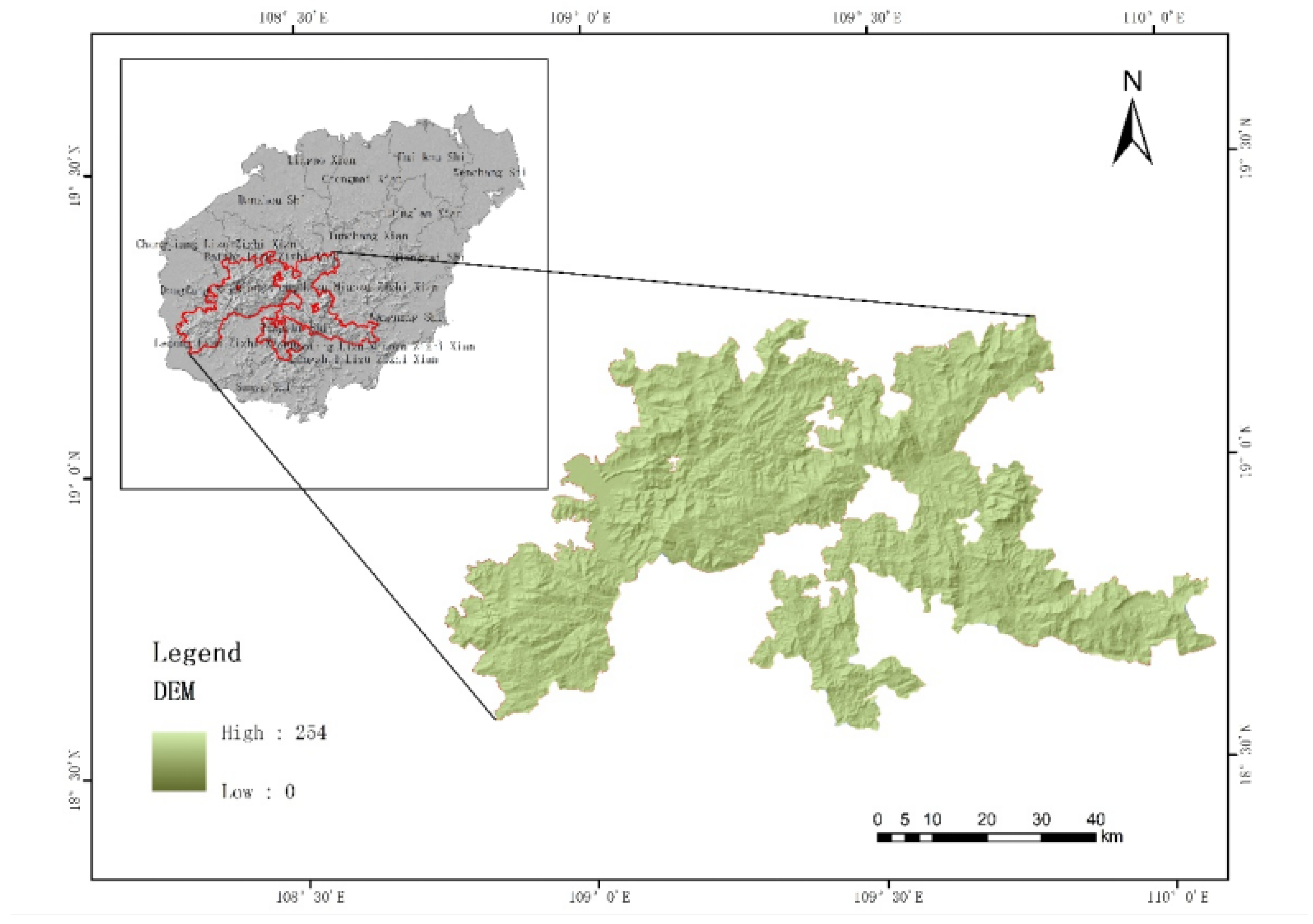
Figure 2.
Research Processes.
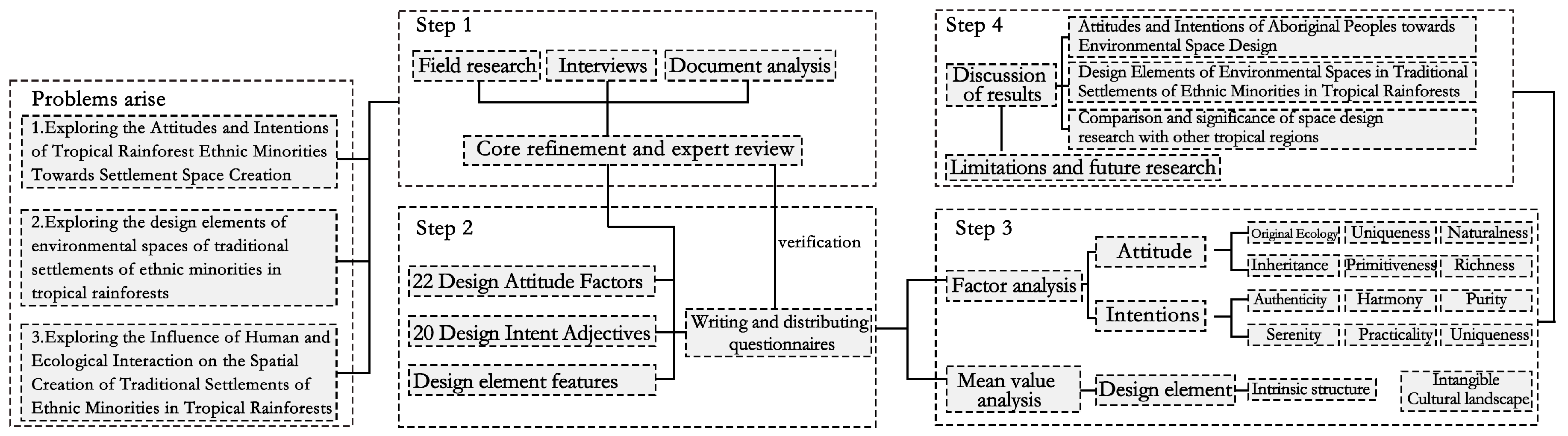

Table 1.
Survey of High-frequency Words in the Traditional Settlement Environmental View of the Li Ethnic Group in the Tropical Rainforest.
Table 1.
Survey of High-frequency Words in the Traditional Settlement Environmental View of the Li Ethnic Group in the Tropical Rainforest.
| Rank | Word | Frequency | Weighted Percentage (%) |
|---|---|---|---|
| 1 | Ecology | 570 | 8.10 |
| 2 | Region | 436 | 6.18 |
| 3 | Characteristic | 430 | 6.14 |
| 4 | Nature | 418 | 5.94 |
| 5 | Culture | 350 | 4.98 |
| 6 | Inheritance | 290 | 4.14 |
| 7 | Local | 282 | 3.78 |
| 8 | History | 218 | 3.06 |
| 9 | Wisdom | 182 | 2.62 |
Table 2.
Survey of High-frequency Words in the Traditional Settlement Environmental View of the Li Ethnic Group in the Tropical Rainforest.
Table 2.
Survey of High-frequency Words in the Traditional Settlement Environmental View of the Li Ethnic Group in the Tropical Rainforest.
| Code | Description |
|---|---|
| FT1 | The traditional Li settlement culture embodies respect and reverence for nature. [28] |
| FT2 | The location selection and architectural style of Li settlements fully reflect adaptation to the natural environment. [29] |
| FT3 | Open street layout with crisscrossing streets and alleys, forming good ventilation. [30] |
| FT4 | Traditional Li architecture mostly uses natural materials. [31] |
| FT5 | Diverse environment of mountains, forests, grasslands, and fields. [32] |
| FT6 | Rich cultural landscapes. [33] |
| FT7 | Protection and inheritance of ecological wisdom. [34] |
| FT8 | Traditional settlements are important carriers of cultural inheritance. |
| FT9 | Protection and inheritance of traditional architectural skills. |
| FT10 | Protection and inheritance of traditional craftsmanship. [35] |
| FT11 | Simple and ancient cultural and artistic style. [36] |
| FT12 | Architecture and planning in traditional settlements should reflect ecological and environmental protection concepts. [32] |
| FT13 | Use simple architectural forms and materials to reduce environmental damage. |
| FT14 | Appropriate size, few traces of artificial carving. |
| FT15 | Traditional settlements and the surrounding natural environment form an ecologically balanced system. [37] |
| FT16 | Traditional settlements are laid out according to local conditions. [37] |
| FT17 | Buildings in traditional settlements often use locally renewable materials. [38] |
| FT18 | Traditional Li architecture is mainly made of bamboo and wood. |
| FT19 | The differences in geographical environment, climate conditions, and resource endowment show unique regional characteristics. [39] |
| FT20 | Unique spatial organization and landscape. [40] |
| FT21 | Unique boat-shaped house architecture. [41] |
| FT22 | The architectural structure and color have no excessive decoration. [41] |
Table 3.
Factor Analysis Results of Spatial Environmental Image in Traditional Settlements.
| Factor Indicator | Factor Loading | Eigenvalue | Contribution Rate (%) |
|---|---|---|---|
| Factor 1: Original Ecology | |||
| Layout adapted to local conditions | 0.667 | 4.922 | 22.215 |
| Ecological balance with the environment | 0.646 | ||
| Simple construction forms and materials | 0.635 | ||
| Locally renewable materials | 0.630 | ||
| Ecological and environmental protection in planning | 0.598 | ||
| Factor 2: Uniqueness | |||
| Unique boat-shaped house architecture | 0.713 | 2.563 | 11.899 |
| Bamboo and wood structure | 0.706 | ||
| Unique spatial organization and landscape | 0.679 | ||
| Unique regional characteristics | 0.661 | ||
| Factor 3: Naturalness | |||
| Adaptation to natural environment | 0.750 | 1.718 | 7.136 |
| Use of natural materials | 0.732 | ||
| Open street layout for ventilation | 0.521 | ||
| Respect and reverence for nature | 0.439 | ||
| Factor 4: Inheritance | |||
| Cultural inheritance through settlements | 0.590 | 1.485 | 5.971 |
| Preservation of architectural skills | 0.561 | ||
| Preservation of ecological wisdom | 0.488 | ||
| Preservation of traditional craftsmanship | 0.469 | ||
| Factor 5: Primitiveness | |||
| Appropriate size, minimal carving | 0.685 | 1.254 | 4.853 |
| No excessive decoration | 0.644 | ||
| Simple and ancient style | 0.601 | ||
| Factor 6: Richness | |||
| Rich cultural landscapes | 0.677 | 0.986 | 4.207 |
| Diverse environments | 0.656 | ||
| Cumulative Contribution Rate | 56.281% | ||
Table 4.
Factor Analysis Results of Spatial Environmental Image in Traditional Settlements.
| Factor Indicator | Factor Loading | Eigenvalue | Contribution Rate (%) |
|---|---|---|---|
| Factor 1: Authenticity | |||
| Natural | 0.712 | 3.045 | 15.241 |
| Ecological | 0.637 | ||
| Rustic | 0.601 | ||
| Leisurely | 0.553 | ||
| Simple | 0.519 | ||
| Factor 2: Harmony | |||
| Neat | 0.719 | 2.819 | 14.105 |
| Rhythmic | 0.687 | ||
| Harmonious | 0.682 | ||
| Gentle | 0.389 | ||
| Factor 3: Purity | |||
| Elegant | 0.781 | 1.379 | 6.891 |
| Fresh | 0.652 | ||
| Simple | 0.647 | ||
| Refreshing | 0.451 | ||
| Factor 4: Serenity | |||
| Spiritual | 0.754 | 1.202 | 5.539 |
| Elegant | 0.671 | ||
| Simple | 0.533 | ||
| Factor 5: Practicality | |||
| Strict | 0.819 | 1.023 | 5.118 |
| Solemn | 0.729 | ||
| Factor 6: Uniqueness | |||
| Unique | 0.944 | 0.944 | 4.721 |
| Personal | 0.617 | ||
| Innovative | 0.580 | ||
| Cumulative Contribution Rate | 52.050% | ||
Table 5.
Example of Design Elements Classification.
| Design Element | Primary Category | Secondary Category |
|---|---|---|
| Intrinsic Structure |
Space Type | Boundary Space Residential Space Living Space |
| Architectural Feature | Individual Form Materials and Structure Layout and Organization |
|
| Road Structure | Road Structure Herringbone Zigzag |
|
| Water System | Surface Water Linear Water Connected Style |
|
| Plants | - | |
| Farmland | Terraced Fields Interwoven |
|
| Intangible Cultural Landscape |
Religion | Totem |
| Custom | Agriculture Festival |
|
| Traditional Craft | Li Brocade Tattoo |
Table 6.
Analysis of the Mean Value of Design Elements in Traditional Li Village Spatial Planning.
| X1 | X2 | X3 | X4 | X5 | X6 | X7 | X8 | |
| N | 20 | 20 | 20 | 20 | 20 | 20 | 20 | 20 |
| Mean | 2.40 | 2.75 | 2.95 | 3.95 | 3.10 | 2.65 | 1.80 | 2.70 |
Table 7.
Analysis of Mean Values for Space Types and Building Characteristics.
| Space Types | Building Characteristics | |||||
| Boundary Space | Residential Space | Living Space | Individual Form | Layout & Organization | Building Materials | |
| N | 38 | 38 | 38 | 38 | 38 | 38 |
| Mean | 2.45 | 3.50 | 3.18 | 2.82 | 3.57 | 3.05 |
Table 8.
Analysis of mean values for road structure, water system, and farmland landscape.
| Road Structure | Water System | Farmland Landscape | ||||||
| Fishbone | Zigzag | Tree-like | Continuous | Surface | Linear | Terraced | Intersected | |
| N | 38 | 38 | 38 | 38 | 38 | 38 | 38 | 38 |
| Mean | 3.01 | 3.56 | 2.56 | 3.29 | 3.34 | 2.97 | 3.34 | 2.97 |
Disclaimer/Publisher’s Note: The statements, opinions and data contained in all publications are solely those of the individual author(s) and contributor(s) and not of MDPI and/or the editor(s). MDPI and/or the editor(s) disclaim responsibility for any injury to people or property resulting from any ideas, methods, instructions or products referred to in the content. |
© 2025 by the authors. Licensee MDPI, Basel, Switzerland. This article is an open access article distributed under the terms and conditions of the Creative Commons Attribution (CC BY) license (http://creativecommons.org/licenses/by/4.0/).
Copyright: This open access article is published under a Creative Commons CC BY 4.0 license, which permit the free download, distribution, and reuse, provided that the author and preprint are cited in any reuse.


