

Submitted:
08 January 2025
Posted:
09 January 2025
You are already at the latest version
Abstract
This article investigates the role of residents as protagonists in participatory processes in architecture, focusing on their impact on the quality of social housing. Over the last ten years, research has examined emblematic cases such as the “Byker Wall” housing complex in Newcastle upon Tyne, UK, and the SAAL (Serviço de Apoio Ambulatório Local — Local Ambulatory Support Service) process in Portugal, both of which highlight the importance of participatory methods in promoting innovative and democratic approaches. Methods include a comparative analysis of these projects and their links to Latin American social housing initiatives, particularly the Uruguayan mutual aid cooperatives that were influential in São Paulo in the 1980s. Results show how participatory architecture can go beyond purely quantitative and productivist outcomes, offering experimental designs that balance architectural quality with social, economic, and environmental considerations. The study concludes by showing how participatory processes can offer a humanized approach to urban space, emphasizing the central role of residents in shaping housing as a democratic and inclusive endeavor.
Keywords:
participatory architecture
; social production of habitat
; co-design
; co-creation
; co-governance
; democracy
1. Introduction
This article is based on research conducted by the author in different contexts over the last decade, focusing primarily on the role of users or residents as protagonists and project agents in participatory processes in architecture. It aims to reflect on the relevance of participatory architecture in housing production, seeking to move beyond a purely quantitative and productivist perspective towards greater architectural and urban quality in social housing developments.
The understanding of recognized participatory methodologies and their social, economic and environmental implications is achieved through a detailed study of emblematic projects in the field of social housing.
The first phase of this research was conducted at the School of Architecture, Planning and Landscape, Newcastle University, UK, between 2014 and 2015. It focused on the study “The User as Protagonist and Design Agent: From Uruguayan Housing Cooperatives to the Byker Wall of Newcastle” [1], which examined the Byker Wall housing complex. Built between 1969 and 1982 in Newcastle upon Tyne, England, the complex consists of approximately 1,800 units and was designed by Swedish-British architect Ralph Erskine and his team with the participation of local residents.
From the outset, the research identified potential connections between this paradigmatic housing complex and Latin American realities, particularly considering the Uruguayan mutual aid cooperatives. Uruguayan cooperatives influenced and inspired several initiatives throughout Latin America, especially in São Paulo in the 1980s.
Following on this initial research, further studies were conducted on the SAAL (Serviço de Apoio Ambulatório Local — Local Ambulatory Support Service) process, developed in Portugal as a response to urban social movements following the “Carnation Revolution”, also known as the 25 April 1974. Between 2018 and 2019, a second phase of research, conducted at the Department of Architecture (DARQ) of the University of Coimbra, was entitled “Sensitive Mediations of Living in the City: Participatory Architecture and the Echoes of the SAAL Process (Portugal, 1975–1976)” [2]. This study compared two European rehousing processes from the late 20th century: the SAAL in Portugal and the Byker Wall housing complex in Newcastle upon Tyne, England.
From this perspective, and taking into account the strategies suggested by Robinson [3], the proposed approach is in line with the concept of comparative urbanism, which is based on new geographies and cultures for theorizing the urban in a globalized world. According to this framework, different cities and places — whether in the global North or South — can offer opportunities to establish connections that contribute to globalize an urban theory [3].
The participatory projects analyzed in this article, while internationally recognized, remain remarkable for their experimental nature and degree of innovation in terms of habitat typologies and urban morphology.
Beyond the visible and tangible qualities of these projects, particularly their architectural creativity, this study also reflects on the utopian ideals and the political, ideological, and cultural dimensions inherent in these initiatives.
By identifying recurring signs and echoes in current debates on participatory projects in Europe — such as Newcastle’s Byker Wall and the SAAL housing complexes — and in Latin America — represented by various projects inspired by Uruguayan mutual aid cooperatives — this study emphasizes a humanized interpretation of urban space. Such an interpretation, as Kellett argues, is not merely a specialized design skill to address societal aspirations, but an essential part of a democratic and participatory process in which residents play a central role [4].
2. Concepts and Theoretical Background
Under the aegis of prefabrication, aimed at large-scale housing production in Europe after the Second World War, several mistakes were made. During this period, the rules of the “first generation” of industrialized building systems relentlessly dominated, often relegating the user to a secondary role. A productivist view prevailed in what Salas classifies as the historical phase of “euphoria and big business” [5].
In the early 1970s, an important conceptual shift occurred in France with the creation of the so-called building performance methodology, supported by research conducted by the CIB (Conseil International du Bâtiment, now the International Council for Research and Innovation in Building and Construction). This shift highlighted, on the one hand, the exhaustion of the productivist model of building industrialization that had been dominant in Europe, and, on the other hand, the need to develop new control tools for managing building production that could respond to the demands of future users and correct the mistakes made during the early post-war reconstruction period [6].
In short, the status gained by the end user of the building process meant that technical standards acquired the status of a social right and were no longer considered as optional by producers [7].
By revisiting the concept of the user (or resident) as a protagonist and design agent in housing projects as a real and viable alternative, it also becomes clear what active or passive roles can be played in participatory experiences, depending on the orientation of the public policies in place. In other words, the relative role of resident’s “involvement” in the project ceases to be relative, according to a perspective of the co-design as essential part and inseparable attribute of a truly emancipatory practice.
In this sense, the proposed study of the role of the user as a protagonist and design agent necessarily involves the study of housing complexes that represent this alternative approach, analyzing their defining characteristics — such as the layout, density, environmental comfort, urban integration, and housing typologies — and, above all, the symbolic-affective aspects and the sense of local belonging that remain among their inhabitants until this day.
2.1. Background of the Research from the Byker Wall of Newcastle (England, 1968-1982)
The Byker Wall (Figure 1), a remnant of 1970s housing production in England, is now considered one of the most emblematic public housing complexes built in the world. Many other housing projects in this category faced social, cultural, environmental, and economic challenges.
Residents of working-class neighborhoods in industrial cities in England, such as Newcastle upon Tyne when the Byker Wall project was initiated, lived in poor conditions. To achieve adequate standards of habitability, it was necessary to provide substantially better housing conditions.
It was in this context that Newcastle City Council commissioned Ralph Erskine to design the Byker Estate, or Byker Wall, for approximately 9,500 residents. According to Copur [8], Erskine’s vision was to plan a diverse physical environment integrated with environmental resources and social facilities [8].
Like many other housing projects, the Byker Wall has experienced periods of decline over time and has deviated from its original design. Recently, however, at a time that was conducive to its redevelopment, the housing complex was added to the official list of buildings of special historic and architectural interest, achieving Grade II status and being recognized as one of the most significant examples of social housing in Britain [8].
Today, almost 60 years after the start of its construction, the Byker Wall still retains its original characteristics, but assumes an iconic dimension as a recognized and successful example of incorporating the concept of sustainability in multiple senses, whether from a technological whether from a social perspective.
In 2018, Byker Wall was voted the best place to live in the UK [9]. The complex won the Great Neighborhood Award from the Academy of Urbanism, a politically independent, non-profit organization based in London that brings together urban planners, thinkers, and professionals in this field. It beat out two other finalists, Smithfield Market in Dublin and the Golden Lane Estate in London. The assessment highlights how the neighborhood has been transformed into a great place to live, even with its socially, culturally, and demographically diverse community. Design played an important role, but the key element was the governance model, strengthened by the involvement of residents in the management of the housing complex.
2.2. Participatory Architecture and the Echoes of the SAAL Process (Portugal, 1975-1976)
In the light of the considerations already presented, the research carried out in Portugal between 2018 and 2019 on the SAAL sought to identify possible connections and establish bases for comparative analyses between the participatory projects that took place in the Byker Wall housing complex, built in Newcastle upon Tyne, England, and the similar process that took place in Portugal. The study fundamentally analyzed the role of the user in the process of creating architectural and urban proposals in each case.
The research project, entitled “Sensitive Mediations of Living in the City: Participatory Architecture and the Echoes of the SAAL Process (Portugal, 1975–1976) [2],” was supervised by Professor José António Oliveira Bandeirinha, director of the DARQ at the University of Coimbra at the time and one of the most recognized scholars of the SAAL process. Among the numerous activities developed by Professor Bandeirinha in relation to the SAAL — as he himself participated in the residual activities of the program after its termination, as a newly enrolled student in the architecture course at the Escola Superior de Belas-Artes in Porto (1978), in what he calls the “aftermath of SAAL” — one of the most important was the scientific coordination of the exhibition “The SAAL Process: Architecture and Participation, 1974-1976”, curated by Professor Delfim Sardo. This exhibition, held at the Serralves Museum in Porto, Portugal, between November 2014 and February 2015, was considered the first major event dedicated to the SAAL, an architectural and political project that emerged shortly after the Carnation Revolution of April 25, 1974.
In the SAAL process, architecture and direct user participation become part of a single process, as in the Byker Wall in Newcastle, both of which seek to meet the needs of disadvantaged populations. Both projects were, in their time, pioneering experiences in Europe, which dialogue perfectly with Brazilian and Latin American realities, as in the case of Uruguayan mutual aid cooperatives, born in the late 1960s and early 1970s, whose model was widely disseminated throughout Latin America, with significant repercussions on the mutual aid projects (Mutirões) carried out in São Paulo, especially in the 1980s and 1990s.
By shifting the term “design” from its original stricto sensu meaning to redefine it as a tool for dialogue between the architect and the resident, the user is introduced as a protagonist and agent in participatory design processes. This dialogue began with the first initiative known in São Paulo, the Vila Nova Cachoeirinha mutual aid project, started in 1979 under the direct influence of the Uruguayan cooperatives. The author participated between 1987 and 1992 as part of the technical team advising the Vila Nova Cachoeirinha community, responsible for the implementation of the lightweight prefabrication technology used in the final construction phase of this housing project.
It is believed that the practices adopted in the 1970s by Ralph Erskine and his team in the design of the Byker Wall in Newcastle, or by the architects involved in programs such as the SAAL in Portugal, as well as the Uruguayan cooperatives that inspired the São Paulo collaborative efforts in the 1990s, are driven by the same type of aspiration that links the production of social habitat to democratic and participatory processes in which users play a central role.
2.3. Remote Connections and Common Paths: The Uruguayan Housing Cooperatives
Benjamín Nahoum, professor and researcher at the University of the Republic of Uruguay and advisor to Uruguayan Federation of Mutual Housing Cooperatives (FUCVAM – Federación Uruguaya de Cooperativas de Vivienda por Ayuda Mutua), in his article “Four decades of housing cooperatives in Uruguay: Changes and permanencies” [10], reviews the work of the mutual aid housing cooperatives that emerged in the country between the late 1960s and early 1970s, creating a model that was later replicated in various Brazilian housing programs, resulting in the construction of thousands of housing units in the early 1990s, both by the Municipality of São Paulo and later by the Housing and Urban Development Company of the State of São Paulo (CDHU – Companhia de Desenvolvimento Habitacional e Urbano do Estado de São Paulo) .
These achievements, whose architectural and urban quality is widely recognized and has become the subject of many academic studies, are characterized by the participation of the residents in the planning and design of the buildings.
On the other hand, Nahoum [10] also argues that it is not possible to think about self-management by the users (pobladores) without the necessary preparation to carry out administrative tasks and decision-making processes, and without multidisciplinary support that both forms and trains. This was the role assigned by the law — the National Housing Law of Uruguay (Nº 13.728 of 1968) — to the technical institutes, composed of architects, engineers, lawyers and other professionals, without which mutual aid cooperativism would not have reached the level of development it did [10].
The origins of the Uruguayan cooperative system date back to the 1960s, and by 2010 its production had already reached 30,000 units built in a country of 3.4 million inhabitants [10]. Today, the so-called 4th generation of housing cooperativism in Uruguay represents the system in the contemporary era, and approximately “40% of public funding for housing is allocated to cooperatives, which accounts for an estimated 10,000 housing units over the next 45 years” [11].
However, beyond its significant quantitative achievements in recent decades, the Uruguayan housing cooperative movement has also become one of the most relevant initiatives in the field of Latin American architecture. More than just generating good architectural and urban projects, Uruguayan cooperativism represented the creation of a concrete alternative for the construction of social habitat, the promotion of self-management in social movements, and the implementation of collective ownership of urban land, actions that have a fundamental impact on the construction of citizenship itself.
In order to draw a parallel between European and Latin American participatory experiences, it is important to understand the architectural thinking behind each of them. It is no coincidence that the emergence of the Uruguayan housing cooperative movement coincided with the affirmation in Europe of a line of thought that, as a response to the social failure of the large housing estates after the Second World War and the crisis of the idea of total control of the environment by architects, focused on the recovery of local values and the participation of residents in the definition of their living spaces.
Of course, it is not possible to attribute the emergence of Uruguayan cooperatives solely to what was happening in the European context, but it is important to note the near simultaneity of participatory experiences both in Latin America (Uruguayan cooperatives) and in Europe (Newcastle’s Byker Wall in England and the SAAL in Portugal).
In an exhibition at the Brazilian Housing Museum (Museu da Casa Brasileira, São Paulo, June to August 2015), entitled “Housing Cooperatives in Uruguay – Half a Century of Experiences” [12], it is explicitly stated that “the pioneering cooperatives in Uruguay (1966) were a few years ahead of the participatory experiences of Erskine or Kroll, or the theoretical productions of Habraken or Alexander” [12].
According to the same text, taken from the exhibition at the Brazilian Housing Museum [12], the architects who participated in the cooperative system from the beginning recognize “the alignment with these trends, but they are also heirs of a generation that adapted the principles of modern architecture to the cultural and geographical reality of the country, such as Mario Payssé, Rafael Lorente, Ernesto Leborgne and Eladio Dieste” [12].
Therefore, it is not an exaggeration to establish possible and perceptible connections between the participatory projects carried out in Brazil, directly influenced by the Uruguayan self-managed cooperatives, the Byker Wall in Newcastle (1969-1982) and the model inspired by the SAAL (1975-1976).
3. Materials and Methods
From a theoretical point of view, this article is primarily based on the concept of “comparative urbanism” proposed by Robinson [3], according to which, in an increasingly globalized world, urban theory can consider the hypothesis that different cities and places, regardless of their location, can offer opportunities for establishing connections [3].
Research on participatory processes applied to housing architecture began with a comparative study of two resettlement processes that took place in Europe in the 1970s: the Byker Wall in Newcastle upon Tyne, UK (1969-1982) and the SAAL process (1975-1976) in Portugal.
In the SAAL, the so-called “technical brigades” or technical teams of the SAAL, mostly composed of young architects and students, played a prominent role in developing projects for degraded areas of Portuguese cities. On the basis of diagnoses made by the technical brigades on the housing situation of each neighborhood to be intervened, the interaction between the population and the technical teams was made possible, with the direct participation of the residents’ associations in the development and management of architectural and urban projects carried out during the existence of the SAAL and even after, under the influence of the participatory methodologies developed there.
In the case of the Byker Wall, in addition to the bibliographical sources already cited in the research references, the research was primarily based on field surveys and testimonies collected during contextual interviews (walking interviews) conducted between September 2014 and March 2015. Due to the size of the complex, with more than 1,800 housing units, and especially due to the typological diversity of the units, which made even the description of them complex, it was decided from the outset to conduct contextual and semi-structured interviews through informal face-to-face dialogues with residents, preferably living in different types of housing.
The design parameters that guided the fieldwork conducted at Byker Wall became an even more relevant approach when the researcher himself, two months after his arrival in Newcastle upon Tyne, in September 2014, decided to move into the housing complex, where he lived for about four months.
Thus, as discussed earlier, the design parameters considered in the field inspections and contextual interviews, which include layout, density, environmental comfort, and especially user satisfaction, became part of the researcher’s own daily experience.
From this exploratory study, based on the spatialization of data through graphic (sketches) and photographic records of information, considering the local scale and everyday scenes, the aim was to put into practice what Lansky called a spatialized ethnographic form [13].
The use of spatialized ethnography during the contextual interviews (walking interviews) allowed the researcher to understand the past from the present through the narratives of place and individual and collective memories.
In addition to qualitative interviews with residents of Byker Wall, interviews were also conducted with two of the architects from Ralph Erskine’s original team, Roger Tillotson and Michael Drage, who were directly involved in the use of participatory methods in the initial development of this housing project.
Specifically, for the SAAL, the study began with a review of existing literature, followed by visits to housing complexes that are representative of the design references documented in books, papers, and academic articles, such as the Quinta da Malagueira neighborhood in Évora (Portugal), designed by architect Álvaro Siza Vieira.
An important clarification is needed regarding the Quinta da Malagueira project. This project, initiated in 1977, is not strictly speaking a SAAL project, since the program was terminated in 1976. However, it is undeniable that the selection of Siza Vieira to develop the Malagueira project, made by Nuno Portas, then Secretary of State for Housing and Urbanism, considered the architect’s trajectory within the SAAL program in the city of Porto, carrying with it the political contours and methodologies implicit in participatory architecture.
In the literature review, in addition to the book The SAAL Process and Architecture on April 25, 1974, by Bandeirinha [14], a second fundamental reference for understanding the SAAL process was considered: the White Book of SAAL [15]. The White Book, published in 1976, aimed to record and disseminate the work carried out in the program between 1975 and 1976, as well as to denounce the precarious conditions in which the most vulnerable populations in Portugal continued to live after the end of the SAAL program.
In order to develop the empirical basis of the research, as mentioned above, visits were made to six housing complexes that served as design references for the SAAL program. The criteria for the selection of these six complexes were based on the geographical distribution of SAAL operations, which can be divided into three main groups: North, Lisbon and Central-South, and Algarve.
From the selected sample, the aim was to promote a contemporary reflection on the SAAL process, seeking to identify, from an external perspective, its contradictions, echoes, and repercussions on architecture.
The fieldwork included visits to seven housing complexes considered representative of the SAAL program, as follows:
- Relvinha (Coimbra): Designed by Carlos Almeida (1st phase) and Rogério Alvarez (2nd phase) – 70 units.
- Malagueira (Évora): Designed by Álvaro Siza Vieira – 1,200 units.
- Catujal (Lisbon): Designed by Francisco Keil do Amaral – 481 units.
- Curraleira (Lisbon): Designed by José António Paradela and Luís Gravata Filipe – 938 units.
- Quinta das Fonsecas and Quinta da Calçada (Lisbon): Designed by Raul Hestnes Ferreira – 615 units.
- Casal das Figueiras (Setúbal): Designed by Gonçalo de Sousa Byrne – 420 units.
- Bouça (Porto): Designed by Álvaro Siza Vieira – 257 units.
Finally, it is important to emphasize that the research conducted using ethnographic techniques, combined with visual inspections and field surveys, allowed the identification of the indelible signs or echoes of the original processes of participatory projects that took place in the Byker Wall and the SAAL. For this purpose, the ethnographic approach was considered an essential tool for a deeper immersion into the daily life of the community. Through semi-structured contextual interviews and informal, personal dialogues with residents in each of the contexts studied, the aim was to move beyond the vision of designing spaces for hypothetical users and to bring the researcher-architect closer to the subject through an ethnography of spaces. To this end, the spatialization of data was carried out through graphic and photographic records of information, considering the local scale and everyday scenes, exploring a humanized reading of urban space, alternating positions, perspectives and spatialized graphic records.
For the researcher, it is the implicit imagination in the comparative study proposed among participatory projects, with alternating positions, and the conceptual association or empirical connectivity that can help build a new story, a critical analysis that can, over time, become an experience to be narrated, in other words, within the inexhaustible fullness of empirical worlds that find in ethnographic practices a way to reconnect, in this particular case, architecture and urbanism to the broader field of applied social sciences to which they belong.
4. Results and Discussion
4.1. Emergence of New Neighborhood Bonds
The ethnographic approach adopted as the core methodology in the research project on the Byker Wall housing complex allowed for immersion in the life of the community. The researcher lived in the complex for four months, which led to the discovery of new bonds of neighborhood and solidarity between long-time and new residents, especially among African immigrants. These bonds, revealed through the interviews, radically changed the negative scenario in which the complex had been immersed during the first half of the 2000s.
As Yarker suggests, a pertinent question arises: “What happens when many of the material and social elements that have made a place ‘home’ or ‘Paradise’ are no longer there and a place has been transformed physically as well as re-imagined by somebody else?” [16]. To this question another one could be added: — How might immigrants, such as the Finnish photographer Sirkka-Liisa Konttinen, who moved to Byker in the late 1960s, interpret and adopt local meanings for themselves?
The answers to such questions could help to understand how recent immigrants, represented by the Afro-descendant community living there, manage to maintain an identity linked to the old Byker neighborhood, which is continued through the participatory process of the Byker Wall project, built on the same shared values of long-time residents, as Yarker comments [16].
4.2. The Changing Nature of Identity and Belonging
As people move or migrate to new places, or as the surrounding places change, paraphrasing Yarker [16], other questions arise: — How do people make sense of the changes taking place in our cities? How do they live in the midst of these changes, and how do they reconcile these changes with the relative stability of their daily lives? In short, what is the nature of local belonging and the emotional significance of cities today?
The community living in the old Byker neighborhood, which Sirkka-Liisa Konttinen documented through photography and writing in the 1970s [17] and again in 2008 [18], lived in a place in transition. As Martins argues, time interferes with the notion of space, as memories of the past lend strong sentimental values to places and spaces today [19]. According to Martins, space, places, and landscapes play a crucial role in shaping individual memory and, by extension, collective human memory.
In this sense, if we look at the community now living at the Byker Wall, it could be inferred that they live in both the present and the past, in relation to “the memorial remnants of the past and future projections based in part on the repetition of the experience of past actions” [1].
4.3. Memory and Collective Identity in the Byker Wall
In the Byker Wall, a number of material and social elements compete to maintain a collective memory. These elements include the original layouts, street names, buildings, and remnants of historic buildings. As Martins [19] notes, this collective memory is largely governed by mental time rather than chronological perception. He goes on to say that “the study of memory as a problem is crucial to understanding how identities are nurtured by a sense of place”.
Through the narratives encouraged during the contextual interviews conducted by the author at the Byker Wall, individual and collective memories were activated. These memories, spatially and temporally situated, were a result of the researcher’s immersion as a participant-observer in this context. These testimonies are regularly organized in the form of spatialized linear narratives that serve as key elements in the process of identity formation.
Using ethnographic techniques that combine fieldwork and contextual interviews, it was found that it was the individuals and their memories that gave to the Byker Wall the meaning of place that the research sought to understand.
The current residents of the Byker Wall continue to maintain the identity built in the old working-class neighborhood of Byker. While cultivating values of solidarity similar to those of long-time residents, they also bring their own cultural and family roots. They have taken ownership of the democratic and participatory process in which they have become also protagonists.
4.4. Understanding the SAAL Program and its Legacy
In the case of the SAAL program, a crucial approach was made through a review of the available literature, especially that found at the 25th of April Documentation Center, located at the Center for Social Studies (CES) of the University of Coimbra. The consultation of the bibliographical material, together with the numerous project references documented in books, reports, works and academic articles, helped to structure the planned field surveys.
The main reference was the book The SAAL Process and Architecture on April 25, 1974, by Bandeirinha [14]. The book collects the records of 91 projects carried out within the framework of the SAAL, to which were added two other projects that, although created before April 25, were later transformed into SAAL operations. The drawings presented in the publication helped to understand the main features of the housing units and their urban integration, allowing a reading of the solutions in relation to territorial contexts, scales and typological options, as revealed by the author.
Another important reference was the so-called SAAL White Book [15]. As recounted by Bandeirinha [14], the VI National Council of SAAL, meeting in November 1976, decided to create a White Book to document and publicize the work carried out in the program from 1975 to 1976, highlighting the precarious living conditions of the most vulnerable populations in Portugal. Shortly thereafter, some architects from Lisbon and Porto, linked to local support brigades or administrative services, began to organize the data collected in order to quantify the work done and present the results achieved. Soon after, the SAAL White Book 1974-1976 [15] was published.
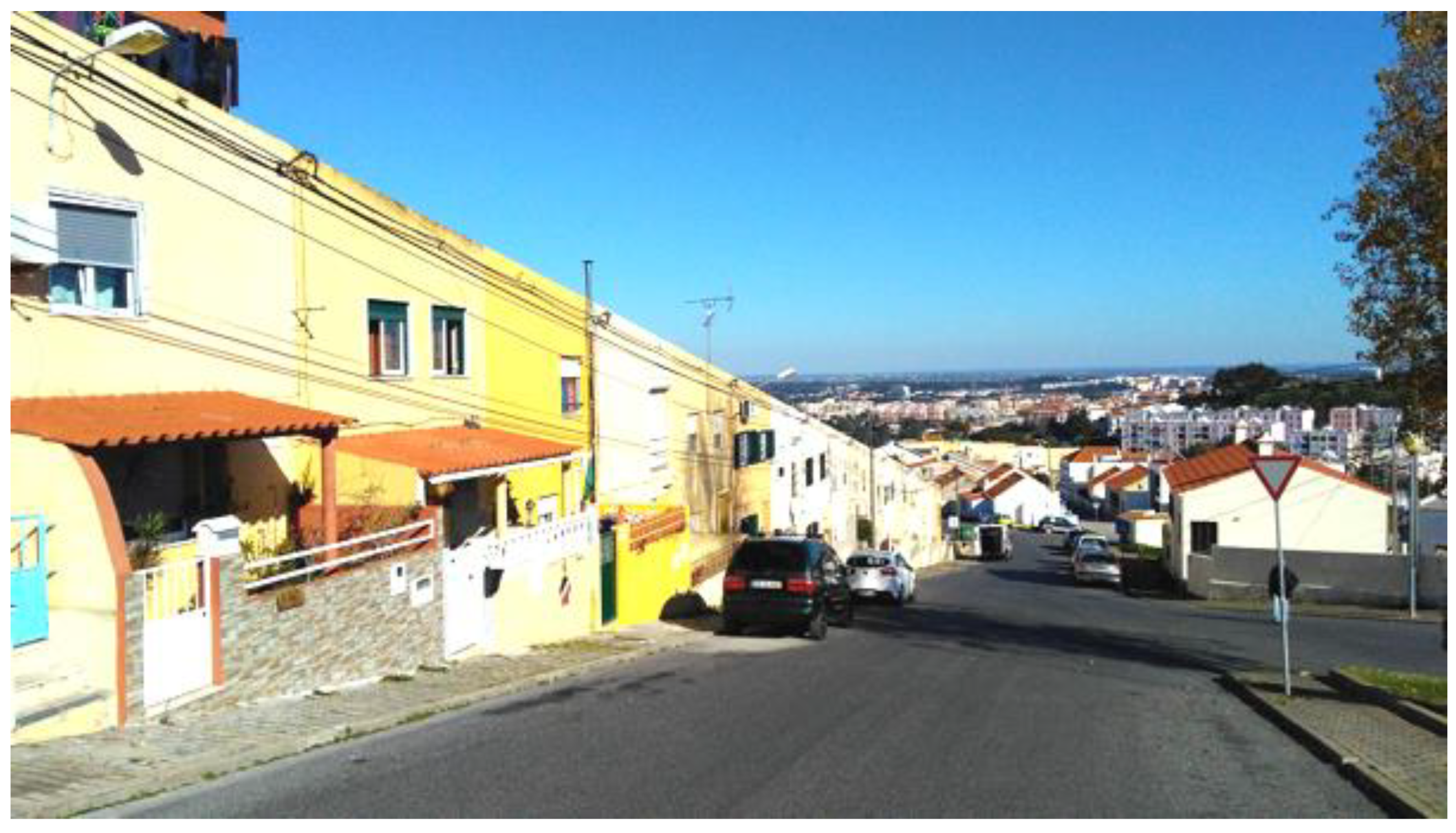
Through visits to housing developments of the period, interviews with current residents, community leaders, and architects involved in the SAAL program, it was possible to study a representative set of SAAL works, including: Bouça (Porto) and Quinta da Malagueira (Évora), both designed by Siza Vieira; Casal das Figueiras (Setúbal), designed by Gonçalo de Sousa Byrne (Figure 2); Curraleira-Embrechados (Lisbon), with projects by José António Paradela and Luís Gravata Filipe; Quinta das Fonsecas and Quinta da Calçada (Lisbon), both by Raúl Hestnes Ferreira; and Catujal (Lisbon), with a project by Francisco Keil do Amaral.
Finally, in parallel with the construction of the theoretical and project framework for the research, an ethnographic approach — already used in the research conducted in the Byker Wall in 2014 — was used, which involved immersion in the life of the community living in the housing complex in the Relvinha neighborhood, located in Coimbra, in the Parish of Eiras.
In the Relvinha neighborhood, the SAAL program, created after the revolution by the then Secretary of State for Housing and Urbanism, Nuno Portas, provided technical and financial support to the residents, as Bandeirinha recounts in his book [15]. It is believed that significant steps were taken in the Relvinha neighborhood to identify the echoes of the original participatory process of the SAAL program, similar to what had occurred five years earlier during the research conducted in Newcastle’s Byker Wall.
5. Conclusions
Participation is a prominent subject in the current debate on architecture and urbanism. Participatory processes have been presented as a way to address the social and political dimensions of projects of collective interest, giving voice to the opinions and desires of users, with the aim of ensuring greater citizenship and democracy in the design of housing and urban spaces.
In a recent series of articles developed by Nikos Salingaros et al. [20], the authors propose a reflection based on a system of best practices for social housing, based on experience and applicable in general situations. With this intention, they present examples of appropriate housing solutions in the Latin American context that focus on long-term sustainability and encourage residents to put down roots in their built environment. The authors refer specifically to the work of Christopher Alexander, who emphasizes participation as a fundamental principle.
Throughout his long career as an architect and urban planner, Christopher Alexander has been commissioned by various governments to design and build social housing. Often in contrast to the project requirements set by the government agencies that hired him, Alexander insisted on resident participation as the only way to create built forms that would be “loved” by their inhabitants [20]. In his projects, it was crucial to involve future residents in the planning of their living space, the configuration of access points and common areas, which was not always appreciated by authorities who feared that this would seriously weaken their control over urban guidelines.
Similarly, in 1969, the British-Swedish architect Ralph Erskine did not propose a “master plan” but rather a “plan of intentions” and submitted it to the city council of Newcastle upon Tyne (UK) for the construction of the famous Byker Wall housing complex (1970), which replaced the old working-class district of Byker [1].
In general, the plan was to create a complete and integrated living environment in the broadest sense, at the lowest possible cost to the residents, in close collaboration between the project team and the residents. The goal was to avoid disrupting family and neighborhood ties, as well as the lifestyle standards valued by the people of Old Byker.
In addition to relocating the population of Byker (Old Byker), Erskine maintained an overall planning vision for the work to be undertaken by the City Council and private companies with their architects working on behalf of public agencies and institutions. These developments included new schools, shelters for the disabled, health centers, clinics, libraries, churches and other buildings.
Studying the growth and decline of housing in Britain in the 1970s and 1980s — a context in which the innovative Byker Wall proposal emerged — raises several recurring themes in the contemporary debate on housing production in general, and in Latin America in particular. These include the magnitude of the problem to be quantitatively addressed, the need to find quick solutions, the hope that technology can provide answers, and the need to maximize available resources [21].
A productivist view, similar to that which still prevails in official programs in countries such as Brazil, Chile and Mexico, is also criticized by Kellett in the British context of post-war reconstruction, stating: “An arithmetic approach is too simplistic” [22].
The reflections presented in this article aim to provide a counterpoint to this productivist paradigm, which usually works in opposition to residents’ participation in housing design.
By studying the role of residents in the design process and analyzing some of the most emblematic and well-known cases of these practices, such as the Byker Wall and the mutual-aid housing production processes of Uruguayan housing cooperatives and the SAAL process, as stated by the architect Nuno Portas, the goal is to “break the distance between residents and the decision-making process, even if [in the case of SAAL] this meant multiplying the number of technicians needed to engage with the community” [23]. He justifies this by saying, “[...] it was no longer possible to resort to the easy adoption of a standard project, as was often done in many European countries at the time — standardized type projects made by central, regional or even local administrations, which were supposed to serve all communities regardless of their characteristics” [23].In this sense, the successful experiences of the Byker Wall and the mutual-aid housing production processes in Uruguayan cooperatives and the SAAL process become essential subjects of study, where ethnography applied to the observation of architecture and place becomes an indispensable tool for the type of analysis proposed here.
The study of the Byker Wall housing complex allowed for a better understanding of how user participation in design took place, and the symbolic-affective dimensions achieved by this social development among its inhabitants, the echoes of which are still felt today.
Understanding the SAAL process, in turn, made it possible to examine the extent to which the participatory character corresponds to the necessary rigor in the act of design. In many of the SAAL housing projects studied, such as the “Casal das Figueiras” (Figure 2), designed by Gonçalo Byrne, to name one example, an ethically and politically considered architectural practice committed to the communities involved did not contradict or conflict with the rigor of the project.
In sum, there is a common thread that links the Byker Wall to projects like SAAL and the remarkable achievements of Latin American mutual-aid housing cooperatives: the Participatory Architecture.
Funding
This research was funded by the São Paulo Research Foundation (FAPESP), grant numbers 2014/06102-2 and 2018/11546-8.
Data Availability Statement
Data is contained within the article.
Acknowledgments
The author expresses sincere gratitude to the São Paulo Research Foundation (FAPESP), one of the leading agencies for the promotion of scientific and technological research in Brazil, for granting the Research Internship Abroad (RIA) that made the research projects underlying this article possible.
Conflicts of Interest
The author declares no conflict of interest.
Short biography of the author
Paulo Eduardo Fonseca de Campos (Santos, Brazil, 1958) is a Senior Associate Professor at the School of Architecture, Urbanism, and Design of the University of São Paulo (FAU-USP). He was Visiting Professor at the University of Coimbra (2018-2019) and Visiting Researcher at the University of Newcastle (2014-2015). He holds a degree in Architecture and Urbanism from PUC-Campinas (1981), a M.Sc. degree in Civil and Urban Engineering from EP-USP (1989), and a Ph.D. in Architecture and Urbanism from FAU-USP (2002). He has been an Associate Professor at FAU-USP since 2016. He has served as a full member of the Brazilian National Committee for the Technological Development of Housing – Ministry of Cities (2007-2015), and as a Housing Technology Advisor for UNDP – United Nations Development Programme (2006-2007).
References
- Fonseca de Campos, P.E. Design Arquitetônico: Uma abordagem projetual com foco no usuário, como protagonista e agente de projeto, ou... Das cooperativas de habitação uruguaias ao dissenso modernista do Byker Wall. Associate professorship thesis. University of São Paulo, São Paulo, Brazil, 2016. Available online: https://www.teses.usp.br/teses/disponiveis/livredocencia/16/tde-28082017-095852/en.php (accessed on 15 December 2024).
- Fonseca de Campos, P.E. Mediações sensíveis do habitar a cidade: arquitetura participativa e os ecos do Processo SAAL – Serviço de Apoio Ambulatório Local (Portugal, 1975–1976). The São Paulo Research Foundation (FAPESP), São Paulo, Brazil, Scientific Report, 2019.
- Robinson, J. Starting from anywhere, making connections: globalizing urban theory. Eurasian Geography and Economics 2017, 57, 643–657. [Google Scholar] [CrossRef]
- Kellett, P. ¿Tecnología inapropiada? Experiencias de vivienda social en Gran Bretaña. Informes de la Construcción 1990, 42, 55–62. Available online: https://informesdelaconstruccion.revistas.csic.es/index.php/informesdelaconstruccion/article/view/1443/1603 (accessed on 15 December 2024).
- Salas, J. Alojamiento y tecnología: ¿Industrialización abierta? Madrid: Eduardo Torroja Institute, 1981.
- Fonseca de Campos, P.E. Industrialização da construção e argamassa armada; perspectivas de desenvolvimento. Master’s thesis. University of São Paulo, São Paulo, Brazil, 1989.
- Fonseca de Campos, P.E. Norma de desempenho de edificações: uma contribuição para o desenvolvimento do conceito de normativa exigencial aplicado à construção civil. Revista Concreto & Construção, 2013, 41, 26–31. Available online: https://www.ibracon.org.br/publicacoes/revistas_ibracon/rev_construcao/rev_construcao_70.htm (accessed on 15 December 2024).
- Copur, U. Towards sustainable regeneration initiatives for Byker Wall, Newcastle upon Tyne, Bristol. Undergraduate Final Project. Roger Williams University, Bristol, USA, 2008.
- Stickings, T. Byker Wall Estate named as the best neighbourhood in the UK. The Chronicle, 10 November 2017. Available online: https://www.chroniclelive.co.uk/news/north-east-news/byker-wall-named-best-neighbourhood-13881931 (accessed on 15 December 2024).
- Nahoum, B. Cuatro décadas de cooperativas de vivienda en Uruguay; Cambios y permanencias. Revista OSERA, 2010, 3, 1–11. Available online: https://publicaciones.sociales.uba.ar/index.php/osera/article/viewFile/5724/4644 (accessed on 15 December 2024).
- Santos, B.A. A experiência cooperativista de habitação no Uruguai: um breve panorama histórico. ArchDaily Brasil, 9 September 2020. Available online: https://www.archdaily.com.br/br/947330/a-experiencia-cooperativista-de-habitacao-no-uruguai-um-breve-panorama-historico (accessed on 15 December 2024).
- Del Castillo, A.; Vallés, R.; Faria e Silva, L.O.; Otero, R. Cooperativas habitacionais no Uruguai – meio século de experiências (Exhibition). São Paulo: Brazilian House Museum; School of Architecture of Montevideo; School of the City (SP/Brazil), 2015.
- Lansky, S. Na cidade, com crianças: uma etnografia espacializada. Ph.D. thesis. Federal University of Minas Gerais, Belo Horizonte, Brazil, 2012. Available online: https://repositorio.ufmg.br/handle/1843/BUOS-8UQJDD (accessed on 15 December 2024).
- Bandeirinha, J.A.O. O Processo SAAL e a Arquitectura no 25 de Abril de 1974. Coimbra: Coimbra University Press, 2007.
- SAAL. Livro Branco do SAAL 1974–1976. Vila Nova de Gaia: SAAL National Council, 1976.
- Yarker, S.K. Belonging in Byker; The nature of local belonging and attachment in contemporary cities. Ph.D. thesis. Newcastle University, Newcastle upon Tyne, UK, 2014. Available online: https://theses.ncl.ac.uk/jspui/handle/10443/2619 (accessed on 15 December 2024).
- Konttinen, S.L. Byker Revisited: Portrait of a Community. Newcastle upon Tyne, UK: Northumbria University Press, 2009.
- Konttinen, S.L. Byker. Hexham, UK: Bloodaxe Books Ltd., 1985.
- Martins, R.N. Entre Narrativas de lugar e memória: a importância de crescer o espaço na identidade do sujeito. Geo-Working Papers 2013, 23, 5–22. Available online: http://www.lasics.uminho.pt/ojs/index.php/geoworkingp/article/view/1850 (accessed on 15 December 2024).
- Salingaros, N.; et al. Habitação social na América Latina: desenho capaz de estabelecer “pertencimento emocional”. ArchDaily Brasil, March 2019. Available online: https://www.archdaily.com.br/br/913159/habitacao-social-na-america-latina-desenho-capaz-de-estabelecer-posse-emocional (accessed on 15 December 2024).
- Kellett, P.; Tavernor, R.W. The Rise and Fall of Multi-Storey Social Housing in Britain. Proceedings of XXIII IAHS World Housing Congress – Excellence in housing: prospects and challenges. Suntec City, Singapore; 1995. [Google Scholar]
- Kellett, P. ¿Tecnología inapropiada? Experiencias de vivienda social en Gran Bretaña. Informes de la Construcción 1990, 42, 55–62. [Google Scholar] [CrossRef]
- Portas, N. O Processo SAAL: Entre o Estado e o Poder Local. Revista Crítica de Ciências Sociais 1986, 18, 635–644. Available online: https://www.ces.uc.pt/publicacoes/rccs/artigos/18%20-%2019%20-%2020/_Nuno%20Portas%20-%20O%20Processo%20SAAL,%20Entre%20o%20Estado%20e%20o%20Poder%20Local.pdf (accessed on 15 December 2024).
Figure 1.
Partial view of the north façade of the Byker Wall housing complex (Newcastle upon Tyne, 1970) – Photo by the Author, 2014.
Figure 1.
Partial view of the north façade of the Byker Wall housing complex (Newcastle upon Tyne, 1970) – Photo by the Author, 2014.
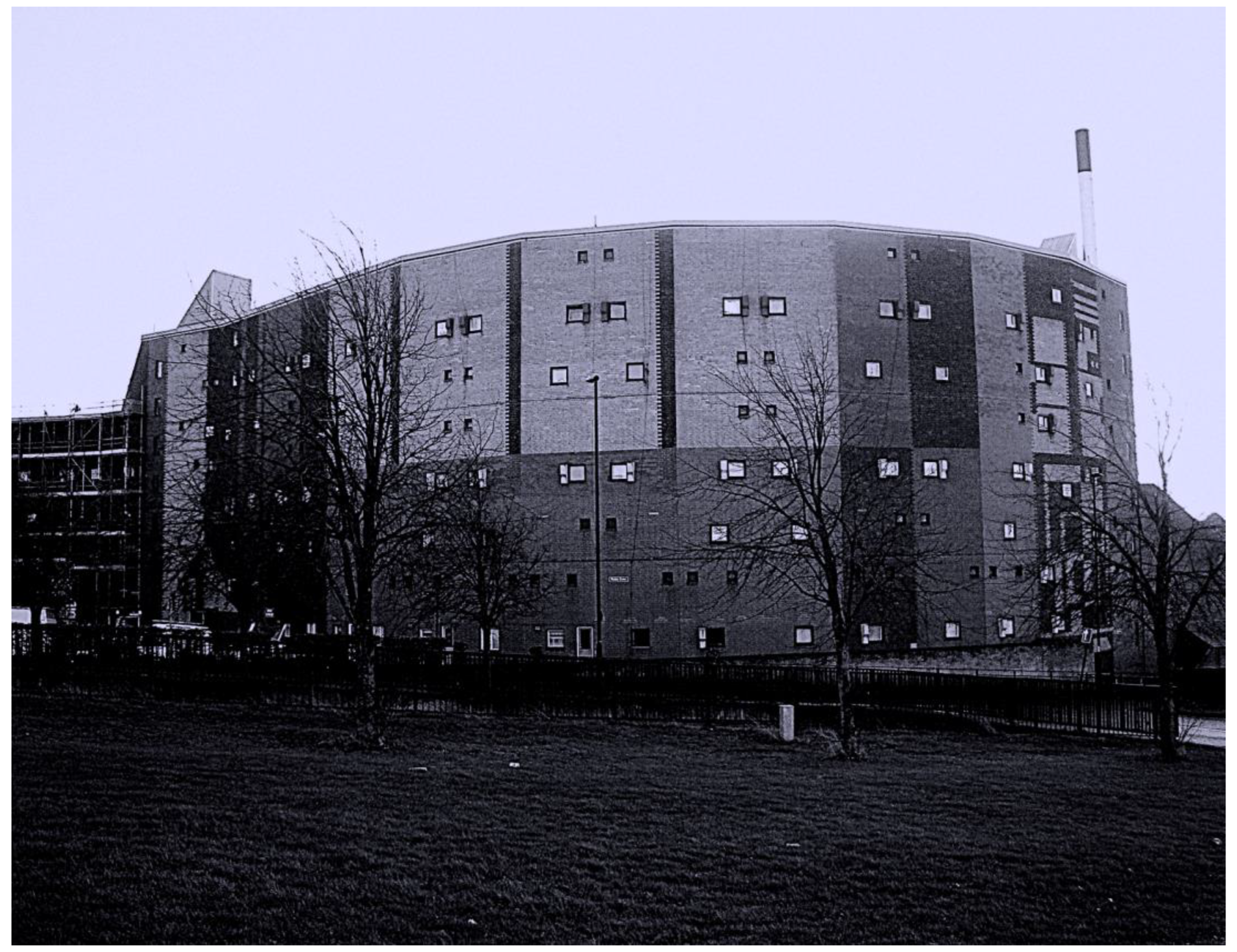
Figure 2.
Casal das Figueiras Housing Complex (Setúbal) – Photo by the Author, 2019.
Disclaimer/Publisher’s Note: The statements, opinions and data contained in all publications are solely those of the individual author(s) and contributor(s) and not of MDPI and/or the editor(s). MDPI and/or the editor(s) disclaim responsibility for any injury to people or property resulting from any ideas, methods, instructions or products referred to in the content. |
© 2025 by the authors. Licensee MDPI, Basel, Switzerland. This article is an open access article distributed under the terms and conditions of the Creative Commons Attribution (CC BY) license (http://creativecommons.org/licenses/by/4.0/).
Copyright: This open access article is published under a Creative Commons CC BY 4.0 license, which permit the free download, distribution, and reuse, provided that the author and preprint are cited in any reuse.


