Preprint
Review

This version is not peer-reviewed.

Review: Overview of Organic Cathode Materials in Lithium-Ion Batteries and Supercapacitors

A peer-reviewed article of this preprint also exists.

Submitted:

01 January 2025

Posted:

08 January 2025

You are already at the latest version

Abstract

Organic materials have emerged as promising candidates for cathode materials in lithium-ion batteries and supercapacitors, offering unique properties and advantages over traditional inorganic counterparts. This review explores the utilization of organic compounds as cathode materials in energy storage devices, focusing on their application in lithium-ion batteries and supercapacitors. The review looks into various types of organic materials, organosulfur compounds, organic free radical compounds, organic carbonyl compounds, conducting polymers, and imine compounds. The advantages, challenges, and ongoing developments in this field are explored, highlighting the potential of organic cathode materials in achieving higher energy density, improved cycling stability, and environmental sustainability. The comprehensive analysis of organic cathode materials provides insights into their electrochemical performance, electrode reaction mechanisms, and design strategies such as molecular structure modification, hybridization with inorganic components, porous architectures, conductive additives, electrolyte optimization, binder selection, and electrode architecture for enhancing their efficiency and performance. Moreover, future research in the field of organic cathode materials should focus on addressing current limitations such as low energy density, cycling stability, poor rate capability, and potential safety concerns, and advancing their performance. This includes enhancing conductivity, optimizing synthesis methods, improving structural stability, addressing capacity fading and cycle life issues, exploring new redox-active organic compounds, and paving the way for the next generation of high-performance energy storage devices. Additionally, the development of scalable and cost-effective manufacturing processes for organic cathode materials is crucial for their commercial viability.

Keywords: 
;  ;  ;  ;  ;  ;  ;  

1. Introduction

There is an urgent need for sustainable energy storage batteries to efficiently use renewable energies due to global concerns about energy challenges and environmental issues [1]. Current battery materials depend heavily on non-renewable minerals, which could restrict their extensive use due to significant economic and resource limitations. Redox-active organic compounds emerge as promising alternatives for sustainable energy storage materials, owing to their advantages such as widespread availability, eco-friendliness, ease of processing, light weight, redox stability, a wide range of structures, resource recyclability, potential flexibility, and affordability. Organic electrode materials, particularly as cathodes in lithium-ion batteries (LIBs), are gaining attention for their structural diversity and as potential replacements for inorganic battery materials [1,2].
Additionally, because organic materials typically contain light components and structurally adaptable redox-active groups, it is advantageous to modify their chemical structures to produce high-capacity battery materials [1]. Over the past decade, organic cathode materials (OCMs), made from common and lightweight elements like carbon, hydrogen, oxygen, nitrogen, and sulfur, have risen in popularity as both an alternative and a complement. Besides being resource-sustainable and eco-friendly, OCMs show tremendous promise in terms of electrochemical performance. This includes aspects like energy density, cost efficiency, and the ability to extend applications, largely due to the versatility, adaptability, and customizability of their structures [3].
Organic cathode materials represent a promising category of energy storage materials with broad application potential. They stand out compared to inorganic cathode materials due to several benefits: they possess high theoretical specific capacities, are environmentally friendly, offer flexible options for structural design, provide high safety levels, and are naturally abundant [4]. However, turning these potential applications into practical reality remains a significant challenge. Despite numerous studies exploring various structures, finding promising organic cathode materials that simultaneously offer high energy density, stable cycling, and low cost is still extremely difficult [3]. In the field of organic electrochemistry, quinone and nitrogen-containing heteroatomic molecules have attracted considerable interest. However, a common issue with most organic electrode materials, including these, is rapid capacity fading during cycling due to their tendency to dissolve in aprotic electrolytes [5]. Various strategies have been employed to tackle this dissolution issue, such as polymerization, incorporating functional groups into conductive backbones, and forming salts with polyanions. Another challenge faced by these electrodes is their poor electronic conductivity, which directly impacts their charging and discharging rates [5]. Over the last decade, various organic compounds with unique structures have been developed, and their electrochemical performance and reaction mechanisms have been extensively studied. However, research in intercalation cathode materials has reached a plateau and has notably slowed down. More importantly, a significant breakthrough has been achieved, providing new insights into the development of innovative organic cathode materials for lithium-ion batteries (LIBs), and reigniting interest in this area. [4].
Organic cathode materials, which have been thoroughly studied, can be categorized into various types based on their structural differences, as shown in Figure 1. These categories include conductive polymers, organosulfur compounds, oxynitride radical compounds, and carbonyl conjugated compounds. Among these, carbonyl-conjugated compounds stand out as a distinct class of electrochemical redox energy storage materials and have garnered significant attention. A key characteristic of carbonyl-conjugated compounds is their large conjugated systems, which often include several carbonyl functional groups. This structural feature primarily contributes to their advantages such as structural diversity, high specific capacity, and rapid reaction kinetics [4]. The feasibility of synthesizing carbonyl-conjugated organic compounds cost-effectively and in large quantities, particularly as derivatives of natural biomass extracts, presents additional advantages for their use as cathode materials. Consequently, carbonyl-conjugated compounds are expected to emerge as the next generation of cathode materials for lithium-ion batteries (LIBs), offering an environmentally friendly and sustainable alternative compared to other types of organic cathode materials. [4].
This review highlights the potential of organic cathode materials, encompassing both monomeric and polymeric systems, for use in lithium-ion batteries (LIBs). It comprehensively discusses aspects such as their electrochemical performance, reaction mechanisms, current challenges, and potential future development paths. The strategies proposed for improvement offer valuable insights into the progression of organic cathodes, setting the stage for the creation of high-performance and sustainable energy storage systems.

2. Conductive Polymers

Since their discovery, there has been extensive research on conductive polymers, revealing that these fascinating polymers not only offer conductivity comparable to semiconductors or metal conductors but also exhibit redox activity, making them suitable as electrode materials. As illustrated in Figure 1a, the most frequently studied conductive polymer cathode materials include polyacetylene, polyaniline, polypyrrole, polythiophene, and polyphenylene. The significant interest in these polymers is largely due to their excellent processability, which allows for easy functionalization and modification by combining them with other materials. [4]. Conductive polymers (CPs) are typically synthesized through electrochemical and chemical oxidations of their monomers. To date, CPs and their derivatives have been widely utilized across a range of specialized fields, showcasing their versatility. In medicine, they are used in applications such as drug delivery systems and bio-adhesives. In the realm of coatings, they serve for anti-corrosion purposes. CPs are also integral in sensing technologies, including sensors and biosensors. In the area of energy storage, they are employed in devices like supercapacitors and batteries. Moreover, CPs have specific applications in environmental engineering, such as in water treatment processes and gas separation techniques [6].
Conductive polymers (CPs) have notably expanded their applications in the biomedical field due to their potential abilities to stimulate various cellular functions. Their responsiveness to electrical fields emanating from different types of tissues, including muscle, connective tissue, epithelium, and nerve tissue, makes them particularly attractive for a multitude of biomedical applications. There are various types of CPs, and they are categorized based on the type of electric charge they carry. This includes ions, conductive nanomaterials, and delocalized π electrons. These distinct classifications underline the versatility and adaptability of CPs in various biomedical contexts [7].
The inherent high degree of regularity in the molecular structure of a pure conjugated polymer can impede the smooth transfer of electrons between the π orbitals, resulting in conductivity as low as that of an insulator. However, by partially doping the polymer with cations and anions, it's possible to adjust the energy level of the electron energy band and significantly enhance its electronic conductivity. This doping process effectively transforms the conjugated polymer into a conductive polymer. The doping can be achieved either by introducing electrons (through reduction) or by removing electrons (through oxidation) into the polymer chain. This alteration in the polymer's structure allows for improved electron movement, thereby enhancing its conductivity properties. [4].

2.1. Polyaniline (PANI)

Polyaniline (PANI) has recently become a material of significant interest, primarily due to its relatively simple synthesis process. When compared to other Conductive Polymers (CPs), PANI stands out for several reasons. It is less expensive to produce, which makes it more economically viable. Additionally, PANI has a higher theoretical conductivity, reaching up to 3407 S/m, which is notable in comparison to other CPs. Moreover, it offers a wider working potential window, which enhances its applicability in various applications. Furthermore, PANI exhibits enhanced stability, a crucial factor for its long-term usage and reliability in various applications, including as a material in electronic devices and sensors [8].
The application of polyaniline (PANI) coating for encapsulating sulfur in the PANI matrix is particularly advantageous due to its flexibility, high conductivity, slight solubility in organic electrolytes, and porous structure. The process of incorporating sulfur into the PANI matrix to form a PANI/Sulfur composite involves a vulcanization reaction. During this reaction, unsaturated bonds in the PANI chains react with some sulfur atoms, leading to the replacement of hydrogen atoms on the aromatic rings. Subsequently, inter/intra-chain disulfide bonds are formed on the side chain [9].
A nano-porous sulfur/PANI (SPANI) composite is created using in situ chlorine substitution and vulcanization reactions. In this composite, sulfur is effectively encapsulated within the main backbone chain of the PANI. The resulting SPANI chain not only provides electronic conductivity but also electrostatic attraction forces that stabilize polysulfide anions during battery cycling. Moreover, the disulfide side chain in the composite acts as a secondary electrochemical redox component, contributing to enhanced capacity behavior[9].The performance metrics of this composite are noteworthy. It demonstrates a high reversible capacity of 750 mAh/g, impressive cycling stability with 89.7% capacity retention after 200 cycles at a 0.3 C rate, and superior rate performance. These attributes underscore the potential of SPANI as a highly effective material for energy storage applications, particularly in lithium-sulfur batteries [9].
For PANI-based sulfur compounds used in Lithium-Sulfur Batteries (LSBs), there are three additional challenges to consider. One of the more significant challenges is the problem of low sulfur loading. To overcome this issue, an innovative approach involves utilizing an egg-yolk-shelled structure. This structure was successfully thermally processed, as depicted in Figure 2. The design of the egg-yolk-shelled structure aims to increase the sulfur content within the composite, thereby addressing the low sulfur loading challenge and potentially enhancing the overall performance and efficiency of PANI-based sulfur compounds in LSBs. [6,8]. Polyaniline (PANI) is commonly synthesized through the oxidative polymerization of aniline monomers in a strong acidic medium, such as HCl or H2SO4. This process typically occurs via a chain-growth mechanism in the presence of an oxidant. There are several synthesis techniques available for producing PANI, each leading to different morphologies: Chemical Polymerization: This method can yield a variety of nanostructured forms of PANI, including nanotubes, nanofibers, nanospheres, nanorods, nanoflakes, and even nanoflowers. Electrochemical Polymerization: This approach is more limited in the morphologies it produces, typically resulting in nanofibers and films [8]. The nature of the substrates used significantly influences the morphologies obtained through PANI synthesis, especially in chemical polymerization. Furthermore, PANI can be combined with other active substances to create hybrid systems. These PANI-based composites offer additional benefits compared to pure PANI. The nature and type of these additional active components determine the specific advantages of the composites, which often display enhanced properties due to their incorporation [8]. In various PANI-based composite structures, PANI typically acts as a conductive layer and network. These composites, with their diverse and unique structures, have shown improved electrochemical performance. This enhancement is attributed to the synergistic effect arising from the combination of PANI with other materials, further broadening the potential applications and efficiencies of these composites in various electrochemical systems [8].
When used in supercapacitors, Polyaniline (PANI) functions as the active electrode material, serving as a charge carrier during redox reactions. However, one of the significant challenges with pure PANI is its propensity for substantial capacitance degradation and poor capacitance contribution during pseudocapacitive processes. This issue is often attributed to the physical changes that PANI undergoes during the doping and dedoping cycles. Specifically, PANI can expand, contract, and even crack, which impacts its structural integrity and compromises its electrochemical performance. These mechanical stresses during the charge-discharge cycles lead to a reduction in the long-term capacitance and overall efficiency of PANI in supercapacitor applications, posing a key challenge in the use of PANI as a reliable and durable electrode material [8]. The electroconductive characteristics of PANI are strongly correlated with the pH of the solution; in an acidic pH, doping with acids will increase the doping level and, as well as the conductivity. The development of doped PANI, on the other hand, will cause its conductivity to decrease when pH rises to the basic zone. This is attributed to its simple, low-cost production, appropriate ion exchange capacity, and other notable qualities including its largest specific capacitance due to several redox processes, good electrical characteristics because of protonation, acceptable bioactivity, and environmental friendliness. PANI is being used to meet water purification demands at an unprecedentedly rapid rate [7,8]. These inherent drawbacks of PANI can be overcome by combining it with other active components (carbon compounds, metal compounds, or other polymers) [8].
Polyaniline (PANI) has been extensively utilized in various energy storage and conversion technologies, including supercapacitors, batteries, and fuel cells. As the active component in supercapacitors, PANI stores charge through redox reactions by transitioning between different oxidation states. This mechanism allows PANI to achieve a high specific capacitance, reaching up to 950 F g-1, which is notable especially when compared to other conducting polymers that primarily store charge on their surface. An effective supercapacitor electrode was developed by combining graphene nanosheets (GNSs), carbon nanotubes (CNTs), and PANI through a simple chemical in-situ process. This electrode demonstrated an exceptionally high specific capacitance of 1035 F g-1 at 1 mV s-1, along with remarkable stability, showing only a 6% loss after 1000 cycles [8].
Similarly, in battery electrodes, PANI enhances electrochemical performance through composite designs. These designs involve blending electroactive organic polymers with electroactive inorganic species to form a single nanocomposite material. This approach allows PANI to address some common issues of traditional inorganic electrodes, such as cycle instability, low conductivity, and structural instability, while also leveraging their strengths. The result is a synergistic effect that enhances the overall performance of the electrode. PANI's versatility and effectiveness in improving the properties of electrodes make it a valuable material in the development of advanced energy storage systems [8].
Polyaniline (PANI) films, fabricated using the pulse galvanostatic method (PGM) and the galvanostatic method (GM), were analyzed for their supercapacitive properties across different morphologies, including granular, flake, and nanofiber forms. The study revealed that the nanofibrous PANI exhibited superior capacitive performance compared to the other morphologies. This enhanced performance can be attributed to the larger specific surface area of the nanofibrous structure, which facilitates greater electrode-electrolyte interaction. Additionally, the nanofibrous PANI benefits from improved electrical and ionic conductivity, further boosting its supercapacitive properties. These findings underscore the importance of morphology in determining the efficiency and effectiveness of PANI as a material in supercapacitor applications, with nanofibrous structures offering significant advantages. [10,11]. In situ aqueous polymerization was used to create porous PANI and the electrochemical capacitance performance of porous PANI was compared to nonporous PANI. In comparison to nonporous PANI, the porous PANI has smaller pores that are more numerous, and the pores are also arranged more randomly. More intriguingly, under a current density of 10 Am-1, the porous PANI displayed a high specific capacitance of 837 Fg-1, significantly higher than that of the nonporous ones (519 Fg-1). However, its experimental capacitance (1570 Fg-1) was only about 77% of its theoretical value ( ~ 2027 Fg-1), indicating that only 77% of PANI contributes to the capacitance ability [12]. PANI nanofibers were fabricated through interfacial polymerization and investigated the properties of the nanofibers when used as a supercapacitor electrode. The tests showed that the initial specific capacitance (554 Fg-1) reduced significantly during cycling, and the value dropped to 57 Fg-1 after 1000 cycles. Additionally, they discovered that only 31% of the theoretical value of PANI nanofibers was used [13]. Pure PANI's instability and minimal capacitance contribution make it potentially unsuitable for use as the supercapacitor electrode. Researchers are attempting to combine PANI with other materials to make supercapacitor electrodes with superior electrochemical characteristics to overcome these difficulties.
Due to PANI's considerable flexibility, it can fortunately be combined with other active materials to create PANI-based composites. Even more satisfyingly, these PANI-based composites have promising characteristics when employed as supercapacitor electrodes [14]. PANI was produced by electrochemical polymerization and added to the porous carbon electrodes after preparation. The initial specific capacitance of the PANI-based capacitor (PC), which is nearly twice as large as the bare-carbon capacitor (BC, 92 Fg-1), was demonstrated to be as high as 180 Fg-1. The specific capacitance of PC dropped from 180 to 163 Fg-1 after 1000 cycles, demonstrating its high cycling stability [15].
The issues that still need to be solved include relatively low conductivity, cycling instability, and structural instability. PANI-modified cathode materials are desired because they have high conductivity, outstanding flexibility, and good stability [8]. To create PANI/LiCoO2 nanocomposites with a well-ordered layered structure, a Pickering emulsion method was developed. LiCoO2 particles can be connected well by conductive and flexible PANI additives, which also reduce charge transport paths, increasing conductivity and capability. The outcome, compared to the pristine LiCoO2 of 136 mAh/g, all nanocomposites with different PANI mass ratios displayed improved specific capacities [16,17]. A PANI-CSA (camphor sulfonic acid)/C-LFP composite was developed by coating C-LFP with PANI-CAS in m-cresol solution. The composite cathodes gave improved specific discharge, specific capacity, and rate capabilities. In particular, 10% PANI-CSA/C-LFP attained a specific capacity value of up to 165.3mAh/g, which is attributed to the electrochemically active PANI [18].
The fabrication process and electrochemical performance of a few common PANI-based supercapacitor electrode materials are shown in Table 1.
PANI composites are highly valued in supercapacitor applications due to their exceptional properties, such as high specific capacitance, improved conductivity, enhanced stability, and large surface area. These composites are environmentally friendly and can be synthesized through various methods. The electrochemical performance of PANI composites is greatly influenced by the types of materials combined with PANI and the specific structure or morphology of these composites. The synergy between PANI and other materials, along with the design of suitable nano-structures or morphologies, is crucial for optimizing their performance. Consequently, research has been increasingly focusing on ternary electrode materials based on PANI, which combine PANI with two other components, exploring their potential in enhancing energy storage and conversion efficiency, particularly in supercapacitors.

2.2. Polypyrrole (PPy)

Polypyrrole (PPy) is another highly popular subclass of Conductive Polymers (CPs), known for offering a wider range of conductivity compared to Polyaniline (PANI). The synthesis of PPy, like PANI, employs a doping-dedoping strategy. The polymerization of PPy monomers is carried out using electrochemical methods as well as chemical oxidation. This process typically occurs in a protonated acid solution, accompanied by a dopant reagent [19].
Additionally, the literature indicates that PPy polymerization can utilize a broader array of reducing agents compared to other CPs. In terms of material properties, PPy is considered the stiffest among its counterparts like PANI and Polythiophene (PT), yet it still maintains more flexibility than most metals and their oxides [19].
Furthermore, PPy offers advantages in terms of cost and processability. It is generally less expensive and easier to process compared to metals. These properties make PPy a valuable material in various applications, particularly where flexibility, conductivity, and cost-effectiveness are key considerations [19].
PPy is frequently used in biosensors, gas sensors, wires, microactuators, anti-electrostatic coatings, solid electrolytic capacitors, electrochromic windows, displays, and packaging, as well as in electronic devices, functional membranes, and polymeric batteries [20]. Polypyrrole (PPy) is a multifunctional polymer whose properties are influenced by its dopant composition and synthesis process. These properties include redox activity, the ability to form nanowires with conductivity between 104 and 102 S/cm at room temperature, ion exchange, and ion discrimination capacities, an electrochromic effect that varies with electrochemical conditions and charge/discharge processes, strong absorption of gases, proteins, and DNA, catalytic activity, and corrosion protection. These characteristics make PPy suitable for electrochemical synthesis and deposition on conducting surfaces, leading to its widespread use in developing various electrochemical sensors and biosensors. [21].
Composite materials made of polypyrrole (PPy) and carbon aerogel (CA) with varying PPy proportions are created by chemical oxidation, polymerization, and ultrasonic irradiation. They are utilized as active electrode materials for supercapacitors. Scanner and transmission electron microscopy (SEM) are used to evaluate the morphology of the PPy/CA composite. PPy is deposited into the surface of CA, according to the results as demonstrated by cyclic voltammetry, the galvanostatic charge/discharge test, and EIS tests, PPy/CA composites perform better in terms of capacitance than CA. In addition, the results based on cyclic voltammetry demonstrate that the composite material has a high specific capacitance of 433 Fg-1, whereas the capacitance of the CA electrode is only 174 Fg-1. The specific capacitance after 500 cycles stabilizes almost exactly at a fixed value, despite the supercapacitor using PPy/CA as the active electrode material having an initial capacitance loss due to PPy's instability [22].
Using a novel microwave hydrothermal method, thorn-like organic metal-functionalized carbon nanotubes were synthesized. This process involved direct polymerization of pyrrole on carbon nanotubes using a reactive seed template of methyl orange and iron (III) chloride, without additional oxidants. The resulting composites, including the carbon nanotube/methyl orange-iron (III) chloride and polypyrrole/carbon nanotube, were characterized using TEM, EDS, infrared spectroscopy, and XRD. Their electrochemical properties were evaluated through cyclic voltammetry and galvanostatic charge-discharge tests, revealing a specific capacitance of 304 Fg-1 in a 1M KCl solution [23].
A variety of polypyrrole-LiFePO4 (PPy-LiFePO4) composites were created by polymerizing pyrrole monomers on the surface of LiFePO4 particles. AC impedance measurements reveal that the polypyrrole coating greatly lowers the charge-transfer resistance of LiFePO4 electrodes. Charge/discharge testing was used to assess the electrochemical reactivity of polypyrrole and PPy-LiFePO4 composites for lithium insertion and extraction. In comparison to the pure LiFePO4 electrode, the PPy-LiFePO4 composite electrodes displayed a higher reversible capacity and improved cycling [24].
A novel conducting sulfur-polypyrrole composite material was prepared by the chemical polymerization method with sodium p-toluene sulphonate as the dopant,4-styrene sulphonic sodium salts as the surfactant, and FeCl3 as the oxidant. Raman spectroscopy, thermogravimetric analysis, and scanning electron microscopy were used to analyze the new material. The electrical conductivity, capacity, and cycle durability in a lithium cell were dramatically increased when nanosized polypyrrole particles were uniformly deposited onto the surface of the sulfur powder [25].
PPy-H4 [PVMo11O40] and PPy-H5[PV2Mo10O40] are two types of vanadophosphomolybdate-based polypyrrole composites. The PPy-H5[PV2Mo10O40] electrode material exhibits excellent pseudocapacitance and high capacitance of 561.1 F/g in a 0.1 M H2SO4 solution at a current density of 0.2 A/g, indicating its effectiveness as a capacitive composite. It also shows a lower equivalent series resistance (5.74Ω) and better capacitive behavior compared to PPy-H4 [PVMo11O40] and standard PPy. Both materials are suitable for small supercapacitor cells, with PPy-H5[PV2Mo10O40] displaying superior cycle stability, retaining about 95% of its capacitance after 4500 cycles, compared to 91% for PPy-H4[PVMo11O40]. The enhanced performance and stability of PPy-H5[PV2Mo10O40] make it a promising candidate for supercapacitor applications [26].
A binary composite polypyrrole@MnMoO4 was efficiently made using in-situ oxidative polymerization of monomer in the presence of MnMoO4 nanorods. The MnMoO4 nanorods created a core-sheath structure that was inserted in the PPy matrix after being wrapped in a layer of polypyrrole (PPy). The produced PPy@MnMoO4 composite was characterized by XRD, IR, SEM, and TEM spectroscopy, and its capacitive performance was examined. Electrochemical experiments show that the specific capacitance of PPy@MnMoO4 composite (MnMoO4 content is 13.95wt%) attained 462.9Fg-1 at a rate of 5mVs-1 and 374.8Fg-1 with a current density of 0.2Ag-1 in a three-electrode setup. It attained specific capacitances of roughly 221.3 Fg-1 at a scan rate of 5 mVs-1 and 207.5 Fg-1 at a current density of 0.5 Ag-1 in the two-electrode system of an asymmetric supercapacitor. After 1000 cycles, the PPy@MnMoO4 preserved 80.6% of its initial capacitance. The outstanding electrochemical performance of PPy@MnMoO4 composite is ascribed to the synergistic effects between the polymer chain and MnMoO4 in PPy@MnMoO4 and its well-designed structure [27]. The composite electrode material, which combined a polyimide matrix with single-wall carbon nanotubes (SWCNT) and was modified by electrodeposited polypyrrole (PPy), showed significant improvements in specific capacitance due to doping with p-Toluene sulfonic acid. The specific capacitance values obtained from cyclic voltammetry and charge-discharge experiments were as high as 84.88 F/g and 127.13 F/g, respectively. Furthermore, the electrode maintained over 80% of its capacitance even after more than 500 testing cycles, demonstrating its durability. This enhanced electrochemical performance was attributed to the effective doping of PPy, which also led to a substantial increase in porosity, measured at about 34.68% more than the non-doped polypyrrole. This performance improvement was also influenced by the increase in pyrrole concentration and the amount of dopant used [28].
Table 2. The supercapacitor electrode materials are typically based on Polypyrrole compound and their electrochemical performance [23,26,27,28].
Materials Method of preparation Capacitance retention Cyclability Advantage Disadvantage Reference
polypyrrole-LiFePO4 (PPy-LiFePO4) composites Polymerization process Higher reversible capacity and improved cycling [23]
PPy-H4 [PVMo 11O40] and PPy-H5 [PV2Mo10O40] Chemical polymerization method Exhibits outstanding capacitance of 561.1 F/g 95% of its capacitance after 4500 cycles Pseudo-capacitance behavior and exhibits outstanding capacitance.
Both PPy-H5 [PV2Mo10O40] and PPy-H4 [PVMo11O40] have cell capacitances of 5.38 and 9.15 mF, respectively, indicating that they are suitable for use in tiny SC cells.
[26]
A binary composite polypyrrole@MnMoO4 in-situ oxidative polymerization attained 462.9Fg-1 at a rate of 5mVs-1 and 374.8Fg-1 with a current density of 0.2Ag-1 in a three-electrode setup After
1000 cycles, it preserved 80.6% of its initial capacitance
outstanding electrochemical performance of PPy@MnMoO4 composite [27]
polyimide matrix-single wall carbon nanotube, SWCNT, composite electrode materials, modified by polypyrrole electrodeposition produced maximum specific capacitance values of up to 84.88 F/g and 127.13 F/g, respectively After more than 500 testing cycles, a capacitance retention of more than 80% was attained The enhanced electrochemical performance of the nanocomposite was favorably correlated with the electrochemical polymerization-induced doping of PPy into the electrode material.
The specific capacitance and capacity of the composite electrodes improve dramatically with an increase in process parameters like pyrrole, Py concentration, and the number of dopants
[28]

2.3. Polythiophene (PTs)

Polythiophenes have also been investigated as cathode materials for lithium-ion batteries, and they have shown good electrochemical performance with high capacity retention and good cycling stability. However, their low theoretical capacity limits their practical application [29]. Polythiophenes (PTs) and their derivatives are gaining attention as potential electrode materials in energy storage devices like supercapacitors and lithium-ion batteries. This interest is due to the high power density and long cycle life that these conducting polymers can offer, especially in comparison to traditional batteries. Supercapacitors, also known as electrochemical capacitors, are of particular interest and can be categorized into two types: electrical double-layer capacitors (EDLCs), which store energy through an electrical double-layer mechanism, and pseudocapacitors, which store energy through a rapid surface redox reaction mechanism. Each type has distinct energy storage mechanisms and advantages, making them suitable for various applications [30].
Polythiophene (PT) is gaining prominence in the field of conducting polymers due to its advantageous properties like high charge carrier mobility, environmental stability, and superior absorption of longer wavelengths. These properties make PT highly suitable for a range of microelectronic applications, including photo-electrochemical cells, actuators, organic field-effect transistors, chemical and gas sensors, electrochromic displays, and catalysts. PT is synthesized through various methods such as chemical, electrochemical, ultrasonics-aided electrochemical, photochemical, and template synthesis, allowing for the customization of its properties for specific uses. Additionally, the use of oxidants and surfactants in the chemical oxidative polymerization process enhances the thermal, electrical, and electrochemical properties of PT, with surfactants influencing the polymerization locus and thereby the molecular structure of the polymer, further broadening its application potential [33].
Electrochemical polymerization allows for the direct synthesis of high-quality polythiophene on the electrode. The optimization of the synthetic parameters, however, depends on several factors including concentration, dopants, solvents, cell design, and current-voltage characteristics [34]. According to Omastova et al., who created PPy while using a variety of surfactants, anionic surfactants improved electrical conductivity and thermal stability as well as the shape, nitrogen content, and yield of the PPy [35]. An anionic sodium dodecyl sulfate (SDS) surfactant was used to synthesize PT nanoparticles with spherical morphology and sizes ranging from 60 to 100 nm. It was reported that the PT produced by the use of copper nitrate oxidant exhibits excellent behavior in terms of morphology and thermal stability [36]. The only method for producing an electrically conducting polymer backbone is through in-situ chemical oxidative polymerization because the electrons released during oxidation were replaced by charge carriers like polarons or bipolarons, and the electrical charge generated was neutralized by dopants [34].
Thiophene was electropolymerized on platinum/ITO substrates in a chloroaluminate room temperature melt medium using cyclic voltammetry or galvanostatic mode, yielding a reddish brown free-standing film that could be peeled off from the electrode surface after a minimum of 10 cycles. Around 102 S/cm of conductivity was discovered. Due to IR investigations, the degree of polymerization is approximately 44 [37].
Various polythiophene (PTh)/multiwall carbon nanotube (MWNT) composites were synthesized with 30 wt.% and 50 wt.% MWNT content using mechanical ball milling, solution mixing, and in situ composite methods. The composites made by solution mixing showed the best thermoelectric properties. Using SEM, XRD, TIR, and TGA, it was found that MWNTs were uniformly distributed in the polymer matrix and the composites had good thermal stability below 200°C.The impact of MWNT content on the thermoelectric properties was analyzed. The results showed that with increasing MWNT content, thermal conductivity slightly increased, electrical conductivity significantly improved, while the Seebeck coefficient varied marginally, changing from 27.7 to 22.7 μV/K. This led to an increase in the figure of merit (ZT). The highest ZT value, at 120°C, was 8.71x10⁻⁴, observed in the composite containing 80 wt.% MWNT. [38].
Polythiophene was created on the surface of carbon microspheres using in-situ oxidative polymerization, yielding polythiophene carbon microsphere composite materials. It displays excellent electrochemical performance as a cathode material for aluminum-ion batteries in terms of a high specific capacity (106 mAh g-1 at a current density of 1 A g-1), good stability (maintaining 58% of initial capacity after 10000 cycles), and excellent rate performance (90 mAh g-1 at a high current density of 3.5 A g-1) [39]. A novel polythiophene/carbon composite, where n-dopable poly(3,4-dihexylthiophene) is in situ chemically polymerized on carbon nanofibers. This organic carbon composite demonstrates a remarkably high reversible electrochemical capacity of ~ 300mAhg-1 (or ~ 200AhL-1) by n-type redox reactions and superior capacity retention of 95% after 100 cycles. An all-organic Li-ion cell using polytriphenylamine as the cathode active material was developed based on this type of redox-active material, and it was successfully demonstrated that it could be used as a high-capacity anode material for all-organic storage batteries [40].
The simple in-situ polymerization process is used to create composite materials made of polythiophene (PTP) and carbon nanotubes (CNTs). X-ray diffraction (XRD) and field emission scanning electron microscopy (FESEM) were used to study the structure and morphology of the PTP-CNT composites. According to the electrochemical experiments, adding CNTs to pure PTP in composites increased the electrochemical performance of the material. The binary composite electrode using CNTs displayed a specific capacitance of 125F/g [41]. A novel, bifunctional, water-soluble binder made of a highly coated polyacrylic acid (PAA) with abundant polar groups and conductive polythiophene polymer (PED). In comparison to conventional conductive additives, the flexible conductive polymer can address the issue of insufficient electrical contact between active materials and the conductive agent, hence providing the integral conductive network, which is crucial for steady electrochemical performance. Additionally, the polar groups of this composite binder can generate double H-bond interactions with the hydroxyl groups of SiO2 layers on the silicon surface, maintaining an integrated electrode structure, which can lessen the ongoing production of SEI films during repeated cycles. Si electrodes with the composite binder delivered a high reversible capacity of 2341 mAh g-1 at 1260 mA g-1, good performance, as a result of bifunctional benefits [42].
Li, Zou, et al. [43] created a sulfur/polythiophene composite using a low-cost, non-toxic, and scalable technique by coating sulfur particles in situ with polymerized polythiophene lamella. The flexible and excellent conductivity of the polythiophene lamella sped up ionic transmission and improved electrochemical kinetics. Additionally, the polythiophene lamella-coated sulfur particles greatly restrained the sulfur's ability to diffuse into the electrolyte. The polythiophene lamella, which successfully prevented the shuttle phenomena and the loss of the sulfur active material during cycling, was associated with the increased composite cycle performance. The sulfur/polythiophene composite had an initial discharge capacity of 1074.3 mAh g-1, and after 90 cycles at 0.1 C, it still had 595.5 mAh g-1. In addition, the coulombic efficiency was close to 100%.
Table 3. The supercapacitor electrode materials are typically based on Polythiophene and their electrochemical performance [38,39,40,43].
Materials Method of preparation Capacitance retention Cyclability Advantage Disadvantage Reference
polythiophene (PTh)/multiwall carbon nanotube (MWNT) composites Mechanical ball milling, solution mixing, and in situ The thermal conductivity somewhat increases, the electrical conductivity significantly increases, and the Seebeck coefficient marginally varies, changing from 27.7 to 22.7 V/K [38]
polythiophene carbon composites In-situ oxidative polymerization method High specific capacity (106 mAh g-1 at a current density of 1 A g-1), and Good stability (maintaining 58% of initial capacity after 10000 cycles), Excellent rate performance (90 mAh g-1 at a high current density of 3.5 A g-1) [39]
Novel polythiophene/carbon composites In-situ chemical polymerization Remarkable high reversible electrochemical capacity of ~300mAhg-1 (or ~200AhL-1) Retention of ≥95% after 100 cycles Could be used as a high-capacity anode material for all-organic storage batteries [40]
Sulfur/polythiophene composite low-cost, non-toxic, and scalable technique An initial discharge capacity of 1074.3 mAh g-1, and After 90 cycles at 0.1 C, it still had 595.5 mAh g-1 Successfully prevented the shuttle phenomena and the loss of the sulfur active material during cycling, was associated with the increased composite cycle performance [43]

2.4. Organosulfur Compounds

Organosulfur compounds have been extensively researched for over three decades as potential cathode materials in rechargeable lithium-sulfur (Li-S) batteries. There is an ongoing need to identify and categorize organosulfur compounds that are particularly suitable for Li-S battery applications. Essential characteristics of these compounds include high sulfur content, good electrical and ionic conductivities, stable structures, and fast electrochemical kinetics. The properties of these compounds are largely determined by the interactions between sulfur chains and organic units in their structure. Organosulfur compounds are classified into three distinct classes based on their electrochemical behavior as cathodes in Li-S batteries. This classification is based on the differences in the discharge/charge products, intermediates during the electrochemical process, and the specific reactions that each class undergoes. Understanding these classifications is key to advancing the development of Li-S batteries [44].
Organosulfur polymers having a solid-liquid-solid state transformation path (P-SLS), which display a typical S8-like electrochemical reaction, make up the first class. Specifically, during discharge, P-SLS go through a sequence of reduction processes that result in the creation of lithium polysulfides and eventually lithium sulfides. The second class of organosulfur polymers (P-SS) demonstrates a solid-solid reaction during the electrochemical reaction without producing lithium polysulfides. The solubility of the starting products, discharge products, charge products, and intermediates distinguishes P-SLS from P-SS. P-SS have two characteristics: (1) Only a small amount of all products and intermediates are soluble in the electrolytes during the electrochemical reaction; (2) the discharge curves only have one potential stage. The third category consists of tiny organosulfur compounds [45,46].
The manufacture of an organosulfur compound must consider the desired molecular and polymer structure to manage the electrochemical mechanism and performance. The three types of organosulfur compounds were synthesized using various organic monomers and synthesis techniques to serve as promising cathodes for Li-S batteries [44]. Organosulfides with active lithiation sites that are sulfur chain-containing offer distinctive electrochemistry. Dimethyl trisulfide, dipyridyl polysulfides, diphenyl trisulfides, and stretchy polymers are a few high-capacity organosulfides that have demonstrated good battery performance in Li-S batteries [47]. Poor redox kinetics, which is closely related to the poor conductivity of organosulfides as well as their reduced products, has, however, hampered the development of high-performance organosulfide-based batteries, leading to inadequate cycle and rate performance [48].
Trithiocyanuric acid (TTCA) is added to polyacrylonitrile (PAN) to create fibrous sulfurized TTCA/PAN (STTCA@SPAN) using an electrospinning process and inverse vulcanization. The sulfur concentration in the fibrous STTCA@SPAN composite increased to 58 wt.% as a result of the thiol groups in TTCA more readily oxidizing during the sulfurization process. The STTCA@SPAN cathode has exceptional compatibility with carbonate-based electrolytes due to the chemically linked short-chain sulfur species. In addition, the fibrous cathodes show a 1301 mAh g-1 initial discharge capacity, remarkable cycle stability over 400 cycles, and high-rate capacities of 1028, 957, 827, and 660 mAh g-1 at 0.2, 0.5, 1.0, and 2.0 C-rates, respectively. After a prolonged charge/discharge operation, the cross-linked fibrous morphology retains the cathode's structural stability [48]. By using a radical polymerization procedure, Yan et al. created a poly (diallyl tetrasulfide) cathode that provided a high capacity of 700 mAh g-1 and steady capacity retention of 85% even after 300 cycles. 1,4-bis(diphenylphosphanyl)tetrasulfide (BDPPTS), which is produced by electrochemically oxidizing diphenyl dithiophosphinic acid, was described by Fu et al. High output voltage (2.9 V) and steady cycling performance (74.8% capacity retention after 500 cycles) are impressive features of BDPPTS [49]. As cathode materials for rechargeable lithium batteries, it has recently been proposed that organosulfur compounds, frequently with the organothiol (-SH)/disulfide (S-S) redox pair, can store significant quantities of charge per unit mass through a highly reversible redox reaction. These materials have a theoretical energy content that is much higher than that of traditional battery materials and other potential materials like conducting polymers and intercalation compounds [50].
Table 4. The supercapacitor electrode materials are typically based on organosulfur compound and their electrochemical performance [48,49].
Materials Method of preparation Capacitance retention Cyclability Advantage Disadvantage Reference
Fibrous sulfurized TTCA/PAN (STTCA@SPAN) composite Electrospinning process and inverse vulcanization 1301 mAh g-1
high-rate capacities of 1028,957, 827, and 660 mAh g-1 at 0.2, 0.5, 1.0, and 2.0 C-rates
cycle stability over 400 cycles Exceptional compatibility with carbonate-based electrolytes
After a prolonged charge/discharge operation, the cross-linked fibrous morphology retains the cathode's structural stability
Poor redox kinetics. [48]
Poly (diallyl tetrasulfide) cathode Radical polymerization high capacity of 700 mAh g-1 steady capacity retention of 85% even after 300 cycles Can store significant quantities of charge per unit mass via a highly reversible redox reaction.
The theoretical energy content is much higher than the traditional battery materials and other potential materials such as conducting polymers and intercalation compounds
[49]
1,4-bis(diphenylphosphanyl)
tetrasulfide (BDPPTS)
Electrochemical oxidation diphenyl dithiophosphinic acid High output voltage (2.9 V) 74.8% capacity retention after 500 cycles [49]

3. Organic Radical Compounds

A stable free radical polymer can be created by fixing free radicals with the right redox potential to the main chain of a highly conductive polymer. This allows each free radical unit to participate in electrode reactions while allowing electrons to pass through the polymer's main chain quickly. These organic radical compounds have the potential to develop into a novel class of cathode materials with high capacity and high power due to their high charge storage density and quick electrode reaction kinetics [51,52,53,54].
The polymers based on nitroxide are the radical chemicals for electrode application that have received the greatest research. In cathodic and anodic processes, a nitroxide can be reversibly n-doped to an aminoxy anion and p-doped to an oxoammonium cation. Poly (2,2,6,6-tetramethyl-1-piperidinyloxy-4-yl methacrylate, or PTMA) was the first nitroxyl radical polymer as a cathode material in LIBs, paving the way for the development of organic radical cathode materials. A flat discharge plateau at 3.5 V versus Li/Li+ was measured, which corresponds to a one-electron transfer per repeating unit and a Ctheo of 111 mAhg-1, and only the nitroxyl radical's oxidation process was used. The radical cathode's high-rate capability is one distinguishing feature [55,56].
91% of the capacity delivered at 0.1 mA cm-2 is retained at a high current density of 1.0 mA cm-2 (equivalent to a 12C rate), showing a highly quick electrode process. Electron-transfer rate constants on the order of 10-1 cm s-1 were found by kinetic experiments in solutions of nitroxides with aliphatic and aromatic replacements. These values are comparable to the simple inorganic cation Cu+ and even higher than that for ferrocene ( ~ 10-2), a standard molecule frequently used as an internal calibrator in electrochemical chemistry due to its excellent reversibility and higher value of 7 × 10⁻¹ is also possible [57,58].
The cathodes in LIBs' long-term reversibility and rate performance are guaranteed by the free radical compounds' structural stability and quick electrode reaction rate. Free radical compounds' primary flaw, however, is their relatively low capacity ( 100 mA h g-1), which limits the scope of their useful use in LIBs. A competitive theoretical capacity for inorganic cathode materials is also hardly possible due to the high mass percentage of the side groups and polymer chain, which is an unavoidable inherent characteristic of radical polymer cathode materials [59,60,61,62,63].
According to a previous study, the cyclability of a lithium battery with a radical polymer composite cathode is comparable to that of a traditional lithium-ion battery, and its operating voltage is 3.5 V. These new batteries are referred to as "organic radical batteries." The nitroxyl radical polymers' maximum theoretical capacity is 147 mA h g-1, which is equivalent to the practical specific capacity of LiCoO2 (140 mA h g-1) [64].

4. Organic Carbonyl Compounds

Dilithium rhodizonate (Li2C6O6) as an organic carbonyl cathode material was predicted a promising future for organic electrode materials. Ever since the research on organic cathode materials has experienced a significant rebirth. The organic carbonyl cathode materials used in the biomass-produced Li2C6O6 demonstrated their sustainability and low environmental impact, paving the path for the development of the following generation of lithium-based batteries. Though their capacity degraded quickly due to their high solubility in the organic electrolytes, organic carbonyl cathode materials did not garner much attention [19].
The redox processes of the oxygen atom on the carbonyl group, which can undergo a reversible one-electron reduction to produce a radical anion and combine with lithium ions, are the basis for the lithium storage mechanism in organic carbonyl compounds. Each carbonyl group receives an electron and a lithium-ion upon discharging, resulting in the formation of a lithium enol salt. Lithium ions are released during charging, and the carbonyl groups receive their electrons back from the enol salts [65,66,67]. Through the transformation between the carbonyl and enol structures, the reversible insertion and extraction of the lithium ions are accomplished. The organic carbonyl compounds' redox reaction mechanism, which results in outstanding charge/discharge reversibility and high Coulombic efficiencies, governs the quick electrode reaction kinetics as cathode materials for LIBs. Additionally, organic carbonyl cathode materials provide benefits including a wealth of raw materials, high theoretical specific capacity, and flexible structural designability that perfectly match the criteria for the next generation of sustainable cathode materials [19,67].

4.1. Quinone Compound Cathode Materials

4.1.1. Categories of Quinone Compound Cathode Materials

Quinones, particularly effective in lithium batteries due to their electrochemical reversibility, have been studied extensively. A lithiated quinone molecule derived from myo-inositol (Li2C6O6) exhibited a high reversible capacity of 580 mAhg-1. However, many quinone compounds don't meet their theoretical capacity and tend to lose capacity over cycles. This is attributed to their solubility in organic electrolytes, crystallization during discharge, and properties as electrical insulators. A new polyquinone cathode material, PADAQ, was developed and tested. Initially, PADAQ showed a capacity of 101 mAh g-1 at 400 mA g-1, which then increased to 143 mAh g-1 after 14 cycles, stabilizing at 126 mAh g-1 after 50 cycles. This performance is detailed in Figure 3a. Even at a higher current density of 1400 mA g-1, PADAQ's capacity remained at 95 mAh g-1, demonstrating good cyclability and rate performance. However, when tested with a cutoff voltage range of 1.0 - 3.7 V, PADAQ's capacity reduced to 135 mAh g-1 after 100 cycles, only 58% of its initial capacity, as shown in Figure 3b, indicating a notable sensitivity to the depth of discharge. [67].
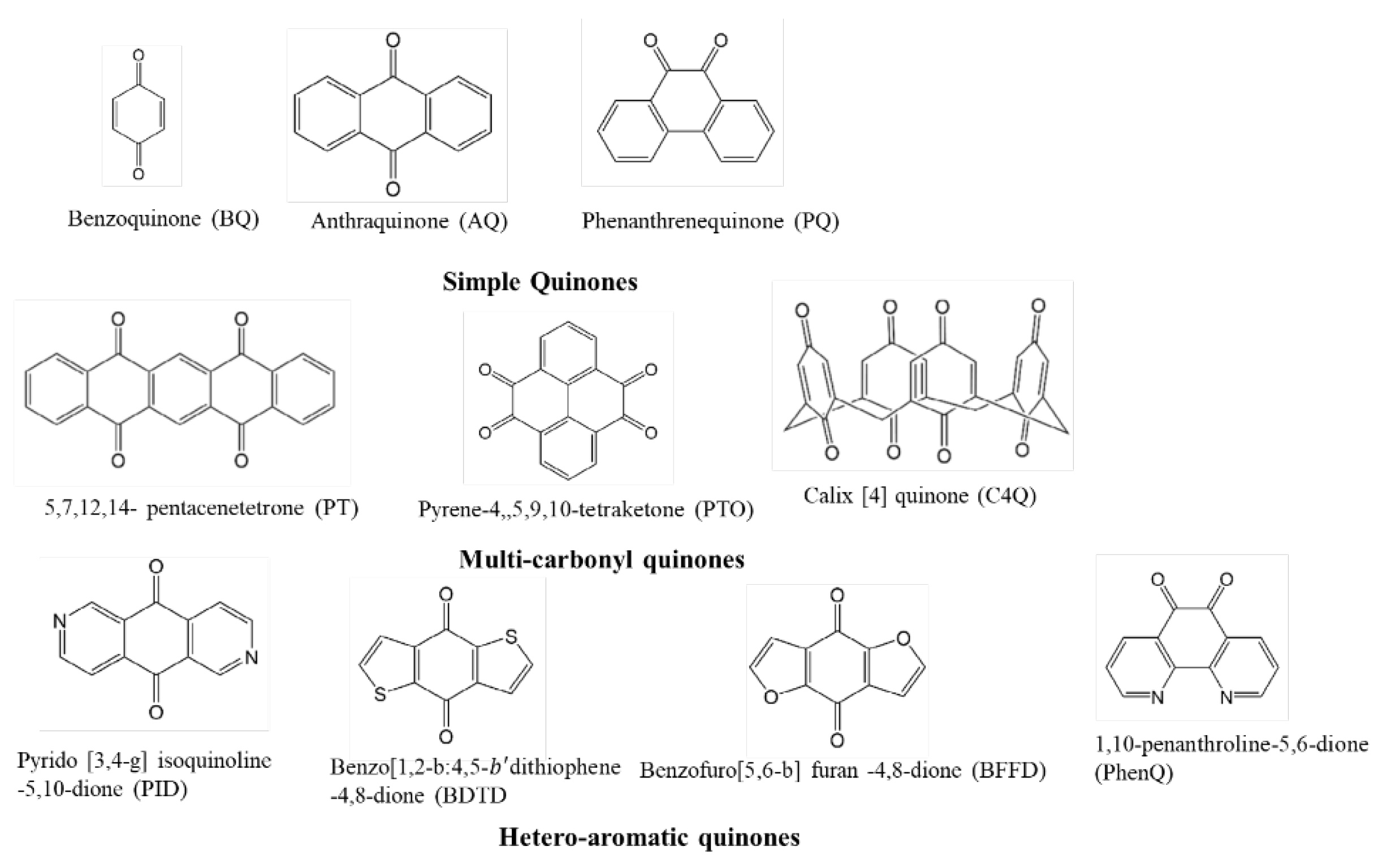
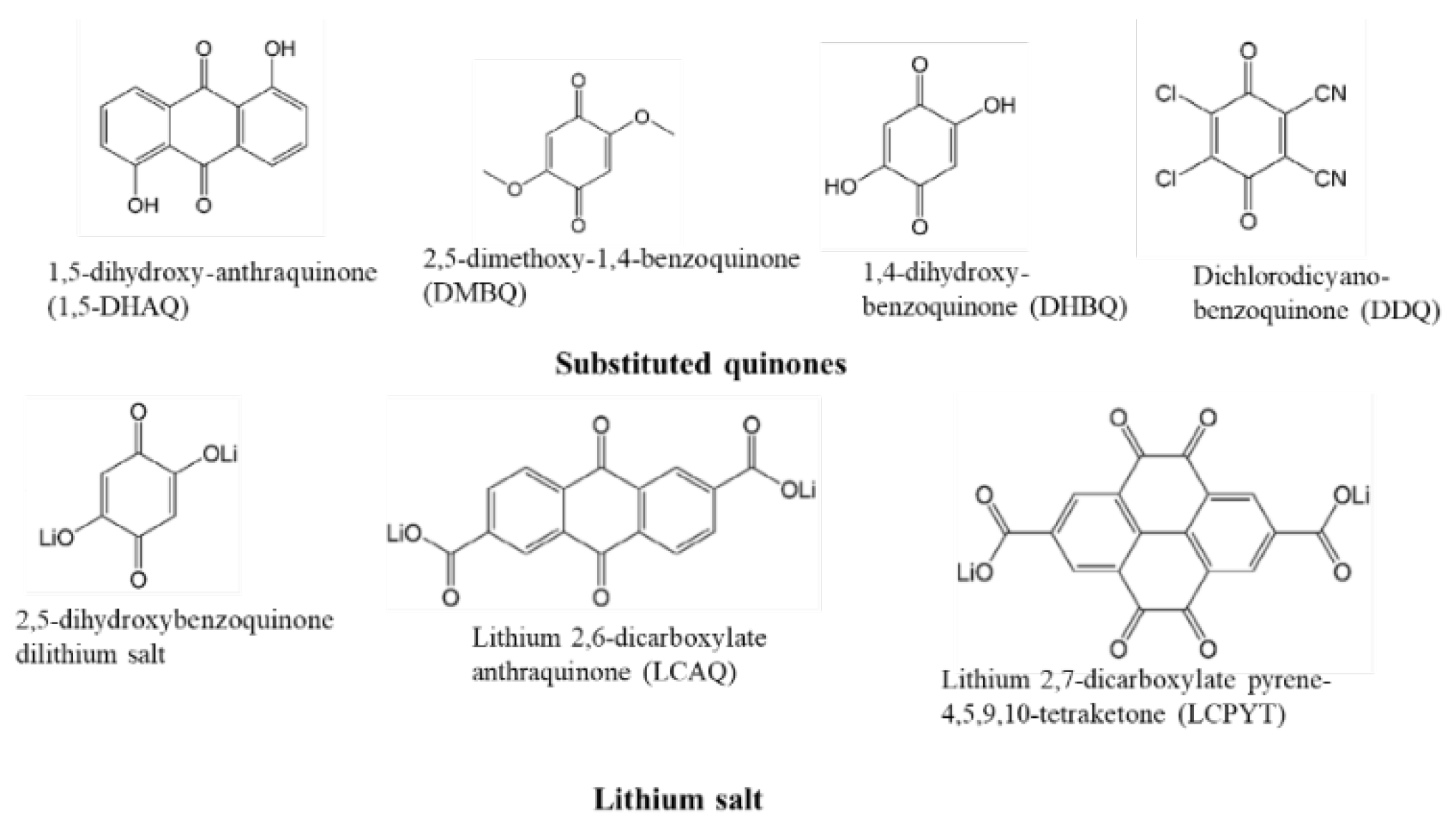
Quinone compounds are promising for battery applications but face challenges like high solubility in organic electrolytes and low intrinsic conductivity. To address these issues, research is exploring natural naphthoquinones and anthraquinone derivatives with smaller side chains, such as -OH, –COOCH3, –COOH, –CONH2, and –OCH3. These smaller side chains help reduce solubility while maintaining conductivity and lithium-storage capacities, offering a balanced approach to developing effective electrode materials for lithium-ion batteries. [67]. Simple quinones, multi-carbonyl quinones, heteroaromatic quinones, substituted quinones, oxocarbon salts, and lithium carboxylates are a few of the small molecular quinone molecules that fall under this category, as shown in Figure 4.

4.1.2. Electrochemical Performance of Natural Quinones as Organic Electrodes for LIBs

Quinone organic materials are the most attractive options for LIBs/SIB electrode materials due to their high theoretical capacity, favorable reaction reversibility, and great resource availability. Quinone electrode materials (QEMs) in secondary batteries have, however, garnered less attention than other organic electrode materials up to this point [68]. C6Q was created and used as a cathode material in LIBs, with an initial capacity of up to 423 mA h g-1 (or around 95% of theoretical capacity). C4Q and C6Q have been evaluated in terms of their electrochemical capabilities. When compared to C4Q, C6Q with a large cyclic structure performs better at excellent rates, has less impedance, and is more stable throughout cycling. C6Q's capacity continued to hold at 195 mA h g-1 after 300 cycles [68].
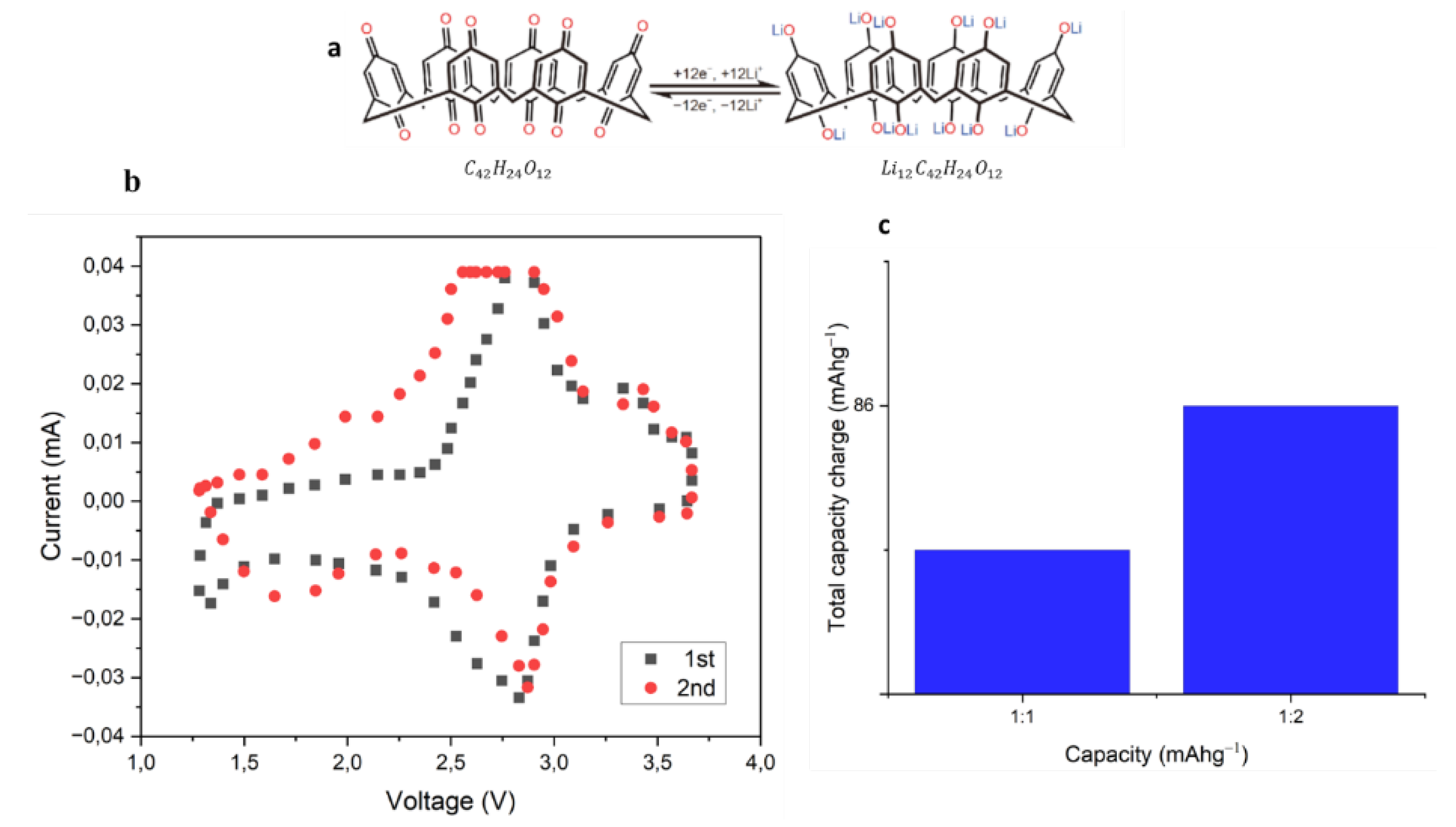
C4Q, a quinone compound, has poor cycling stability in organic electrolytes, rapidly losing capacity within a few cycles. Conversely, Calix(6)quinone (C6Q), despite being heavier (MC6Q = 480) than C4Q (MC4Q = 720), offers the same theoretical capacity but exhibits superior electrochemical performance. The charge-discharge behavior of C6Q is shown in Figure 5a, and its cyclic voltammetry (CV) curve in lithium-ion batteries (LIBs) at 0.2 mV s-1 is presented in Figure 5b. Figure 5c compares the charge/discharge capacities of C6Q/CMK-3 composites in 1:2 and 1:1 ratios. C6Q initially achieved 95% of its theoretical capacity (423 mAhg-1), indicating effective reversible lithiation/delithiation. The cyclic performance improved with CMK-3, particularly for C6Q/CMK-3 (1:2), which retained 63% of its capacity (273 mAhg-1) after 300 cycles. These composites displayed nearly 100% Coulombic efficiency, showing excellent charge/discharge reversibility. The electrochemical behavior remained consistent upon CMK-3 addition, as the charge-discharge curves of pure C6Q closely resembled those of the composites. In energy storage, C6Q/CMK-3 (1:2) outperformed pure C6Q with a total charge capacity of 998.309 Coulomb compared to 939.3015 Coulomb, indicating a superior capacity for storing and delivering charge [69].
Table 5. The supercapacitor electrode materials are typically based on quinone compounds and their electrochemical performance [67,69].
Materials Method of preparation Capacitance retention Cyclability Advantage Disadvantage Reference
lithiated quinone molecule (Li2C6O6) composite Using myo-inositol reversible capacity of up to 580 mAhg-1 Best electrochemical reversibility [67]
PADAQ composite Through the Facile oxidation process Initial capacity of 101 mAh g-1 at current density of 400 mAg-1
At high current density of 1400 mA g-1, specific capacity 95 mAh g-1,
After 14 cycles, increases to 143 mAh g-1.
after 50 cycles maintains 126 mAh g-1
Excellent cyclability and rate performance high solubility in organic electrolytes and poor intrinsic conductivity [67]
C6Q composite Through Synthesis, diazonium
coupling, reduction, and oxidation.
Initial capacity of up to 423 mA h g-1 (or around 95% of theoretical capacity) 195 mA h g-1 after 300 cycles Excellent rates have less impedance and are more stable throughout the cycling [69]

4.2. Organic Acid Anhydride Cathode Materials

Acid anhydrides are another class of materials frequently used as cathodes for carbonyl compounds. Due to the reversible insertion and de-insertion of Li+ on the conjugated carbonyl structure, anhydride organic compounds are interesting candidates for lithium batteries [70,71,72,73,74]. Perylene tetracarboxylic dianhydride (PTCDA, 273 mA h g-1), the first anhydride cathode material to be reported, is discovered to demonstrate first coulombic efficiency of above 98%. Its low electronic conductivity and electrolyte dissolution are the causes of its specific capacitance's quick drop, which caused it to retain less than 50% of its capacity after 90 cycles [75,76].
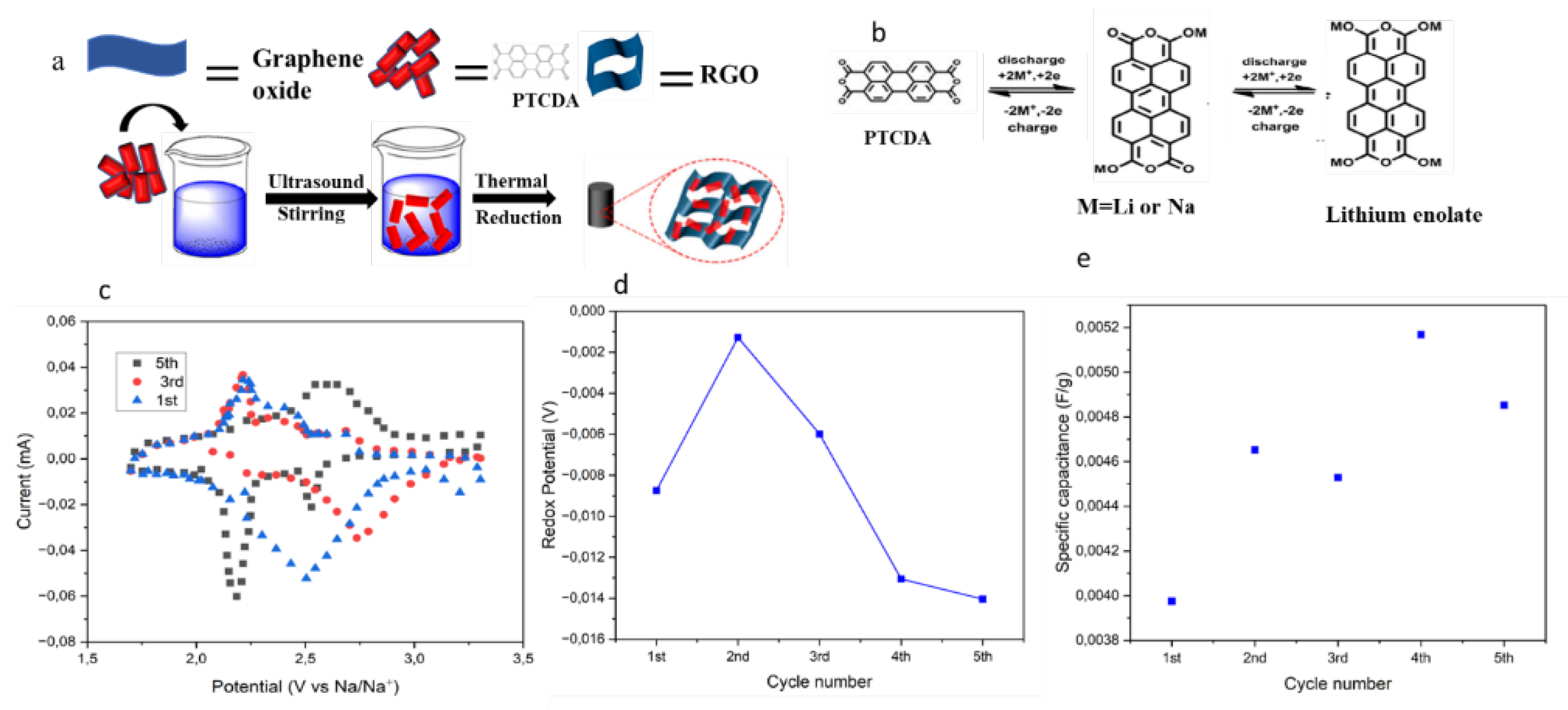
The PTCDA/Graphene Composite (PGC), synthesized using the modified Hummers method and a one-step solvothermal process, displayed significant capacity retention and electrochemical performance as a cathode material for batteries. It retained about 91% of its capacity after 150 cycles. In cyclic voltammetry analysis (Figure 6c), the first cycle showed two oxidation peaks at 2.1 and 2.5 V, and a reduction peak at 2.0 V, while subsequent cycles revealed Na+ insertion and deinsertion peaks at similar voltages. The specific formulation, PGC40, demonstrated initial discharge and charge capacities of 81 and 97 mAhg-1, respectively (as shown in Figure 6d). The redox behavior initially increased in the first cycle but then decreased sharply in later cycles, indicating complex electrochemical dynamics, possibly due to surface layer formation on the electrode. These layers, formed from passivation, side reactions, or buildup of byproducts, may change over cycles, affecting the redox potential [4,77].
For sodium-ion batteries (SIBs), the composite's initial discharge/charge capacities were 81 and 97 mAh g-1 at 25 mA g-1. It maintained nearly 100% Coulombic efficiency and showed a reversible capacity of 60.5 mAh g-1 after 600 cycles, with a capacity retention ratio of 75%. The PTCDA/Graphene Composite demonstrated high Li+/Na+ ion storage capacity, extended cycle life, and good rate capability, making it a promising cathode material for both lithium-ion and sodium-ion batteries, as detailed in the electrochemical investigation. [77].
This increased property is due to a unique structure that not only considerably enhances conductivity and successfully prevents the dissolution of active materials, but also allows for good Li+/Na+ ions accessibility to organic electroactive materials and shortens the duration of the Li+/Na+ ions diffusion. When the specific capacitance of an electrode as the number of charge-discharge cycles increases as seen in Figure 6e, a specific capacitance of 0.00517 F/g was attained with the rate of increase potentially slowing down as the number of cycles increases. However, the area under the curve is 136 mAhg-1, this indicates the specific capacity of the electrode material, signifying that the electrode material can store 136 mAhg-1 of specific capacity. This indicated that the electrode materials have improved capacitance retention and cycling stability, leading to the development of more efficient and durable energy storage systems. The PGC40 composite cathode material's improved electrochemical capabilities which can be related to its unique 3D structure, not only considerably improves the conductivity of both electrons and Li ions but also successfully prevents the dissolution of the active material into the electrolyte. The PGC40 poor volume-specific capacity and energy density are caused by its extremely low bulk density. PGC40 is an unsatisfactory choice for a cathode material for use in practical applications due to the high concentration of graphene aerogel in it [4,77].
PTCDA, or perylene-3,4,9,10-tetracarboxylic dianhydride, is a large molecular weight anhydride compound that has the potential to produce an initial capacity of 135 mAhg-1 but has poor cycling stability for lithium batteries due to partial dissolution in the electrolytes during the charge-discharge process [78]. Naphthalene1,4,5,8-tetracarboxylic acid dianhydride and PTCDA were used to create polyimides, which served as the active ingredients for lithium batteries and had good electrochemical properties. It has been claimed that PTCDA can over-lithiate due to its wide conjugated planar structure, which facilitates the insertion of a large number of Li ions into the active sites by controlling the discharge voltage [77]. Recently a nanoengineered lightweight cathode material was created utilizing graphene aerogel and PTCDA, demonstrating a capacity of 78 mAg-1 even after 500 cycles with 66% capacity retention. Due to the 3D architecture, which helps to improve the conductivity of both Li-ions and electrons and successfully inhibits their dissolution in electrolytes, the material has a much higher degree of cyclability compared to pure PTCDA [79].
PTCDA has been used as the cathode material for SIBs. The PTCDA electrode was conditioned for 5 cycles at 20 mA g-1 and then further 195 cycles at 200 mA g-1 in the potential range of 13 V. After electrochemical conditioning, a very steady cycling performance with exceptional capacity retention of 100 mAh g-1 in the 200th cycle and about 100% Coulombic efficiency was demonstrated. PTCDA demonstrated an incredibly high capacity of 1017 mAh g-1 in the first cycle when discharged to 0.01 V. However, only a small reversible capacity of 435 mAh g-1 was obtained during the subsequent charge, which corresponds to a low Coulombic efficiency of roughly 43%. Moreover, after 5 cycles, the charge capacity quickly dropped to 227 mAh g-1[79]. PTCDA is a new alternate cathode for secondary battery applications since it is readily available in the marketplace and nontoxic, and it also exhibits exceptional electrochemical capabilities as an organic cathode for LIBs and SIBs [78,79,80].

4.3. Imide Compound Cathode Materials

4.3.1 Types of Imide Compound Cathode Materials

The imide compound cathode materials could be seen as an extension of the organic acid anhydride cathode materials, with a nitrogen atom taking the place of the anhydride oxygen atom in the core of O=C-O-C=O groups [81]. The additional covalent link created by the nitrogen atom opens up new design options for molecules, such as imide lithium salt and polyimide [82,83,84]. Small imide molecules have a high solubility in the acidic solution electrolytes, similar to small molecule acid anhydride [85,86,87]. The primary benefit of organic lithium salts is the ability of small molecules to link to one another through chelating bonds O L i + O , which can somewhat reduce the dissolution of small organic molecules in the nonaqueous electrolyte and increase the cycling stability of the electrodes [88,89].
When the pyromellitic diimide lithium salt (Li2-PMDI) was utilized as a cathode material, each imide unit could reversibly accept two Li ions resulting in an initial reversible capacity of 220 mA h g-1 and sustaining at 200 mA h g-1 after 25 cycles [90]. The naphthalene diimide lithium salt (Li2-ND) cathode material achieved 87.6% capacity retention after 100 cycles, compared to 45% for the pure ND cathode. In addition, Li2-ND demonstrated a superior rate performance than that of ND, proving that the imide lithium salts are capable of both preventing the imide compounds' tendency to dissolve and improving the cathode materials' conductivity. It should be noted, nevertheless, that due to its heavier molecular structure, the imide compound's theoretical capacity also falls slightly. The redox potential of the related small molecule imide compounds are likewise decreased by the electron-donating effect of the superscript   O L i + functional group [91].
The production of PI through polycondensation reactions between dianhydrides and diamines is the alternative method to address the imide compound dissolving problem. Aromatic PIs can go through two-step redox processes; the first step reduction is completely reversible, but the second step reduction often occurs at a redox potential lower than 1.0 V versus Li/Li+ and results in the breakdown of the redox-active structure [92]. Pyromellitic anhydride (PMA) or 1,4,5,8-naphthalene tetracarboxylic dianhydride (NTCDA) and 1,4-phenylenediamine or 1,2-ethylenediamine were polycondensed to produce the PI. At a plateau potential in the region of 2.0 to 2.5 V, all of the PI cathode materials demonstrated a high specific capacity in the first cycle that was very close to the theoretical capacity. The reversible capacities of all the PIs were still between 83% and 95% of their initial values after 100 cycles at 0.2 C [93,94].
It is obvious that polymerization successfully addressed the imide compounds' dissolving problem. The PI cathode materials have strong rate performance, high Coulombic efficiency, and long cycle life; however, they still face the following issues in real-world applications. 1) The introduction of chemically inert coupling units causes a decrease in the specific capabilities of the imide compounds. 2) Slower ion and electron transfer rates are brought on by the low conductivity of the polymers and the strong charge attraction between the monomers. 3) The swelling characteristics of the PI and its condensed structure will have an impact on the diffusion and transport of lithium ions during charge and discharge [95,96].
TAPT-NTCDA@CNT and TAPT-PMDA@CNT were created as two aromatic PI-based conjugated microporous polymers (CMPs) that might be used as cathode materials for LIBs and SIBs. The aromatic PI-based CMP can efficiently use the redox activity site because of its many PI-conjugated redox-active units, stable imide bond, large specific surface area, and clear pore structure. The ideal TAPT-NTCDA@CNT demonstrates good rate performance (89.7 mAh g-1 at 2000 mA g-1) and long-cycle stability (87.3% capacity retention after 500 cycles) in LIBs. Moreover, TAPT-NTCDA@CNT has a greater initial capacity of 91.1 mAh g-1 in SIBs at 30 mAg-1[97].

4.3.2. Electrochemical Efficiency of Imide Compound Cathode Materials
The majority of the small molecules of conjugated carbonyl compounds, however, are problematic for battery applications because they dissolve readily in electrolytes. To resolve the issue, it is usually used to polymerize the small carbonyls into insoluble polymeric chains, which increases the cycle stability of the organic electrodes [87,97,98,99]. Several polyimides and poly (anthraquinone sulfide) (PAQS) cathodes for Li-ion batteries were tested, and they showed stable cycling behavior for 100 cycles with high capacities up to 180 mA h g-1. Typically, intramolecular linking requires the introduction of a significant number of redox-inactive fragments during traditional polymerization synthesis, which inevitably causes a significant reduction in the materials' gravimetric capacity [98].
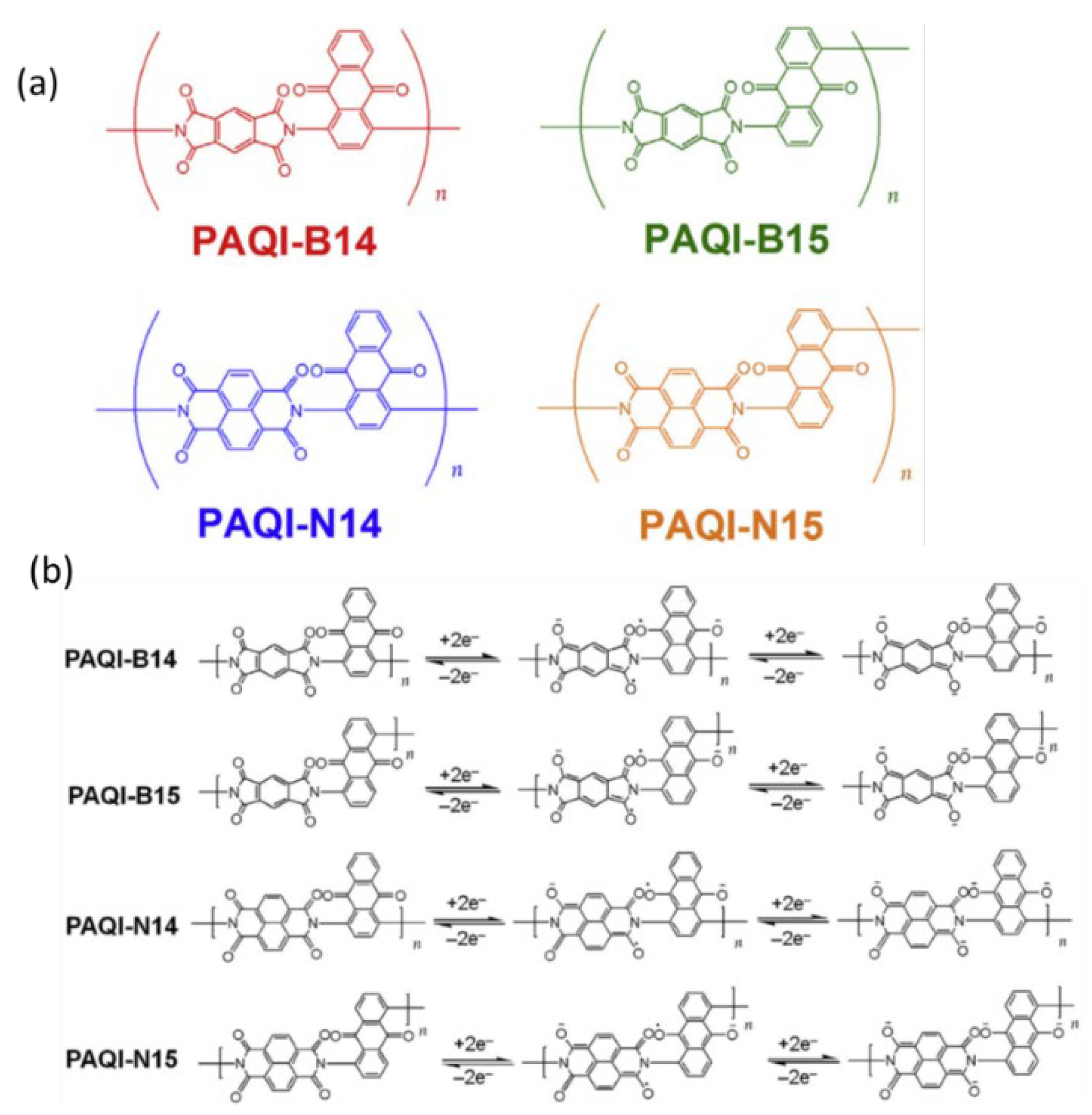
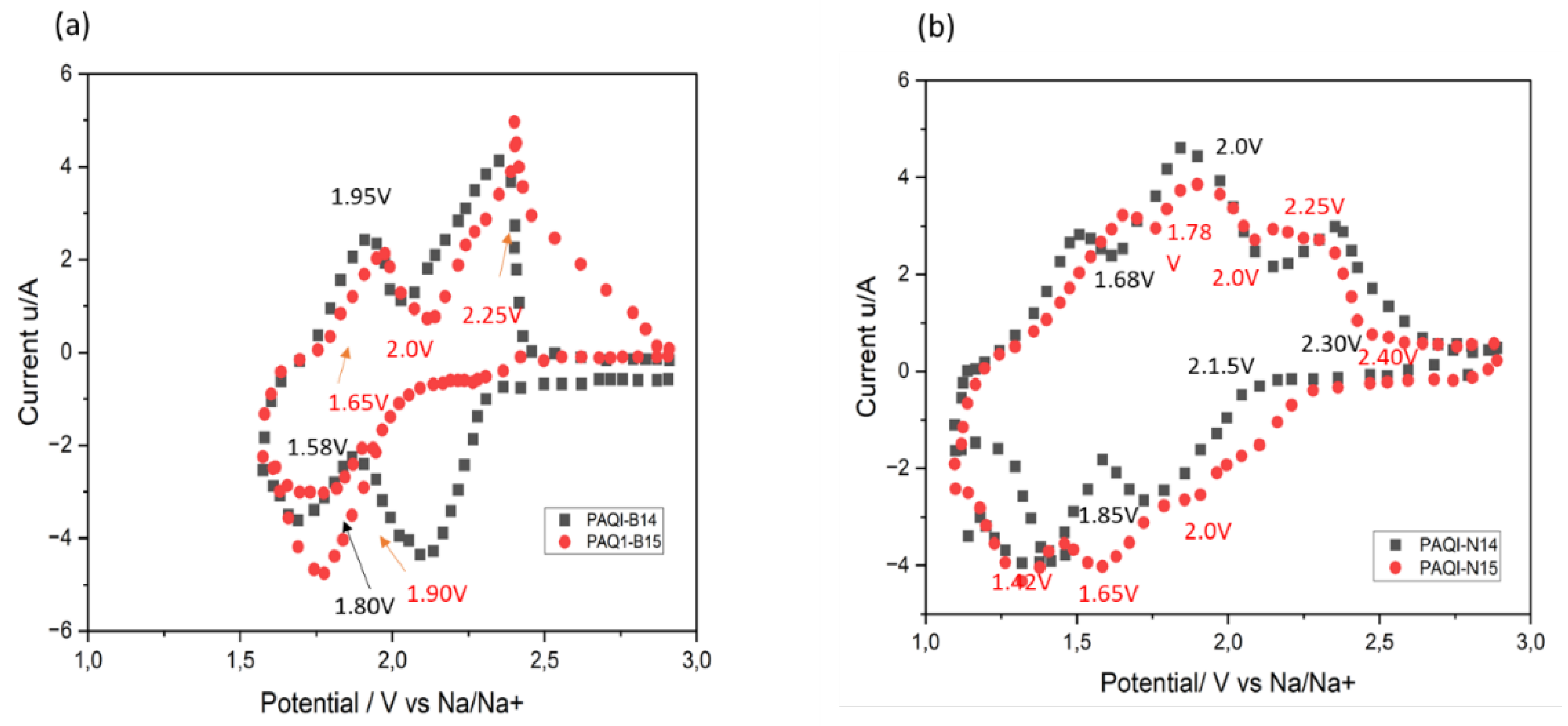
The organic cathode poly (anthraquinonyl imide, or PAQI) for Na-ion batteries is created and studied. It is discovered that the PAQI polymers can behave as a high-capacity organic host by undergoing a reversible four-electron redox reaction with simultaneous Na+ insertion into/extraction from their skeletons. The PAQI cathode, which is derived through galvanostatic discharge/charge cycling, has a high reversible capacity of 190 mA h g-1, stable cyclability, and a 93% capacity retention after 150 cycles. It is discovered through a comparison of four different PAQIs that PAQI-B14 and PAQI-N14, respectively, exhibit lower overpotentials, greater discharge capacities, and more stable cyclabilities than PAQI-B15 and PAQI-N15. This is also supported by the area under the curve for the discharge vs cycle number plot in the case of PAQI-B14/N14 is 23570 mAh/cycle as compared to PAQI-B15/N15 is 16416 mAh/cycle Figure 7[99].
As organic cathodes for Li-ion batteries, two pairs of isomeric PAQIs are produced and evaluated side by side. The PAQI-N14/15 are discovered to be high-capacity organic cathode materials that can perform reversible four-electron redox reactions with simultaneous Li insertion into/extraction from their skeletons. The galvanostatic discharge/charge cycling allows the PAQI-N14 cathode to produce a high reversible capacity of 202 mAh g-1, a stable cyclability with 80% capacity retention over 200 cycles, and an exceptional rate performance. This is true when integrating the area under the curve for the voltage vs capacity plots, it shows that PAQI-N14/15 has more energy storage capacity than PAQI-B14/15. Comparing these two pairs of isomeric PAQIs reveals that "14" isomers perform better electrochemically than "15" ones in terms of lower overpotentials, higher discharge capacities, higher cyclabilities, and better rate performance, indicating that structural configurations have a significant impact on polymer cathode performance Figure 8 [99].
Although polymerization is the most effective method for resolving the dissolution problem of imide compound cathode materials, PI has a glaring disadvantage when used as the cathode material for LIBs since its conductivity is poorer than that of the comparable imide monomer [100]. To enhance the high-rate performance of these polymer cathode materials, poly- (anthraquinonyl sulfide) and polyimide were combined in nanocomposites with graphene. Simple in-situ polymerization was used to create the polymer-graphene nanocomposites in the presence of graphene sheets. The nanocomposite's well-scattered graphene sheets significantly improved the electronic conductivity and made it possible to effectively use the electrochemical activity of the polymer cathode. As a result, charging and discharging can happen extremely quickly; the composite can supply more than 100 mAh/g in just a few seconds [100].
To produce a satisfactory rate performance, the PI cathode materials typically need at least 30% conductive carbon addition. Thus, another study area of interest for practical applications is how to improve the conductivity of the materials used in PI cathodes [4,101]. A composite organic cathode material based on aromatic polyimide (PI) and highly conductive graphene particles was prepared by an easy in-situ polymerization process. Fast electron conduction, quick ion diffusion, and a high rate capability were all made possible by the aromatic structure of the PI's efficient π π interactions with the conductive graphene backbone. One of these, the PI with 10% graphene composite (PI10G), demonstrated a high reversible capacity of 232.6 mAhg-1 at a C/10 charge-discharge rate. Moreover, it demonstrated outstanding high-rate extended cycling stability, demonstrating a high capacity of 122.0 mAhg-1 at 20C with a capacity retention of 94% after 1000 cycles. The remarkable electrochemical performance of the PI10G composite showed how well the PI and the graphene addition were combined to achieve good redox reaction reversibility and strong electronic conductivity [102].
Novel PIs have also been created by the construction of crosslinked networks in addition to normal linear PIs [102]. Excellent electrochemical performance for Mg2 storage can be achieved with organic cathode materials based on composites of CNTs and polyimides (PIs) produced from aromatic dianhydrides. The PI/CNT cathodes displayed exceptional capacities and ultralong cycling stability in RMB due to the highly reversible multi-electron redox processes of π -conjugated PIs and the 3D-crosslinked conductive networks of CNTs [103]. The broad voltage window and strong interfacial compatibility were also a result of the non-nucleophile electrolyte Mg (HMDS)2-4MgCl2/2THF-PP14TFSI. Systematic electrochemistry studies revealed that diffusion-limited and capacitive-controlled processes both contributed to the Mg2 storage capacity of PIs. The reversible transition between the C-O and C-O-Mg species during the discharge/charge cycles was discovered by ex-situ XPS investigation and DFT simulation [104].
The addition of porous features to the polymer composite greatly increases the specific capacitance of graphene-polyimide composites. Pores of various sizes and shapes are produced by the selective breakdown of thermally labile poly-acrylic resin added to the composite during synthesis. It should be observed that samples made using lower-weight percents of the acrylic polymer created pores that were more consistent in size than samples made using higher weight percent. When tested in 0.4 M potassium hexafluorophosphate VI (KPF6)/propylene carbonate electrolyte solution, cyclic voltammetry (CV) shows an increase in specific capacitance from 39 F g-1 to 133 F g-1 and electrochemical impedance spectroscopy (EIS) shows a significant decrease in bulk resistance and a 100% increase in theoretical porosity [105].
Figure 7. CV curves for PAQI-B14/15 in (a) and PAQI-N14/15 in (b) at 0.1 mV s-1 (2nd cycle) [98].
Preprints 144832 g007
Figure 8. a) Structures and abbreviations of PAQIs. b) Drawing showing the PAQIs' sequential electron transfer [99].
Preprints 144832 g008

Organic Imine Compounds

Imines are substances that have a C=N azomethine linkage attached to either carbon or hydrogen atoms (Figure 9) [106]. The importance of OICs is largely due to their good solubility in common organic solvents, which facilitates processing and preparation of composite materials for separation of small molecules, sensing, nanoparticle (NP) templates, or as molecular building blocks for polymers. This is in addition to the porosity and structural aesthetics of these materials [107,108].
Covalent bonds could also prevent the electrolyte from dissolving small organic molecules. Therefore, COFs have been coupled with CNTs, MXene, and polymers for energy storage devices, although it is still difficult to increase the energy density of COF-based materials. The construction of heterostructures with synergistic effects, however, can be a useful method for improving structural stability and electrochemical storage activity [103].
The C=N groups exhibit significant redox activity as the cathode materials of aqueous ZIBs, which can be reduced and mixed with the cations (such as Zn2+ and H+) of electrolytes during discharge processes [109]. Carbon nanotubes (CNT) are combined individually with the imine-linked triazine-based CMPs using the in-situ growth approach (CNT@TAPT-TPA and CNT@TAPT-BTPA), and these materials are subsequently employed as the anode materials for LIBs. The ideal CNT@TAPT-BTPA as organic anode-active materials for LIBs demonstrates a longer cycling stability (a specific capacity of 350.9 mAhg-1), which is due to its large conjugate structure, more exposed active sites, and resilient and accessible pores network [110].
A simple polycondensation reaction was used to create the conjugated porous polyimide poly(2,6-diaminoanthraquinone) benzamide (CP-PDAB) from 2,6-diaminoanthraquinone and pyromellitic dianhydride. The developed CP-PDAB possesses disordered aggregates with a porous and loose structure that facilitate the electrolyte's penetration and buffer the volume change during charging and discharging. The structural stability, insolubility of nonelectrolyte, and high electrical conductivity of the conjugated skeleton with electron delocalization are advantages. When tested as a cathode for SIBs, it can maintain a high specific capacity of 71 mA h g-1 at a current density of 10 A g-1 after 500 cycles and a high reversible discharge capacity of 141 mA h g-1 at 500 mA g-1 after 100 cycles [111].
The utilization of hexaazatrianthranylene (HATA) embedded quinone (HATAQ), a nitrogen- and carbonyl-rich greatly extended p-conjugated small molecule, as a cathode for sodium-ion batteries. Highly functionalized conjugated HATAQ molecules can be arranged in supramolecular graphite-like 2D layered configurations due to the special hydrogen bonds that they form, which also aid in charge transfer and structural stability during prolonged cycling. The substance offers a high capacity of 460 mA h g-1 at 500 mAg-1, as well as a superb capacity retention of 99% (138 mA h g-1) after 5000 cycles at an extraordinarily high rate of current density of 60 A g-1. A combination of characterisation methods and density functional theory (DFT) studies have helped to clarify the material's reaction kinetics and redox mechanism [112].
A post-synthetic approach was used to create the fully π -conjugated, nitrogen-rich, three-dimensional covalent organic framework (PYTRI-COF-2) that contains both pyrazine and triazine units. In the pre-made PYTRI-COF-1, the Povarov reaction transformed the imine linkages into heterocyclic quinolines. When employed as the lithium (Li)-ion battery electrode, the resulting PYTRI-COF-2 demonstrated high Li-ion storage capacity and remarkable cycling stability Figure 10 [113].
Integrating the area under the curve for specific capacity vs cycle number plot, also shows that the energy storage performance and durability of PYTRI-COF-2 battery is far better than PYTRI-COF-1. The bulk resistance decreases with increasing cycle number as seen in Figure 10b, this suggests an improvement in the conductivity or transport properties of the bulk material in the electrochemical system. During cycling, the electrode material goes through structural modifications or transformations that improve conductivity, linking to adjustments of the crystallinity, particle size, or phase transitions that promote charge transfer and lower bulk resistance. The electrode structure was more effectively penetrated by the electrolyte, improving ion transport, and lowering bulk resistance, the electrode material passes through activation activities in the initial cycles that improve the electrochemical performance [113].
Figure 10c the specific capacity increases with an increasing cycle number, showing a positive trend in the electrochemical performance of the electrode. During the initial cycles, the electrode material undergoes activation processes, such as the formation of desired surface layers or structural changes, which enhance the electrochemical performance, resulting in the increased specific capacity as the active sites become more accessible and electrochemically active. With cycling, the electrode material undergoes structural modifications or morphological changes that enhance the diffusion pathways for ions within the electrode. This increased ion accessibility can lead to improved charge storage capacity and an increase in specific capacity [113].
In Figure 10d a decrease in phase angle as the cycle number increases. This implies a change in the impedance behavior or electrochemical processes over time as a result of either accumulation of side reactions/passivation, electrode degradation, or formation of double-layer capacitance. Two isostructural covalent organic frameworks (COFs) with thiazole and oxazole connections were created from imine-linked ILCOF-1, which was based on 1,4-phenylenediamine and 1,3,6,8-tetrakis(4-formylphenyl) pyrene. Infrared and solid-state NMR spectroscopies were used to evaluate the conversion's completeness and powder X-ray diffraction was used to verify the COFs' crystallinity. Nitrogen sorption studies further demonstrate that the azole-linked COFs are still porous. Compared to the imine-linked starting material, the materials produced in this manner exhibit enhanced chemical stability. This provides an easy way to access COFs and links that are otherwise challenging to crystallize due to their constrained microscopic reversibility [113].
Imine compound cathode materials recently have emerged as an emergent research area of organic electrode materials for LIBs due to their excellent electrochemical performance. However, considerably more conductive carbon is needed for the production of imine compound cathode materials than for the other polymer cathode materials [113]. In the meantime, the overloaded Coulombic efficiency phenomena and redox reaction mechanism of imine compounds remain poorly known. As a result, additional thorough research must be done before the imine compound cathode materials may be used in LIBs.
Systems with polymeric and monomeric components have different characteristics and are used for different purposes. Here is a comparison of polymeric and monomeric systems:
Table 6. Comparison of polymeric and monomeric systems.
Polymeric system Monomeric system Reference
Molecular structure They are large, repetitive chains of monomer units in the polymeric structures. These chains, which can be straight or branched, come together to form a three-dimensional structure or network. They are individual molecules that are not chemically bonded together in the monomeric systems. No bigger network structure is formed by these molecules, regardless of how simple or complicated they are. [4]
Cycle life Extended cycle life such as in PANI nanofibers goes up to 1000 cycles, PPy-H4 [PVMo11O40] and PPy-H5 [PV2Mo10O40] 4500 cycles, polythiophene carbon composites 10000 cycles. polymeric systems generally exhibit superior cycle life compared to monomeric systems Have a shorter cycle life such as in PADAQ composite 50 cycles, C6Q composite 300 cycles [13,26,39,68,69]
Mechanism The behavior and characteristics of polymeric systems is determined by interactions and entanglements between polymer chain like in PANI nanofiber, polythiophene (PTh)/multiwall carbon nanotube (MWNT) composites, Poly (diallyl tetrasulfide) (PDTS) cathode They behave as individual molecules without extensive intermolecular interactions such as in Fibrous sulfurized TTCA/PAN (STTCA@SPAN) composite .
[13,39,49,50]
Stability Good stability against degradation, mechanical strain, and fatigue brought on by cycling. Assuring structural integrity and preventing degradation or loss of active material are made possible by the dense network structure and entanglements between polymer chains. polythiophene carbon composites (maintaining 58% of initial capacity after 10000 cycles), poly (anthraquinonyl sulfide) (PAQS) cathodes stable cycling behavior for 100 cycles with high capacities up to 180 mA h g-1 Less stability than polymeric systems due to weaker intermolecular interactions and the absence of a robust network structure. This can result in reduced capacitance retention over repeated cycles. Fibrous sulfurized TTCA/PAN (STTCA@SPAN) composite (cycle stability over 400 cycles) [39,48,98]
Capacitance retention Polymeric systems with strong capacitance retention over numerous cycles include those made of conducting polymers or polymer electrolyte-based systems. PANI/S composite (89.7% capacity retention after 200 cycles at 0.3 C)
PPy-H4 [PVMo11O40] and PPy-H5 [PV2Mo10O40] 95% of its capacitance after 4500 cycles, Novel polythiophene/carbon composites retention of ≥95% after 100 cycles
Depending on the particular molecular structure and characteristics, monomeric systems may display various levels of capacitance retention. 1,4-bis(diphenylphosphanyl)
tetrasulfide (BDPPTS) 74.8% capacity retention after 500 cycles, PADAQ composites (58% capacity retention after 100 cycles, C6Q composite Initial capacity of up to 423 mA h g-1 (or around 95% of theoretical capacity)
[9,26,40,49,67,69]
Higher potential Conducting polymer relatively higher such as in polypyrrole/carbon nanotube composite's −0.5 to 0.5 V Here it contains a redox-active functional group such as in quinones like in PADAQ's cycle performance at 1.0-3.7 V [23,67]
Doped Higher doping capability as can be seen in the case of conducting polymers and enhanced conductivity through charge transfer between the polymer and dopant molecules/ions as seen in the case of PANI and polypyrrole Limited doping capability when compared with polymeric systems such as poly (2,2,6,6-tetramethyl-1-piperidinyloxy-4-yl methacrylate) [28,55,56]
Organic materials are emerging as promising candidates for cathode materials in lithium-ion batteries (LIBs) and supercapacitors, offering unique advantages such as higher energy density, improved cycling stability, and environmental sustainability. This review explores various types of organic cathode materials, including organosulfur compounds, organic free radical compounds, organic carbonyl compounds, conducting polymers, and imine compounds. These materials have the potential to outperform traditional inorganic counterparts while addressing key challenges in the field. However, several issues need to be resolved to fully realize their potential, including low energy density, rapid capacity fading during cycling, poor electronic conductivity affecting charge/discharge rates, dissolution in aprotic electrolytes, and safety concerns.
Significant progress has been made in exploring different organic materials and modifying their molecular structures to enhance electrochemical performance. Researchers have experimented with combining organic materials with inorganic components, creating hybrid structures to leverage the strengths of both. Designing materials with porous architectures and incorporating conductive additives has shown promise in improving performance. Efforts have also been directed toward developing new electrolytes to minimize the dissolution of organic materials and optimizing binder selection and electrode architecture to enhance stability and efficiency.
Future research focus on addressing these limitations and advancing the performance of organic cathode materials. Key strategies include enhancing conductivity and stability through molecular design, leveraging hybridization with inorganic components, and improving material performance through advanced design strategies like porous architectures and conductive additives. Developing new electrolytes that prevent the dissolution of organic materials and optimizing electrode design for better stability and performance are also critical areas of focus.
The review identifies several scientific and engineering problems, such as the need for better understanding and improvement of the electrochemical performance of organic materials, developing scalable and cost-effective synthesis methods, ensuring long-term structural stability to prevent capacity fading, and addressing potential safety concerns. These challenges can be addressed through targeted approaches, including tailoring molecular structures to improve energy density and stability, using inorganic hybrids and conductive additives to enhance performance, developing advanced electrolytes to reduce dissolution, optimizing electrode design, and creating cost-effective and environmentally friendly synthesis methods.
By addressing these challenges and leveraging the unique properties of organic materials, significant advancements can be made in developing high-performance, sustainable, and commercially viable organic cathode materials for LIBs and supercapacitors. This will contribute to the broader goal of creating more efficient and sustainable energy storage solutions.

5. Conclusions

This review looked at monomeric and polymeric systems of different organic cathode materials. The polymeric system shows more advantages over the monomeric system such as high stability and mechanical strength due to the polymer chain structure, enhanced electronic and ionic conductivity, ability to accommodate volume changes during cycling, potential for scalable and cost-effective synthesis, a wide range of polymer properties and tunability.
As a result of the major resource and environmental problems with conventional inorganic cathodes, organic cathode materials have recently attracted a lot of interest. Hence, designing high-performance organic cathode materials for LIBs is easier through having a deeper understanding of the organic cathode materials development process. The research on organic cathode materials, such as conductive polymers, organosulfur compounds, carbonyl compounds, and imine compounds, are reviewed in this article. The potential benefits of organic cathode materials over inorganic cathode materials, including their low cost, flexibility, and eco-friendliness, have made them a focus of contemporary research. It is crucial to keep in mind, though, that the reversibility of organic cathode materials can vary depending on the particular material and application. Organic cathode materials have occasionally shown reversible abilities that are on par with or even superior to those of inorganic cathode materials. Quinones and organic polymers, for instance, have demonstrated promising reversible capacities, high theoretical capacities, and cycling stability for application in rechargeable batteries.
The capacity of organic cathode materials to undertake redox processes involving numerous electron transfers, which can result in higher energy densities than conventional inorganic materials, is one advantage of these materials. Furthermore, the electronic and structural characteristics of organic materials can frequently be tuned for particular applications.
Even with these benefits, issues still need to be resolved before organic cathode materials are extensively used in industrial batteries. These include developing scalable synthesis techniques, additional safety measures to be put in place to prevent accidents and ensure proper disposal, enhancing their energy density, stability, and durability over numerous charge/discharge cycles as well as the energy storage capacity. Future research and development in the field of electric energy storage will require an emphasis on environmental friendliness and sustainability. Therefore, while organic cathode materials have demonstrated promising reversible properties, more study and development are required in the area of scalable synthesis techniques, energy density, stability, and durability over various charge/discharge cycles to fully fulfill their potential as a workable substitute for inorganic cathode materials in rechargeable batteries.

Author Contributions

All authors have read and agreed to the published version of the manuscript.

Funding

This research received no external funding.

Data Availability Statement

Not applicable.

Acknowledgments

The support provided by the Mechanical and Materials Engineering Department and the Polymer laboratory at the University of Cincinnati, is hereby acknowledged.

Conflicts of Interest

The authors declare no conflict of interest.

References

  1. Xu, F., Wang, H., Wu, M., Nan, J., Li, T. and Cao, S.A., 2018. Electrochemical properties of poly (anthraquinonyl imide) s as high-capacity organic cathode materials for Li-ion batteries. Materials Chemistry and Physics, 214, pp.120-125.
  2. Sui, D., Xu, L., Zhang, H., Sun, Z., Kan, B., Ma, Y. and Chen, Y., 2020. A 3D cross-linked graphene-based honeycomb carbon composite with excellent confinement effect of organic cathode material for lithium-ion batteries. Carbon, 157, pp.656-662.
  3. Shi, T., Li, G., Han, Y., Gao, Y., Wang, F., Hu, Z., Cai, T., Chu, J. and Song, Z., 2022. Oxidized indanthrone is a cost-effective and high-performance organic cathode material for rechargeable lithium batteries. Energy Storage Materials, 50, pp.265-273.
  4. Lyu, H., Sun, X.G. and Dai, S., 2021. Organic Cathode Materials for Lithium-Ion Batteries: Past, Present, and Future. Advanced Energy and Sustainability Research, 2(1), p.2000044.
  5. Wang, Y., Zhao, X., Wang, Y., Qiu, W., Song, E., Wang, S. and Liu, J., 2022. Trinitroaromatic Salts as High-Energy-Density Organic Cathode Materials for Li-Ion Batteries. ACS Applied Materials & Interfaces.
  6. Liu, K., Zhao, H., Ye, D. and Zhang, J., 2021. Recent progress in organic Polymers-Composited sulfur materials as cathodes for Lithium-Sulfur battery. Chemical Engineering Journal, 417, p.129309.
  7. Nezakati, T., Seifalian, A., Tan, A. and Seifalian, A.M., 2018. Conductive polymers: opportunities and challenges in biomedical applications. Chemical Reviews, 118(14), pp.6766-6843.
  8. Li, Z. and Gong, L., 2020. Research progress on applications of polyaniline (PANI) for electrochemical energy storage and conversion. Materials, 13(3), p.548.
  9. Yan, J., Li, B. and Liu, X., 2015. Nano-porous sulfur–polyaniline electrodes for lithium–sulfurbatteries. Nano Energy, 18, pp.245-252.
  10. Chen, H., Chen, J.S., Zhou, H.H., Jiao, S.Q., Chen, J.H. and Kuang, Y.F., 2004. The application of nano-fibrous polyaniline in an electrochemical capacitor. ACTA PHYSICO-CHIMICA SINICA, 20(6), pp.593-597.
  11. Zhou, H., Chen, H., Luo, S., Lu, G., Wei, W. and Kuang, Y., 2005. The effect of the polyaniline morphology on the performance of polyaniline supercapacitors. Journal of Solid State Electrochemistry, 9, pp.574-580.
  12. Liu, J., Zhou, M., Fan, L.Z., Li, P. and Qu, X., 2010. Porous polyaniline exhibits highly enhanced electrochemical capacitance performance. Electrochimica Acta, 55(20), pp.5819-5822.
  13. Wang, H., Lin, J. and Shen, Z.X., 2016. Polyaniline (PANi) based electrode materials for energy storage and conversion. Journal of Science: Advanced materials and devices, 1(3), pp.225-255.
  14. Chen, W.C., Wen, T.C. and Teng, H., 2003. Polyaniline-deposited porous carbon electrode for supercapacitor. Electrochimica Acta, 48(6), pp.641-649.
  15. Ferchichi, K., Hbaieb, S., Amdouni, N., Pralong, V. and Chevalier, Y., 2014. Pickering emulsion polymerization of polyaniline/LiCoO 2 nanoparticles used as cathode materials for lithium batteries. Ionics, 20, pp.1301-1314.
  16. Ferchichi, K., Hbaieb, S., Amdouni, N., Pralong, V. and Chevalier, Y., 2013. Structural and electrochemical characterization of polyaniline/LiCoO 2 nanocomposites prepared via a Pickering emulsion. Journal of Solid State Electrochemistry, 17, pp.1435-1447.
  17. Su, C., Lu, G., Xu, L. and Zhang, C., 2012. Preparation of LiFePO4/Carbon/PANI-CSA composite and its properties as high-capacity cathodes for lithium-ion batteries. Journal of the Electrochemical Society, 159(3), p.A305.
  18. Taghizadeh, A., Taghizadeh, M., Jouyandeh, M., Yazdi, M.K., Zarrintaj, P., Saeb, M.R., Lima, E.C. and Gupta, V.K., 2020. Conductive polymers in water treatment: a review. Journal of Molecular Liquids, 312, p.113447.
  19. Wang, H., Lin, J. and Shen, Z.X., 2016. Polyaniline (PANi) based electrode materials for energy storage and conversion. Journal of Science: Advanced materials and devices, 1(3), pp.225-255.
  20. MA, C., SG, P., PR, G., RN, M., Shashwati, S. and VB, P., 2011. Synthesis and characterization of polypyrrole (PPy) thin films. Soft nanoscience letters, 2011.
  21. Ramanavičius, A., Ramanavičienė, A. and Malinauskas, A., 2006. Electrochemical sensors based on conducting polymer—polypyrrole. Electrochimica acta, 51(27), pp.6025-6037.
  22. An, H., Wang, Y., Wang, X., Zheng, L., Wang, X., Yi, L., Bai, L. and Zhang, X., 2010. Polypyrrole/carbon aerogel composite materials for supercapacitor. Journal of Power Sources, 195(19), pp.6964-6969.
  23. Mi, H., Zhang, X., Xu, Y. and Xiao, F., 2010. Synthesis, characterization, and electrochemical behavior of polypyrrole/carbon nanotube composites using organometallic-functionalized carbon nanotubes. Applied Surface Science, 256(7), pp.2284-2288.
  24. Wang, G.X., Yang, L., Chen, Y., Wang, J.Z., Bewlay, S. and Liu, H.K., 2005. An investigation of polypyrrole-LiFePO4 composite cathode materials for lithium-ion batteries. Electrochimica Acta, 50(24), pp.4649-4654.
  25. Wang, J., Chen, J., Konstantinov, K., Zhao, L., Ng, S.H., Wang, G.X., Guo, Z.P. and Liu, H.K., 2006. Sulfur-polypyrrole composite positive electrode materials for rechargeable lithium batteries. Electrochimica Acta, 51(22), pp.4634-4638.
  26. Vannathan, A.A., Maity, S., Kella, T., Shee, D., Das, P.P. and Mal, S.S., 2020. In situ, vanadophosphomolybdate was impregnated into conducting polypyrrole for the supercapacitor. Electrochimica Acta, 364, p.137286.
  27. Wang, H., Song, Y., Zhou, J., Xu, X., Hong, W., Yan, J., Xue, R., Zhao, H., Liu, Y. and Gao, J., 2016. High-performance supercapacitor materials based on polypyrrole composites embedded with core-sheath polypyrrole@ MnMoO4 nanorods. Electrochimica Acta, 212, pp.775-783.
  28. Gooneratne, R. and Iroh, J.O., 2022. Polypyrrole Modified Carbon Nanotube/Polyimide Electrode Materials for Supercapacitors and Lithium-ion Batteries. Energies, 15(24), p.9509.
  29. Liu, L., Tian, F., Wang, X., Yang, Z., Zhou, M. and Wang, X., 2012. Porous polythiophene as a cathode material for lithium batteries with high capacity and good cycling stability. Reactive and Functional Polymers, 72(1), pp.45-49.
  30. Senthilkumar, B., Thenamirtham, P. and Selvan, R.K., 2011. Structural and electrochemical properties of polythiophene. Applied Surface Science, 257(21), pp.9063-9067.
  31. Jose, M.A., Varghese, S. and Antony, M.J., 2016. In situ chemical oxidative polymerization for ordered conducting polythiophene nanostructures in the presence of dioctyl sodium sulfosuccinate.
  32. Gök, A., Omastová, M. and Yavuz, A.G., 2007. Synthesis and characterization of polythiophenes prepared in the presence of surfactants. Synthetic metals, 157(1), pp.23-29.
  33. Omastova, M., Trchova, M., Kovářová, J. and Stejskal, J., 2003. Synthesis and structural study of polypyrroles prepared in the presence of surfactants. Synthetic metals, 138(3), pp.447-455.
  34. Geetha, S. and Trivedi, D.C., 2005. A new route to synthesize high-degree polythiophene in a room temperature melt medium. Synthetic metals, 155(1), pp.232-239.
  35. Zhang, X., Chen, K., Sun, Z., Hu, G., Xiao, R., Cheng, H.M. and Li, F., 2020. Structure-related electrochemical performance of organosulfur compounds for lithium–sulfur batteries. Energy & Environmental Science, 13(4), pp.1076-1095.
  36. Liang, Y., Tao, Z. and Chen, J., 2012. Organic electrode materials for rechargeable lithium batteries. Advanced Energy Materials, 2(7), pp.742-769.
  37. Zhang, X., Chen, K., Sun, Z., Hu, G., Xiao, R., Cheng, H.M. and Li, F., 2020. Structure-related electrochemical performance of organosulfur compounds for lithium–sulfur batteries. Energy & Environmental Science, 13(4), pp.1076-1095.
  38. Wang, L., Jia, X., Wang, D., Zhu, G. and Li, J., 2013. Preparation and thermoelectric properties of polythiophene/multiwalled carbon nanotube composites. Synthetic metals, 181, pp.79-85.
  39. Kong, D., Fan, H., Wang, X., Hu, H., Li, B., Wang, D., Tian, S., Gao, X. and Xing, W., 2021, February. Polythiophene/Carbon Microsphere Composite as a High-Performance Cathode Material for Aluminium-ion Batteries. In IOP Conference Series: Earth and Environmental Science (Vol. 651, No. 2, p. 022032). IOP Publishing.
  40. Zhu, L.M., Shi, W., Zhao, R.R., Cao, Y.L., Ai, X.P., Lei, A.W. and Yang, H.X., 2013. n-Dopable polythiophenes as high-capacity anode materials for all-organic Li-ion batteries. Journal of Electroanalytical Chemistry, 688, pp.118-122.
  41. Thakur, A.K., Majumder, M., Choudhary, R.B. and Pimpalkar, S.N., 2016, September. Supercapacitor based on electropolymerized polythiophene and multiwalled carbon nanotubes composites. In IOP Conference Series: Materials Science and Engineering (Vol. 149, No. 1, p. 012166). IOP Publishing.
  42. Li, Z., Guo, A. and Liu, D., 2022. Water-Soluble Conductive Composite Binder for High-Performance Silicon Anode in Lithium-Ion Batteries. Batteries, 8(6), p.54.
  43. Li, Z., Xu, R., Deng, S., Su, X., Wu, W., Liu, S. and Wu, M., 2018. MnS decorated N/S codoped 3D graphene which is used as cathode of the lithium-sulfur battery. Applied Surface Science, 433, pp.10-15.
  44. Zhang, W., Ma, F., Guo, S., Chen, X., Zeng, Z., Wu, Q., Li, S., Cheng, S. and Xie, J., 2022. A model cathode for mechanistic study of organosulfide electrochemistry in Li-organosulfide batteries. Journal of Energy Chemistry, 66, pp.440-447.
  45. Weret, M.A., Kuo, C.F.J., Su, W.N., Zeleke, T.S., Huang, C.J., Sahalie, N.A., Zegeye, T.A., Wondimkun, Z.T., Fenta, F.W., Jote, B.A. and Tsai, M.C., 2022. Fibrous organosulfur cathode materials with high bonded sulfur for high-performance lithium-sulfur batteries. Journal of Power Sources, 541, p.231693.
  46. Zhang, Q., Ma, Q., Wang, R., Liu, Z., Zhai, Y., Pang, Y., Tang, Y., Wang, Q., Wu, K., Wu, H. and Zhang, Y., 2023. Recent progress in advanced organosulfur cathode materials for rechargeable lithium batteries. Materials Today.
  47. NuLi, Y., Guo, Z., Liu, H. and Yang, J., 2007. A new class of cathode materials for rechargeable magnesium batteries: organosulfur compounds based on sulfur–sulfur bonds. Electrochemistry Communications, 9(8), pp.1913-1917.
  48. Nishide, H., Iwasa, S., Pu, Y.J., Suga, T., Nakahara, K. and Satoh, M., 2004. Organic radical battery: nitroxide polymers as a cathode-active material. Electrochimica acta, 50(2-3), pp.827-831.
  49. Khelifa, F., Ershov, S., Habibi, Y., Snyders, R. and Dubois, P., 2016. Free-radical-induced grafting from plasma polymer surfaces. Chemical Reviews, 116(6), pp.3975-4005.
  50. Ashfaq, A., Clochard, M.C., Coqueret, X., Dispenza, C., Driscoll, M.S., Ulański, P. and Al-Sheikhly, M., 2020. Polymerization reactions and modifications of polymers by ionizing radiation. Polymers, 12(12), p.2877.
  51. Xie, Y., Zhang, K., Yamauchi, Y., Oyaizu, K. and Jia, Z., 2021. Nitroxide radical polymers for emerging plastic energy storage and organic electronics: fundamentals, materials, and applications. Materials Horizons, 8(3), pp.803-829.
  52. Kim, J.K., Cheruvally, G., Ahn, J.H., Seo, Y.G., Choi, D.S., Lee, S.H. and Song, C.E., 2008. Organic radical battery with PTMA cathode: Effect of PTMA content on electrochemical properties. Journal of Industrial and Engineering Chemistry, 14(3), pp.371-376.
  53. Zhao, L., Wang, W., Wang, A., Yuan, K., Chen, S. and Yang, Y., 2013. A novel polyquinone cathode material for rechargeable lithium batteries. Journal of power sources, 233, pp.23-27.
  54. Liang, Y., Tao, Z. and Chen, J., 2012. Organic electrode materials for rechargeable lithium batteries. Advanced Energy Materials, 2(7), pp.742-769.
  55. Zhu, X. and Jing, Y., 2022. Natural quinone molecules as effective cathode materials for nonaqueous lithium-ion batteries. Journal of Power Sources, 531, p.231291.
  56. Kotal, M., Jakhar, S., Roy, S. and Sharma, H.K., 2022. Cathode materials for rechargeable lithium batteries: Recent progress and future prospects. Journal of Energy Storage, 47, p.103534.
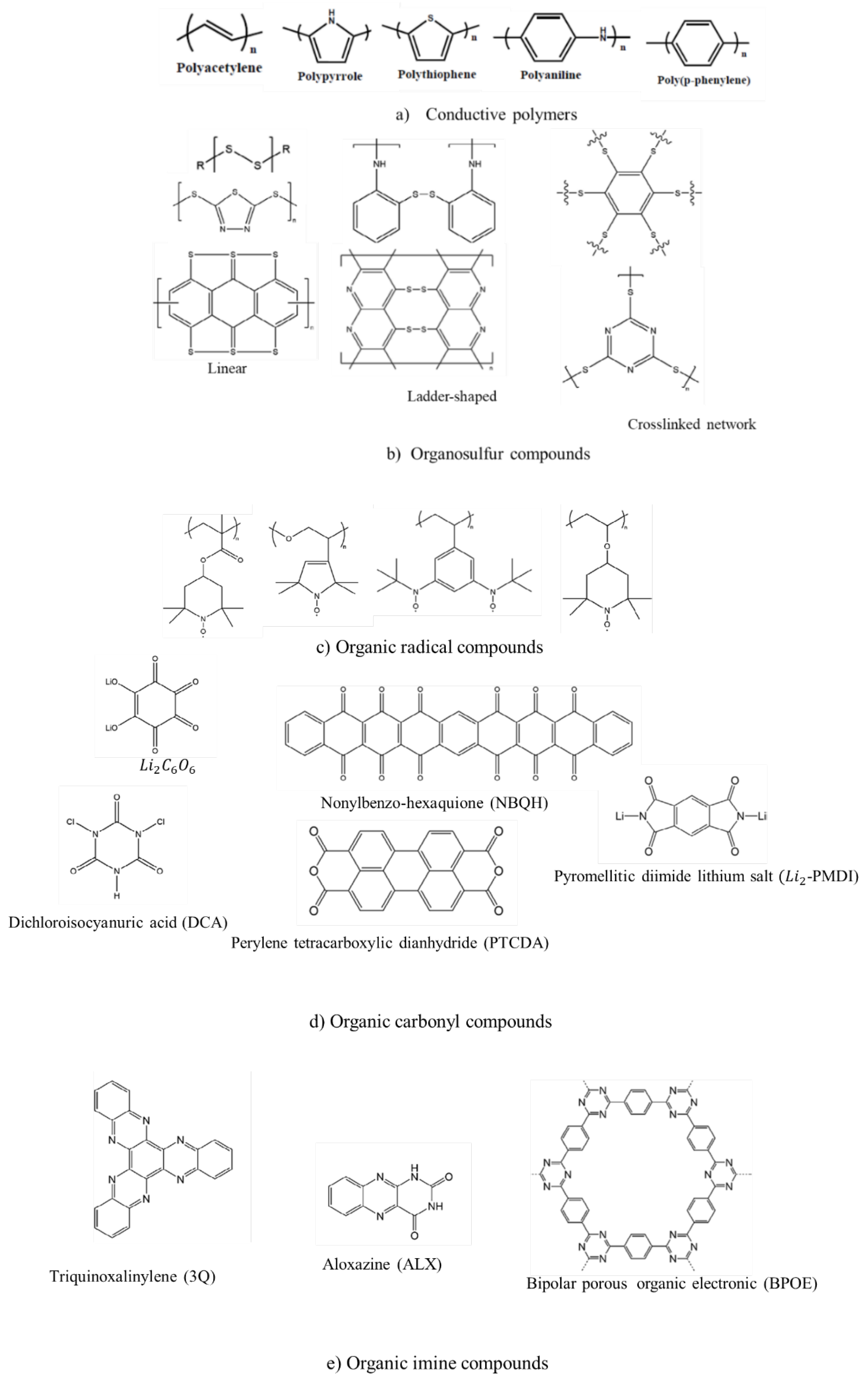
  57. Bhosale, M.E., Chae, S., Kim, J.M. and Choi, J.Y., 2018. Organic small molecules and polymers as an electrode material for rechargeable lithium ion batteries. Journal of Materials Chemistry A, 6(41), pp.19885-19911.
  58. Li, S., Liu, Y., Dai, L., Li, S., Wang, B., Xie, J. and Li, P., 2022. A stable covalent organic framework cathode enables ultra-long cycle life for alkali and multivalent metal rechargeable batteries. Energy Storage Materials, 48, pp.439-446.
  59. Shadike, Z., Tan, S., Wang, Q.C., Lin, R., Hu, E., Qu, D. and Yang, X.Q., 2021. Review on organosulfur materials for rechargeable lithium batteries. Materials Horizons, 8(2), pp.471-500.
  60. Nakahara, K., Oyaizu, K. and Nishide, H., 2011. Organic radical battery approaching practical use. Chemistry letters, 40(3), pp.222-227.
  61. Wu, Y., Zeng, R., Nan, J., Shu, D., Qiu, Y. and Chou, S.L., 2017. Quinone electrode materials for rechargeable lithium/sodium ion batteries. Advanced Energy Materials, 7(24), p.1700278.
  62. McSkimming, A. and Colbran, S.B., 2013. The coordination chemistry of organo-hydride donors: new prospects for efficient multi-electron reduction. Chemical Society Reviews, 42(12), pp.5439-5488.
  63. Power, P.P., 2003. Persistent and stable radicals of the heavier main group elements and related species. Chemical Reviews, 103(3), pp.789-810.
  64. Zhao, L. Wang, W., Wang, A., Yuan, K., Chen, S. and Yang, Y., 2013. A novel polyquinone cathode material for rechargeable lithium batteries. Journal of power sources, 233, pp.23-27.
  65. Huang, W. Zhang, X., Zheng, S., Zhou, W., Xie, J., Yang, Z. and Zhang, Q., 2020. Calix [6] quinone as high-performance cathode for lithium-ion battery. Sci. China Mater, 63(3), pp.339-346.
  66. Huang, W. Liu, S., Li, C., Lin, Y., Hu, P., Sun, Z. and Zhang, Q., 2022. Calix [8] quinone: A new promising macrocyclic molecule as an efficient organic cathode in lithium ion batteries with a highly-concentrated electrolyte. EcoMat, 4(5), p.e12214.
  67. Amin, K. Mao, L. and Wei, Z., 2019. Recent progress in polymeric carbonyl-based electrode materials for lithium and sodium ion batteries. Macromolecular rapid communications, 40(1), p.1800565.
  68. Tran, N.A. Do Van Thanh, N. and Le, M.L.P., 2021. Organic positive materials for magnesium batteries: A review. Chemistry–A European Journal, 27(36), pp.9198-9217.
  69. Banerjee, A. Khossossi, N., Luo, W. and Ahuja, R., 2022. Promise and reality of organic electrodes from materials design and charge storage perspective. Journal of Materials Chemistry A.
  70. Xu, J. Dou, S., Cui, X., Liu, W., Zhang, Z., Deng, Y., Hu, W. and Chen, Y., 2021. Potassium-based electrochemical energy storage devices: Development status and future prospect. Energy Storage Materials, 34, pp.85-106.
  71. Kotal, M. Jakhar, S., Roy, S. and Sharma, H.K., 2022. Cathode materials for rechargeable lithium batteries: Recent progress and future prospects. Journal of Energy Storage, 47, p.103534.

  72. Zhu, L. Ding, G., Xie, L., Cao, X., Liu, J., Lei, X. and Ma, J., 2019. Conjugated carbonyl compounds as high-performance cathode materials for rechargeable batteries. Chemistry of Materials, 31(21), pp.8582-8612.
  73. Wang, J. Wang, X., Li, H., Yang, X. and Zhang, Y., 2016. Intrinsic factors attenuate the performance of anhydride organic cathode materials of lithium battery. Journal of Electroanalytical Chemistry, 773, pp.22-26.
  74. Yuan, C. Wu, Q., Li, Q., Duan, Q., Li, Y. and Wang, H.G., 2018. Nanoengineered ultralight organic cathode based on aromatic carbonyl compound/graphene aerogel for green lithium and sodium ion batteries. ACS Sustainable Chemistry & Engineering, 6(7), pp.8392-8399.
  75. Luo, W. Allen, M., Raju, V. and Ji, X., 2014. An Organic pigment as a high-performance cathode for sodium-ion batteries. Advanced Energy Materials, 4(15), p.1400554.
  76. Poizot, P. Gaubicher, J., Renault, S., Dubois, L., Liang, Y. and Yao, Y., 2020. Opportunities and challenges for organic electrodes in electrochemical energy storage. Chemical reviews, 120(14), pp.6490-6557.
  77. Zhu, Z. Jiang, T., Ali, M., Meng, Y., Jin, Y., Cui, Y. and Chen, W., 2022. Rechargeable batteries for grid-scale energy storage. Chemical Reviews, 122(22), pp.16610-16751.
  78. Sun, T. Xie, J., Guo, W., Li, D.S. and Zhang, Q., 2020. Covalent–organic frameworks: advanced organic electrode materials for rechargeable batteries. Advanced Energy Materials, 10(19), p.1904199.
  79. Peng, H. Yu, Q., Wang, S., Kim, J., Rowan, A.E., Nanjundan, A.K., Yamauchi, Y. and Yu, J., 2019. Molecular design strategies for electrochemical behavior of aromatic carbonyl compounds in organic and aqueous electrolytes. Advanced Science, 6(17), p.1900431.
  80. Van Der Jagt, R. Vasileiadis, A., Veldhuizen, H., Shao, P., Feng, X., Ganapathy, S., Habisreutinger, N.C., van der Veen, M.A., Wang, C., Wagemaker, M. and van der Zwaag, S., 2021. Synthesis and structure–property relationships of polyimide covalent organic frameworks for carbon dioxide capture and (aqueous) sodium-ion batteries. Chemistry of Materials, 33(3), pp.818-833.
  81. Duan, H. Li, K., Xie, M., Chen, J.M., Zhou, H.G., Wu, X., Ning, G.H., Cooper, A.I. and Li, D., 2021. Scalable synthesis of ultrathin polyimide covalent organic framework nanosheets for high-performance lithium–sulfur batteries. Journal of the American Chemical Society, 143(46), pp.19446-19453.
  82. Zhao, Q. Zhu, Z. and Chen, J., 2017. Molecular engineering with organic carbonyl electrode materials for advanced stationary and redox flow rechargeable batteries. Advanced Materials, 29(48), p.1607007.
  83. Oubaha, H. Gohy, J.F. and Melinte, S., 2019. Carbonyl-based π-conjugated materials: from synthesis to applications in lithium-ion batteries. ChemPlusChem, 84(9), pp.1179-1214.
  84. Li, C. and Wonneberger, H., 2012. Perylene imides for organic photovoltaics: yesterday, today, and tomorrow. Advanced Materials, 24(5), pp.613-636.
  85. Renault, S. Geng, J., Dolhem, F. and Poizot, P., 2011. Evaluation of polyketones with N-cyclic structure as electrode material for electrochemical energy storage: case of pyromellitic diimide dilithium salt. Chemical Communications, 47(8), pp.2414-2416.
  86. Xu, K. 2014. Electrolytes and interphases in Li-ion batteries and beyond. Chemical reviews, 114(23), pp.11503-11618.
  87. Kim, D.J. Je, S.H., Sampath, S., Choi, J.W. and Coskun, A., 2012. Effect of N-substitution in naphthalenediimides on the electrochemical performance of organic rechargeable batteries. Rsc Advances, 2(21), pp.7968-7970.
  88. Zhuang, Y. Seong, J.G. and Lee, Y.M., 2019. Polyimides containing aliphatic/alicyclic segments in the main chains. Progress in Polymer Science, 92, pp.35-88.
  89. Song, Z. Zhan, H. and Zhou, Y., 2010. Polyimides: promising energy-storage materials. Angewandte Chemie International Edition, 49(45), pp.8444-8448.
  90. Kapaev, R.R. Scherbakov, A.G., Shestakov, A.F., Stevenson, K.J. and Troshin, P.A., 2021. m-Phenylenediamine as a Building Block for Polyimide Battery Cathode Materials. ACS Applied Energy Materials, 4(5), pp.4465-4472.
  91. Wu, F. Maier, J. and Yu, Y., 2020. Guidelines and trends for next-generation rechargeable lithium and lithium-ion batteries. Chemical Society Reviews, 49(5), pp.1569-1614.
  92. Wang, M. Zhang, H., Cui, J., Yao, S., Shen, X., Park, T.J. and Kim, J.K., 2021. Recent advances in emerging nonaqueous K-ion batteries: from mechanistic insights to practical applications. Energy Storage Materials, 39, pp.305-346.
  93. Li, K. Wang, Y., Gao, B., Lv, X., Si, Z. and Wang, H.G., 2021. Conjugated microporous polyarylimides immobilization on carbon nanotubes with improved utilization of carbonyls as cathode materials for lithium/sodium-ion batteries. Journal of Colloid and Interface Science, 601, pp.446-453.
  94. Xu, F. Wang, H., Lin, J., Luo, X., Cao, S.A. and Yang, H., 2016. Poly (anthraquinonyl imide) as a high capacity organic cathode material for Na-ion batteries. Journal of Materials Chemistry A, 4(29), pp.11491-11497.
  95. Yang, H. Lee, J., Cheong, J.Y., Wang, Y., Duan, G., Hou, H., Jiang, S. and Kim, I.D., 2021. Molecular engineering of carbonyl organic electrodes for rechargeable metal-ion batteries: fundamentals, recent advances, and challenges. Energy & Environmental Science, 14(8), pp.4228-4267.
  96. Song, Z. Xu, T., Gordin, M.L., Jiang, Y.B., Bae, I.T., Xiao, Q., Zhan, H., Liu, J. and Wang, D., 2012. Polymer–graphene nanocomposites as ultrafast-charge and-discharge cathodes for rechargeable lithium batteries. Nano letters, 12(5), pp.2205-2211.
  97. Wu, H. Wang, K., Meng, Y., Lu, K. and Wei, Z., 2013. An organic cathode material based on a polyimide/CNT nanocomposite for lithium ion batteries. Journal of Materials Chemistry A, 1(21), pp.6366-6372.
  98. Lyu, H. Li, P., Liu, J., Mahurin, S., Chen, J., Hensley, D.K., Veith, G.M., Guo, Z., Dai, S. and Sun, X.G., 2018. Aromatic polyimide/graphene composite organic cathodes for fast and sustainable lithium-ion batteries. ChemSusChem, 11(4), pp.763-772.
  99. Wan, B. Dong, X., Yang, X., Wang, J., Zheng, M.S., Dang, Z.M., Chen, G. and Zha, J.W., 2023. Rising of Dynamic Polyimide Materials: A Versatile Dielectric for Electrical and Electronic Applications. Advanced Materials, p.2301185.
  100. You, C. Wu, X., Yuan, X., Chen, Y., Liu, L., Zhu, Y., Fu, L., Wu, Y., Guo, Y.G. and van Ree, T., 2020. Advances in rechargeable Mg batteries. Journal of Materials Chemistry A, 8(48), pp.25601-25625.
  101. Wang, Y. Liu, Z., Wang, C., Hu, Y., Lin, H., Kong, W., Ma, J. and Jin, Z., 2020. π-Conjugated polyimide-based organic cathodes with extremely long cycling life for rechargeable magnesium batteries. Energy Storage Materials, 26, pp.494-502.
  102. Luo, C. Ji, X., Hou, S., Eidson, N., Fan, X., Liang, Y., Deng, T., Jiang, J. and Wang, C., 2018. Azo compounds derived from electrochemical reduction of nitro compounds for high performance Li-ion batteries. Advanced Materials, 30(23), p.1706498.
  103. Ciaccia, M. and Di Stefano, S., 2015. Mechanisms of imine exchange reactions in organic solvents. Organic & Biomolecular Chemistry, 13(3), pp.646-654.
  104. Long, Z. Shi, C., Wu, C., Yuan, L., Qiao, H. and Wang, K., 2022. Heterostructure Fe 2 O 3 nanorods@ imine-based covalent organic framework for long cycling and high-rate lithium storage. Nanoscale, 14(5), pp.1906-1920.
  105. Okafor, P.A. and Iroh, J.O., 2015. Fabrication of porous graphene/polyimide composites using leachable poly-acrylic resin for enhanced electrochemical and energy storage capabilities. Journal of Materials Chemistry A, 3(33), pp.17230-17240.
  106. Tie, Z. and Niu, Z., 2020. Design strategies for high-performance aqueous Zn/organic batteries. Angewandte Chemie International Edition, 59(48), pp.21293-21303.
  107. Lian, L. Li, K., Ren, L., Han, D., Lv, X. and Wang, H.G., 2023. Imine-linked triazine-based conjugated microporous polymers/carbon nanotube composites as organic anode materials for lithium-ion batteries. Colloids and Surfaces A: Physicochemical and Engineering Aspects, 657, p.130496.
  108. Pang, Y. Li, H., Zhang, S., Ma, Q., Xiong, P., Wang, R., Zhai, Y., Li, H., Kang, H., Liu, Y. and Zhang, L., 2022. Conjugated porous polyimide poly (2, 6-diaminoanthraquinone) benzamide with good stability and high-performance as a cathode for sodium ion batteries. Journal of Materials Chemistry A, 10(3), pp.1514-1521.
  109. Kuan, H.C. Luu, N.T., Ivanov, A.S., Chen, T.H., Popovs, I., Lee, J.C. and Kaveevivitchai, W., 2022. A nitrogen-and carbonyl-rich conjugated small-molecule organic cathode for high-performance sodium-ion batteries. Journal of Materials Chemistry A, 10(30), pp.16249-16257.
  110. Waller, P.J. AlFaraj, Y.S., Diercks, C.S., Jarenwattananon, N.N. and Yaghi, O.M., 2018. Conversion of imine to oxazole and thiazole linkages in covalent organic frameworks. Journal of the American Chemical Society, 140(29), pp.9099-9103.
  111. Chen, R. Zhao, J., Yu, Z., Cong, M., Wang, Y., Wang, M., Li, G., Li, Z. and Zhao, Y., 2022. Post-synthetic Fully π-Conjugated Three-Dimensional Covalent Organic Frameworks for High-Performance Lithium Storage. ACS Applied Materials & Interfaces.
  112. Yusran, Y. Fang, Q. and Valtchev, V., 2020. Electroactive covalent organic frameworks: design, synthesis, and applications. Advanced Materials, 32(44), p.2002038.
  113. Kotal, M. Jakhar, S., Roy, S. and Sharma, H.K., 2022. Cathode materials for rechargeable lithium batteries: Recent progress and future prospects. Journal of Energy Storage, 47, p.103534.
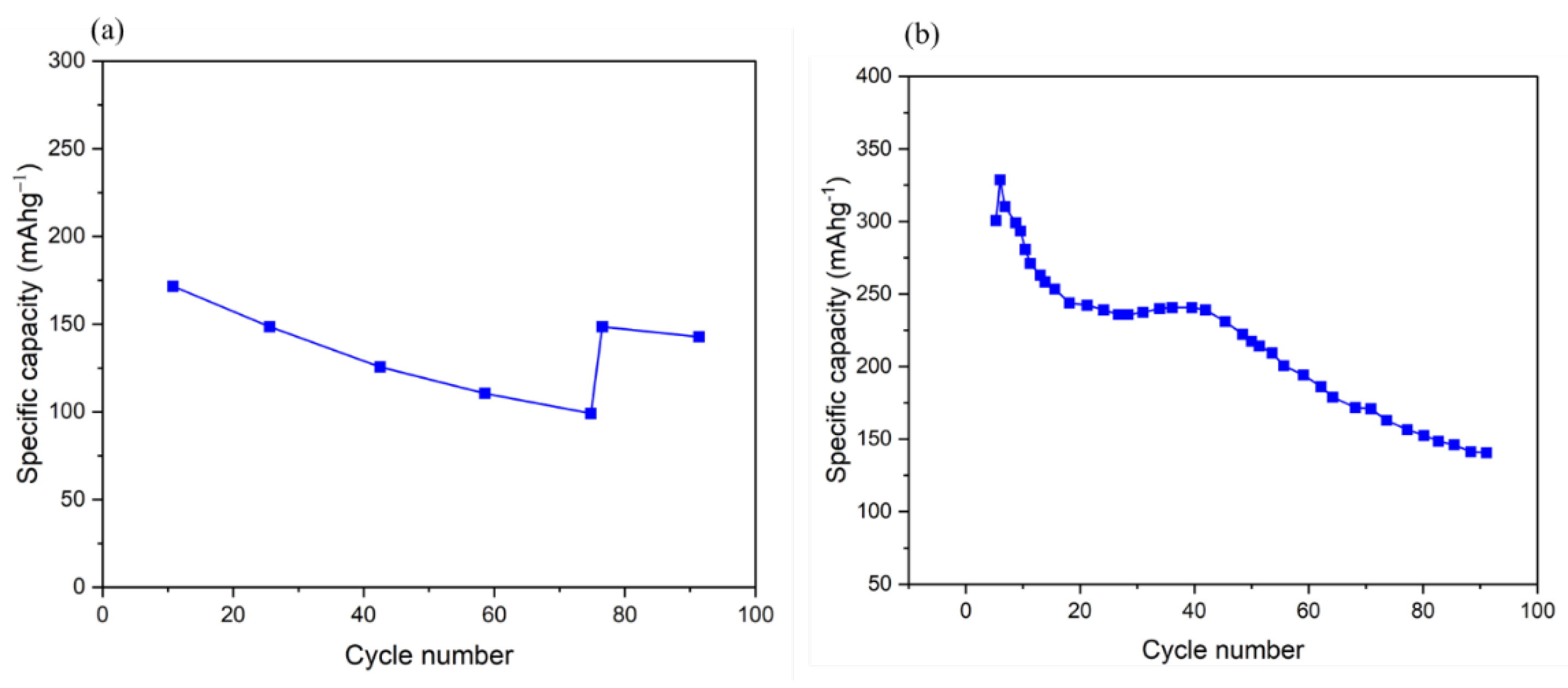
Figure 1. Molecular structures of selected typical cathode materials for LIBs: a) conductive polymers, b) organosulfur compounds, c) Organic radical compounds, d) Organic carbonyl compounds, and e) Organic imine compounds [4].
Preprints 144832 g001
Figure 2. S-PANI synthesis process [6].
Preprints 144832 g002
Figure 3. (a) Rate performance of PADAQ electrode, (b) cycle performance (conditions: cutoff voltage 1.0 - 3.7 V, current density = 400 mA g-1) [67].
Preprints 144832 g003
Figure 4. Structures of specific quinone cathode materials with small molecules [4].
Preprints 144832 g004aPreprints 144832 g004b
Figure 5. (a) The C6Q electrochemical redox has been proposed. (b) C6Q's CV at 0.2 mV s-1. (c) The C6Q/CMK-3 charge-discharge curves (1:2/1:1) [68].
Preprints 144832 g005
Figure 6. a) Diagrammatic representation of the production process for the composite made of PTCDA and graphene aerogel b) The electrochemical redox reaction mechanism in PTCDA, Electrochemical characterization for SIB: (c) CV curves at a scan rate of 0.1 mV/s in the range of 1.5−3.5 V; (d) Redox behavior and cycling stability of the molecule in the electrochemical system. (e) Specific capacitance shows the electrochemical performance and stability over time [77].
Preprints 144832 g006
Figure 9. Principles of operation of organic molecules in Li-ion batteries. In the N-N reaction, two nitro groups are reduced to an azo group by Li-ions, which results in the production of Li2O [106].
Preprints 144832 g009
Figure 10. a) The CV curves of the PYTRI-COF-2 electrodes; b) The bulk resistance of PYTRI-COF-1 and PYTRI-COF-2 electrodes; c) The rate capability of the PYTRI-COF-2 at different current densities; and d) Angle vs cycle number curve [113].
Preprints 144832 g010
Table 1. The supercapacitor electrode materials are typically based on PANI and their electrochemical performance [8,9,13,15,16,18].
Materials Method of preparation Capacitance retention Cyclability Advantage Disadvantage Reference
Graphene nanosheets (GNSs), carbon nanotubes (CNTs), and PANI Easy chemical in-situ process 1035 F g-1, 1 mV s-1 6% loss after 1000 cycles exceptionally high specific capacitance [8]
PANI/S composite In situ chlorine substitution and vulcanization reactions Reversible capacity 750 mAh/g 89.7% capacity retention after 200 cycles at 0.3 C high rate performance Low sulfur loading [9]
PANI nanofibers Interfacial polymerization 554 Fg-1 -57 Fg-1 31% after 1000 cycles Pure PANI's instability and minimal capacitance contribution make it potentially unsuitable for use as the supercapacitor electrode [13]
PANI porous carbon electrodes Electrochemical polymerization 180 Fg-1
dropped from 180 to 163 Fg-1
After 1000 cycles low conductivity, cycling instability, and structural instability [15]
PANI/LiCoO2 nanocomposites Pickering emulsion method Specific capacity 136 mAh/g Improved specific capacities [16]
A PANI-CSA (camphorsulfonic acid)/C-LFP Coating C-LFP with PANI-CAS in m-cresol solution. 10% attained specific capacity up to 165.3mAh/g The composite cathodes gave improved specific discharge, specific capacity, and rate capabilities [18]
Disclaimer/Publisher’s Note: The statements, opinions and data contained in all publications are solely those of the individual author(s) and contributor(s) and not of MDPI and/or the editor(s). MDPI and/or the editor(s) disclaim responsibility for any injury to people or property resulting from any ideas, methods, instructions or products referred to in the content.
Copyright: This open access article is published under a Creative Commons CC BY 4.0 license, which permit the free download, distribution, and reuse, provided that the author and preprint are cited in any reuse.
Prerpints.org logo

Preprints.org is a free preprint server supported by MDPI in Basel, Switzerland.

Subscribe

Disclaimer

Terms of Use

Privacy Policy

Privacy Settings

© 2025 MDPI (Basel, Switzerland) unless otherwise stated