

Submitted:
07 January 2025
Posted:
08 January 2025
You are already at the latest version
Abstract
Quantum computing introduces unique forms of randomness arising from measurement processes, gate noise, and hardware imperfections. Ensuring reliable uncertainty quantification in such quantum-driven or quantum-derived predictions is an emerging challenge. In classical machine learning, conformal prediction has proven to be a robust framework for distribution-free uncertainty calibration, often focusing on univariate or low-dimensional outputs. Recent advances (e.g., [1–3]) have extended conformal methods to handle multi-output or multi-dimensional responses, addressing sophisticated tasks such as time-series, image classification sets, and quantum-generated probability distributions. However, bridging the gap between these powerful conformal frameworks and the high-dimensional, noise-prone distributions typical of quantum measurement scenarios remains largely open. In this paper, we propose a unified approach to harness quantum conformal methods for multi-output distributions, with a particular emphasis on two experimental paradigms: (i) a standard 2-qubit circuit scenario producing a four-dimensional outcome distribution, and (ii) a multi-basis measurement setting that concatenates measurement probabilities in different bases (Z, X, Y) into a twelve-dimensional output space. By combining a multi-output regression model (e.g., random forests) with distributional conformal prediction, we validate coverage and interval-set sizes on both simulated quantum data and multi-basis measurement data. Our results confirm that classical conformal prediction can effectively provide coverage guarantees even when the target probabilities derive from inherently quantum processes. Such synergy opens the door to next-generation quantum-classical hybrid frameworks, providing both improved interpretability and rigorous coverage for quantum machine learning tasks. All codes and full reproducible Colab notebooks are made available at https://github.com/detasar/QECMMOU.
Keywords:
1. Introduction
- Motivation and Background. Quantum computing leverages superposition and entanglement of qubits to (potentially) solve problems at scales intractable for classical machines. However, even as Noisy Intermediate-Scale Quantum (NISQ) devices progress [9], the inherent measurement randomness, gate errors, and hardware noise complicate the generation of stable output probabilities. Classical conformal prediction (CP) has emerged as a powerful, distribution-free framework that can quantify predictive uncertainty in a statistically rigorous way [4,5,6]. Until recently, most conformal approaches addressed single-dimensional outputs or classification tasks [7]. Yet, the need to provide set-valued predictions or region-based coverage for multi-output data is rapidly growing [2,8], especially in quantum contexts where the natural outputs (e.g., measurement distributions) are inherently multi-dimensional.
- Quantum-Specific Challenges. Predicting the outcome distribution of a quantum circuit entails dealing with:
- Stochasticity of measurement. A 2-qubit circuit, for instance, yields a random distribution over . Each execution (shot) collapses the state, introducing inherent randomness.
- Hardware noise and drifts. Real quantum devices exhibit gate infidelities and drift over time, causing correlated noise across measurement shots [1].
- High-dimensional expansions. If measurements are taken in multiple bases (e.g., X, Y, Z), the resulting multi-head distribution can reach dimension for m different bases in just a 2-qubit system.
- Therefore, guaranteeing a coverage statement like “with probability, the true measurement distribution lies within the predicted region” is non-trivial. Recent works [1] discuss probabilistic conformal prediction (PCP) for quantum models, but typically focus on single-basis or single-dimensional scenarios.
- Prior Art in Multi-Output Conformal. Meanwhile, multi-output conformal methods in classical machine learning have flourished. For instance, ellipsoidal sets for multi-dimensional time series [2], multi-output regression intervals [3,8], and adaptive or differentiable conformal solutions [2,4] represent active directions. These techniques ensure finite-sample coverage under minimal assumptions—primarily exchangeability of calibration and test points. In quantum-like scenarios, exchangeability might hold when each circuit is drawn from the same distribution of gates or the same family of states, so the typical CP framework can be leveraged.
- Contributions and Paper Outline. In this work, we propose a systematically integrated approach to:
- Generate synthetic data from quantum circuits and multi-basis measurements. One scenario yields a 4-dim distribution from a 2-qubit measurement (computational basis), while the second scenario concatenates Z, X, and Y measurement probabilities into a 12-dim vector.
- Apply classical multi-output regression to map classical features (circuit-depth, gate counts, etc.) to these quantum-derived probability vectors.
- Adopt a distributional conformal prediction approach, using a single scalar norm (e.g., or ) to form coverage sets in or .
- Experimentally evaluate how coverage changes with different miscoverage parameters , reporting coverage rates and “volume” (or set size) of these multi-dimensional intervals (hypercubes or hyperspheres).
- We show that, under mild assumptions, conformal intervals indeed provide coverage close to , even though the underlying data stems from quantum measurements. This synergy offers an important step toward quantum-classical hybrid pipelines where classical conformal methods supply robust uncertainty quantification for quantum outputs.
- Paper Organization. We structure the paper as follows:
- Section II (Materials and Methods) details the quantum circuit generation, multi-basis measurement strategies, and the fundamentals of multi-output conformal intervals.
- Section III (Experiments) describes how we train random forest regressors on these multi-output distributions, and how we apply distributional conformal thresholds.
- Section IV (Results and Discussions) discusses coverage performance, the trade-off with set sizes, and potential limitations with quantum noise.
- References and Appendices provide literature context, expansions of conformal proofs, and the relevant code annotations for replicability.
- By bridging modern quantum data generation with distribution-free uncertainty quantification, we illuminate a pathway to robust, “error-bounded” quantum machine learning—an essential milestone in advancing practical quantum computing.
2. Materials and Methods
- The quantum data generation pipeline for single-basis (2-qubit) as well as multi-basis measurements.
- The classical features extracted from the quantum circuits.
- Our multi-output regression strategy.
- The distributional conformal approach for interval (or region) construction in up to 12 dimensions.
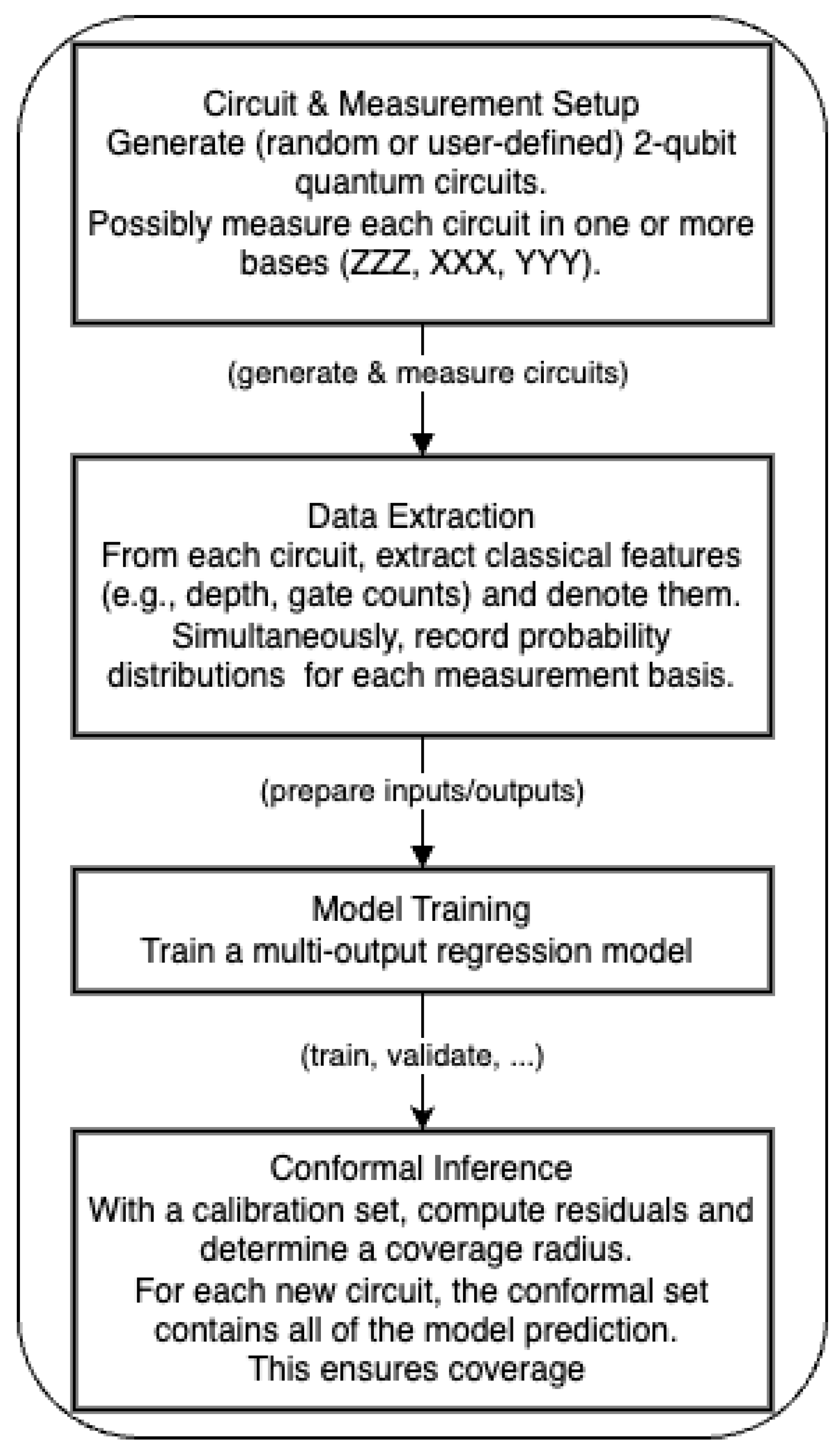
2.1. Overview of the Pipeline
- Circuit and Measurement Setup: We design a random 2-qubit quantum circuit, optionally measuring it in one or more bases (e.g., ).
- Data Extraction: We gather classical features (gate counts, depth, etc.) in an matrix, along with measured distribution vectors (probabilities) in a matrix.
- Model Training: A multi-output regression model is trained to approximate .
- Conformal Inference: Using a calibration subset, we derive coverage thresholds (radii) for distributional conformal sets in or . We then test coverage on new circuits.
2.2. Quantum Circuit Generation
2-Qubit Architecture.
Random Gate Selection.
- Single-Basis (Z) scenario: We measure in the computational (Z) basis, obtaining probabilities for .
- Multi-Basis scenario: We replicate the circuit or apply basis transformations to measure in X, Y, or Z bases. For instance, measuring in the X basis typically involves a Hadamard on each qubit prior to a Z-basis readout. Similarly, measuring in the Y basis can be done via then H [9].
2.3. Feature Extraction
- Depth (integer): .
- Total gates: Summation of all single- and two-qubit gates used.
- Gate counts: For each gate type (H, X, Y, Z, CX, …), we store how many times it appears.
2.4. Measurement Vectors
Single-Basis Setup (4D).
Multi-Basis Setup (12D).
2.5. Multi-Output Regression Model
2.6. Distributional Conformal Inference
Coverage and Set Size.
Exchangeability in Quantum Data.
2.7. Implementation Details and Code Structure
- Data Generation Notebook: Implements the procedures in Sec. 2.2–2.4 for single- or multi-basis measurements. Stores arrays in .npz or .pkl files.
- Model + Conformal Notebook: Loads the data, splits into train/cal/test, trains a multi-output regressor (random forest), computes residuals, and evaluates coverage for various .
| Listing 1. Pseudo-code for quantum data generation and distributional conformal. |
| # (A) Data Generation |
| Define num_samples, min_depth, max_depth, shots. |
| X_list, Y_list = [], [] |
| for i in range(num_samples): |
| qc = random_circuit(num_qubits=2, depth=rand_in_[min_depth,max_depth]) |
| x_features = extract_gate_counts(qc) |
| measure_Z = get_distribution(qc, basis=’Z’) |
| measure_X = get_distribution(qc, basis=’X’) |
| measure_Y = get_distribution(qc, basis=’Y’) |
| y_vector = concat(measure_Z, measure_X, measure_Y) |
| X_list.append(x_features), Y_list.append(y_vector) |
| X_data = np.array(X_list); Y_data = np.array(Y_list) |
| save(X_data, Y_data, filename=...) |
| # (B) Conformal Pipeline |
| X_train, X_cal, X_test, Y_train, Y_cal, Y_test = splits(...) |
| model = RandomForestRegressor(...).fit(X_train, Y_train) |
| cal_pred = model.predict(X_cal) |
| resid_list = [ norm(Y_cal[i] - cal_pred[i]) for i in range(len(cal_cal)) ] |
| sort_resid = sorted(resid_list) |
| for alpha in [0.05, 0.10, 0.20, 0.30, 0.50]: |
| idx = ceil((1-alpha)*(len(cal_cal)+1)) - 1 |
| tau = sort_resid[idx] |
| # Evaluate coverage on test |
| test_pred = model.predict(X_test) |
| coverage = mean( [norm(Y_test[j]-test_pred[j]) <= tau] ) |
| print("alpha=", alpha, " coverage=", coverage, " tau=", tau) |
- This completes the Materials and Methods section. Next, we detail the specific experimental setups, hyper-parameters, and further results that validate or highlight the coverage properties of this approach.
3. Experimental Setup
- Single-Basis (4D) Approach: Measuring a 2-qubit circuit only in the computational (Z) basis. Each circuit instance yields a single 4D probability vector.
- Multi-Basis (12D) Approach: Measuring the same circuit in three distinct bases (Z, X, and Y), concatenating three 4D distributions for each circuit, thus producing 12-dimensional outputs.
3.1. Datasets
Toy Dataset (Hundreds of Samples).
- The circuit depth D was randomly sampled from .
- The random gate set typically included as described in Sec. 2.2.
- Number of shots was set to 512 or 1024 to maintain moderate precision in measuring probabilities.
- For multi-basis generation, we measured the same circuit across by applying the relevant transformations (Hadamard, , ⋯).
Large-Scale Dataset (Tens of Thousands of Samples).
- Used circuit depths up to 8, potentially reaching up to 16 or more gates.
- Was subject to a duplicate-dropping step (Sec. 2.3), ensuring we do not store the same gate composition multiple times.
- Provided enough calibration/test data to yield stable coverage estimates even for small (like ).
3.2. Train–Cal–Test Splits
- Training Set: Roughly of the data, used for fitting the multi-output regressor.
- Calibration Set: Around of the data, used to compute the conformal residual thresholds (Sec. 2.6).
- Test Set: The remaining , reserved for final evaluation of coverage and set size.
3.3. Hyperparameters and Implementation Details
Quantum Circuit Parameters.
- Depth D: Uniformly drawn in or depending on the experiment size.
- Shots: This is the default for most runs; lower shots (256) or higher (2048) can be used to explore noise/variance trade-offs.
Classical Feature Extraction.
- Minimal Features, yielding a 2D .
- Full Gate Counts, which can be 17D or higher.
Random Forest Regressor.
Residual Metric.
3.4. Experiment Configurations
3.4.1. Single-Basis 4D Distributions
- We pick from .
- Compute using the formula in eq. (1) plus the sorted residual approach.
- Evaluate coverage on the test set.
3.4.2. Multi-Basis 12D Distributions
Motivation for Multi-Basis.
3.5. Performance Metrics
Coverage and Set Size.
- Empirical Coverage: The fraction of test points that satisfy
- Radius : The scalar threshold derived from calibration.
- Sum-Size / Volume (optional): For an ball in dimension d, the sum-size is , while the volume is . For -balls, the d-dim volume formula is .
Mean Squared Error.
3.6. Summary of the Experimental Setup
- Generate Data: either single- or multi-basis, with a user-defined number of samples. Remove duplicates in features.
- Split: train, calibration, test.
- Train Regressor: multi-output random forest with moderate hyperparameters.
- Calibrate Residuals: Sort on the calibration set to get at each .
- Evaluate: coverage, radius, volume, or sum-size on the test set.
4. Results and Discussion
4.1. Single-Basis (4D) Coverage
Coverage vs. .
Set Size.
- With , the conformal set is a 4D hypercube of edge length .
- With , it is a 4D hypersphere (radius ).
Random-Forest MSE.
4.2. Multi-Basis (12D) Coverage
Why 12D?
Empirical Coverage Trends.
Comparisons of Set Size.
Regression Performance.
4.3. Qualitative Observations and Open Challenges
Sensitivity to Data Complexity.
Potential for Hardware Testing.
Future Directions.
- Adaptive Conformal Loops: Dynamically recalibrating in real quantum experiments whenever noise behavior shifts.
- Refined Non-Conformity Scores: Instead of a single or residual, one might incorporate physically motivated distances or angles in Bloch sphere subspaces, as hinted by [1].
- Advanced Regression Models: Neural nets or quantum kernel methods might reduce the MSE, potentially leading to narrower, yet still valid, coverage sets for multi-basis data.
4.4. Summary of Findings
- Distributional Conformal maintains near-nominal coverage in both the simpler 4D (single-basis) and the more involved 12D (multi-basis) quantum measurement setting.
- The size of the conformal set grows with dimension and circuit complexity, reflecting the model’s uncertainty about entangled or multi-basis states.
- Even if MSE is not minimal, the conformal mechanism compensates by enlarging the residual threshold to preserve coverage.
5. Conclusions and Future Directions
- Robust Coverage in 4D and 12D: Whether dealing with a four-dimensional quantum measurement vector (e.g., in the computational basis) or a concatenated twelve-dimensional vector (three distinct measurement bases), the distributional conformal sets consistently achieved near-nominal coverage . This confirms that classical conformal wrappers can seamlessly adapt to quantum-generated data, even when the quantum device or simulator produces complex or entangled states.
- Trade-Offs in Set Size: The required residual threshold is invariably larger in the multi-basis approach (12D) than in the single-basis scenario (4D). While multi-basis data can, in principle, enrich the training signal for the regressor, it also significantly complicates the mapping from classical features (gate counts, depths, etc.) to measured distributions. Consequently, maintaining the same coverage demands a higher radius, which may translate into large or voluminous multidimensional sets.
- Model Accuracy and Conformal Enlargement: Our multi-output regressors typically exhibit moderate mean squared errors (– range), reflecting the partial mismatch between classical features and quantum measurement outcomes. Conformal calibration compensates for these inaccuracies, expanding the prediction regions to include potentially spiky or entangled measurement distributions. This synergy confirms that even with suboptimal models, one can preserve finite-sample coverage guarantees through distributional conformal routines.
- Applicability Beyond Simulation: Although our experiments used simulated quantum circuits on classical backends, the same pipeline is poised to operate on real quantum hardware data. The primary condition is to ensure approximate exchangeability between the calibration set and the test set. Ongoing challenges—like time-dependent drifts and correlated gate noise—may call for advanced drift-aware or partial-exchangeability versions of conformal methods, a topic of emerging interest in quantum machine learning [1].
- Advanced Non-Conformity Scoring: Replacing simple or distances with more sophisticated scores (e.g., angles in Bloch space, amplitudes ignoring global phases, or partial tomography) could yield tighter uncertainty sets that better reflect quantum physics.
- Adaptive Conformal Loops Under Noise: Real hardware experiments often exhibit time-varying noise. Recalibrating the residual distribution periodically could keep coverage stable, potentially leveraging “sequential” or “online” conformal techniques that handle non-stationary data [2].
- Hybrid Quantum-Classical Features: Beyond gate counts, one might incorporate partial tomography or mid-circuit measurements as additional classical features for improved learning. This might narrow conformal sets by sharpening the regressor’s accuracy.
Data Availability Statement
References
- S. Park and O. Simeone, “Quantum Conformal Prediction for Reliable Uncertainty Quantification in Quantum Machine Learning,” IEEE Trans. Quantum Eng., 2023. [CrossRef]
- C. Xu, H. Jiang, and Y. Xie, “Conformal Prediction for Multi-Dimensional Time Series by Ellipsoidal Sets,” in Proc. 41st Int. Conf. Mach. Learn. (ICML), 2024.
- S. Feldman, S. Bates, and Y. Romano, “Calibrated Multiple-Output Quantile Regression with Representation Learning,” arXiv preprint arXiv:2110.00816, 2021. [CrossRef]
- Y. Bai, S. Mei, H. Wang, Y. Zhou, and C. Xiong, “Efficient and Differentiable Conformal Prediction with General Function Classes,” arXiv preprint arXiv:2202.11091, 2022. [CrossRef]
- G. Cherubin, A. Pacchiano, and N. Cesa-Bianchi, “Conformal Prediction: A Unified Review of Theory and New Challenges,” arXiv preprint arXiv:2005.07972, 2020. [CrossRef]
- A. N. Angelopoulos, R. F. Barber, and S. Bates, “Theoretical Foundations of Conformal Prediction,” arXiv preprint arXiv:2411.11824, 2024. [CrossRef]
- D. Bethell, S. Gerasimou, and R. Calinescu, “Robust Uncertainty Quantification Using Conformalised Monte Carlo Prediction,” arXiv preprint arXiv:2308.09647, 2023. [CrossRef]
- L. Carlsson, H. Linusson, and A. Ståhlbom, “Exact and Approximate Conformal Inference for Multi-Output Regression,” arXiv preprint arXiv:2210.17405, 2022. [CrossRef]
- H.-Y. Huang, R. Kueng, and J. Preskill, “Learning to Predict Arbitrary Quantum Processes,” PRX Quantum, 4(4), 040337, 2023. [CrossRef]
Disclaimer/Publisher’s Note: The statements, opinions and data contained in all publications are solely those of the individual author(s) and contributor(s) and not of MDPI and/or the editor(s). MDPI and/or the editor(s) disclaim responsibility for any injury to people or property resulting from any ideas, methods, instructions or products referred to in the content. |
© 2025 by the authors. Licensee MDPI, Basel, Switzerland. This article is an open access article distributed under the terms and conditions of the Creative Commons Attribution (CC BY) license (http://creativecommons.org/licenses/by/4.0/).


