

Submitted:
06 January 2025
Posted:
07 January 2025
You are already at the latest version
Abstract
This study examines how novice translators allocate cognitive resources during English-Chinese and Chinese-English translation, focusing on the influence of translation direction and the discrepancies between empirical data and self-reflections. Using a combination of eye-tracking and keystroke logging, four key indicators—Total Attentional Duration, Attention Unit Count, Attention Unit Duration, and pupil dilation—were employed to quantify cognitive effort. Cue-based Retrospective Think-Aloud Protocols were used to capture participants’ reflective insights. The findings reveal that cognitive effort varies significantly between attention types in both translation directions. Specifically, Target Text processing consistently demands more cognitive resources than Source Text processing and parallel processing, though variations between the two translation directions are evident. Furthermore, a notable divergence emerges between participants’ reflective accounts and the quantitative data, with translation directionality significantly influencing this discrepancy. These results contribute to a deeper understanding of cognitive effort in translation and highlight the complex interplay between empirical measures and self-reported experiences.
Keywords:
translators
; eye-tracking
; key-logging
; cognitive resources
; translation direction
; self-reflection
1. Introduction
Directionality in translation, referring to whether translators work from a foreign language into their first language (L1) or the reverse, has long been a foundational topic in translation studies [1]. Directionality, recognized as one of the oldest and most debated topics in translation studies [2], encompasses a wide range of perspectives, including “inward” and “outward” translation practices, regional and national variations, as well as the political, economic, and sociocultural factors influencing them [3]( p. 898). Recent technological advancements have propelled directionality research toward cognitive approaches and as one of variables. For instance, Chang and Chen [4] utilized eye-tracking to examine cognitive load variations in L1 and L2 translations, providing empirical support for the Inhibitory Control Model’s “translation asymmetry” phenomenon. Martín et al. [5] compiled an advanced studies focusing on cognitive load and effort in translation, exploring factors such as text complexity and directionality, and their impact on translator performance. These studies underscore the growing emphasis on cognitive perspectives in directionality research [6,7,8,9,10]. These studies span written translation [11,12], conference interpretation [2], simultaneous interpretation [13,14], translation competence [9], and translator training [15,16].
Among these areas, the relationship between cognitive effort and translation directionality has attracted substantial scholarly attention and debate. A central question is whether translation directionality correlates with translators’ cognitive resource allocation; however, no consensus has been reached. Findings on this issue remain varied and at times contradictory, with researchers offering diverse conclusions. Earlier studies [11,14,17] provided foundational insights into these dynamics. Building on this groundwork, recent research, such as Jia et al. [18] and Chang and Chen [4], have utilized advanced tools like eye-tracking to investigate translation directionality, translator anxiety, cognitive load, and resource allocation, offering new perspectives while underscoring the ongoing complexity of the debate.
This ongoing debate is intricately linked to the development of process-oriented cognitive translation studies and the advancements in eye-tracking technology. The study of cognitive resource allocation by translators has been a cornerstone of this subfield for decades. Initial explorations of translation as a cognitive activity date back to the 1960s and 1970s [19]. By the 1980s and early 1990s, the introduction of eye-tracking technology revolutionized cognitive translation research, providing a less intrusive and highly precise method for examining cognitive processes [19]. Prior to this, methods such as Think Aloud Protocols (TAPs) and keystroke logging dominated the field [20,21,23]. Eye tracking, often combined with keystroke logging, has since become indispensable in investigating translation units (TUs) and attention units (AUs), enabling researchers to measure uninterrupted cognitive processing with unparalleled accuracy [24].
This study employs a combined approach of eye-tracking and keystroke logging to investigate how translators allocate cognitive resources during English-Chinese and Chinese-English translation. It examines the influence of translation directionality on cognitive effort and explores discrepancies between empirical data and translators’ self-reflections. The concept of cognitive effort is refined through the adoption of attention units (AUs), a framework developed by Hvelplund [24]. An AU is defined as a time measurement unit representing uninterrupted cognitive processing, quantified through indicators such as eye movement data (fixations and saccades) and typing events. This framework provides a detailed perspective on the cognitive mechanisms underlying translation. Four indicators are employed to quantify cognitive resource allocation: Total Attentional Duration (TA duration), AU count, AU duration, and pupil dilation. Data were collected from 24 Chinese novice translator trainees and analyzed through Generalized Linear Models. This statistical approach provides fresh insights into the relationship between directionality and cognitive effort in translation.
2. Theoretical and Methodological Considerations
2.1. Processing Types and Allocation of Cognitive Resources in Translators
Translation is a complex process that requires both conscious and unconscious allocation of cognitive resources. Scholars have approached the division and description of these resources in various ways. Traditionally, the translation process has been divided into two primary types: Source Text (ST) comprehension and Target Text (TT) production [e.g., [22,23,24,25]]. However, with theoretical advancements and empirical studies on the sequential and parallel coordination of ST and TT processing [e.g., [26,27,28]], a third type—”parallel processing”—has emerged, prompting a shift toward a more holistic understanding of cognitive resource allocation.
Research in neurology and psychology underscores multitasking as a fundamental human behavior, particularly evident in translation practices. Under the traditional dichotomy of ST comprehension and TT production, researchers identified several sub-processes [29,30,31,32,33,34,35]. These sub-processes often occur simultaneously. For instance, ST rendition and TT reformulation frequently overlap, demonstrating the multitasking nature of translation [36,37]. Hvelplund [24] observed that ST comprehension and TT production, as indicated by eye fixation and key logging, rarely operate as purely sequential processes. Instead, parallel processing—unique to translation—occurs, distinguishing it from simpler activities like copying [39].
Recent empirical studies have advanced our understanding of the differences in cognitive effort associated with Source Text (ST) processing, Target Text (TT) processing, and parallel processing during translation, highlighting the dynamic and multitasking nature of these activities [22]. Once considered a sequential process, translation is now understood to involve significant parallel processing. Balling et al. [40] present compelling evidence that translators often engage in simultaneous comprehension and production, challenging the traditional division between ST and TT processing. Wang et al. [41] demonstrates that TT processing requires substantially more cognitive resources than ST and parallel processing, particularly when translating metaphors between Chinese and English. Similarly, Ferreira et al. [42] shows that inverse translation (L1 → L2) demands greater cognitive effort, as indicated by longer fixation durations and a heightened reliance on external resources. Hvelplund [24] further illustrates that during Danish-English translation, ST reading and comprehension are significantly less time- and resource-intensive compared to TT reading, reformulation, and typing.
Collectively, these findings reveal that TT processing generally requires the highest cognitive effort, while parallel processing reflects the intricate multitasking demands inherent in translation. These studies provide a theoretical and methodological benchmark for our research, enabling a comparison of results against established patterns in cognitive effort allocation. The use of metrics such as fixation durations, ST and TT processing effort, and reliance on external resources—central to this study’s indicators like Total Attentional and Attention Unit Count—validates the relevance and reliability in measuring cognitive effort.
2.2. Unit to Describe Cognitive Processing During Translation
To capture translators’ allocation of cognitive resources, the concepts of translation unit and attention unit have been introduced to quantify continuous cognitive processing over time. Originating from linguistics, the concept of the translation unit has transcended its initial scope. Linguistically, it refers to the smallest segment of an utterance whose signs are so intrinsically linked that they should not be translated in isolation [43], either in terms of meaning [44,45,46] at the analysis level [47], as summarized by Dragsted [48]. Cognitively, on the other hand, the translation unit is conceived as the focus of attention [49], the segment that is actually processed [50], and the unit of “cognitive activity” [51] (p. 953). This perspective reveals valuable insights into the variability of translation unit size, the depth of language processing, and its speed.
To determine the properties and shapes of translation unit, Carl and Kay [51] investigated attention distribution patterns of 12 professionals and students, and defined the TU as “entities of text which the translator focuses on at a given point of time” (p.972). In their study, “all keystrokes and eye movements–so-called user activity data (UAD)–were recorded using the Translog software”(as cited in [51], p.972), and fount that the maximum of translation unit segmentation corresponds to translators’ “capacity and experience … rather than a minimal unit or a ‘translation atom’” [51] (p.973), which is against most previous product-oriented literature. Later, based on theories and practices in the fields of cognitive psychology, language comprehension, language production and process-oriented translation, namely Baddeley and Hitch’s [52] model of working memory, Baddeley’s [52] proposal of attentional control, Kintsch’s [30] model of construction-integration during comprehension, Kellogg’s [33] and Olive [34]’s models of text production, theoretical discussion and empirical observations on sequential and parallel coordination of source text processing and target text processing [26]. Hvelplund [24] categorized eye tracking and keylogging data into three different types of AU, namely Source Text (ST) AU, Target Text (TT) AU and Parallel AU, which respectively describe three different types of processing: Source Text (comprehension) processing, Target Text (production) processing, and parallel processing of ST and TT. The categorization logic of macro and micro AUs is presented in Table 1.
This framework directly informs the current study, which employs eye-tracking and keylogging data to examine translators’ cognitive resource allocation across ST AU, TT AU, and Parallel AU in English-Chinese and Chinese-English translations. By adopting this categorization, the study builds on Hvelplund’s [24] logic to provide empirical insights into the interplay between translation directionality and cognitive effort.
2.3. Models of Translation Processes
There are certain limitations concerned: for example, current eye tracking and key logging technology cannot fulfill the purpose of further differentiating the micro processing stages. For instance, “not only is it infeasible (if not impossible) to distinguish between comprehension and pre-translation activities during reading for translation, but also the borders between ST understanding and TT production problems become blurred” [53] (p. 129). Nevertheless, the combination of eye tracking and key logging methods has proven to be one of the most efficient approaches, and has greatly facilitated the research progress on cognitive processing in translation. Many researchers employ this approach to observe and elucidate the mechanisms underlying language processing in translation, or to test their hypotheses regarding these processes [19,39]. For example, Tirkkonen-Condit [54] (pp. 407-408) put forward literal translation hypothesis: “literal translation is a default rendering procedure, which goes on until it is interrupted by a monitor that alerts about a problem in the outcome. The monitor’s function is to trigger off conscious decision making to solve the problem”. Regarding this issue, Schaeffer et al. [53] further interpret this research question from a perspective of semantic and structural cross-linguistic priming. They suggested that “the default rendering procedure during ST reading in translation is to generate an interim representation in which ST word order and TT word order are identical, where ST and TT items correspond one-to-one and in which each ST word has only one possible translated form. When this is not possible, because of context, target norms or for any other reason, cognitive effort increases” (p.199).
Meanwhile, Alves and Vale [49] adopted Relevance Theory [55,56] to interpret translation units with empirical behavioral data, “RT defines translation as interpretive language use and suggests two distinct translation modes, a stimulus mode (s-mode) and an interpretive mode (i-mode)”, which are believed being “unfold on different timelines” [19] (p.256). Based on this, Carl [19] developed the Monitor Model of translation process, adapted from the previous design [57].
Figure 1.
The Monitor Model [19] (p.258).
Figure 1.
The Monitor Model [19] (p.258).
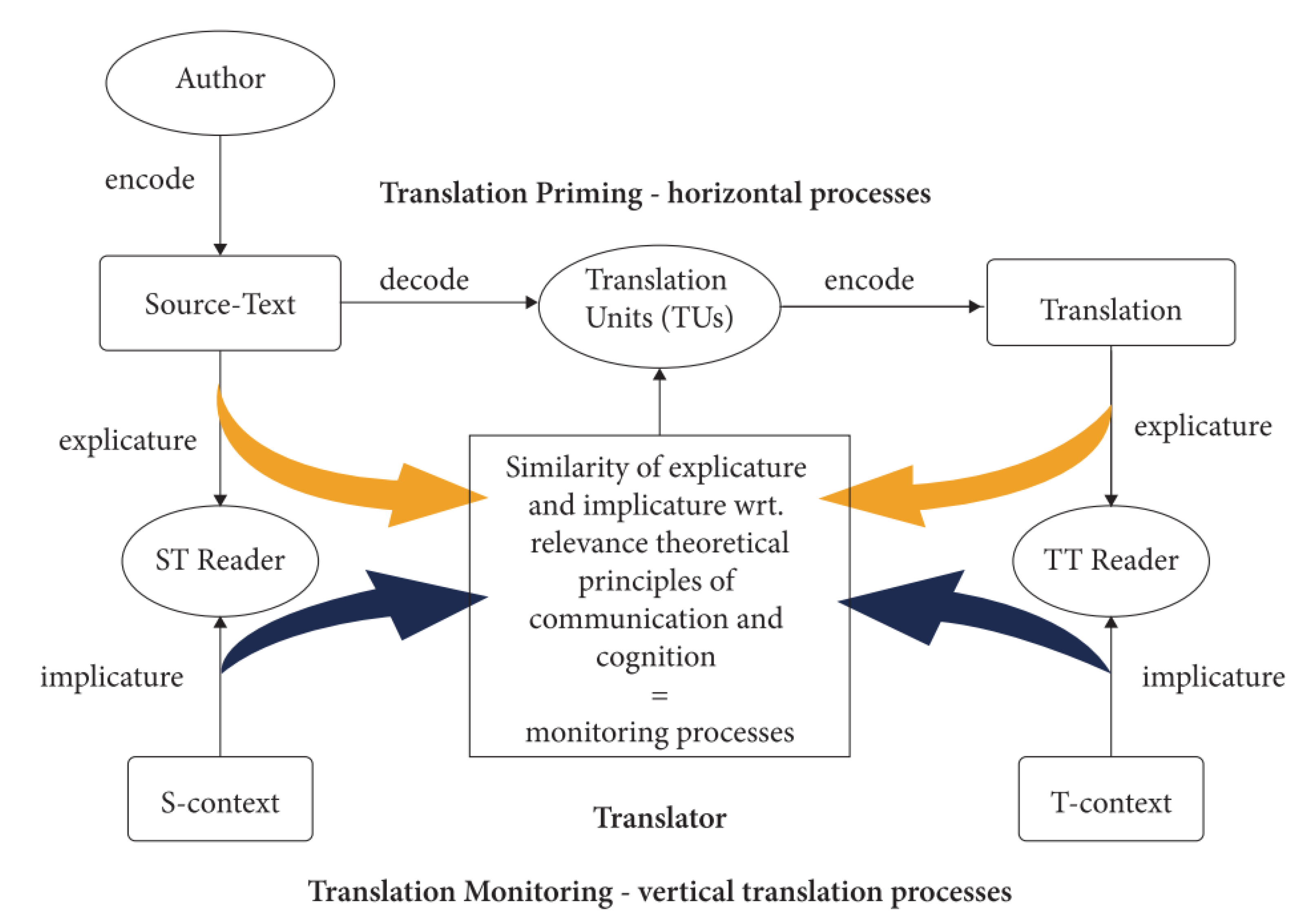
Carl [19] (p. 256) proposed that Gutt’s [56] distinction between the stimulus mode (s-mode) and the interpretive mode (i-mode) broadly aligns with the dichotomy between translation automaton and monitoring processes outlined in the Monitor Model. Specifically, while the s-mode generates entrenched (or default) translation correspondences, the i-mode assumes control over the monitoring processes that regulate the interlingual resemblance of the source and target texts. Carl [19]’s model stipulated that “automatized priming routines are the basis of human translation processes” (p.257), and within a separate timeline, it is assumed that higher-order monitoring strategies equip translators with the means to assess whether the translations they produce correspond with the established translation aims, guidelines, or goals. The Monitor Model stipulates that the translation process progresses in terms of translation units, with the similarity between the input and output being regulated at a higher level by monitoring processes. It underscores the significance of monitoring functions in achieving translation objectives, including maintaining translation quality and adhering to the specified styles outlined in translation guidelines, particularly in contexts where source and target texts may differ. Additionally, it elucidates the dynamic interaction between automated horizontal and vertical monitoring processes, as delineated by De Groot [27].
2.4. Translation Directionality and Allocation of Cognitive Resources
Regarding translation direction and allocation of cognitive resources, a number of research questions have been studied, such as: the differences in allocation of cognitive resources in different translation directions [11], translation direction and metaphor translation [3], translation direction and translation quality [41], among others. For instance, Chang [58] adopted eye tracking and functional magnetic resonance imaging to assess whether the Revised Hierarchical Model at the word level is also applicable at the text level. The results confirmed the existence of translation asymmetry in the English-Chinese translation process. Based on Chang’s study, Wang [3] conducted a study on the impact of translation direction on comprehension related processing, target text processing and parallel processing during metaphor translation. The findings suggested that translation direction can significantly affect the relationship between processing types, metaphor-related text types and attention distribution patterns. Later, Wang et al. [41] evaluated the cognitive processes and translation quality differences between automatic and controlled processing in different translation directions. Their findings suggested that translators demonstrated stronger automatic processing abilities in second language (L2) to first language (L1) translation, while exhibiting higher intensity in controlled processing and allocating greater cognitive resources in L1 to L2 translation. Notably, the quality of both automatic and controlled processing in L2 to L1 translation surpassed that in the opposite translation direction.
Among the previous empirical translation studies on directionality issue, translators’ cognitive processes were mostly observed and described externally. In order to investigate the difference between descriptive data and translators’ own reflection towards allocation of cognitive resources and the differences between translation directions, this study has collected twenty-four novice translators’ data through eye tracking, key logging and cue-based RTA methods. Four indicators are adopted: Total Attentional Duration (TA duration), AU count, AU duration and pupil dilation based on Hvelplund [24]’s definition of attention unit (AU). The following hypotheses have been tested:
- 1)
- In both translation directions, parallel coordination of Source Text (ST) processing and Target Text (TT) processing exist.
- 2)
- In both translation directions, the amount of cognitive resources allocated on different attention types differs. Translators allocate more cognitive resources on TT processing than ST processing and parallel processing.
- 3)
- There are differences between descriptive data and participants’ self-reflection. For instance, participants may have a tendency of being unaware of the cognitive resources invested in first language production during L2-L1 translation.
3. Materials and Research Design
3.1. Subjects
Twenty-four postgraduate students specializing in Translation Studies at various universities in the UK participated in this experiment. All participants were native Chinese speakers (L1) with English as their second language (L2) and had achieved an IELTS score of at least 7.0, indicating comparable levels of English proficiency. They also reported prior familiarity with computer-assisted translation tasks. Additionally, all participants had previously participated in experiments involving eye-tracking, key-logging, and cue-based Retrospective Think-Aloud Protocols (RTA), which facilitated the seamless execution of this study.
Before taking part, all participants signed a consent form in compliance with ethical research practices. Data from twenty-two participants met the quality criteria required for analysis. These criteria included: 1) gaze time on the screen, 2) the percentage of gaze samples converted into fixations, and 3) mean fixation duration, based on the standards outlined by Rayner [59] and Hvelplund [24]).
3.2. Materials
The source texts for this study consist of simulated dialogues set in a hospital context, involving a Chinese diabetes patient and a British doctor. The Chinese patient does not speak any English and the British doctor does not speak any Chinese. These dialogues, were presented as sight interpreting on the screen, were carefully controlled to align with the outlined parameters. Both the English and Chinese Source Texts are non-poetic, colloquial, and devoid of unusual sentence structures or technical jargon. The dialogues aim to reflect realistic exchanges in a professional healthcare setting, ensuring their relevance to translation tasks in medical contexts.
The English Source Text comprises 125 words, while the Chinese Source Text contains 151 words, with both texts consisting of nine sentences. Each sentence was meticulously tested and matched across linguistic levels, including syllable, word, and sentence, to ensure comparability. Standards for alignment include word count, style, genre, sentence type, sentence structure, sentence count, sentence length, word frequency, word difficulty, and word length.
This careful control of linguistic and contextual variables guarantees consistency between the two texts, providing a reliable foundation for analyzing cognitive resource allocation during translation. By simulating a healthcare interaction, the materials also add practical relevance to the study, particularly for interpreting in medical settings.
3.3. Experimental Procedure
Prior to the main experiment, participants underwent a pre-experimental training session to familiarize themselves with the setup and tasks. They then completed two 50-word English-to-English translation tasks as a warm-up exercise, designed to ensure comfort and consistency in using the equipment. Participants maintained a distance of 60–65 cm from the screen throughout the session. Following a calibration process, participants began the translation tasks, during which their eye movements and keylogging data were recorded using the Tobii TX300 remote eye tracker.
To analyze the collected data, a Generalized Linear Model was employed, considering relevant co-variables. For the English-to-Chinese (E-C) models, these co-variables included the Area of Interest (AOI) size for eye fixation, word frequency, average syllable count per word, and average letters per word. For the Chinese-to-English (C-E) models, co-variables included AOI size and word frequency. The linguistic co-variables were designed based on established readability standards, including the Flesch Reading Ease, Gunning Fog Formula, Flesch-Kincaid Grade Level, Coleman-Liau Index, SMOG Index, Automated Readability Index, and Linsear Write Index. Key readability factors considered were the number of sentences, average sentence length (in characters, corresponding to AOI length), average syllables per word, percentage of complex words, and average characters per word. This rigorous experimental design ensures the accuracy and reliability of the results, aligning with the study’s goal of analyzing cognitive resource allocation during translation.
4. Results and Discussions
4.1. Eye Tracking and Key Logging Data Analysis
Using Hvelplund’s (2011) categorization, the eye-tracking and keylogging data in this study were divided into three types of Attention Units (AUs): Source Text AUs (ST AUs), Target Text AUs (TT AUs), and Parallel AUs. These categories correspond to source text comprehension, target text production, and parallel processing activities respectively. The AUs of the translation processes are visually represented in Figure 2, where the X-axis indicates the sequence of AUs, the Y-axis represents the duration of each AU, and color coding distinguishes the types (red for TT AU, blue for ST AU, green for Parallel AU, with typing activity overlaid on TT AUs).
In this study, the parallel coordination of source text comprehension and target text production was frequently observed. For instance, during the production of an equivalent TT segment (as indicated by keylogging activity), participants’ eye movements often fixated on the ST to gather information for the subsequent sentence. This phenomenon aligns with findings by Carl and Dragsted [39], who described a similar process: “while the mind is engaged in the production of a piece of text, the eyes search for relevant textual places to gather the required information needed to continue the text production flow” (p. 128). They referred to this as “the literal default rendering procedure,” characterized by tightly interconnected production and comprehension processes.
From an objective point of view, key logging activity cannot happen autonomously without translator’s conscious manipulation. The tapping of processed TT itself is a valid proof of translators’ production-related cognitive effort. On the other hand, not only do participants report in RTA that they were trying to comprehend the ST during these processes, eye-key data entries have also explicitly indicated the existence of comprehension activities that happen simultaneously with production activity. Figure 2 represents the analysis of cognitive processes during translation by categorizing Attention Units (AUs) based on eye-tracking and keylogging data.
The example of AU entries in Figure 3 is a classic display of comprehension activities during parallel processing. This sample of AU entries is part of Partcipant No. 13 (P13) ’s eye tracking and key logging data during E-C translation. The blue line signals the end of a single sentence. The AU group row indicates which processing type each fixation-key logging activity is categorized into: “AU group A” refers to ST processing, “AU group B” refers to TT processing and “AU group C” refers to Parallel Processing. It is common in sentence translation that in order to produce TT, the first step translators need to do is to allocate cognitive effort on the ST to capture its meaning. The completion of the translation task and retrospective reflection shows concrete proof that P13 has at least tried to comprehend the ST sentences before producing the equivalent TT. Studies show that new information is acquired from the text only during fixations [59], not during saccades or other unclassified eye activities. However, it can be clearly indicated from the figure that, after the production of first sentence, there are no fixations on the ST of the second sentence, except for the fixations that occur during parallel processing. Therefore, the only logical explanation for the completion of this piece of work is that P13 gained all the information she needed during the parallel processing activity. In other words, the objective findings show that the allocation of cognitive effort on the ST is valid in terms of comprehension. Since these comprehension activities happen simultaneously alongside key activities, and tapping activity cannot happen without translators’ conscious manipulation and execution, it can be concluded that translators occasionally allocate cognitive resources in parallel manner during written translation.
At the macro level, Table 2 summarizes the AU duration count, percentage, and average duration of Attention Units (AUs) for both translation directions: Chinese-to-English (C-E) and English-to-Chinese (E-C).
Table 2 showed the overall distribution of raw AU duration data for both translation directions, detailing the count, percentage of each AU type, and the mean AU count after data filtering. In the case of C-E translation, the total count for STAU is 2555, constituting 10.97% of all AUs, with an average duration of 272.2 milliseconds. For TTAU, the count stands at 4504, accounting for 78.98% of all AUs, and the average duration is 1147.65 milliseconds. Additionally, the count of parallel AUs is 892, representing 10.05% of all AUs, with an average duration of 286.74 milliseconds. In the case of E-C translation, the total count for STAU is 4721, constituting 37.4% of all AUs, with an average duration of 260.98 milliseconds. For TTAU, the count stands at 5534, accounting for 43.9% of all AUs, and the average duration is 633.15 milliseconds. Additionally, the count of parallel AUs is 2360, representing 18.7% of all AUs, with an average duration of 295.85 milliseconds. This distribution highlights distinct differences in cognitive processing between translation directions. TT processing dominates in C-E tasks, while E-C tasks show a more balanced distribution between ST and TT processing, with a higher proportion of parallel processing.
To determine the differences between processing types, for E-C translation data, each of the four indicators: Total Attentional Duration, AU count, AU duration and pupil dilation are calculated in three GLM models, namely word frequency, average syllable count per word, and average letter per word. An example of E-C pupil dilation indicator and attention type model is presented as follows:
Figure 4 shows that all the models confirm a strong relationship between attention type and participants’ pupil dilation values. However, the difference is not universal between all comparative pairs. Among the three models, the first two only confirm the differences between ST processing and parallel processing. The differences between ST processing and TT processing are not statistically significant; with Sig. values of 0.059 and 0.098. The impact of Area of Interest (AOI) size on pupil dilation is minimal, as indicated by the non-significant coefficients in the AOI size (character) variable. In contrast, word frequency and syllable count per word exhibit significant effects, aligning with cognitive theories that suggest these linguistic factors influence cognitive load during translation tasks.
In two translation directions, the processing type ranks with each indicator is summarised in the table as follows (this table only lists statistically significant comparisons between processing types):
In both translation directions, all the indicators show a dominant advantage of TT processing among all processing types. The findings on the first two descriptive indicators, the TA duration and AU count, are very similar. During English-Chinese and Chinese-English translation tasks, the total attentional duration of processing types ranks as: TT processing> ST processing> parallel processing. In the same way, the total count of AU of processing types also ranks as TT processing> ST processing> parallel processing.
For the third indicator, AU duration, differences between the translation directions emerge: In C-E tasks, the ranking is TT processing > ST processing > Parallel processing. In E-C tasks, TT processing durations are significantly longer than those for ST and Parallel processing, but the difference between ST and Parallel processing is not statistically significant.
The results of pupil dilation of E-C tasks processing types are similar to the results of AU duration. The pupil dilation of individual TTAU is considerably more sizable than that of STAU and parallel AU. And the difference between ST processing and parallel processing is not statistically significant. In C-E tasks, the pupil dilation of TTAU is also the largest, but only the difference between TT processing and parallel processing is statistically significant.
To sum up, in both translation directions, all the indicators suggest that TT processing consumes most cognitive resources. In addition, the differences between the other two processing types vary with indicators. The eye tracking and key logging data confirmed the second hypothesis. These findings highly coincide with findings in previous process-oriented translation studies on different language pairs [24,39,60]. In Schmaltz’s [60] translation study from Chinese (L1) to Portuguese, she discovered that the Total Fixation Time on the TT is significantly higher (180% more) than that of on the ST. Similarly, Hvelplund [24]) discovered that: 1, during English-Danish translation, translators spend considerably more time on TT than on other processing types; 2, the duration of TTAUs is significantly longer than STAUs and PAUs under practically all circumstances; and 3, the size of pupil dilation of TTAU is considerably larger than that of STAU and PAU. Most of these findings are proved to be valid in both translation directions of English and Chinese translation.
A possible explanation to this phenomenon is that: translation may initiate with a “guess” of the appropriate translation of ST (a partial formulation of a rendition), and the meaning of ST “emerges and consolidates as the translation develops” (Carl and Dragsted, 2012: p.143). In Carl and Dragsted’s [39] study, they discovered that during the decision making process, deeper understandings of source text are often “triggered through translation production problems, rather than difficulties in ST understanding.” [39] (p.128). Similarly, Gile’s [15] theory suggested that when facing production problems, translators may develop a deeper understanding of ST compared to when they first encounter and comprehend the source text. Another explanation to the existing difference between ST processing and TT processing is that: “lexical and propositional analyses of ST comprehension are less cognitively demanding than planning and encoding during TT reformulation” [24] (p. 222). The findings on distribution of cognitive resources and processing type of this current study confirm that these theories are also valid on the language pair Chinese and English.
The majority of the findings on parallel processing in this study also support findings in other language pairs. Hvelplund’s [24] research hypothesis that parallel processing attracts the least amount of cognitive effort among all processing types, but his findings on AU duration does not signify a noticeable difference between parallel processing and ST processing, as in this study. Noting the equal impact of parallel processing and other processing types on “working memory’s limited pool of cognitive resources as ST processing and TT processing compete for cognitive resources” [24] (p.222), he remarks on this that: “there is a capacity limitation on the human memory system’s ability to engage simultaneously in ST processing and TT processing” [24].
4.2. Retrospective Self-Reflections
In this study, participants’ subjective reflections are collected through cue-based RTA. Participants are asked to describe their allocation of cognitive resources on ST and TT in each translation direction, i.e., the amount of cognitive resources invested in ST processing compared to TT processing during E-C translation and C-E translation. The comparisons between descriptive and reflective data are conducted at a macro level. Participants’ self-reflections have been summarized as follows in Table 4 and Table 5:
For C-E translation, this result of RTA reflections correlates highly with the results from eye tracking and key logging data. As was noticed by the majority of participants, second language production takes more time in total, a bigger number of AU counts, and longer individual AU duration.
However, when trying to recall their E-C translation processes, most participants believe that they invest more time in second language ST comprehension than first language TT production. Among 22 participants, only four participants: P02, P04, P05 and P18 reported that they invest more cognitive effort in TT production than in ST comprehension at some points in their tasks. A few participants (P11, P15, P16 and P22) report that they spend an equal amount of cognitive effort on each processing type. Most of participants do not even realize the dominance of TT production cognitive resources among all processing types. Even to the minority of participants who reported they invest more effort in TT production than ST comprehension during E-C translation, the amount of TT production was still severely underestimated. The self-reflective overall ST/TT comparisons of these four participants ranges from 40/60 to 30/70, which is significantly lower than the results of eye tracking and key logging data. In addition, participants are less sensitive about the cognitive resources they invest in first language TT production. It is very likely that they do not realize that the difficulty to channel out Chinese text.
To most participants, during L2-L1 translation, most of the challenges come from the comprehension of the English ST. The students’ confidence in the mother tongue is based on the familiarity of one’s first language, and it is probably one of the most obvious reasons that cause the huge difference between participants’ reflection and the eye tracking and key logging data. For the majority of participants, during L2-L1 translation, most of the challenges come from the comprehension of the English ST. As P19 states, when she translates from Chinese into English, she needs to worry about whether her production fits the cultural and linguistic environment, but when she translates an E-C task, there is no hesitation during production, and she does not even need to double check her Chinese TT, because she is perfectly confident that she will not make the TT “strange” in Chinese. Similarly, other participants also express their confidence over their first language production. For example, P22 states, when translating from English into Chinese, she does not even need to check the TT after production, because the Chinese language is “too familiar” to her.
Interestingly, despite the fact that the majority of translators are unfamiliar with the concept of parallel processing in translation, several reflections did highlight the multitasking of source text comprehension and target text production, as well as automatic processing, particularly the first language automatic processing. Previously, Hvelplund [24] observed participants’ automatic processing and parallel processing in Danish and English translation: either ST processing or TT processing happens automatically during parallel processing, which suggests that either ST reading input is “stored passively in sensory memory for a short memory” [24] (p.224) while typing or the typing activities happen automatically. In this study, a comparable observation was made: numerous participants indicated that typing activities, particularly when producing text in their first language, often occur automatically. This was especially evident when the translation results were straightforward words like “所以” (so) and “但是” (but), which, as P12 noted, “did not require any effort; I just feel my fingers moving and typing without thinking.” In the direction of translating from the first language into the second language, no such reflections were made regarding the production and typing of English TT. When it comes to parallel processing in C-E translation, P16 reported that “It is not always easy to distinguish ST processing and TT processing. These processes often overlap, especially when the Chinese text is simple and straightforward.”
5. Conclusions
In this study, translators’ parallel coordination of source text processing and target text processing have been observed. Both descriptive data and participants’ reflection confirmed the strong correlation between the allocation of cognitive effort and processing types. The eye tracking and key logging data suggested that TT processing occupies the biggest proportion of all cognitive resources. Most of the translators were aware of the difference between processing types, but their assumption on the AU proportion vary greatly with the descriptive results.
To compare these results with hypotheses, it could be seen that one of the three hypotheses has been partially confirmed, and the other two hypotheses are fully confirmed. The first and second hypothesis have been confirmed. The third hypothesis is “there are differences between descriptive data and participants’ self-reflection. For instance, participants may have a tendency of being unaware of the cognitive resources invested in first language production during L2-L1 translation” and has been partially confirmed. In addition, some translators reported experiencing multi-tasking, parallel processing and automatic processing during translation.
A key limitation of this study is its reliance solely on eye-tracking and keylogging data to measure cognitive resource allocation. While these methods provide valuable insights, they may not capture the full complexity of cognitive and physiological responses during translation. Future research could benefit from a multimodal approach, incorporating additional methods such as facial recognition, respiration, heart rate (HR), galvanic skin response (GSR), and cue-based Retrospective Think-Aloud (RTA) protocols. This integrated approach could offer a more comprehensive understanding of cognitive and emotional processes during translation.
This research focused on novice translators only, and therefore, the findings derived from this particular group of participants cannot be directly generalized to represent the translation processes of other types of translators. The exploration of differences among various translator groups presents a fascinating direction for future research on this topic. In addition, extending the research to include other language pairs beyond English and Chinese, or replicating the study with a focus on Chinese-to-English translation, would enhance the generality of the results.
Supplementary Materials
The following supporting information can be downloaded at the website of this paper posted on Preprints.org. The experimental data is available upon personal request, as we are still in the process of analyzing additional data.
Author Contributions
Yifang Wang and Saihong Li were responsible for drafting the original manuscript. All authors have reviewed and approved the final version of the manuscript for publication.
Funding
This research is funded by “A Study on the Influence of Historical and Cultural Empathy between China and Africa on the Cognitive Process of Translators”, Project no: 2424018, the Chinese Academy of Social Sciences.
Institutional Review Board Statement
The study was conducted in accordance with the code of conduct at the Chinese Academy of Social Science and the University of Stirling and was approved by the University Ethics Committee in 2022.
Informed Consent Statement
Informed consent was obtained from all subjects involved in the study.
Conflicts of Interest
The authors declare no conflicts of interest.
| 1 | For this indicator, the number of parallel processing AU count is slightly higher than ST processing AU count, but the differences are not statistically significant. |
| 2 | In this model, the pupil dilation of parallel processing AU is bigger than ST processing AU, but the differences are not statistically significant. |
| 3 | The pupil dilation of C-E AU ranks as TT>ST>parallel, but only the difference between TT processing and parallel processing is statistically significant. |
References
- Beeby, A. Direction of translation: Directionality. In: Baker M. (Ed.), Routledge Encyclopedia of Translation Studies. London and New York: Routledge, 1998; 63-67.
- Gile, D. Directionality in Conference Interpreting: A Cognitive View. Monographies 38(1-2), 2005; 9-26.
- Wang, Y. The Impact of Directionality on Cognitive Patterns in the Translation of Metaphors. In: Muñoz Martín, R., Sun, S., Li, D. (eds) Advances in Cognitive Translation Studies. New Frontiers in Translation Studies. Springer, Singapore, 2021; 201-228.
- Chang V. and Chen I. Translation directionality and the Inhibitory Control Model: a machine learning approach to an eye-tracking study. Frontiers in Psychology, 14, 2023. [CrossRef]
- Martín R. M., S. Sun, & D. Li Advances in Cognitive Translation Studies. 2021; Singapore: Springer.
- Jensen, K. , Sjørup, A., and Balling, L. Effects of L1 Syntax on L2 Translation. In: Mees, I., Alves, F. and Göpferich, S. (Eds.), Methodology, Technology and Innovation in Translation Process Research: A Tribute to Arnt Lykke Jakobsen. Copenhagen: Samfundslitteratur. 2009; 319-336.
- Balling, L. W., Hvelplund, K. T. & Sjørup, A. C. Evidence of Parallel Processing During Translation. Meta, 59(2), 2014; 234–259. [CrossRef]
- Pavlović, N. Directionality in Collaborative Translation Processes. A Study of Novice Translators. Unpublished Doctoral Thesis. 2007. Tarragona: Universitat Rovirai Virgili.
- Pavlović, N. More Ways to Explore the Translating Mind: Collaborative Translation Protocols. Copenhagen Studies in Language (CSL) 37, 2009; 81-105.
- Chang, V. 2011. Translation Directionality and the Revised Hierarchical Model: An Eye-Tracking Study. In: O’Brien, S. (Ed.), Cognitive Explorations of Translation. London and New York: Continuum. 2011; 154-174.
- Jensen, K. and Pavlović, N. Eye tracking translation directionality. In: Pym, A. and Perekrestenko, A. (Eds.), Translation Research Projects 2. Tarragona: Universitate Rovirai Virgili. 2009; 101-119.
- Alves, F. and Gonçalves, J. Investigating the Conceptual-procedural Distinction in the Translation Process: A Relevance-theoretic Analysis of Micro and Macro translation units. Target. 25(1), 2013;.107-124.
- Godijns, R. and Hinderdael, M. (Eds.) Directionality in Interpreting.The ‘Retour’ or the Native? Ghent: Communication and Cognition. 2005.
- Bartlomiejczyk, M. Strategies of Simultaneous Interpreting and Directionality. Interpreting International Journal of Research and Practice in Interpreting. 06(8), 2006; 149-174.
- Gile, D. Basic Concepts and Models for Interpreter and Translator Training. Amsterdam: John Benjamins, 1995.
- Frenchk-Mestre, C. Eye-movement Recording as a Tool for Studying Syntactic Processing in a Second Language: A Review of Methodologies and Experimental Findings. Second Language Research 21 (2), 2005; 175-198.
- Monti, C., Bendazzoli, C., Sandrelli, A. and Russo, M. Studying Directionality in Simultaneous Interpreting through an Electronic Corpus: EPIC (European Parliament Interpreting Corpus). Meta: Translators’ Journal; 50(4), 2005; 2-16.
- Jia J, Wei Z, Cheng H and Wang X. Translation directionality and translator anxiety: Evidence from eye movements in L1-L2 translation. Front. Psychol. 14:1120140. 2023. [CrossRef]
- Carl, Michael. Empirical Translation Process Research: Past and Possible Future Perspectives. Translation, Cognition & Behavior, 6(2), 2023; 252-274.
- Jakobsen, A. L. Logging time delay in translation. LSP Texts and the Translation Process 1 (1). 1998; 73−101.
- Li S, Wang Y & Rasmussen YZ (2022) Studying Interpreters’ Stress in Crisis Communication Evidence from Multimodal Technology of Eye-tracking, Heart Rate and Galvanic Skin Response. The Translator. [CrossRef]
- Jakobsen, A. and Jensen, K. Eye Movement Behaviour across Four Different Types of Reading Task. In: Göpferich, S., Jakobsen, A. L. and Mees, I. (Ed.), Looking at Eyes: Eye-Tracking Studies of Reading and Translation Processing, Copenhagen Studies in Language 36, Copenhagen: Samfundslitteratur. 2008; 103-124.
- Dragsted, B. Segmentation in translation: differences across level of expertise and difficulty. Target 2005; 17 (1): 49-70.
- Hvelplund, K. Allocation of Cognitive Resources in Translation: An Eye-tracking and Key-logging Study. Ph. D thesis. 2011. Copenhagen: Copenhagen Business School.
- Jääskeläinen, R. Think-Aloud Protocol Studies into Translation- an Annotated Bibliography. Target 14(1), 2002; 107-136.
- Seleskovitch, D. Interpretation: A Psychological Approach to Translating. In: Brislin, R. (Ed.), Translation: Applications and Research. New York: Gardner. 1976; 92–116.
- De Groot, A. The Cognitive Study of Translation and Interpretation: Three Approaches. In: Danks, H., Shreve, G., Fountain, S. and McBeath, M. (Ed.), Cognitive Processing in Translation and Interpreting. Thousand Oaks, CA: Sage. 1997; 25-56.
- Ruiz, C., Paredes, N., Macizo, P. and Bajo, M. Activation of Lexical and Syntactic Target Language Properties in Translation. Acta Psychologica. 128 (3), 2008; 490-500.
- Kintsch, W. The Role of Knowledge in Discourse Comprehension: A Construction Integration Model. Psychological Review. 95, 1988; 163–182.
- Kintsch, W. Comprehension: A Paradigm for Cognition. 1998. Cambridge: Cambridge University Press.
- Danks, H. and Griffin, J. Reading and Translation: A Psycholinguistic Perspective. In: Danks, H., Shreve, G., Fountain, S. and McBeath, M. (Ed.), Cognitive Processing in Translation and Interpreting. CA: Sage, Thousand Oaks. 1997;161-175.
- Padilla, P., Bajo M. and Padila F. Proposal for a Cognitive Theory of Translation and Interpreting: A Methodology for Future Empirical Research. The Interpreter’s Newsletter; 9, 1999; 61–78.
- Kellogg, R. A Model of Working Memory in Writing. In: Levy, C. and Ransdell, S. (Ed.), The Science of Writing. Mahwah, N.J.: Lawrence Erlbaum Associates. 1996; 57-71.
- Olive, T. Working Memory in Writing: Empirical Evidence from the Dual-task Technique. European Psychologist 9, 2004; 32-42.
- Anderson, J. Cognitive Psychology and its Implications (5th edn). 2000. New York: Worth.
- Pavlović, N. What Were They Thinking?! Students’ Decision Making in L1 and L2 Translation Processes. Hermes: Journal of Language and Communication Studies. 44, 2010; 63-87.
- Alves, F. , & Gonçalves, J. L. A Relevance Theory approach to the investigation of inferential processes. In F. Alves (Ed.), Triangulating translation: perspectives in process oriented research Vol. 45. Amsterdam: John Benjamins. 2003; 3-24.
- Alves, F., J. L. Gonçalves, & K. Szpak. Identifying instances of processing effort in translation through heat maps: an eye-tracking study using multiple input sources. Paper presented at the 24th International Conference on Computational Linguistics. December 2012.
- Carl, M. and Dragsted, B. Inside the Monitor Model: Process of Default and Challenged Translation Production. Translation: Corpora, Computation, Cognition 2(1), 2012; 127-145.
- Balling, L., Hvelplund, K. & A. Sjørup. Evidence of parallel processing during translation. Meta, 2014( 2) : 234-259.
- Wang, X., Wang, L. and Zheng, B. The Influence of Translation Direction on the Process and Quality of Information Processing. Foreign Language Teaching and Research, 54(01): 2022, 128-139.
- Ferreira, Aline, Stefan Th. Gries & John W. Schwieter. Assessing indicators of cognitive effort in professional translators: A study on language dominance and directionality. In Tra&Co Group (ed.), Translation, Interpreting, Cognition: The Way Out of the Box, Berlin: Language. Science Press. 2021; 115–143. [CrossRef]
- Vinay, J.-P., & Darbelnet, J. Comparative stylistics of French and English: A methodology for translation (Vol. 11). 1995; Amsterdam: John Benjamins.
- Catford, J. C. A linguistic theory of translation: An essay in applied linguistics. 1965. London: Oxford University Press.
- Newmark, P. A textbook of translation (Vol. 66). 1988. London: Prentice Hall.
- Toury, G. Descriptive translation studies and beyond (Vol. 100). 1995; Amsterdam: John Benjamins.
- Gerver, D. Empirical Studies of Simultaneous Interpretation: A Review and a Model. In: Brislin, R. (Ed.), Translation: Applications and Research. New York: Gardner. 1976; 165-207.
- Dragsted, B. Segmentation in Translation and Translation Memory Systems. An Empirical Investigation of Cognitive Segmentation and Effects of Integrating a TM System into the Translation Process. Ph.D thesis, 2004. Amsterdam: Copenhagen Business School.
- Alves, F. and D. Vale. Probing the Unit of Translation in Time: Aspects of the Design and Development of a Web Application for Storing, Annotating, and Querying Translation Process Data. Across Languages and Cultures 10 (2). 2009; 251–273.
- Jääskeläinen, R. Features of Successful Translation Processes: A Think-Aloud Protocol Study. Ph. D thesis 1990. University of Joensuu.
- Carl, M. and Kay, M., Gazing and typing activities during translation: a comparative study of translation units of professional and student translators. Meta: Translators’ Journal 56 (4), 2011; 952–975.
- Baddeley, A. Working Memory. 1986. Oxford: Clarendon Press.
- Schaeffer, M., Dragsted, B., Hvelplund, K. T., Balling, L. W., & Carl, M. Word Translation Entropy: Evidence of Early Target Language Activation During Reading for Translation. In M. Carl, S. Bangalore, & M. Schaeffer (Eds.), New Directions in Empirical Translation Process Research: Exploring the CRITT TPR-DB Cham: Springer. 2016; 183-210.
- Tirkkonen-Condit, S., The monitor model revisited: evidence from process research. Meta: Translators’ Journal 50(2), 2005; 405–414.
- Gutt, Ernst. A. Translation and Relevance: Cognition and Context. 1989/1991/2000. Manchester: St. Jerome.
- Gutt, Ernst. A. On the Significance of the Cognitive Core of Translation. The Translator, 11 (1). 2005; 25–49.
- Carl, Michael, and Moritz Schaeffer. Outline for a Relevance Theoretical Model of Machine Translation Post-editing. In Researching Cognitive Processes of Translation, edited by Defeng Li, Victoria Lai Cheng Lei, and Yuanjian He, Singapore: Springer. 2019; 49–67.
- Chang, V. C. Testing Applicability of Eye-tracking and fMRI to Translation and Interpreting Studies: An Investigation into Directionality. Ph.D thesis. 2009; London: Imperial College.
- Rayner, K. Eye movements in reading, and information processing. Psychological Bulletin. 124(3), 1998; 372-422.
- Schmaltz, M. An empirical-experimental study of problem solving in the translation of linguistic metaphors from Chinese into Portuguese. Ph.D thesis. 2015; Macau: University of Macau.
- Kroll, J. and Erika S. Category in translation and picture naming: Evidence for asymmetric connection between bilingual memory representations. Journal of Memory and Language. 33: 1994; 149–174.
Figure 2.
Sample AUs of translation process.
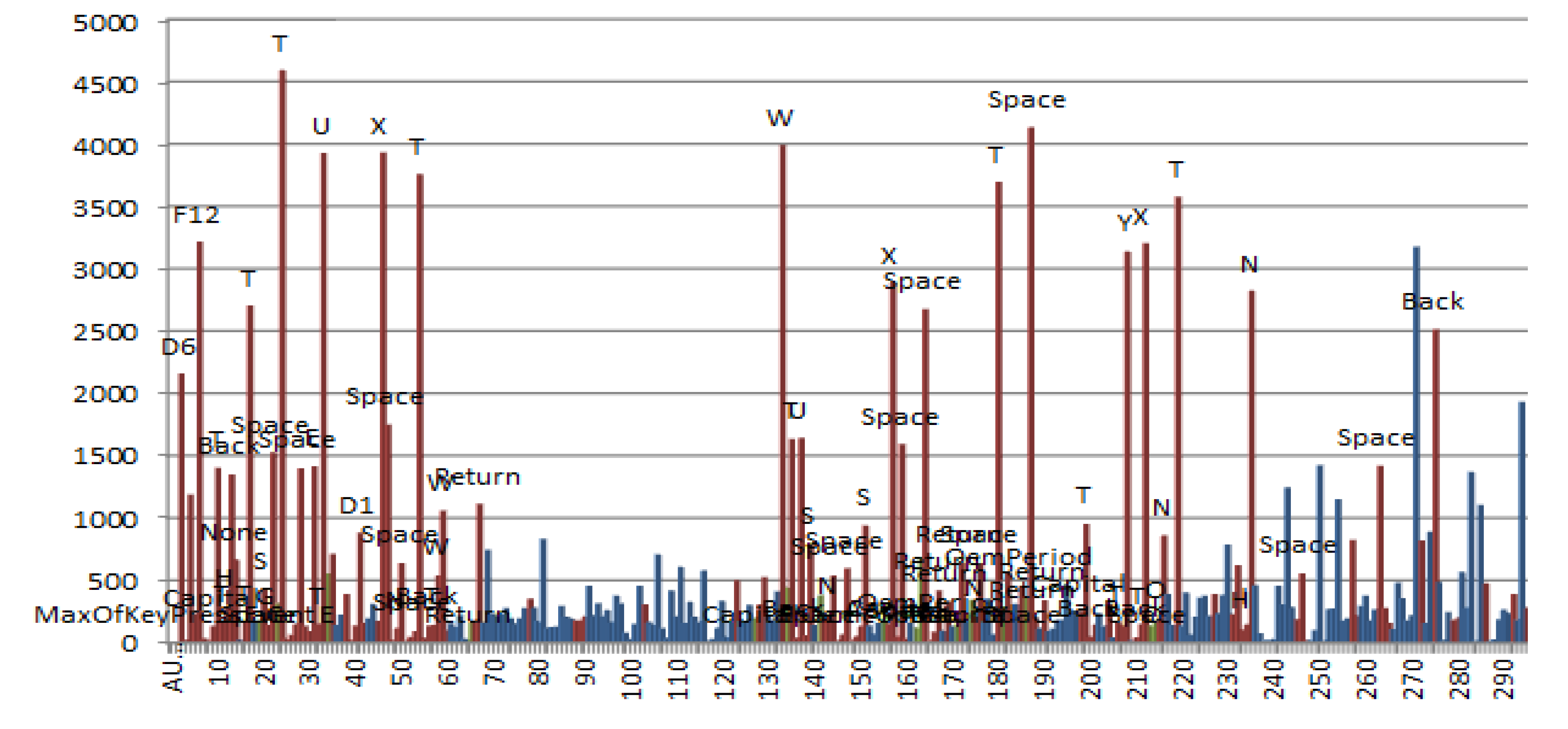
Figure 3.
Sample AU entries.
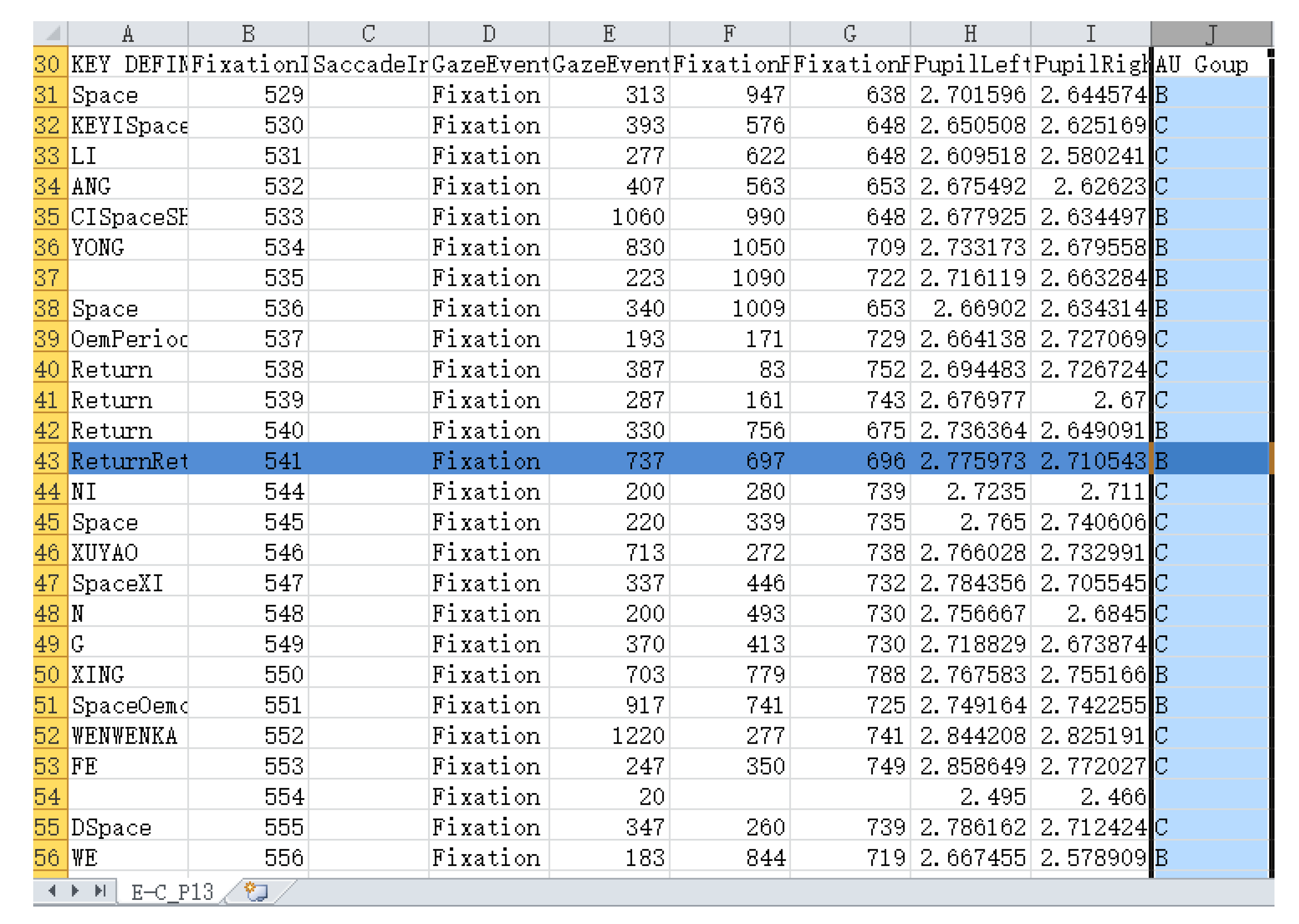
Figure 4.
Parameter evaluation of E-C pupil dilation and attention type models.
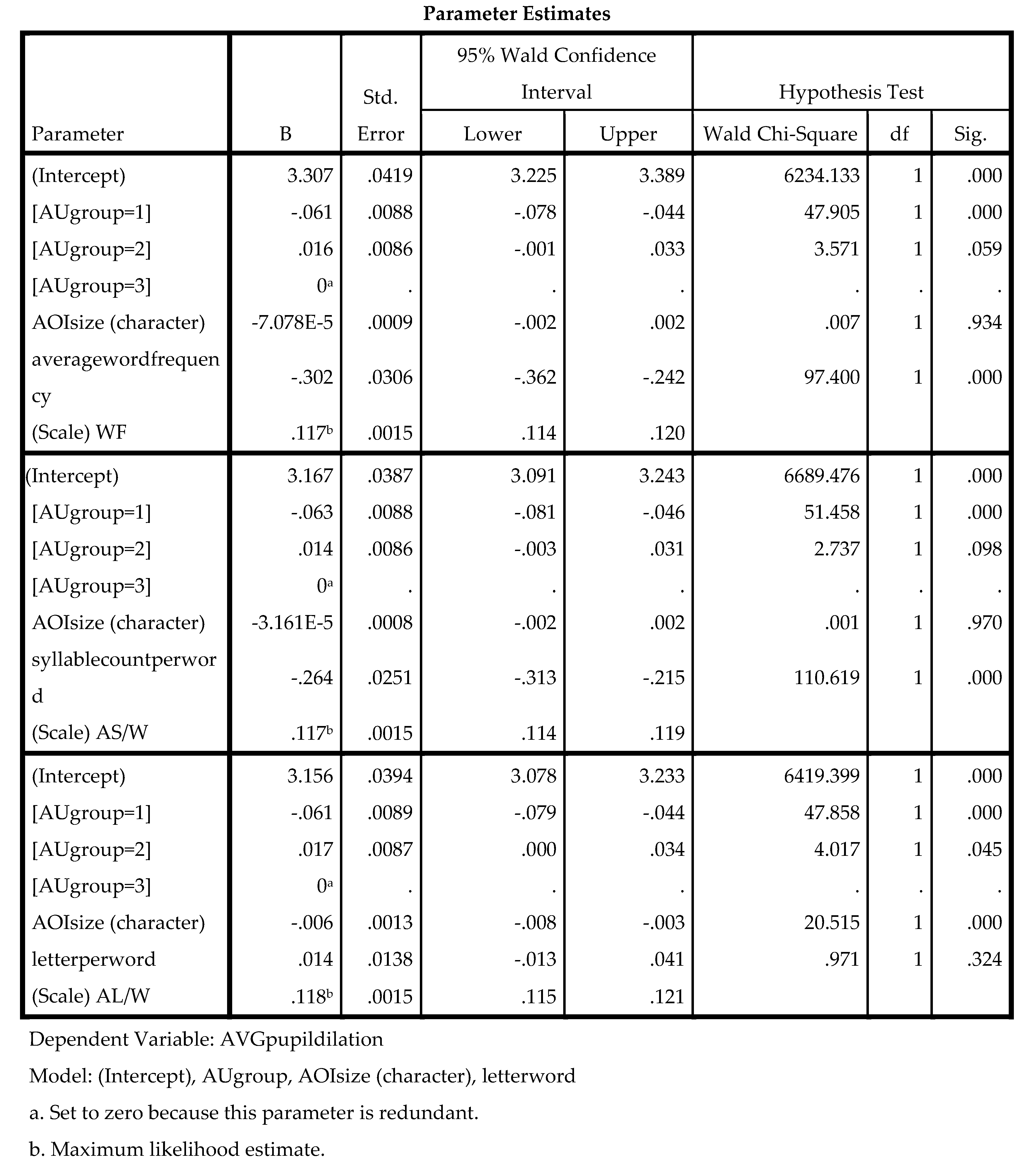

Table 1.
Macro and Micro AUs (Hvelplund 2011:116).
| Categories of micro AUs | Categories of macro AUs |
|---|---|
| ST Gaze | STAU |
| No Gaze + Typing Gaze Off + Typing TT Gaze + Typing TT Gaze |
TTAU |
| ST Gaze + Typing | Parallel AU |
| No Data Gaze Off |
No Data |
Table 2.
AU duration and percentage of each attention type.
| Task | AU group | Count | percentage | Average AU duration |
|---|---|---|---|---|
| C-E | ST processing | 2555 | 10.97% | 272.20 |
| TT processing | 4504 | 78.98% | 1147.65 | |
| Parallel processing | 892 | 10.05% | 286.74 | |
| E-C | ST processing | 4721 | 37.4% | 260.98 |
| TT processing | 5534 | 43.9% | 633.15 | |
| Parallel processing | 2360 | 18.7% | 295.85 |
Table 3.
Allocation of cognitive resources and processing type.
| Indicator/ task |
Results of GLM models | |||
|---|---|---|---|---|
| Word Frequency | Syllable Count/ Word | Letter/ Word | ||
| TA duration | E-C | TT> ST> parallel | TT> ST> parallel | TT> ST> parallel |
| C-E | TT> ST> parallel | |||
| AU count | E-C | TT> ST> parallel | TT> ST> parallel | TT> ST> parallel |
| C-E | TT> ST> parallel | |||
| AU duration | E-C1 | TT> parallel TT> ST |
TT> parallel TT> ST |
TT> parallel TT> ST |
| C-E | TT> ST> parallel | |||
| Pupil dilation | E-C | TT> parallel TT> ST2 |
TT> parallel TT> ST |
TT> parallel> ST |
| C-E | TT>parallel3 | |||
Table 4.
Self-reflection: E-C translation.
| Allocation of cognitive resources on ST and TT | Allocation of cognitive resources on ST and TT | |||||||
|---|---|---|---|---|---|---|---|---|
| Sentence 1-3 | S4-6 | S7-9 | S1-3 | S4-6 | S7-9 | |||
| P01 | 60/40 | 50/50 | 50/50 | P12 | 60/40 | 70/30 | 80/20 | |
| P02 | 40/60 | 40/60 | 40/60 | P13 | 60/40 | 60/40 | 65/35 | |
| P03 | 50/50 | 60/40 | 60/40 | P14 | 50/50 | 60/40 | 60/40 | |
| P04 | 50/50 | 50/50 | 30/70 | P15 | 50/50 | 50/50 | 50/50 | |
| P05 | 30/70 | 40/60 | 50/50 | P16 | 50/50 | 50/50 | 50/50 | |
| P06 | 60/40 | 60/40 | 60/40 | P17 | 70/30 | 70/30 | 70/30 | |
| P07 | 50/50 | 60/40 | 60/40 | P18 | 40/60 | 40/60 | 50/50 | |
| P08 | 50/50 | 60/40 | 60/40 | P19 | 70/30 | 70/30 | 80/20 | |
| P09 | 50/50 | 60/40 | 60/40 | P20 | 50/50 | 40/60 | 50/50 | |
| P10 | 60/40 | 70/30 | 70/30 | P21 | 60/40 | 70/30 | 80/20 | |
| P11 | 50/50 | 50/50 | 50/50 | P22 | 50/50 | 50/50 | 50/50 | |
Table 5.
Self-reflection: C-E translation.
| Allocation of cognitive resources on ST and TT | Allocation of cognitive resources on ST and TT | |||||||
|---|---|---|---|---|---|---|---|---|
| S1-3 | S4-6 | S7-9 | S1-3 | S4-6 | S7-9 | |||
| P01 | 40/60 | 30/70 | 30/70 | P12 | 30/70 | 30/70 | 30/70 | |
| P02 | 40/60 | 40/60 | 40/60 | P13 | 50/50 | 40/60 | 40/60 | |
| P03 | 40/60 | 30/70 | 30/70 | P14 | 30/70 | 30/70 | 30/70 | |
| P04 | 20/80 | 30/70 | 50/50 | P15 | 30/70 | 20/80 | 20/80 | |
| P05 | 20/80 | S | S | P16 | 40/60 | 40/60 | 35/65 | |
| P06 | 40/60 | 50/50 | 50/50 | P17 | 50/50 | 40/60 | 40/60 | |
| P07 | 40/60 | 50/50 | 50/50 | P18 | 30/70 | 30/70 | 20/80 | |
| P08 | 20/80 | 20/80 | 10/90 | P19 | 50/50 | 45/55 | 40/60 | |
| P09 | 40/60 | 30/70 | 20/80 | P20 | 50/50 | 50/50 | 40/60 | |
| P10 | 40/60 | 30/70 | 30/70 | P21 | 50/50 | 40/60 | 30/70 | |
| P11 | 20/80 | 20/80 | 20/80 | P22 | 50/50 | 45/55 | 30/70 | |
Disclaimer/Publisher’s Note: The statements, opinions and data contained in all publications are solely those of the individual author(s) and contributor(s) and not of MDPI and/or the editor(s). MDPI and/or the editor(s) disclaim responsibility for any injury to people or property resulting from any ideas, methods, instructions or products referred to in the content. |
© 2025 by the authors. Licensee MDPI, Basel, Switzerland. This article is an open access article distributed under the terms and conditions of the Creative Commons Attribution (CC BY) license (http://creativecommons.org/licenses/by/4.0/).
Copyright: This open access article is published under a Creative Commons CC BY 4.0 license, which permit the free download, distribution, and reuse, provided that the author and preprint are cited in any reuse.


