

Submitted:
05 January 2025
Posted:
07 January 2025
You are already at the latest version
Abstract
For the abiotic stress in adversity stress is an unfavourable environmental factor that severely affects the plant growth and development, plants have adapted to these stresses through long term evolution to improve their ability to survive. As one of the largest families of transcription factors (TFs) in plants, the MYB transcription factors can play important roles in plants. For example, they can participate in the regulation of plant growth and development, hormone signal transduction, and response to adversity stress. The N-terminus of the MYB family of transcription factors contains a typical MYB structural domain, and they can be classified into different subgroups according to the number of R repeats in the MYB structural domain. Upon activation by external abiotic stress signals, MYB transcription factors can bind to cis-acting elements in the promoter regions of downstream target genes either alone or in interaction with other proteins, and participate in the regulation of downstream expression of stress-response-related genes, thereby regulating plant tolerance to abiotic stress. MYB transcription factors also respond to abiotic stresses by participating in plant hormone signalling pathways. For example, abscisic acid, jasmonic acid, brassinolide, salicylic acid and so on. In this review, the structure and classification of the plant MYB transcription factors family and its mode of action are reviewed, role of MYB transcription factors hormone metabolism in plants and the mechanisms of MYB transcription factors involved in responding to abiotic stresses such as drought, salt, low and high temperatures, nutrients and heavy metals in recent years, and an outlook is given on the key research directions in the future, which will provide excellent genetic resources and theoretical support for the future genetic improvement of crop stress tolerance and plant breeding.
Keywords:
Abiotic stress
; plant growth and development
; MYB transcription factor
; stress-response-related genes
; responds and tolerance
1. Introduction
Transcription factors (TFs) play important roles in human and animals, especially in higher plants for the regulation of plant growth and development, adversity stress, and damage defence [1,2,3]. Transcription factors usually contain DNA-binding domains, transcriptional regulatory domains, oligomerisation sites and nuclear localisation domains. Generally, transcription factors can interact with other transcription factors to regulate the expression of downstream genes, or enhance or inhibit the expression of genes through specific structural domains that bind to the promoter sequences of downstream genes, thus improving plant tolerance to abiotic stresses, and thus play a important role in regulating the physiological and biochemical processes and even the whole life activities of plants [4,5,6].
MYB transcription factors are one of the largest classes of transcription factors in plants, and the MYB transcription factors gene family plays an important role in many physiological processes in plants, such as cell cycle, environmental response, stress response, primary metabolism, secondary metabolism [7,8,9,10]. MYB TFs have attracted much attention from academics because of their important roles in the regulation of plant growth and development and response to abiotic stresses. With the completion of whole genome sequencing of model plants such as Arabidopsis thaliana and rice, and the continuous development of experimental techniques and tools, scientists can conduct more extensive and in-depth research on genes including the MYB transcription factor family, and the results of these researches can not only provide theoretical basis and support for the improvement of crop resistance, but also can be used as a direct genetic resource. A number of reviews have been published to summarise the structure, phylogeny and biological functions of MYB. Most of these reviews only emphasise the regulation of plant growth cycle, accumulation of secondary metabolites or improvement of a certain plant trait, but lack the comprehensive analysis of the response mechanism of MYB family transcription factors under abiotic stress. Therefore, this paper focuses on reviewing the latest research results on the structure and mode of action of plant MYB transcription factors and its regulatory mechanism in response to abiotic stress, including the interaction of MYB transcription factors with other transcription factors to jointly regulate the expression of downstream genes, or the direct binding of MYB transcription factors to the promoters of downstream genes to regulate their expression, etc., as well as the outlook of the future direction of its research. In the future, we will focus on the study of MYB transcription factors as central factors in the regulation of downstream gene networks related to abiotic stresses, so as to improve the tolerance of plants to abiotic stresses and crop yields in order to cope with food security.
1.1. The structure and classification of the plant MYB transcription factors
The MYB transcription factor family is a group of highly conserved DNA-binding domains known as MYB transcription factor structural domains. Each MYB transcription factor contains one to four repetitive MYB domains. Each repeat has approximately 52 amino acid residues, which are inserted into the main groove of double-stranded DNA in a helix-rotate-helix conformation. The presence of three regularly spaced tryptophan in each MYB repeat sequence forms a hydrophobic cluster that is associated with specific recognition of the DNA sequence. The presence of 3 regularly spaced tryptophan in each MYB repeat sequence forms a hydrophobic cluster that is associated with specific recognition of the DNA sequence. Based on the similarity to the three repeat sequences R1, R2, or R3 in animal c-myb and the number of R repeat sequences, the plant MYB TFs family has been classified into four categories: 1R-MYB/MYB-related, 2R-MYB/R2R3-MYB, 3R-MYB/R1R2R3-MYB, and 4R-MYB [11,12]. Each MYB repeat contains three α-helix connected by a corner between the second and third helices to form a stable helix-turn-helix (H-T-H). The HTH three-dimensional structure consists of three regularly spaced hydrophobic amino acids, usually Trp, which are sometimes replaced by Phe or Leu, and which form a hydrophobic core, which is critical for the maintenance of the spatial conformation of MYBs [13]. The third helix is considered to be the ‘recognition helix’ and is responsible for recognising the DNA binding site and structurally binding to the target DNA in the major groove (Figure 1). In 1987, scientists cloned the first plant MYB-like transcription factor COLORED1 from maize. Its encoded protein ZmMYBC1 and found that ZmMYBC1 is mainly involved in anthocyanin synthesis, and nowadays it is one of the most abundant classes of MYB TFs in plants [14]. Nowadays, researchers have found from Arabidopsis thaliana L., Capsicum annuum L., Spinacia oleracea L., Oryza sativa and other species. A large number of MYB genes have been identified in plants. So far, a cumulative total of 198 MYB genes have been identified in the Arabidopsis genome and a cumulative total of 239 MYB genes have been identified in the Oryza sativa genome. From the table, we can find that the number of MYB family members in different species showed some differences, but the number of MYB genes encoding R2R3-MYB was higher than that of other MYB genes in most species. Thus, R2R3-MYB is the most abundant subclass of the MYB family in most plants, and it exists in many monocotyledonous and dicotyledonous plants. The MYB transcription factors are widely involved in plant growth and development, cell differentiation, metabolic pathway regulation, and abiotic stress response [15,16,17,18,19,20,21] (Table 1). In order to investigate the phylogeny and evolutionary relationships of MYB family transcription factors in different species, we constructed phylogenetic trees of the amino acid sequences of some MYB family transcription factors in Arabidopsis thaliana, Oryza sativa and Glycine max using MEGA 11.0 software [40]. Among them, we found that GmMYB187 and GmMYB306 were highly related, GmMYB392 and GmMYB60 were highly related, AtMYB94 and AtMYB96 were highly related, OsMYB36a, OsMYB36b and OsMYB30 were highly related, GmMYB3R-1 isoform X1, GmMYB3R-1 isoform X2, GmMYB3R-4 and GmMYB3R-1-like were highly related, SbMYB3R-1 isoform X1, SbMYB3R-1 isoform X2, PvMYB3R-1-like isoform X1 and PvMYB3R-1-like isoform X2 were highly related, which indicated that the MYB family of transcription factors were highly related in various species have close affinities between them, and it is possible that WRKY family transcription factors have similar functions in different species. MYB transcription factors may be involved in regulating plant growth and development, secondary metabolism, and response to environmental stress (Figure 2).
2. Role of MYB transcription factors hormone metabolism in plants
Previous studies have shown MYB transcription factors can response to abiotic stresses by participating in plant hormone metabolism. For example, abscisic acid (ABA), jasmonic acid (JA), brassinosteroid (BR), salicylic acid (SA) and so on [41,42,43,44,45]. The phytohormone ABA is a plant hormone that can participate in various plant processes. In response to drought stress, plants rapidly accumulate ABA. Xie et al. found that MdMYB88 and MdMYB124, MYB family transcription factors, are essential for ABA accumulation in Malus x domestics after drought. MdMYB88 and MdMYB124 positively regulate leaf water transpiration, photosynthetic capacity, and stress tolerance in apple trees under drought conditions. MdMYB88 and MdMYB124 also regulated the expression of ABA biosynthesis and catabolism genes, as well as drought- and ABA-responsive genes [46]. Yuan et al. found that MYB transcription factor gene, PsMYB306. The expression of PsMYB306 was positively correlated with that of 9-cis-cyclocarotenoid dioxygenase 3 (PsNCED3), and the transcription of PsMYB306 was increased by ABA. Overexpression of PsMYB306 in Petunia hybrida inhibited seed germination and plant growth, while ABA content increased and GA content decreased. It was concluded that PsMYB306 negatively regulated the release of cold-induced bud dormancy by regulating ABA production [47].
The phytohormone JA is an endogenous growth regulator present in higher plants. It induces stomatal closure, affects the uptake of N and P and the transport of organic matter such as glucose, and is closely related to plant resistance [48,49,50]. Li et al. found that MYB transcription factor can positively or negatively regulate anthocyanin biosynthesis. MYB transcription factor mediates the JA signalling pathway during anthocyanin biosynthesis [51]. Li et al. isolated that a novel R2R3-type MYB transcription factor GhODO1 is from Gossypium hirsutum, which plays an active role in resistance to Verticillium dahliae. The GhODO1 protein interacts with the promoters of the genes related to lignin biosynthesis. The GhODO1 protein interacts with the promoters of the lignin biosynthesis-related genes Gh4CL1 and GhCAD3, and GhODO1 is able to directly activate the expression of both genes and promote total lignin accumulation. Furthermore, GhODO1 silencing impaired JA-mediated defence signalling and JA accumulation [52].
The phytohormone BR is a class of highly physiologically active steroid hormones, which have important roles in plant growth and development, including stem and leaf growth, root growth, and vascular tissue differentiation. It also plays an important role in the defence of plants against environmental stresses [53,54,55]. BR signals through the BES1/BZR1 (bri1-ethylmethane sulfonate repressor 1/canola azole resistance 1) family of transcription factors. And a direct target gene of BES1, MYB transcription factor AtMYB30 was identified by Li et al. The Atmyb30 null mutant exhibits a reduced response to BR, and enhances the dwarfing phenotype of a weak allele of the BR receptor mutant bri1. Many BR-regulated genes showed reduced expression and/or hormone induction in Atmyb30 mutants, suggesting that AtMYB30 promotes the expression of a subset of BR target genes. AtMYB30 and BES1 bind to conserved MYB-binding sites and E-box sequences in the promoters of BR and AtMYB30-regulated genes, respectively [56]. Chen et al. found that the role of dehydration-induced GmMYB14 gene in the regulation of soybean plant architecture, high-density yield, and drought tolerance through the BR pathway. The endogenous BR content of GmMYB14-OX plants was reduced, whereas exogenous application of BR partially rescued the phenotype of GmMYB14-OX plants. In addition, it was found that GmMYB14 directly binds to the promoter of GmBEN1 and up-regulates its expression, which leads to the reduction of BR content in GmMYB14-OX plants. The drought tolerance of GmMYB14-OX plants was also improved under field conditions [57].
The phytohormone SA can improve the resistance of plants to cold and drought. When plants are subjected to stress, some are injured to death and others survive although their physiological activities are affected to varying degrees [58,59]. The R2R3 MYB transcription factor GhMYB18 is involved in the defence response against the cotton aphid by participating in the synthesis of SA and flavonoids. GhMYB18 was identified as a gene that is up-regulated in cotton aphid (Aphis gossypii Glover) infested upland cotton (Gossypium hirsutum L.). Transient overexpression of GhMYB18 in cotton activated the SA and phenylpropane signalling pathways and promoted the synthesis of SA and flavonoids, thereby enhancing tolerance to cotton aphid feeding, and vice versa. GhMYB18 also significantly increased the activities of defence-related enzymes, including catalase (CAT), peroxidase (POD), polyphenol oxidase (PPO) and phenylalanine deaminase (PAL) [60]. Pyrethrins are terpene mixtures with insecticidal properties that accumulate in the above-ground parts of the pyrethrum (Tanacetum cinerariifolium). Zhou et al. reported the isolation and characterisation of the T. cinerariifolium MYB transcription factor gene encoding the R3-MYB protein TcMYB8 with a large number of hormone-responsive elements in its promoter. The expression of the TcMYB8 gene tended to decrease at the flower and leaf developmental stages and was induced by JA, SA, and ABA. Transient overexpression of TcMYB8 increased the expression of the key enzyme genes TcCHS and TcGLIP, and increased pyrethrin content. Further analysis revealed that TcMYB8 could directly bind cis-elements in proTcCHS and proTcGLIP and activate their expression, thus regulating pyrethrin biosynthesis [61].
Various hormones in plants present complex synergistic or antagonistic networks to regulate life activities. MYB transcription factor genes have been verified to be involved in the metabolic pathways ABA, JA, BR, SA and so on. The scientific questions of whether MYB transcription factor genes are involved in the metabolic pathways of other hormones, and whether there are deeper regulatory networks among them, need to be further revealed in the future.
3. Mode of action of MYB transcription factors in plants
During growth and development, plants are able to adjust themselves to changes in the external environment in time to adapt to such changes [62]. MYB transcription factors regulate intracellular homeostasis and tolerance to adversity at the transcriptional level. The mode of action is activation and direct action on the promoter regions of downstream response target genes to regulate their transcription. The other is to interact with upstream and downstream transcription factors in response to abiotic stresses, thereby improving plant tolerance to abiotic stresses [63,64,65]. MYB transcription factors mainly activates or inhibits the transcription of downstream target genes by directly binding to specific DNA sequences in the promoter region. Zhou et al. Identified that the CgMYB1 transcription factors, a member of the R2R3-MYB TF family. The CgMYB1 transcription factors gene is induced by salt and cold stresses. Overexpression of CgMYB1 in Arabidopsis significantly enhanced salt and cold tolerance. Interaction between CgMYB1 and the CgbHLH001 promoter, followed by the activation of downstream stress-responsive genes, mediates stress tolerance and improves survival under salt and cold stress [66]. Overexpression of the REVEILLE-8-type transcription factor CstMYB1R1 in Crocus floral was explored for its possible role in regulating crocus flavonoid and anthocyanin biosynthetic pathway. The interaction of CstMYB1R1 with the promoter of LDOX gene to directly regulate its transcription was verified by yeast one-hybrid technique. Expression of CstMYB1R1 in Nicotiana tabacum significantly increased flavonoids and anthocyanins levels and improved their abiotic stress tolerance. [67]. Du et al. Identified that the N-terminal domain of MYB transcription factor MdMYB108L, which was significantly induced under salt stress, as transcriptionally active. Overexpression of MdMYB108L increased germination, primary root length, and the antioxidant activities of catalase and peroxidase in transgenic Arabidopsis seeds, and decreased the accumulation of reactive oxygen species (ROS). Overexpression of MdMYB108L also increased photosynthetic capacity of the hairy root tissue (leaves) under salt stress. MdMYB108L was able to bind to the MdNHX1 promoter to positively regulate the transcription of the salt tolerance gene MdNHX1 in apple, which enhanced the salt tolerance of transgenic plants [68].
In addition, the binding of MYB transcription factors to the promoter sequences of downstream target genes is also affected by the interactions of upstream related proteins, which in turn regulate plant phenotypic changes. The N-terminus of the MYB transcription factor R3 repeat sequence contains a bHLH structural domain that binds to bHLH and WD40 to form the MBW complex, and flavonoid MYBs deterrents can bind basic helix-loop-helix factors and disrupt the MBW complex. For example, AtMYB75/90/113 binds to bHLHs (GL3, EGL3, and TT8) and WD40 (TTG1) to form an MBW complex in Arabidopsis, which regulates the expression of downstream anthocyanin late biosynthesis genes LDOX and DFR [69,70]. Members of MYBs also bind to each other to form multimers. For example, BplMYB46 can form heterodimers with BplMYB6, 8, 11, 12, and 13 to enhance binding to downstream target genes in Betula platyphylla. After co-expression of BplMYB46 and BplMYB13, the heterodimers formed by them enhanced the ROS scavenging ability by enhancing the transcription of downstream genes encoding superoxide dismutase (SOD), POD and glutathione sulfotransferase [71]. Thus MYB transcription factors are able to activate or repress the expression of downstream genes after being interacted with by upstream factors, thus affecting the expression of downstream genes and regulating plant tolerance under abiotic stresses.
4. Role of MYB transcription factors in response to abiotic stresses
Abiotic stresses include drought, salt, high temperature, low temperature, nutrients, heavy metals and so on [72,73]. They are the main abiotic adversity factors affecting plant growth and development, crop yield and quality. Abiotic stresses can seriously impede plant absorption of soil nutrients and water, leading to water loss, stomatal closure, affecting plant photosynthesis, growth inhibition, metabolic disorders, accelerated senescence, seriously affecting plant growth and even leading to plant death. Therefore, plants resist external abiotic stresses in a variety of ways, such as through, so that plants improve the ability to tolerate abiotic adversity. Studies have shown that the MYB transcription factors is widely involved in regulating the plant response to various abiotic stresses [74,75,76,77] .
4.1. MYB transcription factors in response to drought stress
Water is used in the growth and development of plants, and drought causes increased evaporation of water from plants, reduces the availability of soil water, and affects the water transport process in plants, which results in irreversible damage to plants such as wilting of leaves in the canopy, death of branches and even death of the whole plant. Nowadays, the physiological mechanisms behind drought-induced plant death have become a hot research area [78,79,80,81]. MYB-CC transcription factor belongs to the MYB transcription factors and contains conserved MYB DNA-binding domain and convoluted helix (CC) domain. Zhang et al. found that ZmMYB-CC10 enhances drought tolerance in maize by reducing oxidative damage. ZmMYB-CC10 increased the activity of APX and decreased the content of H2O2. It was also demonstrated by yeast one-hybrid crosses and Luciferase assays that ZmMYB-CC10 activated the expression of ZmAPX4 by directly binding to its promoter [82] . Lim et al. identified a MYB transcription factor, CaDIM1 (Capsicum annuum Drought Induced MYB 1), which is highly induced by ABA and drought stress. CaDIM1 has a MYB structural domain at the N-terminal end and an acidic domain at the C-terminal end, which are responsible for the recognition and activation of the target genes, respectively. CaDIM1-silenced plants exhibited abscisic acid-insensitive and drought-sensitive phenotypes and reduced expression of adversity-responsive genes [83]. Peng et al. identified and functionally analysed the R2R3-MYB transcription factor MYB44-5A in Triticum aestivum L.. Overexpression of TaMYB44-5A reduced drought tolerance in Arabidopsis thaliana. TaMYB44-5A reduced the sensitivity of transgenic Arabidopsis thaliana to ABA. Meanwhile, TaMYB44-5A down-regulated the expression levels of drought and ABA-responsive genes, and TaMYB44-5A directly bound to the MYB binding site on the promoter and repressed the transcriptional level of TaRD22-3A [84]. Fang et al. identified that PtrMYB94 is an R2R3 MYB transcription factor from Populus trichocarpa that is involved in the regulation of drought response and ABA signalling. PtrMYB94 transcripts were relatively abundant in leaves and stems and were rapidly induced under dehydration stress. Overexpression of PtrMYB94 ameliorated the drought response of plants. Overexpression of PtrMYB94 plants exhibited inhibition of seed germination and a significant increase in ABA content. In addition, the transcript levels of some ABA and drought-responsive genes ABA1 and DREB2 were up-regulated in overexpression of PtrMYB94 plants [85].
4.2. Molecular mechanisms of MYB transcription factors associated with salt stress
The visible symptoms of salt damage are greening of leaf tips, followed by leaf scorching, browning and leaf death. This results in stunted plant growth, poor root development, sterility and reduced seed production. Salinity can cause soil crusting, poor soil structure, easy auto-dispersion of soil particles after irrigation, and crust formation, which in turn prevents water infiltration and reduces soil water storage capacity, resulting in reduced soil aeration and water conductivity, which seriously affects plant growth and development and results in reduced yields [86,87,88,89,90]. Park et al. identified the MYB transcription factor MYB148 as being associated with salt stress responses. Salt and drought treatments enhanced PagMYB148 expression in hybrid poplar (Populus alba x P. glutulosa), but Pagmyb148 knockout plants exhibited a more sensitive phenotype under salt stress than wild-type plants. The chlorophyll content of Pagmyb148 knockout plants was lower than that of the wild type under salt stress, whereas the mutant increased ion leakage from the cells. Pagmyb148 knockout plants showed higher expression of genes associated with salt stress response than the wild type. Salt treatment increased H2O2 content and decreased antioxidant enzyme activities in Pagmyb148 knockout plants [91]. Wang et al. identified 28 SaR2R3-MYB transcription factors, all of which shared a highly conserved R2R3 structural domain, and further classified them into 28 subgroups by phylogenetic analysis. A number of SaR2R3-MYB transcription factors showed induction under salt stress, and SaR2R3-MYB15 was finally identified as a potential regulator. Transcriptional activity and nuclear localisation of SaR2R3-MYB15. Overexpression of SaR2R3-MYB15 increased antioxidant enzyme activity and proline accumulation, but decreased malondialdehyde (MDA) content, which implies that they have the potential to enhance salt tolerance [92]. A total of 210 MYB genes, named SbMYB1-SbMYB210, were identified by Lu et al. The 210 MYB genes were classified into six subfamilies by phylogeny. SbMYBAS1 (SbMYB119) was found that the expression of this gene was reduced under salt stress conditions. MYB transcription factor SbMYBAS1 is located in the nucleus. Moreover, under salt stress conditions, overexpressing SbMYBAS1 in Arabidopsis plants had significantly lower dry fresh weight and chlorophyll content than wild-type plants, but significantly higher membrane permeability, MDA content, and Na+/K+ ratio than wild-type. The results also showed that SbMYBAS1 was able to regulate the expression of AtGSTU17, AtGSTU16, AtP5CS2, AtUGT88A1, AtUGT85A2, AtOPR2, and AtPCR2 under salt stress conditions [93].
4.3. MYB transcription factors involved in plant response to temperature stress
Temperature is a key factor in plant growth and development. Temperature, along with factors such as light, carbon dioxide, air humidity, water and nutrient levels, affects plant growth and ultimately crop yields. It is best for plants only if the temperature is maintained at a suitable equilibrium for plant growth. The higher the temperature, the faster most biological processes occur, and this has both positive and negative effects. For example, in most cases, this can lead to faster growth rates and increased yields in fruit crops [94,95,96].
However, respiration occurs can have a negative impact as it means less energy is available for fruit development and the fruit will be smaller. Some of the effects are short term and others are long term. For example, the assimilatory balance of a plant is affected by temperature instantly, whereas flower formation is determined by climatic conditions over a much longer period of time. If the temperature is too high, the plant will increase its transpiration rate in order to cool down. This can cause the plant to lose more water and cause it to die [97,98,99]. Zhang et al. identified 174 MYB family members using a high-quality passion fruit genome: 98 2R-MYB, 5 3R-MYB, and 71 1R-MYB (MYB-relate). And among them, 10 representative PeMYB genes were selected for quantitative expression verification. Most of the genes were differentially induced under cold, high temperature, drought and salt stresses, with PeMYB87 responding significantly to high temperature-induced expression and overexpression of the PeMYB87 gene in the yeast system. PeMYB87 in transgenic yeast showed different degrees of resistance under these abiotic stresses [100]. Li et al. investigated that the mechanism of colour change in purple chrysanthemum under high temperature stress. Key anthocyanins were significantly down-regulated in heat-sensitive varieties under high-temperature conditions. Differential expression of CHS, DFR, ANS, GT1, 3AT and UGT75C1 genes during anthocyanin synthesis was found in heat-sensitive and heat-tolerant varieties. Expression differences of the heat-responsive transcription factors HSF, ERF, MYB and WRKY were greater in the petals of heat-sensitive varieties compared to heat-stable varieties. Genes that were significantly negatively correlated with down-regulation of anthocyanin content included two MYB transcription factor genes, Cse_sc001798.1_g020.1 and Cse_sc006944.1_g010.1, which may regulate anthocyanin accumulation in chrysanthemums under high-temperature stress [101]. Xiao et al. investigated that dragon fruit (Hylocereus polyrhizus) is highly resistant to high temperature and drought stress. Previous studies have identified an R2R3-MYB transcription factor gene, HpMYB72 is differentially expressed under high temperature in Hylocereus polyrhizus, which is activated under high temperature and encodes a protein that accumulates in the nucleus, and ectopic overexpression of HpMYB72 in Arabidopsis thaliana improved the growth performance under high temperature stress and increased the germination rate. The accumulation of ROS under high-temperature stress was reduced, thereby alleviating oxidative damage. Meanwhile, the content of osmoregulatory substances was increased, thus reducing water loss caused by high temperature [102].
When plants encounter low temperatures, the rate of photosynthesis decreases significantly because low temperatures cause damage to the photosynthesis system and a decrease in the activity of photosynthetic enzymes such as PEP carboxylase (PEPcase). In addition, the cell plasma membrane becomes porous or cracked, which greatly increases the permeability of the plasma membrane and allows the free diffusion of ions or soluble substances to the outside, resulting in the slowing down of the transport and transformation of photosynthesis products, and thus slowing down the growth of plants [103,104,105,106]. Li et al. obtained a novel 1R-MYB TF gene from the diploid strawberry by cloning and named it FvMYB114. subcellular localisation results showed that the MYB transcription factor FvMYB114 is a nuclear-localised protein. Overexpression of FvMYB114 greatly enhanced the adaptation and tolerance of Arabidopsis to salt and low temperature, and the proline and chlorophyll contents as well as the SOD, POD, and CAT activities of the transgenic plants were higher than those of wild-type and unloaded lines of Arabidopsis under salt and low-temperature stress. However, MDA content was higher in the wild-type and unloaded-line. FvMYB114 also promoted the expression of low temperature stress-related genes AtCCA1, AtCOR4, and AtCBF1/3, which further enhanced the tolerance of transgenic plants to salt stress and low temperature stress [107]. Chen et al analyse the relative expression of the MYB transcription factors StMYB113 and StMYB308 during different periods of low-temperature treatment. StMYB113 and StMYB308 could be expressed in response to low temperature and could promote anthocyanin synthesis. The study showed that StMYB113, which lacked the complete MYB structural domain, could not promote the accumulation of anthocyanins in Nicotiana tabacum, while StMYB308 could significantly promote the accumulation of anthocyanins [108]. Chen et al. obtained a MYB-related transcription factor gene, AhMYB30, from peanut by a transgenic approach, and overexpression of AhMYB30 enhanced the resistance of transgenic plants to freezing and salt stress in Arabidopsis thaliana. The expression of the adversity response genes RD29A (Response-to-Dehydration 29A), COR15A (Cold-Regulated 15A), KIN1 (Kinesin 1), and ABI2 (Abscisic acid Insensitive 2) was increased in transgenic plants compared with that in the wild type. Therefore, AhMYB30 may act as a TF in Arabidopsis thaliana to enhance its tolerance to salinity and freezing [109].
4.4. Role of Plant MYB transcription factors in Response to Nutritional element stress
Nitrogen (N), phosphorus (P), and potassium (K), which are essential nutrients for plants, these nutrients play extremely important physiological roles in plant growth and development [110]. Nitrogen is a component of the vitamin and energy system in plants. The element feeds leaf growth and promotes thick growth of branches, stalks, and stems [111]. Cereal (Setaria italica), native to China, is highly tolerant to low nutrient stress. Ge et al. systematically analysed the cereal transcriptome under low nitrogen stress. There were 74 transcription factor genes in the differentially expressed genes (DEG), including 25 MYB-like transcription factors. Root development in Arabidopsis and Oryza sativa overexpressing SiMYB3 under low nitrogen stress was superior to that of the wild type. SiMYB3 could specifically bind to the MYB element in the promoter region of the TAR2 promoter region of the growth hormone synthesis-related genes conserved in Oryza sativa and Setaria italica. SiMYB3 can regulate root development under low nitrogen conditions by regulating growth hormone synthesis in plant roots [112]. Wang et al. identified all MYB (PtMYB) genes in Phaeodactylum tricornutum, and analysed the MYB gene family at the genome level. The differential expression patterns of the 26 PtMYB TFs implied that the PtMYB genes may be functionally specific under nitrogen-deficient conditions. The homology analysis of the MYB genes indicated that PtMYB3, PtMYB15 and PtMYB21 may play important roles in regulating the circadian rhythm and response to nitrogen stress in Phaeodactylum tricornutum [113].
Phosphorus determines the differentiation of flower buds, the development of pollen key elements, is the reproductive growth and nutritional growth of essential elements. At the same time, phosphorus is involved in various metabolisms in the body, including carbohydrate metabolism, promotion of nitrogen metabolism, and fat metabolism [114]. Plants take up phosphate from the soil mainly through phosphate transporter proteins (mainly PHT1 family proteins) in the root system and transport phosphate to the aboveground via transporter proteins such as PHO1 [115]. PHR transcription factors, as MYB family transcription factors, can positively regulate the phosphorus deficiency response in plants, and it binds to the P1BS motif in the promoter region of phosphorus deficiency response genes, thus activating the expression of downstream genes. SPX proteins, as phosphorus receptors, can avoid toxicity caused by phosphorus over-accumulation by interacting with Arabidopsis PHR1 or Oryza sativa PHR2, and inhibiting their transcriptional activities under normal conditions, while SPX proteins do not affect PHR transcriptional activities when plants are in low phosphorus environments [116]. It has been shown that SPX proteins do not directly sense phosphate, but instead sense soluble inositol polyphosphates (InsPs) [117]. Inositol pyrophosphate InsP8 acts as an intracellular phosphate signalling substance to regulate phosphorus homeostasis by modulating the interaction of SPX1 with PHR1 [118]. Arabidopsis thaliana accumulates InsP8 under phosphorus-sufficient conditions and promotes the binding of the InsP8-SPX complex to the CC structural domain of the PHR transcription factor, thereby repressing PHR-mediated phosphorus-deficiency-responsive gene expression (Figure 3A and Figure 3B) [119]. The microRNA (miR399) can play a key role in phosphorus homeostasis and phosphorus deficiency response through post-transcriptional regulation. MiR399 is induced to be expressed under phosphorus deficiency conditions and positively regulated by PHR1, which promotes phosphorus uptake and transport by inhibiting the expression of its target gene, the ubiquitin E2-binding enzyme PHO2, and then increasing the content of PHO1, PHT1 and other proteins in the downstream of PHO2 [120,121]. MiR399-PHO2 regulatory module also plays a similar role in other plants. For example, miR399 is specifically induced by low phosphorus stress in maize, and overexpression of miR399b causes maize to overexploit phosphate in the shoot and develop symptoms of phosphorus toxicity [122] (Figure 3B). Interestingly, miR399 also negatively regulates the expression of phosphate transport proteins ZmPHT1;1, ZmPHT1;3 and ZmPHT1;13 in maize, and this regulation is modulated by the long-chain non-coding RNA PILNCR2. Meanwhile, PILNCR2 is induced by phosphorus deficiency and forms RNA/RNA dimers with ZmPHTs, thus interfering with the targeting of miR399 to ZmPHTs [123].
The main function of potassium is to participate in plant metabolism, such as promoting photosynthesis and the transfer of photosynthesis products, regulating ion and water balance, promoting protein metabolism, and enhancing plant resistance [124,125]. Niu et al. found that potassium-inhibited anthocyanin accumulation in radish hypocotyls was associated with alterations in sugar distribution and sugar signalling pathways rather than changes in oxidative stress status. Several R2R3-MYBs were identified as anthocyanin-associated MYBs, whereas RsMYB39 and RsMYB82 appeared to be non-canonical MYB anthocyanin activators and deterrents, respectively. It was confirmed that RsMYB39 strongly induced the promoter activity of the anthocyanin transport-related gene RsGSTF12, whereas RsMYB82 significantly reduced the expression of the anthocyanin biosynthesis gene RsANS1. Their data demonstrate the strong effect of potassium on sugar metabolism and signal transduction and its regulation of anthocyanin accumulation through different sugar signals and R2R3-MYB in a hierarchical regulatory system [126].
4.5. MYB transcription factors Involved in Plant Response to heavy metals stress
Excessive amounts of heavy metals inhibit seed germination and seedling growth, damage antioxidant enzyme systems and membrane systems, and induce chromosomal aberrations. Appropriate metals can promote plant growth, but excessive heavy metals can form a greater toxicity to cells and affect plant growth and development [127,128,129]. Excessive cadmium (Cd) in soil poses a serious hazard to the survival and development of a wide range of organisms. Feng et al. identified a MYB family transcription factors PsMYB62 in Potentilla sericea. Net photosynthetic rate, stomatal conductance, transpiration rate, intercellular CO2 concentration, and chlorophyll content of PsMYB62 overexpressing tobacco were significantly higher than that of the control after Cd treatment. Cd content was significantly higher in the aboveground portion of the control than in the transgenic strain, whereas the underground portion was significantly lower in the control than in the transgenic strain. The expression of NtHMA3, NtYSL, NtPDR4 and NtPDR5B in the transgenic lines was significantly lower than that of the control, while the expression of NtNAS3, NtSOD and NtGSH2 was significantly higher than that of the control [130]. Daucus carota is a globally important root vegetable crop, and it has evolved multiple transcriptional regulatory mechanisms to cope with Cd stress. Sun et al. found that the expression level of DcMYB62 was positively correlated with the accumulation pattern of carotenoids, and that the expression of DcMYB62 improved Cd tolerance in Arabidopsis by increasing seed germination, root length, and overall survival. Heterologous expression of DcMYB62 increased the transcription of genes associated with heavy metal resistance in Arabidopsis, particularly nicotinamide synthase [131].
5. Conclusion and Prospects
As one of the largest transcription factor families in plants, MYB transcription factor plays a key role in plant response to abiotic stress. At present, scientists mainly focus on the response of MYB family transcription factors to common abiotic stresses such as drought, cold, salt and heavy metals (Table 2). A large number of studies have been conducted on the structure, classification and function of MYB transcription factors. The MYB family of different species has been mined and identified with the help of bioinformatics methods, and the evolutionary relationship and functional correlation between MYBs of different species have been analyzed, achieving a series of important results. At the same time, the downstream target genes regulated by them have been studied more clearly. However, there are several shortcomings in the study of MYB family transcription factors in plants. For example, the first point is that research on MYB genes is now relatively independent among different crops such as Arabidopsis thaliana, Oryza sativa, Glycine max and so on, and there is little research on the homology and evolution of MYB transcription factors among different crops. Therefore, some key MYB family transcription factors genes may be missed. The second point is that the current family classification based on the number of MYB structural domains is rough and lacks a brief description of their functions. In the future, functional classification should be made based on the functional differences of different family members, and based on the combination of structural and functional classification, in order to understand the known MYB genes faster and predict the unknown MYB genes at the same time, so as to discover more functions of MYB genes. The third point is that nowadays researchers are only focusing on the function of MYB genes. I think that the functional verification of MYB genes should be combined with the actual breeding application, so that it can be applied in the production practice in order to improve the resistance of crops, and ultimately to achieve the purpose of abundant yield and harvest.
In summary, the MYB family of transcription factors is essential for plant growth and development as well as for the regulation of plant responses to abiotic stresses. In the future, we will pay more attention to controlling the expression of MYB family transcription factor genes through molecular breeding to improve plant traits and provide theoretical basis and germplasm resources for breeding superior varieties. Traditional breeding methods to improve plant traits are time-consuming, heavy workload and uncertainty of breeding results, which cannot meet the needs of today's plant breeding. MYB transcription factors are not only involved in the regulation of plant growth and development, but also play an important role in plant response to and tolerance of abiotic stresses, and the study of MYB transcription factors provides an important theoretical basis for the cultivation of varieties that are resistant to adversity, which can maintain stable crop yields and provide a solid foundation for global food security in the future.
Author Contributions
All the authors contributed to the present form of the manuscript. Z.M collected the data, drafted the manuscript; Z.M. and Y.Z. edited; Z.M. and Y.Z. created figures and tables; Z.M. and Y.Z. supervised; Z.M. and Y.Z finalized and approved the final version of manuscript. All authors have read and agreed to the published version of the manuscript.
Funding
This research was supported by National Key R&D Program of China (grant no. 2023YFD2401002), foundation of Jilin University (grant no. 3R220505202) and Open Access funding provided by the Max Planck Society.
Institutional Review Board Statement
Not applicable.
Informed Consent Statement
Not applicable.
Data Availability Statement
Not applicable.
Conflicts of Interest
The authors declare no competing interests.
References
- Liu, H.; Lu, Q.; Huang, K. Selenium suppressed hydrogen peroxide-induced vascular smooth muscle cells calcification through inhibiting oxidative stress and ERK activation. J Cell Biochem. 2010, 111, 1556-64.
- Bayliak, M.M.; Demianchuk, O.I.; Gospodaryov, D.V.; Abrat, O.B.; Lylyk, M.P.; Storey, K.B.; Lushchak, V.I. Mutations in genes cnc or dKeap1 modulate stress resistance and metabolic processes in Drosophila melanogaster. Comp Biochem Physiol A Mol Integr Physiol. 2020, 248, 110746.
- Shan, W.; Kuang, J.F.; Lu, W.J.; Chen, J.Y. Banana fruit NAC transcription factor MaNAC1 is a direct target of MaICE1 and involved in cold stress through interacting with MaCBF1. Plant Cell Environ. 2014, 37, 2116-27.
- Ma, Z.; Hu, L. MicroRNA: A Dynamic Player from Signalling to Abiotic Tolerance in Plants. Int J Mol Sci. 2023, 24, 11364.
- Ma, Z.; Hu, L.; Jiang, W. Understanding AP2/ERF Transcription Factor Responses and Tolerance to Various Abiotic Stresses in Plants: A Comprehensive Review. Int J Mol Sci. 2024, 25, 893.
- Ma, Z.; Hu, L. WRKY Transcription Factor Responses and Tolerance to Abiotic Stresses in Plants. Int J Mol Sci. 2024, 25, 6845.
- Liu, J.; Osbourn, A.; Ma, P. MYB Transcription Factors as Regulators of Phenylpropanoid Metabolism in Plants. Mol Plant. 2015, 8, 689-708.
- Pratyusha, D.S.; Sarada, D.V.L. MYB transcription factors-master regulators of phenylpropanoid biosynthesis and diverse developmental and stress responses. Plant Cell Rep. 2022, 41, 2245-2260.
- Ambawat, S.; Sharma, P.; Yadav, N.R.; Yadav, R.C. MYB transcription factor genes as regulators for plant responses: an overview. Physiol Mol Biol Plants. 2013, 19, 307-21.
- Wang, X.; Niu, Y.; Zheng, Y. Multiple Functions of MYB Transcription Factors in Abiotic Stress Responses. Int J Mol Sci. 2021, 22, 6125.
- Li, X.; Guo, C.; Li, Z.; Wang, G.; Yang, J.; Chen, L.; Hu, Z.; Sun, J.; Gao, J.; Yang, A.; Pu, W.; Wen, L. Deciphering the roles of tobacco MYB transcription factors in environmental stress tolerance. Front Plant Sci. 2022, 13, 998606.
- Ogata, K.; Morikawa, S.; Nakamura, H.; Hojo, H.; Yoshimura, S.; Zhang, R.; Aimoto, S.; Ametani, Y.; Hirata, Z.; Sarai, A.; et al. Comparison of the free and DNA-complexed forms of the DNA-binding domain from c-Myb. Nat Struct Biol. 1995, 2, 309-20.
- Yang, J.; Zhang, B.; Gu, G.; Yuan, J.; Shen, S.; Jin, L.; Lin, Z.; Lin, J.; Xie, X. Genome-wide identification and expression analysis of the R2R3-MYB gene family in tobacco (Nicotiana tabacum L.). BMC Genomics. 2022, 23, 432.
- Paz-Ares, J.; Ghosal, D.; Wienand, U.; Peterson, P.A.; Saedler, H. The regulatory c1 locus of Zea mays encodes a protein with homology to myb proto-oncogene products and with structural similarities to transcriptional activators. EMBO J. 1987, 6, 3553-8.
- Muthuramalingam, P.; Jeyasri, R.; Selvaraj, A.; Shin, H.; Chen, J.T.; Satish, L.; Wu, Q.S.; Ramesh, M. Global Integrated Genomic and Transcriptomic Analyses of MYB Transcription Factor Superfamily in C3 Model Plant Oryza sativa (L.) Unravel Potential Candidates Involved in Abiotic Stress Signaling. Front Genet. 2022, 13, 946834.
- Chen, C.; Zhang, K.; Khurshid, M.; Li, J.; He, M.; Georgiev, M.; Zhang, X.; Zhou, M. MYB transcription repressors regulate plant secondary metabolism. Crit. Rev. Plant Sci. 2019, 38, 159–170.
- Wang, Z.; Peng, Z.; Khan, S.; Qayyum, A.; Rehman, A.; Du, X. Unveiling the power of MYB transcription factors: Master regulators of multi-stress responses and development in cotton. Int J Biol Macromol. 2024, 276, 133885.
- Liu, H.; Zhang, J.; Wang, J.; Fan, Z.; Qu, X.; Yan, M.; Zhang, C.; Yang, K.; Zou, J.; Le, J. The rice R2R3 MYB transcription factor FOUR LIPS connects brassinosteroid signaling to lignin deposition and leaf angle. Plant Cell. 2024, 36, 4768-4785.
- Du, H.; Zhang, L.; Liu, L.; Tang, X.F.; Yang, W.J.; Wu, Y.M.; Huang, Y.B.; Tang, Y.X. Biochemical and molecular characterization of plant MYB transcription factor family. Biochemistry (Mosc). 2009, 74, 1-11.
- Prusty, A.; Panchal, A.; Singh, R.K.; Prasad, M. Major transcription factor families at the nexus of regulating abiotic stress response in millets: a comprehensive review. Planta. 2024, 259, 118.
- Wu, Y.; Wen, J.; Xia, Y.; Zhang, L.; Du, H. Evolution and functional diversification of R2R3-MYB transcription factors in plants. Hortic Res. 2022, 9, uhac058.
- Chen, Y.H.; Yang, X.Y.; He, K.; Liu, M.H.; Li, J.G.; Gao, Z.F.; Lin, Z.Q.; Zhang, Y.F.; Wang, X.X.; Qiu, X.M.; Shen, Y.P.; Zhang, L.; Deng, X.H.; Luo, J.C.; Deng, X.W.; Chen, Z.L.; Gu, H.Y.; Qu, L.J. The MYB transcription factor superfamily of Arabidopsis: expression analysis and phylogenetic comparison with the rice MYB family. Plant Mol Biol. 2006, 60, 107-24.
- Kang, L.; Teng, Y.; Cen, Q.; Fang, Y.; Tian, Q.; Zhang, X.; Wang, H.; Zhang, X.; Xue, D. Genome-Wide Identification of R2R3-MYB Transcription Factor and Expression Analysis under Abiotic Stress in Rice. Plants (Basel). 2022, 11, 1928.
- Du, H.; Yang, S.S.; Liang, Z.; Feng, B.R.; Liu, L.; Huang, Y.B.; Tang, Y.X. Genome-wide analysis of the MYB transcription factor superfamily in soybean. BMC Plant Biol. 2012, 12, 106.
- Stracke, R.; Holtgräwe, D.; Schneider, J.; Pucker, B.; Sörensen, T.R.; Weisshaar, B. Genome-wide identification and characterisation of R2R3-MYB genes in sugar beet (Beta vulgaris). BMC Plant Biol. 2014, 14, 249.
- Li, Z.; Peng, R.; Tian, Y.; Han, H.; Xu, J.; Yao, Q. Genome-Wide Identification and Analysis of the MYB Transcription Factor Superfamily in Solanum lycopersicum. Plant Cell Physiol. 2016, 57, 1657-77.
- Chen, G.; He, W.; Guo, X.; Pan, J. Genome-Wide Identification, Classification and Expression Analysis of the MYB Transcription Factor Family in Petunia. Int J Mol Sci. 2021, 22, 4838.
- Xia, H.; Liu, X.; Lin, Z.; Zhang, X.; Wu, M.; Wang, T.; Deng, H.; Wang, J.; Lin, L.; Deng, Q.; Lv, X.; Xu, K.; Liang, D. Genome-Wide Identification of MYB Transcription Factors and Screening of Members Involved in Stress Response in Actinidia. Int J Mol Sci. 2022, 23, 2323.
- Arce-Rodríguez, M.L.; Martínez, O.; Ochoa-Alejo, N. Genome-Wide Identification and Analysis of the MYB Transcription Factor Gene Family in Chili Pepper (Capsicum spp.). Int J Mol Sci. 2021, 22, 2229.
- Tan, L.; Ijaz, U.; Salih, H.; Cheng, Z.; Ni Win Htet, N.; Ge, Y.; Azeem, F. Genome-Wide Identification and Comparative Analysis of MYB Transcription Factor Family in Musa acuminata and Musa balbisiana. Plants (Basel). 2020, 9, 413.
- Xie, F.; Hua, Q.; Chen, C.; Zhang, Z.; Zhang, R.; Zhao, J.; Hu, G.; Chen, J.; Qin, Y. Genome-Wide Characterization of R2R3-MYB Transcription Factors in Pitaya Reveals a R2R3-MYB Repressor HuMYB1 Involved in Fruit Ripening through Regulation of Betalain Biosynthesis by Repressing Betalain Biosynthesis-Related Genes. Cells. 2021, 10, 1949.
- Li, Y.; Liang, J.; Zeng, X.; Guo, H.; Luo, Y.; Kear, P.; Zhang, S.M.; Zhu, G. Genome-wide analysis of MYB gene family in potato provides insights into tissue-specific regulation of anthocyanin biosynthesis. Horticultural Plant Journal. 2021, 7, 129-141.
- MULEKE, E. M. M.; Yan, W. A. N. G.; Zhang, W. T.; Liang, X. U.; Ying, J. L.; Karanja, B. K.; Zhu, X.W.; Fan, L.X.; Ahmadzai, Z.; Liu, L. W. Genome-wide identification and expression profiling of MYB transcription factor genes in radish (Raphanus sativus L.). Journal of Integrative Agriculture. 2021, 20, 120-131.
- He, C.; Teixeira da Silva, J.A.; Wang, H.; Si, C.; Zhang, M.; Zhang, X.; Li, M.; Tan, J.; Duan, J. Mining MYB transcription factors from the genomes of orchids (Phalaenopsis and Dendrobium) and characterization of an orchid R2R3-MYB gene involved in water-soluble polysaccharide biosynthesis. Sci Rep. 2019, 9, 13818.
- Bertioli, D.J.; Jenkins, J.; Clevenger, J.; Dudchenko, O.; Gao, D.; Seijo, G.; Leal-Bertioli, S.C.M.; Ren, L.; Farmer, A.D.; Pandey, M.K.; Samoluk, S.S.; Abernathy, B.; Agarwal, G.; Ballén-Taborda, C.; Cameron, C.; Campbell, J.; Chavarro, C.; Chitikineni, A.; Chu, Y.; Dash, S.; El Baidouri, M.; Guo, B.; Huang, W.; Kim, K.D.; Korani, W.; Lanciano, S.; Lui, C.G.; Mirouze, M.; Moretzsohn, M.C.; Pham, M.; Shin, J.H.; Shirasawa, K.; Sinharoy, S.; Sreedasyam, A.; Weeks, N.T.; Zhang, X.; Zheng, Z.; Sun, Z.; Froenicke, L.; Aiden, E.L.; Michelmore, R.; Varshney, R.K.; Holbrook, C.C.; Cannon, E.K.S.; Scheffler, B.E.; Grimwood, J.; Ozias-Akins, P.; Cannon, S.B.; Jackson, S.A.; Schmutz, J. The genome sequence of segmental allotetraploid peanut Arachis hypogaea. Nat Genet. 2019, 51, 877-884.
- Chen, Q.; Zhang, X.; Fang, Y.; Wang, B.; Xu, S.; Zhao, K.; Zhang, J.; Fang, J. Genome-Wide Identification and Expression Analysis of the R2R3-MYB Transcription Factor Family Revealed Their Potential Roles in the Flowering Process in Longan (Dimocarpus longan). Front Plant Sci. 2022, 13, 820439.
- Li, P.; Wen, J.; Chen, P.; Guo, P.; Ke, Y.; Wang, M.; Liu, M.; Tran, L.P.; Li, J.; Du, H. MYB Superfamily in Brassica napus: Evidence for Hormone-Mediated Expression Profiles, Large Expansion, and Functions in Root Hair Development. Biomolecules. 2020, 10, 875.
- Wang, Y.; Zhang, Y.; Fan, C.; Wei, Y.; Meng, J.; Li, Z.; Zhong, C. Genome-wide analysis of MYB transcription factors and their responses to salt stress in Casuarina equisetifolia. BMC Plant Biol. 2021, 21, 328.
- Sabir, I.A.; Manzoor, M.A.; Shah, I.H.; Liu, X.; Zahid, M.S.; Jiu, S.; Wang, J.; Abdullah, M.; Zhang, C. MYB transcription factor family in sweet cherry (Prunus avium L.): genome-wide investigation, evolution, structure, characterization and expression patterns. BMC Plant Biol. 2022, 22, 2.
- Tamura, K.; Stecher, G.; Kumar, S. MEGA11: Molecular Evolutionary Genetics Analysis Version 11. Mol Biol Evol. 2021, 38, 3022-3027.
- Li, X.; Sathasivam, R.; Park, N. I.; Wu, Q.; Park, S. U. Enhancement of phenylpropanoid accumulation in tartary buckwheat hairy roots by overexpression of MYB transcription factors. Industrial Crops and Products. 2020, 156, 112887.
- He, J.; Liu, Y.; Yuan, D.; Duan, M.; Liu, Y.; Shen, Z.; Yang, C.; Qiu, Z.; Liu, D.; Wen, P.; Huang, J.; Fan, D.; Xiao, S.; Xin, Y.; Chen, X.; Jiang, L.; Wang, H.; Yuan, L.; Wan, J. An R2R3 MYB transcription factor confers brown planthopper resistance by regulating the phenylalanine ammonia-lyase pathway in rice. Proc Natl Acad Sci U S A. 2020, 117, 271-277.
- Yang, Z.; Huang, Y.; Yang, J.; Yao, S.; Zhao, K.; Wang, D.; Qin, Q.; Bian, Z.; Li, Y.; Lan, Y.; Zhou, T.; Wang, H.; Liu, C.; Wang, W.; Qi, Y.; Xu, Z.; Li, Y. Jasmonate Signaling Enhances RNA Silencing and Antiviral Defense in Rice. Cell Host Microbe. 2020, 28, 89-103.
- Gao, J.; Chen, H.; Yang, H.; He, Y.; Tian, Z.; Li, J. A brassinosteroid responsive miRNA-target module regulates gibberellin biosynthesis and plant development. New Phytol. 2018, 220, 488-501.
- Li, G.; Zhao, J.; Qin, B.; Yin, Y.; An, W.; Mu, Z.; Cao, Y. ABA mediates development-dependent anthocyanin biosynthesis and fruit coloration in Lycium plants. BMC Plant Biol. 2019, 19, 317.
- Xie, Y.; Bao, C.; Chen, P.; Cao, F.; Liu, X.; Geng, D.; Li, Z.; Li, X.; Hou, N.; Zhi, F.; Niu, C.; Zhou, S.; Zhan, X.; Ma, F.; Guan Q. Abscisic acid homeostasis is mediated by feedback regulation of MdMYB88 and MdMYB124. J Exp Bot. 2021, 72, 592-607.
- Yuan, Y.; Zeng, L.; Kong, D.; Mao, Y.; Xu, Y.; Wang, M.; Zhao, Y.; Jiang, C.Z.; Zhang, Y.; Sun, D. Abscisic acid-induced transcription factor PsMYB306 negatively regulates tree peony bud dormancy release. Plant Physiol. 2024, 194, 2449-2471.
- Raza, A.; Salehi, H.; Rahman, M.A.; Zahid, Z.; Madadkar, H.M.; Najafi-Kakavand, S.; Charagh, S.; Osman, H.S.; Albaqami, M.; Zhuang, Y.; Siddique, K.H.M.; Zhuang, W. Plant hormones and neurotransmitter interactions mediate antioxidant defenses under induced oxidative stress in plants. Front Plant Sci. 2022, 13, 961872.
- Ruan, J.; Zhou, Y.; Zhou, M.; Yan, J.; Khurshid, M.; Weng, W.; Cheng, J.; Zhang, K. Jasmonic Acid Signaling Pathway in Plants. Int J Mol Sci. 2019, 20, 2479.
- Wasternack, C.; Song, S. Jasmonates: biosynthesis, metabolism, and signaling by proteins activating and repressing transcription. J Exp Bot. 2017, 68, 1303-1321.
- Li, C.; Yu, W.; Xu, J.; Lu, X.; Liu, Y. Anthocyanin Biosynthesis Induced by MYB Transcription Factors in Plants. Int J Mol Sci. 2022, 23, 11701.
- Zhu, Y.; Hu, X.; Wang, P.; Wang, H.; Ge, X.; Li, F.; Hou, Y. GhODO1, an R2R3-type MYB transcription factor, positively regulates cotton resistance to Verticillium dahliae via the lignin biosynthesis and jasmonic acid signaling pathway. Int J Biol Macromol. 2022, 201, 580-591.
- Nolan, T.M.; Vukašinović, N.; Hsu, C.W.; Zhang, J.; Vanhoutte, I.; Shahan, R.; Taylor, I.W.; Greenstreet, L.; Heitz, M.; Afanassiev, A.; Wang, P.; Szekely, P.; Brosnan, A.; Yin, Y.; Schiebinger, G.; Ohler, U.; Russinova, E.; Benfey, P.N. Brassinosteroid gene regulatory networks at cellular resolution in the Arabidopsis root. Science. 2023, 379, eadf4721.
- Yang, Z.; Liu, Z.; Ge, X.; Lu, L.; Qin, W.; Qanmber, G.; Liu, L.; Wang, Z.; Li, F. Brassinosteroids regulate cotton fiber elongation by modulating very-long-chain fatty acid biosynthesis. Plant Cell. 2023, 35, 2114-2131.
- Tian, J.; Wang, C.; Chen, F.; Qin, W.; Yang, H.; Zhao, S.; Xia, J.; Du, X.; Zhu, Y.; Wu, L.; Cao, Y.; Li, H.; Zhuang, J.; Chen, S.; Zhang, H.; Chen, Q.; Zhang, M.; Deng, X.W.; Deng, D.; Li, J.; Tian, F. Maize smart-canopy architecture enhances yield at high densities. Nature. 2024, 632, 576-584.
- Li, L.; Yu, X.; Thompson, A.; Guo, M.; Yoshida, S.; Asami, T.; Chory, J.; Yin, Y. Arabidopsis MYB30 is a direct target of BES1 and cooperates with BES1 to regulate brassinosteroid-induced gene expression. Plant J. 2009, 58, 275-86.
- Chen, L.; Yang, H.; Fang, Y.; Guo, W.; Chen, H.; Zhang, X.; Dai, W.; Chen, S.; Hao, Q.; Yuan, S.; Zhang, C.; Huang, Y.; Shan, Z.; Yang, Z.; Qiu, D.; Liu, X.; Tran, L.P.; Zhou, X.; Cao, D. Overexpression of GmMYB14 improves high-density yield and drought tolerance of soybean through regulating plant architecture mediated by the brassinosteroid pathway. Plant Biotechnol J. 2021, 19, 702-716.
- Janda, T.; Szalai, G.; Pál, M. Salicylic Acid Signalling in Plants. Int J Mol Sci. 2020 Apr 10;21(7):2655.
- Frerigmann H.; Gigolashvili T. MYB34, MYB51, and MYB122 distinctly regulate indolic glucosinolate biosynthesis in Arabidopsis thaliana. Mol Plant. 2014, 7, 814-28.
- Hu, Z.; Zhong, X.; Zhang, H.; Luo, X.; Wang, Y.; Wang, Y.; Liu, T.; Zhang, Y.; Wang, X.; An, H.; Xu, D.; Wan, P.; Yang, Y.; Zhang, J. GhMYB18 confers Aphis gossypii Glover resistance through regulating the synthesis of salicylic acid and flavonoids in cotton plants. Plant Cell Rep. 2023, 42, 355-369.
- Zhou, L.; Li, J.; Zeng, T.; Xu, Z.; Luo, J.; Zheng, R.; Wang, Y.; Wang, C. TcMYB8, a R3-MYB Transcription Factor, Positively Regulates Pyrethrin Biosynthesis in Tanacetum cinerariifolium. Int J Mol Sci. 2022, 23, 12186.
- Tolosa, L.N.; Zhang, Z. The Role of Major Transcription Factors in Solanaceous Food Crops under Different Stress Conditions: Current and Future Perspectives. Plants (Basel). 2020, 9, 56.
- Roy, S. Function of MYB domain transcription factors in abiotic stress and epigenetic control of stress response in plant genome. Plant Signal Behav. 2016, 11, e1117723.
- Li, J.; Han, G.; Sun, C.; Sui, N. Research advances of MYB transcription factors in plant stress resistance and breeding. Plant Signal Behav. 2019, 14, 1613131.
- Baillo, E.H.; Kimotho, R.N.; Zhang, Z.; Xu, P. Transcription Factors Associated with Abiotic and Biotic Stress Tolerance and Their Potential for Crops Improvement. Genes (Basel). 2019, 10, 771.
- Zhou, Z.; Wei, X.; Lan, H. CgMYB1, an R2R3-MYB transcription factor, can alleviate abiotic stress in an annual halophyte Chenopodium glaucum. Plant Physiol Biochem. 2023, 196, 484-496.
- Bhat, Z.Y.; Mir, J.A.; Yadav, A.K.; Singh, D.; Ashraf, N. CstMYB1R1, a REVEILLE-8-like transcription factor, regulates diurnal clock-specific anthocyanin biosynthesis and response to abiotic stress in Crocus sativus L. Plant Cell Rep. 2023, 43, 20.
- Du, B.; Liu, H.; Dong, K.; Wang, Y.; Zhang, Y. Over-Expression of an R2R3 MYB Gene, MdMYB108L, Enhances Tolerance to Salt Stress in Transgenic Plants. Int J Mol Sci. 2022, 23, 9428.
- Ma, D.; Constabel, C.P. MYB Repressors as Regulators of Phenylpropanoid Metabolism in Plants. Trends Plant Sci. 2019, 24, 275-289.
- Zheng, T.; Tan, W.; Yang, H.; Zhang, L.; Li, T.; Liu, B.; Zhang, D.; Lin, H. Regulation of anthocyanin accumulation via MYB75/HAT1/TPL-mediated transcriptional repression. PLoS Genet. 2019, 15, e1007993.
- Wang, Y.M.; Wang, C.; Guo, H.Y.; Wang, Y.C. BplMYB46 from Betula platyphylla Can Form Homodimers and Heterodimers and Is Involved in Salt and Osmotic Stresses. Int J Mol Sci. 2019, 20, 1171.
- Zhang, H.; Zhu, J.; Gong, Z.; Zhu, J.K. Abiotic stress responses in plants. Nat. Rev. Genet. 2022, 23, 104–119.
- Habibpourmehraban, F.; Wu, Y.; Masoomi-Aladizgeh, F.; Amirkhani, A.; Atwell, B.J.; Haynes, P.A. Pre-Treatment of Rice Plants with ABA Makes Them More Tolerant to Multiple Abiotic Stress. Int J Mol Sci. 2023, 24, 9628.
- Dubos, C.; Stracke, R.; Grotewold, E.; Weisshaar B.; Martin C.; Lepiniec L. MYB transcription factors in Arabidopsis. Trends Plant Sci. 2010 Oct;15(10):573-81.
- Wu, X.; Xia, M.; Su, P.; Zhang, Y.; Tu, L.; Zhao, H.; Gao, W.; Huang, L.; Hu, Y. MYB transcription factors in plants: A comprehensive review of their discovery, structure, classification, functional diversity and regulatory mechanism. Int J Biol Macromol. 2024, 282, 136652.
- Baldoni, E.; Genga, A.; Cominelli, E. Plant MYB Transcription Factors: Their Role in Drought Response Mechanisms. Int J Mol Sci. 2015, 16, 15811-51.
- Colombage, R.; Singh, M.B.; Bhalla, P.L. Melatonin and Abiotic Stress Tolerance in Crop Plants. Int J Mol Sci. 2023, 24, 7447.
- Huang, S.; Ma, Z.; Hu, L.; Huang, K.; Zhang, M.; Zhang, S.; Jiang, W.; Wu, T.; Du, X. Involvement of rice transcription factor OsERF19 in response to ABA and salt stress responses. Plant Physiol. Biochem. 2021, 167, 22–30.
- Vadez, V.; Grondin, A.; Chenu, K.; Henry, A.; Laplaze, L.; Millet, E.J.; Carminati, A. Crop traits and production under drought. Nat Rev Earth Environ. 2024.
- Huang, K.; Wu, T.; Ma, Z.; Li, Z.; Chen, H.; Zhang, M.; Bian, M.; Bai, H.; Jiang, W.; Du, X. Rice Transcription Factor OsWRKY55 Is Involved in the Drought Response and Regulation of Plant Growth. Int J Mol Sci. 2021, 22, 4337.
- Chieb, M.; Gachomo, E.W. The role of plant growth promoting rhizobacteria in plant drought stress responses. BMC Plant Biol. 2023, 23, 407.
- Zhang, G.; Li, G.; Xiang, Y.; Zhang, A. The transcription factor ZmMYB-CC10 improves drought tolerance by activating ZmAPX4 expression in maize. Biochem Biophys Res Commun. 2022, 604, 1-7.
- Lim, J.; Lim, C.W.; Lee, S.C. Role of pepper MYB transcription factor CaDIM1 in regulation of the drought response. Front Plant Sci. 2022, 13, 1028392.
- Peng, D.; Li, L.; Wei, A.; Zhou, L.; Wang, B.; Liu, M.; Lei, Y.; Xie, Y.; Li, X. TaMYB44-5A reduces drought tolerance by repressing transcription of TaRD22-3A in the abscisic acid signaling pathway. Planta. 2024, 260, 52.
- Fang, Q.; Wang, X.; Wang, H.; Tang, X.; Liu, C.; Yin, H.; Ye, S.; Jiang, Y.; Duan, Y.; Luo, K. The poplar R2R3 MYB transcription factor PtrMYB94 coordinates with abscisic acid signaling to improve drought tolerance in plants. Tree Physiol. 2020, 40, 46-59.
- Zhou, H.; Shi, H.; Yang, Y.; Feng, X.; Chen, X.; Xiao, F.; Lin, H.; Guo, Y. Insights into plant salt stress signaling and tolerance. J Genet Genomics. 2024, 51, 16-34.
- Zhou, Y.; Feng, C.; Wang, Y.; Yun, C.; Zou, X.; Cheng, N.; Zhang, W.; Jing, Y.; Li, H. Understanding of Plant Salt Tolerance Mechanisms and Application to Molecular Breeding. Int J Mol Sci. 2024, 25, 10940.
- Zhang, C.; Meng, Y.; Zhao, M.; Wang, M.; Wang, C.; Dong, J.; Fan, W.; Xu, F.; Wang, D.; Xie, Z. Advances and mechanisms of fungal symbionts in improving the salt tolerance of crops. Plant Sci. 2024, 349, 112261.
- Kausar, R.; Komatsu, S. Proteomic Approaches to Uncover Salt Stress Response Mechanisms in Crops. Int J Mol Sci. 2022, 24, 518.
- Xiao, F.; Zhou, H. Plant salt response: Perception, signaling, and tolerance. Front Plant Sci. 2023, 13, 1053699.
- Park, S. J.; Jang, H. A.; Lee, H.; Choi, H. Functional Characterization of PagMYB148 in Salt Tolerance Response and Gene Expression Analysis under Abiotic Stress Conditions in Hybrid Poplar. Forests. 2024, 15, 1344.
- Wang, Y.; Yang, X.; Hu, Y.; Liu, X.; Shareng, T.; Cao, G.; Xing, Y.; Yang, Y.; Li, Y.; Huang, W.; Wang, Z.; Bai, G.; Ji, Y.; Wang, Y. Transcriptome-Based Identification of the SaR2R3-MYB Gene Family in Sophora alopecuroides and Function Analysis of SaR2R3-MYB15 in Salt Stress Tolerance. Plants (Basel). 2024, 13, 586.
- Lu, M.; Chen, Z.; Dang, Y.; Li, J.; Wang, J.; Zheng, H.; Li, S.; Wang, X.; Du, X.; Sui, N. Identification of the MYB gene family in Sorghum bicolor and functional analysis of SbMYBAS1 in response to salt stress. Plant Mol Biol. 2023, 113, 249-264.
- Huang, J.; Zhao, X.; Bürger, M.; Chory, J.; Wang, X. The role of ethylene in plant temperature stress response. Trends Plant Sci. 2023, 28, 808-824.
- Wen, J.; Sui, S.; Tian, J.; Ji, Y.; Wu, Z.; Jiang, F.; Ottosen, C.O.; Zhong, Q.; Zhou, R. Moderately Elevated Temperature Offsets the Adverse Effects of Waterlogging Stress on Tomato. Plants (Basel). 2024, 13, 1924.
- Islam, W.; Adnan, M.; Alomran, M. M.; Qasim, M.; Waheed, A.; Alshaharni, M. O.; Zeng, F. Plant responses to temperature stress modulated by microRNAs. Physiologia Plantarum. 2024, 176, e14126.
- Zhou, C.; Wu, S.; Li, C.; Quan, W.; Wang, A. Response Mechanisms of Woody Plants to High-Temperature Stress. Plants (Basel). 2023, 12, 3643.
- Mariana, Distéfano A.; Bauer, V.; Cascallares, M.; López, G.A.; Fiol, D.F.; Zabaleta, E.; Pagnussat G.C. Heat stress in plants: sensing, signalling and ferroptosis. J Exp Bot. 2024, 11, erae296.
- Zhu, J.; Cao, X.; Deng, X. Epigenetic and transcription factors synergistically promote the high temperature response in plants. Trends Biochem Sci. 2023, 48, 788-800.
- Zhang, Y.S.; Xu, Y.; Xing, W.T.; Wu, B.; Huang, D.M.; Ma, F.N.; Zhan, R.L.; Sun, P.G.; Xu, Y.Y.; Song, S. Identification of the passion fruit (Passiflora edulis Sims) MYB family in fruit development and abiotic stress, and functional analysis of PeMYB87 in abiotic stresses. Front Plant Sci. 2023, 14, 1124351.
- Li, Z.; Zhou, H.; Chen, Y.; Chen, M.; Yao, Y.; Luo, H.; Wu, Q.; Wang, F.L.; Zhou, Y. Analysis of Transcriptional and Metabolic Differences in the Petal Color Change Response to High-Temperature Stress in Various Chrysanthemum Genotypes. Agronomy. 2024, 14, 2863.
- Xiao, L.; Cai, X.; Yu, R.; Nie, X.; Yang, K.; Wen, X. Functional analysis of HpMYB72 showed its positive involvement in high-temperature resistance via repressing the expression of HpCYP73A. Scientia Horticulturae. 2024, 338, 113741.
- Zhang, L.; Jiang, G.; Wang, X.; Bai, Y.; Zhang, P.; Liu, J.; Li, L.; Huang, L.; Qin, P. Identifying Core Genes Related to Low-Temperature Stress Resistance in Quinoa Seedlings Based on WGCNA. Int J Mol Sci. 2024, 25, 6885.
- Jahed, K.R.; Saini, A.K.; Sherif, S.M. Coping with the cold: unveiling cryoprotectants, molecular signaling pathways, and strategies for cold stress resilience. Front Plant Sci. 2023, 14, 1246093.
- Tiwari, M.; Kumar, R.; Subramanian, S.; Doherty, C.J.; Jagadish, S.V.K. Auxin-cytokinin interplay shapes root functionality under low-temperature stress. Trends Plant Sci. 2023, 28, 447-459.
- Xiao, J.; Li, Z.; Song, X.; Xie, M.; Tang, Y.; Lai, Y.; Sun, B.; Huang, Z.; Zheng, Y.; Li, H. Functional characterization of CaSOC1 at low temperatures and its role in low-temperature escape. Plant Physiol Biochem. 2024, 217, 109222.
- Li, W.; Li, P.; Chen, H.; Zhong, J.; Liang, X.; Wei, Y.; Zhang, L.; Wang, H.; Han, D. Overexpression of a Fragaria vesca 1R-MYB Transcription Factor Gene (FvMYB114) Increases Salt and Cold Tolerance in Arabidopsis thaliana. Int J Mol Sci. 2023, 24, 5261.
- Chen, B.C.; Wu, X.J.; Dong, Q.J.; Xiao, J.P. Screening and functional analysis of StMYB transcription factors in pigmented potato under low-temperature treatment. BMC Genomics. 2024, 25, 283.
- Chen, N.; Pan, L.; Yang, Z.; Su, M.; Xu, J.; Jiang, X.; Yin, X.; Wang, T.; Wan, F.; Chi, X. A MYB-related transcription factor from peanut, AhMYB30, improves freezing and salt stress tolerance in transgenic Arabidopsis through both DREB/CBF and ABA-signaling pathways. Front Plant Sci. 2023, 14, 1136626.
- Kumar, S.; Kumar, S.; Mohapatra, T. Interaction Between Macro- and Micro-Nutrients in Plants. Front Plant Sci. 2021, 12, 665583.
- Antenozio, M.L.; Caissutti, C.; Caporusso, F.M.; Marzi, D.; Brunetti, P. Urban Air Pollution and Plant Tolerance: Omics Responses to Ozone, Nitrogen Oxides, and Particulate Matter. Plants (Basel). 2024, 13, 2027.
- Ge, L.; Dou, Y.; Li, M.; Qu, P.; He, Z.; Liu, Y.; Xu, Z.; Chen, J.; Chen, M.; Ma, Y. SiMYB3 in Foxtail Millet (Setaria italica) Confers Tolerance to Low-Nitrogen Stress by Regulating Root Growth in Transgenic Plants. Int J Mol Sci. 2019, 20, 5741.
- Wang, W.; Fang, H.; Aslam, M.; Du, H.; Chen, J.; Luo, H.; Chen, W.; Liu, X. MYB gene family in the diatom Phaeodactylum tricornutum revealing their potential functions in the adaption to nitrogen deficiency and diurnal cycle. J Phycol. 2022, 58, 121-132.
- Prathap, V.; Kumar, A.; Maheshwari, C.; Tyagi A. Phosphorus homeostasis: acquisition, sensing, and long-distance signaling in plants. Mol Biol Rep. 2022, 49, 8071-8086.
- Gu, M.; Chen, A.; Sun, S.; Xu, G. Complex Regulation of Plant Phosphate Transporters and the Gap between Molecular Mechanisms and Practical Application: What Is Missing? Mol Plant. 2016, 9, 396-416.
- Wang, Z.; Ruan, W.; Shi, J.; Zhang, L.; Xiang, D.; Yang, C.; Li, C.; Wu, Z.; Liu, Y.; Yu, Y.; Shou, H.; Mo, X.; Mao, C.; Wu, P. Rice SPX1 and SPX2 inhibit phosphate starvation responses through interacting with PHR2 in a phosphate-dependent manner. Proc Natl Acad Sci U S A. 2014, 111, 14953-8.
- Wild, R.; Gerasimaite, R.; Jung, J.Y.; Truffault, V.; Pavlovic, I.; Schmidt, A.; Saiardi, A.; Jessen, H.J.; Poirier, Y.; Hothorn, M.; Mayer, A. Control of eukaryotic phosphate homeostasis by inositol polyphosphate sensor domains. Science. 2016, 352, 986-90.
- Dong, J.; Ma, G.; Sui, L.; Wei, M.; Satheesh, V.; Zhang, R.; Ge, S.; Li, J.; Zhang, T.E.; Wittwer, C.; Jessen, H.J.; Zhang, H.; An, G.Y.; Chao, D.Y.; Liu, D.; Lei, M. Inositol Pyrophosphate InsP8 Acts as an Intracellular Phosphate Signal in Arabidopsis. Mol Plant. 2019, 12, 1463-1473.
- Ried, M.K.; Wild, R.; Zhu, J.; Pipercevic, J.; Sturm, K.; Broger, L.; Harmel, R.K.; Abriata, L.A.; Hothorn, L.A.; Fiedler, D.; Hiller, S.; Hothorn, M. Inositol pyrophosphates promote the interaction of SPX domains with the coiled-coil motif of PHR transcription factors to regulate plant phosphate homeostasis. Nat Commun. 2021, 12, 384.
- Liu, T.Y.; Huang, T.K.; Tseng, C.Y.; Lai, Y.S.; Lin, S.I.; Lin, W.Y.; Chen, J.W.; Chiou, T.J. PHO2-dependent degradation of PHO1 modulates phosphate homeostasis in Arabidopsis. Plant Cell. 2012, 24, 2168-83.
- Xiao, X.; Zhang, J.; Satheesh, V.; Meng, F.; Gao, W.; Dong, J.; Zheng, Z.; An, G.Y.; Nussaume, L.; Liu, D.; Lei, M. SHORT-ROOT stabilizes PHOSPHATE1 to regulate phosphate allocation in Arabidopsis. Nat Plants. 2022, 8, 1074-1081.
- Du, Q.; Wang, K.; Zou, C.; Xu, C.; Li, W.X. The PILNCR1-miR399 Regulatory Module Is Important for Low Phosphate Tolerance in Maize. Plant Physiol. 2018, 177, 1743-1753.
- Wang, Y.; Wang, Z.; Du, Q.; Wang, K.; Zou, C.; Li, W.X. The long non-coding RNA PILNCR2 increases low phosphate tolerance in maize by interfering with miRNA399-guided cleavage of ZmPHT1s. Mol Plant. 2023, 16, 1146-1159.
- Mulet, J.M.; Porcel, R.; Yenush, L. Modulation of potassium transport to increase abiotic stress tolerance in plants. J Exp Bot. 2023, 74, 5989-6005.
- Xiao, L.; Shi, Y.; Wang, R.; Feng, Y.; Wang, L.; Zhang, H.; Shi, X.; Jing, G.; Deng, P.; Song, T.; Jing, W.; Zhang, W. The transcription factor OsMYBc and an E3 ligase regulate expression of a K+ transporter during salt stress. Plant Physiol. 2022, 190, 843-859.
- Niu, M.; Chen, X.; Guo, Y.; Song, J.; Cui, J.; Wang, L.; Su, N. Sugar Signals and R2R3-MYBs Participate in Potassium-Repressed Anthocyanin Accumulation in Radish. Plant Cell Physiol. 2023, 64, 1601-1616.
- Zhang, H.; Lu, L. Transcription factors involved in plant responses to cadmium-induced oxidative stress. Front Plant Sci. 2024, 15, 1397289.
- Liu, C.; Wen, L.; Cui, Y.; Ahammed, G.J.; Cheng, Y. Metal transport proteins and transcription factor networks in plant responses to cadmium stress. Plant Cell Rep. 2024, 43, 218.
- Goncharuk, E.A.; Zagoskina, N.V. Heavy Metals, Their Phytotoxicity, and the Role of Phenolic Antioxidants in Plant Stress Responses with Focus on Cadmium: Review. Molecules. 2023, 28, 3921.
- Feng, Z.; Gao, B.; Qin, C.; Lian, B.; Wu, J.; Wang, J. Overexpression of PsMYB62 from Potentilla sericea confers cadmium tolerance in tobacco. Plant Physiol Biochem. 2024, 216, 109146.
- Sun, M.; Qiao, H.X.; Yang, T.; Zhao, P.; Zhao, J.H.; Luo, J.M.; Liu, F.F.; Xiong, A.S. DcMYB62, a transcription factor from carrot, enhanced cadmium tolerance of Arabidopsis by inducing the accumulation of carotenoids and hydrogen sulfide. Plant Physiol Biochem. 2024, 216, 109114.
- Li, X.; Lu, J.; Zhu, X.; Dong, Y.; Liu, Y.; Chu, S.; Xiong, E.; Zheng, X.; Jiao, Y. AtMYBS1 negatively regulates heat tolerance by directly repressing the expression of MAX1 required for strigolactone biosynthesis in Arabidopsis. Plant Commun. 2023, 4, 100675.
- Wang, F.; Kong, W.; Wong, G.; Fu, L.; Peng, R.; Li, Z.; Yao, Q. AtMYB12 regulates flavonoids accumulation and abiotic stress tolerance in transgenic Arabidopsis thaliana. Mol Genet Genomics. 2016, 291, 1545-59.
- Beathard, C.; Mooney, S.; Al-Saharin, R.; Goyer, A.; Hellmann, H. Characterization of Arabidopsis thaliana R2R3 S23 MYB Transcription Factors as Novel Targets of the Ubiquitin Proteasome-Pathway and Regulators of Salt Stress and Abscisic Acid Response. Front Plant Sci. 2021, 12, 629208.
- Li, Y.; Tian, B.; Wang, Y.; Wang, J.; Zhang, H.; Wang, L.; Sun, G.; Yu, Y.; Zhang, H. The Transcription Factor MYB37 Positively Regulates Photosynthetic Inhibition and Oxidative Damage in Arabidopsis Leaves Under Salt Stress. Front Plant Sci. 2022, 13, 943153.
- Ortiz-García, P.; Pérez-Alonso, M.M.; González, O.V.A.; Sánchez-Parra, B.; Ludwig-Müller, J.; Wilkinson, M.D.; Pollmann, S. The Indole-3-Acetamide-Induced Arabidopsis Transcription Factor MYB74 Decreases Plant Growth and Contributes to the Control of Osmotic Stress Responses. Front Plant Sci. 2022, 13, 928386.
- Lee, S.B.; Kim, H.U.; Suh, M.C. MYB94 and MYB96 Additively Activate Cuticular Wax Biosynthesis in Arabidopsis. Plant Cell Physiol. 2016, 57, 2300-2311.
- Yang, A.; Dai, X.; Zhang, W.H. A R2R3-type MYB gene, OsMYB2, is involved in salt, cold, and dehydration tolerance in rice. J Exp Bot. 2012, 63, 2541-56.
- Tang, Y.; Bao, X.; Zhi, Y.; Wu, Q.; Guo, Y.; Yin, X.; Zeng, L.; Li, J.; Zhang, J.; He, W.; Liu, W.; Wang, Q.; Jia, C.; Li, Z.; Liu, K. Overexpression of a MYB Family Gene, OsMYB6, Increases Drought and Salinity Stress Tolerance in Transgenic Rice. Front Plant Sci. 2019, 10, 168.
- Chen, Y.; Shen, J.; Zhang, L.; Qi, H.; Yang, L.; Wang, H.; Wang, J.; Wang, Y.; Du, H.; Tao, Z.; Zhao, T.; Deng, P.; Shu, Q.; Qian, Q.; Yu, H.; Song, S. Nuclear translocation of OsMFT1 that is impeded by OsFTIP1 promotes drought tolerance in rice. Mol Plant. 2021, 14, 1297-1311.
- Xiong, H.; Li, J.; Liu, P.; Duan, J.; Zhao, Y.; Guo, X.; Li, Y.; Zhang, H.; Ali, J.; Li, Z. Overexpression of OsMYB48-1, a novel MYB-related transcription factor, enhances drought and salinity tolerance in rice. PLoS One. 2014, 9, e92913.
- Yang, L.; Chen, Y.; Xu, L.; Wang, J.; Qi, H.; Guo, J.; Zhang, L.; Shen, J.; Wang, H.; Zhang, F.; Xie, L.; Zhu, W.; Lü, P.; Qian, Q.; Yu, H.; Song, S. The OsFTIP6-OsHB22-OsMYBR57 module regulates drought response in rice. Mol Plant. 2022, 15, 1227-1242.
- Jian, L.; Kang, K.; Choi, Y.; Suh, M.C.; Paek, N.C. Mutation of OsMYB60 reduces rice resilience to drought stress by attenuating cuticular wax biosynthesis. Plant J. 2022, 112, 339-351.
- Zhu, N.; Cheng, S.; Liu, X.; Du, H.; Dai, M.; Zhou, D.X.; Yang, W.; Zhao, Y. The R2R3-type MYB gene OsMYB91 has a function in coordinating plant growth and salt stress tolerance in rice. Plant Sci. 2015, 236, 146-56.
- Su, C.F.; Wang, Y.C.; Hsieh, T.H.; Lu, C.A.; Tseng, TH.; Yu, S.M. A novel MYBS3-dependent pathway confers cold tolerance in rice. Plant Physiol. 2010, 153, 145-58.
- Dai, X.; Xu, Y.; Ma, Q.; Xu, W.; Wang, T.; Xue, Y.; Chong, K. Overexpression of an R1R2R3 MYB gene, OsMYB3R-2, increases tolerance to freezing, drought, and salt stress in transgenic Arabidopsis. Plant Physiol. 2007, 143, 1739-51.
- Lv, Y.; Yang, M.; Hu, D.; Yang, Z.; Ma, S.; Li, X.; Xiong, L. The OsMYB30 Transcription Factor Suppresses Cold Tolerance by Interacting with a JAZ Protein and Suppressing β-Amylase Expression. Plant Physiol. 2017, 173, 1475-1491.
- El-Kereamy, A.; Bi, Y.M.; Ranathunge, K.; Beatty, P.H.; Good, A.G.; Rothstein, S.J. The rice R2R3-MYB transcription factor OsMYB55 is involved in the tolerance to high temperature and modulates amino acid metabolism. PLoS One. 2012, 7, e52030.
- Casaretto, J.A.; El-Kereamy, A.; Zeng, B.; Stiegelmeyer, S.M.; Chen, X.; Bi, Y.M.; Rothstein, S.J. Expression of OsMYB55 in maize activates stress-responsive genes and enhances heat and drought tolerance. BMC Genomics. 2016, 17, 312.
- Gao, L.J.; Liu, X.P.; Gao, K.K.; Cui, M.Q.; Zhu, H.H.; Li, G.X.; Yan, J.Y.; Wu, Y.R.; Ding, Z.J.; Chen, X.W.; Ma, J.F.; Harberd, N.P.; Zheng, S.J. ART1 and putrescine contribute to rice aluminum resistance via OsMYB30 in cell wall modification. J Integr Plant Biol. 2023, 65, 934-949.
- Wang, F.Z.; Chen, M.X.; Yu, L.J.; Xie, L.J.; Yuan, L.B.; Qi, H.; Xiao, M.; Guo, W.; Chen, Z.; Yi, K.; Zhang, J.; Qiu, R.; Shu, W.; Xiao, S.; Chen, Q.F. OsARM1, an R2R3 MYB Transcription Factor, Is Involved in Regulation of the Response to Arsenic Stress in Rice. Front Plant Sci. 2017, 8, 1868.
- Ren, C.; Li, Z.; Song, P.; Wang, Y.; Liu, W.; Zhang, L.; Li, X.; Li, W.; Han, D. Overexpression of a Grape MYB Transcription Factor Gene VhMYB2 Increases Salinity and Drought Tolerance in Arabidopsis thaliana. Int J Mol Sci. 2023, 24, 10743.
- Fang, L.; Wang, Z.; Su, L.; Gong, L.; Xin, H. Vitis Myb14 confer cold and drought tolerance by activating lipid transfer protein genes expression and reactive oxygen species scavenge. Gene. 2024, 890, 147792.
- Wang, J.; Chen, C.; Wu, C.; Meng, Q.; Zhuang, K.; Ma, N. SlMYB41 positively regulates tomato thermotolerance by activating the expression of SlHSP90.3. Plant Physiol Biochem. 2023, 204, 108106.
- Ning, C.; Yang, Y.; Chen, Q.; Zhao, W.; Zhou, X.; He, L.; Li, L.; Zong, D.; Chen, J. An R2R3 MYB transcription factor PsFLP regulates the symmetric division of guard mother cells during stomatal development in Pisum sativum. Physiol Plant. 2023, 175, e13943.
- Chen, X.; Wu, Y.; Yu, Z.; Gao, Z.; Ding, Q.; Shah, S.H.A.; Lin, W.; Li, Y.; Hou, X. BcMYB111 Responds to BcCBF2 and Induces Flavonol Biosynthesis to Enhance Tolerance under Cold Stress in Non-Heading Chinese Cabbage. Int J Mol Sci. 2023, 24, 8670.
- Liu, T.; Chen, T.; Kan, J.; Yao, Y.; Guo, D.; Yang, Y.; Ling, X.; Wang, J.; Zhang, B. The GhMYB36 transcription factor confers resistance to biotic and abiotic stress by enhancing PR1 gene expression in plants. Plant Biotechnol J. 2022, 20, 722-735.
- Wang, C.; Wang, L.; Lei, J.; Chai, S.; Jin, X.; Zou, Y.; Sun, X.; Mei, Y.; Cheng, X.; Yang, X.; Jiao, C.; Tian, X. IbMYB308, a Sweet Potato R2R3-MYB Gene, Improves Salt Stress Tolerance in Transgenic Tobacco. Genes (Basel). 2022, 13, 1476.
Figure 1.
Domains structure of WRKY family transcription factors in plants. R1, R2, and R3 are the MYB domain, where H1-H3 indicate the α-helix and T indicate the β-turn. W: Trp; F: Phe; I: Ile; X: amino acid.
Figure 1.
Domains structure of WRKY family transcription factors in plants. R1, R2, and R3 are the MYB domain, where H1-H3 indicate the α-helix and T indicate the β-turn. W: Trp; F: Phe; I: Ile; X: amino acid.
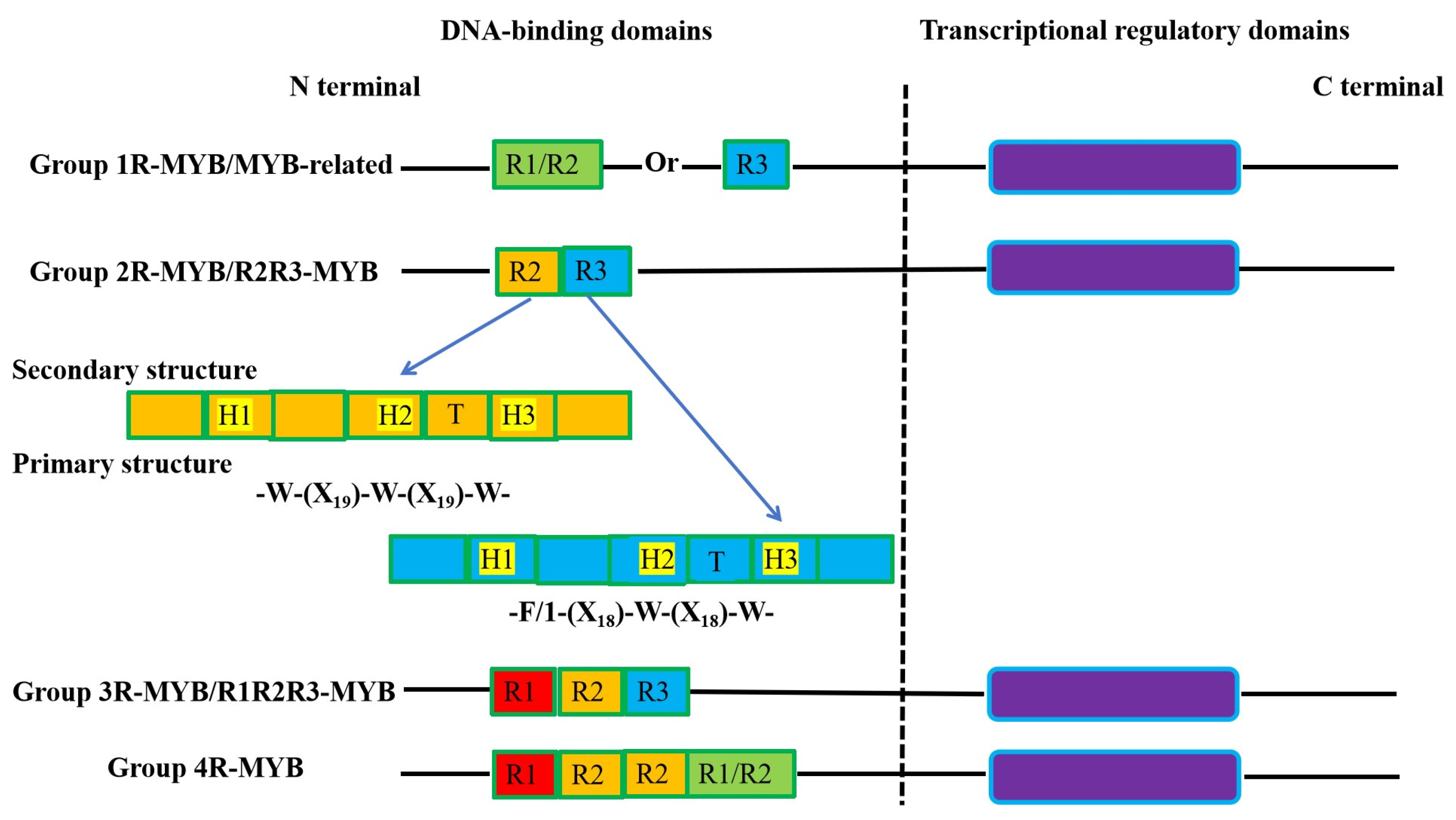
Figure 2.
Phylogenetic tree MYBs family genes in Arabidopsis thaliana, Oryza sativa, Glycine max and so on. Phylogenetic tree of MYB transcription factors proteins in selected angiosperms. The MYB family gene sequences of plants were retrieved using the NCBI (https://www.ncbi.nlm.nih.gov/) and China National Rice Data Center (https://www.ricedata.cn/). The phylogenetic tree was constructed using MEGA version 11.0 with the bootstrap method based on full amino acid sequences. Numbers next to the branches show the percentage of replicate trees in which the associated taxa clustered together in the bootstrap test (1000 replicates).
Figure 2.
Phylogenetic tree MYBs family genes in Arabidopsis thaliana, Oryza sativa, Glycine max and so on. Phylogenetic tree of MYB transcription factors proteins in selected angiosperms. The MYB family gene sequences of plants were retrieved using the NCBI (https://www.ncbi.nlm.nih.gov/) and China National Rice Data Center (https://www.ricedata.cn/). The phylogenetic tree was constructed using MEGA version 11.0 with the bootstrap method based on full amino acid sequences. Numbers next to the branches show the percentage of replicate trees in which the associated taxa clustered together in the bootstrap test (1000 replicates).

Figure 3.
Schematic representation of the molecular regulation phosphorus homeostasis mediated through the MYB transcription factor PHR in plants. (A) Schematic representation of phosphate uptake and transport by plants through the root system. The red upward arrow represents the transport of Pi from the root to the shoot. Pi=phosphate. (B) Patterns of regulation of SPX proteins and PHR transcription factors when low and high phosphorus signalling differ. The red upward arrow represents increased expression. The red downward arrow represents decreased expression.
Figure 3.
Schematic representation of the molecular regulation phosphorus homeostasis mediated through the MYB transcription factor PHR in plants. (A) Schematic representation of phosphate uptake and transport by plants through the root system. The red upward arrow represents the transport of Pi from the root to the shoot. Pi=phosphate. (B) Patterns of regulation of SPX proteins and PHR transcription factors when low and high phosphorus signalling differ. The red upward arrow represents increased expression. The red downward arrow represents decreased expression.
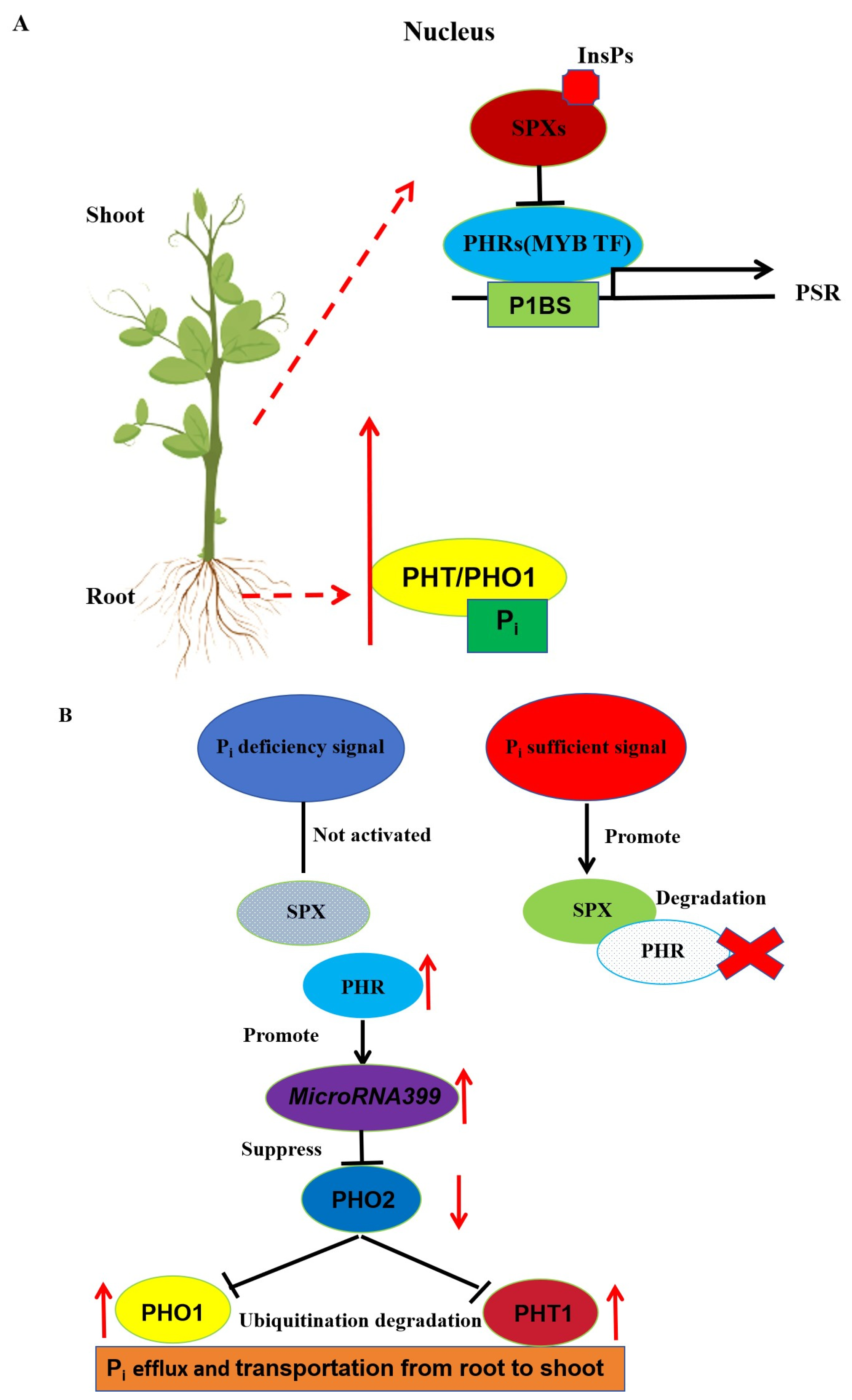

Table 1.
The MYBs genes total numbers in different plants.
| Gene name | Species | R2R3-MYB number | MYB-related number |
R1R2R3-MYB and Atypical MYB number |
Total number | Reference |
|---|---|---|---|---|---|---|
| AtMYBs | Arabidopsis thaliana | 126 | 64 | 8 | 198 | [22] |
| OsMYBs | Oryza sativa | 148 | 87 | 4 | 239 | [15,23] |
| GmMYBs | Glycine max | 244 | 0 | 10 | 254 | [24] |
| BvMYBs | Beta vulgaris | 70 | 0 | 5 | 75 | [25] |
| SlMYBs | Solanum lycopersicum | 122 | 0 | 5 | 127 | [26] |
| PhMYBs | Petunia hybrida | 106 | 40 | 9 | 155 | [27] |
| AcMYBs | Actinidia chinensis | 91 | 87 | 3 | 181 | [28] |
| CaMYBs | Capsicum annuum | 116 | 92 | 7 | 215 | [29] |
| MaMYBs | Musa acuminata | 222 | 73 | 10 | 305 | [30] |
| MbMYBs | Musa balbisiana | 184 | 59 | 8 | 251 | [30] |
| HuMYBs | Hylocereus undatus | 105 | 75 | 5 | 185 | [31] |
| StMYBs | Solanum tuberosum | 124 | 90 | 3 | 217 | [32] |
| RsMYBs | Raphanus sativus | 174 | 2 | 11 | 187 | [33] |
| DoMYBs | Dendrobium officinale | 117 | 42 | 5 | 164 | [34] |
| AhMYBs | Arachis hypogaea | 209 | 219 | 15 | 443 | [35] |
| DlMYBs | Dimocarpus longan | 119 | 95 | 5 | 219 | [36] |
| BnMYBs | Brassica napus | 429 | 227 | 24 | 680 | [37] |
| CeMYBs | Casuarina equisetifolia | 107 | 69 | 6 | 182 | [38] |
| PaMYBs | Prunus avium | 14 | 51 | 4 | 69 | [39] |
Table 2.
Abiotic stress responsive MYB transcription factors in plants.
| Abiotic Stress Type | MYB transcription factors | Species | Target genes and sites | Reference |
|---|---|---|---|---|
| High temperature | AtMYBS1 | Arabidopsis thaliana L. | MAX1 | [132] |
| High temperature, salt, drought | AtMYB12 | Arabidopsis thaliana L. |
ZEP, NCED, ABA2, AAO, P5CS, P5CR, LEA, SOD, CAT, POD and Flavonoid biosynthesis genes |
[133] |
| Salt | AtMYB25 | Arabidopsis thaliana L. | DREB2C, RD29a, SLAH1, JAZ10 | [134] |
| Salt, drought | AtMYB37 | Arabidopsis thaliana L. |
ABF2/3, COR15A, RD29a, RD22, PSII/I |
[135] |
| High temperature | AtMYB74 | Arabidopsis thaliana L. |
ERF53, NIG1, HSFA6a, MYB47, MYB90, MYB102 |
[136] |
| Drought | AtMYB94/96 | Arabidopsis thaliana L. | KCS1/2/6, KCR1, CER1/3, WSD1 | [137] |
| Salt, drought, cold | OsMYB2 | Rice (Oryza sativa) | OsLEA3,OsRab16A,OsDREB2A | [138] |
| Salt, drought | OsMYB6 | Rice (Oryza sativa) |
OsLEA3,OsDREB2A,OsDREB1A,OsP5CS, SNAC1,OsCATA |
[139] |
| Drought | OsMYB26 | Rice (Oryza sativa) | OsLEA3 | [140] |
| Drought | OsMYB48-1 | Rice (Oryza sativa) | OsNCED4,OsNCED5 | [141] |
| Drought | OsMYBR57 | Rice (Oryza sativa) | OsLEA3,Rab21 | [142] |
| Drought | OsMYB60 | Rice (Oryza sativa) | OsCER1 | [143] |
| Salt | OsMYB91 | Rice (Oryza sativa) | SLR1 | [144] |
| Cold | OsMYBS3 | Rice (Oryza sativa) | DREB1 | [145] |
| Cold | OsMYB3R-2 | Rice (Oryza sativa) | DREB2A,COR15a,RCI2A | [146] |
| Cold | OsMYB30 | Rice (Oryza sativa) | OsAGPL3,OsSSIIIb,OsSSIIb,OsSSIIc | [147] |
| High temperature | OsMYB55 | Rice (Oryza sativa) | OsGS1,GAT1,GAD3 | [148,149] |
| Heavy metal stress | OsMYB30 | Rice (Oryza sativa) | Os4CL5 | [150] |
| Heavy metal stress | OsARM1 | Rice (Oryza sativa) | OsLsi1,OsLsi2,OsLsi6 | [151] |
| Salt, drought | VhMYB2 |
V. labrusca×V. riparia |
SOS1/2/3, NHX1, SnRK2.6, NCED3, P5CS1, CAT1 |
[152] |
| Salt, drought, cold | VaMYB14 | Vitis amurensis | ABA signaling genes, CORs, LTPs, CAT, POD |
[153] |
| High temperature | SlMYB41 |
Solanum lycopersicum |
SlHSP90.3 | [154] |
| Drought | PsFLP | Pisum sativum |
CYCA2;3, CDKA;1, AAO3, NCED3, SnRK2.3 |
[155] |
| Cold | BcMYB111 | Brassica campestris | F3H, FLS1 | [156] |
| Drought | GhMYB36 | Gossypium hirsutum | PR1 | [157] |
| Salt | IbMYB308 | Ipomoea batatas | SOD, POD, APX, P5CS | [158] |
Disclaimer/Publisher’s Note: The statements, opinions and data contained in all publications are solely those of the individual author(s) and contributor(s) and not of MDPI and/or the editor(s). MDPI and/or the editor(s) disclaim responsibility for any injury to people or property resulting from any ideas, methods, instructions or products referred to in the content. |
© 2025 by the authors. Licensee MDPI, Basel, Switzerland. This article is an open access article distributed under the terms and conditions of the Creative Commons Attribution (CC BY) license (http://creativecommons.org/licenses/by/4.0/).
Copyright: This open access article is published under a Creative Commons CC BY 4.0 license, which permit the free download, distribution, and reuse, provided that the author and preprint are cited in any reuse.


