

Submitted:
06 January 2025
Posted:
07 January 2025
You are already at the latest version
Abstract
Training drills are fundamental to the development of athletes across various sports disciplines, including basketball. This review examines the multifaceted factors influencing both the external and internal workload of drills during training sessions. Factors such as the type of drills utilized, space constraints, the number of players involved, adjustments to game rules, work-to-rest ratios, modifications to roles or tactical scenarios, the level of coach involvement, and the type of opposition all significantly impact drill workload. A comprehensive understanding of these factors can help coaches and athletes optimize training regimens to achieve desired performance outcomes while minimizing the risk of overtraining or injury. By synthesizing current research, this review provides valuable insights into the complex interplay of factors shaping drill workload in basketball training sessions.
Keywords:
basketball
; ball drills
; small-sided games
; scrimmage games
; load management
; drill-design
1. Introduction
A key goal during training is to prescribe an appropriate training load [1], defined as the physical effort outlined in the training plan [2], to promote targeted adaptations [1] and achieve the intended response [2]. Coaches often emphasize the importance of players training with game-like intensity during practice sessions [3]. Competition is the most specific skill-based conditioning tool, involving the most realistic cognitive, physical, and physiological requirements [4]. To support the development of elite athletes, the need implements training methods that align with the demands of competition performance is well established [3,5].
The normative characteristics of each sport explicitly delineate athletes’ modes of participation and, indirectly, the physical demands associated with them [6,7,8,9,10,11]. Therefore, when aiming to develop efficient training programs to enhance team performance, it is important to understand the specific demands of the sport [11,12]. The fact that the demands in basketball are so diverse and varied necessitates the assessment of a complex range of variables when designing training programs [13,14,15]. In this regard, adjusting game rules during training constitutes a fundamental tool for tailoring exercises and activities to meet conditioning, technical, and tactical objectives [16,17,18]. In high-performance, it has been observed that the greatest benefits are achieved when the training stimulus closely mimics competition [19]. To achieve this, modified competitive situations are employed consisting of drills that replicate some aspects or the entirety of competition, with the intent to target specific elements, whether technical, physical, or tactical [13,20,21,22,23]. These situations can be adjusted based on various factors such as variation of space or time available, the type of opposition or the structure of the drills among other variables.
The effect of including constraints in training has been studied from various perspectives [20,21,23,24,25,26,27,28,29,30]. It can be stated that constraints are decisive in determining the physical load, and modifying these constraints has a significant impact on the frequency and duration of high-intensity actions [26,31]. The most studied activities are based on game characteristics, as integrated on-court conditional training is assumed to have several benefits, such as: a) greater transfer to the game due to the environment in which it is carried out; b) increased use of specific movement patterns; c) more opportunities for decision-making and problem-solving; and d) greater athlete motivation compared to non-specific traditional activities [29]. In this context, it becomes pertinent to address the challenge of understanding the demands of training drills in a more nuanced manner.
1.1. Types of Drills
In this regard, among professionals, there is widespread acceptance of the use and benefits of Ball-Drills (BDs), Small Sided Games (SSGs) and the Scrimmage Games (SGs) or Conditioned Games (CGs) or Game Simulation (GS). While definitions for these drills exist, they are not unique. They are open to interpretation by professionals, allowing for various combinations based on specific objectives. Similarly, different terms are often used interchangeably to describe very similar drills. However, in general terms, and to provide context, these drills can be defined as shown in Table 1.
The integration of BDs, SSGs, and SGs serves to streamline training sessions [38], as coaches associate these drills with comprehensive player development across technical, physical, and decision-making domains (Clemente, 2016; Leite, Vicente, & Sampaio, 2009). Coaches argue that tactical scenarios involving numerical advantages on both offensive and defensive fronts play a crucial role during developmental stages in enhancing player’s understanding of the game’s nuances [39]. The use and adaptation of these drills, commonly employed by professionals, have garnered the interest of researchers seeking to investigate how such modifications influence training workload [26,41]. Given the inherent uncertainty and unpredictability of the game, parameters in BDs, SGs, and SSGs are frequently adjusted [20,38,42,43] to align the drills with specific training objectives.
To achieve this effect, competition rules are often modified to align with specific objectives. Coaches and fitness trainers recognize that changing the game format directly impacts the physical demands of the drills [26,29,31,40]. Commonly used training settings are included in Table 2.
In this context, it becomes apparent that findings vary significantly depending on the variables measured and the specific modifications in each instance. Nevertheless, it can be stated that BDs, SSGs, and SGs are widely utilized in the teaching-learning-training process in team sports due to their performance-related characteristics [15]. Moreover, they share organizational similarities with competitive environments and can be easily adjusted to specific training variables while maintaining the integrity of the game’s dynamics [44]. Therefore, this study aims to identify the various factors influencing the external and internal load of training drills, with the aim of establishing criteria for the efficient planning, programming, and design of training sessions. These criteria are intended to address the physical demands of both players and teams across different periods and circumstances of the season.
1.2. Space Constraints
The playing space appears to be a fundamental and critical variable in regulating exercise intensity [26,31,45,46]. The physical and physiological demands of the drills can be influenced by modifying or restricting absolute or relative playing spaces (m2/player) [38].
Several studies compare SSGs played in full-court versus half-court settings, either with different combinations of players or with the same number of players in each drill. These studies reveal that although the absolute distance may increase, if the relative distance does not—meaning more space but also more players—the difference in intensity, measured as a percentage of maximal heart rate between 3v3 and 4v4 drills, is minimal [47]. However, when the number of players remains constant, but the playing area expands (resulting in increased relative distance), significant differences emerge between the various SSGs [48]. In a study by [26] 5v5 drills were compared across different spaces: half-court (HALF), half-court with transition (HTRAN), and full-court (FULL). Their findings suggest a correlation between larger playing areas and increased distance covered, as well as heightened intensity in variables such as Player Load (PL), maximum speed reached, high-intensity accelerations (≥ 2m • s-2), and high-intensity decelerations (≤ -2m • s-2). Particularly, notable differences were observed between HALF drills compared to HTRANS or FULL. It was noted that with a larger playing area and the same number of players, overall intensity was higher. In HALF drills, compared to FULL, there were fewer instances of variables such as total distance covered, PL, maximum speed, high-intensity actions, accelerations, and decelerations at high intensity, with only the total number of accelerations and decelerations in HALF drills showing higher values than FULL. When comparing HALF with HTRANS, all variables were higher in HTRANS drills. Comparing HTRANS with FULL, it was observed that HTRANS drills achieved higher values in maximum speed, total number of accelerations and decelerations, and maximum acceleration, while FULL drills achieved higher values in total distance covered, PL, high-intensity actions, accelerations, and decelerations. Therefore, it could be concluded that when the playing dimensions are reduced, the applied load on the player is lower. This disparity in results between drills can be attributed to the fact that in HTRANS and FULL drills, a second playing option is allowed, such as a counterattack, transition, or positional attack on the other field, resulting in greater distances to cover.
In this regard, other studies [49] also found that full-court 3v3 and 5v5 drills accumulated the highest Player Load when compared to similar half-court drills. However, for specific variables (such as accelerations per minute), it was observed that half-court drills might be more targeted. For instance, 2v2 drills, in particular, and half-court 5v5 drills showed the highest acceleration load per minute among all the SSGs studied. These findings align with the hypotheses of other authors who, on one hand, attribute higher intensity to drills with fewer players (2v2) [21,40] and, on the other hand, to more specific tasks (5v5) [50]. When quantifying drills load, it is important to separately assess the physical or biomechanical load and the physiological load, as it appears that confined space and opposition situations increase biomechanical load, whereas full-court scenarios elevate physiological load.
1.3. Format: Number of Players
A multitude of studies have compared the demands of various exercises during training, considering the number of participating players. These studies have revealed significant differences depending on the type of exercise chosen.
In general, it has been observed that players tend to spend more time engaging in low or moderate-intensity activities as the number of opponents increases [45]. Some drills are designed without opposition or with passive opposition, particularly in repetitive tasks, to simplify decision-making, reduce uncertainty, and focus attention primarily on technical execution [51]. These situations may include drills with a clear technical focus. On the other hand, active opposition entails high contextual variability and increased uncertainty in interpersonal interaction during the task, as observed in SSGs and full-court SGs [44,51,52].
In the various studies analyzed, it’s consistently observed that in SSGs with fewer players, intensities measured as a percentage of maximum HR [24,47,53], peak HR [21,25] and mean HR [54], increase. Similarly, blood lactate concentrations [21], follow the same trend: lower player numbers are associated with higher lactate concentrations.
In the study conducted by Mccormick et al. (2012), [54] comparisons were made between full court 5v5 and half court 3v3, revealing that the differences in average heart rate during exercises (2 sets of 8 minutes for both cases) were not significant. However, in the investigation by Torres-Ronda et al. (2016) [45], physical demands of training were juxtaposed with those of friendly competition, indicating that the intensity, measured by mean heart rate and peak heart rate reached, was higher during competitive matches (158 bpm-198 bpm, respectively) than in 5v5 full-sided games (152 bpm and 182 bpm, respectively); 4v4 SSGs (143 bpm and 174 bpm, respectively); 3v3 (145 bpm and 179 bpm, respectively); and 2v2 (139 bpm and 177 bpm, respectively). However, within the same study, it was observed that the number of high-intensity actions during SSGs situations was greater, both in half-court scenarios (46 movements per minute) and full-court scenarios (53 movements per minute), compared to friendly match situations (33 movements per minute). Similar findings were reported in the research conducted by Montgomery et al. (2010), where comparisons were drawn among drills, SSGs, and full-sided games with friendly competition, indicating that peak heart rate, percentage of maximum heart rate, and VO2 Max were higher during matches than in other training activities. While the peak heart rate values were comparable between full-sided games (5v5) and competitive matches, a longer duration of higher percentage of maximum heart rate was noted during competitive play.
It seems that 3v3, when played in full court, is a good option to achieve high work intensity, especially biomechanically, due to the high frequency of movements involved [45], partly because of the large playing area and the low number of players [21,49]. Regarding 2v2 scenarios, findings vary across studies. While some authors [47] observed a greater intensity in accelerations compared to other full-court SSG options, others [45,49] found no significant differences in this aspect. However, distinctions were noted when comparing with the same number of players (2v2) in a half-court setting.
Overall, it’s been noted that SSGs involving fewer players tend to exhibit higher intensity levels compared to 5v5 setups [40], except when contrasted with friendly matches [45]. Discrepancies in findings across studies may arise from variability in the conditions of SSGs, SGs, and BDs, particularly in drills design [26,45]. Even when studies compare situations with a standard number of players, other training components will impact these tasks. Therefore, when evaluating task load, it’s crucial to consider not only the number of players involved but also other factors such as available space, rotations, or pauses [49].
1.4. Game Rules
In addition to modifications in the number of players or spaces, it is common to adjust game rules in BDs, SSGs, and SGs to target specific objectives. This allows for the emphasis on particular technical actions, tactical situations [44,56] or increase physical or physiological workload [40]. Common rule modifications include reducing possession times, limiting the type or number of technical gestures, altering the value of scoring actions, or assigning value to other actions (e.g., scoring rebounds, steals, or recoveries). Additionally, penalizing actions or establishing an initial distance between attackers and defenders is often implemented [13,22,24,31,44,52,55,57].
In a study by Conte et al., (2015) [29] that compared two 4v4 SSG tasks under the same training conditions (3 sets of 4 minutes with 2 minutes rest), one of which restricted dribbling, it was found that in the group where dribbling was prohibited, the percentage of maximum heart rate during exercise was higher (92%) compared to the group where dribbling was allowed (90%). Similarly, the subjective perception of effort was higher in the group with dribbling limitations (8.5) compared to the other group (7.9). This rule also influenced the use of other technical elements, such as increasing the total number of passes, both completed and incomplete, and the number of interceptions [29]. Hence, it appears that restricting certain technical gestures can impact exercise intensity from a physiological standpoint, as it alters movement patterns.
1.5. Drill Structure: Duration, Regime (Continuous vs Intermittent) & Work-to-Rest Ratios
This pertains to how exercises are structured, including the arrangement of sets, the duration of each set, and the timing of participation and rest intervals. This approach enables the assessment of recovery capacity between sets and facilitates the management of workload for each drill [40].
This aspect holds significant importance when the exercise objective is conditioning, as varying rest durations can impact the intensity of subsequent sets or actions. BDs, SSGs, and SGs have demonstrated efficiency, based on the training regimen, in improving the fitness levels of basketball players, similar to high-intensity interval training (HIIT) activities involving running [28]. Furthermore, due to the specificity of SSGs, they contribute to enhancing defensive movements, shooting proficiency, and upper limb strength [40]. Therefore, they emerge as a viable option for conditioning improvement. Drills can be structured in a continuous or intermittent manner [29,47] aiming to target either aerobic or anaerobic aspects more prominently. Svilar et al. (2019) [31] proposed modifying the workload of SGs by implementing tasks with and without breaks. Tasks without breaks involved continuous play without interruptions such as free throws or timeouts, while tasks with breaks allowed for these interruptions. They found that tasks without breaks resulted in higher intensity and load values in various performance metrics, including Player Load, decelerations/min, jumps/min, high-intensity jumps/min, COD/min, and high-intensity COD/min, compared to tasks with breaks.
In this regard, when structuring the exercise, two types of pauses or rests should be considered: a) intra-set pauses; and b) inter-set pauses [49]. Intra-set pauses refer to the time that the player stops during the exercise, either due to rotation or exercise circumstances, while inter-set pauses refer to the time and type of rest that the coach plans between different sets. In full-court drills, it has been observed that intra-set rest is greater [49], which could result in a lower average relative workload of the exercise, i.e., a lower work-to-rest ratio, despite the intensity of the actions potentially being higher than in other drills. For this reason, when planning the workload of different tasks, it’s important to consider not only the number of players or the playing space, but also the duration of the exercise, how players are organized, their participation and rotation, any pauses that may arise during the exercise, and the timing and type of rest planned between sets [49].
1.6. Modifications to Roles or Tactical Scenarios
Another key factor influencing exercise workload during training is the individual or collective tactical roles assumed by players. Regulations that constrain players’ tactical decisions-by expanding or restricting their options to favor neutral, conservative, or risk-taking scenarios- significantly impact team dynamics. This modification alters the context of player interactions, leading to new forms of engagement [44,58], and subsequently affecting movement patterns and the overall intensity of training activities.
One common tactical adjustment involves restricting the types of defensive strategies allowed during training sessions [57,59]. Interestingly, research shows no significant differences in physical workload, average heart rate, peak heart rate, or VO2 max between exercises emphasizing individual defense and those focusing on zone defense during training (Montgomery et al., 2010). This finding suggests that the choice of defensive strategy should primarily align with tactical objectives rather than aiming to the physical or physiological demands of the drill.
However, when comparing training exercise that replicate specific tactical scenarios, such as offensive or defensive maneuvers, in SGs (5v5) settings with actual competition, competitive scenarios are found to impose greater physical demands. This is evidenced by higher peak heart rates, mean heart rates, and VO2 max values during competitive matches [45,59].
1.7. The Level of Coach Involvement
The coach’s active involvement during drills also appears to influence their intensity. Continuous encouragement, timely corrections, and enthusiastic motivation can increase the intensity of drills [60]. Furthermore, the manner of this engagement is crucial, as positive feedback directly impacts athletes’ intrinsic motivation and their perception of their abilities and skills [61]. Providing individualized attention during training sessions is an effective strategy for shaping attitudes and increasing physical workload [62].
Evidence from various studies indicates that the physical and physiological demands of drills can be shaped by both drill design or the coach’s involvement. For instance, coach-initiated breaks for instructions, corrections, or feedback affect the players’ average heart rate during the session [16]. When comparing SSG situations (5v5) with official matches, it was found that while the maximum heart rate was similar in both scenarios (SSGs: 171 ± 12 bpm; Matches: 173 ± 6 bpm), the average heart rate was significantly higher in official matches than in SSGs (SSGs: 147 ± 10 bpm; Matches: 162 ± 7 bpm) (Montgomery et al., 2010). The lower average heart rate observed during SSGs were attributed to intermittent breaks initiated by the coach for intervention, providing players with more opportunities to recover [16,55].
1.8. Type of Opposition
Aside from the number of participants, the type of opposition permitted plays a significant role in modulating training workload. A key factor in establishing these contexts is the nature of opposition, often determined by whether contact is allowed [22]. Non-contact opposition, commonly referred to as “passive defense,” is typically used for tactical learning or analysis. Additionally, factors such as the positioning of attackers relative to defenders (e.g., distance or angle), the presence of an offensive or defensive disadvantage, the starting moment of offensive or defensive activity (e.g., when the attacker receives the ball or when the passer releases the ball), or the level of aggressiveness/intensity allowed in defense (e.g., a high or low foul threshold) all influence the interactions between attackers and defenders. These variables, in turn, modify the frequency and intensity of actions [44].

Table 3.
Summary of most used load modulators in basketball.
| MODULATORS | APPLICATION TO TRAINING |
|---|---|
| Court size | Full Court + Transition Full Court Half Court (14x15 or 28x7.5) Quarter Court (14x7.5) |
| Format | Equal: 1v1,2v2,3v3,4v4,5v5 Unequal: 2v1,3v2,4v3,5v4 |
| Drill structure | Duration Continuous / Intermittent Rotation / No rotation Time between tasks |
| Tactical Situations | Type of defense allowed Specific tactic situations |
| Rules | Goal Limited actions Modified valued actions Limited possession time Initial distance between players |
| Coach Involvement | Limit stops for correction Feedback / No feedback Encouraging Vehemence in corrections Individualized attention (Number of coaches) |
| Type of Opposition | No opposition / Opposition Contact / No contact Offensive / Defensive - advantage / disadvantage Aggressiveness allowed |
2. Practical Implications
This narrative review provides valuable insights for improving players’ preparation to withstand the specific situations, uncertainties, and highest intensities encountered during games [63]. Accordingly, the selection of training methods can be greatly influenced by the goal of simultaneously optimizing a wide range of physical, technical, and tactical factors [15,64]. To achieve this, the magnitude and orientation of the stimulus must possess specific characteristics to elicit aligned with the structure, types of physical and bioenergetic demands of competition, the athlete’s previous or ongoing injuries, or the interplay of various physical, technical, tactical, and psycho-emotional aspects. Training load can be modulated using different strategies, adapting it to the many variables affecting players and the team. As described above, various options (Figure 1) can be employed to adjust tasks in training, allowing for increases or decreases in training load depending on the specific objectives of the player/team.
3. Conclusions
The external and internal workload of drills should be evaluated from multiples perspectives to design training sessions that effectively address various objectives. Research highlights that no isolated variable can fully capture the complexity or demands of an activity within a drill; instead, it is the interplay of different variables that determines the nature and focus of the drill. Key elements, such as the type of drill, space constraints, number of players, adjustments to game rules, work-to-rest ratios, role or tactical scenario modifications, level of coach involvement, and type of opposition, should all be carefully considered to effectively tailor the physical demands and orientation of the drill.
Author Contributions
For research articles with several authors, a short paragraph specifying their individual contributions must be provided. The following statements should be used “Conceptualization, C.S. and E.A.; methodology, C.S., E.A. and A.L.; formal analysis, C.S. and E.A..; investigation, C.S. and E.A.; data curation, C.S. and E.A.; writing—original draft preparation, C.S. and E.A.; writing—review and editing, A.L. and X.S. ; supervision, A.L. and X.S. All authors have read and agreed to the published version of the manuscript.”
Funding
This research received no external funding
Institutional Review Board Statement
Not applicable.
Informed Consent Statement
Not applicable.
Data Availability Statement
Not applicable
Conflicts of Interest
The authors declare not conflicts of interest.
References
- Aoki, M.S.; Ronda, L.T.; Marcelino, P.R.; Drago, G.; Carling, C.; Bradley, P.S.; Moreira, A. Monitoring Training Loads in Professional Basketball Players Engaged in a Periodized Training Program. J Strength Cond Res 2017, 31, 348–358. [Google Scholar] [CrossRef]
- Impellizzeri, F.M.; Marcora, S.M.; Coutts, A.J. Internal and External Training Load: 15 Years On. Int J Sports Physiol Perform 2019, 14, 270–273. [Google Scholar] [CrossRef]
- Alonso, E.; Miranda, N.; Zhang, S.; Sosa, C.; Trapero, J.; Lorenzo, J.; Lorenzo, A. Peak Match Demands in Young Basketball Players: Approach and Applications. Int J Environ Res Public Health 2020, 17, 2256. [Google Scholar] [CrossRef] [PubMed]
- Schelling, X.; Torres-Ronda, L. Conditioning for Basketball: Quality and Quantity of Training. Strength Cond J 2013, 35, 89–94. [Google Scholar] [CrossRef]
- Sosa, C.; Alonso Pérez-Chao, E.; Trapero, J.; Ribas, C.; Leicht, A.S.; Lorenzo, A.; L Jiménez, S. External Physical Demands during Official Under-18 Basketball Games: Consideration of Overtime Periods. J Hum Kinet 2024. [Google Scholar] [CrossRef] [PubMed]
- Stojanović, E.; Stojiljković, N.; Scanlan, A.T.; Dalbo, V.J.; Berkelmans, D.M.; Milanović, Z. The Activity Demands and Physiological Responses Encountered During Basketball Match-Play: A Systematic Review. Sports Med 2018, 48, 111–135. [Google Scholar] [CrossRef] [PubMed]
- McInnes, S.E.; Carlson, J.S.; Jones, C.J.; McKenna, M.J. The Physiological Load Imposed on Basketball Players during Competition. J Sports Sci 1995, 13, 387–397. [Google Scholar] [CrossRef] [PubMed]
- McLaren, S.J.; Macpherson, T.W.; Coutts, A.J.; Hurst, C.; Spears, I.R.; Weston, M. The Relationships Between Internal and External Measures of Training Load and Intensity in Team Sports: A Meta-Analysis. Sports Medicine 2018, 48, 641–658. [Google Scholar] [CrossRef] [PubMed]
- Edwards, T.; Spiteri, T.; Piggott, B.; Bonhotal, J.; Haff, G.G.; Joyce, C. Monitoring and Managing Fatigue in Basketball. Sports 2018, 6, 19. [Google Scholar] [CrossRef] [PubMed]
- Nabli, M.A.; Ben Abdelkrim, N.; Castagna, C.; Jabri, I.; Batikh, T.; Chamari, K. Physical and Physiological Demands of U-19 Basketball Refereeing: Aerobic and Anaerobic Demands. Physician and Sportsmedicine 2016, 44, 158–163. [Google Scholar] [CrossRef] [PubMed]
- Sosa, C.; Lorenzo, A.; Trapero, J.; Ribas, C.; Alonso, E.; Jimenez, S.L. Specific Absolute Velocity Thresholds during Male Basketball Games Using Local Positional System; Differences between Age Categories. Applied Sciences (Switzerland) 2021, 11. [Google Scholar] [CrossRef]
- Taylor, J.B.; Wright, A.A.; Dischiavi, S.L.; Townsend, M.A.; Marmon, A.R. Activity Demands During Multi-Directional Team Sports: A Systematic Review. Sports Medicine 2017, 47, 2533–2551. [Google Scholar] [CrossRef]
- Maggioni, M.A.; Bonato, M.; Stahn, A.; La Torre, A.; Agnello, L.; Vernillo, G.; Castagna, C.; Merati, G. Effects of Ball Drills and Repeated-Sprint-Ability Training in Basketball Players. Int J Sports Physiol Perform 2019, 14, 757–764. [Google Scholar] [CrossRef] [PubMed]
- Benis, R.; Bonato, M.; La Torre, A. La Elite Female Basketball Players’ Body-Weight Neuromuscular Training and Performance on the Y-Balance Test. J Athl Train 2016, 51, 688–695. [Google Scholar] [CrossRef]
- Hoffmann, J.J.; Reed, J.P.; Leiting, K.; Chiang, C.-Y.; Stone, M.H. Repeated Sprints, High-Intensity Interval Training, Small-Sided Games: Theory and Application to Field Sports. Int J Sports Physiol Perform 2014, 9, 352–357. [Google Scholar] [CrossRef]
- Berkelmans, D.M.; Dalbo, V.J.; Kean, C.O.; Milanović, Z.; Stojanović, E.; Stojiljković, N.; Scanlan, A.T. Heart Rate Monitoring in Basketball: Applications, Player Responses, and Practical Recommendations. J Strength Cond Res 2018, 32, 2383–2399. [Google Scholar] [CrossRef]
- Scanlan, A.; Dascombe, B.; Reaburn, P. A Comparison of the Activity Demands of Elite and Sub-Elite Australian Men’s Basketball Competition. J Sports Sci 2011, 29, 1153–1160. [Google Scholar] [CrossRef] [PubMed]
- Scanlan, A.T.; Wen, N.; Tucker, P.S.; Dalbo, V.J. The Relationships between Internal and External Training Load Models during Basketball Training. J Strength Cond Res 2014, 28. [Google Scholar] [CrossRef] [PubMed]
- Bompa, T.; Buzzichelli, C. Periodization Training for Sports; 3rd ed.; Human Kinetics: Illinois, 2015.
- Bredt, S.G.T.; Morales, J.C.P.; Andrade, A.G.P.; Torres, J.O.; Peixoto, G.H.; Greco, P.J.; Praça, G.M.; Chagas, M.H. Space Creation Dynamics in Basketball Small-Sided Games. Percept Mot Skills 2018, 125, 162–176. [Google Scholar] [CrossRef]
- Castagna, C.; Impellizzeri, F.M.; Chaouachi, A.; Ben Abdelkrim, N.; Vincenzo, M. Physiological Responses to Ball-Drills in Regional Level Male Basketball Players. J Sports Sci 2011, 29, 1329–1336. [Google Scholar] [CrossRef]
- Schelling, X.; Torres-ronda, L. Conditioning for Basketball : Quality and Quantity of Training. Strength And Conditioning 2013, 35, 89–94. [Google Scholar] [CrossRef]
- Conte, D.; Favero, T.; Niederhausen, M.; Capranica, L.; Tessitore, A. Effect of Number of Players and Maturity on Ball-Drills Training Load in Youth Basketball. Sports 2017, 5, 3. [Google Scholar] [CrossRef] [PubMed]
- Conte, D.; Favero, T.G.; Niederhausen, M.; Capranica, L.; Tessitore, A. Effect of Different Number of Players and Training Regimes on Physiological and Technical Demands of Ball-Drills in Basketball. J Sports Sci 2016, 34, 780–786. [Google Scholar] [CrossRef]
- Delextrat, A.; Kraiem, S. Heart-Rate Responses by Playing Position during Ball Drills in Basketball. Int J Sports Physiol Perform 2013, 8, 410–418. [Google Scholar] [CrossRef]
- Vazquez-Guerrero, J.; Reche, X.; Cos, F.; Casamichana, D.; Sampaio, J. Changes in External Load When Modifying Rules of 5-on-5 Scrimmage Situations in Elite Basketball. J Strength Cond Res 2018, 00, 1–8. [Google Scholar] [CrossRef]
- Svilar, L.; Castellano, J.; Jukic, I. Load Monitoring System in Top-Level Basketball Team: Relationship Between External and Internal Training Load. Kinesiology 2018, 501, 25–33. [Google Scholar] [CrossRef]
- Delextrat, A.; Martinez, A. Small-Sided Game Training Improves Aerobic Capacity and Technical Skills in Basketball Players. Int J Sports Med 2014, 35, 385–391. [Google Scholar] [CrossRef]
- Conte, D.; Favero, T.G.; Niederhausen, M.; Capranica, L.; Tessitore, A. Physiological and Technical Demands of No Dribble Game Drill in Young Basketball Players. J Strength Cond Res 2015, 29, 3375–3379. [Google Scholar] [CrossRef] [PubMed]
- Klusemann, M.J.; Pyne, D.B.; Foster, C.; Drinkwater, E.J. Optimising Technical Skills and Physical Loading in Small-Sided Basketball Games. J Sports Sci 2012, 30, 1463–1471. [Google Scholar] [CrossRef]
- Svilar, L.; Castellano, J.; Jukic, I. Comparison of 5vs5 Training Games and Match-Play Using Microsensor Technology in Elite Basketball. J Strength Cond Res 2019, 33, 1897–1903. [Google Scholar] [CrossRef]
- Svilar, L.; Castellano, J.; Jukic, I. Comparison of 5vs5 Training Games and Match-Play Using Microsensor Technology in Elite Basketball. J Strength Cond Res 2019, 33, 1897–1903. [Google Scholar] [CrossRef]
- Aguiar, M.; Botelho, G.; Lago, C.; MaçAs, V.; Sampaio, J. A Review on the Effects of Soccer Small-Sided Games. J Hum Kinet 2012, 33, 103–113. [Google Scholar] [CrossRef]
- Aschendorf, P.F.; Zinner, C.; Delextrat, A.; Engelmeyer, E.; Mester, J. Effects of Basketball-Specific High-Intensity Interval Training on Aerobic Performance and Physical Capacities in Youth Female Basketball Players. Physician and Sportsmedicine 2019, 47, 65–70. [Google Scholar] [CrossRef] [PubMed]
- Torres-Ronda, L.; Ric, A.; Llabres-Torres, I.; de las Heras, B.; Schelling i del Alcazar, X. Position-Dependent Cardiovascular Response and Time-Motion Analysis During Training Drills and Friendly Matches in Elite Male Basketball Players. J Strength Cond Res 2016, 30, 60–70. [Google Scholar] [CrossRef]
- Schelling, X.; Torres, L. Accelerometer Load Profiles for Basketball-Specific Drills in Elite Players; 2016; Vol. 15.
- Schelling, X.; Torres-Ronda, L. Conditioning for Basketball: Quality and Quantity of Training. Strength Cond J 2013, 35, 89–94. [Google Scholar] [CrossRef]
- Hill-Haas, S.; Dawson, B.; Impellizzeri, F.; Coutts, A. Physiology of Small Sided-Games Training in Football: A Systematic Review. Sports Med 2011, 41, 199–220. [Google Scholar] [CrossRef]
- Leite, N.; Vicente, P.; Sampaio, J. Coaches Perceived Importance of Tactical Items in Basketball Players’ Long Term Development. Revista de Psicología del Deporte 2009, 18, 481–485. [Google Scholar]
- Clemente, F.M. Small-Sided and Conditioned Games in Basketball Training. Strength Cond J 2016, 38, 49–58. [Google Scholar] [CrossRef]
- Scott, M.; Scott, T.; Kelly, V. The Validity and Reliability of Global Positioning Systems in Team Sport: A Brief Review. J Strength Cond Res 2016, 30, 1470–1490. [Google Scholar] [CrossRef]
- Aguiar, M.; Botelho, G.; Lago, C.; Maças, V.; Sampaio, J. A Review on the Effects of Soccer Small-Sided Games. J Hum Kinet 2012, 33, 103–113. [Google Scholar] [CrossRef] [PubMed]
- Hill-Haas, S. V; Rowsell, G.J.; Dawson, B.T.; Coutts, A.J. Acute Physiological Responses and Time-Motion Characteristics of Two Small-Sided Training Regimes in Youth Soccer Players. J Strength Cond Res 2009, 23, 111–115. [Google Scholar] [CrossRef] [PubMed]
- Davids, K.; Araújo, D.; Correia, V.; Vilar, L. How Small-Sided and Conditioned Games Enhance Acquisition of Movement and Decision-Making Skills. Exerc Sport Sci Rev 2013, 41, 154–161. [Google Scholar] [CrossRef]
- Torres-Ronda, L.; Ric, A.; Llabres-Torres, I.; de Las Heras, B.; Schelling I Del Alcazar, X. Position-Dependent Cardiovascular Response and Time-Motion Analysis During Training Drills and Friendly Matches in Elite Male Basketball Players. J Strength Cond Res 2016, 30, 60–70. [Google Scholar] [CrossRef] [PubMed]
- Clemente, F.M. PT NU SC. Physiol Behav 2018, #pagerange#. [CrossRef]
- Klusemann, M.J.; Pyne, D.B.; Foster, C.; Drinkwater, E.J. Optimising Technical Skills and Physical Loading in Small-Sided Basketball Games. J Sports Sci 2012, 30, 1463–1471. [Google Scholar] [CrossRef]
- Atli, H.; Köklü, Y.; Alemdaroğlu, U.; Koçak, F.Ü. A Comparison of Heart Rate Response and Frequencies of Technical Actions between Half-Court and Full-Court 3-a-Side Games in High School Female Basketball Players. J Strength Cond Res 2013, 27, 352–356. [Google Scholar] [CrossRef]
- Schelling, X.; Torres, L. Accelerometer Load Profiles for Basketball-Specific Drills in Elite Players. J Sports Sci Med 2016, 15, 585–591. [Google Scholar] [PubMed]
- Reilly, T.; Morris, T.; Whyte, G. The Specificity of Training Prescription and Physiological Assessment: A Review. J Sports Sci 2009, 27, 575–589. [Google Scholar] [CrossRef]
- Passos, P.; Araújo, D.; Davids, K.; Shuttleworth, R. Manipulating Constraints to Train Decision Making in Rugby Union. Int J Sports Sci Coach 2008, 3, 125–140. [Google Scholar] [CrossRef]
- Correia, V.; Araújo, D.; Duarte, R.; Travassos, B.; Passos, P.; Davids, K. Changes in Practice Task Constraints Shape Decision-Making Behaviours of Team Games Players. J Sci Med Sport 2012, 15, 244–249. [Google Scholar] [CrossRef] [PubMed]
- Sampaio, J.; Abrantes, C.; Leite, N. POWER, HEART RATE AND PERCEIVED EXERTION RESPONSES TO 3X3 AND 4X4 BASKETBALL SMALL-SIDED GAMES. Revista de Psicología del Deporte 2009, 18, 463–467. [Google Scholar]
- Mccormick, B.; Hannon, J.; Newton, M.; Shultz, B.; Miller, N.; Young, W. Comparison of Physical Activity in Small-Sided Basketball Games versus Full-Sided Games. Int J Sports Sci Coach 2012, 7, 689–697. [Google Scholar] [CrossRef]
- Montgomery, P.G.; Pyne, D.B.; Minahan, C.L. The Physical and Physiological Demands of Basketball Training and Competition. Int J Sports Physiol Perform 2010, 5, 75–86. [Google Scholar] [CrossRef] [PubMed]
- Passos, P.; Davids, K.; Araújo, D.; Paz, N.; Minguéns, J.; Mendes, J. Networks as a Novel Tool for Studying Team Ball Sports as Complex Social Systems. J Sci Med Sport 2011, 14, 170–176. [Google Scholar] [CrossRef] [PubMed]
- Ben Abdelkrim, N.; Castagna, C.; El Fazaa, S.; El Ati, J. The Effect of Players’ Standard and Tactical Strategy on Game Demands in Men’s Basketball. J Strength Cond Res 2010, 24, 2652–2662. [Google Scholar] [CrossRef] [PubMed]
- Cordovil, R.; Araújo, D.; Davids, K.; Gouveia, L.; Barreiros, J.; Fernandes, O.; Serpa, S. The Influence of Instructions and Body-Scaling as Constraints on Decision-Making Processes in Team Sports. Eur J Sport Sci 2009, 9, 169–179. [Google Scholar] [CrossRef]
- Montgomery, P.; Pyne, D.; Minahan, C. The Physical and Physiological Demands of Basketball Training and Competition. Int J Sports Physiol Perform 2010, 5, 75–86. [Google Scholar] [CrossRef]
- Halouani, J.; Chtourou, H.; Gabbett, T.; Chaouachi, A.; Chamari, K. Small-Sided Games in Team Sports Training: A Brief Review. J Strength Cond Res 2014, 28, 3594–3618. [Google Scholar] [CrossRef] [PubMed]
- Reinboth, M.; Duda, J.L.; Ntoumanis, N. Dimensions of Coaching Behavior, Need, Satisfaction, and the Psychological and Physical Welfare of Young Athletes. Motiv Emot 2004, 28, 297–313. [Google Scholar] [CrossRef]
- McClaran, S.R. The Effectiveness of Personal Training on Changing Attitudes towards Physical Activity. J Sports Sci Med 2003, 2, 10–14. [Google Scholar] [CrossRef] [PubMed]
- Alonso-Pérez-Chao, E.; Portes, R.; Gómez, M.Á.; Parmar, N.; Lorenzo, A.; Jiménez Sáiz, S.L. A Narrative Review of the Most Demanding Scenarios in Basketball: Current Trends and Future Directions. J Hum Kinet 2023, 89, 231–245. [Google Scholar] [CrossRef]
- Puente, C.; Abián-Vicén, J.; Areces, F.; López, R.; Del Coso, J. Physical and Physiological Demands of Experienced Male Basketball Players During a Competitive Game. J Strength Cond Res 2017, 31, 956–962. [Google Scholar] [CrossRef] [PubMed]
Figure 1.
When and how to manipulate training load.
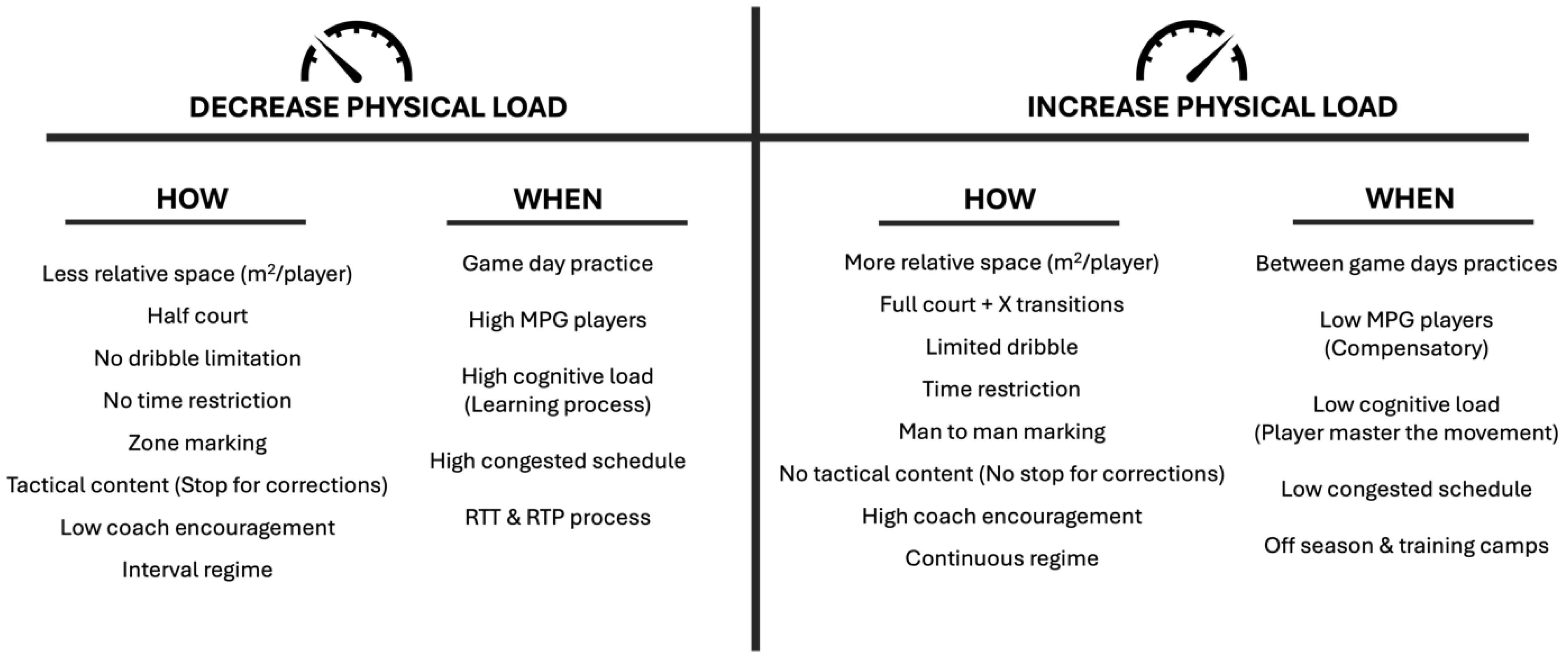
Table 1.
General classification of drills.
| Type of drill | Definition |
| Ball Drills | Encompass a series drills (varying intensity) characterized by the repetitive execution of technical actions (e.g., dribbling, shooting, passing) under predetermined conditions. These exercises aim to simulate the competitive demands primarily at the technical and physical levels, although in 5v0 situations they are commonly used to work on tactical scenarios and collective movements at different intensities. |
| Small Sided Games | These are drills consisting of matches with a smaller number of players than in competitive settings (1v1, 2v2, 3v3, or 4v4), where numerical advantages in offense or defense may also occur (2v1, 3v2, or 4v3). Due to their highly variable nature, these drills can be utilized for improving technical, tactical, and physical aspects. |
|
Scrimmage Games or Conditioned Games or Game Simulation |
Drills closely emulate competitive scenarios, typically comprising 5v4 or 5v5 setups, although some authors also incorporate 4v4. These exercises are characterized by a significant emphasis on collective tactical strategies |
Note: Data extracted from [13,21,23,25,32,33,34,35,36,37].
Table 2.
Commonly modifications used in training drills.
| MODIFICATIONS | AUTHORS |
|---|---|
| Space constraints | Atli, Köklü, Alemdaroğlu, & Koçak, 2013; Clemente, 2016; Conte et al., 2016; Hill-Haas et al., 2011; Klusemann et al., 2012b; Malone & Collins, 2017; Vazquez-Guerrero et al., 2018 |
| Altering number of players | Castagna et al., 2011; Clemente, 2016; Conte et al., 2016; A Delextrat & Martinez, 2014; Svilar et al., 2019; Vazquez-Guerrero et al., 2018 |
| Modifications to game rules | Abdelkrim, Castagna, El Fazaa, et al., 2010; Conte et al., 2016; Conte, Favero, Niederhausen, et al., 2015; Davids, Araújo, Correia, & Vilar, 2013; Maggioni et al., 2019; Montgomery et al., 2010; Schelling & Torres-ronda, 2013; Svilar et al., 2019 |
| Drill structure | Clemente, 2016; Conte et al., 2016; A Delextrat & Martinez, 2014; Hill-Haas et al., 2011; Schelling & Torres-ronda, 2013; Vazquez-Guerrero et al., 2018; Weiss et al., 2017 |
| Altering tactical roles | Clemente, 2016; Conte, Favero, Niederhausen, et al., 2015; Delextrat & Martinez, 2014 |
| Coach Involvement | Aguiar et al., 2012; Clemente, 2016; García, García, Cañadas, & Ibañez, 2014; Rampinini et al., 2007 |
| Changing the type of opposition | Correia et al., 2012; Davids et al., 2013; Passos et al., 2011; Passos, Araújo, Davids, & Shuttleworth, 2008; Schelling & Torres-ronda, 2013 |
Disclaimer/Publisher’s Note: The statements, opinions and data contained in all publications are solely those of the individual author(s) and contributor(s) and not of MDPI and/or the editor(s). MDPI and/or the editor(s) disclaim responsibility for any injury to people or property resulting from any ideas, methods, instructions or products referred to in the content. |
© 2025 by the authors. Licensee MDPI, Basel, Switzerland. This article is an open access article distributed under the terms and conditions of the Creative Commons Attribution (CC BY) license (http://creativecommons.org/licenses/by/4.0/).
Copyright: This open access article is published under a Creative Commons CC BY 4.0 license, which permit the free download, distribution, and reuse, provided that the author and preprint are cited in any reuse.


