

Submitted:
12 December 2023
Posted:
13 December 2023
You are already at the latest version
Abstract
This pioneering study presents an in-depth biomechanical examination of soccer's diving header, aiming to quantify its impact on ball speed enhancement (BSE) and effective offensive range (EOR). Despite the diving header's widespread acclaim and historical significance, there remains a dearth of scientific scrutiny into its biomechanical intricacies. Employing an innovative research design featuring a static hanging ball at varied offensive distances and heights, the study replicates diverse header scenarios. The results of 3D motion quantification have shown that a physically excellent player (identified through the maximal standing long jump test) could reach an EOR around 2.64 times his body height. Furthermore, the study unveils that proficient players could attain BSE surpassing 9 m/s, signifying the diving header's heightened efficacy compared to traditional heading techniques, which could only result in 4.5 m/s. Correlation analyses unveil noteworthy relationships, highlighting the pivotal role of head speed at impact and the influence of minimizing speed-drop and temporal disparities for amplified effectiveness. Considerations for optimizing diving header execution are introduced, emphasizing the necessity for targeted training programs. Despite acknowledged limitations inherent to its pilot nature, this exploration furnishes foundational knowledge to guide subsequent research and practical applications, providing valuable insights into soccer training and skill development through a biomechanical lens.
Keywords:
3D motion capture
; biomechanical modeling
; speed-drop
; time offset
1. Introduction
Soccer, often referred to as football in some parts of the world, occupies a paramount position as the world’s most popular sport [1,2]. At the heart of the sport lies the exhilarating pursuit of scoring goals, the primary objective that ignites passion and enthusiasm among players and spectators alike [3,4,5]. The essence of soccer is embodied in the diverse repertoire of techniques employed by players to achieve this coveted goal. Among these techniques, executing a diving header stands out as an exceptionally challenging maneuver that has the potential to create moments of sheer virtuosity on the soccer field. However, despite its intrinsic skill requirements and the captivating spectacles it has generated, the diving header often remains undervalued and underexplored in terms of its goal-scoring and playmaking potential. Nevertheless, it remains an iconic skill in soccer, with its exploits frequently featured in highlight reels worldwide. Remarkable instances of the diving header serve to underscore the enduring significance of this technique. One such instance is Keith Houchen’s unforgettable performance during the 1987 England FA Cup final (Coventry City vs. Tottenham) [6], where his memorable diving header played a pivotal role in Coventry City capturing their first FA Cup title in their 104-year history (Figure 1, left). Another noteworthy example is Robin van Persie’s stunning diving header during the 2014 FIFA World Cup Brazil, which ranked among the top goals globally [7,8] (Figure 1, right). These instances exemplify the lasting impact and excitement associated with the diving header in the world of soccer. Yet, despite its widespread popularity and historical significance, it is surprising that the biomechanical aspects of the diving header have received limited attention in scientific inquiry [9].
Soccer is a sport where spatial and temporal considerations are critical determinants of success for a team [12,13]. Scoring a goal in soccer necessitates the effective navigation of space and time while contending with the opponent’s defense. The diving header represents a technique that has the potential to extend the attacking range by reshaping spatial dynamics within the game [9,12]. Furthermore, the diving header can serve as a potent tool for both offensive and defensive purposes [14]. In an offensive context, it allows a player to redirect a low-lying cross or pass towards the goal, either with the intention of scoring directly or creating a goal-scoring opportunity for a teammate. Defensively, the diving header can be deployed to clear the ball away from dangerous areas, particularly within the penalty area or other critical defensive zones. In essence, the diving header constitutes a vital skill in the soccer playbook.
To date, researchers have identified 43 distinct soccer scoring techniques (SSTs) [13,15]. Recent biomechanical investigations have emphasized the importance of spatial considerations in the effective execution of these techniques, shedding light on their tactical and strategic implications [9,12]. The diving header stands out among SSTs as it has the unique ability to expand the attack/offensive range by enabling players to intercept and direct a low-lying ball that would otherwise remain out of reach for other SSTs. This extension of the offensive range offers players a novel level of strategic advantage, capable of significantly influencing game outcomes. Moreover, the diving header affords players the flexibility to attack from a wider array of angles, ranging from facing the goal to side-facing-goal diving [12], rendering it a formidable challenge for defenders attempting to anticipate and thwart the attack. By redefining the spatial dynamics of soccer, the diving header opens up new avenues for players to find the back of the net, while providing coaches with a wealth of strategic options to enhance their team’s offensive capabilities.
Despite its paramount importance in soccer, the biomechanical intricacies of the diving header have yet to receive comprehensive scientific scrutiny. Previous research has primarily concentrated on the kinematics and kinetics of traditional headers, such as the jumping or standing header [9], offering limited attention to the nuanced aspects of the diving header technique. While a coaching book [16] has provided insights into the fundamental elements of the diving header, covering the approach, jump, flight, contact, and follow-through phases, it mainly offers empirical and qualitative guidance for coaches and players seeking to refine their diving header skills. However, the book cannot supply two fundamental aspects related to the effects of executing the diving header: the ball speed gained/enhancement through the diving header and the effective attack range (i.e. the maximal offensive range) of the diving technique. In relation to the first issue, prior research has demonstrated that professional players can increase a ball’s speed by up to 4.5 m/s with jumping or standing headers [17]; however, there are no published studies exploring whether this speed enhancement could be applicable to diving headers. Concerning the second issue, there is a notable lack of in-depth scientific exploration of the spatial characteristics associated with the diving header, which represents a critical gap in understanding the potential of the diving header. Recent studies [9,12] emphasize the necessity of elucidating these spatial characteristics as they empower players to make informed decisions about the feasibility of executing a diving header as a goal-scoring opportunity. Comprehending these fundamental aspects of the diving header is crucial for players, coaches, and practitioners looking to enhance their proficiency in this skill. Consequently, the primary objective of this study is to conduct a comprehensive biomechanical analysis of the diving header, specifically aiming to quantify its impact on enhancing ball speed and its effective offensive range. This investigation seeks to provide scientific evidence that can inform soccer practice and players’ decision-making, offering practical implications for coaches and players by furnishing biomechanically rooted, coach-friendly explanations that align with their experiences.
As this study represents a pilot exploration in this domain, no specific hypotheses can be formulated at this stage. However, the absence of predetermined hypotheses enhances the relevance of this research, as it promises to significantly augment the existing body of knowledge related to the control, learning, and optimization of diving header technique. The outcomes of this study will be instrumental in the development of science-based training programs tailored to enhance players’ ability to maximize the effectiveness of diving header attacks. The increased deployment of the diving header in soccer matches has the potential to heighten the excitement of the game, enriching the experience for players and spectators alike.
2. Materials and Methods
2.1. Research Design and Test Protocol
The evaluation of ball speed enhancement (BSE) is focused on measuring the difference in ball speed before and after the impact with the diving header. The application of 3D motion capture emerges as a robust technique for procuring precise BSE data. Given the dearth of prior quantitative investigations regarding effective offensive range (EOR), the precise delineation of EOR assumes paramount importance in the context of biomechanical quantification. In this research, EOR is defined as the maximal offensive range attainable by an athlete. The offensive range is marked by two critical points: the toe of the take-off foot (analogous to the reference point in standing long jump tests) and the maximal horizontal distance one could reach to the ball center upon impact (Figure 2). To provide coaches and athletes with a comprehensive understanding of EOR, the distance derived from maximal standing long jump tests is employed as a quantitative benchmark for evaluating offensive range, expressed as a percentage of an individual’s maximal standing long jump capability. Given the simplicity of the standing long jump test, the outcomes of this study are poised to offer lucid and pragmatic insights, aiding practitioners in formulating strategic decisions pertaining to the judicious application of diving headers.
Given the complex and demanding nature of the diving header skill, necessitating precise timing and adept landing technique, proficient players are scarce. To elevate the research quality, which relies on advanced players, the study protocol was meticulously devised and implemented following these steps:
- Initially, a static hanging ball was utilized to increase the success rate of diving headers among advanced players.
- A soft gymnastic mat was incorporated to ensure landing protection, aiming to encourage subjects to perform at an airborne level close to elite standards.
- Subsequently, each subject underwent an individualized warm-up routine.
- After the warm-up, each subject executed three maximal standing long jumps to determine their physical strength based on the average jump distance.
- Based on the physical strength assessment and the subject’s body height, three distinct test conditions were established for each subject: 1) short-high ball, where the offensive range was 100% of the maximal standing long jump with the hanging ball positioned at chest level; 2) mid ball, where the offensive range equated to 125% of the maximal standing long jump with the hanging ball positioned at hip level; and 3) long-low ball, where the offensive range exceeded 150% of the maximal standing long jump (tailored according to the subject’s choice) with the hanging ball positioned at knee level (Figure 3).
- Individualized pre-trials were allocated for each subject to familiarize them with the test environment before the 3D data collection.
- Finally, during the 3D data collection, each subject was granted an individualized break (lasting 3-6 minutes) between trials to ensure high-quality flying performance without the influence of fatigue.
2.2. Participants
Subjects were selected from soccer-majored students in the Department of Physical Education at a local university in the Shanxi province, China. Criteria for selection included being physically active, possessing over ten years of soccer training, and having learnt the skill. Eleven subjects volunteered for participation in the study. Following preliminary video evaluations conducted by researchers and experienced coaches in the test environment, only four subjects exhibited the expected performance level and were chosen for the study. These male subjects had an average age of 20.8 (±0.6) years, a body mass of 63 (±3.24) kg, and a height of 1.71 (±0.05) m. Notably, these subjects achieved a maximal standing long jump distance of 2.63 (±0.06) m, classified as an "excellent" score [18] for the physical strength test. The Human Subjects Research Committee of the host university reviewed and approved the test protocol in accordance with Ethical Conduct for Research Involving Humans. All subjects were briefed on the testing procedures, provided signed consent, and voluntarily participated in the data collection for the physical strength test.
2.3. Three Dimensional Motion Data Collection
To measure the diving-header movement, a 3D motion-capture system was employed, using 42 reflective markers, with 39 soft markers (diameter = 9 mm) placed on the body and 3 reflective tapes on the ball. The motion capture was conducted using a ten-camera VICON MX40 motion capture system (VICON Motion Systems, Oxford Metrics Ltd., Oxford, England) operating at a frequency of 200 frames per second. Rigorous calibration was undertaken to ensure minimal calibration residuals, adhering strictly to established VICON guidelines, resulting in a precision level within 1 mm. Furthermore, all trials were simultaneously recorded by two CASIO video camcorders (100Hz), in conjunction with the VICON system, to provide rapid and preliminary visual assessments of trial quality. An illustration of a trial’s 3D reconstruction with video reference is displayed in Figure 4.
The placement of 39 strategically positioned body markers was instrumental in constructing a 15-segment biomechanical model, delineating segments such as the head, upper and lower trunk, upper and lower arms, hands, thighs, shanks, and feet. This model has demonstrated efficacy in quantifying various soccer scoring techniques in previous studies [3,5,19]. The 39 markers were meticulously positioned on specific anatomical locations on the subjects, including the left and right temporal regions, left and right posterior head regions, sternal end of the clavicle, xiphoid process of the sternum, C7 and T10 vertebrae, right scapula, left and right anterior superior iliac, posterior superior iliac, right and left acromion, lateral side of each upper arm, lateral epicondyles, lateral side of forearms, styloid processes of radii and ulnae, distal ends of the 3rd metacarpal bones, left and right lateral sides of thighs and shanks, lateral tibial condyles, lateral malleoli, calcanei, and big toes. The utilization of 10 cameras and small markers afforded subjects considerable freedom of movement within the capture volume, enabling their motions to closely mimic their trained "motor control style".
2.4. Data processing and Statistical Analysis
The assessment involved 11 trials per participant: 3 for the short-high ball, 3 for the mid ball, and 5 for the more challenging long-low ball condition, given its comparatively lower success rate. After initial video assessment, only 26 trials out of 44 were deemed to have substantial impact and were retained for further 3D quantification. Of the 26 selected trials, 8 were from the short-high ball (two from each subject), 8 from the mid ball (two from each subject), and 10 from the long-low ball (two subjects contributed 2 trials each, and the remaining 2 contributed 3 trials each).
The acquired raw data underwent processing using a five-point smoothing filter. This processed dataset furnished critical three-dimensional coordinates of the 42 markers. Subsequently, the temporal change of the ball center’s speed was calculated frame-by-frame by employing the 3D coordinates of the three reflective tapes on the ball surface. Simultaneously, the temporal change in the head’s speed was also determined frame-by-frame based on the 3D coordinates of the four head markers. Following the quantification of speed changes over time, specific parameters were identified and determined, including maximal ball speed (Max Vball), maximal head speed (Max Vhead), head speed at impact (Vhead-impact), coordinates of ball center at impact (xb, yb, zb), coordinates of jumping-foot’s big toe at take-off (xt, yt, zt) and airborne/flying time from take-off to impact (tflying). Subsequently, the quantification of BSE and EOR was executed using the following equation:
BSE = Max Vball – 0 (i.e. ball speed before impact) = Max Vball
EOR = √ [(xb − xt)2 + (yb − yt)2]
All calculations were conducted using Microsoft Excel 2013. Owing to the limited sample size (four subjects), this pilot investigation fundamentally operates as a case study, characterized by a collection of observations rather than a comprehensive statistical study. One common practice in case studies involves the utilization of individual data to reveal potential trends and influences, employing descriptive statistics—specifically mean (µ) and standard deviations (SD)—to portray the attributes of the designated parameters [20]. Consequently, descriptive statistics (µ ± SD) were employed to numerically illustrate the ball speed enhancement (BSE) achievable through the application of diving headers and the distance limit (i.e., EOR) within which the diving header could be effectively employed. Previous studies [21,22] have underscored the significance of ball release speed (i.e., BSE in this study) as a crucial parameter for shot quality. Within the EOR, potential determinants influencing BSE encompass flying distance, ball height, and head speed at impact. To scrutinize these potential influences, Bravais-Pearson (parametric) correlations were conducted between BSE and the identified influencing factors. This analytical approach establishes the connection between two interval-scaled variables, yielding a correlation coefficient (r-value) with a corresponding significance level. The commonly accepted r-value interpretation in sports biomechanics and human kinetics [23] was applied, setting the threshold at a significance level of p = 0.05. This correlation analysis offers practitioners an in-depth comprehension of diving header quality and provides recommendations for strategic decisions in its effective application. Descriptive statistics and correlation analyses were performed using SPSS (IBM SPSS Statistics, version 26, Coppell, USA). Additionally, extant research has suggested that anthropometric factors, notably body height, exert a significant influence on sports performance, and normalizing research results by body height may enhance suitability for individual analysis and application [24,25,26]. To augment the applicability of the research outcomes in facilitating individual analysis and application for practitioners, the research findings concerning EOR were normalized by the subjects’ body height.
3. Results
One noteworthy outcome the pilot study involves the identification of the general pattern of the diving header (Figure 5). The diving header exhibits characteristics akin to projectile motion. Following take-off, the head experiences an initial decrease in speed attributable to the upward motion of the body during the flying phase. Subsequently, as the body descends in the flying phase, the head’s speed undergoes a reversal, transitioning into an increase. Theoretically, the head’s speed should culminate at its maximum upon impact with the ball. However, in all but one of the 26 trials, the head’s speed attains its maximum before the impact, leading to a phenomenon known as speed-drop, wherein the speed diminishes once again upon ball impact. From a mechanical standpoint, this speed-drop in the head has the potential to adversely affect the momentum transfer from the head to the ball. Accompanying the speed-drop is the time offset, denoting the temporal disparity between the moment when the head reaches its maximum speed and the instance of impact. These novel findings have prompted the inclusion of two additional parameters, namely head speed drop (%) and time offset (%), in the quantitative analysis.
where Vball: ball velocity, tflying: airborne/flying time from take-off to impact.
Head speed drop (%) = (Max Vball - Vhead-impact)/Max Vball
Time offset (%) = (time at impact – time at Max Vball)/tflying
A rating scale established for the maximal standing long jump test in adults [18] designates jumps exceeding 2.5 meters as excellent. The outcomes presented in Table 1 affirm the excellence of the subjects in this study, demonstrating a mean jumping distance of 2.63 m, equivalent to approximately 1.54 times their body height. Notably, for physically excellent subjects, the EOR approximates 4.5 meters, constituting around 2.64 times their body height. These accomplished subjects have achieved BSE exceeding 9 m/s.
The detailed in-depth analysis results are delineated in Table 2, encompassing various parameters linked to the diving header. The flying distance in this investigation spans from 2.81 to 4.73 meters, the ball height at impact ranges from 0.61 to 1.41 meters, and the flying time from take-off to head impact with the ball varies from 0.31 to 0.65 seconds. Correlation analyses reveal that these factors do not significantly influence BSE (∣r∣ < 0.30 and p > 0.05).
Furthermore, the mean maximum head speed is recorded at 7.34 m/s, indicating a low correlation (0.5 > ∣r ∣ > 0.3) [23] with BSE, suggesting a potential relationship between these variables. Notably, the head speed at impact averages 6.63 m/s, demonstrating a strong correlation (0.7 > ∣r ∣ > 0.5) [23] with high significance (p=0.00).
The head speed drop, in average of 4.93% of maximum head speed, exhibited a robust negative correlation (r = -0.77, p = 0.00) with BSE, indicating the less speed drop the more momentum transfer to ball during the impact. Similarly, the time offset, averaging 26.29% of the flying phase, displayed a strong negative correlation (r = -0.67, p = 0.00) with BSE, emphasizing the temporal aspects influencing the effectiveness of the diving header technique, i.e. the smaller the time offset the more effective the header is.
4. Discussion
The biomechanical exploration of the diving header in soccer, as revealed by the current pilot study, provides valuable insights for skill advancement and strategic application. The use of a static hanging ball with three different offensive distances and heights mimics locations where players intend to head the ball, aiding the identification of players’ intended header locations and investigating spatiotemporal features of movement modulation. The identified general pattern of the diving header introduces considerations for optimizing the skill execution. The observed speed-drop in the head, occurring before impact in all but one trial, presents a new biomechanical nuance, potentially impacting the momentum transfer and warranting further attention in training programs.
One novel and practical result is the use of maximal standing long jump test for quantifying Effective Offensive Range (EOR), which creates a user-friendly approach for estimating EOR in coaching practice. The maximal standing long jump test underscores the athletic prowess of the subjects. Its results obtained from this study have confirmed that the subjects selected possess mean jumping distances surpassing the excellent threshold [18]. These physically excellent subjects exhibit an EOR exceeding 4.5 meters, emphasizing the potential attacking reach facilitated by adept jumping abilities. The normalized EOR (i.e. 2.64 times body height) provides even more useful and practical mean for easily estimating EOR with varying body heights of physically excellent players. For instance, Swedish professional soccer player Ibrahimović, standing at 1.95 meters [13] who achieved multiple dividing header goals in his professional career [13,15], could attain an EOR of 5.15 meters. Previous studies [9,12] suggested soccer shots can be executed within a three-dimensional volume surrounding an attacker’s body, known as the players’ effective/proprioceptive shooting volume. The quantified EOR in this study exhibits a notable deviation from the prior theoretical estimate (1.5 times body height for diving header) [12], registering a substantial increase of 76% (calculated as [2.64-1.5]/1.5 = 76%). This outcome supports the contention that commencing the learning and training of diving headers in soccer practice holds great potential for markedly enhancing scoring opportunities.
Another innovative result is the introduction of the concept of Ball Speed Enhancement (BSE), with accomplished subjects achieving enhancements surpassing 9 m/s. Previous study has shown that professional players can add up to 4.5 m/s (BSE) to the flying ball’s speed with jumping or standing headers [17]. The current study reveals that diving headers can double the BSE achieved by traditional heading techniques, making it a more effective offensive technique. Additionally, a comparative study on ball speed between passing kick for heading and maximal instep kick (22 m/s and 29 m/s, respectively) [27] suggests that diving headers could have a potential to surpass maximal instep kicks in generating a more powerful shot, i.e. 22 + 9 = 31 m/s diving header potential > 29 m/s maximal instep kick. These findings add practical relevance to diving headers, implying that scientific training programs for diving headers should be initiated in soccer coaching practice.
The in-depth analysis of various parameters associated with the diving header reveals intriguing correlations. The head speed at impact demonstrates a strong correlation with BSE, indicating its pivotal role in achieving diving header effectiveness. The unexpected 4.93% head speed drop at impact adversely affected momentum transfer. The result should indicate that minimizing the head speed drop would enlarge BSE. Further, the confirmed high negative correlations of head speed drop and time offset with BSE would highlight the importance of minimizing speed-drop and temporal disparities for improved momentum transfer and header effectiveness.
The drop in head speed and time offset during the diving header may be attributed to head and neck movements, likely associated with the final coordination/adjustment for accurate heading. Biomechanically, this adjustment in a multi-segment system, such as the human body, reduces system rigidity, resulting in a decrease in effective mass during impact. Effective mass, defined as the mass that would exhibit equivalent motion characteristics if substituted for the multi-segment system, is a parameter often used in quantifying impact in human movement [28]. Previous studies [29,30,31] demonstrate that effective mass during impact depends on player body mass and technique/movement, with a stiffer joint connection leading to higher effective mass. In soccer heading, the theoretical estimation [31] shows that the effective mass for an ideal vertically jumping header is one-half the body mass, while for an ideal diving header, it is 100% of the body mass. Torso alignment with impact direction is considered a method to increase effective mass [30,32]. Additionally, applying the pre-tensed condition on neck muscles, additional mass is recruited from the torso, raising the effective mass of the system during head impact and thus increasing ball speed during impact [33]. In a non-stiff condition (e.g., the adjustment movement for an accurate heading), the opposite happens.
The effectiveness of diving headers is a multi-factorial issue tied to the spatial and temporal demands of soccer. Diving headers have the potential to extend the attacking range, making them valuable for practitioners and a versatile tool in the soccer playbook for both offensive and defensive purposes. Coaches and players can leverage these biomechanical insights to inform training strategies. However, the observed head speed drop and time offset during the diving header could be counterproductive, diminishing part of the skill’s effectiveness. As stated before, the negative influences are likely related to the motor control of head and neck movements preceding impact, suggesting a detrimental consequent of the final coordination or adjustment for accurate heading. Training programs could focus on minimizing speed-drop and refining the coordination of temporal aspects to increase the overall effectiveness of the diving header.
Since this is the first pilot study on the diving header, there are inevitable limitations associated with it. An obvious limitation is the case-study nature of the current research. The selection of a case study design was due to the nature of the research problem, such as the pioneering study of a highly complex motor skill and the lack of qualified subjects. One well-known limitation of a case study is the issue of generalizability. Yet, for initiating the diving header investigation, a case study would be the best choice for launching the study to unveil the "secrets" for establishing a science-based learning and training program to master this virtuosic soccer skill; its strengths outweigh its limitations. The insights obtained in the current study could be construed as tentative hypotheses that help structure future research; hence, more statistical studies could be launched in the future for advancing the knowledge base of the diving header.
Another limitation is the lab-based test, especially the use of a soft gymnastic mat for landing protection. This test condition may result in deviations compared to in-field tests. The pilot nature of the study emphasizes the need for further research to validate and build upon these initial findings. Future investigations could explore larger sample sizes, taking into account variations in skill levels. Moreover, longitudinal studies tracking skill development and the impact of training interventions would provide a comprehensive understanding of biomechanical adaptations over time. To launch such future investigations, qualified players should be trained first. From this perspective, the current study would provide fundamental knowledge for training/building qualified subjects and designing/launching future studies. In other words, the findings of the pilot study contribute valuable insights into the biomechanics of the diving header and its associated parameters, providing a foundation for further exploration and practical applications in soccer training and skill development.
The third limitation is the use of a static ball in the tests. This characteristic simplifies the execution of the diving header on a large scale because the final point of impact with the ball does not need to be anticipated based on its own movement. However, this static position was necessary to reproduce similar motion sequences with adequate impacts between the head and ball for research purposes. Additionally, the static ball position interferes with the physical consequences of the impact. Usually, the speed and direction of movement of the ball would impact the result of the head-ball interaction. Nevertheless, this static research will allow conclusions for dynamic practice. A similar situation is found in tee-ball batting in baseball [34,35]. The use of tee ball for initial batting training is a classic drill used by baseball players. Once impact accuracy has been established through static ball training, dynamic ball training is the next step. A second test protocol, in which the ball is thrown towards/across in front of the players, will be applied in our future studies.
5. Conclusions
In summary, this pilot study represents a pioneering exploration into the biomechanics of the diving header in soccer. The innovative static hanging ball research design efficaciously reveals spatiotemporal features, laying a foundation for further exploration in the optimization of diving header execution. The identified general pattern, coupled with the observed speed-drop phenomenon in the head before impact, underscores the significance of addressing these nuances in training programs.
The subjects’ athletic prowess, evident in the maximal standing long jump test, emphasizes the potential attacking reach facilitated by adept jumping abilities. The quantitatively determined Effective Offensive Range (EOR) exceeds prior theoretical estimations, advocating for the integration of diving header training into coaching practices to enhance scoring opportunities. The introduction of the novel concept of Ball Speed Enhancement (BSE) adds a quantitative dimension to diving header effectiveness, outperforming traditional heading techniques and rivaling maximal instep kicks in generating powerful shots.
The in-depth analysis of various parameters establishes correlations that highlight the crucial role of head speed at impact, as well as the significance of minimizing speed-drop and temporal disparities for an improved diving header. The observed head speed drop and time offset may be attributed to final coordination or adjustment movements for accurate heading, indicating potential areas for targeted training programs to refine these aspects.
While acknowledging the limitations of a lab-based test and the use of a static ball, this pilot study furnishes fundamental knowledge essential for training qualified subjects and guiding future studies. Subsequent research with larger sample sizes, consideration of skill level variations, and longitudinal studies tracking skill development will contribute to a more comprehensive understanding of diving header biomechanics. The insights gained from this pilot study hold valuable implications for the application of diving header biomechanics in soccer training and skill development.
Author Contributions
Conceptualization, G.S., Y.L. and X.Z.; methodology, G.S., Y.L. and X.Z.; software, G.S. and X.Z.; validation, G.S., Y.L., T.G., X.Z. and K.W.; formal analysis, G.S., T.G. and K.W.; investigation, G.S., Y.L., T.G. and X.Z.; resources, G.S. and X.Z.; data curation, G.S., Y.L. and T.G.; writing—original draft preparation, G.S., Y.L. and T.G.; writing—review and editing, G.S., Y.L., T.G., X.Z. and K.W.; visualization, G.S., Y.L. and T.G.; supervision, G.S. and K.W.; project administration, G.S. and X.Z.; funding acquisition, G.S. and X.Z. All authors have read and agreed to the published version of the manuscript.
Funding
This research project was supported by Xinzhou Teachers’ University (China) and Discovery Development Grants of National Sciences and Engineering Research Council of Canada (NSERC), Grant #: DDG-2021-00021.
Institutional Review Board Statement
The study was carried in accord with the policy of the Ethical Committee of Xinzhou Teachers’ University (protocol number: 忻州师院伦理审查20190305; approval period: 1 April 2019 to 31 March 2022).
Informed Consent Statement
Informed consent was obtained from all subjects involved in the study.
Data Availability Statement
The data presented in this study are available on request and after appropriate IRB approvals.
Acknowledgments
We would like to thank all the subjects of the study who donated their time and expertise.
Conflicts of Interest
The authors declare no conflict of interest.
References
- FIFA. FIFA Big Count 2006: 270 million people active in football. 2007 [cited 2022 Nov 11]; Available from: https://digitalhub.fifa.com/m/55621f9fdc8ea7b4/original/mzid0qmguixkcmruvema-pdf.pdf.
- Sawe, B.E. The Most Popular Sports In The World. 2018 [cited 2018 June 16]; Available from: https://www.worldatlas.com/articles/what-are-the-most-popular-sports-in-the-world.html.
- Zhang, X., et al., Jumping side volley in soccer—A biomechanical preliminary study on the flying kick and its coaching know-how for practitioners. Applied Sciences, 2020. 10(14): p. 4785. [CrossRef]
- Shan, G. and X. Zhang, From 2D leg kinematics to 3D full-body biomechanics-the past, present and future of scientific analysis of maximal instep kick in soccer. Sports Medicine, Arthroscopy, Rehabilitation, Therapy & Technology, 2011. 3(1): p. 23. [CrossRef]
- Shan, G., et al., Bicycle kick in soccer: is the virtuosity systematically entrainable? Science Bulletin, 2015. 60(8): p. 819-821. [CrossRef]
- Harris, D. Golden goal: Keith Houchen for Coventry City v Tottenham (1987). 2016 [cited 2023 Apr 16]; Available from: https://www.theguardian.com/football/blog/2016/may/20/golden-goal-keith-houchen-for-coventry-city-v-tottenham-1987.
- FIFA. TOP 10 GOALS | 2014 FIFA World Cup Brazil. 2015 [cited 2023 April 16]; Available from: https://www.youtube.com/watch?v=c0cUE-ePDEc.
- FIFA. FIFA Puskás Award: Ten best goals of the year announced. 2014 [cited 2023 April 16]; Available from: http://www.fifa.com//ballon-dor/news/y%3D2014/m%3D11/news%3Dfifa-puskas-award-ten-best-goals-of-the-year-announced-2473885.html.
- Shan, G., Soccer Scoring Techniques: How Much Do We Know Them Biomechanically?—A State-of-the-Art Review. Applied Sciences, 2022. 12(21): p. 10886. [CrossRef]
- Fluffsta. Keith Houchen 1987 FA Cup Diving Header. 2009 [cited 2023 Apr 11]; Available from: https://www.youtube.com/watch?v=SNnj6lCui7Y.
- FIFA. Robin van Persie Header | FIFA Puskas Award 2014 FINALIST. 2014 [cited 2023 Apr 11]; Available from: https://www.youtube.com/watch?v=DeKSmd-hjwo.
- Shan, G. and X. Zhang, Soccer Scoring Techniques—A Biomechanical Re-Conception of Time and Space for Innovations in Soccer Research and Coaching. Bioengineering, 2022. 9(8): p. 333. [CrossRef]
- Shan, G., The Practicality and Effectiveness of Soccer Scoring Techniques Revealed by Top Elite Soccer Scorers. Physical Activity Review, 2023. 11(1): p. 99-111. [CrossRef]
- Mielke, D., Soccer fundamentals. 1st ed. 2003, Champaign, Illinois: Human Kinetics.
- Zhang, X., et al., Diversity of Scoring, Ingenuity of Striking, Art of Flying — Conceptual and Systematical Identification of Soccer Scoring Techniques. Physical Activity Review, 2021. 9(1): p. 86-99.
- Luxbacher, J.A., Soccer: Steps to success. 2013, Champaign, IL Human Kinetics.
- Wesson, J., The science of soccer. 1st ed. 2002, London: CRC Press (Taylor & Francis Group).
- Wood, R. Standing Long Jump Test (Broad Jump) 2008 [cited 2020 July 16]; Available from: https://www.topendsports.com/testing/tests/longjump.htm.
- Shan, G. and P. Westerhoff, Full-body kinematic characteristics of the maximal instep soccer kick by male soccer players and parameters related to kick quality. Sports Biomechanics, 2005. 4(1): p. 59-72. [CrossRef]
- Liu, Y., et al., Performance alteration induced by weight cutting in mixed martial arts—A biomechanical pilot investigation. International Journal of Environmental Research and Public Health, 2022. 19(4): p. 2015. [CrossRef]
- Shan, G., et al., Biomechanics of coaching maximal instep soccer kick for practitioners. Interdisciplinary Science Reviews, 2019. 44(1): p. 12-20. [CrossRef]
- Lees, A., et al., The biomechanics of kicking in soccer: A review. Journal of sports sciences, 2010. 28(8): p. 805-817. [CrossRef]
- Bailey, C.A., Quantitative analysis in exercise and sport science. 2021, Denton, Texas: University of North Texas Libraries.
- Shan, G. and C. Bohn, Anthropometrical data and coefficients of regression related to gender and race. Applied ergonomics, 2003. 34(4): p. 327-337. [CrossRef]
- Shan, G., et al., Regression equations for estimating the quality of maximal instep kick by males and females in soccer. Kinesiology, 2012. 44(2): p. 139-147.
- Ohji, S., et al., Single-leg hop distance normalized to body height is associated with the return to sports after anterior cruciate ligament reconstruction. Journal of Experimental Orthopaedics, 2021. 8(1): p. 1-7. [CrossRef]
- Levanon, J. and J. Dapena, Comparison of the kinematics of the full-instep and pass kicks in soccer. Medicine and science in sports and exercise, 1998. 30(6): p. 917-927. [CrossRef]
- Chi, K.-J. and D. Schmitt, Mechanical energy and effective foot mass during impact loading of walking and running. Journal of biomechanics, 2005. 38(7): p. 1387-1395. [CrossRef]
- Neto, O.P., M. Magini, and M.M. Saba, The role of effective mass and hand speed in the performance of kung fu athletes compared with nonpractitioners. Journal of applied biomechanics, 2007. 23(2): p. 139-148. [CrossRef]
- Adamec, J., et al., Biomechanics and injury risk of a headbutt. International journal of legal medicine, 2013. 127: p. 103-110. [CrossRef]
- Babbs, C.F., Biomechanics of heading a soccer ball: implications for player safety. The Scientific World Journal, 2001. 1: p. 281-322. [CrossRef]
- Shewchenko, N., et al., Heading in football. Part 1: development of biomechanical methods to investigate head response. British journal of sports medicine, 2005. 39(suppl 1): p. i10-i25. [CrossRef]
- Caccese, J.B. and T.W. Kaminski, Minimizing head acceleration in soccer: a review of the literature. Sports Medicine, 2016. 46: p. 1591-1604. [CrossRef]
- Magill, R. and D.I. Anderson, Motor learning and control. 2010: McGraw-Hill Publishing New York.
- McCue, M. and N. Wattie, To Tee, Or Not to Tee: Exploring the Relationship Between Representative Practice and Performance in Highly Skilled Baseball Hitters. Journal of Expertise/March, 2021. 4(1).
Figure 1.
Breathtaking diving headers in elite soccer. Left: Keith Houchen’s diving header in 1987 England FA Cup final (the figure is generated by using the public video from YouTube [10]), right: Robin van Persie’s diving header in the 2014 FIFA World Cup Brazil (the figure is generated by using the public video from FIFA [11]).
Figure 1.
Breathtaking diving headers in elite soccer. Left: Keith Houchen’s diving header in 1987 England FA Cup final (the figure is generated by using the public video from YouTube [10]), right: Robin van Persie’s diving header in the 2014 FIFA World Cup Brazil (the figure is generated by using the public video from FIFA [11]).
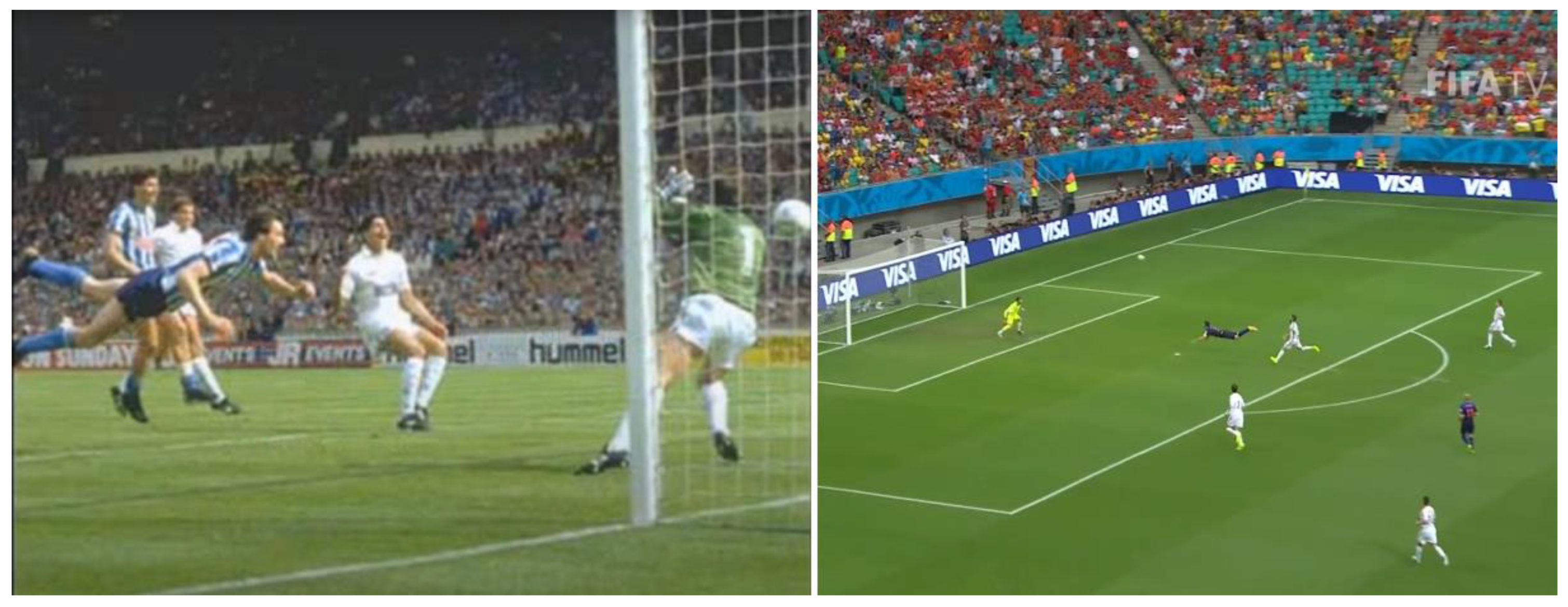
Figure 2.
Definition of offensive range. The biomechanical model animation is generated from 3D data obtained in the current study.
Figure 2.
Definition of offensive range. The biomechanical model animation is generated from 3D data obtained in the current study.

Figure 3.
Test condition selections based on the physical strength assessment: left – short-high ball, right – long-low ball.
Figure 3.
Test condition selections based on the physical strength assessment: left – short-high ball, right – long-low ball.
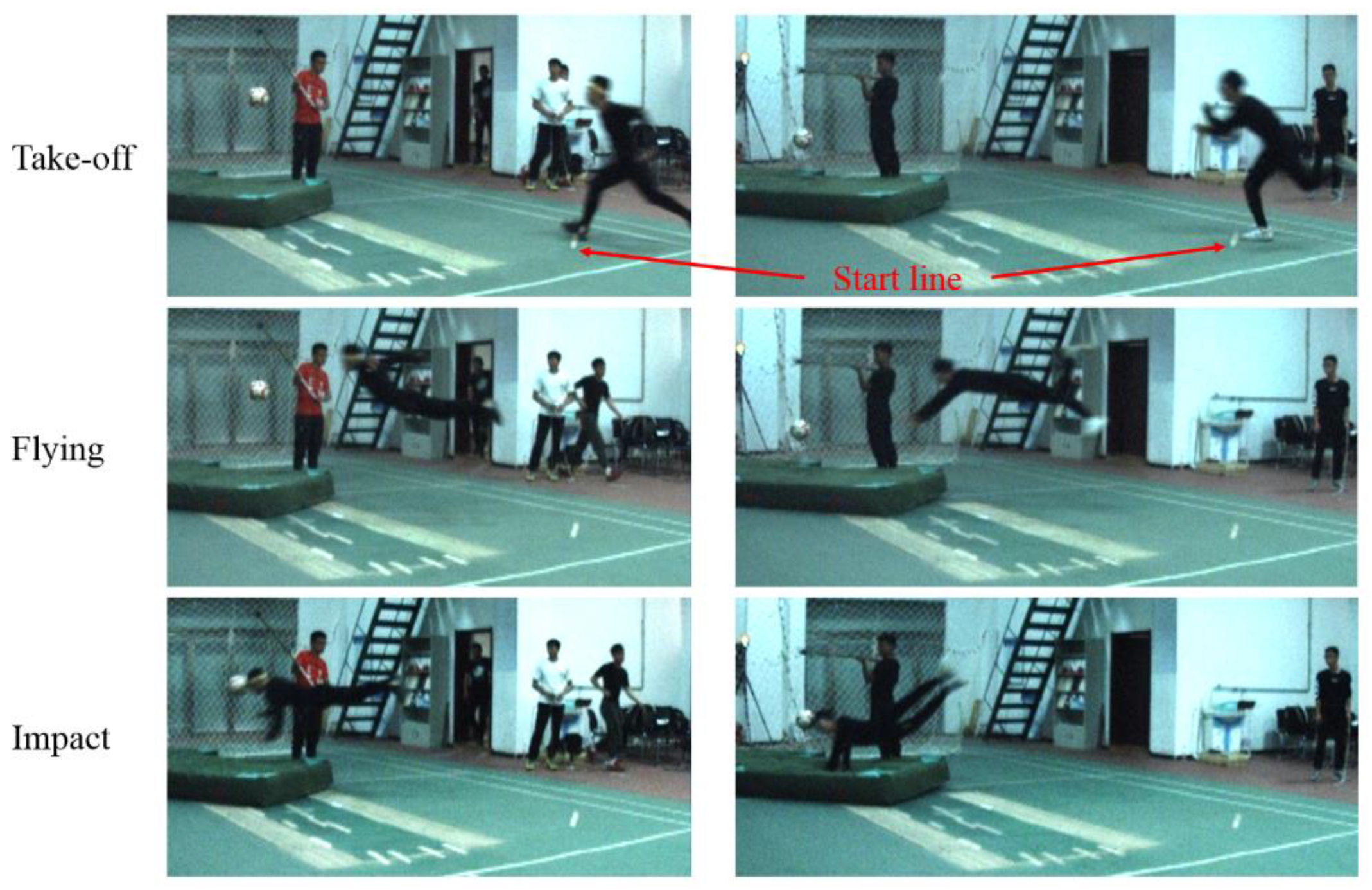
Figure 4.
An exemplary video frame (left) and 3D capture data (right) of a diving header. The ball position is indicated by the three yellow markers, and the trajectory of the head is illustrated by the four blue lines tracking the four head markers.
Figure 4.
An exemplary video frame (left) and 3D capture data (right) of a diving header. The ball position is indicated by the three yellow markers, and the trajectory of the head is illustrated by the four blue lines tracking the four head markers.
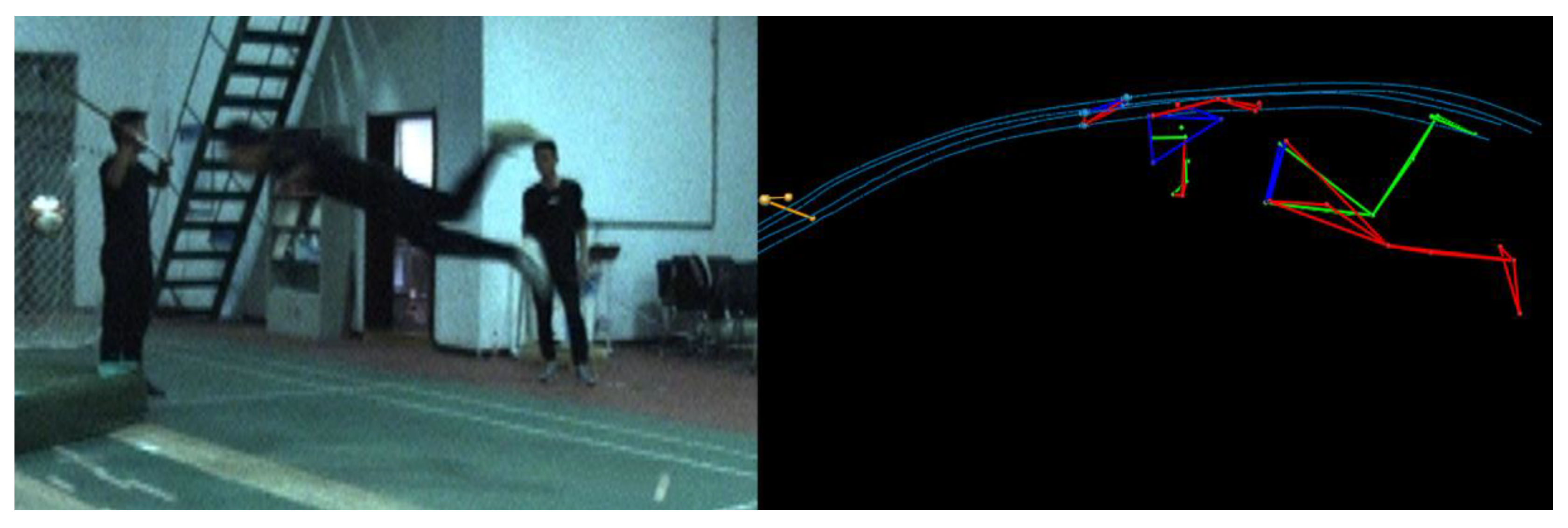
Figure 5.
Exemplary representation of speed changes over time for the head and ball during a diving header.
Figure 5.
Exemplary representation of speed changes over time for the head and ball during a diving header.
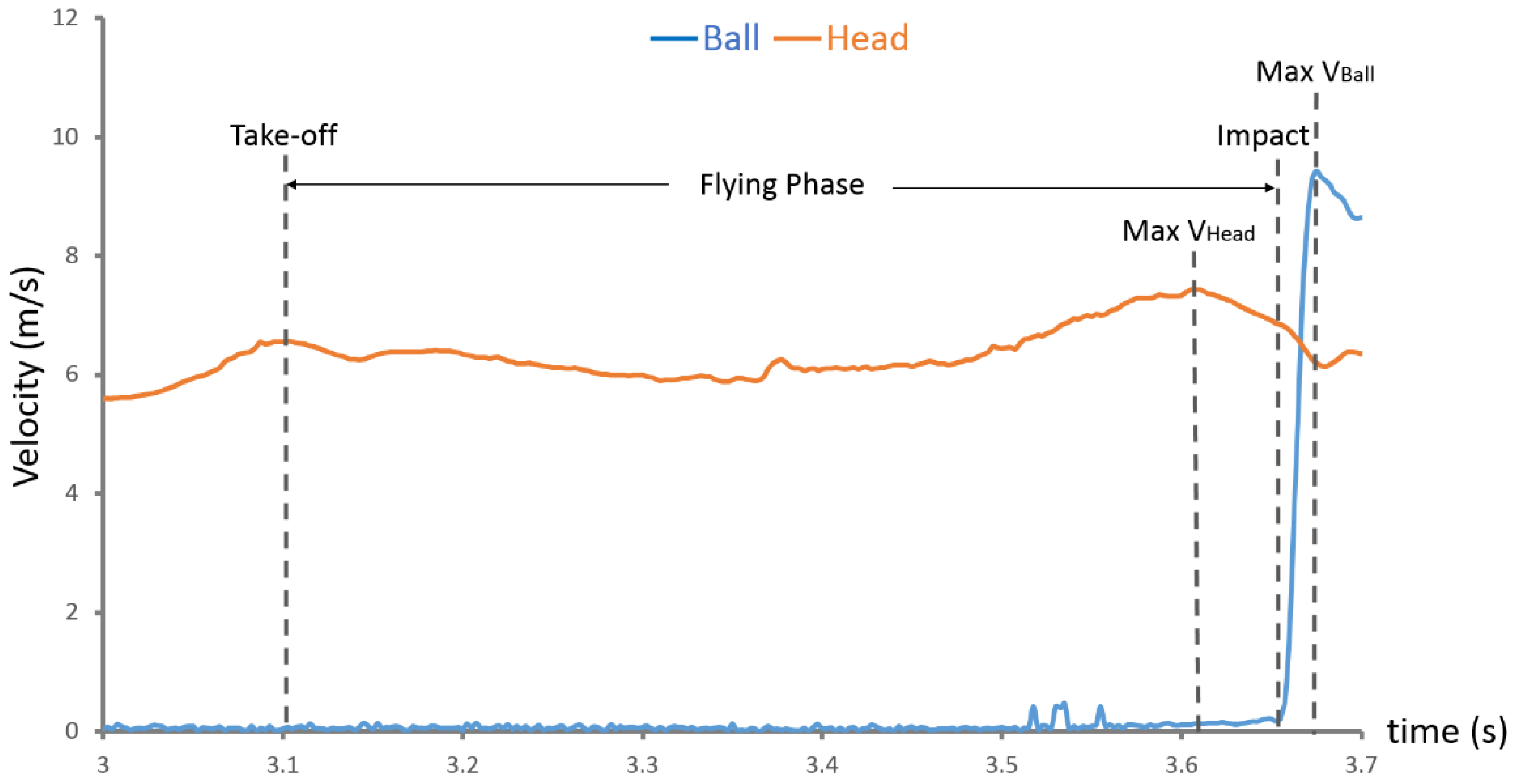

Table 1.
The distinguishing physical features, EOR and BSE of the subjects tested.
| Parameter | µ ± SD | Normalized by BH |
|---|---|---|
| Max standing long jump (n=12) | 2.63 ± 0.06 m | 1.54 ± 0.01 |
| EOR (N=10) | 4.42 ± 0.26 m | 2.64 ± 0.18 |
| BSE (N=26) | 9.35 ± 1.97 m/s |
µ: average, SD: standard deviation, EOR: effective offensive range, BSE: ball speed enhancement.
Table 2.
The characteristics of the selected parameters and their relationship with ball speed enhancement (BSE) revealed by correlation analysis.
Table 2.
The characteristics of the selected parameters and their relationship with ball speed enhancement (BSE) revealed by correlation analysis.
| Parameter | Range | r-value | p | N | |
|---|---|---|---|---|---|
| Flying distance (m) | 2.81 — 4.73 | 0.08 | 0.43 | 26 | |
| Ball height (m) | 0.61 — 1.41 | 0.21 | 0.31 | 26 | |
| Flying time (s) | 0.31 — 0.65 | -0.03 | 0.54 | 26 | |
| µ ± SD | |||||
| Max head speed (m/s) | 7.34 ± 0.45 | 0.37 | 0.05 | 26 | |
| Head speed at impact (m/s) | 6.63 ± 0.70 | 0.59 | 0.00 | 26 | |
| Head speed drop (%) | 4.93 ±4.27 | -0.77 | 0.00 | 26 | |
| Time offset (%) | 26.29 ± 20.56 | -0.67 | 0.00 | 26 | |
µ: average, SD: standard deviation.
Disclaimer/Publisher’s Note: The statements, opinions and data contained in all publications are solely those of the individual author(s) and contributor(s) and not of MDPI and/or the editor(s). MDPI and/or the editor(s) disclaim responsibility for any injury to people or property resulting from any ideas, methods, instructions or products referred to in the content. |
© 2023 by the authors. Licensee MDPI, Basel, Switzerland. This article is an open access article distributed under the terms and conditions of the Creative Commons Attribution (CC BY) license (http://creativecommons.org/licenses/by/4.0/).
Copyright: This open access article is published under a Creative Commons CC BY 4.0 license, which permit the free download, distribution, and reuse, provided that the author and preprint are cited in any reuse.


