

Submitted:
03 January 2025
Posted:
06 January 2025
You are already at the latest version
Abstract
Given the growing burden of mental health disorders, the use of smartphone-based mindfulness meditation applications has drastically increased. However, such applications have failed to attract a substantial base of male users and suffer from poor adherence across genders, which might be due to a lack of basic psychological need satisfaction (BPNS), a measure of intrinsic motivation. It was theorized that online fantasy sports could compensate for possible shortcomings of conventional meditation apps by inspiring consistent usage among men. Using a randomized control trial design, this study tested an eight-week, gamified meditation intervention linking the mechanics of fantasy sports to weekly meditation goals (termed “mindful fantasy sports”) in an all-male sample (n = 24) against using a mindfulness meditation app alone. A secondary aim of the study was to determine whether mindful fantasy sports were more intrinsically motivating than conventional meditation apps by measuring BPNS. The current findings showed participants in the mindful fantasy sports group meditated significantly more often (p = .01) and for a significantly longer cumulative duration (p = .03) than peers in the control condition. In addition, those playing mindful fantasy sports reported higher degrees of BPNS, specifically higher competence satisfaction (p = .03). These findings support the contention that mindful fantasy sports can effectively promote male engagement with meditation apps.
Keywords:
meditation
; meditation app
; fantasy sports
; self-determination theory
; gamification
; intervention
; undergraduate students
; male health
Integrated Online Fantasy Football Platform Promotes Meditation Activity in Male Undergraduate Students: A Self-Determination Theory-Informed Intervention
Young people, including undergraduate students, are experiencing unprecedented mental health crises. Illustratively, 40.65% and 27.57% of U.S. college students reported symptoms of depression and anxiety respectively in 2021, most expressing they are unable to cope with the stress and anxiety they experience [1,2].
In response to excessive mental health issues, the popularity of meditation mobile applications has boomed. Calm, the most popular meditation app, has been downloaded roughly 100 million times since 2019 [3]. Meditation apps provide an appealing degree of convenience and accessibility, and extant, compelling evidence indicates that mobile app interventions are effective in improving stress, anxiety, depression, self-regulation, and the overall psychological well-being of undergraduate users [4,5,6,7].
However, mindfulness meditation app interventions fall victim to notable levels of attrition and poor adherence. For example, a study examining user data found that 83.1% of subscribers to the Calm meditation app used it for one day. However, 350 days after subscribing, 58% of users abandoned the app [8]. A similar study demonstrated that only 8% of surgical patients participating in a mindfulness intervention used the meditation app for the recommended amount of time [9]. Furthermore, on average, 41.2% of participants in smartphone interventions specifically targeting depression fail to download the app or use it [10]. Thus, many who download such apps do not become active users.
Another concern is that meditation apps have failed to attract an appreciable number of male users. App-use data indicate females represent 86.06% of subscribers to the Calm meditation app [10]. Similarly, Jiwani and colleagues reported that 69.8% of the users of the Healthy Minds Program meditation app are female, and only 34% of weekly or daily users of meditation apps are male, paralleling results from the 2017 National Health and Interview Survey that revealed significantly more women practice meditation than men [11,12,13].
These results are indicative of cultural, social, and behavioral barriers that reduce the likelihood of men engaging with meditation apps or digital mental health tools in general. For example, qualitative studies have identified factors such as stigma, masculine norms, and negative perceived effectiveness as hindrances to male adoption of meditation apps [14,15,16]. Additionally, men are underrepresented in digital mental health interventions and interventions suited to the specific needs and preferences of men are limited [17].
Online Fantasy Sports as a Platform to Promote Meditation
Fantasy sports are a category of online, asynchronous, multiplayer games in which players take the role of “general managers” of virtual sports teams, drafting real-life professional athletes onto their rosters and competing with other managers. Akin to those in real-life professional sports, fantasy managers can trade, cut, sign, and bench players on their team.
Theoretically, unique elements of fantasy sports could promote behavior change by gamifying health interventions. For example, Moller and colleagues leveraged online fantasy sports leagues to motivate mostly male participants to meet weekly step goals [18]. Participants in the study wore a fitness tracker, and privileges and punishments within the leagues were administered based on weekly step goals. To illustrate, if a participant met their goal they were brought to the top of the waiver wire, giving them an advantage to add in-demand players to their team. On the other hand, a player at random was cut from their roster if they did not meet their physical activity goal. Participants increased their physical activity by 30% on average.
A later study replicated these results in an undergraduate student sample [19]. Participants increased their physical activity for the first six weeks of the intervention, and all participants enjoyed the active fantasy sports intervention more or as much as conventional fantasy sports. More broadly, gamification strategies have shown promise in improving adherence and effectiveness of meditation and mental health interventions [20,21,22,23].
Applying Self-Determination Theory to Fantasy Sports and Meditation
Self-determination theory (SDT), a theory of human motivation, may clarify the success of past studies leveraging fantasy sports to spur behavioral change. SDT describes motivation in terms of intrinsic psychological needs: competence (having the skills to effectively meet a challenge), autonomy (having the freedom to make decisions at one’s own will), and relatedness (feeling socially connected to peers) [24]. SDT posits that intrinsic motivation is a function of the fulfillment of these needs; thus, an environment or an activity that offers considerable basic psychological need satisfaction (BPNS) will foster high degrees of engagement and intrinsic motivation [25]. A meta-analysis of randomized controlled trials promoting health behaviors incorporating SDT found that such interventions have a significant effect on behavior [26].
More specifically, Moller and colleagues argued that fantasy sports allowed players to compete with others of their skill level, make decisions for their teams, and facilitate social connections [18]. Thus, fantasy sports have the potential to satisfy all three components of BPNS, meaning it is feasible that they could compensate for possible shortcomings of need satisfaction in traditional health interventions.
In fact, several aspects of meditation apps in their current form may be failing to satisfy basic psychological needs, which could be contributing to observed trends in poor adherence. First, due to a disproportionate number of female users, meditation could be considered a gendered practice that is ascribed mostly to women. This might discourage men to engage with mindfulness meditation apps due to gender role fears and a lack of same-gender peer support, curbing relatedness [27]. The meditation app gender imbalance mirrors the broader trend of men failing to access mental health resources, in part due to masculine norms [14]. As they are already favored by males, infusing fantasy sports with meditation practice could create opportunities for men to socialize with and relate to peers regarding in an environment that with fewer social barriers to meditation, thereby improving relatedness. In fact, Moller and colleagues identified social components, such as knowing all fellow group members, as especially important to participants in fantasy sports interventions [18].
Additionally, most meditation apps lack a competitively goal-oriented element, which is a prevalent and effective gamification strategy of mobile health interventions, particularly for men [28]. In fact, men are more likely to focus on specific goals and tracking features of well-being apps than women [29]. Competition also has the potential to be a powerful motivational tool. Wang and colleagues randomized 1,779 medical interns into a physical activity intervention that included a gamified team competition component. Higher mean step counts were observed in the competition group than the noncompetition control [30]. Therefore, using fantasy sports to provide immediate and frequent feedback and the opportunity to compete could potentially improve competence satisfaction.
Furthermore, meditation apps allow users to practice wherever and whenever they please, providing a similar level of autonomy to that of team managers in fantasy leagues. Finally, fantasy sports are extremely popular with men (67% of the 62.5 million players in the U.S. and Canada are male) [31], supporting high potential reach of the intervention and flattening experience curves due to their broad familiarity.
Thus, the present study sought to assess the efficacy of an integrated fantasy football platform, termed “mindful fantasy sports,” in promoting meditation app usage by utilizing a randomized study design in an all-male population. It was predicted that those in the mindful fantasy sports condition would meditate for a higher cumulative frequency and duration than participants in the meditation-only control condition. It was also hypothesized that participants in the mindful fantasy sports group would exhibit greater intervention satisfaction and a higher degree of BPNS of relatedness, competence, and autonomy in comparison to those in the control condition.
Materials and Methods
Participants
After securing IRB approval, forty participants were recruited primarily from the men’s wrestling team at a small, private Midwestern university as well as the general student body. The sample consisted mostly of athletes due to cooperation with the university wrestling coach to recruit his team members to the study. Enrollment was incentivized with a drawing to win one of six $25 gift cards. Of those who completed the entry survey, 38 participants between 18 to 22 years of age were randomized post-consent to the experimental or control conditions (Mage = 19.96; 100% male-identifying; 97% undergraduate students) using the randomization feature in Qualtrics. One participant was enrolled in graduate school. Additional sample demographics are summarized in Table 1.
Eleven participants were lost four weeks into the intervention, and three were lost during the second half of the intervention, leaving 24 participants with meditation app usage data. There were no demographic differences (e.g., race/ethnicity, previous meditation experience, previous fantasy sports experience) between participants that completed the intervention and those that dropped out. Additionally, there were no differences in age, previous fantasy sports experience, or previous meditation experience between the control and experimental conditions. Nineteen participants completed the post-intervention measures in full.
Materials
Meditation App
The Healthy Minds Program (HMP), a free mindfulness meditation smartphone application, was used for the meditation intervention component of the study. Previous work has demonstrated the potential of HMP to improve the psychological well-being, social connectedness, and mindfulness of its users [32,33,34]. HMP features a tracking component that records meditation frequency and duration, used in this study to determine participant meditation goal completion. At the end of each week, participants submitted a screenshot of this tracking feature in their apps to research staff.
Fantasy Sports Platform
ESPN Fantasy, a popular online fantasy sports hosting site, was used to establish fantasy football leagues and included the tools for the investigators to effectively act as league commissioners, including the ability to cut players from team rosters, assign waiver wire order, and give bonus free agent auction budget (FAAB) to team managers. The waiver wire determines the priority of team managers to add in-demand players to their roster, and FAAB is a form of valueless currency that team managers use to make bids on players.
Online Group Chat
GroupMe is an online group messaging service used to communicate study information to participants and offer a space for participants to communicate with each other. GroupMe was also used to collect screenshots from participants of the app tracker to monitor meditation progress. Participants were separated into group chats consisting only of members of their subgroup.
Pre-Intervention Measures
As part of an online Qualtrics entry survey, self-reported demographics information on age, race/ethnicity, gender, and enrollment status were collected. Participants were also asked to complete a questionnaire assessing previous meditation and fantasy sports experience.
Post-Intervention Measures
Within one week of the conclusion of the intervention, participants completed an online exit survey. The survey included several items assessing participant enjoyment of the intervention, participant behavior, and preferences for future interventions. Participant behavior was evaluated by several queries (e.g., “How often did you check your meditation app/meditation practice?”) that participants answered using a Likert-type scale ranging from 1 (never) to 5 (almost every day or every day). Participant enjoyment of practicing meditation and making decisions regarding their meditation practice, preferences for future interventions, and likelihood of continuing meditation were assessed on a scale ranging from 1 to 7.
Additionally, an adapted version of the 21-item Basic Psychological Need Satisfaction Scale (BPNSS) from Ryan & Deci [25] was used to determine state BPNS of autonomy, relatedness, and competence during the intervention. The modified BPNSS consisted of a series of retrospective statements that were altered to focus on participant experience during the intervention (e.g., from “I have been able to learn new skills recently” to “I was able to learn new skills during this study”). The statements were rated from 1 (strongly disagree) to 7 (strongly agree).
Procedure
Both groups used the HMP app weekly, but those in the experimental condition also managed their own fantasy football team as part of a league. In total, there were two experimental subgroups, each with 11 participants, and two control subgroups with 11 and seven participants each (see Figure 1). Subgroups were created due to fantasy football leagues being limited to 11 members. Participants in both groups were assigned weekly meditation goals that progressively increased in frequency and duration, totaling 42 sessions for 435 minutes (see Figure 2). The meditation goal for Week 1 was three sessions totaling 15 minutes, and ramped up to a frequency and duration that has been demonstrated to improve mental health outcomes by Week 6 (seven sessions totaling 70 minutes) [4,35,36]. Participants were free to use the app during any time of day and were permitted to engage with any of the content available on the HMP app. A meditation session was counted each instance a participant used the app to meditate, regardless of session duration. No meditation reminders were sent to participants by research staff. The meditation intervention lasted eight weeks, starting the first week of the NFL season.
Participants in the control group did not face any consequences for failing to meet their weekly goals; however, privileges and punishments tied to the fantasy league were dealt contingent upon goal completion in the experimental group. For example, if a participant in the mindful fantasy sports group failed to meet their weekly goal, a player at random would be cut from their roster. On the other hand, if participants met their weekly goal, they were brought to the top of the waiver wire order and the participant who meditated the most for the week received a bonus $10 FAAB, providing a significant advantage to league performance.
Data Analysis Plan
Meditation app usage data were considered from participants who submitted their progress to research staff for all eight weeks. Meditation app usage data were analyzed from participants who met this criterion even if they did not complete post-intervention measures. Non-parametric independent samples Welch’s t-tests were utilized to assess between-group differences in meditation duration and frequency, basic psychological need satisfaction, participant behavior, intervention satisfaction, and participant preferences for future interventions.
Results
Across the sample, participants meditated an average of 29 times (69% of ideal frequency) for 335.38 minutes (77% of ideal duration) over the eight-week intervention. A divergence in meditation behavior emerged between the two conditions, with a Welch’s t-test revealing that those in the mindful fantasy sports group (M = 36.73, SD = 11.51) logged significantly more meditation sessions throughout the intervention than their peers in the control group (M = 22.46, SD = 13.50), t(22.00) = 2.80, p = .01, d = 1.14.
Similarly, participants in the mindful fantasy sports group (M = 404.00, SD = 102.42) meditated for more cumulative minutes than those in the control group (M = 277.31, SD = 165.42), t(20.33) = 2.29, p = .03, d = .92. On average, the mindful fantasy sports group logged 14.27 more sessions and meditated 126.69 more minutes than the control group over the course of the intervention. The experimental condition experienced a 45% attrition rate and the control condition a 28% attrition rate.
Overall, the mean scores for autonomy, relatedness, and competence were 4.74 (SD = .72; range = 3.83 – 6.83), 4.10 (SD = .81; range = 3.00 – 5.00), and 4.84 (SD = .63; range = 3.83 – 6.17), respectively. No difference was observed in autonomy or relatedness satisfaction between the two groups. However, participants in the mindful fantasy sports group (M = 5.19, SD = .57) reported a significantly higher degree of competence satisfaction than peers in the control group (M = 4.54, SD = .52), t(14.98) = 2.44, p = .03, d = 1.18.
No between-group differences were observed in participants’ enjoyment of meditation or reported likelihood of continuing meditating post-intervention, although the latter was mostly neutral (M = 3.50, SD = 1.79). It was found that both groups enjoyed practicing meditation (M = 4.30, SD = 1.30) and making decisions regarding their practice (M = 4.20, SD = 1.51). Participant preferences for a mindful fantasy sports intervention can be found in Table 2. There were no differences in the frequency at which participants communicated with group members, checked the group chat, or checked their meditation app. Summarized overall participant behavior can be found in Table 3.
In addition, it was more important to the mindful fantasy sports group (M = 5.67, SD = 1.32), compared to the control condition (M = 4.20, SD = .42), to personally know other participants in their respective group, t(9.46) = 3.18, p = .01, d = .58. Similarly, the mindful fantasy sports group reported that they would be significantly more interested in playing in a mindful fantasy sports league with people they knew (M = 5.17, SD = 2.14) rather than strangers (M = 2.67, SD = 1.51), t(5) = 2.71, p = .04, d = 1.11.
Discussion
Consistent with our hypothesis, participants in the mindful fantasy sports group meditated significantly more often and for a longer cumulative duration than peers in the control group. These findings demonstrate the potential efficacy of linking smartphone-based mindfulness meditation to online fantasy sports in the promotion of meditation activity in young males.
The results of the current study align with previous work leveraging gamified fantasy sports interventions to increase physical activity in mostly male samples [18,19]. Despite this, the mindful fantasy sports group experienced a higher attrition rate than the control (45% versus 28%). Although not a significant difference, one conceivable explanation is that 33% of the experimental condition (compared to 17% of the control condition) had no prior fantasy sports experience. It is plausible that participants who had never played fantasy football before had no desire to engage with that component of the study and thus did not continue.
In partial support of SDT, the experimental group reported higher competence satisfaction than participants in the meditation-only control group, indicating that participants exposed to that condition may have had more opportunities to be meaningfully challenged. These results illustrate that competence might be an especially important motivating factor that conventional meditation apps may lack, and fantasy sports could address.
As mentioned, many smartphone meditation applications do not include tracking features, and none allow users to compete, in contrast to the near infinite opportunities for competition provided by fantasy sports. In this way, fantasy sports may complement conventional meditation apps by challenging and rewarding players, thus fostering competence. This conclusion aligns with a qualitative study that identified competition as a key driver for participation in fantasy sports for male players [37].
Additionally, those in the mindful fantasy sports group prioritized knowing their group members, preferring to participate in a league with people they knew rather than strangers, consistent with previous work identifying social connectedness and support as facilitators of male engagement with e-mental health interventions [16,38]. These observations coincide with the fact that fantasy sports are typically played among groups of friends; it is reasonable that those in the mindful fantasy sports group placed greater importance on the familiarity they had with group members. However, participants reported knowing few or none of their fellow group members at the start of the intervention, likely restricting relatedness. This is a potential explanation of the lack of between-group difference of relatedness satisfaction.
Contrary to past studies demonstrating the importance of a sense of control and ability to take action for men’s use of digital mental health tools [16,38], we did not observe a difference of autonomy satisfaction between the fantasy football and meditation only conditions. Because the meditation app allowed participants to make decisions regarding their meditation practice, such as what content they engaged with and when they meditated, it is possible that using the app alone provided sufficient autonomy satisfaction.
Overall, these findings also reflect young males’ willingness to meditate alongside same-gender peers when given the appropriate platform to do so. Men might hesitate to access mental health resources, including smartphone meditation applications, due to masculine norms [14]. Participants’ preference for engaging in a mindful fantasy sports league with their friends indicates that melding meditation with fantasy sports, an activity with which many men are already familiar, may make seeking same-gender peer support regarding meditation and mental health more approachable. Looking beyond the gamified fantasy sports framework, the results of the current study provide insight into motivational factors, behavior, and preferences of male undergraduate students interacting with a digital mental health tool that can be applied to future interventions.
Limitations and Future Directions
The present study contains several methodological limitations that should be considered. First, the study included a small group of mostly White, male undergraduate students, thus reducing the generalizability of the results. Additionally, the sample contained a disproportionate number of athletes and is not representative of undergraduate students overall. It is important to evaluate the efficacy of this intervention using diverse samples of students.
Furthermore, a possible attrition bias may have distorted the results, as those who were not motivated to meditate may have dropped out of the study early in the intervention. The high attrition rate may have left only highly motivated meditators in the final sample, skewing the results of this study. Perhaps a qualitative approach identifying reasons for study drop-out and participants’ perceptions of the fantasy sports intervention could be used to address attrition.
Moreover, participants knew few or none of their group members prior to the study, which they stated made the intervention less enjoyable. This shortcoming was compounded by the lack of structured opportunities for group members to get to know one another, likely limiting relatedness. The intervention may have been more effective if participants had prior relationships with peers; for example, a mindful fantasy sports league comprising a group of friends who already play fantasy sports together. This may also explain why participants reported neutral intentions to continue meditation post-intervention. Additional follow-up support, such as facilitating the transition of gamified meditation from one fantasy sport to the next throughout the year (e.g., from fantasy football in the fall to fantasy basketball in the winter).
Additionally, it is possible that the practice of meditation is contraindicated by the competitiveness of fantasy sports. Previous work has pointed to possible negative psychosocial impacts of fantasy sports, such as worsened anxiety and mood [37,39]. The mental health impact of combining mindfulness meditation and fantasy sports is not yet known.
Conclusions
In sum, the current results demonstrate the behavior-changing potential of linking meditation to the game mechanics of fantasy sports to foster higher competence satisfaction, indicating that mindful fantasy sports may be more engaging for male undergraduate students than conventional meditation apps. Most notably, the success of the present study illustrates that mindful fantasy sports are a promising tool that could be deployed to address the mental health crisis, specifically in subpopulations such as men. Additionally, with 62.5 million fantasy sports players, mindful fantasy sports have the potential for wide scalability and dissemination [31]. Based on the current findings and previous work with physical activity [18,19], it is feasible that similar interventions could be used to address other health behaviors such as diet, sleep, and alcohol and other drug use.
Author Contributions
Samuel M. Degenhard: Conceptualization, Methodology, Investigation, Data curation, Formal analysis, Writing – Original Draft, Writing – Review & Editing Denise Hatter-Fisher: Conceptualization, Methodology, Supervision, Writing – Review & Editing
Funding
The authors received no financial support for the research, authorship, and/or publication of this article.
Data Availability Statement
Data supporting reported results can be found on the Inter-university Consortium for Political and Social Research (ICPSR) open-access data depository (https://doi.org/10.3886/E203061V1). Additional study materials can be requested from the corresponding author.
Ethics Statement
All procedures performed in this study involving human subjects were approved by the Otterbein University Institutional Review Board (HS #22/23-80) and were in accordance with the 1964 Helsinki Declaration and its later amendments. Informed consent was obtained from all participants.
Acknowledgments
The authors would like to thank Brent Rastetter, Michele Acker, Cynthia Laurie-Rose, and Louis Rose for their support of this research.
Conflicts of Interest
The authors declared no conflicts of interest regarding the research, authorship, and/or publication of this article.
References
- Park C, McClure Fuller M, Echevarria TM, Nguyen K, Perez D, Masood H, Alsharif T, Worthen M. A participatory study of college students’ mental health during the first year of the COVID-19 pandemic. Front Public Health. 2023;11:Article 1116865. [CrossRef]
- Wang X, Hegde S, Son C, Keller B, Smith A, Sasangohar F. Investigating mental health of US college students during the COVID-19 pandemic: Cross-sectional survey study. J. Med. Internet Res. 2020;7(9):Article e22817. [CrossRef]
- Curry D. (2024, January 8). Calm Revenue and Usage Statistics (2024). Business of Apps. Published March 27, 2024. Accessed April 9, 2024. https://www.businessofapps.com/data/calm-statistics/.
- Huberty J, Green J, Glissmann C, Larkey L, Puzia M, Lee C. Efficacy of the mindfulness meditation mobile app “Calm” to reduce stress among college students: Randomized controlled trial. JMIR Mhealth Uhealth. 2019;7(6):Article e14273. [CrossRef]
- Gál É, Ștefan S, Cristea IA. (2021). The efficacy of mindfulness meditation apps in enhancing users’ well-being and mental health related outcomes: a meta-analysis of randomized controlled trials. J Affect Disord. 2021;279:131–142. [CrossRef]
- Huberty J, Puzia ME, Green J, Vlisides-Henry RD, Larkey L, Irwin MR, Vranceanu AM. A mindfulness meditation mobile app improves depression and anxiety in adults with sleep disturbance: Analysis from a randomized controlled trial. Gen Hosp Psychiatry. 2021;73:30–37. [CrossRef]
- Schulte-Frankenfeld PM, Trautwein F. App-based mindfulness meditation reduces perceived stress and improves self-regulation in working university students: A randomised controlled trial. Appl Psychol: Health Well-Being. 2021;14(4):1151–1171. [CrossRef]
- Fowers R, Berardi V, Huberty J, Stecher C. Using mobile meditation app data to predict future app engagement: an observational study. J Am Med Inform. Assoc. 2022;29(12): 2057–2065. [CrossRef]
- Diller ML, Mascaro J, Haack C, Master V. Adherence patterns and acceptability of a perioperative, app-based mindfulness meditation among surgical patients with chronic pain. Am Surg. 2024;90(5):936–938. [CrossRef]
- Stecher C, Berardi V, Fowers R, Christ J, Chung Y, Huberty J. Identifying app-based meditation habits and the associated mental health benefits: Longitudinal observational study. J Med Internet Res. 2021;23(11):e27282. [CrossRef]
- Jiwani Z, Tatar R, Dahl C, Wilson-Mendenhall CD, Hirshberg MJ, Davidson RJ, Goldberg SB. Examining equity in access and utilization of a freely available meditation app. Npj Mental Health Res. 2023;2: Article 5. [CrossRef]
- Lam SU, Xie Q, Goldberg, SB. Situating meditation apps within the ecosystem of meditation practice: Population-based survey study. JMIR Ment Health. 2023;10:Article e43565. [CrossRef]
- Clarke TC, Barnes PM, Black LI, Stussman BJ, Nahin RL. Use of yoga, meditation, and chiropractors among U.S. adults aged 18 and over. U.S. Department of Health and Human Services, Centers for Disease Control and Prevention, National Center for Health Statistics. 2018.
- Milner A, Kavanagh A, King T, Currier D. The influence of masculine norms and occupational factors on mental health: Evidence from the baseline of the Australian longitudinal study on male health. Am J Men’s Health. 2018;12(4):696–705. [CrossRef]
- Ekoh PC, Nnadi F, Nwabineli H, Oluwagbemiga O, Odo C, Okolie TJ, Onuh SC, Ugwu EO, Bhatta K, Onalu C. Barriers to the use of mental health services amongst men in Nigeria and the potential of digital mental health support. Adv Mental Health. 2023:1–13. [CrossRef]
- Opozda MJ, Oxlad M, Turnbull D, Gupta H, Smith JA, Ziesing S, Nakivell ME, Wittert G. Facilitators of, barriers to, and preferences for e-mental health interventions for depression and anxiety in men: Metasynthesis and recommendations. J Affect Disord. 2024;346:75–87. [CrossRef]
- Opozda MJ, Drummond M, Gupta H, Petersen J, Smith JA. E-mental health interventions for men: an urgent call for cohesive Australian policy and investment. Health Promot Int. 2024;39(2):daae033. [CrossRef]
- Moller AC, Majewski S, Standish M, Agarwal P, Podowski A, Carson R, Eyesus B, Shah A, Schneider KL. Active fantasy sports: rationale and feasibility of leveraging online fantasy sports to promote physical activity. JMIR Serious Games. 2014;2(2):Article e13. [CrossRef]
- Keeney J, Schneider KL, Moller AC. Lessons learned during formative phase development of an asynchronous, active video game intervention: Making sedentary fantasy sports active. Psychol Sport Exerc. 2019;41:200–210. [CrossRef]
- Barclay P, Bowers C. Feasibility of a meditation video game to reduce anxiety in college students. OBM Integrative and Complementary Medicine. 2018;3(4):1–9. [CrossRef]
- Fish MT, Saul AD. The gamification of meditation: A randomized-controlled study of a prescribed mobile mindfulness meditation application in reducing college students’ depression. Simulation & Gaming. 2019;50(4): 419–435. [CrossRef]
- Litvin S, Saunders R, Maier MA, Lüttke S. Gamification as an approach to improve resilience and reduce attrition in mobile mental health interventions: A randomized controlled trial. PLOS ONE. 2020;15(9):Article e0237220. [CrossRef]
- Brown M, O’Neill N, van Woerden H, Eslambolchilar P, Jones M, John A. Gamification and adherence to web-based mental health interventions: A systematic review. JMIR Ment Health. 2016;3(3):e39. [CrossRef]
- Duda JL, Appleton PR. Empowering and disempowering coaching climates: Conceptualization, measurement, considerations, and intervention implications. In: Raab M, Wylleman P, Seiler R, Elbe A, Hatzigeorgiadis A, eds. Sport and Exercise Psychology Research: From Theory to Practice. Elsevier Inc.; 2016: 373–388.
- Ryan, R. M., & Deci, E. L. (2000). Self-determination theory and facilitation of intrinsic motivation, social development, and well-being. American Psychologist, 55(1), 68–78. [CrossRef]
- Sheeran, P., Wright, C. E., Avishai, A., Villegas, M. E., Lindemans, J. W., Klein, W. M. P., Rothman, A. J., Miles, E., & Ntoumanis, N. (2020). Self-determination theory interventions for health behavior change: Meta-analysis and meta-analytic structural equation modeling of randomized controlled trials. Journal of Consulting and Clinical Psychology, 88(8), 1151–1171. [CrossRef]
- Upchurch DM, Johnson PJ. Gender differences in prevalence, patterns, purposes, and perceived benefits of meditation practices in the United States. J Women’s Health. 2019;28(2):135–142. [CrossRef]
- Xu L, Shi H, Shen M, Ni Y, Zhang X, Pang Y, Yu T, Lian X, Yu T, Yang X, Li F. The effects of mhealth-based gamification interventions on participation in physical activity: Systematic review. JMIR Mhealth Uhealth. 2022;10(2):Article e27794. [CrossRef]
- Antezana G, Venning A, Smith D, Bidargaddi N. Do young men and women differ in well-being apps usage? Findings from a randomised trial. Health Informatics J. 2022;28(1). [CrossRef]
- Wang J, Fang Y, Frank E, Walton MA, Burmeister M, Tewari A, Dempsey W, NeCamp T, Sen S, Wu Z. Effectiveness of gamified team competition as mHealth intervention for medical interns: a cluster micro-randomized trial. Npj Digit Med. 2023;6(1):1–8. [CrossRef]
- Fantasy Sports & Gaming Association. Industry Demographics. 2024. Accessed April 10, 2024.
- Goldberg SB, Imhoff-Smith T, Bolt DM, Wilson-Mendenhall CD, Dahl CJ, Davidson RJ, Rosenkranz MA. Testing the efficacy of a multicomponent, self-guided, smartphone-based meditation app: Three-armed randomized controlled trial. JMIR Ment Health. 2020;7(11):Article e23825. [CrossRef]
- Hirshberg MJ, Frye C, Dahl CJ, Riordan KM, Vack NJ, Sachs J, Goldman R, Davidson RJ, Goldberg SB. A randomized controlled trial of a smartphone-based well-being training in public school system employees during the COVID-19 pandemic. J Educ Psychol. 2022;114(8):1895–1911. [CrossRef]
- Xie Q, Dyer RL, Lam SU, Frye C, Dahl CJ, Quanbeck A, Nahum-Shani I, Davidson RJ, Goldberg SB. Understanding the implementation of informal meditation practice in a smartphone-based intervention: A qualitative analysis. Mindfulness. 2024;15: 479–490. [CrossRef]
- Degenhard SM, Mobile phone mindfulness: Effects of app-based meditation intervention on stress and HRV of undergraduate students. Modern Psychological Studies. 2023;29(1):1.
- Cox CE, Gallis JA, Olsen MK, Porter LS, Gremore T, Greeson JM, Morris C, Moss M, Hough CL. Mobile mindfulness intervention for psychological distress among intensive care unit survivors: a randomized clinical trial. JAMA Inter Med. 2024;184(7):749–759.
- Wilkins L, Beukes E, Dowsett R, Allen PM. A qualitative exploration of the positive and negative experiences of individuals who play fantasy football. Entertain Comput. 2023;45. [CrossRef]
- Borghouts J, Eikey E, Mark G, De Leon C, Schueller SM, Schneider M, Stadnick N, Zheng K, Mukamel D, Sorkin DH. Barriers to and facilitators of user engagement with digital mental health interventions: systematic review. J Med Internet Res. 2021;23(3):e24387. [CrossRef]
- Wilkins L, Dowsett R, Zaborski Z, Scoles L, Allen PM. Exploring the mental health of individuals who play fantasy football. Human Behavior and Emerging Technologies. 2021;3(5):1004–102. [CrossRef]
Figure 1.
Randomization of Participants Note. “Experimental” denotes the mindful fantasy sports condition.
Figure 1.
Randomization of Participants Note. “Experimental” denotes the mindful fantasy sports condition.
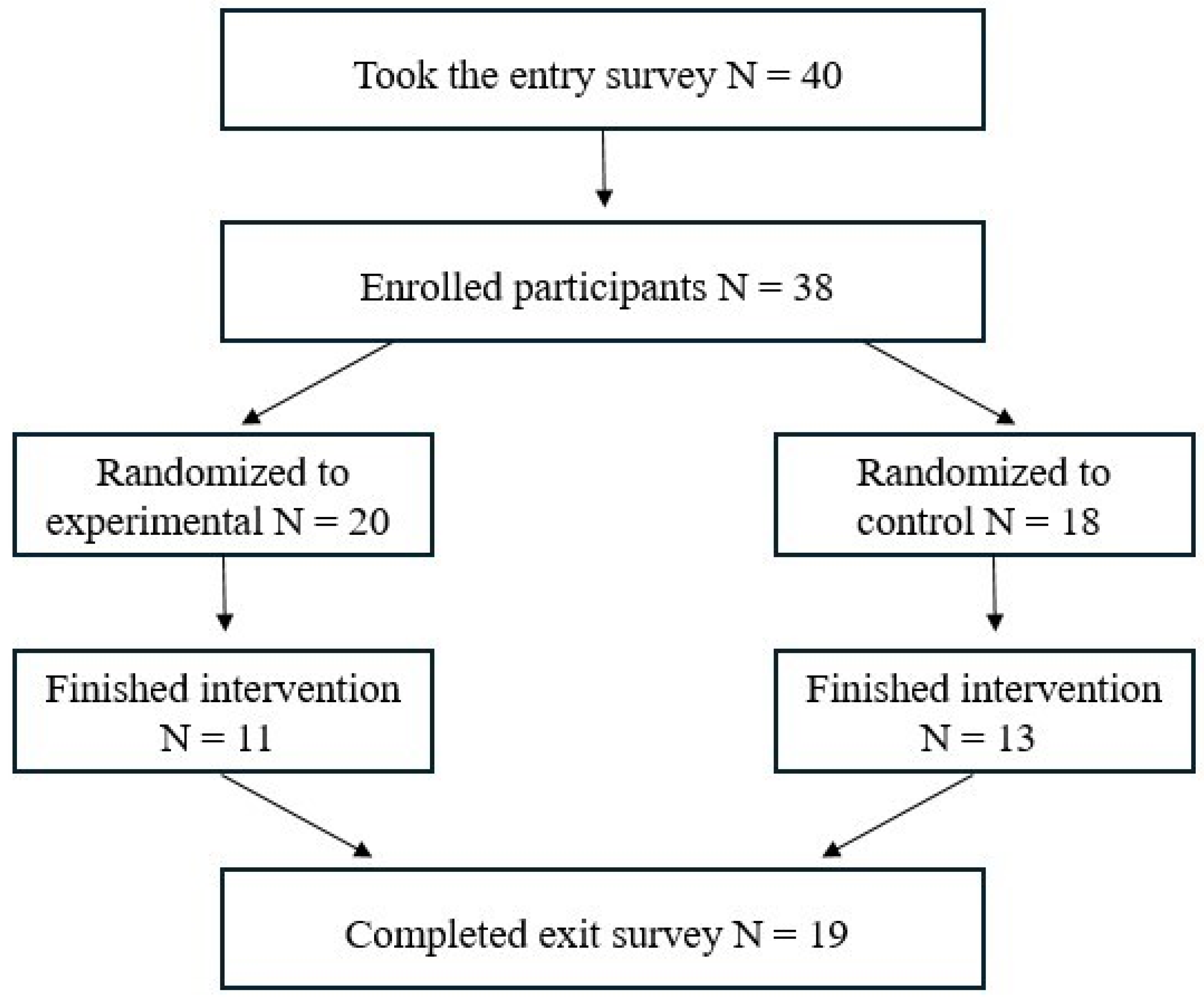
Figure 2.
Meditation Goal Schedule.


Table 1.
Sample Demographics.
| Overall Sample | N | % |
| Male-identifying White |
38 33 |
100.00 86.84 |
| Enrolled in an undergraduate program | 37 | 97.36 |
| Previous fantasy sports experience | 29 | 76.31 |
| Previous meditation experience | 12 | 31.58 |
| Participants Who Completed Intervention1 | N | % |
| Male-identifying | 24 | 100.00 |
| White | 19 | 79.97 |
| Enrolled in an undergraduate program | 23 | 95.83 |
| Previous fantasy sports experience | 19 | 79.17 |
| Previous meditation experience | 10 | 41.67 |
1Submitted meditation progress to research staff for all eight weeks; includes participants who completed meditation intervention but did not complete post-intervention measures.
Table 2.
Participant Preferences for Future Mindful Fantasy Sports Interventions.
| Overall | Exp.b | Con.c | ||||
| M | SD | M | SD | M | SD | |
| Knew everyone before starting | 4.85 | 1.18 | 5.67 | 1.32 | 4.20a | 0.42 |
| Cash prizes tied directly to meditation activity | 4.95 | 1.41 | 4.78 | 1.79 | 5.20 | 1.03 |
| Cash prizes tied directly to performance in fantasy sports league | - | - | 6.17 | 1.17 | - | - |
| Playing in a mindful fantasy sports league again with a group of friends | - | - | 5.17 | 2.14 | - | - |
| Playing in a mindful fantasy sports league again with a group of people you didn’t know | - | - | 2.67 | 1.51 | - | - |
< .0ap < .05; bMindful fantasy sports condition; cControl condition.
Table 3.
Overall Participant Behavior During Intervention.
| Never | Rarely | Almost Every Week | Several Days per Week | Every Day | ||||||
| N | % | N | % | N | % | N | % |
N 3 1 5 3 |
% | |
| Checked meditation app | 0 | 0 | 1 | 5 | 8 | 42 | 7 | 37 | 16 | |
| Checked study GroupMe chat | 1 | 5 | 2 | 11 | 10 | 53 | 5 | 26 | 5 | |
| Messaged group member with third party service (Snapchat, WhatsApp, etc.) |
7 |
37 |
5 |
26 |
1 |
5 |
1 |
5 |
26 |
|
| Checked ESPN fantasy app or website | 0 | 0 | 0 | 0 | 0 | 0 | 3 | 50 | 50 | |
Disclaimer/Publisher’s Note: The statements, opinions and data contained in all publications are solely those of the individual author(s) and contributor(s) and not of MDPI and/or the editor(s). MDPI and/or the editor(s) disclaim responsibility for any injury to people or property resulting from any ideas, methods, instructions or products referred to in the content. |
© 2025 by the authors. Licensee MDPI, Basel, Switzerland. This article is an open access article distributed under the terms and conditions of the Creative Commons Attribution (CC BY) license (http://creativecommons.org/licenses/by/4.0/).
Copyright: This open access article is published under a Creative Commons CC BY 4.0 license, which permit the free download, distribution, and reuse, provided that the author and preprint are cited in any reuse.


