Preprint
Article

This version is not peer-reviewed.

Toward Anode-Free Lithium-Ion Battery Using Amorphous Titanium Oxide Thin Films by Atmospheric-Pressure Mist Chemical Vapor Deposition

Submitted:

04 January 2025

Posted:

06 January 2025

You are already at the latest version

Abstract

We demonstrate the potential of Lithium titanate (LiTiO) and amorphous titanium oxide (a-TiOx) thin films synthesized from titanium diisopropoxide bis acetylacetonate C16H28O6Ti [Ti(acac)2(OiPr)2] using atmospheric-pressure mist chemical vapor deposition method as negative electrode and solid electrolyte for anode-free lithium-ion battery (LIB). LTO thin films synthesized from Ti(acac)2(OiPr)2 and LiNO3 at 500 ℃ act as a negative electrode in LIB. In a-TiOx synthesized at 200-300 ℃, Li-ion permeability improved with charge/discharge cycles and acts as a solid electrolyte. The high diffusivity of Li ions demonstrated its superior behavior as a solid electrolyte. The a-TiOx solid electrolyte battery achieved an charge/discharge efficiency of 94%. These results imply that a-TiOx holds promise for realizing anode-free lithium metal batteries.

Keywords: 
;  ;  ;  ;  ;  

1. Introduction

Today, solid state lithium-ion battery (LIB) has been extensively studied for high energy density, high output characteristics, and excellent safety more than that of electrolyte solution based LIB. They are applied for use of micropower sources for smart cards, medical devices, micro electric mechanical system, wireless sensors and so on [1,2]. It has been reported that solid electrolytes with Li ion conductivity, such as perovskite crystals Li0.35La0.55TiO3 [3] and Na1+xZrSixP3-xO12 (0 < x <3) NASICON crystal structures, Li1+xAlxTi2-x(PO4)3 exhibit ion conductivity of 10-4~10-3 S/cm at room temperature [4]. However, these electrolytes have problems with poor stability and are electrochemically reduced at a potential of about 1.8 V vs. Li/Li+, making it difficult to apply them as electrolytes for LIB secondary batteries. As electrolytes with wide potential windows, Li0.35La0.55Zr2O12 and lithium phosphate oxynitride glass (LiPON), which have a garnet structure [5,6,7], have been well-known. Also they include difficulties in the synthesis and LIB fabrication processes, so further technological development is required in the future. In recent years, it has been reported that sulfide-based compounds exhibit high Li+ ion conductivity and can be applied to all-solid-state LIBs, and research and development have been actively underway. Sulfide ions have a higher polarizability than oxide ions, and the structure of the solid electrolyte is easily distorted when Li+ diffuses [8,9], so it has superior Li+ diffusion ability. Recently, highly conductive electrolytes such as sulfide-based crystalline Li10GePsS12 (approximately 10-2 S/cm at room temperature) have also been reported [10]. However, since sulfide electrolytes easily react with moisture in the atmosphere to produce H2S, improving their chemical stability is an issue that must be overcome [11,12,13,14]. As one of the breakthroughs, the chemically stable oxide-based crystallized as well as amorphous all-solid-state batteries are a possible candidate, but the synthesis of the solid electrolyte and the defect-free negative electrode/electrolyte interface is still crucial to overcome because if even a small amount of current concentration occurs in an electrolyte, lithium metal grows in a dendrite pattern, causing partial short circuits and cycle deterioration (Figure S1). A certain amount of lithium metal was deposited (charged) and the coulombic charge/discharge efficiency was determined from the amount dissolved (discharged). Thus, this is an evaluation of anode-free lithium metal electrodes. For further development of LIB with excellent functionality, higher Li ion mobility of Li+ in the electrolyte and faster desolvation of solvated Li+ at the electrode interface is required using a uniform solid electrolyte thin film that conducts lithium ions without any current concentration at the anode/negative electrode.
Several methods have been employed for thin film deposition using vacuum-based and solution process techniques [15] like sputtering [16,17,18], spray coating [19], plasma sintering [20], chemical vapor deposition (CVD) [21], atomic-layer deposition [22,23,24], plasma-enhanced CVD (PE-CVD) [25], sol-gel [26,27], and mist CVD [28,29,30]. Among these, mist CVD is a possible candidate for preparing a variety of metal oxide thin films with no use of complex components from cost-effective, chemically stable, and low vapor pressure materials such as metal acetylacetonate Ti(acac)2(OiPr)2 and Al(acac)3. In this process, the film is grown via the thermal decomposition of the source material, dissolved in a solvent such as H2O and CH3OH. We have studied the synthesis of amorphous (a-) AlOx and a-TiOx thin films by mist CVD and found that the dense a-AlOx, a-TiOx, and a-Al1-yTiyO3 network with smooth surface, and higher refractive index was obtained by tuning deposition parameters, i.e., furnace temperature Tf, carrier gas flow, Ti(acac)2(OiPr)2/CH3OH solute concentration, mesh bias and so on [31,32,33,34]. However, there are only a few studies on the mist CVD to LIB-related material synthesis and device manufacturing processes [35,36,37].
In this paper, we demonstrate the synthesis of lithium titanate Li4Ti5O12 and a-TiOx thin films from aqueous solution Ti(acac)2(OiPr)2 via mist CVD and they provide great potential as negative electrodes for LIB and solid electrolyte material for realizing anode-free LiB.

2. Materials and Methods

Figure 1(a) shows the molecular structure of Ti(acac)2(OiPr)2 and the setup of the mist-CVD apparatus used in this study, comprising an atomizer (operating at 2.4 MHz), Si tube, shower head nozzle (12 cm length, 3 mm gap), and operation substrate stage. The distance between the substrate and the tip of the shower nozzle is 3 mm. The substrate stage was operated at 5 mm/s and the film thickness was adjusted by the number of repetition cycles as a variable. The layer thickness per cycle was 3-3.3 nm/cycle and the total film thickness was 30-100 nm. The solution of 0.015 mol/L Ti(acac)2(OiPr)2 diluted in CH3OH with and without adding Li source (LiNO3, Li(CH3COO), LiCl) as a guest Li source for LTO and a-TiOx thin films, respectively. They were set on an atomizer (2.4 MHz) and Ti(acac)2(OiPr)2 mist was generated and transported through a Si tube with an inner diameter of 20 mm using N2 or Ar as a carrier gas. They were supplied from the shower nozzle to the substrate on the movable stage. The films were synthesized on crystalline Si, SUS coin cell, and copper foil (15~18 µm thickness) placed on a movable stage. The deposition condition of LTO and a-TiOx is summarized in Table 1. The film thickness was adjusted at approximately 100 nm by setting the repetition cycle of the movable stage at 5 mm/s and Ts. Figure 1(b) shows the schematic of the LIB structure based on crystalline amorphous LTO and a-TiOx as solid electrolytes formed on the Cu foil. In conventional crystal phase electrolytes, Li ions are introduced depending on the plane orientation of the crystal, on the other hand, isotropic diffusion is expected in an amorphous structure due to disturbance of the network structure. The electrochemical evaluation was performed by creating a cell in which the prepared LTO or a-TiOx thin films, polypropylene separator, electrolyte, and metallic lithium were placed in such a jig and performing a charge/discharge test and cyclic voltammetry (CV).
The LTO and a-TiOx films were characterized by X-ray diffraction (XRD) and electrochemical evaluation. First, we investigated the synthesis of Li4Ti5O12 thin films by adding guest Li sources [LiNO3, (CH3COO)Li, LiCl] to the film deposition condition of a-TiOx thin films used in the previous study [31,32,33,34]. After that, post-annealed at 300- 500 °C for 30 min was performed to promote the film crystallization. Furthermore, the refractive index and extinction coefficient (n, k) spectra of a-TiOx thin films prepared at different substrate temperatures Ts were measured using spectroscopic ellipsometry (Uvisel2, HORIBA) using the Tauc–Lorentz model combined with the two-layer model.

3. Results and Discussion

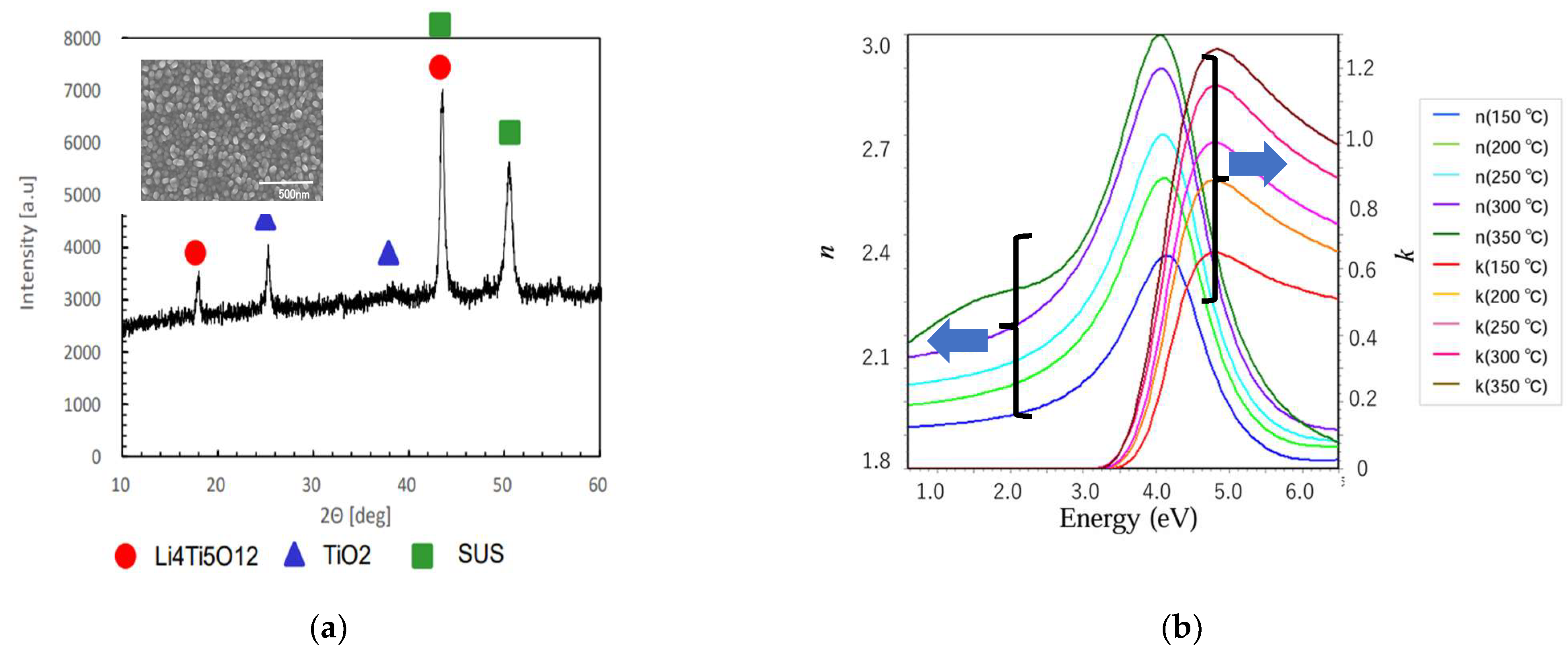
Figure 2(a) shows the XRD pattern of a 100-nm thick LTO film with LiNO3 synthesized Ts at 500 °C. The XRD diffraction peaks observed at around 2θ = 19° and 25° correspond to LTO (111) and TiO2 (101) orientation, respectively, [35,36,37] suggesting that the film structure was a mixture of LTO and TiO2. In addition, at a Ts of 200-350°C, no peaks appeared, indicating that the film is an amorphous state. The XPS revealed that the LTO film composition was Ti (19.5 at%), O (50.9 at%), Li (3.7 at%), and C (15.7 at%), suggesting far from stoichiometric composition Li4Ti5O12. As-deposited a-TiOx at Ts of 200-350 °C was Ti (18.6 at%), O (47.6 at%), and C (33 at%), suggesting that a-TiOx includes huge C content.
Figure 2(b) shows the n and k spectra of a-TiOx synthesized at different Ts. The magnitude of n and k values increase systematically with a slightly higher energy shift of absorption edge in k spectra when Ts was increased from 200 to 350 °C, and their values are lower than those of anatase rutile crystalline. These will be caused by a large amount of residual C, CHO, and COOH-related complex, although the influence on the LIB performance is still controversial. These a-TiOx thin films are less dense and have more vacancies in their network than the anatase and rutile crystal structures.
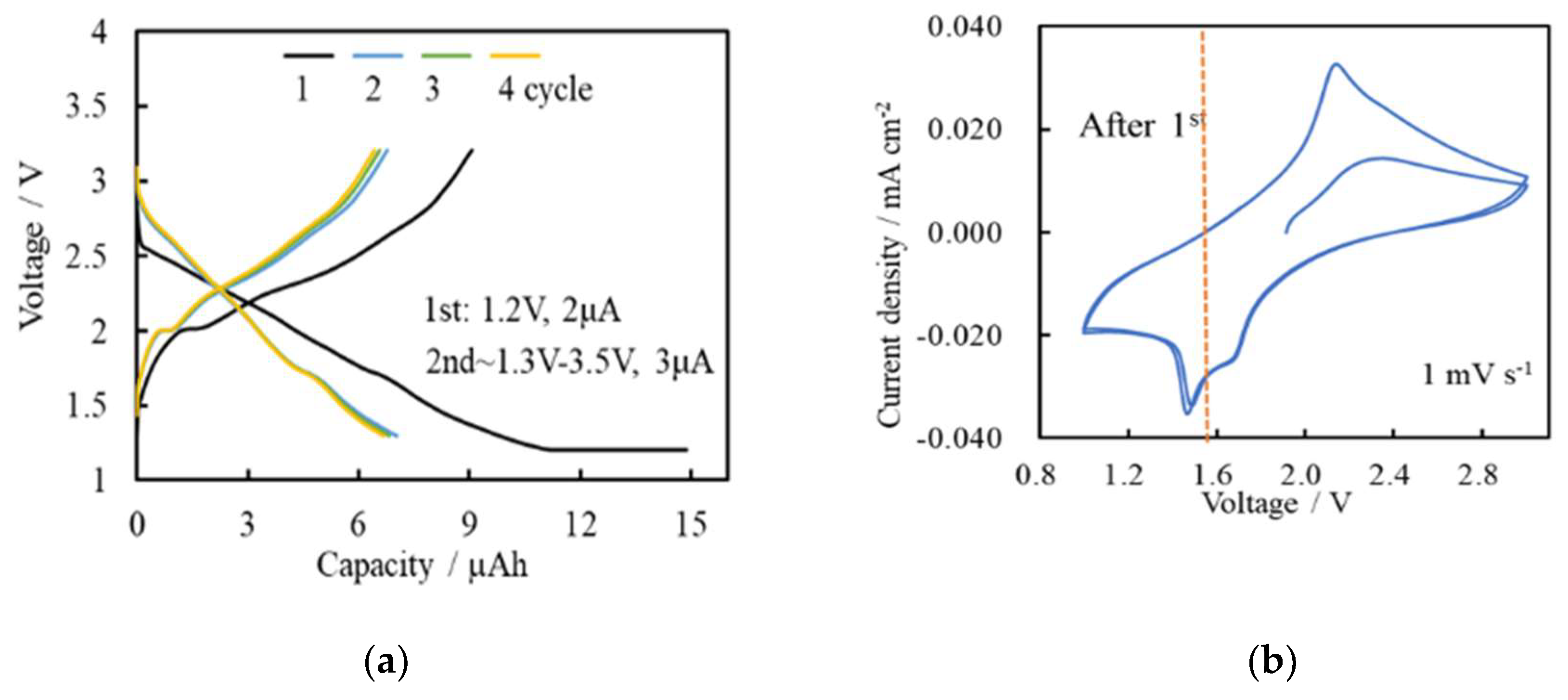
Figure 3(a) and (b) show the charge/discharge curve and CV characteristic of an LTO thin film including TiOx phase fabricated at a Ts of 500 °C. In the charge-discharge curve, an irreversible capacity was detected at the first cycle, but stable redox behavior with no irreversible capacity was observed. The CV chracteristics of Lix-a-TiOx thin film with and without cleaning by acetone is aslo shown in Figure S2.These results suggest that the insertion and desorption of Li ions are stable after the initial insertion of Li ions from the second cycle onwards. In CV, reduction peaks were detected around 1.7V and 1.5V. This is presumed to be due to the reduction reaction of TiOx and LTO (Figure S3).
The redox potential of LTO is approximately 1.8-1.9V (Figure 3b), which is higher than that of Li4Ti5O12 (1.56V) due to smaller Li content [38,39,40]. Additionally, an oxidation peak was detected around 2.2V.
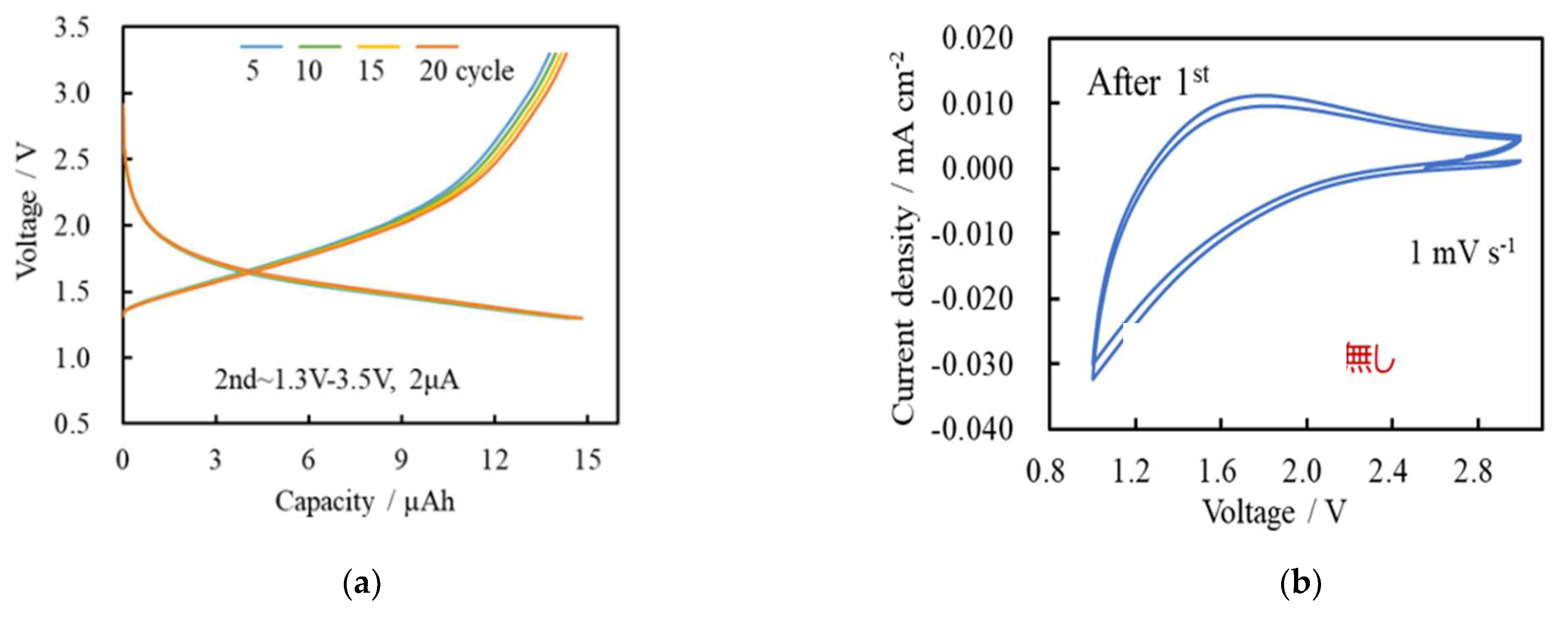
Figure 4(a) and (b) show the charge/discharge and CV curves of a-TiOx thin films synthesized at Tss of 200- 350 °C. The charge-discharge curve revealed that the capacity is higher compared to LTO films synthesized at a Ts of 500 ℃. Additionally, the coulombic efficiency was increased due to the increase in oxidation capacity with the cycles. This result suggests that Li-ion is easily desorbed during charging and discharging, and the permeability of Li ions is improved. Furthermore, no peaks for oxidation/reduction reactions were detected in the CV curve. These findings suggest that Li ions are not inserted into a predetermined crystal structure, but rather diffused into arbitrary positions in the amorphous structure. These results imply that the amorphous TiOx has higher Li-ion permeability than the crystalline structure. This is because Li ions can diffuse isotopically in an amorphous network, while they move in a specific direction depending on the crystal plane in a crystalline structure. Thus, these results imply that a-TiOx is expected to act as a solid electrolyte.
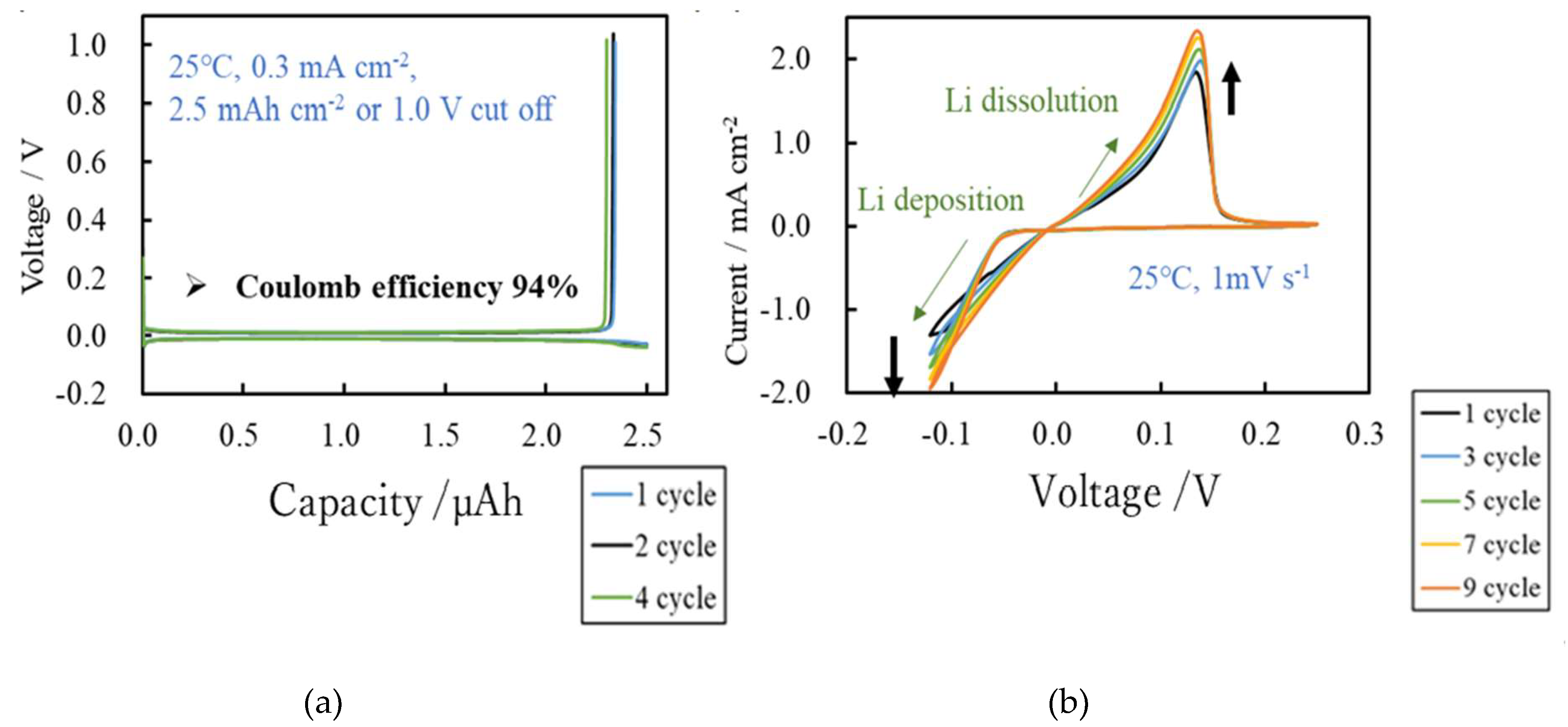
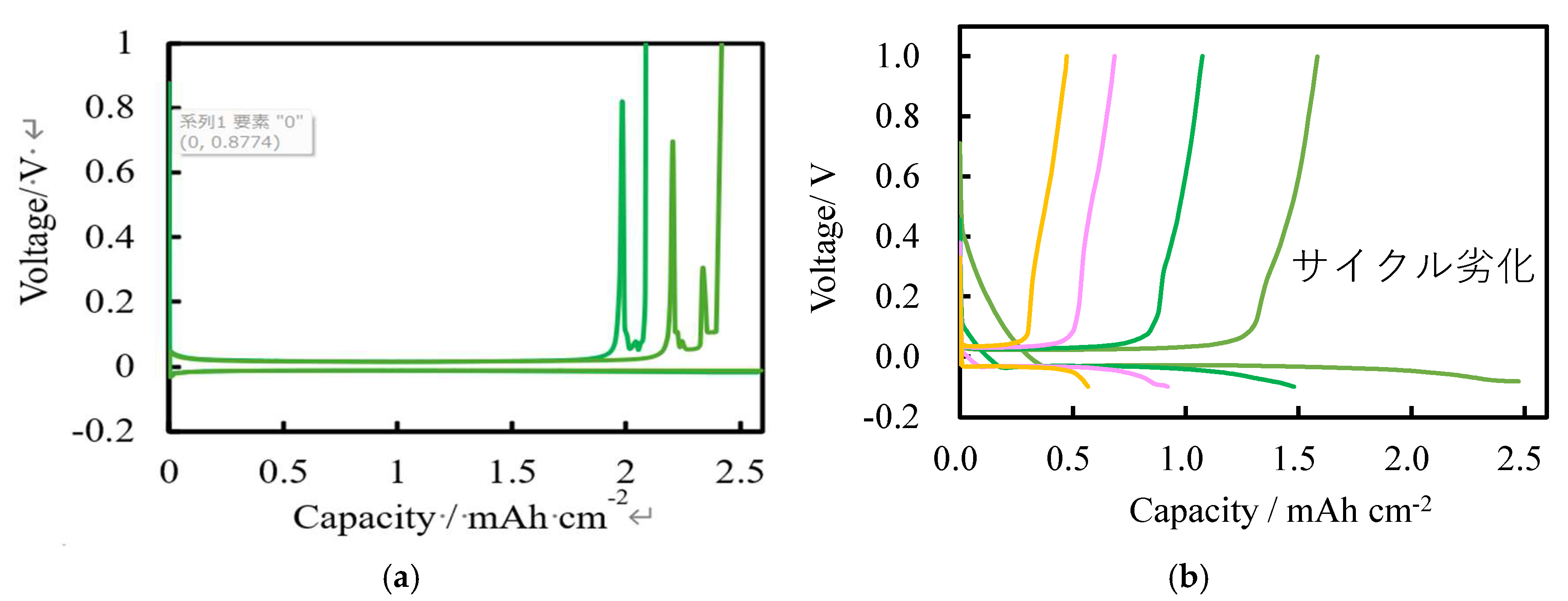
Furthermore, the a-TiOx thin films synthesized at a Ts of 200°C were scanned to the potential at which Li was deposited. The charge/discharge curve and CV are also shown in Figure 5a. In the charge/discharge test, the battery was charged to 2.5 mAhcm-2, which has a similar potential to widely used electrodes, and discharged to 1.0V. It is noted that the Li’s precipitation and dissolution behavior were detected. The coulombic efficiency was 94%. The remarkable redox behavior of Li precipitation and dissolution was also detected in CV (Figure 5b). The current density increased with cycling. This is presumed to be because the permeability of lithium ions increased with cycling. These results suggest that in reduction, Li ions pass through the a-TiOxthin film and Li metal precipitates on the Cu current collector foil, and in oxidation, Li ions dissolve from the Li metal on the Cu foil and pass through the a-TiOx thin film. Additionally, no micro-short circuit behavior during Li precipitation occurred in a series of measurements. These findings imply that a-TiOx thin film has the potential to realize an anode-free lithium metal battery. The theoretical capacity of Li4Ti5O12 is 175 mAh/g, but for LTO synthesized by mist CVD from Ti(acac)2(OiPr)2 at 500 °C is initial 300 mAh/g, second 150 mAh/g, and 300 mAh/g for a-TiOx at 300 °C. These results suggest that a-TiOx from Ti(acac)2(OiPr)2 by mist CVD provides higher capacity. Furthermore, the weight per unit area of a 200-nm thick a-TiOx thin film is approximately 0.1mg/cm2, and no binder or conductive additive is required in the LIB manufacturing process. On the other hand, electrodes synthesized using other coating processes are equivalent to 0.02 g/cm2 at a thickness of 2 μm, and contain 70-90% of the active material, binder, conductive aid, etc. Therefore, although TiOx produced by the mist CVD method shows an amorphous state, its density is approximately 1/10 that of electrodes produced using a conventional coating press. These results suggest that mist CVD a-TiOx is a likely anode-free LIB due to the simple process.
Anode-free lithium metal batteries utilize Li metal as the negative electrode, which provides optimal performance because Li metal is not present during battery manufacturing, thus achieving high safety and low cost. Cu foil, and when using crystalline TiOx electrodes, Li-ion is trapped, and charging becomes impossible. Further detailed studies are underway, but there are challenges to realizing it. Therefore, these results could be a major step in realizing anode-free lithium metal batteries [41,42].

5. Conclusions

We investigated the synthesis of lithium titanate (LTO) and a-TiOx thin films from Ti(acac)2(OiPr)2 diluted in CH3OH by mist CVD and applied in negative electrode and electrolyte of LIB. LTO synthesized at 500 ℃ comprises crystalline LTO that acts as a negative electrode material. A-TiOx synthesized at 250-300 ℃ improved the Li-ion permeability with charge/discharge cycles, and they also exhibit superior behavior as a solid electrolyte due to the high diffusivity of Li ions. The corresponding LIB with a-TiOx as a solid electrolyte showed a charge/discharge efficiency of 94%. These findings suggest that a-TiOx by mist CVD as solid-electrolyte holds promise for realizing anode-free lithium metal batteries.

Supplementary Materials

The following supporting information can be downloaded at the website of this paper posted on Preprints.org, Figure S1: (a) Remaning issue for anode-free Lix-aTiO2 LIB. (b) Microsocpe image of Lix-aTiO2 after charge/discharge cycles. Figure S2: Effect of a-TiOx film thickness and cleaning by immersion in acetone on CV (Li precipitation-dissolution behavior) of Li-a-TiOx/Cu-Li metal. Figure S3: SEM image of Lix-a-TiOx before and after charge/discharge cycles.

Author Contributions

Synthesis of a-TiOx and LTO films by mist CVD, H. Fukushima and H. Watanabe, LIB device fabrication and evaluation; H. Kurihara.; investigation, H. Shirai and H. Sone.; original draft preparation, H. Shirai; writing—review and editing, H. Sone;. project administration and funding acquisition, T. Ohno. All authors have read and agreed to the published version of the manuscript.

Funding

This study is partially supported by the Circular Economy Business Development Grant of Saitama Pref. FY2023.

Data Availability Statement

We encourage all authors of articles published in MDPI journals to share their research data. In this section, please provide details regarding where data supporting reported results can be found, including links to publicly archived datasets analyzed or generated during the study. Where no new data was created, or where data is unavailable due to privacy or ethical restrictions, a statement is still required. Suggested Data Availability Statements are available in the section “MDPI Research Data Policies” at https://www.mdpi.com/ethics.

Acknowledgments

The authors appreciate Mrs. Y. Wasai and Mr. Y. Izumi (HORIBA Techno Service Co., Ltd) for supporting the ellipsometry measurement.

Conflicts of Interest

The authors declare no conflicts of interest associated with this manuscript. All authors approved the final version of the manuscript. (H. Fukushima, H Shirai, H. Kurihara, H. Sone, T. Ohno, T. Watanabe).

References

  1. Yang, G.; Abrahama, C.; Ma, Y.; Lee, M.; Helfrick, E.; Oh, D.; Lee, D. Advances in Materials Design for All-Solid-state Batteries: From Bulk to Thin Films. Appl. Sci. 2020, 10, 4727. [Google Scholar] [CrossRef]
  2. Cao, C.; Li, Z.-B.; Wang, X.-L.; Zhao, X.-B.; Han, W-Q. Recent Advances in Inorganic Solid Electrolytes for Lithium Batteries Frontier Energy Res. 2014. 27 Sec. Electrochemical Energy Storage Volume 2. [CrossRef]
  3. M. Yashima, M. Itoh, Y. Inaguma, and Y. Morii. Crystal Structure and Diffusion Path in the Fast Lithium-Ion Conductor La0.62Li0.16TiO3. J. Am. Chem. Soc. 2005, 127, 3491–3495. [CrossRef]
  4. Fu, J. , Fast Li+ ion conducting glass-ceramics in the system Li2O – Al2O3 – TiO2 – SiO2 – P2O5. J. Am. Ceram. Soc. 1997, 80, 1901. [Google Scholar] [CrossRef]
  5. Murugan, R.; Thangadural, V.; Weppner, W. , Fast Lithium Ion Conduction in Garnet-type Li7La3Zr2O12. Angew. Chem. Int. Ed,. 2007, 46, 7778. [Google Scholar] [CrossRef]
  6. Wang, B.; Bates, J.B.; Hart, F.X.; Sales, B.C.; Zuhr, R.A.; Robertson, J.D. , Characterization of Thin-Film Rechargeable Lithium Batteries with Lithium Cobalt Oxide Cathodes. J. Electrochemical. Soc., 1996, 143, 3203. [Google Scholar] [CrossRef]
  7. Ohta, S.; Kobayashi, T.; Seki, J.; Asaoka, T. , Electrochemical Performance of an All-solid-state Lithium Ion Battery with Garnet-Type Oxide Electrolyte. J. Power Sources 2012, 202, 332–335. [Google Scholar] [CrossRef]
  8. Kanno, R.; Murayama, M. , Lithium Ionic Conductor Thio-LISICON: The Li2 S    GeS2    P 2 S 5 System. J. Electrochem. Soc. 2001, 148, A742. [Google Scholar] [CrossRef]
  9. Kato, Y.; Hori, S.; Saito, T.; Suzuki, K.; Hirayama, M.; Mitsui, A.; Yoneyama, M.; Iba, H.; Kanno, R. High-power All-solid-state Batteries using Sulfide Superionic Conductors. Nature Energy 2016, 1, 16030. [Google Scholar] [CrossRef]
  10. Kamaya, N.; Homma, K.; Yamakawa, Y.; Hirayama, M.; Kanno, R.; Yonemura, M.; Kamiyama, T.; Kato, K.; Hama, S.; Kawamoto, K.; Mitsui, A. , A Lithium Superionic Conductor. Nat. Mater. 2011, 10, 682–686. [Google Scholar] [CrossRef]
  11. Hayashi, A.; Hama, S.; Minami, T.; Tatsumisago, M. , Fast Lithium-Ion Conducting Glass-Ceramics in the System Li2S-SiS2-P2S5. Electrochem. Commun. 2003, 5, 111–114. [Google Scholar] [CrossRef]
  12. Nishimura, S.; Tanibata, N.; Hayashi, A.; Tatsumisago, M.; Yamada, A. The Crystal Structure and Sodium Disorder of High-Temperature Polymorph β-Na3PS4. J. Mater. Chem. A., 2017, 5, 25025–25030. [Google Scholar] [CrossRef]
  13. Hakari, T.; Sato, Y.; Yoshimi, S.; Hayashi, A.; Tatsumisago, M. Favorable Carbon Conductive Additives in Li3PS4 Composite Positive Electrode Prepared by Ball-Milling for All-Solid-State Lithium Batteries. J. Electrochem. Soc. 2017, 162, A2804–A2811. [Google Scholar] [CrossRef]
  14. Sakuda, A.; Hayashi, A.; Tatsumisago, M. Recent Progress on Interface Formation in All-Solid-State Batteries. Curr. Opin. Electrochem., 2017, 6, 108–114. [Google Scholar] [CrossRef]
  15. Perkins, C.Y.; Mansergh, R.H.; Ramos, J.C.; Nanayakkara, C.E.; Park, D. -H. ; Ferron, S.G.; Fullmer, L.B.; Arens, J.T.; Gutierrez-Higgins, M.T.; Jones, Y.R.; Lopez, J.I.; Rowe, T.M.; Whitehurst, D.M.; Nyman, M.; Chabal, Y.J.; Keszler, D.A. Low-index, Smooth Al2O3 Films by Aqueous Solution Process, Optical Material Express 2017, 7, 273–278. [Google Scholar] [CrossRef]
  16. Alberti, A.; Smecca, E.; Sanzaro, S.; Bongiorno, C.; Giannazzo, F.; Mannino, G.; Magna, A.L. Nanostructured TiO2 Grown by Low-Temperature Reactive Sputtering for Planar Perovskite Solar Cells. ACS Appl. Energy Mater. 2019, 2, 6218–6229. [Google Scholar] [CrossRef]
  17. Dai, H. -Q.; Xu, H.; Zhou, Y. -N.; Lu, F.; Fu, Z. -W. Electrochemical Characteristics of Al2O3-Doped ZnO Films by Magnetron Sputtering. J. Phys. Chem. C 2012, 116, 1519–1525. [Google Scholar] [CrossRef]
  18. Hwang, K.H.; Lee, S.H.; Joo, S.K. , Characterization of Sputter-deposited LiMn2O4 Thin Films for Rechargeable Microbatteries. J. Electrochem. Soc. 1994, 141, 3296–3299. [Google Scholar] [CrossRef]
  19. Shamala, K.S.; Murthy, L.C.S.; Radhakrishna, M.C.; Rao, K.N. Characterization of Al2O3 Thin Films Prepared by Spray Pyrolysis Method for Humidity Sensor. Sens. Actuators A 2007, 135, 552–557. [Google Scholar] [CrossRef]
  20. Mei, A.; Jiang, Q.H.; Lina, Y.H.; Nan, C.W. , Lithium Lanthanum Titanium Oxide Solid-State Electrolyte by Spark Plasma Sintering. J. Alloys Compounds 2009, 486, 871–875. [Google Scholar] [CrossRef]
  21. Lei, L.; Chu, H.P.; Hu, X.; Yue, P. -L. Preparation of Heterogeneous Photocatalyst (TiO2/Alumina) by Metal-Organic Chemical Vapor Deposition. Ind. Eng. Chem. Res. 1999, 38, 3381–3385. [Google Scholar] [CrossRef]
  22. Chung, H.K.; Won, S.O.; Park; Y. ; Kim, J.; Park, T.J.; Kim, S.K. Atomic-layer deposition of TiO2 Thin Films with a Thermally Stable (CpMe5)Ti(OMe)3 Precursor. Appl Surf Sci. 2021, 550, 149381. [Google Scholar] [CrossRef]
  23. Roelofs, K.E.; Brennan, T.P.; Dominguez, J.C.; Bailie, C.D.; Margulis, G.Y.; Hoke, E.T.; McGehee, M.D.; Bent, S.F. Effect of Al2O3 Recombination Barrier Layers Deposited by AtomicLayer Deposition in Solid-State CdS Quantum Dot-Sensitized Solar Cells. J. Phys. Chem. C 2013, 117, 5584–5592. [Google Scholar] [CrossRef]
  24. Wan, Z.; Zhang, T.F.; Lee, H. -B. R.; Yang, J.H.; Choi, W.C.; Han, B.; Kim, K.H.; Kwon, S. -H. Improved Corrosion Resistance and Mechanical Properties of CrN Hard Coatings with an Atomic Layer Deposited Al2O3 Interlayer. ACS Appl. Mater. Interfaces 2015, 7, 26716–26725. [Google Scholar] [CrossRef] [PubMed]
  25. Chrysson, C.E.; Pitt, C.W. Al2O3 Thin Films by Plasma-Enhanced Chemical Vapour Deposition Using Trimethyl-Amine alane (TMAA) As the Al Precursor. Appl. Phys. A 1997, 65, 469–475. [Google Scholar] [CrossRef]
  26. Rho, Y.H.; Kanamura, K. Fabrication of thin film Electrodes for All Solid State Rechargeable Lithium Batteries, J. Electroanal. Chem. 2003, 559, 69–75. [Google Scholar] [CrossRef]
  27. Rho, Y.; Kanamura, K. Solid State Chem. Solid State Chem. 2003, 559, 69–75. [Google Scholar]
  28. Oh, K. -T.; Kim, H. -Y.; Kim, D. -H.; Hwan Han, J.H.; Park, J.; Park, J. -S. Facile Synthesis of AlOxDielectrics via Mist-CVD Based on Aqueous Solutions. Ceram. Int. 2017, 43, 8932–8937. [Google Scholar] [CrossRef]
  29. Uchida, T.; Kawaharamura, T.; Shibayama, K.; Hiramatsu, T.; Orita, H.; Fujita, S. Mist Chemical Vapor Deposition of Aluminum Oxide thin Films for Rear Surface Passivation of Crystalline Silicon solar cells. Appl. Phys. Express 2014, 7, 021303. [Google Scholar] [CrossRef]
  30. Kawaharamura, T.; Uchida, T.; Sanada, M.; Furuta, M. Growth and Electrical Properties of AlOx Grown by Mist Chemical Vapor Deposition. AIP Adv. 2013, 3, 032135. [Google Scholar] [CrossRef]
  31. Rajib, A.; Enamul, K.; Kuddus, A.; Ishikawa, R.; Ueno, K.; Shirai, H. Synthesis of AlOx Thin Films by Atmospheric-pressure Mist Chemical Vapor Deposition for Surface Passivation and Electrical Insulator Layers. Journal Vacuum Science & Technology 2020, A38, 033413. [Google Scholar] [CrossRef]
  32. Rajib, A.; Kuddus, A.; Shida, T.; Ueno, K.; Shirai, H. Mist Chemical Vapor Deposition of AlOx Thin Films Monitored by a Scanning Mobility Particle Analyzer and its Application to the Gate Insulating Layer of Field-effect Transistors. ACS Applied Electronic Materials 2021, 3, 658–667. [Google Scholar] [CrossRef]
  33. Rajib, A.; Kuddus, A.; Yokoyama, K.; Shida, T.; Ueno; K. ; Shirai; Mist, H. Chemical Vapor Deposition of Al1-xTixOy Thin Films and Their Application to a High Dielectric Material. J. Applied Physics. 2022, 131, 105301. [Google Scholar] [CrossRef]
  34. Yokoyama, K.; Kuddus, A.; Shirai, H. Mesh-bias Controlled Synthesis of TiO2 and Al0.76Ti0.24O3 Thin films by Mist Chemical Vapor Deposition and Applications as Gate Dielectric Layers for Field-Effect Transistors. ACS Applied Electronic Mater. 2022, 4, 2516–2524. [Google Scholar] [CrossRef]
  35. Tadanaga, K.; Yamaguchi, A.; Hayashi, A.; Tatsumisago, M.; Mosa, J.; Aparicio, M. Preparation of Li4Ti5O12 electrode thin films by a mist CVD process with aqueous precursor solution. J. Asian Ceramic Soc., 2015, 3, 88–91. [Google Scholar] [CrossRef]
  36. Tadanaga, K.; Yamaguchi, A.; Sakuda, A.; Hayashi, A.; Tatsumisago, Duran, A. ; Aparicio, Preparation of LiMn2O4 Cathode Thin Films for Thin Film Lithium Secondary Batteries by a Mist CVD Process. Mater. Res. Bul. 2014, 53, 196–198. [Google Scholar] [CrossRef]
  37. Igawa, T.; Kaneko, K.; Fujita, S. Fabrication of Lithium-based Oxide Thin Films by Ultrasonic-Assisted Mist CVD Technique. J. Soc. Mater. Sci., Japan 2011, 60, 994–997. [Google Scholar] [CrossRef]
  38. Hirayama, M.; Kim, K.; Toujigamori, T.; Cho, W.; Kanno, R. Epitaxial growth and electrochemical properties of Li4Ti5O12 thin-film lithium battery anodes. Dalton Trans. 2011, 40, 2882–2887. [Google Scholar] [CrossRef]
  39. Ohzuku, K.; Ueda, A.; Yamamoto, N. Zero-Strain Insertion Material of Li[Li1/3Ti5/3]O4 for Rechargeable Lithium Cells. J. Electrochem.Soc. 1995, 142, 1431–1435. [Google Scholar] [CrossRef]
  40. Amine, K.; Belharouak, I.; Chen, Z.; Tran, T.; Yumoto, H. Ota, N.; Myung, S.T.; Sun, Y.K. Nanostructured Anode Material for High-power battery System in Electric Vehicles. Adv. Mater. 2010, 22, 3052–3057. [Google Scholar] [CrossRef]
  41. Wang, C.; Liu, M.; Thijs, M.; Ooms, F.G.B.; Ganapathy, S.; Wagemaker, M. High Dielectric Barium Titanate Porous Scaffold for Efficient Li Metal Cycling in Anode-free cells. Nat. Commun. 2021, 12, 6536. [Google Scholar] [CrossRef]
  42. Wang, M.; Cheng, X.; Cao, T.; Niu, J.; Wu, R.; Liu, X. Zhang, Y. Constructing ultrathin TiO2 protection layers via atomic layer deposition for stable lithium metal anode cycling, Journal of Alloys and Compounds 2021, 865, 158748. [Google Scholar] [CrossRef]
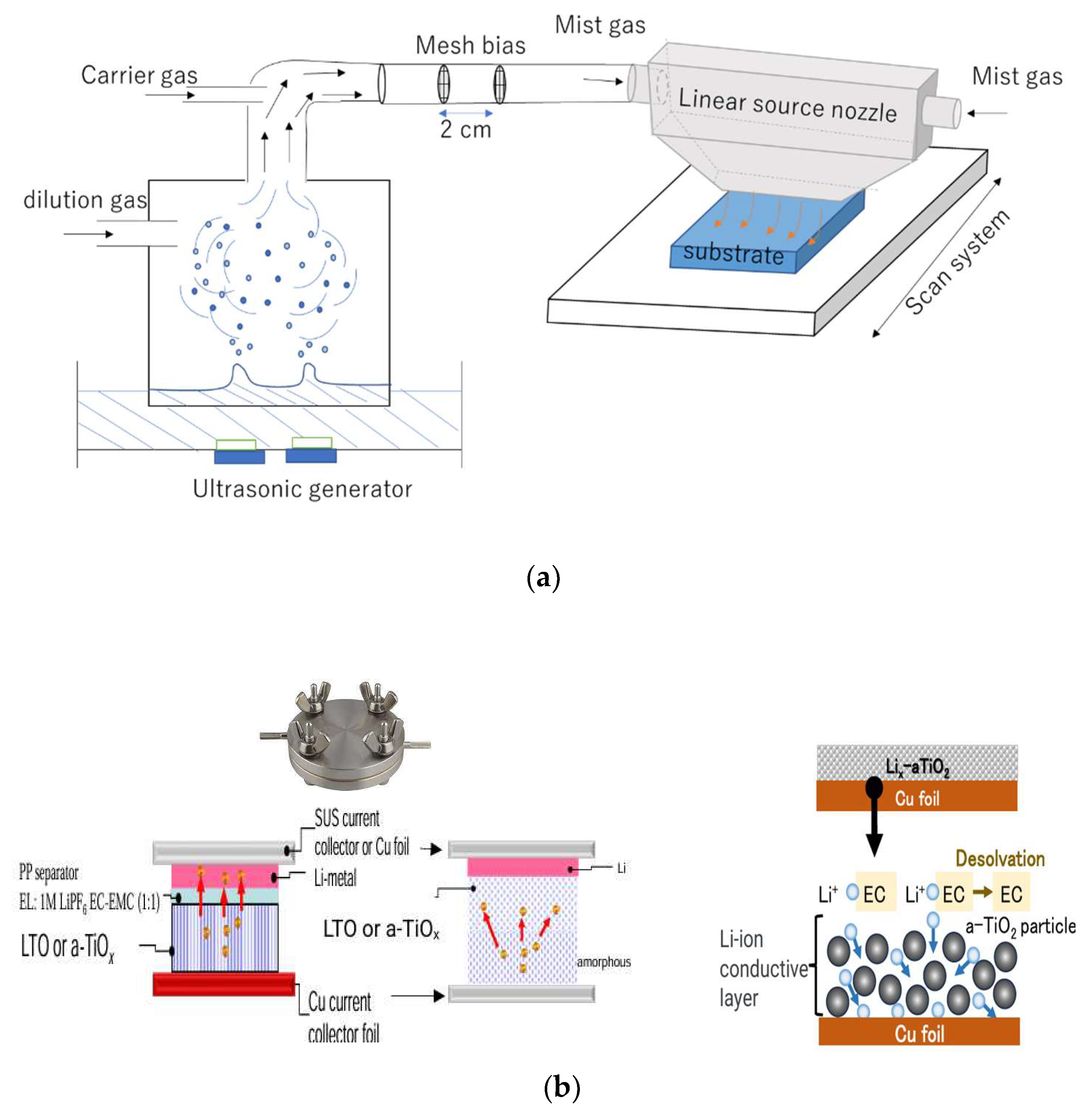
Figure 1. (a) Schematic of the mist CVD apparatus with linear source. (b) The LIB structure using crystalline LTO and a-TiOx as solid electrolytes formed on the Cu foil. Schematic of Li-ion diffusion process in crystalline LTO and a-TiOx particle.
Preprints 145173 g001
Figure 2. (a) XRD pattern of LTO synthesized from Ti(acac)2(OiPr)2 and LiNO3 mixture solution at a Ts of 500°C. The inset shows the SEM image of corresponding a-TiOx and LTO (b) (n, k) spectra of a-TiOx synthesized at different Ts from a 0.015M Ti(acac)2(OiPr)2 diluted in CH3OH using mist CVD.
Preprints 145173 g002
Figure 3. (a) Charge/discharge and (b) CV characteristics of a LTO thin film containing TiO2 anatase phase synthesized at a Ts of 500 °C by mist CVD.
Preprints 145173 g003
Figure 4. (a) Charge/discharge and (b) CV characteristic for a-TiOxfabricated at Ts of 200-350 °C using mist CVD.
Preprints 145173 g004
Figure 5. (a) Charge/discharge and (b) CV curves of a-TiOxsynthesized at a Ts of 200 ℃.
Preprints 145173 g005
Figure 6. (a) Charge discharge curve of (a) Cu foli alone/Li and (b) crystalline TiOx particle/Li metal.
Preprints 145173 g006
Table 1. Deposition condition of LTO and a-TiOx thin films.
Solute Ti(acac)2(OiPr)2
Li source LiNO3, (CH3COO)Li, LiCl
Solvent CH3OH
Solution concentration 0.015 mol/L
Substrate temperature; Ts LTO; 500- 550 ℃, a-TiOx; 200- 350 ℃
Substrate p-Si, SUS, Cu foil (180 µm)
Mist generation gas N2, Ar: 500 sccm
Dilution gas flow; Fd N2, Ar: 2400 sccm
Repetition cycle; N 1 - 30
Disclaimer/Publisher’s Note: The statements, opinions and data contained in all publications are solely those of the individual author(s) and contributor(s) and not of MDPI and/or the editor(s). MDPI and/or the editor(s) disclaim responsibility for any injury to people or property resulting from any ideas, methods, instructions or products referred to in the content.
Copyright: This open access article is published under a Creative Commons CC BY 4.0 license, which permit the free download, distribution, and reuse, provided that the author and preprint are cited in any reuse.
Prerpints.org logo

Preprints.org is a free preprint server supported by MDPI in Basel, Switzerland.

Subscribe

Disclaimer

Terms of Use

Privacy Policy

Privacy Settings

© 2025 MDPI (Basel, Switzerland) unless otherwise stated