

Submitted:
03 January 2025
Posted:
06 January 2025
You are already at the latest version
Abstract
Food adulteration remains a pressing issue with serious implications for public health and economic fairness. Among the diverse methods available for detecting adulteration, non-enzymatic electroanalytical techniques have emerged as promising tools due to their high sensitivity, cost-effectiveness, and adaptability to field conditions. This review delves into the application of these techniques across various food matrices, including olive oil, honey, milk, and alcoholic beverages. By leveraging methodologies such as voltammetry and chemometric data processing, significant advancements have been achieved in identifying both specific and non-specific adulterants. The review highlights novel electrode materials, such as carbon-based nanostructures and ionic liquids, which enhance sensitivity and selectivity. Additionally, electronic tongues employing multivariate analysis have shown promise in distinguishing authentic products from adulterated ones. The integration of machine learning and miniaturization offers potential for on-site testing, making these techniques accessible to non-experts. Despite challenges, such as matrix complexity and the need for robust validation, electroanalytical methods represent a transformative approach to food authentication. The findings underscore the importance of continuous innovation to address emerging adulteration threats and ensure compliance with quality standards.
Keywords:
Food fraud
; adulteration of foodstuffs
; non-enzymatic electroanalytical techniques
; voltammetry
; chemometrics
; principal component analysis
; class-modelling
1. Introduction
The globalization of our food supply has amplified various risks, including economically motivated adulteration (EMA) and food fraud. EMA involves altering the characteristics of food or partially substituting it with less expensive materials (e.g., seed oils in olive oil, sugar syrups in honey) or entirely inexpensive components (e.g., water) to maximize profits. Commonly targeted foods and ingredients include oils, fish, honey, milk and dairy products, meat products, grain-based foods, fruit juices, wine, alcoholic beverages, organic foods, spices, coffee, tea, and certain highly processed foods [1]. Some adulterants, like water in liquid products, are added to increase volume, while others, such as sweetening agents, are used to maintain or improve quality [2].
Food fraud also encompasses misrepresentation through misbranding or mislabeling of geographical origin and cultivation practices [3,4,5,6,7]. Detecting and quantifying food fraud and adulteration is critical for ensuring compliance with legal requirements, international standards, and directives; protecting public health; and safeguarding producers and farmers from unfair competition. In Table 1 the most common adulterants for representative foodstuffs and beverages are presented. In some cases, adulterants can lead to serious adverse effects to consumers, such as the addition of hydrogen peroxide, melamine, urea in milk [8]. However, the task is analytically challenging due to the complexity of different food matrices, the wide range of adulterants, many of which exhibit similar physicochemical properties, as well as the need to minimize analysis time and costs and facilitate field analyses.
Electroanalytical techniques offer significant advantages in this context due to their high sensitivity, simplicity, low cost, miniaturization potential and suitability for field conditions. Despite these advantages, a systematic review of non-enzymatic electroanalytical techniques for detecting food adulteration remains lacking. This review focuses on the adulteration of foodstuffs that are frequently targeted, including olive oil, honey, milk and dairy products, and alcoholic beverages, using non-enzymatic electroanalytical techniques. It does not address issues related to the geographical origin of products or the detection of harmful substances such as agrochemicals.
2. Analytical Strategy for Detection/Quantification of Food Adulteration
Detecting and quantifying food adulteration is a challenging task that requires adopting an appropriate strategy. In simpler cases where a single analyte must be detected, various analytical methods—primarily chromatography coupled with suitable detectors—can be employed. However, most cases involve unknown adulterants or adulteration using substances with similar physicochemical properties (e.g. seed oils in olive oil, or inexpensive honeys in high-value polyfloral honey). In such situations, a fingerprinting strategy is commonly used, which involves creating an analytical fingerprint of authentic samples and comparing it with that of a suspect sample.
Two fingerprinting approaches can be employed:
- ▪
- ▪
- Non-Specific Fingerprinting: Instead of targeting specific analytes, this approach uses the entire analytical signal (e.g., spectrum, voltammogram) as a multivariate representation of the sample's chemical composition. Non-specific fingerprints can be generated using techniques like Ultra-Violet (UV-Vis) Spectrometry [15,16], Fourier Transform Infrared Spectrometry (FT-IR) [17], Fluorescence Spectrometry [15], Mid-Infrared Spectroscopy (MIR) [18], Raman Spectrometry [15], Nuclear Magnetic Resonance (NMR) [15,19], chromatography [20], Mass Spectrometry [21], or even Differential Scanning Calorimetry [22].
These fingerprints are typically two-dimensional (2D), but they can also take the form of three-dimensional (3D) signals, such as surfaces or images (e.g., optical or thermal images, or chromatogram-spectra). A key advantage of fingerprinting is its ability to detect unexpected changes in chemical composition—such as the addition of novel or multiple adulterants—without requiring a predefined hypothesis.
In most cases, the information embedded in the chemical fingerprint is not immediately apparent and requires further processing to extract meaningful insights. Data mining techniques are often applied to classify samples as authentic or adulterated and quantify the level of adulteration. Common chemometric techniques for sample grouping include Principal Component Analysis (PCA), Linear Discriminant Analysis (LDA), and Partial Least Squares-Discriminant Analysis (PLS-DA) [23,24,25]. Class-modeling techniques, which model a specific class of authentic samples, are particularly effective for food authentication. These techniques answer the critical question: “Is this sample, claimed to belong to class X, truly consistent with the class X model?” [23,26].
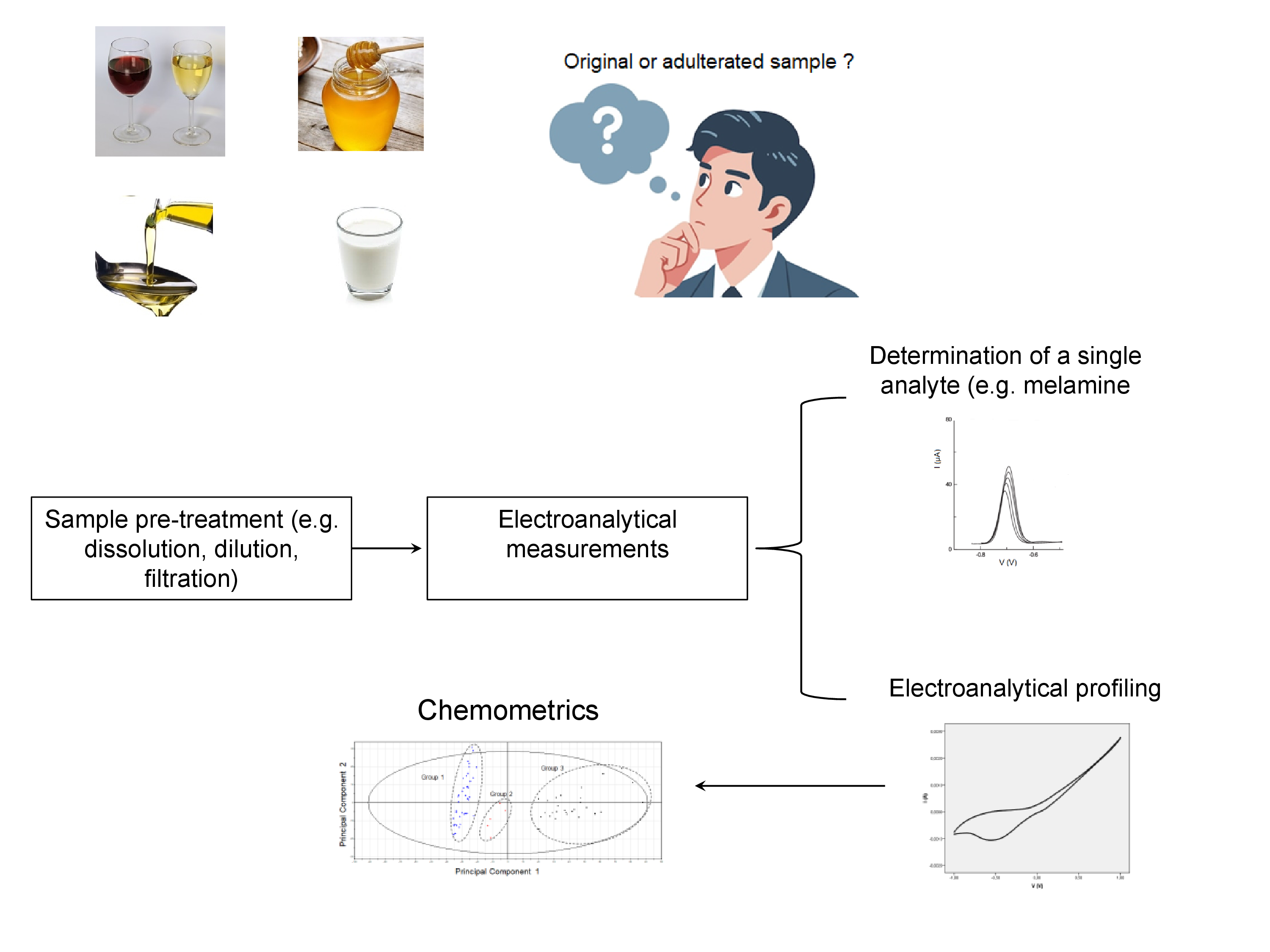
Electroanalytical techniques can also be employed for detecting and quantifying food adulteration. After suitable sample pretreatment (e.g., dissolution, dilution, filtration, liquid-liquid or solid-phase extraction, and electrolyte addition), a sample can be analyzed for specific adulterants (e.g., melamine in milk). Electrochemical signals can then be processed to enhance their informativeness, such as subtracting non-informative capacitive currents and isolating faradaic currents [27] or utilizing the first-order derivative of the measured current versus applied potential [28,29]. Quantification is achieved by constructing calibration plots.
In cases where unknown adulterants have been added, the complete electrochemical graph (e.g., voltammogram) or a specific segment of it can serve as a non-specific multivariate description of the sample. Adulteration can then be identified and quantified using chemometric techniques. The electroanalytical workflow for identifying and quantifying food adulteration is illustrated in Figure 1.
3. Olive Oil
The voltammetric differentiation between extra virgin olive oil and refined olive oil is based on the fact that significant amounts of aromatic compounds, micronutrients and antioxidants such as, polyphenols, tocopherols, sterols, carotenoids are lost during the refining process [30]. Notably, the electrochemically active phenolic compounds are primarily responsible for the flavor of extra virgin olive oil and serve as biomarkers of its authenticity [31]. More to the point, extra virgin olive oil contains high levels of phenolic compounds, which play a crucial role in its resistance to auto-oxidation and photo-oxidation. In contrast, refined olive oil, olive pomace oil and seed oils contain substantially lower amounts of these compounds [32]. Alpha-tocopherol and squalene are also present in higher concentrations in virgin olive oil [33,34].
Electroanaytical measurements in oil matrices pose significant challenges due to the very poor conductivity, the low solubility of many electrolytes in the oil phase as well as incompatibility with standard solvents (e.g. water, alcohols) typically used for electrochemical measurements. Hence, appropriate sample pretreatment is essential, such as dilution with appropriate electrochemically inert solvents that can dissolve small amounts of electrolytes. However, using low-polarity solvents shifts voltammetric peaks to higher potentials due to increased energy required for electrochemical oxidation or reduction. This occurs because of the limited solvation of the polar products of the electrochemical process, causing also the voltammetric peaks to broaden or become indistinct [35]. An alternative approach involves solubilization within the hydrophobic cores of micro-heterogeneous media, such as micelles or emulsions [36].
An effective strategy was reported by the research group of Prof. P. Oliveri, involving the addition of room temperature ionic liquids (RTILs), such as the tri-hexyl(tetradecyl)phosphonium bis(trifluoromethylsulfonyl)imide. These RTILs enhance the conductivity of the matrix [36,37,38,39]. Oliveri et al. successfully distinguished olive oils from maize oils and classified olive oils by geographical origin using cyclic voltammograms recorded on platinum microelectrodes. The resulting voltammetric data were analyzed using the chemometric technique of K-nearest neighbors [36]. Additionally, Prof. P. Oliveri’s team employed the same ionic liquid to determine the free-acidity of olive oils employing a radius platinum microdisk working electrode. They analyzed current intensities at fixed potentials using chronoamperometry or cyclic voltammetry using linear regression [38] or used the entire cyclic voltammetric profile, 0.0 and -1.4 V with PLS regression [39]. Notably, not all ionic liquids are suitable for such applications, as some can significantly increase the viscosity of oil samples.
Apetrei et al. proposed a novel methodology using oil samples as electroactive binders to fabricate carbon paste electrodes chemically modified with oils. Electroanalytical signals were recorded by immersing these electrodes in different aqueous electrolytic solutions [40,41]. Although the number of samples tested was limited, the approach effectively discriminated virgin olive oil from refined olive oils and seed oils [40]. A similar approach was employed by the same authors to evaluate the bitterness intensity of extra virgin olive oils with results obtained by the panel of experts [41]. Apetrei and Apetrei further developed voltammetric e-tongues to detect olive oil adulteration with seed oils [42].
Tsopelas et al. introduced two different sample pretreatments for oil analysis using cyclic voltammetry on a glassy carbon electrode; dilution of oils with dichloromethane and ethanol and extraction with methanol. Cyclic voltammetric data between 0.0 V and +1.3 V analysed via PLS-DA revealed clear discrimination between olive oils (extra virgin and refined) and olive pomace/seed oils. Class-modeling further distinguished extra virgin olive from all other samples. When using methanolic extracts and analyzing data points between 0.6 and 1.3 V, PLS-DA produced three distinct clusters: extra virgin olive oils, regular olive oils and seed/olive pomace oils. A PLS model was also developed to quantify extra virgin olive oil adulteration with olive pomace oil or seed oils, achieving a detection limit of 2% v/v [9].
Munteanu et al. proposed electrochemical sensors based on screen-printed electrodes modified with carbonaceous materials (graphene, nanofibers and carbon nanotubes) and gold nanoparticles. These sensors recorded cyclic voltammetric profiles of methanol:water (40:10% v/v) extracts of extra virgin olive oils, olive pomace oils and sunflower oils from 4 different countries using KCl as electrolyte. The voltammetric responses, analyzed using PCA and PLS-DA, enabled classification by oil type and geographical origin [43].
Karagozlu et al. utilized the oxidation of alpha-tocopherol on a pencil graphite electrode to differentiate virgin olive oil from rapeseed, sunflower and corn oils, with a detection limit of 10% w/w. The method involved activating pencil lead using chronoamperometry, immersing the lead in oil for 30 min, drying for another 30 min and performing differential pulse voltammetric measurements in acetate buffer solution [34]. The lengthy analysis time per sample is a notable limitation of this technique.
4. Honey
The potential of electroanalytical techniques for detecting and quantifying honey adulteration lies in the fact that honey contains natural antioxidants, such as flavonoids, phenols and terpenes, which are electroactive materials. These antioxidants play a natural role in removing oxygen free radicals in the body, a process analogous to the redox reactions on an electrode surface. Consequently, different types of honey, each with unique natural antioxidant profiles, are expected to exhibit distinct electrochemical characteristics [44].
Electroanalytical approaches to address honey authenticity primarily focus on detecting adulteration with various syrups and identifying the botanical or floral origin of honey. It is worth noting that certain monofloral honeys are significantly more expensive [45], and the traditional method for determining botanical origin is melissopalynology, as defined in the EU Council Directive 2001/110.
Honey analysis using voltammetric techniques often requires dissolving the sample in electrolyte solution (e.g., KCl or phosphate buffer saline solution, PBS) or in specific cases, performing extraction or centrifugation steps [10]. Cai et al. studied the electrochemical behavior of Angelica honey adulterated with rice syrup using cyclic coltammetry on a glassy carbon electrode. They identified twelve variable features (e.g. oxidation and reduction peak potentials, half-peak potentials and corresponding currents) from the electrochemical signals. These features were analyzed using PCA and LDA to distinguish pure and adulterated samples. Adulteration quantification was achieved using multiple linear regression [44].
Tiwari et al. employed a platinum working electrode to discriminate monofloral honeys based on vοltammetric data analyzed with PCA, LDA and neural networks to group samples according to floral origin [46]. They also used a carbon paste electrode modified with paraffin oil and ZrO2 nanoparticles [47], as well as a carbon paste electrode modified with ZnO nanoparticles [48], for floral characterization of honey using cyclic voltammetry. Giordano et al. developed a portable device with a gold disk electrode for honey classification based on botanical origin, analyzing voltammetric data with PCA [49]. Guellis et al. combined cyclic voltammetry data obtained on a Cu/CuO electrode with UV-Vis spectrometry for chemometric analysis using PCA and Hierarchical Cluster analysis (HCA) to differentiate between honey and corn syrup [50]. Wojcik et al. integrated differential pulse cyclic voltammetry performed on a quadruple-disk indium-platinum working electrode with computer vision techniques based on smartphone color recognition to distinguish natural from synthetic honey [51].
Over the past two decades, electronic noses (E-noses) and electronic tongues (E-tongues) have been proposed to classify honey based on botanical or geographical origin, detect adulteration and identify typical chemical compounds, intentionally added to honey [10]. E-tongues are electrochemical analytical devices, comprising single or multi-sensor arrays with cross-sensitivity and low specificity, paired with chemometric tools to establish predictive multivariate statistical models, correlating sensors signals to analytical interpretation. E-tongues can be based on different electrochemical techniques (e.g., potentiometry, voltammetry, impedance, etc.). Some potentiometric E-tongues may be directly immersed into the honey sample, allowing direct measurements. In other cases, they may require dissolving a known mass of honey in specific volume of distilled water [10].Using potentiometric e-tongue based devices using several sensors, classification of honey according to its floral origin has been achieved [52,53,54,55,56]. Dias et al. introduced a potentiometric E-tongue with 20 cross-selectivity lipid polymeric membranes to detect adulteration with cane sugar, though quantification was not achieved [57].
Voltammetric E-tongues, consisting of multi-working electrodes (e.g. platinum, gold, palladium, copper, glassy carbon, nickel, silver) paired with a reference and a counter electrode [10] have been employed for botanical origin classification using chemometric techniques [45,53,58] and for detecting adulteration with sugar syrups using PLS regression [11].
Lozano-Torres et al. compared the performance of a voltammetric E-tongue and 1H NMR spectroscopy in detecting adulteration of monofloral honey with syrups, reporting comparable results [59]. Ciursa et al. developed a cyclic voltammetry-based E-tongue with five working electrodes (gold, silver, copper, platinum and glass) to detect honey adulteration with different syrups, namely agave, maple, inverted sugar, corn and rice. Classification was achieved using LDA and Support vector machines (SVM), while PLS regression was applied for quantification, though with inferior statistics [60]. Leon-Medina et al. designed an electronic tongue with three working electrodes (carbon, platinum and gold) to analyze 50 genuine and 50 adulterated honey samples. Following data pre-treatment, classification using k-Nearest Neighbors (k-NN) achieved 100% accuracy [61].
5. Milk and Dairy Products
Electroanalytical techniques have been predominantly used to detect and quantify adulteration in milk and dairy products involving single compounds such as melamine, urea, and hydrogen peroxide. Melamine, in particular, is a commonly used adulterant due to its high nitrogen content (approximately 66% by mass), which can artificially inflate the protein content measured by the conventional Kjeldahl test. However, due to melamine’s low electrochemical activity [62], advanced electrochemical approaches are necessary for its detection.
Rovina et al. demonstrated the detection of melamine in milk products using differential pulse voltammetry (DPV) on a gold electrode modified with chitosan, calcium oxide nanoparticles, and an ionic liquid, achieving an ultralow detection limit [63]. The same group later developed a rapid DPV method for melamine detection in milk powder using a similar electrode modified with chitosan, zinc oxide nanoparticles, and ionic liquids [64]. Heydarian-Dehkordi et al. employed a pencil graphite electrode modified with gold nanoparticles and reduced graphene oxide for melamine detection using cyclic voltammetry [65]. Alternatively, melamine has been voltammetrically detected using an unmodified copper electrode under acidic conditions [66].
Esmaeily et al. introduced a technique involving electropolymerization-based preconcentration of melamine at a glassy carbon electrode modified with overoxidized poly-(para-aminophenol). During this process, non-electroactive melamine was converted into electroactive poly-(melamine), enabling its quantification through square wave voltammetry (SWV) [67]. El-Shahawi et al. reported an indirect DPV method for melamine detection, utilizing its competition with uric acid as a recognition element on a pre-anodized glassy carbon electrode [68].
Daizy et al. developed a glassy carbon electrode modified with L-arginine and a reduced graphene oxide-copper nanoflower composite to detect melamine via differential pulse voltammetry using ascorbic acid as the active recognition element [69]. Guo proposed an ordered mesoporous carbon/glassy carbon electrode in the presence of copper ions, where melamine was converted to an electroactive Cu-melamine complex, quantified by cyclic voltammetry [70].
Mohebbi et al. fabricated a sensor based on a nanocomposite of poly-orthophenylene diamine (POPD) and graphitic carbon nitride (g-C3N4), further functionalized with ethylenediaminetetraacetic acid (EDTA) to achieve advanced selectivity for melamine detection via DPV [62]. Feng et al. proposed a nanocomposite of nickel sulfide/nickel oxide and carbon nanotubes for melamine determination in milk using DPV [71]. An et al. employed a screen-printed carbon electrode modified with ferrocenylglutathione (Fc-ECG) for DPV detection, where melamine enhanced the electrochemical signal of Fc-ECG [72].
Molecularly imprinted polymer (MIP) electrochemical sensors, which integrate molecular imprinting techniques with electrochemical detection, have also been developed for melamine detection. Rao et al. modified a glassy carbon electrode with an imprinted membrane and Au/polyaniline composites to enhance selectivity and amplify the electrochemical signal for DPV-based detection [73].
Urea, another nitrogen-rich adulterant used to falsify milk’s protein content, has also been extensively studied. Yu et al. developed an electronic tongue with three working electrodes (Au, Pt, Pd) combined with multivariate analysis for urea detection in milk [74]. Sha et al. fabricated an amperometric urea sensor by electrodepositing polyaniline on a graphene-modified glassy carbon electrode, achieving a detection limit of 5.88 μM [75]. Ohlsson et al. constructed a sensor using a gold wire working electrode connected via conductive silver epoxy resin to a brass piece, with cyclic voltammetry and functional principal component analysis (f-PCA) demonstrating significant differentiation between adulterated and non-adulterated milk samples (LOD: 85 mg/L) [28].
Shyamala et al. developed a glassy carbon electrode modified with a mixed metal oxide (ZnO/NiO) for simultaneous detection of melamine and urea in milk using cyclic voltammetry [76].
Hydrogen peroxide, used as an adulterant to extend milk’s shelf life, has also been targeted for detection. Silva et al. utilized batch-injection analysis with amperometric detection at a Prussian-blue-modified graphite-composite electrode for hydrogen peroxide quantification. This approach employed an electronic micropipette to deliver precise sample plugs directly onto the electrode surface, achieving a rapid and proportional electrochemical response [77]. Palsaniya et al. developed reduced graphene oxide (rGO)-MoS₂ modified flexible carbon screen-printed electrodes for real-time amperometric detection of hydrogen peroxide in milk [78]. Shalini Devi et al. reported the co-immobilization of lactoferrin and methylene blue onto a multi-walled carbon nanotube (MWCNT)/nafion-modified glassy carbon electrode for hydrogen peroxide sensing [79].
Detecting adulteration of expensive milk types, such as goat milk, with less expensive alternatives like cow’s milk, poses unique challenges. Goat milk, prized for its digestibility, nutritional value, and strong antimicrobial properties, is significantly more expensive than cow milk [80]. Demiati et al. employed cyclic voltammetric fingerprinting on a glassy carbon electrode coupled with chemometric data analysis to detect goat milk adulteration with cow milk [81]. Xue et al. used a ten-electrode microsensor array combined with machine learning for voltammetric fingerprinting, achieving a detection limit of 1% for goat milk adulteration in cow milk [82].
Adulteration of fresh milk with reconstituted skim milk powder is less frequently investigated. Nikolaou et al. applied a graphite/SiO₂ hybrid electrode for voltammetric fingerprinting of fresh cow milk, using PCA and class modeling for adulteration identification. Quantification was performed using PLS regression [12].
6. Wines
Wine is a complex mixture containing organic species with redox activity. Differentiation of different wines can be achieved by electroanalytical signals attributed to the common phenolic compounds of wines. Carbon-based electrodes, screen-printed graphite/ carbon paste electrodes, glassy carbon electrodes and metallic electrodes are among the most suitable working electrodes for detecting Enhancement of sensitivity can be achieved through modification with materials, such as conducting polymers, carbon nanotubes, graphene and metal complexes [83].
Voltammetric techniques have been employed to study polyphenolic content (“total polyphenol” or “polyphenol classes”) of wines by measuring the anodic signals (e.g. peak current, area under voltammograms) obtained in characteristic potential intervals [84,85]. Ksenzhek et al. proposed diagrams, called “redox spectra of wines” attributed to redox behavior of quinones and phenolics, which can be used for the differentiation of different wine samples [85]. Some researchers suggested flow injection analysis (FIA) coupled with amperometric detection at fixed selective potential for the determination of polyphenolic content. Thus, electrochemical indexes have been proposed for the evaluation of specific fractions of polyphenols according to specific redox properties. Apart from their use in the assessment of total antioxidant capacity [86] and polyphenol content [87,88], these indexes can be applied for wine authentication. For instance, Sanchez Arribas et al. proposed “electrochemical indexes” corresponding to different polyphenol fractions to group white wines according to their grape varietal [88]. Moreno et al proposed flow injection analysis coupled to amperometric detection using carbon nanotube/ polyvinylpyrrolidone- modified electrodes. Thus, amperometric signal measured at certain potentials was used to differentiate white wine samples according to their grape variety using Principal Component Analysis and Discriminant Analysis [89].
Novakowski et al. coupled cyclic voltammograms recorded on gold and copper working electrodes and treated voltammetric data using Principal Component Analysis to group nine different wine samples (dry red, soft red, dry white and soft white brands) [4]. Ugliano applied linear sweep voltammetry on disposable screen printed carbon paste sensors and using the first order derivative of measured current vs. applied potential succeeded in the analysis of the main white wine oxidizable compounds and the rapid fingerprinting and classification of white wines from different grape varieties using principal component analysis [29].
Electronic E-tongues have also been proposed for reasons of detection of wine adulteration. Parra et al. [90] successfully developed an electronic tongue based on an array of modified electrodes with different materials to classify red wines and detect adulteration processes. Using a single copper electrode in alkaline medium and taking into account voltammetric measurements at the potential region where copper(II) oxides are generated, Wu et al. [91] were able to differentiate six different brands of Chinese yellow wine, which do not posses constituents that were electroactive at the utilised potential. Schreyer and Mikkelsen [92] were able to differentiate wine samples using a platinum voltammetric electronic tongue, but the proposed sensor was not able to differentiate the origin (Canadian to American wine) and types of wine (white to red wine) in some samples.
Glassy carbon electrodes can also be employed in voltammetric tongues or electrochemical sensors utilizing a potentiometric panel for the monitoring of wine fermentation and aging process with the ability to differentiate aged samples stored under different conditions (standard conditions/ conditions caused deterioration of the samples quality) [93]. Merkyte et al. proposed an electronic tongue consisting of four GCEs for the amperometric study of six red wines in respect of their antioxidant activity, total phenols content and bitter taste and distinction of the considered samples by principal component analysis [94]. Gonzalez-Calabuig et al. developed an electronic tongue consisting of an array of six graphite epoxy modified composite electrodes to evaluate the metabolites of the Brett defect, 4-ethylphenol, 4-ethylguaiacol and 4-ethylcatechol using artificial neural networks to build quantitative prediction model [95]. Voltammetric electronic tongues based on the analysis several organic acid, such as tartaric, ascorbic, lactic, glutamic and gallic acid as well as glucose and tyrosine have been proposed for wine classification in respect to their origin or aging [96].
Less investigated is the investigation of the adulteration of white wine with apple juice and apple cider. Liveri et al. used cyclic voltammetry on carbon nanotubes- gold nanoparticles modified screen printed electrode to identify this adulteration analysing voltammetric data using class-modelling with a deection threshold of 5% v/v or lower. Quantification of adulteration of both apple juice and apple cider was achieved by PLS with acceptable accuracy [7].
7. Other Alcoholic Beverages
The adulteration of alcoholic beverages other than wine has been less extensively studied. Novakowski et al. employed cyclic voltammetry on a copper working electrode combined with Principal Component Analysis (PCA) to successfully detect whiskey adulteration with water and glucose and to differentiate between expensive and inexpensive whiskey samples [4]. Similarly, Wojcik et al. utilized differential pulse voltammetry on an iridium quadruple-disk electrode, focusing solely on the faradaic component of the signal. Using the Alternating Trilinear Decomposition (ATLD) algorithm, they were able to distinguish between wines and Scotch whiskies [27].
Zhao et al. demonstrated the differentiation of Chinese liquors based on their aging periods. This was achieved through direct sample analysis using cyclic voltammetry on a gold microelectrode after adding potassium chloride. The voltammetric data were processed with PCA for classification [97].
Rosello et al. employed cyclic voltammetry with a carbon screen-printed electrode, using Support Vector Machine Discriminant Analysis (SVMDA) to distinguish between the two primary beer types based on their fermentation processes: ales and lagers. Additionally, Partial Least Squares (PLS) regression and artificial neural networks were used to predict the alcoholic content of the beers [98].
Lvova et al. utilized potentiometric responses from porphyrin-based solvent polymeric membranes to analyze a range of alcoholic beverages, including beer, wine, whiskey, and grappa. The PLS model they constructed successfully predicted the alcoholic content of these beverages [99].
8. Future Trends and Perspectives
Electroanalytical techniques, particularly voltammetry, are promising tools for identifying and quantifying food adulteration due to their high sensitivity, rapid analysis, relatively low cost, and potential for field deployment. Key research areas include the analysis of olive oil, honey, meat and seafood, dairy products (e.g., milk, butter, cheese), spices, alcoholic beverages, fruit juices, coffee, and tea.
Future research in this domain is likely to focus on the development of novel electrodes, such as spark-generated screen-printed electrodes [100], incorporating materials like metal nanoparticles, graphene, nanotubes, and other nanostructures to enhance sensitivity and selectivity. Biomimetic sensors, created by modifying electrodes with biomimetic compounds to mimic natural recognition elements for specific adulterants, are also expected to play a significant role.
The principles of Green Chemistry are poised to influence this field by promoting the use of eco-friendly and sustainable materials in sensor preparation, developing non-toxic electrolytes and reagents, and minimizing chemical usage in the electroanalytical process to align with environmental considerations. Miniaturization and portability will be key priorities, aiming to develop portable devices [101] and microelectrodes for on-site testing. Wearable voltammetric sensors could further enable real-time analysis of food samples. Ensuring the affordability of such devices is essential to make these technologies accessible, particularly in developing countries.
Machine learning techniques are anticipated to play a pivotal role in analyzing complex voltammetric data, while artificial intelligence (AI) could differentiate adulterated samples from authentic ones based on unique electrochemical profiles. Developing user-friendly interfaces is another important challenge, aiming to make these tools easily adoptable by non-experts, such as food inspectors and consumers.
For all voltammetric approaches, extensive field studies should be planned and executed using gold-standard methods, such as liquid chromatography-mass spectrometry (LC-MS), as reference techniques to validate the accuracy and precision of electroanalytical methods.
9. Conclusions
Non-enzymatic electroanalytical techniques provide an effective and innovative solution to the pervasive issue of food adulteration. Their advantages include high sensitivity, affordability, and potential for real-time analysis. This review showcases their application across diverse food products, highlighting advances in electrode technology and the integration of chemometric tools for precise adulterant detection. Moreover, emerging trends such as machine learning and green chemistry principles are poised to further refine these methods, offering eco-friendly, scalable solutions for global food safety challenges. However, challenges remain, including matrix complexity and the need for extensive validation against gold-standard methods. Future research should emphasize the development of portable and user-friendly devices, ensuring accessibility in diverse settings. Ultimately, electroanalytical techniques hold immense potential to bolster food authentication, protect public health, and promote economic fairness in global markets.
Funding
This research received no external funding.
Institutional Review Board Statement
Not applicable.
Informed Consent Statement
Not applicable.
Acknowledgments
Not applicable.
Conflicts of Interest
The authors declare no conflicts of interest.
Abbreviations
The following abbreviations are used in this manuscript:
| AI | Artificial Intelligence |
| EMA | Economically Motivated Adulteration |
| K-NN | K-nearest neighbors |
| PCA | Principal Component Analysis |
| PLS | Partial Least Squares |
| RTIL | Room Temperature Ionic Liquids |
| SVM | Support Vector Machine |
References
- Hong, E.; Lee, S.Y.; Jeong, J.Y.; Park, J.M.; Kim, B.H.; Kwon, K.; Chun, H.S. Modern analytical methods for the detection of food fraud and adulteration by food category. J. Sci. Food Agric. 2017, 97, 3877–3896. [Google Scholar] [CrossRef]
- Anagaw, Y.K.; Ayenew, W.; Limenh, L.W.; Geremew, D.T.; Worku, M.C.; Tessema, T.A.; Simegn, W.; Mitku, M.L. Food adulteration: Causes, risks, and detection techniques- review. SAGE Open Med. 2024, 12, 1–10. [Google Scholar] [CrossRef]
- Burda, K.; Collins, M. Adulteration of wine with sorbitol and apple juice. J. Food Prot. 1991, 54, 381–382. [Google Scholar] [CrossRef] [PubMed]
- Novakowski, W.; Bertotti, M.; Paixao, T.R.L.C. Use of copper and gold electrodes as sensitive elements for fabrication of an electronic tongue: Discrimination of wines and whiskies. Microchem. J. 2011, 99, 145–151. [Google Scholar] [CrossRef]
- Lin, S.; Salcido- Keamo, S. Fraud in wine and other alcoholic beverages (Chapter 12). In Food Fraud; Hellberg, R.S., Everstine, K., Sklare, S.A., Eds.; Academic Press, 2021; pp. 233–247. [Google Scholar] [CrossRef]
- Sun, X.; Zhang, F.; Gutierrez- Gamboa, G.; Ge, Q.; Xu, P.; Zhang, Q.; Fang, Y.; Ma, T. Real wine or not? Protecting wine with traceability and authenticity for consumers: chemical and technical basis, technique applications, challenge, and perspectives. Crit. Rev. Food Sci. Nutr. 2022, 62, 6783–6808. [Google Scholar] [CrossRef]
- Liveri, M.; Tsantili- Kakoulidou, A.; Tsopelas, F. Identification of white wine adulteration with apple juice and apple cider using cyclic voltammetry on a screen-printed electrode aided by chemometric analysis. J. Food Compos. Anal. 2024, 136, 106751. [Google Scholar] [CrossRef]
- Azad, T.; Ahmed, S. Common milk adulteration and their detection techniques. Int. J. Food Contam. 2016, 3, 22. [Google Scholar] [CrossRef]
- Tsopelas, F.; Konstantopoulos, D.; Tsantili- Kakoulidou, A. Voltammetric fingerprinting of oils and its combination with chemometrics for the detection of extra virgin olive oil adulteration. Anal. Chim. Acta 2018, 1015, 8–19. [Google Scholar] [CrossRef] [PubMed]
- Veloso, A.C.A.; Sousa, M.E.B.C.; Estevinho, L.; Dias, L.G.; Peres, A.M. Honey evaluation using electronic tongues: an overview. Chemosensors 2018, 6, 28. [Google Scholar] [CrossRef]
- Sobrino- Gregorio, L.; Bataller, R.; Soto, J.; Escriche, I. Monitoring honey adulteration with sugar syrups using an automatic pulse voltammetric tongue. Food Control 2018, 91, 254–260. [Google Scholar] [CrossRef]
- Nikolaou, P.; Deskoulidis, E.; Topoglidis, E.; Tsantili- Kakoulidou, A.; Tsopelas, F. Application of chemometrics for detection and modeling of adulteration of fresh cow milk with reconstituted skim milk powder using voltammetric fingerprinting on a graphite/ SiO2 hybrid electrode. Talanta 2020, 206, 120223. [Google Scholar] [CrossRef] [PubMed]
- Green, H.S.; Li, X.; De Pra, M.; Lovejou, K.S.; Steiner, F.; Acworth, I. N>; Wang, S.C. A rapid method for the detection of extra virgin olive oil adulteration using UHPLC-CAD profiling of triacylglycerols. Food Control 2020, 107, 106773. [Google Scholar] [CrossRef]
- Lymperopoulou, T.; Balta-Brouma, K.; Tsakanika, L.A.; Tzia, C.; Tsantili- Kakoulidou, a.; Tsopelas, F. Identification of lentils (Lens culinaris Medik) from Eglouvi (Lefkada, Greece) based on rare earth elements profile combined with chemometrics. Food Chem. 2014, 447, 138965. [Google Scholar] [CrossRef] [PubMed]
- Ranaweera, K.R.R.; Capone, D.L.; Bastian, S.E.P.; Cozzolino, D.; Jeffery, D.W. A review of wine authentication using spectroscopic approaches in combination with chemometrics. Molecules 2021, 26, 4334. [Google Scholar] [CrossRef] [PubMed]
- Farag, M.A.; Sheashea, M.; Zhao, C.; Maamoun, A.A. UV fingerprinting approaches for quality control analyses of food and functional food coupled to chemometrics: A comprehensive analysis of novel trends and applications. Foods 2022, 11, 2867. [Google Scholar] [CrossRef] [PubMed]
- Jamwal, R.; Amit, *!!! REPLACE !!!*; Kumari, S.; Sharma, S.; Kelly, S.; Cannavan, A.; Singh, D.K. Recent trends in the use of FTIR spectroscopy integrated with chemometrics for the detection of edible oil adulteration. Vib. Spectrosc. 2021, 113, 103222. [Google Scholar] [CrossRef]
- Ceniti, C.; Spina, A.A.; Piras, C.; Oppedisano, F.; Tilocca, B.; Roncada, P.; Britti, D.; Moritu, V.M. Recent advances in the determination of milk adulterants and contaminants by Mid-Infrared Spectroscopy. Foods 2023, 12, 2917. [Google Scholar] [CrossRef]
- Solovyev, P.A.; Fauhl- Hassek, C.; Riedl, J.; Esslinger, S.; Bontempo, L.; Camin, F. NMR spectroscopy in wine authentication: An official control perspective. Compr. Rev. Food Sci. Food Saf. 2021, 20, 2040–2062. [Google Scholar] [CrossRef]
- Cuadros-Rodriguez, L.; Ortega-Gavilan, F.; Martin-Torres, S.; Arroyo-Cerezo, A.; Jimenez-Carvelo, A.M. Chromatographic fingerprinting and food identity/ quality: Potentials and challenges. J. Agric. Food Chem. 2021, 69, 14428–14434. [Google Scholar] [CrossRef]
- Du, L.; Lu, W.; Cai, Z.; Bao, L.; Hartmann, C.; Gao, B.; Yu, L. Rapid detection of milk adulteration using intact protein flow injection mass spectrometric fingerprints combined with chemometrics. Food Chem. 2018, 240, 573–578. [Google Scholar] [CrossRef]
- Farah, J.S.; Cavalcanti, R.N.; Guimaraes, J.T.; Balthazar, C.F.; Coimbra, P.T.; Pimentel, T.C.; Esmerino, E.A.; Duarte, M.C.K.H.; Freitas, M.Q.; Granato, D.; Neto, R.P.C.; Tavares, M.I.B.; Calado, V.; Silva, M.C.; Cruz, A.G. Differential scanning calorimetry coupled with machine learning technique: An effective approach to determine the milk authenticity. Food Control 2021, 121, 107585. [Google Scholar] [CrossRef]
- Oliveri, P. Class- modeling in food analytical chemistry: Development, sampling, optimization and validation issues- A tutorial. Anal. Chim. Acta 2017, 982, 9–19. [Google Scholar] [CrossRef] [PubMed]
- Gonzalez- Dominguez, R.; Sayago, A.; Fernandez- Recamales, A. An overview on the application of chemometrics tools in food authenticity and traceability. Foods 2022, 11, 3940. [Google Scholar] [CrossRef]
- Rodionova, O.Y.; Oliveri, P.; Malegori, C.; Pomerantsev, A.L. Chemometrics as an efficient tool for food authentication: Golden pillars for building reliable models. Trends Food Sci. Technol. 2024, 147, 104429. [Google Scholar] [CrossRef]
- Forina, M.; Oliveri, P.; Lanteri, S.; Casale, M. Class-modeling techniques, classic and new, for old and new problems. Chemom. Intell. Lab. Syst. 2008, 93, 132–148. [Google Scholar] [CrossRef]
- Wojcik, S.; Kopec, J.; Bas, B.; Jakubowska, M. A new approach in voltammetric profiling of wines and whiskies based on a useful faradaic signal component. Anal. Methods 2019, 11, 5984–5996. [Google Scholar] [CrossRef]
- Hilding-Ohlsson, A.; Fauerbach, J.A.; Sacco, N.J.; Bonetto, M.C.; Corton, E. Voltamperometric discrimination of urea and melamine adulterated skimmed milk powder. Sensors 2012, 12, 12220–12234. [Google Scholar] [CrossRef]
- Ugliano, M. Rapid fingerprinting of white wine oxidizable fraction and classification of white wines using disposable screen printed sensors and derivative voltammetry. Food Chem. 2016, 212, 837–843. [Google Scholar] [CrossRef]
- Szydlowska-Czerniak, A. Rapeseed and its products--sources of bioactive compounds: a review of their characteristics and analysis. Crit. Rev. Food Sci. Nutr. 2013, 53, 307–330. [Google Scholar] [CrossRef]
- Lozano-Castellon, J.; Lopez-Yerena, A.; Dominguez-López, I.; Siscart-Serra, A.; Fraga, N.; Samano, S.; Lopez-Sabater, C.; Lamuela-Raventos, R.M.; Vallverdu-Queralt, A.; Perez, M. Extra Virgin Olive Oil: A Comprehensive Review of Efforts to Ensure Its Authenticity, Traceability, and Safety. Compr. Rev. Food Sci. Food Saf. 2022, 21, 2639–2664. [Google Scholar] [CrossRef]
- Marx, Í.M.G.; Casal, S.; Rodrigues, N.; Cruz, R.; Veloso, A.C.A.; Pereira, J.A.; Peres, A.M. Does Water Addition during the Industrial Milling Phase Affect the Chemical-Sensory Quality of Olive Oils? The Case of Cv. Arbequina Oils. Food Chem. 2022, 395, 133570. [Google Scholar] [CrossRef] [PubMed]
- Boskou, D. Olive Oil Minor Constitutents and Health; CRC Press: Boca Raton, 2009. [Google Scholar]
- Karagozlu, M.; Adun, P.; Ozsoz, M.; Asir, S. Detection of adulteration in cold-pressed olive oil by voltammetric analysis of alpha-tocopherol on single-use pencil graphite electrode. Int. J. Food Sci. Technol. 2024, 59, 1781–1788. [Google Scholar] [CrossRef]
- Tsopelas, F.; Ochsenkühn-Petropoulou, M.; Zikos, N.; Spyropoulos, E.; Andreadou, I. Electrochemical study of some non-steroidal anti-inflammatory drugs: solvent effect and antioxidant activity. J. Solid State Electrochem. 2011, 15, 1099–1108. [Google Scholar] [CrossRef]
- Oliveri, P.; Baldo, M.A.; Daniele, S.; Forina, M. Development of a voltammetric electronic tongue for discrimination of edible oils. Anal. Bioanal. Chem. 2009, 395, 1135–1143. [Google Scholar] [CrossRef]
- Baldo, M.A.; Oliveri, P.; Simonetti, R.; Daniele, S. Voltammetric behavior of ferrocene in olive oils mixed with a phosphonium-based ionic liquid. J. Electroanal. Chem. 2014, 731, 43–48. [Google Scholar] [CrossRef]
- Baldo, M.A.; Oliveri, P.; Simonetti, R.; Daniele, S. A novel electroanalytical approach based on the use of a room temperature ionic liquid for the determination of olive oil acidity. Talanta 2016, 161, 881–887. [Google Scholar] [CrossRef]
- Baldo, M.A.; Oliveri, P.; Fabris, S.; Malegori, C.; Daniele, S. Fast determination of extra-virgin olive oil acidity by voltammetry and partial least squares regression. Anal. Chim. Acta 2019, 1056, 7–15. [Google Scholar] [CrossRef]
- Apetrei, C.; Rodriguez- Mendez, M.L.; de Saja, J.A. Modified carbon electrodes for discrimination of vegetable oils. Sens. Actuators B 2005, 111-112, 403–409. [Google Scholar] [CrossRef]
- Apetrei, C.; Gutierez, F.; Rodriguez- Mendez, M.L.; de Saja, J.A. Novel method based on carbon paste electrodes for the evaluation of bitterness in extra virgin olive oils. Sensor. Actuator. Chem. 2007, 121, 567–575. [Google Scholar] [CrossRef]
- Apetrei, I.M.; Apetrei, C. Detection of olive oil adulteration using a voltammetric e-tongue. Comput. Electron. Agric. 2014, 108, 148–154. [Google Scholar] [CrossRef]
- Munteanu, I.G.; Apetrei, C. Classification and antioxidant activity evaluation of edible oils by using nanomaterial-based electrochemical sensors. Int. J. Mol. Sci. 2023, 24, 3010. [Google Scholar] [CrossRef] [PubMed]
- Cai, J.; Wu, X.; Yuan, L.; Han, E.; Zhou, L.; Zhou, A. Determination of chinese Angelica honey adulterated with rice syrup by an electrochemical sensor and chemometrics. Anal. Methods, 2013, 5, 2324–2328. [Google Scholar] [CrossRef]
- Wei, Z.; Wang, J. Classification of monofloral honeys by voltammetric electronic tongue with chemometrics method. Electrochim. Acta 2011, 56, 4907–4915. [Google Scholar] [CrossRef]
- Tiwari, K.; Tudu, B.; Bandyopadhyay, R.; Chatterjee, A. Identification of monofloral honey using voltammetric electronic tongue. J. Food Eng. 2013, 117, 205–210. [Google Scholar] [CrossRef]
- Tiwari, K.; Biswas, S.; Tudu, B.; Bandhopadhyay, R.; Pramanik, P. Development of metal oxide-modified carbon paste based sensor for honey analysis using electronic tongue. Mater. Today-Proc. 2017, 4, 9500–9504. [Google Scholar] [CrossRef]
- Tiwari, K.; Tudu, B.; Bandyopadhyay, R.; Chatterjee, A.; Pramanik, P. Voltammetric sensor for electrochemical determination of the floral origin of honey based on a zinc oxide nanoparticle modified carbon paste electrode. J. Sens. Sens. Syst. 2018, 7, 319–329. [Google Scholar] [CrossRef]
- Giordano, G.F.; Vicentini, M.B.R.; Murer, R.C.; Augusto, F.; Ferrão, M.F.; Helferd, G.A.; da Costa, A.B.; Gobbi, A.L.; Hantao, L.W.; Lima, R.S. Point-of-use electroanalytical platform based on homemade potentiostat and smartphone for multivariate data processing. Electrochim. Acta 2016, 219, 170–177. [Google Scholar] [CrossRef]
- Guellis, C.; Valerio, D.C.; Bessegato, G.G.; Boroski, M.; Dragunski, J.C.; Lindino, C.A. Non-targeted method to detect honey adulteration: Combination of electrochemical and spectrophotometric responses with principal component analysis. J. Food Compos. Anal. 2020, 89, 103466. [Google Scholar] [CrossRef]
- Wojcik, S.; Ciepiela, F.; Jakubowska, M. Computer vision analysis of sample colors versus quadruple-disk iridium-platinum voltammetric e-tongue for recognition of natural honey adulteration. Measurement 2023, 209, 112514. [Google Scholar] [CrossRef]
- Wei, Z.; Wang, J.; Liao, W. Technique potential for classification of honey by electronic tongue. J. Food Eng. 2009, 94, 260–266. [Google Scholar] [CrossRef]
- Wei, Z.; Wang, J. Tracing floral and geographical origins of honeys by potentiometric and voltammetric electronic tongue. Comput. Electron. Agric. 2014, 108, 112–122. [Google Scholar] [CrossRef]
- Dias, L.A.; Peres, A.M.; Vilas-Boas, M.; Rocha, M.A.; Estevinho, L.; Machado, A.A. An electronic tongue for honey classification. Microchim. Acta 2008, 163, 97–102. [Google Scholar] [CrossRef]
- Di Rosa, A.R.; Leone, F.; Scattareggia, C.; Chiofalo, V. Botanical origin identification of Sicilian honeys based on artificial senses and multi-sensor data fusion. Eur. Food Res. Technol. 2018, 244, 117–125. [Google Scholar] [CrossRef]
- Juan-Borras, M.; Soto, J.; Gil-Sanchez, L.; Pascual-Mate, A.; Escriche, I. Antioxidant activity and physico-chemical parameters for the differentiation of honey using a potentiometric electronic tongue. J. Sci. Food Agric. 2017, 97, 2215–2222. [Google Scholar] [CrossRef]
- Dias, L.G.; Bruni, A.R.S.; Anizelli, C.P.; Zangirolami, M.; Lima, P.C.; Estevinho, L.M.; Bona, E. Semi-quantitative discrimination of honey adulterated with cane sugar solution by an ETongue. Chem. Biodiversity 2022, 19, e202200698. [Google Scholar] [CrossRef]
- Bougrini, M.; Tahri, K.; Saidi, T.; El Hassani, N.E.; Bouchikhi, B.; El Bari, N. Classification of Honey According to Geographical and Botanical Origins and Detection of Its Adulteration Using Voltammetric Electronic Tongue. Food Anal. Method. 2016, 9, 2161–2173. [Google Scholar] [CrossRef]
- Lozano-Torres, B.; Martinez-Bisbal, M.C.; Soto, J.; Borras, M.J.; Martinez-Manez, R.; Escriche, I. Monofloral honey authentication by voltammetric electronic tongue: A comparison with 1H NMR spectroscopy. Food Chem. 2022, 383, 132460. [Google Scholar] [CrossRef] [PubMed]
- Ciursa, P.; Oroian, M. Voltammetric e-tongue for honey adulteration detection. Sensors 2021, 21, 5059. [Google Scholar] [CrossRef]
- Leon- Medina, J.X.; Acosta- Opayome, D.; Fuenmayor, C.A.; Zuluaga- Dominguez, C.M.; Anaya, M.; Tibaduiza, D.A. Intelligent electronic tongue system for the classification of genuine and false honeys. Int. J. Food Prop. 2023, 26, 327–343. [Google Scholar] [CrossRef]
- Mohebbi, M.; Ghanbari, K.; Nejabati, F. Electrochemical sensor based on EDTA- functionalized polyorthophylene diamine g-C3N4 nanocomposite for determination of melamine in milk. J. Electroanal. Chem. 2023, 946, 117757. [Google Scholar] [CrossRef]
- Rovina, K.; Siddiquee, S.; Wong, N.K. Development of melamine sensor based on ionic liquid/ nanoparticles/ chitosan with modified gold electrode for determination of melamine in milk product. Sens. Bio-sens. Res. 2015, 4, 16–22. [Google Scholar] [CrossRef]
- Rovina, K.; Siddiquee, S. Electrochemical sensor based rapid determination of melamine using ionic liquid/ zinc oxide nanoparticles/ chitosan/ gold electrode. Food Control 2016, 59, 801–808. [Google Scholar] [CrossRef]
- Heydarian-Dehkordi, N.; Saei-Dehkordi, S.S.; Izadi, Z.; Ghasemi- Varnamkhasti, M. Development of an ultrasensitive molecularly imprinted poly- (ortho-phenylenediamine) based sensor for the determination of melamine adulteration in milk and infant formula. Food Sci. Nutr. 2022, 10, 3154–3164. [Google Scholar] [CrossRef]
- De Araujo, W.R.; Paixao, T.R.L.C. Use of copper electrode for melamine quantification in milk. Electrochim. Acta 2014, 117, 379–384. [Google Scholar] [CrossRef]
- Esmaeily, Z.; Madrakian, T.; Afkhami, A.; Ghoorchian, A.; Ghasemzadeh- Mohammadi, V. Electropolymerization as an electrochemical preconcentration approach for the determination of melamine in milk samples. Electrochim. Acta 2021, 390, 138897. [Google Scholar] [CrossRef]
- El-Shahawi, M.S.; Khraibah, N.H. Development of a highly sensitive voltammetric sensor for trace determination of melamine residues in milk and water samples. Microchem. J. 2020, 157, 105087. [Google Scholar] [CrossRef]
- Daizy, M.; Tarafder, C.; Al-Mamun, M.R.; Liu, X.; Aly Saad Aly, M.; Khan, M.Z.H. Electrochemical detection of melamine by using reduced grapheme oxide- copper nanoflowers modified glassy carbon electrode. ACS Omega 2019, 4, 20324–20329. [Google Scholar] [CrossRef]
- Guo, Z.; Zhao, Y.T.; Li, Y.H.; Bao, T.; Sun, T.S.; Li, D.D.; Luo, X.K.; Fan, H.T. A electrochemical sensor for melamine detection based on copper-melamine complex using OMC modified glassy carbon electrode. Food Anal. Methods 2018, 11, 546–555. [Google Scholar] [CrossRef]
- Feng, N.; Wang, Y.; Li, W. Solid-phase microwave synthesis of nickel sulfide/ nickel oxide/ carbon nanotubes for the electrochemical determination of melamine by differential pulse voltammetry (DPV). Anal. Lett. in press. 2024. [Google Scholar] [CrossRef]
- An, Q.Q.; Feng, X.Z.; Zhou, Z.F.; Zhan, T.; Lian, S.F.; Zhy, J.; Han, G.C.; Chen, Z.; Kraatz, H.B. One step construction of an electrochemical sensor for melamine detection in milk towards an integrated portable system. Food Chem. 2022, 383, 132403. [Google Scholar] [CrossRef]
- Rao, H.; Chen, M.; Ge, H.; Lu, Z.; Liu, X.; Zou, P.; Wang, X.; He, H.; Zeng, X.; Wang, Y. A novel electrochemical sensor based on Au@PANI composites film modified glassy carbon electrode binding molecular imprinting technique for the determination of melamine. Biosens. Bioelectron. 2017, 87, 1029–1035. [Google Scholar] [CrossRef] [PubMed]
- Yu, Y.; Zhao, H.; Dong, G.; Yang, R.; Li, L.; Liu, Y.; Wu, H.; Zhang, W. Discrimination of milk adulterated with urea using voltammetric electronic tongue coupled with PCA-LSSVM. Int. J. Electrochem. Sci. 2015, 1, 10119–10131. [Google Scholar] [CrossRef]
- Sha, R.; Komori, K.; Badhulika, S. Graphene-Polyaniline composite based ultra-sensitive electrochemical sensor for non-enzymatic detection of urea. Electrochim. Acta 2017, 233, 44–51. [Google Scholar] [CrossRef]
- Shyamala, V.; Radha, S.; Kiruthika, R.; Acchutharaman, K.R. Experimental investigation of a mixed metal oxide (MMO)-based sensor for the detection of adulterants (urea and melamine) in milk at room temperature. J. Mater. Sci. Mater. Electron. 2024, 35, 1968. [Google Scholar] [CrossRef]
- Silva, R.A.B.; Montes, R.H.O.; Richter, E.M.; Munoz, R.A.A. Rapid and selective determination of hydrogen peroxide residues in milk by batch injection analysis with amperometric detection. Food Chem. 2012, 133, 200–204. [Google Scholar] [CrossRef]
- Palsaniya, S.; Lal Jat, B.; Mukherji, S. Amperometry sensor for real time detection of hydrogen peroxide adulteration in food samples. Electrochim. Acta 2023, 462, 142724. [Google Scholar] [CrossRef]
- Shalini Devi, K.S.; Mahalakshmi, V.T.; Ghosh, A.R.; Kumar, A.S. Unexpected co-immobilization of lactoferrin and methylene blue from milk solution on a Nafion/ MWCNT modified electrode and application to hydrogen peroxide and lactoferrin biosensing. Electrochim. Acta 2017, 244, 26–37. [Google Scholar] [CrossRef]
- Fangmeier, M.; Kemerich, G.T.; Machado, B.L.; Maciel, M.J.; de Souza, C.F.V. Effects of cow, goat, and buffalo milk on the characteristics of cream cheese with whey retention. Food Sci. Technol. 2019, 39, 122–128. [Google Scholar] [CrossRef]
- Demiati, *!!! REPLACE !!!*; Wahyuni, W.T.; Rafi, M.; Putra, B.R. The detection of goat milk adulteration with cow milk using a combination of voltammetric fingerprints and chemometrics analysis. Chem. Pap. 2023, 77, 4307–4317. [Google Scholar] [CrossRef]
- Xue, D.; Zhao, H. Machine learning and electrochemistry techniques for detecting adulteration of goat milk with cow milk. J. Food Meas. Charact. 2024, 18, 6012–2019. [Google Scholar] [CrossRef]
- Geana, E.I.; Artem, V.; Apetrei, C. Discrimination and classification of wines based on polypyrrole modified screen-printed carbon electrodes coupled with multivariate data analysis. J. Food Compos. Anal. 2021, 96, 103704. [Google Scholar] [CrossRef]
- Kilmartin, P.A.; Zou, H.; Waterhouse, A.L. A cyclic voltammetry method suitable for characterizing antioxidant properties of wine and wine phenolics. J. Agric. Food Chem. 2001, 49, 1957–1965. [Google Scholar] [CrossRef] [PubMed]
- Ksenzhek, O.; Petrova, S.; Kolodyazhny, M. Redox spectra of wines. Electroanalysis 2007, 19, 389–392. [Google Scholar] [CrossRef]
- Mannino, S.; Brenna, O.; Buratti, S.; Cosio, M.S. A new method for the evaluation of the “antioxidant power” of wines. Electroanalysis 1998, 10, 908–912. [Google Scholar] [CrossRef]
- Blasco, A.J.; Rogerio, M.C.; Gonzalez, M.C.; Escarpa, A. “Electrochemical index” as a screening method to determine “total polyphenolics” in foods: A proposal. Anal. Chim. Acta 2005, 539, 237–244. [Google Scholar] [CrossRef]
- Sanchez Arribas, A.; Martinez- Fernandez, M.; Moreno, M.; Bermejo, E.; Zapardiel, A.; Chicharro, M. Analysis of total polyphenols in wines by FIA with highly stable amperometric detection using carbon nanotube-modified electrodes. Food Chem. 2013, 136, 1183–1192. [Google Scholar] [CrossRef]
- Moreno, M.; Sanchez Arribas, A.; Gonzalez, L.; Bermejo, E.; Zapardiel, A.; Chicharro, M. Flow injection analysis with amperometric detection of polyphenols at carbon nanotube/ polyvinylpyrrolidone-modified electrodes as classification tool for white wine varieties. Microchem. J. 2021, 162, 105836. [Google Scholar] [CrossRef]
- Parra, V.; Arrieta, A.A.; Fernandez-Escudero, J.A.; Rodriguez-Mendez, M.L.; De Saja, J.A. Electronic tongue based on chemically modified electrodes and voltammetry for the detection of adulterations in wines. Sens. Actuators B 2006, 118, 448–453. [Google Scholar] [CrossRef]
- Wu, J.; Liu, J.; Fu, M.; Li, G.; Lou, Z. Classification of chinese yellow wines by chemometric analysis of cyclic voltammogram of copper electrodes. Sensors 2005, 5, 529–536. [Google Scholar] [CrossRef]
- Schreyer, S.K.; Mikkelsen, S.R. Chemometric analysis of square wave voltammograms for classification and quantitation of untreated beverage samples. Sens. Actuators B 2000, 71, 147–153. [Google Scholar] [CrossRef]
- Kutyla-Olesiuk, K.; Wawrzyniak, U.E.; Janczyk, M.; Wroblewski, W. Electrochemical sensor arrays for the analysis of wine production. Procedia Eng. 2014, 87, 580–583. [Google Scholar] [CrossRef]
- Merkyte, V.; Morozova, K.; Boselli, E.; Scampicchio, M. Fast and simultaneous determination of antioxidant activity, total phenols and bitterness of red wines by a multichannel amperometric electronic tongue. Electroanalysis 2018, 30, 314–319. [Google Scholar] [CrossRef]
- Gonzalez-Calabuig, A.; del Valle, M. Voltammetric electronic tongue to identify Brett character in wines. On-site quantification of its ethylphenol metabolites. Talanta 2018, 179, 70–74. [Google Scholar] [CrossRef] [PubMed]
- Dominguez-Renedo, O.; Navarro-Cunado, A.M.; Melendez-Alvarez, M.E.; Alonso-Lomillo, M.A. Current state of electrochemical sensors in wine analysis for early diagnosis. TrAC, Trends Anal. Chem. 2023, 168, 117349. [Google Scholar] [CrossRef]
- Zhao, K.; Liu, L.; Zheng, Q.; Gao, F.; Chen, X.; Yang, Z.; Qin, Y.; Yu, Y. Diffentiating between ageing times of typical Chinese liquors by steady-state microelectrode voltammetry. Microchem. J. 2019, 151, 104244. [Google Scholar] [CrossRef]
- Rosello, A.; Serrano, N.; Diaz-Cruz, J.M.; Arino, C. Discrimination of beers by cyclic voltammetry using a single carbon screen-printed electrode. Electroanalysis 2021, 33, 864–872. [Google Scholar] [CrossRef]
- Lvova, L.; Paolesse, R.; Di Natale, C.; D’Amico, A. Detection of alcohols in beverages: An application of porphyrin-based Electronic tongue. Sens. Actuators B 2006, 118, 439–447. [Google Scholar] [CrossRef]
- Mertiri, M.; Hrbac, J.; Prodromidis, M.; Economou, A.; Kokkinos, C. Digital fabrication of 3D printed bismuth sparked sensors for electrochemical sensing. Appl. Mater. Today 2024, 39, 102289. [Google Scholar] [CrossRef]
- Ragazou, K.; Lougkovois, R.; Katseli, V.; Kokkinos, C. Fully integrated 3D-printed electronic device for the on-field determination of antipsychotic drug quetiapine. Sensors 2021, 21, 4753. [Google Scholar] [CrossRef]
Figure 1.
Strategy for the identification and quantification of food adulteration using electroanalytical techniques.
Figure 1.
Strategy for the identification and quantification of food adulteration using electroanalytical techniques.
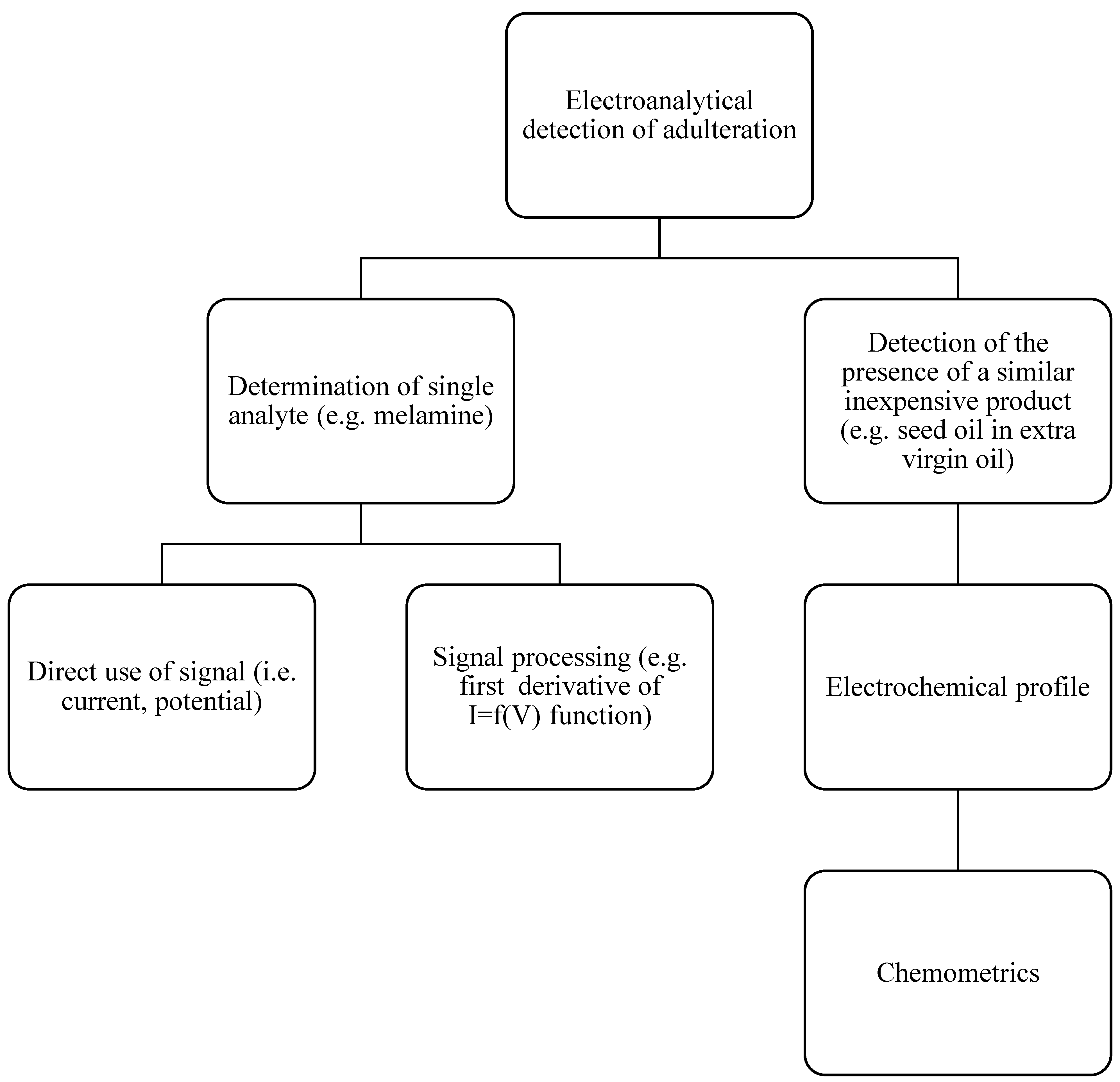

Table 1.
Common adulterations in foodstuffs and beverages.
| Foodstuff/ Beverage | Adulterants | Reference |
|---|---|---|
| Olive oil | Seed oils (e.g. sunflower, soybean, sesame, corn, hazelnut oil), olive oil of lower grade (e.g. olive pomace oil, lampante olive oil) | 1, 9 |
| Honey | Sugar, rice syrups, barley syrups, corn syrups, rice molasses, less expensive honey (e.g. polyfloral) | 2, 10,11 |
| Milk and dairy products | Water, starch, glucose and other sugars, soybean and pea protein isolates, boric acid, salicylic acid, benzoic acid, melamine, urea, maltodextrose, cheese whey (byproduct of cheese production, hydrogen peroxide, reconstituted skim milk powder. Different milk species (cow’s, sheep’s and buffalo’s milk) | 1, 2, 8, 12 |
| Wine | Synthetic sweeteners (e.g. saccharin), sugar, ethanol, flavour, water, synthetic dyes, apple juice. | 1, 3, 5- 7 |
| Whiskey | Alcohol (non-drinking or cereal alcohol), water caramel, dyes, flavours, beverages of lower commercial value, whiskey of different brands, ageing and blending (lower cost) | 1, 4 |
Disclaimer/Publisher’s Note: The statements, opinions and data contained in all publications are solely those of the individual author(s) and contributor(s) and not of MDPI and/or the editor(s). MDPI and/or the editor(s) disclaim responsibility for any injury to people or property resulting from any ideas, methods, instructions or products referred to in the content. |
© 2025 by the authors. Licensee MDPI, Basel, Switzerland. This article is an open access article distributed under the terms and conditions of the Creative Commons Attribution (CC BY) license (http://creativecommons.org/licenses/by/4.0/).
Copyright: This open access article is published under a Creative Commons CC BY 4.0 license, which permit the free download, distribution, and reuse, provided that the author and preprint are cited in any reuse.


