

Submitted:
05 April 2026
Posted:
09 April 2026
You are already at the latest version
Abstract
More than 30 lines of discrete, independent evidence implicate the exposure of susceptible babies and children to acetaminophen with the etiology of autism spectrum disorder (ASD). The most abundant source of evidence is from the fields of pharmacology and toxicology, with clinical and epidemiological observations, numerous miscellaneous observations, and studies in laboratory animal models providing conclusive support. This narrative review summarizes that evidence, and discusses recent work with sibling control analysis that has been unfortunately misinterpreted as a result of incorrect assignment of interacting variables as confounding factors. Susceptibility to acetaminophen-induced injury is imposed by a range of genetic, epigenetic, and environmental factors associated with oxidative stress, and is apparently the greatest immediately after birth. Susceptibility then decreases until about six years of age, which is outside of the developmental window in which regression into ASD typically occurs. Although associations between heavy use of acetaminophen during pregnancy and ASD suggest some risk may be present during pregnancy, insufficient evidence is available to know if sporadic use of acetaminophen during pregnancy poses any risks. Given continued use of acetaminophen during labor and delivery, and routine use during early childhood including for indications including circumcision, vaccination, and some chronic medical conditions, a course correction in clinical practice is much needed.
Keywords:
acetaminophen
; autism
; inflammation
; oxidative stress
; paracetamol
1. Introduction
Abundant evidence has led us to conclude, without reasonable doubt, that exposure of susceptible babies and children to acetaminophen causes neurodevelopmental injury, leading to many if not most cases of autism spectrum disorder (ASD) [1,2,3,4]. Evidence also demonstrates that a wide range of genetic, epigenetic and environmental factors associated with oxidative stress create susceptibility to acetaminophen-induced injury. Furthermore, the developmental period of greatest susceptibility appears to be at the time of birth, with susceptibility diminishing over time and ending almost completely by about six years of age [3]. A current summary of evidence that, when considered together, demonstrates the induction of ASD in susceptible individuals by acetaminophen is shown in Table 1, Table 2, Table 3, Table 4 and Table 5. The 32 lines of evidence shown in the tables are divided into five categories separated into tables based on the nature of that evidence. No attempt is made to “grade” the evidence or rank the evidence in relative terms. Any such effort would involve comparing very different lines of evidence, for example one line of evidence derived from over a dozen studies in laboratory animal models versus another line of evidence derived from many dozens of studies regarding risk factors associated with ASD and their impact on the metabolism of acetaminophen. Any attempt at such comparisons would be highly subjective at best, and arbitrary to at least some extent.
Importantly, no line of evidence alone is sufficient to arrive at any conclusion regarding a causal relationship between acetaminophen exposure and ASD. It is the weight of total evidence, taken together, which is overwhelmingly conclusive. Evidence is numbered sequentially starting with line of evidence #1 in the beginning of Table 1 and ending with line of evidence #32 at the end of Table 5. The 5 categories are as follows:
- Pharmacology/toxicology related evidence (Table 1; 9 lines of evidence, #1 through #9)
- Associations between ASD and acetaminophen use (Table 2; 5 lines of evidence; #10 through #14)
- Laboratory animal studies (Table 3; 4 lines of evidence; #15 through #18)
- Miscellaneous observations (Table 3; 9 lines of evidence; #19 through #27)
- Associations in place and time (Table 5; 5 lines of evidence; #28 through #32)
Throughout the text, particular lines of evidence will be referenced according to their number assigned in Table 1, Table 2, Table 3, Table 4 and Table 5. For example, the fact that fetal alcohol spectrum disorder shares many similarities with ASD is listed in Table 4 as the 25th line of evidence, and will be listed in the text as line of evidence #25. Again, no single line of evidence is used to make a “leap” to any conclusion, but rather it is the weight of total evidence that is used to draw conclusions.
A very brief summary of all evidence is shown in Figure 1. The numbering in Figure 1 corresponds with the numbers shown in Table 1, Table 2, Table 3, Table 4 and Table 5. This list of evidence (Table 1, Table 2, Table 3, Table 4 and Table 5 and Figure 1) is an update from previously published lists. It is important to note, however, that additions to the list do not involve new evidence reported for the first time in this review. Rather, the updated list incorporates existing, previously published evidence into the list for the first time.
Each of the 32 lines of evidence shown in the tables was derived independently, with some lines of evidence being corroborated by multiple research groups. However, in compiling evidence, some information that is discrete and derived independently has been combined into a single category for the sake of clarity and ease of communication. For example, studies examining the effect of acetaminophen on learning in mice are combined with studies of the effect of acetaminophen on social behavior in rats, forming a single line of evidence (line of evidence #15). As another example, the association of ASD with deficiencies in two distinct metabolic pathways involved in the non-toxic metabolism of acetaminophen (line of evidence #4) are lumped into a single category. That line of evidence is summarized in Figure 2, which brings together several lines of pharmaceutical evidence (lines of evidence #1, #3, #4, and #8). Thus, the evidence provided could be divided into more than 32 lines of evidence while maintaining the requirement that each line of evidence remain discrete and independent, and the number of lines of evidence that could be considered discrete and independent exceeds 32. With this in mind, the number 32 should not be considered a precise tabulation of evidence, and will be considered a conservative tally of discrete and independently derived evidence for the sake of this review.
The most recent previously published tally of evidence from our group listed 22 lines of evidence from clinical observations, pharmacokinetic consideration, laboratory animal studies, and other fields of inquiry [3]. Since that list of evidence was published in 2023, additional lines of evidence were described in the literature in 2024, including the numerous similarities between ASD and fetal alcohol spectrum disorder [4], which demonstrate that a single drug, interacting with environmental and genetic factors, can cause a complex spectrum disorder. In addition, prenatal exposure to valproate, a drug commonly used as an anti-seizure medication, can also induce a spectrum disorder [5]. Of note is the fact that acetaminophen [6,7], alcohol [8,9], and valproate [10] are all metabolized by the human body via cytochrome P450 enzymes to produce a toxic metabolite in the reactive electrophile class.
Another example of evidence newly added to the list connecting acetaminophen with neurodevelopmental problems, including ASD, is a study by Graeca and Kulesza showing that exposure of laboratory rats to acetaminophen in utero leads to problems with auditory processing later in life [11]. As reviewed by the authors [11], some degree of auditory dysfunction is seen in the majority of individuals with ASD. However, it remains unknown whether the acetaminophen-induced auditory dysfunction observed in laboratory rats is related to auditory dysfunction observed in individuals with ASD. Thus, this line of evidence, by itself, does not lead to the conclusion that acetaminophen can act as a trigger for the induction of ASD. Nevertheless, the study by Graeca and Kulesza adds to an already overwhelming body of evidence connecting acetaminophen with developmental problems and the induction of ASD in particular, and therefore should be included in an updated tally of evidence (line of evidence #17). Other line of evidence that has been included involves the relationships between arachidonic acid metabolism and acetaminophen [12,13], and between arachidonic acid metabolism and ASD [14,15]. These studies, taken together, suggest that arachidonic acid could be involved in the acetaminophen-mediated induction of ASD by mechanisms that have yet to be elucidated, and constitute yet another link between acetaminophen and ASD (line of evidence #7).
The current summary of evidence demonstrating the induction of ASD in susceptible individuals by acetaminophen conservatively entails 32 lines of discrete and independent evidence (Table 1, Table 2, Table 3, Table 4 and Table 5, Figure 1). Despite this overwhelming evidence, acetaminophen continues to be used in the pediatric population. For example, although acetaminophen is not generally recommended for vaccinations by the World Health Organization [16], three doses of acetaminophen are now recommended for use with each dose of the vaccine against meningococcal serogroup B (MenB), administered to 2, 4, and 12 months of age (see discussion below). Given the existence of this policy and of the ongoing acceptance of acetaminophen use during early development, one obvious question is, do we have enough evidence of harm from acetaminophen to change practice regarding its use?
1.1. How Much Evidence Is Enough?
Although randomized, blinded, placebo-controlled experiments to obtain absolute proof that acetaminophen induces ASD in humans might seem worthwhile at first glance, such experiments would be both impractical and unethical. In terms of trial design, acetaminophen effectively treats fevers, so study subjects would be able to effectively guess their study group, making a blinded placebo control difficult. In addition, even without a blinded placebo control, exposure would need to be controlled from conception to age 5 in thousands of individuals, consuming vast amounts of time and resources for the trial. Even more important is the fact that evidence (Table 1, Table 2, Table 3, Table 4 and Table 5) already conclusively demonstrates that acetaminophen is a developmental neurotoxin. Thus, exposure of any fetus, baby or child to the drug for the sake of research is unethical.
Changes in clinical practice should not require enough evidence to conclude without any reasonable doubt that exposure of susceptible children to acetaminophen causes many if not most cases of ASD. In general, the “precautionary principle” should prevail, which requires only that a threat be “reasonable and plausible” to be avoided [17].
Only a few lines of evidence are required to conclude that acetaminophen exposure may reasonably and plausibly be connected with neurodevelopmental problems. For example, the facts that, (a) children with ASD are deficient in a metabolic pathway (sulfation) that is necessary for safe metabolism of acetaminophen (a part of line of evidence #4), (b) relatively low doses acetaminophen in early life cause long-term brain dysfunction in laboratory mice and rats (line of evidence #15), and (c) acetaminophen can’t be used in some domestic animals because they are deficient in the same pathway (glucuronidation) that is deficient in all newborn babies (line of evidence #5) should have been sufficient to remove the drug entirely from the pediatric market more than a decade ago.
From another perspective, the 2008 study by Schultz and colleagues [18] should have been sufficient to have the safety of acetaminophen for pediatric use completely and immediately reevaluated. That study (line of evidence #12) provided an explanation for the repeated observation that many parents believe that a vaccine was involved in the induction of their child’s ASD (line of evidence #22). Although the study suggested that the vast majority of all regressive ASD might be induced by acetaminophen, it was largely ignored for reasons that, based on an in-depth analysis [1], are invalid. Further, the rationale underlying the widespread but erroneous belief that acetaminophen was proven safe for use in babies and children was not critically evaluated until more than a decade later, in 2022 [19] (line of evidence #19).
The bottom line is that evidence sufficient to drive regulatory changes and changes in clinical practice has long been ignored. Further, proof without reasonable doubt that exposure of susceptible children to acetaminophen causes ASD exceeds what should be required to remove the drug entirely from the pediatric market. Suspicion of danger should be sufficient. At this point, the evidence (Table 1, Table 2, Table 3, Table 4 and Table 5, Figure 1) leads to a level of certainty that far exceeds suspicion.
1.2. A Single Line of Easily Misconstrued Evidence Dominates the Current Discussion
Observational studies assessing acetaminophen use and neurological outcomes have dominated the medical literature and public discourse surrounding the link between acetaminophen and ASD. More than 20 studies assessing the connection between prenatal acetaminophen use and ASD (line of evidence #11a), and one study assessing the connection between postnatal acetaminophen use and ASD (line of evidence #11b) have been published. Such studies can provide insight into potential causality. Indeed, if no association exists, causality is not likely.
Recent events surrounding the connection between acetaminophen and autism brought the issue to the forefront of public discussion. On September 22, 2025, the president of the United States, Donald Trump, along with several high-ranking members of the US Health and Human Services, announced publicly that acetaminophen should be avoided early in life due to risks for development of ASD. Numerous papers were subsequently and rapidly published in the medical literature concluding that no strong evidence pointed toward associations between acetaminophen use and neurodevelopmental problems [20,21,22,23,24,25,26,27,28,29,30,31,32,33,34,35,36,37,38,39,40,41,42,43,44,45,46,47,48,49,50,51]. These papers were largely focused on epidemiological studies connecting acetaminophen use with ASD during pregnancy (line of evidence #11a), or one line of evidence out of 32 lines of evidence shown in Table 1, Table 2, Table 3, Table 4 and Table 5. In particular, conclusions of these papers were largely dependent on one particular epidemiologic study, Ahlqvist et al., which concluded that acetaminophen use during pregnancy was not associated with ASD [52]. Since causal relationships generally do not occur without correlation, this conclusion was taken to mean that no evidence links the use acetaminophen with risk for ASD. The conclusions reached based on the study by Ahlqvist had been shown to be profoundly flawed [4] prior to the US government’s public announcement, reconciling epidemiologic evidence with other evidence shown in Table 1, Table 2, Table 3, Table 4 and Table 5 and Figure 1. Unfortunately, the demonstration that the conclusions based on the study by Ahlqvist et al. and other similar studies were fatally flawed [4] was overlooked.
A recent review of the safety of analgesics in pediatric practice by Milani and colleagues [28] summarizes the current state of thinking in the field of pediatrics:
Early observational studies suggested possible associations, but these were limited by methodological weaknesses. More robust evidence has clarified the issue: a large Swedish sibling control cohort [52] found no causal link with autism, attention deficit and hyperactivity disorders (ADHD), or intellectual disability, and a comprehensive umbrella review [20] confirmed that the overall weight of evidence does not support such an association.
These findings are reinforced by authoritative positions. The American College of Obstetricians and Gynecologists (ACOG) explicitly states in its 2025 Practice Advisory [53] that acetaminophen remains the first-line analgesic and antipyretic in pregnancy, with no evidence of a causal link to neurodevelopmental disorders. The American Academy of Pediatrics (AAP) [54] and the Society for Maternal-Fetal Medicine (SMFM) [55] share this stance, emphasizing that benefits outweigh theoretical risks.
Regulatory agencies have issued similar confirmations: the UK Medicines and Healthcare products Regulatory Agency (MHRA) [56], the European Medicines Agency together with AIFA [57], and the World Health Organization (WHO) [58] all conclude that current data do not justify changes in clinical practice.
This summary, succinctly and clearly written, is supported by (a) only one line of evidence that is entirely misinterpreted (see discussion below), and (b) an illusion of consensus. A true consensus is derived by multiple individuals coming to the same conclusion, whereas an illusion of consensus is obtained by multiple individuals embracing an idea without considering the foundation of that idea. Further, the agreement of numerous “authoritative positions” and regulatory agencies that embrace fundamental errors in the scientific literature does not in any way validate those errors. With this brief dismissal of overwhelming evidence described in this manuscript, Milani and colleagues demonstrate exactly why the prevalence of ASD in the US has increased beyond 3% of the total population, with most scientists and clinicians remaining unaware of the underlying cause.
The “raw analysis” from observational studies generally shows a strong connection between acetaminophen use and ASD. However, using statistical methods to adjust for factors that the authors believe might confound the conclusions, the associations between acetaminophen and ASD usually found in the raw analysis can be diminished or even removed entirely. For example, in the widely publicized study published by Ahlqvist and colleagues in 2024 [52], the raw data showed a strong connection between high levels of acetaminophen use during pregnancy and ASD (Figure 3). The relationship was dose-dependent, with high doses of acetaminophen associated with a hazard ratio of 1.87 (C.I.:1.71–2.06) and statistically significant associations (p < 0.001) at low, medium and high doses of acetaminophen. These associations are particularly concerning given the high prevalence of acetaminophen use in some populations. As we have previously discussed [2], a combination of the hazard ratio associated with a given factor and the prevalence of that factor in the population dictates the potential impact of that factor on public health. Thus, for something as common as acetaminophen use, any statistically significant risk for ASD is probably unacceptable.
However, the conclusion of the widely publicized paper by Ahlqvist noted above [52] was that “Acetaminophen use during pregnancy was not associated with children’s risk of autism…”. Those conclusions have been particularly consequential, leading to a media announcement from the US National Institutes of Health with a headline stating that “Study reveals no causal link between neurodevelopmental disorders and acetaminophen exposure before birth: NIH-funded research in siblings finds previously reported connection is likely due to other underlying factors.” [59]
The conclusion reached by Ahlqvist and colleagues [52], that acetaminophen use during pregnancy is not associated with ASD, was based on the application of statistical “correction” for confounding factors that are, in fact, associated with oxidative stress, a cofactor rather than a confounding factor in the induction of ASD. Any pharmacologist familiar with the metabolism of acetaminophen will be able to confirm that acetaminophen interacts with oxidative stress to create toxicity. The effect of correction for cofactor-associated variables in the Ahlqvist study is shown in Figure 3. As can be seen, the data published by Ahlqvist are exactly as expected if indeed acetaminophen, combined with a wide range of genetic, epigenetic and environmental factors related to oxidative stress, trigger the induction of ASD. As we and others have previously pointed out [2,4,60], the results of such corrections, while informative, cannot be used to determine whether associations are clinically important. Such an error in drawing conclusions from such studies will be evident to professional statisticians, suggesting that experts on the Ahlqvist study team performing statistical tests may have been unaware of the pharmacokinetics of acetaminophen, including interactions of the drug with factors related to inflammation and oxidative stress. In effect, Ahlqvist and colleagues catalogued the conditions under which acetaminophen is dangerous for neurodevelopment. They did not determine that the drug is safe for neurodevelopment. The same problem can be identified in a study by Tovo-Rodrigues and colleagues [61], who also adjusted their analysis using numerous factors related to oxidative stress.
A formal demonstration of the problem of statistical correction for cofactors (aka, predisposing factor or interacting variables) is shown in Figure 3 and Table 6. The table shows the results of a computer simulation in which 50 % of all cases of ASD were caused by a combination of oxidative stress and exposure to acetaminophen during an arbitrary time period. In this computer simulation, the raw (“uncorrected” analysis) shows a hazard ratio for ASD with acetaminophen use of 2.55 (CI 2.41–2.71, p = 2 x 10–16), close to the actual hazard ratio of 2.667 built into the model. However, after correcting for 100 % of the factors that account for all susceptibility to acetaminophen-mediated injury, the calculated hazard ratio for ASD with acetaminophen use is 0.85 (CI 0.80–0.90; p = 2 x 10⁻⁷). Thus, when oxidative stress factors are treated as confounding factors, acetaminophen is “shown” to be protective from ASD despite the fact that it actually caused 50 % of all ASD cases in this computer simulation.
Another problem with analyses of healthcare databases is that such analyses do not take into account that oxidative stress may be associated with genetic, epigenetic, or persistent environmental factors, causing persistence of susceptibility in an individual. The resulting effect is that assessment of acetaminophen exposure versus oxidative stress-related variables at a given time (e.g., during pregnancy or during infancy) may miss important injury-inducing exposure to acetaminophen that happened at a different time (e.g., during labor and delivery). The net result of this situation is that the analysis can identify associations between oxidative-stress related variables but not acetaminophen, even under ideal circumstances. That is to say, even if, hypothetically, 100 % of acetaminophen exposures are documented in a given study period, the net effect of limiting the study period (e.g., to prenatal or postnatal exposure) is that only a fraction of potentially important acetaminophen exposures will be documented. The only way to avoid this problem would be to assess all exposures to acetaminophen which might trigger ASD, from conception to age 5. Although such an approach is not feasible, sufficient evidence is already available (Table 1, Table 2, Table 3, Table 4 and Table 5) to draw conclusions for clinical practice. Therefore, the fact that ideal observational studies are not feasible should be of little concern.
A more recent analysis of sibling controlled data from Taiwan, according to the authors of the study, identified “unaddressed sources of bias and prevents firm conclusions from being drawn using the sibling design” [62]. In short, a positive association between autism and acetaminophen use (HR 1.75; 95% CI, 1.29–2.36) was observed when only the older sibling was exposed to acetaminophen. Potential sources of bias in the data include the fact that parents may halt reproduction after having a child with ASD [63,64], although this effect can be complex and possibly dependent on the population studied [65]. Another source of potential bias is rooted the facts that pregnancy is not the period of greatest risk for acetaminophen-induced induction of ASD [3], and individuals who have older siblings without ASD are expected to be, on average, less sensitive to the induction of ASD than are individuals with older siblings who do have ASD. Thus, individuals who have older siblings without ASD are, in theory, relatively less likely to experience ASD induction during pregnancy, when risk is relatively low compared to the immediate post-partum period and to very early childhood. However, the biases affecting current sibling control studies remain unknown, and errors underlying the assumptions employed in the analysis, described above and illustrated in Figure 3, stand out as the obvious flaw.
Misconstrued analyses of healthcare databases can be influential. An example of placing heavy emphasis on a misconstrued line of evidence is found in Graeca and Kulesza’s groundbreaking work showing acetaminophen-induced developmental problems related to auditory function [11]. The overreliance on observational studies as a basis for understanding the connection between acetaminophen and ASD is evident in the Introduction of that paper:
“Specifically, in utero (but not postnatal) exposure to paracetamol results in a 19% increased risk of ASD (Masarwa et al., 2018; Alemany et al., 2021; Khan et al., 2022)…”
The studies by Masarwa et al. in 2018 [66] and by Khan et al. in 2022 [67] cited by Graeca and Kulesza address only prenatal exposure. Therefore, Graeca and Kulesza base their conclusion that postnatal exposure to acetaminophen (paracetamol) is not associated with ASD solely on the study by Alemany and colleagues in 2021 [68]. However, Alemany and colleagues did not conclude that postnatal acetaminophen use is not associated with ASD. Rather, they concluded that postnatal use of acetaminophen is not associated with “autism spectrum condition symptoms”, which has a prevalence from 6 % to 13 % of the samples they evaluated, much higher than the prevalence of ASD in their study population. However, more than 80 % of Alemany’s sample (48,161 out of 58,006 total individuals) came from the Danish National Birth Cohort (DNBC), and ASD, not autism spectrum condition symptoms, was measured in that cohort. In Alemany’s analysis of the connection between postnatal acetaminophen use and ASD in the DNBC, they found a positive association (OR = 1.30, CI 1.02–1.66). Given that the DNBC dramatically underreports acetaminophen use [2], and given that the authors corrected for oxidative stress-related variables in an invalid fashion (see discussion above), the odds ratio of 1.30 is probably underestimated dramatically. Nevertheless, an odds ratio of 1.30 is profoundly concerning given the high prevalence of acetaminophen exposure. However, when reporting overall results, for example in the abstract of the paper, Alemany and colleagues combined results from analysis of ASD in the DNBC with results from analysis of smaller databases that reported only autism spectrum condition symptoms [68]. In their combined analysis, they counted (weighed) the very concerning results from the DNBC as only 31.84 % of the total, despite the facts that it contained more than 80 % of the total individuals, was the only database to contain measures of ASD, and was the only database which yielded statistically significant results in the analysis. Alemany and colleagues provided no explanation for the weighting scheme or for the lack of emphasis on the very concerning results from their analysis of the DNBC.
In short, analysis of associations between prenatal acetaminophen use and ASD (Table 2, line of evidence #11a) and associations between postnatal acetaminophen use and ASD (Table 2, line of evidence #11b) are informative and useful, but those lines of evidence have been fraught with misinformation, miscalculation, and misinterpretation. As we concluded recently [4]:
“It is concluded that risks of acetaminophen use for neurodevelopment obtained from multivariate analysis of cohort data depend on underlying assumptions in the analyses, and that other evidence, both abundant and robust, demonstrate the critical role of acetaminophen in the etiology of ASD.”
In a recent article in Environmental Health [69], Prada et al. assess evidence related to acetaminophen use during pregnancy and neurodevelopmental injury, including autism spectrum disorder (ASD). Prada et al., unlike other investigators, cited the formal mathematical proof [4] that treating critical and interacting variables as confounding factors will erroneously eliminate the contribution of acetaminophen to the induction of autism in the final analysis. Unfortunately, Prada et al. [69] dismissed the mathematical proof as “speculative”, without supporting “direct evidence”.
Support for the interaction between acetaminophen and oxidative stress in neurodevelopmental injury, particularly autism spectrum disorder (ASD) has been the subject of extensive review [70], and will not be described in detail here. However, as Prada et al. briefly reviewed themselves [69], studies in laboratory animals indicate that oxidative stress is a hallmark of acetaminophen-mediated neurological injury. More importantly, children with ASD are known to have an impaired ability to metabolize acetaminophen via phase II metabolic pathways [71,72], leading to the shunting of acetaminophen down a phase I pathway that involves a toxic intermediate (N-acetyl-p-benzoquinone imine; (NAPQI) [70,73]. NAPQI binds directly to cellular proteins, inducing toxicity, and it may also lead to other reactions that create further toxicity [74]. As noted in our current list of evidence (Table 1, line of evidence #3), enzymes that produce NAPQI are present during the induction of ASD or associated in some way with ASD. Further, neutralization of NAPQI is dependent on the “master antioxidant” in the human body, glutathione. Low concentrations of available (active, reduced state) glutathione are frequently used as an indicator of oxidative stress resulting from a vast number of stimuli. With these factors in mind, it is abundantly clear that oxidative stress will indeed enhance the toxicity of acetaminophen, and it is therefore difficult to understand why Prada et al. would dismiss warnings about treating oxidative stress related factors as confounding factors. Indeed, they provided no justification for their dismissal.
1.3. Plausible Mechanism
Given that the metabolism of acetaminophen yields a toxic metabolite, NAPQI (a reactive electrophile, similar to that produced by the metabolism of ethanol) especially under conditions associated with ASD, and given that the toxic metabolite affects mitochondrial and neuronal function, the induction of ASD by acetaminophen under conditions of oxidative stress is plausible from a mechanistic perspective (lines of evidence #1–5). The observation that ASD is similar in many regards to fetal alcohol spectrum disorder (line of evidence #25) demonstrates that a single chemical does, in fact, have the means to produce a complex developmental spectrum disorder.
The observation that acetaminophen affects social function in adults (line of evidence #20) demonstrates that the drug does indeed have a propensity to affect aspects of brain function involved in all ASD phenotypes. This view is corroborated by studies in laboratory animals [75] showing acetaminophen-mediated damage to cortical neurons (line of evidence #18), a cell type apparently involved in ASD phenotypes.
Although use of acetaminophen is frequently undocumented [1], evidence suggests that most individuals throughout the US and Europe are exposed to the drug both in utero and during early childhood [1], indicating that acetaminophen does indeed have the opportunity to induce ASD. As we have previously discussed [2], despite low levels (< 10 % of the population) of exposure to acetaminophen reported in the Danish and Swedish databases, assessments of acetaminophen use in those populations indicate that more than 50 % of those populations are exposed [76,77]. Further, factors associated with oxidative stress, which determine sensitivity to acetaminophen-mediated injury [70], are connected with reasons for using acetaminophen. Such factors include infection, antibiotic use, and headaches. Thus, exposure to acetaminophen of individuals susceptible to acetaminophen-mediated neurological injury is almost certainly higher than in the population as a whole, increasing risk. Also convincing is the direct measurement of acetaminophen metabolites in humans [60,78,79], which demonstrates widespread exposure to the drug during neurodevelopment in the populations assessed.
1.4. An Implausible Hypothesis: Acetaminophen Does Not Play a Critical Role in the Induction of ASD
A useful exercise of scientific reasoning is to consider the “null hypothesis”. In this case, what if acetaminophen does NOT play a critical role in the induction of ASD? If that is the case, several observations would be very difficult to explain.
- Why did Schultz find that acetaminophen exposure was the common denominator among children with regressive ASD, many of whom had parents that likely thought a vaccine was involved in the induction of their child’s ASD (line of evidence #12)?
- Why did Ji and colleagues find very strong correlations between acetaminophen use during labor and delivery and ASD (line of evidence #13)?
- Why is acetaminophen a potent neurodevelopmental toxin in laboratory rats and especially mice (line of evidence #15), but not humans?
- Why is acetaminophen safe in human neonates who have the same metabolic deficiency that makes acetaminophen dangerous in domestic cats (line of evidence #5)?
- Why is the circumcision procedure associated with adverse effects on social function later in life (line of evidence #10)?
- What is the explanation for the unusual prevalence of autism among Orthodox Jews (line of evidence #14), individuals with cystic fibrosis (line of evidence #23), and individuals in some Scandinavian countries (line of evidence #29)?
- Why is acetaminophen safe for human neonates even though it alters nerve development in tissue culture (Table 3, line of evidence #21)?
- Why do so many parents think their child’s autism was due in part to vaccinations (Table 3, line of evidence #22)?
Several other observations must be “coincidental” in the sense that they do not reflect any connection between acetaminophen and ASD. For examples.
- The formation of a toxic metabolite by acetaminophen in the presence of oxidative stress, which is associated with ASD (lines of evidence #1 through #4), must be coincidental.
- Similarities between FASD and ASD (line of evidence #25) must be coincidental or due to an unknown factor.
- Similarities between the effects of acetaminophen on adults and the hallmarks of the ASD phenotype (line of evidence #20) must be coincidental.
- The association of both acetaminophen and ASD with altered gut function (line of evidence #6) must be coincidental.
- The association of both acetaminophen and ASD with arachidonic acid metabolism (line of evidence #7), alterations in hearing and smell (line of evidence #17), and impaired Ca++ and mitochondrial function (line of evidence #9) must all be coincidental.
- The correlations in time between ASD prevalence and acetaminophen use must be coincidental (lines of evidence #28, #30, and #31).
Three alternative hypotheses can be considered in lieu of the critical role of acetaminophen in the induction of ASD. First, ASD could be genetic. Second, a factor other than acetaminophen could serve as a critical trigger for ASD. Third, ASD could be a result of a myriad of factors, both genetic and environmental, with none of those factors alone being critical. All of these hypotheses face some or all of the objections cited above, providing a strong basis to conclude that acetaminophen is, in fact, critical in the etiology of many if not most cases of ASD.
Recently, Fluegge and Fluegge argue that ASD is “specifically induced from environmental emissions of nitrous oxide (N2O)” rather than acetaminophen. In this view, increases in atmospheric nitrous oxide that result from use of synthetic nitrogen fertilizers, which began in the mid-1910s [80], are responsible for the pandemic of ASD. Their conclusions are not reconcilable with many of the observations described above, and were based on the argument that acetaminophen was first brought to market in 1954, over a decade after ASD was first described in 1943 by Leo Kanner [81]. According to Fluegge and Fluegge, the description of autism more than a decade before acetaminophen was introduced into the commercial market “considerably weakens the argument of causation” connecting acetaminophen with ASD. The authors were apparently unaware that acetaminophen was, for practical intents and purposes, introduced into commercial use in 1886. Both acetanilide (introduced in 1886 [82]) and phenacetin (introduced in 1887 [83,84]) are prodrugs that are converted into acetaminophen by the human body. This undermines the principle argument put forth by Fluegge and Fluegge, although it does not diminish the potential for nitrous oxide to contribute to the induction of ASD because of its tendency to induce oxidative stress [85,86]. Finally, it should be noted that ASD was first described in considerable detail by Grunya Sukhareva in 1925 [87,88], not by Kanner in 1943, although this fact would not affect the argument by Fluegge and Fluegge.
The idea that ASD is genetic is fraught with additional incompatibility with available evidence. If the disorder is genetic, then it cannot have changed dramatically over time.
- Why were early investigators oblivious to the high presence of ASD (line of evidence #31)?
- Since specific genes that are responsible for most cases of ASD cannot be found despite obvious heritability, why does the principle of missing heritability not apply (line of evidence #24)?
- Why do numerous observations indicate that ASD is rare in the absence of modern medicine (line of evidence #32)?
- Why is some ASD infantile, and other ASD regressive?
1.5. Barriers to Moving Forward
Necessary changes in practice should be, for the most part, a matter of rethinking the accepted routines and habits of analgesic use given overwhelming evidence that acetaminophen is a neurodevelopmental toxin [3]. However, the currently widespread acceptance of a view that does not include acetaminophen as a key component in the etiology of ASD may be impeding progress. The “multifactorial model”, in which a wide range of genetic, epigenetic and environmental factors contribute to the induction of ASD is now widely accepted by investigators in the field [4,89]. A wide range of genetic, epigenetic and environmental factors are indeed associated with ASD, but the conclusion based on this association that the etiology of ASD is “complex”, involving many factors, is an illusion of causality, or a false cause fallacy. Such errors in inferring cause based on association are compelling and extremely common [90], but can readily be avoided using science-based reasoning [91]. Since the wide range of ASD-associated factors have a common denominator (oxidative stress and inflammation) [70], and since compelling scientific evidence (Table 1, Table 2, Table 3, Table 4 and Table 5, Figure 1) demonstrates that a relatively simple model involving oxidative stress and acetaminophen describes the etiology of ASD, the multifactorial model should either be dismissed or subsumed under the simpler model [4].
Compelling evidence for the specific role of acetaminophen in the etiology of ASD has mounted for years. The first study in laboratory mice showing long-term, profound (almost complete) loss of important aspects of cognitive function following early life exposure to acetaminophen was published more than a decade ago, in 2013, by Viberg and colleagues [92]. In that study, two doses of 30 mg/kg acetaminophen were administered in one day. That dose is not exceedingly higher than the oral dosage of acetaminophen in babies and children, who can receive up to 4 doses of 14.7 mg/kg of acetaminophen on multiple, consecutive days. Given these results, acetaminophen could never be approved for pediatric use today, even in clinical trials, if it was evaluated using modern safeguards in place to prevent adverse drug reactions. The drug would not pass preclinical testing.
Shortly after Viberg’s study in laboratory mice in 2013, Frisch and Simonsen, two Danish investigators, found more than double the risk of infantile ASD associated with circumcision when assessing the Danish National Birth Cohort [93]. They initiated that investigation in part because Bauer had proposed that acetaminophen exposure during circumcision may induce ASD [94]. Although Frisch and Simonsen could not evaluate acetaminophen use during circumcision, their report did confirm the predictions of Bauer. Further, even if hospital records of acetaminophen administration had been available, these would have been of limited use. Parents are frequently told to administer acetaminophen at home following circumcision to help alleviate discomfort from the procedure that can last for several hours. Finally, a US study [95] found that male circumcision was associated with increased social aversion, corroborating the effects of circumcision on social function that were first observed by Frisch and Simonsen. Unfortunately, the Frisch and Simonsen study was largely ignored [96].
1.6. Clinical Implications
At the present time, no evidence supports the idea that the benefits of acetaminophen use outweigh the risks of neurodevelopmental injury. The drug has never been shown to be lifesaving or to provide any long-term benefits in any study. Fears over fevers tend to be unfounded, with no evidence supporting the view that acetaminophen can block adverse fever-associated events with long-term negative consequences. This topic has been reviewed in detail recently [3]. At the same time, acetaminophen exposure to babies and children seems to be performed with a cavalier attitude, likely due to the erroneous assumption that it is extremely safe because hepatoxicity is not generally induced, even at doses exceeding the recommended dose [97]. Hospital pharmacies, for example, generally recommend doses of acetaminophen up to 45 mg/kg when the drug is administered via the rectum [98,99,100], three times more than the recommended oral dose. The recommended dose for rectal administration is greater than the recommended dose for oral administration because, on average, the rectally administered drug has less bioavailability than the orally administered drug. However, the bioavailability of the drug administered via the rectal route is variable among children and especially neonates [99,100,101,102], which could result in some babies and children receiving considerably more acetaminophen than is possible via the oral route. Further, it seems unlikely that acetaminophen use with circumcision in the first hours of life is always considered with the possibility that some acetaminophen might remain in the neonate’s body as a result of the mother receiving the drug during labor and delivery. In addition, reports abound describing the common occurrence of acetaminophen administration more frequently than recommended, at doses higher than recommended, and for reasons that are not recommended (for review, see Patel et al. [2]), supporting the view that a cavalier attitude exists toward the drug among medical health professionals and possibly other caregivers.
Acetaminophen use during sensitive periods of neurodevelopment continues to be recommended by medical authorities without apparent awareness of the risks. An excellent example of a policy that should be reconsidered is the recommendation of three doses of acetaminophen concurrent with the meningococcal group B (MenB) vaccine at 2, 4, and sometimes 12 months of life [103], when acetaminophen-induced induction of ASD is likely [3]. Fortunately, Australian and Canadian authorities have determined that the MenB vaccine can be given separate from other vaccines and without acetaminophen [104,105]. It is this approach, in addition to avoidance of other acetaminophen exposures from the start of labor and delivery until after age 5, that should be strongly recommended by medical authorities. However, the risk of acetaminophen exposure to the fetus during pregnancy is presently uncertain, and parents-to-be should be made aware of this fact prior to pregnancy in order to make informed decisions and have plans in place to treat fever and pain during pregnancy.
Discontinuation of acetaminophen use during labor and delivery is perhaps the most impactful change that needs to be made immediately, and it also carries the least potential drawbacks. Other means of pain relief during labor and delivery are radically more effective than acetaminophen. The risks for ASD associated with acetaminophen at the time of birth are greater than at other times, and, based on pharmacological considerations, the time immediately post-partum carries the greatest risk of acetaminophen-mediated injury. This idea of sensitivity at the time of birth is not new. In his landmark treatise of 1964, instrumental in overturning the infamous “refrigerator mother hypothesis”, Bernard Rimland [106] states (quotes and italics as used by Rimland):
It may also be significant that “pure” cases of early infantile autism are almost invariably beautifully formed, having no stigmata. This suggests that the crippling factor takes its effect very late in the development of the infant—perhaps at birth or shortly after.
2. Conclusions
The call for “more research (and funds)” rather than calls for action is encouraged by perverse incentives within in the practice of science today [107]. However, the time for analyses of the acetaminophen/ASD connection considering only epidemiological evidence with substantial limitations and flawed underlying assumptions is in the past. Decisions based on analyses having depth without breadth have led to stagnation and a steady increase in the prevalence of ASD for more than half a century. Although no single line of evidence is conclusive, the weight of total evidence (Table 1, Table 2, Table 3, Table 4 and Table 5) is now overwhelming, demonstrating that acetaminophen is, in fact, a developmental neurotoxin that is responsible for many and possibly even the vast majority of all cases of ASD.
The conclusions regarding the role of acetaminophen in the induction of ASD and the recommendations for obstetric and pediatric practice expressed in this manuscript do not constitute an “opinion” in the classical sense of the word. The authors have reached the conclusion, without reasonable doubt, that many if not most cases of ASD are induced by exposure of susceptible individuals to acetaminophen. We have also concluded that the best explanation for all known observations is that the vast majority of ASD is induced by exposure of susceptible individuals to acetaminophen. Given these conclusions, and given the fact that acetaminophen use in the pediatric population has never been shown to have long-term benefits, the cost/benefit ratio of the drug in the pediatric population is insufficient to merit its continued use in that population. The axiom in medicine, “do no harm”, which is more reasonably stated as “do not knowingly do more harm than good”, is not a matter of question. Rather, the axiom is accepted as unquestionable and foundational, to the point of being included in an oath taken by all physicians. Thus, discontinuation of acetaminophen use from labor and delivery through the age of 5 years should be considered as a matter of course, not a matter of opinion. In contrast, use of acetaminophen during pregnancy merits additional study, and parents-to-be should be educated regarding the potential benefits and risks of acetaminophen exposure to their fetus.
Author Contributions
Conceptualization, J.P.J.III, R.A., S.M.-K. and W.P.; methodology, J.P.J.III, Z.K. and W.P.; validation, L.W., Z.K., and W.P; formal analysis, J.P.J.III; resources, J.P.J.III, Z.K., L.W., S.M.-K. and W.P.; writing—original draft preparation, R.A. and W.P.; writing—review and editing, J.P.J.III, Z.K., L.W., R.A., S.M.-K. and W.P.; project administration, W.P.; funding acquisition, J.P.J.III, Z.K., L.W., S.M.-K. and W.P. All authors have read and agreed to the published version of the manuscript.
Funding
This work was supported in part by generous donations to WPLab, Inc., a 501(c)3 non-profit focused on research and education regarding underlying causes of inflammatory-related diseases in high-income areas of the world. This research received no additional external funding.
Institutional Review Board Statement
Not applicable.
Informed Consent Statement
Not applicable.
Data Availability Statement
All data generated or analyzed during this study are included in the published article.
Acknowledgments
The authors wish to thank Kathryn J. Reissner, R. Randy Bollinger, Doron Goldberg, Paul Corrigan, Sean M. Blasko, Susan Poulton and John Poulton for invaluable insight and discussion. The authors also wish to thank Spencer Sharpe and Nathan Kohuth for vital logistical support.
Conflicts of Interest
The authors declare that they have no financial conflicts of interest to report. All authors have non-financial conflicts of interest arising from reputational risk, a conflict shared among most scientists and clinicians conducting work related to autism. Coauthors W.P. and R.A. are paid employees of WPLab. Coauthor L.W. is a paid employee of Northern Kentucky University. Coauthors J.P.J. III, Z.K. and S.M.-K. are non-paid collaborators working with WPLab. Coauthors W.P. and S.M.-K. are husband and wife.
References
- Zhao, L.; Jones, J.P.; Anderson, L.G.; Konsoula, Z.; Nevison, C.D.; Reissner, K.J.; Parker, W. Acetaminophen causes neurodevelopmental injury in susceptible babies and children: no valid rationale for controversy. Clin. Exp. Pediatr. 2024, 67, 126–139. [Google Scholar] [CrossRef] [PubMed]
- Patel, E.; Rd, J.P.J.I.; Bono-Lunn, D.; Kuchibhatla, M.; Palkar, A.; Hernandez, J.C.; Sarafian, J.T.; Lawton, V.G.; Anderson, L.G.; Konsoula, Z.; et al. The safety of pediatric use of paracetamol (acetaminophen): a narrative review of direct and indirect evidence. Minerva Pediatr. 2022, 74, 774–788. [Google Scholar] [CrossRef] [PubMed]
- Parker, W.; Anderson, L.G.; Jones, J.P.; Anderson, R.; Williamson, L.; Bono-Lunn, D.; Konsoula, Z. The Dangers of Acetaminophen for Neurodevelopment Outweigh Scant Evidence for Long-Term Benefits. Children 2023, 11, 44. [Google Scholar] [CrossRef] [PubMed]
- Jones, J.P.; Williamson, L.; Konsoula, Z.; Anderson, R.; Reissner, K.J.; Parker, W. Evaluating the Role of Susceptibility Inducing Cofactors and of Acetaminophen in the Etiology of Autism Spectrum Disorder. Life 2024, 14, 918. [Google Scholar] [CrossRef]
- Clayton-Smith, J.; Bromley, R.; Dean, J.; Journel, H.; Odent, S.; Wood, A.; Williams, J.; Cuthbert, V.; Hackett, L.; Aslam, N.; et al. Diagnosis and management of individuals with Fetal Valproate Spectrum Disorder; a consensus statement from the European Reference Network for Congenital Malformations and Intellectual Disability. Orphanet J. Rare Dis. 2019, 14, 1–21. [Google Scholar] [CrossRef]
- Albano, E; Rundgren, M; Harvison, PJ; Nelson, SD; Moldéus, P. Mechanisms of N-acetyl-p-benzoquinone imine cytotoxicity. Mol Pharmacol. 1985, 28(3), 306–11. [Google Scholar] [CrossRef] [PubMed]
- Luo, G.; Huang, L.; Zhang, Z. The molecular mechanisms of acetaminophen-induced hepatotoxicity and its potential therapeutic targets. Exp. Biol. Med. 2023, 248, 412–424. [Google Scholar] [CrossRef]
- Zakhari, S. Overview: How Is Alcohol Metabolized by the Body? 2006, 29, 245–254. [Google Scholar]
- LoPachin, R.M.; Gavin, T. Molecular Mechanisms of Aldehyde Toxicity: A Chemical Perspective. Chem. Res. Toxicol. 2014, 27, 1081–1091. [Google Scholar] [CrossRef]
- Shnayder, N.A.; Grechkina, V.V.; Khasanova, A.K.; Bochanova, E.N.; Dontceva, E.A.; Petrova, M.M.; Asadullin, A.R.; Shipulin, G.A.; Altynbekov, K.S.; Al-Zamil, M.; et al. Therapeutic and Toxic Effects of Valproic Acid Metabolites. Metabolites 2023, 13, 134. [Google Scholar] [CrossRef]
- Graeca, M.; Kulesza, R. Impaired brainstem auditory evoked potentials after in utero exposure to high dose paracetamol exposure. Hear. Res. 2024, 454, 109149. [Google Scholar] [CrossRef]
- Hinz, B.; Cheremina, O.; Brune, K. Acetaminophen (paracetamol) is a selective cyclooxygenase-2 inhibitor in man. FASEB J. 2007, 22, 383–390. [Google Scholar] [CrossRef] [PubMed]
- Högestätt, E.D.; Jönsson, B.A.G.; Ermund, A.; Andersson, D.A.; Björk, H.; Alexander, J.P.; Cravatt, B.F.; Basbaum, A.I.; Zygmunt, P.M. Conversion of Acetaminophen to the Bioactive N-Acylphenolamine AM404 via Fatty Acid Amide Hydrolase-dependent Arachidonic Acid Conjugation in the Nervous System. J. Biol. Chem. 2005, 280, 31405–31412. [Google Scholar] [CrossRef] [PubMed]
- El-Ansary, A.; Alfawaz, H.A.; Ben Bacha, A.; Al-Ayadhi, L.Y. Combining Anti-Mitochondrial Antibodies, Anti-Histone, and PLA2/COX Biomarkers to Increase Their Diagnostic Accuracy for Autism Spectrum Disorders. Brain Sci. 2024, 14, 576. [Google Scholar] [CrossRef] [PubMed]
- Hirai, T.; Umeda, N.; Harada, T.; Okumura, A.; Nakayasu, C.; Ohto-Nakanishi, T.; Tsuchiya, K.J.; Nishimura, T.; Matsuzaki, H. Arachidonic acid-derived dihydroxy fatty acids in neonatal cord blood relate symptoms of autism spectrum disorders and social adaptive functioning: Hamamatsu Birth Cohort for Mothers and Children (HBC Study). Psychiatry Clin. Neurosci. 2024, 78, 546–557. [Google Scholar] [CrossRef]
- Who Reducing pain at the time of vaccination: WHO position paper, September 2015—Recommendations. Vaccine 2016, 34, 3629–3630. [CrossRef]
- Resnik, D.B. The Precautionary Principle and Medical Decision Making. J. Med. Philos. A Forum Bioeth. Philos. Med. 2004, 29, 281–299. [Google Scholar] [CrossRef]
- Schultz, ST; Klonoff-Cohen, HS; Wingard, DL; Akshoomoff, NA; Macera, CA; Ji, M. Acetaminophen (paracetamol) use, measles-mumps-rubella vaccination, and autistic disorder. The results of a parent survey. Autism 2008, 12(3), 293–307. [Google Scholar] [CrossRef]
- Cendejas-Hernandez, J.; Sarafian, J.T.; Lawton, V.G.; Palkar, A.; Anderson, L.G.; Larivière, V.; Parker, W. Paracetamol (acetaminophen) use in infants and children was never shown to be safe for neurodevelopment: a systematic review with citation tracking. Eur. J. Pediatr. 2022, 181, 1835–1857. [Google Scholar] [CrossRef]
- Sheikh, J.; Allotey, J.; Sobhy, S.; Plana, M.N.; Martinez-Barros, H.; Naidu, H.; Junaid, F.; Sofat, R.; Mol, B.W.; Kenny, L.C.; et al. Maternal paracetamol (acetaminophen) use during pregnancy and risk of autism spectrum disorder and attention deficit/hyperactivity disorder in offspring: umbrella review of systematic reviews. BMJ 2025, 391, e088141. [Google Scholar] [CrossRef]
- Weaponizing uncertainty in science and in public health puts people in harm’s way. Nature 2025, 646, 259–260. [CrossRef] [PubMed]
- Pearson, H.; Ledford, H. Trump links autism and Tylenol: is there any truth to it? Nature 2025. [Google Scholar] [CrossRef] [PubMed]
- Looi, M.-K.; Bowie, K. Autism: Trump links condition to Tylenol and touts leucovorin as “first” US therapeutic. BMJ 2025, 390, r2004. [Google Scholar] [CrossRef] [PubMed]
- Schweitzer, K. Acetaminophen Use in Pregnancy—Study Author Explains the Data. JAMA 2025, 334, 1499. [Google Scholar] [CrossRef]
- Andrade, C. Maternal Use of Acetaminophen (Paracetamol) During Pregnancy and Neurodevelopmental Disorders in Offspring. J. Clin. Psychiatry 2025, 86. [Google Scholar] [CrossRef]
- Louwen, F.; Deuster, E.; McAuliffe, F.M.; Jacobsson, B.; Geary, M.; Fleischman, S.; Kihara, A. Paracetamol (acetaminophen) use during pregnancy and autism risk: Evidence does not support causal association. Int. J. Gynecol. Obstet. 2025, 171, 915–919. [Google Scholar] [CrossRef]
- Fombonne, E. Editorial: The acetaminophen scare: association vs causation. J. Child Psychol. Psychiatry 2025, 66, 1621–1626. [Google Scholar] [CrossRef]
- Milani, G.P.; Nicolini, G.; Cananzi, M.; Spiezia, L.; Vidal, E. Efficacy and Safety of Paracetamol and NSAIDs for Fever and Pain Management in Children with Chronic Diseases: A Narrative Review. Children 2026, 13, 71. [Google Scholar] [CrossRef]
- Wise, J. Paracetamol (Tylenol): No clear link between use in pregnancy and autism or ADHD in children, rapid review finds. BMJ 2025, 391, r2368. [Google Scholar] [CrossRef]
- Lee, B.K.; Stephansson, O.; Gardner, R.M. Paracetamol (acetaminophen) use in pregnancy and risk of autism and ADHD. BMJ 2025, 391, r2438. [Google Scholar] [CrossRef]
- Lang, K. Trump’s claims on Tylenol (paracetamol), vaccines, and autism—what’s the truth? BMJ 2025, 390, r2025. [Google Scholar] [CrossRef]
- Aronson, J.K. When I use a word... Paracetamol/acetaminophen—autism and asthma. BMJ 2025, 390, r2032. [Google Scholar] [CrossRef]
- Gupta, S.; Kopacz, K.S.; Hurdle, M.F.B. Acetaminophen, autism, and analgesia in pregnancy—a pain medicine perspective. Pain Manag. 2025, 16, 1–3. [Google Scholar] [CrossRef] [PubMed]
- Ottewell, L.; Wright, F. Purity, politics and pain: Trump’s paracetamol posturing and the moralisation of pregnancy. Med Humanit. 2025. [Google Scholar] [CrossRef] [PubMed]
- Gardner, R.M.; Lee, B.K. Triangulating Evidence on Prenatal Acetaminophen Use: Insights From a Large Japanese Cohort. Paediatr. Périnat. Epidemiology 2025, 40, 80–82. [Google Scholar] [CrossRef] [PubMed]
- Shah, R.; Hargreaves, D. Autism, paracetamol and folic acid: the perils of health misinformation. Arch. Dis. Child. 2026. [Google Scholar] [CrossRef]
- Mahase, E. Paracetamol (Tylenol) in pregnancy: fresh study dispels autism risk. BMJ 2026, 392, s113. [Google Scholar] [CrossRef]
- American College of Medical Toxicology. ACMT Position Statement: ACMT Responds to the Acetaminophen and Autism Controversy. J. Med Toxicol. 2026, 22, 106–109. [Google Scholar] [CrossRef]
- O’lEary, K. New analysis shows no link between autism and paracetamol. Nat. Med. 2026. [Google Scholar] [CrossRef]
- Brown, C. Is paracetamol in pregnancy a risk factor for ADHD? Nature 2026. [Google Scholar] [CrossRef]
- Bérard, A.; Cottin, J.; Leal, L.F.; Picot, C.; Pleau, J.; Friedman, J.M.; Damkier, P.; Cucherat, M.; Alwan, S.; Jurek, L.; et al. Systematic Review and Meta-Analysis: Acetaminophen Use During Pregnancy and the Risk of Neurodevelopmental Disorders in Childhood. J. Am. Acad. Child Adolesc. Psychiatry 2025, 65, 484–504. [Google Scholar] [CrossRef] [PubMed]
- Bhamjee, S. Paracetamol, pregnancy and law: What the Texas Tylenol case teaches SA doctors. South Afr. Fam. Pr. 2026, 68, e1–e4. [Google Scholar] [CrossRef] [PubMed]
- Marchetti, F. Autismo, paracetamolo e vaccini: quando la retorica politica sfida le evidenze scientifiche. Recenti Progress. Med. 2026, 117, 83–86. [Google Scholar] [CrossRef] [PubMed]
- Pérez-Bermejo, M.; Murillo-Llorente, M.T.; Tudela, J. Is There a Link Between Paracetamol and Autism? A Response to “Evaluation of the Evidence on Acetaminophen Use and Neurodevelopmental Disorders Using the Navigation Guide Methodology”. Linacre Q. 2026. [Google Scholar] [CrossRef]
- Smith, R.; Zipursky, J.S. Safety of acetaminophen use in pregnancy: review of existing evidence. Am. J. Obstet. Gynecol. MFM 2026, 8, 101925. [Google Scholar] [CrossRef]
- Yalçın, H.T.; Yalçın, N.; Allegaert, K.; Erkekoğlu, P. A Noisy Signal? Geographic Bias in FAERS Reports Linking Paracetamol to Autism Spectrum Disorder. J. Clin. Med. 2026, 15, 902. [Google Scholar] [CrossRef]
- Trovò, L; Kucera, G; Gomez, G; de Souza, JS; Muotri, AR; Iakoucheva, LM. Prenatal Acetaminophen Exposure Does Not Disrupt Human Fetal Brain Development in Cortical Organoid Models. In bioRxiv;PubMed; PubMed Central, 2025. [Google Scholar] [CrossRef] [PubMed] [PubMed Central]
- Mataix-Cols, D.; Pol-Fuster, J.; de la Cruz, L.F.; Lichtenstein, P.; D'ONofrio, B.M.; Brander, G.; Gardner, R. Familial confounding and causal inference in child and adolescent neurodevelopment and mental health. Lancet Child Adolesc. Heal. 2026. [Google Scholar] [CrossRef]
- Balkanas, M.; Durcan, G.; Doğangün, B. Emerging Discussions on Folinic Acid and Acetaminophen in Autism. J. Autism Dev. Disord. 2026, 1–3. [Google Scholar] [CrossRef]
- Letter, E.F.T.M. Prenatal Acetaminophen Use and Autism. Med Lett. Drugs Ther. 2025, 67, 193–195. [Google Scholar] [CrossRef]
- Szubert, M.; Stojko, R.; Sieroszewski, P. Statement of the Polish Society of Gynecologists and Obstetricians on paracetamol use during pregnancy and autism risk. Ginekol. Polska 2025. [Google Scholar] [CrossRef]
- Ahlqvist, V.H.; Sjöqvist, H.; Dalman, C.; Karlsson, H.; Stephansson, O.; Johansson, S.; Magnusson, C.; Gardner, R.M.; Lee, B.K. Acetaminophen Use During Pregnancy and Children’s Risk of Autism, ADHD, and Intellectual Disability. JAMA 2024, 331, 1205–1214. [Google Scholar] [CrossRef] [PubMed]
- ACOG. Practice Advisory: Acetaminophen use in pregnancy and neurodevelopmental outcomes: American College of Obstetricians & Gynecologists. 2025 [January 1 2026. Available online: https://www.acog.org/clinical/clinical-guidance/practice-advisory/articles/2025/09/acetaminophen-use-in-pregnancy-and-neurodevelopmental-outcomes.
- American Academy of Pediatrics. Acetaminophen is Safe for Children When Taken as Directed, No Link to Autism 2025. updated October 29, 2025December 24, 2025. Available online: https://www.aap.org/en/news-room/fact-checked/acetaminophen-is-safe-for-children-when-taken-as-directed-no-link-to-autism/.
- SMFM Statement on Acetaminophen Use During Pregnancy and Autism: Society for Maternal Fetal Medicine. 2025 [January 1 2026. Available online: https://www.smfm.org/news/smfm-statement-on-acetaminophen-use-during-pregnancy-and-autism.
- MHRA confirms taking paracetamol during pregnancy remains safe and there is no evidence it causes autism in children: Medicines and Healthcare products Regulatory Agency. 2025 [January 1 2026. Available online: https://www.gov.uk/government/news/mhra-confirms-taking-paracetamol-during-pregnancy-remains-safe-and-there-is-no-evidence-it-causes-autism-in-children.
- Use of paracetamol during pregnancy: European recommendations confirmed: The Italian Medicines Agency (AIFA) 2025. 1 January 2026. Available online: https://www.aifa.gov.it/en/-/uso-del-paracetamolo-in-gravidanza-confermate-le-raccomandazioni-europee.
- WHO statement on autism-related issues: World Health Organization. 2025 [January 1 2026. Available online: https://www.who.int/news/item/24-09-2025-who-statement-on-autism-related-issues.
- Study reveals no causal link between neurodevelopmental disorders and acetaminophen exposure before birth [Internet]. NIH cited. 2024; April 11, 2024.
- Baker, B.H.; Bammler, T.K.; Barrett, E.S.; Bush, N.R.; Collett, B.R.; Derefinko, K.J.; Enquobahrie, D.A.; Karr, C.J.; LeWinn, K.Z.; Liu, J.; et al. Associations of maternal blood biomarkers of prenatal APAP exposure with placental gene expression and child attention deficit hyperactivity disorder. Nat. Ment. Heal. 2025, 3, 318–331. [Google Scholar] [CrossRef] [PubMed]
- Tovo-Rodrigues, L.; Carpena, M.X.; Martins-Silva, T.; Santos, I.S.; Anselmi, L.; Barros, A.J.D.; Barros, F.C.; Bertoldi, A.D.; Matijasevich, A. Low neurodevelopmental performance and behavioural/emotional problems at 24 and 48 months in Brazilian children exposed to acetaminophen during foetal development. Paediatr. Périnat. Epidemiology 2020, 34, 278–286. [Google Scholar] [CrossRef]
- Lee, P.-C.; Chuang, Y.-H.; Hu, Y.-H.; Lin, C.-N.; Li, C.-Y.; Chen, Y.-Y.; Heck, J.E.; Bellia, G.; Zhuo, H.; Arah, O.A.; et al. Maternal Acetaminophen Use and Child Neurodevelopment. JAMA Pediatr. 2026. [Google Scholar] [CrossRef]
- Hoffmann, T.J.; Windham, G.C.; Anderson, M.; Croen, L.A.; Grether, J.K.; Risch, N. Evidence of Reproductive Stoppage in Families With Autism Spectrum Disorder. JAMA Psychiatry 2014, 71, 943–951. [Google Scholar] [CrossRef]
- Power, R.A.; Kyaga, S.; Uher, R.; MacCabe, J.H.; Långström, N.; Landen, M.; McGuffin, P.; Lewis, C.M.; Lichtenstein, P.; Svensson, A.C. Fecundity of Patients With Schizophrenia, Autism, Bipolar Disorder, Depression, Anorexia Nervosa, or Substance Abuse vs Their Unaffected Siblings. JAMA Psychiatry 2013, 70, 22–30. [Google Scholar] [CrossRef]
- Kuja-Halkola, R.; Larsson, H.; Lundström, S.; Sandin, S.; Chizarifard, A.; Bölte, S.; Lichtenstein, P.; Frans, E. Reproductive stoppage in autism spectrum disorder in a population of 2.5 million individuals. Mol. Autism 2019, 10, 1–10. [Google Scholar] [CrossRef]
- Masarwa, R.; Levine, H.; Gorelik, E.; Reif, S.; Perlman, A.; Matok, I. Prenatal Exposure to Acetaminophen and Risk for Attention Deficit Hyperactivity Disorder and Autistic Spectrum Disorder: A Systematic Review, Meta-Analysis, and Meta-Regression Analysis of Cohort Studies. Am. J. Epidemiology 2018, 187, 1817–1827. [Google Scholar] [CrossRef]
- Khan, F.Y.; Kabiraj, G.; A Ahmed, M.; Adam, M.; Mannuru, S.P.; Ramesh, V.; Shahzad, A.; Chaduvula, P.; Khan, S. A Systematic Review of the Link Between Autism Spectrum Disorder and Acetaminophen: A Mystery to Resolve. Cureus 2022, 14, e26995. [Google Scholar] [CrossRef]
- Alemany, S.; Avella-García, C.; Liew, Z.; García-Esteban, R.; Inoue, K.; Cadman, T.; López-Vicente, M.; González, L.; Galán, I.R.; Andiarena, A.; et al. Prenatal and postnatal exposure to acetaminophen in relation to autism spectrum and attention-deficit and hyperactivity symptoms in childhood: Meta-analysis in six European population-based cohorts. Eur. J. Epidemiology 2021, 36, 993–1004. [Google Scholar] [CrossRef] [PubMed]
- Prada, D.; Ritz, B.; Bauer, A.Z.; Baccarelli, A.A. Evaluation of the evidence on acetaminophen use and neurodevelopmental disorders using the Navigation Guide methodology. Environ. Heal. 2025, 24, 1–42. [Google Scholar] [CrossRef] [PubMed]
- Parker, W.; Hornik, C.D.; Bilbo, S.; Holzknecht, Z.E.; Gentry, L.; Rao, R.; Lin, S.S.; Herbert, M.R.; Nevison, C.D. The role of oxidative stress, inflammation and acetaminophen exposure from birth to early childhood in the induction of autism. J. Int. Med Res. 2017, 45, 407–438. [Google Scholar] [CrossRef] [PubMed]
- Alberti, A.; Pirrone, P.; Elia, M.; Waring, R.H.; Romano, C. Sulphation deficit in “low-functioning” autistic children: a pilot study. Biol. Psychiatry 1999, 46, 420–424. [Google Scholar] [CrossRef]
- Geier, D.A.; Kern, J.K.; Garver, C.R.; Adams, J.B.; Audhya, T.; Geier, M.R. A Prospective Study of Transsulfuration Biomarkers in Autistic Disorders. Neurochem. Res. 2008, 34, 386–393. [Google Scholar] [CrossRef]
- Du, K.; Ramachandran, A.; Jaeschke, H. Oxidative stress during acetaminophen hepatotoxicity: Sources, pathophysiological role and therapeutic potential. Redox Biol. 2016, 10, 148–156. [Google Scholar] [CrossRef]
- Chan, J.C.Y.; Soh, A.C.K.; Kioh, D.Y.Q.; Li, J.; Verma, C.; Koh, S.K.; Beuerman, R.W.; Zhou, L.; Chan, E.C.Y. Reactive Metabolite-induced Protein Glutathionylation: A Potentially Novel Mechanism Underlying Acetaminophen Hepatotoxicity. Mol. Cell. Proteom. 2018, 17, 2034–2050. [Google Scholar] [CrossRef]
- Posadas, I.; Santos, P.; Blanco, A.; Muñoz-Fernández, M.; Ceña, V. Acetaminophen Induces Apoptosis in Rat Cortical Neurons. PLOS ONE 2010, 5, e15360. [Google Scholar] [CrossRef]
- Ertmann, R.K.; Møller, J.J.; Waldorff, F.B.; Siersma, V.; Reventlow, S.; Söderström, M. The majority of sick children receive paracetamol during the winter. 2012, 59, A4555. [Google Scholar]
- Bornehag, C.-G.; Reichenberg, A.; Hallerback, M.U.; Wikstrom, S.; Koch, H.; Jonsson, B.; Swan, S. Prenatal exposure to acetaminophen and children's language development at 30 months. Eur. Psychiatry 2018, 51, 98–103. [Google Scholar] [CrossRef]
- Ji, Y.; Azuine, R.E.; Zhang, Y.; Hou, W.; Hong, X.; Wang, G.; Riley, A.; Pearson, C.; Zuckerman, B.; Wang, X. Association of Cord Plasma Biomarkers of In Utero Acetaminophen Exposure with Risk of Atten-tion-Deficit/Hyperactivity Disorder and Autism Spectrum Disorder in Childhood. JAMA Psychiatry 2020, 77, 180–189. [Google Scholar] [CrossRef] [PubMed]
- Baker, B.H.; Lugo-Candelas, C.; Wu, H.; Laue, H.E.; Boivin, A.; Gillet, V.; Aw, N.; Rahman, T.; Lepage, J.-F.; Whittingstall, K.; et al. Association of Prenatal Acetaminophen Exposure Measured in Meconium With Risk of Attention-Deficit/Hyperactivity Disorder Mediated by Frontoparietal Network Brain Connectivity. JAMA Pediatr. 2020, 174, 1073–1081. [Google Scholar] [CrossRef] [PubMed]
- Frink, C.R.; Waggoner, P.E.; Ausubel, J.H. Nitrogen fertilizer: Retrospect and prospect. Proc. Natl. Acad. Sci. 1999, 96, 1175–1180. [Google Scholar] [CrossRef] [PubMed]
- Kanner, L. Autistic disturbances of affective contact. Nerv. Child 1943, 2, 217–250. [Google Scholar]
- Mahmud, S.; Rosen, N. History of NSAID Use in the Treatment of Headaches Pre and Post-industrial Revolution in the United States: the Rise and Fall of Antipyrine, Salicylic Acid, and Acetanilide. Curr. Pain Headache Rep. 2019, 23, 6. [Google Scholar] [CrossRef]
- Clissold, S.P. Paracetamol and Phenacetin. Drugs 1986, 32, 46–59. [Google Scholar] [CrossRef]
- Jaskch, v. Phenacetin and Thallin for Children. The Indian medical gazette;PubMed 1889, 24(7), 215. [Google Scholar] [PubMed] [PubMed Central]
- Grzych, G.; Diesnis, R.; Dupré, T.; Niguet, J.P.; Gernez, E.; Denimal, D.; Deheul, S.; Guichard, J.C.; Scliffet, D.; Mégarbane, B.; et al. Addressing the Global Challenge of Nitrous Oxide Misuse Through a Multidisciplinary Approach: Example of the PROTOSIDE Network. Toxics 2025, 13, 466. [Google Scholar] [CrossRef]
- Singh, S.K.; Misra, U.K.; Kalita, J.; Bora, H.K.; Murthy, R.C. Nitrous oxide related behavioral and histopathological changes may be related to oxidative stress. NeuroToxicology 2015, 48, 44–49. [Google Scholar] [CrossRef]
- Manouilenko, I.; Bejerot, S. Sukhareva—Prior to Asperger and Kanner. Nord. J. Psychiatry 2015, 69, 1761–1764. [Google Scholar] [CrossRef]
- Sher, D.A.; Gibson, J.L. Pioneering, prodigious and perspicacious: Grunya Efimovna Sukhareva’s life and contribution to conceptualising autism and schizophrenia. Eur. Child Adolesc. Psychiatry 2021, 32, 475–490. [Google Scholar] [CrossRef] [PubMed]
- Amaral, DG. Examining the Causes of Autism Epub 2017/07/13. In Cerebrum: the Dana forum on brain science; PubMed Central, 2017. [Google Scholar] [PubMed Central]
- Hansen, H.V. Committing Fallacies and the Appearance Condition. Argumentation 2023, 37, 253–267. [Google Scholar] [CrossRef] [PubMed]
- Matute, H.; Blanco, F.; Yarritu, I.; Díaz-Lago, M.; Vadillo, M.A.; Barberia, I. Illusions of causality: how they bias our everyday thinking and how they could be reduced. Front. Psychol. 2015, 6, 888. [Google Scholar] [CrossRef] [PubMed]
- Viberg, H.; Eriksson, P.; Gordh, T.; Fredriksson, A. Paracetamol (Acetaminophen) Administration During Neonatal Brain Development Affects Cognitive Function and Alters Its Analgesic and Anxiolytic Response in Adult Male Mice. Toxicol. Sci. 2013, 138, 139–147. [Google Scholar] [CrossRef]
- Frisch, M.; Simonsen, J. Ritual circumcision and risk of autism spectrum disorder in 0- to 9-year-old boys: national cohort study in Denmark. J. R. Soc. Med. 2015, 108, 266–279. [Google Scholar] [CrossRef]
- Bauer, A.Z.; Kriebel, D. Prenatal and perinatal analgesic exposure and autism: an ecological link. Environ. Heal. 2013, 12, 41–41. [Google Scholar] [CrossRef]
- Miani, A.; Di Bernardo, G.A.; Højgaard, A.D.; Earp, B.D.; Zak, P.J.; Landau, A.M.; Hoppe, J.; Winterdahl, M. Neonatal male circumcision is associated with altered adult socio-affective processing. Heliyon 2020, 6, e05566. [Google Scholar] [CrossRef]
- Parker, W.; Corrigan, P.T.; Anderson, R.; Iii, J.P.J.; Konsoula, Z.; Williamson, L.; Bollinger, R.R. Evidence that acetaminophen triggers autism in susceptible individuals has been ignored and mishandled for more than a decade. 2025. [Google Scholar] [CrossRef]
- Rumack, B.H. Aspirin Versus Acetaminophen: A Comparative View. Pediatrics 1978, 62, 943–946. [Google Scholar] [CrossRef]
- Chen, L.; Zhang, M.; Yung, J.; Chen, J.; McNair, C.; Lee, K.-S. Safety of Rectal Administration of Acetaminophen in Neonates. Can. J. Hosp. Pharm. 2019, 71, 364–369. [Google Scholar] [CrossRef]
- Anderson, B.J.; van Lingen, R.A.; Hansen, T.G.; Lin, Y.-C.; Holford, N.H.G. Acetaminophen Developmental Pharmacokinetics in Premature Neonates and Infants. Anesthesiology 2002, 96, 1336–1345. [Google Scholar] [CrossRef] [PubMed]
- Birmingham, A.P.K.; Tobin, M.J.; Fisher, D.M.; Henthorn, T.K.; Hall, S.C.; Coté, C.J. Initial and Subsequent Dosing of Rectal Acetaminophen in Children. Anesthesiology 2001, 94, 385–389. [Google Scholar] [CrossRef] [PubMed]
- Montgomery, C.J.; McCormack, J.P.; Reichert, C.C.; Marsland, C.P. Plasma concentrations after high-dose (45 mg · kg−1) rectal acetaminophen in children. Can. J. Anaesth. 1995, 42, 982–986. [Google Scholar] [CrossRef] [PubMed]
- Coulthard, K.; Nielson, H.; Schroder, M.; Covino, A.; Matthews, N.; Murray, R.; VAN DER Walt, J. Relative bioavailability and plasma paracetamol profiles of Panadol® suppositories in children. J. Paediatr. Child Heal. 1998, 34, 425–431. [Google Scholar] [CrossRef]
- Paracetamol use with Bexsero New Zealand: Immunisation Advisory Centre. 2018 [updated 2023. Available online: https://www.immune.org.nz/factsheets/paracetamol-use-with-bexsero-r.
- Meningococcal vaccines: Canadian Immunization Guide; PHAo, Canada, Ed.; Government of Canada, 2024. [Google Scholar]
- Meningococcal disease; HaA, Care, Ed.; Australian Government, 2024. [Google Scholar]
- Infantile Autism. In Century Psychology Series; Rimland, B., Elliott, RM, Lindzey, G, MacCorquodale, K, Eds.; Meredith Publishing Company: New York, 1964; p. 131. [Google Scholar]
- O’rYan, M.L.; Saxena, S.; Baum, F. Time for a revolution in academic medicine? BMJ 2024, 387, q2508. [Google Scholar] [CrossRef]
- Pagan, C.; Benabou, M.; Leblond, C.; Cliquet, F.; Mathieu, A.; Lemière, N.; Goubran-Botros, H.; Delorme, R.; Leboyer, M.; Callebert, J.; et al. Decreased phenol sulfotransferase activities associated with hyperserotonemia in autism spectrum disorders. Transl. Psychiatry 2021, 11, 1–11. [Google Scholar] [CrossRef]
- Frye, R.E.; Sequeira, J.M.; Quadros, E.V.; James, S.J.; Rossignol, D.A. Cerebral folate receptor autoantibodies in autism spectrum disorder. Mol. Psychiatry 2013, 18, 369–381. [Google Scholar] [CrossRef]
- Brzezinski, M.R.; Boutelet-Bochan, H.; Person, R.E.; Fantel, A.G.; Juchau, M.R. Catalytic Activity and Quantitation of Cytochrome P-450 2E1 in Prenatal Human Brain. J. Pharmacol. Exp. Ther. 1999, 289, 1648–1653. [Google Scholar] [CrossRef]
- Zhu, Y.; E Mordaunt, C.; Yasui, D.H.; Marathe, R.; Coulson, R.L.; Dunaway, K.W.; Jianu, J.M.; Walker, C.K.; Ozonoff, S.; Hertz-Picciotto, I.; et al. Placental DNA methylation levels at CYP2E1 and IRS2 are associated with child outcome in a prospective autism study. Hum. Mol. Genet. 2019, 28, 2659–2674. [Google Scholar] [CrossRef]
- Santos, J.X.; Rasga, C.; Marques, A.R.; Martiniano, H.; Asif, M.; Vilela, J.; Oliveira, G.; Sousa, L.; Nunes, A.; Vicente, A.M. A Role for Gene-Environment Interactions in Autism Spectrum Disorder Is Supported by Variants in Genes Regulating the Effects of Exposure to Xenobiotics. Front. Neurosci. 2022, 16, 862315. [Google Scholar] [CrossRef]
- Braam, W.; Keijzer, H.; Boudier, H.S.; Didden, R.; Smits, M.; Curfs, L. CYP1A2 polymorphisms in slow melatonin metabolisers: a possible relationship with autism spectrum disorder? J. Intellect. Disabil. Res. 2012, 57, 993–1000. [Google Scholar] [CrossRef] [PubMed]
- Stein, T.P.; Schluter, M.D.; Steer, R.A.; Ming, X. Autism and Phthalate Metabolite Glucuronidation. J. Autism Dev. Disord. 2013, 43, 2677–2685. [Google Scholar] [CrossRef] [PubMed]
- Anvik, JO. Acetaminophen toxicosis in a cat. The Canadian veterinary journal = La revue veterinaire canadienne PubMed. 1984, 25(12), 445–7. [Google Scholar] [PubMed] [PubMed Central]
- Savides, M.; Oehme, F.; Nash, S.; Leipold, H. The toxicity and biotransformation of single doses of acetaminophen in dogs and cats. Toxicol. Appl. Pharmacol. 1984, 74, 26–34. [Google Scholar] [CrossRef]
- Court, M.H. Feline Drug Metabolism and Disposition. Veter- Clin. North Am. Small Anim. Pr. 2013, 43, 1039–1054. [Google Scholar] [CrossRef]
- Lautz, L.; Jeddi, M.; Girolami, F.; Nebbia, C.; Dorne, J. Metabolism and pharmacokinetics of pharmaceuticals in cats (Felix sylvestris catus) and implications for the risk assessment of feed additives and contaminants. Toxicol. Lett. 2021, 338, 114–127. [Google Scholar] [CrossRef]
- St Omer, VV; McKnight, ED, 3rd. Acetylcysteine for treatment of acetaminophen toxicosis in the cat. In J Am Vet Med Assoc.; PubMed, 1980; Volume 176, 9, pp. 911–3. [Google Scholar] [PubMed]
- Miller, R.P.; Roberts, R.J.; Fischer, L.J. Acetaminophen elimination kinetics in neonates, children, and adults. Clin. Pharmacol. Ther. 1976, 19, 284–294. [Google Scholar] [CrossRef]
- Cook, S.F.; Stockmann, C.; Samiee-Zafarghandy, S.; King, A.D.; Deutsch, N.; Williams, E.F.; Wilkins, D.G.; Sherwin, C.M.T.; Anker, J.N.v.D. Neonatal Maturation of Paracetamol (Acetaminophen) Glucuronidation, Sulfation, and Oxidation Based on a Parent–Metabolite Population Pharmacokinetic Model. Clin. Pharmacokinet. 2016, 55, 1395–1411. [Google Scholar] [CrossRef]
- Fattorusso, A.; Di Genova, L.; Dell’Isola, G.B.; Mencaroni, E.; Esposito, S. Autism Spectrum Disorders and the Gut Microbiota. Nutrients 2019, 11, 521. [Google Scholar] [CrossRef]
- Peralta-Marzal, L.N.; Prince, N.; Bajic, D.; Roussin, L.; Naudon, L.; Rabot, S.; Garssen, J.; Kraneveld, A.D.; Perez-Pardo, P. The Impact of Gut Microbiota-Derived Metabolites in Autism Spectrum Disorders. Int. J. Mol. Sci. 2021, 22, 10052. [Google Scholar] [CrossRef]
- Chopyk, D.M.; Stuart, J.D.; Zimmerman, M.G.; Wen, J.; Gumber, S.; Suthar, M.S.; Thapa, M.; Czaja, M.J.; Grakoui, A. Acetaminophen Intoxication Rapidly Induces Apoptosis of Intestinal Crypt Stem Cells and Enhances Intestinal Permeability. Hepatol. Commun. 2019, 3, 1435–1449. [Google Scholar] [CrossRef] [PubMed]
- Schneider, K.M.; Elfers, C.; Ghallab, A.; Schneider, C.V.; Galvez, E.J.; Mohs, A.; Gui, W.; Candels, L.S.; Wirtz, T.H.; Zuehlke, S.; et al. Intestinal Dysbiosis Amplifies Acetaminophen-Induced Acute Liver Injury. Cell. Mol. Gastroenterol. Hepatol. 2021, 11, 909–933. [Google Scholar] [CrossRef] [PubMed]
- Alabbas, S.Y.; Giri, R.; Oancea, I.; Davies, J.; Schreibner, V.; Florin, T.H.; Begun, J. Gut inflammation and adaptive immunity amplify acetaminophen toxicity in bowel and liver. J. Gastroenterol. Hepatol. 2023, 38, 609–618. [Google Scholar] [CrossRef] [PubMed]
- McCrae, J.C.; Morrison, E.E.; MacIntyre, I.M.; Dear, J.W.; Webb, D.J. Long-term adverse effects of paracetamol – a review. Br. J. Clin. Pharmacol. 2018, 84, 2218–2230. [Google Scholar] [CrossRef]
- Flynn, C.K.; Adams, J.B.; Krajmalnik-Brown, R.; Khoruts, A.; Sadowsky, M.J.; Nirmalkar, K.; Takyi, E.; Whiteley, P. Review of Elevated Para-Cresol in Autism and Possible Impact on Symptoms. Int. J. Mol. Sci. 2025, 26, 1513. [Google Scholar] [CrossRef]
- Xiong, X.; Liu, D.; Wang, Y.; Zeng, T.; Peng, Y. Urinary 3-(3-Hydroxyphenyl)-3-hydroxypropionic Acid, 3-Hydroxyphenylacetic Acid, and 3-Hydroxyhippuric Acid Are Elevated in Children with Autism Spectrum Disorders. BioMed Res. Int. 2016, 2016, 1–8. [Google Scholar] [CrossRef]
- Siddiqui, MF; Elwell, C; Johnson, MH. Mitochondrial Dysfunction in Autism Spectrum Disorders. Autism-open access;PubMed 2016, 6(5). [Google Scholar] [CrossRef] [PubMed] [PubMed Central]
- Du, K.; Farhood, A.; Jaeschke, H. Mitochondria-targeted antioxidant Mito-Tempo protects against acetaminophen hepatotoxicity. Arch. Toxicol. 2016, 91, 761–773. [Google Scholar] [CrossRef]
- Pourtavakoli, A.; Ghafouri-Fard, S. Calcium signaling in neurodevelopment and pathophysiology of autism spectrum disorders. Mol. Biol. Rep. 2022, 49, 10811–10823. [Google Scholar] [CrossRef]
- Salas, V.M.; Corcoran, G.B. Calcium-dependent DNA damage and adenosine 3′,5′-cyclic monophosphate- independent glycogen phosphorylase activation in an in vitro model of acetaminophen-induced liver injury. Hepatology 1997, 25, 1432–1438. [Google Scholar] [CrossRef]
- Schmunk, G.; Nguyen, R.L.; Ferguson, D.L.; Kumar, K.; Parker, I.; Gargus, J.J. High-throughput screen detects calcium signaling dysfunction in typical sporadic autism spectrum disorder. Sci. Rep. 2017, 7, srep40740. [Google Scholar] [CrossRef] [PubMed]
- Howard, C.R.; Weitzman, M.L.; Howard, F.M. Acetaminophen Analgesia in Neonatal Circumcision: The Effect on Pain. Pediatrics 1994, 93, 641–646. [Google Scholar] [CrossRef] [PubMed]
- Tovo-Rodrigues, L.; Schneider, B.C.; Martins-Silva, T.; Del-Ponte, B.; de Mola, C.L.; Schuler-Faccini, L.; Vianna, F.S.L.; Munhoz, T.N.; Entiauspe, L.; Silveira, M.F.; et al. Is intrauterine exposure to acetaminophen associated with emotional and hyperactivity problems during childhood? Findings from the 2004 Pelotas birth cohort. BMC Psychiatry 2018, 18, 368. [Google Scholar] [CrossRef] [PubMed]
- Vlenterie, R.; Wood, M.E.; Brandlistuen, R.E.; Roeleveld, N.; van Gelder, M.M.; Nordeng, H. Neurodevelop-mental problems at 18 months among children exposed to paracetamol in utero: A propensity score matched cohort study. Int. J. Epidemiol. 2016, 45, 1998–2008. [Google Scholar] [CrossRef]
- Liew, Z.; Ritz, B.; Virk, J.; Arah, O.A.; Olsen, J. Prenatal Use of Acetaminophen and Child IQ. Epidemiology 2016, 27, 912–918. [Google Scholar] [CrossRef]
- Liew, Z.; Bach, C.C.; Asarnow, R.F.; Ritz, B.; Olsen, J. Paracetamol use during pregnancy and attention and ex-ecutive function in offspring at age 5 years. Int. J. Epidemiol. 2016, 45, 2009–2017. [Google Scholar] [CrossRef]
- Avella-Garcia, C.B.; Julvez, J.; Fortuny, J.; Rebordosa, C.; García-Esteban, R.; Galán, I.R.; Tardón, A.; Rodríguez-Bernal, C.L.; Iñiguez, C.; Andiarena, A.; et al. Acetaminophen use in pregnancy and neurodevelopment: attention function and autism spectrum symptoms. Leuk. Res. 2016, 45, dyw115–1996. [Google Scholar] [CrossRef]
- Skovlund, E.; Handal, M.; Selmer, R.; Brandlistuen, R.E.; Skurtveit, S. Language competence and communication skills in 3-year-old children after prenatal exposure to analgesic opioids. Pharmacoepidemiol. Drug Saf. 2017, 26, 625–634. [Google Scholar] [CrossRef]
- Liew, Z.; Ritz, B.; Rebordosa, C.; Lee, P.-C.; Olsen, J. Acetaminophen Use During Pregnancy, Behavioral Problems, and Hyperkinetic Disorders. JAMA Pediatr. 2014, 168, 313–320. [Google Scholar] [CrossRef]
- Liew, Z.; Ritz, B.; Virk, J.; Olsen, J. Maternal use of acetaminophen during pregnancy and risk of autism spectrum disorders in childhood: ADanish national birth cohort study. Autism Res. 2015, 9, 951–958. [Google Scholar] [CrossRef]
- Ystrom, E.; Gustavson, K.; Brandlistuen, R.E.; Knudsen, G.P.; Magnus, P.; Susser, E.; Davey Smith, G.; Stoltenberg, C.; Surén, P.; Håberg, S.E.; et al. Prenatal Exposure to Acetaminophen and Risk of ADHD. Pediatrics 2017, 140, e20163840. [Google Scholar] [CrossRef] [PubMed]
- Thompson, J.M.D.; Waldie, K.E.; Wall, C.R.; Murphy, R.; Mitchell, E.A.; ABC Study Group. Associations between Acetaminophen Use during Pregnancy and ADHD Symptoms Measured at Ages 7 and 11 Years. PLoS ONE 2014, 9, e108210. [Google Scholar] [CrossRef] [PubMed]
- Stergiakouli, E.; Thapar, A.; Davey Smith, G. Association of Acetaminophen Use During Pregnancy with Be-havioral Problems in Childhood: Evidence Against Confounding. JAMA Pediatr. 2016, 170, 964–970. [Google Scholar] [CrossRef] [PubMed]
- Brandlistuen, R.E.; Ystrom, E.; Nulman, I.; Koren, G.; Nordeng, H. Prenatal paracetamol exposure and child neurodevelopment: a sibling-controlled cohort study. Leuk. Res. 2013, 42, 1702–1713. [Google Scholar] [CrossRef]
- Sznajder, K.K.; Teti, D.M.; Kjerulff, K.H. Maternal use of acetaminophen during pregnancy and neurobehavioral problems in offspring at 3 years: A prospective cohort study. PLOS ONE 2022, 17, e0272593. [Google Scholar] [CrossRef]
- Inoue, K.; Ritz, B.; Ernst, A.; Tseng, W.-L.; Yuan, Y.; Meng, Q.; Ramlau-Hansen, C.H.; Strandberg-Larsen, K.; A Arah, O.; Obel, C.; et al. Behavioral Problems at Age 11 Years After Prenatal and Postnatal Exposure to Acetaminophen: Parent-Reported and Self-Reported Outcomes. Am. J. Epidemiology 2020, 190, 1009–1020. [Google Scholar] [CrossRef]
- Liew, Z.; Kioumourtzoglou, M.-A.; Roberts, A.L.; O’rEilly, É.J.; Ascherio, A.; Weisskopf, M.G. Use of Negative Control Exposure Analysis to Evaluate Confounding: An Example of Acetaminophen Exposure and Attention-Deficit/Hyperactivity Disorder in Nurses’ Health Study II. Am. J. Epidemiology 2019, 188, 768–775. [Google Scholar] [CrossRef]
- Parker, S.E.; Collett, B.R.; Werler, M.M. Maternal acetaminophen use during pregnancy and childhood behavioural problems: Discrepancies between mother- and teacher-reported outcomes. Paediatr. Périnat. Epidemiology 2019, 34, 299–308. [Google Scholar] [CrossRef]
- Trønnes, J.N.; Wood, M.; Lupattelli, A.; Ystrom, E.; Nordeng, H. Prenatal paracetamol exposure and neurodevelopmental outcomes in preschool-aged children. Paediatr. Périnat. Epidemiology 2019, 34, 247–256. [Google Scholar] [CrossRef]
- Golding, J.; Gregory, S.; Clark, R.; Ellis, G.; Iles-Caven, Y.; Northstone, K. Associations between paracetamol (acetaminophen) intake between 18 and 32 weeks gestation and neurocognitive outcomes in the child: A lon-gitudinal cohort study. Paediatr Perinat Epidemiol. 2020, 34, 257–266. [Google Scholar] [CrossRef]
- Chen, M.-H.; Pan, T.-L.; Wang, P.-W.; Hsu, J.-W.; Huang, K.-L.; Su, T.-P.; Li, C.-T.; Lin, W.-C.; Tsai, S.-J.; Chen, T.-J.; et al. Prenatal Exposure to Acetaminophen and the Risk of Attention-Deficit/Hyperactivity Disorder. J. Clin. Psychiatry 2019, 80. [Google Scholar] [CrossRef]
- Raz, R.; Weisskopf, M.G.; Davidovitch, M.; Pinto, O.; Levine, H. Differences in Autism Spectrum Disorders Incidence by Sub-Populations in Israel 1992–2009: A Total Population Study. J. Autism Dev. Disord. 2014, 45, 1062–1069. [Google Scholar] [CrossRef]
- Zauderer, C. Maternity Care for Orthodox Jewish Couples: Implications for Nurses in the Obstetric Setting. Nurs. Women's Heal. 2009, 13, 112–120. [Google Scholar] [CrossRef] [PubMed]
- Kacker, S.; Tobian.
- Hussin, S; Al-Allaf, L. Histological changes of CA and DG regions of hippocampus of rats’ brain after exposure to Acetaminophen in postnatal period. Iraqi Journal of Veterinary Sciences 2022, 36(1), 151–8. [Google Scholar] [CrossRef]
- Harshaw, C.; Warner, A.G. Interleukin-1β-induced inflammation and acetaminophen during infancy: Distinct and interactive effects on social-emotional and repetitive behavior in C57BL/6J mice. Pharmacol. Biochem. Behav. 2022, 220, 173463. [Google Scholar] [CrossRef]
- Herrington, J.A.; Darwich, J.G.; Harshaw, C.; Brigande, A.M.; Leif, E.B.; Currie, P.J. Elevated ghrelin alters the behavioral effects of perinatal acetaminophen exposure in rats. Dev. Psychobiol. 2022, 64, e22252. [Google Scholar] [CrossRef]
- Blecharz-Klin, K.; Wawer, A.; Jawna-Zboińska, K.; Pyrzanowska, J.; Piechal, A.; Mirowska-Guzel, D.; Widy-Tyszkiewicz, E. Early paracetamol exposure decreases brain-derived neurotrophic factor (BDNF) in striatum and affects social behaviour and exploration in rats. Pharmacol. Biochem. Behav. 2018, 168, 25–32. [Google Scholar] [CrossRef]
- Hay-Schmidt, A.; Finkielman, O.T.E.; Jensen, B.A.H.; Høgsbro, C.F.; Holm, J.B.; Johansen, K.H.; Jensen, T.K.; Andrade, A.M.; Swan, S.H.; Bornehag, C.-G.; et al. Prenatal exposure to paracetamol/acetaminophen and precursor aniline impairs masculinisation of male brain and behaviour. Reproduction 2017, 154, 145–152. [Google Scholar] [CrossRef]
- Baker, B.H.; Rafikian, E.E.; Hamblin, P.B.; Strait, M.D.; Yang, M.; Pearson, B.L. Sex-specific neurobehavioral and prefrontal cortex gene expression alterations following developmental acetaminophen exposure in mice. Neurobiol. Dis. 2022, 177, 105970–105970. [Google Scholar] [CrossRef]
- Saad, A.; Hegde, S.; Kechichian, T.; Gamble, P.; Rahman, M.; Stutz, S.J.; Anastasio, N.C.; Alshehri, W.; Lei, J.; Mori, S.; et al. Is There a Causal Relation between Maternal Acetaminophen Administration and ADHD? PLOS ONE 2016, 11, e0157380. [Google Scholar] [CrossRef] [PubMed]
- Klein, R.M.; Motomura, V.N.; Debiasi, J.D.; Moreira, E.G. Gestational paracetamol exposure induces core behaviors of neurodevelopmental disorders in infant rats and modifies response to a cannabinoid agonist in females. Neurotoxicology Teratol. 2023, 99, 107279. [Google Scholar] [CrossRef]
- Klein, R.M.; Rigobello, C.; Vidigal, C.B.; Moura, K.F.; Barbosa, D.S.; Gerardin, D.C.C.; Ceravolo, G.S.; Moreira, E.G. Gestational exposure to paracetamol in rats induces neurofunctional alterations in the progeny. Neurotoxicology Teratol. 2020, 77, 106838. [Google Scholar] [CrossRef] [PubMed]
- Suda, N.; Hernandez, J.C.; Poulton, J.; Jones, J.P.; Konsoula, Z.; Smith, C.; Parker, W. Therapeutic doses of acetaminophen with co-administration of cysteine and mannitol during early development result in long term behavioral changes in laboratory rats. PLOS ONE 2021, 16, e0253543. [Google Scholar] [CrossRef] [PubMed]
- Philippot, G.; Gordh, T.; Fredriksson, A.; Viberg, H. Adult neurobehavioral alterations in male and female mice following developmental exposure to paracetamol (acetaminophen): characterization of a critical period. J. Appl. Toxicol. 2017, 37, 1174–1181. [Google Scholar] [CrossRef]
- Dean, S.L.; Knutson, J.F.; Krebs-Kraft, D.L.; McCarthy, M.M. Prostaglandin E2 is an endogenous modulator of cerebellar development and complex behavior during a sensitive postnatal period. Eur. J. Neurosci. 2012, 35, 1218–1229. [Google Scholar] [CrossRef]
- Philippot, G.; Hosseini, K.; Yakub, A.; Mhajar, Y.; Hamid, M.; Buratovic, S.; Fredriksson, R. Paracetamol (Acetaminophen) and its Effect on the Developing Mouse Brain. Front. Toxicol. 2022, 4, 867748. [Google Scholar] [CrossRef]
- Kanno, S.-I.; Tomizawa, A.; Yomogida, S.; Hara, A. Glutathione peroxidase 3 is a protective factor against acetaminophen-induced hepatotoxicity in vivo and in vitro. Int. J. Mol. Med. 2017, 40, 748–754. [Google Scholar] [CrossRef]
- Rigobello, C.; Klein, R.M.; Debiasi, J.D.; Ursini, L.G.; Michelin, A.P.; Matsumoto, A.K.; Barbosa, D.S.; Moreira, E.G. Perinatal exposure to paracetamol: Dose and sex-dependent effects in behaviour and brain’s oxidative stress markers in progeny. Behav. Brain Res. 2021, 408, 113294. [Google Scholar] [CrossRef]
- Xu, M.; Minagawa, Y.; Kumazaki, H.; Okada, K.-I.; Naoi, N. Prefrontal Responses to Odors in Individuals With Autism Spectrum Disorders: Functional NIRS Measurement Combined With a Fragrance Pulse Ejection System. Front. Hum. Neurosci. 2020, 14, 523456. [Google Scholar] [CrossRef]
- Donovan, A.P.A.; Basson, M.A. The neuroanatomy of autism – a developmental perspective. Am. J. Anat. 2016, 230, 4–15. [Google Scholar] [CrossRef]
- Casanova, M.F.; Sokhadze, E.M.; Casanova, E.L.; Opris, I.; Abujadi, C.; Marcolin, M.A.; Li, X. Translational Neuroscience in Autism. Psychiatr. Clin. North Am. 2020, 43, 229–248. [Google Scholar] [CrossRef] [PubMed]
- Dong, D.; Zielke, H.R.; Yeh, D.; Yang, P. Cellular stress and apoptosis contribute to the pathogenesis of autism spectrum disorder. Autism Res. 2018, 11, 1076–1090. [Google Scholar] [CrossRef] [PubMed]
- Lv, M.-N.; Zhang, H.; Shu, Y.; Chen, S.; Hu, Y.-Y.; Zhou, M. The neonatal levels of TSB, NSE and CK-BB in autism spectrum disorder from Southern China. Transl. Neurosci. 2016, 7, 6–11. [Google Scholar] [CrossRef] [PubMed]
- Stancioiu, F.; Bogdan, R.; Dumitrescu, R. Neuron-Specific Enolase (NSE) as a Biomarker for Autistic Spectrum Disease (ASD). Life 2023, 13, 1736. [Google Scholar] [CrossRef]
- Ham, A.; Chang, A.Y.; Li, H.; Bain, J.M.; Goldman, J.E.; Sulzer, D.; Veenstra-VanderWeele, J.; Tang, G. Impaired macroautophagy confers substantial risk for intellectual disability in children with autism spectrum disorders. Mol. Psychiatry 2024, 30, 810–824. [Google Scholar] [CrossRef]
- Glick, D.; Barth, S.; MacLeod, K.F. Autophagy: cellular and molecular mechanisms. J. Pathol. 2010, 221, 3–12. [Google Scholar] [CrossRef] [PubMed] [PubMed Central]
- Green, M.; Shires, T.; Fischer, L. Hepatotoxicity of acetaminophen in neonatal and young rats. Toxicol. Appl. Pharmacol. 1984, 74, 116–124. [Google Scholar] [CrossRef]
- Kinoshita, M.; Stempel, K.S.; Nascimento, I.J.B.D.; Bruschettini, M. Systemic opioids versus other analgesics and sedatives for postoperative pain in neonates. 2023, 2023, CD014876. [Google Scholar] [CrossRef]
- Roberts, I.D.; Krajbich, I.; Way, B.M. Acetaminophen influences social and economic trust. Sci. Rep. 2019, 9, 4060. [Google Scholar] [CrossRef]
- DeWall, C.N.; MacDonald, G.; Webster, G.D.; Masten, C.L.; Baumeister, R.F.; Powell, C.; Combs, D.; Schurtz, D.R.; Stillman, T.F.; Tice, D.M.; et al. Acetaminophen Reduces Social Pain. Psychol. Sci. 2010, 21, 931–937. [Google Scholar] [CrossRef] [PubMed]
- Durso, G.R.O.; Luttrell, A.; Way, B.M. Over-the-Counter Relief From Pains and Pleasures Alike. Psychol. Sci. 2015, 26, 750–758. [Google Scholar] [CrossRef] [PubMed]
- Randles, D.; Kam, J.W.; Heine, S.J.; Inzlicht, M.; Handy, T.C. Acetaminophen attenuates error evaluation in cortex. Soc. Cogn. Affect. Neurosci. 2016, 11, 899–906. [Google Scholar] [CrossRef] [PubMed]
- Labba, N.-A.; Wæhler, H.A.; Houdaifi, N.; Zosen, D.; Haugen, F.; Paulsen, R.E.; Hadera, M.G.; Eskeland, R. Paracetamol perturbs neuronal arborization and disrupts the cytoskeletal proteins SPTBN1 and TUBB3 in both human and chicken in vitro models. Toxicol. Appl. Pharmacol. 2022, 449, 116130. [Google Scholar] [CrossRef]
- Vigo, M.B.; Pérez, M.J.; De Fino, F.; Gómez, G.; Martínez, S.A.; Bisagno, V.; Di Carlo, M.B.; Scazziota, A.; Manautou, J.E.; Ghanem, C.I. Acute acetaminophen intoxication induces direct neurotoxicity in rats manifested as astrogliosis and decreased dopaminergic markers in brain areas associated with locomotor regulation. Biochem. Pharmacol. 2019, 170, 113662. [Google Scholar] [CrossRef]
- Schultz, S.; DeSilva, M.; Gu, T.T.; Qiang, M.; Whang, K. Effects of the Analgesic Acetaminophen (Paracetamol) and its para-Aminophenol Metabolite on Viability of Mouse-Cultured Cortical Neurons. Basic Clin. Pharmacol. Toxicol. 2011, 110, 141–144. [Google Scholar] [CrossRef]
- Coleman, D.M.; Adams, J.B.; Anderson, A.L.; Frye, R.E. Rating of the Effectiveness of 26 Psychiatric and Seizure Medications for Autism Spectrum Disorder: Results of a National Survey. J. Child Adolesc. Psychopharmacol. 2019, 29, 107–123. [Google Scholar] [CrossRef]
- Freed, G.L.; Clark, S.J.; Butchart, A.T.; Singer, D.C.; Davis, M.M. Parental Vaccine Safety Concerns in 2009. Pediatrics 2010, 125, 654–659. [Google Scholar] [CrossRef]
- Bazzano, A.; Zeldin, A.; Schuster, E.; Barrett, C.; Lehrer, D. Vaccine-Related Beliefs and Practices of Parents of Children with Autism Spectrum Disorders. Am. J. Intellect. Dev. Disabil. 2012, 117, 233–242. [Google Scholar] [CrossRef]
- Wakefield, A.; Murch, S.; Anthony, A.; Linnell, J.; Casson, D.; Malik, M.; Berelowitz, M.; Dhillon, A.; Thomson, M.; Harvey, P.; et al. RETRACTED: Ileal-lymphoid-nodular hyperplasia, non-specific colitis, and pervasive developmental disorder in children. Lancet 1998, 351, 637–641. [Google Scholar] [CrossRef]
- Schultz, S. Understanding Autism: My Quest for; Schultz Publishing LLC: Nathan, 2013. [Google Scholar]
- Hutabarat, R.M.; Unadkat, J.D.; Kushmerick, P.; Aitken, M.L.; Slattery, J.T.; Smith, A.L. Disposition of drugs in cystic fibrosis. III. Acetaminophen. Clin. Pharmacol. Ther. 1991, 50, 695–701. [Google Scholar] [CrossRef] [PubMed]
- Kearns, G.L. Hepatic Drug Metabolism in Cystic Fibrosis: Recent Developments and Future Directions. Ann. Pharmacother. 1993, 27, 74–79. [Google Scholar] [CrossRef] [PubMed]
- Maher, B. Personal genomes: The case of the missing heritability. Nature 2008, 456, 18–21. [Google Scholar] [CrossRef] [PubMed]
- Roberts, A.L.; Lyall, K.; Rich-Edwards, J.W.; Ascherio, A.; Weisskopf, M.G. Association of Maternal Exposure to Childhood Abuse With Elevated Risk for Autism in Offspring. JAMA Psychiatry 2013, 70, 508–515. [Google Scholar] [CrossRef]
- Stålberg, K.; Haglund, B.; Strömberg, B.; Kieler, H. Prenatal exposure to medicines and the risk of childhood brain tumor. Cancer Epidemiology 2010, 34, 400–404. [Google Scholar] [CrossRef]
- Sirirungreung, A.; Lee, P.-C.; Hu, Y.-H.; Liew, Z.; Federman, N.; Ritz, B.; Heck, J.E. Exposure to Acetaminophen (Paracetamol) during Pregnancy and Childhood Cancer: A Population-Based Cohort Study in Taiwan. Cancer Epidemiology Biomarkers Prev. 2025, 35, 330–340. [Google Scholar] [CrossRef]
- Kuraishy, A.; Karin, M.; Grivennikov, S.I. Tumor Promotion via Injury- and Death-Induced Inflammation. Immunity 2011, 35, 467–477. [Google Scholar] [CrossRef]
- Rimland, B. The autism increase: research needed on the vaccine connection. In Autism Research Review International; 2000. [Google Scholar]
- Donohue, J. A History of Drug Advertising: The Evolving Roles of Consumers and Consumer Protection. Milbank Q. 2006, 84, 659–699. [Google Scholar] [CrossRef]
- Baron-Cohen, S. Leo Kanner, Hans Asperger, and the discovery of autism. Lancet 2015, 386, 1329–1330. [Google Scholar] [CrossRef]
- Aguiar, AG; Mainegra, FD; García, RO; Hernandez, FY. Diagnosis in children with autism spectrum disorders in their development in textual comprehension. Rev Medical Sciences 2016, 20(6), 729–37. [Google Scholar]
- Kosteva, D. A Peek at Pharmacy Practice in Cuba: Pharmacy Times. 2016. Available online: https://www.pharmacytimes.com/view/a-peek-at-pharmacy-practice-in-cuba.
- Yeldham, C. Going to Cuba? Here’s What Else To Pack: STARTUP CUBA. TV. 2021. Available online: https://startupcuba.tv/2021/11/10/going-to-cuba-heres-what-else-to-pack/.
- Sainsbury, B. 20 things to know before visiting Cuba: Lonely Planet. 2024. Available online: https://www.lonelyplanet.com/articles/things-to-know-before-traveling-to-cuba.
- Preparing for Cuba: The Ultimate Packing List For Health & Safety: Simply Cuba Tours. 2023. Available online: https://simplycubatours.com/preparing-for-cuba-the-ultimate-packing-list-for-health-safety/.
- How to Support Local Cubans When You Travel to Cuba: Locally Sourced Cuba Tours. 18 December 2024. Available online: https://locallysourcedcuba.com/how-to-support-locals-in-cuba/.
- Kamer, A.; Zohar, A.H.; Youngmann, R.; Diamond, G.W.; Inbar, D.; Senecky, Y. A prevalence estimate of pervasive developmental disorder among Immigrants to Israel and Israeli natives. Chest 2004, 39, 141–145. [Google Scholar] [CrossRef]
Figure 1.
Summary of evidence pointing to the conclusion that exposure of susceptible babies and children to acetaminophen causes many if not most cases of ASD. Information regarding the shorthand notations in the boxes can be found in Table 1 through 5. In this case, 31 lines of evidence are divided into 5 categories, although the division of evidence into discrete categories is subjective. In this diagram, only one line of evidence is profoundly affected by mistaking interacting variables as confounding factors (“Epidemiology, pregnancy and childhood”; Line of evidence 11 in Table 2).
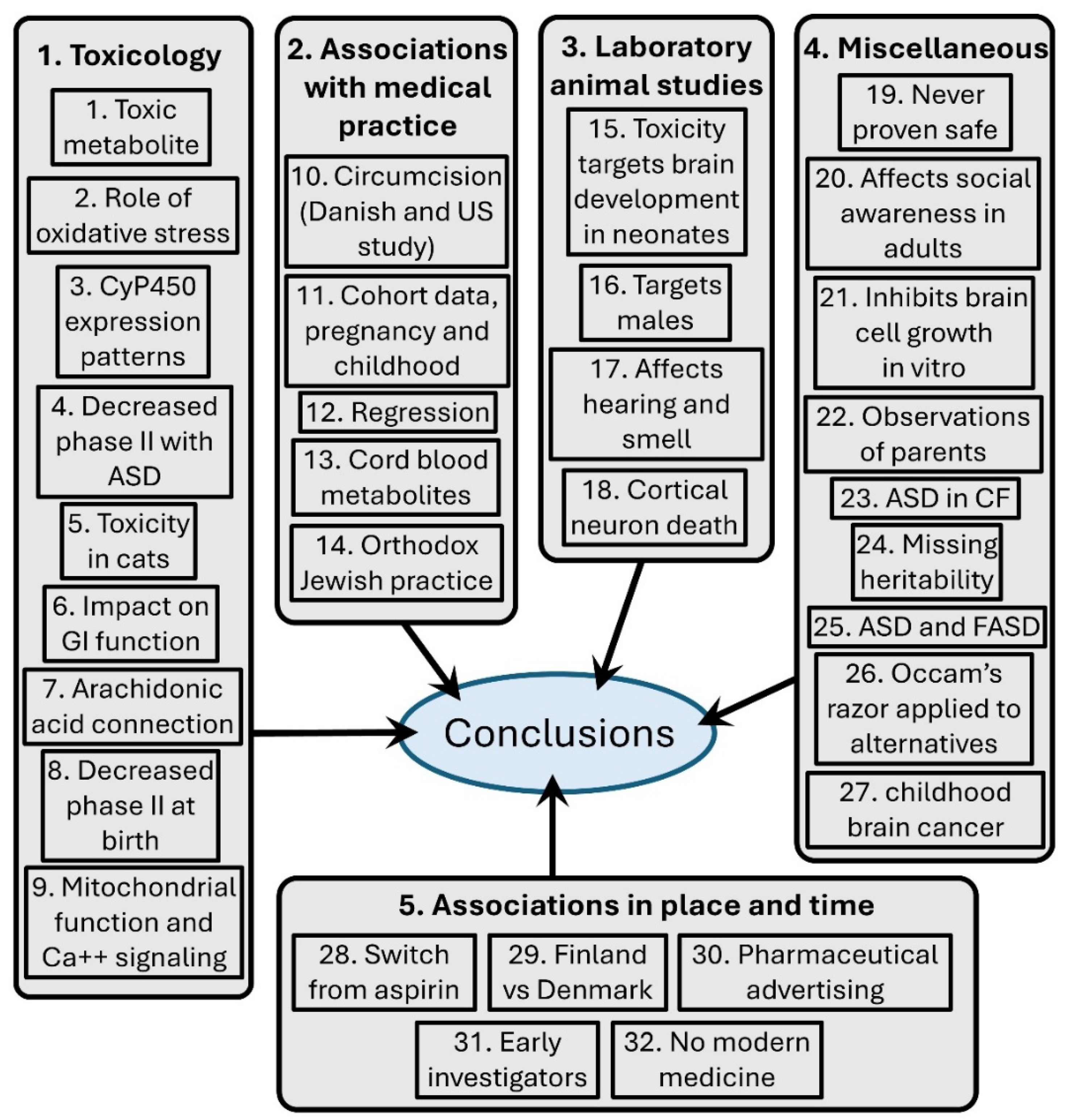
Figure 2.
The variable metabolism of acetaminophen in normal adults, in neonates, and in children with autism. The diagram incorporates four lines of evidence (lines of evidence #1, #3, #4, and #8) described in Table 1.
Figure 2.
The variable metabolism of acetaminophen in normal adults, in neonates, and in children with autism. The diagram incorporates four lines of evidence (lines of evidence #1, #3, #4, and #8) described in Table 1.
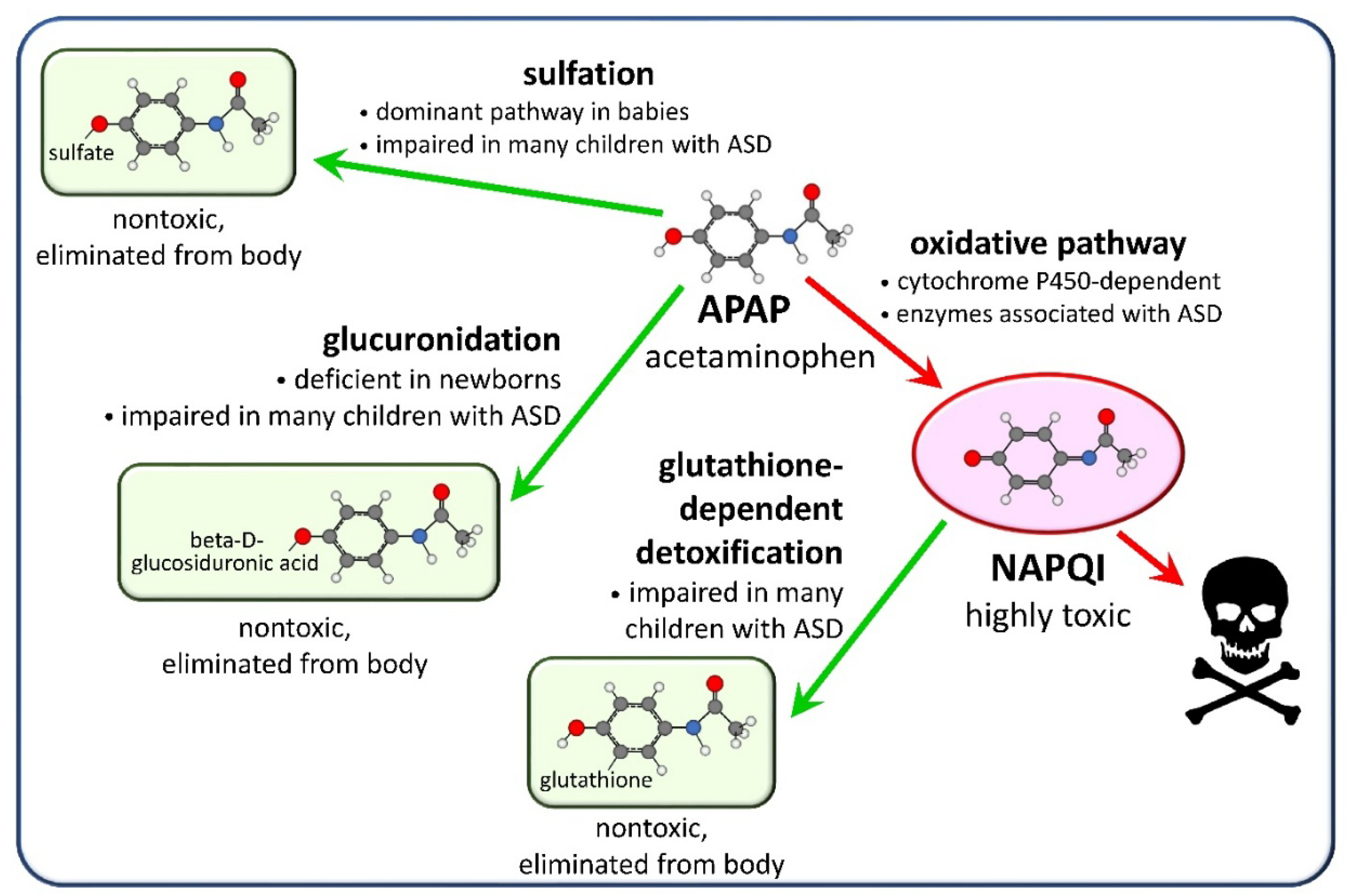
Figure 3.
Adjusting for interacting variables obscure associations between acetaminophen and autism. Hazards ratios calculated by Ahlqvist et al. [52] for heavy use of acetaminophen (APAP) exposure are shown in the white circles. Model 1 adjusted only for time of birth and for sex. Model 2 adjusted for the same factors as Model 1, plus 7 factors associated with inflammation and oxidative stress. Model 3 adjusted for the same factors as Model 2, plus 19 additional factors, including at least a dozen factors associated with inflammation and oxidative stress. Model 4 adjusted for most of the same factors as Model 3, plus “unobserved genetic and environmental confounders shared by full siblings”, many of which may be related to inflammation and oxidative stress. These results demonstrate that acetaminophen does not induce ASD in the absence of factors associated with inflammation and oxidative stress, a fact that has been known for some years [70]. Results calculated according to Jones et al. [4] using computer simulations in which acetaminophen combined with oxidative stress induces half of all cases of ASD are shown by the blue squares. Jones et al. [4] previously reported valued at 0%, 30% and 90% adjustment. The value at 60% adjustment (HR 1.288; 95% CI 1.181–1.405) is added for the sake of comparison with the values reported by Ahlqvist et al. [52] for heavy use of acetaminophen. Error bars indicate 95 % confidence intervals reported by Ahlqvist et al. [52] and calculated by Jones et al. [4].
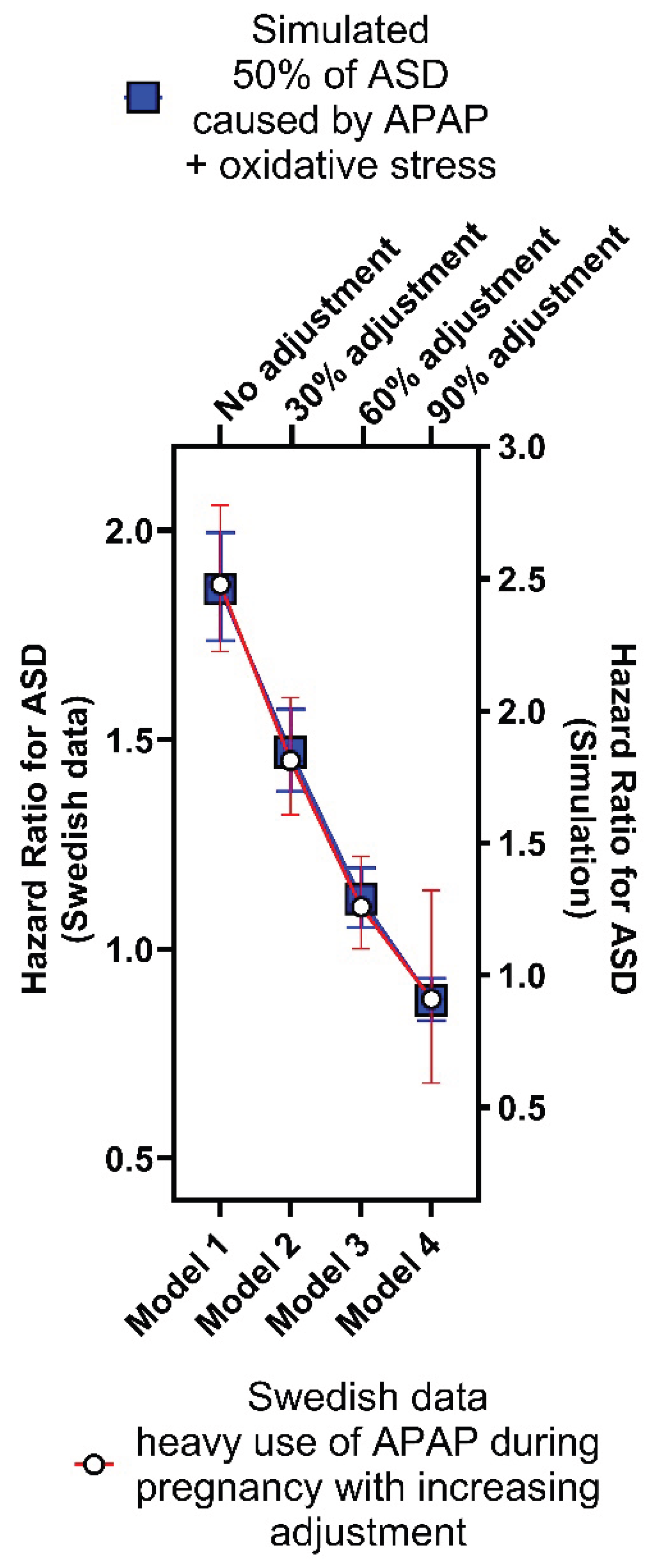

Table 1.
Pharmacology/Toxicology evidence connecting acetaminophen (APAP) use with neurodevelopmental injury and ASD.
Table 1.
Pharmacology/Toxicology evidence connecting acetaminophen (APAP) use with neurodevelopmental injury and ASD.
| Pharmacological/toxicological evidence. | |
|---|---|
| Evidence / references | Background / additional information |
| 1. Toxic Metabolite: Mechanisms of APAP-mediated injury are plausible. The body converts a fraction of acetaminophen into a toxic metabolite called NAPQI. For review, see Jones et al. [4] | The first study showing that children with ASD are deficient in a metabolic pathway necessary to safely detoxify APAP in babies (sulfation) is now more than a quarter of a century old [71], and was subsequently corroborated [72,108]. |
| 2. Oxidative Stress: Genetic, epigenetic, and environmental factors associated with an increased risk of ASD are also associated with oxidative stress, which has an adverse effect on the body’s ability to safely metabolize APAP [70,71,109]. | The wide array of factors associated with ASD have led to the hypothesis that many things can come together to cause ASD, but ASD is characterized by impairment of social function and other particular behavioral phenotypes, suggesting specificity in the etiology of the condition. |
| 3. One enzyme (CyP450 2E1) which produces the toxic metabolite of APAP (NAPQI) is expressed in the human brain from before birth [110] and is a target of epigenetic alterations in mothers who have children with ASD [111]. | Polymorphisms in another enzyme (CyP450 1A2) that produces the same toxic metabolite of APAP is associated with ASD [112,113]. |
| 4. Phase II metabolism is the way the body processes APAP without producing the toxic metabolite. The first study showing that children with ASD are deficient in a phase II metabolic pathway necessary to safely detoxify APAP in babies (sulfation) is now more than a quarter of a century old [71], and was subsequently corroborated [72,108]. | Besides sulfation, the human body has one other primary metabolic pathway to metabolize APAP without producing the toxic metabolite, NAPQI. That pathway, glucuronidation, is also apparently deficient in children with ASD [114]. |
| 5. Toxicity in cats: APAP is not used in domestic cats because they lack of a robust glucuronidation-dependent capacity for metabolism [115,116,117,118,119], making them susceptible to APAP-mediated injury. Human neonates also lack a robust glucuronidation-dependent pathway [120,121]. | Based on liver function in human babies and children, APAP was incorrectly determined to be safe for pediatric use in the 1960s and 1970s (see line of evidence #15 in Table 3), before this evidence became available in the 1980s. |
| 6. Increasing evidence suggests that the gut/brain axis may play a role in many cases of ASD (Reviewed recently [122,123]), and APAP is known to adversely affect gut function in laboratory animal models [124,125,126] and possibly in humans [127]. | Aberrant gut function leading to oxidative stress and inflammation is among many factors that would predispose individuals to adverse reactions to APAP leading to ASD [70], and gut microbial metabolites serve as excellent biomarkers for ASD [128,129]. However, it remains unknown whether aberrant gut function can be induced by APAP at the time of ASD induction and play a role in that induction. |
| 7. APAP binds directly to arachidonic acid [13] and affects arachidonic acid metabolism [12]. Alterations of arachidonic acid [15] and enzymes involved in arachidonic acid metabolism [14] are associated with ASD. | It is unknown what role arachidonic acid plays in ASD, but arachidonic acid plays a role in both the analgesic and antipyretic properties of APAP, and its metabolism is associated with ASD. |
| 8. Decreased phase II metabolism at birth: Human neonates lack a robust glucuronidation-dependent pathway [120,121], one of the two main metabolic pathways that avoids the production of NAPQI, the toxic metabolite of APAP. | Although individuals with ASD are particularly deficient in both main pathways used to metabolize APAP without producing the toxic metabolite (sulfation and glucuronidation), all individuals are deficient in glucuronidation at the time of birth. It is during this time period (labor and delivery) when the greatest risks of ASD associated with APAP exposure are found [78]. |
| 9. Mitochondrial function may be impaired in individuals with ASD [130], and aberrant metabolism of APAP can impair mitochondrial function [131]. Calcium signaling is known to be important in ASD [132], and APAP adversely affects calcium signaling [133]. | Calcium signaling dysfunction can be used as a biomarker for ASD [134], although it remains unknown whether APAP plays any role in inducing that dysfunction. |
Table 2.
Associations between acetaminophen (APAP) exposure and ASD. Associations in this table reflect associations between acetaminophen use during pregnancy, circumcision, labor and delivery, and early childhood with ASD. The numbering of evidence is continued from Table 1.
Table 2.
Associations between acetaminophen (APAP) exposure and ASD. Associations in this table reflect associations between acetaminophen use during pregnancy, circumcision, labor and delivery, and early childhood with ASD. The numbering of evidence is continued from Table 1.
| Associations with Medical Practice/APAP use | |
|---|---|
| Evidence / references | Background / additional information |
| 10. Circumcision of males is associated with a 2-fold increase in the risk for early-onset (infantile) ASD [93]. | Studies in Denmark [93] and the US [95] have identified social problems associated with circumcision. Circumcision is often performed using APAP as an analgesic despite the fact that such use is of highly questionable effectiveness [135]. |
| 11a. Epidemiology (pregnancy): Use of APAP during pregnancy has been associated with adverse long-term effects on the mental health of offspring in numerous studies [60,68,77,78,79,136,137,138,139,140,141,142,143,144,145,146,147,148,149,150,151,152,153,154]. | This line of evidence has received more attention than any other line of evidence, to the point of being the only line of evidence considered by many investigators. However, the numerous studies underpinning this line of evidence are hampered by several factors which can cause errors in estimation of the association between APAP and ASD [4]. For example, a recent study found a dramatic association (odds ratio (OR) for ASD with APAP use = 1.8) [52], but incorrectly and completely cancelled out that association using an error in the assumptions underlying the statistical analysis [2,4,60]. |
| 11b. Epidemiology (childhood): Analysis of the Danish National Birth Cohort (DNBC) revealed an odds ratio (OR) of 1.3 (CI 1.02–1.66) for ASD associated with postnatal APAP exposure [68], despite the fact that the use of APAP appears to be dramatically underreported in the DNBC [1]. | The study authors averaged the results from the DNBC with assessments of autism-like symptoms (not ASD) from smaller data sets, and reported no association between postpartum APAP use and those symptoms (not ASD) in the abstract of the paper [68]. This issue has been addressed in detail by us in the literature [1,2], but unfortunately may still result in confusion [11]. In addition, the study [68] employed invalid statistical adjustments expected to underestimate the association between APAP and ASD [2,4]. See text for additional discussion. |
| 12. Regression: APAP use during early childhood is associated with a 20-fold greater risk of regressive ASD [18]. APAP use with mild adverse reactions to a vaccine, but not mild adverse reactions to a vaccine alone, is associated with ASD [18]. | This case-controlled study, now more than 16 years old, has been widely criticized, but careful analysis does not reveal any credible objections [1]. This study was the first study to separate the impact of vaccines from APAP on neurodevelopment, and the first to implicate APAP with the etiology of ASD. |
| 13. Higher levels of APAP in cord blood are associated with ASD [78]. | For the analysis, the authors divided the women into three groups based on cord blood APAP levels. The third with the highest levels had 3.6 times more likelihood of having a child with ASD than the third with the lowest levels of APAP. |
| 14. Ultra-Orthodox Jews [155] in Israel have a reported prevalence of ASD less than half of that of reform Jews. Traditional circumcision practices employed by Ultra-Orthodox Jews do not utilize APAP. Further, Orthodox Jews may use less pain medications during childbirth than others [156]. | Circumcision is often performed using APAP as an analgesic despite the fact that such use is of highly questionable effectiveness [135]. Almost all Israeli Jews are circumcised [157]. Further, decreased use of pain medications during labor and delivery, which may be associated with Orthodox Judaism [156], would likely lower exposure to APAP at the time of life when individuals are the most sensitive to APAP-mediated neurodevelopmental injury [3]. |
Table 3.
Laboratory animal studies indicating that acetaminophen (APAP) is a neurodevelopmental toxin and pointing toward a connection between acetaminophen use and ASD. The numbering of evidence is continued from Table 2.
Table 3.
Laboratory animal studies indicating that acetaminophen (APAP) is a neurodevelopmental toxin and pointing toward a connection between acetaminophen use and ASD. The numbering of evidence is continued from Table 2.
| Laboratory animal studies | |
|---|---|
| Evidence / references | Background / additional information |
| 15. Numerous studies in laboratory animals from multiple laboratories indicate that early life exposure to APAP causes long term changes in brain function [11,92,158,159,160,161,162,163,164,165,166,167,168,169,170]. | After adjusting for weight, the amount of APAP that causes profound changes in laboratory animals in some studies is very close to [92] or even less than [167] the amount administered to human babies and children. Thus, APAP could never be used in babies or children if current guidelines for drug safety were applied. |
| 16. Early life exposure to APAP has a greater long-term impact on male laboratory animals than female laboratory animals [163,169,171,172]. ASD is more common in males than in females. | The reason or reasons why males are more susceptible to APAP-mediated injury has been considered in some detail, and several plausible mechanisms have been proposed [169,171]. |
| 17. Prenatal exposure of laboratory rats to APAP causes problems with the processing of sound [11] and with olfactory function [166]. Impairment of olfactory function [173] and some degree of auditory dysfunction (reviewed by Graeca and Kulesza [11]) are associated with ASD. | It is unknown whether these effects of APAP on laboratory animals are related to altered processing of smell and hearing in some individuals with ASD. |
| 18. APAP causes apoptosis-mediated death of cortical neurons in laboratory rats [75], and cortical neurons may be involved in the pathology of ASD [174,175]. | Increased levels of biomarkers for neuronal apoptosis [176,177,178] and impaired autophagy [179] are associated with ASD. Autophagy is necessary to clearing damaged organelles such as mitochondria [180], which are created by aberrant metabolism of APAP [131]. |
Table 4.
Miscellaneous observations connecting acetaminophen (APAP) with ASD. The numbering of evidence is continued from Table 3. CI = 95% confidence interval; HR = hazard ratio; OR = odds ratio.
Table 4.
Miscellaneous observations connecting acetaminophen (APAP) with ASD. The numbering of evidence is continued from Table 3. CI = 95% confidence interval; HR = hazard ratio; OR = odds ratio.
| Miscellaneous observations | |
| Evidence / references | Background / additional information |
| 19. APAP was never demonstrated to be safe for neurodevelopment [19]. Over two hundred papers in the medical literature claim that APAP is safe for babies and/or children when used as directed, but all studies were based on the false assumption that adverse reactions in babies would involve easily measured liver injury, the same as in adults [19]. | One study in laboratory animals in the 1980s showed that even lethal doses of APAP do not cause liver failure in neonates [181], but the first study showing APAP-mediated neurodevelopmental brain injury in laboratory animals was not published until 2013 [92]. Like APAP, opioids have also never been shown to be safe for neurodevelopment [182]. However, unlike APAP, opioids are not generally assumed to be safe for neurodevelopment when used as directed. Further, one study probing the safety of prenatal opioid exposure found reductions in communication skills in children associated with prenatal APAP exposure, but not with prenatal opioid exposure [141]. |
| 20. APAP temporarily blunts social trust [183] and awareness [184], emotional responses to external stimuli [185], and the ability to identify errors [186] in adults. | Although the mechanisms are unknown, these studies show that APAP affects aspects of mental function that are impaired in individuals with ASD. |
| 21. APAP inhibits neuronal cell growth in tissue culture experiments, altering “arborization”, the process by which neurons branch out to make connections with other neurons [187]. APAP [75,188] and a metabolite of APAP [189] also cause death of brain cells in culture. | Adverse effects of APAP on neuronal cell growth in culture (in vitro) are dose dependent, and observable at concentrations near those achieved in clinical therapy [187]. These effects in vitro would discourage use of APAP in humans if current guidelines for drug safety were applied. |
| 22. Observations of parents: The top three conditions identified as a cause of their child’s regression into autism listed by parents were vaccination (51% of parents), high fever (11% of parents), and illness (8% of parents)[190]. A standard treatment for all of these conditions is APAP. Surveys show that up to 50% of parents who have a child with ASD believe that their children’s ASD was induced by a vaccine [191,192]. | Although parent’s belief in the connection between vaccination and ASD has been widely attributed to a 1998 case series describing an association between the MMR vaccine and autism in 12 patients [193], the title of that report is not intelligible to individuals outside of the medical profession, and medical papers have seldom affected public opinion. A more likely explanation involves the induction of ASD by APAP use concurrent with vaccination, as suggested by Schultz [18,194]. The failure to consider seriously the views of parents has historically been problematic, resulted in two system-wide errors that were influential for decades, the refrigerator mother hypothesis and the failure to recognize regression [70]. |
| 23. Cystic fibrosis (CF) is associated with unusually efficient (effective) metabolism of APAP [195,196], and the prevalence of ASD is apparently very low in patients with cystic fibrosis [70]. | The mental health of patients with cystic fibrosis has been characterized extensively, but no association between ASD and cystic fibrosis has been reported. |
| 24. The “missing heritability” paradox of ASD suggests that epigenetic factors or very early exposure to environmental factors might influence the onset of ASD [197]. | The role of APAP in the induction of ASD nicely resolves the missing heritability paradox connected with ASD, in which sibling studies indicate a high contribution of genetics, but genome wide studies fail to identify the genes involved [197]. The observation that abuse of a mother when she was a child is associated with ASD in the offspring [198] is one example of evidence that supports this view. |
| 25. ASD and fetal alcohol spectrum disorder (FASD) are similar in many regards. Reviewed by Jones et al. [4] A spectrum disorder can also be triggered by the drug valproate [5]. | These observations demonstrate that a complex spectrum disorder (FASD) sharing many similarities with ASD can (a) be induced by a single chemical and (b) be influenced by a variety of genetic and environmental factors. |
| 26. Common alternative explanations are not consistent with known observations and/or require elaborate/complex scenarios to be true. | Some alternative explanations depend on the view that the incidence of ASD has not increased dramatically over time, a view that is contradicted by numerous lines of evidence showing that ASD is an effect of industrialized culture. Evidence that rules out alternative explanations for the etiology of ASD have been described previously [1,4]. |
| 27. APAP exposure in utero is associated with increases in childhood brain cancer. This connection was first noted in 2010 in Sweden using a case-controlled method [199], although the association was not statistically significant (OR 1.7; CI 0.6–5.4). A more recent study from Taiwan [200] supported the association and was statistically significant (HR 2.4; CI 1.10–5.39). | In the study from Taiwan, which evaluated cancer in about 2.27 million mother-child pairs [200], medulloblastoma, a type of brain cancer, was the only type of cancer in children significantly associated with prenatal use of APAP. An increased risk of cancer might potentially result of cellular injury and subsequent repair of that injury [201], although it remains unknown if APAP-associated brain cancer risks are related to processes involved in the etiology of ASD. |
Table 5.
Associations in place and time connecting acetaminophen (APAP) use with ASD. The numbering of evidence is continued from Table 4.
Table 5.
Associations in place and time connecting acetaminophen (APAP) use with ASD. The numbering of evidence is continued from Table 4.
| Associations in place and time | |
|---|---|
| Evidence / references | Background / additional information |
| 28. The incidence of ASD began to increase in the early 1980s, coinciding with the increase in APAP use after aspirin was associated with Reye’s syndrome [70]. The ratio of regressive to infantile ASD also rose at the same time [202]. | Temporal associations do not prove causality, but are a necessary prerequisite for causality to exist. The increased ratio of regressive to infantile ASD, noted in 2000 [202], would suggest that something was introduced into the environment that could induce ASD after months or even years of neurodevelopment. This factor was tragically and incorrectly suspected to be a vaccine at that time, an issue that was decisively addressed by Stephen Schultz eight years later (see line of evidence #12 in Table 1). |
| 29. The popularity of APAP use and the prevalence of ASD was substantially higher in Denmark than in Finland in the mid-2000s [3]. | Geographic-dependent associations do not prove causality, but do contribute to the total body of evidence. Particularly in the absence of alternative explanations, these associations can be compelling. |
| 30. The incidence of ASD has steadily increased [70] as direct-to-consumer advertising [203], marketing of over-the-counter medications, and perhaps other factors such as mandated use of APAP with the MenB vaccine (see discussion) have led to increased APAP exposure early in life. | Temporal associations do not prove causality, but are a necessary prerequisite for causality to exist. Alternative explanations for the rise in prevalence of ASD face several insurmountable problems, previously reviewed [1,4]. One possible explanation for the persistence of unrealistic alternative explanations may be that many investigators are unaware of a satisfactory explanation consistent with available evidence. |
| 31. Numerous investigators noted a very low prevalence of ASD prior to 1970 or noted increases in the prevalence of ASD that could not be attributed to factors other than a real increase. Reviewed by Jones et al. [4] | Grunya Sukhareva [87,88] and Leo Kanner [81,204] were both renowned for their breadth of knowledge and grasp of pediatric psychology, and both described autism essentially the same as it is described today. Yet neither recognized a high prevalence of the disorder in the 1920s and 1940s, respectively. Further, neither was ridiculed by contemporaries for describing a common, previously well-known condition. |
| 32. Studies in several countries with chronic shortages of medication found dramatically lower-than-expected levels of ASD relative to other developmental issues, including Down syndrome. Reviewed by Jones et al. [4] | In addition to evidence presented in the previous review of this issue [4], apparently low levels of ASD in Cuba have been identified, where 241 cases of ASD in the entire nation (1 in 25,000 children) were identified in a 2016 report [205]. APAP is available in Cuba by prescription only [206], and multiple travel advisors cite APAP in particular as being in short supply in Cuba [207,208,209,210]. In addition, individuals with pervasive developmental disorders, about 50% of which typically have ASD, were found among second generation Israeli immigrants from Ethiopia, but not among first generation Israeli immigrants from Ethiopia (p = 0.0022) [211]. |
Table 6.
Consequences of assumptions underlying multivariate analysis of observational data in a virtual computer construct. Acetaminophen (APAP) is “shown” to be protective against ASD (HR < 1.0), even though it induced 50 % of all cases of ASD in the virtual construct. The virtual data set was constructed and analyzed as previously described [4] using a Cox regression analysis, with 240,000 individuals, 60 % exposure to APAP and one in 36 individuals with ASD. In this virtual data set, 50 % of ASD was induced by exposure to acetaminophen combined with the sum of 10 cofactors, modeling the contribution of oxidative stress (OS) related factors in the induction of ASD. The other 50 % of ASD cases were randomly assigned. The propensity for acetaminophen exposure was dependent on levels of oxidative stress, as previously described [4]. n = 96,000 virtual individuals without APAP use, and n = 144,000 virtual individuals with APAP use. CI = confidence interval. NA = not applicable.
| Variable | HR (CI) | p |
|---|---|---|
| APAP, actual risk built into virtual construct | 2.667 (NA) | NA |
| APAP, result of regression analysis | 2.55 (2.41–2.71) | 2 x 10–16 |
| APAP, adjusted for all contributing cofactors | 0.85 (0.80–0.90) | 2 x 10⁻⁷ |
| OS factor 1, all individuals | 1.24 (1.23–1.26) | 2 x 10–16 |
| OS factor 1, virtual individuals with APAP use only | 1.32 (1.30–1.34) | 2 x 10–16 |
| OS factor 1, virtual individuals with no APAP use only | 1.00 (0.97–1.03) | 0.90 |
Disclaimer/Publisher’s Note: The statements, opinions and data contained in all publications are solely those of the individual author(s) and contributor(s) and not of MDPI and/or the editor(s). MDPI and/or the editor(s) disclaim responsibility for any injury to people or property resulting from any ideas, methods, instructions or products referred to in the content. |
© 2026 by the authors. Licensee MDPI, Basel, Switzerland. This article is an open access article distributed under the terms and conditions of the Creative Commons Attribution (CC BY) license (http://creativecommons.org/licenses/by/4.0/).
Copyright: This open access article is published under a Creative Commons CC BY 4.0 license, which permit the free download, distribution, and reuse, provided that the author and preprint are cited in any reuse.