

Submitted:
03 January 2025
Posted:
04 January 2025
You are already at the latest version
Abstract
Marchantia polymorpha L., also known as common liverwort or umbrella liverwort, is a spore-forming plant belonging to Marchantiaceae family. This thallose liverwort has gained importance as a model plant, mainly because of its global distribution, and easy and rapid in vitro culturing. A review of the literature shows that the dominant compounds in this species are undoubtedly sesquiterpenoids and bisbibenzyls. Among sesquiterpenoids it is worth to mention cuparenes, chamigranes and thujopsanes. Compounds belonging to these classes were found in specimens from Japan, China, Poland, Germany, and India, and could be the chemical markers of this liverwort species. The most characteristic compound occurring in M. polymorpha is a macrocyclic bisbibenzyl, marchantin A. Marchantin-type aromatic compounds together with other bisbibenzyls, such as riccardin D, isoriccardin C or perrottetin E were proven to withhold antifungal and antibacterial properties in various studies. Marchantin A is structurally similar to tubocurarine, exhibiting myorelaxant activity. Its antioxidant and cytotoxic effects have also been confirmed. In this review we summarize the current knowledge on the diversity of compounds produced by M. polymorpha, emphasizing chemical variability depending on the origin of the plant material. Moreover, the biological activity of extracts obtained from this liverwort species as well as single secondary metabolites are described.
Keywords:
common liverwort
; terpenoids
; bisbibenzyls
; biological activity
; Marchantiaceae
1. Introduction
Bryophytes are terrestrial spore-bearing plants that comprise three phyla: liverworts (Marchantiophyta), mosses (Bryophyta), and hornworts (Anthocerophyta). These small, nonvascular plants are phylogenetically placed between algae and ferns and are considered the first inhabitants of terrestrial habitats [1]. As the first land plants, they were often exposed to adverse environmental conditions; hence, their ability to synthesize many different specialized secondary metabolites is extremely high. Indeed, such ‘chemical weapons’ are necessary for these small plants, since they lack mechanical protection like higher vascular plants [2]. Among the bryophytes, the chemical constituents of the Marchantiophyta and their biological activity have been studied in great detail. Over the last 40 years, more than 3,000 compounds have been found in this group of plants. Many of these products are characterized by unprecedented structures, and some, including the pinguisane-type sesquiterpenoids and the sacculatane-type diterpenoids, have not been found in any other plants, fungi or marine organisms. This unique chemical composition increases the number of potential applications in medicine and beyond. The secondary metabolites of this group of spore-bearing plants have a huge, not yet fully understood potential, as phytotherapeutics or natural pesticides. The available literature data indicate that constituents occurring in liverworts show interesting biological activities, such as antibacterial, antifungal, cytotoxic, insect repellant, as well as some enzyme inhibitory and proapoptotic activities [3,4,5].
Marchantia polymorpha L., also known as common liverwort or umbrella liverwort, belonging to Marchantiaceae family (Figure 1), is the most widely distributed liverwort in the world. It is a cosmopolitan species that occurs from tropical to arctic regions [6,7].
Marchantia polymorpha has also been shown to consist of cryptic or nearly cryptic species based on isozyme, RFLP (nrDNA), and RAPD markers in a survey of plants from North America, Europe and Asia. Three taxa were identified and recognized as subspecies which differ in habitat, although they sometimes occur sympatrically [8]. More detailed analyses conducted by Linde and his associates [9] revealed a more complex pattern with evidence suggesting hybridization and introgression between subspecies. Such heterogeneity within a single species of any plant, brings with its variability in chemical composition and, consequently, biological properties. The aim of this paper is to review the available scientific literature concerning both the chemical composition and the biological properties of the most well-known liverwort species, M. polymorpha. Special attention was paid to the variability of the chemical composition depending on the origin of the plant material.
2. Chemical Diversity of M. polymorpha
Liverworts (Marchantiophyta) are plants that produce a wide array of biologically active secondary metabolites. These compounds are accumulated in the oil bodies, which are prominent and highly distinctive organelles uniquely found in liverworts [10]. Oil bodies are present in 95% of all liverwort species and are intracellular organelles bounded by a single unit membrane originating from dilated endoplasmic reticulum cisternae, containing lipophilic globules [11]. In the thallose liverworts like M. polymorpha, oil bodies are confined to scattered idioblastic oil body cells while oil bodies of leafy liverworts are generally present in all cells [12]. The number, size, and colour of oil bodies are species specific. Oil bodies are estimated to serve a protective role for the plant, with their contents postulated to protect the plant against various biotic and abiotic stressors [13].
A review of the literature on the chemical composition of the umbrella liverwort shows that it is characterized by great diversity. The following groups of chemical compounds have been identified so far in Marchantia: mono-, sesqui- and diterpenoids, sterols and triterpenoids, bibenzyls, bisbibenzyls, phenanthrene derivatives, flavonoids, lipids and other compounds (Table 1).
As shown in Table 1, phytochemistry of M. polymorpha varies depending on its place of origin. The major chemical compounds, contributing to phytochemical complexity of this species, are distributed among two groups: terpenoids, and a second one including bibenzyls and bis-bibenzyls.
2.1. Terpenoids
Marchantia polymorpha is a rich source of terpenoids, in particular those belonging to the sesquiterpene group. The first sesquiterpenoid reported from M. polymorpha was (S)-2-hydroxycuparene (= 2-cuparenol). Isolation was conducted in 1974 by Hopkins and Perold [25] from a South African specimen. Two cuparane-type alcohols, cyclopropanecuparenol and its epimer, are the major volatile components present in this species. Both compounds are usually present in specimens from European countries, while in Japan only cyclopropanecuparenol is present. Besides the mentioned alcohols, other cuparanes are present in M. polymorpha, namely cuparene and α-, β-, γ- and δ-cuprenene. Thujopsanes and chamigranes are other sesquiterpenoids characteristic of M. polymorpha. They are represented by thujopsene, thujopsan-7β-ol, thujopsenone, α- and β-chamigrene, as well as ent-9-oxo-α-chamigrene [13,18].
Occasionally M. polymorpha can produce metabolites characteristic of a single specimen. In the Polish collection of M. polymorpha, acorane-type sesquiterpenoids were identified. The presence of α-neocallitropsene, acorenone B, β-alaskene, and β-acoradiene were confirmed [15]. Another example comes from Vietnamese specimens, which produce characteristic diterpenoids. In fact, Van Nguyen and coworkers [31] isolated marchanol, which belongs to the clerodane-type compounds, as well as vitexilactone from the labdane group.
Marchantia polymorpha does not synthesize monoterpenes. However, during cell culture at the initial stage of growth, it produces limonene [14].
2.2. Bibenzyls and Bisbibenzyls
Bibenzyls are organic compounds with a C6-C2-C6 skeleton which are synthesized by the phenylpropanoid pathway, like polyphenols [56]. Common liverwort is reported to produce only a few compounds, and among them it is worth to mention lunularin and lunularic acid [22,25,57]. Both metabolites are direct precursors in the biosynthesis of marchantin C, a bis-bibenzyl, which is later transformed to form marchantin A [58].
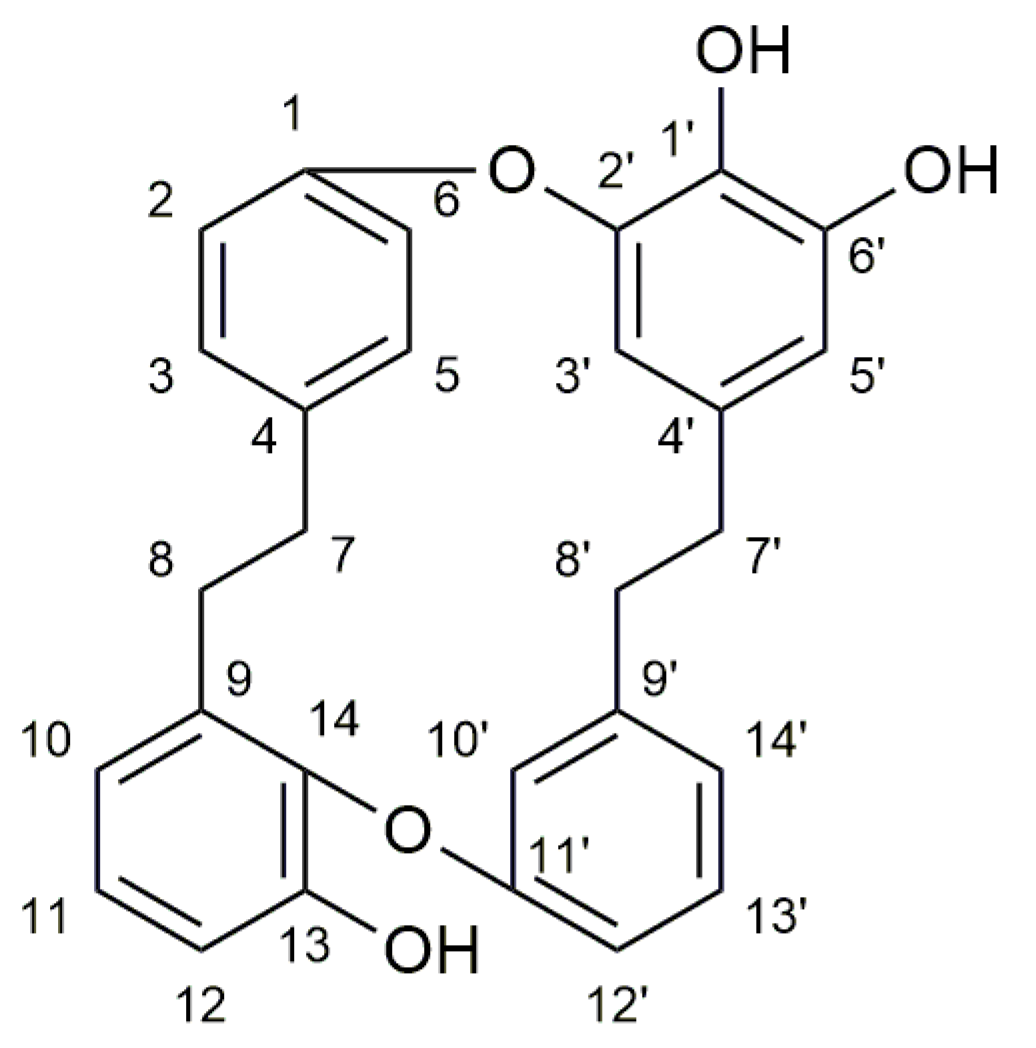
Bisbibenzyls are macrocyclic organic compounds, consisting of two bibenzyl units. Acyclic bisbibenzyl compounds are linked once, while the cyclic ones are linked twice. The most important bisbibenzyl found in M. polymorpha is marchantin A. It is derived from lunularic acid, with two ether linkages between C6 – C2’ and between C14 – C11’ (Figure 1). The majority of common liverwort specimens contain marchantin A in large amounts. In fact, it was reported to be present in common liverwort from various countries, such as Japan, Germany, India, Hungary, Vietnam, China and Serbia [21,22,42,44,57,59,60,61]. This, however, is not true for South African M. polymorpha which, according to some studies, does not contain marchantin A at all [33]. Its place as the major cyclic bisbibenzyl was found to be taken by marchantin H. Moreover, marchantin E has been isolated form Indian and French specimens [5]. Marchantin A is also commonly found in many other plants from the Marchantiales [62,63] and other Marchantiophyta [64].
Figure 1.
Chemical structure of marchantin A.
Riccardins are another group of cyclic bisbibenzyl compounds present in M. polymorpha. Japanese and Indian specimens of M. polymorpha contain riccardin C [13,21,41]. Riccardin H, isoriccardin D and 13,13′-O-isopropylidenericcardin D were found in M. polymorpha from China [57]. Isoriccardin C was found in Chinese, Indian and Vietnamese plant material [13,57,65].
Other bisbibenzyls that can be found in common liverwort are perrottetin E and polymorphatin A. Perrottetin E is an acyclic bisbibenzyl, found in Indian and Chinese specimens of common liverwort [13,57]. It can be used as a precursor for the synthesis of marchantin and riccardin type compounds [33]. Polymorphatin A is a cyclic compound, linked with one ether C1–C2` linkage and one biphenyl C12–C12` linkage. This bisbibenzyl was first found in Chinese M. polymorpha [57].
2.3. Other Compounds Found in M. polymorpha
Flavonoids are ubiquitous minor components in the Marchantiophyta, including M. polymorpha [3,4,60]. The main flavonoid types present in this species are flavone O-glucuronides. Luteolin, apigenin and their derivatives are the most abundant, as shown in Table 1.
Another interesting feature of M. polymorpha is the presence of polyunsaturated fatty acids, arachidonic acid (ARA, 20:4n-6) and eicosapentenoic acid (EPA, 20:5n-3). Shinmen et al. [55] have reported that culture of M. polymorpha contained high amounts of ARA and EPA (92 and 48 mg L-1, respectively) under photomixotrophic conditions.
Among other components present in M. polymorpha, it is worth to mention sterols and triterpenoids, phenanthrenes, phthalides and other aromatic compounds. The sterols and triterpenoids found in common liverwort are similar to those found in higher plants. Among sterols, the presence of sitosterol and stigmasterol was confirmed, while among triterpenoids the occurrence of ursane and oleanane type compounds was reported [21,31,33]. Phenanthrene derivatives were found in the field collection of M. polymorpha from India [22], as well as form cell cultures of this liverwort growing in Germany [37]. The presence of two phthalides, 3R-(3,4-dimethoxybenzyl)-5,7-dimethoxyphthalide and marchatoside was confirmed in a Vietnamese collection [31].
3. Biological Activities
Common liverwort has a long history in ethnomedicine [62]. It was used as an antipyretic, antihepatic, antidotal and a diuretic medicinal plant [66].
Extracts of M. polymorpha were repeatedly proven to possess antifungal properties [43,67,68,69,70]. Many fungi are susceptible to growth inhibition when subjected to these extracts, including Candida albicans [67], Tilletia indica, Fusarium oxysporum f.sp. lini, Sclerotium rolfsii, Rhizoctonia solani [43,68], Alternaria solani [68], Fusarium solani [69] and Aspergillus niger [70]. Studies of activity against C. albicans determined that neomarchantin A, riccardin D and 13,13’-O-isopropylidene-riccardin D are the most effective compounds, while marchantin A, B, E and riccardin H, even if possessing some antifungal activity, were not as effective [67]. The activity also varies depending on the solvent used for extraction. Riccardin D (called by the authors plagiochin E), found in Chinese M. polymorpha, exhibits inhibitory properties against C. albicans, which were increased when combined with fluconazole [71].
Antibacterial activity of extracts from M. polymorpha is also an important subject of studies on common liverwort’s activity. Besides the crude extracts, marchantin A also exhibits such properties [72]. It has an inhibiting effect on growth of both Gram-positive and Gram-negative bacteria, such as Acinetobacter calcoaceticus, Bacillus cereus, Bacillus megaterium, Bacillus subtilis, Cryptococcus neoformans, Haemophilus influenzae, Listeria monocytogenes, Neisseria meningitidis, Pasteurella multocida, Pseudomonas aeruginosa, Proteus mirabilis, Staphylococcus aureus, Staphylococcus epidermis, Streptococcus pyogenes and Streptococcus viridans [22,43,60,70,73]. Lines of M. polymorpha were also subjected to genetic engineering, in order to obtain a mutant with a higher potential for the synthesis of antibacterial compounds [74].
In vitro studies show that many compounds isolated from M. polymorpha exhibit cytotoxic activity. A study conducted in 2008 showed that marchantin A induces growth inhibition on the breast cancer cell lines A256, MCF7 and T47D. The effect was increased when marchantin A and an Aurora-A kinase inhibitor were used simultaneously [75]. Marchantin A also demonstrated cytotoxicity against the malignant melanoma cell line A375, while having less cytotoxic activity against keratocytes and not affecting tyrosinase activity in a model assay [76]. In a recent study, common liverwort extracts showed effectiveness against a colon cancer cell line [77]. This is also true for hepatocellular carcinoma cells [78]. Other compounds with cytotoxic properties, that could be found in M. polymorpha, are marchantins B-D, neomarchantins A and B [79].
Marchantin A exhibits DNA polymerase β inhibitory activity, anti-HIV activity [80], and anti-influenza activity [81], the latter one postulated to be caused by its targeting of PA endonuclease. This compound is also postulated to exhibit antiprotozoal [81] and antitrypanosomal [82] activities. In fact, it showed in vitro growth inhibition against erythrocytic stages of Plasmodium falciparum, and strains of Trypanosoma cruzi, Trypanosoma brucei rhodesiense or Leishmania donovani. However, marchantin A has a low sensitivity index towards the aforementioned parasites, so the therapeutic window is rather narrow. Other compounds contained in M. polymorpha, such as marchantin E and plagiochin A showed antitrypanosomal activity, but at a less significant level than marchantin A [71].
While tested for its antioxidant properties, marchantin A showed free radical scavenging ability [73,83,84], depending on its concentration. It also ties in to the anti-inflammatory properties of M. polymorpha, originating in its ethnomedicinal uses. Marchantin A demonstrates inhibitory effect on 5-lipoxygenase and cyclooxygenase, a key enzyme in the arachidonic acid cascade [84]. The strength of this effect is structure dependent, as marchantin D, which had been tested in the same study, exhibited lower inhibition toward 5-lipoxygenase.
Chloroform extract of M. polymorpha was postulated to have hepatoprotective properties [85]. When mice were administered with paracetamol in liver-damaging quantities along with marchantin A, the amount of markers of liver damage in mice blood (aspartate transaminase and alanine transaminase) was significantly lower than in the control group administered with paracetamol only, and on par with the group in which paracetamol was administered along with silymarin. Another study showed that flavonoids of M. polymorpha can protect liver cells from injuries caused by administration of carbon tetrachloride [86]. As both compounds induce damage to liver cells with their oxidizing potential, the hepatoprotective effect was postulated to be due to antioxidant properties of M. polymorpha extracts.
Marchantin A, riccardin A, marchantin B and other compounds from M. polymorpha also have inhibitory effect on lipopolysaccharide production induced by nitric oxide [87]. As nitric oxide is postulated to play a role in the etiology of chronic neurodegenerative diseases [88], this property should be more closely investigated in the future.
Structural similarity between cyclic bisbibenzyl compounds and bisbenzylisoquinoline alkaloids, such as tubocurarine, has led to the investigation of muscle relaxation properties of marchantin-type compounds [89]. In a study published in 1995 [90], marchantin A was used in comparison to cepharanthine, a muscle relaxant. Both compounds expressed similar properties and were bound to a common receptor, which points to the muscle-relaxing properties of marchantin A likely being owed to the binding of calcium molecules. This may also be tying in with the inhibition by marchantin A of calmodulin [91], a protein with activity related to calcium levels in the cell.
4. Conclusions and Future Perspectives
Marchantia polymorpha is a very interesting case study. This liverwort is present in almost all environments, and has a very versatile phytochemical profile, including bisbibenzyl content. As we managed to summarize in our article, therapeutic potential of M. polymorpha is yet to be fully explored, but even now it holds potential for many future studies, which may be resulting in crucial findings.
The secondary metabolites of M. polymorpha endophytes show applicative potential as well. They exhibit selective cytotoxicity toward HeLa, RKO and FaDu cancer cell lines and antiviral properties [15,92] calling for more accurate investigations on their occurrence and bioactivities. As of late, our team is trying to establish the optimal ways to cultivate these bryendophytes, extract and evaluate their products.
Author Contributions
Conceptualization, A.L. F.N. and B.Z..; methodology, A.L.; formal analysis, R.N..; investigation, F.N..; resources, A.L..; data curation, B.Z. and A.L..; writing—original draft preparation, F.N, B.Z. and A.L..; writing—review and editing, R.N.; visualization, A.L. and F.N..; supervision, R.N..; project administration, A.L.; funding acquisition, R.N. and A.L. All authors have read and agreed to the published version of the manuscript.
Funding
This research was funded by project 101135305 - HORIZON-CL6-2023-CircBio-01-4 (Bioprospecting and production of bioactive molecules from European bryophytes 'BRYOMOLECULES').
Data Availability Statement
No new data were created.
Acknowledgments
The authors gratefully acknowledge the contribution of Yoshinori Asakawa (Tokushima Bunri University, Japan) for the valuable scientific discussion and photos of umbrella liverwort.
Conflicts of Interest
The authors declare no conflicts of interest.
References
- Asakawa, Y.; Ludwiczuk, A. Chemical Constituents of Bryophytes: Structures and Biological Activity. J. Nat. Prod. 2018, 81, 641–660. [Google Scholar] [CrossRef] [PubMed]
- Ludwiczuk, A.; Asakawa, Y. Bryophytes as a Source of Bioactive Volatile Terpenoids - A Review. Food Chem. Toxicol. 2019, 132, 110649. [Google Scholar] [CrossRef] [PubMed]
- Asakawa, Y. Chemical Constituents of the Hepaticae. In Progress in the Chemistry of Organic Natural Products; Herz, W., Grisebach, H., Kirby, G.W., Heidelberger, M., Eds.; Springer: Vienna, 1982; Vol. 42, pp. 1–285. ISBN 978-3-7091-8677-0. [Google Scholar]
- Asakawa, Y. Chemical Constituents of the Bryophytes. In Progress in the Chemistry of Organic Natural Products; Herz, W., Kirby, G. W., Moore, R. E., Steglich, W., Tamm, Ch., Eds.; Springer: Vienna, 1995; Vol. 65, pp. 1–618. ISBN 978-3-7091-6896-7. [Google Scholar]
- Asakawa, Y.; Ludwiczuk, A.; Nagashima, F. Chemical Constituents of Bryophytes. Bio- and Chemical Diversity, Biological Activity, and Chemosystematics. In Progress in the chemistry of organic natural products; Kinghorn, A., Falk, D., Kobayashi, J., Eds.; Springer-Verlag: Vienna, 2013; Vol. 95, p. 25. [Google Scholar]
- Bischler-Causse, H. Marchantia L. The Asiatic and Oceanic Taxa.; Bryophytorium Bibliotheca; Cramer: Vaduz, 1989; Vol. 38. [Google Scholar]
- Bischler-Causse, H. Marchantia L. The European and African Taxa.; Bryophytorium Bibliotheca; Cramer: Stuttgart, 1993; Vol. 45. [Google Scholar]
- M. C. Boisselier-Dubayle; M. F. Jubier; B. Lejeune; H. Bischler Genetic Variability in the Three Subspecies of Marchantia Polymorpha (Hepaticae): Isozymes, RFLP and RAPD Markers. TAXON 1995, 44, 363–376. [CrossRef]
- Linde, A.-M.; Sawangproh, W.; Cronberg, N.; Szövényi, P.; Lagercrantz, U. Evolutionary History of the Marchantia Polymorpha Complex. Front. Plant Sci. 2020, 11, 829. [Google Scholar] [CrossRef] [PubMed]
- Asakawa, Y.; Toyota, M.; Tori, M.; Hashimoto, T. Chemical Structures of Macrocyclic Bis(Bibenzyls) Isolated from Liverworts (Hepaticae). Spectroscopy 2000, 14, 149–175. [Google Scholar] [CrossRef]
- Suire, C. A Comparative, Transmission-Electron Microscopic Study on the Formation of Oil Bodies in Liverworts. J. Hattori Bot. Lab. 2000, 89, 209–232. [Google Scholar] [CrossRef]
- He, X.; Sun, Y.; Zhu, R.-L. The Oil Bodies of Liverworts: Unique and Important Organelles in Land Plants. Crit. Rev. Plant Sci. 2013, 32. [Google Scholar] [CrossRef]
- Romani, F.; Banić, E.; Florent, S.N.; Kanazawa, T.; Goodger, J.Q.D.; Mentink, R.A.; Dierschke, T.; Zachgo, S.; Ueda, T.; Bowman, J.L.; et al. Oil Body Formation in Marchantia Polymorpha Is Controlled by MpC1HDZ and Serves as a Defense against Arthropod Herbivores. Curr. Biol. 2020, 30, 2815–2828.e8. [Google Scholar] [CrossRef]
- Kumar, S.; Kempinski, C.; Zhuang, X.; Norris, A.; Mafu, S.; Zi, J.; Bell, S.A.; Nybo, S.E.; Kinison, S.E.; Jiang, Z.; et al. Molecular Diversity of Terpene Synthases in the Liverwort Marchantia Polymorpha. Plant Cell 2016, 28, 2632–2650. [Google Scholar] [CrossRef] [PubMed]
- Stelmasiewicz, M.; Świątek, Ł.; Ludwiczuk, A. Phytochemical Profile and Anticancer Potential of Endophytic Microorganisms from Liverwort Species, Marchantia Polymorpha L. Molecules 2022, 27. [Google Scholar] [CrossRef]
- Asakawa, Y.; Toyota, M.; Nakaishi, E.; Tada, Y. Distribution of Terpenoids and Aromatic Compounds in New Zealand Liverworts. J. Hattori Bot. Lab. 1996, 80, 271–295. [Google Scholar] [CrossRef]
- Asakawa, Y.; Baser, K.H.C.; Erol, B.; Von Reuß, S.; Konig, W.A.; Ozenoglu, H.; Gokler, I. Volatile Components of Some Selected Turkish Liverworts. Nat. Prod. Commun. 2018, 13, 1934578X1801300729. [Google Scholar] [CrossRef]
- Matsuo, A.; Nakayama, N.; Nakayama, M. Enantiomeric Type Sesquiterpenoids of the Liverwort Marchantia Polymorpha. Phytochemistry 1985, 24, 777–781. [Google Scholar] [CrossRef]
- Asakawa, Y.; Toyota, M.; Bischler, H.; Hattori, S. Comparative Study of Chemical Constituents of Marchantia Species. J. Hattori Bot. Lab. 1984, 57, 383. [Google Scholar]
- Ludwiczuk, A.; Nagashima, F.; Gradstein, S.; Asakawa, Y. Volatile Components from Selected Mexican, Ecuadorian, Greek, German and Japanese Liverworts. Nat. Prod. Commun. 2008, 3, 133–140. [Google Scholar] [CrossRef]
- Asakawa, Y.; Tori, M.; Masuya, T.; Frahm, J.P. Ent-Sesquiterpenoids and Cyclic Bis(Bibenzyls) from the German Liverwort Marchantia Polymorpha. Phytochemistry 1990, 29, 1577–1584. [Google Scholar] [CrossRef]
- Asakawa, Y.; Tori, M.; Takikawa, K.; Krishnamurty, H.G.; Kar, S.K. Cyclic Bis(Bibenzyls) and Related Compounds from the Liverworts Marchantia Polymorpha and Marchantia Palmata. Phytochemistry 1987, 26, 1811–1816. [Google Scholar] [CrossRef]
- Asakawa, Y.; Matsuda, R.; Takemoto, T.; Hattori, S.; Mizutani, M.; Inoue, H.; Suire, C.; Huneck, S. Chemosystematics of Bryophytes VII. The Distribution of Terpenoids and Aromatic Compounds in Some European and Japanese Hepaticae. J. Hattori Bot. Lab. 1981, 50, 107. [Google Scholar]
- Asakawa, Y.; Tokunaga, N.; Toyota, M.; Takemoto, T.; Suire, C. Chemosystematics of Bryophytes I. The Distribution of Terpenoids of Bryophytes. J. Hattori Bot. Lab. 1979, 45, 385. [Google Scholar]
- Hopkins, B.J.; Perold, G.W. (S)-2-Hydroxycuparene [p-(1,2,2-Trimethylcyclopentyl)-o-Cresol] and 3,4′-Ethylenebisphenol from a Liverwort, Marchantia Polymorpha Linn. J. Chem. Soc. Perkin 1 1974, 32–36. [Google Scholar] [CrossRef]
- Li, X.; Syrkin Wurtele, E.; Lamotte, C.E. Abscisic Acid Is Present in Liverworts. Int. J. Plant Biochem. 1994, 37, 625–627. [Google Scholar] [CrossRef]
- Toyota, M.: Chemical Constituents of Marchantia Polymorpha, Riccardia Multifida and Plagiochila Genus (Hepaticae). Ph. D. Thesis, 1987. Ph.D. Thesis, Tokushima Bunri University: Tokushima, 1987.
- Gleizes, M.; Pauly, G.; Suire, C. Les Essences Extraites Du Thalle Des Hepatiques II. - La Fraction Sesquiterpenique de l’Essence de Marchantia Polymorpha L. (Marchantiale). Botaniste 1973, 209.
- Rieck, A.; Bülow, N.; Fricke, C.; Saritas, Y.; König, W.A. (−)-1(10),11-Eremophiladien-9β-Ol from the Liverwort Marchantia Polymorpha Ssp. Aquatica. Phytochemistry 1997, 45, 195–197. [Google Scholar] [CrossRef]
- Kanasaki, T.; Ohta, K. Isolation and Identification of Costunolide as a Piscicidal Component of Marchantia Polymorpha. Agric. BioI. Chern. (Tokyo) 40, 1239 (1976). Agric BioI Chern Tokyo 1976, 40, 1239. [Google Scholar]
- Van Nguyen, N.K.; Tran, H.-D.-T.; Duong, T.-H.; Tuyen Pham, N.K.; Trang Nguyen, T.Q.; Thao Nguyen, T.N.; Chavasiri, W.; Nguyen, N.-H.; Tri Nguyen, H. Bio-Guided Isolation of Alpha-Glucosidase Inhibitory Compounds from Vietnamese Liverwort Marchantia Polymorpha : In Vitro and in Silico Studies. RSC Adv. 2023, 13, 35481–35492. [Google Scholar] [CrossRef]
- Asakawa, Y.; Toyota, M.; Takeda, R.; Matsuda, R.; Gradstein, S.R.; Takikawa, K.; Takemoto, T. New Diterpenoids from Lejeuneaceae, Porellaceae and Marchantiaceae.; Nagasaki, Japan, 1983.
- Asakawa, Y.; Okada, K.; Perold, G.W. Distribution of Cyclic Bis(Bibenzyls) in the South African Liverwort Marchantia Polymorpha. Phytochemistry 1988, 27, 161–163. [Google Scholar] [CrossRef]
- Patterson, G.W.; Wolfe, G.R.; Salt, T.A.; Chiu, P.L. Sterols of Bryophytes with Emphasis on the Configuration at C-24. In Bryophytes: Their Chemistry and Chemical Taxonomy; Oxford University Press: Oxford, 1990; p. 103. [Google Scholar]
- Chiu, P.-L.; W. Patterson, G.; P. Fenner, G. Sterols of Bryophytes. Phytochemistry 1985, 24, 263–266. [CrossRef]
- Abe, S.; Ohta, Y. Lunularic Acid in Cell Suspension Cultures of Marchantia Polymorpha. Phytochemistry 1983, 22, 1917–1920. [Google Scholar] [CrossRef]
- Adam, K.P. Marchantia Polymorpha (Liverwort): Culture and Production of Metabolites. In Medicinal and Aromatic Plants IX; Bajaj, Y.P.S., Ed.; Springer: Berlin, Heidelberg, 1996; pp. 186–201. ISBN 978-3-662-08618-6. [Google Scholar]
- Ohta, Y.; Abe, S.; Komura, H.; Kobayashi, M. Prelunularic Acid, a Probable Immediate Precursor of Lunularic Acid, in Suspension-Cultured Cells of Marchantia Polymorpha. J. Hattori Bot. Lab. 1984, 56, 249. [Google Scholar]
- Ohta, Y.; Abe, S.; Komura, H.; Kobayashi, M. Prelunularic Acid, a Probable Immediate Precursor of Lunularic Acid. First Example of a “Prearomatic” Intermediate in the Phenylpropanoid-Polymalonate Pathway. J. Am. Chem. Soc. 1983, 105, 4480. [Google Scholar] [CrossRef]
- Ohta, Y.; Katoh, K.; Takeda, R. Growth and Secondary Metabolites Production in Cultured Cells of Liverworts. In Bryophyte Development: Physiology and Biochemistry; Chopra, R.N., Bhatla, S.C., Eds.; CRC Press, 1990.
- Qu, J.B.; Xie, C.F.; Ji, M.; Shi, Y.Q.; Lou, H.X. Water-Soluble Constituents from the Liverwort Marchantia Polymorpha. Helv. Chim. Acta 2007, 90, 2109–2115. [Google Scholar] [CrossRef]
- Fang, L.; Guo, H.F.; Lou, H.X. Three New Bibenzyl Derivatives from the Chinese Liverwort Marchantia Polymorpha L. Helv. Chim. Acta 2007, 90, 748–752. [Google Scholar] [CrossRef]
- Niu, C.; Qu, J.B.; Lou, H.X. Antifungal Bis[Bibenzyls] from the Chinese Liverwort Marchantia Polymorpha L. Chem. Biodivers. 2006, 3, 34–40. [Google Scholar] [CrossRef] [PubMed]
- Sabovljević, M.S.; Vujičić, M.; Wang, X.; Garraffo, H.M.; Bewley, C.A.; Sabovljević, A. Production of the Macrocyclic Bis-Bibenzyls in Axenically Farmed and Wild Liverwort Marchantia Polymorpha L. Subsp. Ruderalis Bischl. et Boisselier. Plant Biosyst. - Int. J. Deal. Asp. Plant Biol. 2017, 151, 414–418. [Google Scholar] [CrossRef]
- Asakawa, Y. Phytochemistry of Hepaticae: Isolation of Biologically Active Aromatic Compounds and Terpenoids. Rev. Latinoam. Quím. 1984, 14, 109. [Google Scholar]
- Asakawa, Y.; Toyota, M.; Matsuda, R.; Takikawa, K.; Takemoto, T. Distribution of Novel Cyclic Bisbibenzyls in Marchantia and Riccardia Species. Phytochemistry 1983, 22, 1413–1415. [Google Scholar] [CrossRef]
- Asakawa, Y.; Matsuda, R.; Toyota, M.; Suire, C.; Takemoto, T.; Hattori, S. Phylogenetic Evolution of the Hepaticae Using by Chemical Character. , P. 92 (1981). In Proceedings of the Symposium Papers; Yamaguchi, Japan., 1981; p. 92.
- Konoshima, M. Phytochemical Studies on the Liverworts Marchantia, Reboulia and Wiesnerella. Master’s Thesis, Tokushima Bunri University, Tokushima, Japan, 1998. [Google Scholar]
- Oiso, Y.; Toyota, M.; Asakawa, Y. Occurrence of Digalactopyranosylmonoacylglycerol in the Liverwort Marchantia Polymorpha. J. Hattori Bot. Lab. 1999, 86, 169. [Google Scholar]
- Campbell, E.O.; Markham, K.R.; Moore, N.A.; Porter, L.J.; Wallace, J.W. Taxonomic and Phylogenetic Implications of Comparative Flavonoid Chemistry of Species in the Family Marchantiaceae. J. Hattori Bot. Lab. 1979, 45, 185. [Google Scholar]
- Markham, K.R.; Porter, L.J. Flavonoids of the Liverwort Marchantia Polymorpha. Phytochemistry 1974, 13, 1937–1942. [Google Scholar] [CrossRef]
- Markham, K.R.; Porter, L.J. Production of an Auron by Bryophytes in the Reproductive Phase. Phytochem. 17, 159-160 (1978). Phytochemistry 1978, 17, 159–160. [Google Scholar] [CrossRef]
- Kunz, S.; Burkhardt, G.; Becker, H. Riccionidins a and b, Anthocyanidins from the Cell Walls of the Liverwort Ricciocarpos Natans. Phytochemistry 1993, 35, 233–235. [Google Scholar] [CrossRef]
- Saruwatari, M.; Takio, S.; Ono, K. Low Temperature-Induced Accumulation of Eicosapentaenoic Acids in Marchantia Polymorpha Cells. Phytochemistry 1999, 52, 367–372. [Google Scholar] [CrossRef]
- Shinmen, Y.; Katoh, K.; Shimizu, S.; Jareonkitmongkol, S.; Yamada, H. Production of Arachidonic Acid and Eicosapentaenoic Acids by Marchantia Polymorpha in Cell Culture. Phytochemistry 1991, 30, 3255–3260. [Google Scholar] [CrossRef]
- Tanaka, M.; Esaki, T.; Kenmoku, H.; Koeduka, T.; Kiyoyama, Y.; Masujima, T.; Asakawa, Y.; Matsui, K. Direct Evidence of Specific Localization of Sesquiterpenes and Marchantin A in Oil Body Cells of Marchantia Polymorpha L. Phytochemistry 2016, 130, 77–84. [Google Scholar] [CrossRef]
- Son, N.C.T.; Tan, T.Q.; Lien, D.T.M.; Huong, N.T.M.; Tuyen, P.N.K.; Phung, N.K.P.; Phuong, Q.N.D.; Thu, N.T.H. Five Phenolic Compounds from Marchantia Polymorpha L. and Their in Vitro Antibacterial, Antioxidant and Cytotoxic Activities. Vietnam J. Chem. 2020, 58, 810–814. [Google Scholar] [CrossRef]
- Friederich, S.; Maier, U.H.; Deus-Neumann, B.; Yoshinori Asakawa; H. Zenk, M. Biosynthesis of Cyclic Bis(Bibenzyls) in Marchantia Polymorpha. Phytochemistry 1999, 50, 589–598. [CrossRef]
- Asakawa, Y.; Ludwiczuk, A.; Novakovic, M.; Bukvicki, D.; Anchang, K.Y. Bis-Bibenzyls, Bibenzyls, and Terpenoids in 33 Genera of the Marchantiophyta (Liverworts): Structures, Synthesis, and Bioactivity. J. Nat. Prod. 2022, 85, 729–762. [Google Scholar] [CrossRef] [PubMed]
- Asakawa, Y.; Ludwiczuk, A.; Nagashima, F. Phytochemical and Biological Studies of Bryophytes. Phytochemistry 2013, 91, 52–80. [Google Scholar] [CrossRef] [PubMed]
- Kamory, E.; Keseru, G.M.; Papp, B. Isolation and Antibacterial Activity of Marchantin A, a Cyclic Bis(Bibenzyl) Constituent of Hungarian Marchantia Polymorpha. Planta Med. 1995, 61, 387–388. [Google Scholar] [CrossRef] [PubMed]
- Asakawa, Y.; Toyota, M.; Nagashima, F.; Hashimoto, T. Chemical Constituents of Selected Japanese and New Zealand Liverworts. 2008, 3, 289–300. [CrossRef]
- Ludwiczuk, A.; Raharivelomanana, P.; Pham, A.; Bianchini, J.P.; Asakawa, Y. Chemical Variability of the Tahitian Marchantia Hexaptera Reich. Phytochem. Lett. 2014, 10, xcix–ciii. [Google Scholar] [CrossRef]
- Toyota, M.; Asakawa, Y. Sesquiterpenoids and Cyclic Bis(Bibenzyls) from the Pakistani Liverwort Plagiochasma Appendiculatum. J. Hattori Bot. Lab. 1999, 86, 161–167. [Google Scholar] [CrossRef]
- Xiong, R.L.; Zhang, J.Z.; Liu, X.Y.; Deng, J.Q.; Zhu, T.T.; Ni, R.; Tan, H.; Sheng, J.Z.; Lou, H.X.; Cheng, A.X. Identification and Characterization of Two Bibenzyl Glycosyltransferases from the Liverwort Marchantia Polymorpha. Antioxidants 2022, 11, 735. [Google Scholar] [CrossRef] [PubMed]
- Chen, F.; Ludwiczuk, A.; Wei, G.; Chen, X.; Crandall-Stotler, B.; Bowman, J.L. Terpenoid Secondary Metabolites in Bryophytes: Chemical Diversity, Biosynthesis and Biological Functions. Crit. Rev. Plant Sci. 2018, 37, 210–231. [Google Scholar] [CrossRef]
- Das, K.; Kityania, S.; Nath, R.; Das, S.; Nath, D.; Talukdar, A.D. Bioactive Compounds from Bryophytes. In Bioactive Compounds in Bryophytes and Pteridophytes; Murthy, H.N., Ed.; Springer International Publishing: Cham, 2022; pp. 1–15. ISBN 978-3-030-97415-2. [Google Scholar]
- Gahtori, D.; Chaturvedi, P. Antifungal and Antibacterial Potential of Methanol and Chloroform Extracts of Marchantia Polymorpha L. Arch. Phytopathol. Plant Prot. 2011, 44, 726–731. [Google Scholar] [CrossRef]
- Mewari, N.; Kumar, P. Evaluation of Antifungal Potential of Marchantia Polymorpha L., Dryopteris Filix-Mas (L.) Schott and Ephedra Foliata Boiss. against Phyto Fungal Pathogens. Arch. Phytopathol. Plant Prot. 2011, 44, 804–812. [Google Scholar] [CrossRef]
- Bu, H.; Shi, F.; Li, M.W.; Chen, X.; Liao, L.; Li, J. Screening of the Antibacterial Activity of Accompanying Weed Extracts against Fusarium Solani[伴生杂草提取液对花椒根腐病菌的抑菌活性]. Chin. J. Appl. Environ. Biol. 2023, 29, 460–465. [Google Scholar] [CrossRef]
- Bryophyte Development: Physiology and Biochemistry; Chopra, R.N., Bhatla, S.C., Eds.; CRC Press, 1990.
- Guo, X.L.; Leng, P.; Yang, Y.; Yu, L.G.; Lou, H.X. Plagiochin E, a Botanic-derived Phenolic Compound, Reverses Fungal Resistance to Fluconazole Relating to the Efflux Pump. J. Appl. Microbiol. 2008, 104, 831–838. [Google Scholar] [CrossRef] [PubMed]
- Ivković, I.M.; Bukvički, D.R.; Novaković, M.M.; Ivanović, S.G.; Stanojević, O.Ј.; Nikolić, I.С.; Veljić, M.M. Antibacterial Properties of Thalloid Liverworts Marchantia Polymorpha L., Conocephalum Conicum (L.) Dum. and Pellia Endiviifolia (Dicks.) Dumort. J Serb Chem Soc 2021, 86, 1249–1258. [Google Scholar] [CrossRef]
- Cai, Y.Y.; Chen, T.; Cao, J.F. Antimicrobial and Antioxidant Metabolites From the Cultured Suspension Cells of Marchantia Polymorpha L. Nat. Prod. Commun. 2022, 17. [Google Scholar] [CrossRef]
- Valeeva, L.R.; Dzhabrailova, S.M.; Sharipova, M.R. Cis-Prenyltransferases of Marchantia Polymorpha: Phylogenetic Analysis and Perspectives for Use as Regulators of Antimicrobial Agent Synthesis. Mol. Biol. 2022, 56, 902–914. [Google Scholar] [CrossRef]
- Jensen, J.S.R.E.; Omarsdottir, S.; Thorsteinsdottir, J.B.; Ogmundsdottir, H.M.; Olafsdottir, E.S. Synergistic Cytotoxic Effect of the Microtubule Inhibitor Marchantin A from Marchantia Polymorpha and the Aurora Kinase Inhibitor MLN8237 on Breast Cancer Cells In Vitro. Planta Med. 2012, 78, 448–454. [Google Scholar] [CrossRef]
- Gaweł-Bęben, K.; Osika, P.; Asakawa, Y.; Antosiewicz, B.; Głowniak, K.; Ludwiczuk, A. Evaluation of Anti-Melanoma and Tyrosinase Inhibitory Properties of Marchantin A, a Natural Macrocyclic Bisbibenzyl Isolated from Marchantia Species. Phytochem. Lett. 2019, 31, 192–195. [Google Scholar] [CrossRef]
- Mishra, T.; Sahu, V.; Meena, S.; Pal, M.; Asthana, A.K.; Datta, D.; Upreti, D.K. A Comparative Study of in Vitro Cytotoxicity and Chemical Constituents of Wild and Cultured Plants of Marchantia Polymorpha L. South Afr. J. Bot. 2023, 157, 274–278. [Google Scholar] [CrossRef]
- Zhou, F.; Aipire, A.; Xia, L.; Halike, X.; Yuan, P.; Sulayman, M.; Wang, W.; Li, J. Marchantia Polymorpha L. Ethanol Extract Induces Apoptosis in Hepatocellular Carcinoma Cells via Intrinsic- and Endoplasmic Reticulum Stress-Associated Pathways. Chin. Med. 2021, 16. [Google Scholar] [CrossRef]
- Stelmasiewicz, M.; Świątek, Ł.; Ludwiczuk, A. Chemical and Biological Studies of Endophytes Isolated from Marchantia Polymorpha. Molecules 2023, 28, 2202. [Google Scholar] [CrossRef] [PubMed]
- Iwai, Y.; Murakami, K.; Gomi, Y.; Hashimoto, T.; Asakawa, Y.; Okuno, Y.; Ishikawa, T.; Hatakeyama, D.; Echigo, N.; Kuzuhara, T. Anti-Influenza Activity of Marchantins, Macrocyclic Bisbibenzyls Contained in Liverworts. PLOS ONE 2011, 6, e19825. [Google Scholar] [CrossRef] [PubMed]
- Jensen, S.; Omarsdottir, S.; Bwalya, A.G.; Nielsen, M.A.; Tasdemir, D.; Olafsdottir, E.S. Marchantin A, a Macrocyclic Bisbibenzyl Ether, Isolated from the Liverwort Marchantia Polymorpha, Inhibits Protozoal Growth in Vitro. Phytomedicine 2012, 19, 1191–1195. [Google Scholar] [CrossRef]
- Otoguro, K.; Ishiyama, A.; Iwatsuki, M.; Namatame, M.; Nishihara-Tukashima, A.; Kiyohara, H.; Hashimoto, T.; Asakawa, Y.; Ōmura, S.; Yamada, H. In Vitro Antitrypanosomal Activity of Bis(Bibenzyls)s and Bibenzyls from Liverworts against Trypanosoma Brucei. J. Nat. Med. 2012, 66, 377–382. [Google Scholar] [CrossRef]
- Huang, W.J.; Wu, C.L.; Lin, C.W.; Chi, L.L.; Chen, P.Y.; Chiu, C.J.; Huang, C.Y.; Chen, C.N. Marchantin A, a Cyclic Bis(Bibenzyl Ether), Isolated from the Liverwort Marchantia Emarginata Subsp. Tosana Induces Apoptosis in Human MCF-7 Breast Cancer Cells. Cancer Lett. 2010, 291, 108–119. [Google Scholar] [CrossRef]
- Schwartner, C.; Bors, W.; Michel, C.; Franck, U.; Müller-Jakic, B.; Nenninger, A.; Asakawa, Y.; Wagner, H. Effect of Marchantins and Related Compounds on 5-Lipoxygenase and Cyclooxygenase and Their Antioxidant Properties: A Structure Activity Relationship Study. Phytomedicine 1995, 2, 113–117. [Google Scholar] [CrossRef]
- Asif, A.; Ishtiaq, S.; Kamran, S.H.; Youssef, F.S.; Lashkar, M.O.; Ahmed, S.A.; Ashour, M.L. UHPLC−QTOF−MS Metabolic Profiling of Marchantia Polymorpha and Evaluation of Its Hepatoprotective Activity Using Paracetamol-Induced Liver Injury in Mice. 2023. [Google Scholar] [CrossRef]
- Zhang, K.; Cao, H.; Gao, Y.; Zhong, M.; Wang, Y.; Guan, Y.; Wei, R.; Jin, L. Marchantia Polymorpha L. Flavonoids Protect Liver From CCl4-Induced Injury by Antioxidant and Gene-Regulatory Effects. Altern. Ther. Health Med. 2022, 28, 34–41. [Google Scholar] [PubMed]
- Harinantenaina, L.; Quang, D.N.; Takeshi, N.; Hashimoto, T.; Kohchi, C.; Soma, G.I.; Asakawa, Y. Bis(Bibenzyls) from Liverworts Inhibit Lipopolysaccharide-Induced Inducible NOS in RAW 264.7 Cells: A Study of Structure-Activity Relationships and Molecular Mechanism. J. Nat. Prod. 2005, 68, 1779–1781. [Google Scholar] [CrossRef] [PubMed]
- Esplugues, J.V. NO as a Signalling Molecule in the Nervous System. Br. J. Pharmacol. 2002, 135, 1079. [Google Scholar] [CrossRef]
- Ludwiczuk, A.; Asakawa, Y. Terpenoids and Aromatic Compounds from Bryophytes and Their Central Nervous System Activity. Curr. Org. Chem. 2020, 24, 113–128. [Google Scholar] [CrossRef]
- Keseru, G.M.; Nógrádi, M. The Biological Activity of Cyclic Bis(Bibenzyls): A Rational Approach. Bioorg. Med. Chem. 1995, 3, 1511–1517. [Google Scholar] [CrossRef] [PubMed]
- Stelmasiewicz, M.; Świątek, Ł.; Gibbons, S.; Ludwiczuk, A. Bioactive Compounds Produced by Endophytic Microorganisms Associated with Bryophytes—The “Bryendophytes”. Molecules 2023, 28, 3246. [Google Scholar] [CrossRef] [PubMed]
Figure 1.
Marchantia polymorpha – umbrella liverwort: (a) female and (b) male plant. (Photos by Prof. Yoshinori Asakawa, Tokushima Bunri University, Japan)
Figure 1.
Marchantia polymorpha – umbrella liverwort: (a) female and (b) male plant. (Photos by Prof. Yoshinori Asakawa, Tokushima Bunri University, Japan)
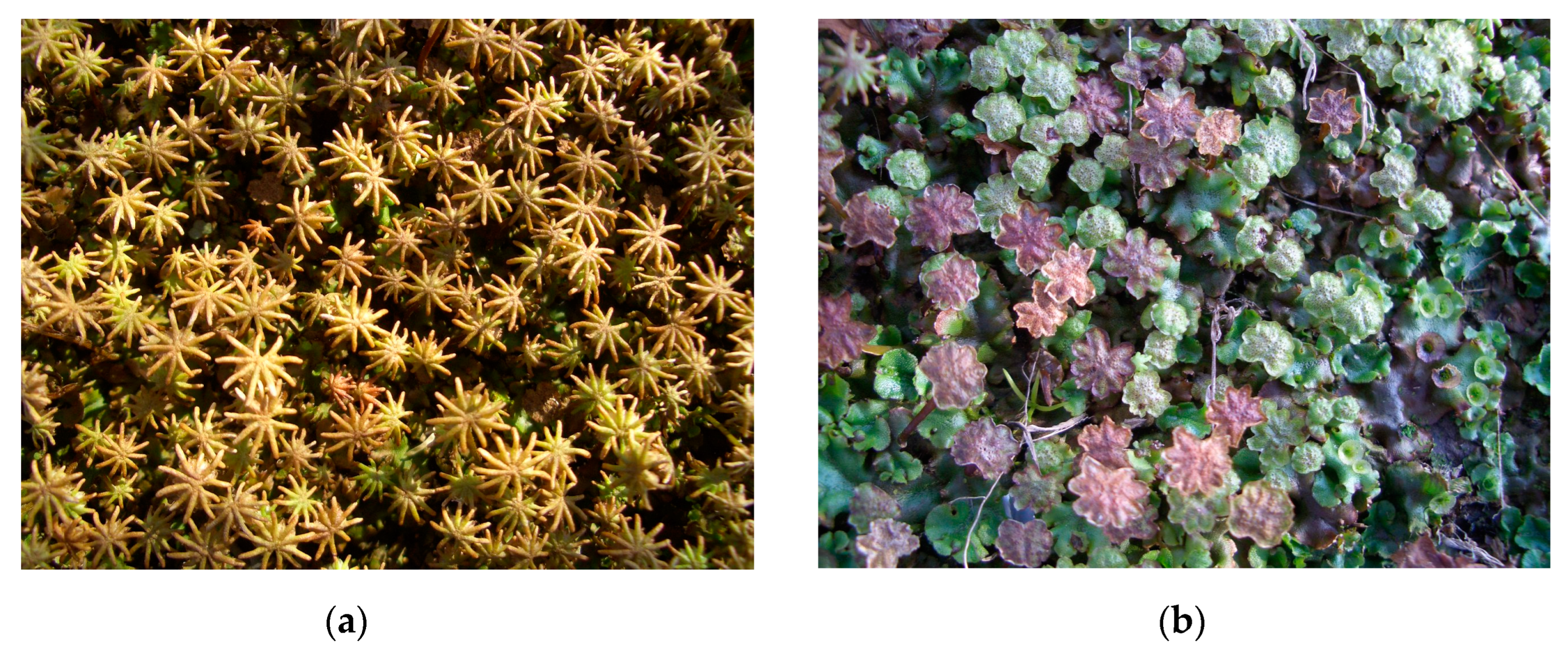

Table 1.
Metabolites found in Marchantia polymorpha.
| No. | Compounds | Formula | Plant origin | References | |
|---|---|---|---|---|---|
| MONOTERPENOIDS | |||||
| 1 | Limonene | C10H16 | USA (axenic culture) | [14] | |
| SESQUITERPENOIDS | |||||
| 2 | β-Acoradiene | C15H24 | Poland | [15] | |
| 3 | α-Neocallitropsene | C15H26 | Poland | ||
| 4 | β-Alaskene | C15H24 | Poland | [15] | |
| 5 | Acorenone B | C15H24O | Poland | [15] | |
| 6 | α-Gurjunene | C15H24 | New Zealand, USA (axenic culture) | [14,16] | |
| 7 | Aromadendrene | C15H24 | Turkey | [17] | |
| 8 | α-Barbatene | C15H24 | Japan | [18] | |
| 9 | β-Barbatene | C15H24 | Japan | [18,19,20] | |
| 10 | α-Chamigrene | C15H24 | Japan, Germany, India | [19,20,21,22] | |
| 11 | β-Chamigrene | C15H24 | Germany, India, Poland, USA (axenic culture) | [14,15,19,21,22,23,24] | |
| 12 |
ent-9-oxo-α-Chamigrene (Laurencenone C) |
C15H22O | Japan, Germany, Poland | [20,21,23] | |
| 13 | Cuparene | C15H24 | Turkey, Japan, Poland, USA (axenic culture) | [14,15,17,18,24] | |
| 14 | α-Cuprenene | C15H24 | Japan, Poland | [15,20] | |
| 15 | β-Cuprenene | C15H24 | [19] | ||
| 16 | γ-Cuprenene | C15H24 | Japan | [20] | |
| 17 | δ-Cuprenene | C15H24 | Japan, Poland | [15,20] | |
| β-Microbiotene | C15H24 | Poland | [15] | ||
| 18 | 2-Cuparenol (= Cuparophenol, δ-Cuparenol) | C15H22O | Turkey, South Africa | [17,18,23,25] | |
| 19 | ent-Cuprenenol | C15H26O | [19] | ||
| 20 | Cyclopropanecuparenol | C15H26O | Japan, Poland | [15,19,20] | |
| 21 | epi-Cyclopropanecuparenol | C15H26O | Poland | [15,19] | |
| 22 | α-Selinene | C15H24 | New Zealand, Poland | [15,16] | |
| 23 | ent-β-Selinene | C15H24 | India | [19,22] | |
| 24 | α-Eudesmol | C15H26O | Turkey | [17] | |
| 25 | (2Z,4E)-Abscisic acid | C15H20O3 | [26] | ||
| 26 | (2E,4E)-Abscisic acid | C15H20O3 | [26] | ||
| 27 | ent-Thujopsene | C15H24 | Japan, Poland, USA (axenic culture) | [14,15,18,19,20,27] | |
| 28 | ent-Thujopsan-7β-ol | C15H26O | Japan, Germany | [20,21] | |
| 29 |
ent-Thujopsenone (= Thujops-3-en-5-one) |
C15H22O | Japan | [18,19,20] | |
| 30 | Bicycloelemene | C15H24 | [19] | ||
| 31 | β-Elemene | C15H24 | [19,28] | ||
| 32 | γ-Elemene | C15H24 | [19] | ||
| 33 | δ-Elemene | C15H24 | [23,24] | ||
| 34 | Eremophilene | C15H24 | [28] | ||
| 35 | 1(10),11-Eremophiladien-9β-ol | C15H24O | Germany | [29] | |
| 36 | Costunolide | C15H20O2 | Japan | [30] | |
| 37 | α-Himachalene | C15H24 | USA (axenic culture) | [14,24] | |
| 38 | β-Bisabolene | C15H24 | [19] | ||
| 39 | β-Caryophyllene | C15H24 | [19] | ||
| 40 | α-Cedrene | C15H24 | [19] | ||
| 41 | 7-epi-α-Cedrene | C15H24 | Poland | [15] | |
| 42 | β-Cedrene | C15H24 | [28] | ||
| 43 | β-Herbertenol | C15H22O | Japan, Poland | [15,18,19] | |
| 44 | ent-α-Herbertenol | C15H22O | Germany | [21] | |
| 45 | Widdrol | C15H26O | Japan | [18,19] | |
| DITERPENOIDS | |||||
| 46 | Marchanol | C20H32O2 | Vietnam | [31] | |
| 47 | Labda-7,13E-dien-15-ol | C20H34O | [19,27,32] | ||
| 48 | Vitexilactone | C22H34O4 | Vietnam | [31] | |
| 49 | Phytol | C20H40O | South Africa, Poland | [15,19,33] | |
| STEROLS and TRITERPENOIDS | |||||
| 50 | Campesterol | C28H48O | South Africa, Germany, India | [21,22,33,34] | |
| 51 | Brassicasterol | C28H46O | [23] | ||
| 52 | Dihydrobrassicasterol | C28H48O | [34,35] | ||
| 53 | Stigmasterol | C29H48O | South Africa, Germany | [21,33] | |
| 54 | Sitosterol | C29H50O | South Africa, Germany | [21,33,34] | |
| 55 | Clionasterol (24β-ethyl) | C29H50O | [34,35] | ||
| 56 | 12-Oleanene-3-one | C30H48O | Vietnam | [31] | |
| 57 | Ursolic acid | C30H48O3 | Vietnam | [31] | |
| 58 | 3,11-Dioxoursolic acid | C30H44O4 | Vietnam | [31] | |
| BIBENZYLS | |||||
| 59 | Lunularin | C14H14O2 | Germany, Vietnam | [19,21,31] | |
| 60 | Lunularic acid | C15H14O4 | Cell culture, Japan Germany | [36,37,38] | |
| 61 | Prelunularic acid | C15H16O5 | [38,39,40] | ||
| 62 | 2,5-Di-O-β-d-glucopyranosyl- 4′-hydroxybibenzyl | C26H34O13 | [41] | ||
| 63 | 2-[3-(Hydroxymethyl) phenoxy]-3-[2- (4-hydroxyphenyl) ethyl]phenol | C21H20O4 | China | [42] |
|
| BISBIBENZYLS | |||||
| 64 | Riccardin C | C28H24O4 | South Africa, India, Vietnam | [22,31,33] | |
| 65 | Riccardin D | C28H24O4 | China | [43] | |
| 66 | Riccardin H | C31H28O4 | China | [43] | |
| 67 | Isoriccardin C | C28H24O4 | India, Vietnam | [22,31] | |
| 68 | Isoriccardin D | C28H24O4 | China | [42] | |
| 69 | 13,13′-O-Isopropylidenericcardin D | C31H28O4 | China | [43] | |
| 70 | Polymorphatin A | C28H24O4 | China | [42] | |
| 71 | Marchantin A | C28H24O5 | China, Germany, India, Japan, Serbia (natural and cultured), Vietnam | [19,21,22,24,27,31,43,44,45,46,47] | |
| 72 | 7′,8′-Dehydromarchantin A | C28H24O4 | Serbia (cell culture) | [44] | |
| 73 | Marchantin B | C28H24O6 | China Germany Japan | [19,21,27,43,45,46] | |
| 74 | Marchantin C | C28H24O4 | South Africa, Germany, India, Japan, Serbia (cell culture) | [19,21,22,27,33,44,45,46] | |
| 75 | Marchantin D | C28H24O6 | Germany, India, Japan | [19,21,22,27,45,46,48] | |
| 76 | Marchantin E | C29H26O6 | China, Germany, India, Japan, Serbia (cell culture) | [19,21,22,27,43,44,45,46] | |
| 77 | Marchantin F | C28H24O7 | South Africa, | [33] | |
| 78 | Marchantin G | C28H22O6 | [48] | ||
| 79 | Marchantin H | C28H24O5 | South Africa, | [33] | |
| 80 | Marchantin J | C30H28O6 | China, Germany | [21,42] | |
| 81 | Marchantin K | C29H26O7 | Germany, Vietnam | [21,31] | |
| 82 | Marchantin L | C28H24O6 | Germany | [21] | |
| 83 | Isomarchantin C | C28H24O4 | India | [22] | |
| 84 | Neomarchantin A | C28H24O4 | China | [43] | |
| 85 | Perrottetin E | C28H26O4 | China, India | [22,42] | |
| OTHER AROMATICS | |||||
| 86 | 3R-(3,4-Dimethoxybenzyl)-5,7-dimethoxyphthalide | C19H20O6 | Vietnam | [31] | |
| 87 | Marchatoside | C20H22O7 | Vietnam | [31] | |
| 88 | 3-(3,4-Dihydroxyphenyl)- 8-hydroxyisocoumarin | C15H10O5 | Germany (cell culture) | [37] | |
| 89 | 2,3-Dimethoxy-7-hydroxy- phenanthrene |
C16H14O3 | Germany (cell culture) | [37] | |
| 90 | 2,7-Dihydroxy-3-methoxy- phenanthrene |
C15H12O3 | Germany (cell culture) | [37] | |
| 91 | 3,3′-Dimethoxy-2,2′,7,7′-tetra- hydroxy-1,1′-biphenanthrene |
C30H22O6 | Germany (cell culture) | [37] | |
| 92 | 2-Hydroxy-3,7-dimethoxy phenanthrene | C16H14O3 | India | [22] | |
| 93 | m-Hydroxybenzaldehyde | C7H6O2 | Germany | [21] | |
| 94 | p-Hydroxybenzaldehyde | C7H6O2 | South Africa, Germany | [21,33] | |
| 95 | 3-Methoxy-2,2′,3′,7,7′-pentahydroxy- 1,1′-biphenanthrene | C29H20O6 | Germany (cell culture) | [37] | |
| 96 | 2,2′,3,3′,7,7′-Hexahydroxy- 1,1′-biphenanthrene | C28H18O6 | Germany (cell culture) | [37] | |
| 97 | 2-(3,4-Dihydroxyphenyl)-ethyl-β-d-allopyranoside | C14H20O8 | [41] | ||
| 98 | 2-(3,4-Dihydroxyphenyl)-ethyl-β-d-glucopyranoside | C14H20O8 | [41] | ||
| 99 | 2-(3,4-Dihydroxyphenyl)-ethyl- O-α-l-rhamnopyranosyl-(1→2)-β-d- allopyranoside | C20H30O12 | [41] | ||
| 100 | 2-(3,4-Dihydroxyphenyl)-ethyl- O-β-d-xylopyranosyl-(1→6)-O-β-d-allopyranoside | C19H28O12 | [41] | ||
| 101 | Salidroside | C14H20O7 | [49] | ||
| 102 | β-(3,4-Dihydroxyphenyl)ethyl- O-β-d-glucoside | C14H20O8 | Germany (cell culture) | [37,49] | |
| 103 | Indole acetic acid | C9H7O2N | [26] | ||
| FLAVONOIDS | |||||
| 104 | Apigenin | C15H10O5 | Germany (cell culture); New Zealand |
[37,50,51] | |
| 105 | Apigenin-7-O-β-D-glucuronide | C21H18O11 | New Zealand | [50,51] | |
| 106 | Apigenin-7,4'-di-O-glucuronide | C27H26O17 | New Zealand | [50,51] | |
| 107 | Luteolin | C15H10O6 | Germany | [21,50,51] | |
| 108 | Luteolin-7-O-β-D-glucuronide | C21H18O12 | New Zealand | [50,51] | |
| 109 | Luteolin-7,3'-di-O-β-glucuronide | C27H26O18 | New Zealand | [50,51] | |
| 110 | Luteolin-7,4'-di-O-β-glucuronide | C27H26O18 | New Zealand | [50,51] | |
| 111 | Luteolin-3'4'-di-O-β-glucuronide | C27H26O18 | New Zealand | [50,51] | |
| 112 | Luteolin-3'-O-β-glucuronide | C21H18O12 | New Zealand | [50,51] | |
| 113 | Luteolin-7,3'4'-tri-O-β-glucuronide | New Zealand | [50,51] | ||
| 114 | Artemetin | C20H20O8 | Vietnam | [31] | |
| 115 | Kaempferol | C15H10O6 | Vietnam | [31] | |
| 116 | Quercetin | C15H10O7 | Vietnam | [31] | |
| 117 | Aureusidin-6-O-g1ucuronide | C21H18O12 | New Zealand | [52] | |
| 118 | 5,3′,4′-Trihydroxyisoflavone- 7-O-β-d-glucopyranoside ( = Orobol-7-O-glucoside) |
C21H20O11 | [41] | ||
| 119 | Riccionidin A | C15H9O6 | [53] | ||
| 120 | Riccionidin B | C30H17O12 | [53] | ||
| LIPIDS | |||||
| 121 | Palmitic acid (16:0) (= Hexadecanoic acid) |
C16H32O2 | Cell culture Japan, sporophyte |
[20,54] | |
| 122 | Ethyl palmitate (= Hexadecanoic acid ethyl ester) | C18H36O2 | Japan, sporophyte | [20] | |
| 123 | Stearic acid (18:0) (= Octadecanoic acid) |
C18H36O2 | Cell culture |
[54] | |
| 124 | Palmitoleic acid (16:1n-7) (= 9-Hexadecenoic acid) |
C16H30O2 | Cell culture |
[54] | |
| 125 | Oleic acid (18:1n-9) (= 9-Octadecenoic acid) |
C18H34O2 | Cell culture |
[54] | |
| 126 | Linoleic acid (18:2n-6) (= 9,12-Octadecadienoic acid) |
C18H32O2 | Japan, sporophyte Cell culture |
[20,54] | |
| 127 | α-Linolenic acid (18:3n-3) (= 9,12,15-Octadecatrienoic acid) |
C18H30O2 | Cell culture |
[54] | |
| 128 | Arachidonic acid (20:4n-6) (= 5,8,11,14-Eicosatetraenoic acid) |
C20H32O2 | Cell culture |
[54,55] | |
| 129 | EPA (20:5n-3) (= Eicosapentaenoic acid) |
C20H30O2 | Cell culture |
[54,55] | |
| 130 | Oxacycloheptadecan-2-one | C16H30O2 | Japan, sporophyte | [20] | |
| OTHER COMPOUNDS | |||||
| 131 | Shikimic acid 4-(β-d-xylopyranoside) | C12H18O9 | [41] | ||
Disclaimer/Publisher’s Note: The statements, opinions and data contained in all publications are solely those of the individual author(s) and contributor(s) and not of MDPI and/or the editor(s). MDPI and/or the editor(s) disclaim responsibility for any injury to people or property resulting from any ideas, methods, instructions or products referred to in the content. |
© 2025 by the authors. Licensee MDPI, Basel, Switzerland. This article is an open access article distributed under the terms and conditions of the Creative Commons Attribution (CC BY) license (http://creativecommons.org/licenses/by/4.0/).
Copyright: This open access article is published under a Creative Commons CC BY 4.0 license, which permit the free download, distribution, and reuse, provided that the author and preprint are cited in any reuse.


