

Submitted:
02 January 2025
Posted:
03 January 2025
You are already at the latest version
Abstract
With the rapid rise in portable electronic and wearable devices, safety concerns have become a global research focus. Gel polymer electrolytes (GPEs) offer a safer and more adaptable alternative to conventional liquid electrolytes, enabling the design of flexible energy storage systems (ESS). Combining viscoelasticity with metallic, semiconductor, and organic components, GPEs have emerged as key materials for advanced ESS applications. This review provides a comprehensive summary of recent progress in GPEs, emphasizing their enhanced physicochemical properties and electrochemical performance. Key topics include the concept of unity lithium-ion transference number and pseudocapacitance, as well as advancements in smart GPEs with self-healing, thermotolerant, and self-protection capabilities. The review concludes by discussing prospects and challenges for future research on GPEs, aiming to propel next-generation energy storage systems.
Keywords:
Gels
; electrolytes
; Li-ion batteries
; energy storage
1. Introduction
Lithium-ion batteries (LIBs) have been the cornerstone of modern digital civilization for several decades [1,2,3]. Behind the scene, it is the liquid electrolytes that has played the essential role in all these EESs with its high electrical conductivities (10-3-10-2 S/cm) maintaining a good contact with the electrodes [4]. Needles to mention, these liquid electrolytes are not only the key players in LIBs but in fact in all the EESs including the LIBs major rivals, sodium-ion, zinc-ion, magnesium-ion, and aluminum-ion batteries [5,6,7,8]. However, the use of liquid electrolytes introduces risks such as leakage and fire hazards, primarily due to the flammability of volatile organic compounds like ethylene carbonate, methylene carbonate, and ethyl methyl carbonate [9,10]. Beyond these technical challenges, significant safety risks arise from the formation of lithium dendrites [11], which are induced by non-uniform charge distribution. This phenomenon is particularly pronounced in metal batteries employing porous separators, where localized current density exacerbates dendritic growth [12]. Commercial LIBs, though they majorly employ liquid organic electrolytes, due to their high wettability on electrode surfaces and high conductivity, have inherent drawbacks, including limited ion selectivity, electrochemical potential window instability, and fire hazards.
In contrast, solid polymer electrolytes without liquid electrolytes offer superior thermal stability, ensuring safety by restricting the growth of lithium dendrites. However, these electrolytes suffer severely from poor ionic conductivities, which barely reach 10-8-10-5 S/cm, and poor electrode interfaces that result in poor electrochemical performances. Though several research efforts [13,14] are underway to improve the insufficient electrode contact and inadequate ionic conductivities, it is still far from being commercialized in the near future. In addition, their inferior mechanical property has also hampered their commercial developments [15,16]. Key requirements for solid electrolytes to meet their commercial success involve enhancing their ionic conductivities and interfacial electrode contacts.
Amid these, combining the unique properties of liquid and solid electrolytes, gel polymer electrolytes (GPEs) have garnered intensive research interest owing to their enhanced electrolyte properties and playing an additional role as separators. Such dual functionalities can assist in packing more energy in limited space in battery packs, thereby reducing the fear of thermal runaway prevalent in day-to-day batteries [17]. In addition, due to the workability of polymers, GPEs can render energy storage devices with adjustable shapes and varying sizes, a promising feature for burgeoning wearable and portable electronic devices [18,19,20,21]. Furthermore, the flexibility of GPEs can also serve as a host to accommodate the volume expansion and the lithium dendrite during charge-discharge, thereby enhancing the electrochemical performances of the battery in general [22]. As a consequence, tremendous progress has been made in the field of GPEs as an alternative to electrolytes used in not only LIBs but also in several other electrochemical energy storage devices, including Li-S, Sodium-ion, Zinc-ion, Li-O2, supercapacitors, fuel cells, and Zn-air batteries [23,24,25,26,27,28].
In a typical gel polymer electrolyte (GPE), a polymeric host material is utilized to ensure robust mechanical stability. The selection of an effective host material is guided by specific criteria, including (1) wide electrochemical window, (2) low grass transition temperature (Tg), (3) functional groups promoting salts dissolution, (4) high degradation temperature, and (5) fast motion of polymeric chain. Unlike solid electrolytes, salts in the GPEs are the primary sources of charge carriers, particularly larger anions with fairly low dissociation energy. Apart from this, electrolytes in GPEs are primarily of four categories, based on (1) ionic liquids (ILs) [29], (2) protons [30], (3) conducting salt [31], and (4) alkaline [32]. Although there are no universally established protocols for selecting a specific electrolyte to be used in energy storage systems (EES), certain practical considerations play a critical role in guiding the selection process. These criteria are essential for ensuring optimal performance, stability, and safety of the system, and they serve as a fundamental basis for evaluating the suitability of an electrolyte for a given application. (1) The electrolytes must have high ionic conductivity, (2) thermal, chemical, and electrochemical stability, and (3) good dissociation without forming ion aggregations or ionic pairs. To facilitate ionic conduction pathways in GPEs, organic/aqueous solvents are introduced that must have a high dielectric constant of the order ε> 15 [33]. There are a few widely used organic electrolytes that include tetrahydrofuran (THF), dimethyl sulphoxide, dimethyl carbonate (DMC), propylene carbonate (PC), ethylene carbonate (EC), diethyl carbonate (DEC), dimethyl formamide (DMF).
After the discussions on the electrolytes, solvents, and salts, we now turn to obtaining a suitable high-performance GPE to improve the electrochemical performances of LIB. To obtain a suitable GPE, it is essential to blend the host polymer species, the solvents, and the salts to form a solution by techniques such as casting, melt process, in-situ polymerization [34], or phase-inversion methods [35].
While several existing reviews [36,37,38] have discussed significant advancements and challenges in the development of GPEs, there remains a lack of focus on emerging techniques designed to enhance their electrochemical performance. Additionally, the unique requirements of wearable electronics have catalyzed the creation of high-performance GPEs, which have yet to be adequately covered in current literature. This review aims to fill these gaps by providing a comprehensive overview of the fundamental principles of GPEs, alongside an in-depth examination of recent innovations and modern methodologies developed to improve their electrochemical properties. By addressing these advancements, this review seeks to pave the way for better and more efficient energy storage solutions.
1.1. Performance and Key Properties
Before moving to further discuss the advancements and existing challenges, it is essential to understand a few key aspects of GPEs. Often conventional GPEs suffer from poor ionic conductivity, particularly at room temperature, mechanical stability, and poor thermal stability [39]. As a result, plasticizers or inorganic/organic fillers are often added to enhance their electrochemical performances. The inorganic fillers can act as Lewis’s acid to compete with Li+ ions, can promote segmental motion of polymer matrix, and impact the ionic conductivity of GPEs [40]. However, care must be taken with plasticized addition, as an excess addition can deteriorate the mechanical property, reduce thermal stability, and lead to phase separation, ultimately compromising the overall performance of the GPE. This imbalance can negatively impact the electrolyte’s ionic conductivity, structural integrity, and long-term cycling stability, counteracting the intended benefits and limiting its suitability for practical energy storage applications. A recent study is a testimony to the critical role of organic plasticizers, which consists of PMMA-based GPEs with LIClO4 and plasticizers [41]. GPEs were prepared using PMMA with propylene carbonate (PC) or a PC-ethylene carbonate (EC) mixture. Conductivity, thermal properties, anodic stability, and ion interactions were analyzed across various salt concentrations. The highest conductivity (0.031 S/cm) was achieved with PMMA-Li-PC-EC at 1 M salt. Anodic stability reached 4 V, and FTIR revealed ion-pairing interactions. Notably, unreacted PMMA monomer enhanced ion conduction, suggesting a novel approach for improving GPE performance.
On the other hand, mechanical and ionic conductivity can also be increased by the addition of inorganic plasticizers. Inorganic plasticizers like LiAlO2, SiO2, TiO2, BaTiO3, and Li3N can enhance their properties, which mostly depend upon their morphology, crystallinity, shape, and size. Another effective method to enhance the properties of GPEs is by incorporating assistant polymers through grafting or copolymerization within the polymer matrix [42]. Grafting introduces side chains that improve flexibility, ion transport, and mechanical strength, while copolymerization combines different monomers to enhance the amorphous structure, reduce crystallinity, and promote ion migration. These modifications not only increase mechanical stability and ionic conductivity but also improve compatibility at the electrode interface, making GPEs more efficient and reliable for energy storage applications. For instance, with the introduction of polystyrene blocks inside the poly(ethylene oxide) matrix, a uniform 3D network could be achieved that enhances the mechanical stability and also introduces crosslinking composites, thereby increasing the thermal stability of the matrix [43]. Furthermore, these cross-linked gel polymer structures also enhance the ionic conductivity ~1.38 × 10⁻³ S/cm at room temperature.
Recent advances in redox mediators have significantly contributed to enhancing the electrochemical performance of GPEs. By introducing redox-active mediators like indigo carmine (IC) into polymer matrices, such as polyvinyl sulfuric acid, researchers have developed advanced GPE systems (e.g., PVA-H₂SO₄-IC) that not only improve ionic conductivity but also serve dual functions as both electrolyte and separator [44]. The incorporation of IC facilitates rapid electron transfer, reduces internal resistance, and enhances charge storage capacity, resulting in improved cycling stability and overall battery efficiency. This multifunctional approach highlights the potential of redox mediators in driving next-generation energy storage solutions. These redox-mediated species not only extend the lifespan of the batteries but also enhance their efficiency and reliability, making GPEs a promising solution for advanced energy storage applications.
2. Applications of GPEs in Energy Storage Devices
GPEs have emerged as critical components in advancing energy storage technologies, offering a versatile and safer alternative to conventional liquid and solid electrolytes. Their unique properties, such as high ionic conductivity, flexibility, and thermal stability, make them ideal for a range of energy storage devices. This section explores the diverse applications of GPEs across various sectors, including lithium-ion batteries (LIBs), sodium-ion batteries (SIBs), and next-generation air batteries.
2.1. Lithium-Ion Batteries:
LIBs have been the driving wheels for modern digital civilizations [45,46]. The development of GPE for LIBs has been significantly propelled by research activities focusing on Polyvinylidene fluoride (PVDF) and copolymers. PVDF has been serving as an excellent host material for decades due to its high electrochemical stability, mechanical robustness, and compatibility with lithium salts. PVDF’s semi-crystalline structure provides a balance between amorphous regions for ion transport and crystalline domains that reinforce mechanical strength. This combination allows for enhanced ionic conductivity and long-term cycling stability, essential for LIBs operating under high voltages and demanding conditions. Additionally, PVDF’s chemical resistance to solvents and oxidative degradation minimizes electrolyte decomposition, contributing to safer and more durable batteries. In sodium-ion batteries (SIBs), PVDF-based GPEs address challenges such as sodium dendrite growth and interfacial instability by providing a flexible and stable electrolyte matrix. The ability of PVDF to adapt to different salt chemistries and plasticizers ensures efficient sodium-ion conduction, paving the way for cost-effective and large-scale energy storage solutions. Recent advancements include blending PVDF with ceramic fillers (such as SiO₂ and TiO₂) to enhance mechanical properties and reduce crystallinity, further boosting ion mobility. Copolymerization with PEO, PMMA, or PTFE has also been explored to optimize flexibility, reduce phase separation, and improve electrolyte-electrode interfaces. PVDF-based GPEs continue to play a pivotal role in advancing both lithium-ion and sodium-ion technologies, ensuring safer, more efficient, and longer-lasting energy storage systems critical to the growth of renewable energy infrastructure and portable power solutions.
Zhang et al. synthesized a flexible gel polymer electrolyte (GPE) using the immersion precipitation technique, incorporating polyvinylidene fluoride-co-hexafluoropropylene (PVDF-HFP) as the base material [47]. To enhance the electrochemical performance of the LiFePO₄ cathode, the GPE was doped with an optimized proportion of poly (ethylene oxide) (PEO) and silicon dioxide (SiO₂) resulting in PVDF-HFP-PEO-SiO2 assembly. The addition of PEO improved ionic conductivity by promoting amorphous regions within the polymer matrix, while SiO₂ acted as a reinforcing filler, enhancing mechanical strength and thermal stability. This combination resulted in better interfacial contact with the LiFePO₄ cathode, leading to improved cycling performance and overall battery efficiency. To obtain the electrochemical performances, CR2032 coin cells were fabricated with the assembly, as shown in Figure 1a. This assembly shows enhanced cyclic stability within the potential window of 2.6-4.0 V at 0.1 C-rate (Figure 1b). The inclusion of PVDF-HFP not only improved the electrochemical performance, but mechanical properties were also enhanced, as evidenced by the stress-strain profile shown in Figure 1c. The tensile strength of PVDF-HFP-PEO-SiO2 was 6.72 MPa with an elongation at a break of 80%. The improved mechanical property of PVDF-HFP-PEO-SiO2 reduced the risk of short-circuit inside the LIBs, thereby increasing their safety and stability. Another issue with LIBs is their electrolyte stability window is closer to ~4.8 V; thus, if the performance has to be raised, there must be a substantial increase in the working window of the electrolyte. Ma et al. in his research designed a GPE-based electrolyte using a simple dipping method for high voltage working (5V) LIB [48]. In this, a new polyethylene (PE) supported ultra-thin blended polymer electrolyte using PVDF/hydroxyethyl cellulose (PVDF/HEC) was developed using a simple dipping method for high voltage LIBs. The optimal PVDF: HEC ratio (3:1) showed superior mechanical, thermal, and wettability properties. The GPE achieved high ionic conductivity (0.78 mS/cm) and electrochemical stability up to 5.25 V. When paired with a LiNi₀.₅Mn₁.₅O₄ cathode, the GPE demonstrated excellent cycling stability and rate performance, making it a promising low-cost option for high-voltage LIBs. Similarly, Huang et al. [49] made an effort to improve the intrinsic limitations of GPE, such as low transference number and poor ionic conductivity, by designing a flexible poly(vinylidene fluoride-co-hexafluoropropylene)-butanedinitrile (PVDF-HFP-SN)-based GPE (PSGPE) by a simple immersion technique. The schematic illustration for the synthesis of PSGPE is shown in Figure 1d. The use of such flexible structures with pores allows electrolytes to percolate deep inside the structure to complete the reactions. The additional pores, and connected network, and reduced crystallinity reduce the energy barrier for Li-diffusion to shuttle easily between the pores. The use of high polarity SN improves the interfacial transference and stability, thereby improving the cyclic stability Figure 1e. As it is now evident that the porosity of the GPE plays a crucial role in Li-ion diffusion, regulating the size, distribution, and connectivity of pores can significantly influence the electrochemical performance, including ionic conductivity, charge-discharge rates, and cycling stability, in lithium-ion batteries (LIBs). In this regard, the Li group [50] demonstrated an experiment with proper tuning of the pores of GPE using poly(acrylonitrile-polyhedral oligomeric silsesquioxane)/poly(vinylidene fluoride) (PAN-POSS/PVDF) with ionic liquids (ILs), the electrochemical performances could be enhanced significantly. GPEs containing 15 wt% PAN-POSS exhibit high ionic conductivity (1.91 × 10⁻³ S/cm at 20°C) due to their enhanced porosity and absorptivity. These GPEs demonstrate excellent mechanical strength, thermal stability, and fire resistance. Additionally, they achieve a high electrochemical stability window of 4.6 V (vs. Li/Li⁺). Testing cells with Li metal anodes and LiFePO₄ cathodes show good rate performance, indicating the potential of these GPEs for application in high-safety, high-performance LIBs. The development of GPEs has significantly improved lithium-ion battery (LIB) technology by addressing the safety and instability issues associated with conventional liquid electrolytes. GPEs offer enhanced mechanical strength, thermal stability, and ionic conductivity, contributing to safer and more durable battery systems. PVDF-HFP/PMMA/PVAc-based GPEs demonstrated ionic conductivity of 4.24 × 10⁻⁴ S/cm and retained 88% capacity after 50 cycles in NCM811/Li cells, highlighting their potential for long-term stable performance [51]. Further advancements, such as incorporating 15 wt% PAN-POSS, increased ionic conductivity to 1.91 × 10⁻³ S/cm at 20°C while improving porosity, absorptivity, and fire resistance. These GPEs achieved an electrochemical stability window of 4.6 V and exhibited strong rate performance in Li/LiFePO₄ cells, underscoring their suitability for high-voltage, high-safety energy storage applications.
Bellcore technology has played a foundational role in advancing flexible LIBs by introducing robust and mechanically stable GPEs. Building on this, a novel large-scale poly(vinyl acetate) (PVAc)-based GPE incorporating poly(vinylidene fluoride)-co-hexafluoropropylene (PVDF-HFP) and SiO₂ was developed using a simple solution casting method [52]. The dry membrane, once swollen with a LiPF₆-carbonate-based electrolyte, forms a rigid-flexible coupling GPE. Intermolecular complexation between PVAc and PVDF-HFP minimizes PVAc solubility in the electrolyte, enhancing structural integrity. This GPE enabled LiNi₀.₅Co₀.₂Mn₀.₃O₂ (NCM523)/mesocarbon microbead (MCMB) full cells to achieve excellent cycling stability and rate performance. Leveraging Bellcore's conventional hot calendaring process, a pouch cell prototype was successfully fabricated, demonstrating superior flexibility and resistance to mechanical stress. By eliminating the need for complex pore regulation, this design offers a new pathway to advancing Bellcore technology for scalable, durable, and high-performance LIBs.
2.2. Sodium-Ion Batteries:
Another essential application for GPE is SIBs. GPEs are increasingly vital for sodium-ion batteries (SIBs), offering a cost-effective and sustainable alternative to lithium-ion systems. While there has been significant progress in electrolytes for lithium-ion batteries (LIBs), much less research has been conducted on electrolytes for SIBs. The development of GPEs for SIBs is in the infancy stage and needs rigorous efforts. In this direction, a series of GPEs has been developed using a blend of PVDF-co-hexafluoropropylene) (PVdF-HFP) and poly (methyl methacrylate) (PMMA), using NaClO4 as a salt and tetra ethylene glycol dimethyl ether (TEGDME) and 1-ethyl-3-methylimidazolium tetrafluoroborate (EMIM-BF4) as a molecular solvent [53]. The synthesized material was denoted as PNTE (1= EMIMBF4: TEGDME (1: 2), 2= EMIMBF4: TEGDME (1: 1), 3= EMIMBF4: TEGDME (2 : 1)). The synthesized GPE looks like as shown in Figure 2a. Uniquely, the semicircle in their Nyquist plot was significantly absent, indicating the presence of oblique straight lines in the low-frequency zone (Figure 2b). The absence of a semi-circle indicates that the conduction is merely due to ion migration achieved due to the versatile nature of the facile ion mobility of PNTE3. The CV curves are further obtained to show the redox nature of the synthesized material. The CV curves (Figure 2c) show that the current is consistent below 2.5 V; however, as the voltage increases beyond 2.5 V, there is a sudden increase in current, as shown by PNTE3. These collective features showcase the device transference number of 0.20 and enhanced room temperature conductivity of 5.8 × 10⁻³ S/cm. To further improve the transference number and electrochemical performances, polydopamine (PDA)-modified thermoplastic polyurethane (TPU) membranes and N-methyl-N-methoxyethyl pyrrolidine bis (fluorosulfonyl) imine (Pyr12O1FSI) ionic liquid is developed as shown in Figure 2d [54]. The GPE shows excellent heat resistance and structural stability due to strong intermolecular interactions. PDA’s functional groups form hydrogen bonds with TFSI−, enhancing Na+ transport. This results in high ionic conductivity (3.57 × 10⁻⁴ S/cm) and a Na+ transference number of 0.34 at 30 °C. The GPE enables symmetric cells to cycle for 1200 h at 0.1 mA cm−2, providing a pathway for safer, high-performance SIBs. To get better insights into the mechanism, density functional theory (DFT) was obtained (Figure 2e-g). There exists an interaction between PDA and TPU fragments with energy -0.5815 eV (Figure 2e). Such a high energy indicates that besides physical interaction, there also exists a chemical interaction between TPU, ensuring a greater stability of the TPU@PDA membrane. In addition, the impact of TPU and PDA fragments of TFSI− ions are calculated to be −0.2995 eV and −0.0217 eV, respectively (Figure 2f). These negative values might arise from the interaction between active functional groups, such as OH− and NH− in the PDA and O atoms in TFSI−. Furthermore, the lower binding energy of Pyr12O1−PDA (-0.4948 eV) against Pyr12O1F−TPU (-0.4470 eV) indicates the stronger interaction of PDA over TPU (Figure 2g). Furthermore, DFT calculations reveal that the strong interactions between PDA and TFSI− effectively restrict TFSI− anion movement, enhancing Na+ selectivity and increasing the Na+ transference number to 0.34.
2.3. Zinc-Batteries:
In addition to LIB and SIB, GPE plays a vital role in Zinc batteries. Zinc batteries are gaining momentum post-lithium-ion batteries due to their high energy density, low cost, clubbed with high safety. However, dendrites, corrosion, by-products during cycling, and hydrogen evolution [55] during performances affect commercial progress [56]. To improve the working potential window of Zinc-ion battery (ZIB), Shim’s group [57] designed a large-scale water-molecule pre-intercalated sheet-like V2O5 cathode structure denoted as (sheet like: s-V2O5·0.56H2O). This innovative design, coupled with a GPE, effectively addresses critical challenges such as the poor reversibility of Zn²⁺ intercalation and the unwanted side reactions commonly associated with aqueous electrolytes (Figure 3a). The pre-intercalated water molecules stabilize the cathode structure, facilitating smoother Zn²⁺ diffusion and improving cycling performance, while the GPE enhances electrolyte stability and suppresses dendrite formation, resulting in improved overall battery efficiency and durability. using GPE to solve technical issues like poor reversibility of Zn²⁺ intercalation chemistry and unwanted side reactions of aqueous electrolytes. The galvanostatic intermittent titration technique (GITT) shows some zig-zag profiles for bulk (b)-V2O5 and s-V2O5·0.56H2O, as shown in Figures 3b and c, respectively. While their calculated diffusion coefficient for b-V2O5 ((2.18–7.93) × 10−11 cm−2 s−1) and s-V2O5·0.56H2O ((4.82–24.6) × 10−11 cm−2 s−1)) is plotted in Figures 3d and e, respectively. The higher diffusion coefficient of s-V2O5·0.56H2O is due to the larger interlayer distance between the vanadium and oxygen layer interlaced between water molecules. The vibrational modes were further explored by Raman spectra, and the following features were revealed (Figure 3f). Raman spectra show layered oxide mode for the stretching at 197, 144, and 104 cm−1 (Figure 3f-a, b). Spectra of the discharge state show some new peaks (170, 258, 327, 443, 793, and 874 cm−1) ascribed to the intercalation of Zn2+ intercalation in VO layer. However, in the charged state, some of the peaks are not restored, indicating the intercalation formation of ZnxV2O5. The crystalline water molecules solvate and mitigate the Zn²⁺ charge shielding effect, facilitating more efficient Zn²⁺ (de)intercalation within the VO layers. This process enhances ion mobility, reduces electrostatic repulsion, and improves the structural integrity of the cathode, ultimately boosting the overall electrochemical performance and cycling stability of the battery.
2.4. Supercapacitors
Beyond batteries, GPEs are equally pivotal in advancing supercapacitor technology. Despite significant progress in flexible supercapacitors (FSCs), their commercialization remains hindered by practical challenges such as poor cyclic stability, limited ionic conductivity, and inadequate electrode/electrolyte interface compatibility. GPEs offer a promising pathway to overcome these barriers by enhancing ionic transport, providing mechanical flexibility, and ensuring superior interfacial contact, which are critical for improving the performance and durability of FSCs. This dual-role application of GPEs across batteries and supercapacitors underscores their versatility and potential in shaping the next generation of energy storage technologies [58]. To ensure safety in supercapacitors due to fire hazards, a flame-retardant GPE was synthesized by Wang and co-workers [59]. They synthesized an ion-gel supercapacitor with strong in situ cross-linking of electrolytes on the electrode surface. The introduction of ether-containing electrolytes in ion-gel electrolytes significantly improves the ionic conductivity to 6.5 × 10⁻³ S cm−1 at room temperature. This supercapacitor displays a high energy density of 41.6 Wh/kg and a high specific capacity of 105 F/g. Similarly, flexible GPEs were prepared using three butyl imidazole ionic liquids ILs with varying anions were used as additives in a polyvinylidene fluoride-hexafluoropropylene (PVDF-HFP) matrix [60]. The weight ratio of three ILs, namely 1-butyl-3-methylimidazole tetrafluoroborate ([BMIM][BF4], 1-butyl-3-methylimidazole hexafluorophosphate ([BMIM][PF6], and 1-butyl-3-methylimidazole difluoromethane sulfonimide ([BMIM][TFSI] to PVDF-HFP was maintained as 4:1, and the synthesized GPEs were named as GPE-1/2/3, respectively ((Figures 4a). The DFT calculations revealed that binding energies for GPE−1 and GPE−3 are -0.07 and -0.08 KJ/mol, respectively, compared to GPE−2 (-0.02 KJ/mol), indicating the former two are more stable (Figures 4b). This study brings the notion that using different ILs with varying anions has different impacts on the performances, and there is no straight scale to judge the overall performances. For instance, using GPE−1 based on [BMIM][BF4] demonstrates the best deformation capacity (~51.8%), while GPE−2 has the best tensile strength (~717 kPa). So, the choice of any particular additive depends upon the requirement in a given situation. Furthermore, the idea of deep eutectic solvent (DES) has also been used recently to improve the ionic conductivity of GPE [61]. In this approach, a deep eutectic solvent (DES) comprising LiClO₄−2-oxazolidinone (LO) as the electroactive species was employed, with polyvinyl alcohol (PVA) or polyacrylamide (PAAM) serving as a redox additive and plasticizer. This combination enhances the electrochemical activity and mechanical flexibility of the electrolyte, contributing to improved ionic conductivity and overall device performance. These combinations were tested in the MnO2 system, and it was found that PVA-LO electrolytes exhibited superior electrochemical performances with a specific capacity of 121.6 F/g, a high energy density (97.3 Wh/kg), and long-duration stability of over 5000 cycles at a current density of 2A/g.
3.0. Case studies on GPEs
After discussion on various energy domains, it is high time to introduce GPEs to solve particular issues in the energy sector. Several technical performance aspects must be improved if a rapid development and wider application of GPE is foreseen. For instance, thermal/mechanical/chemical stability, dendrite growth, interfacial stability, wide operating temperature, and so on. This section will focus on the practical application of GPEs to curb these technical issues in energy sectors.
3.1. Dendrites Control
Dendrites are needle-like structures that originate from the anode and extend toward the cathode, posing significant challenges to the safety and longevity of energy storage devices. These structures can pierce the separator, leading to internal short circuits, capacity loss, and in severe cases, thermal runaway [62]. Addressing dendrite formation is crucial for enhancing the stability, performance, and lifespan of batteries. GPEs have emerged as a promising solution to mitigate dendrite growth by providing a more uniform ion distribution, enhancing mechanical strength, and forming stable solid-electrolyte interfaces. This section explores the role of GPEs in suppressing dendrite formation, ensuring safer and more reliable energy storage systems.
Recently, solid-state lithium metal batteries (SSLMBs) have gained attention for their practical applications in electric vehicles (EVs) for their high energy densities and safety compared to traditional organic electrolytes-based LIBs. However, SSLMBs, with their solid polymer electrolytes, suffer seriously from lithium dendrite issues. Thus, GPEs could be used as an alternative to conventional organic electrolyte-based LIBs for dendrite-free SSLMBs. In this direction, flexible blended GPEs were synthesized for SSLMBs to improve their overall electrochemical performances [63]. The synthesized blending scheme with 3P (PEO: poly (ethylene oxide))/(PMMA: poly(methylmethacrylate))/PVDF-HFP membrane is shown in Figure 5a. PEO was dissolved in acetonitrile to form a continuous homogeneous mixture with stirring for 4h. NMP was then added to the solution with PMMA, followed by PVDF−HFP. The final dried 3P polymer was then punched into 17 mm diameter then soaked into different plasticizers to obtain final GPEs. A set of three plasticizers was used, which coined its name with first plasticizers as FEC with commercial liquid named as LEF. The second is Succinonitrile, named SNL, and the third was 10%vol of FEC to SNL, named SNLF. The as-prepared GPEs were denoted as LEF3P, SNL3P, and SNLF3P (Figure 5b). It is found that LEF3P possesses a high-voltage polarization, which finally settles after a few 20 cycles, while SNLF3P exhibits the lowest polarizations. SNLF3P also shows the best electrochemical performances for LiFePO4 with a specific capacity of 150 mAh/g, with a high retention of 94.8% even after 500 cycles at 0.3C. This enhanced performance of SNLF3P is ascribed to a stable layer formed between electrolyte and lithium. This is further supported by the addition of fluoroethylene carbonate (FEC) into GPE that promotes the formation of LiF coating on the interphase, and as a result, dendrite-free SSLMB was achieved.
3.2. Wide Electrochemical Stability Window
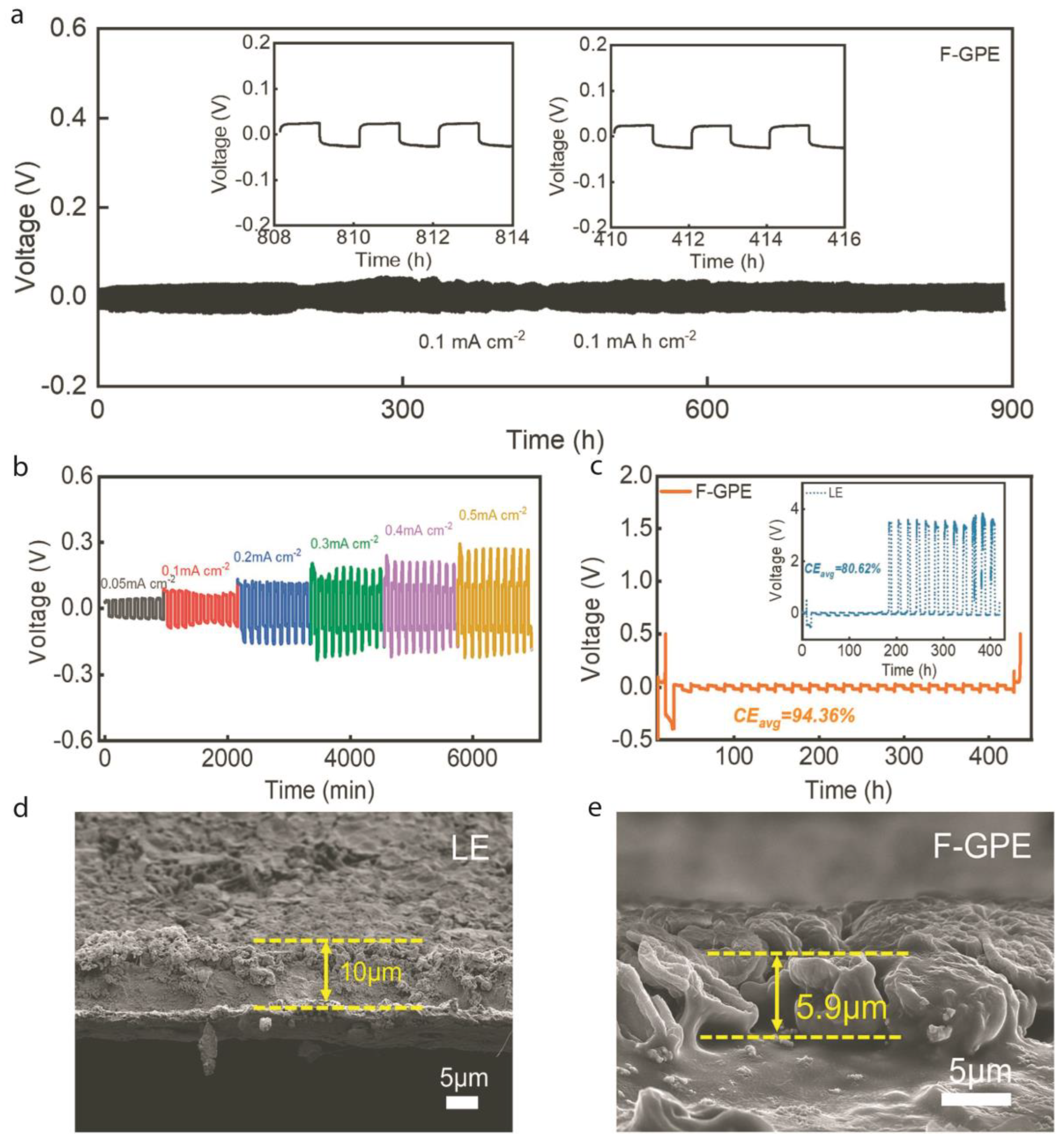
A significant drawback of conventional electrolytes is their limited ability to function within a narrow electrochemical stability window (ESW) [64]. Gel polymer electrolytes (GPEs) offer a solution by enabling batteries to operate within a broader electrochemical window, thereby enhancing their energy densities. Unlike traditional electrolytes, GPEs provide superior thermal stability, even at higher operating voltages, mitigating the risk of thermal runaway and significantly improving battery safety. Recently, a fluorinated GPE (F-GPE) was synthesized via an in situ thermal polymerization technique by using poly (ethylene glycol) diacrylate (PEGDA) as a cross-linking agent by Chen’s group [65]. The long-term cyclic stability was tested for symmetric Li||F-GPE||Li cells, as shown in Figure 6a. This symmetric cell remains quite stable in a large potential window. The F-GPE demonstrated exceptional electrochemical stability across a wide voltage range (2–5.6 V), high ionic conductivity (above 1.2 mS cm−1 at –40 °C), a superior lithium-ion transfer number () of 0.51 at room temperature, and strong compatibility with lithium metal. A LiCoO2||F-GPE||graphite pouch battery, with a LiCoO2 surface density of 30 mg cm−2, exhibited excellent discharge capacity across a broad temperature range (–40 to 60 °C). Their rate performances and average Coulombic efficiency (CEavg) plots were also obtained, as shown in Figures 6b and c, respectively, which show enhanced features. Discharge capacity retention rates at –40 °C and 60 °C were 64.9% and 106.3%, respectively, compared to room temperature. The F-GPE preserved electrolyte performance at low temperatures and enhanced stability and electrochemical behavior at high temperatures, presenting a promising strategy for large-scale LIB applications across diverse operating conditions. Also evident in SEM morphology is that it remains a dense morphology with a plating thickness of 5.9μm while it remains powdery in liquid electrolyte (LE), as shown in Figures 6d and e.
3.3. Enhanced Interfacial Stability
Side reactions represent a critical factor that undermines battery performance and longevity. Strengthening interfacial stability is crucial to suppress dendrite formation at the electrode/electrolyte interfaces, thereby enhancing overall battery safety and efficiency. Addressing these challenges is key to improving the reliability and lifespan of next-generation energy storage systems. A recent study comprehensively explores the large impact of GPE on the interfacial stability of Li-metal batteries [66]. This study introduces a novel GPE based on lithiated poly (vinyl chloride-r-acrylic acid) (PVCAALi) to suppress dendrite growth and enable stable long-term cycling of lithium metal. The PVC chains facilitate rapid gelation and high electrolyte uptake, while the lithiated PAA segments enhance mechanical strength, boost Li-ion transport, and improve interfacial compatibility. PVCAALi GPE demonstrates superior mechanical strength, high ionic conductivity (1.50 mS/cm), and a Li-ion transference number of 0.59 at room temperature. Symmetrical lithium cells exhibit low hysteresis (50 mV) over 1000 hours at 1.0 mA/cm2. Li4Ti5O12/Li and Li-S cells with PVCAALi GPE retain discharge capacities of 133.8 mAh g−1 and 603.8 mAh g−1 over 200 cycles, highlighting the potential of PVCAALi GPE for safe, long-life LMB applications.
4.0. A Note on Transference Number
The transference number, often denoted as t+ for cations and t− for anions, represents the fraction of the total electric current carried by a specific ionic species in an electrolyte. It is crucial in understanding ion transport in electrochemical systems, such as batteries and fuel cells [67,68]. A transference number can be mathematically defined as:
Where μ+ and μ− are the mobilities of cation and anions.
Several efforts have been made to improve the transference number. In this direction, a polyethylene (PE)-supported gel polymer electrolyte (GPE) with superior electrolyte uptake and retention capabilities was developed in this study through the construction of cross-linked polymer networks (PNs) on the surface of a poly(ethylenimine)-primed PE separator, effectively stabilizing the lithium anode [68]. The enhancement in the transference number (0.72) is ascribed to the high uptake of electrolytes and the interaction between the highly stabilized negative charge of p-styrene sulfonate groups and the ions in the electrolyte solution. This increased transference also indicates better interface stability, lesser dendrite formations, and better Li-ion transport. Improving transport numbers is essential to enhance the overall performance of batteries. It is equally essential for enhancing battery performance, reducing polarization, and mitigating dendrite formation. One effective approach is optimizing electrolyte composition by selecting highly dissociative lithium salts, such as LiTFSI or LiFSI, and solvents that solvate anions preferentially, freeing more Li-ions for conduction. Polymer and gel polymer electrolytes GPEs can also enhance transference by utilizing single-ion conducting polymers with tethered anions or through the development of cross-linked polymer networks that restrict anion movement. ILs offer another pathway by suppressing anion mobility, while functional separators coated with polyelectrolytes or surface-modified with materials like poly(ethylenimine) promote selective Li-ion transport. Electrolyte additives, such as anion−trapping agents or ion-selective plasticizers, further reduce anion mobility and enhance cation transport. Additionally, strategies involving concentration gradients and nanocomposite electrolytes with ceramic fillers like Al2O3 or LLZO [36] create ion-conducting pathways that favor lithium-ion movement. High-dielectric constant electrolytes also play a role by weakening ion pairing, promoting dissociation, and reducing anion drag. Collectively, these strategies improve ion transport dynamics, contributing to better overall battery performance and longevity.
5.0. Conclusions and Future Direction
GPEs have emerged as a transformative solution in advancing the safety, flexibility, and electrochemical performance of ESS. By bridging the gap between liquid and solid electrolytes, GPEs offer enhanced ionic conductivity, mechanical stability, and improved interfacial compatibility with electrodes. The progress outlined in this review highlights the remarkable potential of GPEs in lithium-ion, sodium-ion, and zinc-based batteries, as well as in supercapacitors, addressing key challenges such as dendrite growth, limited electrochemical windows, and poor thermal stability.
However, despite the significant strides made, several challenges remain to unlock the full potential of GPEs in commercial applications. Future research should focus on increasing the transference number by designing single-ion conducting polymers and incorporating advanced additives that restrict anion movement while promoting cation transport. The development of novel polymer matrices with high mechanical strength, flexibility, and resistance to degradation is crucial for ensuring long-term battery performance. Additionally, strategies that enhance the formation of stable electrode-electrolyte interfaces are essential to mitigate dendrite growth and improve cycling stability in lithium metal batteries.
Looking ahead, the integration of multifunctional GPEs with self-healing, fire-retardant, and shape-memory properties can pave the way for next-generation batteries with enhanced safety and longevity. The exploration of bio-inspired and hybrid electrolytes may further enhance ionic conductivity and mechanical resilience, fostering the development of sustainable and high-performance energy storage devices. By addressing these future directions, GPEs hold the promise of revolutionizing energy storage technologies and meeting the growing demands of portable electronics, electric vehicles, and grid-scale applications.
Author Contributions
Writing—original draft preparation, A.N.S., T.S.S.S., A.M., R.R.P, M.A.A. and M.S.; writing—review and editing, A.N.S., T.S.S.S., A.M., R.R.P, M.A.A. and M.S.; supervision, A.N.S.; project administration, A.N.S. and M.S.; funding acquisition, M.A.A. and M.S. All authors have read and agreed to the published version of the manuscript.
Funding
The authors extend their appreciation to the Deanship of Scientific Research and Graduate Studies at King Khalid University for funding this work through the Large Project number, R. G. P. 2/627/45 and the authors acknowledge the Research Center for Advanced Materials (RCAMS) at King Khalid University, Saudi Arabia for their valuable technical support.
Acknowledgments
The authors extend their appreciation to the Deanship of Scientific Research and Graduate Studies at King Khalid University for funding this work through the Large Project number, R. G. P. 2/627/45 and the authors acknowledge the Research Center for Advanced Materials (RCAMS) at King Khalid University, Saudi Arabia for their valuable technical support. The first authors extend their appreciation to Nivedita Singh for her discussions on several aspects of the artworks used in this review.
Conflicts of Interest
The authors declare no conflict of interest.
References
- Goodenough, J.B.; Park, K.-S. The Li-Ion Rechargeable Battery: A Perspective. J. Am. Chem. Soc. 2013, 135, 1167–1176. [Google Scholar] [CrossRef]
- Manthiram, A. A reflection on lithium-ion battery cathode chemistry. Nat. Commun. 2020, 11, 1550. [Google Scholar] [CrossRef]
- Singh, A.N.; Kim, M.-H.; Meena, A.; Wi, T.-U.; Lee, H.-W.; Kim, K.S. Na/Al Codoped Layered Cathode with Defects as Bifunctional Electrocatalyst for High-Performance Li-Ion Battery and Oxygen Evolution Reaction. Small 2021, 17, 2005605. [Google Scholar] [CrossRef]
- Yang, H.; Wu, N. Ionic conductivity and ion transport mechanisms of solid-state lithium-ion battery electrolytes: A review. Energy Science & Engineering 2022, 10, 1643–1671. [Google Scholar] [CrossRef]
- Singh, A.N.; Islam, M.; Meena, A.; Faizan, M.; Han, D.; Bathula, C.; Hajibabaei, A.; Anand, R.; Nam, K.-W. Unleashing the Potential of Sodium-Ion Batteries: Current State and Future Directions for Sustainable Energy Storage. Advanced Functional Materials 2023, 33, 2304617. [Google Scholar] [CrossRef]
- Ye, Z.; Cao, Z.; Lam Chee, M.O.; Dong, P.; Ajayan, P.M.; Shen, J.; Ye, M. Advances in Zn-ion batteries via regulating liquid electrolyte. Energy Storage Mater. 2020, 32, 290–305. [Google Scholar] [CrossRef]
- Man, Y.; Jaumaux, P.; Xu, Y.; Fei, Y.; Mo, X.; Wang, G.; Zhou, X. Research development on electrolytes for magnesium-ion batteries. Science Bulletin 2023, 68, 1819–1842. [Google Scholar] [CrossRef]
- Liu, W.; Li, L.; Yue, S.; Jia, S.; Wang, C.; Zhang, D. Electrolytes for Aluminum-Ion Batteries: Progress and Outlook. Chemistry – A European Journal 2024, 30, e202402017. [Google Scholar] [CrossRef]
- Chung, G.J.; Han, J.; Song, S.-W. Fire-Preventing LiPF6 and Ethylene Carbonate-Based Organic Liquid Electrolyte System for Safer and Outperforming Lithium-Ion Batteries. ACS Applied Materials & Interfaces 2020, 12, 42868–42879. [Google Scholar] [CrossRef]
- Bhatt, M.D.; O'Dwyer, C. Density functional theory calculations for ethylene carbonate-based binary electrolyte mixtures in lithium ion batteries. Current Applied Physics 2014, 14, 349–354. [Google Scholar] [CrossRef]
- Lee, H.G.; Kim, S.Y.; Lee, J.S. Dynamic observation of dendrite growth on lithium metal anode during battery charging/discharging cycles. npj Computational Materials 2022, 8, 103. [Google Scholar] [CrossRef]
- He, L.; Sun, Q.; Lu, L.; Adams, S. Understanding and Preventing Dendrite Growth in Lithium Metal Batteries. ACS Applied Materials & Interfaces 2021, 13, 34320–34331. [Google Scholar] [CrossRef]
- Xi, G.; Xiao, M.; Wang, S.; Han, D.; Li, Y.; Meng, Y. Polymer-Based Solid Electrolytes: Material Selection, Design, and Application. Advanced Functional Materials 2021, 31, 2007598. [Google Scholar] [CrossRef]
- Zou, J.; Wang, L.; Zhang, J.; Sun, Q.; Wang, Y.; Zheng, M.; Xiao, Y.; Hu, H.; Liu, Y.; Liang, Y. Construction of covalent electrode/solid electrolyte interface for stable flexible solid-state lithium batteries. Chemical Engineering Journal 2024, 500, 157382. [Google Scholar] [CrossRef]
- Cheng, X.; Pan, J.; Zhao, Y.; Liao, M.; Peng, H. Gel polymer electrolytes for electrochemical energy storage. Adv. Energy Mater. 2018, 8, 1702184. [Google Scholar] [CrossRef]
- Chattopadhyay, J.; Pathak, T.S.; Santos, D.M. Applications of polymer electrolytes in lithium-ion batteries: a review. Polymers 2023, 15, 3907. [Google Scholar] [CrossRef]
- Chen, M.; Yue, Z.; Wu, Y.; Wang, Y.; Li, Y.; Chen, Z. Thermal stable polymer-based solid electrolytes: Design strategies and corresponding stable mechanisms for solid-state Li metal batteries. Sustainable Materials and Technologies 2023, 36, e00587. [Google Scholar] [CrossRef]
- Zhou, X.; Zhou, Y.; Yu, L.; Qi, L.; Oh, K.-S.; Hu, P.; Lee, S.-Y.; Chen, C. Gel polymer electrolytes for rechargeable batteries toward wide-temperature applications. Chemical Society Reviews 2024, 53, 5291–5337. [Google Scholar] [CrossRef]
- Cui, Y.; Chai, J.; Du, H.; Duan, Y.; Xie, G.; Liu, Z.; Cui, G. Facile and Reliable in Situ Polymerization of Poly(Ethyl Cyanoacrylate)-Based Polymer Electrolytes toward Flexible Lithium Batteries. ACS Applied Materials & Interfaces 2017, 9, 8737–8741. [Google Scholar] [CrossRef]
- Castillo, J.; Santiago, A.; Judez, X.; Garbayo, I.; Coca Clemente, J.A.; Morant-Miñana, M.C.; Villaverde, A.; González-Marcos, J.A.; Zhang, H.; Armand, M.; et al. Safe, Flexible, and High-Performing Gel-Polymer Electrolyte for Rechargeable Lithium Metal Batteries. Chemistry of Materials 2021, 33, 8812–8821. [Google Scholar] [CrossRef]
- Singh, A.N.; Meena, A.; Nam, K.-W. Gels in Motion: Recent Advancements in Energy Applications. Gels 2024, 10, 122. [Google Scholar] [CrossRef]
- Huang, Q.; Song, J.; Gao, Y.; Wang, D.; Liu, S.; Peng, S.; Usher, C.; Goliaszewski, A.; Wang, D. Supremely elastic gel polymer electrolyte enables a reliable electrode structure for silicon-based anodes. Nat. Commun. 2019, 10, 5586. [Google Scholar] [CrossRef]
- Hu, X.; Silva, S.R.P.; Zhang, P.; Liu, K.; Zhang, S.; Shao, G. A multifunctional fire-retardant gel electrolyte to enable Li-S batteries with higher Li-ion conductivity and effectively inhibited shuttling of polysulfides. Chemical Engineering Journal 2023, 467, 143378. [Google Scholar] [CrossRef]
- Zheng, J.; Li, W.; Liu, X.; Zhang, J.; Feng, X.; Chen, W. Progress in Gel Polymer Electrolytes for Sodium-Ion Batteries. ENERGY & ENVIRONMENTAL MATERIALS 2023, 6, e12422. [Google Scholar] [CrossRef]
- Huang, C.; Li, H.; Teng, Z.; Luo, Y.; Chen, W. MOF-modified dendrite-free gel polymer electrolyte for zinc-ion batteries. RSC Advances 2024, 14, 15337–15346. [Google Scholar] [CrossRef]
- Amanchukwu, C.V.; Chang, H.-H.; Gauthier, M.; Feng, S.; Batcho, T.P.; Hammond, P.T. One-Electron Mechanism in a Gel–Polymer Electrolyte Li–O2 Battery. Chemistry of Materials 2016, 28, 7167–7177. [Google Scholar] [CrossRef]
- Nguyen, T.K.L.; Pham-Truong, T.-N. Recent Advancements in Gel Polymer Electrolytes for Flexible Energy Storage Applications. Polymers 2024, 16, 2506. [Google Scholar] [CrossRef]
- Wu, J.; Wang, Y.; Deng, D.; Bai, Y.; Liu, M.; Zhao, X.; Xiong, X.; Lei, Y. Low-temperature resistant gel polymer electrolytes for zinc–air batteries. Journal of Materials Chemistry A 2022, 10, 19304–19319. [Google Scholar] [CrossRef]
- Wang, X.; Zhu, H.; Girard; Gaetan, M.A.; Yunis, R.; MacFarlane, D.R.; Mecerreyes, D.; Bhattacharyya, A.J.; Howlett, P.C.; Forsyth, M. Preparation and characterization of gel polymer electrolytes using poly(ionic liquids) and high lithium salt concentration ionic liquids. Journal of Materials Chemistry A 2017, 5, 23844–23852. [Google Scholar] [CrossRef]
- Rani, M.S.A.; Norrrahim, M.N.F.; Knight, V.F.; Nurazzi, N.M.; Abdan, K.; Lee, S.H. A Review of Solid-State Proton–Polymer Batteries: Materials and Characterizations. Polymers 2023, 15, 4032. [Google Scholar] [CrossRef]
- Gong, X.; Xiao, Q.; Li, Q.-Y.; Liang, W.-C.; Chen, F.; Li, L.-Y.; Ren, S.-J. Cross-linked Electrospun Gel Polymer Electrolytes for Lithium-Ion Batteries. Chin. J. Polym. Sci. 2024, 42, 1021–1028. [Google Scholar] [CrossRef]
- Zhang, G.; Cai, X.; Li, C.; Yao, J.; Liu, W.; Qiao, C.; Li, G.; Wang, Q.; Han, J. Construction of Alkaline Gel Polymer Electrolytes with a Double Cross-Linked Network for Flexible Zinc–Air Batteries. ACS Applied Polymer Materials 2023, 5, 3622–3631. [Google Scholar] [CrossRef]
- Tseng, Y.-H.; Lin, Y.-H.; Subramani, R.; Su, Y.-H.; Lee, Y.-L.; Jan, J.-S.; Chiu, C.-C.; Hou, S.-S.; Teng, H. On-site-coagulation gel polymer electrolytes with a high dielectric constant for lithium-ion batteries. Journal of Power Sources 2020, 480, 228802. [Google Scholar] [CrossRef]
- Bai, M.; Tang, X.; Zhang, M.; Wang, H.; Wang, Z.; Shao, A.; Ma, Y. An in-situ polymerization strategy for gel polymer electrolyte Si||Ni-rich lithium-ion batteries. Nat. Commun. 2024, 15, 5375. [Google Scholar] [CrossRef] [PubMed]
- Balakrishnan, N.T.M.; Das, A.; Joyner, J.D.; Jabeen Fatima, M.J.; Raphael, L.R.; Pullanchiyodan, A.; Raghavan, P. Quest for high-performance gel polymer electrolyte by enhancing the miscibility of the bi-polymer blend for lithium-ion batteries: performance evaluation in extreme temperatures. Materials Today Chemistry 2023, 29, 101407. [Google Scholar] [CrossRef]
- Chae, W.; Kim, B.; Ryoo, W.S.; Earmme, T. A Brief Review of Gel Polymer Electrolytes Using In Situ Polymerization for Lithium-ion Polymer Batteries. Polymers 2023, 15, 803. [Google Scholar] [CrossRef]
- Manuel Stephan, A. Review on gel polymer electrolytes for lithium batteries. European Polymer Journal 2006, 42, 21–42. [Google Scholar] [CrossRef]
- Baskoro, F.; Wong, H.Q.; Yen, H.-J. Strategic Structural Design of a Gel Polymer Electrolyte toward a High Efficiency Lithium-Ion Battery. ACS Applied Energy Materials 2019, 2, 3937–3971. [Google Scholar] [CrossRef]
- Liu, X.; Wang, D.; Zhang, Z.; Li, G.; Wang, J.; Yang, G.; Lin, H.; Lin, J.; Ou, X.; Zheng, W. Gel Polymer Electrolyte Enables Low-Temperature and High-Rate Lithium-Ion Batteries via Bionic Interface Design. Small 2024, 20, 2404879. [Google Scholar] [CrossRef]
- Hoang Huy, V.P.; So, S.; Hur, J. Inorganic Fillers in Composite Gel Polymer Electrolytes for High-Performance Lithium and Non-Lithium Polymer Batteries. Nanomaterials 2021, 11, 614. [Google Scholar] [CrossRef]
- Rizzuto, C.; Teeters, D.C.; Barberi, R.C.; Castriota, M. Plasticizers and Salt Concentrations Effects on Polymer Gel Electrolytes Based on Poly (Methyl Methacrylate) for Electrochemical Applications. Gels 2022, 8, 363. [Google Scholar] [CrossRef]
- Fan, W.; Li, N.-W.; Zhang, X.; Zhao, S.; Cao, R.; Yin, Y.; Xing, Y.; Wang, J.; Guo, Y.-G.; Li, C. A Dual-Salt Gel Polymer Electrolyte with 3D Cross-Linked Polymer Network for Dendrite-Free Lithium Metal Batteries. Advanced Science 2018, 5, 1800559. [Google Scholar] [CrossRef]
- Xiao, Q.; Deng, C.; Wang, Q.; Zhang, Q.; Yue, Y.; Ren, S. In Situ Cross-Linked Gel Polymer Electrolyte Membranes with Excellent Thermal Stability for Lithium Ion Batteries. ACS Omega 2019, 4, 95–103. [Google Scholar] [CrossRef]
- Ma, G.; Dong, M.; Sun, K.; Feng, E.; Peng, H.; Lei, Z. A redox mediator doped gel polymer as an electrolyte and separator for a high performance solid state supercapacitor. Journal of Materials Chemistry A 2015, 3, 4035–4041. [Google Scholar] [CrossRef]
- Goodenough, J.B. How we made the Li-ion rechargeable battery. Nature Electronics 2018, 1, 204–204. [Google Scholar] [CrossRef]
- Singh, A.N.; Singh, A.K.; Nam, K.-W. Cutting the Gordian knot of Li-rich layered cathodes. Matter 2022, 5, 2587–2589. [Google Scholar] [CrossRef]
- Zhang, P.; Li, R.; Huang, J.; Liu, B.; Zhou, M.; Wen, B.; Xia, Y.; Okada, S. Flexible poly (vinylidene fluoride-co-hexafluoropropylene)-based gel polymer electrolyte for high-performance lithium-ion batteries. RSC advances 2021, 11, 11943–11951. [Google Scholar] [CrossRef]
- Ma, X.; Zuo, X.; Wu, J.; Deng, X.; Xiao, X.; Liu, J.; Nan, J. Polyethylene-supported ultra-thin polyvinylidene fluoride/hydroxyethyl cellulose blended polymer electrolyte for 5 V high voltage lithium ion batteries. Journal of Materials Chemistry A 2018, 6, 1496–1503. [Google Scholar] [CrossRef]
- Huang, R.; Xu, R.; Zhang, J.; Wang, J.; Zhou, T.; Liu, M.; Wang, X. PVDF-HFP-SN-based gel polymer electrolyte for high-performance lithium-ion batteries. Nano Research 2023, 16, 9480–9487. [Google Scholar] [CrossRef]
- Gong, X.; Luo, H.; Liu, G.; Luo, C.; Niu, Y.; Li, G. High-performance gel polymer electrolytes derived from PAN-POSS/PVDF composite membranes with ionic liquid for lithium ion batteries. Ionics 2021, 27, 2945–2953. [Google Scholar] [CrossRef]
- Mouraliraman, D.; Shaji, N.; Praveen, S.; Nanthagopal, M.; Ho, C.W.; Varun Karthik, M.; Kim, T.; Lee, C.W. Thermally Stable PVDF-HFP-Based Gel Polymer Electrolytes for High-Performance Lithium-Ion Batteries. Nanomaterials 2022, 12, 1056. [Google Scholar] [CrossRef] [PubMed]
- Xu, G.; Zhao, M.; Xie, B.; Wang, X.; Jiang, M.; Guan, P.; Han, P.; Cui, G. A rigid-flexible coupling gel polymer electrolyte towards high safety flexible Li-Ion battery. Journal of Power Sources 2021, 499, 229944. [Google Scholar] [CrossRef]
- Patel, M.; Mishra, K.; Chaudhary, N.A.; Madhani, V.; Chaudhari, J.J.; Kumar, D. A sodium ion conducting gel polymer electrolyte with counterbalance between 1-ethyl-3-methylimidazolium tetrafluoroborate and tetra ethylene glycol dimethyl ether for electrochemical applications. RSC Advances 2024, 14, 14358–14373. [Google Scholar] [CrossRef] [PubMed]
- Liu, Y.; Li, W.; Wang, Z.; Zhao, J.; Sun, K.; Sun, W. Developing a novel polyurethane-based gel polymer electrolyte to enable high safety and remarkably cycling performance of sodium ion batteries. Journal of Power Sources 2024, 610, 234715. [Google Scholar] [CrossRef]
- Sultan, S.; Tiwari, J.N.; Singh, A.N.; Zhumagali, S.; Ha, M.; Myung, C.W.; Thangavel, P.; Kim, K.S. Single Atoms and Clusters Based Nanomaterials for Hydrogen Evolution, Oxygen Evolution Reactions, and Full Water Splitting. Adv. Energy Mater. 2019, 9, 1900624. [Google Scholar] [CrossRef]
- Qi, R.; Tang, W.; Shi, Y.; Teng, K.; Deng, Y.; Zhang, L.; Zhang, J.; Liu, R. Gel Polymer Electrolyte toward Large-Scale Application of Aqueous Zinc Batteries. Advanced Functional Materials 2023, 33, 2306052. [Google Scholar] [CrossRef]
- Kumar, D.R.; Shafi, P.M.; Karthik, R.; Dhakal, G.; Kim, S.-H.; Kim, M.; Shim, J.-J. Safe and extended operating voltage zinc-ion battery engineered by a gel-polymer/ionic-liquid electrolyte and water molecules pre-intercalated V2O5 cathode. Journal of Molecular Liquids 2022, 367, 120399. [Google Scholar] [CrossRef]
- Dai, H.; Zhang, G.; Rawach, D.; Fu, C.; Wang, C.; Liu, X.; Dubois, M.; Lai, C.; Sun, S. Polymer gel electrolytes for flexible supercapacitors: Recent progress, challenges, and perspectives. Energy Storage Mater. 2021, 34, 320–355. [Google Scholar] [CrossRef]
- Wang, Z.; Wang, L.; Jiang, W.; Jian, X.; Hu, F. Development of flame-retardant ion-gel electrolytes for safe and flexible supercapacitors. Science China Materials 2023, 66, 3129–3138. [Google Scholar] [CrossRef]
- Sun, X.; Liu, H. Insight of super-capacitive properties of flexible gel polymer electrolyte containing butyl imidazole ionic liquids with different anions based on PVDF-HFP. Journal of Polymer Research 2024, 31, 53. [Google Scholar] [CrossRef]
- Lin, Y.-H.; Huang, W.-T.; Huang, Y.-T.; Jhang, Y.-N.; Shih, T.-T.; Yılmaz, M.; Deng, M.-J. Evaluation of Polymer Gel Electrolytes for Use in MnO2 Symmetric Flexible Electrochemical Supercapacitors. Polymers 2023, 15. [Google Scholar] [CrossRef] [PubMed]
- Ning, Z.; Li, G.; Melvin, D.L.R.; Chen, Y.; Bu, J.; Spencer-Jolly, D.; Liu, J.; Hu, B.; Gao, X.; Perera, J.; et al. Dendrite initiation and propagation in lithium metal solid-state batteries. Nature 2023, 618, 287–293. [Google Scholar] [CrossRef] [PubMed]
- Ye, X.; Xiong, W.; Huang, T.; Li, X.; Lei, Y.; Li, Y.; Ren, X.; Liang, J.; Ouyang, X.; Zhang, Q.; et al. A blended gel polymer electrolyte for dendrite-free lithium metal batteries. Applied Surface Science 2021, 569, 150899. [Google Scholar] [CrossRef]
- Huo, S.; Sheng, L.; Xue, W.; Wang, L.; Xu, H.; Zhang, H.; He, X. Challenges of polymer electrolyte with wide electrochemical window for high energy solid-state lithium batteries. InfoMat 2023, 5, e12394. [Google Scholar] [CrossRef]
- He, H.; Wang, Y.; Li, M.; Qiu, J.; Wen, Y.; Chen, J. In situ cross-linked fluorinated gel polymer electrolyte based on PEGDA-enabled lithium-ion batteries with a wide temperature operating range. Chemical Engineering Journal 2023, 467, 143311. [Google Scholar] [CrossRef]
- Yuan, J.-J.; Sun, C.-C.; Fang, L.-F.; Song, Y.-Z.; Yan, Y.; Qiu, Z.-L.; Shen, Y.-J.; Li, H.-Y.; Zhu, B.-K. A lithiated gel polymer electrolyte with superior interfacial performance for safe and long-life lithium metal battery. Journal of Energy Chemistry 2021, 55, 313–322. [Google Scholar] [CrossRef]
- Gabryelczyk, A.; Swiderska-Mocek, A. Tailoring the Properties of Gel Polymer Electrolytes for Sodium-Ion Batteries Using Ionic Liquids: A Review. Chemistry–A European Journal 2024, 30, e202304207. [Google Scholar] [CrossRef]
- Wang, Y.; Fu, L.; Shi, L.; Wang, Z.; Zhu, J.; Zhao, Y.; Yuan, S. Gel Polymer Electrolyte with High Li+ Transference Number Enhancing the Cycling Stability of Lithium Anodes. ACS Applied Materials & Interfaces 2019, 11, 5168–5175. [Google Scholar] [CrossRef]
Figure 1.
(a) Schematic illustration of PVDF-HFP-PEO-SiO2- Li battery. (b) Cyclic stability profile. (c) Stress-strain profile. Reproduced under CC-3.0 Licence from [47], RSC, 2021. (d) Schematic illustration of the formation process of PSGPE. (e) Cycling stability obtained at 0.5 C-rate. Reproduced with permission from [49], Springer Nature, 2023.
Figure 1.
(a) Schematic illustration of PVDF-HFP-PEO-SiO2- Li battery. (b) Cyclic stability profile. (c) Stress-strain profile. Reproduced under CC-3.0 Licence from [47], RSC, 2021. (d) Schematic illustration of the formation process of PSGPE. (e) Cycling stability obtained at 0.5 C-rate. Reproduced with permission from [49], Springer Nature, 2023.
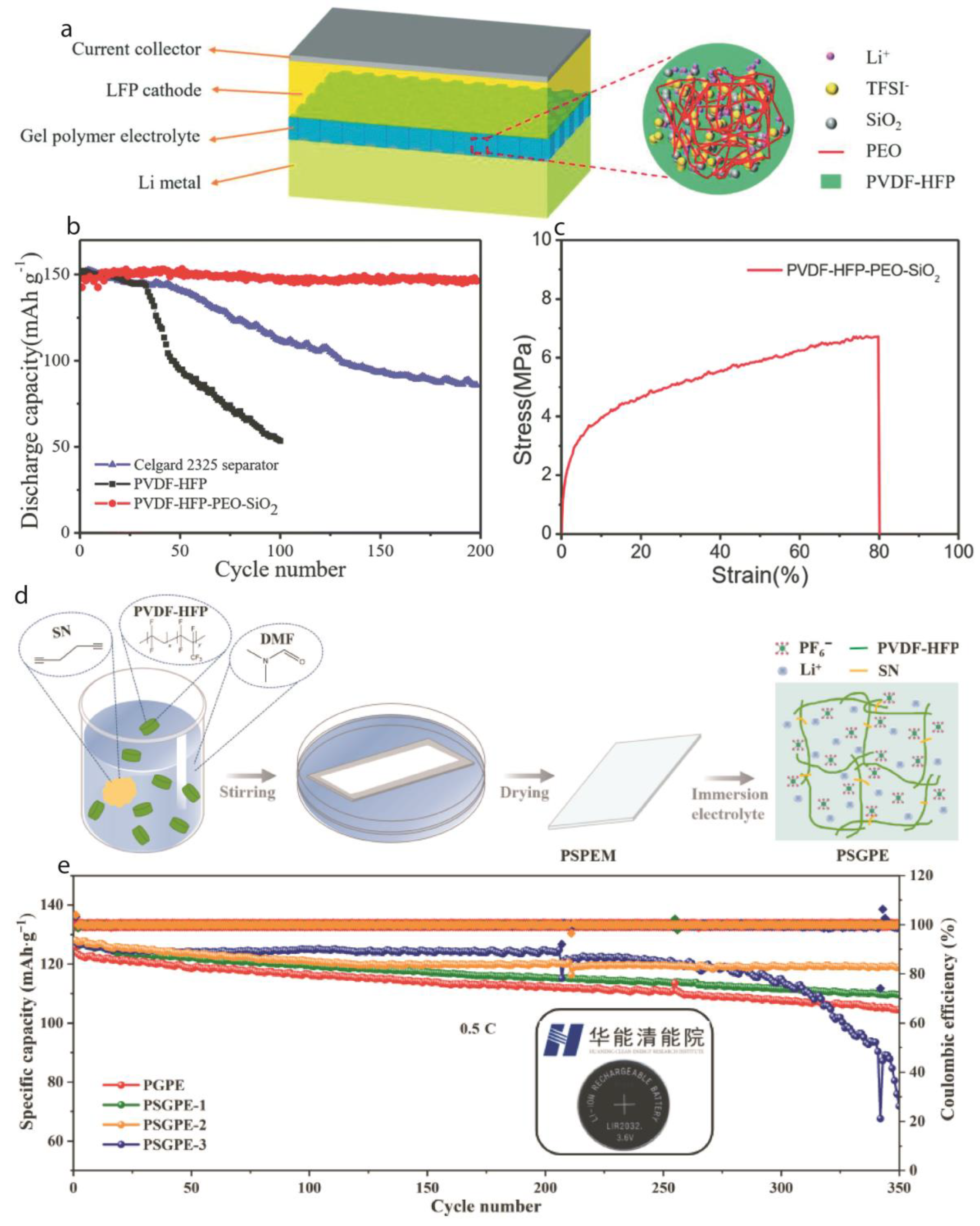
Figure 2.
(a) Image of PNTE3 as synthesized. (b) Nyquist plot for PNTE 1, 2, and 3 and inset shows equivalent fitting circuit. (c) CV profile. Reproduced under CC-3.0 Licence from [53], RSC, 2024. (d) Preparation scheme of the Pyr12O1 and its porous membrane. (e) the binding energy calculation of TPU−PDA. (f) TFSI−-PDA and TFSI−-TPU. (g) Pyr12O1+−PDA and Pyr12O1+−TPU. Reproduced under permission from [54], Elsevier, 2024.
Figure 2.
(a) Image of PNTE3 as synthesized. (b) Nyquist plot for PNTE 1, 2, and 3 and inset shows equivalent fitting circuit. (c) CV profile. Reproduced under CC-3.0 Licence from [53], RSC, 2024. (d) Preparation scheme of the Pyr12O1 and its porous membrane. (e) the binding energy calculation of TPU−PDA. (f) TFSI−-PDA and TFSI−-TPU. (g) Pyr12O1+−PDA and Pyr12O1+−TPU. Reproduced under permission from [54], Elsevier, 2024.
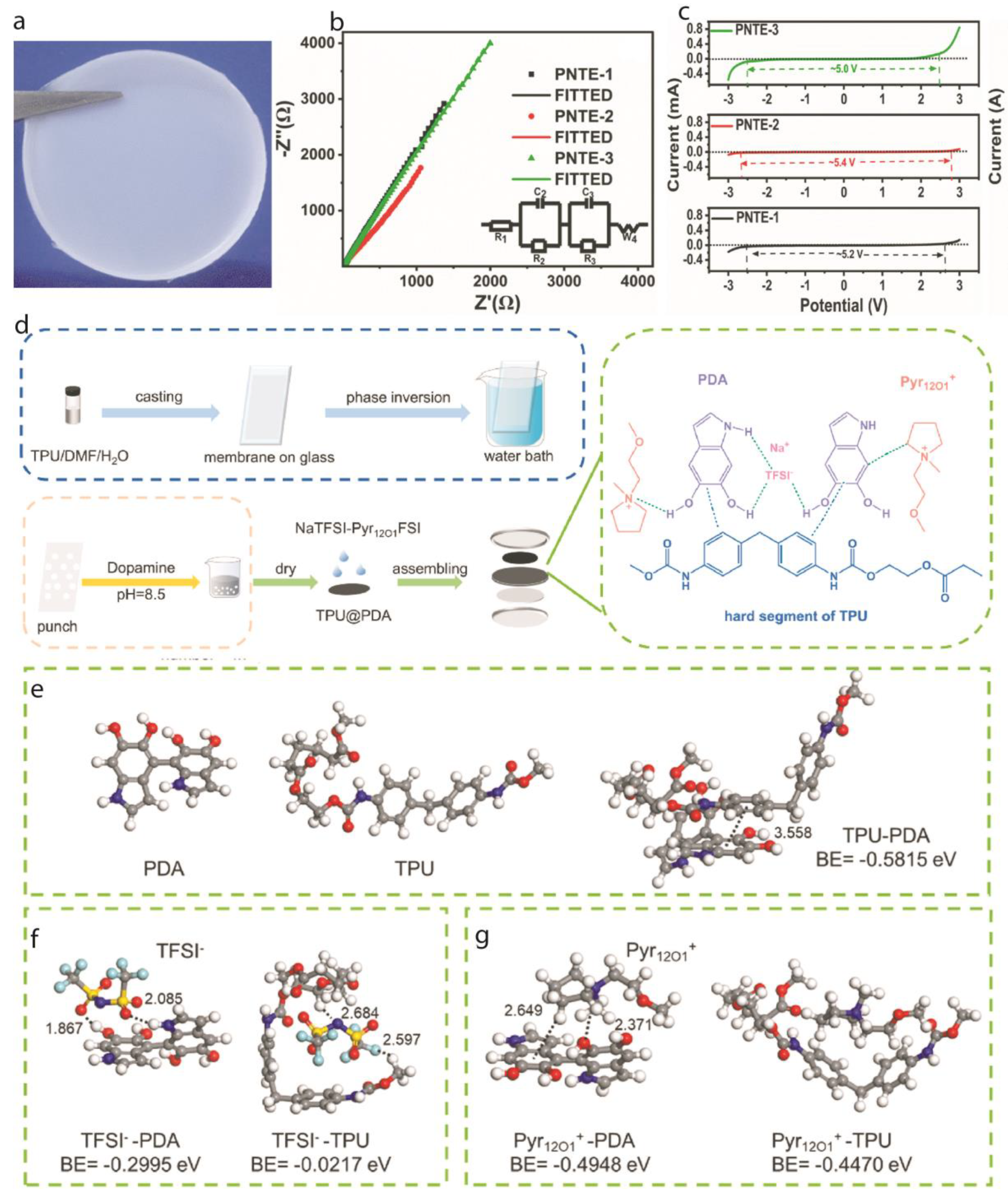
Figure 3.
(a) Schematic representation of aqueous electrolyte and GPE overcoming this issue). GITT discharge–charge curves for (b) b-V2O5, (c) s-V2O5·0.56H2O. Zn2+-ion diffusion coefficient of (d) b-V2O5, (e) s-V2O5·0.56H2O. (f) Raman spectra of (a: b-V2O5, b: pristine s-V2O5·0.56H2O; c: s-V2O5·0.56H2O in discharged voltage up to 0.2 V, d: charged up to 1.5 V). Reproduced with permission from [57], Elsevier, 2022.
Figure 3.
(a) Schematic representation of aqueous electrolyte and GPE overcoming this issue). GITT discharge–charge curves for (b) b-V2O5, (c) s-V2O5·0.56H2O. Zn2+-ion diffusion coefficient of (d) b-V2O5, (e) s-V2O5·0.56H2O. (f) Raman spectra of (a: b-V2O5, b: pristine s-V2O5·0.56H2O; c: s-V2O5·0.56H2O in discharged voltage up to 0.2 V, d: charged up to 1.5 V). Reproduced with permission from [57], Elsevier, 2022.
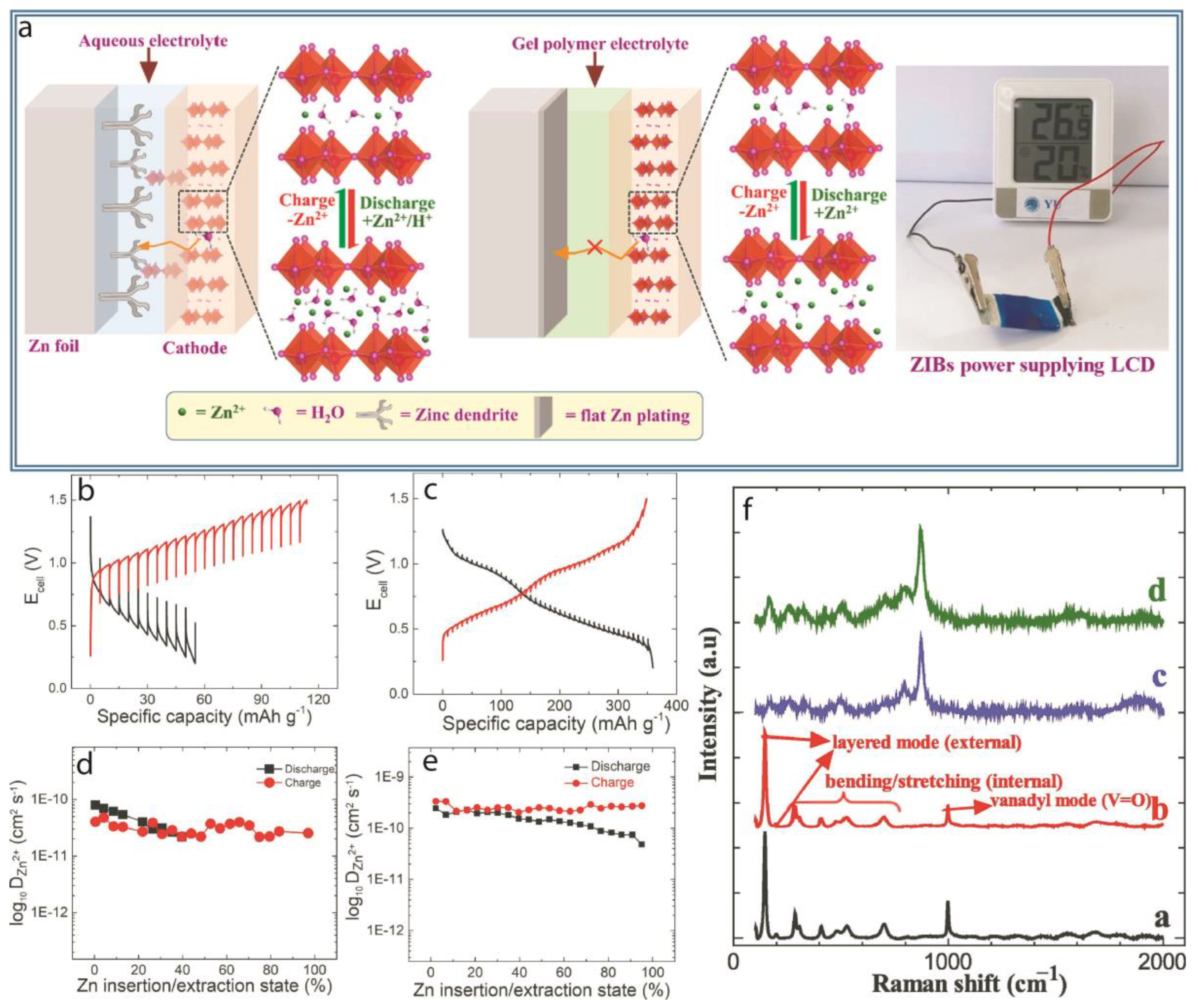
Figure 4.
(a) Schematic illustration of the preparation scheme. (b) Optimized structure and binding energy calculations for the different structures. Reproduced with permission from [60], Springer Nature, 2024.
Figure 4.
(a) Schematic illustration of the preparation scheme. (b) Optimized structure and binding energy calculations for the different structures. Reproduced with permission from [60], Springer Nature, 2024.
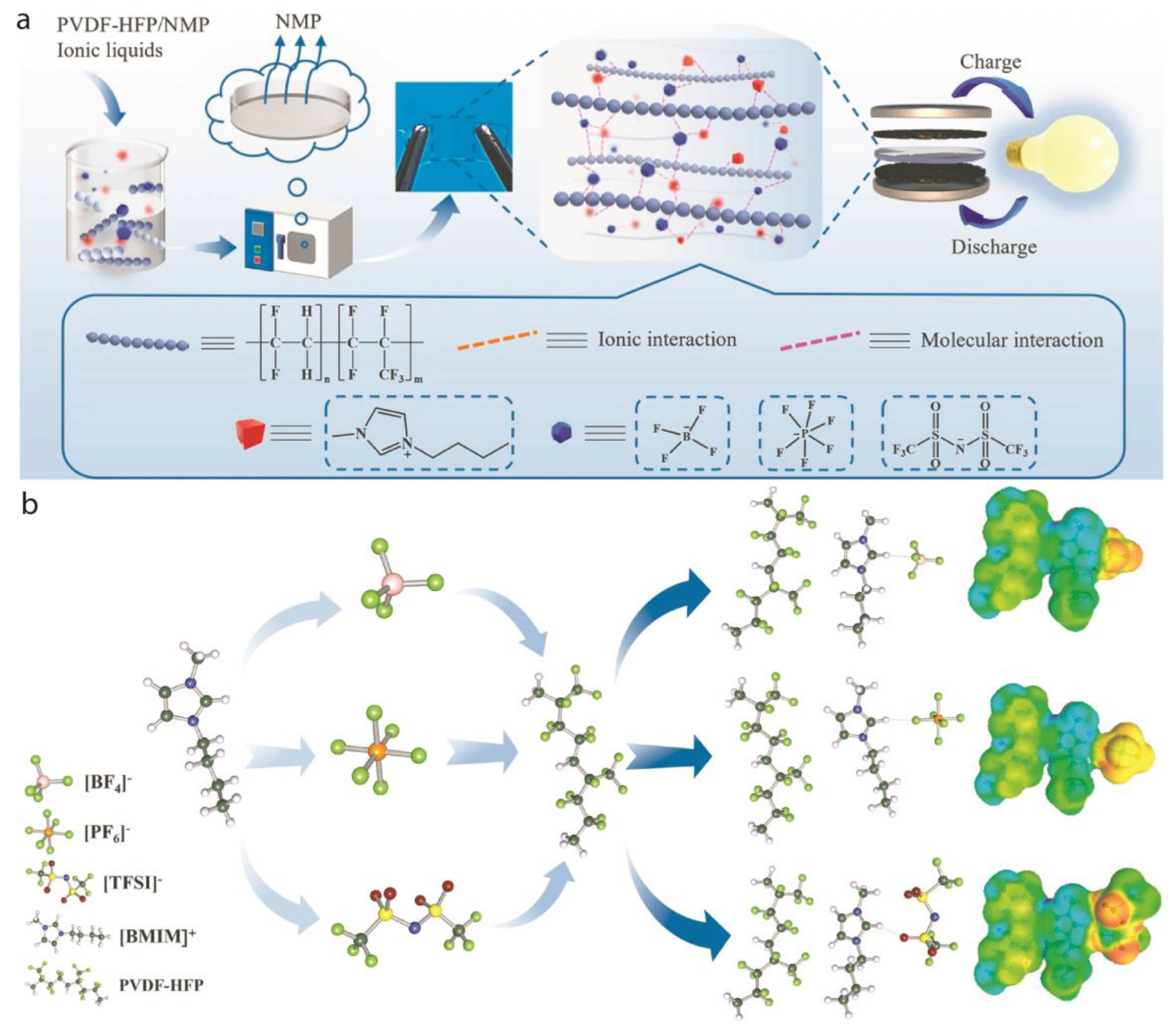
Figure 5.
(a) Schematic illustration of the preparation scheme. PEO was dissolved in acetonitrile. NMP was added to the solution with PMMA, followed by PVDF−HFP. (b) Polarization profile for various GPEs with different plasticizers. Reproduced with permission from [63], Elsevier, 2021.
Figure 5.
(a) Schematic illustration of the preparation scheme. PEO was dissolved in acetonitrile. NMP was added to the solution with PMMA, followed by PVDF−HFP. (b) Polarization profile for various GPEs with different plasticizers. Reproduced with permission from [63], Elsevier, 2021.
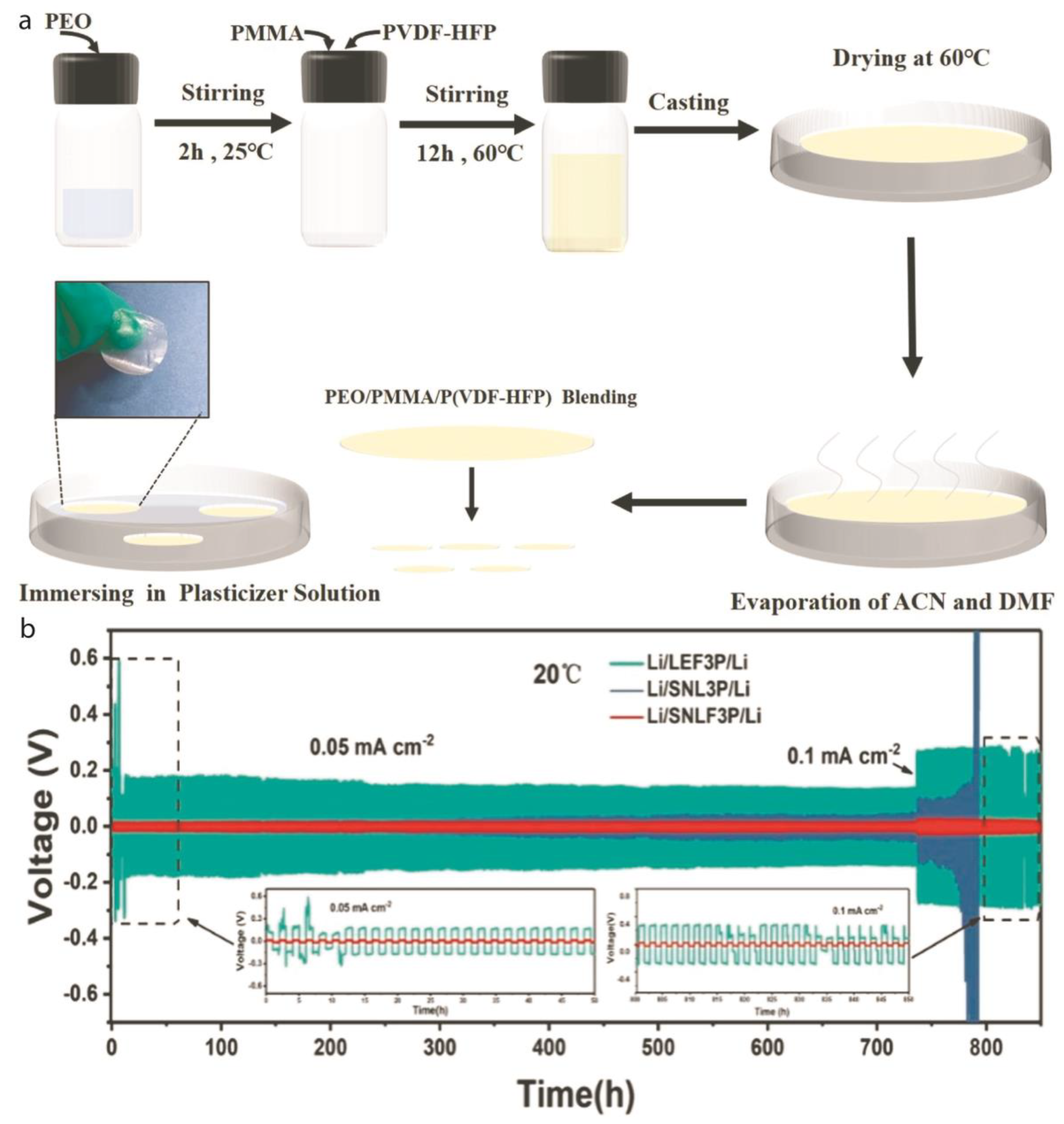
Figure 6.
(a) Cyclic plot of the synthesized symmetric cell Li||F-GPE||Li cell at 0.1 mA cm−2. The inset shows an enlarged portion of voltage-time from 410-416 and 808-816. (b) Voltage-time plot for plating/stripping of symmetric cell Li||F-GPE||Li at different current densities. (c) The average Coulombic efficiency CEavg plot. Cross-sectional SEM image of 2 mAh/cm2 Li deposited at Cu foil at a current density of 0.2 mA/cm2 for Li||Cu cell (d) LE, (e) F-GPE. Reproduced with permission from [65], Elsevier, 2023.
Figure 6.
(a) Cyclic plot of the synthesized symmetric cell Li||F-GPE||Li cell at 0.1 mA cm−2. The inset shows an enlarged portion of voltage-time from 410-416 and 808-816. (b) Voltage-time plot for plating/stripping of symmetric cell Li||F-GPE||Li at different current densities. (c) The average Coulombic efficiency CEavg plot. Cross-sectional SEM image of 2 mAh/cm2 Li deposited at Cu foil at a current density of 0.2 mA/cm2 for Li||Cu cell (d) LE, (e) F-GPE. Reproduced with permission from [65], Elsevier, 2023.
Disclaimer/Publisher’s Note: The statements, opinions and data contained in all publications are solely those of the individual author(s) and contributor(s) and not of MDPI and/or the editor(s). MDPI and/or the editor(s) disclaim responsibility for any injury to people or property resulting from any ideas, methods, instructions or products referred to in the content. |
© 2025 by the authors. Licensee MDPI, Basel, Switzerland. This article is an open access article distributed under the terms and conditions of the Creative Commons Attribution (CC BY) license (http://creativecommons.org/licenses/by/4.0/).
Copyright: This open access article is published under a Creative Commons CC BY 4.0 license, which permit the free download, distribution, and reuse, provided that the author and preprint are cited in any reuse.


