

Submitted:
01 January 2025
Posted:
03 January 2025
You are already at the latest version
Abstract
The over-exploitation of forest resources in the Lubumbashi Charcoal Production Basin in south-eastern DRC is accelerating deforestation and miombo woodlands degradation, jeopardizing the livelihoods of local communities. In this situation, current forestry policies remain ineffective, not least due to the failure to integrate traditional ecological knowledge (TEK). This study explores this knowledge through focus groups and individual interviews in four villages (Maksem, Mwawa, Nsela and Texas), selected according to the availability of forest resources and the number of inhabitants. Interviews gathered data on sacred sites and trees, conservation practices, the transmission of traditional knowledge, the role of ceremonies and the socio-demographic determinants of their application. These data were analyzed using descriptive statistics (citation frequency), Fisher's exact test for associations between variables, and Jaccard's similarity index to compare villages. The results show that 75% of people surveyed in both types of villages were aware of sacred sites in their village, as opposed to cemeteries, where logging is forbidden. Thirty sacred wood species were identified, with stricter observance of related prohibitions in villages with a high availability of forest resources. Knowledge is transmitted orally, via family councils and traditional ceremonies. Conservation practices include small-scale farming, intercropping, the ban on cutting trees on sacred sites and the use of dead wood. However, only the first two are still widely practiced, especially in villages with limited resources (64%). These practices are mainly applied by women and the elderly, and those involved in charcoal production and the collection of non-timber forest products. Nevertheless, the application of these TEK is strongly affected by population growth and the consequent low availability of forest resources, amplifying the pressure on miombo woodlands. These results underline that the integration of this traditional ecological knowledge into DRC forestry policies would significantly strengthen forest restoration initiatives, through a fine-tuned understanding of local ecosystems, sustainable practices and key woody species, while fostering community involvement. Decision-makers must integrate these TEK into DRC forest policy to strengthen biodiversity conservation and miombo woodlands restoration efforts.
Keywords:
Traditional knowledge
; deforestation
; miombo woodlands
; conservation
; biodiversity
; ecological practices
; sustainable management
1. Introduction
The need to preserve tropical forests has become clear in recent decades. Not only are they exceptional reservoirs of biodiversity [1], but they also play a crucial role in sequestering atmospheric carbon [2]. In addition to their ecological function, these forests fulfill indispensable social and cultural roles for local and Indigenous communities. They enable the survival of over 1.6 billion people worldwide, both rural and urban, through the ecosystem services they provide [3,4]. These ecosystem services include the provision of timber, wood energy and various non-timber forest products (NTFPs) [5].
In sub-Saharan Africa, these forests are under increasing anthropogenic pressure, exacerbated by rapid population growth in the context of extreme poverty, as well as rapid and generally unplanned urbanization. These dynamics are leading to unprecedented deforestation and degradation of these forest ecosystems [6,7]. Consequently, statistics relating to this deforestation are alarming. Indeed, in 2010, forests accounted for more than 675 million hectares, or around 23% of the African continent's surface area [8]. But this figure has dropped to less than 636 million hectares (21%) in 2020 [9]. The situation is particularly critical in the Congo Basin, which lost almost 100 million hectares of forest between 2010 and 2020 [10,11]. In the Democratic Republic of Congo (DRC), the annual deforestation rate rose from 0.4% between 2000 and 2010 [12] to 0.61% between 2010 and 2020 [2]. With this rate of deforestation, the DRC's forest area had already fallen from 250 million hectares in 2010 to just 117 million hectares in 2020 [2,12]. If no corrective measures are taken, a forest loss of almost 22% is anticipated by 2050 [2].
The south-east of the DRC is particularly hard hit, especially in the area where miombo woodlands—a forest formation dominated by species of the genera Brachystegia, Julbernardia and Isoberlinia—is the most dominant vegetation unit [13]. Indeed, between 2000 and 2010, miombo woodlands covered 23,220,000 hectares, representing almost 11% of the Zambezi region, but this coverage has declined considerably, from over 70% of Katangan territory in 2000 to around 43% in 2010 [14]. This deforestation trend is particularly marked in the Bassin de Production du Charbon de Bois de Lubumbashi (BPCBL), where the deforestation rate is more than six times higher than the national average, reaching 1.51% [15]. This deforestation is exacerbated by difficult socio-economic conditions, which make rural and urban populations highly dependent on forest resources, notably through shifting agriculture and wood-energy production [16,17]. In addition, the growing demand for wood energy in urban areas, supported by galloping demographics and inadequate electricity supply in large conurbations, is contributing to the increased degradation of BPCBL forests [15]. This affects the miombo woodlands’ rich biodiversity, characterized by a high rate of endemism, and threatens the livelihoods of the rural and urban populations that depend on it [18,19,20].
In response to deforestation and forest degradation, forest ecosystem restoration appears to be the main solution. Restoration refers to all practices aimed at re-establishing the ecological functionality of degraded habitats, thereby improving the living conditions of local populations. [21,22]. This restoration includes the production of seedlings of native or exotic forest species in nurseries, or the facilitation of natural regeneration in the habitats concerned [21,23], thus ensuring the continued provision of essential ecosystem services [24]. Nevertheless, to ensure the success of these initiatives, the integration of traditional ecological knowledge and practices (TEK) is necessary. TEK is defined as a set of culturally transmitted knowledge, practices, beliefs and taboos that evolve and play a central role in the sustainable management of ecosystems by local populations [25,26,27,28,29]. To this end, these TEK strengthen forest restoration through a fine-tuned understanding of local ecosystems, sustainable practices, and key species, while promoting community engagement in forest restoration processes and adaptation to environmental change [30]. The cultural and spiritual anchoring of these TEK guarantees responsible and sustainable management of restored forests [31]. As a result, since the 1992 United Nations Conference on Environment and Development, TEK has been recognized as a complement to modern scientific knowledge in approaches to ecosystem management and biodiversity conservation [32]. They now inspire forest policy through new management models, combining ecological conservation with the socio-economic needs of local populations [28].
Studies of these TEK in Africa show that they promote biodiversity conservation through orally transmitted taboos and beliefs. They protect ecosystems, regulate access to resources and maintain natural habitats [33,34,35,36], including in the miombo woodlands ecoregion [37,38,39]. Moreover, data on their effectiveness and an analysis of interactions with modern dynamics (urbanization, population growth) are often lacking. Yet these dynamics, like population growth, influence TEK implementation by increasing pressure on forest resources [40]. This would lead to the overexploitation of forest resources while limiting the observance of traditional practices, and weakening their transmission to younger generations [28]. Nevertheless, in the Lubumbashi region, research into TEK remains limited. The work of Refs. [41,42] addresses the importance of plant species in daily life and the farming system but does not explore the contribution of integrating these TEK in miombo woodlands management. This study fills these gaps by demonstrating the positive impact of these TEK in miombo woodlands conservation and management, particularly in reforested forest habitats. It documents these endangered practices and proposes their integration into environmental management policies, combining traditional knowledge and scientific expertise for sustainable forest management. The integration of traditional ecological knowledge and practices would promote sustainable management of residual miombo woodland patches and participatory restoration in the BPCBL.
This study aims to identify and describe traditional ecological knowledge and practices relating to biodiversity conservation and the sustainable management of miombo woodlands. It hypothesizes that (i) the endogenous knowledge of local indigenous communities in the Lubumbashi region abounds in TEK, such as sacred sites and trees, which would play a crucial role in forest restoration and sustainable management of miombo woodlands. These practices are transmitted orally within family councils, reinforcing respect for the prohibitions and beliefs associated with natural resource conservation. (ii) These practices are more likely to be applied in villages with small populations and limited forest resources, mainly by women, the elderly, and the less educated, due to their regular contact with the forest and the selective nature of their activities such as charcoal production, art carving and NTFP collection.
2. Materials and Methods
2.1. Study Area
The present study was conducted in the BPCBL in southeastern DRC (Figure 1), a region characterized by a Cw-type climate according to Köppen's classification.
This climate is marked by a dry season extending from May to September, a rainy season from November to March, and two transition periods in April and October [43,44]. The BPCBL, located at an altitude of between 1,200 and 1,300 m, receives annual rainfall of between 1,200 and 1,270 mm [13]. The mean annual temperature, which stood at around 20°C at the end of the XXth century [41], has risen significantly since the beginning of the XXI(st) century [45]. The predominant vegetation unit at the beginning of the 20th century in this region was miombo woodlands, generally established on ferralsols [46]. Today, however, this forest ecosystem is fragmented, a phenomenon attributable mainly to shifting agriculture, charcoal production, and increasing urbanization [15,16,47,48]. The local population, estimated at over 3 million [49], continues to rely heavily on natural resources. School enrolment remains low, with less than 50% of the population having access to formal education [17]. Main subsistence activities include shifting agriculture, firewood production (dendro-energy), illegal timber exploitation, small-scale informal trade, and artisanal mining [16,50].
2.2. Methods
2.2.1. Site Selection, Sampling, and Data Collection
The present study was carried out from November 20th, 2023, to January 20th, 2024, in the villages of Maksem, Mwawa, Nsela, and Texas, located in the rural area of Lubumbashi. These villages were selected because of their intense anthropogenic activities, mainly agriculture and charcoal production, their accessibility in all seasons, and their high connectivity to other satellite villages [17]. To verify the knowledge and application of TEK, these four villages were grouped according to the availability of forest resources (Figure 1), as well as the number of inhabitants (Table 1). This grouping assumes that villages with available forest resources and low population numbers will increasingly implement TEK due to the high availability of forest resources, enabling these inhabitants to remain selective in meeting daily needs. Forest resources are limited and the population is high in Maksem and Texas, compared with Mwawa and Nsela.
To gather information on traditional knowledge and practices relating to the conservation of forest resources, focus groups were organized in each village, following the methodology of [51]. These focus groups made up of 8 to 12 people, mainly the traditional chiefs and notables of each village (Table 1), collected data on the existence of sacred sites, sacred woody species, and associated beliefs and practices. Participation in these focus groups depended on local community members' mastery of TEK, particularly among the indigenous population. The aim was to determine the role of this traditional knowledge in biodiversity conservation and forest management.
Focus group data were validated by individual interviews with 200 local community members, i.e., 50 people per village. This number of respondents was chosen due to the lack of official statistics on the distribution of local communities, allowing a representative sampling of the different populations within these 4 villages. Nevertheless, this number of respondents is higher than that (40 respondents) recommended for social science studies [52]. The snowball method facilitated the identification of Indigenous local community members concerned by the present study, given the heterogeneity of origin (indigenous and non-indigenous) of the population of these four villages [53,54].
In addition, individual interviews were conducted using a semi-structured questionnaire [55], using the Kobotoolbox application version v2023.2.4. This approach made it possible to focus responses on specific themes defined in the questionnaire [56]. In addition to the information gathered during the focus groups, socio-demographic data such as age, gender, level of education, and professional activities of the respondents were collected to correlate them with the TEK responses. For age, participants were grouped into three categories: young (18-35 years), adult (36-60 years) and elderly (≥61 years) [57]. For educational level, participants were classified into four groups: uneducated, primary level, secondary level, and university level.
During these individual interviews, data on knowledge concerning sacred sites and woody species, traditional biodiversity conservation practices, and the modes and circumstances of TEK transmission were collected [37]. The identification of woody species, mentioned under their vernacular names by the respondents, was carried out using existing floras (Flora of Zambia, Flora of Zimbabwe, Worldflora), specialist literature, and various identification guides [41,58,59,60]. Field trips, in the presence of some of the respondents, enabled us to identify woody species cited in vernacular languages by the local communities, but not listed in existing books.
2.2.2. Data Analysis
To assess the importance of traditional knowledge and the influence of associated beliefs and prohibitions, the citation frequency (Cf) of sacred sites and trees was determined using the ethnobotanyR package in R software version 4.3.2. This analysis was also extended to biodiversity conservation practices, modes and circumstances of transmission of traditional knowledge, and the role of ceremonials in forest management. The frequency of citation assumes that elements considered sacred are those that appear most often during interviews [61]. This frequency is calculated according to the following relationship (equation 1):
where: S is the number of people citing the site or species, and N is the total number of people interviewed. When Fc tends towards 0, the site/species is weakly known as sacred, and when Fc tends towards 100, the site/species is strongly known as sacred.
To examine the association between the qualitative variables relating to Traditional Ecological Knowledge and Practices and the two village groups, Fisher's exact test with a risk of error of less than 5% was used. This non-parametric test is an alternative to the Chi-square test of association, particularly suitable when a cell in the contingency table has theoretical values below 5, one of the limiting conditions for applying the Chi-square test [62,63]. In addition, Fisher's exact test was also used to analyze the association between these variables and elements of the socio-demographic profile of the people surveyed.
Finally, to highlight the similarities between the possession of knowledge and its practical application according to the two groups of villages mentioned above, the Jaccard index (J; equation 2; [64]) was calculated using Past version 4.05 software.
where a: represents the number of knowledge or practices common to both village categories, while b and c designate those specific to each category respectively.
3. Results
3.1. Traditional Knowledge, Transmission and the Role of Ceremonials in Biodiversity Conservation and Miombo Woodlands Management
3.1.1. Traditional Ecological Knowledge and Practices Related to Biodiversity Conservation and Miombo Woodlands Management
Over ¾ of those surveyed indicated that cemeteries, associated with the resting place of ancestors, are the most widely recognized sacred sites in rural Lubumbashi, particularly in villages with limited forest resources and high population numbers. In addition, cemeteries and river springs appear to be common sacred sites in both categories of villages studied. A greater diversity of sacred sites is noted particularly in villages with more abundant forest resources and a low number of inhabitants present, compared to villages with limited forest resources and a high number of inhabitants. The taboos associated with these sacred sites mainly take the form of prohibitions on tree-cutting, access to sacred sites, and bushfires. However, observance of these beliefs and prohibitions is generally low, particularly in villages with limited forest resources and high population numbers, except for cemeteries (Table 2). These results underline the cultural importance of cemeteries in Lubumbashi's rural communities, particularly in villages with limited forest resources and high population numbers. They also indicate that, although beliefs and prohibitions relating to sacred sites are often neglected, cemeteries benefit from more rigorous protection. This suggests a need to strengthen the preservation of sacred sites in resource-limited areas to support local cultural practices.
Ethnobotanical surveys carried out in both village categories identified a total of 30 sacred woody species (23 in villages with limited forest resources and high population density; 27 in villages with available forest resources and low density (VRFD & HF), divided into 29 genera (24 in VRFMD & HE; 27 in VRFD & HF) and 18 families (15 in VRFMD & HE; 15 in VRFD & HF), with a predominance of Fabaceae. Among these species, Afzelia quanzensis, Entandrophragma delevoyi, Ficus spp., Parinari curatellifolia, Sterculia quinqueloba, and Strychnos cocculoides are the most widely recognized by respondents, due to their associations with ancestor and spirit beliefs. In addition, species such as Diplorhynchus condylocarpon and Bobgunnia madagascariensis are considered sacred in both types of villages, with around 1/8 and over a quarter of species cited respectively in villages with limited forest resources and high numbers of inhabitants, and villages with abundant forest resources and low numbers of inhabitants. However, implementation of the beliefs and prohibitions associated with these species remains low in villages, particularly in those with limited forest resources and high population numbers. This is particularly noticeable for species such as Afzelia quanzensis, Entandrophragma delevoyi, Ficus spp. and Sterculia quinqueloba, which are otherwise rare in forest ecosystems (Table 3). The,se results show that, although many woody species are recognized as sacred, the implementation of associated prohibitions is often insufficient, especially in villages with limited forest resources and high population numbers. This highlights an urgent need to strengthen conservation practices to protect these culturally crucial species, particularly those that are rare.
In addition, ecological practices for biodiversity conservation and forest management, traditionally known to local communities, include small-scale farming, intercropping (allowing 2 to 3 crops to be grown on the same plot), the prohibition of cutting trees in sacred places, long fallow/rotation periods, and the use of dead wood instead of charcoal. These practices were reported by ¾ of respondents in both village categories. It should be noted that knowledge of these ecological practices is almost equivalent to the two categories of villages located in the rural area of Lubumbashi. Regarding the actual application of these practices, it is observed that intercropping and the ban on cutting trees in sacred places are implemented by more than 65% of respondents in villages with limited forest resources and a high number of inhabitants, whereas these practices concern only around 26% of respondents in villages with abundant forest resources and a low number of inhabitants. Other practices, such as the gradual exploitation of forest areas (19%), long fallow/rotation periods (13%), and the use of dead wood instead of charcoal (12%), are most applied in villages with abundant forest resources and low population numbers (Table 4)
In addition, certain long-standing practices such as the standing abandonment of large or sacred trees and long fallow/rotation periods, which were once essential for biodiversity conservation and forest management, have evolved. They have been transformed into standing abandonment of rare and sacred medicinal trees and shorter fallow/rotation periods. Implementation of these modified practices varies from 8% to 20% in villages with limited forest resources and high population numbers, compared with 4% to 16% in villages with abundant forest resources with low population numbers. addition, concession fencing, a more recent innovation, is particularly observed in villages with abundant forest resources and low population numbers (Table 4). These results indicate that traditional ecological practices of forest conservation and management are more widely applied in villages with abundant forest resources and low population density. However, the evolution and reduction of certain long-standing practices, such as long fallow periods, point to a need to revise and strengthen sustainable management strategies, particularly in villages with limited forest resources and high population numbers.
3.1.2. Circumstances of Knowledge Transmission and the Role of Ceremonial in Biodiversity Conservation and Forest Management
The main means of transmitting traditional ecological knowledge and practices are songs (53%); fables, tales & stories (23%), and proverbs (12%) in both village categories. Specifically, riddles, riddles and skits were particularly cited in villages with abundant forest resources and few inhabitants. In addition, this knowledge and practice is particularly transmitted during family councils, bereavements and weddings (Table 5). These results underline the fact that this traditional knowledge is transmitted especially during family councils, mourning, and weddings, underscoring the importance of social contexts in the preservation of ecological practices.
In the traditions of the tribes of rural Lubumbashi, certain ceremonials take place specifically under the forest canopy. These ceremonials mainly include the burial of a dead relative (79%), the enthronement of a new village chief (10%), and prayers to the gods (12%). Specifically, the burial of a dead relative and the enthronement of a new customary chief are particularly singled out in villages with limited forest resources and large numbers of inhabitants. On the other hand, ceremonials such as exorcism and prayers to the gods are most common in villages with abundant forest resources and numbers of inhabitants (Table 6). These results show a distinct distribution of these practices according to forest resources and village population. This underlines the importance of ecological and demographic contexts in the practice of certain ceremonials.
3.2. Association Between TEK-Elements Variables of the Socio-Demographic Profile and Similarity of Biodiversity Conservation and Miombo Woodlands Management Practices
The application of biodiversity conservation and forest management practices in rural Lubumbashi is strongly influenced by socio-demographic factors such as gender, age, level of education and main occupation of the individuals surveyed. In particular, the application of intercropping and short rotation practices is strongly influenced by the gender and educational level of local community members. In addition, the implementation of most practices is age-dependent, except for stump-free farming practices, selective cutting, the ban on cutting trees in sacred places, and long fallow/rotation periods. However, the practices of leaving rare and sacred medicinal trees standing, intercropping, and prohibiting the cutting of trees in sacred places are particularly influenced by the types of main activities of the respondents. These observations underline the fact that the socio-demographic characteristics of members of the population play a decisive role in the application of biodiversity conservation and forest management practices (Table 7). More specifically, practices such as selective cutting, use of dead wood, leaving rare and sacred medicinal trees standing, long fallow/rotation periods, stump-free agriculture, progressive logging, and defending concessions are mainly adopted by women, the elderly, uneducated individuals or those with a primary level of education, whose main occupations include charcoal production, art carving and NTFP collection. Conversely, practices such as short fallow periods, intercropping, and the ban on cutting down trees in sacred places are more common among men, young people, and adults with secondary education, who are mainly involved in farming and logging for timber.
As regards the comparison between beliefs and prohibitions relating to sacred sites and their application, a total similarity of 100% was observed in both categories of villages. However, similarities in the application of taboos relating to sacred sites show a notable disparity, with a correspondence of only 40% between villages with limited forest resources and a high number of inhabitants and those with abundant forest resources and a low number of inhabitants.
Jaccard's index reveals a similarity of 21.74% between quotations of sacred woody species and the application of corresponding beliefs and prohibitions, in villages with limited forest resources and a high number of inhabitants. This compares with 42.31% in villages with abundant forest resources and few inhabitants. Furthermore, the application of taboos relating to sacred trees shows a similarity of 41.67% between the two categories of villages studied.
As far as biodiversity conservation and forest management practices are concerned, Jaccard's index shows a 50% similarity between citations of these practices and their implementation in villages with limited forest resources and a high number of inhabitants, compared with 61.54% in villages with abundant forest resources and a low number of inhabitants. Overall, the implementation of these practices was 70% similar between the two categories of villages. These results suggest that, although beliefs and prohibitions relating to sacred sites and trees are recognized in both types of villages, their implementation varies considerably according to the availability of forest resources and population in the village areas. Furthermore, the implementation of biodiversity conservation and forest management practices is more consistent in villages with abundant forest resources and small populations, indicating a better integration of these ecological practices in these contexts.
4. Discussion
4.1. Traditional Ecological Knowledge and Practices, Transmission and Role of Ceremonials in Biodiversity Conservation and Miombo Woodlands Management
The depletion of forest resources in the Lubumbashi Charcoal Production Basin is having a direct impact on the livelihoods of local riverside communities, which are largely dependent on the productivity of miombo [65]. In response to this situation, various mechanisms for restoring forest cover and managing residual patches of miombo woodlands have been put in place in this region of southeastern DRC, notably through reforestation initiatives. However, these efforts are struggling to gain the support of local populations, largely due to the lack of integration of traditional ecological knowledge and practices into these mechanisms [17].
The results of the ethnoecological survey conducted as part of the present study reveal the existence of a range of traditional knowledge and practices for biodiversity conservation and miombo woodlands management. This knowledge has significant socio-cultural and spiritual values and plays a crucial role in maintaining forest ecosystems [66]. The beliefs and prohibitions associated with these TEK contribute to the preservation of forest resources and forest resilience [67,68]. These observations are consistent with the results of previous studies in Africa [28,69] and specifically in the miombo woodlands ecoregion [36,70]. The integration of TEK into the processes of vegetation cover restoration and miombo woodlands management could, to this end, represent a significant opportunity to encourage local communities to actively participate in these initiatives and take ownership of the processes [17].
On the other hand, the scarcity of forest resources, coupled with unfavorable economic conditions, increases anthropic pressure on these resources, thus compromising the forest restoration and management mechanisms put in place [17,22]. The data collected also shows that local communities in villages with abundant forest resources and a smaller population have a higher number of TEK than those in villages with limited resources and a large population (Table 2, Table 3 and Table 4). This disparity can be explained by the fact that villages with abundant forest resources and low population numbers retain and apply traditions to a greater extent due to the high availability of resources, in contrast to villages faced with limited resources and high population numbers. Previous studies in Zambia have revealed that the scarcity of forest resources and population growth leads to a decrease in the importance attached to traditional knowledge, resulting in an erosion of this knowledge and practices [40,71]. The results of this study concur with the observations of Ref. [40] in Zambia, who showed that the scarcity of forest resources, coupled with rapid population growth, leads to a gradual erosion of TEK, as local populations turn away from traditional practices in the face of increased economic and ecological pressures.
However, the durability of TEK, such as sacred sites, also depends on several factors such as geography, hydrography, and the distribution of miombo woodlands variants in the study area. The transmission of TEK, mainly orally through songs and stories (Table 5), remains a common practice in Africa, not least because of the low rate of school enrolment and the virtual non-existence of written documentation on the subject [71,72,73]. This mode of transmission, although adapted to poorly educated populations [37] such as those in rural Lubumbashi, leads to a modification or even alteration of knowledge over time, leading to the loss or appearance of new knowledge and practices [36].
These results corroborate studies carried out in Zambia, showing that stories, songs, and proverbs are predominant modes of TEK transmission [36,37,74]. In addition, TEK are often transmitted during family councils, mourning ceremonies, and weddings (Table 5), as well as during ceremonials such as burials performed exclusively in the forest (Table 6). These events, being frequent and bring together many members of the community, offer ideal opportunities for the transmission of TEK. The results corroborate the work of Ref. [37] in Zambia, who emphasize the importance of these ceremonials in the transmission of traditional knowledge, as well as in biodiversity conservation and forest management.
4.2. Association Between TEK and Similarity of Implementation of Biodiversity Conservation Practices and Miombo Woodlands Management
Local communities in villages characterized by limited forest resources and a high number of inhabitants apply TEK less effectively than those in villages with available forest resources and a low number of inhabitants. This situation is attributable to the scarcity of forest resources and population growth, which encourage communities to modify or abandon TEK, thus compromising the sustainable management of forest resources [67,75]. Previous studies in Zambia have shown that the scarcity of forest resources, combined with growing economic needs, is leading to a decline in respect for traditional beliefs and prohibitions when exploiting forest resources to meet daily needs [40]. In addition, high population density significantly reduces the usable area for everyone, increasing anthropogenic pressure on already limited forest resources [76]. This increased pressure contributes to TEK deletion or partial adaptation to cope with resource scarcity, particularly in villages with high population numbers. These observations are in line with the findings of Ref. [28], who points out that TEK evolve over generations and are adapted to environmental changes.
On the other hand, in villages where forest resources are available and the population is small, biodiversity conservation and sustainable forest management practices are mainly implemented by women, who are elderly, poorly educated, and whose main activities include charcoal production, art carving, and the collection of non-timber forest products (Table 7). This predominance of women in the implementation of practices can be explained by their central role in Africa, and particularly in the study area, in the education and transmission of cultural knowledge, including TEK. By passing on this knowledge to the younger generations, they integrate it into everyday practices, thereby contributing to their sustainability. Research in Venezuela also shows that women are more respectful of traditional beliefs and prohibitions than men [77]. Furthermore, the application of TEK increases with age. Older people apply these forest conservation and management practices more assiduously because of their experience, their role as custodians of culture, and their lesser exposure to modernity, which reinforces their perception of the relevance of this knowledge [78,79]. It should also be noted that the transmission of these TEK begins at an early age in the Lubumbashi region.
In addition, people with low levels of education are also more likely to apply TEK. Indeed, activities related to the management of forest areas are often dominated by individuals with a low level of education, due to the lack of alternatives in the labor market and the absence of required skills [17]. Finally, charcoal producers, sculptors, and NTFP collectors are more likely to apply TEK than farmers. Agriculture, whether intensive or slash-and-burn, requires deforestation to avoid competition between natural trees and crops, which contrasts with other activities with selective exploitation of forest resources [6,80,81,82]. These findings corroborate those of Ref. [83] in the Yangambi Biosphere Reserve, who show that forest conservation and management practices are mainly linked to sacred tree prohibitions, agricultural practices, and respect for sacred sites.
However, the implementation of conservation and forest management practices is influenced by other factors, such as the amount of forest space available to an individual. TEK-integrated forest management requires not only recognition of this traditional knowledge but also adequate access to the resources needed for its application. The decrease in forest area available to an individual limits his or her ability to maintain and transmit TEK [76,84]. Furthermore, the application of these TEK in Africa is also influenced by cultural changes, such as formal education, modernization, and above all Western and Asian religions [36]. Indeed, formal education and modernization stemming from colonization have contributed to the marginalization of traditional knowledge in Africa, inculcating Western values that are largely incompatible with local cultures [36,85]. Furthermore, studies carried out in Nigeria, Ghana, and Botswana have shown that local communities adopting Western and Asian religions now reject the application of these TEK, considering them inferior, demonic, and fetishistic [86,87,88].
4.3. Involvement in Contributing to the Sustainable Management and Restoration of Miombo Woodlands
TEK have considerable cultural and spiritual values, but their application is under constant threat from modernization and the shrinking of miombo woodland areas. This situation contributes not only to deforestation and forest degradation, but also to the erosion of the cultural and spiritual values of local communities. To remedy this problem, it is essential to promote the popularization of TEK within local communities. An effective approach for this popularization could include educational programs facilitating the empirical learning of TEK [89]. However, the low school enrolment rate in rural Lubumbashi is a significant obstacle to the application of this method. To overcome this obstacle, it is crucial to foster intergenerational exchanges of knowledge between grandparents, parents, and younger generations, as well as to organize various socio-cultural awareness-raising activities to facilitate the transfer of these TEK [36]. Furthermore, universities should collaborate with the Congolese government to systematically collect and document (including digitizing) the various forms of TEK, to prevent their erosion and preserve this knowledge for current and future generations [90,91]. This documentation is essential to prevent the loss of this traditional knowledge over time.
In addition, there is a need for conservation and sustainable management programs for miombo woodland remnants, as well as forest restoration initiatives through reforestation and assisted natural regeneration [21,92]. These programs should focus on sacred sites (such as cemeteries, river springs, and the habitats of ancestors and deities), using sacred woody species such as Afzelia quanzensis, Entandrophragma delevoyi and Sterculia quinqueloba, whose associated beliefs and prohibitions are respected by local communities [93]. This approach would not only help restore forest ecosystems but also revitalize the cultural and religious practices associated with these places [93,94]. In addition, taking these TEK into account in the forest restoration mechanism would encourage the involvement of local communities and ownership of these forest management and restoration mechanisms, which is crucial to ensuring their long-term success [17].
Finally, these results suggest that the integration of TEK into forest policy requires the creation of a local participatory framework, involving both local communities and decision-makers. This participatory framework could facilitate the identification of relevant TEK and their application at the local scale, their integration into forest management plans, and reforestation or assisted natural regeneration initiatives [95,96]. In addition, incorporating the sacred woody species identified in this study, such as Afzelia quanzensis and Sterculia quinqueloba, into reforestation initiatives could strengthen community commitment while respecting local beliefs.
The present study was carried out on a limited number of villages and respondents. In addition, the cultural variability of different tribes in the Lubumbashi region was underestimated, limiting the generalizability of the results obtained.
5. Conclusions
This study aimed to identify and describe TEK relating to biodiversity conservation and miombo woodlands management, through interviews (group and individual) carried out in two categories of villages differentiated by the availability of forest resources and their population. The results show that most respondents are aware of sacred sites and woody species, including their beliefs and prohibitions. In addition, biodiversity conservation and miombo woodlands management practices include small-scale farming, intercropping, the prohibition of cutting trees in sacred sites, long rotation periods and the use of dead wood. Certain ceremonials, such as burials of the dead, take place only in the forests, encouraging people to leave certain forest patches untouched. TEK are more rigorously applied in villages with abundant forest resources and smaller populations, enabling daily needs to be met while respecting local beliefs and prohibitions. These TEK are particularly observed by women, the elderly and the less educated, involved in charcoal production, art carving and the collection of non-timber forest products.
The present study was carried out on a limited sample of villages and participants. Furthermore, the cultural diversity of the different tribes in the Lubumbashi region was not sufficiently considered, which limits the possibility of generalizing the results obtained. Nevertheless, this study demonstrates the existence of TEK in the Lubumbashi region and their potential to contribute to the sustainable management and restoration of miombo woodlands. The DRC's national forest policy must include concrete strategies for the integration of TEK. This could involve setting up local forest management committees, legally protecting sacred sites and species, and prioritizing TEK in reforestation initiatives. In addition, the documentation and digitization of this traditional knowledge by scientists is essential to ensure its transmission and preservation.
Supplementary Materials
The following supporting information can be downloaded at the website of this paper posted on Preprints.org.
Funding
This research was funded by the Académie de Recherche et d'Enseignement Supérieur (ARES-CCD).
Data Availability Statement
The data related to the present study will be available upon request from the interested party.
Acknowledgments
The authors would like to thank the Académie de Recherche et d'Enseignement Supérieur (ARES) for the doctoral grant awarded to Dieu-donné N'tambwe Nghonda and Héritier Khoji Muteya through the Projet de Recherche pour le Développement : "Renforcement des capacités de gestion durable de la forêt claire de miombo par l'évaluation de l'impact environnemental de la production de charbon de bois et l'amélioration des pratiques vis-à-vis des ressources forestières", PRD CHARLU in acronym. We would also like to thank the members of the local communities and the customary authorities of the villages that took part in this study.
Conflicts of Interest
The authors declare no conflict of interest
References
- Gboze, A. E.; Sanogo, A.; Amani, B. H. K. & Kassi, E. N. J. Diversité floristique et valeur de conservation de la forêt classée de Badenou (Corhogo, Cote d’Ivoire). Agr. Afr. 2020, 32, 51–73. [Google Scholar]
- Eba’a Atyi, R. ; Hiol Hiol, F. ; Lescuyer, G. ; Mayaux, P. ; Defourny, P. ; Bayol, N. ; Saracco, F. ; Pokem, D. ; Sufo Kankeu, R. & Nasi R. Les forêts du bassin du Congo : état des forêts 2021. CIFOR, Bogor, Indonésie, 2022, 180p. [CrossRef]
- Sivadas, D. Pathways for Sustainable Economic Benefits and Green Economies in Light of the State of World Forests 2022. Anthr. Sci. 2022, 1, 460–465. [Google Scholar] [CrossRef]
- FAO. La Situation des forêts du monde 2022 : Des solutions forestières pour une relance verte et des économies inclusives, résilientes et durables. FAO, Rome, Italie, 2022, 180p. [CrossRef]
- West, P. C.; Narisma, G. T.; Barford, C. C.; Kucharik, C. J. & Foley, J. A. An alternative approach for quantifying climate regulation by ecosystems. Front. Ecol. Envir. 2011, 9, 126–133. [Google Scholar]
- Gillet, P.; Vermeulen, C.; Feintrenie, L.; Dessard, H. & Garcia, C. Quelles sont les causes de la déforestation dans le bassin du Congo ? Synthèse bibliographique et études de cas. Biotechnol. Agron. Soc. Environ. 2016, 20, 183–194. [Google Scholar] [CrossRef]
- Khoji, M. H.; N’tambwe, N. D.; Malaisse, F.; Waselin, S.; Kouagou, R. S.; Cabala, K. S.; Munyemba, F. M.; Bastin, J.-F.; Bogaert, J. & Useni, S.Y. Quantification and Simulation of Landscape Anthropization around the Mining Agglomerations of Southeastern Katanga (DR Congo) between 1979 and 2090. Land 2022, 11, 850. [Google Scholar] [CrossRef]
- Chidumayo, E.; Okali, D.; Kowero, G. & Larwanou, M. Forêts, faune sauvage et changement climatique en Afrique. African Forest Forum, Nairobi, Kenya, 2011, 344p.
- FAO. Global Forest Resources Assessment 2020 – Key findings. Rome, Italie, 2020, 16p. [CrossRef]
- De Wasseige, C.; De Marcken, P.; Bayol, N.; Hiol Hiol, F.; Mayaux, Ph.; Desclée, B.; Nasi, R.; Billand, A.; Defourny, P. & Eba’a Atyi, R. Les forêts du bassin du Congo - Etat des Forêts 2010. Office des publications de l’Union Européenne. Luxembourg, 2012, 276 p. [CrossRef]
- Vancutsem, C.; Achard, F.; Pekel, J-F. ; Vieilledent, G.; Carboni, S.; Simonetti, D.; Gallego, J.; Aragao, L. & Nasi, R. Long-term (1990-2019) monitoring of tropical moist forests dynamics. Sci. Adv. 2020, 7, eabe1603. [Google Scholar]
- Megevand, C. Dynamiques de déforestation dans le bassin du Congo : Réconcilier la croissance économique et la protection de la forêt. Washington D. C.: World Bank, 2013, 201p.
- Malaisse, F.; Bogaert, J.; Boisson, S. & Sikuzani, Y. U. La végétation naturelle d’Élisabethville (actuellement Lubumbashi) au début et au milieu du XXième siècle. Géo-Eco-Trop. 2021, 45, 41–51. [Google Scholar]
- Potapov, P. V.; Turubanova, S. A.; Hansen, M. C.; Adusei, B.; Broich, M.; Altstatt, A.; Mane, L. & Justice, C.O. Quantifying forest cover loss in Democratic Republic of the Congo, 2000–2010, with Landsat ETM+ data. Remote Sens. Envir. 2012, 122, 106–116. [Google Scholar] [CrossRef]
- Khoji, M. H.; N’tambwe, N. D.; Mwamba, K. F.; Harold, S.; Munyemba, K. F.; Malaisse, F.; Bastin, J.-F.; Useni, S. Y. & Bogaert, J. Mapping and Quantification of Miombo Deforestation in the Lubumbashi Charcoal Production Basin (DR Congo): Spatial Extent and Changes between 1990 and 2022. Land 2023, 12, 1852. [Google Scholar] [CrossRef]
- Cabala, K. S.; Useni, S. Y.; Amisi, M. Y. A.; Munyemba, K. F. & Bogaert J. Activités anthropiques et dynamique des écosystèmes forestiers dans les zones territoriales de l’Arc Cuprifère Katangais (RD Congo). Tropicultura 2022, 40(3/4), 2100. [CrossRef]
- N’tambwe, N. D.; Khoji, M. H.; Kasongo, K. B.; Kouagou, S. R.; Malaisse, F.; Useni, S. Y.; Masengo, K. W. & Bogaert, J. Towards an Inclusive Approach to Forest Management: Highlight of the Perception and Participation of Local Communities in the Management of miombo Woodlands around Lubumbashi (Haut-Katanga, D.R. Congo). Forests 2023a, 14, 687. [CrossRef]
- Kalaba, F. K.; Quinn, C. H.; Dougill, A. J. & Vinya, R. Floristic composition, species diversity and carbon storage in charcoal and agriculture fallows and management implications in Miombo woodlands of Zambia. For. Ecol. Manag. 2013, 304, 99–109. [Google Scholar] [CrossRef]
- Chirwa, P. W.; Larwanou, M.; Syampungani, S. & Babalola, F.D. Management and restoration practices in degraded landscapes of Eastern Africa and requirements for up-scaling. Int. For. Rev. 2015, 17, 20–30. [Google Scholar] [CrossRef]
- Godlee, J. L.; Gonçalves, F. M.; Tchamba, J. J.; Chisingui, A. V.; Muledi, J. I.; Shutcha, M. N.; Ryan, C. M.; Brade, T. K. & Dexter, K. G. Diversity and Structure of an Arid Woodland in Southwest Angola, with Comparison to the Wider Miombo Ecoregion. Diversity 2020, 12, 140. [Google Scholar] [CrossRef]
- Rinaudo, T.; Muller, A. & Morris, M. Manuel La Régénération Naturelle Assistée (RNA). Une ressource pour les gestionnaires de projets, les utilisateurs et tous ceux qui ont un intérêt à mieux comprendre et soutenir le mouvement pour la RNA. FMNR Hub, World Vision Australia: Melbourne, Australia, 2020, 241p.
- Awono, A.; Assembe-Mvondo, S.; Tsanga, R.; Guizol, P. & Peroches, A. Restauration des paysages forestiers et régimes fonciers au Cameroun : Acquis et handicaps. Document Occasionnel 10. Bogor, Indonésie : Centre de recherche forestière internationale (CIFOR) ; et Nairobi, Kenya : Centre international de recherche en agroforesterie (ICRAF), 2023, 43 p. [CrossRef]
- Holl, K.D. & Aide, T.M. When and where to actively restore ecosystems? For. Ecol. Manag. 2011, 261, 1558–1563. [Google Scholar] [CrossRef]
- Aerts, R. & Honnay, O. Forest restoration, biodiversity and ecosystem functioning. BioMed. Central Ecol. 2011, 11, 29. [Google Scholar] [CrossRef]
- Hamlin, M. L. “Yo soy indígena”: identifying and using traditional ecological knowledge (TEK) to make the teaching of science culturally responsive for Maya girls. Cult. Stud. Sci. Educ. 2013, 8, 759–776. [Google Scholar] [CrossRef]
- Díaz, S.; Demissew, S.; Joly, C.; Lonsdale, W. M. & Larigauderie, A. A Rosetta Stone for nature’s benefits to people. PLoS Biol. 2015, 13, e1002040. [Google Scholar] [CrossRef]
- Tang, R. & Gavin, M. C. A classification of threats to traditional ecological knowledge and conservation responses. Conserv. Soc. 2016, 14, 57–70. [Google Scholar] [CrossRef]
- Mekonen, S. Roles of Traditional Ecological Knowledge for Biodiversity Conservation. J. Nat. Sci. Res. 2017, 7(15), 21–27. [Google Scholar]
- Newman, R. Human Dimensions: Traditional Ecological Knowledge—Finding a Home in the Ecological Society of America. Bull. Ecol. Soc. Am. 2021, 102(3), e01892. [Google Scholar] [CrossRef]
- Ganka, G.; Fandohan, A. B. & Salako, K. V. Impacts des tabous et des cérémonies rituelles sur la structure des peuplements de Triplochiton scleroxylon K. Schum., un arbre sacré au Bénin. Bois For. des Trop. 2023, 357, 57–70. [Google Scholar] [CrossRef]
- Uprety, Y.; Asselin, H.; Bergeron, Y.; Doyon, F. & Boucher, J-F. Contribution of traditional knowledge to ecological restoration: Practices and applications, Écoscience 2012, 19, 225–237. [Google Scholar] [CrossRef]
- Takako, H. Savoirs écologiques traditionnels : de la boîte noire sacrée à la politique de conservation de la biodiversité locale. Policy Sci. 2002, 10, 85–96. [Google Scholar]
- Hens, L. Indigenous knowledge and biodiversity conservation and management in Ghana. J. Hum. Ecol. 2006, 20 (1), 21–30. [CrossRef]
- Ntoko, V. N. & Schmidt, M. Indigenous knowledge systems and biodiversity conservation on Mount Cameroon. For. Trees Livelihoods 2021, 30 (4): 227–241. [CrossRef]
- Taremwa, N. K.; Gasingirwa, M. C. & Nsabimana, D. Unleashing traditional ecological knowledge for biodiversity conservation and resilience to climate change in Rwanda. African J. Sci. Technol. Innov. Dev. 2022, 14, 204–215. [Google Scholar] [CrossRef]
- Sinthumule, N.I. Traditional ecological knowledge and its role in biodiversity conservation: a systematic review. Front. Environ. Sci. 2023, 11, 1164900. [Google Scholar] [CrossRef]
- Milupi, D. I. & Sampa, M. M. Transmission mechanisms of Traditional Ecological Knowledge and sustainable management of natural resources among the Lozi-speaking people in Barotse floodplain of Zambia. Multidscip. J. Lang. Soc. Sci. Educ. 2020, 3, 216–228. [Google Scholar]
- Malekani, A. W. Indigenous Knowledge acquisition and sharing on wild mushroom among local communities in selected districts in Tanzania. J. Indig. Knowl. Dev. Stud. 2022, 4(2), 1–16. [Google Scholar]
- Yanou, M. P.; Ros-Tonen, M.; Reed, J. & Sunderland, T. Local knowledge and practices among Tonga people in Zambia and Zimbabwe: A review. Environ. Sci. Policy 2023, 142, 68–78. [Google Scholar] [CrossRef]
- Syampungani, S.; Chirwa, P. W.; Akinnifesi, F. K.; Ajayi, O. C. & Sileshi, G. The miombo woodlands at the cross roads: Potential threats, sustainable livelihoods, policy gaps and challenges. Nat. Resour. Forum 2009, 33, 150–159. [Google Scholar] [CrossRef]
- Malaisse, F. How to live and survive in Zambezian open forest (Miombo ecoregion). Les Presses Agronomiques de Gembloux, Gembloux, Belgique, 2010, 424 p.
- Hick, A.; Hallin, M. Tshibungu, N. A. & Mahy, G. La place de l’arbre dans les systèmes agricoles de la région de Lubumbashi. In : Bogaert, J. ; Colinet, G. & Mahy, G. (Eds), Anthropisation des paysages katangais. Les Presses Universitaires de Liège, Liège, Belgique, 2018, 111–123.
- Kalombo, K. D. Caractérisation de la répartition temporelle des précipitations à Lubumbashi (Sud-Est de la RDC) sur la période 1970-2014. XXIII Colloque de l’Association Internationale de Climatologie, Liege, 2015, 531–536.
- Mutondo, G. T.; Kamutanda, D. K. & Numbi, A. M. Evaluation du bilan hydrique dans les milieux anthropisés de la forêt claire (région de Lubumbashi, Province du Haut-Katanga, R.D. Congo). Méthodologie adoptée pour l’estimation de l’évapotranspiration potentielle. Geo-Eco-Trop. 2018, 42, 159–172. [Google Scholar]
- Kalombo, K. D. Évolution des éléments du climat en RDC : Stratégies d'adaptation des communautés de base, face aux événements climatiques de plus en plus fréquents. Éditions universitaires européennes, Sarrebruck, Germany, 2016, 220p.
- Ngongo, M. L.; Van Ranst, E.; Baert, G.; Kasongo, E. L.; Verdoodt, A.; Mujinya, B. B. & Mukalay, J. M. Guide des sols en République Démocratique du Congo, tome I : étude et gestion. Ed. Salama, Lubumbashi, République Démocratique du Congo, 2009, 260p.
- Munyemba, K. F. & Bogaert, J. Anthropisation et dynamique spatiotemporelle de l’occupation du sol dans la région de Lubumbashi entre 1956 et 2009. E-revue Unilu 2014, 1, 3–23. [Google Scholar]
- Useni, S. Y.; Malaisse, F.; Cabala, K. S.; Munyemba, K. F. & Bogaert, J. Le rayon de déforestation autour de la ville de Lubumbashi (Haut-Katanga, RD Congo) : Synthèse. Tropicultura 2017, 35, 215–221. [Google Scholar]
- Useni, S. Y.; Mpibwe, K. A.; Yona, M. J.; N’tambwe, N. D.; Malaisse, F. & Bogaert, J. Assessment of Street Tree Diversity, Structure and Protection in Planned and Unplanned Neighborhoods of Lubumbashi City (DR Congo). Sustainability 2022, 14, 3830. [Google Scholar] [CrossRef]
- Useni, S. Y.; Khoji, M. H. & Bogaert, J. Miombo woodland, an ecosystem at risk of disappearance in the Lufira Biosphere Reserve (Upper Katanga, DR Congo)? A 39-years analysis based on Landsat images. Global Ecol. Conserv. 2020, 24, e01333. [Google Scholar] [CrossRef]
- Biloso, M. A. Valorisation des produits forestiers non ligneux des plateaux de Batéké en périphérie de Kinshasa (R. D. Congo). Acta Bot. Gall. 2009, 156, 311–314. [Google Scholar] [CrossRef]
- El Khaddar, H. & Elbouyahyaoui, L. La démarche scientifique en mathématiques, en sciences expérimentales et en sciences sociales. Rech. Cognit. 2019, 11, 22–42. [Google Scholar]
- Johnston, L. G. & Sabin, K. Échantillonnage déterminé selon les répondants pour les populations difficiles à joindre. Methodol. Innov. 2010, 5(2), 38–48. [Google Scholar] [CrossRef]
- Marpsat, M. & Razafindratsima, N. Les méthodes d’enquêtes auprès des populations difficiles à joindre : Introduction au numéro spécial. Methodol. Innov. 2010, 5, 3–16. [Google Scholar] [CrossRef]
- Traoré, L.; Hien, M. & Ouédraogo, I. Usages, disponibilité et stratégies endogènes de préservation de Canarium schweinfurthii (Engl.) (Burseraceae) dans la région des Cascades (Burkina Faso) Uses, availability and endogenous conservation strategies of Canarium schweinfurthii (Engl.) (Burseraceae) in the Cascades region (Burkina Faso). Ethnobot. Res. App. 2021, 21, 1–17. [Google Scholar] [CrossRef]
- Dubois, E. & Michaux, E. Étalonnages à l’aide d’enquêtes de conjoncture : de nouveaux résultats. Écon. Prévis. 2006, 172, 11–28. [Google Scholar] [CrossRef]
- Dieng, K.; Kalandi, M.; Sow, A.; Millogo, V.; Ouedraogo, G. A. & Sawadogo, G. J. Profil socio-économique des acteurs de la chaine de valeur lait local à Kaolack au Sénégal. Rev. Afr. Sant. Product. Anim. 2014, 12(3-4), 161–168.
- Smith, P. & Allen Q. Field Guide to the Trees and Shrubs of the Miombo Woodlands; Royal Botanic Gardens: Brussels, Belgium, 2010, 176p.
- Meerts, P. J. & Hasson, M. Arbres et arbustes du Haut-Katanga. 386 p. Editions Jardin Botanique de Meise : Brussels, Belgium, 2016, 386p.
- Vollesen, K. Woodland. In Based on Plants from the Mutinondo Wilderness Area, Northern Zambia; Lari Merret: Lusaka, Zambia, 2020; 1200p. [Google Scholar]
- Badjaré, B.; Kokou, K.; Bigou-laré, N.; Koumantiga, D. & Akpakouma, A. Étude ethnobotanique d’espèces ligneuses des savanes sèches au Nord-Togo : diversité, usages, importance et vulnérabilité. Biotechnol. Agron. Soc. Environ. 2018, 22, 152–171. [Google Scholar]
- Confais, J. ; Grelet, Y. & Monique, L.G. La procédure FREQ de SAS. Tests d’indépendance et mesures d’association dans un tableau de contingence. MODULAD 2005, 33,188–242. ⟨halshs-00287397⟩.
- Causton, D. R. An introduction to vegetation analysis. Principes, practice and interpretation. Springer Science & Business Media, Dordrecht, Netherlands, 2012, 363p. [CrossRef]
- Kindo, A. I.; Abasse, T.; Soumana, I.; Bogaert, J. & Mahamane, A. Perception locale et facteurs de mutation de la flore ligneuse d’une aire protégée d’Afrique de l’Ouest : cas de la Réserve Partielle de Faune de Dosso, Niger. Afr. Sci. 2019, 15( 6), 229–249.
- Moupela, C.; Vermeulen, C.; Daïnou, K. & Doucet, J.-L. Le noisetier d’Afrique (Coula edulis Baill.). Un produit forestier non ligneux méconnu. Biotechnol. Agron. Soc. Environ. 2011, 15, 451–461. [Google Scholar]
- Ribeiro, N. S.; Katerere, Y.; Chirwa, P. W. & Grundy, I.M. Miombo Woodlands in a Changing Environment: Securing the Resilience and Sustainability of People and Woodlands. Springer International Publishing, Cham., Switzerland, 2020, 269p. [CrossRef]
- Berkes, F.; Colding, J. & Folke, C. Rediscovery of Traditional Ecological Knowledge as Adaptive Management. Ecol. Appl. 2000, 10, 1251–1262. [Google Scholar]
- Garnett, S. T.; Burgess, N. D.; Fa, J. E.; Fernández-Llamazares, Á.; Molnár, Z.; Robinson, C. J.; Watson, J. E. M.; Zander, K. K.; Austin, B.; Brondizio, E. S.; French Collier, N.; Duncan, T.; Ellis, E.; Geyle, H.; Jackson, M. V.; Jonas, H.; Malmer, P.; McGowan, B.; Sivongxay, A. & Leiper, I. A spatial overview of the global importance of Indigenous lands for conservation. Nat. Sustain. 2018, 1, 369–374.
- Juhé-Beaulaton, D. Bois sacrés et conservation de la biodiversité (sud Togo et Bénin). In : Deslaurier C., Juhé-Beaulaton, D. (Eds). Afrique, terre d’histoire. Karthala, Paris, France, 2007, 115–129.
- Sinthumule, N.I. & Mashau, M.L. Traditional ecological knowledge and practices for forest conservation in Thathe Vondo in Limpopo Province, South Africa. Glob. Ecol. Conserv. 2020, 22, e00910. [Google Scholar] [CrossRef]
- Asante, E. A.; Ababio, S. & Boadu, K. B. The use of indigenous cultural practices by the Ashantis for the conservation of forests in Ghana. SAGE Open 2017, 7, 215824401668761. [Google Scholar] [CrossRef]
- Mavhura, E. & Mushure, S. Forest and wildlife resource-conservation efforts based on indigenous knowledge: The case of Nharira community in Chikomba district, Zimbabwe. For. Policy Econ. 2019, 105: 83–90. [CrossRef]
- Mota, L.; Rogério, M.; Lauer-Leite, I. D. & De Novais, J. S. Intergenerational transmission of traditional ecological knowledge about medicinal plants in a riverine community of the Brazilian Amazon. Polibot. 2023, 56, 311–329. [Google Scholar] [CrossRef]
- Mazzocchi, F. Analyzing knowledge as part of a cultural framework: the case of traditional ecological knowledge. Environ. 2008, 36(2), 39–57. [Google Scholar]
- Reyes-García, V.; Huanca, T.; Vadez, V.; Leonard, W. & Wilkie, D. Cultural, Practical, and Economic Value of Wild Plants: a Quantitative Study in the Bolivian Amazon. Econ. Bot. 2006, 60, 62–74. [Google Scholar] [CrossRef]
- Bogaert, J.; Biloso, M. A.; Vranken, I. & André, M. Peri-urban dynamics: landscape ecology perspectives. In : Bogaert, J.& Halleux, J. M. (Eds), Territoires périurbains : Développement, enjeux et perspectives dans les pays du Sud. Les Presses Agronomiques de Gembloux, Gembloux, Belgique, 2015, 63-73.
- Patricia, L. Women and Plants: Gender Relations in Biodiversity Management and Conservation. J. Ethnobiol. 2005, 25, 151–154. [Google Scholar] [CrossRef]
- Zent, S. Acculturation and ethnobotanical knowledge loss among the Piaroa of Venezuela: Demonstration of a quantitative method for the empirical study of TEK change. In: Maffi, L. (Eds.), On Biocultural Diversity: Linking Language, Knowledge, and the Environment. Smithsonian Institution Press, Washington D.C, USA, 2001, 190–211.
- Gómez-Baggethun, E. & Reyes-García, V. Reinterpreting Change in Traditional Ecological Knowledge. Hum. Ecol. 2013, 41, 643–647. [Google Scholar] [CrossRef]
- Reyniers, C. Agroforesterie et déforestation en République démocratique du Congo. Miracle ou mirage environnemental ? Mond. en Dév. 2019, 187, 113–132. [Google Scholar] [CrossRef]
- Schure, J.; Ingram, V.; Assembe, S.M.; Mvula, E.M. & Levang, P. La filière bois-énergie des villes de Kinshasa et Kisangani (RDC). In : Marien, J.- N. ; Dubiez, E. ; Louppe, D. & Larzillière, A. (Eds.), Quand la ville mange la forêt : Les défis du bois-énergie en Afrique centrale. Edition Quae, Paris, France, 2013, 27–44.
- N’tambwe, N. D., Biloso, M. A. Malaisse, F., Useni, S. Y., Masengo, K.W., Bogaert, J. Socio-Economic Value and Availability of Plant-Based Non-Timber Forest Products (NTFPs) within the Charcoal Production Basin of the City of Lubumbashi (DR Congo). Sustainability 2023b, 15, 14943. [CrossRef]
- Kyale, K. J. & Maindo, M. N. A. Pratiques Traditionnelles de Conservation de la Nature à L’épreuve des Faits Chez Les Peuples Riverains de la Réserve de Biosphère de Yangambi (RDC). Eur. Sci. J. 2017, 13, 328–356. [Google Scholar] [CrossRef]
- Charnley, S.; Fischer, A. P. & Jones, E. T. Integrating Traditional and Local Ecological Knowledge into Forest Biodiversity Conservation in the Pacific Northwest. For. Ecol. Manag. 2007, 246, 14–28. [Google Scholar] [CrossRef]
- Diawuo, F. & Issifu, A. K. Exploring the African traditional belief systems (totems and taboos) in natural resources conservation and management in Ghana. In: Chimakonam, J. (Eds.), African Philosophy and Environmental Conservation. 1st Ed., Routledge, New York, USA, 2017, 209–221.
- Phuthego, T. C. & Chanda, R. Traditional ecological knowledge and community-based natural resource management: Lessons from a Botswana wildlife management area. Appl. Geogr. 2004, 24, 57–76. [Google Scholar] [CrossRef]
- imoh S. O.; Ikyaagba E. T.; Alarape A. A.; Obioha E. E. & Adeyemi A. A. The role of traditional laws and taboos in wildlife conservation in the oban hill sector of cross river national park (CRNP), Nigeria. J. Hum. Ecol. 2012, 39 (3), 209–219. [CrossRef]
- Kosoe, E. A.; Adjei, P. O. W. & Diawuo, F. From sacrilege to sustainability: The role of indigenous knowledge systems in biodiversity conservation in the upper west region of Ghana. GeoJournal 2020, 85 (4), 1057–1074. [CrossRef]
- Maffi, L. & Woodley, E. Biocultural diversity conservation: a global sourcebook. Earthscan, London & Washington D.C., UK & USA, 2012, 304p.
- Sutherland, W. J.; Gardner, T. A.; Haider, L. J. & Dicks, L. V. How can local and traditional knowledge be effectively incorporated into international assessments? Oryx 2014, 48, 1–2. [CrossRef]
- Tengö, M.; Austin, B. J.; Danielsen, F. & Fernández-Llamazares, Á. Creating Synergies between Citizen Science and Indigenous and Local Knowledge. BioScience 2021, 71, 503–518. [CrossRef]
- N’tambwe, N. D.; Khoji, M. H.; Salomon, W.; Cuma, M. F.; Malaisse, F.; Ponette, Q.; Useni, S. Y.; Masengo, K. W. & Bogaert, J. Floristic Diversity and Natural Regeneration of Miombo Woodlands in the Rural Area of Lubumbashi, D.R. Congo. Diversity 2024, 16, 405. [Google Scholar] [CrossRef]
- Singh, S. Sacred natural sites: conserving nature and culture, edited by Bas Verschuuren, Robert Wild, Jeffrey McNeely and Gonzalo Oviedo. J. Herit. Tour. 2012, 7, 275–276. [Google Scholar] [CrossRef]
- Bhagwat, S. A.; Kushalappa, C. G.; Williams, P. H. & Brown, N. D. A landscape approach to biodiversity conservation of sacred groves in the Western Ghats of India. Conserv. Biol. 2005, 19, 1853–1862. [Google Scholar] [CrossRef]
- Nakashima, D. J.; Galloway McLean, K.; Thulstrup, H. D.; Ramos Castillo, A. & Rubis, J. T. Weathering Uncertainty: Traditional Knowledge for Climate Change Assessment and Adaptation. UNESCO, Paris, and United Nations University, Darwin, Australia, 2012, 120p.
Figure 1.
The geographical location of the BCPBL and the villages included in the study (represented by stars), within an 80 km radius of Lubumbashi, in the province of Haut-Katanga in south-eastern DRC.
Figure 1.
The geographical location of the BCPBL and the villages included in the study (represented by stars), within an 80 km radius of Lubumbashi, in the province of Haut-Katanga in south-eastern DRC.
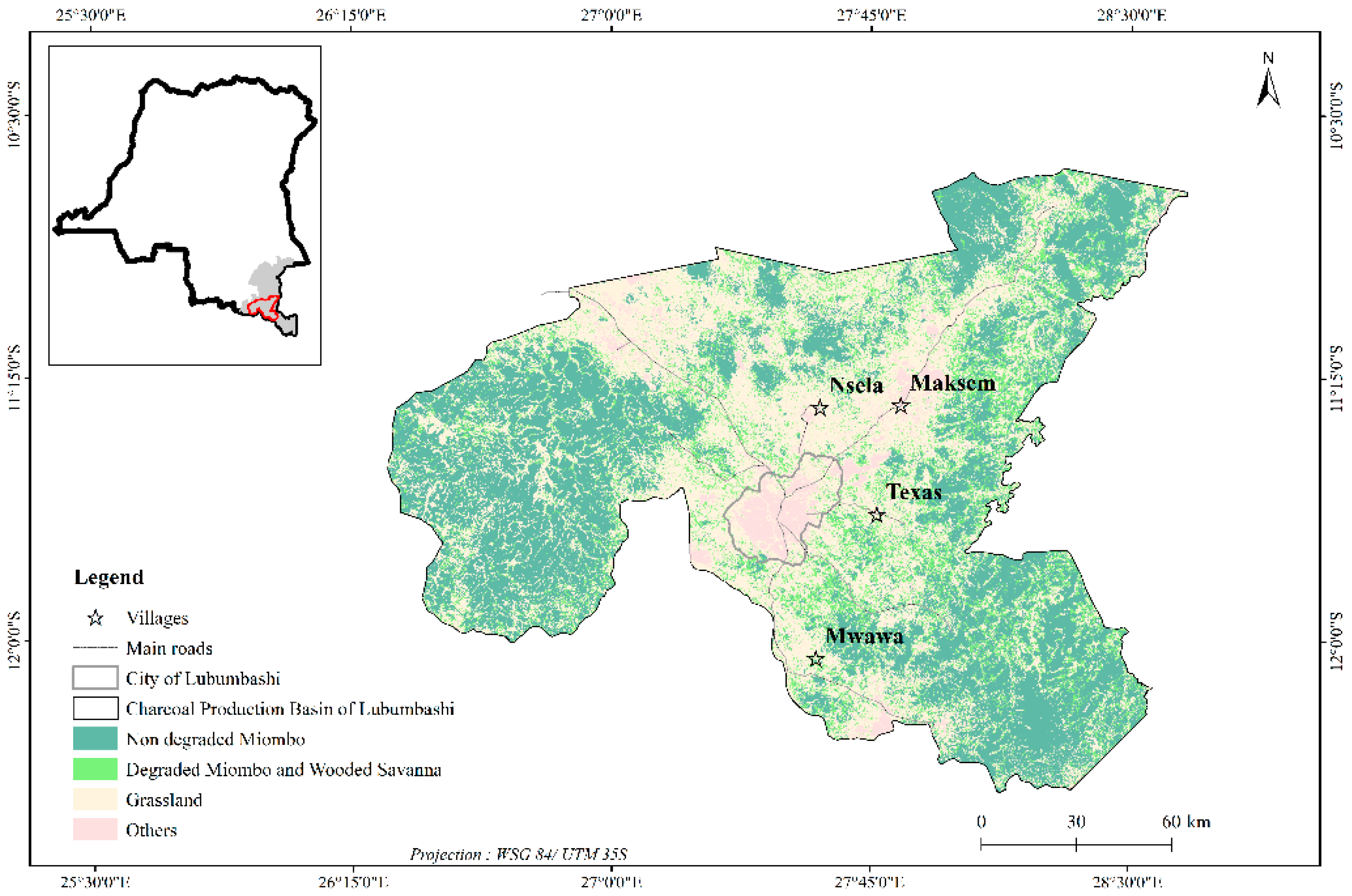

Table 1.
This is a table. Tables should be placed in the main text near to the first time they are cited.
Table 1.
This is a table. Tables should be placed in the main text near to the first time they are cited.
| Villages | Population size | Forests availability | Focus group participant | Number of people surveyed for validation | Gender (%) | |
|---|---|---|---|---|---|---|
| F | M | |||||
| Maksem | 356 | Limited | 8 | 50 | 8 | 92 |
| Texas | 333 | 12 | 50 | 48 | 52 | |
| Mwawa | 163 | Available | 11 | 50 | 24 | 76 |
| Nsela | 126 | 12 | 50 | 36 | 64 | |
Table 2.
Sacred sites in the Lubumbashi rural area, according to citations (focus and individual interviews) by local community members. Sites are presented in alphabetical order, and quotation values are presented as percentages. The values in brackets show the percentage of respondents who continue to regard these sites as sacred and observe related beliefs and prohibitions in their daily lives. VRFMD & HE: villages with less available forest resources and a high number of inhabitants; VRFD & HF: villages with available forest resources and a low number of inhabitants; n: number of people surveyed; -: the sacred site was not cited in the village concerned; p: p-value of Fisher's exact test; *: statistically significant association between variables.
Table 2.
Sacred sites in the Lubumbashi rural area, according to citations (focus and individual interviews) by local community members. Sites are presented in alphabetical order, and quotation values are presented as percentages. The values in brackets show the percentage of respondents who continue to regard these sites as sacred and observe related beliefs and prohibitions in their daily lives. VRFMD & HE: villages with less available forest resources and a high number of inhabitants; VRFD & HF: villages with available forest resources and a low number of inhabitants; n: number of people surveyed; -: the sacred site was not cited in the village concerned; p: p-value of Fisher's exact test; *: statistically significant association between variables.
| Types | Beliefs | Taboos | VRFMD & HE | VRFD & HF | p | |||
|---|---|---|---|---|---|---|---|---|
| Maksem n=50 | Texas n=50 |
Mwawa n=50 | Nsela n=50 | |||||
| Cemeteries | Ancestors' rest | Tree cutting, | 92.00 (90.00) | 78.00 (78.00) | 74.00 (74.00) | 62.00 (62.00) | 0.007* (0.013*) |
|
| Bush fires, | ||||||||
| Collects NTFPs, | ||||||||
| Access (authorization) | ||||||||
| Pregnant women, | ||||||||
| Children | ||||||||
| Mountain | Dwelling of spirits & divinities; place of prayer & exorcism |
Access (except for insiders), Bush fires | - | - | 8.00 (8.00) | - | 0.121 (0.121) | |
| Dense dry forests | Bush fires | - | - | 6.00 (4.00) | 2.00 (2.00) | 0.121 (0.246) | ||
| River sources | Bush fires, Tree cutting, Access |
8.00 (2.00) | 22.00 (6.00) | 10.00 (6.00) | 28.00 (4.00) | 0.573 (1.000) | ||
| Termite mounds | - | - | 8.00 (6.00) | 2.00 (2.00) | 0.059 (0.121) | |||
Table 3.
Ethnobotanical list of sacred wood species identified during focus groups and individual interviews held in various villages in the rural area of Lubumbashi. The woody species are presented in alphabetical order, and the quotation values are presented as percentages. The values in brackets show the percentages of respondents observing beliefs and prohibitions relating to sacred wood species. VRFMD & HF: villages with less available forest resources and a high number of inhabitants; VRFD & HE: villages with available forest resources and a low number of inhabitants; n: number of people surveyed; -: the sacred species was not cited in the village concerned; p: p-value of Fisher's exact test; *: statistically significant association between variables.
Table 3.
Ethnobotanical list of sacred wood species identified during focus groups and individual interviews held in various villages in the rural area of Lubumbashi. The woody species are presented in alphabetical order, and the quotation values are presented as percentages. The values in brackets show the percentages of respondents observing beliefs and prohibitions relating to sacred wood species. VRFMD & HF: villages with less available forest resources and a high number of inhabitants; VRFD & HE: villages with available forest resources and a low number of inhabitants; n: number of people surveyed; -: the sacred species was not cited in the village concerned; p: p-value of Fisher's exact test; *: statistically significant association between variables.
| Scientific names | Families | Availability in the forest | Beliefs about species | VRFMD & HE | VRFD & HF | p | ||||
| Maksem n=50 |
Texas n=50 |
Mwawa n=50 |
Nsela n=50 |
|||||||
| Afzelia quanzensis Welw. | Fabaceae | Rare | Ancestral habitat, medicinal species | 4.00 (4.00) |
- | 36.00 (36.00) |
22.00 (22.00) |
0.000* (0.000*) |
||
|
Anisophyllea boehmii Engl. |
Anisophylleaceae | Available | Food, medicinal species, customary chief's establishment | 10.00 | 32.00 | 10.00 | 12.00 | 0.081 | ||
| Annona senegalensis Pers. | Annonaceae | Available | Sacred, medicinal species | 2.00 | - | 2.00 | - | 1.000 | ||
| Bobgunnia madagascariensis (Desv.) J.H. Kirkbr. & Wiersama | Fabaceae | Available | Sacred, medicinal species | - | - | 4.00 | 10.00 (6.00) |
0.498 (0.331) |
||
| Brachystegia boehmii Taub. | Fabaceae | Available | Helps make incantations underfoot to heal or get rid of evil spirits | - | - | 10.00 | - | 0.059 | ||
| Brachystegia spp. and Julbernardia spp. | Fabaceae | Available | Shelters ancestral spirits | 8.00 | 6.00 | 22.00 | 20.00 | 0.007* | ||
| Cassia abbreviata Oliv. | Fabaceae | Rare | Sacred, medicinal species | - | 6.00 (6.00) |
12.00 (12.00) |
6.00 (6.00) |
0.134 (0.003*) |
||
| Combretum molle Engl. & Diels | Combretaceae | Available | Sacred, medicinal species | 4.00 | - | 12.00 | 8.00 | 0.035* | ||
| Diplorhynchus condylocarpon (Müll. Arg.) Pichon | Apocynaceae | Available | Sacred, medicinal species | - | 2.00 | - | - | 1.000 | ||
| Entandrophragma delevoyi De Wild. | Meliaceae | Rare | Sacred species, medicinal, prediction of future events | 44.00 (44.00) |
20.00 (20.00) |
40.00 (40.00) |
40.00 (40.00) |
0.302 (0.302) |
||
| Erythrina abyssinica Lam. ex DC. | Fabaceae | Available | Medicinal species, herald the good rainy season | 4.00 | - | 12.00 (2.00) |
12.00 | 0.010* (1.000) |
||
| Ficus spp | Moraceae | Available | Shelters ancestral spirits, medicinal | 14.00 (6.00) |
26.00 (12.00) |
32.00 (18.00) |
12.00 (10.00) |
0.862 (0.376) |
||
| Isoberlinia spp | Fabaceae | Rare | Prayers of traditional chiefs, medicinal plants | 8.00 | - | 6.00 | 10.00 | 0.373 | ||
| Lannea discolor (Sond.) Angl. | Anacardiaceae | Available | Ancestral prayers, Enthronement of the chief | - | - | 6.00 | - | 0.246 | ||
| Marquesia macroura Gilg | Dipterocarpaceae | Available | Representation of ancestors, medicinal | - | - | 12.00 (10.00) |
8.00 (2.00) |
0.002* (0.029*) |
||
| Parinari curatellifolia Planch. ex Benth. | Chrysobalanaceae | Available | Food, medicinal, establishment of a traditional chief | 14.00 | 26.00 | 32.00 | 12.00 | 0.862 | ||
| Pericopsis angolensis (Boulanger) Meeuwen | Fabaceae | Available | Representation of ancestors, medicinal, dispels curse | - | 8.00 | 6.00 | 10.00 | 0.373 | ||
| Piliostigma thonningii (Schumach.) Milne-Redh. | Fabaceae | Available | Sacred, medicinal species | 2.00 | - | 16.00 | - | 0.035* | ||
| Psorospermum febrifugum Spach | Hypericaceae | Available | Sacred, medicinal species | 2.00 | - | - | - | 1.000 | ||
| Pterocarpus angolensis DC. | Fabaceae | Available | Sacred medicinal species | - | 2.00 | 4.00 | 0.246 | |||
| Pterocarpus tinctorius Welw. | Fabaceae | Available | Sacred, medicinal species | 6.00 | - | 14.00 | 8.00 | 0.049* | ||
| Rothmannia engleriana (K. Schum.) Keay | Rubiaceae | Available | Medicinal species, create disputes between partners | 2.00 | - | - | 2.00 | 1.000 | ||
| Securidaca longepedunculata Fresen. | Polygalaceae | Available | Medicinal species, home to the spirits | - | - | - | 2.00 (2.00) |
1.000 (1.000) |
||
| Sterculia quinqueloba (Garcke) K. Schum. | Malvaceae | Rare | Sacred species, medicinal, discover hidden events, luck tree, frighten away sorcerers, destroy the power of gris-gris, save poultry from epidemics | 40.00 (40.00) |
12.00 (12.00) |
30.00 (30.00) |
58.00 (58.00) |
0.012* (0.012*) |
||
| Strychnos cocculoides Delile | Loganiaceae | Available | Food and medicinal species | 18.00 | 12.00 | 30.00 | 14.00 | 0.275 | ||
| Syzygium guineense DC. Subsp macrocarpum | Myrtaceae | Available | Food and medicinal species | - | 4.00 | - | - | 0.498 | ||
| Terminalia mollis M.A.Lawson | Combretaceae | Available | Sacred, medicinal species | 2.00 (2.00) |
- | - | 6.00 (4.00) |
0.621 (1.000) |
||
| Uapaca kirkiana Müll.Arg. | Phyllanthaceae | Available | Food species, ceremony before ploughing, medicinal | 22.00 | 14.00 | 26.00 | 8.00 | 1.000 | ||
| Zanha africana (Radlk.) Exell | Fabaceae | Rare | Sacred, medicinal species | - | - | 2.00 (2.00) |
- | 1.000 (1.000) |
||
| Zanthoxylum chalybeum Engl. | Rutaceae | Rare | Sacred, medicinal species | 2.00 (2.00) |
- | 14.00 (14.00) |
10.00 (10.00) |
0.003* (0.003*) |
||
Table 4.
Traditional ecological practices for biodiversity conservation and sustainable miombo woodlands management in rural Lubumbashi. Traditional practices are presented in alphabetical order, with citation values presented as percentages. The values in brackets show the percentage of respondents applying these cited practices. Practices with only implementation values are considered innovations. VRFMD & HE: villages with less available forest resources and a high number of inhabitants; VRFD & HF: villages with available forest resources and a low number of inhabitants; n: number of people surveyed; -: the practice was not cited in the village concerned; p: p-value of Fisher's exact test; *: statistically significant association between variables.
Table 4.
Traditional ecological practices for biodiversity conservation and sustainable miombo woodlands management in rural Lubumbashi. Traditional practices are presented in alphabetical order, with citation values presented as percentages. The values in brackets show the percentage of respondents applying these cited practices. Practices with only implementation values are considered innovations. VRFMD & HE: villages with less available forest resources and a high number of inhabitants; VRFD & HF: villages with available forest resources and a low number of inhabitants; n: number of people surveyed; -: the practice was not cited in the village concerned; p: p-value of Fisher's exact test; *: statistically significant association between variables.
| Traditional practices | VRFMD & HE | VRFD & HF | p | |||
|---|---|---|---|---|---|---|
| Maksem n=50 |
Texas n=50 |
Mwawa n=50 |
Nsela n=50 |
|||
| Leaving large trees and sacred trees standing | 4.00 | 2.00 | 4.00 | 8.00 | 0.498 | |
| Rare and sacred medicinal trees left standing | (8.00) | (10.00) | (4.00) | (16.00) | (0.435) | |
| Small-scale farming | 16.00 | 32.00 | 14.00 | 16.00 | 0.153 | |
| Agriculture without stump grubbing | 4.00 (4.00) |
- | 6.00 (6.00) |
8.00 (8.00) |
0.170 (0.170) |
|
| Charcoal for domestic use | 6.00 | 2.00 | 2.00 | 2.00 | 0.683 | |
| Intercropping | 12.00 (34.00) |
4.00 (40.00) |
6.00 (20.00) |
10.00 (10.00) |
1.000 (0.000*) |
|
| Selective cutting | 6.00 | 8.00 | 2.00 (2.00) |
2.00 (2.00) |
0.170 (0.498) |
|
| Progressive operation | 2.00 | 4.00 | 4.00 (16.00) |
4.00 (22.00) |
1.000 (0.498) |
|
| Tree-cutting banned in sacred places | 20.00 (36.00) |
26.00 (20.00) |
14.00 (8.00) |
14.00 (14.00) |
0.145 (0.004*) |
|
| Defending concessions | - | - | (12.00) | - | (0.029*) | |
| Short fallow/rotation period (3-5 years) | (10.00) | (20.00) | (6.00) | (4.00) | (0.032*) | |
| Long fallow/rotation period (15-20 years) | 12.00 (2.00) |
6.00 (6.00) |
18.00 (16.00) |
10.00 (10.00) |
0.376 (0.040*) |
|
| Optimum bushfire period | - | 4.00 | 6.00 | - | 1.000 | |
| Use of dead wood | 18.00 (6.00) |
12.00 (4.00) |
24.00 (10.00) |
26.00 (14.00) |
0.111 (0.126) |
|
Table 5.
Modes and circumstances of transmission of traditional ecological knowledge and practices. Modes and circumstances of TEK transmission are presented in alphabetical order, and citation values are presented as percentages. VRFMD & HE: villages with less available forest resources and a high number of inhabitants; VRFD & HF: villages with available forest resources and a low number of inhabitants; n: number of people surveyed. - p: p-value of Fisher's exact test; *: statistically significant association between variables.
Table 5.
Modes and circumstances of transmission of traditional ecological knowledge and practices. Modes and circumstances of TEK transmission are presented in alphabetical order, and citation values are presented as percentages. VRFMD & HE: villages with less available forest resources and a high number of inhabitants; VRFD & HF: villages with available forest resources and a low number of inhabitants; n: number of people surveyed. - p: p-value of Fisher's exact test; *: statistically significant association between variables.
| Elements | VRFMD & HE | VRFD & HF | p | |||
|---|---|---|---|---|---|---|
| Maksem n=50 | Texas n=50 |
Mwawa n=50 | Nsela n=50 |
|||
| Transmission modes (%) | ||||||
| Songs | 44.00 | 62.00 | 58.00 | 52.00 | 0.887 | |
| Riddles & puzzles | 8.00 | - | 6.00 | 10.00 | 0.373 | |
| Fables, tales & stories | 36.00 | 28.00 | 10.00 | 20.00 | 0.007* | |
| Scenes | - | - | 2.00 | 4.00 | 0.246 | |
| Proverbs | 12.00 | 10.00 | 24.00 | 14.00 | 0.165 | |
| Circumstances of transmission (%) | ||||||
| Family advice (around the fire) | 28.00 | 40.00 | 46.00 | 50.00 | 0.254 | |
| Bereavement | 32.00 | 22.00 | 20.00 | 24.00 | 0.511 | |
| Weddings | 22.00 | 26.00 | 12.00 | 10.00 | 0.025* | |
| Newborn births | 6.00 | 8.00 | 12.00 | 8.00 | 0.613 | |
| Enthronement of a village chief | 12.00 | 6.00 | 10.00 | 8.00 | 1.000 | |
Table 6.
Roles of ceremonials in forest conservation in rural Lubumbashi. Ceremonials are presented in alphabetical order and quotation values are presented as percentages. VRFMD & HE: villages with less available forest resources and a high number of inhabitants; VRFD & HF: villages with available forest resources and a low number of inhabitants; n: number of people surveyed; p: p-value of Fisher's exact test; *: statistically significant association between variables.
Table 6.
Roles of ceremonials in forest conservation in rural Lubumbashi. Ceremonials are presented in alphabetical order and quotation values are presented as percentages. VRFMD & HE: villages with less available forest resources and a high number of inhabitants; VRFD & HF: villages with available forest resources and a low number of inhabitants; n: number of people surveyed; p: p-value of Fisher's exact test; *: statistically significant association between variables.
| Ceremonials | VRFMD & HE | VRFD & HF | p | |||
|---|---|---|---|---|---|---|
| Maksem n=50 | Texas n=50 | Mwawa n=50 | Nsela n=50 | |||
| Funeral of a loved one | 84.00 | 86.00 | 72.00 | 80.00 | 0.153 | |
| Exorcism | - | 2.00 | 8.00 | 6.00 | 0.065 | |
| Induction of the new chief | 16.00 | 12.00 | 6.00 | 4.00 | 0.051 | |
| Prayers to the gods (ancestors) | - | - | 14.00 | 10.00 | 0.000* | |
Table 7.
Association between biodiversity conservation/forest management practices and elements of the socio-demographic profile of respondents. The figures presented in this table are p-values from Fisher's exact test. * : statistically significant association between variables.
Table 7.
Association between biodiversity conservation/forest management practices and elements of the socio-demographic profile of respondents. The figures presented in this table are p-values from Fisher's exact test. * : statistically significant association between variables.
| Traditional practices | Type | Age ranges |
Education level |
Main occupation |
|---|---|---|---|---|
| Rare and sacred medicinal trees left standing | 0.054 | 0.012* | 0.095 | 0.000* |
| Agriculture without stump grubbing | 0.297 | 0.297 | 0.053 | 0.504 |
| Intercropping | 0.006* | 0.040* | 0.004* | 0.000* |
| Selective cutting | 0.457 | 0.148 | 0.737 | 0.221 |
| Progressive operation | 0.596 | 0.022* | 0.303 | 0.887 |
| Tree-cutting banned in sacred places | 0.334 | 0.714 | 0.983 | 0.002* |
| Defending concessions | 1.000 | 0.027* | 0.346 | 0.619 |
| Short fallow/rotation period (3-5 years) | 0.027* | 0.000* | 0.000* | 0.915 |
| Long fallow/rotation period (15-20 years) | 0.694 | 0.637 | 0.700 | 0.211 |
| Use of dead wood | 0.051 | 0.006* | 0.545 | 0.227 |
Disclaimer/Publisher’s Note: The statements, opinions and data contained in all publications are solely those of the individual author(s) and contributor(s) and not of MDPI and/or the editor(s). MDPI and/or the editor(s) disclaim responsibility for any injury to people or property resulting from any ideas, methods, instructions or products referred to in the content. |
© 2025 by the authors. Licensee MDPI, Basel, Switzerland. This article is an open access article distributed under the terms and conditions of the Creative Commons Attribution (CC BY) license (http://creativecommons.org/licenses/by/4.0/).
Copyright: This open access article is published under a Creative Commons CC BY 4.0 license, which permit the free download, distribution, and reuse, provided that the author and preprint are cited in any reuse.


