

Submitted:
02 January 2025
Posted:
03 January 2025
You are already at the latest version
Abstract
This paper aims to conduct an empirical study on the influence of relational resources (RR) and digital capability (DC) on entrepreneurial performance (EP), as well as to examine the mediating role of value proposition innovation (VPI). This research seeks to fill the gap in existing literature regarding the impact of relational resources and digital capability on entrepreneurial performance. Data were collected from 191 respondents from small snack food production enterprises in China. The Partial Least Squares Structural Equation Modeling (PLS-SEM) method was employed to analyze and measure both direct and indirect effects, and to test the hypothesized model. The findings indicate that while relational resources and digital capability do not have a significant positive influence on entrepreneurial performance, they significantly positively influence value proposition innovation, which in turn has a significant positive effect on entrepreneurial performance. Therefore, value proposition innovation fully mediates the relationship between relational resources, digital capability and entrepreneurial performance. This study contributes to resolving the ongoing debate on the influence of relational resources and digital capability on entrepreneurial performance.
Keywords:
Relational Resources
; Digital Capability
; Entrepreneurial Performance
; Value Proposition Innovation
1. Introduction
China, home to the world’s largest population and a vast consumer market, has historically upheld the belief that “food is the paramount necessity of the people.” As Chinese residents’ income and consumption levels have risen, their dietary structures and consumption habits have also evolved. There is a growing trend toward purchasing snack foods, with the proportion of expenditure on such items in daily consumption increasing rapidly. This trend has created a highly favorable external environment for the growth of snack food production enterprises. However, the global COVID-19 pandemic has significantly altered consumers’ food preferences, placing greater emphasis on nutritional value. This shift presents substantial challenges to the snack food industry, necessitating innovative approaches to meet evolving consumer demands.
Over the past five years, China has conducted a large amount of research on entrepreneurial performance. These studies focus on the entrepreneurial performance of individuals and enterprises (Zhu Peng, 2020). However, in fact, even in a highly competitive market environment, some small snack production enterprises perform better in terms of entrepreneurial performance due to their advantages in mobilizing relationship resources, innovative digital capabilities and value proposition innovation.
Researchers primarily investigate the impact of entrepreneurial resources on performance from two perspectives: resource allocation and social capital. Resource constraints represent a pervasive challenge for small, medium, and micro enterprises during the entrepreneurial process (Yi et al., 2019). Chen and Mao (2021) argue that resource bricolage is a critical strategy for entrepreneurial firms to enhance performance. They posit that through resource bricolage, these firms can generate numerous unique and inimitable new resources, thereby strengthening their competitive advantage and improving overall performance. Resource bricolage refers to a decision-making approach that enables enterprises to survive and thrive by leveraging existing or low-cost resources (Wang et al., 2019). In Chinese society, where interpersonal relationships and emotional connections hold significant value, individuals and organizations demonstrate a greater inclination to collaborate with trustworthy partners, including government entities, research institutions, and other enterprises. Many small and medium-sized enterprises (SMEs) encounter difficulties in building relationships with potential business partners, which subsequently hinders their ability to negotiate favorable cooperation terms (Zhang et al., 2021).
In the era of the digital economy, data has emerged as a pivotal element driving innovation. The digital transformation initiatives undertaken by enterprises involve integrating data with traditional resources to collaboratively generate value, restructure business models, and leverage network effects. This process is referred to as digital empowerment (Liu et al., 2022). Digital empowerment is a critical driver for the high-quality development of the manufacturing sector. Its mechanisms encompass transforming value creation methods, enhancing the efficiency of value creation, expanding the scope of value creation, and improving the capacity to capture value (Lv and Li, 2021). Additionally, Khin (2018) introduced the concept of digital capability, which denotes an organization’s proficiency in leveraging digital technology to create value. Building on the insights from these scholars, this study posits that digital empowerment is essentially an expression of digital capability. For small snack production enterprises in China, digital capability can significantly influence entrepreneurial performance.
This study investigates the mediating role of value proposition innovation in the relationship between relational resources, digital capability, and entrepreneurial performance within small snack food production enterprises in China. Specifically, this research elucidates how relational resources and digital capability influence entrepreneurial performance, leading to distinct outcomes compared to prior studies.
2. Literature Review
2.1. Entrepreneurial Performance
Entrepreneurial performance, which is an expression of the results and value of entrepreneurial activities, is a key theme in entrepreneurship research and a focus of great attention for entrepreneurs, investors, governments, and society (Zhu et al., 2022). However, due to the complexity and diversity of entrepreneurial activities, there is no uniform standard and consensus on the concept, content, and measurement of entrepreneurial performance, so different researchers have defined and analyzed it from different perspectives and levels.
Zhu (2020) examines the concept of entrepreneurial performance from multiple dimensions, including its definition, measurement methodologies, and influencing factors. Entrepreneurial performance is widely recognized as a critical metric for evaluating the outcomes of entrepreneurial activities, reflecting the growth and efficiency of entrepreneurial enterprises in areas such as market expansion, brand development, management practices, and core technological advancements. Zhu (2020) provides a systematic review of the historical trajectory and theoretical evolution of domestic research on entrepreneurial performance in China, highlighting dynamic trends in research focus areas, current developmental status, and thematic concentration. The study reveals that Chinese scholars frequently employ two categories of indicators—financial and non-financial—to comprehensively assess entrepreneurial performance. Sariwulan et al. (2020) posit that entrepreneurial performance serves as an indicator of the growth process of small and medium-sized enterprises (SMEs), encompassing increases in production capacity, sales volume, and corporate profits. Moreover, Sariwulan et al. (2020) empirically demonstrate the significant positive impact of digital literacy, economic literacy, and entrepreneurial skills on the entrepreneurial performance of SMEs.
In addition, Firmansyah et al. (2023) found that entrepreneurial performance involves multiple aspects, including not only the ability to sustain business operations but also a comprehensive consideration of management, products, markets and other dimensions. At the same time, Firmansyah et al. (2023) confirmed that digital literacy and digital transformation play important roles in improving entrepreneurial performance. Finally, Iqbal et al. (2023) propose that entrepreneurial performance refers to the outcomes achieved by entrepreneurs in terms of business success, growth, and innovation. Entrepreneurial performance can be measured through various indicators such as financial performance, business growth, innovation, and job creation opportunities.
2.2. Relational Resources
Relational resources pertain to assets obtained by enterprises through the establishment and maintenance of stable, mutually beneficial, and trust-based relationships with external stakeholders (e.g., suppliers, customers, partners, etc.) (Fu, 2015). In recent years, scholars have extensively examined the relationship between relational resources and business model innovation. Some studies have investigated the influence mechanism from a holistic perspective, positing that relational resources enhance business model innovation by improving corporate absorptive capacity, learning capability, creative potential, and other mediating variables (Fu, 2015). Other research has explored the differential effects of various types of relational resources, such as supplier, customer, and partner relationships, on business model innovation, revealing that different types of relational resources exert varying degrees of influence and mechanisms (Zió\lkowska, 2014). Additionally, some studies have analyzed the impact of relational resources on different dimensions of business model innovation, including components like value proposition, revenue streams, cost structure, as well as dimensions such as content, structure, and governance (Shou et al., 2017).
Coulthard (2007) elucidates the influence of relationship factors, both internal and external to the firm, on entrepreneurial performance. Establishing trust-based relationships with employees, customers, suppliers, and partners can mitigate transaction costs, enhance information sharing, and foster innovation and opportunity identification. Effective communication channels and methods, whether internal or external, significantly affect decision-making efficiency, coordination, knowledge transfer, and learning capabilities within the firm. It is imperative for firms to remain vigilant and responsive to external environmental changes in order to promptly capture and leverage market shifts, competitive threats, and potential opportunities. Managers’ social relationships, contacts, and networks facilitate entrepreneurial firms in accessing external resources and information, establishing credibility and trust, and coordinating transactions with partners (Lu et al., 2010). Trust serves as a pivotal component of relational resources, enhancing communication and cooperation among entrepreneurs at both individual and organizational levels, thereby improving entrepreneurial performance (Shahmehr et al., 2015). According to Monteiro et al. (2017), relational resources encompass the interactions between firms and external entities. Zardini et al. (2023) posit that social relationships and cooperative abilities among market participants are crucial for co-creation and value capture. Network resources, including customers, suppliers, competitors, and governmental agencies, are inherently relational and difficult to relocate, imitate, or substitute, thus providing a sustainable competitive advantage. Entrepreneurial firms can enhance their performance by leveraging and integrating external resources through relational resources established via entrepreneurial business networks (Zardini et al., 2023).
2.3. Digital Capability
With the rapid advancement and extensive application of information technology, the digital economy has emerged as a pivotal force in today’s global landscape, driving transformative changes and innovations across various sectors. Digital capability, as a cornerstone of the digital economy, not only revolutionizes the methods of acquiring, processing, and disseminating information but also redefines the logic, modes, and value propositions of business activities. In the context of digital products, digital capability can be defined as “the competencies of firms to leverage digital technologies for new product development” (Khin & Ho, 2018). Levallet and Chan (2018) identify two key digital capabilities: robust information management capabilities and adaptable IT infrastructure, yet they do not explicitly link these capabilities to innovation. According to Dynamic Capabilities Theory, digital capability can be regarded as a dynamic capability, characterized by an organization’s capacity to innovate new products and processes and adapt to evolving market conditions (Teece & Pisano, 1994). Digital capability complements a firm’s digital orientation; only firms equipped with the necessary skills to manage emerging technologies can effectively adopt and transform them into innovative products. Consequently, digital capability serves as a catalyst for digital innovation, positively impacting firms’ digital innovation efforts and indirectly influencing their entrepreneurial performance.
Digital capability refers to a firm’s proficiency in leveraging digital technologies and data analytics to enhance business processes, customer relationships, and value creation (Freitas Junior et al., 2017). Digital capabilities significantly contribute to the development of business and marketing networks, thereby having both direct and indirect effects on SME performance (Sariwulan et al., 2020). According to Zhe (2021), digital capability encompasses a firm’s ability to integrate information technology resources with other assets, influencing firm performance through its role as a mediator in digital transformation. This capability enables companies to foster customer loyalty, offer distinctive products and services, and adapt swiftly to market changes. Khin & Ho (2018) empirically demonstrated that digital capability and digital innovation are pivotal factors for IT firms in achieving entrepreneurial performance. In conclusion, digital capability exerts a substantial influence on entrepreneurial performance by mediating transformation and innovation. Building on this foundation, this study aims to further investigate the relationship between digital capability and entrepreneurial performance within small snack food production enterprises in China.
2.4. Value Proposition Innovation
Value proposition is a comprehensive description of the value an organization offers to its customers, which can help attract and retain customers and contribute to long-term sustainability (Sassanelli, 2022). According to Åkesson et al. (2016), a value proposition encompasses the value and resources that a service provider promises to deliver, enabling customers to integrate these into their own value creation processes. Value proposition innovation involves developing new or modifying existing value propositions by leveraging both existing and new resources. Clauss et al. (2021) define value proposition as the value of a product or service offered by a firm, encompassing aspects such as functionality, quality, and price. Value proposition innovation refers to the process by which firms introduce new or different value through changes in the product or service mix, target market, potential customers, or delivery channels. This innovation enables firms to expand their portfolios, address emerging market needs, and enhance competitive advantage and performance. To achieve effective value proposition innovation, firms must exhibit strategic agility, characterized by strategic sensitivity, leadership unity, resource mobility, and adaptability to environmental changes.
Salfore et al. (2023) utilized Clauss’s (2017) measurement scale to empirically assess value proposition innovation across four dimensions: new products/services, new target markets, new channels, and new customer relationships. Their findings indicate that value propositions enable firms to differentiate their offerings from competitors and meet unfulfilled market needs, thereby attracting and retaining more customers, improving customer satisfaction, and enhancing firm performance.
3. Hypotheses Development and Empirical Research Model
3.1. Relational Resources and Entrepreneurial Performance
Relational resources can have a significant positive impact on the functioning and expansion of a company. By accessing data on markets, meeting customer needs and receiving the backing of business partners and investors, firms can minimise start-up expenses and risks while maximising entrepreneurial openings and yields. Furthermore, relational resources can bolster a firm’s reputation and prestige and enhance customer contentment and allegiance (Stam et al., 2014). Through the utilization of relational resources, enterprises can acquire technical and policy support, enhancing their ability to innovate and increasing their competitiveness.
These resources offer numerous advantages to enterprises, including improved innovation, efficiency, flexibility, and personalisation (Wittmann et al., 2009). By collaborating with suppliers, customers, R&D organisations, and others through knowledge sharing and innovation, enterprises can enter new markets or develop new products. Efficient communication and coordination with employees, partners, distributors, and other stakeholders can enhance production and distribution efficiency and quality. Additionally, interaction and feedback with customers, users, and communities can promote personalised and adaptable products and services.
The company can also benefit from relational resources by gaining access to niche markets and increased consumer demand. Establishing long-term stable relationships with customers, users, and communities allows firms to increase sales and market share. Additionally, implementing a flexible supply chain and inventory management system with suppliers, distributors, and logistics providers can lower the cost and risk of procurement, production, and distribution. Moreover, enterprises can enhance the differentiation and value of their products and services through market segmentation and positioning (Shou et al., 2017; Karia et al., 2015). Based on literature review and previous studies, it is proposed that:
H1:
Relational resources have a positive relationship with entrepreneurial performance of small snack food production enterprises in China.
3.2. Digital Capability and Entrepreneurial Performance
The application of digital technologies has significantly reduced the barriers and costs associated with entrepreneurship, making the process more accessible and sustainable (Nambisan, 2017). By leveraging readily available online platforms and tools, entrepreneurs can efficiently acquire essential resources such as market intelligence, funding opportunities, and partnerships. Consequently, this reduces the time and risk involved in establishing a business. Flexible cloud services and solutions enable entrepreneurs to streamline production processes, reduce operational costs, and enhance management efficiency. Digital capabilities empower entrepreneurs to gather extensive data, conduct advanced analytics, identify and meet customer needs, optimize products and services, and improve user experience. Additionally, digital capabilities provide entrepreneurs with access to a wide range of market expansion opportunities and effective profit models designed to boost sales and revenues (Bharadwaj et al., 2013).
Furthermore, digital platforms facilitate engagement with like-minded professionals, experts, or organizations through open networks and communities, promoting knowledge sharing and innovation, and contributing to a robust entrepreneurial ecosystem. Moreover, digital capabilities offer platforms and opportunities for entrepreneurs to participate in public welfare initiatives, addressing societal challenges, enhancing quality of life, and fostering social progress. Based on literature review and previous studies, it is proposed that:
H2:
Digital Capability has a positive relationship with entrepreneurial performance of small snack food production enterprises in China.
3.3. Relational Resources and Value Proposition Innovation
Åkesson et al. (2016) posit that value propositions encompass the values and resources service providers commit to delivering to their customers, which can be integrated into the value creation process. These propositions are often articulated through corporate positioning and branding strategies. Value proposition innovation entails developing or modifying existing value propositions by leveraging new or existing resources. According to Clauss et al. (2021), a value proposition represents the value a company offers to its customers in terms of product or service attributes such as functionality, quality, and price. Value proposition innovation is the strategic process by which a company delivers new or different value by altering its product or service offerings, target markets, customer segments, or delivery channels. This innovation enables companies to expand their portfolios, address emerging market needs, and enhance competitive advantage and performance. Salfore et al. (2023) emphasize that value proposition innovation necessitates strategic agility, characterized by strategic sensitivity, leadership cohesion, resource flexibility, and adaptability to environmental changes. Clauss (2017) developed a measurement scale and conducted empirical research on value proposition innovation, demonstrating that firms can differentiate their offerings from competitors through such innovation. Moreover, addressing new or unmet market needs via value proposition innovation allows firms to attract and retain customers, thereby improving customer satisfaction and overall firm performance. Sebök et al. (2022) illustrate how relational resources contribute to competitiveness and sustainability. Based on literature review and previous studies, it is proposed that:
H3:
Relational resources have a positive relationship with value proposition innovation of Chinese small snack food production enterprises.
3.4. Digital Capability and Value Proposition Innovation
Digital capability significantly enhances organizational efficiency and profitability by leveraging digital technologies to transform customer value propositions and refine operating models, thereby fostering greater customer interaction and collaboration (O’Hea, 2011). A key dimension of digital capability is the value proposition, which encapsulates an organization’s strategic use of digital data and technology to generate new value or augment existing value (Korhonen, 2018). The strong correlation between digital capability and value proposition innovation is evident. Based on literature review and previous studies, it is proposed that:
H4:
Digital capability has a positive relationship with value proposition innovation of Chinese small snack food production enterprises.
3.5. Value Proposition Innovation and Entrepreneurial Performance
According to Lüdeke-Freund (2020), entrepreneurial performance encompasses a company’s economic, social, and environmental achievements that stem from value proposition innovation. These achievements include metrics such as revenue, profit, market share, customer satisfaction, social impact, and ecological benefits. Value proposition innovation is a pivotal factor in enhancing entrepreneurial performance by enabling firms to achieve a competitive advantage, increase customer loyalty, reduce operating costs, and improve social recognition and environmental sustainability. Sari (2023) further supports this notion through data analysis using SmartPLS, which indicates that value proposition innovations significantly contribute to the competitiveness and customer satisfaction of small and medium-sized enterprises (SMEs). Hypothesis H5 posits a positive relationship between value proposition innovation and entrepreneurial performance. The specific hypothesis is articulated as follows:
H5:
Value proposition innovation has a positive relationship with entrepreneurial performance of Chinese small snack food production enterprises.
The research framework is shown in Figure 1.
This study aims to explore the influence of relational resources, digital capability and value proposition innovation on entrepreneurial performance, especially for small snack food production enterprises. Based on the literature review and previous studies, a research framework was constructed.
4. Methodology
4.1. Research Framework
This study focuses on Chinese small snack food production enterprises to examine their current entrepreneurial performance. The research participants include production managers, product managers, marketing managers, and financial managers. These enterprises leverage relational resources and digital capability to innovate in value proposition, thereby achieving higher entrepreneurial performance.
4.2. Measurement Instrument
This study examines the relationship between relational resources, digital capability, value proposition innovation, and entrepreneurial performance of Chinese small snack food production enterprises, with a focus on their business processes. The questionnaire employs a Likert 5-point scale ranging from 1 (strongly disagree) to 5 (strongly agree). This study includes two independent variables: relational resources and digital capability, a mediating variable of value proposition innovation, and a dependent variable of entrepreneurial performance. Table 1 summarizes the measurement tools for these variables. Relational resources comprise three measurement items, digital capability includes five measurement items, value propositon innovation comprises four measurement items, and entrepreneurial performance includes eight measurement items. These measurements are adapted from Karia et al. (2015), Khin and Ho (2018), Clauss (2017), Sariwulan et al. (2020).
4.3. Research Sample
The research samples were obtained for data collection via the online distribution of questionnaires. A total of 237 questionnaires were collected, of which 191 were deemed valid, resulting in an effective recovery rate of 80.6%. Data were gathered from five provinces in China that are representative of regional diversity: Guangdong, Jiangsu, Sichuan, Henan, and Shandong. Purposive sampling was employed to select small leisure food production enterprises with annual operating revenues between 3 million and 20 million yuan and a workforce size ranging from 20 to 300 employees. The primary respondents included production managers, product managers, and R&D managers from these enterprises.
4.4. Data Analysis and Measurement Models
The PLS-SEM method, similar to other statistical techniques, depends on empirical guidelines for the evaluation of model outcomes. This study encompasses the analysis and reporting of both measurement models and structural models. Once the measurement model satisfies all requisite criteria, we can proceed to evaluate the structural model (Hair et al., 2014, 2021). A reflective measurement model was selected due to its reliance on exploratory factor analysis and anticipated high intercorrelations among indicators (Hair et al., 2014, 2021). The initial assessment involves examining indicator loadings, which should ideally exceed 0.708. Following this, internal consistency reliability, commonly measured by composite reliability, is evaluated; values between 0.70 and 0.90 are generally deemed satisfactory to good. However, values equal to or exceeding 0.95 may indicate redundancy within the construct, thereby potentially undermining construct validity (Hair et al., 2014, 2021).
The Average Variance Extracted (AVE) is evaluated to assess the convergent validity of all items within each construct. Convergent validity indicates the extent to which a construct successfully explains the variance observed in its constituent items (Hair et al., 2014, 2021). An acceptable AVE value should be at least 0.50. To establish convergent validity, the AVE for each construct is compared with the squared inter-construct correlations between that construct and all other reflectively measured constructs in the structural model. It is crucial that the shared variance among all constructs does not surpass their respective AVE values (Fornell & Larcker, 1981).
The reliability analysis of the measurement model is detailed in Table 2. This table includes the loadings of all indicators, Average Variance Extracted (AVE) values for each construct, Cronbach’s alpha (CA) values for each construct, and Composite Reliability (CR) values. All these metrics meet the established testing criteria.
4.5. Results
After a satisfactory evaluation of the measurement model, the next step is to assess the structural model. In structural equation modeling, the coefficient of determination R2 quantifies the amount of variance explained by each endogenous construct, with higher R2 values indicating a stronger explanatory power of the model for the endogenous variables. This is a crucial metric for assessing the accuracy of model predictions (Shmueli & Koppius, 2011). The range of R2 values lies between 0 and 1, where higher values signify greater explanatory power. In social science research, it is generally considered significant when R2 values are around 0.75, moderate at 0.50, and weak at 0.25 (Hair, Ringle, & Sarstedt, 2011, 2021). For this study, we obtained R2 values using the SmartPLS algorithm while t-statistic values were derived from bootstrapping with resampling method performed for a total of 5000 iterations as depicted in Figure 1 and Figure 2. The R2 values for value proposition innovation (VPI) and entrepreneurial performance (EP) in Figure 1 and Figure 2 are 0.694 and 0.717 respectively. These results indicate that all the R2 values surpass the threshold of 0.5, which signifies a moderate fit level. Consequently, the research model employed in this study fulfills the requirements concerning determination coefficient.
Figure 1.
PLS Model Graph (Algorithm).
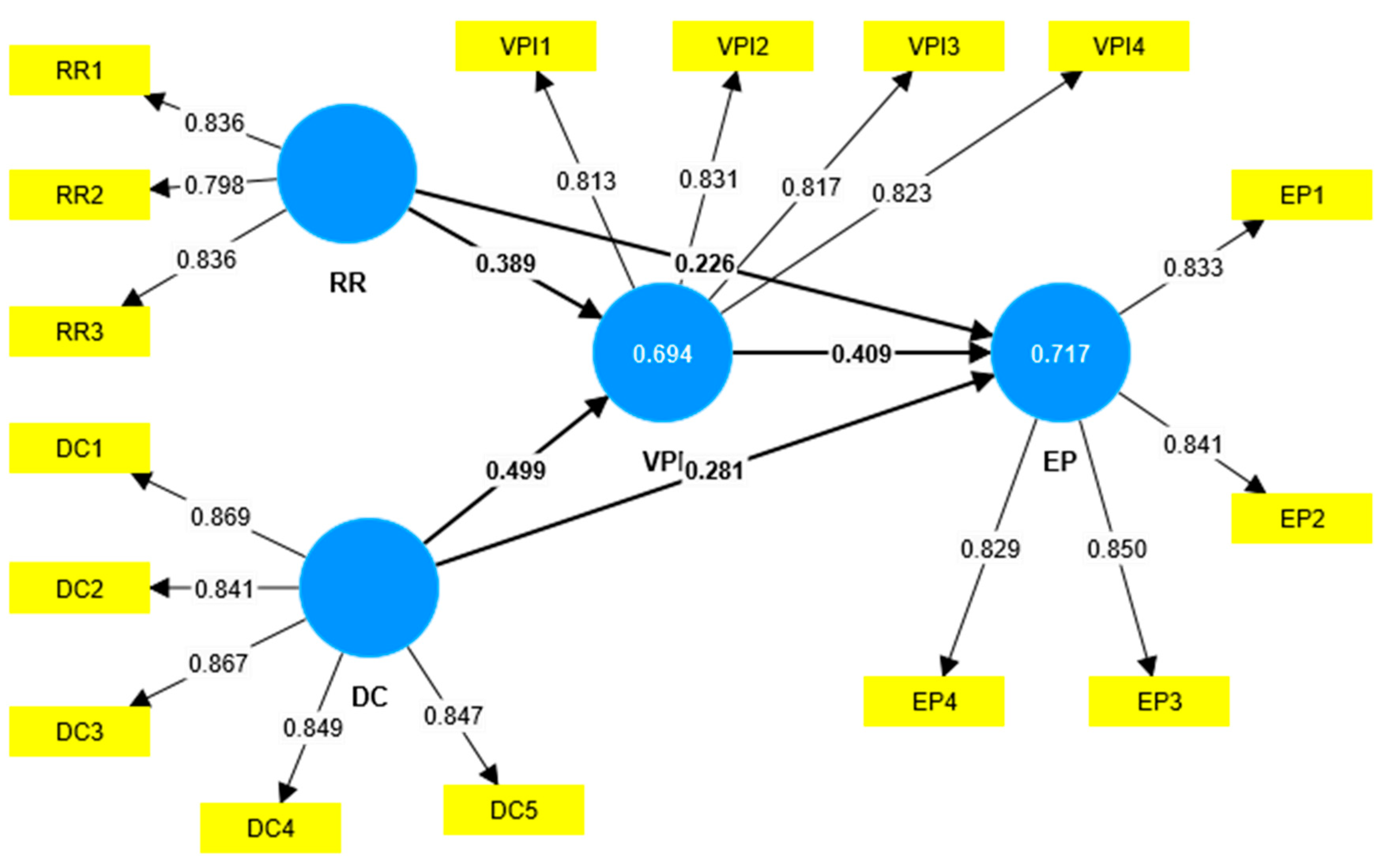
Figure 2.
PLS Model Graph (Bootstrapping).
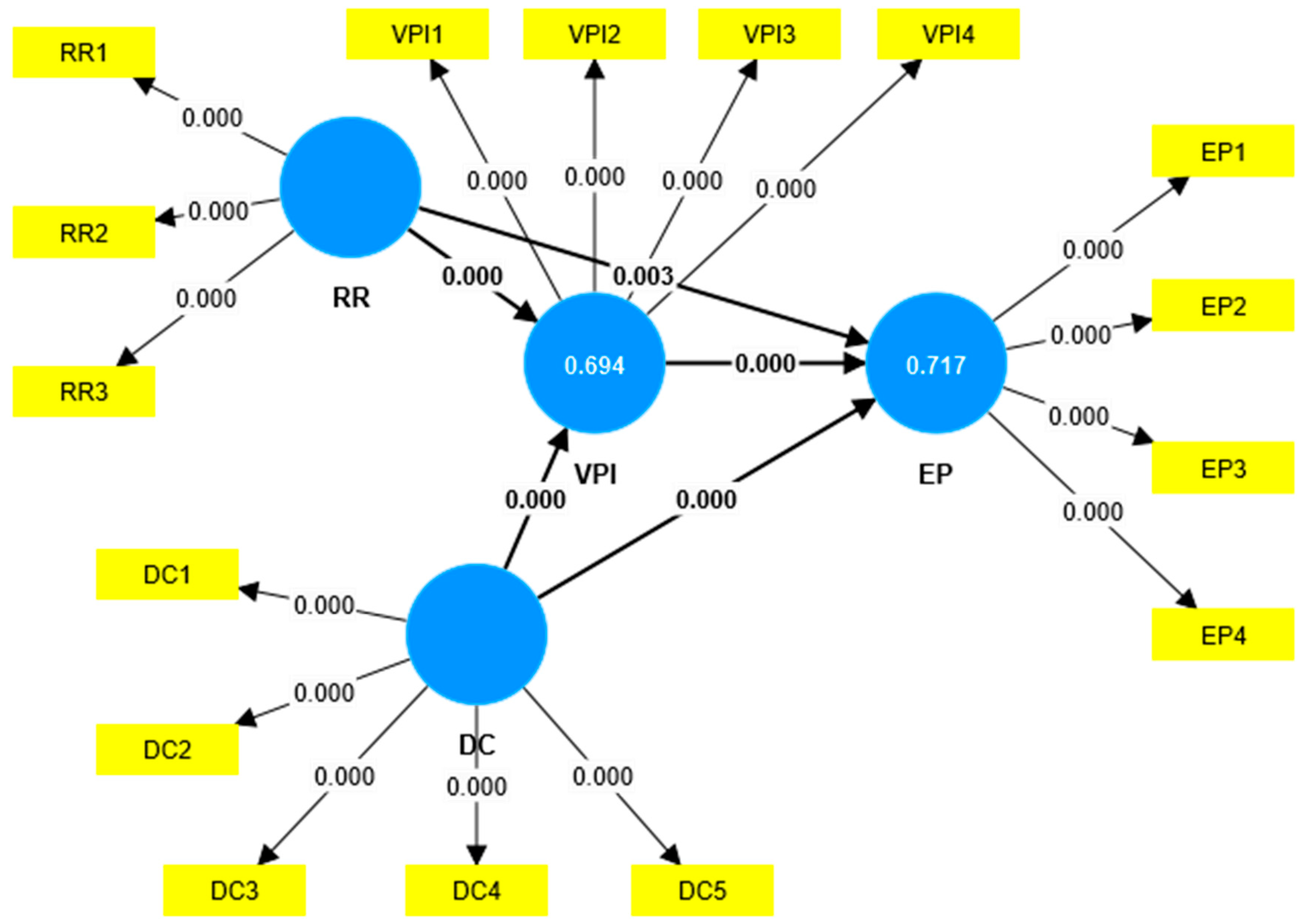
After confirming the model’s explanatory power, the final step involves evaluating the statistical significance and correlation of path coefficients. This study employs bootstrapping to assess path coefficient significance and determine their values, including explanations for constructing total effects (i.e., sum of direct and indirect effects).
In this study, we formulated five direct hypotheses to investigate the relationships between constructs. To evaluate the significance of these hypotheses, we employed SmartPLS 4.0 to generate t-statistics for all paths using bootstrapping and assessed the path coefficient values between latent variables. This process aimed to validate both the proposed hypotheses and the effectiveness of the structural model. According to Hair et al. (2014), a path coefficient value exceeding 0.1 is indicative of meaningful influence within the model. Additionally, t-values should surpass the critical threshold of 1.96, which supports the findings at a significance level below 0.05 in this research analysis.
Table 3 shows that the path coefficient values of the five direct hypotheses proposed in this study are all greater than 0.1, the T values are all greater than the threshold value of 1.96, and the significance p values are all less than 0.01. The forthcoming research will evaluate the effect size (f²). As noted by Sullivan and Fein (2012), while p-values can indicate the presence of an effect, they do not provide information on the magnitude of that effect. In reporting and interpreting research findings, it is crucial to consider both the practical significance (effect size) and statistical significance (p-values). Within the context of the PLS-SEM path model, Cohen’s f² serves as a key metric for assessing the magnitude of path coefficients. This study employs Cohen’s (2016) established guidelines to measure effect size, wherein values of 0.02, 0.15, and 0.35 correspond to small, medium, and large effects, respectively (Cohen, 2016; Hair et al., 2014). Therefore, the data analysis indicates that all the five direct hypotheses H1 to H5 are valid. Meanwhile, it indicates that value proposition innovation plays a partial mediating role among relationship resources, digital capabilities and entrepreneurial performance.
The results of the mediation analysis presented in Table 4 indicate that the P-value of 0 suggests a statistically significant relationship, even after introducing the mediating variable “value proposition innovation”. Specifically, relational resources and digital capability continue to exert a significant influence on entrepreneurial performance.
5. Discussion and Conclusion
The results of the data analysis indicate that both relational resources and digital capability exert a positive influence on entrepreneurial performance, which aligns with prior research findings. However, the results of data analysis show that the influence of relational resources and digital capability on entrepreneurial performance is rather limited (0.02<f-square<0.15). Zardini et al. (2023) suggested that enhancing entrepreneurial business networks through relational resources can improve entrepreneurial firm performance by acquiring and integrating external resources. Shahmehr et al. (2015) argued that trust is an important element for enhancing communication and cooperation at individual and organizational levels to enhance entrepreneurial performance. Sariwulan et al. (2020) highlighted the pivotal role of digital capability in fostering business and marketing networks, which have a direct or indirect impact on the performance of small and medium-sized enterprises (SMEs). Zhe (2021) defined digital capability as the proficiency to integrate information technology resources with other organizational assets, thereby influencing enterprise performance through digital transformation. Empirical studies by Khin & Ho (2018) corroborated that both digital capability and innovation are indispensable for IT companies to attain entrepreneurial success.
The data analysis results provide support for hypothesis 3 and 4 in this study, indicating a direct positive impact of relational resources and digital capability on value proposition innovation within Chinese small snack food production enterprises. Furthermore, the influence effect value of relational resources on value proposition innovation is 0.212, indicating that its influence degree is at a medium level. While the influence effect value of digital capability on value proposition innovation is 0.35, showing a relatively high degree of influence. Previous research has underscored that small and medium-sized enterprises (SMEs) introduce distinctive products and services to the market via innovative business models, thereby effectively addressing customer needs and expectations, which constitutes a critical component of value proposition innovation (Madhavan et al., 2022). Sebök et al. (2022) illustrated how relational resources can enhance competitiveness and sustainability through risk sharing, information exchange, resource allocation, building loyal customer relationships, and engaging in community activities, as exemplified by their case study of a food supplier. They also highlighted the importance of collaboration among suppliers, networking opportunities, and trust-building initiatives. Furthermore, they proposed a systematic approach to identifying and implementing both technological and non-technological innovations to leverage relationship resources for enhancing value propositions (Sebök et al., 2022). Consequently, the findings from this study corroborate previous research conclusions.
The study further examines the impact of value proposition innovation on entrepreneurial performance. The data analysis supports Hypothesis 5, demonstrating that value proposition innovation has a significant and positive effect on entrepreneurial performance in small snack food production enterprises in China. Specifically, the path coefficient is 0.409, with an effect size (f2) of 0.181, indicating a meaningful contribution of value proposition innovation to entrepreneurial performance. Lüdeke-Freund (2020) highlighted that entrepreneurial performance encompasses economic, social, and environmental achievements derived from innovative value propositions, including metrics such as revenue, profit, market share, customer satisfaction, social impact, and ecological benefits. Value proposition innovation serves as a pivotal driver of business performance by enabling firms to achieve competitive advantage, enhance customer loyalty, reduce operational costs, and improve social acceptance and environmental sustainability. Sari (2023) corroborated through SmartPLS data analysis that value proposition innovation significantly contributes to competitiveness and satisfaction in small and medium-sized enterprises. In summary, prior research has consistently demonstrated the critical role of value proposition innovation in bolstering competitive advantage for businesses. Consequently, this study’s findings align with previous research, collectively validating Hypothesis 5.
A mediator is defined as a variable that conveys the effect of an independent variable on a dependent variable. In the context of path analysis, a mediating variable represents the mechanism through which the independent variable indirectly influences the dependent variable (Edwards, 2007). A mediating effect occurs when a mediating variable partially or fully accounts for the impact of an exogenous construct on an endogenous construct in a PLS path model (Hair Jr et al., 2014). According to Baron and Kenny (1986), four criteria must be met to establish mediation. First, the independent variable must have a significant effect on the mediating variable (path a). Second, the mediating variable must significantly influence the dependent variable (path b). Third, there should be a direct effect of the independent variable on the dependent variable when the mediating variable is not considered (path c). Fourth, if the direct effect of the independent variable on the dependent variable (path c’) becomes non-significant after accounting for the mediating variable, this indicates full mediation. If path c’ remains significant but is reduced, it suggests partial mediation, implying that the independent variable affects the dependent variable both directly and indirectly through the mediating variable. It is evident from this study that the mediating variable “value proposition innovation” partially mediated the relationship between the independent variables and the dependent variable. Specifically, it exerted a partial mediating effect between relational resources and entrepreneurial performance, as well as between digital capability and entrepreneurial performance.
6. Limitations and Future Research
This study is based on data from 191 small snack food production enterprises in China, and the limited sample size may constrain the generalizability of the research findings. Future studies can enhance result representativeness by expanding the sample size and including companies from a wider range of regions.
The study revealed that relational resources and digital capability do not exert a direct significant impact on entrepreneurial performance, suggesting the presence of other factors influencing firm performance. Future research should explore additional potential direct or indirect relationships between these variables and entrepreneurial performance.
References
- Åkesson, M., Skålén, P., Edvardsson, B., & Stålhammar, A. (2016). Value proposition test-driving for service innovation: How frontline employees innovate value propositions. Journal of Service Theory and Practice, 26(3). [CrossRef]
- Baron, R. M., & Kenny, D. A. (1986). The moderator–mediator variable distinction in social psychological research: Conceptual, strategic, and statistical considerations. Journal of Personality and Social Psychology, 51(6), 1173. [CrossRef]
- Bharadwaj, A., El Sawy, O. A., University of Southern California, Pavlou, P. A., Temple University, Venkatraman, N., & Boston University. (2013). Digital Business Strategy: Toward a Next Generation of Insights. MIS Quarterly, 37(2), 471–482. [CrossRef]
- Chen, M.L. & Mao, R.X. (2021). The Relationship between Entrepreneurial Alertness, Resource Mobilization, and Entrepreneurial Firm Performance. East China Economic Management Journal (07), 46-55. [CrossRef]
- Clauss, T., Abebe, M., Tangpong, C., & Hock, M. (2021). Strategic Agility, Business Model Innovation, and Firm Performance: An Empirical Investigation. IEEE Transactions on Engineering Management, 68(3), 767–784. [CrossRef]
- Clauss, T., Abebe, M., Tangpong, C., & Hock, M. (2021). Strategic Agility, Business Model Innovation, and Firm Performance: An Empirical Investigation. IEEE Transactions on Engineering Management, 68(3), 767–784. [CrossRef]
- Cohen, J. (2016). A power primer. [CrossRef]
- Coulthard, M. (2007). The role of entrepreneurial orientation on firm performance and the potential influence of relational dynamism. Journal of Global Business and Technology, 3(1), 29.
- Edwards, J. R., & Lambert, L. S. (2007). Methods for integrating moderation and mediation: A general analytical framework using moderated path analysis. Psychological Methods, 12(1), 1. [CrossRef]
- Firmansyah, D., Wahdiniwaty, R., & Budiarti, I. (2023). Entrepreneurial Performance Model: A Business Perspective in the Digital Economy Era. Jurnal Bisnis, Manajemen, Dan Ekonomi, 4(2). [CrossRef]
- Fornell, C., & Larcker, D. F. (1981). Evaluating Structural Equation Models with Unobservable Variables and Measurement Error. Journal of Marketing Research, 18(1), 39–50. [CrossRef]
- Freitas Junior, J. C., Maçada, A. C., & Brinkhues, R. (2017). Digital Capabilities as Key to Digital Business Performance. AMCIS 2017 Proceedings. https://aisel.aisnet.org/amcis2017/eBusiness/Presentations/27.
- Fu, N. (2015). The role of relational resources in the knowledge management capability and innovation of professional service firms. Human Relations, 68(5), 731–764. [CrossRef]
- Hair Jr, J. F., Hult, G. T. M., Ringle, C. M., Sarstedt, M., Danks, N. P., & Ray, S. (2021). Partial least squares structural equation modeling (PLS-SEM) using R: A workbook. Springer Nature. https://library.oapen.org/handle/20.500.12657/51463.
- Hair Jr, J. F., Sarstedt, M., Hopkins, L., & Kuppelwieser, V. G. (2014). Partial least squares structural equation modeling (PLS-SEM): An emerging tool in business research. European Business Review, 26(2), 106–121. [CrossRef]
- Hair, J. F., Ringle, C. M., & Sarstedt, M. (2011). PLS-SEM: Indeed a silver bullet. Journal of Marketing theory and Practice, 19(2), 139-152. [CrossRef]
- Iqbal, M. A. B., Ishfaq, U., Khan, Y., Imran, A., Salahuddin, S., Batool, S., & Ullah, M. (2023). ENTREPRENEURIAL PASSION AND ENTREPRENEURIAL PERFORMANCE. Russian Law Journal, 11(3), 2309-2319.
- Karia, N., Wong, C. Y., Asaari, M. H. A. H., & Lai, K.-H. (2015). The Effects of Resource Bundling on Third-Party Logistics Providers’ Performance. International Journal of Engineering Business Management, 7, 9. [CrossRef]
- Khin, S., & Ho, T. C. (2018). Digital technology, digital capability and organizational performance: A mediating role of digital innovation. International Journal of Innovation Science, 11(2), 177–195. [CrossRef]
- Khin, S., & Ho, T. C. (2018). Digital technology, digital capability and organizational performance: A mediating role of digital innovation. International Journal of Innovation Science, 11(2), 177–195. [CrossRef]
- Korhonen, J. J., & Gill, A. Q. (2018). Digital capability dissected. ACIS 2018-29th Australasian Conference on Information Systems. [CrossRef]
- Levallet, N., & Chan, Y. E. (2018). Role of Digital Capabilities in Unleashing the Power of Managerial Improvisation. MIS Quarterly Executive, 17(1).
- Liu Qilei, Zhang Yuan, Lei Yuyan & Chen Guanju. (2022). A Study on the Process, Logic, and Mechanism of Digitally Empowering Enterprise Innovation. Scientific Research on Science Education (01), 150-159. [CrossRef]
- Lu, Y., Zhou, L., Bruton, G., & Li, W. (2010). Capabilities as a mediator linking resources and the international performance of entrepreneurial firms in an emerging economy. Journal of International Business Studies, 41(3), 419–436. [CrossRef]
- Lüdeke-Freund, F. (2020). Sustainable entrepreneurship, innovation, and business models: Integrative framework and propositions for future research. Business Strategy and the Environment, 29(2), 665–681. [CrossRef]
- Lv Tie & Li Zaichi. (2021). Empowering the High-Quality Development of Manufacturing Industry through Digital Technology: A Perspective Based on Value Creation and Value Acquisition. Academic Monthly, 04, 56-65+80. [CrossRef]
- Madhavan, M., Sharafuddin, M. A., & Chaichana, T. (2022). Impact of Business Model Innovation on Sustainable Performance of Processed Marine Food Product SMEs in Thailand—A PLS-SEM Approach. Sustainability, 14(15), 9673. [CrossRef]
- Monteiro, A. P., Soares, A. M., & Rua, O. L. (2017). Entrepreneurial orientation and export performance: The mediating effect of organisational resources and dynamic capabilities. J. for International Business and Entrepreneurship Development, 10(1), 3. [CrossRef]
- Nambisan, S. (2017). Digital entrepreneurship: Toward a digital technology perspective of entrepreneurship. Entrepreneurship Theory and Practice, 41(6), 1029–1055. [CrossRef]
- O’Hea, K. (2011). Digital capability: How to understand, measure, improve and get value from it. IVI Executive Briefing Series. http://eprints.maynoothuniversity.ie/6396/.
- Salfore, N., Ensermu, M., & Kinde, Z. (2023). Business model innovation and firm performance: Evidence from manufacturing SMEs. HELIYON, 9(6). [CrossRef]
- Sari, D., Kusuma, B. A., Sihotang, J., & Febrianti, T. (2023). The role of entrepreneurial marketing & innovation capability in the performance of SMEs during covid-19 pandemic: Evidence of MSMEs in West Java. Cogent Business & Management, 10(1), 2194091. [CrossRef]
- Sariwulan, T., Suparno, S., Disman, D., Ahman, E., & Suwatno, S. (2020). Entrepreneurial performance: The role of literacy and skills. The Journal of Asian Finance, Economics and Business, 7(11), 269–280. [CrossRef]
- Sassanelli, C., & Terzi, S. (2022). Building the Value Proposition of a Digital Innovation Hub Network to Support Ecosystem Sustainability. SUSTAINABILITY, 14(18). [CrossRef]
- Sebök, A., Varsányi, K., Kujani, K., Xhakollari, V., Fricz, A. S., Castellini, A., Di Gioia, D., Gaggia, F., & Canavari, M. (2022). Value propositions for improving the competitiveness of short food supply chains built on technological and non-technological innovations. International Journal of Food Studies, 11. [CrossRef]
- Shahmehr, F. S., Khaksar, S. M. S., Zaefarian, R., & Talebi, K. (2015). How relational embeddedness affects business performance through trust: Empirical research on emerging SMEs. International Journal of Entrepreneurship and Small Business, 26(1), 61. [CrossRef]
- Shmueli, G., & Koppius, O. R. (2011). Predictive analytics in information systems research. MIS quarterly, 553-572. [CrossRef]
- Shou, Y., Shao, J., & Chen, A. (2017). Relational resources and performance of Chinese third-party logistics providers: The mediating role of innovation capability. International Journal of Physical Distribution & Logistics Management, 47(9), 864–883. [CrossRef]
- Stam, W., Arzlanian, S., & Elfring, T. (2014). Social capital of entrepreneurs and small firm performance: A meta-analysis of contextual and methodological moderators. Journal of Business Venturing, 29(1), 152–173. [CrossRef]
- Sullivan, G. M., & Feinn, R. (2012). Using effect size—or why the P value is not enough. Journal of graduate medical education, 4(3), 279-282. [CrossRef]
- Teece, D., & Pisano, G. (1994). The Dynamic Capabilities of Firms: An Introduction, The Political Economy of Science, Technology and Innovation. Oxford University Press.
- Wang Haihua, Xie Pingping, and Xiong Lijun. (2019). A Study on the Relationship between Entrepreneurial Networks, Resource Mobilization, and Performance of New Ventures. Management Science, 32(2), 50-66.
- Wittmann, C. M., Hunt, S. D., & Arnett, D. B. (2009). Explaining alliance success: Competences, resources, relational factors, and resource-advantage theory. Industrial Marketing Management, 38(7), 743–756. [CrossRef]
- Yi Chaohui, Xie Yurou, and Zhang Chenglong. (2019). Research on the Entrepreneurial Performance of Technology-based Small and Micro Enterprises: A Perspective Based on Prior Experience. Science Research Management, 40(7), 235.
- Zardini, A., Ceesay, L. B., Rossignoli, C., & Mahto, R. (2023). Entrepreneurial business network and dynamic relational capabilities: A case study approach. International Journal of Entrepreneurial Behavior & Research, 29(2), 328–353. [CrossRef]
- Zardini, A., Ceesay, L. B., Rossignoli, C., & Mahto, R. (2023). Entrepreneurial business network and dynamic relational capabilities: A case study approach. International Journal of Entrepreneurial Behavior & Research, 29(2), 328–353. [CrossRef]
- Zhang Huaiying, Li Lu, & Jiang Hui. (2021). Research on the Influence Mechanism of Formal Relationship Networks and Entrepreneurial Spirit on the Performance of Small and Medium-sized Enterprises. Management Journal (03), 353-361. [CrossRef]
- Zhe, B. O. M., & Hamid, N. A. (2021). The impact of digital technology, digital capability and digital innovation on small business performance. Research in Management of Technology and Business, 2(1), 499–509. https://penerbit.uthm.edu.my/periodicals/index.php/rmtb/article/view/1932.
- Zhu Rui, Chang Yunhong & Zhu Yong. (2022). Research on the Influence Mechanism of Financial Literacy on Entrepreneurial Performance of Small and Micro Enterprises. Journal of Hunan University of Science and Technology (Social Sciences Edition) (03), 110-121. [CrossRef]
- Zhu, P. (2020). Entrepreneurial Performance: Theoretical Origins and Research Pathways. Qiusuo (06), 157-166. [CrossRef]
- Zhu, P. (2020). Entrepreneurial Performance: Theoretical Origins and Research Pathways. Qiusuo (06), 157-166. [CrossRef]
- Ziółkowska, M. (2014). Relational resources management as source of company’s innovativeness and competitive advantage. Journal of Economics, Business and Management, 2(3). [CrossRef]
Figure 1.
The Influence of Relational Resources and Digital Capability on Entrepreneurial Performance through the Mediating Role of Value Proposition Innovation.
Figure 1.
The Influence of Relational Resources and Digital Capability on Entrepreneurial Performance through the Mediating Role of Value Proposition Innovation.
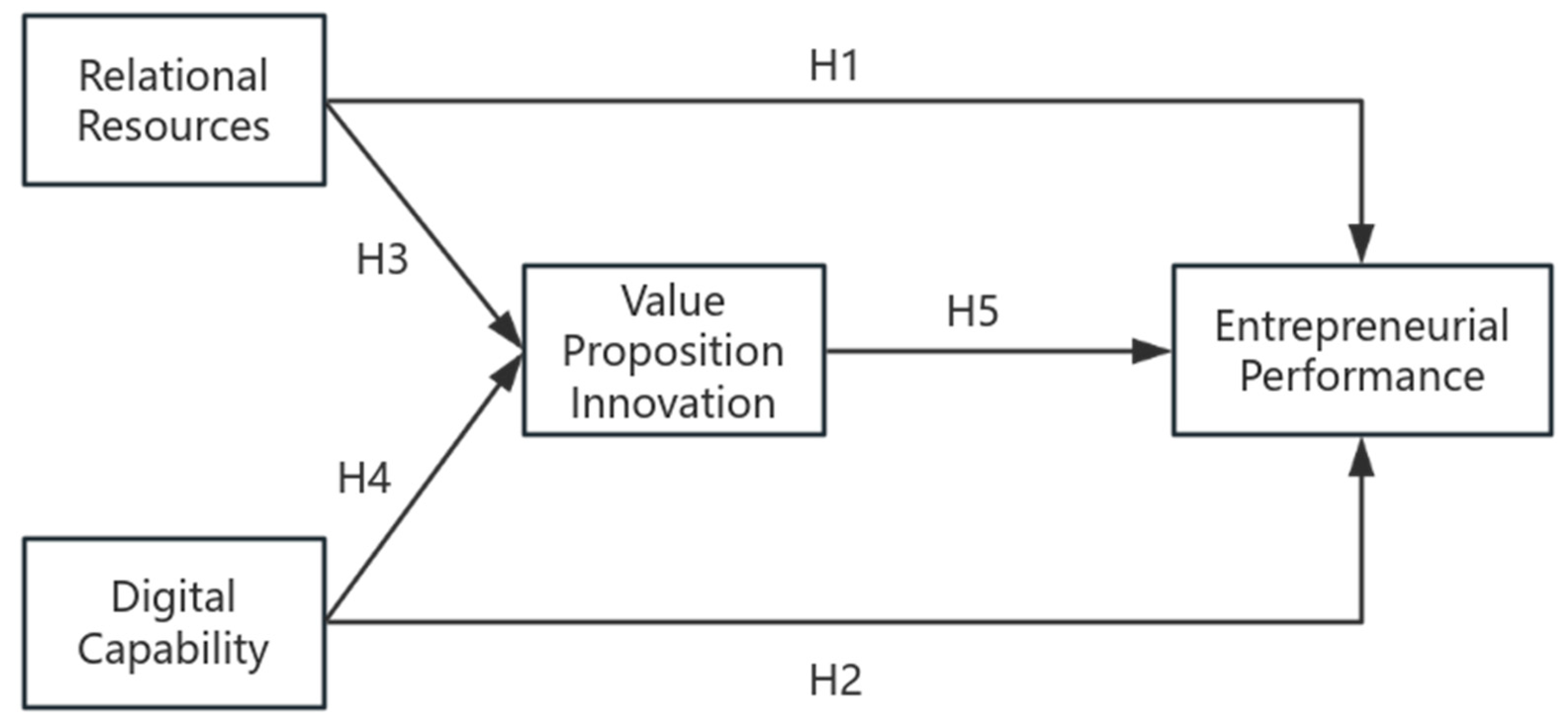

Table 1.
Measurement items and source.
| No. | Measurement item | Source |
|---|---|---|
| Relational Resources | ||
| RR1 | Our company establishes close coordination or collaboration with business partners. | Adapted from Karia et al. (2015) |
| RR2 | Our company commits to share information among business partners. | |
| RR3 | Our company inclines to recruit staff with good communication skill. | |
| Digital Capability | ||
| DC1 | Our company have the capability to apply essential digital technologies. | Adapted from Khin & Ho (2018) |
| DC2 | Our company have the ability to discover digital opportunities. | |
| DC3 | Our company are capable of responding to digital transformation. | |
| DC4 | Our company possess the capacity to master cutting-edge digital technologies. | |
| DC5 | Our company have the competence to utilize digital technologies for developing new products, services, or processes. | |
| Value Proposition Innovation | ||
| VPI1 | Our products or services are very innovative in relation to our competitors. | Adopted from Clauss (2017) |
| VPI2 | Our products or services regularly solve customer needs, which were not solved by competitors. | |
| VPI3 | Our company is constantly seeking new customer segments and markets for our products and services. | |
| VPI4 | Our company recently took many actions in order to strengthen customer relationships. | |
| Entrepreneurial Performance | ||
| EP1 | Our company are experiencing increased production capacity. | Adapted from Sariwulan et al. (2020) |
| EP2 | Our company have new product innovations. | |
| EP3 | Customers with good loyalty increase. | |
| EP4 | Our company provide after-sales service for customer satisfaction. | |
Table 2.
Results of Reliability-Loadings & AVE & CA &CR.
| construct | Items | Loadings | Average variance extracted (AVE) | Cronbach’s alpha(CA) | Composite reliability (CR) |
|---|---|---|---|---|---|
| Relational Resources | RR1 | 0.836 | 0.679 | 0.766 | 0.863 |
| RR2 | 0.798 | ||||
| RR3 | 0.836 | ||||
| Digital Capability | DC1 | 0.869 | 0.731 | 0.909 | 0.931 |
| DC2 | 0.841 | ||||
| DC3 | 0.867 | ||||
| DC4 | 0.849 | ||||
| DC5 | 0.847 | ||||
| Value Proposition Innovation | VPI1 | 0.813 | 0.674 | 0.84 | 0.892 |
| VPI2 | 0.831 | ||||
| VPI3 | 0.817 | ||||
| VPI4 | 0.823 | ||||
| Entrepreneurial Performance | EP1 | 0.833 | 0.703 | 0.859 | 0.904 |
| EP2 | 0.841 | ||||
| EP3 | 0.85 | ||||
| EP4 | 0.829 |
Table 3.
Hypothesis Testing.
| Hypothesis | Relationship | Standard Beta (β) | T-values | P values | f-square | Decision |
|---|---|---|---|---|---|---|
| H1 | RR -> EP | 0.226 | 2.943 | 0.003 | 0.064 | Supported |
| H2 | DC -> EP | 0.281 | 3.693 | 0 | 0.089 | Supported |
| H3 | RR -> VPI | 0.389 | 5.325 | 0 | 0.212 | Supported |
| H4 | DC -> VPI | 0.499 | 6.958 | 0 | 0.35 | Supported |
| H5 | VPI -> EP | 0.409 | 5.757 | 0 | 0.181 | Supported |
Note: *p<0.01, p<0.05. *Standard Beta (β) refers to the path coefficient value.
Table 4.
Mediation Analysis.
| Relationship | Standard Beta (β) | T-values | P values | significance |
|---|---|---|---|---|
| RR -> VPI -> EP | 0.159 | 4.002 | 0 | YES |
| DC -> VPI -> EP | 0.204 | 4.274 | 0 | YES |
Note: *p<0.01, p<0.05. *Standard Beta (β) refers to the path coefficient value.
Disclaimer/Publisher’s Note: The statements, opinions and data contained in all publications are solely those of the individual author(s) and contributor(s) and not of MDPI and/or the editor(s). MDPI and/or the editor(s) disclaim responsibility for any injury to people or property resulting from any ideas, methods, instructions or products referred to in the content. |
© 2025 by the authors. Licensee MDPI, Basel, Switzerland. This article is an open access article distributed under the terms and conditions of the Creative Commons Attribution (CC BY) license (http://creativecommons.org/licenses/by/4.0/).
Copyright: This open access article is published under a Creative Commons CC BY 4.0 license, which permit the free download, distribution, and reuse, provided that the author and preprint are cited in any reuse.


