

Submitted:
31 December 2024
Posted:
03 January 2025
You are already at the latest version
Abstract
Virtual Machine Introspection (VMI) is a powerful technology used to detect and analyze malicious software inside Virtual Machines (VMs) from outside. Asynchronously accessing the VM’s memory can be insufficient for efficiently monitoring what is happening inside of a VM. Active VMI introduces breakpoints to intercept VM execution at relevant points. Especially for frequently visited breakpoints, it is crucial to keep their performance overhead as small as possible. In this paper, we provide an systematization of existing VMI breakpoint implementation variants, propose workloads to quantify the different performance penalties of breakpoints, and implement them in the benchmarking application bpbench. We used this benchmark to measure that, on an Intel Core i5 7300U, SmartVMI’s breakpoints take around 81 µs to handle, and keeping the breakpoint invisible costs an additional 21 µs per read access. The availability of bpbench allows the comparison of different breakpoint mechanisms, as well as their performance optimization with immediate feedback.
Keywords:
Virtual Machine Introspection
; Performance
; Benchmarking
; Hypervisors
1. Introduction
Code introspection methods, such as software debugging, play a critical role in analyzing and understanding program and system behavior. They enable the detection, diagnosis, and mitigation of issues, e.g., security-related problems, or facilitate execution performance measurements. Virtual Machine Introspection (VMI) encompasses techniques used to monitor, analyze, and manipulate the internal guest state of a VM from external environments such as the host system or other VMs. This is accomplished by reading and, if necessary, changing the values of the virtual CPU (vCPU) registers and data in the main memory of the monitored VM combined with its semantic interpretation. VMI as a concept was initially introduced by Garfinkel and Rosenblum in 2003 [1]. In practice, it has been used for security and forensic purposes because it enables administrators and defenders to detect and analyze malicious activities within VMs [1]. Hence, there is significant interest in applications within the fast-growing cloud computing environment [2]. VMI-based tracing mechanisms are also used for dynamic malware analysis, manually or highly automated in sandboxes [3,4].
VMI-based intrusion detection or malware analysis systems have several advantages over kernel-mode or user-mode methods that run on the same system (inside the same VM) that is to be monitored. Two important aspects include i) isolation (sensor isolation from the analysis target) and ii) transparency (sensor invisible for the analysis target). Virtualization ensures strong isolation between the guest software to be monitored and the sensor software. This makes it significantly more difficult for the attacker to detect and manipulate the monitoring software [5], allowing for more resilient observation. However, a key challenge for VMI applications is to bridge the semantic gap [6], i.e., accurately interpret the guest software semantics based on guest memory. Typically, this involves an in-depth understanding of OS and application data structures [7], possibly derived from debugging symbols or via complex reverse engineering efforts, particularly when facing closed-source guest software. When this key challenge is successfully addressed, VMI monitoring enables comprehensive event tracing and memory analysis, providing critical information on the behavior of the system and application.
Modern VMI solutions primarily perform inspections in response to VM events (e.g., page faults, Control Register 3 (CR3) writes, or breakpoint interrupts). Dangle et al. [8] refer to this reactive approach as active (or synchronous) VMI, while passive VMI tasks are scheduled asynchronously by the outer monitoring software. A key method of active VMI is breakpoints that will be placed by the outer analysis software at particular locations inside the guest code. Whenever such a breakpoint is triggered, the VMI software can analyze the guest state related to the intercepted execution (e.g., reading the function arguments of an invocation). Beyond placing breakpoints, more invasive manipulations of the guest state can be useful. For example, the VMI software DRAKVUF [9] uses function call injections to interact with the guest Operating System (OS) Application Programming Interfaces (APIs) to perform data transfers between the target VM and outer environments, or to invoke process starts (called process injection).
The attempt to create a first standard of a low level VMI API as an interface between VMI applications and hypervisors with access capabilities led to the libVMI project. This library focuses on accessing VM memory and vCPU registers. It can deal with Guest Physical Addresses (GVAs) and is able to translate them into Guest Physical Addresss (GPAs) that are accessible via libVMI. Therefore, the library performs a page table walk on the tables managed by the guest OS in software, efficiently implemented with software-side caching. The existing prerequisite is that libVMI is aware of the guest OS and is able to interpret the required internal data structures of the guest OS. Unfortunately, breakpoint handling is not covered by libVMI. Only a minimal trap interface is provided, allowing the control flow to be intercepted when a VM event occurs, e.g., page faults, CR3 writes, or breakpoint interrupts. The handling of execution breakpoints with reconstruction and re-execution of the original trapped instruction is typically implemented by the VMI application, if at all. As a result, various concepts and implementations have been developed.
Building on our work developing a VMI infrastructure for the KVM hypervisor and using SmartVMI for VMI to monitor Windows guests, we investigate the various breakpoint handling mechanisms employed in VMI applications. In this paper, we present an overview and classification of these different methods.
In most use cases, runtime performance is critical for different reasons. For sandboxes, minimizing the overhead from VMI sensor interceptions is advantageous, because the additional cycles spent while the vCPUs are paused extend the real-world execution time without affecting the effective execution time within the VM. Longer execution times reduce the analysis throughput in Sandbox clusters, or provide angles for timing-based evasion checks [10], and should be avoided. Similarly, for VMI on endpoint VMs with user interactions, low latency VMI interceptions are very important because applications with soft real-time requirements do not tolerate long interruptions. This is especially true for graphical user interface activities in the case of VMs operated by human users. Customers of VMI-monitored VMs expect their systems to be responsive.
For the reasons mentioned above, our research includes microbenchmarking experiments regarding runtime performance and latencies, from which we present first results in this paper. In summary, we make the following contributions.
- We propose and implement a benchmark for x86_64 breakpoint approaches suitable to measure execution performance (timing) of VMI-based breakpoint implementations.
- We provide preliminary results of our breakpoint benchmark workloads for the VMI-based breakpoints implemented in SmartVMI.
2. Background
This section provides an overview of existing implementations of hyper-breakpoints, including their strengths, limitations, and trade-offs in 2.2, followed by highlighting a possible optimization strategy to avoid false-positive breakpoint hits in 2.3. We focus on the x86_64 ISA and the Intel VT-x virtualization extension.
2.1. Breakpoint basics
Usermode debugging. First, we take a look at classical software breakpoints that debuggers like GDB or WinDBG utilize to debug usermode programs, while running the debugger as a usermode program themselves. A debug API provided by the operating system enables the debugger process to attach to a process to debug (debuggee). This allows the debugger to read and write in the address space and execution states of the debugging process. Given the virtual address of the instruction in the debuggee’s address space where the breakpoint should be placed, the debugger overwrites the first byte of the original instruction of the debuggee code with 0xcc, the opcode of the int3 instruction (breakpoint). When the instruction pointer reaches the breakpoint address and executes the injected breakpoint instruction, a software/exception interrupt is triggered. This causes the CPU to switch to kernel mode and execute the OS interrupt handler. The OS breakpoint handling mechanism saves contexts, stops threads in the debugging process, and passes a breakpoint event to the attached debugger process. The debugger can inspect the memory and the register states (from saved contexts) of the paused debuggee. To continue execution, the debugger restores the original instruction and switches the thread to single-step execution mode by setting the Trap Flag (TF) in its x64 Flags Register (RFLAGS) register of the thread’s CPU context, before resuming execution of the debuggee. The restored instruction is executed, and immediately afterward, the CPU triggers a debug exception/interrupt again because of single-stepping mode. The debugger’s single-stepping handler finishes the current breakpoint handling by reinserting the int3 breakpoint instruction again, disabling the single-stepping, and resuming debuggee threads.
2.2. Breakpoint Handling Approaches for VMI debugging
Breakpoint Handling with Single Stepping (SmartVMI). We continue by inspecting the current SmartVMI breakpoint implementation, a security-oriented VMI implementation. At its core, it is a direct adaptation of the classical software breakpoint approach, with the hypervisor and VMI application taking over the role that the debugger process had previously had. Given a guest process and the virtual address (inside of a VM referred to as a GVA) where to place the breakpoint, it is not as straightforward to insert the breakpoint. The details are irrelevant to the discussion about breakpoint invocation performance, so we only provide a short summary. SmartVMI has to be aware of some internal data structures of the guest OS to find the process control structure (EPROCESS for Windows) in the kernel space of the guest memory with the guest physical page table base address inside. Next, SmartVMI has to perform a page table walk in the software to translate the given GVA to a GPA, which then can be referenced to write the int3 instruction byte. The described translation is implemented in libVMI used by SmartVMI in an efficient way with software side caching. It is critical that the software interrupt caused by int3 is not handled by the guest OS’ interrupt handler inside the VM, but instead causes a VM exit and passes control to the hypervisor. This behavior is determined by the Virtual Machine Control Structure (VMCS) and must be addressed in advance by the VMI application. On breakpoint execution, the vCPU is paused, and the hypervisor sends an event with the relevant information to SmartVMI. The SmartVMI breakpoint handler instructs the hypervisor to restore the original instruction and to enable single-stepping. Instead of modifying the TF, the Monitor Trap Flag (MTF) in the VMCS is set, which is the equivalent single-stepping functionality provided by the processor’s virtualization extensions, i.e., the guest will trigger a VM exit after executing an instruction. The vCPU is resumed, executes the original instruction, and traps to the hypervisor again due to single-stepping, which sends an event to SmartVMI. The single-stepping handler reinserts the breakpoint instruction, disables the single-stepping, and resumes the vCPU. The whole process is visualized in Figure 1.
Unfortunately, there is an issue with this approach. It only works reliably for VMs with a single vCPU. In multi-vCPU environments, it generally works, but a race condition can cause missed breakpoints. When one vCPU hits a breakpoint and restores the original instruction to single-step it, other vCPUs can execute the original code without the breakpoint until the single-stepping handler has reinserted the int3 instruction. There are multiple ways to address this. The simplest solution is to halt all other vCPUs while handling a breakpoint hit. This has the additional advantage that the VMI application has the guarantee that no changes to memory can occur, which might be beneficial for scanning through memory (data consistency). However, the overhead and, therefore, the impact on VM performance is considerable.
Breakpoint Handling with Instruction Emulation. Another possibility is to eliminate the single-stepping and utilize instruction emulation instead. Emulation means that the hypervisor reads the x86 instruction bytes from guest memory and performs the instruction in software by reading source register values from saved vCPU context (part of VMCS) and/or source guest memory locations, calculates the results, and writes them into the vCPU’s destination register and/or guest memory locations. To be exact, instruction emulation in described pure form, which would emulate the instruction currently found at the vCPU’s instruction pointer, would not help much. It would still be necessary to restore the original instruction, again enabling other vCPUs to miss the breakpoint. Instead, the emulation has to be able to accept the original byte as an additional parameter and reconstruct the instruction that should actually be emulated. With that, the int3 can remain in place, and skipping by becomes impossible. Figure 2 illustrates the adapted workflow. While theoretically a simple and efficient solution, there exist warnings in the hypervisor documentation about instruction emulation being incomplete and might not cover all corner cases. This could lead to system instability [11]. It is important to note that malware might try to strain the instruction emulator with uncommon instructions, such as redundant or unusual combinations of instruction prefixes. A minimal example of a breakpoint handler that leverages the implementation of instruction emulation of libVMI is available1.
Stealthy Breakpoints: PageGuard (SmartVMI). While the use of MTF is transparent to the guest, the same cannot be said for the inserted int3 instruction, which the VM could detect reading the address of the breakpoint. A relevant example of this is software that performs code integrity checks [12]. For example, some malware uses this as part of their anti-analysis checks [13]. Another example is the Windows kernel that contains Kernel Patch Protection (Kernel Patch Protection (KPP)), also called PatchGuard [14], which would cause the system to bluescreen once it detects tampering of the kernel code (driver code excluded) and some important data structures (e.g., System Service Dispatch Table (SSDT)). SmartVMI solves this with a concept they refer to as “PageGuard”. Modifications to the Extended Page Tables (EPTs) enable full control over access to the memory. EPT is a crucial component of memory management of hardware-assisted virtualization. While the ”normal“ guest page tables perform the translation from GVA to GPA, another translation (Second Level Address Translation (SLAT)) at host/hypervisor level is necessary to map from GPA to System Physical Address (SPA). A read, write, or execute access to a page is only permitted when the entries of both page table sets have the corresponding permission bit set. Specifically, in the PatchGuard example, the pages storing kernel code have read and execute permission in the entries of the guest page table sets. With active “PageGuard”, the EPT entries of the page table set stores a permission of execution, and neither reading nor writing When the PatchGuard tries to read from the page where a breakpoint has been inserted, an EPT violation is caused, resulting in a VM exit and consequentially in a memory event notifying SmartVMI. Restoring and single-stepping is not necessary in this case; instead, the hypervisor can be instructed to emulate the read access and deliver the original bytes specified by SmartVMI. Thus, before inserting breakpoints on a page, SmartVMI creates a shadow copy to be able to retrieve the correct content when memory access emulation events occur. This effectively hides the breakpoint for KPP or other integrity checks, including malware-driven checks.
altp2m - Alternative guest physical to machine translation. A different method for breakpoint handling is alternative guest physical to machine translation (altp2m) [11]. It provides multi-vCPU support and guest-invisible breakpoints. The approach does not rely on modifying the guest memory at all; instead, it fully relies on EPT permissions. Similar to how SmartVMI’s “PageGuard” traps read accesses, altp2m activates a “breakpoint” by removing the executable permission on the desired page, i.e., no breakpoint instruction is used anymore, instead the breakpoint is only a virtual breakpoint. Virtual breakpoint means that the execution of each instruction of the page is intercepted and handled accordingly at the address where the virtual breakpoint is set. Upon execution on a page with a virtual breakpoint, this triggers an EPT violation, yielding control to the hypervisor. However, continuing execution by setting the EPT permission again, single-stepping, removing the permission and then resuming the vCPU, would lead to the same race condition problem as previously discussed with the removal of the int3 instruction. altp2ms solution uses vCPU-specific EPTs, i.e., it is possible to maintain multiple EPTs and the hypervisor can control for each vCPU individually which EPT it uses. Thus, two EPTs are maintained. The first is missing the executable permission on pages containing virtual breakpoints and is enabled by default (when vCPUs are executing normally). When an EPT violation occurs on a vCPU, altp2m switches the vCPU’s EPT to the second one and activates single-step mode. This second one has the executable permission set, allowing the vCPU to single-step execute the original instruction. All other vCPUs still use the restricted EPT and, therefore, do not miss the virtual breakpoint. After the breakpoint-handling vCPU has single-stepped, it switches back to the first EPT, i.e., the one without executable permission for pages.
With altp2m, there is no extra care necessary to keep the breakpoints stealthy, because virtual breakpoints are invisible by design. Memory reads can happen normally as there are no modifications to the memory. The EPT and its permissions are part of the host/hypervisor environment and inaccessible to the guest software. The trade-off for having no overhead on memory accesses is that there is a significant penalty to the execution speed on pages with virtual breakpoints. A big problem is that the memory access permissions are coarse-grained: they can only be set per page (page granular). The longest valid instructions on x86_64 architecture are 15 bytes in size. Thus, on a completely filled code page, there will be a minimum of instructions, in the theoretical worst case a total of single-byte instructions, and each of them has to be handled as a breakpoint, even if one is only interested in stopping at a single one of them. Considering the likelihood that code is executed more often than read or written, this is a major drawback.
Optimized altp2m - Combination with Breakpoint instructions (DRAKVUF). The VMI monitoring tool DRAKVUF [15] combines the use of int3 instructions with the altp2m approach of multiple EPTs. Its breakpoint mechanism is also described in [11]. Instead of having multiple EPTs pointing to the same SPA with different permissions, DRAKVUF creates a copy of the page frame where a breakpoint should be inserted. So we have two page frames, one with the original instruction and one with an int3 instruction at the breakpoint location. One version of the EPT remains unmodified, and can keep pointing to the original page frame with unchanged permissions. The other EPT version points to the page frame, an int3 instruction is inserted. The associated permission on this second EPT version is set to execute-only, and by default, this EPT is the active one on all vCPUs. Thus, when a vCPU’s execution is moving towards the breakpoint and executing instructions on the same page, the execute-only permission allows them to execute all other instructions, which have not been changed, completely normally. When the instruction pointer reaches the breakpoint, the inserted int3 instruction is executed, triggering the breakpoint interrupt, eventually reaching the corresponding handler in DRAKVUF’s VMI application logic. Exactly as with altp2m, a switch of the EPT provides the paused vCPU with the original instruction and execute permission, enabling it to single-step once and then switch the EPT back. Meanwhile, the other vCPUs continue using their respective EPTs and are unaffected. When the breakpoint or any other address on the same page is read (e.g., PatchGuard case), the execute-only permission causes an EPT violation, which is resolved by emulating the read access.
Table 1 summarizes the breakpoint approaches covered in this work.
2.3. Breakpoint Invocation Optimization
There are scenarios where a breakpoint may frequently trigger VM exits that are unrelated to meaningful breakpoint hits, a phenomenon we refer to as false-positive breakpoint hit. Consider the example of detecting file openings of a specific process by setting a breakpoint in the CreateFile function of Windows’ API library kernel32.dll inside the process virtual address space. Such DLLs are shared libraries; to optimize memory utilization, the code of shared libraries exists only once in (guest) physical memory which is mapped into all the (guest) virtual address spaces. Consequently, inserting a breakpoint instruction inside the (guest) physical page frame (inevitably) enables the breakpoint for all processes. In the given example, kernel32.dll is linked to almost all processes running on a Windows system, and since CreateFile is a frequently invoked API function, this setup has two drawbacks. First, it may lead to breakpoint hits in processes that are outside the scope of the analysis and irrelevant to monitoring. Second, if we use a breakpoint mechanism where every execution in the page with a breakpoint leads to a VM exit, code adjacent to the breakpoint in CreateFile within the same page, even if unrelated to CreateFile, also triggers a VM exit and the breakpoint inspection routine. Both drawbacks are likely to contribute to performance degradation.
In a single-vCPU scenario, only a single process can be actively executing. When the target process is not the active process, the breakpoint can be removed. When the target process gets scheduled, the breakpoint has to be activated. SmartVMI implements exactly this. Each process has its individual virtual address space, which is realized by a process-specific page table set. Before a process gets scheduled, the kernel has to instruct the Memory Management Unit (MMU) to use the correct page table set. As what we call “page table set” actually is a 4-layer-deep tree of page tables, the MMU of a specific CPU core that executes the thread of the process is informed by writing the (guest) physical address of the root/base page table (called Page Map Level 4 (PML4)) to the CR3 register when the thread is dispatched. SmartVMI instructs the hypervisor to configure VM exit on CR3 register writes and provides an event that informs of the occurrence and the value that is being written. Then, the assigned handler for this event can iterate all process-specific breakpoints and check whether they need to be active for the new process (identified by its CR3 value). All breakpoints that are detected to have to change status can now be en- or disabled. Finally, the hypervisor can be instructed to let the vCPU resume its execution.
When multiple vCPU exist, the new CR3 value is not enough to determine whether a breakpoint should be active; the associated CR3 value additionally has to be checked against the active CR3 value of the other vCPUs. This avoids having a breakpoint disabled when it should be active, but it is impossible to avoid false-positive hits in this case. If the target process runs on one vCPU and another process using the same shared library runs on another, the breakpoint has to be active and can be hit by the wrong process.
DRAKVUF’s altp2m method is advantageous because irrelevant breakpoints can be avoided without having to remove int3 instructions from physical memory. DRAKVUF tracks address space/process switches by intercepting CR3 register writes. If a vCPU is switched to one of the target processes, DRAKVUF changes the EPT for this vCPU to the version that refers to the manipulated page frames with breakpoint instructions. For other irrelevant processes, the unchanged EPT version that refers to the original page frames is used [9,11].
3. Benchmarking Design
While Section 2 explained the details of the different breakpoint handling approaches, it also included observations on how certain aspects might impact the performance of some operations. The goal of this work is explicitly not to define a representative workload, which measures all aspects of breakpoint overhead in a realistic scenario. Instead, we want to be able to quantify the hyper-breakpoint overhead in the relevant aspects and be able to compare completely different approaches as well as evaluate the effectiveness of smaller optimizations within the same approach. We want to be able to answer questions like:
- Is it faster to use instruction emulation or perform EPT switches and single-stepping?
- How expensive is it to handle reads with EPT violations and read emulations?
- What is the performance penalty for the whole system when a VM exit happens on every context switch to manage breakpoint statuses?
We aim to measure the individual causes of overhead in isolation using specifically targeted microbenchmarks.
3.1. Workloads
We identify the following specialized workloads that concentrate on a single detail of breakpoint implementation, and, when their results are put together, can provide a full overview of the overhead a breakpoint implementation causes.
- Breakpoint execution This workload is supposed to measure how long it takes the VMI infrastructure to handle a breakpoint. There are a multitude of factors that comprise this latency: VM exits, processing in the hypervisor, communication between hypervisor and VMI application, processing in the VMI application, VM entries.
- Breakpoint execution + additional instructions Most of the approaches introduced do not add latency to the execution of an instruction where no breakpoint is placed. However, altp2m effectively also breakpoints all other instructions that are on the same page as the target instruction. The previous workload does not reflect that, so this one is supposed to measure the latency of executing the breakpoint as well as additional instructions that are located on the same page.
- Reading the breakpoint Using EPT permissions to control read accesses to breakpoint locations causes overhead for similar reasons as the breakpoint executions. This workload is designed to quantify this latency by reading from the exact memory location where a breakpoint is placed.
- Reading a page with breakpoint EPT read control has page-granularity, so all mentioned approaches behave the same independently of whether exactly the breakpoint or any address on the same page has been read. Thus, the results should show the same trend as the previous workload. The purpose of this approach is mainly to mimic the behavior of Microsoft’s PatchGuard.
- CPU workload with and wihout CR3 monitoring The final workload is not concerned with breakpoints themselves. To implement process-specific breakpoints, context switches have to be detected and handled by intercepting at every CR3 register write. Given a CPU performance benchmark, it should be run with and without VMI monitoring CR3 writes. The difference in performance is the minimal cost of processing context switches with VMI. It is important to note that the chosen benchmark most likely has an impact on the measurable overhead. Performing only calculations will not cause any additional context switches, while repeatedly invoking systemcalls, e.g., to write to a file inevitably triggers context switches.
3.2. Implementation Considerations
All workloads have in common that they want to measure the overhead of VMI activities. They also have in common that there can be vastly different implementations of the same tasks. Breakpoint handling might use single-stepping or instruction emulation. The hypervisor might be KVM or Xen. All of those details are transparent to the VMs that are being inspected. Thus, we chose to measure the VMI performance penalties from inside a VM, enabling comparisons of any VMI setup and breakpoint implementation. On the flip side, this makes it impossible to quantify overheads with a finer granularity (e.g., how long did a VM exit take, how long took an instruction emulation).
While there are some smaller differences between realizing the benchmark in the kernel compared to as a user process, and there is also differing implementation details depending on the guest operating system. Considering the use cases of malware analysis and intrusion detection, as well as the prevalence of malware targeting Windows systems, we choose to run the benchmark workloads as user-mode processes on Windows.
The five workloads are not well suited to be realized in the same benchmarking application, because the first four require the existence of a breakpoint to measure execution or read access of it, while the fifth scenario does not require breakpoints but the presence of VMI CR3 write monitoring. Furthermore, the CR3-overheard workload only requires the measurement of system performance, which many already existing benchmarking applications already support. For now, we decided to use the CPU-Z2 benchmark as a reference for system performance. For measuring the latency of breakpoint executions and read accesses, we present bpbench in the following subsection.
3.3. The bpbench Benchmarking Application
The concept of bpbench is to have a designated memory location on that the VMI application under test places a breakpoint, which bpbench can then execute and read while measuring execution times.
It is not suitable to have this designated location in the code segment of the program. We would have no control at which page offset the breakpoint has to be placed, which is problematic for workload 2, where other instructions on the same page should be executed. Every change of the code, compiler, and compiler flags can impact the layout. To avoid such complications, we take full control of the page containing the breakpoint.
When bpbench starts up, it allocates one page of memory at a fixed address. While not strictly necessary, this makes it easier for the VMI application to know where to insert the breakpoint. We initialize the first 4095 bytes with the value 0x90, which represents the NOP instruction (“no operation”). The 4096th byte is assigned to 0xc3, the RET instruction (“return”). Once this page is setup, the application pauses and waits for user input, which should only be provided once the VMI application has inserted a breakpoint at the end of the page, on the RET instruction. Then, the benchmark workloads can be executed.
To measure the latency of a single breakpoint hit, bpbench initially takes a timestamp using Windows’ QueryPerformanceCounter function. Then, it performs a call to the end of the allocated page, directly to the breakpoint. The breakpoint is hit and processed, which causes the latency that we aspire to measure. Because the original instruction was the RET, after the breakpoint handling, the control leaves the allocated page, and continues in the timing function. A second timestamp is taken, and the total execution time can be calculated as the difference of the second and first timestamp.
It is important to note that we measure not only the latency of the breakpoint hit, but additionally the execution time of a CALL instruction and potentially time it takes to retrieve the timestamps. These are constant overheads that apply equally to all measurements, so while the real breakpoint latency is a bit lower than measured, comparing the latencies of different breakpoint implementations is not affected. Furthermore, the call instruction is cheap, especially compared to, e.g., the execution time of a VM exit. The timestamp taking might add considerable overhead. We revisit this topic in more detail at the end of the section.
Timing the execution of the breakpoint and of other, non-breakpoint instructions on the same page, is performed by taking a timestamp, calling the starting of the page, executing 4095 NOPs, hitting the breakpoint, returning, taking another timestamp, calculating the total time. For the read access workloads, bpbench performs the same timestamp taking but replaces calling to the page with reading from the page. Workload 3 is realized by reading only the last byte of the page, where the breakpoint is. Workload 4 is realized by reading the whole page, accessing 8 bytes with each access ( reads).
Finally, we are coming back to the overhead induced by acquiring the timestamps. Usually, this is fast operation, requiring a fast read from the Time Stamp Counter (TSC) register that counts the cycles of the CPU since boot, followed by a few calculations. However, depending on the hypervisor, reading the TSC register will take considerably longer if this access is emulated. We determine this overhead by taking two timestamps in succession without any workload in between. Subtracting the result from the measurement results of the workloads, it is possible to estimate the pure latency of breakpoint executions and reads with high accuracy.
4. Initial Measurement Results
With SmartVMI’s breakpoint implementation is the only one we currently have available, this section does not provide a full-fledged comparison of breakpoint handlers. After documenting the testbed setup in Subsection 4.1, Subsection 4.2 presents our benchmark results for SmartVMI’s breakpoints, and compares it to the baseline performance where no breakpoints are present. The overhead SmartVMI induces with monitoring CR3 write events is quantified using CPU-Z in Subsection 4.3.
4.1. VMI Setup
Figure 3 gives a detailed overview of the VMI setup that we used to benchmark with bpbench. The host system runs NixOS with a Linux kernel that has a patchset applied that adds VMI functionality to KVM. KVM works together with QEMU to host the Windows VM that runs bpbench. QEMU is also patched in order to provide an Inter-Process Communication (IPC) socket, which VMI applications can connect to. We use SmartVMI, which builds upon libVMI, which is a library providing an API for VMI operations. This way, the same VMI application can control the by libVMI supported hypervisors (Xen and KVM). SmartVMI contains OS-specific code, e.g., to determine the currently active processes by reading through a VM’s memory. It supports the loading of plugins, which, among other things, can register callbacks for process start and termination events, scan through memory, and register breakpoints. Currently, its breakpoint mechanism is not multicore-safe3, so the Windows VM was configured to use a single vCPU only.
The whole system is running on a Intel NUC 7. All the specifications are versions are listed in Table 2.
The KVM version with VMI patch v7 can be found here4, the associated QEMU is available here5. The SmartVMI project can be found here6. We had to make slight adaptions to the code and published the two versions used for the following measurement results. The first7 was used for the execute and read workloads, the second8 was used together with CPU-Z 2.13.09 to measure CR3 monitoring overhead. The version of bpbench used in this paper is available here10. It contains a nix flake that can reproducibly generate an ISO file with the bpbench and CPU-Z executable for easy insertion into a VM.
The next sections present the measurement results. All of the raw data, plotting scripts, and plots can be found here11.
4.2. Breakpoint Execution and Reading
Before we look at any measurements, especially of very short durations, it is important to clarify the resolution of utilized timer. bpbench queries the frequency of the timer used by QueryPerformanceCounterand provides it to the user. In the VM in our setup, the frequency is around 3.58 MHz (3579545 Hz), which results in a timer resolution of 279.37 ns. When measured durations are around the same order of magnitude as the timer resolution, the discrete steps become clearly visible. Figure 4 shows the results of running bpbench without an inserted breakpoint and the previously mentioned fact is clearly visible.
The figure shows a boxplot of the measured latencies. The bounds of the box show the InterQuartile Range (IQR), which encloses the middle 50% of the data. The orange line inside the box represents the median, whose value is also noted right to the line. The “whiskers” extend from the box to the smallest and largest values within 1.5 times the IQR. Any values outside of this range are considered outliers and plotted individually. In all the shown boxplots, there are more outliers that are not shown because they are many ordners of magnitudes larger, and result from interrupts or context switches pausing bpbench’s execution. However, all measurements are used the calculate the IQR and median, the large outliers are just not rendered in the plot.
Looking at the actual measurements, it makes sense to start with the results for timer. These represents the time passed between taking two timestamps as fast as possible. The majority of data points is either 3911 ns or 4190 ns, which represents 14 and 15 timer ticks, respectively. This is fairly long time for accessing the timer and indicates that the access is emulated by the hypervisor. Also, this measurement establishes that around 4 µs is the overhead induced by accessing the timestamps, and it can be used as a correction offset to calculate the actual latencies of other workloads. Note that all the plots do not have this correction applied and always show the actually measured durations.
The workload “exec bp” without breakpoint measures basically the execution time of one CALL and one RET instruction, which, assuming the necessary memory is cached, can be executed in a few CPU clock cycles, i.e., few nanoseconds. Accordingly, the plot is pretty much identical, the faster median value can again be explained by the resolution of the timer and the duration of the timer access, which induce randomness whether 14 or 15 clock ticks are measured between two timer accesses. “exec page” has 4095 additional NOPs to execute, which is slightly noticeable by the majority of times showing 15 or 16 clock ticks. “read byte” reads only a single byte between the timer accesses, thus its plotted box looks identical to “timer” and “exec bp”. Finally, “read page” measures the time to read 8 bytes from the breakpoint page 512 times. The majority of times, this happens in 22 timer ticks (6146 ns). Subtracting the timer offset, this equates to around 2 µs for 512 reads or around 4 ns per read.
We established that around 4 µs can be assumed as timer overhead, the “read page” page workload takes around 2 µs on its own, and the other workloads are basically negligible, especially considering the timer resolution.
Figure 5 and Figure 6 present the bpbench measurements when SmartVMI has inserted a breakpoint at the designated memory address. The reference “timer” workload is unaffected by the breakpoint. Our main motivation to implement bpbench was to determine the execution times for the “exec bp” workload: to finally quantify how expensive SmartVMI’s breakpoints are. Now the answer is available: subtracting timer overhead, a breakpoint hit takes around 81 µs on our Intel NUC test system. As expected, the results are not much different for “exec page”, as the breakpoint does not cause extra penalties on the NOP instructions. For reading the byte at the breakpoint, the measurements show that it is significantly cheaper than executing the breakpoint, clocking in at around 21 µs. This aligns with the fact that the breakpoint handling requires two VM exits and multiple communications between SmartVMI and KVM, whereas the read causes only a single VM exit and a read emulation. However, performing 512 accesses to read a whole page, with each access causing a VM exit and requiring an emulation, the whole workload takes a median duration of around 22.5 ms. Assuming single-byte reads take the same amount of time as 8-byte reads, we can estimate . A plausible explanation for the gap between the theoretical duration and the measured median is that in the at least 10 ms execution time the workloads requires, there is a considerable likelihood for interrupts and scheduling of other processes to take up CPU time and temporarily prevent progress in the page read.
4.3. CR3 Write Monitoring
We ran the CPU benchmark of CPU-Z once without VMI active to retrieve the reference score, which the single vCPU is able to achieve. The score amounted to 334.7 points. Then, SmartVMI was activated. It did not place any breakpoints, but enabled that it KVM informs it on every CR3 write. The registered callback function was empty, no additional code was executed. Running the CPU-Z benchmark under these conditions, the achieved score reduced to 259.9 points. This amounts to a performance reduction of 22.4%. The results are also displayed in Figure 7.
5. Related Work
The paper [16] presents VAMPiRE, a stealth breakpoint framework designed for fine-grained malware analysis. Traditional debugging mechanisms, such as hardware and software breakpoints, face significant limitations when analyzing self-modifying and self-checking malware. VAMPiRE overcomes these challenges by employing stealth techniques, combining virtual memory manipulations, single-stepping, and task state segments. Its features include: unlimited breakpoints, undetectability to the target code, portability and ease of integration via a simple API. The framework achieves its stealth through clock patches, virtual trap-flag management, and polymorphic/metamorphic engine techniques, ensuring that malware cannot detect its presence. Performance benchmarks show that VAMPiRE’s latency is comparable to hardware breakpoints, making it suitable for interactive debugging. However VAMPIRE has two shortcomings. It currently lacks support for legacy I/O breakpoints in kernel mode, which limits its scope for certain debugging scenarios. Also, while VAMPiRE itself is stealthy, integration into existing debuggers may expose the debugging activity to malware.
VAMPiRE operates at the level of commodity operating systems (e.g., Windows, Linux) and relies on features like virtual memory, single-stepping, and exception handlers within the OS’s context. Hypervisor-level debugging requires awareness and manipulation of virtualization-specific constructs like VMCS (Virtual Machine Control Structure) or hypervisor traps, which VAMPiRE does not address.
A “goto reference” for breakpoint performance is the paper "Efficient Data Breakpoints" by Robert Wahbe [17]. It explores methods for implementing data breakpoints, which trigger actions when specific data changes occur during program execution. While specialized hardware provides fast performance, it is costly and limited in scalability. Virtual memory-based methods, using write protection and fault handling, are portable but incur high overhead. Software approaches, particularly code patching, which embeds checks directly in program code, offer a balance of efficiency, portability, and flexibility, handling unlimited breakpoints. Simulation experiments showed code patching as the most practical solution, with acceptable performance and versatility, making it ideal for complex debugging tasks without requiring specialized hardware.
The authors expanded on their work in [18]. It addresses the inefficiency of traditional data breakpoints by proposing optimized methods for debugging. The authors introduce a segmented bitmap structure to track memory updates efficiently and data flow analysis to eliminate unnecessary checks, reducing overhead significantly. These techniques achieved a 42 % average overhead, dropping to 25 % for scientific workloads, making data breakpoints practical. Using dynamic code patching and loop optimizations, the system further improved performance, outperforming traditional and hardware-based methods. The approach enables efficient debugging and supports advanced applications like runtime type checking and anomaly detection.
The presentation [5] showcases hypervisor-based, hardware-assisted monitoring for advanced malware analysis in the form of their prototype CXPInspector. The use two-dimensional paging for memory isolation and monitor transitions between user and kernel modules. Through this the authors are able to perform static, dynamic, and behavior analysis. However, they suffer significant performance overhead and still lack spophisticated analysis systems that support their method. Furthermore, they indicate, that their kind of monitoring can still be detected by intelligent malware.
It is obvious, that most of the relevant works are rather old. However, with the continuing trend of virtualizing everything, we make the case, that it is necessary to continue in the direction of the research.
6. Conclusions
This section concludes this paper. In Subsection 6.1, we summarize the main takeaways from the paper and, before we give an outlook into planned and potential future work in Subsection 6.2.
6.1. Summary
In this work, we gave an overview and categorization of existing approaches of handling, hiding, and optimizing VMI breakpoints. Based on the findings, we proposed micro-benchmark workloads to quantify the execute and read performance of breakpoints, as well as the overhead induced by monitoring context switches. While we do not have working implementations of each approach available for testing, we provided the measurement results for the SmartVMI breakpoint implementation working together with KVM and QEMU. We measured that it takes 81 µs to process a breakpoint hit, 21 µs per read to a page where a breakpoint is hidden, and that intercepting CR3 write events costs the vCPU around 22% of performance.
6.2. Future Work
The work presented in this paper presented is a strong foundation that enables building a lot of follow-up research on top of it. Most notably, our need for bpbench’s functionality came from the fact that we needed quantitative feedback to aid in the development in efficient VMI breakpoints. Thus, the next step is now to implement some or all breakpoint handling approaches discussed in Section 2, and use bpbench to assess their performance.
Another interesting research topic is the impact of the hypervisor. Instead of using the same hypervisor and comparing different breakpoint approaches implemented in SmartVMI, the abstract of libvmi allows us to instead use the same SmartVMI configuration with different hypervisors (i.e., Xen and KVM) and measure if performance difference exist between them.
There are considerations of implementing another workload into bpbench, which is not concerned about performance, but is supposed to test the robustness of breakpoint handling implementations. A big challenge is to keep breakpoints active even when the VM is performing memory management operations, e.g., when a page containing a breakpoint is evicted from RAM. Usually, because code packages are not writable, their memory contents are not wrote to swap but reloaded from disc when demand arises. Even if they were paged out, the breakpoints stealthiness would prevent their state from being preserved. Additionally, when reloaded, the page might be placed at a different GPA. If the breakpoint mechanism is not very thorough with checking this, breakpoints can disappear. It would be beneficial to have a workload test for exactly cases and rate the robustness of the breakpoint implementation under test.
Finally, we want to improve the situation of VMI infrastructure deployment. Manually configuring a system with the right kernel, with KVM-VMI patches applied, and compiling the right versions of patched QEMU and SmartVMI is a tedious endeavour involving many steps and dependencies. We aim to provide nix packaging to provide reproducible and easy to deploy VMI infrastructure based on KVM.
Author Contributions
Conceptualization, L.B. and L.I.; methodology, A.S. and L.B.; software, A.S. and L.B.; validation, A.S., L.B. and R.S.; formal analysis, L.B.; investigation, L.B. and A.S.; resources, L.B.; data curation, L.B.; writing—original draft preparation, L.B., A.S, R.S.; writing—review and editing, L.I., C.D.; visualization, L.B.; supervision, L.I., C.D.; project administration, L.B.; funding acquisition, L.B. and L.I. All authors have read and agreed to the published version of the manuscript.
Funding
This research was funded by German Federal Ministry of Education and Research (BMBF) grant number 16KIS1745K. MDPI has kindly waived the submission fees for this paper.
Data Availability Statement
The original data presented in the study are openly available in the repositories specified in Section 4.1.
Use of Artificial Intelligence
The AI-assisted proofreading tool Writefull has been used to audit and improve this manuscript. ChatGPT’s PDF summarization feature has been used to select appropriate related work.
Conflicts of Interest
The authors declare no conflicts of interest. The funders had no role in the design of the study; in the collection, analyses, or interpretation of data; in the writing of the manuscript; or in the decision to publish the results.
References
- Garfinkel, T.; Rosenblum, M.; et al. A virtual machine introspection based architecture for intrusion detection. In Proceedings of the Ndss. San Diega, CA, 2003, Vol. 3, pp. 191–206.
- wook Baek, H.; Srivastava, A.; Van der Merwe, J. CloudVMI: Virtual Machine Introspection as a Cloud Service. In Proceedings of the 2014 IEEE International Conference on Cloud Engineering. IEEE, IEEE, 3 2014, pp. 153–158. [CrossRef]
- Jiang, X.; Wang, X.; Xu, D. Stealthy malware detection through VMM-based ‘out-of-the-box’semantic view. In Proceedings of the Proceedings of the 14th ACM conference on Computer and communications security. ACM, 10 2007, Vol. 10, CCS07, pp. 128–138. [CrossRef]
- Dinaburg, A.; Royal, P.; Sharif, M.; Lee, W. Ether: malware analysis via hardware virtualization extensions. In Proceedings of the Proceedings of the 15th ACM conference on Computer and communications security. ACM, 10 2008, CCS08, pp. 51–62. [CrossRef]
- Willems, C.; Hund, R.; Holz, T. Cxpinspector: Hypervisor-based, hardware-assisted system monitoring. Technical report, Ruhr-Universitat Bochum, 2013.
- Dolan-Gavitt, B.; Leek, T.; Zhivich, M.; Giffin, J.; Lee, W. Virtuoso: Narrowing the Semantic Gap in Virtual Machine Introspection. In Proceedings of the 2011 IEEE Symposium on Security and Privacy. IEEE, IEEE, 5 2011, pp. 297–312. [CrossRef]
- Jain, B.; Baig, M.B.; Zhang, D.; Porter, D.E.; Sion, R. SoK: Introspections on Trust and the Semantic Gap. In Proceedings of the 2014 IEEE Symposium on Security and Privacy, 5 2014, pp. 605–620. ISSN: 2375-1207. [CrossRef]
- Dangl, T.; Taubmann, B.; Reiser, H.P. RapidVMI: Fast and multi-core aware active virtual machine introspection. In Proceedings of the Proceedings of the 16th International Conference on Availability, Reliability and Security, New York, NY, USA, 8 2021; ARES ’21, pp. 1–10. [CrossRef]
- Lengyel, T.K.; 3esca, S.; Payne, B.D.; Webster, G.D.; Vogl, S.; Kiayias, A. Scalability, fidelity and stealth in the DRAKVUF dynamic malware analysis system. In Proceedings of the Proceedings of the 30th Annual Computer Security Applications Conference. ACM, 12 2014, ACSAC ’14, pp. 386–395. [CrossRef]
- Roccia, T. Evolution of Malware Sandbox Evasion Tactics – A Retrospective Study, 2019.
- Lengyel, T.K. Stealthy monitoring With xen altp2m. 2016. Available online: https://xenproject.org/blog/stealthy-monitoring-with-xen-altp2m/ (accessed on 17 December 2024).
- Qiu, J.; Yadegari, B.; Johannesmeyer, B.; Debray, S.; Su, X. Identifying and Understanding Self-Checksumming Defenses in Software. In Proceedings of the Proceedings of the 5th ACM Conference on Data and Application Security and Privacy, New York, NY, USA, 3 2015; CODASPY ’15, pp. 207–218. [CrossRef]
- Sonawane, S.; Onofri, D. Malware Analysis: GuLoader Dissection Reveals New Anti-Analysis Techniques and Code Injection Redundancy. 2022. Available online: https://www.crowdstrike.com/en-us/blog/guloader-dissection-reveals-new-anti-analysis-techniques-and-code-injection-redundancy/ (accessed on 19 December 2024).
- Blum, D. PatchGuard and Windows security, 2007.
- Lengyel, T. DRAKVUF Black-box Binary Analysis. 2014. Available online: https://github.com/tklengyel/drakvuf (accessed on 19 December 2024).
- Vasudevan, A.; Yerraballi, R. Stealth Breakpoints. In Proceedings of the 21st Annual Computer Security Applications Conference (ACSAC’05). IEEE, IEEE, 2005, pp. 381–392. [CrossRef]
- Wahbe, R. Efficient data breakpoints. ACM SIGPLAN Notices 1992, 27, 200–212. [CrossRef]
- Wahbe, R.; Lucco, S.; Graham, S.L. Practical data breakpoints: Design and implementation. In Proceedings of the Proceedings of the ACM SIGPLAN 1993 conference on Programming language design and implementation. ACM, 6 1993, Vol. 28, PLDI93, pp. 1–12. [CrossRef]
| 1 | |
| 2 | |
| 3 | |
| 4 | |
| 5 | |
| 6 | |
| 7 | |
| 8 | |
| 9 | |
| 10 | |
| 11 |
Figure 1.
Control flow sequence of a breakpoint handling with single stepping.
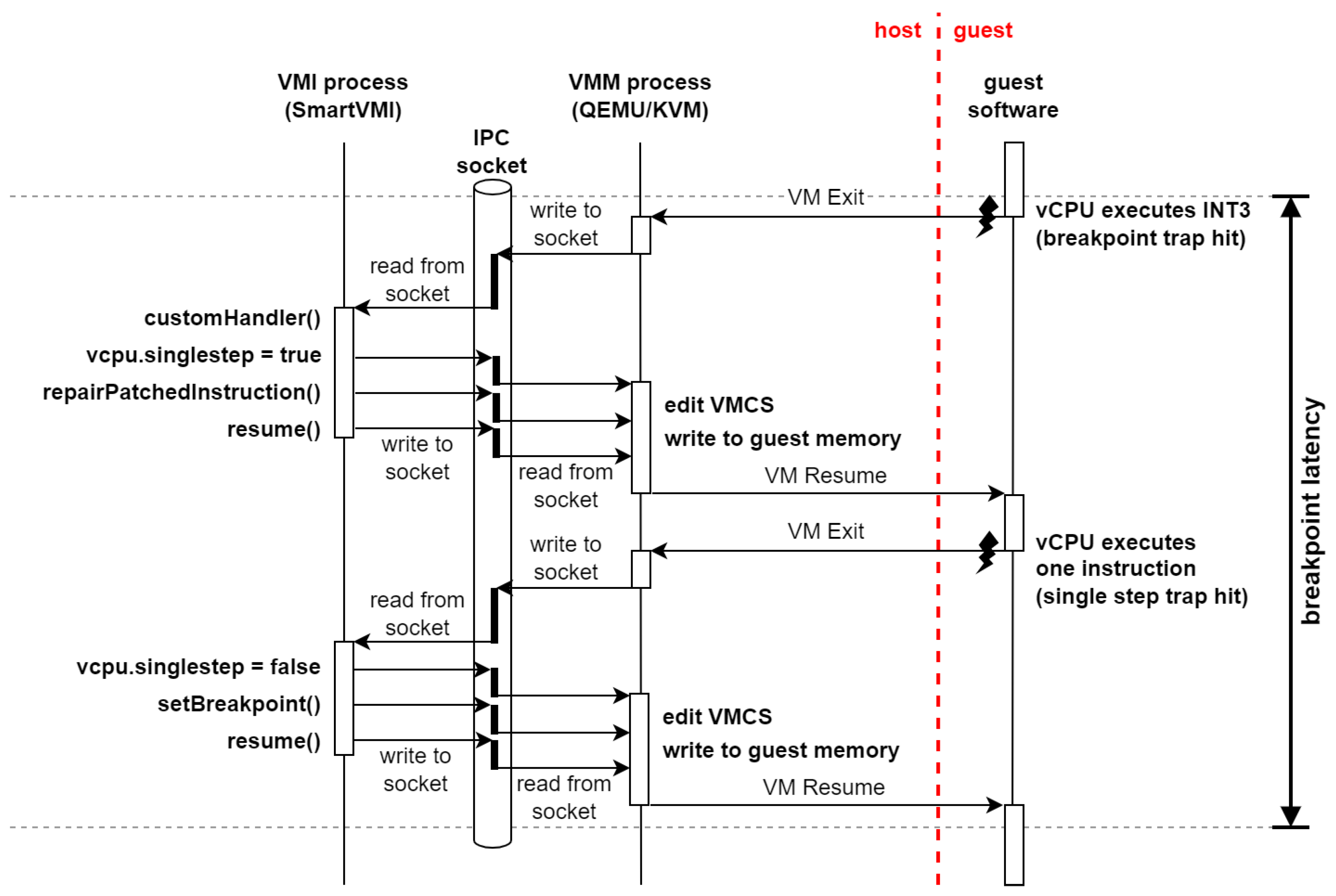
Figure 2.
Control flow sequence of a breakpoint handling with instruction emulation.
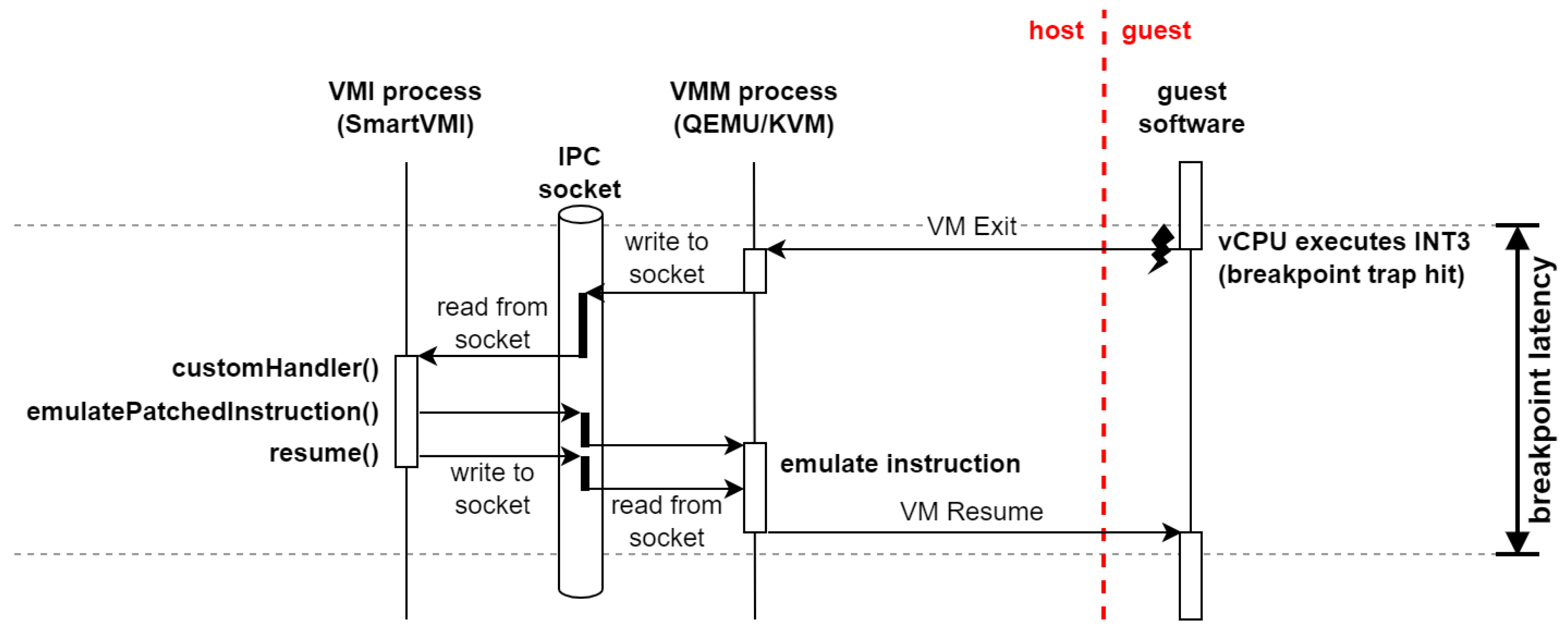
Figure 3.
Architecture of a SmartVMI on KVM/QEMU based VMI setup.
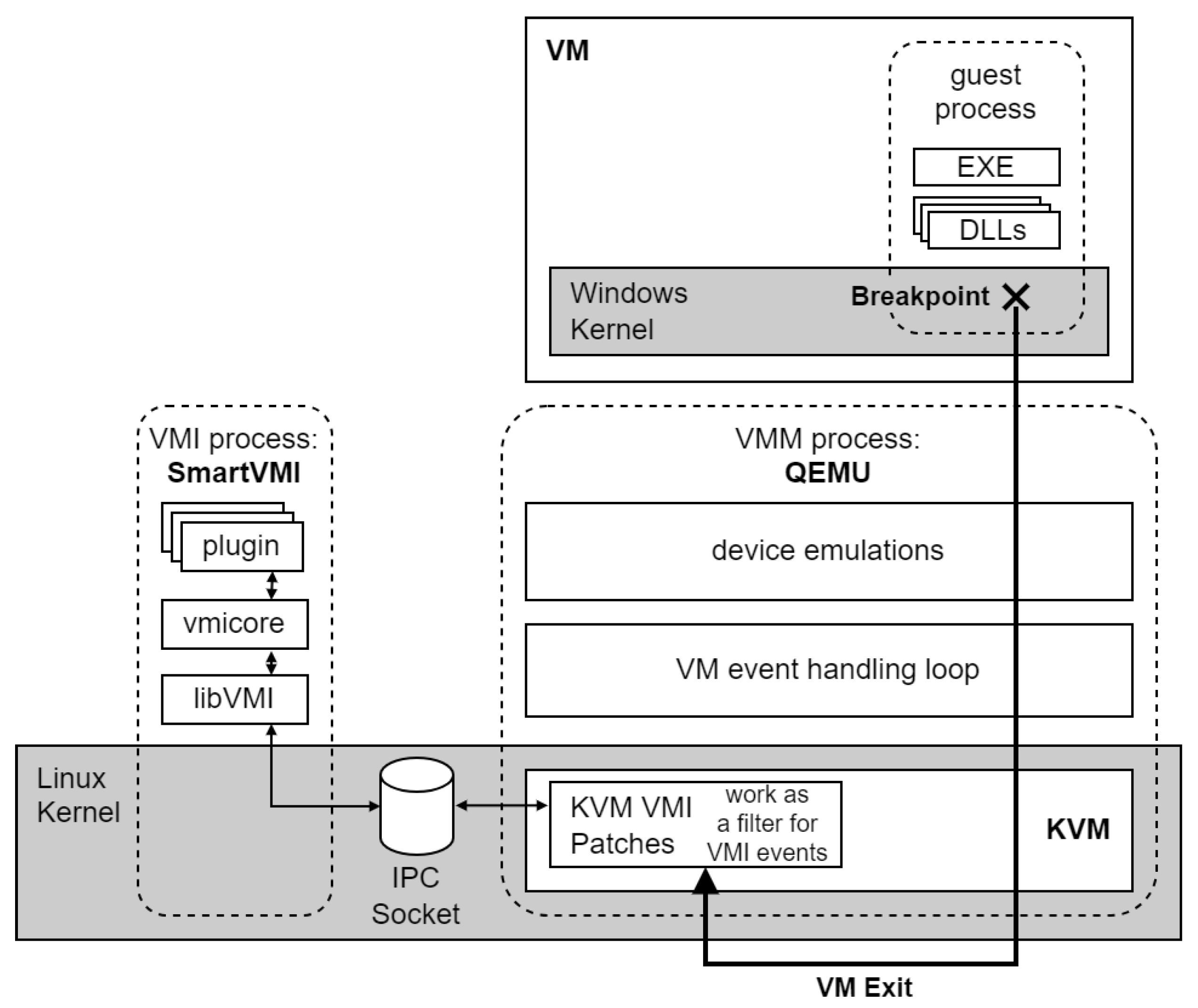
Figure 4.
Boxplot of the breakpoint execute and read workloads with no breakpoint set.
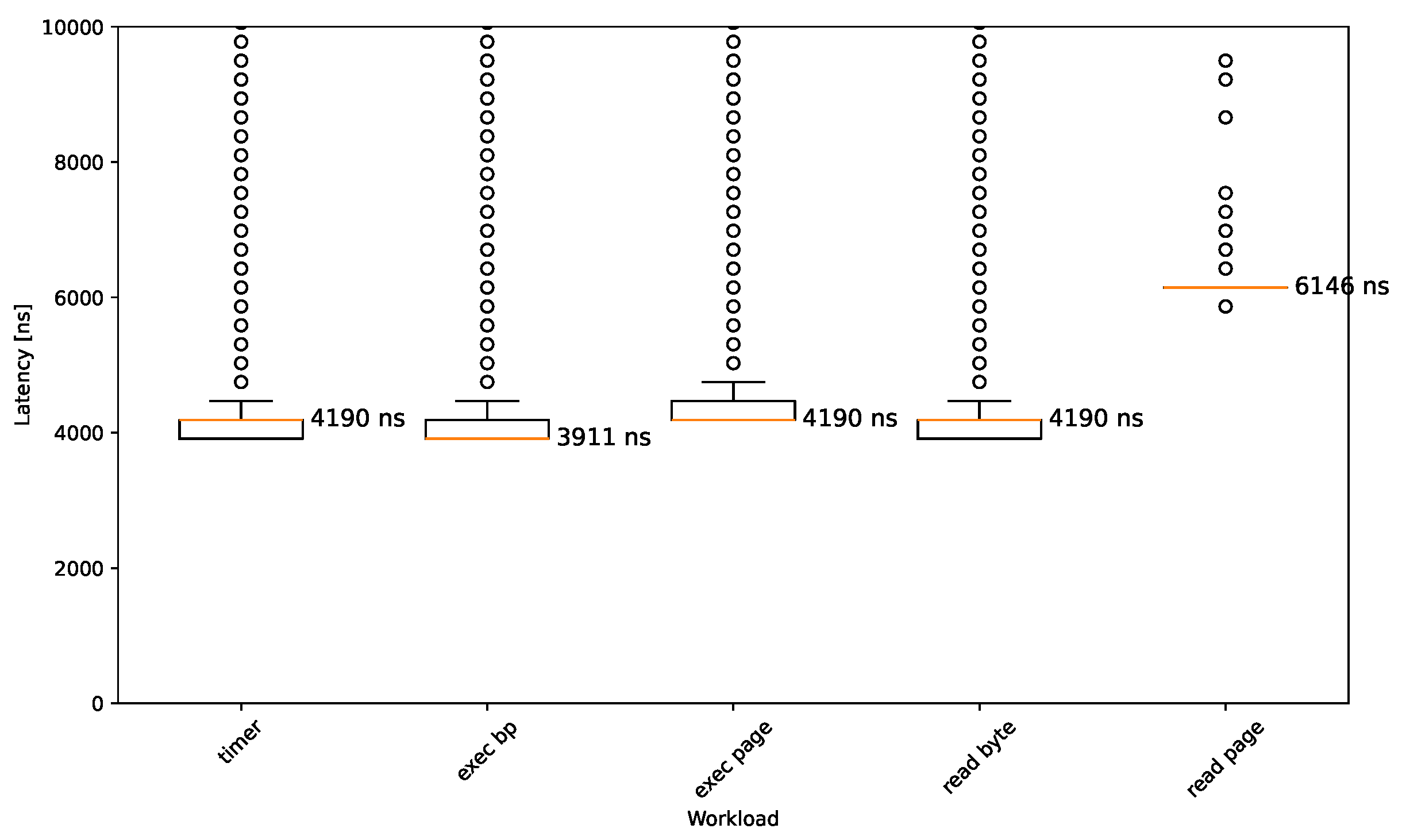
Figure 5.
Boxplot of the breakpoint execute and read (read page excluded) workloads with breakpoint set.
Figure 5.
Boxplot of the breakpoint execute and read (read page excluded) workloads with breakpoint set.
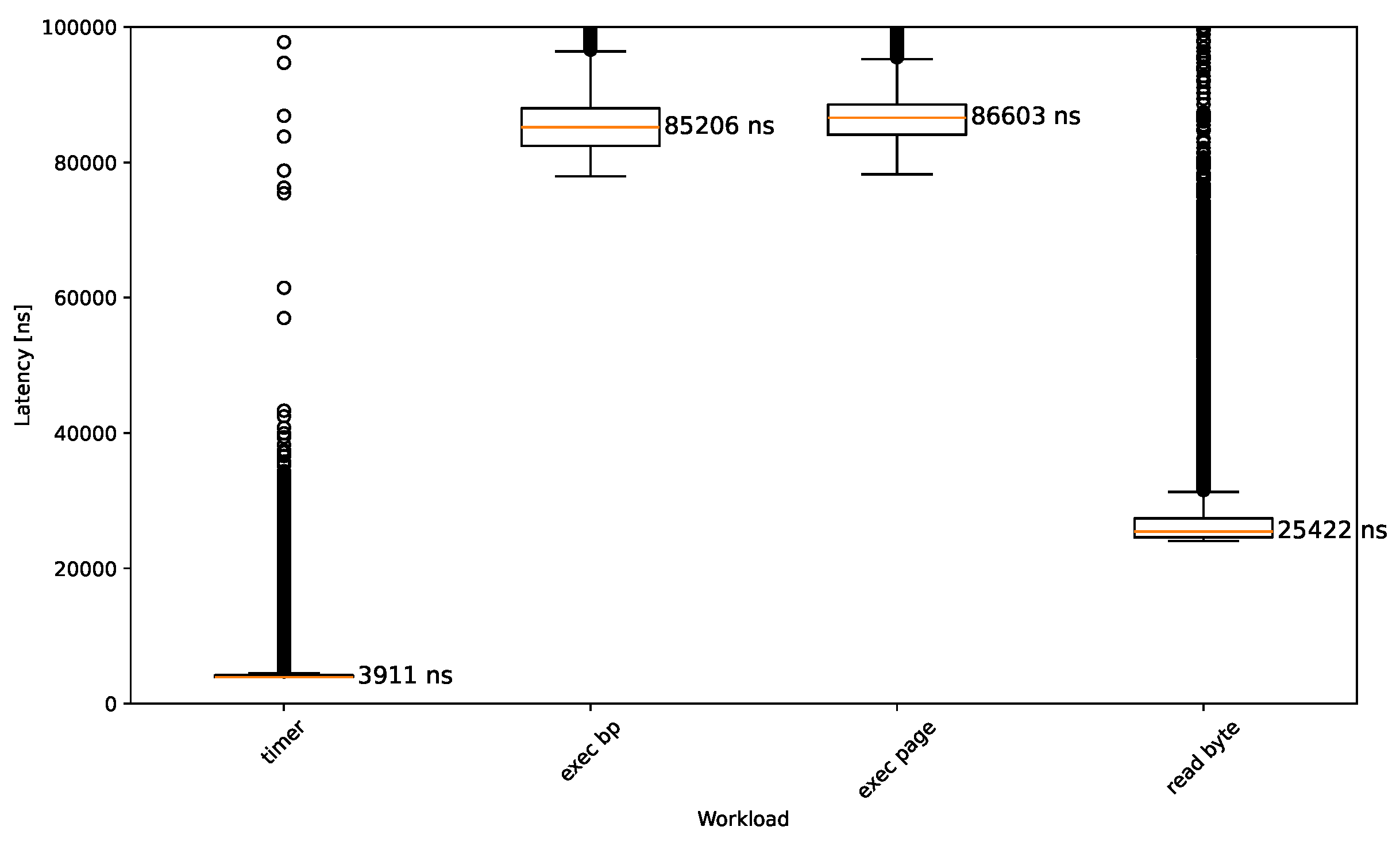
Figure 6.
Boxplot of the breakpoint read page workload with breakpoint set.
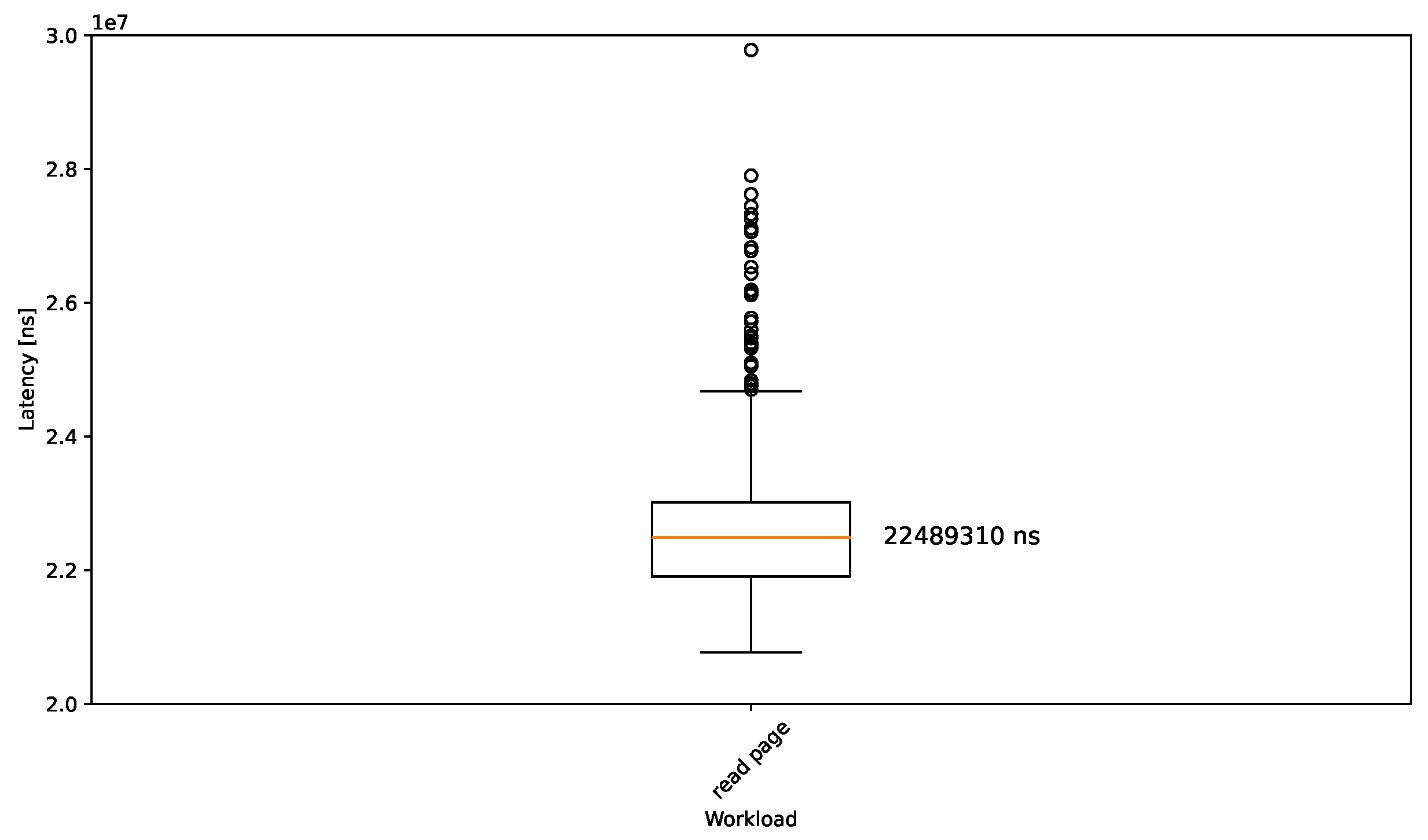
Figure 7.
CPU-Z benchmark performance with and without CR3 monitoring.
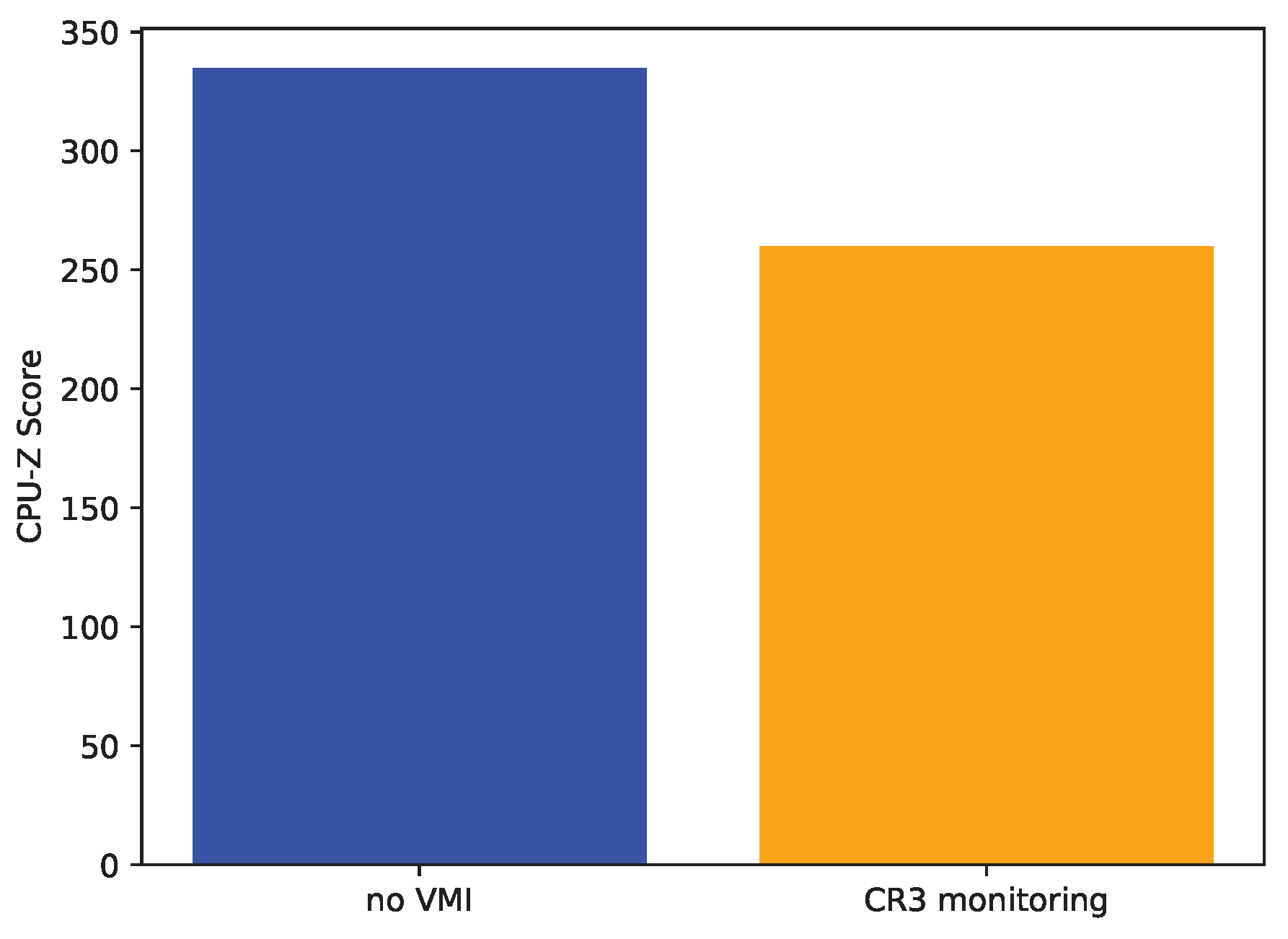

Table 1.
An overview of breakpoint approaches.
| Approach | BP Trigger | Handling of the Original Instruction | Stealth |
|---|---|---|---|
| Usermode debugging | int3 | Single-stepping (TF) | None |
| SmartVMI with Single-Stepping | int3 | Single-stepping (MTF) | EPT read permission (PageGuard) |
| Instruction Emulation | int3 | Instruction emulation | EPT read permission |
| altp2m | EPT violation | EPT switch + Single+stepping (MTF) | by design invisible |
| altp2m with int3 (DRAKVUF) | int3 | EPT switch + Single-stepping (MTF) | EPT read permission |
Table 2.
Hardware specifications and software versions of the VMI setup.
| Category | Host | VM |
|---|---|---|
| CPU | Intel Core i5 7300U | 1 vCPU |
| RAM | 2x4 GB DDR4 | 4 GB |
| OS | NixOS 24.05 | Windows 10 Pro 22H2, |
| Kernel version | 5.4.241 | Build 19045.2965 |
| Other software | QEMU 4.2.11 | bpbench |
| SmartVMI | CPU-Z 2.13.0 |
1 Patches applied to add VMI functionality.
Disclaimer/Publisher’s Note: The statements, opinions and data contained in all publications are solely those of the individual author(s) and contributor(s) and not of MDPI and/or the editor(s). MDPI and/or the editor(s) disclaim responsibility for any injury to people or property resulting from any ideas, methods, instructions or products referred to in the content. |
© 2025 by the authors. Licensee MDPI, Basel, Switzerland. This article is an open access article distributed under the terms and conditions of the Creative Commons Attribution (CC BY) license (http://creativecommons.org/licenses/by/4.0/).
Copyright: This open access article is published under a Creative Commons CC BY 4.0 license, which permit the free download, distribution, and reuse, provided that the author and preprint are cited in any reuse.


