

Submitted:
30 December 2024
Posted:
03 January 2025
You are already at the latest version
Abstract
The thesis offers an innovative analysis of quantum mechanics. Firstly, it clearly expounds the characteristics of quantum mechanics in measurement and other aspects, and proposes seven criteria for judging scientific nature. Then, it points out that there are some key problems with the orthodox assumptions of quantum mechanics, such as unclear physical mechanisms, lack of rigorous logic, difficulty in falsification, and incomplete main considerations.Regarding the double-slit interference experiment, the thesis conducts a comprehensive derivation and demonstration, proposing a unique interpretation. The traditional view holds that the interference is caused by the wave nature of electrons, while this thesis suggests that it is the periodic fluctuating Coulomb force field in the double-slit slits. A large number of electrons interact with it, undergo regular deflection to form a probability distribution, and then superimpose to produce interference fringes. This interpretation challenges the traditional cognition of the wave nature of microscopic particles in quantum mechanics, prompting us to re-think the basic concepts and experimental interpretations of quantum mechanics from the new perspective of the Coulomb force field, providing new ideas and directions for the study of quantum mechanics.
Keywords:
1. Introduction
2. There Are Essential Differences in the Measurement of Macroscopic and Microscopic Physical Objects
3. How to Determine Whether Hypotheses, Explanations and Probability Predictions Are Scientific?
- A.
- Experimental verification: Scientific hypotheses, explanations and probability predictions must be verifiable through experiments or observations. If the theoretical prediction is consistent with the experimental results, then the hypothesis and explanation are scientific.
- B.
- Reproducibility: Experimental results should be independently replicable by other researchers to ensure the reliability of the experiment.
- C.
- Logical consistency: Assumptions and explanations should be inherently logically sound and not produce self-contradictory situations.
- D.
- Integrity: This assumes that the analysis of hypotheses and explanations includes all physical factors comprehensively and completely, without any omissions. For example, it must include various physical influencing factors of three basic elements: microscopic physical objects, microscopic physical media, and microscopic physical environment.
- E.
- Falsifiability: It is the possibility that a theory or proposition can be refuted by empirical facts or experiments. In other words, if a theory or proposition is falsifiable, then there exists at least one possible observation or experimental result that can prove the theory or proposition to be wrong. If a hypothesis or explanation cannot be falsified under the current level of science and technology, it means that there are only two possibilities: either its hypothesis or explanation has exceeded the range of existing science and technology; or its hypothesis or explanation can only belong to science fiction speculation.
- F.
- Uniqueness: Refers to the ability of a hypothesis and explanation to independently and exclusively elucidate a certain phenomenon or problem, without the existence of other contradictory, opposing explanations that are equally effective or more reasonable. If a hypothesis and explanation can be replaced by other contradictory, opposing hypotheses and explanations, then such a hypothesis and explanation lacks uniqueness and is also incomplete.
- G.
- Theoretical basis: Assumptions and explanations should be built on existing scientific theories and knowledge systems, rather than being based on wild guesses.
4. Comprehensive Analysis of the Double-Slit Interference Experiment with Electrons
4.1. Analysis of the Three Elements of the Experiment
4.2. Analysis of the Orthodox Interpretation of the Experiment
- A.
- Electrons have wave properties.
- B.
- The wave nature of electrons is a matter wave.
- C.
- Continuous irrelevant single electron interference phenomenon
5. Other Explanatory Approaches to Interference
5.1. Basic Theoretical Basis
5.2. Establish a Simple Analysis Model of the Double-Slit Physical Environment
5.3. Mathematical Analysis
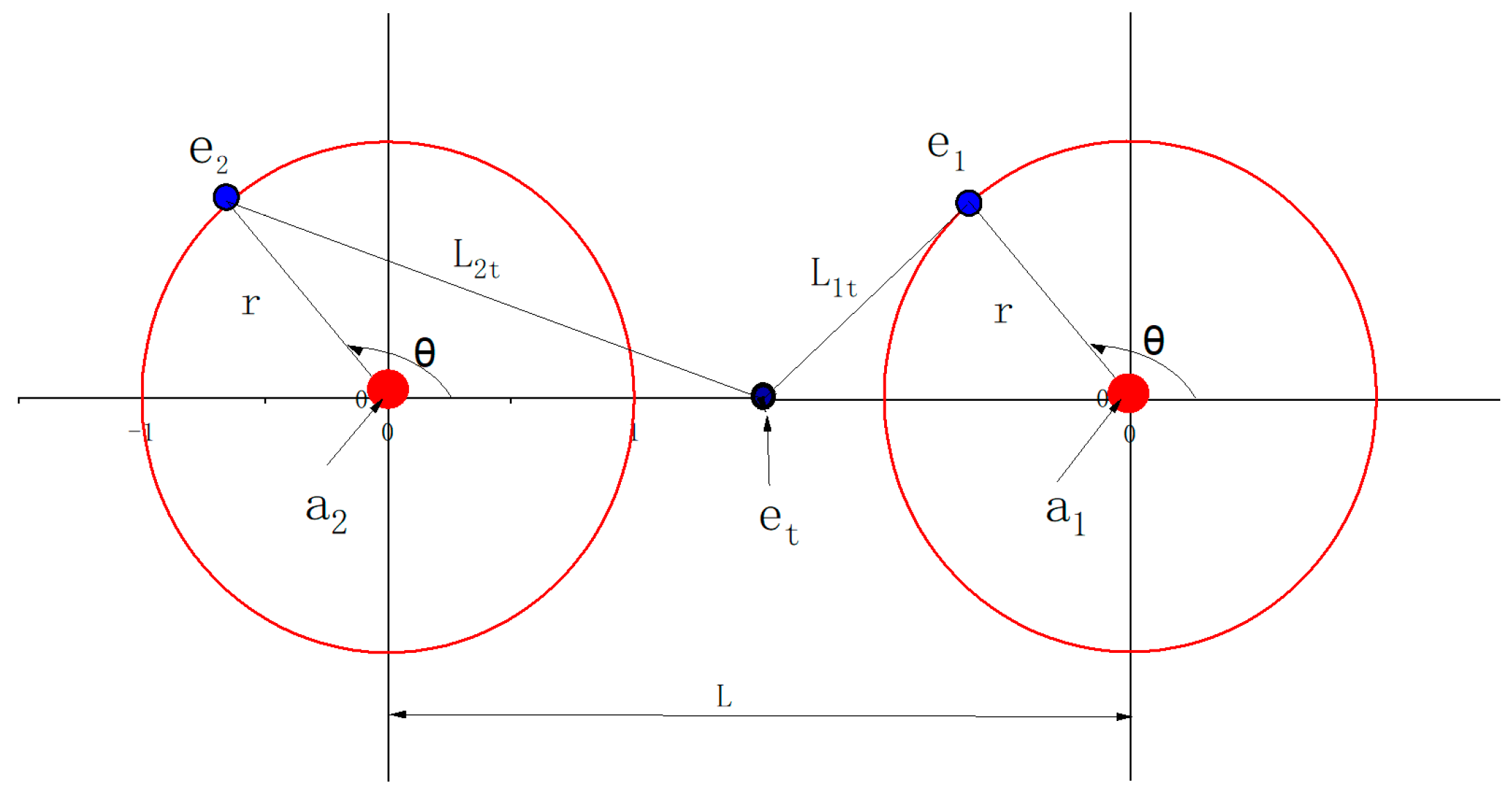
- er is the unit vector in the direction of the radial vector from qe1 to qet;
- Ft1 is the Coulomb force vector generated between et and e1;
- Ft2 is the Coulomb force vector generated between et and e2;
- L1t is the distance between e1 and et.
- L2t is the distance between e2 and et.
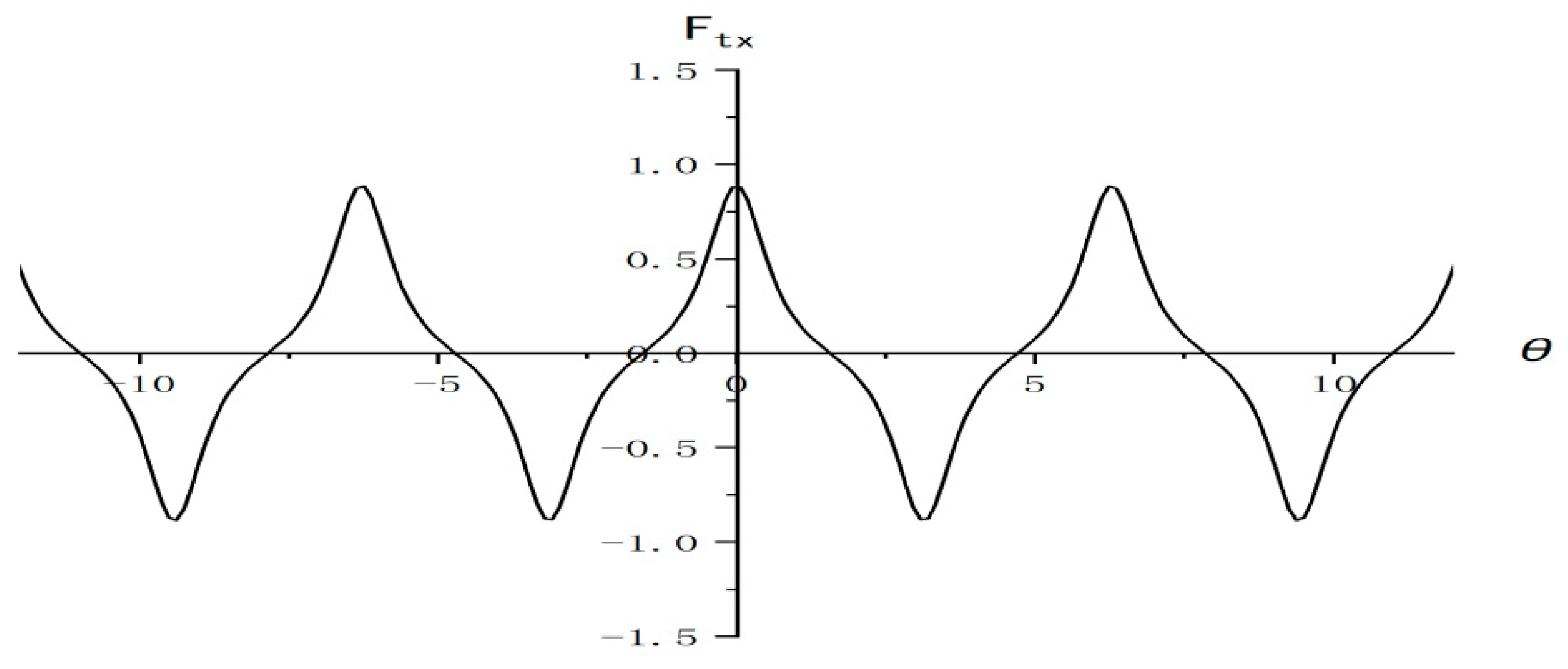
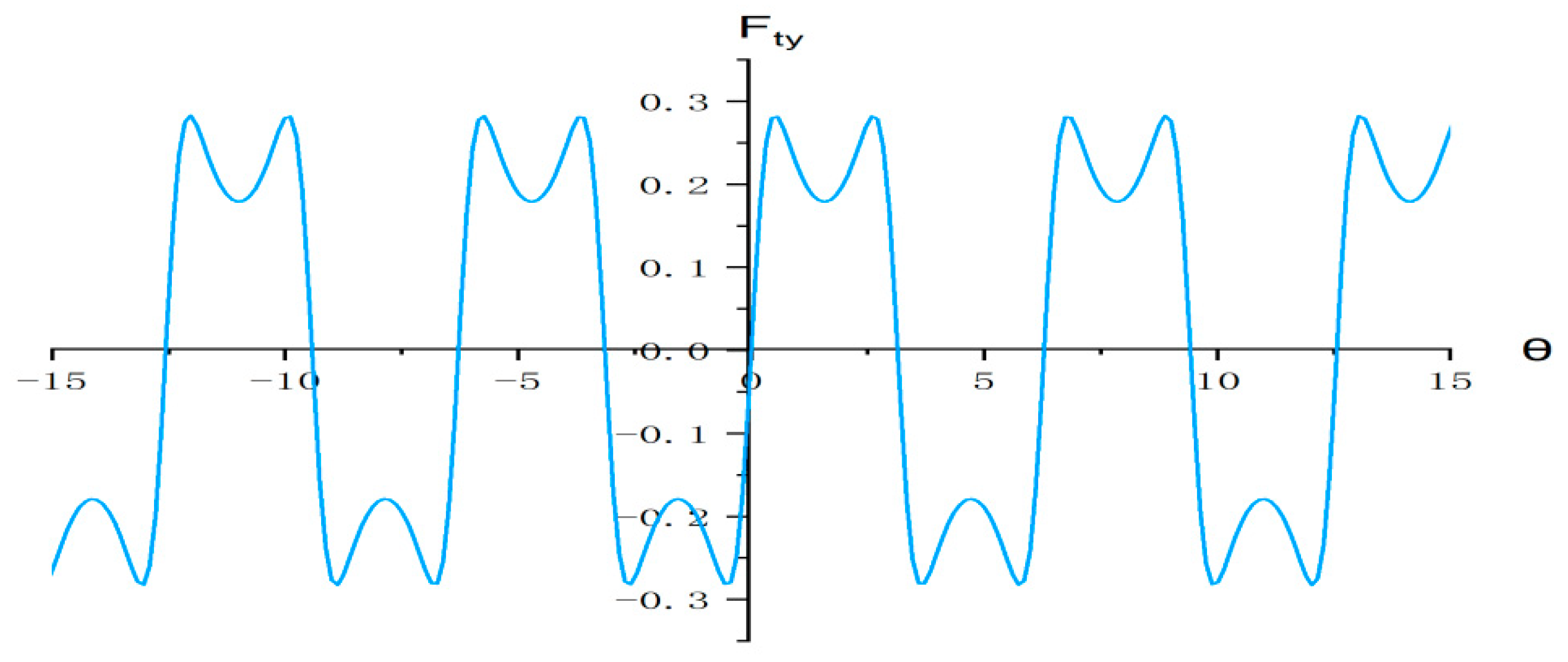
- A.
- In a certain spatial range within each slit of the double slit, there exists a regular periodic fluctuating Coulomb force field;
- B.
- When free electrons pass through a gap, their spatial position and the moment they are in the gap are probabilistic;
- C.
- A large number of free electrons pass through the gap, and their spatial position probability distribution in the gap is uniform; the probability distribution at the moment according to the θ angle parameter is also uniform.
- D.
- When a large number of free electrons pass through a single slit, they will interact with the periodic fluctuating Coulomb force field according to their probability and undergo regular deflection. Importantly, this deflection is not random but follows certain regularities because the Coulomb force field itself is periodic. Eventually, a regular distribution similar to the wave function pattern of the periodic fluctuating Coulomb force field is formed on the projection screen; this should also be an optimal possible principle explanation for electron diffraction.
- E.
- When a large number of free electrons pass through the slits of a double-slit, the regular periodic wave dynamic field formed by the two slits will superimpose the probability distribution of electrons, and finally an interference pattern is formed on the projection screen.
- F.
- When a certain amount of photons is directed at the slit (this amount must be very large, because a significantly greater number of photons than electrons need to be emitted to ensure that some photon will collide with some electron. It’s like needing to fire a large number of anti-aircraft shells to increase the probability of hitting an airplane), the photons will interact with the Coulomb force field in the slit, thereby disrupting or disturbing its original regularity, or the trajectory of the electrons passing through the slit is altered. As a result, the so-called interference fringes disappear.
6. Basic Idea of Verification
7. Summary
References
- (India) Anil Ananthaswamy. Double-slit Experiment and Quantum Mechanics[M]. Translated by Zhu Jinjie. Beijing: CITIC Publishing House, 2024.
- Zhao Guoqiu. Fundamentals of Double Four-Dimensional Spacetime Quantum Mechanics: The Spacetime Origin of Quantum Probability[M]. Wuhan: Hubei Science and Technology Press, 2016.
- Richard Feynman, Robert Leighton, Matthew Sands. Feynman Lectures on Physics[M]. Translated by Zheng Yongling et al. Shanghai: Shanghai Science and Technology Press, 2020.
- (Germany) W. Heisenberg. The Physical Principles of the Quantum Theory[M]. Translated by Wang Zhengxing, Li Shaoguang, Zhang Yu. Beijing: Higher Education Press, 2017.
- Jin Shangnian. The Physical Foundations and Philosophical Background of Quantum Mechanics[M]. Shanghai: Fudan University Press, 2007.
- Zhao Kaihua, Luo Weiyin. New Concept Physics Course. Quantum Physics (2nd Edition) [M]. Beijing: Higher Education Press, 2008.
Disclaimer/Publisher’s Note: The statements, opinions and data contained in all publications are solely those of the individual author(s) and contributor(s) and not of MDPI and/or the editor(s). MDPI and/or the editor(s) disclaim responsibility for any injury to people or property resulting from any ideas, methods, instructions or products referred to in the content. |
© 2025 by the authors. Licensee MDPI, Basel, Switzerland. This article is an open access article distributed under the terms and conditions of the Creative Commons Attribution (CC BY) license (http://creativecommons.org/licenses/by/4.0/).