Preprint
Article

This version is not peer-reviewed.

Digital Film Consumption Beyond Legal Frameworks: A New Form of Cinephilia? A Empirical Investigation of Unauthorized Film Access (2001–2012)

Submitted:

29 December 2024

Posted:

31 December 2024

You are already at the latest version

Abstract

This article examines the cinephilia of film downloaders between the end of the Napster era (the first P2P network shut down by US authorities in 2001) and that of MegaUpload, shut down in 2012 by New Zealand authorities. This decade has been characterized by the gradual disappearance of the technological barriers that have long hampered the downloading of large files, in tandem with the spread of ADSL and the rise of streaming[1] . Few studies, however, have looked at downloading and streaming from the perspective of the sociology of consumption, considering these content appropriation practices as a means of determining a trend in cinephiles' taste for the cinema object. On the basis of a qualitative survey, we look at the motivations behind downloading and streaming, relating them to the emergence of new cinephilic behaviours ("niche" and "rarity" cinephilias). Today, these indicators converge to suggest that downloading films is a way of appropriating images that has become commonplace, with few differences from other uses of cinephilia consumed on the big screen.

Keywords: 
;  ;  ;  ;  ;  ;  ;  ;  ;  ;  ;  ;  ;  ;  ;  ;  ;  ;  ;  ;  ;  ;  ;  ;  ;  ;  ;  ;  ;  

1. Film Awareness and Distribution Channels: From Experience to the Viewer's Expertise

This article examines the cinephilia of film downloaders between the end of the Napster era (the first P2P network shut down by US authorities in 2001) and that of MegaUpload, shut down in 2012 by New Zealand authorities. This decade is characterized by the gradual disappearance of the technological locks that had long hampered heavy file downloading, in tandem with the spread of ADSL and the rise of streaming consumption2. Few studies, however, have looked at downloading and streaming from the perspective of the sociology of consumption, considering these content appropriation practices as a means of determining a trend in cinema-goers' taste for the cinema object. In 2003, and again in 2005 in a study led by Olivia Wojnas, we put forward this hypothesis of a “new cinephilic practice” in two studies devoted to the sociology of piracy practices, seeking to compare downloaded content with that of legal distribution channels3. A number of indicators converged to show that, very early on in the first decade of the 2000s, the practice of downloading (whatever the mode: P2P, newsgroups, file sharing, streaming or link sharing) revealed, beyond the simple game of thwarting the rules of a market, a growing appetite for so-called "niche" cinephilia, avatars of a virtual, global video library virtually inaccessible on ordinary retail markets. In 2006, the publication of Chris Anderson's book La Longue traîne shed further light on the potential of these niche categories, which are usually made up of films of lesser, but not zero, notoriety. After observing that, at the time of the survey (2005), Imdb counted almost 40,000 documentaries published on DVD worldwide, Anderson established that Amazon offered almost 40% of them for sale (17,061); Netflix (the main streaming VOD operator in the USA, with a catalog of 100,000 titles and 8 million subscribers) only 3% (1,180 documentaries); and local video retailers in the USA 0.2% (75 titles on average). Anderson thus explicitly identifies documentaries published on DVD and not available in retail outlets or on legal download platforms (i.e. over 50% of all published titles) as a niche with qualitative potential that is both underestimated and under-exploited by the online sales giants4. At the same time, the first decade of the twenties confirmed the now widespread hypothesis of "cinephilic self-education" on the part of the user, outside traditional prescribers. Laurent Jullier, Jean-Marc Leveratto and Patrice Flichy will each shed light, in their own way, on the processes involved in the appropriation of this indigenous knowledge of cinema, born outside the cinema hall and directly derived from people's domestic uses (television, video, online viewing and downloading). This knowledge helps to naturally lead the amateur to a form of expertise proportional to his or her degree of familiarity with the objects consumed, an expertise which has, basically, from the point of view of the measuring tools mobilized to gauge the aesthetic quality of the files viewed, few notable differences with the traditional cinephilia making the big screen the center of audiovisual leisure5. Finally, the most recent advance in the sociology of culture, which today enables us to build bridges with this cinephilia of the download, concerns studies which, in the wake of the work of Passeron and Grignon, have since the 1980s revealed the disturbing singularity of a certain "omnivorism" among heavy consumers of culture6. In an academic environment where the importance traditionally accorded to the symmetry of cultural practices according to social class had made it possible to characterize, from the outset, the practice of downloading as necessarily "popular", since it involved mainly, it was thought, teenagers with few qualifications, and therefore incapable of constructing for themselves a reference culture in the field, the first proceedings instituted by Hadopi curiously revealed a fairly wide range of offenders belonging to different social classes and with fairly broad levels of income, as well as cultural practices7. Subsequent studies on the relationship between the French and digital technology have helped to gradually abandon these social representations of the downloader as a rather strange anthropological object located outside the system of economic prosperity, but rather as an actor in this system, including in economic terms8. The question of whether the practice of illegal downloading or streaming can create ripple effects with repercussions on other sectors of cultural activity (notably live performance) remains unanswered, despite the fact that it is better known today than it was at the outset.

2. Dissatisfaction with the Legal Film Offer

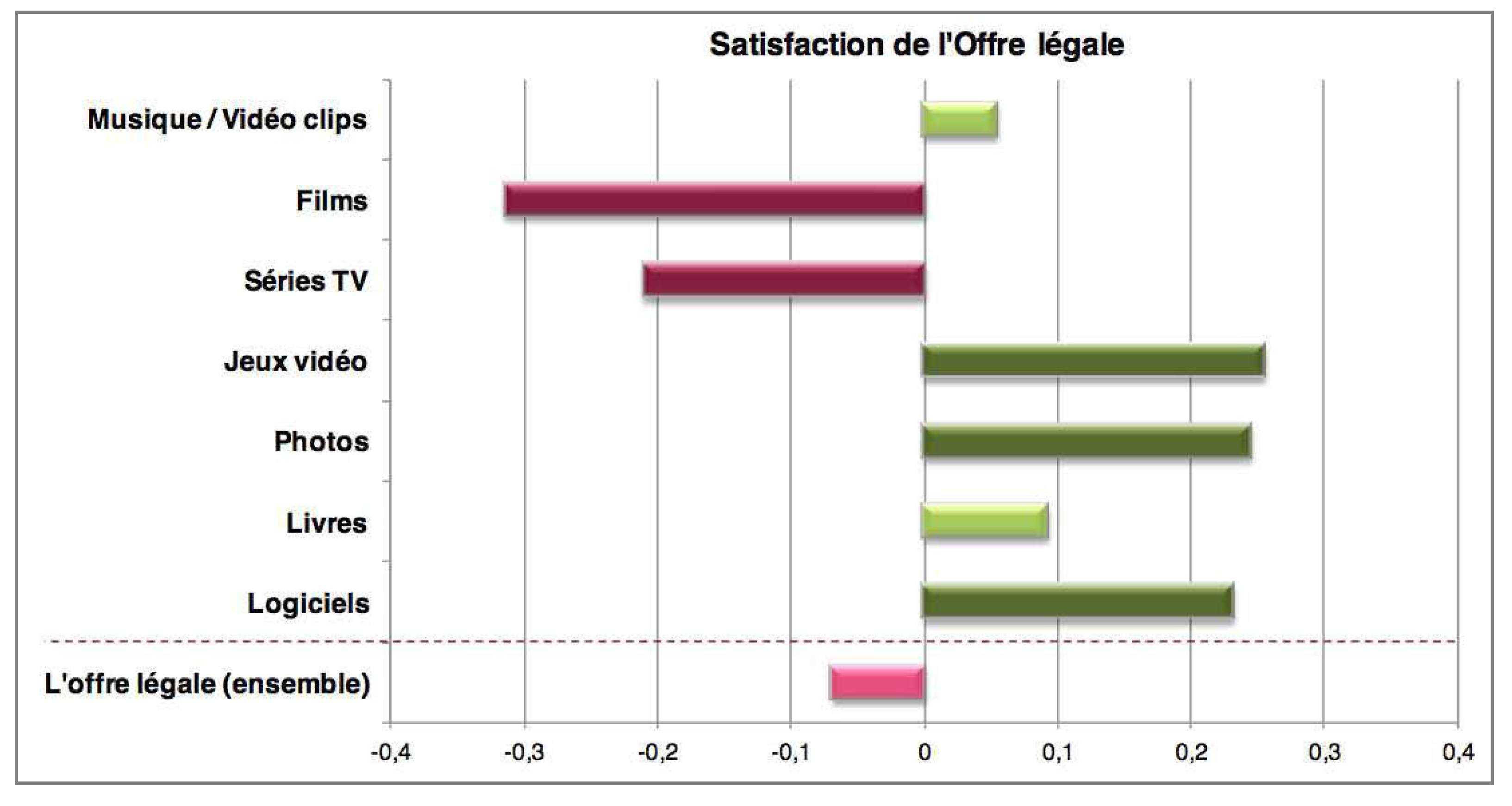
A socio-economic approach to film "demand" allows us to detect the behavior of groups of viewers who have become accustomed to watching films online, and who no longer identify, on the cinema or even video market alone, objects that reflect a more refined taste and a cinephilia born of television, then DVD and finally the widespread use of ADSL. A growing number of studies on the notoriety phenomenon9 tend to show that notoriety now involves two vectors: on the one hand, recognition of the quality of objects through the amateur's lay expertise, as a result of his or her rapid appropriation of recommendation systems for domestic purposes, which dispenses with the importance given in the past to traditional cultural prescribers, as shown by Bernard Lahire's survey on La culture des individus10 or the work of Laurent Jullier11 and Laurence Allard12 on cinephile networks as catalysts of taste; secondly, by the effectiveness of cross-referral systems such as those set up in the early 2000s by Amazon and specialized platforms like Allociné. The proliferation of the film supply (and, proportionately, of uncertainty about the quality of objects in circulation) today leads cinephiles, whether cinema-goers, downloaders or occasional "online" viewers, to be more sensitive to judgmental devices aimed at reducing uncertainty, and in particular to markers of the quality of objects in circulation issued by their peers13. Thus, several indicators have led us to the hypothesis that it is probably as a reducer of uncertainty that the practice of "cinephile" downloading operates, alongside a more playful, more compulsive and less calculated downloading practice, which coexists without totally replacing the first. Indeed, studies undertaken to verify the validity of Anderson's model tend to confirm that the long tail of online sales tends to benefit genre and niche films, i.e. the hypersegmentation of objects, as already shown by the multiplication of legal editions (DVD, VOD accessibility), but also of non-legal downloading for films not distributed because of their scarcity on traditional distribution channels. While Pierre-Jean Benghozi and Françoise Benhamou remain cautious as regards books and music, believing that "these effects could be due solely to dematerialization and would then be self-evident14 ", they do attest to the existence of a lever for niche films, confirming a "long tail effect" on the video market. In contrast to DVDs for rental, DVDs for purchase seem to escape box office logic to a greater extent. In a study carried out on 953 DVDs belonging to the "top 30" of American sales, comparing film titles with their box office results, David Walls succeeded in showing a strong asymmetry between the two modes of consumption, resulting in differentiated purchasing logics that thwart Pareto's law15 . The spectator's experience is therefore not limited to theatrical viewing, and the DVD offer takes into account parameters other than the box-office alone. A quantitative study entitled "Baromètre de l'offre légale" (Barometer of the legal offer) carried out in 2013 on behalf of Hadopi among a sample of 1,500 French Internet users, shows that "many users still say they are dissatisfied with the offer, complaining however about its lack of exhaustiveness, its prohibitive cost or its lack of ergonomics16 ". More interestingly, this study shows that respondents' attention is focused on films and TV series, the content for which satisfaction with the legal offer is lowest. In fact, the "Ease of finding" criterion mainly concerns legal offers for music, video clips, video games and software (80% of respondents), while films (64%) and TV series (62%) are clearly lagging behind. These indicators are in line with those observed elsewhere. The first "baromètre de l'offre légale" published by Hadopi in 2013 found that consumers more readily appreciated the "richness/variety of the available offer", in video games (78%), software (76%) and music (75%), while films (66%), books (65%) and TV series (61%) were rated less highly.17

3. Exit, Voice and Loyalty: Downloading as a Means of Contesting the Legal Offer
Similar phenomena can be observed when cinephiles consider the Internet as an additional distribution channel to quench a thirst for rarities that the DVD or even VOD retail market alone can no longer satisfy. In addition to the aggregation of cinephiles deserting traditional distribution channels to meet up by affinity on sites for sharing cinematic rarities [a phenomenon analyzed in the current issue of Cahiers de Champs Visuels], spaces for speaking out against the shortcomings of the legal DVD offer have emerged in recent years. Whatever form they take (forum, blog or website), they illustrate in their own way the "Exit, Voice, and Loyalty" theory of consumer sociologist Alfred Hirschman, who in the early 1970s identified two solutions generally available to consumers dissatisfied with the quality of the objects in circulation on a given market: exit or speak out to improve their quality. We've taken a closer look at voice, studying a number of sites, forums and blogs that gather consumer opinions. The French microblog jvoulaispaspirater.tumblr.com, created at the end of 2012 with the aim of collecting testimonials from Internet users on the shortcomings of the legal offer (audio and video), deals almost exclusively with films and series, a trend fairly symptomatic of a state of the DVD market under stress. The difficulties identified by Internet users concern three areas: the composition of the offer (inconsistencies deemed unjustified, missing or out-of-order versions, areas not served, exclusive distribution, etc.), pricing policy and access to content (technological locks, bridging, DRM, etc.). While this forum focuses on technological tools and concerns the offer as a whole, similar forums can be used to further explore the question of tastes and moviegoers' appetite for certain genres. The Facebook forum "Films and video series you'd like to see in stores" builds bridges between unfulfilled cinephile demand and the retail market. Its 113 members18 have posted almost 634 photos of posters for films released in cinemas (or first released on VHS) but not available on DVD, providing an interesting snapshot of unmet demand. Requests fall into three categories: relatively obscure genre films (post-apocalyptic films from the 70s, karate and action films from the 80s, etc.), cinema "classics" or "cult films" unavailable for rights reasons, unreleased films by recognized auteurs (first films, shorts, etc.) and series. The same proportion can be found on the DVDthèque forum "Les Films Inédits, épuisés ou trop rares en DVD" (Unreleased, out-of-print or too rare on DVD)19 where the offer of French genre films appears more clearly, as well as on the last platform observed for this article "Films inédits : le forum" (Unreleased films: the forum).20
For a long time, the observation of downloaders and their practices was essentially assessed from an economic angle. In France, for cinema films, two initial studies were carried out at the initiative of the CNC: one in 2004 by the Qualiquanti institute21, the other by ALPA (Association de lutte contre la piraterie audiovisuelle)22. It wasn't until later that studies gradually abandoned the categories of observation that prevailed during the first decade of the second millennium, those using opposition pairs that were then widespread on the issue in the public arena ("licit vs illicit", "pirate vs legal", etc.) to categorize individuals according to their use of online consumption of digital goods23. ALPA's analysis shows that, while the supply of downloaded American films is strong (52%) compared with French films (24.9%), another unknown but significant quarter in terms of volume includes all the "other" nationalities that can be found on the networks. The analysis carried out by the Qualiquanti institute reveals the diversity of consumption practices and motivations, as does the Hadopi survey published in 2013 on French practices with regard to downloading24. We learn that there are "multiple techniques that facilitate piracy", that "a multitude of factors can incite [...] to pirate". The impact on consumption also appears difficult to quantify: it is "more or less strong". Qualiquanti has listened to the people we interviewed, and for each classic act of consumption we have determined the reasons for and against - renting, buying, watching TV, going to the cinema. But these reasons don't seem to be able to be grouped together in a homogeneous way, and contribute to segmenting downloaders in a rather schematic way, like the surveys that prevailed on the question from around 2005 to 2010. If there are as many motivations for consuming illicit content as there are individuals who practice it, it's because this activity is not exclusive and specific to one segment of the population, as was long thought with the typical profile of the "teenage downloader", but rather widespread. Studies carried out at a very early stage showed the appetite of Internet users to use P2P networks for pre-purchase testing, as well as the non-opposition between the two acts (purchasing and illegal downloading), such as the JupiterResearch study published in 200025. A study carried out in 2004 by Médiamétrie and the French Ministry of Culture's Département des Etudes et de la Prospective, on all download practices (music, cinema, video games), confirms the two main reasons why these individuals use P2P networks: to explore and to test26 In 2007, Idate and Médiamétrie/NetRatings showed that French P2P users are mostly the same customers as those on legal platforms. Their main motivations are a thirst for discovery, a certain curiosity, and a "strong desire to develop the offer towards a form of exhaustiveness". Curiously enough, conservation, free access and exchange come last. And yet, it is mainly these three acts that have qualified the social problem of piracy.
Figure 1. Internet users' satisfaction with the legal offer (source: Hadopi barometer of legal offers, April 2013).
Preprints 144449 g001

4. The Survey “Downloading Movies: A New Way of Consuming Images?”

4.1. Survey Protocol and General Data

The starting point was to attempt to define a typology of existing download behavior, rather than to define a "profile" of the downloader. The aim was to describe downloaders' cinematic tastes, their passions for certain genres, the frequency of their use - in other words, to describe what could be described as the "cinephilia" of P2P network users. The hypothesis was that practice on P2P networks could be conditioned by pre-existing types of cinephilic behavior in the same as they manifest themselves when cinephiles consume cinema in cinemas or on television: the demanding cinephile, more attentive to the content of the film and the reputation of its author(s), the "cinephile" for whom quantity and the films shown take precedence over quality27 , the "niche" spectator with specialized tastes in one genre, the "technophile" individual over-equipped with equipment and attentive to the technical quality of files, those who combine these different characteristics, etc. A questionnaire (28 open and closed questions) covering preferred audiovisual works, computer equipment, viewing and downloading habits was submitted. For questions concerning "preferences" in terms of taste (tastes in general, films most purchased on DVD and films most downloaded), numbering was requested in order of preference. The questionnaires were completed during semi-structured interviews. The survey was carried out in the Lille metropolitan area. The target locations were defined as follows: cinema exits, Internet access points offering networked games, videoclubs, stores selling second-hand video games and DVDs (or VHSs), and the image departments of general supermarkets (GSA) and specialist supermarkets (GSS). The questionnaire was submitted to 118 people, in two ways: by direct contact with passers-by stopped on the public highway in front of the chosen locations; and by deposit in the same locations, in places visible to the public who frequent them (bar counters in small cinemas, ticket offices, cash desks in video stores, or among flyers and leaflets in video game stores). This study highlights a proportional curve between three correlative factors: appetite for niche cinephilias (genre films, films of foreign nationalities, cinematic rarities made by "classic" cinema auteurs...), physical unavailability on the retail market, and recourse to downloading as an objective distribution channel
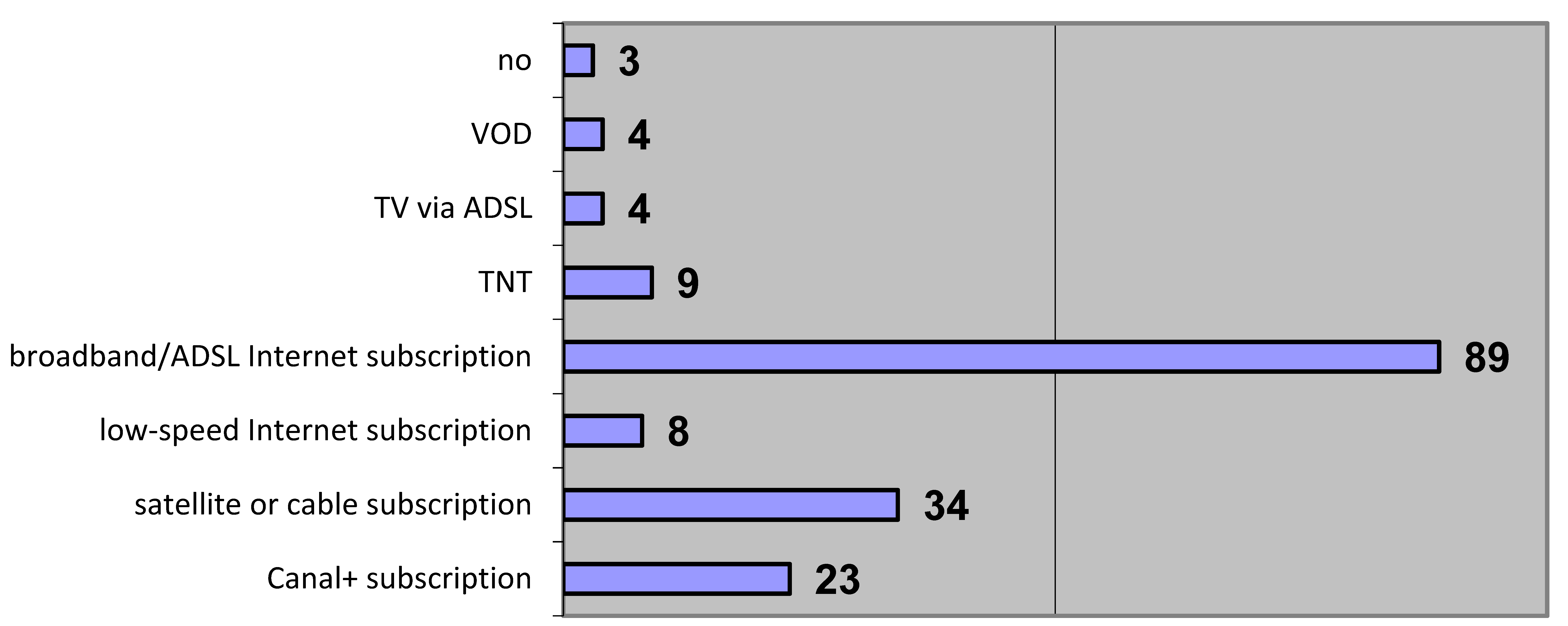
Media playback modes are diverse. Downloaders are generally very well equipped. The most widespread service is a broadband Internet subscription. Surprisingly, 56% of downloaders surveyed have both an Internet connection and a subscription to a pay-TV channel, which is much higher than the average Internet user. Although it is not made clear whether this dual legal and illegal consumption is driven by sports or cinema, the CSA provides an answer by presenting the overall offer of pay-TV channels in France as essentially oriented towards fiction, in particular Canal +: "Canal+'s programming [...] is essentially made up of cinematographic and audiovisual fiction, as well as numerous sports broadcasts28 ". Finally, 24% have only an Internet connection. Three people said they had no Internet access at home. It cannot be ruled out that downloading may therefore take place at their workplace or at a friend's house.
Classic TV screens are the most popular, followed by home cinema. On these two screens, we watch all film formats. The computer screen stands out: it's mainly used to watch feature films and TV series. The type of screen available does not determine the majority of people who choose to watch a film. The few people (16%) who choose a film according to the screen say that "cinema is better suited to certain films" (special effects, big shows, horror, science fiction), that "certain comedies don't need to be seen on the big screen" and that "it's better to watch family films on the living room TV".

4.2. Favourite Film Genres

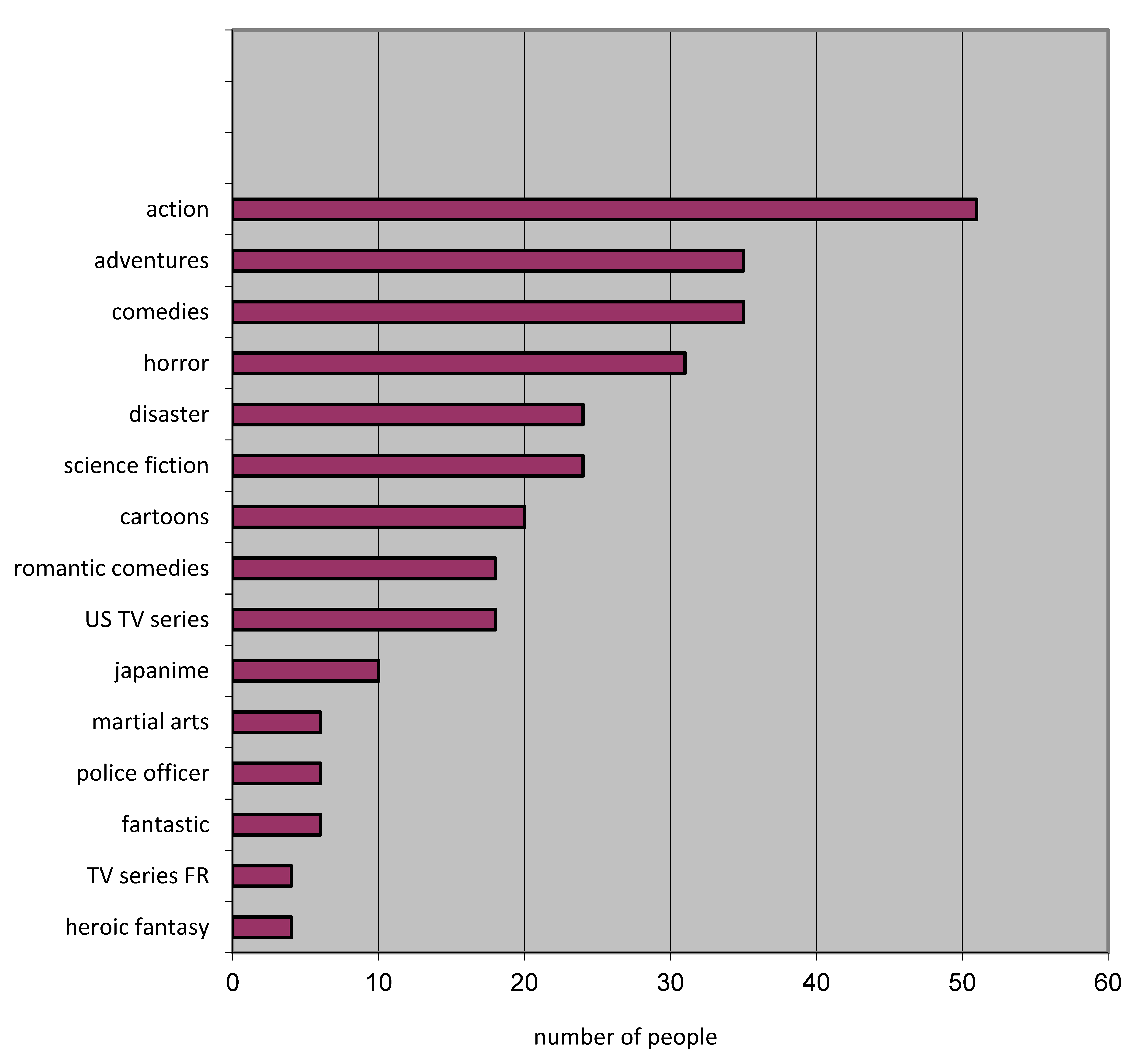
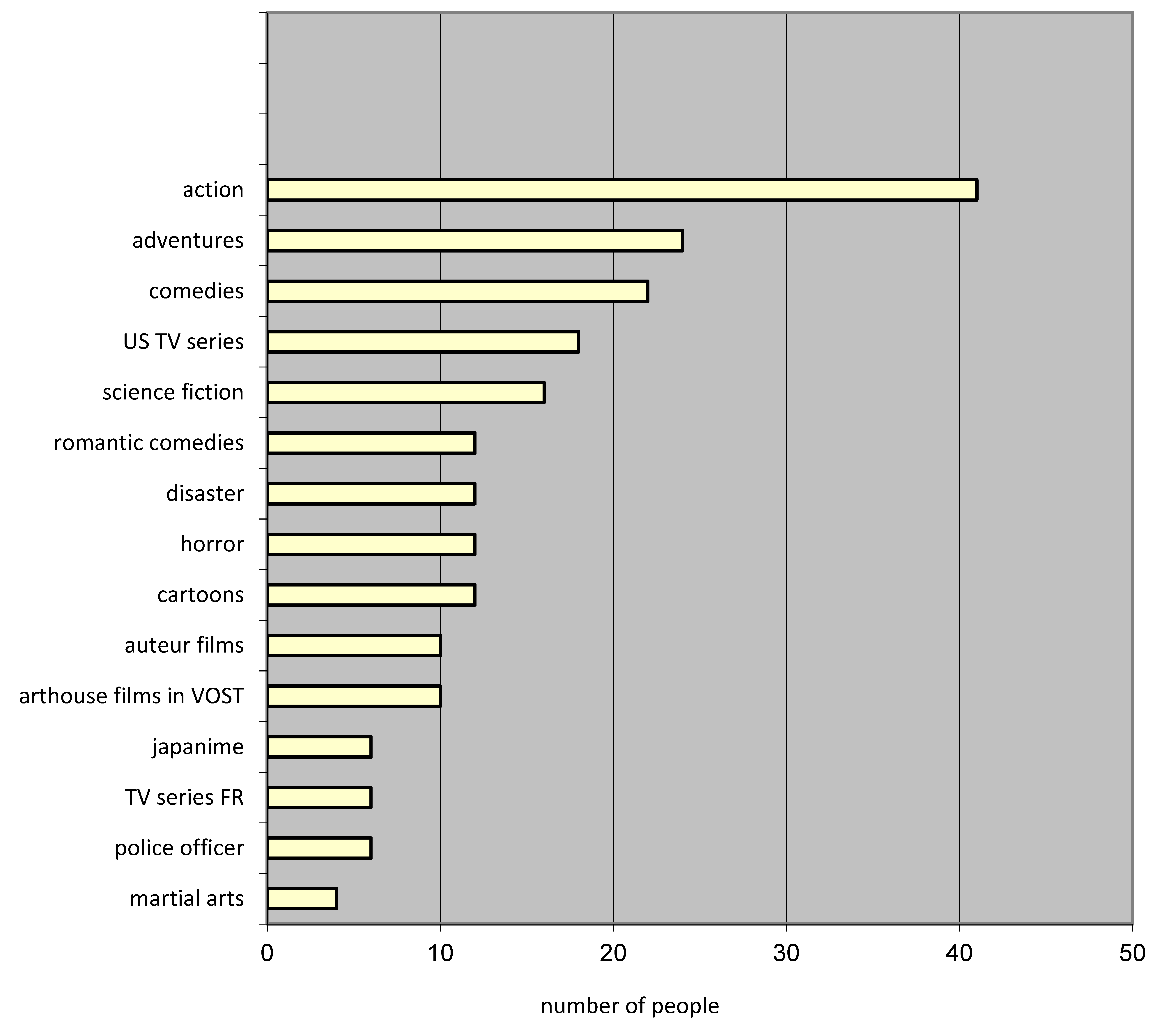
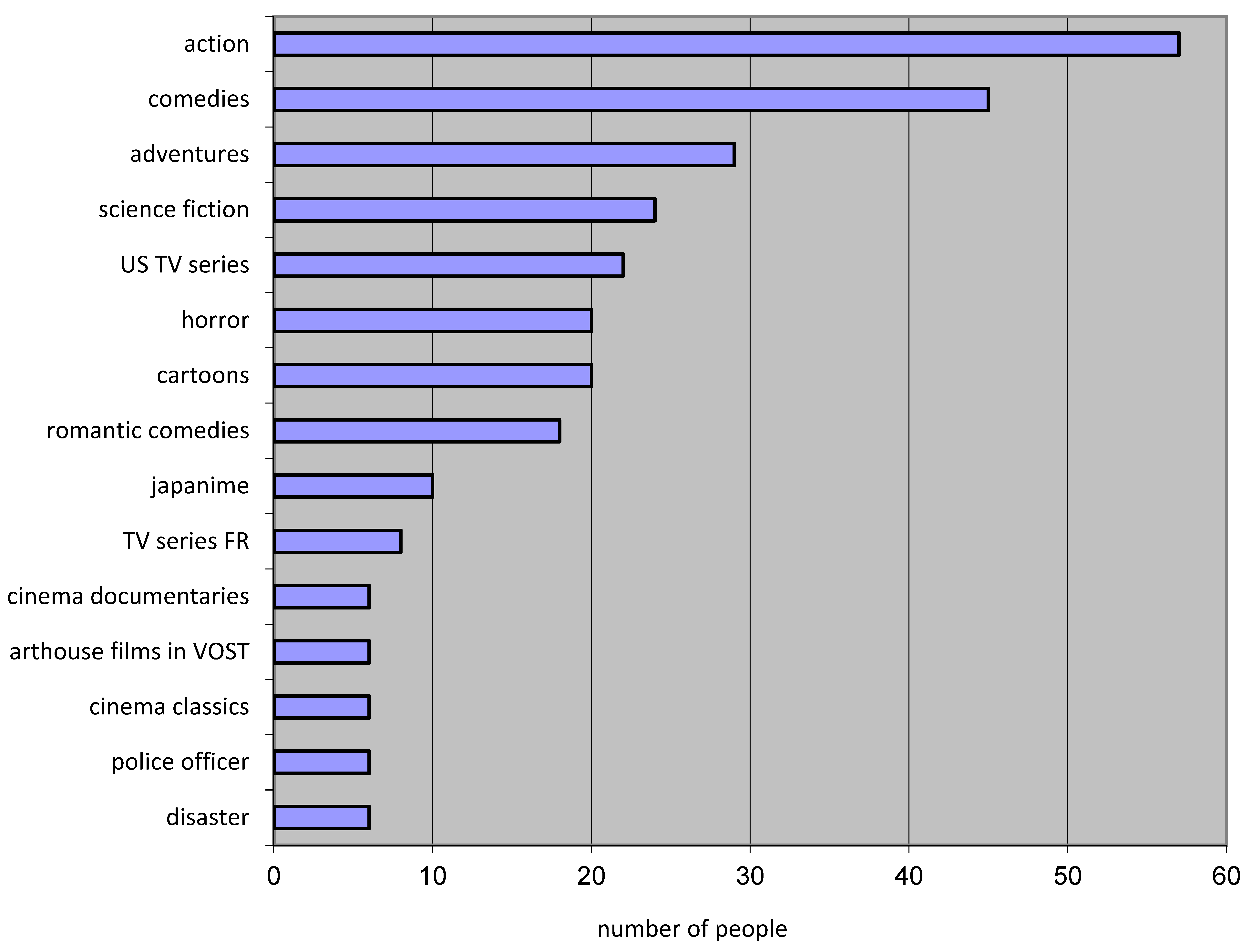
Preferred genres are very varied. Niche cinephiles (the fewest in number), who love specific genres above all, are also interested in the more "commercial" genres; while the opposite has not been verified. Last but not least, the initial hypothesis of a "transfer" cinephilia is borne out: the genres most loved on TV and in the cinema are also those most purchased on DVD and the most sought-after on P2P networks. However, their quantity decreases in favor of American TV series, "cinema classics" and auteur films in VF and VOST for DVD purchases, and in favor of French and American TV series and cinema classics for P2P network searches. However, films d'auteur and classic films, which are present for both purchases and downloads, do not appear at any point in the three preferred genres for either TV or cinema.

4.3. DVD Purchase and Rental

Nearly half of respondents do not buy films on VOD via the Internet. Among them, 13 never buy DVDs (25%). Among those who buy DVDs regularly, the majority do so about once a quarter (55%). The most frequently purchased films are those recently released in cinemas (58%), followed by heritage classics (33%), then foreign films never released in France (12%). DVDs are bought mainly in food superstores (41%), followed by specialized superstores (27%), second-hand DVD stores (23%) and online sales sites (21%). Purchases from specialist retailers account for only 8%. A significant proportion of downloaders buy films they've already seen (33%), and films they've heard about (35%). DVD extras come in last place, accounting for only 8% of purchases.
When it comes to the availability of DVDs in retail outlets, the majority (people who don't buy DVDs also answered this question) feel that prices are too high (48%); on the other hand, 39% say they would buy more DVDs if prices were lower. 25% can find all the DVDs they want. Only 6% say they find almost nothing because their tastes are too specialized. 34% would not buy more DVDs if the in-store offer diversified.
On the subject of DVD rentals, 32% find the offer too limited for their tastes. 28% can find all the films they are looking for. 23% can't find older films. 17% think it's better to rent than download films.

4.4. Downloading and Consumption of the Downloaded Film.

The size of the audiovisual file does not influence the choice of film downloaded. The computer memory constraint doesn't exist, so we can assume that downloaders are properly equipped for their practice. Or perhaps they keep their films on external storage media. However, they recognize that the DVD is still considered "important" if the desire to keep the film is present. What's more, the majority of people who watch films "on their computer screen", store the films.
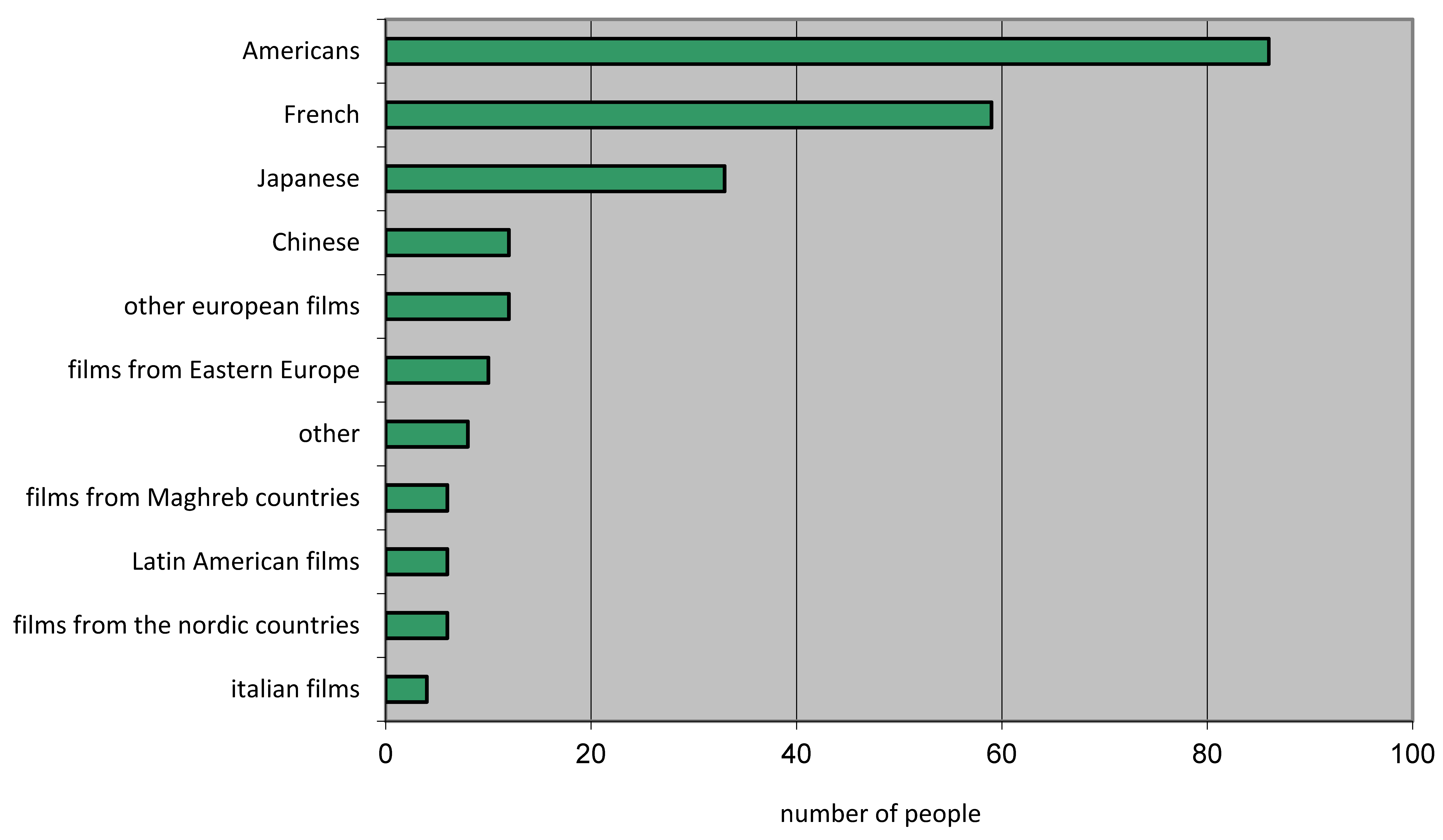
In terms of nationality, the films downloaded are mainly American (86%). French (59%) and Japanese (33%) follow. American films are downloaded 1 to 3 times a month. French films and films of other nationalities are downloaded less than once a month. Downloaded films are watched "from time to time" (71%) and in equal proportions "never" and "often". They are retained by the majority of downloaders (76%). For each person, the genres most frequently watched correspond to those most frequently purchased on DVD. We also note the presence of cinema classics and films d'auteur (not present in the preferred genres for television or cinema in general). Finally, the survey shows that, contrary to popular belief, downloaders know what they're looking for: the majority look for specific films and genres on P2P networks (76%). 26% say they sometimes find "rare" films on P2P networks that have helped develop their taste for cinema.
For the majority, the closure of P2P networks or newsgroups offering direct links would not lead to an increase in consumption on traditional distribution channels. 57% of downloaders say they would continue to download films free of charge by another means, a fairly stable proportion confirmed by other surveys carried out on larger panels of individuals.29

4.5. Various Opinions and Views

Almost unanimously (94%), those questioned said that going to the cinema is still of interest today. Consumption of audiovisual works via the Internet represents a genuine revolution in the way people consume, according to 81% of respondents. Finally, and symptomatically in relation to the initial hypothesis, downloaders feel that their practice of downloading has contributed to increasing their cinephile culture. As far as film authors are concerned, downloading firstly enables "wider distribution" and "the possibility of making oneself known", then "recognition of the author, which can encourage people to go to the cinema to see their next film or to buy a DVD".

5. Conclusions

The future of online exchanges does not seem to escape the illicit appropriation of30 audiovisual content, but these uses, now commonplace, also contribute to embellishing the range of cinephile practices. While they remain loyal to the cinema and DVD, one of the problems faced by moviegoers who resort to downloading is the lack of diversity in the retail offer. The defection of this market (exit) for an alternative offer, illegal but fertile in terms of choice, testifies to a form of collective pressure on the quality of the objects in circulation. It is also interesting to note that a 2013 study estimates that the industry is reacting to signals from these consumers using31 downloads. In an article on "The effect of piracy on the quality of immaterial goods", Debabrata Dey and Atanu Lahiri, show the apparently beneficial role of piracy on the quality of products distributed on the retail market (video games) and on subscription television. The authors refer to the policy of HBO, the American pay-TV channel, which, faced with a piracy rate estimated at between 30% and 50%, has focused on broadcasting content in high quality and in different languages. According to the survey, HBO's qualitative innovations have not only reduced the piracy rate, but have also attracted new subscribers. The same is true of Valve, an American video game studio. It has regularly made improvements to one of its flagship titles, Team Fortress 2, prompting many gamers to return to the law and reaffirm their loyalty to the company (loyalty). Finally, and most interestingly, most studies on the subject have succeeded in showing that the two download modes (free and paid) are not mutually exclusive. Consumers, who know all about the means and channels for obtaining illegal content, may be prepared to pay even when they have the means to get the same thing for free. This only confirms their interest in the quality of content in circulation, and in the industry's efforts to improve it. For they alone determine the choice of mode (free or paid). While the traditional cinephilia of the cinema or television remains a "cinephilia of supply" (over which the viewer has little control: limited variety of films on show, media chronology or broadcasting schedules), the cinephilia of downloading is a "cinephilia of demand" to which the legal VOD offer has, until now, only partially responded (VOD titles very often come from generalist catalogs that cinephiles avoid precisely because of their lack of diversity or because they already own them). The recent success of "replay" services offered by TV channels, for example, as part of their triplay offers, shows that viewers like to be free from the offer and the broadcasting schedule, choosing content according to their tastes and the time of viewing. It's worth noting that related practices such as streaming, like VOD, involve a more limited range of films, reflecting a less eclectic form of cinephilia. In short, all the indicators converge today to suggest that downloading films is a way of appropriating images that has become part of everyday life, with few differences from other uses of cinephilia consumed on the big screen.32

Appendix A. Survey Results "Downloading Films: A New Way Of Consuming Images”

Table A1. Customers of the following services (in %).
Preprints 144449 i001
Table A2. Favourite film genres.
Preprints 144449 i002
Table A3. Genres most purchased on DVD.
Preprints 144449 i003
Table A4. Genres most downloaded from the Internet.
Preprints 144449 i004
Table A5. Nationality of films downloaded.
Preprints 144449 i005
Table A6. Factors influencing the purchase of a DVD.
Downloaders declare that:
Rank 1 It's word of mouth that makes them want to buy a DVD 35%
Rank 2 They mostly buy films they've seen before 33%
Rank 3 They read reviews before buying 22%
Rank 4 They choose according to the publicity surrounding the film 16%
Rank 5 They only buy DVDs on sale 16%
Rank 6 It's the extras that make the difference between buying a DVD or not. 8%
Table A7. The cinephilia of the Internet film downloader.
Downloaders declare that:
Rank 1 They know exactly which films they want to download before they log on. 76%
Rank 2 They don't know what movies they're going to download before they log on 22%
Rank 3 Using P2P networks makes it easier for them to find film-related products in traditional distribution channels. 18%
Rank 4 Using P2P networks has enabled them to meet people who share the same taste in cinema. 4%
Table A8. Downloading and the cinephilia of rarity.
Downloaders sometimes find films on P2P networks that are impossible to find elsewhere:
Rank 1 Sometimes 26%
Rank 2 Don't look for "rare pearls 12%
Rank 3 Often 8%
Rank 4 Rarely 6%
Table A9. ("What do you think?" section): various opinions and views.
The majority of Internet users say:
Be interested in Internet access to audiovisual content 61%
P2P networks have changed their cultural practices 44%
That their film culture has grown thanks to P2P networks 65%
That going to the movies is still worthwhile today 94%
That unpaid downloading is not a fad 77%
Internet downloading is revolutionizing the way we consume images 81%
That the term "piracy" is appropriate to the practice of downloading and streaming 55%

References

  1. AKERLOF, George A. 1970. "The Market for 'Lemons': Quality Uncertainty and the Market Mechanism". Quarterly Journal of Economics, Vol. 84, n°3, pp. 488-500.
  2. BENSON-ALLOTT, Caetlin. Killer Tapes and Shattered Screens: Video Spectatorship From VHS to File Sharing; University of California Press: Berkeley, 2013. [Google Scholar]
  3. ANDERSON, Chris. The Long Tail: Why the Future of Business Is Selling Less of More; Hyperion: New York, 2006. [Google Scholar]
  4. BECKER, Jan; CLEMENT, Michel. 2006. Dynamics of Illegal Participation in Peer-to-Peer Networks-Why Do People Illegally Share Media Files? Journal of Media Economics, Vol. 19, Issue 1, pp.7-32.
  5. BENHAMOU, Françoise. Economics of the star system; Odile Jacob: Paris, 2002. [Google Scholar]
  6. BERGÉ, Armelle; GRANJON, Fabien. 2005. "Relational networks and cultural eclecticism," Revue LISA/LISA e-journal [Online], Media, culture, history, Culture and society. Online January 1,2005. URL: http://lisa.revues.org/909.
  7. CALLON, Michel; LASCOUMES, Pierre; BARTHE, Yannick. 2001. Agir dans un monde incertain. Essay on technical democracy. Paris: Le Seuil (collection "La couleur des idées").
  8. CARDOSO, Gustavo. P2P in the Networked Future of European Cinema. International Journal of Communication 2012, 6, 795–821. [Google Scholar]
  9. CHAO, Chiang-Nan; ZHAO, Saibei. "Emergence of Movie Stream Challenges Traditional DVD Movie Rental-An Empirical Study with a User Focus". International Journal of Business Administration 2010, 4(3), 22–29. [Google Scholar]
  10. CHAO, Chiang-Nan; Tiger, LI. "Movie Download Challenges Traditional Movie Rental". International Journal of Business, Marketing, and Decision Sciences, 2010; 3, 2, 78–87. [Google Scholar]
  11. CHARTOIRE, Renaud. Distinction, omnivority and dissonance: The example of 'bis' cinema. Idées 2007, 46–57. [Google Scholar]
  12. CMPDA. 2011. "Economic Consequences of Film Piracy in CANADA", February.
  13. DE VANY, Arthur; WALLS, David. 1999. "Uncertainty in the Movie Industry: Does Star Power Reduce the Terror of the Box Office?", Journal of Cultural Economics, n° 23, pp. 285-318.
  14. DE VANY, Arthur; WALLS, David. 2002. "Movie Stars, Big Budgets, and Wide Releases: Empirical Analysis of the Blockbuster Strategy". working paper, University of California at Irvine.
  15. ENGLISH, James. The Economy of Prestige: Prizes, Awards, and the Circulation of Cultural Value; Harvard University Press: Cambridge, 2008. [Google Scholar]
  16. FLICHY, Patrice. 2010. Le sacre de l'amateur. Sociologie des passions ordinaires à l'ère numérique. Paris: Seuil.
  17. FOREST, Claude, 2010. Which film to see? Pour une socioéconomie de la demande de cinéma. Villeneuve-D'Ascq: Septentrion.
  18. FREY, Bruno; NECKERMANN, Susanne. 2008. Who is Who? - The Economics of Awards. Working paper. pp. 1-35.
  19. -. 2009. "Awards: A Disregarded Source of Motivation". Rationality, Markets and Morals, Vol. 0, n°1, pp. 177-182.
  20. GIMELLO-MESPLOMB, Frédéric. 2005. "Peut-on responsabiliser les nouveaux modes de consommation de l'audiovisuel?", in La libération audiovisuelle - Enjeux technologiques, économiques et réglementaires (edited by Thomas Paris), Paris: Éditions Dalloz, pp. 165-192.
  21. GIMELLO MESPLOMB, Frédéric. 2012. "Three new 'grey areas' in the light of sociotechnical developments in cinema: the economics of notoriety, uncertainty and drag phenomena," Mise au point [Online], 4 2012, Online since 21 August 2012: http://journals.openedition.org/map/762. [CrossRef]
  22. GIMELLO-MESPLOMB, Frédéric. 2024. "Hundred Years of French Film Policy (1925-2025). Power, Policy, and Aesthetic Values Within State Intervention for Film Production in France." SocArXiv. December 6. [CrossRef]
  23. GIMELLO-MESPLOMB, Frédéric. 2024. "The Invention of the Spectator: How Has Early Film Spectatorship Shaped Audience and Reception Theory. Selected Writings (1900s-1910s)". New York - London: Zenodo. [CrossRef]
  24. GIMELLO-MESPLOMB. Frédéric. 2024. "THE 1910s: PIONEERING INSIGHTS INTO AUDIENCES STUDIES". The Invention of the Spectator: How has Early film Spectatorship shaped Audience and Reception Theory. Selected Writings (1900s-1910s), Zenodo, 2024, Media and Cultural Studies, 9791043111785. ⟨10.5281/zenodo.14315753⟩. ⟨halshs-04830093⟩.
  25. GIMELLO-MESPLOMB. Frédéric. 2000. « Enjeux et stratégies de la politique de soutien au cinéma français: un exemple: la nouvelle vague: économie politique et symboles ». Université Toulouse II.
  26. GRANJON, Fabien. 2005. "De quelques considérations sur la notion d'éclectisme culturel", Working paper. Published online March 29, 2006. URL: http://w3.u-grenoble3.fr/les_enjeux/2005/Granjon-Berge/home.html.
  27. HADOPI. 2008. "Impact économique de la copie illégale des biens numérisés en France: Quand le chaos économique s'immisce dans la révolution technologique". Research report. Paris: Hadopi.
  28. -. 2013. "Access to works on the Internet: inventory and analysis of uses". Research report. Paris: Hadopi, Département Recherche, Etudes et Veille (DREV).
  29. -. 2013. "Strategies for accessing dematerialized works - Qualitative & quantitative synthesis". Research report. Paris: Hadopi, Département Recherche, Etudes et Veille (DREV).
  30. HIRSCHMAN, Alfred. 1970. Exit, Voice, and Loyalty: Responses to Decline in Firms, Organizations, and States. Cambridge (US): Harvard University Press. Translated into French in 1972, Face au déclin des entreprises et des institutions. Paris: Ed. Ouvrières (Economie et humanisme), 1970.
  31. HUTTER, Michael; THROSBY, David. 2008. Beyond Price: Value in Culture, Economics, and the Arts. Cambridge: Cambridge University Press. Chapter 1: "Value and Valuation in Art and Culture: Introduction and Overview".
  32. IDATE. 2012. "Study of the economic model of sites or services for streaming and direct downloading of illicit content". Final report. Paris, Idate/Hadopi. URL: http://www.hadopi.fr/sites/default/files/page/pdf/Rapport_IDATE.pdf.
  33. IFOP - digital media. 2010. "The French and Illegal Downloading. Study report. July 2010". Paris: IFOP.
  34. KARPIK, Lucien. 2010. Valuing The Unique: The Economics Of Singularities. Priceton: Princeton University Press.
  35. LAHIRE, Bernard. La Culture des individus. Dissonances culturelles et distinction de soi; La Découverte: Paris, 2006. [Google Scholar]
  36. LESCURE, Pierre. 2013. Rapport de Mission " Acte II de l'exception culturelle ", " Contribution aux politiques culturelles à l'ère numérique ". Paris : Ministère de la Culture. 2 volumes.
  37. LEVERATTO, Jean-Marc; JULLIER, Laurent. Cinéphiles et cinéphilie, une histoire de la qualité cinématographique; Colin: Paris, 2010. [Google Scholar]
  38. LIEBOWITZ, Stan J. 2006. "Economists Examine File-Sharing and Music Sales", in Illing G. and M. Peitz (eds), Industrial Organization and the Digital Economy, MIT press, Cambridge.
  39. NECKERMANN, Susanne; FREY Bruno S. 2007. "Awards as Incentives". SSRN Electronic Journal, pp. 1-41.
  40. NICOLAS, Yann. 2005. "Le téléchargement sur les réseaux de pair à pair", Développement Culturel, n° 148, June 2005; published online [http://www.culture.gouv.fr/dep] ; October 15, 2005.
  41. SAROIU, Stefan; and ali. 2002. "Measurement study of peer-to-peer file sharing systems", Proc. SPIE 4673, Multimedia Computing and Networking 2002, 156 (December 10, 2001).
  42. THROSBY, David. 2010. "Economic analysis of artists' behaviour: some current issues", Revue d'économie politique, Dalloz, 0 (1), pp. 47-56.
  43. WALLS David W. "Superstars and heavy tails in recorded entertainment: empirical analysis of the market for DVDs". Journal of Cultural Economics, Vol. 34, n°4, 2010, pp. 261-279.
  44. WENGER, Etienne. Communities of Practice: Learning, Meaning, and Identity; Cambridge University Press: Cambridge, 1998. [Google Scholar]
  45. WERBACH, Kevin. "The implications of video peer-to-peer on network usage". In Peer-to-peer video: The economics, policy, and culture of today's new mass medium; E. M., Noam, L. M., Pupillo, Eds.; Springer: New York, 2008; pp. 95–128. [Google Scholar]
  46. WOJNAS, Olivia. 2005. " L'échange de films en Peer-to-peer: une sociologie des usages ". Master's thesis in cinema (ed. F. Gimello-Mesplomb). Université de Metz, Service Commun de Documentation.
  47. ZAFIRAU, Stephen. "Reputation Work in Selling Film and Television: Life in the Hollywood Talent Industry". Qualitative Sociology 2007, 31(2), 99–127. [Google Scholar]
1
This practice has grown considerably since 2010, particularly for the consumption of music (63%) and TV series (42%), according to a report by Hadopi's Research, Studies and Monitoring Department (DREV) "Stratégies d'accès aux œuvres dématérialisées - Synthèse qualitative & quantitative - Novembre 2013", pp. 57-58.
2
This practice has grown considerably since 2010, particularly for the consumption of music (63%) and TV series (42%), according to a report by Hadopi's Research, Studies and Monitoring Department (DREV) "Stratégies d'accès aux œuvres dématérialisées - Synthèse qualitative & quantitative - Novembre 2013", pp. 57-58.
3
Frédéric Gimello-Mesplomb, "Peut-on responsabiliser les nouveaux modes de consommation de l'audiovisuel?", in La libération audiovisuelle - Enjeux technologiques, économiques et réglementaires (ed. Thomas Paris), Paris: Éditions Dalloz, 2005, pp. 165-192; Olivia Wojnas, "L'échange de films en Peer-to-peer: une sociologie des usages". Master's thesis in cinema (ed. F. Gimello-Mesplomb). Université de Metz, 2005.
4
Chris Anderson, The Long Tail: Why the Future of Business Is Selling Less of More, New York, Hyperion, 2006.
5
Laurent Jullier and Jean-Marc Leveratto, Cinéphiles et cinéphilie: histoire et devenir de la culture cinématographique, Armand Colin, 2010; Patrice Flichy, Le sacre de l'amateur. Sociologie des passions ordinaires à l'ère numérique, Seuil, 2010.
6
Fabien Granjon. "De quelques considérations sur la notion d'éclectisme culturel", Working paper. Published online March 29, 2006. URL: http://w3.u-grenoble3.fr/les_enjeux/2005/Granjon-Berge/home.html; Armelle Bergé and Fabien Granjon, "Réseaux relationnels et éclectisme culturel", Revue LISA/LISA e-journal [Online], Media, culture, history, Culture and society, January 2005, URL: http://lisa.revues.org/909.
7
CNC, "Le téléchargement de films sur Internet. Analyse quantitative: Profil sociodémographique du téléchargeur", pp. 15-18. See also http://www.hadopi-data.fr, statistics on 518 Internet subscribers who received a warning from the Haute Autorité pour la Diffusion des Oeuvres et la Protection des Droits sur Internet (Hadopi).
8
IDATE report "Etude du modèle économique de sites ou services de streaming et de téléchargement direct de contenus illicites" Final report - March 21, 2012. Haute Autorité pour la diffusion des œuvres et protection des droits sur Internet, 2012.
9
Stephen Zafirau, "Reputation Work in Selling Film and Television: Life in the Hollywood Talent Industry". Qualitative Sociology Vol. 31, n°2, 2007, pp. 99-127; Bruno S. Frey; Susanne Neckermann, "Awards: A Disregarded Source of Motivation". Rationality, Markets and Morals, Vol. 0, n°1, 2009, pp. 177-182; James English, The Economy of Prestige: Prizes, Awards, and the Circulation of Cultural Value. Cambridge: Harvard University Press, 2008.
10
Bernard Lahire, La Culture des individus. Dissonances culturelles et distinction de soi, Paris, La Découverte, 2006.
11
Laurent Jullier, Star Wars. Anatomie d'une saga, Paris, Armand Colin Cinéma, 2005.
12
Allard Laurence. "Cinéphiles, à vos claviers ! Réception, public et cinéma". In: Réseaux, 2000, volume 18 n°99. pp. 131-168.
13
See James English's work on awards: The Economy of Prestige: Prizes, Awards, and the Circulation of Cultural Value, Cambridge, Harvard University Press, 2008.
14
Pierre-Jean Benghozi and Françoise Benhamou: "Longue traîne: levier numérique de la diversité culturelle?" Culture prospective - production, diffusion and markets, DEPS, Ministère de la Culture, n° 1, 2008.
15
Arthur De Vany and David Walls, "Movie Stars, Big Budgets, and Wide Releases: Empirical Analysis of the Blockbuster Strategy", working paper, University of California at Irvine, 2002; "Superstars and Heavy Tails in Pre-Recorded Entertainment: Empirical Analysis of the Market for DVDs," Working Papers 2009-20, Department of Economics, University of Calgary, revised 26 Oct 2009.
16
Hadopi, "Première vague du baromètre de l'offre légale", April 2013 [online]: http://www.hadopi.fr/actualites/actualites/premiere-vague-du-barometre-de-loffre-legale [page consulted July 27, 2013].
17
Ibid.
18
As of 1/08/2013.
19
http://my.dvdlib.be/viewtopic.php?t=8 [page consulted on July 27, 2013].
20
http://films-inedits.leforum.tv [page consulted on July 27, 2013].
21
Qualiquanti, "La Piraterie de films: motivations et pratiques des Internautes. Analyse qualitative", May 2004, study commissioned by the CNC, [http://www.qualiquanti.com/pdfs/pirateriefilms.pdf]; [page consulted July 27, 2013].
22
ALPA, "L'offre "pirate" de films sur Internet". Study commissioned by the CNC, October 2004, [http://www.cnc.fr/b_actual/fr_b2.htm] ; [page consulted July 27, 2013].
23
Cf. Hadopi Barometer, "Usages de biens culturels sur Internet: pratiques et perception des internautes français", Hadopi, July 2013.
24
Hadopi barometer, "Usages de biens culturels sur Internet: pratiques et perception des internautes français", Hadopi, July 2013.
25
Aram Sinnreich, "Digital Music Subscriptions: Post-Napster Product Formats," Jupiter Research, 2000.
26
Yann Nicolas, "Le téléchargement sur les réseaux de pair à pair", in Développement Culturel issue 148 (June 2005); published online [http://www.culture.gouv.fr/dep]; October 15, 2005.
27
We're not talking here about the artistic quality of the film, but about an objective quality: that of the files viewed, the viewing and reception conditions.
28
29
Hadopi barometer, "Usages de biens culturels sur Internet: pratiques et perception des internautes français", Hadopi, July 2013.
30
Jupiter-Research (2009). "Analysis Of The European Online Music Market Development And Assessment of Future Opportunities. Study on online music piracy and purchasing habits". New York: IFPI.
31
Lahiri, Atanu and Dey, Debabrata, "Effects of Piracy on Quality of Information Goods". Management Science, Vol. 59, No. 1, January 2013, pp. 245-264.
32
Cf. Laurent Jullier and Jean-Marc Leveratto, Cinéphiles et cinéphilie: histoire et devenir de la culture cinématographique, Armand Colin, 2010.
Disclaimer/Publisher’s Note: The statements, opinions and data contained in all publications are solely those of the individual author(s) and contributor(s) and not of MDPI and/or the editor(s). MDPI and/or the editor(s) disclaim responsibility for any injury to people or property resulting from any ideas, methods, instructions or products referred to in the content.
Copyright: This open access article is published under a Creative Commons CC BY 4.0 license, which permit the free download, distribution, and reuse, provided that the author and preprint are cited in any reuse.
Prerpints.org logo

Preprints.org is a free preprint server supported by MDPI in Basel, Switzerland.

Subscribe

Disclaimer

Terms of Use

Privacy Policy

Privacy Settings

© 2025 MDPI (Basel, Switzerland) unless otherwise stated