

Submitted:
30 December 2024
Posted:
31 December 2024
You are already at the latest version
Abstract
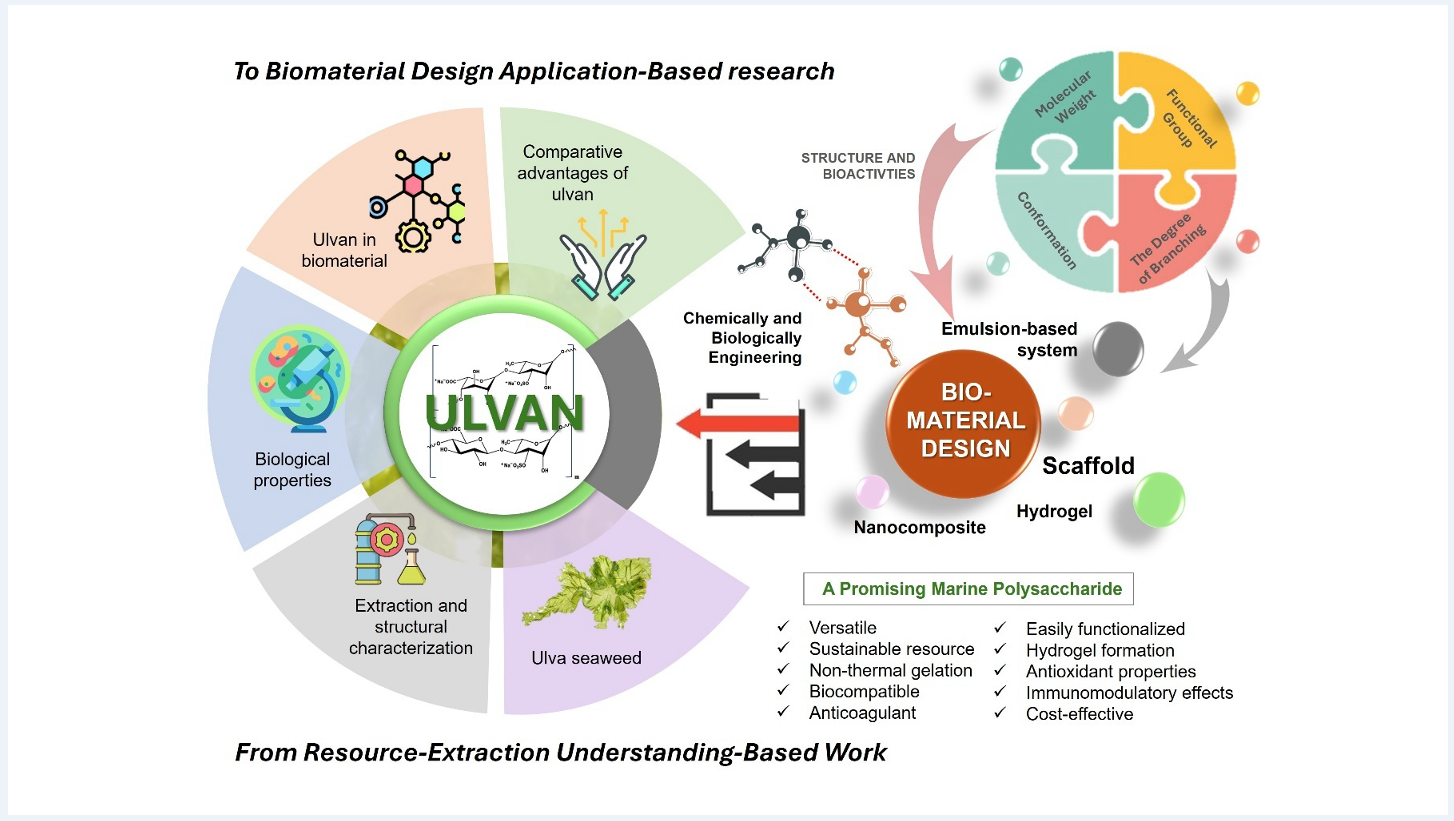
Currently, green seaweed is underutilized compared to other major seaweeds. Among green seaweeds, many scientists have reported the utilization of Ulva in various fields in recent years, which intrigues its potential as the next top candidate for biomass in industrial biorefineries. Ulva has unique polysaccharides called ulvan, which are considered for medicinal and pharmacological applications. Ulvan is a sulfated polysaccharide consisting of rhamnose, glucuronic acid, and sulfated sugar units, which offers a range of bioactive properties, including immunomodulation, antimicrobial activity, anticoagulant, and biocompatibility, making it a versatile candidate for biomaterial design. This review presents an in-depth analysis of the potential route for the application of ulvan, starting from extraction methods, structural and biological characterization to biomaterial design, highlighting its advantages over traditional polysaccharides such as agar, carrageenan, and alginate.
Keywords:
green seaweed
; marine biomaterial
; ulvan
; cellulose
1. Introduction
In recent years, seaweed, or macroalgae, has attracted significant attention for its potential as a sustainable source of food and non-food industries, such as food additives, animal feeds, pharmaceuticals, nutraceuticals, cosmetics, textiles, biostimulants, bioplastics, and biofuels [1,2,3,4,5,6]. Seaweed are simple aquatic plants that thrive in diverse environments, ranging from freshwater to highly saline oceans [7]. From an environmental point of view, seaweed is a highly autotrophic plant [8]. Through photosynthesis, seaweeds produce significantly more organic matter and consume CO₂. The photosynthetic efficiency of seaweeds was 3–5 times higher than terrestrial plants [7,9] making it highly effective in converting sunlight and CO₂ into biomass. The carbon uptake rates reach 8–20 tons per hectare/year [4,8,9] contributing to carbon sequestration and helping mitigate climate change. Furthermore, the biomass productivity of seaweed was greater than terrestrial biomass [10]. For instance, the yield of brown seaweed was 225 tons dry weight/Ha/year, 2.3 yield was 2.3 folds higher than sugarcane [9]. In addition, seaweed has lower lignin content than land plants [6,11,12,13] so the process of extracting seaweed components will be easier with lower energy input.
Based on the pigments contained in their thallus, seaweeds are classified into three major groups: red seaweeds (Rhodophyta), green seaweeds (Chlorophyta), and brown seaweeds (Phaeophyta) [4,7]. Currently, red, and brown seaweed are widely known both in terms of the number of species and their commercial production. Suntana et al. reported that the number of red and brown seaweed species reached 4000 and 1500 species respectively, while green seaweed only 900 species [14]. Apart from being obtained from the wild, several types of seaweed can also be cultivated well [15]. Seaweed cultivation offers several advantages over terrestrial plant farming, making it a sustainable and environmentally friendly choice. On seaweed cultivation, there is no need for arable land [15,16] and reduce competition with terrestrial agriculture which ends the need for arable land and reduces competition with terrestrial agriculture [6]. In addition, unlike terrestrial plants, seaweed does not require fresh water or chemical fertilizers [16], conserving valuable resources and minimizing pollution.
Green seaweed, especially Ulva, is one of the promising species in terms of availability, sustainability, and potential applications and uses. Ulva is commonly known as sea lettuce and is seen worldwide [17,18]. Remarkably, Ulva shows adaptability to various salinities, growing well in marine and brackish water and freshwater [19,20]. Some species of Ulva caused green tide bloom. Green tide blooms occur more global seawater eutrophication and temperature rise [21]. The largest Ulva-forming green tide happened in the Yellow Sea of China, covering 1746 km² and producing over 24 million tons of biomass [22]. Ulva thrives in diverse habitats, including tidal pools and rocky shores, and can grow optimally in water temperatures of 20 – 30 °C [17,23,24]. Daily growth rate (DGR) in the open sea was 20.1 ± 1.8 % day−1. Interestingly, it was cultivated in the pond or tanks, the DGR reached 27.9 ± 4.4 % day−1 [18]. Studies have also shown that Ulva achieves higher growth rates than other seaweed massively cultivated such as Porphyra umbilicalis, Chondrus crispus, and Laminaria saccharina [25,26].
Ulva is composed of mainly carbohydrates (47 – 67 %) [27] consisting of starch (4 %), cellulose (9 – 10 %), hemicellulose (14 – 32 %) and Ulvan (13 – 39 %). The protein content of Ulva was (12 – 30 %) and fat (1 – 4 %). Like seaweed, Ulva also has ash (21 – 45 %) [27,28,29,30] consisting of macro and micro minerals. Ulva sp. as a nutraceutical agent can be used as food that shows beneficial physiological functions, improves well-being, and reduces the risk of certain diseases, including inflammatory disorders, cancer, bacterial infections, and viral infections; it also acts as an immunomodulating and hypolipidemic agent [31]. Generally, Ulvan is extracted from seaweed by conventional methods carried out separately. This process will produce waste and environmental problems. Through the concept of integrated biorefinery [6,29,30,32,33,34,35], the production of ulvan with various byproducts will be able to increase the added value of the Ulva seaweed industry. Through the biorefinery approach, process efficiency can be increased, for example increasing from 26% to 39%, as well as cellulose as a by-product increasing from 12% to 39% [28]. Although several papers have comprehensively reviewed ulvan [31,36], to the best of our knowledge, there are few reported concepts of biorefinery concept with green extraction ulvan which focuses on ulvan characteristics for biomaterial purposes. Moreover, there are no studies that have revealed its transition from resource-extraction understanding-based research to biomaterial design application-focused work while addressing the chemical and biological engineering aspects of its exploration. In line with this knowledge gap, this review further explores the comparative advantages of ulvan by comparing its properties in relation to other seaweed-derived polysaccharides and examining the challenges it faces in future applications for biomaterial design across various fields.
2. Ulva, Structural Characteristics, and Extraction of Ulvan
2.1. Ulva
As is generally observed in the seaweed, the entire body of Ulva is known as a thallus which is composed of hold fast, stipe, and blade standing for the function of root, stem, and leave in the higher plant such as seagrass. The size of the thallus reaches 100 cm. The color of the thallus ranges from bright green to dark green, depending on the species and environmental conditions. The dominance of chlorophyll pigments causes green color. The shapes of the thallus are thin, flat, and sheet-like resembling lettuce leaves. Some species may appear tubular or filamentous [15]. Examples of species, color and shape are presented in Figure 1.
2.2. Ulvan Chemical Structure characteristic
The chemical structure of ulvan polysaccharide consist of repeating sugar which unique to Ulva species (Figure 2). The major monosaccharide sugars are rhamnose, glucuronic acid, xylose, iduronic acid, and galactose. Sulfate group is attached in all rhamnose and some xylose [37]. Based on thallus morphology, Ulva divides into blade and filamentous. The nomenclature of repeating disaccharide is first initiated by Kidgell et al. [36]. The repeating sugar in ulvan polysaccharide of blade and filamentous Ulva are different, resulting different sugar composition. In their new study, it was found that in the filamentous U. ralfsii and U. prolifera, sulfate also found in glucuronic acid [38]. Besides sulfate, ulvan also have carboxyl group on uronic acid in the form of glucuronic acid and iduronic acid. A lot of hydroxyl group makes ulvan hydrophilic and water-soluble.
2.3. Ulvan Extraction Strategy
In ulvan extraction, the quantity and quality of the extracted ulvan depend on the extraction method, purification process, and biomass sources. The ulvan polysaccharide extraction method is selected based on the properties of the ulvan molecule, its physicochemical characteristics, and its interactions with other components [39]. Broadly, ulvan extraction can be categorized into three approaches: physical, chemical, and enzymatic. The extraction process primarily focuses on ulvan due to its high abundance. However, co-extraction during the process often results in the presence of salts, proteins, pigments, and other polysaccharides, such as cellulose, glucuronan, xyloglucan, and starch. The intended final product plays a critical role in determining the specific steps of ulvan extraction. Figure 3 illustrates the schematic of ulvan extraction from Ulva. In this work, we will unravel the steps of ulvan extraction, emphasizing yield, strategies, and the management of side products in the context of Ulva biorefinery.
In the biorefinery concept, the goal is to optimize the use of biomass resources by maximizing benefits and profitability while minimizing waste [40]. As previously mentioned, Ulva holds significant potential, with ulvan being its most unique and valuable component. Therefore, focusing on ulvan as the primary extraction target, while managing other potentials through sequential extraction, presents a highly attractive approach. In the context of ulvan biorefinery, side products can be categorized into co-products, ulvan itself, and residual products.
The co-products in Ulva include salts, pigments, lipids, and proteins. Extracting co-products helps reduce co-extracted impurities in ulvan, thereby increasing its yield. Since Ulva is harvested from the sea, it contains a high salt content, which can impact the extraction process. Reducing salt content enhances protein yield while decreasing the mineral content. For instance, extracting Ulva with distilled water at 25 °C for 2 hours or at 40 °C for 30 minutes removes 22 % of the salt without significantly affecting ulvan extraction [41]. In addition to salt, starch can be extracted using cold distilled water. Extraction of starch from U. ohnoi with cold distilled water and a homogenizer yields 7.33 % of the dry weight of Ulva [30].
Another valuable co-product is pigment, which can be extracted using ionic liquids or organic solvents [42]. Ethanol is the most commonly used solvent for pigment extraction from Ulva, yielding 3.6 mg/g of dry weight [43]. Cascading extraction, starting with salt removal, increased the ulvan yield from 3.7 % to 8.2 % of Ulva dry weight, while subsequent pigment extraction showed no significant impact on ulvan yield [44]. Besides pigments, ethanol also extracts lipids and proteins from Ulva [44,45]. The compounds extracted with an ethanol-to-water ratio of 70:30 exhibit bioactivity, with an IC50 of 1.2 g/mL of biomass in the solvent [46]. Although pigment removal at the beginning of the process has minimal effect on ulvan yield, pigments themselves have significant applications in fields such as cosmetics, food additives, and pharmaceuticals. Therefore, their early extraction holds considerable value on its own.
The extraction of ulvan requires careful optimization of solvents and conditions, as these not only influence ulvan yield but also affect the co-extraction of other materials. Table 1 summarizes the ulvan yields, molecular properties, and extraction conditions across various Ulva species. Solvents used for ulvan extraction are typically categorized as acidic, alkaline, or neutral. Among these, acidic solvents generally produce higher yields compared to alkaline solvents [45]. Interestingly, even hot distilled water, a neutral solvent, can achieve good ulvan yields with a wide range of molecular weights [36]. Acidic solvents likely enhance ulvan extraction by breaking down the cell wall matrix and disrupting ionic interactions between ulvan and other components, making the polysaccharide more accessible for solubilization. In contrast, alkaline solvents may lead to degradation or selective solubilization of other polysaccharides, reducing ulvan recovery.
In addition to solvent selection, an extraction temperature of at least 80 °C is recommended for optimal results. Assisted extraction strategies, such as microwave, ultrasonic, autoclave, hydrothermal, or enzymatic techniques, can further enhance ulvan yield. Enzymatic assistance using cellulase, for example, is energy-efficient and achieves higher yields compared to non-assisted methods [47]. While physical-assisted methods are highly effective in increasing yield, they tend to consume significantly more energy compared to enzymatic approaches. Physical-assisted methods, such as microwave and ultrasonic techniques, improve extraction by disrupting cell walls through rapid heating or mechanical vibrations [45,48]. Enzymatic approaches target specific bonds, like glycosidic linkages, to release ulvan with minimal structural damage and energy use [49].
The solid fraction generated during ulvan extraction constitutes a significant portion of the residual product. This solid fraction contains cellulose, protein, and minerals, with its composition varying based on the pretreatment and extraction processes used. For instance, the residual solid obtained from hydrothermal extraction combined with supercritical CO₂ and ethanol pretreatment is rich in cellulose and protein but has lower heavy metal and mineral content, making it a promising candidate for food or feed applications [50,51]. The cellulose derived from Ulva exhibits unique characteristics, which make it suitable for a wide range of applications. Separating protein and cellulose from the residual solid can yield more valuable side products, enhancing the overall economic and environmental sustainability of the ulvan biorefinery process.
During the extraction of ulvan, various other components are co-extracted, which are typically considered impurities. To obtain pure ulvan, these impurities must be effectively removed. Ulvan, a water-soluble polysaccharide, is insoluble in alcohol [5]. This property allows for its selective precipitation, while other soluble compounds remain in the liquid phase. Even with extended pretreatment strategies, the precipitation step remains critical for isolating pure ulvan [44]. This step separates ulvan from pigments, lipids, and proteins. Subsequent processes, such as centrifugation, evaporation, and ultrafiltration, are employed to further separate the liquid and solid phases following precipitation.
Alcohol precipitation is a convenient and widely used method; however, its effectiveness is limited by the insolubility of certain impurities, such as salts and starch. Post-treatment using enzymes or strong chemicals, such as peracetic acid, provides an effective means of minimizing co-extracted components [5]. For example, α-amylase can be used to reduce starch content, while proteinase K is effective for protein removal [59]. Dialysis and ultrafiltration are commonly used to remove salts from ulvan extracts. Before dialysis, the precipitated ulvan must be rehydrated using distilled water or an appropriate buffer solution. Dialysis typically employs membrane tubing with a molecular weight cut-off (MWCO) ranging from 12–14 kDa [60]. The choice of downstream processing steps for ulvan purification depends on its intended applications, as ulvan has a wide molecular weight range, spanning from over 400 kDa to less than 3.9 kDa [36]. Molecular weight-based purification is often performed using Size Exclusion Chromatography (SEC), which allows for precise separation based on size. The molecular weight of ulvan plays a crucial role in determining its rheological properties and bioactivity, with higher molecular weights favoring structural applications and lower molecular weights enhancing bioavailability in pharmaceutical uses.
SEC separates ulvan based on particle size, which is determined by the hydrodynamic volume of the molecules in solution. This separation can be used to estimate molecular weight by comparing the elution profile of ulvan to a calibration curve generated with standards of known molecular weight. High-performance SEC is typically performed using distilled water as the mobile phase and carried out on a High-Performance Liquid Chromatography system equipped with an Infrared detector [58]. Further separation may be required if the target product is a rare sugar, such as rhamnose. Rare sugars such as rhamnose are valuable for their applications in pharmaceuticals and as precursors in chemical synthesis, necessitating further refinement to achieve the desired purity and concentration.
3. Biological Properties of Ulvan
Ulvan holds significant potential as a biomaterial, largely due to its exceptional biological properties that are crucial for the functionality of biomaterials. This review highlights ulvan's biological activities, focusing on its role as a biomaterial with key attributes such as excellent biocompatibility, immunomodulatory effects, anticoagulant activity, and antimicrobial properties. These properties are essential for biomaterials, as they enable compatibility with biological systems and enhance therapeutic efficacy, making ulvan a promising candidate for various biomedical applications.
3.1. Biocompatibility Profile
Biomaterials must be compatible with biological tissues, meaning they should not provoke harmful immune responses or toxicity when introduced into the body. This is a critical characteristic for materials used in implants, drug delivery systems, and tissue engineering. The biocompatibility of ulvan has been assessed through various techniques, including cytotoxicity tests, haemolysis assays, and studies of cellular uptake and interactions.
Cytotoxicity testing has been performed both in vitro on cell cultures and in vivo using experimental animals [61,62]. Ulvan’s cytotoxicity has been studied across a range of cell types, including fibroblast cells (e.g., mouse C3H [L929], 3T3) [63,64], macrophage cell lines (e.g., RAW 264.7, peritoneal, and J774A.1) [65,66,67,68], gut cells (e.g., IPEC-1) [69,70,71], myoblast cell ( e.g. mammalian L6 cells) [72,73,74], HaCaT keratinocytes [75], Vero cells [76] and in animal models such as mice and rats [77]. T The most used method for cytotoxicity testing is the MTT (3-(4,5-dimethylthiazol-2-yl)-2,5-diphenyltetrazolium bromide) assay, which measures cell viability by detecting the reduction of yellow MTT dye into purple formazan crystals by metabolically active cells, indicating mitochondrial activity.
Ulvan has generally been shown to be non-toxic, with several studies reporting high cell viability across various cell lines exposed to ulvan extracts. Fractions of ulvan from several spesies of Ulva, namely U. pertusa [65,66], U. intestinalis [68,78], U. armoricana [69,70], U. lactuca [63,77,79], U. clathrata [80], U. compressa [81], and U. prolifera [67,82], exhibited over 50 % cell viability at concentrations of ≥500 μg/mL. Furthermore, ulvan derived from Ulva sp. has been proven safe for mammalian L6 cells, showing no cytotoxic effects at concentrations under 90 mg/mL. Similarly, it did not show toxicity in 3T3 cells even at concentrations up to 10,000 mg/mL [83]. In human L929 cells, ulvan remained metabolically active after 72 hours of exposure, with no decrease in cell viability [64].
The hemolysis assay, which measures hemoglobin release from red blood cells, is a simple screening method for potential biocompatibility of a material. Ulvan extracted from U. lactuca demonstrated hemolytic activity, with a recorded hemolysis percentage of 12.38 % at a concentration of 100 μg/mL. The negatively charged oxygen groups on ulvan electrostatically interact with the positively charged phosphatidylcholine lipids on the outer surface of red blood cells, contributing to ulvan’s hemolytic activity [84].
3.2. Immunomodulatory effect
Immunomodulatory properties are a key biological activity that can serve as an essential parameter in biomaterial characterization, especially in applications involving interactions with the immune system, such as tissue engineering, wound healing, implants, and drug delivery. The ability of a biomaterial to modulate immune responses in a controlled manner ensures safety, biocompatibility, and effectiveness in these medical applications [85,86]. Immunomodulation refers to the alteration of the immune system's response, either by enhancing immune responses (immunostimulatory) or reducing excessive immune activity (immunosuppressive). This process involves regulating immune cell functions (like macrophages, T cells, or natural killer cells), cytokine production, and overall immune system responsiveness. The primary goal of immunomodulation is to achieve a balanced immune response that supports effective defense against infections or tumours while preventing immune system overactivation, as seen in autoimmune diseases and allergies [85].
The immunomodulatory effects of ulvan have been widely investigated in various macrophage cell types, including RAW 264.7 cells (Rat Adherent White blood cell 264.7 cells), mouse peritoneal macrophages, J77A.1 cells, and fish head kidney cells [86,87,88,89,90,91,92]. Moreover, ulvan’s impact on immune modulation has been explored in several models, such as fish [93,94], porcine intestinal epithelial cells (IPEC-1 cell line), rats [77,97], mice [77,78,95,96], and chickens [97]. A range of probes are commonly used to evaluate ulvan’s effects on inflammation, including signalling molecules (e.g., cytokines like tumor necrosis factor-alpha (TNF-α) , interleukin, IL (IL1, IL2, IL6, IL10, IL12), C-X-C motif chemokine ligand (CXCL1, CXCL12, CXCL14), and C-C motif chemokine ligand), which are various types of interleukins and chemokines that play roles in immune regulation), active metabolites (e.g., Prostaglandin E2), nitric oxide (NO)), immunoglobulins (e.g. immunoglobulin M (IgM), Intercellular Adhesion Molecule, and Vascular Cell Adhesion Molecule-1), enzymes (e.g., cyclooxygenase-2 (COX-2) , inducible nitric oxide synthase-2 (iNOS-2) , Heme Oxygenase-1, and Myeloperoxidase), and transcription-related molecules (e.g., nuclear factor kappa-B (NF-κB) and mRNA) [65,66,67,78,82,94,95,98].
The immunomodulatory effects of ulvans are closely associated with the inflammatory response, which can be divided into four key stages: inducers, sensors, mediators, and target tissues, as shown in Figure 4. Inflammation begins with inducers, which can be classified as either exogenous or endogenous. Exogenous inducers, such as pathogen-associated molecular patterns, are recognized by specific receptors, while endogenous inducers include damage-associated molecular patterns released from damaged host cells. Other endogenous molecules, like advanced glycation end products and oxidized lipoproteins, are often linked to oxidative stress and can also trigger inflammation. Sensors, such as Toll-like receptors (TLRs), Nod-like receptors, and other pattern recognition receptors, identify these inducers and activate downstream signaling pathways like mitogen-activated protein kinase (MAPK), NF-κB, and SIRT1/FOXO1. These signaling pathways lead to the production of various inflammatory mediators, including chemokines, cytokines, vasoactive amines, eicosanoids, matrix metalloproteinases, nitric oxide, and free radicals. These mediators are involved in several processes, such as pain induction, immune modulation, and tissue repair. The target tissues affected by these mediators show responses such as increased vascular permeability, immune cell recruitment, and either tissue damage or repair. If this process is dysregulated, it may lead to chronic inflammation and associated disorders [65].
Ulvans function as immunomodulatory agents through various mechanisms that influence the immune system, including the suppression of pro-inflammatory cytokine production, modulation of the NF-κB pathway, enhancement of anti-inflammatory cytokines, regulation of TLR signaling, and restoration of gut microbiota balance (Figure 4). The immunostimulatory properties of ulvan are largely determined by its structural features, such as monosaccharide composition, sulfate content, and molecular weight, as discussed by Kidgell (2019) [36]. One of the key mechanisms of ulvans is the regulation of cytokine production, particularly pro-inflammatory cytokines that are crucial in immune responses. Cytokines like TNF-α, IL-6, and IL-1β, which are commonly elevated in inflammatory conditions such as inflammatory bowel diseases (IBD) [100], can be modulated by ulvans. Additionally, ulvans regulate intestinal inflammation by inhibiting the NF-κB pathway. Ali et al. (2016) [101] demonstrated that ulvan from U. pertusa COMP reduces the production of pro-inflammatory cytokines (IL-12, p40, IL-6, TNF-α) by preventing the phosphorylation of IκBα, which inhibits its degradation and the nuclear translocation of NF-κB. This action suppresses the expression of inflammatory genes and helps maintain immune homeostasis.
Ulvans enhance the production of anti-inflammatory cytokines, such as IL-10. This cytokine is vital for suppressing inflammatory responses and promoting tissue repair. By increasing IL-10 levels, ulvans counteract the effects of pro-inflammatory cytokines, further contributing to an anti-inflammatory state [102,103]. Ulvans also play a role in regulating TLR signaling pathways, particularly TLR4. By modulating these pathways, ulvans can inhibit the activation of downstream inflammatory responses, including those mediated by NF-κB and MAPK pathways. This regulation is essential for preventing excessive immune activation and inflammation [102].
The immunomodulatory effects of ulvan are partly attributed to its capacity to alter the gut microbiota. The gut microbiome plays a key role in immune system regulation, and ulvan’s prebiotic properties support the growth of beneficial microbes, enhancing immune function and controlling inflammation [103,104,105,106]. Ulvans influence the gut microbiota by promoting beneficial bacteria and regulating immune responses, which is essential for gut health and preventing inflammation-related disorders. By restoring microbiota balance, ulvans help maintain immune homeostasis, promoting beneficial bacteria and suppressing harmful ones, which is important for preventing dysbiosis and reducing inflammation [107,108].
3.3. Anticoagulation Activity
Anticoagulant activity is a vital characteristic of biomaterials used in medical applications, especially those that come into direct contact with blood. This property ensures biocompatibility, functionality, and safety by preventing blood clot formation (thrombosis), minimizing inflammation, and maintaining proper blood flow, which collectively improve patient outcomes and extend the lifespan of medical devices [109]. The anticoagulant potential of a molecule is typically assessed through three primary tests: activated partial thromboplastin time, thrombin time, and prothrombin time. These tests evaluate how the material influences various pathways in the coagulation cascade, providing critical information about its hemocompatibility.
Studies have indicated that ulvan, a polysaccharide derived from various species of the seaweed genus Ulva, exhibits anticoagulant effects. Key species include U. clathrata [110], U. lactuca [111,112], U. prolifera [113], U. fasciata [112,114], U. nematoidea [115], U. conglobata [116], U. linza [117,118], and U. reticulata [112]. The anticoagulant potency of ulvan differs across species and is influenced by environmental and physiological factors. The anticoagulant activity of ulvan depends on the degree of sulfation and molecular weight, both of which are critical to its effectiveness [115,116,117,118]. Higher sulfation enhances its activity, while molecular weights below 200 kDa can diminish it [115].
Regarding its mechanism of action, ulvan primarily affects the intrinsic and/or common pathways of the coagulation cascade. The intrinsic pathway is triggered by the interaction of Factor XII with an anionic surface, while the extrinsic pathway is initiated when Factor VII binds to tissue factor, a receptor released from damaged cells. Both pathways converge at Factor X, activating the common pathway, which leads to the conversion of prothrombin into thrombin. Thrombin then catalyzes the transformation of soluble fibrinogen into insoluble fibrin, forming the structural framework of a clot [119].
3.4. Antimicrobial Activity
Antimicrobial activity is a crucial characteristic of biomaterials, particularly those used in medical applications, as it significantly enhances their safety and functionality. It helps prevent infections by reducing microbial colonization on the material's surface, which is especially vital for implants, wound dressings, and other medical devices. Additionally, antimicrobial properties protect biomaterials from degradation caused by microbial activity, thereby prolonging their lifespan and maintaining their performance [120].
Ulvan has been studied for its ability to combat various harmful microorganisms. Van Tran et al. [121] were the pioneers in demonstrating the antimicrobial properties of ulvan derived from U. reticulata, showing significant inhibitory effects against two pathogenic bacteria linked to skin diseases and inflammation. They reported inhibition zones of 20 mm against Enterobacter cloacae and 18 mm against Escherichia coli. Fournière et al. [122] also documented the biological activity of ulvan extracts from Ulva species against Staphylococcus aureus, Staphylococcus epidermidis, and Cutibacterium acnes. In addition, Ibrahim et al. [123] emphasized the potent antimicrobial effects of partially purified ulvan from U. lactuca against certain fish and human pathogens, including E. coli ATCC 8739 and C. albicans ATCC 10,231. However, ulvan showed no antimicrobial activity against two Gram-positive bacteria (S. aureus ATCC 25,923 and L. monocytogenes ATCC 35,152), a Gram-negative bacterium (B. pertussis ATCC 8467), or fungal pathogens (A. niger, P. notatum, and F. solani). The antimicrobial effects of ulvan are attributed to its distinctive chemical structure, which is composed mainly of rhamnose, uronic acid, and sulfate groups [121].
4. Ulvan in Biomaterial Design
Due to its unique structural and functional properties, ulvan exhibits significant potential across fields. The unique structure come from its β-(1,4) backbone is composed of alternating glucuronic acid (GlcA) and rhamnose (Rha) units, which are often modified by varying patterns of sulfation. These sulfate groups are crucial because they enable intermolecular interactions, such as hydrogen bonding and electrostatic forces, which are essential for gelation [124]. Additionally, ulvan contains carboxyl groups that serve as active sites for synthesizing complexes with other molecules, further expanding its functional versatility. The natural origin of ulvan as a renewable and sustainable material further enhances its relevance in environmentally friendly biomaterial design.
Ulvan has the remarkable ability to transform liquids into semi-solid gels by forming network structures. This process occurs through hydrogen bonding, ionic interactions, or hydrophobic interactions. These properties make ulvan highly valuable in the food, cosmetics, and pharmaceutical industries, where it is used to improve the texture, stability, and consistency of products. We will discuss the ulvan in hydrogel, film, emulsion, and nanocomposite (Figure 5).
4.1. Ulvan-Based Hydrogel
Ulvan’s carboxyl and sulfate groups play a pivotal role in its ability to form hydrogels through various crosslinking methods. One such method involves oxidizing ulvan with sodium periodate, which introduces aldehyde groups along the polysaccharide backbone [125]. These aldehyde groups react with gelatine's amine groups through Schiff-base reactions, forming covalent imine bonds. The Schiff-base reaction occurs when the aldehyde groups (−CHO) in ulvan dialdehyde interact with the primary amine groups (−NH2) in lysine residues of gelatine, resulting in stable C=N bonds [126]. Using phosphate-buffered saline (PBS), hydrogels with 80% gelatine and 20% ulvan showed the lowest swelling capacity (300%), while hydrogels with 40% gelatine and 60% ulvan reached the highest swelling capacity (900%). When deionized water was used, swelling capacity increased significantly, with 80% gelatine and 20% ulvan samples showing 1000% swelling, and 40% gelatine and 60% ulvan samples exhibiting an extraordinary swelling capacity of 2400% [50]. These results demonstrate the tunable properties of ulvan-based hydrogels depending on solvent composition and polymer ratios. This interaction not only creates a robust hydrogel network but also enhances its binding capacity for dyes and heavy metal ions, utilizing the free amine groups from gelatine and carboxyl groups in ulvan [45]. The Schiff-base strategy involving gelatin matrices is applicable for tissue engineering application [127] and bone tissue engineering [128].
Another advanced approach uses enzymatic crosslinking with horseradish peroxidase (HRP) and hydroxyphenyl compounds such as tyramine. Hydroxyphenyl compounds are particularly suitable substrates for HRP due to their reactivity in green chemistry processes [129]. Tyramine is the most commonly used hydroxyphenyl compound in enzymatic gelling systems, offering a safe profile and efficient conjugation via its terminal amine group [130]. In this system, ulvan-tetrahydroxyphenyl (UT) conjugates are synthesized by forming amide bonds between the carboxyl group of ulvan and the amine group of tyramine, facilitated by carbodiimide chemistry [131]. The carboxyl groups are first activated by reacting with EDC and sulfo-NHS in a slightly acidic environment, creating reactive sulfo-NHS esters optimized for polymer bonding. In the presence of hydrogen peroxide (H2O2), HRP catalyzes the oxidative coupling of hydroxyphenyl compounds through a radical mechanism [130]. Covalent bonds form between carbon atoms in the ortho position to the hydroxyl or oxygen atoms of phenol groups, creating a stable crosslinked network. These enzymatically crosslinked hydrogels achieve swelling degrees of approximately 2000%, classifying them as superabsorbent materials [128]. The enzymatic and H2O2 conditions can be adjusted to optimize gelation times for applications such as injectable hydrogels [132].
Ulvan’s gelling potential is also being explored in the development of bioinks for 3D printing applications. A bio-ionic liquid derived from ulvan is formulated by mixing it with choline chloride and subjecting it to ethanol precipitation. This process results in a material with excellent viscoelastic strength, making it an ideal candidate for use in advanced 3D bioink formulations [53]. More details on its biocompatibility and specific cell interaction performance would further solidify its relevance in biomedical applications.
The exploration of ulvan hydrogels extends to food applications. When formulated with alginate, ulvan forms a scaffold suitable for probiotic encapsulation. While alginate is widely used as a scaffold for nutrient encapsulation [133] , it has limitations when applied to systems involving living organisms. In contrast, ulvan demonstrates strong prebiotic activity and supports cell proliferation [134] , effectively addressing alginate's limitations in microbial encapsulation. Ulvan-alginate hydrogel beads for probiotic immobilization have been shown to enhance the survival rate of probiotics in both simulated gastric and intestinal fluids [135] . This system offers significant potential for applications in the food and beverage industry.
4.2. Ulvan-Based Film
Ulvan-based film formulations utilize glycerol as a plasticizer to create hydrophilic films. These films are typically composed of ulvan, glycerol, distilled water, and boric acid. To enhance the material’s characteristics, 10% carnauba wax and Tween-80 can be added, resulting in hydrophobic films ideal for food packaging. These hydrophobic films demonstrate impressive mechanical properties, with an average tensile strength of 1 MPa and an average elongation at break of 80% [56]. Further comparisons with conventional gelling agents could provide insight into ulvan’s superior performance and sustainability.
4.3. Ulvan-Based Nanocomposite
Hybrid hydrogels that incorporate ulvan exhibit enhanced mechanical and functional properties. For instance, ulvan crosslinked with citric acid and hybridized with sodium carboxymethyl cellulose (Na-CMC) achieves a swelling degree of up to 387.5%, highlighting its improved mechanical stability. This hybrid hydrogel is synthesized using a single-pot heating method, where a fixed citric acid concentration of 20 wt% is used to crosslink ulvan and Na-CMC. The simplicity of this process enhances its applicability in scalable production methods. Comparatively, ulvan hydrogels without Na-CMC show a swelling capacity of 248.7%, demonstrating that hybridization significantly improves performance. [54]
Comprehensive utilization of Ulva is further demonstrated by Mariia et al. [136]. Ulvan is reacted with chitosan to form polyelectrolyte complexes involving anionic and cationic side chain interactions. The sulfate groups in ulvan carry a negative charge (anionic), while the amine groups in chitosan are positively charged (cationic). Combining chitosan/ulvan with cellulose nanocrystals (CNCs), extracted from the solid residue of ulvan extraction, results in nano-bio composite hydrogels designed for wound healing applications. Chitosan hydrogels incorporating 20% CNC show enhanced tensile strength of 1.2 MPa and a significant increase in swelling capacity, indicating improved mechanical properties. Furthermore, these nanocomposites exhibit excellent cell proliferation, remarkable biocompatibility, and non-toxicity. The sustained release of epidermal growth factors from these hydrogels accelerates wound healing, demonstrating their advanced therapeutic potential.
Further advancements in ulvan research include ulvan hybrid with carrageenan and polyvinyl alcohol (PVA). For ulvan hybrid carrageenan, the synthesis of ulvan-amide derivatives through carbodiimide chemistry. These derivatives enable the creation of ulvan-kappa-carrabiose hybrid polysaccharides, expanding the scope of ulvan-based materials [137]. For ulvan nanofiber fabrication with PVA, ulvan-polyvinyl alcohol (PVA) nanofibers, produced via electrospinning with a 1:2 ulvan/PVA ratio, demonstrate promising potential for advanced material applications, including biomedical and environmental uses [125]. Specific examples of these applications, such as filtration membranes or antimicrobial coatings, would add depth.
4.4. Ulvan-Based Emulsion
A detailed evaluation of ulvan highlights its significant potential in various industries, especially within food and cosmetic formulations. Ulvan’s capacity to hold water and oil, quantified at 3.17 g water/g ulvan and 2.66 g oil/g ulvan respectively [45], makes it particularly useful for stabilizing emulsified products. This capability helps prevent liquid separation (syneresis) while enhancing viscosity and texture, ensuring consistency in complex formulations [138].
In emulsified systems, increasing ulvan concentrations from 1 % to 3 % enhances both emulsion activity and stability. At its peak concentration of 3 %, ulvan achieves an emulsion activity index of 69.66 m²/g and a stability of 72.39 % [45]. While polysaccharides are typically recognized for their stabilizing rather than emulsifying roles, ulvan stands out due to its surface-active functional groups, such as carboxyl, sulfate, and hydroxyl, as well as hydrophobic protein-like elements [139]. The molecular structure of ulvan, which includes a high molecular weight and glucuronic acid content, significantly bolsters its ability to form stable emulsions by increasing solution viscosity and strengthening interfacial layers [140].
Ulvan also exhibits excellent foaming capabilities, achieving a foaming capacity of 75 % and a stability of 54 % at 3 % concentration [45]. These properties are crucial for developing consistent and appealing textures in food and cosmetic products [140]. As ulvan concentrations increase, its ability to stabilize foam improves, largely due to its high molecular weight. This allows it to create robust networks at the air-water interface, effectively delaying the merging of gas bubbles and prolonging foam integrity. Such characteristics are highly beneficial for applications in whipped desserts, aerated beverages, and cosmetic mousses, where stable foam structures are essential [139,140].
5. Comparative Advantages of Ulvan
One of the key advantages of ulvan is its potentially high yield due to the high and robust biomass of Ulva species, which can outperform other seaweed sources such as agar, carrageenan, alginate, laminaran, fucoidan, porphyran, floridean, and xylofucoglycan [141]. As mentioned in the previous section, ulvan extracted from Ulva is derived from an undesired seaweed, which can be produced 7 – 10 times faster and in higher quantities than other commercially available seaweed biomass in the current seaweed industry. This characteristic ensures a sustainable production pipeline, addressing scalability issues that often limit other polysaccharides.
The extraction of ulvan is also reported to be relatively easy and simple, making it a more accessible and cost-effective option compared to other marine polysaccharides. Compared to other marine polysaccharides, ulvan demonstrates superior yield potential, with up to ~41 % extraction efficiency from dry Ulva biomass [56,142]. This is higher than the yields typically reported for agar (10 – 15 %) or fucoidan (5 – 10 %). The ability of Ulva species to proliferate in eutrophic environments further enhances its suitability for large-scale production, reducing reliance on pristine ecosystems required for agarophytes or carrageenophytes. Chemically, with ulvan’s unique properties, stands as an equally competitive seaweed polysaccharide alongside others such as agar, carrageenan, alginate, laminaran, fucoidan, porphyran, floridean starch, and xylofucoglycan, offering distinct advantages in yield, functionality, and bioactivity.
Notably, unlike agar or carrageenan, which require heat for gel formation, ulvan can form gels under non-thermal conditions through ionic cross-linking with CaCl2 and H3BO3 [143]. This characteristic could position it as a potential alternative to alginate, a widely used marine polysaccharide This property is advantageous for applications requiring cold processing, such as in the pharmaceutical and food industries. For instance, ulvan-based hydrogels can encapsulate heat-sensitive bioactives, a limitation for thermally reliant gelling agents. Furthermore, the high sulfate content of ulvan has garnered interest in the biomedical field, as it may confer anticoagulant properties, similar to heparin, leading to it being referred to as the "vegan heparin" [144]. Compared to other seaweed polysaccharides, ulvan has also demonstrated versatility in its bioactive compounds, exhibiting a range of beneficial properties, such as antioxidant, immunomodulatory, anticancer, and antimicrobial activities [141,145]. The richness of sulfated moieties in ulvan’s structure also favors its potential for engineering and modification, opening up opportunities for the development of innovative polymeric materials and applications [146]. The comprehensive comparison between ulvan and other marines’ polysaccharide shows in Table 2.
Despite potential of ulvan discussed in the previous chapter, it faces certain challenges that could hinder its broader adoption in commercial and industrial needed. Key limitations include:
Extraction Complexity and Standardization. The extraction process for ulvan remains less standardized compared to traditional polysaccharides like agar or carrageenan. Variability in the chemical composition of Ulva biomass due to environmental factors affects the consistency and quality of ulvan. Green solvent and enzyme-assisted methods show promise for improving efficiency but require further optimization for industrial scalability.
Seasonal Yield Variability. Currently, most Ulva cultivation occurs in wild or semi-wild conditions, where environmental factors such as temperature, nutrient availability, and seasonal variations significantly affect the yield and quality of ulvan. This lack of controlled cultivation introduces variability and limits the scalability of ulvan production.
Functional Limitations. Although ulvan exhibits excellent gelling and bioactive properties, its mechanical strength in hydrogels is often lower compared to alginate or carrageenan. This limitation restricts its use in applications demanding high structural integrity, such as wound dressings or load-bearing scaffolds in tissue engineering.
Processing Costs. Specialized extraction methods, including green solvents and enzymatic approaches, increase production costs. The absence of well-established infrastructure for ulvan processing further compounds this issue, making it less competitive than agar or alginate in certain markets.
Future Directions. To overcome these limitations, research efforts should focus on:
- Enhanced Extraction Techniques: Developing cost-effective, standardized methods for high-purity ulvan production.
- Cross-Linking Strategies: Enhancing mechanical properties of ulvan-based materials through innovative cross-linking and composite formation.
- Sustainability Metrics: Incorporating life cycle assessments to establish ulvan as a green alternative to synthetic and traditional polysaccharides.
- Controlled Cultivation: Advancing aquaculture techniques for Ulva species to ensure stable and high-quality ulvan yields independent of seasonal and environmental variations.
- Establishing high-quality ulvan standards depends on its intended use, whether as feed, a food source, or a bioactive compound in the biomedical field.
By addressing these challenges, ulvan has the potential to surpass its current limitations and establish itself as a cornerstone versatile material in biomaterial science and industrial applications.
Lastly, the evaluation of Ulvan as a biomaterial emphasizes its potential across three key strategies: Bioactive Ingredient, Scaffold-Backbone Design and Dual Function Synergetic (Figure 6). While substantial progress has been made, critical gaps remain in integrated functionality, mechanical property optimization, and encapsulation stability. Addressing these challenges could unlock transformative applications for Ulvan in biomaterial design, particularly in biomedical and industrial fields.
6. Conclusion
Ulva provide the potent as the versatile new generation of seaweed that more robust and sustainable. The cultivation of Ulva offers environmental benefits, including high carbon sequestration, rapid growth, and low resource requirements. Integrated green biorefinery of Ulva approaches enhance its polysaccharide extraction efficiency of ulvan as the main sugar. It enables the recovery of valuable co-products such as pigments, proteins, and cellulose, boosting sustainability. Ulvan's superior yield and scalability compared to other marine polysaccharides position it as an economically viable alternative.
Ulvan, a sulfated polysaccharide derived from Ulva seaweed, is a promising biomaterial due to its unique structure and exceptional bioactive properties, including immunomodulation, anticoagulant activity, antimicrobial effects, and biocompatibility. Its ability to form hydrogels, films, scaffolds, and nanocomposites makes it valuable for biomedical, food, and environmental applications. Unlike traditional polysaccharides, ulvan’s non-thermal gelation and high sulfate content provide advantages for preserving heat-sensitive bioactives and mimicking heparin-like anticoagulant properties.
Despite its potential, challenges in extraction optimization and impurity management remain. Advancing green extraction methods and exploring innovative applications will unlock ulvan’s full potential. With its sustainability, versatility, and scalability, ulvan is poised to play a vital role in advancing biomaterial design and addressing global challenges in healthcare, food security, and environmental sustainability.
Author Contributions
“Conceptualization, N.K. and U.; data curation, R.F.P., U., W.R., and S.D.H.; writing—original draft preparation, R.F.P., U., W.R., and S.D.H.; writing—review and editing, N.K., U., W.R., R.W., and M.G.; visualization, W.R., and R.F.P.; supervision, U., N.K., R.W., and M.G.; funding acquisition, U. and M.G. All authors have read and agreed to the published version of the manuscript.
Funding
This research was funded by JSPS-DGHE Joint Research Program for Fiscal Year 2022-2024, grant number JPJSBP120228101.
Acknowledgments
We thank to Directorate General of Higher Education (DGHE), Ministry of Higher Education, Science and Technology. Republic of Indonesia for the support by the Japan Society fot the Promotion of Science (JSPS) Program for the grant (JPJSBP120228101).
Conflicts of Interest
The authors declare no conflicts of interest. The funders had no role in the design of the study; in the collection, analyses, or interpretation of data; in the writing of the manuscript; or in the decision to publish the results.
Abbreviations
The following abbreviations are used in this manuscript:
| DGR | Daily growth rate |
| MWCO | Molecular weight cut-off |
| SEC | Size Exclusion Chromatography |
| IPEC-1 | porcine intestinal epithelial cells |
| TNF- α | tumor necrosis factor-alpha |
| IL | Interleukin |
| CXCL | C-X-C motif chemokine ligand |
| IgM | Immunoglobulin M |
| COX-2 | Cyclooxygenase-2 |
| iNOS-2 | inducible nitric oxide synthase-2 |
| NF-κB | nuclear factor kappa-B |
| MAPK | Mitogen-activated protein kinase |
| TLR | Toll-like receptors |
| HRP | Horseradish peroxidase |
| Na-CMC | Sodium carboxymethyl cellulose |
| CNC | Cellulose nanocrystals |
| PVA | Polyvinyl alcohol |
References
- Torres, M.D.; Kraan, S.; Domínguez, H. Seaweed Biorefinery. Rev Environ Sci Biotechnol 2019, 18, 335–388. [Google Scholar] [CrossRef]
- Baghel, R.S.; Reddy, C.R.K.; Singh, R.P. Seaweed-Based Cellulose: Applications, and Future Perspectives. Carbohydrate Polymers 2021, 267, 118241. [Google Scholar] [CrossRef] [PubMed]
- Trivedi, J.; Aila, M.; Bangwal, D.P.; Kaul, S.; Garg, M.O. Algae Based Biorefinery—How to Make Sense? Renewable and Sustainable Energy Reviews 2015, 47, 295–307. [Google Scholar] [CrossRef]
- Rudke, A.R.; De Andrade, C.J.; Ferreira, S.R.S. Kappaphycus Alvarezii Macroalgae: An Unexplored and Valuable Biomass for Green Biorefinery Conversion. Trends in Food Science & Technology 2020, 103, 214–224. [Google Scholar] [CrossRef]
- McHugh, D.J. A Guide to the Seaweed Industry; FAO fisheries technical paper; Food and Agriculture Organization of the United Nations: Rome, 2003; ISBN 978-92-5-104958-7.
- Cesário, M.T.; Da Fonseca, M.M.R.; Marques, M.M.; De Almeida, M.C.M.D. Marine Algal Carbohydrates as Carbon Sources for the Production of Biochemicals and Biomaterials. Biotechnology Advances 2018, 36, 798–817. [Google Scholar] [CrossRef]
- Chen, H.; Zhou, D.; Luo, G.; Zhang, S.; Chen, J. Macroalgae for Biofuels Production: Progress and Perspectives. Renewable and Sustainable Energy Reviews 2015, 47, 427–437. [Google Scholar] [CrossRef]
- Duarte, C.M.; Wu, J.; Xiao, X.; Bruhn, A.; Krause-Jensen, D. Can Seaweed Farming Play a Role in Climate Change Mitigation and Adaptation? Front. Mar. Sci. 2017, 4. [Google Scholar] [CrossRef]
- Ramachandra, T.V.; Hebbale, D. Bioethanol from Macroalgae: Prospects and Challenges. Renewable and Sustainable Energy Reviews 2020, 117, 109479. [Google Scholar] [CrossRef]
- Ross, F.; Tarbuck, P.; Macreadie, P.I. Seaweed Afforestation at Large-Scales Exclusively for Carbon Sequestration: Critical Assessment of Risks, Viability and the State of Knowledge. Front. Mar. Sci. 2022, 9, 1015612. [Google Scholar] [CrossRef]
- Uju; Wijayanta, A.T.; Goto, M.; Kamiya, N. Great Potency of Seaweed Waste Biomass from the Carrageenan Industry for Bioethanol Production by Peracetic Acid–Ionic Liquid Pretreatment. Biomass and Bioenergy 2015, 81, 63–69. [CrossRef]
- Uju; Wijayanta, A.T.; Goto, M.; Kamiya, N. High Yield Hydrolysis of Seaweed-Waste Biomass Using Peracetic Acid and Ionic Liquid Treatments.; Jatinangor, Indonesia, 2018; p. 020004.
- Uju; Goto, M.; Kamiya, N. Powerful Peracetic Acid–Ionic Liquid Pretreatment Process for the Efficient Chemical Hydrolysis of Lignocellulosic Biomass. Bioresource Technology 2016, 214, 487–495. [CrossRef]
- Sultana, F.; Wahab, M.A.; Nahiduzzaman, M.; Mohiuddin, M.; Iqbal, M.Z.; Shakil, A.; Mamun, A.-A.; Khan, M.S.R.; Wong, L.; Asaduzzaman, M. Seaweed Farming for Food and Nutritional Security, Climate Change Mitigation and Adaptation, and Women Empowerment: A Review. Aquaculture and Fisheries 2023, 8, 463–480. [Google Scholar] [CrossRef]
- Jung, K.A.; Lim, S.-R.; Kim, Y.; Park, J.M. Potentials of Macroalgae as Feedstocks for Biorefinery. Bioresource Technology 2013, 135, 182–190. [Google Scholar] [CrossRef] [PubMed]
- Álvarez-Viñas, M.; Flórez-Fernández, N.; Torres, M.D.; Domínguez, H. Successful Approaches for a Red Seaweed Biorefinery. Marine Drugs 2019, 17, 620. [Google Scholar] [CrossRef] [PubMed]
- Hiraoka, M. Massive Ulva Green Tides Caused by Inhibition of Biomass Allocation to Sporulation. Plants 2021, 10, 2482. [Google Scholar] [CrossRef] [PubMed]
- Mantri, V.A.; Kazi, M.A.; Balar, N.B.; Gupta, V.; Gajaria, T. Concise Review of Green Algal Genus Ulva Linnaeus. J Appl Phycol 2020, 32, 2725–2741. [Google Scholar] [CrossRef]
- Pankiewicz, R.; Łęska, B.; Messyasz, B.; Fabrowska, J.; Sołoducha, M.; Pikosz, M. First Isolation of Polysaccharidic Ulvans from the Cell Walls of Freshwater Algae. Algal Research 2016, 19, 348–354. [Google Scholar] [CrossRef]
- Park, J.; Lee, H.; De Saeger, J.; Depuydt, S.; Asselman, J.; Janssen, C.; Heynderickx, P.M.; Wu, D.; Ronsse, F.; Tack, F.M.G.; et al. Harnessing Green Tide Ulva Biomass for Carbon Dioxide Sequestration. Rev Environ Sci Biotechnol 2024, 23, 1041–1061. [Google Scholar] [CrossRef]
- Zhang, Y.; He, P.; Li, H.; Li, G.; Liu, J.; Jiao, F.; Zhang, J.; Huo, Y.; Shi, X.; Su, R.; et al. Ulva Prolifera Green-Tide Outbreaks and Their Environmental Impact in the Yellow Sea, China. Natl Sci Rev 2019, 6, 825–838. [Google Scholar] [CrossRef]
- Xiao, J.; Wang, Z.; Liu, D.; Fu, M.; Yuan, C.; Yan, T. Harmful Macroalgal Blooms (HMBs) in China’s Coastal Water: Green and Golden Tides. Harmful Algae 2021, 107, 102061. [Google Scholar] [CrossRef]
- Trivedi, N.; Gupta, V.; Reddy, C.R.K.; Jha, B. Enzymatic Hydrolysis and Production of Bioethanol from Common Macrophytic Green Alga Ulva Fasciata Delile. Bioresource Technology 2013, 150, 106–112. [Google Scholar] [CrossRef]
- Fortes, M.D.; Lüning, K. Growth Rates of North Sea Macroalgae in Relation to Temperature, Irradiance and Photoperiod. Helgolander Meeresunters 1980, 34, 15–29. [Google Scholar] [CrossRef]
- Chemodanov, A.; Robin, A.; Jinjikhashvily, G.; Yitzhak, D.; Liberzon, A.; Israel, A.; Golberg, A. Feasibility Study of Ulva Sp. (Chlorophyta) Intensive Cultivation in a Coastal Area of the Eastern Mediterranean Sea. Biofuels Bioprod Bioref 2019, 13, 864–877. [Google Scholar] [CrossRef]
- Seaweeds and Microalgae: An Overview for Unlocking Their Potential in Global Aquaculture Development; FAO, 2021; ISBN 978-92-5-134710-2.
- Pari, R.F.; Uju; Wijayanta, A.T.; Ramadhan, W.; Hardiningtyas, S.D.; Kurnia, K.A.; Firmansyah, M.L.; Hana, A.; Abrar, M.N.; Wakabayashi, R.; et al. Prospecting Ulva Lactuca Seaweed in Java Island, Indonesia, as a Candidate Resource for Industrial Applications. Fish Sci 2024, 90, 795–808. [CrossRef]
- Trivedi, N.; Baghel, R.S.; Bothwell, J.; Gupta, V.; Reddy, C.R.K.; Lali, A.M.; Jha, B. An Integrated Process for the Extraction of Fuel and Chemicals from Marine Macroalgal Biomass. Sci Rep 2016, 6, 30728. [Google Scholar] [CrossRef] [PubMed]
- El-Gendy, N.Sh.; Nassar, H.N.; Ismail, A.R.; Ali, H.R.; Ali, B.A.; Abdelsalam, K.M.; Mubarak, M. A Fully Integrated Biorefinery Process for the Valorization of Ulva Fasciata into Different Green and Sustainable Value-Added Products. Sustainability 2023, 15, 7319. [Google Scholar] [CrossRef]
- Prabhu, M.; Chemodanov, A.; Gottlieb, R.; Kazir, M.; Nahor, O.; Gozin, M.; Israel, A.; Livney, Y.D.; Golberg, A. Starch from the Sea: The Green Macroalga Ulva Ohnoi as a Potential Source for Sustainable Starch Production in the Marine Biorefinery. Algal Research 2019, 37, 215–227. [Google Scholar] [CrossRef]
- Cindana Mo’o, F.R.; Wilar, G.; Devkota, H.P.; Wathoni, N. Ulvan, a Polysaccharide from Macroalga Ulva Sp.: A Review of Chemistry, Biological Activities and Potential for Food and Biomedical Applications. Applied Sciences 2020, 10, 5488. [Google Scholar] [CrossRef]
- Thygesen, A.; Fernando, D.; Ståhl, K.; Daniel, G.; Mensah, M.; Meyer, A.S. Cell Wall Configuration and Ultrastructure of Cellulose Crystals in Green Seaweeds. Cellulose 2021, 28, 2763–2778. [Google Scholar] [CrossRef]
- Pilavtepe, M.; Sargin, S.; Celiktas, M.S.; Yesil-Celiktas, O. An Integrated Process for Conversion of Zostera Marina Residues to Bioethanol. The Journal of Supercritical Fluids 2012, 68, 117–122. [Google Scholar] [CrossRef]
- Gajaria, T.K.; Suthar, P.; Baghel, R.S.; Balar, N.B.; Sharnagat, P.; Mantri, V.A.; Reddy, C.R.K. Integration of Protein Extraction with a Stream of Byproducts from Marine Macroalgae: A Model Forms the Basis for Marine Bioeconomy. Bioresource Technology 2017, 243, 867–873. [Google Scholar] [CrossRef]
- Bikker, P.; Van Krimpen, M.M.; Van Wikselaar, P.; Houweling-Tan, B.; Scaccia, N.; Van Hal, J.W.; Huijgen, W.J.J.; Cone, J.W.; López-Contreras, A.M. Biorefinery of the Green Seaweed Ulva Lactuca to Produce Animal Feed, Chemicals and Biofuels. J Appl Phycol 2016, 28, 3511–3525. [Google Scholar] [CrossRef]
- Kidgell, J.T.; Magnusson, M.; de Nys, R.; Glasson, C.R.K. Ulvan: A Systematic Review of Extraction, Composition and Function. Algal Research 2019, 39, 101422. [Google Scholar] [CrossRef]
- Huang, A.; Wu, X.; Lu, F.; Liu, F. Sustainable Production of Ulva Oligosaccharides via Enzymatic Hydrolysis: A Review on Ulvan Lyase. Foods 2024, 13, 2820. [Google Scholar] [CrossRef] [PubMed]
- Kidgell, J.T.; Glasson, C.R.K.; Magnusson, M.; Sims, I.M.; Hinkley, S.F.R.; de Nys, R.; Carnachan, S.M. Ulvans Are Not Equal - Linkage and Substitution Patterns in Ulvan Polysaccharides Differ with Ulva Morphology. Carbohydrate Polymers 2024, 333, 121962. [Google Scholar] [CrossRef] [PubMed]
- Huang, X.; Ai, C.; Yao, H.; Zhao, C.; Xiang, C.; Hong, T.; Xiao, J. Guideline for the Extraction, Isolation, Purification, and Structural Characterization of Polysaccharides from Natural Resources. eFood 2022, 3, e37. [Google Scholar] [CrossRef]
- Ferreira, A.F. Biorefinery Concept. In Biorefineries: Targeting Energy, High Value Products and Waste Valorisation; Rabaçal, M., Ferreira, A.F., Silva, C.A.M., Costa, M., Eds.; Springer International Publishing: Cham, 2017; pp. 1–20 ISBN 978-3-319-48288-0.
- Magnusson, M.; Carl, C.; Mata, L.; de Nys, R.; Paul, N.A. Seaweed Salt from Ulva: A Novel First Step in a Cascading Biorefinery Model. Algal Research 2016, 16, 308–316. [Google Scholar] [CrossRef]
- Martins, M.; Fernandes, A.P.M.; Torres-Acosta, M.A.; Collén, P.N.; Abreu, M.H.; Ventura, S.P.M. Extraction of Chlorophyll from Wild and Farmed Ulva Spp. Using Aqueous Solutions of Ionic Liquids. Separation and Purification Technology 2021, 254, 117589. [Google Scholar] [CrossRef]
- Martins, M.; Oliveira, R.; Coutinho, J.A.P.; Faustino, M.A.F.; Neves, M.G.P.M.S.; Pinto, D.C.G.A.; Ventura, S.P.M. Recovery of Pigments from Ulva Rigida. Separation and Purification Technology 2021, 255, 117723. [Google Scholar] [CrossRef]
- Glasson, C.R.K.; Sims, I.M.; Carnachan, S.M.; de Nys, R.; Magnusson, M. A Cascading Biorefinery Process Targeting Sulfated Polysaccharides (Ulvan) from Ulva Ohnoi. Algal Research 2017, 27, 383–391. [Google Scholar] [CrossRef]
- Kazemi, M.; Fathi, M.; Jahanbin, K.; Taghdir, M.; Abbaszadeh, S. Optimization of Ultrasonic-Assisted Hot Acidic Solvent Extraction of Ulvan from Ulva Intestinalis of the Persian Gulf: Evaluation of Structural, Techno-Functional, and Bioactivity Properties. Food Hydrocolloids 2023, 142, 108837. [Google Scholar] [CrossRef]
- Pappou, S.; Dardavila, M.M.; Savvidou, M.G.; Louli, V.; Magoulas, K.; Voutsas, E. Extraction of Bioactive Compounds from Ulva Lactuca. Applied Sciences 2022, 12, 2117. [Google Scholar] [CrossRef]
- Guidara, M.; Yaich, H.; Amor, I.B.; Fakhfakh, J.; Gargouri, J.; Lassoued, S.; Blecker, C.; Richel, A.; Attia, H.; Garna, H. Effect of Extraction Procedures on the Chemical Structure, Antitumor and Anticoagulant Properties of Ulvan from Ulva Lactuca of Tunisia Coast. Carbohydrate Polymers 2021, 253, 117283. [Google Scholar] [CrossRef]
- Ramadhan, W.; Uju, U.; Hardiningtyas, S.D.; Pari, R.F.; Nurhayati, N.; Sevica, D. Ekstraksi Polisakarida Ulvan Dari Rumput Laut Ulva Lactuca Berbantu Gelombang Ultrasonik Pada Suhu Rendah: Ultrasonic Wave Assisted Extraction of Ulvan Polysaccharide from Ulva Seaweed at Low Temperature. JPHPI 2022, 25, 132–142. [Google Scholar] [CrossRef]
- Wahlström, N.; Nylander, F.; Malmhäll-Bah, E.; Sjövold, K.; Edlund, U.; Westman, G.; Albers, E. Composition and Structure of Cell Wall Ulvans Recovered from Ulva Spp. along the Swedish West Coast. Carbohydrate Polymers 2020, 233, 115852. [Google Scholar] [CrossRef] [PubMed]
- Andrade, C.; Martins, P.L.; Duarte, L.C.; Oliveira, A.C.; Carvalheiro, F. Development of an Innovative Macroalgae Biorefinery: Oligosaccharides as Pivotal Compounds. Fuel 2022, 320, 123780. [Google Scholar] [CrossRef]
- Rodríguez-Iglesias, P.; Baltrusch, K.L.; Díaz-Reinoso, B.; López-Álvarez, M.; Novoa-Carballal, R.; González, P.; González-Novoa, A.; Rodríguez-Montes, A.; Kennes, C.; Veiga, M.C.; et al. Hydrothermal Extraction of Ulvans from Ulva Spp. in a Biorefinery Approach. Science of The Total Environment 2024, 951, 175654. [Google Scholar] [CrossRef]
- Gomaa, M.; Badr, H.A. Optimization of Oxalic Acid Treatment for Ulvan Extraction from Ulva Linza Biomass and Its Potential Application as Fe(III) Chelator. Algal Research 2024, 80, 103536. [Google Scholar] [CrossRef]
- Moawad, M.N.; El-Sayed, A.A.M.; Abd El Latif, H.H.; El-Naggar, N.A.; Shams El-Din, N.G.; Tadros, H.R.Z. Chemical Characterization and Biochemical Activity of Polysaccharides Isolated from Egyptian Ulva Fasciata Delile. Oceanologia 2022, 64, 117–130. [Google Scholar] [CrossRef]
- Manikandan, N.A.; Lens, P.N.L. Green Extraction and Esterification of Marine Polysaccharide (Ulvan) from Green Macroalgae Ulva Sp. Using Citric Acid for Hydrogel Preparation. Journal of Cleaner Production 2022, 366, 132952. [Google Scholar] [CrossRef]
- Wahlström, N.; Steinhagen, S.; Toth, G.; Pavia, H.; Edlund, U. Ulvan Dialdehyde-Gelatin Hydrogels for Removal of Heavy Metals and Methylene Blue from Aqueous Solution. Carbohydrate Polymers 2020, 249, 116841. [Google Scholar] [CrossRef]
- Ramadhan, W.; Alamsyah, A.; Uju; Hardiningtyas, S.D.; Pari, R.F.; Wakabayashi, R.; Kamiya, N.; Goto, M. Facilitating Ulvan Extraction from Ulva Lactuca via Deep Eutectic Solvent and Peracetic Acid Treatment. ASEAN Journal of Chemical Engineering 2024, 24, 90–101ng Ulvan Extraction from Ulva Lactuca via Deep Eutectic Solvent and Peracetic Acid Treatment. [CrossRef]
- Chen, J.; Zeng, W.; Gan, J.; Li, Y.; Pan, Y.; Li, J.; Chen, H. Physicochemical Properties and Anti-Oxidation Activities of Ulvan from Ulva Pertusa Kjellm. Algal Research 2021, 55, 102269. [Google Scholar] [CrossRef]
- André, J.; Flórez-Fernández, N.; Domínguez, H.; Torres, M.D. Microwave-Assisted Extraction of Ulva Spp. Including a Stage of Selective Coagulation of Ulvan Stimulated by a Bio-Ionic Liquid. International Journal of Biological Macromolecules 2023, 225, 952–963. [Google Scholar] [CrossRef]
- Yaich, H.; Garna, H.; Besbes, S.; Paquot, M.; Blecker, C.; Attia, H. Effect of Extraction Conditions on the Yield and Purity of Ulvan Extracted from Ulva Lactuca. Food Hydrocolloids 2013, 31, 375–382. [Google Scholar] [CrossRef]
- Fournière, M.; Latire, T.; Lang, M.; Terme, N.; Bourgougnon, N.; Bedoux, G. Production of Active Poly- and Oligosaccharidic Fractions from Ulva Sp. by Combining Enzyme-Assisted Extraction (EAE) and Depolymerization. Metabolites 2019, 9, 182. [Google Scholar] [CrossRef] [PubMed]
- Pengzhan, Y.; Quanbin, Z.; Hong, Z.; Xizhen, N.; Zhien, L. Preparation of Polysaccharides in Different Molecular Weights fromUlva Pertusa Kjellm (Chorophyta). Chin. J. Ocean. Limnol. 2004, 22, 381–385. [Google Scholar] [CrossRef]
- Jaulneau, V.; Lafitte, C.; Corio-Costet, M.-F.; Stadnik, M.J.; Salamagne, S.; Briand, X.; Esquerré-Tugayé, M.-T.; Dumas, B. An Ulva Armoricana Extract Protects Plants against Three Powdery Mildew Pathogens. Eur J Plant Pathol 2011, 131, 393–401. [Google Scholar] [CrossRef]
- Alves, A.; Sousa, R.A.; Reis, R.L. In Vitro Cytotoxicity Assessment of Ulvan, a Polysaccharide Extracted from Green Algae. Phytotherapy Research 2013, 27, 1143–1148. [Google Scholar] [CrossRef]
- Barros, A.A.A.; Alves, A.; Nunes, C.; Coimbra, M.A.; Pires, R.A.; Reis, R.L. Carboxymethylation of Ulvan and Chitosan and Their Use as Polymeric Components of Bone Cements. Acta Biomaterialia 2013, 9, 9086–9097. [Google Scholar] [CrossRef]
- Tabarsa, M.; You, S.; Dabaghian, E.H.; Surayot, U. Water-Soluble Polysaccharides from Ulva Intestinalis : Molecular Properties, Structural Elucidation and Immunomodulatory Activities. Journal of Food and Drug Analysis 2018, 26, 599–608. [Google Scholar] [CrossRef]
- Tabarsa, M.; Han, J.H.; Kim, C.Y.; You, S.G. Molecular Characteristics and Immunomodulatory Activities of Water-Soluble Sulfated Polysaccharides from Ulva Pertusa. Journal of Medicinal Food 2012, 15, 135–144. [Google Scholar] [CrossRef]
- Cho, M.; Yang, C.; Kim, S.M.; You, S. Molecular Characterization and Biological Activities of Watersoluble Sulfated Polysaccharides from Enteromorpha Prolifera. Food Sci Biotechnol 2010, 19, 525–533. [Google Scholar] [CrossRef]
- Peasura, N.; Laohakunjit, N.; Kerdchoechuen, O.; Vongsawasdi, P.; Chao, L.K. Assessment of Biochemical and Immunomodulatory Activity of Sulphated Polysaccharides from Ulva Intestinalis. International Journal of Biological Macromolecules 2016, 91, 269–277. [Google Scholar] [CrossRef]
- Berri, M.; Slugocki, C.; Olivier, M.; Helloin, E.; Jacques, I.; Salmon, H.; Demais, H.; Le Goff, M.; Collen, P.N. Marine-Sulfated Polysaccharides Extract of Ulva Armoricana Green Algae Exhibits an Antimicrobial Activity and Stimulates Cytokine Expression by Intestinal Epithelial Cells. J Appl Phycol 2016, 28, 2999–3008. [Google Scholar] [CrossRef]
- Berri, M.; Olivier, M.; Holbert, S.; Dupont, J.; Demais, H.; Le Goff, M.; Collen, P.N. Ulvan from Ulva Armoricana (Chlorophyta) Activates the PI3K/Akt Signalling Pathway via TLR4 to Induce Intestinal Cytokine Production. Algal Research 2017, 28, 39–47. [Google Scholar] [CrossRef]
- Nimse, S.B.; Pal, D. Free Radicals, Natural Antioxidants, and Their Reaction Mechanisms. RSC Adv. 2015, 5, 27986–28006. [Google Scholar] [CrossRef]
- Maray, S.O.; Abdel-Kareem, M.S.M.; Mabrouk, M.E.M.; El-Halmouch, Y.; Makhlof, M.E.M. In Vitro Assessment of Antiviral, Antimicrobial, Antioxidant and Anticancer Activities of Ulvan Extracted from the Green Seaweed Ulva Lactuca. Thalassas 2023, 39, 779–790. [Google Scholar] [CrossRef]
- Vonthron-Sénécheau, C.; Kaiser, M.; Devambez, I.; Vastel, A.; Mussio, I.; Rusig, A.-M. Antiprotozoal Activities of Organic Extracts from French Marine Seaweeds. Marine Drugs 2011, 9, 922–933. [Google Scholar] [CrossRef]
- Spavieri, J.; Allmendinger, A.; Kaiser, M.; Itoe, M.; Blunden, G.; Mota, M.; Tasdemir, D. Assessment of Dual Life Stage Antiplasmodial Activity of British Seaweeds. Marine Drugs 2013, 11, 4019–4034. [Google Scholar] [CrossRef]
- Botta, A.; Martínez, V.; Mitjans, M.; Balboa, E.; Conde, E.; Vinardell, M.P. Erythrocytes and Cell Line-Based Assays to Evaluate the Cytoprotective Activity of Antioxidant Components Obtained from Natural Sources. Toxicology in Vitro 2014, 28, 120–124. [Google Scholar] [CrossRef]
- Morán-Santibañez, K.; Cruz-Suárez, L.E.; Ricque-Marie, D.; Robledo, D.; Freile-Pelegrín, Y.; Peña-Hernández, M.A.; Rodríguez-Padilla, C.; Trejo-Avila, L.M. Synergistic Effects of Sulfated Polysaccharides from Mexican Seaweeds against Measles Virus. BioMed Research International 2016, 2016, 1–11. [Google Scholar] [CrossRef]
- De Araújo, I.W.F.; Rodrigues, J.A.G.; Quinderé, A.L.G.; Silva, J.D.F.T.; Maciel, G.D.F.; Ribeiro, N.A.; De Sousa Oliveira Vanderlei, E.; Ribeiro, K.A.; Chaves, H.V.; Pereira, K.M.A.; et al. Analgesic and Anti-Inflammatory Actions on Bradykinin Route of a Polysulfated Fraction from Alga Ulva Lactuca. International Journal of Biological Macromolecules 2016, 92, 820–830. [Google Scholar] [CrossRef]
- Jiao, L.; Li, X.; Li, T.; Jiang, P.; Zhang, L.; Wu, M.; Zhang, L. Characterization and Anti-Tumor Activity of Alkali-Extracted Polysaccharide from Enteromorpha Intestinalis. International Immunopharmacology 2009, 9, 324–329. [Google Scholar] [CrossRef]
- Das Chagas Faustino Alves, M.G.; Dore, C.M.P.G.; Castro, A.J.G.; Do Nascimento, M.S.; Cruz, A.K.M.; Soriano, E.M.; Benevides, N.M.B.; Leite, E.L. Antioxidant, Cytotoxic and Hemolytic Effects of Sulfated Galactans from Edible Red Alga Hypnea Musciformis. J Appl Phycol 2012, 24, 1217–1227. [Google Scholar] [CrossRef]
- Aguilar-Briseño, J.; Cruz-Suarez, L.; Sassi, J.-F.; Ricque-Marie, D.; Zapata-Benavides, P.; Mendoza-Gamboa, E.; Rodríguez-Padilla, C.; Trejo-Avila, L. Sulphated Polysaccharides from Ulva Clathrata and Cladosiphon Okamuranus Seaweeds Both Inhibit Viral Attachment/Entry and Cell-Cell Fusion, in NDV Infection. Marine Drugs 2015, 13, 697–712. [Google Scholar] [CrossRef] [PubMed]
- Lopes, N.; Ray, S.; Espada, S.F.; Bomfim, W.A.; Ray, B.; Faccin-Galhardi, L.C.; Linhares, R.E.C.; Nozawa, C. Green Seaweed Enteromorpha Compressa ( Chlorophyta, Ulvaceae ) Derived Sulphated Polysaccharides Inhibit Herpes Simplex Virus. International Journal of Biological Macromolecules 2017, 102, 605–612. [Google Scholar] [CrossRef] [PubMed]
- Kim, J.-K.; Cho, M.L.; Karnjanapratum, S.; Shin, I.-S.; You, S.G. In Vitro and in Vivo Immunomodulatory Activity of Sulfated Polysaccharides from Enteromorpha Prolifera. International Journal of Biological Macromolecules 2011, 49, 1051–1058. [Google Scholar] [CrossRef] [PubMed]
- Husemann, E. Chemistry and Enzymology of Marine Algal Polysaccharides. Von E. Percival Und R. H. McDowell. Academic Press, London-New York 1967. 1. Aufl., XII, 219 S., Mehrere Abb. u. Tab., Geb. 60s. Angewandte Chemie 1968, 80, 856–856. [Google Scholar] [CrossRef]
- García-Márquez, J.; Moreira, B.R.; Valverde-Guillén, P.; Latorre-Redoli, S.; Caneda-Santiago, C.T.; Acién, G.; Martínez-Manzanares, E.; Marí-Beffa, M.; Abdala-Díaz, R.T. In Vitro and In Vivo Effects of Ulvan Polysaccharides from Ulva Rigida. Pharmaceuticals 2023, 16, 660. [Google Scholar] [CrossRef]
- Yousefpour, P.; Ni, K.; Irvine, D.J. Targeted Modulation of Immune Cells and Tissues Using Engineered Biomaterials. Nat Rev Bioeng 2023, 1, 107–124. [Google Scholar] [CrossRef]
- Abou El Azm, N.; Fleita, D.; Rifaat, D.; Mpingirika, E.Z.; Amleh, A.; El-Sayed, M.M.H. Production of Bioactive Compounds from the Sulfated Polysaccharides Extracts of Ulva Lactuca: Post-Extraction Enzymatic Hydrolysis Followed by Ion-Exchange Chromatographic Fractionation. Molecules 2019, 24, 2132. [Google Scholar] [CrossRef]
- Ishwarya, R.; Vaseeharan, B.; Kalyani, S.; Banumathi, B.; Govindarajan, M.; Alharbi, N.S.; Kadaikunnan, S.; Al-anbr, M.N.; Khaled, J.M.; Benelli, G. Facile Green Synthesis of Zinc Oxide Nanoparticles Using Ulva Lactuca Seaweed Extract and Evaluation of Their Photocatalytic, Antibiofilm and Insecticidal Activity. Journal of Photochemistry and Photobiology B: Biology 2018, 178, 249–258. [Google Scholar] [CrossRef]
- Shalaby M, S.; Amin H, H. Potential Using of Ulvan Polysaccharide from Ulva Lactuca as a Prebiotic in Synbiotic Yogurt Production. J Prob Health 2019, 07. [Google Scholar] [CrossRef]
- Alves, A.; Duarte, A.R.C.; Mano, J.F.; Sousa, R.A.; Reis, R.L. PDLLA Enriched with Ulvan Particles as a Novel 3D Porous Scaffold Targeted for Bone Engineering. The Journal of Supercritical Fluids 2012, 65, 32–38. [Google Scholar] [CrossRef]
- Vane, J.; Botting, R. Inflammation and the Mechanism of Action of Anti-Inflammatory Drugs. FASEB J 1987, 1, 89–96. [Google Scholar] [CrossRef] [PubMed]
- Estevinho, B.N.; Rocha, F.; Santos, L.; Alves, A. Microencapsulation with Chitosan by Spray Drying for Industry Applications – A Review. Trends in Food Science & Technology 2013, 31, 138–155. [Google Scholar] [CrossRef]
- Venkatesan, J.; Lowe, B.; Anil, S.; Manivasagan, P.; Kheraif, A.A.A.; Kang, K.; Kim, S. Seaweed Polysaccharides and Their Potential Biomedical Applications. Starch Stärke 2015, 67, 381–390. [Google Scholar] [CrossRef]
- Castro, R.; Piazzon, M.C.; Zarra, I.; Leiro, J.; Noya, M.; Lamas, J. Stimulation of Turbot Phagocytes by Ulva Rigida C. Agardh Polysaccharides. Aquaculture 2006, 254, 9–20. [Google Scholar] [CrossRef]
- Fernández-Díaz, C.; Coste, O.; Malta, E. Polymer Chitosan Nanoparticles Functionalized with Ulva Ohnoi Extracts Boost in Vitro Ulvan Immunostimulant Effect in Solea Senegalensis Macrophages. Algal Research 2017, 26, 135–142. [Google Scholar] [CrossRef]
- Wei, J.; Wang, S.; Liu, G.; Pei, D.; Liu, Y.; Liu, Y.; Di, D. Polysaccharides from Enteromorpha Prolifera Enhance the Immunity of Normal Mice. International Journal of Biological Macromolecules 2014, 64, 1–5. [Google Scholar] [CrossRef]
- Zhu, C.; Zhang, S.; Song, C.; Zhang, Y.; Ling, Q.; Hoffmann, P.R.; Li, J.; Chen, T.; Zheng, W.; Huang, Z. Selenium Nanoparticles Decorated with Ulva Lactuca Polysaccharide Potentially Attenuate Colitis by Inhibiting NF-κB Mediated Hyper Inflammation. J Nanobiotechnol 2017, 15, 20. [Google Scholar] [CrossRef]
- Hong, J.-K.; Bong, M.-H.; Park, J.-C.; Moon, H.-K.; Kim, D.-W.; Lee, S.-C.; Lee, J.-H. Antioxidant and Immunomodulatory Effects of Ulva Pertusa Kjellman on Broiler Chickens. Journal of Animal Science and Technology 2011, 53, 419–428. [Google Scholar] [CrossRef]
- Leiro, J.M.; Castro, R.; Arranz, J.A.; Lamas, J. Immunomodulating Activities of Acidic Sulphated Polysaccharides Obtained from the Seaweed Ulva Rigida C. Agardh. International Immunopharmacology 2007, 7, 879–888. [Google Scholar] [CrossRef]
- Flórez-Fernández, N.; Rodríguez-Coello, A.; Latire, T.; Bourgougnon, N.; Torres, M.D.; Buján, M.; Muíños, A.; Muiños, A.; Meijide-Faílde, R.; Blanco, F.J.; et al. Anti-Inflammatory Potential of Ulvan. International Journal of Biological Macromolecules 2023, 253, 126936. [Google Scholar] [CrossRef] [PubMed]
- Sanmarco, L.M.; Chao, C.-C.; Wang, Y.-C.; Kenison, J.E.; Li, Z.; Rone, J.M.; Rejano-Gordillo, C.M.; Polonio, C.M.; Gutierrez-Vazquez, C.; Piester, G.; et al. Identification of Environmental Factors That Promote Intestinal Inflammation. Nature 2022, 611, 801–809. [Google Scholar] [CrossRef] [PubMed]
- Ali, I.; Manzoor, Z.; Koo, J.-E.; Kim, J.-E.; Byeon, S.-H.; Yoo, E.-S.; Kang, H.-K.; Hyun, J.-W.; Lee, N.-H.; Koh, Y.-S. 3-Hydroxy-4,7-Megastigmadien-9-One, Isolated from Ulva Pertusa, Attenuates TLR9-Mediated Inflammatory Response by down-Regulating Mitogen-Activated Protein Kinase and NF-κB Pathways. Pharmaceutical Biology 2017, 55, 435–440. [Google Scholar] [CrossRef] [PubMed]
- Cian, R.E.; Hernández-Chirlaque, C.; Gámez-Belmonte, R.; Drago, S.R.; Sánchez De Medina, F.; Martínez-Augustin, O. Green Alga Ulva Spp. Hydrolysates and Their Peptide Fractions Regulate Cytokine Production in Splenic Macrophages and Lymphocytes Involving the TLR4-NFκB/MAPK Pathways. Marine Drugs 2018, 16, 235. [Google Scholar] [CrossRef]
- Zhang, Y.; Duan, X.; Wassie, T.; Wang, H.; Li, T.; Xie, C.; Wu, X. Enteromorpha Prolifera Polysaccharide–Zinc Complex Modulates the Immune Response and Alleviates LPS-Induced Intestinal Inflammation via Inhibiting the TLR4/NF-κB Signaling Pathway. Food Funct. 2022, 13, 52–63. [Google Scholar] [CrossRef]
- Liu, D.; Ouyang, Y.; Chen, R.; Wang, M.; Ai, C.; El-Seedi, H.R.; Sarker, Md.M.R.; Chen, X.; Zhao, C. Nutraceutical Potentials of Algal Ulvan for Healthy Aging. International Journal of Biological Macromolecules 2022, 194, 422–434. [Google Scholar] [CrossRef]
- Shah, S.; Famta, P.; Shahrukh, S.; Jain, N.; Vambhurkar, G.; Srinivasarao, D.A.; Raghuvanshi, R.S.; Singh, S.B.; Srivastava, S. Multifaceted Applications of Ulvan Polysaccharides: Insights on Biopharmaceutical Avenues. International Journal of Biological Macromolecules 2023, 234, 123669. [Google Scholar] [CrossRef]
- Xie, C.; Zhang, Y.; Niu, K.; Liang, X.; Wang, H.; Shan, J.; Wu, X. Enteromorpha Polysaccharide-Zinc Replacing Prophylactic Antibiotics Contributes to Improving Gut Health of Weaned Piglets. Animal Nutrition 2021, 7, 641–649. [Google Scholar] [CrossRef]
- Wlodarska, M.; Kostic, A.D.; Xavier, R.J. An Integrative View of Microbiome-Host Interactions in Inflammatory Bowel Diseases. Cell Host & Microbe 2015, 17, 577–591. [Google Scholar] [CrossRef]
- Weiss, G.A.; Hennet, T. Mechanisms and Consequences of Intestinal Dysbiosis. Cell. Mol. Life Sci. 2017, 74, 2959–2977. [Google Scholar] [CrossRef]
- Gorbet, M.B.; Sefton, M.V. Biomaterial-Associated Thrombosis: Roles of Coagulation Factors, Complement, Platelets and Leukocytes. Biomaterials 2004, 25, 5681–5703. [Google Scholar] [CrossRef] [PubMed]
- Qi, H.; Huang, L.; Liu, X.; Liu, D.; Zhang, Q.; Liu, S. Antihyperlipidemic Activity of High Sulfate Content Derivative of Polysaccharide Extracted from Ulva Pertusa (Chlorophyta). Carbohydrate Polymers 2012, 87, 1637–1640. [Google Scholar] [CrossRef]
- Adrien, A.; Dufour, D.; Baudouin, S.; Maugard, T.; Bridiau, N. Evaluation of the Anticoagulant Potential of Polysaccharide-Rich Fractions Extracted from Macroalgae. Natural Product Research 2017, 31, 2126–2136. [Google Scholar] [CrossRef] [PubMed]
- Shanmugam, M.; Ramavat, B.K.; Mody, K.; Oza, R.; Tewari, A. Distribution of Heparinoid-Active Sulphated Polysaccharides in Some Indian Marine Green Algae. Indian Journal of Marine Sciences 2001. [Google Scholar]
- Cui, J.; Li, Y.; Wang, S.; Chi, Y.; Hwang, H.; Wang, P. Directional Preparation of Anticoagulant-Active Sulfated Polysaccharides from Enteromorpha Prolifera Using Artificial Neural Networks. Sci Rep 2018, 8, 3062. [Google Scholar] [CrossRef]
- Faggio, C.; Pagano, M.; Dottore, A.; Genovese, G.; Morabito, M. Evaluation of Anticoagulant Activity of Two Algal Polysaccharides. Natural Product Research 2016, 30, 1934–1937. [Google Scholar] [CrossRef]
- Guerra-Rivas, G.; Gómez-Gutiérrez, C.M.; Alarcón-Arteaga, G.; Soria-Mercado, I.E.; Ayala-Sánchez, N.E. Screening for Anticoagulant Activity in Marine Algae from the Northwest Mexican Pacific Coast. J Appl Phycol 2011, 23, 495–503. [Google Scholar] [CrossRef]
- Mao, W.; Zang, X.; Li, Y.; Zhang, H. Sulfated Polysaccharides from Marine Green Algae Ulva Conglobata and Their Anticoagulant Activity. J Appl Phycol 2006, 18, 9–14. [Google Scholar] [CrossRef]
- Qi, X.; Mao, W.; Chen, Y.; Chen, Y.; Zhao, C.; Li, N.; Wang, C. Chemical Characteristics and Anticoagulant Activities of Two Sulfated Polysaccharides from Enteromorpha Linza (Chlorophyta). J. Ocean Univ. China 2013, 12, 175–182. [Google Scholar] [CrossRef]
- Wang, X.; Zhang, Z.; Yao, Z.; Zhao, M.; Qi, H. Sulfation, Anticoagulant and Antioxidant Activities of Polysaccharide from Green Algae Enteromorpha Linza. International Journal of Biological Macromolecules 2013, 58, 225–230. [Google Scholar] [CrossRef]
- Synytsya, A.; Choi, D.J.; Pohl, R.; Na, Y.S.; Capek, P.; Lattová, E.; Taubner, T.; Choi, J.W.; Lee, C.W.; Park, J.K.; et al. Structural Features and Anti-Coagulant Activity of the Sulphated Polysaccharide SPS-CF from a Green Alga Capsosiphon Fulvescens. Mar Biotechnol 2015, 17, 718–735. [Google Scholar] [CrossRef] [PubMed]
- Pahlevanzadeh, F.; Setayeshmehr, M.; Bakhsheshi-Rad, H.R.; Emadi, R.; Kharaziha, M.; Poursamar, S.A.; Ismail, A.F.; Sharif, S.; Chen, X.; Berto, F. A Review on Antibacterial Biomaterials in Biomedical Applications: From Materials Perspective to Bioinks Design. Polymers 2022, 14, 2238. [Google Scholar] [CrossRef] [PubMed]
- Tran, T.T.V.; Truong, H.B.; Tran, N.H.V.; Quach, T.M.T.; Nguyen, T.N.; Bui, M.L.; Yuguchi, Y.; Thanh, T.T.T. Structure, Conformation in Aqueous Solution and Antimicrobial Activity of Ulvan Extracted from Green Seaweed Ulva Reticulata. Natural Product Research 2018, 32, 2291–2296. [Google Scholar] [CrossRef] [PubMed]
- Fournière, M.; Bedoux, G.; Souak, D.; Bourgougnon, N.; Feuilloley, M.G.J.; Latire, T. Effects of Ulva Sp. Extracts on the Growth, Biofilm Production, and Virulence of Skin Bacteria Microbiota: Staphylococcus Aureus, Staphylococcus Epidermidis, and Cutibacterium Acnes Strains. Molecules 2021, 26, 4763. [Google Scholar] [CrossRef]
- Ibrahim, M.I.A.; Amer, M.S.; Ibrahim, H.A.H.; Zaghloul, E.H. Considerable Production of Ulvan from Ulva Lactuca with Special Emphasis on Its Antimicrobial and Anti-Fouling Properties. Appl Biochem Biotechnol 2022, 194, 3097–3118. [Google Scholar] [CrossRef]
- Kraithong, S.; Bunyameen, N.; Theppawong, A.; Ke, X.; Lee, S.; Zhang, X.; Huang, R. Potentials of Ulva Spp.-Derived Sulfated Polysaccharides as Gelling Agents with Promising Therapeutic Effects. International Journal of Biological Macromolecules 2024, 273, 132882. [Google Scholar] [CrossRef]
- Madany, M.A.; Abdel-Kareem, M.S.; Al-Oufy, A.K.; Haroun, M.; Sheweita, S.A. The Biopolymer Ulvan from Ulva Fasciata: Extraction towards Nanofibers Fabrication. International Journal of Biological Macromolecules 2021, 177, 401–412. [Google Scholar] [CrossRef]
- Wang, Q.; Yan, S.; Zhu, Y.; Ning, Y.; Chen, T.; Yang, Y.; Qi, B.; Huang, Y.; Li, Y. Crosslinking of Gelatin Schiff Base Hydrogels with Different Structural Dialdehyde Polysaccharides as Novel Crosslinkers: Characterization and Performance Comparison. Food Chemistry 2024, 456, 140090. [Google Scholar] [CrossRef]
- Jaiswal, D.; James, R.; Shelke, N.B.; Harmon, M.D.; Brown, J.L.; Hussain, F.; Kumbar, S.G. Gelatin Nanofiber Matrices Derived from Schiff Base Derivative for Tissue Engineering Applications. Journal of Biomedical Nanotechnology 2015, 11, 2067–2080. [Google Scholar] [CrossRef]
- Amiryaghoubi, N.; Fathi, M.; Safary, A.; Javadzadeh, Y.; Omidi, Y. In Situ Forming Alginate/Gelatin Hydrogel Scaffold through Schiff Base Reaction Embedded with Curcumin-Loaded Chitosan Microspheres for Bone Tissue Regeneration. International Journal of Biological Macromolecules 2024, 256, 128335. [Google Scholar] [CrossRef]
- R. Lopes, G.; A. Pinto, D.C.G.; S. Silva, A.M. Horseradish Peroxidase (HRP) as a Tool in Green Chemistry. RSC Advances 2014, 4, 37244–37265. [CrossRef]
- WINTERBOURN, C.C.; PARSONS-MAIR, H.N.; GEBICKI, S.; GEBICKI, J.M.; DAVIES, M.J. Requirements for Superoxide-Dependent Tyrosine Hydroperoxide Formation in Peptides. Biochemical Journal 2004, 381, 241–248. [Google Scholar] [CrossRef] [PubMed]
- Morelli, A.; Betti, M.; Puppi, D.; Bartoli, C.; Gazzarri, M.; Chiellini, F. Enzymatically Crosslinked Ulvan Hydrogels as Injectable Systems for Cell Delivery. Macromolecular Chemistry and Physics 2016, 217, 581–590. [Google Scholar] [CrossRef]
- Wang, R.; Huang, X.; Zoetebier, B.; Dijkstra, P.J.; Karperien, M. Enzymatic Co-Crosslinking of Star-Shaped Poly(Ethylene Glycol) Tyramine and Hyaluronic Acid Tyramine Conjugates Provides Elastic Biocompatible and Biodegradable Hydrogels. Bioactive Materials 2023, 20, 53–63. [Google Scholar] [CrossRef] [PubMed]
- Saqib, Md.N.; Khaled, B.M.; Liu, F.; Zhong, F. Hydrogel Beads for Designing Future Foods: Structures, Mechanisms, Applications, and Challenges. Food Hydrocolloids for Health 2022, 2, 100073. [Google Scholar] [CrossRef]
- Kansandee, W.; Moonmangmee, S.; Vangpikul, S.; Kosawatpat, P.; Tamtin, M. Physicochemical Properties and in Vitro Prebiotic Activity of Ulva Rigida Polysaccharides. Biocatalysis and Agricultural Biotechnology 2024, 59, 103252. [Google Scholar] [CrossRef]
- Ramadhan, W.; Ramadhani, F.A.; Sevica, D.; Hardiningtyas, S.D. ; Desniar Synthesis and Characterization of Ulvan-Alginate Hydrogel Beads as a Scaffold for Probiotic Immobilization. BIO Web Conf. 2024, 92, 02020. [Google Scholar] [CrossRef]
- Mariia, K.; Arif, M.; Shi, J.; Song, F.; Chi, Z.; Liu, C. Novel Chitosan-Ulvan Hydrogel Reinforcement by Cellulose Nanocrystals with Epidermal Growth Factor for Enhanced Wound Healing: In Vitro and in Vivo Analysis. International Journal of Biological Macromolecules 2021, 183, 435–446. [Google Scholar] [CrossRef]
- Colodi, F.G.; Ducatti, D.R.B.; Noseda, M.D.; de Carvalho, M.M.; Winnischofer, S.M.B.; Duarte, M.E.R. Semi-Synthesis of Hybrid Ulvan-Kappa-Carrabiose Polysaccharides and Evaluation of Their Cytotoxic and Anticoagulant Effects. Carbohydrate Polymers 2021, 267, 118161. [Google Scholar] [CrossRef]
- Yuan, Y.; Xu, X.; Jing, C.; Zou, P.; Zhang, C.; Li, Y. Microwave Assisted Hydrothermal Extraction of Polysaccharides from Ulva Prolifera: Functional Properties and Bioactivities. Carbohydrate Polymers 2018, 181, 902–910. [Google Scholar] [CrossRef]
- Hamzaoui, A.; Ghariani, M.; Sellem, I.; Hamdi, M.; Feki, A.; Jaballi, I.; Nasri, M.; Amara, I.B. Extraction, Characterization and Biological Properties of Polysaccharide Derived from Green Seaweed “Chaetomorpha Linum” and Its Potential Application in Tunisian Beef Sausages. International Journal of Biological Macromolecules 2020, 148, 1156–1168. [Google Scholar] [CrossRef]
- Bayar, N.; Bouallegue, T.; Achour, M.; Kriaa, M.; Bougatef, A.; Kammoun, R. Ultrasonic Extraction of Pectin from Opuntia Ficus Indica Cladodes after Mucilage Removal: Optimization of Experimental Conditions and Evaluation of Chemical and Functional Properties. Food Chemistry 2017, 235, 275–282. [Google Scholar] [CrossRef] [PubMed]
- Dominguez, H.; Loret, E.P. Ulva Lactuca, A Source of Troubles and Potential Riches. Marine Drugs 2019, 17, 357. [Google Scholar] [CrossRef] [PubMed]
- Baltrusch, K.L.; Torres, M.D.; Domínguez, H. Characterization, Ultrafiltration, Depolymerization and Gel Formulation of Ulvans Extracted via a Novel Ultrasound-Enzyme Assisted Method. Ultrasonics Sonochemistry 2024, 111, 107072. [Google Scholar] [CrossRef] [PubMed]
- Lahaye, M.; Robic, A. Structure and Functional Properties of Ulvan, a Polysaccharide from Green Seaweeds. Biomacromolecules 2007, 8, 1765–1774. [Google Scholar] [CrossRef]
- Cheong, K.; Jesumani, V.; Khan, B.M.; Liu, Y.; Du, H. Algal Polysaccharides and Their Biological Properties. In Recent Advances in Micro and Macroalgal Processing; Rajauria, G., Yuan, Y.V., Eds.; Wiley, 2021; pp. 231–277 ISBN 978-1-119-54258-2.
- Michael, O.S.; Adetunji, C.O.; Ayeni, A.E.; Akram, M.; Inamuddin; Adetunji, J.B.; Olaniyan, M.; Muhibi, M.A. Marine Polysaccharides: Properties and Applications. In Polysaccharides; Inamuddin, Ahamed, M.I., Boddula, R., Altalhi, T., Eds.; Wiley, 2021; pp. 423–439 ISBN 978-1-119-71138-4.
- López-Hortas, L.; Flórez-Fernández, N.; Torres, M.D.; Ferreira-Anta, T.; Casas, M.P.; Balboa, E.M.; Falqué, E.; Domínguez, H. Applying Seaweed Compounds in Cosmetics, Cosmeceuticals and Nutricosmetics. Marine Drugs 2021, 19, 552. [Google Scholar] [CrossRef]
Figure 1.
Morphological features illustration of Ulva (a) and photographic representations of Ulva species: Ulva lactuca (b) and Ulva prolifera (c).
Figure 1.
Morphological features illustration of Ulva (a) and photographic representations of Ulva species: Ulva lactuca (b) and Ulva prolifera (c).
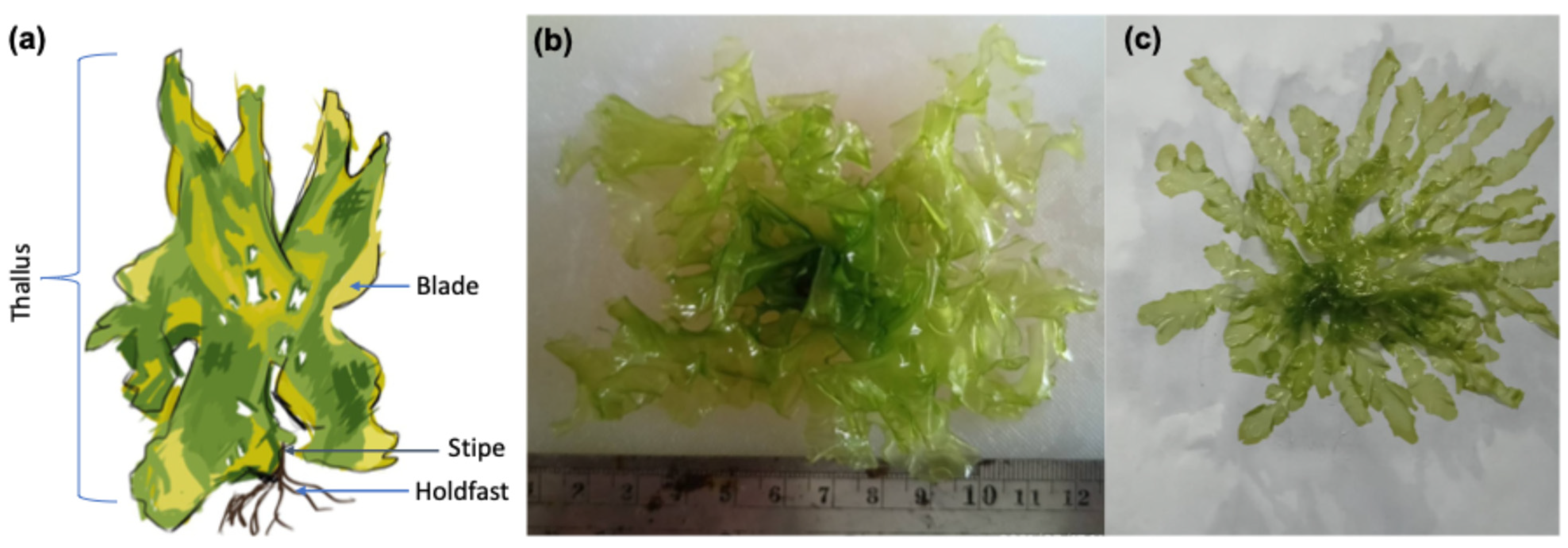
Figure 2.
Chemical structure of ulvan.
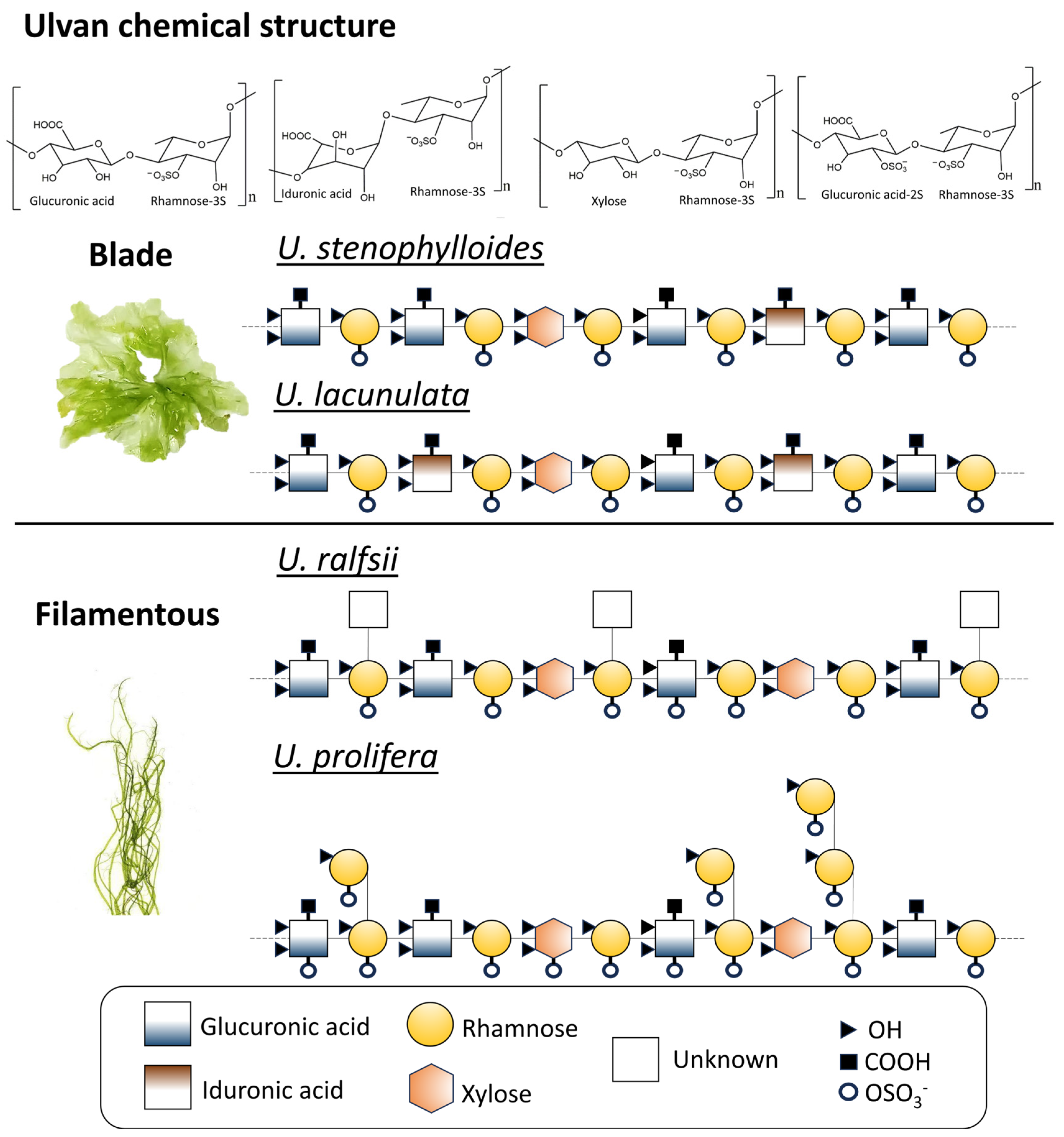
Figure 3.
Schematic extraction steps of ulvan from Ulva sp.
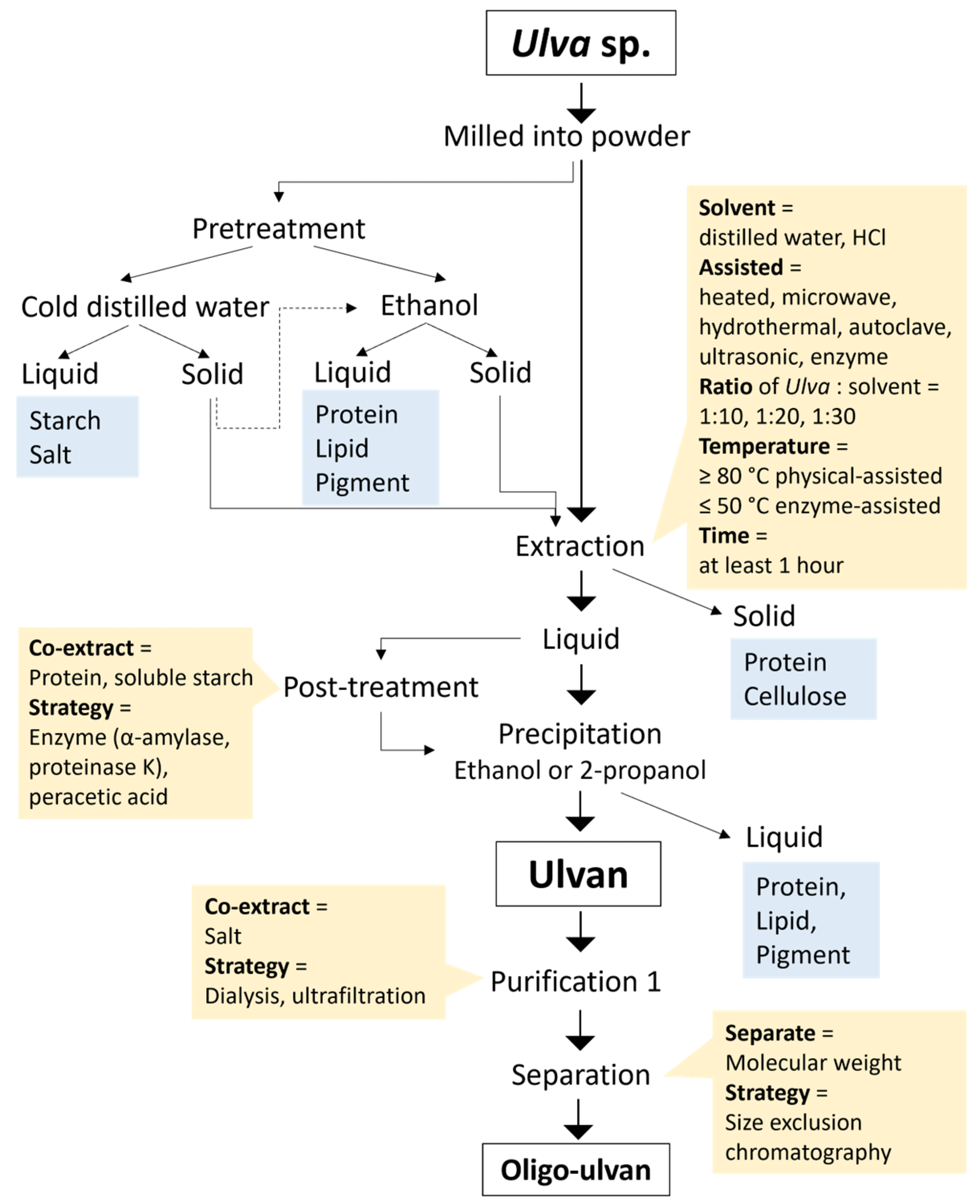
Figure 4.
The Role of Ulvans in Modulating Inflammatory Pathways. Reproduced from Flórez-Fernández et al. [99] with permission. Copyright (2023) Elsevier.
Figure 4.
The Role of Ulvans in Modulating Inflammatory Pathways. Reproduced from Flórez-Fernández et al. [99] with permission. Copyright (2023) Elsevier.
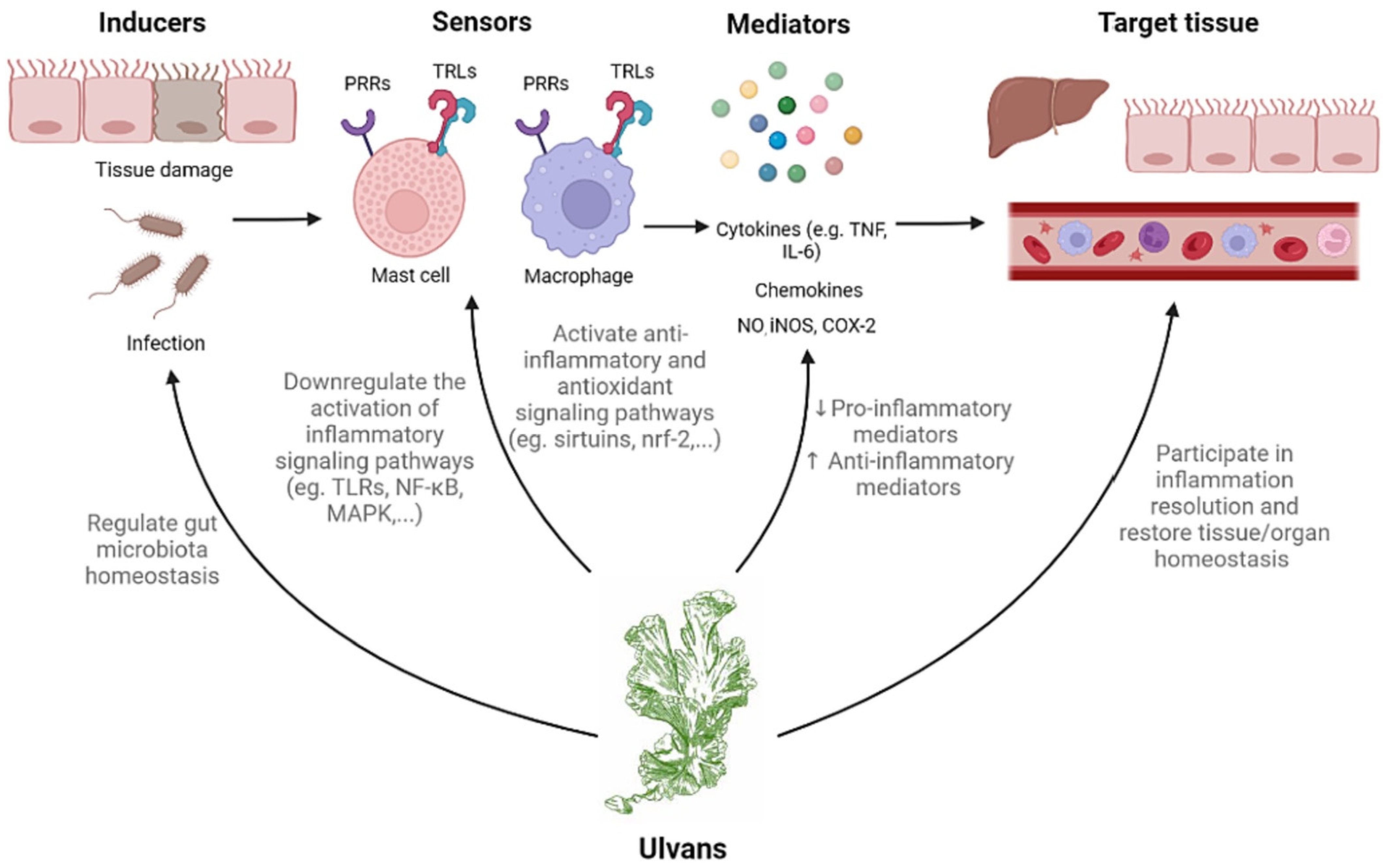
Figure 5.
Illustration of ulvan biomaterial design strategy for hydrogel, film, emulsion and nanocomposite.
Figure 5.
Illustration of ulvan biomaterial design strategy for hydrogel, film, emulsion and nanocomposite.
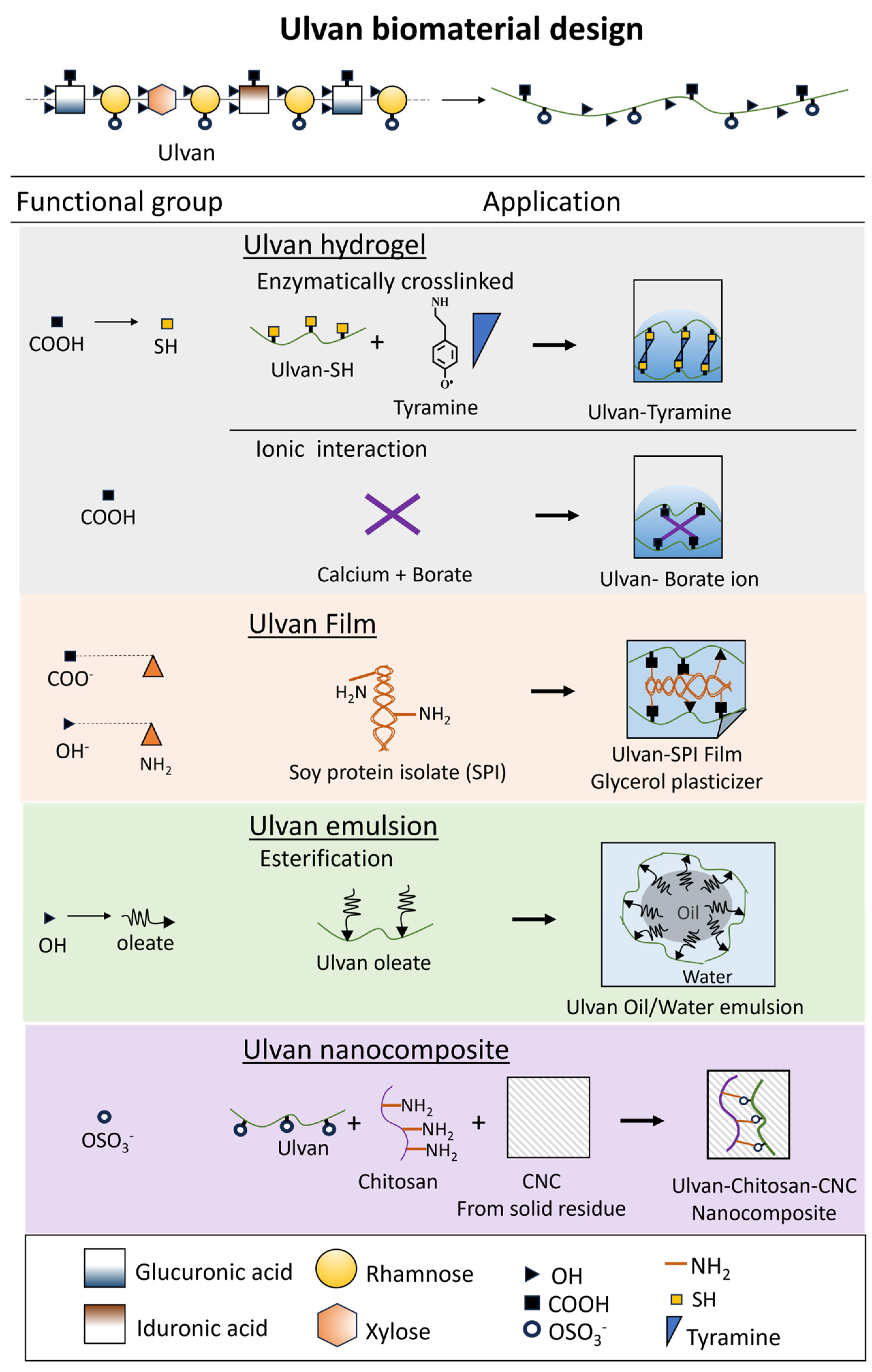
Figure 6.
Summary of the roles of ulvan as a biomaterial and its rationale for outlook biomaterial design.
Figure 6.
Summary of the roles of ulvan as a biomaterial and its rationale for outlook biomaterial design.
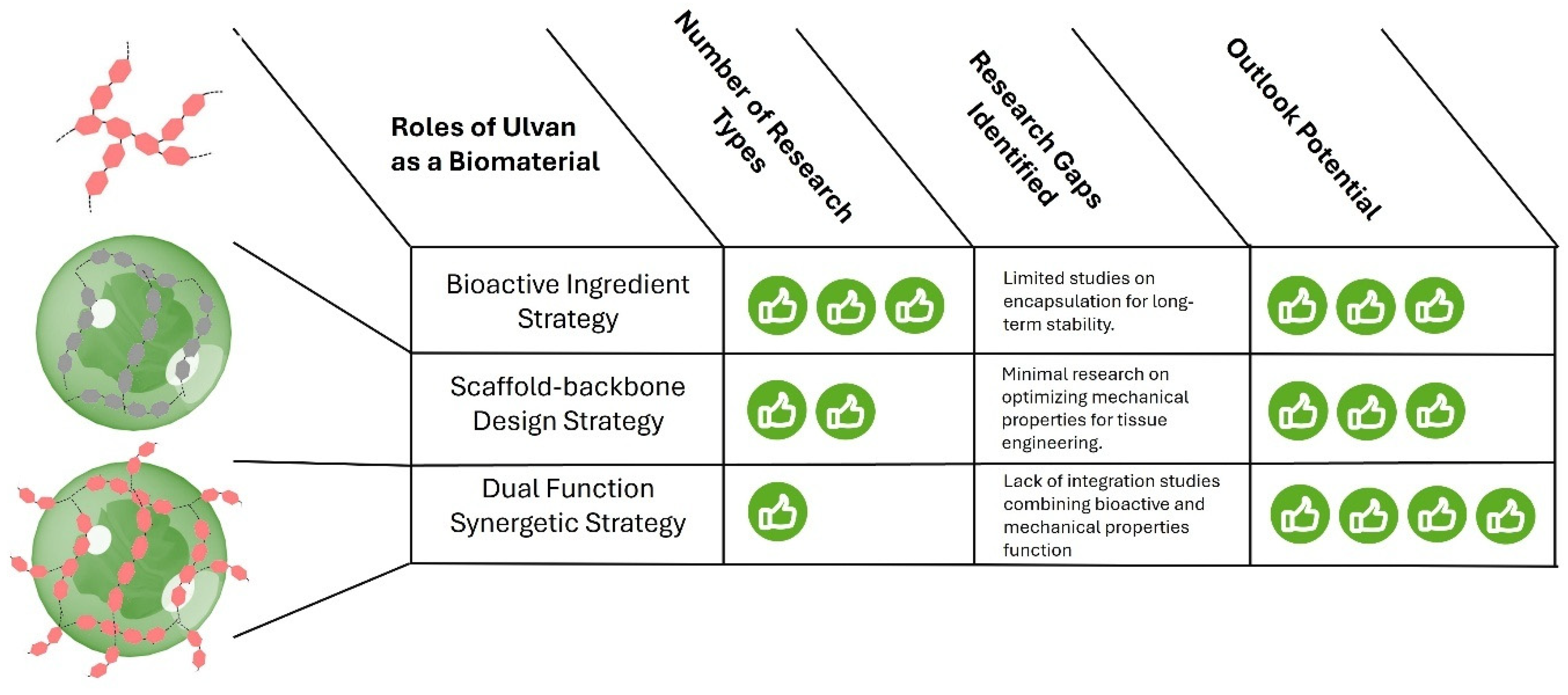

Table 1.
Ulvan yield, molecular properties, extraction conditions, and co-products across different Ulva species.
Table 1.
Ulvan yield, molecular properties, extraction conditions, and co-products across different Ulva species.
| Species | Yield (% dw) | MW (kDa) | Sulfate (% dw) | Extraction Solvent | T (°C) | Assisted |
Solvent for Co-product |
Ref | |
| U. ohnoi | 3.50 | 105 | 17.60 | HCl (pH2) | 37 | - | - | [52] | |
| U. tepida | 3.90 | 313 | 21.60 | HCl (pH2) | - | - | |||
| U. prolifera | 6.70 | 246 | 16.60 | HCl (pH2) | - | - | |||
| U. lactuca | 17.95 | - | 17.22 | Distilled water | 50 | Cellulase | - | [47] | |
| U. lactuca | 16.90 | 265 | 53 | NaOH | 70 | Ultrasonic | [48] | ||
| 14.50 | 280 | 58 | HCl | 70 | |||||
| 12.50 | 304 | 39 | Distilled water | 70 | |||||
| U. linza | 17.00 | - | - | Citric acid | 60 | - | - | [52] | |
| U. fasciata | 6.02 | - | 14.92 | Distilled water | - - - |
Ethanol-protein and pigment | [53] | ||
| 7.34 | - | 12.73 | HCl | ||||||
| 6.74 | - | 7.760 | Na2EDTA | ||||||
| U. lactuca | 14.22 | - | 16.82 | HCl (pH2) | 80 | - | - | [47] | |
| U. linza | 29.33 | 16 | 13.78 | Oxalic acid | - | Distilled water - Starch | [52] | ||
| U. intestinalis | 17.76 | 300 | - | Distillled water | - | - | [45] | ||
| 23.21 | 88 | - | Acidic water (pH3) | - | Ethanol-lipid and pigment | ||||
| 16.11 | 110 | - | Alkaline water (pH10) | - | |||||
| 20.41 | - | - | Distillled water | Microwave | |||||
| 17.89 | - | - | Distillled water | Autoclave 121 °C | |||||
| 23.73 | - | - | Distillled water | Ultrasonic | |||||
| U. ohnoi | 8.20 | 10.5 | 12,5 | HCl | 85 | - | Distilled water – salt | [44] | |
| 7.00 | 16.3 | 12.4 | HCl | - | Ethanol – pigments | ||||
| 8.10 | 10.8 | 12.5 | HCl | - | Distilled water – saltEthanol – pigments | ||||
| Ulva sp. | 0.04 | - | 18.00 | Citric acid | 90 | - | - | [54] | |
| U. fenestrata, U. lactuca, | 18.00 | - | 17.80 | HCl | - | - | [49,55] | ||
| U. compressa | 18.00 | - | 17.80 | HCl | - | - | [55] | ||
| U. lactuca, | 11.00 | - | 14.30 | Distilled water | Post-treatment α-amylase & proteinase K | Ethanol-protein and pigment | |||
| U. compressa | 11.00 | - | 9.30 | Distilled water | |||||
| U. lactuca | 41.96 | - | 23.20 | ChCl-glycerol | Peracetic acid | - | [56] | ||
| U. lactuca | 3.40 | - | 15.65 | HCl (pH1.5) | - | - | [47] | ||
| U. pertusa | 17.80 | 283 | 13.20 | Distilled water | - | - | [57] | ||
| 20.60 | 352 | 9.20 | Distilled water | Ultrasonic | - | ||||
| 25.30 | 404 | 6.80 | HCl (pH4.5) | Pretreatment cellulase at 50 °C | - | ||||
| 26.70 | 300 | 3.90 | HCl (pH4.5) | - | |||||
| Ulva sp. | 30.36 | - | - | HCl (pH2) | 90 | - | - | [58] | |
| 30.48 | - | 31 | Distilled water | 120 | Microwave hydrothermal | - | |||
| 30.46 | - | 40 | Distilled water | 140 | - | ||||
| 30.66 | - | 50 | Distilled water | 160 | - | ||||
| 30.70 | - | 20 | Distilled water | 180 | - | ||||
| 30.66 | - | 21 | Distilled water | 200 | - | ||||
| Ulva sp. | 11.00 | - | 11.02 | Distilled water | 120 | Hydrothermal | Pretreatment supercritical CO2 & ethanol - polyunsaturated rich lipids & phenolic content | [51] | |
| 19.00 | - | 7.14 | Distilled water | 140 | |||||
| 22.00 | - | 10.09 | Distilled water | 160 | |||||
| 5.00 | - | 7.58 | Distilled water | 180 | |||||
| 5.00 | - | 7.36 | Distilled water | 200 | |||||
Table 2.
Comparison of chemical modifications, gelling mechanisms, yield, and applications in biomaterial design of marine polysaccharides.
Table 2.
Comparison of chemical modifications, gelling mechanisms, yield, and applications in biomaterial design of marine polysaccharides.
| Polysac-charide | Source Algae | Yield Range (%) | Gelling Mechanism | Existing Function in Current Market | Commercial Availability | Mechanical Properties | Cytocom-patibility | Thermal Stability | Cross-Linking Potential | Functionalization Potential | Common Modifications | Applications of Modifications | Challenges in Modifications |
| Ulvan | Ulva spp. | 15-41 | Ionic cross-linking with divalent cations (e.g., Ca2+; CaCl2, H3BO3) | Emerging in tissue engineering, drug delivery, and bioadhesive development | Moderate, requires specialized extraction processes | Moderate elasticity, suitable for hydrogels | Excellent, supports cell adhesion and proliferation | Moderate, stable up to ~80°C under physiological conditions | High, forms strong ionic cross-links | High, easily modified with bioactive groups | Thiolated ulvan, sulfation, carboxymethylation, phosphorylation, hydrogel formation | Drug delivery, tissue engineering, bioadhesive development, antioxidant systems | Complexity in achieving uniform thiolation, scalability issues |
| Agar | Gelidium spp. | 10-15 | Thermal gelation via hydrogen bonding | Widely used in food industry (gels, thickeners), limited biomedical applications | High, widely available and established supply chain | Strong, brittle gels, limited elasticity | Good, limited applications in biomedical fields | High, retains gel pro-perties up to ~100°C | Moderate, limited chemical reactivity | Moderate, limited functionalization pathways | Thiolated agar, esterification, hydrogel formation, nanoparticle stabilization | Encapsulation, tissue scaffolding, bioadhesives, wound dressings | Low reactivity under mild conditions, batch variability |
| Carra-geenan | Kappa-phycus spp. | 20-30 | Thermal gelation via sulfate groups. Helical structures formed via 3,6-anhydro-galactose units and ion interactions | Predominantly in food as stabilizers and thickeners, some drug delivery systems | High, commercially available for various industries | Flexible gels, moderate strength | Moderate, may require modifications for biocompa- tibility |
High, stable up to ~120°C | High, versatile cross-linking potential | High, supports diverse chemical modifications | Sulfation, hydrogel formation, derivatization for drug delivery | Drug release matrices, bioadhesive, biocompatible scaffolds | Control over sulfation levels, stability in physiological conditions |
| Alginate | Macrocystis spp. | 15-35 | Ionic cross-linking with Ca2+ or other divalent ions | Extensively in food, pharmaceuticals, and wound care products | High, extensively used and widely produced | High elasticity, robust structural integrity | Excellent, widely used in tissue engineering | High, stable across wide temperature ranges (~150°C) | High, readily cross-links with divalent ions | High, extensively modified for various uses | Calcium cross-linking, thiolation, carboxylation, hydrogel formation, esterification | Controlled release systems, wound care, tissue scaffolding | High dependency on cross-linking agents, cost of modification processes |
| Fucoidan | Fucus spp. | 5-10 | Not a primary gelling agent, interacts through sulfated domains | Limited use in niche biomedical applications (anticoagulants, drug carriers) | Low, niche market with limited availability | Weak mechanical properties, limited application | Variable, dependent on sulfation level | Moderate, sensitive to heat above ~70°C | Low, limited cross-linking capability | Moderate, functionalization depends on sulfate groups | Sulfation, desulfation, acetylation, hydrogel formation, anti-coagulant enhancement | Anti-inflammatory agents, drug carriers, heparin substitutes | Variability in biological activity, cost-intensive extraction and modification |
| Laminaran | Laminaria spp. | 10-20 | Weak hydrogen bonding and limited gel formation | Occasionally in nutraceuticals and research-grade biomaterials | Low, specialized production with limited supply | Low mechanical strength, not primary gelling agent | Moderate, limited data on cytocompatibility | Low, weak stability under heat, <60°C | Low, rarely used for cross-linking | Low, not typically functionalized extensively | Oxidation, acetylation, hydrogel formation, nanoparticle delivery systems | Nanoparticle stabilizers, immune enhancement, tissue scaffolds | Low stability under physiological conditions, complex modification processes |
| Porphyran | Porphyra spp. | 10-15 | Thermal gelation and hydrogen bonding | Emerging in antioxidant-rich supplements and basic drug delivery systems | Moderate, emerging commercial interest | Moderate strength, suitable for soft applications | Good, supports basic biomedical applications | Moderate, stable under mild thermal conditions (~80°C) | Moderate, potential for chemical derivatization | Moderate, supports basic functionalization | Sulfation, esterification, hydrogel formation, antioxidant enhancement | Antioxidant applications, drug delivery, immune modulation | Limited structural studies, stability in industrial applications |
Disclaimer/Publisher’s Note: The statements, opinions and data contained in all publications are solely those of the individual author(s) and contributor(s) and not of MDPI and/or the editor(s). MDPI and/or the editor(s) disclaim responsibility for any injury to people or property resulting from any ideas, methods, instructions or products referred to in the content. |
© 2024 by the authors. Licensee MDPI, Basel, Switzerland. This article is an open access article distributed under the terms and conditions of the Creative Commons Attribution (CC BY) license (http://creativecommons.org/licenses/by/4.0/).
Copyright: This open access article is published under a Creative Commons CC BY 4.0 license, which permit the free download, distribution, and reuse, provided that the author and preprint are cited in any reuse.