
Submitted:
30 December 2024
Posted:
02 January 2025
You are already at the latest version
Abstract
Why do human beings invest work in creating representations of objects and situations that do not exist, cannot be proven to exist, or exist by cultural convention? This study explains this phenomenon by identifying counterfactual cultural production as a form of evidence hallucination, where anxiety-reducing cultural and cognitive models are made to be `true’ by flooding the perceptual environment with fabricated evidence of their truth. The theoretical framework builds on concepts from information theory, thermodynamics, and active-inference approaches to agent-environment interactions; it is validated against two cultural phenomena—religious evangelism as articulated in the four Gospels of the King James Version (KJV) Bible and symbols of collective identity in the form of national flags. The first study encodes English words into 64 categories using their sensorimotor associations, and predicts that the KJV should address existential anxiety by over-sampling positively valenced words with large semantic size from each sensory category—and in doing so, generate an implicit world-model that is lower in unpredictability than that of background English. The second study predicts that the visual entropy of national flags will positively scale with endogenous anxiety (collective worry about internal conflict) and that internal contrast will negatively scale with exogenous anxiety (collective worry about external threats)—with contrast anchoring entropy in the low contrast position. These studies show that it is, in principle, possible to predict detailed features of high-level cultural activity from affective dispositions using a straightforward formalism and without a ‘thick’ model of human cognition.
Keywords:
symbolic culture
; anxiety reduction
; predictive modeling
; entropy reduction
; thermodynamics
1. Introduction
Human beings are unique in their exposure to counterfactual realities. That is, to representations of objects and states of affairs that are acknowledged not to exist, which cannot be proven to exist, or which exist only by way of social convention [1,2]. These include religion, literature, art, popular culture, mythology, ideology, and other forms of symbolic or material fabulation that, to greater or lesser degrees, innovate on or compete with what is known to be the case. Moreover, this is not a minor phenomenon: One estimate suggests that the average Briton spends 6% of their waking life immersed in counterfactual realities [3], and this figure is likely to generalize cross-culturally. The question that emerges is why this should be the case. Unlike practical culture, for which there is an obvious payoff [4,5], counterfactual cultural elaborations are—at least on the surface—wasteful of cognitive resources like attention and memory, and are often complicit in reproducing illusory folk beliefs about the nature of reality and where humans feature in it [6,7]. How do we explain this puzzle?
This study accounts for the existence of counterfactual cultural elaboration as a form of evidence hallucination, where explanatory models of the world are made to be `true’ by flooding the perceptual environment with evidence that their predictions are correct. The core claim is that the incentive to do this comes from the desire to reduce anxiety. As a concomitant of chronic stress that is actuated by unpredictability in the environment anxiety is future pointing: not knowing what will happen next feels unpleasant. From this, it follows that anxiety avoidance will take the form of uncertainty reduction––typically, by constructing predictive models of the environment. Necessarily, if these models are to bring about anxiety reduction then their predictions must be accurate. In scientific modes of inquiry this is secured by hypothesis testing against independent data. But the human capacity for counterfactual thinking offers a more efficient shortcut: If I can saturate the environment with low-cost, perceptually salient simulations of evidence, then I gain the benefits of anxiety reduction without the extra work of hypothesis testing. Thus, counterfactual cultural elaboration can be explained as the attempt to reduce anxiety by performing `cheap’ work on the environment that makes it conform with model predictions. Given that hallucinated evidence is typically not veridical, the ultimate failure of most predictive models means there is a persistent stimulus to produce either new evidence or new cultural and cognitive models—and hence the generative nature of counterfactual fabulation.
This hypothesis draws on several lines of theoretical and empirical inquiry. Firstly, foundational work in thermodynamics and information theory demonstrates the convertibility between information and work [8,9], which gives an in-principle viability to the idea that there can be trade-offs between model construction and environmental manipulation. In particular, the Landauer limit gives the minimum possible amount of energy required to erase one bit of information, where E is the energy, is the Boltzmann constant, and T is the temperature of the system in Kelvins [Equation (1)].
Because every model of the world is a representation that involves a deletion of some aspect of the world that is noisy with respect to the model, the principle here is that simplification requires work. Physical intuition for this idea is typically provided by thought experiments like Maxwell’s demon [10]. Specifically, the eponymous demon uses their omniscient knowledge of the velocities and positions of gas molecules in a box to open and close a partition between the two halves of the box. By selectively letting only high velocity particles into one partition, the demon creates an energy gradient and thereby converts information into work. But one can just as easily come from the other direction and see that work that compresses physical particles of any specific type into a smaller volume increases the predictability of a system, and thus work can also be converted into information. Whilst these abstract considerations may seem a far remove from cultural processes that operate at orders of magnitude above the Landauer limit, they have already been used speculatively to formulate potential solutions to the Fermi paradox by predicting the behaviour of more technologically advanced civilizations (the `aestivation’ hypothesis [11]). From the more mundane perspective of the present study, their value lies in showing that cultural modeling and environmental manipulation are linked by deep thermodynamic principles that do not require an especially rich account of human cognition.
The account of cognition that is required is provided by active inference models that identify surprise minimization as the principle guiding the interactions of an agent with its environment [12,13,14,15,16]. That is, the agent acts so as to not find itself in sensory states that lie outside the expected values of the sensory states that evolution has encoded into its cognitive and somatic architecture. For instance, the fact that I have lungs rather than gills means that I will act so as to not to surprise my respiratory system by spending long periods of of time underwater. In general, this is done by generating on-the-fly predictions about the sensory data I should be receiving and gauging these against the sensory data that I am receiving. Where these diverge, I act so as to decrease this divergence, which has an upper bound in the negative log probability of my sensory state. This approach is evolutionarily useful because it reduces the computationally intractable task of modeling the entire environment to the estimation of those environmental states that are relevant to the agent. Once again, the value of active inference approaches here lies in their cognitively `thin’ nature, which allows them to be applied to natural and cultural phenomena, ranging from collective behaviours in animals [17] to narrative cognition in humans [18,19].
Anxiety enters the picture by way of `dark room’ objections to active inference models [20]. Specifically, if the object is to act so as to minimize surprise, then the easiest solution is to seek out environments that are highly predictable (the dark room). As this does not capture the totality of any agent’s behavior, there is clearly a need for prediction to be guided by a flexible cognitive orientation that conditions predictions on what is known about specific environments and calibrates actions accordingly. The literature converges on anxiety—in both its clinical and non-clinical manifestations—as a cross-species, negatively valenced aversive response to uncertainty in the environment in this way [21,22,23]. Usefully, this can be connected with the active inference and thermodynamic frameworks described above by way of Shannon entropy, H(hereafter, just entropy) [24,25,26] [Equation (2)]
To the extent that entropy represents the expected value of surprise across all the states of a system, increases in anxiety should track increases in entropy. Equivalently, any predictive model will reduce anxiety by reducing surprise. Qualitative appreciations of cultural models have long recognised the link between certainty-offering rituals and aesthetic practices and anxiety reduction [27,28]; more recent work by the present author and others has explicitly formalized this in terms of cultural models as entropy reduction devices that serve to minimize anxiety [19,29,30,31].
Putting all of these considerations together, what emerges is an account of counterfactual cultural production that sees it as a form of low-cost work that reduces anxiety by flooding the environment with simulated evidence for a predictive cultural or cognitive model. While it is obviously impractical to test this hypothesis against the entire cultural record, the present study trials it against two representative examples: a religious model of the world, as articulated in the Gospels of the King James Version Bible; and secular representations of collective identity in the form of national flags. As these test cases span linguistic and visual modes of representation, the cultural salience of the examples is complemented by a more robust test of the hypothesis.
Study 1: A Linguistically Articulated Religious World Model
While it is unlikely that religion can be collapsed into any single function [32], it is clear that one of its functions is to reduce existential uncertainty [33,34,35]. One way religions can do this is by offering low entropy, positively valenced, and transcendentally oriented predictions about situations of maximal uncertainty—with death, for obvious reasons, being chief amongst these. To make the predictions credible, the evidence hallucination hypothesis maintains that religious believers will populate the environment with perceptually impacting stimuli that reduce complexity and evince a positively coded postmortem reality. That this is so can be seen readily enough with ecclesiastical architecture, which simplifies the spatial environment by providing navigation points and, by way of perceptual salience, intrudes religious ideas on the attention. Here, the conversion of thermodynamic work into predictability comes via reshaping the landscape into a lower entropy state. But if it is cheaper to build a church than an afterlife, linguistic representations are cheaper still, so this tendency should be even more visible in religious language. This gives the following hypothesis:
- : Religious models should saturate the perceptual environment with low entropy linguistic constructions that, relative to the implicit model of background English, stimulate positively valenced, transcendentally oriented sensory experiences.
1.1. Methods
Testing this hypothesis requires an encoding of language that allows for all of the relevant variables to be quantified. The Lancaster sensorimotor norms for English provide one efficient way to do this for sensory states [36]. By providing human sourced scores for how strongly each of 39,707 lemmas is associated with 11 sensorimotor dimensions (the five senses plus interoception and the motor effectors of head, arm/hand, leg/foot, torso, and mouth/throat), the Lancaster norms capture the embodiment profile for most common English words. Significantly, the norms show that even abstract concepts have a stable sensorimotor profile across individuals [Figure 1].
No less significantly, the norms allow for English to be partitioned into equivalence classes of words that have a similar sensorimotor profiles. This is important because it creates a probability distribution across the equivalence classes that allows entropy to be calculated. That is, if there are N equivalence classes and religious language uses words from each class with a different probability than English as a whole, it becomes possible to measure the entropy difference between religious language and background English with respect to their sensorimotor impact. In effect, this amounts to vocabulary reduction, where lemmas are mapped into a small number of superordinate `words’ that are defined by their somatic impact rather than their meaning, allowing that the two will be related. (Food related lemmas, for example, are likely to map into the same category.) On the one hand, this makes for a more succinct formal model; on the other, that fact that religious behavior is as much a matter of corporeal experience as cognitive suggests the procedure is especially appropriate to the phenomenon of interest. [37,38,39,40]. Here, the reduction was done by performing a median split on the score of all 39,707 lemmas on the six sensory modalities (the motor modalities being incidental to the hypothesis under test). This generates possible sensory states into which words can be mapped [Table 1]; an interactive plot showing a 3D projection of all 39,707 lemmas grouped by the 64 sensory states can be accessed here.
The religious model chosen was that articulated in the four Gospels of the 1611 first edition of the King James Bible (KJV). Though any religious text should show the same result, the KJV was chosen for its significance as a book “designed to control the language of salvation and to occupy the linguistic high ground in such a way as to allow its rivals [...] less verbal space, less legitimacy, less power” [41]—in other words, for its representativeness as an evangelical document. The text was prepared by tokenizing, lemmatizing, and removing the stopwords from the four Gospels using a custom function built in the spaCy natural language processing library for python [42]. This meant breaking the text into words, reducing morphological variation in words to a root form (`ran’, `running’, `runs’ → `run’), and stripping out words with no semantic content like prepositions, conjunctions and articles. The result was a Bible vocabulary of 2,398 meaningful lemmas. Intersecting this with the sensorimotor lemmas gave 1,960 words for which data was available; all 64 sensory states were represented in these words. (It should be acknowledged that sensorimotor norms were scored by speakers of modern English, so their application to the KJV is necessarily anachronistic. Nevertheless, the semantic accessibility of the KJV to modern readers suggests that the less fine-grained sensorimotor profiles should also have descriptive validity.)
1.2. Results
The first prediction of is that the entropy of religious language will be lower than English as whole, measured relative to the distribution of words across sensory states. That is, religious language, compared to English as a whole, will over-sample words from from some sensory states and under-sample from others, thereby making the over-sampled states more perceptually salient. This was tested by creating two probability distribution defined by normalizing the number words in each sensory state relative to the total vocabulary size for the KJV and English as a whole respectively. As predicted, the entropy of the KJV Gospels (5.274 bits) was lower than the entropy of English as a whole (5.415 bits)—a difference of -2.673%. (Entropy was calculated as per Eqn 2 using the SciPy python library [43].) This value is about what one would expect for a text that is designed to normatively regulate everyday life: too large a simplification invites falsification of hallucinated evidence by experience, and small entropy difference like 2.673% ensures that the KJV is complex enough to represent most human sensory states, but simple enough to make them more predictable. The wider implications of this difference for predicting the frequency of religious behaviours will developed further in the discussion below.
The second and third predictions of relate to positively valenced and transcendentally oriented language. That is, the language of the KJV Gospels should, relative to background English, select words from the 64 sensory categories that engender pleasant sensory states [44] and index values that point to a supra-mundane reality [40]. Both variables can be calculated using the valence-arousal-dominance norms published in Warriner at al [45] and the semantic size norms in the Glasgow norms of Scott et al [46]. Valence is a straightforward measure of positive sentiment; semantic size is slightly more complicated and concerns how `large’ a word is felt to be. For concrete words, this tracks physical size: CATHEDRAL has a larger semantic size than CHAPEL. In the case of abstract words, the tracking is guided by psychological or cultural salience: VOTE has a larger semantic size than CHOOSE. Given this, semantic size provides a useful proxy for the `transcendental’ freighting of a word. As the two data sources use different scales for rating words, valence and semantic size variation were rescaled between 0 and 1.
Both predictions were evaluated by scoring lemmas from the KJV and background English for both valence and semantic size across each of the 64 sensory states [Figure 2]. These scores provided DVs for separate two-way ANOVAs that took source (KJV Gospels vs background English) and sensory category as the IVs. Tests were conducted using the pingouin statistics library for python [47]. For valence, there was a statistically significant difference in the predicted direction with respect to sensory state (, , ), as there was also for source (, , ). Similarly, differences for semantic size were in the predicted direction for sensory state (, , ) and source (, , ). As expected from the entropy results, there were no significant interaction effects for source and sensory state in either model: i.e., there was a substantial overlap across all sensory categories between the vocabulary of the Gospel writers/translators and background English. This is likely because a complete decoupling of the two vocabularies would make the KJV inapplicable to everyday life, and hence negatively impact on the `plausibility’ of the hallucinated evidence.
These results support the claims of with respect to the likely cognitive and perceptual effects of hallucinated evidence generated by a textually articulated religious model. That is, that the KJV selectively over-samples words with a high transcendental freighting and that are associated with positively valenced sensory states, and its vocabulary encodes a world model that is lower in entropy than that implicit in background English.
Study 2: A Visually Encoded Model of National Identity
The evidence hallucination hypothesis is prima facie true with respect to symbols of national identity. Few would question that polities flood the perceptual environment with thermodynamically `cheap’ evidence that they are permanent and pervasive in the form of flags, anthems, currency, crests, parades, and other identity-projecting symbolic devices. Given this, the question becomes whether increases in collective anxiety positively predict the extent to which this evidence hallucination occurs. This second study evaluates this question with respect to national flags, the most common symbol of collective identity.
But first, what anxiety does this evidence hallucination alleviate? For nation states, the principal challenge is persistence over time. The historical record makes visible the fact that collective identity is not stable, and this, clearly, is a threat to any individual or group that is materially or politically invested in a given identity. This divides into two forms of collective anxiety: exogenous and endogenous.
- Exogenous anxiety: Conflict between societies is a historical staple. Indeed, war has been hypothesised as a key driver in human evolution [48]. As this poses an existential threat to the loser in the conflict, it is unsurprising that war and the fear of war is one of the most persistent causes of anxiety [49]. In this scenario, collective representations are valuable as focal points around which identities can coalesce in opposition to competing external identities.
- Endogenous anxiety: There are no human societies that do not contain internal divisions. The incest taboo alone means that every individual must, at the most basic level, observe the distinction between kin and non-kin [50]. Where anxiety arises is in relation to the fact that divisions are often factional, and thus corrosive of solidarity and competitive with respect to their claim on collective identity symbols [51].
National flags act as an implicit cultural model that alleviates these anxieties. At the most trivial level, this is done by associating national identity with permanent features of the natural world, like stars (EU, USA, China, Australia), vegetable forms (Lebanon, Canada, Haiti, Fiji), and animals (Uganda, Wales, Mexico, Papua New Guinea). Clearly, the intention here is to provide reassurance that the historically contingent fact of national identity is actually a natural state of affairs—and thus permanent. Equally, by mapping an intractably complex entity—a nation—into an iconic visual representation, flags reduce entropy and with it anxiety. Where this picture becomes more complicated is with respect to the two different forms of anxiety, principally because these exert competing pressures on the visual features of flags.
One the one hand, endogenous anxiety demands that flags project the different internal divisions of a nation into their material form. For example, the green, white, and orange of the Irish tricolor map Catholicism (green) and Protestantism (orange) into a space of mutual amity (white), just as the 50 stars of the USA flag represent the 50 federated states of the union. In practice, this implies a positive correlation between internal divisions and visual entropy. Visual entropy measures how predictable one patch of an image is from another—low entropy images are highly self-similar—and is calculated by treating the histogram of pixel hues in an image as a probability distribution [52]. It therefore follows that flags which need to represent large numbers of internal divisions will have higher entropy in virtue of needing to do more visual `work’ in mapping these divisions.
On the other hand, exogenous anxiety will aim for flags that are maximally perceptually salient relative to other flags. If a flag is to adequately capture the difference between a nation and its competitors, this flag should be immediately and unreflectively identifiable. This implies that the flag should have low internal contrast, where contrast in an image of N pixels is calculated as the expected value across pixels of the squared difference in hue intensity between all possible pairs of pixels in the image [52] [Eqn 3]:
The logic here is that images with high internal contrast act as camouflage—think how zebra or tiger stripes serve to blend their bearer into the background environment [53,54,55]. On this view, a flag should maximize perceptual salience by keeping internal contrast low.
The complication here should be evident. Because visual entropy and contrast are partially positively correlated [52], endogenous and exogenous anxiety are to some degree in competition with each other with respect to the visual features of national flags (i.e., raising entropy will usually also raise internal contrast). This means that the optimal flag for reducing overall anxiety is one that maximizes entropy while minimizing corresponding gains in contrast. However, given that the ultimate purpose of a flag is to signal a coherent collective identity, the demands of exogenous anxiety should anchor variations of entropy in the low contrast position. This generates the following hypothesis:
- : Higher levels of exogenous anxiety will produce flags with low visual contrast, while higher levels of endogenous anxiety will produce flags with high visual entropy—with low contrast trumping high entropy as the optmized variable.
1.3. Methods
Flag data were acquired by downloading a comprehensive dataset of 254 national flag bitmaps from the Flags of the World website. As these are normalized for size and resolution, they ensured that all image metrics would be standardized. Entropy and contrast scores were extracted for all flags using the mahotas image processing library for python [56]. This provided the two dependent variables.
As exogenous and endogenous anxiety cannot be measured directly, proxies were used for both. In the case of exogenous anxiety, the proxy used was the number of land borders a country has. It is an established result that the frequency of conflict scales with the number of borders a country shares, so from this it is reasonable to infer that exogenous anxiety will be more pronounced in countries with more borders [57,58,59]. (It is certainly the case, for example, that proximity to porous and contested borders in general engenders higher levels of of anxiety [60,61].) Border counts were obtained using the pycountry library for python by counting the number of neighbors each country had [62]. A proxy for endogenous anxiety was obtained by using the internal fractionalization data published in Alesina et al [63], which provides indexes of ethnic, religious, and linguistic division for 185 countries. Each index is calculated by estimating the probability that two randomly selected individuals will belong to a different ethnic, religious, or linguistic group. Here, a mean was taken across all three indexes to capture the aggregate level of internal division for each country. (This, in addition to missing border data for some countries, reduced the number of usable flags to 181.)
1.4. Results
Two linear regressions were performed with contrast and entropy as DVs and mean internal social division and number of borders as IVs. As expected, number of borders predicted a decrease in the contrast of flags (). Also as expected, mean internal division positively predicted the entropy of flags () [Figure 3]. There was no statistically significant effect of number of borders on entropy, or of mean internal division on contrast. These results were consistent with the claim that flags can be thought of hallucinated evidence that serves to reduce collective anxiety, and that increases in exogeneous and endgoenous have anxiety have predicable effects on the visual features of flags.
The prediction that contrast would anchor entropy variation in the low contrast position was tested by zero-centering the entropy and contrast scores relative to the midpoint of each range and performing a test of goodness of fit on observations by quadrant. The results showed there to be a statistically significant effect of quadrant on frequency of flags (). 96% of observations were below the midpoint for contrast, confirming the prediction that contrast would anchor entropy variation in the low contrast position, with there being no observations at all in the least optimal high-contrast, low-entropy quadrant [Figure 4]. Assuming that the optimal flag is the flag that offers highest entropy for lowest contrast and the least optimal is the flag offering lowest entropy and highest contract, taking the absolute value of the product of entropy and contrast for each flag in the relevant quadrants allowed these to be identified. On this assumption, the flags of Benin and Saint Pierre and Miquelon respectively emerged as the most and least optimal for purposes of anxiety reduction [Figure 5].
Discussion
Cultural models do not define a homogeneous population, so the two tests of the evidence hallucination hypothesis presented here cannot be more than illustrative. This is the nature of cultural data and should not need to be apologized for. However, it does mean that testing the hypothesis further will require patient, interdisciplinary work that treats each cultural model on its own terms with the methods appropriate to its nature.
In terms of the results that are presented, the entropy differences between the KJV Gospels and background English provide an independent corroboration of the modes theory of religiosity, where religious practices are classed as either doctrinal or imagistic [64,65,66]. The doctrinal mode involves frequent, low arousal rituals (daily prayers, regular group worship), while the imagistic mode entails infrequent, high arousal rituals (rites of passage, ascetic practices). The small entropy difference between the KJV Gospels and background English means that the world-model encoded in the KJV would require evangelically oriented repetition and re-emphasis for it to perform work in reducing anxiety—and thus it naturally reproduces the dynamics of the doctrinal mode. That this was so is very much visible in the historical character of the Protestant Reformation, which, amongst other innovations, immersed worshippers in the Bible text, and explicitly encouraged the memorization and daily application of Biblical passages [67]. However, one can also see how the imagistic mode emerges from the evidence hallucination hypothesis. Much larger entropy differences can be obtained by using a simpler model of sensory states (for example by using fewer sensory modalities); this results in a compression and itensification of sensory experience, but at the cost of evidence plausibility––-the language and material actions associated with such states are not compatible with day-to-day life. Thus, these larger reductions in entropy are likely to be highly ritualized and occur with far less frequency than the smaller entropy reductions identified in the KJV Gospels. What all of this shows is that the evidence hallucination hypothesis predicts the frequency of two features of religious behaviour—day-to-day evangelism and infrequent sensory intensification or compression—in a way that consistent with existing anthropological models and data. Further testing would involve more granular analysis of variations in entropy within specific books of KJV, as well as extension of the model to religious texts outside the Anglophone Christian tradition.
The results on national flags offer fewer points of integration with existing scholarship—largely because (to the author’s knowledge) no such scholarship exists. While there are many qualitative studies of flags and national symbols [68,69,70], these are interpretatively oriented and do not make testable predictions with respect to the visual characteristcs of flags and wider features of social life. Such contributions are important: the small effect sizes of the statistical models presented here show that there are many other factors at work in flag design than those analyzed. Nevertheless, the simple fact that high-level cultural tendencies can be predicted from low-level proxies for anxiety is an important in-principle advance for the quantitative analysis of counterfactual culture in its own right. Next steps would come with a more extensive analysis of symbols of national identity that includes as covariates their semantic content and historical context.
It is worth closing with a general observation on where the evidence hallucination hypothesis sits in relation to other models of counterfactual cultural fabulation. As a rule, these models have oscillated between deterministic biosocial models that are naturalistically grounded or interpretive models that explain cultural processes by way of contingent historical factors. Models of the first type offer consilience with scientific knowledge but are often insensitive to the autonomy of cultural production; models of the second type respect the freedom and generativity of culture, but are hostile to the idea that culture is shaped by non-historical cognitive constraints. The bad-tempered dialogue between these traditions of cultural analysis suggests that they likely track a fundamental interpersonal differences in how their protagonists approach the world. The evidence hallucination hypothesis offers a way out of this impasse. Its grounding in thermodynamic, active-inference, and information-theoretic concepts means that has a strong naturalistic orientation than can be readily reconciled with empirically and theoretically plausible accounts of the relation between work, cognition, and information. But at the same time, the evidence hallucination hypothesis is receptive to (and predictive of) the infinite creativity of counterfactual culture, and its application requires sensitivity to the historical factors that cause cultural and cognitive models to come into existence in the first place. In this sense, it is inherently needful of insights from across the spectrum of qualitative and quantitative disciplines. Whether it survives further testing is, as always, the key question, but the results presented here should illustrate its value as one possible solution to the puzzle of counterfactual cultural fabulation.
SI Datasets
Funding
This research received no external funding.
Data Availability Statement
All data used in the two studies presented here can be found at this public repository.
Conflicts of Interest
`The author declares no conflicts of interest.
References
- Searle, J.R. The Construction of Social Reality; Penguin Philosophy, Allen Lane, 1995.
- Van Hoeck, N.; Watson, P.D.; Barbey, A.K. Cognitive neuroscience of human counterfactual reasoning. Frontiers in human neuroscience 2015, 9, 420. [CrossRef]
- Nettle, D. What happens in Hamlet? Exploring the psychological foundations of drama. In The Literary Animal: Evolution and the Nature of Narrative; Gottschall, J.; Wilson, D.S., Eds.; Northwestern University Press: Evanston IL, 2005; pp. 56–75.
- Henrich, J. The Secret of Our Success: How Culture Is Driving Human Evolution; Princeton University Press: Princeton NJ, 2016.
- Henrich, N.; Henrich, J. Why Humans Cooperate: A Cultural and Evolutionary Explanation; Oxford University Press: Oxford, 2007.
- Bering, J.M. The folk psychology of souls. Behavioral and Brain Sciences 2006, 29, 453–462. [CrossRef]
- Pinker, S. Toward a Consilent Study of Literature. Philosophy and Literature 2007, 31, 161–177. [CrossRef]
- Landauer, R. Irreversibility and heat generation in the computing process. IBM J. Res. Dev. 1961, 5, 183–191. [CrossRef]
- Bennett, C.H. Notes on Landauer’s principle, reversible computation, and Maxwell’s Demon. Studies in History and Philosophy of Science Part B: Studies in History and Philosophy of Modern Physics 2003, 34, 501–510. [CrossRef]
- THOMSON, W. Kinetic Theory of the Dissipation of Energy. Nature 1874, 9, 441–444. [CrossRef]
- Sandberg, A.; Armstrong, S.; Cirkovic, M.M. That is not dead which can eternal lie: The aestivation hypothesis for resolving Fermi’s paradox, 2017, [arXiv:physics.pop-ph/1705.03394].
- Buckley, C.L.; Kim, C.S.; McGregor, S.; Seth, A.K. The free energy principle for action and perception: A mathematical review. Journal of Mathematical Psychology 2017, 81, 55–79, [1705.09156]. [CrossRef]
- Friston, K. The free-energy principle: A rough guide to the brain? Trends in Cognitive Sciences 2009, 13, 293–301. [CrossRef]
- Palmer, C.J.; Paton, B.; Kirkovski, M.; Enticott, P.G.; Hohwy, J. Context sensitivity in action decreases along the autism spectrum: A predictive processing perspective. Proceedings. Biological sciences / The Royal Society 2015, 282. [CrossRef]
- Clark, A. Dreaming the Whole Cat: Generative Models, Predictive Processing, and the Enactivist Conception of Perceptual Experience. Mind 2012, 121, 753–771. [CrossRef]
- Clark, A. Surfing Uncertainty: Prediction, Action, and the Embodied Mind; Oxford University Press, 2016.
- Heins, C.; Millidge, B.; Da Costa, L.; Mann, R.P.; Friston, K.J.; Couzin, I.D. Collective behavior from surprise minimization. Proceedings of the National Academy of Sciences 2024, 121. [CrossRef]
- Friston, K.; Frith, C. Active inference, Communication and hermeneutics. Cortex 2015, 68, 129–143. [CrossRef]
- Carney, J.; Robertson, C.; Dávid-Barrett, T. Fictional narrative as a variational Bayesian method for estimating social dispositions in large groups. Journal of Mathematical Psychology 2019, 93, 102279. [CrossRef]
- Friston, K.; Thornton, C.; Clark, A. Free-energy minimization and the dark-room problem. Frontiers in Psychology 2012, 3, 1–7. [CrossRef]
- Charpentier, C.J.; Cogliati Dezza, I.; Vellani, V.; Globig, L.K.; Gädeke, M.; Sharot, T. Anxiety increases information-seeking in response to large changes. Scientific Reports 2022, 12, 7385. [CrossRef]
- Charpentier, C.J.; Aylward, J.; Roiser, J.P.; Robinson, O.J. Enhanced Risk Aversion, But Not Loss Aversion, in Unmedicated Pathological Anxiety. Biological Psychiatry 2017, 81, 1014–1022. Mechanisms of Fear Consolidation and Extinction, . [CrossRef]
- Wilson, E.J.; Abbott, M.J.; Norton, A.R. The impact of psychological treatment on intolerance of uncertainty in generalized anxiety disorder: A systematic review and meta-analysis. Journal of Anxiety Disorders 2023, 97, 102729. [CrossRef]
- Shannon, C.E. A mathematical theory of communication. The Bell System Technical Journal 1948, 27, 379–423, [arXiv:chao-dyn/9411012]. [CrossRef]
- Shannon, C.E. Prediction and Entropy of Printed English, 1951, [0-387-31073-8]. [CrossRef]
- Kuzemsky, A.L. Statistical Mechanics and the Physics of Many-Particle Model Systems; WORLD SCIENTIFIC: London, 2017. [CrossRef]
- Worringer, W. Abstraction and empathy; a contribution to the psychology of style.; Abstraction and empathy; a contribution to the psychology of style., International Universitites Press: Oxford, England, 1953; pp. xv, 144–xv, 144.
- Malinowski, B. Magic, Science and Religion: And Other Essays; Anchor Books, Doubleday, 1954.
- Carney, J., The Role of Aesthetic Style in Alleviating Anxiety About the Future. In Evolutionary Perspectives on Imaginative Culture; Springer International Publishing: Cham, 2020; pp. 141–159. [CrossRef]
- Carney, J.; Carron, P.M. Comic-Book Superheroes and Prosocial Agency: A Large-Scale Quantitative Analysis of the Effects of Cognitive Factors on Popular Representations. Journal of Cognition and Culture 2017, 17, 306–330. [CrossRef]
- Hirsh, J.B.; Mar, R.A.; Peterson, J.B. Psychological entropy: A framework for understanding uncertainty-related anxiety. Psychological Review 2012, 119, 304–320. [CrossRef]
- Atran, S. In Gods We Trust: The Evolutionary Landscape of Religion; Oxford University Press: Oxford, 2005.
- Hogg, M.A.; Adelman, J.R.; Blagg, R.D. Religion in the Face of Uncertainty: An Uncertainty-Identity Theory Account of Religiousness. Personality and Social Psychology Review 2010, 14, 72–83. An official journal of the Society for Personality and Social Psychology, Inc. [CrossRef]
- Höllinger, F.; Muckenhuber, J. Religiousness and existential insecurity: A cross-national comparative analysis on the macro- and micro-level. International Sociology 2019, 34, 19–37. [CrossRef]
- Engstrom, H.R.; Laurin, K. Chapter 17 - Existential uncertainty and religion. In The Science of Religion, Spirituality, and Existentialism; Vail, K.E.; Routledge, C., Eds.; Academic Press, 2020; pp. 243–259. [CrossRef]
- Lynott, D.; Connell, L.; Brysbaert, M.; Brand, J.; Carney, J. The Lancaster Sensorimotor Norms: Multidimensional measures of perceptual and action strength for 40,000 English words. Behavior Research Methods 2020, 52, 1271–1291. [CrossRef]
- Tan, T., The Corporeality of Religious Experience: Embodied Cognition in Religious Practices. In Religious Experience Revisited; Brill: Leiden, The Netherlands, 2016; pp. 207 – 226. [CrossRef]
- Winter, A.L.; Granqvist, P. Where the Spirit Meets the Bone: Embodied Religiospiritual Cognition from an Attachment Viewpoint. Religions 2023, 14. [CrossRef]
- Van Cappellen, P.; Cassidy, S.; Zhang, R. Religion as an embodied practice: Documenting the various forms, meanings, and associated experience of Christian prayer postures. Psychology of Religion and Spirituality 2023, 15, 251–261. [CrossRef]
- James, W. The Varieties of Religious Experience: A Study in Human Nature; Longmans, Green, and Co.: New York, 1902. Gifford Lectures on Natural Religion delivered at Edinburgh.
- Carroll, R.; Prickett, S. The Bible: Authorized King James Version; Oxford World’s Classics, OUP Oxford, 2008.
- Honnibal, M.; Montani, I. spaCy 2: Natural language understanding with Bloom embeddings, convolutional neural networks and incremental parsing. To appear.
- Virtanen, P.; Gommers, R.; Oliphant, T.E.; Haberland, M.; Reddy, T.; Cournapeau, D.; Burovski, E.; Peterson, P.; Weckesser, W.; Bright, J.; et al. SciPy 1.0: Fundamental Algorithms for Scientific Computing in Python. Nature Methods 2020, 17, 261–272. [CrossRef]
- Van Cappellen, P.; Zhang, R.; Fredrickson, B.L., The Scientific Study of Positive Emotions and Religion/Spirituality. In Handbook of Positive Psychology, Religion, and Spirituality; Springer International Publishing: Cham, 2023; pp. 315–328. [CrossRef]
- Warriner, A.B.; Kuperman, V.; Brysbaert, M. Norms of valence, arousal, and dominance for 13,915 English lemmas. Behavior Research Methods 2013, 45, 1191–1207. [CrossRef]
- Scott, G.G.; Keitel, A.; Becirspahic, M.; Yao, B.; Sereno, S.C. The Glasgow Norms: Ratings of 5,500 words on nine scales. Behavior Research Methods 2019, 51, 1258–1270. [CrossRef]
- Vallat, R. Pingouin: Statistics in Python. The Journal of Open Source Software 2018, 3, 1026.
- Duntley, J.D. Adaptations to Dangers From Humans. In The Handbook of Evolutionary Psychology; Buss, D.M., Ed.; John Wiley & Sons, Inc., 2015; pp. 1–23. [CrossRef]
- Stearns, P.N. American Fear: The Causes and Consequences of High Anxiety; Routledge: New York, 2006.
- Lévi-Strauss, C. The Elementary Structures of Kinship; Beacon Press: Boston, 1969. Originally published in French as Les structures élémentaires de la parenté, 1949.
- or Organization, A.N. The Display of Flags, Symbols and Emblems in Northern Ireland. Commissioned Report, 2013. Report.
- Haralick, R.M.; Shanmugam, K.; Dinstein, I. Textural Features for Image Classification. IEEE Transactions on Systems, Man, and Cybernetics 1973, SMC-3, 610–621. [CrossRef]
- Desimone, R.; Duncan, J. Neural Mechanisms of Selective Visual Attention. Annual Review of Neuroscience 1995, 18, 193–222. [CrossRef]
- Eckstein, M.P.; Ahumada, A.J.; Watson, A.B. Visual Signal Detection in Structured Backgrounds. II. Effects of Contrast Gain Control, Background Variations, and White Noise. Journal of the Optical Society of America A 1997, 14, 2406–2419. [CrossRef]
- Troscianko, T.; Benton, C.P.; Lovell, P.G.; Tolhurst, D.J.; Pizlo, Z. Camouflage and Visual Perception. Philosophical Transactions of the Royal Society B: Biological Sciences 2009, 364, 449–461. [CrossRef]
- Coelho, L.P. Mahotas: Open Source Software for Scriptable Computer Vision. Journal of Open Research Software 2013, 1, e3. [CrossRef]
- Wesley, J.P. Frequency of wars and geographical opportunity. Journal of Conflict Resolution 1962, 6, 387–389. [CrossRef]
- Richardson, L.F. The Statistics of Deadly Quarrels; Boxwood Press: Pittsburgh, PA, 1960.
- Starr, H. International Borders: What They Are, What They Mean, and Why We Should Care. SAIS Review of International Affairs 2006, 26, 3–10. [CrossRef]
- Almond, B. Border Anxiety: Culture, Identity and Belonging. Philosophy 2016, 91, 463 – 481. [CrossRef]
- Simmons, B.A.; Shaffer, R. Border anxiety in international discourse. American Journal of Political Science 2023, 68, 661–677. [CrossRef]
- Ehmann, A. pycountry: ISO country, subdivision, language, currency and script definitions and their translations. https://pypi.org/project/pycountry/, 2022. Version 22.3.5.
- Alesina, A.; Devleeschauwer, A.; Easterly, W.; Kurlat, S.; Wacziarg, R. Fractionalization. Journal of Economic Growth 2003, 8, 155–194. [CrossRef]
- Whitehouse, H. Modes of Religiosity: A Cognitive Theory of Religious Transmission; AltaMira Press: Walnut Creek, CA, 2004.
- Atkinson, Q.D.; Whitehouse, H. The cultural morphospace of ritual form: Examining modes of religiosity cross-culturally. Evolution and Human Behavior 2011, 32, 50–62. [CrossRef]
- Pyysiäinen, I. Corrupt Doctrine and Doctrinal Revival: On the Nature and Limits of the Modes Theory. In Theorizing Religions Past: Historical and Archaeological Perspectives; Whitehouse, H.; Martin, L.H., Eds.; AltaMira Press: Walnut Creek, CA, 2004; pp. 5–28.
- Cameron, E. The European Reformation, 2nd ed.; Oxford University Press, 2012.
- Cerulo, K.A. Symbols and the world system: National anthems and flags. Sociological Forum 1993, 8, 243–271. [CrossRef]
- Medway, D.; Light, D.; Warnaby, G.; Byrom, J.; Young, C. Flags, society and space: Towards a research agenda for vexillgeography. Area 2019, 51, 689–696. [CrossRef]
- Reichl, S. Flying the Flag: The Intricate Semiotics of National Identity. European Journal of English Studies 2004, 8, 205–217. [CrossRef]
Figure 1.
Sensorimotor norm scores for CONFIDENCE and CHOCOLATE.
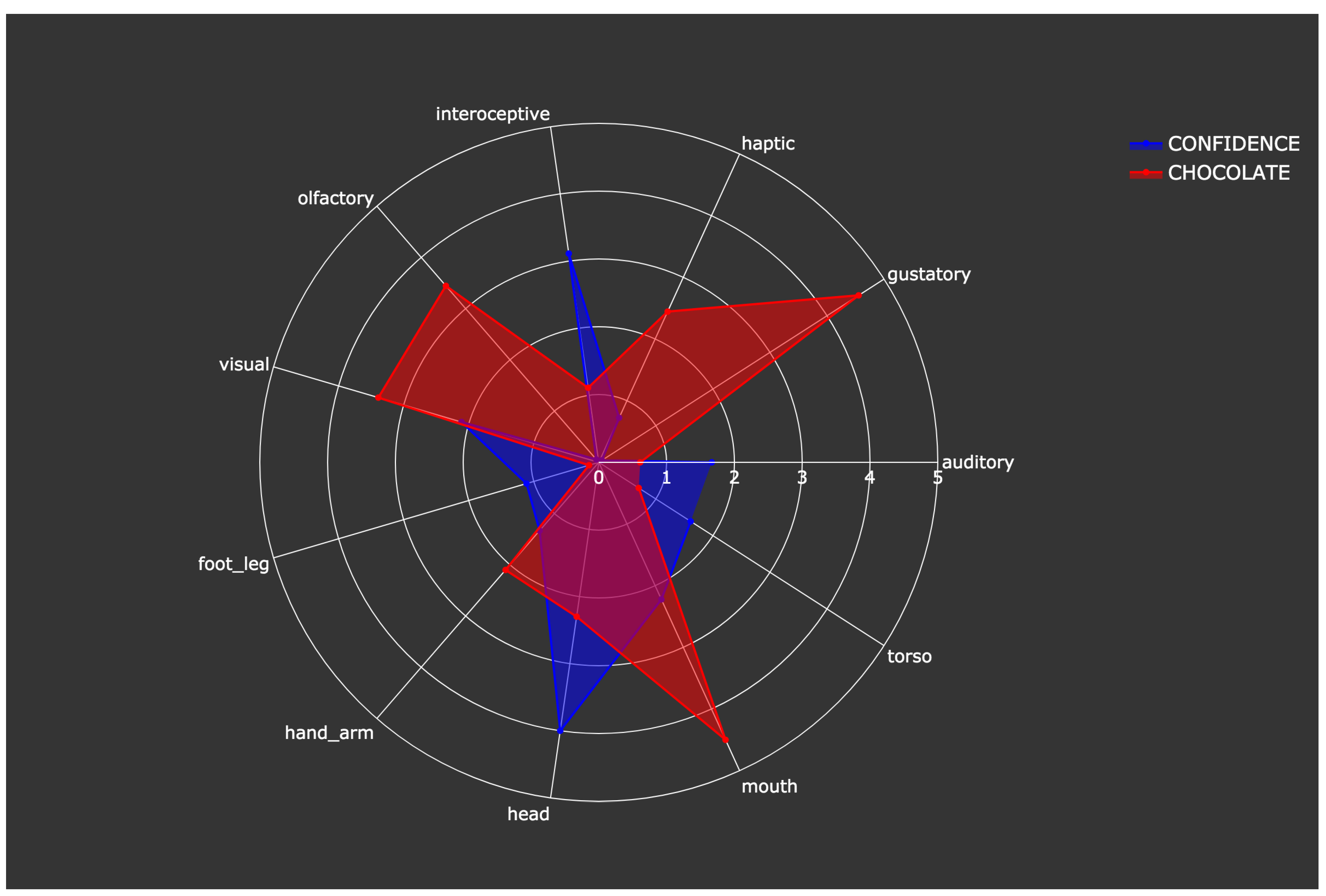
Figure 2.
Sensory categories scaled by frequency in terms of mean valence and semantic size by sensory category for English and the KJV Gospels. See here for an interactive version of this plot that allows categories to be compared across sources.
Figure 2.
Sensory categories scaled by frequency in terms of mean valence and semantic size by sensory category for English and the KJV Gospels. See here for an interactive version of this plot that allows categories to be compared across sources.
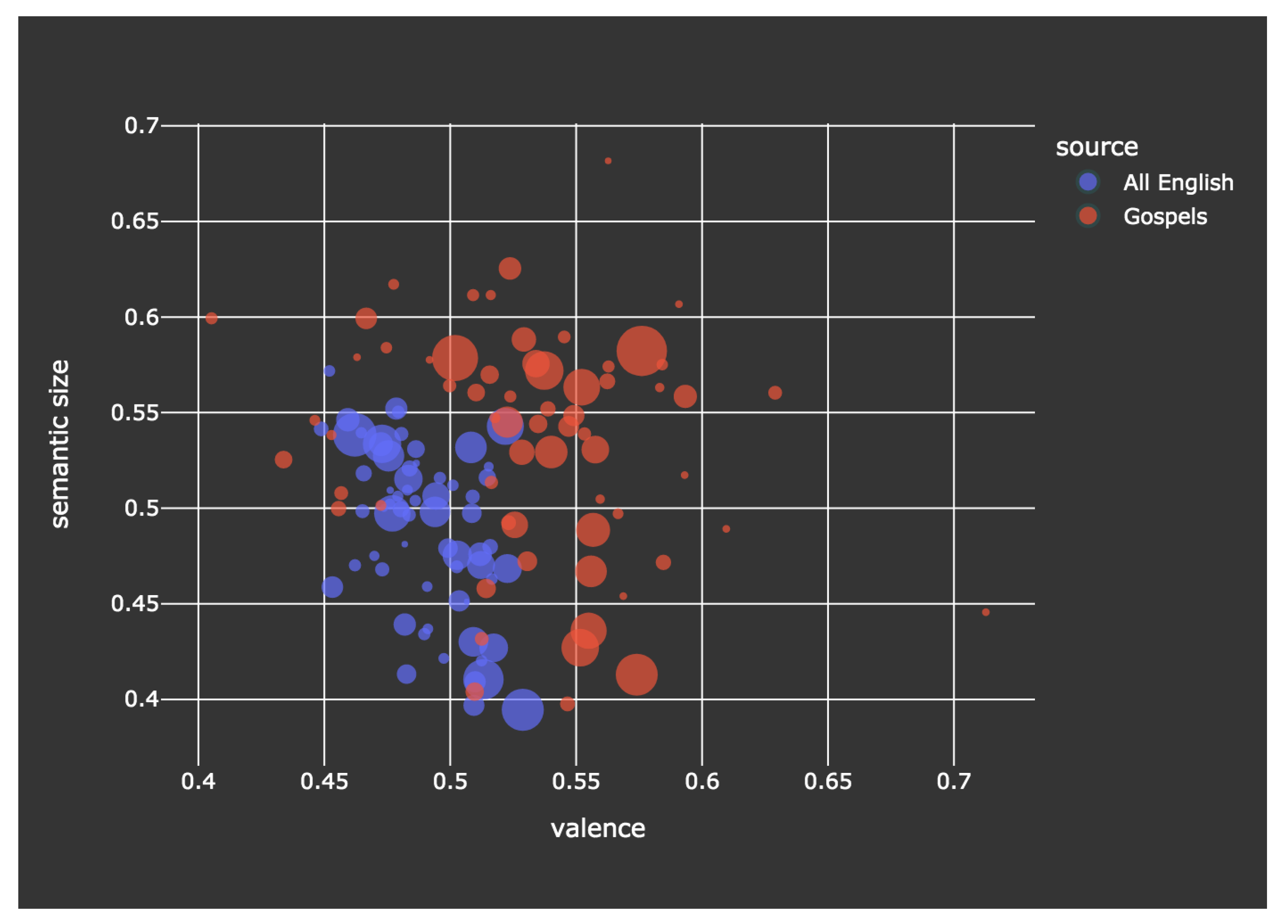
Figure 3.
Contrast and entropy over number of borders and mean internal social division for n = 181 flags.
Figure 3.
Contrast and entropy over number of borders and mean internal social division for n = 181 flags.
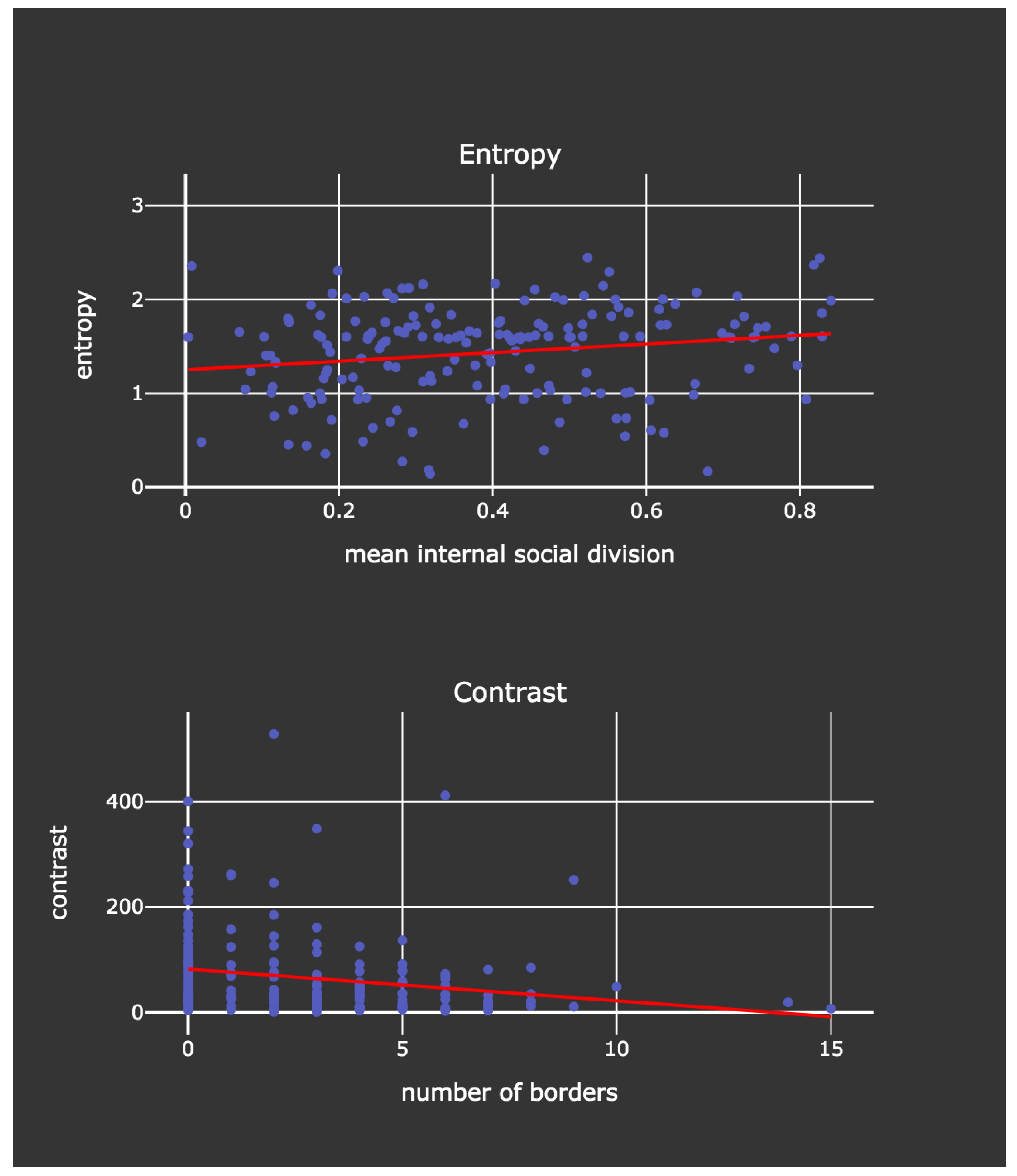
Figure 4.
The distribution of flags relative to the midpoints of the ranges of entropy and contrast, where data are scaled so 0 represents the midpoint
Figure 4.
The distribution of flags relative to the midpoints of the ranges of entropy and contrast, where data are scaled so 0 represents the midpoint
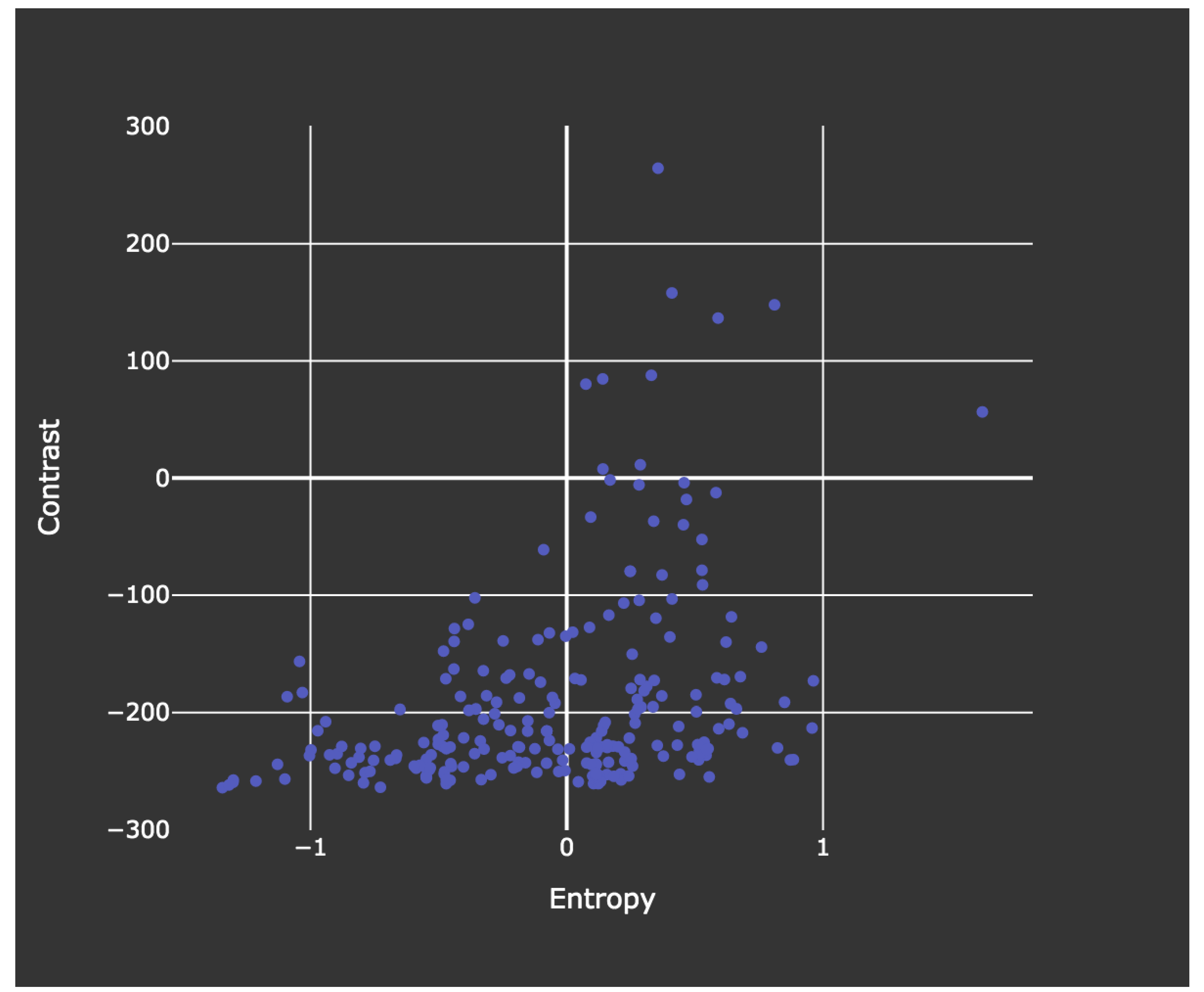
Figure 5.
The flag of Benin (left) offers the optimal trade-off of entropy against contrast; the flag of Saint Pierre and Miquelon offers the worst. It is notable that the three-color model visible in the Benin flag is one of the most common flag designs
Figure 5.
The flag of Benin (left) offers the optimal trade-off of entropy against contrast; the flag of Saint Pierre and Miquelon offers the worst. It is notable that the three-color model visible in the Benin flag is one of the most common flag designs


Table 1.
Median split for three example words on six sensory modalities; 0 indicates a score below the 50th percentile for all words in that modality and 1 a score of greater than or equal to it. Words with the same binary vector are mapped into the same sensory category
Table 1.
Median split for three example words on six sensory modalities; 0 indicates a score below the 50th percentile for all words in that modality and 1 a score of greater than or equal to it. Words with the same binary vector are mapped into the same sensory category
| Modality | PIZZA | SPIRIT | ACHE |
|---|---|---|---|
| Auditory | 0 | 1 | 0 |
| Gustatory | 1 | 0 | 0 |
| Haptic | 1 | 0 | 1 |
| Interoceptive | 0 | 1 | 1 |
| Olfactory | 1 | 0 | 0 |
| Visual | 1 | 0 | 0 |
Disclaimer/Publisher’s Note: The statements, opinions and data contained in all publications are solely those of the individual author(s) and contributor(s) and not of MDPI and/or the editor(s). MDPI and/or the editor(s) disclaim responsibility for any injury to people or property resulting from any ideas, methods, instructions or products referred to in the content. |
© 2025 by the authors. Licensee MDPI, Basel, Switzerland. This article is an open access article distributed under the terms and conditions of the Creative Commons Attribution (CC BY) license (http://creativecommons.org/licenses/by/4.0/).
Copyright: This open access article is published under a Creative Commons CC BY 4.0 license, which permit the free download, distribution, and reuse, provided that the author and preprint are cited in any reuse.


