

Submitted:
27 December 2024
Posted:
30 December 2024
You are already at the latest version
Abstract
Introduction: The family in child growth screening is an inherent issue and an important part, especially in stunting prevention. Factors related to the incidence of stunting are something that is the basis for stunting prevention. This research aims to review family involvement in stunting prevention based on philosophical views. Method: Conduct a review by finding from several databases, namely Proquest, Science Direct and Scopus. The article is limited to the family population with stunted or malnourished or under nutrition children in 2020-2024. Results: Families contribute to stunting prevention, among others, by increasing knowledge about the factors that contribute to the incidence of stunting. Family involvement is not only in the nuclear family, namely parents (fathers and mothers) but also in the extended family, one of which is the grandmother. The view of ontology is related to growth and development problems, especially nutrition as a function of family parenting which involves the decisions of both parents but is also influenced by decisions outside the nuclear family. The epistemiology view is to improve the ability of families to regulate children's growth with preventive efforts from the aspect of increasing knowledge and skills. The view of axiology is to increase family concern for children by respecting that children's growth and nutrition are the essential values of a form of respect for individual children. Conclusion: The family has an effective role for both fathers, mothers or families outside the nuclear family either individually or in cooperation between family members.
Keywords:
Introduction
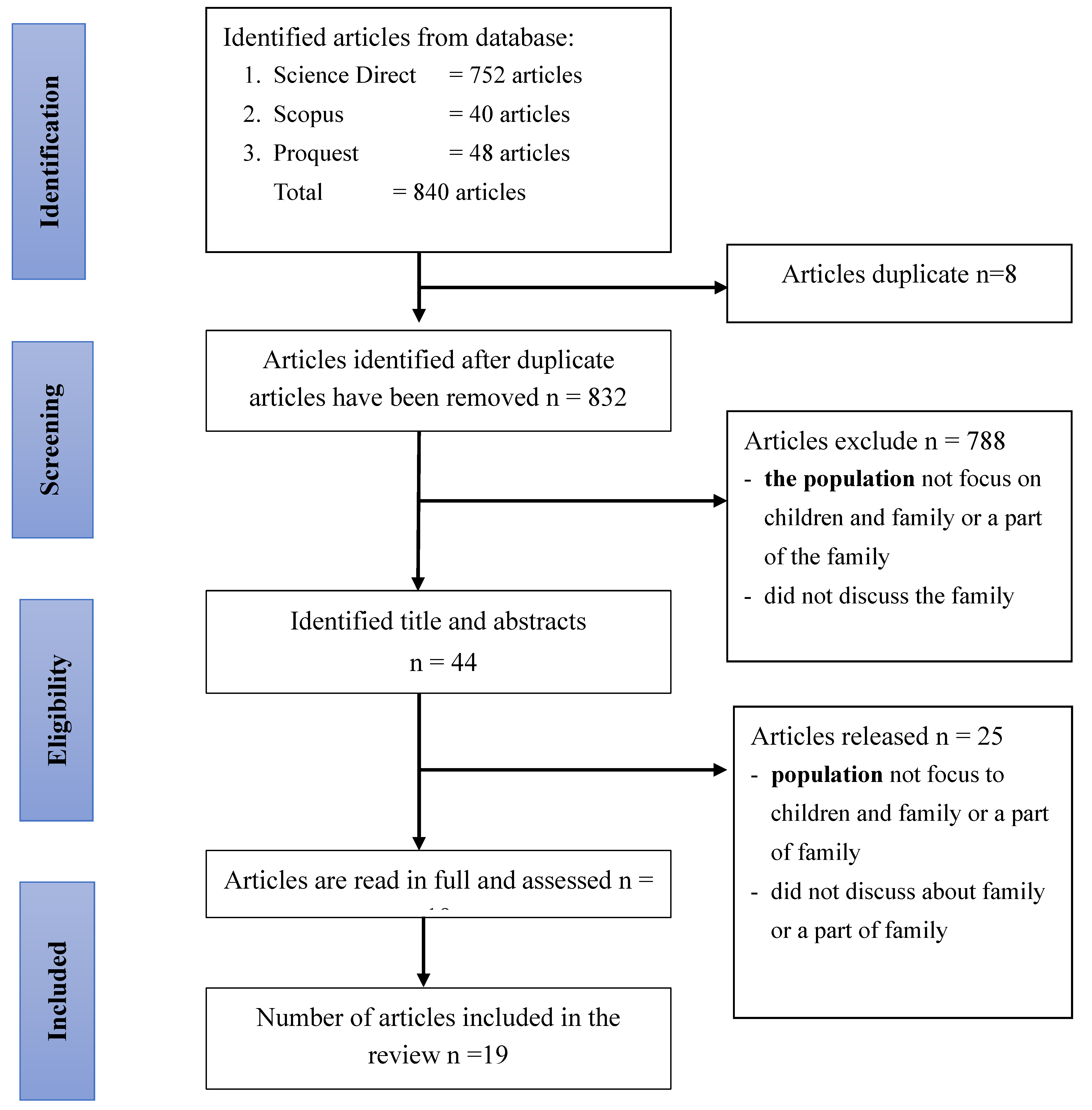
Method

| Author | Title | Purpose | Intervention/Program | Study Desain | Outcome |
|---|---|---|---|---|---|
| Rahmadiyah, et al (2024) | Family Resilience with Stunted Children Aged Below 5 Years: A Qualitative Study in Depok City, Indonesia | Explored the influence of family resilience in fulfilling the nutritional needs of stunted children | N/A | Qualitative | Identified three main themes: (1) family belief that stunting is hereditary, (2) family belief that stunted children will “grow up,” and (3) lack of communication between family members in discussing stunting. |
| Yani, Desy Indra, et al (2023) | Family Household Characteristics and Stunting: An Update Scoping Review | Identify family household characteristics related to stunting among children aged less than 5 years. | N/A | Scoping review | The family household characteristics included individual factors (sex age, history of diarrhea, and birthplace), family factors (family headship, primary caregiver/mother, social-cultural orientation, and family system factors), and environmental factors. Stunting has been linked to a number of child characteristics, family characteristics, and environmental factors (such as the kind of residence, floor type, water access, drinking water source, and household power). |
| Alfianti, KZ., Yunitasari, E., Armini, NKA. (2023) | Cultural perspectives of stunting prevention: A systematic review | Synthesize earlier research that offered an overview of the cultural perspective on stunting prevention. | N/A | Systematic review | The cultural perspectives in the prevention of stunting, including parenting cultures on the role of fathers, parenting cultures on the role of grandmothers, and cultures of family empowerment |
| Nursalam, Utami, S., Susilaningrum, R. (2021) | Analysis of Factors Affecting Commitment and Ability of Families to Early Detection in Stunting | Analyze the factors that influence family commitment and ability to detect stunting. | N/A | Cross-sectional study | The dominant factor affecting the commitment in early detection of stunting was community resources. The ability to identify early stunting was influenced by three main factors: enabling, empowering, and supporting. |
| Sarkar, Plabon., et al (2023) | How is parental education associated with infant and young child feeding in Bangladesh? a systematic literature review | Summarize how parental education is associated with IYCF practices in Bangladesh. | N/A | Systematic literature review | Parental education was found to be positively associated with complementary feeding practices. However, there remained uncertainty surrounding the general impact of parental education on breastfeeding. High parental education was associated with bottle-feeding practices and no initiation of colostrum. |
| Lowery, CM., et al (2022) | Experiences Engaging Family Members in Maternal, Child, and Adolescent Nutrition: A Survey of Global Health Professionals | Document global health professionals’ experiences engaging family members in nutrition activities, and their perceived obstacles, facilitators, and nutrition recommendations activities for family members. | N/A | Qualitative | Respondents reported engaging family members increases support for recommended behaviors, improves program sustainability, and facilitates family and community ownership. Some participants also talked about their experiences with both positive and bad unintended outcomes when interacting with family members; for instance, one-fifth of them said that mothers felt uneasy when men were brought up in conversations. Traditional gender stereotypes, not include all significant family members, and a lack of program delivery resources were common issues. |
| Tefese, Z., et al (2020) | Child Feeding Practice and Primary Health Care as Major Correlates of Stunting and Underweight among 6- to 23-Month-Old Infants and Young Children in Food-Insecure Households in Ethiopia | Identify key factors contributing to undernutrition among 6- to 23-month-old children. | N/A | cross-sectional study | Factors significantly associated with both stunting and underweight were child age of 12–23 months ( 6–11 months), female, more siblings, lack of zinc supplement for diarrhea, inadequate diet diversity, and lack of iodized salt in complementary food. |
| Erika, KA., et al (2024) | Stunting Super App as an Effort Toward Stunting Management in Indonesia: Delphi and Pilot Study | Develop a stunting super app, a one-stop app designed to prevent and manage stunting in Indonesia. | N/A | Delphi Study | 11 consensus statements were extracted; arranged in three major themes, including maternal health education, child health education, and environmental education; and applied in the form of the Sistem Evaluasi Kesehatan Anak Tumbuh Ideal (SEHATI) app. Mothers of toddlers with stunted growth had more knowledge both before and after the educational intervention, according to the pilot study. |
| Langlois, BK., et al (2020) | Factors that May Influence the Effectiveness of 4 Specialized Nutritious Foods in the Prevention of Stunting and Wasting in Children | Examines the use of SNFs that may affected efficacy, particularly with regard to sharing or consumption by the receiving child and other individuals, distractions from the recipient child, preparation, storage, and sanitation. | Cluster random sampling was obtained so that 4 groups were obtained, namely Corn Soy Blend Plus with oil (CSB+ w/ oil), Corn Soy Whey Blend with oil (CSWB w/ oil), Super Cereal Plus (SC+), or ready-to-use supplements (RUSF). | Quantitatif-Qualitative | In all arms, sharing was prevalent; the largest percentages were seen in SC+ (73%) and CSWB w/oil (36%). Some reported giving the ration away (highest in SC+ at 17%) or using it for other purposes (highest in CSWB w/oil at 17%). On average, 49% of households had the beneficiary child eating the ration (38–60% by arm in CSB+ w/oil and RUSF, respectively). In the CSWB w/oil arm, qualitative reports of bitterness and spoiling surfaced. With the exception of RUSF, the majority of observed homes (35–46% by arm) did not make porridge every day as directed. Escherichia coli contamination of household water samples was either hazardous or high-risk (72–78% by arm). Before eating the porridge, a small number of children and servers were seen cleaning their hands. |
| Talukder, A., Hasan MM., Assikunnaby (2023) | Assessing association between paternal smoking status and child malnutrition in Albania | Examine the relationship between Albanian child malnutrition and the smoking status of the father. | N/A | Quantitative study | Smoking fathers are strongly associated with child malnutrition, the OR outcome of smoking and non-smoking fathers is 1,109 with a 95% CI (1,114, 1,472). |
| Soofi, Bashir, S., et al (2024) | Specialized nutritious foods and behavior change communication interventions during the first 1000 d of life to prevent stunting: a quasi-experimental study in Afghanistan | Evaluate the success of the social and behavior change communication (SBCC) and specialized nutritious food (SNF) interventions in preventing stunting in children under two years old throughout the first 1000 days of life. in Badakhshan, Afghanistan. |
Pregnant and lactating women received a monthly ration of 7.5 kg of super cereal (250 g/d) during pregnancy and the first 6 months of breastfeeding. Child respondent received 30 sachets lipid-based nutrient supplement (50 g/sachet/d) monthly. | quasi-experimental | DID estimates adjusted for child, maternal, and household characteristics indicated a significant reduction in stunting and underweight among children <2 y of age. Exposure to the SBCC messages was associated with improvements in the early initiation of breastfeeding, exclusive breastfeeding under 6 mo, minimum meal frequency, and minimum acceptable diet. |
| Seretew, WS., Tesema, GA., Yirsaw, BG., Argaw, GS. (2024) | Prevalence of child stunting in Sub-Saharan Africa and its risk factors | Utilizing recent demographic and health surveys from each nation, examine the prevalence and contributing factors of stunting in children under five in Sub-Saharan Africa. | N/A | Quantitative study | Factors that have a lower chance of stunting are good maternal education, born from mothers aged above 35 years, high household wealth status, small family size, being female child, being the head of the household, being in the media, and receiving ANC visits one after the otherLiving in the countryside, not married or divorced, early birth order, child age 24-59 months and diarrhea in the last two weeks are more likely to become stunting. |
| MacDonald, CA., Aubel, J., Aidam, BA., Girard, AW. (2020) | Grandmothers as Change Agents: Developing a Culturally Appropriate Program to Improve Maternal and Child Nutrition in Sierra Leone | Examining the roles and impact of family members on MCN and how such realizations impacted the development of a culturally appropriate curriculum |
N/A | Qualitative | All groups indicated that 1) grandmothers are the culturally designated advisors and supervisors of women on MCN (maternal and child nutrition) issues and 2) mothers are not autonomous decision makers and are greatly influenced by grandmothers. The research identified both beneficial MCN practices and gaps between optimal and existing MCN practices—particularly related to maternal diet during pregnancy and exclusive breastfeeding for 6 months. |
| Passarelli, Simoni., et al (2022) | Caregivers Systematically Overestimate Their Child’s Height-for-Age Relative to Other Children in Rural | Better understand how caregivers perceive their child’s growth | N/A | cross-sectional | Overestimation was more common among caregivers who were impoverished and had older, female, and stunted children. 37% of parents overestimated their child’s height in comparison to other kids, whereas 43% of parents rated their child’s height as the median. |
| Waid, JL., et al (2021) | What Were the Drivers of Improving Child Nutritional Status in Bangladesh? An Analysis of National Household Data from 1992 to 2005 Guided by the UNICEF Framework | Calculate the factors that contributed to Bangladesh’s preschool-aged children’s improved nutritional condition between 1992 and 2005. | N/A | Quantitative | There were significant improvements in child growth over time for all z-score measures—length/height-forage (LAZ/HAZ), weight-for-length/height (WLZ/WHZ), and weight-for-age (WAZ)—and in many potential determinants of child growth across domains of the UNICEF framework. |
| Komakech, JJ., et al (2022) | A Peer-Led Integrated Nutrition Education Intervention through Care Groups Improved Complementary Feeding of Infants in Postemergency Settlements in the West-Nile Region in Uganda: A Cluster Randomized Trial | Examined the effects of a peer-led integrated nutrition education intervention on infant complementary feeding by South Sudanese refugee mothers in the West-Nile region in Uganda. | Two groups, namely group 1 only mothers, groups of parents (mother and father) compared to the intervention and control groups. WHO and UNICEF recommendations were used to evaluate infant feeding. | RCT | In both groups, the infant companion feeding increased significantly. There was a positive effect on the introduction of soft, semi-solid, and solid foods (ISSSF) in the maternal group only. ISSSF was better for the parents-combined arm at both Midline-II and Endline. In both groups the minimum acceptable diet (MAD) was significantly as well as the infant consumption of eggs and meat meals (EFF). The role of mothers is higher in MDD, MAD, and EFF |
| Adugna,G., Egata, G., Fufa, DA., Desta, DT. (2023) | Effect of nutrition education on improving dietary diversity of children aged 6–23 months in Horo district, Oromia region, Ethiopi | Assess the effect of maternal nutrition education and another determinant on the dietary diversity of children aged 6–23 months | The nutrition education intervention, which lasted three months and consisted of eight sessions, was given to the intervention group | RCT | The proportion of children with dietary diversity scores in the control group and the intervention group was good. Household food security and being in the intervention group were both positive predictors of the dietary diversity score, while maternal age (35–45 years) was a negative predictor. |
| Aidam, BA., et al (2020) | An Innovative Grandmother-Inclusive Approach for Addressing Suboptimal Infant and Young Child Feeding Practices in Sierra Leone | Examined how an innovative grandmother-inclusive approach (GMIA) can be used to address suboptimal IYCF (infant and young child feeding) practices | In Bum chiefdom, IYCF attitudes and practices were compared between comparison communities (normal nutrition education) and GMIA intervention communities (monthly nutrition dialogue, quarterly gatherings for community appreciation, and forums that span generations) | quasi-experiment | Mothers and grandmothers in intervention communities were highly aware of and participation in the GMIA; the intervention group had a significantly higher percentage of infants and young children aged 0–23 months (n = 291) who were exclusively breastfed during the first week of life; the intervention group had a significantly higher percentage of infants aged 6–23 months (n = 219) who achieved minimum dietary diversity and minimum acceptable diet; and the difference in percentages achieving minimum meal frequency (MMF) was only significant for infants aged 9–23 months, with the intervention group achieving a higher MMF |
| Han, Y., Park, S., Kim, J., Hoddinott, J., (2022) | Engaging Fathers Through Nutrition Behavior Communication Change Does Not Increase Child Dietary Diversity in a Cluster Randomized Control Trial in Rural Ethiopia | evaluated whether family food security, child diet diversity scores (CDDS), and nutrition knowledge were enhanced by maternal BCC, maternal and paternal BCC, maternal BCC and a food voucher, or maternal and paternal BCC and a food voucher. | Treatments were as follows: maternal (M) BCC only; maternal BCC and paternal BCC (M+P); maternal BCC and food vouchers (M+V); and maternal BCC, food vouchers, and paternal BCC (M+V+P) | RCT | Both maternal and paternal BCC improved their understanding of the best feeding methods for infants and young children. CDDS increased when maternal BCC was combined with either paternal BCC or the meal voucher. The percentage of kids who fulfilled the minimal acceptable dietary requirements rose with the M, M+V, and M+P therapies. There was no greater rise in CDDS when paternal BCC was added to the maternal BCC treatment or to the maternal BCC and voucher treatment. |
Results and Discussion
Philosophy of Ontology in Family Contribution to the Prevention of Stunting in Children
Philosophy of Epistemiology in Family Contribution to the Prevention of Stunting in Children
Axiological Philosophy in Family Contribution on Child Stunting Prevention
Conclusion
References
- Filiya, A. N., Ultasari, A. P., Putri, N. A., & Afifah, A. (2024). Correlation Between Exclusive Breastfeeding, Frequency and Quantity of Complementary Feeding With Stunting Among Toddler in Puru Village, Suruh District, Trenggalek Regency. Malaysian Journal of Medicine and Health Sciences, 20, 8–13. [CrossRef]
- Fitri, R., Huljannah, N., & Rochmah, T. N. (2022). Program Pencegahan Stunting Di Indonesia: A Systematic Review Stunting Prevention Program in Indonesia: A Systematic Review. Indonesian Nutrition Media (National Nutrition Journal). 2022, 17(3), 281–292. [CrossRef]
- Galvin, L., Verissimo, C. K., Ambikapathi, R., Gunaratna, N. S., Rudnicka, P., Sunseri, A., Jeong, J., O’Malley, S. F., Yousafzai, A. K., Sando, M. M., Mosha, D., Kumalija, E., Connolly, H., PrayGod, G., Endyke-Doran, C., & Kieffer, M. P. (2023). Effects of engaging fathers and bundling nutrition and parenting interventions on household gender equality and women’s empowerment in rural Tanzania: Results from EFFECTS, a five-arm cluster-randomized controlled trial. Social Science and Medicine, 324. [CrossRef]
- Harahap, H., Syam, A., Palutturi, S., Syafar, M., Hadi, A. J., Ahmad, H., Sani, H. A., & Mallongi, A. (2024). Stunting and Family Socio-Cultural Determinant Factors: A Systematic Review. In Pharmacognosy Journal (Vol. 16, Issue 1, pp. 268–275). EManuscript Technologies. [CrossRef]
- Has, E. M. M., Krisnana, I., & Efendi, F. (2024). Enhancing Maternal Caregiving Capabilities Model to Prevent Childhood Stunting: A UNICEF-Inspired Model. SAGE Open Nursing, 10. [CrossRef]
- Khasanah, U., Esyuananik, E., Nurul W., M., Laili, A. N., Saadah, N. L., & Pavadhgul, P. (2022). Family Empowerment Model on Sensitive Nutrition Intervention for Stunting. International Journal of Advanced Health Science and Technology, 2(5). [CrossRef]
- Komakech, J. J., Emerson, S. R., Cole, K. L., Walters, C. N., Rakotomanana, H., Kabahenda, M. K., Hildebrand, D. A., & Stoecker, B. J. (2023). A Peer-Led Integrated Nutrition Education Intervention through Care Groups Improved Complementary Feeding of Infants in Postemergency Settlements in the West-Nile Region in Uganda: A Cluster Randomized Trial. Current Developments in Nutrition, 7(3). [CrossRef]
- Noviana, U., Ekawati, H., M. Hasinuddin, Haris, M., & Mufarika, M. (2024). Stunting prevention behavior among children under two years based on integrated behavior: A model development. Pediomaternal Nursing Journal, 10(1), 7–13. [CrossRef]
- Nursalam, N., Utami, S., & Susilaningrum, R. (n.d.). Analysis of Factors Affecting Commitment and Ability of Families to Early Detection in Stunting. [CrossRef]
- Passarelli, S., Sudfeld, C., Davison, K. K., Fawzi, W., Donato, K., Tessema, M., Gunaratna, N. S., De Groote, H., Cohen, J., & McConnell, M. (2022). Caregivers Systematically Overestimate Their Child’s Height-for-Age Relative to Other Children in Rural Ethiopia. Journal of Nutrition, 152(5), 1327–1335. [CrossRef]
- Putri, A. P., & Rong, J.-R. (2021). Parenting functioning in stunting management: A concept analysis. In Journal of Public Health Research (Vol. 10). [CrossRef]
- Rezaeizadeh, G., Mansournia, M. A., Keshtkar, A., Farahani, Z., Zarepour, F., Sharafkhah, M., Kelishadi, R., & Poustchi, H. (2024). Maternal education and its influence on child growth and nutritional status during the first two years of life: a systematic review and meta-analysis. www.thelancet.com.
- Sucipto, H., Nurhadi, N., & Supriyati, S. (2023). The Social Support of Extended Family as the protective factor of Stunting among Migrant Labour Families in Magetan, East Java. BIO Web of Conferences, 75. [CrossRef]
- Tasic, H., Akseer, N., Gebreyesus, S. H., Ataullahjan, A., Brar, S., Confreda, E., Conway, K., Endris, B. S., Islam, M., Keats, E., Mohammedsanni, A., Wigle, J., & Bhutta, Z. A. (2020). Drivers of stunting reduction in Ethiopia: A country case study. American Journal of Clinical Nutrition, 112, 875S-893S. [CrossRef]
- UNICEF. (2015, November 1). A fair chance for every child. New York: United Nations Children’s Fund. Https://Www.Unicef.Org/Media/50421/File/For_every_child_a_fair_chance-ENG.Pdf.
- Vaivada, T., Akseer, N., Akseer, S., Somaskandan, A., Stefopulos, M., & Bhutta, Z. A. (2020). Stunting in childhood: An overview of global burden, trends, determinants, and drivers of decline. In American Journal of Clinical Nutrition (Vol. 112, pp. 777S-791S). Oxford University Press. [CrossRef]
- WHO. (2014, December 30). Global Nutrition Targets 2025: Stunting policy brief. https://www.who.Int/Publications/i/Item/WHO-NMH-NHD-14.3.
- WHO. (2020). Prevalence of stunting among children under 5 years of age. https://www.who.Int/Data/Gho/Data/Themes/Topics/Joint-Child-Malnutrition-Estimates-Unicef-Who-Wb.
- Yani, D. I., Rahayuwati, L., Sari, C. W. M., Komariah, M., & Fauziah, S. R. (2023). Family Household Characteristics and Stunting: An Update Scoping Review. In Nutrients (Vol. 15, Issue 1). MDPI. [CrossRef]
Disclaimer/Publisher’s Note: The statements, opinions and data contained in all publications are solely those of the individual author(s) and contributor(s) and not of MDPI and/or the editor(s). MDPI and/or the editor(s) disclaim responsibility for any injury to people or property resulting from any ideas, methods, instructions or products referred to in the content. |
© 2024 by the authors. Licensee MDPI, Basel, Switzerland. This article is an open access article distributed under the terms and conditions of the Creative Commons Attribution (CC BY) license (http://creativecommons.org/licenses/by/4.0/).


