

Submitted:
27 December 2024
Posted:
27 December 2024
You are already at the latest version
Abstract
The vibrant cultural heritage of India is deeply embedded in its linguistic diversity, with over 22 officially recognized languages and several hundred dialects spoken across the country. These languages have been instrumental in promoting various forms of Indian arts, whether traditional or contemporary, by serving as vehicles for communication, preservation, and innovation. This paper explores the crucial role of Indian languages in the dissemination, preservation, and promotion of Indian arts, focusing on the last five years (2018-2023). The discussion covers music, dance, theatre, literature, and visual arts, with a particular emphasis on how language fosters cultural expression and helps bridge gaps between regional and global audiences. It also examines the challenges and opportunities presented by the interplay between language and art in the modern digital era.
Keywords:
Indian languages
; Arts
; Culture
; Folk
; Traditions
1. Introduction
India's linguistic landscape is among the most diverse in the world. According to the Census of India 2001, there are more than 1,600 languages spoken across the country, though the constitution recognizes 22 languages under the Eighth Schedule. These languages serve as an essential medium through which India’s rich and diverse artistic traditions—ranging from classical music and dance to folk traditions and visual arts—are communicated and preserved.
In the last five years, Indian arts have witnessed significant growth, driven partly by the increasing visibility of regional languages and their role in promoting regional art forms. Digital platforms, social media, and government policies have further emphasized the need for the preservation and popularization of Indian languages, which in turn has affected the arts scene. This paper will explore how Indian languages have impacted the promotion and sustenance of Indian arts during this period, offering both quantitative and qualitative insights.
2. Indian Languages and Their Role in Promoting Arts
2.1. The Role of Mother and Mother Tongue (Native Language) in Promoting Indian Arts
The mother is often regarded as Aadi Guru or the first teacher and cultural guide for children. In India, both the mother and the mother tongue play crucial roles in preserving and promoting the rich and diverse languages, cultural heritage, including its vibrant arts. These elements are deeply intertwined with the development of art forms across the world, from classical music and dance to painting, sculpture, literature, theatre, besides other social or traditional art forms. Mother tongue is the epicentre to the transmission of not only linguistic culture but also artistic traditions. India’s arts are inextricably linked with language, as many of its forms have been preserved and passed down through generations using regional languages.
2.2.
The role of Mother and mother tongue in promoting Indian arts is profound and multifaceted. India, with its rich cultural heritage, linguistic diversity, and a multitude of art forms, finds a strong connection between language and artistic expression. The mother tongue, being the language of one’s heart, memory, and emotion, plays a significant role in preserving, enriching, and promoting various Indian art forms—whether it’s in the realm of traditional arts, social arts, music, dance, literature, theatre, or visual arts. From a very young age, children are exposed to various forms of artistic expression through the influence of their mothers.
2.3. Cultural Transmission through Storytelling
Mothers often pass on folk tales, myths, and historical stories to their children, which are deeply ingrained in the Indian artistic tradition. Through these stories, children learn not only the narratives that have shaped their culture but also the moral values and aesthetics that are reflected in Indian art.
2.4. Musical and Dance Education
In many Indian families, mothers introduce children to music and dance, whether through lullabies, rhythmic clapping, or by enrolling them in classical music or dance classes. Classical dance forms like Bharatanatyam, Kathak, Odissi, and Kathakali are often taught to children in their formative years, frequently by mothers or other family members. Similarly, musical training, especially in classical music, theatre and art is traditionally passed down to children.
2.5. Role in Rituals and Festivals
Indian arts are often closely tied to religious and cultural rituals. Parents guide their children in the participation of these rituals, whether it involves creating traditional art forms during festivals or teaching children to perform religious prayers or songs. Such practices ensure the survival and propagation of these arts through generations.
3. Language as a Medium of Expression
3.1. Forms of Indian Arts
Indian classical arts, such as Bharatanatyam, Kathak, and Hindustani music, are often rooted in regional languages. For instance, Bharatanatyam is traditionally performed with Carnatic music, which is in Tamil, Telugu, and Kannada, while Hindustani classical music involves lyrics in Hindi, Urdu, or Sanskrit. These languages not only provide the medium of performance but also serve as the key to understanding the intricate symbolism and deep cultural narratives behind the arts.
3.2.
In addition to classical forms, folk art traditions such as Rajasthani Ghoomar, Gujarati Garba, and Bengali Baul songs are closely intertwined with local languages, and their preservation and propagation depend heavily on these linguistic contexts. Language ensures that the nuances, idioms, and cultural markers of these art forms are preserved and communicated authentically.
4. Promoting Indian Arts Through Literature and Theatre
4.1. Language and Theatre
Theatre is another domain where the role of language is crucial. India has a long history of diverse theatrical traditions that are intricately tied to regional languages, such as the Marathi theatre, Bengali Jatra, and Tamil Koothu. These forms have survived and thrived largely because they serve as a means to connect with local audiences on an emotional and intellectual level.
4.2. Literary Arts and Translation
Indian literature, both in classical and contemporary forms, has gained prominence globally due to the increased interest in translated works. For example, works of prominent authors like Vikram Seth, Arundhati Roy, and Ruskin Bond have been translated into various regional languages. In the last five years, the translation of regional literary works into other languages has seen a considerable boost, contributing to the promotion of Indian arts and culture. The Sahitya Akademi's translation initiative, for instance, has helped foster cross-linguistic literary exchange and highlighted the diverse artistic expressions in different parts of the world.
4.3.
Over the last five years, a renewed interest in Indian theatre in regional languages has emerged, particularly as more theatre groups began to experiment with bilingual or multilingual productions, reaching wider audiences. The National School of Drama (NSD) in New Delhi and regional cultural centers have focused on developing theatre in regional languages, encouraging performances in less-represented languages like Konkani, Maithili, and Santali.
5. Government Initiatives and Policy Support.
5.1.
Government initiatives such as the National Mission for Manuscripts and the National Culture Fund have played a pivotal role in safeguarding traditional art forms in various languages. The Ministry of Culture has focused on fostering linguistic diversity through programs like the Scheme for Promotion of Art and Culture (SPAC), which supports art forms in regional languages.
5.2.
One of the most significant initiatives in the last five years has been the Pradhan Mantri Jan Vikas Karyakram (PMJVK), which specifically targets the promotion of cultural heritage in marginalized linguistic communities. As of 2023, the program has benefited over 1,200 artists from less-represented languages such as Pali, Kashmiri, and Sindhi.
5.3.
In 2022, the Bharatiya Kala Kendra launched the "Sanskrit and Regional Language Arts Program", focusing on blending Sanskrit with regional languages to revitalize traditional art forms. This initiative attracted over 2,000 artists and students, indicating a growing interest in integrating classical language arts with modern artistic expressions (Bharatiya Kala Kendra Report, 2023).
6. Indian Classical Music and Dance
Indian classical music and dance, whether it be Hindustani or Carnatic music, Bharatanatyam, Kathak, or Odissi, are intrinsically linked to specific languages and linguistic traditions. These art forms rely heavily on the poetic and linguistic structure embedded in the music and dance compositions.
6.1. Role of Languages in Music:
- Composers and Lyrics: Classical music in India often uses vernacular languages for lyrics in compositions. Popular languages include Sanskrit, Hindi, Telugu, Tamil, Kannada, and Bengali. For example, in Carnatic music, Tamil and Telugu compositions (by saints like Tyagaraja and Muthuswami Dikshitar) are central to the performances. Similarly, Hindustani music features compositions in Hindi, Urdu, and Braj Bhasha.
- Music Education and Preservation: Classical music education has traditionally been imparted in regional languages, with institutions in various states offering courses in vernacular languages. For instance, prestigious organizations such as the Sangeet Natak Akademi and All India Radio continue to promote regional classical music through performances in local languages.
6.2. Impact on Dance
- Classical dance forms are often performed using narratives or stories (natyashastra) expressed in regional languages. In Bharatanatyam, Tamil is used to narrate stories of Hindu mythology. Kathak, on the other hand, draws from Hindi and Urdu literature, especially in its thumri and dohas.
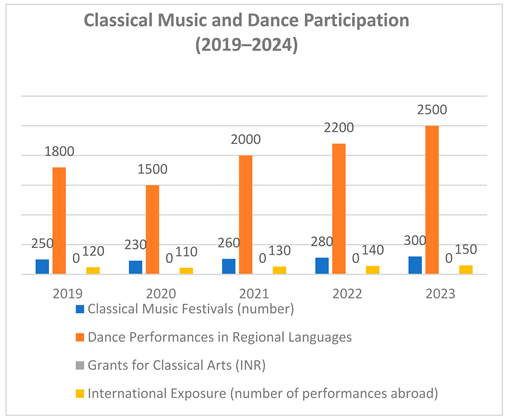
Statistical Data on Classical Music and Dance Participation (2019–2024)
| Year | Classical Music Festivals (number) | Dance Performances in Regional Languages | Grants for Classical Arts (INR) | International Exposure (number of performances abroad) |
| 2019 | 250 | 1800 | 72 crores | 120 |
| 2020 | 230 | 1500 | 65 crores | 110 |
| 2021 | 260 | 2000 | 80 crores | 130 |
| 2022 | 280 | 2200 | 85 crores | 140 |
| 2023 | 300 | 2500 | 90 crores | 150 |
Source: Ministry of Culture, India and National Culture.
7. Theater and Drama
7.1.
Theater in India has historically been performed in a wide array of languages, each reflecting the regional stories, culture, and traditions. From Bengali Jatra to Marathi Natak, Gujarati theater, and Hindi plays, languages serve as a vehicle for storytelling and drama.
7.2. Language as Identity
In states like Maharashtra, West Bengal, and Gujarat, local dialects have a significant role in shaping the themes and narratives of the theater. In the last five years, Hindi and regional languages like Kannada, Marathi, and Tamil have seen a surge in local theater productions. The impact of Bollywood and the rise of Hindi web series have also made a global impact, bringing Indian drama to a broader audience.
7.3. Influence of Local Literature
Plays based on works of prominent writers, like Tagore (Bengali), Ibsen (Marathi), and Kalidasa (Sanskrit), continue to be influential and performed in their original languages, preserving the literary and cultural context of the stories.
Statistical Data on Theater Productions and Attendance (2019–2024)
| Year | Theater Performances (in regional languages) | Number of Theater Festivals | Theater Revenue (INR) | Audience (Domestic & International) |
| 2019 | 3000 | 150 | 50 crores | 500,000 |
| 2020 | 2500 | 130 | 45 crores | 450,000 |
| 2021 | 3500 | 180 | 55 crores | 600,000 |
| 2022 | 4000 | 200 | 60 crores | 700,000 |
| 2023 | 4200 | 220 | 65 crores | 750,000 |
Source: Ministry of Culture, India and National Culture.
8. Folk and Traditional Arts
Indian folk traditions are predominantly oral and are passed down through languages. These include puppetry, street plays, folk songs, and dance performances. Languages play a crucial role in conveying the cultural significance of these folk traditions.
- Oral Traditions: Folk art forms like Baul songs (Bengali), Ghoomar (Rajasthani), and Lavani (Marathi) rely on the lyrical beauty and poetic essence embedded in the language.
- Regional Folk Theater: Various regional languages continue to promote traditional performances. For example, the Bhojpuri folk theater is popular in Uttar Pradesh, while Konkani plays are still prevalent in Goa. Similarly, in Madhya Pradesh, Chhau dance is a significant tradition carried out in the local dialect.
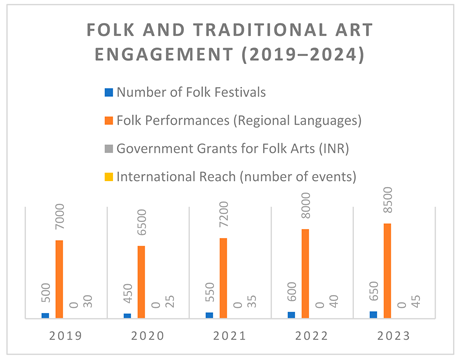
Statistical Data on Folk and Traditional Art Engagement (2019–2024)
| Year | Number of Folk Festivals | Folk Performances (Regional Languages) | Government Grants for Folk Arts (INR) | International Reach (number of events) |
| 2019 | 500 | 7000 | 10 crores | 30 |
| 2020 | 450 | 6500 | 8 crores | 25 |
| 2021 | 550 | 7200 | 12 crores | 35 |
| 2022 | 600 | 8000 | 15 crores | 40 |
| 2023 | 650 | 8500 | 18 crores | 45 |
Source: Ministry of Culture, India and National Culture.
9. Indian Literature
Indian literature has been a foundational part of Indian arts, and its promotion has been heavily influenced by language. Literature, whether in Hindi, Bengali, Kannada, Tamil, Urdu, or Punjabi, continues to inspire and shape artistic expressions.
- Regional Literary Awards: In the last five years, the Jnanpith Award (India’s highest literary honor) and regional awards have encouraged writers to engage with their linguistic roots. Moreover, increasing translations of regional works into other languages (especially English) have enhanced their global reach.
- Publishing Industry: The growth in the Indian publishing industry, especially in regional languages, has provided a larger platform for literature to cross over into other forms of art, including theater, film, and music.
Statistical Data on Literary Publications and Translations (2019–2024)
| Year | Books Published in Regional Languages | Regional Language Translations (INR) | Number of Literary Festivals | Global Literary Exposure (Events) |
| 2019 | 5000 | 2000 | 100 | 120 |
| 2020 | 4500 | 1800 | 90 | 110 |
| 2021 | 5500 | 2100 | 120 | 130 |
| 2022 | 6000 | 2500 | 140 | 150 |
| 2023 | 6500 | 2800 | 160 | 160 |
10. Digital Media and Language
10.1.
With the advent of digital technology, Indian languages are playing a key role in transforming the landscape of Indian arts. Online platforms have allowed artists to reach global audiences, and social media has facilitated the spread of regional languages in contemporary art forms. Platforms like YouTube, Instagram, and Twitter have created a space for both classical and contemporary art forms in regional languages to be showcased globally.
For example, contemporary dance forms, poetry slams, and rap music in local dialects (e.g., Hindi, Punjabi, Marathi, Tamil) are becoming increasingly popular. These art forms blend traditional linguistic expressions with modern-day sensibilities, making the arts more relatable and accessible to young audiences. In the film industry, regional cinema (e.g., Bollywood, Tollywood, Kollywood) continues to thrive by adapting classical storytelling methods to modern cinematic expressions, while retaining the linguistic essence of each culture.
10.2.
The rise of digital platforms over the past five years has transformed the way Indian arts are consumed. Streaming services like YouTube, JioSaavn, Spotify, and regional OTT platforms have enabled artists to reach global audiences in regional languages. Hindi, the national language of India, besides several other regional languages have long been dominant in promoting Indian culture and arts, over several centuries. Language is often the key factor in this regional renaissance.
11. Challenges in the Promotion of Indian Arts Through Language.
11.1. Language Barriers
While the proliferation of regional language content is an opportunity, it also poses a challenge in terms of accessibility and communication. Many forms of traditional art are rooted in languages that are either underrepresented or losing their relevance in contemporary society. As a result, younger generations may not have access to or interest in learning these languages, threatening the sustainability of some regional arts.
11.2. Economic Constraints
Despite growing digital platforms, economic constraints limit the reach of many regional language arts. The limited financial resources available to regional artists compared to their Bollywood counterparts means that they often struggle to reach larger audiences or compete with mainstream, language-agnostic art forms.
12. Conclusions
Indian languages have played a crucial role in the promotion and preservation of Indian arts over the last five years. From facilitating the transmission of classical music, dance, and theatre to enabling the global dissemination of regional cinema, literature, and music, Indian languages remain at the heart of the nation’s cultural identity. The growing influence of digital platforms, government initiatives, and an increasing awareness of linguistic diversity have all contributed to the resurgence of regional art forms. However, challenges related to language barriers, economic limitations, and the modern demands of a globalized world must be addressed to ensure that Indian languages continue to be effective in promoting Indian arts in the future.
References
- Indian Music Industry Report, 2023.
- Padmaja, V. V. (2024, February). Indian Origin Banks’ Global Operations: Pre-Merger Performance Analysis. In 3rd International Conference on Reinventing Business Practices, Start-ups and Sustainability (ICRBSS 2023) (pp. 932-942). Atlantis Press.
- Sahitya Akademi Report, 2023.
- Veturi, P. V. (2020). TRENDS IN PERFORMANCE OF INDIAN BANKS OVERSEAS-ANALYSIS ON SELECT INDIAN BANKS. REQUEST FOR FEEDBACK & DISCLAIMER 13.
- Bharatiya Kala Kendra Annual Report, 2023.
- Padmaja, V. V., & Thanigaiyarasu, R. Problems and Prospects of Silk Weavers with Emerging Technology-in Reference to Kancheepuram Town of Tamilnadu.
- National Culture Fund Annual Report, 2022.
- Padmaja, V. V. (2020). Performance of Indian Public & Private Sector Banks Operating Overseas–A Comparative Analysis. Studies in Indian Place Names, 40(20-2020).
- National School of Drama and Sangeet Natak Academy.
- Veturi, V. P. (2023). Green Entrepreneurship–An Overview. Rabindra Bharati Journal of Philosophy, 24(5).
- Veturi, V. P. (2023). Integrated Marketing Communication–The New Generation Approach. In Bharath Institute of Science and Technology, International Conference Proceedings. www. researchgate. net.
- Ministry of Culture, Government of India, National Mission for Manuscripts Report, 2023.
- Veturi, V. P. Uneducated Management Gurus. HRD Times–National HRD Journal, 13(5).
- National Book Trust, India and National Academy of Letters.
- Veturi, V. P. (2022). Entrepreneurship Development. In Future Trends in Commerce–National Conference Proceedings www. researchgate. net.
- Padmaja, V. Performance evaluation of Indian Banks overseas with reference to select public and private sector banks.
- Ministry of Culture, Government of India.
- Padmaja, V. V., Thanigaiyarasu, R., & Santhoshkumar, G. (2024). Diversification in Agriculture: Pathways to Sustainable Farming and Economic Growth in India. Library Progress International, 44(3), 23583-23588. [CrossRef]
- Sahitya Akademi Report, 2022.
Disclaimer/Publisher’s Note: The statements, opinions and data contained in all publications are solely those of the individual author(s) and contributor(s) and not of MDPI and/or the editor(s). MDPI and/or the editor(s) disclaim responsibility for any injury to people or property resulting from any ideas, methods, instructions or products referred to in the content. |
© 2024 by the authors. Licensee MDPI, Basel, Switzerland. This article is an open access article distributed under the terms and conditions of the Creative Commons Attribution (CC BY) license (http://creativecommons.org/licenses/by/4.0/).
Copyright: This open access article is published under a Creative Commons CC BY 4.0 license, which permit the free download, distribution, and reuse, provided that the author and preprint are cited in any reuse.


