Preprint
Article

This version is not peer-reviewed.

Highly Effective Asymmetric Henry Reaction Catalyzed by Chiral Aziridine-Functionalized Organophosphorus Compounds

Submitted:

25 December 2024

Posted:

26 December 2024

You are already at the latest version

Abstract

Remaining in the research topic related to the discovery of new catalytic abilities of chiral organophosphorus derivatives of aziridines, we decided to synthesize organophosphorus compounds containing an aziridine ring, previously described by our group, and to investigate their catalytic activity in the asymmetric nitroaldol (Henry) reaction between aromatic aldehydes and nitromethane in the presence of catalytic amounts of copper (II) acetate. In some cases, the chiral β-nitroalcohols obtained with high chemical yield were characterized by very high values ​​of enantiomeric excess (over 95%). What is quite important, the use of two enantiomerically pure catalysts differing in the absolute configuration of the aziridine unit led to the formation of two enantiomeric products of the Henry reaction.
Keywords: 
;  ;  ;  ;  

1. Introduction

The use of asymmetric synthesis techniques for the enantioselective formation of carbon-carbon bonds has enjoyed unwavering interest among contemporary chemists dealing with modern organic synthesis for many decades [1]. This technology has been a research platform used in both academia and industry for years [2]. Moreover, it is also of great importance in the design of potential pharmaceutical molecules and therefore in medicinal chemistry [3]. The continuous development of synthetic methods of asymmetric synthesis confirms its enormous importance for many areas of life [4].
The nitroaldol (Henry) reaction is one of the most important carbon-carbon bond-forming reactions in organic chemistry, which involves the construction of nitroalcohols [5]. There are numerous examples of chiral catalysts promoting the asymmetric variant of the Henry reaction known in the literature [6], including: chiral tridentate ligands from L-proline [7], chiral thiols and C2-symmetrical disulfides [8], chiral salan ligands with bulky substituents [9], bisoxazoline-cobalt complexes [10], N-substituted-3,4-dihydroxypyrrolidines [11], β-amino alcohol-copper (II) complex [12], and explored in our group sulfur-containing chiral tridentate ligands [13,14].
The chiral products of the asymmetric Henry reaction are extremely useful building blocks used in many research areas [15], i.e. in pharmaceutical chemistry for the synthesis of β-adrenergic blockers [16], in the synthesis of β-aminoalcohols [17], and for the construction of tetrasubstituted stereogenic carbon centers having a nitrogen substituent [18].
Our previous studies on the synthesis and catalytic activity of chiral organophosphorus aziridine derivatives have shown that these compounds are capable of efficiently promoting asymmetric Michael addition, a three-component asymmetric Mannich reaction, Friedel-Crafts alkylation, Simmons-Smith cyclopropanation, diethylzinc addition to aldehydes, asymmetric Morita-Baylis-Hillman reaction, its vinylogous version (namely Rauhut-Currier transformation), and recently an asymmetric [3+2]-cycloaddition of azomethine ylides to trans-β-nitrostyrene.
Despite the above reports, there are only a few works in the chemical literature describing organophosphorus compounds containing a chiral aziridine ring and their application in asymmetric synthesis [19]. Taking into account the above, with the aim of expanding the range of applicability of chiral aziridine derivatives having a phosphine or phosphine oxide fragment in the molecule, and based on our experience in asymmetric synthesis, including the nitroaldol reaction [13,14], we decided to test their catalytic ability in the asymmetric Henry reaction between aromatic aldehydes and nitromethane, hoping to observe interesting stereochemical relationships.

2. Results and Discussion

2.1. Synthesis of Chiral Catalysts 1-12

The enantiomerically pure organophosphorus derivatives of aziridines which were used in this research constitute: chiral aziridine phosphines 1-4, chiral aziridine phosphine oxides 5-8, aziridine phosphine oxide bearing free NH aziridinyl moiety 9, and aziridine-functionalized imines 10-12 (Figure 1).
Phosphine oxides 5-8 were constructed from o-bromoanisole and diphenylphosphic chloride in the presence of magnesium turnings and catalytic amount of iodine as described earlier [20]. In turn, phosphines 1-4 were achieved from the titanium (IV) isopropoxide and triethoxysilane-mediated reduction of the aforementioned phosphine oxides 5-8 [21]. Phosphine oxide 9 bearing a free NH-group at aziridine subunit was prepared from (S)-2-phenylaziridine and diphenylphosphinic chloride according to our previous findings [22]. And finally, chiral imines 10-12 were synthesized from the corresponding aminoalkyl aziridines and aldehydes as reported previously [23,24].

2.2. Asymmetric Nitroaldol (Henry) Reaction Catalyzed by Chiral Systems 1-12

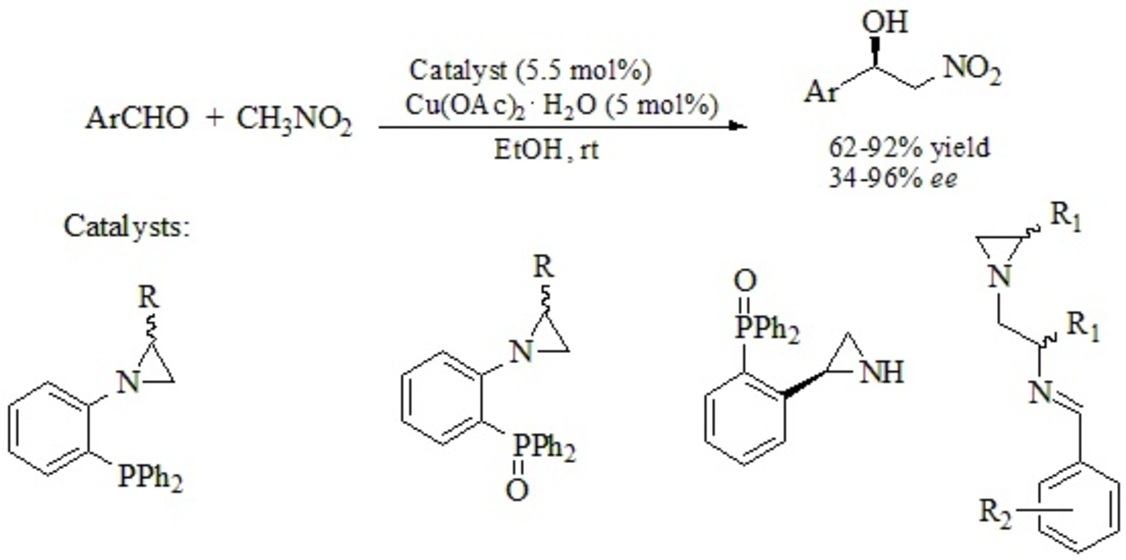
Having all the chiral catalysts in hand, we decided to check whether they would be able to efficiently catalyze the asymmetric Henry reaction. As a model transformation, we chose the reaction of benzaldehyde with nitromethane in the presence of 5 mol% of copper(II) acetate as the metal component (Scheme 1). The reactions were carried out in ethanol at room temperature following our previous findings [13]. All screening results of our chiral catalysts are summarized in Table 1.
A quick glance at the results in Table 1 allows concluding that all the chiral catalysts tested are capable of promoting the title reaction. Chiral aziridinylphosphines 1-4 led to the desired β-nitroalcohol in fairly good chemical yields (62-70%), however with quite low enantiomeric excess values (34-55%), Table 1, entries 1-4. On the other hand, chiral aziridinylphosphine oxides 5-8 allowed to obtain the same desired product in higher chemical yields (in most cases) (Table 1, entries 5-8) and excellent enantioselectivity in one case (96% ee, Table 1, entry 5). What is somewhat surprising, catalyst 9 containing a free NH-aziridine group in its structure showed only moderate catalytic activity resulting in medium values ​​of yield (65%) and enantiomeric excess of the reaction product (56%) (Table 1, entry 9). Finally, imines 10-12 showed quite robust catalytic activity, but without any distinguishable results (Table 1, entries 10-13). Interestingly, the use of enantiomeric catalysts containing (S)-2-isopropylaziridine and (R)-2-isopropylaziridine units led to the formation of both enantiomers of β-nitroalcohols (Table 1, entries 1,2,4,5, and 10,11).
We also decided to investigate the effect of the metal additive on the course of the title reaction. Therefore, we used other copper and zinc derivatives (in one case) for this purpose (Table 2). Analysis of the data collected in Table 2 clearly shows that copper(II) acetate, previously selected by us, was practically the only effective metal component in our catalytic systems. Reactions involving zinc triflate and copper(II) chloride dihydrate did not give the expected reaction product and only unreacted starting material was recovered (Table 2, entries 2 and 3, respectively). Having the experience from our previous work on the enantioselective Henry reaction [13,14] and knowing that reactions carried out in ethanol at room temperature proceed in the most efficient way (in terms of chemical yield and enantioselectivity), we decided not to screen other solvents and temperatures.

2.3. Asymmetric Henry Reaction Promoted by Aziridine-Phosphine 5 – Scope of the Starting Materials

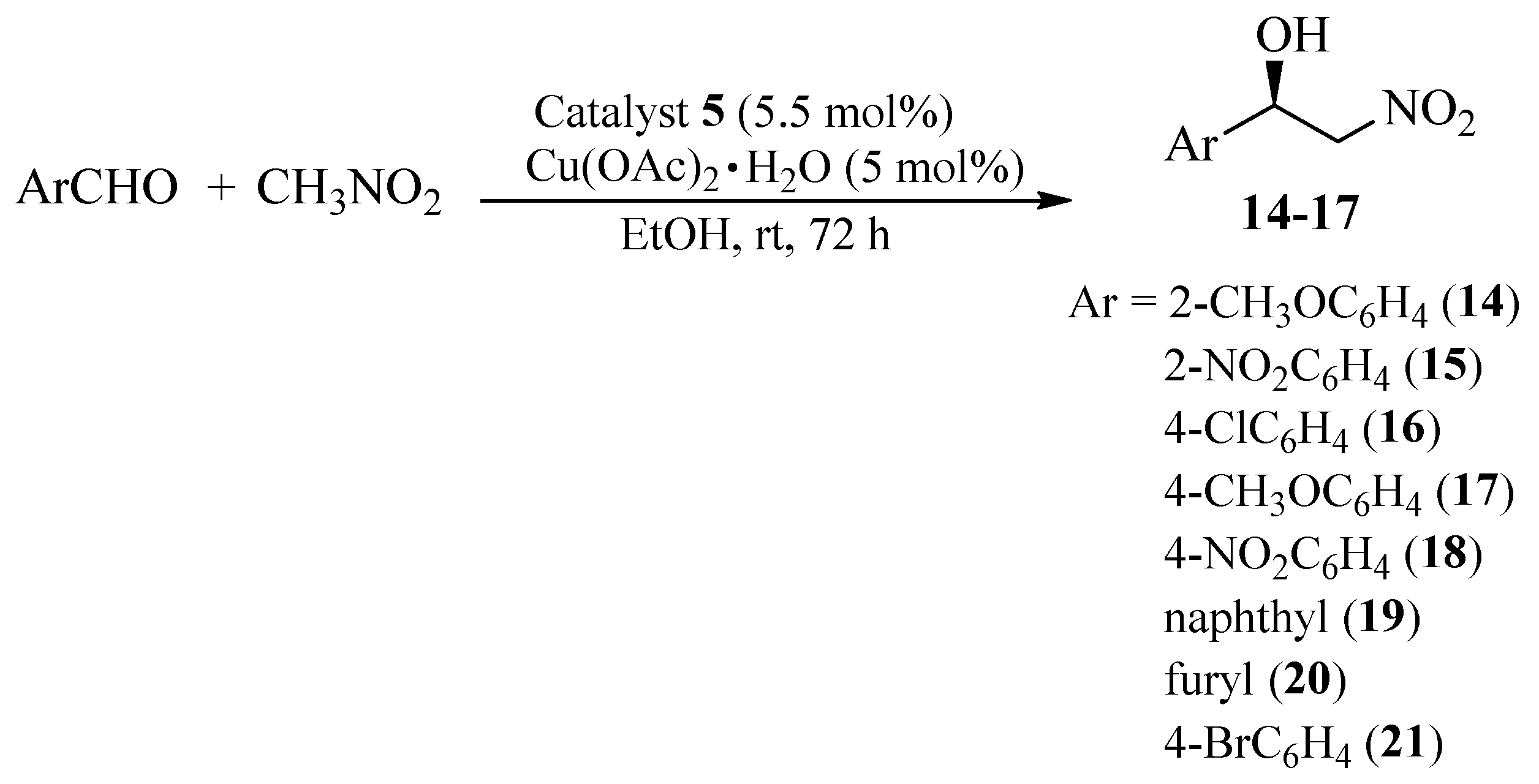
Based on previously conducted screening studies of the catalysts, it was determined that aziridinylphosphine oxide 5 bearing (R)-2-isopropylaziridine group showed the highest catalytic activity. Therefore, this system was used to carry out further asymmetric nitroaldol reactions using other aromatic aldehydes as substrates (Scheme 2). The results are summarized in Table 3.
The results summarized in Table 3 clearly confirm that the chiral aziridine phosphine oxide 5 having an (R)-2-isopropylaziridine group is an efficient catalyst for the asymmetric nitroaldol reaction leading to chiral aromatic β-nitroalcohols with high chemical yields and enantiomeric excess. Although the substrate scope we used in our studies containing only aromatic aldehydes may seem narrow, this choice was driven by several factors: In the case of aliphatic (non-aromatic) aldehydes, the lack of stabilizing interaction of the aromatic system may lead to lower reactivity or poorer enantiomeric selectivity. In aromatic aldehydes, groups on the ring can influence the electronic properties of the carbon atom in the carbonyl group by both inductive and resonance effects, which can positively influence the control of chirality in the final product. Aromatic aldehydes often allow for better enantioselectivity in the asymmetric Henry reaction. This is because the interactions between the aldehyde and the chiral catalyst can be more precisely controlled when an aromatic system is present. The aromatic group can form additional noncovalent interactions (e.g., π–π stacking) that stabilize the specific direction of addition of the nitroalkane to the carbonyl group. Unfortunately, the reaction carried out with furfural as the starting aldehyde did not provide even trace amounts of the desired reaction product (Table 3, entry 7).
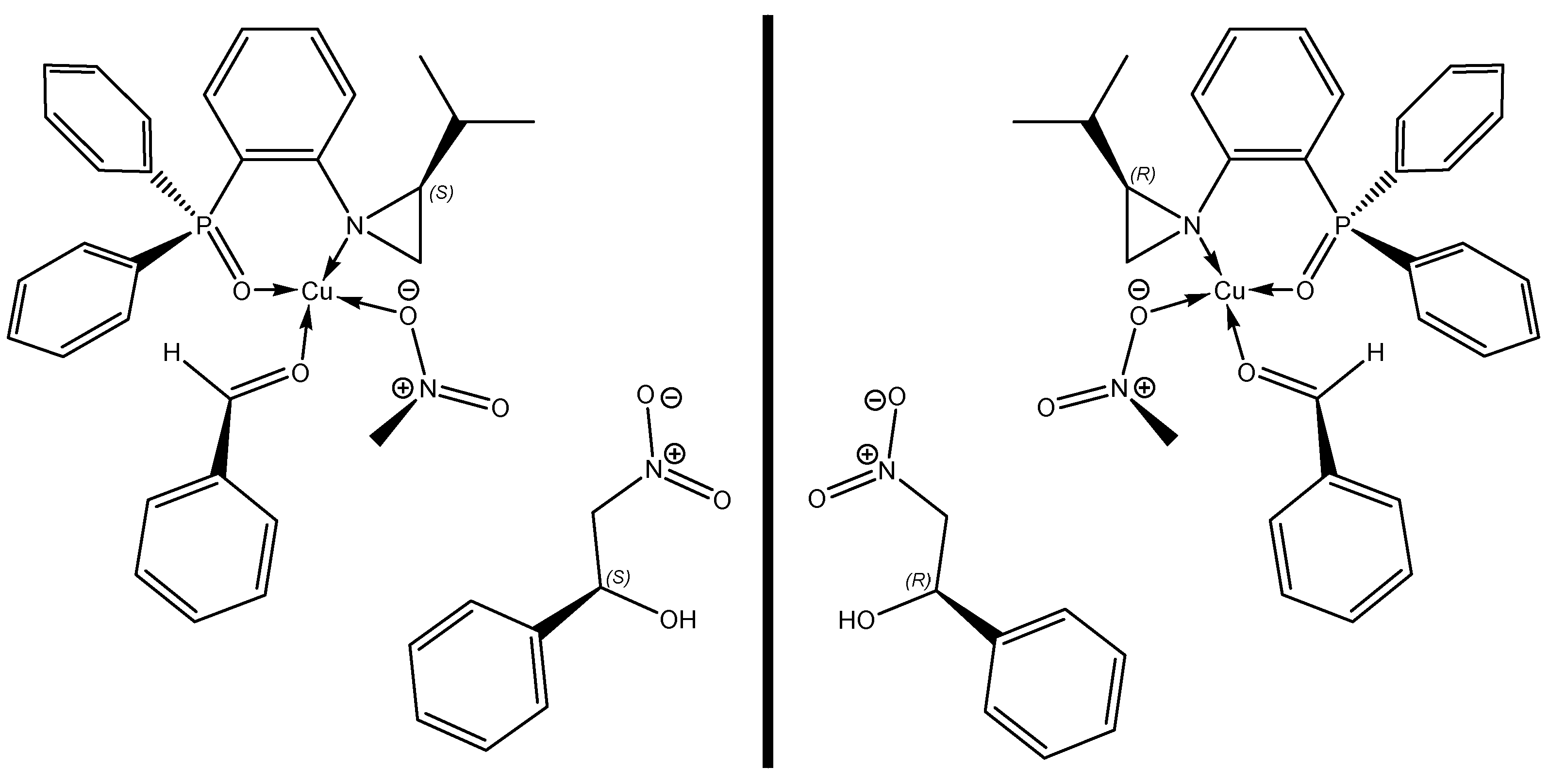
In order to propose a tentative transition state model for the asymmetric nitroaldol reaction, we based on our earlier considerations dedicated to the transition state of the asymmetric [3+2]-cycloaddition reaction [25], and looking for proposals for transition states of this reaction available in the literature [26,27,28,29,30,31]. Therefore, we proposed enantiomeric transition states for enantiomeric ligands 5 and 6, which led to chiral products with opposite absolute configuration (Figure 2). As presented earlier, the use of ligands with opposite absolute configuration led to the formation of nitroaldol reaction products with a configuration that depends on the configuration of the ligand and, consequently, on the resulting copper(II)-ligand complex. The presented transition state shows that the coordination cavity formed by the ligand-Cu atom bond forces the formation of a new carbon-carbon bond between the substrates in a stereoselective manner, because only in such an arrangement can the substrates fit into it.
In support of the possibility of such a transition state formation, we performed a series of NMR spectra for the ligand and the in situ formed complex in deuterated methanol. The 31P NMR spectrum showed a signal at 32 ppm originating from the phosphine oxide of the ligand, but this signal is clearly smeared and shifts to 34 ppm for the formed complex with copper (spectrum in Supporting Information). Additionally, the 15N NMR spectrum of the ligand shows a signal originating from the aziridine nitrogen atom (53 ppm), which disappears after the ligand is complexed. Both of these results may confirm our concept of complexation of the copper atom and, consequently, the model of the transition state presented in Figure 2.

3. Materials and Methods

3.1. Materials

n-Hexane and ethyl acetate were purchased from Merck (Merck Group (Merck KgaA), Darmstadt, Germany) and were distilled before use. The NMR spectra were recorded on a Bruker (Bruker, Billerica, MA, USA) instrument at 600 MHz using CDCl3 as a solvent and TMS as internal standard. Column chromatography was performed using Merck 60 silica gel. TLC was performed on Merck 60 F254 silica gel plates (Merck Group (Merck KgaA), Darmstadt, Germany). The enantiomeric excess (ee) was determined via HPLC using column with chiral support (Chiralcel OD-H). Chiral catalysts 1-12 were prepared as previously reported [20,21,22,23,24].

3.2. Methods

3.2.1. Asymmetric Nitroaldol (Henry) Reaction – General Procedure

In a round-bottomed flask were placed the appropriate catalysts (0.055 mol, 5.5 mol%) and copper (II) acetate monohydrate (0.05 mol, 5 mol%, 10 mg). Ethanol (1.5 mL) was added and the mixture was stirred during 1 h at room temperature. After this time, nitromethane (10 mmol, 0,54 mL) and the corresponding aromatic aldehyde (1 mmol) were added and the mixture was stirred magnetically at rt during 72 h. After completion of the transformation (TLC test) the solvent was evaporated in vacuo and the crude mixture was purified on the chromatographic column (SiO2, hexane:ethyl acetate from 97:3 to 90:10) to yield the corresponding β-nitroalcohols. The chemical yield and enantiomeric excess values are summarized in Table 1, Table 2 and Table 3.
  • 1-Phenyl-2-nitroethanol 13
  • 1H NMR (600 MHz, CDCl3): δ = 2.84 (s, 1H, OH), 4.55 (dd, J = 3.0, 13.2 Hz, 1H, CH2NO2), 4.62 (dd, J = 9.6, 13.2 Hz, 1H, CH2NO2), 5.49 (d, J = 9.6, 1H, CHOH), 7.39 – 7.44 (m, 5H, CHar);
  • (R)-1-(2-Methoxyphenyl)-2-nitroethanol 14
  • 1H NMR (600 MHz, CDCl3): δ = 3.13 (s, 1H, OH), 3.91 (s, 3H, OCH3), 4.60 (dd, J = 9.3, 13.0 Hz, 1H, CH2NO2), 4.68 (dd, J = 3.0, 13.0 Hz, 1H, CH2NO2), 5.66 (d, J = 8.8 Hz, 1H, CHOH), 6.93 – 6.95 (m, 1H, CHar), 7.03 – 7.05 (m, 1H, CHar), 7.34 – 7.37 (m, 1H, CHar); 7.46 – 7.48 (m, 1H, CHar);
  • (R)-1-(2-Nitrophenyl)-2-nitroethanol 15
  • 1H NMR (600 MHz, CDCl3): δ = 3.18 (s, 1H, OH), 4.58 (dd, J = 9.0, 13.9 Hz, 1H, CH2NO2), 4.90 (dd, J = 2.0, 13.9 Hz, 1H, CH2NO2), 6.08 (d, J = 9.0 Hz, 1H, CHOH), 7.57 – 7.59 (m, 1H, CHar), 7.76 – 7.78 (m, 1H, CHar), 7.97 – 7.98 (m, 1H, CHar); 8.10 – 8.11 (m, 1H, CHar);
  • (R)-1-(4-Chlorophenyl)-2-nitroethanol 16
  • 1H NMR (600 MHz, CDCl3): δ = 3.02 (s, 1H, OH), 4.51 (dd, J = 3.1, 13.4 Hz, 1H, CH2NO2), 4.58 (dd, J = 9.3, 13.4 Hz, 1H, CH2NO2), 5.46 (d, J = 9.3 Hz, 1H, CHOH), 7.36 – 7.41 (m, 4H, CHar);
  • (R)-1-(4-Methoxyphenyl)-2-nitroethanol 17
  • 1H NMR (600 MHz, CDCl3): δ = 2.85 (br.s, 1H, OH), 3.83 (s, 3H, OCH3), 4.49 (dd, J = 3.0, 13.1 Hz, 1H, CH2NO2), 4.61 (dd, J = 9.6, 13.1 Hz, 1H, CH2NO2), 5.42 (dd, J = 3.0, 9.6 Hz, 1H, CHOH), 6.93 – 6.95 (m, 2H, CHar), 7.33 – 7.34 (m, 2H, CHar);
  • (R)-1-(4-Nitrophenyl)-2-nitroethanol 18
  • 1H NMR (600 MHz, CDCl3): δ = 3.22 (s, 1H, OH), 4.57 – 4.65 (m, 2H, CH2NO2), 5.63 (dd, J = 3.3 Hz, J = 8.7 Hz, 1H, CHOH), 7.64 – 7.66 (m, 2H, CHar), 8.28 – 8.30 (m, 2H, CHar);
  • (R)-1-(naphthalen-1-yl)-2-nitroethanol 19
  • 1H NMR (600 MHz, CDCl3): δ = 2.91 – 2.93 (m, 1H, OH), 4.66 – 4.74 (m, 2H, CH2NO2), 6.27–6.29 (m, 1H, CHOH), 7.53 – 7.59 (m, 2H, CHar), 7.61 – 7.64 (m, 1H, CHar), 7.78 – 7.79 (m, 1H, CHar), 7.88 – 7.95 (m, 2H, CHar), 8.06 – 8.08 (m, 1H, CHar);
  • (R)-1-(4-bromophenyl)-2-nitroethanol 21
  • 1H NMR (600 MHz, CDCl3): δ = 2.90 (s, 1H, OH), 4.52 (dd, J = 3.0, 13.5 Hz, 1H, CH2NO2), 4.60 (dd, J = 9.5, 13.5 Hz, 1H, CH2NO2), 5.46 (dd, J = 3.0, 9.5 Hz, 1H, CHOH), 7.31 – 7.33 (m, 2H, CHar), 7.55 – 7.57 (m, 2H, CHar);

4. Conclusions

A series of chiral organophosphorus derivatives containing a three-membered aziridine ring were synthesized and screened for their catalytic activity in the asymmetric nitroaldol reaction of aromatic aldehydes and nitromethane in the presence of copper(II). The above-mentioned chiral heteroorganic derivatives were shown to be effective in yielding the desired chiral products with reasonable chemical yields and enantiomeric excess. The change in the absolute configuration of the catalyst also resulted in changing of the absolute configuration of the obtained β-nitroalcohols.

Supplementary Materials

The following supporting information can be downloaded at the website of this paper posted on Preprints.org. H NMR spectra and HPLC chromatogram tracks of Henry reaction products.

Author Contributions

Conceptualization and methodology, M.R. and A.M.P.; software, J.S., A.M.P. and M.R.; investigation, J.W. and J.S.; writing—original draft preparation, M.R.; writing—review and editing, M.R. and A.M.P.; supervision, M.R. All authors have read and agreed to the published version of the manuscript.

Funding

This research was realized without external funding.

Conflicts of Interest

The authors declare no conflict of interest.

References

  1. Garg, A.; Rendina, D.; Bendale, H.; Akiyama, T.; Ojima, I. Recent advances in catalytic asymmetric synthesis. Front. Chem. 2024, 12, 1398397. [Google Scholar] [CrossRef] [PubMed]
  2. He, Y.-M.; Cheng, Y.-Z.; Duan, Y.; Zhang, Y.-D.; Fan, Q.-H.; You, S.-L.; Luo, S.; Zhu, S.-F.; Fu, X.-F.; Zhou, Q.-L. Recent Progress of Asymmetric Catalysis from a Chinese Perspective. CCS Chem. 2023, 5, 2685–2716. [Google Scholar] [CrossRef]
  3. Tamatam, R.; Shin, D. Asymmetric Synthesis of US-FDA Approved Drugs over Five Years (2016–2020): A Recapitulation of Chirality. Pharmaceuticals 2023, 16, 339. [Google Scholar] [CrossRef] [PubMed]
  4. Sharma, S.K.; Paniraj, A.S.R.; Tambe, Y.B. Developments in the Catalytic Asymmetric Synthesis of Agrochemicals and Their Synthetic Importance. J. Agric. Food Chem. 2021, 69, 14761–14780. [Google Scholar] [CrossRef] [PubMed]
  5. Ballini, R.; Palmieri, A. Nitroalkanes: Synthesis, Reactivity, and Applications, 1st ed; WILEY-VCH GmbH Weinheim, Germany, 2021, pp. 59–105.
  6. Dong, L.; Chen, F.-E. Asymmetric catalysis in direct nitromethane-free Henry reactions. RSC Adv. 2020, 10, 2113–2326. [Google Scholar] [CrossRef] [PubMed]
  7. Xu, D.; Sun, Q.; Quan, Z.; Sun, W. Wang, X. The synthesis of chiral tridentate ligands from L-proline and their application in the copper(II)-catalyzed enantioselective Henry reaction. Tetrahedron: Asymmetry 2017, 28, 954–963. [Google Scholar] [CrossRef]
  8. Zielińska-Błajet, M.; Skarżewski, J. New chiral thiols and C2-symmetrical disulfides of Cinchona alkaloids: ligands for the asymmetric Henry reaction catalyzed by CuII complexes. Tetrahedron: Asymmetry 2009, 20, 1992–1998. [Google Scholar] [CrossRef]
  9. Wang, Z.; He, J.; Mu, Y. Synthesis of chiral salan ligands with bulky substituents and their application in Cu-catalyzed asymmetric Henry reaction. J. Organomet. Chem. 2020, 928, 121546. [Google Scholar] [CrossRef]
  10. Ishihara, K.; Kato, Y.; Takeuchi, N.; Hayashi, Y.; Hagiwara, Y.; Shibuya, S.; Natsume, T.; Matsugi, M. Asymmetric Henry Reaction Using Cobalt Complexes with Bisoxazoline Ligands Bearing Two Fluorous Tags. Molecules 2023, 28, 7632. [Google Scholar] [CrossRef]
  11. Rénio, M.R.R.; Sousa, F.J.P.M.; Tavares, N.C.T.; Valente, A.J.M.; da Silva Serra, M.E.; Murtinho, D. (3S,4S)-N-substituted-3,4-dihydroxypyrrolidines as ligands for the enantioselective Henry reaction. Appl. Organomet. Chem. 2021, 35, e6175. [Google Scholar] [CrossRef]
  12. Alammari, A.S.; Al-Majid, A.M.; Barakat, A.; Alshahrani, S.; Ali, M.; Islam, M.S. ; Asymmetric Henry Reaction of Nitromethane with Substituted Aldehydes Catalyzed by Novel In Situ Generated Chiral Bis(β-Amino Alcohol-Cu(Oac)2·H2O Complex. Catalysts 2021, 11, 1208. [Google Scholar] [CrossRef]
  13. Rachwalski, M.; Leśniak, S.; Sznajder, E.; Kiełbasiński, P. Highly enantioselective Henry reaction catalyzed by chiral tridentate heterorganic ligands. Tetrahedron: Asymmetry 2009, 20, 1547–1549. [Google Scholar] [CrossRef]
  14. Kiełbasiński, P.; Rachwalski, M.; Kaczmarczyk, S.; Leśniak, S. Polydentate chiral heteroorganic ligands/catalysts – impact of particular groups on their activity in selected reactions of asymmetric synthesis. Tetrahedron: Asymmetry 2013, 24, 1417–1420. [Google Scholar] [CrossRef]
  15. Rao, D.H.S.; Chatterjee, A.; Padhi, S.K. Biocatalytic approaches for enantio and diastereoselective synthesis of chirl β-nitroalcohols. Org. Biomol. Chem. 2021, 19, 322–337. [Google Scholar] [CrossRef]
  16. Wang, H.-H.; Wan, N.-W.; Da, X.-Y.; Mou, X.-Q.; Wang, Z.-X.; Chen, Y.-Z.; Liu, Z.-Q.; Zheng, Y.-G. Enantiocomplementary synthesis of β-adrenergic blocker precursors via biocatalytic nitration of phenyl glycidyl ethers. Bioorg. Chem. 2023, 138, 106640. [Google Scholar] [CrossRef] [PubMed]
  17. Tentori, F.; Brenna, E.; Colombo, D.; Crotti, M.; Gatti, F.G.; Ghezzi, M.C.; Pedrocchi-Fantoni, G. Biocatalytic Approach to Chiral β-Nitroalcohols by Enantioselective Alcohol Dehydrogenase-Mediated Reduction of α-Nitroketones. Catalysts 2018, 8, 308. [Google Scholar] [CrossRef]
  18. De Jesús Cruz, P.; Johnson, J.S. Crystallization-Enabled Henry Reactions: Stereoconvergent Construction of Fully Substituted [N]-Asymmetric Centers. J. Am. Chem. Soc. 2022, 144, 15803–15811. [Google Scholar] [CrossRef] [PubMed]
  19. Doğan, Ö.; Çağli, E. PFAM catalyzed enantioselective diethylzinc addition to imines. Turk. J. Chem. 2015, 39, 290–296. [Google Scholar] [CrossRef]
  20. Wujkowska, Z.; Zawisza, A.; Leśniak, S.; Rachwalski, M. Phosphinoyl-aziridines as a new class of chiral catalysts for enantioselective Michael addition. Tetrahedron 2019, 75, 230–235. [Google Scholar] [CrossRef]
  21. Buchcic, A.; Zawisza, A.; Leśniak, S.; Rachwalski, M. Asymmetric Friedel-Crafts Alkylation of Indoles Catalyzed by Chiral Aziridine-Phosphines. Catalysts 2020, 10, 971. [Google Scholar] [CrossRef]
  22. Buchcic, A.; Zawisza, A.; Leśniak, S.; Adamczyk, J.; Pieczonka, A.M.; Rachwalski, M. Enantioselective Mannich Reaction Promoted by Chiral Phosphinoyl-Aziridines. Catalysts 2019, 9, 837. [Google Scholar] [CrossRef]
  23. Buchcic-Szychowska, A.; Adamczyk, J.; Marciniak, L.; Pieczonka, A.M.; Zawisza, A.; Leśniak, S.; Rachwalski, M. Efficient Asymmetric Simmons-Smith Cyclopropanation and Diethylzinc Addition to Aldehydes Promoted by Enantiomeric Aziridine-Phosphines. Catalysts 2021, 11, 968. [Google Scholar] [CrossRef]
  24. Pieczonka, A.M.; Marciniak, L.; Rachwalski, M.; Leśniak, S. Enantiodivergent aldol condensation in the presence of aziridine/acid/water systems. Symmetry 2020, 12, 930. [Google Scholar] [CrossRef]
  25. Szymańska, J.; Rachwalski, M.; Pieczonka, A.M. Highly Efficient Asymmetric [3+2]-Cycloaddition Promoted by Chiral Aziridine-Functionalized Organophosphorus Compounds. Molecules 2024, 29, 3283. [Google Scholar] [CrossRef]
  26. Palomo, C.; Oiarbide, M.; Mielgo, A. Unveiling Reliable Catalysts for the Asymmetric Nitroaldol (Henry) Reaction. Angew. Chem. Int. Ed. 2004, 43, 5442–5444. [Google Scholar] [CrossRef]
  27. Cho, J.; Nayab, S.; Jeong, J.H. An efficient synthetic approach towards a single diastereomer of (2R,3R)-N2,N3-bis((S)-1-phenylethyl)butane-2,3-diamine via metalation and demetalation. Transit. Met. Chem. 2020, 45, 9–17. [Google Scholar] [CrossRef]
  28. Subba Reddy, B.V.; Madhusudana Reddy, S.; Manisha, S.; Madan, C. Asymmetric Henry reaction catalyzed by a chiral Cu(II) complex: a facile enantioselective synthesis of (S)-2-nitro-1-arylethanols. Tetraheron: Asymmetry 2011, 22, 530–535. [Google Scholar] [CrossRef]
  29. Ji, Y.Q.; Qi, G.; Judeh, Z.M.A. Efficient Asymmetric Copper(I)-Catalyzed Henry Reaction Using Chiral N-Alkyl-C1-tetrahydro-1,1′-bisisoquinolines. Eur. J. Org. Chem. 2011, 4892–4898. [Google Scholar] [CrossRef]
  30. Yoshisawa, A.; Feula, A.; Male, L.; Leach, A.G.; Fossey, J.S. Rigid and concave, 2,4-cis-substituted azetidine derivatives: A platform for asymmetric catalysis. Sci. Rep. 2018, 8, 6541. [Google Scholar] [CrossRef] [PubMed]
  31. Yearick Spangler, K.; Wolf, C. Asymmetric Copper(I)-Catalyzed Henry Reaction with an Aminoindanol-Derived Bisoxazolidine Ligand. Org. Lett. 2009, 11, 4724–4727. [Google Scholar] [CrossRef] [PubMed]
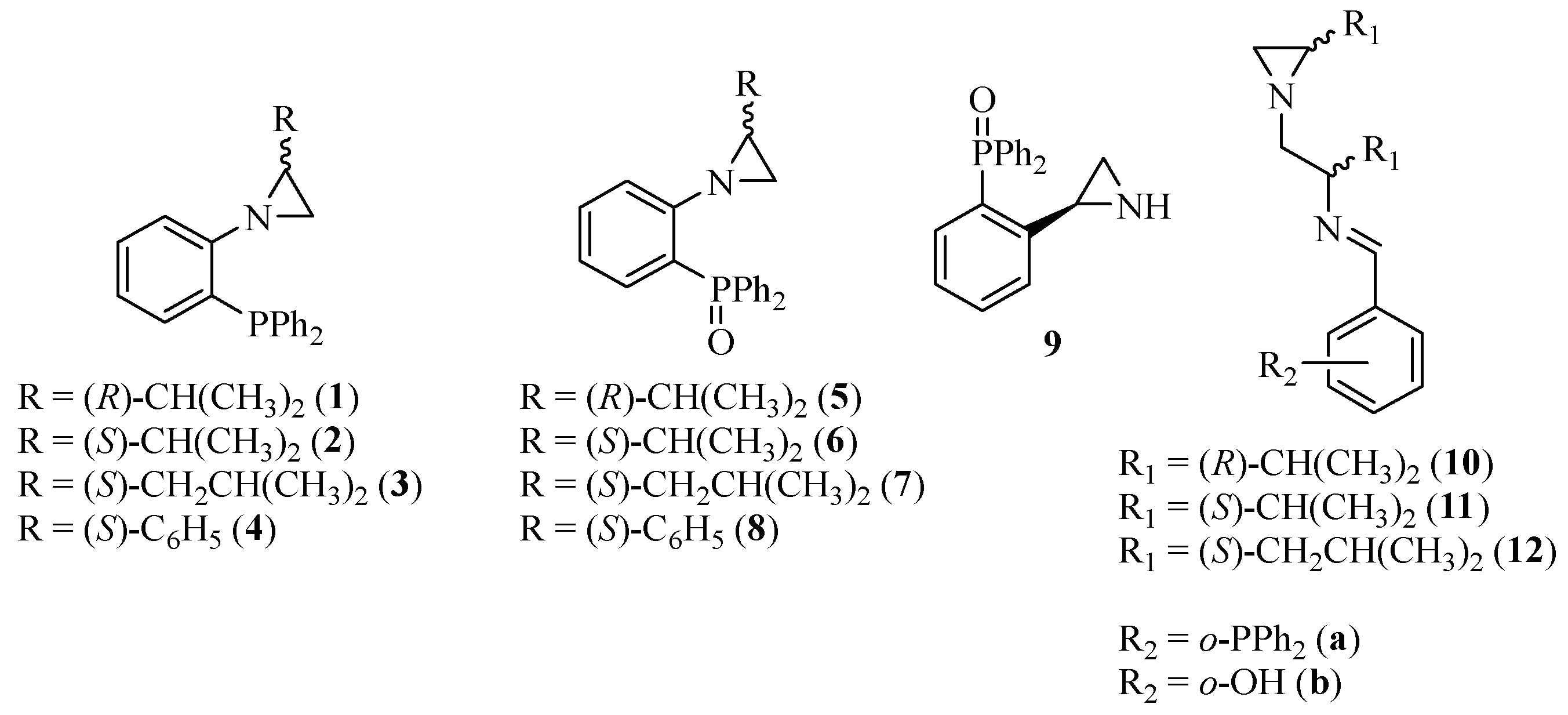
Figure 1. Optically pure chiral organophosphorus aziridine-derivatives 1-12.
Preprints 144161 g001
Scheme 1. Asymmetric Henry reaction promoted by chiral catalysts 1-12.
Preprints 144161 sch001
Scheme 2. Asymmetric Henry reactions catalyzed by aziridine-phosphine oxide 5.
Preprints 144161 sch002
Figure 2. Tentative transition state model for asymmetric Henry reaction.
Preprints 144161 g002
Table 1. Model asymmetric nitroaldol reaction promoted by aziridines 1-12.
Entry Catalyst Yield [%] ee [%]a Abs. conf.b
1 1 70 40 (R)
2 2 68 55 (S)
3 3 67 44 (S)
4 4 62 34 (S)
5 5 90 96 (R)
6 6 88 74 (S)
7 7 85 56 (S)
8 8 82 55 (S)
9 9 65 56 (S)
10 10a 89 80 (R)
11 11a 70 74 (S)
12 11b 78 62 (S)
13 12a 64 50 (S)
a Determined by chiral HPLC using Chiralcel OD-H. b According to literature data [13]. Conditions: 5.5 mol% of the catalyst, Cu(OAc)2·H2O (5 mol%), benzaldehyde (1.0 mmol), nitromethane (10.0 mmol), EtOH (1.5 mL), rt, 72 h.
Table 2.
Entry Metal additve Yield [%] ee [%]a Abs. conf.b
1 Cu(OTf)2 ‧ C6H6 19 1 (R)
2 Zn(OTf)2 0 (R)
3 CuCl2 ‧ 2 H2O 0 (R)
4 CuOAc 47 4 (R)
5 Cu(OAc)2 ‧ H2O 90 96 (R)
a Determined by chiral HPLC using Chiralcel OD-H. b Conditions: 5.5 mol% of the catalyst, metal additive (5 mol%), benzaldehyde (1.0 mmol), nitromethane (10.0 mmol), EtOH (1.5 mL), rt, 72 h.
Table 3. Asymmetric nitroaldol reaction in the presence of catalyst 5.
Entry Ar Product Yield [%] ee [%]a Abs. conf.b
1 2-CH3OC6H4 14 92 90 (R)
2 2-NO2C6H4 15 90 82 (R)
3 4-ClC6H4 16 88 80 (R)
4 4-CH3OC6H4 17 91 84 (R)
5 4-NO2C6H4 18 78 94 (R)
6 Naphthyl 19 70 64 (R)
7 Furyl 20 0 n.d.
8 4-BrC6H4 21 85 86 (R)
a Determined by chiral HPLC using Chiralcel OD-H column. b According to literature data [7,13]. Conditions: 5.5 mol% of the catalyst 5, Cu(OAc)2·H2O (5 mol%), aldehyde (1.0 mmol), nitromethane (10.0 mmol), EtOH (1.5 mL), rt, 72 h.
Disclaimer/Publisher’s Note: The statements, opinions and data contained in all publications are solely those of the individual author(s) and contributor(s) and not of MDPI and/or the editor(s). MDPI and/or the editor(s) disclaim responsibility for any injury to people or property resulting from any ideas, methods, instructions or products referred to in the content.
Copyright: This open access article is published under a Creative Commons CC BY 4.0 license, which permit the free download, distribution, and reuse, provided that the author and preprint are cited in any reuse.
Prerpints.org logo

Preprints.org is a free preprint server supported by MDPI in Basel, Switzerland.

Subscribe

Disclaimer

Terms of Use

Privacy Policy

Privacy Settings

© 2025 MDPI (Basel, Switzerland) unless otherwise stated