

Submitted:
04 October 2024
Posted:
08 October 2024
You are already at the latest version
Abstract
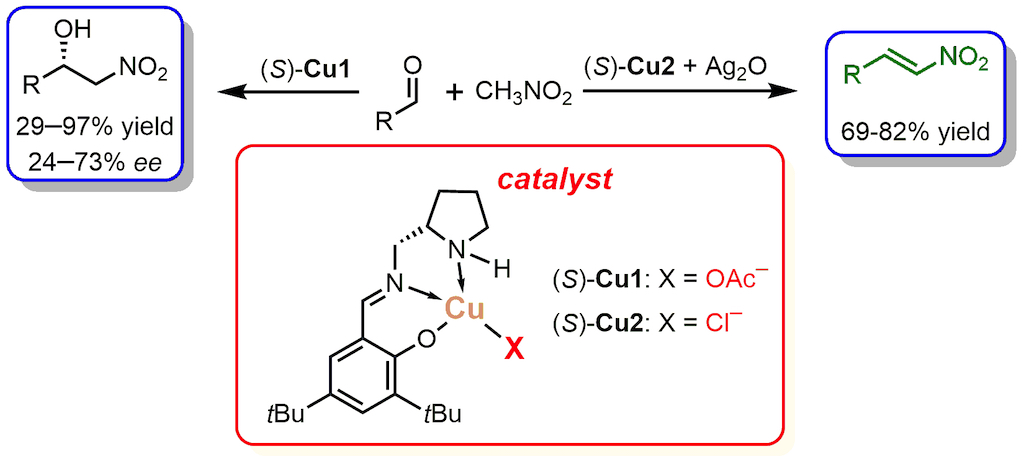
This article is a continuation of our previous research on the catalytic capability of chiral copper complex based on commercially available (S)-2-aminomethylpyrrolidine and 3,5-di-tert-butylsalicylaldehyde with various counter-anions in the asymmetric Henry reaction. Our findings indicate that depending on the type of base used, chiral nitroalcohols with yields up to 97% and ee values up to 78%, as well as β-nitrostyrenes with yields up to 82% can be produced. Additionally, it has been found that the outcome of the reaction and the catalytic properties of copper(II) complexes (S)-Cu1 and (S)-Cu2 are influenced by the structure of the aldehyde used.
Keywords:
Henry reaction
; Copper complex
; Nitroalcohols
; Nitrostyrenes
; Enantioselectivity
1. Introduction
The nitroaldol reaction, also known as the Henry reaction [1], is a classical and versatile method for producing chiral β-nitroalcohols 2 (Scheme 1) [2]. These can then be easily converted into a wide variety of valuable products, including α-nitro ketones [3], nitro alkenes [4], β-amino alcohols [5], and alkanes, and even some drugs [6]. Many catalytic systems have been used for this reaction, including the chiral ones [7,8,9,10,11]. In most cases the combination of both Lewis acid and Brønsted base is required for the efficient catalysis of this reaction. Obviously, it is challenging to combine both of these in the same system. Depending on the balance the Brønsted basicity and Lewis acidity of the catalyst, the reaction may also produce dehydration products, such as nitroalkenes 3, which are also important building blocks in organic synthesis (Scheme 1) [12].
Despite the importance of nitroalkenes 3 as diverse building blocks, there have been only a few reports of their formation in the case of using copper complexes as catalysts so far [13]. For example, in 2010, Luo and Yan used a homogenous copper(II) complex based on chiral α-ethylphenyl amines in the asymmetric Henry reaction, and obtained accompanied nitrostyrene products in up to 47% yield under the reaction conditions [13a]. The Jones and Schulz groups showed that immobilizing chiral copper(II) complexes on a solid-support also led to the formation of undesired nitroalkenes 3 (up to 35%) [13b,c]. This is likely due to the intrinsic acidity of the silica-based support. However, the systematic and in-depth investigations into the influence of the ligand Brønsted basicity and Lewis acidity of the central metal cations on the selectivity of the aldol condensation have not been explored and assessed.
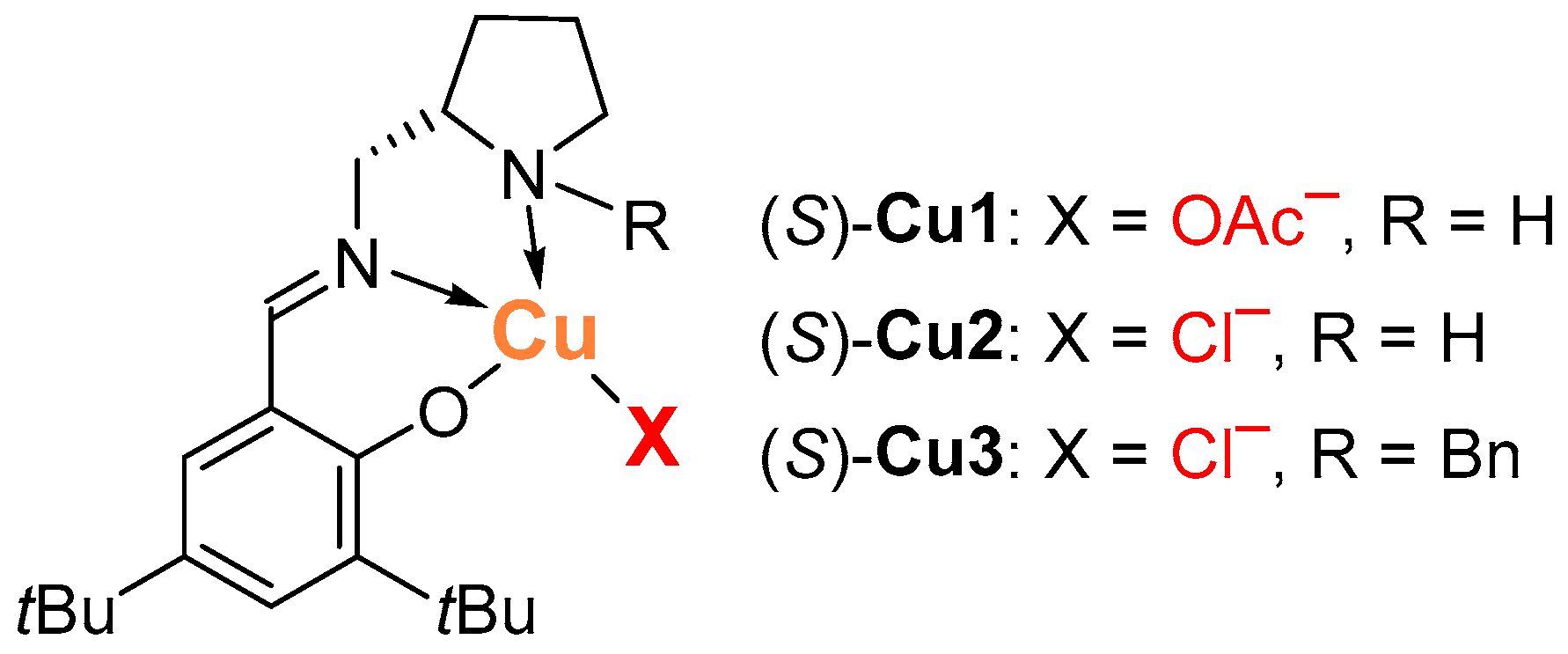
Here, we set ourselves the task of partially filling this knowledge gap by using chiral copper(II) complexes that we have previously developed [14], derived from the tridentate Schiff bases of (S)-2-aminomethylpyrrolidine and 3,5-di-tert-butylsalicylaldehyde and different basic anions in the reaction of nitromethane with various aldehydes (Figure 1). We hypothesised that by changing the nature of the basic anions of the complex, we can switch the selectivity of the reaction to obtain either β-nitroalcohol 2 or nitroalkene 3, both of which are valuable building blocks in synthetic chemistry [2,3,4,5,6].
2. Results and Discussion
2.1. Henry Reaction Conditions Screening
We previously demonstrated that the chiral copper(II) complex (S)-Cu1 catalyzes Henry reaction of o-nitrobenzaldehyde 1a with nitromethane, producing only the nitroalcohol 2a in 78% yield with 77% ee at room temperature (Table 1, entry 1) [14b]. On the other hand, nitrostyrene 3a was formed in a 55% yield if the temperature was raised to 50 oC in 1,2-dichloroethane (DCE) as a solvent and also the enantiomeric purity of 2a dropped to 25% (Table 1, entry 2). The yield of product 2a was significantly increased up to 96% with 73% ee using an additional amount of acetate base (Table 1, entry 4).
Expectedly, the complex (S)-Cu2 with a non-basic chloride anion was catalytically inactive (Table 1, entry 5). Therefore, the next step was to assess the basicity of the anion in the copper(II) complex. In situ exchange of the chloride anion with a strong basic phenolate speeded up the conversion to give 53% of 2a and 40% of 3a after 3 h (Table 1, entry 6). A similar outcome was achieved with another strong basic anion O2-, which wasgenerated in situ using Ag₂O (Table 1, entry 8). The increased time of the reaction led to a greater proportion of formed 3a relative to 2a (Table 1, entry 9). The reaction performed with deuterated nitromethane gave the product 3a with lower yield (24%) (Table 1, compare entries 8 and 11). The nature of the solvent played an essential role in the reaction, significantly influencing the outcome (Table 1, entries 13-19). The highest yields of product 3a were achieved using DCE and toluene with yields of 63% and 61%, respectively (Table 1, entries 13 and 18). The reaction proceeded under solvent-free conditions with 30 equivalents of nitromethane produced nitroalcohol 2a with 44% yield and nitrostyrene 3a with 35% yield, along with Michael addition product 4a in 20% yield (Table 1, entry 20). It is worth noting that reaction in methanol using the catalytic system (S)-Cu2/Ag2O gave only nitroalcohol 2a in a quantitative yield (99%) (Table 1, entry 19).
Next, the impact of temperature on the reaction outcome was studied (Table 1, entries 7, 10, 21, 22). Lowering the temperature to –17 ˚C increased the yield of product 2a (98% for PhONa and 89% for NaOAc) with a trace amount of 3a formed; however, the enantioselectivity of the reaction was reduced (Table 1, entries 7 and 10). On the other hand, when the reaction was carried out at 50 oC, the yield of product 3a increased to 81% (Table 1, entry 21). The further increase in temperature to 70 oC yielded the desired β-nitrostyrene 3a with 81% yield, although the yield of the bis-coupling product 4a increased to 18% yield (Table 1, entry 22). Then, the decrease in catalyst and MeNO2 loadings was investigated (Table 1, entries 22-25). The maximum yield of nitrostyrene 3a (88%) was obtained with 2 mol% of the complex (S)-Cu2 and 1 mol% of Ag2O and 5 equivalents of MeNO2 used (Table 1, entry 25).
For comparison purposes, the reaction using a catalytic system CuCl2/1,10-phenanthroline/Ag2O was studied under the optimized conditions, and the yield of 3a was only 23% as compared to 88% in case of (S)-Cu2 (Table 1, entry 26). This demonstrates the superiority of our new system. It should be noted that pure silver oxide does not catalyze the reaction itself (Table 1, entry 27). In contrast, the reaction catalyzed by tBuOK resulted in the formation of only nitroalcohol 2a in 85% conversion (Table 1, entry 28). N-benzylated complex (S)-Cu3 influenced the outcome of the reaction (Table 1, entries 29 and 30). Whereas the yield of nitroalcohol 2a was low (7% and 11%) and nitrostyrene 3a became the main product (72% and 78%) (Table 1, entries 29 and 30).
This demonstrates the superiority of our new catalytic system, the selectivity of which is easily modified by simple modification of the tridentate ligand and the nature of the mono-anion.
2.2. The Scope of Aldehydes in the Enantioselective Henry Reaction with the Complex (S)-Cu1
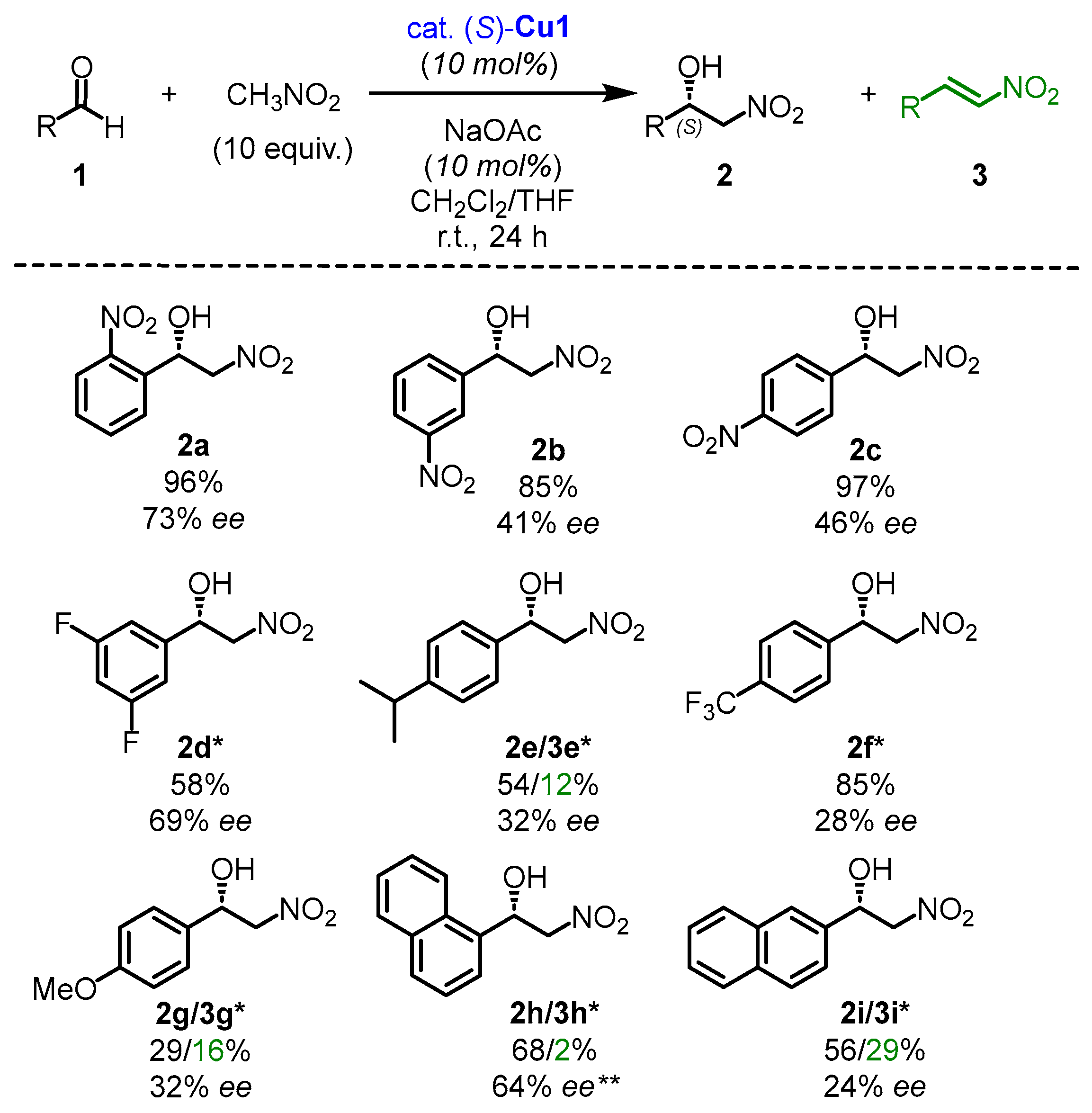
The next step was to examine the reactivity of various aldehydes in the enantioselective Henry reaction promoted by (S)-Cu1 (Scheme 2). The experiments conducted demonstrated that the substituents in the aromatic rings of the aldehydes significantly impacted the yields of the product 2 and 3. The catalyst (S)-Cu1 demonstrated good activity with benzaldehyde containing electron-withdrawing group (EWG). The ortho-, meta- and para-NO2-substituted nitroalcohols 2a-2c were produced in high yields (85–97%) with no traces of nitrostyrene observed. A similar pattern was observed for fluorine substituted benzaldehydes, resulting in 2d with 58% yield and 2f with 85% yield, respectively. On the other hand, for aldehydes with electron-donating groups (EDG), the targeted Henry reaction was accompanied with the dehydration process. The resulting products 2e, 2g-2i were isolated in moderate yields (54%, 29%, 68% and 56%, respectively), accompanied by the formation of nitrostyrenes 3e, 3g-3i (12%, 16%, 2% and 29% yields, respectively). The level of enantioselectivity for the nitroalcohols 2a-2i was moderate (24–73% ee).
2.3. The Scope of Aldehydes in the Synthesis of β-Nitrostyrenes 3
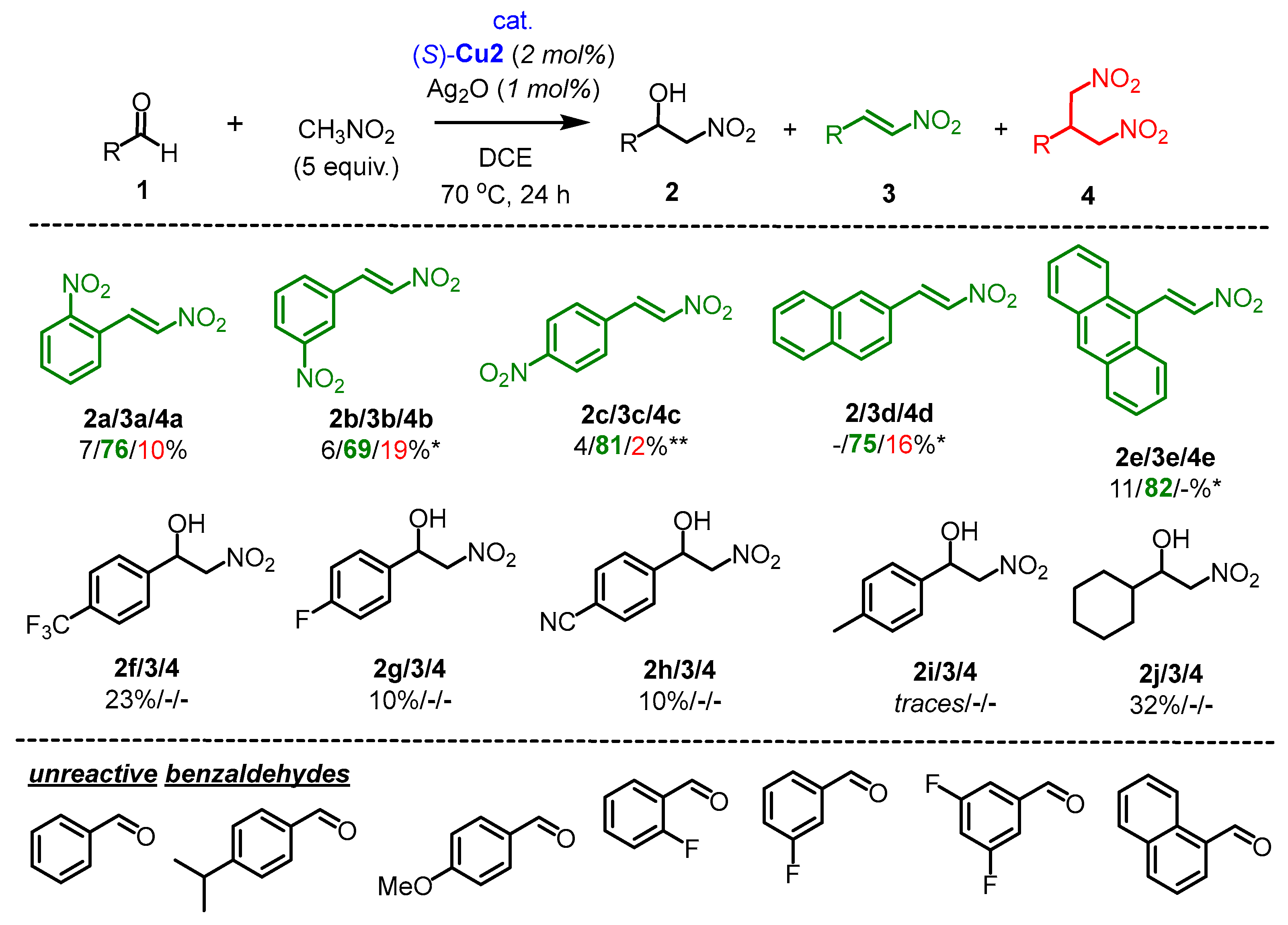
Next, the Henry reaction protocol was extended using different aldehydes under the conditions with a catalytic system (S)-Cu2/Ag2O that favored the formation of nitrostyrene 3 (Scheme 3). The selectivity and efficiency of the catalytic system were also found to be highly sensitive to the structure of 1. The reaction exhibited a high conversion for aldehydes 1a-1e with nitrostyrene 3 as the predominant product (o-NO2 3a: 76%, m-NO2 3b: 69%, p-NO2 3c: 81%, 2-naphthyl 3d: 75% and 9-anthracenyl 3e: 82%, respectively) (Scheme 3). Importantly, the corresponding trans-β-nitrostyrenes 3a-3e were isolated in pure form by crystallization in yields of 74%, 58%, 62%, 58% and 74% respectively. A low conversion and the formation of nitroalcohols with yields up to 32% were observed for aldehydes 1f-1j (Scheme 3). On the other hand, for certain reasons some aldehydes (depicted in Scheme 3) were inactive under the conditions. Most likely, the rate of the retro-nitroaldol reaction was faster as compared to the irreversible dehydration step (vide infra). Thus, it seems reasonable to suggest that the (S)-Cu2 complex requires particularly strong EWG groups in the benzaldehyde structure (such as NO2) in order to achieve efficient catalysis. Even with CF3 and CN groups, the catalytic activity of (S)-Cu2 was already limited.
2.4. Mechanism Related Experiments
In order to understand the mechanism of the addition of nitromethane to benzaldehydes and the subsequent dehydration process, a series of retro-nitroaldol experiments were conducted under standard condensation conditions (Scheme 4). The racemic nitroalcohol 2a was kept in a solution of DCE with a strong base tBuOK for 24 h at 50 oC. This caused the complete decomposition of the nitroalcohol into the initial aldehyde 1a (97% conversion). A similar pattern is evident when DBU is used as the organic base. However, in this case, the conversion remained incomplete (68%). Silver oxide was not effective in the decomposition of nitroalcohol or its dehydration process. As expected, only the combined system (S)-Cu2/Ag2O was able to produce a high yield of nitrostyrene 3a (76%), along with the reverse reaction product – aldehyde 1a – in 21% (Scheme 4).
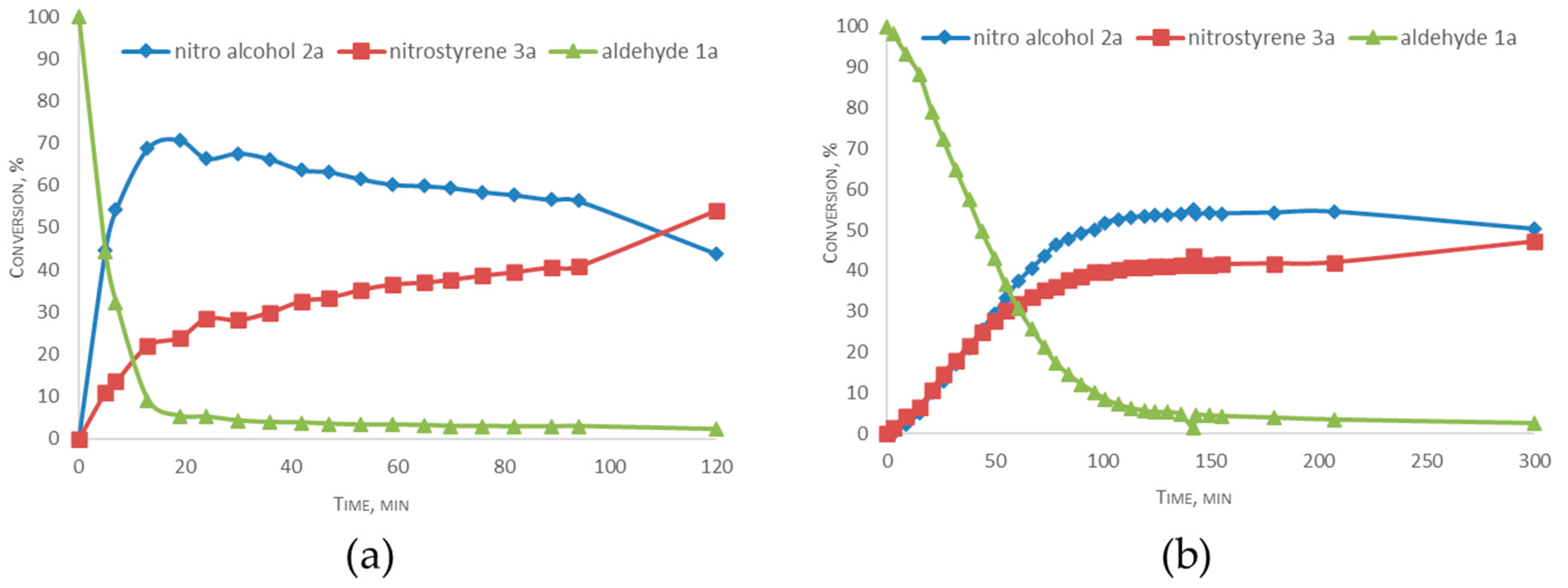
1H NMR kinetic studies of the condensation reaction between benzaldehyde 1a and CH3NO2 and deuterated CD3NO2 in CD2Cl2 were also conducted (Figure 2). According to the data, the aldol condensation step of the reaction showed a kinetic isotope effect (kD/kH) of approximately 10 and 3 for the dehydration process. The result corroborated the involvement of the C-D bond cleavage in the rate limiting stages of both reactions.
Finally, based on the experimental results and findings, we have proposed a mechanism of the catalysis (Scheme 5). The first step is the formation of a catalytically active dimeric complex from (S)-Cu2 and Ag2O, where two units of copper complex are linked by a μ2-oxygen bridge ([L-Cu]-O-[L-Cu]). This catalytic particle with a higher basicity of the oxygen bridge, promotes the reversible nitroaldol reaction, leading to the formation of nitroalcohol 2. Subsequently, the dehydration process was accelerated as the complex [L-Cu]-O-[L-Cu] appeared to coordinate with product 2, increasing the acidity of its β-protons and activating the leaving hydroxyl groups of nitroalcohols by coordinating to Cu ion and thus facilitating the E1cB elimination step for the production of β-nitrostyrene 3 (Scheme 5). This concept rationalized why strongly basic tBuONa promoted only the retro-aldol decomposition of nitroalcohols and not their dehydration. It should also be noted that the Michael addition of the second nitromethane molecule results in the formation of a minor bis-coupling product 4 [15].
3. Materials and Methods
3.1. General Information
All solvents purchased from commercial suppliers were used without further purification (CH2Cl2, DCE, MeOH, 1,4-dioxane, CDCl3, CD2Cl2, acetone-d6). THF and toluene were distilled over sodium under an atmosphere of argon. Purchased (S)-(2-aminomethyl)pyrrolidine, 3,5-di-tret-butylsalicylaldehyde, nitromethane, DBU, CD3NO2, tBuOK, NaOAc, Ag2O, Cu(OAc)2 from commercial suppliers were used without further purification. Commercially available benzaldehydes were purified by distillation under reduced pressure or through SiO2 short column. (S)-2-aminomethyl-1-benzylpyrrolidine were synthesised according to a literature procedure starting from 1-benzyl-(S)-proline [16]. The (S)-Cu1, (S)-Cu2 and (S)-Cu3 complexes were synthesized according to our previously published procedure [14]. The reported catalytic reactions were performed under an atmosphere of argon using Schlenk-line techniques in flame-dried glassware. If not stated otherwise, flash column chromatography was performed with silica gel 60 M from Macherey-Nagel.
3.2. Instrumentation
Proton nuclear magnetic resonance (1H NMR) spectra was recorded on a Bruker Avance 300 NMR spectrometer (operating at 300 MHz respectively referring to 1H nucleus). Chemical shifts are reported in ppm relative to the residual solvent peak (CDCl3: δ = 7.26 ppm for 1H NMR). NMR data are reported as follows: chemical shift, multiplicity (br. s = broad singlet, s = singlet, d = doublet, dd = doublet of doublets, m = multiplet), coupling constant, integration, and nucleus. Chiral HPLC chromatography was performed with a Shimadzu LC-10ADVP instrument equipped with a Shimadzu SPDM10AVP diode array detector using a Chiralcel OD-H or Astec Cellulose DMP column (conditions: hexane/isopropanol = 90:10, flow rate: 1 mL/min, 254 nm, 25 ˚C).
3.3. Synthesis
3.3.1. General Procedure for the Enantioselective Henry Reaction
A flask (10 mL) was charged with aldehyde 1 (0.3 mmol, 1 equiv.), (S)-Cu1 catalyst (13.2 mg, 10 mol %) and NaOAc (2.4 mg, 10 mol %.) under Ar atmosphere. Then, solvent mixture (THF (0.25 mL)/DCM (0.25 mL)) and nitromethane (0.160 mL, 3 mmol, 10 equiv.) were added and the reaction mixture was stirred for 24 h at RT. After completing of the reaction, the reaction mixture was purified by flash SiO2 chromatography (eluent: CH2Cl2). The solvent was evaporated on a rotary evaporator, and the residue was purified by column SiO2 chromatography (eluent: hexane/acetone (5:1)) to afford the desired product 2.
- 1-(2-nitrophenyl)-2-nitroethan-1-ol (2a)
- 1H NMR (400 MHz, CDCl3): δ = 8.11–8.08 (m, 1H, ArH), 7.98–7.96 (m, 1H, ArH), 7.78–7.74 (m, 1H, ArH), 7.59–7.55 (m, 1H, ArH), 6.07 (ddd, J = 8.8, 4.2, 2.2 Hz, 1H), 4.89 (dd, J = 13.9, 2.2 Hz, 1H), 4.57 (dd, J = 13.9, 8.8 Hz, 1H), 3.15 (d, J = 4.2 Hz, 1H) ppm.
- All spectroscopic data were in agreement with the literature [14b].
- The enantiomeric excess was established by HPLC analysis using a Kromasil 3-AmyCoat column, ee = 73% (conditions: heptane/isopropanol = 90:10, flow rate: 1 mL/min, 254 nm, 25 ˚C, tR(major) = 12.7 min, tR(minor) = 11.0 min).
- All spectroscopic data were in agreement with the literature [14a].
- 1-(3-nitrophenyl)-2-nitroethan-1-ol (2b)
- 1H NMR (CDCl3, 300 MHz): δ = 8.33–8.28 (m, 1H), 8.24–8.15 (m, 1H), 7.77 (d, J = 7.7 Hz, 1H), 7.64–7.56 (m, 1H), 5.66–5.55 (m, 1H), 4.68–4.54 (m, 2H), 3.46–3.40 (m, 1H) ppm.
- The enantiomeric excess was established by HPLC analysis using a Chiralcel OD-H column, ee = 41% (conditions: hexane/isopropanol = 90:10, flow rate: 1 mL/min, 254 nm, 25 ˚C, tR(major) = 28.4 min, tR(minor) = 25.0 min).
- All spectroscopic data were in agreement with the literature [17a].
- 1-(4-nitrophenyl)-2-nitroethan-1-ol (2c)
- 1H NMR (CDCl3, 300 MHz): δ = 8.26 (d, J = 8.7 Hz, 2H), 7.62 (d, J = 8.6 Hz, 2H), 5.65–5.56 (m, 1H), 4.67–4.51 (m, 2H), 3.33–3.26 (m, 1H) ppm.
- The enantiomeric excess was established by HPLC analysis using a Chiralcel OD-H column, ee = 46% (conditions: hexane/isopropanol = 90:10, flow rate: 1 mL/min, 254 nm, 25 ˚C, tR(major) = 31.4 min, tR(minor) = 25.3 min).
- All spectroscopic data were in agreement with the literature [17a].
- 1-(3,5-difluorophenyl)-2-nitroethan-1-ol (2d)
- 1H NMR (CDCl3, 300 MHz): δ = 7.02–6.91 (m, 2H), 6.85–6.74 (m, 1H), 5.51–5.41 (m, 1H), 4.62–4.46 (m, 2H), 3.14–3.07 (m, 1H) ppm. 19F NMR (282 MHz, CDCl3): δ = –107.7 (s, 2F) ppm.
- The enantiomeric excess was established by HPLC analysis using a Chiralcel OD-H column, ee = 69% (conditions: hexane/isopropanol = 90:10, flow rate: 1 mL/min, 254 nm, 25 ˚C, tR(major) = 12.5 min, tR(minor) = 10.7 min).
- All spectroscopic data were in agreement with the literature [17b].
- 1-(4-isopropylphenyl)-2-nitroethan-1-ol (2e)
- 1H NMR (CDCl3, 300 MHz): δ = 7.36–7.30 (m, 2H), 7.29–7.23 (m, 2H), 5.48–5.39 (m, 1H), 4.61 (dd, J = 13.3, 9.6 Hz, 1H), 4.50 (dd, J = 13.2, 3.1 Hz, 1H), 3.00–2.86 (m, 1H), 1.25 (d, J = 6.9 Hz, 6H) ppm.
- The enantiomeric excess was established by HPLC analysis using a Chiralcel OD-H column, ee = 32% (conditions: hexane/isopropanol = 90:10, flow rate: 1 mL/min, 254 nm, 25 °C, tR(major) = 18.2 min, tR(minor) = 12.2 min).
- All spectroscopic data were in agreement with the literature [17c].
- 1-(4-(trifluoromethyl)phenyl)-2-nitroethan-1-ol (2f)
- 1H NMR (CDCl3, 300 MHz): δ = 7.67 (d, J=8.1 Hz, 2H), 7.55 (d, J = 8.1 Hz, 2H), 5.60–5.48 (m, 1H), 4.65–4.48 (m, 2H), 3.21–3.09 (m, 1H) ppm. 19F NMR (282 MHz, CDCl3): δ = –62.7 (s, 3F) ppm.
- The enantiomeric excess was established by HPLC analysis using a Chiralcel OD-H column, ee = 28% (conditions: hexane/isopropanol = 90:10, flow rate: 1 mL/min, 254 nm, 25 ˚C, tR(major) = 14.6 min, tR(minor) = 11.5 min).
- All spectroscopic data were in agreement with the literature [17a].
- 1-(4-methoxyphenyl)-2-nitroethan-1-ol (2g)
- 1H NMR (CDCl3, 300 MHz): δ = 7.35–7.28 (m, 2H), 6.95–6.89 (m, 2H), 5.45–5.37 (m, 1H), 4.60 (dd, J = 13.2, 9.6 Hz, 1H), 4.47 (dd, J = 13.2, 3.1 Hz, 1H), 3.81 (s, 3H), 2.84–2.80 (m, 1H) ppm.
- The enantiomeric excess was established by HPLC analysis using a Chiralcel OD-H column, ee = 32% (conditions: hexane/isopropanol = 90:10, flow rate: 1 mL/min, 254 nm, 25 ˚C, tR(major) = 26.0 min, tR(minor) = 20.3 min).
- All spectroscopic data were in agreement with the literature [17a].
- 1-(naphthalen-1-yl)-2-nitroethan-1-ol (2h)
- 1H NMR (CDCl3, 300 MHz): δ = 8.04 (d, J = 8.3 Hz, 1H), 7.94–7.89 (m, 1H), 7.89–7.83 (m, 1H), 7.77 (d, J = 7.2 Hz, 1H), 7.64–7.49 (m, 3H), 6.30–6.23 (m, 1H), 4.74–4.59 (m, 2H), 2.92 (d, J=3.6 Hz, 1H) ppm.
- The enantiomeric excess was established by HPLC analysis using a Chiralcel OD-H column, ee = 64% (conditions: hexane/isopropanol = 90:10, flow rate: 1 mL/min, 254 nm, 25 ˚C, tR(major) = 24.8 min, tR(minor) = 18.0 min).
- All spectroscopic data were in agreement with the literature. [17c]
- 1-(naphthalen-2-yl)-2-nitroethan-1-ol (2i)
- 1H NMR (CDCl3, 300 MHz): δ = 7.90–7.81 (m, 4H), 7.57–7.49 (m, 2H), 7.49–7.41 (m, 1H), 5.65–5.56 (m, 1H), 4.68 (dd, J = 13.3, 9.4 Hz, 1H), 4.57 (dd, J = 13.3, 3.2 Hz, 1H), 3.16–3.10 (br. s, 1H) ppm.
- The enantiomeric excess was established by HPLC analysis using a Chiralcel OD-H column, ee = 24% (conditions: hexane/isopropanol = 90:10, flow rate: 1 mL/min, 254 nm, 25 ˚C, tR(major) = 52.5 min, tR(minor) = 37.1 min).
- All spectroscopic data were in agreement with the literature. [17b]
3.3.2. General Procedure for the Synthesis of β-Nitrostyrenes 3
A flask (10 mL) was charged with aldehyde 1 (0.3 mmol, 1 equiv.), complex (S)-Cu2 (2.4 mg, 2 mol% or 6.2 mg, 5 mol%) and Ag2O (0.7 mg, 1 mol% or 1.8 mg, 2.5 mol%). Then, 1,2-dichloroethane (1 mL), nitromethane (0.08 mL, 1.5 mmol, 5 equiv. or 0.16 mL, 3.0 mmol, 10 equiv.) were added and the reaction mixture was stirred for 24 h at 70 ˚C. After completing of the reaction, the reaction mixture was filtrated through the SiO2 layer using CH2Cl2 as an eluent. The solvent was evaporated on a rotary evaporator, and the residue was purified by column SiO2 chromatography or by crystallization in ethanol to afford the desired product 3.
- 2-nitro-β-nitrostyrene (3a)
- 1H NMR (300 MHz, CDCl3): δ = 8.54 (d, J = 13.4 Hz, 1H), 8.21 (d, J = 7.9 Hz, 1H), 7.81–7.65 (m, 2H), 7.61 (d, J = 7.3 Hz, 1H), 7.43 (d, J = 13.5 Hz, 1H) ppm.
- All spectroscopic data were in agreement with the literature [18].
- 3-nitro-β-nitrostyrene (3b)
- 1H NMR (300 MHz, CDCl3): δ = 8.42 (t, J = 2.0 Hz, 1H), 8.35 (dd, J = 8.4, 2.2 Hz, 1H), 8.06 (d, J = 13.7 Hz, 1H), 7.88 (d, J = 7.7 Hz, 1H), 7.74–7.63 (m, 2H) ppm.
- All spectroscopic data were in agreement with the literature [19].
- 4-nitro-β-nitrostyrene (3c)
- 1H NMR (300 MHz, acetone-d6): δ = 8.33 (d, J = 8.8 Hz, 2H), 8.25–8.07 (m, 4H) ppm.
- All spectroscopic data were in agreement with the literature [18].
- (E)-2-(2-nitrovinyl)naphthalene (3d)
- 1H NMR (300 MHz, CDCl3): δ = 8.15 (d, J = 13.6 Hz, 1H), 8.00 (s, 1H), 7.88 (dt, J = 9.4, 3.6 Hz, 3H), 7.69 (d, J = 13.6 Hz, 1H), 7.65–7.51 (m, 3H) ppm. 13C NMR (101 MHz, CDCl3): δ = 139.4, 137.3, 135.0, 133.3, 132.4, 129.5, 129.0, 128.5, 128.1, 127.7, 127.4, 123.4 ppm.
- (E)-9-(2-nitrovinyl)anthracene (3e)
- 1H NMR (300 MHz, CDCl3): δ = 8.98 (d, J = 13.7 Hz, 1H), 8.53 (s, 1H), 8.11 (dd, J = 39.5, 8.4 Hz, 4H), 7.76–7.39 (m, 5H) ppm. 13C NMR (101 MHz, CDCl3): δ = 142.8, 135.8, 131.2, 130.6, 130.0, 129.3, 127.6, 125.8, 124.4, 123.3 ppm.
5. Conclusions
In conclusion, we have shown that a chiral copper(II) complex prepared from a Schiff base ligand based on commercially available (S)-2-aminomethylpyrrolidine and 3,5-di-tert-butylsalicylaldehyde can selectively catalyze the Henry reaction, depending on the type of the anion, producing either nitroalcohols or nitrostyrenes. In particularly, the chiral complex containing the acetate anion allows the formation of nitroalcohols with up to 97% yield and ee value of up to 78%. On the other hand, the in situ formed catalytic system [L-Cu]-O-[L-Cu] gives predominantly access to β-nitrostyrenes with up to 88% yield. Additionally, it was found that the substituents in the aromatic rings of the aldehydes have a significant impact on the reaction outcome and the formation of nitroolefins. Our results clearly demonstrate that the selectivity of a copper(II) complex can be easily altered by simply modifying the tridentate ligand and the nature of the basic anion.
Supplementary Materials
1H, 13C and 19F NMR spectra for all compounds, and HPLC traces of the products can be downloaded at website of this paper posted on Preprints.org.
Author Contributions
Conceptualization, V.I.M., Y.N.B. and V.A.L.; methodology, O.V.K., L.V.Y. and N.V.S.; formal analysis, O.V.K. and N.V.S.; investigation, O.V.K., L.V.Y. and N.V.S.; data curation, O.V.K. and N.V.S.; writing—original draft preparation, O.V.K. and V.A.L.; writing—review and editing, V.I.M., Y.N.B. and V.A.L.; supervision, Y.N.B. and V.A.L.; project administration, Y.N.B. and V.A.L.; funding acquisition, V.A.L. All authors have read and agreed to the published version of the manuscript.
Funding
This work was supported by Russian Science Foundation (grant no. 20-13-00155, https://rscf.ru/project/23-13-45008/).
Institutional Review Board Statement
Not applicable.
Data Availability Statement
Data from the research described in the manuscript are available from the authors.
Acknowledgments
We gratefully acknowledge Dr Mikhail Il’in for chiral HPLC analysis. NMR spectra were recorded with the support from the Ministry of Science and Higher Education of the Russian Federation. The publication has been supported by RUDN University Strategic Academic Leadership Program (HPLC analysis).
Conflicts of Interest
The authors declare no conflicts of interest.
References
- a) Henry, L. Formation synthétique d’alcohols nitrés. Hebd. Seances Acad. Sci. 1895, 120, 1265−1268; b) Henry, L. Bull. Soc. Chim. Fr. 1895, 13, 999.
- a) Luzzio, F.A. The Henry reaction: recent examples. Tetrahedron 2001, 57, 915−945; b) Mahrwald, R. Modern Aldol Reactions; Wiley-VCH, Weinheim, 2004; pp. 1−357; c) Geary L.M.; Hultin, P.G. The state of the art in asymmetric induction: the aldol reaction as a case study. Tetrahedron: Asymmetry 2009, 20, 131–173; d) Murugavel, G.; Sadhu, P.; Punniyamurthy, T. Copper(II)-catalyzed nitroaldol (Henry) reactions: recent developments. Chem. Rec. 2016, 16, 1906–1917; e) Zhang, S.; Li, Y.; Xu, Y.; Wang, Z. Recent progress in copper catalyzed asymmetric Henry reaction. Chin. Chem. Lett. 2018, 29, 873–883; f) Mondal, K.; Mistri, S. Schiff base based metal complexes: A review of their catalytic activity on aldol and Henry reaction. Comments on Inorganic Chemistry 2023, 43, 77–105.
- Ballini, R. New and convenient synthesis of (Z)-heneicos-6-en-11-one, the douglas fir tussock moth (Orgyia pseudotsugata) sex pheromone, and (Z)-non-6-en-2-one, the immediate precursor for the synthesis of brevicomin, the sex attractant of the western pine beetle Dentroctonus brevicomis. J. Chem. Soc. Perkin Trans. 1 1991, 6, 1419−1421.
- a) Melton, J.; McMurry, J. E. New method for the dehydration of nitro alcohols. J. Org. Chem. 1975, 40, 2138−2139; b) Denmark, S.E.; Marcin, L.R. A general method for the preparation of 2,2-disubstituted 1-nitroalkenes. J. Org. Chem. 1993, 58, 3850−3856; c) Zhang, K.; Jelier, B.; Passera, A.; Jeschke, G.; Katayev, D. Synthetic diversity from a versatile and radical nitrating reagent. Chem. Eur. J. 2019, 25, 12929−12939; d) Patra, S.; Mosiagin, I.; Giri, R.; Nauser, T.; Katayev, D. Electron-driven nitration of unsaturated hydrocarbons. Angew. Chem., Int. Ed. 2023, 62, e202300533.
- Sasai, H.; Itoh, N.; Suzuki, T.; Shibasaki, M. Catalytic asymmetric nitroaldol reaction: An efficient synthesis of (S) propranolol using the lanthanum binaphthol complex. Tetrahedron Lett. 1993, 34, 855–858. [Google Scholar] [CrossRef]
- a) Allmendiger, L.; Bauschke, G.; Paintner, F.F. Total synthesis of Sperabillin A and C. Synlett 2005, 17, 2615−2618; b) Gogoi, N.; Boruwa, J.; Barua, N. C. A total synthesis of (−)-bestatin using Shibasaki’s asymmetric Henry reaction. Tetrahedron Lett. 2005, 46, 7581−7582; c) Li, H.; Wang, B.; Deng, L. Enantioselective nitroaldol reaction of α-ketoesters catalyzed by cinchona alkaloids. J. Am. Chem. Soc. 2006, 128, 732−733; d) Blay, G.; Hernández-Olmos, V.; Pedro, J.R. Synthesis of (S)-(+)-sotalol and (R)-(−)-isoproterenol via a catalytic enantioselective Henry reaction. Tetrahedron: Asymmetry 2010, 21, 578–581; e) Guo, Z.-L.; Deng, Y.-Q.; Zhong, S.; Lu, G. Enantioselective synthesis of (R)-salmeterol employing an asymmetric Henry reaction as the key step. Tetrahedron: Asymmetry 2011, 22, 1395–1399.
- a) Sasai, H.; Takeyuki, S.; Arai, T.; Shibasaki, M. Basic character of rare earth metal alkoxides. Utilization in catalytic carbon-carbon bond-forming reactions and catalytic asymmetric nitroaldol reactions. J. Am. Chem. Soc. 1992, 114, 4418–4420; b) Evans, D.A.; Seidel, D.; Rueping, M.; Lam, H.W.; Shaw, J.T.; Downey, C.W. A new copper acetate-bis(oxazoline)-catalyzed, enantioselective Henry reaction. J. Am. Chem. Soc. 2003, 125, 12692–12693; c) Ginotra, S.K.; Singh, V.K. Enantioselective Henry reaction catalyzed by a C2-symmetric bis(oxazoline)–Cu(OAc)2·H2O complex. Org. Biomol. Chem. 2007, 5, 3932–3937; d) Cruz, H.; Aguirre, G.; Madrigal, D.; Chávez, D.; Somanathan, R. Enantioselective nitromethane addition to brominated and fluorinated benzaldehydes (Henry reaction) catalyzed by chiral bisoxazoline–copper(II) complexes. Tetrahedron: Asymmetry 2016, 27, 1217–1221; e) Pavlov, A.A.; Dalinger, A.I.; Suslov, E.V.; Ponomarev, K.Yu.; Mozhaitsev, E.S.; Vatsadze, S.Z. Investigation of the possibility of complex formation of bidentate bispidine ligands with copper(II) salts in solution by proton NMR spectroscopy. Russ. Chem. Bull. 2023, 72, 635–640.
- a) Xion, Y.; Wang, F.; Huang, X.; Wen, Y.; Feng, X. A new copper(I)–tetrahydrosalen-catalyzed asymmetric Henry reaction and its extension to the synthesis of (S)-norphenylephrine. Chem. Eur. J. 2007, 13, 829–833; b) White, J.D.; Shaw, S. A new catalyst for the asymmetric Henry reaction: synthesis of β-nitroethanols in high enantiomeric excess. Org. Lett. 2012, 14, 6270–6273; c) Kannan, M.; Punniyamurthy, T. Effect of ligand N,N-substituents on the reactivity of chiral copper(II) salalen, salan, and salalan complexes toward asymmetric nitroaldol reactions. Tetrahedron: Asymmetry 2014, 25, 1331–1339; d) Kureshy, R.I.; Das, A.; Khan, N.H.; Abdi, S.H.R.; Bajaj, H.C. Cu(II)-macrocylic [H4]Salen catalyzed asymmetric nitroaldol reaction and its application in the synthesis of α1-adrenergic receptor agonist (R)-phenylephrine. ACS Catal. 2011, 1, 1529–1535.
- a) Kowalczyk, R.; Sidorowicz, L.; Skarzewski, J. Asymmetric Henry reaction catalyzed by chiral secondary diamine-copper(II) complexes. Tetrahedron: Asymmetry 2008, 19, 2310–2315; b) Sanjeevakumar, N.; Periasamy, M. Highly enantioselective Henry reaction catalyzed by a new chiral C2-symmetric N,N′-bis(isobornyl)ethylenediamine–copper complex. Tetrahedron: Asymmetry 2009, 20, 1842–1847; c) Chunhong, Z.; Liu, F.; Gou, S. Application of chiral N,N′-dialkyl-1,2-cyclohexanediamine derivatives in asymmetric copper(II)-catalyzed Henry reactions. Tetrahedron: Asymmetry 2014, 25, 278–283; d) Malhotra, S.V.; Brown, H.C. C2-symmetric N,N′-bis(terpenyl)ethylenediamines−synthesis and application in the enantioselective nitroaldol reaction. RSC Adv. 2014, 4, 14264–14269.
- a) Jin, W.; Li, X.; Huang, Y.; Wu, F.; Wan, B. A highly effective bis(sulfonamide)–diamine ligand: a unique chiral skeleton for the enantioselective Cu-catalyzed Henry reaction. Chem. Eur. J. 2010, 16, 8259–8261; b) Jin, W.; Li, X.; Wan, B. A highly diastereo- and enantioselective copper(I)-catalyzed Henry reaction using a bis(sulfonamide)−diamine ligand. J. Org. Chem. 2011, 76, 484–491; c) Valverde-González, A.; Fernández-Seriñan, P.; Matarín, Á.; Arnanz, A.; Sánchez, F.; Iglesias, M. Porous aromatic frameworks containing binaphthyl-dihydroazepine units (cBAPAFs) as catalytic supports for asymmetric reactions. J. Catal. 2022, 413, 434–442.
- a) Maheswaran, H.; Prasanth, K.L.; Krishna, G.G.; Ravikumar, K.; Sridharb, B.; Kantam, M.L. Enantioselective nitroaldol (Henry) reaction using copper(II) complexes of (−)-sparteine. Chem. Commun. 2006, 39, 4066–4068; b) Arai, T.; Watanabe, M.; Yanagisawa, A. Practical asymmetric Henry reaction catalyzed by a chiral diamine-Cu(OAc)2 complex. Org. Lett. 2007, 9, 3595–3597; c) Arai, T.; Takashita, R.; Endo, Y.; Watanabe, M.; Yanagisawa, A. Asymmetric syn-selective Henry reaction catalyzed by the sulfonyldiamine−CuCl−pyridine system. J. Org. Chem. 2008, 73, 4903–4906; d) Qi, G.; Ji, Y.Q.; Judeh, Z.M.A. Novel chiral C1-1′,2′,3′,4′-tetrahydro-1,1′-bisisoquinolines: synthesis, resolution, and applications in catalytic enantioselective reactions. Tetrahedron 2010, 66, 4195–4205; e) Noole, A.; Lippur, K.; Metsala, A.; Lopp, M.; Kanger, T. A highly diastereo- and enantioselective copper(I)-catalyzed Henry reaction using a bis(sulfonamide)−diamine ligand. J. Org. Chem. 2010, 75, 1313–1316; f) Wei, Y.; Yao, L.; Zhang, B.; He, W.; Zhang, S. Novel Schiff base ligands derived from Cinchona alkaloids for Cu(II)-catalyzed asymmetric Henry reaction. Tetrahedron 2011, 67, 8552–8558; g) Chougnet, A.; Zhang, G.; Liu, K.; Häussinger, D.; Kägi, A.; Allmendinger, T.; Woggon, W.-D. Diastereoselective and highly enantioselective Henry reactions using C1-symmetrical copper(II) complexes. Adv. Synth. Catal. 2011, 353, 1797–1806; h) Blay, G.; Hernandez-Olmos, V.; Pedro, J.R. Development of new N,N-ligands for the enantioselective copper(II)-catalyzed Henry reaction. Synlett 2011, 9, 1195–1211; i) Ji, Y.Q.; Judeh, Z.M.A. 1,1′-Methylene-bis(1,1′,2,2′,3,3′,4,4′-octahydroisoquinoline): synthesis, reaction, resolution, and application in catalytic enantioselective transformations. Tetrahedron 2011, 67, 4086–4092; j) Ji, Y.Q.; Qi, G.; Judeh, Z.M.A. Efficient asymmetric copper(I)-catalyzed Henry reaction using chiral N-alkyl-C1-tetrahydro-1,1′-bisisoquinolines. Eur. J. Org. Chem. 2011, 25, 4892–4898; k) Zhou, Y.; Gong, Y. Asymmetric copper(II)-catalysed nitroaldol (Henry) reactions utilizing a chiral C1-symmetric dinitrogen ligand. Eur. J. Org. Chem. 2011, 30, 6092–6099; l) Filippova, L.; Stenstrøm, Y.; Hansen, T.V. Cu(II)-catalyzed asymmetric Henry reaction with a novel C1-symmetric aminopinane-derived ligand. Molecules 2015, 20, 6224–6236.
- a) Poe, S.L.; Kobašlija, M.; McQuade, D.T. Microcapsule enabled multicatalyst system. J. Am. Chem. Soc. 2006, 128, 15586–15587; b) Komura, K.; Kawamura, T.; Sugi, Y. Layered silicate PLS-1: A new solid base catalyst for C–C bond forming reactions. Catal. Commun. 2007, 8, 644–648; c) Motokura, K.; Tada, M.; Iwasawa, Y. Cooperative catalysis of primary and tertiary amines immobilized on oxide surfaces for one-pot C-C bond forming reactions. Angew. Chem. Int. Ed. 2008, 47, 9230–9235; d) Rokhum, L.; Bez, G. One-pot solid phase synthesis of (E)-nitroalkenes. Tetrahedron Lett. 2013, 54, 5500–5504; e) Ishitani, H.; Saito, Y.; Tsubogo, T.; Kobayashi, S. Synthesis of nitro-containing compounds through multistep continuous flow with heterogeneous catalysts. Org. Lett. 2016, 18, 1346−1349; f) Lee, L.-C.; Lu, J.; Weck, M.; Jones, C.W. Acid–base bifunctional shell cross-linked micelle nanoreactor for one-pot tandem reaction. ACS Catal. 2016, 6, 784−787.
- a) Luo, M.; Yan, B.; Enantioselective Henry reactions catalyzed by chiral N-metal complexes containing R(+)/S(−)-α-ethylphenyl amines. Tetrahedron Lett. 2010, 51, 5577–5580; b) Jones, M.D.; Cooper, C.J.; Mahon, M.F.; Raithby, P.R.; Apperley, D.; Wolowska, J.; Collison, D. Cu(II) homogeneous and heterogeneous catalysts for the asymmetric Henry reaction. J. Mol. Cat. A: Chemical 2010, 325, 8–14; c) Didier, D.; Magnier-Bouvier, C.; Schulz, E. Charge-transfer interactions: an efficient tool for recycling bis(oxazoline)-copper complexes in asymmetric Henry reactions. Adv. Synth. Catal. 2011, 353, 1087–1095; d) Cirujano, F.G.; López-Maya, E.; Rodríguez-Albelo, M.; Barea, E.; Navarro, J.A.R.; de Vos, D.E. Selective one-pot two-step C−C bond formation using metal–organic frameworks with mild basicity as heterogeneous catalysts. ChemCatChem 2017, 9, 4019–4023; e) El-Asaad, B.; Métay, E.; Karamé, I.; Lemaire, M. Chiral N-arylated diamine – copper complexes catalyzed asymmetric Henry reaction. Mol. Catal. 2017, 435, 76–81; f) Marquez, C.; Cirujano, F.G.; Smolders, S.; van Goethem, C.; Vankelecom, I.; de Vos, D.; de Baerdemaeker, T. Metal ion exchange in Prussian blue analogues: Cu(II)-exchanged Zn–Co PBAs as highly selective catalysts for A3 coupling. Dalton Trans. 2019, 48, 3946–3954; g) El-Atawy, M.A.; Khalil, K.D.; Bashal, A.H. Chitosan capped copper oxide nanocomposite: efficient, recyclable, heterogeneous base catalyst for synthesis of nitroolefins. Catalysts 2022, 12, 964.
- a) Larionov, V.A.; Yashkina, L.V.; Smol’yakov, A.F.; Zubavichus, Y.V.; Babievsky, K.K.; Akat’yev, N.V.; Titov, A.A.; Belokon, Y.N.; Maleev, V.I. Synthesis and investigations of chiral NNO type copper(II) coordination polymers. ChemistrySelect 2018, 3, 653–656; b) Larionov, V.A.; Yashkina, L.V.; Medvedev, M.G.; Smol’yakov, A.F.; Peregudov, A.S.; Pavlov, A.A.; Eremin, D.B.; Savel’yeva, T.F.; Maleev, V.I.; Belokon, Y.N. Henry reaction revisited. Crucial role of water in an asymmetric Henry reaction catalyzed by chiral NNO-type copper(II) complexes. Inorg. Chem. 2019, 58, 11051−11065.
- Sarkar, A.; Mistry, S.; Bhattacharya, S.; Natarajan, S. Multistep cascade catalytic reactions employing bifunctional framework compounds. Inorg. Chem. 2023, 62, 11142–11151. [Google Scholar] [CrossRef] [PubMed]
- Herold, F.; Dawidowski, M.; Wolska, I.; Chodkowski, A.; Kleps, J.; Turło, J.; Zimniak, A. The synthesis of new diastereomers of (4S,8aS)- and (4R,8aS)-4-phenyl-perhydropyrrole [1,2-α]pyrazine-1,3-dione. Tetrahedron Asymmetry 2007, 18, 2091–2098. [Google Scholar] [CrossRef]
- a) Lai, G.; Guo, F.; Zheng, Y.; Fang, Y.; Song, H.; Xu, K.; Wang, S.; Zha, Z.; Wang, Z. Highly enantioselective Henry reactions in water catalyzed by a copper tertiary amine complex and applied in the synthesis of (S)-N-trans-feruloyl octopamine. Chem. Eur. J. 2011, 17, 1114–1117; b) Cruz, H.; Aguirre, G.; Madrigal, D.; Chávez, D.; Somanathan, R. Enantioselective nitromethane addition to brominated and fluorinated benzaldehydes (Henry reaction) catalyzed by chiral bisoxazoline–copper(II) complexes. Tetrahedron Asymmetry 2016, 27, 1217–1221; c) Yao, C.; Chen, Y.; Wang, C.; Sun, R.; Chang, H.; Jiang, R.; Li, L.; Wang, X.; Li, Y.-M. Binaphthyl-proline hybrid chiral ligands: modular design, synthesis, and enantioswitching in Cu(II)-catalyzed enantioselective Henry reactions. J. Org. Chem. 2023, 88, 7651–7659.
- Qi, X.; Tian, J.; Li, Y.; Chen, L.; Yan, X. (1R,2R)-(+)-1,2-DPEN-modified Wang resin: an efficient catalyst for the asymmetric Michael addition of acetone to β-nitroolefins. Catal. Commun. 2015, 71, 70–73. [Google Scholar] [CrossRef]
- Ohe, T.; Uemura, S. Palladium(II)-catalyzed Michael-type hydroarylation of nitroalkenes using aryltins and sodium tetraarylborates. Bull. Chem. Soc. Jpn. 2003, 76, 1423–1431. [Google Scholar] [CrossRef]
Scheme 1.
Henry (nitroaldol) reaction.
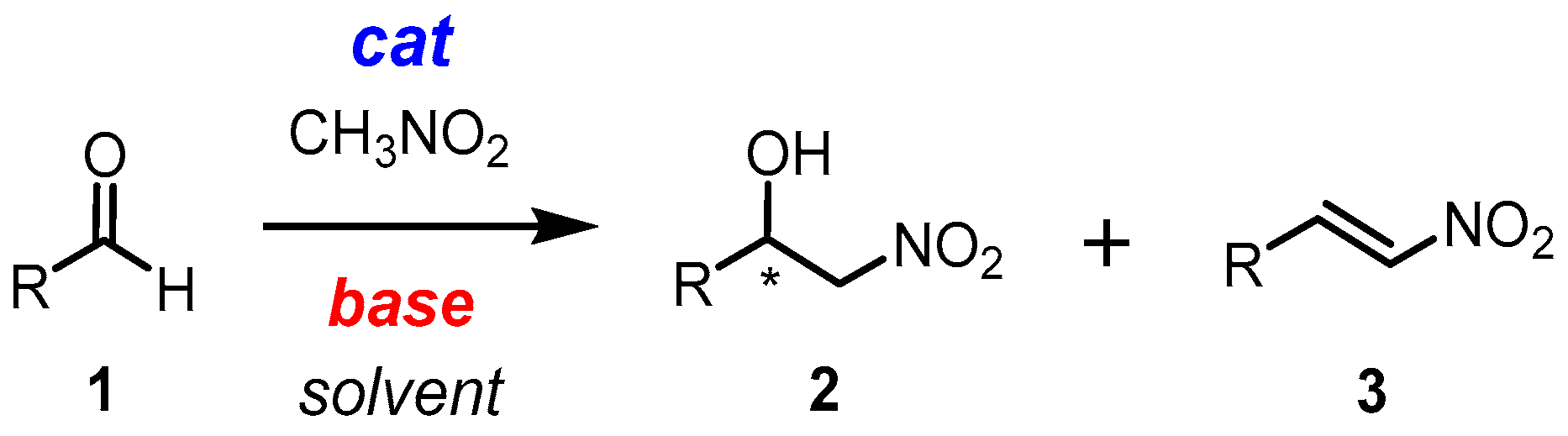
Figure 1.
Chiral copper(II) complexes Cu1-Cu3.
Scheme 2.
Henry reaction catalyzed by the complex (S)-Cu1. Reaction conditions: aldehyde 1 (0.3 mmol), nitromethane (10 equiv., 3 mmol), complex (S)-Cu1 (10 mol%) and NaOAc (10 mol%) in 0.5 mL of solvent mixture (CH2Cl2/THF) were stirred for 24 h. The yields were determined by 1H NMR analysis of the crude mixture using HMDSO as a standard. *The reaction time was 36 h. **No base was used.
Scheme 2.
Henry reaction catalyzed by the complex (S)-Cu1. Reaction conditions: aldehyde 1 (0.3 mmol), nitromethane (10 equiv., 3 mmol), complex (S)-Cu1 (10 mol%) and NaOAc (10 mol%) in 0.5 mL of solvent mixture (CH2Cl2/THF) were stirred for 24 h. The yields were determined by 1H NMR analysis of the crude mixture using HMDSO as a standard. *The reaction time was 36 h. **No base was used.
Scheme 3.
Henry reaction catalyzed by a catalytic system (S)-Cu2/Ag2O. Reaction conditions: aldehyde 1 (0.3 mmol), nitromethane (5 equiv., 1.5 mmol), complex (S)-Cu2 (2 mol%) and Ag2O (1 mol%) in 1 mL of DCE were stirred for 24 h at 70 oC. *(S)-Cu2 (5 mol%), Ag2O (2.5 mol%), CH3NO2 10 equiv. **The reaction time is 48h.
Scheme 3.
Henry reaction catalyzed by a catalytic system (S)-Cu2/Ag2O. Reaction conditions: aldehyde 1 (0.3 mmol), nitromethane (5 equiv., 1.5 mmol), complex (S)-Cu2 (2 mol%) and Ag2O (1 mol%) in 1 mL of DCE were stirred for 24 h at 70 oC. *(S)-Cu2 (5 mol%), Ag2O (2.5 mol%), CH3NO2 10 equiv. **The reaction time is 48h.
Scheme 4.
Control experiments.
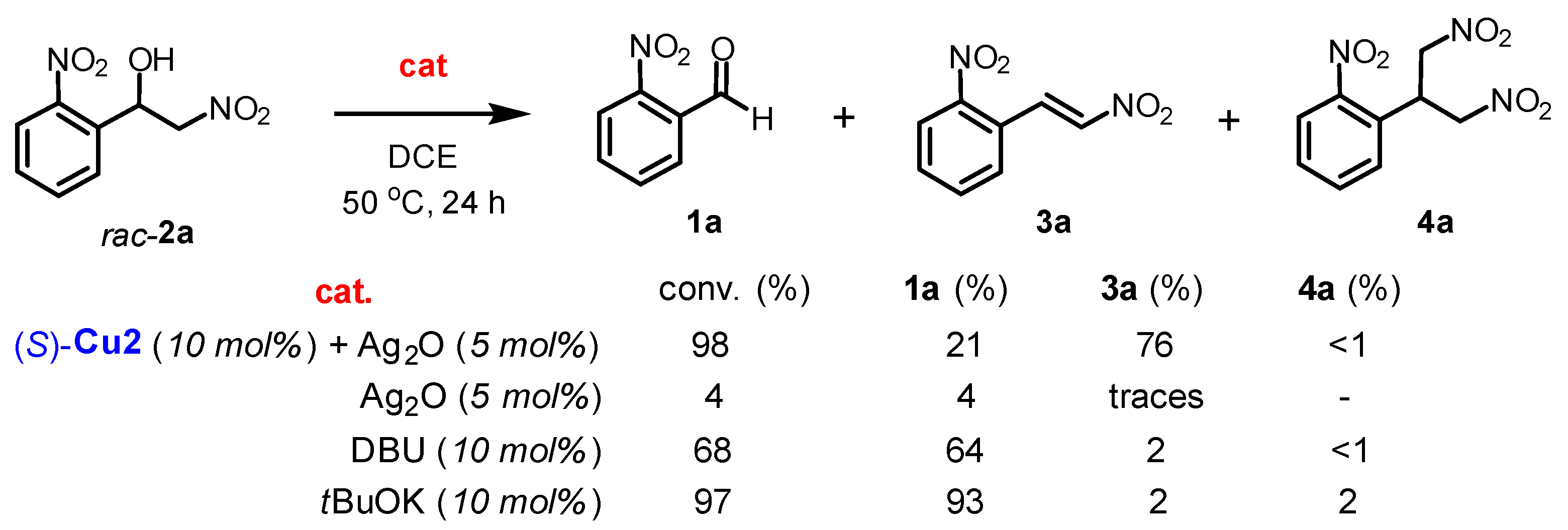
Figure 2.
Kinetic profiles of the reaction with nitromethane (a) and deuterated nitromethane (b) in CD2Cl2.
Figure 2.
Kinetic profiles of the reaction with nitromethane (a) and deuterated nitromethane (b) in CD2Cl2.
Scheme 5.
Proposed mechanism for Henry and subsequent reactions catalyzed by the system (S)-Cu2 and Ag2O.
Scheme 5.
Proposed mechanism for Henry and subsequent reactions catalyzed by the system (S)-Cu2 and Ag2O.
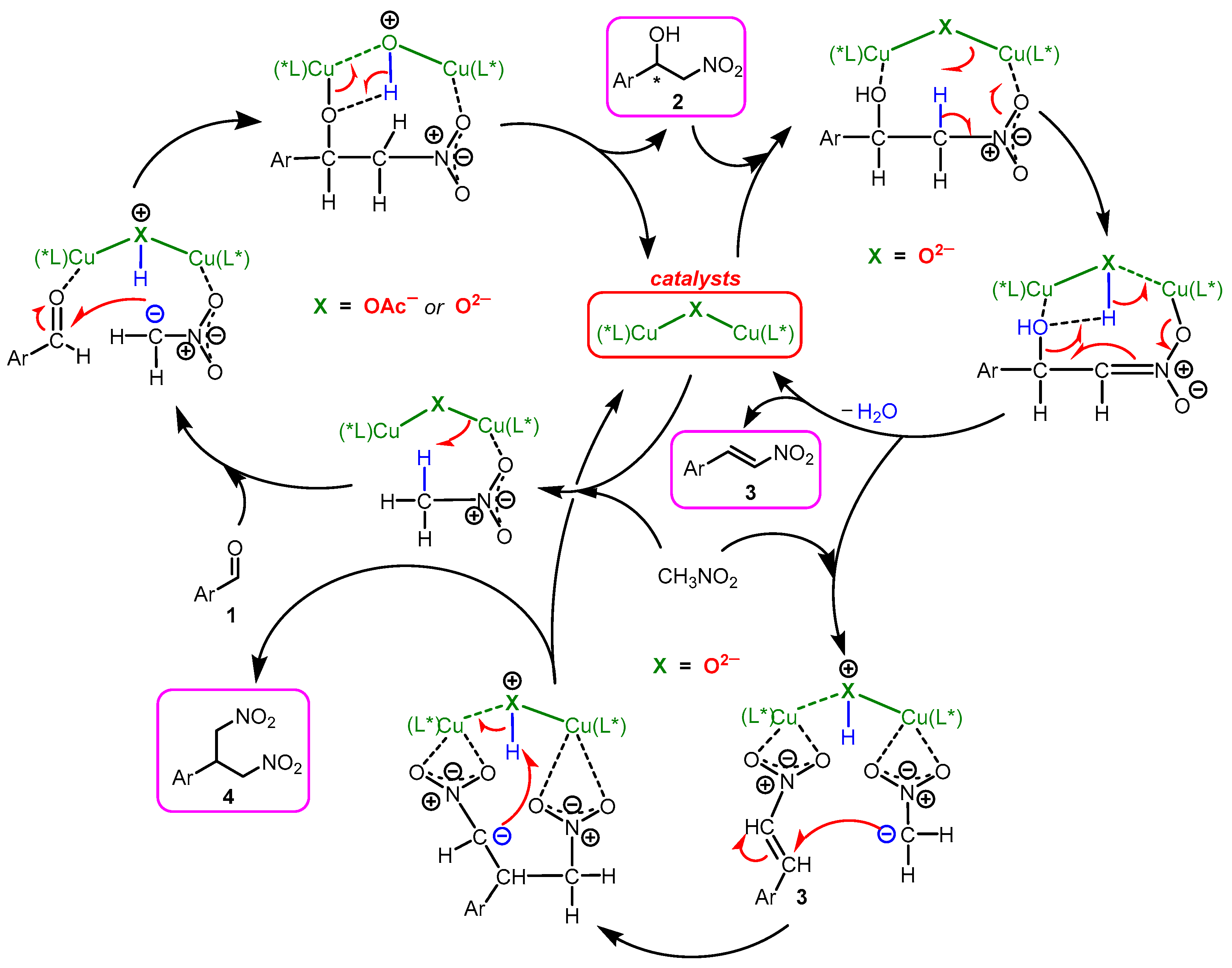

Table 1.
Reaction condition screening for the reaction of o-nitrobenzaldehyde 1a with nitromethane catalyzed by chiral Cu(II) complexes.a.
Table 1.
Reaction condition screening for the reaction of o-nitrobenzaldehyde 1a with nitromethane catalyzed by chiral Cu(II) complexes.a.
 | |||||||
| entry | catalyst | additive (x mol%) |
solvent | T, ˚C | yield (ee) of 2a (%)b,c |
yield of 3a (%)b |
Yield of 4a (%)b |
| 1ref. 14b | (S)-Cu1 | – | CD2Cl2d | RT | 78 (77) | – | – |
| 2 | (S)-Cu1 | – | DCE | 50 | 43 (25) | 55 | traces |
| 3 | (S)-Cu1 | NaOAc (10) | DCE | RT | 63 (60) | 3 | – |
| 4 | (S)-Cu1 | NaOAc (10) | THF/CH2Cl2 | RT | 96 (73) | 2 | – |
| 5 | (S)-Cu2 | - | CH2Cl2 | RT | NR | – | – |
| 6f | (S)-Cu2 | PhONa (10) | CH2Cl2 | RT | 53 (12) | 40 | 3 |
| 7 | (S)-Cu2 | PhONa (10) | CH2Cl2 | –17 | 98 (39) | traces | traces |
| 8f | (S)-Cu2 | Ag2O (5) | CH2Cl2 | RT | 59 (0) | 34 | 2 |
| 9 | (S)-Cu2 | Ag2O (5) | CH2Cl2 | RT | 31 (ND) | 54 | 14 |
| 10 | (S)-Cu2 | Ag2O (5) | CH2Cl2 | –17 | 89 (56) | 4 | traces |
| 11f,g | (S)-Cu2 | Ag2O (5) | CH2Cl2 | RT | 71 (ND) | 24 | traces |
| 12g | (S)-Cu2 | Ag2O (5) | CH2Cl2 | RT | 50 (ND) | 48 | 2 |
| 13 | (S)-Cu2 | Ag2O (5) | DCE | RT | 23 (ND) | 63 | 13 |
| 14 | (S)-Cu2 | Ag2O (5) | CH3CN | RT | 72 (ND) | 16 | 11 |
| 15 | (S)-Cu2 | Ag2O (5) | EtOAc | RT | 51 (ND) | 30 | 18 |
| 16 | (S)-Cu2 | Ag2O (5) | THF | RT | 69 (ND) | 15 | 15 |
| 17 | (S)-Cu2 | Ag2O (5) | 1,4-dioxane | RT | 51 (ND) | 32 | 16 |
| 18 | (S)-Cu2 | Ag2O (5) | toluene | RT | 28 (ND) | 61 | 10 |
| 19 | (S)-Cu2 | Ag2O (5) | MeOH | RT | 99 (ND) | – | – |
| 20h | (S)-Cu2 | Ag2O (5) | - | RT | 44 (ND) | 35 | 20 |
| 21 | (S)-Cu2 | Ag2O (5) | DCE | 50 | 4 (ND) | 81 | 14 |
| 22 | (S)-Cu2 | Ag2O (5) | DCE | 70 | <1 (ND) | 81 | 18 |
| 23 | (S)-Cu2 (5) | Ag2O (2.5) | DCE | 70 | 2 (ND) | 87 | 10 |
| 24 | (S)-Cu2 (2) | Ag2O (1) | DCE | 70 | 4 (ND) | 87 | 8 |
| 25i | (S)-Cu2 (2) | Ag2O (1) | DCE | 70 | 3 (ND) | 88 | 6 |
| 26i | CuCl2*2H2O + 1,10-phen (2) |
Ag2O (1) | DCE | 70 | 33 (ND) | 23 | 4 |
| 27 | – | Ag2O (5) | DCE | 50 | NR | – | – |
| 28 | – | tBuOK (5) | DCE | 50 | 85 (0) | – | – |
| 29 | (S)-Cu3 | Ag2O (5) | DCE | 50 | 7 (ND) | 78 | 13 |
| 30 | (S)-Cu3 | NaOAc (10) | DCE | RT | 11 (ND) | 72 | 15 |
| aReaction conditions: o-nitrobenzaldehyde 1a (0.15 mmol), nitromethane (10 eq., 1.5 mmol), catalyst (10 mol%) and an additive (5 or 10 mol%) in 0.5 mL solvent were stirred for 24 h. bYields were determined by 1H NMR analysis of the crude mixture. cEnantiomeric excess was determined by chiral HPLC analysis. d0.1 equiv. of water was added. e1.0 equiv. of water was added. fThe reaction time was 3 h. gCD3NO2 was used instead of CH3NO2. h30.0 equiv. of CH3NO2 was used. i5.0 equiv. of CH3NO2 was used. DCE = 1,2-dichloroethane. NR = no reaction. | |||||||
Disclaimer/Publisher’s Note: The statements, opinions and data contained in all publications are solely those of the individual author(s) and contributor(s) and not of MDPI and/or the editor(s). MDPI and/or the editor(s) disclaim responsibility for any injury to people or property resulting from any ideas, methods, instructions or products referred to in the content. |
© 2024 by the authors. Licensee MDPI, Basel, Switzerland. This article is an open access article distributed under the terms and conditions of the Creative Commons Attribution (CC BY) license (http://creativecommons.org/licenses/by/4.0/).
Copyright: This open access article is published under a Creative Commons CC BY 4.0 license, which permit the free download, distribution, and reuse, provided that the author and preprint are cited in any reuse.


