

Submitted:
24 December 2024
Posted:
25 December 2024
You are already at the latest version
Abstract
Triatomines are vectors of Trypanosoma cruzi (Kinetoplastida: Trypanosomatidae), agent of Chagas disease. Stercorarian transmission occurs when infectious parasites are passed in insect feces to vertebrates through the biting wound or a mucosa. Defaecating on hosts during or shortly after blood-feeding is therefore critical for transmission, and delayed triatomine defecation behavior has been posited to contribute to a low incidence of human Chagas disease in the U.S. We allowed nymphal T. cruzi-infected and uninfected Triatoma gerstaeckeri (Stål, 1859) and Triatoma sanguisuga (LeConte, 1855) to interact with restrained guinea pigs and measured insect feeding and defecation events; South American Rhodnius prolixus (Stål, 1859; Latin America) served as a comparison group. In 148 trials, 40.0% of insects fed, of which 71.2% defecated. Compared to R. prolixus, T. gerstaeckeri had >9 times higher odds of feeding, and T. sanguisuga fed longer. Observations of defecation while feeding occurred across all three species. The post-feeding defecation interval (PFDI) of R. prolixus was significantly shorter (4.54±2.46 minutes) than that of T. gerstaeckeri (9.75±2.52 minutes) and T. sanguisuga (20.69±8.98 minutes) and the PFDI between was shorter for TcI-infected insects. Triatoma gerstaeckeri and T. sanguisuga are capable of stercorarian transmission, although the calculated metrics suggest they are less efficient vectors than R. prolixus.
Keywords:
feeding and defecation behaviors
; triatomines
; Trypanosoma cruzi
Introduction
Triatomines (Hemiptera: Reduviidae) transmit Trypanosoma cruzi, the etiological agent of Chagas disease, and require bloodmeals to develop throughout their hemimetabolous life cycles. Over 150 triatomine species distributed from the southern U.S. to Argentina and Chile are potential vectors of T. cruzi [1,2]. Triatomines exhibit stercorarian biological transmission, in which they transmit the infectious state of T. cruzi via fecal contamination to the host. If an infected triatomine feeds on a host and defecates at the same time or shortly after, the probability of host infection with infectious parasite through the bite wound or mucosa increases [3]. Accordingly, there is a long-standing interest in triatomine defecation behavior as it relates to the risk of T. cruzi vectorial transmission [4,5,6,7,8,9,10,11,12,13].
Vectorial capacity (VC) is a concept that allows scientists to estimate vector transmission potential by incorporating all the intrinsic and extrinsic factors that regulate this process [14]. VC includes factors such as vector competence, extrinsic incubation period, the vector density in relation to humans, daily survival rate, and probability of the vector feeding on the host [14]. For triatomines and the transmission of T. cruzi, intrinsic factors include the ability of triatomines to ingest and then transmit T. cruzi (vector competence); the infectious dosage of parasites in triatomine feces [15]; the host utilization of triatomines and contact with different vertebrates such as dogs or humans [16]; and the frequency of triatomine colonization of domicile environments [17]. Feeding and defecation behaviors are a critical part of vector competence as they relate to the probability of infectious stages of T. cruzi in feces coming into contact and infecting a host. Beyond VC, additional routes of transmission of T. cruzi further complicate this pathosystem, and include oral consumption of infected triatomines by wild hosts and dogs, which is an efficient route of T. cruzi [18] or consuming food contaminated with T. cruzi [19]).
Studies of feeding and defecation behaviors of triatomines have been conducted for decades. It is assumed that South American triatomines are more efficient vectors of T. cruzi because they generally have shorter post-feeding defecation intervals (PFDIs) [4,12,20,21,22], as compared to North American species that do not defecate while feeding nor immediately after [4,6,7,9,12]. Although not all South American triatomine species have short PFDIs, studies have suggested that other domiciliary species with longer PFDIs could serve as secondary vectors of Chagas disease [23]. The feeding and defecation behaviors of North American species may be the main contributor to the lower human burden of Chagas disease in the U.S. relative to Latin America [6,7,9,24,25,26] as autochthonous cases in the U.S. are rare [27], despite established vector populations in both locations. However, only selected U.S. taxa have been examined, with little attention to how infection with T. cruzi may alter defecation behaviors [6,7,9,12]. Other factors that may contribute to fewer autochthonous human cases in the U.S. include 1) low testing rates and underreporting of Chagas disease cases, 2) generally robust housing to prevent domestication of triatomines, 3) the scarcity of triatomine domicile colonization [28], and 4) variation in the pathogenicity of the parasite.
Triatoma gerstaeckeri (Stål) is the most commonly collected species in Texas [29,30] and is distributed throughout most of Texas, parts of New Mexico, and has been documented in 10 states in northern Mexico [31]. Triatoma sanguisuga (LeConte), known as the ‘eastern blood-sucking conenose bug’, is broadly distributed from Texas to the east coast of the U.S. [30]. Triatoma gerstaeckeri and T. sanguisuga are considered the two most epidemiologically important vector species in Texas, and they both have relatively high T. cruzi infection prevalence [32] (45-70% for T. gerstaeckeri [12,29,32,33]; 25-67% for T. sanguisuga [12,29,33,34]) and are frequently encountered in or around households in Texas [32]. In the United States, T. cruzi discrete typing units (DTUs) TcI and TcIV are the most predominant, with TcI being associated with human infections, though other DTUs have been found in autochthonous human cases in the US [28,35]. Additionally, there is evidence that the TcIV strain found in the United States is distinct to its South American counterpart phylogenetically [36]. In a comphrensive study, Triatoma gerstaeckeri is more likely to carry DTU TcI, while T. sanguisuga is more likely to carry DTU TcIV [32].
Rhodnius prolixus (Stål) is native to northern South America which spread to Central America and is a competent vector for T. cruzi and highly domiciliated [37,38,39]. It is the most common laboratory triatomine model [40,41]. Rhodnius prolixus and other South American species [20] have been shown to have higher vectorial capacity given short PFDIs compared to triatomine species found in the U.S. [7,12]. Thus, R. prolixus is a good model for the comparison of feeding and defecation behaviors with the U.S. species.
The objective for this study was to examine feeding and defecation behaviors of T. cruzi-infected and uninfected T. gerstaeckeri and T. sanguisuga in the presence of live hosts in comparison with colonized R. prolixus to afford key information for enhanced understanding of vectorial capacity and human risk of exposure.
Materials and methods
Insects
All insects in this study were reared in an arthropod containment level 2 (ACL2) triatomine colony at a 12-hour photoperiod cycle. The temperature in the room had a mean of 23.4°C (±2.4). Microhabitat humidity experienced by the triatomines was >50% because they were housed in Nalgene primary containers (Avantor, Radnor, PA, USA) that were placed in a plastic secondary container filled with water [42]. The secondary containers sit in tubs coated with fluon (BioQuip Products, Rancho Dominguez, CA, USA) to reduce risk of escape. Rhodnius prolixus were obtained from Centers of Disease Control and Prevention from a colony developed from insects collected in Colombia (NR-44077, BEI Resources, Manassas, VA, USA), and were many generations removed from the wild population. Triatoma gerstaeckeri and T. sanguisuga were offspring of individuals collected from wild populations in Texas between 2017 and 2019. The laboratory generations F1 to F2 were used in the trials. All nymphs came from known T. cruzi-negative colonies which were separated from adults and subsampled to confirm infection status following testing protocols described below. Triatomines were maintained on defibrinated rabbit (Oryctolagus cuniculus domesticus) blood (Hemostat Laboratories, Dixon, CA, USA) weekly through artificial membrane feeders (Hemotek Ltd, Blackburn, UK).
Guinea Pigs
Fourteen adult female guinea pigs were used in the trials. They were uniquely marked with fur pigment markers (Stoelting, Wood Dale, IL, USA) and group-housed in animal BSL-1 containment. Although T. cruzi infection was not an expected outcome in animals in this study, each of the guinea pigs had their blood drawn at three different time points: pre-study, mid-study, and post-study to confirm negative infection status and to facilitate their adoption at the end of the study. We extracted DNA from 50-100 µL of blood (E.Z.N.A.® Blood DNA Kit, Omega Bio-tek, USA) and used qPCR of to detect T. cruzi nuclear satellite DNA [43]. Animal use was approved by the Institutional Animal Use and Care Committee (2018-0484).
Parasite Culture
We obtained T. cruzi metacyclic trypomastigotes by gently compressing the abdomen of a naturally infected, wild-caught T. gerstaeckeri nymph from Frio County, TX, that had previously tested positive for T. cruzi discrete typing unit (DTU) TcI. We obtained T. cruzi epimastigotes of T. cruzi DTU TcIV by hemoculture of a naturally infected non-human primate from a central Texas biomedical research facility [44]. Trypanosomes were cultured in liver-infusion tryptose (LIT) media supplemented with fetal bovine serum, penicillin-streptomycin, and nystatin (Sigma-Aldrich, Darmstadt, Germany) [45,46,47]. Culture flasks were placed into an incubator at 27°C and microscopically examined for the presence of motile trypanosomes two weeks later. Cultures were maintained by passage in LIT media and were mixtures of abundant epimastigotes and rare trypomastigotes as determined by microscopy. The T. cruzi DTU in each culture was confirmed by a multiplex qPCR targeting the spliced leader intergenic region (SL-IR) [48].
Experimental Infections
To calculate parasite concentration of each culture, we agitated the culture flask and pipetted 10 µL of media into 90 µL of formalin (VWR, Radnor, PA, USA) and counted parasites in a hemocytometer (Reichert, Buffalo, NY, USA) to determine an approximate density while accounting for the formalin dilution. To concentrate the parasites, we centrifuged samples in microcentrifuge tubes for 10 minutes at 3,000 rpm, poured off the culture medium, and resuspended with sterile phosphate-buffered saline (PBS) solution (VWR, Radnor, PA, USA) after which the process was repeated, and the pellet was retrieved. We transferred the washed parasite pellet into a measured quantity of defibrinated rabbit blood to a final estimated concentration of 3 x 10⁶ parasites per mL of blood, a concentration similar to peak parasitemia in laboratory mice which has a very high probability of insect infection [49,50,51,52].
The feedings of the experimental infections were conducted in a biosafety cabinet located in the same ACL2 facility where the triatomines are reared; ambient temperatures in the room ranged from 24-27°C. Infected blood was offered to 4th and 5th instar triatomine nymphs through the Hemotek membrane feeder for two hours. These instars were chosen because of robust availability in the insect colony, ease of handling, and high visibility under the surveillance cameras used in the trials. The control groups were offered blood without parasites. The insects were group housed during the experimental feedings, where the nymphs were allowed to feed to repletion. For all insects, insects that did not feed on their pre-trial bloodmeal, or fed then molted into adults prior to use, were removed from the study. The following treatment groups after experimental infections were prepared: T. gerstaeckeri (control, n=26; 1 4th instar and 25 5th instars); T. gerstaeckeri (TcI, n=21; all 5th instars); T. gerstaeckeri (TcIV, n=17; all 5th instars); T. sanguisuga (control, n=16; 7 4th instars and 9 5th instars); T. sanguisuga (TcI, n=11; 4 4th instars and 7 5th instars); R. prolixus (control, n=21; 1 4th instar and 20 5th instars); R. prolixus (TcI, n=19; 3 4th instars and 16 5th instars); R. prolixus (TcIV, n=17; 2 4th instars and 15 5th instars). There was no TcIV treatment group for T. sanguisuga due to limited numbers in the colony. Triatomines were fed either infected or uninfected rabbit blood using artificial membrane feeders as cohorts, and the date of prior molt was not recorded. We recorded the starvation period as the number of days since the last time a bloodmeal was offered prior to use in the trials; the range was 2-6 weeks.
Confirmation of Infection Status
We used up to three different methods to confirm the infection status of insects. For abdominal compression, insects at 2 weeks post-feeding on infected blood were gently compressed so fecal material could be directly expelled into 5 mL of LIT culture media. The cultures incubated at 27°C and were checked weekly for presence of T. cruzi. We allowed for T. cruzi to grow in the cultures for one month [53] to confirm infection. Some individuals would not defecate following compression, so as an alternative we used fecal spot testing. Feces from insects voided naturally onto filter paper was cut out using sterile scissors and held individually in 50 mL-conical tubes (Whatman Filter Paper, Sigma-Aldrich, Darmstadt, Germany).
DNA was extracted using the KingFisher Cell and Tissue kit (Thermo Fisher Scientific, Waltham, MA, USA), and real-time qPCR was performed to detect T. cruzi [32]. If infection status was not confirmed with one of these methods, then after their use in the trials, insects were dissected to obtain gut material, which was subjected to DNA extraction and tested using qPCR [32].
Feeding and Defecation Behavioral Trials
The trials were conducted from August 2019─September 2020 in an ABSL2 and ACL2 negative air pressure biocontainment unit (bioBUBBLE, Fort Collins, CO, USA). Temperatures ranged from 18-26°C. The hours of the day when trials were conducted ranged from starting at 8:30 a.m. and ending at 7:00 p.m. Experimental arenas were a 17.6 in x 11.5 in x 7.8 in, clear, polycarbonate Sous Vide container (Lipavi, United Kingdom) with the bottom surfaces lined with white bench paper and taped using white laboratory tape. One camera (YI Technology, Pudong District, Shanghai, China) was docked above each arena to allow recording of the trials. After the first several trials were done in ambient light, two 25-watt red, light bulbs were set up above the containers to allow for observations to be made with the low-light surveillance cameras. One trial is defined as a single triatomine feeding on a guinea pig and four trials were run simultaneously. Each guinea pig was restrained into a 2 inch-mesh, cotton stockinette (Rolyan, Warrenville, IL, USA) with both ends tied and secured with white duct tape to the sides of the containers. Each insect was weighed before and after the trial period and haphazardly assigned to be placed with a guinea pig for the first 60 minutes of the trial period.
Trials lasted for 120 minutes, with the first 60 minutes consisting of one guinea pig and one triatomine together in the arena, after which the guinea pig was removed, and the insect was observed for an additional 60 minutes. Insect behavioral scoring included: (i) whether the insect was sedentary or walking; (ii) number of feeding attempts, feeding events, interrupted feedings; and (iii) and number of defecation events, with the color of each defecation noted. A feeding event started when an insect inserted its proboscis into the guinea pig for at least one continuous second and ended once the insect removed its proboscis and walked away from the location of the bite [54]. A probing attempt was defined when an insect repeatedly probed the guinea pig for less than one second each time. A defecation event occurred when an insect excreted either urinary or fecal material at any time in the two-hour trial period. The time at which the insect defecated was noted. Guinea pig behavioral scoring consisted of: (i) reaction to probing by an insect; (ii) movement inside the stockinette; (iii) and other general observations. In cases that an insect was still feeding at the 60-minute mark, the guinea pig stayed in the arena until the insect finished feeding. Upon completion of the trial, the insects were weighed again and a unique colored marking with nail polish was painted over their lower abdomen. Any fecal spots on the bench paper from the trials were collected.
Statistical Analyses
We adopted the defecation index (DI) from Zeledon to allow for a standardized index of infection capacity to compare with other studies [4,6,7], where DI= (% of insects that defecated up to 10 minutes post feeding x average number of defecations up to 10 minutes post feeding)/100. We also calculated the PFDI as the time intervals between the start of an insect’s most recent bloodmeal in the arena to the time of its first defecation [21]; in the case of insects that fed and defecated multiple times, multiple PFDIs were calculated per trial. Given that some studies emphasize the importance of defecation at an interval less than 10 minutes [4,21,55], we also calculated percent of individuals defecating within 1-minute post-feeding because it is suggested that triatomines would already have moved away from its hosts after 1 minute post feeding [8,55].
The volume of blood ingested was calculated using a proportion of 1 mg of weight gained after feeding equal to 1 µL of blood [54]. The percent weight gain was also calculated by dividing the ingested blood volume by the pre-trial weight of the insect [12].
We tested for differences among treatment groups using generalized estimating equation models, GEE [56]. Models were fit using the “geepack” package in R version 4.1.1. We employed GEE models given the nature of the data, where experiments had randomization constraints related to using different guinea pigs and were done over different days, something that constrained the use of simpler regression tools that assume full replication [57]. To analyze whether triatomines fed or defecated, we employed logistic GEE models [58]. To analyze variables associated with the number of times a triatomine fed, or defecated/urinated, we employed models with a Poisson distribution [58]. To analyze the total feeding time and the post-feeding defecation intervals (PFDIs), we used a model with a Gaussian distribution [56].
In all models we considered the triatomine species and the infection status as the main explanatory variables. As covariates, we considered the illumination conditions for the experiment (with lights on or off), the estimated number of days the triatomine was starved before the experiment, and the nymphal instar. This basic structure was used in the model looking at factors associated with vector feeding; in all other models, we included additional covariates. For the model studying whether triatomines defecated or not, we considered whether triatomines fed when offered the guinea pig. For models studying the number of feedings, number of defecations, total feeding time, and PFDIs, we compared their goodness of fit considering either the initial insect weight or the pre- and post-feeding weight difference at the end of the experiment. For the model of number of defecations, we also added the number of feedings as a covariate.
For the inference we used a sandwich estimator to obtain robust standard errors, since naïve standard errors are appropriate only when the correlation structure is correct [58]. When fitting the GEE models we fitted alternative models that either considered an independent or a correlated, a.k.a. exchangeable, error structure as a function of the clustering factor (guinea pig or date of trial) [56]. In the models, we considered the day of measurement or guinea pig identity as clustering factor. Among these alternatives we chose the best model for each of the responses based on the minimization of the quasi-likelihood information criterion (QIC), a goodness of fit function that trades-off deviance and number of parameters in GEE models, and whose minimization can be used to choose the best model [59].
For each guinea pig, we recorded the number of trials the guinea pig was successfully fed on by an insect and used a GEE model to see if the size of bloodmeals would decrease over time as the guinea pigs’ immune system was primed to the insects’ salivary proteins [60,61]. All guinea pigs were considered naïve to triatomine salivary proteins at the beginning of the study. When a guinea pig was used and the insect did not feed, the bloodmeal size was recorded as 0 µL. In this model we also considered as covariates, the interaction between life stage (4th or 5th instar) and kissing bug species and the initial weight of the kissing bug including guinea pig as clustering variable. We also compared the QIC of independent and exchangeable models.
Results
Of the 91 triatomines that were experimentally exposed to and fed on T. cruzi-infected blood, T. cruzi was found via culture or PCR methods in 85 (93.4%) of them. Of the 69 triatomines that were in the control category, 64 (92.8%) were subjected to confirmatory testing of infection status, and 63 (98.4%) were confirmed as uninfected. The single control insect that tested positive was excluded from analysis. Five insects that were untested were lost and could not be extracted; these insects were excluded from analysis. Insects that had test results congruent with their assigned treatment groups were used for statistical analysis, which resulted in a total of 148 (92.5%) individual insects.
Out of 148 trials, 59 (40.0%) involved a triatomine that fed on guinea pigs during the trial periods (Table 1). Of those 59 insects, 42 (71.2%) defecated at least once after feeding during the observation period. Forty-one (64.1%) T. gerstaeckeri fed on the guinea pigs, while only eight (29.6%) T. sanguisuga and ten (17.5%) R. prolixus fed on the guinea pigs. For defecation, 33 (51.6%) T. gerstaeckeri defecated during the observation period regardless of feeding success, while there were eight (29.6%) for T. sanguisuga and 15 (26.3%) for R. prolixus.
For the logistic GEE model to explore predictors of whether an insect fed or not, the best fit model had an independent correlation structure considering the guinea pig as the clustering factor (Table S1). We found the odds of T. gerstaeckeri feeding on a guinea pig was 9.21 times higher (P<0.001) than in R. prolixus. In contrast, T. sanguisuga feeding odds were not different from those of R. prolixus (P=0.825). If a triatomine was infected with TcI, it had 1/3 the odds of feeding on the guinea pig (P=0.025) when compared with an uninfected triatomine (Table S2). There were no differences in feeding odds if a triatomine was infected with TcIV when compared with uninfected triatomines.
For the model to explore variables associated with whether an insect defecated, the best fit model had an independent correlation structure considering the guinea pig as the clustering factor (Table S3). We found there were no significant differences between species nor infection status, but if an insect was observed in the dark (with the red lights), it had an odds of defecating two times higher than the odds of an insect in ambient light (P=0.045; Table S4). If an insect fed on the guinea pig, the odds of defecating was 17.99 times higher than that of an insect that did not feed on the guinea pig (P<0.001).
Feeding Results
For the model exploring the number of feedings, the best fit model had an exchangeable correlation structure using the date of trial observation as the clustering factor (Table S5). Of the insects that fed, the mean number (± S.E.) of feeding events per insect within the first 60 minutes with the guinea pig were 6.49 (± 0.56) for T. gerstaeckeri; 6.50 (± 0.68) for T. sanguisuga; and 3.50 (± 0.76) for R. prolixus. Triatoma gerstaeckeri had significantly more feeding events than R. prolixus (P=0.017; Figure 1A), while there were no differences between T. sanguisuga and R. prolixus (P=0.154). Aggregating species, the control group had an average of 5.34 (± 0.61) feeding events per insect, while TcI had 7.44 (± 0.91) and TcIV had 5.73 (± 0.73) feeding events per insect. Weight gain was positively correlated (P<0.001; Table S6). Out of the 59 trials where a triatomine successfully fed on a guinea pig, only one trial did not result in host agitation of the guinea pig when the triatomine fed on it. Additionally, of the 148 trials, 78 (52.7%) of the insects were noted to have probed the guinea pigs. Of these 78 insects, 58 (74.4%) also and a successful feeding event.
The best fit Gaussian model exploring total feeding time per insect had an independent correlation structure using the date of trial observation as the clustering factor (Table S7). The mean total feeding times per insect were 14.6 (± 1.51) minutes for T. gerstaeckeri; 15.2 (± 3.34) minutes for T. sanguisuga; and 14.8 (± 3.86) minutes for R. prolixus. On average, T. sanguisuga fed 10.55 minutes longer than R. prolixus (P<0.001), while total feeding times were not significantly different for T. gerstaeckeri (Table S8; Figure 1B). The model also showed the covariates of life stage and environment were significant: 5th-instars took an average of 10.43 minutes more to feed than 4th-instars (P<0.001), and insects that fed in ambient light fed 4.37 minutes less than those with red lights (P=0.021; Table S8). An insect fed for 0.065 minutes more for every 1 mg increase in its weight (P<0.001). Aggregating species, uninfected insects fed 13.67 (± 1.80) minutes per insect; TcI fed for 14.42 (± 2.67) minutes; and TcIV fed for 18.13 (± 2.35) minutes.
Defecation Results
A total of 56 (37.8%) insects defecated during the trials, and 42 of those defecated after feeding while 14 defecated without feeding during the trial. The best fit model for number of defecation events had an independent correlation structure using guinea pigs as the clustering factor (Table S9). Both T. gerstaeckeri and T. sanguisuga had, on average, fewer defecation events than R. prolixus (P<0.001 for both) (Table S10; Figure 1C). For every 1 mg increase in an insect’s weight, there was a 6.65% increase in the number of defecations (P=0.002). Infection status and other covariates did not yield significant differences in the number of defecation events. The mean (± S.E.) total number of defecation/urination events per insect were 1.80 (± 0.29) for T. gerstaeckeri; 0.91 (± 0.21) for T. sanguisuga; and 2.56 (± 0.59) for R. prolixus. Regarding infection status, controls had 1.81 (± 0.32) defecation events per insect; TcI had 1.53 (± 0.50); and TcIV had 2.22 (± 0.43).
Post-Feeding Defecation Intervals
We measured the post-feeding defecation interval (number of minutes from the end of a blood meal to the first defecation) using GEE models with a Gaussian distribution. The best fitted model had an independent correlation structure using guinea pigs as the clustering factor (Table S11). The average interval between first feeding to the first defecation was 9.75 (± 2.52) minutes for T. gerstaeckeri; 20.69 (± 8.98) minutes for T. sanguisuga; and 4.54 (± 2.46) minutes for R. prolixus. The PFDIs for the control group was 11.82 (± 3.17) minutes; TcI group was 8.19 (± 3.26) minutes; and TcIV group was 6.68 (± 4.02) minutes. Except for the T. sanguisuga (Control) group, the infection groups had PFDIs averages within 10 minutes (Figure 1D). Compared to R. prolixus, T. gerstaeckeri, on average, would defecate 11.45 minutes later post feeding (P<0.001), and T. sanguisuga would defecate 19.52 minutes later post feeding (P<0.001; Table S12). We did not see a significant difference between the infected and uninfected groups (TcI: P=0.087; TcIV: P=0.389) for the PFDIs to the first defecation.
Given many insects had multiple defecations post feeding, we fitted a model to use data on multiple PFDIs per insect with a Gaussian distribution that had an independent correlation structure using the individual insect as the clustering factor (Table S13). There was a total of 42 insects that fed and defecated which accounted for 117 individual PFDIs (Figure 2). We observed TcI-infected insects had shorter PFDIs than uninfected insects (P=0.001; Table S14). In this model, T. sanguisuga took longer to defecate post feeding than R. prolixus (P<0.001), and insects in ambient light took longer to defecate post feeding than those in the dark (P=0.007).
Of the 148 triatomines that were analyzed, we observed six insects (4.1%) spanning all three species simultaneously feed and defecate (Figure 3), including three that did so twice. A video taken during one trial showing a T. sanguisuga nymph simultaneously feeding and defecating is uploaded as Supplementary Material (Video S1). These insects had a total feeding time range from 13 to 40 minutes and defecated a total of 29 times, of which 21 defecations were within 10 minutes post feeding. For both T. gerstaeckeri and T. sanguisuga, only infected insects simultaneously fed and defecated, and they accounted for 14 total defecation events—10 of which were within 10 minutes post feeding.
Defecation Index
For R. prolixus, the DI for both the uninfected group (2.02) and TcIV-infected group (3.00) were higher than all treatment groups of the other species (Figure 4), but the R. prolixus TcIV data is from a single insect. The DI for R. prolixus (TcI) could not be calculated since none of the insects in that group fed on a guinea pig. The percent of triatomines defecating within 1-minute post feeding was 11 (39.3%) of T. gerstaeckeri, 1 (20%) of T. sanguisuga, and 6 (66.7%) of R. prolixus.
Weight gain & Bloodmeal Size
We calculated the mean weight gain (mg), mean volume of blood ingested (µL), and percent weight gain for insects that fed on the guinea pigs and gained weight (Table 2). There was a total of five insects that we recorded feeding events for, but they did not gain weight and were excluded in the tabulation, so the total number of insects that fed and gained weight was n=53. T. sanguisuga had 4th instar nymphs that fed and gained weight, while the other infection groups only had data for 5th instars. Overall, most of the infected groups gained more weight and ingested more blood. Triatoma gerstaeckeri (TcI) had lower mean weight gain and mean blood volume ingested but had a higher percent weight gain than the control group. Both T. cruzi-infected groups (TcI and TcIV) for all three species had larger mean weight gain percentages than the control groups, apart from R. prolixus (TcI) since none of those insects fed.
Of those that fed and gained weight (n=53), the mean bloodmeal size was 119 µL, and there was no difference in the size of insect bloodmeals that were taken on guinea pigs with different numbers of prior feeding events (P=0.57; Figure 5). Our independent correlation gaussian GEE (QIC= 9.14e+05) model (Table S15), which was selected over one with a correlated structure (QIC= 9.14e+05), also showed that blood meal volume increased by 22.49 (±7.15) µL in 5th instars of all species when compared with 4th instars (P<0.017; Table S16). There was an additional significant increase of 101.39 (±25.46) µL in T. gerstaeckeri 5th instar (P< 6.8e-05) when compared with R. prolixus, the difference between T. sanguisuga and R. prolixus (the reference species in our analysis) not being significant (P>0.66). Once the stage and species corrections were considered, the model suggested that larger triatomines ingested less blood. We found that for each mg of insect weight before bloodfeeding the volume of the bloodmeal decreased by -0.275 (±0.116) µL (P< 0.0183; Table S16).
Discussion
We observed the feeding and defecation behaviors of two epidemiologically important triatomine species found in the U.S. and compared them with a highly competent vector species from South America. Previous studies have shown R. prolixus to be efficient vectors for transmitting T. cruzi in that it defecates often and has short PFDIs [4,12,20,22], while studies of species in the U.S. have shown them to have prolonged PFDIs [6,7,9,12]. A feeding and defecation behavioral study has been done with T. gerstaeckeri and T. sanguisuga in the U.S showing they may be less efficient vectors than R. prolixus [12]; however, it has been a few decades since the study was conducted and to our knowledge, only a few more studies observing other species that can be found in the U.S. have since been conducted [6,7,13,62]. The various behavioral metrics observed in our study for R. prolixus indeed support that it may be a more efficient vector than T. gerstaeckeri and T. sanguisuga. However, we found evidence for both T. gerstaeckeri and T. sanguisuga that suggest competence for stercorarian transmission of T. cruzi in nature.
Fewer R. prolixus defecated during the study period (26.3%) as compared to T. gerstaeckeri (51.6%); this likely results from the low rate of feeding by R. prolixus (17.5%) as compared to T. gerstaeckeri (64.1%). The lower rate of feeding may be attributed to the mixed physiological status of insects that were enrolled in the trials. In particular, we used insects in the same life stage as when they obtained their last bloodmeal; R. prolixus in particular may have been unmotivated to feed despite allowing for a starvation period. Whereas Buxton (1930) found a single bloodmeal per life stage was sufficient to allow molting of R. prolixus; Uribe (1926) found multiple feedings for each immature stage before molting. Regardless, the majority of metrics calculated in our study result from the subset of insects that both fed and defecated from which some conclusions may be drawn.
We found that in the uninfected (control) groups, all three species had similar mean total feeding times. Rhodnius prolixus had fewer feeding events per insect than T. gerstaeckeri and T. sanguisuga, which may be attributed to R. prolixus taking a longer time to feed per feeding event. Rhodnius prolixus also had significantly more defecation events and shorter PFDIs than the other two species, which was expected based on previous studies [4,12,20,22] and support its role as an efficient vector of T. cruzi.
The influence of T. cruzi infection on feeding and defecation behavior is important given a majority of individuals are infected in nature [29,32,33]. Many studies have investigated the influence of T. cruzi on various aspects of triatomine behavior, such as development, fecundity, and fitness [63,64,65,66]. Some of these studies and others have seen changes in infected triatomine’s biting rates, weight gains, and defecations [11,15,21,54,67], suggesting that T. cruzi may modulate vector competence. One study showed infected Mepraia spinolai were twice more likely to bite and defecated sooner than uninfected triatomines [11], and another study showed that T. cruzi infection increased triatomine’s vector activity, such as host odor detection [67]. Both studies suggest manipulation by T. cruzi of feeding and defecation behaviors leading to increased parasite transmission. Interestingly, while we saw the T. cruzi infected groups had slightly more feeding and defecation events and longer feeding times than the uninfected controls, none of these metrics were statistical different. While T. cruzi infected groups tended to have shorter PFDIs to the first defecation event, this difference was not significant. However, when considering multiple, individual defecation events post-feeding, TcI-infected insects had significantly shorter PFDIs than uninfected insects. This finding suggests that infection with T. cruzi makes a difference in the timing of multiple defecation events.
The defecation index (DI) was first proposed as a measurement to estimate an insect’s transmission capability and accounts for defecations within 10 minutes post-feeding [4]. A higher DI generally equates to a higher capability of transmission. Zeledon calculated the DIs for 4th and 5th-instars of R. prolixus to be 3.8 and 1.8, respectively. We saw higher DIs in both the control and TcIV groups for R. prolixus (2.02 and 3, respectively) compared to the North American species. The DIs we calculated for most of the T. gerstaeckeri and T. sanguisuga groups were higher than those previously reported for Triatoma protracta and Triatoma rubida [4,6,9], with one study showing adult female T. rubida having a DI of 1.3 [7]. Across all species, we found that the infected groups had higher DIs compared with their own control groups, providing further support that T. cruzi may be playing a role in increasing the vector competence of triatomines with respect to their defecation behaviors. Apart from T. gerstaeckeri (TcI), all infected groups had a higher mean for blood volume ingested than the control groups, similar to results found for Triatoma rubrovaria infected with DTU TcIV [54]. We also observed that the more blood an insect ingested—indicated by bigger weight gain—the shorter were PFDIs, corroborating that blood intake had a negative correlation with the time of appearance of the first defecation [68].
A total of six insects (4.1%) fed and defecated simultaneously, in which all three species were represented. These insects had multiple defecation events, of which a majority was within 10 minutes post feeding. If an insect fed to repletion, then it is possible that they will still be in close proximity to the host because the added weight may slow down its mobility [4], and the chances to defecate or urinate multiple times is likely. We also observed 14 insects that defecated with no apparently successful feeding events on the guinea pig. Of these 14 insects, six (42.9%) were noted to have had probing attempts on the guinea pigs. Defecation without feeding may reflect digestion of blood ingested prior to the trials; however, we could not rule out that the defecation came from unmeasurable amounts of blood from probing. We found the insects were more likely to defecate in the dark than in ambient light, which supports findings of an increased risk of parasite transmission at night or in dark nests as triatomines are likely more active to feed when their hosts are sleeping [42].
The three species we used in the trials were the same that were used in Pippin’s study in 1970 with triatomines feeding on laboratory mice and rats. His findings showed the mean total feeding times of 4th- and 5th-instar nymphs were 33 and 39 minutes, respectively, for T. gerstaeckeri; 25 and 31 minutes for T. sanguisuga; and 17 and 19 minutes for R. prolixus [12]. In contrast, all three species we studied had mean total feeding times of 14-15 minutes. Pippin also found a larger percentage of 4th- and 5th-instar nymphs of R. prolixus defecated within two minutes of feeding than that of T. gerstaeckeri and T. sanguisuga, indicating the two species were less efficient stercorarian vectors than R. prolixus. We did not see significant differences determining which species was more likely to defecate, but both T. gerstaeckeri and T. sanguisuga had fewer defecation events than R. prolixus. Zeledon and others noted that in Pippin’s study, about 1/4th of the late instar nymphs of T. gerstaeckeri and T. sanguisuga were defecated within two minutes post feeding, making them potential vectors for T. cruzi [69]. Applying the same method of reporting for our insects that defecated for our study, we saw 42.9% of T. gerstaeckeri and 20.0% of T. sanguisuga defecating within two minutes after feeding, which is similar to T. sanguisuga (23.3%) but higher than T. gerstaeckeri (25.0%) observed in Pippin’s study [12].
We wanted to see if the bloodmeal size would decrease over time as the guinea pigs would be repeatedly exposed to triatomine saliva and develop antibodies against salivary proteins. Saliva serves as an important aid in the feeding process for triatomines as it has various anticlotting, anesthetic, antihistamine, and other properties [70]. Exposure to triatomine saliva can induce salivary antigens and other host-immune response [60,70], which could potentially decrease the amount of blood a triatomine can intake or affect the feeding process in future feeding events [71]. In our study, we did not see a significant difference of the bloodmeal size when the guinea pigs were repeatedly fed on by the triatomines.
A previous study reported that T. sanguisuga were more likely to carry DTU TcIV [32], yet we did not have a TcIV infection group for that species. Triatoma sanguisuga is more challenging to colonize [72,73] than T. gerstaeckeri and had insufficient numbers to properly make comparisons between TcIV-infected and uninfected insects in the trials. Surprisingly, our results showed none of the R. prolixus (TcI) insects fed on the guinea pigs. This observation is likely due to the individuals being offered the guinea pig prior to molting, as multiple studies have shown that they only require one blood meal for each life stage [16,74], unlike some Triatoma species which often take multiple bloodmeals prior to molting [75] which we observed in our Triatoma insects. We group-housed the individuals when feeding through the artificial membrane which is a strategy to encourage higher feeding success [76]. But then we did not track individuals through time to know exactly which ones had molted and which ones had not prior to the experiments. DTU TcI is also known to be mostly associated with R. prolixus [51,77,78], so due to the lack of data for that infection group, we could not assess if T. cruzi can influence the feeding and defecation patterns in R. prolixus [79].
Limitations include that there was variation in the days since molt for the nymphs used in the experiments, and these data were not tracked so we do not know how it influences the outcome. This wide range in days since molt was done to maximize the number of individuals available to include in the multipe groups, but may have impacted the insects willingness to feed (Buxton 1930). Although we specifically documented the number of days since each insect was offered their last bloodmeal and this was used as the estimated starvation period, some insects may have not fed when offered blood, such that the real starvation period is longer than our estimate. Additionally, most of the trials were associated with documented behavioral response of the guinea pig host to the triatomine feeding (e.g., movement including leg jerking), which may have impacted the success of the feeding. However, the use of live animals in our experiments affords the benefit of being able to measure insect defecation after feeding on unaltered blood from a live host, which overcomes some of the challenges posed by the use of citrated blood [7] through a membrane feeder, the digestion of which is not expected to reflect reality. Upon testing to confirm the infection or control status of each insect used in the trials, we found a single control insect to test positive in the absence of apparent contamination (DNA extraction negative control and PCR negative control wells were clean). Data from this trial were not used in the analysis. Although this insect was taken from a colony thought to be free from infection, exposure to feces on filter paper (provided to lab-hatched nymphs to aid in development) taken from established colonies that include wild-caught insects with negative test results could have been a route of transmission, if those tests were imperfect and allowed for an infected insect to be present in the colony.
The results from this study will help understand elements of vectorial capacity that may contribute to human Chagas disease risk. Although T. gerstaeckeri and T. sanguisuga had fewer defecation events and longer PFDIs than R. prolixus, a highly efficient vector, our observations in this study suggest that these two species are capable vectors of T. cruzi in the U.S. through the stercorarian form of biological transmission. While considering results on PDFI, DI, and the percent defecating within 1-minute following feeding, T. gerstaeckeri appears to have higher transmission potential compared to T. sanguisuga. It is known that these species are mostly found in peridomestic or sylvatic settings, but there have been reports of them being encountered in homes [80] and are capable of domicile colonization [81]. Additionally, while adult triatomines are more likely to disperse and enter homes, nymphal instars can potentially become infected from other infected individuals (such as an infected adult) via triatomine cannibalism or coprophagy [82,83], especially in cases when a household has a high infestation of nymphal triatomines where they can aggregate. Studies investigating triatomine host utilization document human-derived bloodmeals, implying that they have contact with humans in the U.S. [84,85].
We present evidence that T. cruzi infection in triatomines might influence feeding and defecation behavior in ways that would facilitate T. cruzi transmission. We observed a decreased PDFI with T. cruzi infection which was only significant in modeling data on all defecation events, and not just the first defecation event as has been done previously [4,7,11,21]. This observation warrants further research investigating the influence of T. cruzi on feeding and defecation behavior and mathematical models to determine the importance at the population level. Additionally, up to 11 species of triatomines exist in the U.S. and more studies should be conducted to compare the feeding and defecation behaviors among these species and from multiple geographic populations. The scientific and lay-community perspective that the defecation behavior or triatomines of the U.S. results in less efficient transmission of T. cruzi is only marginally supported by the observations in this current study. Instead, we hypothesize that other factors of triatomine ecology and contact with humans contributes to reduced vectorial capacity and lower disease burden in the U.S. compared to other regions in Latin America [86].
Supplementary Materials
The following supporting information can be downloaded at the website of this paper posted on Preprints.org, Video S1: Triatoma sanguisuga nymph feeding and defecating.
Author Contributions
KCK: Investigation; Data curation; Formal analysis; Visualization; Writing – original draft. JW: Conceptualization; Funding acquisition; Writing – review & editing. IZ: Investigation; Writing – review & editing. LFC: Data curation; Formal analysis; Writing – review & editing. GLH: Conceptualization; Funding acquisition; Resources; Writing – review & editing. SAH: Conceptualization; Funding acquisition; Supervision; Writing – review & editing.
Funding
This project was funded by National Institutes of Health award R03AI144711.
Data Availability Statement
R code is available in the Oak Trust Digital Repository: https://hdl.handle.net/1969.1/200930.
Acknowledgments
We thank the Texas A&M University Veterinary Medical Park and Comparative Medicine Program staff for providing husbandry for guinea pigs. We thank Edward Davila and Lisa Auckland for assisting in feeding trials and coordinating institutional permits. We thank Pete Krauter for management of the quarantine facility housing the triatomine colony. The following reagent was provided by Centers for Disease Control and Prevention for distribution by BEI Resources, NIAID, NIH: Adult Rhodnius prolixus, Strain CDC, NR-44077.
Conflicts of Interest
The authors declare no conflicts of interest. The funders had no role in the design of the study; in the collection, analyses, or interpretation of data; in the writing of the manuscript; or in the decision to publish the results.
References
- Lent, H.; Wygodzinsky, P. Revision of the Triatominae (Hemiptera, Reduviidae), and their significance as vectors of Chagas' disease. Bulletin of the AMNH ; v. 163, article 3; 1979.
- Galvão, C. Taxonomy. In Triatominae - The Biology of Chagas Disease Vectors, Guarneri, A., Lorenzo, M., Eds.; Springer International Publishing: Cham, 2021; pp. 15–38. [Google Scholar]
- Kirk, M.L.; Schofield, C.J. Density-dependent timing of defaecation by Rhodnius prolixus, and its implications for the transmission of Trypanosoma cruzi. Trans. R. Soc. Trop. Med. Hyg. 1987, 81, 348–349. [Google Scholar] [CrossRef]
- Zeledón, R.; Alvarado, R.; Jiron, L.F. Observations on the feeding and defecation patterns of three triatomine species (Hemiptera: Reduviidae). Acta Trop. 1977, 34, 65–77. [Google Scholar]
- Canals, M.; Solis, R.; Tapia, C.; Ehrenfeld, M.; Cattan, P. Comparison of some behavioral and physiological feeding parameters of Triatoma infestans Klug, 1834 and Mepraia spinolai Porter, 1934, vectors of Chagas disease in Chile. Mem. Inst. Oswaldo Cruz 1999, 94, 687–692. [Google Scholar] [CrossRef]
- Klotz, S.A.; Dorn, P.L.; Klotz, J.H.; Pinnas, J.L.; Weirauch, C.; Kurtz, J.R.; Schmidt, J. Feeding behavior of triatomines from the southwestern United States: an update on potential risk for transmission of Chagas disease. Acta Trop. 2009, 111, 114–118. [Google Scholar] [CrossRef]
- Reisenman, C.E.; Gregory, T.; Guerenstein, P.G.; Hildebrand, J.G. Feeding and defecation behavior of Triatoma rubida (Uhler, 1894) (Hemiptera: Reduviidae) under laboratory conditions, and its potential role as a vector of Chagas disease in Arizona, USA. Am. J. Trop. Med. Hyg. 2011, 85, 648–656. [Google Scholar] [CrossRef]
- Almeida, C.E.; Francischetti, C.N.; Pacheco, R.S.; Costa, J. Triatoma rubrovaria (Blanchard, 1843) (Hemiptera-Reduviidae-Triatominae) III: patterns of feeding, defecation and resistance to starvation. Mem. Inst. Oswaldo Cruz 2003, 98, 367–371. [Google Scholar] [CrossRef] [PubMed]
- Wood, S.F. Importance of feeding and defecation times of insect vectors in transmission of Chagas' Disease. J. Econ. Entomol. 1951, 44, 52–54. [Google Scholar] [CrossRef]
- Aldana, E.; Lizano, E.; Rodríguez, M.; Valderrama, A. Alimentación y defecación en triatominos del género Rhodnius (Hemiptera: Reduviidae) alimentados con sangre humana. Rev. Biol. Trop. 2001, 49, 693–696. [Google Scholar] [PubMed]
- Botto-Mahan, C.; Cattan, P.E.; Medel, R. Chagas disease parasite induces behavioural changes in the kissing bug Mepraia spinolai. Acta Trop. 2006, 98, 219–223. [Google Scholar] [CrossRef]
- Pippin, W.F. The biology and vector capability of Triatoma sanguisuga Texana Usinger and Triatoma gerstaeckeri (StÅL) compared with Rhodnius prolixus (StÅL) (Hemiptera: Triatominae)1. J. Med. Entomol. 1970, 7, 30–45. [Google Scholar] [CrossRef] [PubMed]
- Martinez-Ibarra, J.A.; Alejandre-Aguilar, R.; Paredes-Gonzalez, E.; Martinez-Silva, M.A.; Solorio-Cibrian, M.; Nogueda-Torres, B.; Trujillo-Contreras, F.; Novelo-Lopez, M. Biology of three species of North American Triatominae (Hemiptera: Reduviidae: Triatominae) fed on rabbits. Mem. Inst. Oswaldo Cruz 2007, 102, 925–930. [Google Scholar] [CrossRef] [PubMed]
- Vieira, C.B.; Praça, Y.R.; Bentes, K.L.d.S.; Santiago, P.B.; Silva, S.M.M.; Silva, G.D.S.; Motta, F.N.; Bastos, I.M.D.; de Santana, J.M.; de Araújo, C.N. Triatomines: Trypanosomatids, Bacteria, and Viruses Potential Vectors? Frontiers in cellular and infection microbiology 2018, 8, 405–405. [Google Scholar] [CrossRef] [PubMed]
- Chacón, F.; Bacigalupo, A.; Álvarez-Duhart, B.; Cattan, P.E.; Solís, R.; Muñoz-San Martín, C. The Parasite Load of Trypanosoma cruzi Modulates Feeding and Defecation Patterns of the Chagas Disease Vector Triatoma infestans. Microorganisms 2022, 10, 1003. [Google Scholar] [CrossRef]
- Rabinovich, J.E.; Leal, J.A.; Feliciangeli de Piñero, D. Domiciliary biting frequency and blood ingestion of the Chagas's disease vector Rhodnius prolixus Ståhl (Hemiptera: Reduviidae), in Venezuela. Trans. R. Soc. Trop. Med. Hyg. 1979, 73, 272–283. [Google Scholar] [CrossRef]
- Bacigalupo, A.; Segovia, V.; García, A.; Botto-Mahan, C.; Ortiz, S.; Solari, A.; Acuna-Retamar, M.; Torres-Pérez, F.; Cattan, P.E. Differential Pattern of Infection of Sylvatic Nymphs and Domiciliary Adults of Triatoma infestans with Trypanosoma cruzi Genotypes in Chile. The American Society of Tropical Medicine and Hygiene 2012, 87, 473–480. [Google Scholar] [CrossRef]
- Roellig, D.M.; Ellis, A.E.; Yabsley, M.J. Oral transmission of Trypanosoma cruzi with opposing evidence for the theory of carnivory. The Journal of Parasitology 2009, 95, 360–364. [Google Scholar] [CrossRef]
- Nóbrega, A.A.; Garcia, M.H.; Tatto, E.; Obara, M.T.; Costa, E.; Sobel, J.; Araujo, W.N. Oral transmission of Chagas disease by consumption of açaí palm fruit, Brazil. Emerg. Infect. Dis. 2009, 15, 653–655. [Google Scholar] [CrossRef]
- Dias, E. Observations on defecation and contact feeding time of several South American Triatoma. Mem. Inst. Oswaldo Cruz 1956, 54, 115–124. [Google Scholar] [CrossRef] [PubMed]
- Pereyra, N.; Lobbia, P.A.; Mougabure-Cueto, G. Effects of the infection with Trypanosoma cruzi on the feeding and excretion/defecation patterns of Triatoma infestans. Bull. Entomol. Res. 2020, 110, 169–176. [Google Scholar] [CrossRef]
- Pipkin, A.C., Sr. Domiciliary reduviid bugs and the epidemiology of Chagas' disease in Panama (Hemiptera: Reduviidae: Triatominae). J. Med. Entomol. 1968, 5, 107–124. [Google Scholar] [CrossRef]
- Mosquera, K.D.; Villacís, A.G.; Grijalva, M.J. Life Cycle, Feeding, and Defecation Patterns of Panstrongylus chinai (Hemiptera: Reduviidae: Triatominae) Under Laboratory Conditions. J. Med. Entomol. 2016, 53, 776–781. [Google Scholar] [CrossRef]
- Shields, T.L.; Walsh, E.N. Kissing bug bite. AMA Arch Derm 1956, 74, 14–21. [Google Scholar] [CrossRef]
- Vetter, R. Kissing bugs (Triatoma) and the skin. Dermatol. Online J. 2001, 7, 6. [Google Scholar] [CrossRef] [PubMed]
- Rabinovich, J.E.; Kitron, U.D.; Obed, Y.; Yoshioka, M.; Gottdenker, N.; Chaves, L.F. Ecological patterns of blood-feeding by kissing-bugs (Hemiptera: Reduviidae: Triatominae). Mem. Inst. Oswaldo Cruz 2011, 106, 479–494. [Google Scholar] [CrossRef]
- Lynn, M.K.; Bossak, B.H.; Sandifer, P.A.; Watson, A.; Nolan, M.S. Contemporary autochthonous human Chagas disease in the USA. Acta Trop. 2020, 205, 105361. [Google Scholar] [CrossRef] [PubMed]
- Bern, C.; Messenger, L.A.; Whitman, J.D.; Maguire, J.H. Chagas Disease in the United States: a Public Health Approach. Clinical microbiology reviews 2019, 33, e00023–00019. [Google Scholar] [CrossRef] [PubMed]
- Kjos, S.A.; Snowden, K.F.; Olson, J.K. Biogeography and Trypanosoma cruzi infection prevalence of Chagas disease vectors in Texas, USA. Vector borne and zoonotic diseases 2009, 9, 41–50. [Google Scholar] [CrossRef] [PubMed]
- Bern, C.; Kjos, S.; Yabsley, M.J.; Montgomery, S.P. Trypanosoma cruzi and Chagas' Disease in the United States. Clin. Microbiol. Rev. 2011, 24, 655–681. [Google Scholar] [CrossRef]
- Sandoval-Ruiz, C.A.; Cervantesperedo, L.M.-P., Fredy Severo; Ibanez-Bernal, S. The Triatominae (Hemiptera: Heteroptera: Reduviidae) of Veracruz, Mexico: geographic distribution, taxonomic redescriptions, and a key. Zootaxa 2012, 3487, 1–23. [Google Scholar] [CrossRef]
- Curtis-Robles, R.; Auckland, L.D.; Snowden, K.F.; Hamer, G.L.; Hamer, S.A. Analysis of over 1500 triatomine vectors from across the US, predominantly Texas, for Trypanosoma cruzi infection and discrete typing units. Infect Genet Evol 2018, 58, 171–180. [Google Scholar] [CrossRef]
- Kjos, S.A.; Marcet, P.L.; Yabsley, M.J.; Kitron, U.; Snowden, K.F.; Logan, K.S.; Barnes, J.C.; Dotson, E.M. Identification of bloodmeal sources and Trypanosoma cruzi infection in triatomine bugs (Hemiptera: Reduviidae) from residential settings in Texas, the United States. J. Med. Entomol. 2013, 50, 1126–1139. [Google Scholar] [CrossRef] [PubMed]
- Waleckx, E.; Suarez, J.; Richards, B.; Dorn, P.L. Triatoma sanguisuga blood meals and potential for Chagas disease, Louisiana, USA. Emerg. Infect. Dis. 2014, 20, 2141–2143. [Google Scholar] [CrossRef] [PubMed]
- Garcia, M.N.; Burroughs, H.; Gorchakov, R.; Gunter, S.M.; Dumonteil, E.; Murray, K.O.; Herrera, C.P. Molecular identification and genotyping of Trypanosoma cruzi DNA in autochthonous Chagas disease patients from Texas, USA. Infection, Genetics and Evolution 2017, 49, 151–156. [Google Scholar] [CrossRef] [PubMed]
- Flores-López, C.A.; Mitchell, E.A.; Reisenman, C.E.; Sarkar, S.; Williamson, P.C.; Machado, C.A. Phylogenetic diversity of two common Trypanosoma cruzi lineages in the Southwestern United States. Infection, Genetics and Evolution 2022, 99, 105251. [Google Scholar] [CrossRef]
- Zeledón, R.; Rabinovich, J.E. Chagas Disease: an Ecological Appraisal With Special Emphasis on its Insect Vectors. Annu. Rev. Entomol. 1981, 26, 101–133. [Google Scholar] [CrossRef] [PubMed]
- Rassi, A.; Rassi, A.; Marin-Neto, J.A. Chagas disease. The Lancet 2010, 375, 1388–1402. [Google Scholar] [CrossRef]
- Waleckx, E.; Gourbière, S.; Dumonteil, E. Intrusive <i>versus</i> domiciliated triatomines and the challenge of adapting vector control practices against Chagas disease. Mem. Inst. Oswaldo Cruz 2015, 110. [Google Scholar]
- Buxton, P.A. The biology of a blood-sucking bug, Rhodnius prolixus. Transactions of the Royal Entomological Society of London 1930, 78, 227–256. [Google Scholar] [CrossRef]
- Uribe, C. On the biology and life history of Rhodnius prolixus Stahl. The Journal of Parasitology 1926, 13, 129–136. [Google Scholar] [CrossRef]
- Wormington, J.D.; Gillum, C.; Meyers, A.C.; Hamer, G.L.; Hamer, S.A. Daily activity patterns of movement and refuge use in Triatoma gerstaeckeri and Rhodnius prolixus (Hemiptera: Reduviidae), vectors of the Chagas disease parasite. Acta Trop 2018, 185, 301–306. [Google Scholar] [CrossRef]
- Hodo, C.L.; Bertolini, N.R.; Bernal, J.C.; VandeBerg, J.L.; Hamer, S.A. Lack of Trypanosoma cruzi infection in urban roof rats (Rattus rattus) at a Texas facility housing naturally infected nonhuman primates. J Am Assoc Lab Anim Sci 2017, 56, 57–62. [Google Scholar]
- Hodo, C.L.; Wilkerson, G.K.; Birkner, E.C.; Gray, S.B.; Hamer, S.A. Trypanosoma cruzi Transmission Among Captive Nonhuman Primates, Wildlife, and Vectors. Ecohealth 2018, 15, 426–436. [Google Scholar] [CrossRef]
- Fernandes, J.F.; Castellani, O. Growth characteristics and chemical composition of Trypanosoma cruzi. Exp. Parasitol. 1966, 18, 195–202. [Google Scholar] [CrossRef]
- Sadigursky, M.; Brodskyn, C.I. A new liquid medium without blood and serum for culture of hemoflagellates. Am. J. Trop. Med. Hyg. 1986, 35, 942–944. [Google Scholar] [CrossRef] [PubMed]
- Camargo, E.P. Growth and differentiation in Trypanosoma cruzi. I. Origin of metacyclic trypanosomes in liquid media. Rev. Inst. Med. Trop. Sao Paulo 1964, 6, 93–100. [Google Scholar] [PubMed]
- Cura, C.I.; Duffy, T.; Lucero, R.H.; Bisio, M.; Péneau, J.; Jimenez-Coello, M.; Calabuig, E.; Gimenez, M.J.; Valencia Ayala, E.; Kjos, S.A.; et al. Multiplex real-time PCR assay using TaqMan probes for the identification of Trypanosoma cruzi DTUs in biological and clinical samples. Plos Neglect. Trop. Dis. 2015, 9, e0003765. [Google Scholar] [CrossRef] [PubMed]
- Bice, D.E.; Zeledon, R. Comparison of infectivity of strains of Trypanosoma cruzi (Chagas, 1909). J. Parasitol. 1970, 56, 663–670. [Google Scholar] [CrossRef]
- Mejia-Jaramillo, A.M.; Pena, V.H.; Triana-Chavez, O. Trypanosoma cruzi: Biological characterization of lineages I and II supports the predominance of lineage I in Colombia. Exp. Parasitol. 2009, 121, 83–91. [Google Scholar] [CrossRef]
- Peterson, J.K.; Graham, A.L.; Dobson, A.P.; Chavez, O.T. Rhodnius prolixus life history outcomes differ when infected with different Trypanosoma cruzi I strains. Am. J. Trop. Med. Hyg. 2015, 93, 564–572. [Google Scholar] [CrossRef] [PubMed]
- Añez, N.; Martens, M.L.; Romero, M.; Crisante, G. Trypanosoma cruzi primary infection prevents severe re-infection in mice. Boletín de Malariología y Salud Ambiental 2011, 51, 177–186. [Google Scholar]
- Fellet, M.R.; Lorenzo, M.G.; Elliot, S.L.; Carrasco, D.; Guarneri, A.A. Effects of infection by Trypanosoma cruzi and Trypanosoma rangeli on the reproductive performance of the vector Rhodnius prolixus. PLoS One 2014, 9, e105255. [Google Scholar] [CrossRef] [PubMed]
- Verly, T.; Costa, S.; Lima, N.; Mallet, J.; Odencio, F.; Pereira, M.; Moreira, C.J.C.; Britto, C.; Pavan, M.G. Vector competence and feeding-excretion behavior of Triatoma rubrovaria (Blanchard, 1843) (Hemiptera: Reduviidae) infected with Trypanosoma cruzi TcVI. PLoS Negl Trop Dis 2020, 14, e0008712. [Google Scholar] [CrossRef] [PubMed]
- Nogueda-Torres, B.; Martinez-Ibarra, J.A.; Barboza-Lopez, M.; Montanez-Valdez, O.D.; Michel-Parra, J.G. Biological Parameters of Two Triatoma protracta Subspecies (Hemiptera: Reduviidae). J. Med. Entomol. 2021. [Google Scholar] [CrossRef] [PubMed]
- Venables, W.N.; Ripley, B.D. Modern applied statistics with S; Springer: New York, 2002. [Google Scholar]
- Chaves, L.F. An entomologist guide to demystify pseudoreplication: data analysis of field studies with design constraints. J. Med. Entomol. 2010, 47, 291–298. [Google Scholar] [CrossRef]
- Faraway, J.J. Extending the Linear Model with R: Generalized Linear, Mixed Effects and Nonparametric Regression Models CRC Press: Boca Raton, 2006.
- Pan, W. Akaike's Information Criterion in Generalized Estimating Equations. Biometrics 2001, 57, 120–125. [Google Scholar] [CrossRef]
- Schwarz, A.; Sternberg, J.M.; Johnston, V.; Medrano-Mercado, N.; Anderson, J.M.; Hume, J.C.; Valenzuela, J.G.; Schaub, G.A.; Billingsley, P.F. Antibody responses of domestic animals to salivary antigens of Triatoma infestans as biomarkers for low-level infestation of triatomines. Int. J. Parasitol. 2009, 39, 1021–1029. [Google Scholar] [CrossRef]
- Dornakova, V.; Salazar-Sanchez, R.; Borrini-Mayori, K.; Carrion-Navarro, O.; Levy, M.Z.; Schaub, G.A.; Schwarz, A. Characterization of guinea pig antibody responses to salivary proteins of Triatoma infestans for the development of a triatomine exposure marker. PLoS Negl Trop Dis 2014, 8, e2783. [Google Scholar] [CrossRef]
- Martinez-Ibarra, J.A.; Paredes-Gonzalez, E.; Licon-Trillo, A.; Montanez-Valdez, O.D.; Rocha-Chavez, G.; Nogueda-Torres, B. The biology of three Mexican-American species of Triatominae (Hemiptera: Reduviidae): Triatoma recurva, Triatoma protracta and Triatoma rubida. Mem. Inst. Oswaldo Cruz 2012, 107, 659–663. [Google Scholar] [CrossRef]
- Cordero-Montoya, G.; Flores-Villegas, A.L.; Salazar-Schettino, P.M.; Vences-Blanco, M.O.; Rocha-Ortega, M.; Gutierrez-Cabrera, A.E.; Rojas-Ortega, E.; Cordoba-Aguilar, A. The cost of being a killer's accomplice: Trypanosoma cruzi impairs the fitness of kissing bugs. Parasitol. Res. 2019, 118, 2523–2529. [Google Scholar] [CrossRef]
- Elliot, S.L.; Rodrigues Jde, O.; Lorenzo, M.G.; Martins-Filho, O.A.; Guarneri, A.A. Trypanosoma cruzi, etiological agent of Chagas disease, is virulent to its triatomine vector Rhodnius prolixus in a temperature-dependent manner. PLoS Negl Trop Dis 2015, 9, e0003646. [Google Scholar] [CrossRef] [PubMed]
- Villalobos, G.; Nava-Bolanos, A.; De Fuentes-Vicente, J.A.; Tellez-Rendon, J.L.; Huerta, H.; Martinez-Hernandez, F.; Rocha-Ortega, M.; Gutierrez-Cabrera, A.E.; Ibarra-Cerdena, C.N.; Cordoba-Aguilar, A. A reduction in ecological niche for Trypanosoma cruzi-infected triatomine bugs. Parasit Vectors 2019, 12, 240. [Google Scholar] [CrossRef] [PubMed]
- Schaub, G.A. Developmental time and mortality of larvae of Triatoma infestans infected with Trypanosoma cruzi. Trans. R. Soc. Trop. Med. Hyg. 1988, 82, 94–96. [Google Scholar] [CrossRef]
- Ramirez-Gonzalez, M.G.; Flores-Villegas, A.L.; Salazar-Schettino, P.M.; Gutierrez-Cabrera, A.E.; Rojas-Ortega, E.; Cordoba-Aguilar, A. Zombie bugs? Manipulation of kissing bug behavior by the parasite Trypanosoma cruzi. Acta Trop. 2019, 200, 105177. [Google Scholar] [CrossRef]
- Trumper, E.V.; Gorla, D.E. Density-dependent timing of defaecation by Triatoma infestans. Trans. R. Soc. Trop. Med. Hyg. 1991, 85, 800–802. [Google Scholar] [CrossRef] [PubMed]
- Zeledón, *!!! REPLACE !!!*; Beard, C.; Dias, J.C.; Leiby, D.A.; Dorn, P.; Coura, J.R. Zeledón; Beard, C.; Dias, J.C.; Leiby, D.A.; Dorn, P.; Coura, J.R. An Appraisal of the Status of Chagas Disease in the United States, 2012. [Google Scholar]
- Sant’Anna, M.R.V.; Soares, A.C.; Araujo, R.N.; Gontijo, N.F.; Pereira, M.H. Triatomines (Hemiptera, Reduviidae) blood intake: Physical constraints and biological adaptations. J. Insect Physiol. 2017, 97, 20–26. [Google Scholar] [CrossRef] [PubMed]
- Randolph, S.E. Population regulation in ticks: the role of acquired resistance in natural and unnatural hosts. Parasitology 1979, 79, 141–156. [Google Scholar] [CrossRef] [PubMed]
- Hays, K.L. Some habitat requirements for Triatoma sanguisuga (Le Conte) (Hemiptera; Reduviidae). J. Alabama Acad. Sci. 1966, 37, 8–14. [Google Scholar]
- Hays, K.L. Longevity, Fecundity, and Food Intake of Adult Triatoma Sanguisuga (Leconte) (Hemiptera: Triatominae)1. J. Med. Entomol. 1965, 2, 200–202. [Google Scholar] [CrossRef]
- Wigglesworth, V.B. Memoirs: The Physiology of Ecdysis in Rhodnius Prolixus (Hemiptera). II. Factors controlling Moulting and ‘Metamorphosis’. J. Cell Sci. 1934, s2-77, 191–222. [Google Scholar] [CrossRef]
- Soares, R.P.; das Graças Evangelista, L.; Laranja, L.S.; Diotaiuti, L. Population dynamics and feeding behavior of Triatoma brasiliensis and Triatoma pseudomaculata, main vectors of chagas disease in Northeastern Brazil. Mem. Inst. Oswaldo Cruz 2000, 95, 151–155. [Google Scholar] [CrossRef]
- de Azambuja, P.; Garcia, E.S. Care and maintenance of triatomine colonies. In The Molecular Biology of Insect Disease Vectors: A Methods Manual, Crampton, J.M., Beard, C.B., Louis, C., Eds.; Springer Netherlands: Dordrecht, 1997; pp. 56–64. [Google Scholar]
- Zingales, B.; Miles, M.A.; Campbell, D.A.; Tibayrenc, M.; Macedo, A.M.; Teixeira, M.M.; Schijman, A.G.; Llewellyn, M.S.; Lages-Silva, E.; Machado, C.R.; et al. The revised Trypanosoma cruzi subspecific nomenclature: rationale, epidemiological relevance and research applications. Infect Genet Evol 2012, 12, 240–253. [Google Scholar] [CrossRef] [PubMed]
- Carrasco, H.J.; Segovia, M.; Llewellyn, M.S.; Morocoima, A.; Urdaneta-Morales, S.; Martínez, C.; Martínez, C.E.; Garcia, C.; Rodríguez, M.; Espinosa, R.; et al. Geographical distribution of Trypanosoma cruzi genotypes in Venezuela. Plos Neglect. Trop. Dis. 2012, 6, e1707–e1707. [Google Scholar] [CrossRef]
- Takano-Lee, M.; Edman, J.D. Lack of manipulation of Rhodnius prolixus (Hemiptera: Reduviidae) vector competence by Trypanosoma cruzi. J. Med. Entomol. 2002, 39, 44–51. [Google Scholar] [CrossRef] [PubMed]
- Curtis-Robles, R.; Wozniak, E.J.; Auckland, L.D.; Hamer, G.L.; Hamer, S.A. Combining public health education and disease ecology research: using citizen science to assess Chagas disease entomological risk in Texas. PLoS Negl Trop Dis 2015, 9, e0004235. [Google Scholar] [CrossRef]
- Edward, J.W.; Gena, L.; Rodion, G.; Hasanat, A.; Ellen, D.; Blake, S.; Sahotra, S.; Kristy, O.M. The Biology of the Triatomine Bugs Native to South Central Texas and Assessment of the Risk They Pose for Autochthonous Chagas Disease Exposure. J. Parasitol. 2015, 101, 520–528. [Google Scholar] [CrossRef]
- Ryckman, R.E. Recent observations of cannibalism in Triatoma (Hemiptera: Reduviidae). J. Parasitol. 1951, 37, 433–434. [Google Scholar] [CrossRef]
- Schaub, G.A. Direct transmission of Trypanosoma cruzi between vectors of Chagas' disease. Acta Trop. 1988, 45, 11–19. [Google Scholar] [PubMed]
- Balasubramanian, S.; Curtis-Robles, R.; Chirra, B.; Auckland, L.D.; Mai, A.; Bocanegra-Garcia, V.; Clark, P.; Clark, W.; Cottingham, M.; Fleurie, G.; et al. Characterization of triatomine bloodmeal sources using direct Sanger sequencing and amplicon deep sequencing methods. Scientific Reports 2022, 12, 10234. [Google Scholar] [CrossRef]
- Gorchakov, R.; Trosclair, L.P.; Wozniak, E.J.; Feria, P.T.; Garcia, M.N.; Gunter, S.M.; Murray, K.O. Trypanosoma cruzi Infection Prevalence and Bloodmeal Analysis in Triatomine Vectors of Chagas Disease From Rural Peridomestic Locations in Texas, 2013–2014. J. Med. Entomol. 2016, 53, 911–918. [Google Scholar] [CrossRef] [PubMed]
- Gürtler, R.; Fernández, M.; Cardinal, M.V. Eco-Epidemiology of Vector-Borne Transmission of Trypanosoma cruzi in Domestic Habitats. 2021; pp. 447–489.
Figure 1.
Boxplots of A) Number of feeding events per triatomine species: Rhodnius prolixus (Control, TcIV); Triatoma gerstaeckeri (Control, TcI, TcIV); Triatoma sanguisuga (Control, TcI); B) Total feeding times (min) per triatomine species: R. prolixus (Control, TcIV); T. gerstaeckeri (Control, TcI, TcIV); T. sanguisuga (Control, TcI); C) Total number of defecation events per triatome species: R. prolixus (Control, TcI, TcIV); T. gerstaeckeri (Control, TcI, TcIV); T. sanguisuga (Control, TcI); D) Post-feeding defecation interval (min) of the first defecation per triatomine species: R. prolixus (Control, TcIV); T. gerstaeckeri (Control, TcI, TcIV); T. sanguisuga (Control, TcI).
Figure 1.
Boxplots of A) Number of feeding events per triatomine species: Rhodnius prolixus (Control, TcIV); Triatoma gerstaeckeri (Control, TcI, TcIV); Triatoma sanguisuga (Control, TcI); B) Total feeding times (min) per triatomine species: R. prolixus (Control, TcIV); T. gerstaeckeri (Control, TcI, TcIV); T. sanguisuga (Control, TcI); C) Total number of defecation events per triatome species: R. prolixus (Control, TcI, TcIV); T. gerstaeckeri (Control, TcI, TcIV); T. sanguisuga (Control, TcI); D) Post-feeding defecation interval (min) of the first defecation per triatomine species: R. prolixus (Control, TcIV); T. gerstaeckeri (Control, TcI, TcIV); T. sanguisuga (Control, TcI).
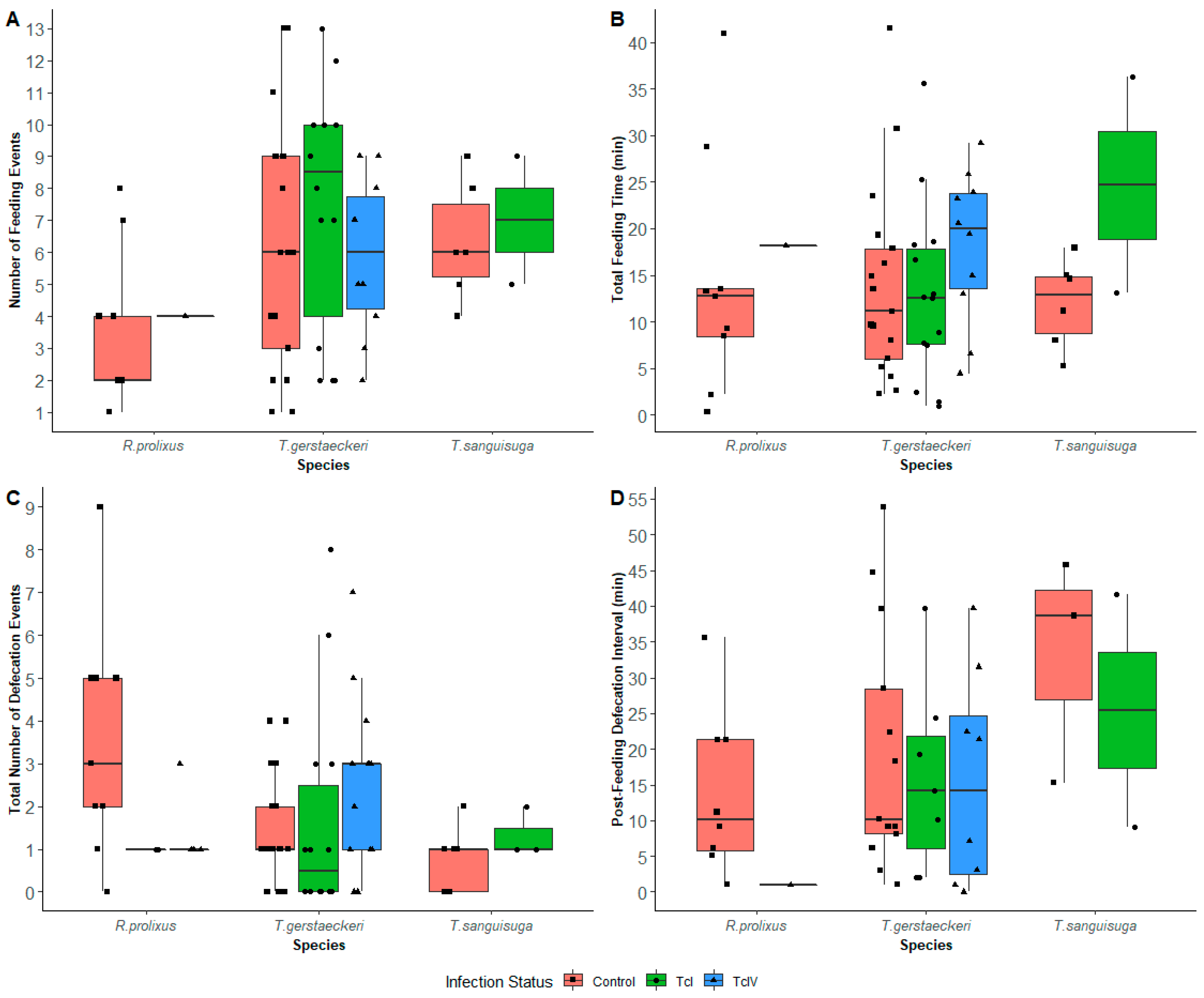
Figure 2.
Boxplot showing each individual post-feeding defecation intervals (min) between the most recent bloodmeal and defecation per triatomine species: Rhodnius prolixus (Control, TcIV); Triatoma gerstaeckeri (Control, TcI, TcIV); Triatoma sanguisuga (Control, TcI). Triatomines that defecated multiple times have multiple data points in the plot.
Figure 2.
Boxplot showing each individual post-feeding defecation intervals (min) between the most recent bloodmeal and defecation per triatomine species: Rhodnius prolixus (Control, TcIV); Triatoma gerstaeckeri (Control, TcI, TcIV); Triatoma sanguisuga (Control, TcI). Triatomines that defecated multiple times have multiple data points in the plot.
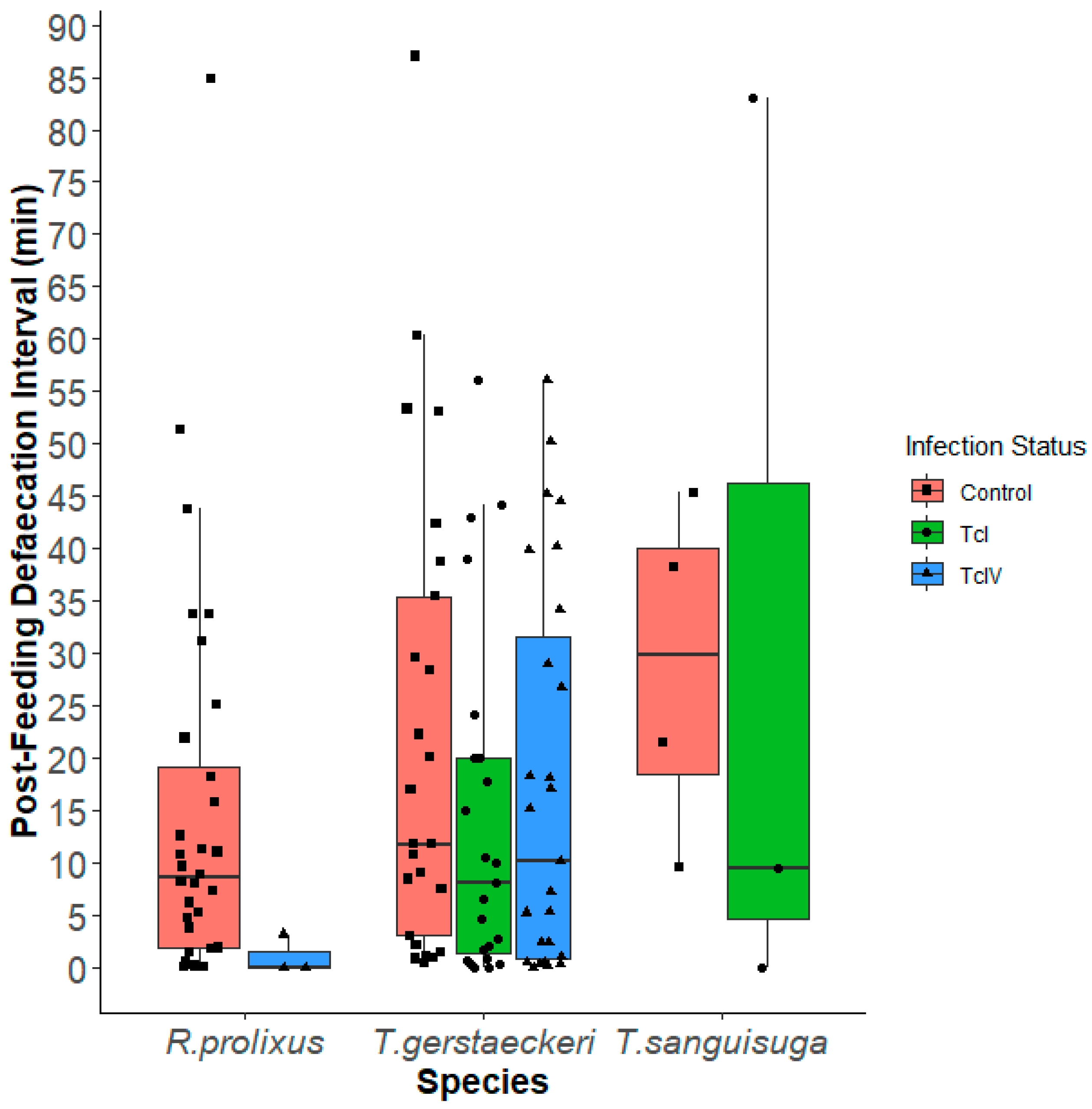
Figure 3.
Photographs of all three species of triatomines simultaneously defecating while feeding on restrained guinea pigs. Left to right: Triatoma gerstaeckeri, Triatoma sanguisuga, Rhodnius prolixus.
Figure 3.
Photographs of all three species of triatomines simultaneously defecating while feeding on restrained guinea pigs. Left to right: Triatoma gerstaeckeri, Triatoma sanguisuga, Rhodnius prolixus.
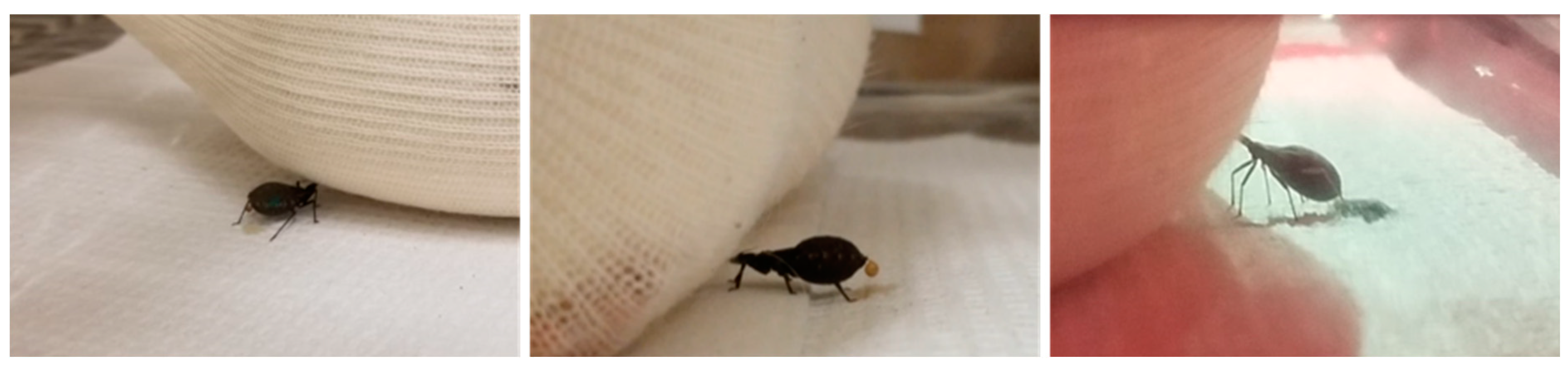
Figure 4.
Defecation indices (DI= (% of insects that defecated up to 10 minutes post feeding X average number of defecations up to 10 minutes post feeding)/100)) of each infection group.
Figure 4.
Defecation indices (DI= (% of insects that defecated up to 10 minutes post feeding X average number of defecations up to 10 minutes post feeding)/100)) of each infection group.
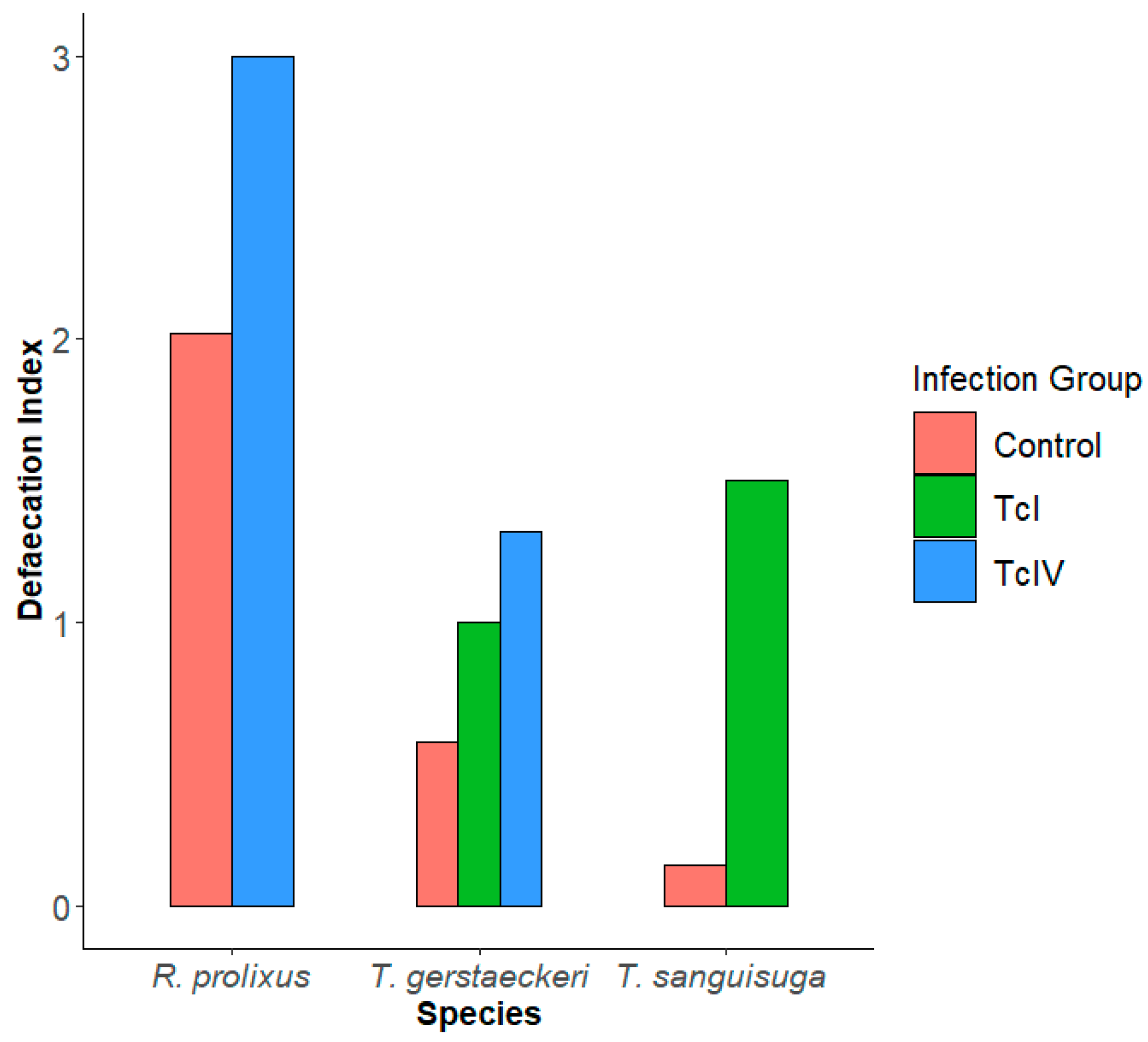
Figure 5.
Bloodmeal sizes taken from guinea pigs by insects over time based on number of previous trials in which guinea pigs were fed on by triatomines. Each individual data point is a different insect that was used in the study with bars representing the mean bloodmeal size for each category. All guinea pigs were naïve to being fed on by triatomines at the beginning of the study (category zero). Each guinea pig was assigned a unique color.
Figure 5.
Bloodmeal sizes taken from guinea pigs by insects over time based on number of previous trials in which guinea pigs were fed on by triatomines. Each individual data point is a different insect that was used in the study with bars representing the mean bloodmeal size for each category. All guinea pigs were naïve to being fed on by triatomines at the beginning of the study (category zero). Each guinea pig was assigned a unique color.
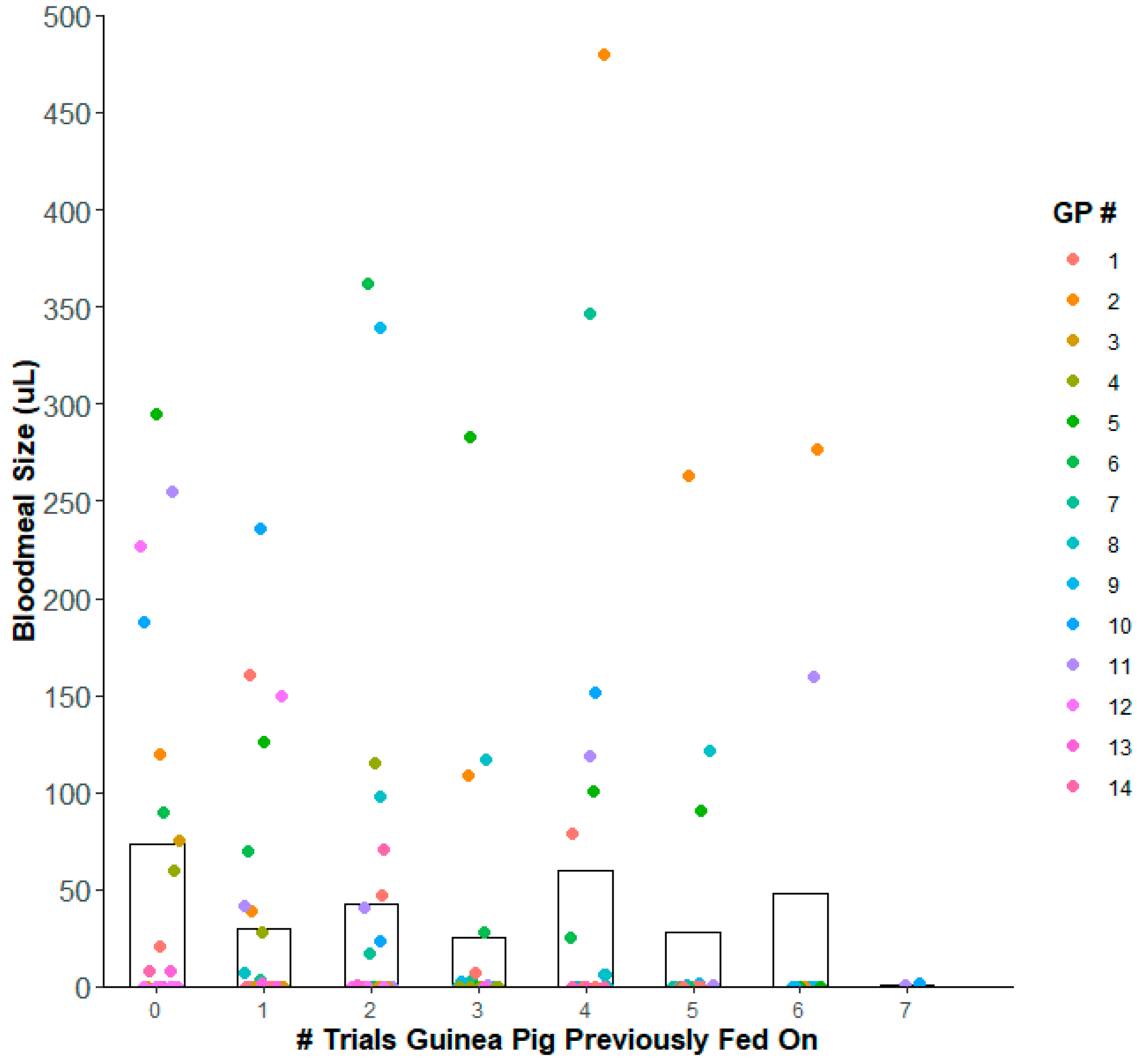

Table 1.
Descriptive summary of the frequency of feeding and defecation events during trials, which consisted of 60 minutes with guinea pigs and triatomines together followed by 60 minutes of insect-only observation.
Table 1.
Descriptive summary of the frequency of feeding and defecation events during trials, which consisted of 60 minutes with guinea pigs and triatomines together followed by 60 minutes of insect-only observation.
| Species | Infection Group | No. of Insects | No. Fed (%) | No. Defecated (%)a | No. Fed + Defecated (%)b | % Fed Insects that Defecated in 120 min |
| T. gerstaeckeri | Control | 26 | 17 (65) | 15 (58) | 13 (50) | 76 |
| TcI | 21 | 14 (67) | 7 (33) | 7 (33) | 50 | |
| TcIV | 17 | 10 (58) | 11 (65) | 8 (47) | 80 | |
| T. sanguisuga | Control | 16 | 6 (38) | 5 (31) | 3 (19) | 50 |
| TcI | 11 | 2 (17) | 3 (25) | 2 (17) | 100 | |
| R. prolixus | Control | 21 | 9 (47) | 8 (42) | 8 (42) | 89 |
| TcI | 19 | 0 (0) | 2 (11) | 0 (0) | 0 | |
| TcIV | 17 | 1 (6) | 5 (29) | 1 (6) | 100 | |
| Overall | 148 | 59 (40) | 56 (38) | 42 (28) | 71 | |
| aThis is the number of insects that defecated at least once in the 2-hour period, including insects that defecated before feeding or did not feed at all. bThis number represents insects that fed on a guinea pig either with simultaneous defecation or any defecation following feeding. | ||||||
Table 2.
Mean weight gain, mean blood volume ingested, and percent weight gain in triatomine species that fed and gained weighta by T. cruzi infection status and life stageb.
Table 2.
Mean weight gain, mean blood volume ingested, and percent weight gain in triatomine species that fed and gained weighta by T. cruzi infection status and life stageb.
| Species | Infection Group | Nymphal Instar | No. Insects that Gained Weight | Mean ± S.E. Weight Gain (mg) | Mean Blood Volume Ingested (µL) | % Weight Gain ± S.E. |
| T. gerstaeckeri | Control | 5th | 15 | 121 ± 26.5 | 120.7 | 98.8 ± 23.2 |
| TcI | 5th | 13 | 102 ± 27.9 | 102.2 | 104.8 ± 35.2 | |
| TcIV | 5th | 8 | 265 ± 46.1 | 264.9 | 164.0 ± 37.0 | |
| T. sanguisuga | Control | 4th | 4 | 14 ± 9.0 | 14.2 | 44.9 ± 33.9 |
| 5th | 1 | 39 | 39.0 | 46.9 | ||
| TcI | 4th | 1 | 1.4 | 1.4 | 2.8 | |
| 5th | 1 | 126 | 126.0 | 175 | ||
| R. prolixus | Control | 5th | 9 | 71 ± 18.5 | 70.7 | 222.3 ± 44.4 |
| TcI | n/a | 0 | 0 | 0 | 0 | |
| TcIV | 5th | 1 | 160 | 159.5 | 406.9 | |
| a There were six insects that fed on guinea pigs but did not gain any weight. These data points were excluded from the calculations. b Some infection groups only had 5th instar triatomines that fed and gained weight. R. prolixus (TcI) group did not have any insects that fed and gained weight, but the data is still shown in this table. | ||||||
Disclaimer/Publisher’s Note: The statements, opinions and data contained in all publications are solely those of the individual author(s) and contributor(s) and not of MDPI and/or the editor(s). MDPI and/or the editor(s) disclaim responsibility for any injury to people or property resulting from any ideas, methods, instructions or products referred to in the content. |
© 2024 by the authors. Licensee MDPI, Basel, Switzerland. This article is an open access article distributed under the terms and conditions of the Creative Commons Attribution (CC BY) license (http://creativecommons.org/licenses/by/4.0/).
Copyright: This open access article is published under a Creative Commons CC BY 4.0 license, which permit the free download, distribution, and reuse, provided that the author and preprint are cited in any reuse.


