Calculation of the Gravitational Force
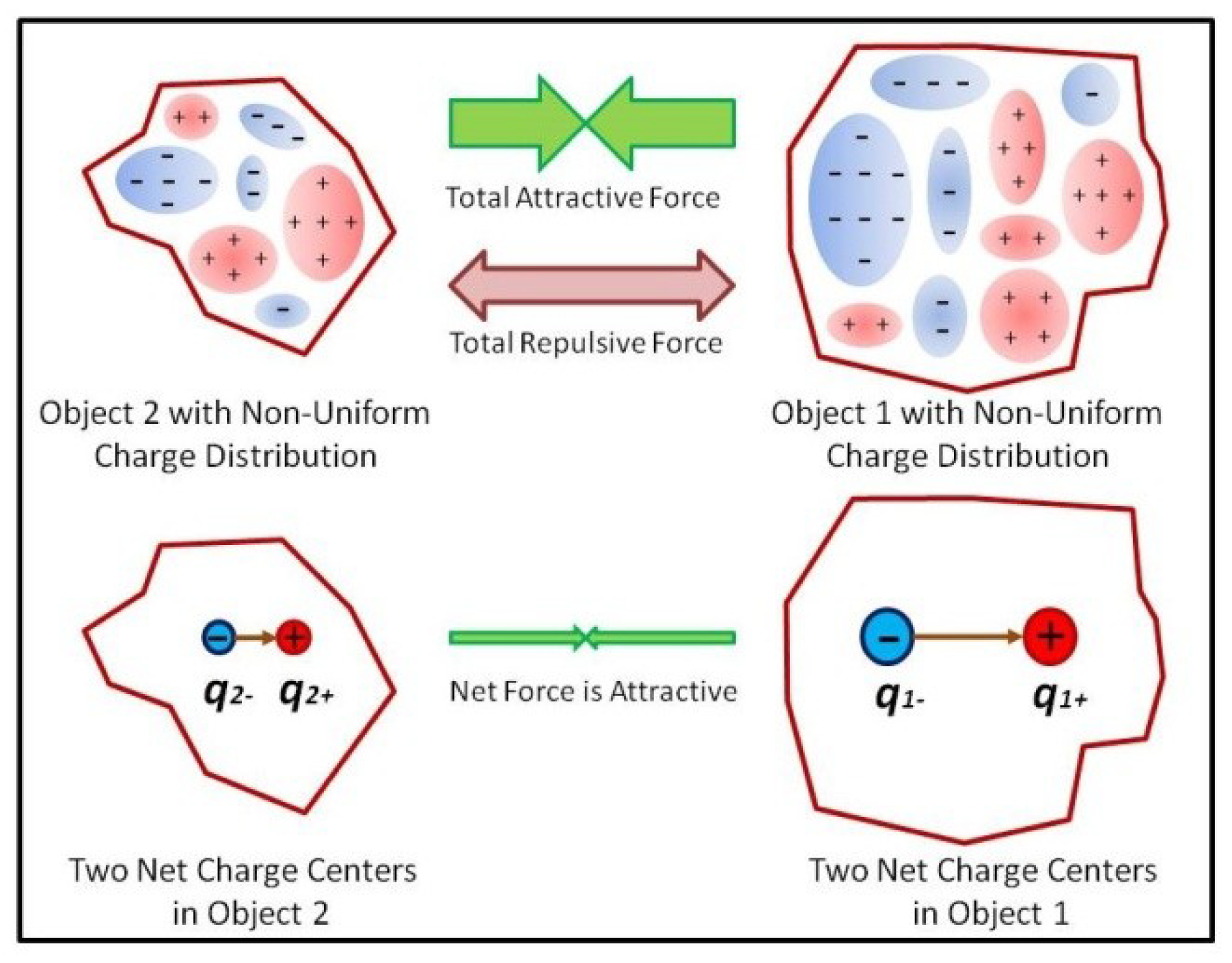
In an object, the non-uniform distribution of electric charges may be very complicated, making the analysis and calculation of the produced electric fields difficult. To simplify this, two net “charge centers,” similar to the “mass center” used in mechanics, are defined.
Regardless of the complexity of the net positive and net negative charge distributions, all electric forces generated by all net positive charges can be synthesized into a synthetic positive electric force. The point at which this force is exerted on another object is the net positive “charge center.” Similarly, the net negative “charge center” is defined.
With this simplification, any object with non-uniform charge distribution can be regarded as having a net “positive charge center” and a net “negative charge center.” All net positive charges are considered concentrated at the “positive charge center,” and all net negative charges are considered concentrated at the “negative charge center.” As emphasized above, because these two charge centers are almost impossibly at the same point, nearly any object with non-uniform charge distribution can be regarded as an electric dipole.
The theoretical electric dipole is a pair of two point electric charges with equal magnitude |
| and opposite signs, where |
| is the absolute value of charge
. A small distance
is between the two point charges. The electric dipole moment
is the product of the distance
and the charge
.
where
and
are vectors. The direction of the dipole moment
is from the negative point charge to the positive point charge.
Sometimes, the distance between the “positive charge center” and the “negative charge center” in an object may not be small. However, if the size of the object is much smaller than the scale related to the problem being considered, such as considering the attraction between a planet and a star in the universe, the size and shape of the object are less important. Thus, the distance between the positive and negative “charge centers” in an object may be treated as small, so the object with a non-uniform charge distribution may be reasonably regarded as an electric dipole.
The electrical field strength
of the electric dipole at the distance of
R is [
9]
In Eq. (3),
is unit distance vector along the
R direction.
is the electric constant. From Eq. (3), we know that when the direction of the vector
changes, the electric field strength
changes too. When the direction of
is the same as or opposite to the direction of
, the electric field strength
becomes
or
,
The
in Eq. (4) is positive, which expresses a repulsive force away from the dipole to a positive point charge. The
in Eq. (5) is negative, which expresses an attractive force towards the dipole to a positive point charge. When the direction of the dipole moment is perpendicular to the direction of
, the electric field strength
becomes
.
The in Eq. (6) is negative. Please note that is a deflective force.
Then, a problem arises: if the electric field strength of an object with non-uniform charge distribution is not isotropic, why we have not observed that the gravitational force between two objects varies significantly with their relative direction? For instance, many planetary orbits around stars are nearly circular.
The reason is that while the electric field of an electric dipole may exert repulsive, attractive, or deflective forces on another electric dipole, in most cases, the repulsive and deflective forces will quickly become attractive force. When the interaction between two electric dipoles is repulsive, both dipoles are in states of highest electric potential energy, which are unstable. Any change in the charge distribution of one object will produce a deflective force between the two dipoles. This deflective force rotates the dipoles, eventually making the gravitational force between them attractive.
However, in some cases, the gravitational force between the two objects is still affected by their relative direction, which is one of the reasons why some planetary orbits around stars are elliptical.
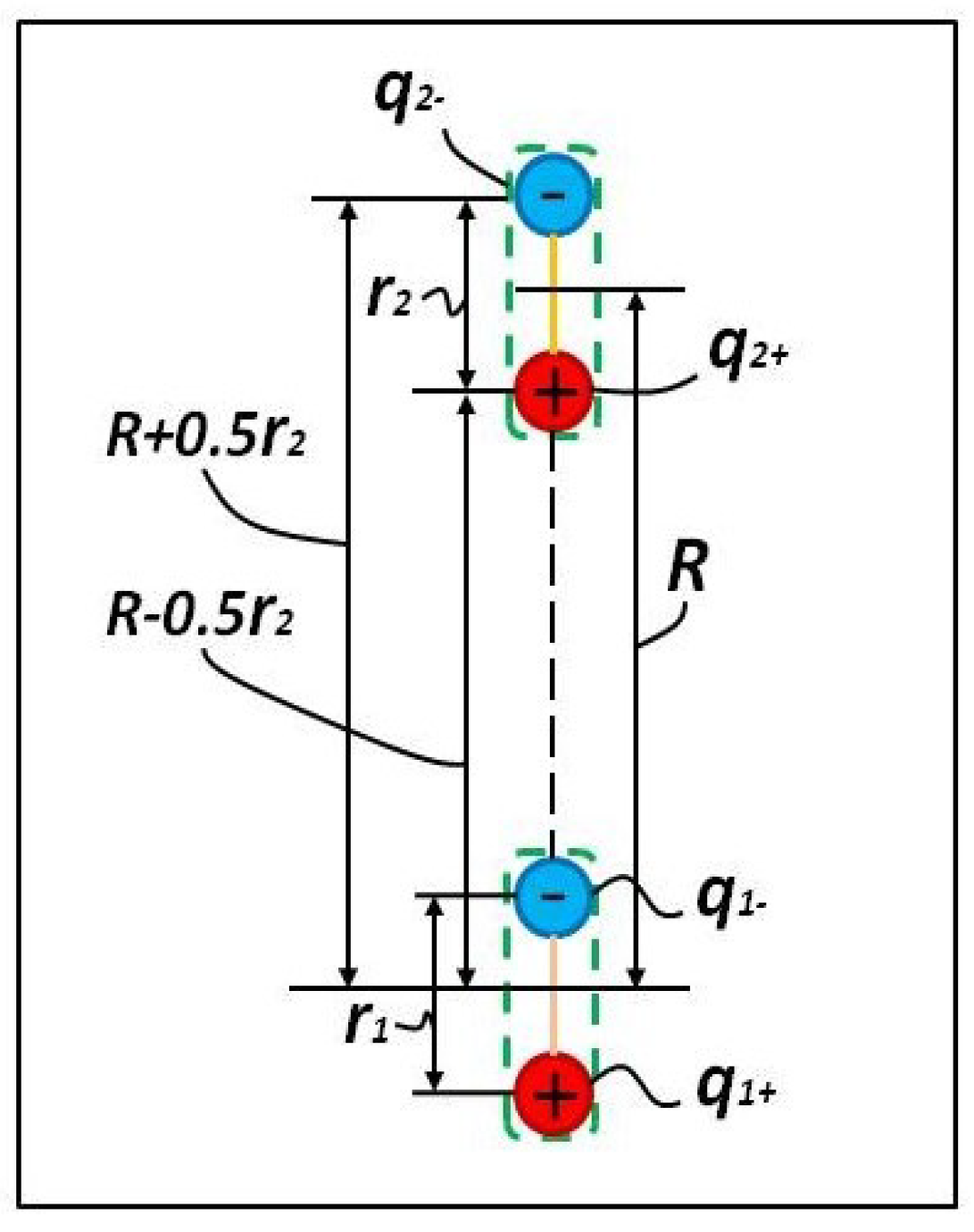
Below, the interaction force between two electric dipoles is calculated. First, considering the case when the directions of two dipole moments are the same. In
Figure 3, the first dipole moment
consists of positive pinot charge
and negative point charge
. The second dipole moment
consists of positive pinot charge
and negative point charge
. The length of the first dipole moment
is
. The length of the second dipole moment
is
. The distance between the centers of two dipoles is
R.
From Eq. (3), the first electric dipole will produce the electrical field
at the distance
R from its center
In the electrical field
, the positive point charge
of the second dipole will feel a force
as
The direction of force
is along the direction of
. The negative point charge
of the second dipole will feel a force
as
The direction of force is also along the direction of .
Because the absolute values of
and
are equal, and the absolute values of
and
are also equal, when
and
, the total force felt by the second dipole in the electric field
is
approximately
In Eq. (10), if
is replaced by
,
is replaced by
,and
is replaced by gravitational constant
G, then Eq. (10) becomes Newton’s gravitational law
We can see that the physical essence of the mysterious mass is just the electric charges. In other words, the mass is another expression of the amount of the electric charges.
Compare Newton's law of the gravitational force
with Coulomb’s law of the electric force
We can see that their expressions are very similar. Eq. (11) expresses the attractive gravitational force generated by two point-like objects with masses of and . Eq. (12) expresses the attractive electric force generated by two point electric charges of and . G and K are proportionality constants whose numerical values depend on the system of units used. R is the distance between two mass centers or two charge centers. is unit distance vector along R direction. If two charges in Eq. (12) are replaced by two masses in Eq. (11), then Eq. (12) becomes Eq. (11). Of course, because and are mass, and and are electric charges, the dimensions of the constants G and K are naturally different, and the magnitudes of the constants G and K differ greatly because the gravitational force is produced by a large number of electric charges, and the most of the electric forces produced by electric charges have been cancelled since the electric charges have opposite signs.
The striking similarity between Eq. (11) and Eq. (12) strongly hints that the gravitational force is the electric force, because if the natures of two physical forces are different, their expressions should be significantly different. Where else can we find such similarity between the expressions of two different physical forces?
When the directions of two dipole moments are opposite or perpendicular, the interaction forces between two dipoles become repulsive or deflective because both of the dipoles are pushed by repulsive electric fields, expressed by Eq. (4), or twisted by deflective electric fields, expressed by Eq. (6).
However, as explained above, in most cases, two interacting electric dipoles cannot push or twist each other for long. As soon as an electric dipole is affected by a deflective force, even if small, its dipole moment direction will rotate and eventually align with the direction of that force. The rotation of the electric dipole doesn’t require the rotation of the real object physical body. It only needs a change in the distribution of net electric charges, including free and induced charges in the object. Such changes are very fast and cannot be seen visibly. This explains why the gravitational force is always attractive. Thus, when considering the interaction force between two objects, because the directions of two electric dipoles are almost always the same, the interaction force, that is, the gravitational force between the two objects, can be expressed by Eq. (10) only.
When three objects interact with each other, the free and induced charges in each object are redistributed in response to the electric fields generated by the other two objects. If each object is simplified as an electric dipole, it will interact with the electric dipoles of the other objects. Thus, the redistribution of charges in each object may be regarded as forming two electric dipoles. Each dipole in one object responds to an external dipole in another object, leading to the analysis of interactions among six electric dipoles. When more objects are involved, the gravitational force analysis becomes more complex. However, the redistribution of charges in each object may still be regarded as forming multiple electric dipoles, each responding to a dipole in another object.
Eq. (10) expresses the interactional electric force between two electric dipoles when the dipoles have the same direction. This electric force is the gravitational force between two objects. According to Eq. (10), the gravitational force has the following properties:
First, since the gravitational force is produced by electric charges and , the gravitational field is actually the electric field.
Second, the gravitational force strength depends on the force direction, meaning that the gravitational force is anisotropic.
Third, replacing with and replacing with , because in most cases, and , so the magnitudes of and are much smaller than the magnitudes of and . This is why, although the gravitational force is the electric force, the strength of the gravitational force is much smaller than the strength of the electric force.
Fourth, the values of , , and in Eq. (10) are not fixed because they are determined by charge distributions in two objects. Since variations of charge distributions in two objects can change the values of , , and , the gravitational force between two objects is not fixed even their so-called masses don’t change.
These properties make the gravitational force exhibit strange and mysterious behaviors, causing confusing phenomena observed in the universe. Some of these phenomena have puzzled humans for a long time. However, by using new understandings of the gravitational force introduced here, these confusing phenomena can be explained simply and effectively. On the other hand, these phenomena may be regarded as indirect evidences of the correctness of the introduced understanding.