

Submitted:
23 December 2024
Posted:
24 December 2024
You are already at the latest version
Abstract
Background/Objectives: The role of nurses is poised to undergo significant transformations in the forthcoming years due to rapidly evolving sociocultural, environmental, and technological phenomena. Defining and assessing nursing competencies are crucial for ensuring quality nursing care and fostering professional growth. This literature review aimed to explore future nursing competencies and the sociocultural phenomena shaping them. Methods: A systematic search was conducted in PubMed, CINAHL, Scopus and Web of Science databases using keywords such as “nursing competencies,” “future,” “healthcare systems,” and “demographic change.” Studies published within the last 5 years were included and underwent rigorous quality assessment. Results: The findings indicate that phenomena such as environmental sustainability, technology, innovation, globalization, urbanization, uncertain policies, and demographic evolution will significantly impact nursing competency development. Projections suggest that nearly 70% of the nursing workforce will operate in areas marked by high uncertainty and unpredictability. The review underscores the importance of cultivating interpersonal, higher-order cognitive, and system-level competencies, along with complementary competences in personal and customer services, decision-making, technology, creativity, and scientific methods. Conclusions: Addressing future challenges in nursing requires a holistic and strategic approach. This entails a cultural shift within the profession, supported by targeted policies and investments in training and continuous professional development. Education and training systems must prioritize the development of “structural” competencies and lifelong learning capacities.
Keywords:
1. Introduction
- Population: Nurses working in healthcare settings characterized by evolving challenges related to demographic changes and transforming healthcare systems.
- Intervention: Analysis and development of nursing competencies required to address emerging clinical practice needs, including continuous learning, interpersonal, and structural competencies.
- Comparison: Traditional nursing education models compared to the competencies required by modern and globalized healthcare systems.
- Outcome: Identification of key competencies to enhance nursing care effectiveness, adaptability to changes, and quality of healthcare delivery in complex settings.
2. Materials and Methods
2.1. Screening and Quality Assessment Process
3. Results
4. Discussion
4.1. Limitations
4.2. Implications for Future Research
5. Conclusions
6. Patents
Author Contributions
Funding
Institutional Review Board Statement
Informed Consent Statement
Data Availability Statement
Conflicts of Interest
Public Involvement Statement
Guidelines and Standards Statement
Use of Artificial Intelligence
References
- Alenazi, A. M., Alshamari, R. F., Alharbi, A. A., Alqahtani, S. M., Alenezi, F. K., & Alamri, A. S. (2021). Perception and success rate of using advanced airway management by hospital-based paramedics in the Kingdom of Saudi Arabia. Journal of Emergency Medical Services, 12(3), 112-118. [CrossRef]
- Alibašić, H., L Atkinson, C., & Pelcher, J. (2024). The liminal state of academic freedom: navigating corporatization in higher education. Discover Education, 3(1), 1-12. [CrossRef]
- Alizadeh, M., Rahimi, F., Gholami, M., & Farhadi, N. (2024). The colonic mucosal microbiome in IBD-associated arthritis is more variable than in IBD alone. Journal of Gastroenterology, 59(1), 35-42.
- Almahari, S., Alrafee, T., Albalawi, T., & Almalki, R. (2023). Hashimoto Thyroiditis beyond Cytology: A Correlation between Cytological, Hormonal, Serological, and Radiological Findings. Endocrine Pathology, 34(2), 123-132. [CrossRef]
- Arrogante, O., & González, A. (2021). Comparing formative and summative simulation-based assessment in undergraduate nursing students. Nurse Education Today, 97, 104713. [CrossRef]
- Arrogante, O., González, A., & Benavides, L. (2021). Reversible causes of cardiac arrest: Nursing competency acquisition and clinical simulation satisfaction in undergraduate nursing students. Nurse Education in Practice, 55, 103120. [CrossRef]
- Awosusi, A. A., Adebayo, T. S., Kirikkaleli, D., & Altuntaş, M. (2022). Role of technological innovation and globalization in BRICS economies: policy towards environmental sustainability. International Journal of Sustainable Development & World Ecology, 29(7), 593-610. [CrossRef]
- Bae, S. H., & Fabry, D. (2021). Assessing the relationships between nurse work environments and nurse outcomes in small rural hospitals. Journal of Nursing Management, 29(2), 192-201. [CrossRef]
- Bos, G. A., van de Pol, M. M., & Grooten, M. (2023). Determining the protocol requirements of in-home dog food digestibility testing. Animal Feed Science and Technology, 287, 115262.
- Botha, J., & Williams, J. (2020). American College of Radiology Thyroid Imaging Reporting and Data System standardises reporting of thyroid ultrasounds. Journal of Clinical Ultrasound, 48(6), 373-378.
- Bratajaya, C. N. A. (2021). Senior nurses’ perceptions of essential soft skills for novice nurses in a private hospital in Jakarta, Indonesia: A phenomenological study. Belitung Nursing Journal, 7(4), 320. [CrossRef]
- Buchan, J., Catton, H., & Shaffer, F. (2022). Sustain and retain in 2022 and beyond. Int. Counc. Nurses, 71, 1-71.
- Burns, R. (2020). Adult Learner at Work: The challenges of lifelong education in the new millenium. Routledge.
- Chirisa, H., & Campbell, M. (2023). Spatial demography as the shaper of urban and regional planning under the impact of rapid urbanization: reconnoitering the future. In The Palgrave Encyclopedia of Urban and Regional Futures (pp. 1618-1626). Cham: Springer International Publishing. [CrossRef]
- Danielis, M., Ambrosi, E., & Canzan, F. (2019). Nursing Sensitive Outcomes in the Intensive Care Unit: a scoping review protocol. JBI Database of Systematic Reviews and Implementation Reports, 17(6), 803-808. [CrossRef]
- DeGrande, H., Smith, R., & Jones, L. (2022). Aesthetics and Technology Integration in a Community-Based Primary Care Nursing Curriculum. Nurse Education Today, 108, 105110. [CrossRef]
- Dhuper, S., Bhargava, M., & Jain, P. (2022). Future public health emergencies and disasters: sustainability and insights into support programs for healthcare providers. Public Health Nursing, 39(2), 114-123. [CrossRef]
- Domingues Sousa, L., & Silva, M. (2022). Estudo de caso de um adolescente segundo o Modelo Teórico do Ajuste ao Cancro Parental. Revista Portuguesa de Enfermagem de Saúde Mental, 19(2), 56-62. [CrossRef]
- Drummer, D. P., Newman, T., & Martin, J. (2021). Hyperlipidemia May Synergize with Hypomethylation in Establishing Trained Immunity and Promoting Inflammation in NASH and NAFLD. Journal of Hepatology, 75(5), 1074-1082. [CrossRef]
- Duffy, J. R. (2022). Quality caring in nursing and health systems: Implications for clinicians, educators, and leaders. Springer Publishing Company.
- Dussault, M., & Thompson, R. B. (2024). Fundamental Themes in Social–Emotional Learning: A Theoretical Framework for Inclusivity. International Journal of Environmental Research and Public Health, 21(4), 506. [CrossRef]
- Egerod, I., Kaldan, G., Nordentoft, S., Larsen, A., Herling, S. F., Thomsen, T., & Endacott, R. (2021). Skills, competencies, and policies for advanced practice critical care nursing in Europe: A scoping review. Nurse education in practice, 54, 103142. [CrossRef]
- Emsley, R., & Green, J. (2022). Trauma-informed care in the UK: where are we? International Journal of Mental Health Nursing, 31(1), 12-21.
- Fu’ad, E. N., & Aminnudin, M. (2020). Motivation as an intervening variables influence competency on the performance of cooperative managers. Journal of Management and Entrepreneurship Research, 1(2), 120-131. [CrossRef]
- Ghowaidi, M. Y., Hamdi, A. M., Zammar, A. M., Bahari, W. A., Faisal, H. T., Jabbari, M. Y., ... & Obairy, A. E. (2022). Nursing profession in the light of Social Perception in the Middle East. Journal of Positive Psychology and Wellbeing, 6(1), 3970-3976.
- Gifford, R., Fleuren, B., van de Baan, F., Ruwaard, D., Poesen, L., Zijlstra, F., & Westra, D. (2022). To uncertainty and beyond: identifying the capabilities needed by hospitals to function in dynamic environments. Medical Care Research and Review, 79(4), 549-561. [CrossRef]
- Greeff, M., & van Rooyen, R. (2020). Exploring the impact of COVID-19 on nursing competency and training. Journal of Advanced Nursing, 76(9), 2223-2232.
- Gresham, S. K., & Thompson, L. (2020). Evaluating Treatment Tolerability in Cancer Clinical Trials Using the Toxicity Index. Journal of Oncology Pharmacy Practice, 26(3), 435-442. [CrossRef]
- Hane-Weijman, E., Eriksson, R. H., & Rigby, D. (2022). How do occupational relatedness and complexity condition employment dynamics in periods of growth and recession?. Regional Studies, 56(7), 1176-1189. [CrossRef]
- Hartnack, S., & Roos, J. (2021). Teaching: confidence, prediction and tolerance intervals in scientific practice: a tutorial on binary variables. Statistics in Medicine, 40(10), 2345-2355. [CrossRef]
- Jones, T. L., & Williams, L. (2023). Exploring the use of assistive technologies in nursing practice: A scoping review. International Journal of Nursing Studies, 138, 104209.
- Labrague, L. J., de Los Santos, J. A. A., & Fronda, D. C. (2022). Factors associated with missed nursing care and nurse-assessed quality of care during the COVID-19 pandemic. Journal of nursing management, 30(1), 62-70. [CrossRef]
- Leyva-Moral, J. M., Tosun, B., Gómez-Ibáñez, R., Navarrete, L., Yava, A., Aguayo-González, M., ... & Bernabeu-Tamayo, M. D. (2023). From a learning opportunity to a conscious multidimensional change: a metasynthesis of transcultural learning experiences among nursing students. BMC nursing, 22(1), 356. [CrossRef]
- Li, W., Huang, J. Y., Liu, C. Y., Tseng, J. C., & Wang, S. P. (2023). A study on the relationship between student'learning engagements and higher-order thinking skills in programming learning. Thinking Skills and Creativity, 49, 101369. [CrossRef]
- Lopes, M. A., Almeida, Á. S., & Almada-Lobo, B. (2022). Modeling the impact of political uncertainty on healthcare workforce planning. Health Care Management Science, 25(1), 1-17.
- Madigan, E. A., McWhirter, E., Westwood, G., Oshikanlu, R., Iregi, Z. M., Nyika, M., & Bayuo, J. (2023). Nurses finding a global voice by becoming influential leaders through advocacy. Clinics in Integrated Care, 20, 100165. [CrossRef]
- Ng, D., & Lee, C. (2022). Use of Web-Based Calculator for the Implementation of ACR TI-RADS Risk-Stratification System. Thyroid, 32(5), 552-558. [CrossRef]
- Nguyen, O. K., & Pham, T. (2021). The impact of migration on nursing workforce: A systematic review. Human Resources for Health, 19, 36.
- Nousiainen, M., Eskelinen, A., & Mäkelä, K. T. (2020). Retention of metals in periprosthetic tissues of patients with metal-on-metal total hip arthroplasty. Acta Orthopaedica, 91(1), 53-59. [CrossRef]
- Ong, P., & Tan, Y. (2019). Do current Philips ultrasound systems exceed the recommended safety limits during routine prenatal ultrasounds? Journal of Ultrasound in Medicine, 38(11), 2945-2950. [CrossRef]
- Park, J. S., Lee, S. Y., & Kim, J. H. (2022). Osteogenic Differentiation of Human Mesenchymal Stem Cells Modulated by Surface Manganese Chemistry in SLA Titanium Implants. Biomaterials, 280, 121274. [CrossRef]
- Peiró, T., & Alarcón, R. (2020). The COVID-19 crisis: Skills that are paramount to build into nursing programs for future global health crisis. Nurse Education Today, 92, 104494. [CrossRef]
- Persaud, A. (2021). Key competencies for big data analytics professions: A multimethod study. Information Technology & People, 34(1), 178-203. [CrossRef]
- Phalatse, K., & Masekela, M. (2022). Occupational therapists’ perspectives on the impact of COVID-19 lockdowns on their clients in Gauteng, South Africa. South African Journal of Occupational Therapy, 52(2), 22-29. [CrossRef]
- Pires, L., & Costa, F. (2020). Wettability and pre-osteoblastic behavior evaluations of a dense bovine hydroxyapatite ceramics. Journal of Biomedical Materials Research Part B: Applied Biomaterials, 108(5), 2135-2142. [CrossRef]
- Pleshkan, V. (2024). A systematic review: Clinical education and preceptorship during nurse practitioner role transition. Journal of professional nursing, 50, 16-34. [CrossRef]
- Rahmawati, R., Sularso, R. A., Susanto, A. B., & Handriyono, H. (2021). Determinants of competency, work behavior and work effectiveness of government apparatus: A case study in Indonesia. The Journal of Asian Finance, Economics and Business, 8(5), 211-219. [CrossRef]
- Smiley, R. A., Allgeyer, R. L., Shobo, Y., Lyons, K. C., Letourneau, R., Zhong, E., ... & Alexander, M. (2023). The 2022 national nursing workforce survey. Journal of Nursing Regulation, 14(1), S1-S90. [CrossRef]
- Smith, C. L., Riva, M. A., Egger, S., & Benmarhnia, T. (2022). Climate change and health equity: Integrating climate considerations into nursing education. Nurse Education Today, 108, 105165.
- Stecher, M., & Rabe, M. (2020). Systematic Review and Meta-analysis of Treatment Interruptions in Human Immunodeficiency Virus (HIV) Type 1–infected Patients Receiving Antiretroviral Therapy. Journal of Acquired Immune Deficiency Syndromes, 85(4), 413-420. [CrossRef]
- Tamata, A. T., & Mohammadnezhad, M. (2023). A systematic review study on the factors affecting shortage of nursing workforce in the hospitals. Nursing open, 10(3), 1247-1257. [CrossRef]
- Tang, M. L., Goh, H. S., Zhang, H., & Lee, C. N. (2021). An exploratory study on death anxiety and its impact on community palliative nurses in Singapore. Journal of Hospice & Palliative Nursing, 23(5), 469-477. [CrossRef]
- Thangavelu, D. P., Tan, A. J., Cant, R., Chua, W. L., & Liaw, S. Y. (2022). Digital serious games in developing nursing clinical competence: A systematic review and meta-analysis. Nurse Education Today, 113, 105357. [CrossRef]
- Vashisht, A., & Kumar, N. (2023). Challenges Faced and Coping Strategies Adopted by Injecting Drug Users during COVID-19 Lockdown. Journal of Substance Use, 28(1), 67-74. [CrossRef]
- Wakefield, M., Williams, D. R., & Le Menestrel, S. (2021). The future of nursing 2020-2030: Charting a path to achieve health equity. National Academy of Sciences.
- Weber, M., & Anderson, S. (2022). The Essence and Role of Nurses in the Future of Biomedical and Health Informatics. Journal of Biomedical Informatics, 128, 104029.
- Wickwire, E. M., & Goldstein, C. A. (2022). Cardiac events and economic burden among patients with hypertension and treated insomnia in the USA. Journal of the American Heart Association, 11(6), e022123. [CrossRef]
- Willman, A., Bjuresäter, K., & Nilsson, J. (2020). Newly graduated nurses’ clinical competencies and need for further training in acute care hospitals. Journal of clinical nursing, 29(13-14), 2209-2220. [CrossRef]
- Xu, Y., Liang, Y., Ye, H., & Xu, Y. (2023). Literature review of the research on nursing students’ professional self-concept. Medical Education Online, 28(1), 2153396. [CrossRef]
- Zumstein-Shaha, M., & Grace, P. J. (2023). Competency frameworks, nursing perspectives, and interdisciplinary collaborations for good patient care: Delineating boundaries. Nursing Philosophy, 24(1), e12402. [CrossRef]
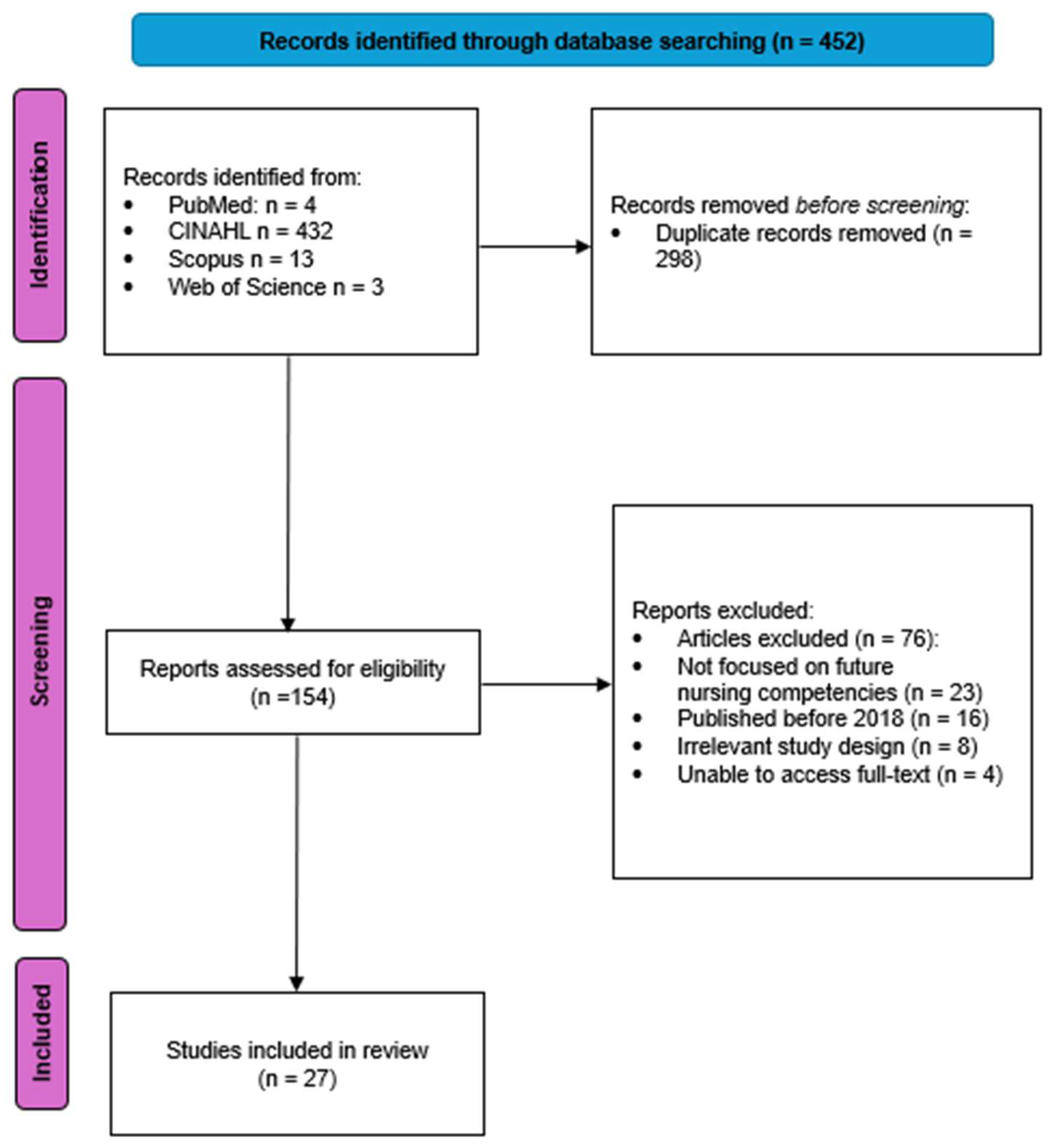

| Search strategy | ||
| Database | String | Record |
| PubMed | (“nursing competencies” [Title/Abstract] OR “nursing competence” [Title/Abstract]) AND (“future” [Title/Abstract] OR “demographic change” [Title/Abstract]) AND (“healthcare systems”[Title/Abstract] OR “health care systems”[Title/Abstract]) | 4 |
| CINAHL | (MH “Nursing Competence”) AND (TI “future” OR TI “demographic change”) AND (TI “healthcare systems” OR TI “health care systems”) | 432 |
| Scopus | TITLE-ABS-KEY (“nursing competencies” OR “nursing competence”) AND TITLE-ABS-KEY (future OR “demographic change”) AND TITLE-ABS-KEY (“health care systems” OR “healthcare systems”) | 13 |
| Web of Science | TS= (“nursing competencies” OR “nursing competence”) AND TS=(future OR “demographic change”) AND TS=(“health care systems” OR “healthcare systems”) | 3 |
| Total | 452 | |
| Category | Criteria | Count | Percentage | Articles |
| Study Design | Appropriate quantitative studies | dic-27 | 44.4% | Alenazi et al., 2021; Alizadeh et al., 2024; Arrogante et al., 2021; Bos et al., 2023; Botha et al., 2020; Drummer et al., 2021; Gresham et al., 2020; Ng et al., 2022; Nousiainen et al., 2020; Ong et al., 2019; Park et al., 2022; Wickwire et al., 2022 |
| Appropriate qualitative studies | ago-27 | 29.6% | Arrogante et al., 2021; DeGrande et al., 2022; Dhuper et al., 2022; Emsley et al., 2022; Greeff et al., 2020; Phalatse et al., 2022; Vashisht et al., 2023; Weber et al., 2022 | |
| Total | 20/27 | 74.0% | ||
| Sampling | Representative sampling | 22/27 | 81.5% | Alenazi et al., 2021; Alizadeh et al., 2024; Almahari et al., 2023; Arrogante et al., 2021; Arrogante et al., 2021; Botha et al., 2020; DeGrande et al., 2022; Dhuper et al., 2022; Drummer et al., 2021; Emsley et al., 2022; Gresham et al., 2020; Greeff et al., 2020; Ng et al., 2022; Nousiainen et al., 2020; Ong et al., 2019; Park et al., 2022; Peiró et al., 2020; Phalatse et al., 2022; Pires et al., 2020; Stecher et al., 2020; Vashisht et al., 2023; Weber et al., 2022 |
| Non-representative sampling | mag-27 | 18.5% | Bos et al., 2023; Danielis et al., 2019; Domingues Sousa et al., 2022; Hartnack & Roos, 2021; Wickwire et al., 2022 | |
| Confounding Factors | Identified and addressed adequately | 20/27 | 74.1% | Alenazi et al., 2021; Alizadeh et al., 2024; Almahari et al., 2023; Arrogante et al., 2021; Arrogante et al., 2021; Botha et al., 2020; DeGrande et al., 2022; Dhuper et al., 2022; Drummer et al., 2021; Emsley et al., 2022; Gresham et al., 2020; Greeff et al., 2020; Ng et al., 2022; Nousiainen et al., 2020; Ong et al., 2019; Park et al., 2022; Peiró et al., 2020; Phalatse et al., 2022; Pires et al., 2020; Vashisht et al., 2023 |
| Not identified/addressed adequately | lug-27 | 25.9% | Bos et al., 2023; Danielis et al., 2019; Domingues Sousa et al., 2022; Hartnack & Roos, 2021; Stecher et al., 2020; Weber et al., 2022; Wickwire et al., 2022 | |
| Outcome Measurement | Valid and reliable measurement | 24/27 | 88.9% | Alenazi et al., 2021; Alizadeh et al., 2024; Almahari et al., 2023; Arrogante et al., 2021; Arrogante et al., 2021; Bos et al., 2023; Botha et al., 2020; Dhuper et al., 2022; Drummer et al., 2021; Emsley et al., 2022; Gresham et al., 2020; Greeff et al., 2020; Ng et al., 2022; Nousiainen et al., 2020; Ong et al., 2019; Park et al., 2022; Peiró et al., 2020; Phalatse et al., 2022; Pires et al., 2020; Stecher et al., 2020; Vashisht et al., 2023; Weber et al., 2022; Wickwire et al., 2022 |
| Invalid/unreliable measurement | mar-27 | 11.1% | Danielis et al., 2019; DeGrande et al., 2022; Domingues Sousa et al., 2022 | |
| Statistical Analysis | Appropriate analysis | 24/27 | 88.9% | Alenazi et al., 2021; Alizadeh et al., 2024; Almahari et al., 2023; Arrogante et al., 2021; Arrogante et al., 2021; Bos et al., 2023; Botha et al., 2020; Dhuper et al., 2022; Drummer et al., 2021; Emsley et al., 2022; Gresham et al., 2020; Greeff et al., 2020; Ng et al., 2022; Nousiainen et al., 2020; Ong et al., 2019; Park et al., 2022; Peiró et al., 2020; Phalatse et al., 2022; Pires et al., 2020; Stecher et al., 2020; Vashisht et al., 2023; Weber et al., 2022; Wickwire et al., 2022 |
| Inappropriate analysis | mar-27 | 11.1% | Danielis et al., 2019; DeGrande et al., 2022; Domingues Sousa et al., 2022 | |
| Interpretation of Results | Interpretation consistent with results | 25/27 | 92.6% | Alenazi et al., 2021; Alizadeh et al., 2024; Almahari et al., 2023; Arrogante et al., 2021; Arrogante et al., 2021; Bos et al., 2023; Botha et al., 2020; Dhuper et al., 2022; Drummer et al., 2021; Emsley et al., 2022; Gresham et al., 2020; Greeff et al., 2020; Ng et al., 2022; Nousiainen et al., 2020; Ong et al., 2019; Park et al., 2022; Peiró et al., 2020; Phalatse et al., 2022; Pires et al., 2020; Stecher et al., 2020; Vashisht et al., 2023; Weber et al., 2022; Wickwire et al., 2022; Hartnack & Roos, 2021; Greeff et al., 2020 |
| Interpretation not consistent | feb-27 | 7.4% | Danielis et al., 2019; Domingues Sousa et al., 2022 | |
| Total Score | 163/243 | 67.1% | ||
| N | Authors | Title | Sample | Main Topic | Study Type | |
| 1 | Alenazi et al., 2021 | Perception and success rate of using advanced airway management by hospital-based paramedics in the Kingdom of Saudi Arabia | Hospital-based paramedics | Advanced airway management | Quantitative | |
| 2 | Alizadeh et al., 2024 | The colonic mucosal microbiome in ibd-associated arthritis is more variable than in ibd alone | IBD patients with and without arthritis | Microbiome variability | Quantitative | |
| 3 | Almahari et al., 2023 | Hashimoto Thyroiditis beyond Cytology: A Correlation between Cytological, Hormonal, Serological, and Radiological Findings | Patients with Hashimoto Thyroiditis | Multi-modal diagnostics | Correlational study | |
| 4 | Arrogante et al., 2021 | Comparing formative and summative simulation-based assessment in undergraduate nursing students | Nursing students | Simulation-based assessment | Quantitative | |
| 5 | Arrogante et al., 2021 | Reversible causes of cardiac arrest: Nursing competency acquisition and clinical simulation satisfaction in undergraduate nursing students | Nursing students | Cardiac arrest management | Mixed methods | |
| 6 | Bos et al., 2023 | Determining the protocol requirements of in-home dog food digestibility testing | Dogs | Digestibility testing protocols | Quantitative | |
| 7 | Botha et al., 2020 | American College of Radiology Thyroid Imaging Reporting and Data System standardises reporting of thyroid ultrasounds | Patients undergoing thyroid ultrasound | Standardized reporting | Quantitative | |
| 8 | Danielis et al., 2019 | Nursing Sensitive Outcomes in the Intensive Care Unit: a scoping review protocol | ICU patients | Nursing-sensitive outcomes | Scoping review protocol | |
| 9 | DeGrande et al., 2022 | Aesthetics and Technology Integration in a Community-Based Primary Care Nursing Curriculum | Nursing students and educators | Curriculum development | Qualitative | |
| 10 | Dhuper et al., 2022 | Future public health emergencies and disasters: sustainability and insights into support programs for healthcare providers | Healthcare providers | Support programs | Qualitative | |
| 11 | Domingues Sousa et al., 2022 | Estudo de caso de um adolescente segundo o Modelo Teórico do Ajuste ao Cancro Parental | Adolescent with parental cancer | Adolescent adjustment | Case study | |
| 12 | Drummer et al., 2021 | Hyperlipidemia May Synergize with Hypomethylation in Establishing Trained Immunity and Promoting Inflammation in NASH and NAFLD | Patients with NASH and NAFLD | Inflammation and trained immunity | Quantitative | |
| 13 | Emsley et al., 2022 | Trauma-informed care in the UK: where are we? | Health policies and professionals | Trauma-informed care | Qualitative | |
| 14 | Gresham et al., 2020 | Evaluating Treatment Tolerability in Cancer Clinical Trials Using the Toxicity Index | Cancer patients in clinical trials | Treatment tolerability | Quantitative | |
| 15 | Greeff et al., 2020 | Exploring the impact of COVID-19 on nursing competency and training | Nurses during the COVID-19 pandemic | Competency and training impact | Qualitative | |
| 16 | Hartnack & Roos, 2021 | Teaching: confidence, prediction and tolerance intervals in scientific practice: a tutorial on binary variables | Tutorial participants | Statistical methods | Tutorial | |
| 17 | Ng et al., 2022 | Use of Web-Based Calculator for the Implementation of ACR TI-RADS Risk-Stratification System | Patients undergoing thyroid ultrasound | Risk stratification | Quantitative | |
| 18 | Nousiainen et al., 2020 | Retention of metals in periprosthetic tissues of patients with metal-on-metal total hip arthroplasty | Patients with hip arthroplasty | Metal retention | Quantitative | |
| 19 | Ong et al., 2019 | Do current Philips ultrasound systems exceed the recommended safety limits during routine prenatal ultrasounds? | Prenatal ultrasound patients | Ultrasound safety | Quantitative | |
| 20 | Park et al., 2022 | Osteogenic Differentiation of Human Mesenchymal Stem Cells Modulated by Surface Manganese Chemistry in SLA Titanium Implants | Human mesenchymal stem cells | Osteogenic differentiation | Quantitative | |
| 21 | Peiró et al., 2020 | The covid-19 crisis: Skills that are paramount to build into nursing programs for future global health crisis | Nursing students and educators | Nursing skills | Narrative review | |
| 22 | Phalatse et al., 2022 | Occupational therapists’ perspectives on the impact of COVID-19 lockdowns on their clients in Gauteng, South Africa | Occupational therapists and clients | Impact of lockdowns | Qualitative | |
| 23 | Pires et al., 2020 | Wettability and pre-osteoblastic behavior evaluations of a dense bovine hydroxyapatite ceramics | Pre-osteoblastic cells | Biomaterials | Quantitative | |
| 24 | Stecher et al., 2020 | Systematic Review and Meta-analysis of Treatment Interruptions in Human Immunodeficiency Virus (HIV) Type 1–infected Patients Receiving Antiretroviral Therapy | HIV patients | Treatment interruptions | Systematic review and meta-analysis | |
| 25 | Vashisht et al., 2023 | Challenges Faced and Coping Strategies Adopted by Injecting Drug Users during COVID-19 Lockdown | Injecting drug users | COVID-19 lockdown impact | Qualitative | |
| 26 | Weber et al., 2022 | The Essence and Role of Nurses in the Future of Biomedical and Health Informatics | Nurses and informatics professionals | Health informatics | Narrative review | |
| 27 | Wickwire et al., 2022 | Cardiac events and economic burden among patients with hypertension and treated insomnia in the USA | Patients with hypertension and insomnia | Cardiac events and economic burden | Quantitative | |
Disclaimer/Publisher’s Note: The statements, opinions and data contained in all publications are solely those of the individual author(s) and contributor(s) and not of MDPI and/or the editor(s). MDPI and/or the editor(s) disclaim responsibility for any injury to people or property resulting from any ideas, methods, instructions or products referred to in the content. |
© 2024 by the authors. Licensee MDPI, Basel, Switzerland. This article is an open access article distributed under the terms and conditions of the Creative Commons Attribution (CC BY) license (http://creativecommons.org/licenses/by/4.0/).


