

Submitted:
23 December 2024
Posted:
24 December 2024
You are already at the latest version
Abstract
Inspiration from nature is a promising tool for the design of new polymeric biomaterials, espe-cially for frontier technological areas such as tissue engineering. In tissue engineering, polyure-thane-based implants have gained considerable attention, as they are materials that can be de-signed to meet the requirements imposed by their final applications. The choice of their building blocks (which are used in the synthesis as macrodiols, diisocyanates and chain extenders) can be implemented to obtain biomimetic structures that can mimic native tissue in terms of mechanical, morphological and surface properties. In recent years, due to their excellent chemical stability, biocompatibility and low cytotoxicity, polyurethanes have been widely used in biomedical ap-plications. Biomimetic materials with their inherent nature of mimicking natural materials are possible thanks to recent advances in manufacturing technology. The aim of this review is to provide a critical overview of relevant promising studies on polyurethane scaffolds, including those based on non-isocyanate polyurethanes, for the regeneration of selected soft (cardiac muscle, blood vessels, skeletal muscle) and hard (bone tissue) tissues.
Keywords:
polyurethane
; non-isocyanate polyurethane
; biomimetic materials
; tissue engineering
; soft tissue
; hard tissue
Introduction
The fascinating ability of living organisms to create complex structures has been the subject of many studies and scientific inquiries for years [1,2]. With increasing technical capabilities, we are able to imitate nature better and better. Biomimetics, understood as an interdisciplinary science that draws inspiration from nature when designing and producing new materials, goes a step further. The assumption of this field is not only an attempt to faithfully reproduce biological structures, but also to understand, describe and use natural processes and optimal solutions. Biomimetic design is a breakthrough in the way of thinking about materials, because in principle, they are created for a specific target element, taking into account its desired features. Assuming that the structure affects the properties of the material, they can be matched to the given functions of the finished object. Nature's inspiration is a promising tool for designing new biomaterials, especially for pioneering technological areas such as tissue engineering [3,4,5,6].
The term "biomaterial" was first defined during the Biomaterials Consensus Conference at the National Institute of Health in In accordance with the findings, the following definition has been adopted since then: "Biomaterial is any substance (other than a drug) or combination of substances, synthetic or natural, that can be used at any time, and whose task is to supplement or replace the tissues of an organ or its parts in order to fulfill their functions" [7,8]. A common feature of all biomaterials is physiological acceptance by a living organism, which determines their use in medicine. It results from the similarity, both in chemical, biological and mechanical terms, of individual biomaterials to the tissues whose functions they are to replace or support. Very important properties characterizing biomaterials are the lack of toxicity and immunogenicity, i.e. their chemical and pharmacological inertness so that they do not cause allergic, carcinogenic or cytotoxic reactions. Depending on the purpose of the material, they can also exhibit such properties as bioactivity, degradability, biostability, osteoinductivity and osteoconductivity [9,10,11,12].
Biomimetics in Tissue Engineering
The basis for the development of science dealing with the structure and regenera-tion of tissues was the discovery of the function of the extracellular matrix (ECM). It is a substance that creates a three-dimensional space, composed of collagen fibers, elastin, glycosaminoglycans, adhesive proteins and water. It occurs throughout the body as a means of connecting cells in order to create specific tissues [13,14]. The polysaccharides contained in it, such as hyaluronic acid or heparin, have hydrophilic groups in their structure, responsible for binding water molecules, thanks to which the intercellular matrix takes the form of a gel. The basic tasks of the natural extracellular matrix include providing cells with appropriate conditions for proliferation. This is done by supplying oxygen and essential nutrients and removing unnecessary metabolic products from their environment. The key function of the ECM is to support and organize cells into structures through interactions between cell integrins and matrix fibronectins. It also provides protection against mechanical damage [15,16].
The natural extracellular matrix fulfills many important functions at the cellular, tissue and organ levels. These functions and the properties of the ECM depend on the type of tissue. An important issue is to adapt the properties of the substrate to the properties of the regenerated tissue. The aim is for the synthetic extracellular matrix to exhibit biomimicry, i.e. to imitate certain beneficial features and fulfill some functions of the natural extracellular matrix [17,18,19].
Replacing this substance with a polymeric material and developing methods for culturing cells outside the human body allowed for the rapid development of this science and aroused great interest of scientists in many fields such as chemistry, biology and tissue engineering [20,21]. Tissue engineering (TE) is a scientific discipline that proposes new, alternative solutions that change the approach to treatment with transplants and replacement of organ or tissue defects. The beginnings of tissue engineering date back to the 1980s. Later on, chemist J. Langer and surgeon J.P. Vacanti drew the attention of the scientific world to the potential and enormous possibilities of this young field [22]. The main goal of tissue engineering is considered to obtain a biological material that would make it possible to replace, restore or maintain the basic functions of damaged tissues or entire organs. This material should have a biochemical structure that fully resembles natural tissue, with its extraordinary mechanical properties [23].
The use of a combination of cells, scaffolds and appropriate biomechanical factors in tissue engineering provides the possibility of improving or replacing biological functions [24]. These three key elements form the so-called triad of tissue engineering (Figure 1).
A cellular scaffold is a place of cell attachment, which provides them with specific spatial conditions necessary for proper growth. After being implanted on the scaffold, cells multiply and then integrate with the cells of the damaged tissue. Growth factors, i.e. vitamins, amino acids, sugars or hormones, are nutrients that enable cells to function and grow properly [25]. Cell scaffolds serve as a temporary extracellular matrix (ECM), which provides support for cell growth and tissue regeneration [26,27].
Tissue substitutes prepared in vitro can be implanted in the place of tissue or organ defect. Further regeneration takes place in vivo [28,29,30]. One of the most important parameters of tissue substrates is architecture - porosity, size, geometry, connection and arrangement of pores in the material. High open porosity allows for the settlement and delivery of cells to the regeneration site, enables the transport of nutrients and metabolic products, as well as vascularization of the newly formed tissue. The hierarchical structure of pores considered at the level of milli-, micro- and nanometers also plays a key role. The milli- level determines the shape and dimensions of the scaffold, as well as its mechanical properties. Microstructure affects cell migration and transport of nutrients and by-products. In turn, the nanometric structure ensures cell adhesion and also affects the expression of ECM components [18,30,31]. The optimal average pore size for newly formed vessels is 5 μm, for hepatocyte development about 20 μm, for skin regeneration 20–125 μm, and for bone tissue regeneration 100–350 μm. Pores with a diameter greater than 500 μm promote the formation of fibrous (scar) tissue and its rapid vascularization. The shape of the pores also affects the life processes of cells. It should allow both cell adhesion and flattening and for the cell to assume a spherical shape, necessary for carrying out specific life processes [32].
The mechanical properties of ECM, such as elastic modulus and density, have also a significant impact on cell differentiation, migration, growth and proliferation [18,33,34]. Therefore, the best approach is to adapt the mechanical properties of the substrate to the properties of the natural extracellular matrix of a given tissue [17,35]. Mechanical stimuli transmitted to cells via a synthetic matrix have a positive effect on the secretion of components of the natural extracellular matrix and its reconstruction [18]. The second aspect of the mechanical properties of synthetic ECM is the creation of a temporary, structural support for cells. In many cases, there is also a need to temporarily take over the mechanical functions of a given tissue or organ [36]. The synthetic matrix allows for the transfer of some stresses and provides protection of cells against excessive loads until the developing tissue reaches sufficient strength [37,38]. The tissue scaffold should also maintain dimensional and structural stability after implantation, until the tissue is developed. This is particularly important in the case of hard tissues – bone or cartilage tissue [32].
The desired architecture and mechanical parameters of the scaffold can be obtained primarily by selecting appropriate methods of obtaining them, and using various materials, including (bio)composites. The key challenge is to ensure the appropriate porosity and mechanical properties of the substrate, enabling simultaneous migration and communication of cells, transport of nutrients and by-products, providing the environment necessary for cell differentiation and proliferation, and transferring some of the stresses.
In addition to the synthesis stage of an appropriately designed cell scaffold, the process of reconstructing new tissue also includes the element of cell culturing on the obtained substrate. There are two methods of applying cells to a synthetic matrix. The first one involves applying cells outside the human body, which can be collected from both the donor and the patient. However, autologous cells do not require subsequent treatment with immunosuppressive drugs. In the second method, the scaffold without cells is implanted in the place requiring repair, where only after some time will the cells spontaneously settle on the substrate [39].
The cultivation of cells on the obtained scaffold in the in vitro environment begins with the collection of donor cells. There are three types of cells: autologous - taken directly from the patient, allogeneic, which come from a donor who is another person, and syngeneic, which come from a genetically identical individual. Depending on the type of tissue being recreated, the types of cells that have the ability to rebuild it are taken. The smallest elements of living matter that can revolutionize tissue engineering are so-called stem cells that can differentiate without restrictions into various types of cell lines depending on the type of growth factors used. They can be isolated from bone marrow or even from adipose tissue collected during liposuction [40]. The isolated cells are multiplied in the in vitro environment and then transferred to a sterilized scaffold. An important element is the selection of appropriate growth factors, which are also applied to the substrate. The scaffold supplied with a medium and the multiplied cells are placed in a bioreactor in the next stage. In this device, conditions similar to those prevailing in the in vivo environment are ensured, i.e. appropriate temperature, humidity, oxygenation and pH. After a specified period of time, when the degree of cell multiplication is sufficient, such a scaffold is implanted into the human body. The cells present on the scaffold have the ability to produce and excrete collagen into the intercellular space, which is then organized into a natural extracellular matrix [41,42,43]. Over time, as a result of metabolic changes, the tissue scaffold biodegrades into non-toxic products that are excreted from the body. It is important that the degradation of the material occurs in a controlled manner (Figure 2). The time of decomposition of the biomaterial must be matched to the time of tissue regeneration [44,45].
Too rapid degradation may not only cause premature loss of mechanical properties, but also the release of a significant amount of degradation product in a short time, exceeding the body's ability to excrete it. The direct effect of this is then a prolonged inflammation. This is particularly important in the case of polymers whose transient degradation products are acidic (e.g. polylactides) [46,47]. On the other hand, the degradation of the material should not be too slow. In optimal conditions, the polymer implant should undergo gradual resorption, proceeding in accordance with the ongoing tissue healing process [48,49,50].
There are numerous examples of polymers used in the production of scaffolds in the literature. All collected polymers can be categorized into four types of polymers due to the source of raw materials and the method of synthesis:
· of natural origin
· of bacterial origin
· synthetic
· synthetic from renewable raw materials [51].
The first polymers considered in the process of scaffold synthesis were natural proteins and polysaccharides. This choice was motivated by their bioactive properties, which have an impact on better cell adhesion to the substrate. However, it quickly turned out that their use is also associated with the possibility of the occurrence of malignant pathogens, high cost of acquisition, limited way of modifying their properties and biodegradation parameters. In response to the problems related to the use of natural polymers, replacing them with synthetic macromolecular compounds has undoubtedly been successful. Synthetic polymers are extremely useful due to highly developed control of their properties during the synthesis process. Through the conditions of the reaction, it is possible to influence mechanical strength, physicochemical properties and degradation time, and in this way obtain materials adapted to specific needs [52].
An additional advantage of producing synthetic biomaterials is the control of the chemical composition, and thus the impurities present in it. In this group of polymers, biodegradable polymers should be distinguished, which are currently the subject of intensive research [50].
The most popular representatives of this group are aliphatic polyesters, which are widely studied and used in tissue reconstruction processes. However, apart from them, there is a very large group of biodegradable polymers that can also be successfully used. These include hydrophilic polymers, such as poly(ethylene glycol), or hydrophobic polymers that are resistant to mechanical stress and the action of hydrolytic enzymes, e.g. poly(ethylene terephthalate), poly(alkyl siloxanes), fluorinated polymers and polyurethanes [53].
The latter group of polymers - polyurethanes (PUs) - are often used in biomedical applications, due to their good flexural and tensile strength and good biocompatibility. Moreover, it has been shown that the absorption of plasma proteins on polyurethanes is slower or smaller than on other materials [54,55]. Therefore, polyurethanes have become a good material for various medical applications requiring unique antithrombotic and biomimetic properties. Additionally, obtaining biodegradable polyurethanes has significantly increased the possibilities of their applications, for example in tissue engineering [53].
Polyurethane Chemistry
The use of polyurethanes in biomedicine is mainly related to their unique multiphase system morphology, which plays a fundamental role in the final properties of polymers, giving for example a variety of mechanical properties. The molecular architecture of polyurethanes can be controlled and modified by changing the chemical nature of the substrates and the processing method. Therefore, precise determination of the morphology is necessary to understand the relationship between the PU structure and properties. The morphology of polyurethanes is complicated due to the phase separation of crystalline and amorphous microdomains, which form rigid and flexible segments, respectively. Additionally, phenomena such as crystallization and hydrogen bonding may also strongly affect the polymer morphology. The degree of phase separation depends on the molar mass of the substrates, their chemical nature and the mutual interaction between the flexible and rigid segments. For example, a greater degree of phase separation is seen in polybutadiene-based polyurethanes than in polyethers and polyesters [56,57,58,59]. Figure 3 shows semi-crystalline polymer and PU linear structures, as well as PU foam morphology [60].
The structure of a polyurethane is determined by the distribution of rigid and flexible segments, as well as their size and degree of cross-linking. These structures are described in terms of chain conformation, and affect the degree of crystallinity phase separation. Both primary and secondary structures affect the final properties of the polymer [57,59,61]. The morphology is also influenced by aspects such as phase volume, size, shape, orientation, and interconnection of comonomers, depending on the percentage of rigid segments and thermal history [61].
In order to create a material with elastic properties, the melting temperature of the crystalline phase must be higher than the operating temperature. On the other hand, the elastic segment, which is mainly composed of amorphous domains, should be only slightly crystalline and its glass transition temperature must be significantly below the operating temperature. Only when these two conditions are met, the crystalline domains function as a network node, and the amorphous phase freely binds them together [62] . It follows that the elastic segment affects the lower range of the operating temperature and the elasticity of the material, while the rigid segment determines its upper range and the modulus of elasticity, hardness and strength [63,64] . Therefore, the structure of the polyurethane elastomer has a fundamental influence on the final properties of the product.
The phase separation itself is determined by several factors. One of them is the geometrical conditions of the rigid segment and its ease of mutual adjustment and formation of crystalline rigid domains of polar character, separating from apolar macrodiol segments forming amorphous domains. The rigid segment consists of isocyanate and chain extender, so these two components will affect its geometry [65]. Also important are the structural features of the polyol, isocyanate and chain extender molecules, such as chain length, chemical structure, and functionality, which have a significant impact on the properties of polyurethane. All these parameters can affect the way rigid segments are arranged in the crystalline domain and the degree of phase separation. The physical properties of PUs are dependent on the cross-linking density and intermolecular forces between polymer chains. Even when a cross-linking agent is not used, cross-linking can occur during synthesis through the formation of allophanate and biuret groups.
Intermolecular hydrogen bonds have a high impact on the phase separation. The hydrogen bond energy is at the level of 20-50 kJ/mol, making it the strongest of the secondary interactions [59]. In the case of polyurethanes, the degree of bonding by these bonds increases in the following order due to the type of polyol used: polybutadiene < polyether < polyester. Hydrogen bonds in polyurethanes occur primarily between the carboxyl group and the secondary amine group, which occur in the urethane bond. The bonds formed in this way cause the extension of the bond between the nitrogen and hydrogen atoms in amines, as well as between the carbon and oxygen atoms in carbonyls. Such extension causes a decrease in the frequency of bond vibrations, which is visible as a separation of the absorption band under infrared irradiation. Thanks to this, hydrogen bonds can be detected by infrared spectroscopy; free and hydrogen-bonded bands of carboxyl and amino groups are studied in particular [66,67,68,69,70]. By comparing the intensity of the bands free from hydrogen bonding and the bond participating in the formation of hydrogen bonding, it is possible to determine with some approximation the degree of phase separation. Hydrogen bonding plays a fundamental role in phase separation. At room temperature, about 90% of amino groups in rigid segments are hydrogen-bonded [67,71,72], while with increasing temperature, hydrogen bonds disappear as the glass transition temperature of rigid segments is approached. Despite this, 30–40% of hydrogen bonds are maintained even up to 200 ºC [67].
Designing biodegradable polyurethanes (PU) requires taking into account many complex factors that affect their properties. The ratio of components, such as the amount of diisocyanate and polyol, is crucial because it can significantly affect the hardness, elasticity and biodegradability of the material. The mechanical properties of PU, such as tensile strength, flexural strength and elongation at break, are closely related to their microstructure. For example, the presence of hydrogen bonds can improve structural stability, and appropriate phase separation can affect elasticity and resistance to external factors. In addition, changes in molecular weight can affect the rate of degradation of the material, which is particularly important in the context of biomedical applications, where the degradation time of PU must be tailored to specific needs, such as wound healing time or drug release.
The complexity of this subject opens up many opportunities for innovative applications, such as materials for the production of implants, as well as materials for tissue regeneration. By adjusting the chemical composition and parameters of the production processes, it is possible to obtain PU with specific properties, which makes it an ideal solution in various fields of medicine and biomaterials technology.
Soft Tissues, Hard Tissue
PU elastomers are rubber-like materials with a transition temperature lower than room temperature that exhibits biocompatibility, fatigue resistance, and durability. PU generates potentially toxic by-products and is considered a non-degradable material. However, by integrating unstable hydrolyzable groups into the PU backbone, an elastomeric biodegradable PU can be created. The biodegradability can be introduced into PUs by using degradable polymers as soft and/or hard segments, such as polycaprolactone (PCL), [73,74] poly-l-lactide (PLA), [75] poly(glycolic acid) (PGA), [75] and their copolymers [76]. The presence of terminal hydroxyl groups enables the synthesis of alternating segments in the PU chain. Hard segments in PU increase the hardness, tensile strength, impact resistance, stiffness and modulus of the material, while soft segments increase water absorption, elongation, flexibility, softness and degradability. Due to the possibility of tunability of physicochemical properties, biodegradable PUs are attractive substrates in regenerative medicine. For example, the composition of PUs can be appropriately matched to the function of the tissue that requires replacement. Due to differences in the mechanical properties of tissues (Figure 4), rigid polyurethane scaffolds are suitable for hard tissue replacement, while soft polyurethane structures better meet the requirements of soft tissue [77].
Elastomeric biodegradable polyurethanes are promising candidates for the regeneration of various soft tissues, including cardiac muscle, [79] blood vessels, [80,81] skeletal muscle, [82] cartilage, [83] and the repair of tendons, ligaments, and skin. This class of materials is also being investigated for hard tissue regeneration, such as bone tissue repair [53].
Soft-Tissue Engineering
5.Skeletal Muscle Tissue Engineering
Skeletal muscles are the major muscles in our body and have various critical functions [84].
Skeletal muscles make up to 40% of the total body mass. Not only do they play a key role in our movements, but they also keep our bodies in a state of balance by regulating energy production. One of the most important physiological features that help maintain this balance is the extraordinary ability of skeletal muscles to adapt to changed functional needs. On a macro scale, such adaptation is clearly seen in athletes, marathon runners and weightlifters. While marathon runners' training focuses on strengthening fatigue-resistant muscles, weightlifters' training focuses on working on muscles that react quickly and produce a lot of power. A number of disorders can severely impair normal muscle function. In particular, traumatic skeletal muscle injury can be caused by bruising, extreme cold or toxins, road accidents, surgery, or sports-related injuries [85]. Up to 55% of all sports injuries result in damage at the muscle fiber level [86]. Loss of more than 20% of total muscle mass results in reduced function and impaired tissue regeneration [87]. Despite the impressive ability of the body to regenerate on a daily basis, in some cases skeletal muscle cannot be fully rebuilt. In the case of minor damage, the muscle can recover completely, but when the damage is significant, repair of large losses of muscle mass may be impossible and the damage is irreversible. This makes rebuilding and improving muscle function one of the greatest biomedical challenges of our time. Tissue-engineered muscle represents a suitable strategy for replacing damaged or lost muscle tissue. A particular challenge, however, is producing structures that accurately mimic the mechanical properties of muscle, such as soft and flexible woven fabrics that can withstand large uniaxial loads and stretch up to 60% before mechanical failure [88].
5.1.Polyurethane Scaffolds for Skeletal Muscle Engineering
In order to design scaffolds that mimic the mechanical properties of skeletal muscle, different PU formulations were investigated as skeletal muscle scaffolds obtained by different techniques, i.e. freeze-drying, bioprinting, decellularization, and electrospinning [84].
Chen et al. [89,90] synthesized biodegradable, electroactive and elastic polyurethane-urea copolymers from amine capped aniline trimer, dimethylol propionic acid, polylactide, and hexamethylene diisocyanate. The high breaking elongation rate of these poly(urethane urea) (PUU) copolymers (between 145.2% and 641.7%) is attributed to the hydrogen bonds between the ester, urethane, and urea groups which serve as physical crosslinking points to enhance the intra- and intermolecular interaction between the PUU macromolecules. These materials have also been shown to have an enhanced effect on myogenic differentiation of C2C12 myoblasts.
Along this line of interest, Xu et al. [91] reported the incorporation of aniline trimer into polycaprolactonediol-based polyurethane (CPU) and then doped with camphorsulfonic acid (CSA). The electrical conductivity was studied under both dry and wet conditions. The results showed that wet CPU films exhibited better conductivity compared to dry film samples. Increasing the CSA content in the films also increased the electrical conductivity of the obtained materials.
Random block polyurethanes (PULA-ran-3/4HB) and alternating block polyurethanes (PULA-alt-3/4 HB) based on the polyester poly(lactic acid) (PLA) and poly(3-hydroxybutyrate-co-4-hydroxybutyrate) (P3/4HB) copolymer were studied by Niu [92]. The porous PULA-alt-3/4 HB scaffolds showed hemocompatibility, in vitro and in vivo cytocompatibility, and hydrophilicity due to a more regular structure compared to PULA-ran-3/4 HB materials, making them a better candidate for muscle tissue scaffolds. Implantation in rats for six weeks was successful, and no inflammation associated with muscle tissue formation was observed in the case of alternating and random copolymeric scaffold structures.
In recent years, significant progress has been observed in electrospinning techniques, which make it possible to obtain scaffolds in the form of biomimetic nanofibrous morphologies consisting of fibers similar to fibrous ECM proteins. Such topography affects cell proliferation, adhesion and phenotype [93,94,95].
The electrospinning technique was used by Yıldırım et al. [84], who obtained nanofibers based on thermoplastic polyurethane (TPU) doped with clinoptilolite (CLN). Mechanical tests showed that pure TPU and TPU doped with 5 and 10 wt.% CLN showed Young's modulus values of 3.66, 2.37 and 1.85 MPa, respectively, while the elongation at break was 118.37%, 106.18% and 179.0%, respectively. Cytotoxicity tests showed that the obtained TPU/CLN membranes are biocompatible, and cell adhesion increases proportionally with the increase in the amount of CLN in the composite.
The artificial muscles based on electrospun PU microfiber yarns, in which carbon nanotubes (CNTs) were embedded, have been studied by Meng et al. [96]. The presence of nanotubes in the yarns allows them to efficiently absorb near-infrared light and heat, which induces the fast temperature change that leads to the contraction/expansion motions along the axial direction. The yarns from microfiber mats are highly twisted into the coiled structure, which generates maximum contractive actuation of 6.7% at 70°C. 1000 cycles were carried out with no significant drop in performance.
Solution blow spinning (SBS) technique was used to produce fibrous polyurethanes with fiber diameters of 200, 500 and 1000 nm [97]. The effect of collector rotation speed on fiber alignment and diameter was investigated, and it was shown that the larger the fiber diameter, the better controlled architectures can be obtained and that the scaffold pore size increased with increasing fiber diameter, but decreased with increasing fiber alignment. Mechanical property studies showed that they strongly depend on the stretching direction, but fiber orientation affects mechanical strength only in the case of materials with a fiber diameter of 1000 nm. On scaffolds with aligned fibers and the largest fiber diameter (1000 nm), pericyte growth occurred. Scaffolds obtained by the SBS technique can be used for controlled design and production of scaffolds with aligned fibers [98].
Traditional methods such as electrospinning or freeze-drying have limitations, especially when it comes to producing realistic, large-scale muscle grafts. These techniques often require secondary colonization to obtain larger constructs, which complicates the even distribution of cells and makes it difficult to ensure a homogeneous population of different cell types. Among the various available fabrication techniques, 3D bioprinting stands out for its precision in creating the complex architecture required for efficient skeletal muscle. This method allows for the deposition of cell-laden hydrogels in a controlled, layer-by-layer manner, effectively mimicking the extracellular matrix (ECM) environment [99,100,101].
The study by Gokyer et al. [102] focused on the development and evaluation of a new 3D-printed scaffold made of thermoplastic polyurethane-urea (TPU) elastomer that was designed to mimic the mechanical properties of skeletal muscle extracellular matrix (ECM). This was particularly important due to the limitations of other synthetic biomaterials such as polycaprolactone (PCL), which showed significantly reduced elasticity (28% elongation) compared to the TPU scaffold (940% elongation). The TPU scaffold was designed with a parallel internal architecture to improve cellular behavior – Figure 5. In vitro experiments demonstrated successful seeding and differentiation of C2C12 myoblasts and human adipose-derived stem cells (hADSCs) on the scaffold, a crucial step before moving on to in vivo applications.
In subsequent experiments using a rat model of volume muscle loss (VML), Gokyer et al. [102] compared the performance of cell-free scaffolds with that of cell-loaded scaffolds containing hADSCs. The results showed that the cell-loaded scaffolds promoted significant muscle tissue regeneration, while the acellular scaffolds did not show similar results. Furthermore, the study showed that the regenerated muscle tissue was able to generate force exceeding preoperative levels by 112%, which highlights the high potential of the TPU scaffold in muscle tissue engineering applications. Overall, the results of this study highlight the advantages of using TPU over traditional biomaterials for muscle regeneration, especially in terms of appropriate mechanical properties and enhanced bioactivity in combination with appropriate cell types. This work represents a significant step forward in the field of regenerative medicine and muscle tissue engineering, offering promising opportunities for future research and clinical applications.
5.Cardiovascular Tissue Engineering
Cardiovascular tissue engineering (CTE) is a rapidly developing field that focuses on the creation and regeneration of tissues of the heart and vascular system to improve the treatment of cardiovascular diseases and increase the quality of life of patients. CTE uses various approaches, including stem cells, which have the ability to differentiate into various cell types, and to form novel biomaterials, which serve as scaffolds to support the growth of new tissues. The main goals of CTE are:
- - Blood vessels: Creating bio-engineered blood vessels that can replace damaged or blocked vessels is crucial to restoring proper blood circulation. The use of biodegradable scaffolds and hydrogels allows for the development of a structure that not only provides physical support but also promotes integration with existing tissue.
- - Heart muscle: Regeneration or replacement of damaged heart muscle after heart attacks or other diseases is an important goal. Research into stem cells and various biomaterials for tissue engineering could lead to new therapies that speed healing and improve heart function.
The most commonly used biomaterials in CTE are: biodegradable scaffolds (offer mechanical support in the initial phases of regeneration and gradually degrade in the body, allowing for the formation of natural tissue), hydrogels (show properties resembling soft tissue and are used to support cell growth and differentiation, which is important in the context of heart muscle formation) and decellularized tissue (based on the removal of cells from natural tissues, preserving their extracellular matrix, which can stimulate regeneration and integration with new cells) [106,107].
Cardiovascular tissue engineering has the potential to transform the treatment of heart disease, offering alternatives to traditional surgical procedures and transplantation. With advances in science and technology, CTE has the potential to become a significant tool in providing better healthcare and quality of life for patients suffering from cardiovascular disease. Developing new tissue engineering and regenerative medicine methods for reconstructing the heart ventricular wall is a promising research direction. Approaches such as the use of flexible, biodegradable patches that mimic the natural structure of the heart muscle could have a significant impact on the treatment of patients after heart attacks. While the heart muscle is characterized by a unique fiber arrangement and its functionality relies on the ability to contract spontaneously, damage caused by infarction leads to many adverse changes. Left ventricular remodeling after infarction is a serious problem that includes not only mechanical dilation of the ventricle but also changes in shape and hypertrophy of the heart muscle. These processes are often associated with declining heart function and can lead to heart failure, which deprives patients of their quality of life and increases the risk of death [107].
The use of modern bioengineered materials, such as specially designed patches, can help improve heart mechanics after heart attacks. Such solutions can support tissue regeneration, improve contractile function and have a positive impact on the overall health of patients. Continued research in this area is crucial to introducing innovative therapies that can impact clinical outcomes and survival of patients with heart disease [108].
5.2.Polyurethane Scaffolds for Cardiac Muscle Engineering
Cardiac patches, as an innovative solution in heart regeneration, play a key role in the therapy of myocardial injuries. Made of various materials, both natural and synthetic, they aim to mimic the natural structure of heart tissue. Thanks to the microstructure that mimics the biological environment, these patches can support cell adhesion and proliferation, which promotes tissue regeneration. Adapting the patch to specific needs, such as size, shape and mechanical strength, is extremely important to ensure its compatibility with the surrounding tissues. Also, the possibility of seeding cells in the patches before their implantation opens up new possibilities in the context of heart regeneration, allowing their development and differentiation in a controlled culture environment. It is crucial that these materials can degrade in sync with the natural healing process, helping to avoid problems such as the formation of a fibrous capsule that could lead to a chronic inflammatory response [109]
Adapting the mechanical properties of materials to the characteristics of the heart is important because the stiffness of cardiac cells changes during the cardiac cycle. Stiffness values that start from lower values in early diastole (10-20 kPa) and reach much higher values in late diastole (200-500 kPa) indicate that materials used in regeneration should reflect these changes to support proper cell contraction and their integration with the surrounding tissue [110]. With such approaches, cardiac patches have the potential to improve myocardial function and support repair processes after heart attacks or other cardiac injuries [111].
The research conducted by Asadpour et al. [112] concerned the synthesised of biodegradable poly(ester-ether-urethane-urea) (PEEUU) which was blended with polycaprolactone (PCL) -Figure 6- to improve its mechanical and physicochemical properties.
As a result of this process, it was found that the elasticity of the fabricated blends increased with the increasing share of PEEUU. The studies observed that the elastic moduli reached various values: for PEEUU it was 0.62 ± 16 MPa, while for PEEUU-PCL in the proportion of 3/1 it was 12.62 ± 3.1 MPa, and in the proportion of 1/1 it reached 63.3 ± 4.07 MPa. However, the modulus of elasticity of PEEUU films and PEEUU-PCL blends was in the range of values similar to that of native heart tissue, making them promising materials in the context of medical applications. The low stiffness of the resulting materials may be beneficial for integration with native heart tissue, because too stiff polymeric blend may inhibit cardiomyocyte growth and function. Additionally, blending PEEUU with PCL showed good biocompatibility. These blends revealed appropriate cell-scaffold interactions, resulting in increased functional activity of cardiomyoblasts, which could be measured by analyzing the expression of markers specific for heart tissue. These results suggest the potential of using PEEUU-PCL in the context of cardiac tissue regeneration.
Baheiraei et al. [113,114] obtained electroactive polyurethane/siloxane films containing fragments of aniline tetramer. The presence of electroactive aniline tetramer in these materials leads to increased expression of heart-specific genes, which is crucial for cardiac contractile function and electrical signaling. Increased expression of genes such as Cx43 (connectin cadherin), TrpT-2 (receptor protein) and SERCA (calcium pump protein), suggests that these changes may support better intercellular connections and synchronized contractions, which are crucial for efficient cardiac muscle function. Furthermore, these materials were shown to be biocompatible and do not negatively affect the intrinsic electrical properties of HL-1 cells. Incorporation of the electroactive part of polymeric constructs improves their ability to transmit electrical signals between cells.
Electroconductive nanofibrous polyurethane/graphene (PU/G) composites obtained using different concentrations of graphene and two different fabrication techniques (electrospinning and solvent casting) showed interesting electrical and mechanical properties. Research by Bahrami et al. [115] revealed that with increasing graphene content in the materials, their electrical conductivity increased significantly. Graphene acted as electrical bridges, which contributed to the improvement of electrical conductivity of PU/G composites. Additionally, the mechanical properties of composites obtained by electrospinning were significantly better compared to those produced by solvent casting. Biological evaluations confirmed that the introduction of graphene supported cell adhesion and proliferation, suggesting that these composites are non-toxic and can be used in biological and medical applications. The study results indicated that graphene was better distributed in the polyurethane matrix when the electrospinning method was used, which may have a significant impact on the final mechanical and electrical properties of the composites.
In the work of Mani et al., [116] an electrospun new nanocomposite filled with basil oil and titanium dioxide (TiO2) particles was developed. The composite material showed increased hydrophobicity and reduced fiber diameter compared to the original polymer. The prepared patch delayed the clotting time and provided a safe environment for red blood cells, which indicates its hemocompatibility, and the cellular toxicity of the developed composite was lower than that of the original polymer.
The research conducted by Tao et al. [117] focused on the use of an innovative angiogenic hydrogel based on poly(ethylene glycol) fibrin, reinforced with a biodegradable poly(ether-urethane)urea (BPUR) mesh, for the development of ventricular heart wall replacement in rats. The developed hydrogel scaffold aimed to stimulate cell invasion and the formation of new blood vessels, which is crucial for tissue regeneration. During the research, a significant improvement in regenerative tissue remodeling was observed in places where an artificial defect on the right ventricular wall was introduced. The use of an engineered hydrogel patch reinforced with BPUR contributed to the intensification of blood vessel formation and muscle regeneration, which indicates its potential effectiveness in the treatment of heart damage. Due to the limited fibrosis reaction, a reduced number of arrhythmia cases and improved heart performance were observed in the studied animals. These results suggest that the developed hydrogel scaffold may have significant implications for future therapies aimed at regenerating and improving heart function following heart injury.
The research work of Chen at al [118] presents a biomimetic electrospun anisotropic scaffold based on polyurethane (PU) and ethylcellulose (EC), characterized by uniform fibrous nanostructures and three-dimensional porous networks. The results showed that the anisotropic folds of the scaffolds with aligned nanofibers were successfully fabricated and exhibited high mechanical properties for cardiac cell survival and function.
Immediately after myocardial infarction, there is an overproduction of reactive oxygen species (ROS), which leads to disruption of cellular homeostasis. These disorders contribute to cardiomyocyte damage and promote inflammatory processes and fibrosis in the heart. ROS play a key role in the pathological processes of cardiac remodeling after infarction, associated, for example, with increased activity of nicotinamide adenine dinucleotide phosphate (NADPH) oxidase, which is one of the main sources of these reactive species [119].
The study by Yao et al. [119] focused on biodegradable elastomeric ROS-responsive polyurethane containing thioketal bonds (PUTK). This material was synthesized from polycaprolactonediol (PCL-diol), 1,6-hexamethylenediisocyanate (HDI) and a ROS-cleavable chain extender. PUTK was electrospun into fibrous patches that were capable of loading the glucocorticoid methylprednisolone (MP) – Figure 7. These patches were used to treat myocardial infarction (MI) in rats in vivo. In long-term treatment lasting 28 days, the fibrous patches containing MP significantly improved cardiac function and angiogenesis, and effectively reduced fibrosis and negative cardiac remodeling after MI. The results of these studies suggest that PUTK may have great potential to optimize and promote its use in the treatment of myocardial infarction.
One of the major limitations of electrospinning is the difficulty in obtaining large pore sizes in the fabricated structures. Typically used electrospinning techniques focus on creating fibers with very small diameters, which can lead to microscale pore sizes [120].
To overcome these problems, scaffolds have been prepared by thermally induced phase separation (TIPS) technique which allows the control of the scaffold pore size by changing the preparation conditions [121].
Xu et al. [122] described an advanced approach to designing biomedical scaffolds made of polyurethane (PU-PEG-PVCL) that were optimized for mechanical adaptation to the native myocardium. The authors used the TIPS method to synthesize an anisotropic scaffold, which allowed for tuning the mechanical properties of the material by manipulating the polymer concentration and selecting appropriate soft segments, which were: triblock copolymer of poly(ethylene glycol) (PEG), random copolymers of ε-caprolactone (CL) and δ-valerolactone (VL). The aim was to achieve mechanical parameters of the designed scaffold that would resemble those of native myocardium. The authors focused on aspects such as suture retention strength, uniaxial and biaxial mechanical properties, and fracture toughness. The results showed that the optimal scaffold achieved a fracture strength of 20.7 ± 1.5 N, which is comparable to that of native cardiac tissues (20.4 ± 6.0 N). Additionally, the biaxial mechanical stretching of the scaffold was similar to that of the myocardium. Analyzing the possibility of creating innovative biomaterials, the authors combined the optimized scaffold with a hydrogel derived from porcine myocardium, which resulted in the creation of a biohybrid scaffold with a morphology resembling a decellularized myocardium matrix (Figure 8). The SEM images of the obtained biohybrid scaffolds showed the fibrous myocardium ECM distributed on the surface and inside their aligned pores.
In experiments after implantation of such a scaffold in rat models, minimal immune response and improved cell penetration were demonstrated compared to PU scaffolds used alone. The studies conducted underline the advantages of biohybridization of synthetic polymers from biological tissues, which allows for the preservation of favorable tissue properties, such as native extracellular matrix (ECM) components and their biological activity, while obtaining durable and mechanically strong synthetic materials.
5.Cardiac Tissue Engineering
The heart is a key organ in the circulatory system, responsible for pumping blood to various parts of the body. Heart valves play an important role in controlling blood flow and preventing its backflow. In the event of damage or disease, valve replacement becomes necessary. Artificial heart valves are an essential element of modern cardiology. Mechanical valves, made of materials such as carbon or metals, are very durable, but require long-term use of anticoagulants, which is associated with the risk of bleeding. Biological valves, on the other hand, derived from animal tissue, are more biocompatible, which means a lower risk of complications related to clotting, but their durability is limited. They often calcify or degenerate over time, which may lead to the need to replace them [53].
Since the first polymeric heart valves (PHV) implanted in the 1960s, which were made of polyurethane and then, due to material and technological limitations, did not meet the expectations in terms of durability, scientists have been constantly looking for more innovative solutions. Over the past decades, many different materials and structures have been tested, including the use of molecular design techniques and modifications of existing polymers. In addition, research on additional components such as nanomaterials has become a promising direction that could improve the mechanical properties and biocompatibility of valves. However, despite the progress, polyurethane valves have still not achieved sufficient durability and resistance to degradation, which limits their clinical use. Problems such as the deposition of calcium salts, leading to calcification and reduced valve function, remain a key challenge to overcome. There is still much room for development and improvement of polymer heart valves, and further research is needed to transform these theoretical concepts into practical, effective solutions that can improve the outcomes of patients with heart diseases [123].
5.3.Polyurethane Scaffolds for Cardic Valve
The literature review showed that three polyurethane-based heart valves have been intensively studied over the last decade and have either been clinically tested or are currently being tested. These are: TRISKELE transcatheter valve, SiPUU (LifePolymer) and the first implantation of these PHVs in humans [124] and FGO-PCU (Hastalex®) [125], a unique polymer with incorporated graphene [126]. The TRISKELE transcatheter valve made of POSS-PCU is a trileaflet valve. It consists of a nitinol wire frame, leaflets, a POSS-PCU sealing cuff, and a skirt supporting the sealing cuff. The structural elements of the TRISKELE valve were manufactured separately.
POSS-PCU is a nanocomposite polymer consisting of a hard crystalline segment and soft elastomeric segments in which polyhedral oligomeric silsesquioxane (POSS) nanoparticles are attached as pendant chain functional groups to a poly(carbonate-urea)urethane (PCU) backbone. In vitro studies of this polyurethane have shown increased hemocompatibility and a surface resistant to thrombogenesis [127], biostability [127] and resistance to calcification [128]. The described study focuses on an innovative approach to the production of heart valves, using materials such as POSS-PCU in combination with stainless steel. The production method consisting in immersing the stem in a polyurethane solution allows for obtaining uniform and repeatable hydrodynamic properties (PHV) with a controlled leaflet thickness of 130 ± 10 µm on average. The valve prototypes were tested in different sizes (23, 26, 29 mm) under simulated anatomical conditions, which allowed for checking their functionality in the context of the aorta. The results showed that the TRISKELE valves are characterized by hydrodynamic performance that is at least comparable to the currently used reference models. An additional advantage of the TRISKELE valves is a significant reduction in paravalvular leakage, which is crucial for the safety and effectiveness of implantation. Better anchoring and sealing also indicate the high potential of the TRISKELE valves. The valve is currently in preclinical development [129].
SiPUU is a polyurethane that is synthesized using a modified two-step solution polymerization method, which allows to obtain unique material properties. The soft segments of this polymer are based on α,ω-bis(6-hydroxyethoxypropyl)poly(dimethylsiloxane) and urethane-linked poly(hexamethylene oxide) (PHMO) in a ratio of 80:The hard segments are formed using 4,4'-methylenediphenyl diisocyanate (MDI) and a mixture of 1,3-bis(4-hydroxybutyl)-1,1,3,3-tetramethyldisiloxane (BHTD) and 1,2-ethylenediamine (EDA) in a ratio of 50:In vitro studies have shown that the newly developed polymer is characterized by high oxidation resistance, which is important in the context of its use in a physiological environment. The presence of dimethyl siloxane (PDMS) affects the structure of the polymer, increasing its durability and resistance to environmental factors. Ex vivo thrombogenicity tests have shown that the SiPUU polymer causes virtually no platelet adhesion or clot formation on its surface. Additionally, long-term implantation of the SiPUU valve prototype in sheep did not reveal any differences in thrombogenicity or tissue response compared to the conventionally used biological valve. SiPUU (LifePolymer) valves consist of three main elements: a stent, two or three specially designed leaflets, and a sewing cuff. The leaflets are formed in solution on stents made of polyetheretherketone and then mechanically processed for precise dimensional adjustment. This approach allows for obtaining efficient and functional heart valves that can be widely used in medicine [126].
Foldax®, under the trade name Tria™, recently conducted a first-in-human clinical trial of 15 patients undergoing surgical replacement of the LifePolymer valve [127,128,129,130]. The results of this study suggest that most of the complications observed were not related to the valve chosen or to the surgical procedure itself. However, some results suggested that the occurrence of clots may have been related to the Tria valve suture ring, which is made of polytetrafluoroethylene rather than polyurethane. The polysiloxane-based valve demonstrated good hemodynamic function in this first-in-human experience, which is a positive sign. However, due to the limited size of the population and the need for long-term monitoring, further studies with a larger group of patients are needed to assess the efficacy and safety of this type of valve over a longer period of time.
In [125,131], a detailed evaluation of a nanocomposite consisting of functionalized graphene oxide and poly(carbonate-urea)urethane, known under the brand name "Hastalex"®, was made – Figure 9.
It was compared with GORE-TEX™, a commercial polymer traditionally used in medicine, especially in the context of treating cardiovascular diseases. One of the key factors influencing the high tensile strength of Hastalex is the presence of graphene oxide in the polymer matrix. The high elasticity of this polymer allows the production of thinner leaflets, making it a promising material for applications in heart valves, in particular in transcatheter valve replacements (TVR). Cytotoxicity tests indicate high biocompatibility of FGO-PCU, which is further confirmed by the results of tests on cell adhesion, viability and proliferation. Despite of the promising results, there is currently only one prototype of a heart valve prosthesis made of Hastalex polymer, and there is no data on its hydrodynamic performance and in vivo test results. This indicates the need for further research and analysis before the wide application of this new material in clinical practice [132].
Recently, for the first time Melo et al. [133] developed new environmentally friendly isocyanate-free polyurethanes (NIPU) as potential biomaterials for the production of synthetic heart valve prostheses. Poly(tetrahydrofuran) (PTHF)-NIPU and poly(propylene glycol) (PPG)-NIPU were obtained by mixing bis(cyclic carbonate) polyethers with diamine and triamine. NIPUs are a "green" alternative to traditional polyurethanes, and their low thrombogenic profile makes them promising for use in medicine. When used for the production of valve elements, tested in laboratory conditions, they showed hydraulic properties comparable to those used in clinically recognized bioprostheses, which suggests their high efficiency and safety. Additionally, the resistance to calcification of patches made of PTHF-NIPU is another advantage that may contribute to the longer service life of these implants. This study provides a basis for the future development of isocyanate-free, hemocompatible and hydrodynamically competent heart valve prostheses made from NIPU.
5.Vascular Tissue Engineering
Vascular tissue engineering is an important field of research that aims to develop innovative solutions to overcome the disadvantages of conventional blood vessel substitutes [134].
Blood vessels are part of the circulatory system and their function is to transport blood throughout the body. Blood circulation in the human body is provided by three types of blood vessels: arteries, veins and capillaries. They perform different functions, which translates into differences in their structure. Arteries, which are responsible for carrying blood away from the heart at high pressure (90–70 mmHg; 8–12 MPa), have thicker walls than veins, which direct blood at lower pressure (15–20 mmHg; 2–2.7 MPa) back to the heart. Capillaries, thanks to their thin walls, allow the exchange of substances between body cells and blood. Due to their size, arteries can be divided into: large (approx. 24–39 mm), which includes the aorta, medium (up to 35 mm) and small (arterioles). Their diameter is from 1.1 to 2 mm. In terms of structure, we distinguish arteries of the following types:
– elastic (large), in their structure elastic fibers and membranes play the main role,
– muscular (medium and small), in their walls there is more smooth muscle tissue.
The transition between subsequent types occurs gradually with the decreasing diameter of the vessels, as well as with the changing number of elastic fibers [135,136].
Bioengineered grafting, to be effective, requires a thoughtful selection of materials that minimize the risk of thrombogenicity and demonstrate adequate vascular activity. It is also crucial to ensure that the scaffolds stimulate the adhesion and proliferation of key cells such as endothelial cells, vascular smooth muscle cells, and fibroblasts. The proliferation of vascular smooth muscle cells (VSMCs) on the artificial construct is of particular importance, as these cells are the basic elements of vascular tissue and play an important role in the process of vessel morphogenesis. In the context of bioengineered vascular grafts, the mechanical properties of the materials used are also important. They should be similar to those of native blood vessels to prevent mismatch at the interface with adjacent tissues, which is one of the main causes of graft failure. For scaffolds to function properly, they must have sufficient strength to withstand blood pressure and provide adequate stability for sutures, while remaining sufficiently flexible and soft, which is crucial for their integration with the surrounding tissues. In this way, the risk of complications can be minimized and the overall functionality of vascular grafts can be improved [108,137].
5.4.Polyurethane Scaffolds for Vascular Engineering.
Large-diameter artificial blood vessels with an inner diameter larger than 6 mm are widely used in clinical practice. However, small blood vessels with an inner diameter less than 6 mm often cause implantation failure due to their narrow diameter, easy embolization and low long-term patency rate. Therefore, the development of small (<6 mm) artificial blood vessels for medical applications is of great importance. The high elasticity of PU can withstand repeated stress, mimicking the native blood vessel subjected to blood flow.
The work of Nafiseh Jirofti et al. [138] suggests that optimized co-electro-spun PCL/PU grafts can provide sufficient mechanical stress to conform to and mimic the native blood vessels. Biodegradable elastomeric PU was designed as a drug-eluting stent coating to be non-thrombotic and able to provide antiproliferative drug release to inhibit smooth muscle cell proliferation.
Zhen et al. [139] developed biostable, cross-linked polyurethane formulations which were further used to fabricate scaffolds with precisely designed 40 μm pores. The mechanical properties of these scaffolds were matched to those of native blood vessels by optimizing the polyurethane composition. The studies showed that these scaffolds support the healing process and mitigate the body's foreign body response (FBC). The biomaterial obtained is characterized by tunable mechanical properties and a precisely designed porous structure (Figure 10), making it an promising candidate for applications in pro-healing vascular grafts and in situ vascular engineering.
Mostafavi et al. [140] developed a novel sodium alginate-based supramolecular bioactive elastomer (BASPU) that exhibits high strength and advantageous mechanical properties. BASPU utilizes two different physical networks: the first consists of soft ammonium-soft tertiary sulfate pairs that function as strong ionic bonds, and the second consists of soft tertiary carboxylate groups that function as weak bonds. The presence of sulfate groups in the elastomer structure contributes to a low Young's modulus, which means that the material is flexible while offering high strength and excellent tensile properties. Additionally, BASPU exhibits efficient energy dissipation, ultrafast self-healing ability, and high overall healing efficiency. In vitro studies have shown that BASPU has improved endothelial cell adhesion, which is important for integration with biological tissues. In addition, this material demonstrates higher antithrombotic capacity and significantly lower platelet adhesion compared to commercial artificial vessels.
Kianpour et al. [141] presented a novel approach to the production of scaffolds for artificial vascular grafts using a flexible, porous, and biocompatible titanium dioxide nanotube (TNT) film with polyurethane (PU). The study compared the mechanical and biological properties of open (OE) and closed (CE) TNT-PU films with their pure PU counterparts. The results of the study showed that the structure of the OE-TNT-PU scaffolds was not only hydrophilic but also superhydrophilic, which promoted better cell attachment and proliferation. It was noted that the endothelialization rate in the OE-TNT-PU scaffolds was twice as high as that of pure PU scaffolds after 5 days of in vitro culture. Moreover, these scaffolds were characterized by significantly lower platelet counts and agglomeration, which may indicate better biocompatibility of the material. The mechanical properties of the OE-TNT-PU films were considerably improved, compared to pristine PU: the elongation at break was as high as 881% and the tensile strength was more than 3 times higher than that of pure PU. The Young's modulus of these scaffolds exceeded 150 MPa, suggesting that these materials are exceptionally flexible and strong, which is crucial for applications in regenerative medicine and vascular surgery.
Small-diameter vascular scaffolds developed by co-electrospinning using poly(ε-caprolactone) (PCL) and flexible polyurethane (PU) exhibit promising mechanical and biological properties [138]. In vivo studies conducted in rat and sheep models confirmed that increasing the PU content in the scaffolds significantly improves their biocompatibility, reaching 43% with a maximum PU content of 90%. Ultimate tensile strength (UTS) measurements for different PU proportions (10%, 25%, 50%, 75% and 90%) indicate variability in mechanical properties, with the lowest UTS value obtained for 75% PU (2.2 ± 0.34 MPa) and the highest for 10% PU (4.7 ± 0.34 MPa). Cytotoxicity studies conducted using the MTT assay showed that the number of cells on the scaffolds increased compared to the control group, suggesting a beneficial effect of the materials on cell proliferation from day one to day seven. The fabricated composite structures as vascular scaffolds provided appropriate mechanical and biological properties with the desired clinical performance, and the simple preparation method makes the composite structure a good candidate for the required potentials for use as small-diameter vascular grafts in vivo.
Yu et al. [142] prepared by electrospinning hybrid vascular grafts that combines the properties of synthetic thermoplastic polyurethane (TPU) and natural fibroin. The use of a rotating collector allowed obtaining a unique fibrous structure with a biomimetic architecture, which contributed to increased flexibility of the graft compared to traditional, regularly aligned fibers (Figure 11).
The results showed that the obtained fiber morphologies differed depending on the materials and processing parameters used. The TPU/fibroin hybrid grafts showed mechanical properties comparable to those of natural blood vessels. In addition, contact angle tests showed that TPU is hydrophobic, while fibroin is hydrophilic. The combination of these two materials allowed obtaining grafts with balanced hydrophilicity, which favors cellular activity and interaction with the matrix. Importantly, a significantly higher cell population was observed in the case of the TPU/fibroin hybrid graft compared to the graft made of TPU alone. This indicates that the presence of fibroin significantly promotes cell proliferation.
Polyurethanes for Hard-Tissue Engineering
6.Bone Tissue Engineering
Bone grafting is often needed to accelerate the healing of bone defects. In addition to autografting, a standard procedure involving bone taken from the patient's own body (often from the iliac crest), it is possible to use a biodegradable or bioresorbable synthetic material with similar mechanical properties to bone. In particular, tissue engineering approaches to repair or regenerate bone tissue function include the combined use of osteoconductive biodegradable scaffolds, osteogenic cells, and osteoinductive bioactive factors. Signaling molecules such as growth factors can be incorporated into the scaffold to enhance its osteoconductive properties. In terms of mechanical properties, scaffold materials should optimally match the properties of the tissue to be replaced [143,144].
Bone tissue engineering is a rapidly developing field that focuses on creating new methods for treating bone-related diseases. Unlike traditional approaches such as allografts (grafts from other people), autografts (grafts from own body), and xenografts (grafts from other species), bone tissue engineering seeks to find alternatives that could minimize the risk of rejection, infection, and other complications [108].
The design of biomimetic bone material aims to create artificial bone grafts that are superior to autologous and allogeneic grafts and provide full regeneration of bone defects. Based on the definition of biomimetic bone scaffold, Xu et al. [145] proposed that the design and fabrication process of these scaffolds should be based on four key principles:
(1) Compositional biomimetics: Materials should mimic the natural chemical composition of bone, which can affect their biocompatibility and ability to integrate with surrounding tissues.
(2) Structural biomimetics: The structure of the scaffold should mimic the hierarchical organization of bone, which can improve the mechanical properties and functionality of the grafts.
(3) Mechanical strength biomimetics: Materials should have adequate strength and flexibility to meet the biomechanical demands of the body.
(4) Biomimetic regeneration process: Design should take into account the natural processes of bone healing and regeneration, supporting cell proliferation and new bone formation.
Fulfilling these four principles (Figure 12) aims to create biomimetic bone materials that will be a more effective substitute for autologous bone, thus improving clinical outcomes and quality of life for patients.
Bone tissue engineering field encompasses a wide range of medical procedures, including orthopedic defects, bone tumors, spinal segment stabilization, pseudoarthrosis, and various interventions in maxillofacial, orthopedic, reconstructive, and trauma surgery [108].
Bone is a living, dynamic tissue that is constantly remodeling. Studies have shown that 10–15% of the bone in the body is replaced with new bone each year [136]. Bone matrix is a three-dimensional structure secreted by cells into the extracellular space. It is composed of organic (40%) and inorganic (60%) compounds, and exact composition varies with gender, age, and health status. The main inorganic components of ECM are calcium-poor apatite and trace elements. On the other hand, organic ECM is much more complex, consisting mainly of type I collagen (90%) and non-collagen proteins (10%). It is mainly synthesized by osteoblasts before the mineralization process [146].
The bone ECM dynamically interacts with osteoblasts and osteoclasts, regulating the processes of bone remodeling or regeneration. The bone remodeling process occurs thanks to specialized cells of bone tissue, among which we can distinguish [147]:
- osteoblasts, which are responsible for bone synthesis,
- osteoclasts, which are responsible for bone resorption,
- osteocytes and lining cells, which are permanently present in bone tissue.
Due to their structure, location and function, compact and spongy bone are distinguished. One difference between these two types is their porosity. The apparent density of solid compact bone is about 1.8 g/cm3, while the relative density, i.e. the ratio of the apparent density of the sample to the mass of solid bone, reaches a value of > 0.The mechanical properties of spongy bone, which consists of many trabecular elements with dimensions greater than 1 mm, are called apparent mechanical properties. These properties depend on the characteristics of the bone tissue matrix, the amount of tissue and the spatial organization of the trabeculae. The relative density and architecture of spongy bone are of great importance. Since the relative density and architecture of cancellous bone vary depending on the anatomical site, age, and past or permanently acquired diseases, there are significant differences in bone stiffness and strength [148].
Depending on the extent of the defect, we can distinguish three methods of bone regeneration: (1) synthetic scaffolds, (2) scaffolds combined with active particles, and (3) materials obtained in combination with cells. Tissue engineering allows an alternative approach to the creation of bone grafts by providing temporary, artificial scaffolds for the growth and regeneration of natural tissue [149]. In relation to bone tissue, tissue engineering methods allow the production of a three-dimensional (3D) structure with controlled porosity in order to create an environment supporting bone growth. It is desirable to obtain bone scaffolds from biodegradable materials, which is why they are completely replaced by new tissue [150]. A bone scaffold is a mechanical structure designed to mimic the extracellular matrix (ECM) of bone tissue, which creates conditions for bone remodeling processes to occur with minimal complications [151]. Implantation of bone scaffolds is successful if mesenchymal stem cells (MSCs) contact and adhere to the material surface [152]. After the initial stage, bone begins to grow on the outer surfaces of the scaffold with an internal mineralization gradient [153].
The success of this process depends on several critical parameters of the scaffold, such as surface roughness, internal architecture, porosity, chemical composition of the material and biocompatibility [154]. Bone scaffolds in tissue engineering can be made of various types of materials, such as metals, ceramics and polymers. Metal scaffolds are used due to their osteoinductive properties, but they are not biodegradable. Ceramic scaffolds exhibit biomimetic properties, but are stiff, have limited biodegradability and limited processability. Polymer scaffolds are characterized by good processability, controlled degradation rate, as well as the ability to adjust mechanical properties and wettability to the conditions of their use, which makes them the appropriate candidates in bone tissue regeneration [155]. To achieve the optimal biomimetic effect, it is advisable to combine the benefits of several materials in accordance with biomimetic therapy principles.
6.1. Polyurethane Scaffolds for Bone Engineering
Biodegradable polyurethane elastomers, thanks to their tuneable mechanical properties, are excellent materials for bone-tissue engineering. In order to improve the osteogenicity of biodegradable polyurethane scaffolds, they are combined with an osteogenic material. An example of this type of modification is the work of McEnery et al. [156], who synthesized a new thioketal (TK) diol and then cross-linked it with a lysine triisocyanate (LTI) prepolymer. The obtained poly(thioketal urethanes) (PTKUR) are hydrolytically stable, but are subject to degradation by reactive oxygen species (ROS) released by cells. They were then combined with MasterGraft™ (MG; Medtronic) ceramic blend (85% β-tricalcium phosphate/15% hydroxyapatite) to produce PTKUR/ceramic composite cements that, when implanted into femoral condyle defects in rabbits, supported appositional new bone growth, osteoclast-mediated resorption, and host bone integration observed at 6 and 12 weeks after implantation. The cements also demonstrated initial compressive strengths exceeding that of trabecular bone, and working times comparable to commercial bone cements (5–10 min).
McGough et al. [157] investigated PTKUR/ceramic composites as iliac crest (AG) autograft extenders. PTKUR/AG and PTKUR/CaP/AG showed operating times of 10-20 min and compressive strengths of 1-2 MPa. When implanted in a rabbit posterolateral intertransverse process bone formation model, bone growth along the posterior plane of the processes was consistent from 2 to 8 weeks for PTKUR/AG and PTKUR/CaP/AG. New bone formation was also evident in the intertransverse process (ITP) space away from the processes. Incorporation of PTKUR/CaP/AG showed that the AG content could be reduced to approximately 50% without significantly impairing bone healing. This work provides evidence for the high potential of PTKUR-based AG extensions in the treatment of bone defects.
To enhance the colloidal stability, handling properties, and osteoinduction of nanocomposites, the same research group [158,159] introduced hydroxyapatite nanocrystals (nHA-PTKUR) into PTKUR, which were implanted into femoral defects in white rabbits to assess ossification at 4, 12, and 18 months of age. The results suggest that nHA-PTKUR cements support combined intramembranous and endochondral ossification, which results in enhanced cement osseointegration and potentially may improve patient outcomes.
Talley et al. [160,161] synthesized low-viscosity polyester polyurethane (LV-PUR) and then obtained the composites by doping with 85% β-tricalcium phosphate/15% hydroxyapatite (CM) or bioactive glass (BG). They also incorporated recombinant human bone morphogenetic protein-2 growth factor (rhBMP-2), which promotes the differentiation, maturation, and proliferation of multivascular cells. Injectable bone grafts were placed in a rabbit posterolateral fusion (PLF) model. μCT images and histological sections revealed evidence of bone union. This study highlights the potential of rhBMP-2-loaded LV grafts as injectable bone grafts for MIS posterolateral spinal fusion surgery.
Studies by Lavrador et al. [162] have shown that biodegradable polyurethane (PU) foam with synthesized polycaprolactone (PCL) and HMDI segments, combined with a 1,4:3,6-dianhydro-d-sorbitol chain extender, has potential in medical applications, especially in tissue engineering. Scaffolds made of this foam, enriched with nano-hydroxyapatite (nHA) and bioactive compounds (such as creatine/putrescine or soy lecithin), were implanted into defects in the tibial and iliac crest of sheep. After 26 weeks of observation, new bone growth was observed both around and inside the PU scaffolds. These results emphasize the importance of the porosity of these scaffolds, which allows cell infiltration and promotes bone tissue regeneration processes. This study suggests that appropriately designed biomimetic materials may support bone regeneration and be useful in the treatment of bone defects.
Lei et al. [163] in their study focused on the development of a porous polyurethane adhesive (PUA) and the evaluation of the influence of different components, such as water, polyisocyanate and β-tricalcium phosphate (β-TCP), on the physicochemical and mechanical properties of this material. By modifying the water content, PUA with different surface morphology and porosity was obtained, which had a direct impact on its properties. The addition of polyisocyanate and β-TCP proved effective in increasing both the adhesive strength and mechanical properties of the adhesives. Importantly, the adhesion strength of PUA to bone was twice that of clinical bone cement based on poly(methyl methacrylate), suggesting its potential advantage in medical applications. In vitro analyses, including cell culture and adhesion tests, showed high biocompatibility of PUA. In addition, in vivo studies in a rabbit model showed that the porous structure of the adhesive promotes cell growth and bone tissue regeneration. PUA also showed compressive strength and modulus that were similar to those of cancellous bone, which is an important advantage in the context of its use as a bone gluing material. All these results indicate that the porous polyurethane adhesive has the potential to become an effective solution for bone regeneration and reconstruction through bone gluing.
In the work of Zhu et al. [164] one investigated the ability of TiO2 nanoparticles to improve the mechanical properties of scaffolds, promote biomineralization and support the proliferation of osteogenic cells. Since unmodified TiO2 nanoparticles cannot distribute evenly in the fibers and do not show the reinforcing effect, the poly(ester urethane)urea (PEUU) scaffold was first reinforced by grafting TiO2 onto poly(ester urethane) (PEU) to obtain PEU-g-TiOThe scaffolds were fabricated by electrospinning to obtain three kinds of fibers: pure PEUU scaffold, PEUU scaffold with unmodified TiO2 nanoparticles (TiO2/PEUU) and PEU-g-TiO2/PEUU. PEU-g-TiO2/PEUU significantly increased the Young's modulus and tensile stress of PEUU scaffolds, while unmodified TiO2 significantly decreased the Young's modulus and tensile stress. The greatest strengthening effect was observed for the 1:1 ratio PEUU and TiO2-modified PEU scaffolds. PEU-g-TiO2/PEUU scaffolds also showed a higher biomineralization capacity than PEUU scaffolds. Moreover, these scaffolds promoted MSC growth better than pure PEUU scaffold and TiO2/PEUU scaffold. The obtained scaffolds, alone or in combination with osteogenic cells, have the potential to regenerate bone.
Synthesized by Huang et al. [165], a novel levofloxacin loaded mesoporous silica microspheres (MSN)/nano-hydroxyapatite /polyurethane composite (HA/PU) scaffolds represent an innovative approach to the treatment of bone defects (Figure 13). As a result of this material’s composition, a degradable scaffold was formed that not only releases drugs but also exhibits bioactivity, which promotes bone tissue regeneration. The therapeutic effect in the treatment of chronic osteomyelitis with bone defects was evaluated in a rabbit model compared to bulk PMMA. The degradation of this composite starts after 12 weeks from implantation, which ensures that until then the material maintains its structural integrity, offering adequate mechanical support for the bone healing process. After the degradation of the material, new bone tissue is formed. This novel antibiotic-loaded biocomposite scaffold may serve as a drug delivery system for treating bone defects due to chronic osteomyelitis. However, as indicated, the use of antibiotics, including levofloxacin, may lead to the development of bacterial resistance.
The use of drugs/antibiotics alone leads to the increase of pathogen resistance, therefore Huang et al. [166] designed another nano-hydroxyapatite/PU (Ag/n-HA/PU) composite containing 3% silver. Silver ions are known for their antibacterial properties and can effectively combat the bacteria responsible for osteomyelitis and infections associated with bone gaps. Good bone defect repair, reasonable degradation rate of scaffolds and no significant toxicity were observed, indicating the advantages of this new synthetic scaffold as a potential treatment option for chronic osteomyelitis.
In general, antibacterial activity in the biomedical perspective is associated with compounds or elements that locally retard bacterial growth or anihilate bacteria without being generally toxic to the surrounding tissues. Most of the current antibacterial agents available in the medical industry are chemical modification of natural compounds [167]. An example of an innovative approach is the work of Zhang et al., [168] who developed an injectable antibacterial bone cement by combining Enoxacin (EN) with a polyurethane/ nano-hydroxyapatite (PUHA) composite -Figure 14.
Enoxacin, a third-generation fluoroquinolone antibiotic, has a broad spectrum of activity, especially against Gram-positive bacteria [169]. Its minimum inhibitory concentration (MIC) is much lower compared to the used inorganic antibacterial agents, such as silver or gold. [170] For this reason, EN is a suitable choice in the context of biomaterial-associated infections (BAI). The antibacterial cements showed good viscosity and injectability with shear behavior ensuring convenient manipulation. Adding EN drug accelerated the conversion of monomers and increased the cross-linking and mechanical properties, which enhanced the stability of the cured EN-loaded cements, which is beneficial to avoid the inflammatory reaction caused by the residual monomers. All the drug-loaded PUHA cements showed antibacterial properties.
In recent years, the use of 3D printing techniques has increased for developing bone substitutes. 3D printing is a flexible method to manufacture a variety of materials such as polymers, ceramics, metals, and composites with unique geometries and macro/microporous architectures. In bone tissue engineering, 3D printing methods have numerous advantages such as the control of fine features including interconnected porosity, there are no contamination issues related with any second material for the support structures, and it showed the ability of direct printing with both metallic and ceramic materials. [171]. 3D printing ink materials should show degradability, biocompatibility, and processability, and their degradation products must not have side effects on human health [172]. For the first time, Ma et al. [173] developed a series of biodegradable piperazine (PPZ)-based polyurethane-urea (P-PUU) scaffolds with a gradient of PPZ content by pneumatic extrusion 3D printing technology. They demonstrated that the P-PUU ink at 60 wt% had a suitable viscosity for fabricating the scaffolds. The 3D-printed P-PUU scaffolds showed an interconnected porous structure with a macropore size of about 450 μm and a porosity of about 75% - Figure 15.
By adjusting the PPZ content of the P-PUU scaffolds, their mechanical properties could be moderated, and the scaffolds with the highest PPZ content showed the highest compressive modulus (155.9 ± 5.7 MPa) and strength (14.8 ± 1.1 MPa). Furthermore, both in vitro and in vivo biological results suggested that the 3D-printed P-PUU scaffolds possessed excellent biocompatibility and osteoconductivity, which facilitated new bone formation.
Conclusions and Future Trends
Over the past decade, polyurethanes (PU) have continued to gain recognition as versatile polymeric biomaterials in medicine; this is thanks to their unique physicochemical properties and the possibility of manipulating their structure. Polyurethanes are polymers that combine different macromeric building blocks to create materials with specific properties, such as biocompatibility, flexibility, strength, and durability. These characteristics make polyurethanes an attractive option for many biomedical applications. The use of biomimicry, self-assembly, and tailored degradation in polyurethane design allows for the creation of macromolecular systems that meet the requirements of complex processes, such as tissue reconstruction. Among synthetic biodegradable polymers, polyurethanes stand out as one of the most versatile classes, capable of producing scaffolds with a variety of architectures, pore sizes, and mechanical properties. By controlling the degradation rate and developing new technologies, scientists can design polyurethane-based scaffolds, including those based on non-isocyanate polyurethanes, with different biomimetic features, enabling their use in both soft and hard tissue regeneration. This opens up new perspectives in therapy and treatment, as well as in tissue engineering, where polyurethanes can be used to create implants, scaffolds and other biomaterials supporting regenerative processes.
PU scaffolds support the growth of cells and tissues under controlled degradation conditions to obtain non-cytotoxic degradation products. Numerous long-term studies have confirmed the safety of PU in various animal models and provided evidence of their complete degradation. The development of reactive, injectable PU prepolymer systems that can be administered by minimally invasive surgical procedures has opened up new possibilities for the creation of biodegradable bone cements and fracture stabilizing products in orthopedics.
Among the various methods of PU forming, 3D printing has become a particularly popular research direction in biomedicine. This technology allows the creation of complex structures with high precision, maintaining good mechanical properties and biological compatibility. Compared to traditional methods, 3D printing is a faster process, allowing simultaneous forming without the need for multiple manual corrections, which significantly increases production efficiency. Future research will most likely deal with 3D printing optimization, as well as fabrication of hybrid materials based on PU. New research directions will probably focus on new PU composites containing bio-based additives and nanoadditives to better meet the needs of the modern biomedical field. A promising research field are non-isocyanate polyurethane-based scaffolds with improved properties and performance. However, this research line is at infancy stage and requires much effort to establish structure-property relationships. As the quality and effectiveness of medical treatments are improved, the demand for advanced polyurethanes in biomedicine will continue to grow.
Author Contributions
Conceptualization, E.H. and K.P.; methodology, E.H.; software, E.H.; validation, K.P.; formal analysis, E.H.; investigation, E.H.; resources, K.P.; data curation, E.H.; writing—original draft preparation, E.H.; writing—review and editing, E.H. and K.P; visualization, E.H.; supervision, K.P.; project administration, K.P.; funding acquisition, K.P. All authors have read and agreed to the published version of the manuscript.
Acknowledgments
This work was financed by the Polish National Science Centre under contract No. DEC-2022/45/B/ST8/03060.
Conflicts of Interest
The authors declare no conflicts of interest.
References
- Bar-Cohen, Y. Biomimetics – Biologically Inspired Technologies, 1st ed.; Taylor & Francis Group, Boca Raton, 2005, 18-40.
- Bar-Cohen, Y. Biomimetics – using nature to inspire human innovations. Bioinsp. Biomim. 2006, 1, 1–12. [Google Scholar] [CrossRef]
- Dąbrowska, A. Biomimetism and nanotechnology – materials and methods inspired by nature. Przegląd mechaniczny 2017, 1. [Google Scholar]
- Bhushan, B. Biomimetics: lessons from nature – an overview. Phil. Trans. R. Soc. A 2009, 367, 1445–1486. [Google Scholar] [CrossRef] [PubMed]
- Vincent., J.F.V. Biomimetics – a review. Proceedings of the Institution of Mechanical Engineers Part H Journal of Engineering in Medicine 2009, 919–939. [Google Scholar] [CrossRef] [PubMed]
- Bonser, R.H.C.; Vincent, J.F.V. Technology trajectories, innovation, and the growth of biomimetics. Proc. IMechE, Part C: J. Mechanical Engineering Science 2007, 221, 1177–1180. [Google Scholar] [CrossRef]
- Peppas, N.A.; Langer, R.L. New challenges in biomaterials. Science 1994, 263, 1715–1720. [Google Scholar] [CrossRef] [PubMed]
- Langer, R.; Tirrell, D.A. Designing materials for biology and medicine. Nature 2004, 428, 487–492. [Google Scholar] [CrossRef] [PubMed]
- Ratner, B.D.; Bryant, S.J. Biomaterials: where we have been and where we are going. Annu. Rev. Biomed. Eng. 2004, 6, 41–75. [Google Scholar] [CrossRef] [PubMed]
- Tathe, A.; Ghodke, M.; Nikalje, A.P. A brief review: biomaterials and their application. Int..J Pharm Pharm. Sci. 2010, 2, 19–23. [Google Scholar]
- Ratner, B.D.; Hoffman, A.S. Biomaterials science: an introduction to materials in medicine, 1st ed.; Academic Press: 1996.
- Badylak, S. The extracellular matrix as a scaffold for tissue reconstruction. Cell and Developmental Biology 2002, 13. [Google Scholar] [CrossRef]
- Kular, J.K.; Basu, S.; Sharma, R.I. The extracellular matrix: Structure, composition, age-related differences, tools for analysis and applications for tissue engineering. J. Tissue Eng. 2014, 5. [Google Scholar] [CrossRef] [PubMed]
- Tanzer, M.L. Current concepts of extracellular matrix. J. Orthop. Sci. 2006, 11, 326–331. [Google Scholar] [CrossRef]
- Badylak, S.F.; Freytes, D.O.; Gilbert, T.W. Extracellular matrix as a biological scaffold material: structure and function. Acta Biomater. 2009, 5, 1–13. [Google Scholar] [CrossRef]
- Lin, X.; Patil, S.; Gao, Y.G.; Qian, A. The Bone Extracellular Matrix in Bone Formation and Regeneration. Front. Pharmacol. 2020, 11, 1–15. [Google Scholar] [CrossRef] [PubMed]
- Chan, B.; Leong, B. Scaffolding in tissue engineering: general approaches and tissue-specific considerations. European Spine Journal 2008, 17, 467–479. [Google Scholar] [CrossRef] [PubMed]
- Kima, K.; Parkb, I.; Hoshibac, T.; Jiangd, H. Design of artificial extracellular matrices for tissue engineering. Progress in Polymer Science, 2011, 36, 238–268. [Google Scholar] [CrossRef]
- Kim, T.; Shin, H.; Lim, D. Biomimetic scaffolds for tissue engineering. Advanced Functional Materials, 2012, 22, 2446–2468. [Google Scholar] [CrossRef]
- Kim, B.; Mooney, D. Development of biocompatible synthetic extracellular matrices for tissue engineering. Trends in Biotechnology 1998, 16, 224–230. [Google Scholar] [CrossRef] [PubMed]
- Rosso, F.; Giordano, A.; Barbarisi, M.; Barbarisi, A. From cell–ECM interactions to tissue engineering. Journal of Cellular Physiology. 2004, 199, 174–180. [Google Scholar] [CrossRef]
- Langer, R.; Vacanti, J.P. Tissue engineering. Science 1993, 260, 920–926. [Google Scholar] [CrossRef] [PubMed]
- Wojtowicz, A.; Szostak, D.; Malejczyk, J. Tissue engineering in oral surgery – review of new methodology. Nowa Stomatologia 2002, 1. [Google Scholar]
- Zulkiflee, I.; Fauzi, M.B. Gelatin-Polyvinyl Alcohol Film for Tissue Engineering: A Concise Review. Biomedicines 2021, 9, 979. [Google Scholar] [CrossRef]
- Akter, F. Tissue engineering made easy. Academic Press, London 2016.
- Grayson, W.L.; Martens, T.P.; Eng, G.M.; Radisic, M.; Vunjak-Novakovic, G. Biomimetic approach to tissue engineering. Seminars in Cell & Developmental Biology 2009, 20, 665–673. [Google Scholar]
- Jakab, K.; Norotte, C.; Marga, F.; Murphy, K.; Vunjak-Novakovic, G.; Forgacs, G. Tissue engineering by self-assembly and bio-printing of living cells. Biofabrication 2010, 2. [Google Scholar] [CrossRef]
- Tabata, Y. Significance of release technology in tissue engineering. Drug Discovery Today 2005, 10, 1639–1646. [Google Scholar] [CrossRef]
- Chan, B.; Leong, B. Scaffolding in tissue engineering: general approaches and tissue-specific considerations. European Spine Journal 2008, 17, 467–479. [Google Scholar] [CrossRef] [PubMed]
- Liao, S.; Chan, C.; Ramakrishna, S. Stem cells and biomimetic materials strategies for tissue engineering. Materials Science and Engineering C 2008, 28, 1189–1202. [Google Scholar] [CrossRef]
- Liu, C.; Xia, Z.; Czernuszka, J. Design and development of three-dimensional scaffolds for tissue engineering. Chemical Engineering Research and Design 2008, 85, 1051–1064. [Google Scholar] [CrossRef]
- Yang, S.; Leong, K.; Du, Z.; Chua, C. The design of scaffolds for use in tissue engineering part I. Traditional factors. Tissue Engineering 2001, 7, 679–689. [Google Scholar] [CrossRef] [PubMed]
- Owen, S.; Shoichet, M. Design of three-dimensional biomimetic scaffolds. Journal of Biomedical Materials Research A 2010, 94, 1321–1331. [Google Scholar] [CrossRef]
- Seidi, A.; Ramalingam, M.; Elloumi-Hannachi, I.; Ostrovidov, S. Gradient biomaterials for soft-to-hard interface tissue engineering. Acta Biomaterialia 2011, 7, 1441–1451. [Google Scholar] [CrossRef]
- Ma, P. Biomimetic materials for tissue engineering. Advanced Drug Delivery Reviews 2008, 60, 184–198. [Google Scholar] [CrossRef]
- Chan, G.; Mooney, D. New materials for tissue engineering: towards greater control over the biological response. Trends in Biotechnology 2008, 26, 382–392. [Google Scholar] [CrossRef]
- Armentano, I.; Dottori, M.; Fortunati, E.; Mattioli, S.; Kenny, J. Biodegradable polymer matrix nanocomposites for tissue engineering: A review. Polymer Degradation and Stability 2010, 95, 2126–2146. [Google Scholar] [CrossRef]
- Vert, M.; Li, S.; Spenlehauer, G.; Guerin, P. Bioresorbability and biocompatibility of aliphatic polyesters. Journal of Materials Science: Materials in Medicine 1992, 3, 432–446. [Google Scholar] [CrossRef]
- Koria, P. Delivery of Growth Factors for Tissue Regeneration and Wound Healing. BioDrugs 2012, 26, 163–175. [Google Scholar] [CrossRef]
- Fortunato, T.; De Bank, P.; Pula, G. Vascular Regenerative Surgery: Promised Land for Tissue Engineers? Int. J. Stem. Cell. Res. Transplant. 2017, 5, 268–276. [Google Scholar]
- Williams, D.F. To engineer is to create: the link between engineering and regeneration. Trends Biotechnol. 2006, 24, 4–8. [Google Scholar] [CrossRef]
- Yamaguchi, A.; Hashimoto, Y.; Negishi, J. Fabrication of a cell culture scaffold that mimics the composition and structure of bone marrow extracellular matrix. Journal of Bioscience and Bioengineering 2024, 138, 83–88. [Google Scholar] [CrossRef]
- Butler, D.L.; Goldstein, S.A.; Guilak, F. Functional tissue engineering: the role of biomechanics. J. Biomech. Eng. 2000, 122, 570–575. [Google Scholar] [CrossRef]
- Adachia, T.; Osakoa, Y.; Tanakaa, M.; Hojoa, M.; Hollister, S.J. Framework for optimal design of porous scaffold microstructure by computational simulation of bone regeneration. Biomaterials 2006, 27, 3964–3972. [Google Scholar] [CrossRef] [PubMed]
- Chung, C.; Burdick, J.A. Engineering cartilage tissue. Advance Drug Delivery Reviews 2008, 60, 243–262. [Google Scholar] [CrossRef]
- Błażewicz, S.; Stoch, L. Biocybernetyka i Inżynieria Biomechaniczna. Akademicka Oficyna Wydawnicza EXIT, Warszawa, 1999.
- Bronzino, J.D. Tissue Engineering and Artificial Organs. CRC Press, Boca Raton, Florida, 2006.
- Middleton, J.C.; Tipton, A.J. Synthetic biodegradable polymers as orthopedic devices. Biomaterials 2000, 21, 2335–2346. [Google Scholar] [CrossRef]
- Chen, D.R.; Bei, J.Z.; Wang, S.G. Polycaprolactone microparticles and their biodegradation. Polymer Degradation and Stability 2000, 67, 455–459. [Google Scholar] [CrossRef]
- Wyleżoł, M.; Ostrowska, B.; Wróbel, E.; Muzalewska, M.; Grabowski, M.; Wyszyński, D.; Zubrzycki, J.; Piech, P.; Klepka, T. Inżynieria biomedyczna. Metody przyrostowe w technice medycznej. Politechnika Lubelska, Agencja TOP, Lublin, 2016.
- Nair, L.; Laurencin, C. Biodegradable polymers as biomaterials. Progress in Polymer Science 2007, 32, 762–798. [Google Scholar] [CrossRef]
- Liu, X.; Ma, P. Polymeric scaffolds for bone tissue engineering. Annals of Biomedical Engineering 2004, 32, 477–486. [Google Scholar] [CrossRef]
- Piozzi, A.; Francolini, I. Chapter 9: Biomimetic Polyurethanes. In Polymeric Materials with Antimicrobial Activity: From Synthesis to Applications. Muñoz-Bonilla, A.; Cerrada, M.; Fernández-García, M. Royal Society of Chemistry, 2013, 224 – 278.
- Wu, Y.; Simonovsky, F.I.; Ratner, B.D.; Horbett, T.A. The role of adsorbed fibrinogen in platelet adhesion to polyurethane surfaces: A comparison of surface hydrophobicity, protein adsorption, monoclonal antibody binding, and platelet adhesion. J. Biomed. Mater. Res. 2005, 74A, 722–738. [Google Scholar] [CrossRef]
- Morais, J.M.; Papadimitrakopoulos, F.; Burgess, D.J. Biomaterials/tissue interactions: possible solutions to overcome foreign body response. The AAPS Journal 2010, 12, 188–196. [Google Scholar] [CrossRef]
- Florjańczyk, Z.; Penczek, S. Chemia polimerów, v.II, Oficyna Wydawnicza Politechniki Warszawskiej, Warszawa, 1998.
- Wirpsza, Z. Poliuretany: chemia, technologia, zastosowanie, Wydawnictwo Naukowo-Techniczne, Warszawa, 1991.
- Randall, D.; Lee, S. The polyurethane book, Wiley Ltd., New York, 2002.
- Szycher, M. Szycher’s handbook of polyurethane, CRC Press, Taylor &Francis Group, 2003.
- Magnina, A.; Polleta, E.; Phalipb, V.; Avérous, L. Evaluation of biological degradation of polyurethanes. Biotechnology Advances 2020, 39, 107457–107481. [Google Scholar] [CrossRef] [PubMed]
- Oertel, G.; Abele, L. Polyurethane handbook : chemistry, raw materials, processing, application, properties. Hanser, 1994.
- Prisacariu, C. Polyurethane Elastomers – from morphology to mechanical aspects, Springer Wien, New York, 2011.
- Rueda-Larraz, L.; Fernandez d’Arlas, B.; Tercjak, A.; Ribes, A.; Mondragon, I.; Eceiza, A. Synthesis and microstructure–mechanical property relationships of segmented polyurethanes based on a PCL–PTHF–PCL block copolymer as soft segment. European Polymer Journal 2009, 45, 2096–2109. [Google Scholar] [CrossRef]
- Sanchez-Adsuar, M.S.; Pastor-Blas, M.M.; Martín-Martínez, J.M.; Villenave, J.J. Properties of elastomeric polyurethanes obtained with ϵ-caprolactone macroglycol. International Journal of Adhesion and Adhesives 1997, 17, 155–161. [Google Scholar] [CrossRef]
- Petrovic, Z.S.; Javni, I.; Divjakovic, V. Structure and physical properties of segmented polyurethane elastomers containing chemical crosslinks in the hard segment. J. Polym. Sci. Part B Polym. Phys. 1998, 36, 221–235. [Google Scholar] [CrossRef]
- Fernández-D’Arlas, B.; Alonso-Varona, A.; Palomares, T.; Corcuera, M.A.; Eceiza, A. Studies on the morphology, properties and biocompatibility of aliphatic diisocyanate-polycarbonate polyurethanes. Polym. Degrad. Stab. 2015, 122, 153–160. [Google Scholar] [CrossRef]
- Yilgor, I.; Yilgor, E.; Guler, I.G.; Ward, T.C.; Wilkes, G.L. FTIR investigation of the influence of diisocyanate symmetry on the morphology development in model segmented polyurethanes. Polymer 2006, 47, 4105–4114. [Google Scholar] [CrossRef]
- Tien, Y.; Wei, K. Hydrogen bonding and mechanical properties in segmented montmorillonite/polyurethane nanocomposites of different hard segment ratios. Polymer 2001, 42, 3213–3221. [Google Scholar] [CrossRef]
- Coleman, M.M.; Lee, K.H.; Skrovanek, D.J.; Painter, P.C. Hydrogen Bonding in Polymers. Infrared Temperature Studies of a Simple Polyurethane. Macromolecules 1986, 19, 2149–2157. [Google Scholar] [CrossRef]
- Seymour, R.W.; Estes, G.X. Infrared Studies of Segmented Polyurethan Elastomers. Hydrogen Bonding. Polyurethan Elastomers 1970, 3, 579–583. [Google Scholar] [CrossRef]
- Seymour, R.W.; Cooper, S.L. Thermal Analysis of Polyurethane Block Polymers. Macromolecules 1973, 6, 48–53. [Google Scholar] [CrossRef]
- Xu, C.; Hong, Y. Rational design of biodegradable thermoplastic polyurethanes for tissue repair. Bioactive Materials 2022, 15, 250–271. [Google Scholar] [CrossRef]
- Ciardelli, G.; Sartori, S.; Silvestri, A.; Serafini, P.; Caporale, A.; Boccafoschi, F. Multiblock polyurethanes in biomedical applications: fine tuning of degradation and biomimetic properties. AIP Conf. Proc. 2010, 1255, 8–16. [Google Scholar]
- Niu, Y.Q.; Chen, K.V.C.; He, T.; Yu, W.Y.; Huang, S.W.; Xu, K.T. Scaffolds from block polyurethanes based on poly(e-caprolactone) (PCL) and poly(ethylene glycol) (PEG) for peripheral nerve regeneration. Biomaterials 2014, 35, 4266–4277. [Google Scholar] [CrossRef] [PubMed]
- Yao, C.; Hedrick, M.; Pareek, G.; Renzulli, J.; Haleblian, G.; Webster, T.J. Nanostructured polyurethane-poly-lactic-co-glycolic acid scaffolds increase bladder tissue regeneration: an in vivo study. Int. J. Nanomed. 2013, 8, 3285–3296. [Google Scholar]
- Xu, Y.; Guan, J. Interaction of cells with polyurethane scaffolds. In Advances in Polyurethane Biomaterials. Cooper, S.L.; Guan, J. Elsevier Ltd., 2016, 523-542.
- García-Estrada, P.; García-Bon, M.A.; López-Naranjo, E.J.; Basaldúa-Pérez, D.N.; Santos, A.; Navarro-Partida, J. Polymeric Implants for the Treatment of Intraocular Eye Diseases: Trends in Biodegradable and Non-Biodegradable Materials. Pharmaceutics 2021, 13, 701–721. [Google Scholar] [CrossRef] [PubMed]
- Su, T.; Xu, M.; Lu, F.; Chang, Q. Adipogenesis or osteogenesis: destiny decision made by mechanical properties of biomaterials. RSC Adv. 2022, 12, 24501–24510. [Google Scholar] [CrossRef] [PubMed]
- McDevitt, T.C.; Woodhouse, K.A.; Hauschka, S.D.; Murry, C. E.; Stayton, P.S. Spatially organized layers of cardiomyocytes on biodegradable polyurethane films for myocardial repair. J. Biomed. Mater. Res. A 2003, 66, 586–595. [Google Scholar] [CrossRef]
- Guan, J.; Fujimoto, K.L.; Sacks, M.S.; Wagner, V.R. Preparation and characterization of highly porous, biodegradable polyurethane scaffolds for soft tissue applications. Biomaterials 2005, 26, 3961–3971. [Google Scholar] [CrossRef]
- Sharifpoor, S.; Labow, R.S.; Santerre, J.P. Synthesis and Characterization of Degradable Polar Hydrophobic Ionic Polyurethane Scaffolds for Vascular Tissue Engineering Applications. Biomacromolecules 2009, 10, 2729–2739. [Google Scholar] [CrossRef]
- Riboldi, S.A.; Sampaolesi, M.; Neuenschwanderc, P.; Cossu, G.; Mantero, S. Biomaterials 2005, 26, 4606–4615. [CrossRef] [PubMed]
- Grad, S.; Kupcsik, L.; Gorna, K.; Gogolewski, S.; Alini, M. The use of biodegradable polyurethane scaffolds for cartilage tissue engineering: potential and limitations. Biomaterials 2003, 24, 5163–5171. [Google Scholar] [CrossRef]
- Yıldırım, A.M.; Sanli, A.; Türkoglu, N.; Denktaş, C. Fabrication of electrospun nanofibrous clinoptilolite doped thermoplastic polyurethane scaffolds for skeletal muscle tissue engineering. J Appl Polym Sci. 2023, 140, 54233–54245. [Google Scholar] [CrossRef]
- Warren, G.L.; Hulderman, T.; Jensen, N.; McKinstry, M.; Mishra, M.; Luster, M.I.; Simeonova, P.P. Physiological role of tumor necrosis factor α in traumatic muscle injury. FASEB Journal 2002, 16, 1630–1632. [Google Scholar] [CrossRef] [PubMed]
- Liu, Y.; Zhou, G.; Liu, Z.; Guo, M.; Jiang, X.; Taskin, M.B.; Zhang, Z.; Liu, J.; Tang, J.; Bai, R.; Besenbacher, F.; Chen, M.; Chen, C. Mussel inspired polynorepinephrine functionalized electrospun Polycaprolactone microfibers for muscle regeneration. Sci. Rep. 2017, 7, 8197–81107. [Google Scholar] [CrossRef]
- Kim, J.H.; Kim, I.; Seol, Y.-. .J.; Ko, I.K.; Yoo, J.J.; Atala, A.; Lee, S.J. Neural cell integration into 3D bioprinted skeletal muscle constructs accelerates restoration of muscle function. Nat. Commun. 2020, 11, 1–12. [Google Scholar]
- Gotti, C.; Sensini, A.; Fornaia, G.; Gualandi, C.; Zucchelli, A.; Focarete, M.L. Biomimetic hierarchically arranged nanofibrous structures resembling the architecture and the passive mechanical properties of skeletal muscles: a step forward toward artificial muscle. Front. Bioeng. Biotechnol. 2020, 8, 767–789. [Google Scholar] [CrossRef]
- Chen, J.; Dong, R.; Ge, J.; Guo, B.; Ma, P.X. Biocompatible, Biodegradable, and Electroactive Polyurethane-Urea Elastomers with Tunable Hydrophilicity for Skeletal Muscle Tissue Engineering. ACS Appl. Mater. Interfaces 2015, 7, 28273–28285. [Google Scholar] [CrossRef]
- Chen, J.; Ge, J.; Guo, B.; Gao, K.; Ma, P.X. Nanofibrous polylactide composite scaffolds with electroactivity and sustained release capacity for tissue engineering. J. Mater. Chem. B 2016, 4, 2477–2485. [Google Scholar] [CrossRef]
- Xu, C.; Yepez, G.; Wei, Z.; Liu, F.; Bugarin, A.; Hong, Y. Synthesis and characterization of conductive, biodegradable, elastomeric polyurethanes for biomedical applications. Journal of Biomedical Materials Research A. 2016, 104, 2305–2314. [Google Scholar] [CrossRef] [PubMed]
- Niu, Y.; Zhu, Y.; Gao, R.; Yu, W.; Li, L.; Xu, K. Synthesis, Characterizations and Biocompatibility of Novel Block Polyurethanes Based on Poly(lactic acid) (PLA) and Poly(3-hydroxybutyrate-co-4-hydroxybutyrate) (P3/4HB). J. Inorg. Organomet. Polym. 2015, 25, 81–90. [Google Scholar] [CrossRef]
- Flemming, R.G.; Murphy, C.J.; Abrams, G.A.; Goodman, S.L.; Nealey, P.F. ; Effects of synthetic micro- and nano-structured surfaces on cell behawior. Biomaterials 1999, 20, 573–588. [Google Scholar] [CrossRef] [PubMed]
- Badami, A.S.; Kreke, M.R.; Thompson, M.S.; Riffle, J.S.; Goldstein, A.S. Effect of fiber diameter on spreading, proliferation, and differentiation of osteoblastic cells on electrospun poly(lactic acid) substrates. Biomaterials 2006, 27, 596–606. [Google Scholar] [CrossRef]
- Wolf, M.T.; Dearth, C.L.; Sonnenberg, S.B.; Loboa, E.G.; Badylak, S.F. Naturally derived and synthetic scaffolds for skeletal muscle reconstruction. Advanced Drug Delivery Reviews 2015, 84, 208–221. [Google Scholar] [CrossRef]
- Meng, JX.; Hou, CY.; Zhang, QH.; Li, YG.; Wang, HZ. Light-driven artificial muscles based on electrospun microfiber yarns. Sci. China Tech. Sci. 2019, 62, 965–970. [Google Scholar] [CrossRef]
- Łopianiak, I.; Kawecka, A.; Civelek, M.; Wojasinski, ́M.; Cicha, I.; Ciach, T.; Butruk-Raszeja, B.A. Characterization of Blow-Spun Polyurethane Scaffolds−Influence of Fiber Alignment and Fiber Diameter on Pericyte Growth. ACS Biomater. Sci. Eng. 2024, 10, 4388–4399. [Google Scholar] [CrossRef] [PubMed]
- Łopianiak, I.; Wojasinski, ́ M.; Butruk-Raszeja, B. Properties of Polyurethane Fibrous Materials Produced by Solution Blow Spinning. Chem. Process Eng. 2020, 41, 267–276. [Google Scholar]
- Blake, C.; Massey, O.; Boyd-Moss, M.; Firipis, K.; Rifai, A.; Franks, S.; Quigley, A.; Kapsa, R.; Nisbet, D.R.; Williams, R.J. Replace and repair: Biomimetic bioprinting for effective muscle engineering. APL Bioeng. 2021, 5, 031502-1–031502-16. [Google Scholar] [CrossRef]
- Askari, M.; Naniz, M.A.; Kouhi, M.; Saberi, A.; Zolfagharian, A.; Bodaghi, M. Recent progress in extrusion 3D bioprinting of hydrogel biomaterials for tissue regeneration: a comprehensive review with focus on advanced fabrication techniques. Biomater. Sci. 2021, 9, 535–573. [Google Scholar] [CrossRef] [PubMed]
- Azarmgin, S.; Torabinejad, B.; Kalantarzadeh, R.; Garcia, H.; Velazquez, C.A.; Lopez, G.; Vazquez, M.; Rosales, G.; Heidari, B.S.; Davachi, S.M. Polyurethanes and Their Biomedical Applications. ACS Biomater. Sci. Eng. 2024, 10, 6828–6859. [Google Scholar] [CrossRef] [PubMed]
- Gokyer, S.; Yilgor, E.; Yilgor, I.; Berber, E.; Vrana, E.; Orhan, K.; Monsef, Y.A.; Guvener, O.; Zinnuroglu, M.; Oto, C.; Huri, P.Y. 3D Printed Biodegradable Polyurethaneurea Elastomer Recapitulates Skeletal Muscle Structure and Function. ACS Biomater. Sci. Eng. 2021, 7, 5189–5205. [Google Scholar] [CrossRef] [PubMed]
- Ketabat, F.; Alcorn, J.; Kelly, M.E.; Badea, I.; Chen, X. Cardiac Tissue Engineering: A Journey from Scaffold Fabrication to In Vitro Characterization. Small Sci. 2024, 4, 2400079–2400096. [Google Scholar] [CrossRef]
- Laflamme, M.A.; Murry, C.E. Heart regeneration. Nature 2011, 473, 326–335. [Google Scholar] [CrossRef]
- Hirt, M.N.; Hansen, A.; Eschenhagen, T. Cardiac tissue engineering: state of the art. Circ. Res. 2014, 114, 354–367. [Google Scholar] [CrossRef] [PubMed]
- Boroumand, S.; Asadpour, S.; Akbarzadeh, A.; Faridi-Majidi, R.; Ghanbari, H. Heart valve tissue engineering: an overview of heart valve decellularization processes. Regener. Med. 2018, 13, 41–54. [Google Scholar] [CrossRef]
- Akter, F.; Hamid, H. Chapter 6 - Cardiovascular Tissue Engineering. In Tissue Engineering Made Easy. Akter, F. Elsevier Inc., 2016, 55-65.
- Sartori, S.; Chiono, V.; Tonda-Turo, C.; Mattu, C.; Gianluca, C. Biomimetic polyurethanes in nano and regenerative medicine. J. Mater. Chem. B 2014, 2, 5128–5144. [Google Scholar] [CrossRef] [PubMed]
- Jawad, H.; Lyon, A.R.; Harding, S.E.; Ali, N.N.; Boccaccini, A.R. Myocardial tissue engineering. Br. Med. Bull. 2008, 87, 31–47. [Google Scholar] [CrossRef] [PubMed]
- Nagueh, S.F.; Shah, G.; Wu, Y.; Torre-Amione, G.; King, N.M.; Lahmers, S.; Witt, C.C.; Becker, K.; Labeit, S.; Granzier, H.L. Altered titin expression, myocardial stiffness, and left ventricular function in patients with dilated cardiomyopathy. Circulation 2004, 110, 155–162. [Google Scholar] [CrossRef] [PubMed]
- Udriste, A.S.; Niculescu, A.G.; Iliută, L.; Bajeu, T.; Georgescu, A.; Grumezescu, A.M.; Bădilă, E. Progress in Biomaterials for Cardiac Tissue Engineering and Regeneration. Polymers 2023, 15, 1177–1199. [Google Scholar] [CrossRef] [PubMed]
- Asadpour, S.; Yeganeh, H.; Ai, J.; Kargozar, S.; Rashtbar, M.; Alexander Seifalian, A.; Ghanbari, H. Polyurethane-Polycaprolactone Blend Patches: Scaffold Characterization and Cardiomyoblast Adhesion, Proliferation, and Function. ACS Biomaterials Science & Engineering 2018, 4, 4299–4310. [Google Scholar]
- Baheiraei, N.; Gharibi, R.; Yeganeh, H.; Miragoli, M.; Salvarani, N.; Di Pasquale, E.; Condorelli, G. ; Electroactive polyurethane/siloxane derived from castor oil as a versatile cardiac patch, part I: Synthesis, characterization, and myoblast proliferation and differentiation. J. Biomed. Mater. Res. Part A 2015, 104, 775–787. [Google Scholar] [CrossRef]
- Baheiraei, N.; Gharibi, R.; Yeganeh, H.; Miragoli, M.; Salvarani, N.; Di Pasquale, E.; Condorelli, G. ; Electroactive polyurethane/siloxane derived from castor oil as a versatile cardiac patch, part II: HL-1 cytocompatibility and electrical characterizations. J. Biomed. Mater. Res. Part A 2016, 104, 1398–1407. [Google Scholar] [CrossRef]
- Bahrami, S.; Solouk, A.; Mirzadeh, H.; Seifalian, A.M. Electroconductive polyurethane/graphene nanocomposite for biomedical applications. Composites Part B 2019, 168, 421–431. [Google Scholar] [CrossRef]
- Mani, M.P.; Jaganathan, S.K.; Ahmad Athif Faudzi, A.A.; Sunar, M.S. Engineered Electrospun Polyurethane Composite Patch Combined with Bi-functional Components Rendering High Strength for Cardiac Tissue Engineering. Polymers 2019, 11, 705–721. [Google Scholar] [CrossRef]
- Tao, Z.W.; Wu, S.; Cosgriff-Hernandez, E.M.; Jacot, J.G. Evaluation of a polyurethane-reinforced hydrogel patch in a rat right ventricle wall replacement model. Acta Biomaterialia 2019, 101, 206–218. [Google Scholar] [CrossRef] [PubMed]
- Chen, P.H.; Liao, H.C.; Hsu, S.H.; Chen, R.S.; Wu, M.C.; Yang, Y.F.; Wu, C.C.; Chen, M.H.; Su, W.F. A novel polyurethane/cellulose fibrous scaffold for cardiac tissue engineering. RSC Adv. 2015, 5, 6932–6939. [Google Scholar] [CrossRef]
- Yao, Y.; Ding, J.; Wang, Z.; Zhang, H.; Xie, J.; Wang, Y.; Hong, L.; Mao, Z.; Gao, J.; Gao, C. ROS-responsive polyurethane fibrous patches loaded with methylprednisolone (MP) for restoring structures and functions of infarcted myocardium in vivo. Biomaterials 2020, 232, 119726–119740. [Google Scholar] [CrossRef] [PubMed]
- Demir, M.M.; Yilgor, I.; Yilgor, E.; Erman, B. Electrospinning of Polyurethane Fibers. Polymer 2002, 43, 3303–3309. [Google Scholar] [CrossRef]
- Boffito, M.; Sartori, S.; Ciardelli, G. Polymeric scaffolds for cardiac tissue engineering: requirements and fabrication technologies. Polym. Int. 2013, 63, 2–11. [Google Scholar] [CrossRef]
- Xu, C.; Okpokwasili, C.; Huang, Y.; Shi, X.; Wu, J.; Liao, J.; Tang, L.; Hong, Y. Optimizing Anisotropic Polyurethane Scaffolds to Mechanically Match with Native Myocardium. ACS Biomater. Sci. Eng. 2020, 6, 2757–2769. [Google Scholar] [CrossRef] [PubMed]
- Shao, Z.; Tao, T.; Xu, H.; Cen Chen, C.; Lee, I.S.; Chung, S.; Dong, Z.; Li, W.; Ma, L.; Bai, H. Qianming Chen Recent progress in biomaterials for heart valve replacement: Structure, function, and biomimetic design. VIEW 2021, 2, 20200142–20200159. [Google Scholar] [CrossRef]
- Kereiakes, D.J.; Answini, G.A.; Yakubov, S.J.; Rai, B.; Smith, J.M.; Duff, S.; Shannon, F.L.; Sakwa, M.; Beith, J.; Heimansohn, D. Preliminary evaluation of a novel polymeric valve following surgical implantation for symptomatic aortic valve disease. J. Am. Coll. Cardiol. Intv. 2021, 14, 2754–2756. [Google Scholar] [CrossRef]
- Ovcharenko, E.A.; Seifalian, A.; Rezvova, M.A.; Klyshnikov, K.Y.; Glushkova, T.V.; Akenteva, T.N.; Antonova, L.V.; Velikanova, E.A.; Chernonosova, V.S.; Shevelev, G.Y. A new nanocomposite copolymer based on functionalised Graphene oxide for development of heart valves. Sci. Rep. 2020, 10, 5271–5285. [Google Scholar] [CrossRef]
- Rezvova, M.A.; Klyshnikov, K.Y.; Gritskevich, A.A.; Ovcharenko, E.A. Polymeric Heart Valves Will Displace Mechanical and Tissue Heart Valves: A New Era for the Medical Devices. Int. J. Mol. Sci. 2023, 24, 3963–3993. [Google Scholar] [CrossRef]
- Leon, M.B.; Smith, C.R.; Mack, M.J.; Makkar, R.R.; Svensson, L.G.; Kodali, S.K.; PARTNER 2 Investigators. Transcatheter or surgical aortic-valve replacement in intermediate risk patients. The New England journal of medicine. 2016, 374, 1609–1620. [Google Scholar] [CrossRef] [PubMed]
- Thourani, V.H.; Kodali, S.; Makkar, R.R.; Herrmann, H.C.; Williams, M.; Babaliaros, V.; Leon, M.B. Transcatheter aortic valve replacement versus surgical valve replacement in intermediate-risk patients: a propensity score analysis. The Lancet 2016, 387, 2218–2225. [Google Scholar] [CrossRef]
- Rahmani, B.; Tzamtzis, S.; Sheridan, R.; Mullen, M.J.; John Yap, J.; Seifalian, A.M.; Burriesci, G. In Vitro Hydrodynamic Assessment of a New Transcatheter Heart Valve Concept (the TRISKELE). J. of Cardiovasc. Trans. Res. 2016, 10, 104–115. [Google Scholar] [CrossRef]
- Kereiakes, D.J.; . Answini, G.A.; Yakubov, S.J.; Rai, B.; Smith, J.M.; Duff, S.; Shannon, F.L.; Sakwa, M.; Beith, J.; Heimansohn, D. Preliminary Evaluation of a Novel Polymeric Valve Following Surgical Implantation for Symptomatic Aortic Valve Disease. JACC Cardiovascular Interventions 2021, 14, 2754–2756. [Google Scholar] [CrossRef]
- Evgeny, A.O.; Amelia Seifalian, A.; Rezvova, M.A.; Klyshnikov, K.Y.; Glushkova, T.V.; Akenteva, T.N.; Antonova, L.V.; Velikano, E.A.; Chernonosova, V.S.; Shevelev, G.Y.; Shishkova, D.K.; Krivkin, E.O.; Kudryavceva, Y.A.; Seifalian, A.M.; Barbarash, L.S. A New Nanocomposite Copolym Based On Functionalised Graphen Oxide for Development of Heart Valves. Scientific Reports 2020, 10, 527–541. [Google Scholar]
- Hasan, A.; et al. Biomechanical properties of native and tissue engineered heart valve constructs. J. Biomech. 2014, 47, 1949–1963. [Google Scholar] [CrossRef] [PubMed]
- Melo, S.F.; Nondonfaz, A.; Aqil, A.; Pierrard, A.; Hulin, A.; Delierneux, C.; Ditkowski, B.; Gustin, M.; Legrand, M.; Tullemans, B.M.E.; Brouns, S.L.N.; Nchimi, A.; Carrus, R.; Dejosé, A.; Heemskerk, J.W.M.; Kuijpers, M.J.E.; Jan Ritter, J.; Steinseifer, U.; Clauser, J.C.; Jérôme, C.; Lancellotti, P.; Oury, C. Design, manufacturing and testing of a green non-isocyanate polyurethane prosthetic heart valve. Biomater. Sci. 2024, 12, 2149–2164. [Google Scholar] [CrossRef] [PubMed]
- Ercolani, E.; Gaudio, C.D.; Bianco, A. Vascular tissue engineering of small-diameter blood vessels: reviewing the electrospinning approach. J. Tissue Eng. Regen. Med. 2013, 9, 861–888. [Google Scholar] [CrossRef]
- Singh, C.; Cynthia, S.; Wong, C.S.; Wang, X. Medical textiles as vascular implants and their success to mimic natural arteries. Journal of Functional Biomaterials 2015, 6, 500–525. [Google Scholar] [CrossRef] [PubMed]
- Liber-Kneć, A.; Łagan, S. Metody badań biomateriałów i tkanek-wstęp do ćwiczeń labarotoryjnych. Politechnika Krakowska, Kraków, 2020.
- Haruguchi, H.; Teraoka, S. Intimal hyperplasia and hemodynamic factors in arterial bypass and arteriovenous grafts: a review. J. Artif. Organs. 2003, 6, 227–235. [Google Scholar] [CrossRef]
- Jirofti, N.; Mohebbi-Kalhori, D.; Samimi, A.; Hadjizadeh, A.; Kazemzadeh, G.G. Small-diameter Vascular Graft Using Co-Electrospun of Composite PCL/PU Nanofibers. Biomed. Mater. 2018, 13, 055014–005020. [Google Scholar] [CrossRef]
- Zhen, L.; Creason, S.A.; Simonovsky, F.I.; Snyder, J.M.; Lindhartsen, S.L.; Mecwan, M.M.; Johnson, B.W.; Himmelfarb, J.; Ratner, B.D. Precision-porous polyurethane elastomers engineered for application in pro-healing vascular grafts: Synthesis, fabrication and detailed biocompatibility assessment. Biomaterials 2021, 279, 121174–121191. [Google Scholar] [CrossRef] [PubMed]
- Mostafavi, A.; Daemi, H.; Rajabi, S.; Baharvand, H. Highly tough and ultrafast self-healable dual physically crosslinked sulfated alginate-based polyurethane elastomers for vascular tissue engineering. Carbohydrate Polymers 2021, 257, 117632–117641. [Google Scholar] [CrossRef] [PubMed]
- Kianpour, G.; Bagheri, R.; Pourjavadi, A.; Ghanbari, H. Synergy of titanium dioxide nanotubes and polyurethane properties for bypass graft application: Excellent flexibility and biocompatibility. Materials & Design 2022, 215, 11523–11533. [Google Scholar]
- Yu, E.; Mi, H.Y.; Zhang, J.; Thomson, J. A.; Turng, L.S. Development of Biomimetic Thermoplastic Polyurethane/Fibroin Small-Diameter Vascular Grafts via a Novel Electrospinning Approach. J. Biomed. Mater. Res. A 2018, 106, 985–996. [Google Scholar] [CrossRef]
- Stevens, M.M. Biomaterials for bone tissue engineering. Mater. Today 2008, 11, 18–25. [Google Scholar] [CrossRef]
- Ferrone, M.L.; Raut, C.P. Modern surgical therapy: limb salvage and the role of amputation for extremity soft-tissue sarcomas. Surg. Oncol. Clin. N. Am. 2012, 21, 201–213. [Google Scholar] [CrossRef] [PubMed]
- Xu, H.; Hui Li, H.; Liu, R.; Liu, Y.; Tian, F.; Gao, X.; Wang, Z.; Lu, B.; Wu, W.; Hui, H.; Chen, X.; Hu, C.; Jia, S.; Hao, D.; Zhu, L. Four-Dimensional Perspective on Biomimetic Design and Fabrication of Bone Scaffolds for Comprehensive Bone Regeneration. CS Materials Lett. 2024, 6, 4262–4281. [Google Scholar] [CrossRef]
- Lin, X.; Patil, S.; Gao, Y.G.; Qian, A. The Bone Extracellular Matrix in Bone Formation and Regeneration. Front. Pharmacol. 2020, 11, 1–15. [Google Scholar] [CrossRef] [PubMed]
- Ethier, C.R.; Simmons, C.A. Skeletal biomechanics. In Introductory Biomechanics From Cells to Organisms. Ethier, C.R.; Simmons, C.A. Cambridge University Press, 2007, 379–443.
- Guo, X.E.; Goldstein, S.A. Is trabecular bone tissue different from cortical bone tissue? Forma 1997, 12, 85–196. [Google Scholar]
- Becker, S.T.; et al. Biocompatibility of individually designed scaffolds with human periosteum for use in tissue engineering. Journal of Materials Science: Materials in Medicine 2010, 21, 1255–1262. [Google Scholar] [CrossRef]
- Brunello, G.; et al. Powder-based 3D printing for bone tissue engineering. Biotechnology Advances 2016, 34, 740–753. [Google Scholar] [CrossRef]
- Kantaros, A.; Chatzidai, N.; Karalekas, D. 3D printing-assisted design of scaffold structures. The International Journal of Advanced Manufacturing Technology 2016, 82, 559–571. [Google Scholar] [CrossRef]
- Warnke, P.H.; et al. Ceramic scaffolds produced by computer-assisted 3D printing and sintering: characterization and biocompatibility investigations. J. Biomed. Mater. Res. B Appl. Biomater. 2010, 93, 212–217. [Google Scholar] [CrossRef]
- Bose, S.; Vahabzadeh, S.; Bandyopadhyay, A. Bone tissue engineering using 3D printing. Materials Today 2013, 16, 496–504. [Google Scholar] [CrossRef]
- Torres, F.G.; et al. Mechanical properties and bioactivity of porous PLGA/TiO2 nanoparticle-filled composites for tissue engineering scaffolds. Composites Science and Technology 2007, 67, 1139–1147. [Google Scholar] [CrossRef]
- Ambekar, R.S.; Kandasubramanian, B. Progress in the Advancement of Porous Biopolymer Scaffold: Tissue Engineering Application. Industrial & Engineering Chemistry Research 2019, 58, 6163–6194. [Google Scholar]
- McEnery, M.A.P.; Lu, S.; Gupta, M.K.; Zienkiewicz, K.J.; Wenke, J.C.; Kalpakci, K.N.; Shimko, D.A.; Duvalla, C.L.; Guelcher, S.A. Oxidatively degradable poly(thioketal urethane)/ceramic composite bone cements with bone-like strength. RSC Adv. 2016, 6, 109414–109424. [Google Scholar] [CrossRef] [PubMed]
- McGough, M.A.P.; Shiels, S.M.; Boller, L.A.; Zienkiewicz, K.J.; Duvall, C.L.; Wenke, J.C.; Guelcher, S.A. Poly(Thioketal Urethane) Autograft Extenders in an Intertransverse Process Model of Bone Formation. Tissue Eng. Part A. 2019, 25, 949–963. [Google Scholar] [CrossRef]
- McGough, M.A.P.; Boller, L.A.; Groff, D.M.; Schoenecker, J.G.; Nyman, J.S.; Wenke, J.C.; Rhodes, C.; Shimko, D.; Duvall, C.L.; Guelcher, S.A. Nanocrystalline Hydroxyapatite−Poly(thioketal urethane) Nanocomposites Stimulate a Combined Intramembranous and Endochondral Ossification Response in Rabbits. ACS Biomater. Sci. Eng. 2020, 6, 564–574. [Google Scholar] [CrossRef] [PubMed]
- Boller, L.A.; Jones, A.A.; Cochran, D.L.; Guelcher, S.A. Compression-resistant polymer/ceramic composite scaffolds augmented with rhBMP-2 promote new bone formation in a nonhuman primate mandibular ridge augmentation model. Int. J. Oral Maxillofac. Implants. 2020, 35, 616–624. [Google Scholar] [CrossRef] [PubMed]
- Talley, A.D.; McEnery, M.A.; Kalpakci, K.N.; Zienkiewicz, K.J.; Shimko, D.A.; Guelcher, S.A. Remodeling of injectable, low-viscosity polymer/ceramic bone grafts in a sheep femoral defect model. J. Biomed. Mater. Res. Part B 2017, 105, 2333–2343. [Google Scholar] [CrossRef]
- Shiels, S.M.; Anne, D.; Talley, A.D.; McGough, M.A.P.; Zienkiewicz, K.J.; Kalpakci, K.; Shimko, D.; Guelcher, S.A.; Wenke, J.C. Injectable and compression-resistant low viscosity polymer/ceramic composite carriers for rhBMP-2 in a rabbit model of posterolateral fusion: a pilot study. Journal of Orthopaedic Surgery and Research 2017, 12, 107–116. [Google Scholar] [CrossRef]
- Lavrador, C.; Mascarenhas, R.; Coelho, P.; Brites, C.; Pereira, A.; Gogolewski, S. Elastomeric enriched biodegradable polyurethane sponges for critical bone defects: a successful case study reducing donor site morbidity. J. Mater. Sci: Mater. Med. 2016, 27, 61–73. [Google Scholar] [CrossRef] [PubMed]
- Lei, K.; Zhu, Q.; Wang, X.; Xiao, H.; Zheng, Z. In Vitro and in Vivo Characterization of a Foam-Like Polyurethane Bone Adhesive for Promoting Bone Tissue Growth. ACS Biomater. Sci. Eng. 2019, 5, 5489–5497. [Google Scholar] [CrossRef]
- Zhu, Q.; Li, X.; Fan, Z.; Xu, Y.; Niu, H.; Lia, C.; Dang, Y.; Huang, Z.; Wang, Y.; Guan, J. Biomimetic polyurethane/TiO2 nanocomposite scaffolds capable of promoting biomineralization and mesenchymal stem cell proliferation. Materials Science & Engineering C 2018, 85, 79–87. [Google Scholar]
- Wang, Q.; Chen, C.; Liu, W.; He, X.; Zhou, N.; Zhang, D.; Gu, H.; Li, J.; Jiang, J.; Huang, W. Levofloxacin loaded mesoporous silica microspheres/nano-hydroxyapatite/polyurethane composite scaffold for the treatment of chronic osteomyelitis with bone defects. Scientific Reports 2017, 7, 41808–41821. [Google Scholar] [CrossRef]
- Zhang, D.; Liu, W.; Wu, X.D.; He, X.; Lin, X.; Wang, H.; Li, J.; Jiang, J.; Huang, W. Efficacy of novel nano-hydroxyapatite/polyurethane composite scaffolds with silver phosphate particles in chronic osteomyelitis. Journal of Materials Science: Materials in Medicine 2019, 30–59. [Google Scholar] [CrossRef]
- Hajipour, M.J.; Fromm, K.M.; Ashkarran, A.A.; Jimenez de Aberasturi, D. , de Larramendi, I.R.; Rojo, T.; Serpooshan, V.; Parak, W.J.; Mahmoudi, M. Antibacterial properties of nanoparticles. Trends in Biotechnology 2012, 30, 499–511. [Google Scholar] [CrossRef]
- Zhang, J.; Lei, X.; Tang, J.; Chen, J.; Zhao, Q.; Fang, W.; Zhang, Y.; Li, Y.; Zuo, Y. Efect of Antibacterial Enoxacin on the Properties of Injectable Nano-hydroxyapatite/Polyurethane Cement for Bone Repairing. Journal of Bionic Engineering 2022, 19, 483–496. [Google Scholar] [CrossRef]
- Anderson, J.M.; Marchant, R.E. Biomaterials: Factors favoring colonization and infection. In F. A. Waldvogel & A. L. Bisno (Eds.), Infections associated with indwelling medical devices. 2000, 89–109, ASM Press.
- Saidin, S.; Jumat, M.A.; Mohd Amin, N.A.A.; Hammadi, A.S. Organic and inorganic antibacterial approaches in combating bacterial infection for biomedical application. Materials Science and Engineering C: Materials for Biological Applications, 2021, 118, 111382–111399. [Google Scholar] [CrossRef]
- Wanga, C.; Huang, W.; Zhoue, Y.; Hea, L.; Hea, Z.; Chena, Z.; Hea, X.; Tian, S.; Liao, J.; Lua, B.; Weid, Y.; Wang, M. 3D printing of bone tissue engineering scaffolds. Bioactive Materials 2020, 5, 82–91. [Google Scholar] [CrossRef] [PubMed]
- Cheng, L.; K, S.S.; He, H.; Rajput, R.S.; Feng, Q.; Ramesh, S.; Wang, Y.; Krishnan, S.; Ostrovidov, S.; Camci-Unal, G.; Ramalingam, M. 3D Printing of Micro- and Nanoscale Bone Substitutes: A Review on Technical and Translational Perspectives. International Journal of Nanomedicine 2021, 16, 4289–4319. [Google Scholar] [CrossRef] [PubMed]
- Ma, Y.; Hu, N.; Liu, J.; Zhai, X.; Wu, M.; Hu, C.; Li, L.; Lai, Y.; Pan, H.; Lu, W.W.; Zhang, X.; Luo, Y.; Ruan, C. Three-Dimensional Printing of Biodegradable Piperazine-Based Polyurethane-Urea Scaffolds with Enhanced Osteogenesis for Bone Regeneration. ACS Appl. Mater. Interfaces 2019, 11, 9415–9424. [Google Scholar] [CrossRef]
Figure.
Triad of tissue engineering. Reprinted from [24], Copyright (2021), MDPI.
Figure.
Triad of tissue engineering. Reprinted from [24], Copyright (2021), MDPI.
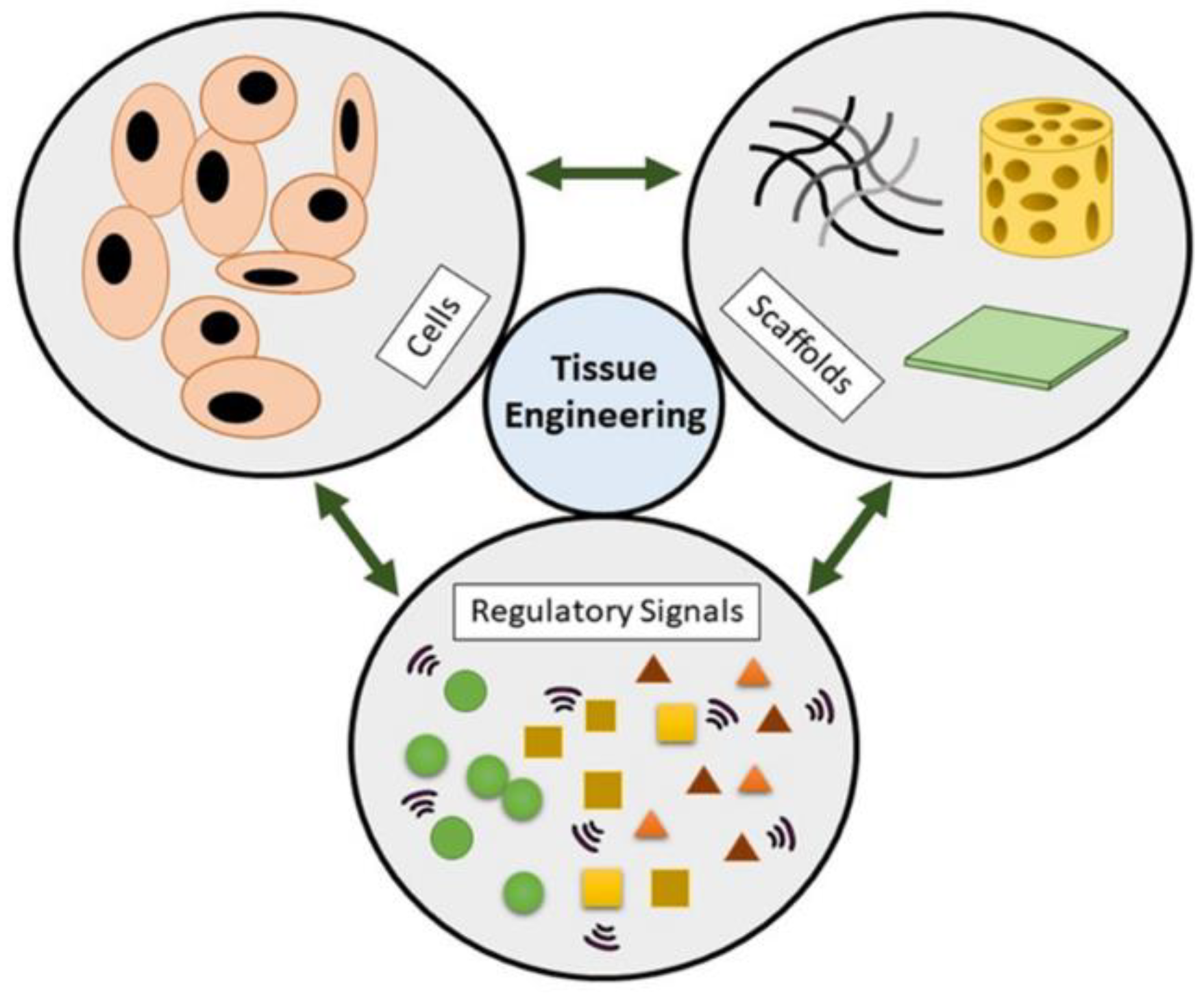
Figure.
Illustrating the changes in the mechanical function of a biodegradable scaffold based on regenerated bone tissue: (a) tissue loss; (b) tissue scaffold implantation; (c) tissue regeneration (scaffold degradation), (d) complete tissue reconstruction.
Figure.
Illustrating the changes in the mechanical function of a biodegradable scaffold based on regenerated bone tissue: (a) tissue loss; (b) tissue scaffold implantation; (c) tissue regeneration (scaffold degradation), (d) complete tissue reconstruction.
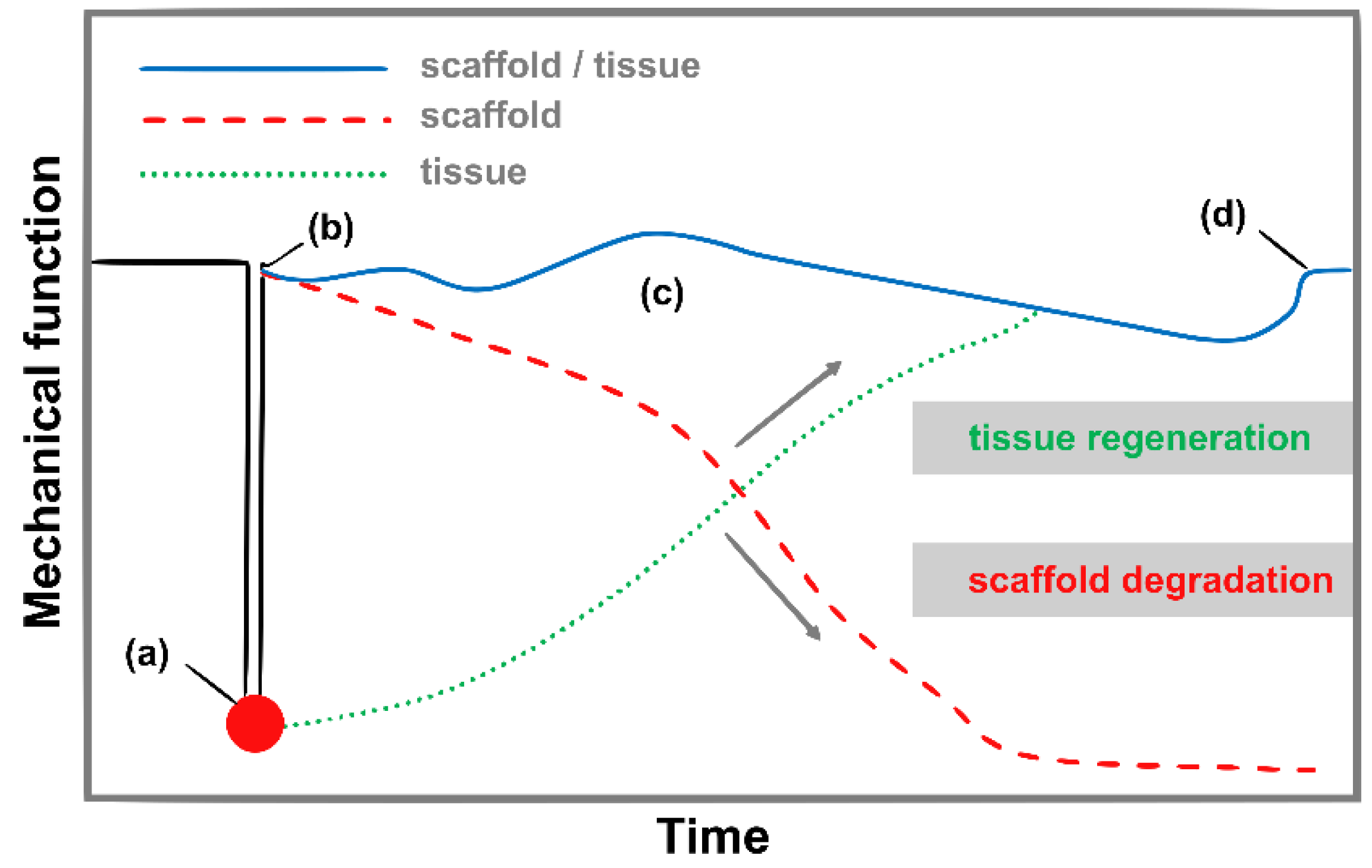
Figure 3.
(a) Schematic representation of a semi-crystalline polymer and (b) linear polyurethane structure. Reprinted from [60], Copyright 2022, Elsevier.
Figure 3.
(a) Schematic representation of a semi-crystalline polymer and (b) linear polyurethane structure. Reprinted from [60], Copyright 2022, Elsevier.
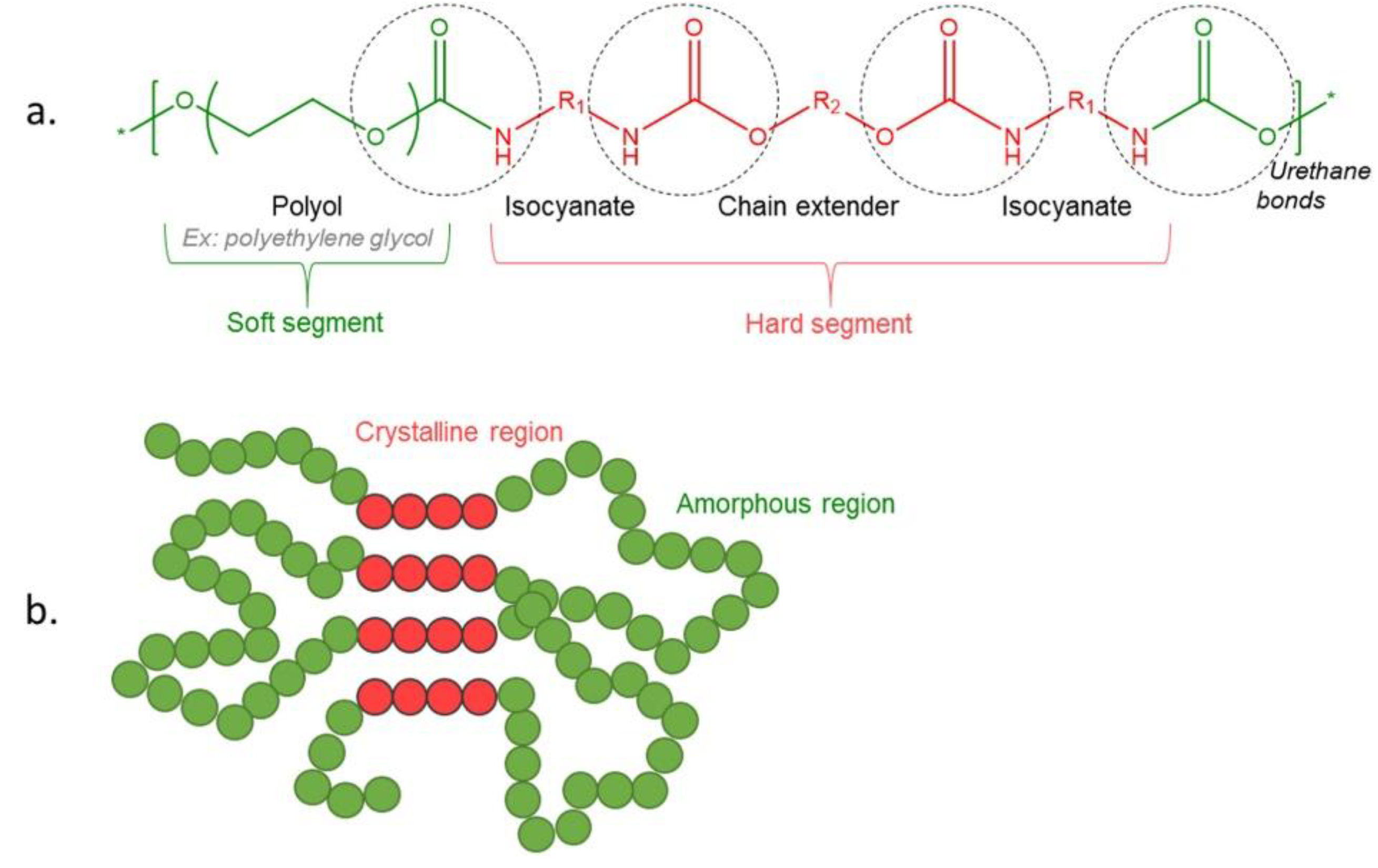
Figure.
Tissue elastic modulus as a reference for the design of suitable scaffolds. Reprinted from [78], Copyright 2022, Royal Society of Chemistry.
Figure.
Tissue elastic modulus as a reference for the design of suitable scaffolds. Reprinted from [78], Copyright 2022, Royal Society of Chemistry.
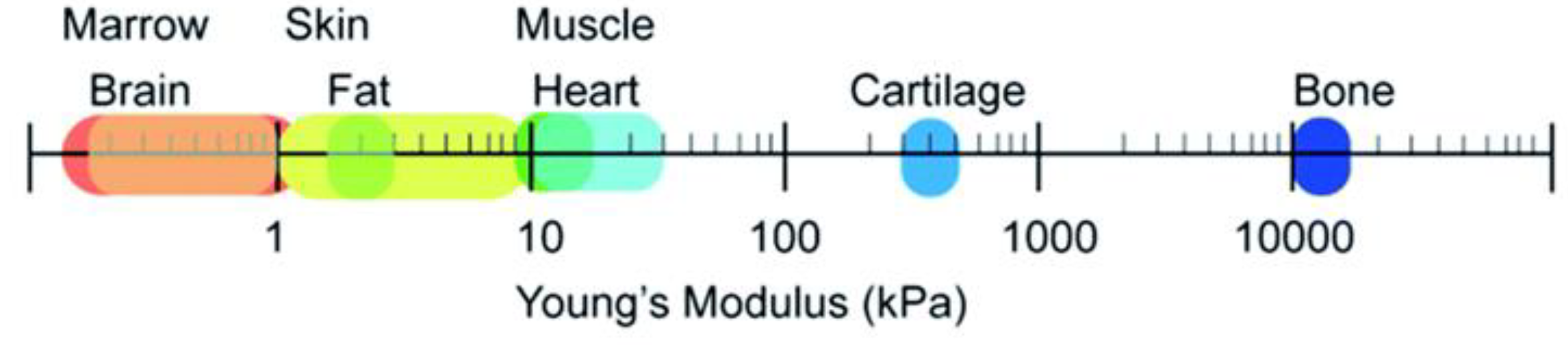
Figure 5.
(a) Set-up for 3D printing of TPU scaffolds. Scaffolds were prepared in rectangular and spindle-shaped outer geometry for in vitro and in vivo applications, respectively. Inner structures of both scaffold types were made of parallel-aligned fibers in 3D. (b) Representative images of 3D printed TPU scaffolds showing elasticity and recovery of the materials upon deformation. (c) 3D printed TPU scaffolds with different architectures that closely comply with the 3D model. Reprinted from [102], Copyright 2021, ACS Publications.
Figure 5.
(a) Set-up for 3D printing of TPU scaffolds. Scaffolds were prepared in rectangular and spindle-shaped outer geometry for in vitro and in vivo applications, respectively. Inner structures of both scaffold types were made of parallel-aligned fibers in 3D. (b) Representative images of 3D printed TPU scaffolds showing elasticity and recovery of the materials upon deformation. (c) 3D printed TPU scaffolds with different architectures that closely comply with the 3D model. Reprinted from [102], Copyright 2021, ACS Publications.
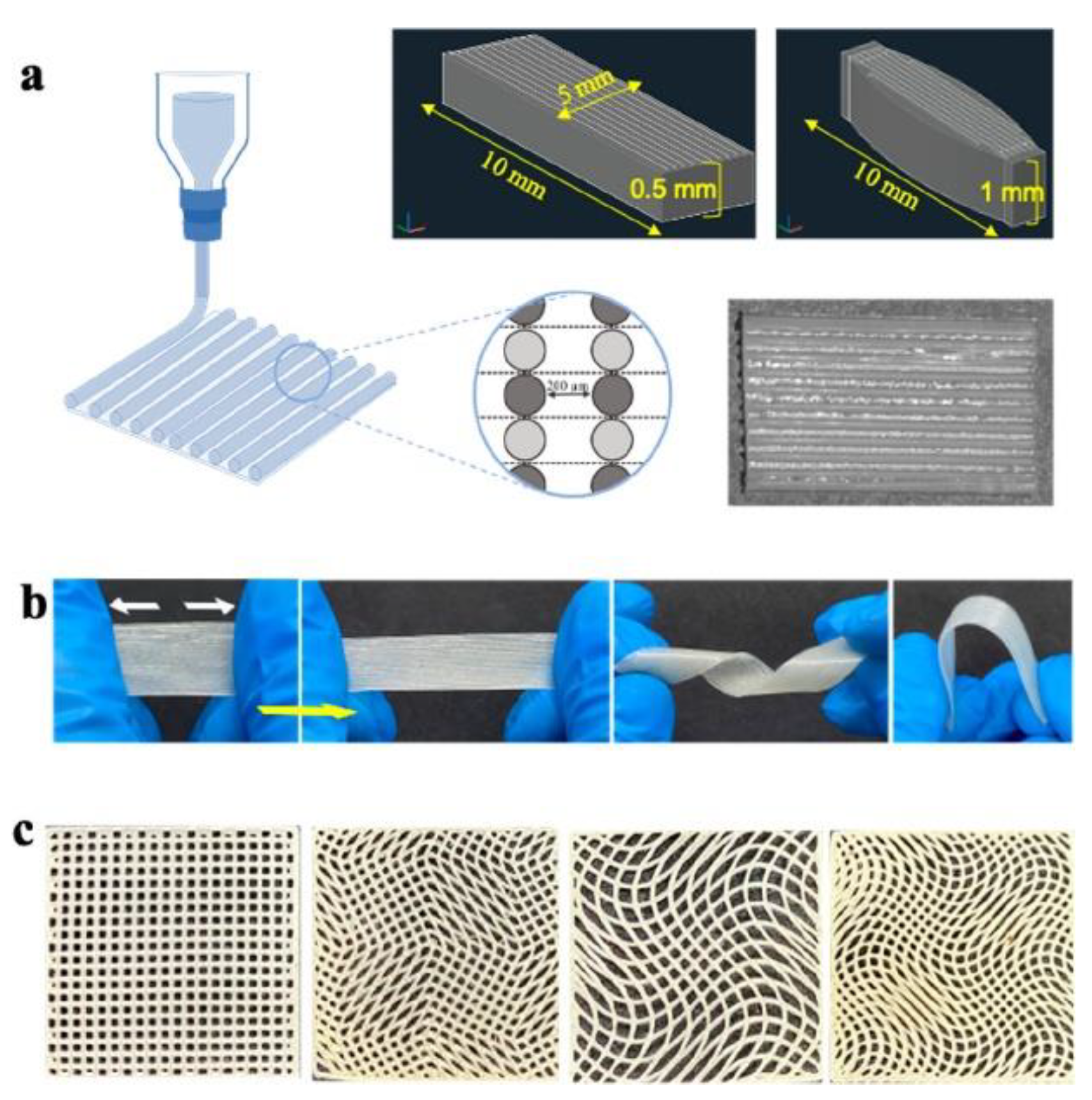
Figure 6.
(A) SEM micrographs of the fabricated films. (B) Macroscopic images and (C and D) SEM images of the scaffolds fabricated by the solvent casting and salt leaching method. (C) and (D) micrographs with low and high magnification, respectively. Scale bars: 200 μm. Reprinted from [112], Copyright 2018, ACS Publications.
Figure 6.
(A) SEM micrographs of the fabricated films. (B) Macroscopic images and (C and D) SEM images of the scaffolds fabricated by the solvent casting and salt leaching method. (C) and (D) micrographs with low and high magnification, respectively. Scale bars: 200 μm. Reprinted from [112], Copyright 2018, ACS Publications.
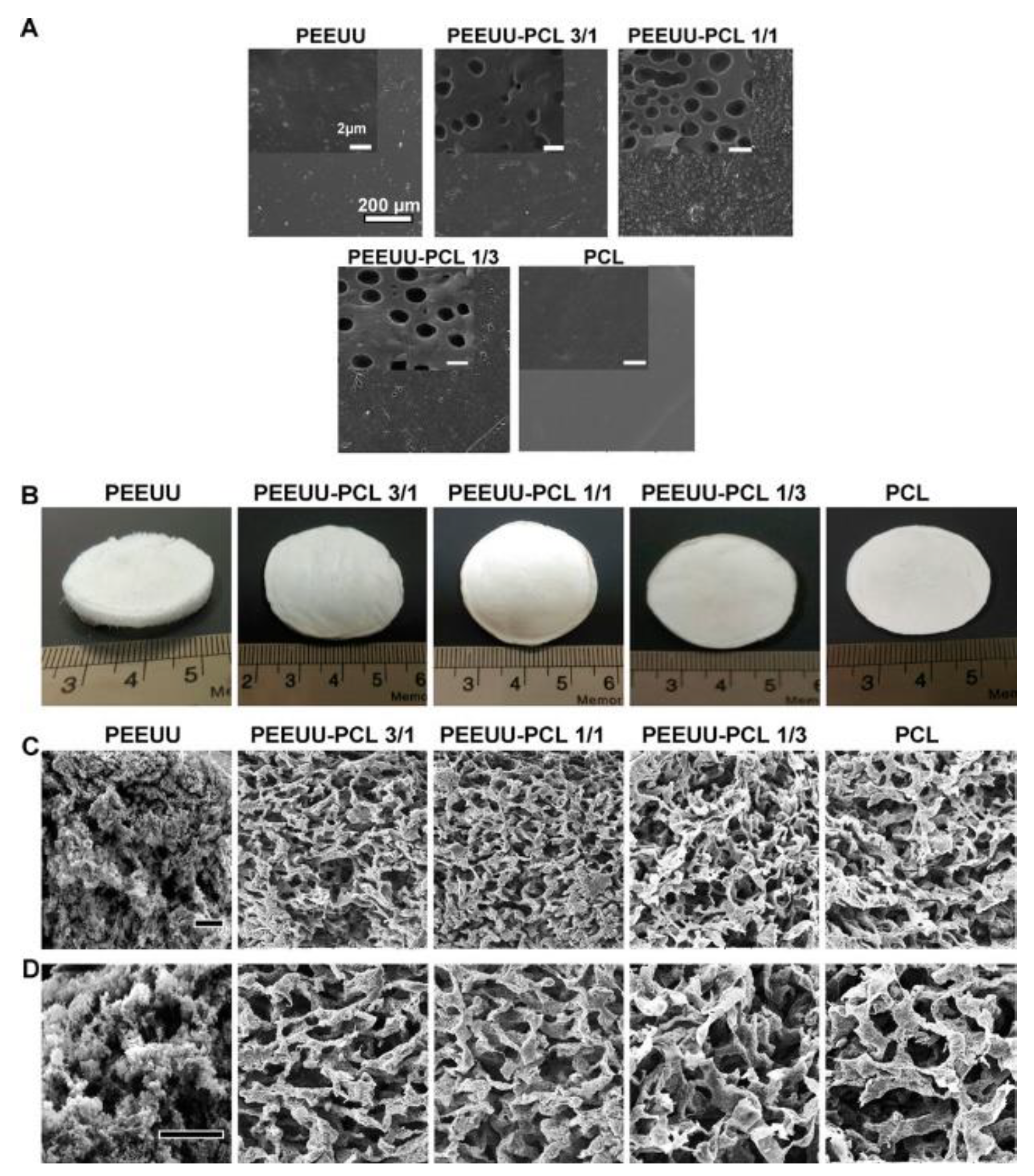
Figure 7.
(A) Synthetic scheme for ROS responsive polyurethane (PUTK) and non responsive polyurethane (PU) from poly(ε-caprolactone) diol, 1,6-hexamethylene diisocyanate, and chain extenders of ROS-cleavable thioketal (TK) and 1,6-hexanediamine (HMDA), respectively. (B) The thioketal linkers in PUTK are cleaved in response to reactive oxygen species (ROS) expressed by injured or inflamed tissues in situ. (C) Fabrication of electrospun fibrous patches loaded with methylprednisolone (MP) for sustainable release. (D) Transplantation of the cardiac patch on the surface of myocardia infarction (MI) for restoring the structures and functions of infracted myocardium. Reprinted from [119], Copyright 2020, Elsevier.
Figure 7.
(A) Synthetic scheme for ROS responsive polyurethane (PUTK) and non responsive polyurethane (PU) from poly(ε-caprolactone) diol, 1,6-hexamethylene diisocyanate, and chain extenders of ROS-cleavable thioketal (TK) and 1,6-hexanediamine (HMDA), respectively. (B) The thioketal linkers in PUTK are cleaved in response to reactive oxygen species (ROS) expressed by injured or inflamed tissues in situ. (C) Fabrication of electrospun fibrous patches loaded with methylprednisolone (MP) for sustainable release. (D) Transplantation of the cardiac patch on the surface of myocardia infarction (MI) for restoring the structures and functions of infracted myocardium. Reprinted from [119], Copyright 2020, Elsevier.
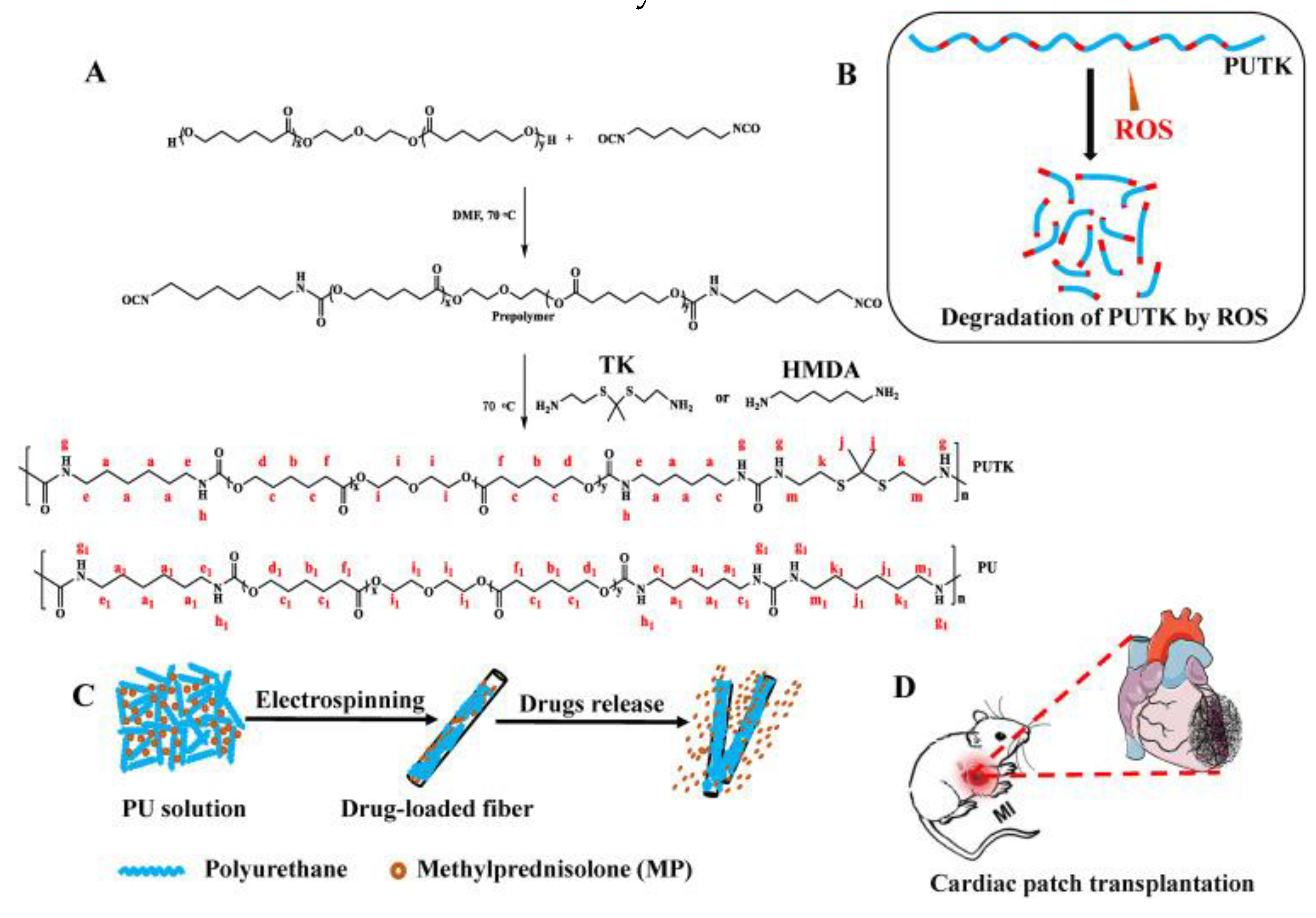
Figure.
Biohybrid scaffolds fabricated by combining PU-PEG1K-PVCL6K anisotropic scaffolds (5%, 8%, and 10% w/v) with myocardium-derived hydrogel. (A) Decellularized heart ECM solution was added dropwise onto the synthetic anisotropic scaffold and then absorbed into the scaffold by low vacuum. After placing the ECM–scaffold complex at 37 °C for 30 min, the biohybrid scaffold was formed. (B, E, and H) Digital images of PU-PEG1K-PVCL6K-5% H, PU-PEG1K-PVCL6K-8% H, and PU-PEG1K-PVCL6K-10% H. (C, F, and I) Electron micrographs of PU-PEG1K-PVCL6K-5% H, PU-PEG1K-PVCL6K-8% H, and PU-PEG1K-PVCL6K-10% H biohybrid scaffolds in the transversal direction. (D, G, and J) Electron micrographs of PU-PEG1K-PVCL6K-5% H, PU-PEG1K-PVCL6K-8% H, and PU-PEG1K-PVCL6K-10% H biohybrid scaffolds in the longitudinal direction. Reprinted from [122], Copyright 2020, Elsevier.
Figure.
Biohybrid scaffolds fabricated by combining PU-PEG1K-PVCL6K anisotropic scaffolds (5%, 8%, and 10% w/v) with myocardium-derived hydrogel. (A) Decellularized heart ECM solution was added dropwise onto the synthetic anisotropic scaffold and then absorbed into the scaffold by low vacuum. After placing the ECM–scaffold complex at 37 °C for 30 min, the biohybrid scaffold was formed. (B, E, and H) Digital images of PU-PEG1K-PVCL6K-5% H, PU-PEG1K-PVCL6K-8% H, and PU-PEG1K-PVCL6K-10% H. (C, F, and I) Electron micrographs of PU-PEG1K-PVCL6K-5% H, PU-PEG1K-PVCL6K-8% H, and PU-PEG1K-PVCL6K-10% H biohybrid scaffolds in the transversal direction. (D, G, and J) Electron micrographs of PU-PEG1K-PVCL6K-5% H, PU-PEG1K-PVCL6K-8% H, and PU-PEG1K-PVCL6K-10% H biohybrid scaffolds in the longitudinal direction. Reprinted from [122], Copyright 2020, Elsevier.
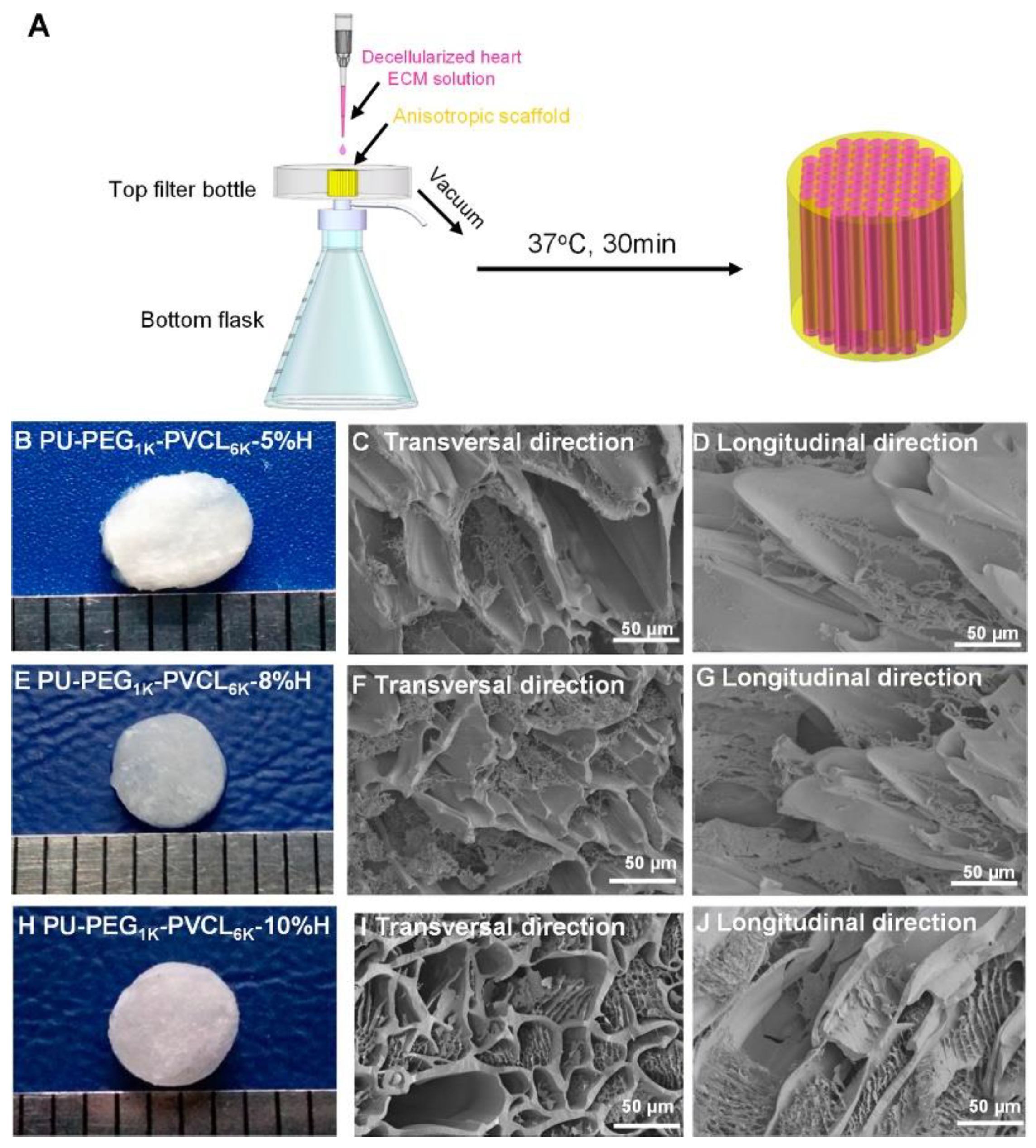
Figure 9.
A prototype of polymeric heart valve made from Hastalex. Reprinted from [125], Copyright 2020, Springer Nature.
Figure 9.
A prototype of polymeric heart valve made from Hastalex. Reprinted from [125], Copyright 2020, Springer Nature.
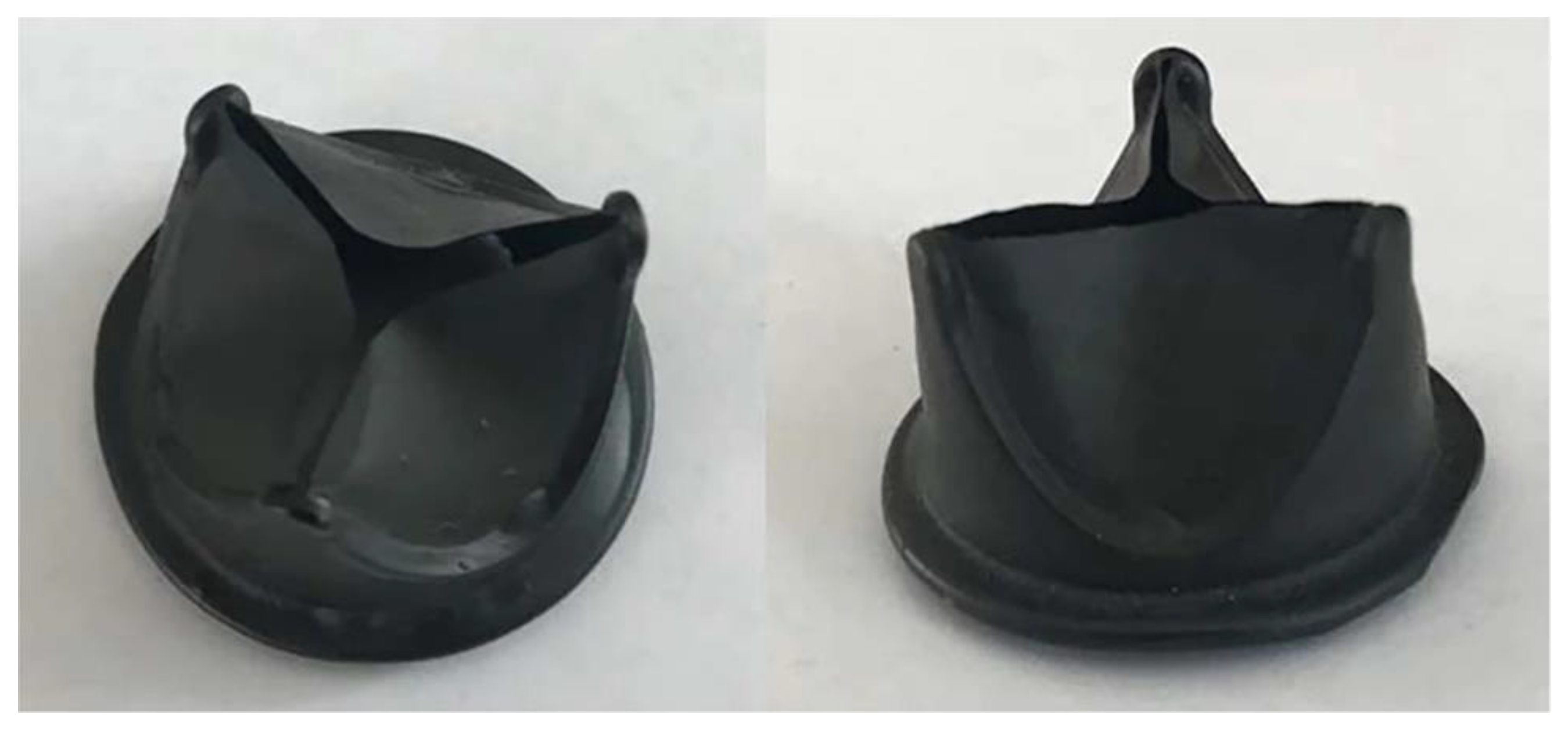
Figure.
Microscopic and macroscopic structures. A) An SEM image of a broken cross-section of sintered PMMA beads (small circular markings on bead surfaces were interconnects between beads). Scale bar: 50 μm. B) A photograph of the side view and cross-section of a porous PU graft. Scale bar: 1 cm. C) An SEM image of the exterior surface of a porous PU graft. Scale bar: 50 μm. D) An SEM image of the cross-section of a porous PU graft. Scale bar: 100 μm. E) An SEM image of the luminal surface of a porous PU graft., Scale bar: 100 μm. Reprinted from [139], Copyright 2021, Elsevier.
Figure.
Microscopic and macroscopic structures. A) An SEM image of a broken cross-section of sintered PMMA beads (small circular markings on bead surfaces were interconnects between beads). Scale bar: 50 μm. B) A photograph of the side view and cross-section of a porous PU graft. Scale bar: 1 cm. C) An SEM image of the exterior surface of a porous PU graft. Scale bar: 50 μm. D) An SEM image of the cross-section of a porous PU graft. Scale bar: 100 μm. E) An SEM image of the luminal surface of a porous PU graft., Scale bar: 100 μm. Reprinted from [139], Copyright 2021, Elsevier.
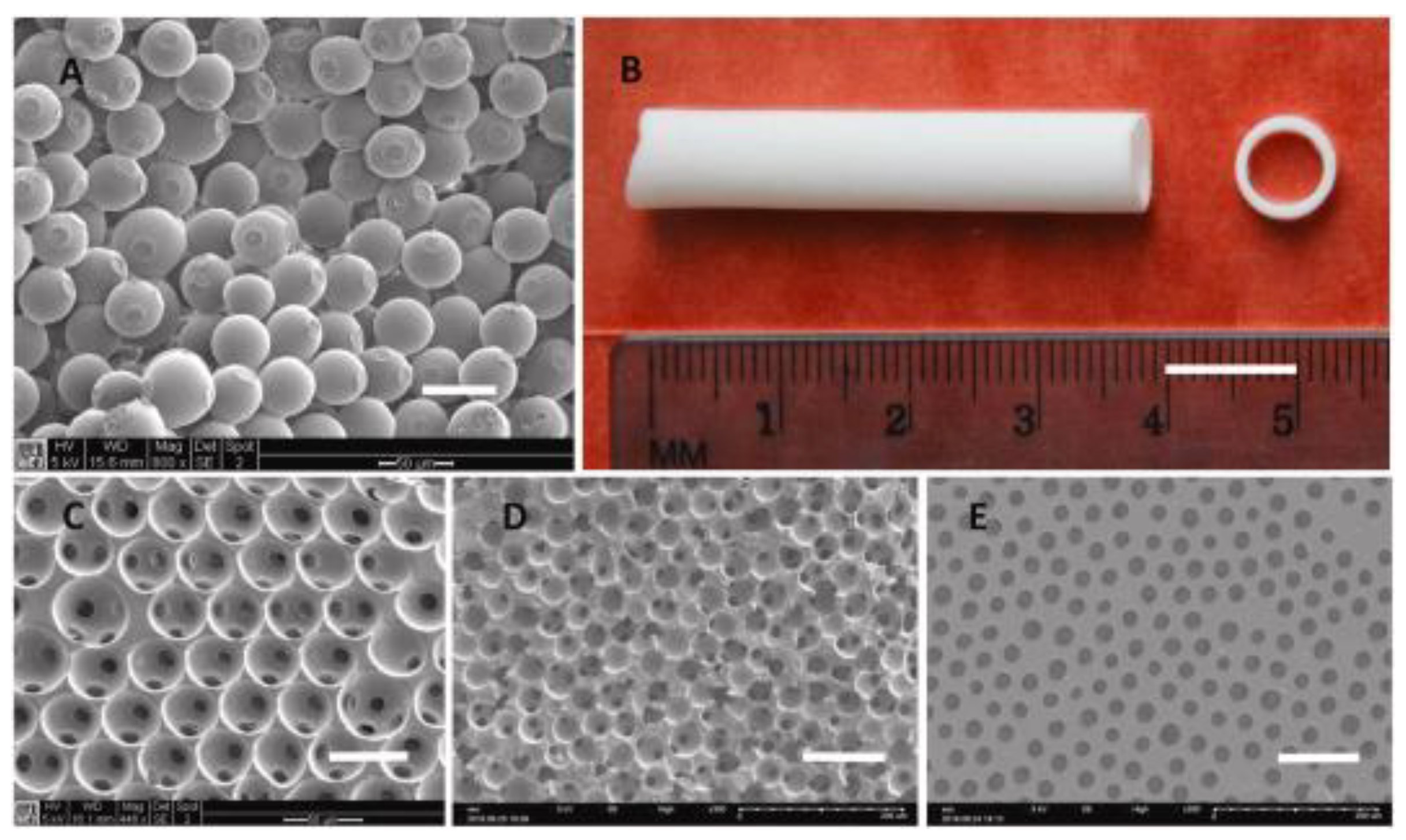
Figure 11.
(A) TPU/fibroin (1:1) graft with a wavy inner surface and a smooth outer surface. (B) The wall of the graft was composed of a thick layer with various thicknesses and a thin skin layer. (C) The crest of the inner layer (the squared region in (B)) was formed by the accumulation of crimped fibers. (D) Fiber morphology of the inner surface. Reprinted from [142], Copyright 2018, Wiley.
Figure 11.
(A) TPU/fibroin (1:1) graft with a wavy inner surface and a smooth outer surface. (B) The wall of the graft was composed of a thick layer with various thicknesses and a thin skin layer. (C) The crest of the inner layer (the squared region in (B)) was formed by the accumulation of crimped fibers. (D) Fiber morphology of the inner surface. Reprinted from [142], Copyright 2018, Wiley.
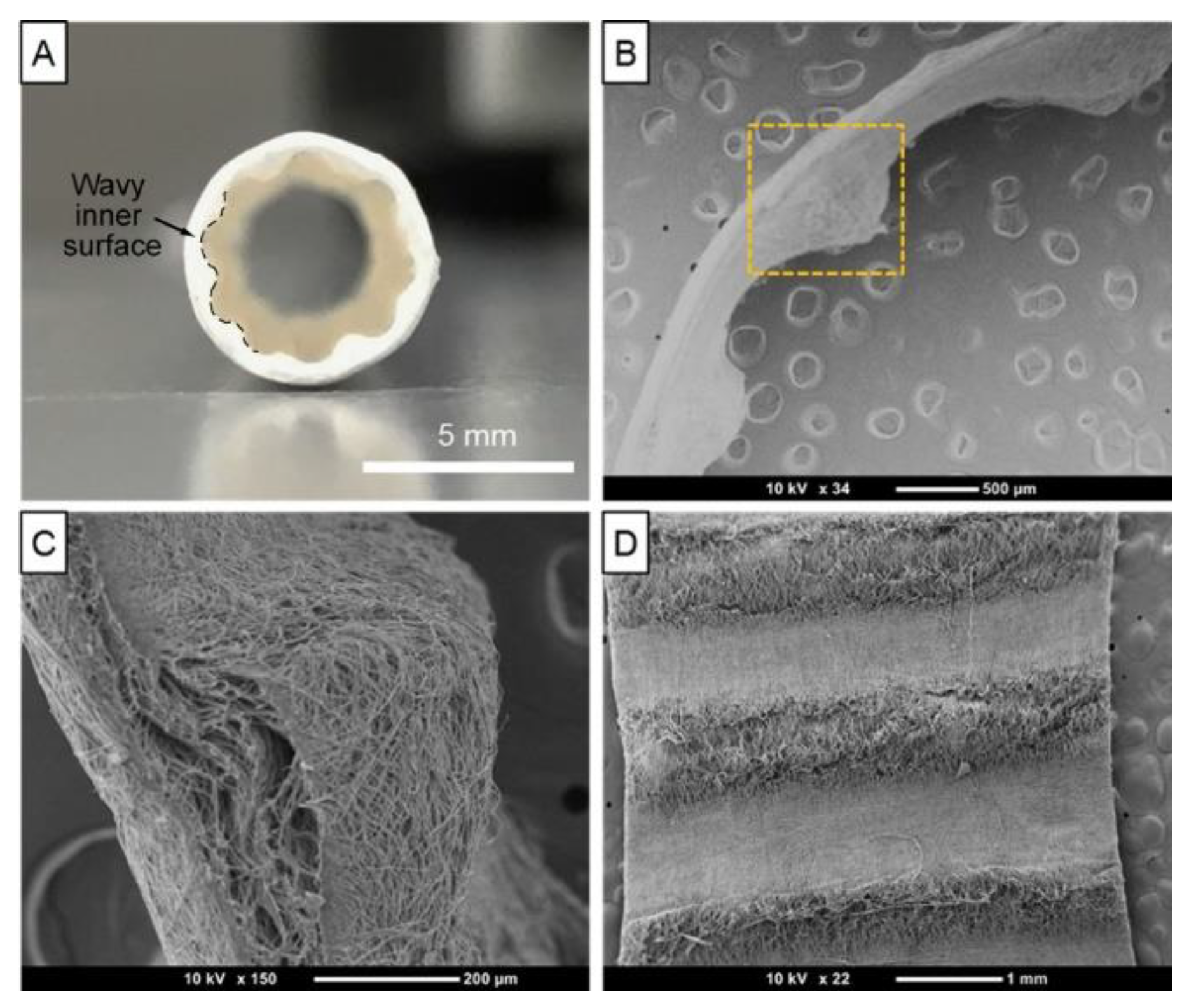
Figure.
New biomimetic principles for bone scaffold fabrication. Reproduced with permission from ref. [145]. Copyright 2024, ACS Publications.
Figure.
New biomimetic principles for bone scaffold fabrication. Reproduced with permission from ref. [145]. Copyright 2024, ACS Publications.
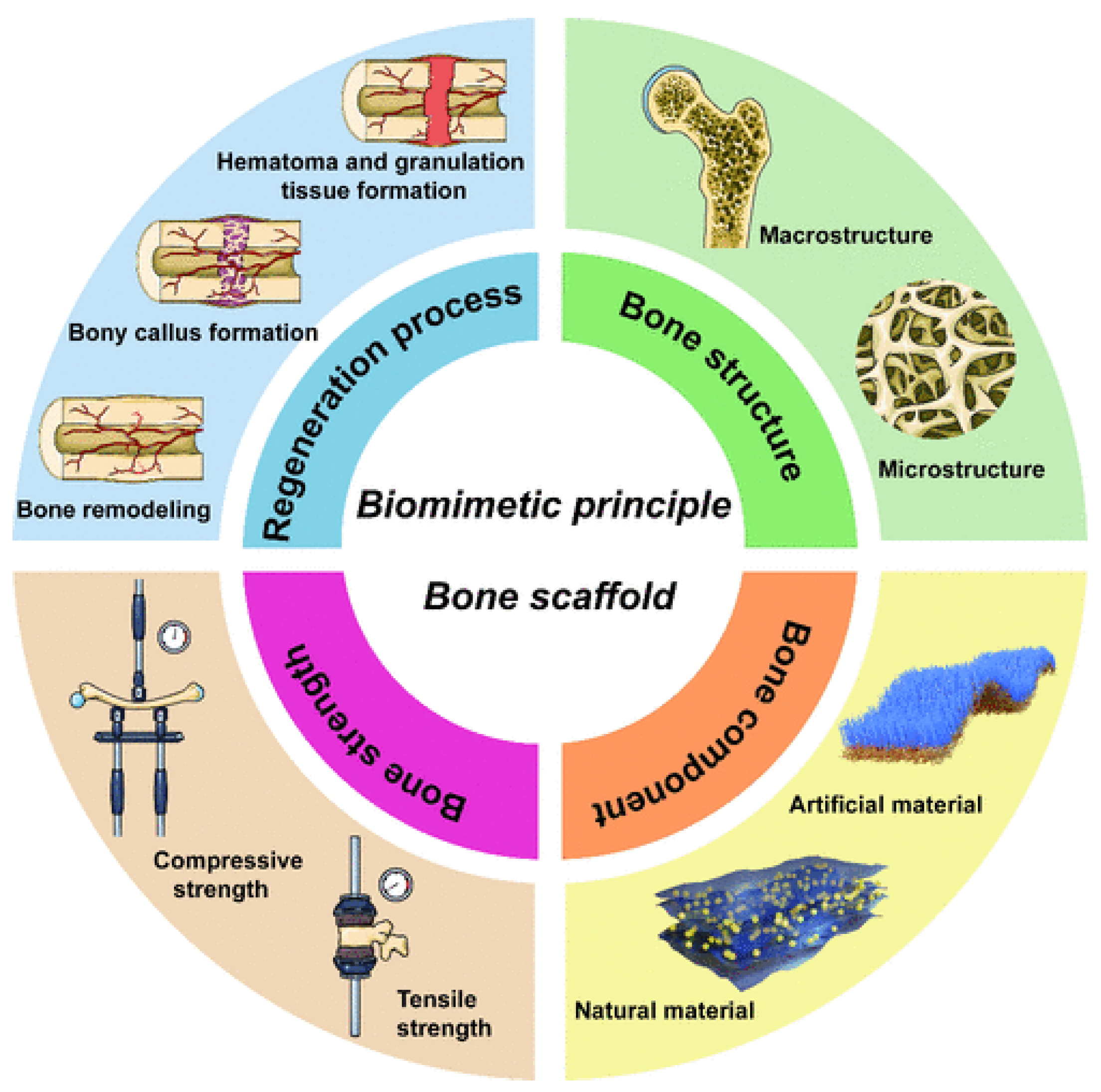
Figure.
The shape and internal structure of new synthetic composite scaffolds. The HA/PU composite porous scaffolds were manufactured using the situ foaming method. The size of the material was 10 mm × 6 mm × 6 mm (a). HA/PU scaffolds were combined with MSNs, which contained different concentrations of levofloxacin (b). PMMA cement which contained 1 mg or 5 mg levofloxacin (c) was used as a positive control group. Levofloxacin was successfully loaded with mesoporous silica nanoparticle via electrostatic attraction (d). Reproduced with permission from ref. [165]. Copyright 2017 Springer Nature.
Figure.
The shape and internal structure of new synthetic composite scaffolds. The HA/PU composite porous scaffolds were manufactured using the situ foaming method. The size of the material was 10 mm × 6 mm × 6 mm (a). HA/PU scaffolds were combined with MSNs, which contained different concentrations of levofloxacin (b). PMMA cement which contained 1 mg or 5 mg levofloxacin (c) was used as a positive control group. Levofloxacin was successfully loaded with mesoporous silica nanoparticle via electrostatic attraction (d). Reproduced with permission from ref. [165]. Copyright 2017 Springer Nature.
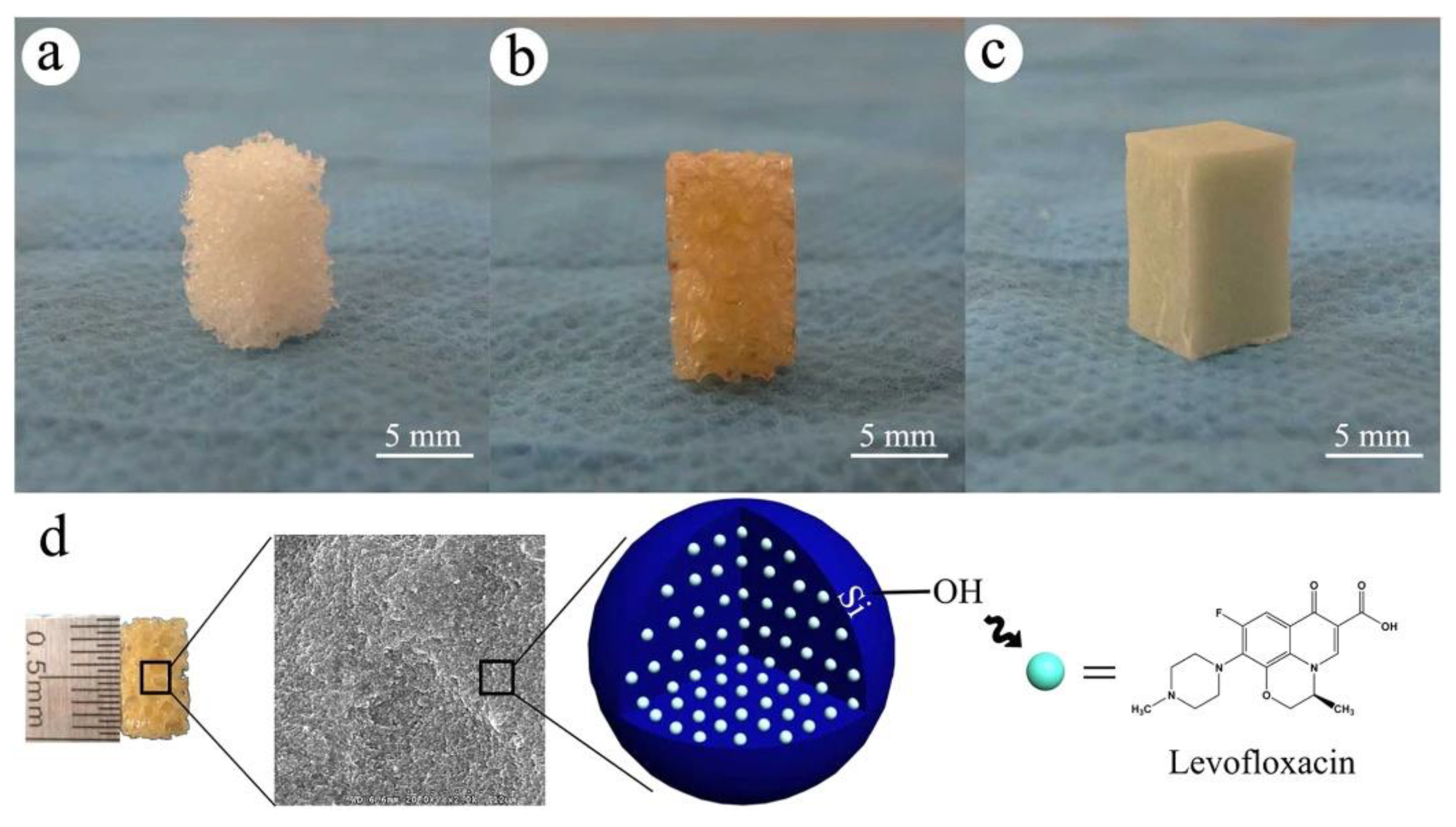
Figure.
Injectable EN-loaded bone cement based on PUHA promoting osteogenesis and inhibiting bacterial. Reproduced with permission from ref. [168]. Copyright 2022 Springer Nature.
Figure.
Injectable EN-loaded bone cement based on PUHA promoting osteogenesis and inhibiting bacterial. Reproduced with permission from ref. [168]. Copyright 2022 Springer Nature.
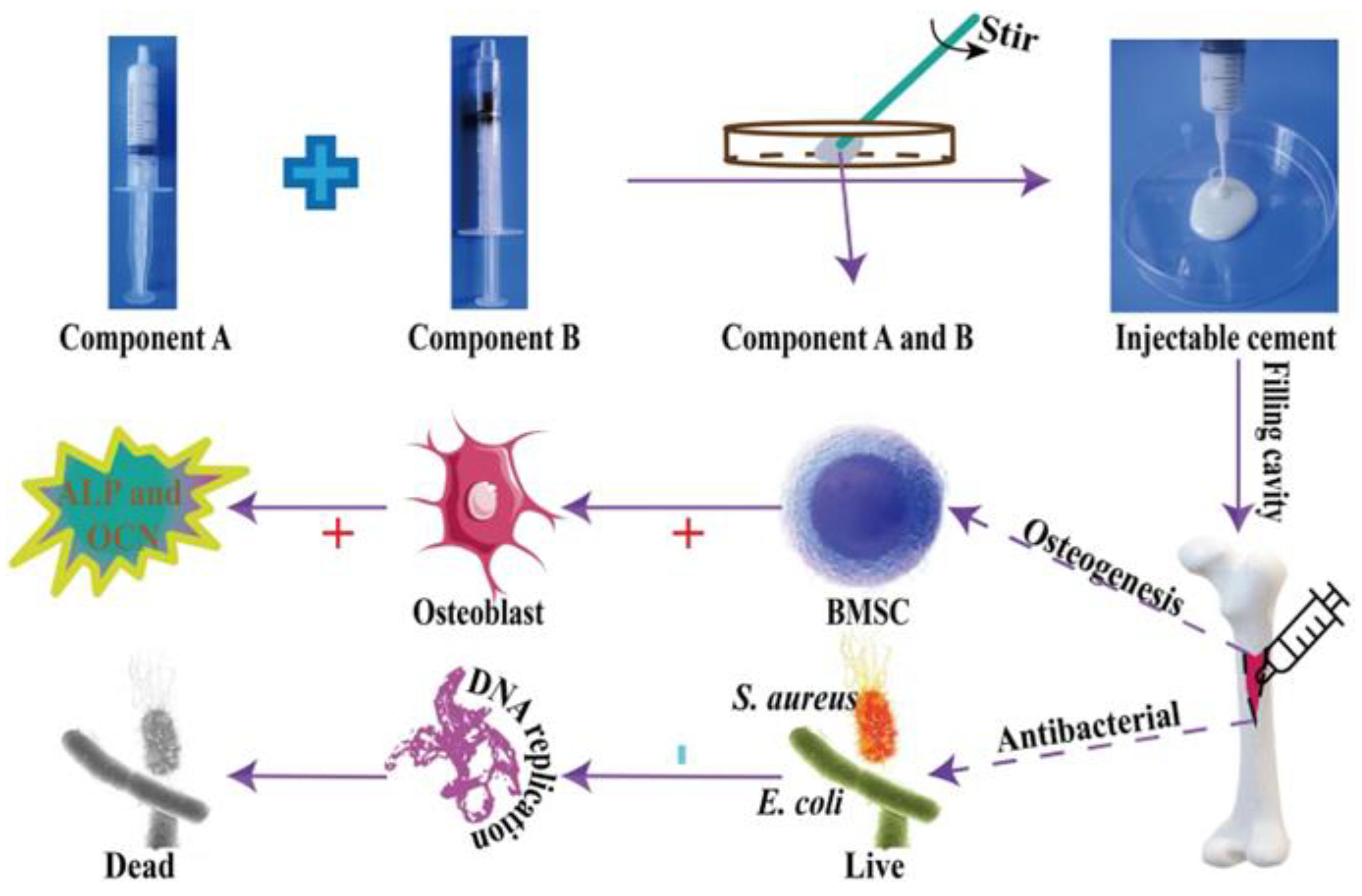
Figure.
Schematic illustration for preparation of polymeric scaffolds by air-driven extrusion 3D Printing assisted with a low-temperature receiver (left side) and surface morphology and macro-/micropores of polymeric scaffolds (macropores size of about 450 μm; micropores size of 2–10 μm) (bar: a–d: 1 mm; e–h: 500 μm; i,j: 50 μm) (right side). Reproduced with permission from ref. [173]. Copyright 2019 ACS Publications.
Figure.
Schematic illustration for preparation of polymeric scaffolds by air-driven extrusion 3D Printing assisted with a low-temperature receiver (left side) and surface morphology and macro-/micropores of polymeric scaffolds (macropores size of about 450 μm; micropores size of 2–10 μm) (bar: a–d: 1 mm; e–h: 500 μm; i,j: 50 μm) (right side). Reproduced with permission from ref. [173]. Copyright 2019 ACS Publications.
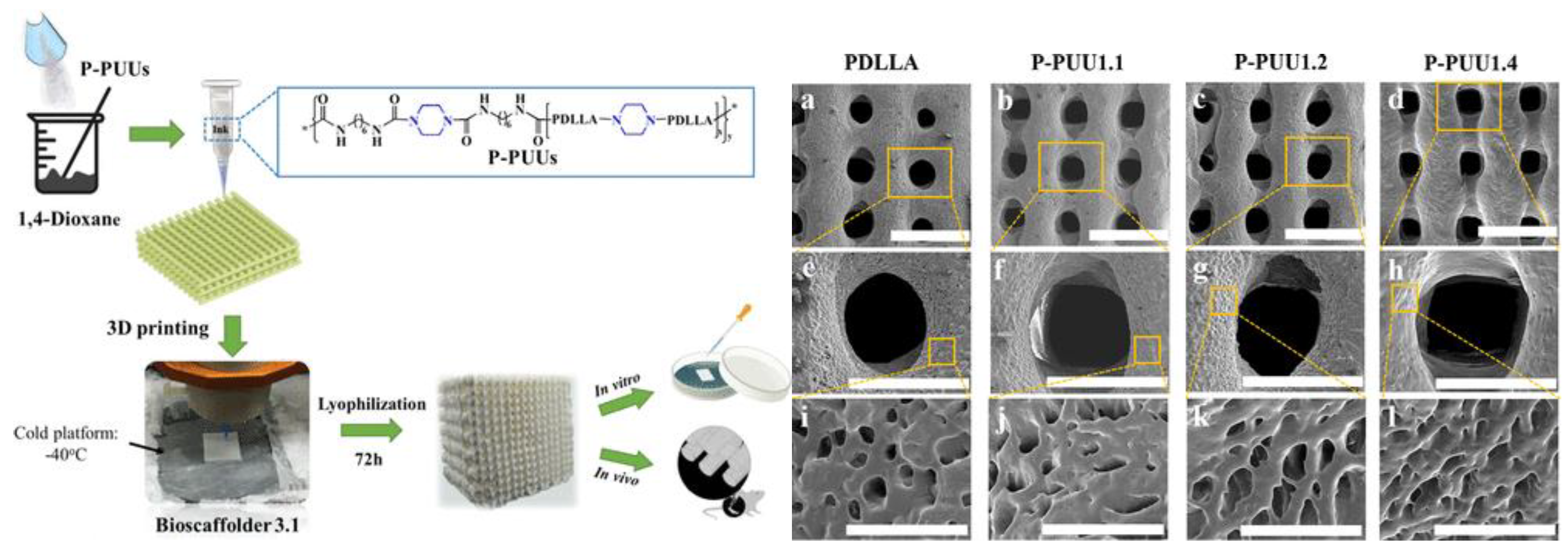
Disclaimer/Publisher’s Note: The statements, opinions and data contained in all publications are solely those of the individual author(s) and contributor(s) and not of MDPI and/or the editor(s). MDPI and/or the editor(s) disclaim responsibility for any injury to people or property resulting from any ideas, methods, instructions or products referred to in the content. |
© 2024 by the authors. Licensee MDPI, Basel, Switzerland. This article is an open access article distributed under the terms and conditions of the Creative Commons Attribution (CC BY) license (http://creativecommons.org/licenses/by/4.0/).
Copyright: This open access article is published under a Creative Commons CC BY 4.0 license, which permit the free download, distribution, and reuse, provided that the author and preprint are cited in any reuse.