

Submitted:
19 December 2024
Posted:
23 December 2024
You are already at the latest version
Abstract
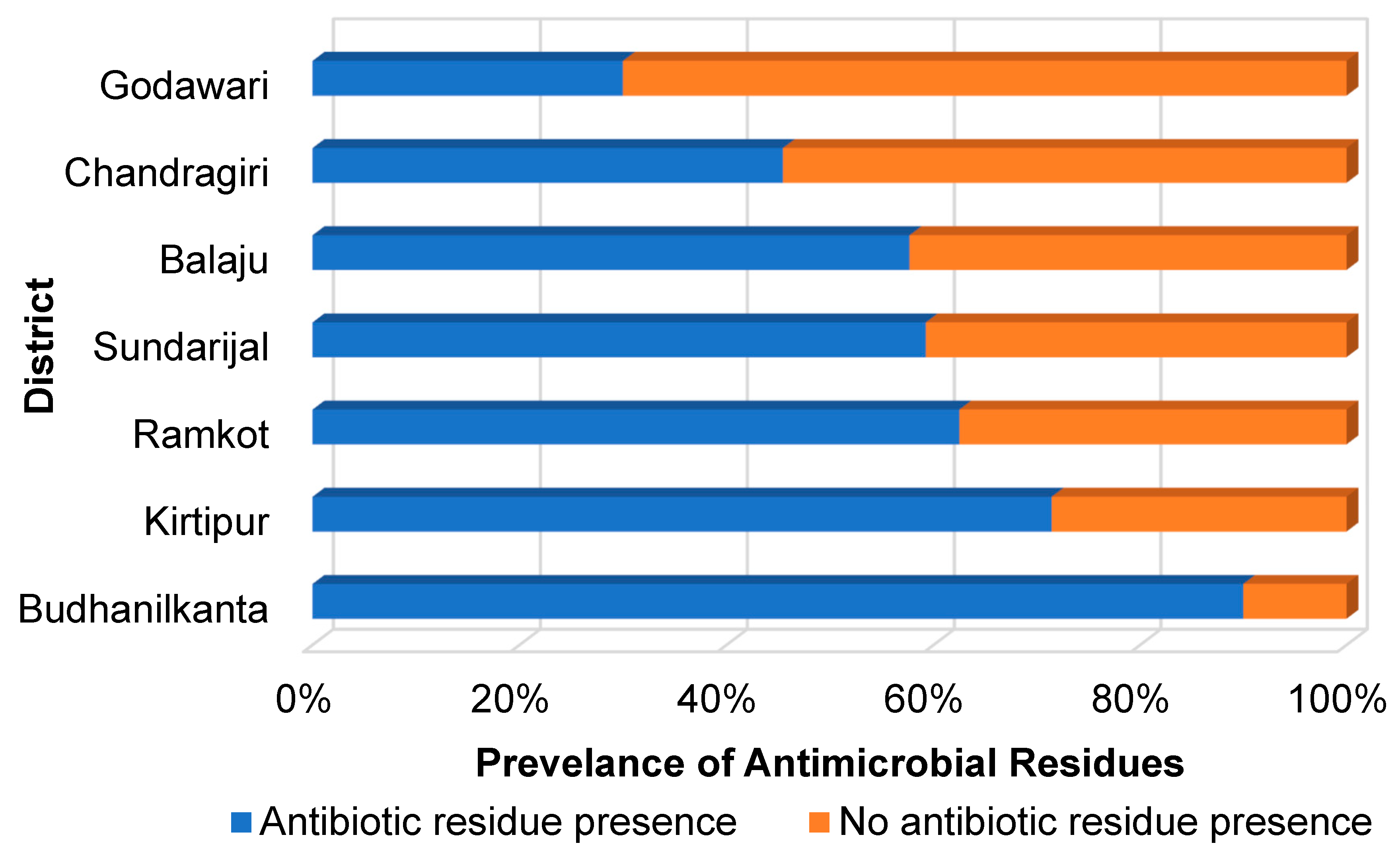
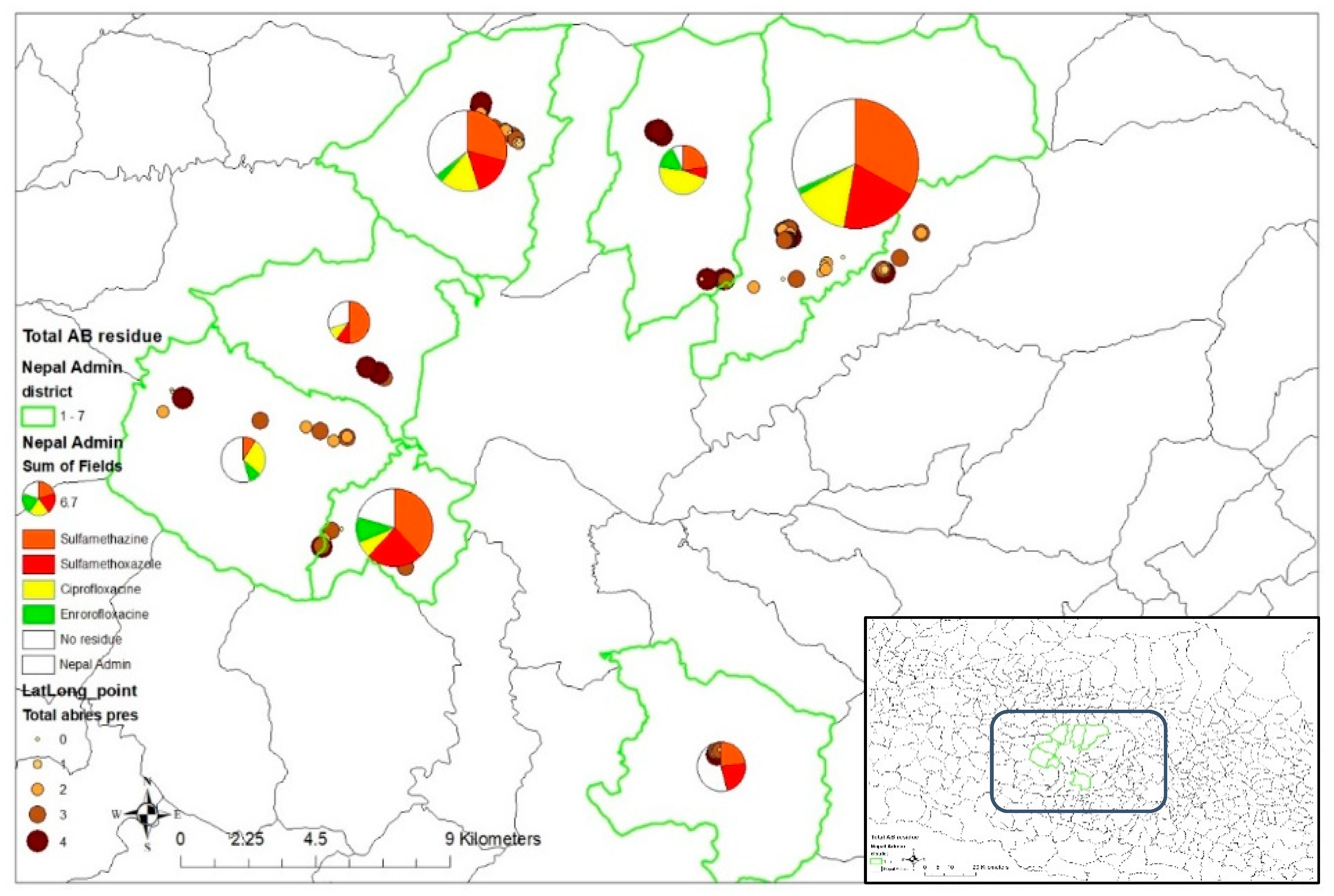
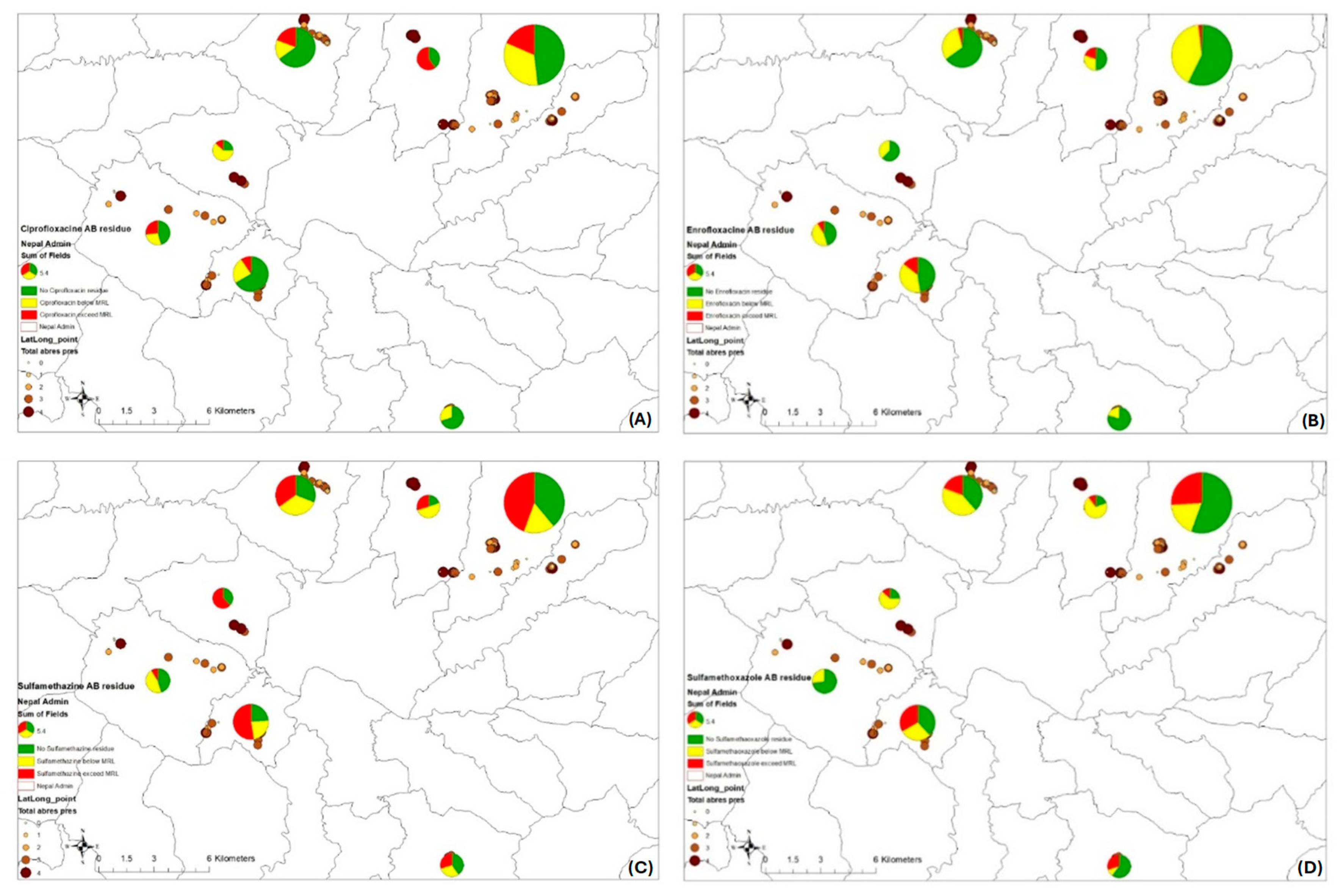
The presence of antibiotic residues (AR) in animal products such as milk can be an important driver of antimicrobial resistance in commensal and pathogenic bacteria. Previous studies on ARs in Nepal have demonstrated the presence of ARs in milk samples but without further characterization of the samples for risk factor analysis. This study aimed to quantify the prevalence and risk factors for the presence of ARs in 140 peri-urban dairy farms in Kathmandu, Nepal, included in a cross-sectional survey in 2019, to estimate farm-level AR prevalence. High-performance liquid chromatography was conducted on farm bulk milk samples for AR analysis, revealed positive Additionally, a structured questionnaire and direct farmer interviews were used to collect data on farm biosecurity and farming practices, animal health and hygiene, antimicrobial usage (AMU), and attitudes and practices towards antimicrobial stewardship. Our results revealed the presence of ARs for sulfamethazine (61%), sulfamethoxazole (53%), ciprofloxacin (46%), and enrofloxacin (42%). Furthermore, of those samples positive for sulfamethazine, sulfamethoxazole, and ciprofloxacin, 81%, 42%, and 42%, respectively, exceeded the MRL. While samples taken from farms where staff administered antimicrobials were less likely to have single residues and multidrug residues (2, 3, and 4 residues), farms with more workers were more likely to have single residues. Moreover, samples from farms with a higher number of calves and milking cows were more likely to contain single and multiple residues exceeding the maximum residue limit (MRL), while milk from farms with a higher number of dry cows and farmers reported visiting chemist were less likely to have multidrug residue exceeding MRL. Ultimately, this study provides evidence on the role of modifiable ARs risk factors in the peri-urban milk industry of Kathmandu, which can serve as a foundation for developing improved antimicrobial stewardship guidelines, and designing intervention measures, to reduce the public health risk posed by ARs in milk sold in Kathmandu, Nepal.
Keywords:
1. Introduction
2. Materials and Methods
2.1. Study Design
2.2. Antimicrobial Residues in Milk by HPLC Analysis
2.3. Risk Factor Data
2.4. Statistical Analyses
3. Results
3.1. Dataset for Analysis
3.2. Prevalence of Antibiotic Residues
3.3. Risk Factors Associated with the Presence of ARs and MRL Exceedance
4. Discussion
5. Conclusions
Author Contributions
Funding
Institutional Review Board Statement
Informed Consent Statement
Data Availability Statement
Acknowledgments
Conflicts of Interest
References
- Ma, F., et al., Use of antimicrobials in food animals and impact of transmission of antimicrobial resistance on humans. Biosafety and Health, 2020.
- Van Boeckel, T.P., et al. Global trends in antimicrobial use in food animals. Proceedings of the National Academy of Sciences 2015, 112, 5649. [Google Scholar] [CrossRef] [PubMed]
- Manyi-Loh, C., et al. Antibiotic Use in Agriculture and Its Consequential Resistance in Environmental Sources: Potential Public Health Implications. Molecules (Basel, Switzerland) 2018, 23, 795. [Google Scholar] [CrossRef] [PubMed]
- Sachi, S., et al. Antibiotic residues in milk: Past, present, and future. Journal of advanced veterinary and animal research 2019, 6, 315–332. [Google Scholar] [CrossRef] [PubMed]
- FDA, Multicriteria-based Ranking Model for Risk Management of Animal Drug Residues in Milk and Milk Products. 2015.
- Bacanlı, M. and N. Basaran, Importance of antibiotic residues in animal food. Food and Chemical Toxicology, 2019. 125.
- Tufa, T., Veterinary Drug Residues in Food-animal Products: Its Risk Factors and Potential Effects on Public Health. Journal of Veterinary Science & Technology, 2015. 07.
- CAC, FAO and WHO: Maximum residue limits for veterinary drugs in foods. Updated as at the 34th session of the Codex Alimentarius Commission. 2011.
- EC, E.C., Council Regulation No. 37/2010 of 22 December 2009 On pharmacologically active substances and their classification regarding maximum residue limits in foodstuffs of animal origin. , in Official Journal of the European Communities. 2011.
- MOA No.235 Bulletin of the Ministry ofAgriculture of the People’s Republic of China. 2002.
- Menkem, Z.o.E., et al. Antibiotic residues in food animals: Public health concern. Acta Ecologica Sinica 2019, 39, 411–415. [Google Scholar] [CrossRef]
- Mund, M.D., et al. Antimicrobial drug residues in poultry products and implications on public health: A review. International Journal of Food Properties 2017, 20, 1433–1446. [Google Scholar] [CrossRef]
- Nepal, G., Milk marketing strategies study, Final report, National dairy development Board, Hariharbhawan, Nepal. 2012: Lalitpur, Nepal.
- Thapaliya, M., T. Karki, and D. Sedai, Sulfonamides and Penicillin Residue in Market Milk. Journal of Food Science and Technology Nepal, 2014. 8.
- Khanal, B.K.S., et al. Screening of antibiotic residues in fresh milk of Kathmandu Valley, Nepal. Journal of Environmental Science and Health 2018, 53, 57–86. [Google Scholar] [CrossRef] [PubMed]
- Bhusal, D.R., B.P. Chhetri, and J.R. Subedi, Determination of Antibiotics Residues in Milk Samples Collected in the Different Sites of Kathmandu, Nepal. Asian Journal of Dairy and Food Research, 2020.
- Gompo, T.R., et al. Monitoring of Antibiotic Residues in Chicken Meat, Cow and Buffalo Milk Samples in Nepal. International Journal of Applied Sciences and Biotechnology 2020, 8, 355–362. [Google Scholar] [CrossRef]
- Malisch, R., B. Bourgeois, and R. Lippold, Multiresidue analysis of selected chemotherapeutics and antiparasitics. Determination of Sulphonamides and their N4-metabolites, chloramphenicol and nicarbazin. 1994.
- ESRI. Redlands, ArcGIS Desktop: Release 10.. 2011, CA: Environmental Systems Research Institute.
- StataCorp, Stata Statistical Software: Release 17. 2021, College Station: TX: StataCorp LLC.
- Microsoft, Microsoft Excel 2022. 2022.
- CASA, Dairy Sector Strategy – Nepal. Commercial Agriculture for Smallholders and Agribusiness, in CASA NEPAL COUNTRY TEAM. 2020.
- Upadhyaya, N., et al., Trend of Antimicrobial Use in Food-Producing Animals from 2018 to 2020 in Nepal. Animals, 2023. 13(8).
- Wang, S., et al. Analysis of sulphonamide residues in edible animal products: a review. Food Addit Contam 2006, 23, 362–84. [Google Scholar] [CrossRef] [PubMed]
- Chattopadhyay, M.K. , Use of antibiotics as feed additives: a burning question. 2014, Frontiers Media SA. p. 334.
- Gallo, G.F. and J.L. Berg. Efficacy of a feed-additive antibacterial combination for improving feedlot cattle performance and health. Can Vet J 1995, 36, 223–229. [Google Scholar]
- Richards, R.M.E., R. B. Taylor, and Z.Y. Zhu, Mechanism for synergism between sulphonamides and trimethoprim clarified. Journal of Pharmacy and Pharmacology, 1996. 48(9): p. 981-984.
- Chung, H.-H., et al. Analysis of sulfonamide and quinolone antibiotic residues in Korean milk using microbial assays and high performance liquid chromatography. Food Chemistry 2009, 113, 297–301. [Google Scholar] [CrossRef]
- Zhang, Y.D. , et al., Occurrence of tetracyclines, sulfonamides, sulfamethazine and quinolones in pasteurized milk and UHT milk in China's market. Food Control, 2014. 36: p. 238-242.
- Hossain, M.T. , et al., A Survey on Knowledge, Attitude, and Practices of Large-Animal Farmers towards Antimicrobial Use, Resistance, and Residues in Mymensingh Division of Bangladesh. Antibiotics (Basel), 2022. 11(4).
- Gebeyehu, D.T. , et al., Knowledge, attitude and practice of animal producers towards antimicrobial use and antimicrobial resistance in Oromia zone, north eastern Ethiopia. PLoS One, 2021. 16(5): p. e0251596.
- Ahmed, S.M. , et al., Exploring the status of retail private drug shops in Bangladesh and action points for developing an accredited drug shop model: a facility based cross-sectional study. Journal of Pharmaceutical Policy and Practice, 2017. 10(1): p. 21.
- Wallinga, D. and D.G. Burch, Does adding routine antibiotics to animal feed pose a serious risk to human health? Bmj, 2013. 347: p. f4214.
- Spellberg, B., J. G. Bartlett, and D.N. Gilbert, The future of antibiotics and resistance. N Engl J Med, 2013. 368(4): p. 299-302.
- Nisha, A.R. , Antibiotic Residues - A Global Health Hazard. Veterinary World, 2008. 1.
- Dankar, I., H. Hassan, and M. Serhan, Knowledge, attitudes, and perceptions of dairy farmers regarding antibiotic use: Lessons from a developing country. Journal of Dairy Science, 2022. 105(2): p. 1519-1532.
- Giguère, S., J. F. Prescott, and P.M. Dowling, Antimicrobial therapy in veterinary medicine. 2013, Chichester: John Wiley & Sons. xvii + 683 pp.
- Gruet, P. , et al., Bovine mastitis and intramammary drug delivery: Review and perspectives. Advanced drug delivery reviews, 2001. 50: p. 245-59.
- Duse, A. , et al., Occurrence and Spread of Quinolone-Resistant Escherichia coli on Dairy Farms. Applied and Environmental Microbiology, 2016. 82(13): p. 3765-3773.
- Pham-Duc, P. , et al., Knowledge, attitudes and practices of livestock and aquaculture producers regarding antimicrobial use and resistance in Vietnam. PLoS One, 2019. 14(9): p. e0223115.
- Kalunke, R.M. , et al., Detection of ciprofloxacin residues in cow milk: A novel and rapid optical β-galactosidase-based screening assay. Microchemical Journal, 2018. 136: p. 128-132.
- Persson, Y. , et al., Efficacy of enrofloxacin for the treatment of acute clinical mastitis caused by Escherichia coli in dairy cows. Vet Rec, 2015. 176(26): p. 673.
- WHO, Critically Important Antimicrobials for Human Medicine. 5th Revision. 2017, Geneva: World Health Organization.
- Organization, W.H. , WHO guidelines on use of medically important antimicrobials in food-producing animals: web annex A: evidence base. 2017, World Health Organization.
- Pokharel, S. , et al., Antibiotic Residue in Raw Milk Collected from Dairy Farms and Markets in Nepal. Nepalese Veterinary Journal, 2023.
- Acharya, K.P., S. H. Subramanya, and B.S. Lopes, Combatting antimicrobial resistance in Nepal: the need for precision surveillance programmes and multi-sectoral partnership. JAC-Antimicrobial Resistance, 2019. 1.
- Acharya, K.P. and R.T. Wilson, Antimicrobial Resistance in Nepal. Frontiers in Medicine, 2019. 6.
- Sachi, S. , et al., Antibiotic residues in milk: Past, present, and future. Journal of Advanced Veterinary and Animal Research, 2019. 6: p. 315 - 332.
- Caudell, M.A., et al. Towards a bottom-up understanding of antimicrobial use and resistance on the farm: A knowledge, attitudes, and practices survey across livestock systems in five African countries. PLoS One 2020, 15, e0220274. [Google Scholar] [CrossRef] [PubMed]
- Alhaji, N.B., et al. Survey on antimicrobial usage in local dairy cows in North-central Nigeria: Drivers for misuse and public health threats. PLoS One 2019, 14, e0224949. [Google Scholar] [CrossRef] [PubMed]
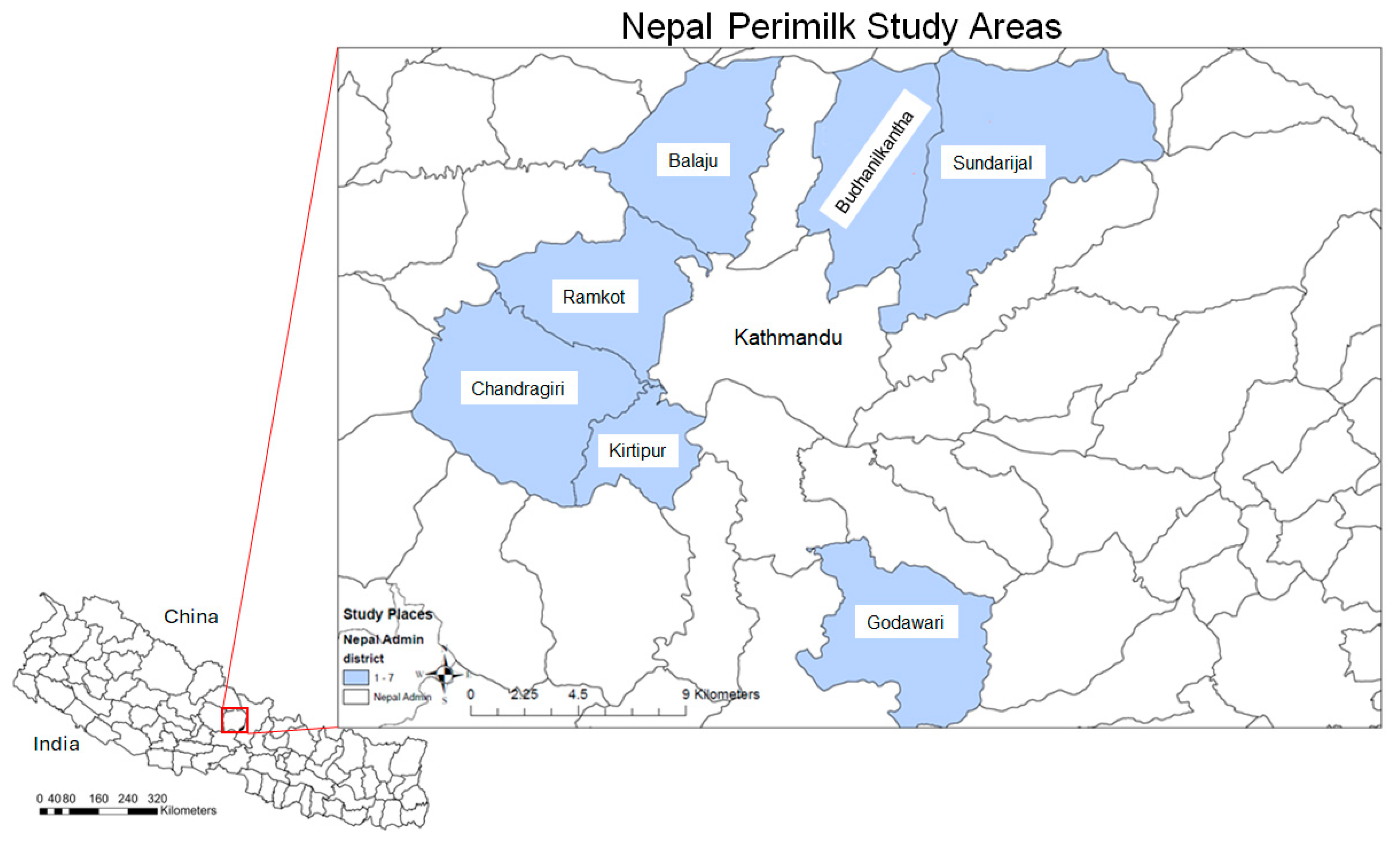


| Study locations | Farm count per location | Total cattle count | Sampled farm counts |
|---|---|---|---|
| Sundarijal | 57 | 246 | 20 |
| Balaju | 114 | 224 | 40 |
| Ramkot | 34 | 166 | 12 |
| Kirtipur | 93 | 308 | 33 |
| Chandragiri | 49 | 153 | 17 |
| Godawari | 48 | 257 | 17 |
| Budhanilkantha | 43 | 247 | 15 |
| Variables | Odds Ratio (95% Confidence Interval) |
p-Value |
|---|---|---|
| One AR present (vs No ARs present) | ||
| Total number of workers (FD) | 1.61 (1.1-2.33) | 0.013 |
| Women responsible for medicines (FP) | 0.25 (0.05-1.28) | 0.097 |
| AB administrated by farm staff (AMU) | 0.14 (0.03-0.61) | 0.01 |
| Two ARs present (vs No ARs present) | ||
| Total number of workers (FD) | 1.12 (0.79-1.58) | 0.513 |
| Women responsible for medicines (FP) | 0.54 (0.16-1.8) | 0.325 |
| AB administrated by farm staff (AMU) | 0.25 (0.06-0.92) | 0.038 |
| Three ARs present (vs No ARs present) | ||
| Total number of workers (FD) | 1.43 (0.99-1.95) | 0.052 |
| Women responsible for medicines (FP) | 0.42 (0.12-1.46) | 0.174 |
| AB administrated by farm staffs (AMU) | 0.19 (0.05-0.71) | 0.014 |
| Four ARs present (vs No ARs present) | ||
| Total number of workers (FD) | 1.24 (0.84-1.84) | 0.262 |
| Women responsible for medicines (FP) | 0.5 (0.12-2.07) | 0.338 |
| AB administrated by farm staffs (AMU) | 0.18 (0.04-0.79) | 0.023 |
| Variables | Odds Ratio (95% Confidence Interval) |
p-Value |
|---|---|---|
| One AR exceeding MRL (vs No ARs exceeding MRL) | ||
| Number of calves (FD) | 2.41(1.09-5.36) | 0.03 |
| Number of milking cows (FD) | 0.98(0.7-1.36) | 0.903 |
| Number of dry cows (FD) | 0.74(0.42-1.28) | 0.282 |
| Women responsible for milking (FP) | 0.9(0.3-2.69) | 0.856 |
| Farmers visiting chemist (OS) | 1.29(0.07-22.42) | 0.856 |
| Two or more ARs exceeding MRL (vs No ARS exceeding MRL) | ||
| Number of calves (FD) | 1.59(0.63-4.09) | 0.315 |
| Number of milking cows (FD) | 1.56(1.04-2.36) | 0.03 |
| Number of dry cows (FD) | 0.32(0.15-0.69) | 0.004 |
| Women responsible for milking (FP) | 0.37(0.11-1.29) | 0.123 |
| Farmers visiting chemist (OS) | 0.1(0.01-0.99) | 0.049 |
| Variables | Enrofloxacin | Ciprofloxacin | Sulfamethazine | Sulfamethoxazole | ||||
|---|---|---|---|---|---|---|---|---|
| OR (95% CI) | p-Value | OR (95% CI) | p-Value | OR (95% CI) | p-Value | OR (95% CI) | p-Value | |
| Number of calves | 4.305(0.802-23.103) | 0.089 | ||||||
| Use vitamin/supplement (Ref:No) | Reference | Reference | ||||||
| Yes | 0.009(0.0002-0.343) | 0.011 | 2.43(0.74-8.08) | 0.14 | 15.02(1.89-120.3) | 0.01 | ||
| Visiting/visited by private veterinary services: (Ref:No) | Reference | |||||||
| Yes | 0.009(0.0001-0.576) | 0.026 | ||||||
| Withholding milk: (Ref:No) | Reference | |||||||
| Yes | 10.27(0.9417-112.168) | 0.056 | ||||||
| Responsible milking: (Ref:Men) | Reference | |||||||
| Women | 0.107(0.01-0.79) | 0.029 | ||||||
| Frequency of selling milk daily: (Ref: once) | Reference | |||||||
| Two times | 41.67(1.2-1450.98) | 0.039 | ||||||
| Frequency visits/ visited by private veterinary services | 0.59(0.37-0.94) | 0.027 | ||||||
| AB administrated by staff: (Ref:No) | Reference | |||||||
| Yes | 0.27(0.06-1.16) | 0.079 | ||||||
| Number of milking cows | 1.29(0.97-1.71) | 0.078 | ||||||
| Farmers education level (Illiterate) | Reference | |||||||
| Primary school | 0.49(0.14-1.69) | 0.264 | ||||||
| High school | 0.22(0.06-0.8) | 0.022 | ||||||
| Graduates | 0.41(0.06-0.39) | 0.339 | ||||||
| Visiting chemist: (Ref:No) | Reference | |||||||
| Yes | 0.16(0.01-1.55) | 0.115 | ||||||
| Number of dry cows | 1.29(0.97-1.71) | 0.066 | ||||||
| Number of women workers | 2.11(1.1-4.05) | 0.024 | ||||||
| Last time using AB: (Ref: Within a week) | ||||||||
| Within a month | 1.13(0.14-8.93) | 0.899 | ||||||
| Three months ago | 0.26(0.03-2.13) | 0.214 | ||||||
| Six months ago | 0.41(0.06-2.8) | 0.364 | ||||||
| A year ago | 0.03(0.003-0.34) | 0.004 | ||||||
| Some of these medicines I use in my dairy farm do not cure diseases even at high doses: (Ref: Disagree) | ||||||||
| Agree | 0.66(0.08-5.31) | 0.694 | ||||||
| Do not know | 0.12(0.02-0.61) | 0.01 | ||||||
| Routinely withhold milk for at least 7 days from animals which I have given medications: (Ref: Disagree) | ||||||||
| Agree | 0.23(0.04-1.19) | 0.07 | ||||||
| Do not know | 0.3(0.01-3.15) | 0.388 | ||||||
Disclaimer/Publisher’s Note: The statements, opinions and data contained in all publications are solely those of the individual author(s) and contributor(s) and not of MDPI and/or the editor(s). MDPI and/or the editor(s) disclaim responsibility for any injury to people or property resulting from any ideas, methods, instructions or products referred to in the content. |
© 2024 by the authors. Licensee MDPI, Basel, Switzerland. This article is an open access article distributed under the terms and conditions of the Creative Commons Attribution (CC BY) license (http://creativecommons.org/licenses/by/4.0/).