

Submitted:
19 December 2024
Posted:
20 December 2024
Read the latest preprint version here
Abstract
The article explores Bangladeshi university students’ Mathematics test anxiety using a quantitative survey. It analyses the general level of Mathematics test anxiety of the students and the gender and course effect on this anxiety level. Data were gathered from around 700 university Mathematics students in Bangladesh and analyzed using descriptive statistics. Findings reveal the participants are somehow anxious about mathematics tests, although gender or course type does not impact it. The conclusion calls for common awareness of students, teachers, and parents to reduce its effects on learning and performance.
Keywords:
Mathematics
; Test Anxiety
; Undergraduate students
; Gender
; Major/Minor students
1. Introduction
Test anxiety is an assessment-related emotion, which refers to the individual's appraisal of assessments as threats [1, 2] identify two factors named distal and proximal antecedents responsible for test anxiety development. Distal antecedents involve organismic and contextual factors, including particular parent-child/teacher-student relationship patterns, early learning experiences, and academic failure that contribute to enhancing anxiety reactions while responding to evaluative conditions. In contrast, proximal antecedents directly generate responsible for anxiety reactions in an assessment or test atmosphere, such as difficult or important exams. Distal factors shape students’ test anxiety while proximal factors impact test anxiety [3].
Researchers have attempted to conceptualize mathematics anxiety in a variety of ways. Vinson [4] defines mathematics anxiety as not only disliking mathematics but also something more advanced than fear or unease. Math anxiety is discomfort during performing mathematical tasks, which often affects one's self-esteem [5]. Studies by Hembree [6] and Luo et al. [7] describe mathematics anxiety as one type of disease. Moreover, students experience various body reactions such as sweaty palms, stiff hands, feeling sick, nausea, and thirst to approach maths tests, which make students feel math anxiety and they start to lose interest in learning mathematics [7]. McGlynn-Stewart [8] states this math phobia undermines students’ self-confidence, which in turn makes them apathetic towards maths and increases math test anxiety.
Asif & Khan [9] attempt to explore the relationships between fear, interest, and achievement in mathematics. They sampled 78 Pakistani undergraduate economics students in this study. They observe students’ mathematics interest is unrelated to mathematics anxiety or achievement, and gender has no effect on math anxiety. Sevindir et al.’s [10] research addressing 217 Turkish university students’ mathematics anxiety finds low achievers have higher math anxiety than high-grade achievers. They provide a clear understanding of how teachers and students can overcome negative emotions. However, the level of mathematics anxiety is dependent on students' positive attitudes and interests in mathematics [11]. They also report no correlations between gender and math anxiety that strongly agree with Sevindir et al.’s [10] and Asif & Khan’s [9] findings. A comparative analysis of two groups of Egyptian and American university students’ math anxiety affected by different cultural environments shows positive results [12]. Brown et al. [13] carried out a similar study revealing significant cultural influences on two different American and Colombian university students’ math anxiety with no gender impact which differs from the former findings of Hamza & Helal [12]. Karjanto & Yong [14] studied mathematics test anxiety among 206 undergraduate students. They found that test anxiety was stronger among students who expected to get lower grades but, still they scored higher than their expectations. Also, they found that test anxiety was not related to gender, nationality, and academic performance. Seng's [15] research showed that mathematics test anxiety has a positive relationship with mathematics achievement, which is supported by Yousafi et al [16]. Some related research on mathematics test anxiety is previously studied by Zettle & Raines [17], Kazelskis et al. [18], Yousefi et al. [16], Faleye [19], and Stowell & Bennett [20]. Hence, the literature demonstrates a common pattern of Mathematics test anxiety prevailing among university students around the world.
The majority of the secondary school teachers (76%) are reported to have experienced a moderate level of Mathematics anxiety. In contrast, two smaller groups comprising the rest of them have a high or low level of Maths anxiety. Female teachers are personally more anxious than their male counterparts, although they are less anxious about teaching mathematics. However, urban and rural teachers experience similar personal math anxiety and math teaching anxiety. Also, pre-service training in Mathematics influences teachers’ math anxiety; those who are trained undergo higher anxiety than the non-trained group [21]. Bangladeshi High School students have different Math anxiety levels and gender has no significant correlation with this level. However, several reasons for these students’ Math test anxiety include difficulties, teaching, boredom, low confidence, inadequate family support, etc [21]. On the other hand, an entirely ICT-based Mathematics Skills Development Program (MSDP) including fun and hands-on activities designed and applied to enhance students’ positive attitudes towards Mathematics at the elementary and secondary levels can help students overcome math anxiety [22]. However, no little research has addressed the current study that explores Bangladeshi university students’ mathematics anxiety levels and their correlation with external variables, including gender and course type.
2. Methodology
The proposed study includes the following questions:
a. What is the test anxiety level of Bangladeshi university mathematics students?
b. Does gender or course impact their anxiety level?
The research respondents comprise 702 Mathematics students studying at the public and private universities in Bangladesh. A total of 113 first-year, 233 second-year, 180 third-year, and 176 fourth-year students from 15 public and 9 private universities participated in this research. Among them, 190 students are from private universities, and the remaining 512 are from different public universities. Moreover, 482 participants are male and 220 participants are female. In addition, 384 of them are mathematics majors and 318 are mathematics minor students. The Abbreviated Math Anxiety Scale (AMAS) questionnaire proposed by Carey et al. [23] was used in this study. The survey questionnaire was prepared and shared via Google form with a large number of participants through different social media, participants’ institutional and personal emails, student networking groups, etc. Also, demographic information regarding participant gender and course type were collected and a Likert-type questionnaire containing 10 questions with 5 different options (Strongly agree = 5, Agree = 4, Neutral = 3, Disagree = 2, Strongly disagree = 1) was circulated among the participants to check the anxiety level. The reliability of the questionnaire was measured and the value of the Cronbach alpha was 0.81, which indicates the consistency of AMAS. Data were analyzed using SPSS software to present in this article. Also, a qualitative approach called Participatory Action Research (PAR) is used in this study [24]. Five students are randomly selected for the structured interviews and the meetings were conducted using zoom. The language of the discussions was Bengali and these recorded interviews are transcribed and analyzed later. Participants’ details are given in Table 3 and presented in section 3.2.
3. Results and Discussion
3.1. Quantitative Approach
Figure 1 demonstrates the measurement of stress levels during tests. Forty-six percent of the students complain of stomach issues while only 33% of them mention they are nervous during the test. Again, 47% of the student respondents are calm during the test. Moreover, 41% of them have faster heartbeats due to stress and tension. Also, 38% and 21% of students state that they start to worry about the test long before the test date and do not feel confident regarding the test. Also, 47% and 62% of students said, they do not think about tests before the date and feel sufficiently confident during the test.
Figure 2 shows the percentage of the confidence level and performance of the respondents during the test. Fifty percent of the students suggest they cannot remember the correct answers due to test stress and 36% of them think most of the answers are wrong. Forty-eight percent of students suggest low confidence about obtaining good grades while 38% of students lack confidence about expected performances and 36% of respondents are afraid that their parents may not accept such poor achievement. However, 45% of them suggest they are well confident about their performance and believe in getting a good grade. And, 42% of students do not worry about parents' anxiety about their achievement.
Table 1 shows that there is no significant difference between male and female test anxiety labels. However, it is observed that female students feel tenser than male students during the test and they complain of higher heart bit than males.
Table 2 shows that 5 out of 10 items have statistically significant differences while comparing the test anxiety level between Mathematics major and minor students. Here, 3 items show a significant correlation at 0.1% level, 1 item at 1% level, and 1 other item at 5% level. Findings demonstrate students who study mathematics as a major have higher stress and anxiety about tests than those who study mathematics as a minor subject. Mathematics major students complain more about stomach sickness, nervousness, faster heartbeats, and worrying before and during the tests compared to mathematics minor students.
3.2. Qualitative Approach
The following questions were asked to five participants to draw learner voices and in-depth anxiety data:
What are the factors that cause anxiety during exams?
How do you feel during your exam?
In your opinion, when does anxiety level increase during exams? Before the exam, during the exam, or after the exam?
What suggestions and recommendations do you have for alleviating your test anxiety?

Table 3.
Participant’s details.
| pseudonym | Gender | Year of Study | Family Income |
| Anamika | Female | 2nd | High |
| Choiti | Female | 3rd | Medium |
| Rahul | Male | 4th | Medium |
| Sujit | Male | 3rd | Low |
| Susmita | Female | 4th | High |
In response to the first qualitative research question, Anamika reports of several factors raising while-test anxiety. These include forgetting answers, perceived inadequate preparation, fair of failure, hypertension, panic, slow writing speed, and short of time. The Choiti, on the other hand, states:
My anxiety arises from lack of preparation. But sometimes good preparation is not enough and I get anxious thinking about whether I will be able to remember everything or not.
Rahul says while-test anxiety generates from lack of confidence about getting the questions common and answer them properly. Also, Sujit states:
I worry about question patterns and if I will be able to answer the questions in time.
They suffer from time constraint, irregularity, last time study, insufficient practice, as Susmita states.
In response to the second qualitative question, Anamika reports:
It depends on the question paper; if all the questions are common, I feel confident. However, if the things are reverse I often get panicked in the exam hall.
The other participants agree; common questions calm them since they can anticipate the possible right or wrong answers and marks to be deduced or obtained. As Rahul states:
I always try to remain relax as much as possible; however, it depends on the course, preparation, and confidence level.
Sujit and Susmita mention about being exhausted, tensed, little confidence, etc.
In response to “when does anxiety level increase during exams? Before, during, or after the exam?,” Anamika states:
My anxiety remains high before the exam and reduces gradually during and after the exams.
Choiti has high pre-test anxiety and Rahul clarifies:
When my preparation is bad, I am much anxious before the exam. If my exam does not go well, I am more anxious after the exam.
Sujit is panic when she knows the answer but fail to remember right at that time Susmita states:
At the beginning of the exams, I feel very nervous. But gradually I get use to with this circumstances.
In response to the last question regarding suggestions about anxiety management, Anamika 1exerts:
We should study consistently throughout the year rather than cramming before exam. We should practice regularly to build confidence and fight anxiety. Eating healthy food and keeping away from social media might reduce stress.
Also, some exam strategies can fight anxiety; responding to all common questions first and careful time management are very helpful. But they have positive attitudes towards post-test anxiety:
It is better to realize that what is gone is gone; we cannot bring it back. We need to learn from the mistakes made in the previous exam and start preparing with a fresh mind for the next exam.
Choiti is anxious before exam and suggests:
Always remember that a single paper or exam marks really cannot define one's life. There will be many more opportunities to do better in our life if we try hard. That is how I reduce my anxiety.
Thus the other participants recommend to confident, take preparation and not to give up etc.
Sujit focuses on practicing more and more. And, Susmita suggest to believe in own capabilities and try to keep steady:
Don’t panic. Study properly and do not memorize without understanding.
They emphasize on keeping practicing and taking sample tests to check preparation.
4. Conclusions
The study reveals Bangladeshi university Mathematics students are generally test-anxious and gender has a very little or insignificant effect on university students’ math test anxiety this outcome is supported by the works of Asif & Khan [9], Karjanto & Yong [14], and Sevindir et al. [10]. However, the type of course, such as mathematics as a major or minor has a considerable impact on test anxiety. Mathematics major students feel more tense, nervous, and ill during the test while students who study mathematics as minors feel less pressure and worry about the tests than them [25]. The following points are highlighted from the findings of this study:
Test anxiety is common among Bangladeshi Mathematics students and is not correlated with gender.
Those who study maths as a major subject at universities experience higher maths test anxiety than others.
5. Questionnaire for Quantitative Section
My stomach gets upset and/or I get very nervous before the tests.
a. Strongly disagree, b. Disagree, c. Neutral, d. Agree, e. Strongly agree
I have an uncomfortable feeling during the math tests.
a. Strongly disagree, b. Disagree, c. Neutral, d. Agree, e. Strongly agree
My heart beat gets faster during math tests.
a. Strongly disagree, b. Disagree, c. Neutral, d. Agree, e. Strongly agree
I could not sleep properly before math tests.
a. Strongly disagree, b. Disagree, c. Neutral, d. Agree, e. Strongly agree
I could not concentrate during math tests.
a. Strongly disagree, b. Disagree, c. Neutral, d. Agree, e. Strongly agree
I have good understanding in math but do badly on math tests.
a. Strongly disagree, b. Disagree, c. Neutral, d. Agree, e. Strongly agree
During the tests, I think that I will not get good grades.
a. Strongly disagree, b. Disagree, c. Neutral, d. Agree, e. Strongly agree
During the tests, I forget everything that I know.
a. Strongly disagree, b. Disagree, c. Neutral, d. Agree, e. Strongly agree
I don't want to tell others about my math test scores.
a. Strongly disagree, b. Disagree, c. Neutral, d. Agree, e. Strongly agree
I could not pick right questions to answer that is easy for me.
a. Strongly disagree, b. Disagree, c. Neutral, d. Agree, e. Strongly agree
References
- Putwin, D.W.; Daniels, R.A. Is the relationship between competence beliefs and test anxiety influenced by goal orientation? Learning and Individual Differences 2010, 20, 8–13. [Google Scholar] [CrossRef]
- Phillips, B.N.; Martin, R.P.; Meyers, J. Interventions in relation to anxiety in school. In C.D. Spielberger (ed.) Anxiety: Current trends in theory & research, 2 (1972) 410-464. New York. Academic Press.
- Zeidner, M. Test anxiety: The state of the art. New York: Plenum, 1998.
- Vinson, B.M. A comparison of preservice teachers’ mathematics anxiety before and after a methods class emphasizing manipulatives. Early Childhood Education Journal 2001, 29, 89–94. [Google Scholar] [CrossRef]
- Trujillo, K.; Hadfield, O. Tracing the roots of mathematics anxiety through in-depth interviews with preservice elementary teachers. College Student Journal 1999, 33, 219–233. [Google Scholar]
- Hembree, R. ; Nature; effects, and relief of mathematics anxiety. Journal for Research in Mathematics Education 1990, 21, 33–46. [Google Scholar] [CrossRef]
- Luo, X.; Wang, F.; Luo, Z. Investigation and analysis of mathematics anxiety in middle school students. Journal of Mathematics Education 2009, 2, 12–19. [Google Scholar]
- McGlynn-Stewart, M. ; Listening to students, listening to myself: Addressing pre-service teachers’ fears of mathematics and teaching mathematics. Studying Teacher Education 2010, 6, 175–186. [Google Scholar] [CrossRef]
- Asif, M.; Khan, S. An analysis of mathematics anxiety and mathematics interest. Elixir Management Arts 2011, 35, 2843–2845. [Google Scholar]
- Sevindir, H.K.; Yazici, C.; Yazici, V. Mathematics Anxiety: A Case Study for Kocaeli University. Procedia - Social and Behavioral Sciences 2014, 152, 637–641. [Google Scholar] [CrossRef]
- Dagaylo-AN, M.B.; Tancinco, N.P. Mathematics anxiety and the academic performance of the freshmen college students of the Naval State University. International Journal of Engineering Sciences & Research Technology 2016, 5, 1125–1136. [Google Scholar]
- Hamza, E.G.A.; Helal, A.M. Maths Anxiety in College Students across Majors: A Cross-Cultural Study. Educational Futures, E-journal of the British Education Studies Association 2013, 5, 58–74. [Google Scholar]
- Brown, J.L.; Ortiz-Padilla, M.; Soto-Varela, R. Does mathematical anxiety differ cross-culturally? Journal of New Approaches in Educational Research 2020, 9, 126–136. [Google Scholar] [CrossRef]
- Karjanto, N.; Yong, S.T. Test anxiety in mathematics among early undergraduate students in a British university in Malaysia. European Journal of Engineering Education 2013, 38, 11–37. [Google Scholar] [CrossRef]
- Seng, E.L.K. The influence of pre-university students' mathematics test anxiety and numerical anxiety on mathematics Achievement. International Education Studies 2015, 8, 162–168. [Google Scholar] [CrossRef]
- Yousefi, F.; Abutalib, M.; Mansoor, M.B.; Juhari, R.B. Relationship between test anxiety and academic achievement among Iranian adolescents. Asian Social Science 2010, 6, 100. [Google Scholar] [CrossRef]
- Zettle, R.D.; Raines, S.J. The relationship of trait and test anxiety with mathematics anxiety, College Student Journal, 34(2) (2000).
- Kazelskis, R.; Reeves, C.; Kersh, M.E.; Bailey, G.; Cole, K.; Larmon, M.; Hall, L.; Holliday, D.C. Mathematics anxiety and test anxiety: Separate constructs? The Journal of Experimental Education 2000, 68, 137–146. [Google Scholar] [CrossRef]
- Faleye, B.A. Cognitive Test Anxiety and Learning Outcomes of Selected Undergraduate Students. The African Symposium 2010, 10, 69–74. [Google Scholar]
- Stowell, J.R.; Bennett, D. Effects of Online Testing on Student Exam Performance and Test Anxiety. Journal of Educational Computing Research 2010, 42, 161–171. [Google Scholar] [CrossRef]
- Syed, S.; Anwar, N. The level of math anxiety among the students who consistently perform poorly in mathematics at secondary level education in Bangladesh. Asian Conference on Education & International Development, 2016.
- Saha, J.; Ahmmed, S.; Ali, M.; Tamal, M.; Rezaul, K. ICT-based mathematics skill development program: An initiative to overcome mathematics anxiety. International Journal of Emerging Technologies in Learning (iJET) 2020, 15, 252–261. [Google Scholar] [CrossRef]
- Carey, E.; Hill, F.; Devine, A.; Szucs, D. The modified abbreviated math anxiety scale: A valid and reliable instrument for use with children. Frontiers in Psychology, 8(11) (2017).
- Dube, B. Rural online learning in the context of COVID 19 in South Africa: Evoking an inclusive education approach. Multidisciplinary Journal of Educational Research 2020, 10, 135. [Google Scholar] [CrossRef]
- Saha M, Islam S, Akhi AA, Saha G. Factors affecting success and failure in higher education mathematics: Students’ and teachers’ perspectives. Heliyon 2024, 10, e29173. [CrossRef] [PubMed]
Figure 1.
Students' responses in percentage for Q1 to Q5.
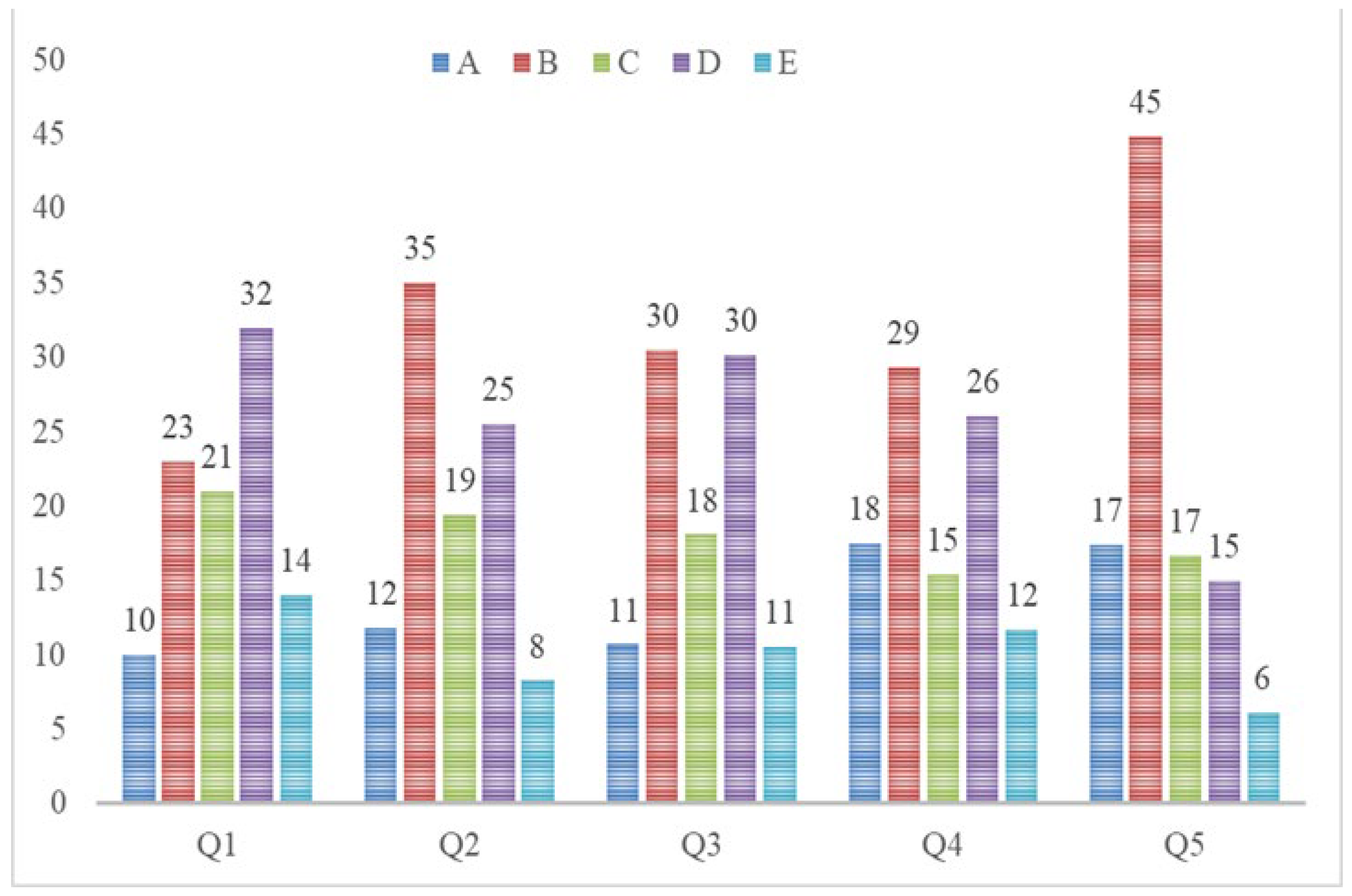
Figure 2.
Students' responses in percentage for Q6 to Q10.
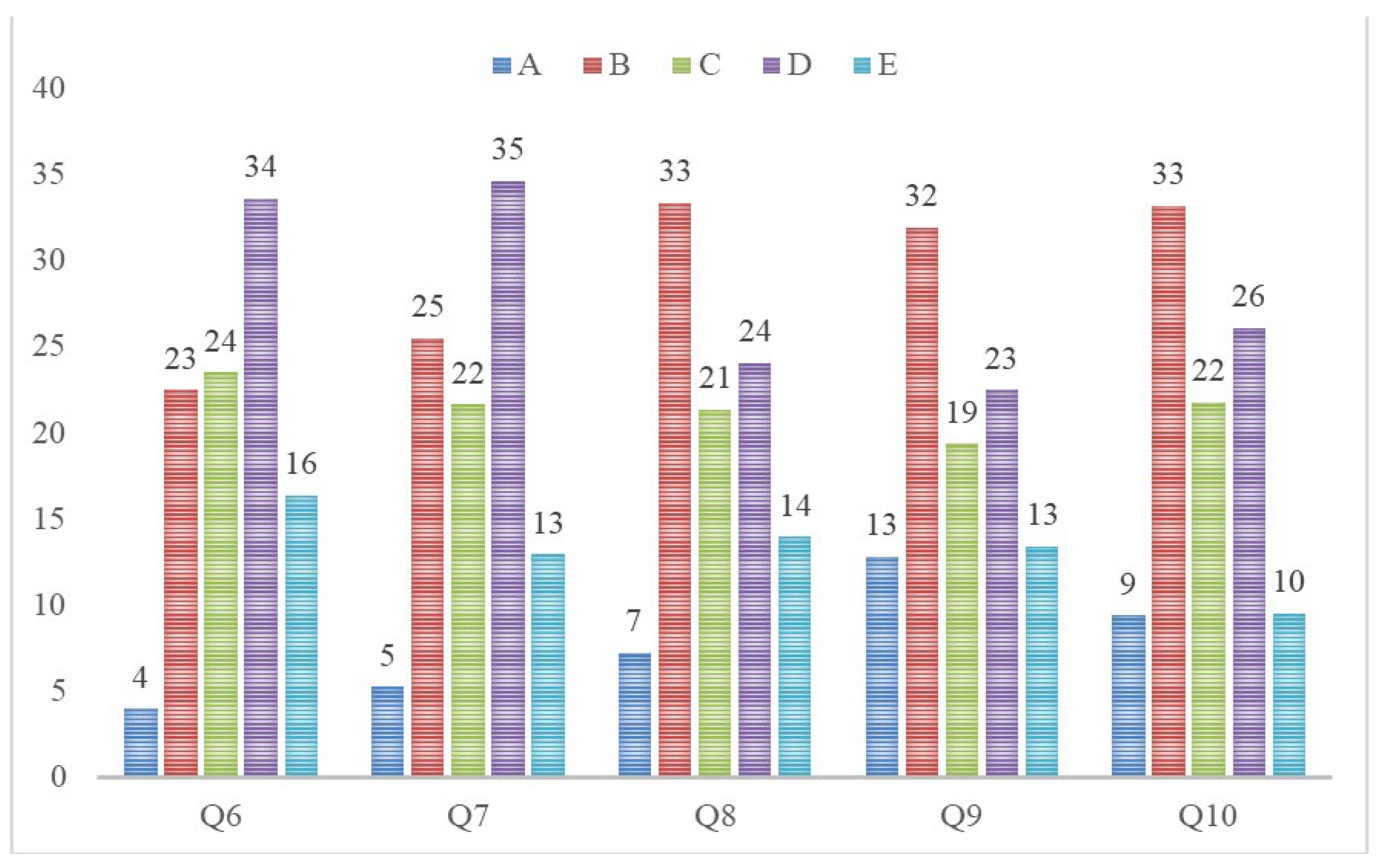
Table 1.
Statistical comparison between male and female anxiety levels.
| Male | Female | df = 700 | |||
| N = 482 | N = 220 | ||||
| Items | Mean | SD | Mean | SD | p-value |
| 1 | 3.122 | 1.222 | 3.282 | 1.202 | 0.1062 |
| 2 | 2.811 | 1.161 | 2.882 | 1.211 | 0.4587 |
| 3 | 2.929 | 1.197 | 3.136 | 1.220 | 0.0350* |
| 4 | 2.803 | 1.304 | 2.955 | 1.303 | 0.1523 |
| 5 | 2.465 | 1.122 | 2.500 | 1.133 | 0.7024 |
| 6 | 3.384 | 1.132 | 3.305 | 1.087 | 0.3855 |
| 7 | 3.210 | 1.142 | 3.323 | 1.094 | 0.2183 |
| 8 | 3.012 | 1.187 | 3.105 | 1.206 | 0.3383 |
| 9 | 2.954 | 1.276 | 2.836 | 1.224 | 0.2501 |
| 10 | 2.944 | 1.182 | 2.905 | 1.116 | 0.6800 |
*p<0.05, **p<0.01, ***p<0.001.
Table 2.
Statistical comparison between Mathematics major and minor students.
| Major | Minor | df = 700 | |||
| N = 384 | N = 318 | ||||
| Items | Mean | SD | Mean | SD | p-value |
| 1 | 3.335 | 1.205 | 2.997 | 1.214 | 0.0002*** |
| 2 | 2.963 | 1.176 | 2.695 | 1.167 | 0.0027** |
| 3 | 3.170 | 1.199 | 2.802 | 1.195 | 0.0001*** |
| 4 | 3.068 | 1.327 | 2.607 | 1.241 | <0.0001*** |
| 5 | 2.581 | 1.134 | 2.365 | 1.109 | 0.0111* |
| 6 | 3.419 | 1.099 | 3.308 | 1.143 | 0.1913 |
| 7 | 3.322 | 1.117 | 3.173 | 1.142 | 0.0823 |
| 8 | 3.105 | 1.198 | 2.984 | 1.190 | 0.1819 |
| 9 | 2.963 | 1.303 | 2.881 | 1.212 | 0.3920 |
| 10 | 2.961 | 1.141 | 2.915 | 1.190 | 0.6022 |
*p<0.05, **p<0.01, ***p<0.001.
Disclaimer/Publisher’s Note: The statements, opinions and data contained in all publications are solely those of the individual author(s) and contributor(s) and not of MDPI and/or the editor(s). MDPI and/or the editor(s) disclaim responsibility for any injury to people or property resulting from any ideas, methods, instructions or products referred to in the content. |
© 2024 by the authors. Licensee MDPI, Basel, Switzerland. This article is an open access article distributed under the terms and conditions of the Creative Commons Attribution (CC BY) license (http://creativecommons.org/licenses/by/4.0/).
Copyright: This open access article is published under a Creative Commons CC BY 4.0 license, which permit the free download, distribution, and reuse, provided that the author and preprint are cited in any reuse.


