

Submitted:
18 December 2024
Posted:
19 December 2024
You are already at the latest version
Abstract
In recent years, there has been an increase in awareness regarding the sustainable use of water across various industries, including the gastronomic sector. Therefore, the objective of this study was to determine the impact of corporate social responsibility on environmental awareness, moral commitment, corporate image, and the intention of gastronomic SMEs to make proper use of water. To achieve this, 354 surveys were conducted with restaurant entrepreneurs in Santiago, Chile, and a PLS-SEM model was applied for data analysis. Among the results, it is noteworthy that social responsibility had a greater effect on ecological awareness as well as on the intention to care for water. These findings reflect the importance of water conservation by entrepreneurs and their employees, as they are more directly involved in managing this resource.
Keywords:
SMEs
; sustainable use of water
; consumer economy
; ecological conscience
1. Introduction
Today, companies emphasize the importance of adopting some or all of the Sustainable Development Goals (SDGs) from the 2030 Agenda, structured into 169 targets and 231 indicators established in 2015 (Munasinghe, 2012; Wu et al., 2021). This agenda promotes, over the next seven years, efforts across three strategic pillars: economic growth and development, social development, and the care and development of natural resources. Member States of the United Nations have firmly expressed their commitment to working strategically and adopting a transformative approach to the goals, abandoning old practices where some nations provided aid while others received it conditionally. Instead, the focus is on creating development opportunities that involve all countries.
For this research, attention is directed toward SDG 6, which aims to ensure the availability and sustainable management of water and sanitation for all. Companies play a critical role in this regard, as they must responsibly manage water resources used in the creation, production, and distribution of their goods and services. They are also expected to promote and facilitate improved water management across their value chains and invest in education and innovation on this subject (Wu et al., 2021).
There is a pressing issue with the proper management of water resources. Global researchers reflect on the relationship between water usage and sustainability, highlighting it as a current ethical challenge. Water is a finite resource, essential for human life and ecosystem functioning, making it a fundamental bioethical and abiotic value (García-Novo, 2012).
Therefore, this study aims to determine how corporate social responsibility (CSR) impacts environmental awareness, moral commitment, and corporate image among gastronomic SMEs, as well as their water use practices. The research offers significant contributions to academics, professionals, and policymakers. Furthermore, it evaluates the positive effects of water use in Chilean restaurant SMEs—a country already experiencing a water crisis that urgently demands solutions for better water resource management (Garreaud et al., 2020). No prior studies have examined the constructs presented together within a theoretical model or explored the relationships among these dimensions.
The research is structured as follows: an overview of the current situation of SMEs in Chile, a literature review supporting the formulated hypotheses detailing each studied construct and its relationships with other dimensions, a methodological analysis through a quantitative study, key results, and finally, conclusions, discussions, and future research directions for interested stakeholders.
2. Contextual Framework
According to the World Resources Institute study from the United Nations Global Compact (2021), 17 out of 164 countries, which together account for a quarter of the world’s population, face water stress. Part of the Latin American continent ranks in medium-high, medium-low, and low categories, while areas with extremely high water stress occur when water demand exceeds available supply (Ferasso et al., 2021; Muñiz, 2021). In this report, Chile ranks 18th globally under the category of “high water stress,” making it the most water-stressed country in Latin America. The report also highlights that the situation is particularly critical in specific areas, such as the Metropolitan and Atacama regions, where water availability is severely limited, and demand continues to rise due to population and economic growth.
Chile has experienced an uninterrupted and severe drought since 2010, with average rainfall deficits of 20–40% (Dirección General de Aguas, 2022). This megadrought affects a vast area, particularly in the central region, causing negative impacts on water availability, vegetation, and an increase in forest fires, which have led to significant social and economic repercussions (Garreaud et al., 2020). Moreover, water use issues in this region stem from decades of low environmental awareness and poorly managed moral commitment, resulting in legal appropriation challenges, inefficient management, overexploitation, and contamination of freshwater and groundwater reserves. These factors have exacerbated water stress and degraded water-related ecosystems, further affecting human health, economic activities, and the supply of food and energy (Franchini & Evangelista, 2022).
Regarding sustainable water use, a study conducted between 2018 and 2022 by the Sustainability and Climate Change Agency and the Ecology and Development Foundation (2022) in Chile’s Metropolitan Region revealed that a bar or restaurant can consume 130 liters per seat per day, while a café can consume 500 liters per table per day, and a restaurant 145 liters per seat per day. The gastronomy industry in the Metropolitan Region uses approximately 30 liters of water per customer on average. Currently, there are 8,500 food establishments in Santiago, representing a 13.3% growth compared to the previous year when the figure stood at 7,500.
In terms of types of cuisine, fast food dominates with 24.4%, followed by sandwich-specialized venues at 23.6%. Other significant categories include homemade food (15%), cafés (13%), sushi/Chinese cuisine (15%), and other international gastronomy, which accounts for 10% of all establishments (Zomato Gastronomic Network, 2022).
2.1. Corporate Social Responsibility (CSR)
According to the literature, CSR involves issues related to legal compliance, corporate governance, community, workers’ rights, environmental suitability, welfare practices, philanthropy, and market relations by companies (Jabeen et al., 2023; Pfajfar et al., 2022). It is important to note that CSR has developed with the purpose of encouraging companies to consider environmental and sustainability issues, bringing them closer to the Circular Economy (CE) approach, which is based on the reuse and renewal of materials or products to continue production sustainably or in an environmentally respectful way. It also relies on the principles of reducing, reusing, and recycling (3R) (Jabeen et al., 2023).
According to Kim (2023), companies that apply CSR are positively valued by their customers and, in turn, significantly impact their attitudes and intentions regarding sustainable behaviors. Likewise, CSR influences companies’ image significantly, as customers value companies committed to CSR (Kim, 2023). Therefore, to predict specific behaviors related to environmental care, the NAM (Norm Activation Model) proposed by Schwartz (1977) was used. This model is applied because it assumes that humans are rational beings, not solely guided by individual internal norms (Y. H. Kim, 2023; H.-H. Park et al., 2017), and is used when the research focuses on predicting behaviors related to the psychological state, as presented in this research.
2.2. CSR and the Intention for Sustainable Water Use
Regarding behavioral intention, previous studies mention that intention is related to people’s actual behavior (Müller-Pérez, Garza-Muñiz, et al., 2022). Regarding sustainability intentions, it plays a key role in predicting sustainable behaviors (Patak, Branska & Pecinova, 2021). In fact, Tao, Lin, and Khan (2022) mention that when a company communicates its CSR activities to customers, they show more intention to engage in pro-environmental behavior. Likewise, Han et al. (2020) state that CSR actions contribute significantly to improving a company’s reputation, leading customers to have better attitudes and showing an intention to support environmental activities. In this literary context, CSR can be seen as a set of company policies and practices that go beyond legal requirements or profit motives (Abad-Segura, Cortés-García, & Belmonte-Ureña, 2019). It is also considered essential for SMEs in the gastronomic sector to meet environmental and social demands and improve their competitiveness (Ali et al., 2022; Sarkar & Searcy, 2016). Based on this, the following hypothesis is derived:
H1:
Corporate social responsibility has a positive effect on the intention for sustainable water use in gastronomic SMEs.
2.3. CSR and Environmental Awareness
Regarding CSR and its relationship with environmental awareness, this has often been misunderstood, as environmental awareness is focused on a macro level compared to CSR, which focuses at the industry level (Dyllick & Muff, 2016; Tao et al., 2022). In fact, environmental awareness is the knowledge a person has about environmental issues (Müller-Pérez et al., 2022). Tao et al. (2022) demonstrated that CSR was significantly related to business awareness in Taiwan. Similarly, Newton et al. (2015) stated that environmental awareness has a positive impact on the relationship between external ecological rankings and corporate awareness of sustainability. Therefore, the following hypothesis is derived:
H2:
CSR has a positive effect on environmental awareness in gastronomic SMEs.
2.4. CSR and Moral Commitment
According to Müller et al. (2021), moral commitment occurs when a person engages in a specific act and may feel either proud or guilty. As Ajzen (1991) mentions, a person may feel committed to acting in a certain way by taking actions in favor or against certain circumstances. Regarding CSR and its influence on moral commitment, it has been shown that promoting social and environmental behavior emphasizes the moral commitments of ethical consumers and appeals to their altruistic moral emotions to encourage ethical consumption (Hwang & Kim, 2018). Likewise, Golob et al. (2019) demonstrated a direct relationship between CSR and moral commitment to engaging in environmental care activities. Therefore, the following hypothesis is derived:
H3:
Corporate social responsibility has a positive effect on the moral commitment of gastronomic SMEs.
2.5. CSR and Corporate Image
According to Chen et al. (2021), corporate image is characterized by reactions to the amount of trust, confidence, concepts, and thoughts that communities have towards a corporation’s direction. Previous studies have shown that companies reflecting concern for the common good, especially for environmental care, enhance their corporate image in the market they aim to penetrate, as seen in Kim et al.’s (2017) study in the hospitality field. Similarly, a study by Chen et al. (2021) confirmed that CSR significantly impacts corporate image in Pakistan’s hotel industry. Likewise, Park, Lee, and Kim (2014) confirmed that socially responsible companies reflected a positive image to young consumers in South Korea. Therefore, the following hypothesis is derived:
H4:
CSR has a positive effect on the corporate image of gastronomic SMEs.
2.6. Environmental Awareness and Intention for Sustainable Water Use
Environmental awareness involves understanding that natural resources are finite and should be cared for and used responsibly and sustainably (Müller-Pérez et al., 2022). From a business perspective, this can include reducing energy and water consumption, managing waste properly, conserving biodiversity, and promoting sustainable practices in all aspects of the organization’s lifecycle (Heikkurinen, 2018). In fact, gastronomic SMEs hold significant responsibility to promote environmental awareness, by educating their employees on environmental issues and fostering a behavioral change toward more sustainable water practices, which, in turn, support sustainability and environmental conservation (González-Díaz et al., 2021). Therefore, the following hypothesis is derived:
H5:
Environmental awareness positively affects the intention for sustainable water use in gastronomic SMEs.
2.7. Moral Commitment and Intention for Sustainable Water Use
Currently, markets are seeking new ways to adopt more sustainable practices and new, more responsible approaches toward their stakeholders, both internally and externally. Business owners are increasingly aware of how their management practices impact their environment (Loukatos et al., 2022). Moral commitment refers to the moral obligation a person or organization feels to act ethically and responsibly (Jia et al., 2017). Furthermore, when companies have strong moral commitments to sustainability and CSR, they are more likely to adopt practices that reduce their environmental impact (Müller et al., 2021). In fact, gastronomic SMEs currently face moral commitment through the idea that all employees have an ethical responsibility to preserve and protect water as a vital natural resource (Kanchanapibul et al., 2014). Based on this, the following hypothesis is derived:
H6:
Moral commitment positively affects the intention for sustainable water use in gastronomic SMEs.
2.8. Corporate Image and Intention for Sustainable Water Use
Today, companies have strived to develop a sustainable corporate image to communicate in the global market, pressured by the community in which they operate (Luo & Qu, 2023). As a result, companies have had to increase their activities for environmental care, such as managing the water used in their operations (Saran & Shokouhyar 2023). Indeed, a study by Jabeen et al. (2023) showed that improving corporate image sustainably led to greater customer intention to participate in environmental protection activities in Pakistan. Similarly, Shah et al. (2020) found that a sustainable corporate image in fast-food restaurants increased customers’ intention to support activities for environmental care. Therefore, the following hypothesis is derived:
H7:
Corporate image positively and directly affects the intention for sustainable water use in gastronomic SMEs.
2.8. Environmental Awareness and Moral Commitment
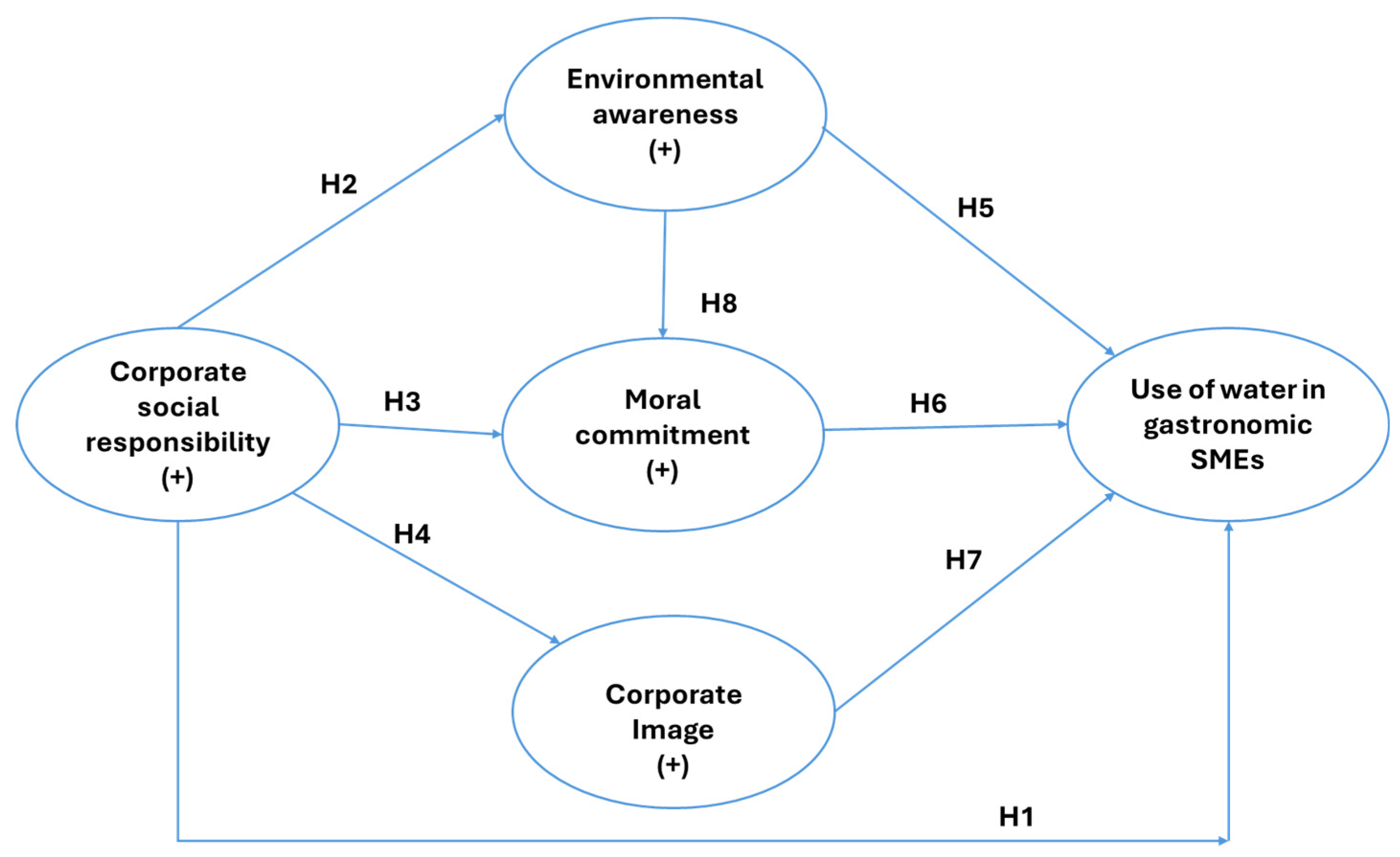
It is well known that business owners and managers with greater environmental awareness are more committed to adopting sustainable practices in their operations to reduce their environmental impact (Borgias, 2018). Additionally, moral commitment in the proper use of water is crucial because it goes beyond complying with environmental regulations and laws; it is an ethical commitment of the company to reduce its environmental impact and contribute to environmental conservation (Borgias, 2018; Thomas et al., 2022). Furthermore, moral commitment can have a positive impact on corporate culture and employee motivation, as Si et al. (2020) highlighted, indicating that employees working for an environmentally committed company may feel more motivated and proud of their work, which can improve their performance and retention (See Figure 1). Therefore, environmental awareness could be positively related to moral commitment in the proper use of water in gastronomic SMEs. Based on this, the following hypothesis is derived:
H8:
Environmental awareness is positively related to moral commitment in water use in gastronomic SMEs.
Figure 1.
Presents the study model along with the proposed hypotheses.
2. Materials and Methods
The research was conducted using a quantitative research approach, as it focuses on the idea of environmental awareness and moral commitment as a real necessity in gastronomic SMEs. A cross-sectional survey was conducted via email for Chilean gastronomic SMEs, which were contacted through organizations such as the Technical Cooperation Service (Sercotec) and Business Development Centers (CDN). These organizations reached out to business owners of gastronomic SMEs, allowing the researchers to establish contact with these organizations and subsequently send the survey to their members, obtaining a sample of 354 participants.
The sample consisted of employees from gastronomic SMEs located in the Metropolitan Region of Santiago, Chile. According to the National Institute of Statistics of Chile (INE), the latest available study from 2022 estimated that there were around 1.7 million companies in Chile, with more than 99% being SMEs. Regionally, according to the Confederation of Production and Commerce (CPC), approximately 40% of the country’s businesses are located in the Metropolitan Region of Santiago, most of which are SMEs. A large proportion of these are in the commerce sector, which includes the gastronomic industry.
Regarding the application of the instrument, it was sent via email to employees and included an informed consent form with an ethics committee code, indicating that by completing the questionnaire, they authorize the researchers to use their responses anonymously for this research (Balestrini & Gamble, 2006). Prior to data collection, conducted between March and June 2024, a pilot test was carried out in February 2024 with a sample of 90 employees to check the reliability and validity of the instrument.
The items were measured using a 5-point Likert scale, where 1 = strongly disagree and 5 = strongly agree. The variable of corporate social responsibility was measured based on Asif et al. (2018), Imani et al. (2021), and Jaiswal & Kant (2018). The corporate image variable was measured according to Chen et al. (2021). The environmental awareness variable was based on Chen et al. (2021) and Ruangkanjanases et al. (2020). The moral commitment variable was based on Kumar et al. (2020) and Si et al. (2020). Finally, the usage intention variable was based on Lowe, Lynch, and Lowe (2015), and Salem and Ertz (2023).
3. Results
3.1. Data Analysis
For the descriptive analysis of the employees, SPSS version 25 was used to understand their demographic data. Then, SMART PLS4 software was used to test the hypotheses described above. The validation of the measurement model was done through reliability and discriminant validity (Hair Jr. et al., 2019). Reliability was measured using Cronbach’s alpha, composite reliability (CR), and average variance extracted (AVE), with acceptable values considered >0.7 for Cronbach’s alpha, >0.7 for CR, and >0.5 for AVE (Hair Jr. et al., 2019). Discriminant validity was assessed by examining the extent to which a specific construct differs from others (Hair Jr. et al., 2019), using the Heterotrait-Monotrait ratio (HTMT < 0.90) (Henseler, Ringle & Sarstedt, 2015) due to its robustness (Sarstedt et al., 2022).
3.2. Demographic Data
The detailed demographic data of the participants are presented in Table 1. Regarding gender, 42.20% were male and 57.79% were female. As for age, 12% were between 18 and 22 years old, 17.9% between 23 and 27 years old, 10.5% between 28 and 32 years old, 12% between 33 and 37 years old, 9.2% between 38 and 42 years old, 10.7% between 43 and 47 years old, 9.4% between 48 and 52 years old, and 8.4% were older than 52 years. Regarding years worked in the gastronomic SME, 9.2% had been employed for less than 6 months, 18.4% for 6 months to 1 year, 30.4% for 1 to 2 years, and 32.2% for more than 2 years. Regarding position, 28.3% worked in the kitchen, 1.8% in cleaning, 0.5% were baristas, 15.8% were cashiers, 35.5% were waiters, 0.8% were waiters, and 6.1% were restaurant managers or supervisors (See Table 1).
3.3. Model Validation
Table 2 shows the results of reliability, convergent validity, and discriminant validity for the model. Regarding model measurement, this is done through factor loadings, Cronbach’s Alpha, composite reliability (CR), and average variance extracted (AVE) (Hair Jr. et al., 2019). The results show that all items in the model have a factor loading of 0.7 or higher, indicating high reliability of the indicators with their corresponding construct; however, the items CI2, CSR1, CSR5, and CSR7 were removed for not meeting the required loadings. As for Cronbach’s Alpha and the CR values, they also exceeded the suggested threshold of 0.70 (Hair et al., 2013). Regarding convergent validity, this was calculated through the average variance extracted (AVE), which should be above 0.5 to confirm the construct’s validity. Indeed, the AVE values for all constructs are above the 0.5 threshold (Hair et al., 2010) (See Table 2).
Regarding discriminant validity, this illustrates how indicators from different constructs correlate with each other, and is measured using the heterotrait-monotrait correlation (HTMT) ratio. According to Henseler et al. (2015), an HTMT value lower than 0.9 is considered a good indicator of discriminant validity. Table 3 shows that the values indicate that discriminant validity for the constructs is well established (See Table 3).
Subsequently, the relationship between the constructs was determined by applying the PLS bootstrapping algorithm with a full result, with a subsample of 5000, and a one-tailed t-test, with a significance level of 0.05%. Figure 2 shows the results of the structural model with the path coefficient (See Figure 2).
Furthermore, the multicollinearity factor was measured using the Variance Inflation Factor (VIF), which was lower than 5 (Hair Jr. et al., 2019; Kock, 2015), suggesting the absence of multicollinearity in the exogenous variables (see Table 4). Regarding the previous considerations, Table 4 shows the hypothesis testing results, where it can be observed that the variable that most affects the sustainable water usage intention was the role of corporate social responsibility (β= 0.422, p<.000), followed by environmental awareness (β= 0.200, p< 0.000), corporate image (β= 0.90, p<0.015), and, finally, moral commitment (β= 0.078, p<0.038). Therefore, hypotheses 1, 5, 6, and 7 were accepted. Regarding the impact of corporate social responsibility, the variable with the most significant impact was environmental awareness (β=0.657, p<0.000), followed by corporate image (β=0.275, p<0.000) and moral commitment (β=0.150, p<0.017), so hypotheses 2, 3, and 4 are accepted. Finally, the environmental awareness variable significantly affected moral commitment (β=0.178, p<0.009), so hypothesis 8 is accepted.
Based on the results presented above, the coefficient of determination (R²) for the variables corporate social responsibility, environmental awareness, corporate image, and moral commitment on the sustainable water usage intention was examined. The obtained R² was 0.406, which is sufficiently substantial (moderate to weak) to explain the variation in sustainable water usage intention by the variables corporate social responsibility, environmental awareness, corporate image, and moral commitment (Chin, 1998; Hair Jr. et al., 2019).
Regarding the effect of corporate social responsibility on environmental awareness, it was almost moderate (R²=0.432), while the effects on corporate image (R²=0.075) and moral commitment (R²=0.094) were weak (Hair Jr. et al., 2019) (See Table 4).
4. Discussion
In recent years, there has been an increase in awareness about the sustainable use of water across various industries, including the food industry. Small and medium-sized food enterprises (SMEs) can play an important role in water conservation and reducing environmental impact through efficient water use in their daily operations in the Metropolitan Region of Santiago, Chile. Therefore, the aim of this study is to determine the impact of corporate social responsibility (CSR) on environmental awareness, moral commitment, corporate image, and the intention of food SMEs to use water responsibly. Based on the results obtained, it was found that CSR had a significant effect on environmental awareness (β=.657), which in turn affected the intention of good water use (β=.422), corporate image (β=.275), and environmental awareness (β=.159).
These results confirm the role of CSR in sustainable activities, as employees are more likely to engage in environmentally friendly actions when the company demonstrates its commitment to the environment (Lee et al., 2016), and, therefore, express their intention to be part of these sustainable activities (Ahmad, 2019). Regarding the variables that significantly affected the intention to use water responsibly, as mentioned earlier, CSR had a significant impact, followed by environmental awareness (β=.200), corporate image (β=0.90), and, to a lesser extent, moral obligation (β=0.78). This aligns with what Müller-Pérez et al. (2022) mentioned, where they state that people who are aware of environmental problems will feel more committed to taking actions that improve the situation. Likewise, Shah et al. (2020) confirmed that a sustainable corporate image in fast food restaurants increased people’s intention to participate in environmental protection activities.
As for the theoretical and practical contributions of the study, it is noted as a reference for future studies on water conservation in various business contexts. Additionally, a predictive model is proposed that studies the impact of CSR on the intention to sustainably use natural resources and, in turn, how it affects other variables that have been previously studied in similar models to the one presented.
It is important to highlight that the study shows the willingness of employees in companies that employ CSR in their activities to perform more environmentally friendly actions, as long as the company carries out such activities ethically and responsibly. Furthermore, this study provides a theoretical foundation for further research on the behavior of entrepreneurs and their staff in activities that not only support environmental protection but also contribute to creating a corporate image that allows them to position themselves as socially sustainable companies.
5. Conclusions
This study has demonstrated the importance of Corporate Social Responsibility (CSR) in promoting sustainable practices, particularly in the efficient use of water within the gastronomic sector, specifically in small and medium-sized enterprises (SMEs) in the Metropolitan Region of Santiago, Chile. The results indicate that CSR has a significant impact on environmental awareness, moral commitment, and corporate image, which, in turn, influences the intention of SMEs to use water responsibly. These findings highlight the relevance of CSR policies as a driving force for change towards more sustainable practices in the business sector.
Future research could focus on several key areas to further explore the implications of CSR in the gastronomic sector. First, a geographical expansion of this study to other regions of Chile or even different countries would be essential to evaluate the applicability of these results in distinct cultural and economic contexts. Additionally, a longitudinal study could provide valuable insights into how CSR policies evolve over time and their long-term effects on water sustainability in SMEs. Further analysis could also target specific subsectors within the gastronomic industry, exploring the unique aspects of responsible water usage in each. Moreover, future studies could investigate consumer behavior, particularly how consumers perceive CSR policies and how these influence their purchasing decisions in the gastronomic context. Lastly, examining the impact of technology on sustainability, particularly the adoption of innovative solutions such as water recycling systems or water-saving technologies, could reveal how these tools enhance sustainable practices within SMEs.
5.1. Limitations of the Study
The study focused on SMEs in the Metropolitan Region of Santiago, Chile, so the results may not be generalizable to other regions or businesses of different sizes. The research used a quantitative approach with statistical models to analyze the data; however, a qualitative approach could offer deeper insights into the attitudes and motivations of entrepreneurs and employees regarding sustainability. Additionally, the self-reporting of companies on their CSR practices and water usage may be subject to biases, such as the desire to present a more favorable image to the researchers.
5.2. Implications of the Study
The results suggest that SMEs can benefit significantly from implementing CSR policies that promote responsible water use, which could improve not only their environmental sustainability but also their corporate image and employee motivation. Companies should recognize the value of raising awareness among their staff about the importance of sustainable practices, particularly regarding the efficient use of water. Education in this area can increase employees’ willingness to actively participate in environmental care initiatives. Furthermore, SMEs that implement sustainable water use practices can leverage their environmental commitment as a differentiator in their marketing strategy, improving their competitiveness in an increasingly sustainability-conscious market.
Supplementary Materials
The following supporting information can be downloaded at the website of this paper posted on Preprints.org.
Author Contributions
Conceptualization, Á.A-D; and J.M-P; methodology, Á.A-D; and J.M-P; software, Á.A-D; and J.M-P; validation, Á.A-D; J.M-P; R.A-B;E.C-V;M.F.-M; I.M.F; and I.Y.V.; formal analysis, Á.A-D; J.M-P; R.A-B;E.C-V;M.F.-M; I.M.F; and I.Y.V; investigation, Á.A-D; and J.M-P; resources, Á.A-D; J.M-P; R.A-B;E.C-V;M.F.-M; I.M.F; and I.Y.V.; data curation Á.A-D; J.M-P; R.A-B;E.C-V;M.F.-M; I.M.F; and I.Y.V.; writing—original draft preparation, Á.A-D; J.M-P; R.A-B;E.C-V;M.F.-M; I.M.F; and I.Y.V.; writing—review and editing, Á.A-D; J.M-P; R.A-B;E.C-V;M.F.-M; I.M.F; and I.Y.V.; visualization, Á.A-D; J.M-P; R.A-B;E.C-V;M.F.-M; I.M.F; and I.Y.V.; supervision, Á.A-D; and J.M-P; project administration, Á.A-D; and J.M-P; funding acquisition, Á.A-D. All authors have read and agreed to the published version of the manuscript.
Funding
This project is partially funded by the DIUA 2024 Project of the Universidad Autónoma de Chile.
Institutional Review Board Statement
This study was approved by the Ethics Committee of the Universidad de la Universidad Autónoma de Chile (protocol code Nº CEC 25-23).
Informed Consent Statement
This study was approved by the Ethics Committee of the Universidad de la Universidad Autónoma de Chile (protocol code Nº CEC 25-23).
Data Availability Statement
The data may be provided to interested readers by requesting the corresponding author via email.
Acknowledgments
Not applicable.
Conflicts of Interest
The authors declare no conflicts of interest.
References
- Abad-Segura, E., Cortés-García, F. J., & Belmonte-Ureña, L. J. (2019). The Sustainable Approach to Corporate Social Responsibility: A Global Analysis and Future Trends. Sustainability, 11(19), 5382. [CrossRef]
- Ahmad, T., Alvi, A., & Ittefaq, M. (2019). The Use of Social Media on Political Participation Among University Students: An Analysis of Survey Results From Rural Pakistan. SAGE Open, 9(3). [CrossRef]
- Ajzen, I. (1991). The Theory of Planned Behavior. Orgnizational Behavior and Human Decision Processes, 50, 179–211. [CrossRef]
- Ali, M., Ullah, S., Ahmad, M. S., Cheok, M. Y., & Alenezi, H. (2022). Assessing the impact of green consumption behavior and green purchase intention among millennials toward sustainable environment. Environmental Science and Pollution Research, 2019. [CrossRef]
- Asif, M., Xuhui, W., Nasiri, A., & Ayyub, S. (2018). Determinant factors influencing organic food purchase intention and the moderating role of awareness: A comparative analysis. Food Quality and Preference, 63, 144–150. [CrossRef]
- Balestrini, P., & Gamble, P. (2006). Country-of-origin effects on Chinese wine consumers. British Food Journal, 108(5), 396–412. [CrossRef]
- Borgias, S. L. (2018). “Subsidizing the State:” The political ecology and legal geography of social movements in Chilean water governance. Geoforum, 95, 87–101. [CrossRef]
- Chen, C. C., Khan, A., Hongsuchon, T., Ruangkanjanases, A., Chen, Y. T., Sivarak, O., & Chen, S. C. (2021). The role of corporate social responsibility and corporate image in times of crisis: The mediating role of customer trust. International Journal of Environmental Research and Public Health, 18(16). [CrossRef]
- Chen, S. C., Jong, D., Hsu, C. S., & Lin, C. H. (2021). Understanding Extended Theory of Planned Behavior to Access Backpackers’ Intention in Self-Service Travel Websites. Journal of Hospitality and Tourism Research, 1–27. [CrossRef]
- Chin, W. W. (1998). The Partial Least Squares Approach to Structural Modeling. Modern Methods for Business Research, 295(2), 295–336.
- Ferasso, M., Bares, L., Ogachi, D., & Blanco, M. (2021). Economic and Sustainability Inequalities and Water Consumption of European Union Countries. Water, 13(19), 2696. [CrossRef]
- Franchini, M., & Evangelista Mauad, A. C. (2022). La gobernanza ambiental global tras el Acuerdo de París y los ODS: crisis ambiental, pandemia y conflicto geopolítico sistémico. Desafíos, 34(1). [CrossRef]
- García Novo, F. (2012). Moral drought: The ethics of water use. Water Policy, 14(S1), 65–72. [CrossRef]
- Garreaud, R. D., Boisier, J. P., Rondanelli, R., Montecinos, A., Sepúlveda, H. H., & Veloso-Aguila, D. (2020). The Central Chile Mega Drought (2010–2018): A climate dynamics perspective. International Journal of Climatology, 40(1), 421–439. [CrossRef]
- Golob, U., Podnar, K., Koklič, M. K., & Zabkar, V. (2019). The importance of corporate social responsibility for responsible consumption: Exploring moral motivations of consumers. Corporate Social Responsibility and Environmental Management, 26(2), 416–423. [CrossRef]
- González-Díaz, R. R., Acevedo-Duque, Á., Salazar-Sepúlveda, G., & Castillo, D. (2021). Contributions of Subjective Well-Being and Good Living to the Contemporary Development of the Notion of Sustainable Human Development. Sustainability, 13(6), 3298. [CrossRef]
- Hair, J. F., Hult, G. T. M., Ringle, C. M., & Sarstedt, M. (2013). A Primer on Partial Least Squares Structural Equation Modeling (PLS-SEM). Thousand Oaks. In Sage.
- Hair, J. R., Black, W. C., Babin, B. J., & Anderson, R. E. (2010). Multivariante Data Analysis (Setima). Pearson Prentice Hall.
- Hair Jr., J. F., M. Hult, G. T., M. Ringle, C., Sarstedt, M., Castillo Apraiz, J., Cepeda Carrión, G. A., & Roldán, J. L. (2019). Manual de Partial Least Squares Structural Equation Modeling (PLS-SEM) (Segunda Edición). In Manual de Partial Least Squares Structural Equation Modeling (PLS-SEM) (Segunda Edición). OmniaScience. [CrossRef]
- Han, H., Chua, B., Ariza-Montes, A., & Untaru, E. (2020). Effect of environmental corporate social responsibility on green attitude and norm activation process for sustainable consumption: Airline versus restaurant. Corporate Social Responsibility and Environmental Management, 27(4), 1851–1864. [CrossRef]
- Heikkurinen, P. (2018). Strategic corporate responsibility: a theory review and synthesis. Journal of Global Responsibility, 9(4), 388–414. [CrossRef]
- Henseler, J., Ringle, C. M., & Sarstedt, M. (2015). A new criterion for assessing discriminant validity in variance-based structural equation modeling. Journal of the Academy of Marketing Science, 43(1), 115–135. [CrossRef]
- Hwang, K., & Kim, H. (2018). Are Ethical Consumers Happy? Effects of Ethical Consumers’ Motivations Based on Empathy Versus Self-orientation on Their Happiness. Journal of Business Ethics, 151(2), 579–598. [CrossRef]
- Imani, B., Allahyari, M. S., Bondori, A., Surujlal, J., & Sawicka, B. (2021). Determinants of organic food purchases intention: The application of an extended theory of planned behaviour. Future of Food: Journal on Food, Agriculture and Society, 9(1), 1–12. [CrossRef]
- Jabeen, R., Khan, K. U., Zain, F., & Atlas, F. (2023). Buy green only: Interplay between green marketing, corporate social responsibility and green purchase intention; the mediating role of green brand image. Business Strategy and Development, 6(3), 503–518. [CrossRef]
- Jaiswal, D., & Kant, R. (2018). Green purchasing behaviour: A conceptual framework and empirical investigation of Indian consumers. Journal of Retailing and Consumer Services, 41, 60–69. [CrossRef]
- Jia, F., Soucie, K., Alisat, S., Curtin, D., & Pratt, M. (2017). Are environmental issues moral issues? Moral identity in relation to protecting the natural world. Journal of Environmental Psychology, 52, 104–113. [CrossRef]
- Kanchanapibul, M., Lacka, E., Wang, X., & Chan, H. K. (2014). An empirical investigation of green purchase behaviour among the young generation. Journal of Cleaner Production, 66, 528–536. [CrossRef]
- Kim, H. L., Rhou, Y., Uysal, M., & Kwon, N. (2017). An examination of the links between corporate social responsibility (CSR) and its internal consequences. International Journal of Hospitality Management, 61, 26–34. [CrossRef]
- Kim, Y. H. (2023). A Study of the Integrated Model with Norm Activation Model and Theory of Planned Behavior: Applying the Green Hotel’s Corporate Social Responsibilities. Sustainability (Switzerland), 15(5). [CrossRef]
- Kock, N. (2015). Common Method Bias in PLS-SEM. International Journal of E-Collaboration, 11(4), 1–10. [CrossRef]
- Kumar, A., Huerta-Guerrero, C., López-Domínguez, E., Hernández- Velázquez, Y., Domínguez-Isidro, S., Cueto-García, A., De-La-Calleja, J., Medina-Nieto, M. A., Kamal, M., Aljohani, A., Alanazi, E., Elahi, B., Tokaldany, S. A., Zhang, C., Zheng, X., Sharma, G. D., Thomas, A., Paul, J., Gupta, D., … Diaconescu, M. (2020). Some considerations regarding the new trends in marketing approaches. ArXiv, 5(1), 100342. [CrossRef]
- Lee, K., Conklin, M., Bordi, P., & Cranage, D. (2016). Restaurants’ healthy eating initiatives for children increase parents’ perceptions of CSR, empowerment, and visit intentions. International Journal of Hospitality Management, 59, 60–71. [CrossRef]
- Loukatos, D., Androulidakis, N., Arvanitis, K. G., Peppas, K. P., & Chondrogiannis, E. (2022). Using Open Tools to Transform Retired Equipment into Powerful Engineering Education Instruments: A Smart Agri-IoT Control Example. Electronics, 11(6), 855. [CrossRef]
- Lowe, B., Lynch, D., & Lowe, J. (2015). Reducing household water consumption: a social marketing approach. Journal of Marketing Management, 31(3–4), 378–408. [CrossRef]
- Luo, H., & Qu, X. (2023). Impact of environmental CSR on firm’s environmental performance, mediating role of corporate image and pro-environmental behavior. Current Psychology, 42(36), 32255–32269. [CrossRef]
- Müller-Pérez, J., Acevedo-Duque, Á., Llanos-Herrera, G. R., García-Salirrosas, E. E., Ovalles-Toledo, L. V., Sandoval Barraza, L. A., & Álvarez-Becerra, R. (2022). The Mexican Ecological Conscience: A Predictive Model. Sustainability, 14(12), 7050. [CrossRef]
- Müller-Pérez, J., Garza-Muñiz, V. S., Acevedo-Duque, Á., García-Salirrosas, E. E., Esponda-Pérez, J. A., & Álvarez-Becerra, R. (2022). The Future of Tamaulipas MSMEs after COVID-19: Intention to Adopt Inbound Marketing Tools. Sustainability (Switzerland), 14(19), 1–18. [CrossRef]
- Müller, J., Acevedo-Duque, Á., Müller, S., Kalia, P., & Mehmood, K. (2021). Predictive Sustainability Model Based on the Theory of Planned Behavior Incorporating Ecological Conscience and Moral Obligation. Sustainability, 13(8), 4248. [CrossRef]
- Munasinghe, M. (2012). Millennium Consumption Goals (MCGs) for R io+20 and beyond: A practical step towards global sustainability. Natural Resources Forum, 36(3), 202–212. [CrossRef]
- Muñiz Martínez, C. (2021). La responsabilidad social corporativa (RSC), el Pacto Mundial de las Naciones Unidas y análisis práctico sobre la contribución de diferentes organizaciones a los Objetivos de Desarrollo Sostenible (ODS)= Corporate social responsibility (CSR). The United Nations Global Compact and Practical Analysis on the Contribution of Different Organizations to the Sustainable Development Goals (SDGS).
- Newton, J. D., Tsarenko, Y., Ferraro, C., & Sands, S. (2015). Environmental concern and environmental purchase intentions: The mediating role of learning strategy. Journal of Business Research, 68(9), 1974–1981. [CrossRef]
- Park, H.-H., Shin, G.-C., & Lew, Y. K. (2017). An Application of the Norm Activation Model to Fair Trade Product Purchase Decision-Making Process: The Moderating Impact of Cultural Cluster. International Business Journal, 28(4), 45–75. [CrossRef]
- Park, J., Lee, H., & Kim, C. (2014). Corporate social responsibilities, consumer trust and corporate reputation: South Korean consumers’ perspectives. Journal of Business Research, 67(3), 295–302. [CrossRef]
- Patak, M., Branska, L., & Pecinova, Z. (2021). Consumer Intention to Purchase Green Consumer Chemicals. Sustainability, 13(14), 7992. [CrossRef]
- Pfajfar, G., Shoham, A., Małecka, A., & Zalaznik, M. (2022). Value of corporate social responsibility for multiple stakeholders and social impact – Relationship marketing perspective. Journal of Business Research, 143, 46–61. [CrossRef]
- Ruangkanjanases, A., You, J. J., Chien, S. W., Ma, Y., Chen, S. C., & Chao, L. C. (2020). Elucidating the Effect of Antecedents on Consumers’ Green Purchase Intention: An Extension of the Theory of Planned Behavior. [CrossRef]
- Salem, M. Z., & Ertz, M. (2023). Water consumption rationalization using demarketing strategies in the Gaza Strip, Palestine. Water Resources and Economics, 43(1), 100227. [CrossRef]
- Saran, S. M., & Shokouhyar, S. (2023). Crossing the chasm between green corporate image and green corporate identity: a text mining, social media-based case study on automakers. Journal of Strategic Marketing, 31(1), 116–139. [CrossRef]
- Sarkar, S., & Searcy, C. (2016). Zeitgeist or chameleon? A quantitative analysis of CSR definitions. Journal of Cleaner Production, 135, 1423–1435. [CrossRef]
- Sarstedt, M., Hair, J. F., Pick, M., Liengaard, B. D., Radomir, L., & Ringle, C. M. (2022). Progress in partial least squares structural equation modeling use in marketing research in the last decade. Psychology & Marketing, 20(January), 277–320. [CrossRef]
- Schwartz, S. H. (1977). Normative Influences on Altruism. In Advances in Experimental Social Psychology (pp. 221–279). [CrossRef]
- Shah, S. H. H., Lei, S., Hussain, S. T., & Mariam, S. (2020). How consumer perceived ethicality influence repurchase intentions and word-of-mouth? A mediated moderation model. Asian Journal of Business Ethics, 9(1), 1–21. [CrossRef]
- Si, H., Shi, J., Tang, D., Wu, G., & Lan, J. (2020). Understanding intention and behavior toward sustainable usage of bike sharing by extending the theory of planned behavior. Resources, Conservation and Recycling, 152(October 2019), 104513. [CrossRef]
- Tao, Y. T., Lin, M. Der, & Khan, A. (2022). The impact of CSR on green purchase intention: Empirical evidence from the green building Industries in Taiwan. Frontiers in Psychology, 13(November), 1–15. [CrossRef]
- Thomas, I., Martin, A., Wicker, A., & Benoit, L. (2022). Understanding youths’ concerns about climate change: a binational qualitative study of ecological burden and resilience. Child and Adolescent Psychiatry and Mental Health, 16(1), 110. [CrossRef]
- Wu, S.-L., Chen, H., Wang, H.-L., Chen, X., Yang, H.-C., & Darling, S. B. (2021). Solar-driven evaporators for water treatment: challenges and opportunities. Environmental Science: Water Research & Technology, 7(1), 24–39. [CrossRef]
Figure 2.
Results of the structural model.
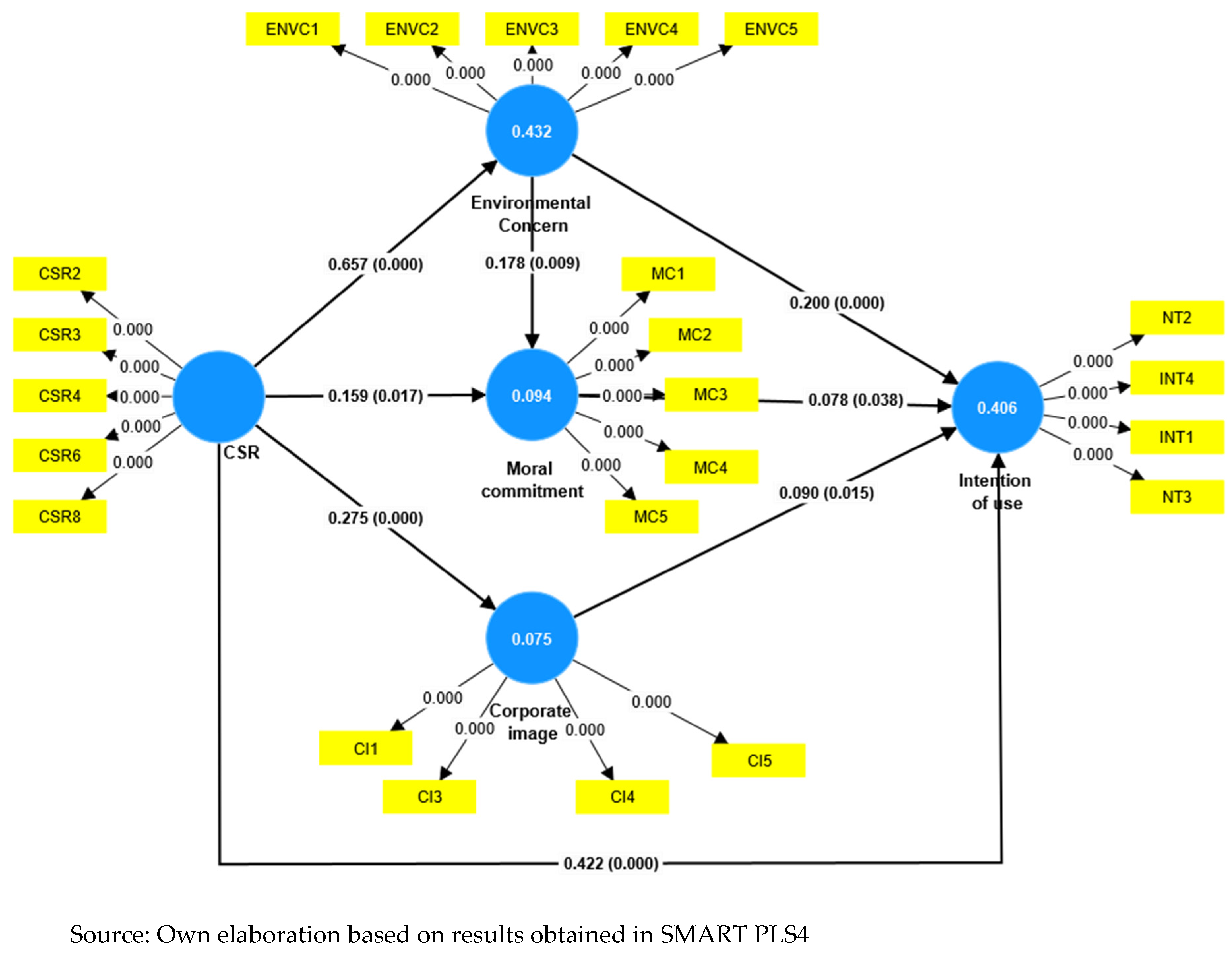

Table 1.
Respondent demographics.
| Variable | Frequency | Percentage |
| Sex | ||
| Man | 149 | 42.20 |
| Women | 204 | 57.79 |
| Age | ||
| 18 - 22 | 47 | 12.0 |
| 23 – 27 | 70 | 17.9 |
| 28 – 32 | 41 | 10.5 |
| 33 – 37 | 47 | 12.0 |
| 38 – 42 | 36 | 9.2 |
| 43 – 47 | 42 | 10.7 |
| 48 – 52 | 37 | 9.4 |
| Older than 52 | 33 | 8.4 |
| Time working | ||
| Less than 6 months | 36 | 9.2 |
| 6 months to 1 year | 72 | 18.4 |
| 1 to 2 years | 119 | 30.4 |
| More than 2 years | 126 | 32.2 |
| Job position | ||
| Kitchen | 111 | 28.3 |
| Toilet | 7 | 1.8 |
| Cafeteria | 2 | 0.5 |
| Barista | 5 | 1.3 |
| Cashier | 62 | 15.8 |
| Waiter | 139 | 35.5 |
| Dishwasher | 3 | 0.8 |
| Manager or supervisor | 24 | 6.1 |
Source: Own elaboration based on data analysis in SPSS version 25.
Table 2.
Model validation.
| Items | Charges >0.70 |
AVE >0.50 |
Cronbach’s Alpha | Composite reliability | Rho_A |
| Intention of sustainable water use | |||||
| INT1 INT2 INT3 INT4 |
0.821 0.844 0.887 0.889 |
0.741 | 0.883 | 0.919 | 0.886 |
| Moral commitment | |||||
| MC1 MC2 MC3 MC4 MC5 |
0.769 0.700 0.773 0.792 0.823 |
0.596 | 0.830 | 0.881 | 0.837 |
| Corporate image | |||||
| CI1 CI3 CI4 CI5 |
0.710 0.786 0.740 0.848 |
0.597 | 0.778 | 0.855 | 0.783 |
| Corporate social responsibility | |||||
| CSR2 CSR3 CSR4 CSR6 CSR8 |
0.776 0.856 0.826 0.784 0.723 |
0.631 | 0.853 | 0.895 | 0.859 |
| Environmental awareness | |||||
| ENVC1 ENVC2 ENVC3 ENVC4 ENVC5 |
0.773 0.745 0.731 0.788 0.825 |
0.598 | 0.831 | 0.881 | 0.833 |
Source: Own elaboration based on data analysis in SMART PLS4.
Table 3.
HTMT Criteria.
| INT | MC | ENVC | CI | CSR | |
| Intention to use | |||||
| Moral commitment | 0.319 | ||||
| Environmental awareness | 0.612 | 0.337 | |||
| Corporate image | 0.339 | 0.355 | 0.370 | ||
| CSR | 0.685 | 0.319 | 0.775 | 0.323 |
Source: Own elaboration based on data analysis in SMART PLS4.
Table 4.
Hypothesis Testing.
| Hipótesis | VIF | Path | p-valor | Resultado |
| CSR → INT | 1.798 | 0.422 | 0.000 | Se acepta |
| CSR → ENVC | 1.000 | 0.657 | 0.000 | Se acepta |
| CSR → MC | 1.760 | 0.159 | 0.017 | Se acepta |
| CSR → CI | 1.000 | 0.275 | 0.000 | Se acepta |
| ENVC → INT | 1.834 | 0.200 | 0.000 | Se acepta |
| MC → INT | 1.159 | 0.078 | 0.038 | Se acepta |
| CI → INT | 1.171 | 0.090 | 0.015 | Se acepta |
| ENVC → MC | 1.760 | 0.178 | 0.009 | Se acepta |
Source: Own elaboration based on data analysis in SMART PLS4.
Disclaimer/Publisher’s Note: The statements, opinions and data contained in all publications are solely those of the individual author(s) and contributor(s) and not of MDPI and/or the editor(s). MDPI and/or the editor(s) disclaim responsibility for any injury to people or property resulting from any ideas, methods, instructions or products referred to in the content. |
© 2024 by the authors. Licensee MDPI, Basel, Switzerland. This article is an open access article distributed under the terms and conditions of the Creative Commons Attribution (CC BY) license (https://creativecommons.org/licenses/by/4.0/).
Copyright: This open access article is published under a Creative Commons CC BY 4.0 license, which permit the free download, distribution, and reuse, provided that the author and preprint are cited in any reuse.


