

Submitted:
18 December 2024
Posted:
20 December 2024
You are already at the latest version
Abstract
The rapid growth in e-commerce calls for research on the potential of electric vehicles in improving last mile delivery. Whereas existing studies have examined aspects of last mile delivery, such as challenges, acceptance/ benefits, and feasibility, the studies are fragmented, with conflicting findings and regional differences. Thus, there is a need for a comprehensive understanding of the studies to map out current research trends and propose future research agendas. To address this research gap, a bibliometric review was conducted on 375 publications from the Scopus database. Findings reveal that pioneering countries like the USA have researched integrating electric vehicles into last mile delivery systems, focusing on technological advancements such as battery technologies and smart grids. The sustainability theme is common in most studies, focusing on controlling carbon emissions and energy efficiency. The electric micro-mobility theme has grown in recent years, while emerging technologies remain underexplored, especially in developing economies. Future research should address the underexplored areas. These include charging infrastructure, electric micro-mobility innovations, alongside the social and ethical implications of integrating emerging technologies into electric vehicles for last mile delivery.
Keywords:
electric vehicle
; last mile delivery
; bibliometric review
1. Introduction
Electronic commerce (e-commerce) allows people to order goods online without leaving home [1]. Globally, sales from e-commerce are projected to reach $8.034 trillion in 2027 from $5.784 trillion in 2023 [2], a 38.9% growth within four years. The rapid growth in global e-commerce sales is expected to continue, increasing the demand for last mile delivery. The last dispatch and delivery points define the last mile structure [3]. Thus, customers need transportation to receive the goods they order online. The vehicles used in last mile delivery can run on different power sources (i.e., either fossil, hybrid, or fossil-free) [4]. The last mile process is often the most polluting, inefficient, and expensive part of the supply chain [3], because it heavily relies on fossil-powered vehicles. This could be attributed to numerous challenges, including logistical challenges (such as sudden change of delivery routes and unoptimised routing), environmental challenges (e.g., greenhouse gas emissions, air and noise pollution), infrastructure challenges (for example, traffic congestion and insufficient parking places), operational challenges (such as vehicle maintenance), and delivery challenges (e.g., fast or many delivery options) [3]. Traffic concerns, high delivery costs, and unconducive local government by-laws are common last mile delivery challenges in developing economies such as Kenya [5]. Likewise, the increasing volume of goods, costly home delivery, pressure for tight delivery deadlines, ageing workforce (in developed economies), and sustainability were identified as the main challenges facing last mile delivery [6]. Similarly, environmental challenges such as negative externalities of urban congestion, high carbon emissions, habitat loss, noise, and air pollution are common in last mile delivery [7].
Due to their potential for environmental, economic, and operational benefits in last mile delivery, electric vehicles are increasingly becoming popular. An electric vehicle is any vehicle that uses electric or traction motors for its propulsion [8]. These include battery electric vehicles (BEVs), hybrid electric vehicles (HEVs), plug-in hybrid electric vehicles (PHEVs), fuel cell electric vehicles (FCEVs), and extended range electric vehicles (EREVs) [9,10,11]. BEVs run solely on electricity stored in rechargeable batteries, powered by an electric motor, and have no internal combustion engine (Barbosa et al., 2022; Ullah et al., 2023). PHEVs combine a conventional internal combustion engine with an electric motor and a rechargeable battery [9, 11]. HEVs use a conventional combustion engine and an electric motor to power the vehicle. The electric motor provides additional power when needed, e.g., during acceleration, and the internal combustion engine provides range and power for longer trips [9, 11]. FCEVs run on electricity generated by a fuel cell (i.e. using hydrogen as a fuel) to power an electric motor. They have a more extended driving range after recharging than BEVs [9, 11]. EREVs operate primarily on electricity stored in a battery, with an internal combustion engine kicking in when the battery is depleted to extend the driving range [9, 11]. Thus, a variety of electric vehicles can be used in last-mile delivery.
Sustainability concerns, such as greenhouse gas reduction, energy security and independence, resource conservation, air pollution reduction, and socioeconomic impacts, are key drivers of the adoption of electric vehicles [12, 13]. The potential economic impacts of electric vehicles include creating new manufacturing, maintenance, and charging infrastructure jobs. The potential social impacts of electric vehicles include improved air quality and reduced noise pollution [11, 13], contributing to better health outcomes and a higher quality of life [13]. Electric vehicles can also offer comfort and efficiency in operations not provided by gasoline vehicles [8]. Environmental impacts of electric vehicles relate to reduced greenhouse gas emissions and improved energy efficiency [10, 11]. Green vehicles (including electric vehicles) may contribute to the alleviation of problems such as environmental pollution, global warming, and oil dependency [14]. Due to being a clean and environmentally friendly mobility option, electric vehicles represent a promising alternative to conventional internal combustion engine vehicles [11, 15].
Whilst electric vehicles offer numerous benefits, the uptake is hindered by various limitations. These include infrastructure limitations (such as inadequate charging infrastructure and limited access to electricity), affordability (e.g., the high initial cost of electric vehicles, concerns related to battery replacement and maintenance costs), consumer behaviour and preferences (for example cultural factors), lack of comprehensive policies and regulations [15], especially in developing economies. Todorovic et al. [10] identified negative economic impacts of electric vehicles, such as high investments in infrastructure and car production, changes in the type of employment and business operations, and personal expenses for purchasing electric vehicles. Singh et al. [12] also noted that economic aspects of electric vehicles include the high total cost of ownership, high purchase costs, and low resale value of electric vehicles. With the advancement of electric mobility, critical materials used in electric vehicle batteries and electronic equipment tend to be scarce [16]. Disposing of electric vehicle batteries also poses significant environmental concerns due to toxic materials [17]. Operational barriers such as limited driving range and additional costs in training drivers have hindered the adoption of electric vehicles in last mile deliveries [18]. In Africa, the challenges confronting the adoption of electric vehicles include high upfront costs, poor grid systems, frequent blackouts, inadequate infrastructure (e.g. roads and charging systems), and dominance of conventional vehicles [19]. Anxieties related to limited driving range, risk of queueing at charging stations, payload restrictions, and unreliable grids affect the acceptance of electric vehicles in France and the United Kingdom (UK) [20]. In Italy, insufficient energy infrastructure, high cost of electric vehicles, and insufficient technological development of batteries are key issues discouraging the switch to electric vehicles for last mile delivery [21]. There are notable variations in infrastructure standards across different regions [10]. The authors noted a need for greater clarity concerning legal matters, inconsistent regulations, and liabilities associated with electric vehicles.
The preceding discussion shows a growing body of research on electric vehicles. Existing studies have addressed particular aspects of last mile delivery, such as challenges [18, 19], acceptance/ benefits [22], and feasibility [23]. However, there are conflicting findings and regional disparities. Thus, there is a need for a comprehensive study as the research is currently fragmented. In addition, as e-commerce grows and electric vehicle technology advances, a bibliometric review can reveal emerging trends supporting last mile delivery as well as identification of areas which require future research. A search in the Scopus database using keywords (Article title (“electric vehicle*”) AND (“last mile” OR “last-mile”) AND (“bibliometric”) did not find any studies directly matching the focus of this review. Thus, there is a need to investigate the current state of research and propose a future research agenda for electric vehicles in last mile delivery. This is meant to guide policy formulation and promote widespread adoption of electric vehicles in last mile delivery. The specific research questions are:
- What are the current trending themes in the study of electric vehicles in last mile delivery?
- What are the research gaps and proposed future research areas on electric vehicles in last mile delivery?
2. Materials and Methods
This review followed a bibliometric analysis to answer the research questions. Bibliometric analysis aims to quantify published studies on a specific topic, highlighting existing knowledge and the trends for new studies [16]. This approach was adopted to identify the topics of electric vehicles that received the most attention. This will offer insightful information to policymakers and researchers to guide future technological development in electric vehicles, implementation, and research to address last mile delivery challenges.
The main categories of bibliometric analysis are performance analysis, which accounts for the contributions of different research constituents, and science mapping, which focuses on relationships between research constituents [24]. Performance analysis techniques include the productivity of different research constituents such as authors, institutions, countries, and journals in a field. In contrast, science mapping techniques include citation, co-citation, co-word, and co-authorship analyses [24]. Thus, this review first presents performance analysis descriptives, followed by science mapping findings to visualise the relationships in the topic.
The required data was searched to conduct the bibliometric analysis, and appropriate data analysis techniques were applied to achieve the aims of the review. The search strategy involved the selection of appropriate keywords, database(s), and inclusion criteria. A search was done on the Scopus database on 14 October 2024 using a combination of the following keywords: (Article title, Abstract, Keywords ("electric vehicle*" OR “electric car*” OR “electric bike*” OR “electric scooter*” OR “electric rickshaw*” OR “electric automobile*” OR “electric truck*” OR “electric mobility” OR “electric micromobility” OR “EV” OR “BEV” OR “HEV” OR “PHEV” OR “FCEV” OR “EREV” OR “e-vehicle*” OR “e-car*” OR “e-bike*” OR “e-scooter*” OR “e-rickshaw*” OR “e-automobile*” OR “e-truck*” OR “e-mobility” OR “e-micromobility” OR ((“battery” OR “plug-in battery” OR “hybrid” OR “fuel cell” OR “extended range”) AND “electric vehicle*”)) AND ("last mile" OR "last-mile") AND (“delivery” OR “logistics” OR “distribution” OR “transport*”). The search was limited to journal articles, conference papers, review papers, and book chapters published in the English language between 2010 and 2024. The search provided a total of 434 publications. The Scopus database was used because it is considered among the largest databases of peer-reviewed scientific literature [25]. Even though the Scopus and the Web of Science databases index similar journals, the Scopus indexed 66.07% more unique journals than the Web of Science [26]. The 434 publications were manually inspected, and those that were not relevant to the topic, without titles or abstracts, were deleted. This reduced the number to 375 publications, which were then exported as a CSV Excel file for further analysis. The Bibliometrix package (specifically the Biblioshiny app) was used for performance analysis and science mapping. Performance analysis (quantitative measures representing authors, journals, and countries) was used to identify the scholars, sources, and countries that have contributed the most, as well as identify the dominant themes and trends used in the study of the topic. Science mapping (citation analysis, co-citation analysis, co-word analysis, and thematic mapping) helped to identify the dominant themes and trends used in the study of the topic. Table 1 provides the main information about the data. Even though the search was limited to publications between 2010 and 2024, it was noted that the first publication was in 2013, indicating that this is a young field. The average citations per publication is high (17.3), highlighting the research’s significant impact and relevance.
3. Results
This section provides a comprehensive description of the results obtained and their interpretation.
3.1. Performance analysis
Between 2013 and 2015, there was little research on the topic, with no more than ten publications done per year (Figure 1). This may be attributed to a few government incentives and policies (e.g., subsidies on electric vehicles), the slow growth in e-commerce, and most e-commerce companies relying on conventional delivery vehicles. There were incentive policies for revitalising the automobile industries between 2009 and 2011 [9]. From 2016, there was a double-digit publication growth, rising from 11 to 15 publications in 2019 (Figure 1). During this period, there were rising environmental concerns and regulatory pressures for green logistics. The adoption of the Sustainable Development Goals (SDGs) by the United Nations in 2015 is partly responsible for interest in electric vehicles during this period [12]. From 2020, there was a significant increase in publications, rising from 31 to a high of 80 publications in 2023 (Figure 1). However, a slight decline in publications in 2022 could be attributed to the impact of Coronavirus disease 2019 (Covid-19) disruptions on research outputs. In recent years, the growing interest in electric vehicles in last mile delivery can be attributed to technological advancements, increasing environmental concerns, and energy security [11]. Many governments have implemented policies to promote environmentally friendly and innovative transport technology to mitigate the climate change threat brought on by transport sector emissions and minimise dependence on other countries for oil [11]. Thus, the sharp increase in recent years can be attributed to conducive government incentives and policies, increasing environmental regulations (e.g., the Paris Agreement), technological advancements, and the rapid growth of e-commerce.
3.1.1. Most productive sources- journals
The top-ranked journal is Transport Research Part D: Transport and Environment, with 914 citations, an h-index of 13, and a g-index of 17 calculated from 2017 (Table 2), thus the most influential journal. The Sustainability journal is ranked second with 380 citations, an h-index of 9, and a g-index of 17, calculated from 2015 (Table 2). The two journals cover a broad range of topics. In contrast, the World Electric Vehicle Journal and the Transportation Research Part C: Emerging Technologies cover specialised research topics. The Transportation Research Part C: Emerging Technologies journal has five publications with 469 citations (Table 2), implying highly impactful studies. The journal focuses on specialised topics such as machine learning and artificial intelligence in electric vehicles. The European Journal of Operational Research is relatively new, starting its publication in 2022 with an m-index of 1.667 (Table 2), implying a few highly impactful studies. The studies focus on optimisation and modeling problems in last-mile delivery (route optimisation, and energy consumption modeling). The Energies journal and the Transportation Research Part A: Policy and Practice started publishing in 2020, each with a high m-index of 1.6 (Table 2), implying few high-impact studies despite being new.
SCImago ranks all the listed journals in different subject categories. Journals such as Sustainability, Energies, Journal of Transport Geography, Environmental Science and Technology, Sustainable Cities and Society, and the 2020 Forum on Integrated and Sustainable Transportation Systems cover sustainability subject. The Transportation Research Part C: Emerging Technologies, the Lecture Notes in Computer Science (Artificial Intelligence and Bioinformatics), the IEEE Access journal, and the 2021 International Conference on Models and Technologies for Intelligent Transportation Systems focus on technological innovations. The World Electric Vehicle Journal and the 2013 World Electric Vehicle Symposium and Exhibition focus on electric vehicles, while the European Journal of Operational Research focuses on operational research. The Transportation Research Part A: Policy and Practice, and the Case Studies on Transport Policy focus on policy and regulation. The journals focusing on operations and transportation cover issues such as routing problems, operational costs, and range anxiety resulting from electric vehicles. The journals focusing on sustainability cover issues like carbon emission control and improved energy efficiency. The journals focusing on technological innovations cover technological advancements in electric vehicles, such as routing algorithms, and battery technologies. Thus, the multidisciplinary approach is essential in considering all perspectives from different subject categories to understand electric vehicles fully. Combining insights from transportation, operational research, sustainability, and technological innovations can lead to more comprehensive and innovative electric vehicle solutions for last mile delivery. For instance, integrating operational research findings on route optimisation with battery technology from technological innovation journals would extend electric vehicle range and reduce delivery times.
3.1.2. Most productive authors
Table 1 shows 1 145 authors have contributed to research on the topic, with 18 (1.6%) being single authors. This suggests a collaborative research approach to the topic. The top three researchers (i.e., Andaloro L., Antonucci V., and Napoli G.) have the highest impact and productivity on the topic, each with five publications, 72 citations, a h-index of 4, and a g-index of 5 calculated from 2014 (Table 3). They have co-authored five publications focusing on infrastructure for smart cities (e.g., charging stations) and electric vehicle technological innovations (e.g., energy storage and battery technology). These are groundbreaking studies published in high-impact journals, likely to promote the uptake of electric vehicles in the last mile delivery. Emerging researchers (such as Hosseinzadeh A. and Kluger R.) have a high m-index of 0.75 and 202 citations from the three publications calculated from 2021 (Table 3), an indicator of groundbreaking studies. They have co-authored three studies focusing on the factors influencing the use of electric micro-mobility (the use of small, low-speed, electric-powered vehicles such as electric bikes and electric scooters) in last mile delivery. The most recent researcher is Kepaptsoglou K, who has a high m-index of 1.5 from the four publications calculated from 2023 (Table 3), an indicator of groundbreaking studies. The author focuses on using electric micro-mobility (e.g. e-bikes and e-scooters) in last mile delivery. Veteran researchers (such as Lebeau P., Macharis C., and Van Mierlo J.) each have 113 citations from the three publications, having started their publication in 2013 (Table 3), suggesting a sustained contribution and possibly more foundational work on electric vehicles in last mile delivery. They have co-authored three publications focusing on how electric vehicles affect delivery efficiency, environmental benefits, and operational performance compared to conventional vehicles.
3.1.3. Most productive countries
The top five countries based on the frequencies of scientific production (i.e., by corresponding authors) are the United States of America (USA (227), Germany (157), Italy (135), India (123), and China (103) (Table 4). The high ranking of the USA can be attributed to government policy pushing for electric vehicle adoption, which is expected to ensure that half of new passengers and trucks sold in the country have zero emissions by 2030 [27]. In China and the USA, the rapid expansion of e-commerce companies like JD.com, Alibaba, and Amazon are at the forefront of experimenting with new delivery vehicles such as electric vehicles. The high rankings of the USA and China relate to pioneering research on integrating electric vehicles into last mile delivery systems, focusing on technological advancements such as autonomous driving, battery technologies, and smart grid integration. Germany's and Italy's high rankings result from their automotive companies' contributions to the development of innovative electric vehicle technologies. Emerging markets like India’s ranking can be attributed to research aimed at overcoming local challenges and promoting electric vehicle adoption (mostly e-scooters). Brazil, an emerging economy, is ranked 16th (Table 4), with research focusing on electric vehicle technology adaptation and infrastructure development to address urban mobility and environmental challenges. No African country was among the top 20 most productive countries (Table 4), underscoring a significant regional disparity in scientific research. Thus, the leading countries have contributed substantially to research on electric vehicles in last mile delivery. This includes policy analysis, battery technology, and charging infrastructure. The emerging countries are addressing local challenges and opportunities related to electric vehicle adoption.
3.2. Science mapping
3.2.1. Co-authorship analysis
The USA has the highest collaboration rate, mainly with Canada, China, India, and European countries (Figure 2). The USA’s collaborations (specifically with India) focus on integrating electric vehicles (e.g. e-scooters) by evaluating challenges and barriers to their adoption. In Europe, the United Kingdom has the highest rate of collaboration with Sweden (Figure 2), showing intracontinental collaborations. In Asia, China has the highest collaboration rate, mainly with Australia and Korea (Figure 2). China’s collaborations with Australia focus on two-wheeled transport (e.g., e-bikes), green vehicle routing, and efficient e-scooter charging solutions. Africa has a low rate of collaboration (Figure 2). While Tunisia collaborates with Luxembourg, Morrocco collaborates with France. Studies in Nigeria explored challenges to adopting electric vehicles (e.g., scarce infrastructure, affordability issues, and unequal access to energy) and opportunities for renewable energy utilisation. Tunisia’s collaboration with Luxembourg explored the potential for modular electric vehicles to improve last mile delivery efficiency (e.g., by addressing challenges of limited battery capacity and optimising vehicle routing). Thus, the USA, China, India, and a few European countries dominate the research on electric vehicles in last mile delivery.
3.2.2. Co-citation analysis
Authors are split into several clusters, defined by the similarity of the research areas in which the author works [10]. Similarity in a research topic is measured by the frequency with which two publications are cited together [11]. Figure 3 shows three major themes: The main cluster (orange) led by Schneider M. (2014) forms the core of the network and is likely to be a foundational study in the topic. Schneider (2014) explores the theme of electric vehicle performance (i.e. the electric vehicle routing problem due to the limited battery capacities and vehicle freight capacities). The second cluster (red) includes Smith C.S. (2018) and Gossling S. (2020) exploring policy implications for the adoption of electric vehicles, e.g., infrastructure and dedicated parking. The third cluster (blue), led by Hardt C. (2019) and Gruber J. (2014), relates to the use of electric micro-mobility, e.g., e-scooters and e-bikes in last mile delivery. The connection between the red and blue clusters implies a need to make policy-driven decisions when using electric micro-mobility. The isolated cluster (green) led by Arnold F. (2018) and Melo S. (2017) relates to case studies. All the clusters are isolated from each other, an indicator of early phases of research on the topic. A more mature research topic looks at influences between topics, resulting in interconnected clusters.
3.2.3. Co-word analysis
The analysis identified 2 149 keywords plus on electric vehicles in last mile delivery publications (Table 1). The high number of keywords highlights the topic’s diverse range of research. In addition, Table 5 lists the top 50 most frequently used keywords. From the top 50 keywords, the four main themes include sustainability, technological innovations, operational efficiency, and electric micro-mobility. The operational efficiency of electric vehicles includes keywords like fleet operations, vehicle routing, optimisation, costs, travel time, and transport planning (Table 5). The performance of electric vehicles has a positive effect on the intention to buy the vehicles [11]. The theme of technological innovations includes keywords like secondary batteries, charging (batteries), integer programming, learning systems, routing algorithms, drones, autonomous vehicles, and automation (Table 5). Optimising routes using advanced routing algorithms and advances in battery technology is crucial for the widespread adoption of electric vehicles in last mile delivery. Many researchers have recently focused on developing advanced battery systems due to the high demand for alternative secondary batteries [9]. The sustainability theme includes keywords like energy utilisation, sustainable development, greenhouse gases, sustainability, energy efficiency, traffic congestion, carbon dioxide, emission control, environmental impact, energy management, and life cycle (Table 5). The uptake of electric vehicles in last mile delivery is often motivated by the aim to achieve Sustainable Development Goals by reducing greenhouse gas emissions, especially carbon dioxide, in urban areas. The theme of electric micro-mobility includes keywords such as micro-mobility, cycle transport, electric scooters (e-scooter), and electric bikes (Table 5). The electric micro-mobility alternatives are becoming common in last mile delivery over short distances in urban areas. Thus, co-word analysis shows that embracing electric vehicles for last mile delivery can help in operational efficiency and sustainable transportation in last mile delivery.
A word trend analysis was used to understand word growth over time. In the early stages (2013 to 2015), the words electric vehicle(s) and urban transportation were common (Figure 4), although the frequencies were relatively low. The words last mile and fleet operations were used from 2014 (Figure 4), although they did not report significant frequencies. During this period, interest in electric vehicles for last mile delivery was limited. Most e-commerce businesses relied on conventional delivery vehicles. The moderate growth period between 2016 and 2019 saw a moderate increase in the frequencies of the words electric vehicle(s), urban transportation, and last mile (Figure 4). The significant growth period between 2020 and 2023 saw the highest frequencies of the words electric vehicle(s) and last mile (Figure 4). Energy utilisation, vehicle routing, fleet operations, urban transportation, public transport, and bicycles also reported significant rise in frequencies (Figure 4). Thus, growth in words over time moved from broad (e.g. electric vehicles, last mile, and urban transport) to specific (energy utilisation, vehicle routing, and fleet operations).
3.2.4. Thematic mapping
Thematic mapping of published documents helps to discover themes in a field: motor, basic, emerging or declining, and niche themes [28]. Figure 5 shows motor themes (quadrant one), which are central and developed; basic themes (quadrant two), which are central but undeveloped; emerging or declining themes (quadrant three), which are peripheral and undeveloped; and niche themes (quadrant four), which are peripheral but developed [29, 30].
The motor theme (quadrant one) relates to electro-mobility (Figure 5), forming the foundation of discussions around electric vehicles. The keywords represented in this theme include electric vehicles and urban transportation. The finding might imply that electric vehicles are crucial in addressing urban transportation challenges. The basic theme (quadrant two) relates to electric micro-mobility (Figure 5), which is considered fundamental but has yet to mature. The keywords in the theme are bicycles, micromobility, cycle transport, urban transport, and public transport. Since the theme is relevant but underexplored, more research is required to fully exploit the potential of electric micro-mobility in urban areas for last mile delivery. The niche theme (quadrant four) relates to environmental sustainability (Figure 5) and is considered mature, i.e., well-established and still relevant. The keywords in the niche theme include greenhouse gases, emission control, and lifecycle. Emission control refers to decreasing greenhouse gas emissions, like carbon dioxide, contributing to climate change [12]. Todorovic et al. [10] noted that the main reasons for introducing electric vehicles are environmental factors, i.e., greenhouse gas emission reduction and targeting net zero emission. The high uptake of electric vehicles can potentially reduce environmental carbon footprint [11]. As such, electric vehicles offer an opportunity to control emissions and reduce carbon footprint. At the intersection of quadrant three (the emerging or declining theme) and quadrant two (the basic theme) are two themes: technological innovations (keywords such as secondary batteries and integer programming) and operational efficiency (keywords such as fleet operations, vehicle routing, and energy utilisation). As basic themes, there is potential for technological innovations to improve the operational efficiency of electric vehicles in last mile delivery. As emerging themes, the specific application of technological innovations such as integer programming and charging (batteries) might still be in the early stages. Limited driving range, reduced payload, uncertain battery lifespan, and long recharge waiting times are among the challenges of electric vehicle adoption in final parcel delivery [18].
3.2.5. Citation analysis
Citation analysis will help to identify the seminal publications on electric vehicles in last mile delivery. Table 6 presents the ten most cited publications on electric vehicles in last mile delivery. The most cited publication with 862 citations was by Schneider et al. [31], which focuses on electric vehicle-routing problems with time windows and recharging stations (i.e., an operational aspect of electric vehicles). The high total citations imply that this is a groundbreaking work on the topic, addressing the operational challenge of integrating electric vehicles in last mile delivery.
Publications in Table 6 show that the dominant theme is sustainability. Several publications in the list focus on the environmental benefits of electric vehicles and alternative delivery vehicles [34, 36]. The studies emphasise the potential of electric vehicles to reduce energy consumption and carbon emissions in last mile delivery. There is research interest in electric micro-mobility [32, 33, 35, 38], and autonomous vehicles [34, 36] in last mile delivery. The study by Campell et al. [32] has a high number of citations (346 citations) highlights the growing interest in electric micro-mobility in congested cities such as Beijing. The studies on electric micro-mobility focus on their potential in last mile delivery, safety concerns, and user behaviour. While Yang et al. [35] highlighted the need for e-scooter safety measures, such as the use of helmets, Saunders et al. [33] noted barriers to using e-scooters, such as traffic safety concerns and equipment unavailability. Autonomous vehicles like drones and robots have the potential to further reduce carbon emissions and energy consumption compared to electric vehicles [34, 36]. However, there is a lack of research on integrating emerging technologies (e.g., artificial intelligence, data analytics, and internet-of-things) in electric vehicle research for last mile delivery. Several studies also focus on users' acceptance of electric vehicles [32, 33, 38]. Distance, safety, price/ cost, environmental conditions, and perceived usefulness influence user acceptance of electric vehicles in last mile delivery. Thus, the topics tend to be broad (e.g., deliveries utilising air and ground autonomous vehicles, drone-based and ground-based parcel delivery services) or narrow (e.g., shared e-bikes and e-scooters). The publications show a theme on infrastructure and charging networks, which are required to support the adoption of electric vehicles in last mile delivery. Schneider et al. [31] indicated that the use of electric vehicles in last mile delivery requires careful route planning due to limited recharging stations. Hosseinzadeh et al. [39] stress integrating electric mobility into urban planning and land use examining spatial factors (such as commercial and industrial land use). The list of studies on the topic also shows the geographic diversity of studies, e.g., Beijing [32], the USA [33, 35, 39], the Netherlands [37, 40], and Poland [38]. This highlights the importance of context-specific electric vehicle solutions in last mile delivery.
4. Discussion
The rapid growth in e-commerce calls for urgent research on the potential of electric vehicles in transforming last mile delivery. Although some studies have addressed particular aspects of last mile delivery, such as challenges [18], acceptance [22], and feasibility [23], there is a need for a comprehensive study as the research is currently scattered. Performance analysis reveals that leading authors such as Andaloro L., Antonucci V., and Napoli G. have extensively researched electric vehicle technological innovations (such as energy storage and battery technology) and infrastructure for smart cities (e.g., charging stations). In contrast, emerging authors like Hosseinzadeh A. and Kluger R. have researched factors influencing the use of electric micro-mobility (e.g. electric bikes and electric scooters) in last mile delivery. The USA, Germany, Italy, India, and China are top-ranked scientific producers in the topic. This is reinforced by the country collaboration map, which shows considerable international input into research on the topic, especially from the USA and China. The USA and China have conducted pioneering research on integrating electric vehicles into last mile delivery systems, focusing on technological advancements such as autonomous driving, battery technologies, and smart grid integration. Among leading countries in electric vehicle research, the USA has contributed significantly to charging infrastructure, battery technology, environmental issues, and policy analysis [11, 12]. In contrast, little research from African countries highlights regional disparity in research contributions. The country collaboration analysis identified that Tunisia collaborates with global researchers, exploring the potential for modular electric vehicles to improve last mile delivery efficiency (e.g., by addressing challenges of limited battery capacity and optimising vehicle routing). The potential of modular vehicles might be overstated in African countries without considering other factors, such as economic feasibility and infrastructural limitations. Nigeria’s collaborations explored challenges to adopting electric vehicles (e.g., scarce infrastructure, affordability issues, and unequal access to energy) and opportunities for renewable energy utilisation. The collaborative approach emphasises the importance of teamwork and shared expertise across disciplines in advancing research. Ullah et al. [11] noted that collaborations can assist researchers in developing joint ventures and exchanging innovative technologies and ideas. Analysis of the top-ranked journals revealed that there is a broad range of journals, such as the Sustainability Journal and the Transport and Research Part D: Transport and Environment. The broad journals emphasise sustainability (e.g., environmental), technological innovations (e.g., electric vehicles), and operational (e.g., transportation) aspects. The specialised journals like the Transport Research Part C: Emerging Technologies and the World Electric Vehicle Journal explore areas like machine learning and artificial intelligence in electric vehicles. The newer journals, like the European Journal of Operational Research and Transportation Research Part A, explore areas like optimisation and policy solutions.
The critical themes used to study electric vehicles in last mile delivery were identified. Thematic mapping reveals that sustainability is critical in using electric vehicles in last mile delivery. Oe and Abdullah [41] agree that sustainability is a central theme in business initiatives and developing new ideas, innovations, and products (e.g., electric vehicles). Analysis of the top cited publications reinforces that electric vehicles are associated with environmental benefits such as reduced carbon emissions and energy consumption in last mile delivery [34, 36]. Electric micro-mobility is a common theme in the research on electric vehicles in last mile delivery. The role of micro-mobility might expand, especially in densely populated areas where the other types of electric vehicles are less efficient. For instance, analysis of the most cited publications highlights the growing interest in electric micro-mobility in congested cities such as Beijing [32]. The studies on electric micro-mobility focus on the potential to further reduce carbon emissions and energy consumption compared to electric vehicles. The co-word analysis reinforces the electric micro-mobility theme using keywords such as micro-mobility, cycle transport, electric scooters (e-scooters), and electric bikes. The electric micro-mobility alternatives are becoming common in last mile delivery over short distances in urban areas to address the growing sustainability concerns in last mile delivery. However, analysis of the most cited publications revealed a need for more research on integrating emerging technologies (e.g., data analytics, artificial intelligence, and internet-of-things) in the use of electric vehicles for last mile delivery. For instance, artificial intelligence can be used to optimise delivery routes through the use of real-time data on weather, traffic, and charging stations availability, resulting in efficiency in last mile delivery. The co-citation analysis revealed a foundational study on electric vehicle performance (i.e. the electric vehicle routing problem due to the limited battery capacities and vehicle freight capacities [31]. In addition, Smith (2018) and Gossling (2020) explored policy implications for adopting electric vehicles, e.g., infrastructure and dedicated parking.
Thematic mapping identified two central themes: electric micro-mobility and technological innovations. These are considered fundamental but yet-to-mature themes. Electric micro-mobility can reduce operational costs in last mile delivery compared to other electric vehicles. However, widespread adoption may be hindered by infrastructure limitations, limited battery life, and safety concerns for riders. Secondary batteries are one technological advancement that can significantly increase the operational efficiency of electric micromobility. Further analysis of the most cited publications revealed that distance, safety, price/ cost, environmental conditions, and perceived usefulness influence user acceptance of electric vehicles in last mile delivery [32, 38]. Therefore, it is necessary to intensify research efforts to overcome the economic, operational, technological, and infrastructural challenges to increase the uptake of electric vehicles in last mile delivery.
5. Conclusions
Notably, there is an increasing trend in research on electric vehicles in last mile delivery, a positive sign for the future of e-commerce. This could be attributed to the electric vehicles’ economic, environmental, and operational advantages. Research on electric vehicles in last mile delivery revolves around four themes, namely sustainability, electric micro-mobility, electric vehicle performance/ operational efficiency, and charging infrastructure/ technological innovations. The future research agenda will focus on addressing several research gaps relevant to these four themes.
- Developing economies, particularly in Africa, face unique last mile delivery challenges, yet little research originates from these countries. Future research in developing economies should focus on electric vehicle charging infrastructure and operational feasibility to support last mile delivery (e.g., energy grid capacity and location of charging stations). In addition, future research on charging infrastructure should focus on systemic challenges faced by developing countries. These include external shocks such as power blackouts, inadequate transport policies, lack of government support, and logistical inefficiencies.
- Although sustainability dominates research on electric vehicles in last mile delivery, more focus is on environmental issues, giving little attention to social and economic issues. Patella et al. [14] assert that sustainability includes environmental, economic, and social considerations in evaluating logistics configurations. The future research agenda will need to focus on integrating social issues into research on electric vehicles for last mile delivery. These may include safety, standards/ regulations, ethical and privacy concerns arising from using electric vehicles in last mile delivery. The future research agenda will also need to focus on integrating economic issues into research on electric vehicles in last mile delivery. These include analysing funding models for charging infrastructure, consumers’ willingness to pay for electric vehicle delivery options, potential for job creation, and the role of economic policies in promoting the uptake of electric vehicles in last mile delivery.
- While interest in electric micro-mobility is growing, particularly in congested cities, the focus remains on acceptance/ adoption. Electric micro-mobility (e.g., e-bikes and e-scooters) could support the penetration and acceptability of electric vehicles because they are considered a sustainable mobility option for city logistics [42]. Thus, future research should focus on underexplored areas like micro-mobility charging infrastructure, advancements in micro-mobility battery technologies, regulatory barriers, and safety concerns.
-
While technological advancements dominate research on electric vehicle performance in last mile delivery, little attention is given to emerging technologies (such as artificial intelligence, data analytics, and the internet-of-things). Future research should focus on how the use of electric vehicles can benefit from integrating these emerging technologies to improve last mile delivery. In addition, ethical issues such as perceived safety, data security, and privacy will be on the rise, and future research should explore these issues arising from using emerging technologies.The current review is limited to findings from publications extracted from the Scopus database. Other databases, such as Web of Science and Science Direct exist and should be considered for future research to include any publications that might have been missed. This review also focused on specific keywords for a meaningful analysis. Despite being relevant, future researchers can expand the search criteria to undertake a more comprehensive search as more innovations emerge in the electric vehicle industry. In agreement, Mogire et al. [43] concluded that electric vehicles are expected to continue evolving to support last mile delivery. Overall, this bibliometric review extends knowledge of the current state of research. It has provided a comprehensive understanding of the dominant themes used in current research on electric vehicles in last mile delivery. Thus, sustainability and technological advancements are the main drivers for the increased use of electric vehicles in last mile delivery. Managers should concentrate on investing in sustainable technological innovations such as electric micro-mobility and other emerging technologies to improve last mile delivery efficiency.
Author Contributions
Conceptualization, E.M., P.K. and R.L.; methodology, E.M., P.K. and R.L.; software, E.M.; validation, P.K. and R.L.; formal analysis, E.M.; investigation, E.M.; data curation, E.M.; writing— original draft preparation, E.M.; writing—review and editing, E.M., P.K. and R.L.; visualization, P.K. and R.L.; supervision, P.K. and R.L. All authors have read and agreed to the published version of the manuscript
Funding
This research received no external funding.
Institutional Review Board Statement
Not applicable.
Informed Consent Statement
Not applicable
Conflicts of Interest
The authors declare no conflict of interest.
References
- Lauenstein, S.; Schank, C. Design of a sustainable last mile in urban logistics—A systematic literature review. Sustainability 2022, 14, 5501. [Google Scholar] [CrossRef]
- eMarketer. Worldwide Ecommerce Forecast 2023. Available online: https://www.emarketer.com/content/worldwide-ecommerce-forecast-2023 (accessed on day month year).
- Ha, N.T.; Akbari, M.; Au, B. Last mile delivery in logistics and supply chain management: A bibliometric analysis and future directions. Benchmarking: An International Journal 2023, 30, 1137–1170. [Google Scholar] [CrossRef]
- Risberg, A.; Jafari, H. Last mile practices in e-commerce: framework development and empirical analysis of Swedish firms. Int. J. Retail Distrib. Manag. 2022, 50, 942–961. [Google Scholar] [CrossRef]
- Mogire, E.; Kilbourn, P.; Luke, R. The last mile delivery problem: a Kenyan retail perspective. Acta Logistica 2022, 9. [Google Scholar] [CrossRef]
- Boysen, N.; Fedtke, S.; Schwerdfeger, S. Last-mile delivery concepts: A survey from an operational research perspective. OR Spectrum 2021, 43, 1–58. [Google Scholar] [CrossRef]
- World Economic Forum. The Future of the Last-Mile Ecosystem. Available online: https://www.weforum.org/publications/the-future-of-the-last-mile-ecosystem/ (accessed on day month year).
- Ramirez Barreto, D.A.; Ochoa Guillermo, E.V.; Peña Rodriguez, A.; Cardenas Escorcia, Y.D.C. Bibliometric analysis of nearly a decade of research in electric vehicles: A dynamic approach. 2018.
- Barbosa, W.; Prado, T.; Batista, C.; Câmara, J.C.; Cerqueira, R.; Coelho, R.; Guarieiro, L. Electric vehicles: bibliometric analysis of the current state of the art and perspectives. Energies 2022, 15, 395. [Google Scholar] [CrossRef]
- Todorovic, M.; Aldakkhelallah, A.; Simic, M. Managing transitions to autonomous and electric vehicles: Scientometric and bibliometric review. World Electr. Veh. J. 2023, 14, 314. [Google Scholar] [CrossRef]
- Ullah, I.; Safdar, M.; Zheng, J.; Severino, A.; Jamal, A. Employing bibliometric analysis to identify the current state of the art and future prospects of electric vehicles. Energies 2023, 16, 2344. [Google Scholar] [CrossRef]
- Singh, V.; Singh, H.; Dhiman, B.; Kumar, N.; Singh, T. Analyzing bibliometric and thematic patterns in the transition to sustainable transportation: uncovering the influences on electric vehicle adoption. Research in Transportation Business & Management 2023, 50, 101033. [Google Scholar]
- Singh, G.; Misra, S.C.; Daultani, Y.; Singh, S. Electric vehicle adoption and sustainability: Insights from the bibliometric analysis, cluster analysis, and morphology analysis. Oper. Manag. Res. 2024, 17, 635–659. [Google Scholar] [CrossRef]
- Patella, S.M.; Grazieschi, G.; Gatta, V.; Marcucci, E.; Carrese, S. The adoption of green vehicles in last mile logistics: A systematic review. Sustainability 2020, 13, 6. [Google Scholar] [CrossRef]
- Purwanto, E.; Irawan, A.P. Bibliometric analysis of electric vehicle adoption research: trends, implications, and future directions," International Journal of Safety & Security Engineering 2023, 13.
- Soares, L.O.; Reis, A.d.C.; Vieira, P.S.; Hernandez-Callejo, L.; Boloy, R.A.M. Electric vehicle supply chain management: A bibliometric and systematic review. Energies 2023, 16, 1563. [Google Scholar] [CrossRef]
- Amusa, H.K.; Sadiq, M.; Alam, G.; Alam, R.; Siefan, A.; Ibrahim, H.; Raza, A.; Yildiz, B. Electric vehicle batteries waste management and recycling challenges: a comprehensive review of green technologies and future prospects. J. Mater. Cycles Waste Manag. 2024, 1–20. [Google Scholar] [CrossRef]
- Anosike, A.; Loomes, H.; Udokporo, C.K.; Garza-Reyes, J.A. Exploring the challenges of electric vehicle adoption in final mile parcel delivery. Int. J. Logist. Res. Appl. 2023, 26, 683–707. [Google Scholar] [CrossRef]
- Agyekum, E.B.; Adebayo, T.S.; Ampah, J.D.; Chakraborty, S.; Mehmood, U.; Nutakor, C. Transportation in Africa under Paris Agreement 2 C goal—a review of electric vehicle potentials, cleaner alternative fuels for the sector, challenges, and opportunities. Environ. Sci. Pollut. Res. 2023, 1–36. [Google Scholar] [CrossRef]
- Morganti, E.; Browne, M. Technical and operational obstacles to the adoption of electric vans in France and the UK: An operator perspective. Transp. Policy 2018, 63, 90–97. [Google Scholar] [CrossRef]
- Corti, F.; Nava, A. Investment in Greening Last-Mile Logistics: A Case Study. In Smart and Sustainable Planning for Cities and Regions: Results of SSPCR 2022. Switzerland, Cham: Springer Nature 2023, 7584.
- Alnıpak, S.; Toraman, Y. Acceptance of e-vehicles for last-mile parcel delivery from the perspective of drivers: A study in Turkiye. LogForum, 2023, 19.
- Wei, H.; Callegari, C.; Fiorini, A.C.O.; Schaeffer, R.; Szklo, A. Technical and economic modelling of last-mile transport: A case for Brazil. Case Stud. Transp. Policy 2024, 16, 101219. [Google Scholar] [CrossRef]
- Donthu, N.; Kumar, S.; Mukherjee, D.; Pandey, N.; Lim, W.M. How to conduct a bibliometric analysis: An overview and guidelines. J. Bus. Res. 2021, 133, 285–296. [Google Scholar] [CrossRef]
- Mohammad, W.A.; Nazih Diab, Y.; Elomri, A.; Triki, C. Innovative solutions in last mile delivery: Concepts, practices, challenges, and future directions. Supply Chain Forum: An International Journal 2023, 24, 151–169. [Google Scholar] [CrossRef]
- Singh, V.K.; Singh, P.; Karmakar, M.; Leta, J.; Mayr, P. The journal coverage of Web of Science, Scopus and Dimensions: A comparative analysis. Scientometrics 2021, 126, 5113–5142. [Google Scholar] [CrossRef]
- Locke, S.L. Household characteristics and electric vehicle adoption: changes from 2017 to 2022. Applied Economics Letters 2014, 1–4. [Google Scholar] [CrossRef]
- Luke, R.; Mageto, J. Impact of China's belt and road initiative on logistics management in Africa: a bibliometric analysis. Journal of International Logistics and Trade 2023, 21, 204–219. [Google Scholar] [CrossRef]
- Callon, M.; Courtial, J.P.; Laville, F. Co-word analysis as a tool for describing the network of interactions between basic and technological research: The case of polymer chemistry. Scientometrics 1991, 22, 155–205. [Google Scholar] [CrossRef]
- Mageto, J. Current and future trends of information technology and sustainability in logistics outsourcing. Sustainability 2022, 14, 7641. [Google Scholar] [CrossRef]
- Schneider, M.; Stenger, A.; Goeke, D. The electric vehicle routing problem with time windows and recharging stations. Transp. Sci. 2014, 48, 500–520. [Google Scholar] [CrossRef]
- Campbell, A.A.; Cherry, C.R.; Ryerson, M.S.; Yang, X. Factors influencing the choice of shared bicycles and shared electric bikes in Beijing. Transp. Res. Part C-Emerg. Technol. 2016, 67, 399–414. [Google Scholar] [CrossRef]
- Sanders, R.L.; Branion-Calles, M.; Nelson, T.A. To scoot or not to scoot: Findings from a recent survey about the benefits and barriers of using e-scooters for riders and non-riders. Transp. Res. Part A Policy Pract. 2020, 139, 217–220. [Google Scholar] [CrossRef]
- Figliozzi, M.A. Lifecycle modeling and assessment of unmanned aerial vehicles (drones) CO2 emissions. Transp. Res. Part D: Transp. Environ. 2017, 57, 251–261. [Google Scholar] [CrossRef]
- Yang, H.; Ma, Q.; Wang, Z.; Cai, Q.; Xie, K.; Yang, D. Safety of micro-mobility: analysis of e-scooter crashes by mining news reports. Accident Analysis & Prevention 2020, 143, 105608. [Google Scholar]
- Kirschstein, T. Comparison of energy demands of drone-based and ground-based parcel delivery services. Transp. Res. Part D: Transp. Environ. 2020, 78, 102209. [Google Scholar] [CrossRef]
- Scheltes, A.; de Almeida Correia, G.H. Exploring the use of automated vehicles as last mile connection of train trips through an agent-based simulation model: An application to Delft, Netherlands. International Journal of Transportation Science and Technology 2017, 6, 28–41. [Google Scholar] [CrossRef]
- Bieliński, T.; Ważna, A. Electric scooter sharing and bike sharing user behaviour and characteristics. Sustainability 2020, 12, 9640. [Google Scholar] [CrossRef]
- Hosseinzadeh, A.; Algomaiah, M.; Kluger, R.; Li, Z. E-scooters and sustainability: Investigating the relationship between the density of E-scooter trips and characteristics of sustainable urban development. Sustain. Cities Soc. 2021, 66, 102624. [Google Scholar] [CrossRef]
- Liang, X.; de Almeida Correia, G.H.; Van Arem, B. Optimizing the service area and trip selection of an electric automated taxi system used for the last mile of train trips. Transp. Res. Part E Logist. Transp. Rev. 2016, 93, 115–129. [Google Scholar] [CrossRef]
- Oe, H.; Abdullah, M.N. An exploratory discussion on electric cars and sustainable innovation. Economit Journal: Scientific Journal of Accountancy, Management and Finance 2022, 2, 174–181. [Google Scholar] [CrossRef]
- Castiglione, M.; Comi, A.; De Vincentis, R.; Dumitru, A.; Nigro, M. Delivering in urban areas: A probabilistic-behavioral approach for forecasting the use of electric micromobility. Sustainability 2022, 14, 9075. [Google Scholar] [CrossRef]
- Mogire, E.; Kilbourn, P.; Luke, R. Green innovations in last mile delivery for e-commerce: A bibliometric review. In the Proceedings of the 17th International Business Conference (IBC), Technopark, Stellenbosch, South Africa,22-25 September 2024.
Figure 1.
Number of publications on EVs in LMD research (2013 – 2024). Source: Authors’ own.
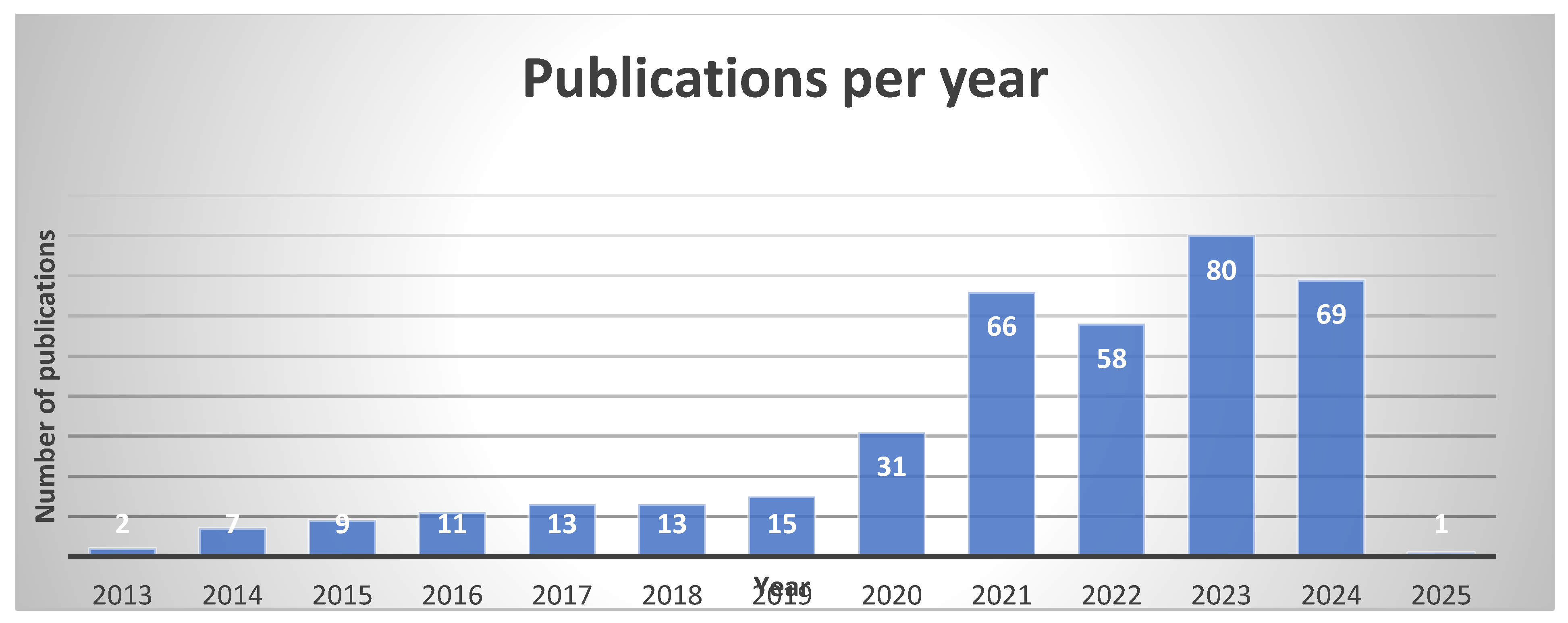
Figure 2.
Country collaborations map on EVs in LMD research (2013 – 2024). Source: Authors’ own
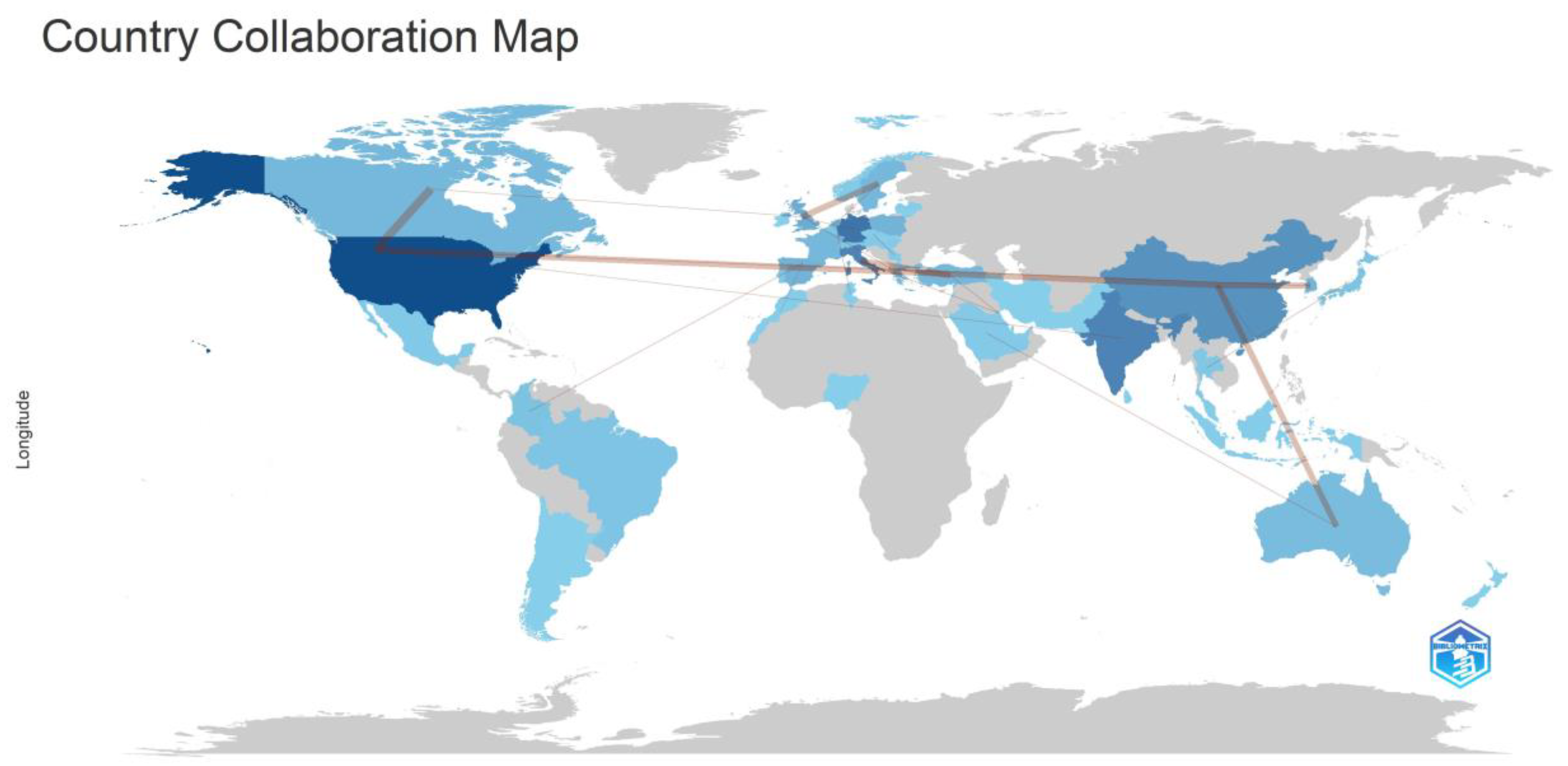
Figure 3.
Co-citation network on EVs in LMD research (2013 – 2024). Source: Authors’ own
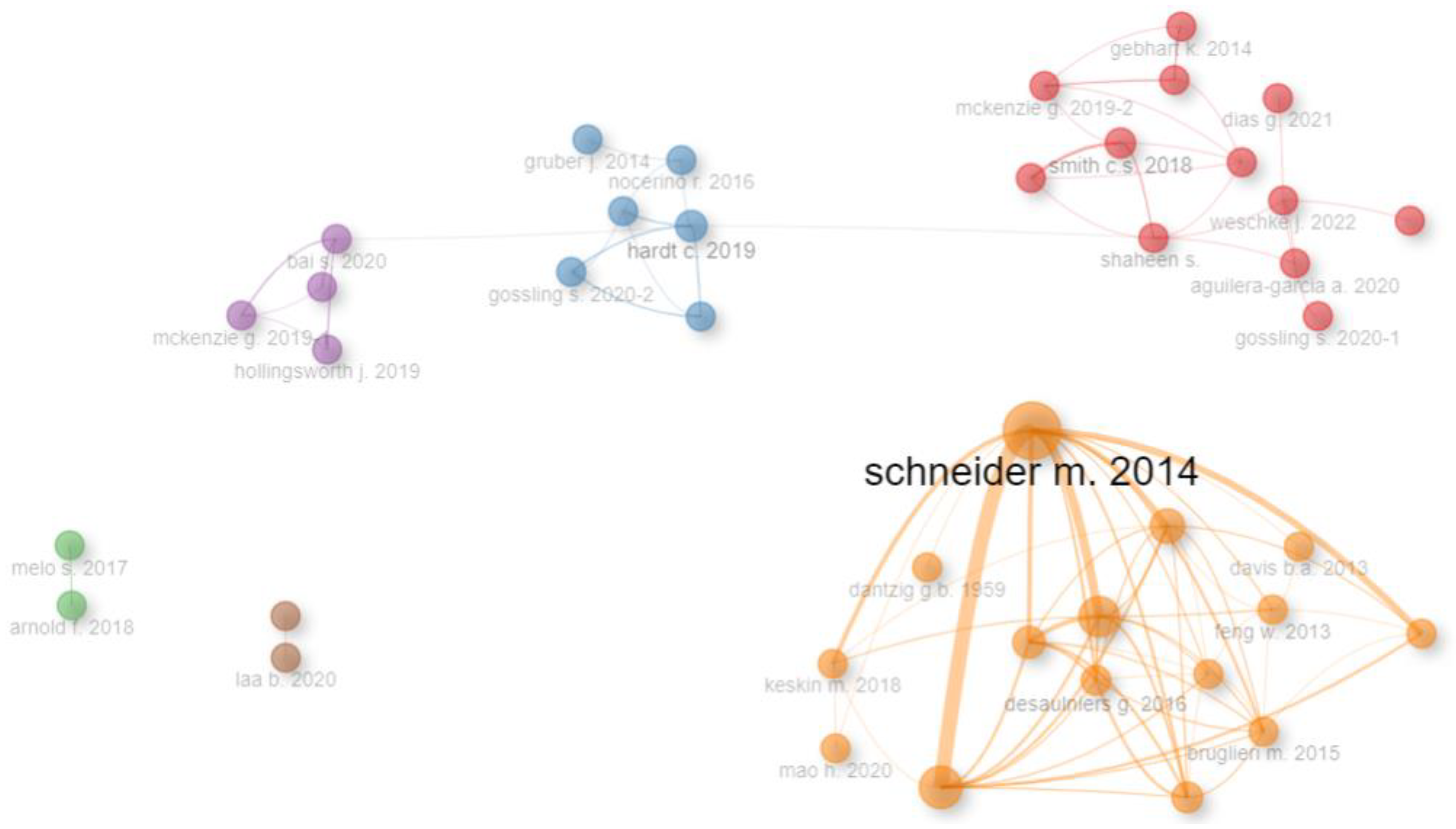
Figure 4.
Words’ frequency over time on EVs in LMD research (2013 – 2024) Source: Authors’ own
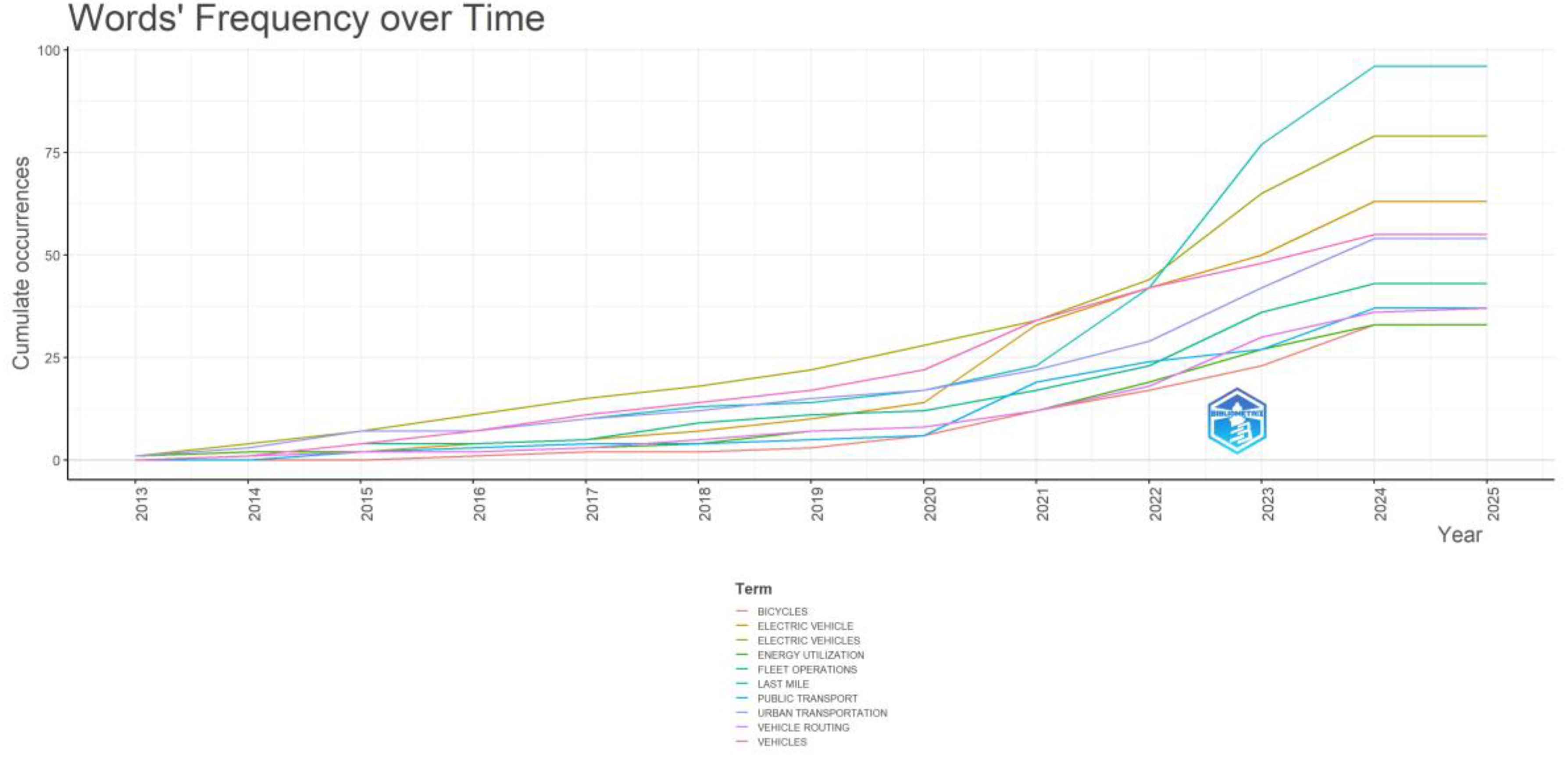
Figure 5.
Thematic map on EVs in LMD research (2013 – 2024). Source: Authors’ own
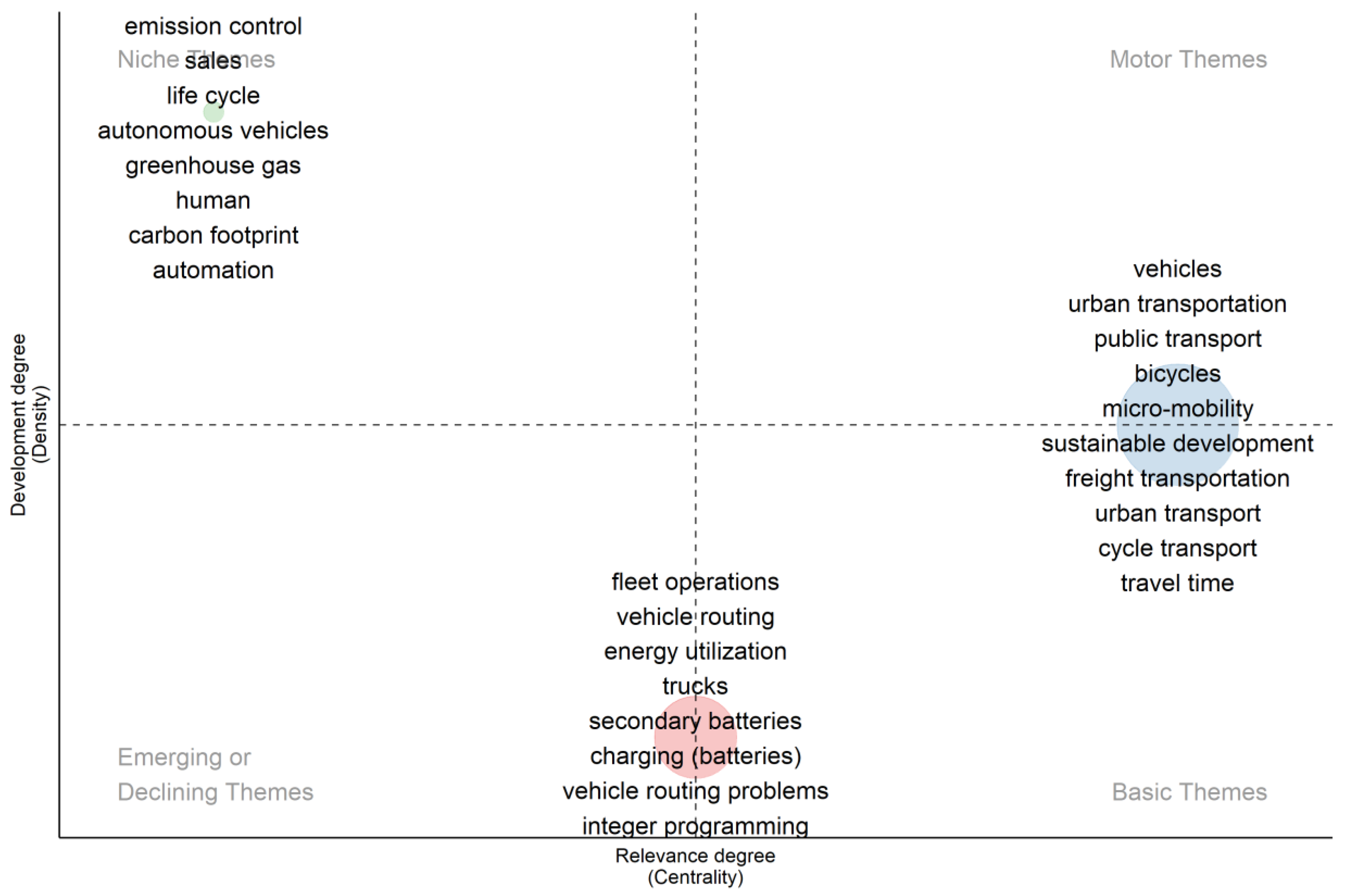

Table 1.
Main information about the publications (2013 – 2024)
| Description | Results |
|---|---|
| Timespan | 2013:2024 |
| Sources (Journals, Books, etc.) | 205 |
| Documents | 375 |
| Annual Growth Rate % | -5.61 |
| Document Average Age | 2.73 |
| Average citations per doc | 17.3 |
| References | 13927 |
| DOCUMENT CONTENTS | |
| Keywords Plus (ID) | 2149 |
| Author's Keywords (DE) | 1069 |
| AUTHORS | |
| Authors | 1145 |
| Authors of single-authored docs | 18 |
| AUTHORS COLLABORATION | |
| Single-authored docs | 19 |
| Co-Authors per Doc | 3.7 |
| International co-authorships % | 19.73 |
| DOCUMENT TYPES | |
| Article | 224 |
| book chapter | 25 |
| conference paper | 123 |
| Review | 3 |
Source: Authors’ own
Table 2.
Top 20 most productive journals on EVs in LMD research (2013 – 2024).
| Rank | Journal | h-index | g-index | m-index | TC | NP | PY_start |
|---|---|---|---|---|---|---|---|
| 1 | Transportation Research Part D: Transport and Environment | 13 | 17 | 1.625 | 914 | 17 | 2017 |
| 2 | Sustainability | 9 | 17 | 0.900 | 380 | 17 | 2015 |
| 3 | Energies | 8 | 13 | 1.600 | 186 | 13 | 2020 |
| 4 | Transportation Research Part A: Policy and Practice | 8 | 10 | 1.6 | 378 | 10 | 2020 |
| 5 | Journal of Transport Geography | 6 | 8 | 1 | 164 | 8 | 2019 |
| 6 | Transportation Research Procedia | 6 | 8 | 0.667 | 156 | 8 | 2016 |
| 7 | European Journal of Operational Research | 5 | 5 | 1.667 | 83 | 5 | 2022 |
| 8 | Transportation Research Part C: Emerging Technologies | 5 | 5 | 0.556 | 469 | 5 | 2016 |
| 9 | Case Studies on Transport Policy | 4 | 7 | 1.000 | 88 | 7 | 2017 |
| 10 | Lecture Notes in Computer Science (Including Subseries Lecture Notes in Artificial Intelligence and Lecture Notes in Bioinformatics) | 4 | 5 | 0.444 | 29 | 6 | 2016 |
| 11 | Sustainable Cities and Society | 4 | 5 | 1.000 | 186 | 5 | 2021 |
| 12 | World Electric Vehicle Journal | 4 | 6 | 0.333 | 59 | 6 | 2013 |
| 13 | 2013 World Electric Vehicle Symposium and Exhibition, EVS 2014 | 3 | 3 | 0.273 | 20 | 3 | 2014 |
| 14 | Applied Sciences | 3 | 3 | 0.750 | 23 | 3 | 2021 |
| 15 | Environmental Science and Technology | 3 | 3 | 0.600 | 68 | 3 | 2020 |
| 16 | IEEE Access | 3 | 4 | 0.600 | 93 | 4 | 2020 |
| 17 | Transportation Research Record | 3 | 7 | 0.333 | 63 | 10 | 2016 |
| 18 | 2020 Forum on Integrated and Sustainable Transportation Systems, Fists 2020 | 2 | 2 | 0.4 | 7 | 2 | 2020 |
| 19 | 2021 7th International Conference on Models and Technologies for Intelligent Transportation Systems, Mt-Its 2021 | 2 | 2 | 0.5 | 19 | 2 | 2021 |
| 20 | Computers and Industrial Engineering | 2 | 3 | 0.333 | 66 | 3 | 2019 |
Source: Authors’ own
Table 3.
Top 20 most productive authors on EVs in LMD research (2013 – 2024)
| Rank | Element | h_index | g_index | m_index | TC | NP | PY_start |
|---|---|---|---|---|---|---|---|
| 1 | Andaloro L | 4 | 5 | 0.364 | 72 | 5 | 2014 |
| 2 | Antonucci V | 4 | 5 | 0.364 | 72 | 5 | 2014 |
| 3 | Napoli G | 4 | 5 | 0.364 | 72 | 5 | 2014 |
| 4 | Sergi F | 4 | 4 | 0.364 | 44 | 4 | 2014 |
| 5 | Bieliński T | 3 | 3 | 0.600 | 222 | 3 | 2020 |
| 6 | Hosseinzadeh A | 3 | 3 | 0.75 | 202 | 3 | 2021 |
| 7 | Keoleian G | 3 | 3 | 0.750 | 36 | 3 | 2021 |
| 8 | Kepaptsoglou K | 3 | 4 | 1.500 | 36 | 4 | 2023 |
| 9 | Kluger R | 3 | 3 | 0.75 | 202 | 3 | 2021 |
| 10 | Lebeau P | 3 | 3 | 0.250 | 113 | 3 | 2013 |
| 11 | Li Z | 3 | 4 | 0.75 | 195 | 4 | 2021 |
| 12 | Macharis C | 3 | 3 | 0.250 | 113 | 3 | 2013 |
| 13 | Micari S | 3 | 3 | 0.300 | 51 | 3 | 2015 |
| 14 | Northrop W | 3 | 3 | 0.500 | 48 | 3 | 2019 |
| 15 | Simic V | 3 | 3 | 0.6 | 122 | 3 | 2020 |
| 16 | Van Mierlo J | 3 | 3 | 0.250 | 113 | 3 | 2013 |
| 17 | Vasan A | 3 | 5 | 0.375 | 25 | 5 | 2017 |
| 18 | Ważna A | 3 | 3 | 0.600 | 222 | 3 | 2020 |
| 19 | Çatay B | 3 | 4 | 0.500 | 65 | 4 | 2019 |
| 20 | Agnello G | 2 | 2 | 0.200 | 23 | 2 | 2015 |
Source: Authors’ own
Table 4.
Top 20 countries’ scientific production on EVs in LMD research (2013 – 2024)
| Rank | Country | Frequency |
|---|---|---|
| 1 | USA | 227 |
| 2 | Germany | 157 |
| 3 | Italy | 135 |
| 4 | India | 123 |
| 5 | China | 103 |
| 6 | Greece | 65 |
| 7 | Spain | 54 |
| 8 | South Korea | 38 |
| 9 | UK | 35 |
| 10 | Netherlands | 33 |
| 11 | Poland | 32 |
| 12 | Turkey | 28 |
| 13 | Sweden | 26 |
| 14 | France | 25 |
| 15 | Australia | 23 |
| 16 | Brazil | 22 |
| 17 | Belgium | 21 |
| 18 | Canada | 20 |
| 19 | Portugal | 19 |
| 20 | Japan | 16 |
Source: Authors’ own
Table 5.
Top 50 most frequent words on EVs in LMD (2013 – 2024)
| Rank | Word(s) | Occurrences | Rank | Word(s) | Occurrences |
|---|---|---|---|---|---|
| 1 | urban transportation | 54 | 26 | public transportation | 13 |
| 2 | fleet operations | 43 | 27 | traffic congestion | 13 |
| 3 | public transport | 37 | 28 | carbon dioxide | 12 |
| 4 | vehicle routing | 37 | 29 | drones | 12 |
| 5 | energy utilisation | 33 | 30 | electric bikes | 12 |
| 6 | micro-mobility | 33 | 31 | urban areas | 12 |
| 7 | secondary batteries | 31 | 32 | carbon footprint | 11 |
| 8 | sustainable development | 31 | 33 | optimisation | 11 |
| 9 | charging (batteries) | 28 | 34 | autonomous vehicles | 10 |
| 10 | freight transportation | 26 | 35 | costs | 10 |
| 11 | greenhouse gases | 26 | 36 | decision making | 10 |
| 12 | urban transport | 25 | 37 | energy-consumption | 10 |
| 13 | cycle transport | 21 | 38 | learning systems | 10 |
| 14 | travel time | 21 | 39 | optimisations | 10 |
| 15 | energy efficiency | 19 | 40 | routing algorithms | 10 |
| 16 | sustainability | 19 | 41 | sales | 10 |
| 17 | vehicle routing problems | 19 | 42 | transportation planning | 10 |
| 18 | electric scooters | 18 | 43 | urban area | 10 |
| 19 | integer programming | 17 | 44 | automation | 9 |
| 20 | freight transport | 16 | 45 | behavioral research | 9 |
| 21 | travel behavior | 16 | 46 | covid-19 | 9 |
| 22 | city logistics | 15 | 47 | e-scooter | 9 |
| 23 | environmental impact | 15 | 48 | energy management | 9 |
| 24 | gas emissions | 14 | 49 | greenhouse gas | 9 |
| 25 | emission control | 13 | 50 | life cycle | 9 |
Source: Authors’ own
Table 6.
Top 10 most cited publications on EVs in LMD (2013 – 2024)
| Rank | Authors | Total citations | Title | Journal | Summary |
|---|---|---|---|---|---|
| 1. | Schneider et al. [31]. | 895 | The electric vehicle routing problem with time windows and recharging stations | Transportation Science | The paper considered the electric vehicle routing problem with limited time windows, freight capacities, and charging stations. A recharging scheme (i.e., a hybrid heuristic combining variable neighbourhood search and tabu search) was proposed, showing high performance. |
| 2. | Campbell et al. [32]. | 353 | Factors influencing the choice of shared bicycles and shared electric bikes in Beijing. | Transportation Research Part C: Emerging Technologies | A survey on factors influencing the choice of shared e-bikes in Beijing found that trip distance, high temperatures, and poor air quality negatively impact bike-share demand. Even though e-bike sharing is attractive as a bus replacement, it is unclear if it is attractive as a last mile solution. |
| 3. | Sanders et al. [33]. | 161 | To scoot or not to scoot: Findings from a recent survey about the benefits and barriers of using e-scooters for riders and non-riders | Transportation Research Part A: Policy and Practice | A survey in the USA found that e-scooters are a convenient travel option during hot weather compared to walking. However, traffic safety concerns and the unavailability of working equipment when needed were noted among the barriers. |
| 4. | Figliozzi [34]. | 139 | Lifecycle modeling and assessment of unmanned aerial vehicles (drones) CO2 emissions. | Transportation Research Part D: Transport and Environment | The study presented a framework showing that UAVs can significantly reduce CO2 emissions and energy consumption compared to diesel vehicles. However, they are less efficient than electric vans and tricycles for larger payloads and denser deliveries. |
| 5. | Yang et al. [35]. | 137 | Safety of micro-mobility: analysis of e-scooter crashes by mining news reports | Accident Analysis and Prevention | The study examined media reports to identify safety concerns related to the rise of shared e-scooter systems in the USA. A total of 169 incidents were reported between 2017 to 2019, highlighting the need for safety measures such as helmet use and not riding under influence. |
| 6. | Kirschstein [36]. | 131 | Comparison of energy demands of drone-based and ground-based parcel delivery services | Transportation Research Part D: Transport and Environment | The paper presented an energy consumption model for drones, comparing their energy demand to diesel and electric trucks. Results showed that a stationary drone-based parcel delivery system requires more energy than a truck-based parcel delivery system, particularly in urban areas where customer density is high, and truck tours are comparatively short. |
| 7. | Scheltes & de Almeida Correia [37]. | 126 | Exploring the use of automated vehicles as last mile connection of train trips through an agent-based simulation model: An application to Delft, Netherlands | International Journal of Transportation Science and Technology | The paper explored an Automated Last Mile Transport system using driverless electric vehicles to improve last mile performance of a trip done in a train in Netherlands. Findings showed that the system competes with the walking mode but requires improvements such as allowing pre-booking and driving at higher speeds. |
| 8. | Bieliński & Ważna [38]. | 123 | Electric scooter sharing and bike sharing user behaviour and characteristics. | Sustainability | The study investigated user behaviour/ characteristics of e-scooters and bike sharing in Poland. Results showed that the public e-bike sharing system was more popular than e-scooter sharing, with residents citing concerns about e-scooter safety, high prices, and lack of perceived usefulness. However, both systems suffer from limited availability and fleet size, affecting user satisfaction. |
| 9. | Hosseinzadeh et al. [39]. | 106 | E-scooters and sustainability: Investigating the relationship between the density of e-scooter trips and characteristics of sustainable urban development. | Sustainable cities and society | The study aimed to identify spatial factors associated with scooter trips in the USA. Results showed that commercial and industrial land use, scores of walks and bikes influenced the trip density of e-scooters. |
| 10. | Liang et al. [40]. | 101 | Optimising the service area and trip selection of an electric automated taxi system used for the last mile of train trips. | Transportation Research Part E: Logistics and Transportation Review | The study developed a model for optimising automated taxi systems for last mile connectivity to train stations in Netherlands. Results found that having electric automated taxis constrained the system for small fleets because they lacked time for charging. |
Source: Authors’ own.
Disclaimer/Publisher’s Note: The statements, opinions and data contained in all publications are solely those of the individual author(s) and contributor(s) and not of MDPI and/or the editor(s). MDPI and/or the editor(s) disclaim responsibility for any injury to people or property resulting from any ideas, methods, instructions or products referred to in the content. |
© 2024 by the authors. Licensee MDPI, Basel, Switzerland. This article is an open access article distributed under the terms and conditions of the Creative Commons Attribution (CC BY) license (http://creativecommons.org/licenses/by/4.0/).
Copyright: This open access article is published under a Creative Commons CC BY 4.0 license, which permit the free download, distribution, and reuse, provided that the author and preprint are cited in any reuse.


