

Submitted:
17 December 2024
Posted:
18 December 2024
You are already at the latest version
Abstract
This article is devoted to the development and testing of a computer model of an IoT system based on a combination of wireless network technologies and aimed at implementing online monitoring of the soil and climatic condition of agricultural productions with decision-making support for the management of agrotechnical processes by predicting the probability of crop diseases. The object of the research is the processes of aggregation, wireless transmission and processing of soil and climatic measurement data in infocommunication software and hardware solutions. The results of the research are a contribution of both scientific and practical importance, focusing on the development of the computer model based on wireless sensor networks and edge-computing technologies, designed for aggregation and intelligent processing of agricultural monitoring data to predict the probability of agricultural crop diseases. The developed software component of the computer model based on ANFIS was integrated into the microcontroller unit of the IoT systems intended for use in agriculture. This approach enabled substantiation of the optimized structural and algorithmic organization of the IoT system, which can be used in the designing and implementation of reliable computing architectures of software and hardware solutions for monitoring systems in open fields with decision-making support.
Keywords:
agriculture
; disease prediction
; edge computing
; internet of things
; wireless sensor network
1. Introduction
1.1. Relevance of the Topic and Research Motivation
Agriculture is the backbone of many economies, providing livelihoods for a significant part of the world's population. Beyond simply providing sustenance, it makes a significant contribution to national and international trade, shaping economic markets. However, in open field agriculture, where crops are exposed to various environmental factors and potential risks, ensuring crop preservation becomes a critical task. Unpredictable weather conditions, pests and diseases pose serious challenges that can significantly affect agricultural crop yields and quality [1,2]. The loss of crops due to diseases not only affects individual farmers, but also has a ripple effect on the entire economy, affecting food prices and the trade balance.
Given the multifaceted importance of agriculture, it is becoming imperative to incorporate cutting-edge technologies to protect crops and increase productivity [3,4]. The integration of the Internet of Things into agriculture has proven to be transformative, offering real-time monitoring, data-driven decision-making, and automation [5]. In particular, in the context of crop security, IoT technologies contribute to the timely detection and mitigation of threats, minimizing economic losses and ensuring a stable food supply.
The development of advanced technologies is a practical necessity for solving the complex problems of modern agriculture. In the effort to develop effective IoT solutions for agriculture, the role of modelling methods cannot be overestimated. Modelling is a fundamental step in the end-to-end development cycle of IoT systems [6]. Modelling allows for the simulation and analysis of proposed solutions prior to their deployment, providing insight into system behaviour, potential problems, and areas for improvement. In the case of crop disease prediction, modelling is becoming a critical step in enhancing algorithms and optimising the performance of wireless sensor networks [7].
The main aspects that require further research and development are: the development of software and hardware solutions for network data exchange by combining wireless technologies depending on the distance of data retransmission; consideration of the types and periods of crops vegetation when implementing algorithms and software and hardware means of monitoring systems; accounting for the interconnectedness of informative and destabilising physical and chemical parameters that impact cultivation efficiency and the probability of the development of diseases of agricultural crops; synthesis and optimisation of computer models for aggregation and comprehensive processing of agrotechnical monitoring data based on modern machine learning and artificial intelligence techniques. These models should be convertible into software components for the peripheral level of monitoring and automation systems for agricultural enterprises.
This article is dedicated to the development and testing of a computer model of an IoT system based on a combination of wireless network technologies and aimed at implementing online monitoring of the soil and climatic condition of agricultural production with decision-making support for the management of agrotechnical processes by predicting the probability of occurrence of crop diseases. The object of the research is the processes of aggregation, wireless transmission and processing of soil and climatic data in infocommunication software and hardware solutions. The subject of the research is the computer-oriented model of the IoT system based on wireless sensor networks (WSNs) and edge-computing technologies.
Therefore, the relevance of the research topic is emphasised by the pressing need for sustainable and efficient agriculture. As the world's population is constantly growing, the demand for food is increasing, making it necessary to optimise agricultural processes. The results of the research will contribute to the creation of a reliable computing architecture for monitoring systems in open fields with decision-making support.
1.2. Review, Critical Analysis and Systematisation of Current Literature Sources
Over the past two decades, global agricultural production of major agricultural crops has shown a steady upward trend to meet growing global demand (see Figure 1, a): the recorded growth rate of 56% between 2000 and 2022 was driven by improved production technologies and intensification of agricultural activities, including the wider use of irrigation, pesticides, fertilisers and high-yielding crop varieties, as well as expansion of cultivated areas amid the negative effects of climate change [8,9]. Corn, wheat, rice, barley and sorghum were the five most widely grown cereals in 2022 (see Figure 1, b) [8,9].
In 2022, crop production growth was +0.7%, which was caused by a general recession, probably due to market effects after the outbreak of the war in Ukraine, as well as high inflation [10]. According to the new forecasts published in the latest Cereal Supply and Demand Brief [11], which was released on 02 February 2024, global cereal production in 2023 will reach a record high of 2,836 million tonnes, which is 1.2% more than in 2022 [10].
Thus, taking into account the steady dynamics of the areas for crop cultivation, as well as the volumes of cultivation [8,9], the issues related to the development, modernisation and improvement of distributed soil and climate monitoring systems that are integrated into IoT networks for agrotechnical purposes are of great relevance [12].
The resilience and sustainability of the agricultural sector depend on the integration of information technologies (IT). Over the past decades, IT has become an important factor that has revolutionised traditional farming methods. From precision farming to data-driven decision-making, the transformative impact of IT is apparent in optimising resource utilisation, increasing yields and improving overall farm management. In the broader context of IT, IoT is becoming a catalyst for unprecedented progress in agriculture. IoT technologies facilitate the seamless connection of devices, sensors and systems in real-time, contributing to the creation of a networked agricultural ecosystem. This connectivity provides farmers with invaluable information that allows them to monitor, analyse and respond to dynamic environmental conditions and crop-specific needs. According to Juniper, the number of IoT connections will grow to 83 billion by 2024 from 35 billion in 2020, with about half of them falling into the MIoT category [13]. At the same time, IndustryARC predicts a 7.1% CAGR for the mass IoT market, which will reach $121.4 billion by 2026 [14].
In this regard, Industry 4.0 (I4.0) and Agriculture 4.0 (AC4.0), which combines traditional agriculture with various modern cutting-edge technologies, can help improve food supply and food security. This covers all digitalisation and automation processes in business and our daily lives, including big data, artificial intelligence (AI), IoT, virtual and augmented reality, technologies such as unmanned aerial vehicles (UAVs), unmanned ground vehicles (UGVs), image processing, machine learning (ML), fog and edge computing, cloud computing and WSNs, which are expected to bring significant changes in the industry. Currently, the direction of advancement in highly efficient applied information technologies necessitates architectural solutions that fulfil complexity and systematicity criteria, aligning with the conceptual frameworks of I4.0 and AC4.0. This involves executing a complete sequence of functional transformations, encompassing precise aggregation of field data, dependable network exchange, and analytical computing in fog, edge, or cloud environments [15,16,17,18,19,20,21,22,23,24,25,26].
At the network level, the intricacies of protocol interactions and sensor placement play a key role in the efficiency of agricultural IoT systems. High-performance communication protocols ensure reliable data exchange, while a variety of sensors collect vital information about soil conditions, weather conditions, and crop health [27,28,29,30,31,32,33,34,35]. This networked approach forms the foundation of intelligent decision support systems for farmers, offering a comprehensive accounting of their agricultural operations [36,37,38,39,40,41,42,43].
At the development stage, computer modelling becomes a highly important tool for improving and optimising agricultural IoT systems. Modelling makes it possible to simulate different scenarios, refine algorithms and evaluate system performance under different conditions. This iterative process ensures the reliability and efficiency of the IoT infrastructure, laying the foundation for a sustainable and adaptive agricultural monitoring system [44,45,46,47,48,49,50,51,52].
Embedded software, as an integral component of IoT systems, is central to predicting and extracting valuable information from spatially and temporally distributed agricultural monitoring data. Using sophisticated AI and ML algorithms and techniques, embedded software transforms raw data into meaningful predictions. This intelligent data analytics is crucial for disease prediction, resource optimisation, and intelligent decision-making, which contributes to the main aim of increasing agricultural yields and productivity [53,54,55,56,57,58,59,60,61,62,63,64,65].
The path from the broader realm of information technology to the intricacies of IoT, network protocols and sensors, culminating in the importance of computer modelling and embedded software, highlights the multifaceted role that technology plays in shaping the modern agricultural landscape, as shown in Table 1. It is important to acknowledge that the findings presented in Table 1 from the analysis of scientific sources are not comprehensive. Rather, they highlight predominant trends and prospective tasks of sustainable development in the field of IoT systems architecture development, data transmission protocols interaction, computer modelling and intellectualisation of information and computer technologies for agro-technical monitoring and management, and prove the effectiveness of ML and AI integration into pertinent technical systems and networks.
Based on the systematisation of the results of the analysis of the literature, the following has been established: when building IoT systems, a three-tier architecture is used: perception level, transport level and software level; WSN technology is used to build the physical infrastructure of IoT systems; ZigBee, LoRa, Bluetooth, Wi-Fi and LTE technologies are used for network data exchange; IoT Cloud is used for the aggregation and intelligent processing of measurement data; the synthesis of the structural and algorithmic organisation of WSNs in most cases is performed on the basis of a single-factor approach according to the criteria of energy efficiency or network coverage area.
Therefore, the conducted analysis and logical synthesis of the known results of scientific and applied research in the field of online IoT monitoring of distributed objects, taking into account the characteristic features of agricultural crop production as monitoring objects, allowed for the localisation of the range of questions that require further research in this article: clarification of the architecture of the designed systems at the early stages of development using computer modelling methods; development and validation of a computer model of network interaction of various protocols at different architectural levels of the IoT system; development of algorithms for intelligent data processing at the low level (microcontrollers) to transform measurement data, which will allow the transition to edge computing technology without fundamentally changing the architecture of currently used IoT networks for agrotechnical monitoring.
Thus, conducting research in the areas mentioned earlier will improve the known systems of online IoT monitoring of soil and climatic parameters of crop production enterprises through the substantiation and implementation of a computer model and means of complex aggregation, network exchange, intelligent data transformation in accordance with the scientific and applied principles of edge computing technology on the impact of soil and climatic parameters on the efficiency of growing crops in real-time with decision-making support based on the concepts of IoT, ANFIS and XAI, which will increase the rational use of the areas and resources involved during the full cycle of crop production.
1.3. Novelty and Main Contributions of the Paper
The main scientific and practical value of the results of the article is the modernisation of the hardware and software of IoT technologies for soil and climate monitoring of open field agricultural enterprises. The proposed computer-oriented model of the IoT network is based on WSN and edge-computing technology and, unlike previously known ones, implements an intelligent algorithm for analysing the integral impact of a collection of climatic parameters (air temperature and humidity, precipitation, time duration of leaf cover in a moistened state) on the probability of occurrence and development of specific types of diseases of specific agricultural crops, based on the network integration of precise and prompt measurement monitoring, reliable data and information exchange, and intelligent data processing with real-time decision support embedded in the microcontroller link. Intelligent data processing is carried out at the edge of the network (locally), which allows the implementation of edge-computing techniques based on low-cost sensor and microprocessor devices with embedded software based on XAI algorithms.
1.4. Organisation and Structure of the Paper
The structure of the article is outlined as follows: in the first section the relevance of the research topic is substantiated, information analysis and systematisation of current scientific findings within the subject area under investigation are carried out, the purpose, object, subject and anticipated outcomes of the research are determined; in the second section the means, approaches and methods of the research are described in detail; in the third section the results of research on the structural and algorithmic organisation of IoT by computer experiment are presented; in the fourth section the perspective directions for further research are substantiated; in the fifth section, the general conclusions are presented.
2. Materials and Methods
2.1. General Description of Research Methods and Means
The main research results of the article were carried out using the following methods: comprehensive analysis and systematisation of the known results of scientific research in the field of IoT monitoring; theory of adaptive systems of neuro-fuzzy computing; theory of identification of nonlinear dynamic systems; computer simulation of information and communication systems and networks; testing and validating of the structural and algorithmic organizations of IoT monitoring networks. The research presented in this article represents a natural progression of the authors' prior theoretical and experimental investigations concerning the advancement of intelligent IoT systems for monitoring agrotechnical entities, as documented in scientific articles [12,41,50,58]. The validity of the obtained results was confirmed through the testing of a computer model depicting the synthesized structural and algorithmic framework of the IoT agrotechnical monitoring system within the Proteus simulation environment.
2.2. Generalised Structural Description of Computer-Oriented Model
The basis of the developed computer-oriented model of the IoT network for detecting the probability of crop diseases with decision-making support is the WSN technology based on the star of stars topology (see Figure 2). In this architecture, each functional unit "Local field WSN network #" represents a location (a separate fragment "Type B" in Figure 3) that aggregates data from end nodes (a set of intelligent soil and climate sensors) using NRF24 at the ISM operating frequency of 2.5 GHz (Type A in Figure 3). After that, the aggregated data from Type A network nodes that have undergone preliminary statistical analysis procedures in the corresponding Type B network nodes (time and space averaging) are transmitted via LoRa technology to the base station (Type C) of the field network infrastructure. The core functions of the base station (Type C network node) are: formation of a local database of measurement results; intelligent data analysis with the possibility of predicting the impact of soil and climatic parameters on the quality of crop cultivation; coordination of network protocols; sending information messages (processed data) to the cloud server using LTE technology. The cloud server in this architecture (see Figure 2) acts as an IoT platform that provides access to the visualisation of measurement information on remote user devices.
The above-mentioned wireless communication technologies and the structural and functional organisation of the infocommunication infrastructure of the IoT network shown in Figure 3, were selected on the basis of research conducted in [58] with substantiating the optimal geometric model for the placement of sensor nodes according to the criteria of reliability and coverage area, taking into account the range, power consumption, and data encryption algorithms.
Figure 4 and Figure 5 refer to the intellectual component of the developed computer-oriented model of the IoT system.
The dataset is the basis for training the ANFIS model [58]. It contains historical data such as date and time of measurement, air temperature, relative humidity, precipitation, and leaf wetness time. Each record in the dataset represents a specific observation in the context of agriculture, and the target variable is the presence or absence of the probability of crop disease.
It is important to ensure data quality by properly handling missing values. In this step, records containing zero values are filtered out. Missing data can have a negative impact on the training process and model accuracy, so it is important to either impute or delete such records. The time feature of the data may not be directly relevant to disease prediction, and keeping it in the dataset may result in unnecessary complexity. Therefore, this parameter is removed.
Splitting a dataset into training and validation sets is a standard practice in machine learning. The training set is used to train the ANFIS model on patterns in the data, while the validation set helps to evaluate the model's generalisation performance on data outside the training set. This step is crucial to prevent overfitting.
Training the ANFIS model involves optimising its parameters according to the patterns in the training data. The model learns the relationships between the input features and the target variable (the probability of a crop disease) during this phase. The learning process is aimed at minimising the error between predicted and actual results.
After the ANFIS model is trained, its performance is evaluated on a validation sample. This step indicates how well the model generalises to new data, according to standard metrics such as MAE, RMSE and R2.
If the model shows signs of overfitting (performing well on the training set but poorly on the validation set), adjustments should be made to prevent this. Overfitting occurs when the model learns noise in the training data instead of the underlying patterns. This step involves adjusting hyperparameters.
If the ANFIS model does not show overfitting and performs well on the validation set, it can be used to predict the probability of disease occurrence.
The detailed UML diagram describing each stage of the proposed model for predicting the probability of a specific disease in a specific crop is shown in Figure 5. Together, Figure 4 and Figure 5 show the entire process of the proposed methodology, from data collection to precision prediction using ANFIS.
2.3. Model Limitations
The following conditions and limitations were taken into account during the research:
- the dataset (spanning from September 2022 to September 2023) containing climatic parameters was gathered from the Metos by Pessl Instruments weather station, utilising the FieldClimate IoT platform. Access to this platform was granted by Metos Ukraine LLC;
- the agroclimatic zone for data collection was the northern steppe of Ukraine, characterised as arid and warm (with a hydrothermal coefficient ranging from 0.7 to 1.0). The typical annual temperature sum ranges from 2900°С to 3300°С;
- the agricultural crop under study was corn;
- the diagnosed disease of interest was Fusarium Head Blight;
- informative soil and climatic parameters included air temperature (°С), relative humidity (%), precipitation (mm) and leaf wetness time (min).
The field-level unit for collecting measured data in the investigated model was implemented using standard components of the Proteus modelling environment. Arduino Uno and Arduino Mega 2560 were used as microcontrollers. The components used to build the model are shown in Table 2. Network communication is provided by means of: HC-05 based on Serial Interface, Modulo RF library and Sim900D. Visualisation devices: Virtual terminal.
3. Results
3.1. Results of Development and Modelling of Functional Components of the IoT System
Based on the scheme of the structural and functional organisation of the information and communication infrastructure of the IoT agrotechnical monitoring network (see Figure 3), while considering the principle of decomposing the research task involved in developing and testing computer models of the functional components of information technology, a simulation of the computer model was implemented in the Proteus software environment to test the network interaction of various protocols at different architectural levels of the IoT system, and to test the integrated intelligent algorithm for predicting the probability of occurrence of crop diseases. The corresponding ANFIS model for data processing depicted in Figure 4 was developed using the Matlab & Simulink Fuzzy Logic Toolbox [58]. These computer models implement the approach described above in Section 2.2 "Generalised structural description of computer-oriented model". The data utilized for training and evaluating the generated models were derived from the authors' original experimental investigations, detailed in articles [12,58]. The procedure for constructing and assessing a computer model is outlined as follows:
- The ANFIS model acquired in [58] is converted into software code tailored for the Arduino Mega microcontroller platform utilizing a specialized open-source online tool (refer to Appendix A). Subsequently, adjustments were made to the arguments of the software components' functions to ensure alignment with the involved microcontroller pin numbers and the ranges of variation in physicochemical soil and climatic parameters.
- Development of a simulation model of a Type A network node utilizing Arduino Uno Rev3 within the Proteus environment mentioned in Appendix A, depicted in Figure 6. This simulation model integrates software developed in the Arduino IDE environment (see Appendix A), which implements the acquisition of soil and climate sensors data, preliminary statistical analysis (time and space averaging), and the transmission of measurement data to the Type B network node using the NRF module.
- Development of a simulation model of the Type B network node utilizing Arduino Mega 2560 in the Proteus environment detailed in Appendix A and illustrated in Figure 7. This simulation model integrates software developed in the Arduino IDE (see Appendix A), which aggregates measurement data from Type A network nodes, polls its own soil and climate sensors, performs preliminary statistical analysis (time and space averaging), and transmits the result to the Type C base station using LoRa technology (see Figure 8).
- This simulation model includes software code that aggregates measurement data from Type B network nodes, polls its own soil and climate sensors, performs preliminary statistical analysis (time and space averaging), uses ANFIS to predict the probability of the occurrence of the crop disease, and sends an SMS with the result of the intelligent analysis to a specified number.
- Testing the modes of functioning of the developed computer model by detecting data transmitted as a result of network interaction of various protocols at different architectural levels of the IoT system using a virtual terminal. These steps enabled an evaluation of the accuracy and resilience of the proposed hardware and software solution.
The test models that have been developed serve as a simulation foundation for conducting further research on the developed information technology through computer experiments.
3.2. Results of the Development and Modelling of the Network Organisation of the IoT System
Based on the above provisions of the development of the computer model of the IoT network for detecting the probability of occurrence of crop diseases with decision-making support, its investigation utilized computer modelling methods, along with a comprehensive analysis of the results obtained at both qualitative and quantitative levels.
The appearance of the entire model is shown in Figure 9. Structurally, the model is built in accordance with Figure 3 of Section 2.2 "Generalised structural description of computer-oriented model ". Due to the computational limitations of the Proteus environment, an MVP version of the diagram of the structural and functional organisation of the information and communication infrastructure of the IoT agrotechnical monitoring network is implemented in Figure 3: 2х Type A nodes, 1х Type B and 1х Type C (see Figure 9). The operation of individual network nodes and the description of how the model implements the communication between Type A, Type B, and Type C are described in Section 3.1 "Results of development and modelling of functional components of the IoT system".
The corresponding results of validating the network interaction of different protocols at different architectural levels of the IoT system are presented in the form of screenshots of virtual terminals of the Proteus environment (see Figure 10, Figure 11, Figure 12, Figure 13 and Figure 14). The corresponding results of testing the integrated intelligent component of detecting the probability of crop diseases are presented in the form of 2D graphs of the dependence of soil and climatic parameters of the growing area on time and the probability of disease occurrence under different combinations of these factors (see Figure 15). In Figure 15 the time period from 2023-08-10 19:00 to 2023-08-11 11:00 is presented, where the first 7 points with an interval of one hour are the prehistory, and from 2023-08-11 02:00 the prediction began. The main objective of this experiment was to: test data transfer within the network interaction of different protocols at different architectural levels of the IoT system; test the edge computing technology of the ANFIS model in the microcontroller unit to predict the probability of occurrence of crop diseases under the complex influence of informative factors.
Proteus test results demonstrated the validity and reliability of the developed computer model. The emulation of network nodes, base station, and communication protocols accurately reflected the real-world scenario, providing up-to-date information about the behaviour of the system. In addition, the successful data transfer between the modules confirmed the effectiveness of the implemented communication mechanisms, such as NRF and LoRa technologies.
The integration of ANFIS for disease probability prediction in combination with SMS messages via LTE demonstrated the capacity of the system to perform advanced analytics and provide end users with information on the detected probability of a particular disease for a particular type of agricultural crop.
Based on the test results (see Figure 16) using the formulas for calculating the mathematical expectation (ΔProbabilitymean) and standard deviation (σΔProbability) the probabilistic characteristics of the error of the approximation model were estimated:
where
ProbabilityDataset – is the probability of disease occurrence from the FieldClimate IoT platform dataset;
ProbabilityModel – is the predicted probability of disease occurrence, the output of the ANFIS model.
Based on the performed calculations, it was determined that the mathematical expectation of the data approximation is 5.2% with a standard deviation of ±1.4%. It was also found that this error is additive and can be reduced by introducing a correction to the approximation results. Numerically, this correction is equal to the mathematical expectation of the error with the reverse sign (see Figure 15, green dots – predicted with correction). After introducing the correction, the error value does not exceed (1.1±0.7)%.
The outcomes of the computer experiment, depicted in Figure 10, Figure 11, Figure 12, Figure 13, Figure 14 and Figure 15, affirm the suitability of the developed system for utilisation in hardware and software tools for intelligent monitoring of soil and climatic conditions, as well as for detecting potential crop diseases. Consequently, this enables the deployment of intelligent edge computing technology based on cost-effective embedded microprocessor and sensor technologies within open-field agrotechnical production environments. Moreover, the proposed hardware and software solutions for the advancement of corresponding information technology can be customised for a broader array of crops and expanded to encompass a greater spectrum of influential factors and physical-chemical parameters, all without necessitating fundamental alterations to the architecture of the designated technology. These conducted studies underscore the positive impact of enhancing the technical and functional attributes of presently utilised agrotechnical information technologies for monitoring and management.
4. Discussion
The primary scientific and applied impact is obtained in this article is the creation of the computer-oriented model of the IoT network based on WSN and edge-computing technologies using information intelligent technology for agrotechnical monitoring and detection of the probability of crop diseases. It provides decision-making support which involves synthesizing the structural and algorithmic organization of pertinent software and hardware solutions, leveraging the conceptual frameworks of IoT and neuro-fuzzy logic.
There are several challenges that may be relevant in the practical implementation of the proposed model and require further elaboration:
- Accounting for aggressive environmental conditions requires more thorough research on the reliability of microelectronic components.
- The impact of the battery life of portable power modules on the continuous operation of an IoT system.
- Assessment of the influence of natural and man-made interference on the efficiency of signal transmission over certain distances in real conditions.
The key focus areas for future research of the developed computer-based model include: conducting long-term testing accompanied by iterative refinement of the pertinent software and hardware solutions; engaging in expert analysis of time-series data derived from experimental observations across a broader spectrum of crops, considering more informative parameters and destabilising factors. Subsequently, integrating the identified patterns into software components of information technologies; undertaking a comprehensive technical and economic evaluation of the proposed software and hardware solutions.
5. Conclusions
In this article, an important scientific and applied problem has been solved in the development and testing of the computer model of the IoT system based on a combination of wireless network technologies, aimed at implementing online monitoring of the soil and climatic condition of agricultural production with support for decision-making on the management of agrotechnical processes by predicting the probability of the occurrence of crop diseases.
The primary scientific and practical divergence between the research outcomes delineated in this article and those previously documented lies in the comprehensive consideration of soil and climatic parameters' intricate influence across temporal and spatial dimensions throughout the entire growth cycle of various crop varieties. This consideration is embedded within the software and hardware framework of information technology for intelligent computer-integrated monitoring and prediction of crop disease probabilities. This technology amalgamates networked wireless technologies of varying ranges, a cost-effective component base, and edge computing methodologies.
Such an approach facilitates intricate intelligent processing of measurement data at the microcontroller level within industrial automation systems tailored for agricultural applications within the context of Industry 4.0 and Agriculture 4.0 paradigms. The resultant efficacy stems from a synergistic amalgamation of cutting-edge advancements in IoT, WSN, and ANFIS, leveraging the latter as a methodology for eXplainable Artificial Intelligence (XAI).
The main results of this article are:
- A comprehensive analysis of the subject area of digitalisation of agriculture has been carried out, which allowed to localise the directions of perspective research of this article, taking into account modern scientific and applied achievements in the field of IoT systems, approaches to their computer modelling and technology of intelligent analysis of time series of measurement monitoring results.
- The structural and algorithmic organisation of the information and communication infrastructure of the agrotechnical monitoring network of the IoT system, which implements the principles of edge computing and takes into account the results of previous studies and reflects their implementation, taking into account the integral influence of the criteria that determine the number of wireless network modules and the reliability of measurement data exchange, has been developed.
- The computer model has been implemented in the Proteus environment, which allowed testing and validating the network interaction of various protocols at different architectural levels of the IoT system according to the criterion of objective testing of algorithms for multi-level data aggregation, processing and transmission.
- Data processing software based on ANFIS technology has been developed for the microprocessor unit of the system, which allowed the analysis of the results obtained at the qualitative and quantitative levels.
- The error of data approximation has been estimated at (5.2±1.4)%. As a result, an approach to its reduction has been proposed based on introducing the correction to the prediction results. The value of the error after compensation does not exceed (1.1±0.7)%.
The overall scientific and practical impact of the research presented in the article facilitates improvement in functionality of scaling the monitoring zone and adapting it to different types of diseases and types of crops in open fields by introducing hardware and software tools for early detection and prediction of the dynamics of crop diseases, based on network integration of precise and prompt measurement monitoring, reliable data and information exchange, and intelligent data processing with real-time decision support embedded in the microcontroller link. The research findings serve as the hardware and software foundation for advancing the digitisation and intellectualisation of industrial ecosystems within the agricultural sector. This advancement is achieved through the utilisation of embedded computer-oriented tools employing edge architecture.
A set of promising areas of research to improve the adequacy, adaptability and scalability of the developed computer-oriented model using XAI for diagnosing crop diseases has also been substantiated in the article.
Acknowledgement
This research was carried out as part of the scientific project ‘Development of software and hardware of intelligent technologies for sustainable crop production in wartime and post-war’ funded by the Ministry of Education and Science of Ukraine at the expense of the state budget.
Appendix A. The Software Used
- Online training version of software Matlab & Simulink: https://www.mathworks.com/products/matlab-online.html
- Open-source Arduino IDE https://www.arduino.cc/en/software
- Online training version of software Proteus: https://www.labcenter.com/education/
- Open-source tool for converting fis-models into Arduino code: http://www.makeproto.com/projects/fuzzy/matlab_arduino_FIST/index.php
References
- FAO. Climate change and food security: risks and responses. Available online: https://www.fao.org/3/i5188e/I5188E.pdf (accessed on 14 December 2024).
- IFPRI. Research and engagement: Climate change and agrifood systems. Available online: https://ebrary.ifpri.org/utils/getfile/collection/p15738coll2/id/136977/filename/137188.pdf (accessed on 14 December 2024).
- Breisinger, C.; Keenan, M.; Mbuthia, J.; Njuki, J. Food systems transformation in Kenya: Lessons from the past and policy options for the future. Washington, DC: International Food Policy Research Institute (IFPRI), 2023.
- Piot-Lepetit, I. Digitainability and open innovation: how they change innovation processes and strategies in the agrifood sector? Frontiers in sustainable food systems 2023, 7, 1–9. [Google Scholar] [CrossRef]
- López-Lozano, R.; Baruth, B. An evaluation framework to build a cost-efficient crop monitoring system. Experiences from the extension of the European crop monitoring system. Agricultural Systems 2019, 168, 231–246. [Google Scholar] [CrossRef]
- Placidi, P.; Morbidelli, R.; Fortunati, D.; Papini, N. ; Gobbi,F.; Scorzoni, A. Monitoring Soil and Ambient Parameters in the IoT Precision Agriculture Scenario: An Original Modeling Approach Dedicated to Low-Cost Soil Water Content Sensors. Sensors, 2021; 21, 1–28. [Google Scholar]
- Fu, B. The research of IOT of agriculture based on three layers architecture. In Proceedings of the 2nd International Conference on Cloud Computing and Internet of Things (CCIOT), Dalian, China, 162-165., 1 October 2016. [Google Scholar]
- FAO. Agricultural production statistics 2000-2022, FAOSTAT Analytical Briefs, No. 79, Rome. [CrossRef]
- FAO. Production: Crops and livestock products, In: FAOSTAT, Rome. Available online: https://www.fao.org/faostat/en/#data/QCL (accessed on 14 December 2024).
- FAO. Food Price Index down again in January led by lower wheat and maize prices, In: FAO News and Media (Rome). Available online: https://www.fao.org/newsroom/detail/fao-food-price-index-down-again-in-january-led-by-lower-wheat-and-maize-prices/en (accessed on 14 December 2024).
- FAO. Cereal Supply and Demand Brief: Larger coarse grain outputs push up supply and trade prospects. Available online: https://www.fao.org/worldfoodsituation/csdb/en (accessed on 14 December 2024).
- Laktionov, I.; Diachenko, G.; Koval, V.; Yevstratiev, M. Computer-Oriented Model for Network Aggregation of Measurement Data in IoT Monitoring of Soil and Climatic Parameters of Agricultural Crop Production Enterprises. Baltic Journal of Modern Computing 2023, 11, 500–522. [Google Scholar] [CrossRef]
- Juniperresearch. IoT Connections to Reach 83 Billion by 2024, Driven by Maturing Industrial Use Cases. Available online: https://www.juniperresearch.com/press/iot-connections-to-reach-83-bn-by-2024 (accessed on 14 December 2024).
- Industryarc. Massive IoT (MIoT) Market – Forecast (2025-2032). Available online: https://www.industryarc.com/Report/19418/massive-iot-market.html (accessed on 14 December 2024).
- Alam, Md.F.B.; Tushar, S.R.; Zaman, S.Md.; Gonzalez, E.D.R.S.; Bari, A.B.M.M.; Karmaker, C.L. Analysis of the drivers of Agriculture 4.0 implementation in the emerging economies: Implications towards sustainability and food security. Green Technologies and Sustainability, 2023; 1, 1–14. [Google Scholar]
- Bernhardt, H.; Bozkurt, M.; Brunsch, R.; Colangelo, E.; Herrmann, A.; Horstmann, J.; Kraft, M.; Marquering, J.; Steckel, T.; Tapken, H.; Weltzien, C.; Westerkamp, C. Challenges for Agriculture through Industry 4.0. Agronomy 2021, 11, 1–10. [Google Scholar] [CrossRef]
- Charania, I.; Li, X. Smart farming: Agriculture's shift from a labor intensive to technology native industry. Internet of Things 2020, 9, 100142. [Google Scholar] [CrossRef]
- Costa, F.; Frecassetti, S.; Rossini, M.; Portioli-Staudacher, A. Industry 4.0 digital technologies enhancing sustainability: Applications and barriers from the agricultural industry in an emerging economy. Journal of Cleaner Production, 2023; 408, 137208. [Google Scholar]
- Javaid, M.; Haleem, A.; Singh, R.P.; Suman, R. Enhancing smart farming through the applications of Agriculture 4.0 technologies. International Journal of Intelligent Networks 2022, 3, 150–164. [Google Scholar] [CrossRef]
- Karunathilake, E.M.B.M.; Le, A.T.; Heo, S.; Chung, Y.S.; Mansoor, S. The Path to Smart Farming: Innovations and Opportunities in Precision Agriculture. Agriculture 2023, 13, 1–26. [Google Scholar] [CrossRef]
- Maffezzoli, F.; Ardolino, M.; Bacchetti, A.; Perona, M.; Renga, F. Agriculture 4.0: A systematic literature review on the paradigm, technologies and benefits. Futures, 2022; 142, 1–15. [Google Scholar]
- Morchid, A.; Alami, R.E.; Raezah, A.A.; Sabbar, Y. Applications of internet of things (IoT) and sensors technology to increase food security and agricultural Sustainability: Benefits and challenges. Ain Shams Engineering Journal 2024, 15, 1–15. [Google Scholar] [CrossRef]
- Mowla, M.N.; Mowla, N.; Shah, A.F.M.S.; Rabie, K.M.; Shongwe, T. Internet of Things and Wireless Sensor Networks for Smart Agriculture Applications: A Survey. IEEE Access 2023, 11, 145813–145852. [Google Scholar] [CrossRef]
- Moysiadis, V.; Sarigiannidis, P.; Vitsas, V.; Khelifi, A. Smart Farming in Europe. Computer Science Review 2021, 39, 100345. [Google Scholar] [CrossRef]
- Raj, M.; Gupta, S.; Chamola, V.; Elhence, A.; Garg, T.; Atiquzzaman, M.; Niyato, D. A survey on the role of Internet of Things for adopting and promoting Agriculture 4.0. Journal of Network and Computer Applications 2021, 187, 103107. [Google Scholar] [CrossRef]
- Rose, D.C.; Wheeler, R.; Winter, M.; Lobley, M.; Chivers, C.-A. Agriculture 4.0: Making it work for people, production, and the planet. Land Use Policy 2021, 100, 104933. [Google Scholar] [CrossRef]
- Alaerjan, A. Towards Sustainable Distributed Sensor Networks: An Approach for Addressing Power Limitation Issues in WSNs. Sensors 2023, 23, 1–23. [Google Scholar] [CrossRef] [PubMed]
- Alqahtani, H. Role of wireless sensor network in precision agriculture. Computational algorithms and numerical dimensions 2022, 1, 84–88. [Google Scholar]
- López-Martínez, J.; Blanco-Claraco, J.L.; Pérez-Alonso, J.; Callejón-Ferre, Á.J. Distributed network for measuring climatic parameters in heterogeneous environments: Application in a greenhouse. Computers and Electronics in Agriculture 2017, 145, 105–121. [Google Scholar] [CrossRef]
- Nawandar, N.K.; Satpute, V.R. IoT based low cost and intelligent module for smart irrigation system. Computers and Electronics in Agriculture 2019, 162, 979–990. [Google Scholar] [CrossRef]
- Nguyen, M.T. Distributed compressive and collaborative sensing data collection in mobile sensor networks. Internet of Things 2019, 9, 100156. [Google Scholar] [CrossRef]
- Ramli, M.R.; Daely, P.T.; Kim, D.-S.; Lee, J.M. IoT-based adaptive network mechanism for reliable smart farm system. Computers and Electronics in Agriculture 2020, 170, 105287. [Google Scholar] [CrossRef]
- Sadowski, S.; Spachos, P. Wireless technologies for smart agricultural monitoring using internet of things devices with energy harvesting capabilities. Computers and Electronics in Agriculture 2020, 172, 105338. [Google Scholar] [CrossRef]
- Srbinovska, M.; Gavrovski, C.; Dimcev, V.; Krkoleva, A.; Borozan, V. Environmental parameters monitoring in precision agriculture using wireless sensor networks. Journal of Cleaner Production 2015, 88, 297–307. [Google Scholar] [CrossRef]
- Wu, Y.; Yang, Z.; Liu, Y. Internet-of-Things-Based Multiple-Sensor Monitoring System for Soil Information Diagnosis Using a Smartphone. Micromachines 2023, 14, 1395. [Google Scholar] [CrossRef]
- Aiello, G.; Giovino, I.; Vallone, M.; Catania, P.; Argento, A. A decision support system based on multisensor data fusion for sustainable greenhouse management. Journal of Cleaner Production 2017, 172, 4057–4065. [Google Scholar] [CrossRef]
- Andrijevi´c, N.; Uroševi´c, V.; Arsi´c, B.; Herceg, D.; Savi´c, B. IoT Monitoring and Prediction Modeling of Honeybee Activity with Alarm, Electronics 2022, 11, 783.
- CropX. CropX System Disease Control. Available online: https://cropx.com/cropx-system/disease-control/ (accessed on 15 December 2024).
- dos Santos, U.J.L.; Pessin, G.; da Costa, C.A.; da Rosa Righi, R. AgriPrediction: A proactive internet of things model to anticipate problems and improve production in agricultural crops. Computers and Electronics in Agriculture 2019, 161, 202–213. [Google Scholar] [CrossRef]
- IBM. Watson Decision Platform for Agriculture. Available online: https://worldagritechusa.com/wp-content/uploads/2019/03/Dan-Wolfson-IBM.pdf (accessed on 15 December 2024).
- Laktionov, I.; Vovna, O.; Kabanets, M. Information Technology for Comprehensive Monitoring and Control of the Microclimate in Industrial Greenhouses Based on Fuzzy Logic. Journal of Artificial Intelligence and Soft Computing Research 2023, 13, 19–35. [Google Scholar] [CrossRef]
- Singh, S.; Chana, I.; Buyya, R. Agri-Info: Cloud Based Autonomic System for Delivering Agriculture as a Service. Internet of Things 2020, 9, 100131. [Google Scholar] [CrossRef]
- Sinha, A.; Shrivastava, G.; Kumar, P. Architecting user-centric internet of things for smart agriculture. Sustainable Computing: Informatics and Systems 2019, 23, 88–102. [Google Scholar] [CrossRef]
- Ben Ali, R.; Aridhi, E.; Mami, A. Dynamic model of an agricultural greenhouse using Matlab-Simulink environment. In Proceedings of the 12th International Multi-Conference on Systems, Signals & Devices (SSD), 346-350., 1 December 2015. [Google Scholar]
- Faouzi, D; Bibi-Triki, N.; Draoui B.; Abène, A. Modeling, Simulation and Optimization of agricultural greenhouse microclimate by the application of artificial intelligence and / or fuzzy logic. International Journal of Scientific & Engineering Research 2016, 7, 204–214.
- Ivanov, D.V.; Hnatushenko, V.V.; Kashtan, V.Yu.; Garkusha, I.M. Computer modeling of territory flooding in the event of an emergency at seredniodniprovska hydroelectric power plant. Naukovyi Visnyk Natsionalnoho Hirnychoho Universytetu 2022, 6, 123–128. [Google Scholar] [CrossRef]
- Kephe, P.N.; Ayisi, K.K.; Petja, B.M. Challenges and opportunities in crop simulation modelling under seasonal and projected climate change scenarios for crop production in South Africa. Agric & Food Secur 2021, 10, 10. [Google Scholar]
- Laktionov, I.; Vovna, O.; Cherevko, O.; Kozlovskaya, T. Mathematical model for monitoring carbon dioxide concentration in industrial greenhouses. Agronomy Research 2018, 16, 134–146. [Google Scholar]
- Laktionov, I.S.; Vovna, O.V.; Kabanets, M.M.; Derzhevetska, M.A.; Zori, A.A. Mathematical Model of Measuring Monitoring and Temperature Control of Growing Vegetables in Greenhouses. International Journal of Design & Nature and Ecodynamics 2020, 15, 325–336. [Google Scholar]
- Laktionov, I.S.; Vovna, O.V.; Kabanets, M.M.; Sheina, H.O.; Getman, I.A. Information model of the computer-integrated technology for wireless monitoring of the state of microclimate of industrial agricultural greenhouses. Instrumentation Mesure Métrologie, 2021; 20, 289–300. [Google Scholar]
- Mihalyov, A. ; Hnatushenko,V.; Hnatushenko, V., Ed.; Vladimirska, N. Optimization model lifetime wireless sensor network. In Proceedings of the 8th International Conference on Intelligent Data Acquisition and Advanced Computing Systems: Technology and Applications (IDAACS), Warsaw, Poland, 01 September 2015. [Google Scholar]
- Sokolov, S. Optimization of greenhouse microclimate parameters considering the impact of CO2 and light. Journal of Engineering Sciences 2023, 10, G14–G21. [Google Scholar] [CrossRef]
- Akhtar, M.N.; Shaikh, A.J.; Khan, A.; Awais, H.; Bakar, E.A.; Othman, A.R. Smart Sensing with Edge Computing in Precision Agriculture for Soil Assessment and Heavy Metal Monitoring: A Review. Agriculture 2021, 11, 475. [Google Scholar] [CrossRef]
- Bassine, F.Z.; Epule, T.E.; Kechchour, A.; Chehbouni, A. Recent Applications of Machine Learning, Remote Sensing, and IoT Approaches in Yield Prediction: a Critical Review. Preprint 2023, 1–35. [Google Scholar]
- Fenu, G.; Malloci, F.M. Review forecasting plant and crop disease: An explorative study on current algorithms. Big Data and Cognitive Computing 2021, 5, 1–24. [Google Scholar] [CrossRef]
- Huang, C.L.; Ke, Y.X.; Hua, X.D. Application status and prospect of edge computing in smart agriculture. Trans. Chin. Soc. Agric. Eng. (Trans. CSAE), 2022; 38, 224–234. [Google Scholar]
- Kashtan, V.; Hnatushenko, V. Deep Learning Technology for Automatic Burned Area Extraction Using Satellite High Spatial Resolution Images; Babichev, S. , Lytvynenko, V., Eds.; Volume 149, Springer, Cham, 664-685. Lecture Notes in Data Engineering, Computational Intelligence, and Decision Making, Babichev, S., Lytvynenko, V., Eds.; Springer: Cham; Volume 149, 664–685.
- Laktionov, I.; Diachenko, G.; Rutkowska, D.; Kisiel-Dorohinicki, M. An Explainable AI Approach to Agrotechnical Monitoring and Crop Diseases Prediction in Dnipro Region of Ukraine. Journal of Artificial Intelligence and Soft Computing Research 2023, 13, 247–272. [Google Scholar] [CrossRef]
- Mohr, S.; Kühl, R. Acceptance of artificial intelligence in German agriculture: an application of the technology acceptance model and the theory of planned behavior. Precision Agric. 2021, 22, 1816–1844. [Google Scholar] [CrossRef]
- O'Grady, M.J.; Langton, D.; O'Hare, G.M.P. Edge computing: A tractable model for smart agriculture? Artificial Intelligence in Agriculture 2019, 3, 42–51. [Google Scholar] [CrossRef]
- Rafique, W.; Qi, L.; Yaqoob, I.; Imran, M.; Rasool, R.U.; Dou, W. Complementing IoT services through software defined networking and edge computing: A comprehensive survey. IEEE Commun. Surv. Tutor. 2020, 22, 1761–1804. [Google Scholar] [CrossRef]
- Ryo, M. Explainable artificial intelligence and interpretable machine learning for agricultural data analysis. Artificial Intelligence in Agriculture 2022, 6, 257–265. [Google Scholar] [CrossRef]
- Xiao, Q.; Li, W.; Kai, Y.; Chen, P.; Zhang, J.; Wang, B. Occurrence prediction of pests and diseases in cotton on the basis of weather factors by long short term memory network. BMC Bioinformatics 2019, 20, 1–15. [Google Scholar] [CrossRef]
- Yu, H.; Liu, J.; Chen, C.; Heidari, A.A.; Zhang, Q.; Chen, H.; Mafarja, M.; Turabieh, H. Corn Leaf Diseases Diagnosis Based on K-Means Clustering and Deep Learning. IEEE Access 2021, 9, 143824–143835. [Google Scholar] [CrossRef]
- Zhang, X.; Cao, Z.; Dong, W. Overview of Edge Computing in the Agricultural Internet of Things: Key Technologies, Applications, Challenges. IEEE Access 2020, 8, 141748–141761. [Google Scholar] [CrossRef]
- Mahbub, M. A Smart Farming Concept Based on Smart Embedded Electronics. Internet of Things and Wireless Sensor Network, Internet of Things 2020, 9, 100161. [Google Scholar]
- Pamula, A.S.P.; Ravilla, A.; Madiraju, S.V.H. Applications of the Internet of Things (IoT) in Real-Time Monitoring of Contaminants in the Air, Water, and Soil. Engineering Proceedings 2022, 27, 26. [Google Scholar]
- Molodets, B.; Hnatushenko, V.; Boldyriev, D.; Bulana, T. Information System of Air Quality Assessment Based of Ground Stations and Meteorological Data Monitoring. In Proceedings of the 4th International Workshop on Intelligent Information Technologies and Systems of Information Security, Khmelnytskyi, Ukraine, 22-24 March 2023. [Google Scholar]
- Karim, F.; Karim, F.; Frihida, A. Monitoring system using web of things in precision agriculture. Procedia Computer Science 2017, 110, 402–409. [Google Scholar] [CrossRef]
- Ali, A.I.; Zorlu Partal, S. Development and performance analysis of a ZigBee and LoRa-based smart building sensor network. Frontiers in Energy Research 2022, 10, 1–13. [Google Scholar] [CrossRef]
- Holovatyy, A.; Teslyuk, V.; Kryvinska, N.; Kazarian, A. Development of Microcontroller-Based System for Background Radiation Monitoring. Sensors 2020, 20, 7322. [Google Scholar] [CrossRef] [PubMed]
- Rajput, A.; Kumaravelu, V.B. Scalable and Sustainable Wireless Sensor Networks for Agricultural Application of Internet of Things using Fuzzy-C Means Algorithm. Sustainable Computing: Informatics and Systems 2019, 22, 62–74. [Google Scholar] [CrossRef]
- Truong, V.-T.; Nayyar, A.; Ahmad Lone, S. System Performance of Wireless Sensor Network Using LoRa–Zigbee Hybrid Communication. Computers, Materials & Continua 2021, 68, 1615–1635. [Google Scholar]
- Choudhury, S.; Kuchhal, P.; Anita, R.S. ZigBee and Bluetooth Network based Sensory Data Acquisition System. Procedia Computer Science 2015, 48, 367–372. [Google Scholar] [CrossRef]
- Holovatyy, А. Development of IoT Weather Monitoring System Based on Arduino and ESP8266 Wi-Fi Module, In Proceedings of the IOP Conf. Series: Materials Science and Engineering, Lviv, Ukraine, 26-27 November 2020, 1016, 012014. [Google Scholar]
- Lova Raju, K.; Vijayaraghavan, V. IoT-AgriSens: A LoRa-Based Smart Agriculture Monitoring and Decision-Making System with Amalgamation of IoT and Cloud-Enabled Services. Research Square, 2023; 1–34. [Google Scholar]
- Laktionov, I.S.; Vovna, O.V.; Zori, A.A.; Lebedev, V.A. Results of simulation and physical modeling of the computerized monitoring and control system for greenhouse microclimate parameters. International Journal on Smart Sensing and Intelligent Systems 2018, 11, 1–15. [Google Scholar] [CrossRef]
- Yusuf, S.D.; Odoma, D.Y.; Loko, A.Z. Simulation and Construction of a Microcontroller based Plant Water Sprinkler with Weather Monitoring System. International Journal of Computer Applications 2022, 184, 51–58. [Google Scholar] [CrossRef]
- Singh, S.; Singh, A.; Limkar, A. IoT Based Machine Learning Weather Monitoring and Prediction Using WSN. International Journal on Recent and Innovation Trends in Computing and Communication 2024, 12, 112–123. [Google Scholar] [CrossRef]
- Bakthavatchalam, K.; Karthik, B.; Thiruvengadam, V.; Muthal, S.; Jose, D.; Kotecha, K.; Varadarajan, V. IoT Framework for Measurement and Precision Agriculture: Predicting the Crop Using Machine Learning Algorithms. Technologies 2022, 10, 13. [Google Scholar] [CrossRef]
Figure 1.
World agricultural crop and of top cereals production volumes and growth [9]: (a) World agricultural crop production volumes and growth [9]; (b) World production of top cereals [9].
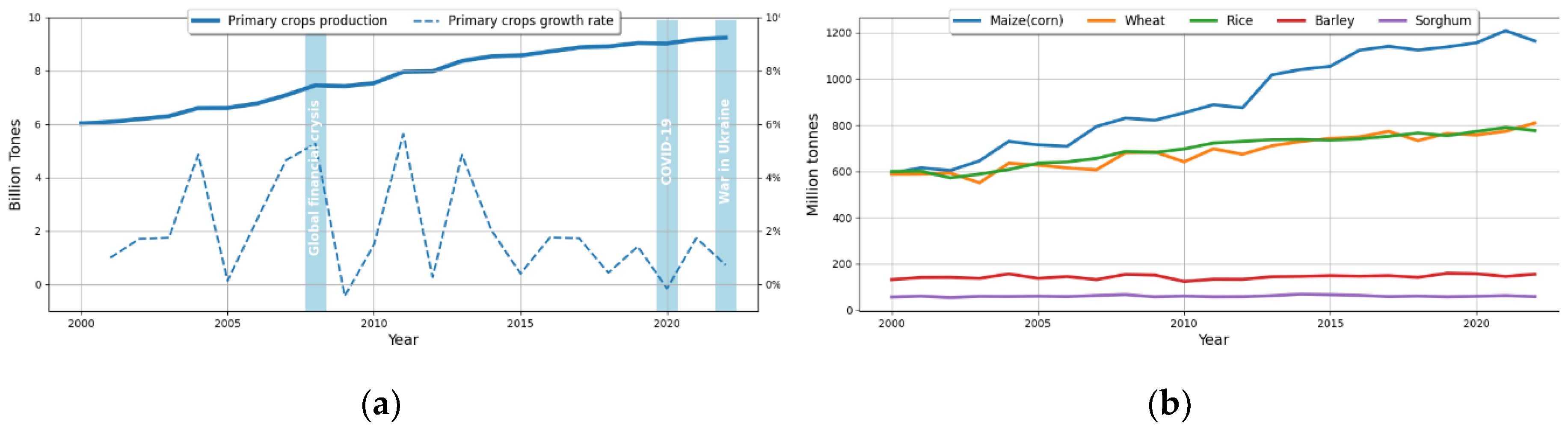
Figure 2.
Generalised architecture of the information and communication infrastructure of the IoT network for agrotechnical monitoring [12].
Figure 2.
Generalised architecture of the information and communication infrastructure of the IoT network for agrotechnical monitoring [12].
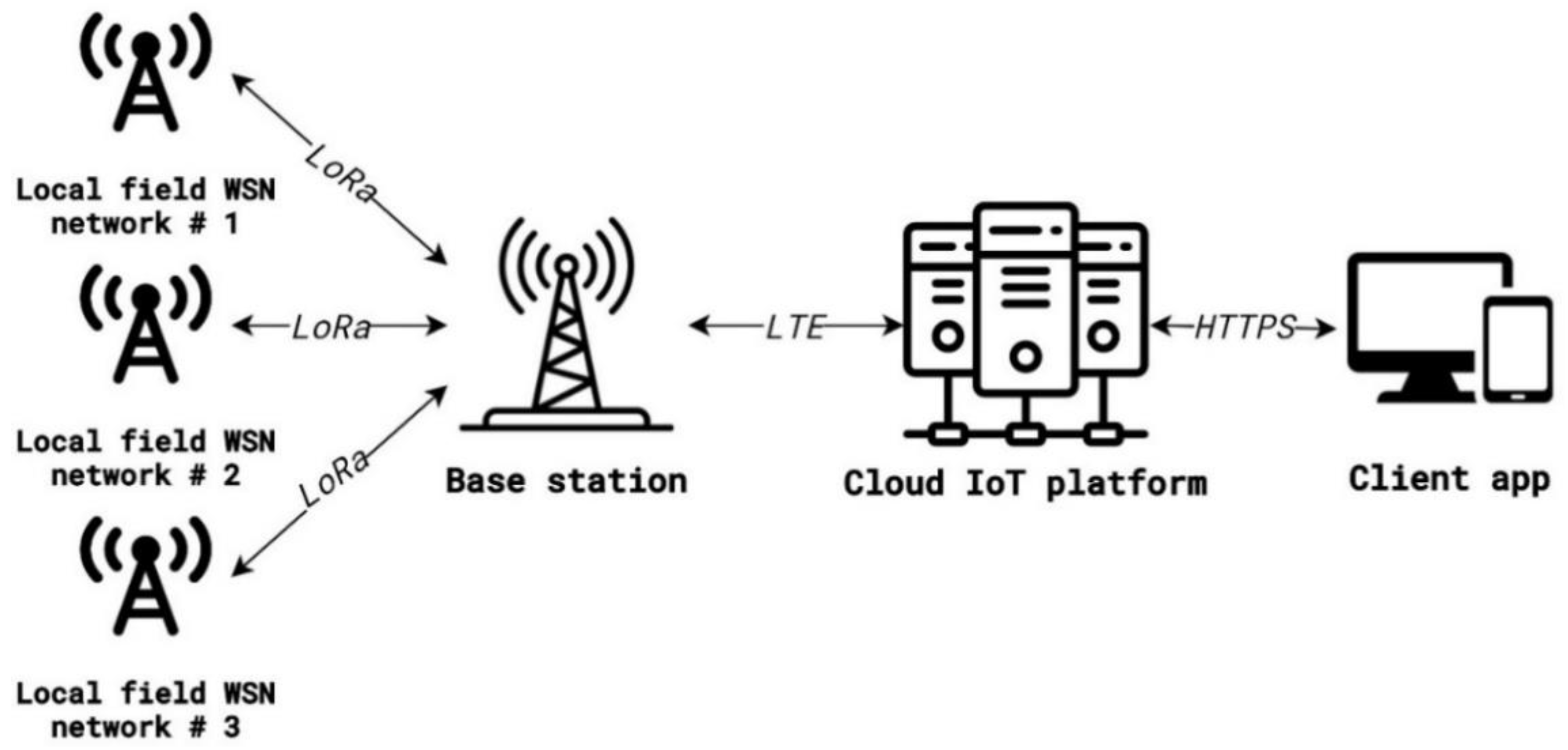
Figure 3.
Detailed structural and functional organisation of the information and communication infrastructure of the IoT agrotechnical monitoring network.
Figure 3.
Detailed structural and functional organisation of the information and communication infrastructure of the IoT agrotechnical monitoring network.
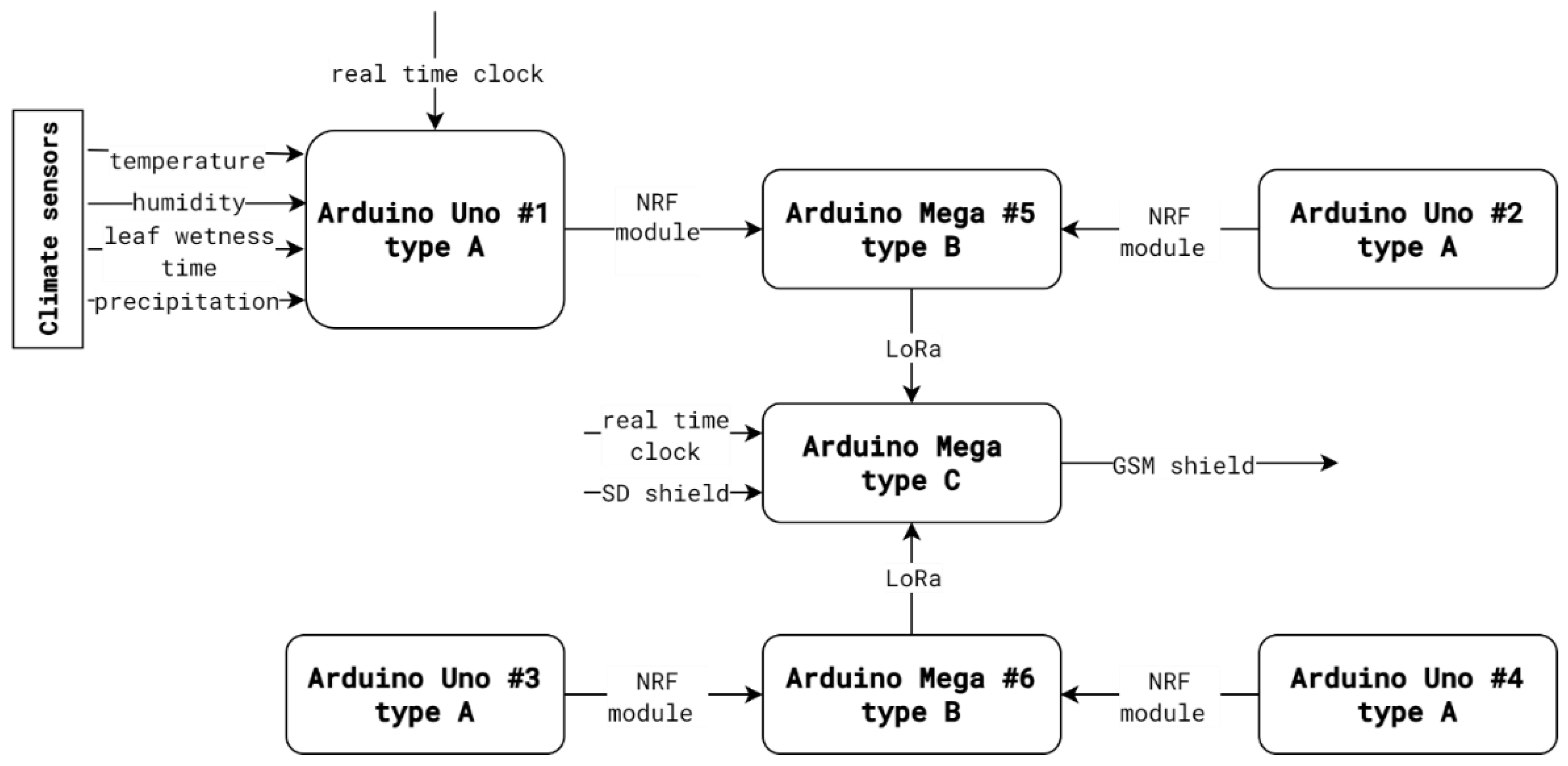
Figure 4.
Proposed ANFIS model for disease prediction.
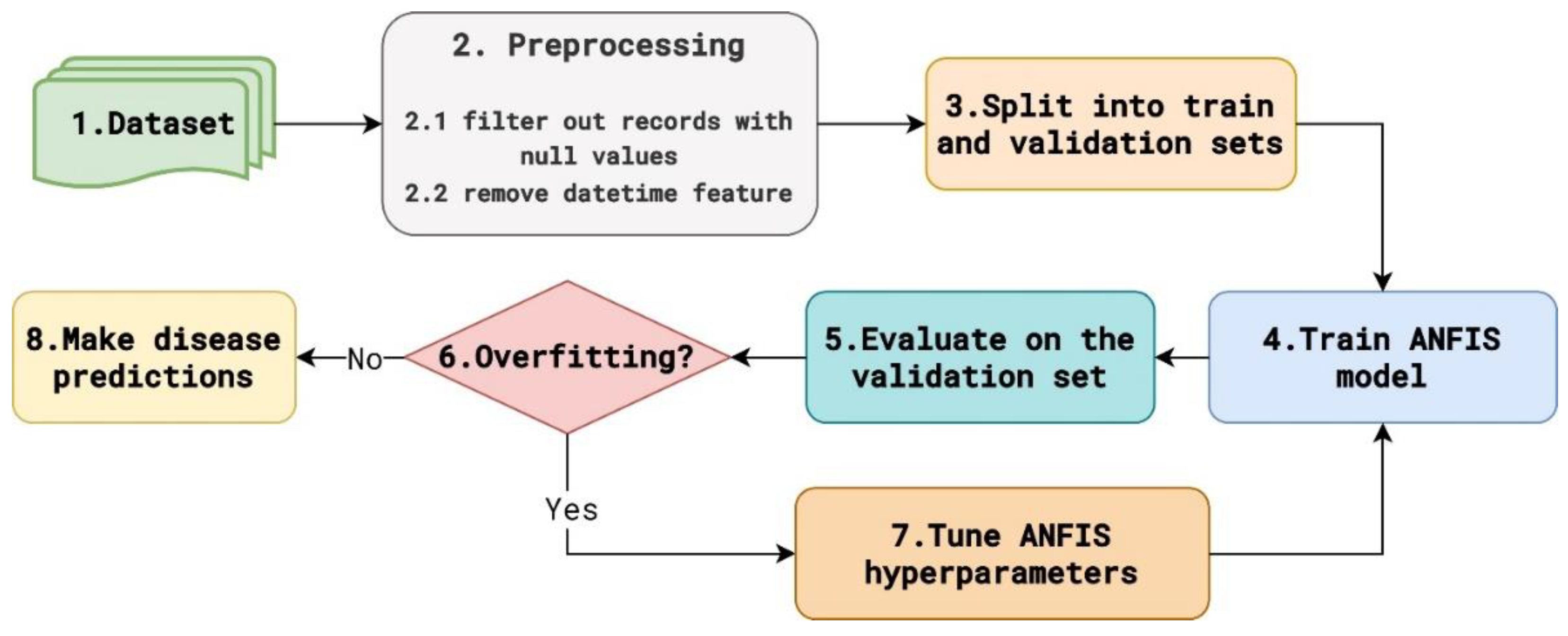
Figure 5.
UML diagram of the proposed model.
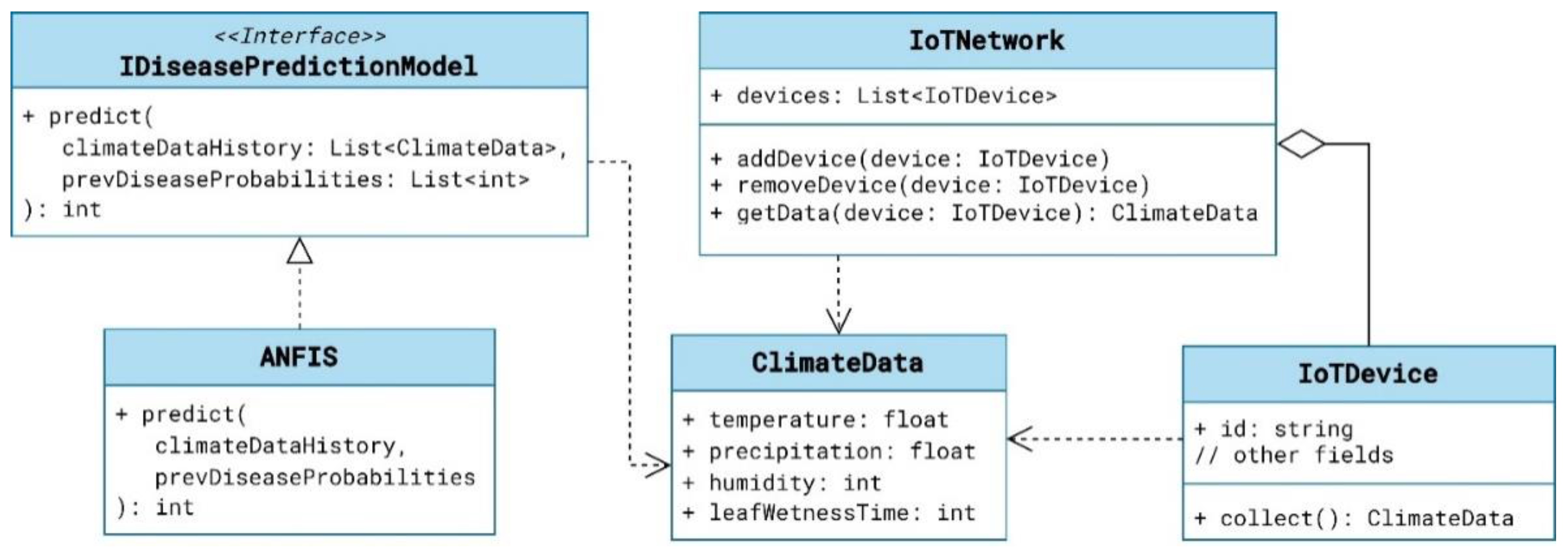
Figure 6.
Node Type A.
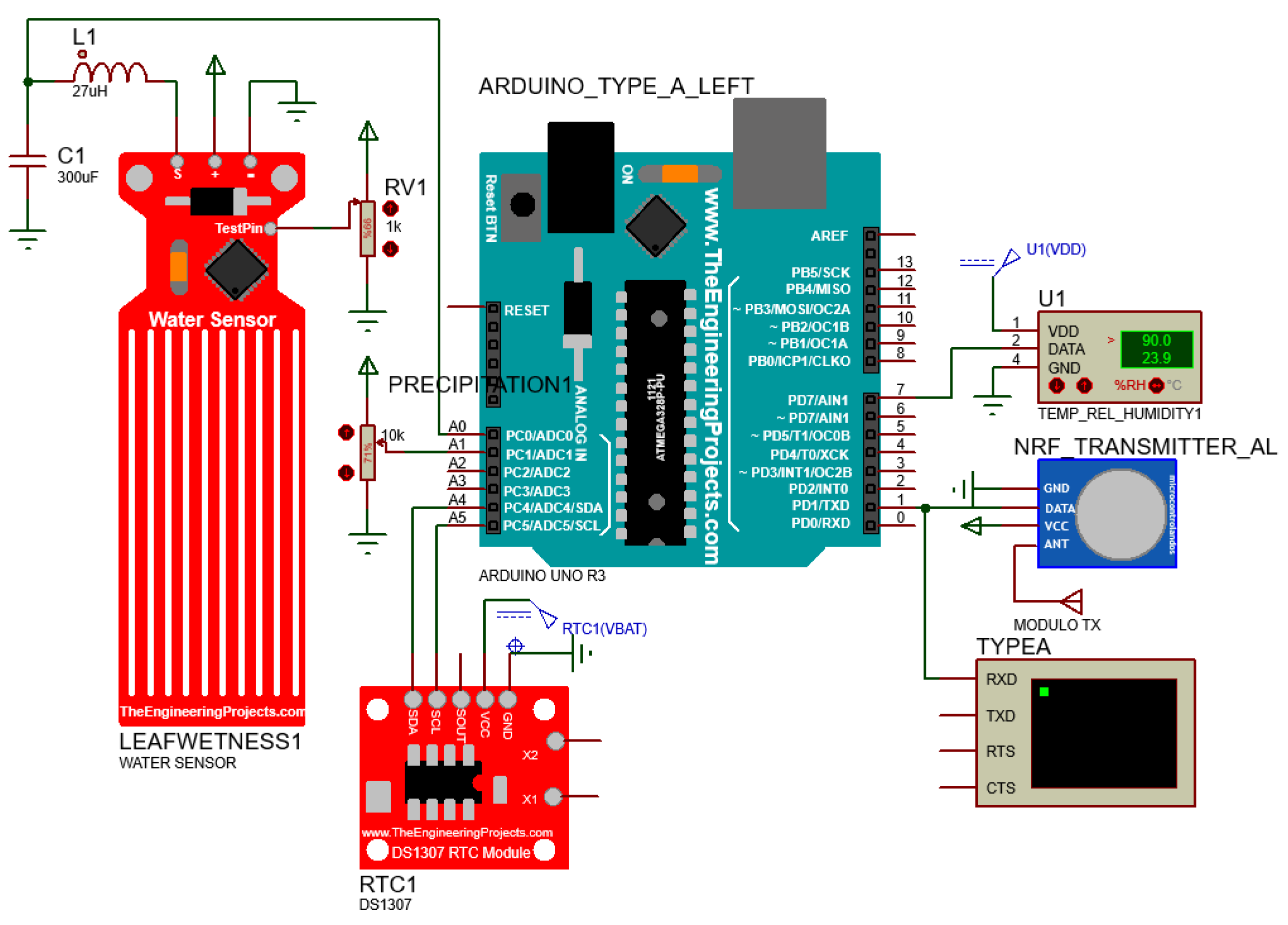
Figure 7.
Node Type B.
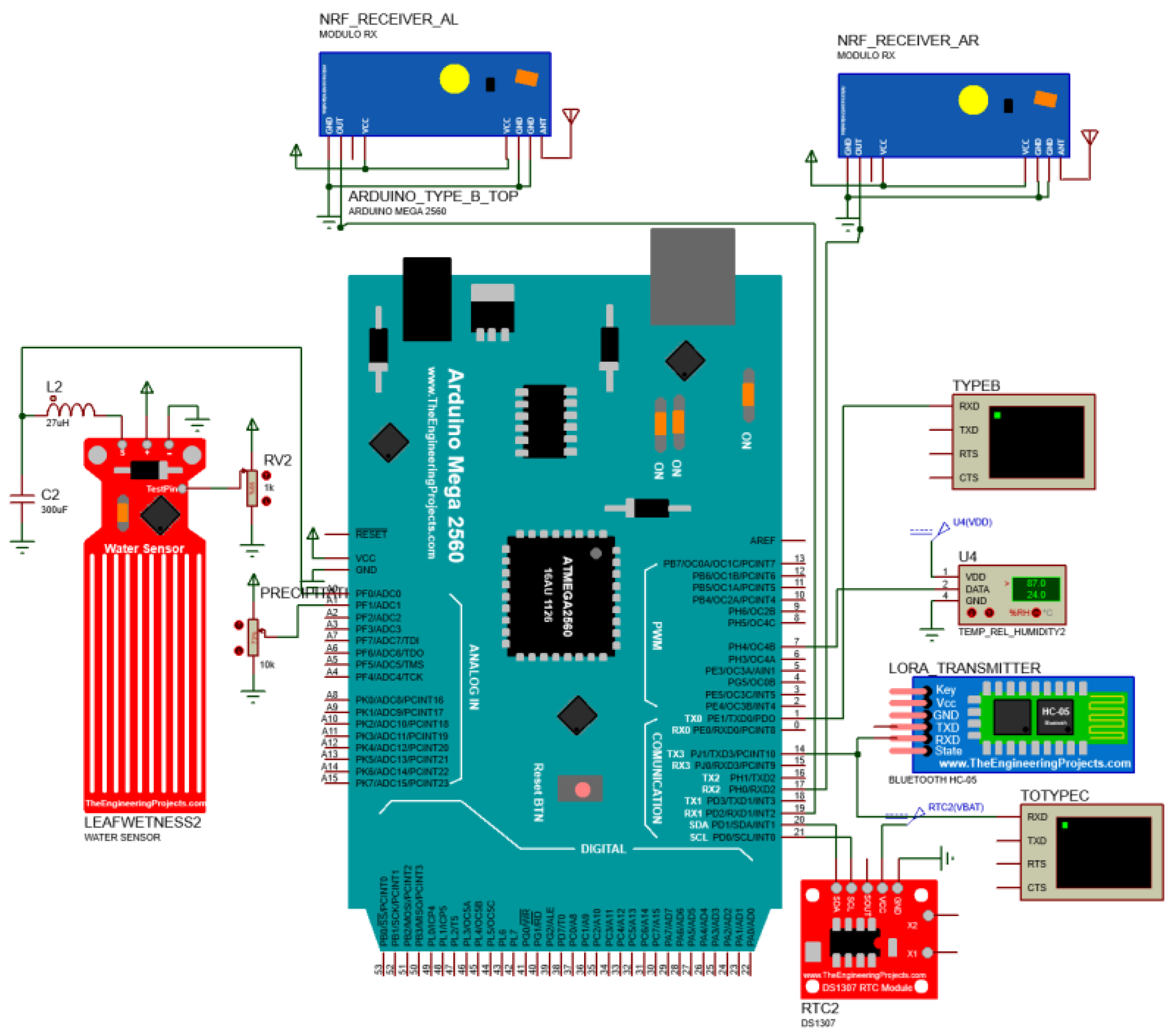
Figure 8.
Node Type C.
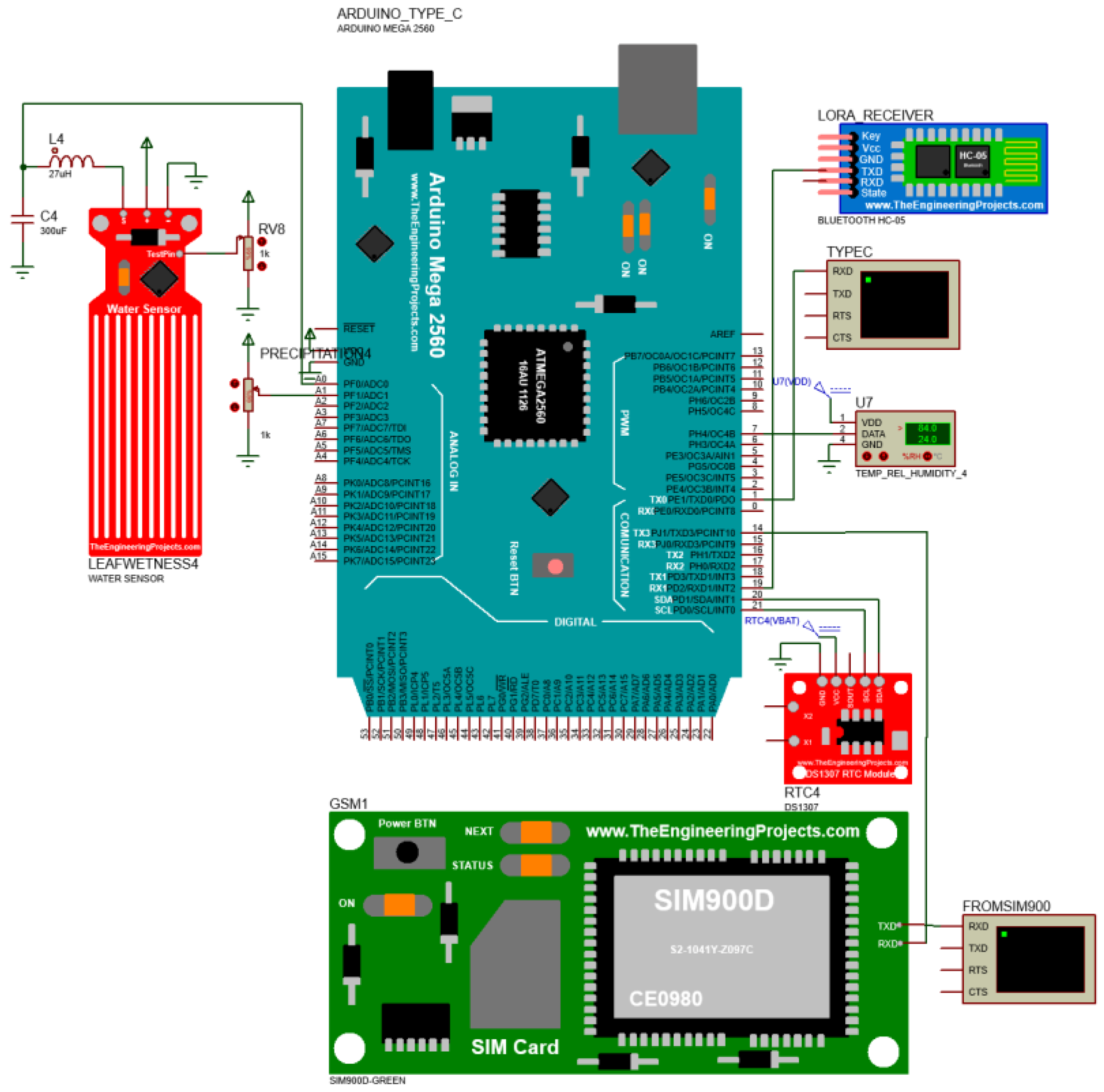
Figure 9.
View of the full model.
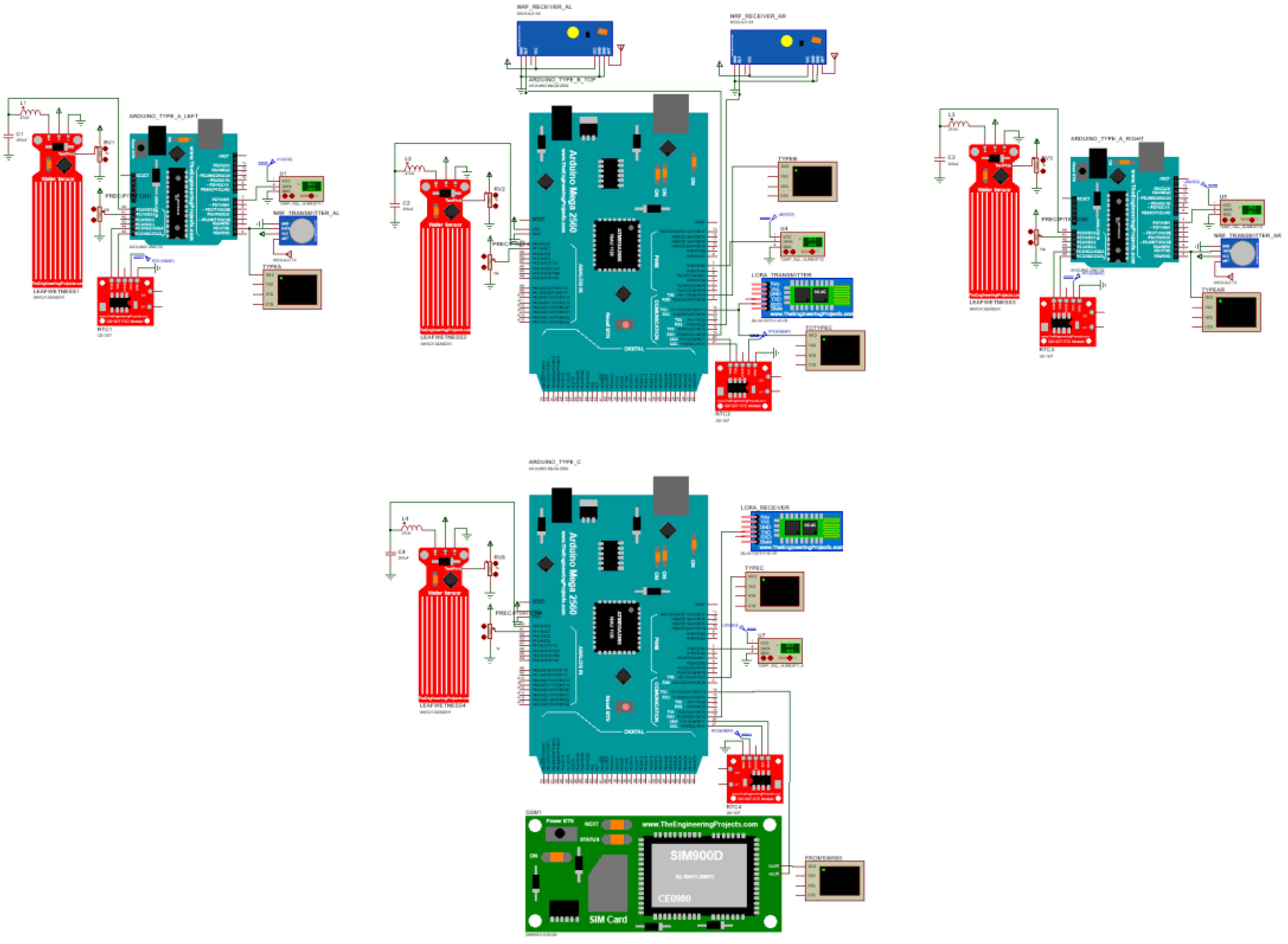
Figure 10.
Virtual terminal Node Type A #1.
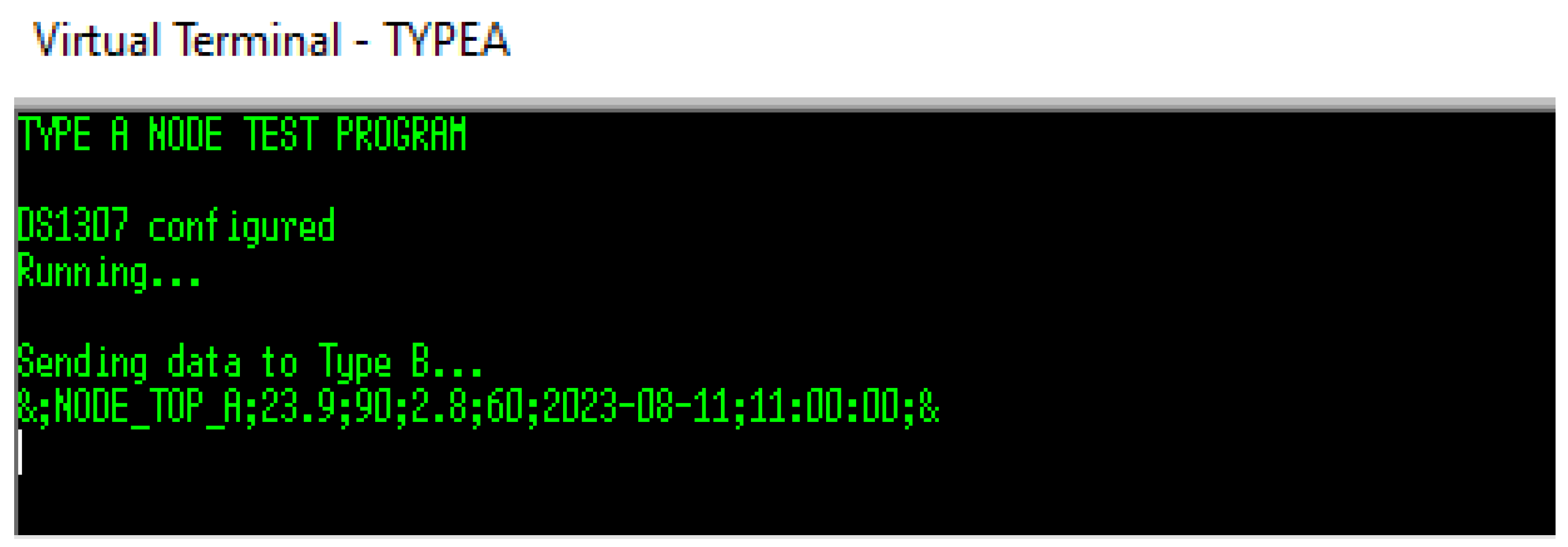
Figure 11.
Virtual terminal Node Type A #2.
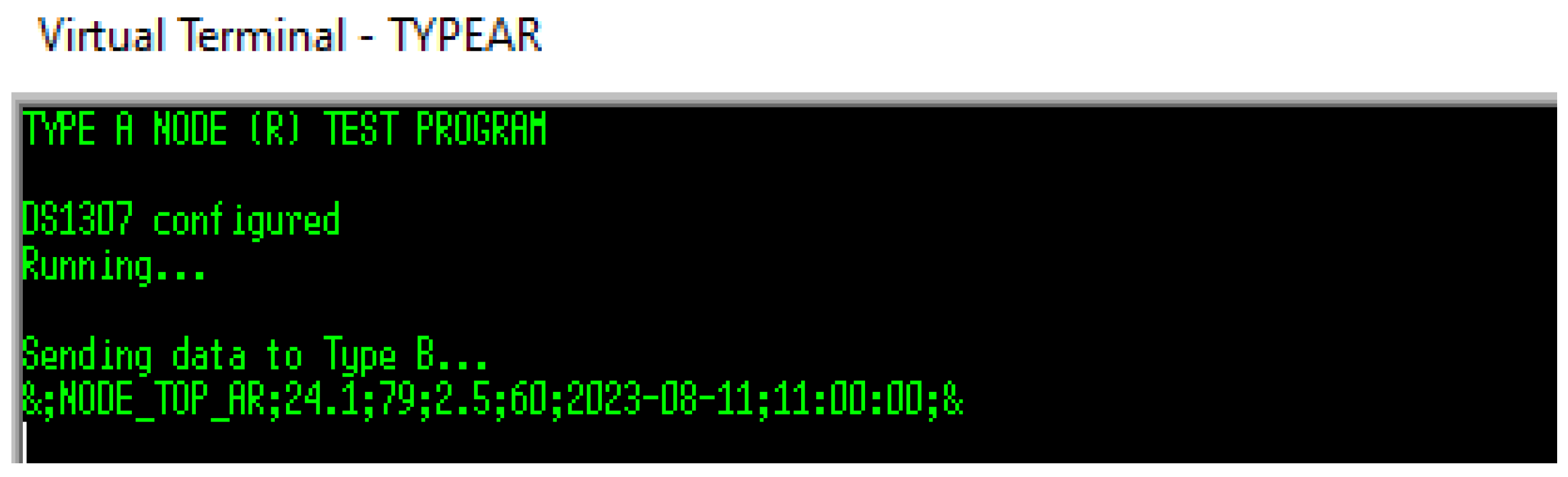
Figure 12.
Virtual terminal Node Type B.
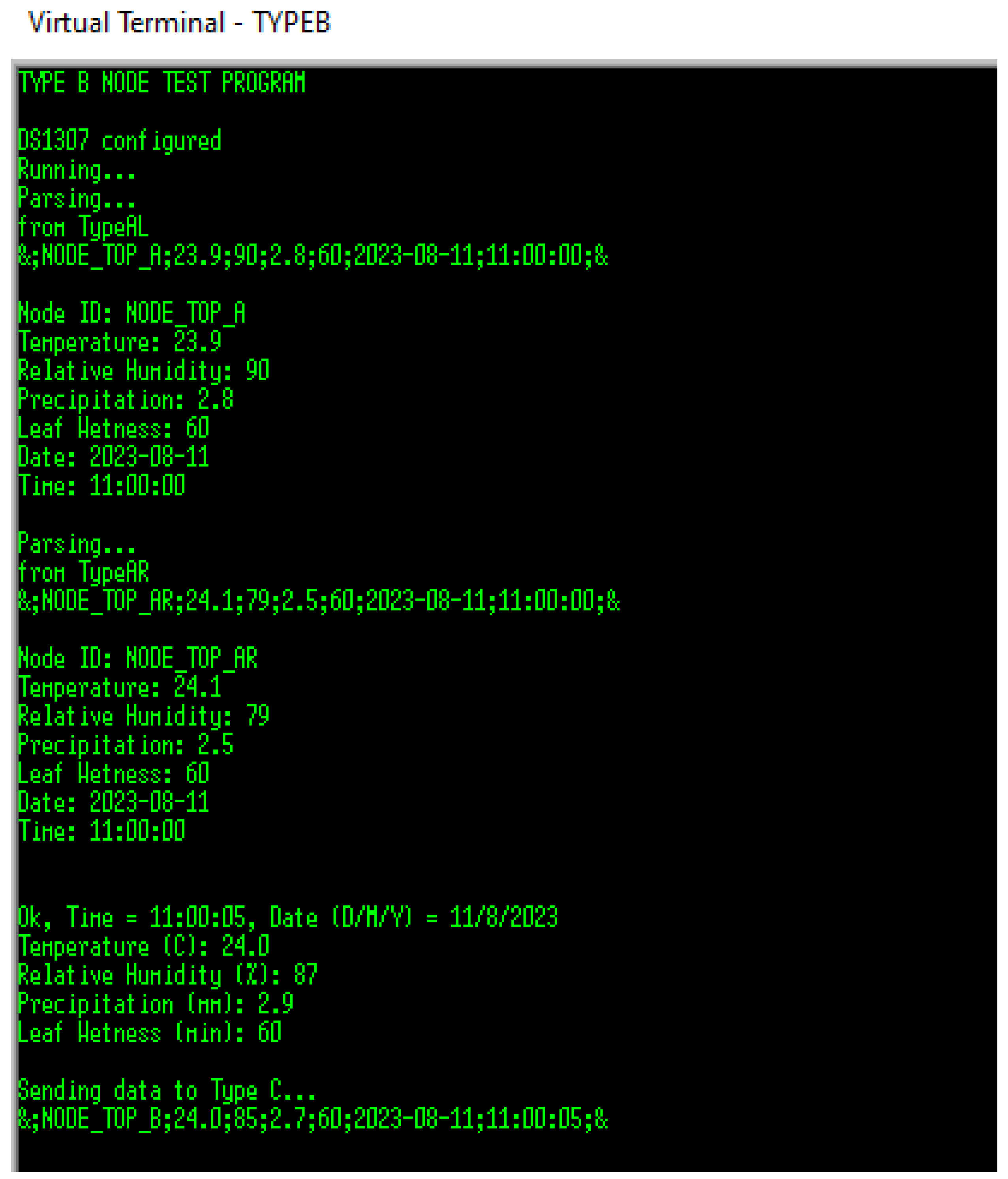
Figure 13.
Virtual terminal Node Type C.
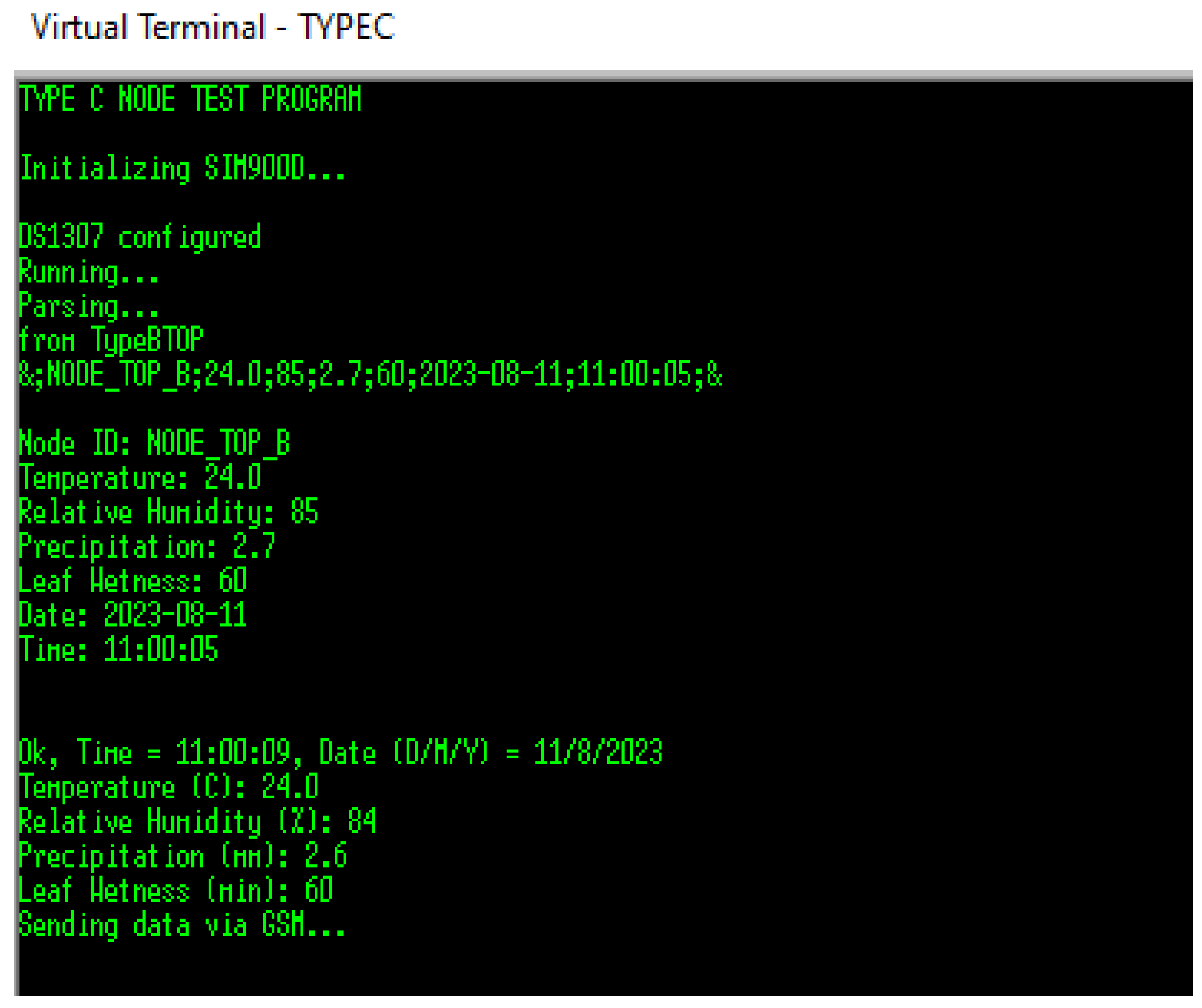
Figure 14.
Virtual terminal SIM900D.
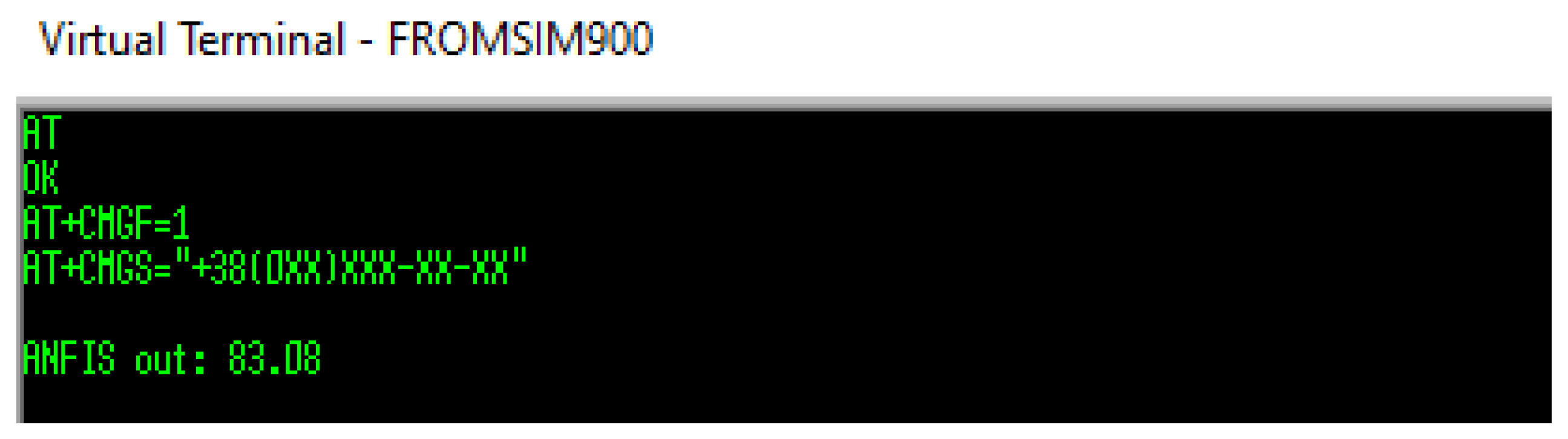
Figure 15.
Results of testing.
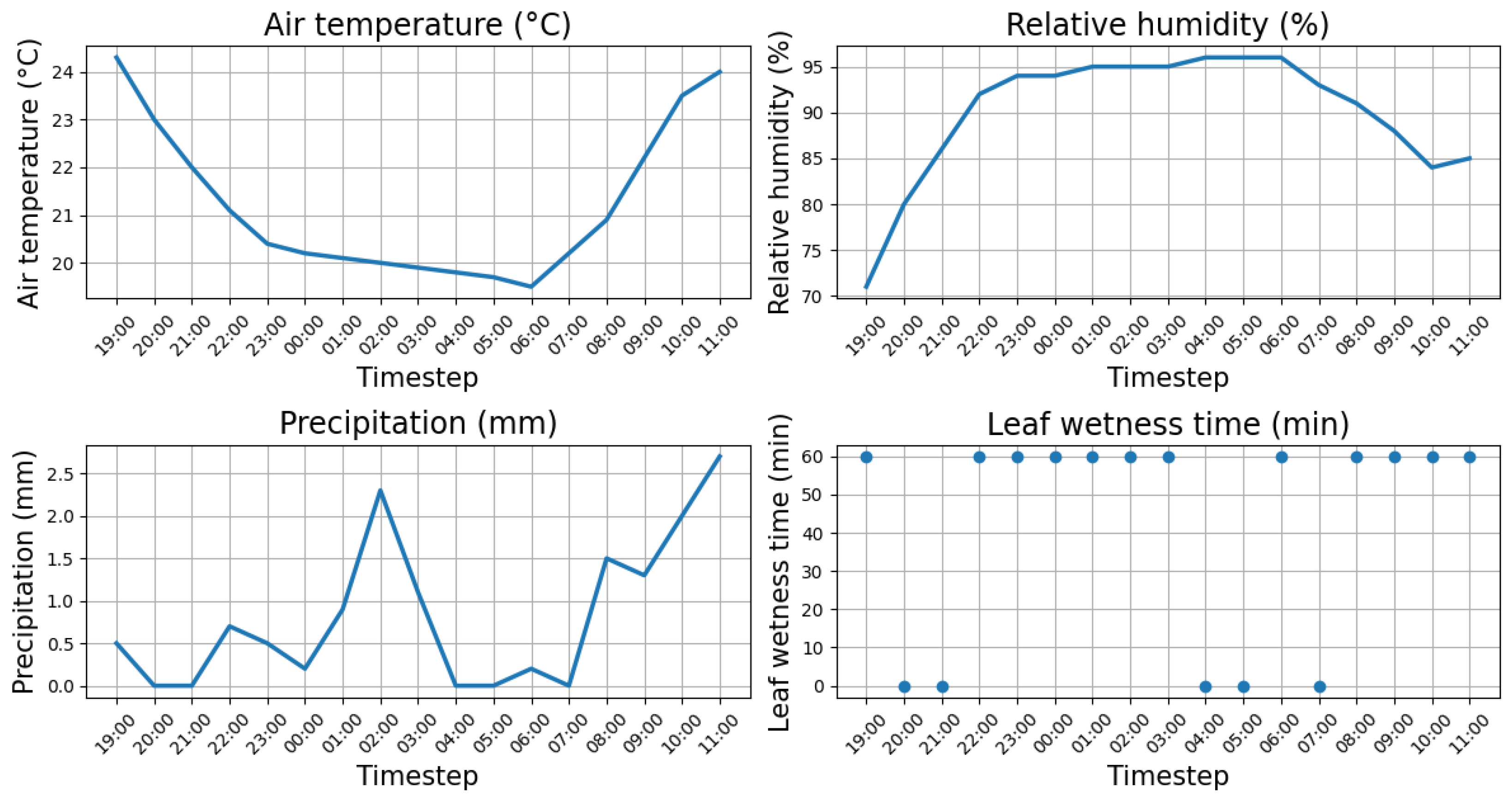
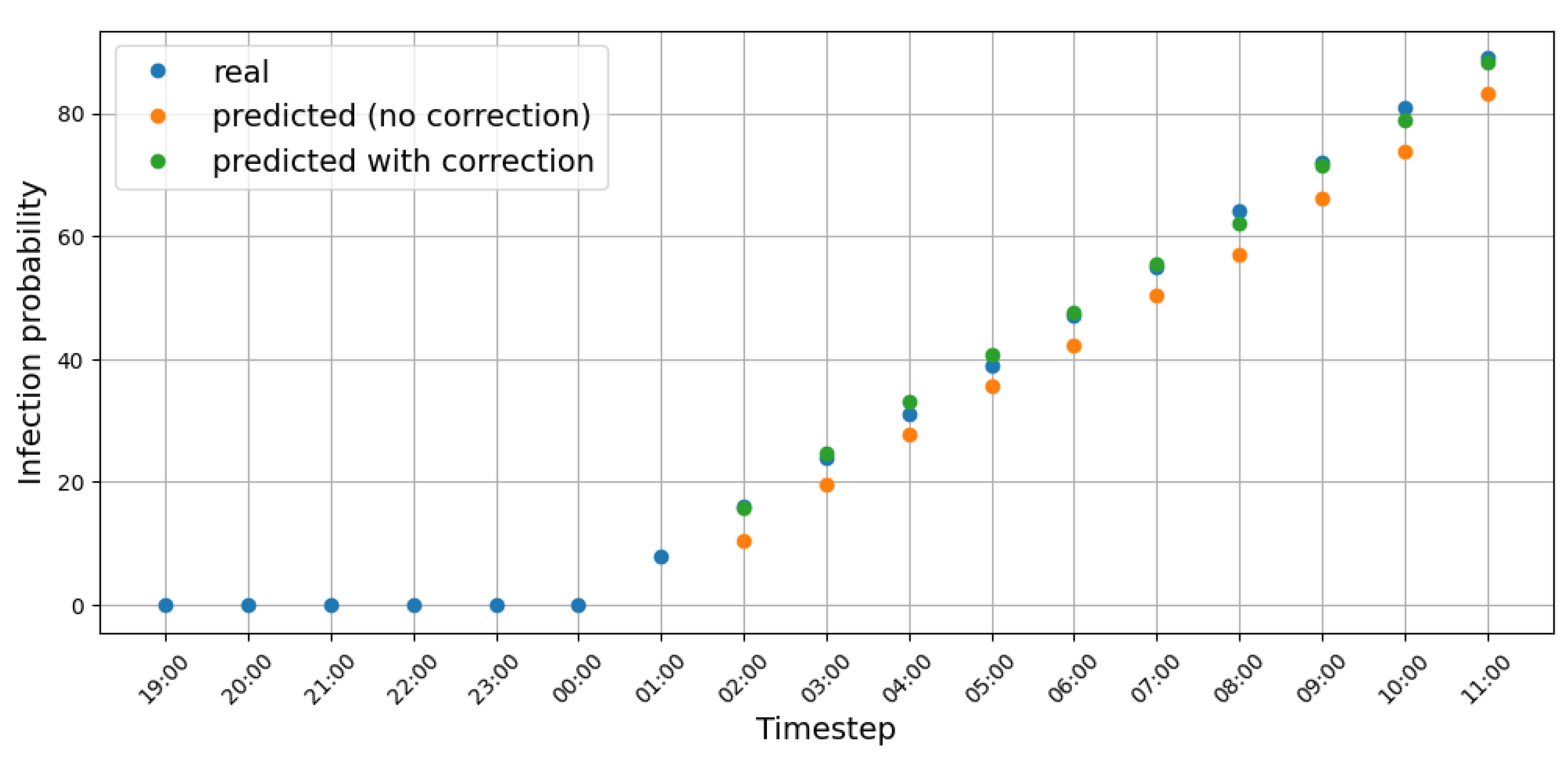

Table 1.
Results of comprehensive analysis and logical generalisation of scientific and applied results regarding the development and modelling of IoT systems for distributed online monitoring.
Table 1.
Results of comprehensive analysis and logical generalisation of scientific and applied results regarding the development and modelling of IoT systems for distributed online monitoring.
| The research subject | Technologies used | Scientific source |
|---|---|---|
| Development of scientifically grounded approaches to improving the efficiency of IoT systems for agrotechnical monitoring based on the optimality criterion, which takes into account the simultaneous influence of factors such as maximum uptime of hardware and software components, maximum network coverage area, and minimum number of wireless sensor modules used.entry 1 | WSN, ZigBee, LoRa, LTE, IoT cloud, CupCarbon |
[12] |
| Development of scientific and applied approaches to improve computer-integrated microclimate monitoring systems for industrial agricultural greenhouses. | GSM / GPRS, IoT Cloud |
[50] |
| Development of a farm management system based on embedded systems, IoT and WSN for agricultural field and livestock farms. | IoT, WSN, GSM, Wi-Fi |
[66] |
| A framework that combines the sensor layer, network layer, and visualisation layer to observe progressive trends in environmental data while being cost-effective. | IoT, EnviroDIY, Python |
[67] |
| Development of an information system for assessing air quality based on data from ground stations and monitoring of meteorological data, which solves the problem of sending out alerts about the danger to people. | Docker, REST, API, CALPUFF, WRF | [68] |
| An alert system for monitoring water deficit in plants using IoT technologies. | IoT cloud, WSN, ZigBee |
[69] |
| WSN using ZigBee and LoRa communication protocols for integration into energy management systems of smart buildings. | WSN, ZigBee, LoRa |
[70] |
| Development of a microcontroller system for monitoring the radiation background using the Arduino Uno board the Geiger counter SBM-20. | Petri nets, Geiger–Mueller counter |
[71] |
| Building an energy-efficient, resilient WSN while maximising node density and coverage using the FCM clustering algorithm. | WSN, FCM | [72] |
| Investigation of the performance of a heterogeneous WSN system using hybrid LoRa-Zigbee communication. | ZigBee, LoRa, MQTT, ThinkSpeak, Blynk |
[73] |
| The system of data collection for factories and industrial enterprises or environmental monitoring is offered, which measures certain parameters, such as temperature, humidity, level of gases present in the atmosphere, movement of any person near the prohibited zone at a certain moment of time and transmits these parameters to the control room wirelessly. | Bluetooth, WSN, ZigBee | [74] |
| Development of hardware and software for an IoT weather monitoring system based on the Arduino Mega2560 board, digital pressure, temperature and humidity sensor BME280, and Wi-Fi module ESP-01 built on the ESP8266 chip. | ThingsBoard IoT, MQTT, Node-RED, Wi-Fi | [75] |
| Development and implementation of a LoRa-based IoT system to monitor five dynamic parameters, including air temperature and humidity, soil temperature and moisture and soil pH. | IoT, LoRa, Wi-Fi, ThinkSpeak | [76] |
| Research on the development and laboratory testing of imitation and physical models of a computerised system for monitoring and controlling microclimate parameters in industrial greenhouses. | Proteus | [77] |
| Testing and modelling of an automatic plant irrigation system based on an Arduino microcontroller with a weather monitoring system. | Proteus | [78] |
| Development of a new approach to real-time meteorological data analysis and forecasting using an integrated system based on IoT, WSN, and ML. | IoT, WSN, RNN, ANN, RF | [79] |
| Development of a model that predicts high crop yields and precision farming. | IoT, WEKA, ML | [80] |
Table 2.
Components used to model the functional parts of the IoT system.
| IoT system components | Type of node | Proteus library equivalent |
|---|---|---|
| Temperature sensor | Type A, Type B, Type C | DHT22 |
| Relative humidity sensor | ||
| Precipitation sensor | Type A, Type B, Type C | POT-HG 10 kΩ, POWER, GROUND |
| Leaf wetness sensor | Type A, Type B, Type C | WATER SENSOR, CAP 300 uF, INDUCTOR 27 uH, POT_HG 1 kΩ, GROUND, POWER |
| Real-time clock | Type A, Type B, Type C | DS1307, DC Generator 5 V, GROUND |
| NRF module | Type A, Type B | MODULO RX (modulo rf library), MODULO TX (modulo rf library), GROUND, POWER, |
| LoRa module | Type B, Type C | HC-05 based on Serial Interface |
| GSM shield | Type C | SIM900D-GREEN |
| Arduino Uno Rev3 | Type A | ARDUINO UNO R3 |
| Arduino Mega 2560 Rev3 | Type B, Type C | ARDUINO MEGA 2560, GROUND, POWER |
Disclaimer/Publisher’s Note: The statements, opinions and data contained in all publications are solely those of the individual author(s) and contributor(s) and not of MDPI and/or the editor(s). MDPI and/or the editor(s) disclaim responsibility for any injury to people or property resulting from any ideas, methods, instructions or products referred to in the content. |
© 2024 by the authors. Licensee MDPI, Basel, Switzerland. This article is an open access article distributed under the terms and conditions of the Creative Commons Attribution (CC BY) license (http://creativecommons.org/licenses/by/4.0/).
Copyright: This open access article is published under a Creative Commons CC BY 4.0 license, which permit the free download, distribution, and reuse, provided that the author and preprint are cited in any reuse.


