

Submitted:
27 November 2024
Posted:
19 December 2024
You are already at the latest version
Abstract
This booklet, Building Bridges: A Peace Education Manual for Church Youth Leaders in the Democratic Republic of Congo, represents a vital resource for fostering a culture of peace and reconciliation in a nation grappling with complex social, political, and environmental challenges. By addressing foundational aspects of peacebuilding and conflict resolution through the lens of biblical values, this manual equips youth leaders with the tools and understanding necessary to become catalysts for transformation in their communities.
Keywords:
Peace education
; conflict resolution
; conflict prevention
; gender and equity
; dialogue and tolerance
Introduction
This booklet, Building Bridges: A Peace Education Manual for Church Youth Leaders in the Democratic Republic of Congo, represents a vital resource for fostering a culture of peace and reconciliation in a nation grappling with complex social, political, and environmental challenges. By addressing foundational aspects of peacebuilding and conflict resolution through the lens of biblical values, this manual equips youth leaders with the tools and understanding necessary to become catalysts for transformation in their communities.
The modules outlined in this manual—ranging from understanding the biblical values of human relationships to exploring the intersection of conflicts and environmental protection—serve as a comprehensive guide to tackling the multifaceted issues that impact individuals and society. Each module’s focus on biblical principles underscores the role of faith in navigating challenges and fostering sustainable peace. By leveraging compelling discussion prompts, facilitators can stimulate participants to engage in critical thinking and discourse, thus fostering their capacity to comprehend and enact the concepts within their personal narratives.
Peacebuilding is a dynamic and continuous process requiring intentional effort, empathy, and resilience. The inclusion of modules on dialogue and tolerance, gender and equity, and child protection reflects a holistic approach to addressing the root causes of conflict and promoting inclusive solutions. These modules underscore the intricate interdependence among human relationships, justice, and sustainable development, emphasizing that peace transcends the mere absence of conflict and encompasses the embodiment of equity, dignity, and harmony.
Furthermore, the module on human rights and justice calls attention to the importance of fairness and accountability in fostering a just society. By understanding the value of human rights within a biblical framework, church youth leaders are better positioned to advocate for marginalized individuals and uphold principles of justice in their interactions. Similarly, the module on environmental protection challenges us to view peacebuilding through a broader lens, acknowledging the impact of environmental stewardship on long-term stability and community well-being.
This manual also underscores the role of education and dialogue in resolving and preventing conflicts. By implementing effective pedagogical approaches for youth leaders, it ensures the perpetuation of peace education tenets to future generations. The biblical narratives and perspectives woven throughout the modules provide both inspiration and guidance, reminding participants of their divine calling to be peacemakers in a divided world.
As the Democratic Republic of Congo persistently endeavors to traverse its trajectory toward lasting peace, the significance of influential youth leaders' contributions is undeniably paramount. These leaders possess a distinct opportunity to act as bridge-builders, uniting individuals across disparate boundaries and promoting comprehension amidst challenges. This manual is a testament to the belief that peace is possible when communities come together with faith, wisdom, and courage. Let this training manual inspire and empower its readers to take actionable steps toward building a society where love, justice, and respect prevail. By applying the teachings and principles contained herein, church youth leaders in the DRC can create an enduring legacy of peace, one relationship, one dialogue, and one community at a time.
Rationale
Almost three decades ago, the Democratic Republic of Congo experienced insecurity and armed conflicts that led to the death of several million people and enormous material losses. Conflicts have even caused the unjust distribution of resources, leading to inequality, gender-based violence, and ethnic conflicts. The implementation of peace education is a fundamental aspect in preventing armed conflict and violence, resulting in the preservation of human life and the allocation of available resources toward communities’ needs.
Peace education is an interdisciplinary field of study that aims to promote the values, attitudes, and skills needed to create and sustain a culture of peace. Peace Education seeks to equip individuals with the knowledge and skills to address the root causes of conflict, promote social justice, and build sustainable and peaceful relationships between communities and nations.
Peace education has its roots in the peace movements of the 20th century, which sought to promote peace and non-violence as an alternative to war and conflict. It has since evolved into a multidisciplinary field that draws on a range of disciplines, including education, psychology, sociology, political science, and international relations.
Peace education is not teaching individuals about peace; it involves transforming individuals and societies toward a culture of peace. It seeks to challenge the beliefs, attitudes, and practices that contribute to violence and conflict and promote values such as respect, empathy, cooperation, and nonviolence. Peace education also involves the development of skills such as communication, conflict resolution, critical thinking, and active citizenship.
Peace education can be applied in various contexts, including schools, universities, community organizations, and international development programs. It can be integrated into existing curricula and educational programs or developed as a standalone program. The ultimate goal of peace education is to empower individuals and communities to work towards a more peaceful and just world where human dignity and rights are respected and conflict is addressed through peaceful means.
In a place where conflicts are recurrent, peace education is needed for individuals who have an influence on others in their communities. The Democratic Republic of Congo setting is more indicative of the need for training individuals in peace education. Indeed, the Democratic Republic of Congo has experienced conflicts and instability since 1992, especially in the eastern part of the country. Death, rape, loss of property, displacement of population, environmental destruction, and many more are the consequences of the prevailing conflicts.
Due to this situation, raising awareness among the population through education for peaceful cohabitation is crucial. A Peace Education Manual can help realize this project. Our target is Church Youth Leaders who will be tained to traine others. Indeed, non-violent conflict resolution remains the only way to mitigate conflicts and their consequences.
Using force to solve armed conflicts has been unsuccessful since the beginning of instability in the DRC. The intervention of the United Nations Peacekeeping forces has also brought no lasting solution despite their 20 years of existence in the conflict field. We believe non-violent solutions from a biblical perspective can bring sustainable results.
Philosophy
Peace education is a field of education that aims to promote the knowledge, skills, and attitudes needed to build a more peaceful world. Its philosophical foundations are based on several key principles, including Human Dignity, Social Justice, Nonviolence, Global Citizenship, and Sustainability.
The philosophical foundations of peace education provide a theoretical basis for developing curricula, pedagogical methods, and assessment strategies based on these principles. Literature from various philosophical traditions, including humanism, feminism, critical theory, and postcolonial theory, supports these foundations.
Aims, Goals, and Objectives
The objective of peace education is to foster the development of conscientious individuals who possess the ability to exhibit empathy and solidarity towards others, irrespective of their social or geographical background. Such individuals are expected to be able to analyze the underlying causes of violence and take appropriate measures to promote peace. The goal is to create responsible citizens who can contribute to building a harmonious society.
Aim
The Peace Education Training Module aims to provide participants with the skills they need to work toward peace and nonviolent conflict resolution in their neighborhoods and beyond.
Goals
Increasing learners’ understanding of the causes and consequences of conflict and violence and the principles of peace and non-violence.
- Enhancing participants’ communication skills, including active listening, respectful dialogue, and effective negotiation.
- Building participants’ capacity to analyze and address conflict situations through various non-violent strategies and techniques.
- Encouraging participants to become active peacebuilders in their communities and promote peaceful and inclusive societies.
Objectives
At the end of this training, attendees will be able to:
- Analyze case studies of conflict situations to identify root causes and potential non-violent solutions.
- Practice active listening and respectful dialogue skills through role-plays and group discussions.
- Apply different non-violent conflict resolution strategies and techniques, such as mediation, negotiation, and advocacy.
- Develop action plans for promoting peace and non-violence in participants’ communities.
Scope And Sequence
| Module | Topic | Content | Teaching Strategies | Evaluation |
| 1 | Biblical Values on Human Relations |
The Bible offers numerous understandings of the nature of human relations and guides how individuals can foster positive relationships with others. | Lecture Think-square-share Discussion |
Short Quiz |
| 2 | Why does Conflict Arise? | People have different perspectives on life and its problems. Conflict arises when people disagree in their way of thinking. |
KWL Lecture Think-pair-share Discussion |
Three-minutes pose Classroom Opinion Polls |
| 3 | Conflict Resolution and Prevention | Strategies and approaches to address and mitigate conflicts between individuals, groups, or communities. |
Group Jigsaw Presentation |
Class Modelling |
| 4 | Dialogue and Tolerance | Communication process between two or more people or groups where ideas, opinions, and perspectives are exchanged respectfully and constructively. | Lecture Discussion Think-pair-share |
Short quiz Reading Report |
| 5 | Human Rights and Justice | Fundamental rights and freedom to all. There is a need for justice to protect people equally. |
Lecture Ranking |
Group Quiz |
| 6 | Child Protection | Children are vulnerable in times of conflicts Efforts to protect children are multi-faced. everyone must protect children: families, communities, government, and other stakeholders. |
Group Jigsaw Venn Diagram Think-square-share |
Classroom Opinion Polls |
| 7 | Gender and Equity | Men and women are equal. Gender should not be a barrier to accessing opportunities, achieving success, or making meaningful contributions to the community. |
Lecture Graffiti |
Case Study |
| 8 | Conflicts and Environment Protection | Conflicts have a significant impact on the environment. Environment degradation contributes to conflicts. Competition for limited resources like land, water, and minerals can lead to armed conflicts. Environment protection can contribute to reducing conflicts. |
Expert Jigsaw Think-pair-share |
Short Quiz Reading report. |
Teaching Strategies, Techniques, And Structures
A strategy is an organized system of instruction based on learning theory or how scholars think in a particular discipline. The trainer can use the following teaching strategies and structures to engage learners in the lesson.
Regular Jigsaw
The jigsaw teaching strategy is a cooperative learning technique developed by Elliot Aronson and his colleagues in the 1970s. It is designed to promote cooperation and communication among students by requiring them to work together to master a particular subject or topic.
Step 1: Preparation of information or material for learning.
- -
- The teacher prepares the information or materials to be studied.
- -
- The information to be studied is divided into four parts. Each cooperative group is supposed to have four members.
- -
- The material is labeled: #1, #2, #3, #4
- -
- In each cooperative group of four members, everyone is assigned one part of the information.
Step 2: Individual students work on their assigned material.
- -
- Each student reads his/her information.
- -
- The student decides on the necessary details from the material.
Step 3: Students teach.
- -
- The student decides the best way to teach the information to his group members.
- -
- The student has up to 2 minutes to share what he/she learned from the material.
Step 3: Assessment
- -
- Here, the teacher decides the best way to assess the student’s learning. He can ask questions or use any other forms of assessment.
Group Jigsaw
Step 1: Preparation of information or material for learning
- -
- The teacher divides the information to be learned into several organized cooperative groups.
- -
- The teacher labels the material. At this level, the material or information to be studied is numbered according to the number of organized groups: Groups 1, 2, 3, 4, 5, 6, and so forth.
- -
- Each cooperative group is assigned one part of the information.
Step 2: Cooperative groups work
- -
- Each cooperative group reads their material/information.
- -
- The members of the cooperative group decide on 3 to 5 important details to pick from the information they have.
- -
- The cooperative group decides the best way to present the information to the class.
Step 3: The cooperative groups teach.
- -
- Each cooperative group is given an assigned amount of time to present the information to the class.
- -
- All members of the group are expected to participate in the presentation.
Step 4: Assessment
- -
- The teacher decides the best way to assess the student’s learning. He can ask questions or use any other forms of assessment.
Expert Jigsaw
Step 1: Preparation of the information
- -
- The teacher prepares the information to be studied.
- -
- The teacher divides the information into four equal parts.
- -
- The teacher labels the four parts: #1, #2, #3, #4
Step 2: Distribution of the material
- -
- In each cooperative group, everyone is assigned one part of the information. In this case, each cooperative group has four members.
- -
- Individuals read their information and summarize it.
Step 3: Formation of Expert Groups
- -
- Here, the students form expert groups.
- -
- Individuals from different cooperative groups with the same material label form an Expert Group. Example: all individuals who have received material #1, they leave their cooperative groups and come together to form Expert Group #1, those with material labeled #2 form Expert Group #2, those with material labeled #3 form Expert Group #3, and those with material labeled #4 form Expert Group #4.
Step 4: Expert groups work
- -
- The members of the expert group read the information they have.
- -
- Students decide on 3 to 5 essential points to learn from the material.
- -
- Students decide on the best way to teach this information to their home cooperative groups.
Step 5: Experts teach.
- -
- At this stage, students return to their home cooperative groups.
- -
- Each student is given time to present his information to the members of his home cooperative group.
Step 6: Assessment
- -
- The teacher decides the best way to assess the student’s learning. He can ask questions or use any other forms of assessment.
Graffiti
Graffiti is a form of cooperative learning in which students are asked to provide written responses to the instructor’s questions. Graffiti is a great way to do a quick informal pre-assessment, evaluate how well a lesson was delivered, or check for understanding.
A Graffiti Board is a large piece of paper or whiteboard where students can write their thoughts and questions about a topic together. Using this method, students will be able to hear and understand the points of view of their peers. Five to ten minutes are enough to implement this procedure. Graffiti is an excellent way for introverted students to start talking. Furthermore, it keeps track of student inquiries and comments for future reference.
Procedure
Step 1 – The teacher prepares Graffiti Questions and divides students into study groups. The teacher prepares a limited number of review questions (4 or 5).
Step 2 – The teacher distributes the materials. Every student uses colored markers. This way, they can track their responses.
Step 3 - Answer Questions - At the end of a timed interval, students exchange questions until each cooperative group has had an opportunity to answer all the questions.
Step 4 - Exchange Questions: Teams exchange question responses until all teams have read all responses.
Step 5 - Return to Original Question: Teams get their original response sheets and review all the answers on their review sheet. They arrange their answers into categories and arrive at generalizations and additions based on others’ responses.
Step 6 - Share Information - groups then share material with the whole class.
Lecture
Though lecture is considered the traditional strategy, it is also unavoidable in teaching. The instructor will use power presentations and videos empowered by the questions and other modern techniques such as “three-minute pause,” “turn to your neighbor”…
Discussion:
Depending on the topic of the study, the instructor encourages group work through brainstorming and sharing experiences and ideas to provide broader insights.
Venn diagram
A Venn diagram is a visual aid for illustrating relationships between and among sets, groups of objects that share something in common. The Venn Diagram teaching strategy is a useful tool for any subject area and with students of all ages. It is a wonderful method for fostering critical thinking and helping students make connections between ideas.
Procedure:
- Draw two or more intersecting circles on a piece of paper or whiteboard.
- Label each circle with the name of a concept or idea to be compared.
- From the information provided to the students, they write down the similarities between the concepts in the overlapping section of the circles.
- Students write down the differences between the concepts in the non-overlapping sections of the circles.
- The teacher discusses the similarities and differences with the students.
- Use the Venn Diagram to guide further discussion or to help students organize their thoughts.
 |
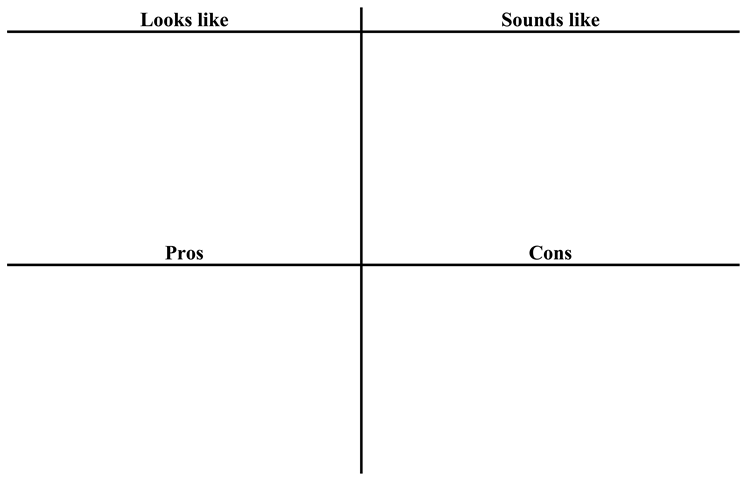
T – Chart
The T-Chart teaching strategy is a visual tool to organize information into two columns. The teacher uses T-Chart when he wants students to compare or contrast ideas or analyze a topic from different perspectives. Here is how it works:
- Draw a large T on a piece of paper or whiteboard.
- Label the left column “Looks like” and “Sounds like” when checking for similarities. The teacher may also label the left column “Pros” and the right column “Cons” when he requires students to check for differences or opposite ideas.
- Discuss the similarities or differences in a given topic.
- Use the T-Chart to guide further discussion or debate.
 |
K - W - L
KWL is the acronym of “Know, Want to know, Learned.” It is a learning strategy that helps students organize their thoughts and focus their learning by reflecting on what they already know about a topic, what they want to know, and what they have learned after studying the topic.
Here is how it works:
- Know: This is where students brainstorm what they already know about a topic. This helps activate prior knowledge and helps the student connect new information to what they already know.
- Want to know: This is where students generate questions, concerns, and ideas about what they want to learn or discover about the topic.
- Learned: After studying the topic, students reflect on what they have learned. This helps reinforce their learning and allows them to reflect on their understanding.
|
K (What I know) |
W (What I want to Know) |
L (What I have Learned) |
| Students list here what they know about the topic. - - - - - - - -- |
Students list here what they want to know about the topic. - - - - - - - - |
After studying the topic, students list here what they have learned. - - - - - - - |
Ranking
The ranking teaching structure involves students ranking a list of items, ideas, or concepts based on their importance, relevance, or preference. This strategy can be used to promote critical thinking, discussion, and collaboration among students by encouraging them to consider and defend their opinions on a particular topic.
Here's how the ranking teaching structure typically works:
- The teacher introduces a list of items, ideas, or concepts related to a specific topic.
- Students individually rank the items in order of importance, relevance, or preference, and record their rankings on a piece of paper or worksheet.
- Students then work in small groups to compare and discuss their rankings, exploring similarities and differences among their choices.
- The groups then work together to come up with a collective ranking, using the insights and arguments from their individual rankings and discussions.
- After the group rankings are completed, the class can come together to share and compare their rankings, discuss the reasons behind their choices, and explore the implications of the rankings.
Four Corners
The four corners teaching structure is a strategy that involves dividing the classroom into four sections or corners. Each corner represents a different answer or opinion to a specific question or statement. This strategy is often used to initiate discussion and engage students in critical thinking by encouraging them to consider multiple perspectives on a particular issue.
Procedure:
- The teacher introduces a question or statement that requires students to take a position or make a choice.
- The teacher assigns each corner of the room with a different answer or opinion that students can choose.
- Students move to the corner that corresponds with their chosen answer or opinion and stand with others who share their views.
- Once students have settled in their chosen corners, the teacher facilitates a discussion among the groups.
- Students share reasons for their chosen answer or opinion, listening to and responding to alternative viewpoints, and exploring common ground or differences among the groups.
- After the discussion, students may be asked to reflect on what they learned, how their opinions may have changed, or what new questions they have.
EVALUATION
Evaluation is an essential part of the curriculum, which helps the teacher to check if the learning goals have been met. The following are the evaluation strategies that will be given to the students to assess their learning and understanding of the lessons:
- Short Quiz - learners will be given a short-written quiz.
- Classroom Opinion Polls - Learners are asked to raise their hand to indicate agreement or disagreement
- Class Modelling - Learners perform what they have understood and learned.
- Group Quiz - Learners will be divided into small groups and answer the questions.
- Reading Report: A reading report is a written summary and analysis of literature or an academic text. The purpose of a reading report is to demonstrate that the reader has understood the material and can engage with its themes, ideas, and arguments critically.
- Case study: Case studies can provide context for understanding a particular issue or problem. By examining the details of a specific case, researchers can gain a deeper understanding of the broader social, cultural, and historical factors that may have influenced the outcome
MODULE 1
BIBLICAL VALUES ON HUMAN RELATIONS
Devotional
Psalm 133:1-3
1 How good and pleasant it is when God’s people live together in unity!
2 It is like the precious oil poured on the head the head, running down to the beard, running down on Aaron’s beard, down in the collar of his robe.
3 It is as if the dew of Hermon were falling Mount Zion; For there the Lord bestows his blessing, even life forevermore. (NIV)
Psalm 133:1-3 emphasizes the importance of unity among God’s people and the blessings that come from it. The psalmist uses powerful and vivid metaphors to illustrate how unity brings abundance, richness, and life to the community of believers. The psalm is a call to live in harmony with one another, to appreciate the blessings of unity, and to please God by living under His will.
Discussion questions on Psalms 133: 1-3
What does this psalm teach us about the importance of unity among God’s people? Why is unity so essential, both for individuals and for the community as a whole?
What do you think the psalmist means when he says that unity among brethren is “good and pleasant”? How does unity bring joy and delight to both God and His people?
Biblical Values On Human Relations
The Bible offers numerous understandings of human relations and guides how individuals can foster positive relationships with others. In this module, we will explore some vital biblical teachings on human relations and their relevance to contemporary society.
Learning Objectives
- Identify critical biblical passages that address human relationships and their values.
- Describe the biblical values that underpin solid human relationships, such as love, respect, forgiveness, honesty, and compassion.
- Analyze the challenges that arise in human relationships and how biblical values can help to overcome them.
- Evaluate the impact of biblical values on human relationships in personal, familial, and community contexts.
- Apply biblical values to practical situations in personal, familial, and community contexts.
The Bible teaches that all human beings were created in the image of God (Genesis 1:27). This implies that every person is intrinsically valuable and deserving of respect and dignity. This teaching provides the foundation for the biblical commandment to love one’s neighbor as oneself (Leviticus 19:18), which implies that we should treat others with the same care and concern we have for ourselves.
The Bible also recognizes the reality of conflict and disagreement in human relationships. However, it offers a framework for resolving conflicts constructively and respectfully. In Matthew 18:15-17, for example, Jesus instructs his followers on how to handle disputes with others. The first step is to speak directly to the person involved, in private, and attempt to resolve the issue. If this does not work, the matter should be taken to a larger group for mediation.
Furthermore, the Bible offers guidance on the importance of forgiveness and reconciliation in human relationships. In Matthew 6:14-15, Jesus states that we will also be forgiven if we forgive others. This teaching implies that forgiveness is a moral obligation and a means of healing and restoring damaged relationships.
The Bible also emphasizes the importance of honesty and integrity in human relationships. Proverbs 11:3 states that “the integrity of the upright guides them, but the unfaithful are destroyed by their duplicity.” This teaching implies that honesty and integrity are essential for building and maintaining trust in human relationships.
In addition, the Bible offers guidance on the importance of empathy and compassion in human relationships. In Philippians 2:3-4, Paul urges his readers to “do nothing out of selfish ambition or vain conceit. Rather, in humility, value others above yourselves, not looking to your interests but each of you to the interests of the others.” The lesson here is that we should make an effort to put ourselves in the shoes of others. And act with compassion towards them.
In conclusion, the Bible offers numerous insights into human relations and guides how individuals can foster positive relationships with others. The biblical teachings on the value of human beings, conflict resolution, forgiveness and reconciliation, honesty and integrity, and empathy and compassion continue to be relevant in contemporary society. By following these teachings, individuals can build healthy, respectful, and meaningful relationships with others.
Discussion Questions
- Cite some biblical values that help to build strong human relationships.
- How can you apply biblical values to your relationships with family members, friends, coworkers, and the community, including people from different backgrounds and cultures?
- How does the Bible address familiar sources of conflict in human relationships, such as pride, selfishness, and misunderstanding?
- How can the Bible’s teachings on human relationships help to address some pressing social and political issues, such as ethnicity, racism, inequality, and division? How can you use biblical values to promote justice, peace, and reconciliation in your community?
MODULE 2
WHY DOES CONFLICT ARISE?
Devotion
Dispute between Abraham and Lot
Genesis 13:1-8
So, Abram went up from Egypt to the Negev, with his wife and everything he had, and Lot went with him. 2 Abram had become very wealthy in livestock and in silver and gold.
3 From the Negev he went from place to place until he came to Bethel, to the place between Bethel and Ai where his tent had been earlier 4 and where he had first built an altar. There Abram called on the name of the Lord.
5 Now Lot, who was moving about with Abram, also had flocks and herds and tents. 6 But the land could not support them while they stayed together, for their possessions were so great that they were not able to stay together. 7 And quarreling arose between Abram’s herders and Lot’s. The Canaanites and Perizzites were also living in the land at that time.
8 So Abram said to Lot, “Let’s not have any quarreling between you and me, or between your herders and mine, for we are close relatives. 9 Is not the whole land before you? Let’s part company. If you go to the left, I’ll go to the right; if you go to the right, I’ll go to the left.”
Discussion questions
- Why do you think there was tension between the two groups?
- Do you find similar disputes in your local community? How was it solved? Share your response with others.
Why do Conflicts Arise in the Democratic Republic of Congo?
Learning Objectives
- Describe the factors that have contributed to the current conflicts in DRC.
- Identify the key actors involved in the conflict.
- Analyze the role of natural resources in conflict.
- Evaluate the impact of the conflict on civilians.
- Develop strategies for promoting peace and stability in the DRC.
People have a different perspectives on life and its problem:
- We each have our unique history and character.
- Each of us is born either male or female.
- Each of us is born in a particular way of life.
- Each has grown up in a different place.
- Each of us has values that guide our way of thinking, and our behavior motivates us to take some actions and deny others.
Not surprisingly, when we meet and work with others, they often have different perspectives on things. Differences in viewpoint are inevitable and often enriching. When people study a problem together, they assume that, with the same facts, they will all agree on a single analysis. However, people want different things in the same situation; sometimes, these goals clash or are incompatible. It is then that we have a conflict.
Conflict arises among people when:
- They see things differently.
- They want different things.
- They have different thinking styles, which prompts them to disagree.
- They are predisposed to disagree.
- They have different personalities.
- They have a different status.
- They have ideological and philosophical differences.
- They have different goals.
- They have different approaches.
- They are influenced by fear, force, fairness, or funds.
Source of Conflict in the Democratic Republic
The Democratic Republic of Congo (DRC) went through numerous ethnic conflicts throughout its history. The sources of these conflicts are complex and multifaceted, with a combination of political, economic, and social factors playing a role. Here are some of the significant sources of ethnic conflicts in the DRC:
- Colonial Legacy: The DRC was a Belgian colony until 1960. One of colonialism's most extreme effects was on the DRC has been the imposition of arbitrary borders and divisions between different ethnic groups. Belgium divided the country into different administrative regions and favored some ethnic groups over others, creating a system of hierarchy and exclusion. This created divisions and animosity that continue to fuel ethnic tensions today.
- Resource Conflict: The DRC is rich in natural resources such as copper, diamonds, gold, and coltan, which are essential components in electronic devices. The competition for control over these resources has been a significant driver of conflicts in the country. Armed groups, militias, and foreign companies have often been involved in exploiting these resources, leading to conflicts.
- Political Instability: The DRC has been agitated by political instability, with numerous coups and civil wars since independence. This has led to the proliferation of armed groups, many of which are associated with specific ethnic groups.
- Land Disputes: Land is a scarce resource in the DRC, and disputes over land ownership and access are common. These disputes often occur between ethnic groups and can escalate into violent conflicts.
- Ethnic Marginalization: Some ethnic groups in the DRC have a long history of oppression and exclusion. This can fuel ethnic tensions and contribute to conflict.
- Foreign intervention: The DRC has been a victim of foreign intervention, with neighboring countries such as Rwanda and Uganda intervening in the country’s affairs. These interventions have often been motivated by the desire to control the country’s resources or to support rebel groups allied with the interveners.
To address the colonial legacy’s impact on ethnic conflicts in the DRC, efforts must focus on promoting national reconciliation, addressing past injustices, and building a more inclusive society. This could involve supporting truth and reconciliation commissions, investing in education and awareness programs, and strengthening institutions that promote equal representation and participation. It will also require acknowledging the lasting impact of colonialism on the country’s politics and society and finding ways to address those impacts constructively and equitably.
Discussion Questions
- Identify conflict in your local community or region. How are they related to the causes we learn in this class. What are other causes not yet learned?
- Are those who disagree with us our enemies?
- Do you think of a situation, from your own experience, where conflict has made a positive contribution?
MODULE 3
CONFLICT RESOLUTION AND PREVENTION
Devotional
Romans 12:18 “If it is possible, as far as it depends on you, live at peace with everyone.”
Matthew 18: 15-20
“If your brother or sister sins, go and point out their fault, just between the two of you. If they listen to you, you have won them over.
But if they will not listen, take one or two others along, so that ’every matter may be established by the testimony of two or three witnesses.’
If they still refuse to listen, tell it to the church; and if they refuse to listen even to the church, treat them as you would a pagan or a tax collector.
“Truly I tell you, whatever you bind on earth will be bound in heaven, and whatever you loose on earth will be loosed in heaven.
“Again, truly I tell you that if two of you on earth agree about anything they ask for, it will be done for them by my Father in heaven.
For where two or three gather in my name, there am I with them.” (NIV)
Conflict Resolution and Prevention
Learning Objectives:
- Recognizing the causes of conflicts: Understand the various factors that can lead to conflicts, such as communication breakdowns, cultural differences, power imbalances, and resource scarcity.
- Developing conflict resolution skills: Learn how to communicate effectively, actively listen, negotiate, and find mutually beneficial solutions to conflicts.
- Exploring conflict prevention strategies: Study different strategies for preventing conflicts before they escalate, such as building trust, promoting collaboration, and addressing underlying issues.
- Analyzing case studies: Analyze real-world examples of conflicts and how they were resolved or prevented to gain practical insights into conflict management.
- Cultivate emotional intelligence skills, listening skills, empathy, and social skills, to better understand and manage own emotions and those of others in conflict situations.
- Evaluate the effectiveness of different conflict resolution strategies and interventions, such as mediation, arbitration, and restorative justice.
- Develop conflict management plans.
- Applying conflict resolution skills to real-world situations.
Conflict resolution and prevention refer to the process of managing and resolving conflicts that arise between individuals, groups, or nations, to prevent future conflicts. Also, Conflict resolution and prevention refer to strategies and approaches to address and mitigate conflicts between individuals, groups, organizations, or even nations. Conflict can arise from various sources, such as differences in values, goals, beliefs, interests, or power inequalities.
Effective conflict resolution and prevention involve several steps, including identifying the sources of the conflict, understanding the underlying causes, and developing strategies to address the issues. Depending on the circumstances, this may involve negotiation, mediation, and arbitration.
Prevention strategies focus on identifying potential sources of conflict before they escalate and addressing them proactively. This can involve fostering open communication and collaboration between parties, promoting cultural awareness and sensitivity, and providing training on conflict resolution skills.
Effective conflict resolution and prevention are crucial in various settings, including workplaces, schools, communities, and international relations. Conflict resolution and prevention can help build stronger relationships and create more peaceful and productive environments by promoting understanding, cooperation, and mutual respect.
There are various conflict resolution and prevention techniques, and the choice of the most appropriate depends on the conflict's nature, severity, and complexity. Here are some standard methods:
- Negotiation: This involves a discussion between the parties in a dispute to work out a compromise that works for every parties' interests. Both parties and third-party mediators can participate in the negotiation process.
- Mediation: This is a process where a neutral third party facilitates communication between the conflicting parties help them come up with a compromise that will satisfy both parties. Mediation is beneficial when there is a communication breakdown between the parties.
- Conciliation: The conciliator acts more like a mediator in that they actively suggest solutions to the parties involved and facilitate agreement between the parties.
- Arbitration: A neutral third party intervens in the process and listens to both parties' arguments and makes a legally binding decision on both parties. Arbitration is commonly used in business and legal disputes.
- Restorative justice: This approach focuses on repairing the harm caused by the conflict and restoring the relationships between the parties. It involves the conflicting parties, the victims, and the community in finding a solution.
- Dialogue: This involves creating a safe and respectful space for the conflicting parties to share their perspectives, concerns, and emotions. The goal is to promote understanding and empathy between the parties and find common ground.
Conflict resolution and prevention require effective communication, active listening, empathy, creativity, and a willingness to compromise. These skills are crucial for building and maintaining healthy relationships, whether in personal, organizational, or international settings.
Discussion Questions
- What are some of the key insights you gained from the class on conflict resolution and prevention? How have these insights changed you understanding of conflict and its resolution?
- What are some of the personal biases and assumptions that I bring to conflicts? How can you be more aware of these biases and overcome them to resolve conflicts effectively?
- How can you apply the conflict resolution skills and techniques you learned in class to your personal and professional relationships? What steps can you take to build stronger relationships and prevent conflicts from arising?
- How can you be a more effective leader in managing conflicts within your team or organization? What steps can you take to promote teamwork, collaboration, and mutual respect?
- How can you use your knowledge and ability in conflict resolution and prevention to positively impact your community or society? What actions can you take to promote peace, justice, and equality?
MODULE 4
DIALOGUE AND TOLERANCE
Devotional
Jesus and the Samaritan Woman
John 4: 4-10
4Now he had to go through Samaria. 5So he came to a town in Samaria called Sychar, near the plot of ground Jacob had given to his son Joseph. 6Jacob’s well was there, and Jesus, tired as he was from the journey, sat down by the well. It was about noon.
7When a Samaritan woman came to draw water, Jesus said to her, “Will you give me a drink?” 8(His disciples had gone into the town to buy food.)
9The Samaritan woman said to him, “You are a Jew and I am a Samaritan woman. How can you ask me for a drink?” (For Jews do not associate with Samaritans.[a])
10Jesus answered her, “If you knew the gift of God and who it is that asks you for a drink, you would have asked him and he would have given you living water.” (NIV)
Discuss the following questions.
- What are some of the cultural and religious differences between the Samaritans and the Jews that are highlighted in this passage?
- What is the significance of Jesus asking the Samaritan woman for a drink of water, and why is she surprised by his request?
- What was the outcome of Jesus’ conversation with the Samaritan woman?
Dialogue and Tolerance
Dialogue and tolerance are both critical concepts that are closely related. Dialogue is a communication process between two or more people or groups where ideas, opinions, and perspectives are exchanged respectfully and constructively. When people are tolerant of one another's viewpoints and behaviors, they are able to coexist peacefully despite their differences.
In order for dialogue to be successful, tolerance is essential. Without tolerance, people may become defensive, dismissive, or aggressive when their beliefs or ideas are challenged. This can lead to arguments and breakdowns in communication, which can ultimately hinder progress or change.
In addition, dialogue can also cultivate tolerance. Through open and respectful communication, people can better understand each other’s perspectives and beliefs. This has the potential to decrease prejudice and increase appreciation of individual differences.
In today’s world, where there are many complex and divisive issues, dialogue and tolerance are more important than ever. Engaging in constructive and respectful dialogue and cultivating tolerance can build stronger relationships, promote understanding and empathy, and work towards a more peaceful and just society.
When people engage in dialogue and practice tolerance, it can lead to several positive outcomes, including:
Understanding diversity involves recognizing and valuing the differences among individuals and groups, including differences in culture, ethnicity, race, gender, religion, socioeconomic status, and ability. Dialogue enables individuals to learn more about each other’s perspectives and experiences, which can lead to greater empathy and understanding.
Effective Communication: Effective communication is essential for building relationships and promoting understanding among people with diverse backgrounds and perspectives. One way to improve one’s communication skills is to practice active listening and demonstrate full engagement in the conversation. This can involve asking clarifying questions, summarizing the other person’s points, and using nonverbal cues to show that you are listening.
Recognizing and Confronting Prejudice: Prejudice is a pervasive societal problem that can negatively impact individuals and communities. Recognizing and confronting prejudice is essential to promoting greater understanding, respect, and inclusion.
Challenging Stereotypes: Stereotypes are oversimplified and often inaccurate beliefs about different groups of people. Challenging stereotypes involves questioning assumptions and generalizations and understanding individuals’ unique experiences and perspectives.
Empathy and understanding: Empathy and understanding are key components of confronting prejudice. This involves putting yourself in someone else’s shoes, acknowledging their experiences and emotions, and demonstrating a willingness to learn and grow.
Fostering a Culture of Inclusion: Fostering a culture of inclusion is essential for creating a workplace or community where everyone feels valued, respected, and supported.
Discussion questions on Stereotypes among different communities
- What are some common stereotypes between different communities in your region, and how do they impact relationships between those communities?
- Have you ever witnessed or experienced a stereotype being applied to someone from a different community? How did it make you feel, and how did you respond?
- What strategies can we use to combat stereotypes and promote understanding and respect between different communities?
- How dialogue and tolerance contribute to mutual understanding in your region
- How can you create a safe space in your region and community for people to express their concerns about stereotypes and address them constructively and respectfully?
MODULE 5
HUMAN RIGHTS AND JUSTICE
Devotional
Parable of the widow and the evil judge
Luke 18: 2-7
2He said: “In a certain town, there was a judge who neither feared God nor cared what people thought. 3And there was a widow in that town who kept coming to him with the plea, ‘Grant me justice against my adversary.’
4“For some time he refused. But finally he said to himself, ‘Even though I don’t fear God or care what people think, 5yet because this widow keeps bothering me, I will see that she gets justice, so that she won’t eventually come and attack me!’”
6And the Lord said, “Listen to what the unjust judge says. 7And will not God bring about justice for his chosen ones, who cry out to him day and night? Will he keep putting them off? (NIV)
Learning Objectives
- Explain the the concept of human rights and its historical development.
- Describing the different types of human rights, including civil, political, economic, social, and cultural rights.
- Analyze the relationship between human rights and justice, and the importance of ensuring justice for protecting and promoting human rights.
- Examine the impact of discrimination, marginalization, and inequality on the enjoyment of human rights and the pursuit of justice.
- Analyze the role of human rights defenders, activists, and organizations in promoting and protecting human rights and seeking justice for human rights violations.
- Evaluate current human rights challenges and issues, such as the refugee crisis, gender-based violence, and racial discrimination, and the strategies and approaches for addressing these challenges.
- Develop critical thinking skills related to human rights and justice, and applying these skills to real-world issues and cases.
Human rights and justice are closely related concepts. Human rights refer to the fundamental rights and freedoms all people are entitled to, simply by being human. Here are included the right to life, liberty, security, freedom of expression, religion, and assembly.
On the other hand, justice is the concept of fairness and impartiality in treating individuals and groups. It involves the fair and equal application of laws and policies, as well as the protection of human rights and the prevention of discrimination and abuse.
Human rights and justice are interconnected because protecting and promoting human rights are essential to achieving justice. If and only if fundamental human rights are upheld, safeguarded, and realized., individuals can live in dignity and security and are less likely to experience injustice. On the other hand, when human rights are violated or ignored, individuals are at greater risk of experiencing injustice and discrimination.
Moreover, justice is essential to the protection and promotion of human rights. When justice is not served, human rights violations may go unpunished, and perpetrators may continue to engage in abusive behavior without fear of consequences. Therefore, ensuring that justice is accessible and impartial is essential to protecting and promoting human rights.
The concept of human rights can be traced back to ancient civilizations, where early legal codes and religious texts recognized human life's inherent dignity and value. However, the modern concept of human rights emerged in the 18th century, during the Age of Enlightenment, as a response to widespread abuses of power by governments and other authorities.
One of the proponents in the development of modern human rights was the philosopher and jurist John Locke. Locke argued that individuals had natural rights to life, liberty, and property, which governments or other entities could not take away. Enlightenment thinkers such as Jean-Jacques Rousseau, Immanuel Kant, and Thomas Paine further developed this idea of natural rights.
The modern human rights movement gained momentum in the aftermath of World War II, with the adoption of the Universal Declaration of Human Rights by the United Nations General Assembly in 1948. The Universal Declaration sets out a comprehensive list of civil, political, economic, social, and cultural rights that all people are entitled to, simply by being human.
Since the adoption of the Universal Declaration, human rights have become increasingly important on the global stage, with the establishment of a wide range of international treaties, conventions, and institutions designed to protect and promote human rights.
Human rights continue to be violated in many parts of the world, with ongoing challenges such as discrimination, inequality, and authoritarianism. As such, the struggle for human rights remains an ongoing process that requires continued advocacy, education, and activism by individuals and organizations worldwide.
Human rights are an idea that have existed since the dawn of humanity. The Bible states that human beings were created in the image of God (Genesis 1:26,27). In addition, God’s law includes commands to help those who are less fortunate or less privileged, such as widows, orphans, and foreigners (Exodus 22:21-27). Jesus also taught that we should love our neighbors as ourselves (Mark 12:31).
In ancient civilizations (Greece and Rome) there were ideas of natural law and the dignity of human beings. However, the modern concept of human rights emerged in the 18th and 19th centuries, throughout the enlightenment era and the industrial revolution.
One of the earliest documents on human rights is the Magna Carta, a charter signed by King John of England in 1215, which established the principle that everyone, including the king, was subject to the law. The Magna Carta was followed by other important documents such as the English Bill of Rights of 1689 and the American Declaration of Independence of 1776, which enshrined the principles of liberty, equality, and justice.
An important turning point in history, the French Revolution of 1789 heralded the beginning of the modern era of human rights. Men "are born free and remain equal in rights," as stated in the 1789 French Declaration of the Rights of Man and the Citizen. Over the course of the nineteenth century, support grew for the concept of universal human rights, and in 1948, the General Assembly of the United Nations adopted the Universal Declaration of Human Rights (UDHR)..
Today, the concept of human rights continues to evolve, with new issues and challenges arising in a globalized and interconnected world. Promoting and protecting human rights remains a key priority for individuals, organizations, and governments worldwide.
Current Human Rights Challenges and Issues
- Discrimination and inequality: Many people continue to face discrimination and marginalization based on their race, gender, sexual orientation, religion, or other factors. This can lead to unequal access to opportunities, services, and resources, preventing people from realizing their full potential.
- Conflict and violence: Armed conflict, terrorism, and other forms of violence continue to cause suffering and displacement for millions worldwide. These situations can also result in human rights violations, including the right to life, liberty, and security.
- Climate change: As a result of climate change, more people are being forced to relocate and are more likely to be at risk of experiencing food, water, and shelter insecurity.It also has significant implications for human rights, particularly the rights of future generations to a healthy environment.
- Migration and displacement: Millions of people are moving due to conflict, persecution, and other factors. These individuals may face discrimination and human rights violations in their country of origin, transit, or destination.
- Cybersecurity and digital privacy: With the increasing reliance on technology, there are growing concerns about the protection of personal data and the impact of cyber attacks on human rights, including the right to privacy and freedom of expression.
- Access to justice: Many people, particularly those who are marginalized or from disadvantaged communities, face barriers to accessing justice and legal systems. This can prevent them from seeking redress for human rights violations or obtaining legal remedies.
- Economic inequality: Income and wealth disparities continue to widen, with the wealthiest 1% of the global population owning more than the bottom 50%. This can result in unequal access to necessities such as healthcare, education, and housing and can lead to violations of economic, social, and cultural rights.
- Political rights and freedoms: Some governments restrict political freedoms and rights, including freedom of expression, assembly, and association. This can result in censorship, repression, and human rights violations, including the right to participate in democratic processes.
- Gender-based violence: Persistent problems with gender-based violence, such as sexual harassment and domestic violence, are seen all over the world. Women and girls are particularly vulnerable to these forms of violence, which can result in physical, psychological, and emotional harm.
In order to address the impact of discrimination, marginalization, and inequality on human rights and the pursuit of justice, it is crucial to take proactive steps to promote inclusion, equality, and respect for diversity. This can include policies and programs aimed at reducing discrimination and inequality and efforts to promote diversity and inclusion in all areas of society. It is also essential to address the root causes of discrimination and marginalization, including social, economic, and political factors contributing to these issues.
Discussion Questions
- What are some human rights that you feel are most important and why?
- How have you seen discrimination or marginalization affect people’s access to human rights in your community or your region?
- How can you promote justice and respect for human rights personally and professionally?
- How can you use your privilege or position of power to promote equality and justice for those who are marginalized or oppressed?
- How can you support the efforts of organizations or individuals promoting human rights and justice?
- How can you challenge your biases and stereotypes to advocate more effectively for human rights and justice?
- What can be done at the national and international levels to ensure that human rights are respected and protected for all people?
MODULE 6
CHILD PROTECTION
Devotional
Psalm 127 :3-5
3Children are a heritage from the Lord, offspring a reward from him.
4Like arrows in the hands of a warrior are children born in one’s youth.
5Blessed is the man whose quiver is full of them. They will not be put to shame
when they contend with their opponents in court.
Learning Objectives
- Identify the different types of harm and risks children may face, particularly in conflict, displacement, and emergencies.
- Describe the roles and responsibilities of different stakeholders in protecting children, including governments, humanitarian organizations, and communities.
- Evaluate the approaches and interventions used in child protection, including prevention, response, and advocacy strategies.
- Develop practical skills in child protection.
- Apply a rights-based and child-centered approach to child protection, ensuring children’s voices and perspectives are central to all interventions and decisions.
- Reflect on personal attitudes and biases related to child protection work and explore ways to promote a culture of child protection in different contexts.
Child protection is a critical issue in times of conflict. Indeed, children are often vulnerable to various forms of harm and abuse, including physical violence, sexual exploitation, forced recruitment into armed groups, and separation from their families. The impact of conflicts on children can be devastating and long-lasting and have significant consequences for their physical and mental health, education, and overall well-being.
Children face a range of risks and harms in situations of conflicts, displacement, and emergencies:
- Physical harm: Children may be exposed to violence, including direct attacks, explosive remnants of war, and landmines. They may also experience injuries and health problems due to inadequate shelter, water, sanitation, and healthcare.
- Emotional harm: Children may experience trauma, fear, and anxiety due to exposure to violence and displacement from their homes and communities. Separation from family members, loss of loved ones, and the interruption of their education and social networks can also have long-term emotional impacts.
- Sexual violence and exploitation: Children are at increased risk of sexual violence and exploitation, including forced marriage, trafficking, and sexual abuse. Girls are particularly vulnerable to these forms of harm.
- Separation from caregivers: Children may become separated from their parents or primary caregivers during conflicts, displacement, and emergencies, resulting in feelings of abandonment, anxiety, and uncertainty.
- Education disruption: Children may be forced to drop out of school or face significant educational disruptions due to conflict, displacement, and emergencies, which can have long-term impacts on their learning and future opportunities.
- Forced recruitment: Children may be forcibly recruited by armed groups or forced to engage in activities that put them in harm’s way, including as child soldiers.
- Exploitation and abuse by humanitarian workers: Children may be at risk of exploitation and abuse by humanitarian workers, including sexual abuse and trafficking.
- Discrimination and marginalization: Children from marginalized communities, including refugees, internally displaced persons, and ethnic and religious minorities, may face discrimination, stigmatization, and exclusion, which can worsen their vulnerability to harm.
It is important to note that these risks and harms are interrelated and can affect children’s well-being and development. Interventions aimed at protecting children in these settings need to be holistic, considering both the immediate and long-term effects of the risks and harms they face. Efforts to protect children in times of conflict must be multifaceted and comprehensive. There is a need to involve a range of stakeholders, including governments, humanitarian organizations, and civil society groups. Key strategies may include providing safe spaces for children, supporting the reunification of separated families, providing psychosocial support and counseling services, and promoting access to education and other essential services.
Practical Skills in Child Protection Work
Practical skills are essential in child protection work. Some of the practical skills that are important for child protection include:
- Identification of child abuse and neglect: Professionals in the field of child protection must be able to recognize the symptoms of child abuse and neglect. This includes recognizing physical, emotional, and behavioral indicators of abuse and neglect.
- Interviewing and communication: Child protection professionals need to have strong interviewing and communication skills to interact with children and families in a sensitive and supportive manner. This includes active listening, empathy, and building relationships with children and families.
- Risk assessment and safety planning: Child protection professionals need to be able to assess the level of risk to children and develop safety plans to protect them from harm. This includes identifying protective factors and developing strategies to mitigate risks.
- Case management and documentation: Child protection professionals need to have strong case management skills to coordinate services and support for children and families. This includes maintaining accurate and detailed case notes and documentation.
- Advocacy and collaboration: Child protection professionals need to be able to advocate for the best interests of children and collaborate with other professionals to ensure that children receive the services and support they need. This includes working with law enforcement, health care providers, and other community organizations.
These practical skills are essential for effective child protection work and can help ensure children are safe and protected from harm. Efforts to prevent conflicts and promote peace and stability are also essential for protecting the rights and well-being of children. This may involve addressing the root causes of conflict, promoting human rights and respect for the rule of law, and investing in sustainable development and economic growth to promote more excellent social stability and resilience.
Questions
- What potential challenges and ethical considerations may child protection professionals face when working with children and families, particularly in conflict, displacement, and emergencies?
- What can you do in your everyday life or at work to help make your community a better place for kids by protecting them from harm and providing them with positive adult role models?
- In what ways can you put your expertise to use in order to protect at-risk children from harm or neglect?
- How can child protection professionals work collaboratively with other stakeholders, such as law enforcement, health care providers, and community organizations, to ensure that children receive the services and support they need?
- What are some challenges and opportunities in providing child protection services in emergency and humanitarian contexts, such as in refugee camps or natural disasters?
MODULE 7
GENDER AND EQUITY
Devotional
Zelophehad’s Daughters
Number 27:1-7
1The daughters of Zelophehad son of Hepher, the son of Gilead, the son of Makir, the son of Manasseh, belonged to the clans of Manasseh son of Joseph. The names of the daughters were Mahlah, Noah, Hoglah, Milkah and Tirzah. They came forward 2and stood before Moses, Eleazar the priest, the leaders and the whole assembly at the entrance to the tent of meeting and said, 3“Our father died in the wilderness. He was not among Korah’s followers, who banded together against the Lord, but he died for his own sin and left no sons. 4Why should our father’s name disappear from his clan because he had no son? Give us property among our father’s relatives.” 5So Moses brought their case before the Lord, 6and the Lord said to him, 7“What Zelophehad’s daughters are saying is right. You must certainly give them property as an inheritance among their father’s relatives and give their father’s inheritance to them. (NIV)
Reflect on this passage and share reflections with other classmates.
Learning Objectives
- Define key terms related to gender and equity, such as gender, gender identity, gender roles, sexism, and discrimination.
- Discuss the impact of gender inequality and discrimination on individuals and societies.
- Examine the complex interplay between gender and other social categories like race, ethnicity, class, and sexual orientation.
- Evaluate strategies for promoting gender equity and reducing gender-based discrimination, including legislative, policy, and social change approaches.
- Develop personal and professional skills for promoting gender equity and inclusivity.
- Apply concepts and skills related to gender and equity to real-world situations, such as workplace policies, community programs, and personal relationships.
When there is gender equity, men and women, have equal access to and share equally in society's benefits and burdens. It is based on the recognition that gender should not be a barrier to accessing opportunities, achieving success, or making meaningful contributions to society.
Gender equity is essential to social justice, human rights, and sustainable development. When individuals and communities have equal access to resources and opportunities, it enable them to grow into their full potential and have a positive effect on the world as a result.
Gender equity requires addressing the root causes of gender inequality, including discriminatory laws and policies, cultural norms and practices that perpetuate stereotypes and gender roles, and unequal access to education, healthcare, and economic opportunities. To get there, it's important to highlight how gender interacts with other social identities, like race, ethnicity, sexual orientation, and ability.
Equal rights for men and women affect everyone. It is a human rights issue. Achieving gender equity requires the participation and engagement of all members of society, including men and boys, to challenge harmful gender norms and promote equality.
Overall, gender equity is about creating a world in which individuals are valued and empowered regardless of their gender identity, and everyone can thrive and reach their full potential.
Gender Discriminatory Factors
Gender discrimination refers to treating someone unfairly or differently based on their gender rather than their abilities, qualifications, or merits. Gender discrimination can take many forms, including:
- Pay inequality: Paying women less than men for the same work or giving men higher-paying positions than women.
- Promotion discrimination: To deny women opportunities for advancement and promotion based on gender.
- Hiring discrimination: Refusing to hire women or offering them lower salaries than male candidates based on gender.
- Harassment: Creating a hostile work environment through sexual or gender-based harassment, such as unwanted touching, inappropriate comments, or gestures.
- Stereotyping: Making assumptions about a person’s abilities, interests, or behaviors based on their gender rather than on their characteristics.
Gender discrimination can have severe consequences for individuals and societies, such as limiting women’s access to education, healthcare, and economic opportunities, perpetuating gender-based violence, and reinforcing harmful gender stereotypes. To combat gender discrimination, it is vital to raise awareness, promote gender equity and inclusivity, and implement policies and programs that ensure equal opportunities for all individuals, regardless of their gender.
Gender Equity Promotion
Promoting gender equity involves a variety of strategies and approaches that address the root causes of gender inequality and promote fairness and justice in the distribution of resources, opportunities, and responsibilities between people of different gender.
- Education and Awareness-raising: Education is a powerful tool for promoting gender equity. Raising awareness about gender issues and stereotypes, challenging gender norms, and providing comprehensive sexuality education can help to promote gender equity.
- Empowering Women and Girls: Empowering women and girls by providing access to education, healthcare, economic opportunities, and leadership roles can help to promote gender equity. This can also involve supporting women’s rights organizations and initiatives that work to advance gender equality.
- Addressing Discriminatory Laws and Policies: Policies and laws that are discriminatory need to be updated to ensure they support gender equality.This can include laws related to inheritance, property ownership, and access to justice, among others.
- Engaging Men and Boys: Engaging men and boys in discussions about gender equity and the promotion of women’s rights can help to create allies in the fight for gender equality. Men and boys can be encouraged to challenge harmful gender stereotypes and to promote gender equity in their own lives and communities.
- Strengthening Institutions: Ensuring institutions and organizations promote gender equity can be important in advancing gender equality. This can involve policies and practices that promote gender equity, as well as addressing bias and discrimination within institutions.
Promoting gender equity requires a comprehensive and intersectional approach that addresses the root causes of gender inequality and promotes fairness and justice for all individuals, regardless of their gender identity.
Discussion Questions
- What does gender equity mean to you, and why is it important?
- How do you think gender roles and stereotypes affect individuals and society, and what can be done to challenge them?
- What are some examples of gender-based discrimination that you have seen or experienced in your family, community, and region?
- What strategies are most effective in promoting gender equity in your community or region, and why?
- How can gender-based inequality generate conflicts in families, communities, and workplaces?
- Critically evaluate common misconceptions and myths about gender and equity, and understand the role of media and culture in perpetuating these ideas.
MODULE 8
CONFLICT AND ENVIRONMENT PROTECTION
Devotional
Genesis 1:28 “ God blessed them and said to them, “Be fruitful and increase in number; fill the earth and subdue it. Rule over the fish in the sea and the birds in the sky and over every living creature that moves on the ground.” (NIV)
Genesis 2:15 “The Lord God took the man and put him in the Garden of Eden to work it and take care of it.” (NIV)
Reflect: What does it mean “to rule” and “take care” of the creation? Share your response with your classmates.
Learning Objectives
At the end of this module, participants will be able to:
- Identify how competition for resources and other factors can lead to environmental degradation and how environmental degradation can contribute to conflicts.
- Evaluate strategies for preventing and mitigating environmental conflicts.
- Apply principles of environmental protection to conflict resolution, such as sustainable use of natural resources and ecosystem restoration and resolving conflicts related to environmental issues.
- Explain the role of international law and governance in addressing environmental conflicts.
- Develop communication skills to promote environmental protection and conflict resolution.
Conflicts can have a significant impact on the environment. Also, environmental degradation can contribute to conflicts. The relationship between conflicts and environmental protection is complex and can vary depending on the context.
Competition for limited resources like land, water, and minerals can lead to armed conflicts. This competition can lead to environmental degradation as people try to extract resources to meet their needs. For example, deforestation and soil erosion may occur due to mining activities, leading to conflicts between local communities and mining companies. In such cases, effective environmental protection measures can help reduce conflicts by ensuring the sustainable use of resources and minimizing environmental impacts.
In other cases, conflicts may hurt the environment, such as in the case of armed conflicts where damage to infrastructure, pollution, and displacement of people can lead to significant environmental damage. Environmental protection measures can also help mitigate these impacts, such as environmental assessments of infrastructure projects, restoration of damaged ecosystems, and sustainable use of natural resources.
Moreover, environmental protection can also play a positive role in preventing conflicts. For example, sustainable management of natural resources can help ensure equitable access to resources and reduce the risk of resource-related conflicts. Similarly, biodiversity conservation can contribute to ecosystems' resilience and help prevent conflicts that may arise due to the loss of ecosystem services.
In conclusion, conflicts and environmental protection are closely interconnected, and addressing environmental challenges can help reduce the risk of conflicts and promote peace and stability.
Economic and Social Implications of Environmental Conflicts
Environmental conflicts can have significant economic and social implications for affected communities and broader society. Here are some examples of these implications:
- Loss of livelihoods: Communities whose economies are dependent on land, water, and forests are particularly vulnerable to the devastation that can result from environmental conflicts.This can have significant economic impacts, particularly in rural areas where agriculture and other resource-based activities are the primary sources of income.
- Displacement and migration: Environmental conflicts can also lead to displacement and migration as people are forced to leave their homes and communities due to environmental degradation or resource competition. This can have significant social and economic impacts, particularly for vulnerable groups such as women, children, and senior citizens.
- Health impacts: Environmental conflicts can have negative health impacts, particularly for communities that are exposed to pollution, toxins, or other environmental hazards. This can lead to increased healthcare costs and reduced productivity.
- Social tensions and unrest: Environmental conflicts can create social tensions and unrest, particularly in situations where different groups have competing interests or significant power differences. This can lead to social instability and even violence in some cases.
- Economic disruption: Environmental conflicts can disrupt economic activity, particularly in sectors that depend on natural resources. This can lead to lost revenue, reduced investment, and increased poverty.
- Environmental degradation: Finally, environmental conflicts can exacerbate environmental degradation, mainly if they result in the overexploitation of natural resources or the destruction of ecosystems. This can have long-term economic and social implications, particularly for future generations.
The economic and social implications of environmental conflicts are significant and wide-ranging and can have significant impacts on both individuals and society. It is, therefore important to address environmental conflicts in a way that considers their economic and social dimensions and seeks to promote sustainable and equitable resource management.
Strategies to Prevent and Mitigate
Environmental Conflicts
Preventing and mitigating environmental conflicts requires a range of strategies that address the root causes of these conflicts. Here are some strategies that can help:
- Promoting sustainable resource management: Sustainable resource management can help prevent conflicts over natural resources by ensuring fair and responsible use of these resources. Overuse can be reduced, sustainable practices can be ensured, and community-based methods of natural resource management can be encouraged by implementing appropriate policies and regulations.
- Strengthening environmental governance: Strong environmental governance can help prevent conflicts by promoting transparency, accountability, and equitable decision-making processes. This can involve strengthening regulatory frameworks, increasing public participation in decision-making, and improving monitoring and enforcement mechanisms.
- Promoting conflict resolution and peacebuilding: Conflict resolution and peacebuilding efforts can help prevent and reduce environmental conflicts by addressing the root causes of these conflicts and promoting dialogue and cooperation between stakeholders. This can involve promoting mediation and negotiation, building trust and relationships between conflicting parties, and addressing the underlying social, economic, and political factors contributing to conflicts.
- Supporting community-based conservation: Community-based conservation approaches can help prevent conflicts over natural resources by promoting the involvement of local communities in conservation efforts and ensuring that they benefit from the sustainable use of these resources. This can involve promoting community-based resource management approaches, supporting local livelihoods, and involving local communities in decision-making processes.
- Promoting sustainable development: Sustainable development approaches can help prevent environmental conflicts by promoting economic growth and development while minimizing negative environmental impacts. This can involve promoting sustainable practices in key sectors such as agriculture, forestry, and mining, as well as promoting the use of renewable energy sources and sustainable infrastructure development.
Preventing and mitigating environmental conflicts requires integrated approaches that address the underlying social, economic, and political factors that contribute to these conflicts. These strategies must be context-specific and involve the participation of all relevant stakeholders, including local communities, civil society organizations, and government institutions.
Discussion Questions
- What are the leading causes of environmental conflicts, and how can they be addressed?
- How do conflicts over natural resources impact the environment, and what can be done to mitigate these impacts?
- In case of environmental conflicts in your community, what strategies will you apply to solve this issue? Examples of successful conflict resolution strategies in the context of?
- How can international law and governance be used to address environmental conflicts, and what are some of the challenges associated with their implementation?
- What role can local communities play in preventing and resolving environmental conflicts, and how can they be empowered to participate in decision-making processes?
- What are environmental conflicts' economic and social implications, and how can these be considered in conflict resolution processes?
- How can businesses and corporations be held accountable for their environmental impacts, and what role can they play in preventing environmental conflicts?
References
- Ackermann, A. The Idea and Practice of Conflict Prevention. Journal of Peace Research 2003, 40, 339–347. [Google Scholar] [CrossRef]
- Adams, M.; Blumenfeld, W.J.; Castañeda, C.; Hackman, H.W.; Peters, M.L.; Zúñiga, X. (Eds.). (2018). Readings for diversity and social justice. Routledge.
- Adler, R.B.; Rosenfeld, L.B.; Proctor, R.F. (2018). Interplay: The process of interpersonal communication (14th ed.). Oxford University Press.
- Aronson, E.; Bridgeman, D. Jigsaw Groups and the Desegregated Classroom: In Pursuit of Common Goals. Personality and Social Psychology Bulletin 1979, 5, 438–446. [Google Scholar] [CrossRef]
- Beckett, C. (2007). Child Protection: An Introduction (Second edition). SAGE.
- Beyers, R.L.; Hart, J.A.; Sinclair, A.R.E.; Grossmann, F.; Klinkenberg, B.; Dino, S. Resource wars and conflict ivory: The impact of civil conflict on elephants in the Democratic Republic of Congo--the case of the Okapi Reserve. PLoS ONE 2011, 6, e27129. [Google Scholar] [CrossRef] [PubMed]
- Butsic, V.; Baumann, M.; Shortland, A.; Walker, S.; Kuemmerle, T. Conservation and conflict in the Democratic Republic of Congo: The impacts of warfare, mining, and protected areas on deforestation. Biological Conservation 2015, 191, 266–273. [Google Scholar] [CrossRef]
- Cahn, D.D.; Abigail, R.A. (2014). Managing conflict through communication (5th ed.). Pearson.
- Carment, D.; Schnabel, A. (Eds.). (2003). Conflict prevention: Path to peace or grand illusion? Tokyo: United Nations Univ. Press.
- Carr, E.; Ogle, D. KWL Plus: A strategy for comprehension and summarization. Journal of Reading 1987, 30, 626–631. [Google Scholar]
- Cox, T. (1994). Cultural diversity in organizations: Theory, research, and practice. Berrett-Koehler Publishers.
- Davis, M.H. Measuring individual differences in empathy: Evidence for a multidimensional approach. Journal of Personality and Social Psychology 1983, 44, 113–126. [Google Scholar] [CrossRef]
- De Waal, F. (2009). The age of empathy: Nature’s lessons for a kinder society. Harmony.
- DeVito, J.A. (2016). The interpersonal communication book (14th ed.). Pearson.
- DeYoung, K.; Gilbert, G. (2011). What Is the Mission of the Church? Making Sense of Social Justice, Shalom, and the Great Commission. Crossway.
- Dickens, L. Collective bargaining and the promotion of gender equality at work: Opportunities and challenges for trade unions. Transfer: European Review of Labour and Research 2000, 6, 193–208. [Google Scholar] [CrossRef]
- Dovidio, J.F.; Gaertner, S.L.; Saguy, T. (Eds.). (2009). Another view of diversity: Inclusion in psychology. American Psychological Association.
- Epsztein, L. (1986). Social justice in the ancient Near East and the people of the Bible (1st British ed.). SCM Press.
- Extractivism and Conflict: Comparative Study of Serbia and the DRC. (2023). The Journal of Social Encounters, 7, 66–86. https://digitalcommons.csbsju.edu/social_encounters/vol7/iss1/5/.
- Ferrell, J.; Boyce, D. (2015). The anatomy of peace: Resolving the heart of conflict (Second edition). Berrett-Koehler Publishers.
- Garcia, H.F. (2012). The power of communication: Skills to build trust, inspire loyalty, and lead effectively (1st ed.). FT Press.
- Goodhart, M.E. (Ed.). (2016). Human rights: Politics and practice (Third edition). Oxford University Press.
- Green, W.H.; Henriquez-Green, R. (2008). Basic moves of teaching: Building on cooperative learning. Trafford.
- Grooten, M.; Almond, R.E.A. (Eds.). (2018). Living planet report 2018: Aiming higher. WWF--World Wide Fund for Nature.
- Gudykunst, W.B. (2017). Bridging differences: Effective intergroup communication (6th ed.). Sage.
- Guèye, E.F. The Role of Family Poultry in Poverty Alleviation, Food Security and the Promotion of Gender Equality in Rural Africa. Outlook on Agriculture 2000, 29, 129–136. [Google Scholar] [CrossRef]
- Halpern J (2014) Empathy sympathy In, A.C. Michalos (Ed.), Encyclopedia of quality of life and well-being research (pp. 1828–1831). Springer.
- Hann, G.; Fertleman, C. (Eds.). (2016). The child protection practice manual: Training practitioners how to safeguard children. Oxford University Press. [CrossRef]
- Kelly, J.T. “This mine has become our farmland”: Critical perspectives on the coevolution of artisanal mining and conflict in the Democratic Republic of the Congo. Resources Policy 2014, 40, 100–108. [Google Scholar] [CrossRef]
- Kisangani, E.F. Conflict in the Democratic Republic of Congo: A mosaic of insurgent groups. International Journal on World Peace 2003, 20, 51–80. [Google Scholar]
- Krieger, N. Discrimination and health inequities. International Journal of Health Services 2014, 44, 643–710. [Google Scholar] [CrossRef] [PubMed]
- Lachman, P.; Poblete, X.; Ebigbo, P.O.; Nyandiya-Bundy, S.; Bundy, R.P.; Killian, B.; Doek, J. Challenges facing child protection. Child Abuse & Neglect 2002, 26, 587–617. [Google Scholar] [CrossRef]
- Marijnen, E. The ‘green militarisation’ of development aid: The European Commission and the Virunga National Park, DR Congo. Third World Quarterly 2017, 38, 1566–1582. [Google Scholar] [CrossRef]
- Munro, E. Learning to Reduce Risk in Child Protection. The British Journal of Social Work 2010, 40, 1135–1151. [Google Scholar] [CrossRef]
- Oetzel, J.G. (2017). Intercultural communication: A layered approach (7th ed.). Pearson.
- Ogle, D.M. K-W-L: A Teaching Model That Develops Active Reading of Expository Text. The Reading Teacher 1986, 39, 564–570. [Google Scholar] [CrossRef]
- Ogle DM (1989) The know want to know learn strategy In, K.D. Muth (Ed.), Children's comprehension of text: Research into practice (pp. 205–223). International Reading Association.
- Oleschuk, M. Gender Equity Considerations for Tenure and Promotion during COVID-19. Canadian Review of Sociology = Revue Canadienne De Sociologie 2020, 57, 502–515. [Google Scholar] [CrossRef]
- Ray, A. (2012). Peace Is Everybody’s Business: A Strategy for Conflict Prevention. New Delhi: SAGE India.
- Sen, A. (1999). Development as Freedom. Oxford University Press.
- Sen, A. (2007). Identity and violence: The illusion of destiny (1st Ed.). W. W. Norton & Company.
- Shekhawat, S. (2009). Governance crisis and conflict in the Democratic Republic of Congo. https://archive.mu.ac.in/arts/social_science/african_studies/seemawp6.pdf.
- Shelton, D. (Ed.). (2015). The Oxford handbook of international human rights law (1st ed., 2nd imp). Oxford University Press.
- Stalker, K.; McArthur, K. Child abuse, child protection and disabled children: A review of recent research. Child Abuse Review 2012, 21, 24–40. [Google Scholar] [CrossRef]
- Taneja, S.; Pryor, M.G.; Oyler, J. Empowerment and Gender Equality: The Retention and Promotion of Women in the Workforce. Journal of Business Diversity 2012, 12, 43–53. [Google Scholar]
- The Arbinger Institute. (2020). The Anatomy of Peace: Resolving the Heart of Conflict (Third Edition). Business professional collection. Berrett-Koehler Publishers.
- UNICEF. (2021). Child protection strategy 2021–2030. https://www.unicef.org/media/104416/file/Child-Protection-Strategy-2021.pdf.
- UNICEF. (2021). Child protection strategy. https://www.unicef.org/media/104411/file/Child-Protection-Strategy-Summary-2021.pdf.
- United Nations Development Programme. (2016). Human Development Report 2016: Human Development for Everyone. Retrieved from http://hdr.undp.org/sites/default/files/2016_human_development_report.pdf.
- United Nations. (2015). Conflict in the Democratic Republic of Congo: Causes, impact and implications for the Great Lakes region. United Nations. https://repository.uneca.org/bitstream/handle/10855/22687/b11546694.pdf.
- United Nations. (2016). The Universal Declaration of Human Rights. Retrieved from https://www.un.org/en/universal-declaration-human-rights/.
- United Nations. (2018). Gender equality: Why it matters? https://www.un.org/sustainabledevelopment/wp-content/uploads/2018/09/Goal-5.pdf.
- Westfall, C.L. (2015). The Bible and social justice: Old Testament and New Testament foundations for the church’s urgent call. McMaster New Testament series. Pickwick Publications.
- Wisner, B.; Blaikie, P.; Cannon, T.; Davis, I. (2010). At risk: Natural hazards, people’s vulnerability and disasters (Second edition). Routledg.
- DeYoung, K.; Gilbert, G. (2011). What Is the Mission of the Church? Making Sense of Social Justice, Shalom, and the Great Commission. Crossway.
- Epsztein, L. (1986). Social justice in the ancient Near East and the people of the Bible (1st British ed.). SCM Press.
- Westfall, C.L. (2015). The Bible and social justice: Old Testament and New Testament foundations for the church’s urgent call. McMaster New Testament series. Pickwick Publications.
- Butsic, V.; Baumann, M.; Shortland, A.; Walker, S.; Kuemmerle, T. Conservation and conflict in the Democratic Republic of Congo: The impacts of warfare, mining, and protected areas on deforestation. Biological Conservation 2015, 191, 266–273. [Google Scholar] [CrossRef]
- Kelly, J.T. “This mine has become our farmland”: Critical perspectives on the coevolution of artisanal mining and conflict in the Democratic Republic of the Congo. Resources Policy 2014, 40, 100–108. [Google Scholar] [CrossRef]
- Kisangani, E.F. Conflict in the Democratic Republic of Congo: A mosaic of insurgent groups. International Journal on World Peace 2003, 20, 51–80. [Google Scholar]
- Shekhawat, S. (2009). Governance crisis and conflict in the Democratic Republic of Congo. https://archive.mu.ac.in/arts/social_science/african_studies/seemawp6.pdf.
- United Nations. (2015). Conflict in the Democratic Republic of Congo: Causes, impact and implications for the Great Lakes region. United Nations. https://repository.uneca.org/bitstream/handle/10855/22687/b11546694.pdf.
- Ackermann, A. The Idea and Practice of Conflict Prevention. Journal of Peace Research 2003, 40, 339–347. [Google Scholar] [CrossRef]
- Carment, D.; Schnabel, A. (Eds.). (2003). Conflict prevention: Path to peace or grand illusion? Tokyo: United Nations Univ. Press.
- Ferrell, J.; Boyce, D. (2015). The anatomy of peace: Resolving the heart of conflict (Second edition). Berrett-Koehler Publishers.
- Garcia, H.F. (2012). The power of communication: Skills to build trust, inspire loyalty, and lead effectively (1st ed.). FT Press.
- Ray, A. (2012). Peace Is Everybody’s Business: A Strategy for Conflict Prevention. New Delhi: SAGE India.
- The Arbinger Institute. (2020). The Anatomy of Peace: Resolving the Heart of Conflict (Third Edition). Business professional collection. Berrett-Koehler Publishers.
- Adams, M.; Blumenfeld, W.J.; Castañeda, C.; Hackman, H.W.; Peters, M.L.; Zúñiga, X. (Eds.). (2018). Readings for diversity and social justice. Routledge.
- Adler, R.B.; Rosenfeld, L.B.; Proctor, R.F. (2018). Interplay: The process of interpersonal communication (14th ed.). Oxford University Press.
- Cahn, D.D.; Abigail, R.A. (2014). Managing conflict through communication (5th ed.). Pearson.
- Cox, T. (1994). Cultural diversity in organizations: Theory, research, and practice. Berrett-Koehler Publishers.
- Davis, M.H. Measuring individual differences in empathy: Evidence for a multidimensional approach. Journal of Personality and Social Psychology 1983, 44, 113–126. [Google Scholar] [CrossRef]
- De Waal, F. (2009). The age of empathy: Nature’s lessons for a kinder society. Harmony.
- DeVito, J.A. (2016). The interpersonal communication book (14th ed.). Pearson.
- Dovidio, J.F.; Gaertner, S.L.; Saguy, T. (Eds.). (2009). Another view of diversity: Inclusion in psychology. American Psychological Association.
- Gudykunst, W.B. (2017). Bridging differences: Effective intergroup communication (6th ed.). Sage.
- Halpern J (2014) Empathy sympathy In, A.C. Michalos (Ed.), Encyclopedia of quality of life and well-being research (pp. 1828–1831). Springer.
- Oetzel, J.G. (2017). Intercultural communication: A layered approach (7th ed.). Pearson.
- Goodhart, M.E. (Ed.). (2016). Human rights: Politics and practice (Third edition). Oxford University Press.
- Krieger, N. Discrimination and health inequities. International Journal of Health Services 2014, 44, 643–710. [Google Scholar] [CrossRef]
- Sen, A. (1999). Development as Freedom. Oxford University Press.
- Sen, A. (2007). Identity and violence: The illusion of destiny (1st Ed.). W. W. Norton & Company.
- Shelton, D. (Ed.). (2015). The Oxford handbook of international human rights law (1st ed., 2nd imp). Oxford University Press.
- United Nations Development Programme. (2016). Human Development Report 2016: Human Development for Everyone. Retrieved from http://hdr.undp.org/sites/default/files/2016_human_development_report.pdf.
- United Nations. (2016). The Universal Declaration of Human Rights. Retrieved from https://www.un.org/en/universal-declaration-human-rights/.
- Beckett, C. (2007). Child Protection: An Introduction (Second edition). SAGE.
- Hann, G.; Fertleman, C. (Eds.). (2016). The child protection practice manual: Training practitioners how to safeguard children. Oxford University Press. [CrossRef]
- Lachman, P.; Poblete, X.; Ebigbo, P.O.; Nyandiya-Bundy, S.; Bundy, R.P.; Killian, B.; Doek, J. Challenges facing child protection. Child Abuse & Neglect 2002, 26, 587–617. [Google Scholar] [CrossRef]
- Munro, E. Learning to Reduce Risk in Child Protection. The British Journal of Social Work 2010, 40, 1135–1151. [Google Scholar] [CrossRef]
- Stalker, K.; McArthur, K. Child abuse, child protection and disabled children: A review of recent research. Child Abuse Review 2012, 21, 24–40. [Google Scholar] [CrossRef]
- UNICEF. (2021). Child protection strategy 2021–2030. https://www.unicef.org/media/104416/file/Child-Protection-Strategy-2021.pdf.
- UNICEF. (2021). Child protection strategy. https://www.unicef.org/media/104411/file/Child-Protection-Strategy-Summary-2021.pdf.
- Dickens, L. Collective bargaining and the promotion of gender equality at work: Opportunities and challenges for trade unions. Transfer: European Review of Labour and Research 2000, 6, 193–208. [Google Scholar] [CrossRef]
- Guèye, E.F. The Role of Family Poultry in Poverty Alleviation, Food Security and the Promotion of Gender Equality in Rural Africa. Outlook on Agriculture 2000, 29, 129–136. [Google Scholar] [CrossRef]
- Oleschuk, M. Gender Equity Considerations for Tenure and Promotion during COVID-19. Canadian Review of Sociology = Revue Canadienne De Sociologie 2020, 57, 502–515. [Google Scholar] [CrossRef]
- Taneja, S.; Pryor, M.G.; Oyler, J. Empowerment and Gender Equality: The Retention and Promotion of Women in the Workforce. Journal of Business Diversity 2012, 12, 43–53. [Google Scholar]
- United Nations. (2018). Gender equality: Why it matters? https://www.un.org/sustainabledevelopment/wp-content/uploads/2018/09/Goal-5.pdf.
- Beyers, R.L.; Hart, J.A.; Sinclair, A.R.E.; Grossmann, F.; Klinkenberg, B.; Dino, S. Resource wars and conflict ivory: The impact of civil conflict on elephants in the Democratic Republic of Congo--the case of the Okapi Reserve. PLoS ONE 2011, 6, e27129. [Google Scholar] [CrossRef] [PubMed]
- Extractivism and Conflict: Comparative Study of Serbia and the DRC. The Journal of Social Encounters 2023, 7, 66–86. [CrossRef]
- Grooten, M.; Almond, R.E.A. (Eds.). (2018). Living planet report 2018: Aiming higher. WWF--World Wide Fund for Nature.
- Marijnen, E. The ‘green militarisation’ of development aid: The European Commission and the Virunga National Park, DR Congo. Third World Quarterly 2017, 38, 1566–1582. [Google Scholar] [CrossRef]
- Wisner, B.; Blaikie, P.; Cannon, T.; Davis, I. (2010). At risk: Natural hazards, people’s vulnerability and disasters (Second edition). Routledge.
Disclaimer/Publisher’s Note: The statements, opinions and data contained in all publications are solely those of the individual author(s) and contributor(s) and not of MDPI and/or the editor(s). MDPI and/or the editor(s) disclaim responsibility for any injury to people or property resulting from any ideas, methods, instructions or products referred to in the content. |
© 2024 by the authors. Licensee MDPI, Basel, Switzerland. This article is an open access article distributed under the terms and conditions of the Creative Commons Attribution (CC BY) license (http://creativecommons.org/licenses/by/4.0/).
Copyright: This open access article is published under a Creative Commons CC BY 4.0 license, which permit the free download, distribution, and reuse, provided that the author and preprint are cited in any reuse.