1. Introduction
1.1. Background of the ICT Industry in Malaysia
Over the past 20+ years, Malaysia has set off several strategic initiatives such as MSC, MSC2 or Digital Economy Blueprint in an ambitious game plan to become a regional leader in digital technology and innovation. These initiatives have led to expansions in different software and ICT subsectors, which, in turn, have impacted the economy of Malaysia [
1,
2].
However, MSC was introduced in 1996 with the aim of attracting foreign investment in ICT and raising the skill levels of workers. It has also contributed to the creation of a very fertile entrepreneurial ecosystem for ICT innovation, which has swept up many tech companies and start-ups [
1]. As a result, the introduction of this blueprint states the government’s vision to enhance the digital economy’s contribution ratio towards national GDP by covering a wide range of sectors, including education, health, and agriculture. These initiatives highlight that for any more extensive sector expansion human capital is the key, a workforce of trained people who are prepared to embrace technological improvements and trade their technologies on the global marketplace [
3,
4].
Moreover, the ICT industry has changed as fast as organizations have forgotten their readiness to operate in this space organization have accumulated the necessary human capital and business processes. Human capital in the workforce goes hand in hand with the efficient use of ICT resources. For instance, a study by [
5] observed that investments in employee training and technology have direct positive effects on performance and innovation, while another example, through the lens of efficiency, comes from research conducted [
3]. This correlation not only underscores the need for constant human capital development but also indicates that skills need to be constantly refreshed in order to remain relevant in an evolving landscape of technology.
Along with this growth in the ICT sector, work has changed. The need for professionals in cybersecurity, development [
6] and data analysis has increased as the market has matured, increasing the demand for work in such areas [
7]. To this end, they should use human resource management (HRM) and ensure a holistic HRM approach when recruiting and training ICT professionals [
4,
8]. One more exciting thing about the development in the ICT world is that it started to have new professionals on board. The days of one man holding all the hats are now extinct, creating a phenomenon called individual skill development. The setting is overall friendly for discussing and exchanging ideas as well as innovation, the two crucial aspects that are certain to progress rapidly in an agile digital economy [
7]. As a result, effective creation of an intellectual capital policy in companies is essential for achieving the global ICT industry. This enables employees to apply collaborative skills that support sustainable business growth [
4].
The ICT industry is vital in Malaysia and depends on government initiatives to promote digital technology and innovation. The high and increasing demand for skilled labor further demonstrates why human capital is critical to firms within this sector. These companies must shift gear towards a business model that invests in its staff through ongoing training and career development so that they know how to navigate the digital jungle.
1.2. Importance of Human Resource Management (HRM) Practices
The practices of Human Resource Management (HRM) play a significant role in the employment system of an organization, and with neither the ICT sector nor Botswana being different in this respect, HRM matters impinge directly on which way outgrowths could turn, especially in such dynamic drovers and cantankerous conditions as are obtained. Typical human resource practices include recruitment and selection, training and development, compensation, performance appraisal (PA), and work-life balance (WLB). The maintenance of the above-mentioned perspectives in a sector marked by constant technology changes and high employee turnover rates [
9,
10] is imperative for attracting and maintaining the talent needed to meet organizational goals.
Research in broader HRM literature consistently shows that HRM strength is related to employee satisfaction (positive) and turnover intention (negative). Organizations that run more successful recruitment and selection processes enjoy higher job satisfaction, leading to improved organizational performance [
11]. Also, [
12] pointed out that strategic HRM plays a role in enhancing employees’ performance by allowing a qualified employee to be placed in the right position thus will help lowering the turnover intentions now he is contributing to outnumber the rests of employees as employer and fighting with the organizational crises up to this stage is working alongside for total worker stability. This association rationalizes HRM practice implementation to support organizations in improving job satisfaction and overcoming the mishaps of soaring turnover rates.
Compensation management is one of the most crucial aspects of HRM, and is closely linked to job satisfaction. The integration of management indicators related to work-life balance can be helpful because compensation strategies, including such elements, increase job satisfaction, leading to employee retention [
13,
14]. This is consistent with the results of [
15], who showed that organizations providing competitive pay and flexible work schedules to employees experience a decrease in turnover intentions. These practices increase job satisfaction and create loyalty in the ICT sector with high player exchange.
In addition to HRM practices, employee satisfaction may depend strongly on the recruitment and selection processes. The strategies that recruit candidates well and align their intrinsic skills with those skills that the organization fell short of led to an improvement in job satisfaction [
11]. This is essential because employees tend to behave in a way that aligns with their internal views of fit. Individuals appropriately matched to the company in terms of internal dimensions were less likely to report turnover intention. HRM’s training and development side is also critical because it provides employees with the tools and knowledge required for their positions, making them more productive and leading to job satisfaction and loyalty to the company [
16].
Among these systems, they massively shape the way staff view their workplace and performance. Supporting employee satisfaction with products is feedback and acknowledgement created through good performance management. In doing so, if employees perceive that the performance appraisal system is transparent and fair, they tend to be satisfied and have more job engagement [
12]. This applies throughout the ICT sector, where ongoing learning and upskilling are prerequisites for progression along the career pathway.
Finally, HRM practices have immense significance for the ICT sector. Workable HRM strategies fetch only those organizations that prioritize them; consequently, the quality of human resources working in such places is fairly intelligent compared with others and shows higher organizational performance. Organizations can generate a conducive environment to enhance employee job satisfaction, reducing the intention to quit through recruitment and selection, training and development, compensation, performance appraisal, and work-life balance.
1.3. Overview of Turnover Intentions
Turnover intentions are employees’ intentions to leave a job within an organization after some time. For organizations, this idea is crucial because high turnover intentions among employees often have the potential for a myriad of negative outcomes, including higher recruitment and training-related costs, loss of institutional knowledge, and reduced functioning of the remaining workforce [
17,
18]. In the particularly competitive context of Malaysian ICT sector, it is important for any firm that seeks to be successful to identify factors affecting turnover intention. According to [
19], job satisfaction, organizational commitment, perceived effectiveness of HRM practice were the main significant factor influencing turnover intentions to respondents in studied locations.
Job satisfaction is a theoretical example, and one of the most studied predictors of turnover intentions. For example, the literature found an overall low intention to quit the job from employees that find their jobs satisfying [
20]. Similarly, [
21] if an employee is working with interest in their field of work, the opportunities that the employee does not leave to seek another job will increase and thus be motivated to make employees satisfied do not go out and look for a new job. Higher job satisfaction decreases turnover [
22].
Nevertheless, the best way to decrease turnover intentions is organizational commitment. This means higher intention to stay correlates with a greater sense of organizational commitment amongst employees. [
20] meta-analytically examined organizational outcomes linking the relationship between turnover intentions and commitment among literature following Aristotelian type of commitment, where he suggested that as members move closer to other-oriented normative commitment they are less likely to stay with the organization. This contributes in making the statement significant especially towards the Malaysian ICT industry that urgently requires talents to drive competitive advantage over others and also to sustain in a rapid growth of talent field.
In addition, HRM practices should be perceived as effective for it to be an important predictor of turnover intentions. Studies indicated that high level and intensity of HRM may decrease turnover intention through job satisfaction and, commitment [
23,
24]. Similarly, [
25] shown that organizations competent HRM have less employee turnover intention confirming essential to retain talent planning process of high strategic value. This eventually leads to attrition, bad HRM practices, and the need for employees to work in an environment where the Malaysian ICT industry undergo changes in technology swiftly [
19].
Because of the unique characteristics of the technology sector that has much narrower margins and far more rapid competition, Malaysia offers a sharp case study in differing drivers for turnover intentions compared to its ICT industry. However, businesses need to develop strategic plans that match their key resource trends of talent retention and continuity. It strengthens job satisfaction and organizational commitment, and causes HRM practices and perceptions employee perceptions to function effectively [
26,
27]. Reducing the turnover intentions of IT professionals might help organizations retain their employees, which in turn may reduce their rate of absenteeism while simultaneously achieving better performance in an industry-wide fast-paced ICT industry.
This means that the level of employee turnover intention is high in organizations such as the ICT industry in, Malaysia. Among other factors, employee intention to leave is significantly influenced by job satisfaction, organizational commitment, and desired HRM practices. These nuances are important to uncover so that you can craft strategies that will enhance employee retention and help your business thrive in the new world of work.
1.4. Research Objective and Questions
This study examined the association between HRM practices and turnover intention in the Malaysian ICT industry. The objectives of this study were as follows:
To scrutinize the result of recruitment and selection procedures on turnover intentions.
To investigate training and development as a predictor of turnover intentions.
To evaluate the impact compensation strategies, have on the retention of staff employees.
This study examines the linkage between performance appraisal systems and turnover intentions.
To investigate the impact of work-life balance initiatives on employees' intention to leave their organizations.
The research questions guiding this study are:
What are the roles of recruitment and selection practices in mediating ICT employees' intention to leave Malaysia?
How does turnover intention and the availability of training and development opportunities work together?
Compensation Strategies Effects on Employee Retention in Malaysia's ICT Sector?
The influence of performance appraisal systems on employees' turnover intention?
How Work-Life Balance Could Influence Turnover Intentions among ICT Professionals in Malaysia?
The outcomes of this research will enhance the literature on HRM practices and employee retention, which will benefit practitioners and policymakers in the Malaysian ICT industry.
2. Literature Review
2.1. Human Resource Management Practices
2.1.1. Recruitment and Selection
Recruitment and selection are vital processes in human resource management (HRM), and have been performed for a long time, especially in the ICT industry. The output of these processes directly affects the calibration of talent that can be brought into the company, ultimately playing a vital role in the ability to remain competitive in an industry maturing at breakneck speed. Research suggests that a fair and transparent recruitment process is the top priority for attracting qualified personnel [
28]. In a field such as ICT, where technical skills are in high demand, an organization must have robust and inclusive recruitment strategies to create a diverse workforce [
28]. Using technology during recruitment, such as an e-recruitment platform, can facilitate the selection process and improve candidate experience, which is known to increase the effectiveness of HR departments [
29]. For example, this is relevant in Malaysia, where the ICT industry is proliferating, and innovative recruitment strategies are being implemented to address this growth.
2.1.2. Training and Development
Training and development are critical for improving ICT employees’ performance and retention. A good training program provides various regular opportunities for employees to learn new skills that will help them to keep pace with modern developments and enhance their job performance [
30]. The other advantage is that it has been proven through a study, according to [
30], that learning opportunities are also known to enhance individual performance and promote a learning culture in the work environment, which is very crucial in an ICT fast-paced environment. It includes implementing sustained training programs that are equally vital in increasing employee satisfaction and subsequent retention due to the uptick in feeling valued and assisted in their professional development [
31]. This finding supports the idea that an organized training program can moderate turnover intentions by enhancing employee engagement and commitment within the workplace [
32].
2.1.3. Compensation
Compensation is considered necessary in HRM. Ultimately, your employee’s satisfaction and retention rely on the compensation they receive from the employer. As [
33] describes, a straightforward reason is that the technology industry has habitually faced shortages of new candidates, where technical jobs need competitive compensation packages to come with them. Research has shown that job satisfaction is higher for people who are able to determine fair pay and that turnover decreases. Significantly, it can help reduce employee turnover rates, as firms that grant performance-based incentives and benefits in Singapore have been found to further motivate workers and encourage them to stay with a company longer. Another critical aspect of a strategic compensation system is the tracking of industry norms and retaining workers, who are increasingly in demand in ICT.
2.1.4. Performance Appraisal
It is one of the integral elements of HRM functions, as it serves a basis for appraising & assessing employees' performance and helps them in their Career Progression. Various popular appraisal methods like traditional performance reviews, 360-degree feedback and self-assessments [
33] has been used to efficaciously measure the employee contributions over time. Since employees are naturally more appreciative of systems deemed fair and developmental [
34], the manner in which performance is appraised can have far reaching consequences on employee motivation and satisfaction. In addition, effective performance review conversations also facilitate discussions between all staff and their managers, creating an environment of feedback and continual employee development [
35]. For instance, the ICT will witness a changing technology every day with new appraisals for manoeuvring their resources where expectations must be able to grow upon employee development applications and objectives organizational goals [
35].
2.1.5. Work-Life Balance
Work-life balance is one of the most importantly promising factors affecting employees in terms of job satisfaction and their intention to stay in the ICT industry. Flexible work to increase employee retention because organizations that adhere to flexible work policies support a good work-life balance and these organizations find it easier to retain their employees amid the rising flexibility demand in modern-day workplace [
36]. Work-life balance initiatives lead to higher job satisfaction and lower stress levels, and are negatively associated with turnover intentions [
37]. In addition, companies that value work-life balance improve employee well-being and consequently have a more engaged and efficient workforce [
36]. Hence, incorporating work-life balance initiatives in HRM policies is indispensable for firms that aspire to lower the rate of employee turnover and increase employee retention amidst stiff demand for ICT professionals.
In general, our literature review aimed to determine how HRM practices affect employee performance and turnover intention in the Malaysian ICT industry. Organizations need to emphasize ethical recruitment and selection procedures, conduct proper training programs, design fair compensation systems, execute effective performance appraisals, and support work-life balance. This will eventually help employees adapt to a supportive environment, leading to higher job satisfaction and lower rates of employee turnover.
2.2. Turnover Intention
A crucial component of intention to leave, henceforth turnover intention, is the likelihood that employees will leave their current position [
38]. Context and turnover intentions are essential constructs in the Information and Communication Technology (ICT) sector, as it features a demand for skilled labor and high competition in the industry to attract young talent [
39]. Organizations must closely monitor and address the root causes of employee turnover, particularly for high-potential employees, who represent significant upfront investments in recruitment, training, and loss of company culture [
38]. A preponderance of past research has indicated that turnover intentions essentially represent sales to turnover, prompting the necessity for HRM responses designed to address these intentions proactively [
38]. In addition, the ICT sector is experiencing rapid technological evolution and job roles are still emerging, aggravating turnover intentions if employees do not feel appropriately supported or activated [
39]. As the ICT industry requires a skilled workforce, providing practical strategies to reduce turnover intentions is pivotal for decreasing churn and improving organizational effectiveness.
This indicates that job satisfaction is one of the leading contributors to several factors affecting turnover intention. Relationship between job satisfaction and conditions like work environment, recognition and coworker support: Job satisfaction is the employee's perception of how well his/her current employment confirms his/her ideal job" [
40,
41]. Job satisfaction is inversely proportional to turnover intention, where higher job satisfaction leads to fewer turnover intentions [
42]. Regarding satisfaction with rewards and recognition, [
43] also found that the construct significantly predicted turnover intention, and overall job satisfaction emerged as the strongest predictor. Echoed a similar sentiment and noted that retention strategies need to consider the processes by which job satisfaction impacts turnover intention [
44].
Furthermore, job satisfaction plays an essential role managing employees’ turnover intention in high-stress occupations, such as healthcare and ICT [
40]. As mentioned earlier, employees who feel positive towards their work environment are less likely to think about resigning from a particular job as they are recognized and assisted [
40]. On the other hand, decreased job satisfaction is associated with increased turnover intention because employees may seek employment in places with better working conditions and appreciation [
41,
42].
By contrast, organizational commitment, career development, and workplace incivility contribute to increased turnover intention. For example, employees with high levels of organizational commitment are unlikely to declare turnover intentions, as they exhibit loyalty and attachment to their organization [
45,
46]. Furthermore, workplace incivility and relational negativity may worsen it by creating emotions that reduce job satisfaction [
47,
48]. Overall, ICT job turnover intentions were affected by other sources, with job satisfaction as a variable. In this competitive industry, the organization needs to be more utensiled towards job satisfaction by utilizing the best human resource management practices, such as turnover and intention to leave among these knowledgeable workers.
2.3. Theoretical Background
2.3.1. Social Exchange Theory
SET argues that relationships are formed and maintained based on a simple cost-benefit analysis of the interaction between parties. Related to Human Resource Management (HRM), this theory posits that employees consider the quality of their exchange with their employer based on what they see as fairness in HRM practices and the rewards they receive for what they give back. Employees' perceptions of the organization's support in recognition and rewards lead them to exhibit positive behaviour, including higher job satisfaction and lower turnover intentions [
49].
Some research supports that positive associations with HRM practices can lead to increased engagement and decreased employee turnover intentions. Interestingly, the positive perception of employees towards HRM practices promotes employee engagement, which reduces turnover intentions. Similarly, perceived organizational support is also an essential aspect of SET; therefore, valuing employees means they are less likely to leave the organization [
50]. This is to the results of research conducted by [
52], which said that adequate compensation and career advancement opportunities can create a sense of reciprocity that impacts low employee turnover intentions.
In addition, employees and their supervisor’s impact social exchange processes in the organization. According to [
49], the realization of HRM depends on quality social exchanges between HRM actors, which can be crucial in influencing employee perceptions of HRM and, subsequently, turnover intentions. Hence, places that nurture a facilitating environment through efficient HRM practices and congenial relationships among individuals will show lesser retention.
2.3.2. Organizational Support Theory (OST)
Organizational Support Theory (OST) states that employees tend to feel committed and loyal to organizations they perceive as being supportive of them. Based on this theory, this approach focuses on the essential role played by perceived organizational support (POS), which influences behaviors of employees including turnover intentions. As employees see the organization in which they work as valuing them and concerned about their welfare, so do they become more emotionally attached to the organization that decreases turnover intentions [
18,
52].
Research literature has consistently recognized POS as a preeminent indicator of job satisfaction and organizational commitment (foundational antecedents to turnover intentions). For instance, [
53] Employee who experiences high organizational support was linked with enhanced job satisfaction and low turnover intentions. Similarly, [
54] also demonstrate that organizational commitment mediates between perceived support and turnover intention: greater corporate commitment due to perceived support mitigates turnover intentions. This is especially true in the Malaysian ICT industry, as novel technologies are created and re-positioned at such a fast pace that there is always intense competition for expert talents, making employees' commitment essential to achieve talent retention.
Moreover, OST also proposes that through various HRM practices, organizations can increase POS to realize effective productivity from employees by providing them adequate training and development opportunities, pay structure recognition of contributions made to employee output, etc. Indeed, research conducted by [
55] also shows that employees face higher organizational commitment when they feel supported through HRM practices, which minimize turnover intentions. It demonstrates the importance of HRM in creating a blue ocean organization atmosphere for employee retention.
2.4. Theoretical Framework
2.4.1. Conceptual Model of HRM Practices
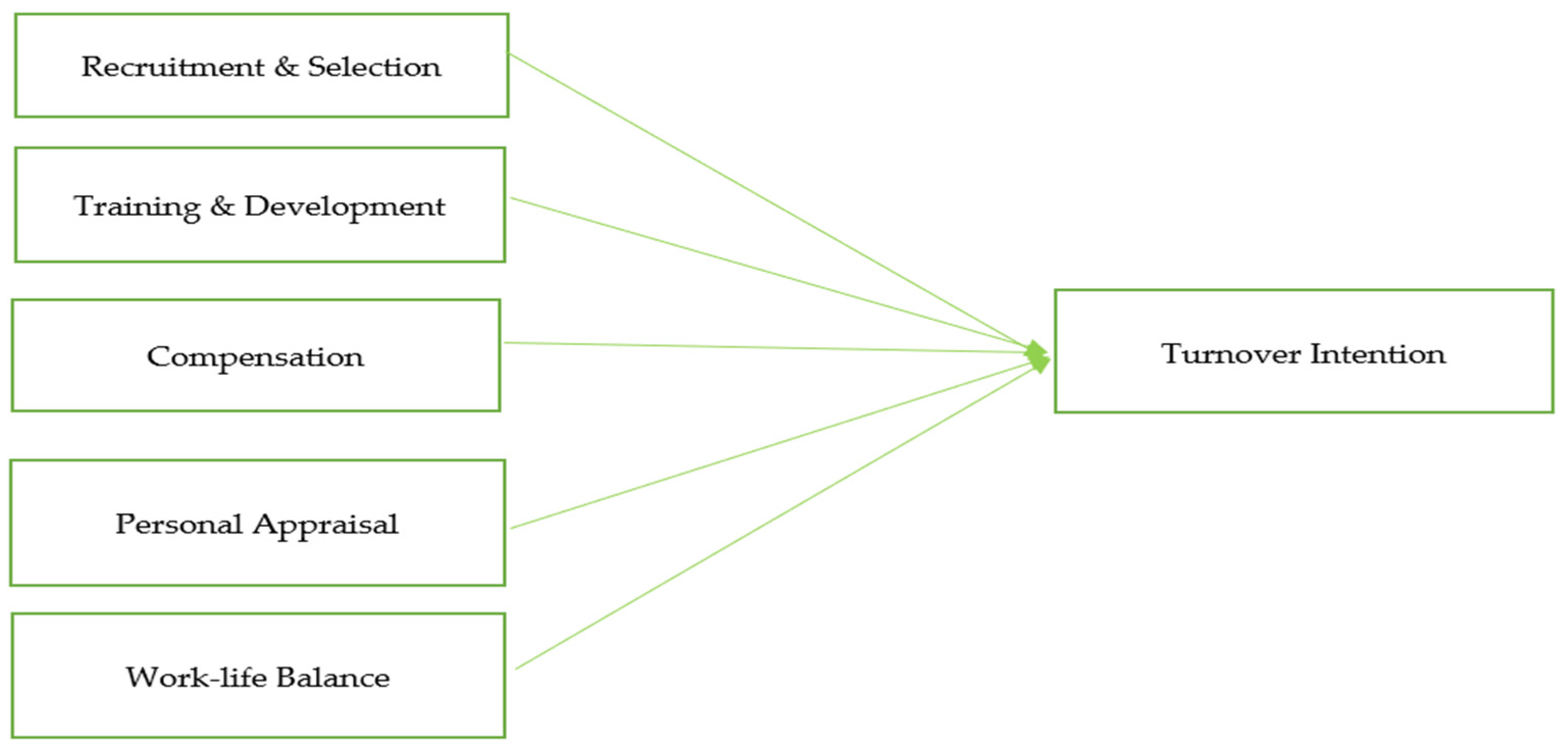
This research model discusses the connection between HRM and turnover intention in the context of the Malaysian ICT Industry.
Figure 1 the independent variables consist of recruitment and selection, training and development, compensation performance appraisal, and work-life balance, while the dependent variable is turnover intention. This model proposes that extended HRM practices are crucial in determining whether employees would remain with the firm or head.
Recruitment and Selection
Recruitment and selection processes are key HRM processes that directly affect turnover intention. High-performing recruitment strategies imply that firms attract candidates with the skills required to match their organizational culture [
56]. Employees have better job satisfaction when they feel they are relatively hired and transparent, reducing their turnover intentions. By contrast, lousy recruitment practices can cause a loss of talent; employees are not able to adjust to their respective positions, which is accessible to turnover.
Training and Development
Implementing organizational training and development programs is vital for improving employee performance and creating a satisfactory workforce. Organizational support implies that firms offering career development are less likely to suffer from turnover intention because they feel supported and valued [
57]. Regular training prospects enhance a company’s productivity and create a belief in dedication among employees to prevent them from leaving their firm [
57]. Constant training is essential for maintaining ICT specialists because this sector experiences frequent technological changes [
58].
Compensation
Pay is one of the essential antecedents of turnover intentions, and the importance of competitive compensation packages was also raised by [
59], who showed that adequate compensation was a key factor in drawing and holding professionals in the ICT sector. Similarly, when employees perceive their compensation as fair and competitive with the value they bring to their job, work satisfaction increases [
59,
60] and turnover intention decreases. Conversely, when they are not paid well enough, it will result in them becoming dissatisfied, which will encourage employees to seek satisfaction elsewhere. Therefore, to decrease unregretted turnover intentions, organizations must strategically manage remuneration.
Work-Life Balance
The importance of work-life balance initiatives on turnover intention has increased, particularly within the ICT sector. Employees feel well supported when they are given the opportunity by their organizations to balance work and life through suitable flexible working hours and policies, leading to reduced staff turnover [
62,
63]. [
62,
63] described in their studies that an effective balance between work life and private life could result in high job satisfaction, thereby significantly lowering the intention to leave an organization. These are the times when you want to make sure that prospects keep their balance and attract them to the workforce. In short, the conceptual model shows how distinct HR practices influence turnover intentions. The human resource department of the Malaysian ICT industry must stress effective recruitment and selection, training and development, compensation, performance appraisals, and work-life balance to satisfy their employees in order to reduce turnover intention.
2.4.2. Hypotheses Development
In recruitment and selection, the main part was found to be a suitable candidate for the organizational environment. Similarly, well-organized recruitment improves overall job satisfaction and lowers subsequent turnover intention. On the other hand, deficient recruitment procedures make differences between what employees’ desires and the reality of their tasks motivated them to leave the organization [
64,
65]. One of the possible reasons why employees who have poor person-job fit during the selection process are more likely to consider quitting has been outlined in research [
65]. Therefore, we hypothesize as follows:
H1: There is a positive relationship between Recruitment and Selection and Turnover Intentions.
Training and development are a part of employee skills, growth, and satisfaction. Employees who perceive that the organization is willing to invest in their development opportunities will also feel appreciated and engaged with the consequences, which can lead to lower turnover intentions [
66,
67]. If we do not provide sufficient training or the correct type of training, it can create a feeling of stagnation and cause employees to look for new opportunities elsewhere [
66]. Thus, the following hypotheses are proposed:
H2: There is a positive relationship between Training and Development and Turnover Intentions.
The amount of compensation paid is also one of the most essential elements impacting satisfaction and retention. Related research indicates that, within the service industry, if employees feel unvalued, this can lead to a greater desire to turn over and search for other jobs that pay better [
56,
68]. In contrast, another aspect of salary can affect job satisfaction and intention to leave [
56]. Therefore, the following hypotheses are proposed:
H3: There is a positive relationship between Compensation and Turnover Intentions.
Systems for performance appraisals help to improve employee morale and job satisfaction. Employees who perceive that their contribution needs to be recognized or rewarded correctly are likely to be dissatisfied and have high turnover intentions [
69]. Conversely, transparent and constructive performance appraisals help enhance job satisfaction and minimize turnover intention [
66,
69]. Hence, we propose the following hypothesis:
H4: There is a positive relationship between Performance Appraisal and Turnover Intentions.
One of the most critical elements contributing to employee satisfaction and retention is work-life balance. This is because employees perceive little balance between work and personal life and suffer from high stress and low levels of satisfaction, which makes them more prone to high turnover intention [
70,
71]. On the other hand, organizations that encourage work-life balance can increase employee satisfaction and decrease intention to leave [
70]. Therefore, the following hypotheses are proposed:
H5: There is a positive relationship between Work-Life Balance and Turnover Intentions.
3. Discussion
3.1. Implications of HRM Practices on Turnover
3.1.1. Recruitment and Selection
Recruitment and selection are increasingly vital for developing employee perceptions and experiences within an organization. Companies with a formal and respectful recruitment process are likely to bring in people who best fit their corporate culture and values. This alignment may contribute to higher job satisfaction and lower turnover intentions [
56]. Similarly, suppose employees perceive that their expectations are unmet because ineffective recruitment practices. In this case, they are more likely to have turnover intention, as they may feel dissatisfied following these roles [
74]. Consequently, organizations in the ICT sector should focus on tweaking their recruitment processes to recruit talent, which will further help to consider job-leaving rates.
3.1.2. Training and Development
Employee training and development contribute to improving employees’ skills and enhancing their work satisfaction. [
75], the perception of staff towards the organization's support to grow professionally makes an engaged employee and simultaneously reduces the intended turnover. Studies have found that the absence of training programs can cause employees to stagnate and seek alternative jobs [
76]. Thus, ICT organizations must continuously invest in educational and developmental support, which can encourage employee loyalty and reduce turnover intention.
3.1.3. Compensation
Salary is a significant factor when employees determine whether they are happy with their jobs, and salary significantly affects employee trust. It has been found that competitive compensation packages are linked with low turnover intentions because when employees feel adequately rewarded for their work, they would like to stay within their organization [
56]. Insufficient pay can create dissatisfaction and higher turnover intentions, as staff members are likely to experience undervalued ness [
77]. To lessen turnover intention, organizations must observe and recalibrate their compensation structures regularly to maintain a competitive edge within the industry.
3.1.4. Performance Appraisal
Employee motivation and satisfaction are largely dependent on performance appraisal systems. A sound appraisal system that offers constructive feedback, rewards, and recognition can boost job satisfaction and reduce turnover intentions. On the other hand, an ineffective or unfair appraisal system would increase the rate of dissatisfaction and turnover intentions because employees might find that their contributions are not rewarded [
78]. Hence, to reduce turnover intention, ICT companies must introduce a transparent and fair performance appraisal system to create a sense of recognition and support among their employees.
3.1.5. Work-Life Balance
The increasing importance of work-life balance has become a key contributor to employee satisfaction and retention. The findings that emerged from the present study are consistent with previous research [
66,
79], according to which employees who feel a lack of balance between work and personal life tend to suffer more stress symptoms and dissatisfaction, ultimately increasing their turnover intention. In contrast, workplaces that support work-life balance by using methods such as providing flexibility in work style and systems and reinforcing policies contribute to reducing turnover intention of employees, which truths employers mentioned. Hence, ICT companies should focus on work-life balance as part of the design of talent programs to attract and retain employees.
3.2. Theoretical Contributions
Therefore, this study adds to the existing literature on HRM practices and turnover intentions by empirically proving that various HRM practices are associated with each other, impacting turnover intentions in the Malaysian ICT industry. This suggests that more favorable HRM practices predict higher employee satisfaction and retention, as seen in social exchange theory, where the organization should treat employees well, which can result in positive outcomes [
80]. This study also underscores the essential role of mediating factors, including job satisfaction and organizational commitment, in comprehending the mechanisms linking HRM practices and turnover intentions.
3.3. Practical Implications for ICT Companies in Malaysia
The practical implications of this study for ICT companies in Malaysia are discussed. Work on perfecting the recruitment and interview process to hire employees who mirror the values and culture of the organization. A second way in which training can influence voluntary turnover is through the effect of training on employee engagement and intention to leave. Organizations must take time to re-evaluate their compensation plans to remain competitive, while ensuring that all employees feel appreciated. The fourth essential step is to implement fair and transparent performance appraisal systems to create a culture of recognition and support. Lastly, initiatives that promote work-life balance assist in building a workplace culture where people want to stay for years. Many of these could be dealt with in course areas and, if addressed, would reduce turnover intentions and increase overall ICT companies’ organizational performance.
4. Conclusion
4.1. Summary of Findings
This study focused on the relationship between HRM practices and turnover intention in the Malaysian ICT sector. More specifically, the results of the study provide evidence that HRM practices such as those that focuses on selection and recruitment, training and development compensation, performance appraisal, and work–life balance decrease turnover intention. The literature identified that, in the context of a fair recruitment process, high job satisfaction was built, resulting in low turnover intentions [
56]. In addition, the employee training and development program strengthens employee relations with competitive compensation packages in retaining the finest people [
76,
81]. It can also help lower turnover intention by providing effective performance appraisals that provide constructive feedback, and recognition and work-life balance policies are implemented [
82]. In conclusion, this study highlights the importance of strategic HRM in building sustainable and supportive workforces that are less likely to express turnover intention.
4.2. Recommendations for Future Research
Further research might consider consistently testing this idea in different sectors, rather than the ICT industry, to find if these HRM practices also have unexpected side effects on turnover intentions over time. For future studies, longitudinal inquiries should be made into how changes in HRM over time affect employee retention [
83]. Effects HRM practice on turnover intentions Studies have shown that medium to high turnover of employees is enhanced by the use of HRM practices; however, less emphasis should be based on short-term employment and more on longer term career development for a financial return [
82]. Qualitative research will conduct interviews and focus group sessions as ideal models because they provide an in-depth account of how the procedures are perceived from the standpoint of employees. Furthermore, who can better inform HRM practices’ turnover intention as a moderating impact of organizational culture and productive practice [
84].
4.3. Limitations of the Study
Due to the cross-sectional design, we could not infer causal relationships between HRM practices and turnover intention [
85]. A target population bias could be introduced because the results stem from self-reported data, which would theoretically have been answered honestly against potentially socially desirable responses [
66]. Finally, this study found that the findings are only relevant to the Malaysian ICT sector; therefore, it can be said that these results only apply to one specific industry and may not be generalizable to all industries [
86]. Future research can address such limitations by improving our understanding of the compositional processes involved in HRM practices and turnover intentions.
Author Contributions
H M Mahfuzur Rahman: Conceptualization; Writing of original draft; Literature Review; Conclusion of the study; Discussion; Review and formatting. Chinnasamy Agamudai Nambi Malarvizhi: Conceptualization; Supervision; Discussion; Review. Nasreen Khan: Conceptualization; Supervision; Discussion; Review. All authors have read and agreed to the published version of the manuscript.
Funding
Funding is sponsored by the Research Management Centre (RMC) of Multimedia University, Cyberjaya, Malaysia. [MMU/RMC].
Data Availability Statement
This is a conceptual paper and does not involve the collection or analysis of primary data. Therefore, there are no datasets associated with this study.
Acknowledgments
The authors would like to acknowledge assistance of the Editor and Reviewers in the preparation of the article for publication.
Conflicts of Interest
Declare conflicts of interest or state: “The authors declare no conflicts of interest.”.
About the authors
H M Mahfuzur Rahman is a Research schooler, Faculty of Management, Multimedia University, Malaysia. He is currently pursuing his PhD in Management at the Multimedia University of the Cyberjaya, Malaysia. He holds a B.sc (hons) and M.sc in chemistry, from national University in Bangladesh. H M Mahfuzur Rahman has authored articles in several journals. His research interests encompass an Operations Management, human Resources Management Practices, technology Management, supply chain Management, industry 4.0, and tourism and hospitality management and sustainable Development studies. Dr. Chinnasamy Agamudai Nambi Malarvizhi has more than 18 years of teaching and research experience in Economics, Environment and Health issues, Knowledge Management and Tourism Development. Associated with MMU since 2006, she regularly publishes in journals and presents in international conferences. She has guided many PhD research scholars, Master students, and undergraduate Students. Dr. Nasreen Khan is currently assistant Professor in the Faculty of Management, Multimedia University, Malaysia. She received her PhD from University Malaya in 2012. She has been an academician for over ten years and was involved actively in teaching, research, and supervision. her publications have appeared in various international refereed journals and conference proceedings. Her research interests include service marketing, technology marketing, marketing communication, consumer behavior and human resource management.
References
- Ahmad, N., Drus, S., & Kasim, H. (2020). Factors that influence the adoption of enterprise architecture by public sector organizations: an empirical study. Ieee Access, 8, 98847-98873. [CrossRef]
- Isa, F., Muhammad, N., Ahmad, A., & Noor, S. (2021). Effect of ict on women entrepreneur business performance: case of malaysia. Journal of Economics and Business, 4(1). [CrossRef]
- Giménez, G. and Vargas-Montoya, L. (2021). Ict use and successful learning: the role of the stock of human capital. Mathematics, 9(14), 1648. [CrossRef]
- Lekić, N., Carić, M., Soleša, D., Vapa-Tankosić, J., Rajaković-Mijailović, J., Bogetić, S., … & Vučičević, M. (2021). Employees’ perceptions on the relationship of intellectual capital and business performance of ict companies. Sustainability, 14(1), 275. [CrossRef]
- Mongale, I. and Magongoa, M. (2020). Human capital and information and communication technology nexus: the south african perspective. Journal of Reviews on Global Economics, 9, 403-412. [CrossRef]
- Rehan, R. (2023). Inspecting sector-specific capital structure determinants: the case of malaysian shariah firms. International Journal of Applied Economics Finance and Accounting, 17(2), 402-414. [CrossRef]
- Nhon, H., Thong, B., & Trung, N. (2020). The effects of intellectual capital on information communication technology firm performance: a moderated mediation analysis of environmental uncertainty. Cogent Business & Management, 7(1), 1823584. [CrossRef]
- Gil-Delgado, M., Sánchez-Braza, A., & González-Jara, D. (2022). Economic growth and global warming effects on electricity consumption in spain: a sectoral study. Environmental Science and Pollution Research, 30(15), 43096-43112. [CrossRef]
- Alola, U. and Alafeshat, R. (2020). The impact of human resource practices on employee engagement in the airline industry. Journal of Public Affairs, 21(1). [CrossRef]
- Jose, S. (2019). Innovation in recruitment and talent acquisition: a study on technologies and strategies adopted for talent management in it sector. International Journal of Marketing & Human Resource Management, 10(3). [CrossRef]
- Ohene, A., Owusu-Acheampong, E., Jabez, A., & Doumbia, M. (2022). Recruitment and selection, training and development on job satisfaction mediated by motivation: exploratory and confirmatory factor analysis in the ghanaian smes. Journal of Human Resource Management – Hr Advances and Developments, 2022(1), 52-65. [CrossRef]
- Elrehail, H., Harazneh, I., Abuhjeeleh, M., Alzghoul, A., Alnajdawi, S., & Ibrahim, H. (2019). Employee satisfaction, human resource management practices and competitive advantage. European Journal of Management and Business Economics, 29(2), 125-149. [CrossRef]
- Abou-Moghli, A. (2019). The influence of compensation management strategy on talent retention: exploring the mediating role of structural capital. International Business Research, 12(3), 165. [CrossRef]
- Gilal, F., Ashraf, Z., Gilal, N., Gilal, R., & Chaana, N. (2019). Promoting environmental performance through green human resource management practices in higher education institutions: a moderated mediation model. Corporate Social Responsibility and Environmental Management, 26(6), 1579-1590. [CrossRef]
- Malik, S., Mughal, Y., Azam, T., Cao, Y., Wan, Z., Zhu, H., … & Ramayah, T. (2021). Corporate social responsibility, green human resources management, and sustainable performance: is organizational citizenship behavior towards environment the missing link? Sustainability, 13(3), 1044.
- Hayuni, A. (2023). The influence of servant leadership and self-efficacy on employee performance with job satisfaction as intervening variables (empirical study on rural banks in the magelang region)., 1475-1486.
- Wang, H., Jin, Y., Wang, D., Zhao, S., Xin-gang, S., & Yuan, B. (2020). Job satisfaction, burnout, and turnover intention among primary care providers in rural china: results from structural equation modeling. BMC Family Practice, 21(1). [CrossRef]
- Uzuntarla, Y., Bayer, N., Gölbaşı, Z., & Akarsu, K. (2021). Job satisfaction, burnout and turnover intention of nurses working in hospital during the pandemic covid-19 in turkey. Journal of Clinical Medicine of Kazakhstan, 18(6), 69-75. [CrossRef]
- Dewi, R. and Nurhayati, M. (2021). The effect of career development on turnover intention with job satisfaction and organizational commitment as mediators, study at pt control systems arena para nusa. European Journal of Business Management and Research, 6(4), 11-18. [CrossRef]
- Güzeller, C. and Çeliker, N. (2019). Examining the relationship between organizational commitment and turnover intention via a meta-analysis. International Journal of Culture Tourism and Hospitality Research, 14(1), 102-120. [CrossRef]
- Ferrari, I., Mulyawan, I., Witarsana, I., & Yudhistira, P. (2021). The effect of job satisfaction on employee turnover intention: case study in tanadewa resort and spa ubud. Jurnal Bisnis Hospitaliti, 10(2), 126-136. [CrossRef]
- Wicaksono, A., Amin, S., & Solihin, A. (2021). Role of mediating job satisfaction to improve organizational justice and turnover intentions. Journal of Business Studies and Mangement Review, 5(1), 1-9. [CrossRef]
- Chen, X., Li, R., Zhang, Y., Yang, J., Yao, H., Zhu, S., … & Tan, X. (2019). Moderating role of job satisfaction on turnover intention and burnout among workers in primary care institutions: a cross-sectional study. BMC Public Health, 19(1). [CrossRef]
- Dhanpat, N., Manakana, T., Mbacaza, J., Mokone, D., & Mtongana, B. (2019). Exploring retention factors and job security of nurses in gauteng public hospitals in south africa. African Journal of Economic and Management Studies, 10(1), 57-71. [CrossRef]
- Noreña-Chavez, D. and Thalassinos, E. (2023). Fueling innovation performance through entrepreneurial leadership: assessing the neglected mediating role of intellectual capital. Journal of Infrastructure Policy and Development, 7(1), 2020. [CrossRef]
- Zhang, M., Zheng, X., Chen, C., Fang, J., Liu, H., Zhang, X., … & Lang, H. (2022). Role of patient safety attitudes between career identity and turnover intentions of new nurses in china: a cross-sectional study. Frontiers in Public Health, 10. [CrossRef]
- Wajdi, M. (2023). The impact of compensation, organizational commitment, and job satisfaction on turnover intention among young female employees. Jbti Jurnal Bisnis Teori Dan Implementasi, 14(2), 383-400. [CrossRef]
- Rahadi, D. (2023). Analysis of recruitment and selection process in the field of information technology. International Journal of Scientific and Management Research, 06(08), 01-11. [CrossRef]
- Malik, M. and Mujtaba, M. (2018). Impact of e-recruitment on effectiveness of hr department in private sector of pakistan. International Journal of Human Resource Studies, 8(2), 80.
- Hee, O. and Jing, K. (2018). The influence of human resource management practices on employee performance in the manufacturing sector in malaysia. International Journal of Human Resource Studies, 8(2), 129. [CrossRef]
- Nguyen, C., 2020. The impact of training and development, job satisfaction and job performance on young employee retention. Job Satisfaction and Job Performance on Young Employee Retention (May 1, 2020).
- Memon, M.A., Salleh, R., Mirza, M.Z., Cheah, J.H., Ting, H., Ahmad, M.S. and Tariq, A., 2021. Satisfaction matters: the relationships between HRM practices, work engagement and turnover intention. International Journal of Manpower, 42(1), pp.21-50. [CrossRef]
- Sahija, D. (2022). Employee performance appraisal process and its impact on employee satisfaction. Technoarete Transactions on Economics and Business Systems, 1(2). [CrossRef]
- Görün, M., Kayar, İ., & Varol, B. (2018). 360-degree performance appraisal and feedback system: a study with heads of departments in çanakkale onsekiz mart university. Gaziantep University Journal of Social Sciences, 17(4), 1407-1419. [CrossRef]
- Boruett, H., Ronoh, A., Dimba, M., & Kisirkoi, F. (2021). Employees’ perceptions on the contribution of performance appraisal to career growth and development in kenya’s ministry of education in nairobi city county, kenya. The International Journal of Humanities & Social Studies, 9(3). [CrossRef]
- Wanigasinghe, N. (2020). Can i switch off? i can’t breathe. University of Colombo Review, 1(1), 81.
- Ágota-Aliz, B. (2021). Flexible working practices in the ict industry in achieving work-life balance. Studia Universitatis Babes-Bolyai Sociologia, 66(1), 29-50.
- Norizan, N. (2023). Exploring the research landscape of turnover intention: a bibliometric analysis. Information Management and Business Review, 15(3(I)), 361-372. [CrossRef]
- Putra, U. and Masdupi, E. (2019). The effect of compensation and organizational commitments to turnover intention with work satisfaction as intervening variables. case study at pt. bni life west sumatra region.
- Tampubolon, V. and Sagala, E. (2020). Pengaruh kepuasan kerja dan komitmen organisasi terhadap turnover intention pada karyawan pt. bum divisi pmks. Business Management Journal, 16(2), 65. [CrossRef]
- Ratnawita, R. (2023). The role of job satisfaction as intervening variable in the relationship between career development, work-life balance and turnover intention in outsource solution company. Jemsi (Jurnal Ekonomi Manajemen Dan Akuntansi), 9(3), 708-712. [CrossRef]
- Agustine, T. and Nawangsari, L. (2020). The effect of compensation and workloads towards intension of turnover with work satisfaction as a variable mediation in clinic employees of pt nayaka era husada branch of bekasi. International Journal of Innovative Science and Research Technology, 5(7), 1304-1312.
- Quynh, A. and Tran, A. (2021). Job satisfaction and turnover intention of preventive medicine workers in northern vietnam: is there any relationship? Health Services Insights, 14, 117863292199517.
- Silva, L. (2024). Relationship between job satisfaction and turnover intentions among nurses in south america. Journal of Human Resource and Leadership, 9(3), 1-12. [CrossRef]
- Hasan, N., Bagis, A., & Wahyulina, S. (2019). Effect of job satisfaction on turnover intention and organizational commitment as moderator variable at multi jaya lombok. Scientific Research Journal, 07(10), 97-102. [CrossRef]
- Sabarrudin, M. (2023). The impact of organizational commitment and motivation on turnover intention with job satisfaction asus a variable intervening at pt bgr logistics indonesia post-merger. Dinasti International Journal of Digital Business Management, 4(2), 233-241. [CrossRef]
- Kavakli, B. and Yıldırım, N. (2022). The relationship between workplace incivility and turnover intention in nurses: a cross-sectional study. Journal of Nursing Management, 30(5), 1235-1242. [CrossRef]
- Sazili, S., Ju’im, J., Indarti, S., & Efendi, R. (2022). Turnover intention influenced by work environment and job satisfaction. International Journal of Social Science Research and Review, 5(6), 102-108. [CrossRef]
- Bos-Nehles, A. and Meijerink, J. (2018). Hrm implementation by multiple hrm actors: a social exchange perspective. The International Journal of Human Resource Management, 29(22), 3068-3092. https://doi.org/10.1080/09585192.2018.1443958. [CrossRef]
- Liu, W., Zhao, S., Shi, L., Zhong, Z., Li, X., Li, L., … & Ni, X. (2018). Workplace violence, job satisfaction, burnout, perceived organisational support and their effects on turnover intention among chinese nurses in tertiary hospitals: a cross-sectional study. BMJ Open, 8(6), e019525. https://doi.org/10.1136/bmjopen-2017-019525. [CrossRef]
- Hidayah, N. and Ananda, H. (2021). Compensation, career development, and job satisfaction as the antecedent of nurse turnover intention. Jurnal Medicoeticolegal Dan Manajemen Rumah Sakit, 10(2), 139-147. https://doi.org/10.18196/jmmr.v10i2.10631. [CrossRef]
- Aburumman, O., Salleh, A., Omar, K., & Abadi, M. (2020). The impact of human resource management practices and career satisfaction on employee’s turnover intention. Management Science Letters, 641-652. https://doi.org/10.5267/j.msl.2019.9.015. [CrossRef]
- Wang, Q., Kai-peng, G., Wei, H., Sun, A., Wang, Y., & Zhou, X. (2022). Public service motivation and public employees' turnover intention: the role of job satisfaction and career growth opportunity. Personnel Review, 53(1), 99-118. https://doi.org/10.1108/pr-11-2020-0836. [CrossRef]
- Saragih, D. and Hendy, H. (2022). The effect of organizational commitment and job satisfaction on turnover intentions. Almana Jurnal Manajemen Dan Bisnis, 6(1), 95-106. https://doi.org/10.36555/almana.v6i1.1754. [CrossRef]
- Farndale, E., Ruiten, J., Kelliher, C., & Hailey, V. (2011). The influence of perceived employee voice on organizational commitment: an exchange perspective. Human Resource Management, 50(1), 113-129. https://doi.org/10.1002/hrm.20404. [CrossRef]
- Ramlah, S., Sudiro, A., & Juwita, H. (2021). The influence of compensation and job stress on turnover intention through mediation of job satisfaction. International Journal of Research in Business and Social Science (2147-4478), 10(4), 117-127. [CrossRef]
- Kashif, M.F. and Israr, S. (2020). Relationship between work-family conflict and turnover intention of university teachers in lahore. Global Sociological Review, V(III), 117-123. [CrossRef]
- Renaud, S., St-Onge, S., & Morin, D. (2021). Do vacations and parental leave reduce voluntary turnover? a study of organizations in the ict sector in canada. International Journal of Manpower, 42(7), 1224-1237. [CrossRef]
- Pepple, D., Akinsowon, P., & Oyelere, M.A. (2021). Employee commitment and turnover intention: perspectives from the nigerian public sector. Public Organization Review, 23(2), 739-757. [CrossRef]
- Zahari, A., Supriyati, Y., & Santoso, B. (2020). The influence of compensation and career development mediated through employee engagement toward turnover intention of the permanent officers employees at the head office of pt bank syariah mandiri. Journal of International Conference Proceedings, 3(1), 22-40. [CrossRef]
- Zhen, Y., Mansor, Z.D., Choo, W.C., & Abdullah, A.R. (2021). How to reduce employees’ turnover intention from the psychological perspective: a mediated moderation model. Psychology Research and Behavior Management, Volume 14, 185-197. [CrossRef]
- Giao, H.N.K., Vương, B.N., Huan, D.D., Tushar, H., & Quan, T.N. (2020). The effect of emotional intelligence on turnover intention and the moderating role of perceived organizational support: evidence from the banking industry of vietnam. Sustainability, 12(5), 1857. [CrossRef]
- Kumar, S.R. (2021). The impact of talent management practices on employee turnover and retention intentions. Global Business and Organizational Excellence, 41(2), 21-34. [CrossRef]
- Irawanto, D., Novianti, K., & Roz, K. (2021). Work from home: measuring satisfaction between work–life balance and work stress during the covid-19 pandemic in indonesia. Economies, 9(3), 96. [CrossRef]
- Hee, O. and Ann, Y. (2019). Factors influencing employee turnover in the food manufacturing industry in malaysia. International Journal of Academic Research in Business and Social Sciences, 9(1). [CrossRef]
- Hanifa, M. (2024). The mediating role of job satisfaction in the relationship between human resource management practices and turnover intention. Jurnal Manajemen Bisnis, 15(1), 32-56. [CrossRef]
- Triningsih, N. (2023). Compensation, worklife balance, employee engagement, and turnover intention. Quantitative Economics and Management Studies, 5(1), 10-21.
- Amir, E., Winarto, E., Sunarno, R., & Hapsari, S. (2023). The correlation between job satisfaction, compensation, and work environment on nurse's turnover intention in kotamobagu regional general hospital using structural equation modeling path analysis. GHMJ (Global Health Management Journal), 6(1), 01-10.
- Hartono, M. (2019). Relationship of work environment, commitment, compensation and turnover intention of private elementary school teachers.
- Aman-Ullah, A., Ibrahim, H., Aziz, A., & Mehmood, W. (2022). Balancing is a necessity not leisure: a study on work–life balance witnessing healthcare sector of pakistan. Asia-Pacific Journal of Business Administration, 16(1), 127-147. [CrossRef]
- Purwatiningsih, E. and Sawitri, H. (2021). Analysis on the effect of work-life balance and career development on turnover intention for millennial generations. Management and Entrepreneurship Trends of Development, 1(15), 80-88. [CrossRef]
- Paluck, E.L., Porat, R., Clark, C.S., & Green, D.P. (2021). Prejudice reduction: Progress and challenges. Annual review of psychology, 72(1), 533-560. [CrossRef]
- Kar, A.K., & Dwivedi, Y.K. (2020). Theory building with big data-driven research–Moving away from the “What” towards the “Why”. International Journal of Information Management, 54, 102205.
- Ingsih, K., Kadarningsih, A., & Rijati, N. (2022). Job stress, compensation, job dissatisfaction and turnover intention.
- Zahari, A.E., Supriyati, Y., & Santoso, B. (2020). The influence of compensation and career development mediated through employee engagement toward turnover intention of the permanent officers employees at the head office of pt bank syariah mandiri. Journal of International Conference Proceedings, 3(1), 22-40. [CrossRef]
- Alifuddin, M. and Widodo, W. (2021). Mitigating turnover intention among private school teachers. Journal of Education and Learning (Edulearn), 15(3), 443-449. [CrossRef]
- Zhang, W., Meng, H., Yang, S., & Liu, D. (2018). The influence of professional identity, job satisfaction, and work engagement on turnover intention among township health inspectors in china. International Journal of Environmental Research and Public Health, 15(5), 988. [CrossRef]
- Zhang, X., Zhang, W., Li, X., Zhang, X., Tian, Z., Wei, C., … & Gao, S. (2022). The influence of professional identity, job satisfaction, burnout on turnover intention among village public health service providers in china in the context of covid-19: a cross-sectional study. Frontiers in Public Health, 10. [CrossRef]
- Islam, A., Jantan, A., Yusoff, Y., Chong, C., & Hossain, S. (2020). Green human resource management (ghrm) practices and millennial employees’ turnover intentions in tourism industry in malaysia: moderating role of work environment. Global Business Review, 24(4), 642-662. [CrossRef]
- Hee, O., Lien, C., Liang, S., Ali, A., Manap, N., & Lailee, S. (2018). Human resource management practices and employee’s turnover intention in the manufacturing industry in malaysia. International Journal of Human Resource Studies, 8(2), 216. [CrossRef]
- Jevtić, T. (2024). The effects of the compensation system on job satisfaction and turnover intention of employees in the republic of serbia. Strategic Management, (00), 64-64. [CrossRef]
- Rajapakshe, W. (2021). The effect of hrm practices: performance appraisal system and career development on turnover intention. Asian Journal of Economics Business and Accounting, 29-39. [CrossRef]
- Sija, A. (2021). The influence of job satisfaction and its effect on employee turnover intention in financial service industry of malaysia. European Journal of Economic and Financial Research, 5(1). [CrossRef]
- Purba, A. (2023). The effect of leadership, motivation, and compensation on employee turnover intention with job satisfaction as an intervening variable at pt bpr npb 22 binjai., 1370-1378.
- Bede, C. and Iqbal, M. (2022). The role of job satisfaction as an intervening variable and its effect on burnout and compensation for turnover intention. International Journal of Research and Review, 9(7), 724-732. [CrossRef]
- Wiguna, I. (2023). The effect of compensation on employee turnover intention at msmes in denpasar city: job satisfaction as mediation. Management and Applied Social Studies Review, 1(2), 53-63. [CrossRef]
|
Disclaimer/Publisher’s Note: The statements, opinions and data contained in all publications are solely those of the individual author(s) and contributor(s) and not of MDPI and/or the editor(s). MDPI and/or the editor(s) disclaim responsibility for any injury to people or property resulting from any ideas, methods, instructions or products referred to in the content. |
© 2024 by the authors. Licensee MDPI, Basel, Switzerland. This article is an open access article distributed under the terms and conditions of the Creative Commons Attribution (CC BY) license (http://creativecommons.org/licenses/by/4.0/).