

Submitted:
16 December 2024
Posted:
17 December 2024
You are already at the latest version
Abstract
A comprehensive phytochemical investigation of the whole plant of Stemona parviflora led to the isolation of 13 alkaloidal constituents, including five new alkaloids: 13α-hydroxyparvistemonine (1), 12α-methoxyparvistemonine (2), parvistemonine-N-oxide (3), parvistemoninine (4), and parvistemofoline (5). The structures of these compounds were elucidated through extensive analyses of 1D and 2D NMR spectra, DFT NMR calculation, and comparisons with data in literature. Notably, compounds 1-4 represent new examples of the rare parvistemoline-type alkaloids, with compound 4 showcasing a unique rearranged skeleton. Additionally, parvistemofoline (5) was identified as a distinct alkaloid skeleton characterized by a n-butyl side chain. These findings significantly expand our understanding of the chemical diversity of parvistemoline-type alkaloids, and provide clues for elucidating the biosynthetic pathways of these structurally unique parvistemoline alkaloids.
Keywords:
Stemona parviflora
; alkaloid
; parvistemoline-type
; 13α-hydroxyparvistemonine
; 12α-methoxyparvistemonine
; parvistemonine-N-oxide
; parvistemofoline
; parvistemoninine
1. Introduction
Stemonaceae is a small family of monocotyledonous flowering plants within the order Pandanales, consisting of four genera: Croomia, Stemona, Stichoneuron, and Pentastemona, with about 37 known species[1,2]. These plants are native to Southeast Asia, Northern Australia, China, Japan, and Northern America [1,3,4]. Stemona is the largest genus with approximately 25-32 species, known for its unique alkaloids, which typically feature either a pyrrolo- or a pyrido[1,2-α]azepine core. To date, over 250 alkaloids of various structural types have been isolated from different Stemona species, with previous research demonstrating that these alkaloids exhibited various biological activities such as antitussive, insecticidal, antifeedant, nematicidal, and repellent properties [5,6].
Stemona parviflora C. H. Wright is a species endemic mostly in Hainan and Guangdong Province, China [7]. It has a long-standing history of use in Chinese folk medicine, commonly referred to as “Baibu,” where it is employed to treat respiratory disorders, including pulmonary tuberculosis and bronchitis, as well as for its insecticidal properties [7]. Despite its traditional uses, there have been relatively few chemical investigations into this species in recent years [8,9,10,11,12,13,14]. These studies revealed the existence of minor phenylethyl benzoquinones and phenanthrenes in addition to the predominant alkaloids. A unique structural type of alkaloid, belonging to the parvistemoline group [15,16], has been identified in this species. This group, with only 13 derivatives reported so far, is characterized by the presence of a substituent at the C-9 position of the pyrrolo[1,2-a]azepine nucleus and the absence of a fused B-C ring system, which distinguishes it from other groups of Stemona alkaloids [6]. This limited exploration underscores the need for further research into this species.
This investigation aims to explore and identify new alkaloidal constituents from S. parviflora, thereby providing valuable insights into its phytochemical profile and potential therapeutic applications. A systematic chemical investigation was conducted, resulting in the isolation of a total of 13 alkaloids, including four novel parvistemoline-type compounds (1—4, Figure 1), one new stemofoline-type derivative (5, Figure 1), and eight known compounds. The structures of these compounds were elucidated through extensive analysis of spectroscopic data, including MS, IR, 1D- and 2D-NMR spectroscopic data, density functional theory (DFT) NMR calculations, as well as comparisons with existing literature.
2. Materials and Methods
2.1. General Experimental Procedures
Optical rotations were measured with a Perkin-Elmer 241MC polarimeter or a Perkin-Elmer 341 polarimeter. IR spectra were recorded using a Perkin-Elmer 577 Spectrometer. ESIMS were measured by using a Finnigan LCQ-DECA mass spectrometer, and HRESIMS were obtained on a Waters Q-TOF Micro MS spectrometer. EIMS and HREIMS were recorded on a Finnigan MAT-95 mass spectrometer. 1H, 13C, and 2D NMR spectra were recorded on a Bruker AM-300, Varian INOVA 400 or Bruker Avance III 500 NMR spectrometer with solvent resonances (CDCl3, δH 7.26; δC 77.16) as internal standards. Chemical shifts were reported in ppm (δ), with coupling constants (J) in hertz. Column chromatographic separations were carried out using silica gel (Qingdao Haiyang Chemical Group Corporation, China) and Sephadex LH-20 (Pharmcia Biotech AB, Uppsala, Sweden) as packing materials. Precoated silica gel 60 F254 aluminum sheets (Merck Millipore, Germany) were used for analytical TLC. Visualization of TLC spots was performed by Dragendorff’s reagent and Iodine. Analytical HPLC was performed on a Waters 2695 separations module coupled with a Waters 998 DAD UV detector, a Waters Acquity® ELSD and a Waters 3100 SQD MS. The HPLC-MS analysis were performed on a Waters Sunfire® RP C18, 3.5 μm, 4.6 × 100 mm column using a gradient solvent system composed of H2O and CH3CN (5% to 95%) with 0.1% formic acid, at a flow rate of 1.0 mL/min.
2.2. Plant Material
The whole plants of S. parviflora were collected in Hainan province, China, in 2013 and identified by Qiong-Xin Zhong from Hainan Normal University. A voucher specimen (No. 20130401) has been deposited in the Herbarium of Shanghai Institute of Materia Medica, Chinese Academy of Sciences.
2.3. Extraction and Isolation
Air-dried roots of S. parviflora (10.0 kg) were grounded into powder and extracted with 95% EtOH (25 L) for three times, three days each. After evaporation of the collected filtrate, the crude extract was acidified with dilute HCl (4%) to pH 1-2 and partitioned between ethyl ether and water. The aqueous part was basified with aqueous NH3 to pH 9-10 and extracted repeatedly with CH2Cl2 to afford 70 g of crude alkaloid. The crude alkaloid was subjected to column chromatography over silica gel (200-300 mesh) and eluted with petroleum ether–acetone from 4:1 to 1:4, and then acetone to yield four major fractions (XB1-XB4). Fraction XB1 was subjected to repeated column chromatography over silica gel, and then Sephadex LH-20 to afford isomaistemonine (151 mg), maistemonine (49 mg), croomine (553 mg). Similarly, fraction XB2 gave 12α-methoxyparvistemonine (2, 515 mg), parvistemofoline (5, 64 mg), parvineostemonine (143 mg), and parvistemonine (4.9 g), and fraction XB3 afforded 13α-hydroxyparvistemonine (1, 832 mg), parvistemonine-N-oxide (3, 2 mg), parvistemoninine (4, 64 mg), protostemonine (533 mg), and protostemoamide (5 mg). Stemofoline (680 mg) was afforded from fraction XB4.
2.3.1. 13α-Hydroxyparvistemonine (1)
2.3.2. 12α-Methloxylparvistemonine (2)
2.3.3. Parvistemonine-N-Oxide (3)
Yellow amorphous powder; [α] + 9 (c 0.1, MeOH); IR (KBr) Bmax: 3433, 2937, 1772, 1457, 1167, 997 cm-1; HRESIMS m/z: 408.2385 (calcd for C22H34NO6, 408.2386). 1H-NMR (300 MHz, CDCl3): δH 4.91 (dd, 1H, J = 3.8, 3.9 Hz; H-11), 4.61 (m, 1H; H-12), 4.32 (m, 1H; H-16), 4.05 (m, 1H; H-18), 3.85 (m, 1H; H-5β), 3.70 (m, 3H; H-3, H-5α and H-9a), 2.70 (m, 3H; H-13, H-19, H-20), 2.50 (m, 1H; H-9), 2.20-1.50 (m, 10H; H-1, H-2, H-6, H-7, and H-8), 1.30 (m, 9H; Me-15, Me-17, Me-22); 13C-NMR (100 MHz, CDCl3): δC 24.8 (t, C-1); 24.1 (t, C-2), 76.9 (d, C-3), 69.0 (t, C-5), 23.5 (t, C-6), 26.7 (t, C-7), 28.1 (t, C-8), 34.9 (d, C-9), 73.9 (d, C-9a), 49.7 (d, C-10), 89.6 (d, C-11), 79.8 (d, C-12), 41.2 (d, C-13), 178.2 (s, C-14), 18.6 (C-15), 77.1 (d, C-16), 9.0 (q, C-17), 83.0 (d, C-18), 34.8 (t, C-19), 34.2 (d, C-20), 178.5 (s, C-21), 14.9 (q, C-22). The signals were assigned according to the proton and carbon assignments of the known compound parvistemonine.
2.3.4. Parvistemoninine (4)
2.3.5. Parvistemofoline (5)
Yellow amorphous powder; [α] − 79 (c 0.1, Acetone); IR (KBr) νmax 2931, 1739, 1680, 1616, 1460, 1398, 1215, 1155, 1063, 1016, 754 cm-1; 1H and 13C NMR data: see Table 3; EIMS m/z 375 [M]+, 318, 265, 208 (100); HRESIMS m/z: 376.2491 (calcd for C22H34NO4, 376.2488).
3. Results
Compound 1 was obtained as light-yellow amorphous powder, positive to the Dragendorff’s reagent. Its molecular formula was established by HREIMS (m/z 407.2305 [M]+, calcd 407.2308) as C22H33NO6 with seven degrees of unsaturation. The 1H NMR spectrum (Table 1) displayed signals of a methylene (δH 2.87, 3.40) characteristic for the CH2-5 of the pyrrolo[1,2-α]azepine nucleus in Stemona alkaloids [17], two doublet methyls (δH 1.15, Me-17; 1.25, Me-22), and one singlet methyl (δH 1.50, Me-15). In the 13C NMR spectrum two quaternary carbons at δC 179.8 and 177.6 suggested the presence of two γ-lactone rings. The base peak at 308 [M − 99]+ in EIMS further confirmed the presence of an α-methyl-γ-lactone moiety attached to C-3 [18,19]. All these data were indicative of a parvistemoline-type skeleton of compound 1. A further NMR data comparison of compound 1 and the known parvistemonine [12,20] revealed big similarities of rings A, B, C and E between these two compounds except that an oxygenated quaternary carbon (δC 76.1, C-13) and a singlet methyl instead of a doublet methyl in parvistemonine were observed in compound 1. Considering the molecular formula of 1 contains one more oxygen atom than that of parvistemonine, compound 1 was deduced to be a 13-hydroxyl derivative of parvistemonine. Such elucidation was further confirmed by 1H−1H COSY, HSQC and HMBC spectra (Figures S3-S5). The ROESY correlation between Me-15 and Me-17 suggested an α-orientation of OH-13 (Figure S6). Therefore, the structure of compound 1 was fully determined as 13α-hydroxyparvistemonine.
Compound 2, yellow amorphous powder, was positive to the Dragendorff’s reagent. The pseudo molecular ion at m/z 422.2544 ([M + H]+) in the HRESIMS suggested a molecular formula of C23H35NO6, corresponding to seven degrees of unsaturation. Its EIMS base peak at m/z 322 ([M − 99]+) indicated also the existence of an α-methyl-γ-lactone moiety. Further analysis of its NMR data (Table 1 and Table 2) revealed that compound 2 was also a parvistemoline-type alkaloid: both 1H and 13C NMR data of 2 were quite similar to those of the known parvistemonine and compound 1, except for the presence of an extra methoxy group (δH 3.35, MeO-23) in 2, which caused some chemical shift differences at C-12 and C-13. In the 13C NMR and DEPT spectra (Figures S9 and S10), a quaternary carbon signal resonating at δC 110.3 replaced the methine at C-12 in parvistemonine and compound 1, suggesting the methoxy group might be located at C-12. HMBC correlations from MeO-23, Me-15, and H-16 to C-12 further supported the assumption. The relative configuration of 2 was determined by the NOESY experiment, and the cross-peaks of H-11/MeO-23 and H-11/H-13 indiated an α-orientation of the methoxy group. Therefore, the structure of compound 2 was established, and named 12α-methoxyparvistemonine.
Compound 3 was also obtained as yellow amorphous powder, and positive to the Dragendorff’s reagent. The molecular formula was established as C22H33NO6 (m/z 408.2385, [M + H]+) by HRESIMS, one more oxygen atom than that of parvistemonine. The 1H NMR data (Table 1) displayed signals of three doublet methyls (δH 1.28-1.30, 9H, overlapped), indicative of also a parvistemonine skeleton. The 13C NMR data (Table 2) highly resembled those of parvistemonine, suggesting that the additional oxygen atom was not substituted at any carbon of the skeleton but the nitrogen atom. Accordingly, compound 3 was finally proposed as N-oxide derivative of parvistemonine, and named parvistemonine-N-oxide.

Table 1.
1H NMR data (300 MHz) for compounds 1, 2 and 4 in CDCl3.
| No. | 1 | 2 | 4 |
|---|---|---|---|
| 1 |
1.42, m 1.64, m |
1.40, m 1.64, m |
1.67, m 1.90, m |
| 2 |
1.59, m 1.75, m |
1.59, m 1.75, m |
1.42, m 2.05, m |
| 3 | 3.45, m | 3.40, m | 3.16, m |
| 5 |
2.87, dd (15.7, 11.9) 3.40, m |
2.85, d (11.7) 3.30, dd (11.7, 7.9) |
2.99, dd (14.4, 11.4) 2.74, d (14.4) |
| 6 |
1.44, m 1.72, m |
1.42, m 1.70, m |
1.59, m 1.65, m |
| 7 |
1.42, m; 1.82, m |
1.38, m 1.77, m |
1.42, m; 1.61, m |
| 8 |
1.46, m; 1.92, m |
1.45, m 1.91, m |
1.60, m 1.71, m |
| 9 | 2.18, m | 2.15, m | 2.38, m |
| 9a | 3.45, m | 3.43, m | |
| 10 | 2.15, m | 2.30, m | 2.01, m |
| 11 | 5.14, d (3.8) | 4.61, d (4.3) | 4.84, dd (3.4, 1.7) |
| 12 | 4.25, d (3.8) | 7.02, d (1.7) | |
| 13 | 2.89, m | ||
| 15 | 1.50, s, 3H | 1.34, d (7.2) | 1.92, s |
| 16 | 4.30, m | 4.48, m | 3.55, m |
| 17 | 1.15, d (6.7), 3H | 1.20, d (6.6) | 1.28, d (5.9) |
| 18 | 4.20, m | 4.17, ddd (10.8, 7.1, 5.3) | 4.22, m |
| 19 |
1.55, m 2.37, m |
1.55, m 2.35, m |
2.36, m 1.49, m |
| 20 | 2.61, m | 2.59, m | 2.62, m |
| 22 | 1.25, d (7.1), 3H | 1.25, d (7.0), 3H | 1.24, d (7.0), 3H |
| 23-OMe | 3.35, s, 3H |
The molecular formula of compound 4 was established as C22H31NO5 according to the pseudo molecular ion at m/z 390.2281 ([M + H]+) in the HRESIMS and the 13C NMR data, corresponding to eight degrees of unsaturation. Its 1H NMR data (Table 3) showed the characteristic signals of a methylene (δH 2.99, 2.74), indicative of a pyrrolo[1,2-α]azepine nucleus (rings A and B). The 13C NMR and DEPT 135 spectra (Table 3, Figures S21-S22) showed resonances ascribed to three methyl, seven methylene, eight methine (one olefinic at δC 147.3, and three oxygenated at δC 71.3, 80.9 and 82.2), and four quaternary carbons (one olefinic at δC 130.6, one oxygenated at δC 105.1, and two carbonyl at δC 173.8 and 179.9). In the EIMS spectrum, the base peak at m/z 290 [M − 99]+ suggested the presence of an α-methyl-γ-lactone moiety. IR absorptions at 1668 cm−1, together with the carbonyl resonating at δC 173.8, indicated the presence of another α,β-unsaturated α-methyl-γ-lactone ring. The 1H-1H COSY spectrum (Figure S23) revealed two spin systems of −C(1)H2−C(2)H2−C(3)H−C(18)H−C(19)H2−C(20)H−C(22)H3 and −C(5)H2−C(6)H2−C(7)H2−C(8)H2−C(9)H−C(10)H(CH)−C(16)H−C(17)H3 (Figure 2). The former moiety, in combination with the HMBC correlations from Me-22 and H-19 to the carbonyl carbon (C-21) revealed the α-methyl-γ-lactone (ring E) attached to C-3. HMBC correlations from H-12 and Me-15 to another carbonyl carbon C-14, from H-12 to C-10, and from H-11 to C-16 suggested the α,β-unsaturated lactone ring (ring D) connected to C-10 (Figure 2). Since seven degrees of unsaturation were occupied by the pyrrolo[1,2-α]azepine nucleus and the identified rings D and E, the remaining one indicated the presence of another ring. Given that C-12 was not oxygenated, together with the obvious down-fielded chemical shifts of C-9a and C-9, the last ring was eventually constructed by forming an oxygen bridge between C-9a and C-16. Therefore, the planar structure of 4 was established.
Table 2.
13C NMR data (125 MHz) for compounds 1, 2 and 4 in CDCl3.
| No. | 1 | 2 | 4 |
|---|---|---|---|
| 1 | 27.0 t | 27.1 t | 38.6 t |
| 2 | 26.8 t | 26.9 t | 23.7 t |
| 3 | 63.7 d | 63.7 d | 67.0 d |
| 5 | 46.5 t | 46.6 t | 46.0 t |
| 6 | 24.5 t | 24.8 t | 23.1 t |
| 7 | 28.6 t | 28.7 t | 31.2 t |
| 8 | 26.7 t | 26.9 t | 27.0 t |
| 9 | 39.1 d | 39.0 d | 46.5 d |
| 9a | 62.8 d | 62.9 d | 105.1 s |
| 10 | 49.4 d | 47.4 d | 50.3 d |
| 11 | 84.0 d | 86.4 d | 80.9 d |
| 12 | 84.4 d | 110.3 s | 147.3 d |
| 13 | 76.1 s | 44.7 d | 130.6 s |
| 14 | 177.6 s | 176.3 s | 173.8 s |
| 15 | 18.6 q | 10.0 q | 10.8 q |
| 16 | 77.9 d | 79.4 d | 71.3 d |
| 17 | 19.3 q | 19.4 q | 20.2 q |
| 18 | 83.3 d | 83.4 d | 82.2 d |
| 19 | 34.2 t | 34.2 t | 33.7 t |
| 20 | 34.9 d | 35.0 d | 35.4 d |
| 21 | 179.8 s | 179.7 s | 179.9 s |
| 22 | 14.9 q | 15.0 q | 15.2 q |
| 23-OMe | 51.2 q |
The relative configuration was inferred from the NOESY spectrum and biogenetic consideration. The cross-peaks of H-16/H-9 and Me-17/H-10 suggested that the configurations of C-9, C-10, and C-16 could keep untouched. Assuming the configuration at C-12 remained unchanged, there would be two possible configurations for C-9a as showed in Figure 3. Given the observable correlation between H-16 and H-1, which is only possible when the C-O bond at C-9a was in the α-orientation, we eventually proposed an S-configuration of C-9a.
The configuration of C-11 was assumed to also unchanged. However, due to the free rotation caused by the single bond between C-10 and C-11, the relative configuration of C-11 could not be confirmed unambiguously by the NOESY experiment. Therefore, DFT NMR calculation was performed with the Gaussian 16 program [21] on two possible conformations, 11S-4 and 11R-4 (Figure S29). Conformational search was performed using the Conflex 8.0 software within an energy window of 5.0 kcal/mol [22], and the conformers with the Boltzmann population above 1.0% were selected for re-optimization at the B3LYP/6-31G(d) level in vacuo. The 1H and 13C NMR magnetic shielding tensors of each non-redundant conformer were calculated at the level of mPW1PW91/6-311G(d,p) with the PCM solvent mode for chloroform. The final 1H and 13C NMR data for each conformation were obtained after Boltzmann weighted average. The DP4+ statistical analysis was then used for the experimental and calculated data, and the results specified the 11S-4 (all data, 100%) as the most probable conformation of 2 (Figure S29) [23].
Subsequently, compound 4 was established as a parvistemoline-type derivative, and named parvistemoninine. This structure features a rearranged furan ring, presumably formed through the cleavage of the ether bond of C-12 in parvistemonine, followed by the reformation of a new bond of C-16-O-C-9a. This accounts for the unchanged configurations at C-9, C-10, C-11, and C-16. This type of ring formation is a novel discovery in the Stemona alkaloids.
Compound 5, positive to the Dragendorff’s reagent, was obtained as a yellow amorphous powder. The HRESIMS data suggested a molecular formula of C22H33NO4 (m/z 376.2491 [M + H]+), with an unsaturation equivalence of seven. Considering the fragment peak at m/z 318 ([M − 57]+) in the EIMS (Figure S37), and a triplet methyl signal (δH 0.88, t, J = 7.0 Hz) in the 1H NMR spectrum (Figure S30), an n-butyl side chain was proposed. The 1H NMR data (Table 3) showed signals of one methoxy (δH 4.11) and three methyls, as well as characteristic signals of the pyrrolo[1,2-α]azepine nucleus presenting in Stemona alkaloids. The 13C NMR and DEPT 135 spectra (Figures S31-S32) gave 22 resonances ascribed to four methyls (one methoxy, δC 58.9), eight methylenes, five methines (one oxygenated, δC 83.8), and five quaternary carbons (four olefinic, δC 97.1, 124.6, 149.1, 163.3; one carboxyl, δC 170.2). The 1H-1H COSY spectrum (Figure S33) revealed a spin system of −C(5)H2−C(6)H2−C(7)H2−C(8)H(O)−C(9)H−C(10)H−C(17)H3, which was in accordance with a protostemonine-type skeleton [19]. HMBC correlations from H3-17 to C-11, H-10 to C-12, H3-16 to C-13 and C-15, and OMe-22 to C-13 exhibited an α,β-unsaturated α-methyl-γ-lactone, connecting to ring C through the C11-C12 double bond, while the correlations from H-1 to C-3 and H-18 to C-2 confirmed the n-butyl was connecting to C-3. All these data evidenced that the structure of compound 5 closely resembled that of protostemonine with the exception of an n-butyl group being present instead of an α-methyl-γ-lactone group at C-3. Consequently, the structure of compound 5 was fully elucidated. Considering the n-butyl side chain was distinct in stemofoline-type alkaloids [24], compound 5 was named as parvistemofoline.
Accompanying with the new compounds, eight known alkaloids were identified as parvistemonine [12], parvineostemonine [9], protostemonine [19], croomine [2], protostemoamide [25], stemofoline [24], maistemonine [26], and isomaistemonine [27], by comparison with data in literature.
Table 3.
1H (400 MHz) and 13C NMR (100 MHz) data for compounds 5 in CDCl3.
| No. | δH | δC |
|---|---|---|
| 1 | 1.50, m 1.93, m |
27.3 t |
| 2 | 1.48, m 2.01, m |
30.9 t |
| 3 | 3.03, m | 61.1 d |
| 5 | 3.21, dd (11.7, 4.1) 2.98, dd (11.7, 7.9) |
44.8 t |
| 6 | 1.52, m 1.68, m |
18.9 t |
| 7 | 1.51, m 2.34, m |
33.7 t |
| 8 | 4.13, m | 83.8 d |
| 9 | 2.22, m | 56.1 d |
| 9a | 3.83, m | 58.3 d |
| 10 | 2.92, m | 39.4 d |
| 11 | 149.1 s | |
| 12 | 124.6 s | |
| 13 | 163.3 s | |
| 14 | 97.1 s | |
| 15 | 170.2 s | |
| 16 | 2.04, s, 3H | 9.2 q |
| 17 | 1.33, d, 3H | 20.7 q |
| 18 | 1.22, m 1.64, m |
32.4 t |
| 19 | 1.25, m, 2H | 28.4 t |
| 20 | 1.30, m, 2H | 23.0 t |
| 21 | 0.88, t (7.0), 3H | 14.1 q |
| 22-OMe | 4.11, s, 3H | 58.9 q |
4. Discussion
Stemona alkaloids are a small family of unique structures having a pyrrolo[1,2-a]azepine or a pyrido[1,2- a]azepine nucleus. Based on their structural features, the classification of these alkaloids was presented firstly by Götz and Strunz in 1975 [28]. Then, Pilli et al. proposed in 2000 and 2010 to classify Stemona alkaloids into six or eight structural groups, respectively [15,16]. In this paper, we have followed the aforementioned classification method, categorizing the obtained compounds 1-4 as parvistemoline-type. This classification method effectively reflects the structural characteristics of the compounds but lacks a description of the biosynthetic relationships between different structural types.
In 2006, Greger suggested a new classification based on biosynthetic considerations, and classified the Stemona alkaloids into three skeletal types – the stichoneurine-type (tuberostemonine-type), protostemonine-type, and croomine-type alkaloids according to different carbon chains attached to C-9 of the pyrroloazepine nucleus [5,29]. In his classification, parvistemoline-type alkaloids were eventually classified as stemoninine-type derivatives of the stichoneurine skeleton [5]. The structure of parvistemonine is hypothesized to originate from the formation of an ether linkage between C-12 and C-16 of a stichoneurine-type compound. The rearranged structure of compound 4, which constructed an ether linkage between C-16 and C-9a, supported that the stichoneurine-type could be the precursor of the parvistemonine alkaloids.
5. Conclusions
In this study, we successfully isolated five new alkaloids from the roots of S. parviflora. Among these, four compounds (1-4) are derivatives of the parvistemoline-type alkaloids, a relatively rare class of structures reported in previous phytochemical investigations of Stemona species. Notably, compound 4 represents the first identified ring-C rearranged skeleton within this group of compounds. In addition, compound 5 possesses a unique structural skeleton, representing a hybrid of protostemonine-type and stemofoline-type. Our findings expand the chemical diversity of S. parviflora, and provide valuable clues for the study of the biosynthetic pathways of Stemona alkaloids.
Supplementary Materials
The following supporting information can be downloaded at the website of this paper posted on Preprints.org. Figures S1- S37: 1H and 13C NMR of compounds 1−5, 1H−1H COSY, HSQC, HMBC, and NOESY spectra of compounds 1, 2, 4, 5, as well as the DFT NMR calculation results of compound 4.
Author Contributions
Conceptualization, C.T. and Y.Y.; methodology, C.K.; software, C.T.; validation, S.Z., F.G. and C.T.; formal analysis, S.Z.; investigation, S.Z., R.G. and F.G.; resources, Y.C.; data curation, C.T.; writing—original draft preparation, S.Z.; writing—review and editing, C.T.; visualization, R.G. and Y.C.; supervision, Y.Y.; project administration, C.T.; funding acquisition, Y.Y. All authors have read and agreed to the published version of the manuscript.
Funding
This research was funded by the Key-Area Research and Development Program of Guangdong Province (2020B0303070002), and the National Key R&D Program “Strategic Scientific and Technological Innovation Cooperation” Key Project (2022YFE0203600) released by the Ministry of Science and Technology of China.
Data Availability Statement
The original contributions presented in this study are included in the article/supplementary material. Further inquiries can be directed to the corresponding author(s).
Conflicts of Interest
The authors declare no conflicts of interest. The funders had no role in the design of the study; in the collection, analyses, or interpretation of data; in the writing of the manuscript; or in the decision to publish the results.
References
- Lu, R.; Xu, W.; Lu, Q.; Li, P.; Losh, J.; Hina, F.; Li, E.; Qiu, Y. Generation and classification of transcriptomes in two Croomia species and molecular evolution of CYC/TB1 genes in Stemonaceae. Plant Divers. 2018, 40, 253–264. [Google Scholar] [CrossRef]
- Jiang, R.W.; Hon, P.M.; Xu, Y.T.; Chan, Y.M.; Xu, H.X.; Shaw, P.C.; But, P.P.H. Isolation and chemotaxonomic significance of tuberostemospironine-type alkaloids from Stemona tuberosa. Phytochemistry 2006, 67, 52–57. [Google Scholar] [CrossRef] [PubMed]
- Jiang, R.W.; Hon, P.M.; Xu, Y.T.; Chan, Y.M.; Xu, H.X.; Shaw, P.C.; But, P.P.H. Isolation and chemotaxonomic significance of tuberostemospironine-type alkaloids from. Phytochemistry 2006, 67, 52–57. [Google Scholar] [CrossRef]
- Liu, Y.Q.; Shen, Y.; Teng, L.; Yang, L.F.; Cao, K.; Fu, Q.; Zhang, J.L. The traditional uses, phytochemistry, and pharmacology of Stemona species: A review. J. Ethnopharmacol. 2021, 265. [Google Scholar] [CrossRef] [PubMed]
- Greger, H. Structural classification and biological activities of Stemona alkaloids. Phytochem. Rev. 2019, 18, 463–493. [Google Scholar] [CrossRef]
- Nguyen-Thi, C.; Vo-Cong, D.; Giang, L.D.; Dau-Xuan, D. Isolation and bioactivities of Stemona Alkaloid: A review. Nat. Prod. Commun. 2024, 19, 1–26. [Google Scholar] [CrossRef]
- Zhang, X.; Ge, J.; Yang, J.; Dunn, B.; Chen, G. Genetic diversity of Stemona parviflora: A threatened myrmecochorous medicinal plant in China. Biochem. Syst. Ecol. 2017, 71, 193–199. [Google Scholar] [CrossRef]
- Huang, S.Z.; Kong, F.D.; Ma, Q.Y.; Guo, Z.K.; Zhou, L.M.; Wang, Q.; Dai, H.F.; Zhao, Y.X. Nematicidal Stemona alkaloids from Stemona parviflora. J. Nat. Prod. 2016, 79, 2599–2605. [Google Scholar] [CrossRef]
- Ke, C.Q.; He, Z.S.; Yang, Y.P.; Ye, Y. A novel alkaloid from Stemona parviflora. Chin. Chem. Lett. 2003, 14, 173–175. [Google Scholar]
- Lin, W.H.; Xu, R.S.; Zhong, Q.X. Chemical studies on Stemona alkaloids. I. Studies on new alkaloids of Stemona parviflora C. H. Wright. Acta Chim. Sin. 1991, 49, 927–931. [Google Scholar]
- Lin, W.H.; Xu, R.S.; Zhong, Q.X. Chemical studies on Stemona alkaloids. II. Studies on the minor alkaloids of Stemona parviflora Wright C. H. Acta Chim. Sin. 1991, 49, 1034–1037. [Google Scholar]
- Lin, W.H.; Yin, B.P.; Tang, Z.J.; Xu, R.S.; Zhong, Q.X. The structure of parvistemonine. Acta Chim. Sin. 1990, 48, 811–814. [Google Scholar]
- Yang, X.Z.; Gulder, T.A.A.; Reichert, M.; Tang, C.P.; Ke, C.Q.; Ye, Y.; Bringmann, G. Parvistemins A-D, a new type of dimeric phenylethyl benzoquinones from Stemona parviflora Wright. Tetrahedron 2007, 63, 4688–4694. [Google Scholar] [CrossRef]
- Huang, S.Z.; Kong, F.D.; Chen, G.; Cai, X.H.; Zhou, L.M.; Ma, Q.Y.; Wang, Q.; Mei, W.L.; Dai, H.F.; Zhao, Y.X. A phytochemical investigation of Stemona parviflora roots reveals several compounds with nematocidal activity. Phytochemistry 2019, 159, 208–215. [Google Scholar] [CrossRef] [PubMed]
- Pilli, R.A.; de Oliveira, M.D.C.F. Recent progress in the chemistry of the Stemona alkaloids. Nat. Prod. Rep. 2000, 17, 117–127. [Google Scholar] [CrossRef] [PubMed]
- Pilli, R.A.; Rosso, G.B.; de Oliveira, M.D.F. The chemistry of Stemona alkaloids: An update. Nat. Prod. Rep. 2010, 27, 1908–1937. [Google Scholar] [CrossRef] [PubMed]
- Ye, Y.; Qin, G.W.; Xu, R.S. Alkaloids of Stemona japonica. J. Nat. Prod. 1994, 57, 655–669. [Google Scholar] [CrossRef]
- Xu, R.S.; Lu, Y.J.; Chu, J.H.; Iwashita, T.; Naoki, H.; Naya, Y.; Nakanishi, K. Studies on some new Stemona alkaloids - a diagnostically Useful 1H-NMR line-broadening effect. Tetrahedron 1982, 38, 2667–2670. [Google Scholar] [CrossRef]
- Ye, Y.; Xu, R.S. Studies on new alkaloids of Stemona japonica. Chin. Chem. Lett. 1992, 3, 511–514. [Google Scholar]
- Kaltenegger, E.; Brem, B.; Mereiter, K.; Kalchhauser, H.; Kählig, H.; Hofer, O.; Vajrodaya, S.; Greger, H. Insecticidal pyrido[1,2-α]azepine alkaloids and related derivatives from Stemona species. Phytochemistry 2003, 63, 803–816. [Google Scholar] [CrossRef]
- Frisch, M.J.; Trucks, G.W.; Schlegel, H.B.; Scuseria, G.E.; Robb, M.A.; Cheeseman, J.R.; Scalmani, G.; Barone, V.; Petersson, G.A.; Nakatsuji, H.; et al. Gaussian 16, Revision C.01; Gaussian, Inc.: Wallingford, CT, USA, 2016. [Google Scholar]
- Goto, H.; Obata, S.; Kakayama, N.; Ohta, K. CONFLEX 8, CONFLEX Corporation: Tokyo, Japan, 2017.
- Zanardi, M.M.; Sarotti, A.M. Sensitivity Analysis of DP4+with the Probability Distribution Terms: Development of a Universal and Customizable Method. J. Org. Chem. 2021, 86, 8544–8548. [Google Scholar] [CrossRef] [PubMed]
- Irie, H.; Masaki, N.; Ohno, K.; Osaki, K.; Taga, T.; Uyeo, S. The crystal structure of a new alkaloid, stemofoline, from Stemona japonica. J. Chem. Soc. D 1970, 0, 1066–1066. [Google Scholar] [CrossRef]
- Yang, X.Z.; Zhu, J.Y.; Tang, C.P.; Ke, C.Q.; Lin, G.; Cheng, T.Y.; Rudd, J.A.; Ye, Y. Alkaloids from roots of Stemona sessilifolia and their antitussive activities. Planta Med. 2009, 75, 174–177. [Google Scholar] [CrossRef] [PubMed]
- Lin, W.H.; Ye, Y.; Xu, R.S. Studies on new alkaloids of Stemona mairei. Chin. Chem. Lett. 1991, 2, 369–370. [Google Scholar]
- Guo, A.; Jin, L.; Deng, Z.; Cai, S.; Guo, S.; Lin, W. New Stemona alkaloids from the roots of Stemona sessilifolia. Chem. Biodiver. 2008, 5, 598–605. [Google Scholar] [CrossRef] [PubMed]
- Götz, M.; Strunz, G.M. Tuberostemonine and Related Compounds: The Chemistry of Stemona Alkaloids. In Alkaloids, Wiesner, G., Ed. Butterworths: London, 1975; Vol. 9, pp 143-160.
- Greger, H. Structural relationships, distribution and biological activities of Stemona alkaloids. Planta Med. 2006, 72, 99–113. [Google Scholar] [CrossRef]
Figure 1.
Structures of compounds 1-5 and parvistemonine.
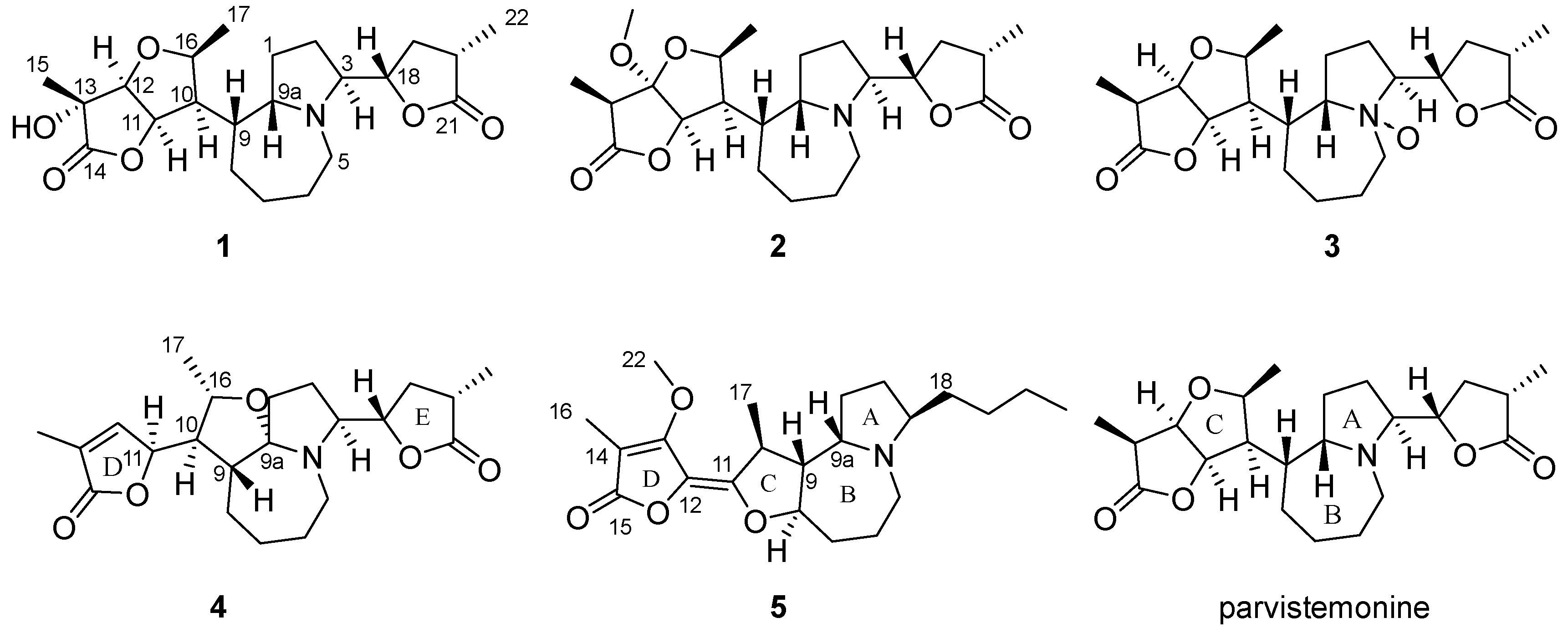
Figure 2.
Important 1H–1H COSY (▬) and HMBC (H→C) correlations of compounds 4 (left) and 5 (right).

Figure 3.
3D structure models of two presumed configurations of compound 4, and key NOESY correlations (H ↔H). (a) the C-O bond at C-9a was α-orientated; (b) the C-O bond at C-9a was β-orientated (generated by ChemBio3D software).
Figure 3.
3D structure models of two presumed configurations of compound 4, and key NOESY correlations (H ↔H). (a) the C-O bond at C-9a was α-orientated; (b) the C-O bond at C-9a was β-orientated (generated by ChemBio3D software).

Disclaimer/Publisher’s Note: The statements, opinions and data contained in all publications are solely those of the individual author(s) and contributor(s) and not of MDPI and/or the editor(s). MDPI and/or the editor(s) disclaim responsibility for any injury to people or property resulting from any ideas, methods, instructions or products referred to in the content. |
© 2024 by the authors. Licensee MDPI, Basel, Switzerland. This article is an open access article distributed under the terms and conditions of the Creative Commons Attribution (CC BY) license (http://creativecommons.org/licenses/by/4.0/).
Copyright: This open access article is published under a Creative Commons CC BY 4.0 license, which permit the free download, distribution, and reuse, provided that the author and preprint are cited in any reuse.


