
Submitted:
15 December 2024
Posted:
16 December 2024
You are already at the latest version
Abstract
The purpose of this paper is to assess the several variables affecting tourist arrival in Argentina, Also Argentina, known for its rich culture and breathtaking landscapes, is a favourite destination for tourists seeking to experience the best of South America. This research explores the factors affecting tourist arrivals to Argentina using the Quantitative method through statistical processes to model and analyze the relationship between tourist arrivals to Argentina and relevant variables such as tourist income, having a common religion between Argentina and neighbouring countries Chile, Bolivia, and Brazil, having a common religion, government effectiveness and political stability, although income in Argentina and Tourist Income in neighbouring countries Chile, Bolivia, and Brazil. The results of this study indicate that an increase in Argentina's income level enhances international tourism arrivals, and an increase in tourist income and neighbouring countries Chile, Bolivia, and Brazil suggests an increase in the number of tourists visiting Argentina. The government's effectiveness and Political Stability in Argentina developed the Underlying ICT infrastructure and broad ICT adoption together with improved air infrastructure, are imperative for the travel and tourism sector.
Keywords:
Tourism
; Argentina
; Destination
; South America
; Arrival
Introduction
Argentina is one of the most beautiful countries in South America, offering a unique array of tourist destinations that are sure to captivate travellers from around the world. Also, Chile, Bolivia, and Brazil are located in South America, The tourist industry in Argentina has been steadily increasing since the early 2000s. The number of tourists visiting the nation is been increasing steadily, and competition has been steadily improving throughout this time as well. Alongside this dynamism, there has been a noticeable shift in the type of demand for tourists, with an increasing number of travellers coming from nations with greater levels of tourism expenditure.
With its rich cultural heritage, diverse landscapes and renowned culinary offerings, Argentina offers travellers authentic experiences and unforgettable memories. Also, Strategic investments in infrastructure and targeted marketing initiatives are enhancing its appeal, allowing the country to tap into the global demand for unique and immersive travel, further cementing its position as a leading tourist destination in the region. Argentina offers a fascinating mix of luxury hotels, stunning natural wonders and distinctive cuisine, making it the first choice for travellers looking for diverse experiences, in addition to the diversity of air transportation.
In 2020, the travel and tourism industry's contribution to Argentina's GDP increased to an astounding 46.4 billion USD by 2021, reaching 33.7 billion USD. Argentina is a popular travel destination that draws tourists from all over the world (Cunningham, 2024). The number of foreigners visiting Argentina reached 13.4 million in 2023, according to the National Institute of Statistics and Census, marking an impressive 85.8% increase compared to 2022. More than 90 countries can travel to Argentina without a visa, including Brazil, Bolivia and Chile, which puts the country in a position to attract a wider range of international visitors. While the continued expansion of low-cost airlines and improved air connectivity have made short-haul options more attractive. This essay's goal is to investigate several factors influencing traveller arrivals in Argentina. Additionally, it investigates the factors that influence the number of tourists that arrive in Argentina by using the quantitative method through statistical processes to model and analyze the relationship between tourist arrivals and pertinent variables like tourist income, the fact that Argentina and its neighbouring countries, Chile, Bolivia, and Brazil, share a common Religion, have a common religion, have an effective government, and have political stability, even though Argentina's income is lower than that of its neighbours. There are some research limitations due to the lack of data available and there are other variables affecting tourist arrivals such as the price of Goods and services in Argentina etc.,
Literature Review
Different variables of interest have been used across the literature for example Camara et al, 2022 analyze the income level of the country of origin, and the relative price of tourist services between the host and origin countries (Obi et al, 2015), Yang et al., 2022 analyze the geographical distance, More than one million wine tourists visit Mendoza, Argentina each year, but little is known about their features. Leonardo Santoni et al., 2022 present the characteristics of wine tourists in Mendoza, Argentina, and examine the elements that influence their expenditure. The findings allow the authors to provide recommendations for both the commercial and public sectors. Marketing efforts may yield a good return on investment by focusing initially on Brazilian tourists, guests of high-end hotels, tourists who appreciate wine tourism experiences, and elderly tourists.
The Value Added Tax refund to foreign tourists, namely the Tax-Free Shopping incentive, increases travellers' propensity to buy retail items, even when shopping is occasionally the primary reason for a vacation, according to S. C. H. Banús (2020). Since the governments of Argentina and Uruguay have decided to outsource their VAT refund services to private companies, our study provides a benchmark by which travel planners can assess how this type of incentive has evolved.
Port, N. 2020 examined Argentina's tourism development and plans from an economic perspective, focusing on tourism projects that will ensure equitable distribution throughout the country, generate jobs and strengthen local economies. There are many possibilities and opportunities for a better distribution of tourism benefits for different regions of the country, and some national tourism dispersal policies and strategies are said to have a very positive impact on attracting tourists and enjoying the benefits of tourism.
Porto, N. (2018) looked at the factors affecting the demand for international bilateral travel in countries that are part of the Southern Common Market, specifically Argentina, Brazil, Uruguay, and Chile. The establishment of three tourism models based on the spatial distribution of tourist arrivals and departures is the analysis's novel contribution. An intra-regional model, an extra-regional model, and a generic model are estimated using a dynamic panel data model. indicates that traditional gravitational variables have a significant role in explaining bilateral inbound arrivals; however, the characteristics and trends of tourism demand vary based on whether a nation is a part of the sub-regional bloc. The findings indicate that the classic gravitational factors of habit persistence, distance, and remoteness are not the only important factors that contribute to the explanation of tourism in the area. One important characteristic that can provide information regarding potential tourism policy options is the spatial distribution of tourism flows. Finding the extra-bloc tourist demand requires taking into account new important factors, such as the reasons behind travel to exotic locations and the use of tourism as a means of expressing one's perceived social standing. However, No studies have been found that explore all different variables affecting tourist arrivals to Argentina and neighbouring countries Chile, Bolivia, and Brazil, such as income in Argentina and tourist income in Chile, Bolivia, and Brazil also have a common religion, political stability, and government effectiveness, as well as the distance between Argentina and neighbouring countries Chile, Bolivia, and Brazil.
Methodology
The theoretical concept emphasizes the significance of tourist arrivals in Argentina as dependent variables and with other independent variables like distance, life expectancy etc. The following is an expression for the model:
| Y = ß + a1 Distance a2 Comrelig_ + a3 Tourist income_dest + a4 Ge_dest + a5 Pl_dest +a6 Ge_orig +a7 Pl Orig + a8 Tourist income_orig + E (1) |
where:
Y represents dependent variable α1 to α8 represents coefficients of independent variables ß represents constant (intercept)
Distance: represents Argentina and Chile, Bolivia, and Brazil
Tourist income represents Tourist Income in Chile, Bolivia, and Brazil
Com relig represents common religion
Ge_dest represents life expectancy in Argentina
Pl_dest represents Political stability in Argentina
Ge_orig represents life expectancy in Chile, Bolivia, and Brazil
Pl _Orig political stability in Chile, Bolivia, and Brazil
Tourist income_dest represents Income in Argentina ε represents the error term (it is used to improve the consistency (functionality) of the regression model)

Table 1.
A complete description of the factors.
 |
Analysis and Findings
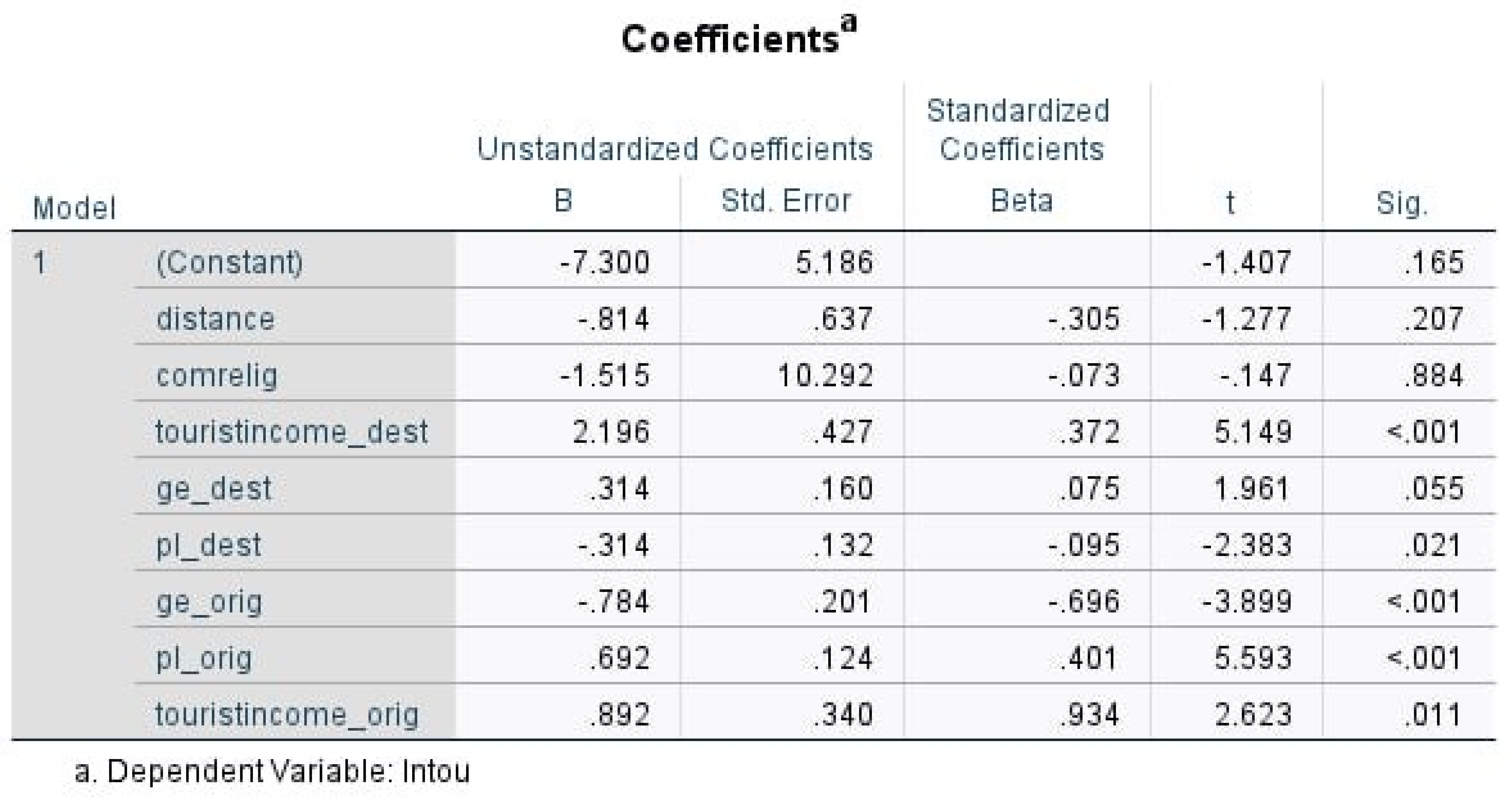
Distance between Argentina and Chile, Bolivia, and Brazil:
The Distance between Argentina and Chile, Bolivia, and Brazil is statistically insignificant. We do accept H0, indicating no relationship between the Distance between Argentina and Chile, Bolivia, and Brazil and tourist arrival in Argentina. Overall it demonstrates that there is acceptability between the four countries located in South America and there are several types of transportation there are 17 airlines between Argentina and Brazil, Six airlines between Chile and Argentina and Bolivia with four airlines, opening up opportunities for regional tourism growth. The increased affordability of short-haul flights is playing an important role in improving tourism in countries that may not have previously been at the forefront of Brazilian travellers’ interests.
Common Religion between Argentina and Chile, Bolivia, and Brazil:
The common religion in Argentina and Chile, Bolivia, and Brazil is statistically insignificant and we do accept H0, indicating that there is no connection between the common religion in Argentina and Chile, Bolivia, and Brazil and the number of tourist arrivals. Overall. There is a cultural affinity between the peoples of South America.
Tourist income in Argentina:
The income in Argentina is statistically significant at 0.01% level, we do accept Ha, and reject HO, meaning there is a positive relationship between income in Argentina and tourist arrivals to Argentina. If a 1% increase in the income level in Argentina, it means to grow up the number of tourist arrivals to Argentina by 2.1%, the relationship between rising incomes in Argentina and increasing tourist arrivals is largely driven by greater financial infrastructure to travel, enhanced tourism services, and also the beautiful view of Argentina as a tourist attraction in South America. All these factors work together to create a more favourable environment for tourism, which enhances the number of tourist arrivals to this Country.
Government Effectiveness in Argentina:
The Government Effectiveness in Argentina is statistically significant at 0.01 level and we do accept Ha and Reject Ho, which means that there are positive relationship between the Government Effectiveness in Argentina and the tourist arrival in Argentina, if the Government Effectiveness in Argentina became more effective that’s leads to increase the tourist arrival in Argentina 0. 31%. The government effectiveness in Argentina developed the Underlying ICT infrastructure and broad ICT adoption together with improved air infrastructure, are imperative for the travel and tourism sector.
Political stability in Argentina:
The political stability in Argentina is statistically significant at 0.01 level and we do accept Ha and Reject Ho, indicating that there is a negative relationship between Argentina's political stability and the number of visitors. If the political stability in Argentina became more stable that would lead to an increase the tourist arrivals in Argentina by 0. 31%.Although Argentina is Latin America’s second-largest country and third-largest economy, political stability is one of the key issues for economic growth especially in the tourism industry.
Government Effectiveness in Chile, Bolivia, and Brazil:
The Government Effectiveness in Chile, Bolivia, and Brazil is statistically significant at 0.01 level and we do accept Ha and Reject Ho, which means that there are Negative relationship between the Government Effectiveness in Chile, Bolivia, and Brazil and the tourist arrival in Argentina, if the Government Effectiveness in Chile, Bolivia, and Brazil became more effective that’s leads to decrease the tourist arrival in Argentina 0. 78%. Overall, the government can directly affect tourist policy by implementing a certain public policy or indirectly by actions taken in adjacent fields.
Political stability in Chile, Bolivia, and Brazil
The political stability in Chile, Bolivia, and Brazil is statistically significant at 0.01 level and we do accept Ha and Reject Ho, which means that there are positive relationship between the political stability in Chile, Bolivia, and Brazil and the tourist arrival in Argentina, if the political stability in Chile, Bolivia, and Brazil became more stable that’s leads to increase the tourist arrival in Argentina 0. 7%. That Political stability reflects the extent of economic and tourism growth of countries.
Tourist income in Chile, Bolivia, and Brazil:
The Tourist income in Chile, Bolivia, and Brazil and tourist arrival in Argentina are statistically significant and we do accept Ha and reject Ho indicating that there are positive relationship between tourism income in Chile, Bolivia, and Brazil and tourist arrival in Argentina If a 1% increase in the income level in Chile, Bolivia, and Brazil, it means to grow up the number of tourist arrivals to Argentina by 0.89%, The increase in tourists' income in Chile, Bolivia, and Brazil reflects their increased desire to travel and have a new tourist experience in neighbouring countries that have diverse tourist, heritage and cultural potential.
Model Summary
| Model Summary | ||||
| Model | R | R Square | Adjusted R Square | Std. Error of the Estimate |
| 1 | .979a | .959 | .953 | .1765311279 |
| a. Predictors: (Constant), touristincome_orig , pl_dest , distance, , ge_dest, touristincome_dest, pl_orig, comrelig. | ||||
The model summary provides (R) Square of 0.959, indicating that the predictors employed in the model account for 95.9% of the variation in Argentina tourist arrivals. The nature of this model is explained by these predictors distance pl_orig, ge_dest, pl_dest, comrelig, touristincome_dest, ge_orig, touristincome_orig. Although a standard critique of the model found that 4.7% of the total variation remains unexplained, the R Square of 0.959 indicates that a good amount of the variation has been explained. This suggests that additional variables or factors may be required to cover the comprehensive indicators of tourist arrivals.
Conclusion
It can be concluded that the study investigates the causality between international visitor arrivals in Argentina and neighbouring countries. To model and analyze the relationship between tourist arrivals in Argentina and pertinent variables like tourist income, the presence of a common religion between Argentina and its neighbouring countries, Chile, Bolivia, and Brazil, government effectiveness, and political stability, as well as the difference between Argentina's income and that of its neighbouring country, Chile, Bolivia, and Brazil, this study employs the quantitative method through statistical processes. Several factors affect a tourist's arrival to Argentina, different key aspects play a crucial role in attracting visitors to the country. According to the study's findings, a rise in Argentina's income level boosts foreign traveller arrivals, and a rise in tourist spending and that of Argentina's neighbours, Chile, Bolivia, and Brazil, indicates a rise in traveller numbers. The underlying ICT infrastructure in Argentina was created by the government's effectiveness and political stability, and the travel and tourist industry depends on widespread ICT use and better air infrastructure.
References
- Banús, S. C. H. (2020). Comparative Analysis of VAT Refunds System to Foreign Tourists in Argentina, Colombia, Ecuador, and Uruguay. The Case of the TAX-Free Shopping. Selected papers draft, 127. [CrossRef]
- Camara, I., Monteiro, J.; and Marques, O. (2022). “Models and determinants of international tourism demand: perspectives from the systematic review of literature for the period 2000-2020”, Revista Brasileira de Pesquisa em Turismo, 16.
- Cunningham, Courtney 2024, Tourism In Argentina Statistics 2024: A Comprehensive Travel Guide, https://gowithguide.
- Leonardo Javier Santoni, Jimena Estrella Orrego, Alejandro Gennari, (2022): Profiles and factors influencing spending of wine tourists in Mendoza, Tourism and Hospitality Research 2022, Vol. 22(4) 403–413. [CrossRef]
- Obi, P.; Sil, S.; and Abuizam R. (2015). “Tourism Stocks, Implied Volatility and Hedging: A Vector Error Correction Study”, Journal of Accounting and Finance, 15(8): 30-39.
- Pablo Avila, Robert Govers, Daniel Fenton, Lauro Ferroni (2020) World Economic Forum Argentina’s Travel and Tourism Competitiveness. The Case for Promoting and Preserving Cultural, Natural and Heritage Assets in Tourism, https://www3.weforum.org/docs/WEF_Argentina_Tourism_Report_2020.
- Port, N., & Garcia, C. I. (2020). Strategies for regional tourism development in Argentina. A path with new initiatives for tourism dispersal policies. In Tourism planning and development in Latin America (pp. 8-30). Wallingford UK: CABI.
- Porto, N., Garbero, N., & Espinola, N. (2018). Spatial distribution of touristic flows in a gravity model in South America. Journal of Tourism Analysis: Revista de Análisis Turístico, 25(1), 39-53. [CrossRef]
- Yang, Y., Nieto García, M., Viglia, G.; and Nicolau, J. (2022). “Competitors or complements: a meta-analysis of the effect of Airbnb on hotel performance”, Journal of Travel Research, 61(7), 1508-1527. [CrossRef]
Disclaimer/Publisher’s Note: The statements, opinions and data contained in all publications are solely those of the individual author(s) and contributor(s) and not of MDPI and/or the editor(s). MDPI and/or the editor(s) disclaim responsibility for any injury to people or property resulting from any ideas, methods, instructions or products referred to in the content. |
© 2024 by the authors. Licensee MDPI, Basel, Switzerland. This article is an open access article distributed under the terms and conditions of the Creative Commons Attribution (CC BY) license (http://creativecommons.org/licenses/by/4.0/).
Copyright: This open access article is published under a Creative Commons CC BY 4.0 license, which permit the free download, distribution, and reuse, provided that the author and preprint are cited in any reuse.


