

Submitted:
13 December 2024
Posted:
16 December 2024
You are already at the latest version
Abstract
The technique of Dynamic Factor Analysis (DFA), which aims to reduce the dimensionality of time series data, was utilized in order to model the changes over time in 8 different weed long-time series (26 years) growing in a biennial cereal-legume rotation. A common trend was extracted that captured the main signal of abundance over the time, indicating latent influences affecting all species. Canonical correlation analysis showed strong associations between the common trend and specific weed species, suggesting differential responses to this latent factor. Local (temperature and precipitations) and global weather factors (North Atlantic Oscillation (NAO)) were considered as explanatory variables to explain the common trend. The local weather variables considered did not play a significant role in explaining the common observed trend. Conversely, NAO showed a significant relationship with the weed community, indicating its potential role in shaping long-term weed dynamics. DFA was found to be useful for studying the variability in multivariate weed time series without the need for detailed a priori detailed information on the underlying mechanisms governing weed population dynamics. Overall, this study provides valuable insights into the long-term drivers of weed dynamics and sets the stage for future research in this area.
Keywords:
1. Introduction
2. Materials and Methods
2.1. Site and Sampling
2.2. Dynamic Factor Analysis
2.3. Explanatory Variables
3. Results and Discussion
4. Conclusions
Author Contributions
Funding
Data Availability Statement
Conflicts of Interest
References
- Howard, J.; Lincoln, J.M. Future of work in agriculture. J. Agromed. 2023, 28, 1–4.
- Zimdahl, R.L. Fundamentals of weed science, 3rd ed.; Academic Press: Cambridge, MA, USA, 2007; pp. 16–28.
- Oerke, E.C. Crop losses to pests. J. Agric. Sci. 2006, 144, 31–43. [CrossRef]
- Appleby, A.P.; Muller, F.; Carpy, S. Weed control. Pages 687–707 in Muller, F, ed., Agrochemicals. New York. Wiley. 2000.
- Van Acker, R.C. Weed biology serves practical weed management. Weed Res. 2009, 49. [CrossRef]
- Bagavathiannan, M.V.; Beckie, H.J.; Chantre, G.R.; Gonzalez-Andujar, J.L.; Leon, R.G.; Neve, P.; Poggio, S.L.; Schutte, B.J.; Somerville, G.J.; Werle, R.; et al. Simulation Models on the Ecology and Management of Arable Weeds: Structure, Quantitative Insights, and Applications. Agronomy 2020, 10, 1611. [CrossRef]
- Jurado-Exposito, M. ; Lopez-Granados, F. ; Gonzalez-Andujar, J.L.; Garcia-Torres, L. Characterizing population growth rate of Convolvulus arvensis in wheat-sunflower no-tillage systems. Crop Science 2005, 45, 2106-2112. [CrossRef]
- Hermandez-Plaza, E.; Kozak, M.; Navarrete, L.; Gonzalez-Andujar, J. Tillage system did not affect weed diversity in a 23-year experiment in Mediterranean dryland. Agric. Ecosyst. Environ. 2011, 140, 102–105. [CrossRef]
- Hernandez-Plaza, E.; Navarrete, L.; González-Andujar, J.L. Intensity of soil disturbance shapes response trait diversity of weed communities: the long-term effects of different tillage systems. Agric. Ecosyst. Environ. 2015, 207, 101–108. [CrossRef]
- Dick, W. A.; Daniel, T. C. Soil Chemical and Biological Properties as Affected by Conservation Tillage: Environmental Implications. In Effects of Conservation Tillage on Groundwater Quality: Nitrates and Pesticides, 1st ed.; Logan, T., Davidson, J., Baker, J., Overcash, M., Eds.; Lewis Publishers: Chelsea, MI, 1987. pp. 315–339.
- Légère, A.; Stevenson, F. C.; Benoit, D. L. Diversity and assembly of weed communities: contrasting responses across cropping systems. Weed Res. 2005, 45, 303–315. [CrossRef]
- Gonzalez-Andujar, J. L.; Fernandez-Quintanilla, C.; Navarrete, L. Population Cycles Produced by Delayed Density Dependence in an Annual Plant. Am. Nat. 2006, 168, 318–322. [CrossRef]
- Berti, A.; Dalla Marta, A.; Mazzoncini, M.; Tei, F. An overview on long-term agroecosystem experiments: present situation and future potential. Eur. J. Agron. 2016, 77, 236–241. [CrossRef]
- Hernanz, J.L.; Sanchez-Giron, V.; Navarrete, L. Soil carbon sequestration andstratification in a cereal/leguminous crop rotation with three tillage systems in semiaridconditions. Agric. Ecosyst. Environ. 2009, 133, 114–122. [CrossRef]
- Hernandez-Plaza, E.; Navarrete, L.; Lacasta, C.; Gonzalez-Andujar, J.L. Fluctuations in plant populations: Role of exogenous and endogenous factors. J. Veg. Sci. 2012, 23, 640–646. http://doi.org/10.1111/j.1654-1103.2011.01381.x.
- Gonzalez-Andujar, J.; Saavedra, M. Spatial distribution of annual grass weed populations in winter cereals. Crop Prot. 2003, 22, 629–633. [CrossRef]
- Meiss, H.; Médiène, S.; Waldhardt, R.; Caneill, J.; Munier-Jolain, N. Contrasting weed species composition in perennial alfalfas and six annual crops: implications for integrated weed management. Agron. Sustain. Dev. 2010, 30, 657–666. [CrossRef]
- Zuur, A.F.; Fryer, R.J.; Jolliffe, I.T.; Dekker, R.; Beukema, J.J. Estimating common trends in multivariate time series using dynamic factor analysis. Environmetrics 2003, 14, 665–685. [CrossRef]
- Zuur, A.F.; Ieno, E.N.; Smith, G.M. Analysing ecological data, 1st ed.; Springer: New York, US, 2007; pp. 303–314. [CrossRef]
- Stock, J. H.; Watson, M. W. Dynamic factor models, factor-augmented vector autoregressions, and structural vector autoregressions in macroeconomics. In Handbook of macroeconomics, 1st ed.; Taylor, J. B, Uhlig, H., Eds.; Elsevier: Amsterdam, The Netherlands, 2016; Volume 2, pp. 415–525. [CrossRef]
- Hurrell, J.W. Decadal trends in the North Atlantic Oscillation: regional temperatures and precipitation. Science 1995, 269, 676–679. [CrossRef]
- Climatic Predictions Center (USA) (2024). Available online: https://www.cpc.ncep.noaa.gov/products/precip/CWlink/pna/nao.shtml (accessed on 15 August 2024).
- Fernandez-Gonzalez, S.; Del Rio, S.; Castro, A.; Penas, A.; Fernández-Raga, M.; Calvo, A.I.; Fraile, R. Connection between NAO, weather types and precipitation in León, Spain (1948-2008). Int. J. Climatol. 2012, 32, 2181–2196. [CrossRef]
- Hubalek, Z. The North Atlantic Oscillation system and plant phenology. Int. J. Biometeorol. 2016, 60, 749–756. [CrossRef]
- Dunstone, N.; Smith, D.M.; Hardiman, S.C.; Hermanson, L.; Ineson, S.; Kay, G.; Li, C.; Lockwood, J.F.; Scaife, A.A.; Thornton, H.; Ting, M.; Wang, L. Skilful predictions of the Summer North Atlantic Oscillation. Commun. Earth Environ. 2023, 4, 409. [CrossRef]
- Burnham, K. P.; Anderson, D. R. Multimodel Inference: Understanding AIC and BIC in Model Selection. Sociol. Methods Res. 2004, 33, 261–304. [CrossRef]
- Oreja, F.H.; Genna, N.G.; Gonzalez-Andujar, J.L.; Wuest, S.B.; Barroso, J. A hydrothermal model to predict Russian thistle (Salsola tragus) seedling emergence in the dryland of the Pacific Northwest (USA). Weed Sci. 2024, 72, 108–112. [CrossRef]
- Larcher, W. Temperature stress and survival ability of Mediterranean sclerophyllous plants. Plant Biosyst. 2000, 134, 279–295. [CrossRef]
- Liu, C.; Li, J.; Liu, Q.; Gao, J.; Mumtaz, F.; Dong, Y.; Wang, C.; Gu, C.; Zhao, J. Combined influence of ENSO and North Atlantic Oscillation (NAO) on Eurasian Steppe during 1982–2018. Sci. Total Environ. 2023, 892, 164735. [CrossRef]
- Lima, M.; Navarrete, L.; Gonzalez-Andujar, J. L. Climate effects and feedback structure determining weed population dynamics ina long-term experiment. PLoS ONE 2012, 7, 1–7. [CrossRef]
- Gouveia, C., Trigo, R.M., DaCamara, C.C., Libonati, R., Pereira, J.M.C.. The North Atlantic Oscillation and European vegetation dynamics. International Journal of Climatology 2008, 28, 1835–1847.
- Fried, G.; Norton, L.R.; Reboud, X. Environmental and management factors determining weed species composition and diversity in France. Agric. Ecosyst. Environ. 2008, 128, 68–76. [CrossRef]
- Pinke, G.; Pál, R.W.; Tóth, K.; Karácsony, P.; Czúcz, B.; Botta-Dukát, Z. Weed vegetation of poppy (Papaver somniferum) fields in Hungary: effects of management and environmental factors on species composition. Weed Res. 2011, 51, 621–630. [CrossRef]
- Li, J.; Du, L.; Guan, W.; Yu, F. H.; van Kleunen, M. Latitudinal and longitudinal clines of phenotypic plasticity in the invasive herb Solidago canadensis in China. Oecologia 2016, 182, 755–764. [CrossRef]
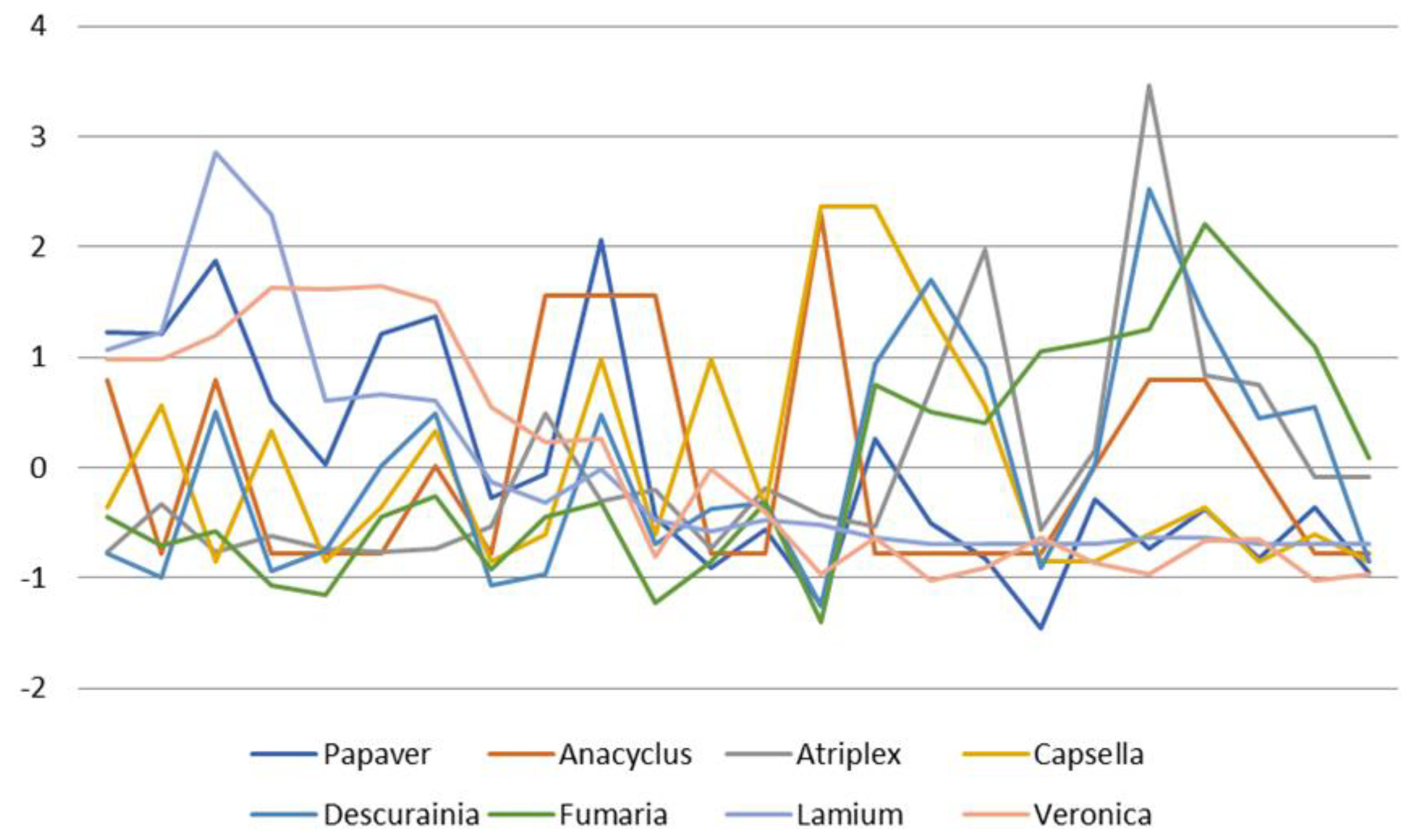
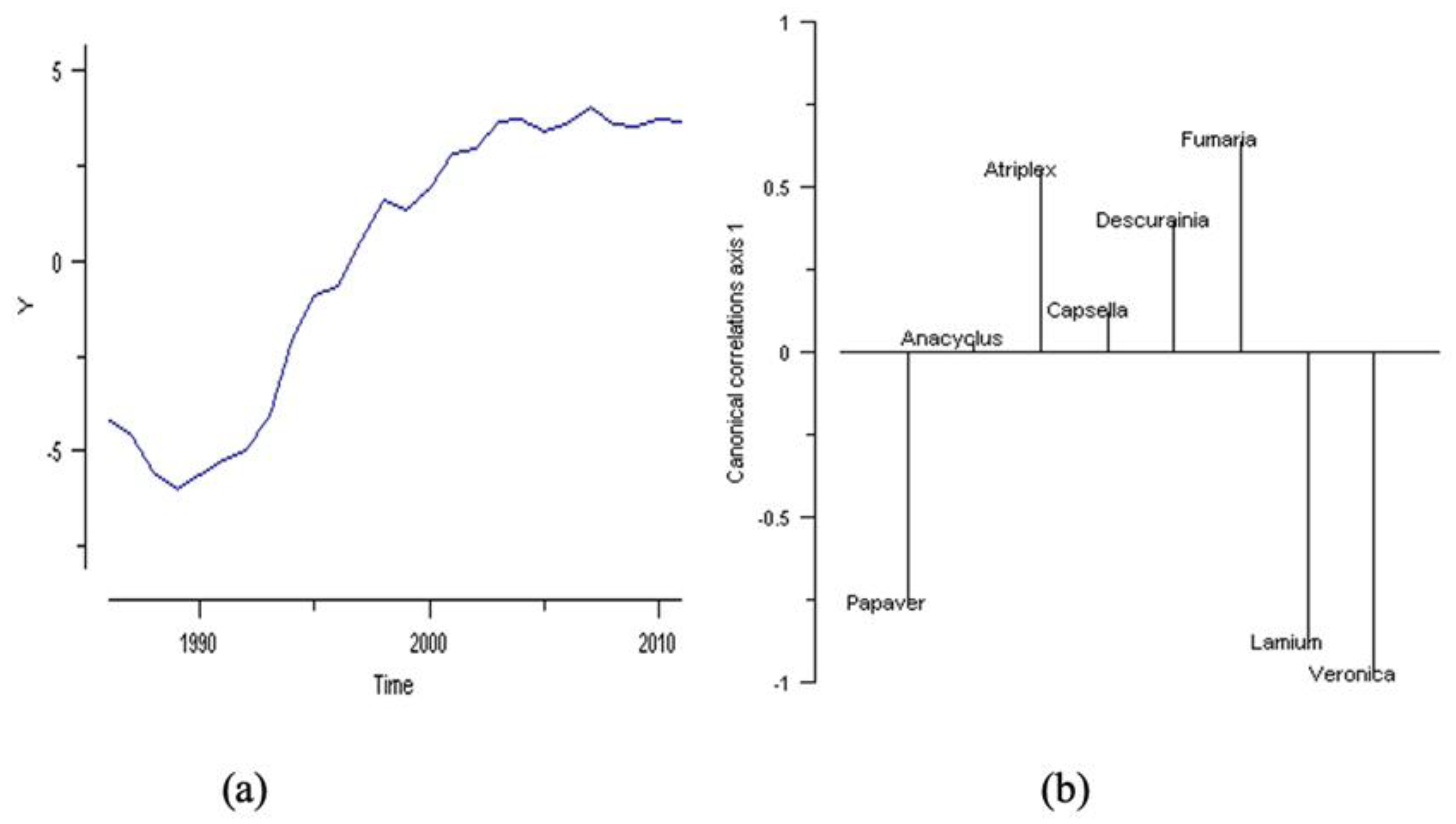

| Model | Trend | AICc | ∆i | wi | Explanatory variables |
|---|---|---|---|---|---|
| Tillage | |||||
| 1 | 1 | 526.16 | 8.84 | 0.012 | ------- |
| 2 | 1 | 546.10 | 28.78 | 0.000 | MSP |
| 3 | 1 | 539.08 | 21.76 | 0.000 | MST |
| 4 | 1 | 517.32 | 0 | 0.988 | NAO |
| 5 | 1 | 569.59 | 52.27 | 0.000 | MSP+MST |
| 6 | 1 | 573.83 | 56.51 | 0.000 | MST+NAO |
| 7 | 1 | 570.08 | 52.76 | 0.000 | MSP+NAO |
| 8 | 1 | 596.89 | 79.57 | 0.000 | MSP+MST+NAO |
Disclaimer/Publisher’s Note: The statements, opinions and data contained in all publications are solely those of the individual author(s) and contributor(s) and not of MDPI and/or the editor(s). MDPI and/or the editor(s) disclaim responsibility for any injury to people or property resulting from any ideas, methods, instructions or products referred to in the content. |
© 2024 by the authors. Licensee MDPI, Basel, Switzerland. This article is an open access article distributed under the terms and conditions of the Creative Commons Attribution (CC BY) license (http://creativecommons.org/licenses/by/4.0/).


