

Submitted:
11 December 2024
Posted:
12 December 2024
You are already at the latest version
Abstract
Background/Objectives: Fear of recurrence is one of the main issues affecting cancer patients after the completion of treatment. Despite the development of various assessment tools at an international level, there is a lack of validated questionnaires in Spanish. For this reason, the aim of this study is to conduct a transcultural adaptation and evaluate the psychometric properties of the Spanish version of the Fear of Cancer Recurrence (FCR7) questionnaire. Methods: Translation and transcultural adaptation of the FCR7 scale, content validity assessment through expert review, and face validity with a pilot test in the first phase. In the second phase, construct validity was evaluated through confirmatory factor analysis and RASCH analysis, along with reliability (internal consistency), convergent-divergent validation, and known-groups validation in a sample of 315 individuals with a history of cancer. Descriptive and inferential analysis was performed using JAMOVI© software, confirmatory factor analysis with FACTOR©, and RASCH analysis with JMetrik© software. Results: Aiken's coefficient exceeded 0.75 for all items, indicating acceptable face validity for the instrument. Two unidimensional models were obtained for the instrument, FCR7-SP and FCR6-SP, both showing acceptable fit values and adequate reliability (omega coefficient = 0.933 [95% CI: 0.922-0.944] and 0.942 [95% CI: 0.931-0.951], respectively). Conclusions: The Spanish version of the FCR7 is valid and reliable for assessing fear of cancer recurrence in the Spanish population, with two models available for its application (FCR7-SP and FCR6-SP). The availability of this tool will enable the evaluation of this phenomenon in clinical practice, and a more effective approach to addressing its consequences.
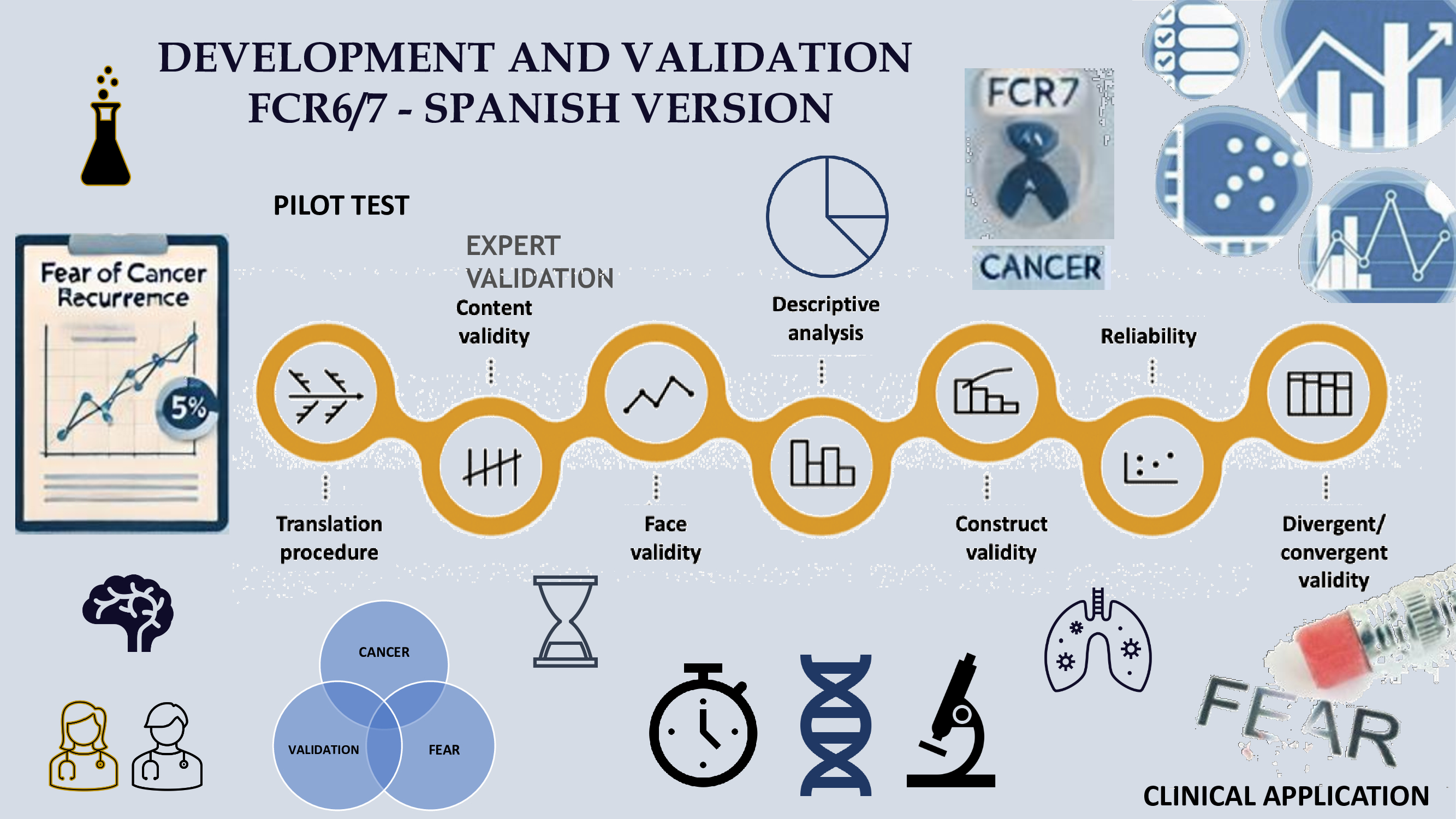
Keywords:
1. Introduction
2. Materials and Methods
2.1. Stage 1: Methodological Study
2.1.1. Starting Instrument
2.1.2. Translation Procedure
2.1.3. Content Validity
2.1.4. Face Validity
2.2. Stage 2: Cross-Sectional Study to Obtain a Validation Sample for the Evaluation of Different Psychometric Properties of the Spanish Version of the FCR7 Instrument.
2.2.1. Design
2.2.2. Population and Study Setting
2.2.3. Sample Size
2.2.4. Variables Under Study
2.2.5. Instruments and Data Collection System
- Resilience Scale (RS-14): Measures individual resilience, considered a positive personality trait that allows adaptation to adverse situations. Originally developed by Wagnild [19] and revised in 2009 to the current 14-item scale. Adapted to the Spanish version by Sánchez-Teruel [20] in 2015. The RS-14 measures two factors: Personal Competence (11 items; self-confidence, independence, decision-making, ingenuity, and perseverance) and Acceptance of Self and Life (3 items; adaptability, balance, flexibility, and a stable life perspective). The author of the original scale defines the following levels of resilience: 98-82 = Very high resilience; 81-64 = High resilience; 63-49 = Normal; 48-31 = Low; 30-14 = Very low.
- Coping Strategies Inventory (CSI): Measures the frequency of use of coping strategies. Validated and structured by Tobin [21] and in its Spanish version of 40 items adapted by Cano [22]. The person starts by describing the stressful situation and responds on a five-point Likert scale that defines the frequency of what was done in the described situation. An item regarding perceived self-efficacy in coping is added at the end. The inventory is structured around eight coping strategies: problem-solving (strategies aimed at eliminating stress by modifying the situation), self-criticism (self-blame for the emergence of the situation and apparent mismanagement), emotional expression (releasing emotions resulting from stress), wishful thinking (desire for the situation to be less stressful), social support (seeking emotional support), cognitive restructuring (modifying the meaning of the situation), problem avoidance (denial and avoidance of thoughts and actions related to the situation), and social withdrawal (withdrawing from close people related to the stressful situation).
- SF-36 Health Survey: A generic health profile scale commonly used as a quality of life assessment tool. Developed by McHorney [23] and adapted to the Spanish version by Alonso [24], showing adequate levels of validity, reliability, and cultural equivalence with versions developed in other countries. It consists of 36 items and 8 dimensions: physical functioning (PF), role limitations due to physical problems (RP), bodily pain (BP), general health (GH), vitality (VT), social functioning (SF), role limitations due to emotional problems (RE), and mental health (MH). In addition to these eight health scales, there is an item that evaluates the general concept of changes in the perception of current health status compared to how it was one year ago (CS). For each dimension, the items are coded, summed, and transformed into a scale ranging from 0 (worst health status) to 100 (best health status).
2.2.6. Analysis and Interpretation of the Data
- Construct validity through confirmatory factor analysis
- Construct-structural validity through Rasch analysis
- Reliability
- Divergent / Convergent Validity
- Known-groups validation
2.2.7. Ethics Considerations
3. Results
3.1. Stage 1. Translation Procedure
3.1.1. Content Validity
3.1.2. Face Validity
3.2. Stage 2. Descriptive Analysis of the Sample and the Items of the Fear of Recurrence-FCR7-SP
3.2.1. Construct Validity Through Confirmatory Factor Analysis for FCR4-SP and FCR7-SP
3.2.2. Construct-Structural Validity Through RASCH Analysis
3.2.3. Reliability
3.2.4. Divergent-Convergent Validity
3.2.5. Validation by Known Groups and Final Proposal
4. Discussion
5. Conclusions
Author Contributions
Funding
Institutional Review Board Statement
Informed Consent Statement
Data Availability Statement
Acknowledgments
Conflicts of Interest
Appendix A
References
- World Organization Health. Cancer. Facts and figures. 2022. Available at: https://www.who.int/es/news-room/fact-sheets/detail/cancer.Accessibility verified, June 8, 2024.
- Emery, J.; Butow, P.; Lai-Kwon, J.; Nekhlyudov, L.; Rynderman, M.; Jefford, M. Management of common clinical problems experienced by survivors of cancer. Lancet 2022, 399 (10334), 1537–1550. [CrossRef]
- Lebel, S.; Simard, S.; Harris, C.; Feldstain A.; Breathe, S.; McCallum, M.; Lefebvre M.; Savard, J.; Devins G.M. Empirical validation of the English version of the Fear of Cancer Recurrence Inventory. Qual Life Res. 2016, 25, 311-321. [CrossRef]
- Coutts-Bain, D.; Sharpe, L.; Pradhan, P.; Russell, H.; Heathcote, L.C.; Costa, D. Are Fear of Cancer Recurrence and Fear of Progression Equivalent Constructs? Psycho-Oncology 2022, 31(8), 1381-1389. [CrossRef]
- Luigjes-Huizer, Y.L.; Tauber, N.M.; Humphris, G.; Kasparian, N.A.; Lam, W.W.T.; Lebel, S.; Simard, S.; Smith, A.B.; Zachariae, R.; Afiyanti, Y.; et al. What is the prevalence of fear of cancer recurrence in cancer survivors and patients? A systematic review and individual participant data meta-analysis. Psycho-Oncology 2022, 31(6), 879-892. [CrossRef]
- Reed, S.C.; Bell, J.F.; Miglioretti, D.L.; Nekhlyudov, L.; Fairman, N.; Joseph, J.G. Relationships Between Fear of Cancer Recurrence and Lifestyle Factors Among Cancer Survivors. J. Cancer Educ. 2019, 35(4), 669–677. [CrossRef]
- Lisy, K.; Langdon, L.; Piper, A.; Jefford, M. Identifying the most prevalent unmet needs of cancer survivors in Australia: A systematic review. Asia-Pacific Journal of Clinical Oncology 2019, 15(5), e68-e78. [CrossRef]
- Miroševič, Š.; Prins, J.B.; Selič, P.; Zaletel Kragelj, L.; Klemenc Ketiš, Z. Prevalence and factors associated with unmet needs in post-treatment cancer survivors: A systematic review. European Journal of Cancer Care 2019, 28(3). [CrossRef]
- Mutsaers, B.; Butow, P.; Dinkel, A.; Humphris, G.; Maheu, C.; Ozakinci, G.; Prins, J.; Sharpe, L.; Smith, A.; Thewes, B.; et al. Identifying the key characteristics of clinical fear of cancer recurrence: An international Delphi study. Psycho-Oncology 2019, 29(2), 430–436. [CrossRef]
- Williams, J.T.W.; Pearce, A.; Smith, A. A systematic review of fear of cancer recurrence related healthcare use and intervention cost-effectiveness. Psycho-Oncology 2021, 30(8), 1185–1195. [CrossRef]
- Anderson, K.; Smith, A.; Diaz, A.; Shaw, J.; Butow, P.; Sharpe, L.; Girgis, A.; Lebel, S., Dhillon, H.; Burhansstipanov, L.; et al. A Systematic Review of Fear of Cancer Recurrence Among Indigenous and Minority Peoples. Frontiers in Psychology 2021, 12, 621850. [CrossRef]
- Mendoza, S.Y. Relationship between fear of recurrence, death anxiety and meaning of life in cancer survivors [Doctoral Thesis]. University Autonoma of Nuevo León, México, 2023. Available at: http://eprints.uanl.mx/25433/1/1080328812.pdf.
- Humphris, G.M.; Watson, E.; Sharpe, M.; Ozakinci, G. Unidimensional scales for fears of cancer recurrence and their psychometric properties: the FCR4 and FCR7. Health and Quality of Life Outcomes 2018, 16(1). [CrossRef]
- Soto, C.M.; Segovia, J.L. Confidence intervals for the content validity: a visual basic computer program for the Aiken’s V. Anal Psicol. 2009, 25, 169–71.
- Almanasreh, E.; Moles, R.; Chen, T.F. Evaluation of methods used for estimating content validity. Research in Social and Administrative Pharmacy 2019, 15(2), 214-221. [CrossRef]
- Barrio-Cantalejo, I.M.; Simón-Lorda, P.; Melguizo, M.; Escalona, I.; Marijuán, M.I.; Hernando, P. Validation of the INFLESZ scale to evaluate readability of texts aimed at the patient. An Sist Sanit Navar 2008, 31(2),135–52. [CrossRef]
- Ferrando, P.; Lorenzo-Seva, U.; Hernández-Dorado, A.; Muñiz, J. Decalogue for the Factor Analysis of Test Items. Psicothema 2022, 1(34), 7–17. [CrossRef]
- Lorenzo-Seva, U.; Ferrando, P.J. Determining Sample Size Requirements in EFA Solutions: A Simple Empirical Proposal. Multivariate Behavioral Research 2024, 59(5), 899-912. [CrossRef]
- Wagnild, G. A Review of the Resilience Scale. Journal of Nursing Measurement 2009, 17(2), 105–113. [CrossRef]
- Sánchez-Teruel, D.; Robles-Bello, M.A. 14-item Resilience Scale (RS-14): Psychometric Properties of the Spanish Version. Rev Iberoamericana de Diagnóstico y Evaluación 2015, 40(2),103-113.
- Tobin, D.L.; Holroyd, K.A.; Reynolds, R.V.; Wigal, J.K. The hierarchical factor structure of the coping strategies inventory. Cognitive Therapy and Research 1989, 13(4), 343–361. [CrossRef]
- Cano, F.J.; Rodríguez, L.; Garcia, J. Spanish adaptation of the Coping Strategies Inventory. Actas Esp Psiquiatr 2007, 35(1), 29-39.
- McHorney, C.A.; Johne, W.; Anastasiae, R. The MOS 36-Item Short-Form Health Survey (SF-36). Medical Care 1993, 31(3), 247–263. [CrossRef]
- Alonso, J.; Prieto, L.; Anto, J.M. The Spanish version of the SF-36 Health Survey (Cuestionario de Salud SF-36): an instrument for measuring clinical outcomes. Med Clin 1995, 104, 771-6.
- Lloret, S.; Ferreres, A.; Hernández, A.; Tomás, I. El análisis factorial exploratorio de los ítems: análisis guiado según los datos empíricos y el software. Anales de Psicología 2017, 33(2), 417-432. [CrossRef]
- Ferrando, P.J.; Lorenzo-Seva, U. Assessing the quality and appropriateness of factor solutions and factor score estimates in exploratory item factor analysis. Educ Psychol Meas 2018, 78(5), 762–80. [CrossRef]
- Ferrando, P.J.; Lorenzo-Seva, U. A note on improving EAP trait estimation in oblique factor-analytic and item response theory models. Psicologica 2016, 37, 235–247.
- Hancock, G.R.; Mueller R.O. Rethinking Construct Reliability within Latent Variable Systems. In: Structural equation modeling: Present and future. Cudeck, R.; du Toit, S; Sörbom, D. editors. Scientifc Software:Lincolnwood, United States of America, 2001; pags. 195–216.
- Christensen, K.B.; Makransky, G.; Horton, M. Critical Values for Yen’s Q3: Identification of Local Dependence in the Rasch Model Using Residual Correlations. Applied Psychological Measurement 2016, 41(3), 178–194. [CrossRef]
- Linacre, J.M. Winsteps® Rasch Measurement Computer Program User's Guide, Version 5.6.0; Winsteps.com: Portland, Oregon, 2023. Disponible en: https://www.winsteps.com/ (consultado el 3 de diciembre de 2024).
- Linacre, J.M. What do Infit and Outfit, Mean-square and Standardized mean? Rasch Measurement Transactions 2002, 16(2), 878.
- Yang, Y.; Humphris, G.; Sun, H.; Li, W.; Hao, Y.; Liu, T.; Zhang, J.; Wang, H.; Zhang, B. Psychometric properties of the Chinese version Fear of Cancer Recurrence Questionnaire-7 (FCR-7). Professional Psychology: Research and Practice 2019, 50(6), 376–383. [CrossRef]
- Nandakumar, D.; Veeriah, S.; Krishnamurthy, A.; Veluswami, S.; Ananthi, B. Fear of Cancer Recurrence 7 Scale Tamil Translation and Validation among Breast Cancer Survivors in India. Indian Journal of Palliative Care 2022, 28(3), 321-327. [CrossRef]
- Bergerot, C.D.; Ferreira, L.N.; Molina, L.N.M.; Pagung, L.B.; da Silva Pedersen, B.; de Andrade, T.G.; Machado, R.H.I.; de Sousa Freitas, A.N.; Barreto, L.H.C.T.; de Araujo, L.L.; et al. Fear of cancer recurrence among Brazilian patients with cancer: Translation and cultural adaptation of FCR4/7 and FCRI-SF measures. Journal of Psychosomatic Research 2022, 165, 111125. [CrossRef]
- Calderon, C.; Gustems, M.; Galán-Moral, R.; Muñoz-Sánchez, M.M.; Ostios-García, L.; Jiménez-Fonseca, P. Fear of Recurrence in Advanced Cancer Patients: Sociodemographic, Clinical, and Psychological Correlates. Cancers 2024, 16(5), 909. [CrossRef]
- Charter, R.A. A breakdown of reliability coefficients by test type and reliability method, and the clinical implications of low reliability. Journal of General Psychology 2003, 130(3), 290-304. [CrossRef]
- Argimón-Pallás, J.M.; Jiménez-Villa, J. Clinical and epidemiological research methods, 5ªed. Elsevier, España, 2019.
- Lobiondo-Wood, G.; Haber, J. Nursing research: Methods and critical appraisal for evidence-based practice 10ªed. Elsevier Science Publishing: Filadelfia, Estados Unidos de América, 2021.
- Braun, S.E.; Willis, K.D.; Mladen, S.N.; Aslanzadeh, F.; Lanoye, A.; Langbein, J.; Reid, M.; Loughan, A.R. Introducing FCR 6 – Brain: Measuring Fear of Cancer Recurrence in Brain Tumor Patients and Their Caregivers. Neuro-Oncology Pract 2022, 9,(6),509-519. [CrossRef]
- Iglesias-Puzas, Á.; García-González, V.; Conde-Taboada, A.; López-Bran, E. Fear of cancer recurrence in patients with non-metastatic melanoma: Spanish validation and disease-related factors. Australas. J. Dermatol. 2022, 63(4), e312-e319. [CrossRef]
- Paperák, P.; Javůrková, A.; Raudenská, J. Therapeutic intervention in fear of cancer recurrence in adult oncology patients: a systematic review. Journal of Cancer Survivorship. 2022, 17, 1017- 1035. [CrossRef]
- Li, Y.; Li, N.; Wang, J.; Shang, Q.; Zhang, B.; Cao, M. Effects of Social Support, Family Resilience, and Individual Resilience on Fear of Cancer Recurrence Among Persons With Breast Cancer: A Cross-Sectional Study. West J Nurs Res. 2023, 45(11), 993-1000. [CrossRef]

| FCR7 Items | Exp 1 | Exp 2 | Exp 3 | Exp 4 | Exp 5 | Exp 6 | Exp 7 | Exp 8 | Exp 9 | Exp 10 | V Aiken Coefficient [95%CI] |
|---|---|---|---|---|---|---|---|---|---|---|---|
| 1. I'm afraid cancer may appear | 4 | 4 | 3 | 4 | 4 | 3 | 4 | 4 | 2 | 4 | 0.87 [0.70-0.95] |
| 2. I am worried or anxious about the possibility of cancer recurrence | 4 | 4 | 3 | 4 | 4 | 3 | 3 | 4 | 3 | 4 | 0.87 [0.70-0.95] |
| 3. How often do you worry about getting cancer again? | 4 | 4 | 3 | 4 | 3 | 3 | 4 | 4 | 4 | 4 | 0.90 [0.74-0.97] |
| 4. I have strong feelings about the cancer coming back | 4 | 4 | 3 | 4 | 3 | 3 | 3 | 4 | 3 | 4 | 0.83 [0.66-0.93] |
| 5. I think about the cancer coming back when I don't want to | 4 | 4 | 3 | 4 | 4 | 3 | 1 | 4 | 2 | 4 | 0.77 [0.59-0.88] |
| 6. I check myself for physical signs of cancer | 4 | 4 | 4 | 3 | 3 | 4 | 4 | 3 | 3 | 3 | 0.83 [0.66-0.93] |
| 7. To what extent does worry about developing cancer again take over or interfere with your thoughts and activities? | 4 | 4 | 2 | 4 | 4 | 4 | 2 | 4 | 4 | 4 | 0.87 [0.70-0.95] |
| Items FCR7-SP | M [95%CI]1 | SD2 | Symmetry | Kurtosis | Floor Not at all3 N (%) |
Ceiling All the time3 N (%) |
|---|---|---|---|---|---|---|
| Item 1. I am afraid that cancer may appear. | 4.25 [4.15-4.36] | 0.98 | -1.227 | 0.933 | 6 (1.9%) | 172 (54.6%) |
| Item 2. I am worried or anxious about the possibility of cancer recurrence. | 3.91 [3.78-4.03] | 1.12 | -0.841 | 0.050 | 15 (4.8%) | 124 (39.4%) |
| Item 3. How often do you worry about getting cancer again? | 3.85 [3.73-3.96] | 1.05 | -0.636 | -0.263 | 8 (2.5%) | 104 (33.0%) |
| Item 4. I have strong feelings about the cancer coming back. | 3.26 [3.13-3.40] | 1.24 | -0.000 | -0.997 | 24 (7.6%) | 75 (23.8%) |
| Item 5. I think about the cancer coming back when I don't want to. | 2.93 [2.78-3.08] | 1.36 | 0.178 | -1.110 | 56 (17.8%) | 62 (19.7%) |
| Item 6. I check myself for physical signs of cancer. | 4.54 [4.43-4.65] | 1.00 | -2.305 | 4.485 | 12 (3.8%) | 246 (78.1%) |
| Item 7. To what extent does worry about developing cancer again take over or interfere with your thoughts and activities? | 3.80 [3.69-3.91] | 1.00 | -0.626 | 0.168 | 10 (3.2%) | 88 (27.9%) |
| Items | FCR4 Factor loading values [95% Confidence Interval] | FCR7 Factor loading values [95% Confidence Interval] |
|---|---|---|
| Item 1. I am afraid that cancer may appear. | 0.903 [0.858-0.935] | 0.913 [0.853-0.941] |
| Item 2. I am worried or anxious about the possibility of cancer recurrence. | 0.976 [0.951-0.992] | 0.951 [0.926-0.972] |
| Item 3. How often do you worry about getting cancer again? | 0.944 [0.915-0.963] | 0.921 [0.885-0.943] |
| Item 4. I have strong feelings about the cancer coming back. | 0.869 [0.822-0.902] | 0.904 [0.859-0.932] |
| Item 5. I think about the cancer coming back when I don't want to. | 0.869 [0.817-0.905] | |
| Item 6. I check myself for physical signs of cancer. | 0.624 [0.517-0.727] | |
| Item 7. To what extent does worry about developing cancer again take over or interfere with your thoughts and activities? | 0.925 [0.869-0.950] | |
| Factor Determinacy Index (FDI) | 0.986 | 0.986 |
| EAP scores reliability | 0.973 | 0.972 |
| Sensitivity ratio (SR)a | 5.992 | 5.857 |
| Expected percentage of true differences (EPTD)b | 97.1% | 97.0% |
| Item | Index of Difficulty* FCR7-SP |
Infit-WMS** (Std. WMS***) FCR7-SP |
Outfit-UMS** (Std. UMS***) FCR7-SP |
Infit-WMS** (Std. WMS***) without item nº6-Model FCR6-SP |
Outfit-UMS** (Std.UMS***) without item nº6-Model FCR6-SP |
Infit-WMS** (Std. WMS***) Model FCR4-SP |
Outfit-UMS** (Std. UMS***) Model FCR4-SP |
|---|---|---|---|---|---|---|---|
| Item 1. I am afraid that cancer may appear. | -1.40 | 0.74 (-3.03) |
1.22 (1.28) |
0.93 (-0.72) |
1.74 (3.06) |
1.08 (0.80) |
1.33 (1.52) |
| Item 2. I am worried or anxious about the possibility of cancer recurrence. | -0.29 | 0.66 (-4.21) |
0.72 (-2.92) |
0.80 (-2.36) |
0.86 (-1.31) |
0.70 (-3.68) |
0.66 (-3.73) |
| Item 3. How often do you worry about getting cancer again? | -0.31 | 0.78 (-2.73) |
0.79 (-2.57) |
0.97 (-0.39) |
0.95 (-0.56) |
0.87 (-1.60) |
0.85 (-1.66) |
| Item 4. I have strong feelings about the cancer coming back. | 1.39 |
0.87 (-1.60) |
0.87 (-1.56) |
0.86 (-1.71) |
0.87 (-1.45) |
1.33 (3.29) |
1.31 (2.81) |
| Item 5. I think about the cancer coming back when I don't want to. | 2.47 |
1.10 (1.10) |
1.12 (1.16) |
1.11 (1.25) |
2.12 (4.79) |
NA | NA |
| Item 6. I check myself for physical signs of cancer. | -1.74 | 2.44 (7.83) |
11.58 (7.10) |
NA | NA | NA | NA |
| Item 7. To what extent does worry about developing cancer again take over or interfere with your thoughts and activities? | -0.13 |
0.81 (-2.28) |
0.84 ( 1.91) |
1.18 (2.06) |
1.19 (1.97) |
NA | NA |
| Model FCR7-SP (seven items) | Model FCR6-SP (item number 6 eliminated) |
Model FCR4-SP (item number 1 to number 4) | ||||
|---|---|---|---|---|---|---|
| items | persons | items | persons | item | persons | |
| Separation index | 13.181 | 3.153 | 14.777 | 3.723 | 13.212 | 3.164 |
| Reliability | 0.994 | 0.908 | 0.995 | 0.932 | 0.994 | 0.909 |
| If item dropped | |||||
|---|---|---|---|---|---|
| Cronbach's α | McDonald's ω | ||||
| FCR1 | 0.912 | 0.920 | |||
| FCR2 | 0.904 | 0.912 | |||
| FCR3 | 0.906 | 0.915 | |||
| FCR4 | 0.908 | 0.917 | |||
| FCR5 | 0.916 | 0.922 | |||
| FCR6 | 0.942 | 0.945 | |||
| FCR7 | 0.908 | 0.917 | |||
| SF-36 Dimensions Scores | ||||
|---|---|---|---|---|
| FCR7-SP | FCR6-SP | |||
| p value | p value | |||
| Physical functioning | -0.132 | 0.019* | -0.147 | 0.009* |
| Physical role | -0.176 | 0.002* | -0.183 | 0.001* |
| Body pain | -0.293 | ≤0.001* | -0.295 | ≤0.001* |
| General Health | -0.404 | ≤0.001* | -0.414 | ≤0.001* |
| Vitality | -0.365 | ≤0.001* | -0.376 | ≤0.001* |
| Social Functioning | 0.084 | 0.138 | 0.104 | 0.066 |
| Emotional Role | -0.391 | ≤0.001* | -0.406 | ≤0.001* |
| Mental Health | -0.451 | ≤0.001* | -0.464 | ≤0.001* |
| Model FCR 7-SP | Model FCR6-SP | |
|---|---|---|
| M(SD) 1 | M(SD) 1 | |
| Gender | ||
| Female n=289 | 27.3 (6.19) | 22.8 (5.65) |
| Male n=47 | 22.2 (6.51) | 17.7 (6.11) |
| p-value 2 | <0.001* | <0.001* |
| Effect size 3 (Hedges's g) | 0.816 | 0.890 |
| Children | ||
| If n=257 | 26.4 (6.48) | 21.8(5.94) |
| No n=58 | 27.4 (6.52) | 22.7 (6.15) |
| p-value 2 | 0.224 | 0.226 |
| Effect size 3 (Hedges's g) | 0.153 | 0.150 |
| Nationality | ||
| Spanish n=296 | 26.3 (6.54) | 21.8 (6.02) |
| No Spanish n=19 | 30.2 (4.29) | 25.5 (4.07) |
| p-value 2 | 0.013* | 0.008* |
| Effect size 3 (Hedges's g) | 0.604 | 0.622 |
| He/she lives alone | ||
| Yes n=65 | 26.7 (6.69) | 22.1 (6.18) |
| Live accompanied n=250 | 26.5 (6.45) | 22.0 (5.94) |
| p-value 2 | 0.843 | 0.867 |
| Effect size 3 (Hedges's g) | 0.030 | 0.016 |
| Active treatment | ||
| No n=115 | 23.4 (6.89) | 19.1 (6.36) |
| Yes n= 200 | 28.4 (5.49) | 23.7 (5.06) |
| p-value 2 | <0.001* | <0.001* |
| Effect size 3 (Hedges's g) | 0.826 | 0.824 |
| Psycho-oncologist during treatment | ||
| No n=298 | 26.7 (6.37) | 22.1 (5.92) |
| Yes n= 17 | 23.2 (7.84) | 19.6 (6.71) |
| p-value 2 | 0.066 | 0.124 |
| Effect size 3 (Hedges's g) | 0.541 | 0.418 |
| Breast Cancer (a) (n=200) |
Colorectal Cancer (b) (n=63) |
Other types of Cancer (c) (n=52) |
Kruskall Wallis contrast test | Effect size | Dwass-Steel-Critchlow-Fligne Post Hoc |
||
|---|---|---|---|---|---|---|---|
| M(SD) | M(SD) | M(SD) | X 2 | p-value | Ɛ 2 | ||
| FCR7-SP | 28.4(5.16) | 21.9(6.57) | 25.1(7.81) | 47.7 | ≤0.001* | 0.152 | a,b (p=≤0.001)** a,c (p=0.015)** b,c (p=0.040)** |
| FCR6-SP | 23.7 (4.82) | 17.6(6.05) | 20.9(7.05) | 46.6 | ≤0.001* | 0.148 | a,b (p=≤0.001)** a,c (p=0.038)** b,c (p=0.018)** |
| X 2 = Chi Square. Ɛ 2 = Epsilon squared. Effect size from 0 to 1, with 1 being the maximum effect. *Statistically significant results according to the Kruskal-Wallis test.**p value for the two-to-two contrast. | |||||||
Disclaimer/Publisher’s Note: The statements, opinions and data contained in all publications are solely those of the individual author(s) and contributor(s) and not of MDPI and/or the editor(s). MDPI and/or the editor(s) disclaim responsibility for any injury to people or property resulting from any ideas, methods, instructions or products referred to in the content. |
© 2024 by the authors. Licensee MDPI, Basel, Switzerland. This article is an open access article distributed under the terms and conditions of the Creative Commons Attribution (CC BY) license (http://creativecommons.org/licenses/by/4.0/).


