Preprint
Article

This version is not peer-reviewed.

FSW Optimization: Prediction Using Polynomial Regression and Optimization with Hill Climbing Method

A peer-reviewed article of this preprint also exists.

Submitted:

11 December 2024

Posted:

12 December 2024

You are already at the latest version

Abstract

This study presents the optimization of the friction stir welding (FSW) process using polynomial regression to predict the maximum tensile load (MTL) of welded joints. The experimental design included varying spindle speeds from 600 to 2200 rpm and welding speeds from 100 to 350 mm/min over 28 experimental points. The resulting MTL values ranged from 1912 to 15336 N. A fifth degree polynomial regression model was developed to fit the experimental data. Diagnostic tests, including the Shapiro-Wilk test and kurtosis analysis, indicated a non-normal distribution of the MTL data. Model validation showed that fifth-degree polynomial regression provided a robust fit with high fitted and predicted R² values, indicating strong predictive power. Hill-climbing optimization was used to fine-tune the welding parameters, identifying an optimal spindle speed of 1100 rpm and a welding speed of 332 mm/min, which was predicted to achieve an MTL of 16852 N. Response surface analysis confirmed the effectiveness of the identified parameters and demonstrated their significant influence on the MTL. These results suggest that the applied polynomial regression model and optimization approach are effective tools for improving the performance and reliability of the FSW process.

Keywords: 
;  ;  ;  ;  ;  ;  

1. Introduction

The process of joining materials using friction stir welding (FSW) originated in 1991 when researchers at The Welding Institute patented this unconventional method of joining sheet metal [1]. FSW is a process that creates joints using a rotating, non-wearing tool that locally plasticizes the surfaces to be joined by friction and local plastic deformation, allowing the tool to “stir” the materials being joined [2]. This method, through the use of friction and plastic deformation, allows joints to be made without the use of additional fasteners - compared to traditional methods of joining materials such as welding. In addition, the lower temperature compared to traditional methods allows for less deformation and internal stresses. Finding the optimum process parameters to produce robust joint is a big challenge that industries and research centers have been working on. When conducting experiments with a wide range of FSW process parameters, several limitations can arise. Exploring a wide range of parameters (e.g., tool rotation speed, welding speed, axial force) requires many experimental trials, making the process time-intensive. Each experiment consumes materials (workpieces, tools) and resources (energy, labor), leading to higher costs and material wastage. With a wide range of parameters, analyzing the results becomes complex. Interactions between different parameters can lead to non-linear and unpredictable outcomes, making it challenging to identify trends. Experimental errors or noise might increase when working with a broad range of parameters, leading to inconsistent or unreliable results. A wide range of parameters generates a large amount of data, which can be overwhelming and difficult to interpret without appropriate data analysis tools. Testing across a wide range may lead to the identification of local optima rather than the global optimum for joint strength, especially if the parameter space is not well-understood. With advantages of optimization methods, can significantly reduce these limitations by systematically exploring the parameter space and efficiently identifying the best process parameters for maximizing joint strength [3]. The use of neural networks to minimize the cost of testing has also been demonstrated by Maleki [4]. He focused on using machine learning to optimize welding parameters of AA7075-T6 alloy. He used feed forward error back propagation (BP) to teach ANNs. He selected rotational speed, feed rate, axial forces, tool diameter, pin diameter, and tool hardness as input parameters. Yield strength, tensile strength, notch tensile strength, and hardness of the weld zone were presented as output parameters of the neural network. The sets were divided into training (15 sets of parameters) and testing (15 sets of parameters). By using artificial intelligence, a set of optimal output parameters was obtained, which are as follows: 1400rpm as the rotational speed, 60 mm/min as the feed rate, 8 kN as the axial force, 45 HRC as the tool hardness, 15 mm as the tool average and 5mm as the pin diameter. Using these parameters, a joint with a strength of 361 MPa is obtained. The application of machine learning in the optimization of friction stir welding process parameters was also demonstrated by Mysliwiec et al. [5]. They used parameter extrapolation, which allowed them to increase the tensile strength of the joined plates. They confirmed the extrapolated results by conducting an experiment, which allowed them to obtain a joint with a tensile strength of 427 MPa, which is 98% of the strength of the native material.
The use of machine learning is becoming more common, but statistical optimization tools are still used. The use of statistical methods is described by Vijayan et al. [6]. He uses the Taguchi L9 method to maximize the tensile strength of a joint made of AA 5083. The variables used in the experiment were rotational speed, feed rate, and axial force. In addition, an analysis of variance (ANOVA) was performed to determine the significance of the input parameters. In this case, it was shown that the applied rotational speed had the greatest influence on the final quality of the resulting joint. The Taguchi method is relatively simple and convenient for modeling experiments for single response optimizations. For multi-response optimization, other methods are needed. In this case, Taguchi-Grey relational analysis is very often used. The use of this method is described by the authors in [7]. In their publication, they presented an experimental study to determine the optimal parameters for the FSW process of 6061 aluminum alloy. They took rotational speed, feed rate and axial force as input parameters for the optimization process. They used an orthogonal Taguchi L9 table for the experiment. Tensile strength and elongation of the fabricated joint were taken as quality output parameters. The significance of the parameters was determined using analysis of variance (ANOVA) and F-test. Using these analyses, they proved that the most significant parameters in the FSW process are speed and feed rate.
The relevance of optimization using a combination of Taguchi and Gret Realational Analysis methods can also be found in. [8]. This paper considers the problem of adjusting the parameters of friction stir welding of different aluminum alloys, in this case - AA6082 and AA5456. The parameters defined in this work as input parameters for the optimization process are: tool speed, welding speed, tool tilt angle, pin extension and pin type. The authors conducted an analysis of variance to determine the significance of these parameters on the output parameters, which were defined as tensile strength, hardness measured in Brinell scale and specific wear rate. Through confirmatory experiments and predictive analysis, the results obtained and the optimized variables were subjected to validation and comparison processes.
Silva et al. [9] In their study, they undertook to optimize the parameters in different configurations of a joint made by the FSW method. They made 3 different types of joints: lap, butt, and T-joint. They selected one Taguchi orthogonal array for each type of joint and made 27 joints with butt and T configurations and 8 FSW joints for the lap type. They proved that the Taguchi design of experiments (DoE) technique is one of the methods suitable for optimizing joints made by friction stir welding. In their work, they quantified the contribution of each parameter, which allowed them to determine the importance of the parameters. The experiment they conducted proved that for each type of joints tested, there is a different set of parameters that allow obtaining the highest tensile strength value. Design of experiments using Taguchi’s method is a very popular method for optimizing friction stir welding parameters. It has also been used by Verma et al. [10]. In their study, they used a five level experimental design. The variables used for optimization were speed and feed rate. The objective of the optimization performed was to maximize the results of the tensile strength test and the microhardness of the weld. Using analysis of variance, it was found that the test speed influences the obtained tensile strength value, while the feed rate influences the obtained value and the distribution of microhardness of the joint.
This paper presents a new approach to the optimization of friction stir welding process parameters for aluminum alloys using polynomial regression. The use of statistical modeling allows optimal process parameters to be found. This work is characterized by the use of polynomial regression as a parameter optimization method with an overlapping joint configuration.

2. Materials and Methods

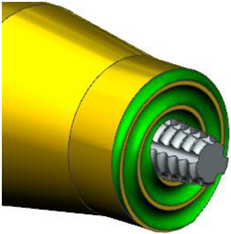
The friction stir welding process was conducted using AA2024-T3 aluminum sheets with a thickness of 1.5 mm. The experiments were performed on a Makino PS95 CNC milling machine (Figure 1a) using a commercially available tool with the geometric parameters shown in Table 1. The plates, which were 200 mm long and 100 mm wide, were joined along the rolling line. The joints were configured in a lap joint arrangement with a lap width of 30 mm. A factorial design was used to plan the experiment. The design matrix, shown in Figure 1b, included 28 experimental points with varying spindle speeds from 600 to 2200 rpm and welding speeds from 100 to 350 mm/min. The technological parameters for each test run, along with the measured strength of the FSW joints. This factorial design allowed a comprehensive analysis of the effects of spindle and welding speeds on the tensile strength of the FSW joints, ensuring a robust assessment of the optimum welding conditions. Each joint was then divided into four sections for tensile testing. The specimens were precisely cut using a wire electrical discharge machining (EDM) technique to minimize the influence of external forces on the joint structure. The cutting process followed the configuration shown in Figure 1c. Each of the four specimens was mounted on a ZWICK/ROELL Z100 universal testing machine to evaluate the bond strength. The experimental results were analyzed using Design Expert software and a fifth degree polynomial regression model was developed to predict and optimize the technological parameters in the FSW process.

2.1. Evaluation of the Experimental Model

The FSW process was implemented for a range of parameters: tool speed from 600 to 2200 rpm and welding speed from 100 to 350 mm/min. The independent variables were coded and presented in Table 2. The dependent variable was the response or strength of the FSW lap joint. The resulting load capacities ranged from 1912 to 15336 N (Table 3).
Table 4 presents key indicators of the quality of the polynomial regression model used to optimize the FSW process. These indicators include the standard error, VIF, R², and power of the model for each term. The standard error measures the variability of the regression coefficient estimates. In a balanced design, the standard errors for different terms should be similar. In this case, the standard errors for all terms are relatively small, indicating robust estimates in the model. The lowest standard error is 0.1357 for term B (welding speed) and the highest is 0.2453 for term A² (spindle speed squared). The Variance Inflation Factor (VIF) measures the degree of collinearity between independent variables. The ideal VIF value is 1.0, with values greater than 10 indicating significant collinearity, which could lead to problems with coefficient estimation. All terms have VIF values close to 1.0, indicating no significant collinearity in the model. R² measures the fit of the model and indicates the proportion of variance in the dependent variable that is explained by the independent variables. For an ideal polynomial regression model, the R² values for individual terms should be close to 0 to avoid overfitting. The R² values for all terms are very low, indicating no overfitting and suggesting that the model fits well without unnecessary complexity. The power of the statistical test indicates the ability to detect a true effect if it exists. High power (close to 100%) indicates that the model is highly effective in detecting the influence of process variables on joint strength. All terms have a power level of 99.9%, indicating that the model is very effective in detecting the effects of the process variables. The quality assessment of the polynomial regression model for the FSW process indicates that the model is well fitted and does not have problems with collinearity or overfitting. The low standard errors and VIF values, along with the high power values, demonstrate the robustness and effectiveness of the model. The R² values suggest that the model is well calibrated without unnecessary complexity, which is beneficial for interpretation of results and practical application.
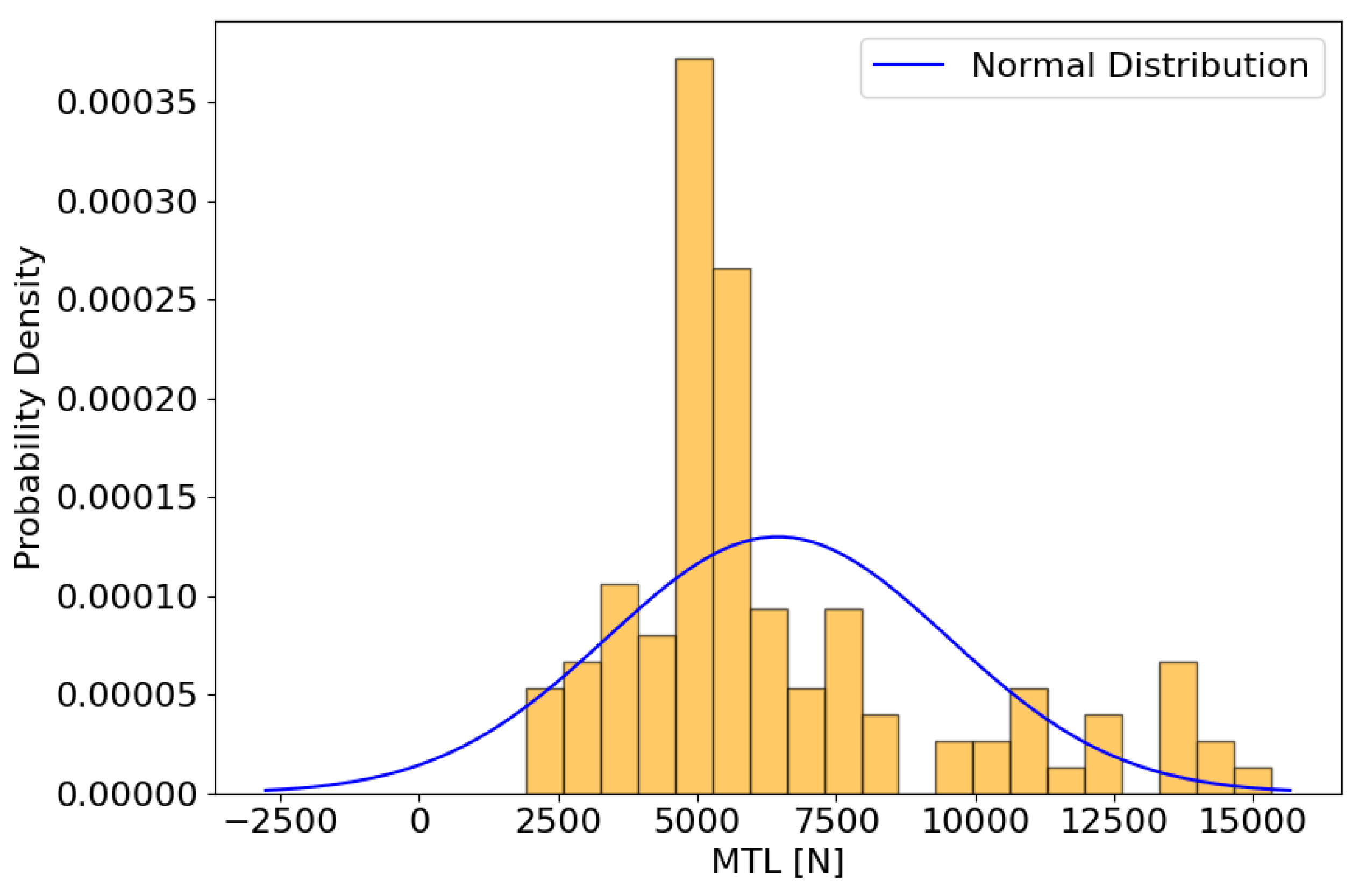
The histogram of the Ultimate Maximum Tensile Load, hereafter referred to as MTL, measurements (Figure 2) from the FSW process was analyzed along with statistical tests to assess the normality of the data distribution. The histogram shows a right-skewed distribution of MTL values with the majority of measurements concentrated between 2500 N and 7500 N. The peak frequency occurs around 5000 N and there is a noticeable decrease in frequency towards higher MTL values. To statistically evaluate the normality of the data, the Shapiro-Wilk test was performed. The test statistic is 0.861 with a p-value of 7.62e-09, indicating that the MTL data do not follow a normal distribution and the null hypothesis (H0) is rejected. This result is visually confirmed by superimposing a normal distribution curve on the histogram, which highlights significant departures from normality. Further analysis of the kurtosis of the data yields a value of 0.764. This positive kurtosis indicates that the distribution has heavier tails and a sharper peak compared to a normal distribution, contributing to the observed skewness. In addition, the histogram shows several outliers at higher MTL values, especially above 10000 N, further supporting the non-normality of the data.
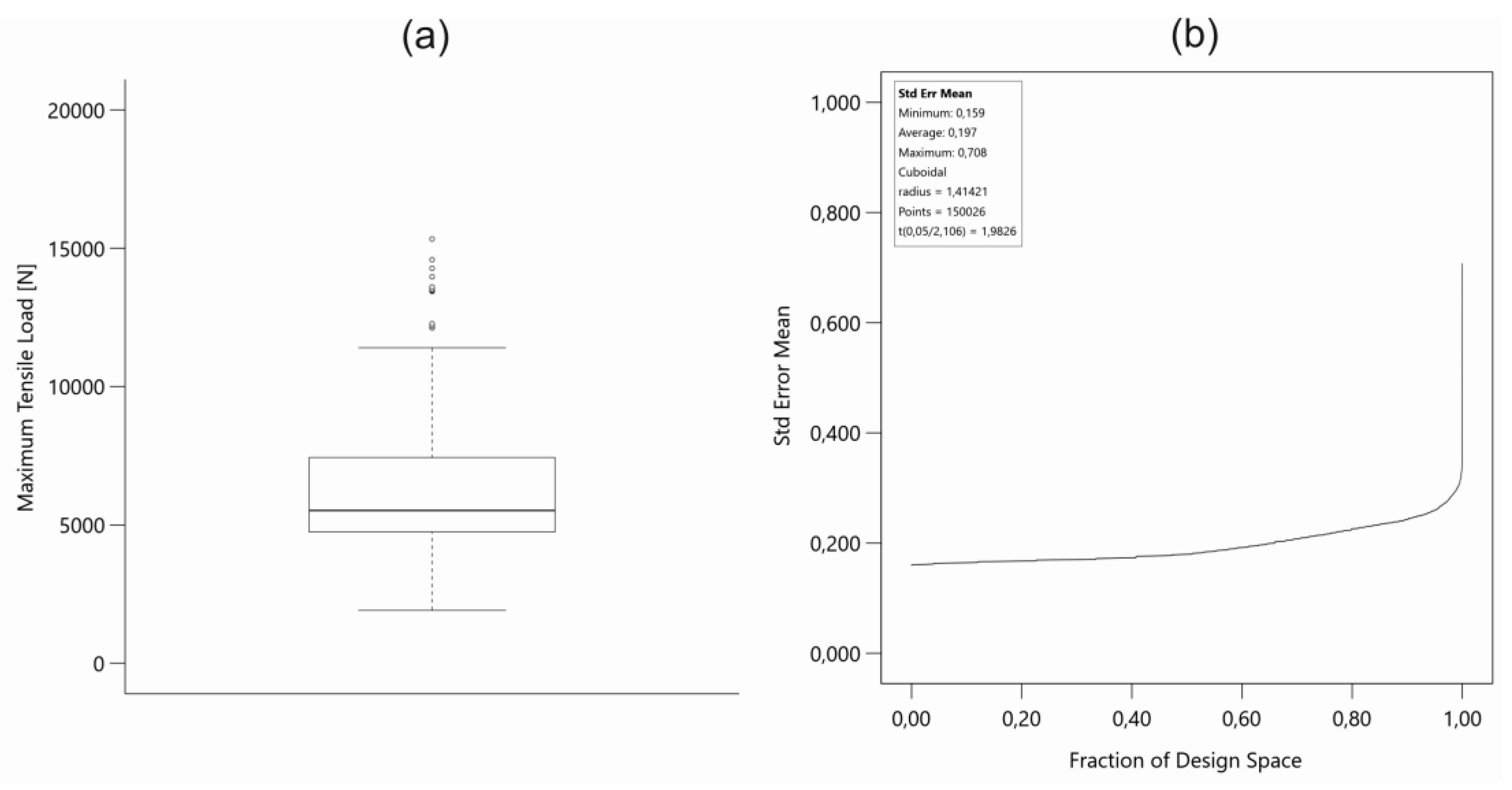
The box plot of the Maximum Tensile Load (MTL) measurements (Figure 3a) from the FSW process was analyzed to identify potential outliers and assess the overall data distribution. The box plot shows that the majority of the MTL values are concentrated within the interquartile range (IQR), with the median value in the lower half of the IQR, indicating a slight skew in the data distribution. The box plot analysis highlights several high MTL values that are considered outliers. However, these outliers are critical to understanding the conditions that lead to exceptionally high tensile strengths in welds. Rather than dismissing these values, further investigation is warranted to explore the specific parameters and conditions that resulted in these superior weld strengths. This information could be critical to optimizing the FSW process and achieving more reliable and higher quality welds. The final step in evaluating the quality of the experimental model was to plot the FDS. The graph (Figure 3b) plots the standard error mean (Std Error Mean) as a function of the fraction of the design space (FDS). This type of graph is typically used to evaluate the quality of an experimental design [11]. The X-axis represents the fraction of the design space, while the Y-axis represents the standard error of the mean. The design space is defined as a cube, indicating a rectangular area of variable space. The radius of 1.41421 indicates that the space is constructed considering the Euclidean distance. The analysis was performed on a very large number of points (150026), which increases the accuracy of the evaluation. The t-Student value indicates the critical value for the t-distribution at a given confidence level, which is used to assess statistical significance. The design is well constructed and accurate in the central regions of the design space, indicating good model quality in these regions. The increase in standard error at the edges is typical and indicates potentially lower model reliability in these regions, but requires attention at the edges of the design space.

3. Creating a Polynomial Regression Model

3.1. Principles of Polynomial Regression

Polynomial regression is an extension of linear regression that is used to model the relationship between a dependent variable y and one or more independent variables x by fitting a polynomial equation to the observed data. This type of regression is particularly useful when the relationship between the variables is non-linear. The polynomial regression model of degree nn can be written as:
y = β 0 + β 1 x + β 2 x 2 + β 3 x 3 + + β n x n + ϵ
where y is the dependent variable, x is the independent variable, β0,β1,β2,...,βn are the coefficients of the polynomial to be estimated from the data, and ϵ is the error term representing the difference between the observed and predicted values [12]. The polynomial regression process involves several steps. First, data points (xi,yi) are collected fori=1,2,...,m, wheremis the number of observations. Next, the degreenof the polynomial is chosen, with a higher degree polynomial fitting the data better but potentially leading to overfitting. A design matrix X is then constructed that contains the powers of the independent variable x. For a polynomial of degree n, the design matrix is X:
X = 1 x 1 x 1 2 1 x 2 x 2 2 x 1 n x 1 n 1 x m x m 2 x m n
The coefficients β are estimated using the least squares method, which minimizes the sum of the squared differences between the observed values y i and the values predicted by the polynomial. The coefficients are given by:
β = ( X T X ) 1 X T y
where X T is the transpose of the design matrix X, and y is the vector of observed values. Once the coefficients are estimated, the polynomial equation can be used to predict the values of the dependent variable for new values of the independent variable x [13,14,15]. To illustrate the process, consider fitting a fifth-degree polynomial regression model to a set of data points (x1,y1),(x2,y2),…,(xm,ym). The fifth-degree polynomial regression model can be written as:
y = β 0 + β 1 x + β 2 x 2 + β 3 x 3 + β 4 x 4 + β 5 x 5 + ϵ
The data points (xi,yi) are collected for i=1,2,…,m. The design matrix X is formulated to include the powers of the independent variable x. For a fifth-degree polynomial, the design matrix X is constructed as follows:
X = 1 x 1 x 1 2 1 x 2 x 2 2 x 1 3 x 1 4 x 1 5 x 2 3 x 2 4 x 2 5 1 x m x m 2 x m 3 x m 4 x m 5
Once the coefficients are estimated, the polynomial equation is used to predict the values of the dependent variable for new values of the independent variable x:
y ^ = β 0 + β 1 x + β 2 x 2 + β 3 x 3 + β 4 x 4 + β 5 x 5 + ϵ
The Fit Summary Table 5 compares different polynomial regression models for the MTL data from the FSW process. Sequential p-values indicate that cubic, quartic, fifth and sixth polynomial terms significantly improve the model fit (p < 0.0001), meaning that the addition of these terms provides a statistically significant improvement to the model. The lack of fit p-value is less than 0.0001 for all models, indicating a statistically significant lack of fit. This indicates that the models do not perfectly capture all the underlying patterns in the data. However, it is common in complex real-world data for models to show some lack of fit. The adjusted R², which accounts for model complexity, increases from 0.3877 for the linear model to 0.9752 for the sixth degree polynomial. Similarly, the predicted R², which indicates the predictive power of the model, also increases with model complexity. The fifth degree polynomial model is recommended with an adjusted R² of 0.9489 and a predicted R² of 0.9390, providing an excellent balance between model fit and predictive accuracy. Although the sixth degree polynomial has slightly higher R² values, it is noted as aliased, suggesting potential overfitting or multicollinearity issues. In conclusion, while the lack of fit is statistically significant for all models, the 5th degree polynomial model stands out with high fitted and predicted R² values, indicating strong model performance and predictive power. This makes it the optimal choice for accurately modeling and predicting MTL data in the FSW process.

3.2. ANOVA for Fifth Model

An analysis of variance was performed on the accepted fifth degree polynomial regression model. The ANOVA Table 6 for the 5th degree polynomial model of the MTL data from the FSW process provides a comprehensive analysis of the sources of variation and their statistical significance. The overall model is highly significant with an F-value of 104.12 and a p-value of less than 0.0001, indicating that the model effectively explains a significant portion of the variability in MTL. Several terms in the model are identified as statistically significant with p-values less than 0.05. These include the main effect of spindle speed (A) and numerous higher order interactions and polynomial terms such as AB (spindle speed * welding speed), A², B², A³, B³, A⁴, B⁴, A⁵, and B⁵. The significance of these terms suggests that both the main effects and complex interactions between spindle speed and welding speed are critical in determining MTL. However, some terms, such as the main effect of welding speed (B) and interactions such as A²B, A³B, A²B³, and A⁴B, are not statistically significant, as indicated by their p-values greater than 0.05. These non-significant terms do not contribute meaningfully to the model, suggesting that they could be excluded in future model refinement to improve simplicity without sacrificing predictive power. The F-value for lack of fit is 49.80 with a p-value of less than 0.0001, indicating a significant lack of fit. This suggests that the model does not perfectly capture all of the underlying variability in the data, and that there may be other factors or interactions influencing MTL that are not included in the model.
The fit statistics for the fifth degree polynomial model (Table 7) applied to the MTL data from the FSW process indicate strong model performance. The model achieves a high R² value of 0.9581, explaining 95.81% of the variability in MTL. The adjusted R² of 0.9489 and the predicted R² of 0.9390 are in close agreement, indicating excellent predictive accuracy and minimal overfitting. The standard deviation of the residuals is 694.15 and the coefficient of variation is 10.76%, indicating low variability relative to the MTL mean of 6451.97. In addition, the adequate precision ratio of 40.7155 far exceeds the desirable threshold of 4, confirming a strong signal-to-noise ratio.
The final regression equation (Table 8) for predicting MTL in FSW process is expressed in terms of the actual factors, specifically spindle speed and welding speed. This equation allows accurate predictions by substituting the specified values of these factors. It is important to note that the coefficients are scaled to the units of each factor and the intercept is not centered in the design space.

4. Results

The applied regression model was used to predict Maximum Tensile Load, hereafter referred to as MTL values. In addition, a series of diagnostic tests were performed on the applied model. The experimental results, along with the predicted MTL values from the 5th degree polynomial regression model and associated metrics, are presented in Table 9. The table lists the actual MTL values from the experiments, the predicted maximum tensile load values from the regression model, the residuals (differences between actual and predicted values), leverage values indicating the influence of each data point on the model, internally and externally studentized residuals for detecting outliers, Cook’s distance for identifying influential observations, and DFFITS values for assessing the influence of each observation on the fitted values.

4.2. Model Diagnostics

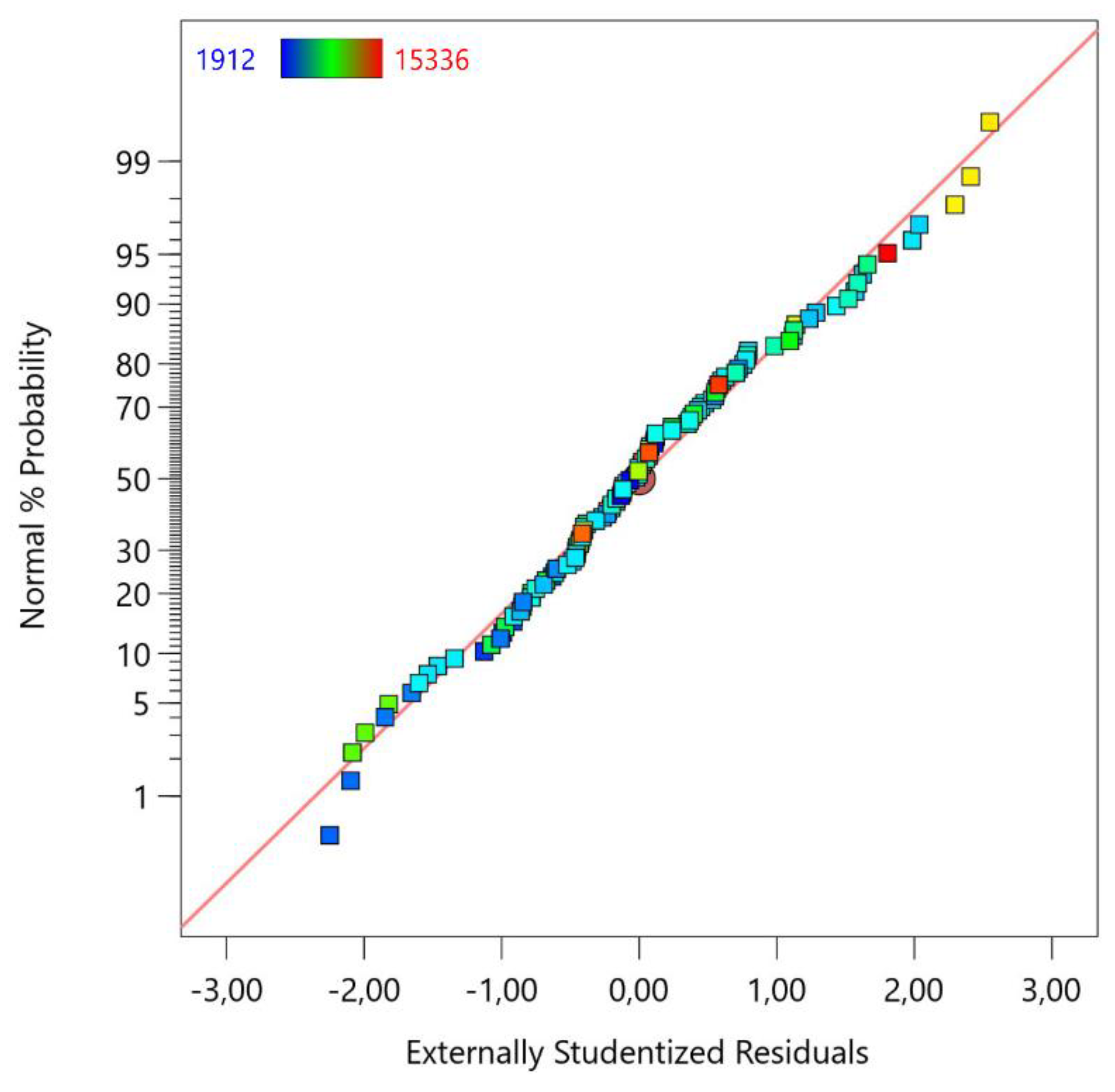
For the accepted regression model, diagnostic tests were performed to assess its validity. The first diagnostic test is the Normal Probability Plot of Residuals (Figure 4), which assesses whether the residuals from the 5th degree polynomial regression model for the MTL data are normally distributed. In this plot, the externally studentized residuals are plotted on the x-axis, while the corresponding normal cumulative probabilities are plotted on the y-axis. Most of the residuals are close to the red reference line, indicating that they follow a normal distribution. However, some deviations from normality are observed, especially in the tails of the distribution. Some residuals, especially those on the far right, deviate significantly from the line, indicating potential outliers or deviations from normality.
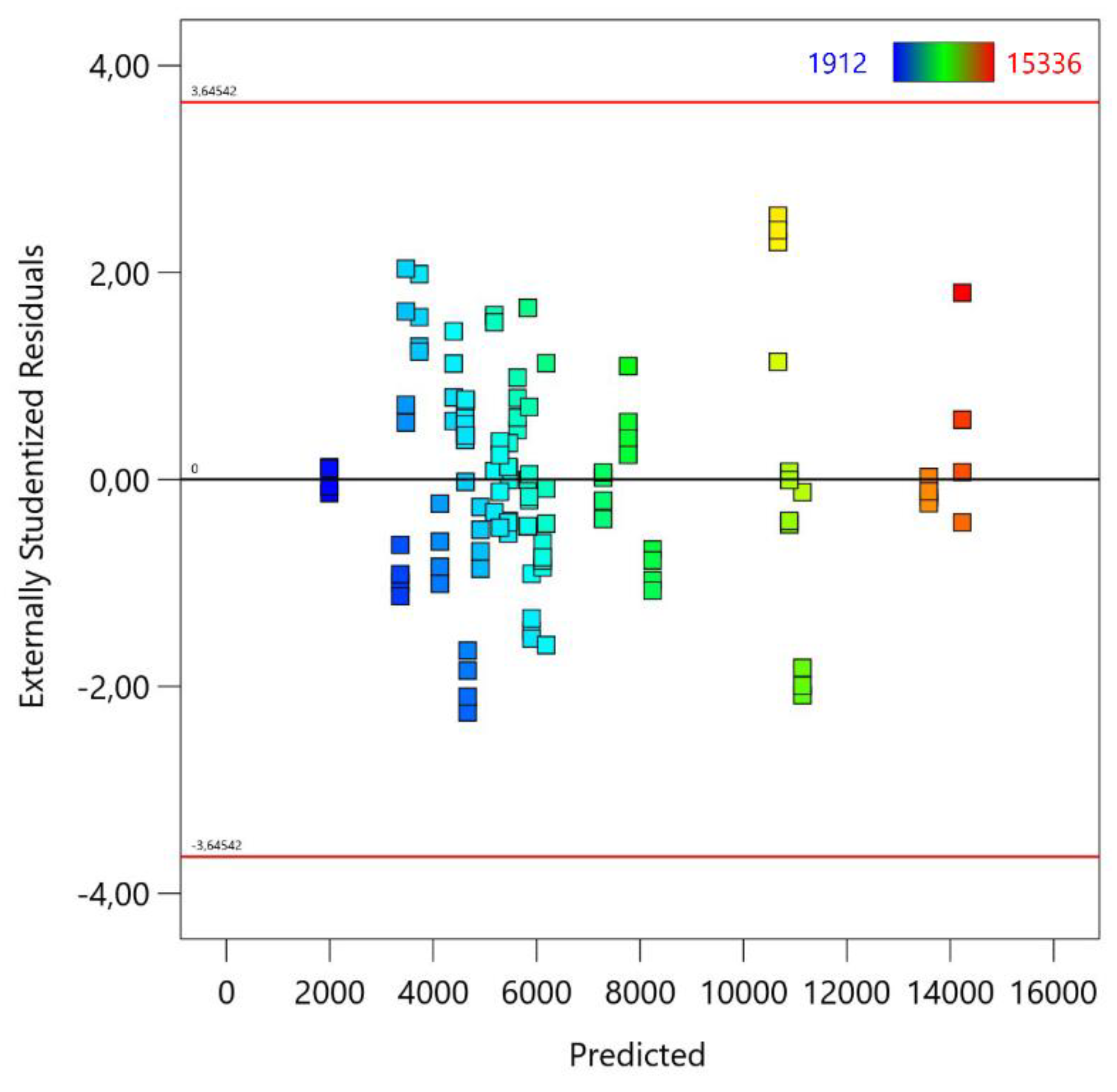
The second diagnostic test is the residuals versus predicted values plot Figure 5), which evaluates whether the residuals are randomly distributed, indicating a good fit for the regression model. The plot shows the externally studentized residuals on the y-axis and the predicted MTL values on the x-axis. Most of the residuals are randomly scattered around the horizontal line at zero, indicating that the model captures the data well with no obvious patterns. The absence of a clear pattern or trend in the residuals indicates that there is no significant nonlinearity or heteroscedasticity (nonconstant variance). This random scatter supports the assumption that the residuals are independent and identically distributed. The plot includes red lines at ±3.65 standard deviations. Note that none of the residuals exceed these thresholds, indicating that there are no extreme outliers. The concentration of the residuals around the zero line, with no discernible patterns, confirms that the model is a good fit for most of the data points.
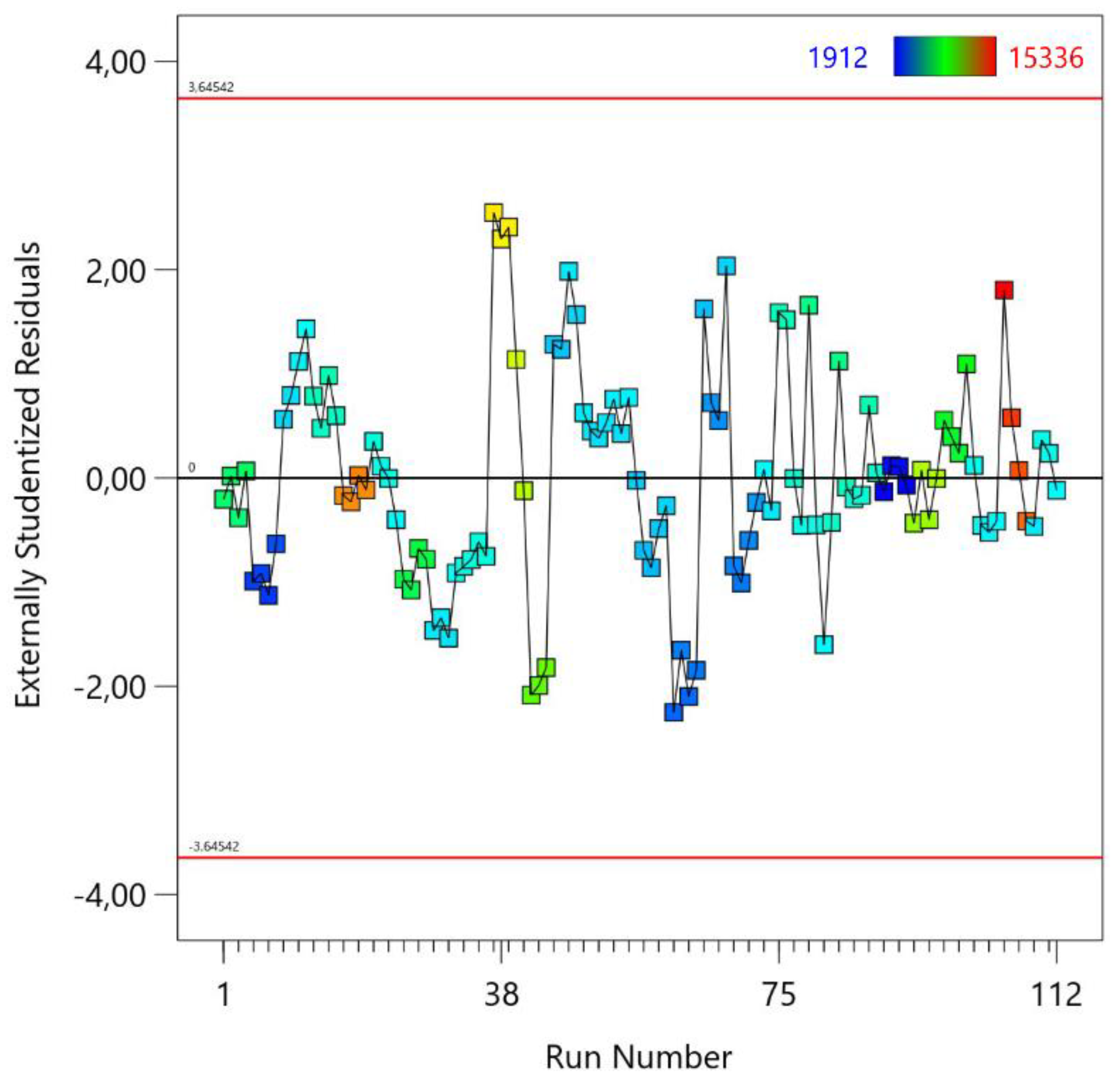
The third diagnostic test is the residuals versus run order plot (Figure 6), which assesses whether the residuals are randomly distributed across the sequence of observations, indicating the absence of temporal or sequence bias in the model. The plot plots the externally studentized residuals on the y-axis and the run number on the x-axis. Most of the residuals are scattered around the horizontal line at zero, indicating that there is no clear pattern or trend over the sequence of observations. Although there is some variation in the residuals, there is no consistent pattern or trend that would suggest systematic errors related to run order. This lack of a discernible trend suggests that the residuals are independent of run order, supporting the assumption that there is no autocorrelation in the residuals. The Durbin-Watson statistic, which tests for the presence of autocorrelation in the residuals, is 0.8776 with an autocorrelation value of 0.5609. A Durbin-Watson value close to 2 indicates no autocorrelation, while values significantly lower or higher indicate positive or negative autocorrelation, respectively. The observed value (0.8776) indicates some positive autocorrelation, which may require further investigation. The plot includes red lines at ±3.64 standard deviations, and none of the residuals exceed these thresholds, indicating that there are no extreme outliers.
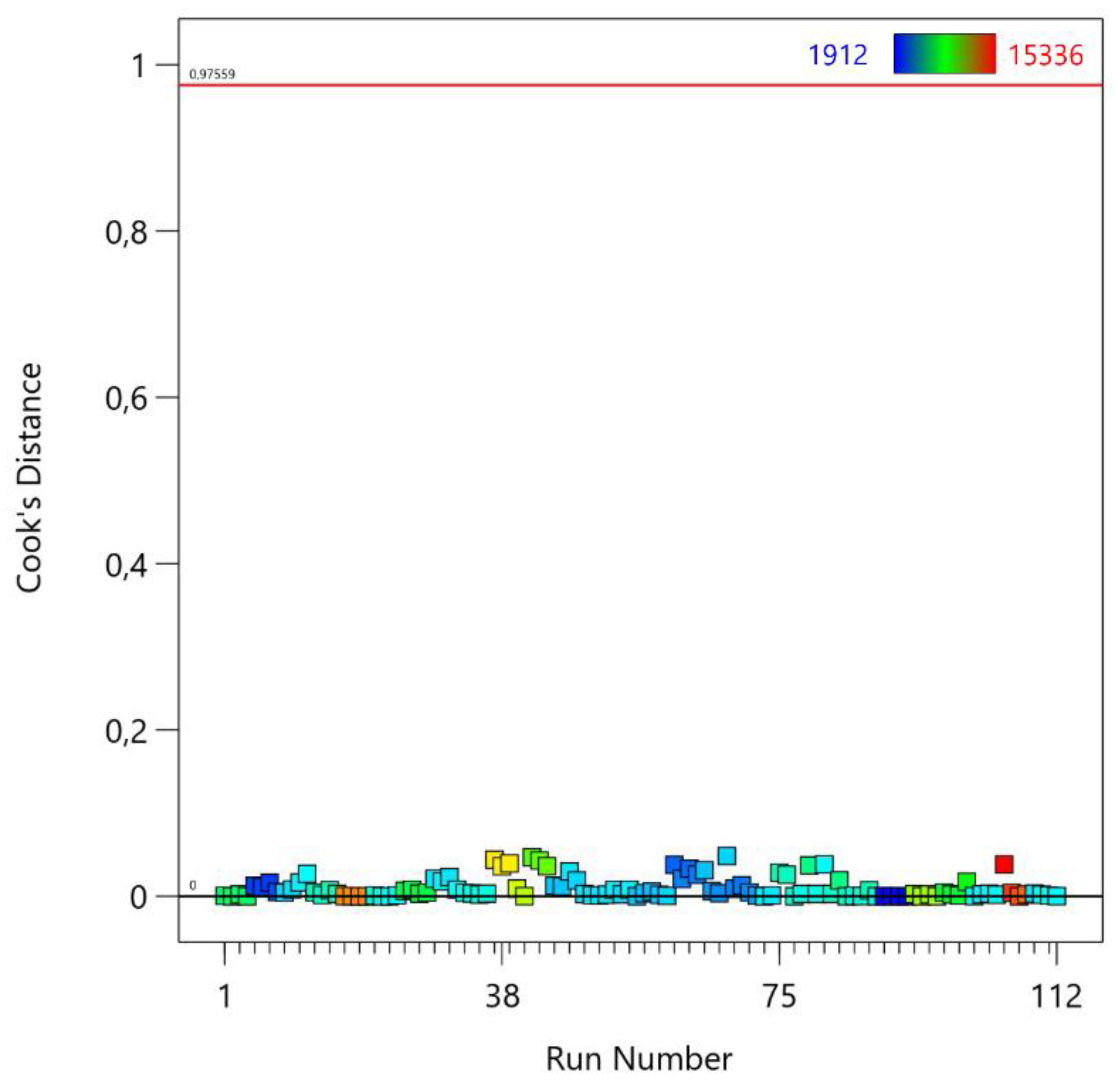
The fourth diagnostic test is the Cook’s Distance plot (Figure 7), which evaluates the influence of each observation on the regression model. Cook’s Distance measures how much the regression coefficients change when a particular observation is removed, helping to identify influential data points that may disproportionately affect the model [16]. Cook’s Distance for the i-th observation is calculated using the following formula:
D i = e i 2 p M S E h i ( 1 h i ) 2
where, D i is the Cook’s Distance for the i-th observation. e i is the residual for the i-th observation (i.e., the difference between the observed and fitted values for that observation). p is the number of parameters in the model, including the intercept. MSE is the mean squared error of the regression model. h i is the leverage of the i-th observation, which is the i-th diagonal element of the hat matrix H=X(XX)−1X′. Most observations have Cook’s Distance values close to zero, indicating that they have minimal influence on the regression model. The red line at Cook’s Distance of 0.976 serves as a threshold; points above this line are considered highly influential. In this plot, none of the observations exceed the Cook’s Distance threshold of 0.976, indicating that there are no highly influential data points in the data set.
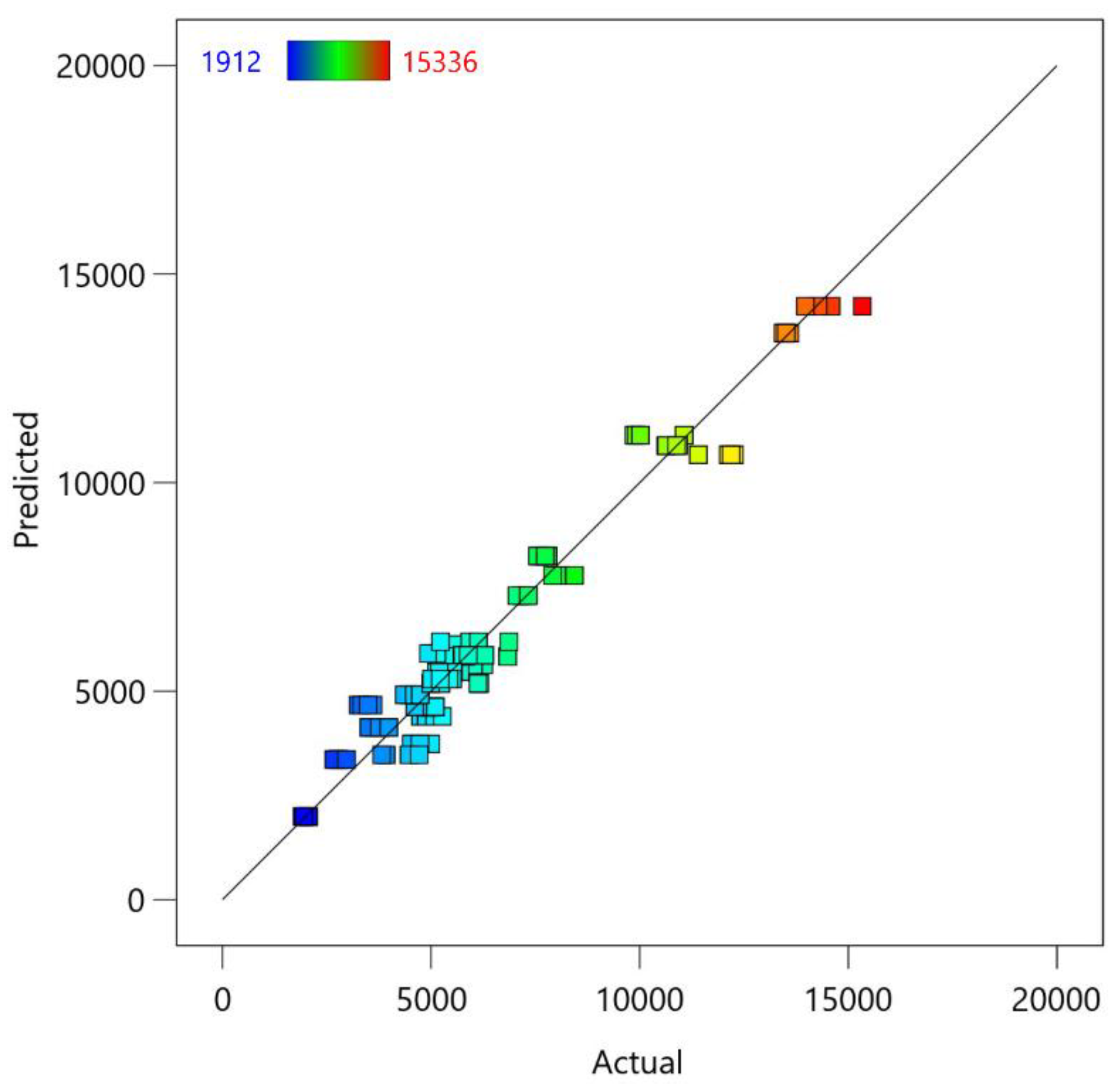
The fifth diagnostic test is the Predicted vs. Actual plot (Figure 8), which evaluates how well the regression model predicts the observed data. The distribution of points along the line indicates a strong correlation between predicted and actual values, confirming the model’s ability to accurately predict MTL.
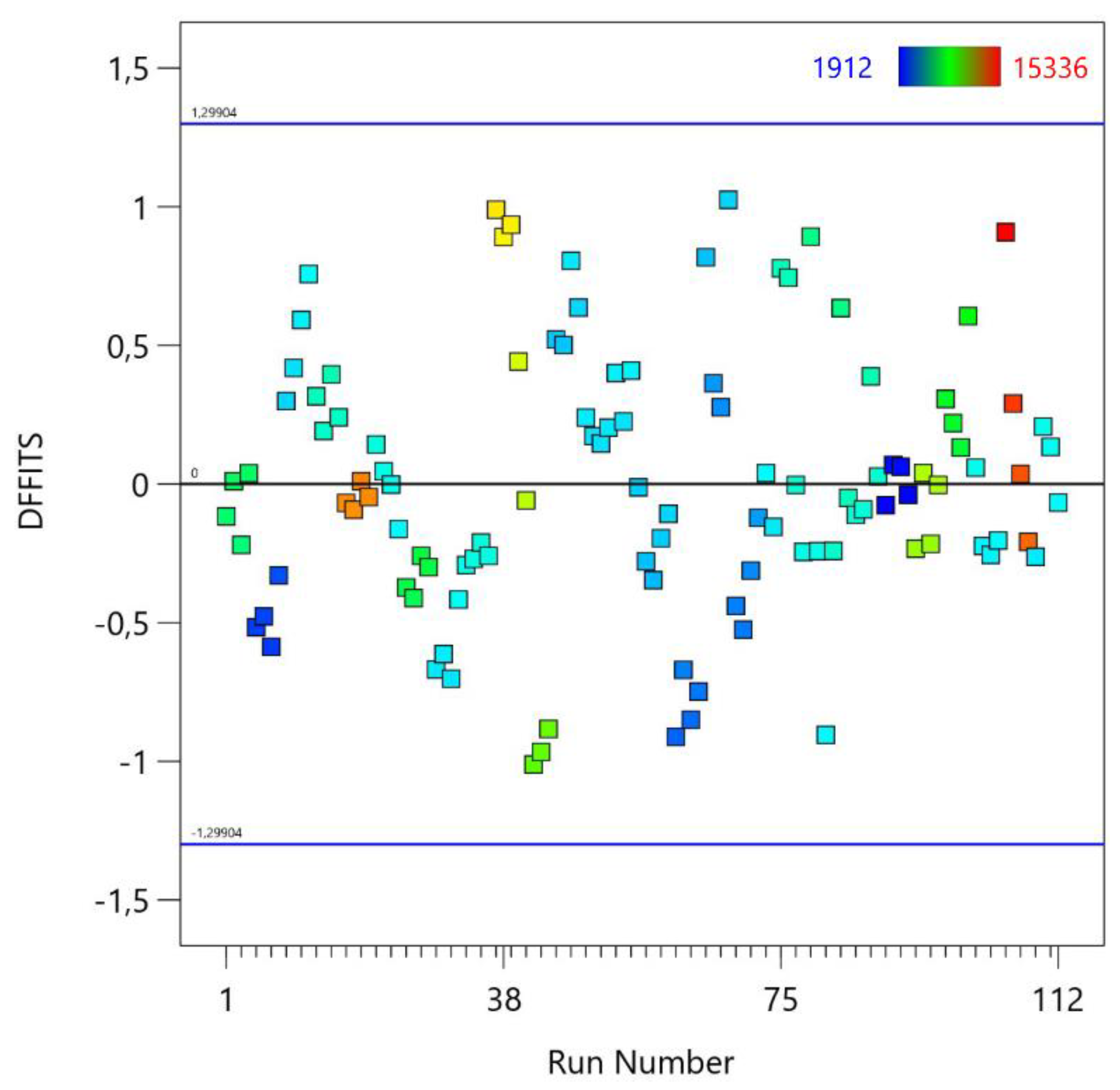
The sixth diagnostic test is the DFFITS vs. Run Number plot (Figure 9), which examines the influence of each observation on the fitted values of the regression model. DFFITS (Difference in Fits) measures how much an observation affects the fitted value and is used to identify influential points that may disproportionately affect the model. DFFITS is a diagnostic measure that quantifies the influence of a single observation on the fitted values of the regression model. It calculates the change in the predicted value when an observation is excluded from the model. The formula for DFFITS is given by:
D F F I T S i = y ^ i y ^ i ( i ) s ( i ) h i
where, y ^ i is the predicted value with all observations included. y ^ i ( i ) is the predicted value with the i-th observation excluded. s ( i ) is the standard error of the regression with the i-th observation excluded. h i is the leverage of the i-th observation. Many of the DFFITS values lie around zero, indicating that individual observations generally have a minimal influence on the fitted values of the model. As observations move further from the zero line, they have a greater impact on the model’s fitted values. The horizontal blue lines at ±1.29904 serve as thresholds, calculated based on the formula ± 2 p n , where p is the number of predictors (including the intercept) and n is the number of observations. Values beyond these lines suggest influential observations [17]. The plot shows that none of the observations exceed these thresholds, indicating that there are no highly influential data points in the data set. This suggests that the model is robust and not unduly influenced by any single observation.
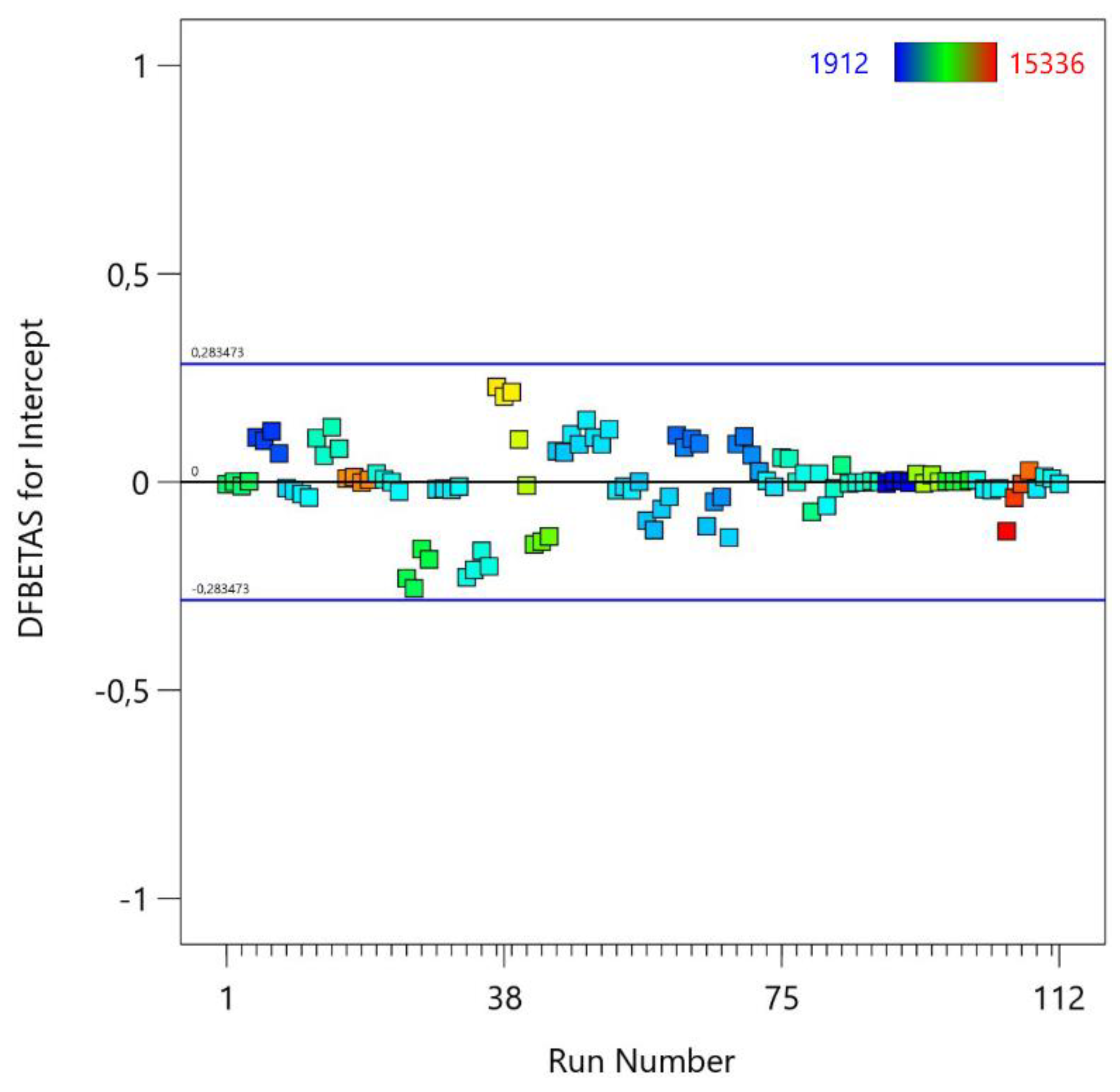
The next diagnostic test is the DFBETAS vs. Run Number plot (Figure 10), which examines the influence of each observation on the estimated regression coefficients. DFBETAS, which stands for “Difference in Beta,” is a diagnostic measure that assesses the impact of each individual data point on the estimated regression coefficients. Specifically, it measures the change in a regression coefficient when an observation is omitted from the analysis. The formula for DFBETAS is:
D F B E T A S i j = β ^ j β ^ j ( i ) s ( i ) ( X X ) j j 1
where, β ^ j is the estimated coefficient for predictor j with all observations included. β ^ j ( i ) is the estimated coefficient for predictor jj with the i-th observation excluded. s ( i ) is the standard error of the regression with the i-th observation excluded. ( X X ) j j 1 is the j-th diagonal element of the inverse of the design matrix XX.
DFBETAS values indicate how much an individual observation influences the regression coefficients. Large DFBETAS values indicate that the observation has a significant impact on the corresponding coefficient, potentially indicating an influential data point that may disproportionately affect the model’s estimates. In the plot, the DFBETAS values for the intercept are plotted on the y-axis and the run number is plotted on the x-axis. Many of the DFBETAS values are around zero, indicating that most observations have little to no effect on the estimated regression coefficients. The horizontal blue lines at ±0.284573 serve as thresholds, calculated using the formula ± 2 / n where n is the number of observations. Values beyond these lines indicate that the corresponding observations have a significant impact on the model’s coefficients [18]. The plot shows that all observations fall within the thresholds of ±0.284573, indicating that none of the data points have an undue influence on the regression coefficients. This indicates that the model is stable and the coefficients are not overly sensitive to any single observation.
Both measures are useful for identifying influential data points, but they provide different perspectives on how an observation affects the regression model. DFFITS is concerned with overall prediction accuracy, while DFBETAS is concerned with the stability of the regression coefficients.

4.2. Principles of Hill Climbing Algorithm

Hill climbing is an optimization algorithm used to find the best solution to a problem by iteratively improving the current solution based on a fitness function. Starting with an arbitrary initial solution, the algorithm evaluates its fitness and generates neighboring solutions by making small changes. It then selects the neighbor with the best fitness as the new current solution. This process is repeated until a stopping criterion is met, such as a fixed number of iterations, a time limit, or when no better neighbors are found. Hill climbing is a local search algorithm that focuses on improving the current solution and takes a greedy approach by always moving to the best neighbor solution. However, it can get stuck in local optima, i.e., solutions that are better than their neighbors but not the best overall. Variants such as Steepest Ascent, Stochastic, and First-Choice Hill Climbing help to solve this problem. Hill climbing is easy to implement and efficient for small problem spaces, making it useful in applications such as artificial intelligence, operations research, and machine learning.
The process begins with an initial guess
S 0 = i n i t i a l g u e s s .
The fitness of a solution S is evaluated using a fitness function f(S), which maps the solution to a real number indicating its quality.
f : S R .
The algorithm generates a set of neighboring solutions N(S) by making small perturbations to the current solution S.
N S = { S | S i s a n e i g h b o r o f S }
Among the generated neighbors, the algorithm selects the neighbor S′ with the optimal fitness value, either the highest for maximization problems or the lowest for minimization problems.
S = a r g m a x S N S f S       ( f o r   m a x i m i z a t i o n ) S = a r g m i n S N S f S         ( f o r   m i n i m i z a t i o n )
If the best neighbor S′ improves the fitness function compared to the current solution S, the algorithm updates S to S′.
I f     f S > f S       ( f o r   m a x i m i z a t i o n ) , t h e n   S = S I f     f S < f S         ( f o r   m i n i m i z a t i o n ) , t h e n   S = S
The algorithm iterates through the steps of generating neighbors and selecting the best one until a predefined stopping criterion T is met. This criterion could be a fixed number of iterations, a time limit, or the absence of further improvements [19,20].

5. Optimization

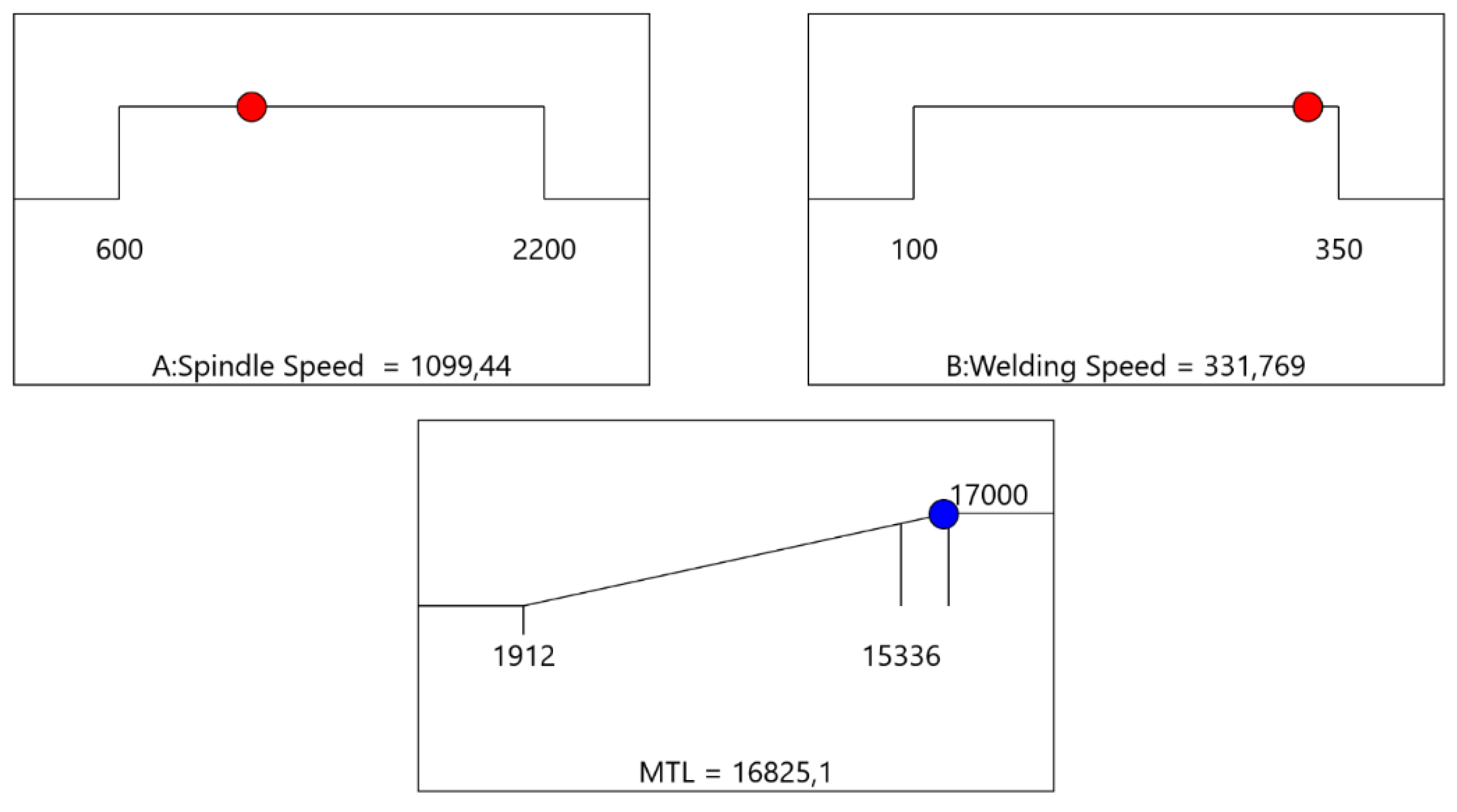
For our model, hill-climbing optimization was performed to fine-tune the welding parameters to achieve the best possible MTL. The process involved starting with an initial set of welding parameters and iteratively adjusting these parameters to explore their neighboring values. At each step, the fitness function, defined as the MTL, was evaluated to identify the optimal combination of welding parameters. By selecting the parameters that maximized the MTL, the algorithm iteratively moved toward the best solution, thereby improving the overall performance and reliability of the welding process. This approach ensured that the parameters were effectively optimized, resulting in the highest achievable MTL for the given welding conditions. The optimal parameters identified through this process are a spindle speed of 1100 rpm and a welding speed of 332 mm/min, which are predicted to achieve an MTL of 16852 N. Figure 11 shows the optimization parameters.
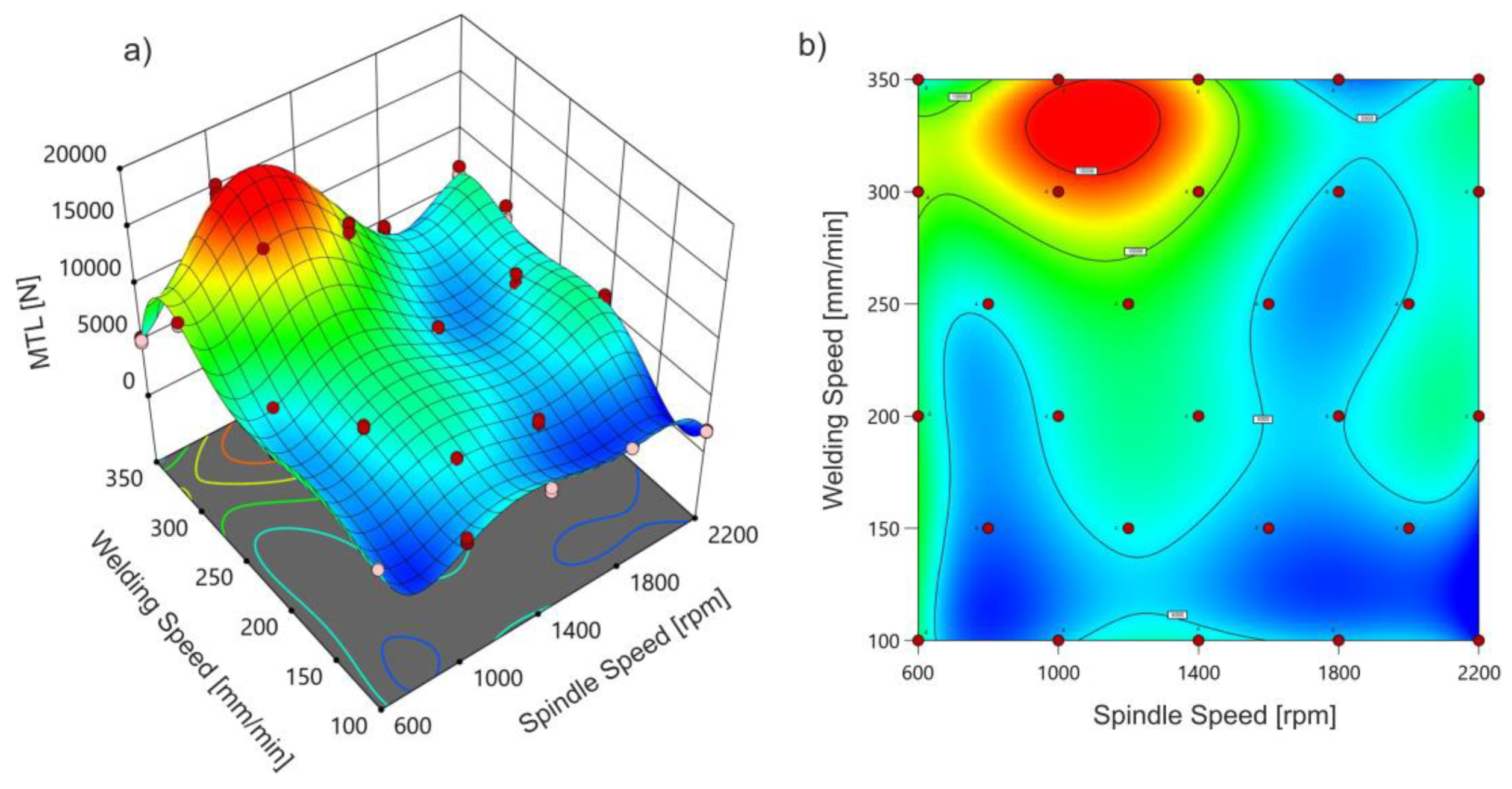
The response surface plot (Figure 12) shows the relationship between MTL and two key welding parameters: spindle speed (rpm) and welding speed (mm/min).
The surface plot has regions of different heights that indicate how changes in spindle speed and welding speed affect the MTL. The highest region of the surface corresponds to the maximum MTL values, represented by the red and yellow areas on the plot. The plot shows a peak MTL value around the spindle speed of approximately 1100 rpm and welding speed of approximately 332 mm/min, which is consistent with the optimal parameters determined by the hill climbing optimization.

6. Confirmation Test

The specimen subjected to the confirmation test was FSW in a lap joint configuration using the optimal parameters identified by the optimization process: a spindle speed of 1100 rpm and a welding speed of 332 mm/min. The test procedure followed the same protocol as described in the Experimental Procedure section to ensure consistency in the evaluation of the welds. The measured load capacity for the FSW sample in the confirmation test ranged from 16200 to 17300 N, which is in good agreement with the predicted values from the optimization model. This confirms the accuracy and reliability of the optimization process for these specific parameters.

6.1. Macro and Microstructure Analysis

Macro and microstructure analyses were performed on the specimen to further validate the quality of the weld (Figure 13). The image provided illustrates these analyses, with six different regions marked and examined in detail. The specimen has been electropolished to reveal its microstructural features, and the image shows a cross section of the FSW joint.
  • Region 1 (Base Metal (BM), Heat Affected Zone (HAZ), Thermo-Mechanically Affected Zone (TMAZ), and Stir Zone (SZ)). This region shows the transition from the BM through the HAZ and the TMAZ into the SZ. The microstructure shows a gradual refinement of the grains from the BM to the SZ, indicating effective thermal and mechanical processing during FSW. The distinct zones highlight the gradient of thermal and mechanical effects on the material [21].
  • Region 2 (TMAZ, HAZ): Similar to Region 1, this region provides a detailed view of the microstructural changes within the TMAZ and the HAZ. Grain refinement is evident as the material moves toward the stir zone, showing the progressive effect of the welding process on the material structure. The shape of the grains is a direct result of the compression process, which flattens them into small fractions and also causes further grain refinement. A similar evolution of the microstructure was shown in the work of Orlowska et al. [22].
  • Region 3 (SZ): The stir zone exhibits a uniform and refined grain structure, indicating effective material mixing and recrystallization during the welding process. This region confirms the high quality of the stir zone, which is critical to the integrity and strength of the weld.
  • Region 4 (SZ, TMAZ, HAZ): This region illustrates the microstructural characteristics at the interface between the stir zone (SZ), thermomechanically affected zone (TMAZ), and heat-affected zone (HAZ). The boundaries are well defined and demonstrate the effectiveness of the welding parameters in producing a strong joint with distinct zones that contribute to the overall mechanical properties of the weld.
  • Region 5 (SZ - Hooking): This section shows a hooking defect within the SZ. The hooking defect is characterized by a curved, hook-like shape at the interface between the joined materials. [23]. Despite the presence of this defect, the overall grain structure remains consistent with the expected characteristics of a properly welded stir zone. The hooking defect is identified during mechanical testing as a potential crack initiation site that can compromise the structural integrity of the weld.
  • Region 6 (SZ - Material Flow Lines): The microstructure in this region shows material flow lines within the stir zone (SZ). The visible lines are likely flow lines of the material, with changes in shading possibly reflecting the presence of “onion rings” that are characteristic of FSW. These features indicate effective stirring and mixing of the material without the presence of cracks, confirming the overall quality of the weld in this region [24].
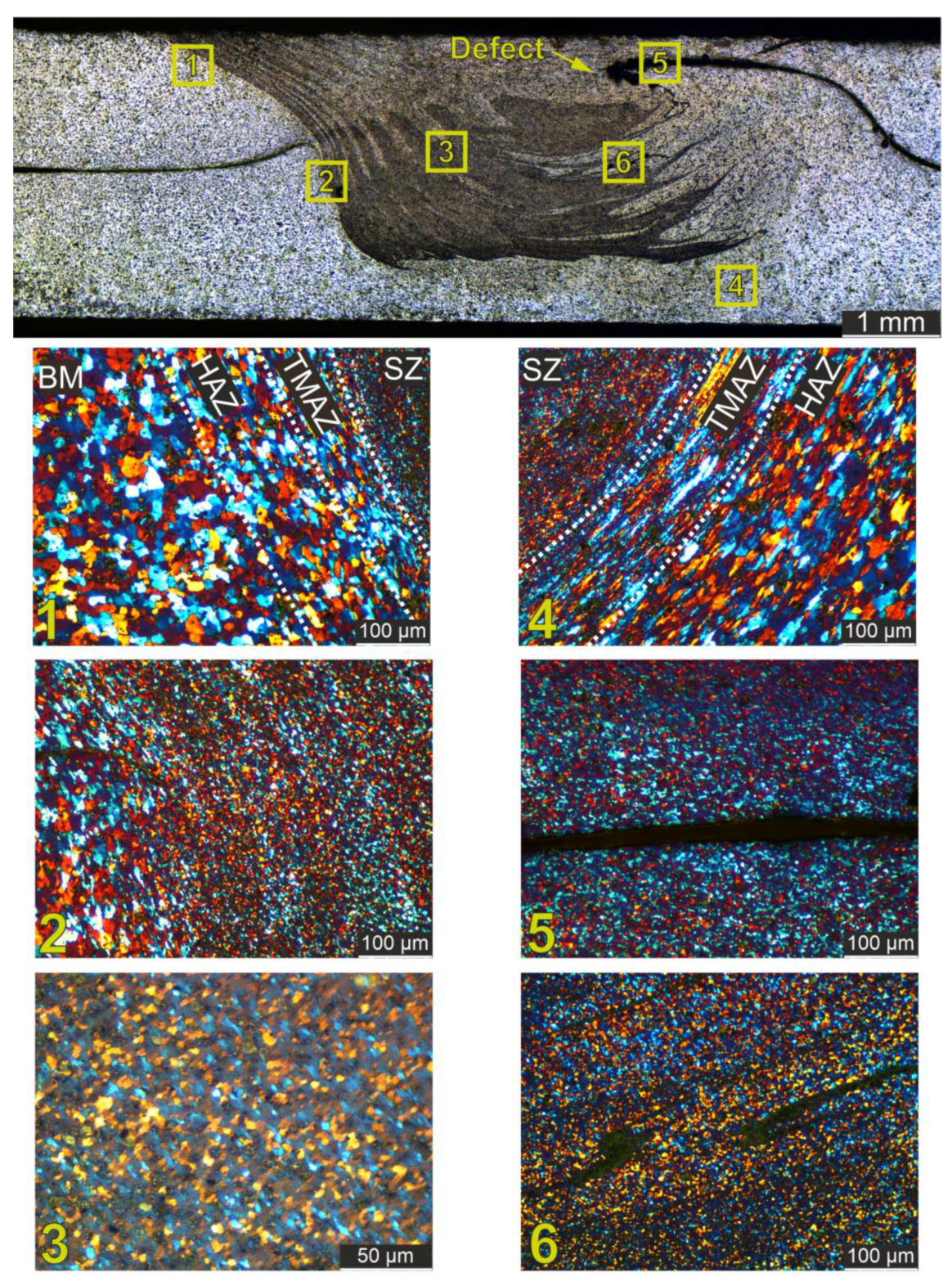
Figure 14. Macro and microstructure analysis of FSW sample.
Preprints 142553 g014
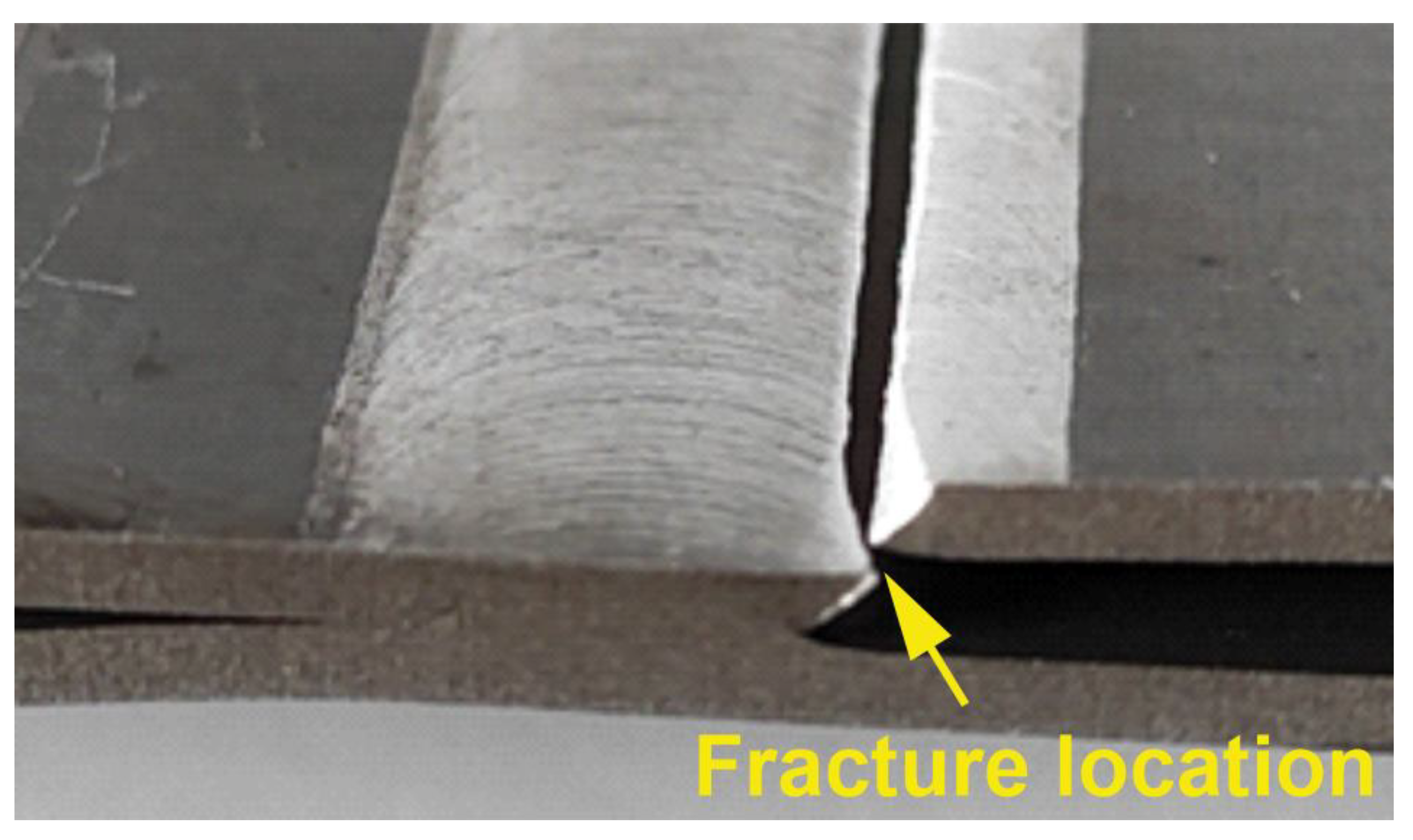
Figure 15 presence view of the specimen after failure, showing crack initiation and propagation through the identified flaw. The confirmation test validates the effectiveness of the optimized parameters by achieving the predicted load capacities and demonstrating robust weld quality through detailed macro- and microstructural examination. The consistency between predicted and actual performance underscores the reliability of the optimization process used in this study. The observed macrostructure and microstructure are typical of AA2024-T3 alloys, as reported in the publication by Myśliwiec et al. [25] which discusses the butt welding of thin AA2024 sheets. The application of advanced optimization methods for FSW process parameters using commercial software, such as Design Expert, has been successfully demonstrated in the studies of Myśliwiec et al.[26].

6.2. The Microhardness Analysis

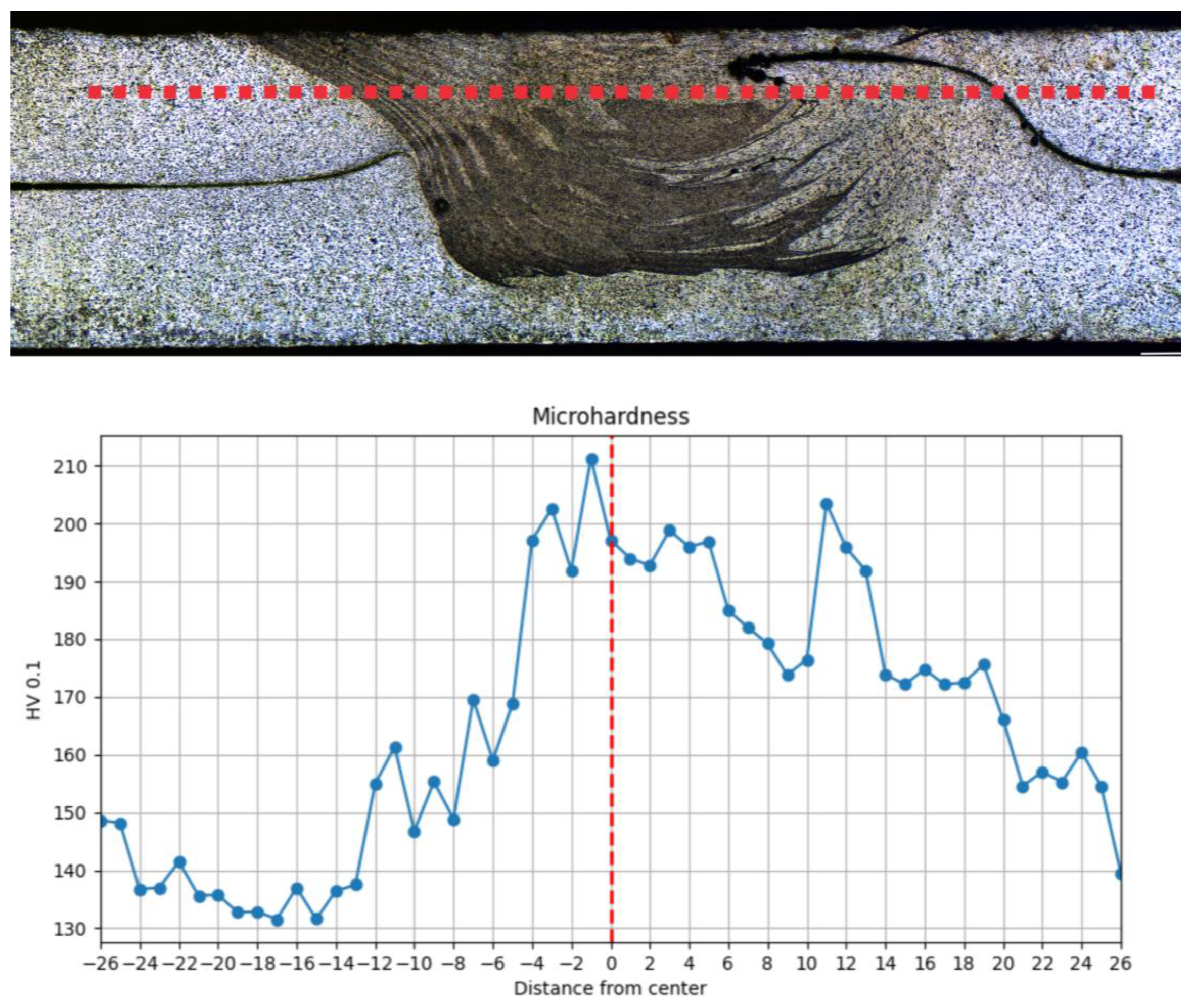
The next step in evaluating the formed lap FSW joint was to measure the Vickers microhardness in the cross-section. The measurement method and results are shown in Figure 16. The microhardness profile of the lap FSW joint for the AA2024-T3 alloy shows the following key features: the microhardness of the parent material is at 130 - 140 HV, increasing the temperature in the heat affected zone causes a gradual increase in microhardness to a value of 160 - 170 HV. The peak microhardness (210 HV) in the center of the weld indicates that the refined grains in the weld nugget (the mixing zone) have a higher hardness and therefore higher strength than the base material. The change in microhardness in the weld nugget is significant which is typical for FSW joints of 2024-T3 alloy, but we mostly observe a local decrease in microhardness in this region caused mainly by the dissolution of AlMgCu reinforcing phase particles due to high temperatures [27]. Another factor in the decrease of microhardness is also the movement of dislocations due to intense mechanical deformation [28]. However, in this particular case, we observe the phenomenon of a significant increase in microhardness in the weld nugget. On the one hand, the mechanism of grain reduction due to intense plastic deformation is responsible for this. According to the Hall-Pecha relationship, grain reduction results in increased hardness and strength [29]. Another phenomenon is probably due to the high welding speed lower temperature in the weld nugget by which the strengthening phase was not dissolved [30]. In addition, the overlap configuration causes an increase in the cross-section of the weld which leads to better cooling and heat transfer to the environment and tooling. This results in higher longitudinal stresses in the joint as shown in Staron et. al. [31]. The appearance of these stresses can have a negative effect on fatigue and crack propagation in this area. The result can be the appearance of a hook defect in the weld.

7. Conclusions

Based on the research conducted, the following conclusions were drawn:
  • A fifth-degree polynomial regression model was successfully developed to predict the maximum tensile load (MTL) of friction stir welded (FSW) joints, demonstrating high predictive accuracy with robust model performance and minimal overfitting.
  • Experimental results showed MTL values ranging from 1912 to 15336 N over various spindle and welding speeds. Diagnostic tests indicated a non-normal distribution of MTL values, requiring robust model validation.
  • Hill-climbing optimization effectively identified optimal welding parameters: a spindle speed of 1100 rpm and a welding speed of 332 mm/min, predicting an MTL of 16852 N. Diagnostic plots confirmed the model’s fit, ensuring reliable and robust predictions.
  • The response surface plot validated the optimization results, highlighting regions of maximum MTL values corresponding to the identified optimal parameters. The interaction between spindle speed and welding speed was clearly demonstrated, showing their combined effect on MTL.
  • The confirmation test validated the optimized parameters, achieving the predicted load capacities and demonstrating robust weld quality through detailed macro and microstructural examination.
  • The microhardness profile of the FSW lap joint for AA2024-T3 alloy showed higher hardness in the weld nugget compared to the base material, with peak microhardness reaching approximately 210 HV in the weld center. This significant increase in microhardness is attributed to grain refinement and the absence of phase dissolution, indicating superior strength and hardness of the welded joint.

Author Contributions

P.M.: conceptualization, methodology, writing—original draft. A.K.: writing-review and editing, supervision. P.S.: data curation. M.Z.: formal analysis. R.O.: resources. H.D.: validation, project administration. W.J.: funding acquisition. All authors have read and agreed to the published version of the manuscript.

Funding

This research received no external funding.

Institutional Review Board Statement

Not applicable.

Informed Consent Statement

Not applicable.

Data Availability Statement

The data presented in this study are available on request.

Conflicts of Interest

The authors declare no conflicts of interest.

References

  1. Thomas, W.M.; Nicholas, E.D.; Needham, J.C.; Murch, M.G.; Temple-Smith, P.; Dawes, C.J. Friction Stir Welding. International Patent Application No. PCT/GB92/02203, 10 December 1991.
  2. Colligan, K.J. The Friction Stir Welding Process: An Overview. Friction Stir Welding; ; Elsevier: Amsterdam, The Netherlands, 2010; pp. 15–41. [CrossRef]
  3. Jamalian, H.M.; Tamjidi Eskandar, M.; Chamanara, A.; Karimzadeh, R.; Yousefian, R. An Artificial Neural Network Model for Multi-Pass Tool Pin Varying FSW of AA5086-H34 Plates Reinforced with Al2O3 Nanoparticles and Optimization for Tool Design Insight. CIRP J. Manuf. Sci. Technol. 2021, 35, 69–79. [CrossRef]
  4. Maleki, E. Artificial Neural Networks Application for Modeling of Friction Stir Welding Effects on Mechanical Properties of 7075-T6 Aluminum Alloy. IOP Conf. Ser. Mater. Sci. Eng. 2015, 103, 012034. [CrossRef]
  5. Myśliwiec, P.; Kubit, A.; Szawara, P. Optimization of 2024-T3 Aluminum Alloy Friction Stir Welding Using Random Forest, XGBoost, and MLP Machine Learning Techniques. Materials 2024, 17, 71452. [CrossRef]
  6. Vijayan, S.; Raju, R.; Subbaiah, K.; Sridhar, N.; Rao, S.R.K. Friction Stir Welding of Al-Mg Alloy Optimization of Process Parameters Using Taguchi Method. Exp. Tech. 2010, 34, 37–44. [CrossRef]
  7. Ravindrannair, P.; Equbal, A.; Equbal, Md.A.; Saxena, K.K.; Equbal, Md.I. Grey Based Taguchi Method for Multi-Response Optimization of FSW of Aluminium AA6061 Alloy. Int. J. Interact. Des. Manuf. IJIDeM 2024, 18, 1279–1290. [CrossRef]
  8. Karumuri, S.; Karri, K.; Abburu, R.; Kumar, A. Multi-Objective Optimization Using Taguchi Based Grey Relational Analysis in Friction Stir Welding for Dissimilar Aluminium Alloy. Int. J. Interact. Des. Manuf. IJIDeM 2024, 18, 1627–1644. [CrossRef]
  9. Silva, A.C.F.; Braga, D.F.O.; De Figueiredo, M.A.V.; Moreira, P.M.G.P. Ultimate Tensile Strength Optimization of Different FSW Aluminium Alloy Joints. Int. J. Adv. Manuf. Technol. 2015, 79, 805–814. [CrossRef]
  10. Verma, S.; Misra, J.P.; Gupta, M. Study of Temperature Distribution and Parametric Optimization During FSW of AA6082 Using Statistical Approaches. SAE Int. J. Mater. Manuf. 2019, 12, 73–82. [CrossRef]
  11. Zhang, F.; Li, L.; Han, Z.; Wang, X. Determination Method of Binary Fractions by the Integrated Spectrum. Mon. Not. R. Astron. Soc. 2024, 531, 3468–3478. [CrossRef]
  12. James, G.; Witten, D.; Hastie, T.; Tibshirani, R. An Introduction to Statistical Learning, 2nd ed.; Springer: New York, NY, USA, 2013. [CrossRef]
  13. Li, Y.; Li, M.; Zhang, L. Evolutionary Polynomial Regression Improved by Regularization Methods. PLoS ONE 2023, 18, e0282029. [CrossRef]
  14. Marasco, S.; Marano, G.C.; Cimellaro, G.P. Evolutionary Polynomial Regression Algorithm Combined with Robust Bayesian Regression. Adv. Eng. Softw. 2022, 167, 103101. [CrossRef]
  15. Cheng, C.-L.; Tsai, J.-R.; Schneeweiss, H. Polynomial Regression with Heteroscedastic Measurement Errors in Both Axes: Estimation and Hypothesis Testing. Stat. Methods Med. Res. 2019, 28, 2681–2696. [CrossRef]
  16. Sulthan, A.; Jayakumar, G.S.D.S. Exact Distribution of Cook’s Distance and Identification of Influential Observations. Hacet. J. Math. Stat. 2014, 44, 1–1. [CrossRef]
  17. Li, J.; Valliant, R. Linear Regression Influence Diagnostics for Unclustered Survey Data. J. Off. Stat. 2011, 27, 99–119.
  18. Bahadir, B.; İnci, H.; Karadavut, U. Determination of Outlier in Live-Weight Performance Data of Japanese Quails (Coturnix Coturnix Japonica) by DFBETA and DFBETAS Techniques. Ital. J. Anim. Sci. 2014, 13, 3113. [CrossRef]
  19. Kuznetsov, A.; Abusukhon, A.; Andreev, K.; Sidorov, I.; Pavlova, V. Optimizing Hill Climbing Algorithm for S-Boxes Generation. Electronics 2023, 12, 2338. [CrossRef]
  20. Peker, F.; Altun, M. A Fast Hill Climbing Algorithm for Defect and Variation Tolerant Logic Mapping of Nano-Crossbar Arrays. IEEE Trans. Multi-Scale Comput. Syst. 2018, 4, 522–532. [CrossRef]
  21. Qiao, J.; Shi, Q.; Chen, S.; Yang, C.; Han, Y.; Chen, G. Visualization of Vertical Transfer of Material Through High-Velocity Rotating Flow Zone During Friction Stir Welding. Mater. Lett. 2024, 367, 136599. [CrossRef]
  22. Orłowska, M.; Mrozek, K.; Kaczmarek, L.; Sidor, J.; Staniek, A. Local Changes in the Microstructure, Mechanical and Electrochemical Properties of Friction Stir Welded Joints from Aluminium of Varying Grain Size. J. Mater. Res. Technol. 2021, 15, 5968–5987. [CrossRef]
  23. Ji, S.; Li, Z. Reducing the Hook Defect of Friction Stir Lap Welded Ti-6Al-4V Alloy by Slightly Penetrating into the Lower Sheet. J. Mater. Eng. Perform. 2017, 26, 921–930. [CrossRef]
  24. Yang, C.; Li, Y.; Zhang, J.; Gao, Z.; Wu, X. Material Flow During Dissimilar Friction Stir Welding of Al/Mg Alloys. Int. J. Mech. Sci. 2024, 272, 109173. [CrossRef]
  25. Myśliwiec, P.; Śliwa, R.E.; Ostrowski, R. Friction Stir Welding of Ultrathin AA2024-T3 Aluminum Sheets Using Ceramic Tool. Arch. Met. Mater. 2019, 64, 1385–1394.
  26. Myśliwiec, P.; Śliwa, R.E. Friction Stir Welding of Thin Sheets of the AA2024-T3 Alloy with a Ceramic Tool: RSM and ANOVA Study. Key Eng. Mater. 2022, 926, 1756–1761. [CrossRef]
  27. Salih, O.S.; Neate, N.; Ou, H.; Sun, W. Influence of Process Parameters on the Microstructural Evolution and Mechanical Characterisations of Friction Stir Welded Al-Mg-Si Alloy. J. Mater. Process. Technol. 2020, 275, 116366. [CrossRef]
  28. Laska, A.; Szkodo, M.; Cavaliere, P.; Moszczyńska, D.; Mizera, J. Analysis of Residual Stresses and Dislocation Density of AA6082 Butt Welds Produced by Friction Stir Welding. Metall. Mater. Trans. A 2023, 54, 211–225. [CrossRef]
  29. Sato, Y.S.; Urata, M.; Kokawa, H.; Ikeda, K. Hall–Petch Relationship in Friction Stir Welds of Equal Channel Angular-Pressed Aluminium Alloys. Mater. Sci. Eng. A 2003, 354, 298–305. [CrossRef]
  30. Kosturek, R.; Śnieżek, L.; Torzewski, J.; Wachowski, M. Research on the Friction Stir Welding of Sc-Modified AA2519 Extrusion. Metals 2019, 9, 1024. [CrossRef]
  31. Staron, P.; Kocak, M.; Williams, S. Residual Stresses in Friction Stir Welded Al Sheets. Appl. Phys. Mater. Sci. Process. 2002, 74, s1161–s1162. [CrossRef]
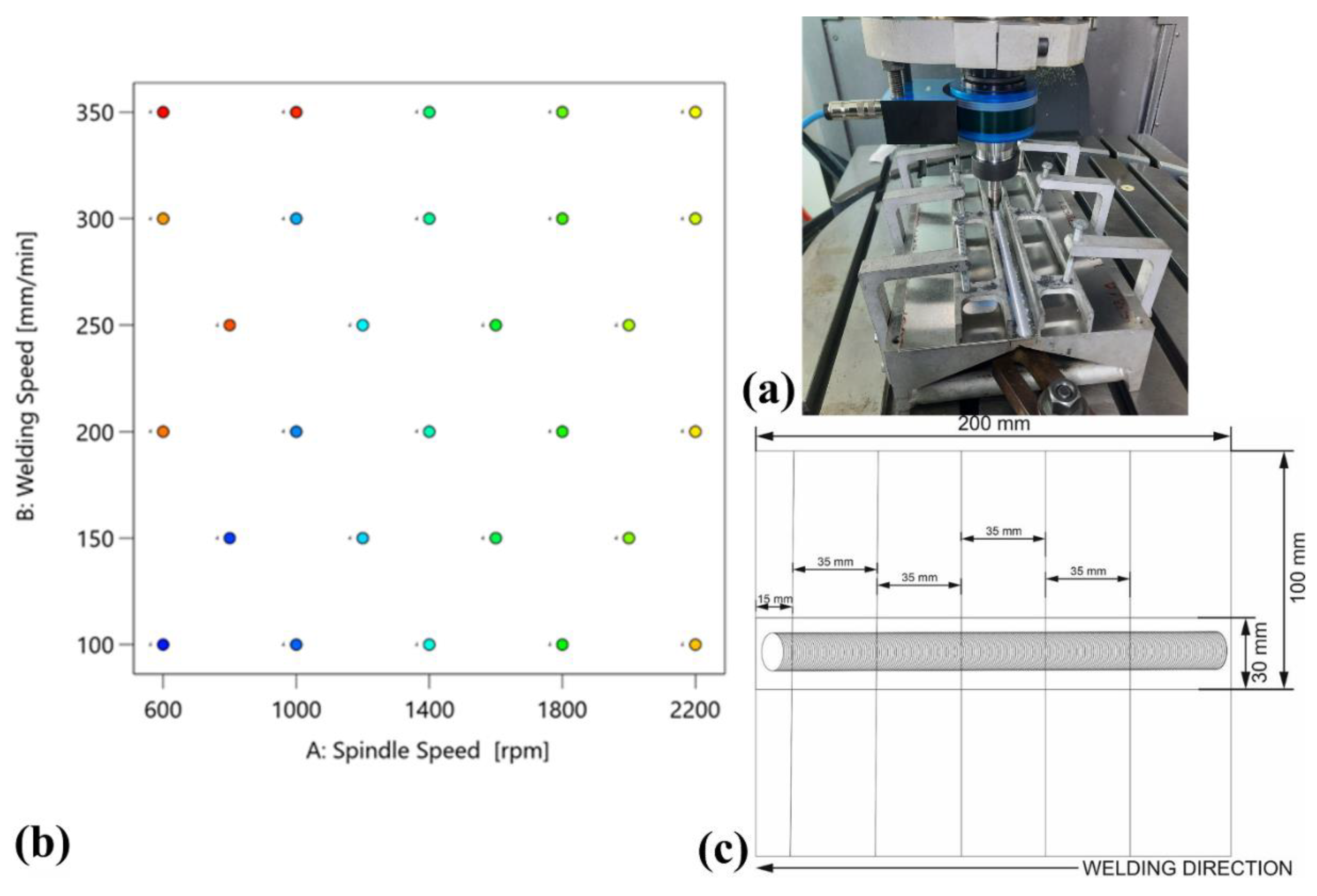
Figure 1. (a) FSW machine, (b) factor plan of the FSW process and (c) Configuration of the welded panels (unit mm).
Preprints 142553 g001
Figure 2. Histogram of Maximum Tensile Load (MTL) results from the FSW process. The analysis indicates a right-skewed distribution, showing that the data are not normally distributed.
Preprints 142553 g002
Figure 3. (a) Box plot of Maximum Tensile Load (MTL) results from the FSW process. (b) Fraction of Design Space (FDS) graph for Standard Error Mean.
Preprints 142553 g003
Figure 4. Normal probability plot of residuals for the fifth-degree polynomial regression model applied to MTL data.
Preprints 142553 g004
Figure 5. Residuals vs. predicted values plot for the fifth-degree polynomial regression model applied to MTL data.
Preprints 142553 g005
Figure 6. Residuals vs. run order plot for the fifth-degree polynomial regression model applied to MTL data.
Preprints 142553 g006
Figure 7. Cook’s distance plot for the fifth-degree polynomial regression model applied to MTL data.
Preprints 142553 g007
Figure 8. Predicted vs. actual values plot for the fifth-degree polynomial regression model applied to MTL data.
Preprints 142553 g008
Figure 9. DFFITS vs. run number plot for the fifth-degree polynomial regression model applied to MTL data.
Preprints 142553 g009
Figure 10. DFBETAS vs. run number plot for the fifth-degree polynomial regression model applied to MTL data.
Preprints 142553 g010
Figure 11. Optimization results for welding parameters using hill climbing.
Preprints 142553 g011
Figure 12. Response surface plot (a) and contour plot (b) for MTL as a function of spindle speed and welding speed.
Preprints 142553 g012
Figure 15. FSW sample after tensile test.
Preprints 142553 g015
Figure 16. Distribution of microhardness for FSW joint.
Preprints 142553 g016
Table 1. Geometric parameters of the FSW tool and welding conditions.
Tool Parameters Value Tool View
Shoulder diameter D [mm] 12 Preprints 142553 i001
Pin diameter d [mm] 4.5
Pin height [mm] 2.55
Tool offset [mm] 0.05
Dwell time [s] 10
Tool tilt angle
Tool plunge speed [mm/min] 2
Shoulder profile Flat with spiral groove
Pin profile Conical threaded
D/d ratio of the tool 2.7
Tool material H13 Steel
Table 2. FSW process parameters: tool speed (A) and welding speed (B) with their ranges, coded values, averages and standard deviations.
Factor Name Units Type Min. Max. Coded Low Coded High Mean Std. Dev.
A Spindle Speed rpm Numeric 600 2200 -1 ↔ 600 +1 ↔ 2200 1400 536.92
B Welding Speed N Numeric 100 350 -1 ↔ 100 +1 ↔ 350 226.79 87.49
Table 3. Measured joint Maximum Tensile Load (MTL) in the FSW experiment, including the number of observations, range of values, mean and standard deviation.
Response Name Units Observations Min. Max. Mean Std. Dev. Ratio
R1 MTL N 112 1912 15336 6451.97 3071.58 8.02
Table 4. Assessing the quality of the experimental model. *For a standard deviation of 1.
Term Standard Error* VIF Rᵢ² Power
A 0.1416 1.00309 0.0031 99.9 %
B 0.1357 1.00182 0.0018 99.9 %
AB 0.1964 1.00309 0.0031 99.9 %
0.2453 1.01148 0.0114 99.9 %
0.2349 1.00965 0.0096 99.9 %
Table 5. Fit summary for polynomial regression models applied to MTL data.
Source Sequential
p-Value
Lack of Fit
p-Value
Adjusted R² Predicted R²
Linear < 0.0001 < 0.0001 0.3877 0.3629
2FI 0.1962 < 0.0001 0.3916 0.3541
Quadratic 0.1153 < 0.0001 0.4049 0.3573
Cubic < 0.0001 < 0.0001 0.5213 0.4544
Quartic < 0.0001 < 0.0001 0.8435 0.8234
Fifth < 0.0001 < 0.0001 0.9489 0.9390 Suggested
Sixth < 0.0001 < 0.0001 0.9752 0.9683 Aliased
Table 6. ANOVA for fifth-degree polynomial model applied to MTL data.
Source Sum of Squares df Mean Square F-Value p-Value
Model 1.003E+09 20 5.017E+07 104.12 < 0.0001 significant
A-Spindle Speed 3.854E+07 1 3.854E+07 79.99 < 0.0001
B-Welding Speed 7.292E+05 1 7.292E+05 1.51 0.2218
AB 1.535E+08 1 1.535E+08 318.49 < 0.0001
1.946E+07 1 1.946E+07 40.40 < 0.0001
2.012E+07 1 2.012E+07 41.77 < 0.0001
A²B 1.090E+06 1 1.090E+06 2.26 0.1360
AB² 4.119E+07 1 4.119E+07 85.49 < 0.0001
4.509E+07 1 4.509E+07 93.59 < 0.0001
1.284E+07 1 1.284E+07 26.65 < 0.0001
A²B² 3.609E+07 1 3.609E+07 74.91 < 0.0001
A³B 1.930E+08 1 1.930E+08 400.65 < 0.0001
AB³ 5.528E+06 1 5.528E+06 11.47 0.0010
A⁴ 2.486E+07 1 2.486E+07 51.60 < 0.0001
B⁴ 8.687E+06 1 8.687E+06 18.03 < 0.0001
A³B² 1.317E+07 1 1.317E+07 27.33 < 0.0001
A²B³ 51117.18 1 51117.18 0.1061 0.7454
A⁴B 50177.92 1 50177.92 0.1041 0.7477
AB⁴ 2.440E+07 1 2.440E+07 50.64 < 0.0001
A⁵ 4.439E+07 1 4.439E+07 92.12 < 0.0001
B⁵ 1.765E+07 1 1.765E+07 36.62 < 0.0001
Residual 4.385E+07 91 4.818E+05
Lack of Fit 3.533E+07 7 5.048E+06 49.80 < 0.0001 significant
Pure Error 8.514E+06 84 1.014E+05
Cor Total 1.047E+09 111
Table 7. Fit statistics for the fifth-degree polynomial model applied to MTL data.
Std. Dev. 694.15 0.9581
Mean 6451.97 Adjusted R² 0.9489
C.V. % 10.76 Predicted R² 0.9390
Adeq Precision 40.7155
Table 8. Final regression equation for predicting MTL in the FSW process.
MTL =
+2.65761E+05
-816.24439 Spindle Speed
-1633.38459 Welding Speed
-2.37849 Spindle Speed * Welding Speed
+1.42349 Spindle Speed ²
+24.68195 Welding Speed²
+0.000460 Spindle Speed ² * Welding Speed
+0.016034 Spindle Speed * Welding Speed²
-0.001068 Spindle Speed ³
-0.158386 Welding Speed³
-2.71047E-06 Spindle Speed ² * Welding Speed²
-4.74309E-08 Spindle Speed ³ * Welding Speed
-0.000039 Spindle Speed * Welding Speed³
+3.80250E-07 Spindle Speed ⁴
+0.000442 Welding Speed⁴
+5.20073E-10 Spindle Speed ³ * Welding Speed²
+2.29939E-10 Spindle Speed ² * Welding Speed³
-7.12925E-12 Spindle Speed ⁴ * Welding Speed
+4.38557E-08 Spindle Speed * Welding Speed⁴
-5.22195E-11 Spindle Speed ⁵
-4.58801E-07 Welding Speed⁵
Table 9. Experimental and predicted Maximum Tensile Load (MTL) values along with diagnostic metrics for the fifth-degree polynomial regression model.
Run
Order
Rotational Speed [rpm] Welding Speed [mm/min] Actual Value of MTL [N] Predicted Value of MTL [N] Residual Leverage Internally Studentized Residuals Externally Studentized Residuals Cook’s Distance Influence on Fitted Value DFFITS
1 600 100 7165.00 7288.17 -123.17 0.248 -0.205 -0.204 0.001 -0.117
2 7299.00 7288.17 10.83 0.248 0.018 0.018 0.000 0.010
3 7057.00 7288.17 -231.17 0.248 -0.384 -0.382 0.002 -0.219
4 7329.00 7288.17 40.83 0.248 0.068 0.067 0.000 0.039
5 800 150 2754.00 3364.21 -610.21 0.213 -0.991 -0.991 0.013 -0.516
6 2800.00 3364.21 -564.21 0.213 -0.916 -0.916 0.011 -0.477
7 2671.00 3364.21 -693.21 0.213 -1.126 -1.128 0.016 -0.588
8 2974.00 3364.21 -390.21 0.213 -0.634 -0.632 0.005 -0.329
9 1000 100 4746.00 4397.76 348.24 0.218 0.567 0.565 0.004 0.299
10 4885.00 4397.76 487.24 0.218 0.794 0.792 0.008 0.419
11 5084.00 4397.76 686.24 0.218 1.118 1.120 0.017 0.592
12 5272.00 4397.76 874.24 0.218 1.425 1.433 0.027 0.757
13 1000 200 6138.00 5629.89 508.11 0.139 0.789 0.787 0.005 0.316
14 5938.00 5629.89 308.11 0.139 0.478 0.476 0.002 0.191
15 6264.00 5629.89 634.11 0.139 0.984 0.984 0.007 0.395
16 6017.00 5629.89 387.11 0.139 0.601 0.599 0.003 0.241
17 1000 300 13477.00 13585.93 -108.93 0.141 -0.169 -0.168 0.000 -0.068
18 13438.00 13585.93 -147.93 0.141 -0.230 -0.229 0.000 -0.093
19 13602.00 13585.93 16.07 0.141 0.025 0.025 0.000 0.010
20 13511.00 13585.93 -74.93 0.141 -0.116 -0.116 0.000 -0.047
21 1200 150 5692.00 5464.73 227.27 0.141 0.353 0.352 0.001 0.143
22 5538.00 5464.73 73.27 0.141 0.114 0.113 0.000 0.046
23 5462.00 5464.73 -2.73 0.141 -0.004 -0.004 0.000 -0.002
24 5206.00 5464.73 -258.73 0.141 -0.402 -0.400 0.001 -0.162
25 1200 250 7612.00 8243.00 -631.00 0.128 -0.973 -0.973 0.007 -0.373
26 7547.00 8243.00 -696.00 0.128 -1.074 -1.075 0.008 -0.411
27 7803.00 8243.00 -440.00 0.128 -0.679 -0.677 0.003 -0.259
28 7735.00 8243.00 -508.00 0.128 -0.784 -0.782 0.004 -0.299
29 1400 100 4984.00 5902.63 -918.63 0.173 -1.455 -1.464 0.021 -0.669
30 5059.00 5902.63 -843.63 0.173 -1.336 -1.342 0.018 -0.613
31 4939.00 5902.63 -963.63 0.173 -1.526 -1.538 0.023 -0.702
32 5326.00 5902.63 -576.63 0.173 -0.913 -0.912 0.008 -0.417
33 1400 200 5560.00 6117.56 -557.56 0.106 -0.850 -0.848 0.004 -0.292
34 5602.00 6117.56 -515.56 0.106 -0.786 -0.784 0.003 -0.270
35 5714.00 6117.56 -403.56 0.106 -0.615 -0.613 0.002 -0.211
36 5623.00 6117.56 -494.56 0.106 -0.754 -0.752 0.003 -0.259
37 1400 300 12271.00 10669.27 1601.73 0.131 2.475 2.549 0.044 0.989
38 12121.00 10669.27 1451.73 0.131 2.243 2.295 0.036 0.891
39 12189.00 10669.27 1519.73 0.131 2.348 2.410 0.040 0.935
40 11405.00 10669.27 735.73 0.131 1.137 1.139 0.009 0.442
41 1400 350 11064.00 11140.53 -76.53 0.191 -0.123 -0.122 0.000 -0.059
42 9862.00 11140.53 -1278.53 0.191 -2.047 -2.084 0.047 -1.011
43 9916.00 11140.53 -1224.53 0.191 -1.961 -1.992 0.043 -0.967
44 10018.00 11140.53 -1122.53 0.191 -1.797 -1.820 0.036 -0.883
45 1600 150 4556.00 3732.42 823.58 0.141 1.280 1.285 0.013 0.521
46 4525.00 3732.42 792.58 0.141 1.232 1.236 0.012 0.501
47 4989.00 3732.42 1256.58 0.141 1.953 1.985 0.030 0.805
48 4734.00 3732.42 1001.58 0.141 1.557 1.569 0.019 0.636
49 1600 250 5028.00 4620.71 407.29 0.128 0.628 0.626 0.003 0.240
50 4914.00 4620.71 293.29 0.128 0.452 0.450 0.001 0.172
51 4870.00 4620.71 249.29 0.128 0.385 0.383 0.001 0.147
52 4966.00 4620.71 345.29 0.128 0.533 0.531 0.002 0.203
53 1800 100 5092.00 4625.74 466.26 0.218 0.760 0.758 0.008 0.401
54 4889.00 4625.74 263.26 0.218 0.429 0.427 0.002 0.226
55 5102.00 4625.74 476.26 0.218 0.776 0.774 0.008 0.409
56 4612.00 4625.74 -13.74 0.218 -0.022 -0.022 0.000 -0.012
57 1800 200 4465.00 4913.36 -448.36 0.139 -0.696 -0.694 0.004 -0.279
58 4357.00 4913.36 -556.36 0.139 -0.864 -0.863 0.006 -0.347
59 4599.00 4913.36 -314.36 0.139 -0.488 -0.486 0.002 -0.195
60 4741.00 4913.36 -172.36 0.139 -0.268 -0.266 0.001 -0.107
61 1800 300 3250.00 4666.11 -1416.11 0.141 -2.201 -2.250 0.038 -0.912
62 3612.00 4666.11 -1054.11 0.141 -1.638 -1.654 0.021 -0.670
63 3341.00 4666.11 -1325.11 0.141 -2.060 -2.098 0.033 -0.850
64 3493.00 4666.11 -1173.11 0.141 -1.823 -1.847 0.026 -0.749
65 1800 350 4472.00 3473.27 998.73 0.202 1.611 1.625 0.031 0.818
66 3922.00 3473.27 448.73 0.202 0.724 0.722 0.006 0.363
67 3816.00 3473.27 342.73 0.202 0.553 0.551 0.004 0.277
68 4715.00 3473.27 1241.73 0.202 2.003 2.037 0.048 1.025
69 2000 150 3611.00 4131.38 -520.38 0.213 -0.845 -0.844 0.009 -0.440
70 3511.00 4131.38 -620.38 0.213 -1.008 -1.008 0.013 -0.525
71 3761.00 4131.38 -370.38 0.213 -0.602 -0.600 0.005 -0.312
72 3987.00 4131.38 -144.38 0.213 -0.235 -0.233 0.001 -0.122
73 2000 250 5235.00 5184.34 50.66 0.194 0.081 0.081 0.000 0.040
74 4987.00 5184.34 -197.34 0.194 -0.317 -0.315 0.001 -0.154
75 6166.00 5184.34 981.66 0.194 1.575 1.588 0.028 0.778
76 6125.00 5184.34 940.66 0.194 1.509 1.520 0.026 0.745
77 2200 300 5828.00 5831.36 -3.36 0.224 -0.006 -0.005 0.000 -0.003
78 5552.00 5831.36 -279.36 0.224 -0.457 -0.455 0.003 -0.245
79 6836.00 5831.36 1004.64 0.224 1.643 1.659 0.037 0.892
80 5555.00 5831.36 -276.36 0.224 -0.452 -0.450 0.003 -0.242
81 2200 350 5228.00 6187.20 -959.20 0.242 -1.587 -1.601 0.038 -0.905
82 5928.00 6187.20 -259.20 0.242 -0.429 -0.427 0.003 -0.241
83 6865.00 6187.20 677.80 0.242 1.122 1.123 0.019 0.635
84 6133.00 6187.20 -54.20 0.242 -0.090 -0.089 0.000 -0.050
85 2200 200 5738.00 5860.18 -122.18 0.234 -0.201 -0.200 0.001 -0.111
86 5759.00 5860.18 -101.18 0.234 -0.167 -0.166 0.000 -0.092
87 6288.00 5860.18 427.82 0.234 0.704 0.702 0.007 0.388
88 5890.00 5860.18 29.82 0.234 0.049 0.049 0.000 0.027
89 2200 100 1912.00 1992.21 -80.21 0.248 -0.133 -0.133 0.000 -0.076
90 2065.00 1992.21 72.79 0.248 0.121 0.120 0.000 0.069
91 2058.00 1992.21 65.79 0.248 0.109 0.109 0.000 0.062
92 1951.00 1992.21 -41.21 0.248 -0.068 -0.068 0.000 -0.039
93 600 300 10620.99 10887.32 -266.33 0.224 -0.436 -0.434 0.003 -0.233
94 10933.00 10887.32 45.68 0.224 0.075 0.074 0.000 0.040
95 10641.00 10887.32 -246.32 0.224 -0.403 -0.401 0.002 -0.216
96 10884.00 10887.32 -3.32 0.224 -0.005 -0.005 0.000 -0.003
97 600 200 8110.00 7771.51 338.49 0.234 0.557 0.555 0.005 0.307
98 8014.00 7771.51 242.49 0.234 0.399 0.397 0.002 0.220
99 7917.00 7771.51 145.49 0.234 0.239 0.238 0.001 0.132
100 8436.00 7771.51 664.49 0.234 1.094 1.095 0.017 0.606
101 800 250 5529.00 5453.20 75.80 0.194 0.122 0.121 0.000 0.059
102 5168.00 5453.20 -285.20 0.194 -0.458 -0.456 0.002 -0.223
103 5127.00 5453.20 -326.20 0.194 -0.523 -0.521 0.003 -0.255
104 5193.00 5453.20 -260.20 0.194 -0.417 -0.416 0.002 -0.204
105 1000 350 15336.00 14230.29 1105.71 0.202 1.783 1.805 0.038 0.908
106 14590.00 14230.29 359.71 0.202 0.580 0.578 0.004 0.291
107 14274.97 14230.29 44.68 0.202 0.072 0.072 0.000 0.036
108 13972.00 14230.29 -258.29 0.202 -0.417 -0.415 0.002 -0.209
109 600 350 5009.00 5290.96 -281.96 0.242 -0.467 -0.465 0.003 -0.263
110 5514.00 5290.96 223.04 0.242 0.369 0.367 0.002 0.208
111 5435.00 5290.96 144.04 0.242 0.238 0.237 0.001 0.134
112 5219.00 5290.96 -71.96 0.242 -0.119 -0.118 0.000 -0.067
Disclaimer/Publisher’s Note: The statements, opinions and data contained in all publications are solely those of the individual author(s) and contributor(s) and not of MDPI and/or the editor(s). MDPI and/or the editor(s) disclaim responsibility for any injury to people or property resulting from any ideas, methods, instructions or products referred to in the content.
Copyright: This open access article is published under a Creative Commons CC BY 4.0 license, which permit the free download, distribution, and reuse, provided that the author and preprint are cited in any reuse.
Prerpints.org logo

Preprints.org is a free preprint server supported by MDPI in Basel, Switzerland.

Subscribe

Disclaimer

Terms of Use

Privacy Policy

Privacy Settings

© 2025 MDPI (Basel, Switzerland) unless otherwise stated