Preprint
Brief Report

This version is not peer-reviewed.

DNA Vaccine Encoding a Modified Hemagglutinin of Influenza A/H5N8 Virus Protects Mice from Infection with a Lethal Dose of Influenza A/H5N1 Virus

A peer-reviewed article of this preprint also exists.

Submitted:

10 December 2024

Posted:

11 December 2024

You are already at the latest version

Abstract

Highly pathogenic avian influenza (HPAI) H5 clade 2.3.4.4b viruses are widespread in wild and domestic birds, causing severe economic damage to the global poultry industry. Moreover, viruses of this clade can adapt to mammals, posing a potential pandemic threat. With the constant evolution and change of dominant strains of H5 clade 2.3.4.4b, it is important to investigate the cross-reactivity of available and developing vaccine preparations. In this study, the immuno-genicity of the previously developed DNA vaccine encoding a modified hemagglutinin of influ-enza A/turkey/Stavropol/320-01/2020 (H5N8) virus, administered by jet injection at doses of 1, 10, 50, 100 and 200 μg, was investigated. The highest titer of specific to recombinant hemagglutinin antibodies was detected in the group of animals injected with 100 µg of DNA vaccine. The cross-reactivity study of sera of animals immunized with 100 µg of DNA vaccine in microneutralization assay against strains A/chicken/Astrakhan/321-05/2020 (H5N8), A/chicken/Komi/24-4V/2023 (H5N1), A/chicken/Khabarovsk/24-1V/2022 (H5N1) and A/chicken/Voronezh/193-1V/2024 (H5N1) showed the formation of cross-neutralizing antibodies. Moreover, the study of protective properties showed that the DNA vaccine prevented morbidity and mortality of animals after infection with both homologous strain A/Astrakhan/3212/2020 (H5N8) and heterologous strain A/chicken/Khabarovsk/24-1V/2022 (H5N1).

Keywords: 
;  ;  ;  ;  ;  ;  

1. Introduction

Influenza A and B viruses cause seasonal epidemics, but only influenza A viruses have caused pandemics in the past with high mortality and economic costs [1,2]. The wide host range provides influenza A viruses with a high probability of genetic reassortment, resulting in zoonotic viruses that can spread to the human population. In particular, highly pathogenic avian influenza (HPAI) H5 viruses also have pandemic potential [3,4,5,6,7,8,9,10,11]. According to WHO, HPAI H5 viruses have caused 904 human infections, including 464 deaths [12]. In 2020, a new H5N1 virus of clade 2.3.4.4b emerged as a result of reassortment, which by now has become the most common variant of the highly pathogenic H5 influenza virus [13]. HPAIV H5N1 clade 2.3.4.4b have demonstrated an enhanced ability to cross species barriers and infect several mammalian species, including humans [14,15]. The host range of the virus has recently been expanded to include ruminants, particularly dairy cattle in the United States [16,17]. In addition, several cases of HPAIV H5N1 infection in humans have also been reported among dairy farm workers [18,19,20,21]. This is believed to be the first confirmed case of mammal-to-human transmission of HPAIV H5N1. In addition, it has been shown that a few amino acid substitutions (e.g., substitutions of Gln for Leu at position 226 in hemagglutinin [22]) are sufficient for A/H5 viruses to become airborne between mammals [23].
The continuous emergence of new influenza virus strains increases the need for the development of new vaccines and for improved vaccine technologies that provide an effective immune response and can be optimized for rapid and scalable production [11,24]. Currently, FDA-approved and licensed whole-virus and live attenuated human influenza A virus vaccines are mainly produced using chicken embryos, and the manufacturing process can take up to 9 months [25]. Nucleic acid-based vaccines (DNA and mRNA vaccines) are one of the promising approaches to vaccine development. These vaccines are non-infectious and have an ability to induce humoral and cellular immune responses. The production of such vaccines is uniform, rapid and scalable [26,27]. These advantages make them suitable for the development of vaccines against influenza, including highly pathogenic avian influenza with pandemic potential [28,29,30,31,32,33,34,35,36,37,38]. One of the disadvantages of DNA vaccines is low immunogenicity, which can be improved by the delivery method. Jet injection with customized nozzles is a promising method that provides high immunogenicity with minimal side effects [38,39,40,41,42,43].
Thus, given the high incidence of infection and mortality in mammals [44,45,46,47,48], as well as the high variability of circulating HPAI H5 virus strains, it is necessary to conduct studies aimed at investigating the activity of existing and emerging vaccines against different HPAI H5 strains of clade 2.3.4.4b [49]. In the study [50], it was demonstrated that licensed H5N1 vaccines derived from HPAI H5N1 virus strains (A/Vietnam, clade 1 and A/Indonesia, clade 2.1) held in reserve for a pandemic in the United States were able to induce cross-neutralizing antibodies against HPAI clade 2.3.4.4b A/Astrakhan/3212/2020 (H5N8) virus. Previously, we developed DNA vaccine pVAX-H5 and investigated its immunogenicity against homologous strain A/Astrakhan/3212/2020 (H5N8) at a dose of 100 μg [48]. This study presents the results of the dose-dependent effect of DNA vaccine pVAX-H5 in the range of 1 to 200 μg and the cross-reactivity of sera of animals immunized with 100 µg of DNA vaccine in microneutralization assay against strains A/chicken/Astrakhan/321-05/2020 (H5N8), A/chicken/Komi/24-4V/2023 (H5N1), A/chicken/Khabarovsk/24-1V/2022 (H5N1) and A/chicken/Voronezh/193-1V/2024 (H5N1). The protective properties of the DNA vaccine against homologous strain A/Astrakhan/3212/2020 (H5N8) and heterologous strain A/chicken/Khabarovsk/24-1V/2022 (H5N1) were also demonstrated.

2. Materials and Methods

2.1. Strains of Viruses, Bacteria, Cell Cultures

Influenza A/Astrakhan/3212/2020 (H5N8), A/chicken/Astrakhan/321-05/2020 (H5N8), A/chicken/Khabarovsk/24-1V/2022 (H5N1), A/chicken/Voronezh/193-1V/2024 (H5N1), A/turkey/Stavropol/320-01/2020 (H5N8), A/chicken/Komi/24-4V/2023 (H5N1) viruses (FBRI SRC VB «Vector», Rospotrebnadzor) were used. Antigenic characterization of the viruses according to hemagglutination inhibition (HI) assay is presented in Table 1.
Plasmid DNA was obtained using E. coli Stbl3 strain (F′ proA+B+ lacIq ∆(lacZ)M15 zzf::Tn10 (TetR) ∆(ara-leu) 7697 araD139 fhuA ∆lacX74 galK16 galE15 e14- Φ80dlacZ∆M15 recA1 relA1 endA1 nupG rpsL (StrR) rph spoT1 ∆(mrr-hsdRMS-mcrBC)).
Microneutralization assay was performed using the Madin-Darby canine kidney (MDCK) cell culture (Cell Culture Collection of FBRI SRC VB «Vector», Rospotrebnadzor).

2.2. Development of DNA Vaccine pVAX-H5

The design, development and production of the DNA vaccine pVAX-H5 is described in our previous work [51].

2.3. Experimental Design

The Guide for the Care and Use of Laboratory Animals was used for animal experiments. The Animal Care and Use Committee (IACUC) at the State Research Center of Virology and Biotechnology “Vector” established the protocols for work with animals (BEC Protocol No. 1 of 03/21/2023).
Female BALB/c mice (16-18 g) were used for immunization. Immunization preparations were dissolved in 50 μL of physiological solution and were injected into the area of the left hind paw by jet injection using a Comfort-IN injector (Australia) with individual nozzles. A detailed description of the immunization protocol using jet injection is described in our previous work [51].
The experiment consisted of two parts. The first part of the experiment was to assess the humoral response to the different doses of the experimental DNA vaccine. 7 groups (6 animals in each group) were involved in the study. Groups 1-5 were injected with 1, 10, 50, 100 and 200 μg of pVAX-H5 solution in saline, respectively; Group 6 was injected intramuscularly with 50 μg of recombinant hemagglutinin in complex with incomplete Freund's adjuvant as a positive control; Group 7 included the intact animals. Immunization was performed twice with an interval of 21 days. 14 days after the second immunization, blood was taken from the retrobulbar sinus of the animal’s eye to analyse the humoral response. Animals were taken out of the experiment by the cervical dislocation method.
The second part of the experiment was to assess the protective properties of the experimental DNA vaccine. 4 groups (10 animals in each group) were involved in the study. Groups 1-2 were injected with 100 μg of pVAX-H5 solution in saline; Groups 3-4 were injected with 100 μg of pVAX1 in saline. Immunization was performed twice with an interval of 21 days. 14 days after the second immunization, blood was taken from the retro-orbital sinus.

2.4. Enzyme-Linked Immunosorbent Assay (ELISA)

ELISA was performed on the immunosorbent of recombinant hemagglutinin of influenza virus A/turkey/Stavropol/320-01/2020 (H5N8) (FBRI SRC VB «Vector») [52]. A detailed description of the ELISA protocol is described in our previous work [51].

2.5. HI and Microneutralization Assays

The HI assay was carried out as described in [52]. Standardized influenza virus was prepared by diluting each virus strain to a final HA titer of 4 HA units/25 µl. The animal sera were treated with Receptor-Destroying Enzyme (RDE) and heat-inactivated prior to the assay. Then 2-fold dilutions of serum were mixed with 25 µl of standardized influenza virus (each well contained a final volume of 50 µl). The mixture was incubated at room temperature for 30 minutes. Then 50 µl of 0.5% turkey erythrocyte suspension was added to each well. The assay was incubated at 4-8°C until hemagglutination occurred in the control.
Microneutralization assay was performed as described in [52]. Briefly, each standardized virus contained 100 TCID50/100 µL. Two-fold dilutions of serum (200 µL) were mixed with 200 µL of standardized influenza virus, the suspensions were incubated for 1 h at 37°C, 5% CO2. Non-immune mouse sera were used as the negative controls. Ferret reference sera (SRC VB Vector, Koltsovo, Russia) were used as the positive controls. Then, 200 µL of the suspension was added to the wells of culture plates with MDCK-SIAT1 cells. After 60 minutes, the inoculum was removed and the cells were washed with culture medium. The cells were cultured for 3 days in Opti-MEM I medium with 1 μg/mL TPCK-trypsin (Sigma-Aldrich) at 37°C, 5% CO2. After that, cells were stained with crystal violet solution, washed with water and analyzed using an Agilent BioTek Cytation 5 multi-mode cell visualization reader (Thermo Fisher Scientific). All analysis were repeated in three replicates. The titer was taken as the serum dilution at which 50% of the cells survived. All negative controls had less than 5% surviving cells.

2.6. Challenge Studies

All challenge studies were carried out in accordance with the requirements of SanPiN3.3686-21 “Sanitary and Epidemiologic Requirements for the Prevention of Infectious Diseases” and Directive 2010/63/EC of the European Parliament and of the Council of the European Union of September 22, 2010 on the protection of animals used for research purposes.
Fourteen days after the second immunization, mice were intranasally infected with influenza A/Astrakhan/3212/2020 (H5N8) and A/chicken/Khabarovsk/24-1V/2022 (H5N1) viruses at a dose of 50 MLD50. Infection was carried out under anesthesia using a mixture of tiletamine and zolazepam and xylazine hydrochloride. After infection, the mice were monitored daily for 14 days, recording any manifestation of clinical symptoms of the disease, such as dishevelment, decreased body temperature, weight loss, neurological disorders and cases of death. If severe conditions that could lead to the death of the animal occurred, such as loss of more than 20% of initial weight or lethargy, they were euthanized by cervical dislocation. The remaining mice were humanely killed in the same manner at the end of the experiment.

2.7. Statistical Analysis

GraphPad Prism 9.0 software (GraphPad Software, Inc., San Diego, CA, USA) was used for statistical analysis of the data obtained. Quantitative data are provided as median with range and analyzed using nonparametric tests. The Mann-Whitney test was used in case of two independent groups. Kaplan-Meier multiplier estimator was used to construct the survival curve, and the Mantel-Cox test was used to compare the survival rates of the experimental and control groups.

3. Results

DNA vaccine pVAX-H5 encoding a modified hemagglutinin of influenza virus A/turkey/Stavropol/320-01/2020 (H5N8) was previously developed and its immunogenic properties were investigated [51]. In this study, the first step was to analyze the immunogenicity of different doses of DNA vaccine pVAX-H5. BALB/c mice were immunized with 1, 10, 50, 100 or 200 μg of pVAX-H5 twice at 3-week intervals using jet injection (Figure 1a). At 2 weeks after the second immunization, serum samples were obtained and analyzed by ELISA. All doses of vaccine pVAX-H5 induced the formation of specific antibodies to recombinant HA of influenza virus A/turkey/Stavropol/320-01/2020 (H5N8) (Figure 1b). The mean median titers for different doses were: 1 μg - 1:12150, 10 μg - 1:36450, 50 μg - 1:36450, 100 μg - 1:72900, and 200 μg - 1:36450. All vaccine doses also induced the formation of neutralizing antibodies against the corresponding A/turkey/Stavropol/320-01/2020 (H5N8) virus strain (Figure 1c). Based on these data, a dose of 100 μg of pVAX-H5 DNA vaccine was selected for further studies.
Sera of animals immunized with 100 μg of pVAX-H5 were also analyzed in the microneutralization assay against three strains of A/H5 clade 2.3.4.4b (Table 2). All viruses were isolated from sectional material of birds during outbreaks of highly pathogenic influenza in Russia in 2022-2024, including A/chicken/Komi/24-4V/2023 (H5N1), A/chicken/Khabarovsk/24-1V/2022 (H5N1), and A/chicken/Voronezh/193-1V/2024 (H5N1). Antigenic properties of the viruses are presented in Table 1.
As shown in the data presented in Table 2, the DNA vaccine pVAX-H5 based on the hemagglutinin of A/turkey/Stavropol/320-01/2020 (H5N8) strain induced the production of antibodies that neutralized both the homologous strain A/Astrakhan/3212/2020 (H5N8) and the other strains used in the experiment. The sera reacted well with all viruses, with titers against A/chicken/Komi/24-4V/2023 (H5N1) and A/chicken/Voronezh/193-1V/2024 (H5N1) ranging from 160 to 1280. The lowest neutralizing antibody titers were detected against influenza virus A/chicken/Khabarovsk/24-1V/2022 (H5N1) (40-80). This is possibly due to the lower antigenic similarity of this virus to the vaccine strain (see Table 1). Differences in amino acid sequence are presented in Table 3. It should be noted that the HA in the DNA vaccine pVAX-H5 does not contain cytoplasmic and transmembrane domains.
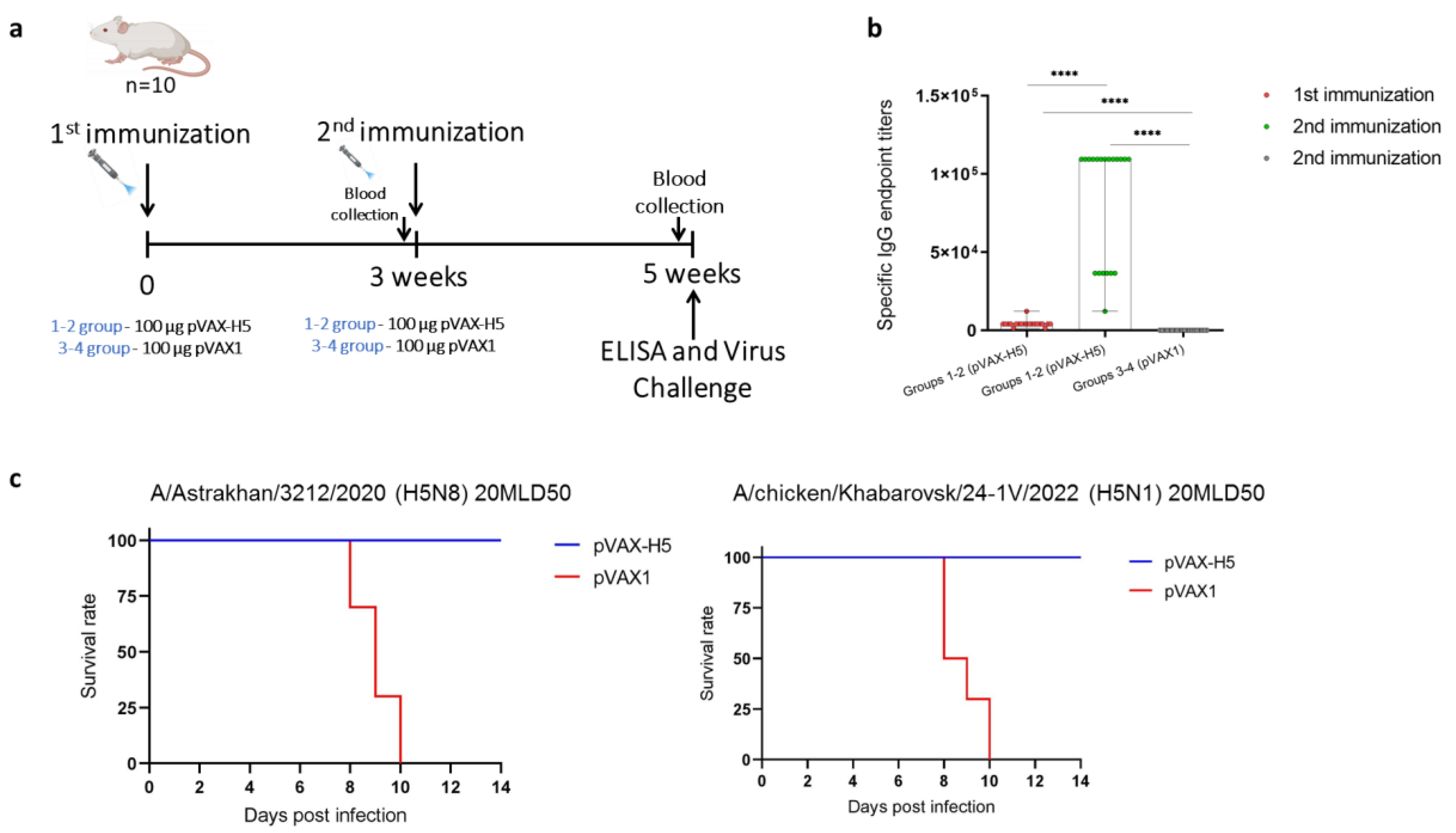
Next, the protective effect of pVAX-H5 (100 μg) was investigated upon infection with both homologous and heterologous HPAI H5 clade 2.3.4.4b viruses. BALB/c mice were immunized according to the scheme shown in Figure 2a. Before the second immunization and two weeks after the second immunization, animal serum samples were obtained for ELISA analysis, and the results showed that after the first immunization there was a slight rise in the level of specific antibodies, with a median titer of 1:4050. After the second immunization, the median titer reached 1:109356, consistent with the previous experiment (Figure 2b). Mice were then infected with a lethal dose of homologous virus A/Astrakhan/3212/2020 (H5N8) or heterologous virus A/chicken/Khabarovsk/24-1V/2022 (H5N1) (Figure 2a). All immunized animals survived after infection with A/Astrakhan/3212/2020 (H5N8) virus and showed no clinical signs of disease, whereas intact animals died or were euthanized due to severe (>20%) weight loss or neurological symptoms by day 10 post-infection (Figure 2c). When infected with a lethal dose of heterologous A/chicken/Khabarovsk/24-1V/2022 (H5N1) virus, all vaccinated animals also survived, while all intact animals, died or were euthanized by day 10 post-infection (Figure 2c). These results indicate that the DNA vaccine effectively induces cross-protective immunity in vivo.

4. Discussion

Global outbreaks of HPAI H5 viruses in wild birds and infection of other animals create the conditions for the virus to evolve in mammals, which could eventually lead to a virus strain capable of sustained human-to-human transmission, potentially resulting in a pandemic. This potential cross-species transmission requires continuous monitoring of avian influenza viruses and vaccine development [24,53,54,55]. A promising area for influenza vaccine development is nucleic acid-based vaccines: DNA and mRNA vaccines. These types of vaccines do not require the use of chicken embryos or cell cultures for production [26,56]. Determination of the nucleotide sequence of an actual virus strain is sufficient to initiate the development of a new vaccine [24].
In the development of nucleic acid-based influenza vaccines, it is important for an effective immune response to ensure that the antigen, in our case hemagglutinin, is presented in a prefusion conformation. It has been previously shown that stabilizing substitutions in pH switch regions provide a closed conformation of the HA proteolysis site and prevent protein cleavage into subunits, which enhances the expression, quality and stability of HA of influenza A and B viruses [57,58]. Therefore, in the development of DNA vaccine, we modified HA by making stabilizing amino acid substitutions in the pH-switch region and added the trimerizing domain of phage T4. As a result, a DNA vaccine encoding the secreted HA A/turkey/Stavropol/320-01/2020 (H5N8) was developed and its immunogenic properties were investigated against the homologous strain A/Astrakhan/3212/2020 (H5N8) 2.3.4.4b [51], which was recommended by WHO as a vaccine strain [59]. The resulting DNA vaccine pVAX-H5 at a dose of 100 μg was found to induce the formation of neutralizing antibodies and provide protection against the homologous strain [51]. However, antigenic drift and antigenic shifts result in changing influenza virus variants causing outbreaks, and therefore it is important to determine whether existing and developing vaccines retain protective effects against new viral isolates [8]. For example, between 2019 and 2022, the major HPAI virus subtype causing global epizootics has changed from H5N8 to H5N1 [24,60].
This study was aimed to investigate the dose-dependent effect and cross-reactivity of the DNA vaccine pVAX-H5. According to the comparative immunogenicity results, high levels of specific antibodies were observed starting from a dose of 50 μg (Figure 1). The highest titer of specific antibodies to recombinant HA was in the group receiving 100 μg. Notably, the higher dose of pVAX-H5 (200 µg) did not provide an increase in antibody titer compared to 100 µg (data are not significantly different, but there is a tendency to decrease in the case of 200 µg). The observed effect may be related to the fact that foreign DNA has adjuvant properties, activating innate immunity, which in turn may negatively affect specific immunogenicity [61,62]. In the case of mRNA vaccines, dsRNA impurities have been shown to activate innate immunity, leading to a significant decrease in the immunogenicity of mRNA vaccines [63,64,65,66]. Therefore, dose escalation may be inappropriate or even harmful in the case of DNA vaccines administered by jet injection. For a more detailed understanding of the immune response to higher doses of pVAX-H5, doses in a wider range, e.g. up to 1 mg, and vaccination in other animal models should be investigated in the future.
Analysis of sera of animals immunized with 100 µg of pVAX-H5 in the microneutralization assay against heterologous H5N1 strains showed that the sera had neutralizing activity against these strains. The lowest neutralizing activity was observed against A/chicken/Khabarovsk/24-1V/2022 (H5N1). This strain also showed the lowest titers in HI assay (Table 1) and has the highest number of amino acid substitutions in HA relative to the vaccine strain (Table 2). It is worth noting that there are no clear criteria for a protective titer for the microneutralization assay, as in HI assay [67]. Thus, some researchers use a titer ≥80 as an endpoint for the efficacy of H5N1 avian influenza vaccines [68], while others consider a seroprotection threshold of 1:20 to be acceptable [69].
Next, we tested the protective effect of the DNA vaccine against both homologous and heterologous strains. It was of particular interest to determine if pVAX-H5 would provide protection against infection with a lethal dose of A/chicken/Khabarovsk/24-1V/2022 (H5N1), since against this strain the neutralizing titers were the lowest. It was shown that all animals immunized with 100 μg of pVAX-H5 survived, whereas all animals receiving the control plasmid pVAX1 died when infected with both the homologous H5N8 and heterologous H5N1 strains (Figure 2c). It has also been previously shown that mRNA vaccines encoding HA clade 2.3.4.4b in vitro provide antibody formation that binds to different strains of H5 subtype virus and protects mice from infection with clade 2.3.2.1a virus [70,71]. In this study, we did not analyze the specific T-cell response. However, in past work [51], we showed its formation in response to the administration of 100 μg of pVAX-H5 in similar settings. Therefore, we hypothesize that in this case, in addition to neutralizing antibodies, T-cell immunity was involved in the formation of protective immunity. Recent studies by other groups have also shown that T-cell immunity induced by mRNA-based vaccine contributes to protection against H5 virus infection [32,70,72].
Thus, the data obtained indicate that the DNA vaccine encoding a modified hemagglutinin of influenza A/H5N8 virus is capable of protecting mice from infection with a lethal dose of influenza A/H5N1 virus. The findings support the feasibility of the DNA vaccine development for the pandemic preparedness against HPAI viruses, which pose the increasing threat to human health.

Author Contributions

Conceptualization, A.P.R., A.A.I., L.I.K. and A.A.S.; methodology, A.P.R., N.B.R., D.N.K., M.B.B., L.I.K., V.A.Y., E.V.T., K.I.I., A.S.G., D.I.V., K.P.M., N.P.K. and V.Y.M.; investigation, V.R.L., A.P.R., N.B.R., D.N.K., M.B.B., L.A.K., V.A.Y., E.V.T., K.I.I., A.S.G., T.N.I. and V.Y.M.; writing—original draft preparation, A.P.R., V.R.L., N.B.R., D.N.K., T.N.I., A.A.I. and L.I.K.; writing—review and editing, A.P.R., N.B.R., D.N.K., L.A.K., T.N.I., A.S.G., A.A.S., N.P.K., A.A.I. and L.I.K. All authors have read and agreed to the published version of the manuscript.

Funding

The study was conducted under the state assignment of FBRI SRC VB “Vector” Rospotrebnadzor.

Institutional Review Board Statement

The study was conducted according to the Declaration of Helsinki and approved by the Bioethics Committee of SRC VB "Vector (No. 1 Protocol of the Bioethics Committee of 03/21/2023).

Informed Consent Statement

Not applicable.

Data Availability Statement

The data can be shared up on request.

Conflicts of Interest

The authors declare no conflicts of interest.

References

  1. Fukuyama, S.; Kawaoka, Y. The pathogenesis of influenza virus infections: the contributions of virus and host factors. Curr Opin Immunol. 2011, 23, 481–486. [Google Scholar] [CrossRef] [PubMed]
  2. Doran, Á.; Colvin, C.L.; McLaughlin, E. What can we learn from historical pandemics? A systematic review of the literature. Soc Sci Med. 2024, 342, 116534. [Google Scholar] [CrossRef]
  3. Shi, J.; Zeng, X.; Cui, P.; Yan, C.; Chen, H. Alarming situation of emerging H5 and H7 avian influenza and effective control strategies. Emerg Microbes Infect. 2023, 12. [Google Scholar] [CrossRef]
  4. Mohanty, A.; Mini, M.; Zaawari, A.; Banerjee, A.; Bage, R. N.; Jha, T. From avian to human: understanding the cross-species transmission and the global spread of highly pathogenic avian influenza. The Evidence 2024, 2. [Google Scholar] [CrossRef]
  5. Koopmans, M.P.G.; Barton Behravesh, C.; Cunningham, A.A.; Adisasmito, W.B.; Almuhairi, S.; Bilivogui, P.; Bukachi, S.A.; Casas, N.; Cediel Becerra, N.; Charron, D.F.; et al. The panzootic spread of highly pathogenic avian influenza H5N1 sublineage 2.3.4.4 b: a critical appraisal of One Health preparedness and prevention. Lancet Infect Dis. 2024. [Google Scholar] [CrossRef]
  6. Pramuwidyatama, M.G.; Indrawan, D.; Boeters, M.; Poetri, O.N.; Saatkamp, H.W.; Hogeveen, H. Economic impact of highly pathogenic avian influenza outbreaks in Western Java smallholder broiler farms. Prev Vet Med. 2023, 212, 105833. [Google Scholar] [CrossRef]
  7. Zhirnov, O.P.; Lvov, D.K. Avian flu: «for whom the bell tolls»? Vopr Virusol. 2024, 69, 101–118. [Google Scholar] [CrossRef] [PubMed]
  8. Chiba, S.; Kiso, M.; Yamada, S.; Someya, K.; Onodera, Y.; Yamaguchi, A.; Matsunaga, S.; Jounai, N.; Yamayoshi, S.; Takeshita, F.; Kawaoka, Y. Protective effects of an mRNA vaccine candidate encoding H5HA clade 2.3.4.4b against the newly emerged dairy cattle H5N1 virus. eBioMedicine 2024, 109, 105408. [Google Scholar] [CrossRef]
  9. Centers for Disease Control and Prevention (CDC). Isolation of avian influenza A(H5N1) viruses from humans--Hong Kong, May-December 1997. MMWR Morb Mortal Wkly Rep. 1997, 46, 1204–1207. [Google Scholar]
  10. Hatta, M.; Gao, P.; Halfmann, P.; Kawaoka, Y. Molecular basis for high virulence of Hong Kong H5N1 influenza A viruses. Science 2001, 293, 1840–1842. [Google Scholar] [CrossRef]
  11. Focosi, D.; Maggi, F. Avian Influenza Virus A(H5Nx) and Prepandemic Candidate Vaccines: State of the Art. Int. J. Mol. Sci. 2024, 25, 8550. [Google Scholar] [CrossRef]
  12. World Health Organization. Cumulative number of confirmed human cases for avian influenza A(H5N1) reported to WHO, 2003-2024, 27 September 2024. Available online: https://www.who.int/publications/m/item/cumulative-number-of-confirmed-human-cases-for-avian-influenza-a (accessed on 4 December 2024).
  13. Xie, R.; Edwards, K.M.; Wille, M.; Wei, X.; Wong, S.S.; Zanin, M.; El-Shesheny, R.; Ducatez, M.; Poon, L.L.M.; Kayali, G.; Webby, R.J.; Dhanasekaran, V. The episodic resurgence of highly pathogenic avian influenza H5 virus. Nature 2023, 622, 810–817. [Google Scholar] [CrossRef]
  14. World Health Organization. Assessment of risk associated with recent influenza A(H5N1) clade 2.3.4.4b viruses 21 December 2022. Available online: https://cdn.who.int/media/docs/default-source/influenza/avian-and-other-zoonotic-influenza/h5-risk-assessment-dec-2022.pdf?sfvrsn = a496333a_1&download = true (accessed on 17 November 2024).
  15. Pyankova, O.G.; Susloparov, I.M.; Moiseeva, A.A.; Kolosova, N.P.; Onkhonova, G.S.; Danilenko, A.V.; Vakalova, E.V.; Shendo, G.L.; Nekeshina, N.N.; Noskova, L.N.; et al. Isolation of clade 2.3.4.4b A(H5N8), a highly pathogenic avian influenza virus, from a worker during an outbreak on a poultry farm, Russia, December 2020. Euro Surveill. 2021, 26. [Google Scholar] [CrossRef] [PubMed]
  16. Eisfeld, A.J.; Biswas, A.; Guan, L.; Gu, C.; Maemura, T.; Trifkovic, S.; Wang, T.; Babujee, L.; Dahn, R.; Halfmann, P. J.; et al. Pathogenicity and transmissibility of bovine H5N1 influenza virus. Nature 2024, 26. [Google Scholar] [CrossRef] [PubMed]
  17. Burrough, E.R.; Magstadt, D.R.; Petersen, B.; Timmermans, S.J.; Gauger, P.C.; Zhang, J.; Siepker, C.; Mainenti, M.; Li, G.; Thompson, A.C.; et al. Highly pathogenic avian influenza A (H5N1) clade 2.3.4.4 b virus infection in domestic dairy cattle and cats, United States, 2024. Emerg Infect Dis. 2024, 30, 1335–1343. [Google Scholar] [CrossRef] [PubMed]
  18. Le Sage, V.; Werner, B.D.; Merrbach, G.A.; Petnuch, S.E.; O'Connell, A.K.; Simmons, H.C.; McCarthy, K.R.; Reed, D.S.; Moncla, L.H.; Bhavsar, D.; et al. Pre-existing H1N1 immunity reduces severe disease with bovine H5N1 influenza virus. bioRxiv, 2024. [Google Scholar] [CrossRef]
  19. Bruno, A.; Alfaro-Núñez, A.; de Mora, D.; Armas, R.; Olmedo, M.; Garcés, J.; Garcia-Bereguiain, M. A. First case of human infection with highly pathogenic H5 avian influenza a virus in South America: a new zoonotic pandemic threat for 2023? J Travel Med. 2023, 30. [Google Scholar] [CrossRef] [PubMed]
  20. Pulit-Penaloza, J. A.; Brock, N.; Belser, J. A.; Sun, X.; Pappas, C.; Kieran, T. J.; Basu Thakur, P.; Zeng, H.; Cui, D.; Frederick, J.; et al. Highly pathogenic avian influenza A (H5N1) virus of clade 2.3.4.4 b isolated from a human case in Chile causes fatal disease and transmits between co-housed ferrets. Emerg Microbes Infect 2024, 13. [Google Scholar] [CrossRef]
  21. Abdelwhab, E.M.; Beer, M. Panzootic HPAIV H5 and risks to novel mammalian hosts. npj Viruses 2024, 2. [Google Scholar] [CrossRef]
  22. Xiong, X.; Xiao, H.; Martin, S.R.; Coombs, P.J.; Liu, J.; Collins, P.J.; Vachieri, S.G.; Walker, P.A.; Lin, Y.P.; McCauley, J.W.; et al. Enhanced human receptor binding by H5 haemagglutinins. Virology 2014, 456-457, 179–187. [Google Scholar] [CrossRef]
  23. Kok, A.; Fouchier, R.A.M.; Richard, M. Cross-Reactivity Conferred by Homologous and Heterologous Prime-Boost A/H5 Influenza Vaccination Strategies in Humans: A Literature Review. Vaccines 2021, 9, 1465. [Google Scholar] [CrossRef]
  24. Huang, P.; Sun, L.; Li, J.; Wu, Q.; Rezaei, N.; Jiang, S.; Pan, C. Potential cross-species transmission of highly pathogenic avian influenza H5 subtype (HPAI H5) viruses to humans calls for the development of H5-specific and universal influenza vaccines. Cell Discov. 2023, 9. [Google Scholar] [CrossRef]
  25. Furuyama, W.; Reynolds, P.; Haddock, E.; Meade-White, K.; Quynh Le, M.; Kawaoka, Y.; Feldmann, H.; Marzi, A. A single dose of a vesicular stomatitis virus-based influenza vaccine confers rapid protection against H5 viruses from different clades. NPJ Vaccines 2020, 5. [Google Scholar] [CrossRef]
  26. Litvinova, V.R.; Rudometov, A.P.; Karpenko, L.I.; Ilyichev, A.A. mRNA vaccine platform: mRNA production and delivery. Russ J Bioorg Chem. 2023, 49, 220–235. [Google Scholar] [CrossRef]
  27. Cagigi, A.; Douradinha, B. Have mRNA vaccines sentenced DNA vaccines to death? Expert Rev. Vaccines 2023, 22, 1154–1167. [Google Scholar] [CrossRef] [PubMed]
  28. Feldman, R.A.; Fuhr, R.; Smolenov, I.; Mick Ribeiro, A.; Panther, L.; Watson, M.; Senn, J.J.; Smith, M.; Almarsson, Ӧ.; Pujar, H.S. mRNA vaccines against H10N8 and H7N9 influenza viruses of pandemic potential are immunogenic and well tolerated in healthy adults in phase 1 randomized clinical trials. Vaccine 2019, 37(25), 3326–3334. [Google Scholar] [CrossRef]
  29. Pardi, N.; Parkhouse, K.; Kirkpatrick, E.; McMahon, M.; Zost, S.J.; Mui, B.L.; Tam, Y.K.; Karikó, K.; Barbosa, C.J.; Madden, *!!! REPLACE !!!*; et al. Nucleoside-modified mRNA immunization elicits influenza virus hemagglutinin stalk-specific antibodies. Nat Commun. 2018, 9. [Google Scholar] [CrossRef]
  30. Willis, E.; Pardi, N.; Parkhouse, K.; Mui, B.L.; Tam, Y.K.; Weissman, D.; Hensley, S.E. Nucleoside-modified mRNA vaccination partially overcomes maternal antibody inhibition of de novo immune responses in mice. Sci Transl Med. 2020, 12. [Google Scholar] [CrossRef]
  31. Arevalo, C.P.; Bolton, M.J.; Le Sage, V.; Ye, N.; Furey, C.; Muramatsu, H.; Alameh, M.G.; Pardi, N.; Drapeau, E.M.; Parkhouse, K.; et al. A multivalent nucleoside-modified mRNA vaccine against all known influenza virus subtypes. Science 2022, 378, 899–904. [Google Scholar] [CrossRef] [PubMed]
  32. Li, Y.; Wang, X.; Zeng, X.; Ren, W.; Liao, P.; Zhu, B. Protective efficacy of a universal influenza mRNA vaccine against the challenge of H1 and H5 influenza A viruses in mice. mLife 2023, 2, 308–316. [Google Scholar] [CrossRef]
  33. Mooij, P.; Grødeland, G.; Koopman, G.; Andersen, T.K.; Mortier, D.; Nieuwenhuis, I.G.; Verschoor, E.J.; Fagrouch, Z.; Bogers, W.M.; Bogen, B. Needle-free delivery of DNA: Targeting of hemagglutinin to MHC class II molecules protects rhesus macaques against H1N1 influenza. Vaccine 2019, 37, 817–826. [Google Scholar] [CrossRef] [PubMed]
  34. Xu, S.; Yu, L.; Teng, Q.; Li, X.; Jin, Z.; Qu, Y.; Li, J.; Zhang, Q.; Li, Z.; Zhao, K. Enhance immune response to H9 AIV DNA vaccine based on polygene expression and DGL nanoparticle encapsulation. Poult Sci. 2023, 102. [Google Scholar] [CrossRef] [PubMed]
  35. Xu, S.; Lan, H.; Teng, Q.; Li, X.; Jin, Z.; Qu, Y.; Li, J.; Zhang, Q.; Kang, H.; Yin, T.H.; Li, Z.; Zhao, K. An immune-enhanced multivalent DNA nanovaccine to prevent H7 and H9 avian influenza virus in mice. Int J Biol Macromol. 2023, 251, 126286. [Google Scholar] [CrossRef]
  36. Valentin, J.; Ingrao, F.; Rauw, F.; Lambrecht, B. Protection conferred by an H5 DNA vaccine against highly pathogenic avian influenza in chickens: The effect of vaccination schedules. Vaccine 2024, 42, 1487–1497. [Google Scholar] [CrossRef] [PubMed]
  37. Eman, M.E.; Saad, M.A.; Maha, A.G.; Zaki, F.F.; Soliman, Y.A. A novel DNA vaccine coding for H5 and N1 genes of highly pathogenic avian influenza H5N1 subtype. IJVSBT 2020, 15, 1–11. [Google Scholar] [CrossRef]
  38. Mady, W.H.M.; Liu, B.; Huang, D.; Arafa, A.; Hassan, M.K.; Aly, M.M.; Chen, P.; Jiang, Y.; Chen, H. Construction and protective efficacy of Egy-H5 DNA Vaccine from local Egyptian STRAIN H5N1 using codon optimized HA gene. Hosts and Viruses 2017, 4, 54–61. [Google Scholar]
  39. Xu, Z.; Patel, A.; Tursi, N.J.; Zhu, X.; Muthumani, K.; Kulp, D.W.; Weiner, D.B. Harnessing Recent Advances in Synthetic DNA and Electroporation Technologies for Rapid Vaccine Development Against COVID-19 and Other Emerging Infectious Diseases. Front Med Technol. 2020, 2, 571030. [Google Scholar] [CrossRef]
  40. Kisakov, D.N.; Kisakova, L.A.; Borgoyakova, M.B.; Starostina, E.V.; Taranov, O.S.; Ivleva, E.K.; Pyankov, O.V.; Zaykovskaya, A.V.; Shcherbakov, D.N.; Rudometov, A.P.; et al. Optimization of In Vivo Electroporation Conditions and Delivery of DNA Vaccine Encoding SARS-CoV-2 RBD Using the Determined Protocol. Pharmaceutics 2022, 14, 2259. [Google Scholar] [CrossRef]
  41. Kisakov, D.N.; Belyakov, I.M.; Kisakova, L.A.; Yakovlev, V.A.; Tigeeva, E.V.; Karpenko, L.I. The use of electroporation to deliver DNA-based vaccines. Expert Rev. Vaccines 2023, 23, 102–123. [Google Scholar] [CrossRef]
  42. Ledesma-Feliciano, C.; Chapman, R.; Hooper, J.W.; Elma, K.; Zehrung, D.; Brennan, M.B.; Spiegel, E.K. Improved DNA Vaccine Delivery with Needle-Free Injection Systems. Vaccines 2023, 11, 280. [Google Scholar] [CrossRef] [PubMed]
  43. Maslow, J.N.; Kwon, I.; Kudchodkar, S.B.; Kane, D.; Tadesse, A.; Lee, H.; Park, Y.K.; Muthumani, K.; Roberts, C.C. DNA Vaccines for Epidemic Preparedness: SARS-CoV-2 and Beyond. Vaccines 2023, 11, 1016. [Google Scholar] [CrossRef]
  44. Kupferschmidt, K. Bird flu spread between mink is a ‘warning bell’. Science 2023, 379, 316–317. [Google Scholar] [CrossRef]
  45. Sidik, S.M. Bird flu outbreak in mink sparks concern about spread in people. Nature 2023, 614. [Google Scholar] [CrossRef] [PubMed]
  46. Agüero, M.; Monne, I.; Sánchez, A.; Zecchin, B.; Fusaro, A.; Ruano, M.J.; Del Valle Arrojo, M.; Fernández-Antonio, R.; Souto, A.M.; Tordable, P.; et al. Highly pathogenic avian influenza A(H5N1) virus infection in farmed minks, Spain, October 2022. Euro Surveill. 2023, 28. [Google Scholar] [CrossRef]
  47. Rijks, J.M.; Hesselink, H.; Lollinga, P.; Wesselman, R.; Prins, P.; Weesendorp, E.; Engelsma, M.; Heutink, R.; Harders, F.; Kik, M.; et al. Highly Pathogenic Avian Influenza A(H5N1) Virus in Wild Red Foxes, the Netherlands, 2021. Emerg Infect Dis. 2021, 27, 2960–2962. [Google Scholar] [CrossRef]
  48. Puryear, W.; Sawatzki, K.; Hill, N.; Foss, A.; Stone, J.J.; Doughty, L.; Walk, D.; Gilbert, K.; Murray, M.; Cox, E.; et al. Highly Pathogenic Avian Influenza A(H5N1) Virus Outbreak in New England Seals, United States. Emerg Infect Dis. 2023, 29, 786–791. [Google Scholar] [CrossRef]
  49. Marchenko, V.Y.; Panova, A.S.; Kolosova, N.P.; Gudymo, A.S.; Svyatchenko, S.V.; Danilenko, A.V.; Vasiltsova, N.N.; Egorova, M.L.; Onkhonova, G.S.; Zhestkov, P.D.; et al. Characterization of H5N1 avian influenza virus isolated from bird in Russia with the E627K mutation in the PB2 protein. Sci Rep. 2024, 14. [Google Scholar] [CrossRef] [PubMed]
  50. Khurana, S.; King, L.R.; Manischewitz, J.; Posadas, O.; Mishra, A.K.; Liu, D.; Beigel, J.H.; Rappuoli, R.; Tsang, J.S.; Golding, H. Licensed H5N1 vaccines generate cross-neutralizing antibodies against highly pathogenic H5N1 clade 2.3.4.4b influenza virus. Nat Med. 2024, 30, 2771–2776. [Google Scholar] [CrossRef]
  51. Litvinova, V.R.; Rudometov, A.P.; Rudometova, N.B.; Kisakov, D.N.; Borgoyakova, M.B.; Kisakova, L.A.; Starostina, E.V.; Fando, A.A.; Yakovlev, V.A.; Tigeeva, E.V.; et al. DNA Vaccine Encoding a Modified Hemagglutinin Trimer of Avian Influenza A Virus H5N8 Protects Mice from Viral Challenge. Vaccines 2024, 12, 538. [Google Scholar] [CrossRef] [PubMed]
  52. Rudometova, N.B.; Fando, A.A.; Kisakova, L.A.; Kisakov, D.N.; Borgoyakova, M.B.; Litvinova, V.R.; Yakovlev, V.A.; Tigeeva, E.V.; Vahitov, D.I.; Sharabrin, S.V.; et al. Immunogenic and Protective Properties of Recombinant Hemagglutinin of Influenza A (H5N8) Virus. Vaccines 2024, 12, 143. [Google Scholar] [CrossRef]
  53. Sultankulova, K.T.; Argimbayeva, T.U.; Aubakir, N.A.; Bopi, A.; Omarova, Z.D.; Melisbek, A.M.; Karamendin, K.; Kydyrmanov, A.; Chervyakova, O.V.; Kerimbayev, A.A.; et al. Reassortants of the Highly Pathogenic Influenza Virus A/H5N1 Causing Mass Swan Mortality in Kazakhstan from 2023 to 2024. Animals 2024, 14, 3211. [Google Scholar] [CrossRef] [PubMed]
  54. Gudymo, A.; Onkhonova, G.; Danilenko, A.; Susloparov, I.; Danilchenko, N.; Kosenko, M.; Moiseeva, A.; Kolosova, N.; Svyatchenko, S.; Marchenko, V.; et al. Quantitative Assessment of Airborne Transmission of Human and Animal Influenza Viruses in the Ferret Model. Atmosphere 2023, 14, 471. [Google Scholar] [CrossRef]
  55. Saad, N.; Esaki, M.; Kojima, I.; Khalil, A.M.; Osuga, S.; Shahein, M.A.; Okuya, K.; Ozawa, M.; Alhatlani, B.Y. Phylogenetic Characterization of Novel Reassortant 2.3.4.4b H5N8 Highly Pathogenic Avian Influenza Viruses Isolated from Domestic Ducks in Egypt During the Winter Season 2021–2022. Viruses 2024, 16, 1655. [Google Scholar] [CrossRef]
  56. Lu, B.; Lim, J.M.; Yu, B.; Song, S.; Neeli, P.; Sobhani, N.; Pavithra, K.; Bonam, S.R.; Kurapati, R.; Zheng, J.; Chai, D. The next-generation DNA vaccine platforms and delivery systems: advances, challenges and prospects. Front Immunol. 2024, 15, 1332939. [Google Scholar] [CrossRef]
  57. Milder, F.J.; Jongeneelen, M.; Ritschel, T.; Bouchier, P.; Bisschop, I.J.M.; de Man, M.; Veldman, D.; Le, L.; Kaufmann, B.; Bakkers, M.J.G.; et al. Universal stabilization of the influenza hemagglutinin by structure-based redesign of the pH switch regions. Proc Natl Acad Sci U S A 2022, 119. [Google Scholar] [CrossRef] [PubMed]
  58. Juraszek, J.; Milder, F.J.; Yu, X.; Blokland, S.; van Overveld, D.; Abeywickrema, P.; Tamara, S.; Sharma, S.; Rutten, L.; Bakkers, M.J.G.; Langedijk, J.P.M. Engineering a cleaved, prefusion-stabilized influenza B virus hemagglutinin by identification and locking of all six pH switches. PNAS Nexus 2024, 3. [Google Scholar] [CrossRef] [PubMed]
  59. World Health Organization. Recommendations for influenza vaccine composition. Available online: https://www.who.int/teams/global-influenza-programme/vaccines/who-recommendations (accessed on 17 November 2024).
  60. Marchenko, V.Yu.; Svyatchenko, S.V.; Onkhonova, G.S.; Goncharova, N.I.; Ryzhikov, A.B.; Maksyutov, R.A.; Gavrilova, E.V. Review on the Epizootiological Situation on Highly Pathogenic Avian Influenza around the World and in Russia in 2022. Problems of Particularly Dangerous Infections, 2023; 1, 48–55. [Google Scholar] [CrossRef]
  61. Kozak, M.; Hu, J. DNA Vaccines: Their Formulations, Engineering and Delivery. Vaccines 2024, 12, 71. [Google Scholar] [CrossRef] [PubMed]
  62. Werninghaus, I.C.; Hinke, D.M.; Fossum, E.; Bogen, B.; Braathen, R. Neuraminidase delivered as an APC-targeted DNA vaccine induces protective antibodies against influenza. Mol Ther. 2023, 31, 2188–2205. [Google Scholar] [CrossRef] [PubMed]
  63. Zhang, J.; Li, C.; Liu, Y.; Liao, R.; He, D.; Xu, L.; Chen, T.; Xiao, Q.; Luo, M.; Chen, Y.; et al. Airway applied IVT mRNA vaccine needs specific sequence design and high standard purification that removes devastating dsRNA contaminant. bioRxiv, 2024. [Google Scholar] [CrossRef]
  64. Sharabrin, S.V.; Bondar, A.A.; Starostina, E.V; Kisakov, D.N.; Kisakova, L.A.; Zadorozhny, A.M.; Rudometov, A.P.; Ilyichev, A.A.; Karpenko, L.I. Removal of Double-Stranded RNA Contaminants During Template-Directed Synthesis of mRNA. Bull Exp Biol Med 2024, 176, 751–755. [Google Scholar] [CrossRef]
  65. Karikó, K.; Muramatsu, H.; Ludwig, J.; Weissman, D. Generating the optimal mRNA for therapy: HPLC purification eliminates immune activation and improves translation of nucleoside-modified, protein-encoding mRNA. Nucleic Acids Res. 2011, 39. [Google Scholar] [CrossRef]
  66. Portal, M.M.; Pavet, V.; Erb, C.; Gronemeyer, H. Human cells contain natural double-stranded RNAs with potential regulatory functions. Nat Struct Mol Biol. 2015, 22, 89–97. [Google Scholar] [CrossRef] [PubMed]
  67. Trombetta, C.M.; Perini, D.; Mather, S.; Temperton, N.; Montomoli, E. Overview of Serological Techniques for Influenza Vaccine Evaluation: Past, Present and Future. Vaccines 2014, 2, 707–734. [Google Scholar] [CrossRef]
  68. Galli, G.; Medini, D.; Borgogni, E.; Zedda, L.; Bardelli, M.; Malzone, C.; Nuti, S.; Tavarini, S.; Sammicheli, C.; Hilbert, A.K.; et al. Adjuvanted H5N1 vaccine induces early CD4+ T cell response that predicts long-term persistence of protective antibody levels. Proc Natl Acad Sci U S A. 2009, 106, 3877–3882. [Google Scholar] [CrossRef]
  69. Van der Velden, M.V.; Aichinger, G.; Pollabauer, E.M.; Low-Baselli, A.; Fritsch, S.; Benamara, K.; Kistner, O.; Muller, M.; Zeitlinger, M.; Kollaritsch, H.; et al. Cell culture (Vero cell) derived whole-virus non-adjuvanted H5N1 influenza vaccine induces long-lasting cross-reactive memory immune response: Homologous or heterologous booster response following two dose or single dose priming. Vaccine 2012, 30, 6127–6135. [Google Scholar] [CrossRef] [PubMed]
  70. Furey, C.; Scher, G.; Ye, N.; Kercher, L.; DeBeauchamp, J.; Crumpton, J.C.; Jeevan, T.; Patton, C.; Franks, J.; Rubrum, A.; et al. Development of a nucleoside-modified mRNA vaccine against clade 2.3.4.4b H5 highly pathogenic avian influenza virus. Nat Commun. 2024, 15. [Google Scholar] [CrossRef]
  71. Chiba, S.; Kiso, M.; Yamada, S.; Someya, K.; Onodera, Y.; Yamaguchi, A.; Matsunaga, S.; Uraki, R.; Iwatsuki-Horimoto, K.; Yamayoshi, S.; Takeshita, F.; Kawaoka, Y. An mRNA vaccine candidate encoding H5HA clade 2.3.4.4b protects mice from clade 2.3.2.1a virus infection. NPJ Vaccines 2024, 9. [Google Scholar] [CrossRef] [PubMed]
  72. Cui, X.; Vervaeke, P.; Gao, Y.; Opsomer, L.; Sun, Q.; Snoeck, J.; Devriendt, B.; Zhong, Z.; Sanders, N. N. Immunogenicity and biodistribution of lipid nanoparticle formulated self-amplifying mRNA vaccines against H5 avian influenza. NPJ Vaccines 2024, 9. [Google Scholar] [CrossRef]
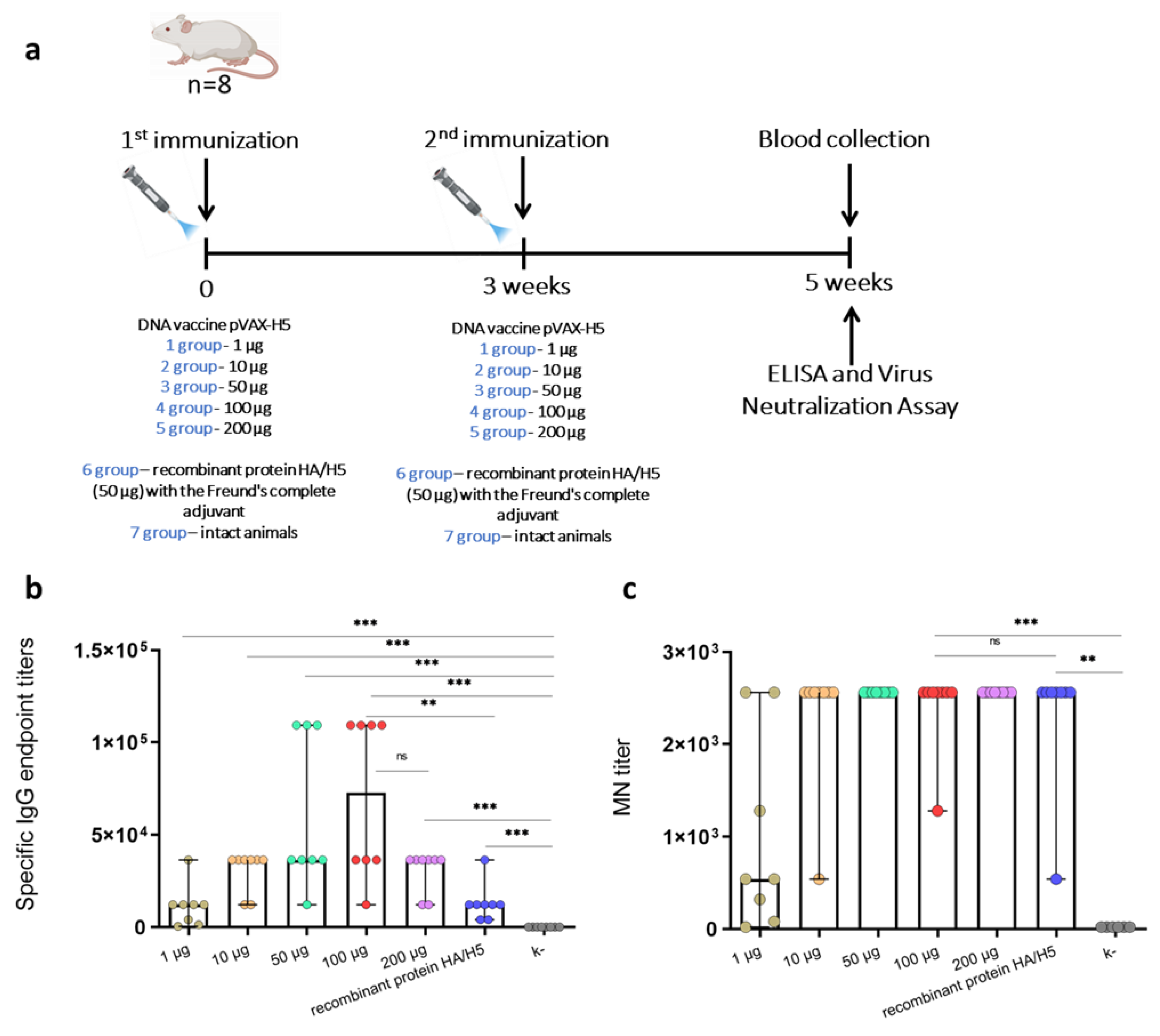
Figure 1. The humoral response to the different doses of the DNA vaccine pVAX-H5. (a) Experimental design. (b) Hemagglutinin-specific IgG antibody titer determined in immune sera by ELISA. The immunosorbent was recombinant hemagglutinin of influenza virus A/H5N8 [52]. Specific IgG endpoint titers are presented on the ordinate axis. (c) Microneutralization (MN) assay of immune sera against influenza A/turkey/Stavropol/320-01/2020 (H5N8) virus. MN titers are marked on the ordinate axis. Data are provided as median with range. The Mann-Whitney test was used for the statistical analysis of the data (** – p < 0.05; *** – p < 0.001; ns – not significant).
Preprints 142481 g001
Figure 2. Evaluation of immunogenic and protective activity of DNA vaccine pVAX-H5. (a) Experimental design. (b) Hemagglutinin-specific IgG antibody titer determined in immune sera by ELISA. Data are presented as median with range. The Mann-Whitney test was used for statistical analysis (**** – p < 0.0001). (c) Survival probability of immunized animals after infection with the influenza viruses of A/Astrakhan/3212/2020 (H5N8) and A/chicken/Khabarovsk/24-1V/2022 (H5N1) strains. Kaplan-Meier multiplier estimator was used to construct the survival curve, and the Mantel-Cox test was used to compare the survival rates of the experimental and control groups. pVAX-H5 – a group of animals immunized with 100 ug of DNA vaccine pVAX-H5; pVAX1 – group of animals immunized with 100 ug of plasmid pVAX1.
Preprints 142481 g002
Table 1. Antigenic characteristics of A/H5 subtype influenza viruses by HI assay.
Viruses Ferret reference serum
A/gyrfalcon/Washington/41088-6/2014 A/Astrakhan/3212/2020 A/chicken/Nghe An/27VTC/2018 A/dalmatian pelican/Astrakhan/213-2V/2022 A/chicken/Khabarovsk/24-1V/2022
Reference antigens Subtype Subclade
2.3.4.4c 2.3.4.4b 2.3.4.4f 2.3.4.4b 2.3.4.4b
A/gyrfalcon/Washington/
/41088-6/2014
H5N8 320 640 640 640 320
A/Astrakhan/3212/2020 H5N8 80 160 80 80 160
A/chicken/NgheAn
/27VTC/2018
H5N6 320 640 640 640 320
A/dalmatian pelican/Astrakhan/
213-2V/2022
H5N1 160 320 320 320 320
A/chicken/Khabarovsk/24-1V/2022 H5N1 20 80 80 80 320
A/chicken/Astrakhan/ 32105/2020 H5N8 80 160 80 80 160
A/chicken/Voronezh/193-1V/2024 H5N1 <20 <20 <20 <20 160
A/turkey/Stavropol/320-01/2020 H5N8 80 80 <20 40 80
A/chicken/Komi/24-4V/2023 H5N1 320 320 <20 160 160
Table 2. Virus neutralizing activity of immune sera against heterologous influenza A virus strains (reverse titer value).
Serum code A/chicken/Astrakhan/321-05/2020 (H5N8) A/chicken/Komi/24-4V/2023 (H5N1) A/chicken/Khabarovsk/24-1V/2022 (H5N1) A/chicken/Voronezh/193-1V/2024 (H5N1)
1 1280 640 40 640
2 1280 160 40 320
3 640 320 80 640
4 2560 640 40 1280
5 2560 640 40 640
6 1280 320 40 640
7 640 320 80 640
8 640 320 80 1280
9 1280 320 80 640
10 1280 640 40 640
Control (+)* 2560 1280 640 2560
Control (-)** <20 <20 <20 <20
* ferret reference serum against each influenza virus was used as a positive control. ** a pool of sera from intact animals was used as a negative control.
Table 3. Amino acid substitutions in HA of avian influenza viruses A/chicken/Voronezh/193-1V/2024 (H5N1), A/chicken/Komi/24-4V/2023 (H5N1), A/Astrakhan/3212/2020 (H5N8), A/chicken/Khabarovsk/24-1V/2022 (H5N1), A/chicken/Astrakhan/321-05/2020 (H5N8) compared with A/turkey/Stavropol/320-01/2020 (H5N8).
HA 10 44 88 99 104 152 153 170 338 462 463 503 519 548
A/turkey/Stavropol/320-01/2020 (H5N8) I H R A D P Y N L N L D S M
A/chicken/Astrakhan/321-05/2020 (H5N8) . . . . . . . . . . . . . .
A/Astrakhan/3212/2020 (H5N8) . . . . . . . . . . . . . .
A/chicken/Khabarovsk/24-1V/2022 (H5N1) T Q . N . . . D I K . Y . .
A/chicken/Komi/24-4V/2023 (H5N1) . . E . G . H . . . . . . I
A/chicken/Voronezh/193-1V/2024 (H5N1) . . . D . S . . . . I . N I
. – sequence matches HA A/turkey/Stavropol/320-01/2020 (H5N8).
Disclaimer/Publisher’s Note: The statements, opinions and data contained in all publications are solely those of the individual author(s) and contributor(s) and not of MDPI and/or the editor(s). MDPI and/or the editor(s) disclaim responsibility for any injury to people or property resulting from any ideas, methods, instructions or products referred to in the content.
Copyright: This open access article is published under a Creative Commons CC BY 4.0 license, which permit the free download, distribution, and reuse, provided that the author and preprint are cited in any reuse.
Prerpints.org logo

Preprints.org is a free preprint server supported by MDPI in Basel, Switzerland.

Subscribe

Disclaimer

Terms of Use

Privacy Policy

Privacy Settings

© 2025 MDPI (Basel, Switzerland) unless otherwise stated