

Submitted:
10 December 2024
Posted:
11 December 2024
You are already at the latest version
Abstract
Background: Head-out aquatic training, using modalities such as water-aerobics/hydrogymnastics (HYD) and deep-water running (DWR), has been effective for improving the health of middle-aged adults. However, direct comparisons between these modalities are lacking.
Aim: The aim of this study was to compare the effects of water-aerobics and deep-water running on anthropometric, functional and hemodynamic outcomes in adults and older adults.
Methods: An uncontrolled pragmatic trial (RBR-2txw8zy) was conducted with participants aged 30 to 80, allocated to HYD and DWR groups. The intervention consisted of 12 weeks of progressive aerobic training with weekly undulating periodization (2x/week), divided into 3 mesocycles (4, 5, and 3 weeks), each lasting 50 minutes. Intensity was prescribed using the Rate of Perceived Effort (RPE), ranging from RPE 11 to 17. Outcomes assessed included the 30-s chair stand, 30-s arm curl, Timed-Up-and-Go usual (TUG-u) and maximum (TUG-m), 6-minute walking test (6MWT), body mass, waist circumference, blood pressure and resting heart rate-HRrest. The analysis was conducted using generalized estimating equations, with per-protocol (PP) and intention-to-treat (ITT) analyses.
Results: The study included 104 participants (HYD: n=63, mean age 59 years, 54 women; DWR: n=41, mean age 53 years, 33 women). ITT analysis showed improvements in waist circumference, waist-to-height ratio, and TUG-m in the HYD group, and a reduction in HRrest in the DWR group. Both modalities showed significant improvements in the 30-s chair stand, 30-s arm curl, 6MWT, waist circumference, and waist-to-height ratio in the PP analysis.
Conclusion: Both modalities promoted functional improvements and favorable changes in anthropometric evaluations, with DWR showing a greater reduction in HRrest.
Keywords:
Aquatic exercise
; physical fitness
; exercise
; aerobic training
; water-based exercise
1. Introduction
Aerobic training is widely recommended due to its demonstrated benefits on the health outcomes of adults and older adults (1) and as a predictor of reduced premature all-cause mortality (2). Aquatic-based training in an upright position has emerged as an alternative form of aerobic exercise prescription, showing beneficial results for the health of adults and older adults Andrade et al. 2020; Moreira et al. 2019; Prado et al. 2016; Broman et al. 2006; Reichert et al. 2016; 2015; Kwok et al. 2022). Additionally, it has shown good adherence rates and, due to the reduced impact on lower limb joints, allows for increased intensity and/or volume of training with less joint overload, consequently reducing the risk of injuries (3).
Among the forms of aquatic exercise in the upright position, hydrogymnastics (HYD) and deep water running (DWR) stand out, practiced in shallow and deep water, respectively. Although both are performed in the upright position, they have some distinctive characteristics. Hydrogymnastics is a modality conducted in immersion at a depth reaching the xiphoid process, with the feet touching the pool floor, with a reduction of approximately 60-70% in hydrostatic weight (3) and minimal vertical ground reaction force (4,5). This practice involves a combination of lower limb movements in a closed kinetic chain, accompanied by upper limb movements. Due to the nature of the modality and its movements, the displacement is predominantly vertical, and evidence points to lower muscle activation and force production compared to dry land exercises performed at the same cadence (Alberton et al. 2009; Heithold e Glass 2002; Alberton et al. 2011).
In contrast, DWR involves walking and/or running submerged in water at shoulder level, using a flotation device to prevent the feet from touching the pool floor, thereby eliminating vertical ground reaction force (9,10). It simulates running movement patterns found on dry land, but in an open kinetic chain, with the technique involving a slight forward lean of the torso, and circular, cyclical arm and leg movements to achieve horizontal displacement in the water (11). Due to the nature of the modality and its movement technique, the center of buoyancy is altered (10), which results in greater activation and coordination of the trunk muscles (12).
Given the complexity of the technique, the depth of immersion, and the emphasis on horizontal displacement with increased drag force, this exercise requires substantial engagement of large muscle groups in the lower limbs (13), and it also leads to higher energy expenditure compared to dry land exercises (14). Overall, systematic reviews and clinical trials report improvements in cardiorespiratory fitness and lower limb muscle strength (15,16), functional capacity (17–19), as well as hemodynamic (20) and metabolic benefits (19,21) with regular hydrogymnastics practice. Similarly, improvements in cardiorespiratory fitness (Broman et al. 2006; Kanitz et al. 2019; Kwok et al. 2020), functional capacity (Kwok et al. 2020; Reichert et al. 2016), lower limb strength, hemodynamic reductions (Reichert et al. 2016), and metabolic and cognitive benefits (22) have been evidenced with DWR practice.
Despite their similar health benefits for adults and older adults, these modalities exhibit certain differences, such as the prioritized kinetic chains, the predominant type of displacement in the aquatic environment (vertical or horizontal), and the varying levels of stabilization and complexity in their techniques. These factors influence movement performance, muscle recruitment, and possibly energy expenditure, which may result in differing magnitudes of effects on participants of each modality. In this context, no studies to date have compared the impact of hydrogymnastics and deep-water running on anthropometric, functional, and hemodynamic outcomes in adults and older adults practicing these activities. Therefore, the present study aims to compare the effects of these two modalities on anthropometric measurements, functional fitness, and hemodynamic aspects in adults and older adults.
2. Methods
2.1. Trial Design
This is an uncontrolled pragmatic trial, that analyzed two intervention groups with aquatic training in the upright position, conducted in parallel (hydrogymnastic and deep-water running), recruited by convenience. The protocol was registered in the Brazilian Registry of Clinical Trials (RBR-2txw8zy).
2.2. Participants
Participants of the Vertical Aquatic Activities Extension Program – Floripa Aquatic Training and Health Outcomes (FATHO), affiliated with the Federal University of Santa Catarina (UFSC), enrolled in the first semester of 2024 were invited to participate in this study. Eligibility criteria required participants to be between 30 and 80 years of age, of both sexes, and to have medical clearance for physical exercise. All participants signed the Informed Consent Form, and the study was approved by the Human Research Ethics Committee (5.510.243).
2.3. Interventions
The training programs were conducted at the aquatic complex of the Sports Center at UFSC, with sessions led by trained professionals and students from the Physical Education course at the institution. The hydrogymnastics group (HYD) used an adapted pool with a depth of immersion up to the xiphoid process, with a temperature ranging from 28 to 31°C. Meanwhile, the deep-water running group (DWR) trained in an Olympic pool, with immersion depth at shoulder and neck level, using flotation vests at waist height, with a temperature ranging from 26 to 28°C.
Both groups performed the same periodization, differing only in modality. The protocol consisted of 12 weeks of progressive aerobic training with weekly undulating periodization, including two sessions per week (on Mondays and Wednesdays) with a total duration of 50 minutes. Each session comprised 5 minutes of warm-up, 36 to 42 minutes of main activity, and 3 minutes of cool-down. The training program was structured into three mesocycles: the first mesocycle lasted four weeks, the second lasted five weeks, and the last lasted three weeks. The intensity of aerobic training was prescribed using the Borg Rating of Perceived Exertion (RPE) scale, ranging from 6 to 20 (23), progressing from RPE 11 (light) to 17 (very hard). On Mondays, continuous methods were used, while on Wednesdays, pyramid methods were employed.
The HYD group performed the following exercises: 1) stationary running, 2) posterior elevation, 3) lateral glides, 4) frontal glides, 5) frontal kicks, and 6) posterior running. In the second mesocycle, a pool noodle was used in Monday classes, and in the third mesocycle, the equipment was switched to aqua dumbbells. In the DWR group, the movement techniques for the upper limbs were alternated on Mondays, with the arms submerged in front, pit movements from bottom to top. More information about the periodization model for both groups can be found in Table 1.
2.4. Outcomes
To characterize the participants, an initial anamnesis was conducted to collect sociodemographic information (age and sex), health conditions (health history and medication use), and experience with the modalities and other physical exercises.
The primary and secondary outcomes were assessed before and after the 12-week intervention. As the primary outcome of the study, functional fitness was assessed through the Rikli and Jones test battery (24). For the evaluations, the participants were instructed to wear suitable clothes and received instructions on how to perform each test. Once familiarized, the evaluation was performed following the sequence mentioned above. In summary, resistance and strength of the dominant upper limb were assessed through a 30-second elbow flexion (4 kg for males and 2 kg for females), resistance and strength of the lower limbs were measured through the 30-second chair-stand test, functional mobility was assessed through the Time Up and Go (TUG) test in two speed (maximum speed and habitual), and cardiorespiratory endurance was evaluated using the 6-minute walk test (6MWT).
The secondary outcomes are anthropometric and hemodynamic measurements. Body mass and height were measured using a digital scale with a precision of 100 grams (Marte®, model PP 180) and a stadiometer with a precision of 1 millimeter (AlturaExata®), respectively. In addition, the waist-to-height ratio was also calculated using the ratio between waist circumference (cm) and height (cm). Hemodynamic measurements, including resting systolic (SBP) and diastolic (DBP) blood pressure and resting heart rate, were taken using automatic equipment (OMRON, model HEM-7113, Brazil) after the participants remained at rest, sitting in a calm environment, for 10 minutes.
2.5. Statistical Analysis
To verify differences in the baseline of participant characterization variables and adherence, the chi-square test was used on categorical variables. For continuous variables, the Shapiro-Wilk normality test and subsequent Student's t test were performed. Continuous variables were expressed as mean and standard deviation and categorical variables as absolute and relative frequency.
To verify the effect of the intervention, the analysis was conducted using both per protocol (PP) and intention-to-treat (ITT) methods. For the PP analysis, only data from participants with both pre- and post-intervention values for the variable of interest and adherence ≥70% in the sessions were considered. In contrast, the ITT analysis included all participants, and for those with missing data in post-intervention assessments, maximum likelihood was performed. Generalized Estimating Equations (GEE) were employed for these analyses, utilizing the Bonferroni post-hoc test, with data expressed as means and standard errors. The significance level adopted was 0.05. All analyses were performed using SPSS version 23.0 (IBM Corp., Armonk, NY, USA).
3. Results
A total of 131 participants volunteered for the study, with 27 participants excluded for not completing all pre-intervention assessments. Consequently, 104 participants were included in the study, with 63 participants in the HYD group and 41 in the DWR group. Of these, 42.2% (n=27) and 31.7% (n=13) were students from the previous semester in their respective modalities (p=0.253). During the follow-up, there was a sample loss of 25.4% (n=16) in the HYD group and 43.9% (n=18) in the DWR group (p=0.080) (Figure 1).
Among the 104 participants evaluated, the majority were women and 45 older adults. There were no significant differences between the groups in terms of sociodemographic data, presence of chronic diseases, or medication use. The most used medications were antidepressants, statins, and thyroid preparations. Additionally, approximately half of the participants reported engaging in other forms of physical activity besides upright position aquatic training (Table 2). The most frequently reported activities were walking (21 participants) and Pilates (12 participants).
The mean adherence of the HYD participants was 68.68% ± 20.39% and the DWR an adherence of 58.23%±27.39% (p=0.033). The aquatic training was well tolerated by the participants, with no adverse events occurring.
Table 3 describes anthropometric measurements, functional fitness and hemodynamic results. In anthropometric measurements, significant improvements were observed in the Waist circumference and Waist-to-Height Ratio in HYD in ITT analysis, an in both groups in PP analysis. Regarding functional fitness, the 30-s chair-stand test and TUG-m, showed a significant improvement in both group in the PP analysis, while TUG-m showed significant improvements only in HYD in ITT analysis. The groups are different at baseline and 12 weeks in the PP analysis for 30-s chair-stand. The 30-s arm curl and the 6-Minute walk test were improved in both group and in both analyses. Hemodynamic outcomes showed a significant time effect, with both groups showing increase in systolic blood pressure in the ITT analysis and a significant improvement in DWR in both analyses in Resting Heart Rate.
4. Discussion
The aim of the present study was to compare the effects of 12 weeks of hydrogymnastics and deep-water running on anthropometric measurements, functional fitness, and hemodynamic outcomes in middle-aged adults. The main findings included improvements in waist circumference, waist-to-height ratio, and the TUG-m in HYD group, as well as a reduction in resting heart rate in DWR group. Additionally, both modalities showed significant improvements in the 30-second arm curl test and the 6-minute walk test.
The hydrogymnastic group showed greater adherence to the training program compared to the DWR, which may have influenced the results of the ITT analysis. We speculate that this difference in adherence could be partly due to several factors, such as the water temperature being 3 to 5°C lower in DWR, and even the participants' unfamiliarity with the modality. Another point is that the HYD included equipment to help alleviate monotony, as noted in previous reports. The training was safe for participants, with no adverse effects observed. Additionally, participants who attended more than 70% of the sessions showed improvements in the 30-second chair stand test, 30-s arm curl test, TUG-m, and in the 6MWT in both groups. It is important to note that, even for measures that did not show statistically significant improvements after 12 weeks, there was a maintenance of pre-intervention values, with no worsening in any anthropometric, functional, or hemodynamic markers. Given the heterogeneity of the participants, who are younger, trained, and without associated comorbidities, this maintenance is even more interesting.
In terms of anthropometric measurements, in ITT analysis, the HYD group showed a decrease of 6.11 centimeters in waist circumference and a reduction of 0.04 in the Waist-to-Height Ratio, while practicing at least 70% of the sessions resulted in reductions over time in both groups, this indicates that both modalities, when practiced with higher adherence, benefit body composition. Evidence suggests that reductions in waist circumference are more pronounced when training is conducted at higher volumes and adherence levels (25,26). Furthermore, these reductions are important, as waist circumference and Waist-to-Height Ratio are associated with all-cause and cardiovascular mortality (27,28). A systematic review by Carmienke et al. (29) demonstrated that waist circumference was associated with increased all-cause mortality above values of 95 cm for men and 80 cm for women. Furthermore, a 2022 cohort study (28) showed that the Waist-to-Height Ratio was associated with cardiovascular disease risk in people with hypertension and had better predictive value for cardiovascular incidence compared to waist circumference or BMI.
In the functional fitness outcomes, the HYD group showed an improvement in the TUG-m, and both groups showed improvements in the 30-second arm curl test and the 6-minute walk test in the ITT analysis, as well as in the 30-second chair stand test in the PP). These results align with other studies that have found functional benefits for adults and older adults who performed aquatic training, such as improvements in cardiorespiratory adaptations, dynamic balance and muscle strength (16,18,30,31). The aging process leads to declines in muscle function and cardiorespiratory fitness, which impair the ability to perform daily activities and live independently (1). The results of the present study reinforce the importance of exercise for maintaining quality of life in old age (32).
Regarding the hemodynamic outcomes, in the ITT analysis, the results indicate significantly higher systolic blood pressure values after 12 weeks, however, when observing those who performed at least 70% of the sessions there were no changes in SBP. A meta-analysis by Igarashi and Nogami (33) identified that upright position aquatic exercises and swimming significantly reduce systolic and diastolic blood pressure, differing from the findings of the present study. However, it is important to note that the mean values for both groups at baseline and after 12 weeks can be considered optimal (< 120 mmHg) according to the Brazilian Guidelines for Blood Pressure Measurement Inside and Outside the Ambulatory Settings (34), in addition to the fact that the sample predominantly consisted of normotensive individuals. Furthermore, the higher values observed after the intervention may have been influenced by the data collection period, as the initial samples were taken during the summer and the subsequent ones during the winter. Studies suggest that seasonal variation affects blood pressure response, with a tendency for higher values in winter (35,36).
On the other hand, the decrease in resting heart rate in the DWR group in both analyses represents an important indication of improvement in cardiorespiratory health. Resting heart rate is a crucial indicator of cardiac output and predicts longevity and cardiovascular diseases, serving as an important marker for outcomes in conditions like heart failure (Böhm et al., 2015). In addition, this superior effect on DWR may be associated with the depth of immersion at which the activity was performed, as greater depths are linked to increased bradycardia (37).
The present study has some limitations inherent to the pragmatic nature of the trial, such as the lack of a control group and the absence of participant randomization. Additionally, since this is a community-based project, the participants present a wide heterogeneity, which may lead to challenges in sample characterization. However, the project aims to improve the overall health of individuals representing a cross-section of adults and older adults who are currently active in society, while offering the opportunity for the entire community to engage in physical activity in an equitable manner. As strengths, it is noteworthy that this is the first study to compare the two most widely practiced upright position aquatic modalities globally in terms of functional, hemodynamic, and anthropometric outcomes.
5. Conclusions
It is concluded that both the HYD and DWR modalities result in functional improvements in participants, with particular emphasis on the 30-second arm curl test and the 6-minute walk test. Additionally, the HYD modality appears to be superior in anthropometric assessments, while DWR shows greater improvement in resting heart rate. However, despite the statistical differences, the values are not markedly divergent between the groups, favoring the overall health of participants in a similar manner. Notably, the HYD modality showed better adherence to the training program, which may lead to more pronounced results over the same period of time.
Author Contributions
Conceptualization, L.S.L Methodology, L.S.L; Formal Analysis, L.S.L.; Investigation, L.S.L and A.D; Data Curation, L.S.L.; Writing – Original Draft Preparation, L.SL. and A.D; Writing – Review & Editing, R.S.D.; Supervision, R.S.D.; Project Administration, R.S.D., L.S.L. and A.D.
Funding
This research received no external funding.
Institutional Review Board Statement
The study was conducted in accordance with the Declaration of Helsinki, and approved by the Institutional Review Board (or Ethics Committee) of Federal University of Santa Catarina and Human Research Ethics Committee (5.510.243).
Informed Consent Statement
Informed consent was obtained from all subjects involved in the study.
Data Availability Statement
The original contributions presented in this study are included in the article/supplementary material. Further inquiries can be directed to the corresponding author(s).
Conflicts of Interest
The authors declare no conflicts of interest.
References
- Izquierdo, M.; Merchant, R.A.; Morley, J.E.; Anker, S.D.; Aprahamian, I.; Arai, H.; et al. International Exercise Recommendations in Older Adults (ICFSR): Expert Consensus Guidelines. J Nutr Health Aging 2021, 25, 824–853. [Google Scholar] [CrossRef]
- Lang, J.J.; Prince, S.A.; Merucci, K.; Cadenas-Sanchez, C.; Chaput, J.P.; Fraser, B.J.; et al. Cardiorespiratory fitness is a strong and consistent predictor of morbidity and mortality among adults: An overview of meta-analyses representing over 20.9 million observations from 199 unique cohort studies. Br J Sports Med. 2024, 58, 556–566. [Google Scholar] [CrossRef]
- Torres-Ronda, L.; Del Alcázar, X.S.I. The Properties of Water and their Applications for Training. J Hum Kinet. 2014, 44, 237–248. [Google Scholar] [CrossRef] [PubMed]
- Alberton, C.L.; Fonseca, B.A.; Nunes, G.N.; Bergamin, M.; Pinto, S.S. Magnitude of vertical ground reaction force during water-based exercises in women with obesity. Sports Biomech. 2021, 1–14. [Google Scholar] [CrossRef] [PubMed]
- Delevatti, R.S.; Alberton, C.L.; Kanitz, A.C.; Marson, E.C.; Kruel, L.F.M. Vertical ground reaction force during land- and water-based exercise performed by patients with type 2 diabetes. Med Sport. 2015, 11, 2501–2508. [Google Scholar]
- Alberton, C.L.; Tartaruga, M.P.; Pinto, S.S.; Cadore, E.L.; Da Silva, E.M.; Kruel, L.F.M. Cardiorespiratory responses to stationary running. J Sports Med Phys Fitness. 2009, 49, 2. [Google Scholar]
- Heithold, K.; Glass, S. Variations in heart rate and perception of effort during land and water aerobics in older women. J Exerc Physiol Online [Internet]. 2002 [citado 15 de setembro de 2024];5(4). Disponível em: https://www.asep.org/asep/asep/Heithold.pdf.
- Alberton, C.L.; Cadore, E.L.; Pinto, S.S.; Tartaruga, M.P.; da Silva, E.M.; Kruel, L.F.M. Cardiorespiratory, neuromuscular and kinematic responses to stationary running performed in water and on dry land. Eur J Appl Physiol. 2011, 111, 1157–1166. [Google Scholar] [CrossRef] [PubMed]
- Reilly, T.; Dowzer, C.N.; Cable, N. The physiology of deep-water running. J Sports Sci. 2003, 21, 959–972. [Google Scholar] [CrossRef] [PubMed]
- Killgore, G.L. Deep-Water Running: A Practical Review of the Literature with an Emphasis on Biomechanics. Phys Sportsmed. 2012, 40, 116–126. [Google Scholar] [CrossRef] [PubMed]
- Chu, K.S.; Rhodes, E.C. Physiological and cardiovascular changes associated with deep water running in the young: Possible implications for the elderly. Sports Med. 2001, 31, 33–46. [Google Scholar] [CrossRef]
- So, B.C.L.; Yuen, C.H.N.; Tung, K.L.H.; Lam, S.; Cheng, S.L.; Hung, Z.W.L.; et al. A study on trunk muscle activation of 2 deep water running styles (high-knee and cross-country style) and land walking. J Sport Rehabil. 2020, 29, 73–78. [Google Scholar] [CrossRef] [PubMed]
- Silva, M.F.; Dias, J.M.; Bela, L.F.D.; Pelegrinelli, A.R.M.; Lima, T.B.; da Silva Carvalho, R.G.; et al. A review on muscle activation behaviour during gait in shallow water and deep-water running and surface electromyography procedures. J Bodyw Mov Ther. 2020, 24, 432–441. [Google Scholar] [CrossRef]
- DeMaere, J.M.; Ruby, B.C. Effects of deep water and treadmill running on oxygen uptake and energy expenditure in seasonally trained cross country runners. J Sports Med Phys Fitness. 1997, 37, 175–181. [Google Scholar] [PubMed]
- Andrade, L.S.; Pinto, S.S.; Silva, M.R.; Campelo, P.C.; Rodrigues, S.N.; Gomes, M.B.; et al. Randomized Clinical Trial of Water-Based Aerobic Training in Older Women (WATER Study): Functional Capacity and Quality of Life Outcomes. J Phys Act Health. 2020, 1–9. [Google Scholar] [CrossRef]
- Costa, R.R.; Kanitz, A.C.; Reichert, T.; Prado, A.K.G.; Coconcelli, L.; Buttelli, A.C.K.; et al. Water-based aerobic training improves strength parameters and cardiorespiratory outcomes in elderly women. Exp Gerontol. 2018, 108, 231–239. [Google Scholar] [CrossRef] [PubMed]
- Moreira, O.C.; Lopes, G.S.; de Matos, D.G.; Mazini-Filho, M.L.; Aidar, F.J.; Silva, S.F.; et al. Impact of two hydrogymnastics class methodologies on the functional capacity and flexibility of elderly women. J Sports Med Phys Fitness. 2019, 59, 126–131. [Google Scholar] [CrossRef]
- Reichert, T.; Prado, A.; Kanitz, A.; Kruel, L. Efeitos da hidroginástica sobre a capacidade funcional de idosos: Metanálise de estudos randomizados. Rev Bras Atividade Física Saúde. 2015, 20, 447. [Google Scholar] [CrossRef]
- Farinha, C.; Ferreira, J.P.; Serrano, J.; Santos, H.; Oliveiros, B.; Silva, F.M.; et al. The impact of aquatic exercise programs on the systemic hematological and inflammatory markers of community dwelling elderly: A randomized controlled trial. Front Physiol. 2022, 13, 838580. [Google Scholar] [CrossRef]
- Reichert, T.; Costa, R.R.; Barroso, B.M.; da Rocha, V.M.B.; Oliveira, H.B.; Bracht, C.G.; et al. Long-Term Effects of Three Water-Based Training Programs on Resting Blood Pressure in Older Women. J Aging Phys Act. 2020, 28, 962–970. [Google Scholar] [CrossRef]
- Costa, R.R.; Pilla, C.; Buttelli, A.C.K.; Barreto, M.F.; Vieiro, P.A.; Alberton, C.L.; et al. Water-Based Aerobic Training Successfully Improves Lipid Profile of Dyslipidemic Women: A Randomized Controlled Trial. Res Q Exerc Sport. 2018, 89, 173–182. [Google Scholar] [CrossRef]
- Kwok, M.M.; Ng, S.S.; Myers, J.; So, B.C. Aquatic High Intensity Interval Deep Water Running Influence on Cardiometabolic Health and Cognitive Psychological Responses in Women. Med Sci Sports Exerc [Internet]. 2024 [citado 15 de setembro de 2024]; Disponível em: https://europepmc.org/article/med/38886917.
- Borg, G.A.; Noble, B.J. Perceived exertion. Exerc Sport Sci Rev. 1974, 2, 131–154. [Google Scholar] [CrossRef] [PubMed]
- Rikli, R.E.; Jones, C.J. Senior fitness test manual; Human kinetics; 2013.
- Slentz, C.A.; Duscha, B.D.; Johnson, J.L.; Ketchum, K.; Aiken, L.B.; Samsa, G.P.; et al. Effects of the amount of exercise on body weight, body composition, and measures of central obesity: STRRIDE--a randomized controlled study. Arch Intern Med. 2004, 164, 31–39. [Google Scholar] [CrossRef] [PubMed]
- Wang, H.; Cheng, R.; Xie, L.; Hu, F. Comparative efficacy of exercise training modes on systemic metabolic health in adults with overweight and obesity: A network meta-analysis of randomized controlled trials. Front Endocrinol. 2024, 14, 1294362. [Google Scholar] [CrossRef]
- Ross, R.; Neeland, I.J.; Yamashita, S.; Shai, I.; Seidell, J.; Magni, P.; et al. Waist circumference as a vital sign in clinical practice: A Consensus Statement from the IAS and ICCR Working Group on Visceral Obesity. Nat Rev Endocrinol. 2020, 16, 177–189. [Google Scholar] [CrossRef]
- Ke, J.F.; Wang, J.W.; Lu, J.X.; Zhang, Z.H.; Liu, Y.; Li, L.X. Waist-to-height ratio has a stronger association with cardiovascular risks than waist circumference, waist-hip ratio and body mass index in type 2 diabetes. Diabetes Res Clin Pract. 2022, 183, 109151. [Google Scholar] [CrossRef]
- Carmienke, S.; Freitag, M.H.; Pischon, T.; Schlattmann, P.; Fankhaenel, T.; Goebel, H.; et al. General and abdominal obesity parameters and their combination in relation to mortality: A systematic review and meta-regression analysis. Eur J Clin Nutr. 2013, 67, 573–585. [Google Scholar] [CrossRef]
- dos Santos Leonel, L.; de Brum, G.; Lima Alberton, C.; Sudatti Delevatti, R. Aquatic training improves HbA1c, blood pressure and functional outcomes of patients with type 2 diabetes: A systematic review with meta-analysis. Diabetes Res Clin Pract. 2023, 110575. [Google Scholar] [CrossRef] [PubMed]
- Bento, P.C.B.; Lopes, M.F.A.; Cebolla, E.C.; Wolf, R.; Rodacki, A.L.F. Effects of Water-Based Training on Static and Dynamic Balance of Older Women. Rejuvenation Res. 2015, 18, 326–331. [Google Scholar] [CrossRef]
- Valenzuela, P.L.; Morales, J.S.; Pareja-Galeano, H.; Izquierdo, M.; Emanuele, E.; de la Villa, P.; et al. Physical strategies to prevent disuse-induced functional decline in the elderly. Ageing Res Rev. 2018, 47, 80–88. [Google Scholar] [CrossRef] [PubMed]
- Igarashi, Y.; Nogami, Y. The effect of regular aquatic exercise on blood pressure: A meta-analysis of randomized controlled trials. Eur J Prev Cardiol. 2018, 25, 190–199. [Google Scholar] [CrossRef] [PubMed]
- Feitosa, A.D.M.; Barroso, W.K.S.; Mion Junior, D.; Nobre, F.; Mota-Gomes, M.A.; Jardim, P.C.B.V.; et al. Diretrizes Brasileiras de Medidas da Pressão Arterial Dentro e Fora do Consultório – 2023. Arq Bras Cardiol. 2024, 121, e20240113. [Google Scholar] [PubMed]
- Aubinière-Robb, L.; Jeemon, P.; Hastie, C.E.; Patel, R.K.; McCallum, L.; Morrison, D.; et al. Blood Pressure Response to Patterns of Weather Fluctuations and Effect on Mortality. Hypertension 2013, 62, 190–196. [Google Scholar] [CrossRef] [PubMed]
- Goyal, A.; Aslam, N.; Kaur, S.; Soni, R.K.; Midha, V.; Chaudhary, A.; et al. Factors affecting seasonal changes in blood pressure in North India: A population based four-seasons study. Indian Heart J. 2018, 70, 360–367. [Google Scholar] [CrossRef]
- Kruel, L.F.M.; Peyré-Tartaruga, L.A.; Alberton, C.L.; Müller, F.G.; Petkowicz, R. Effects of Hydrostatic Weight on Heart Rate During Water Immersion. Int J Aquat Res Educ [Internet]. maio de 2009 [citado 19 de outubro de 2024];3(2). Disponível em: http://scholarworks.bgsu.edu/ijare/vol3/iss2/8/.
Figure 1.
Flow diagram.
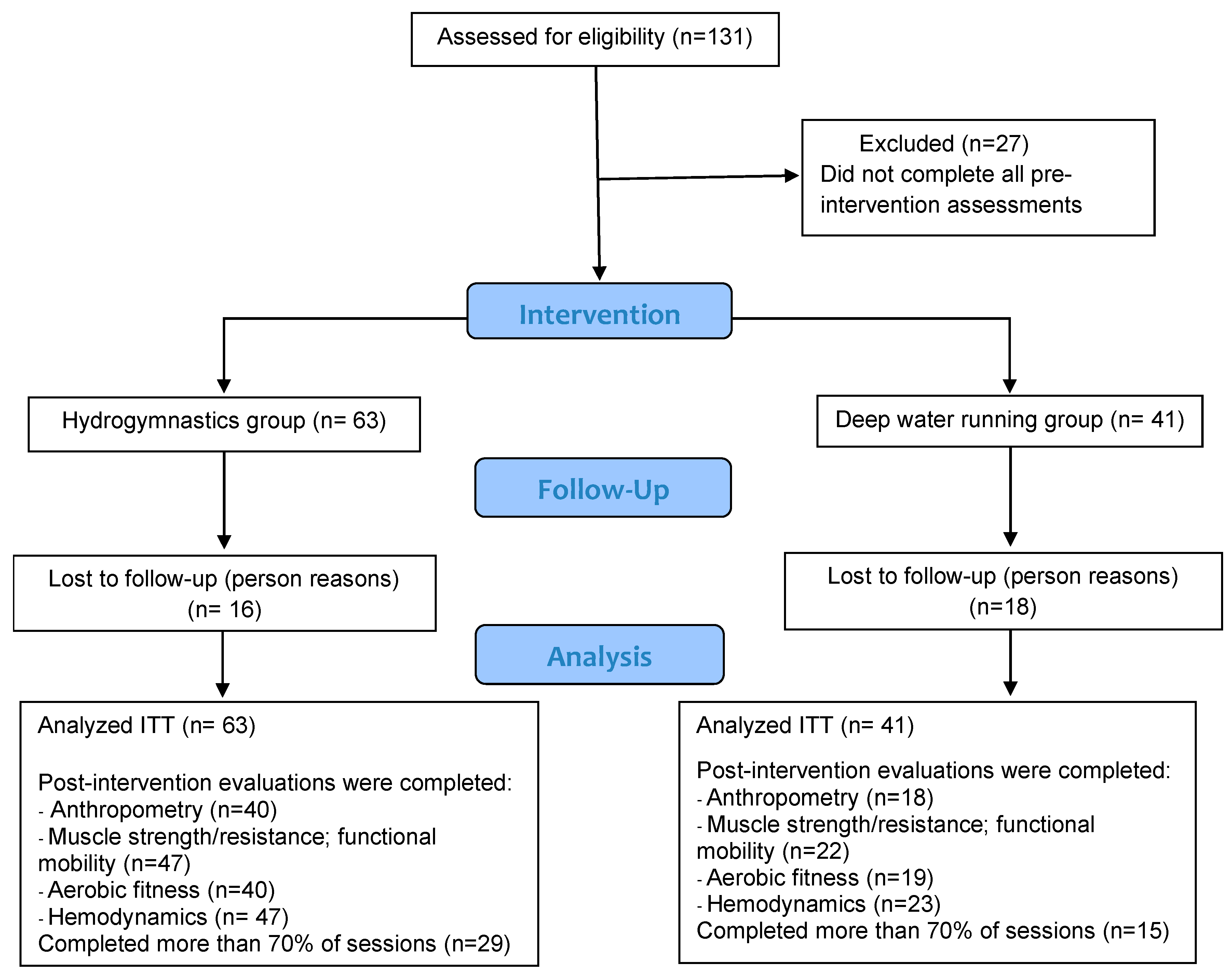

Table 1.
Periodization model.
| Mesocycle | Weeks | Mondays (continuous) |
Wednesday (pyramid) |
Duration main part |
|---|---|---|---|---|
| I | 1-4 | RPE 11 | 6x RPE 11-13-15 (3:2:1) | 36 minutes |
| II | 5-9 | RPE 11 | 7x RPE 11-13-15 (3:2:1) | 42 minutes |
| III | 10-12 | RPE 13 | 7x RPE 13-15-17 (3:2:1) | 42 minutes |
Note: RPE: Rating of perceived exertion. The information between parentheses is time in minutes in each intensity.
Table 2.
Characterization of the participants (n=104).
| Variables | HYD (n=63) | DWR (n=41) | p value |
|---|---|---|---|
| Age (years) | 59 (47 – 65) | 53 (41 – 64) | 0.329 |
| Sex (female) | 54 (85.7%) | 33 (80.5%) | 0.665 |
| Diabetes mellitus | 3 (4.7 %) | 3 (7.3%) | 0.676 |
| Dyslipidemia | 16 (25.3%) | 13 (31.7%) | 0.869 |
| Systemic arterial hypertension | 18 (28.5%) | 10 (24.4%) | 0.657 |
| Practice of other physical exercises | 31 (49.2%) | 22 (53.6%) | 0.902 |
| ACE inhibitors | 4 (6.3%) | 4 (9.8%) | 0.524 |
| ANG-II antagonist | 9 (14.3%) | 1 (2.4%) | 0.045 |
| Antidepressant | 8 (12.7%) | 5 (12.5%) | 0.940 |
| Antiepileptics | 3 (4.8%) | 2 (4.9%) | 0.978 |
| Antipsychotics | 3 (4.8%) | 1 (2.4%) | 0.547 |
| Antirheumatic | 3 (4.8%) | 0 (0.0%) | 0.156 |
| Beta-blocker | 4 (6.3%) | 1 (2.4%) | 0.362 |
| Biguanide antidiabetics | 1 (1.6%) | 1 (2.4%) | 0.757 |
| Diuretics | 3 (4.8%) | 3 (7.3%) | 0.585 |
| Hmg-Coa reductase inhibitors | 4 (6.3%) | 3 (7.3%) | 0.847 |
| Non-Barbiturates Sedative/Hypnotics | 1 (1.6%) | 1 (2.4%) | 0.757 |
| Proton pump inhibitors | 2 (3.2%) | 2 (4.9%) | 0.659 |
| Statins | 7 (11.1%) | 2 (4.9%) | 0.269 |
| Thyroid preparations | 15 (23.8%) | 6 (14.6%) | 0.255 |
Note: DWR: deep water running group; HYD: hydrogymnastics group. Continuous non-parametric data is presented as median and interquartile range (P25-P75). Categorical data is presented as absolute frequency (sample n) and relative frequency (%).
Table 3.
Effects of 12 weeks of hydrogymnastic and deep-water running on health outcomes in adults of middle-age.
Table 3.
Effects of 12 weeks of hydrogymnastic and deep-water running on health outcomes in adults of middle-age.
| Outcomes (Analysis) | Group (n) | Baseline ± se |
12 weeks |
Δ (CI95%) |
Value p | ||
|---|---|---|---|---|---|---|---|
| g | t | g*t | |||||
| Anthropometric measurements | |||||||
| Body mass (ITT) |
HYD | 72.39±1.98 | 70.30±2.33 | -2.00 (-5.21;1.02) | 0.611 | 0.710 | 0.134 |
| DWR | 73.40±2.31 | 74.80±3.51 | 3.36 (-3.11; 10.07) | ||||
| Body mass (PP) |
HYD (n=46) | 72.65±2.84 | 73.27±2.90 | 0.62 (-0.47;1.72) | 0.990 | 0.879 | 0.351 |
| DWR (n=24) | 73.11±5.57 | 72.66±4.83 | -0.44 (-2.41;1.51) | ||||
| Body mass index (ITT) |
HYD | 27.57±0.65 | 28.43±1.36 | 0.85 (-1.30;3.00) | 0.825 | 0.236 | 0.925 |
| DWR | 27.35±0.76 | 28.08±1.15 | 0.72 (-0.75;2.21) | ||||
| Body mass index (PP) |
HYD (n=46) | 27.70±1.12 | 27.89±1.10 | 0.19 (-0.19;0.58) | 0.882 | 0.832 | 0.426 |
| DWR (n=24) | 27.59±1.46 | 27.48±1.24 | -0.11 (-0.76;0.53) | ||||
| Waist circumference (ITT) |
HYD | 94.10±1.80 | 87.98±2.19* | -6.11 (-9.21; -3.00) | 0.802 | 0.042 | 0.020 |
| DWR | 91.56±1.96 | 91.98±2.98 | 0.41 (-4.12;4.95) | ||||
| Waist circumference (PP) |
HYD (n=46) | 94.78±2.79 | 91.43±2.88* | -3.35 (-5,86; -0.83) | 0.853 | 0.001 | 0.393 |
| DWR (n=24) | 93.22±3.73 | 91.27±3.78* | -1.95 (-3.93; 0.03) | ||||
| Waist-to-Height Ratio (ITT) | HYD | 0.58±0.01 | 0.54±0.01* | -0.04 (-0.05; -0.01) | 0.923 | 0.084 | 0.028 |
| DWR | 0.56±0.01 | 0.56±0.01 | 0.00 (-0.02;0.03) | ||||
| Waist-to-Height Ratio (PP) | HYD (n=46) | 0.58±0.01 | 0.56±0.01* | -0.02 (-0.03; -0.00) | 0.857 | 0.001 | 0.335 |
| DWR (n=24) | 0.57±0.02 | 0.56±0.02* | -0.01 (-0.02;0.00) | ||||
| Functional Fitness | |||||||
| 30-s chair-stand (ITT) |
HYD | 16.44±0.56 | 17.61±0.77 | 1.17 (-0.22;2.57) | 0.405 | 0.060 | 0.633 |
| DWR | 15.95±0.64 | 16.64±0.84 | 0.68 (-0.73;2.11) | ||||
| 30-s chair-stand (PP) |
HYD (n=29) | 17.13±0.86a | 18.17±0.78*a | 1.03 (-0.02;2.09) | 0.014 | 0.001 | 0.301 |
| DWR (n=13) | 14.30±0.72b | 16.30±0.59*b | 2.00 (0.50;3.49) | ||||
| 30-s arm curl (ITT) |
HYD | 19.52±0.57 | 23.88±0.67* | 4.35 (3.14;5.57) | 0.820 | <0.001 | 0.562 |
| DWR | 19.70±0.55 | 23.29±1.19* | 3.58 (1.27;5.89) | ||||
| 30-s arm curl (PP) |
HYD | 19.44±0.73 | 24.24±0.68* | 4.79 (3.53;6.05) | 0.663 | <0.001 | 0.455 |
| DWR | 19.53±1.23 | 22.92±1.79* | 3.38 (-0.08; 6.85) | ||||
| TUG-h (ITT) |
HYD | 8.17±1.99 | 7.70±0.17 | -0.46 (-0.80; -0.12) | 0.888 | 0.496 | 0.257 |
| DWR | 7.92±0.16 | 8.03±0.48 | 0.11 (-0.83; 1.06) | ||||
| TUG-h (PP) |
HYD (n=29) | 7.89±0.27 | 7.74±0.18 | -0.15 (-0.83;0.53) | 0.498 | 0.762 | 0.744 |
| DWR (n=13) | 7.62±0.20 | 7.62±0.35 | 0.00 (-0.63;0.64) | ||||
| TUG-m (ITT) |
HYD | 6.74±0.17 | 6.15±0.17* | -0.58 (-0.80; -0.36) | 0.450 | 0.131 | 0.027 |
| DWR | 6.57±0.12 | 6.68±0.30 | 0.11 (-0.46; 0.69) | ||||
| TUG-m (PP) |
HYD (n=29) | 6.59±0.23 | 6.18±0.21* | -0.40 (-1.05;0.24) | 0.826 | 0.019 | 0.762 |
| DWR (n=13) | 6.70±0.19 | 6.17±0.22* | -0.52 (-0.95; -0.09) | ||||
| 6-Minute walk test (ITT) | HYD | 543.75±16.10a | 603.52±8.60*a | 59.77 (29.09; 90.44) | 0.040 | <0.001 | 0.468 |
| DWR | 493.54±24.17b | 574.94±16.15*b | 81.40 (31.63; 131.17) | ||||
| 6-Minute walk test (PP) | HYD (n=25) | 591.18±13.67 | 604.80±9.87* | 13.62 (-13.25;40.49) | 0.153 | 0.022 | 0.109 |
| DWR (n=12) | 512.75±47.03 | 589.99±20.53* | 77.24 (4.21;150.27) | ||||
| Hemodynamic | |||||||
| Systolic Blood Pressure (ITT) |
HYD | 109.32±2.46 | 114.00±2.49* | 4.68 (-0.44; 9.80) | 0.567 | 0.036 | 0.563 |
| DWR | 108.73±1.97 | 111.39±2.39* | 2.65 (-1.91; 7.22) | ||||
| Systolic Blood Pressure (PP) |
HYD (n=29) | 112.79±2.67 | 114.29±3.34 | 1.49 (-5.01;2.02) | 0.646 | 0.507 | 0.719 |
| DWR (n=13) | 111.66±2.32 | 112.11±2.57 | 0.44 (-4.07;4.95) | ||||
| Diastolic Blood Pressure (ITT) |
HYD | 72.55±1.18 | 75.20±1.42 | 2.65 (0.51; 4.79) | 0.270 | 0.240 | 0.072 |
| DWR | 72.32±1.26 | 71.77±1.43 | -0.55 (-3.33; 2.21) | ||||
| Diastolic Blood Pressure (PP) |
HYD (n=29) | 74.89±1.83 | 75.58±2.02 | 0.68 (-0.98;2.35) | 0.239 | 0.513 | 0.177 |
| DWR (n=15) | 73.37±1.96 | 71.41±1.50 | -1.96 (-5.43;1.49) | ||||
| Resting Heart Rate (ITT) |
HYD | 75.95±1.44 | 76.24±1.73 | 0.28 (-2.12;2.70) | 0.968 | 0.059 | 0.030 |
| DWR | 78.10±1.50 | 73.92±1.71* | -4.18 (-7.42; -0.94) | ||||
| Resting Heart Rate (PP) |
HYD (n=29) | 76.93±1.91 | 77.94±2.03 | 1.00 (-1.05;3.07) | 0.305 | 0.028 | 0.002 |
| DWR (n=13) | 77.43±3.02 | 71.25±2.02* | -6.17 (-10.31; -2.04) | ||||
Note: DWR: deep water running group; HYD: hydrogymnastics group; ITT: intention-to-treat analysis; PP: per-protocol analysis; Data are presented as mean ± standard error; Intra and intergroup comparisons were performed using generalized estimation equations with Bonferroni post hoc; *: significant intra-group differences. Different letters indicate a difference between the groups
Disclaimer/Publisher’s Note: The statements, opinions and data contained in all publications are solely those of the individual author(s) and contributor(s) and not of MDPI and/or the editor(s). MDPI and/or the editor(s) disclaim responsibility for any injury to people or property resulting from any ideas, methods, instructions or products referred to in the content. |
© 2024 by the authors. Licensee MDPI, Basel, Switzerland. This article is an open access article distributed under the terms and conditions of the Creative Commons Attribution (CC BY) license (http://creativecommons.org/licenses/by/4.0/).
Copyright: This open access article is published under a Creative Commons CC BY 4.0 license, which permit the free download, distribution, and reuse, provided that the author and preprint are cited in any reuse.


