

Submitted:
08 December 2024
Posted:
10 December 2024
You are already at the latest version
Abstract
The concepts of Sustainable development, Triple Bottom Line and ESG have a strong influence on the process of formation and operation of supply chains today. This requires the implementation of various green solutions and practices to improve supply chain sustainability. The analysis conducted of supply chain research has not revealed a universally accepted methodology to systematize green solutions and practices for their effective use in chain management. It was revealed that there are many views on the content of green solutions, insufficient specificity of their description, as well as fragmentation of the use of green solutions in relation to the elements and functions of supply chains (procurement, production, warehousing, transportation, distribution). This reduces the effectiveness of green solutions' implementation. In this study, based on the literature review, a classification of currently existing green solutions and practices is made. The classification is done according to the affiliation of supply chain elements and the functions performed by the elements to promote and process the material flow from supplier to consumer. The proposed system of methods (GLM) and instruments (GLI) of green logistics covers all known functional areas of logistics and includes 27 methods and 105 instruments. The paper performs a ranking of methods and instruments using TOPSIS, MABAC and MARCOS methods. The most and least significant GLM and GLI for each element of the supply chain, as well as for chains of complex structure in general, are determined. The results of GLM and GLI ranking can be used as a basis for the implementation of management decisions to improve the sustainability of supply chains.
Keywords:
green logistics
; green supply chain
; green practices
; green solution
; instruments
; methods
; MCDM
; ranking
1. Introduction
The functioning of supply chains a set of processes of procurement, production, and distribution of material flows to the final consumer. The classical concept of supply chain management synthesizes the tasks of logistics – minimization of total costs in the chain, operational management – effective inventory and production management, marketing - focus on creating value for the customer [1]. However, the intensive spread of such concepts as Sustainable development, Triple Bottom Line, ESG (Environmental, Social, Governance) all over the world is changing views and approaches to supply chain management. Along with the economic benefits of companies, the policy of people's welfare and environmental protection are an integral part of supply chains management (SCM) nowadays [2]. Companies around the world are implementing green practices in supply chain management, trying to transform supply chains into sustainable supply chains or green supply chains. National governments and company management are implementing various programs and projects to achieve sustainability goals. Green or sustainable supply chain management is one of the most relevant topics in modern research of operations management, logistics, and sustainability [2,3].
The analysis of papers in the field of green or sustainable supply chain management shows an increase in the number of scientific papers devoted to theoretical and practical problems of implementing green practices. The existing approaches can be divided into two groups. The first one is related to the research of supply chains as a single system [4,5,6], the second one is related to the research of individual green operations [7] or elements of supply chains. The latter include, for example, studies of sustainable supply [8,9], sustainable production [10,11], sustainable warehousing [12,13], sustainable transportation [14,15], sustainable consumption [16]. One of the key research questions is the challenges of implementing green solutions and practices in logistics. Such practices encompass the integration of sustainable approaches into forward and reverse logistics operations to promote balanced social, environmental and economic performance [3].
The main objective of our study is to categorize the currently used green solutions and practices in logistics activities to develop a universal system of green logistics instuments. This study makes both theoretical and practical contributions to the field of green logistics and green supply chain management. Firstly, based on the analysis of scientific publications and structural-functional approach, we have identified green solutions and practices and developed a universal system of green logistics methods and instruments. The main idea of the classification is to compare and group different green solutions and practices with the functions of structural (logistics) elements of green supply chains. Second, we developed a methodology to rank green logistics instruments in the supply chain using multi-criteria decision-making (MCDM) techniques. This methodology will help stakeholders make effective decisions to implement green logistics methods and instruments in supply chain elements based on the ranking of instruments.
The rest of the paper is as follows. The next section contains the literature review. The third section describes the methodology for systematization and ranking of green logistics methods and instruments. The fourth section presents a computational case study of the implementation of the proposed methodology. The last section contains the main results and directions for future research.
2. Literature Review
To understand the terminology used in relation to green practices in logistics and to identify the most common keywords, we used a combination of keywords to search for review articles in Scopus: “Practices” AND “Review” AND “Green AND supply AND chains” OR “Green AND Logistics” in their titles, abstracts, or keywords (Figure 1).
The analysis of articles indicated that different terms are used in the research in relation to green practices: Criteria, GSCM practices, Factors, Measures, Green logistics practices, Activities, Initiatives, Drivers, Practices, Green practices, Green activities, Decision, Attributes, Sustainable practices, Solution, Policies, GSCM initiatives, Green logistics activities, Green initiative.
We have analyzed review papers in which the authors have attempted to group and systematize various green solutions and practices as applied to supply chain and logistics activities.
The paper [17] compares green and lean practices on supply chain management performance. The authors grouped 17 practices into two groups and presented their brief characterization of the practices. The 14 solutions are grouped into 4 types of activities: Green office, Inventory control and material handling, Green warehousing and Green transportation [18]. The authors in [19] identified three levels of dimensions and categories for different green activities and operations aimed at improving the efficiency of green logistics. The authors grouped 18 green activities and operations into three categories - Network design, Product & Inventory, Reverse logistics. In the studies [20], the authors grouped 36 activities/practices for all activities in the supply chain such as raw material procurement, inbound logistics, transformation, outbound logistics, marketing, after-sales and appropriate product disposal.
The reviews [5,21] present a list of 58 green supply chain practices that are grouped into 16 aspects of green supply chain management (GSCM): reverse logistics, industrial symbiosis, eco-innovation practices, green information technology and systems, green design, carbon management, supplier environmental collaboration, customer environmental collaboration, ISO 14001 certification, internal management, green purchasing, green manufacturing, green packaging, green logistics, green outsourcing, green warehousing. The authors [4] analyzed the frequency of GSCM practices in the scientific papers. They identified 46 different practices. The five most frequently mentioned are green purchasing/procurement, collaboration/cooperation with customers, internal GSCM practices/environmental management, green/eco-design, investment recovery. Another [22] paper identifies the major research fields in circular supply chain management and calculates the frequency of mentioning 25 alternative solutions in scientific publications. The paper [3] points out two approaches in the existing research: green logistics practices can be considered as a composite construction for improving sustainability, or publications focus on individual practices. As an example, the authors identify 33 green logistics practices: green manufacturing, green marketing, green consumption, green reverse logistics, green transportation, green communication, information sharing, logistics emissions, green warehouse, green packaging, green vehicle technologies, alternative fuels, eco-driving, green transport management, green logistics systems, green modal shift, eco-friendly technologies, environmental standards, green administration and logistics data management, sustainable waste management, eco-friendly transportation, waste reduction, energy-efficient operations, sustainable transport, green ware housing and building, eco-design, green purchasing, reverse logistics, responsive packaging, green monitoring and evaluation, sustainable information sharing, sustainable packaging and distribution, waste management.
In another literature review [23], all articles are categorized into two groups of mitigation actions and adaptation actions and include 7 green actions to improve environmental sustainability in third-party logistics service providers. The paper [24] attempts to identify the determinants (motivations, pressures, and incentives) and modalities (practices conducting greening transportation from shippers and logistics service providers (LSPs)) standpoint. Based on a review of publications, the authors identified 14 green logistics practices and described them. According to the authors, these practices are green modal shifts, green transportation management, green logistics systems, green vehicle technologies, eco-driving, alternative fuels, environmental management systems (EMS), reverse logistics, green administration, green packaging, green warehousing, emission data, cooperation with shippers, choice of partners.
Another literature review [25] explores the relationship between GSCM pressures, practices, and performance. The authors grouped the literature on GSCM practices — eco-design, internal environmental management, waste management, green purchasing aspect, quality, and product recovery. The authors [26] studied the relationship between Green Human Resource Management practices and Green Supply Chain Management practices.
In the systematic review [13], the papers on green practices is grouped into three macro themes: the green warehouse management, the environmental impact of warehouse construction, and the energy saving in warehousing. In the paper [14], the literature on sustainable transportation is classified into 6 decisions — network design, profit sharing, inventory, distribution organization and routing. The study [12] focuses on sustainable inventory management in green supply chains. The authors considered 25 solutions to improve the sustainability of inventory management. The paper [27] considers Industry 4.0 technologies divided by GSC aspects. The authors grouped 10 green practices into 5 aspects — reverse logistic, green design, green manufacturing, carbon emissions management and green warehousing.
In several research studies, the authors do not consider green practices as activities, but as criteria against which to evaluate individual logistics processes to improve the sustainability of the supply chain. For example, when evaluating suppliers (12 practices) [28], green practices and initiatives for sustainable hotel operations (27 attributes of green practices and initiatives for sustainable hotel operations) [29]; to assess green supply chain management (13 criteria and 79 sub-criteria) [30]; to assess the feasibility of implementing Industry 4.0 technologies in sustainable supply chains (17 criteria and 59 attributes) [31].
A review of research on the use of green practices in logistics and supply chain management revealed the following problem.
Multiple views on the content of green solutions and, consequently, insufficient systematic implementation in supply chains.
Different understanding and interpretation of green practices.
Insufficient specificity of green solutions and practices (lack of description in 71% of publications).
Fragmented use of green solutions and practices in relation to elements and functions of supply chains (procurement, production, warehousing, transportation, distribution).
3. Methodology for Systematization and Ranking of Green Logistics Methods and Instruments
The proposed methodology is based on the structural-functional approach to the green supply chain formalization. This approach defined the principles of green logistics methods and instruments systematization. Multi-criteria decision-making methods are used to rank the methods and instruments. MCDM and a system of criteria for evaluating logistics flows, the achievement of which ensures the fulfillment of sustainable supply chain development goals, are applied for ranking.
3.1. Structural-Functional Approach to the Green Supply Chain Formalization
The structural-functional approach involves the identification of supply chain-based logistics functions and the identification of corresponding abstract logistics elements. The basic logistics functions are proposed to include the following main actions with logistics flows (a) acceleration and movement, (b) deceleration and accumulation, (c) quality change and processing, (d) input into the system, (e) output from the system, and (f) coordination of logistics functions. The relevant logistics elements realizing these basic functions are (a) transport, (b) cumulative, (c) processing, (d) input, (e) output, and (f) control. The basic functions of each logistics element or supply chain element are concretized by a set of so-called supporting functions, i.e. specific actions to change the parameters of logistics flows.
With the help of a combination of abstract logistic elements realizing the corresponding basic and supporting functions, it becomes possible to model any real infrastructural element of the supply chain. It becomes possible to formalize supply chains or logistics systems at any level of detail.
The structural-functional approach is fundamentally different from the generally accepted way of identifying functional areas of logistics, such as transportation, sales, production, supply and warehousing logistics. The disadvantage of the traditional functional approach is the “binding” of logistics functions and operations to infrastructural elements of logistics chains – warehouses, industrial enterprises, supply and sales departments, transportation. This makes it difficult to identify and systematize the methods and instruments of logistics flow management, since the same method or instrument can be implemented in different functional areas of logistics [32].
The model of the green supply chain (GSC) formed using the structural-functional approach is presented in Figure 2. The GSC model is a set of logistics elements linearly ordered along with the material and accompanying financial, information and work (sevice) flow. Achievement of sustainable development goals is ensured as a result of fulfillment by each GSC element of its supporting functions with the help of green logistics methods and instruments Figure 3.
3.2. Classification of Green Logistics Methods and Instruments
The study of scientific literature has allowed us to establish that different terminology is used in relation to solutions to reduce negative environmental impact in logistics. The most common terms are “green practices”, “GSCM practices”, “green factors”, “green measures”, “green activities”, “green initiatives”, “green drivers”, “solution”, etc.
We propose to use the terms “green logistics methods” and “green logistics instruments” as generalized concepts for various green solutions in the field of logistics activities. The main purpose of implementation of green logistics methods and instruments is to identify and eliminate deviations of their parameters that hinder the achievement of Sustainable Development Goals (SDGs).
In the previous paper [33], we proposed a system of green logistics methods and instruments. This system consists of 27 methods and 105 instruments. We have established what specific SDGs are achieved by the realization of each method and instrument. Subsequent studies [32,34,35,36,37,38] allowed us to clarify, adjust and extend the original system by a detailed description of each instrument.
The classification of methods and instruments presented in this study is made using the following classification features:
- Correspondence to the elements of the supply chain to avoid duplication of methods and instruments at different stages of the logistics process, as well as to identify missing and promising methods and instruments.
- Correspondence to supporting functions of supply chain elements. Traditionally, logistics functional areas are focused on cost reduction and quality improvement. Specialization of green logistics methods and instruments by supporting functions is necessary to achieve social and environmental goals additionally.
- Correspondence of instruments to the green logistics methods, i.e., realization of a certain method by a set of instruments.
In addition, the proposed classification is based on the following principles:
- Consideration of green logistics methods and instruments as a unified system for achieving SDGs. The object of management is logistics flows in the supply chain.
- Using the best green practices, eco-programs and projects with the participation of political, social and economic institutions, scientific organizations, international unions and organizations to form and improve the system of green logistics methods and instruments.
Thus, we propose the following concepts:
- Green Logistics Method (GLM) – a set of solutions to achieve the SDGs by realizing the basic and supporting logistics functions of a certain element of the logistics system or supply chain.
- Green Logistics Instruments (GLI) – a specific solution for changing the parameters of logistics flows to implement the corresponding green logistics method.
3.3. Multi-Criteria Ranking of Green Logistics Methods and Instruments
A GLM and GLI system can consist of multiple methods and instruments specialized by logistics elements and functions. Different elements of the supply chain may have different objectives in changing the parameters of logistics flows by GLM and GLI. Therefore, ranking and selection of GLM and GLI is proposed to be done using multi-criteria decision-making (MCDM) techniques.
The methodology for multi-criteria assessment and ranking of GLMs and GLIs consists of the following steps:
Step 1. Design a list of methods and instruments based on the results of analyzing scientific papers in the field of green solutions and practices as applied to supply chains.
Step 2. Formation of GLM and GLI system with observance of classification attributes and principles presented in Section 3.2. Grouping GLM by supporting functions of logistics elements. Grouping of GLIs by GLM compliance.
Step 3. Selection of criteria system and formation of a set of multi-criteria models for GLM and GLI ranking.
We propose to use estimates of logistic flow parameters (Figure 4) as a system of criteria. This choice is based on the ultimate influence of instruments on these parameters, as a result of which the achievement of the SDGs is ensured. A detailed description of the selected two-level criteria system is presented in [32,39]. The set of multi-criteria models includes one GLM ranking model for the entire supply chain and six GLI ranking models, one for each logistics element.
Step 4. Formation of an expert group, preparation of questionnaires for GLM and GLI assessment using a system of criteria. The expert group should include representatives of the academic community, as well as businesses in the field of logistics and supply chain management. It is desirable that the experts' qualifications allow them to adequately assess the importance of methods and instrumentss for different elements of the supply chain.
Step 5. Calculation of weights of criteria for evaluation of green logistics methods and instruments. Since impacts on different parameters of logistics flows using GLM and GLI have different impacts on the achievement of SDGs, it is necessary to calculate the weights of criteria for assessing logistics flows. The most common methods for calculating criteria weights in green supply chains are AHP, ANP, BWM, CRITIC, DEMATEL, FUCOM and others [38]. The input data for calculations using these methods are expert estimates of criteria weights. Multiple scales can be used to improve the accuracy of the estimation, for example with fuzzy, rough and gray numbers.
Step 6. Obtaining expert evaluations of alternatives. Assessment can be done using a variety of scales. Formation of initial decision-making matrices for ranking methods (1) and instruments (2) considering the criteria weights. The initial matrices in general form have the following.
where M = {M1, M2 …Mm} – green logistics methods; m – number of methods; I = {I1, I2 …Ik} – green logistics instruments; k – number of instruments; C = {C1, C2 …Cn} – criteria of logistics flows; n – number of criteria; w = {w1, w2 …wn} – weight of criteria; xij or xgj – respectively the evaluation value of i – method and g – instruments according to j – criterion C.
Step 7. Multi-criteria ranking of green logistics methods and instruments using MCDM. The selection of a specific MCDM is necessary in this step. MCDMs differ in their data aggregation methods and algorithms, accuracy of results, and computational labor intensity. Common methods for ranking green supply chain solutions are SAW, TOPSIS, PROMETHEE, COPRAS, ARAS, WASPAS, EDAS, MABAC, CODAS, MARCOS, etc. [37].
Step 8: Sensitivity analysis of the ranking results. The results obtained using one of the selected MCDMs are compared with those calculated by other multi-criteria methods. The ranked GLMs and GLIs are used by decision makers to align sustainability programs and projects across all elements of the supply chain.
4. Case Study
This section presents an example of ranking green logistics methods and instruments. In the first step, we analyzed 184 research papers on the use of various green solutions and practices in supply chains. The identified green solutions and practices are grouped according to the supporting functions of green supply chain elements. The results of the research analysis are presented in Table 2.
Figure 6, Figure 7, Figure 8, Figure 9, Figure 10 and Figure 11 shows the results of systematization of green logistics methods and instruments separately for each logistic element. The corresponding elements are highlighted in color. A detailed description of each green logistics instrument is given in Table 3, Table 4, Table 5, Table 6, Table 7 and Table 8. The names of the instruments are close to the formulations of traditional logistics support functions and tasks. However, from the perspective of green logistics, they should be considered as methods and instruments for achieving sustainable development goals. These goals are indicated in the figures by the corresponding well-known pictograms [204].
Seven MCDM models are formed to rank green logistics methods and instruments.
1. Supply chain model (27 methods — M1.1-M6.5).
2. Control element model (21 instruments — I1.1.1-I1.5.4).
3. Input element model (14 instruments — I2.1.1-I2.4.5).
4. Processing element model (17 instruments — I3.1.1-I3.5.4).
5. Cumulative element model (17 instruments — I4.1.1-I4.4.4).
6. Transport element model (18 instruments — I5.1.1-I5.4.4).
7. Output element model (18 instruments — I6.1.1-I6.5.4).
A system of 15 logistics flow criteria is used to evaluate green logistics methods and instruments. The weight values of the criteria of logistic flows are taken from [205]. Fuzzy Analytic Hierarchy Process (Fuzzy AHP) is used to evaluate the weight of criteria.
A group of five academic experts in the field of Supply chain management, transport systems, Logistics was formed to perform the assessment. The average length of service of the experts is 25.4 years. The experts evaluated the impact of green logistics methods and instruments on logistics flow criteria on a five-point scale: 1 – very low, 2 — low, 3 — medium, 4 — high, 5 — very high. The results of expert assessments are presented in Table 10.
For ranking green logistics methods and instruments, we used MCDM methods Technique for Order Preference by Similarity area Comparison Ideal Solution (TOPSIS), Multi-Attributive Border Approximation Area Comparison (MABAC) and Measurement of Alternatives and Ranking according to Compromise Solution (MARCOS). These methods are widely used for multi-criteria evaluation of various aspects of sustainable and green supply chains. The main steps of each method can be found in [206,207,208].
Table 11, Table 12, Table 13, Table 14, Table 15, Table 16 and Table 17 and Figure 12, Figure 13, Figure 14, Figure 15, Figure 16, Figure 17 and Figure 18 present the ranking results. Sensitivity assessment of the ranking results was performed based on the calculation of Spearman rank correlation coefficient. The average correlation coefficient was for MCDM model of green logistics methods – 0.984. For MCDM model of green logistics instruments: Control element – 0.982; Input element – 0.947; Processing element – 0.979; Cumulative element – 0.983; Transport element – 0.974; Output element – 0.980. The values of the coefficients show a high correlation, which indicates the reliability of the results obtained.
Additionally, we calculated the value of the Mean Relative Error of the Ranking results (MRER) for each MCDM model using the following formula/
where Ril – rank of the i-th alternative (GLM or GLI), calculated by the l-th method, M – number of alternatives, L – number of ranking methods, L ≥ 3.
The MRER values for GLM were 1.135. The MRER values for GLI: Control element — 1.015; Input element — 0.904; Processing element — 0.901; Cumulative element — 0.745; Transport element — 0.814; Output element — 0.851. The calculated MRER values show the minimum deviation in the ranks obtained in the evaluation by different methods.
The two most significant green logistics methods are M2.4 Procurement planning, implementation and control (rank #1), M5.3 Transportation management and transportation planning (rank #2). Rank #3 is assigned to two green logistics methods — M1.4 Design and implementation of intelligent transportation system (MABAC, MARCOS assessment) and M3.4 Process flow management (TOPSIS assessment). The three least significant green logistics methods are M4.1 Environmental design of warehouse complexes (rank #27), M4.2 Use of environmentally acceptable handling equipment and vehicles (rank #26). Rank #25 is assigned to three green logistics methods — M1.1 Environmental management (TOPSIS score), M3.5 Human resource management (MARCOS score) and M5.2 Selection of environmentally friendly vehicles (MABAC score).
Ranking the green logistics instruments separately by supply chain elements allowed us to establish the most important instruments (Rank #1): I1.5.2 Electronic data interchange (Control Element), I2.4.1 Minimization of procurement volume (Input Element), I3.4.1 Optimization of process flow parameters (Processing Element), I4.4.4 Unification of batch shipment (Cumulative Element), I5.2.1 Vehicles with the least environmental impact (Transportation Element), I6.3.1 Selection of green distribution channels (Output Element).
Green logistics instruments with the lowest rank: I1.4.1. Data Mining techniques and I1.4.3. Situational management techniques (Control Element), I2.2.1. Selection of environmentally friendly raw materials (Input element), I3.4.3. Production according to eco design requirements (Processing element), I4.4.2. Operational control of inventory management system parameters (Cumulative Element), I5.3.6. Reduction of return empty mileage (Transport Element), I6.1.3. Analysis of the distribution system in terms of environmental impact, and I6.3.4. Location of distribution centers with minimal environmental impact (Output Element).
5. Conclusions
The methodology of classification and ranking of methods and instruments of green logistics in supply chains is presented. The peculiarity of the proposed approach is the consideration of the supply chain as a universal model of six elements (Control, Input, Processing, Cumulative, Transport, and Output) each of which implements all known functional areas of logistics for the promotion and processing of material flow. Each element performs a set of supporting functions peculiar only to it. To improve the sustainability of the supply chain, the performance of supporting functions by elements should be based on the implementation of methods and instruments of green logistics.
Based on the literature review, the classification of currently existing green solutions and practices by supporting functions of supply chain elements is performed. A universal system of green logistics methods and instruments is proposed, and definitions of each instrument are given. This system includes 27 methods and 105 instruments.
The system of criteria for assessing logistics flows is used as criteria for the effectiveness of the implementation of green logistics methods and instruments. The implementation of green logistics instruments has an impact on the criteria of logistics flows and allows achieving the goals of sustainable development of supply chains. To assess the impact of green logistics methods and instruments on the criteria of logistics flows, it is proposed to use multi-criteria decision-making methods.
Ranking green logistics methods and instruments using MCDM methods was performed. Fuzzy AHP was used to estimate the weight of criteria of logistic flows. TOPSIS, MABAC and MARCOS methods were used to rank the methods and instruments. The ranking results by different MCDM showed high convergence — The average Spearman rank correlation coefficient was 0.975, the value of the Mean Relative Error of the Ranking results was 0.909.
The most significant methods of green logistics are “Procurement planning, execution and supply controlling”, “Transport management and transport planning” “Development and implementation of intelligent transport system” and “Technological flows management”. The most significant instruments of green logistics in the supply chain elements are: “Electronic Data Interchange” (Control element), “Minimization of purchasing volume” (Input element), “Optimization of technological flows’ parameters” (Processing element), “Unitization of party shipment” (Cumulative element), “Vehicles with the least impact on the environment” (Transport element), “Selection of environmentally friendly distribution channels” (Output element).
Thus, we proposed considering the developed system of green logistics methods and instruments as a universal framework for the implementation of management decisions to improve supply chain sustainability. The limitation of this study is the small number of experts involved in the evaluation of the ranking of methods and instruments, which does not allow the results to be interpreted for global supply chains. An important direction for future research is to evaluate and rank methods and instruments, considering the constraints on available resources for effective implementation of GLM and GLI in supply chains.
Author Contributions
Conceptualization, A.R. and N.O.; methodology, A.R. and N.O.; software, N.O.; validation, N.O. and A.R.; formal analysis, N.O.; investigation, N.O.; resources, A.R.; data curation, N.O.; writing—original draft preparation, N.O.; writing—review and editing, A.R.; visualization, N.O.; supervision, A.R.; project administration, N.O.; funding acquisition, N.O. and A.R. All authors have read and agreed to the published version of the manuscript.
Funding
The work was carried out with the financial support of the Russian Science Foundation No. 23-21-10038, https://rscf.ru/en/project/23-21-10038/ (accessed on 08 December 2024).
Data Availability Statement
Data is contained within the article.
Acknowledgments
Thanks in advance to the anonymous reviewers for their help with the article.
Conflicts of Interest
The authors declare no conflicts of interest.
References
- Sergeev, V. Supply Chain Management; Publishing House Yurait: Moscow, 2023; ISBN 978-5-534-01356-6. [Google Scholar]
- Chakraborty, A.; Al Amin, M.; Baldacci, R. Analysis of internal factors of green supply chain management: An interpretive structural modeling approach. Cleaner Logistics and Supply Chain 2023, 7, 100099. [Google Scholar] [CrossRef]
- Tetteh, F.K.; Owusu Kwateng, K.; Mensah, J. Green logistics practices: A bibliometric and systematic methodological review and future research opportunities. Journal of Cleaner Production 2024, 476, 143735. [Google Scholar] [CrossRef]
- Bhatia, M.S.; Gangwani, K.K. Green supply chain management: Scientometric review and analysis of empirical research. Journal of Cleaner Production 2021, 284, 124722. [Google Scholar] [CrossRef]
- Tseng, M.-L.; Islam, M.S.; Karia, N.; Fauzi, F.A.; Afrin, S. A literature review on green supply chain management: Trends and future challenges. Resources, Conservation and Recycling 2019, 141, 145–162. [Google Scholar] [CrossRef]
- Lazar, S.; Klimecka-Tatar, D.; Obrecht, M. Sustainability orientation and focus in logistics and supply chains. Sustainability 2021, 13, 3280. [Google Scholar] [CrossRef]
- Tozanli, O.; Duman, G.; Kongar, E.; Gupta, S. Environmentally concerned logistics operations in fuzzy environment: A literature survey. Logistics 2017, 1, 1–42. [Google Scholar] [CrossRef]
- Zhang, L.-J.; Liu, R.; Liu, H.-C.; Shi, H. Green supplier evaluation and selections: A state-of-the-art literature review of models, methods, and applications. Mathematical Problems in Engineering 2020, 2020, 1–25. [Google Scholar] [CrossRef]
- Zimmer, K.; Fröhling, M.; Schultmann, F. Sustainable supplier management – a review of models supporting sustainable supplier selection, monitoring and development. International Journal of Production Research 2016, 54, 1412–1442. [Google Scholar] [CrossRef]
- Malek, J.; Desai, T.N. A systematic literature review to map literature focus of sustainable manufacturing. Journal of Cleaner Production 2020, 256, 120345. [Google Scholar] [CrossRef]
- Roy, V.; Singh, S. Mapping the business focus in sustainable production and consumption literature: Review and research framework. Journal of Cleaner Production 2017, 150, 224–236. [Google Scholar] [CrossRef]
- Becerra, P.; Mula, J.; Sanchis, R. Green supply chain quantitative models for sustainable inventory management: A review. Journal of Cleaner Production 2021, 52, 129544. [Google Scholar] [CrossRef]
- Bartolini, M.; Bottani, E.; Grosse, E.H. Green warehousing: Systematic literature review and bibliometric analysis. Journal of Cleaner Production 2019, 226, 242–258. [Google Scholar] [CrossRef]
- Aloui, A.; Hamani, N.; Derrouiche, R.; Delahoche, L. Systematic literature review on collaborative sustainable transportation: Overview, analysis and perspectives. Transportation Research Interdisciplinary Perspectives 2021, 9, 100291. [Google Scholar] [CrossRef]
- Zhao, X.; Ke, Y.; Zuo, J.; Xiong, W.; Wu, P. Evaluation of sustainable transport research in 2000–2019. Journal of Cleaner Production 2020, 256, 120404. [Google Scholar] [CrossRef]
- Dubey, R.; Gunasekaran, A.; Papadopoulos, T.; Childe, S.J. Green supply chain management enablers: Mixed methods research. Sustainable Production and Consumption 2015, 4, 72–88. [Google Scholar] [CrossRef]
- Carvalho, H.; Garrido Azevedo, S.; Cruz-Machado, V. Supply chain performance management: Lean and green paradigms. International Journal of Business Performance and Supply Chain Modelling 2010, 2, 304–333. [Google Scholar] [CrossRef]
- Hasan, M.M.; Nekmahmud, M.; Yajuan, L.; Patwary, M.A. Green business value chain: A systematic review. Sustainable Production and Consumption 2019, 326–339. [Google Scholar] [CrossRef]
- Zhang, S.; Lee, C.; Chan, H.K.; Choy, K.L.; Wu, Z. Swarm intelligence applied in green logistics: A literature review. Engineering Applications of Artificial Intelligence 2015, 37, 154–169. [Google Scholar] [CrossRef]
- Bülent Sezen; Sibel Yildiz Çankaya. Green supply chain management theory and practices. In Ethics and sustainability in global supply chain management; Akkucuk, U., Ed.; IGI Global: Hershey PA, 2017; pp 92– 114, ISBN 978-1-5225-2036-8.
- Islam, S.; Karia, N.; Fauzi, F.; Soliman, M. A review on green supply chain aspects and practices. Management and Marketing. Challenges for the Knowledge Society 2017, 12, 12–36. [Google Scholar] [CrossRef]
- Lahane, S.; Kant, R.; Shankar, R. Circular supply chain management: A state-of-art review and future opportunities. Journal of Cleaner Production 2020, 258, 120859. [Google Scholar] [CrossRef]
- Evangelista, P.; Santoro, L.; Thomas, A. Environmental sustainability in third-party logistics service providers: A systematic literature review from 2000-2016. Sustainability 2018, 10, 1627. [Google Scholar] [CrossRef]
- Bilek, G.M.; Calvi, R.; Erhel, D.; Mechouar, Y. Towards green transportation practices using a buyer/supplier perspective: A systematic literature review. Logistics 2024, 8, 68. [Google Scholar] [CrossRef]
- Balon, V. Green supply chain management: Pressures, practices, and performance - An integrative literature review. Business Strategy and Development 2019, 3. [Google Scholar] [CrossRef]
- Ahmed, T.; Yousaf, A.; Clavijo, R.C.; Sanders, K. Entrepreneurial pathways to sustainability: A theoretical paper on green human resource management, green supply chain management, and entrepreneurial orientation. Sustainability 2024, 16, 6357. [Google Scholar] [CrossRef]
- Morella, P.; Lambán, M.P.; Royo, J.; Sánchez, J.C.; Latapia, J. Technologies associated with Industry 4. 0 in green supply chains: A systematic literature review. Sustainability 2023, 15, 9784. [Google Scholar] [CrossRef]
- Villanueva-Ponce, R.; Avelar-Sosa, L.; Alvarado-Iniesta, A.; Cruz-Sánchez, V.G. The green supplier selection as a key element in a supply chain: A review of cases studies. DYNA 2015, 82, 36–45. [Google Scholar] [CrossRef]
- Khalil, N.; Che Abdullah, S.N.; Haron, S.N.; Hamid, M.Y. A review of green practices and initiatives from stakeholder’s perspectives towards sustainable hotel operations and performance impact. Journal of Facilities Management 2024, 22, 653–682. [Google Scholar] [CrossRef]
- Sharma, V.K.; Chandna, P.; Bhardwaj, A. Green supply chain management related performance indicators in agro industry: a review. Journal of Cleaner Production 2017, 141, 1194–1208. [Google Scholar] [CrossRef]
- Manavalan, E.; Jayakrishna, K. Manavalan, E.; Jayakrishna, K. A review of internet of things (IoT) embedded sustainable supply chain for Industry 4.0 requirements. Computers & Industrial Engineering 2018. [CrossRef]
- Osintsev, N.; Rakhmangulov, A.; Sładkowski, A.; Dyorina, N. Logistic flow control system in green supply chains. In Ecology in Transport: Problems and Solutions; Sładkowski, A., Ed.; Springer International Publishing: Cham, 2020; pp 311–380; ISBN 978-3-030-42322-3. [Google Scholar]
- Rakhmangulov, A.; Sladkowski, A.; Osintsev, N.; Muravev, D. Green logistics: A system of methods and instruments - Part 2. Naše more 2018, 65, 49–55. [Google Scholar] [CrossRef]
- Osintsev, N.A.; Tsyganov, A.V.; Rakhmangulov, A.N. Mathematical model for optimization of a range of tools for «green» logistics. Herald of the Ural State University of Railway Transport 2023, 98–112. [Google Scholar] [CrossRef]
- Osintsev, N.A.; Rakhmangulov, A.N.; Sladkovski, A.V. A fuzzy AHP-TOPSIS approach for green logistics instruments ranking. Transport of the Urals 2020, 64, 3–14. [Google Scholar] [CrossRef]
- Osintsev, N.A.; Rakhmangulov, A.N. Supply сhain sustainability assessment based on gray relational analysis. Vestnik of Nosov Magnitogorsk State Technical University 2023, 21, 180–196. [Google Scholar] [CrossRef]
- Osintsev, N. Multi-criteria decision-making methods in green logistics. World of Transport and Transportation 2021, 19, 231–240. [Google Scholar] [CrossRef]
- Osintsev, N.; Rakhmangulov, A. Sustainable development of supply chains; INFRA-M: Moscow, 2025; ISBN 978-5-16-019680-0. [Google Scholar]
- Osintsev, N.; Rakhmangulov, A.; Baginova, V. Evaluation of logistic flows in green supply chains based on the combined DEMATEL-ANP method. Facta Universitatis, Series: Mechanical Engineering 2021, 19, 473–498. [Google Scholar] [CrossRef]
- Aliakbari Nouri, F.; Shafiei Nikabadi, M.; OLFAT, L. Sustainable service supply chain practices (SSSCPs): A framework development. International Journal of Productivity and Performance Management 2019, 69, 813–833. [Google Scholar] [CrossRef]
- Behdioglu, S.; Koca, G. Green supply chain initiatives in Turkish automotive main industry. Journal of Strategic Research in Social Science 2017, 3. [Google Scholar] [CrossRef]
- Bhattacharya, A.; Mohapatra, P.; Kumar, V.; Dey, P.K.; Brady, M.; Tiwari, M.K.; Nudurupati, S.S. Green supply chain performance measurement using fuzzy ANP-based balanced scorecard: a collaborative decision-making approach. Production Planning & Control 2014, 25, 698–714. [Google Scholar] [CrossRef]
- Boutkhoum, O.; Hanine, M.; Boukhriss, H.; Agouti, T.; Tikniouine, A. Multi-criteria decision support framework for sustainable implementation of effective green supply chain management practices. Springerplus 2016, 5, 664. [Google Scholar] [CrossRef]
- Brandenburg, M.; Gruchmann, T.; Oelze, N. Sustainable supply chain management - A conceptual framework and future research perspectives. Sustainability 2019, 11, 7239. [Google Scholar] [CrossRef]
- Akman, G.; Pışkın, H. Evaluating green performance of suppliers via analytic network process and TOPSIS. Journal of Industrial Engineering 2013, 2013, 1–13. [Google Scholar] [CrossRef]
- Akcan, S.; Taş, M.A. Green supplier evaluation with SWARA-TOPSIS integrated method to reduce ecological risk factors. Environmental Monitoring and Assessment 2019, 191, 226. [Google Scholar] [CrossRef] [PubMed]
- Anand, K.R.; Ramalingaiah; Parthiban, P. Evaluation of green supply chain factors using DEMATEL. Applied Mechanics and Materials 2014, 592-594, 2619–2627. [CrossRef]
- Awasthi, A.; Chauhan, S.S.; Goyal, S.K. A fuzzy multicriteria approach for evaluating environmental performance of suppliers. International Journal of Production Economics 2010, 126, 370–378. [Google Scholar] [CrossRef]
- Baah, C.; Jin, Z.; Tang, L. Organizational and regulatory stakeholder pressures friends or foes to green logistics practices and financial performance: Investigating corporate reputation as a missing link. Journal of Cleaner Production 2020, 247, 119125. [Google Scholar] [CrossRef]
- Bai, C.; Kusi-Sarpong, S.; Sarkis, J. An implementation path for green information technology systems in the Ghanaian mining industry. Journal of Cleaner Production 2017, 164, 1105–1123. [Google Scholar] [CrossRef]
- Carvalho, H.; Govindan, K.; Azevedo, S.G.; Cruz-Machado, V. Modelling green and lean supply chains: An eco-efficiency perspective. Resources, Conservation and Recycling 2017, 120, 75–87. [Google Scholar] [CrossRef]
- Chin, T.A.; Tat, H.H.; Sulaiman, Z. Green supply chain management, environmental collaboration and sustainability performance. Procedia CIRP 2015, 26, 695–699. [Google Scholar] [CrossRef]
- Chou, Y.-C.; Yang, C.-H.; Lu, C.-H. ; van Dang; Yang, P. -A. Building criteria for evaluating green project management: An integrated approach of DEMATEL and ANP. Sustainability 2017, 9, 740. [Google Scholar] [CrossRef]
- Colicchia, C.; Marchet, G.; Melacini, M.; Perotti, S. Building environmental sustainability: empirical evidence from logistics service providers. Journal of Cleaner Production 2013, 59, 197–209. [Google Scholar] [CrossRef]
- Đalić, I.; Stević, Ž.; Karamasa, C.; Puška, A. A novel integrated fuzzy PIPRECIA – interval rough SAW model green supplier selection. Decision Making: Applications in Management and Engineering 2020, 3, 126–145. [Google Scholar] [CrossRef]
- Darnall, N.; Jolley, G.J.; Handfield, R. Environmental management systems and green supply chain management: Complements for sustainability? Business Strategy and the Environment 2008, 17, 30–45. [Google Scholar] [CrossRef]
- Deshmukh, A.J.; Vasudevan, H. Emerging supplier selection criteria in the context of traditional VS green supply chain management. International Journal of Managing Value and Supply Chains 2014, 5, 19–33. [Google Scholar] [CrossRef]
- Diabat, A.; Govindan, K. An analysis of the drivers affecting the implementation of green supply chain management. Resources, Conservation and Recycling 2011, 55, 659–667. [Google Scholar] [CrossRef]
- Drohomeretski, E.; Gouvea da Costa, S.; Pinheiro de Lima, E. Green supply chain management: drivers, barriers and practices within the Brazilian automotive industry. Journal of Manufacturing Technology Management 2014, 25, 1105–1134. [Google Scholar] [CrossRef]
- El Jaouhari, A.; Arif, J.; Samadhiya, A.; Kumar, A. Net zero supply chain performance and industry 4. 0 technologies: Past review and present introspective analysis for future research directions. Heliyon 2023, 9, e21525. [Google Scholar] [CrossRef]
- Esmaeilian, B.; Sarkis, J.; Lewis, K.; Behdad, S. Blockchain for the future of sustainable supply chain management in Industry 4. 0. Resources, Conservation and Recycling 2020, 163, 105064. [Google Scholar] [CrossRef]
- Falatoonitoosi, E.; Ahmed, S.; Sorooshian, S. A multicriteria framework to evaluate supplier’s greenness. Abstract and Applied Analysis 2014, 2014. [Google Scholar] [CrossRef]
- Fu, X.; Zhu, Q.; Sarkis, J. Evaluating green supplier development programs at a telecommunications systems provider. International Journal of Production Economics 2012, 140, 357–367. [Google Scholar] [CrossRef]
- Gupta, S.; Soni, U.; Kumar, G. Green supplier selection using multi-criterion decision making under fuzzy environment: A case study in automotive industry. Computers & Industrial Engineering 2019, 136, 663–680. [Google Scholar] [CrossRef]
- Gurel, O.; Acar, A.Z.; Onden, I.; Gumus, I. Determinants of the green supplier selection. Procedia - Social and Behavioral Sciences 2015, 181, 131–139. [Google Scholar] [CrossRef]
- Haeri, S.A.S.; Rezaei, J. A grey-based green supplier selection model for uncertain environments. Journal of Cleaner Production 2019, 221, 768–784. [Google Scholar] [CrossRef]
- Hashemi, S.H.; Karimi, A.; Tavana, M. An integrated green supplier selection approach with analytic network process and improved Grey relational analysis. International Journal of Production Economics 2015, 159, 178–191. [Google Scholar] [CrossRef]
- Hsu, C.-W.; Kuo, T.-C.; Chen, S.-H.; Hu, A.H. Using DEMATEL to develop a carbon management model of supplier selection in green supply chain management. Journal of Cleaner Production 2013, 56, 164–172. [Google Scholar] [CrossRef]
- Hu, A.H.; Hsu, C.-W. Critical factors for implementing green supply chain management practice. Management Research Review 2010, 33, 586–608. [Google Scholar] [CrossRef]
- Husáková, N. A new approach to eco-logistics. Applied Mechanics and Materials 2014, 708, 99–104. [Google Scholar] [CrossRef]
- Hussain, M.; Khan, M.; Al-Aomar, R. A framework for supply chain sustainability in service industry with confirmatory factor analysis. Renewable and Sustainable Energy Reviews 2016, 55, 1301–1312. [Google Scholar] [CrossRef]
- Jalali Naini, S.G.; Aliahmadi, A.R.; Jafari-Eskandari, M. Designing a mixed performance measurement system for environmental supply chain management using evolutionary game theory and balanced scorecard: A case study of an auto industry supply chain. Resources, Conservation and Recycling 2011, 55, 593–603. [Google Scholar] [CrossRef]
- Jasmi, M.F.A.; Fernando, Y. Drivers of maritime green supply chain management. Sustainable Cities and Society 2018, 43, 366–383. [Google Scholar] [CrossRef]
- Jayant, A.; Azhar, M. Analysis of the barriers for implementing green supply chain management (GSCM) practices: an interpretive structural modeling (ISM) approach. Procedia Engineering 2014, 97, 2157–2166. [Google Scholar] [CrossRef]
- Jayant, A. ; Neeru; Agarwal, A. A novel hybrid MCDM approach based on DEMATEL, AHP and TOPSIS to evaluate green suppliers. Journal of Physics: Conference Series 2019, 1240, 12010. [Google Scholar] [CrossRef]
- Jo, D.; Kwon, C. Structure of green supply chain management for sustainability of small and medium enterprises. Sustainability 2022, 14, 50. [Google Scholar] [CrossRef]
- Jovanovic, N.; Zolfagharinia, H.; Peszynski, K. To green or not to treen trucking? Exploring the Canadian case. Transportation Research Part D: Transport and Environment 2020, 88, 102591. [Google Scholar] [CrossRef]
- Kannan, D.; Jabbour, A.B.L.d.S.; Jabbour, C.J.C. Selecting green suppliers based on GSCM practices: Using fuzzy TOPSIS applied to a Brazilian electronics company. European Journal of Operational Research 2014, 233, 432–447. [Google Scholar] [CrossRef]
- Karmaker, C.L.; Ahmed, T.; Ahmed, S.; Ali, S.M.; Moktadir, M.A.; Kabir, G. Improving supply chain sustainability in the context of COVID-19 pandemic in an emerging economy: Exploring drivers using an integrated model. Sustainable Production and Consumption 2021, 26, 411–427. [Google Scholar] [CrossRef]
- Kayikci, Y. Sustainability impact of digitization in logistics. Procedia Manufacturing 2018, 21, 782–789. [Google Scholar] [CrossRef]
- Keshavarz Ghorabaee, M.; Zavadskas, E.K.; Amiri, M.; Esmaeili, A. Multi-criteria evaluation of green suppliers using an extended WASPAS method with interval type-2 fuzzy sets. Journal of Cleaner Production 2016, 137, 213–229. [Google Scholar] [CrossRef]
- Khan, S.A.R.; Dong, Q.L.; Yu, Z. Research on the measuring performance of green supply chain management: in the perspective of China. International Journal of Engineering Research in Africa 2016, 27, 167–178. [Google Scholar] [CrossRef]
- Khanal, G.; Shrestha, R.; Devkota, N.; Sakhakarmy, M.; Mahato, S.; Paudel, U.R.; Acharya, Y.; Khanal, C.K. An investigation of green supply chain management practices on organizational performance using multivariate statistical analysis. Supply Chain Analytics 2023, 3, 100034. [Google Scholar] [CrossRef]
- Kim, J.; Rhee, J. An empirical study on the impact of critical success factors on the balanced scorecard performance in Korean green supply chain management enterprises. International Journal of Production Research 2012, 50, 2465–2483. [Google Scholar] [CrossRef]
- Kumar, A.; Moktadir, M.A.; Khan, S.A.R.; Garza-Reyes, J.A.; Tyagi, M.; Kazançoğlu, Y. Behavioral factors on the adoption of sustainable supply chain practices. Resources, Conservation and Recycling 2020, 158, 104818. [Google Scholar] [CrossRef]
- Kumar, S.; Luthra, S.; Haleem, A. Customer involvement in greening the supply chain: An interpretive structural modeling methodology. Journal of Industrial Engineering International 2013, 9. [Google Scholar] [CrossRef]
- Kumar, S.; Luthra, S.; Haleem, A. Critical success factors of customer involvement in greening the supply chain: An empirical study. International Journal of Logistics Systems and Management 2014, 19, 283. [Google Scholar] [CrossRef]
- Kumar Shetty, S.; Subrahmanya Bhat, K. Green supply chain management practices implementation and sustainability – A review. Materials Today: Proceedings 2021, 19, 131. [Google Scholar] [CrossRef]
- Kusi-Sarpong, S.; Sarkis, J.; Wang, X. Assessing green supply chain practices in the Ghanaian mining industry: a framework and evaluation. International Journal of Production Economics 2016, 181, 325–341. [Google Scholar] [CrossRef]
- Lai, X.; Shi, Q. Green and low-carbon technology innovations. Innovation Strategies in Environmental Science; Elsevier, 2020; pp 209–253, ISBN 9780128173824.
- Lamba, N.; Thareja, P. Modelling of barriers pertaining to implementation of green supply chain management using ISM approach. Materials Today: Proceedings 2021, 43, 9–16. [Google Scholar] [CrossRef]
- Laosirihongthong, T.; Adebanjo, D.; Choon Tan, K. Green supply chain management practices and performance. Industrial Management & Data Systems 2013, 113, 1088–1109. [Google Scholar] [CrossRef]
- Large, R.O.; Gimenez Thomsen, C. Drivers of green supply management performance: Evidence from Germany. Journal of Purchasing and Supply Management 2011, 17, 176–184. [Google Scholar] [CrossRef]
- Li, X.; Zhu, Q. Evaluating the green practice of food service supply chain management based on fuzzy DEMATEL-ANP model. In Seventh International Conference on Electronics and Information Engineering. Seventh International Conference on Electronics and Information Engineering, Nanjing, China, Saturday 17 September 2016; Chen, X., Ed.; SPIE, 2017; 103222J. 17 September.
- Lim, M.K.; Tseng, M.-L.; Tan, K.H.; Bui, T.D. Knowledge management in sustainable supply chain management: Improving performance through an interpretive structural modelling approach. Journal of Cleaner Production 2017, 162, 806–816. [Google Scholar] [CrossRef]
- Lin, K.-P.; Tseng, M.-L.; Pai, P.-F. Sustainable supply chain management using approximate fuzzy DEMATEL method. Resources, Conservation and Recycling 2018, 128, 134–142. [Google Scholar] [CrossRef]
- Lin, R.-J. Using fuzzy DEMATEL to evaluate the green supply chain management practices. Journal of Cleaner Production 2013, 40, 32–39. [Google Scholar] [CrossRef]
- Liou, J.J.; Tamošaitienė, J.; Zavadskas, E.K.; Tzeng, G.-H. New hybrid COPRAS-G MADM Model for improving and selecting suppliers in green supply chain management. International Journal of Production Research 2016, 54, 114–134. [Google Scholar] [CrossRef]
- Liu, P.; Gao, H.; Fujita, H. The new extension of the MULTIMOORA method for sustainable supplier selection with intuitionistic linguistic rough numbers. Applied Soft Computing 2021, 99, 106893. [Google Scholar] [CrossRef]
- Lorena, C.-M.; Leonardo, R.-U. Sustainable procurement with Coloured Petri Nets. Application and extension of the proposed model. Expert Systems with Applications 2018, 114, 467–478. [Google Scholar] [CrossRef]
- Luthra, S.; Garg, D.; Haleem, A. Identifying and ranking of strategies to implement green supply chain management in Indian manufacturing industry using Analytical Hierarchy Process. Journal of Industrial Engineering and Management 2013, 6. [Google Scholar] [CrossRef]
- Luthra, S.; Mangla, S.K. Evaluating challenges to Industry 4. 0 initiatives for supply chain sustainability in emerging economies. Process Safety and Environmental Protection 2018, 117, 168–179. [Google Scholar] [CrossRef]
- Malviya, R.K.; Kant, R. Hybrid decision making approach to predict and measure the success possibility of green supply chain management implementation. Journal of Cleaner Production 2016, 135, 387–409. [Google Scholar] [CrossRef]
- Malviya, R.K.; Kant, R. Identifying critical success factors for green supply chain management implementation using fuzzy DEMATEL method. In 2014 IEEE International Conference on Industrial Engineering and Engineering Management. 2014 IEEE International Conference on Industrial Engineering and Engineering Management (IEEM), Selangor Darul Ehsan, Malaysia, 09–12 Dec. 2014; IEEE, 122014; pp 214–218, ISBN 978-1-4799-6410-9.
- Manimaran, A.; Muthuraman, V.; Jayakumar, V. A novel tolerance evaluation framework for green supply chain management implementation. International Journal of Mechanical Engineering and Technology 2018, 9, 152–159. [Google Scholar]
- Muasya, K.; Kihara, A. Role of green supply chain practices on the performance of government ministries in Kenya: A case of ministry of industrialization and enterprise development. Journal of International Business, Innovation and Strategic Management 2018, 1, 215–230. [Google Scholar]
- Matić, B.; Jovanović, S.; Das, D.K.; Zavadskas, E.K.; Stević, Ž.; Sremac, S.; Marinković, M. A new hybrid MCDM model: Sustainable supplier selection in a construction company. Symmetry 2019, 11, 353. [Google Scholar] [CrossRef]
- Mavi, R.K.; Goh, M.; Zarbakhshnia, N. Sustainable third-party reverse logistic provider selection with fuzzy SWARA and fuzzy MOORA in plastic industry. The International Journal of Advanced Manufacturing Technology 2017, 91, 2401–2418. [Google Scholar] [CrossRef]
- Mishra, A.R.; Rani, P.; Pardasani, K.R.; Mardani, A. A novel hesitant fuzzy WASPAS method for assessment of green supplier problem based on exponential information measures. Journal of Cleaner Production 2019, 238, 117901. [Google Scholar] [CrossRef]
- Mousakhani, S.; Nazari-Shirkouhi, S.; Bozorgi-Amiri, A. A novel interval type-2 fuzzy evaluation model based group decision analysis for green supplier selection problems: A case study of battery industry. Journal of Cleaner Production 2017, 168, 205–218. [Google Scholar] [CrossRef]
- Mubarik, M.S.; Kazmi, S.H.A.; Zaman, S.I. Application of gray DEMATEL-ANP in green-strategic sourcing. Technology in Society 2021, 64, 101524. [Google Scholar] [CrossRef]
- Muduli, K.; Govindan, K.; Barve, A.; Kannan, D.; Geng, Y. Role of behavioural factors in green supply chain management implementation in Indian mining industries. Resources, Conservation and Recycling 2013, 76, 50–60. [Google Scholar] [CrossRef]
- Mumtaz, U.; Ali, Y.; Petrillo, A.; Felice, F. de. Identifying the critical factors of green supply chain management: Environmental benefits in Pakistan. Sci. Total Environ. 2018, 640-641, 144–152. [CrossRef]
- Nag, U.; Sharma, S.K.; Govindan, K. Investigating drivers of circular supply chain with product-service system in automotive firms of an emerging economy. Journal of Cleaner Production 2021, 319, 128629. [Google Scholar] [CrossRef]
- Nikookar, H.; Takala, J.; Sahebi, D.; Kantola, J. A qualitative approach for assessing resiliency in supply chains. Management and Production Engineering Review 2014, 5, 36–45. [Google Scholar] [CrossRef]
- Olatunji, O.O.; Akinlabi, S.A.; Ayo, O.O.; Madushele, N.; Adedeji, P.A.; Fatoba, S.O. Drivers and barriers to competitive carbon footprint reduction in manufacturing supply chain: A brief review. Procedia Manufacturing 2019, 35, 992–1000. [Google Scholar] [CrossRef]
- Ortiz-Barrios, M.; La Miranda-De Hoz, C.; López-Meza, P.; Petrillo, A.; Felice, F. de. A case of food supply chain management with AHP, DEMATEL, and TOPSIS. Journal of Multi-Criteria Decision Analysis 2019, 27, 104–128. [Google Scholar] [CrossRef]
- Özaşkın, A.; Görener, A. An integrated multi-criteria decision-making approach for overcoming barriers to green supply chain management and prioritizing alternative solutions. Supply Chain Analytics 2023, 3, 100027. [Google Scholar] [CrossRef]
- Pimenta, H.C.; Ball, P.D. Analysis of environmental sustainability practices across upstream supply chain management. Procedia CIRP 2015, 26, 677–682. [Google Scholar] [CrossRef]
- Prakash, C.; Barua, M.K. Integration of AHP-TOPSIS method for prioritizing the solutions of reverse logistics adoption to overcome its barriers under fuzzy environment. Journal of Manufacturing Systems 2015, 37, 599–615. [Google Scholar] [CrossRef]
- Puška, A.; Božanić, D.; Nedeljković, M.; Janošević, M. Green supplier selection in an uncertain environment in agriculture using a hybrid MCDM model: Z-Numbers–Fuzzy LMAW–Fuzzy CRADIS model. Axioms 2022, 11, 427. [Google Scholar] [CrossRef]
- Puška, A.; Nedeljković, M.; Hashemkhani Zolfani, S.; Pamučar, D. Application of interval fuzzy logic in selecting a sustainable supplier on the example of agricultural production. Symmetry 2021, 13, 774. [Google Scholar] [CrossRef]
- Rajesh, R.; Ravi, V. Supplier selection in resilient supply chains: a grey relational analysis approach. Journal of Cleaner Production 2015, 86, 343–359. [Google Scholar] [CrossRef]
- Raut, R.D.; Narkhede, B.; Gardas, B.B. To identify the critical success factors of sustainable supply chain management practices in the context of oil and gas industries: ISM approach. Renewable and Sustainable Energy Reviews 2017, 68, 33–47. [Google Scholar] [CrossRef]
- Refaie, A.A.; Momani, D. ISM approach for modelling drivers to practices of green supply chain management in Jordanian industrial firms. International Journal of Business Performance and Supply Chain Modelling 2018, 10, 91. [Google Scholar] [CrossRef]
- Rostamzadeh, R.; Govindan, K.; Esmaeili, A.; Sabaghi, M. Application of fuzzy VIKOR for evaluation of green supply chain management practices. Ecological Indicators 2015, 49, 188–203. [Google Scholar] [CrossRef]
- Sancha, C.; Longoni, A.; Giménez, C. Sustainable supplier development practices: Drivers and enablers in a global context. Journal of Purchasing and Supply Management 2015, 21, 95–102. [Google Scholar] [CrossRef]
- Sauer, P.C.; Seuring, S. Sustainable supply chain management for minerals. Journal of Cleaner Production 2017, 151, 235–249. [Google Scholar] [CrossRef]
- SHAHRYARI NIA, A.; OLFAT, L.; Esmaeili, A.; Rostamzadeh, R.; ANTUCHEVIČIENĖ, J. Using fuzzy choquet integral operator for supplier selection with environmental considerations. Journal of Business Economics and Management 2016, 17, 503–526. [Google Scholar] [CrossRef]
- Shao, J.; Taisch, M.; Ortega-Mier, M. A grey-DEcision-MAking Trial and Evaluation Laboratory (DEMATEL) analysis on the barriers between environmentally friendly products and consumers: Practitioners’ viewpoints on the European automobile industry. Journal of Cleaner Production 2016, 112, 3185–3194. [Google Scholar] [CrossRef]
- Shen, L.; Muduli, K.; Barve, A. Developing a sustainable development framework in the context of mining industries: AHP approach. Resources Policy 2015, 46, 15–26. [Google Scholar] [CrossRef]
- Sharma, Y.K.; Sharma, S. IT success factors in sustainable food supply chain management. Materials Today: Proceedings 2022, 56, 43–45. [Google Scholar] [CrossRef]
- Shibin, K.T.; Gunasekaran, A.; Dubey, R. Explaining sustainable supply chain performance using a total interpretive structural modeling approach. Sustainable Production and Consumption 2017, 12, 104–118. [Google Scholar] [CrossRef]
- Shih-Hsiung Cheng; Shih Ming Ou; Su-Mei Lin. Using decision-making trial and evaluation laboratory (DEMATEL) to explore the key success factors for green logistics manufacturers. African Journal of Business Management 2018, 12, 58–65. [CrossRef]
- Soltanmohammadi, A.; Andalib Ardakani, D.; Dion, P.A.; Hettiarachchi, B.D. Employing total quality practices in sustainable supply chain management. Sustainable Production and Consumption 2021, 28, 953–968. [Google Scholar] [CrossRef]
- Staš, D.; Lenort, R.; Wicher, P.; Holman, D. Сonceptual framework for assessing the green transport level in industrial companies and supply chains. Applied Mechanics and Materials 2014, 708, 87–92. [Google Scholar] [CrossRef]
- Stević, Ž.; Durmić, E.; Gajić, M.; Pamučar, D.; Puška, A. A novel multi-criteria decision-making model: interval rough SAW method for sustainable supplier selection. Information 2019, 292. [Google Scholar] [CrossRef]
- Su, C.-M.; Horng, D.-J.; Tseng, M.-L.; Chiu, A.S.; Wu, K.-J.; Chen, H.-P. Improving sustainable supply chain management using a novel hierarchical grey-DEMATEL approach. Journal of Cleaner Production 2016, 134, 469–481. [Google Scholar] [CrossRef]
- Sugandini, D.; Muafi, M.; Susilowati, C.; Siswanti, Y.; Syafri, W. Green supply management and green marketing strategy on green purchase intention: SMEs cases. Journal of Industrial Engineering and Management 2020, 13, 79. [Google Scholar] [CrossRef]
- Thakker, S.V.; Rane, S.B. Implementation of green supplier development process model in Indian automobile industry. Management of Environmental Quality: An International Journal 2018, 29, 938–960. [Google Scholar] [CrossRef]
- Thiell, M.; Zuluaga, J.P.S.; Montañez, J.P.M.; van Hoof, B. Green logistics: Global practices and their implementation in emerging markets. In Green finance and sustainability: Environmentally-aware business models and technologies; Luo, Z., Ed.; Business Science Reference; London: Hershey, Pa, 2011; ISBN 1609605322. [Google Scholar]
- Tippayawong, K.Y.; Tiwaratreewit, T.; Sopadang, A. Positive influence of green supply chain operations on Thai electronic firms’ financial performance. Procedia Engineering 2015, 118, 683–690. [Google Scholar] [CrossRef]
- Tippayawong, K.; Niyomyat, N.; Sopadang, A.; Ramingwong, S. Factors affecting green supply chain operational performance of the Thai auto parts industry. Sustainability 2016, 8, 1161. [Google Scholar] [CrossRef]
- Tsai, J.-F.; Shen, S.-P.; Lin, M.-H. Applying a hybrid MCDM model to evaluate green supply chain management practices. Sustainability 2023, 15, 2148. [Google Scholar] [CrossRef]
- Tsai, J.-F.; Wu, S.-C.; Pham, T.K.L.; Lin, M.-H. Analysis of key factors for green supplier selection: A case study of the electronics industry in Vietnam. Sustainability 2023, 15, 7885. [Google Scholar] [CrossRef]
- Tseng, M.-L.; Chiu, S.F.; Tan, R.R.; Siriban-Manalang, A.B. Sustainable consumption and production for Asia: sustainability through green design and practice. Journal of Cleaner Production 2013, 40, 1–5. [Google Scholar] [CrossRef]
- Tseng, M.-L.; Lim, M.; Wu, K.-J.; ZHOU, L.; Bui, D.T.D. A novel approach for enhancing green supply chain management using converged interval-valued triangular fuzzy numbers-grey relation analysis. Resources, Conservation and Recycling 2018, 128, 122–133. [Google Scholar] [CrossRef]
- Uddin, S.; Ali, S.M.; Kabir, G.; Suhi, S.A.; Enayet, R.; Haque, T. An AHP-ELECTRE framework to evaluate barriers to green supply chain management in the leather industry. International Journal of Sustainable Development & World Ecology 2019, 26, 732–751. [Google Scholar] [CrossRef]
- Ulutaş, A.; Topal, A.; Pamučar, D.; Stević, Ž.; Karabašević, D.; Popović, G. A new integrated multi-criteria decision-making model for sustainable supplier selection based on a novel grey WISP and grey BWM methods. Sustainability 2022, 14, 16921. [Google Scholar] [CrossRef]
- Uygun, Ö.; Dede, A. Performance evaluation of green supply chain management using integrated fuzzy multi-criteria decision making techniques. Computers & Industrial Engineering 2016, 102, 502–511. [Google Scholar] [CrossRef]
- Vijayvargy, L.; Thakkar, J.; Agarwal, G. Green supply chain management practices and performance. Journal of Manufacturing Technology Management 2017, 28, 299–323. [Google Scholar] [CrossRef]
- Vila, C.; Abellán-Nebot, J.V.; Albiñana, J.C.; Hernández, G. An approach to sustainable product lifecycle management (Green PLM). Procedia Engineering 2015, 132, 585–592. [Google Scholar] [CrossRef]
- Murphy, P.R.; Poist, R.F. Green perspectives and practices: a “comparative logistics” study. Supp Chain Mnagmnt 2003, 8, 122–131. [Google Scholar] [CrossRef]
- Sarkis, J.; Meade, L.M.; Talluri, S. E-logistics and the natural environment. Supp Chain Mnagmnt 2004, 9, 303–312. [Google Scholar] [CrossRef]
- Walker, H.; Di Sisto, L.; McBain, D. Drivers and barriers to environmental supply chain management practices: Lessons from the public and private sectors. Journal of Purchasing and Supply Management 2008, 14, 69–85. [Google Scholar] [CrossRef]
- Wan Hasrulnizzam Wan Mahmood. Manufacturing performance in green supply chain management. World Applied Sciences Journal 2013, 21. [CrossRef]
- Wu, K.-J.; Liao, C.-J.; Tseng, M.-L.; Chiu, A.S. Exploring decisive factors in green supply chain practices under uncertainty. International Journal of Production Economics 2015, 159, 147–157. [Google Scholar] [CrossRef]
- Wu, K.-J.; Tseng, M.-L.; Vy, T. Evaluation the drivers of green supply chain management practices in uncertainty. Procedia - Social and Behavioral Sciences 2011, 25, 384–397. [Google Scholar] [CrossRef]
- Yunlin, C. Awareness of green logistics technology, certification, and standards by logistics practitioners at Chinese e-commerce company, Jing Dong. The Asian Journal of Shipping and Logistics 2023, 39, 37–46. [Google Scholar] [CrossRef]
- Zhang, Y.; Thompson, R.G.; Bao, X.; Jiang, Y. Analyzing the promoting factors for adopting green logistics practices: a case study of road freight industry in Nanjing, China. Procedia - Social and Behavioral Sciences 2014, 125, 432–444. [Google Scholar] [CrossRef]
- Zhou, L.; Zhu, J.; Guo, J. Research on construction of the green logistics evaluation index system and determination of index weight. American Journal of Theoretical and Applied Statistics 2014, 3, 96–99. [Google Scholar] [CrossRef]
- Zhu, Q.; Sarkis, J. Relationships between operational practices and performance among early adopters of green supply chain management practices in Chinese manufacturing enterprises. Journal of Operations Management 2004, 22, 265–289. [Google Scholar] [CrossRef]
- Zhu, Q.; Sarkis, J. An inter-sectoral comparison of green supply chain management in China: Drivers and practices. Journal of Cleaner Production 2006, 14, 472–486. [Google Scholar] [CrossRef]
- Zhu, Q.; Sarkis, J.; Lai, K.-H. Confirmation of a measurement model for green supply chain management practices implementation. International Journal of Production Economics 2008, 111, 261–273. [Google Scholar] [CrossRef]
- Jayarathna, C.P.; Agdas, D.; Dawes, L. Exploring sustainable logistics practices toward a circular economy: A value creation perspective. Business Strategy and the Environment 2023, 32, 704–720. [Google Scholar] [CrossRef]
- Kumar, K.M.; Rahman, A.A.; Jayaraman, K.; Rahim, S.A. Conceptualization of a research model for sustainable logistics practices and logistics transport performance. Jurnal Pengurusan 2017, 51, 1–12. [Google Scholar] [CrossRef]
- Souza, E.D. de; Kerber, J.C.; Bouzon, M.; Rodriguez, C. Performance evaluation of green logistics: Paving the way towards circular economy. Cleaner Logistics and Supply Chain 2022, 3, 100019. [Google Scholar] [CrossRef]
- Kim, S.-T.; Han, C.-H. Measuring environmental logistics practices. The Asian Journal of Shipping and Logistics 2011, 27, 237–258. [Google Scholar] [CrossRef]
- Azevedo, S.G.; Pimentel, C.M.O.; Alves, A.C.; Matias, J.C.O. Support of advanced technologies in supply chain processes and sustainability impact. Applied Sciences 2021, 11, 3026. [Google Scholar] [CrossRef]
- Banasik, A.; Bloemhof-Ruwaard, J.M.; Kanellopoulos, A.; Claassen, G.D.H.; van der Vorst, J.G.A.J. Multi-criteria decision making approaches for green supply chains: A review. Flexible Services and Manufacturing Journal 2018, 30, 366–396. [Google Scholar] [CrossRef]
- Dekker, R.; Bloemhof, J.; Mallidis, I. Operations research for green logistics – an overview of aspects, issues, contributions and challenges. European Journal of Operational Research 2012, 219, 671–679. [Google Scholar] [CrossRef]
- Popović, V.; Kilibarda, M.; Andrejić, M.; Jereb, B.; Dragan, D. A new sustainable warehouse management approach for workforce and activities scheduling. Sustainability 2021, 13, 2021. [Google Scholar] [CrossRef]
- Rachih, H.; Mhada, F.Z.; Chiheb, R. Meta-heuristics for reverse logistics: A literature review and perspectives. Computers & Industrial Engineering 2019, 127, 45–62. [Google Scholar] [CrossRef]
- Vasiliauskas, A.V.; Zinkevičiūtė, V.; Šimonytė, E. Implementation of the concept of green logistics reffering to it applications for road freight transport enterprises. Business: Theory and Practice 2013, 14, 43–50. [Google Scholar] [CrossRef]
- Balouei Jamkhaneh, H.; Shahin, R.; Tortorella, G.L. Analysis of Logistics 4. 0 service quality and its sustainability enabler scenarios in emerging economy. Cleaner Logistics and Supply Chain 2022, 4, 100053. [Google Scholar] [CrossRef]
- Pålsson, H.; Lundquist, K.-J.; Olander, L.-O.; Larsson, F.E.; Hiselius, L. Target: Low-carbon goods transportation: A growth-dynamics perspective on logistics and goods transportation until 2050. International Transport Forum Discussion Papers, 2014.
- Geroliminis, N.; Daganzo, C.F. A review of green logistics schemes used in cities around the world. Available online: https://escholarship.org/uc/item/4x89p485.
- Beškovnik, B.; Twrdy, E. Green logistics strategy for South East Europe: to improve intermodality and establish green transport corridors. Transport 2012, 27, 25–33. [Google Scholar] [CrossRef]
- Hossain, M.I.; Al Amin, M.; Baldacci, R.; Rahman, M.H. Identification and prioritization of green lean supply chain management factors using fuzzy DEMATEL. Sustainability 2023, 15, 10523. [Google Scholar] [CrossRef]
- Keshavarz-Ghorabaee, M. Using SWARA II for subjective evaluation of transport emissions reduction policies. The Open Transportation Journal 2023, 17. [Google Scholar] [CrossRef]
- Assis, T.F. de; Marujo, L.G.; Abreu, V.H.S. de; Da Costa, M.G.; Rodrigues, L.M.; D’Agosto, M.d.A. Best practices to support the transition towards sustainable logistics from the perspective of Brazilian carriers. Sustainability 2023, 15, 13434. [Google Scholar] [CrossRef]
- Cherrafi, A.; Garza-Reyes, J.A.; Kumar, V.; Mishra, N.; Ghobadian, A.; Elfezazi, S. Lean, green practices and process innovation: A model for green supply chain performance. International Journal of Production Economics 2018, 206, 79–92. [Google Scholar] [CrossRef]
- Gruchmann, T. Advanced green logistics strategies and technologies. In Operations, Logistics and Supply Chain Management; Zijm, H., Klumpp, M., Regattieri, A., Heragu, S., Eds.; Springer: Cham, Switzerland, 2019; 663-686; ISBN 978-3-319-92446-5. [Google Scholar]
- Reza Kiani Mavi; Sajad Kazemi; Ali Fallahian Najafabadi; Hosein Bemani Mousaabadi. Identification and assessment of logistical factors to evaluate a green supplier using the fuzzy logic DEMATEL method. Polish Journal of Environmental Studies 2013, 22, 445–455.
- Ouyang, C.Y.; Nie, X.L. An investigation into green logistics and packaging design. Applied Mechanics and Materials 2013, 448-453, 4552–4556. [CrossRef]
- Pourjavad, E.; Shahin, A. Green supplier development programmes selection: a hybrid fuzzy multi-criteria decision-making approach. International Journal of Sustainable Engineering 2020, 13, 463–472. [Google Scholar] [CrossRef]
- Sarkar, A.N. Green supply chain management: a potent tool for sustainable green marketing. Asia-Pacific Journal of Management Research and Innovation 2012, 8, 491–507. [Google Scholar] [CrossRef]
- van Hoek, R.I. From reversed logistics to green supply chains. Supply Chain Management: An International Journal 1999, 4, 129–135. [Google Scholar] [CrossRef]
- Waltho, C.; Elhedhli, S.; Gzara, F. Green supply chain network design: A review focused on policy adoption and emission quantification. International Journal of Production Economics 2019, 208, 305–318. [Google Scholar] [CrossRef]
- Björklund, M.; Forslund, H. A framework for classifying sustainable logistics innovations. Logistics Research 2018, 11. [Google Scholar] [CrossRef]
- Abu Seman, N.A.; Zakuan, N.; Jusoh, A.; Md Arif, M.S.; Mat Saman, M.Z. Green supply chain management: a review and research direction. International Journal of Managing Value and Supply Chains 2012, 3, 1–18. [Google Scholar] [CrossRef]
- Aslam, H.; Rashid, K.; Wahla, A.R.; Tahira, U. Drivers of green supply chain management practices and their impact on firm performance: A developing country perspective. Journal of Quantitative Methods 2018, 2, 87–113. [Google Scholar] [CrossRef]
- Masoumik, S.M.; Abdul-Rashid, S.H.; Olugu, E.U.; Raja Ghazilla, R.A. Sustainable supply chain design: a configurational approach. The Scientific World Journal 2014, 2014, 897121. [Google Scholar] [CrossRef]
- Zailani, S.; Jeyaraman, K.; Vengadasan, G.; Premkumar, R. Sustainable supply chain management (SSCM) in Malaysia: A survey. International Journal of Production Economics 2012, 140, 330–340. [Google Scholar] [CrossRef]
- Lakshmi, P.; Visalakshmi, S. Managing green supply chain: initiatives and outcomes. International Journal of Managing Value and Supply Chains 2012, 3, 55–63. [Google Scholar] [CrossRef]
- Sureeyatanapas, P.; Poophiukhok, P.; Pathumnakul, S. Green initiatives for logistics service providers: An investigation of antecedent factors and the contributions to corporate goals. Journal of Cleaner Production 2018, 191, 1–14. [Google Scholar] [CrossRef]
- Zou, X.; Zhao, W.; Zhang, T.T. Study of green logistics technology to manufacturing based on green supply chain Theory. Advanced Materials Research 2014, 1073-1076, 2438–2442. [CrossRef]
- Maji, I.K.; Mohd Saudi, N.S.; Yusuf, M. An assessment of green logistics and environmental sustainability: Evidence from Bauchi. Cleaner Logistics and Supply Chain 2023, 6, 100097. [Google Scholar] [CrossRef]
- Modica, T.; Perotti, S.; Melacini, M. Green warehousing: Exploration of organisational variables fostering the adoption of energy-efficient material handling equipment. Sustainability 2021, 13, 13237. [Google Scholar] [CrossRef]
- Juan, A.; Mendez, C.; Faulin, J.; Armas, J. de; Grasman, S. Electric vehicles in logistics and transportation: a survey on emerging environmental, strategic, and operational challenges. Energies 2016, 9, 86. [Google Scholar] [CrossRef]
- Dubisz, D.; Golinska-Dawson, P.; Zawodny, P. Measuring CO2 emissions in E-Commerce deliveries: From empirical studies to a new calculation approach. Sustainability 2022, 14, 16085. [Google Scholar] [CrossRef]
- Noor Aslinda, A.S.; Norhayati Mohmad, Z.; Jusoh, A.; Arif, M.S.M.; Bahari, A.Z.; Zaidin, N.; Saman, M.Z.M. The development of green innovation measurement based on inter rater agreement approach: a preliminary study. Advanced Materials Research 2014, 903, 347–352. [Google Scholar] [CrossRef]
- Chen, Z.-S.; Zhang, X.; Govindan, K.; Wang, X.-J.; Chin, K.-S. Third-party reverse logistics provider selection: A computational semantic analysis-based multi-perspective multi-attribute decision-making approach. Expert Systems with Applications 2021, 166, 114051. [Google Scholar] [CrossRef]
- The Sustainable Development. Available online: https://sustainabledevelopment.un.org/ (accessed on 8 February 2024).
- Osintsev, N.; Rakhmangulov, A.; Sladkowski, A. A fuzzy AHP-TOPSIS approach for green logistics instruments ranking. Transport of the Urals 2020, 64, 3–14. [Google Scholar] [CrossRef]
- Hwang, C.-L.; Masud, A.S.M. Multiple Objective Decision Making - Methods and Applications: A state-of-the-art survey; Springer Berlin Heidelberg: Berlin, Heidelberg, 1979; ISBN 978-3-642-45511-7. [Google Scholar]
- Pamučar, D.; Ćirović, G. The selection of transport and handling resources in logistics centers using multi-attributive border approximation area comparison (MABAC). Expert Systems with Applications 2015, 42, 3016–3028. [Google Scholar] [CrossRef]
- Stević, Ž.; Pamučar, D.; Puška, A.; Chatterjee, P. Sustainable supplier selection in healthcare industries using a new MCDM method: Measurement of alternatives and ranking according to COmpromise solution (MARCOS). Computers & Industrial Engineering 2020, 140, 106231. [Google Scholar] [CrossRef]
Figure 1.
The network of keyword co-occurrences.
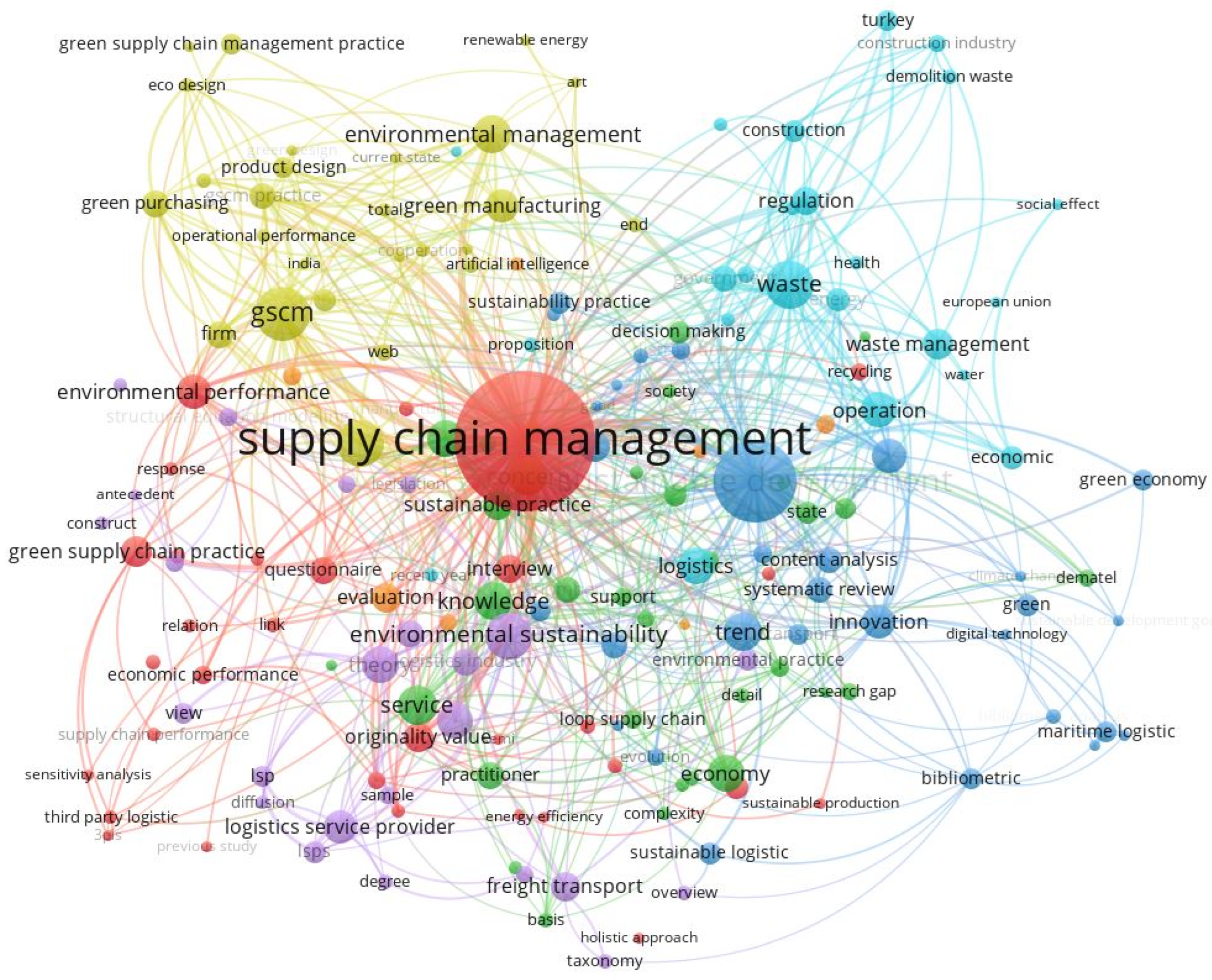
Figure 2.
Green supply chain model according to the structural-functional approach to the identification of logistics elements.
Figure 2.
Green supply chain model according to the structural-functional approach to the identification of logistics elements.
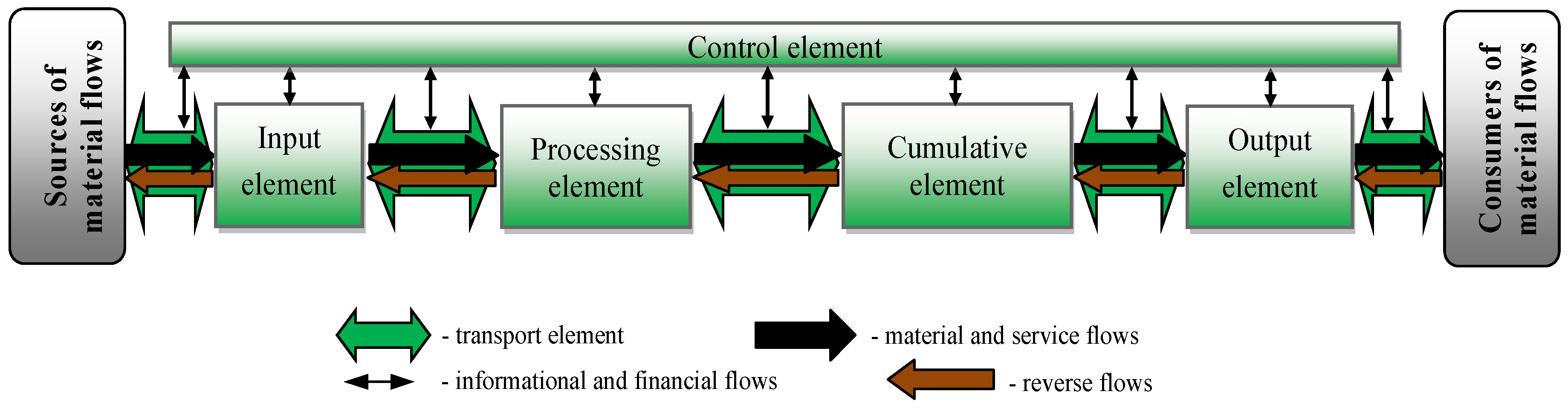
Figure 3.
Basic and supporting functions of green supply chain elements.
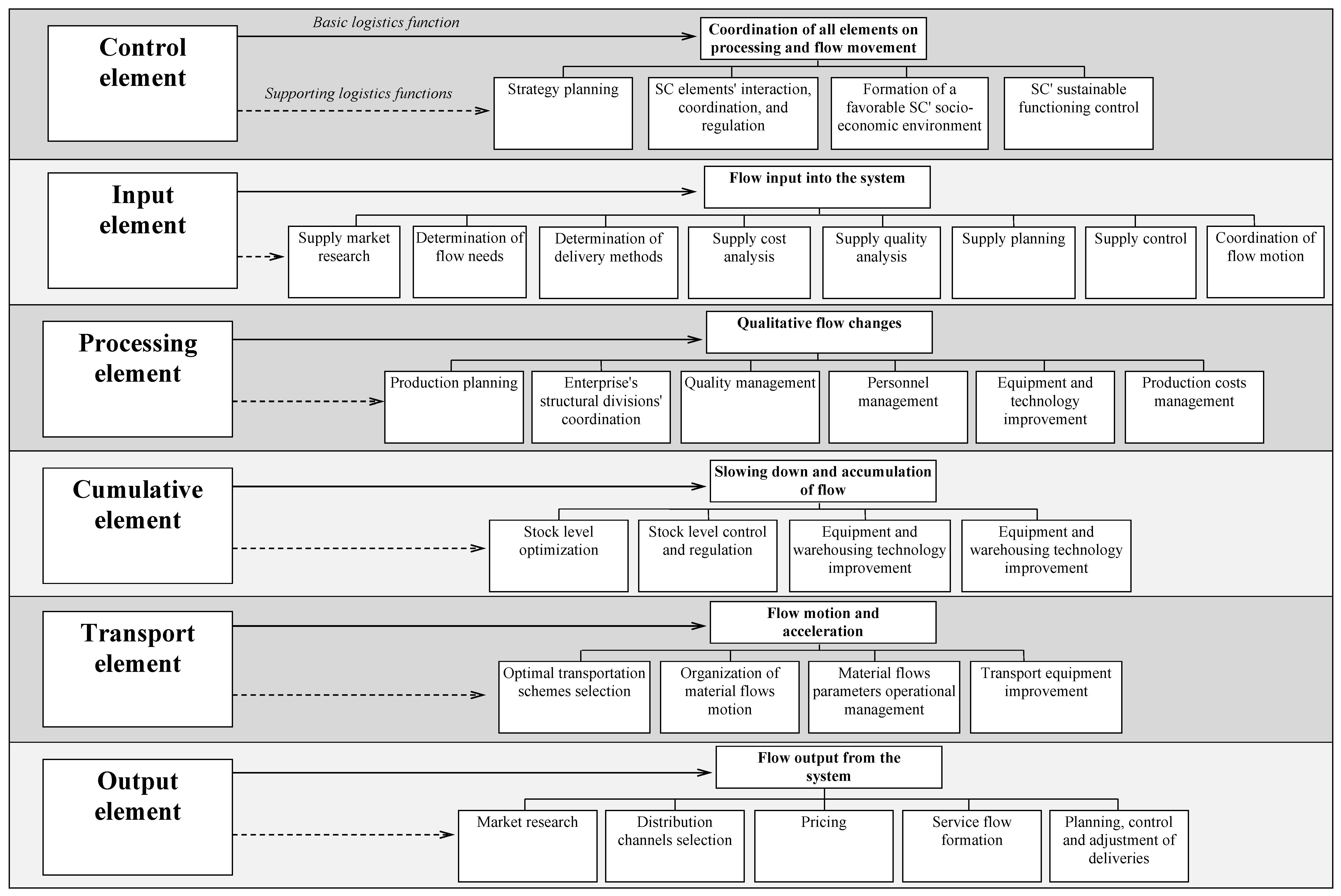
Figure 4.
Logistic flow evaluation system [39].
Figure 4.
Logistic flow evaluation system [39].
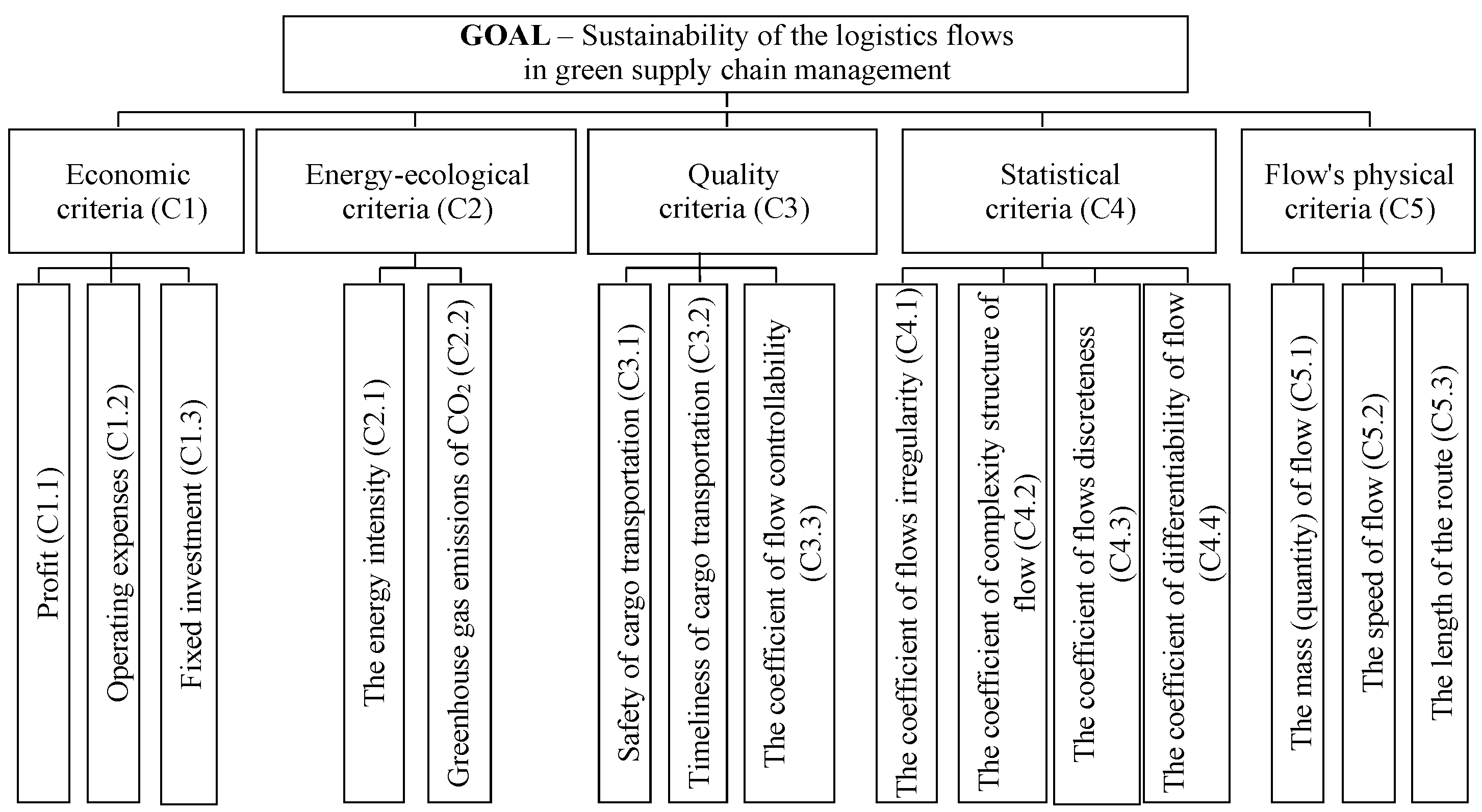
Figure 5.
The multi-criteria assessment framework for GLM and GLI.
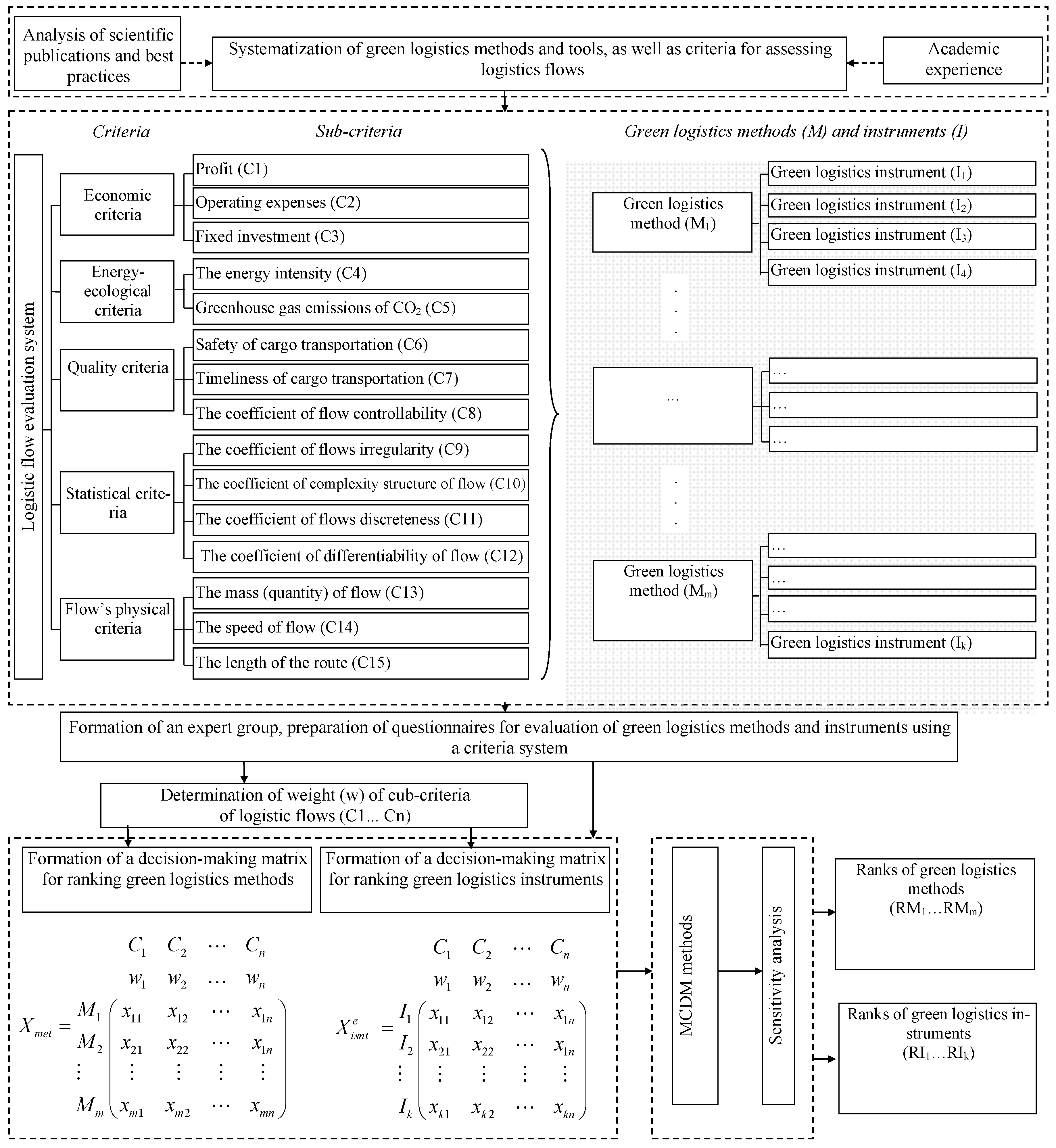
Figure 6.
Geen logistics methods and instruments for the Control Logistics Element.
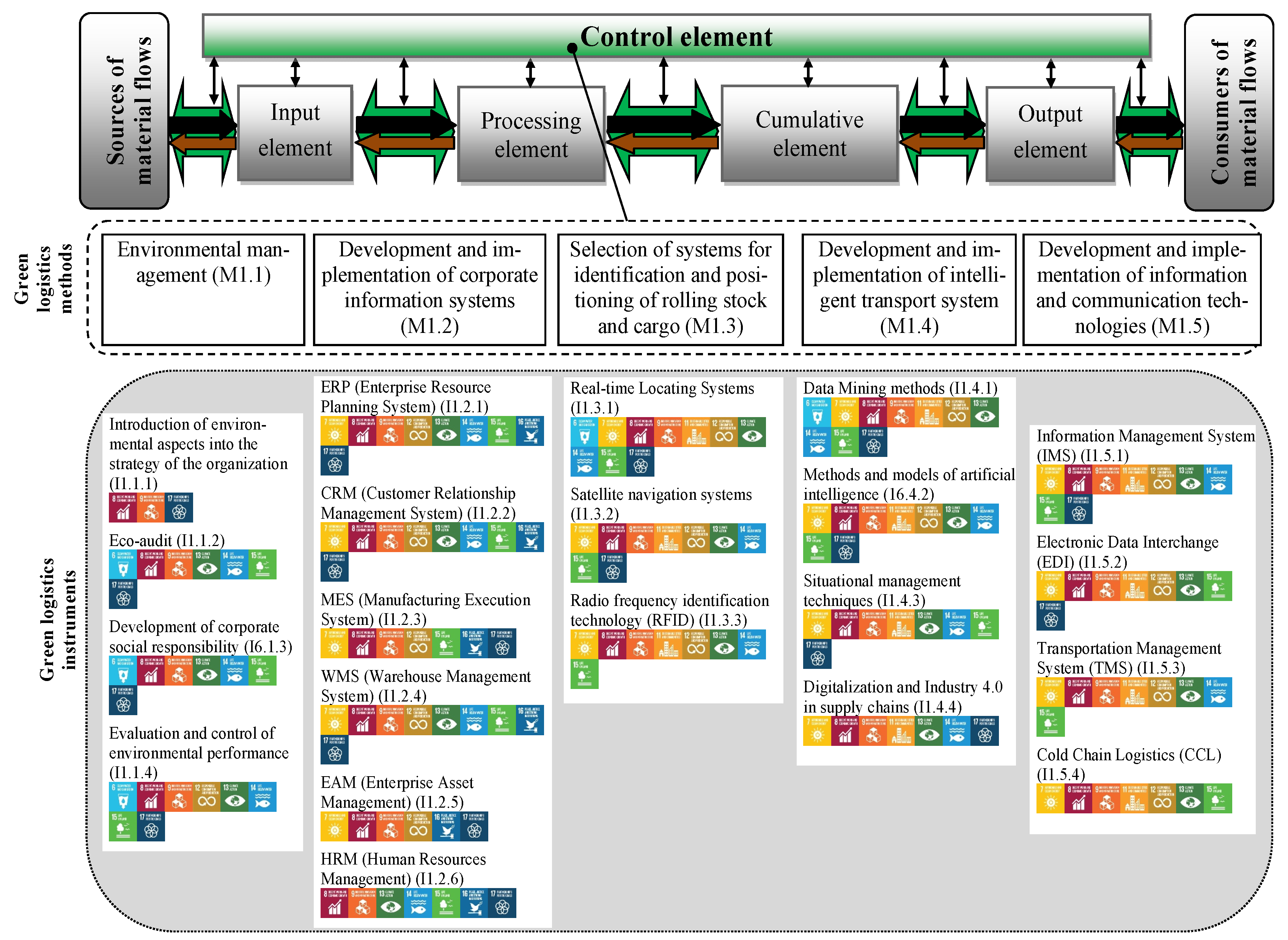
Figure 7.
Green logistics methods and instruments for the Input Logistics Element.
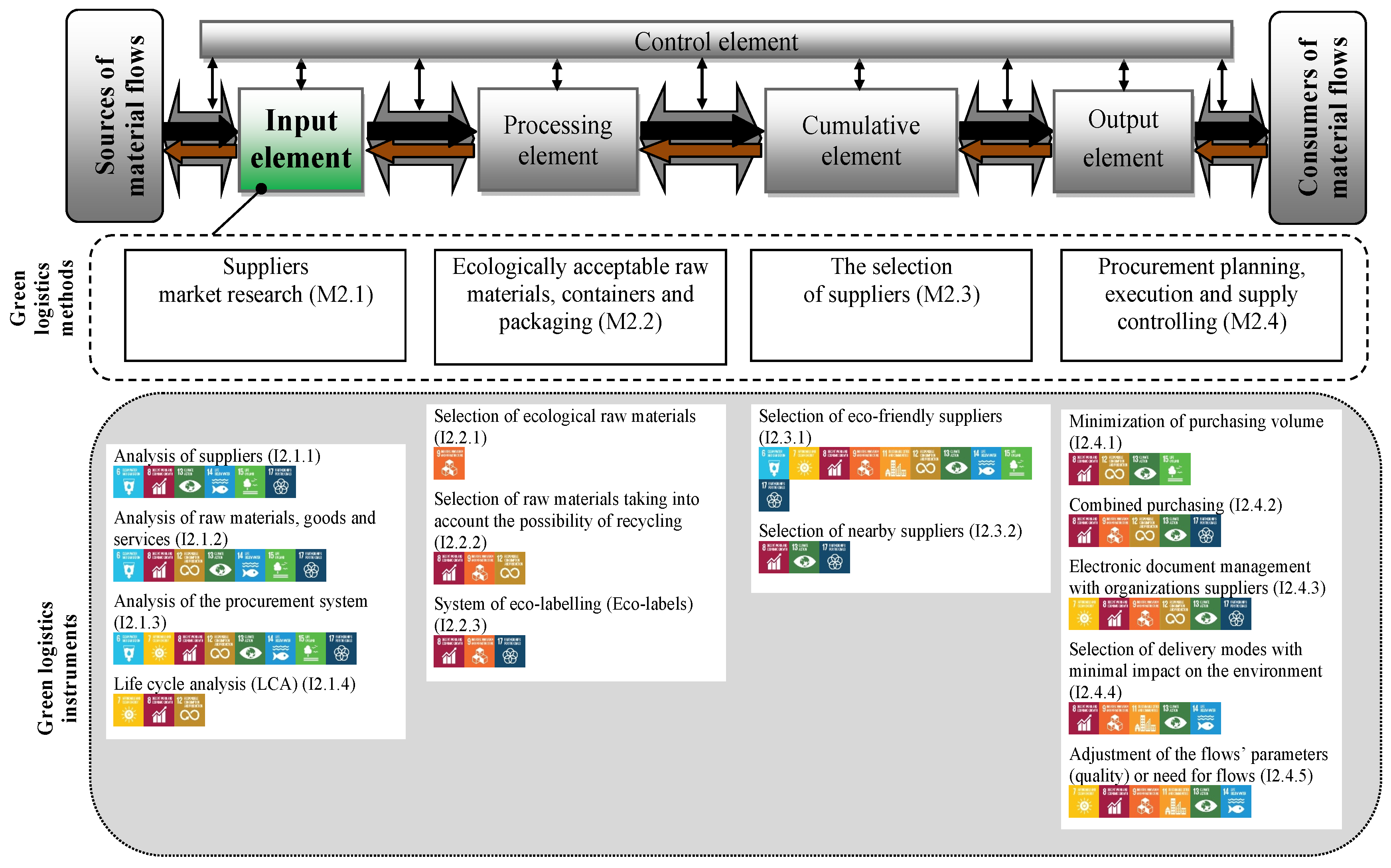
Figure 8.
Green logistics methods and instruments for the Processing Logistics Element.
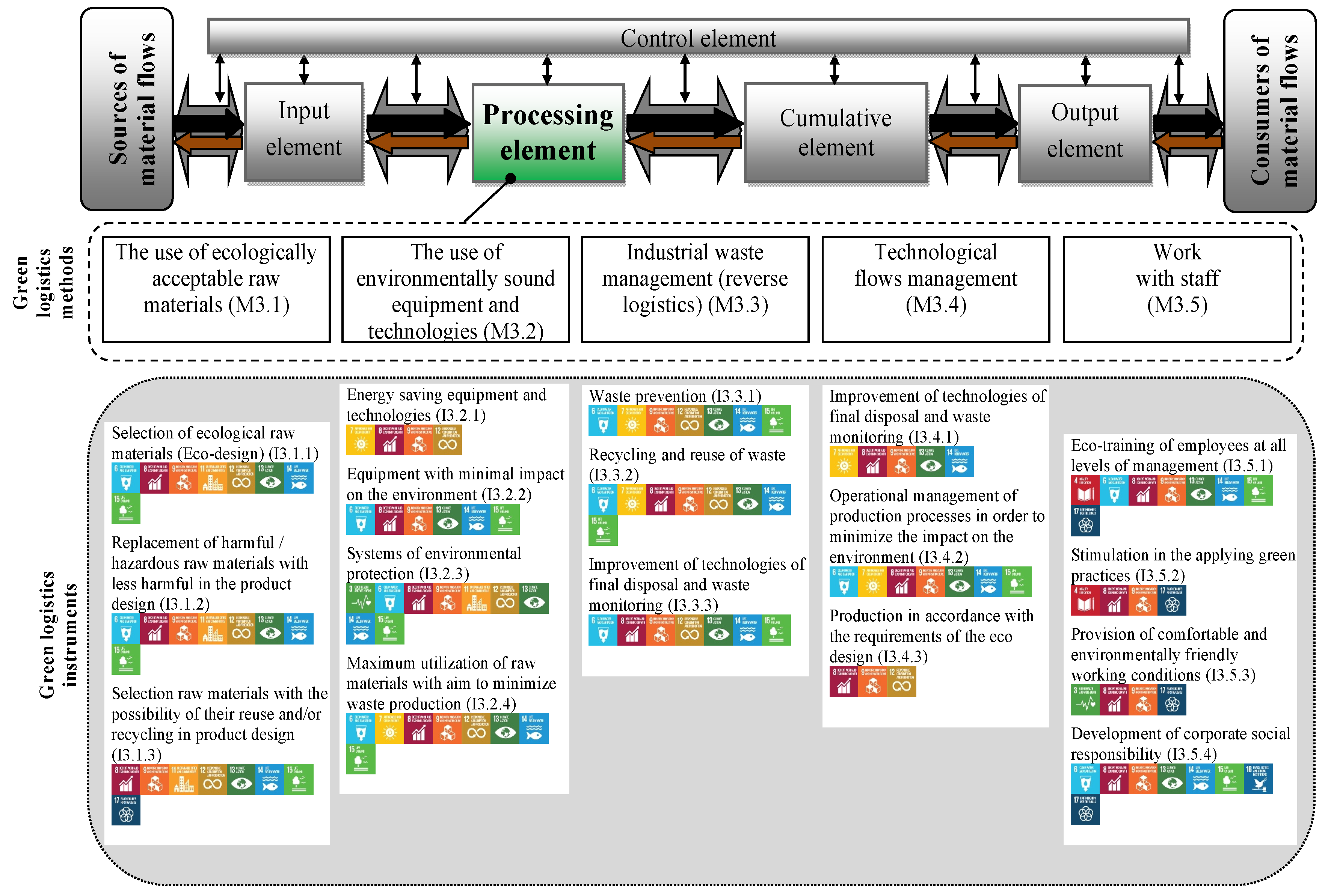
Figure 9.
Green logistics methods and instruments for the Cumulative Logistics Element.
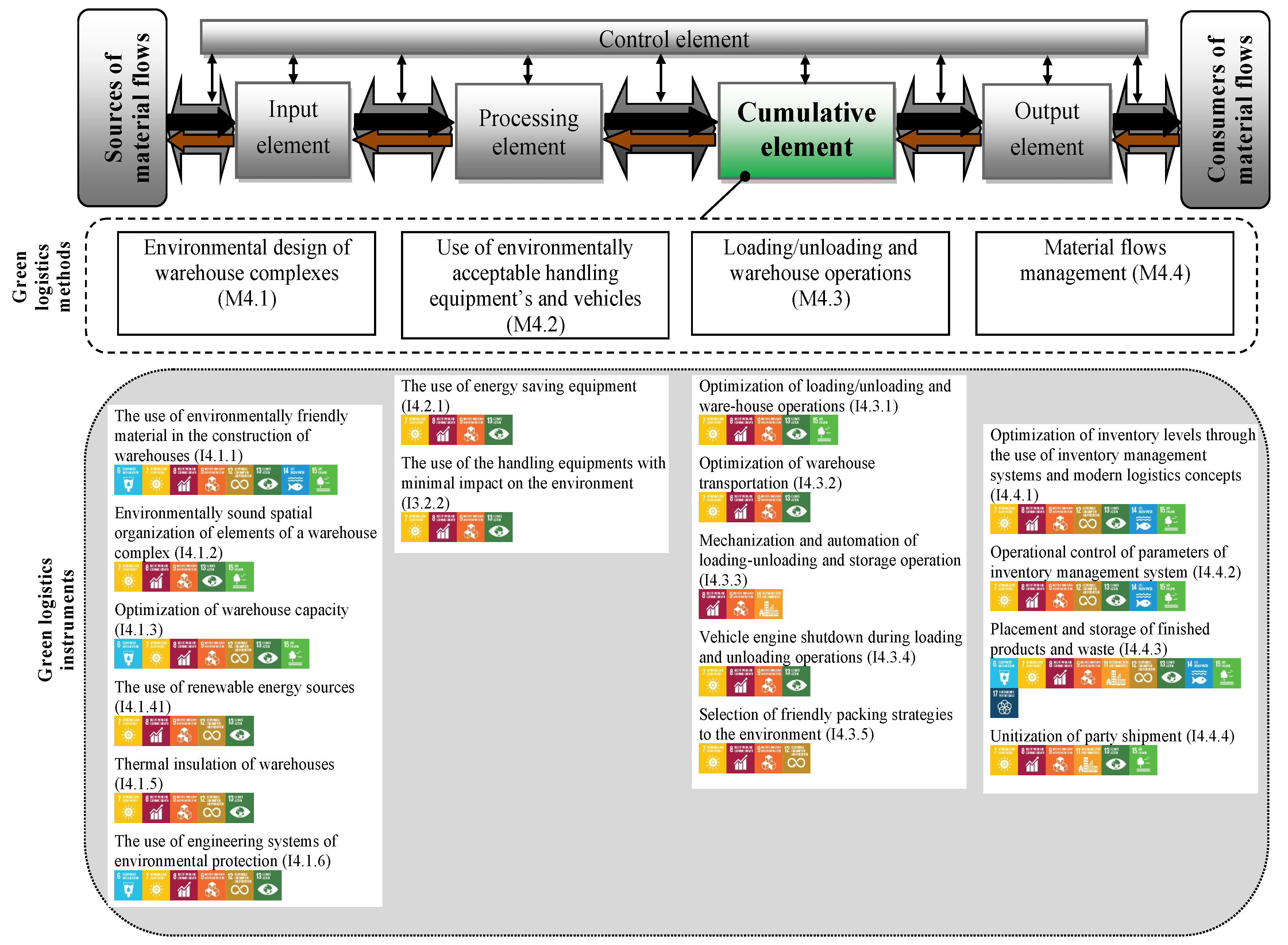
Figure 10.
Green logistics methods and instruments for the Transport Logistics Element.
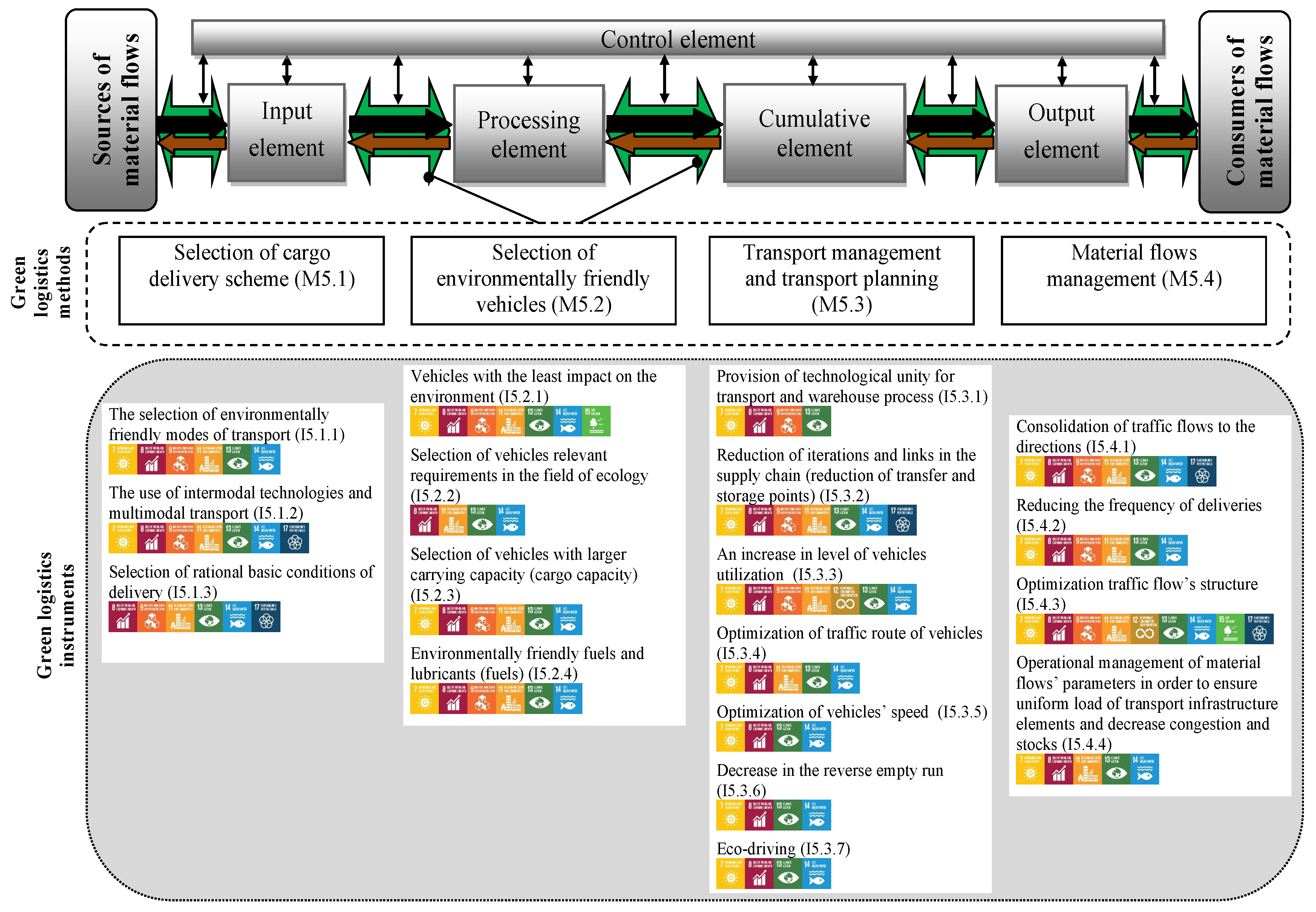
Figure 11.
Green logistics methods and instruments for the Output Logistics Element.
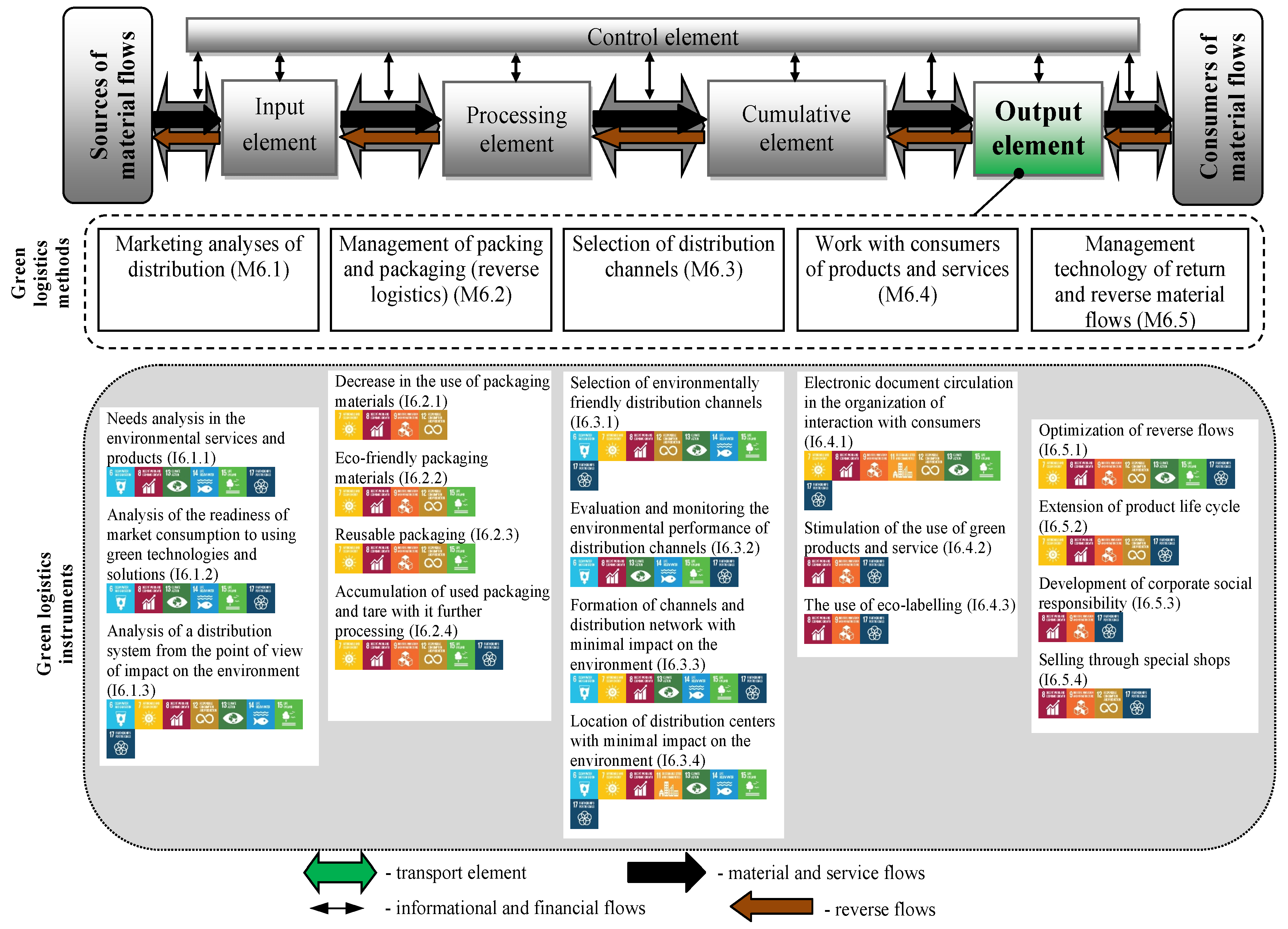
Figure 12.
Comparison of ranking results of green logistics methods by TOPSIS, MABAC and MARCOS methods.
Figure 12.
Comparison of ranking results of green logistics methods by TOPSIS, MABAC and MARCOS methods.
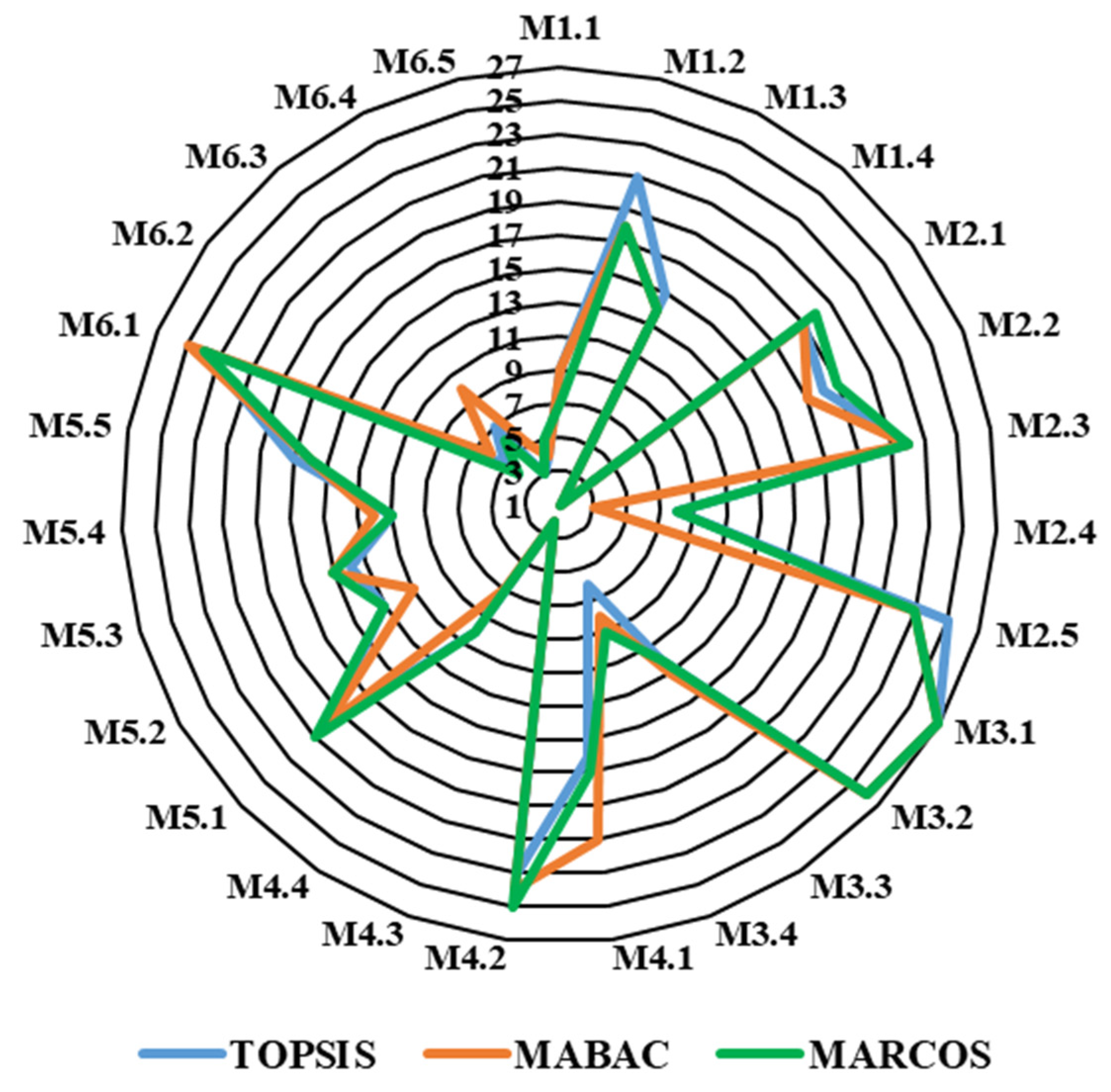
Figure 13.
Comparison of ranking results of green logistics instruments for the Control element.
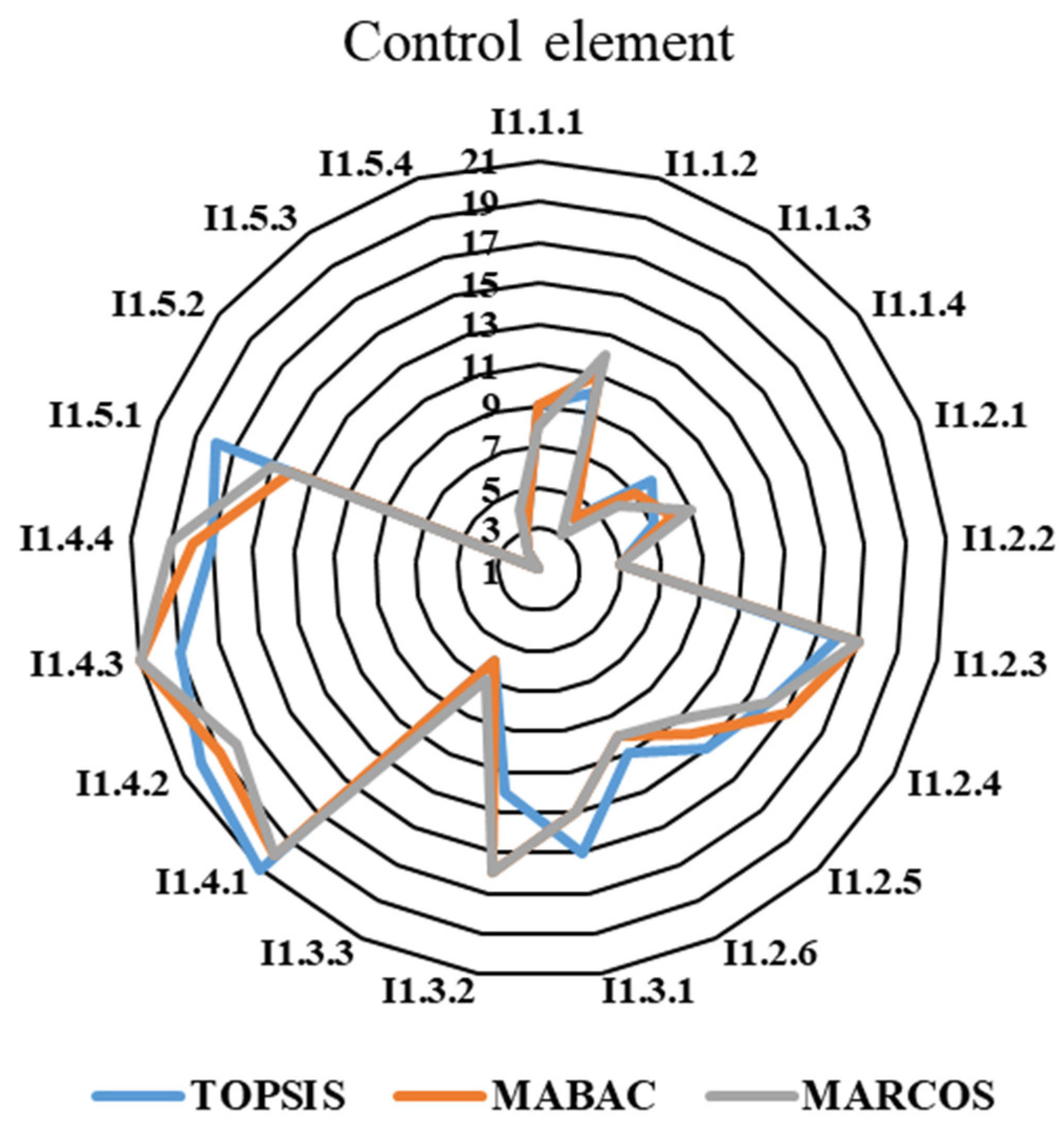
Figure 14.
Comparison of ranking results of green logistics instruments for the Input element.
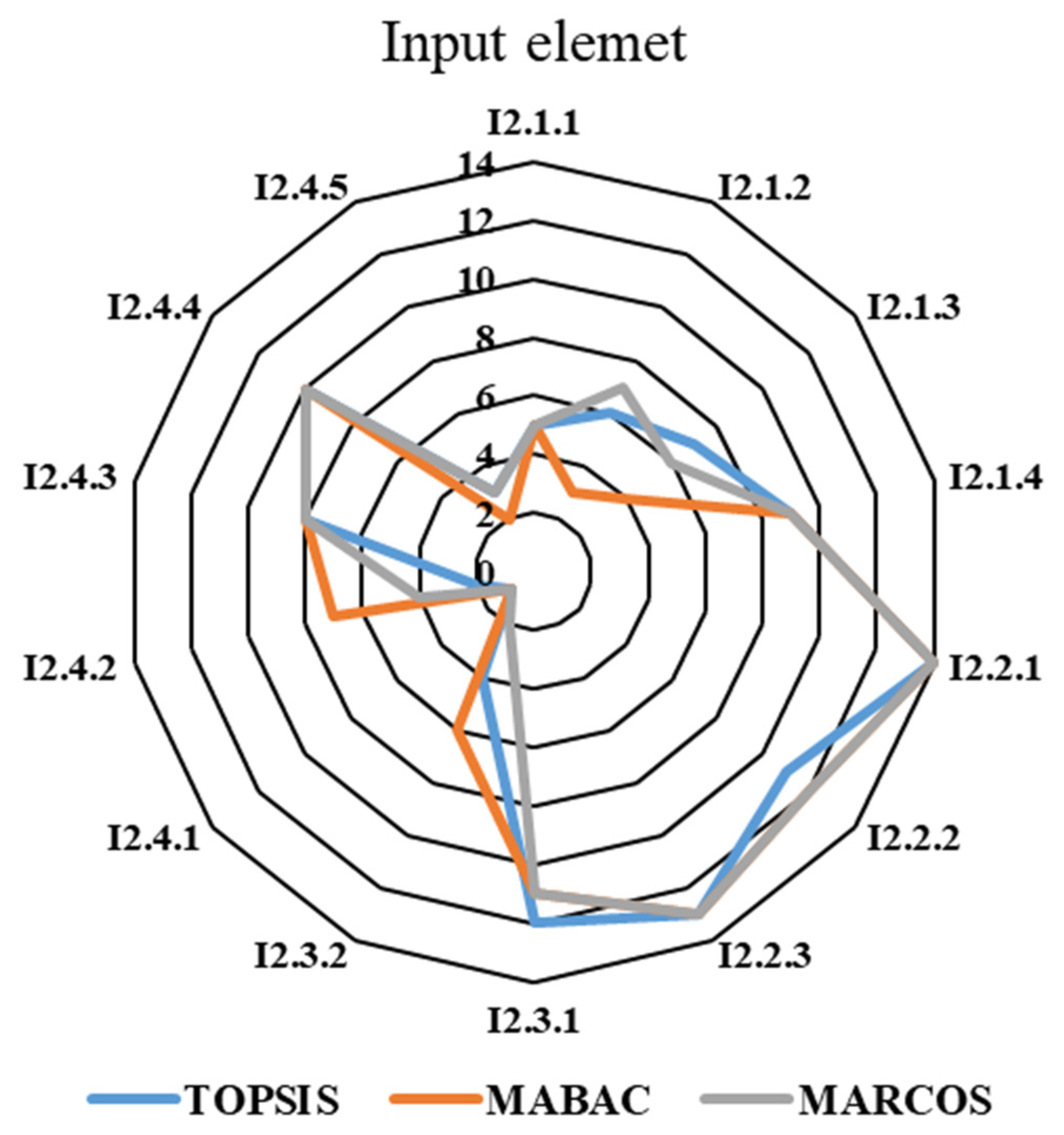
Figure 15.
Comparison of ranking results of green logistics instruments for the Processing element.
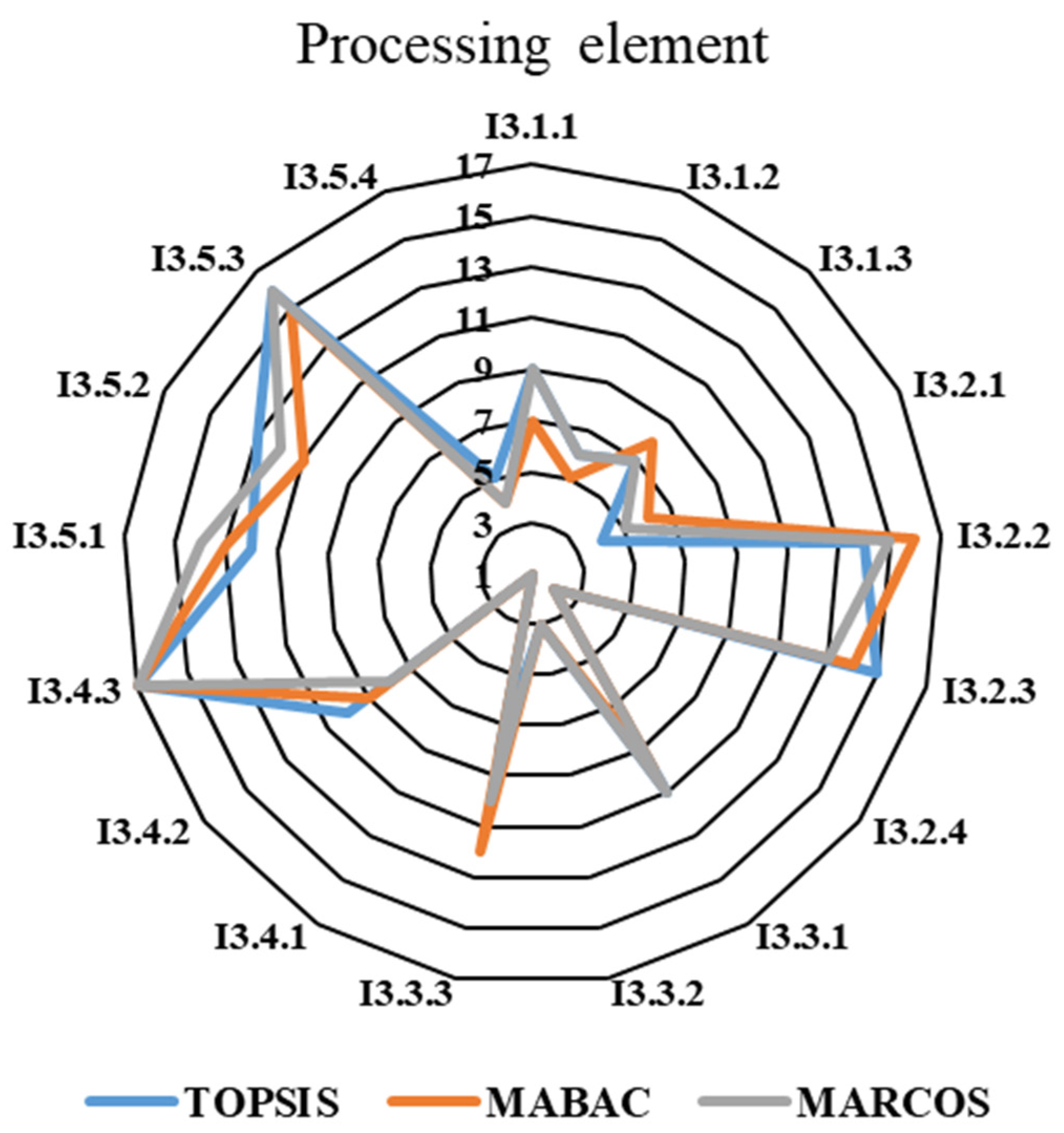
Figure 16.
Comparison of ranking results of green logistics instruments for the Cumulative element.
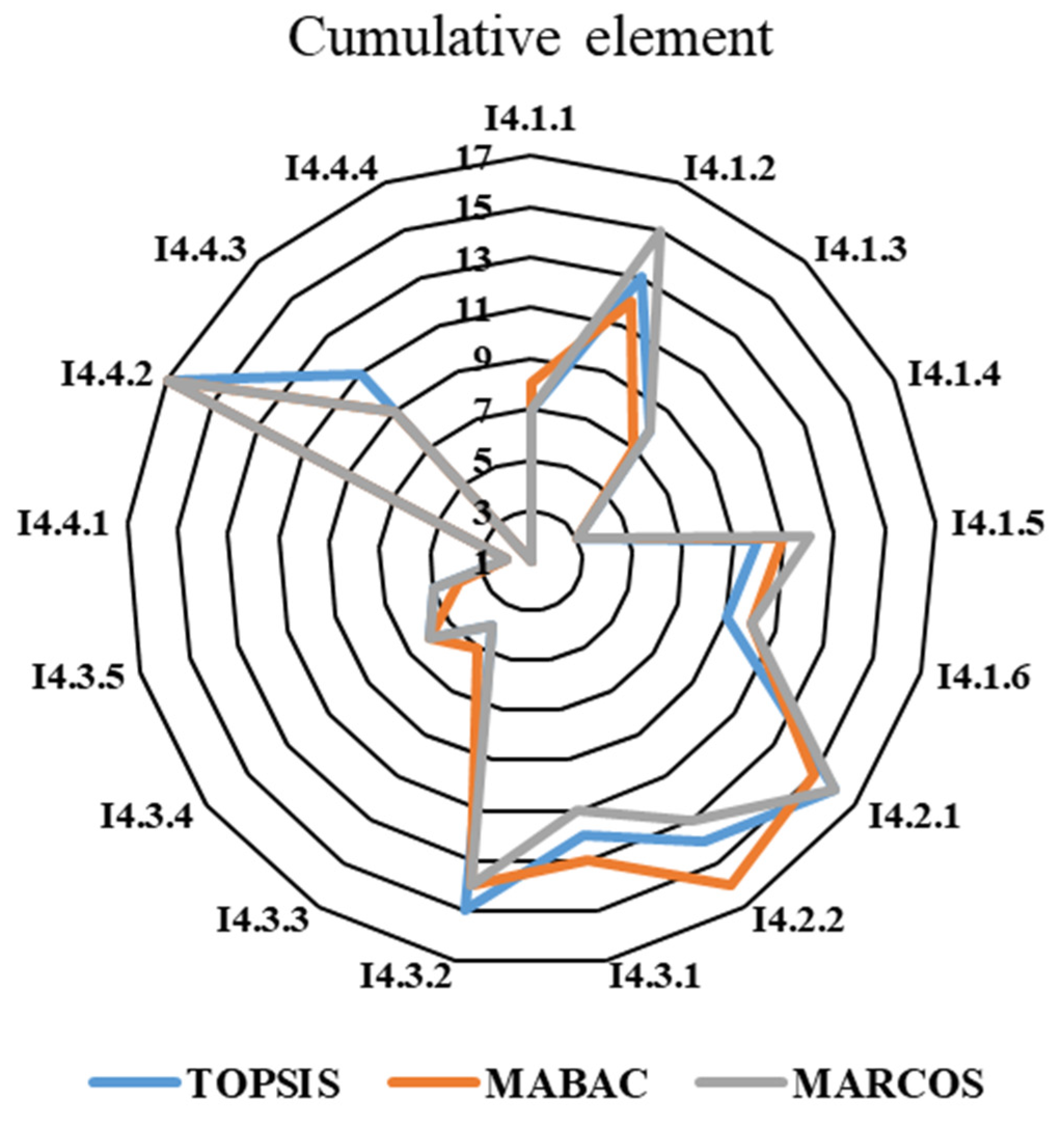
Figure 17.
Comparison of ranking results of green logistics instruments for the Transport element.
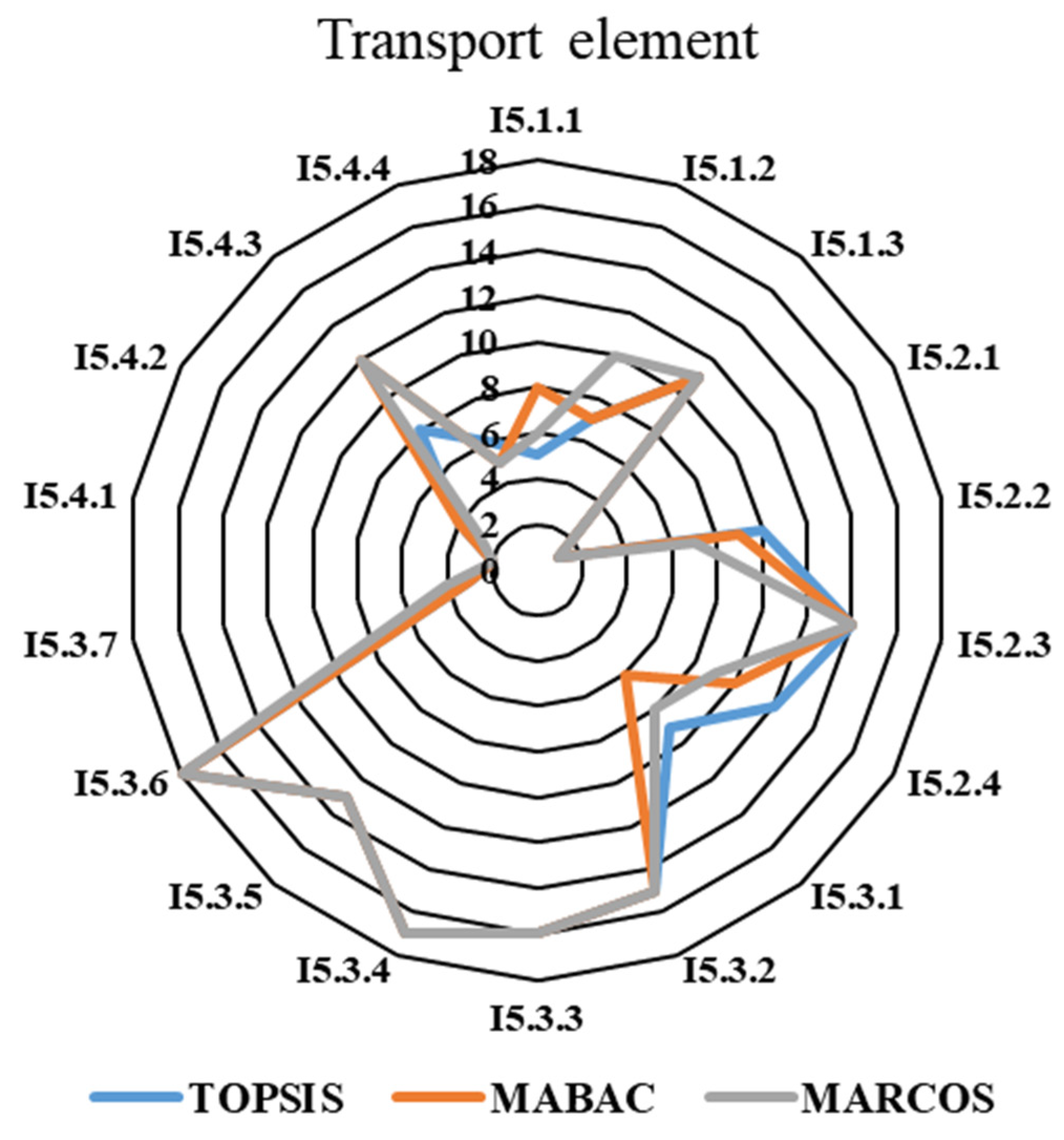
Figure 18.
Comparison of ranking results of green logistics instruments for the Output element.
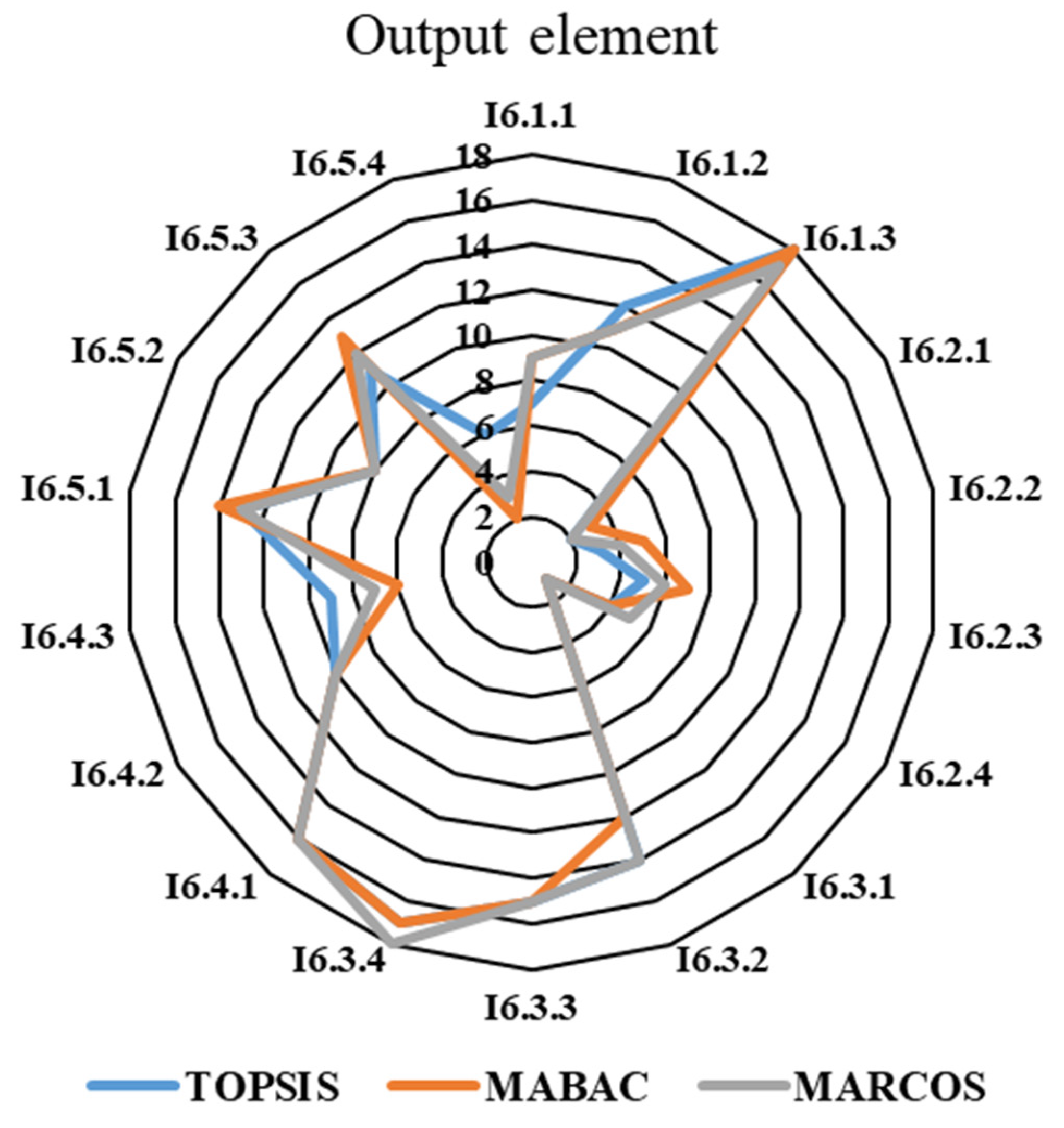

Table 2.
Grouping of scientific papers in relation to logistic elements and by mention of Green Logistics Methods (M) and Instruments (I).
Table 2.
Grouping of scientific papers in relation to logistic elements and by mention of Green Logistics Methods (M) and Instruments (I).
Table 3.
Description of green logistics instruments for the Control Logistics Element.
| № | Green logistics instrument | Description | |
|---|---|---|---|
| I1.1.1 | 1.1. Introduction of environmental aspects into the strategy of the organization | Development of the organization's environmental strategy based on the goals and principles of sustainable development and its integration into the business strategy (ESG-strategy) | |
| I1.1.2 | 1.2. Eco-audit | Independent assessment of compliance with regulatory and legal requirements in the field of environmental protection and preparation of recommendations in the field of environmental activities | |
| I1.1.3 | 1.3. Development of corporate social responsibility | Design and implementation of the strategy for developing the concept of Corporate Social Responsibility (CSR), taking responsibility for external and internal stakeholders, the environment, and society as a whole | |
| I1.1.4 | 1.4. Evaluation and control of environmental performance | Design standards for the process of selecting indicators, collecting and evaluating data and information to provide an ongoing assessment of environmental performance and its trends over time, consistent with the organization's environmental goals (ISO 14031:2013) | |
| I1.2.1 | Enterprise Resource Planning System (ERP) | Implementation of the enterprise resource management and planning system based on the integration and automation of data required to perform business processes — production, financial, personnel management, service provision, etc. | |
| I1.2.2 | Customer Relationship Management System (CRM) | Implementation of Customer Relationship Management (CRM) based on the use of advanced management and information technologies to interact with customers to increase the efficiency of customer service and improve business processes | |
| I1.2.3 | Manufacturing Execution System (MES) | Implementation of Manufacturing Execution System (MES) based on data integration and automation to manage manufacturing activities | |
| I1.2.4 | Warehouse Management System (WMS) | Implementation of Warehouse Management System (WMS) based on data integration and automation for planning and execution of a set of tasks and functions of warehouse business processes | |
| I1.2.5 | Enterprise Asset Management (EAM) | Implementation of Enterprise Asset Management (EAM) based on automation of business processes for managing physical assets and their modes of operation, risks, and costs throughout the asset lifecycle | |
| I1.2.6 | Human Resources Management (HRM) | Implementation of Human Resources Management (HRM) based on the integration of data required to effectively manage the organization's workforce | |
| I1.3.1 | Real-time Locating Systems (RTLS) | Implementation of Real-time Locating Systems (RTLS) based on the use of methods and technologies of identification and location of controlled objects (UWB, RFID, Wi-Fi, Bluetooth, ZigBee, NFER, etc.) within the territory for the purpose of monitoring transportation, logistics and business processes | |
| I1.3.2 | Satellite navigation systems | Implementation of satellite navigation systems (GPS, GLONAS, BeiDou, Galileo, QZSS and IRNSS) to determine the location of objects and movement parameters (vehicles, cargoes, etc.) to monitor the performance of logistics functions and supply chain operations | |
| I1.3.3 | Radio frequency identification technology (RFID) | Implementation of Radio Frequency Identification (RFID) technology in transportation and logistics processes for automatic identification, transmission, and storage of information about elements of the material flow throughout the life cycle from production to retail trade | |
| I1.4.1 | Data Mining methods | Use of Data Mining methods and systems for intellectual analysis of the data array and identification of patterns for the purpose of making managerial decisions (Board, SAS Revenue Optimization, SAS Enterprise Miner, etc.). | |
| I1.4.2 | Methods and models of artificial intelligence | Integration of systems, technologies or intelligent machines capable of mimicking human behavior in performing logistics functions in the supply chain | |
| I1.4.3 | Situational management techniques | The use of a set of techniques and methods of managerial decision-making in the operational management of supply chains under the influence of external and internal changes. This set includes system, situational and factor analysis, expert methods, simulation modeling, multi-criteria decision-making methods, heuristic methods and others | |
| I1.4.4 | Digitalization and Industry 4.0 in supply chains | Control and optimization of logistics flows based on the implementation of principles and technologies of Industry 4.0 concept and digitalization of supply chains (cloud technologies, Internet of Things, blockchain, artificial intelligence and machine learning, virtual reality, 3D printing, etc.) | |
| I1.5.1 | Management Information System (MIS) | Implementation of Management Information System (MIS) for decision-making, coordination, control, analysis, and visualization of information in supply chains by integrating the links between chain members, processes, and technologies required to perform business processes | |
| I1.5.2 | Electronic Data Interchange (EDI) | Implementation of Electronic Data Interchange (EDI) transfer of structured digital information between organizations – elements of the supply chain, based on regulations and formats of transmitted messages. | |
| I1.5.3 | Transportation Management System (TMS) | Implementation of the Transportation Management System (TSM) for complex automation of transportation and logistics operations | |
| I1.5.4 | Cold Chain Logistics (CCL) | Utilizing Cold Chain Logistics (CCL) technologies and techniques to ensure consistent temperature of goods in the supply chain from production to consumption |
Table 4.
Description of green logistics instruments for the Input Logistics Element.
| № | Green logistics instrument | Description | |
|---|---|---|---|
| I2.1.1 | Analysis of suppliers | Assessment of suppliers' and contractors' performance for the purpose of further cooperation by analyzing previous activities, as well as compliance with the requirements and principles of the customer's work, including in achieving SDGs | |
| I2.1.2 | Analysis of raw materials, goods and services | Assessing products and services for compliance with customer and supply chain requirements | |
| I2.1.3 | Analysis of the procurement system | Evaluate the management of logistics processes in procurement to effectively utilize logistics resources and achieve the SDGs | |
| I2.1.4 | Life cycle analysis (LCA) | Comprehensive assessment of the environmental impact of a logistics material or work flow at all stages of its life cycle | |
| I2.2.1 | Selection of ecological raw materials | Selection of environmentally friendly and safe raw materials in logistics processes, ensuring the least impact on the environment and human health | |
| I2.2.2 | Selection of raw materials taking into account the possibility of recycling | Selection of raw materials and materials considering the possibility of their reuse and recycling | |
| I2.2.3 | System of eco-labelling (eco-labels) | Use of eco-labeling system to identify products and services for compliance with environmental standards and requirements, inform consumers about environmental properties of products or services | |
| I2.3.1 | Selection of eco-friendly suppliers | Evaluate and select suppliers that have environmental policies and incorporate environmentally friendly mechanisms into their operations | |
| I2.3.2 | Selection of nearby suppliers | Assessing and selecting the nearest suppliers to reduce logistics costs and environmental impact | |
| I2.4.1 | Minimization of purchasing volume | Analysis of cargo flow parameters and optimization of purchasing volumes to minimize inventories and reduce logistics costs | |
| I2.4.2 | Combined purchasing | Consolidation of procurement and collective tendering to reduce logistics costs and environmental footprints | |
| I2.4.3 | Electronic document management with organizations suppliers | Implementation of the electronic document management system and refusal to use paper carriers | |
| I2.4.4 | Selection of delivery modes with minimal impact on the environment | Assessing and selecting methods of raw material delivery with minimal environmental impact | |
| I2.4.5 | Adjustment of the flows’ parameters (quality) or need for flows | Analysis of statistical parameters of logistics flows to assess the need for them, as well as to optimize their parameters and indicators |
Table 5.
Description of green logistics instruments for the Processing Logistics Element.
| № | Green logistics instrument | Description | |
|---|---|---|---|
| I3.1.1 | Selection of ecological raw materials (Eco-design) | Consideration of environmental parameters in the process of creating products (services) when selecting raw materials and materials used in production processes to improve the natural, social, cultural and physical environment of certain areas | |
| I3.1.2 | Replacement of harmful/hazardous raw materials with less harmful in the product design | Replacing harmful and hazardous raw materials in the process of creating products (services) with environmentally friendly ones that ensure the least impact on the environment and human health | |
| I3.1.3 | Selection raw materials with the possibility of their reuse and/or recycling in product design | Considering the possibility of reusing and recycling raw materials in the process of creating products (services) | |
| I3.2.1 | Energy saving equipment and technologies | Application of energy-saving equipment and resource-saving technologies to rationally utilize logistics resources and improve production efficiency | |
| I3.2.2 | Equipment with minimal impact on the environment | Selection and application of equipment and technologies with minimal environmental impact in production processes | |
| I3.2.3 | Systems of environmental protection | Use of environmental safety methods and technical systems (air protection systems, water protection systems, waste management systems, etc.) to reduce the negative impact on the environment | |
| I3.2.4 | Maximum utilization of raw materials with aim to minimize waste production | Analysis of production process parameters and implementation of methods that maximize the use of raw material components to minimize production and service waste | |
| I3.3.1 | Waste prevention | Selection and application of ways to prevent waste generation in the process of production of products (services) | |
| I3.3.2 | Recycling and reuse of waste | Selection and application of waste treatment methods to ensure its reuse in logistics processes and to obtain raw materials, energy, products, and supplies | |
| I3.3.3 | Improvement of technologies of final disposal and waste monitoring | Evaluate and select ways to control and improve technologies for the utilization of waste generated during production, operation and after decommissioning | |
| I3.4.1 | Optimization of technological flows’ parameters | Analyzing the parameters of production processes and operations and making decisions to adjust the parameters of industrial logistics flows to reduce logistics costs and achieve the SDGs | |
| I3.4.2 | Operational management of production processes in order to minimize the impact on the environment | Operational management of production processes to control product quality and reduce the negative environmental impact of the industry | |
| I3.4.3 | Production in accordance with the requirements of the eco design | Designing and manufacturing products and services with consideration of their environmental impact throughout their life cycle | |
| I3.5.1 | Eco-training of employees at all levels of management | Training in the field of environmental protection and ecological safety for managers and specialists responsible for decision-making in the implementation of activities that have a negative impact on the environment | |
| I3.5.2 | Stimulation in the applying green practices | Stimulating supply chain participants' activities and personnel behavior in implementing “green” principles and technologies to reduce the negative impact on the environment | |
| I3.5.3 | Provision of comfortable and environmentally friendly working conditions | Creation of favorable conditions of the production environment and labor process, which have an impact on personnel health, working capacity and labor productivity, labor satisfaction, efficiency, and safety of work | |
| I3.5.4 | Development of corporate social responsibility | Incentivizing personnel in implementing the CSR strategy |
Table 6.
Description of green logistics instruments for the Cumulative Logistics Element.
| № | Green logistics instrument | Description | |
|---|---|---|---|
| I4.1.1 | The use of environmentally friendly material in the construction of warehouses | The use of modern environmentally friendly and safe building materials and technologies in the construction of warehouses in accordance with ISO 14024:1999, LEED, BREEAM, DGNB, Green Globes, CASBEE, BEAM and other standards | |
| I4.1.2 | Environmentally sound spatial organization of elements of a warehouse complex | Warehouse design, warehouse space planning and placement of main elements considering the requirements of environmental standards and the use of modern safety equipment, as well as the efficiency of loading and unloading and storage operations | |
| I4.1.3 | Optimization of warehouse capacity | Analysis of statistical parameters of cargo flows to optimize warehouse capacity and ensure the quality of inventory storage | |
| I4.1.4 | The use of renewable energy sources | Utilization of renewable energy sources in the warehouse to reduce greenhouse gas emissions (bioenergy, photovoltaics, concentrated solar energy, geothermal energy, hydropower, ocean energy, wind energy) | |
| I4.1.5 | Thermal insulation of warehouses | Use of special materials and technologies to insulate warehouses to ensure comfortable working conditions for the personnel and reduce the costs of heating the warehouse | |
| I4.1.6 | The use of engineering systems of environmental protection | Use of autonomous and centralized engineering systems ensuring maintenance of specified environmental parameters (air conditioning systems, ventilation systems, heating systems, water environment protection systems, energy saving systems, physical security systems, etc.) | |
| I4.2.1 | The use of energy saving equipment | Application of energy-saving equipment and resource-saving technologies to rationally utilize logistics resources and improve warehouse efficiency | |
| I4.2.2 | The use of the handling equipment’s with minimal impact on the environment | Use of loading and unloading means and devices with minimal environmental impact in the warehouse | |
| I4.3.1 | Optimization of loading/unloading and warehouse operations | Regulating the parameters of loading, unloading and warehousing processes to reduce logistics costs and achieve the SDGs | |
| I4.3.2 | Optimization of warehouse transportation | Use of progressive organization of cargo movement between different storage areas in the warehouse to minimize transshipment and optimize intro-warehouse routes | |
| I4.3.3 | Mechanization and automation of loading-unloading and storage operation | Mechanization and automation of loading and unloading and warehousing operations to reduce the share of manual processes and operations and increase labor productivity in warehousing operations | |
| I4.3.4 | Vehicle engine shutdown during loading and unloading operations | Disabling the vehicle engine during loading and unloading operations to reduce fuel consumption and CO2 emissions | |
| I4.3.5 | Selection of friendly packing strategies to the environment | Developing and using a packaging strategy to prevent damage and loss of goods, efficiently utilize resources, and reduce environmental impact (ISO 18601-06: 2013) | |
| I4.4.1 | Optimization of inventory levels through the use of inventory management systems and modern logistics concepts | Optimization of inventory levels based on the Inventory Management Systems and modern logistics concepts (Just-in-Time, Kanban, Lean Production, etc.) | |
| I4.4.2 | Operational control of parameters of inventory management system | Operational control of deviations of the actual parameters of the inventory management system from the optimal ones and decision-making to regulate these parameters | |
| I4.4.3 | Placement and storage of finished products and waste | Optimal filling of storage space, safe and efficient handling and warehousing services | |
| I4.4.4 | Unitization of party shipment | Consolidation of cargo consignments for efficient use of vehicles, reduction of transportation expenses and harmful emissions into the environment |
Table 7.
Description of green logistics instruments for the Transport Logistics Element.
| № | Green logistics instrument | Description | |
|---|---|---|---|
| I5.1.1 | The selection of environmentally friendly modes of transport | Assessment and selection of transport modes and transport planning systems for efficient transport of goods and reduction of negative environmental impacts | |
| I5.1.2 | The use of intermodal technologies and multimodal transport | Use in supply chains of multimodal delivery systems with intermodal technologies based on sequential or parallel advancement of cargo flows by several modes of transportation, and elimination of transshipment operations when transferring cargo from one mode of transportation to another | |
| I5.1.3 | Selection of rational basic conditions of delivery | Selection of basic terms of delivery of goods that define the duties, place of transfer of goods, cost, and risks arising in the delivery of goods from sellers to buyers, considering the least negative impact on the environment | |
| I5.2.1 | Vehicles with the least impact on the environment | Selection and use of vehicles with the least negative environmental impact throughout the life cycle, including zero emission vehicles — ZEVs | |
| I5.2.2 | Selection of vehicles relevant requirements in the field of ecology | Evaluating and selecting vehicles that comply with established environmental regulations and requirements (Euro 1-6) | |
| I5.2.3 | Selection of vehicles with larger carrying capacity (cargo capacity) | Selecting a vehicle with a larger payload (cargo capacity) to increase productivity and reduce CO2 emissions | |
| I5.2.4 | Environmentally friendly fuels and lubricants (fuels) | Selection and use of fuels, lubricants and special fluids with improved environmental properties, ensuring reliability and efficiency of vehicle operation | |
| I5.3.1 | Provision of technological unity for transport and warehouse process | Ensuring the technological unity of the transportation and warehousing process by unifying the parameters of vehicles, tare, loading and unloading means and devices, places of cargo storage in the warehouse | |
| I5.3.2 | Reduction of iterations and links in the supply chain (reduction of transfer and storage points) | Minimize iterations and links in the supply chain (transshipment and storage points) to reduce logistics costs | |
| I5.3.3 | An increase in level of vehicles utilization | Selection of the best ways to load vehicles to optimize the use of vehicle load capacity | |
| I5.3.4 | Optimization of traffic route of vehicles movement | Optimization of vehicle routes to reduce mileage, fuel consumption, save engine life, and reduce pollutant emissions | |
| I5.3.5 | Optimization of vehicles’ speed | Selecting vehicle speeds that reduce fuel consumption, emissions, and safety | |
| I5.3.6 | Decrease in the reverse empty run | Reducing empty vehicle miles traveled to improve vehicle efficiency, reduce fuel consumption and carbon dioxide emissions | |
| I5.3.7 | Eco-driving | Training drivers in vehicle driving techniques that optimize fuel consumption, reduce emissions and improve safety | |
| I5.4.1 | Consolidation of traffic flows to the directions | Consolidation of small jets of material flow (cargo flow) into a powerful jet to increase the efficiency of its transportation using the system of main modes of transportation | |
| I5.4.2 | Reducing the frequency of deliveries | Optimization of the frequency and size of deliveries based on the inventory management strategy adopted within the boundaries of a particular logistics system | |
| I5.4.3 | Optimization traffic flow’s structure | Changing the structure of material flow (cargo flow) during transportation, considering the needs of supply chain elements in material flow | |
| I5.4.4 | Operational management of material flows’ parameters in order to ensure uniform load of transport infrastructure elements and decrease congestion and stocks | Use of various methods of continuous assessment of material flow parameters and their correction in case of deviation from normative values |
Table 8.
Description of green logistics instruments for the Output Logistics Element.
| № | Green logistics instrument | Description | |
|---|---|---|---|
| I6.1.1 | Needs analysis in the environmental services and products | Using the principles and methods of green marketing to study the market, demand for goods (services), consumer behavior and competitors to meet consumer demand for environmentally friendly products and services | |
| I6.1.2 | Analysis of the readiness of market consumption to using green technologies and solutions | Utilizing a range of different activities to communicate the merits of “green” goods or services to potential consumers and stimulate the consumption of “green” goods or services | |
| I6.1.3 | Analysis of a distribution system from the point of view of impact on the environment | Assessment of the distributional system for compliance with the principles of building sustainable supply chains and achieving the SDGs | |
| I6.2.1 | Decrease in the use of packaging materials | Rational use of packaging to reduce logistics costs and packaging material volumes | |
| I6.2.2 | Eco-friendly packaging materials | Use of eco-friendly packaging materials composed of natural ingredients, as well as materials with ingredients that accelerate their decomposition | |
| I6.2.3 | Reusable packaging | Use of reusable and reusable containers and packaging to reduce waste and packaging procurement costs, and to improve the security of cargo delivery | |
| I6.2.4 | Accumulation of used packaging and tare with it further processing | Collection of used containers and packaging for recycling by own forces or under contract with specialized organizations | |
| I6.3.1 | Selection of environmentally friendly distribution channels | Assessment and selection of distribution channels that implement environmental policies and incorporate environmentally friendly mechanisms in their operations | |
| I6.3.2 | Evaluation and monitoring the environmental performance of distribution channels | Operational elimination of the distributional system parameters deviations from those set in accordance with the SDGs or ESG strategy | |
| I6.3.3 | Formation of channels and distribution network with minimal impact on the environment | Use of strategy and methods for the formation of the distribution network with minimal environmental impact | |
| I6.3.4 | Location of distribution center’s with minimal impact on the environment | Green field analysis for distribution centers to reduce logistics costs and reduce negative environmental impact | |
| I6.4.1 | Electronic document circulation in the organization of interaction with consumers | Using the system and EDI operator to organize work with documents by forming them electronically, without using paper carriers | |
| I6.4.2 | Stimulation of the use of green products and service | Stimulating consumers of products or services whose behavior is based on the concepts of sustainable development, responsible, ethical, “green” consumption | |
| I6.4.3 | The use of eco-labelling | Use of eco-labeling system to inform consumers about the environmental properties of products or services | |
| I6.5.1 | Optimization of reverse flows | Use of methods of handling return material flows, i.e., reuse, recycling, utilization of goods, materials, and wastes | |
| I6.5.2 | Extension of product life cycle | Extension of product life cycle based on the use of principles and methods of closed-loop economy and Closed-loop Supply Chain, including defect elimination, repair, restoration, refurbishment, modernization of products | |
| I6.5.3 | Development of corporate social responsibility | Cooperation with various charitable, environmental, volunteer organizations, animal shelters, etc. for donation of products | |
| I6.5.4 | Selling through special shops | Sale of goods and services through specialized stores, including Zero waste stores, online stores, second hand stores, eco-markets, food sharing, etc. |
Table 9.
Weight of logistic flows' criteria and sub-criteria [205].
Table 9.
Weight of logistic flows' criteria and sub-criteria [205].
| Criteria | Weight | Sub criteria |
Weight | Global weight |
| Economic criteria (С1) | 0.2538 | C1.1 | 0.75726 | 0.19216 |
| C1.2 | 0.01508 | 0.00383 | ||
| C1.3 | 0.22766 | 0.05777 | ||
| Energy-ecological criteria (С2) | 0.2220 | C2.1 | 0.98622 | 0.21890 |
| C2.2 | 0.01378 | 0.00306 | ||
| Quality criteria (С3) | 0.2474 | C3.1 | 0.44784 | 0.11080 |
| C3.2 | 0.30491 | 0.07544 | ||
| C3.3 | 0.24725 | 0.06117 | ||
| Statistical criteria (С4) | 0.0005 | C4.1 | 0.41160 | 0.00020 |
| C4.2 | 0.32903 | 0.00016 | ||
| C4.3 | 0.17474 | 0.00009 | ||
| C4.4 | 0.08463 | 0.00004 | ||
| Flow’s physical criteria (С5) | 0.2764 | C1.1 | 0.45068 | 0.12456 |
| C2.2 | 0.54476 | 0.15056 | ||
| C3.3 | 0.00456 | 0.00126 |
Table 10.
Results of expert assessment of green logistics methods and instruments.
| Element | GLM / GLI | С11 | С12 | С13 | С21 | С22 | С31 | С32 | С33 | С41 | С42 | С43 | С44 | С51 | С52 | С53 |
|---|---|---|---|---|---|---|---|---|---|---|---|---|---|---|---|---|
| Control element | M1.1 | 2.35 | 2.93 | 2.17 | 3.03 | 3.90 | 1.64 | 1.52 | 1.78 | 1.32 | 1.15 | 1.15 | 1.32 | 1.64 | 1.43 | 1.64 |
| I1.1.1 | 3.064 | 3.245 | 2.297 | 3.776 | 4.129 | 2.825 | 3.178 | 3.519 | 2.352 | 2.221 | 2.297 | 2.297 | 1.516 | 2.551 | 3.366 | |
| I1.1.2 | 2.169 | 2.000 | 1.741 | 2.930 | 3.519 | 2.702 | 2.702 | 2.993 | 2.491 | 2.551 | 2.702 | 2.702 | 1.516 | 2.352 | 2.048 | |
| I1.1.3 | 2.993 | 3.519 | 3.594 | 3.245 | 4.317 | 2.825 | 2.825 | 3.519 | 2.702 | 2.930 | 2.862 | 2.862 | 2.169 | 3.104 | 3.438 | |
| I1.1.4 | 2.702 | 2.862 | 3.981 | 3.594 | 4.317 | 2.605 | 2.825 | 3.641 | 2.862 | 3.031 | 2.639 | 2.639 | 1.644 | 2.862 | 4.076 | |
| M1.2 | 3.52 | 3.25 | 3.73 | 3.10 | 2.49 | 2.83 | 3.52 | 3.98 | 3.44 | 2.70 | 2.55 | 2.70 | 2.70 | 3.37 | 1.89 | |
| I1.2.1 | 2.825 | 3.288 | 2.169 | 2.551 | 2.930 | 2.048 | 2.702 | 2.605 | 2.352 | 2.048 | 2.048 | 2.048 | 1.644 | 2.460 | 1.783 | |
| I1.2.2 | 2.551 | 2.639 | 2.352 | 2.702 | 2.491 | 2.352 | 3.565 | 3.807 | 2.352 | 2.551 | 2.048 | 1.888 | 1.516 | 3.129 | 1.888 | |
| I1.2.3 | 2.169 | 2.702 | 1.741 | 2.352 | 3.245 | 1.149 | 1.320 | 1.783 | 1.320 | 1.320 | 1.320 | 1.320 | 1.888 | 1.783 | 1.644 | |
| I1.2.4 | 1.888 | 2.169 | 1.888 | 2.048 | 3.680 | 1.644 | 1.516 | 1.516 | 1.320 | 1.320 | 1.320 | 1.320 | 1.644 | 1.888 | 1.516 | |
| I1.2.5 | 2.862 | 3.565 | 2.352 | 3.641 | 3.438 | 2.169 | 1.516 | 2.702 | 2.352 | 2.605 | 1.888 | 2.000 | 2.639 | 2.048 | 2.605 | |
| I1.2.6 | 3.519 | 3.728 | 2.639 | 3.807 | 4.129 | 1.516 | 1.320 | 2.221 | 2.268 | 2.402 | 1.974 | 2.091 | 2.993 | 1.783 | 2.268 | |
| M1.3 | 2.70 | 3.10 | 3.90 | 2.40 | 2.17 | 3.13 | 3.59 | 3.59 | 3.29 | 2.22 | 2.30 | 2.17 | 1.52 | 3.10 | 1.74 | |
| I1.3.1 | 2.825 | 3.104 | 2.551 | 3.438 | 3.594 | 2.000 | 1.320 | 2.766 | 1.974 | 2.091 | 1.974 | 2.091 | 2.402 | 1.783 | 1.974 | |
| I1.3.2 | 1.888 | 2.048 | 1.149 | 1.741 | 1.888 | 1.149 | 1.149 | 1.741 | 1.320 | 1.516 | 1.431 | 1.516 | 2.000 | 1.644 | 2.169 | |
| I1.3.3 | 2.766 | 2.702 | 1.888 | 1.516 | 2.048 | 1.888 | 1.516 | 2.221 | 1.644 | 2.491 | 2.048 | 2.169 | 2.048 | 1.888 | 2.491 | |
| M1.4 | 3.73 | 3.68 | 4.13 | 3.73 | 3.29 | 3.73 | 4.13 | 4.32 | 3.59 | 3.13 | 3.17 | 3.17 | 2.35 | 4.32 | 3.73 | |
| I1.4.1 | 2.352 | 2.930 | 2.169 | 3.031 | 3.898 | 1.644 | 1.516 | 1.783 | 1.320 | 1.149 | 1.149 | 1.320 | 1.644 | 1.431 | 1.644 | |
| I1.4.2 | 2.352 | 2.297 | 2.141 | 3.031 | 3.807 | 1.644 | 1.516 | 1.933 | 1.320 | 1.246 | 1.149 | 1.320 | 1.783 | 1.552 | 1.888 | |
| I1.4.3 | 2.048 | 2.766 | 1.644 | 2.639 | 3.594 | 1.644 | 1.516 | 1.888 | 1.320 | 1.149 | 1.149 | 1.320 | 1.644 | 1.431 | 1.644 | |
| I1.4.4 | 2.352 | 2.352 | 1.320 | 2.169 | 2.930 | 1.888 | 1.741 | 1.644 | 1.516 | 1.431 | 1.431 | 1.431 | 1.149 | 1.149 | 1.149 | |
| M1.5 | 3.44 | 3.73 | 4.08 | 3.29 | 3.29 | 3.52 | 3.73 | 3.76 | 3.59 | 3.44 | 3.03 | 3.03 | 2.55 | 3.90 | 2.86 | |
| I1.5.1 | 2.460 | 2.402 | 2.268 | 2.491 | 2.993 | 2.091 | 1.821 | 1.974 | 1.741 | 1.431 | 1.431 | 1.431 | 1.320 | 1.320 | 1.149 | |
| I1.5.2 | 3.519 | 3.245 | 3.728 | 3.104 | 2.491 | 2.825 | 3.519 | 3.981 | 3.438 | 2.702 | 2.551 | 2.702 | 2.702 | 3.366 | 1.888 | |
| I1.5.3 | 3.519 | 2.993 | 3.438 | 2.825 | 2.551 | 2.825 | 3.323 | 4.317 | 3.438 | 3.064 | 2.551 | 2.551 | 2.402 | 2.491 | 1.888 | |
| I1.5.4 | 2.930 | 2.702 | 3.438 | 2.402 | 2.352 | 2.352 | 2.702 | 4.317 | 3.438 | 2.551 | 2.352 | 2.352 | 2.000 | 2.702 | 2.169 | |
| Input element | M2.1 | 3.59 | 3.39 | 3.32 | 2.05 | 2.49 | 1.78 | 2.64 | 2.55 | 2.77 | 2.86 | 2.77 | 2.22 | 2.99 | 2.49 | 2.83 |
| I2.1.1 | 3.807 | 3.438 | 2.491 | 2.993 | 2.000 | 2.605 | 3.807 | 2.551 | 3.366 | 2.862 | 3.178 | 2.551 | 2.352 | 2.639 | 3.245 | |
| I2.1.2 | 4.129 | 3.898 | 2.702 | 2.605 | 2.169 | 2.000 | 2.048 | 2.352 | 2.702 | 2.551 | 2.862 | 2.169 | 2.759 | 2.268 | 2.491 | |
| I2.1.3 | 3.680 | 3.898 | 3.170 | 2.862 | 1.888 | 2.048 | 2.221 | 3.104 | 2.825 | 2.993 | 3.245 | 2.221 | 2.702 | 2.702 | 2.491 | |
| I2.1.4 | 3.064 | 2.930 | 2.862 | 2.702 | 2.169 | 1.431 | 1.888 | 2.352 | 2.169 | 2.000 | 2.352 | 1.783 | 2.491 | 2.993 | 2.091 | |
| M2.2 | 3.10 | 4.00 | 2.35 | 2.70 | 4.13 | 1.64 | 1.32 | 1.64 | 1.52 | 2.70 | 2.49 | 2.49 | 2.55 | 2.35 | 2.14 | |
| I2.2.1 | 3.104 | 4.000 | 1.783 | 2.702 | 3.758 | 1.000 | 1.000 | 1.149 | 1.149 | 2.702 | 2.048 | 2.639 | 2.169 | 1.888 | 2.759 | |
| I2.2.2 | 3.807 | 4.317 | 2.048 | 3.594 | 4.317 | 1.516 | 1.516 | 1.431 | 1.320 | 2.702 | 2.169 | 2.491 | 3.288 | 2.551 | 2.724 | |
| I2.2.3 | 2.048 | 2.551 | 1.888 | 2.000 | 1.821 | 1.888 | 1.431 | 1.516 | 1.431 | 1.933 | 1.320 | 1.320 | 1.320 | 1.431 | 1.552 | |
| M2.3 | 3.29 | 3.37 | 2.17 | 2.77 | 3.29 | 3.48 | 4.57 | 3.95 | 3.44 | 2.49 | 2.93 | 2.77 | 2.17 | 2.61 | 4.13 | |
| I2.3.1 | 2.551 | 2.702 | 1.741 | 2.221 | 3.641 | 2.352 | 2.402 | 2.091 | 1.888 | 2.221 | 2.048 | 2.169 | 1.644 | 2.169 | 4.183 | |
| I2.3.2 | 3.898 | 4.317 | 1.741 | 3.519 | 3.129 | 3.565 | 4.317 | 4.183 | 3.807 | 2.862 | 3.366 | 3.000 | 2.169 | 2.759 | 4.782 | |
| M2.4 | 4.13 | 4.37 | 2.41 | 3.29 | 3.10 | 3.90 | 4.32 | 4.32 | 4.13 | 3.37 | 3.57 | 3.57 | 2.86 | 3.10 | 2.86 | |
| I2.4.1 | 4.317 | 4.573 | 2.862 | 3.680 | 3.482 | 3.104 | 2.702 | 3.288 | 2.825 | 2.862 | 2.408 | 2.551 | 4.782 | 3.064 | 2.221 | |
| I2.4.2 | 3.129 | 4.129 | 2.352 | 3.245 | 3.245 | 2.930 | 3.288 | 3.776 | 3.728 | 4.076 | 3.565 | 3.594 | 3.565 | 2.862 | 2.993 | |
| I2.4.3 | 2.491 | 3.104 | 2.352 | 2.352 | 2.702 | 2.551 | 2.862 | 4.076 | 2.993 | 2.169 | 1.888 | 2.048 | 1.516 | 2.667 | 1.431 | |
| I2.4.4 | 3.245 | 3.438 | 2.825 | 3.366 | 5.000 | 2.551 | 2.862 | 2.048 | 2.825 | 2.993 | 2.605 | 2.605 | 2.297 | 2.491 | 3.728 | |
| I2.4.5 | 3.438 | 3.728 | 2.000 | 3.104 | 3.482 | 2.352 | 2.639 | 4.129 | 4.129 | 4.129 | 3.366 | 3.064 | 3.104 | 3.565 | 2.169 | |
| Processing element | M3.1 | 3.39 | 4.13 | 2.55 | 3.31 | 4.08 | 1.43 | 1.32 | 1.32 | 1.74 | 2.83 | 2.22 | 2.22 | 3.03 | 1.78 | 2.17 |
| I3.1.1 | 3.393 | 4.573 | 2.605 | 3.466 | 3.314 | 1.380 | 1.149 | 1.149 | 1.516 | 2.352 | 1.933 | 2.048 | 2.048 | 2.169 | 1.888 | |
| I3.1.2 | 2.993 | 3.949 | 2.766 | 3.170 | 3.898 | 1.516 | 1.320 | 1.149 | 1.516 | 2.825 | 2.352 | 2.221 | 2.862 | 1.888 | 1.888 | |
| I3.1.3 | 3.129 | 4.317 | 2.352 | 3.393 | 4.317 | 1.149 | 1.320 | 1.320 | 1.644 | 2.221 | 2.048 | 2.048 | 2.759 | 2.048 | 2.268 | |
| M3.2 | 3.10 | 3.57 | 3.98 | 3.59 | 4.78 | 1.74 | 1.74 | 1.78 | 1.89 | 1.78 | 1.78 | 1.64 | 2.35 | 2.22 | 2.05 | |
| I3.2.1 | 3.288 | 3.949 | 3.981 | 3.981 | 4.317 | 1.516 | 1.516 | 1.431 | 1.644 | 1.516 | 1.431 | 1.644 | 2.491 | 2.169 | 2.048 | |
| I3.2.2 | 2.862 | 3.178 | 3.981 | 3.594 | 5.000 | 1.149 | 1.320 | 1.320 | 1.320 | 1.431 | 1.320 | 1.320 | 1.516 | 1.888 | 1.888 | |
| I3.2.3 | 2.551 | 3.178 | 3.641 | 3.393 | 4.514 | 1.516 | 1.149 | 1.644 | 1.516 | 1.320 | 1.149 | 1.516 | 1.644 | 1.741 | 1.741 | |
| I3.2.4 | 4.076 | 4.076 | 2.491 | 3.594 | 4.129 | 1.431 | 1.644 | 2.169 | 2.169 | 2.460 | 2.460 | 1.888 | 3.178 | 2.169 | 2.169 | |
| M3.3 | 3.68 | 3.90 | 3.18 | 3.44 | 4.08 | 1.15 | 1.32 | 2.55 | 2.22 | 2.70 | 2.22 | 2.70 | 3.29 | 2.49 | 2.76 | |
| I3.3.1 | 2.993 | 3.641 | 2.091 | 3.314 | 3.758 | 1.149 | 1.320 | 2.048 | 2.352 | 2.352 | 2.221 | 2.221 | 2.605 | 1.644 | 1.974 | |
| I3.3.2 | 3.898 | 3.898 | 2.352 | 3.641 | 4.317 | 1.149 | 1.516 | 2.702 | 2.702 | 3.064 | 2.221 | 2.491 | 3.594 | 2.169 | 2.993 | |
| I3.3.3 | 2.702 | 3.949 | 3.438 | 3.807 | 4.317 | 1.149 | 1.320 | 1.888 | 2.048 | 2.169 | 2.221 | 2.169 | 2.491 | 2.352 | 1.888 | |
| M3.4 | 3.52 | 4.13 | 2.27 | 3.39 | 3.13 | 1.89 | 2.70 | 3.64 | 3.03 | 2.99 | 2.64 | 3.03 | 3.37 | 3.44 | 2.86 | |
| I3.4.1 | 3.314 | 3.519 | 2.169 | 3.104 | 3.245 | 1.888 | 2.825 | 3.641 | 3.170 | 2.605 | 2.639 | 2.639 | 3.728 | 3.170 | 3.170 | |
| I3.4.2 | 2.702 | 3.519 | 1.585 | 3.594 | 3.594 | 1.644 | 1.552 | 2.862 | 2.862 | 2.221 | 2.048 | 2.408 | 2.297 | 2.000 | 2.297 | |
| I3.4.3 | 2.825 | 3.519 | 2.460 | 3.129 | 3.807 | 1.149 | 1.149 | 1.149 | 1.149 | 1.516 | 1.320 | 1.644 | 1.644 | 1.320 | 1.516 | |
| M3.5 | 3.25 | 4.00 | 1.89 | 3.06 | 3.17 | 1.43 | 1.55 | 2.05 | 1.52 | 1.64 | 1.52 | 1.64 | 1.52 | 1.78 | 1.32 | |
| I3.5.1 | 2.702 | 3.565 | 1.320 | 2.825 | 3.129 | 1.320 | 1.320 | 2.000 | 1.741 | 1.516 | 1.516 | 1.644 | 1.516 | 1.644 | 1.320 | |
| I3.5.2 | 2.702 | 3.366 | 1.149 | 3.245 | 3.728 | 1.644 | 1.741 | 2.169 | 2.048 | 2.000 | 1.888 | 1.888 | 1.644 | 1.644 | 1.431 | |
| I3.5.3 | 2.352 | 3.949 | 2.825 | 3.104 | 2.862 | 1.516 | 1.516 | 1.783 | 1.783 | 1.741 | 1.644 | 1.644 | 1.516 | 1.516 | 1.516 | |
| I3.5.4 | 2.352 | 3.366 | 1.320 | 2.297 | 2.169 | 2.297 | 2.297 | 2.000 | 1.741 | 1.431 | 1.320 | 1.320 | 1.320 | 1.320 | 1.320 | |
| Cumulative element | M4.1 | 2.49 | 3.95 | 4.57 | 3.81 | 3.39 | 2.27 | 2.05 | 2.09 | 2.00 | 1.89 | 1.78 | 1.64 | 2.35 | 2.35 | 1.78 |
| I4.1.1 | 2.491 | 3.949 | 4.573 | 3.807 | 3.393 | 2.268 | 2.048 | 2.091 | 2.000 | 1.888 | 1.783 | 1.644 | 2.352 | 2.352 | 1.783 | |
| I4.1.2 | 1.741 | 3.104 | 4.373 | 2.724 | 2.091 | 1.149 | 1.149 | 1.000 | 1.000 | 1.000 | 1.000 | 1.000 | 1.149 | 1.000 | 1.000 | |
| I4.1.3 | 1.741 | 2.702 | 4.076 | 2.460 | 2.825 | 1.431 | 1.741 | 1.741 | 1.516 | 1.516 | 1.516 | 1.516 | 2.169 | 2.491 | 1.821 | |
| I4.1.4 | 2.930 | 2.930 | 3.758 | 2.702 | 2.352 | 2.169 | 2.605 | 2.825 | 2.862 | 2.825 | 2.268 | 2.091 | 3.129 | 2.491 | 1.888 | |
| I4.1.5 | 3.728 | 3.728 | 3.949 | 3.641 | 4.782 | 1.149 | 1.149 | 1.000 | 1.000 | 1.000 | 1.000 | 1.000 | 1.000 | 1.000 | 1.000 | |
| I4.1.6 | 2.491 | 2.825 | 3.680 | 3.949 | 3.393 | 3.680 | 1.320 | 1.149 | 1.320 | 1.149 | 1.000 | 1.000 | 1.149 | 1.320 | 1.149 | |
| M4.2 | 2.64 | 3.39 | 4.13 | 4.18 | 4.16 | 1.52 | 1.43 | 1.52 | 1.32 | 1.43 | 1.32 | 1.32 | 1.43 | 1.43 | 1.15 | |
| I4.2.1 | 2.000 | 2.825 | 3.949 | 3.366 | 3.949 | 1.741 | 1.431 | 1.741 | 1.320 | 1.149 | 1.000 | 1.000 | 1.000 | 1.000 | 1.000 | |
| I4.2.2 | 2.639 | 3.393 | 4.129 | 4.183 | 4.163 | 1.516 | 1.431 | 1.516 | 1.320 | 1.431 | 1.320 | 1.320 | 1.431 | 1.431 | 1.149 | |
| M4.3 | 2.83 | 3.95 | 3.44 | 3.57 | 3.57 | 2.99 | 3.10 | 3.02 | 3.59 | 3.17 | 2.64 | 2.17 | 1.89 | 3.25 | 1.32 | |
| I4.3.1 | 3.519 | 3.680 | 4.129 | 4.373 | 4.782 | 1.516 | 1.320 | 1.246 | 1.149 | 1.000 | 1.000 | 1.000 | 1.246 | 1.149 | 1.000 | |
| I4.3.2 | 2.702 | 3.245 | 3.949 | 3.949 | 5.000 | 1.585 | 1.516 | 1.320 | 1.246 | 1.320 | 1.149 | 1.149 | 1.246 | 1.246 | 1.149 | |
| I4.3.3 | 2.825 | 3.949 | 3.438 | 3.565 | 3.565 | 2.993 | 3.104 | 3.017 | 3.594 | 3.170 | 2.639 | 2.169 | 1.888 | 3.245 | 1.320 | |
| I4.3.4 | 3.519 | 4.129 | 2.605 | 3.519 | 3.170 | 3.129 | 2.759 | 2.885 | 2.885 | 3.170 | 2.605 | 2.091 | 1.821 | 2.402 | 1.585 | |
| I4.3.5 | 2.862 | 4.129 | 1.644 | 2.993 | 3.104 | 2.512 | 2.402 | 3.129 | 3.245 | 2.862 | 3.031 | 2.169 | 2.000 | 3.245 | 1.821 | |
| M4.4 | 3.90 | 4.13 | 2.49 | 3.73 | 2.99 | 3.44 | 4.13 | 3.98 | 3.98 | 4.32 | 3.81 | 3.59 | 3.06 | 3.98 | 2.51 | |
| I4.4.1 | 4.129 | 4.317 | 4.373 | 3.178 | 3.104 | 3.129 | 3.245 | 3.129 | 2.993 | 2.221 | 2.551 | 2.221 | 1.741 | 3.594 | 1.821 | |
| I4.4.2 | 2.702 | 3.641 | 1.320 | 3.776 | 4.782 | 1.149 | 1.246 | 1.431 | 1.149 | 1.246 | 1.246 | 1.149 | 1.149 | 1.320 | 1.149 | |
| I4.4.3 | 2.402 | 2.667 | 1.783 | 2.702 | 3.641 | 1.644 | 1.783 | 1.888 | 1.320 | 1.320 | 1.320 | 1.320 | 1.320 | 1.320 | 1.320 | |
| I4.4.4 | 3.898 | 4.129 | 2.491 | 3.728 | 2.993 | 3.438 | 4.129 | 3.981 | 3.981 | 4.317 | 3.807 | 3.594 | 3.064 | 3.981 | 2.512 | |
| Transport element | M5.1 | 3.73 | 4.13 | 3.31 | 4.08 | 4.13 | 3.78 | 3.57 | 3.73 | 3.10 | 3.10 | 2.93 | 2.86 | 1.89 | 2.99 | 2.89 |
| I5.1.1 | 4.317 | 3.898 | 2.402 | 4.129 | 3.129 | 3.438 | 3.017 | 3.017 | 3.017 | 2.885 | 2.885 | 2.605 | 2.825 | 2.885 | 1.821 | |
| I5.1.2 | 3.758 | 3.758 | 1.644 | 3.366 | 2.702 | 3.064 | 3.129 | 3.758 | 2.885 | 2.885 | 2.512 | 2.091 | 2.268 | 2.885 | 1.821 | |
| I5.1.3 | 2.639 | 2.862 | 2.352 | 2.352 | 2.297 | 3.031 | 2.352 | 2.048 | 2.551 | 2.702 | 2.408 | 2.702 | 2.702 | 2.297 | 2.352 | |
| M5.2 | 2.86 | 3.25 | 3.47 | 4.08 | 4.57 | 2.17 | 2.35 | 1.89 | 2.00 | 1.74 | 2.00 | 1.89 | 1.74 | 2.35 | 1.52 | |
| I5.2.1 | 3.245 | 3.393 | 1.431 | 2.825 | 2.402 | 3.519 | 3.898 | 3.807 | 3.641 | 3.898 | 3.594 | 3.393 | 3.898 | 3.594 | 2.268 | |
| I5.2.2 | 3.728 | 4.129 | 3.314 | 4.076 | 4.129 | 3.776 | 3.565 | 3.728 | 3.104 | 3.104 | 2.930 | 2.862 | 1.888 | 2.993 | 2.885 | |
| I5.2.3 | 3.064 | 3.064 | 3.758 | 4.129 | 4.514 | 2.352 | 2.491 | 2.169 | 1.888 | 2.169 | 2.000 | 1.888 | 1.644 | 2.048 | 1.974 | |
| I5.2.4 | 3.594 | 4.076 | 3.104 | 3.898 | 3.807 | 3.245 | 3.728 | 3.949 | 3.438 | 3.170 | 2.862 | 2.639 | 1.644 | 3.178 | 3.728 | |
| M5.3 | 3.31 | 3.90 | 3.13 | 3.25 | 3.37 | 3.17 | 3.76 | 3.31 | 3.31 | 3.17 | 3.17 | 2.89 | 2.49 | 3.47 | 3.47 | |
| I5.3.1 | 3.129 | 3.170 | 2.352 | 3.031 | 3.288 | 3.482 | 3.366 | 3.728 | 2.930 | 3.288 | 3.104 | 2.702 | 1.741 | 3.178 | 3.323 | |
| I5.3.2 | 2.862 | 3.245 | 3.466 | 4.076 | 4.573 | 2.169 | 2.352 | 1.888 | 2.000 | 1.741 | 2.000 | 1.888 | 1.741 | 2.352 | 1.516 | |
| I5.3.3 | 2.352 | 2.930 | 3.314 | 3.758 | 4.514 | 1.644 | 1.783 | 1.741 | 1.741 | 1.888 | 1.741 | 1.516 | 1.516 | 2.551 | 1.644 | |
| I5.3.4 | 2.352 | 2.702 | 2.885 | 3.314 | 4.317 | 1.431 | 1.644 | 1.320 | 1.320 | 1.431 | 1.320 | 1.320 | 1.149 | 1.888 | 1.320 | |
| I5.3.5 | 3.288 | 2.993 | 3.466 | 4.129 | 3.898 | 2.268 | 1.974 | 1.644 | 2.297 | 2.268 | 2.169 | 1.783 | 2.402 | 2.460 | 1.644 | |
| I5.3.6 | 3.170 | 3.898 | 1.644 | 3.393 | 3.758 | 1.149 | 1.149 | 1.320 | 1.149 | 1.149 | 1.149 | 1.149 | 1.149 | 1.320 | 1.149 | |
| I5.3.7 | 3.314 | 3.898 | 3.129 | 3.245 | 3.366 | 3.170 | 3.758 | 3.314 | 3.314 | 3.170 | 3.170 | 2.885 | 2.491 | 3.466 | 3.466 | |
| M5.4 | 3.13 | 3.64 | 2.41 | 3.29 | 2.86 | 2.35 | 3.44 | 3.90 | 3.17 | 3.47 | 3.31 | 3.47 | 3.31 | 3.47 | 3.10 | |
| I5.4.1 | 3.314 | 3.565 | 2.605 | 3.245 | 2.862 | 3.898 | 3.898 | 3.641 | 3.641 | 3.641 | 3.438 | 3.245 | 2.352 | 3.641 | 2.702 | |
| I5.4.2 | 3.314 | 3.594 | 2.702 | 3.519 | 3.104 | 2.993 | 3.898 | 3.949 | 3.641 | 3.641 | 3.641 | 3.594 | 2.352 | 4.129 | 4.129 | |
| I5.4.3 | 3.104 | 3.594 | 1.974 | 3.366 | 3.104 | 2.491 | 2.993 | 2.268 | 2.402 | 2.297 | 2.297 | 2.169 | 3.245 | 2.759 | 1.644 | |
| I5.4.4 | 3.393 | 3.728 | 1.888 | 3.519 | 3.728 | 2.825 | 4.076 | 3.641 | 3.641 | 2.993 | 3.438 | 2.954 | 2.048 | 4.129 | 4.782 | |
| Output element | M6.1 | 2.46 | 2.70 | 1.55 | 2.22 | 1.89 | 1.32 | 1.32 | 2.05 | 1.78 | 1.64 | 1.55 | 1.43 | 1.52 | 1.89 | 1.74 |
| I6.1.1 | 2.352 | 2.993 | 1.644 | 3.178 | 3.104 | 2.169 | 3.565 | 3.438 | 2.551 | 2.000 | 1.516 | 1.888 | 1.320 | 4.573 | 1.320 | |
| I6.1.2 | 2.993 | 3.898 | 1.888 | 3.104 | 4.183 | 1.516 | 2.000 | 2.605 | 1.888 | 1.741 | 1.431 | 1.783 | 2.297 | 1.974 | 3.594 | |
| I6.1.3 | 2.000 | 2.702 | 1.644 | 3.245 | 3.519 | 1.516 | 1.888 | 2.639 | 1.888 | 1.552 | 1.320 | 1.320 | 1.149 | 2.491 | 1.246 | |
| M6.2 | 2.86 | 3.52 | 2.17 | 3.29 | 3.90 | 2.99 | 2.05 | 2.35 | 1.89 | 2.00 | 1.64 | 1.74 | 2.86 | 1.89 | 1.43 | |
| I6.2.1 | 3.129 | 3.641 | 2.408 | 3.288 | 2.862 | 2.352 | 3.438 | 3.898 | 3.170 | 3.466 | 3.314 | 3.466 | 3.314 | 3.466 | 3.104 | |
| I6.2.2 | 2.702 | 3.594 | 2.352 | 3.565 | 3.245 | 2.221 | 3.288 | 3.898 | 3.393 | 3.594 | 3.393 | 3.129 | 3.393 | 3.807 | 3.438 | |
| I6.2.3 | 2.297 | 3.438 | 2.221 | 3.565 | 2.862 | 1.888 | 3.898 | 3.245 | 3.758 | 3.393 | 3.314 | 2.352 | 3.949 | 3.981 | 2.169 | |
| I6.2.4 | 2.702 | 3.594 | 2.268 | 3.031 | 2.862 | 2.352 | 3.288 | 3.728 | 2.993 | 3.949 | 3.031 | 3.438 | 3.064 | 3.314 | 1.644 | |
| M6.3 | 3.59 | 3.10 | 2.83 | 2.99 | 2.89 | 2.30 | 2.99 | 3.59 | 3.31 | 2.86 | 2.99 | 2.70 | 1.97 | 2.99 | 3.81 | |
| I6.3.1 | 3.129 | 3.680 | 1.888 | 3.031 | 2.993 | 2.759 | 3.680 | 3.898 | 3.438 | 3.438 | 2.993 | 2.993 | 3.438 | 4.317 | 3.031 | |
| I6.3.2 | 2.460 | 2.702 | 1.552 | 2.221 | 1.888 | 1.320 | 1.320 | 2.048 | 1.783 | 1.644 | 1.552 | 1.431 | 1.516 | 1.888 | 1.741 | |
| I6.3.3 | 2.048 | 2.491 | 1.516 | 2.048 | 2.141 | 1.149 | 1.149 | 1.552 | 1.431 | 1.552 | 1.431 | 1.431 | 1.644 | 1.888 | 1.644 | |
| I6.3.4 | 1.888 | 2.169 | 1.552 | 2.221 | 1.933 | 1.149 | 1.320 | 1.552 | 1.320 | 1.431 | 1.431 | 1.431 | 1.320 | 1.516 | 1.320 | |
| M6.4 | 2.83 | 3.29 | 2.17 | 2.55 | 2.93 | 2.05 | 2.70 | 2.61 | 2.35 | 2.05 | 2.05 | 2.05 | 1.64 | 2.46 | 1.78 | |
| I6.4.1 | 2.169 | 2.491 | 1.320 | 2.352 | 2.460 | 1.516 | 1.644 | 1.783 | 1.431 | 1.644 | 1.431 | 1.431 | 1.516 | 1.644 | 1.320 | |
| I6.4.2 | 2.862 | 3.519 | 2.169 | 3.288 | 3.898 | 2.993 | 2.048 | 2.352 | 1.888 | 2.000 | 1.644 | 1.741 | 2.862 | 1.888 | 1.431 | |
| I6.4.3 | 3.323 | 3.323 | 1.888 | 3.104 | 3.898 | 2.724 | 2.000 | 2.551 | 1.783 | 1.644 | 1.516 | 1.320 | 3.104 | 1.888 | 1.149 | |
| M6.5 | 2.86 | 3.57 | 2.35 | 3.64 | 3.44 | 2.17 | 1.52 | 2.70 | 2.35 | 2.61 | 1.89 | 2.00 | 2.64 | 2.05 | 2.61 | |
| I6.5.1 | 2.402 | 2.605 | 1.741 | 3.104 | 3.898 | 2.605 | 1.644 | 1.741 | 1.644 | 1.644 | 1.516 | 1.516 | 2.297 | 1.644 | 1.149 | |
| I6.5.2 | 3.438 | 3.245 | 1.741 | 3.438 | 3.594 | 3.129 | 1.741 | 2.491 | 2.048 | 2.169 | 2.000 | 1.516 | 2.930 | 2.048 | 1.741 | |
| I6.5.3 | 3.104 | 3.949 | 2.297 | 3.482 | 3.898 | 1.644 | 1.320 | 1.783 | 2.048 | 2.402 | 2.169 | 2.000 | 2.605 | 2.048 | 2.352 | |
| I6.5.4 | 3.594 | 3.104 | 2.825 | 2.993 | 2.885 | 2.297 | 2.993 | 3.594 | 3.314 | 2.862 | 2.993 | 2.702 | 1.974 | 2.993 | 3.807 |
Table 11.
Results of ranking green logistics methods by different MCDM.
| Green logistics methods | Rank | ||
|---|---|---|---|
| TOPSIS | MABAC | MARCOS | |
| M1.1 | 25 | 24 | 24 |
| M1.2 | 6 | 4 | 5 |
| M1.3 | 10 | 6 | 7 |
| M1.4 | 5 | 3 | 3 |
| M1.5 | 4 | 5 | 4 |
| M2.1 | 9 | 7 | 9 |
| M2.2 | 18 | 18 | 21 |
| M2.3 | 14 | 14 | 15 |
| M2.4 | 1 | 1 | 1 |
| M3.1 | 19 | 20 | 19 |
| M3.2 | 17 | 19 | 18 |
| M3.3 | 22 | 22 | 22 |
| M3.4 | 3 | 8 | 8 |
| M3.5 | 23 | 23 | 25 |
| M4.1 | 27 | 27 | 27 |
| M4.2 | 26 | 26 | 26 |
| M4.3 | 13 | 12 | 12 |
| M4.4 | 8 | 9 | 6 |
| M5.1 | 21 | 17 | 16 |
| M5.2 | 24 | 25 | 23 |
| M5.3 | 2 | 2 | 2 |
| M5.4 | 7 | 10 | 10 |
| M6.1 | 20 | 21 | 20 |
| M6.2 | 11 | 13 | 13 |
| M6.3 | 15 | 15 | 14 |
| M6.4 | 12 | 11 | 11 |
| M6.5 | 16 | 16 | 17 |
Table 12.
Ranks of green logistics instruments of the Control element.
| Green logistics instrument | Rank | ||
|---|---|---|---|
| TOPSIS | MABAC | MARCOS | |
| I1.1.1 | 9 | 9 | 8 |
| I1.1.2 | 10 | 11 | 12 |
| I1.1.3 | 4 | 4 | 3 |
| I1.1.4 | 8 | 7 | 6 |
| I1.2.1 | 7 | 8 | 9 |
| I1.2.2 | 5 | 5 | 5 |
| I1.2.3 | 16 | 17 | 17 |
| I1.2.4 | 14 | 15 | 14 |
| I1.2.5 | 13 | 12 | 11 |
| I1.2.6 | 11 | 10 | 10 |
| I1.3.1 | 15 | 13 | 13 |
| I1.3.2 | 12 | 16 | 16 |
| I1.3.3 | 6 | 6 | 7 |
| I1.4.1 | 21 | 20 | 20 |
| I1.4.2 | 20 | 19 | 18 |
| I1.4.3 | 19 | 21 | 21 |
| I1.4.4 | 17 | 18 | 19 |
| I1.5.1 | 18 | 14 | 15 |
| I1.5.2 | 1 | 1 | 1 |
| I1.5.3 | 2 | 2 | 2 |
| I1.5.4 | 3 | 3 | 4 |
Table 13.
Ranks of green logistics instruments of the Input element.
| Green logistics instrument | Rank | ||
|---|---|---|---|
| TOPSIS | MABAC | MARCOS | |
| I2.1.1 | 5 | 5 | 5 |
| I2.1.2 | 6 | 3 | 7 |
| I2.1.3 | 7 | 4 | 6 |
| I2.1.4 | 9 | 9 | 9 |
| I2.2.1 | 14 | 14 | 14 |
| I2.2.2 | 11 | 12 | 12 |
| I2.2.3 | 13 | 13 | 13 |
| I2.3.1 | 12 | 11 | 11 |
| I2.3.2 | 4 | 6 | 2 |
| I2.4.1 | 1 | 1 | 1 |
| I2.4.2 | 2 | 7 | 4 |
| I2.4.3 | 8 | 8 | 8 |
| I2.4.4 | 10 | 10 | 10 |
| I2.4.5 | 3 | 2 | 3 |
Table 14.
Ranks of green logistics instruments of the Processing element.
| Green logistics instrument | Rank | ||
|---|---|---|---|
| TOPSIS | MABAC | MARCOS | |
| I3.1.1 | 9 | 7 | 9 |
| I3.1.2 | 6 | 5 | 6 |
| I3.1.3 | 7 | 8 | 7 |
| I3.2.1 | 4 | 6 | 5 |
| I3.2.2 | 14 | 16 | 15 |
| I3.2.3 | 15 | 14 | 13 |
| I3.2.4 | 2 | 2 | 2 |
| I3.3.1 | 11 | 10 | 11 |
| I3.3.2 | 3 | 3 | 3 |
| I3.3.3 | 8 | 12 | 10 |
| I3.4.1 | 1 | 1 | 1 |
| I3.4.2 | 10 | 9 | 8 |
| I3.4.3 | 17 | 17 | 17 |
| I3.5.1 | 12 | 13 | 14 |
| I3.5.2 | 13 | 11 | 12 |
| I3.5.3 | 16 | 15 | 16 |
| I3.5.4 | 5 | 4 | 4 |
Table 15.
Ranks of green logistics instruments of the Cumulative element.
| Green logistics instrument | Rank | ||
|---|---|---|---|
| TOPSIS | MABAC | MARCOS | |
| I4.1.1 | 7 | 8 | 7 |
| I4.1.2 | 13 | 12 | 15 |
| I4.1.3 | 8 | 7 | 8 |
| I4.1.4 | 3 | 3 | 3 |
| I4.1.5 | 10 | 11 | 12 |
| I4.1.6 | 9 | 10 | 10 |
| I4.2.1 | 16 | 15 | 16 |
| I4.2.2 | 14 | 16 | 13 |
| I4.3.1 | 12 | 13 | 11 |
| I4.3.2 | 15 | 14 | 14 |
| I4.3.3 | 4 | 5 | 4 |
| I4.3.4 | 6 | 6 | 6 |
| I4.3.5 | 5 | 4 | 5 |
| I4.4.1 | 2 | 2 | 2 |
| I4.4.2 | 17 | 17 | 17 |
| I4.4.3 | 11 | 9 | 9 |
| I4.4.4 | 1 | 1 | 1 |
Table 16.
Ranks of green logistics instruments of the Transport element.
| Green logistics instrument | Rank | ||
|---|---|---|---|
| TOPSIS | MABAC | MARCOS | |
| I5.1.1 | 5 | 8 | 6 |
| I5.1.2 | 7 | 7 | 10 |
| I5.1.3 | 11 | 11 | 11 |
| I5.2.1 | 1 | 1 | 1 |
| I5.2.2 | 10 | 9 | 7 |
| I5.2.3 | 14 | 14 | 14 |
| I5.2.4 | 12 | 10 | 9 |
| I5.3.1 | 9 | 6 | 8 |
| I5.3.2 | 15 | 15 | 15 |
| I5.3.3 | 16 | 16 | 16 |
| I5.3.4 | 17 | 17 | 17 |
| I5.3.5 | 13 | 13 | 13 |
| I5.3.6 | 18 | 18 | 18 |
| I5.3.7 | 3 | 3 | 4 |
| I5.4.1 | 2 | 2 | 2 |
| I5.4.2 | 4 | 4 | 3 |
| I5.4.3 | 8 | 12 | 12 |
| I5.4.4 | 6 | 5 | 5 |
Table 17.
Ranks of green logistics instruments of the Output element.
| Green logistics instrument | Rank | ||
|---|---|---|---|
| TOPSIS | MABAC | MARCOS | |
| I6.1.1 | 7 | 9 | 9 |
| I6.1.2 | 12 | 11 | 11 |
| I6.1.3 | 18 | 18 | 17 |
| I6.2.1 | 2 | 3 | 2 |
| I6.2.2 | 3 | 5 | 4 |
| I6.2.3 | 5 | 7 | 6 |
| I6.2.4 | 4 | 4 | 5 |
| I6.3.1 | 1 | 1 | 1 |
| I6.3.2 | 14 | 12 | 14 |
| I6.3.3 | 15 | 15 | 15 |
| I6.3.4 | 17 | 17 | 18 |
| I6.4.1 | 16 | 16 | 16 |
| I6.4.2 | 10 | 10 | 10 |
| I6.4.3 | 9 | 6 | 7 |
| I6.5.1 | 13 | 14 | 13 |
| I6.5.2 | 8 | 8 | 8 |
| I6.5.3 | 11 | 13 | 12 |
| I6.5.4 | 6 | 2 | 3 |
Disclaimer/Publisher’s Note: The statements, opinions and data contained in all publications are solely those of the individual author(s) and contributor(s) and not of MDPI and/or the editor(s). MDPI and/or the editor(s) disclaim responsibility for any injury to people or property resulting from any ideas, methods, instructions or products referred to in the content. |
© 2024 by the authors. Licensee MDPI, Basel, Switzerland. This article is an open access article distributed under the terms and conditions of the Creative Commons Attribution (CC BY) license (http://creativecommons.org/licenses/by/4.0/).
Copyright: This open access article is published under a Creative Commons CC BY 4.0 license, which permit the free download, distribution, and reuse, provided that the author and preprint are cited in any reuse.


