Preprint
Article

This version is not peer-reviewed.

Stability of Ternary Drug-Drug-Drug Coamorphous Systems Obtained Through Mechanochemistry

A peer-reviewed article of this preprint also exists.

Submitted:

09 December 2024

Posted:

10 December 2024

You are already at the latest version

Abstract

This study explores the successful preparation of coamorphous systems composed entirely of ac-tive pharmaceutical ingredients, namely praziquantel, niclosamide, and mebendazole. Using a mixture design approach, ten different (binary and ternary) mixtures were formulated and pre-pared by neat grinding in a lab-scale vibrational mill. The solvent-free one-step process was re-producible, requiring only 4 hours to generate the coamorphous systems in the whole experi-mental domain. Structural analysis by PXRD and FTIR confirmed the absence of crystalline do-mains and presence of molecular interactions. The glass transition (Tg) temperature was calcu-lated theoretically according to Gordon-Taylor equation for a three-component system and then determined by DSC. In most cases a single Tg was seen, indicating the formation of homogene-ous multicomponent systems. Stability studies on seven systems, stored for six months under different temperature conditions (-30 °C, 5 °C, 25 °C, and 40 °C), demonstrated that all systems were physically stable according to the "Tg – 50 °C" stability rule, with only two exceptions out of seven. Humidity effects were minimal, as shown by DVS data, which revealed only superfi-cial water sorption and no recrystallization. Additionally, the investigation of recrystallization pathways revealed that, depending on the system's interactions, some coamorphous systems separated into their original crystalline phases and others formed new entities such cocrystals.
Keywords: 
;  ;  ;  ;  ;  

1. Introduction

Coamorphous systems offer a promising approach in pharmaceutical formulation, presenting distinct advantages over both crystalline and traditional amorphous forms. Among these benefits are the enhanced solubility and bioavailability of poorly water-soluble drugs. By stabilizing drugs in the amorphous state with suitable coformers, coamorphous systems help overcoming the solubility challenges that typically affect crystalline drugs, leading to faster dissolution rates that are crucial for ensuring consistent and rapid drug absorption in vivo [1,2]. Additionally, when properly formulated, coamorphous systems exhibit superior physical stability compared to individual amorphous forms, which are often unstable and prone to recrystallization when subjected to storage or environmental stresses. The intimate molecular-level mixing of drugs with coformers in coamorphous systems reduces molecular mobility and significantly lowers the risk of phase separation or crystallization [3,4,5,6,7,8].
Traditionally, coamorphous systems consist of two low-molecular-weight coformers (e.g., drugs, amino acids, dicarboxylic acids, flavonoids, sugars, etc. [7,9,10]) and exhibit a single glass transition temperature (Tg). A 1-1 molar ratio is quite common in coamorphous system, resulting thus in a higher drug-loading compared to classical amorphous solid dispersions. Recent advancements are increasingly focusing on the design of three-component coamorphous systems, which, despite being more complex and challenging to formulate due to the need for optimized molecular compatibility, offer even greater physical stability. The inclusion of a third component could promote stronger molecular interactions, such as hydrogen bonding and van der Waals forces, which further disrupt potential recrystallization pathways, resulting in superior stabilization of the amorphous state compared to two-component systems [6,11,12].
In this context, where multiple active pharmaceutical ingredients (APIs) are administered simultaneously, drug-drug coamorphous systems offer a valuable platform. These systems can stabilize and enhance the solubility of multiple drugs within a single formulation, facilitating the development of therapies that are not only more effective but also more convenient for patients. This approach may avoid the complexities and potential drug-drug interactions that often arise with traditional crystalline mixtures or cocrystals [13].
Moreover, coamorphous systems provide flexibility in tailoring drug release profiles to meet specific therapeutic needs. By adjusting the composition of coformers and drug ratios, researchers can fine-tune the release kinetics of the drugs within coamorphous formulations. This capability is especially useful for controlled or sustained drug delivery, where precise release profiles are essential for optimizing therapeutic efficacy while minimizing side effects [14]. Additionally, coamorphous systems often exhibit good processability and scalability, making them suitable for large-scale manufacturing. Unlike nanoparticle or crystalline formulations that may require specialized manufacturing techniques, coamorphous systems can be produced using conventional pharmaceutical processes, such as spray-drying or co-milling, which ensure cost-effective production and broader accessibility [15].
Beyond their functional advantages, the novel compositions and improved properties of coamorphous systems provide opportunities for patent protection and market differentiation. Pharmaceutical companies can capitalize on the unique benefits of coamorphous formulations to extend patent life, secure market exclusivity, and set their products apart from competitors offering conventional dosage forms.
Given this context, the objective of this experimental work was to investigate the feasibility of developing drug-drug coamorphous systems—both two-component and three-component—by combining three anthelmintic drugs, planning the trials by means of an experimental design for mixtures: praziquantel (PZQ), niclosamide (NCM), and mebendazole (MBZ) (Figure 1). Specifically, based on the recent development of dual-drug coamorphous through mechanochemistry [9,16], the study aimed to determine whether PZQ – NCM – MBZ mixtures could give origin to homogenous coamorphous systems, and whether these systems could be produced through neat grinding (NG), without the need for solvents [7,17,18]. The research focused on assessing whether such systems could stabilize each drug in its amorphous state, enhancing their stability during storage. By creating coamorphous mixtures, it is assumed that the combination of these drugs will promote molecular-level interactions, such as hydrogen bonding, which could prevent recrystallization and enhance individual amorphous stability. The study compared two-component systems, where one drug acts as a coformer for the other, to three-component systems, where the third drug – if properly selected – is expected to further improve stability through added intermolecular complexity.
The selection of these APIs, all characterized by anthelmintic activity – which also justifies their use in polytherapy (e.g., PZQ and MBZ [19]) –is due to their poor aqueous solubility and low bioavailability [20]. All three APIs have numerous crystalline solid forms indexed in the Cambridge Structural Database (CSD) [21], confirming their ability to interact in the solid state with various coformers. Furthermore, they all have demonstrated the ability to form coamorphous systems [10] or amorphous solid dispersions [22,23]. Additionally, literature reports several examples of the three drugs use in mechanochemical experiments [24,25].
By enhancing the amorphous stability and improve Tgs values of these drugs, this approach has the potential to greatly improve their therapeutic efficacy, addressing the persistent challenges related to drug solubility and delivery.

2. Materials and Methods

2.1. Materials

PZQ, (RS)-2-(Cyclohexylcarbonyl)-1,2,3,6,7,11b-hexahydro-4-H-pyrazino[2,1-a]-isoquinolin-4-one], of Ph. Eur. grade was kindly donated by Fatro S.p.a. (Bologna, Italy), while NCM (5-chloro-N-(2-chloro-4-nitrophenyl)-2-hydroxybenzamide)(purity of 98-101%) and MBZ (methyl N-(6-benzoyl-1H-benzimidazol-2-yl)carbamate)(purity ≥ 98%) were purchased from Sigma-Aldrich (St. Louis, USA). All the actives were used without further purification before grinding.

2.2. Methods

2.2.1. Samples Preparation

Mixture Composition and Experimental Design

The composition of the mixtures was formulated using a mixture design approach [26], implemented via NEMRODW software [27]. The mixtures subjected to grinding consisted of three powdered components: praziquantel (PZQ, X1), mebendazole (MBZ, X2), and niclosamide (NCM, X3). The limits of each component in the mixtures were defined during the preliminary trials obtaining the following values: 0 ≤ X ≤ 0.5 (expressed as molar ratio in the mixture).
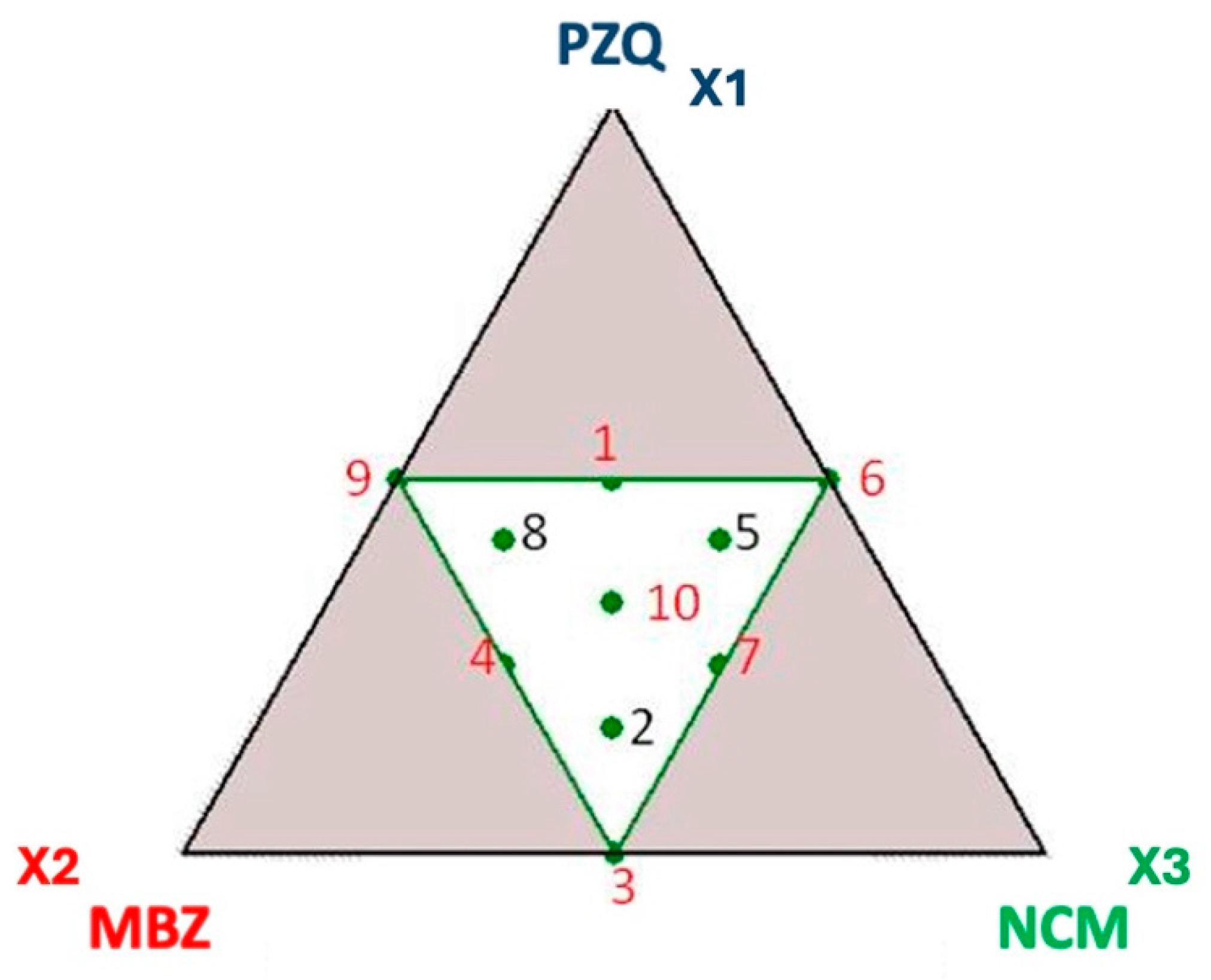
The experimental matrix is detailed in Table 1, and the ternary diagram representing the experimental design space is shown in Figure 2.

Neat Grinding (NG) Experiments

Milling was carried out using a Retsch MM400 vibrational mill (Retsch, Germany) equipped with two 25 mL stainless steel jars, each containing a 10 mm Ø stainless steel bead. The milling frequency was consistently set at 25 Hz for all experiments, with the void volume in the jars kept constant by maintaining a total powder mass of 400 mg per 25 mL jar. The milling duration was 4 hours.
To ensure reproducibility, each mixture was milled in at least four replicates. Pure crystalline drugs (MBZ and NCM) (400 mg per drug) were also milled individually under the same conditions. PZQ was not milled alone, as its behavior under these conditions had already been well-documented in previous studies [28,29].

Physical Mixtures Preparation

Physical mixtures were prepared by manually mixing the active ingredients in an agate mortar for a standardized time of 3 minutes. Both binary and ternary mixtures were prepared, with a total mass of 400 mg for each batch. The molar ratios of the APIs were varied according to the experimental mixture design (Table 1).

2.2.2. Samples Characterization

Powder X-ray Diffraction (PXRD)

PXRD analysis was carried out by a Bruker D2 Phaser benchtop diffractometer (Bruker, Manheim, Germany) using the Bragg-Brentano geometry, using Cu-Kα radiation (λ = 1.5418 Å) with a 300W low-power X-ray generator (30 kV at 10 mA). All the measurements were conducted in a 2θ range of 3-40° with a step size of 0.02° and a scan speed of 0.6°/s. Each sample was prepared by gently pressing approximately 200 mg of ground product into the cavity of a steel sample holder equipped with a cylindrical polyvinylidene fluoride (PVDF) reducer.
PXRD patterns were recorded for the starting materials, physical mixtures, all milled samples, and a selection of aged coamorphous samples.

Differential Scanning Calorimetry (DSC)

Selected samples, weighing 2-4 mg, were introduced into an aluminum sealed and pierced 40 μL crucible and analyzed by a Mettler Toledo DSC 3 Star System (Milan, Italy) using STARe software version 16.40 for data analysis. The heating program employed a temperature ramp of 10 °C/min, from 30 °C to 350 °C, under a nitrogen (N2) flow rate of 50 mL/min.
The following samples were analyzed: pure APIs, physical mixtures, coamorphous samples produced via NG, and a selection of aged coamorphous samples.
DSC was mainly applied to experimentally evaluate Tgs of the ten coamorphous and the Tg temperature was expressed as inflection point in the thermal curve.
To obtain MBZ Tg, DSC heating/cooling/heating cycles were applied. These cycles were performed under a nitrogen (N2) flow of 50 mL/min, following this protocol: 1. Heating from 30 °C to 335 °C at a rate of 10 °C/min; 2. Isotherm at 335 °C for 5 min; 3. Cooling from 335 °C to -30 °C at a rate of 50 °C/min; 4. Isotherm at -30 °C for 5 min; 5. Reheating from -30 °C to 330 °C at a rate of 40 °C/min.
In certain cases, such as with NCM, where the Tg could not be detected using conventional DSC analysis, modulated DSC (MTDSC) was performed by using a DSC1 Stare System (Mettler Toledo, CH) equipped with a refrigerated cooling system (RCS). Samples of about 10 mg were quantitatively transferred to pin-holed aluminum pans, sealed, weighed and subjected to heating cycles from 10 to 350 °C (1 K/min), for a period of 90 s and an amplitude 0.5 °C. The DSC cell and RCS were purged with dry nitrogen at 80 and 120 mL/min, respectively. The system was calibrated using an indium standard. All data were treated with Stare System software (Mettler Toledo, CH).

True Density Determinations

The true density of the three pure powdered APIs was measured using a helium pycnometer (Ultrapyc 5000, Anton Paar GmbH, Graz, Austria). The device is based on gas pressure determinations, in connected, sealed chambers of specified volume. At first, a chamber is filled with powders and gas; the latter is later allowed to flow in a second chamber, free of powders. The difference in helium pressure in the two chambers is used to calculate the volume occupied by the powders, using Boyle’s law [30]. The density is finally determined by the ratio between mass of powders and calculated volume. The accuracy of the measurement relies on the penetration of inert gas in any void between particles. The density values of crystalline materials were used as crude density values for the amorphous components and serve to calculate the constant, K (equation 1):
K = T g 1 ρ 1 T g 2 ρ 2
K is a fundamental constant of Gordon-Taylor (G-T) equation (equation 2), which considers the weight fractions and Tg values of the individual component, as well as the true density values of their powders, to calculate a theoretical Tg for a coamorphous system [31,32]:
T g m i x = [ w 1 T g 1 + K 2 w 2 T g 2 + K 3 w 3 T g 3 ] [ ( w 1 + K 2 w 2 + K 3 w 3 ]
where:
  • pedix 1, 2 and 3 refer to PZQ, NCM and MBZ, respectively.
The Tg values included in the equation for the individual components are the experimentally determined values, as measured and described in section 2.2.2.2.

Fourier Transform Infrared Spectroscopy (FT-IR)

Powdered samples were analyzed with a Shimadzu IRAffinity-1S FT-IR instrument (Kyoto, Japan) in a range of 400-4000 cm-1 with a resolution of 4 cm-1 and 20 scans.
Suitable discs for analysis were prepared by gently grinding in an agate mortar 200 mg of anhydrous KBr (99% infrared grade) with 1% w/w of analyte and then pressing the mixture with a hydraulic press (PerkinElmer, Norwalk, USA), applying a pressure of 10 Ton for 3 min.
Data interpretation and comparisons were performed using SpectraGryph 1.2 software.

Scanning Electron Microscopy (SEM)

Images of some coamorphous were collected through SEM. The powdered sample was placed on an aluminum stub covered with a carbon double-sided tape and sputter-coated with gold using a Sputter Coater K550X (Emitech, Quorum Technologies Ltd, UK), before being analyzed by a scanning electron microscope (Quanta 250 SEM, FEI, Oregon, USA) with the secondary electron detector. The working distance was set at 10 mm to obtain the appropriate magnifications, and the acceleration voltage was set at 5 kV.

Stability Studies

Selected samples (i.e., exp. N° 1, 3, 4, 6, 7, 9, 10) were stored at four different temperatures (-30 °C, 5 °C, 25 °C, and 40 °C) for 6 months to assess their physical stability under various temperature conditions. To protect the samples from atmospheric humidity, they were stored in sealed vials placed inside sealed plastic bags. Samples were withdrawn during the first month on a weekly basis and then on a biweekly basis and tested to investigate the possible recrystallization using PXRD (as described in section 2.2.2.1). Samples stored for 6 months under the most severe conditions (i.e., -30 °C and 40 °C) were also evaluated for drug recovery (see section 2.2.2.7).
Additionally, it is well-established in literature that amorphous systems are prone to hygroscopicity [33,34]. Therefore, to gather preliminary data on the effects of relative humidity (RH) on these coamorphous systems, selected samples were further analyzed using the dynamic vapor sorption (DVS) technique. Specifically, samples from exp. N° 3, 6, 9, and 10 were placed in crucibles and subjected to a gradual RH increase from 0% to 90% at a constant temperature of 25 °C. This allowed for the evaluation of mass changes, providing insight into surface moisture absorption and, consequently, powder hygroscopicity.

Drug Recovery

To check possible degradation of coground samples after preparation, 1H-NMR spectra were recorded on a Bruker Avance 600 spectrometer equipped with a 14 T superconducting magnet and two 5 mm probes. Analyzed samples were dissolved in chloroform deuterated (CDCl3) using tetramethyl silane (TMS) as reference. Measurements were conducted at 300 K using a simple pulse-acquire sequence. Drug recovery analyses were performed on the same seven samples (i.e., exp. N° 1, 3, 4, 6, 7, 9, 10) used for the physical stability study, specifically those stored in the freezer and those subjected to stressed conditions at 40 °C.

3. Results and Discussion

The first step of this experimental work involved the planning of an experimental matrix using the NEMROWD software to design binary and ternary mixtures of the three APIs (PZQ, NCM and MBZ). The goal was to develop mixtures with a total molar composition equal to 1, ensuring that the combined molar ratios of the three drugs in each formulation would sum to a precise unity. Once established these constraints, ten different mixtures of the three APIs were obtained (refer to Table 1 for N° of experiment and compositions). These ten mixtures were then subjected to NG for 4 hours at a frequency of 25 Hz (in batches, each weighing 400 mg).
As a control, physical mixtures with the same compositions as those in the experimental matrix were also prepared. This allowed for a detailed comparison between the coground samples and their unprocessed counterparts, providing valuable insight into the structural differences between the two.
The solid-state nature of the coground samples and physical mixtures was then assessed through PXRD analysis. Diffractograms of all ten milled mixtures revealed a typical halo pattern characteristic of amorphous compounds (see Figures S1-S10 in the Supporting Information (SI) file) [35], in contrast to the physical mixtures, where the PXRD patterns simply reflected the combined crystalline patterns of the two or three (depending on the mixture composition) starting materials (Figure S11 in the SI file). This comparison clearly indicated that manual physical mixing was insufficient to amorphize the three APIs, whereas NG was essential to achieve complete amorphization in all ten systems.
At this stage, some coground samples (all three binary plus one ternary system, i.e., exp. N° 3, 6, 9 and 10) were analyzed using FT-IR spectroscopy to investigate the presence of possible interactions between the components, which would indicate the formation of coamorphous systems rather than mere physical blends of the three amorphous components.
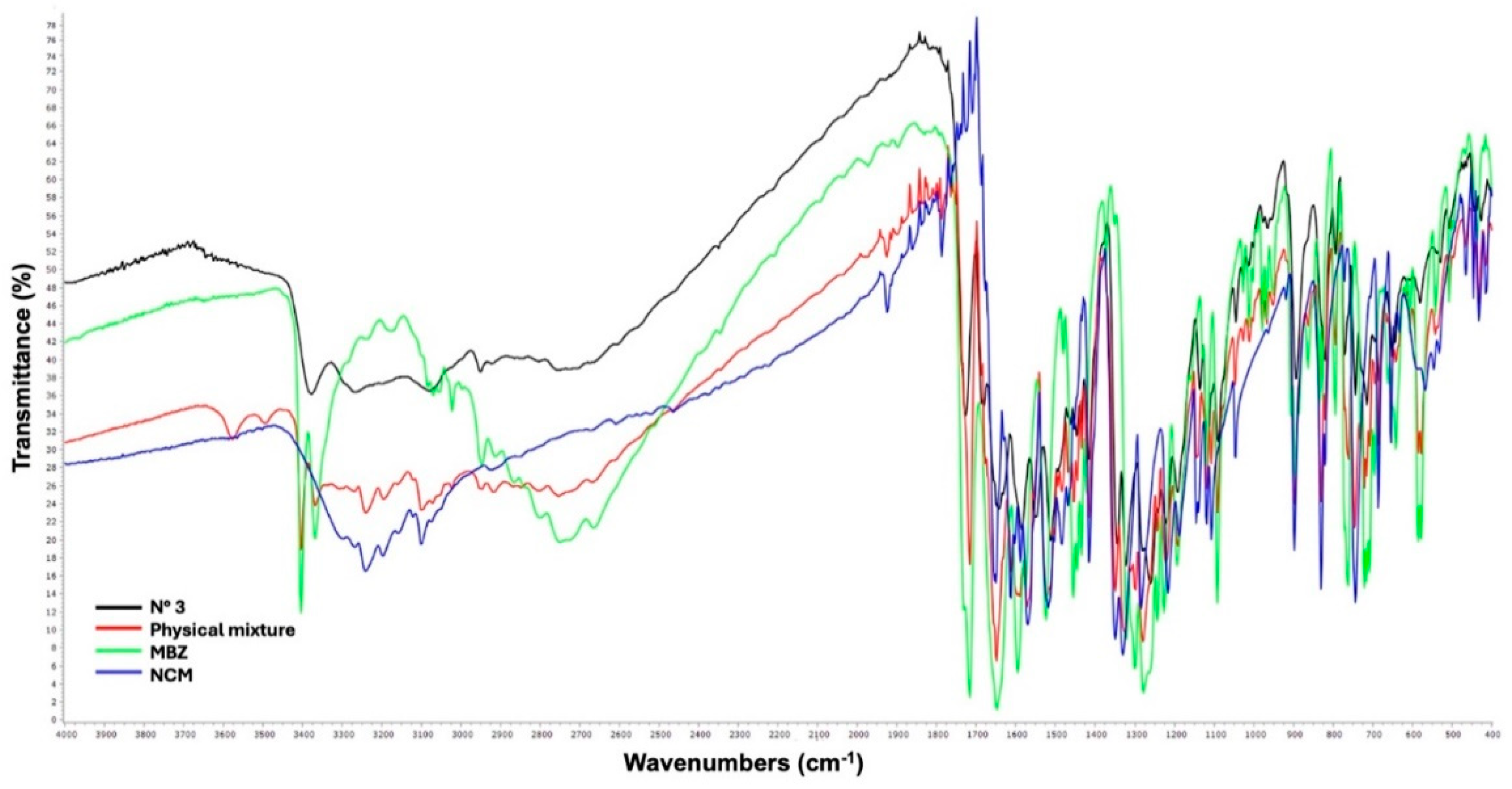
Figure 3 shows FT-IR spectrum of exp. N° 3 (i.e., binary NCM-MBZ 1-1) compared to the corresponding physical mixture and pure components. Starting with MBZ, the N-H amide stretching band at 3404 cm⁻¹ [36] is still present in the physical mixture, whereas it disappears in the coamorphous spectrum, indicating their involvement in hydrogen bonding. Similarly, the amide C=O stretching band at 1717 cm⁻¹ [36] is no longer detectable in the coamorphous system, suggesting that the carbonyl amide group could also be involved. At 1648 cm⁻¹ [36], the benzoyl C=O stretching of MBZ exhibits broadening in the coamorphous spectrum, though the extent of its involvement remains uncertain.
Turning to NCM, the functional group clearly involved in interactions is the N-H, as its stretching bands at 3241 and 3110 cm⁻¹ [37], still visible in the physical mixture, completely disappear in the coamorphous spectrum. At 1651 cm⁻¹ [38], the C=O stretching band shows broadening in the coamorphous spectrum, though its involvement in hydrogen bonding is less clear. Additionally, the C-OH stretching band at 1192 cm⁻¹ [38] appears in both spectra, suggesting no interaction with this group. In conclusion, the N-H amide groups from both components and the MBZ amidic carbonyl appear to be involved in hydrogen bonding.
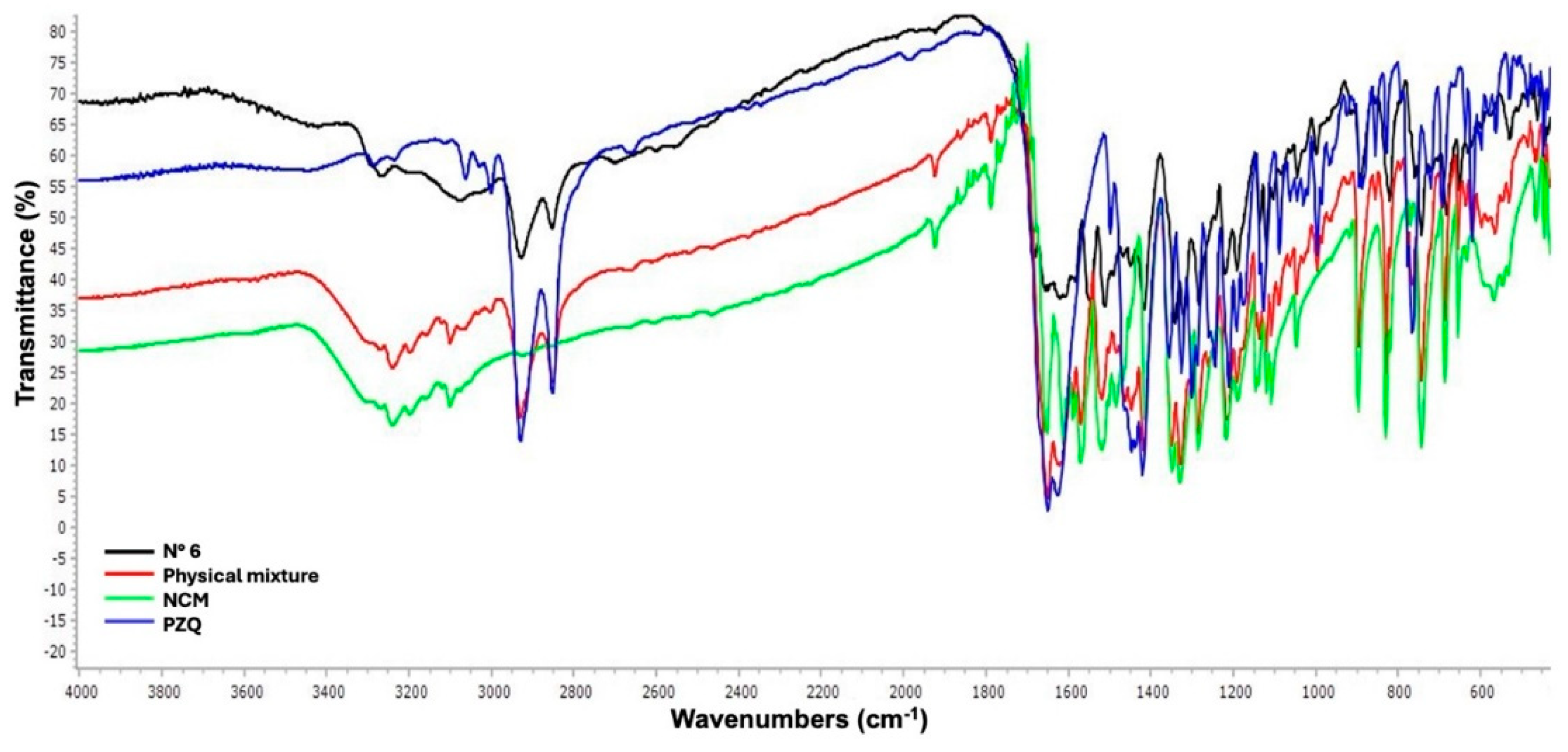
Also, FT-IR of exp. N° 6 (i.e., binary PZQ-NCM 1-1) was useful to elucidate some possible interactions between the two components. The FTIR spectrum of the new coamorphous system exhibits the typical band broadening characteristic of amorphous materials, differently from the pure crystalline components and the physical mixture. This broadening is particularly evident in the wavenumber region between 3241 and 3110 cm⁻¹, where the N-H stretching bands of NCM are located [37], making it difficult to clearly determine whether the donor group is involved in hydrogen bonding. Additionally, the band at 1624 cm⁻¹, corresponding to the C=O stretching of PZQ [22,28,39,40], disappears in the coamorphous spectrum, confirming the involvement of the carbonyl group as a hydrogen bond acceptor. Conversely, the C-OH stretching band of NCM at 1192 cm⁻¹ [38] is still present in both the physical mixture and the coamorphous spectra, suggesting that this group is not acting as a hydrogen-bond donor. The broadening observed in the coamorphous spectrum makes it difficult to definitively identify all the groups involved in hydrogen bonding. However, a PZQ carbonyl group seems to be implicated as a hydrogen bond acceptor. Figure 4 shows the FT-IR spectra described above.
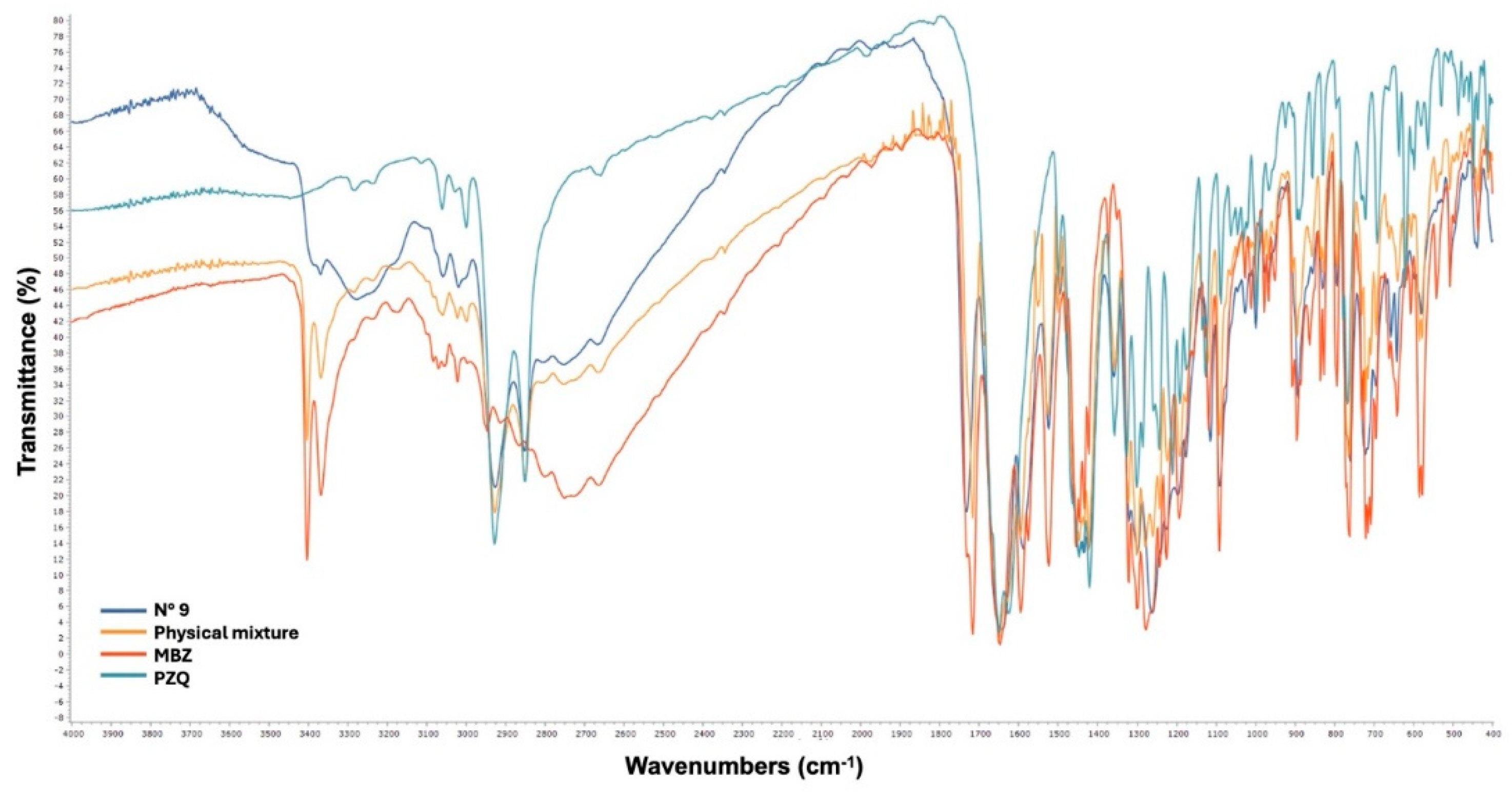
FT-IR of exp. N° 9 (i.e., binary PZQ-MBZ 1-1) are reported in Figure 5. By comparing the FT-IR spectra of the new coamorphous system, its physical mixture, and the individual components, it can be hypothesized the presence of solid-state interactions. In the region related to PZQ carbonyl stretching vibrations, the coamorphous merges into a single broad and shifted carbonyl band at 1641 cm⁻¹, compared to the double peak at 1647 and 1624 cm⁻¹ observed for anhydrous PZQ [22,28,39,40]. PZQ bands are still visible in the physical mixture, confirming that no interactions involving these functional groups occur in the simple mixture. Regarding MBZ, the sharp N-H amide stretching band at 3404 cm⁻¹ [36], which is still prominent in the physical mixture, is absent in the coamorphous system. This could indicate that the N-H amide group participates in hydrogen bonding. Additionally, the band at 1278 cm⁻¹, associated with the C-N stretch of the imidazole [36], shows significant broadening in the coamorphous spectrum, suggesting its involvement in interactions. In contrast, no such broadening is observed in the simple physical mixture.
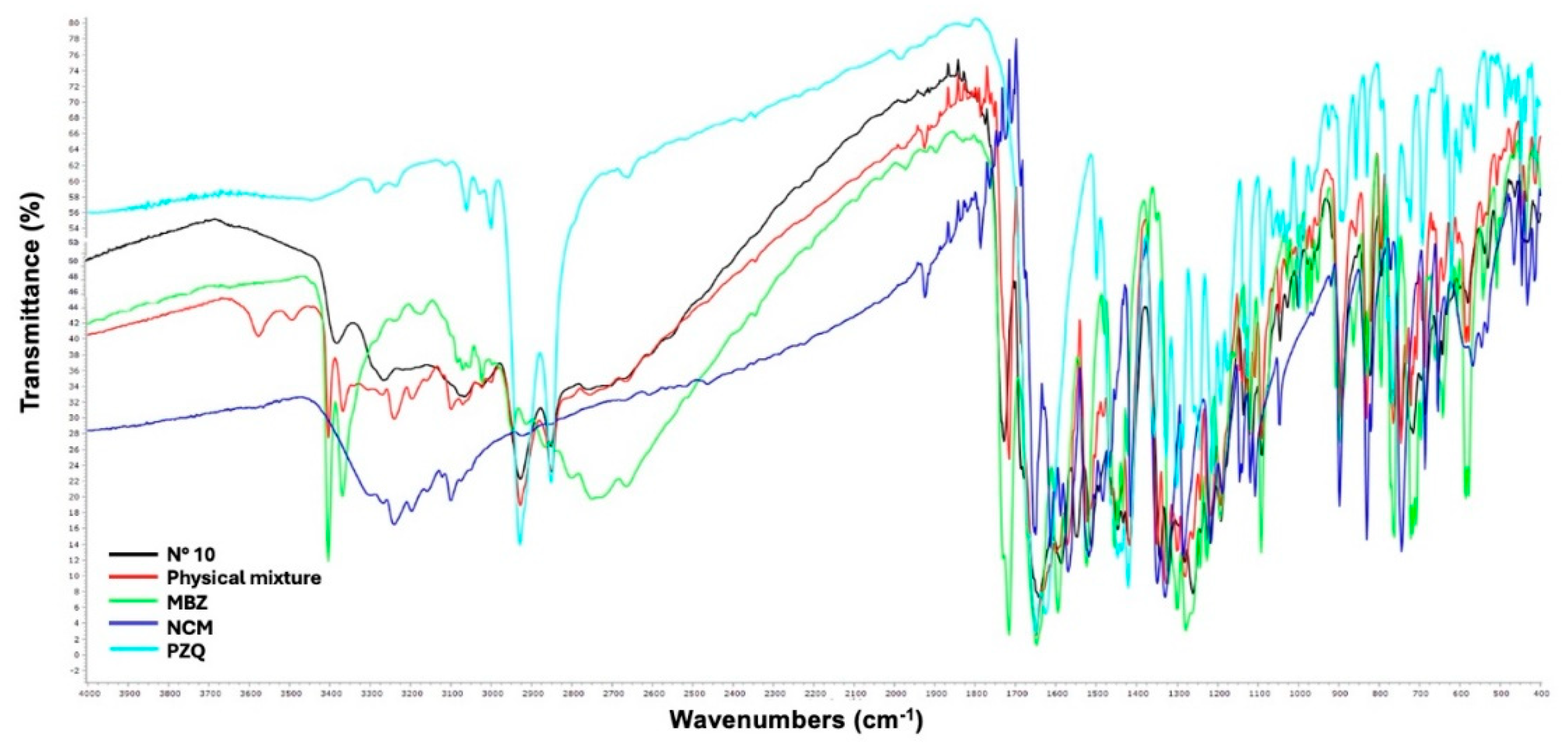
Figure 6 reports FT-IR spectra for ternary PZQ-NCM-MBZ 1-1-1 coamorphous, the corresponding physical mixture and the three active ingredients. The FT-IR spectra reveal several informative bands. Considering MBZ, the sharp N-H stretching band at 3404 cm⁻¹ [36] completely disappears in the coamorphous spectrum, indicating the involvement of a hydrogen bond. The C-N stretching band at 1278 cm⁻¹ [36] shows significant broadening in the ternary system, reflecting its amorphous nature, while the C=O stretching band, originally at 1717 cm⁻¹ [36], is absent, confirming the involvement in the interactions. On the contrary, the C=O stretching band at 1648 cm⁻¹ [36] remains visible, suggesting that this group is not involved in the interactions. Regarding NCM, the N-H stretching and bending at 3241 and 3195 cm⁻¹ and 897 cm⁻¹ [37], respectively, disappear in the ternary system spectrum, indicating their involvement in hydrogen bonding. The C=O stretching band at 1651 cm⁻¹ is significantly broadened but still present, while the C-OH stretching band at 1192 cm⁻¹ is broadened and shifted, a behavior also observed in the physical mixture spectrum, making it unclear whether this group participates in hydrogen bonding. As for the C=O groups in PZQ, the carbonyl stretching band at 1624 cm⁻¹ disappears in the coamorphous spectrum, indicating its definite involvement in hydrogen bonding. In conclusion, the groups most certainly involved in hydrogen bonding are the amide N-H and carbonyl groups of MBZ, the amide N-H of NCM, and the carbonyl group of PZQ.
Given the complexity of FT-IR results of coamorphous systems—particularly the ternary ones—and the fact that the starting commercial form of MBZ is itself a mixture of two polymorphs [41] (as also confirmed by DSC and PXRD analyses), the confirmation of the existence of homogeneous coamorphous systems was obtained through the evaluation of the Tg of the system, as it is one of the key features that distinguishes amorphous and coamorphous systems from crystalline materials. Particularly to coamorphous systems, which are homogeneous multicomponent systems, one would expect to observe a single Tg value. Therefore, experimentally determining the Tg and confirming a unique value for each of the ten mixtures could provide further evidence that homogeneous coamorphous systems were successfully obtained.
The experimental Tg values were primarily determined using conventional DSC analysis. However, in some cases, where it was not possible to detect Tg through traditional DSC, MTDSC was employed.
To provide a comparison of the experimental results, theoretical Tg values of the (binary or ternary) drug mixtures were also calculated using the Gordon-Taylor (G-T) equation reported in section 2.2.2.3 [31,32].
As for the individual APIs, Tg was determined experimentally by DSC (or MTDSC, in PZQ and NCM cases) and compared to theoretical Tg values. The experimental values, not in good agreement with the conventional Rule of 2/3 [42], were in satisfactory accordance with the predicted model recently proposed by Alzghoul and coauthors [43], unless for MBZ. The experimental Tg values of PZQ and MBZ were found to be consistent with those previously reported in literature [44,45], while Tg of NCM was experimentally determined for the first time.
Table 2 summarizes experimental and calculated Tg values for the ten mixtures and the three pure APIs.
As highlighted in this table, the experimental Tg values of the mixtures obtained via DSC were generally in good agreement with the theoretical values calculated using the G-T equation. The similarity between the experimental Tg and the theoretical Tg values indicated that there might be not strong molecular interactions between the drugs [10]. In these mixtures, slight positive deviations were observed, generally indicating a slightly higher rigidity of the vitreous state, as also confirmed by FT-IR analyses, which remain to be verified by stability studies [42,46,47].
However, experimental analyses (i.e. DSC and MTDSC) were unable to clearly determine the Tg in two out of the thirteen systems investigated. This issue could be attributed to several reasons: the known difficulty in detecting Tg in some amorphous formulations prepared by grinding, as these systems occasionally fail to produce a distinct Tg signal, possibly due to incomplete amorphization or other physical disruptions introduced during the grinding process [2,48], or simply to the fact that these two systems are not coamorphous systems.
In the remaining eight cases, a single Tg value was observed, demonstrating that these were homogeneous multicomponent systems. The presence of a singular Tg is a key indicator that the components are well-integrated at the molecular level, supporting the conclusion that true coamorphous systems were formed rather than simple physical mixtures of individual amorphous substances.
The experimental and computed Tg values provided useful insights into the expected stability of the coamorphous systems. Stability is a critical factor for the practical application of coamorphous materials, particularly because of their inherent tendency to revert to a crystalline state over time or under certain environmental conditions [2,7,34]. It is widely reported in the literature that amorphous and coamorphous systems are generally stable up to a temperature approximately 50 °C below their Tg, a principle often referred to as the "Tg – 50 °C" rule. According to this rule, molecular mobility within an amorphous solid becomes negligible 50 °C below its Tg, whereas temperatures exceeding this threshold can lead to significantly increased molecular mobility, which is sufficient to induce physical changes such as recrystallization or phase separation.
This "Tg – 50 °C" guideline serves as a practical tool for predicting the long-term stability of coamorphous systems, helping to ensure that their amorphous nature is maintained during storage and use [49,50,51]. As a result, coamorphous systems with a Tg above 75 °C are generally expected to remain stable under ambient conditions (or even at 40 °C if the Tg exceeds 90 °C). In contrast, systems with lower Tg values are more prone to recrystallization at room temperature and therefore require to be stored in a refrigerator or in a freezer to maintain their physical integrity.
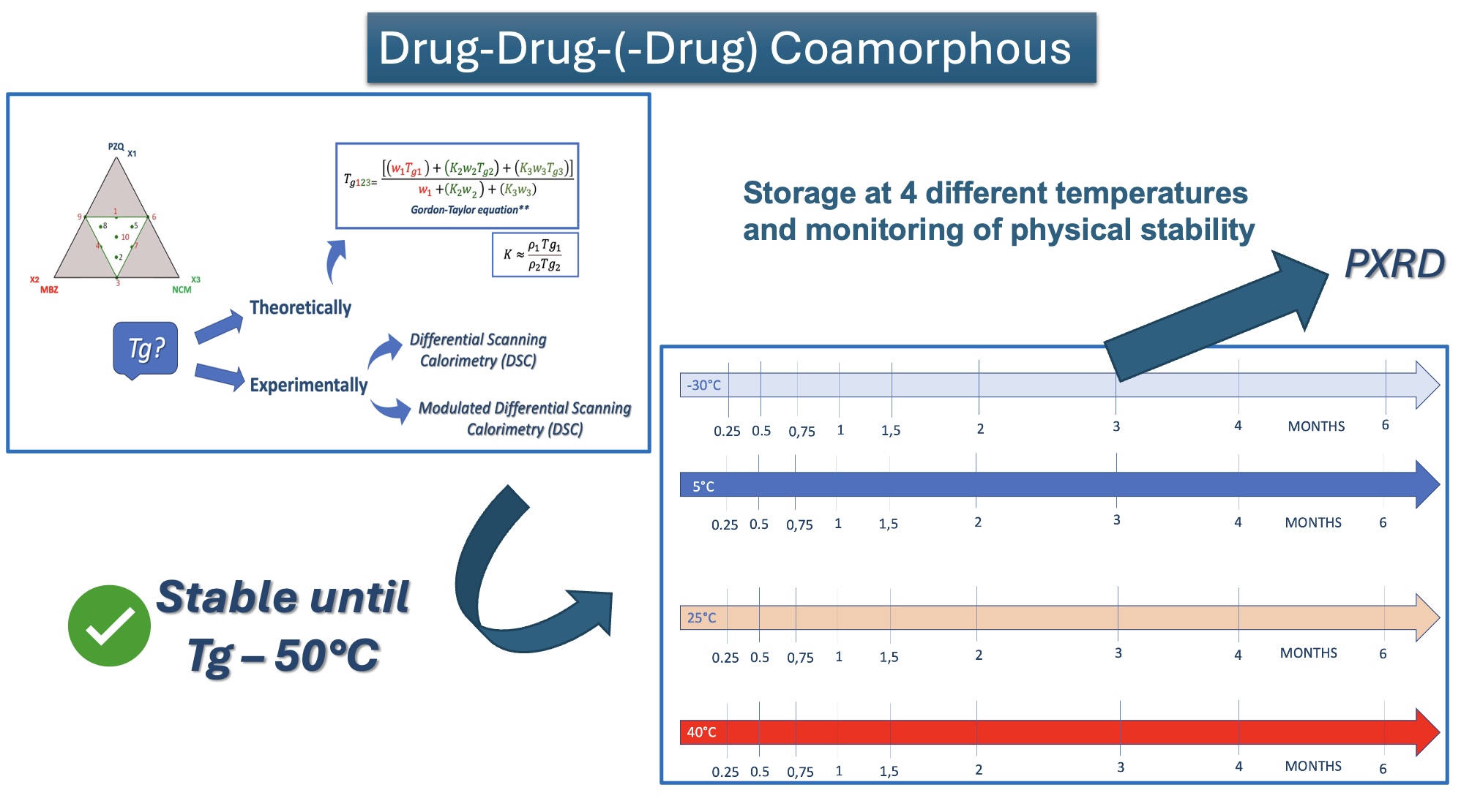
Therefore, to assess the physical stability of the coamorphous systems under different temperature conditions, selected samples (exp. N° 1, 3, 4, 6, 7, 9, 10) were stored at four distinct temperatures: -30 °C, 5 °C, 25 °C, and 40 °C, over a period of six months. The solid-state nature of these samples was closely monitored using PXRD, with analyses conducted on a weekly basis during the first month and then on a biweekly basis.
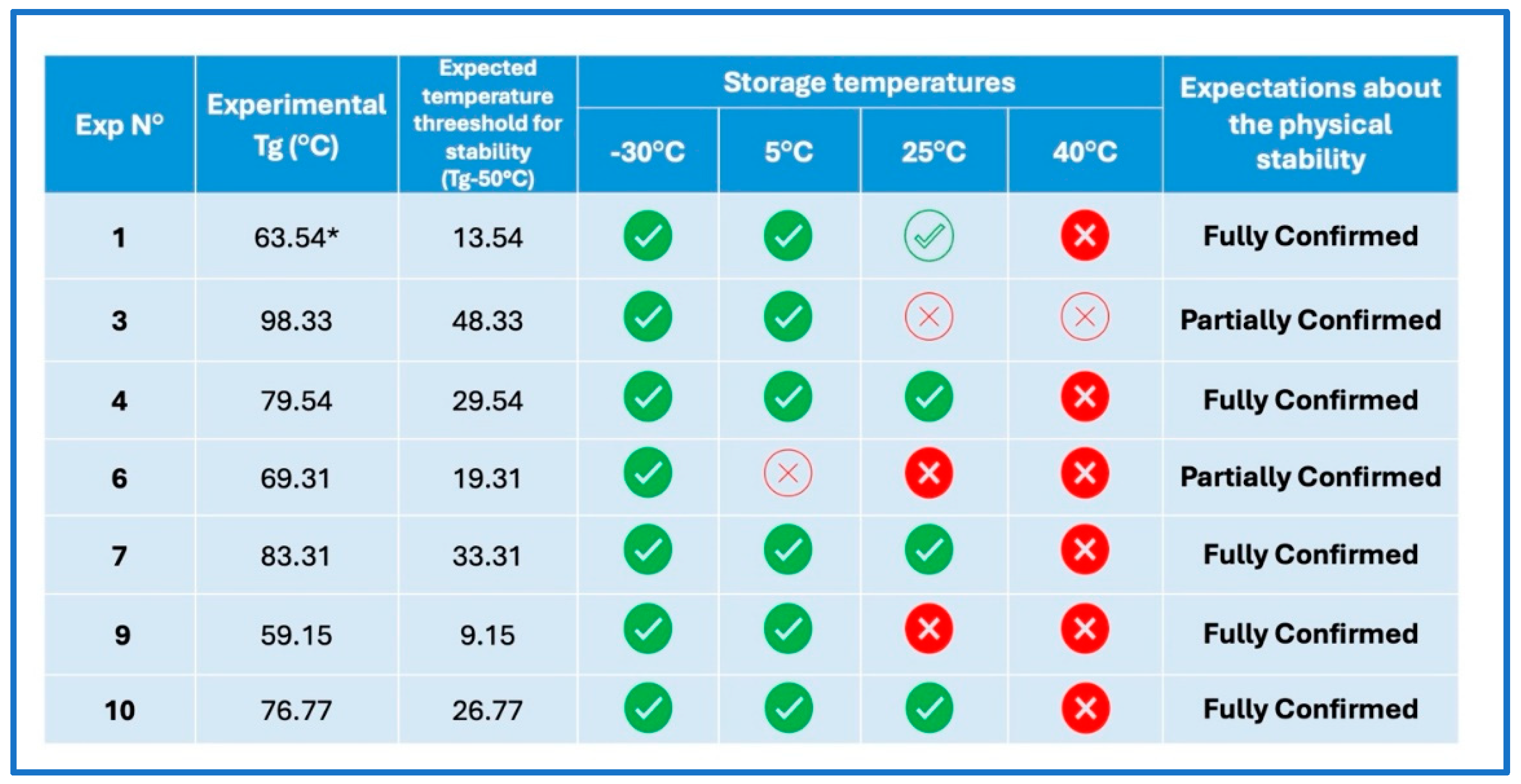
Figure 7 presents a summary of the results from this 6-month stability study. The findings largely aligned with the expectations regarding the physical stability of the coamorphous systems, as predicted by the "Tg – 50 °C" rule; only two out of seven systems partially deviated from these expectations. All systems remained stable in the freezer throughout the entire six-month period. Furthermore, one of the samples, specifically exp. N° 1, which corresponds to a ternary coamorphous formulation, for which the Tg could not be measured experimentally, considering the “Tg – 50 °C” rule and the calculated Tg (through G-T equation), demonstrated stability greater than expected. This led to conclude with good approximation that this was also a coamorphous system.
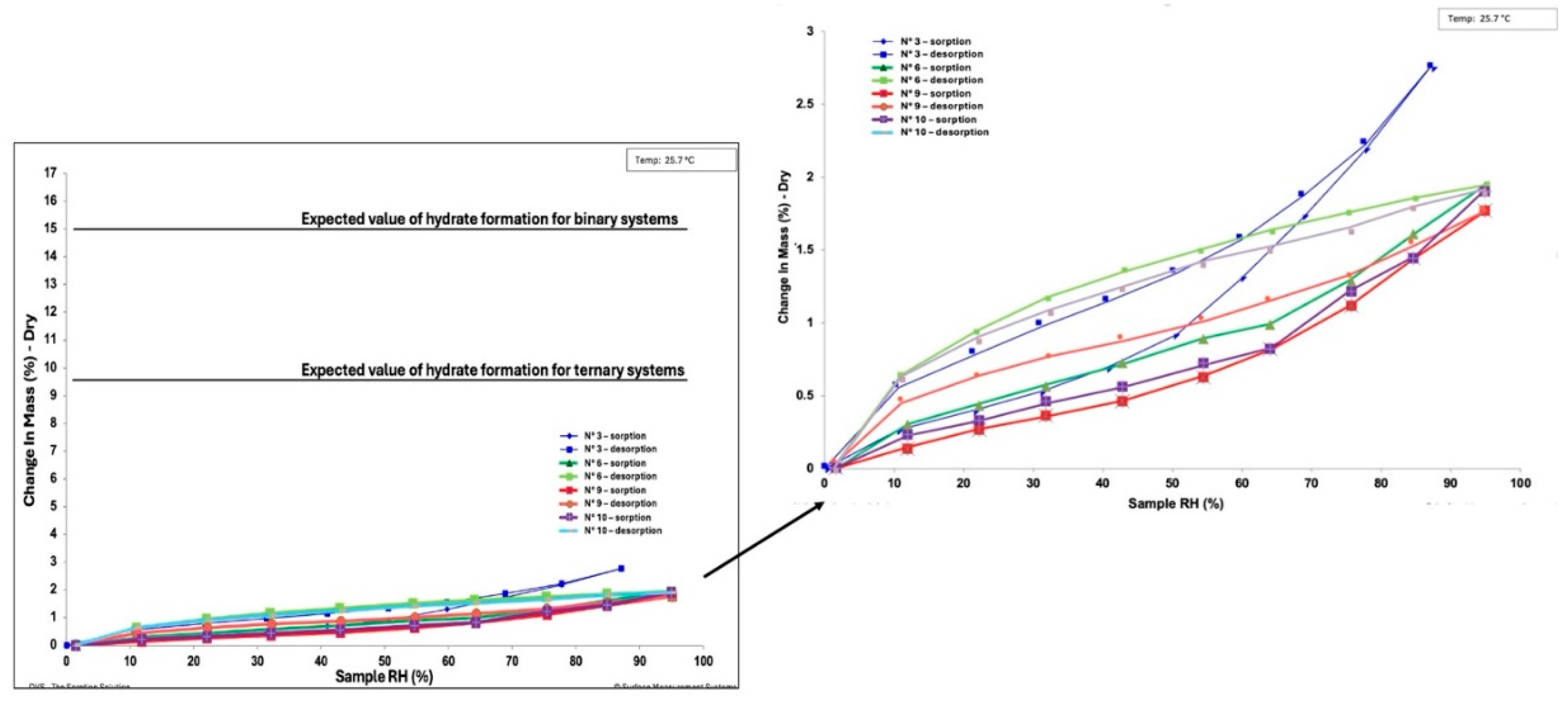
Remaining in the context of physical stability, one of the most critical challenges associated with amorphous and coamorphous materials is their inherent hygroscopicity. These materials have a high tendency to absorb moisture from the environment due to their disordered molecular structure, which creates an increased surface area and more accessible sites for water interaction. The absorption of moisture can generate several negative consequences. Water molecules, once absorbed, can act as plasticizers, lowering the Tg and increasing molecular mobility within the material. This can lead to a destabilization of the amorphous or coamorphous matrix, weakening or completely disrupting the intricate molecular interactions that maintain the material in its high-energy state. Such destabilization brings to unwanted phenomena, like phase separation, loss of cohesion in the coamorphous system, or most detrimentally, recrystallization or hydrates formation. These latter phenomena not only compromise the solubility and dissolution rate advantages of amorphous forms, but also risk reducing bioavailability [33,34]. Therefore, understanding and meticulously controlling hygroscopicity is crucial to preserving the physical stability of amorphous and coamorphous powders over time. To assess the effects of relative humidity (RH) on the obtained coamorphous systems, selected samples (i.e., N° 3, 6, 9, and 10) were subjected to a gradual RH increase from 0% to 90% at a constant temperature of 25 °C. Figure 8 provides a summary of the sorption-desorption curves for all four coground systems investigated.
In each case a limited mass uptake can be noticed, not exceeding the 3% of the starting mass. It can be concluded hence that this maximum observed value neither is imputable to a recrystallization event, since after the cycle of desorption the mass corresponds to the starting one, nor to a bulk transformation such as hydrate formation. In fact, considering the molecular weight of the three APIs and water, a hydrate formation would correspond to a mass gain percentage of about 15% for the binary and 9.6% for the ternary systems. Conversely, a mass uptake ranging about 3% is related to a superficial water adsorption, since amorphous phases demonstrates hygroscopic properties and they sorbs relatively more water as compared with crystalline solid phase [52]. The mass uptake of the four samples is between 1.8 and 2.8%, attesting an analogous behavior not depending on the composition. Moreover, measurable hysteresis (i.e., difference in water vapor uptake between sorption and desorption isotherms), are visible on the graph but they are not attributable to any recrystallization phenomena since, as explained above, the final mass after the cycle of desorption corresponds to the initial one.
Subsequently, drug recovery analyses were carried out on the same seven samples (i.e., exp. N° 1, 3, 4, 6, 7, 9, and 10) used in the physical stability study, focusing on those stored in the freezer at -30 °C and those exposed to stressed conditions at 40 °C (a total of fourteen samples).
The degradation tendency of PZQ under milling conditions is well-documented in literature [22,45,53]. While PZQ does not degrade when milled alone [28,29], binary ground mixtures have shown reduced PZQ recovery, along with the emergence of specific degradation products depending on the excipient used [22,45,53]. To determine whether PZQ undergoes chemical degradation when co-ground with NCM and/or MBZ under NG conditions, spectrometric evaluations were conducted.
The recorded ¹H-NMR spectra revealed weak signs of PZQ degradation in only one out of fourteen samples (exp. N° 6), likely due to the fact that this sample was stored under stressed conditions at 40 °C. Encouragingly, all other thirteen samples, including those stored at 40 °C, showed only the presence of the starting materials—PZQ, NCM, and/or MBZ—indicating the absence of chemical changes after mechanochemical treatment under all experimental conditions. Figures S12-S25 in the SI file report all the recorded ¹H-NMR spectra.
The final phase of this experimental work involved clarifying the recrystallization phenomena observed in the newly developed systems.
Recrystallization of coamorphous systems can lead to different outcomes, depending on the nature of the components and their interactions. In some cases, recrystallization may result in the separation of the initial phases, where each component reverts to its crystalline form independently. Alternatively, recrystallization can lead to the formation of a new entity that corresponds to the coamorphous system but in a crystalline form, known as a cocrystal. This transformation into a cocrystal indicates that the components have not only maintained their interactions but have rearranged into a well-defined crystalline lattice, preserving the combined properties of the coamorphous phase while gaining the stability of a crystalline structure [54,55,56].
Here, we present two examples of recrystallization pathways, noticed during stability studies: one illustrating the recrystallization of a coamorphous system into its individual components, and the other showcasing its transformation into a new cocrystal. In some cases, to gain a deeper understanding of the solid forms obtained after recrystallization, SEM images of both the fresh and recrystallized products were acquired and combined with PXRD analyses (see Figure S26 in the SI file as an example).
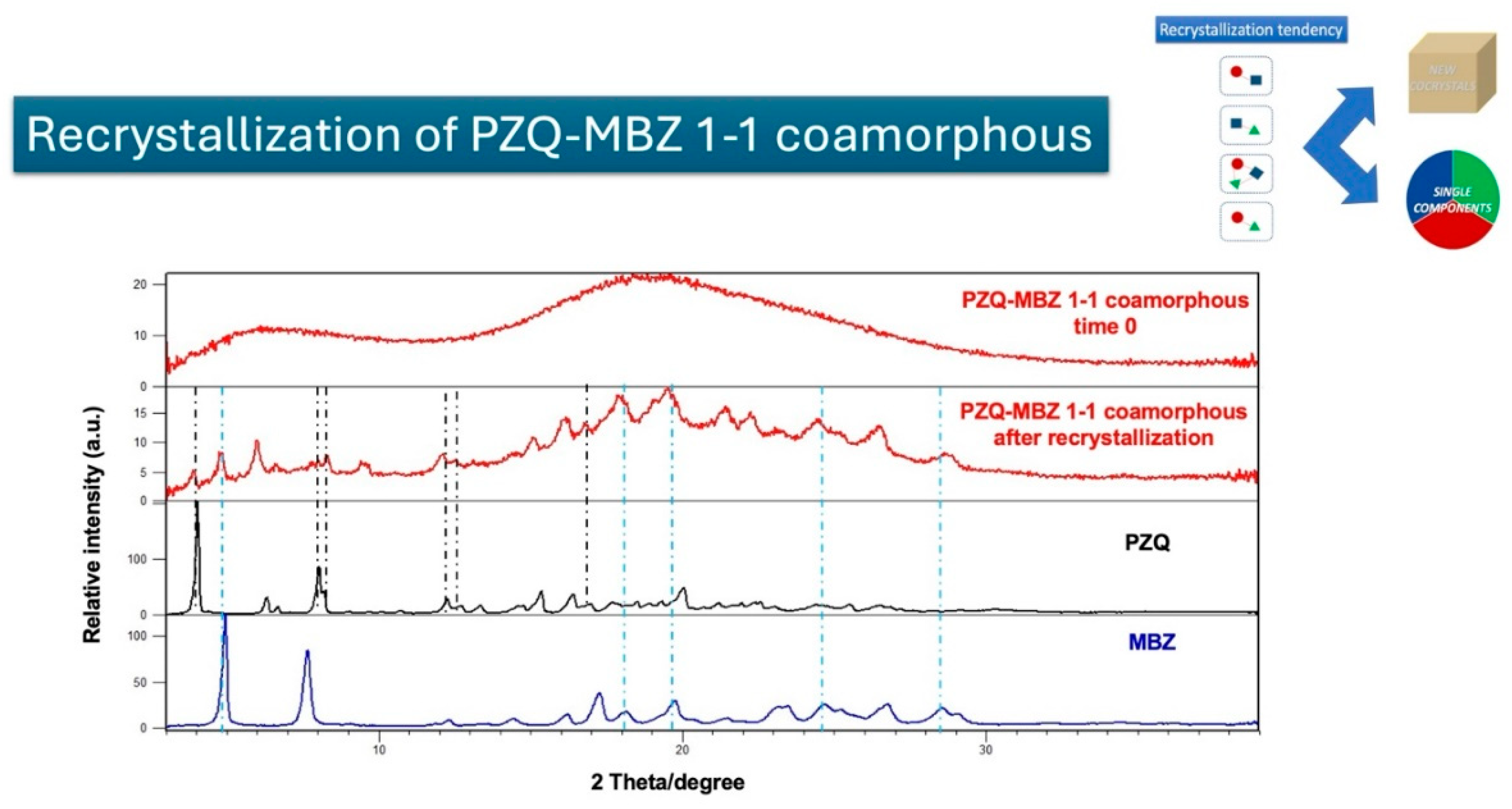
The first example of recrystallization is that observed in exp. N° 6, which corresponds to the binary PZQ-MBZ 1-1 coamorphous system. As shown in Figure 9, which presents the PXRD data of the fresh and recrystallized products, the recrystallization process leads to the phase separation of the original components, PZQ and MBZ. In fact, the PXRD patterns clearly show distinct peaks corresponding to the separate crystalline forms of PZQ and MBZ.
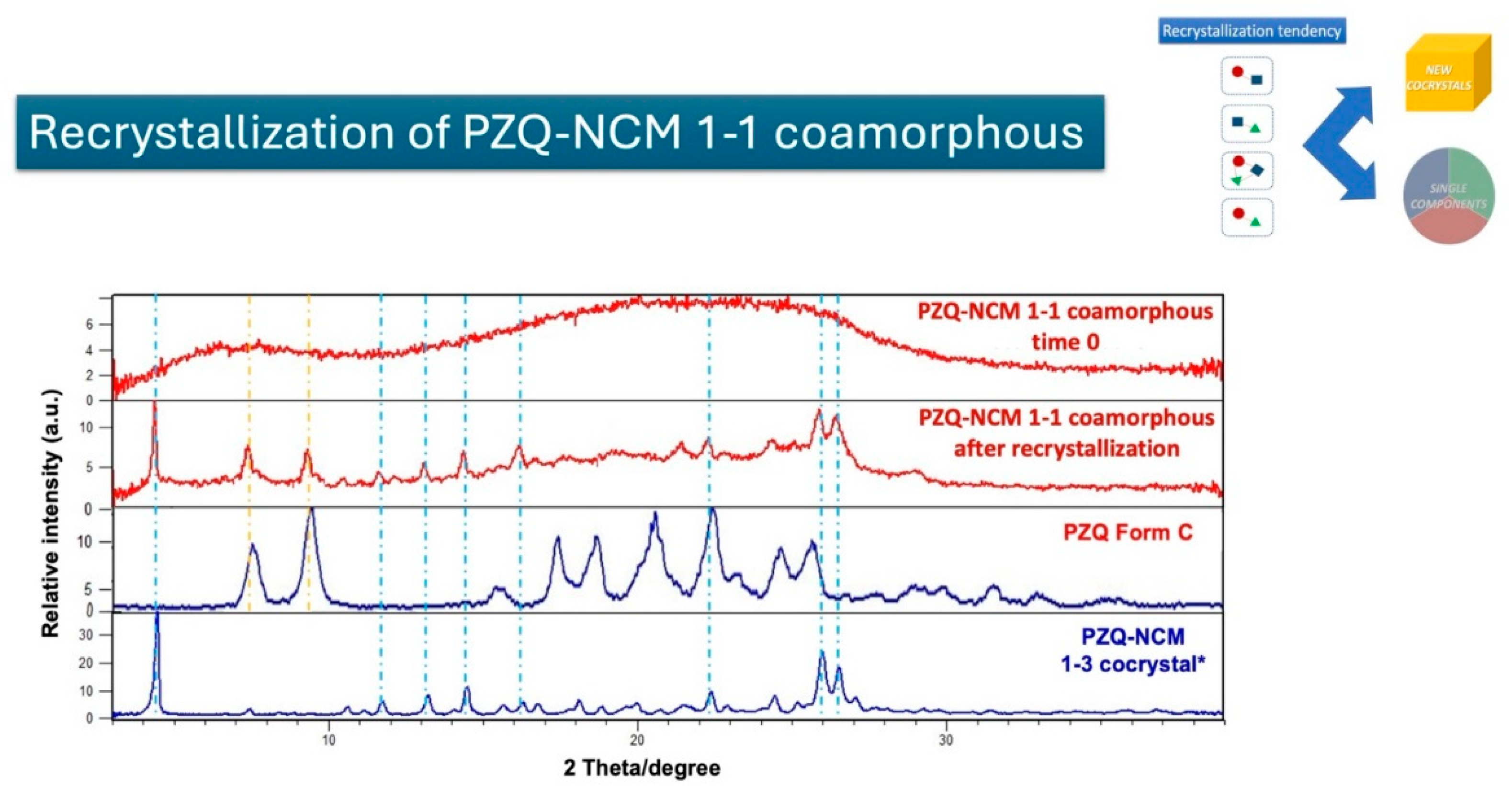
The second example is exp. N° 9, which involves the binary PZQ-NCM 1-1 coamorphous system. In this instance, recrystallization did not result in the formation of individual crystalline materials. Instead, it led to the creation of a "new" entity that, through detailed analysis, was identified as the previously reported PZQ-NCM 1-3 anhydrous cocrystal (CSD refcode RIPFOP01) [24].
What is particularly intriguing about this coamorphous system is its unique behavior during recrystallization. Specifically, the PZQ-NCM 1-1 coamorphous system transforms into a combination of the well-known polymorph C of PZQ and PZQ-NCM 1-3 anhydrous cocrystal (Figure 10). This indicates a significant change in the stoichiometry between the two components, suggesting that the coamorphous state can influence the pathways of crystallization in unexpected ways.
However, recrystallization phenomena are inherently slow processes, and understanding them, particularly in ternary coground systems, can often be challenging and not immediately straightforward. Due to the complexity of these systems and the gradual nature of recrystallization, this aspect of the research is still in progress and continues to expand.

4. Conclusions

In this experimental work, we demonstrate the possibility of preparing coamorphous systems composed exclusively of active pharmaceutical ingredients, specifically praziquantel, niclosamide, and mebendazole.
The coamorphous systems were prepared via a one-step, solvent-free process—neat grinding—using a lab-scale vibrational mill. The process proved to be reproducible, requiring only 4 hours of grinding to achieve the coamorphous state. All systems were characterized by PXRD and, in some cases, FT-IR analysis, and compared against the starting components and their corresponding physical mixtures to confirm the absence of crystalline domains in the samples. Glass transition temperatures of the coamorphous systems were experimentally determined using DSC and compared to theoretical Tg values calculated via the Gordon-Taylor equation. Despite the complex DSC curves, particularly for ternary coamorphous, the presence of a single Tg in each case confirmed the formation of a homogeneous multicomponent system.
Stability studies were conducted on seven systems (three binary and four ternary coground samples) for six months under four different temperature conditions (-30 °C, 5 °C, 25 °C, and 40 °C), based on the "Tg – 50 °C" stability rule. The results largely aligned with expectations for physical stability, with only two deviations out of the seven systems. All systems remained stable when stored in the freezer for the entire six-month period, and one ternary coamorphous formulation exhibited a higher stability temperature than anticipated.
Regarding the influence of relative humidity, DVS results indicated that water had minimal impact on the new solid phases. Only superficial sorption was observed, with no signs of recrystallization triggered by humidity.
Recrystallization pathways were also investigated to better understand the potential outcomes of this process. Depending on the molecular interactions within the system, recrystallization led either to the separation of the initial components into their crystalline forms or to the formation of a new entity, such as a cocrystal previously reported by our group.
Future directions of this work will focus on a deeper examination of the recrystallization phenomena, which are slow processes, particularly in ternary systems. Additionally, the biopharmaceutical properties of these promising drug-drug coamorphous systems—such as solubility, dissolution, permeability, and their anthelmintic activity—will be investigated to further evaluate their therapeutic potential.

Supplementary Materials

The following supporting information can be downloaded at the website of this paper posted on Preprints.org, Figure S1. PXRD analysis of 4 repetitions of NG of exp. N° 1 (ternary PZQ-NCM-MBZ 1-0.5-0.5 system). Figure S2. PXRD analysis of 4 repetitions of NG of exp. N° 2 (ternary PZQ-NCM-MBZ 1-2.5-2.5 system). Figure S3. PXRD analysis of 8 repetitions of NG of exp. N° 3 (binary NCM-MBZ 1-1 system). Figure S4. PXRD analysis of 8 repetitions of NG of exp. N° 4 (ternary PZQ-NCM-MBZ 0.5-0.5-1 system). Figure S5. PXRD analysis of 4 repetitions of NG of exp. N° 5 (ternary PZQ-NCM-MBZ 2.5-2.5-1 system). Figure S6. PXRD analysis of 6 repetitions of NG of exp. N° 6 (binary PZQ-NCM 1-1 system). Figure S7. PXRD analysis of 4 repetitions of NG of exp. N° 7 (ternary PZQ-NCM-MBZ 0.5-1-0.5 system). Figure S8. PXRD analysis of 4 repetitions of NG of exp. N° 8 (ternary PZQ-NCM-MBZ 2.5-1-2.5 system). Figure S9. PXRD analysis of 8 repetitions of NG of exp. N° 9 (binary PZQ-MBZ 1-1 system). Figure S10. PXRD analysis of 6 repetitions of NG of exp. N° 10 (ternary PZQ-NCM-MBZ 1-1-1 system). Figure S11. PXRD analysis of pure MBZ, PZQ and NCM compared to the physical mixtures of the matrix systems. Figure S12. 1H-NMR analysis (from top to bottom) of pure PZQ, NCM and MBZ compared to the sample of exp. N° 1. Figure S13. 1H-NMR analysis (from top to bottom) of pure PZQ, NCM and MBZ compared to the sample of exp. N° 2. Figure S14. 1H-NMR analysis (from top to bottom) of pure PZQ, NCM and MBZ compared to the sample of exp. N° 3. Figure S15. 1H-NMR analysis (from top to bottom) of pure PZQ, NCM and MBZ compared to the sample of exp. N° 4. Figure S16. 1H-NMR analysis (from top to bottom) of pure PZQ, NCM and MBZ compared to the sample of exp. N° 5. Figure S17. 1H-NMR analysis (from top to bottom) of pure PZQ, NCM and MBZ compared to the sample of exp. N° 6. Figure S18. 1H-NMR analysis (from top to bottom) of pure PZQ, NCM and MBZ compared to the sample of exp. N° 7. Figure S19. 1H-NMR analysis (from top to bottom) of pure PZQ, NCM and MBZ compared to the sample of exp. N° 8. Figure S20. 1H-NMR analysis (from top to bottom) of pure PZQ, NCM and MBZ compared to the sample of exp. N° 9. Figure S21. 1H-NMR analysis (from top to bottom) of pure PZQ, NCM and MBZ compared to the sample of exp. N° 10. Figure S22. 1H-NMR analysis (from top to bottom) of pure PZQ, NCM and MBZ compared to the sample of exp. N° 11. Figure S23. 1H-NMR analysis (from top to bottom) of pure PZQ, NCM and MBZ compared to the sample of exp. N° 12. Figure S24. 1H-NMR analysis (from top to bottom) of pure PZQ, NCM and MBZ compared to the sample of exp. N° 13. Figure S25. 1H-NMR analysis (from top to bottom) of pure PZQ, NCM and MBZ compared to the sample of exp. N° 14. Figure S26. Cartoon depicting the recrystallization of ternary PZQ-MBZ-NCM 1-1-1 coamorphous into MBZ and the PZQ-NCM 1-3 anhydrous cocrystal through SEM and PXRD. Black dotted lines represent MBZ reflections, while light blue dotted lines PZQ-NCM 1-3 anhydrous cocrystal reflections.

Author Contributions

Conceptualization, B.P. and I.D.; methodology, B.P., E.B., F.S., I.S.; investigation, I.D., E.V., F.S., E.B., I.S.; data curation, I.D., B.P.; writing—original draft preparation, I.D., G.P.; writing—review and editing, B.P., F.S., I.S.; supervision, B.P.; project administration, B.P.; funding acquisition, G.P. All authors have read and agreed to the published version of the manuscript.

Funding

This research received no external funding.

Institutional Review Board Statement

Not applicable.

Informed Consent Statement

Not applicable.

Data Availability Statement

Not applicable.

Acknowledgments

Fatro S.p.a. (Bologna, Italy) is thanked for the kind gift of praziquantel; I.D. wish to thank Yohann Cartigny for kind cooperation in DVS analyses.

Conflicts of Interest

The authors declare no conflicts of interest.

References

  1. Babu, N.J.; Nangia, A. Solubility Advantage of Amorphous Drugs and Pharmaceutical Cocrystals. Cryst Growth Des 2011, 11, 2662–2679. [Google Scholar] [CrossRef]
  2. Shi, Q.; Moinuddin, S.M.; Cai, T. Advances in Coamorphous Drug Delivery Systems. Acta Pharm Sin B 2019, 9, 19–35. [Google Scholar] [CrossRef]
  3. Newman, A.; Knipp, G.; Zografi, G. Assessing the Performance of Amorphous Solid Dispersions. J Pharm Sci 2012, 101, 1355–1377. [Google Scholar] [CrossRef]
  4. Laitinen, R.; Löbmann, K.; Strachan, C.J.; Grohganz, H.; Rades, T. Emerging Trends in the Stabilization of Amorphous Drugs. Int J Pharm 2013, 453, 65–79. [Google Scholar] [CrossRef]
  5. Kaminska, E.; Adrjanowicz, K.; Zakowiecki, D.; Milanowski, B.; Tarnacka, M.; Hawelek, L.; Dulski, M.; Pilch, J.; Smolka, W.; Kaczmarczyk-Sedlak, I.; et al. Enhancement of the Physical Stability of Amorphous Indomethacin by Mixing It with Octaacetylmaltose. Inter and Intra Molecular Studies. Pharm Res 2014, 31, 2887–2903. [Google Scholar] [CrossRef]
  6. Li, J.; Duggirala, N.K.; Kumar, N.S.K.; Su, Y.; Suryanarayanan, R. Design of Ternary Amorphous Solid Dispersions for Enhanced Dissolution of Drug Combinations. Mol Pharm 2022, 19, 2950–2961. [Google Scholar] [CrossRef]
  7. Chieng, N.; Aaltonen, J.; Saville, D.; Rades, T. Physical Characterization and Stability of Amorphous Indomethacin and Ranitidine Hydrochloride Binary Systems Prepared by Mechanical Activation. Eur. J. Pharm. Biopharm. 2009, 71, 47–54. [Google Scholar] [CrossRef]
  8. Heng, W.; Song, Y.; Luo, M.; Hu, E.; Wei, Y.; Gao, Y.; Pang, Z.; Zhang, J.; Qian, S. Mechanistic Insights into the Crystallization of Coamorphous Drug Systems. J. Control. Release 2023, 354, 489–502. [Google Scholar] [CrossRef]
  9. Lodagekar, A.; Chavan, R.B.; Mannava, M.K.C.; Yadav, B.; Chella, N.; Nangia, A.K.; Shastri, N.R. Co Amorphous Valsartan Nifedipine System: Preparation, Characterization, in Vitro and in Vivo Evaluation. Eur. J. Pharm. Sci. 2019, 139, 105048. [Google Scholar] [CrossRef]
  10. Zou, Z.; Huang, Q.; Li, X.; Liu, X.; Yin, L.; Zhao, Y.; Liang, G.; Wu, W. Dissolution Changes in Drug-Amino Acid/Biotin Co-Amorphous Systems: Decreased/Increased Dissolution during Storage without Recrystallization. Eur. J. Pharm. Sci. 2023, 188, 106526. [Google Scholar] [CrossRef]
  11. D’angelo, A.; Edgar, B.; Hurt, A.P.; Antonijević, M.D. Physico-Chemical Characterisation of Three-Component Co-Amorphous Systems Generated by a Melt-Quench Method. J Therm Anal Calorim 2018, 134, 381–390. [Google Scholar] [CrossRef]
  12. Narala, S.; Nyavanandi, D.; Srinivasan, P.; Mandati, P.; Bandari, S.; Repka, M.A. Pharmaceutical Co-Crystals, Salts, and Co-Amorphous Systems: A Novel Opportunity of Hot-Melt Extrusion. J Drug Deliv Sci Technol 2021, 61, 102209. [Google Scholar] [CrossRef]
  13. Laitinen, R.; Priemel, P.A.; Surwase, S.; Graeser, K.; Strachan, C.J.; Grohganz, H.; Rades, T. Theoretical Considerations in Developing Amorphous Solid Dispersions. In; 2014; 35–90. [Google Scholar]
  14. Chavan, R.B.; Thipparaboina, R.; Kumar, D.; Shastri, N.R. Co Amorphous Systems: A Product Development Perspective. Int J Pharm 2016, 515, 403–415. [Google Scholar] [CrossRef]
  15. Yu, L. Amorphous Pharmaceutical Solids: Preparation, Characterization and Stabilization. Adv Drug Deliv Rev 2001, 48, 27–42. [Google Scholar] [CrossRef]
  16. Silva, J.F.C.; Rosado, M.T.S.; Maria, T.M.R.; Pereira Silva, P.S.; Silva, M.R.; Eusébio, M.E.S. Introduction to Pharmaceutical Co-Amorphous Systems Using a Green Co-Milling Technique. J Chem Educ 2023, 100, 1627–1632. [Google Scholar] [CrossRef]
  17. Oliveira, P.F.M.; Willart, J.-F.; Siepmann, J.; Siepmann, F.; Descamps, M. Using Milling To Explore Physical States: The Amorphous and Polymorphic Forms of Dexamethasone. Cryst Growth Des 2018, 18, 1748–1757. [Google Scholar] [CrossRef]
  18. Hasa, D.; Jones, W. Screening for New Pharmaceutical Solid Forms Using Mechanochemistry: A Practical Guide. 2017, 117,147–161. [CrossRef]
  19. PRALEN Gocce per Gatti, Cani Cuccioli e Di Piccola Taglia | UPD. Available online: https://medicines.health.europa.eu/veterinary/it/600000094039 (accessed on 26 September 2024).
  20. Lindenberg, M.; Kopp, S.; Dressman, J.B. Classification of Orally Administered Drugs on the World Health Organization Model List of Essential Medicines According to the Biopharmaceutics Classification System. Eur. J. Pharm. Biopharm. 2004, 58, 265–278. [Google Scholar] [CrossRef]
  21. Groom, C.R.; Bruno, I.J.; Lightfoot, M.P.; Ward, S.C. The Cambridge Structural Database. Acta Crystallogr B Struct Sci Cryst Eng Mater 2016, 72, 171–179. [Google Scholar] [CrossRef]
  22. Perissutti, B.; Passerini, N.; Trastullo, R.; Keiser, J.; Zanolla, D.; Zingone, G.; Voinovich, D.; Albertini, B. An Explorative Analysis of Process and Formulation Variables Affecting Comilling in a Vibrational Mill: The Case of Praziquantel. Int J Pharm 2017, 533, 402–412. [Google Scholar] [CrossRef]
  23. Barbosa, E.J.; Andrade, M.A.B.; Gubitoso, M.R.; Bezzon, V.D.N.; Smith, P.A.; Byrn, S.R.; Bou-Chacra, N.A.; Carvalho, F.M.S.; de Araujo, G.L.B. Acoustic Levitation and High-Resolution Synchrotron X-Ray Powder Diffraction: A Fast Screening Approach of Niclosamide Amorphous Solid Dispersions. Int J Pharm 2021, 602, 120611. [Google Scholar] [CrossRef]
  24. D’Abbrunzo, I.; Bianco, E.; Gigli, L.; Demitri, N.; Birolo, R.; Chierotti, M.R.; Škoríc, I.; Keiser, J.; Häberli, C.; Voinovich, D.; et al. Praziquantel Meets Niclosamide: A Dual-Drug Antiparasitic Cocrystal. Int J Pharm 2023, 644, 123315. [Google Scholar] [CrossRef]
  25. Chen, J.-M.; Wang, Z.-Z.; Wu, C.-B.; Li, S.; Lu, T.-B. Crystal Engineering Approach to Improve the Solubility of Mebendazole. CrystEngComm 2012, 14, 6221. [Google Scholar] [CrossRef]
  26. Voinovich, D.; Campisi, B.; Phan-Tan-Luu, R. Experimental Design for Mixture Studies. Comprehensive Chemometrics 2020, 1, 391–452. [Google Scholar] [CrossRef]
  27. Qui Sommes-Nous ? | NemrodW. Available online: https://www.nemrodw.com/fr/whoweare#intro%20(accessed%20on%2030%20August%202024 (accessed on 21 September 2024).
  28. Zanolla, D.; Perissutti, B.; Passerini, N.; Chierotti, M.R.; Hasa, D.; Voinovich, D.; Gigli, L.; Demitri, N.; Geremia, S.; Keiser, J.; et al. A New Soluble and Bioactive Polymorph of Praziquantel. Eur. J. Pharm. Biopharm. 2018, 127, 19–28. [Google Scholar] [CrossRef]
  29. Zanolla, D.; Perissutti, B.; Vioglio, P.C.; Chierotti, M.R.; Gigli, L.; Demitri, N.; Passerini, N.; Albertini, B.; Franceschinis, E.; Keiser, J.; et al. Exploring Mechanochemical Parameters Using a DoE Approach: Crystal Structure Solution from Synchrotron XRPD and Characterization of a New Praziquantel Polymorph. Eur. J. Pharm. Sci. 2019, 140. [Google Scholar] [CrossRef]
  30. Kenny, B.J.; Ponichtera, K. Physiology, Boyle’s Law; in: StatPearls. Treasure Island (FL): StatPearls Publishing; 2024 Jan. 2022 Oct. 10.
  31. Hsu, W.-P.; Yeh, C.-F. Phase Behavior of Ternary Blends of Tactic Poly(Methyl Methacrylate)s and Poly(Styrene-Co-Acrylonitrile). Polym J 1999, 31, 574–578. [Google Scholar] [CrossRef]
  32. Tobyn, M.; Brown, J.; Dennis, A.B.; Fakes, M.; gao, Q.; Gamble, J.; Khimyak, Y.Z.; Mcgeorge, G.; Patel, C.; Sinclair, W.; et al. Amorphous Drug-PVP Dispersions: Application of Theoretical, Thermal and Spectroscopic Analytical Techniques to the Study of a Molecule With Intermolecular Bonds in Both the Crystalline and Pure Amorphous State. J Pharm Sci 2009, 98, 3456–3468. [Google Scholar] [CrossRef]
  33. Skrdla, P.J.; Floyd, P.D.; Dell’Orco, P.C. Predicting the Solubility Enhancement of Amorphous Drugs and Related Phenomena Using Basic Thermodynamic Principles and Semi-Empirical Kinetic Models. Int J Pharm 2019, 567, 118465. [Google Scholar] [CrossRef]
  34. Xie, T.; Taylor, L.S. Effect of Temperature and Moisture on the Physical Stability of Binary and Ternary Amorphous Solid Dispersions of Celecoxib. J Pharm Sci 2017, 106, 100–110. [Google Scholar] [CrossRef]
  35. Murthy, N.S.; Minor, H. General Procedure for Evaluating Amorphous Scattering and Crystallinity from X-Ray Diffraction Scans of Semicrystalline Polymers. Polymer (Guildf) 1990, 31, 996–1002. [Google Scholar] [CrossRef]
  36. Fatema, K.; Sajeeb, B.; Sikdar, K.Y.K.; Hossain, A.M. Al; Bachar, S.C. Evaluation of the Formulation of Combined Dosage Form of Albendazole and Mebendazole through In Vitro Physicochemical and Anthelmintic Study. Dhaka Univ. J. Pharm. Sci. 2022, 21, 153–163. [Google Scholar] [CrossRef]
  37. Bhushan, B.; Dubey, P.; Kumar, S.U.; Sachdev, A.; Matai, I.; Gopinath, P. Bionanotherapeutics: Niclosamide Encapsulated Albumin Nanoparticles as a Novel Drug Delivery System for Cancer Therapy. RSC Adv 2015, 5, 12078–12086. [Google Scholar] [CrossRef]
  38. Xie, Y.; Yao, Y. Octenylsuccinate Hydroxypropyl Phytoglycogen Enhances the Solubility and In-Vitro Antitumor Efficacy of Niclosamide. Int J Pharm 2018, 535, 157–163. [Google Scholar] [CrossRef]
  39. Borrego-Sánchez, A.; Hernández-Laguna, A.; Sainz-Díaz, C.I. Molecular Modeling and Infrared and Raman Spectroscopy of the Crystal Structure of the Chiral Antiparasitic Drug Praziquantel. J Mol Model 2017, 23, 106. [Google Scholar] [CrossRef] [PubMed]
  40. Espinosa-Lara, J.C.; Guzman-Villanueva, D.; Arenas-García, J.I.; Herrera-Ruiz, D.; Rivera-Islas, J.; Román-Bravo, P.; Morales-Rojas, H.; Höpfl, H. Cocrystals of Active Pharmaceutical Ingredients - Praziquantel in Combination with Oxalic, Malonic, Succinic, Maleic, Fumaric, Glutaric, Adipic, and Pimelic Acids. Cryst Growth Des 2013, 13, 169–185. [Google Scholar] [CrossRef]
  41. Q. P. Garbuio; T. Hanashiro; B. Markman; F. Fonseca; F. Perazzo; P. Rosa Evaluation and Study of Mebendazole Polymorphs Present in Raw Materials and Tablets Available in the Brazilian Pharmaceutical Market. J Appl Pharm Sci. [CrossRef]
  42. Skrdla, P.J.; Floyd, P.D.; Dell’Orco, P.C. The Amorphous State: First-Principles Derivation of the Gordon–Taylor Equation for Direct Prediction of the Glass Transition Temperature of Mixtures; Estimation of the Crossover Temperature of Fragile Glass Formers; Physical Basis of the “Rule of 2/3.” Phys. Chem. Chem. Phys. 2017, 19, 20523–20532. [Google Scholar] [CrossRef]
  43. Alzghoul, A.; Alhalaweh, A.; Mahlin, D.; Bergström, C.A.S. Experimental and Computational Prediction of Glass Transition Temperature of Drugs. J Chem Inf Model 2014, 54, 3396–3403. [Google Scholar] [CrossRef]
  44. Kasten, G.; Löbmann, K.; Grohganz, H.; Rades, T. Co-Former Selection for Co-Amorphous Drug-Amino Acid Formulations. Int J Pharm 2018. [CrossRef]
  45. Zanolla, D.; Perissutti, B.; Passerini, N.; Invernizzi, S.; Voinovich, D.; Bertoni, S.; Melegari, C.; Millotti, G.; Albertini, B. Milling and Comilling Praziquantel at Cryogenic and Room Temperatures: Assessment of the Process-Induced Effects on Drug Properties. J Pharm Biomed Anal 2018, 153, 82–89. [Google Scholar] [CrossRef]
  46. Lu, Q.; Zografi, G. Phase Behavior of Binary and Ternary Amorphous Mixtures Containing Indomethacin, Citric Acid and PVP. Pharm Res 1998, 15, 1202–1206. [Google Scholar] [CrossRef]
  47. Tajber, L.; Corrigan, O.I.; Healy, A.M. Physicochemical Evaluation of PVP–Thiazide Diuretic Interactions in Co-Spray-Dried Composites—Analysis of Glass Transition Composition Relationships. Eur. J. Pharm. Sci. 2005, 24, 553–563. [Google Scholar] [CrossRef] [PubMed]
  48. Feng, T.; Bates, S.; Carvajal, M.T. Toward Understanding the Evolution of Griseofulvin Crystal Structure to a Mesophase after Cryogenic Milling. Int J Pharm 2009, 367, 16–19. [Google Scholar] [CrossRef] [PubMed]
  49. Hancock, B.C.; Shamblin, S.L.; Zografi, G. Molecular Mobility of Amorphous Pharmaceutical Solids Below Their Glass Transition Temperatures. Pharm Res 1995, 12, 799–806. [Google Scholar] [CrossRef]
  50. Van den Mooter, G. The Use of Amorphous Solid Dispersions: A Formulation Strategy to Overcome Poor Solubility and Dissolution Rate. Drug Discov Today Technol 2012, 9, e79–e85. [Google Scholar] [CrossRef]
  51. Yoshioka, M.; Hancock, B.C.; Zografi, G. Crystallization of Indomethacin from the Amorphous State below and above Its Glass Transition Temperature. J Pharm Sci 1994, 83, 1700–1705. [Google Scholar] [CrossRef]
  52. Sheokand, S.; Modi, S.R.; Bansal, A.K. Dynamic Vapor Sorption as a Tool for Characterization and Quantification of Amorphous Content in Predominantly Crystalline Materials. J Pharm Sci 2014, 103, 3364–3376. [Google Scholar] [CrossRef]
  53. Šagud, I.; Zanolla, D.; Perissutti, B.; Passerini, N.; Škorić, I. Identification of Degradation Products of Praziquantel during the Mechanochemical Activation. J Pharm Biomed Anal 2018, 159, 291–295. [Google Scholar] [CrossRef]
  54. Wu, W.; Wang, Y.; Löbmann, K.; Grohganz, H.; Rades, T. Transformations between Co-Amorphous and Co-Crystal Systems and Their Influence on the Formation and Physical Stability of Co-Amorphous Systems. Mol Pharm 2019, 16, 1294–1304. [Google Scholar] [CrossRef]
  55. Sovago, I.; Wang, W.; Qiu, D.; Raijada, D.; Rantanen, J.; Grohganz, H.; Rades, T.; Bond, A.; Löbmann, K. Properties of the Sodium Naproxen-Lactose-Tetrahydrate Co-Crystal upon Processing and Storage. Molecules 2016, 21, 509. [Google Scholar] [CrossRef]
  56. Kilpeläinen, T.; Pajula, K.; Ervasti, T.; Uurasjärvi, E.; Koistinen, A.; Korhonen, O. Raman Imaging of Amorphous-Amorphous Phase Separation in Small Molecule Co-Amorphous Systems. Eur. J. Pharm. Biopharm. 2020, 155, 49–54. [Google Scholar] [CrossRef]
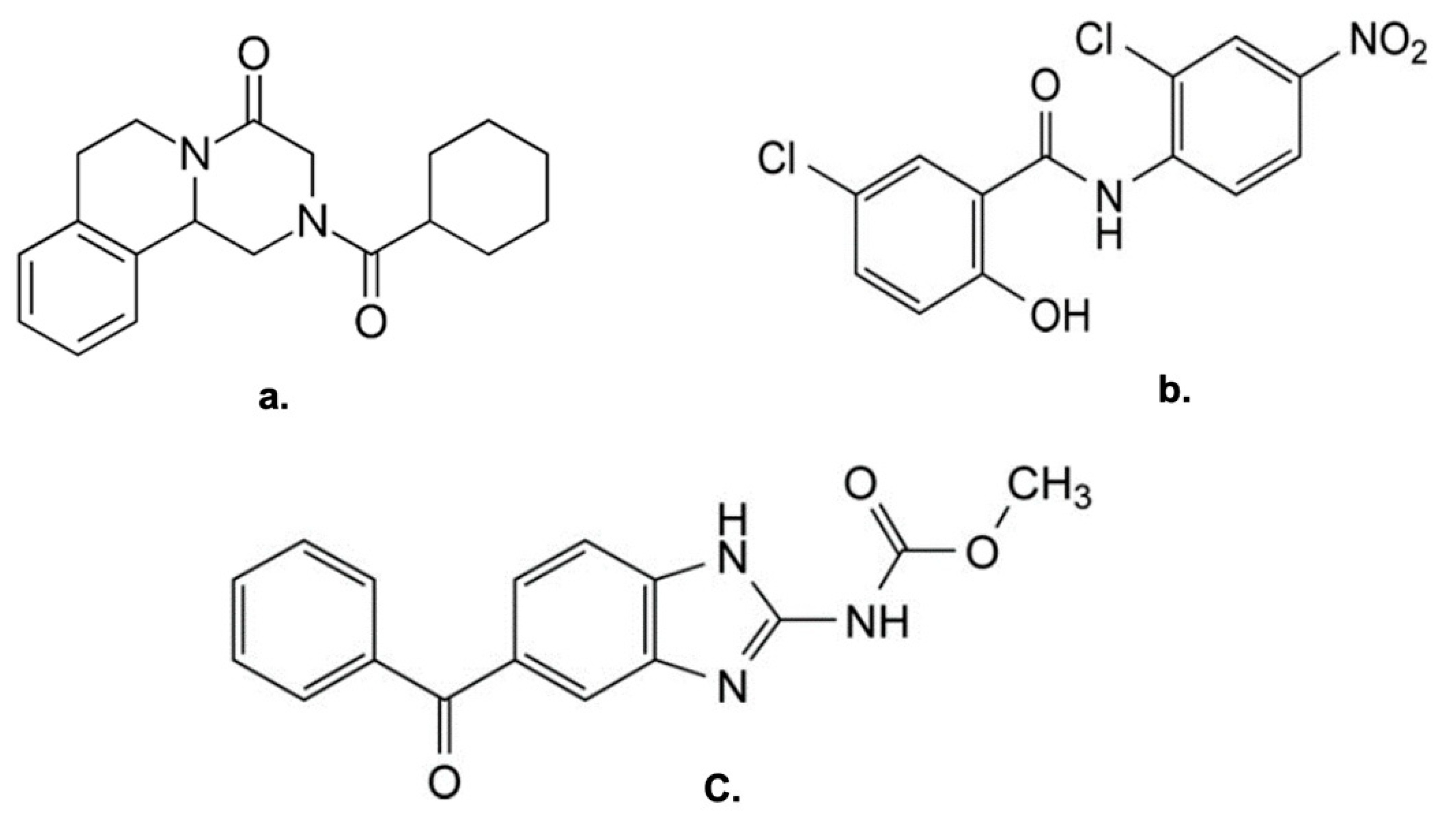
Figure 1. (a) Praziquantel (b) niclosamide and (c) mebendazole molecular structures.
Preprints 142322 g001
Figure 2. Ternary diagram representing the experimental design space.
Preprints 142322 g002
Figure 3. FT-IR spectra of NCM-MBZ 1-1 coamorphous (black) compared with its physical mixture (red) and pure components (blue line represents NCM and light green line MBZ).
Preprints 142322 g003
Figure 4. FT-IR spectra of PZQ-NCM 1-1 coamorphous (black) compared with its physical mixture (red) and pure components (blue line represents PZQ and light green line NCM).
Preprints 142322 g004
Figure 5. FT-IR spectra of PZQ-MBZ 1-1 coamorphous (blue) compared with its physical mixture (orange) and pure components (light blue line represents PZQ and red line MBZ).
Preprints 142322 g005
Figure 6. FT-IR spectra of PZQ-NCM-MBZ 1-1-1 coamorphous (black) compared with its physical mixture (red) and pure components (light blue line represents PZQ, blue NCM and light green line MBZ).
Preprints 142322 g006
Figure 7. Physical stability of seven coamorphous systems after 6 months of storage at different temperatures. Full sticks indicate that sample meets expectations according to “Tg – 50 °C” rule. Full green ticks stand for “stable as expected according to “Tg – 50 °C” rule”; full red crosses stand for “unstable, as expected according to “Tg – 50 °C” rule”; empty green ticks stand for “stability superior to expectations”; empty red crosses stand for “stability inferior to expectations”. *Tg value calculated from G-T equation.
Preprints 142322 g007
Figure 8. Sorption-desorption curves for exp. N° 3 (dark blue-light blue), 6 (dark green-light green), 9 (red-orange), and 10 (purple-grey).
Preprints 142322 g008
Figure 9. Cartoon depicting the recrystallization of binary PZQ-MBZ 1-1 coamorphous into individual components through PXRD analyses. Black dotted lines represent PZQ peaks, while light blue dotted lines MBZ reflections.
Preprints 142322 g009
Figure 10. Cartoon depicting the recrystallization of binary PZQ-NCM 1-1 coamorphous into polymorph C of PZQ and the PZQ-NCM 1-3 anhydrous cocrystal. Yellow dotted lines represent PZQ polymorph C reflections, while light blue dotted lines PZQ-NCM 1-3 anhydrous cocrystal reflections.
Preprints 142322 g010
Table 1. Experimental matrix.
Exp. N° Molar ratio
PZQ
X1
MBZ
X2
NCM
X3
1 0.500 0.250 0.250
2 0.167 0.417 0.417
3 0 0.500 0.500
4 0.250 0.500 0.250
5 0.417 0.167 0.417
6 0.500 0 0.500
7 0.250 0.250 0.500
8 0.417 0.417 0.167
9 0.500 0.500 0
10 0.333 0.333 0.333
Table 2. Experimental Tg values compared to theoretical ones according to G-T equation.
Sample / Exp. N° Molar ratio Experimental
Tg (°C) ± S.D.
Theoretical Tg according to G-T equation (°C)
PZQ NCM MBZ
PZQ 1 0 0 40.94* ± 0.90 28.56§
NCM 0 1 0 82.90* ± 0.64 85.47§
MBZ 0 0 1 111.98 ± 0.73 142.95§
1 0.500 0.250 0.250 / 63.54
2 0.167 0.417 0.417 / 84.17
3 0 0.500 0.500 98.33 ± 0.34 96.95
4 0.250 0.500 0.250 79.54 ± 0.59 75.40
5 0.417 0.167 0.417 74.02 ± 0.59 71.02
6 0.500 0 0.500 69.31 ± 0.87 68.67
7 0.250 0.250 0.500 83.31 ± 0.76 81.58
8 0.417 0.417 0.167 60.40 ± 0.13 65.40
9 0.500 0.500 0 59.15 ± 0.95 57.87
10 0.333 0.333 0.333 76.77 ± 0.09 73.15
*MTDSC. §Single compound, not applicable to calculate a theoretical Tg according to G-T equation; Tg was predicted through the model proposed by Alzghoul et al. [43].
Disclaimer/Publisher’s Note: The statements, opinions and data contained in all publications are solely those of the individual author(s) and contributor(s) and not of MDPI and/or the editor(s). MDPI and/or the editor(s) disclaim responsibility for any injury to people or property resulting from any ideas, methods, instructions or products referred to in the content.
Copyright: This open access article is published under a Creative Commons CC BY 4.0 license, which permit the free download, distribution, and reuse, provided that the author and preprint are cited in any reuse.
Prerpints.org logo

Preprints.org is a free preprint server supported by MDPI in Basel, Switzerland.

Subscribe

Disclaimer

Terms of Use

Privacy Policy

Privacy Settings

© 2025 MDPI (Basel, Switzerland) unless otherwise stated