
Preprint
Article

This version is not peer-reviewed.

Comorbidity Associated with Vitiligo: Results from the EpiChron Cohort

A peer-reviewed article of this preprint also exists.

Submitted:

06 December 2024

Posted:

09 December 2024

You are already at the latest version

Abstract

Background: Vitiligo is linked to a range of systemic, autoimmune and dermatologic diseases, some of which may not have been described in the literature. Methods: An observational, retrospective study based on the clinical information of the individuals of the EpiChron Cohort (Aragon, Spain; reference population 1.3 million inhabitants) with a diagnosis of vitiligo between 1 January and 31 December 2019 was conducted. The main socio-demographic and clinical characteristics were described, as well as the likelihood of presenting vitiligo based on sex, age, nationality, area of residence and the area's deprivation index. The prevalence of chronic comorbidities was calculated, and logistic regression models were used to obtain the crude and age- and sex-adjusted odds ratios (OR) of each comorbidity (dependent variable) according to the presence or not of vitiligo (independent variable). Results: 218 patients diagnosed with vitiligo were analysed (56.42% women). The mean age was 44.0 years. The diseases associated the most with vitiligo were thyroid disorders (OR 3.01, p<0.000), ocular and hearing anomalies (OR 1.54, p=0.020), inflammatory disorders of the skin (OR 2.21, p<0.000), connective tissue diseases (OR 1.84, p=0.007), lower respiratory diseases (OR 1.78, p=0.014), urinary tract infections (OR 1.69, p=0.032) and cardiac dysrhythmias (OR 1.84, p=0.034). Conclusion: This research highlights the importance of understanding the broader health implications of vitiligo and provides a foundation for further exploration into the complex interplay between this dermatologic condition and a diverse range of comorbidities.
Keywords: 
;  ;  

1. Introduction

Vitiligo is a skin disorder characterized by the presence of depigmented patches on the skin due to the loss of melanin. Vitiligo is estimated to affect about 0.5 to 2% of the population. The variability in its prevalence seems to be influenced by genetic, environmental, and other factors that are not fully understood.[1-3]
The exact mechanism by which melanocytes are lost in vitiligo has been the subject of debate and research for many years. On the one hand, autoimmune hypothesis suggests that vitiligo is primarily an autoimmune disorder. This autoimmune response is believed to be triggered by genetic and environmental factors. In vitiligo, autoreactive cytotoxic CD8+ T cells play a central role; these cells engage melanocytes and promote disease progression through the local production of IFN-γ. IFN-γ-induced chemokines are then secreted from surrounding keratinocytes to further recruit T cells to the skin through a positive-feedback loop. Relapse of disease after stopping treatment is mediated by autoreactive tissue-resident memory (TRM) cells.[4]
On the other hand, the degenerative hypothesis suggests that melanocytes undergo degeneration or apoptosis independently of autoimmune processes. Various factors, including oxidative stress and genetic predisposition, may contribute to the degeneration of melanocytes. The autoimmune theory is currently the most widely accepted. A high prevalence of autoantibodies against melanocytes and genes shared with other autoimmune diseases have been found in these patients, as well as a higher prevalence of autoimmune diseases among first-degree relatives. It is increasingly recognized that vitiligo is a complex and multifactorial condition in which both genetic and environmental factors are involved.[2,4-7]
The Vitiligo European Task Force (VETF) defines non-segmental vitiligo (NSV) as an acquired chronic pigmentation disorder characterized by white patches on the skin, which are often symmetrical and tend to increase in size over time. NSV typically manifests in areas such as the face, trunk, and extremities. NSV is the most common type of vitiligo in both children and adults. Segmental vitiligo (SV) is similar to NSV in terms of white patches and loss of melanocytes; however, it differs in the distribution, which is distributed unilaterally. This form, which accounts for only 10-20% of cases of vitiligo, usually presents at a younger age and it is not as frequently associated with autoimmune disorders.[2,3,8]
Several studies have previously analyzed the association of vitiligo with the presence of other diseases, including autoimmune, systemic, and dermatological diseases. Some of the most frequent comorbidities associated with vitiligo include thyroid disease such as Hashimoto’s thyroiditis and Grave’s disease, alopecia areata, type 1 diabetes mellitus, pernicious anemia, systemic lupus erythematosus (SLE), rheumatoid arthritis, Addison's disease, inflammatory bowel disease (IBD), Sjögren's syndrome, dermatomyositis, scleroderma, ocular and audiological abnormalities, psoriasis, atopic dermatitis and psychological and emotional impacts, potentially leading to depression, anxiety, and social isolation.[3,7,9-11]
The presence of these vitiligo-associated conditions can vary among individuals, and the relationship between vitiligo and these comorbidities is complex and not fully understood. A better knowledge of the comorbidities surrounding vitiligo could help us guide the care of these patients from a holistic perspective and better understand the etiopathogenesis of this disease. The aim of this study was to exhaustively describe the comorbidity of vitiligo through a population-based study.

2. Materials and Methods

2.1. Study Design and Population

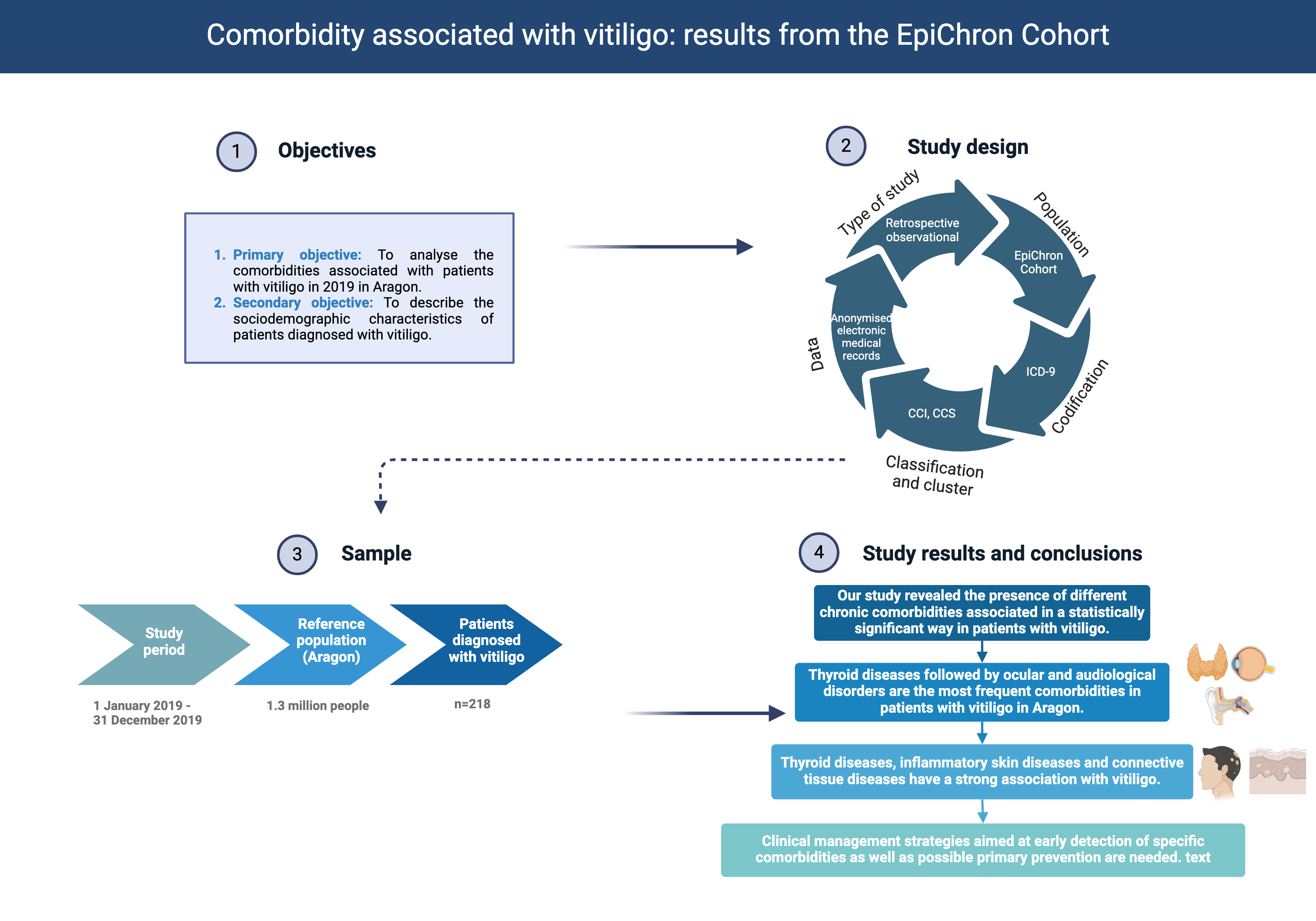
We conducted a retrospective, observational study in the EpiChron Cohort, which links socio-demographic and clinical data from all the users of the public health system of the Spanish region of Aragon.[12] This cohort is based on the information registered in the electronic health records (EHRs) and clinical–administrative databases of approximately 98% of the citizens of the region (reference population: 1.3 million people). For this study, we selected all the 218 individuals from the cohort diagnosed with vitiligo at some point from 1 January 2019 to 31 December 2019.
The Clinical Research Ethics Committee of Aragon (CEICA) approved this study (Research protocol PI23/411) and waived the requirement to obtain informed consent from patients given the epidemiological nature of the project and the use of anonymized data.

2.2. Variables and Data Sources

For all patients, we studied socio-demographic variables and all chronic diseases registered in their EHRs. As sociodemographic variables, we included sex, age (categorised as 0-17, 18-44, 45-64, and ≥65 years), nationality, area of residence (urban, i.e. people living in municipalities that concentrate at least 80% of the population of the area, and rural, i.e. the rest), and deprivation index. This index was developed for Aragon and calculated at an aggregated level by basic healthcare area according to 26 socio-economic indicators including information on housing, education, and neighbourhood conditions, types of employment, unemployment rates, ageing of the population, and immigration, and divided into four quartiles from least (Q1) to most (Q4) deprived.[13] Diagnoses were initially coded using the International Classification of Primary Care, First Edition (ICPC–1), or the International Classification of Diseases, Ninth Revision, Clinical Modification (ICD–9–CM). Subsequently, using the open-source algorithm Chronic Condition Indicator (CCI)[14], each ICD9 code was classified as either chronic or not. The software defines as chronic those diseases with a duration equal to or greater than 12 months and meeting at least one of the following criteria: (a) require continuous care, that have a high risk of recurrence, and/or that continue to have implications for the management of the patient; (b) imply limitations on self-care, social interactions, and independent living. Once selected, those chronic diagnoses were grouped into 153 clinical categories through the Clinical Classifications Software (CCS)[15] based on the clinical, therapeutic and diagnostic similarities of the diseases. Multimorbidity was defined as the presence of two or more chronic diseases.[16]

2.3. Statistical analysis

First, a descriptive analysis of the socio-demographic characteristics of the study population was performed, categorized by sex. We summarized the results as proportions for categorical variables and as means and standard deviations for continuous variables. The likelihood of presenting vitiligo was estimated by logistic regression model based on sex, age, nationality, area of residence and area deprivation index. Logistic regression models were used to obtain the crude and sex- and age-adjusted odds ratio (OR) of each comorbidity (dependent variable) according to the presence or not of vitiligo
(independent variable). The Table 3 shows the comorbidities in order of prevalence. All the analyses were conducted in STATA software (Version 12.0, StataCorp LLC, College Station, TX, USA), with the statistical significance set at P < 0.05.

3. Results

3.1. Characteristics of the Population

We analyzed a population of 218 patients with vitiligo (56.4% women). The mean age was 44.0 years (SD 21.26) and regarding age groups, the highest percentage of patients (34.86%) were in the range of 18-44 years-old. The demographic characteristics are shown in Table 1.
Regarding the likelihood of presenting vitiligo based on sex, age, nationality, area of residence (urban/rural), and deprivation index of the area, we found statistically significant differences (OR [95% confidence interval]) in nationality (Latin American: 3.06 [2.07-4.53], p<0.000) and age (≥65 years: 0.48 [0.30-0.76], p=0.002) (Table 2). No relevant differences in the prevalence of vitiligo according to the area of residence, socioeconomic deprivation and sex were observed.

3.2. Chronic Comorbidities

Of all the patients with vitiligo included, 71.5% had multimorbidity, being diagnosed with a mean of 3.21 comorbidities (SD 2.41). This multimorbidity was more common in woman (76.42%) than in men (65.26%) (Table 1).
The most common chronic comorbidities in people with vitiligo of all ages and for both sexes were thyroid disorders (25.2%), ear and sense organ disorders (16.1%), inflammatory condition of skin (11%) and connective tissue diseases (10.1%). All these comorbidities were more prevalent in the vitiligo population compared to the general one (Table 3).
Regardless of their prevalence and after adjustment by sex and age, the conditions most associated with vitiligo were (adjusted OR (95% CI)): thyroid disorders (OR 3.01 [2.18-4.15], p<0.000), following by inflammatory condition of skin (OR 2.21 [1.45-3.38], p<0.000), connective tissue disease (1.84 [1.19-2.87], p<0.007), cardiac dysrhythmias (1.84 [1.05-3.22], p<0.034), lower respiratory disease (1.78 [1.12-2.82], p<0.014), urinary tract infections (1.69 [1.05-2.73], p<0.032), and ear and sense organ disorders (OR 1.54 [1.07-2.22], p<0.020) (Table 3).
On the other hand, there were also some relevant comorbidities that did not show an association with vitiligo, including depression and mood disorders (OR 0.88; [0.56-1.37], p<0.563), anxiety (OR 0.92; [0.62-1.36], p<0.660), hypertension (OR 1.12; [0.76-1.63], p<0.569), disorders of lipid metabolism (OR 1.11; [0.80-1.53], p<0.532), diabetes mellitus (OR 1.39; [0.86-2.27], p<0.181) among others (Table 3).

4. Discussion

This study, which explores the comorbidity of vitiligo, provides a basis for developing preventive strategies at various levels (primary, secondary, and tertiary prevention). This can involve lifestyle modifications, regular screenings, and targeted interventions to reduce the risk or severity of specific comorbidities. Furthermore, understanding the physio-pathological mechanisms underlying the comorbidity patterns contributes to the broader scientific understanding of vitiligo.
Vitiligo affects approximately 0.5-2% of the world's population, according to an updated study based on a review of more than 50 studies worldwide.[17] There is no racial predilection, and it affects adults and children of both sexes equally. NSV usually begins in early childhood or young adulthood, with a peak age between 10 and 30 years. Approximately 50% of patients develop vitiligo before the age of 20 years and 70-80% before the age of 30 years.[3,9] The prevalence tends to decrease with increasing age. In this regard, our study shows that 65.6% of patients are aged between 18 and 64 years, with no gender predilection.
In our study, we found no significant differences between living in an urban or rural environment, in contrast to other inflammatory diseases such as atopic dermatitis where such differences have been found.[18] In addition, we also found no statistically significant differences in the deprivation index.
Multimorbidity (i.e., the presence of more than one chronic condition) was presented by 71% of our patients, associated with an average of 3.21 chronic diseases. The specific relationship between multimorbidity and vitiligo is not widely discussed in the medical literature. In this regard, research may provide more insights into the relationship between vitiligo and comorbidities.
Vitiligo is associated with various systemic, autoimmune and dermatological pathologies that contribute to increased morbidity in these patients. Autoimmune and systemic diseases associated with vitiligo include alopecia areata, dermatomyositis, scleroderma, psoriasis, atopic dermatitis, systemic lupus erythematosus, rheumatoid arthritis, thyroid disease, diabetes mellitus, Addison's disease, pernicious anaemia, inflammatory bowel disease, Sjögren's syndrome, ocular and audiological abnormalities.[3,7,9,19-21].
The prevalence of association with autoimmune diseases varies between series, ranging from 19-30%, compared to 1-2% in the general population. Autoimmune diseases represent the main comorbidity associated with vitiligo and are the focus of research in most studies. This is supported by genetic evidence, with approximately 85% of susceptibility genes involved in both innate and adaptive immunity. In addition, the presence of circulating autoantibodies directed towards melanocyte antigens, anti-thyroid antibodies, as well as elevated antinuclear antibodies and rheumatoid factor have been observed in these patients.[2,3] The association with thyroid disease is the most frequent of all autoimmune diseases[19,20] In this line, our study also found that thyroid disorder was the second most prevalent comorbidity and the one most associated with vitiligo. In this regard, a nationwide cross-sectional study by Rios-Duarte et al. in 2023[19] concluded that the most frequent autoimmune disorders in patients with vitiligo were type 1 diabetes, rheumatoid arthritis, SLE, autoimmune thyroiditis, Addison's disease, and systemic sclerosis (SSc). Furthermore, cutaneous disorders with largest effect-sizes were alopecia areata and SSc. Non-cutaneous comorbidities with largest effect-sizes were primary sclerosing cholangitis, pernicious anemia, Addison’s disease and autoimmune thyroiditis. Furthermore, a systematic review and meta-analysis by Lee et al. in 2023[9] described that patients with vitiligo were more likely to have autoimmune thyroiditis (OR = 10.39, 95 % CI = 2.43-44.40), hypothyroidism (OR = 5.54, 95 % CI = 3.36-9, 13), hyperthyroidism (OR = 4.68, 95 % CI = 1.75-12.50), Graves' disease (OR = 2.93, 95 % CI = 2.62-3.28), Hashimoto's thyroiditis (OR = 2.12, 95 % CI = 1.92-2.34) and thyroid cancer (OR = 1.13, 95 % CI = 1.02-1.24). They concluded that patients with vitiligo showed higher risks of having comorbid autoimmune and connective tissue diseases, including alopecia areata, discoid lupus erythematous and rheumatoid arthritis. The prevalence of some of these autoimmune disorders depends on age, sex, race and clinical subtype of vitiligo. A better understanding of all these factors will help us to propose strategies for the clinical approach to vitiligo aimed at the early detection of specific comorbidities.
On the other hand, vitiligo is, like other pigmentation disorders, often associated with ocular and auditory abnormalities, in line with the results obtained in our study. In addition to the skin, melanocytes are abundant in the uveal tract and in the pigment epithelium of the retina. A higher prevalence of hypopigmented spots has been found in both locations, as well as decreased visual acuity, dry eye syndrome, normotensive glaucoma and chronic progressive neuropathy. Melanocytes are also distributed in the membranous labyrinth of the inner ear, and sensorineural deafness has been observed in some patients.[9,22-24] In the meta-analysis by Lee et al.[9] showed that glaucoma (OR = 1.31, 95 % CI = 1.27-1.35), cataracts (OR = 1.30, 95 % CI = 1.27-1.32), iris change (OR = 1.25, 95 % CI = 1.17-1.34) and retinal pigment epithelium change (OR = 1.19, 95 % CI = 1.16-1.22) were significantly more prevalent in patients with vitiligo. With regard to hearing abnormalities, a statistically significant association with sensorineural hearing loss (OR = 2.43, 95 % CI = 1.50-3.93) was observed compared to controls without vitiligo.
Although patients with vitiligo had an 84% higher likelihood of presenting cardiac arrhythmias in our study, there is no well-established direct association between these two conditions. In this regard, Stevens et al.[18] described a case of giant cell myocarditis in a patient with vitiligo, showing that the association found between these two diseases suggests an autoimmune cause of these diseases. Concerning infections, there is some evidence that suggests that certain infections or factors related to infections may play a role in triggering or exacerbating vitiligo in susceptible individuals.[5] However, our study only focused on chronic conditions, and infections and other acute conditions were not analyzed.
The psychological and emotional consequences of vitiligo have a great impact on the quality of life of these patients, especially in those with high skin phototypes, and can lead to low self-esteem, social isolation and the presence of associated psychiatric comorbidities.[3,9,25,26] However, no association between vitiligo and mental health conditions was found in our study. The fact that vitiligo is related to other chronic diseases, and not only to autoimmune diseases, highlights the need to take this fact into account for early detection and comprehensive patient management.[3] In a systemic review[27] in which six studies involving 516 patients with vitiligo were included, the prevalence of suicidal ideation ranged from 6% to 25%. These same findings were found in a retrospective cross-sectional analysis by Montgomery et al.[28] Out of a total of 1943 patients with vitiligo in the public hospital and
695 in the private hospital, the rate of depression among patients with vitiligo in both hospitals was 6.8% (N=179). Female sex was significantly more associated with depression (p=0.0043). Furthermore, in the study by Ezzedine et al.[29] similar results were obtained with higher incidence rates of psychiatric illness in patients with vitiligo than in healthy individuals (28.4 % vs. 22.8 %). The most frequent psychiatric illnesses among these individuals included anxiety (14.3% vs. 11.0%, respectively), sleep disturbance (9.1% vs. 7.1%) and depression (8.0% vs. 6.3%).
Regarding the limitations of this study, the fact that the clinical information obtained in the EHRs was not originally designed for research could create over and underdiagnosis of some chronic disorders. Another limitation is the cross-sectional retrospective nature of the study, which does not allow us to know the longitudinal characteristics of the population. Additionally, we have to consider the lack of some variables that could help us explain the results obtained, such as lifestyle information, socioeconomic factors, information on functional status, and analytical variables, among others.
One of the principal strengths of our research is that it was conducted on a population-based cohort, including 98% of the reference population. Moreover, data in the EpiChron Cohort undergo continuous quality control checkups that ensure their accuracy and reliability for research purposes. In this sense, it is also important to highlight that this study exhaustively analyzed all chronic diseases obtained from the patient’s EHRs created by health professionals, and not just the most relevant, prevalent or self-reported diseases.

5. Conclusions

Our study revealed the presence of different clinically significant comorbidities in patients with vitiligo, allowing us to propose clinical approach strategies aimed at the early detection of specific comorbidities, including their possible primary prevention. Our results may help to guide the prevention of comorbidities in patients with vitiligo and to understand the pathophysiological mechanisms underlying the identified comorbidity associations. Detecting comorbidities early in patients with vitiligo can lead to more effective and timely interventions and treatments, potentially improving overall health outcomes.

Author Contributions

All authors contributed to the preparation of the manuscript and critically modified it. All authors contributed to the article and approved the submitted version.

Funding

There are no sources of funding.

Acknowledgments

I would like to express my sincere gratitude to all those who have contributed to the completion of this article. There are no sources of funding. The authors have no conflict of interest to declare. All the authors contributed to the preparation of manuscript and critically modified. All authors contributed to the article and approved the submitted version.

Conflicts of Interest

The authors have no conflicts of interest to declare.

References

  1. Mastacouris N, Strunk A, Garg A. Incidence and Prevalence of Diagnosed Vitiligo According to Race and Ethnicity, Age, and Sex in the US. JAMA Dermatol. 2023 Sep 1;159(9):986-990. [CrossRef] [PubMed]
  2. Ezzedine K, Eleftheriadou V, Whitton M, van Geel N. Vitiligo. Lancet. 2015 Jul 4;386(9988):74-84. [CrossRef] [PubMed]
  3. Dahir AM, Thomsen SF. Comorbidities in vitiligo: comprehensive review. Int J Dermatol. 2018 Oct;57(10):1157-1164. [CrossRef] [PubMed]
  4. Frisoli ML, Essien K, Harris JE. Vitiligo: Mechanisms of Pathogenesis and Treatment. Annu Rev Immunol. 2020 Apr 26;38:621-648. [CrossRef] [PubMed]
  5. Marchioro HZ, Silva de Castro CC, Fava VM, Sakiyama PH, Dellatorre G, Miot HA. Update on the pathogenesis of vitiligo. An Bras Dermatol. 2022 Jul-Aug;97(4):478-490. [CrossRef] [PubMed]
  6. Taieb A, Alomar A, Böhm M, Dell'anna ML, De Pase A, Eleftheriadou V, Ezzedine K, Gauthier Y, Gawkrodger DJ, Jouary T, Leone G, Moretti S, Nieuweboer-Krobotova L, Olsson MJ, Parsad D, Passeron T, Tanew A, van der Veen W, van Geel N, Whitton M, Wolkerstorfer A, Picardo M; Vitiligo European Task Force (VETF); European Academy of Dermatology and Venereology (EADV); Union Europe´enne des Me´decins Spe´cialistes (UEMS). Guidelines for the management of vitiligo: the European Dermatology Forum consensus. Br J Dermatol. 2013 Jan;168(1):5-19. [CrossRef] [PubMed]
  7. Bergqvist C, Ezzedine K. Vitiligo: A Review. Dermatology. 2020;236(6):571-592. [CrossRef] [PubMed]
  8. Taïeb A, Picardo M; VETF Members. The definition and assessment of vitiligo: a consensus report of the Vitiligo European Task Force. Pigment Cell Res. 2007 Feb;20(1):27-35. [CrossRef] [PubMed]
  9. Lee JH, Ju HJ, Seo JM, Almurayshid A, Kim GM, Ezzedine K, Bae JM. Comorbidities in Patients with Vitiligo: A Systematic Review and Meta-Analysis. J Invest Dermatol. 2023 May;143(5):777-789.e6. [CrossRef] [PubMed]
  10. Hu Z, Wang T. Beyond skin white spots: Vitiligo and associated comorbidities. Front Med (Lausanne). 2023 Feb 23;10:1072837. [CrossRef] [PubMed]
  11. Fan KC, Yang TH, Huang YC. Vitiligo and thyroid disease: a systematic review and meta-analysis. Eur J Dermatol. 2018 Dec 1;28(6):750-763. [CrossRef] [PubMed]
  12. Prados-Torres A, Poblador-Plou B, Gimeno-Miguel A, Calderón-Larrañaga A, Poncel-Falcó A, Gimeno-Feliú LA, González-Rubio F, Laguna-Berna C, Marta-Moreno J, Clerencia-Sierra M, Aza-Pascual-Salcedo M, Bandrés-Liso AC, Coscollar-Santaliestra C, Pico-Soler V, Abad-Díez JM. Cohort Profile: The Epidemiology of Chronic Diseases and Multimorbidity. The EpiChron Cohort Study. Int J Epidemiol. 2018 Apr 1;47(2):382-384f. [CrossRef] [PubMed]
  13. Compés Dea ML, Olivan Bellido E, Feja Solana C, Aguilar Palacio I, García-Carpintero Romero Del Hombrebueno G, Adiego Sancho B. Construcción de un índice de privación por zona básica de salud en Aragón a partir de datos de censo de 2011 [Construction of a deprivation index by Basic Healthcare Area in Aragon using Population and Housing Census 2011]. Rev Esp Salud Publica. 2018 Dec 10;92:e201812087. Spanish. [PubMed]
  14. Chronic Condition Indicator (CCI) for ICD-9-CM [Internet]. [cited 2023 Nov 22]. Available from: https://hcup-us.ahrq.gov/toolssoftware/chronic/chronic.
  15. Clinical Classifications Software (CCS) for ICD-9-CM [Internet]. [cited 2023 Nov 22]. Available from: https://hcup-us.ahrq.gov/toolssoftware/ccs/ccs.
  16. Moreno-Juste A, Gimeno-Miguel A, Poblador-Plou B, Calderón-Larrañaga A, Cano Del Pozo M, Forjaz MJ, Prados-Torres A, Gimeno-Feliú LA. Multimorbidity, social determinants and intersectionality in chronic patients. Results from the EpiChron Cohort. J Glob Health. 2023 Feb 3;13:04014. [CrossRef] [PubMed]
  17. Krüger C, Schallreuter KU. A review of the worldwide prevalence of vitiligo in children/adolescents and adults. Int J Dermatol. 2012 Oct;51(10):1206-12. [CrossRef] [PubMed]
  18. Almenara-Blasco M, Carmona-Pírez J, Gracia-Cazaña T, Poblador-Plou B, Pérez-Gilaberte JB, Navarro-Bielsa A, Gimeno-Miguel A, Prados-Torres A, Gilaberte Y. Comorbidity Patterns in Patients with Atopic Dermatitis Using Network Analysis in the EpiChron Study. J Clin Med. 2022 Oct 29;11(21):6413. [CrossRef] [PubMed]
  19. Rios-Duarte JA, Sanchez-Zapata MJ, Silverberg JI. Association of vitiligo with multiple cutaneous and extra-cutaneous autoimmune diseases: a nationwide cross-sectional study. Arch Dermatol Res. 2023 Nov;315(9):2597-2603. [CrossRef] [PubMed]
  20. Lim JH, Lew BL, Sim WY, Kwon SH. Incidence of childhood-onset vitiligo and increased risk of atopic dermatitis, autoimmune diseases, and psoriasis: A nationwide population-based study. J Am Acad Dermatol. 2022 Nov;87(5):1196-1198. [CrossRef] [PubMed]
  21. Chen YT, Chen YJ, Hwang CY, Lin MW, Chen TJ, Chen CC, Chu SY, Lee DD, Chang YT, Liu HN. Comorbidity profiles in association with vitiligo: a nationwide population-based study in Taiwan. J Eur Acad Dermatol Venereol. 2015 Jul;29(7):1362-9. [CrossRef] [PubMed]
  22. Hu Z, Wang T. Beyond skin white spots: Vitiligo and associated comorbidities. Front Med (Lausanne). 2023 Feb 23;10:1072837. [CrossRef] [PubMed]
  23. Genedy R, Assal S, Gomaa A, Almakkawy B, Elariny A. Ocular and auditory abnormalities in patients with vitiligo: a case-control study. Clin Exp Dermatol. 2021 Aug;46(6):1058-1066. [CrossRef] [PubMed]
  24. Gopal KV, Rama Rao GR, Kumar YH, Appa Rao MV, Vasudev P; Srikant. Vitiligo: a part of a systemic autoimmune process. Indian J Dermatol Venereol Leprol. 2007 May-Jun;73(3):162-5. [CrossRef] [PubMed]
  25. Kussainova A, Kassym L, Akhmetova A, Glushkova N, Sabirov U, Adilgozhina S, Tuleutayeva R, Semenova Y. Vitiligo and anxiety: A systematic review and meta-analysis. PLoS One. 2020 Nov 10;15(11):e0241445. [CrossRef] [PubMed]
  26. Chen CY, Wang WM, Chung CH, Tsao CH, Chien WC, Hung CT. Increased risk of psychiatric disorders in adult patients with vitiligo: A nationwide, population-based cohort study in Taiwan. J Dermatol. 2020 May;47(5):470-475. [CrossRef] [PubMed]
  27. Padmakar S, Murti K, Pandey K, Kumari S, Kumar R, Siddiqui NA, et al. Suicidal ideation associated with vitiligo - A systematic review of prevalence and assessment. Clin Epidemiol Glob Health. 2022 Sep 1;17:101140. [CrossRef]
  28. Montgomery SN, Syder N, Barajas G, Elbuluk N. Psychological comorbidities of vitiligo: a retrospective cross-sectional analysis in an urban population. Arch Dermatol Res. 2023 Dec 4;316(1):14. [CrossRef] [PubMed]
  29. Ezzedine K, Soliman AM, Li C, Camp HS, Pandya AG. Comorbidity Burden Among Patients with Vitiligo in the United States: A Large-Scale Retrospective Claims Database Analysis. Dermatol Ther (Heidelb). 2023 Oct;13(10):2265-2277. [CrossRef] [PubMed]

Table 1. Socio-demographic and clinical characteristics of patients with vitiligo in the EpiChron Cohort in 2019.
Characteristics Men Women Total
N (%) 95 (43.58) 123 (56.42) 218 (100)
Mean age, years (SD1) 42.45 (22.97) 45.15 (19.85) 43.97 (21.26)
Age group, years (n, %)
0–17 23 (24.21) 13 (10.57) 36 (16.51)
18–44 23 (24.21) 53 (43.09) 76 (34.86)
45–64 31 (32.63) 36 (29.27) 67 (30.73)
≥65 18 (18.95) 21 (17.07) 39 (17.89)
Nationality (n, %)
Spain 71 (74.74) 94 (76.42) 165 (75.69)
Eastern Europe 4 (4.21) 8 (6.50) 12 (5.50)
Asia 0 (0) 1 (0.81) 1 (0.46)
North Africa 4 (4.21) 3 (2.44) 7 (3.21)
Sub-Saharan Africa 1 (1.05) 1 (0.81) 2 (0.92)
Latin America 14 (14.74) 16 (13.01) 30 (13.76)
EU and North America 1 (1.05) 0 (0) 1 (0.46)
Area of residence
Urban2 (n, %) 58 (61.05) 70 (56.91) 128 (58.72)
Deprivation index3 (n, %)
Q1 13 (13.68) 37 (30.08) 50 (22.94)
Q2 30 (31.58) 29 (23.58) 59 (27.06)
Q3 24 (25.26) 18 (14.63) 42 (19.27)
Q4 28 (29.47) 39 (31.71) 67 (30.73)
Number of chronic diseases (mean, SD) 2.75 (1.92) 3.56 (2.68) 3.21 (2.41)
Multimorbidity, yes (n, %) 62 (65.26) 94 (76.42) 156 (71.56)
1 Standard deviation; 2 Versus rural; 3 Deprivation index of the residence area according to 26 socio-economic indicators and categorized from least (Q1) to most (Q4) deprived
Table 2. Likelihood of presenting vitiligo based on sex, age, nationality, area of residence and deprivation index.
Variable Crude OR1 p-value Adjusted OR2 p-value
Sex
Men ref.
Woman 1.14 (0.87-1.48) 0.349
Age group (years)
0–17 ref.
18–44 0.93 (0.63-1.38) 0.724
45–64 0.73 (0.49-1.09) 0.129
≥65 0.48 (0.30-0.76) 0.002
Nationality
Spain ref. ref.
Eastern Europe 1.07 (0.27-4.32) 0,924 1.01 (0.25-4.08) 0,987
Asia 0.99 (0.14-7.09) 0,994 0.91 (0.13-6.52) 0,927
North Africa 1.56 (0.87-2.80) 0,139 1.45 (0.81-2.61) 0,213
Sub-Saharan Africa 3.30 (2.23-4.87) 0,000 3.06 (2.07-4.53) 0,000
Latin America 2.04 (0.96-4.36) 0,064 1.92 (0.90-4.10) 0,091
EU and North America 0.60 (0.08-4.27) 0,607 0.60 (0.08-4.26) 0,606
Area of residence
Urban ref. ref.
Rural 1.07 (0.82-1.41) 0,597 1.08 (0.83-1.42) 0,552
Deprivation index3 (n, %)
Q1 ref. ref.
Q2 1.27 (0.87-1.86) 0,208 1.29 (0.88-1.88) 0,188
Q3 1.08 (0.72-1.62) 0,720 1.10 (0.73-1.66) 0,650
Q4 1.28 (0.89-1.85) 0,181 1.30 (0.90-1.88) 0,160
1 Odds ratio; 2 adjusted odds ratios for sex and age; 3 Deprivation index of the residence area according to 26 socio-economic indicators and categorized from least (Q1) to most (Q4) deprived
Table 3. Prevalence of chronic comorbidities in patients with vitiligo in the EpiChron Cohort in 2019 (n=218) and likelihood of vitiligo depending on comorbidities. The table shows the comorbidities in order of prevalence.
Comorbidity Prevalence Crude OR Adjusted OR1 p-value2
n (%) (95% CI) (95% CI)
Disorders of lipid metabolism 60 (27.5) 0.86 (0.64-1.15) 1.11 (0.80-1.53) 0.532
Thyroid disorders 55 (25.2) 2.58 (1.90-3.50) 3.01 (2.18-4.15) 0.000*
Hypertension 50 (22.9) 0.74 (0.54-1.02) 1.12 (0.76-1.63) 0.569
Other nutritional; endocrine; and metabolic disorders 41 (18.8) 0.97 (0.69-1.36) 1.18 (0.83-1.68) 0.356
Spondylosis; intervertebral disc disorders; other back problems 39 (17.9) 1.26 (0.89-1.78) 1.42 (1.00-2.02) 0.051
Other ear and sense organ disorders 35 (16.1) 1.41 (0.98-2.02) 1.54 (1.07-2.22) 0.020*
Anxiety disorders 29 (13.3) 0.91 (0.61-1.34) 0.92 (0.62-1.36) 0.660
Blindness and vision defects 28 (12.8) 1.47 (0.99-2.19) 1.44 (0.97-2.15) 0.070
Menstrual disorders 24 (11.0) 1.39 (0.91-2.13) 1.23 (0.78-1.94) 0.364
Other inflammatory condition of skin 24 (11.0) 2.15 (1.41-3.29) 2.21 (1.45-3.38) 0.000*
Osteoarthritis 23 (10.6) 0.95 (0.62-1.47) 1.50 (0.93-2.41) 0.093
Other upper respiratory disease 22 (10.1) 0.79 (0.51-1.23) 0.75 (0.48-1.16) 0.196
Other connective tissue disease 22 (10.1) 1.77 (1.14-2.76) 1.84 (1.19-2.87) 0.007*
Allergic reactions 22 (10.1) 1.05 (0.67-1.63) 0.91 (0.58-1.43) 0.674
Depression and mood disorders 22 (10.1) 0.78 (0.50-1.21) 0.88 (0.56-1.37) 0.563
Headache; including migraine 21 (9.6) 0.97 (0.62-1.52) 0.89 (0.57-1.40) 0.624
Other lower respiratory disease 20 (9.2) 1.78 (1.12-2.82) 1.78 (1.12-2.82) 0.014*
Diabetes Mellitus 20 (9.2) 0.96 (0.61-1.53) 1.39 (0.86-2.27) 0.181
Asthma 19 (8.7) 1.23 (0.77-1.98) 1.16 (0.72-1.85) 0.546
Urinary tract infections 19 (8.7) 1.58 (0.98-2.52) 1.69 (1.05-2.73) 0.032*
Neoplasms 16 (7.3) 1.25 (0.75-2.08) 1.49 (0.89-2.49) 0.131
Genitourinary symptoms and ill-defined conditions 15 (6.9) 0.91 (0.54-1.53) 1.32 (0.76-2.29) 0.323
Obesity 15 (6.9) 0.69 (0.41-1.17) 0.76 (0.45-1.29) 0.316
Cardiac dysrhythmias 14 (6.4) 1.26 (0.74-2.17) 1.84 (1.05-3.22) 0.034*
1 odds ratios adjusted by sex and age; 2 p-values for the adjusted OR; * p<0.05.
Disclaimer/Publisher’s Note: The statements, opinions and data contained in all publications are solely those of the individual author(s) and contributor(s) and not of MDPI and/or the editor(s). MDPI and/or the editor(s) disclaim responsibility for any injury to people or property resulting from any ideas, methods, instructions or products referred to in the content.
Copyright: This open access article is published under a Creative Commons CC BY 4.0 license, which permit the free download, distribution, and reuse, provided that the author and preprint are cited in any reuse.
Prerpints.org logo

Preprints.org is a free preprint server supported by MDPI in Basel, Switzerland.

Subscribe

Disclaimer

Terms of Use

Privacy Policy

Privacy Settings

© 2025 MDPI (Basel, Switzerland) unless otherwise stated