

Submitted:
09 December 2024
Posted:
09 December 2024
You are already at the latest version
Abstract
This research study presents a comparison of an in-person and an online conference in terms of environmental impact and energy efficiency. The main goal of our research was to prepare a complete life cycle assessment of a two-day (15-hour), 200-participant in-person (with and without travel) and online conference for different functional units by comparing the carbon footprint values. Life cycle assessment methods focus on the numerical determination of the decarbonisation of conference consumption (lunch, dinner, food and beverage consumption during program breaks) and conference organisation (organisational discussions, correspondence, Abstract booklet, registration package). The meals were examined by connecting the stages of preparation, cooking, consumption and end-of-life cycle, i.e. we performed a cradle-to-grave LCA analysis. We paid particular attention to the calculation of energy consumption, which we covered in detail. In conclusion, there is no outstanding difference between the impact assessment methods for the carbon footprint investigation. The carbon footprint value is 57% of the total impact of an entire in-person conference. The environmental impact of meals is the second largest, with 8.41 kg CO2 equivalent/person/hour. Excluding meals and travel, the calculated carbon footprint is 0.362 kg CO2 equivalent/person/hour (only considering the effect of preparation, organisation, administration and registration package).
Keywords:
energy consumption
; decarbonisation
; life cycle assessment
; carbon footprint
; in-person conference
; online conference
1. Introduction
The European Union is striving to achieve carbon neutrality in the future within the framework of the Sustainable Development Goals (SDGs) and the circular economy (CE). This means that, in addition to products and technologies, knowledge of the environmental impact of different services based on life-cycle assessment is now essential for achieving decarbonisation goals. Of course, the question arises as to how the mentioned decarbonisation goals and the reduction of carbon emissions to mitigate climate change can be achieved, through what methods, and at what costs. Decarbonisation can be achieved through various ways, including expanding alternative energy production, improving energy efficiency, advocating for electric transportation, advancing environmentally friendly consumption, and digitalisation.
In the present study, we conducted a methodological review of the literature regarding the given research topic and modelling for online and in-person conferences. Based on the results of studies using a life cycle approach, we sought to identify reasonable options for decarbonisation. Our initial hypothesis is that digital decarbonisation, i.e., the transition to online conferences, significantly reduces the carbon footprint of conference organisational processes by minimizing physical presence, i.e. digitisation reduces global carbon emissions. When it comes to models for the decarbonisation assessment of online conferences, they generally refer to computational tools and simulation models that allow the estimation of the carbon footprint and climate impacts of online conferences and the assessment of the impacts of decarbonisation measures. These models can be mathematical models, computer simulations or other analytical tools.
At the same time, consumer demands have changed in line with the trend towards healthier lifestyle, which has also led to sustainable consumption becoming a more important issue in the context of various professional events. Sustainable production and consumption is one of the most promising pathways for the transition to a circular and climate-neutral economy.
Scientific conferences – as part of the social interactions - are a priority for scientists, researchers and lecturers. However, the consumption of digital content has become a defining part of daily life in developed countries, both at work and in private life: on average, 60% of the world's population spends 40% of their waking hours consuming digital content [1]. Previous research has looked at the energy use of data centres and data transmission networks. These have concluded that together they account for 2-3% of global electricity consumption [2]and the ICT’s emission at ca. 1,8-2,8% of global GHG emission in 2020. Within this, the impact of virtual conferences was quantified at 10,17 kWh [3]. Most studies [4,5] define the environmental impact of data traffic as being outside the system boundary, considering only the power consumption of electronic devices [6]
Conference tourism (as a sub-sector of MICE) is one of the largest segments of the tourism industry, whose role is not only to promote destinations but also to ensure significant growth in the host country [9]. It also directly contributes to the economic benefits of local markets and, in turn, to the development of global markets [7]. The importance of the MICE sector is underlined by the fact that in 2019 (before COVID-19) contributed with US$8trillion to the global economy, representing the 10,4 percent of global gross domestic product according to ILO calculations. (ILO 2022). While decarbonisation became the focus of investigations due to climate policy objectives, digitisation became more and more critical due to COVID and worldwide lockdowns, with the forced transfer of contact to virtual space. The latter saves time and travel energy, but ICT also requires energy. The question is how big the carbon footprint of this modern technology is and how much carbon footprint reduction can be achieved through the use of digital technologies in the field of conferences.
The organisation and delivery of a conference, whether in-person, online or hybrid, must be adapted to a wide range of expectations. It can be considered as a specific type of product (service), the "consumption" of which is decided by potential candidates based on preferences [8]. A key feature of the organised tourism market, which includes academic conferences, is that entry to the market is voluntary. The buyer (who is an academic) is faced with several choices among economic operators. Each year, irrespective of the discipline, there is a choice of conferences to attend. This "freedom of choice" does not apply to company employees.
The arguments in favour of in-person conferencing for participants: less dependence on ICT, a wide range of communication channels (facial expressions, gestures, eye contact, body movements, posture, territorial behaviour, interpersonal distance, environmental set-up) to facilitate understanding [9]. Attendance person conferences have the disadvantages of higher travel costs and difficulties in accessing the venue, higher costs (travel, accommodation, organisation) and security risks. Considering a conference as a tourist event, the experience of the venue is significant when attending in person (especially if it also generates private travel), which is good for the economy of the venue and the host country [10,11]. To eliminate the disadvantages and increase the advantages of face-to-face conferences, they create optimal conditions for establishing and maintaining personal contacts and developing social networks. In contrast, online conferences are more cost-effective, convenience (even for the participants), considered by the literature to be more sustainable and safer[12].
The experience of the venue and the economic multiplier effect for the location's entrepreneurs is much stronger (visitor expenditures, marketing channels more efficient), which generates more opportunities to visit [13]. Brand loyalty (return to a regularly organised event and venue): organisers should aim to provide a pleasant programme in a pleasant environment at a reasonable price (optimising value for money)[10,13,14].
There are parallels and differences in the potential risks for the two event types. As human life expectancy increases, the age range of possible participants increases. This is a challenge for both the face-to-face and online formats. The motivating factors for the different generations to participate are different and need to be taken into account by organisers [9,15,16].
In the last years, with the help of concerns about carbon footprint calculations and the available guidelines, more and more attention has been paid to the development of more environmentally sustainable information communication technologies. However, there are no scientific publications available on the life cycle study of the environmental impact of in-person and online conferences and their specific results. Although research is paying more and more attention to this topic, little is known about the state of research on the carbon footprint of conference organisation processes. Reducing the carbon footprint is an important part of sustainable development. Models that can be used for the decarbonisation assessment of conferences usually include computational tools and simulation models that allow the estimation of the carbon footprint and impacts of in-person and online conferences. For example, a model for sustainability assessment can be a carbon footprint calculation that considers the climate impacts of the whole life cycle of conferences, including event preparation, energy use, travel costs and infrastructure. These models can assess the emission levels of various conferences, pinpoint areas with the highest emissions, and suggest decarbonisation measures. However, it is crucial to understand that evaluating the decarbonisation of different conferences encompasses many variables and contexts. Each model will be perfect in some situations, and the evaluation results will require further expert analysis and human evaluation if necessary. Therefore, the research aims to develop scenarios to organize more sustainable conferences based on the life cycle impact assessments. In this way, we aim to contribute to environmental and sustainability, as well as social and economic needs, meeting as many of the sustainable development goals as possible and responding to sustainability demands in the field of scientific conferences.
The sustainability aspects of the economy were already mentioned by Kuznets in 1950. The environmental extension of the inverted U-shaped curve was published by Grossmann-Krueger [17]. Since then, it has become increasingly prominent in the economy and in the public consciousness. This is also true for one of the main areas of scientific public life, professional conferences. The changing age range of participants reinforces this process [9]. In the future, the conference itself as a product will be considered as a tourism service when organizing a conference that meets as many sustainability criteria as possible. This is because it is optimally aligned with the SAP-LAP analysis framework [18]. The starting point for the method is to organize a sustainable conference (S: situation). Events like conferences represent a vast resource and social and environmental burden. They can cause significant pollution, heavily strain in-person resources (water, electricity), and cause serious tensions in local communities. There is a growing awareness of sustainability issues, the importance of reputation and brand value, the need to comply with regulatory requirements and stakeholder expectations, and the potential cost savings of sustainable event management. By adopting this additional aspect, event organizers can demonstrate their commitment to sustainability and responsible event management, differentiate themselves from competitors and organise socially responsible, environmentally friendly and economically viable events. Organising a sustainable event can benefit the organiser because it builds reputation and "brand equity" (especially in the case of a recurring event) and can result in cost savings. The ISO20121:2024 standard regulates the organisation of sustainable events. It helps to organise events in line with sustainability requirements. It can be used to regulate events of all types and sizes. It guides best practices in organising events and regulating and controlling their social, economic and environmental impacts. The use of the standard supports environmentally aware business partners and local businesses. The qualification areas are accessibility, initiatives to reduce waste, green purchasing, qualified suppliers, event management and feedback loops. Various theoretical and practical ways of implementing this standard have emerged, ranging from corporate governance methods to online interfaces and the use of artificial intelligence[19]. For example good practice for increasing the security and the user’s experience is integrating AI and technologies like SSO and RBAC for the event management platform [20]. Besides, for any event in the digital age, the online presence is essential [20]. When organizing events, the literature identifies three critical subsystems of conferences from an environmental point of view: travel, the use of ICT tools and catering [4,21,22,23]. This is an important issue for both organizers and participants in terms of the physiological conditions of the location [24,25]. In the context of travel, it is known to be a good solution to advertise the event in a hybrid or online format instead of attendance. Recently, several authors have questioned whether online conferences really have a smaller carbon footprint than face-to-face ones [26,27]. The environmental impact of the use of digital techniques is generally outside the scope of the systemic scope of studies. The environmental impacts of food are minor compared to the previous two factors, and there are many more good practices to reduce them, such as reducing food waste, using short supply chain vendors, and using environmentally friendly techniques (sous-vide) [28,29,30,31].
The European Union is trying to achieve carbon neutrality in the future within the framework of sustainable development goals and the circular economy. As a result, in addition to products and technologies, knowledge of the environmental effects of various services based on a life cycle assessment is now essential in achieving goals for sustainable services and decarbonisation. Therefore, the developed model for sustainability assessment focuses solely on the calculation of the carbon footprint based on the environmental impact assessments of the whole life cycle of in-person and online conferences, including event preparation, organisation, energy and water use, travel costs and infrastructure. This sustainability model compares the emissions, environmental impacts and primary energies of different types of conferences, identifies the areas with the highest loads and makes recommendations for decarbonisation measures.
1.3. Research Aims
The main goal of the research was to organize a two-day (total 15 hours), 200-participant in-person and online conference and to prepare complete life cycle assessments of the conference participations by comparing the research results, primarily the carbon footprint values. The study was based on an international conference held in 2019. Regarding the examined in-person conference, the proportion of foreign participants was 19%, where the participants and speakers came from Europe and represented all continents except America. In previous research, we have already carried out life cycle assessments for restaurant dishes and end-of-life scenarios separately, but for the first time, complex analyses were carried out to compare conferences [32,33,34].
2. Materials and Methods
2.1. Research Methodology
The applied life cycle assessment methodology quantifies conference consumption (lunch, dinner, food and beverage consumption during program breaks), conference organization (discussions regarding the organization, correspondence, Abstract booklet, registration package), energy consumption related to conference participation, and the travel's impacts. During the investigation, separate analyses were made of the meals consumed at the conference, the multi-course lunches and dinners, and the foods and drinks consumed in the pauses. Main meals were examined by connecting the stages of preparation, cooking, consumption, and end-of-life life cycle. When determining the conference's carbon footprint, we did not consider the environmental impact of hotel accommodations. Regarding travel, we calculated the environmental impacts and emissions depending on the different travel modes and transport distances.
During the software analyses, we followed the mandatory steps of the life cycle assessment (determination of system boundary, functional unit and allocation, definition of expectations regarding batch quality, data collection and inventory analysis based on actual plant and measured household data, impact assessment and interpretation).
In the first step of the research, we performed a cradle-to-grave life cycle assessment of the meals of one in-person and one online two-day conference and the catering services during the program breaks of the two conference days (four times in total). The whole life cycle of the examined lunch and dinner dishes was divided into four main stages: (1) preparation, (2) cooking, (3) consumption and (4) becoming waste. The life cycle assessments lasted from the extraction of raw materials through the preparation, cooking and use (consumption) phases until the end of the life cycle. The life cycle stages of each product (meal) were illustrated in a single LCA plan for each meal portion separately during the software analyses, with a single LCA process in the background. For the 3-course lunch on the first day of the conference, we chose Cheddar cheese cream soup, Wiener schnitzel served with rice, and orange cream with cream, and for dinner, we chose gnocchi with cheese sauce and tomato salad. On the conference's second day, we chose green pea cream soup, steamed cod with Thai rice and tapioca pudding for lunch. Dinner was not served on the second day of the conference, given that the program ended at 4:00 p.m.. Starting conditions during the conference meals are the following:
- The first conference day's duration is 9:00 a.m. - 10:00 a.m. to 7:00 p.m.
- II. conference day duration: 6 hours - from 10.00 a.m. to 4.00 p.m.
- Total duration of the conference: 15 hours
- I. Conference day: 3-course lunch and dinner with accompanying pickles, two program breaks (duration of breaks: 15 minutes)
- II. conference day: 3-course lunch, two program breaks (duration of breaks: 15 minutes)
In the second step, we determined the estimators of the carbon footprints occurring during conference organization and organization.
In the third step, we determined separately the burden of traveling to the in-person conference.
2.2. Life Cycle Inventory
The coherent life cycle inventory is based on 2022 data and follows the technique described in the ISO 14040:2006 and 14044:2006 standards [35,36]. It includes the material and energy supply of all the examined processes. Regarding the study of meals, we associated professional and food industry supplementary datasets with preparation and cooking data to establish a more accurate life cycle inventory for the studied products. In most cases, the data available in the database of the LCA for Experts software used by us do not take into account the following parameters: equipment, various auxiliary materials and additives, as well as the amount of energy used for heating and cooling, so in the case of equipment, only their energy consumption was taken into account. When entering the input data to create the LCA processes within the software, we could only consider the parameters already included in the database. All other parameters were considered as cut-off flows. Also, the conference accommodation was treated as a cut-off flow during the analysis. The Saint Anna Restaurant in Berkenye (in Hungary) provided us with the large-scale kitchen data necessary for the inventory analysis of the in-person conference regarding lunch and dinner courses, as they also deal with conference and wedding organizations. For each main course, we received the exact material and energy flow values for the preparation and cooking phases, which mainly included the following parameters: electricity supply for preparation and cooking, gas quantity used for cooking and water heating; electricity use, for example, for storing chilled meat, cod, cheese and cream, the amount of drinking water for cleaning raw materials, for cooking, and for washing used dishes, plates and cutlery. We measured the material flows of the soups, desserts, and tomato salad using a kitchen scale in our homes, and we prepared the individual dishes. The material flows required for the online conference inventory analysis were identical to the in-person conference material flows for consistency and comparability. However, the water and energy flows used here were measured in our homes. The factors, input and output currents taken into account in the analysis were as follows:
- Number of participants
- Travel distance, travel method
- Energy consumption for the organisation and running of the event (2 days – 15 hours duration of electricity consumption, lighting, electricity consumption of IT devices)
- Registration package
- Catering (buffet service twice a day) – tea, orange juice, potato chips, oranges, sugar
- Meals - 1st day: lunch + dinner, 2nd day: only lunch
- Travel methods and kilometres travelled
- Water consumption, paper towel consumption (when using the toilet)
- Amount of municipal solid waste and wastewater generated
Table 1 summarizes the life cycle inventory of raw materials in kilograms per portion for lunches on the two conference days and dinner on the first conference day.
The life cycle inventory for conference registration package only features the in-person conference, so the relevant analyses were prepared only for this case. During the analyses, we assumed that all participants received the registration package during the in-person registration, so the analysis was performed for 200 people. The contents of the package are the follows:
- 2-page program booklet (2 pieces of A4 size kraft paper, with black ink cartridge, total: 8 g)
- Globe-shaped stress ball made of eco-rubber, weight: 61 g/pc
- Conference folder: a document folder made of recycled paper with a 20-page notepad, a ballpoint pen covered with recycled paper and self-adhesive marking (post-it) labels
- Paper bag with ribbon flaps made of recycled paper (size: 22x28 + 10 cm)
- Wooden wine cup with glass insert and copper conference logo
2.3. Life Cycle Impact Assessment
During the life cycle impact assessment, the impact assessment methods shown in Table 2 can be used to determine the carbon footprint during the analyses (regarding determining carbon dioxide equivalents) in the LCA for Experts software.
During the life cycle assessments, the following impact assessment methods for the determination of the carbon dioxide equivalent in the software analyses, both for the face-to-face and online versions were applied:
- CML 2016/Non-baseline, excluding biogenic carbon
- IPCC AR6 GWP 100, excluding biogenic carbon (version Aug. 2021)
- ISO 14067 GWP 100
2.4. System Boundary
Regarding the system boundary and allocation of the life cycle assessment, the food and drinks served were examined within the cradle-to-grave system boundary, and the life cycle stages were determined as a function of the weight of the portions served. All environmental loads were allocated by mass allocation to the tested products and the generated waste. The material and energy flows used are related to the examined product output. The energy requirement was determined as a function of the energy content. Equipment and machines are outside the system boundary. In the preparation phase, we considered the energy storage of raw materials, which includes the energy values used to cook meat, fish, cream and cheese in the refrigerator. We incorporated these energy values into the preparation phase. We completely excluded transport during our analyses since the individual ingredients do not come from the same place, and in this case, we would not have been entirely consistent in comparing the environmental impact of the served meals. The life cycle analysis also includes the wastewater flows from the washing process of the raw materials and the washing of dishes in the preparation and cooking phase, as well as the required input water flows, like the same in our previous research with regard to water currents [33]
Regarding the amounts of food waste generated, in connection with the consumption of the in-person conference lunch, we assumed that 15% of food waste would be generated during the consumption phase in the soup, 26% in the main course, and 5% in the dessert. Regarding the online conference lunch consumption, we assumed 5% food waste in the soup, 22% food waste in the meat main course, and 5% in the dessert. For both in-person and online conference dinners, we assumed 15% food waste for the main course and 5% waste for the salad. At the end of the life cycle, food waste from the production, cooking and consumption phases was disposed of in a municipal solid waste incinerator during our software analyses.
3. Results
3.1. Energy Consumption and Waste Generation for Conference Dishes
Table 3. provides a summary of the energy consumption and generated waste streams regarding
lunch on the first conference day for both types of conferences.
Table 4 presents the energy consumption and food waste amount for lunch on the second conference day.
Table 5 shows the energy consumption and wastes regarding dinner on the first conference day.
3.2. Energy Consumption for Catering Service
Table 6 show the energy consumptions and raw material weights for the catering service during the conference breaks, taking into account both days and two different functional units. Functional units: (1) consumption per 1 participant for 4 program breaks/2 conference days/4x15 minutes = consumption/1 person/1 hour and (2) consumption per 200 participants for 4 program breaks/2 conference days/4x15 minutes = consumption/200 people/ 1 hour. Assumed average daily consumption for a conference participant during the 2 program breaks per day: 2 servings (2x2 dl) of tea, 2 teaspoons of tea grass, 2 teaspoons of sugar, 10 g of sliced oranges, 600 g of Cassava chips, 4 dl of orange juice. Since the software database did not contain lemon, we used oranges to flavour the tea. For the four occasions, a total of 0.261 kg/person/1 hour of municipal solid waste is generated by the used tea grass and orange peels. This amount of waste for 200 people: 52.2 kg. During our analysis, we considered the packaging of potato chips, orange juice, granulated sugar, and tea as cut-off flows since we focused exclusively on consumable material flows. As for food and drink consumption during program breaks, we assumed that in the case of online conference participation, we consume the same food and drinks in our homes with the same material and energy flow inputs and municipal solid waste output.
3.3. Energy Consumption for Conference Organisation
During the analyses, we assumed the conference was held in late summer, so we did not count on heating and cooling. There were 6 meetings between the members of the Organizing Committee.
Conference organization for 200 people:
- classroom lighting in a classroom of 20 students by neon tube 6 times during discussions: 6x1 hour.
- correspondence: 1-2 hours of computer use over 60 working days, total: 60x1.5 hours = 90 hours
- website editing: 5 working days in 8 hours: 40 hours of computer use = 40 h x 0.08 kW = 3.2 kWh
- correspondence: 1.5 h/day x 60 days = 130 hours = 10.4 kWh
- laptop consumption per hour: 0.08 kW (80 W)
- classroom lighting (20 people) per hour, 40 sq.m
- neon tube: 10 pcs
- consumption of 1 neon tube: 36 W/h = 0.036 kWh, 10 360 W/h = 0.36 kWh x 6 times = 2.16 kWh
- total energy consumption: 15.78 kWh = 56.736 MJ
3.4. Energy and water consumption for in-person conference
- Providing technical background during the conference:
- equipment: laptop, projector, lighting
- laptop consumption per hour: 0.08 kWh (80 W)
- for 15 hours: 1.2 kWh
- projector consumption per hour: 0.08 kWh (80 W)
- for 3 p.m.: 1.2 kWh
- 15 hours of lighting in 1 large auditorium (200 people) /conf. day
- consumption of 1 neon tube: 36 W/h = 0.036 kWh
- for 68 neon tubes for 1 hour = 2,448 kWh
- for 68 neon tubes for 15 hours = 36.72 kWh
- for 15 hours: 39.12 kWh = 140,862 MJ
- total electricity consumption: 54.9 kWh = 197.64 MJ
- Bathroom use during the conference:
- 2 sessions/person/day, 400 sessions/day, 800 sessions/conference. Water consumption/occasion: 3 kg/occasion. 2400 kg of water for tank flushing.
- handwashing: 1 l/occasion, i.e. 800 kg of tap water/conference.
- handwashing: 800 times/ 2 paper towels, total: 1600 paper sheets, 11 packs of folded hand towel sheets (1 pack: 150 sheets), 1650 sheets in total, weight of 1 sheet: 1 g, 1650 g/conf., 1.65 kg
- toilet paper: 600 times 1200 pieces of paper, 8 packs of paper, 1200 g, 1.2 kg
- paper waste: 1.2 kg
- 1 g liquid. soap: 1,600 drops/2 days/200 people. 1.6 kg of soap
- waste water: tank flushing + hand washing: 3200 kg for 2 days for 800 people
- paper waste: 1.65 kg
3.5. Energy and water consumption for online conference
- Provision of technical background:
- tools: laptop
- laptop consumption per hour: 0.08 kWh (80 W)
- for 15 hours: 1.2 kWh
- 15 hours of lighting in 1 room by an LED bulb
- consumption of 1 x 60 W LED bulb: 9 W = 0.009 kWh
- for 15 hours: 0.035 kWh = 0.486 MJ
- total electricity consumption: 61,542 MJ
- Toilet use at home:
- 2 sessions/person/day, 400 sessions/day, 800 sessions/conference. Water consumption/occasion: 3 kg/occasion. 2400 kg of water for tank flushing.
- Handwashing: 1 l/occasion, i.e. 800 kg of tap water/conference.
- Hand washing: 800 times/towel used by everyone at home
- toilet paper: 600 times 1200 pieces of paper, 8 packs of paper, 1200 g, 1.2 kg
- paper waste: 1.2 kg
- 1 g liquid. soap: 1,600 drops/2 days/200 people. 1.6 kg of soap
- waste water: tank flushing + hand washing: 3200 kg for 2 days for 800 people
- paper waste: 1.2 kg
3.6. Decarbonisation Results
The decarbonization results of the conferences are summarized in Table 7 and Table 8 for one person and one hour.
Figure 1 and Figure 2 summarize the decarbonization values in percentage distribution. In Figure 1, organization and management include energy, water, paper towels, and liquid soap consumption (conference room technology and bathroom use combined).
The research results show that in-person and online conferences' carbon footprint values are similar. The data in Table 7 clearly show that the carbon footprint resulting from conference travel is extremely dominant: 11.912 kg CO2 equivalent/person for 1 hour (57% of the total conference impact) and 178.68 kg CO2 equivalent/person for the entire conference. Meal impact (lunches, dinner and catering), represents the second largest environmental burden at 8.413 kg CO2 equivalent/person/h. Ignoring the environmental impact of meals and travel, the decarbonization value is 0.3627 kg CO2 equivalent/person/h including only preparation, organization, implementation and registration package in the case of an in-person conference.
4. Discussion and Conclusions
The European Union is working towards achieving carbon neutrality in alignment with sustainable development goals and the principles of a circular economy. Consequently, in addition to developing products, it is increasingly important to understand the environmental impacts of various services through life cycle assessment. To this end, the research focuses on calculating the energy consumption and carbon footprint associated with the entire life cycle of in-person and online conferences as services. The in-person conference includes event preparation, organisation, catering service, energy and water usage, travel costs, and infrastructure.
The research results compare the carbon footprints of different types of conferences based on three different impact assessment methods. In the case of conferences, carbon footprint reduction can be achieved by reducing travel. This can be done online when the most significant savings can be achieved. However, hybrid solutions or decentralised conference organisations can also be considered viable paths in decarbonisation. The catering service, the lunches and the dinner of the conferences are the second significant factors increasing the carbon footprint impact, where the reduction option is choosing an environmentally conscious diet and serving snacks that help reduce waste instead of full menus. Consumer needs have changed due to trends emphasising healthier eating, meaning sustainable consumption also plays a more critical role. Sustainable production and consumption is one of the most promising ways to transition to a circular and climate-neutral economy. By analysing the environmental loads of the food served at the conference events and optimising them at certain stages of their life cycle, we can achieve an ideal ecological effect while avoiding food waste during the preparation of each product. Various food preparation and cooking technologies are currently the most significant challenges and areas for future development in the hospitality industry. In our previous research studies [32,33], we have already set up complete life cycle models for restaurant dishes, where we mainly focused on scenarios at the end of the life cycle and compared the loads of "sous vide" and traditional cooking technologies. At the same time, in the framework of several research studies, we also examined and compared the environmental burdens of vegan, vegetarian, and traditional eating habits. Based on the results of our research so far, the carbon footprint of the preparation phase of each meal has always resulted in a higher value than the carbon footprint of the cooking stages. The reason for this was primarily that related environmental loads were also considered for raw material production itself.
All in all, the online connection is also realistic from an environmental point of view.
Based on research results, we conducted a SWOT analysis of in-person and online conferences, which are illustrated in Figure 3.
After comparing the two types of conferences in four areas (strengths, weaknesses, opportunities and threats), the process of organising more sustainable events is illustrated in Figure 4. This has been done to illustrate the main purpose and place of our sustainability calculations.
The research work provides new information about energy consumption and decarbonisation for in-person and online conferences. Using a SWOT analysis, areas with strengths, weaknesses, opportunities, and threats were identified, and recommendations for decarbonisation measures were provided. The results can be used to develop sustainable conference organisations that reduce environmental impacts and enhance energy efficiency. Research results can also benefit the catering service by facilitating the integration of sustainable consumption and life cycle assessment.
Author Contributions
Original draft preparation, methodology, supervision, diagrams, resources, review, writing and editing, V.M.; conceptualisation, data curation, funding acquisition, investigation, visualisation, J.L.A.. All authors have read and agreed to the published version of the manuscript.
Data Availability Statement
Not applicable.
Conflicts of Interest
The authors declare no conflict of interest.
References
- Data Centres & Networks - IEA Available online: https://www.iea.org/energy-system/buildings/data-centres-and-data-transmission-networks (accessed on 12 October 2024).
- Istrate, R.; Tulus, V.; Grass, R.N.; Vanbever, L.; Stark, W.J.; Guillén-Gosálbez, G. The Environmental Sustainability of Digital Content Consumption. Nat Commun 2024, 15, 3724. [CrossRef]
- Tao, Y.; Steckel, D.; Klemeš, J.J.; You, F. Trend towards Virtual and Hybrid Conferences May Be an Effective Climate Change Mitigation Strategy. Nat Commun 2021, 12, 7324. [CrossRef]
- van Ewijk, S.; Hoekman, P. Emission Reduction Potentials for Academic Conference Travel. J Ind Ecol 2021, 25, 778–788. [CrossRef]
- Neugebauer, S.; Bolz, M.; Mankaa, R.; Traverso, M. How Sustainable Are Sustainability Conferences? – Comprehensive Life Cycle Assessment of an International Conference Series in Europe. J Clean Prod 2020, 242, 118516. [CrossRef]
- Freitag, C.; Berners-Lee, M.; Widdicks, K.; Knowles, B.; Blair, G.S.; Friday, A. The Real Climate and Transformative Impact of ICT: A Critique of Estimates, Trends, and Regulations. Patterns 2021, 2, 100340. [CrossRef]
- Mair, J.; Thompson, K. The UK Association Conference Attendance Decision-Making Process. Tour Manag 2009, 30, 400–409. [CrossRef]
- Pavlukovic, V.; Cimbaljevic, M. Factors Affecting Conference Participation Decision-Making. Journal of the Geographical Institute Jovan Cvijic, SASA 2020, 70, 31–43. [CrossRef]
- Pavluković, V.; Carmer, A.B.; Vujičić, M.D.; Cimbaljević, M.; Stankov, U. Unveiling the Motivational Factors behind Generation Z’s Conference Attendance for Sustaining Future Participation. Sustainability 2023, 15, 13989. [CrossRef]
- Welthagen, L.; Slabbert, E.; Plessis, E. du Conference Tourism Competitiveness: An Applied AHP Framework. Journal of Convention and Event Tourism 2022, 23.
- Wee, H.; Mustapha, N.A.; Anas, M.S. Characteristic of Green Event Practices in MICE Tourism: A Systematic Literature Review. International Journal of Academic Research in Business and Social Sciences 2021, 11. [CrossRef]
- Raven, R.; Hadfield, P.; Butler, B.; Eagleton, J.; Giraud, G.; Jacob, M.; Markard, J.; Schiller, K.; Swilling, M.; Tshangela, M. Transitioning to Sustainable Academic Conferences Needs More Experimentation and Reflection. Global Sustainability 2023, 6, e16. [CrossRef]
- Yao, J.; Wang, L.; Pang, Q.; Fang, M. Coupling Coordination and Spatial Analyses of the MICE and Tourism Industries: Do They Fit Well? Current Issues in Tourism 2024, 27, 2783–2796. [CrossRef]
- Tanford, S.; Jung, S. Festival Attributes and Perceptions: A Meta-Analysis of Relationships with Satisfaction and Loyalty. Tour Manag 2017, 61, 209–220. [CrossRef]
- International Labor Organzation The Future of Work in the Tourism Sector: Sustainable and Safe Recovery and Decent Work in the Context of the COVID-19 Pandemic. Report for the Technical Meeting on COVID-19 and Sustainable Recovery in the Tourism Sector - TMSRTS/2022 2022.
- Martín-Rojo, I.; Gaspar-González, A.I. The Impact of Social Changes on MICE Tourism Management in the Age of Digitalization: A Bibliometric Review. Review of Managerial Science 2024. [CrossRef]
- Grossman, G.M.; Krueger, A.B. Economic Growth and the Environment. Q J Econ 1995, 110, 353–377. [CrossRef]
- Arshinder; Kanda, A.; Deshmukh, S.G. Supply Chain Coordination Issues: An SAP-LAP Framework. Asia Pacific Journal of Marketing and Logistics 2007, 19, 240–264. [CrossRef]
- Vasudavan, H.; Razali, N.F.; Shah, D.A. Event Management Systems (EMS) Innovation Practices among Malaysian Banking View Project Optimization Model for Consumption Taxation in Malaysia View Project Event Management Systems (EMS). Article in Journal of Applied Research and Technology 2023, 7.
- Honey John; Helna Maria Melton; Sreekuttan MB; N Anbarasu; Muhammed Sajal* AI Powered Event Management Platform. International Research Journal of Modernization in Engineering Technology and Science 2024. [CrossRef]
- Wenger, A. Shifting from Academic Air Travel to Sustainable Research Exchange: Examining Networking Efficacy during Virtual Conferences. J Clean Prod 2023, 414, 137577. [CrossRef]
- Raby, C.L.; Madden, J.R. Moving Academic Conferences Online: Aids and Barriers to Delegate Participation. Ecol Evol 2021, 11, 3646–3655. [CrossRef]
- Li, J.; Coca-Stefaniak, J.A.; Nguyen, T.H.H.; Morrison, A.M. Sustainable Tourist Behavior: A Systematic Literature Review and Research Agenda. Sustainable Development 2024, 32, 3356–3374. [CrossRef]
- Liu, J.; He, C.; Si, Y.; Li, B.; Wu, Q.; Ni, J.; Zhao, Y.; Hu, Q.; Du, S.; Lu, Z.; et al. Toward Better and Healthier Air Quality: Global PM 2.5 and O 3 Pollution Status and Risk Assessment Based on the New WHO Air Quality Guidelines for 2021. Global Challenges 2024, 8. [CrossRef]
- Southerland, V.A.; Brauer, M.; Mohegh, A.; Hammer, M.S.; van Donkelaar, A.; Martin, R. V; Apte, J.S.; Anenberg, S.C. Global Urban Temporal Trends in Fine Particulate Matter (PM2·5) and Attributable Health Burdens: Estimates from Global Datasets. Lancet Planet Health 2022, 6, e139–e146. [CrossRef]
- ROBINSON, S.; BAUMHAMMER, M.; BEIERMANN, L.; BELTEKI, D.; CHAMBERS, A.C.; GIBBONS, K.; GUIMONT, E.; HEFFNER, K.; HILL, E.-L.; HOUGHTON, J.; et al. Innovation in a Crisis: Rethinking Conferences and Scholarship in a Pandemic and Climate Emergency. The British Journal for the History of Science 2020, 53, 575–590. [CrossRef]
- Nitesh Kushwaha; Akhilesh A.Woo A COMPREHENSIVE REVIEW OF ENERGY CONSUMPTION IN COMPUTER SYSTEMS: CHALLENGES, TRENDS, AND SUSTAINABLE SOLUTIONS. International Research Journal of Modernization in Engineering Technology and Science 2023. [CrossRef]
- Reger, C.; Leitzmann, M.F.; Rohrmann, S.; Kühn, T.; Sedlmeier, A.M.; Jochem, C. Sustainable Diets and Risk of Overweight and Obesity: A Systematic Review and Meta-analysis. Obesity Reviews 2024, 25. [CrossRef]
- Elhoushy, S.; Jang, S. (Shawn) How to Maintain Sustainable Consumer Behaviours: A Systematic Review and Future Research Agenda. Int J Consum Stud 2023, 47, 2181–2211. [CrossRef]
- Baungaard, C.; Lane, K.E.; Richardson, L. Understanding Nutrition Students’ Knowledge, Perceived Barriers and Their Views on the Future Role of Nutritionists Regarding Sustainable Diets. Nutr Bull 2023, 48, 572–586. [CrossRef]
- Steenson, S.; Buttriss, J.L. Healthier and More Sustainable Diets: What Changes Are Needed in High-income Countries? Nutr Bull 2021, 46, 279–309. [CrossRef]
- Avató, J.L.; Mannheim, V. Life Cycle Assessment Model of a Catering Product: Comparing Environmental Impacts for Different End-of-Life Scenarios. Energies (Basel) 2022, 15, 5423. [CrossRef]
- Mannheim, V.; Avató, J.L. Life-Cycle Assessments of Meat-Free and Meat-Containing Diets by Integrating Sustainability and Lean: Meat-Free Dishes Are Sustainable. Sustainability 2023, 15, 12014. [CrossRef]
- Mannheim, V. Perspective: Comparison of End-of-Life Scenarios of Municipal Solid Waste from Viewpoint of Life Cycle Assessment. Front Built Environ 2022, 8. [CrossRef]
- ISO ISO 14040:2006; Environmental Management—Life Cycle Assessment—Principles and Framework; Geneva, Switzerland, 2006.
- ISO 14044:2006; Environmental Management—Life Cycle Assessment—Requirements and Guidelines. ISO: Geneva, Swit-Zerland, 2006. Available Online: Https://Www.Iso.Org/Standard/38498.Html (Accessed on 6 June 2019).
Figure 1.
Decarbonization percentage distribution regarding in-person conference by CML 2016 excluding biogenic carbon impact assessment method. (Functional unit: person/hour).
Figure 1.
Decarbonization percentage distribution regarding in-person conference by CML 2016 excluding biogenic carbon impact assessment method. (Functional unit: person/hour).
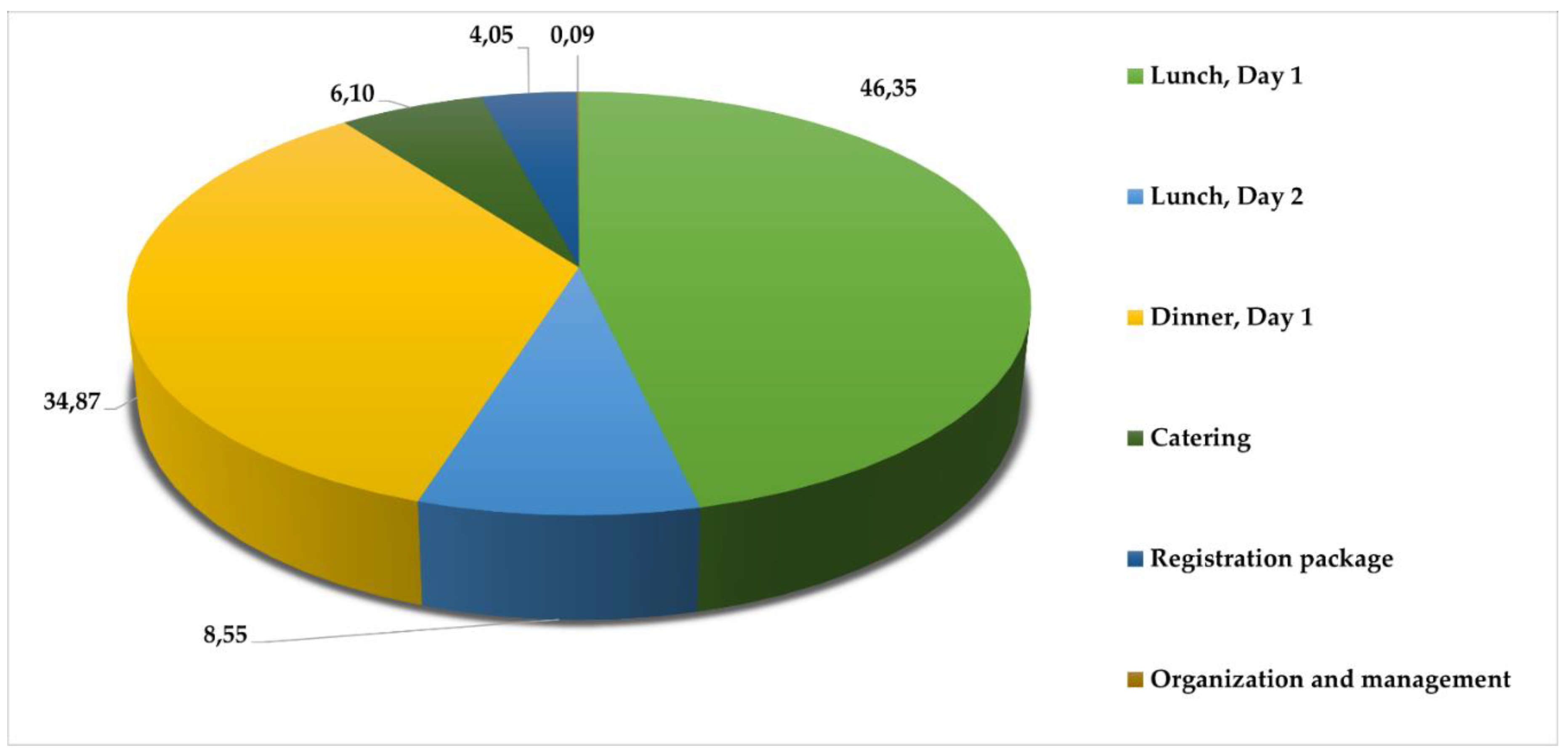
Figure 2.
Decarbonization percentage distribution regarding online conference by CML 2016 excluding biogenic carbon impact assessment method. (Functional unit: person/hour).
Figure 2.
Decarbonization percentage distribution regarding online conference by CML 2016 excluding biogenic carbon impact assessment method. (Functional unit: person/hour).
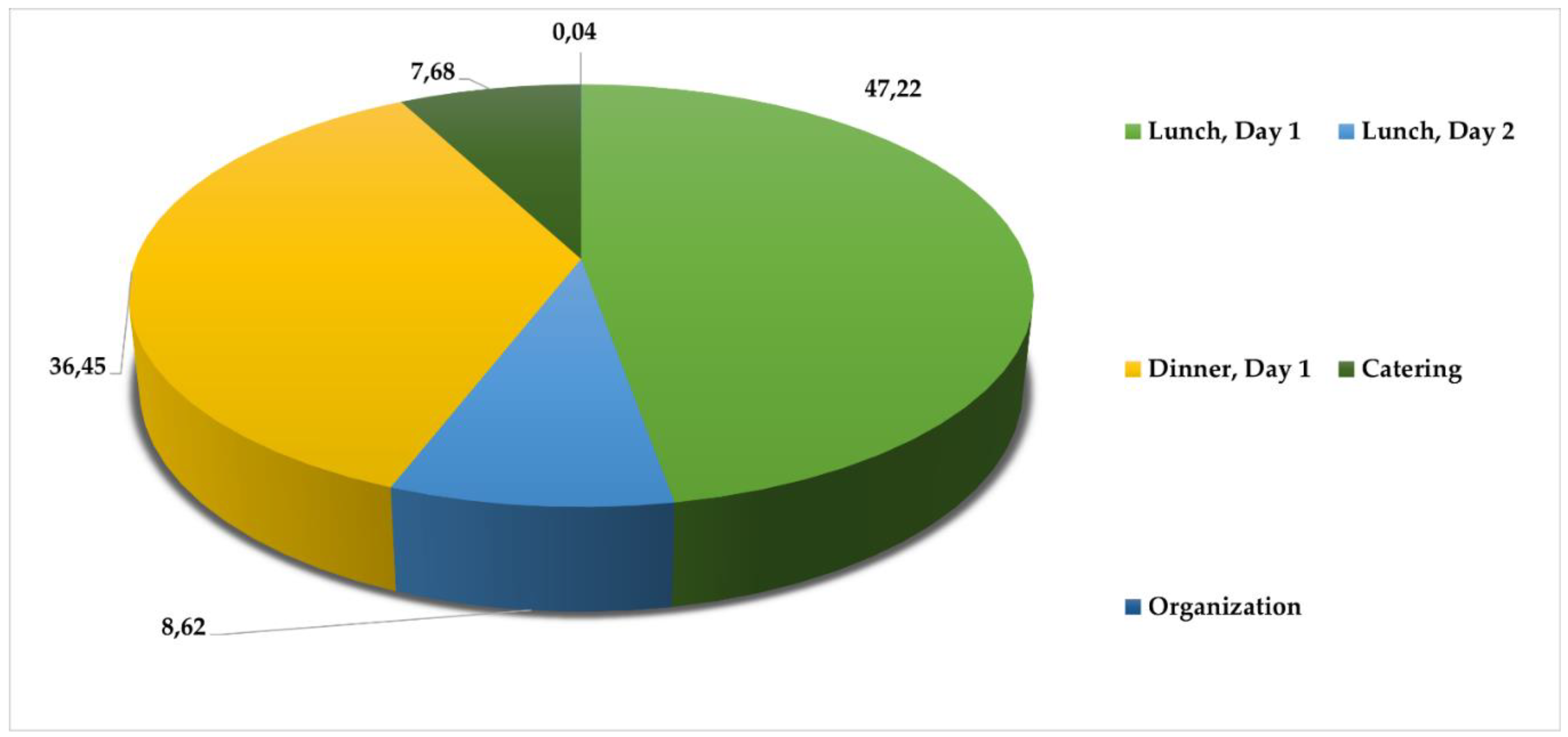
Figure 3.
SWOT analysis of in-person and online conferences based on the results.
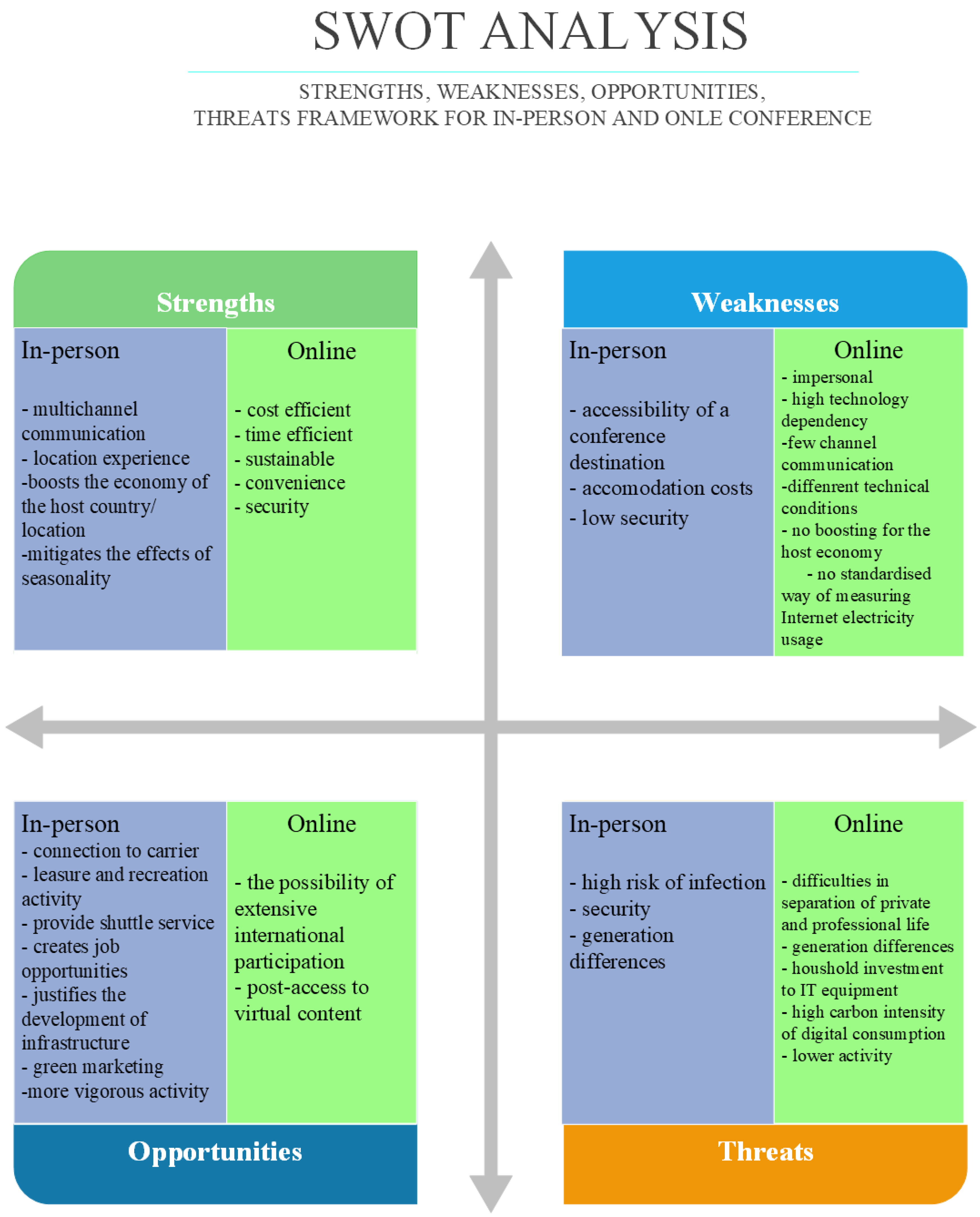
Figure 4.
SAP-LAP analysis (Situation Actor Process-Learning Action Performance) framework for conferences.
Figure 4.
SAP-LAP analysis (Situation Actor Process-Learning Action Performance) framework for conferences.
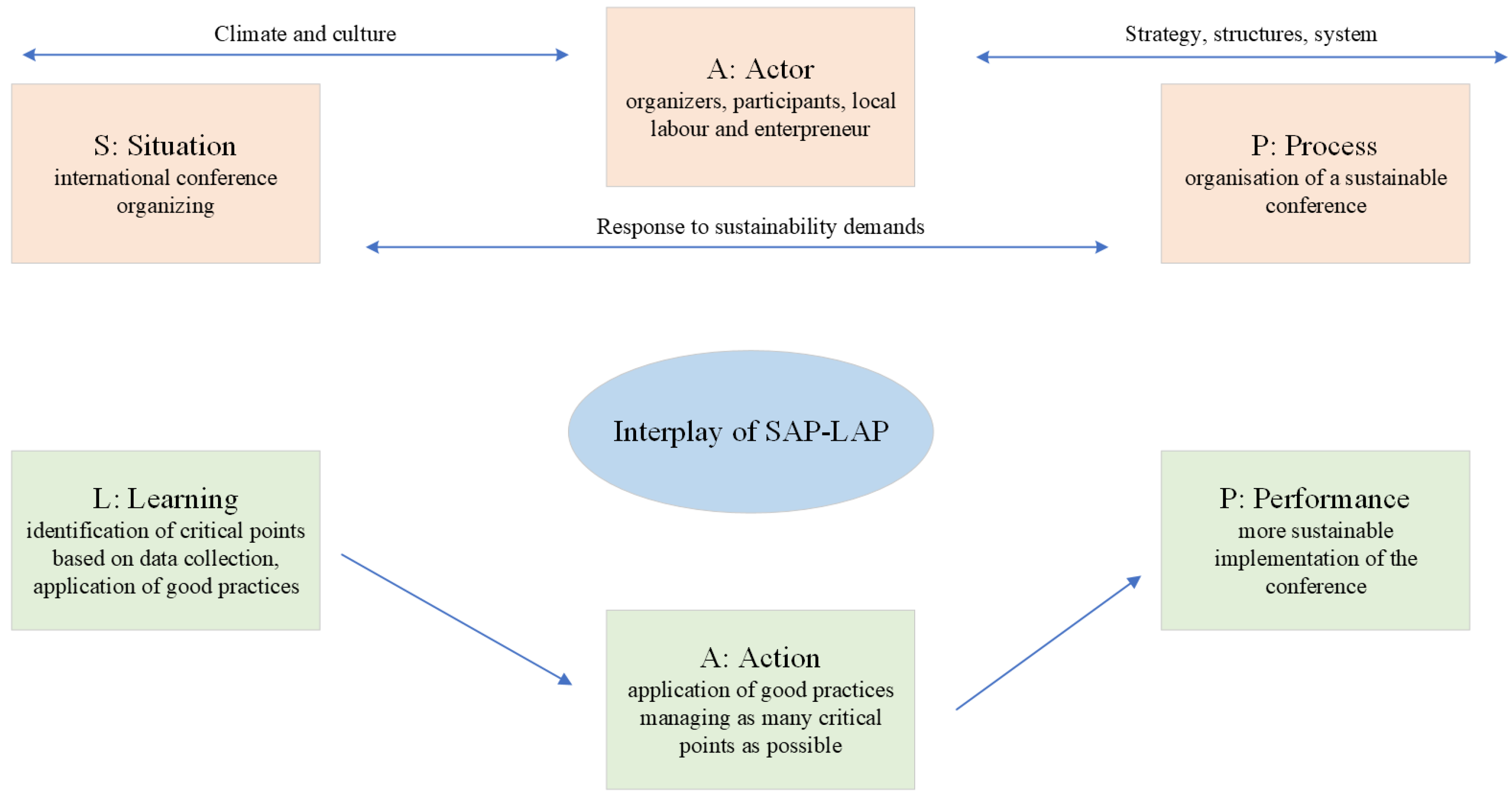

Table 1.
Life Cycle Inventory of raw materials in kilograms per portion for lunches on the two conference days and dinner on the first conference day.
Table 1.
Life Cycle Inventory of raw materials in kilograms per portion for lunches on the two conference days and dinner on the first conference day.
|
Conference Day 1:/Lunch/Course I: Cheddar cheese cream soup Serving weight: 0.385 kg/person |
| Cheddar cheese: 0.15 Pasteurized cream (38-42%): 0.103 Rapeseed oil (Canola): 0.025 Fine wheat flour: 0.006 Salt: 0.001 |
|
Conference Day 1/Lunch/Course II: Vienna Schnitzel with Thai rice Serving weight: 0.433 kg/person |
| Beef (semi-boned): 0.12 Fine wheat flour, eggs and breadcrumbs: 0.0355 Thai rice: 0.25 Orange rings (for decoration): 0.02 Sunflower oil: 0.0882 Salt: 0.001 |
|
Conference Day 1/Lunch/Dessert: Orange cream glass Serving weight: 0.289 kg/person |
| Orange: 0.165 Pasteurized cream (38-42%): 0.0773 Sour cream: 0.045 Sugar: 0.01 |
|
Conference Day 1/Dinner: Gnocchi with cheese sauce Serving weight: 0.414 kg/person |
| Cheese: 0.15 Pasteurized cream (42%): 0.05 Potatoes: 0.167 Wheat flour: 0.0333 Rapeseed oil (Canola): 0.03 Salt: 0.01 |
|
Conference Day 2/Lunch/Course I: Green pea cream soup Serving weight: 0.388 kg/person |
| Green peas: 0.125 Carrot: 0.09 Pasteurized cream (38-42%): 0.05 Rapeseed oil (Canola): 0.02 Fine wheat flour: 0.002 Salt: 0.001 |
|
Conference Day 2/Lunch/Course II: Steamed fish with Thai rice Serving weight: 0.398 kg/person |
| Fish meat: 0.10 Thai rice: 0.25 Orange rings (for decoration): 0.02 Rapeseed oil (Canola): 0.03 |
|
Conference Day 2/Lunch/Salad: Tomato salad Serving weight: 0.250 kg/person |
| Tomato: 0.20 Rapeseed oil (EU): 0.05 |
Table 2.
Possible impact assessment methods for decarbonization in the LCA for Experts software.
| Name of impact assessment method | Carbon Footprint [kg CO2 eq.] |
|---|---|
| CML 2001 - Aug. 2016/Non-baseline CML | Global Warming Potential (GWP 100 years) with or without biogenic carbon |
| Impact 2002+ (I02+ v2.1) | Global warming 500yr – Midpoint (kg CO2 eq. to air) |
| EF 3. 0 and EF 3.1 (Environmental Footprint 3.0 and Environmental Footprint 3.1) |
Climate Change – total, biogenic, fossil, and land use and land use change |
| EN 15804 +A2 (based on EF 3.1) | EN 15804+A2 (EF 3.1) Climate Change – total, fossil, biogenic, land use and land use change |
| Impacts ILCD/PEF recom worldsteel mod v1.09 | Climate Change midpoint, including or excluding biogenic carbon (v1.09) |
| IPCC AR6 | IPCC AR6 GWP 20,100, 500 including or excluding biogenic carbon IPCC AR6 GTP 50, 100 including or excluding biogenic carbon |
| ISO 14067 GWP (based on IPCC AR6) | GWP100, Aircraft emissions GWP100, Biogenic GHG emissions GWP100, Biogenic GHG removal GWP100, Emissions from land use change (dLUC) GWP100, Fossil GHG emissions |
| PCF IPCC | IPCC AR5 GWP 100 including biogenic carbon, including Land Use Change, no norm/weight |
| ReCiPe 2016 v1.1 | Climate Change, incl. Land Use Change (LUC): endpoint (H) and midpoint (H), Climate Change, incl. or default, excl. biogenic carbon Endpoint (I)/Midpoint (I) |
| SBK Bepalingsmethode - Jan. 2021 (NMD 3.3) | Climate change (GWP 100) Climate change (GWP 100), incl long-term emissions |
| TfS (Together for Sustainability) | TfS 1 – GWP total, inc. biogenic carbon TfS 2 - GWP total, excl. biogenic carbon TfS 3 – GWP fossil |
| TRACI 2.1 | Global Warming Air, excl biogenic carbon, incl LUC, no norm/weight Global Warming Air, incl biogenic carbon, incl LUC, no norm/weight Global Warming Air, LUC only, no norm/weight Global Warming Air, including or excluding biogenic carbon |
Table 3.
Energy consumption and waste generation regarding lunch on the first conference day for both types of conferences (functional unit: 1 portion/person/hour).
Table 3.
Energy consumption and waste generation regarding lunch on the first conference day for both types of conferences (functional unit: 1 portion/person/hour).
| Cheddar cheese cream soup (Course I), serving weight: 0.385 kg | |||
| Inputs | Water [kg] | Natural gas [kg] | Electricity [MJ] |
| In-person | 4.50 tap water mix from EU for washing and cooking (of which the cooking water: 0.1) |
0.0063 natural gas from EU |
0.85 electricity grid mix (Hungary): |
| Online | 4.50 | 0.0308 | 2.01 |
| Outputs | Food waste from all life cycle stages [kg/portion] | Waste water generated from preparation-cooking-consumption stages [kg/portion] |
Amount of other waste [kg/portion] |
| In-person | 0.058 (remaining consumption: 15%) |
4.40 | - |
| Online | 0.0193 (remaining consumption: 5%) |
4.40 | - |
| Vienna Schnitzel with Thai rice (Course II), serving weight: 0.433 kg | |||
| Inputs | Water [kg] | Natural gas [kg] | Electricity [MJ] |
| In-person | 6.71 tap water mix from EU (of which the cooking water for rice: 1.14) |
0.0283 natural gas from EU |
1.87 electricity grid mix (Hungary): |
| Online | 8.10 | 0.201 | 0.373 |
| Outputs | Food waste from all life cycle stages [kg/portion] | Waste water generated from preparation-cooking-consumption stages [kg/portion] |
Amount of other waste [kg/portion] |
| In-person | 0.11526 (orange peel from decoration: 0.001, peel: 0.018, consumption residue: 0.11246 - 26%) |
5.57 | 0.0794 (used cooking oil) |
| Online | 0.098 (orange peel: 0.001, peel: 0.018, consumption residue: 0.09516 - 22%) |
6.99 | 0.0794 (used cooking oil) |
| Orange cream glass (Dessert), serving weight: 0.289 kg | |||
| Inputs | Water [kg] | Natural gas [kg] | Electricity [MJ] |
| In-person | 3.45 tap water mix from EU for washing |
- |
1.70 electricity grid mix (Hungary): |
| Online | 3.45 | 0.0107 | 0.805 |
| Outputs | Food waste from all life cycle stages [kg/portion] | Waste water generated from preparation-cooking-consumption stages [kg/portion] |
Amount of other waste [kg/portion] |
| In-person | 0.0227 (orange peel: 0.0825, consumption residue: 0.01445 – 5%) |
3.45 | - |
| Online | 0.0227 (orange peel: 0.0825, consumption residue: 0.01445 – 5%) |
3.45 | - |
Table 4.
Energy consumption and waste generation regarding lunch on the second conference day for both types of conferences (Functional unit: 1 portion/person/hour).
Table 4.
Energy consumption and waste generation regarding lunch on the second conference day for both types of conferences (Functional unit: 1 portion/person/hour).
| Green pea cream soup (Course I), serving weight: 0.388 kg | |||
| Inputs | Water [kg] | Natural gas [kg] | Electricity [MJ] |
| In-person | 4.50 tap water mix from EU for washing and cooking (of which the cooking water: 0.1) |
0.0063 natural gas from EU |
0.85 electricity grid mix (Hungary): |
| Online | 5.00 (of which the cooking water: 0.1) |
0.0595 | 2.01 |
| Outputs | Food waste from all life cycle stages [kg/portion] | Waste water generated from preparation-cooking-consumption stages [kg/portion] |
Amount of other waste [kg/portion] |
| In-person | 0.0682 (carrot peel: 0.01, consumption residue: 0.0582 – 15%) |
4.40 | - |
| Online | 0.0294 (carrot peel: 0.01, consumption residue: 0.0194 – 5%) |
4.90 | - |
| Steamed fish with Thai rice (Course II), serving weight: 0.398 kg | |||
| Inputs | Water [kg] | Natural gas [kg] | Electricity [MJ] |
| In-person | 6.31 tap water mix from EU |
0.043 natural gas from EU |
1.21 electricity grid mix (Hungary): |
| Online | 6.31 | 0.195 | 0.33 |
| Outputs | Food waste from all life cycle stages [kg/portion] | Waste water generated from preparation-cooking-consumption stages [kg/portion] |
Amount of other waste [kg/portion] |
| In-person | 0.0621 (orange peel from decoration: 0.01, consumption residue: 0.05963 – 15%) |
5.20 | - |
| Online | 0.0621 (orange peel: 0.01, consumption residue: 0.05963 – 15%) |
5.20 | - |
| Tomato salad (salad), serving weight: 0.250 kg | |||
| Inputs | Water [kg] | Natural gas [kg] | Electricity [MJ] |
| In-person | 0.7 tap water mix from EU for washing and preparing |
- |
- electricity grid mix (Hungary): |
| Online | 0.70 | - | - |
| Outputs | Food waste from all life cycle stages [kg/portion] | Waste water generated from preparation-cooking-consumption stages [kg/portion] |
Amount of other waste [kg/portion] |
| In-person | 0.0125 (consumption residue) |
0.70 | - |
| Online | 0.0125 (consumption residue) |
0.70 | - |
Table 5.
Energy consumption and waste generation regarding dinner on the first conference day for both types of conferences (Functional unit: 1 portion/person/hour).
Table 5.
Energy consumption and waste generation regarding dinner on the first conference day for both types of conferences (Functional unit: 1 portion/person/hour).
| Gnocchi with cheese sauce (main course), serving weight: 0.414 | |||
| Inputs | Water [kg] | Natural gas [kg] | Electricity [MJ] |
| In-person | 10.60 tap water mix from EU (of which the added cooking water: 0.1 kg) |
0.036 natural gas from EU |
1.35 electricity grid mix (Hungary): |
| Online | 10.60 | 0.0615 | 2.01 |
| Outputs | Food waste from all life cycle stages [kg/portion] | Waste water generated from preparation-cooking-consumption stages [kg/portion] |
Amount of other waste [kg/portion] |
| In-person | 0.0788 (potato peel: 0.0166, consumption residue: 0.06214 – 15%) |
10.60 | - |
| Online | 0.0788 (potato peel: 0.0166, consumption residue: 0.06214 – 15%) |
10.60 | - |
Table 6.
Energy consumption and raw material weights regarding catering for in-person and online conferences by different functional units.
Table 6.
Energy consumption and raw material weights regarding catering for in-person and online conferences by different functional units.
|
Tea with orange, orange juice and Cassava chips Functional Unit: consumption/1 person/1 hour | |||
| Water [kg] | Natural gas [kg] | Electricity [MJ] | |
| 0.80 tap water mix from EU ((use of water to make tea) |
- |
0.0576 electricity grid mix (Hungary) CASO HW 550 hot water dispenser |
|
| Weight of raw materials [kg] | Black tea: 0.0112 Sliced orange (for flavoring): 0.02 Potato chips (Cassava): 1.20 Orange juice: 0.96 Crystal sugar: 0.024 |
||
|
Tea with orange, orange juice and Cassava chips Functional Unit: consumption/200 person/1 hour | |||
| Water [kg] | Natural gas [kg] | Electricity [MJ] | |
| 160 tap water mix from EU ((use of water to make tea) |
- |
11.50 electricity grid mix (Hungary) CASO HW 550 hot water dispenser |
|
| Weight of raw materials [kg] | Black tea: 2.24 Sliced orange (for flavoring): 4.0 Potato chips (Cassava): 240 Orange juice: 192 Crystal sugar: 4.8 |
||
Table 7.
Carbon footprint values regarding in-person conference by different life cycle impact assessment methods in carbon-dioxide kg equivalents.
Table 7.
Carbon footprint values regarding in-person conference by different life cycle impact assessment methods in carbon-dioxide kg equivalents.
|
Carbon footprint for the in-person conference Functional unit: 1 person/1 hour |
||||
| CML 2016 excl. biogenic carbon [kg CO2 eq.] |
IPCC AR6 GWP 100, excl. biogenic CO2 (version Aug. 2021) [kg CO2 eq.] |
ISO 14067 GWP 100 [kg CO2 eq.] |
||
| Lunch, Day 1 | 4.068 | 4.213 | 2.612 | |
| Lunch, Day 2 | 0.7504 | 0.7711 | 0.5893 | |
| Dinner, Day 1 | 3.06 | 3.17 | 1.85 | |
| Catering | 0.535 | 0.551 | 0.286 | |
| Registration gift package | 0.355 | 0.357 | 0.24 | |
| Organization and Management | 0.0077 | 0.00774 | 0.0042 | |
| Total | 8.7761 | 9.06984 | 5.5815 | |
| Trip | 11.912 | |||
Table 8.
Carbon footprint values regarding online conference by different life cycle impact assessment methods in carbon-dioxide kg equivalents.
Table 8.
Carbon footprint values regarding online conference by different life cycle impact assessment methods in carbon-dioxide kg equivalents.
| Carbon footprint for the online conference Functional unit: 1 person/1 hour |
||||
|---|---|---|---|---|
| CML 2016 excl. biogenic carbon [kg CO2 eq.] | IPCC AR6 GWP 100, excl. biogenic CO2 (version Aug. 2021) [kg CO2 eq.] |
ISO 14067 GWP 100 [kg CO2 eq.] |
||
| Lunch, Day 1 | 4.041 | 4.187 | 2.55 | |
| Lunch, Day 2 | 0.7374 | 0.7551 | 0.4815 | |
| Dinner, Day 1 | 3.12 | 3.23 | 1.86 | |
| Catering | 0.657 | 0.673 | 0.324 | |
| Organization | 0.00321 | 0.00323 | 0.00208 | |
| Total | 8.55861 | 8.84833 | 5.21758 | |
Disclaimer/Publisher’s Note: The statements, opinions and data contained in all publications are solely those of the individual author(s) and contributor(s) and not of MDPI and/or the editor(s). MDPI and/or the editor(s) disclaim responsibility for any injury to people or property resulting from any ideas, methods, instructions or products referred to in the content. |
© 2024 by the authors. Licensee MDPI, Basel, Switzerland. This article is an open access article distributed under the terms and conditions of the Creative Commons Attribution (CC BY) license (http://creativecommons.org/licenses/by/4.0/).
Copyright: This open access article is published under a Creative Commons CC BY 4.0 license, which permit the free download, distribution, and reuse, provided that the author and preprint are cited in any reuse.


