

Submitted:
06 December 2024
Posted:
09 December 2024
You are already at the latest version
Abstract
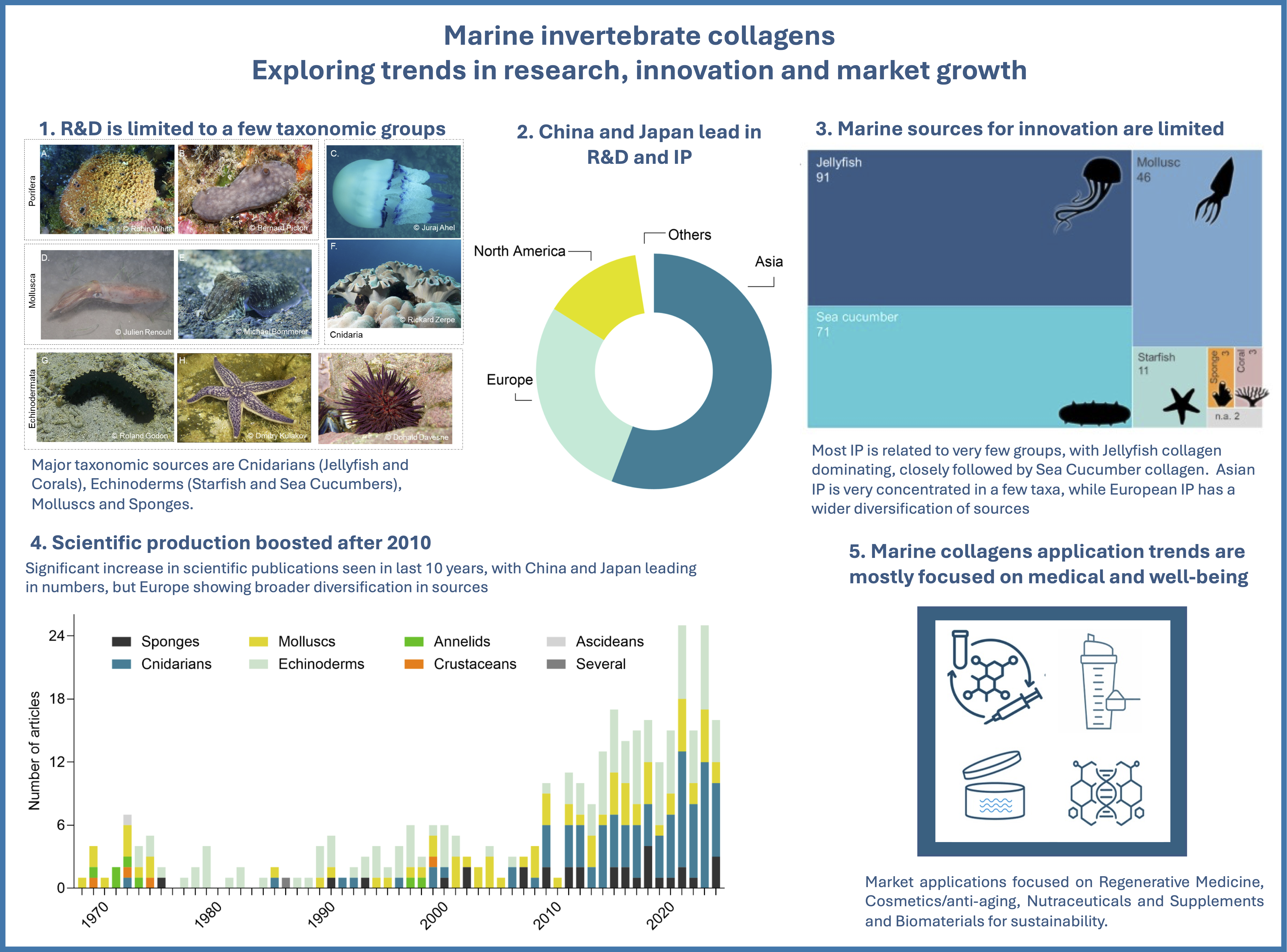
This review is focused on the research, innovation and technological breakthroughs on 16 marine invertebrate collagens and their applications. The findings reveal that research dates back to the 1970s, and after a period of reduced activity, interest in collagens from several marine invertebrate groups was renewed around 2008, likely driven by the increased commercial interest in these biomolecules of marine origin. R&D is predominantly reported from China and Japan, highlighting significant research interest in cnidarians (jellyfish), echinoderms (sea cucumbers, sea urchins and starfish), molluscs (squid and cuttlefish) and sponges. Co-word analysis of the literature highlights applications in regenerative medicine, the properties of hydrolysates, and biology and biochemistry studies. Innovation and technological landscape, however, focuses on fewer taxonomic groups, possibly reflecting the challenge of sustainably sourcing raw materials, with a higher number of patents coming from Asia. Globally, jellyfish collagen is the most prominent marine invertebrate source, while Asia also emphasizes the use of collagens derived from molluscs and sea cucumbers. Europe, despite fewer patents, explores a broader range of taxonomic groups. Globally, key applications registered are mostly in medical, dental and toiletry area, with peptide preparations spanning also multiple animal groups. The food domain is notably relevant for molluscs and sea cucumbers. Market trends show a strong presence of cosmetic and supplement products, aligning with market reports that predict a growing demand for marine collagens in cosmetics and personalized nutrition, particularly in targeted health supplements.
Keywords:
patents
; biomaterials
; application
; blue biotechnology
; jellyfish
; sea-cucumber
; sponges
; molluscs
1. Introduction
Collagen is a key component of the extracellular matrix of animals, providing structural and mechanical support to tissues, playing a role in biomineralization and influencing cell properties, such as adhesion, migration, proliferation and differentiation[1]. In the human body collagen accounts for about 30% of total protein [2]. This molecule has a unique triple-helical structure made of three α polypeptide chains, which can be identical (homotrimeric) or distinct (heterotrimeric), coiled around each other. The α chain’s primary structure consists of repeating Gly-Xaa-Yaa triplets, typically glycine, proline and hydroxyproline, with the latter being a hallmark of collagens being used to identify (and quantify) its presence in biological samples. During collagen biosynthesis, key post-translational modifications (PTMs) include hydroxylation of proline residues, which stabilizes the helix and contributes to thermal stability [3], and hydroxylation of specific lysine residues, which influence fibrillogenesis, cross-linking and matrix mineralization [4]. Glycosylation is less studied but appears to be essential for collagen integrity [5]. These PTMs add a layer of information in addition to the amino acid code, resulting in diverse collagen forms [6].
To date, of the 28 collagen types described, fibrillar collagens types I-III are the most abundant in mammals and widely used in biomedical, cosmetic, and nutraceutical fields, primarily sourced from porcine and bovine skin and bones [7]. Another important non-fibrillar collagen, Type IV, is the main component of the basement membrane, providing structural support and influencing cell behaviour, while fibril-associated collagens (FACIT) have interruptions within the triple helix domain and associate with other collagen fibrils [8].
Collagens from marine organisms can be isolated from their by- or co-products to produce new value-added compounds and materials, with this biobased approach being a high target on the EU policy making agenda [9]. This goal has improved the research on the properties and applications of collagen from fish tissues,[10], revealing them as safe sources with a variety of applications in human well-being and health sectors. Additionally, the study of invertebrate collagen has been driven not only by its potential applications but also by its significance in understanding animal evolution[1]. These studies have focused on the study of novel source species [11,12], improvement of isolation procedures (yields, reduction of processing time and amount of chemicals used) [13,14], life-cycle assessment [15], processing technologies and advancing their use in tissue engineering [16], wound healing [17], and drug delivery systems [18], as well as expanding its use in functional foods and nutraceuticals through the discovery of bioactive peptides [19].
Interest in collagen-based extracellular matrices from marine invertebrates emerged early given their association to the origin of animal multicellularity and tissue evolution [8,20] and therefore, earlier works on these collagens are likely to hold valuable insights that are worth a review (Figure 1). In this respect, this review aims to provide: i) an overview of the physicochemical fundamentals of collagens derived from marine invertebrates; ii) an analysis of publications and patents to provide insights into the current research and innovation landscape; and iii) discuss potential future directions in marine collagens originating from invertebrates. The study begins with foundational concepts of marine invertebrate collagen, establishing the relevance of publications and patent analysis. This combined approach offers a clearer understanding of the current state of the art and the evolving trends in marine collagens innovation.
1.1. Background on Collagen Fundamentals of Porifera – Spongin and Collagen Diversity
Sponges are ancient sessile animals consisting of a jelly-like mesohyl enclosed by two layers of cells and bodies with pores and channels for water circulation. The phylum is divided into four classes based on their skeleton composition, from which Demospongiae is the most collagen-rich one. Sponge skeletons incorporate collagen as spongins, from dispersed thin fibrils to organized macroscopic fibrous frameworks, being commonly described in Keratosa sponge species.
In sponges, collagen isolation is hindered by mineralization and insolubility in acid solutions, which generally also affects their biochemical analysis [21] and therefore a variety of methods explored allowed the discovery of several collagens’ forms present in sponges [22]. Collagen is commonly obtained from sponges by disaggregation of body wall using a solution containing a chaotropic agent, with the protein being generated in the fibril form [22,23].
Structural or biochemical analysis have identified fibrillar collagens, in the form of bundles, formed by the association of several hundred collagen fibrils, in diverse demosponge taxa, such as Geodia, Axinella, Chondrosia, Chondrilla and Suberites [12,22,24,25,26]. In glass sponges (class Hexactinellida), highly hydroxylated fibrillar collagen has been recently described in their spicules, which can act as a template for the biosilicification process [21]. A unique collagen form, spongin has been reported in certain demosponges [27]. Although its properties are not fully understood, spongin is notable for having less glycine (about 14%) compared to collagen (between 25% and 33%) and for its diverse halogen content [21].
In family Irciinidae (Figure 2A), a collagen-like material made of filaments with globular ends and linked to carbohydrates is found within spongin matrices, forming strong yet flexible structures [28,29]. Moreover, fibrillar and non-fibrillar collagen extracted along with the filaments of Ircinia fusca revealed specificity for anti-collagen type I and IV human antibodies [28]. Both collagen types have also been identified in collagen fibrils in C. reniformis (Figure 2B). In fact, in the Mediterranean Sea this species has been studied for several decades given its high collagen content, lack of spicules, high bioactivity and capability to modulate its mechanical properties by acting on the collagen crosslink, calling attention from the biotechnological and biomedical fields [30,31]. Numerous studies have focused on optimizing C. reniformis collagen extraction, biomass production and development of biomaterials for cosmetic, pharmaceutical and biomedical research [12,32,33,34].
1.2. Background on Collagen Fundamentals of Cnidaria – Mesoglea Collagens
Cnidaria is phylogenetically more complex than sponges and less complex than bilaterians. Their bodies consist of mesoglea, a jelly-like substance, located between two layers of cells, and their most distinguishing feature is the occurrence of a specialized cell used mainly for prey capturing and defense called cnidocyte [35]. Collagen descriptions from this phylum have been obtained from species belonging to three Cnidaria classes: Hydrozoa (includes both colonial swimmers and sessile members, such as the freshwater invertebrate model Hydra sp.), sessile Anthozoa (e.g., sea anemones, corals and sea pens) and swimming Scyphozoa (e.g., jellyfish) (Figure 2C). In Hydrozoa, Collagen IV has been reported in the interstitial matrix of Hydra in association with a fibrous collagen [36]. In Anthozoa, early studies described homotrimeric collagen molecules in the sea anemones Actinia equina and Metridium dianthus [37,38,39], while in the sea-pen Veretillum cynomorium heterotrimeric collagen molecules were reported [40]. Recent works have isolated collagen-associated glycoproteins from the soft corals Lobophytum crassum and Sinularia polydactyla [41,42] and identified long and hyper-elasticity collagen fibers in Sarcophyton ehrenbergi (Figure 2F) [41].
Research on Scyphozoa collagens has significantly expanded since initial studies on their chain structure [43]. Electrophoretic patterns showed varying subunit compositions among species. For example, collagen from the jellyfish Catostylus mosaicus resemble mammal collagen type I [44] while others, such as from the jellyfish Rhopilema esculentum were designated as analogous to vertebrate collagen type II [45]
Other works found similarities with mammal collagens, reporting collagens characterized by two α chains, α1 and α2 in Rhopilema asamushi [46], (α1)3 chains in Cyanea nozakii [47] and α1, α2, and α3 chains in Acromitus hardenbergi [43,48,49]. This great variability among several jellyfish species is attributed to species-specific variations in amino acid composition and collagen molecular weight [50]. The identification of shared features between jellyfish collagens and different human collagen types suggests that jellyfish collagen may represent an ancestral form, potentially being a precursor of the structural proteins found in higher animals [51]. Indeed, the collagen produced by the company Jellagen was categorized as “collagen type 0” to highlight these similarities and ancient origin (https://jellagen.co.uk/collagen-type-0/). In addition, the higher occurrence in jellyfish blooms, caused by global warming and overfishing, among others, raise a concern regarding the potential negative effects [52] but may also offer an opportunity for sustainable collagen production from abundant biomass while tackling an environmental challenge.
Specific collagens with improved mechanical properties, designed as mini collagens, are reported for this phylum. Minicollagens are found in the inner layer of nematocyst walls and are the smallest collagens known with 12-16 Gly-X-Y repeats flanked at both ends by a polyproline stretch and a conserved cysteine-rich domain, proposed to function in collagen assembly [53]. These biomolecules have also been highlighted for their biomimetic potential [54].
1.3. Background on Collagen Fundamentals of Nematodes and Annelids - Cuticular Collagens
Cuticular collagens are reported for worm-like animals, such as nematodes and annelids, and have distinctive chemical and physical properties from fibrillar collagens. Compared to vertebrates, they are most similar to the fibril-associated collagens with interrupted triple helices [1].
The cuticle of these organisms is known to be multilayered, flexible and exoskeleton synthesized by underlying hypodermal cells that enclose the animal. While cuticles are found in several marine taxa, in nematodes and several worms these have been described as collagen-rich [55]. Cuticle collagens from nematodes have a characteristic structure of short, interrupted blocks of Gly-X-Y sequence flanked by conserved cysteine residues [56] and cross-linked by nonreducible covalent bonds that involve tyrosine residues [55].
Annelid cuticle collagens are different from those of nematodes, as these are characterized by globular domains and a very long triple helix, high molecular masses and amino acid compositions, with about one third of glycine being almost the only common feature [57]. An interesting example which is species-specific, is found in the hydrothermal vent polychaete Riftia pachyptila, in which cuticular collagen stability is associated with a large amount of glycosylated threonine residues [58]. It is worth highlighting that while cuticular structures have also been found in some sponges, their molecular composition is yet to be determined [21]
1.4. Background on Collagen Fundamentals of Molluscs and Crustaceans - Collagens from Muscle Tissues
The major collagen of crustacean muscles described to date is a type V like homotrimer observed in the prawns Pennaeus japonicus and P. indicus [59] and in the crab Scylla serrata [60]. In the latter, collagen presented differences within the animal body parts; leg muscles featured a higher degree of crosslinking, a higher bound of carbohydrates and increased lysine hydroxylation and reduced glycine content when compared to the collagen found in abdominal muscles [60]. These differences were associated with the functional requirements of leg muscles for locomotion and predation, while abdominal muscles contribute to normal growth and development [60].
Type V like heterotrimer was also found in the cuttlefish Sepia officinalis cartilage and cornea and was associated to vertebrate cartilage minor collagens, type V and XI [61].
Collagens in molluscs have been more extensively characterized in commercial cephalopods (Figure 2D,E). Collagen extracted from the skin of squid and cuttlefish species (e.g., Doryteuthis singhalensis, Dosidicus gigas, Kondakovia longimana, Illex argentinus and Sepia pharaonis) was characterized as Type I collagen [62,63,64,65], while in the squids Loligo formosana and Todarodes pacificus, two genetically distinct collagen types were described in the skin and/or mantle, presenting similarities to Type I and V collagens, and found to possess heterotrimeric chain compositions (α1)2 α2, with the latter in a smaller amount [65,66,67].
Besides a few works on the nutritional characterization of commercially important bivalve molluscs for human consumption [68], collagen studies have been carried out in the oysters Crassostrea gigas and Pinctada martensi [69,70]. These works demonstrated high insoluble collagens that were able to be solubilized after treatment disaggregation of collagen fibrils and revealed a similar composition as described for cephalopods: a heterotrimer structure (α1)2 α2.
One specificity within bivalves is the occurrence of collagen-like filaments formed as byssal threads [71]. Indeed, the main components of byssal threads include a set of various collagen-like structural proteins (preCols) consisting of a collagenous core sequence and two flanking domains, composed of either a soft (elastin-like), a stiff (silk fibroin-like) or an intermediate (amorphous polyglycine) chain globular domains [71,72].
1.5. Background on Collagen Fundamentals of Echinoderms – Mutable Collagen Tissues
Echinoderms are strictly marine animals that feature an endoskeleton composed of unique calcareous ossicles forming a framework that supports their body, and a complex system of channels and reservoirs, the water vascular system, used for movement, respiration, and feeding [35]. The phylum is divided into five classes: Crinoidea (e.g., sea-lilies and feather stars), Ophiuroidea (e.g., brittle stars), Holothuroidea (e.g., sea-cucumbers), Echinoidea (e.g., sea-urchins), and Asteroidea (e.g., starfish). Among these, collagen has been mostly studied in starfish, sea urchins and sea cucumbers.
One characteristic of most echinoderms across its five classes is a specific connective tissue, the mutable collagenous tissue (MCT) [73]. This collagen differs from others due to its ability to switch between rigid and flexible states, allowing the organism to adapt its body structure for different functions, as movement, defense and regeneration; this mechanism features a neural control and is only possible due to the release of specialized effector proteins [73]. At molecular level, the collagen of sea cucumber is different from heterotrimeric vertebrate type I fibrillar collagen, consisting of homotrimers with three α1 polypeptide chains [74]. This collagen, particularly from sea cucumbers, has inspired biomimetic designs through the development of artificial materials and devices in fields such as tissue engineering, soft robotics, and biomedical devices [75]. Although the mutability of echinoderms connective tissues is a unique characteristic of this phylum, there are also a few other examples of “mechanical adaptable tissues” among invertebrates [76]
Sea cucumbers (Figure 2G) have attracted scientific interest due to the abundance of collagen in their body walls [74]. Different species of edible sea cucumbers have been studied for their collagen content, such as Parastichopus californicus and Apostichopus japonicus from the Northwest Pacific, Stichopus vastus, S. monotuberculatus and Holothuria parva from the Indo-Pacific, Cucumaria frondosa from the Northern Atlantic and the Arctic, as well as Australostichopus mollis from the South Pacific [74,77,78,79,80]. In these studies, collagen extracted from sea cucumbers has primarily been identified as type I collagen, the most common type of this biomolecule found in vertebrates and the one being most investigated for potential applications [74].
Studies on collagen from the starfish Asterias rubens (Atlantic) and A. amurensis (North Pacific), which are known to significantly impact aquaculture production, are currently being performed to explore the properties of this biomolecule (Figure 2H). Indeed, the collagen of these animals has already been reported to display a structure related to that of mammalian type I [81,82].
Earlier studies on sea urchin tissues have indicated the presence of diverse and potentially specialized types of collagens in echinoids, suggesting that sea urchins may have evolved a variety of collagen structures tailored for specific functions in different parts of their bodies [83]. Despite this diversity, research also suggests a strong similarity between sea urchin collagen and that of mammalian collagen, particularly type I [84]. For instance, collagen extracted from sea urchins the soft tissues, such as the peristomial membrane (the tissue surrounding the mouth) of edible species, such as Paracentrotus lividus and Sphaerechinus granularis, is primarily composed of fibrillar structures (Figure 2I) [85]. Previous studies suggest that this collagen closely resembles that of mammalian type I, exhibiting impressive mechanical properties, including high stiffness and resistance, thus making it suitable for applications in regenerative medicine and biomaterial development [86,87,88].
2. Results
2.1. Temporal Growth, Geographic Distribution and Trends in Research Topics
The literature search on marine invertebrate collagens yielded a total of 424 publications, of which 323 publications were selected for deeper analysis. The highest number of selected publications originated from China and Japan (72 and 48, respectively), with significant contributions also coming from the United States of America (23), Italy (17), Germany (17), France and Mexico (14 each) and the United Kingdom (12) (Figure 3). The most studied taxonomic groups pertaining collagens from marine invertebrates were cnidarians (jellyfish: 89; corals: 5), echinoderms (sea-cucumbers: 63; sea urchins: 43; starfish: 10) and molluscs (squids: 57; cuttlefish: 8), followed by marine sponges (31). The analysis of publications over time shows that research on marine collagens increased in recent years, with over 10 publications per year being authored from the 2010s onwards, except for 2013 (Figure 4), with an increase in studies focusing on marine sources, such as sponges and jellyfish.
Figure 5 presents a co-word analysis that allows for a visualization of the relationships between marine sources and various keywords found in publications addressing collagens from marine invertebrates. This analysis reveals seven distinct clusters of related terms. The blue cluster represents research focused on jellyfish collagen, with the terms “scaffold” and “extracellular matrix” suggesting an emphasis on tissue engineering and the use of this collagen to serve as a structural component in medical applications. The red cluster, although closely related to the blue cluster, focus more broadly on various sources of marine collagen (e.g., originating from jellyfish, sea urchins, and sponges) as a biomaterial, with an emphasis on “regenerative medicine” and “biomaterials” suggesting a strong interest in both technological and medical uses of these biomolecules. The green and emerald clusters mostly related to the study of collagens from echinoderms, particularly sea cucumbers and starfish, and their structural and physicochemical properties, most likely related to more fundamental marine biology and biochemistry studies. The identification of mutable collagenous tissues in animals from this phylum and the efforts to explain the phenomenon of collagen aggregation and disaggregation are probably related to this. The purple and orange clusters are associated with studies addressing collagens from molluscs and yet again more focused on structural and physicochemical studies. Finally, the light green cluster accounts for studies addressing functional properties of collagen hydrolysates, namely those specifically related to sea cucumbers but also, most likely, involving other marine invertebrate sources in general, exploring the anti-oxidant activity that these collagen hydrolysates display. The collagen hydrolysates, in general, have been particularly studied as potential components of nutraceutical and cosmetic formulations [89], given their higher absorption and easier metabolism, and this suggested association of hydrolysates and biological activity is certainly reflecting that.
2.2. Technological Development Trends, Sources, Application Areas and Demography
A total of 228 patent applications were surveyed in the present study. The first application dates back from 1997 and, in following years, the number of patents published was relatively low (<2 per year). From 2007 onward, the number of patent publications increased in a pronounced way, rising from 7 in 2007 to 24 in 2023, with some oscillations in numbers between those years. In 2024, there were a total of 14 patent publications.
Jellyfish emerges as the most relevant source of collagen among the marine invertebrates listed with a total of 91 patent documents (Figure 6A). Sea cucumbers followed with 71 patent applications and molluscs, including shellfish, squid and cuttlefish, were recorded in 46 applications. Collagens derived from starfish, sponges and corals (11, 3 and 3 respectively) show relatively low numbers of patent applications. Asia, particularly China, is the leader in the marine collagen patent space showing extensive activity across multiple marine invertebrate taxa, yielding 158 applications. South Korea and Japan also significantly contribute to this Asian dominated landscape, but to a lesser extent (with 31 and 14 patents, respectively). The United States of America follows with 12 patents and Europe, including the United Kingdom, Portugal, Germany, Russia and Italy, each with a total of 8 patents. Other countries, such as Taiwan and Israel, feature 2 patents each (Figure 6B). Although patentability may experience different regulations across the globe, the observed predominance of Asian countries, in line with the abovementioned reports for scientific publications, is possibly related to an easier access to raw materials, has China as the world’s highest aquatic food production [90].
Collagen from jellyfish is found across all countries working on this topic, while collagen from sea cucumbers and from molluscs (e.g., squid, cuttlefish, and shellfish) appears to be much more thoroughly addressed in Asia. Europe shows a more diversified, but smaller-scale, activity, with a notable focus on sponges and some interest in jellyfish and coral, while North America focuses primarily on jellyfish collagen directly competing with Asian players.
The comparison of the more relevant technological areas across the main animal groups is shown in Figure 7. Preparations for medical, dental or toiletry purposes (A61K) were highly relevant across all sources (except for coral). The areas of disinfection and sterilization (A61L) were particularly relevant for coral and sponges, therapeutics (A61P) was more pronounced in sponges and the cosmetic area (A61Q) was particularly relevant for starfish. The food domain (A23L) displayed a more pronounced relevance in the context of molluscs and sea-cucumbers. Peptides (C07K) showed higher relevance in all animal groups, except in sponges. In contrast, macromolecular compounds (C08H, C08L) and glue/gelatine preparation (C09H) were more relevant for sponges.
The analysis of applicants per type of entities reveals that 48% of the patents are filed by either corporations or companies. This is followed by individual applicants and universities/academic institutions, each contributing around 16%. Research and development institutions account for 8% of patents, with a similar proportion being attributed to patents filed jointly by two or more entities. Concerning the legal status of the patents screened in the present study, 42% are classified as discontinued, with sea cucumbers and molluscs being the invertebrate groups with the highest number of contributions. A comparable number of patents are either pending (24%) or active (23%), while only a small portion is either expired (4%) or inactive (7%) (Figure 8).
2.3. Market Overview
Currently, bovine and porcine sources dominate the collagen market. However, globally, this trend is projected to decline due to concerns on disease transmission, possible allergic reactions and cultural impact. Believes and other food and dietary restrictions and options are also imposing a decrease in the sourcing of collagen from these more “conventional” raw materials. Indeed, the society seems to be pushing to abandon the use of mammal derived materials and entrepreneurs on biomedical arena report regulatory constraints on the use of mammal derived tissues for collagen production (regarding the origin of such biological materials and associated safety issues). In contrast, marine collagens are considered to be safer, produced from more unobjectionable sources, being expected to experience the highest growth in consumption at global level [91]. Additionally, the global production of marine collagens is relatively small compared to traditional bovine or porcine collagen [92] and, consequently, being even smaller for marine invertebrates, perhaps representing a niche market with high growth potential. The analysis of collagen market reports’ is usually focused on this market as a whole, which encompasses collagens derived from various sources. Reports typically provide an overview of the whole collagen market and, within this, marine collagens are often treated as one of the segmented categories: indeed, only a small number of reports specifically focus on the marine collagen market per se. According to these reports the total collagen market was estimated to be valued at 5.1 USD billion in 2023 and was projected to grow to 7.4 USD billion by 2030, with a compound annual growth rate (CAGR) of 5.3% [93]. The Marine Collagen Market Research Report [94] summarizes trends in the marine collagen market per se and this market is expected to grow from 2.79 USD Billion in 2023 to 4.95 USD Billion by 2032. The CAGR of this specific market segment is expected to be around 6.59% during the forecast period (2024 - 2032). Marine collagen is a small part of the collagen production volume but comprises almost half the revenue. This report suggests a shift towards personalized nutrition and targeted supplements designed to address specific health needs. Manufacturers are also exploring new sources of marine collagens, such as jellyfish, indicating as justification the need to meet the growing demand for sustainable and ethical products [94]. While marine collagens sourced from fish are widely used in the food domain, as shown in the previous section, this report indicates that marine invertebrates are projected to experience the most rapid growth during the forecasted period, driven by increasing demand for marine collagens in the cosmetic and personal care sector. To illustrate this trend, Table 1 provides examples of products currently available on the marketplace that incorporate collagens derived from marine invertebrates.
3. Discussion
In the 1960s, biochemical studies began addressing collagen phylogeny across marine phyla, from sponges to ascidians [37,95]. The search on this topic was further extended in the 2000s by genome sequencing [1]. More recently, three factors have renewed the interest in collagen: 1) the development (and price reduction) of -omics tools improving phylogenetic studies; 2) the applications of collagen in the well-being sector; and 3) the use of by- and co-products in a sustainable and circular bioeconomy framework. The first factor, knowledge-driven, contributed to the emergence of comb-jellies, alongside sponges, as the earliest groups of marine invertebrates being addressed [8], suggesting that collagens from these organisms would be the ancestors of the animal structural proteins, including silks and keratins, with the former exhibiting features of these. The last two factors, application-driven, significantly boosted research and innovation on marine collagens, especially from marine finfish (from bony and cartilaginous organisms, such as sharks and rays) [10,96], particularly exploring extraction methodologies and industrial applicability, namely in human health and well-being. This boost in the search of marine collagens was also evident for marine invertebrates. As referred above, the scientific literature on collagens from marine invertebrates experienced a steady growth since the 2010s, with China and Japan being the main drivers of this trend, with cnidarians (e.g., jellyfish), echinoderms (e.g., sea cucumbers and sea urchins), molluscs (squids) and sponges supporting the development of applications targeting the use of these biomolecules in multiple biomaterials, in tissue engineering and exploring the antioxidant activity of collagen hydrolysates. This may be associated to the wider range of marine animals being explored in Asian countries when compared with Europe or North America, namely for food, with the availability of biomass triggering curiosity-driven research. Notably, China account for 22% of global publications in this area.
This emphasis is particularly relevant given the broader context of China’s scientific output, where 14.1% of its publications are in health sciences and 12.4% in biological and biomedical sciences, according to the National Science Foundation’s report on global scientific publications [96]. Compared to The United States, where invertebrate collagen papers identified in this study account for 7.1% of total publications and with the relevant publishing sectors according to NSF at 37.4 and 14.1%, respectively, the subject seems to be more heavily investigated in China. This broadening of marine sources for collagen may also be influenced from the sustainability demand side of the markets and consumers [97]. On the innovation and technological side, patent analysis revealed that among the taxonomic groups highlighted in the search performed in the present study, cnidarians and echinoderms stand out as the most significant marine invertebrate taxa in terms of innovation.
Among cnidarians, several species are being evaluated for their collagen content, primarily edible species from Asian countries, and species that form blooms in the wild, such as those of jellyfish that are recurrently recorded in the Mediterranean[98,99]. In fact, the highest number of publications and patents within this group of invertebrates suggests a strong and global interest in the properties of collagen derived from jellyfish. Indeed, multiple industries, such as those from food, cosmetics and biomedicine, are interested in the presumably biological features displayed by collagen yielded from these marine invertebrates, namely its high biocompatibility, bioactivity, lower immunogenic and inflammatory responses, few biological toxins and/or contaminants; additionally, the sustainability of sourcing some of these species from the wild, given the availability of its natural biomass and its composition as gelatinous organism, together with the know-how already in place to process collagen sourced from jellyfish, contribute to the growing interest displayed by multiple industries on this topic [100,101]. The co-word analysis supported this vision, as it revealed a cluster with the words “jellyfish”, “regenerative medicine”, “biomaterials” and “tissue engineering”, confirming that these topics are frequently studied together. In fact, recent works presented jellyfish collagen characterization studies for biomedical research, while others highlighted the interest of jellyfish decellularized matrices for the regeneration of different tissues or wound healing [50,99,102], just to name a few. Moreover, the examples of products found in the market concerning the use of jellyfish collagen also illustrate the economic potential of this type of collagens. Indeed, in Europe, the commercial exploitation of the bloom forming jellyfish Rhizostoma octopus started in 2014 within UK waters, making possible to extract high-quality collagen for biomedical applications [50].
Echinoderms are the second phyla with more research and patent activity in collagen from marine invertebrates. While part of this research is concerned with developmental biology, our co-word analysis revealed two distinct, yet complementary, areas of research within the Echinodermata. One cluster features sea urchins and their collagen, particularly regarding regenerative medicine and biomaterials, indicating ongoing studies into its biomedical applications, but with no expression in the patent domain. In fact, research is studying tissues from the waste of the edible sea urchin Mediterranean–Atlantic species Paracentrotus lividus, as a source of high-value native collagen to develop innovative collagen-based biomaterials for tissue engineering as this collagen can be extracted without destructive methods, preserving its native fibrillar conformation, and maintaining the structural and mechanical performance [85,88], contrasting with fish collagen that is produced as acid soluble protein, prone to thermal denaturation thus resulting in gelatine. The second cluster of scientific publications focuses on sea cucumbers and starfish studies, with a particular focus on the structural and physicochemical properties of their collagen. These studies aim to understand how the unique characteristics of collagen yielding from these marine species influence its functionality and efficacy across a range of applications, including food, nutritional supplements, cosmetics, and biomedical products, in particular, that derived from edible species, such as the sea cucumbers Stichopus japonicus or Apostichopus japonicus [74]. The identification of mutable collagenous tissue in this class of organisms also motivated particular research efforts, mostly aiming to understand that dynamic phenomenon in which collagen seems to aggregate and disaggregate in response to external stimuli, by action of effectors and inhibition factors expressed by specialized cells [73]. Mimicking this behaviour in vitro would enable the establishment of smart materials with application in different areas, but the light shed so far has not yet cleared the path. Noteworthy is the fact that patent analysis reveals that innovations related to sea cucumbers collagen plays a more significant role in the food domain than those from other taxonomic groups of marine invertebrates. Moreover, it also shows that these innovations are being developed mostly in China and the United States of America. China’s significant focus on sea cucumbers may be driven both by its national culinary importance [103], but also by the growing demand for health-related products [104]. On the other hand, in the United States of America, the focus on sea cucumbers and starfish collagen research likely reflects the broader trend in the global market for alternative natural and marine-derived products, particularly for cosmetic and health applications [94].
While research and innovation on sea cucumbers have been ongoing for a longer period, both the scientific literature and patents concerning collagen derived from sea stars indicate that both are recent and comparatively modest in relation to their jellyfish counterpart, possibly indicating an initial stage of collagen research for these groups. Furthermore, current research on starfish mostly focuses on species negatively impacting the shellfish farming industry and to which biomass no feasible use has been found yet [81,105], suggesting a link between different blue bioeconomy industries in an effort to identify and use sustainable sources of collagen, while simultaneously minimizing the ecological impacts of certain species. A comparable trend is evidenced for sponges, which also have a relatively low number of patents filed to date. As shown by our analysis, with the exception of one publication in the 1970s, most scientific research on sponges addressing collagens has only gained momentum in the last two decades. Academic studies [12,29] and co-word analysis reveal an association between sponges and advancements in regenerative medicine, highlighting the growing interest in studying these organisms for biomedical research, not only due to the collagen contents in some species, but also due to the peculiar morphological features or their bodies. Indeed, being porous to enable water flow, marine sponges “skeletons” resemble the porous templates used in tissue engineering for 3D culture of cells, which have already motivated the study of decellularized sponge biomass as natural scaffolds for regenerative medicine [106,107]. This trend suggests that sponges, much as starfish, can also be considered an emerging group of marine invertebrates in the collagens landscape, even if sustainable exploitation is a critical concern. This interest may have been part of the drivers fostering sponge mariculture, whose discovery of bioactive metabolites and use for habitat restoration [108] has opened new routes for their valorisation. The case of the Mediterranean sponge C. reniformis, a sponge whose large-scale culture is being studied, is an example of how research is being paired with efforts to minimize environmental impact [32,34]. Other sponge species are also being investigated for their biomedical potential [24], though at present, there are no clear indications of sustainable exploitation methods for most of them. This gap points to the need for more research, focused not only on the biotechnological potential of sponges, but also on developing environmentally responsible ways to harness their valuable properties.
Mollusc collagen, particularly from squid, was also prominent in both scientific literature and patent landscapes. In the scientific domain molluscs appear in a cluster of studies that focus on the extraction and characterization of collagen, particularly from edible squid’s mantle and muscle tissues. Part of these studies were related to biochemical changes in the processing of squid tissues [109,110], while others were related with collagen isolation and bioactivity properties analysis [111,112]. Our findings suggest that research efforts are concentrated on understanding the biochemical and structural properties of squid collagen, as well as its functional derivatives, such as hydrolysates [113]. In terms of patents, molluscs, especially squids, are highlighted in food-related innovations. The extraction and use of squid collagen, for example, is frequently explored in patents aimed at developing new food products and bioactive peptides with functional health benefits, particularly in Asian markets[114].
There is also a notable trend in the patent landscape concerning discontinued patents across the groups, and especially related to mollusc collagen. These trends are observed for sea cucumbers as well. The high number of discontinued patents across these groups of marine invertebrates may suggest challenges in upscaling the processes and obtaining sufficient yields. Additionally, downstream hurdles in patenting processes, regulatory hurdles, market demand or insufficient economic incentive to continue research in these areas are reasonable issues that may somehow justify these trends. Moreover, some patent applications are submitted as research project outputs and used as tool to trigger new collaboration with companies to further explore such technological developments towards new products, but when such collaboration does not materialize or does not evolve as planned, the patent application is dropped. Nevertheless, a high percentage of active or pending patents, especially from jellyfish, suggests a strong ongoing innovation and potential commercial interest in collagen derived from this group of marine invertebrates. In fact, corporations and companies represent the majority of applicants, indicating a strong commercial interest in this source and form of collagen. These results are in line with the documented significant market potential and demand for collagen products, leading businesses to invest in research and patenting [94]. Universities and Research Institutions were also relevant applicants, which indicates an academic interest in technological transfer and innovation activities in this field, and an alignment of their R&D efforts towards solving specific industry needs. Moreover, applicants falling into multiple categories also points to collaborative efforts among different entities, which may lead to more comprehensive approaches to collagen research, combining commercial insights with academic research [115].
Recent research highlights differences in collagen genes between marine invertebrate and mammalian collagens [50]. Variations in molecular weight [78,81,116] and different SDS-PAGE band patterns within species [79,117,118] suggest inconsistencies [50,78] and, therefore, traditional approaches for collagen molecular characterization are insufficient.
Proteomics offers deeper insights into collagen types and post-translational modifications (PTMs), often reported in collagen from marine invertebrates [23,58], which are crucial to the structure and function of collagen. Proteomics also enable the identification of co-factors that are part of the collagen matrix, providing insights into biological roles and the influence of environmental factors, both of which are relevant aspects to understand species or taxa- specific collagen features [23,119]. A more detailed study of marine invertebrate collagen can also highlight specific and unique properties of such biomolecules compared to those of vertebrates or other marine taxonomic groups, adding further value to their potential applications and enhancing their commercial exploitation interest. However, as there is currently no high-throughput and low-cost method for determining collagen subtypes (mass spectrometry being a very common alternative), it seems likely that the most immediate research will still be dependent on the facilities within each laboratory working on this topic and thus a large-scale subtype-identification of these collagens will most likely remain unfeasible [120]. In another perspective, it is also necessary to better elucidate the performance variability, considering the health and well-being application, of collagen peptides, gelatine and native collagen. As native collagen is typically extracted via a laborious processes involving acid extraction, or even more complex processes comprising matrix disaggregating solutions, with particular care with working temperature to avoid protein denaturation, it is generally considered simpler to produce gelatin by using hot water processing or extract collagen peptides directly via enzymatic hydrolysis, which, in general, are also less expensive processes [121].
As research delves deeper into the properties of marine invertebrate collagens towards their market applications, it becomes essential to also consider sustainability. While the emergence of greener solvents and processing methodologies will certainly bring positive contributions to the environmental impact of collagen extraction processes, sustainability assessment starts with the access to biomass. For example, sourcing marine collagens from some sharks and other cartilaginous fish species raises significant concerns due to the heavy pressures these species face. In contrast, utilizing coproducts from the fish-processing industry, presents a more sustainable alternative for producing marine collagens [97]. Another pertinent example can be drawn from the jellyfish fisheries, initially pursued as an attempt to control invasive behaviours associated with certain bloom species that experience pronounced increases in biomass and have garnered attention for their potential as a sustainable source of collagen [101]. However, the complexities surrounding jellyfish populations and their ecological roles, and the downstream impact of these fisheries underscores the importance of implementing ecosystem-based management strategies that consider the broader implications of jellyfish harvesting [122]. Another perspective falling under the topic of sustainability of jellyfish harvesting, is the amount of water they contain and wether using resources to extract a compound or material that is 95% seawater [123] from the ocean is a sustainable approach (both environmentally and economically). For this approach to be economically sustainable, the price obtained from extracted collagen would have to be significantly higher when compared to other sources.
This knowledge could be beneficial for opening up new commercial opportunities within the market for marine collagen exploitation.
4. Materials and Methods
4.1. Literature Review and Patent Data Extraction and Analysis
The present study evaluated currently existing scientific literature and patents related to marine collagen derived from invertebrates. The search was performed across multiple databases (Scopus and Web of Science) in September 2024, following PRISMA guidelines [124], while patent-related information was retrieved from PATENTSCOPE (World Intellectual Property Organization) and the LENS database (Figure 9). The review process began with the identification of keywords related to marine invertebrate phyla described in the previous section. Twelve keywords were used to create a single query to each database. The keyword “collagen” was combined with marine invertebrates’ animals or groups: “marine invertebrate”, “marine sponge”, “coral” “jellyfish”, “starfish”, “cucumber”, “shellfish”, “cuttlefish”, “squid”, “urchin” and “mollusc”. Boolean and proximity operators were used to refine the search. Table S1 includes all the combinations of keywords to retrieve the publications according to the requirements of each database.
A total of 691 publications were identified. After the removal of duplicates, the title and abstract of 424 publications were screened. Publications were considered eligible if they focused on marine invertebrates’ collagen and addressed at least one of the following topics: (i) molecular structure and synthesis of marine invertebrate collagen; (ii) collagen functionality; (iii) evolutionary aspects of collagen; (iv) collagen synthesis and degradation; (v) properties; or (vi) potential applications. Only articles written in English and with abstracts available were included, and therefore, reviews, conference papers/proceedings and book chapters were excluded from this analysis.
After an initial screening, a final set of 323 publications were considered relevant to address the study objectives. The publications collected were analysed by country (based on the corresponding author’s affiliation), publication year and biomass source (information extracted from abstract reading). To obtain an overview of the applications covered in these publications, a bibliometric mapping approach was employed. Co-word analyses were performed using VOSviewer software (version 1.6.19, https://www.vosviewer.com/) to visualize the resulting networks.
For patent data, a similar approach was carried out. The initial patent count resulted in 501 patent families. After the removal of duplicates (i.e., patents that appeared more than once in the dataset and patents that belong to the same family), the title and abstract of 314 patent publications were screened. Patents were considered eligible if they focused on collagen from marine invertebrates and addressed at least one of the following topics: i) extraction; ii) processing; iii) processing devices; or iv) use of collagen for product development. After screening, a final set of 227 patent documents were selected for further analysis. These patents were then analysed based on the country of origin (determined by the location of the patent assignee), filing year and collagen source (information extracted from the abstracts). The publications and patent documents are listed in Tables S2 and S3. To analyse the application fields of the patent documents, the International Patent Classification (IPC) codes (https://www.wipo.int/classifications/ipc/en/), which are assigned to patents, were examined. These codes were utilized to categorize the technological areas associated with each patent and identify fields of application. To evaluate the type of organization using patents as a form of intellectual property protection in this field, the applicants´ information was organized by entity typology. The analysis also focused on the patent legal status.
4.2. Market Data Extraction and Analysis
To obtain an overview of the applications of collagen derived from marine invertebrates in the market, market research firms (Statistica, MarketsandMarkets, MordorIntelligence and MarketResearchFuture) were screened to search for free information available of their reports to obtain an overview of market trends and forecasts. The search was based on the keywords marine AND collagen, to narrow the search to marine sources only. Additionally, online marketplaces (e.g., Amazon) were also searched (on 07/10/2024) to identify products that currently use collagens from marine invertebrates. To extend to other specialized products, further searches were performed in Google to access company websites and product listings. All product data collected was then organized and analysed by product category (cosmetics, nutraceuticals, pharmaceuticals, food & beverage, biomedical) and animal source. This search aimed to gain insights into the current market landscape for (marine) collagen products and assess the range of their applications across different industries.
5. Conclusions
The geographical and temporal distribution of marine invertebrate collagen research and patents allows to understand on how local marine biodiversity, economic priorities and sustainability shape scientific focus. Regions like China, with rich fishery industries, lead in publications and patents. Technological interest is high in medical, dental, and toiletry applications and emerging markets highlight cosmetics and personalized supplements. Tracking these trends can highlight global innovation hubs, emerging markets, and for new sustainable practices in the marine collagen industry.
Supplementary Materials
The following supporting information can be downloaded at: Preprints.org, Table S1: Query used to retrieve the scientific and patent publications. Table S2: Scientific publications selected for analyses. Table S3: Patent documents selected for analyses.
Author Contributions
Conceptualization, M.A.; writing—original draft, M.A.; writing—review and editing, T.S., R.G.S., A.L., R.C. and H.V.; funding acquisition, A.L. All authors have read and agreed to the published version of the manuscript.
Funding
This research has received funding from the support action (CSA) ERA Chair BESIDE project financed by the European Union’s Horizon Europe under grant agreement No 951389 (DOI: 10.3030/951389). MA and HV acknowledges the financial support of the ERA Chair BESIDE project (No 951389). We also acknowledge financial support from FCT/MCTES, through national funds of CESAM (UIDP/50017/2020; UIDB/50017/2020 and LA/P/0094/2020).
Conflicts of Interest
The authors declare no conflicts of interest.
References
- Exposito, J.-Y.; Cluzel, C.; Garrone, R.; Lethias, C. Evolution of collagens. Anat Rec 2002, 268, 302–316. [Google Scholar] [CrossRef] [PubMed]
- Shoulders, M.D.; Raines, R.T. Collagen Structure and Stability. Annu Rev Biochem 2009, 78, 929–958. [Google Scholar] [CrossRef]
- Rappu, P.; Salo, A.M.; Myllyharju, J.; Heino, J. Role of prolyl hydroxylation in the molecular interactions of collagens. Essays Biochem 2019, 63, 325–335. [Google Scholar] [CrossRef] [PubMed]
- Yamauchi, M.; Sricholpech, M. Lysine post-translational modifications of collagen. Essays Biochem 2012, 52, 113–133. [Google Scholar] [CrossRef]
- Hennet, T. Collagen glycosylation. Curr Opin Struct Biol 2019, 56, 131–138. [Google Scholar] [CrossRef]
- Pokidysheva, E.; Zientek, K.D.; Ishikawa, Y.; Mizuno, K.; Vranka, J.A.; Montgomery, N.T.; Keene, D.R.; Kawaguchi, T.; Okuyama, K.; Bächinger, H.P. Posttranslational Modifications in Type I Collagen from Different Tissues Extracted from Wild Type and Prolyl 3-Hydroxylase 1 Null Mice*. Journal of Biological Chemistry 2013, 288, 24742–24752. [Google Scholar] [CrossRef]
- Sionkowska, A.; Skrzyński, S.; Śmiechowski, K.; Kołodziejczak, A. The review of versatile application of collagen. Polym Adv Technol 2017, 28, 4–9. [Google Scholar] [CrossRef]
- Fidler, A.L.; Darris, C.E.; Chetyrkin, S. V.; Pedchenko, V.K.; Boudko, S.P.; Brown, K.L.; Gray Jerome, W.; Hudson, J.K.; Rokas, A.; Hudson, B.G. Collagen iv and basement membrane at the evolutionary dawn of metazoan tissues. Elife 2017, 6. [Google Scholar] [CrossRef] [PubMed]
- Rudovica, V.; Rotter, A.; Gaudêncio, S.P.; Novoveská, L.; Akgül, F.; Akslen-Hoel, L.K.; Alexandrino, D.A.M.; Anne, O.; Arbidans, L.; Atanassova, M.; et al. Valorization of Marine Waste: Use of Industrial By-Products and Beach Wrack Towards the Production of High Added-Value Products. Front Mar Sci 2021, 8. [Google Scholar] [CrossRef]
- de Melo Oliveira, V.; Assis, C.R.D.; de Aquino Marques Costa, B.; de Araújo Neri, R.C.; Monte, F.T.D.; da Costa Vasconcelos Freitas, H.M.S.; França, R.C.P.; Santos, J.F.; de Souza Bezerra, R.; Porto, A.L.F. Physical, biochemical, densitometric and spectroscopic techniques for characterization collagen from alternative sources: A review based on the sustainable valorization of aquatic by-products. J Mol Struct 2021, 1224, 129023. [Google Scholar] [CrossRef]
- Sousa, R.O.; Alves, A.L.; Carvalho, D.N.; Martins, E.; Oliveira, C.; Silva, T.H.; Reis, R.L. Acid and enzymatic extraction of collagen from Atlantic cod (Gadus Morhua) swim bladders envisaging health-related applications. J Biomater Sci Polym Ed 2020, 31, 20–37. [Google Scholar] [CrossRef]
- Pozzolini, M.; Scarfì, S.; Gallus, L.; Castellano, M.; Vicini, S.; Cortese, K.; Gagliani, M.C.; Bertolino, M.; Costa, G.; Giovine, M. Production, Characterization and Biocompatibility Evaluation of Collagen Membranes Derived from Marine Sponge Chondrosia reniformis Nardo, 1847. Mar Drugs 2018, 16, 111–130. [Google Scholar] [CrossRef]
- Sousa, R.O.; Martins, E.; Carvalho, D.N.; Alves, A.L.; Oliveira, C.; Duarte, A.R.C.; Silva, T.H.; Reis, R.L. Collagen from Atlantic cod (Gadus morhua) skins extracted using CO2 acidified water with potential application in healthcare. Journal of Polymer Research 2020, 27. [Google Scholar] [CrossRef]
- Kendler, S.; Kobbenes, S.M.M.; Jakobsen, A.N.; Mukhatov, K.; Lerfall, J. The application of microwave and ultrasound technologies for extracting collagen from European plaice by-products. Front Sustain Food Syst 2023, 7. [Google Scholar] [CrossRef]
- Zilia, F.; Orsi, L.; Costantini, M.; Tedesco, D.E.A.; Sugni, M. Case study of Life Cycle Assessment and sustainable business model for sea urchin waste. Cleaner Environmental Systems 2023, 8, 100108. [Google Scholar] [CrossRef]
- Leonard, A.R.; Cumming, M.H.; Ali, M.A.; Cabral, J.D. Fish Collagen Cross-Linking Strategies to Improve Mechanical and Bioactive Capabilities for Tissue Engineering and Regenerative Medicine. Adv Funct Mater 2024, 34. [Google Scholar] [CrossRef]
- Carolo, A.; Melotti, L.; Zivelonghi, G.; Sacchetto, R.; Akyürek, E.E.; Martinello, T.; Venerando, A.; Iacopetti, I.; Sugni, M.; Martinelli, G.; et al. Mutable Collagenous Tissue Isolated from Echinoderms Leads to the Production of a Dermal Template That Is Biocompatible and Effective for Wound Healing in Rats. Mar Drugs 2023, 21, 506. [Google Scholar] [CrossRef] [PubMed]
- Langasco, R.; Cadeddu, B.; Formato, M.; Lepedda, A.J.; Cossu, M.; Giunchedi, P.; Pronzato, R.; Rassu, G.; Manconi, R.; Gavini, E. Natural collagenic skeleton of marine sponges in pharmaceutics: Innovative biomaterial for topical drug delivery. Materials Science and Engineering C 2017. [Google Scholar] [CrossRef]
- Kumar, A.; Elavarasan, K.; Hanjabam, M.D.; Binsi, P.K.; Mohan, C.O.; Zynudheen, A.A.; Kumar K, A. Marine collagen peptide as a fortificant for biscuit: Effects on biscuit attributes. LWT 2019, 109, 450–456. [Google Scholar] [CrossRef]
- Garrone, R. Collagen, a common thread in extracellular matrix evolution. Proceedings of the Indian Academy of Sciences - Chemical Sciences 1999, 111, 51–56. [Google Scholar] [CrossRef]
- Ehrlich, H.; Wysokowski, M.; Zółtowska-Aksamitowska, S.; Petrenko, I.; Jesionowski, T. Collagens of poriferan origin. Mar Drugs 2018, 16, 1–21. [Google Scholar] [CrossRef]
- Tziveleka, L.-A.; Ioannou, E.; Tsiourvas, D.; Berillis, P.; Foufa, E.; Roussis, V. Collagen from the Marine Sponges Axinella cannabina and Suberites carnosus: Isolation and Morphological, Biochemical, and Biophysical Characterization. Mar Drugs 2017, 15, 152. [Google Scholar] [CrossRef]
- Tassara, E.; Orel, B.; Ilan, M.; Cavallo, D.; Dodero, A.; Castellano, M.; Vicini, S.; Giovine, M.; Pozzolini, M. Seasonal Molecular Difference in Fibrillar Collagen Extracts Derived from the Marine Sponge Chondrosia reniformis (Nardo, 1847) and Their Impact on Its Derived Biomaterials. Mar Drugs 2023, 21. [Google Scholar] [CrossRef] [PubMed]
- Araújo, T.A.T.; de Souza, A.; Santana, A.F.; Braga, A.R.C.; Custódio, M.R.; Simões, F.R.; Araújo, G.M.; Miranda, A.; Alves, F.; Granito, R.N.; et al. Comparison of Different Methods for Spongin-like Collagen Extraction from Marine Sponges (Chondrilla caribensis and Aplysina fulva): Physicochemical Properties and In Vitro Biological Analysis. Membranes (Basel) 2021, 11. [Google Scholar] [CrossRef] [PubMed]
- Diehl-Seifert, B.; Kurelec, B.; Zahn, R.K.; Dorn, A.; JeriČevic, B.; Uhlenbruck, G.; Müller, W.E.G. Attachment of sponge cells to collagen substrata: Effect of a collagen assembly factor. J Cell Sci 1985, 79, 271–285. [Google Scholar] [CrossRef]
- Heinemann, S.; Ehrlich, H.; Douglas, T.; Heinemann, C.; Worch, H.; Schatton, W.; Hanke, T. Ultrastructural studies on the collagen of the marine sponge Chondrosia reniformis Nardo. Biomacromolecules 2007, 8, 3452–3457. [Google Scholar] [CrossRef] [PubMed]
- Gross, J.; SOKAL, Z.; ROUGVIE, M. STRUCTURAL AND CHEMICAL STUDIES ON THE CONNECTIVE TISSUE OF MARINE SPONGES. Journal of Histochemistry & Cytochemistry 1956, 4, 227–246. [Google Scholar] [CrossRef]
- Pallela, R.; Bojja, S.; Janapala, V.R. Biochemical and biophysical characterization of collagens of marine sponge, Ircinia fusca (Porifera: Demospongiae: Irciniidae). Int J Biol Macromol 2011, 49, 85–92. [Google Scholar] [CrossRef]
- Pozzolini, M.; Tassara, E.; Dodero, A.; Castellano, M.; Vicini, S.; Ferrando, S.; Aicardi, S.; Cavallo, D.; Bertolino, M.; Petrenko, I.; et al. Potential Biomedical Applications of Collagen Filaments derived from the Marine Demosponges Ircinia oros (Schmidt, 1864) and Sarcotragus foetidus (Schmidt, 1862). Mar Drugs 2021, 19. [Google Scholar] [CrossRef] [PubMed]
- Fassini, D.; Duarte, A.R.C.; Reis, R.L.; Silva, T.H. Bioinspiring chondrosia reniformis (Nardo, 1847) collagen-based hydrogel: A new extraction method to obtain a sticky and self-healing collagenous material. Mar Drugs 2017, 15. [Google Scholar] [CrossRef] [PubMed]
- Pozzolini, M.; Millo, E.; Oliveri, C.; Mirata, S.; Salis, A.; Damonte, G.; Arkel, M.; Scarfì, S. Elicited ROS Scavenging Activity, Photoprotective, and Wound-Healing Properties of Collagen-Derived Peptides from the Marine Sponge Chondrosia reniformis. Mar Drugs 2018, 16, 465. [Google Scholar] [CrossRef] [PubMed]
- Orel, B.; Giovine, M.; Ilan, M. On the Path to Thermo-Stable Collagen: Culturing the Versatile Sponge Chondrosia reniformis. Mar Drugs 2021, 19. [Google Scholar] [CrossRef]
- Rocha, M.S.; Marques, C.F.; Carvalho, A.C.; Martins, E.; Ereskovsky, A.; Reis, R.L.; Silva, T.H. The Characterization and Cytotoxic Evaluation of Chondrosia reniformis Collagen Isolated from Different Body Parts (Ectosome and Choanosome) Envisaging the Development of Biomaterials. Mar Drugs 2024, 22, 55. [Google Scholar] [CrossRef] [PubMed]
- Gökalp, M.; Chondrosia, S.; Kooistra, T.; Rocha, M.S.; Silva, T.H.; Osinga, R.; Murk, A.J.; Wijgerde, T. The Effect of Depth on the Morphology, Bacterial Clearance and Respiration of the Mediterranean Sponge Chondrosia reniformis (Nardo, 1847) Mert. Mar Drugs 2020, 18, 358. [Google Scholar] [CrossRef]
- Brusca, R.C.; Brusca, G.J. Invertebrates; Associates, S., Ed.; 2nd ed.; Sunderland, 2003.
- Deutzmann, R.; Fowler, S.; Zhang, X.; Boone, K.; Dexter, S.; Boot-Handford, R.P.; Rachel, R.; Sarras, M.P. Molecular, biochemical and functional analysis of a novel and developmentally important fibrillar collagen (Hcol-I) in hydra. Development 2000, 127, 4669–4680. [Google Scholar] [CrossRef] [PubMed]
- Nordwig, A.; Hayduk, U. Invertebrate collagens: Isolation, characterization and phylogenetic aspects. J Mol Biol 1969, 44, 161–172. [Google Scholar] [CrossRef] [PubMed]
- Nordwig, A.; Nowack, H.; Hieber-Rogall, E. Sea anemone collagen: Further evidence for the existence of only oneα-chain type. J Mol Evol 1973, 2, 175–180. [Google Scholar] [CrossRef]
- Katzman, R.L. “Structural glycoprotein” from Metridium dianthus connective tissue. Life Sci 1972, 11, 131–136. [Google Scholar] [CrossRef]
- Tillet-Barret, E.; Franc, J.M.; Franc, S.; Garrone, R. Characterization of heterotrimeric collagen molecules in a sea-pen (Cnidaria, Octocorallia). Eur J Biochem 1992, 203, 179–184. [Google Scholar] [CrossRef] [PubMed]
- Orgel, J.P.R.O.; Sella, I.; Madhurapantula, R.S.; Antipova, O.; Mandelberg, Y.; Kashman, Y.; Benayahu, D.; Benayahu, Y. Molecular and ultrastructural studies of a fibrillar collagen from octocoral (Cnidaria). Journal of Experimental Biology 2017, 220, 3327–3335. [Google Scholar] [CrossRef] [PubMed]
- Rahman, M.A. Collagen of Extracellular Matrix from Marine Invertebrates and Its Medical Applications. Mar Drugs 2019, 17. [Google Scholar] [CrossRef] [PubMed]
- Miura, S.; Kimura, S. Jellyfish mesogloea collagen. Characterization of molecules as alpha 1 alpha 2 alpha 3 heterotrimers. Journal of Biological Chemistry 1985, 260, 15352–15356. [Google Scholar] [CrossRef] [PubMed]
- Addad, S.; Exposito, J.-Y.; Faye, C.; Ricard-Blum, S.; Lethias, C. Isolation, characterization and biological evaluation of jellyfish collagen for use in biomedical applications. Mar Drugs 2011, 9, 967–983. [Google Scholar] [CrossRef] [PubMed]
- Barzideh, Z.; Latiff, A.A.; Gan, C.-Y.; Benjakul, S.; Karim, A.A. Isolation and characterisation of collagen from the ribbon jellyfish (Chrysaora sp.). Int J Food Sci Technol 2014, 49, 1490–1499. [Google Scholar] [CrossRef]
- Nagai, T.; Worawattanamateekul, W.; Suzuki, N.; Nakamura, T.; Ito, T.; Fujiki, K.; Nakao, M.; Yano, T. Isolation and characterization of collagen from rhizostomous jellyfish (Rhopilema asamushi). Food Chem 2000, 70, 205–208. [Google Scholar] [CrossRef]
- Zhang, J.; Duan, R.; Huang, L.; Song, Y.; Regenstein, J.M. Characterisation of acid-soluble and pepsin-solubilised collagen from jellyfish (Cyanea nozakii Kishinouye). Food Chem 2014, 150, 22–26. [Google Scholar] [CrossRef]
- Nagai, T.; Ogawa, T.; Nakamura, T.; Ito, T.; Nakagawa, H.; Fujiki, K.; Nakao, M.; Yano, T. Collagen of edible jellyfish exumbrella. J. Sci. Food Agric. 1999, 79. [Google Scholar] [CrossRef]
- Khong, N.M.H.; Yusoff, F.Md.; Jamilah, B.; Basri, M.; Maznah, I.; Chan, K.W.; Armania, N.; Nishikawa, J. Improved collagen extraction from jellyfish (Acromitus hardenbergi) with increased physical-induced solubilization processes. Food Chem 2018, 251, 41–50. [Google Scholar] [CrossRef]
- Smith, I.P.; Domingos, M.; Richardson, S.M.; Bella, J. Characterization of the Biophysical Properties and Cell Adhesion Interactions of Marine Invertebrate Collagen from Rhizostoma pulmo. Mar Drugs 2023, 21. [Google Scholar] [CrossRef]
- Faruqui, N.; Williams, D.S.; Briones, A.; Kepiro, I.E.; Ravi, J.; Kwan, T.O.C.; Mearns-Spragg, A.; Ryadnov, M.G. Extracellular matrix type 0: From ancient collagen lineage to a versatile product pipeline – JellaGelTM. Mater Today Bio 2023, 22, 100786. [Google Scholar] [CrossRef]
- Palmieri, M.G.; Barausse, A.; Luisetti, T.; Turner, K. Jellyfish blooms in the Northern Adriatic Sea: Fishermen’s perceptions and economic impacts on fisheries. Fish Res 2014, 155, 51–58. [Google Scholar] [CrossRef]
- Özbek, S.; Pertz, O.; Schwager, M.; Lustig, A.; Holstein, T.; Engel, J. Structure/Function Relationships in the Minicollagen ofHydra Nematocysts. Journal of Biological Chemistry 2002, 277, 49200–49204. [Google Scholar] [CrossRef] [PubMed]
- Farajollahi, S.; Dennis, P.B.; Crosby, M.G.; Slocik, J.M.; Pelton, A.T.; Hampton, C.M.; Drummy, L.F.; Yang, S.J.; Silberstein, M.N.; Gupta, M.K.; et al. Disulfide Crosslinked Hydrogels Made From the Hydra Stinging Cell Protein, Minicollagen-1. Front Chem 2020, 7. [Google Scholar] [CrossRef]
- Cox, G.N. Molecular and Biochemical Aspects of Nematode Collagens. J Parasitol 1992, 78, 1. [Google Scholar] [CrossRef] [PubMed]
- Johnstone, I.L. Cuticle collagen genes. Trends in Genetics 2000, 16, 21–27. [Google Scholar] [CrossRef]
- Gaill, F.; Mann, K.; Wiedemann, H.; Engel, J.; Timpl, R. Structural Comparison of Cuticle and Interstitial Collagens from Annelids Living in Shallow Sea-water and at Deep-sea Hydrothermal Vents. J Mol Biol 1995, 246, 284–294. [Google Scholar] [CrossRef]
- Mann, K.; Mechling, D.E.; Bächinger, H.P.; Eckerskorn, C.; Gaill, F.; Timpl, R. Glycosylated Threonine but not 4-Hydroxyproline Dominates the Triple Helix Stabilizing Positions in the Sequence of a Hydrothermal Vent Worm Cuticle Collagen. J Mol Biol 1996, 261, 255–266. [Google Scholar] [CrossRef] [PubMed]
- Yoshinaka, R.; Mizuta, S.; Itoh, Y.; Sato, M. Two genetically distinct types of collagen in kuruma prawn Penaeus japonicus. Comparative Biochemistry and Physiology Part B: Comparative Biochemistry 1990, 96, 451–456. [Google Scholar] [CrossRef]
- Sivakumar, P.; Suguna, L.; Chandrakasan, G. Molecular species of collagen in the intramuscular connective tissues of the marine crab, Scylla serrata. Comp Biochem Physiol B Biochem Mol Biol 2000, 125, 555–562. [Google Scholar] [CrossRef]
- Sivakumar, P.; Suguna, L.; Chandrakasan, G. Similarity between the major collagens of cuttlefish cranial cartilage and cornea. Comp Biochem Physiol B Biochem Mol Biol 2003, 134, 171–180. [Google Scholar] [CrossRef]
- Veeruraj, A.; Arumugam, M.; Ajithkumar, T.; Balasubramanian, T. Isolation and characterization of collagen from the outer skin of squid (Doryteuthis singhalensis). Food Hydrocoll 2015, 43, 708–716. [Google Scholar] [CrossRef]
- Fu, W.; Wang, Y.; Zheng, B.; Liao, M.; Zhang, W. Isolation and Characterization of Pepsin-Soluble Collagen from the Skin of Peru Squid ( Dosidicus gigas ). Journal of Aquatic Food Product Technology 2013, 22, 270–280. [Google Scholar] [CrossRef]
- Hazeena, S.H.; Shih, M.-K.; Hsieh, S.-L.; Hsieh, C.-W.; Liu, T.T.; Chen, M.-H.; Huang, Y.-W.; Hou, C.-Y. Structural characteristics of collagen from cuttlefish skin waste extracted at optimized conditions. Int J Food Prop 2022, 25, 2211–2222. [Google Scholar] [CrossRef]
- Mizuta, S.; Yoshinaka, R.; Sato, M.; Sakaguchi, M. Isolation and Partial Characterization of Two Distinct Types of Collagen in the Squid Todarodes pacificus Fisheries science 1994, 60, 467–471. [CrossRef]
- Kittiphattanabawon, P.; Nalinanon, S.; Benjakul, S.; Kishimura, H. Characteristics of Pepsin-Solubilised Collagen from the Skin of Splendid Squid ( Loligo formosana ). J Chem 2015, 2015, 1–8. [Google Scholar] [CrossRef]
- Cozza, N.; Bonani, W.; Motta, A.; Migliaresi, C. Evaluation of alternative sources of collagen fractions from Loligo vulgaris squid mantle. Int J Biol Macromol 2016, 87, 504–513. [Google Scholar] [CrossRef] [PubMed]
- Mizuta, S.; Miyagi, T.; Nishimiya, T.; Yoshinaka, R. Partial characterization of collagen in several bivalve molluscs. Food Chem 2004, 87, 83–88. [Google Scholar] [CrossRef]
- Mizuta, S.; MIYAGI, T.; YOSHINAKA, R. Characterization of the quantitatively major collagen in the mantle of oyster Crassostrea gigas. Fisheries Science 2005, 71, 229–235. [Google Scholar] [CrossRef]
- Mizuta, S.; Miyagi, T.; Nishimiya, T.; Yoshinaka, R. Partial characterization of collagen in mantle and adductor of pearl oyster (Pinctada fucata). Food Chem 2002, 79, 319–325. [Google Scholar] [CrossRef]
- Waite, J.H.; Qin, X.-X.; Coyne, K.J. The peculiar collagens of mussel byssus. Matrix Biology 1998, 17, 93–106. [Google Scholar] [CrossRef]
- Hagenau, A.; Scheidt, H.A.; Serpell, L.; Huster, D.; Scheibel, T. Structural Analysis of Proteinaceous Components in Byssal Threads of the Mussel Mytilus galloprovincialis. Macromol Biosci 2009, 9, 162–168. [Google Scholar] [CrossRef] [PubMed]
- Wilkie, I.C. Mutable Collagenous Tissue: Overview and Biotechnological Perspective. In Echinodermata; Springer-Verlag: Berlin/Heidelberg, 2005; pp. 221–250. [Google Scholar]
- Senadheera, T.R.L.; Dave, D.; Shahidi, F. Sea Cucumber Derived Type I Collagen: A Comprehensive Review. Mar Drugs 2020, 18, 471. [Google Scholar] [CrossRef] [PubMed]
- Candia Carnevali, M.D.; Sugni, M.; Bonasoro, F.; Wilkie, I.C. Mutable Collagenous Tissue: A Concept Generator for Biomimetic Materials and Devices. Mar Drugs 2024, 22, 37. [Google Scholar] [CrossRef] [PubMed]
- Fassini, D.; Wilkie, I.C.; Pozzolini, M.; Ferrario, C.; Sugni, M.; Rocha, M.S.; Giovine, M.; Bonasoro, F.; Silva, T.H.; Reis, R.L. Diverse and Productive Source of Biopolymer Inspiration: Marine Collagens. Biomacromolecules 2021, 22, 1815–1834. [Google Scholar] [CrossRef] [PubMed]
- Matsumura, T. Collagen Fibrils of the Sea Cucumber, Sticliopus Japonicus: Purification and Morphological Study. Connect Tissue Res 1974, 2, 117–125. [Google Scholar] [CrossRef]
- Tian, M.; Xue, C.; Chang, Y.; Shen, J.; Zhang, Y.; Li, Z.; Wang, Y. Collagen fibrils of sea cucumber (Apostichopus japonicus) are heterotypic. Food Chem 2020, 316, 126272. [Google Scholar] [CrossRef]
- Dong, X.; Zhu, B.; Sun, L.; Zheng, J.; Jiang, D.; Zhou, D.; Wu, H.; Murata, Y. Changes of collagen in sea cucumber (Stichopus japonicas) during cooking. Food Sci Biotechnol 2011, 20, 1137–1141. [Google Scholar] [CrossRef]
- Zhong, M.; Chen, T.; Hu, C.; Ren, C. Isolation and Characterization of Collagen from the Body Wall of Sea Cucumber Stichopus monotuberculatus. J Food Sci 2015, 80, C671–C679. [Google Scholar] [CrossRef] [PubMed]
- Vate, N.K.; Strachowski, P.; Undeland, I.; Abdollahi, M. Structural and functional properties of collagen isolated from lumpfish and starfish using isoelectric precipitation vs salting out. Food Chem X 2023, 18, 100646. [Google Scholar] [CrossRef]
- Li, L.; Yu, Y.; Wu, W.; Wang, P. Extraction, Characterization and Osteogenic Activity of a Type I Collagen from Starfish (Asterias amurensis). Mar Drugs 2023, 21, 274. [Google Scholar] [CrossRef]
- Burke, R.D.; Bouland, C.; Sanderson, A.I. Collagen diversity in the sea urchin, strongylocentrotus purpuratus. Comparative Biochemistry and Physiology Part B: Comparative Biochemistry 1989, 94, 41–44. [Google Scholar] [CrossRef]
- Tomita, M.; Kinoshita, T.; Izumi, S.; Tomino, S.; Yoshizato, K. Characterizations of sea urchin fibrillar collagen and its cDNA clone. Biochimica et Biophysica Acta (BBA) - Gene Structure and Expression 1994, 1217, 131–140. [Google Scholar] [CrossRef]
- Roncoroni, M.; Martinelli, G.; Farris, S.; Marzorati, S.; Sugni, M. Sea Urchin Food Waste into Bioactives: Collagen and Polyhydroxynaphtoquinones from P. lividus and S. granularis. Mar Drugs 2024, 22, 163. [Google Scholar] [CrossRef] [PubMed]
- Nhu Hieu, V.M.; Thanh Van, T.T.; Hang, C.T.T.; Mischenko, N.P.; Sergey A., F.; Truong, H.B. Polyhydroxynaphthoquinone Pigment From Vietnam Sea Urchins as a Potential Bioactive Ingredient in Cosmeceuticals. Nat Prod Commun 2020, 15. [Google Scholar] [CrossRef]
- Benedetto, C.; Barbaglio, A.; Martinello, T.; Alongi, V.; Fassini, D.; Cullorà, E.; Patruno, M.; Bonasoro, F.; Barbosa, M.; Carnevali, M.; et al. Production, Characterization and Biocompatibility of Marine Collagen Matrices from an Alternative and Sustainable Source: The Sea Urchin Paracentrotus lividus. Mar Drugs 2014, 12, 4912–4933. [Google Scholar] [CrossRef]
- Ferrario, C.; Rusconi, F.; Pulaj, A.; Macchi, R.; Landini, P.; Paroni, M.; Colombo, G.; Martinello, T.; Melotti, L.; Gomiero, C.; et al. From Food Waste to Innovative Biomaterial: Sea Urchin-Derived Collagen for Applications in Skin Regenerative Medicine. Mar Drugs 2020, 18, 414. [Google Scholar] [CrossRef]
- León-López, A.; Morales-Peñaloza, A.; Martínez-Juárez, V.M.; Vargas-Torres, A.; Zeugolis, D.I.; Aguirre-Álvarez, G. Hydrolyzed Collagen—Sources and Applications. Molecules 2019, 24, 4031. [Google Scholar] [CrossRef] [PubMed]
- FAO The State of World Fisheries and Aquaculture 2022; FAO, 2022; ISBN 978-92-5-136364-5.
- Transparency Market research Collagen Market (Source: Bovine, Porcine, Marine, and Poultry; Application: Pharmaceutical & Healthcare, Food & Beverage, Cosmetics, Nutraceuticals, and Others; and Product: Gelatin, Hydrolyzed Gelatin, and Native Collagen) - Global Industry Analysis, Size, Share, Growth, Trends, and Forecast, 2021-2028; Delaware, USA, 2022.
- Precedence Research Collagen Market Size, Share, and Trends 2024 to 2034; Canada/India, 2024.
- Markets and Markets Collagen Market by Product Type (Gelatin, Hydrolyzed Collagen, Native Collagen), Application, Source (Bovine, Porcine, Poultry, Marine, and Plant Sources), Form, Type, Extraction Process and Region—Global Forecast to 2030; Dublin, Ireland, 2023.
- Market Research Future Marine Collagen Market Research Report By Source, By Form, By Application, By Target Consumers, By Distribution Channel, By Regional Source; New York, USA, 2024.
- Plez, K.A.; Gross, J. The amino acid composition and morphology of some invertebrate and vertebrate collagens. Biochim Biophys Acta 1959, 34, 24–39. [Google Scholar] [CrossRef]
- Science and Engineering Indicators Publications Output: U.S. Trends and International Comparisons; 2023.
- Herbert-Read, J.E.; Thornton, A.; Amon, D.J.; Birchenough, S.N.R.; Côté, I.M.; Dias, M.P.; Godley, B.J.; Keith, S.A.; McKinley, E.; Peck, L.S.; et al. A global horizon scan of issues impacting marine and coastal biodiversity conservation. Nat Ecol Evol 2022, 6, 1262–1270. [Google Scholar] [CrossRef]
- Cheng, X.; Shao, Z.; Li, C.; Yu, L.; Raja, M.A.; Liu, C. Isolation, Characterization and Evaluation of Collagen from Jellyfish Rhopilema esculentum Kishinouye for Use in Hemostatic Applications. PLoS One 2017, 12(1), e0169731. [Google Scholar] [CrossRef]
- Zhao, J.; Yu, W.; Zhang, Q.; Li, X.; Huang, Y.; Zhao, S.; Li, T.; Liu, S.; Li, Y.; Shan, H. Structural and biofunctional evaluation of decellularized jellyfish matrices. J Mater Chem B 2023, 11, 3740–3751. [Google Scholar] [CrossRef] [PubMed]
- Cisneros-Mata, M.A.; Mangin, T.; Bone, J.; Rodriguez, L.; Smith, S.L.; Gaines, S.D. Fisheries governance in the face of climate change: Assessment of policy reform implications for Mexican fisheries. PLoS One 2019, 14, e0222317. [Google Scholar] [CrossRef]
- Chiarelli, P.G.; Suh, J.H.; Pegg, R.B.; Chen, J.; Mis Solval, K. The emergence of jellyfish collagen: A comprehensive review on research progress, industrial applications, and future opportunities. Trends Food Sci Technol 2023, 141, 104206. [Google Scholar] [CrossRef]
- Cadar, E.; Pesterau, A.-M.; Sirbu, R.; Negreanu-Pirjol, B.S.; Tomescu, C.L. Jellyfishes—Significant Marine Resources with Potential in the Wound-Healing Process: A Review. Mar Drugs 2023, 21, 201. [Google Scholar] [CrossRef] [PubMed]
- Pérez-Lloréns, J.L.; Mouritsen, O.G. Sea cucumber: A scavenger overexploited, traded and turned into food (even a gastronomic delicacy). Int J Gastron Food Sci 2024, 37, 100996. [Google Scholar] [CrossRef]
- Mordor Intelligence China Collagen Market Size & Share Analysis - Growth Trends & Forecasts (2024 - 2029). Mordor Intelligence 2024.
- Vate, N.K.; Undeland, I.; Abdollahi, M. Resource efficient collagen extraction from common starfish with the aid of high shear mechanical homogenization and ultrasound. Food Chem 2022, 393, 133426. [Google Scholar] [CrossRef] [PubMed]
- Duarte A. R., C.; Moreira-Silva, J.; Silva T., H.; Osinga, R.; Ilan, M.; Marques A., P.; Mano J., F.; Reis, R. L Marine sponges as natural scaffolds: decellularization by supercritical fluid technology and cellularization with osteoblasts for tissue engineering applications. J Tissue Eng Regen Med 2012, 6, 171–172. [Google Scholar]
- Green, D.; Howard, D.; Yang, X.; Kelly, M.; Oreffo, R.O.C. Natural Marine Sponge Fiber Skeleton: A Biomimetic Scaffold for Human Osteoprogenitor Cell Attachment, Growth, and Differentiation. Tissue Eng 2003, 9, 1159–1166. [Google Scholar] [CrossRef] [PubMed]
- Bierwirth, J.; Mantas, T.P.; Villechanoux, J.; Cerrano, C. Restoration of Marine Sponges—What Can We Learn from over a Century of Experimental Cultivation? Water (Basel) 2022, 14, 1055. [Google Scholar] [CrossRef]
- Sarabia-Sainz, H.M.; Ezquerra-Brauer, J.M.; Santacruz-Ortega, H.C.; Rouzaud-Sández, O.; Valenzuela-Soto, E.M.; Acosta-Elias, M.; Torres-Arreola, W. Muscle lysyl oxidase activity and structural/thermal properties of highly cross-linked collagen in jumbo squid (Dosidicus gigas) mantle, fins and arms. Food Sci Biotechnol 2018, 27, 57–64. [Google Scholar] [CrossRef]
- Ezquerra-Brauer, J.M.; Márquez-Ríos, E.; López-Corona, B.E.; Ocaño-Higuera, V.M.; Ramírez-Guerra, H.E.; Cota-Arriola, O.; Torres-Arreola, W. Physicochemical changes of pepsin-solubilized and insoluble collagen in jumbo squid ( Dosidicus gigas ) muscle after cooking process. Int J Food Prop 2018, 21, 821–834. [Google Scholar] [CrossRef]
- Zhao, Q.; Li, Z.; Liu, Z.; Zhao, X.; Fan, Y.; Dong, P.; Hou, H. Preparation, typical structural characteristics and relieving effects on osteoarthritis of squid cartilage type II collagen peptides. Food Research International 2024, 191, 114697. [Google Scholar] [CrossRef]
- Nakchum, L.; Kim, S.M. Preparation of squid skin collagen hydrolysate as an antihyaluronidase, antityrosinase, and antioxidant agent. Prep Biochem Biotechnol 2016, 46, 123–130. [Google Scholar] [CrossRef] [PubMed]
- Singh, A.; Mittal, A.; Benjakul, S. Full Utilization of Squid Meat and Its Processing By-products: Revisit. Food Reviews International 2022, 38, 455–479. [Google Scholar] [CrossRef]
- LUYUN, C.; MINJIE, C.; JIANRONG, L.; YANBO, W.; TAO, M. Production method of squid skin collagen peptide instant noodle sandwich biscuits capable of nourishing skin 2018.
- Quero, M.J.; Díaz-Méndez, M.; Ventura, R.; Gummesson, E. Co-patenting, co-ownership, and co-ideation as drivers for university business innovation: the case of public universities in Spain. TQM Journal 2022, 328–346. [Google Scholar] [CrossRef]
- Tan, C.C.; Karim, A.A.; Latiff, A.A.; Gan, C.Y.; Ghazali, F.C. Extraction and characterization of pepsin-solubilized collagen from the body wall of crown-of-thorns Starfish (Acanthaster planci). Int Food Res J 2013, 20. [Google Scholar]
- Cui, F.; Xue, C.; Li, Z.; Zhang, Y.; Dong, P.; Fu, X.; Gao, X. Characterization and subunit composition of collagen from the body wall of sea cucumber Stichopus japonicus. Food Chem 2007, 100, 1120–1125. [Google Scholar] [CrossRef]
- Saito, M.; Kunisaki, N.; Urano, N.; Kimura, S. Collagen as the Major Edible Component of Sea Cucumber (Stichopus japonicus). J Food Sci 2002, 67, 1319–1322. [Google Scholar] [CrossRef]
- Drake, J.L.; Mass, T.; Haramaty, L.; Zelzion, E.; Bhattacharya, D.; Falkowski, P.G. Proteomic analysis of skeletal organic matrix from the stony coral Stylophora pistillata. Proceedings of the National Academy of Sciences 2013, 110, 3788–3793. [Google Scholar] [CrossRef]
- Bielajew, B.J.; Hu, J.C.; Athanasiou, K.A. Collagen: quantification, biomechanics and role of minor subtypes in cartilage. Nat Rev Mater 2020, 5, 730–747. [Google Scholar] [CrossRef]
- Alves, AL.; Marques, C.F.; Almeida, M.; Pérez-Martín, R.I.; Reis, R.L.; Silva, T.H. Isolation and Characterization of Marine-Derived Collagens and Gelatins in the Perspective of Biomedical Application. In Handbook of the Extracellular Matrix; Springer International Publishing: Cham, 2023; pp. 1–28. [Google Scholar]
- Edelist, D.; Angel, D.L.; Canning-Clode, J.; Gueroun, S.K.M.; Aberle, N.; Javidpour, J.; Andrade, C. Jellyfishing in Europe: Current Status, Knowledge Gaps, and Future Directions towards a Sustainable Practice. Sustainability 2021, 13, 12445. [Google Scholar] [CrossRef]
- Lucas, C.H.; Pitt, K.A.; Purcell, J.E.; Lebrato, M.; Condon, R.H. What’s in a jellyfish? Proximate and elemental composition and biometric relationships for use in biogeochemical studies. Ecology 2011, 92, 1704–1704. [Google Scholar] [CrossRef]
- Page, M.J.; McKenzie, J.E.; Bossuyt, P.M.; Boutron, I.; Hoffmann, T.C.; Mulrow, C.D.; Shamseer, L.; Tetzlaff, J.M.; Akl, E.A.; Brennan, S.E.; et al. The PRISMA 2020 statement: an updated guideline for reporting systematic reviews. BMJ 2021, n71. [Google Scholar] [CrossRef] [PubMed]
Figure 1.
Schematic representation of a phylogenetic tree showing relationships of selected phyla analysed in the present study.
Figure 1.
Schematic representation of a phylogenetic tree showing relationships of selected phyla analysed in the present study.
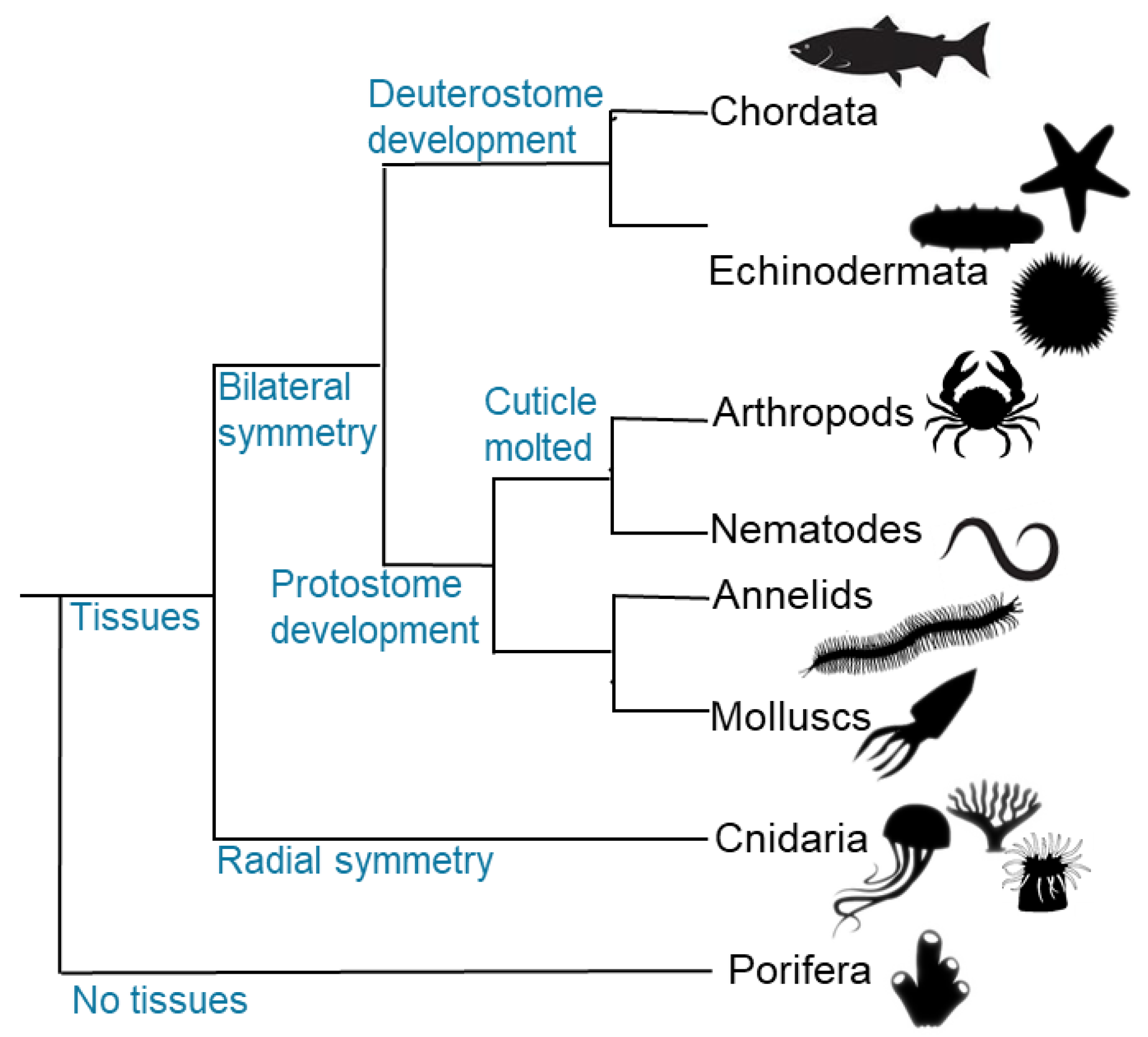
Figure 2.
Representative marine invertebrate animals (genus or species level) from the phylum studied. Porifera (A: Ircinia; B: Chondrosia reniformis). Cnidaria (C: jellyfish Rhizostoma pulmo; F: coral Sarcophyton). Mollusca: (D: squid Loligo; E: cuttlefish Sepia). Echinodermata: G: sea-cucumber Stichopus; H: starfish Asterias amurensis; I: sea-urchin Paracentrotus lividus. Images sourced from iNaturalist contributors under CC BY 4.0. Modifications include cropping and resizing. For license details, see https://creativecommons.org/licenses/by/4.0/.
Figure 2.
Representative marine invertebrate animals (genus or species level) from the phylum studied. Porifera (A: Ircinia; B: Chondrosia reniformis). Cnidaria (C: jellyfish Rhizostoma pulmo; F: coral Sarcophyton). Mollusca: (D: squid Loligo; E: cuttlefish Sepia). Echinodermata: G: sea-cucumber Stichopus; H: starfish Asterias amurensis; I: sea-urchin Paracentrotus lividus. Images sourced from iNaturalist contributors under CC BY 4.0. Modifications include cropping and resizing. For license details, see https://creativecommons.org/licenses/by/4.0/.
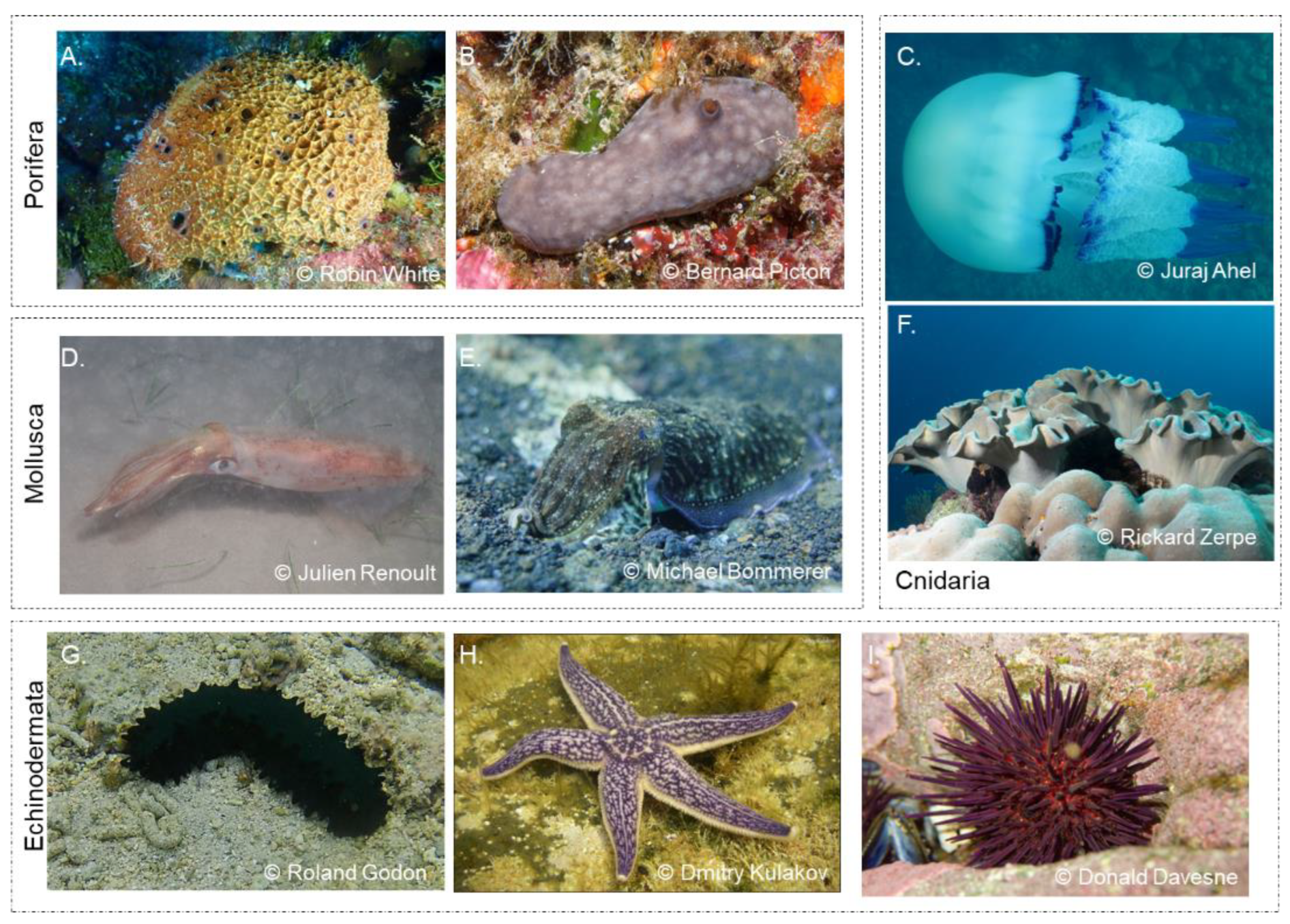
Figure 3.
Geographical distribution of scientific publications addressing collagens in marine invertebrates.
Figure 3.
Geographical distribution of scientific publications addressing collagens in marine invertebrates.
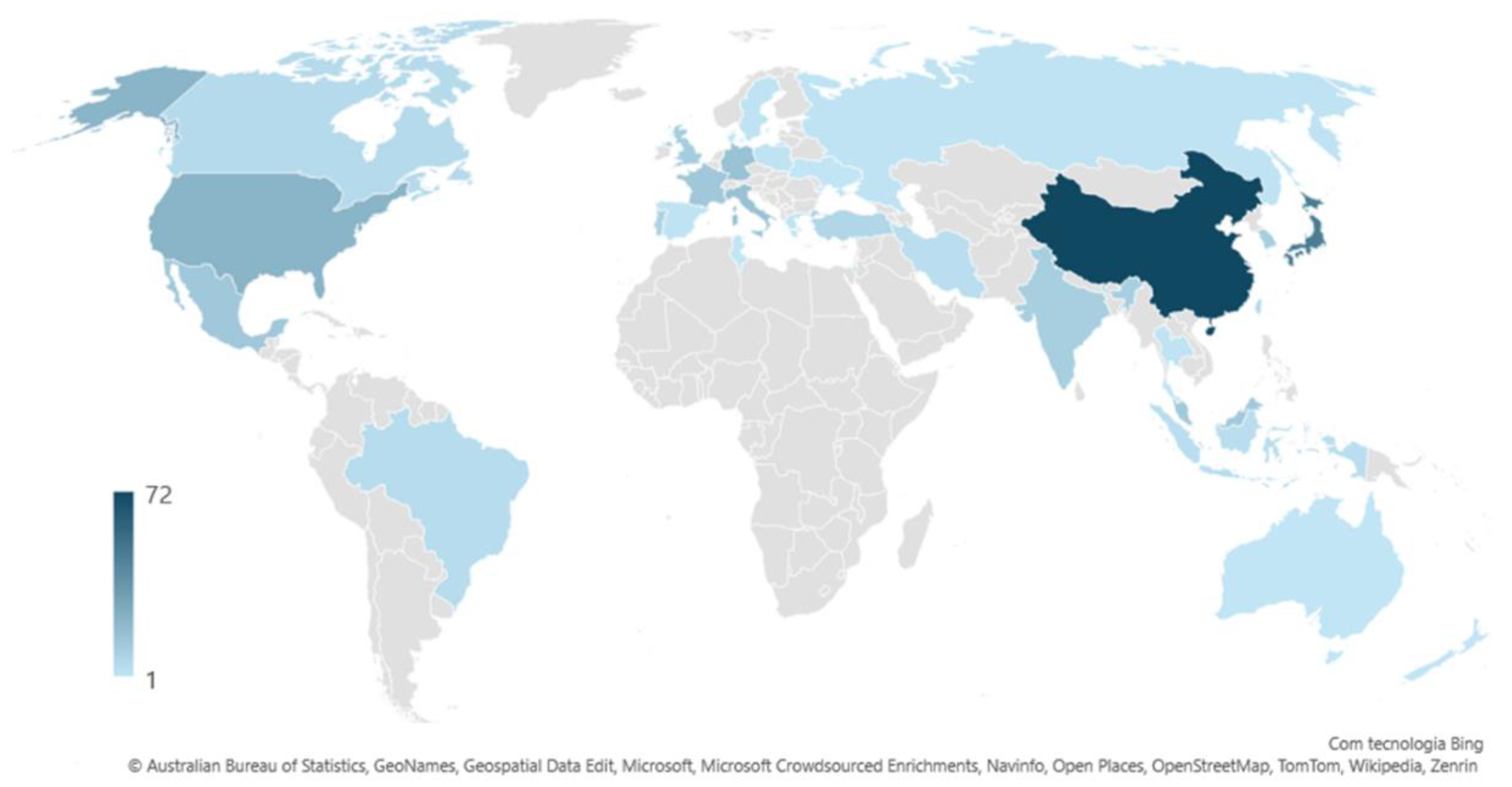
Figure 4.
Distribution of scientific publications by year and taxonomic group addressing collagens in marine invertebrates.
Figure 4.
Distribution of scientific publications by year and taxonomic group addressing collagens in marine invertebrates.
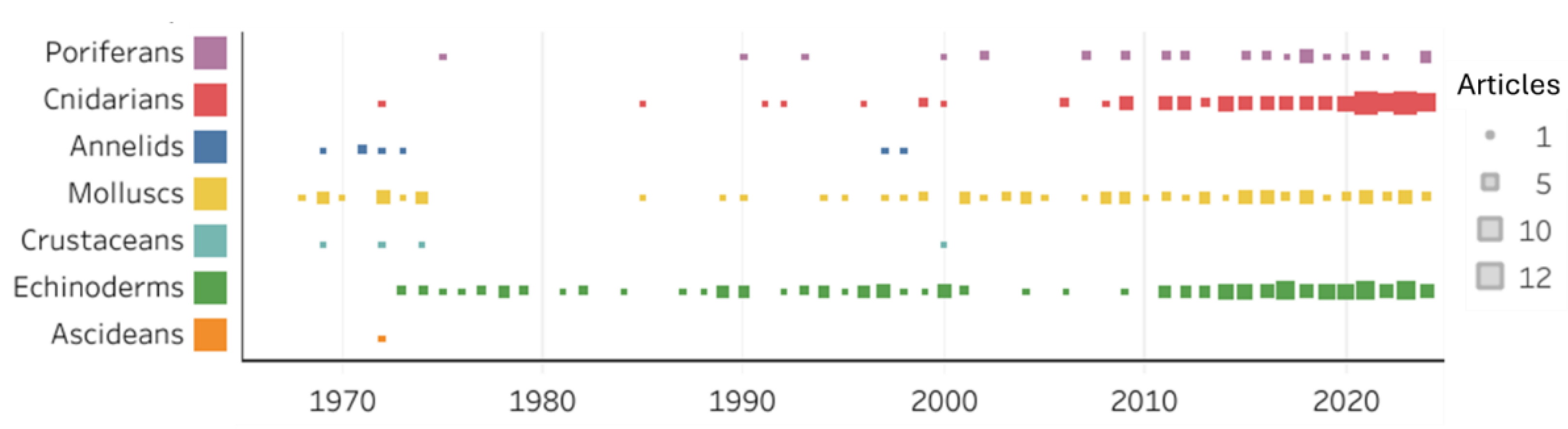
Figure 5.
Visualization of the relationships between different marine sources and keywords found in scientific publications addressing collagens from marine invertebrates.
Figure 5.
Visualization of the relationships between different marine sources and keywords found in scientific publications addressing collagens from marine invertebrates.
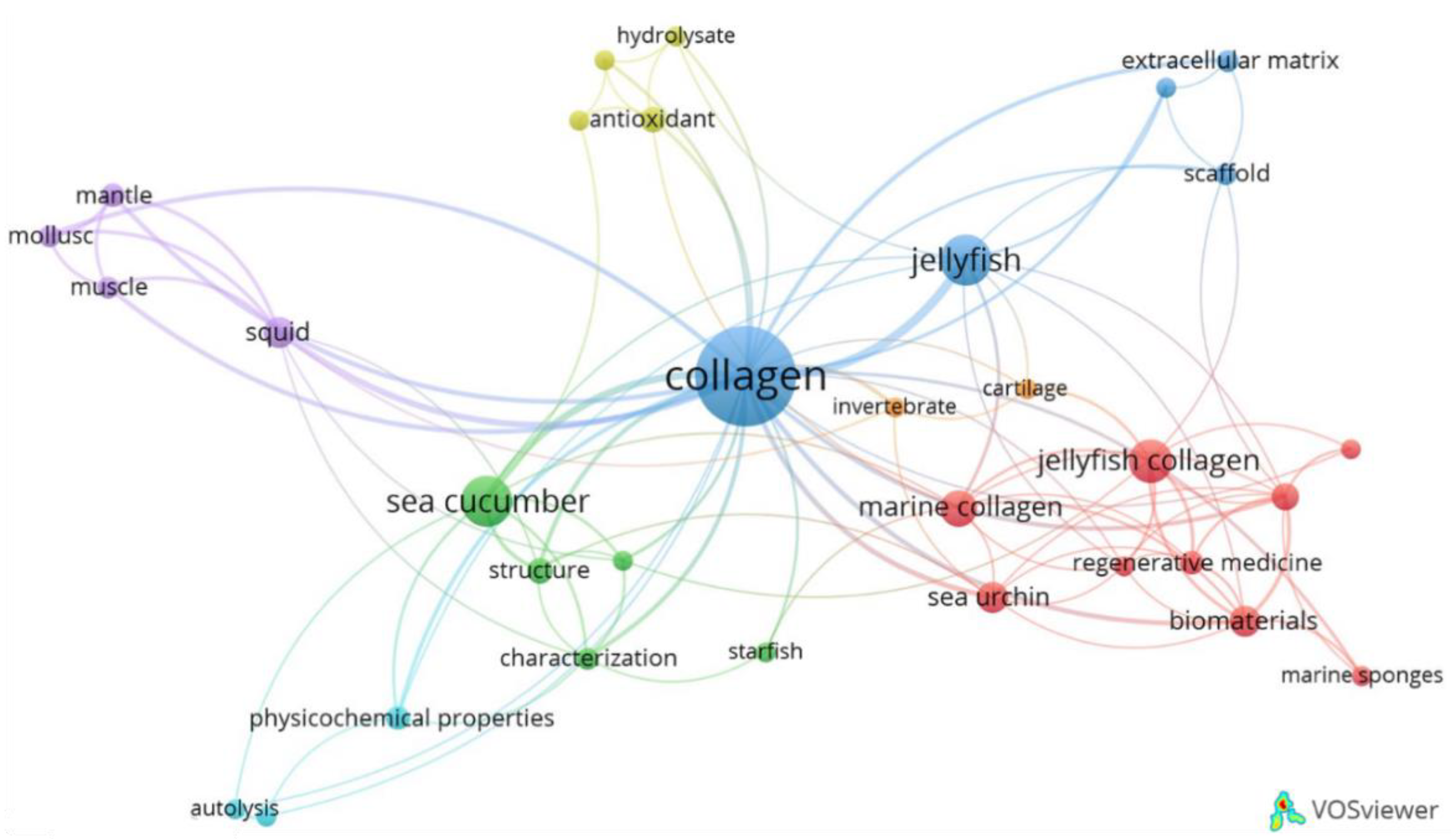
Figure 6.
Distribution of patent publications addressing collagens by jurisdiction and taxonomic group of marine invertebrates.
Figure 6.
Distribution of patent publications addressing collagens by jurisdiction and taxonomic group of marine invertebrates.
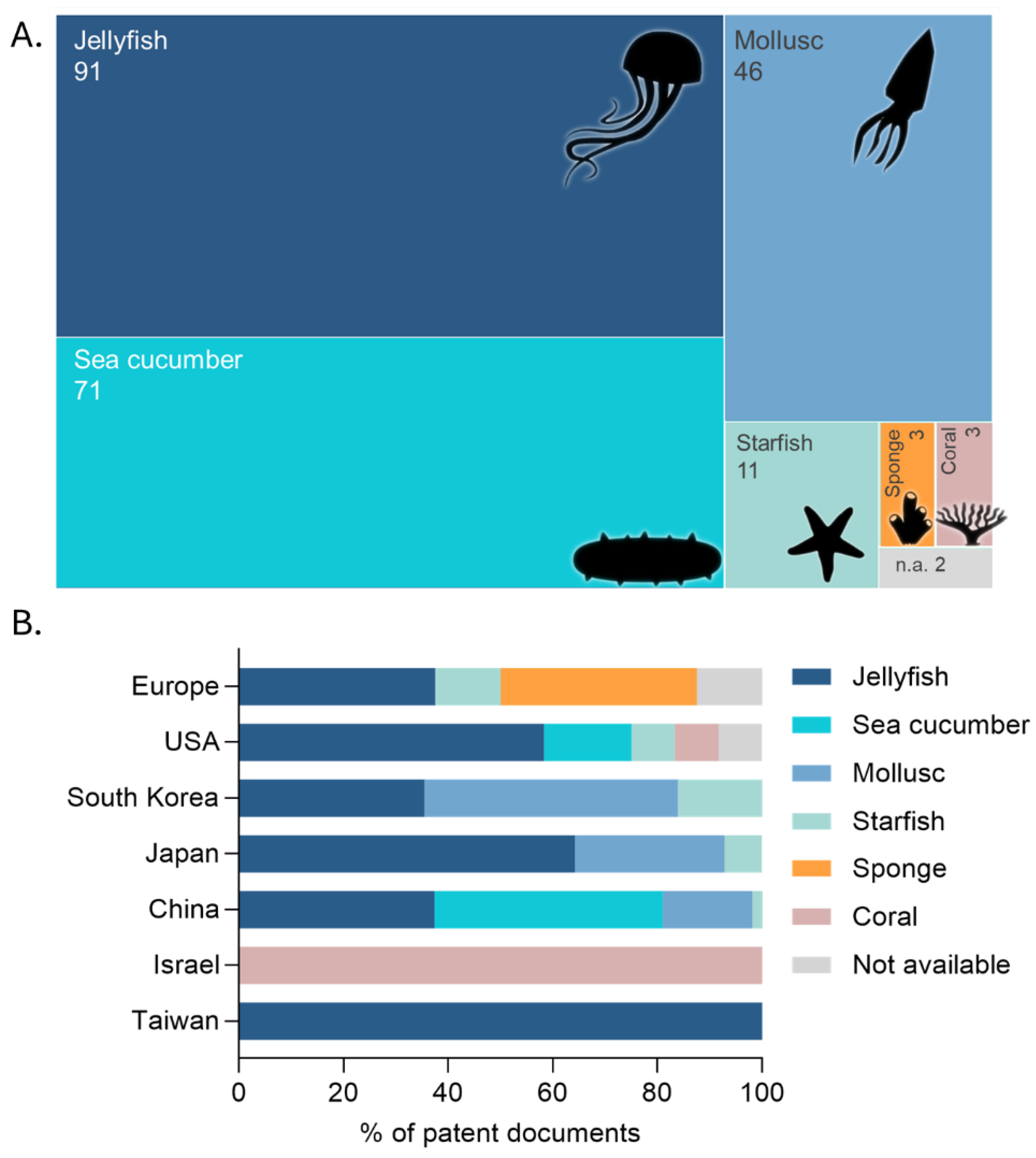
Figure 7.
Distribution of patent publications addressing the uses of collagens by technological areas.
Figure 7.
Distribution of patent publications addressing the uses of collagens by technological areas.
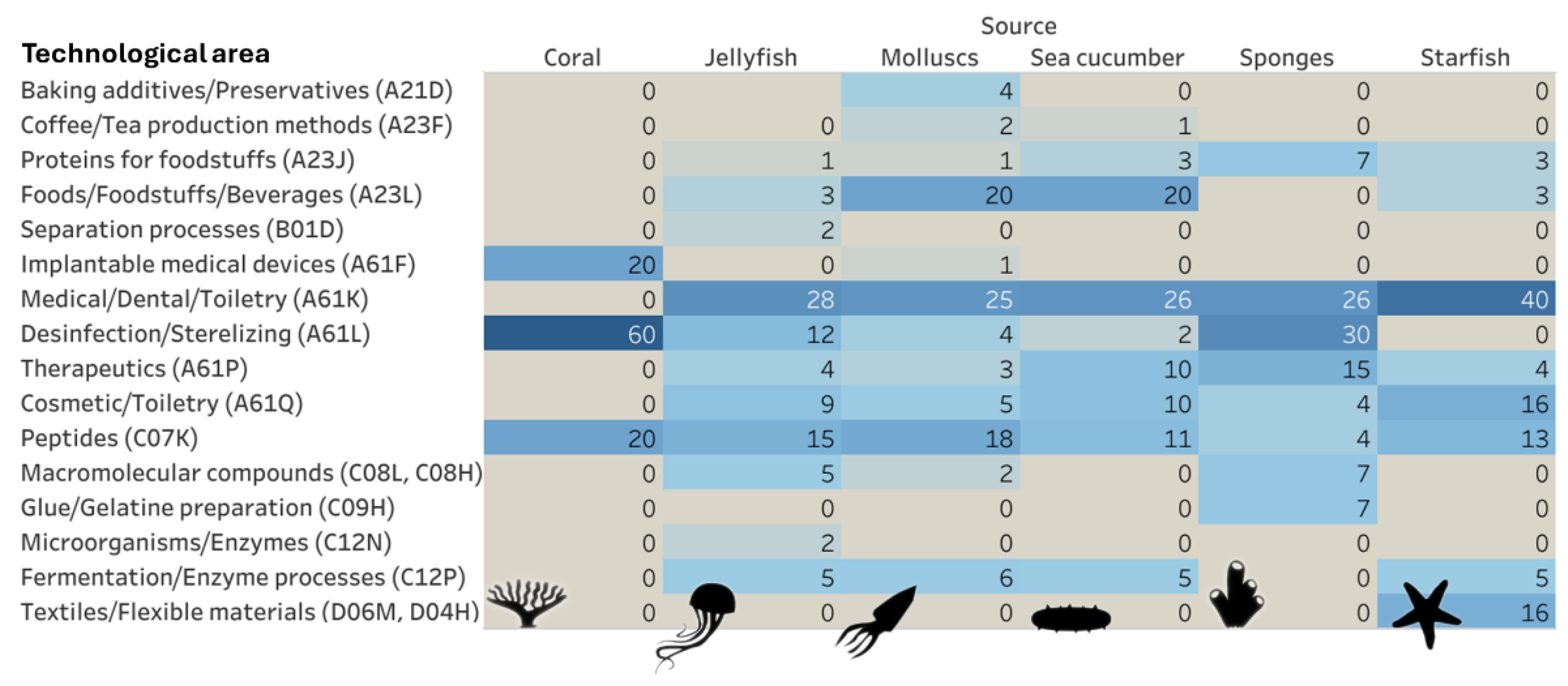
Figure 8.
A) Patents applicants by type of entity; B) Legal status of patents addressing collagens by taxonomic group of marine invertebrates (for simplification, please note that taxonomic groups are either phyla, in case of sponges and molluscs, or families within a phylum, in case of jellyfish, starfish and sea cucumbers).
Figure 8.
A) Patents applicants by type of entity; B) Legal status of patents addressing collagens by taxonomic group of marine invertebrates (for simplification, please note that taxonomic groups are either phyla, in case of sponges and molluscs, or families within a phylum, in case of jellyfish, starfish and sea cucumbers).
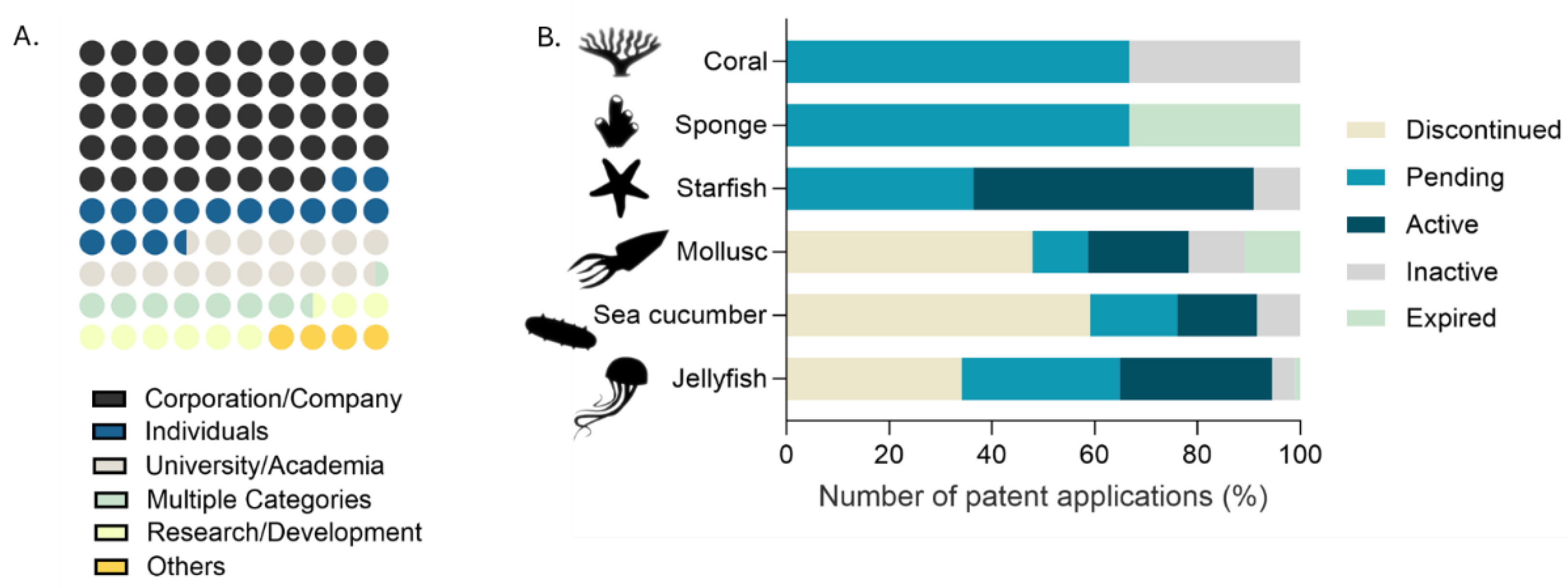
Figure 9.
Databases and sources used for the scientific literature review, patent analysis, and market analysis to assess the significance of collagens from marine invertebrates in research, innovation, and market applications.
Figure 9.
Databases and sources used for the scientific literature review, patent analysis, and market analysis to assess the significance of collagens from marine invertebrates in research, innovation, and market applications.
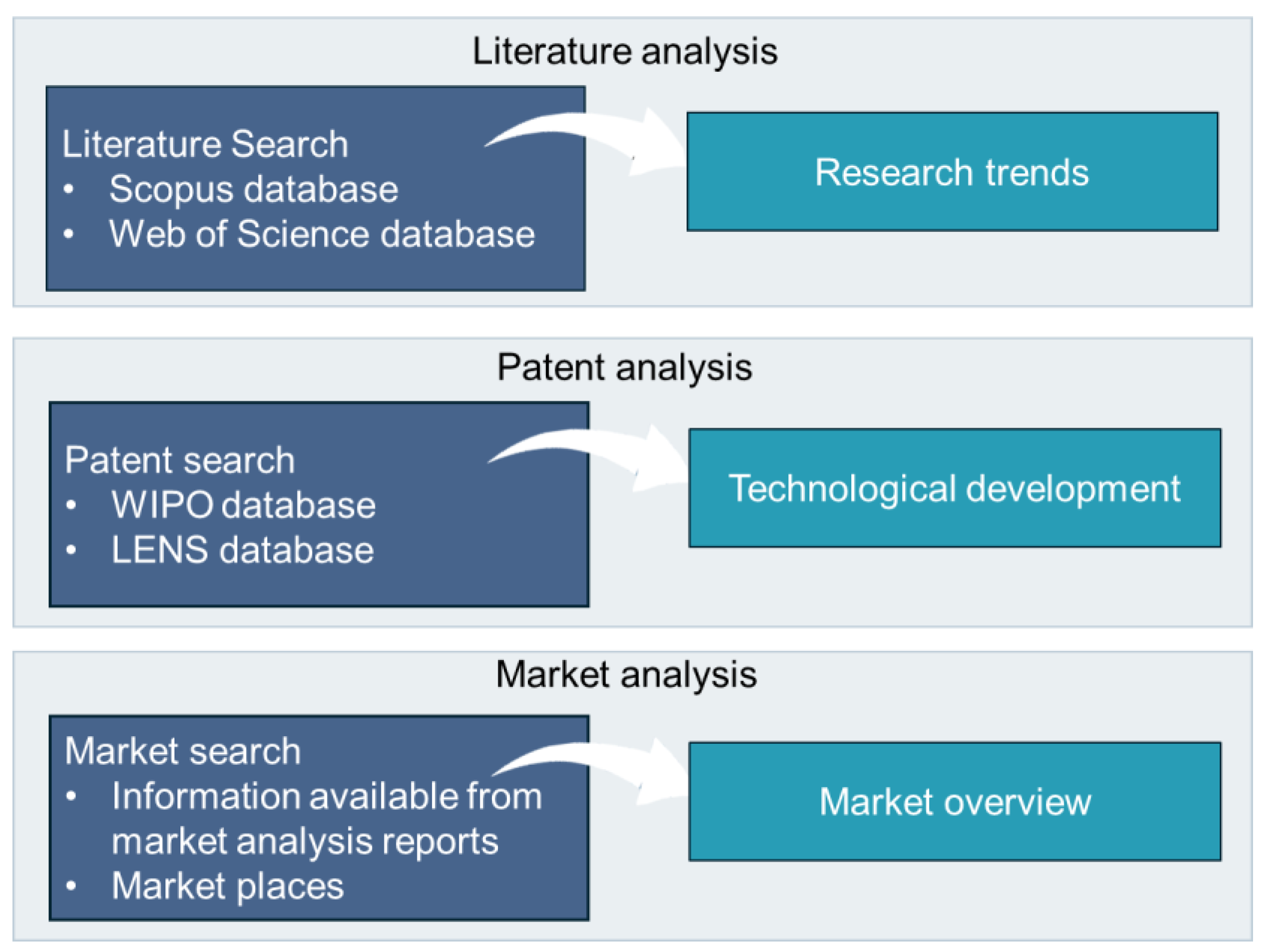

Table 1.
Ingredients or products found in companies or marketplaces (verified on 04/11/2024) which advertise the incorporation of collagens derived from marine invertebrates. Note: Several marine collagen products in the market do not discriminate their source of origin, with several of them being simply presented as ocean collagen or fish/marine-derived collagen.
Table 1.
Ingredients or products found in companies or marketplaces (verified on 04/11/2024) which advertise the incorporation of collagens derived from marine invertebrates. Note: Several marine collagen products in the market do not discriminate their source of origin, with several of them being simply presented as ocean collagen or fish/marine-derived collagen.
| Brand/Company and Source | Country | Ingredient/Product | Application | |
|---|---|---|---|---|
 |
Jellagen1: Jellyfish | United Kingdom | Power (in pre- clinical stage) | Wound care |
 |
KliniPharm2: sponge | Germany | Boswellia Spongi®-Kollagen-Lecithin Capsules | Nutraceutical |
 |
KliniPharm: sponge | Germany | Spongi Sunflower Collagen-Lecithin Capsules | Nutraceutical |
 |
KliniPharm: sponge | Germany | SpongiCol® Collagen-Lecithin Capsules | Nutraceutical |
 |
KliniPharm: sponge | Germany | SpongiCol Collagen-Lecithin Granulate | Nutraceutical |
 |
KliniPharm: sponge | Germany | SpongiCol ECO Collagen-Lecithin Capsules | Nutraceutical |
 |
Certified Nutraceuticals3: Jellyfish | USA | kollaJell Brain Health & Cognitive function | Nutraceutical |
 |
MitoLife4: Jellyfish | USA | Jellyfish Jolt (Wild-caught collagen) - capsules | Nutraceutical |
 |
Neogenesis Health5: Jellyfish | South Africa | INFINITY JellyFish Collagencapsules | Nutraceutical |
 |
Nova Sea Atlantic6: Sea cucumber | Canada | Nova Sea Atlantic® Sea Cucumber Capsules | Nutraceutical |
 |
KliniPharm: sponge | Germany | ELEANA MARINE collagen creme nourishing sponge extract | Cosmetic |
 |
KliniPharm: sponge | Germany | ELEANA MARINE collagen serum$reconstructing sponge extract | Cosmetic |
 |
KliniPharm: sponge | Germany | ELEANA MARINE collagen gel nourishing sponge extract | Cosmetic |
 |
Nano Recipe7: sponge | South Korea | Korean Marin Collagen Concentrate Serum | Cosmetic |
 |
Joli Visage8 | USA | Joli Collagen Spongilla Cream | Cosmetic |
 |
Coseed BioPharm9Jellyfish and starfish | South Korea | Jellyfish extract$Starfish collagen | Cosmetic |
 |
Bescher10: Sea cucumber | Australia | Sea cucumber collagen Anti-Ageing Cream | Cosmetic |
 |
Bescher: Sea cucumber | Australia | Sea Cucumber Collagen Blemish Defence Serum | Cosmetic |
 |
Bescher: Sea cucumber | Australia | Sea Cucumber Collagen Regeneration Serum | Cosmetic |
 |
Bescher: Sea cucumber | Australia | Sea Cucumber Collagen Glow Toner | Cosmetic |
 |
Bescher: Sea cucumber | Australia | Sea Cucumber Collagen Gel Cleanser | Cosmetic |
1 https://jellagen.co.uk/applications/, 2 https://klinipharmshop.com/, 3 https://www.certifiednutra.com/, 4 https://www.mitolife.co/, 5 https://www.neogenhealth.com/, 6 https://atlanticseacucumber.ca/, 7 https://nanorecipe.com/, 8 https://www.jolispa.com/, 9 http://coseed.softss.co.kr/eng/main.php, 10 https://www.bescher.com.au/.
Disclaimer/Publisher’s Note: The statements, opinions and data contained in all publications are solely those of the individual author(s) and contributor(s) and not of MDPI and/or the editor(s). MDPI and/or the editor(s) disclaim responsibility for any injury to people or property resulting from any ideas, methods, instructions or products referred to in the content. |
© 2024 by the authors. Licensee MDPI, Basel, Switzerland. This article is an open access article distributed under the terms and conditions of the Creative Commons Attribution (CC BY) license (http://creativecommons.org/licenses/by/4.0/).
Copyright: This open access article is published under a Creative Commons CC BY 4.0 license, which permit the free download, distribution, and reuse, provided that the author and preprint are cited in any reuse.


