Preprint
Article

This version is not peer-reviewed.

Mode Shape Projection for Damage Detection of Laminated Composite Plates

A peer-reviewed article of this preprint also exists.

Submitted:

05 December 2024

Posted:

06 December 2024

You are already at the latest version

Abstract

Currently, the wavelet technique has a weakness for detecting damage at the edge of two-dimensional signals. This weakness arises from the nature of the wavelet transform procedure, which shifts the signal by differencing the signal’s pair arrays in the neighborhood. This study introduces the mode shape projection method as an efficient technique for damage detection of two-dimensional signals in rectangular laminated composite plates to eliminate the weakness of damage detection by the wavelet method. In other words, this paper proposes creating two one-dimensional waves containing information about damages or faults in signals from vibration amplitude signals of composite plates to have an efficient damage detection method. Results show that the proposed method acts much better than wavelet transform and detects damages in numerical and experimental investigations with high performance for various damage scenarios.

Keywords: 
;  ;  ;  

1. Introduction

Damage detection of composite structures has been widely studied as one of the most critical activities in the field of structural health monitoring in recent decades [1,2,3]. One of the most commonly used damages detection techniques is the vibration-based damage detection technique since it is a global non-destructive test [4]. In vibration-based damage detection techniques, modal characteristics of the composite structures such as natural frequencies and mode shapes are acquired to use for localizing damages [5,6,7,8]. Among the vibration-based damage detection techniques, those use mode shapes are very popular due to their simplicity [9].
Wavelet transform-based damage detection techniques can use the mode shapes of the structures to detect damages [10]. Thus, they may be considered mode shape-based damage detection methods. Two types of wavelet transform can be used based on the dimension of structures’ signals. For structures such as cables, bars, and beam-like structures, signals have one dimension; thus, the one-dimensional wavelet transform is used for their damage detection [11]. Also, in terms of types of continuity or discontinuity of transform, wavelet transform can be divided into two main types: continuous wavelet transform and discrete wavelet transform. In [12], Katunin et al. used the modal rotation differences signal for damage detection of the beam structures. They used one-dimensional continuous wavelet analysis for damage detection. In [13], a quasi-Pearson correlation signal was suggested for damage detection in beam structures using wavelet transform. The wavelet transform used in this study was the one-dimensional discrete wavelet transform. Kumar et al. [14] used the one-dimensional continuous wavelet analysis for crack detection near the ends of the beams. The signal used in their study was one-dimensional. For damage detection of polymer composite beams, Janeliukstis et al. [15] investigated on spatial continuous wavelet transform.
For plate structures, the signal acquired is a two-dimensional signal, and thus, the two-dimensional wavelet transform is used for damage detection. Like one-dimensional wavelet transform, two-dimensional wavelet transform can be either continuous or discrete. Rucka et al. [16] used continuous wavelet transform for damage detection of steel plates. Damage detection of a rectangular plate by a spatial wavelet-based approach was studied by Chang et al. [17]. The two-dimensional wavelet transform is powerful, at the same time, a simple method for damage detection of plate structures; however, it has several weaknesses. One of the most critical weaknesses is the dependency on the accuracy of wavelet transform to select the wavelet function and its vanishing moment. Ashory et al. [18] investigated damage detection in laminated composite plates using an optimal wavelet selection criterion. Zhou et al. [19] studied damage detection of composite plates with cutout based on continuous wavelet transform. In [20], the abilities of the two-dimensional discrete wavelet transform and artificial neural network were combined for damage detection of laminated composite plate structures. The optimal wavelet function was selected based on trial and error efforts. Saadatmorad et al. [21] used the convolutional neural network (CNN) to select the best wavelet function to detect damages in rectangular laminated composite plates. Rucka et al. [22] presented a Neuro-wavelet damage detection technique for plate structures. The selection of the wavelet family function was based on trial-and-error simulations.
Another weakness of the two-dimensional wavelet transform for damage detection in plate structure is that for low-level damages, several locations may be detected for single damage. The results of wavelet transform in low-level damage may contain noises. In order to eliminate all the weaknesses mentioned above, this paper proposes a novel method for damage detection of plate structure by focusing on the laminated composite plates. A comparative study is presented to prove the advantages of the proposed method over wavelet transform. Also, in addition to numerical investigations, experimental investigations are conducted on a damaged glass-epoxy laminated composite plate to evaluate the efficiency of the proposed method for real damage detection scenarios. Section 2 presented the mathematical formulation of the wavelet transform. In section 3, the proposed mode shape projection method is presented. Section 4 deals with the numerical and experimental results in different damage scenarios. Finally, section 5 concludes the paper.

2. Wavelet Transform

The one-dimensional continuous wavelet transform (1D-CWT) transforms a one-dimensional signal f ( x ) as follows [23]:
W p , q = 1 q + f ( x ) ψ x p q d x
where x is the spatial variable of the original signal f ( x ) , p is called the shifting parameter and s is the scaling parameter. Also, Also, the wavelet coefficients resulting from one-dimensional continuous wavelet transform are presented as C p , q , a function of shifting and scaling parameters. In (1), ψ x is named the mother wavelet function or simply wavelet function and defined as follows [24]:
ψ x p , s = 1 q ψ x p q
According the following relation, the property of the zero value of the average of wavelet functions is one of the essential properties of wavelet functions:
+ ψ x d x = 0
Also, a wavelet is acceptable if the following condition is satisfied:
0 + ψ ^ ω 2 ω d ω <
Where ψ ^ ω is the Fourier transform of the function ψ z x .
Also, a wavelet function has n vanishing moments if the following condition is satisfied [25]:
+ z k ψ x d x = 0 ,       k = 0 ,   1 ,   2 ,   ,   n 1
One-dimensional continuous wavelet transform is a helpful damage detection technique; however, in many cases, there is no need to apply high and continuous scales to identify detection. Thus, the one-dimensional discrete wavelet transform can be formulated by defining discrete scales. For this purpose, changing the variable p = 2 j k and q = 2 j is applied to equation (1) so that the discretized wavelet function is obtained according to the following equation:
ψ j , k = + 2 j 2 ψ x 2 j k 2 j d x = + 2 j 2 ψ 2 j x k d x
One-dimensional discrete wavelet transform (1D-DWT) in the real space x for the signal f x is applied as follows:
c D j , k = + f x 2 j 2 ψ j , k x 2 j k 2 j d x = + f x 2 j 2 ψ j , k 2 j x k d x
c A j , k = + f x 2 j 2 ϕ j , k x 2 j k 2 j d x = + f x 2 j 2 ϕ j , k 2 j x k d x
where c D j , k is the detail wavelet coefficient in the data sample with scale j and shift k , also, c A j , k is the approximate wavelet coefficient in the data sample with scale j and shift k .
From another point of view, 1D-DWT decomposes arbitrary one-dimensional signal f ( x ) as follows:
f x = A j x + j < J D j ( x )
where A j represents the approximation signal at level j , and و D j represents the detail signals at level j. Approximation signals at level j are defined as follows [26]:
A j ( x ) = k =   + c A j , k ϕ j , k ( x )
where ϕ j , k ( x ) are the scaling functions at level j and ϕ j , k x = 2 j 2 ϕ ( 2 j x k ) and has the property + ϕ 0,0 x = 1 . Also, ϕ 0,0 x = 0 is also called the scaling function or father wavelet function.
Also, detail signals at level j are defined as follows:
D j x = k ϵ Z c D j , k ψ j , k ( x )
where c D j , k are the detail wavelet coefficients at level j , and ψ j , k ( x ) is called wavelet function or mother wavelet function. j is the level or scale, and k is the shifting parameter. Z is an integer. It should be noted that A j , which includes the scaling function ϕ j , k x , acts as a low-pass filter, and D j , which includes the wavelet function ψ j , k ( x ) , acts as a high-pass filter works, and in wavelet-based damage identification, usually high transient and local frequencies are identified by using a low-pass filter.
One of the most essential and effective parameters for identifying singularities or local jumps in signals is vanishing moments. When a wavelet has n number of vanishing moments, the following relation is satisfied:
+ x i ψ x d x = 0   ,     i = 1,2 ,   ,   n 1
The mentioned above wavelet transform, described from equations (6) to (12), is the one-dimensional discrete wavelet transform. It can identify very small discontinuities and sudden singularities in one-dimensional signals.
Expand equations (6) to (12) can be expanded for a specific two-dimensional signal f x , y because two-dimensional wavelets can be expressed as tensor product of two one-dimensional wavelets, as follows:
ϕ x , y = ϕ x ϕ y
ψ H x , y = ψ x   ϕ y
ψ V x , y = ϕ y ψ x
ψ D x , y = ψ x   ψ y
where ϕ x , y is a two-dimensional scaling function and ψ H x , y , ψ V x , y , ψ D x , y are horizontal and vertical two-dimensional wavelet functions, respectively, And they are diagonal. Therefore, the two-dimensional signal f ( x , y ) is divided into four images as an image. These four images are respectively W ϕ as approximate image, W ψ H as horizontal detail image, W ψ V as vertical detail image, and W ψ D as diagonal detail image.
By discretizing the wavelet functions and the scaling function, one can write:
ϕ j , m , n x , y = 2 j 2 ϕ ( 2 j x m ,   2 j y n )
ψ H j , m , n x , y = 2 j 2 ψ H ( 2 j x m ,   2 j y n )
ψ V j , m , n x , y = 2 j 2 ψ V ( 2 j x m ,   2 j y n )
ψ D j , m , n x , y = 2 j 2 ψ D ( 2 j x m ,   2 j y n )
Therefore, the discrete wavelet transform of the function f(x,y) with M×N dimensions is expressed as follows:
A ϕ j , m , n x , y = 1 M N x = 0 M 1 y = 0 N 1 f ( x , y ) ϕ j , m , n x , y
D H j , m , n x , y = 1 M N x = 0 M 1 y = 0 N 1 f ( x , y ) ψ H j , m , n x , y
D V j , m , n x , y = 1 M N x = 0 M 1 y = 0 N 1 f ( x , y ) ψ V j , m , n x , y
D D j , m , n x , y = 1 M N x = 0 M 1 y = 0 N 1 f ( x , y ) ψ D j , m , n x , y
Thus
A ϕ j , m , n x , y = 1 M N x = 0 M 1 y = 0 N 1 f ( x , y ) 2 j 2 ϕ ( 2 j x m ,   2 j y n )
D H j , m , n x , y = 1 M N x = 0 M 1 y = 0 N 1 f ( x , y ) 2 j 2 ψ ( 2 j x m ,   2 j y n )
D V j , m , n x , y = 1 M N x = 0 M 1 y = 0 N 1 f ( x , y ) 2 j 2 ψ ( 2 j x m ,   2 j y n )
D D j , m , n x , y = 1 M N x = 0 M 1 y = 0 N 1 f ( x , y ) 2 j 2 ψ ( 2 j x m ,   2 j y n )
Having A ϕ j 0 , m , n x , y , D H j , m , n x , y , D V j , m , n x , y and D D j , m , n x , y which are respectively approximation functions, horizontal details, vertical details and diagonal details of the two-dimensional discrete wavelet transform, one can write:
f x , y = 1 M N m n A ϕ j , m , n x , y ϕ j , m , n x , y + 1 M N i = H , V , D j = 1 m n D i j , m , n x , y ψ i j , m , n x , y
Research manuscripts reporting large datasets that are deposited in a publicly available database should specify where the data have been deposited and provide the relevant accession numbers. If the accession numbers have not yet been obtained at the time of submission, please state that they will be provided during review. They must be provided prior to publication.
Interventionary studies involving animals or humans, and other studies that require ethical approval, must list the authority that provided approval and the corresponding ethical approval code.

3. Mode Shape Projection Method

In this paper, a novel mode shape projection method is introduced to detect discontinuity in two-dimensional signals (i.e., images). The main idea of this method is to convert a two-dimensional signal f ( x , y ) containing discontinuity into two one-dimensional signals, f ( x ) and f ( y ) , which are contained the discontinuity. The discontinuous functions f x and f y are waves created by differentiating the signal f ( x , y ) in directions of x and y , respectively. This method provides a tremendous advantage for discontinuity detection of two-dimensional signals compared with the other local signal processing methods such as the wavelet method. The final results of discontinuity detection based on wavelet for two-dimensional signals containing discontinuity at edges are very difficult to detect and usually fail to detect them. In addition, there are noises at the edges of a two-dimensional signal processed by wavelet transform in many applications. The mode shape projection method fixes this problem and ensures an efficient and reliable discontinuity detection result. Consider the two-dimensional digital signal f ( x , y ) containing one discontinuity (Figure 1).
Assume the size of this signal is 3 × 3 , as follow:
f 3 × 3 = f 1   1 f 1   2 f 1   3 f 2   1 f 2   2 f 2   3 f 3   1 f 3   2 f 3   3
For obtaining the one-dimensional wave along x (i.e., f 1 × 3 ) the following operation is performed:
f 2 × 3 = [ f 2   1 f 1   1 f 2   2 f 1   2 f 2   3 f 1   3 f 3   1 f 2   1 f 3   2 f 2   2 f 3   3 f 2   3 ]
f 1 × 3 = [ f 3   1 f 2   1 ( f 2   1 f 1   1 ) f 3   2 f 2   2 f 2   2 f 1   2 f 3   3 f 2   3 ( f 2   3 f 1   3 ) ]
For obtaining the one-dimensional wave along y (i.e., f 3 × 1 ) the following operation is performed:
f 3 × 2 = [ f 1   2 f 1   1 f 1   3 f 1   2 f 2   2 f 2   1 f 2   3 f 2   2 f 3   2 f 3   1 f 3   3 f 3   2 ]
and:
f 3 × 1 = [ f 1   3 f 1   2 f 1   2 f 1   1 f 2   3 f 2   2 ( f 2   2 f 2   1 ) f 3   3 f 3   2 ( f 3   2 f 3   1 ) ] T
This mathematical operation can be expanded for the signal f m × n to have:
f m × n = f 1   1 f 1   2 f 1   3 f 2   1 f 2   2 f 2   3 f 3   1 f 3   2 f 3   3 f 1 n 2 f 1 n 1 f 1 n f 2 n 2 f 2 n 1 f 2 n f 3 n 2 f 3 n 1 f 3 n f m 2   1 f m 2   2 f m 2   3 f m 1   1 f m 1   2 f m 1   3 f m 1 f m 2 f m 3 f m 2 n 2 f m 2 n 1 f m 2 n f m 1 n 2 f m 1 n 1 f m 1 n f m n 2 f m n 1 f m n
f 1 × n = f m 1 f m 1   1 f m 1   1 f m 2   1 f 3   1 f 2   1 f 2   1 f 1   1 f m n f m 1 n f m 1 n f m 2 n ( f 3 n f 2 n ) ( f 2 n f 1 n )
f m × 1 = [ f 1 n f 1 n 1 f 1 n 1 f 1 n 2 f 1   3 f 1   2 ( f 1   2 f 1   1 ) f m n f m n 1 f m n 1 f m n 2 f m 3 f m 2 ( f m 2 f m 1 ) ] T
This paper suggests that when the signal f m × n contains a sudden jump at a data point, it will be detected waves in f 1 × n and f m × 1 . This is proved in the result section numerically and experimentally.

4. Results

4.1. Numerical Results

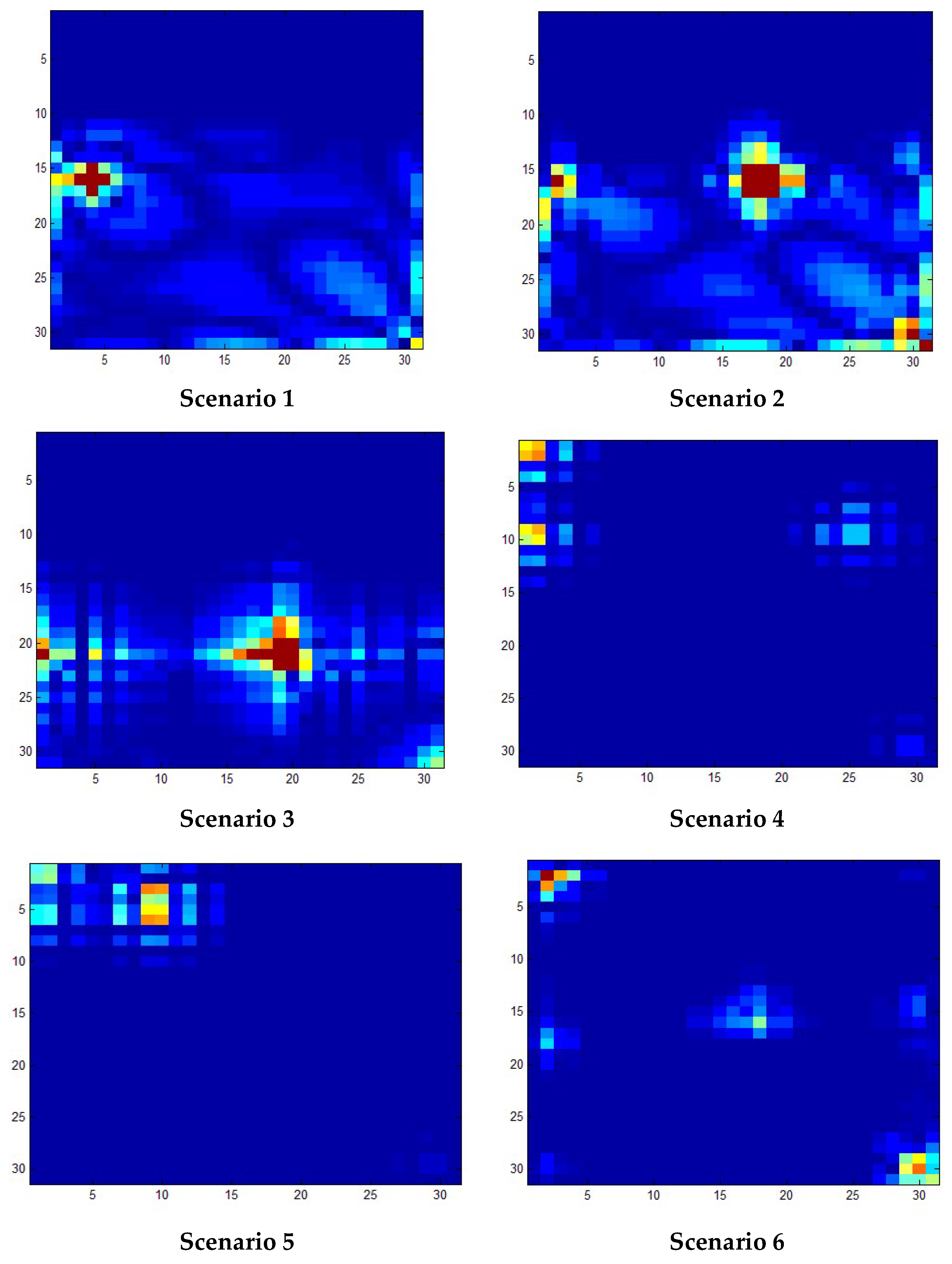
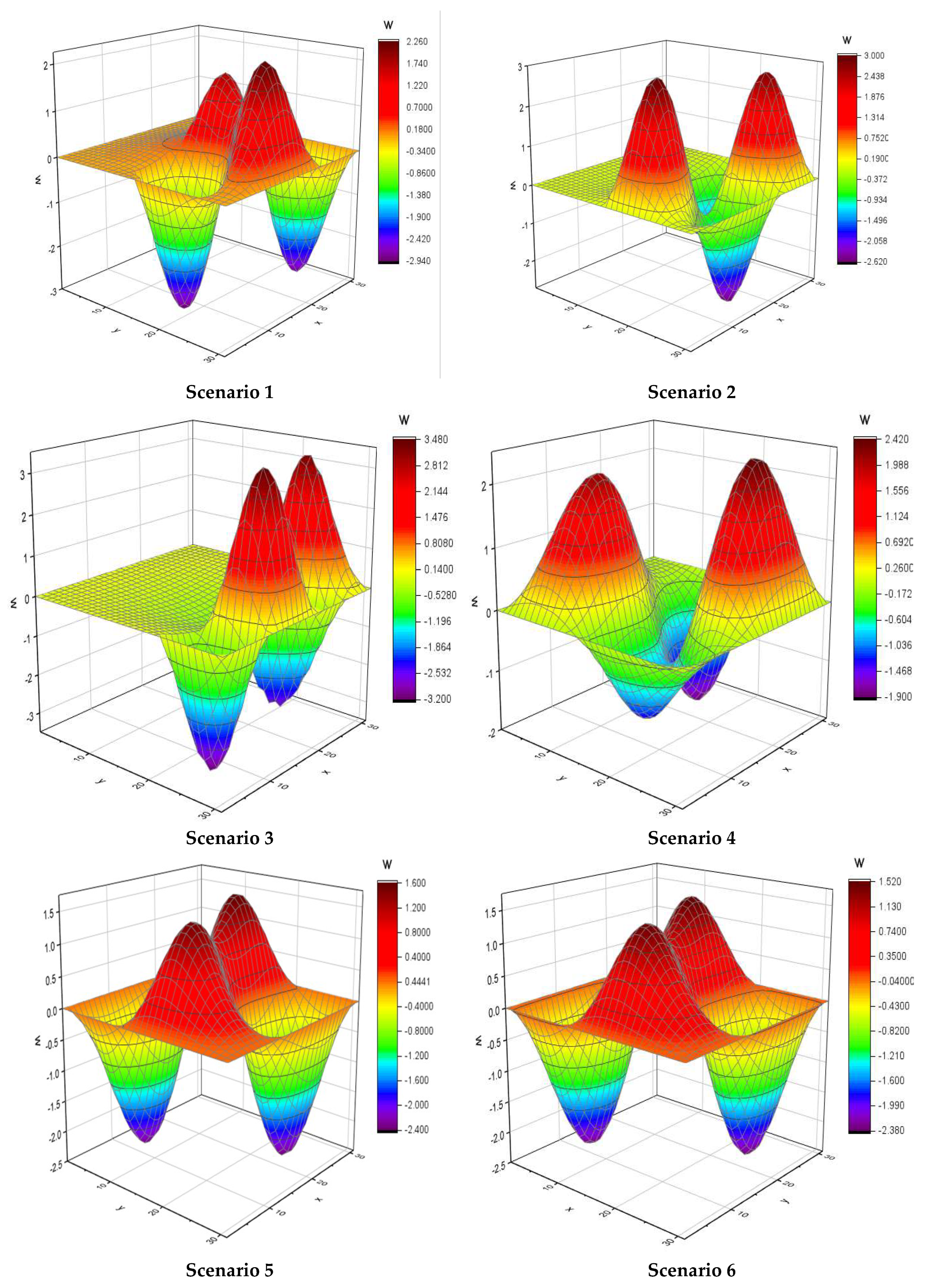
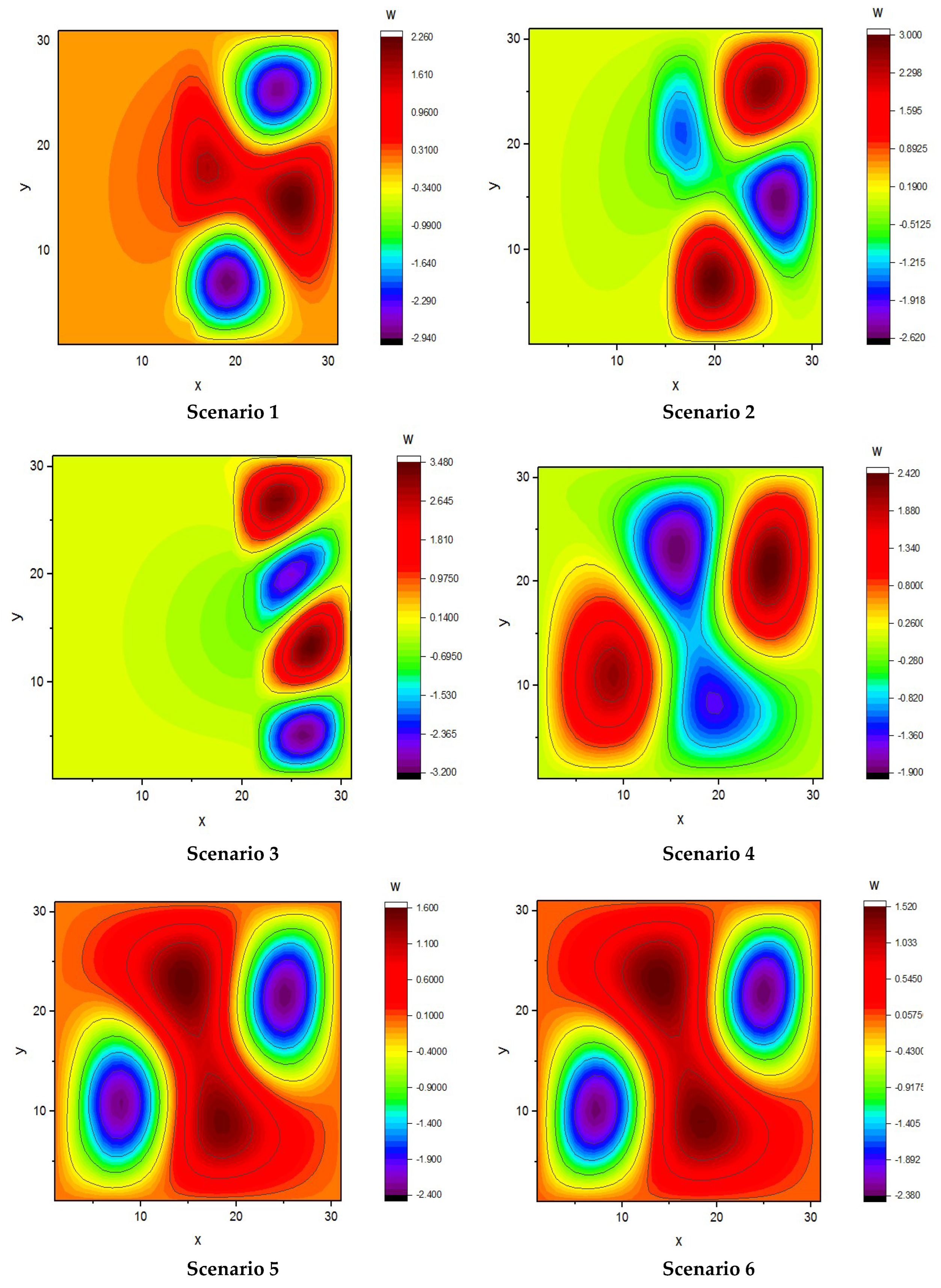
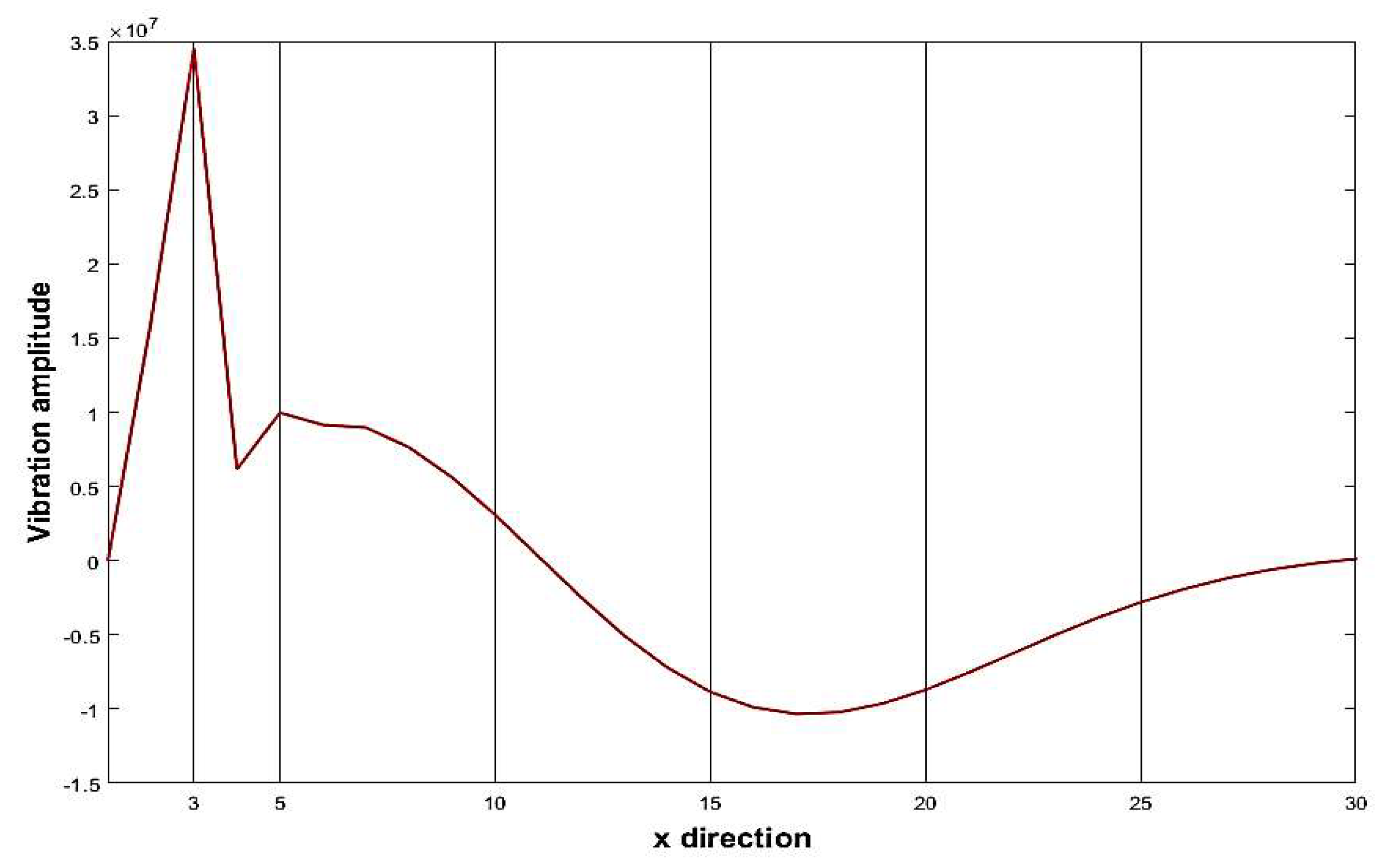
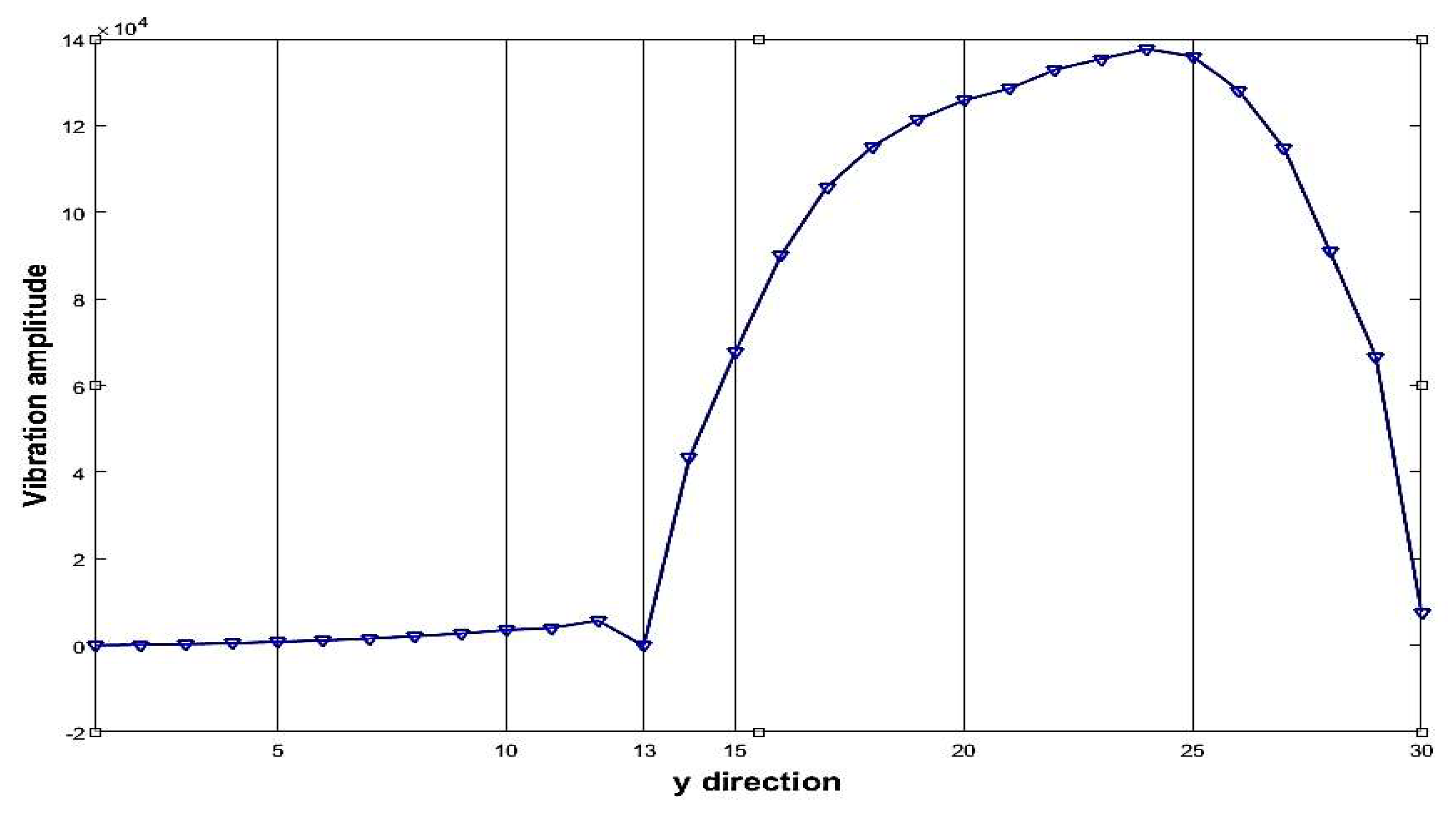
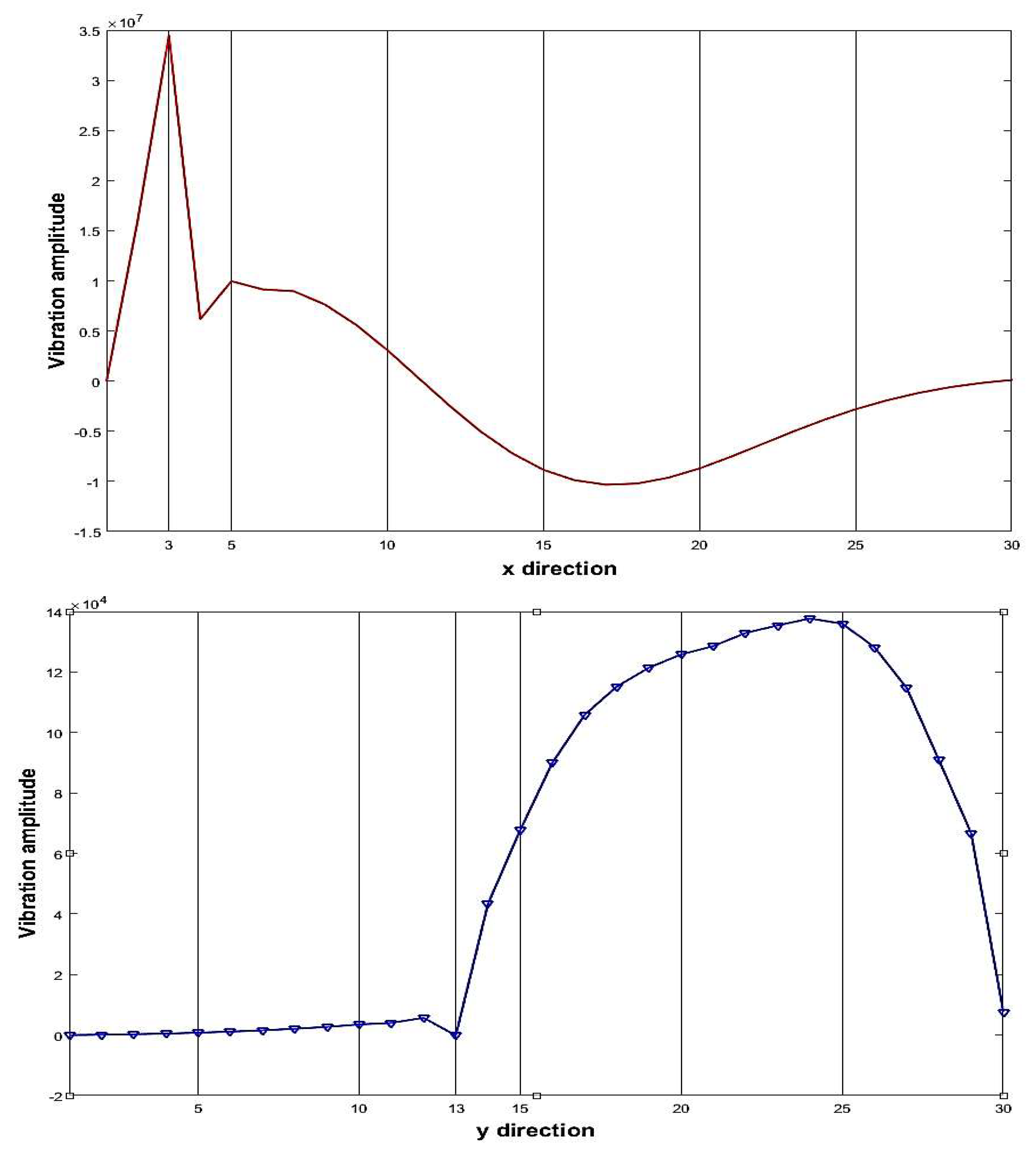
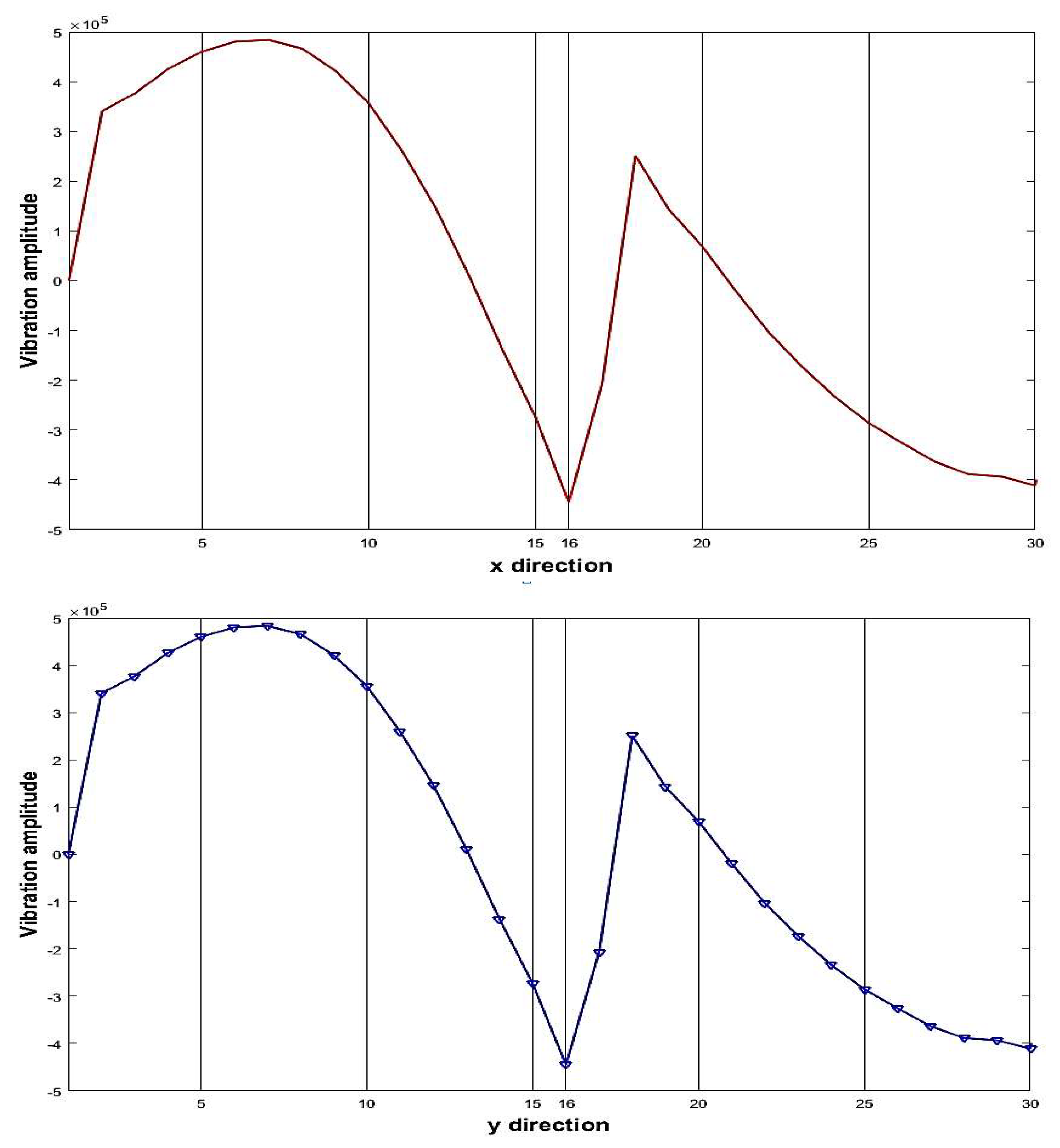
In this section, the proposed mode shape projection method is evaluated for a numerical digital signal obtained for the finite element modeling of a vibrating rectangular laminated composite palate with the general properties of the rectangular laminated composite plate listed in Table 1. According to Table 2, finite element modeling is performed for six different damage scenarios that create six different sudden jumps in the obtained signals. Table 3 shows results from two-dimensional wavelet transform for the six considered damage scenarios. These values are obtained from the diagonal detail signal shown in Figure 2. As seen in Table 3 and Figure 2, the wavelet transform detects the location of damage or a sudden jump in signals obtained from six different scenarios (Figure 3 and Figure 4) with noises. Therefore, the proposed mode shape projection method is used to fix this problem and detect the exact location of damages or sudden jumps in these signals.
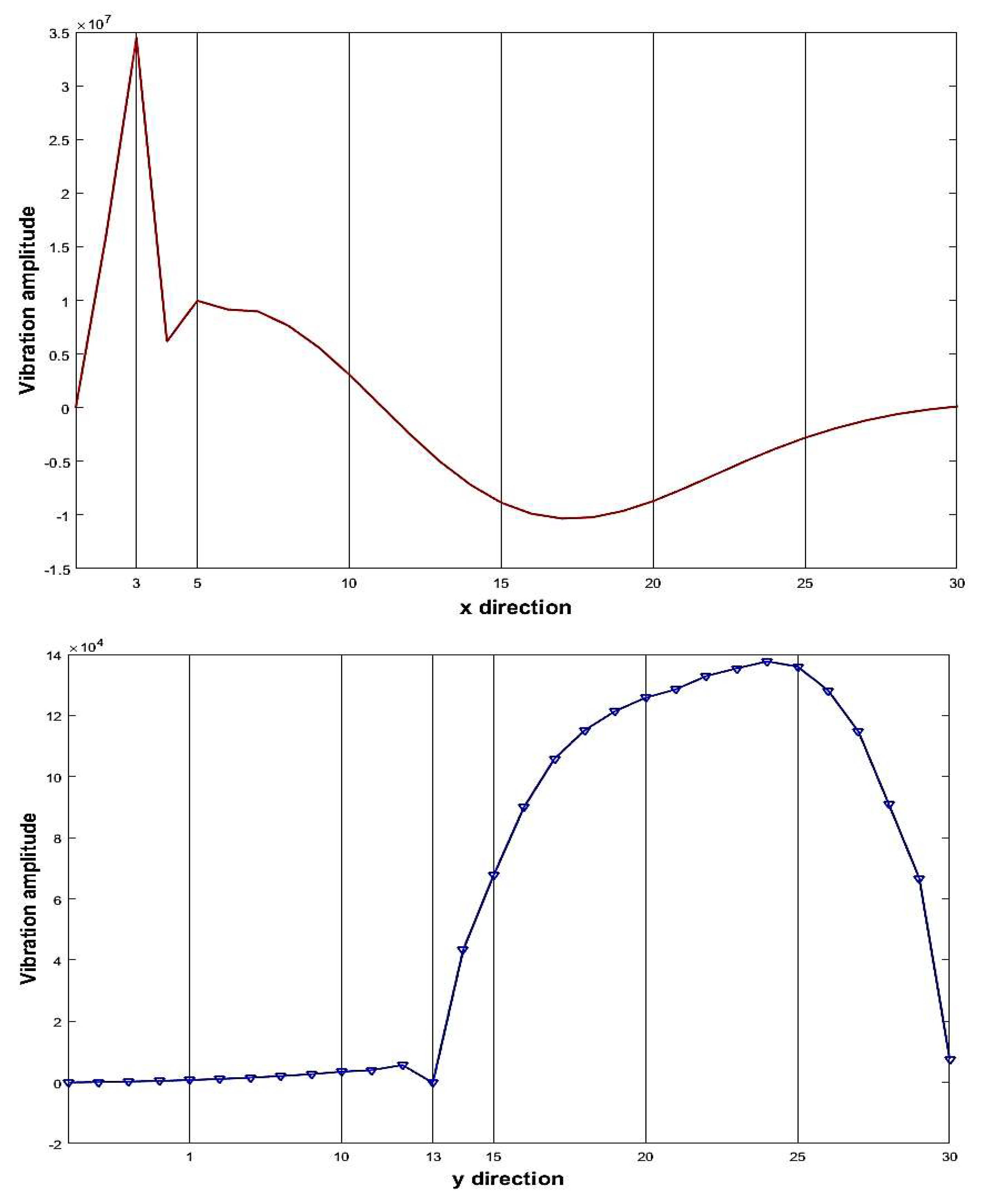
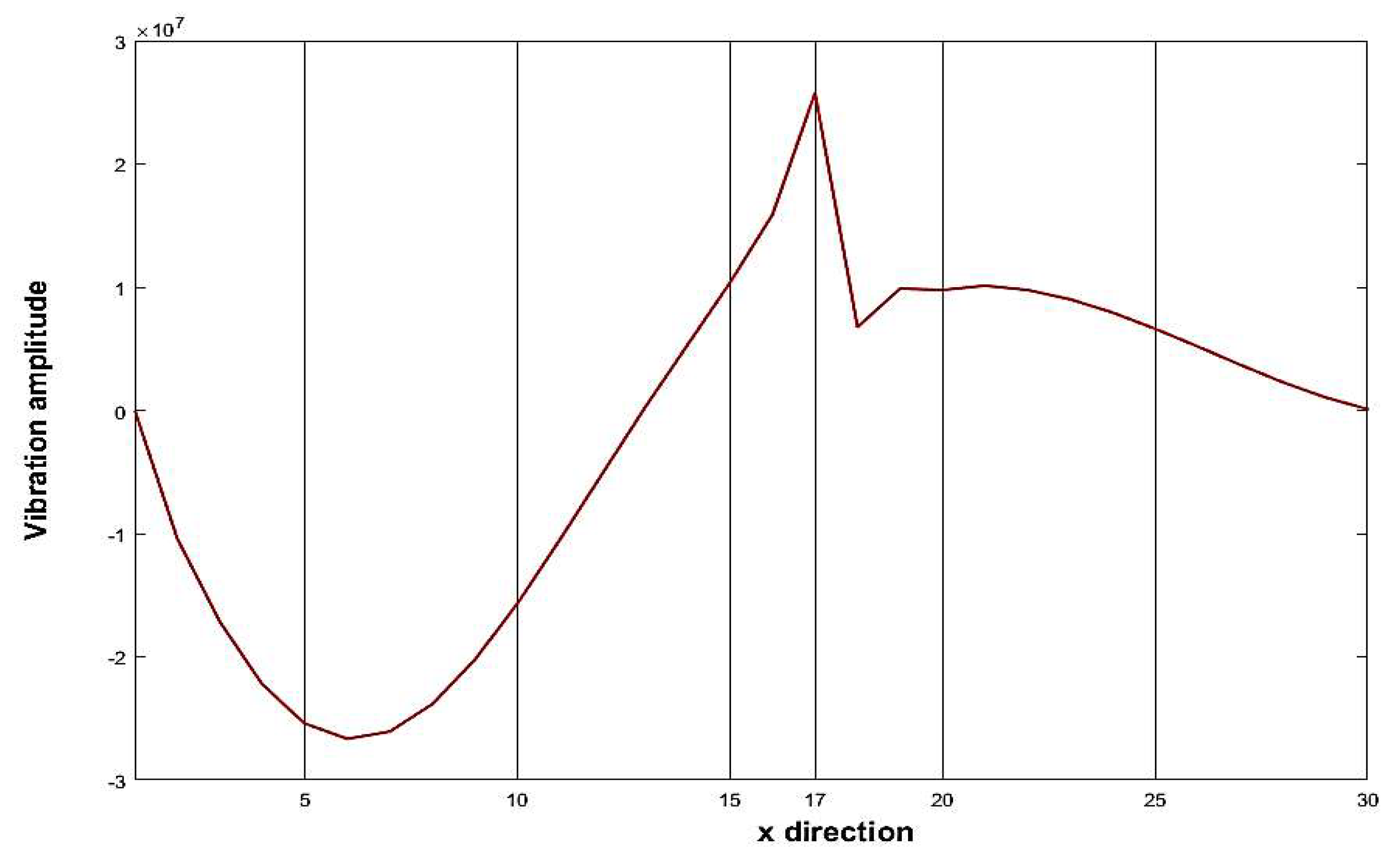
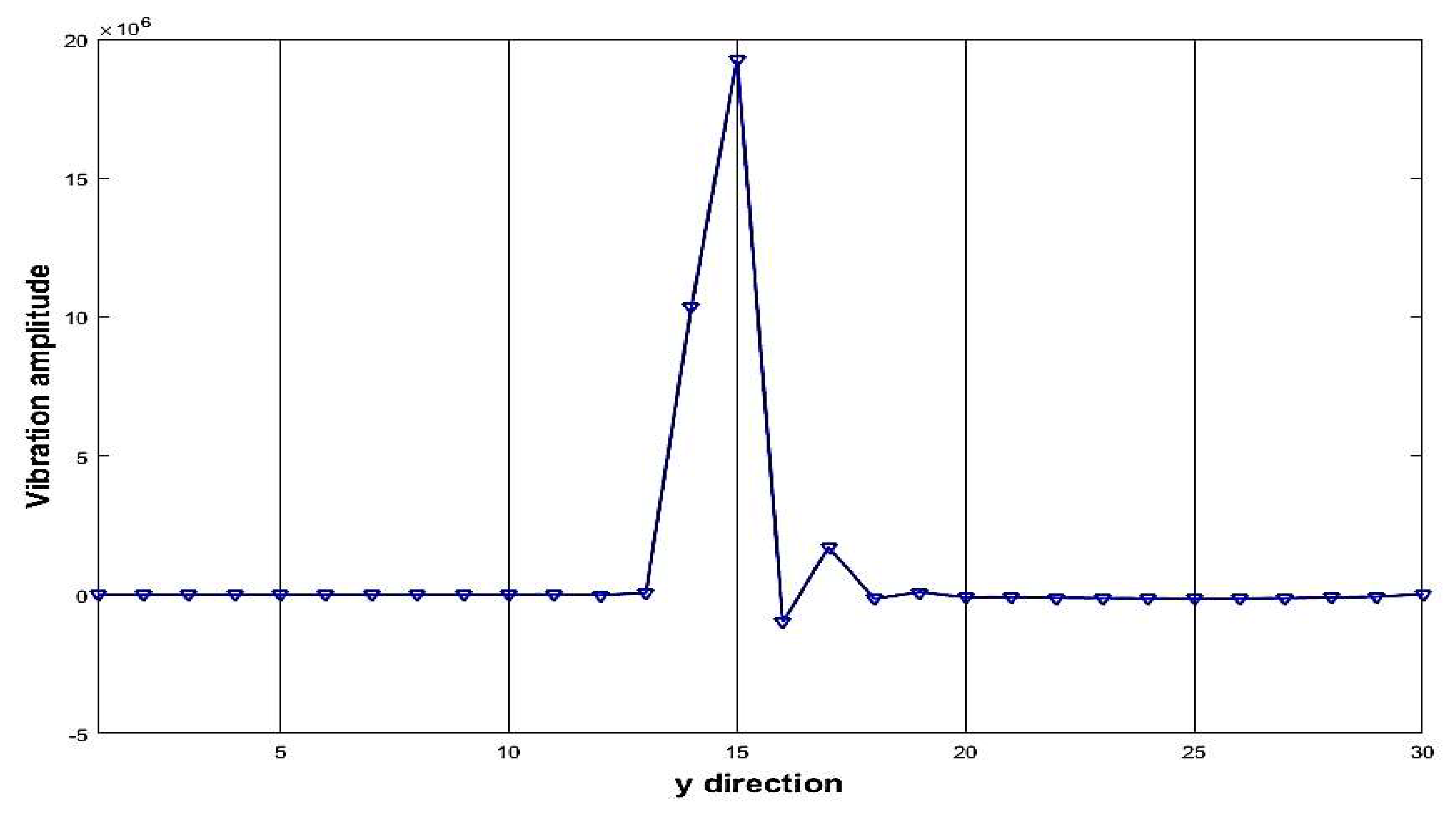
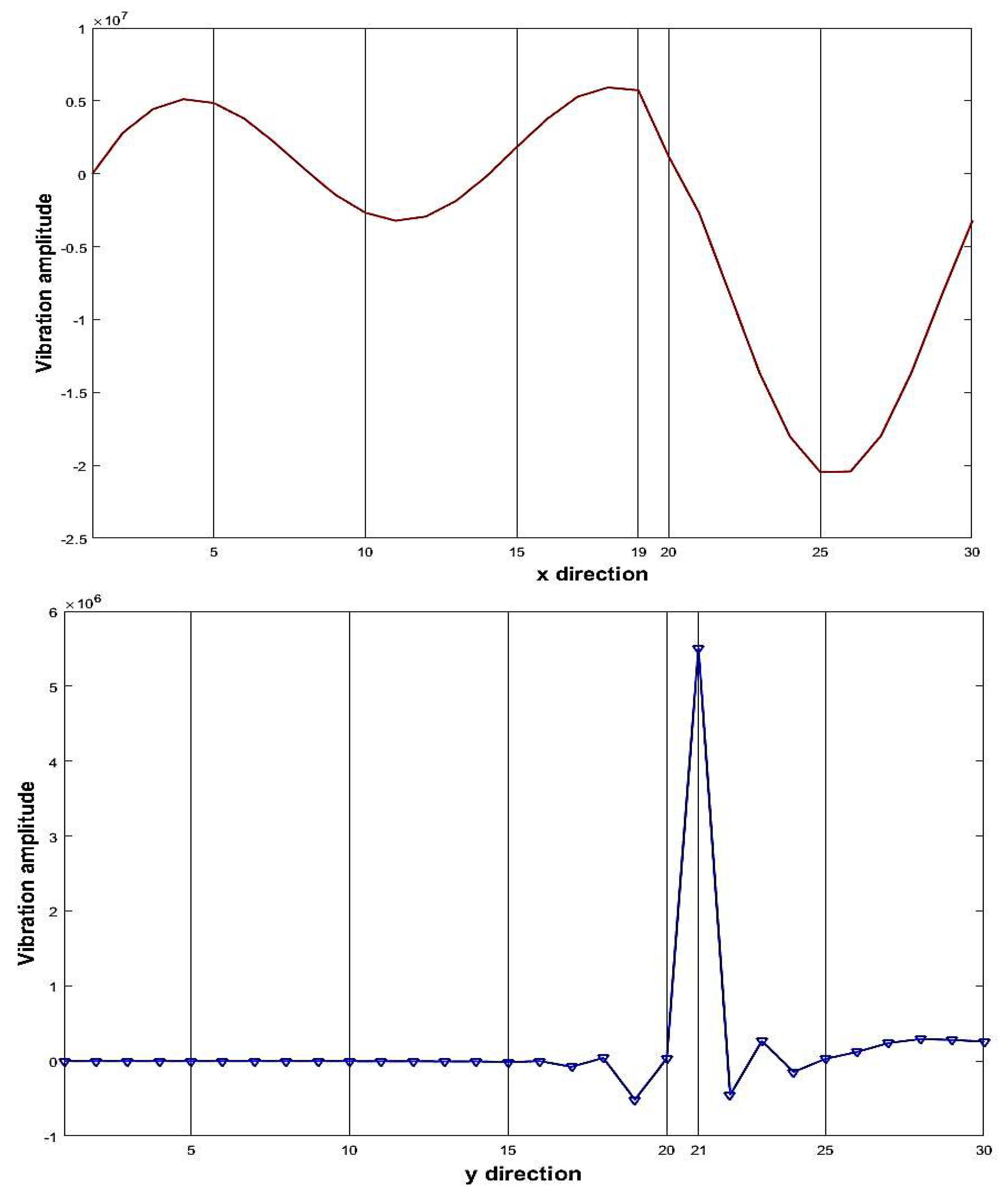
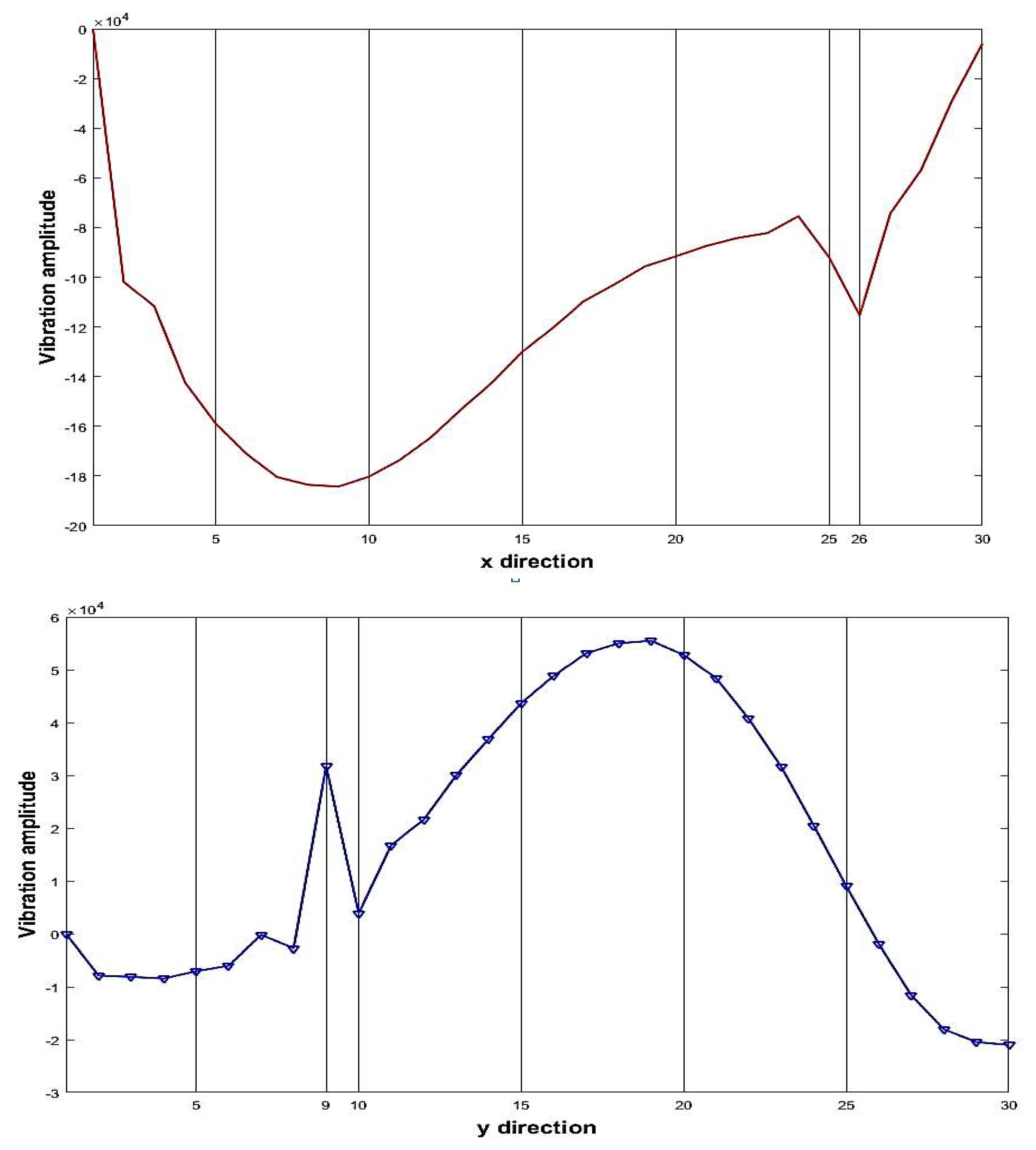
Figure 5, Figure 6, Figure 7, Figure 8, Figure 9 and Figure 10 show the results of the proposed mode shape projection method for scenarios 1-6.
Table 4 lists the results of the proposed mode shape projection method for scenarios 1-6. As seen in Figure 5, Figure 6, Figure 7, Figure 8, Figure 9 and Figure 10 and Table 4, the proposed mode shape projection method can detect damages or sudden jumps in signals with high accuracy, and it has better performance than wavelet transform.

4.2. Experimental Results

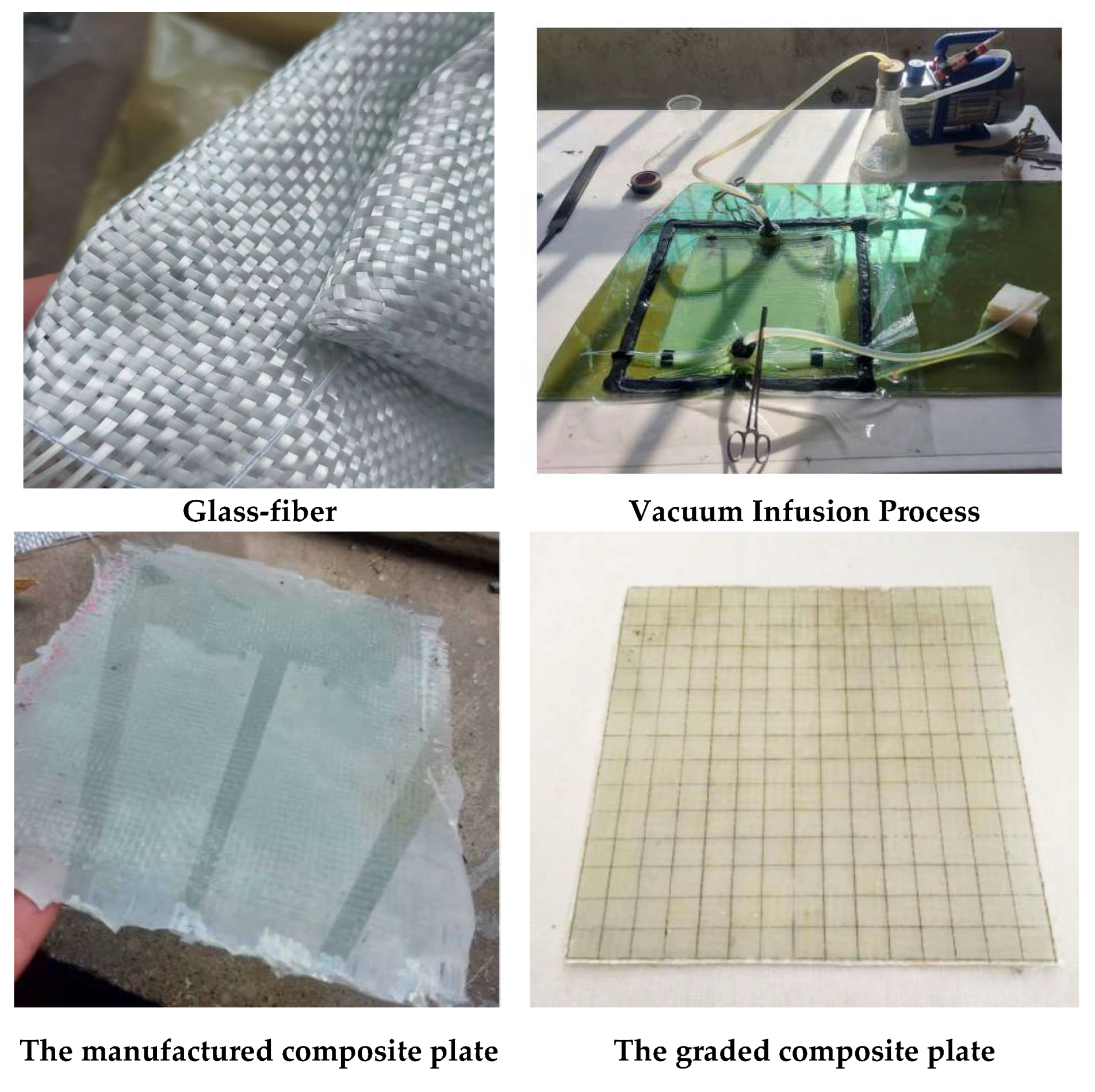
In order to verify the efficiency of the proposed mode shape projection method in practical damage detection, this section applies the method for experimental signal obtained from a rectangular laminated composite plate made of glass-epoxy. According to Figure 11, the vacuum infusion process (VIP) is used to manufacture a rectangular laminated glass-epoxy composite plate. Then, the manufactured composite plate is graded in 15 × 15 elements to measure the vibration amplitude of its mode shape signal.
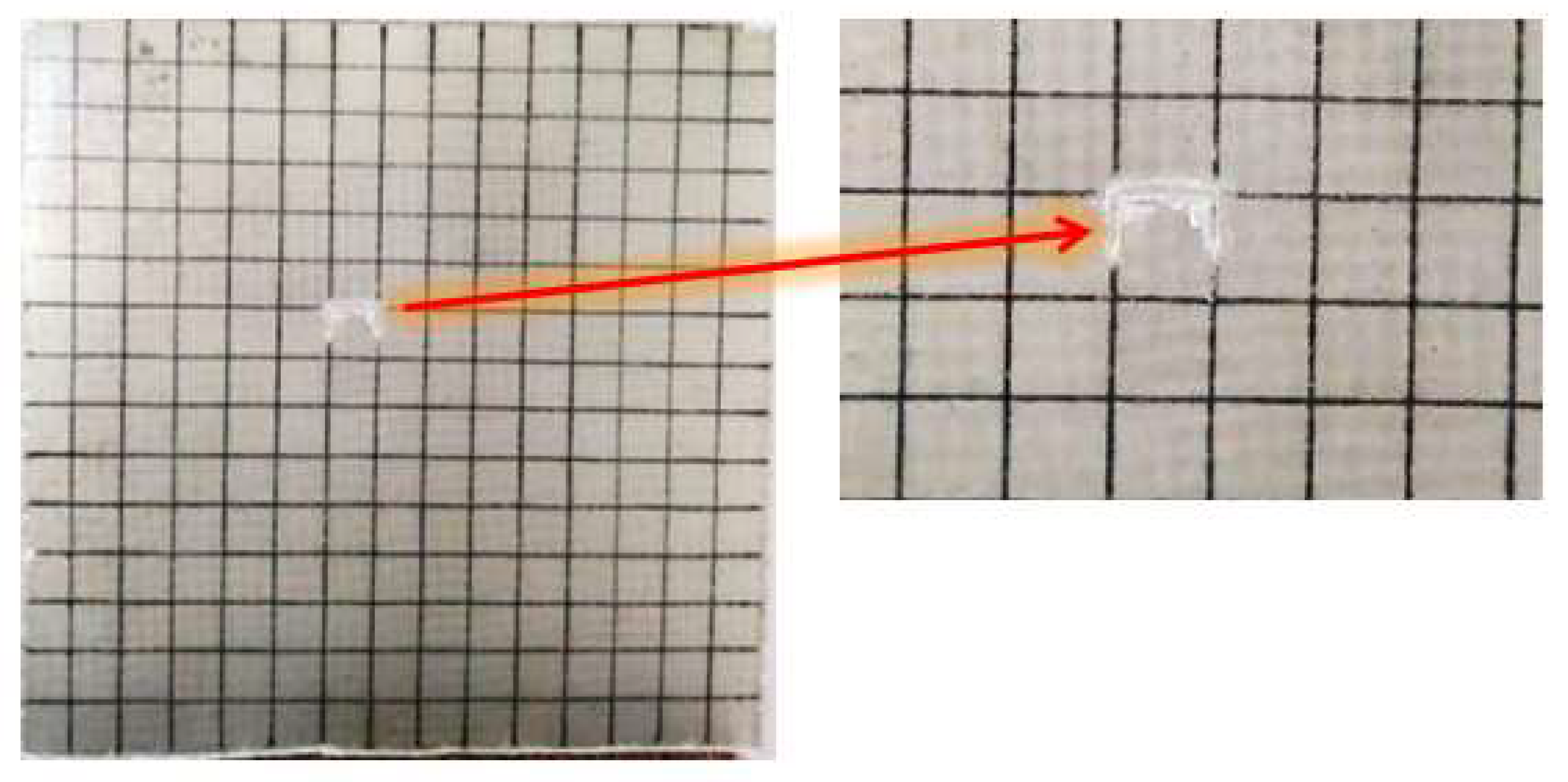
After manufacturing the composite plate, as seen in Figure 12, an element of the plate is damaged to produce a jump in the experimental signal.
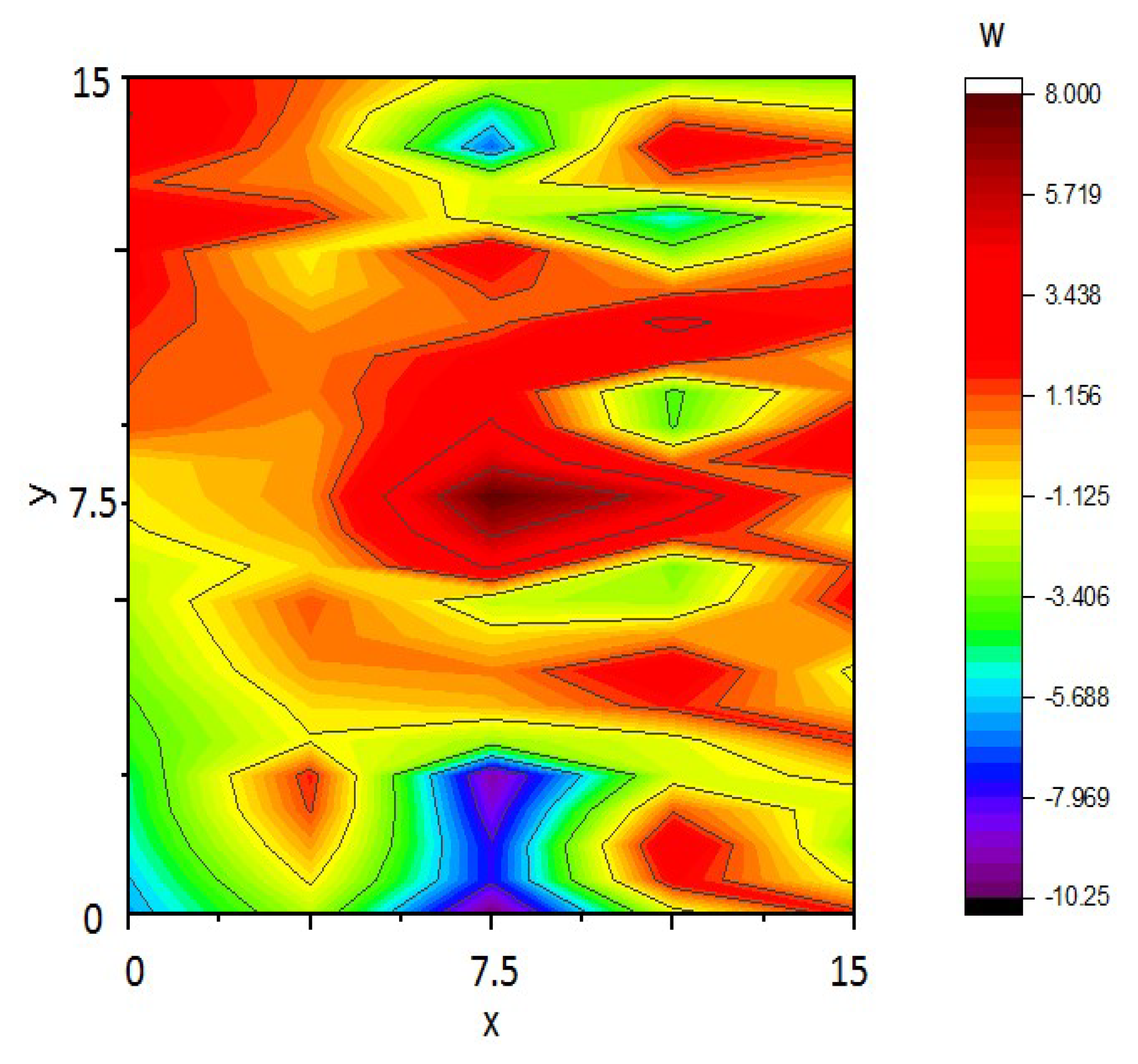
According to Figure 13, the Laser Doppler vibrometer (LDV) shaker is used to measure the vibration mode shape amplitude signal. The experimental vibration mode shape amplitude signal from the LDV shaker is presented in Figure 14.
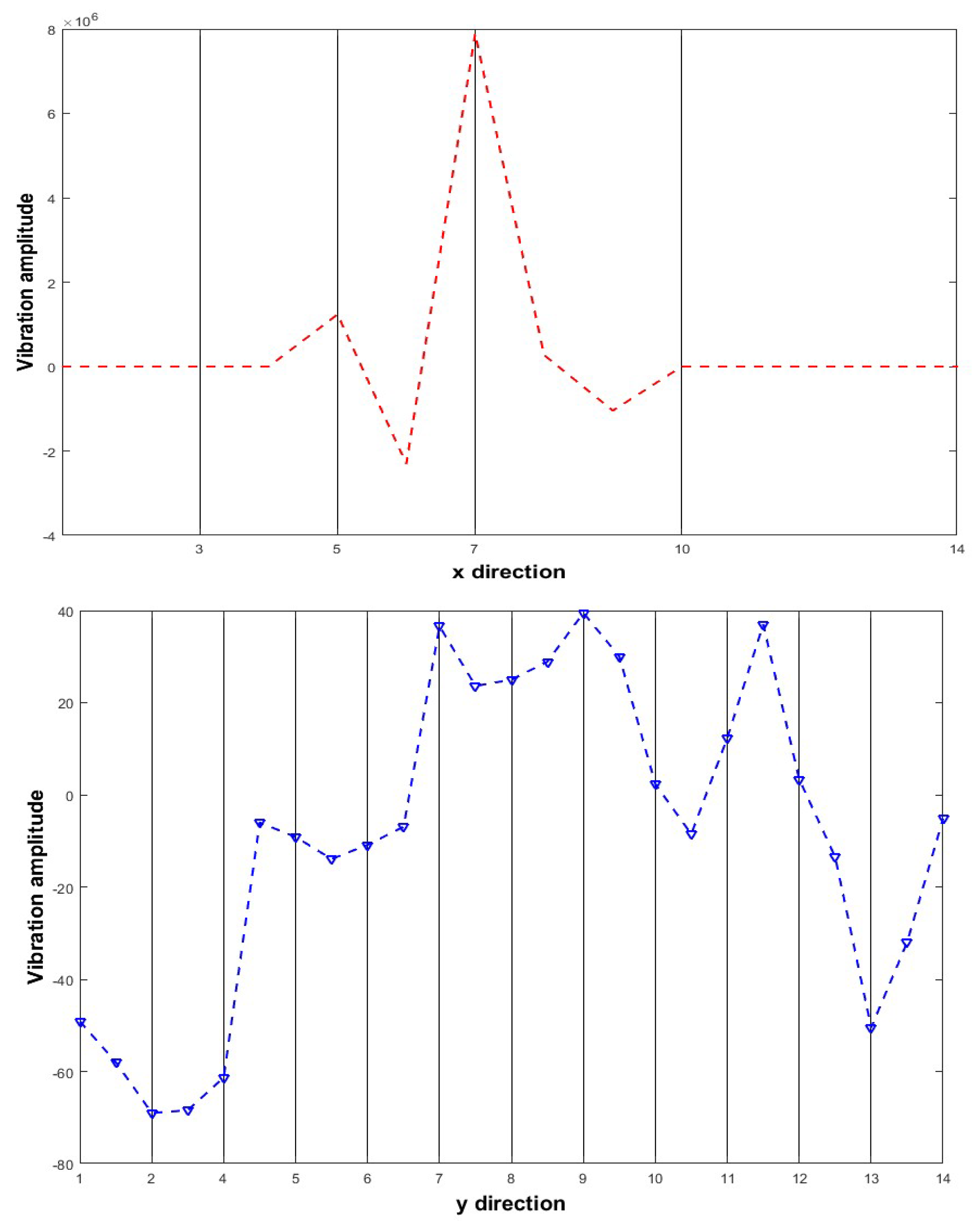
Figure 14 shows the results of the proposed mode shape projection method for the experimental damage scenario. As seen in Figure 14, the location of the damage is detected with high accuracy. This proves that the proposed mode shape projection method is highly efficient for numerical and experimental damage detection processes.

5. Conclusions

This paper presents a promising and straightforward approach called the mode shape projection method for damage detection in composite plate structures. The proposed method is suggested to eliminate weaknesses in the traditional popular methods such as wavelet transform that many times cannot detect damages with high accuracy because its results are based on the selection of proposer wavelet family and vanishing moments. Findings demonstrate that the wavelet transform can detect damage, but its results are contained noises that may be led to inaccurate damage detection. Also, in addition to this high performance, this method is straightforward and has no complexities of the conventional method, such as wavelet transformation for implementation. Findings show that in contrast to wavelet transformation, the results obtained from the proposed method show that the proposed mode shape projection method eliminates noises, and the two final one-dimensional waves along the x and y axis contain no noises. Also, this paper shows that the mathematical implementation of the proposed mode shape projection method is very simpler than the wavelet transform.

References

  1. Heshmati, A., Jafari-Talookolaei, R. A., Valvo, P. S., & Saadatmorad, M. Free and forced vibration analysis of laminated composite beams with through-the-width delamination by considering the in-plane and out-of-plane deformations. Mech. Adv. Mater. Struct. 2024, 31(23), 5953-5972. [CrossRef]
  2. Hassani, S., Mousavi, M., & Gandomi, A. H. Damage detection of composite laminate structures using VMD of FRF contaminated by high percentage of noise. Compos. Struct. 2022, 286, 115243. [CrossRef]
  3. Xie, H., Fang, H., Li, X., Wan, L., Wu, P., & Yu, Y. Low-velocity impact damage detection and characterization in composite sandwich panels using infrared thermography. Compos. Struct. 2021, 269, 114008.
  4. Heshmati, A., Jafari-Talookolaei, R. A., Valvo, P. S., & Saadatmorad, M. A novel damage detection technique for laminated composite beams under the action of a moving load. Mech. Syst. Signal Process. 2023, 202, 110692. [CrossRef]
  5. Sadeghi, F., Yu, Y., Zhu, X., & Li, J. Damage identification of steel-concrete composite beams based on modal strain energy changes through general regression neural network. Eng. Struct. 2021, 244, 112824. [CrossRef]
  6. Saadatmorad, M., Shahavi, M. H., & Gholipour, A. Damage Detection in Laminated Composite Beams Reinforced with Nano-particles Using Covariance of Vibration Mode Shape and Wavelet Transform. J. Vib. Eng. Technol. 2024, 12(3), 2865-2875. [CrossRef]
  7. Abdushkour, H. A., Saadatmorad, M., Khatir, S., Benaissa, B., Al Thobiani, F., & Khawaja, A. U. Structural Damage Detection by Derivative-Based Wavelet Transforms. Arab. J. Sci. Eng. 2024, 1-9. [CrossRef]
  8. Ahmed, O., Wang, X., Tran, M. V., & Ismadi, M. Z. Advancements in fiber-reinforced polymer composite materials damage detection methods: towards achieving energy-efficient SHM systems. Compos. B: Eng. 2021, 223, 109136. [CrossRef]
  9. Saadatmorad, M., Khatir, S., Cuong-Le, T., Benaissa, B., & Mahmoudi, S. Detecting damages in metallic beam structures using a novel wavelet selection criterion. J. Sound Vib. 2024, 578, 118297. [CrossRef]
  10. Oliver, G. A., Pereira, J. L. J., Francisco, M. B., Ancelotti, A. C., & Gomes, G. F. Parameter tuning for wavelet transform-based damage index using mixture design. Eng. Comput. 2021, 1-22. [CrossRef]
  11. Douka, E., Loutridis, S., & Trochidis, A. Crack identification in beams using wavelet analysis. Int. J. Solids Struct. 2003, 40(13-14), 3557-3569. [CrossRef]
  12. Katunin, A., dos Santos, J. V. A., & Lopes, H. Damage identification by wavelet analysis of modal rotation differences. Struct. 2021 (Vol. 30, pp. 1–10). Elsevier. [CrossRef]
  13. Saadatmorad, M., Talookolaei, R. A. J., Pashaei, M. H., Khatir, S., & Wahab, M. A. Pearson Correlation and Discrete Wavelet Transform for Crack Identification in Steel Beams. Math 2022, 10(15), 2689. [CrossRef]
  14. Kumar, R., & Singh, S. K. Crack detection near the ends of a beam using wavelet transform and high resolution beam deflection measurement. Eur. J. Mech. A/Solids. 2021, 88, 104259. [CrossRef]
  15. Janeliukstis, R., Rucevskis, S., Wesolowski, M., Kovalovs, A., & Chate, A. Damage identification in polymer composite beams based on spatial continuous wavelet transform. In IOP Conference Series: Materials Science and Engineering 2016, (Vol. 111, No. 1, p. 012005). IOP Publishing.
  16. Rucka, M., & Wilde, K. (2006). Application of continuous wavelet transform in vibration based damage detection method for beams and plates. J. Sound Vib 2006, 297(3-5), 536-550. [CrossRef]
  17. Chang, C. C., & Chen, L. W. (2004). Damage detection of a rectangular plate by spatial wavelet based approach. Appl. Acoust. 2004, 65(8), 819-832. [CrossRef]
  18. Ashory, M. R., Ghasemi-Ghalebahman, A., & Kokabi, M. J. Damage detection in laminated composite plates via an optimal wavelet selection criterion. J. Reinf. Plast. Compos. 2016, 35(24), 1761-1775.
  19. Zhou, J., Li, Z., & Chen, J. Damage identification method based on continuous wavelet transform and mode shapes for composite laminates with cutouts. Compos. Struct. 2018, 191, 12–23. [CrossRef]
  20. Saadatmorad, M., Jafari-Talookolaei, R. A., Pashaei, M. H., & Khatir, S. (2022). Damage Detection in Rectangular Laminated Composite Plate Structures using a Combination of Wavelet Transforms and Artificial Neural Networks. J. Vib. Eng. Technol. 2022, 1-18. [CrossRef]
  21. Saadatmorad, M., Jafari-Talookolaei, R. A., Pashaei, M. H., & Khatir, S. Damage detection on rectangular laminated composite plates using wavelet based convolutional neural network technique. Compos. Struct. 2021, 278, 114656. [CrossRef]
  22. Rucka, M., & Wilde, K. Neuro-wavelet damage detection technique in beam, plate and shell structures with experimental validation. J. Theor. Appl. Mech. 2010, 48(3), 579-604.
  23. Gdeisat, M. A., Abid, A., Burton, D. R., Lalor, M. J., Lilley, F., Moore, C., & Qudeisat, M. Spatial and temporal carrier fringe pattern demodulation using the one-dimensional continuous wavelet transform: recent progress, challenges, and suggested developments. Opt. Lasers Eng. 2009, 47(12), 1348-1361.
  24. Burnes, S., Villa, J., Moreno, G., de la Rosa, I., González, E., & Alaniz, D. 3D shape measurement with temporal phase unwrapping and 1-D continuous wavelet transform. Photon. Ins. Eng. VIII 2021, (Vol. 11693, pp. 203–210). SPIE.
  25. Kathuria, L., Goel, S., & Khanna, N. (2021). Fourier–Boas-Like Wavelets and Their Vanishing Moments. J. Math. 2021. (1), 6619551. [CrossRef]
  26. Knitter-Piątkowska, A., Pozorski, Z., & Garstecki, A. (2006). Application of discrete wavelet transformation in damage detection. Part I: Static and dynamic experiments. Comput. Assist. Methods Eng. Sci. 2006, 13(1), 21-38.
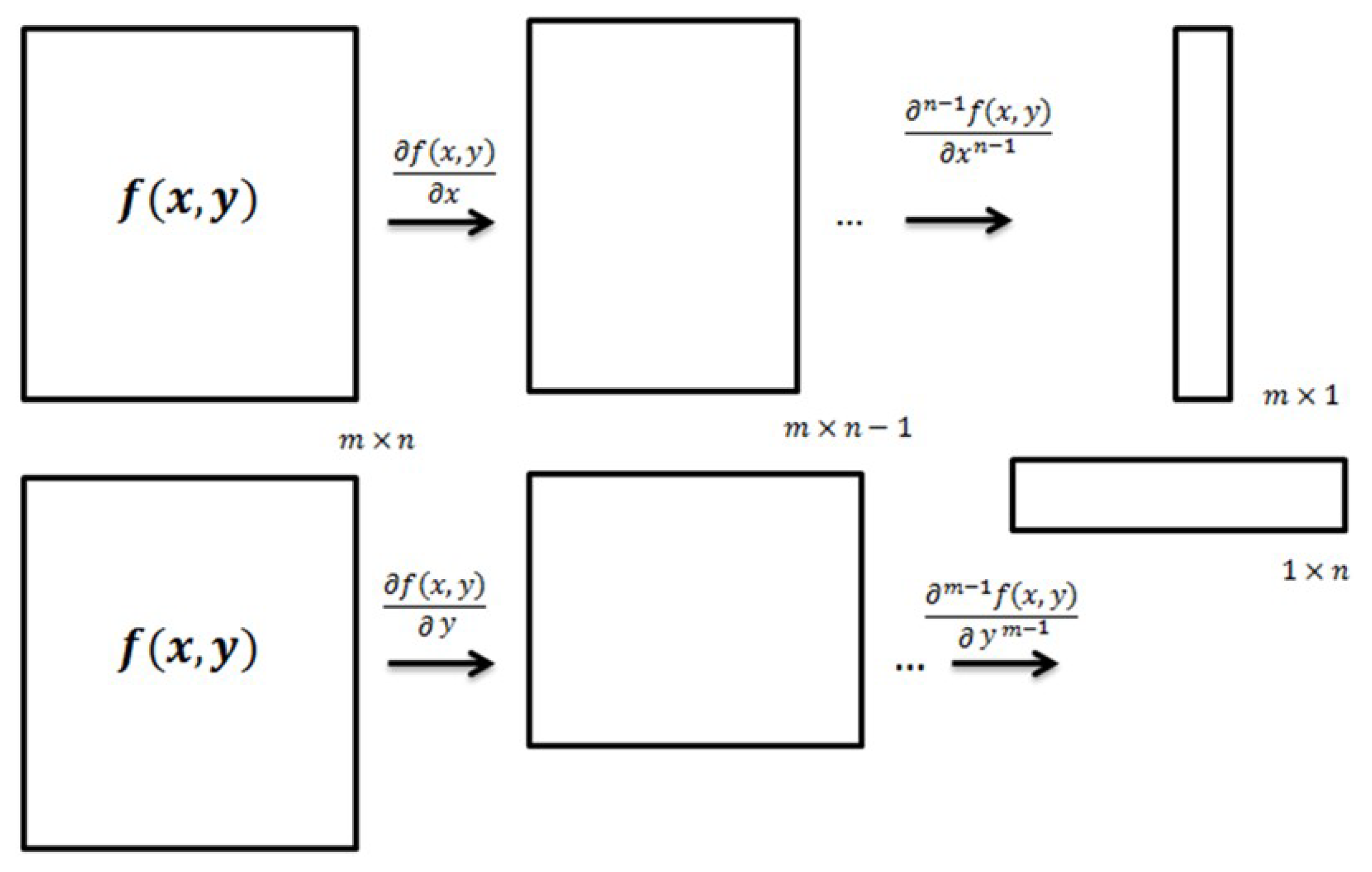
Figure 1. Projection of two two-dimensional mode shapes for creating two one-dimensional signals.
Preprints 141938 g001
Figure 2. Results from two-dimensional wavelet transform for the six considered damage scenarios.
Preprints 141938 g002
Figure 3. Two-dimensional signals obtained for the six damage scenarios in the three-dimensional distribution.
Preprints 141938 g003
Figure 4. Two-dimensional signals obtained for the six damage scenarios in the two-dimensional distribution.
Preprints 141938 g004
Figure 5. Result of the proposed mode shape projection method for scenario 1.
Preprints 141938 g005
Figure 6. Result of the proposed mode shape projection method for scenario 2.
Preprints 141938 g006aPreprints 141938 g006b
Figure 7. Result of the proposed mode shape projection method for scenario 3.
Preprints 141938 g007
Figure 8. Result of the proposed mode shape projection method for scenario 4.
Preprints 141938 g008
Figure 9. Result of the proposed mode shape projection method for scenario 5.
Preprints 141938 g009aPreprints 141938 g009b
Figure 9. Result of the proposed mode shape projection method for scenario 5.
Preprints 141938 g010
Figure 10. Result of the proposed mode shape projection method for scenario 6.
Preprints 141938 g011
Figure 11. Process of manufacturing and grading the rectangular laminated glass-epoxy composite plate using the vacuum infusion process (VIP).
Preprints 141938 g012
Figure 12. Damage created in the coposite plate.
Preprints 141938 g013
Figure 14. The experimental vibration mode shape amplitude signal from the LDV shaker.
Preprints 141938 g014
Figure 14. Results of the proposed mode shape projection method for the experimental damage scenario.
Preprints 141938 g015
Table 1. General properties of the rectangular laminated composite plate.
Parameter Description or value
Number of layers 2
Layers configuration [0, 45]
a 0.2 m
b 0.2 m
h h=0.1a
Dividing elements 30 × 30
Shear Factor k s = 5 / 6
Young’s modulus E 11 = 25 × E 22   E 22 = 965 × 10 7 ,
Shear modulus , G 13 = 0.2 E 22   G 12 = G 13 = 0.5 E 22
Poisson’s ratios ν 21 = E 22 E 11 ν 12   ν 12 = 0.25 ,
Table 2. Six different damage scenarios that create six different sudden jumps in the obtained signals.
Scenario No. Location of damage `Level of damage
x y
1 3 13 70%
2 17 15 50%
3 19 21 30%
4 26 9 9%
5 3 13 40%
6 16 16 15%
Table 3. Results from two-dimensional wavelet transform for the six considered damage scenarios.
Scenario No. Actual location of damage Location of damage detected by wavelet transform
x y x y
1 3 13 1-5, 24-30 14-20, 24-27, 30
2 17 15 1-3, 15-22, 27-30 15-20, 25-30
3 19 21 1-3, 5, 16, 22, 25, 29-30 17-22, 29, 30
4 26 9 1-2, 4, 25-26 1, 2, 4, 9, 10
5 3 13 1, 2, 7,9,10,12 1-6
6 16 16 2-4, 18, 27-30 2-4, 18, 27-30
Table 4. Results of the proposed mode shape projection method for scenarios 1-6.
Scenario No. Actual location of damage Location of damage detected by the proposed creation method
x y x y
1 3 13 3 13
2 17 15 17 15
3 19 21 19 21
4 26 9 26 9
5 3 13 3 13
6 16 16 16 16
Disclaimer/Publisher’s Note: The statements, opinions and data contained in all publications are solely those of the individual author(s) and contributor(s) and not of MDPI and/or the editor(s). MDPI and/or the editor(s) disclaim responsibility for any injury to people or property resulting from any ideas, methods, instructions or products referred to in the content.
Copyright: This open access article is published under a Creative Commons CC BY 4.0 license, which permit the free download, distribution, and reuse, provided that the author and preprint are cited in any reuse.
Prerpints.org logo

Preprints.org is a free preprint server supported by MDPI in Basel, Switzerland.

Subscribe

Disclaimer

Terms of Use

Privacy Policy

Privacy Settings

© 2025 MDPI (Basel, Switzerland) unless otherwise stated