

Submitted:
04 December 2024
Posted:
04 December 2024
You are already at the latest version
Abstract
Vortex-induced vibration harvesters are usually equipped with small piezoelectric patches mounted near the cantilever clamp, where the largest longitudinal stress occurs. This paper investigates the possibility of extending the patch length in order to improve the energy harvesting performance. A novel analytical model based on dimensionless numbers is presented to determine the output voltage generated by a vibration harvester subjected to periodic vortex shedding. This model shows that both voltage and stored energy reaches maximum for an optimal length, and provides guidance to the interpretation of experimental results. Experimental tests, comparing different harvester designs, investigate the effect on the performance of the harvester of the patch length and of both length and mass of the bluff body mounted on the harvester to induce vortex shedding.
Keywords:
Vortex
; vibrations
; energy harvesting
; piezoelectric
; harvester
; damping
1. Introduction
Vortex-induced vibrations (VIV) have been studied since many years due to their negative effects on the safety of machines and structures [1]. The influence of the geometric and mechanical properties of the vibrating system was studied to minimize the effect of excitation due to vortex shedding [2,3,4]. The most dangerous phenomena occurred in lightly damped structures [5] where the increase in damping was considered a positive factor to reduce the amplitude of vibrations [6].
Recent developments in vibration energy harvesting technologies have opened up the possibility of exploiting fluid-excited vibrations to scavenge energy [7]. This possibility appears to be very useful for remote sensors that are powered by small photovoltaic panels. In adverse weather conditions, solar energy production decreases [8] and can be complemented by wind [9] and rain energy harvesting [10] to guarantee the minimum energy level needed for sensors and data storage. A wind flow impinging on an elastically mounted body can produce vibrations due to different phenomena [1], which can be exploited for energy harvesting. Experimental and numerical studies on vibrations generated by vortex shedding from cylinders were reported in [11,12]. Galloping harvesters exploiting the interaction between wind and non-cylindrical bodies were studied in [13,14]. An inverted flag harvester exploiting a flutter phenomenon was presented in [15], and finally, harvesters exploiting turbulence were proposed in [16].
The present research focuses on vortex-induced vibration because, after proper natural frequency tuning, they are effective in the range of small flow velocities, which are very common in the field of civil and industrial structures. In contrast, harvesters based on limit cycles (galloping and flutter harvesters) require the wind speed to be higher than the cutoff speed [17]. The turbulence harvester also produces larger amounts of energy when the wind speed increases.
Vortex-induced vibration harvesters typically consist of one or more piezoelectric patches attached to a structural layer, which is equipped with a cylindrical bluff body to induce vortex shedding [11]. Various layouts were proposed in the literature, such as the I-shaped configuration, in which the axes of the bluff body (a cylinder) and of the cantilever are aligned, and the T-shaped configuration, in which the axes are perpendicular [18]. More complex layouts are described in [19] and [20]. VIV harvesters achieve the best performance when the vortex shedding frequency is equal to the natural frequency of the harvester. This resonance condition is made complex by the nonlinear dynamics of near-wake vortex shedding. When the frequency of vortex shedding is close to the natural frequency of the system, a considerable interaction between flow and structure is present, and a range of flow velocities with large-amplitude oscillations named the "lock-in region" appears [21]. Many studies focused on the fluid dynamics of vortex shedding and the lock-in phenomenon. A detailed experimental analysis of the effect of the cylinder aspect ratio on both vortex shedding and harvested energy was presented in [4]. The effect of the ratio between cylinder length and cantilever width was studied experimentally in [22]. Computational fluid dynamics (CFD) simulations of a VIV harvester were presented in [23]. The effect of electrical load on the output power of the harvester was studied by many researchers, who considered simple resistors connected to piezoelectric patches [12,23].
Despite such large research efforts, it is still worth studying some aspects of the mechanical design of a T-shaped VIV harvester. Most of the studies mentioned above have considered cantilevers equipped with small piezoelectric patches placed in the best position, that is, near the cantilever clamp where the largest longitudinal stress occurs. The effect of extending the length of the piezoelectric patch has been scarcely addressed in the literature. The extension of the patch may have unexpected results: on the one hand, it can increase the charge generated and the energy stored; on the other hand, a larger patch area glued to the structural layer increases damping, limiting the dynamics of the harvester.
The cylindrical bluff body can be regarded as a tip mass added to the end of the cantilever harvester. The increase in the tip mass has a predictable effect consisting in the lowering of the natural frequency of the system and, in turn, of the lock-in velocity. However, some researchers [12,19] reported other effects of tip mass, such as significant variations in the maximum vibration amplitude and in the size of the velocity window in the lock-in region. Other researchers highlighted the effect of the tip mass on the shape of higher-order modes [10]. These phenomena are explored in this paper.
The paper is organized as follows. In Section 2 a mathematical model is presented showing the effect of the main design parameters on harvester performance under ideal conditions. The final equations are expressed in dimensionless terms by making use of the Skop-Griffin number, which is widely used in the field of VIV. In Section 3 experimental tests for the identification of the dynamic parameters necessary to compare the performance of different harvesters are presented. The damping increase due to the bonding of long piezoelectric patches is highlighted. In Section 4 wind harvesting tests carried out on harvesters equipped with patches having different lengths and with different cylindrical bluff bodies are presented. The experimental results are discussed in light of the model in Section 2, and the limits of simplified models are discussed. Finally, conclusions are drawn in Section 5.
2. Mathematical Model of the VIV Harvester
Figure 1 shows a schematic of the T-shaped piezoelectric harvester investigated here to exploit VIV. The three main components of the harvester are the structural layer, the piezoelectric layer, and the bluff body to induce wind vibrations. The bluff body has two different functions: the first is to lower the first natural frequency of the cantilever () because it is a mass concentrated on the tip of the cantilever and the second is to generate vortex shedding phenomena. By properly selecting the diameter of the cylinder (D), it is possible to adjust the vortex shedding frequency () to match the natural frequency of the harvester at a specific wind velocity (U).
The cantilever beam consists of an aluminum beam 130 mm long, with a rectangular section (21 mm width, 1 mm thickness). The piezoelectric patch is a Macro Fiber Composite (MFC) built by Smart Material Corporation and exploits the effect. The longitudinal direction 1 corresponds to the x axis, and the transverse direction 3 corresponds to the y axis in Figure 1. It is a wafer structure with rectangular piezoceramic rods sandwiched between layers of adhesive, electrodes, and polyimide [24].
In this work, three different patches manufactured by Smart Material Corporation were glued to the structural layer (Figure 2). The patches, which have the same width (14 mm) and different lengths (7 mm, 28 mm, and 85 mm), were labeled with codes "0714", "2814", and "8514", respectively (see Figure 2a). The cylindrical bluff body is made of 3D printed plastic material. The bluff body has an external diameter 19 mm, while the length and thickness of the cylinder were varied in the experimental tests.
2.1. Electromechanical Model
The origin of the Cartesian coordinate system in Figure 1 is located at the clamped end (base). The cylindrical bluff body, placed at the free end of the beam (), is modeled as a tip mass . Metal electrodes are located on the top and bottom sides of the piezoelectric patch to collect the electric charge generated by the piezoelectric effect due to strain; electrodes are connected to the power conditioning circuit through terminals. For simplicity, a 1D model of the VIV harvester is considered neglecting the displacement in directions x and z. It is also assumed that the piezoelectric patch does not cover the entire surface of the beam, but rather a delimited area represented by the interval .
According to [25], the electrical output of the piezoelectric patch can be analytically modeled assuming the patch is very thin compared to the structural layer; therefore, the mechanical response of the cantilevered beam is basically unchanged. The analytical model used here for a qualitative assessment of the energy harvesters is described below.
The absolute transverse displacement w of any point of the beam can be obtained by solving the equation of motion [26]:
where t is time, M is the bending moment, is the equivalent coefficient of strain rate damping, I is the equivalent area moment of inertia of the composite cross-section, is the viscous air damping coefficient, m is the mass per unit length of the beam, is the force applied to the cantilever tip, and is the Dirac delta. The presence of the clamp and of the tip mass is taken into account by setting proper boundary conditions at the ends of the beam [27].
If the piezoelectric patch does not cover the whole beam, the bending moment reads:
where is the bending stiffness of the composite cross-section and H is the Heaviside function. In Equation (2) the electromechanical coupling coefficient is defined as:
where is the piezoelectric constant, b is the width of the beam, is the thickness of the piezoelectric layer, is the position of the bottom of the piezoelectric layer from the neutral axis, and is the position of the top of the piezoelectric layer from the neutral axis.
According to modal expansion approach, the absolute displacement can be expanded into an absolutely and uniformly convergent series:
where is the eigenfunction (or mode of vibration) that takes into account the presence of the tip mass and is the modal coordinate of the clamped free beam for the nth mode. The modes of vibration are obtained by solving the eigenvalue problem related to Equation (1) and are normalized by setting the tip amplitude to one.
Inserting Equation (4) in Equation (1), assuming proportional damping and exploiting the orthogonality of eigenfunctions, the dynamic equation for the nth mode becomes:
where is the modal mass, is the modal damping coefficient, and is the modal stiffness of the cantilever, is the forward modal coupling coefficient, and is the modal force for the nth mode [28]. The latter can be calculated as:
For the unimorph harvester layout shown in Figure 1, the forward modal coupling coefficient is equal to the backward modal coupling coefficient [28], yielding:
The vibrations induced by the vortex are transformed into electric charge as a result of the piezoelectric effect and stored in the collector electrodes as in a capacitor. In this case, the electric charge at the top electrode of the harvester (positive) is the flux of the electric displacement , that is:
where is the unit normal vector of , directed opposite to the y axis. Assuming a thin piezoelectric patch, the electric displacement is constant on and has only a transverse component, that is:
where is the component of axial strain, is the transverse component of the electric field, is the piezoelectric stress charge coefficient and is the permittivity at constant strain. By noting that the longitudinal component of the strain can be approximated for a thin patch as [26]:
where is the distance of the center of the piezoelectric patch cross-section from the neutral axis, and
where is the electric voltage. By inserting Equation (10) and Equation (11) in Equation (9) and by noting that , the electric charge (8) becomes:
Due to the charge conservation law applied to the positive terminal, the output current (with sign convention coming out from the positive terminal) results:
After integrating Equation (12) over time, the output current becomes:
where the piezoelectric patch capacitance is defined as:
Assuming open-circuit operation (no current flows through the terminals, that is ), the open-circuit voltage (OCV) can be obtained from the time integration of Equation (16) as:
where is the OCV at the initial time instant . The OCV is used here to characterize the electrical performance of the vibration harvester. In fact, in practical applications, power electronic converters for energy extraction are used most of the time under open circuit conditions to minimize energy loss, and the electric charge is extracted from the harvester when the maximum voltage level (or the maximum stored energy) is reached [29].
The electric potential energy stored in the harvester (that is, the electric work spent to charge electrodes at voltage ) can be calculated as in a capacitor [30]:
The average energy stored can thus be obtained as:
where is the root mean square (RMS) value of the OCV.
2.2. Aerodynamic Force
According to [1], when the cylinder is subject to a constant airflow, vortexes are shed with a frequency given by the following relationship:
where U is the wind speed, D is the cylinder external diameter, and St is the Strouhal number. The periodic shedding of vortexes results in a variation of pressure surrounding the bluff body, and hence in a time-dependent force orthogonal to the flow direction. The latter is modeled as an harmonic lift applied to the cylinder axis:
where is the fluid density, is the length of the cylinder, and is the time-dependent lift coefficient.
The electromechanical model in Section 2.1 holds for a force applied to the cantilever tip and cannot be directly used if is applied at the center of the bluff body (that is, at distance from the tip). However, the model can be generalized to adding a torque applied to the tip. It can be shown that, in this case, the modal forcing term becomes [12]:
The harmonic force model does not include the effect of the cylinder motion on the aerodynamic force. Other models introduce additional equations to take into account the coupling between the lift coefficient and the cylinder motion. For example, the model presented by Facchinetti et al. in [21] uses the van der Pol oscillator equation, with a forcing term that depends on the acceleration of the cylinder, to calculate . In this work, Equation (21) is adopted to model the vortex shedding lift because it allows a direct interpretation of the experimental data.
2.3. Dimensionless Harmonic Solution
The VIV harvesters considered in the present work were used with wind speeds less than 5 m/s. Considering the typical values of the Strouhal number for cylinders, the vortex shedding frequency belongs to the range 10-25 Hz and can be tuned to the first natural frequency of the cantilever harvester. The excitation of higher-order modes is negligible and the dynamic response of the VIV harvester can be studied only by considering the contribution of the first mode of Equation (5). If only the first mode is considered, Equation (17) becomes:
Introducing Equation (23) in Equation (5) with and considering the modal forcing term defined by Equation (22) leads to:
A time-harmonic solution is sought for Equation (24) by setting , , where is the complex amplitude of the response of first mode. This results:
where is the natural frequency of the first mode taking into account the electromechanical coupling and is the modal damping ratio of the first mode. From Equation (25), the amplitude of the modal response at resonance () reads:
By expressing Equation (23) in the frequency domain and by substituting Equation (21) in Equation (26), the OCV amplitude can be calculated as:
Equation (27) can be expressed in dimensionless form, since many experimental studies on VIV have shown a correlation between the amplitude of cylinder vibrations and the Skop-Griffin number, which is defined as [4,31,32]:
in which is the mass ratio defined as the ratio between the vibrating mass and the mass of fluid having the same volume of the cylinder. In the present case, considering the modal mass of the first mode:
and the modal damping of the first mode , the Skop-Griffin number becomes:
The amplitude of the OCV generated by the harvester at resonance can be expressed as a function of the Skop-Griffin number by substituting in Equation (27) and performing some algebraic manipulations:
At the right hand side of Equation (31), the term has the physical meaning of voltage generated by a displacement equal to cylinder diameter, hence, the OCV can be normalized with respect to this value obtaining the dimensionless equation:
This equation is useful because it defines the main parameters that determine the voltage generation in the harvester in the presence of a harmonic lift.
2.4. Calculated Results
The analysis carried out in Section 2.3 has outlined that the extension of the piezoelectric patch influences the generated voltage through the forward coupling coefficient , capacitance , and modal damping . The last parameter appears in the Skop-Griffin number. The mass of the piezoelectric patch, which is a small fraction of the mass of the harvester (including the structural layer and the cylinder), has a small effect on which appears in SG.
Therefore, using the mathematical model, the effect of the piezoelectric patch length was simulated considering different values of . The best location for a piezoelectric patch covering only a small portion of the structural layer is near the clamp, where the second spatial derivative of the first mode (corresponding to the cantilever curvature) reaches the largest value. Therefore, the coordinate , which defines the starting point of the piezoelectric patch, was kept small and constant ( 8 mm), while the coordinate , which defines the end point of the patch, was varied; see Figure 1.
Figure 3a shows the effect of the length of the patch on the open-circuit voltage. A unitary harmonic force (1 N) was applied to the cylinder axis and the RMS value of the OCV was calculated. The vertical lines in Figure 3a represent the lengths of the three tested patches. Figure 3b shows the effect of the patch length on the average energy calculated according to Equation (19).
The calculated results show that an increase in the damping ratio leads to a large decrease in the performance of the VIV harvester, evaluated in terms of OCV and energy. When the piezoelectric patch is short, the increase in length increases the OCV, which reaches a maximum. A further increase in length leads to a monotonic decrease in the RMS value of the OCV. The extension of the piezoelectric patch length has a positive effect on energy for a wide range of length (see Figure 3). For very large lengths (comparable with cantilever length), a further increase in length leads to a decrease in energy.
In conclusion, the main performance indexes of the harvester (OCV and energy) show a maximum value at a certain length. This optimal length depends not only on the spatial derivative of the modal shape (Equation (7)) and on the capacitance (Equation (15)), but also on the increase in damping caused by the piezoelectric patch and the adhesive. The latter effect can only be analyzed experimentally.
3. Experimental Characterization of the Harvester by Means of Impulsive Tests
Experiments were performed to measure the damping ratio of the first bending mode of the harvesters.
Each harvester was fixed to one extremity of a suspended aluminum bar, the suspension was adopted to isolate the system from environmental vibrations [33]. An impulsive force was applied to the other extremity of the aluminum bar with a hammer for modal testing (PCB 086D03, sensitivity 2.25 mV/N) to excite the harvester. The acceleration of the base of the harvester was measured using a PCB 352C22 accelerometer (sensitivity 10.48 mV/g). The cantilever was fixed with its tip down, in this way it was in a configuration of stable equilibrium. The experimental setup is shown in Figure 4.
The voltage generated by the piezoelectric patch, the accelerometer signal, and the hammer signal were acquired at a sampling frequency of 2048 Hz with a NI9230 module. Since the internal resistance of the acquisition module is 324 k, the piezoelectric patches directly connected to the module would work under load. Therefore, an additional resistor (10 M) was connected in series with the module to increase the resistance of the circuit and simulate the open-circuit condition. Data were analyzed using Matlab software. The logarithmic decrement method was applied to identify the damping ratio from the measured voltage. Moreover, the frequency response function (FRF) between the OCV and base acceleration was calculated.
First, three harvesters with the same geometry and different patches were tested. To investigate the linearity of the harvesters, each harvester was tested by applying base accelerations with peak values of 2, 3, 6, and 9 g. Five acquisitions of 6 seconds were performed for each harvester and for each excitation level.
For damping calculation, the voltage signal of each test was filtered to remove small fluctuations due to higher-order modes. The first part of the time record, which includes some irregularities, and the last part of the time record (with amplitudes smaller than 10 % of initial amplitude) were discarded. Then positive and negative peaks were found (see Figure 5a) and the logarithmic decrement method was applied between the peaks at a distance of ten periods. The calculation was repeated for all the positive peaks and for all the negative peaks, finding the damping ratio for each cycle of ten periods. Finally, the mean damping ratio between cycles was calculated for each test. In addition, the non-filtered voltage signal was used to compute the FRF, the result is shown in Figure 5b. The FRF shows a large resonance peak at the first natural frequency of the cantilever (16.8 Hz), while the peaks at other natural frequencies (e.g. at 165.2 Hz) are negligible, demonstrating that only the first mode of vibration influences the generated voltage.
Damping ratios measured in each test for increasing excitation levels are reported in Figure 6. The three patches show an increase in damping for larger excitation; this nonlinearity is almost negligible for patches 0714 and 8514, while the damping ratio of the harvester equipped with patch 2814 shows a sharper increase. The natural frequencies and damping ratios of the three harvesters excited by 9 g acceleration impulse are summarized in Table 1.
Second, the effect of the cylinder length on the damping ratio was investigated. To perform this analysis, cylinders with different lengths but with the same mass (10 grams (gr)) and the same external diameter 19 mm were mounted on the cantilever equipped with patch 2814, which was tested with the impulsive method, as shown in Figure 2b. Five tests for each cylinder were carried out. The amplitude of the excitation was chosen equal to 3 g. The damping ratios were calculated as in the previous tests, and the results are depicted in Figure 7a. The damping ratio is quite constant if the length of the cylinder is equal to 65 and 94 mm, whereas when the length increases there is a slight increase in the damping ratio. In fact, when the surface area of the cylinder increases, there is a larger interaction between the bluff body and the fluid, which causes larger dissipation. However, this increase is rather small and can be considered negligible.
Finally, five harvesters equipped with patch 2814 and cylinders of different masses were tested with the same procedure described above. The external diameter (19 mm) and the length of the cylinders (178 mm) were not changed, but only the internal diameter was changed. In this way, the effect of the cylinder mass on the damping ratio was measured. The excitation amplitude was chosen equal to 3 g also in these tests. These measured damping ratios are reported in Figure 7b. As expected, the increase in the mass of the cylinder caused a decrease in the damping ratio, and this behavior can be easily understood by considering the damping ratio formulation . In this equation, the stiffness and the damping coefficient are constant because the structure is the same, while the mass varies because the tip mass changes.
4. Effects of Design Parameters of the Harvester in Wind Tunnel Experiments
4.1. Experimental Equipment - Wind Tunnel
To evaluate the performance of the harvester, a wind tunnel was utilized to create a steady airflow (see Figure 8). This wind tunnel comprises a channel with a rectangular cross section, measuring 19 cm in width and 20 cm in height, and extends 80 cm in length. Airflow is generated by a fan located at the channel end, allowing for wind speeds up to 4 m/s. Within the tunnel, the harvesters are securely mounted on a slender vertical column placed upwind the cylinder. The axis of the cylindrical bluff body was parallel to the direction of gravity, so this set-up minimizes gravitational effects on the harvester’s performance during testing.
The generated voltage was acquired by means of a 9230 NI board, with a sampling rate of 2048 Hz and a total number of samples of 20480 (10 s). Five acquisitions were performed at each wind velocity.
Figure 9a shows a typical signal in the time domain of the OCV measured at different wind speeds. These curves were obtained using a cantilever equipped with a piezoelectric patch 2814 and a cylindrical bluff body (length 178 mm, diameter 19 mm, mass 10 gr).
The three curves depicted in Figure 9b represent the OCV at velocities lower than the lock-in region (pre lock-in), at lock-in, and at velocities higher than the lock-in region (post lock-in). The lock-in phenomenon occurs when the vortex-shedding frequency reaches the natural frequency of the cantilever harvester. When the wind speed is different from the lock-in value, the amplitude of vibrations is small and therefore the output OCV is low. When the harvester works in the lock-in region, the RMS value of the OCV reaches values close to 4 V, due to the large amplitude of vibrations. When the harvester operates above the lock-in region, the generated voltage strongly decreases and the waveform becomes irregular with many beats.
Figure 9b shows the Fast Fourier Transform (FFT) of the OCV in the three conditions. It confirms the excitation of the first mode and its strong predominance in the lock-in region.
4.2. Effect of Patch Length
The harvesters with different patches characterized in Section 3 were tested in the wind tunnel. All patches are bonded to the cantilever with the active part of the patch starting at a distance of 8 mm from the clamp.
The root mean square (RMS) of the OCV generated by each patch in the wind tunnel is shown in Figure 10a (the mean RMS between five acquisitions is shown). Figure 10b shows the average collected energy calculated according to Equation (19). Both the generated voltage and energy show the lock-in phenomenon. When the wind velocity is lower than the value that makes the vortex shedding frequency equal to the natural frequency, the response is small and slightly increases with U. Then there is a large increase in amplitudes, and these amplitudes remain large for a velocity band: this is the lock-in phenomenon. For higher velocities, the vibration amplitude suddenly decreases. In this range, amplitudes are larger than in the pre lock-in and this is due to the increased turbulence at higher velocities.
The analysis of Figure 10a highlights that the lock-in velocity slightly increases as the length of the patch increases, this effect is due to the extension of the patch that slightly increases the stiffness of the cantilever. The RMS value of the OCV decreases as the length of the piezoelectric patch increases. This result agrees with the calculations reported in Figure 3a if the transition between the curves corresponding to the damping values identified for the different harvesters is considered and if the wind force is assumed constant (the crosses in Figure 3a correspond to the tested harvesters). Figure 10b shows that the average energy reaches a peak when the harvester is equipped with a medium-length piezoelectric patch (2814). This result is in reasonable agreement with the calculations reported in Figure 3b, if the different damping ratios of these harvesters are considered.
The measured OCV can be expressed in a dimensionless form as a function of the Skop-Griffin number and the other dimensionless parameters as shown in Section 2.3. The modal parameters are not affected by the length of the patch, which has a negligible effect on the modal shape. In addition, the lift coefficient does not depend on the length of the patch. For the calculation of the Skop-Griffin number, the modal mass was calculated, the damping ratio was identified as described in Section 3, and the St number was calculated from the lock-in velocity and frequency. Results, which are presented in Figure 11, show that the extension of patch length leads to an increase in the Skop-Griffin number, which is chiefly caused by the increase of the damping ratio. The dimensionless voltage decreases as the SG number increases. It should be noted that many researches on VIV harvesting reported that the dimensionless displacement of the cylinder decreases as SG increases [32], and the dimensionless voltage used in the present study is proportional to the dimensionless displacement.
4.3. Effect of Cylinder Length
Experiments in the wind tunnel on harvesters equipped with the same 2814 piezoelectric patch but with three cylinders of different lengths (see Figure 2b) were carried out. The external diameter and the mass were the same for the three cylinders, whereas cylinder thickness was varied to keep the cylinder mass constant. Therefore, the three prototypes had the same natural frequency while the aspect ratio (AR) of the cylinder, the ratio between the width of the cantilever and the length of the cylinder, and the mass ratio were different. These parameters are summarized in Table 2.
Results of this analysis are depicted in Figure 12. Figure 12a shows the RMS value of of the OCV, whereas Figure 12b shows the average collected energy. Experimental results show that the RMS value of the OCV monotonically decreases as the cylinder length decreases. The value of lock-in velocity is the same for the long cylinder ( 178 mm) and the medium cylinder ( 94 mm) and is slightly larger for the short cylinder ( 65 mm). The force exerted by the fluid near wake on the cylinder can be considered a fluctuating lift force [21]. Therefore, if fluid velocity U and lift coefficient were constant, force would depend linearly on the projected area A of the cylinder perpendicular to the direction of fluid velocity. In the present case, since diameter D was kept constant during tests, force would depend linearly on as well. Consequently, Equation (27) shows that the generated voltage would be proportional to cylinder length. Actually, Figure 12a shows that, when cylinder length decreases from 178 to 94 mm (the ratio between projected areas being 0.54), there is a more than proportional decrease in the generated voltage, which varies from 2.1 to 0.7 V (the ratio being 0.33). Also, when cylinder length decreases further from 94 to 64 mm (the ratio between projected areas being 0.69), the generated voltage decrease is more than proportional to the decrease in projected area.
These measured trends can be explained considering some phenomena that have been highlighted by previous research. Akaydin et al. in 2016 [22] showed that vortex shedding is strongly reduced when the aspect ratio tends to 1, because most of the airflow passes over the cylinder ends rather than over the cylindrical surface. Azadeh et al. in 2018 [4] experimentally investigated the effect of the flow around the free ends of the cylinder on the wake that generates the fluctuating force. They reported variations in the Strouhal number depending on the AR. Moreover, they found that a decrease in the AR from 10 to 5 caused an increase in the generated voltage and in the extent of the lock-in region, whereas a further decrease of AR below 2.5 caused the disappearance of VIV. Unfortunately, they carried out the tests on cylinders having different AR and natural frequency, hence, the lock-in took place for rather different values of velocity. Therefore it is difficult to distinguish the effect of AR from the effect of velocity in their results.
When the cantilever clamp was located downstream of the incoming airflow, some researchers found a splitter plate effect [4,22,34]. In fact, the cantilever surface prevented the formation of part of the wake and caused a large reduction in VIV.
The experimental results presented in this research refer to prototypes with the cantilever clamp mounted upstream of the incoming airflow and having AR in the range 3.4 - 9.4. On the one hand, the splitter plate effect is not present. On the other hand, it is possible that with this flow configuration, even if AR is rather large () the reduction in AR causes a reduction in generated voltage. This effect is in addition to that of area reduction, and both effects lead to a large reduction in voltage when AR decreases. In addition, for this series of tests, the measured OCV can be normalized and expressed as a function of dimensionless parameters. It should be noted that since the various cylinders have the same tip mass, the modal parameters appearing in Equation (32) are constant, whereas the lift coefficient may change due to the different cylinder AR. Figure 13 shows that the Skop-Griffin number increases strongly as the length of the cylinder decreases due to the increase in the mass ratio. The dimensionless voltage decreases as the SG increases.
4.4. Effect of Cylinder Mass
The last series of tests aimed to study the effect of the tip mass (cylinder mass) on the generated OCV and energy. To insulate the effect of the tip mass, the piezoelectric patch (2814), the cantilever beam, and the external geometry of the cylinder were kept constant in all prototypes. The constancy of external geometry guaranteed constant fluid flow about the harvesters vibrating with the same amplitude. The variation in tip mass was achieved by modifying the internal diameter of the cylinder.
Figure 14a shows the RMS value of the OCV generated by the piezoelectric patch 2814 using five cylinders with different masses. The RMS value of the lock-in OCV increases strongly as the cylinder mass decreases. If the cylinder mass halves (passing from 10 gr to 5 gr), the RMS value becomes roughly four times larger. The decrease in cylinder mass also increases the extension of the lock-in region, this effect is consistent with previous research on VIV that showed an increase in the extension of the lock-in region as the vibration amplitude increased [21]. Figure 14b shows the energy against the wind velocity. The effect of varying the mass of the cylinder on the energy is even more pronounced since the latter is dependent on the square of the RMS value of the OCV.
The effect of cylinder mass can be studied by plotting the dimensionless voltage as a function of the dimensionless parameters defined in Section 2.3. When the mass of the cylinder changes, the number SG changes due to the large variations in the mass ratio, the variations in (see Section 3) and the variation in St. Since the modes of vibration () used in the mathematical model that leads to Equation (32) are normalized by setting the tip amplitude to one (which is the maximum amplitude of the first mode), the parameters and are not affected by the value of the tip mass. The lift coefficient should not change because the flow geometry is constant. Figure 15 shows that also in this case the dimensionless voltage decreases and SG number increases.
5. Conclusions
Most of the VIV harvesters presented in the literature consider a small patch mounted near the clamped end of the structural layer. The idea of extending the length of the active piezoelectric layer to improve the open-circuit voltage and the harvested energy has been investigated both numerically and experimentally in this work. This was motivated by the practical consideration that power electronic converters used for energy management of vibration harvesters operate primarily under no-load conditions. A novel mathematical model has been proposed that shows the dependence of the open-circuit voltage at resonance on a few relevant dimensionless parameters such as the Skop-Griffin number, the modal shape, and the lift coefficient. The calculated results have shown that an increase in the damping ratio leads to a large decrease in the performance of the VIV harvester, evaluated in terms of OCV and energy. Series of impulsive tests have been carried out to analyze the effect of the main parameters of the piezoelectric patch and of the cylindrical bluff body on damping. Then, series of wind tunnel experiments have been carried out to analyze the effect of the main parameters on OCV generation. The use of dimensionless quantities in the voltage equation has proven to be a powerful tool for the analysis of experimental results due to the reduction in the number of model parameters. Experimental results have shown that the extension of patch length leads to an increase in the Skop-Griffin number, which is chiefly caused by the increase in damping. Moreover, the reduction of the cylinder length leads to a strong increase of the Skop-Griffin number if the cylinder mass is kept constant. Finally, when the mass of the cylinder changes, the Skop-Griffin number changes due to the large variations in the mass ratio, and, in particular, increases as the cylinder mass increases. The Skop-Griffin number increase leads in turn to a reduction of the dimensionless voltage. Therefore, energy scavenging can be improved designing an harvester equipped with a medium length patch and a long and light cylinder.
Author Contributions
Conceptualization, A.D. F.M. A.P. M.T.; methodology, A.D. A.P. M.T.; software, A.P. M.T.; validation, A.D. F.M. A.P. M.T.; formal analysis, A.D. F.M. A.P. M.T.; writing—original draft preparation, A.D. F.M. A.P. M.T.; writing—review and editing, A.D. F.M. A.P. M.T.; supervision, A.D. All authors have read and agreed to the published version of the manuscript.
Conflicts of Interest
The authors declare no conflicts of interest.
References
- Blevins, R.D. Flow-induced vibration; Van Nostrand Reinhold Company, 1977.
- Matsumoto, M. VORTEX SHEDDING OF BLUFF BODIES: A REVIEW. Journal of Fluids and Structures 1999. [Google Scholar] [CrossRef]
- Assi, G.; Bearman, P.; Kitney, N. Low drag solutions for suppressing vortex-induced vibration of circular cylinders. Journal of Fluids and Structures 2009. [Google Scholar] [CrossRef]
- Azadeh-Ranjbar, V.; Elvin, N.; Andreopoulos, Y. Vortex-induced vibration of finite-length circular cylinders with spanwise free-ends: Broadening the lock-in envelope. Physics of Fluids 2018. [Google Scholar] [CrossRef]
- Khalak, A.; Williamson, C. MOTIONS, FORCES AND MODE TRANSITIONS IN VORTEX-INDUCED VIBRATIONS AT LOW MASS-DAMPING. Journal of Fluids and Structures 1999. [Google Scholar] [CrossRef]
- Goswami, I.; Scanlan, R.; Jones, N. Vortex-induced vibration of circular cylinders. I: Experimental data. Journal of Engineering Mechanics. [CrossRef]
- Wang, J.; Geng, L.; Ding, L.; Zhu, H.; Yurchenko, D. The state-of-the-art review on energy harvesting from flow-induced vibrations. Applied Energy 2020. [Google Scholar] [CrossRef]
- Tukymbekov, D.; Saymbetov, A.; Nurgaliyev, M.; Kuttybay, N.; Dosymbetova, G.; Svanbayev, Y. Intelligent autonomous street lighting system based on weather forecast using LSTM. Energy 2021. [Google Scholar] [CrossRef]
- Xia, L.; Ma, S.; Tao, P.; Pei, W.; Liu, Y.; Tao, L.; Wu, Y. A Wind-Solar Hybrid Energy Harvesting Approach Based on Wind-Induced Vibration Structure Applied in Smart Agriculture. Micromachines 2023. [Google Scholar] [CrossRef]
- Doria, A.; Fanti, G.; Filipi, G.; Moro, F. Development of a novel piezoelectric harvester excited by raindrops. Sensors (Switzerland) 2019. [Google Scholar] [CrossRef]
- Akaydin, H.; Elvin, N.; Andreopoulos, Y. The performance of a self-excited fluidic energy harvester. Smart Materials and Structures 2012. [Google Scholar] [CrossRef]
- Dai, H.; Abdelkefi, A.; Wang, L. Theoretical modeling and nonlinear analysis of piezoelectric energy harvesting from vortex-induced vibrations. Journal of Intelligent Material Systems and Structures 2014. [Google Scholar] [CrossRef]
- Zhao, D.; Hu, X.; Tan, T.; Yan, Z.; Zhang, W. Piezoelectric galloping energy harvesting enhanced by topological equivalent aerodynamic design. Energy Conversion and Management 2020. [Google Scholar] [CrossRef]
- Zhao, K.; Zhang, Q.; Wang, W. Optimization of galloping piezoelectric energy harvester with V-shaped groove in low wind speed. Energies 2019. [Google Scholar] [CrossRef]
- Orrego, S.; Shoele, K.; Ruas, A.; Doran, K.; Caggiano, B.; Mittal, R.; Kang, S. Harvesting ambient wind energy with an inverted piezoelectric flag. Applied Energy 2017. [Google Scholar] [CrossRef]
- Hobeck, J.; Inman, D. Artificial piezoelectric grass for energy harvesting from turbulence-induced vibration. Smart Materials and Structures 2012. [Google Scholar] [CrossRef]
- Lai, Z.; Wang, S.; Zhu, L.; Zhang, G.; Wang, J.; Yang, K.; Yurchenko, D. A hybrid piezo-dielectric wind energy harvester for high-performance vortex-induced vibration energy harvesting. Mechanical Systems and Signal Processing 2021. [Google Scholar] [CrossRef]
- Dai, H.; Abdelkefi, A.; Yang, Y.; Wang, L. Orientation of bluff body for designing efficient energy harvesters from vortex-induced vibrations. Applied Physics Letters 2016. [Google Scholar] [CrossRef]
- Fershalov, A.; Albano, J.; Orlandini, P.; Elvin, N.; Liu, Y. HARVESTING SUSTAINABLE ENERGY THROUGH VORTEX-INDUCED CYLINDER VIBRATIONS. 2024, Vol. 1. [CrossRef]
- Boddapati, K.; Arrieta, A.F. Structural multistability for multi-speed wind energy harvesting from vortex-induced vibrations. Smart Materials and Structures 2024, 33. [Google Scholar] [CrossRef]
- Facchinetti, M.; de Langre, E.; Biolley, F. Coupling of structure and wake oscillators in vortex-induced vibrations. Journal of Fluids and Structures 2004, 19, 123–140. [Google Scholar] [CrossRef]
- Akaydin, H.D.; Elvin, N.; Andreopoulos, Y. Experimental study of a self-excited piezoelectric energy harvester. 2010, Vol. 1, p. 179 – 185.
- Mehmood, A.; Abdelkefi, A.; Hajj, M.; Nayfeh, A.; Akhtar, I.; Nuhait, A. Piezoelectric energy harvesting from vortex-induced vibrations of circular cylinder. Journal of Sound and Vibration 2013, 332, 4656–4667. [Google Scholar] [CrossRef]
- Home of the MFC. https://www.smart-material.com/MFC-product-mainV2.html. accessed on. 25 November.
- Erturk, A.; Inman, D. On Mechanical Modeling of Cantilevered Piezoelectric Vibration Energy Harvesters. Journal of Intelligent Material Systems and Structures 2008, 19, 1311–1325. [Google Scholar] [CrossRef]
- Erturk, A.; Inman, D.J. A Distributed Parameter Electromechanical Model for Cantilevered Piezoelectric Energy Harvesters. Journal of Vibration and Acoustics 2008, 130, 041002. [Google Scholar] [CrossRef]
- Pasetto, A.; Tonan, M.; Doria, A. Development of a Hybrid Harvester for Collecting Energy From Wind and Vibrations in Light Vehicles. 2024, Vol. Volume 1: 26th International Conference on Advanced Vehicle Technologies (AVT), International Design Engineering Technical Conferences and Computers and Information in Engineering Conference, p. V001T01A012. [CrossRef]
- Erturk, A.; Inman, D. Piezoelectric Energy Harvesting; John Wiley and Sons, Ltd, 2011. [CrossRef]
- Doria, A.; Marconi, E.; Moro, F. Energy Harvesting from Bicycle Vibrations by Means of Tuned Piezoelectric Generators. Electronics 2020, 9. [Google Scholar] [CrossRef]
- Griffiths, D.J. Introduction to Electrodynamics, 5 ed.; Cambridge University Press, 2023. [CrossRef]
- Bearman, P.W. Vortex shedding from oscillating bluff bodies. Annual review of fluid mechanics 1984, 16, 195–222. [Google Scholar] [CrossRef]
- Williamson, C.H.; Govardhan, R. Vortex-induced vibrations. Annu. Rev. Fluid Mech. 2004, 36, 413–455. [Google Scholar] [CrossRef]
- Tommasino, D.; Tonan, M.; Moro, F.; Doria, A. Identification of the Piezoelectric Properties of Materials From Impulsive Tests on Cantilever Harvesters. 2023, Vol. Volume 12: 35th Conference on Mechanical Vibration and Sound (VIB), International Design Engineering Technical Conferences and Computers and Information in Engineering Conference, p. V012T12A005. [CrossRef]
- Unal, M.; Rockwell, D. On vortex formation from a cylinder. Part 2. Control by splitter-plate interference. Journal of Fluid Mechanics 1988, 190, 513–529. [Google Scholar] [CrossRef]
Figure 1.
Scheme of the piezoelectric harvester equipped with a cylindrical bluff body.
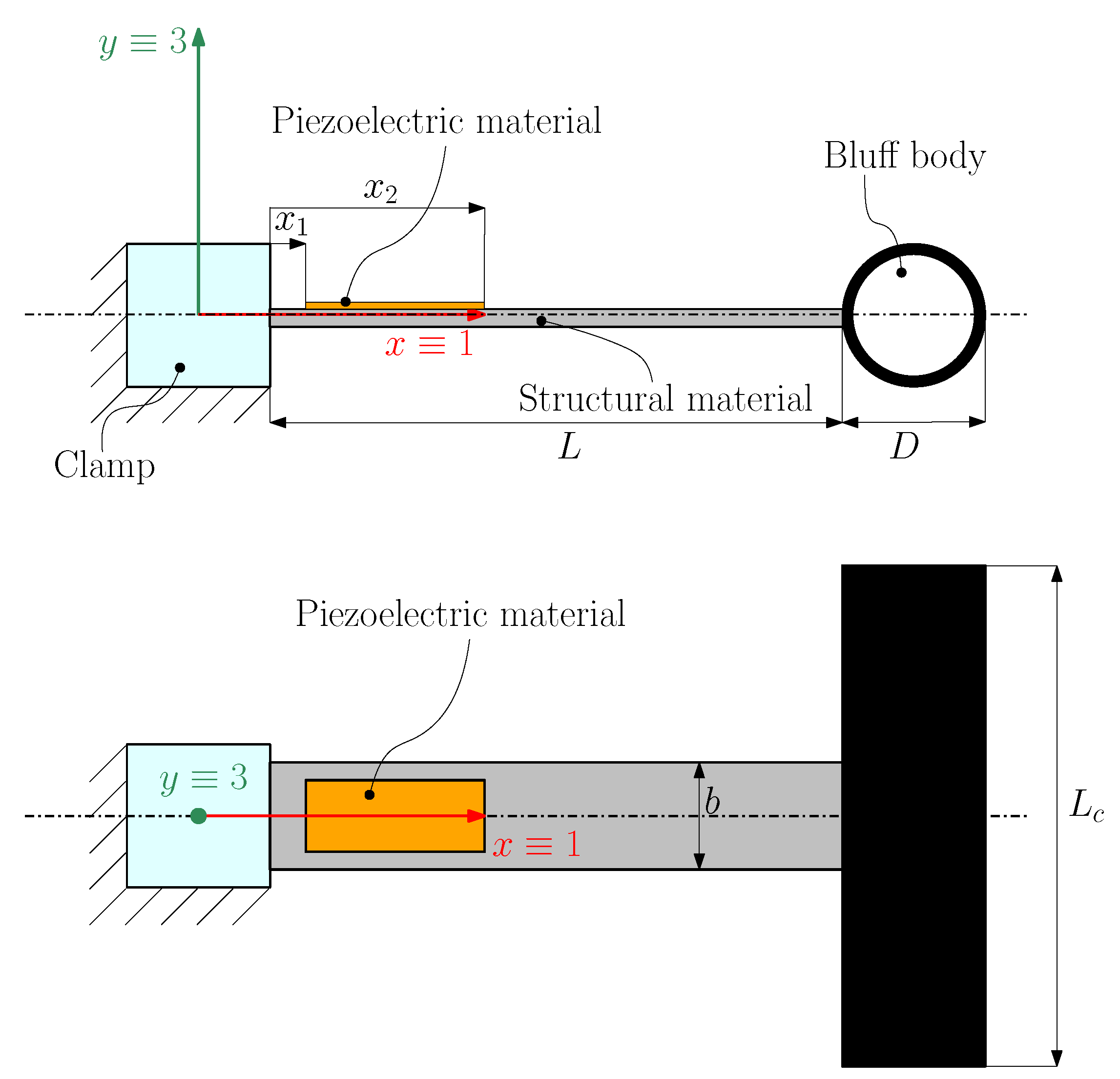
Figure 2.
Test samples: (a) Patches of different lengths bonded to the aluminum cantilevers. (b) Cylindrical bluff bodies of different lengths (A - 178 mm, B - 94 mm, and C - 65 mm).
Figure 2.
Test samples: (a) Patches of different lengths bonded to the aluminum cantilevers. (b) Cylindrical bluff bodies of different lengths (A - 178 mm, B - 94 mm, and C - 65 mm).
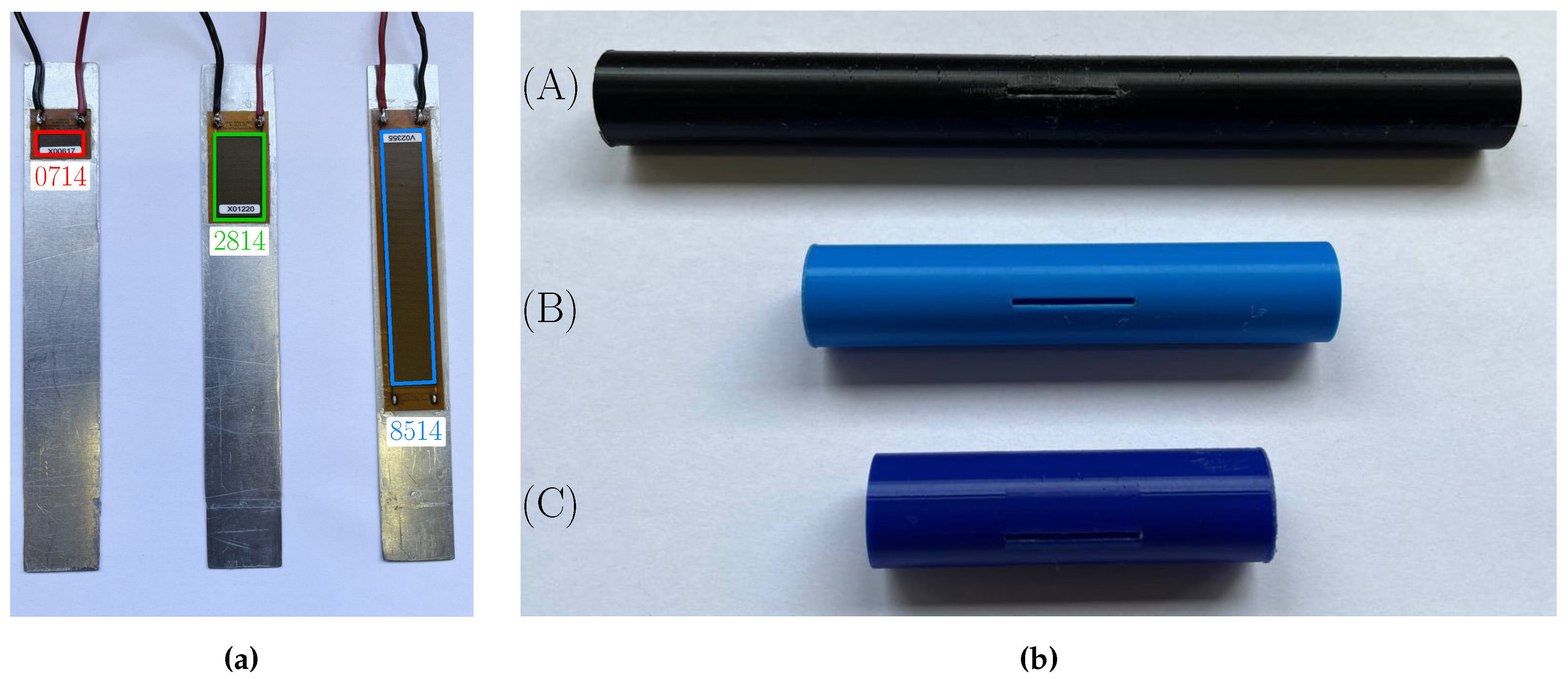
Figure 3.
(a) Effect of patch length and damping on the OCV, and (b) the energy generated by the cantilever harvester according to the electromechanical model per unit tip force applied at resonance. Patch start: 8 mm.
Figure 3.
(a) Effect of patch length and damping on the OCV, and (b) the energy generated by the cantilever harvester according to the electromechanical model per unit tip force applied at resonance. Patch start: 8 mm.
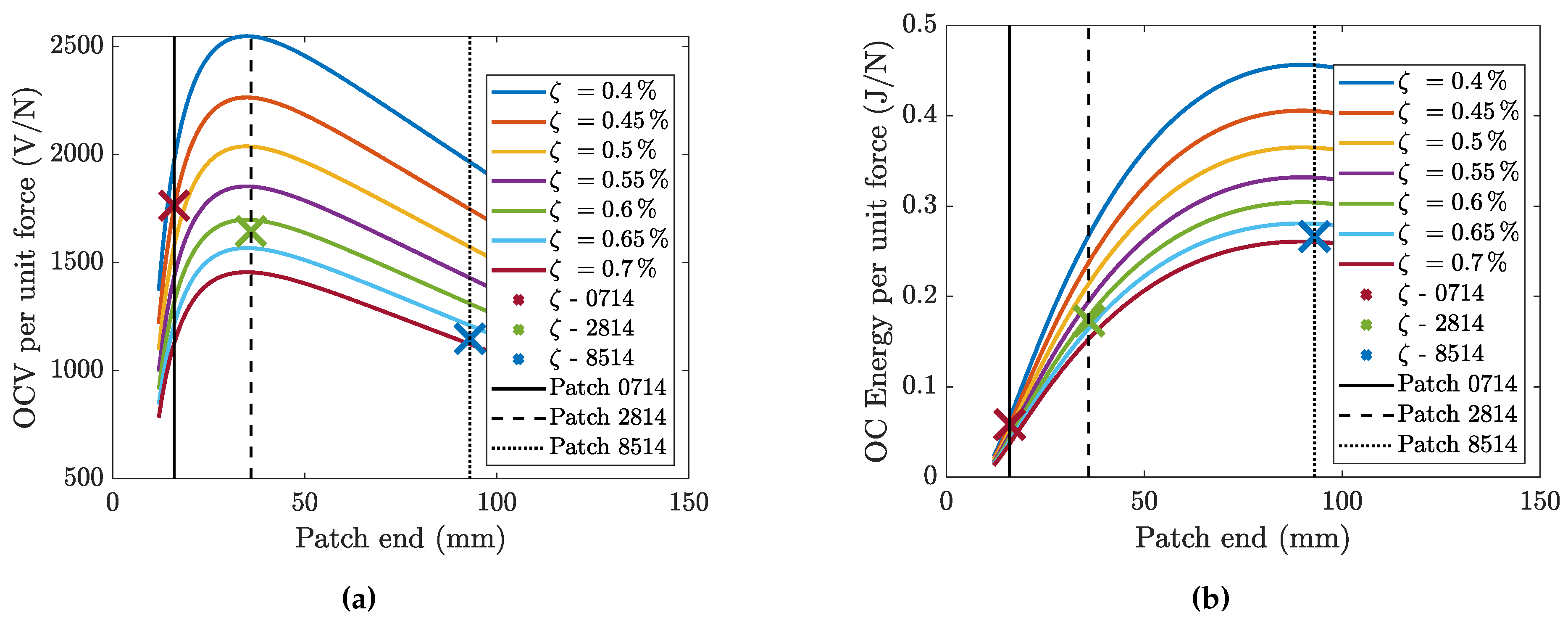
Figure 4.
Experimental setup for the impulsive characterization of the harvesters.
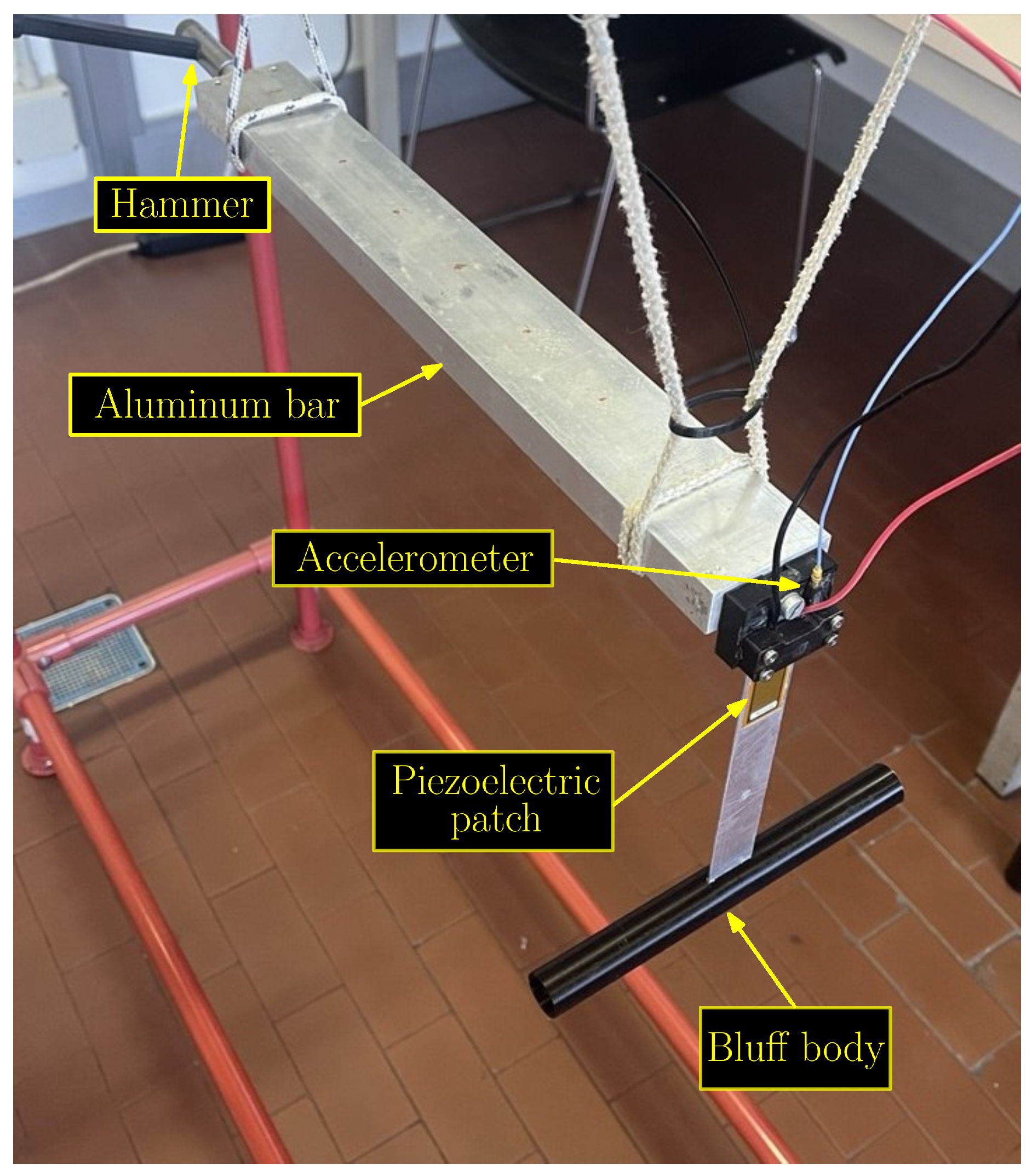
Figure 5.
(a) Example of voltage signal (hammer hit 3 g, patch 2814, cylinder with mass 10 grams (hereafter gr) and length 178 mm) with peaks used for the calculation of the damping ratio (a), and (b) FRF (Magnitude) between the OCV and the base acceleration.
Figure 5.
(a) Example of voltage signal (hammer hit 3 g, patch 2814, cylinder with mass 10 grams (hereafter gr) and length 178 mm) with peaks used for the calculation of the damping ratio (a), and (b) FRF (Magnitude) between the OCV and the base acceleration.
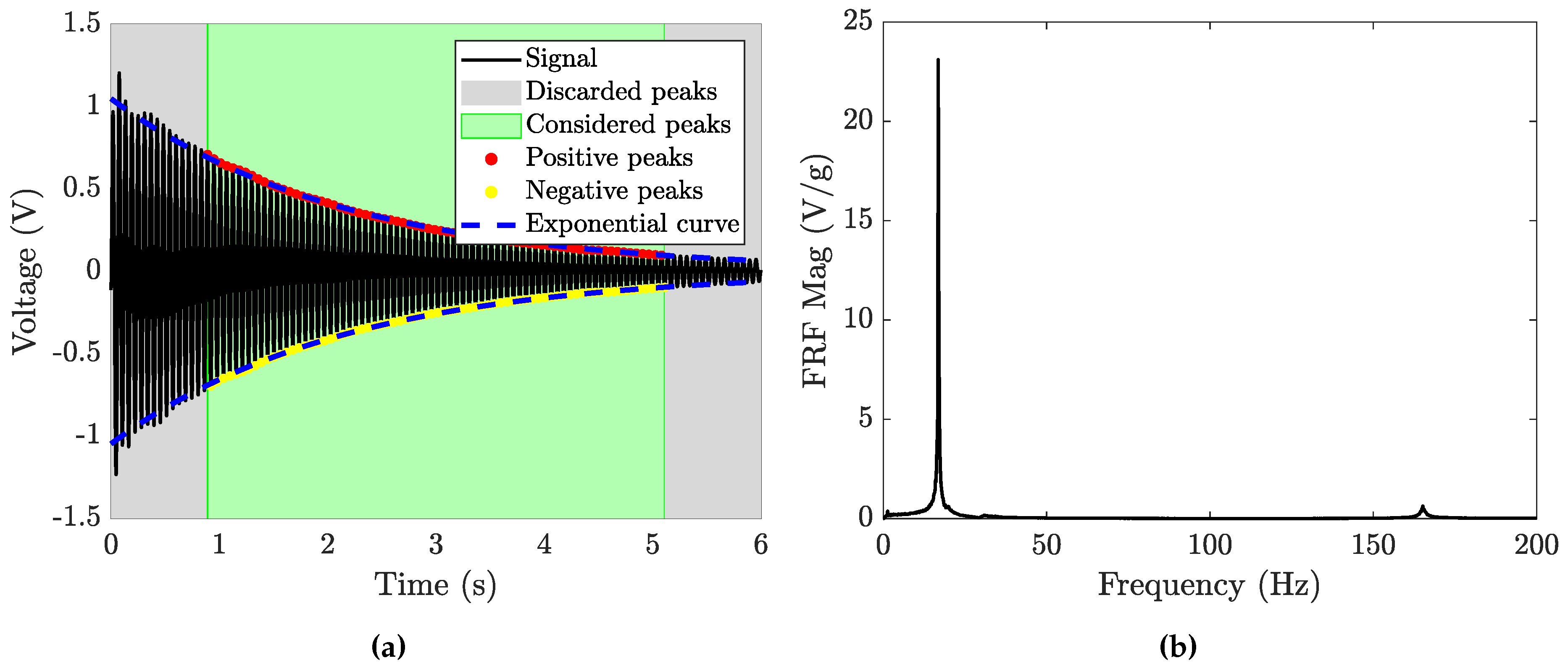
Figure 6.
Damping trend of the three patches obtained with different excitation amplitude (2 g, 3 g, 4 g, and 9 g).
Figure 6.
Damping trend of the three patches obtained with different excitation amplitude (2 g, 3 g, 4 g, and 9 g).
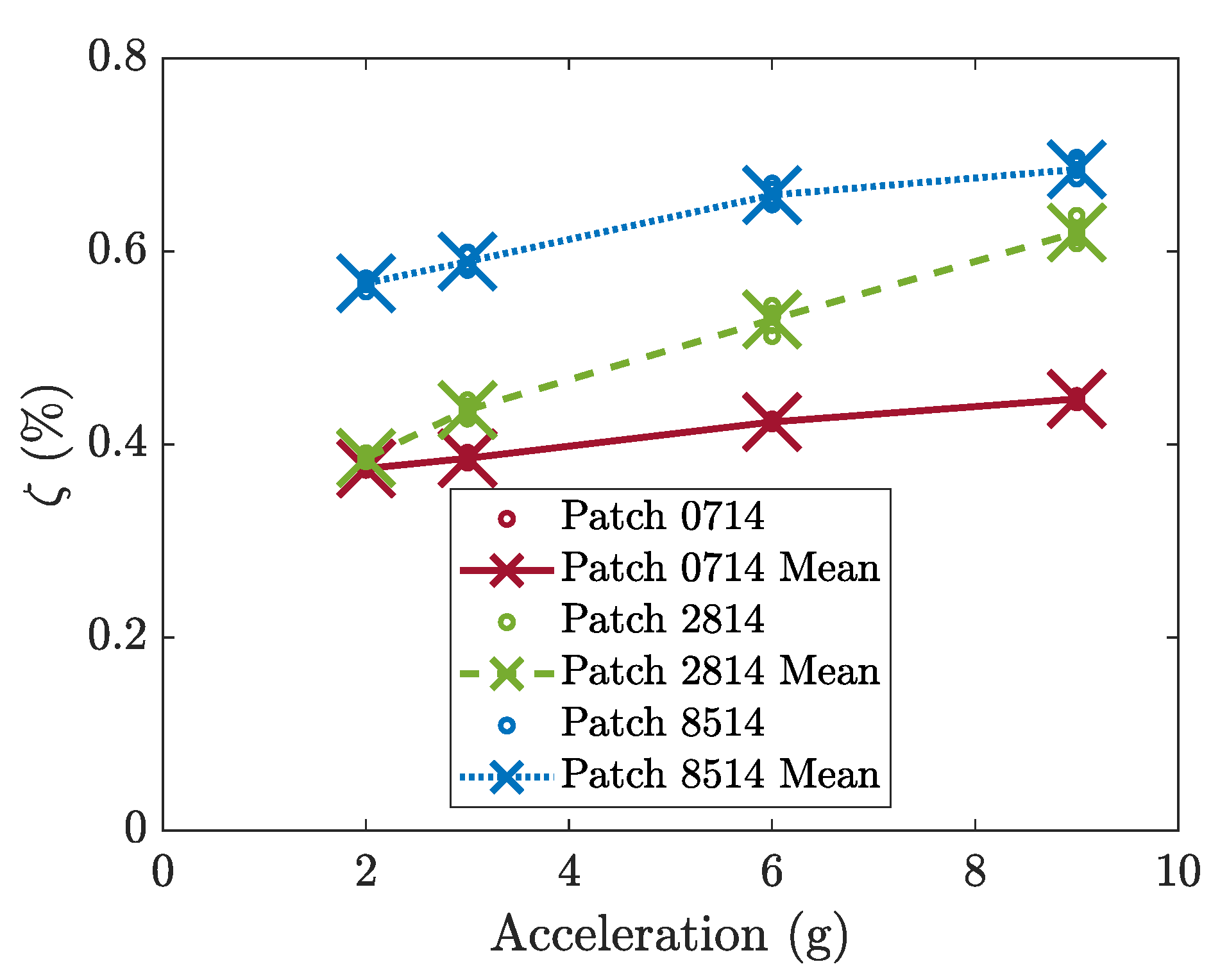
Figure 7.
(a) Damping values of the same cantilever (with patch 2814) equipped with three cylinders with different lengths, and (b) of the same cantilever equipped with five cylinders with different masses. (Both with an excitation amplitude equal to 3 g).
Figure 7.
(a) Damping values of the same cantilever (with patch 2814) equipped with three cylinders with different lengths, and (b) of the same cantilever equipped with five cylinders with different masses. (Both with an excitation amplitude equal to 3 g).
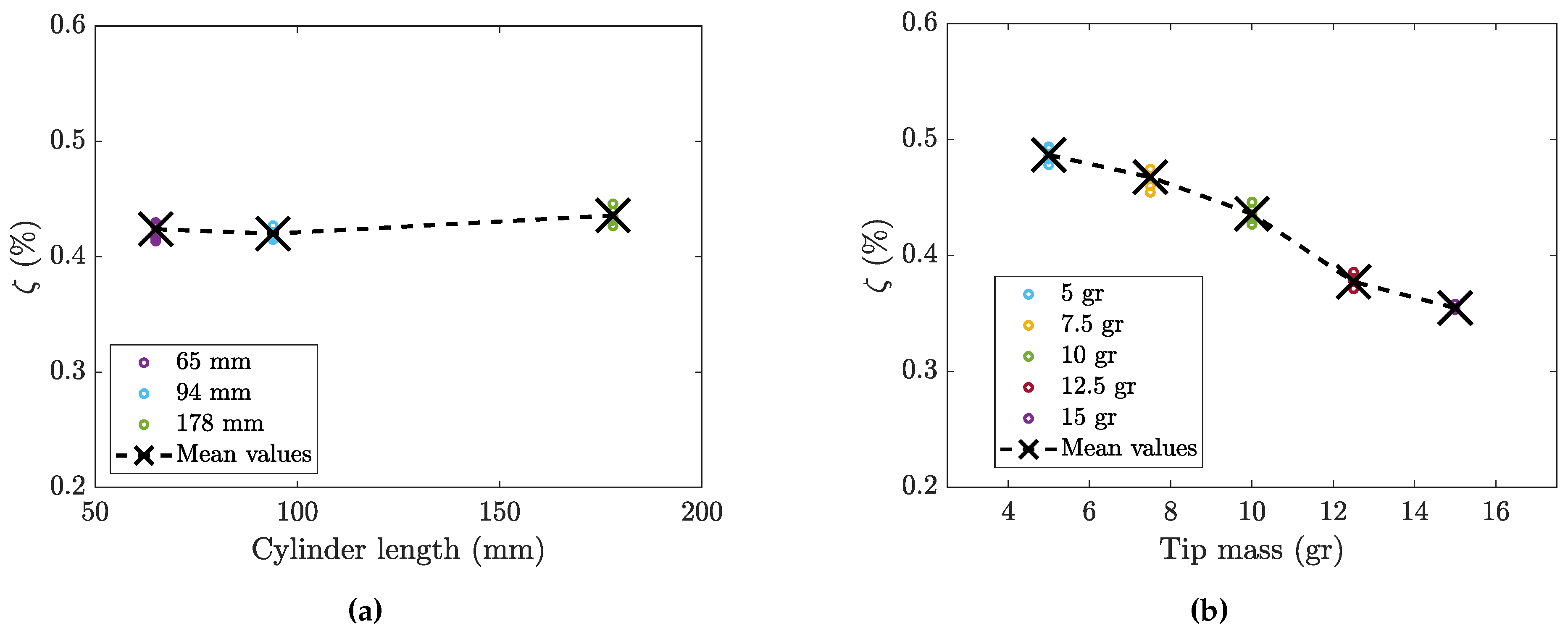
Figure 8.
Wind harvester inside the wind tunnel (top view).
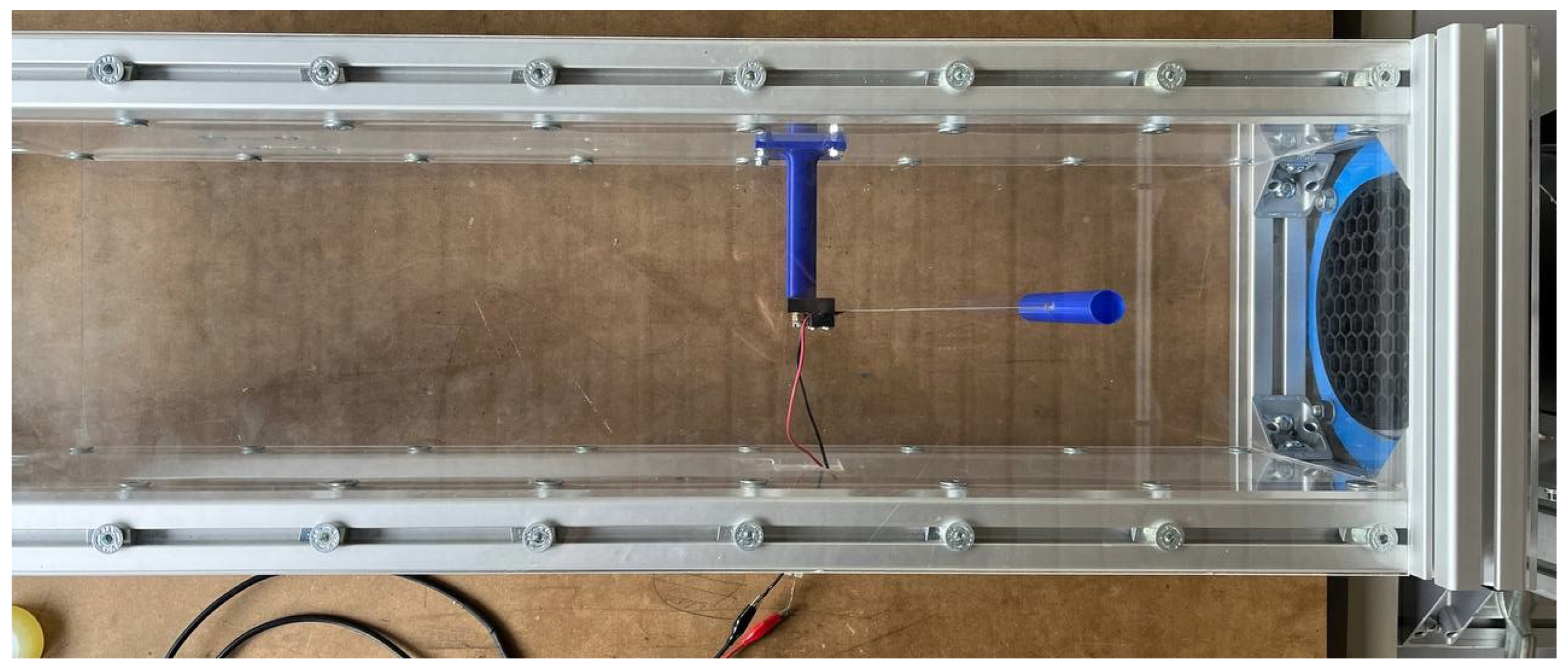
Figure 9.
(a) Time domain OCV at pre lock-in, lock-in, and post lock-in for the patch 2814 with 10 gr cylinder (length 178 mm), and (b) the corresponding FFT of the three voltage signals.
Figure 9.
(a) Time domain OCV at pre lock-in, lock-in, and post lock-in for the patch 2814 with 10 gr cylinder (length 178 mm), and (b) the corresponding FFT of the three voltage signals.
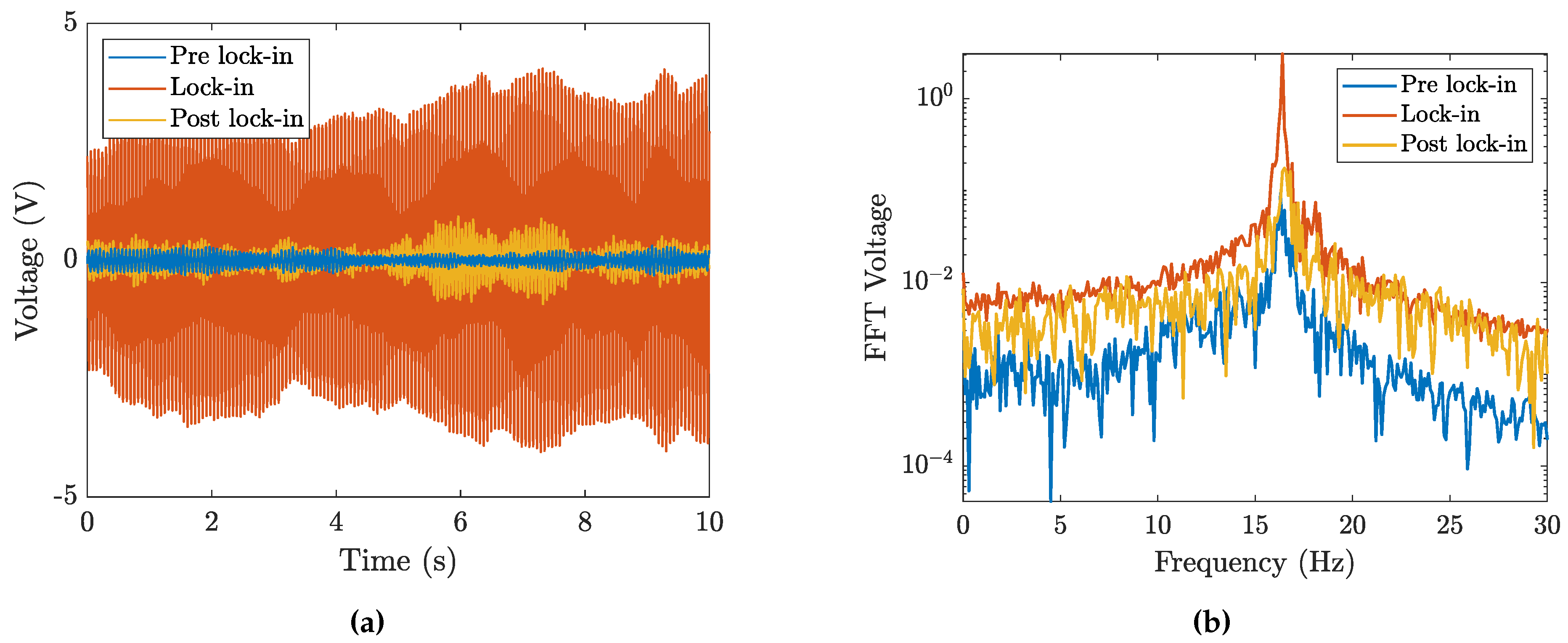
Figure 10.
Wind tunnel tests. (a) RMS value of OCV generated by the three prototypes with different patches, and (b) corresponding energy.
Figure 10.
Wind tunnel tests. (a) RMS value of OCV generated by the three prototypes with different patches, and (b) corresponding energy.
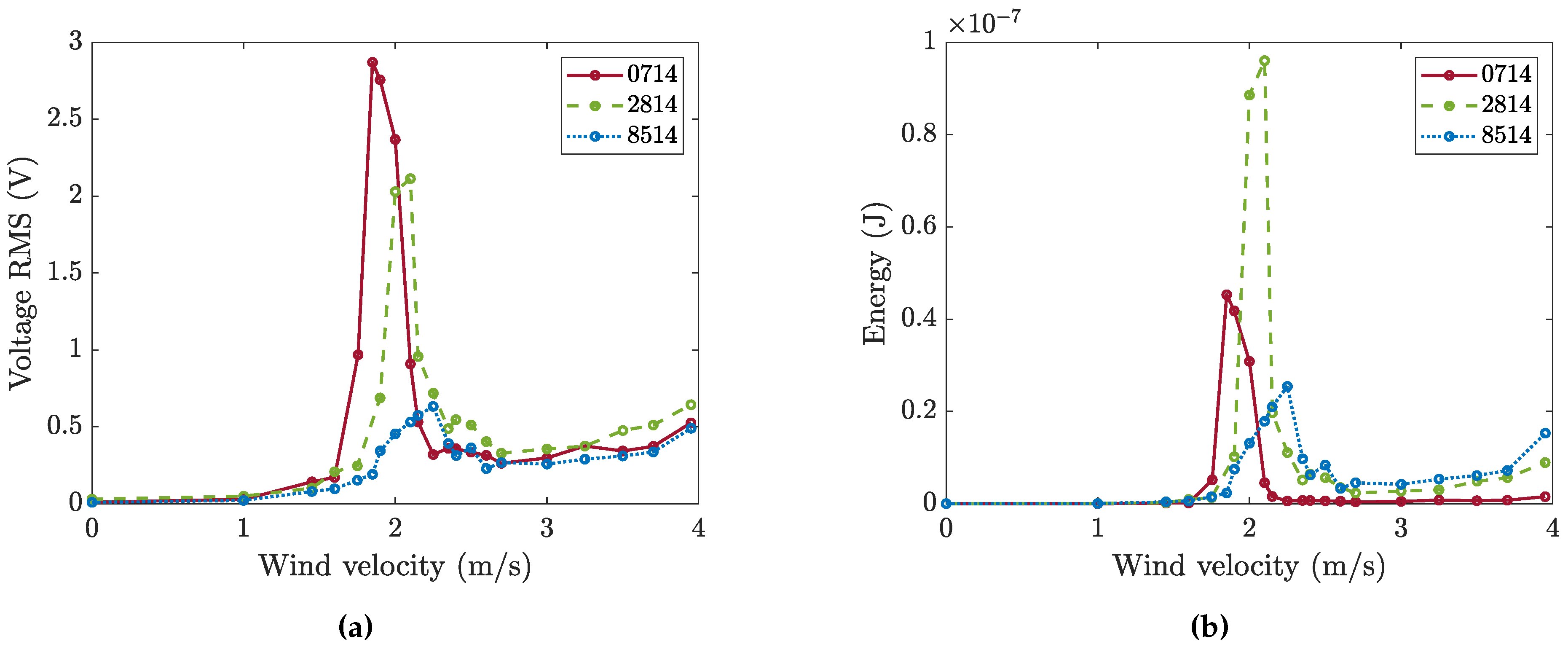
Figure 11.
Dimensionless voltage against Skop-Griffin number for harvester with different patches.
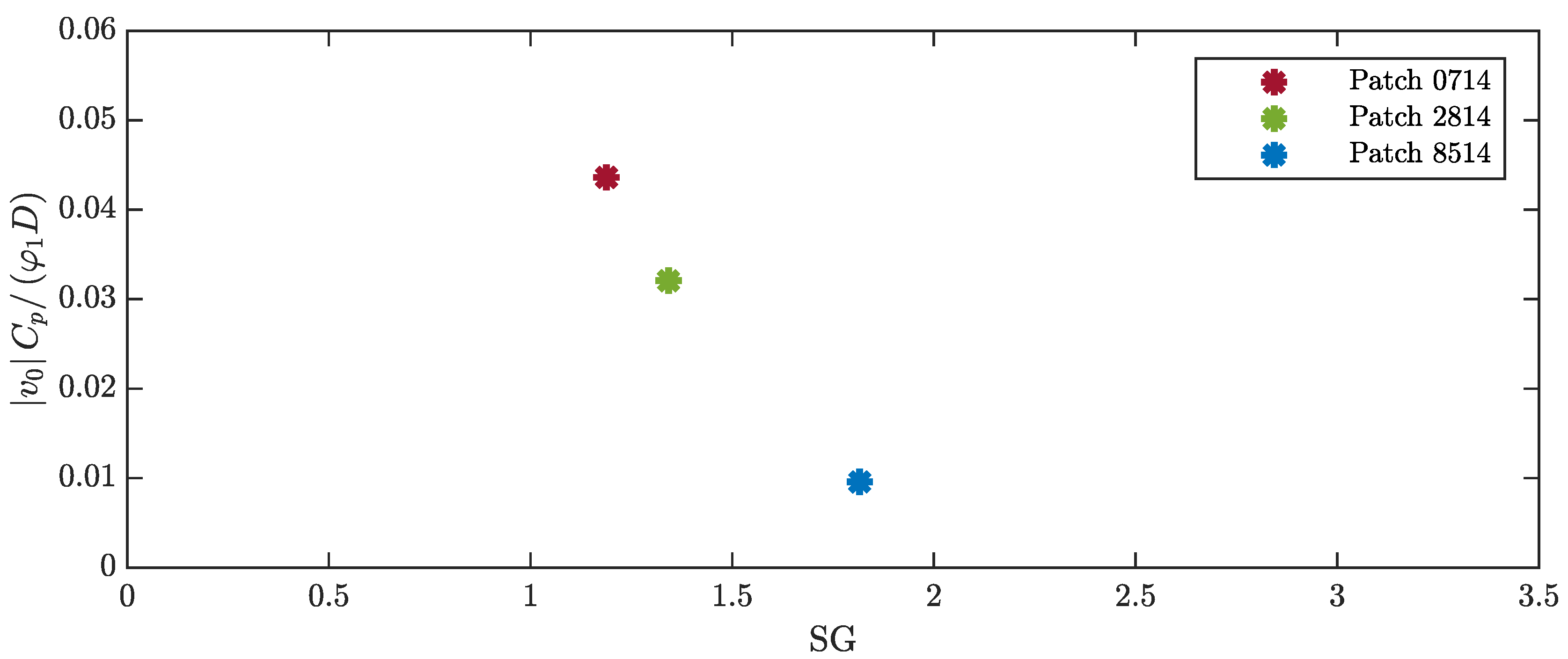
Figure 12.
Wind tunnel tests. (a) RMS value of OCV generated by the patch 2814 using three cylinders with different lengths, and (b) corresponding energy.
Figure 12.
Wind tunnel tests. (a) RMS value of OCV generated by the patch 2814 using three cylinders with different lengths, and (b) corresponding energy.
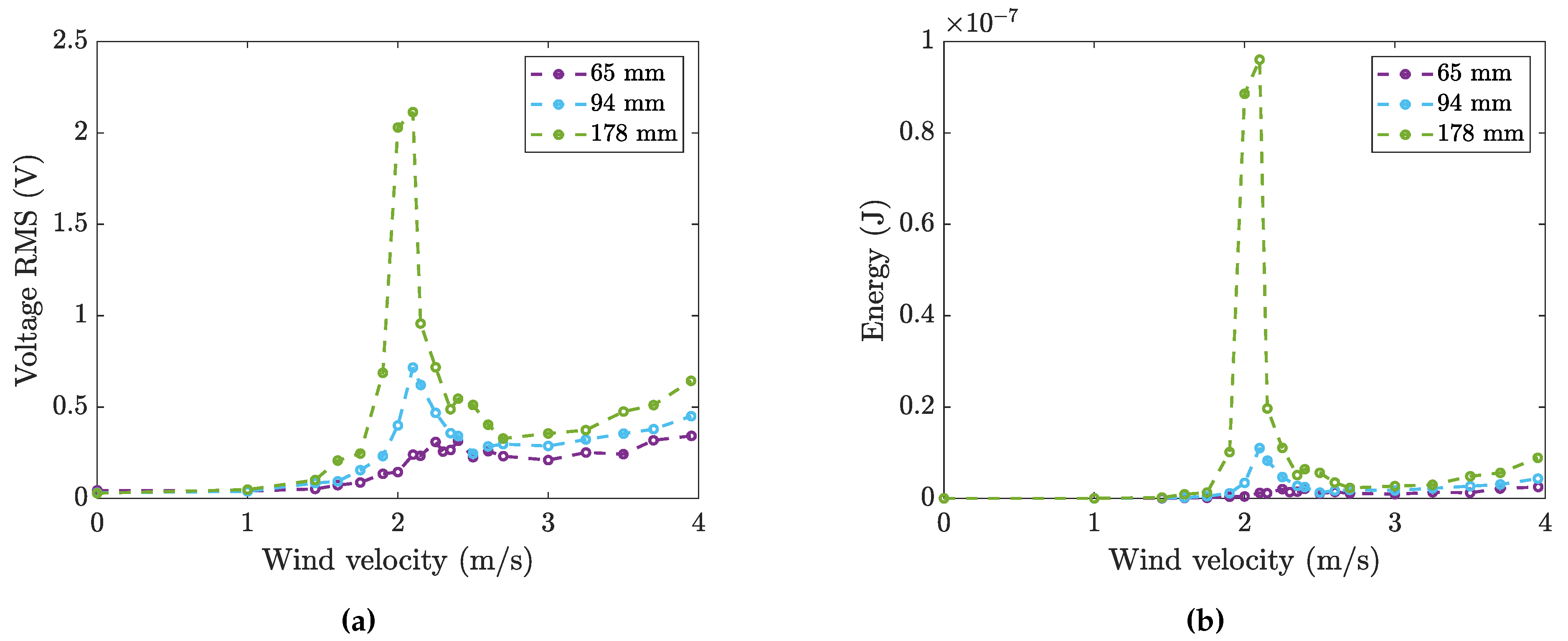
Figure 13.
Dimensionless voltage against Skop-Griffin number for harvester with different cylinder lengths.
Figure 13.
Dimensionless voltage against Skop-Griffin number for harvester with different cylinder lengths.
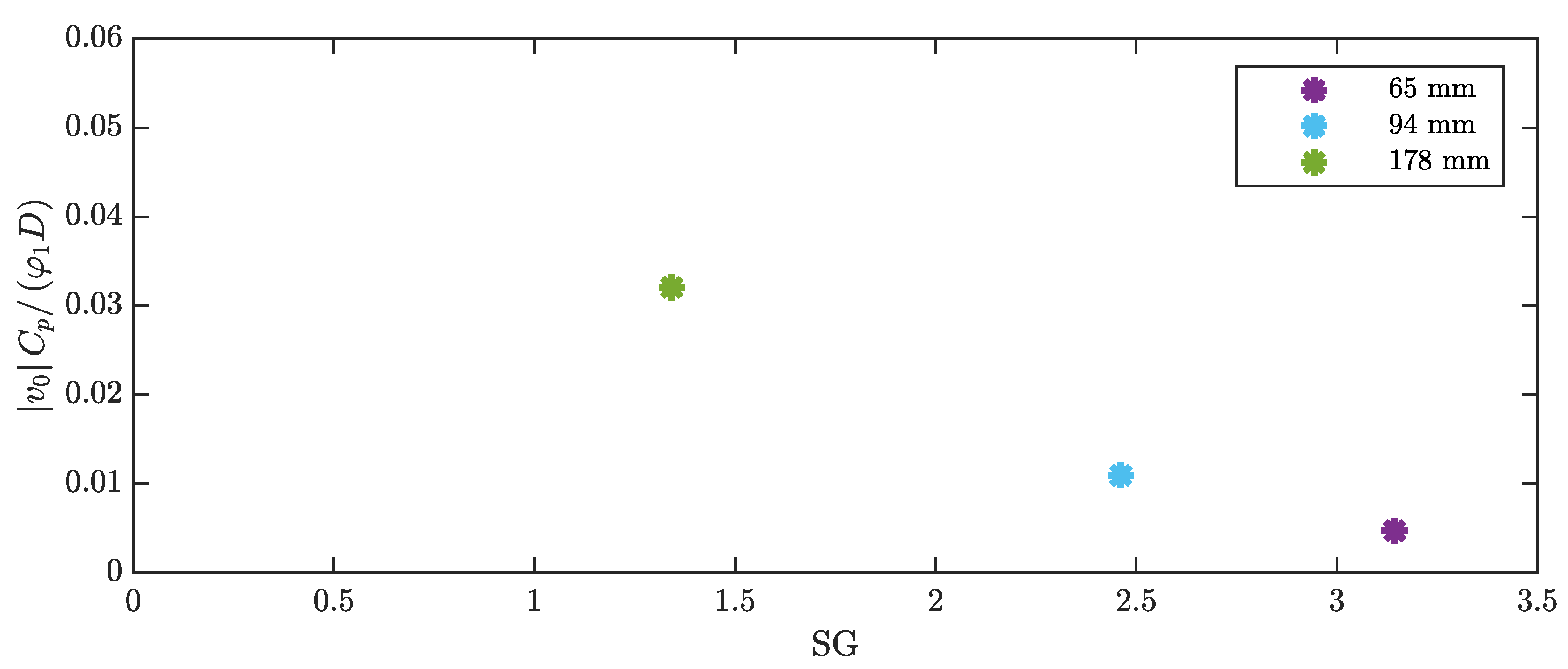
Figure 14.
Wind tunnel tests. (a) RMS value of OCV generated by the patch 2814 using three cylinders with different masses, and (b) corresponding energy.
Figure 14.
Wind tunnel tests. (a) RMS value of OCV generated by the patch 2814 using three cylinders with different masses, and (b) corresponding energy.
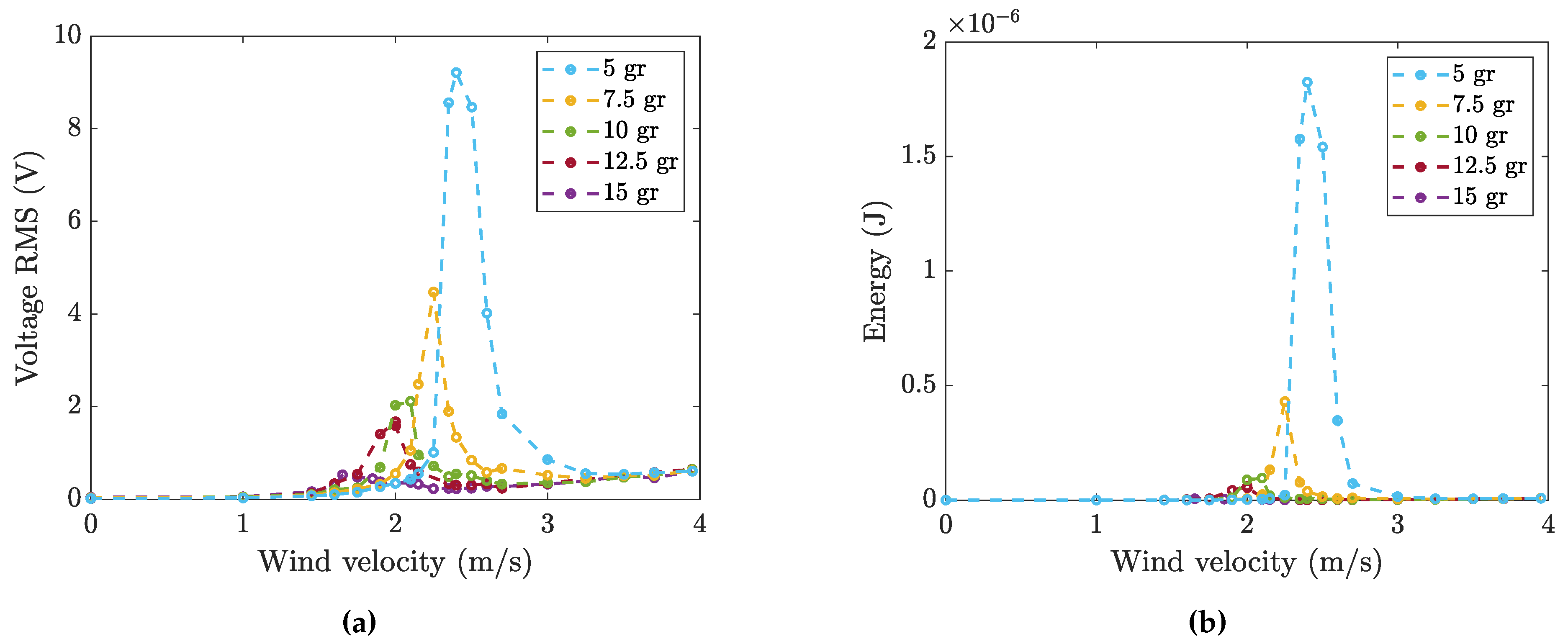
Figure 15.
Dimensionless voltage against Skop-Griffin number for harvester with different cylinder masses.
Figure 15.
Dimensionless voltage against Skop-Griffin number for harvester with different cylinder masses.
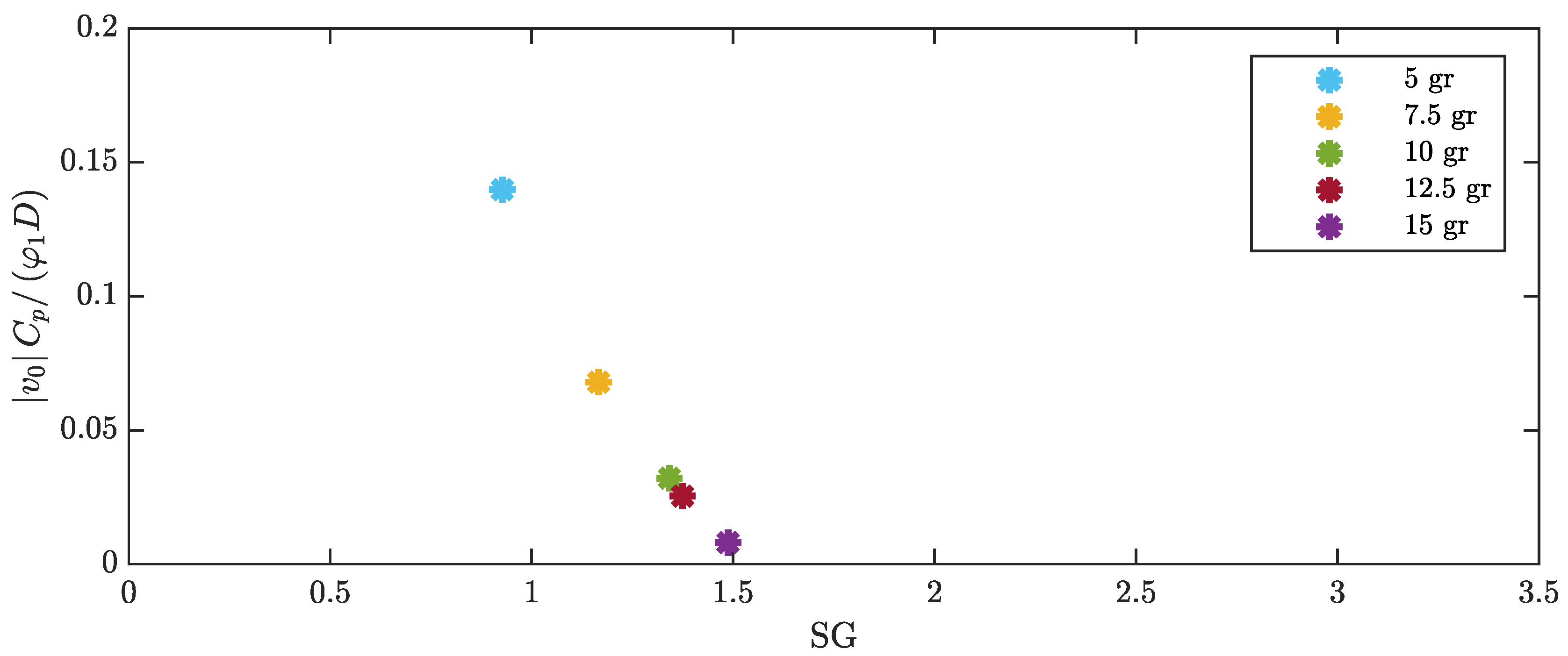

Table 1.
Summary of the natural frequencies and damping ratios of the three harvesters equipped with three different patches and the same cylindrical bluff body (length 178 mm, diameter 19 mm, mass 10 gr). These values of the damping ratios refer to the tests carried out with an excitation level equal to 9 g.
Table 1.
Summary of the natural frequencies and damping ratios of the three harvesters equipped with three different patches and the same cylindrical bluff body (length 178 mm, diameter 19 mm, mass 10 gr). These values of the damping ratios refer to the tests carried out with an excitation level equal to 9 g.
| Patch 0714 | Patch 2814 | Patch 8514 | |
|---|---|---|---|
| Hz) | 16.0 | 16.8 | 19.2 |
| 0.45 | 0.62 | 0.68 |
Table 2.
Geometrical parameters and mass ratio of the cylindrical bluff bodies with different lengths.
Table 2.
Geometrical parameters and mass ratio of the cylindrical bluff bodies with different lengths.
| Cylinder Length | 65 mm | 94 mm | 178 mm |
|---|---|---|---|
| AR | 3.4 | 5.0 | 9.4 |
| 0.32 | 0.22 | 0.12 | |
| mass ratio | ∼570 | ∼430 | ∼210 |
Table 3.
Natural frequency measured in the wind tunnel and mass ratio of the harvester equipped with cylindrical bluff bodies of different mass.
Table 3.
Natural frequency measured in the wind tunnel and mass ratio of the harvester equipped with cylindrical bluff bodies of different mass.
| Cylinder Mass | 5 gr | 7.5 gr | 10 gr | 12.5 gr | 15 gr |
|---|---|---|---|---|---|
| (Hz) | 20.7 | 18.1 | 16.8 | 15.1 | 14.1 |
| mass ratio | ∼130 | ∼170 | ∼210 | ∼250 | ∼290 |
Disclaimer/Publisher’s Note: The statements, opinions and data contained in all publications are solely those of the individual author(s) and contributor(s) and not of MDPI and/or the editor(s). MDPI and/or the editor(s) disclaim responsibility for any injury to people or property resulting from any ideas, methods, instructions or products referred to in the content. |
© 2024 by the authors. Licensee MDPI, Basel, Switzerland. This article is an open access article distributed under the terms and conditions of the Creative Commons Attribution (CC BY) license (http://creativecommons.org/licenses/by/4.0/).
Copyright: This open access article is published under a Creative Commons CC BY 4.0 license, which permit the free download, distribution, and reuse, provided that the author and preprint are cited in any reuse.


